Cambridge A Level Chemistry 9701 — 2010 May/June Paper 2 · Variant 3
9701/23/M/J/10 · 60 marks · ≈68 min
The question paper and its mark scheme, free to read here and free to download. This is Cambridge’s own paper, exactly as it was sat.
Question paper12 pages
Mark scheme5 pages
Answers below. Sit the paper first if you are practising.
Paper as text
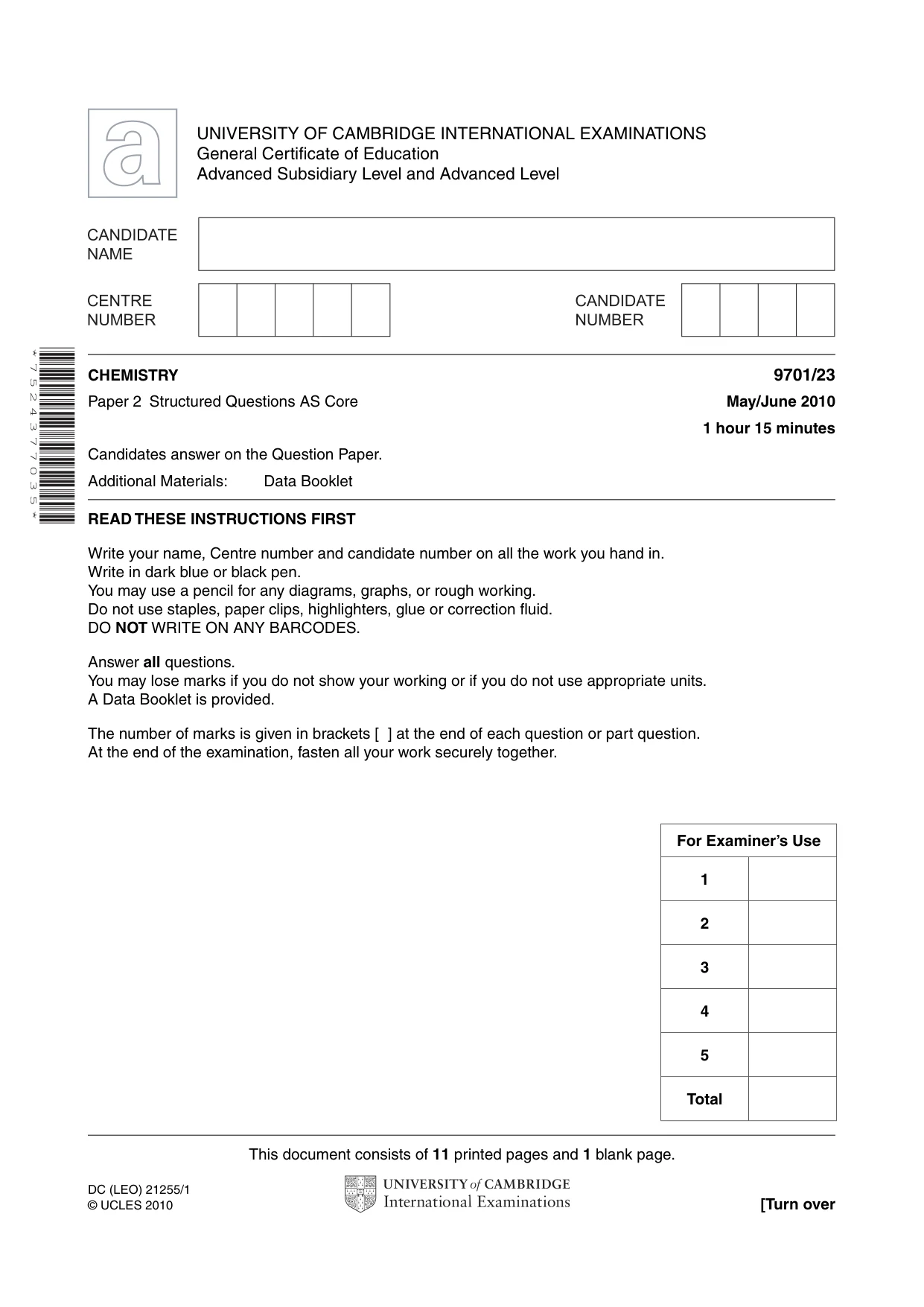
Question paper, page 1
This document consists of 11 printed pages and 1 blank page. DC (LEO) 21255/1 © UCLES 2010 [Turn over UNIVERSITY OF CAMBRIDGE INTERNATIONAL EXAMINATIONS General Certificate of Education Advanced Subsidiary Level and Advanced Level READ THESE INSTRUCTIONS FIRST Write your name, Centre number and candidate number on all the work you hand in. Write in dark blue or black pen. You may use a pencil for any diagrams, graphs, or rough working. Do not use staples, paper clips, highlighters, glue or correction fluid. DO NOT WRITE ON ANY BARCODES. Answer all questions. You may lose marks if you do not show your working or if you do not use appropriate units. A Data Booklet is provided. The number of marks is given in brackets [ ] at the end of each question or part question. At the end of the examination, fasten all your work securely together. * 7 5 2 4 3 7 7 0 3 5 * CHEMISTRY 9701/23 Paper 2 Structured Questions AS Core May/June 2010 1 hour 15 minutes Candidates answer on the Question Paper. Additional Materials: Data Booklet For Examiner’s Use 1 2 3 4 5 Total
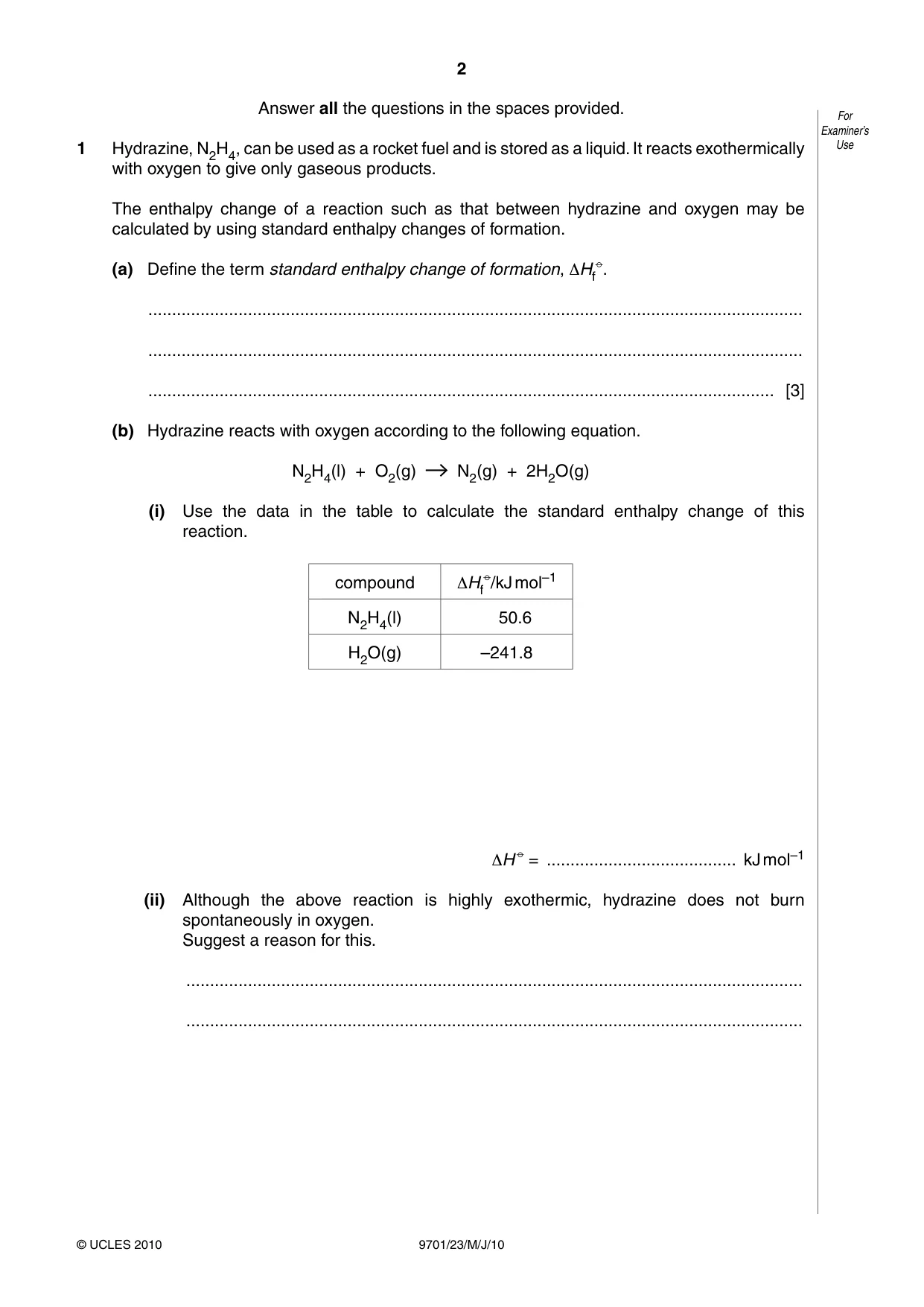
Question paper, page 2
2 9701/23/M/J/10 © UCLES 2010 For Examiner’s Use Answer all the questions in the spaces provided. 1 Hydrazine, N2H4, can be used as a rocket fuel and is stored as a liquid. It reacts exothermically with oxygen to give only gaseous products. The enthalpy change of a reaction such as that between hydrazine and oxygen may be calculated by using standard enthalpy changes of formation. (a) Define the term standard enthalpy change of formation, ΔHf . … … … [3] (b) Hydrazine reacts with oxygen according to the following equation. N2H4(l) + O2(g) N2(g) + 2H2O(g) (i) Use the data in the table to calculate the standard enthalpy change of this reaction. compound ΔHf /kJ mol–1 N2H4(l) 50.6 H2O(g) –241.8 ΔH = … kJ mol–1 (ii) Although the above reaction is highly exothermic, hydrazine does not burn spontaneously in oxygen. Suggest a reason for this. … …
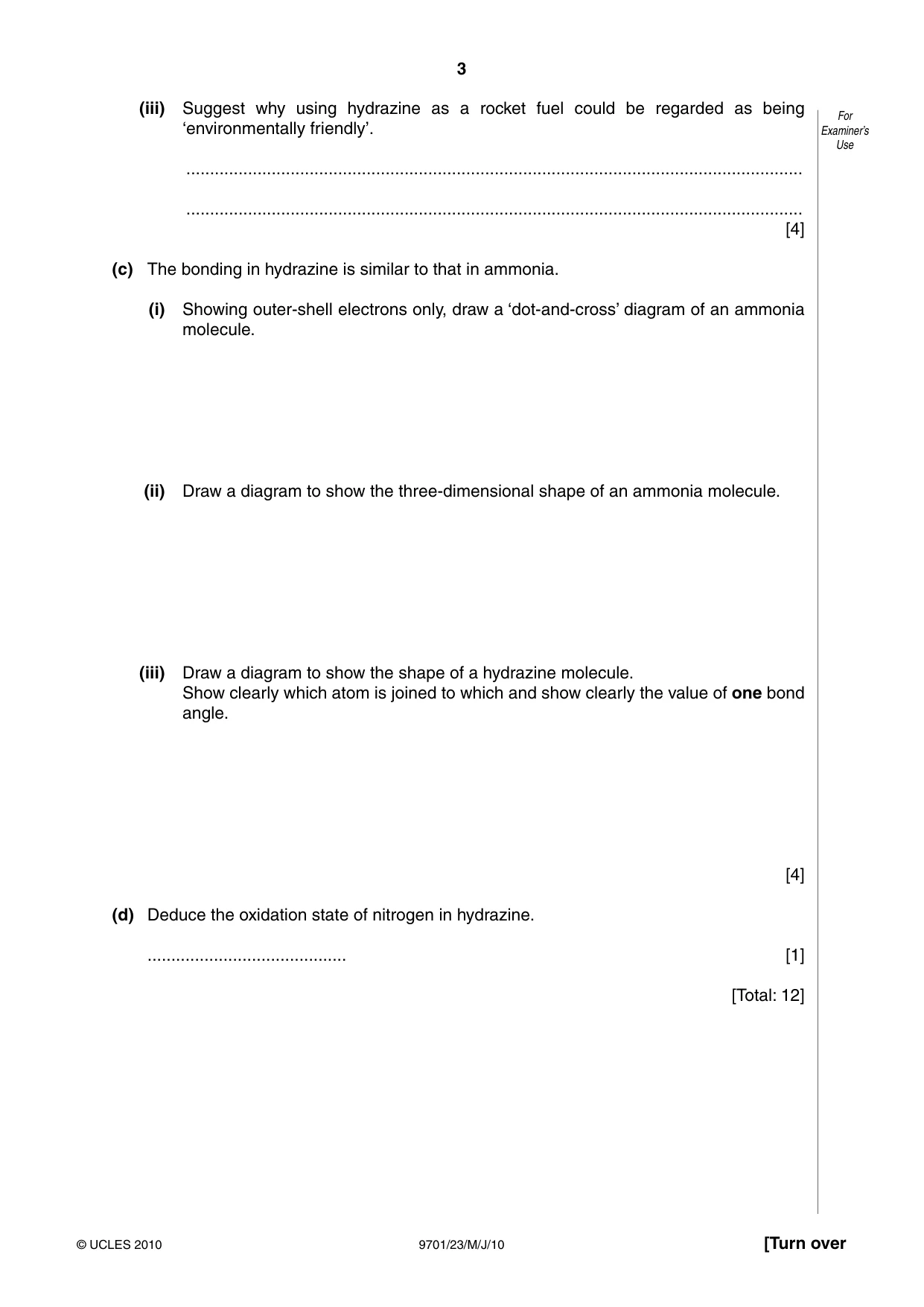
Question paper, page 3
3 9701/23/M/J/10 © UCLES 2010 [Turn over For Examiner’s Use (iii) Suggest why using hydrazine as a rocket fuel could be regarded as being ‘environmentally friendly’. … … [4] (c) The bonding in hydrazine is similar to that in ammonia. (i) Showing outer-shell electrons only, draw a ‘dot-and-cross’ diagram of an ammonia molecule. (ii) Draw a diagram to show the three-dimensional shape of an ammonia molecule. (iii) Draw a diagram to show the shape of a hydrazine molecule. Show clearly which atom is joined to which and show clearly the value of one bond angle. [4] (d) Deduce the oxidation state of nitrogen in hydrazine. … [1] [Total: 12]
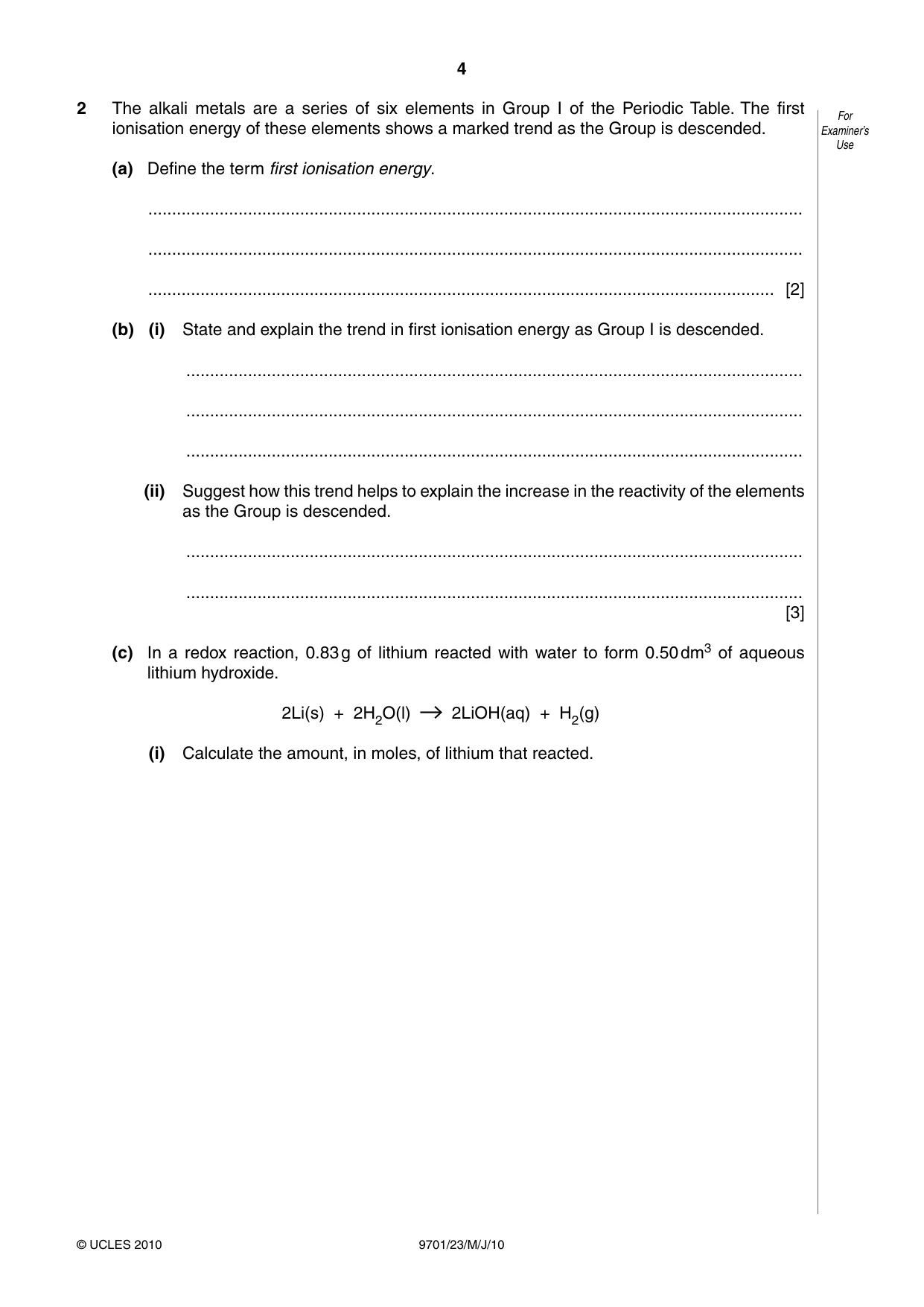
Question paper, page 4
4 9701/23/M/J/10 © UCLES 2010 For Examiner’s Use 2 The alkali metals are a series of six elements in Group I of the Periodic Table. The first ionisation energy of these elements shows a marked trend as the Group is descended. (a) Define the term first ionisation energy. … … … [2] (b) (i) State and explain the trend in first ionisation energy as Group I is descended. … … … (ii) Suggest how this trend helps to explain the increase in the reactivity of the elements as the Group is descended. … … [3] (c) In a redox reaction, 0.83 g of lithium reacted with water to form 0.50 dm3 of aqueous lithium hydroxide. 2Li(s) + 2H2O(l) 2LiOH(aq) + H2(g) (i) Calculate the amount, in moles, of lithium that reacted.
Question paper, page 5
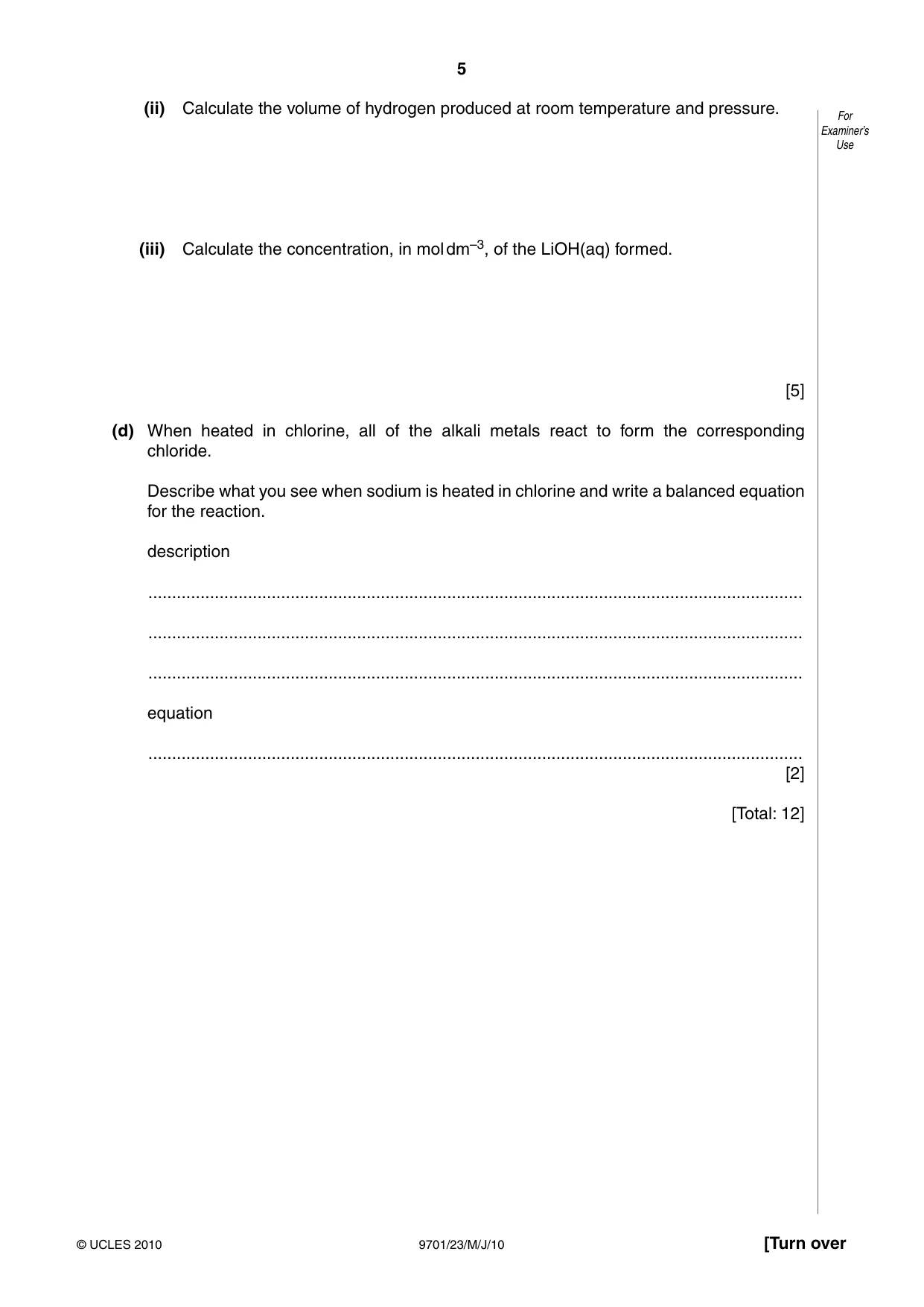
5 9701/23/M/J/10 © UCLES 2010 [Turn over For Examiner’s Use (ii) Calculate the volume of hydrogen produced at room temperature and pressure. (iii) Calculate the concentration, in mol dm–3, of the LiOH(aq) formed. [5] (d) When heated in chlorine, all of the alkali metals react to form the corresponding chloride. Describe what you see when sodium is heated in chlorine and write a balanced equation for the reaction. description … … … equation … [2] [Total: 12]
Question paper, page 6
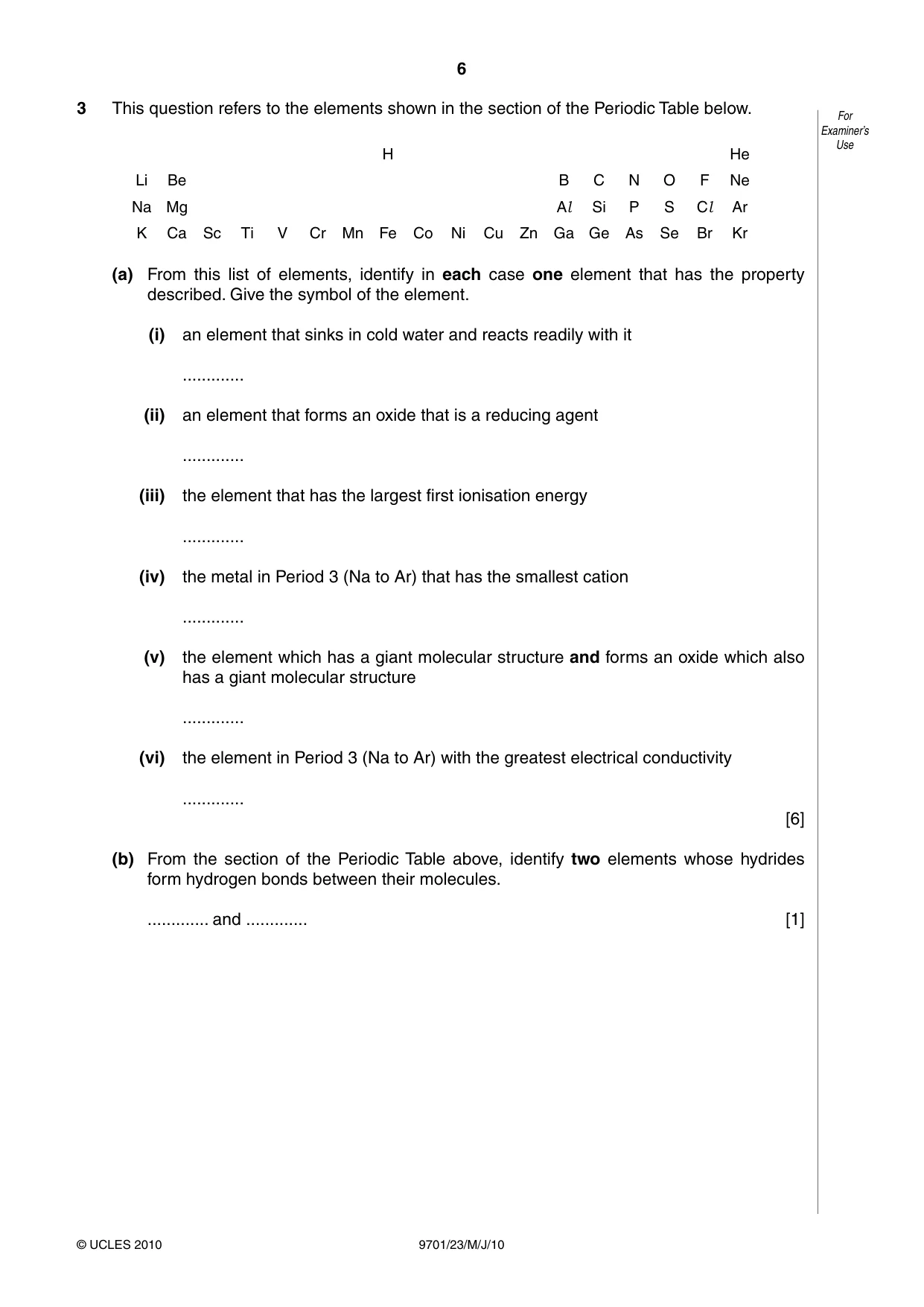
6 9701/23/M/J/10 © UCLES 2010 For Examiner’s Use 3 This question refers to the elements shown in the section of the Periodic Table below. H He Li Be B C N O F Ne Na Mg Al Si P S Cl Ar K Ca Sc Ti V Cr Mn Fe Co Ni Cu Zn Ga Ge As Se Br Kr (a) From this list of elements, identify in each case one element that has the property described. Give the symbol of the element. (i) an element that sinks in cold water and reacts readily with it … (ii) an element that forms an oxide that is a reducing agent … (iii) the element that has the largest first ionisation energy … (iv) the metal in Period 3 (Na to Ar) that has the smallest cation … (v) the element which has a giant molecular structure and forms an oxide which also has a giant molecular structure … (vi) the element in Period 3 (Na to Ar) with the greatest electrical conductivity … [6] (b) From the section of the Periodic Table above, identify two elements whose hydrides form hydrogen bonds between their molecules. … and … [1]
Question paper, page 7
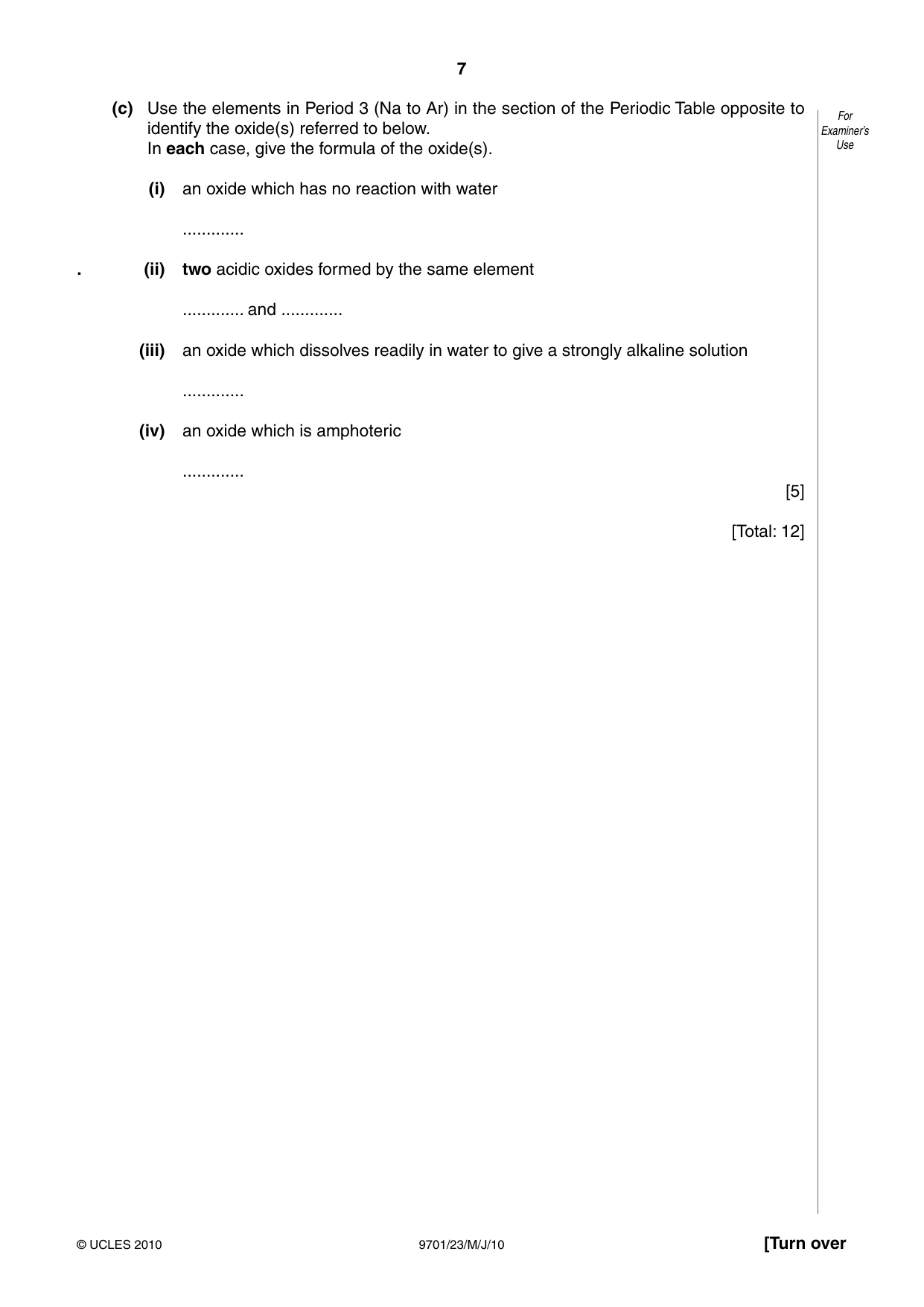
7 9701/23/M/J/10 © UCLES 2010 [Turn over For Examiner’s Use (c) Use the elements in Period 3 (Na to Ar) in the section of the Periodic Table opposite to identify the oxide(s) referred to below. In each case, give the formula of the oxide(s). (i) an oxide which has no reaction with water … . (ii) two acidic oxides formed by the same element … and … (iii) an oxide which dissolves readily in water to give a strongly alkaline solution … (iv) an oxide which is amphoteric … [5] [Total: 12]
Question paper, page 8
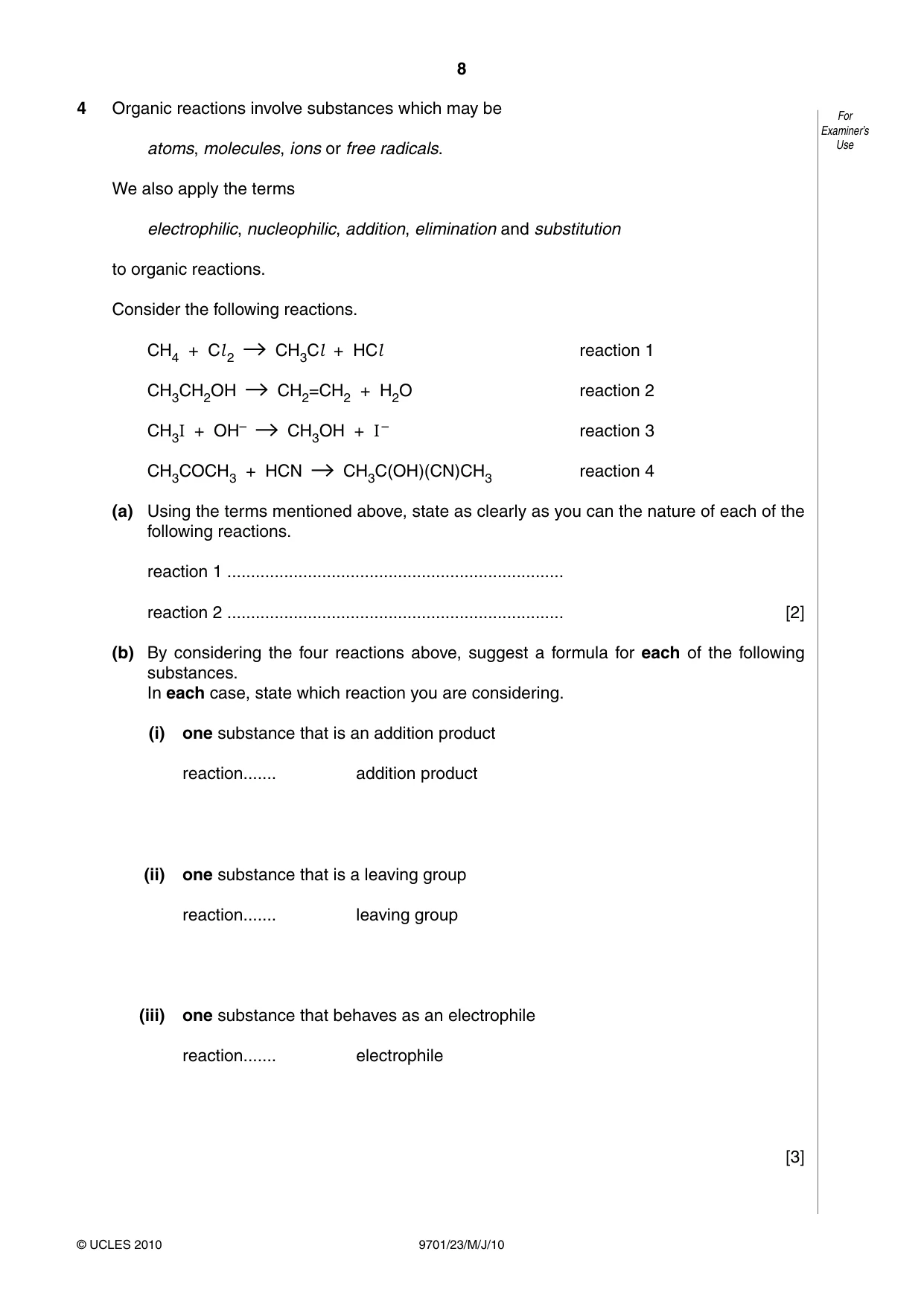
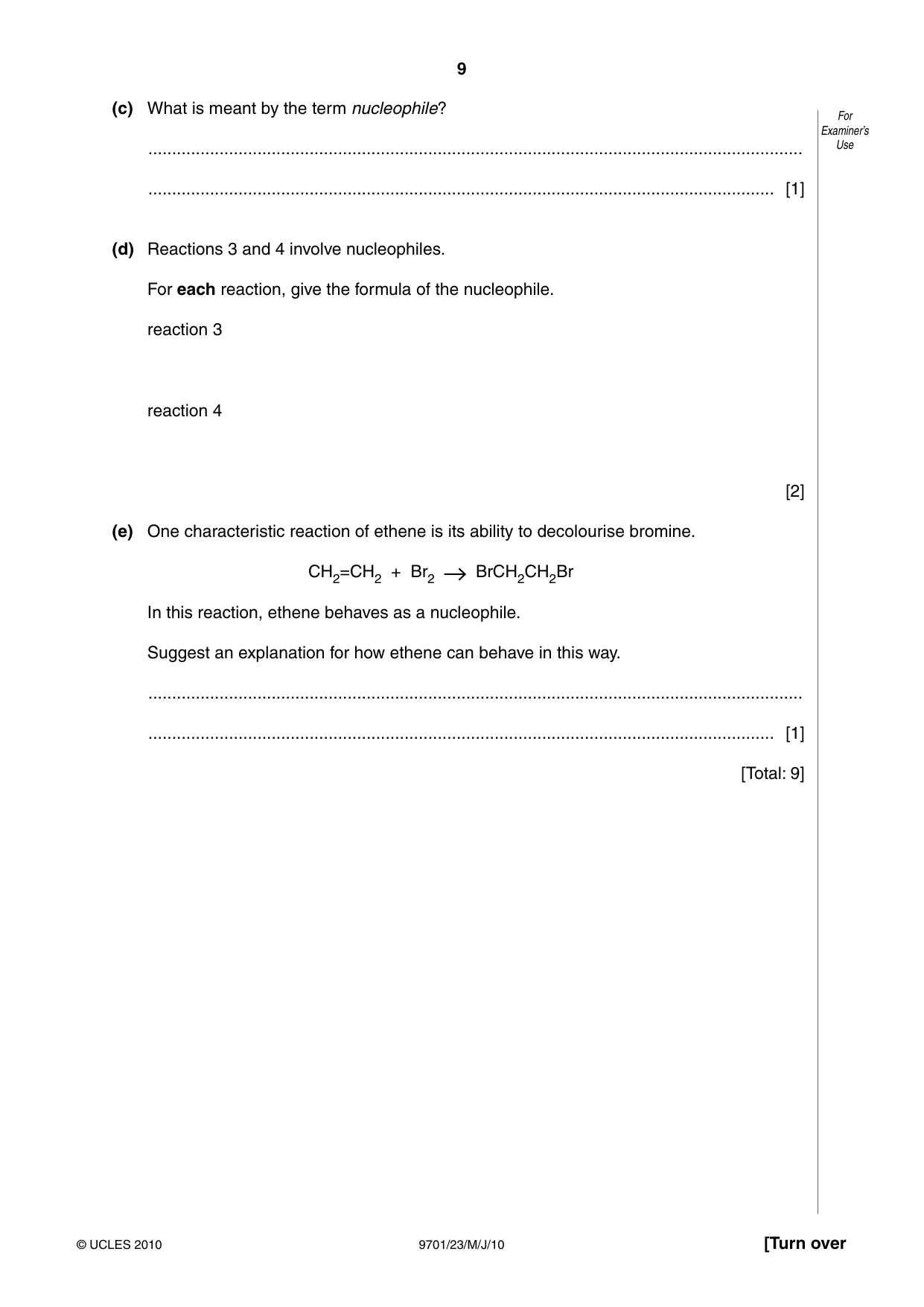
8 9701/23/M/J/10 © UCLES 2010 For Examiner’s Use 4 Organic reactions involve substances which may be atoms, molecules, ions or free radicals. We also apply the terms electrophilic, nucleophilic, addition, elimination and substitution to organic reactions. Consider the following reactions. CH4 + Cl 2 CH3Cl + HCl reaction 1 CH3CH2OH CH2=CH2 + H2O reaction 2 CH3I + OH– CH3OH + I – reaction 3 CH3COCH3 + HCN CH3C(OH)(CN)CH3 reaction 4 (a) Using the terms mentioned above, state as clearly as you can the nature of each of the following reactions. reaction 1 … reaction 2 … [2] (b) By considering the four reactions above, suggest a formula for each of the following substances. In each case, state which reaction you are considering. (i) one substance that is an addition product reaction… addition product (ii) one substance that is a leaving group reaction… leaving group (iii) one substance that behaves as an electrophile reaction… electrophile [3]
Question paper, page 9
9 9701/23/M/J/10 © UCLES 2010 [Turn over For Examiner’s Use (c) What is meant by the term nucleophile? … … [1] (d) Reactions 3 and 4 involve nucleophiles. For each reaction, give the formula of the nucleophile. reaction 3 reaction 4 [2] (e) One characteristic reaction of ethene is its ability to decolourise bromine. CH2=CH2 + Br2 BrCH2CH2Br In this reaction, ethene behaves as a nucleophile. Suggest an explanation for how ethene can behave in this way. … … [1] [Total: 9]
Question paper, page 10
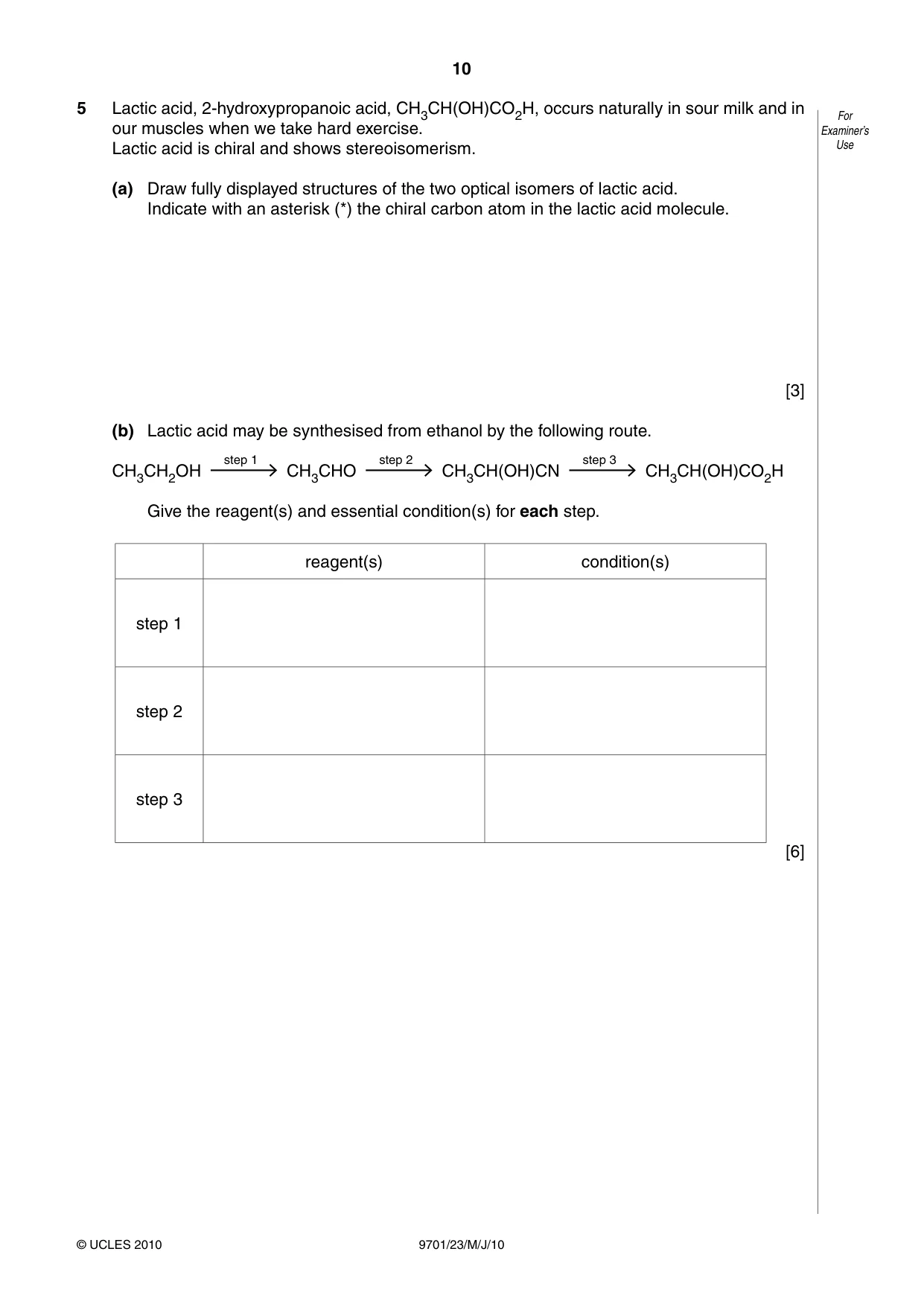
10 9701/23/M/J/10 © UCLES 2010 For Examiner’s Use 5 Lactic acid, 2-hydroxypropanoic acid, CH3CH(OH)CO2H, occurs naturally in sour milk and in our muscles when we take hard exercise. Lactic acid is chiral and shows stereoisomerism. (a) Draw fully displayed structures of the two optical isomers of lactic acid. Indicate with an asterisk (*) the chiral carbon atom in the lactic acid molecule. [3] (b) Lactic acid may be synthesised from ethanol by the following route. CH3CH2OH step 1 CH3CHO step 2 CH3CH(OH)CN step 3 CH3CH(OH)CO2H Give the reagent(s) and essential condition(s) for each step. reagent(s) condition(s) step 1 step 2 step 3 [6]
Question paper, page 11
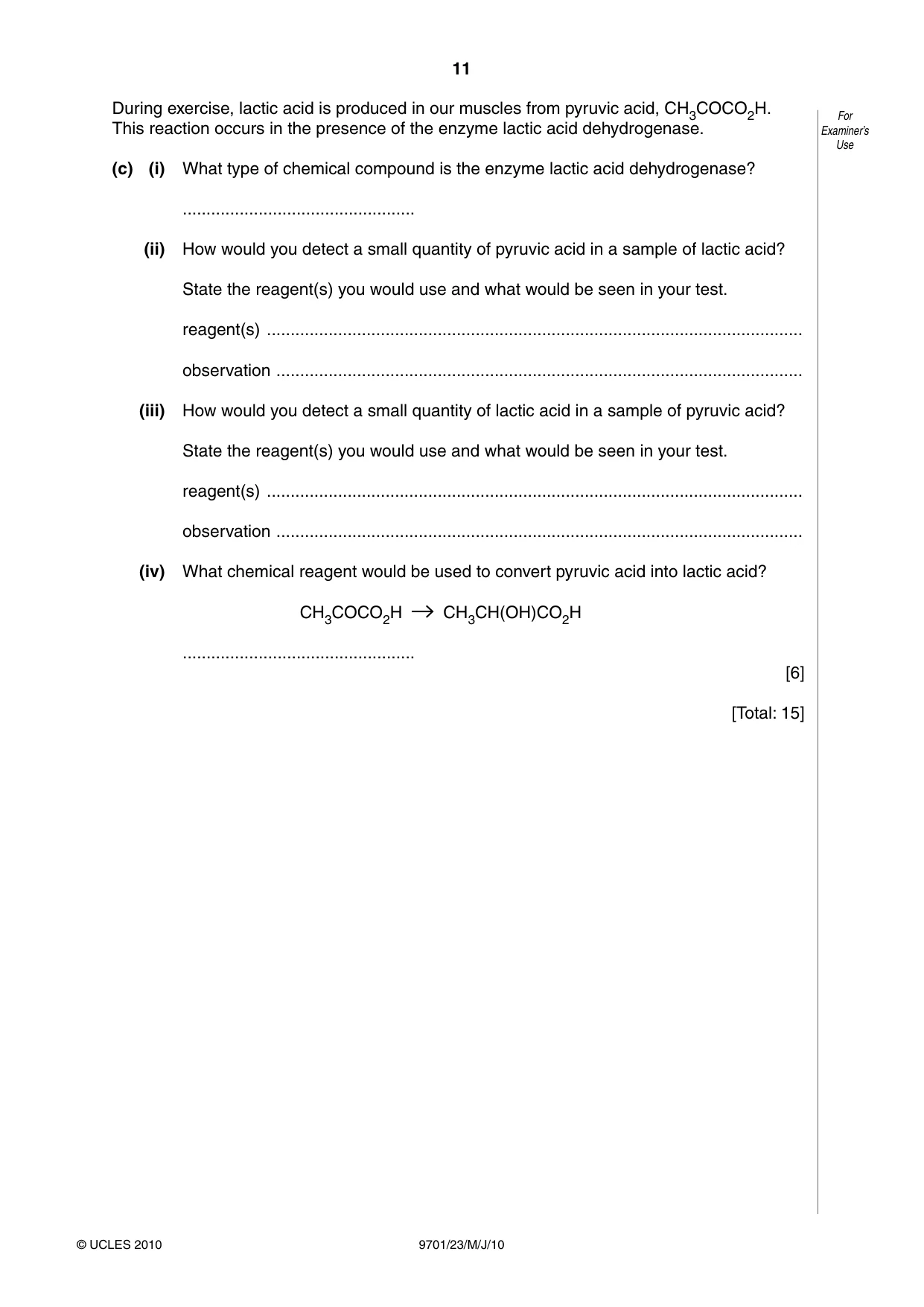
11 9701/23/M/J/10 © UCLES 2010 For Examiner’s Use During exercise, lactic acid is produced in our muscles from pyruvic acid, CH3COCO2H. This reaction occurs in the presence of the enzyme lactic acid dehydrogenase. (c) (i) What type of chemical compound is the enzyme lactic acid dehydrogenase? … (ii) How would you detect a small quantity of pyruvic acid in a sample of lactic acid? State the reagent(s) you would use and what would be seen in your test. reagent(s) … observation … (iii) How would you detect a small quantity of lactic acid in a sample of pyruvic acid? State the reagent(s) you would use and what would be seen in your test. reagent(s) … observation … (iv) What chemical reagent would be used to convert pyruvic acid into lactic acid? CH3COCO2H CH3CH(OH)CO2H … [6] [Total: 15]
Question paper, page 12
12 9701/23/M/J/10 © UCLES 2010 BLANK PAGE Permission to reproduce items where third-party owned material protected by copyright is included has been sought and cleared where possible. Every reasonable effort has been made by the publisher (UCLES) to trace copyright holders, but if any items requiring clearance have unwittingly been included, the publisher will be pleased to make amends at the earliest possible opportunity. University of Cambridge International Examinations is part of the Cambridge Assessment Group. Cambridge Assessment is the brand name of University of Cambridge Local Examinations Syndicate (UCLES), which is itself a department of the University of Cambridge.
Mark scheme, page 1
UNIVERSITY OF CAMBRIDGE INTERNATIONAL EXAMINATIONS GCE Advanced Subsidiary Level and GCE Advanced Level MARK SCHEME for the May/June 2010 question paper for the guidance of teachers 9701 CHEMISTRY 9701/23 Paper 2 (AS Structured Questions), maximum raw mark 60 This mark scheme is published as an aid to teachers and candidates, to indicate the requirements of the examination. It shows the basis on which Examiners were instructed to award marks. It does not indicate the details of the discussions that took place at an Examiners’ meeting before marking began, which would have considered the acceptability of alternative answers. Mark schemes must be read in conjunction with the question papers and the report on the examination. • CIE will not enter into discussions or correspondence in connection with these mark schemes. CIE is publishing the mark schemes for the May/June 2010 question papers for most IGCSE, GCE Advanced Level and Advanced Subsidiary Level syllabuses and some Ordinary Level syllabuses.
Mark scheme, page 2
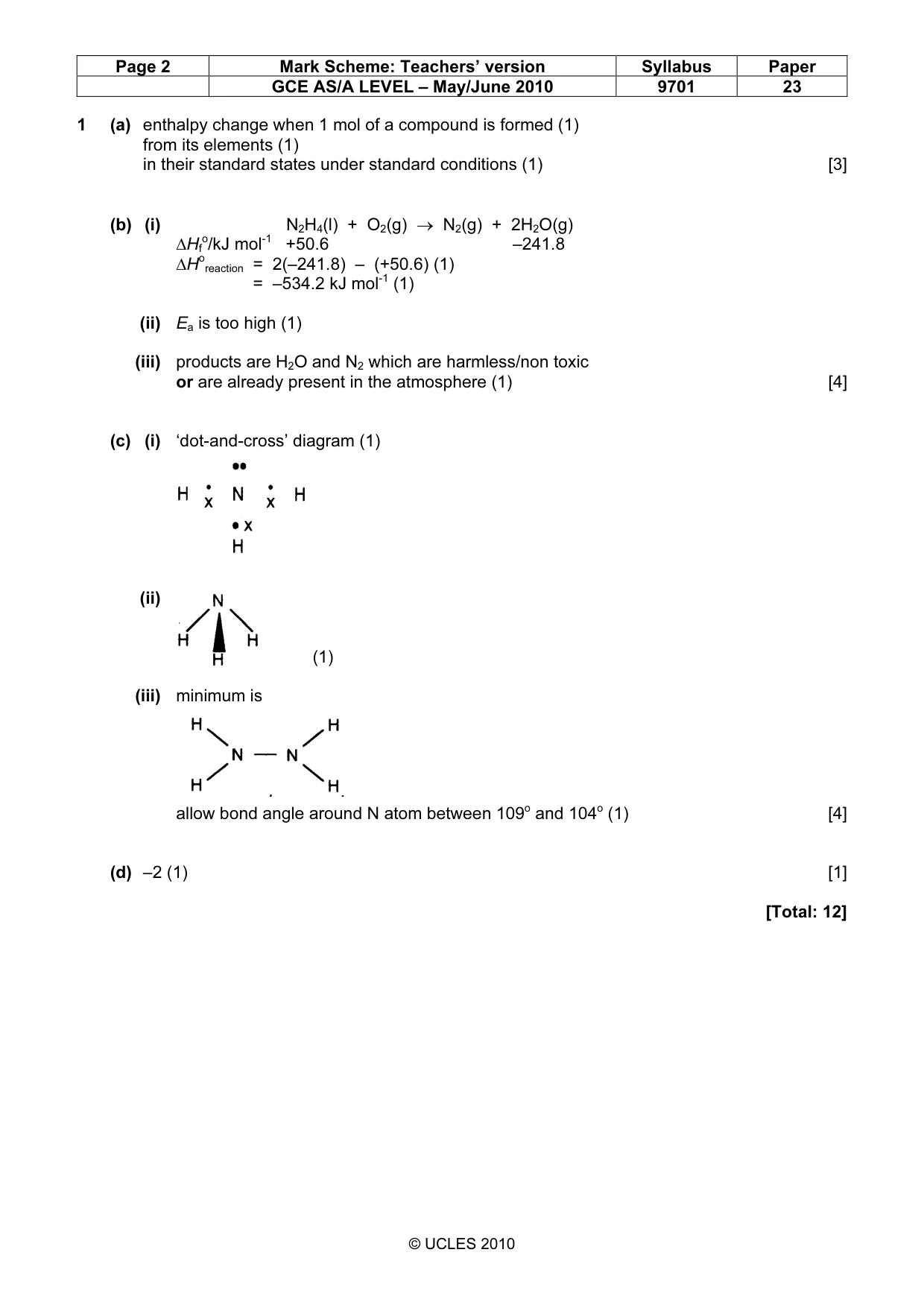
Page 2 Mark Scheme: Teachers’ version Syllabus Paper GCE AS/A LEVEL – May/June 2010 9701 23 © UCLES 2010 1 (a) enthalpy change when 1 mol of a compound is formed (1) from its elements (1) in their standard states under standard conditions (1) [3] (b) (i) N2H4(l) + O2(g) → N2(g) + 2H2O(g) ∆Hf o/kJ mol-1 +50.6 –241.8 ∆Ho reaction = 2(–241.8) – (+50.6) (1) = –534.2 kJ mol-1 (1) (ii) Ea is too high (1) (iii) products are H2O and N2 which are harmless/non toxic or are already present in the atmosphere (1) [4] (c) (i) ‘dot-and-cross’ diagram (1) (ii) (1) (iii) minimum is allow bond angle around N atom between 109o and 104o (1) [4] (d) –2 (1) [1] [Total: 12]
Mark scheme, page 3
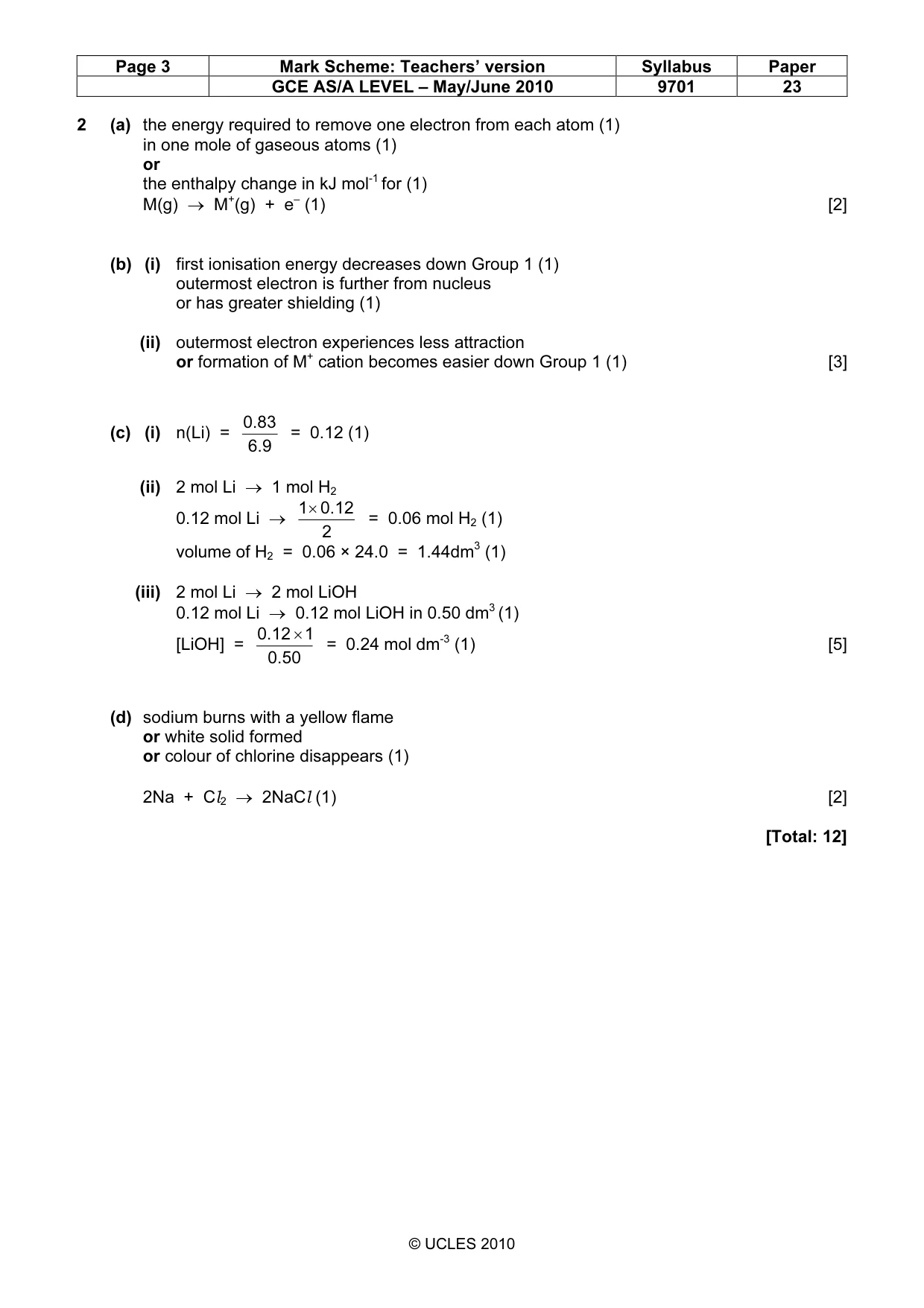
Page 3 Mark Scheme: Teachers’ version Syllabus Paper GCE AS/A LEVEL – May/June 2010 9701 23 © UCLES 2010 2 (a) the energy required to remove one electron from each atom (1) in one mole of gaseous atoms (1) or the enthalpy change in kJ mol-1 for (1) M(g) → M+(g) + e– (1) [2] (b) (i) first ionisation energy decreases down Group 1 (1) outermost electron is further from nucleus or has greater shielding (1) (ii) outermost electron experiences less attraction or formation of M+ cation becomes easier down Group 1 (1) [3] (c) (i) n(Li) = 6.9 0.83 = 0.12 (1) (ii) 2 mol Li → 1 mol H2 0.12 mol Li → 2 0.12 1× = 0.06 mol H2 (1) volume of H2 = 0.06 × 24.0 = 1.44dm3 (1) (iii) 2 mol Li → 2 mol LiOH 0.12 mol Li → 0.12 mol LiOH in 0.50 dm3 (1) [LiOH] = 0.50 1 0.12 × = 0.24 mol dm-3 (1) [5] (d) sodium burns with a yellow flame or white solid formed or colour of chlorine disappears (1) 2Na + Cl2 → 2NaCl (1) [2] [Total: 12]
Mark scheme, page 4
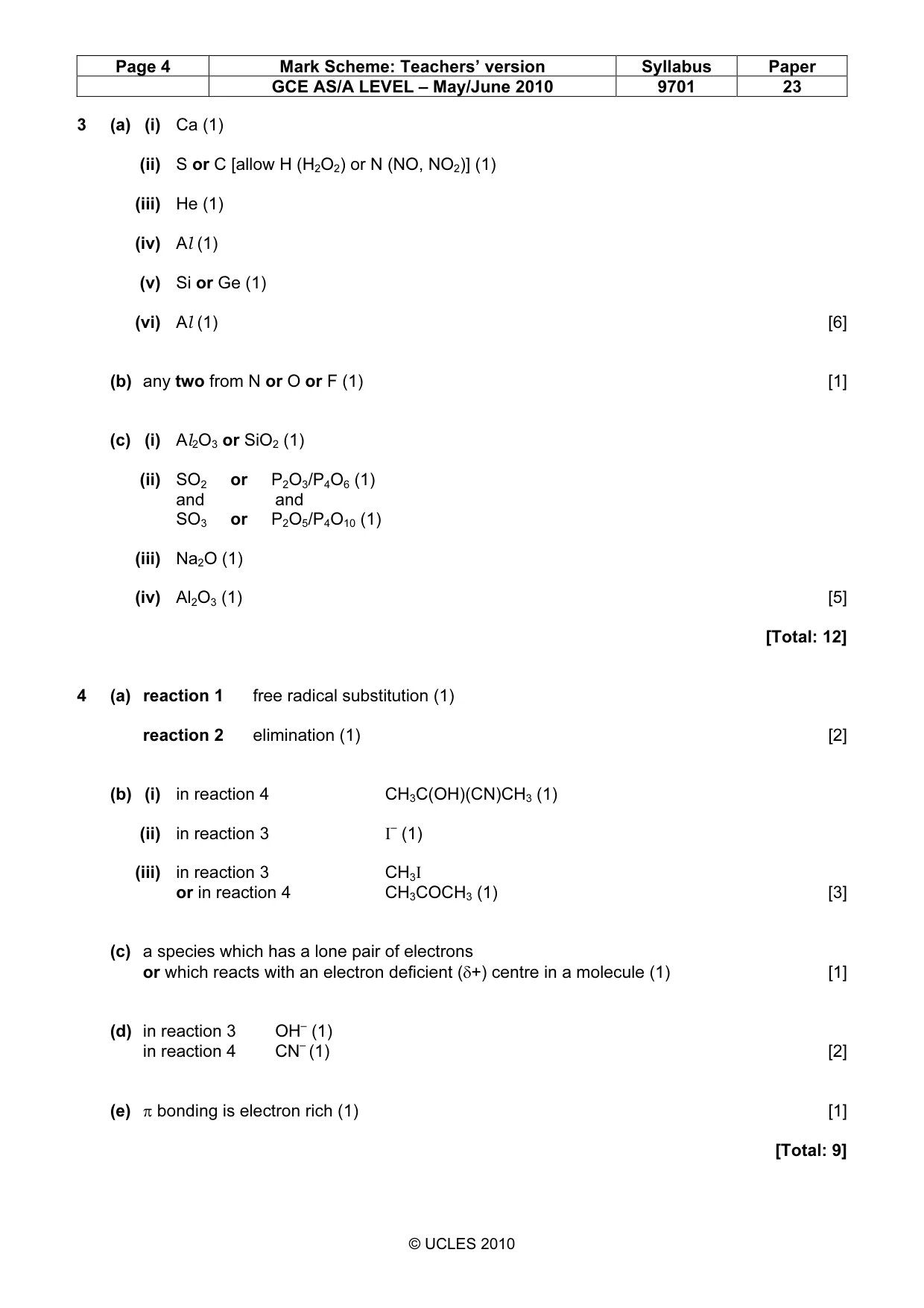
Page 4 Mark Scheme: Teachers’ version Syllabus Paper GCE AS/A LEVEL – May/June 2010 9701 23 © UCLES 2010 3 (a) (i) Ca (1) (ii) S or C [allow H (H2O2) or N (NO, NO2)] (1) (iii) He (1) (iv) Al (1) (v) Si or Ge (1) (vi) Al (1) [6] (b) any two from N or O or F (1) [1] (c) (i) Al2O3 or SiO2 (1) (ii) SO2 or P2O3/P4O6 (1) and and SO3 or P2O5/P4O10 (1) (iii) Na2O (1) (iv) Al2O3 (1) [5] [Total: 12] 4 (a) reaction 1 free radical substitution (1) reaction 2 elimination (1) [2] (b) (i) in reaction 4 CH3C(OH)(CN)CH3 (1) (ii) in reaction 3 I– (1) (iii) in reaction 3 CH3I or in reaction 4 CH3COCH3 (1) [3] (c) a species which has a lone pair of electrons or which reacts with an electron deficient (δ+) centre in a molecule (1) [1] (d) in reaction 3 OH– (1) in reaction 4 CN– (1) [2] (e) π bonding is electron rich (1) [1] [Total: 9]
Mark scheme, page 5
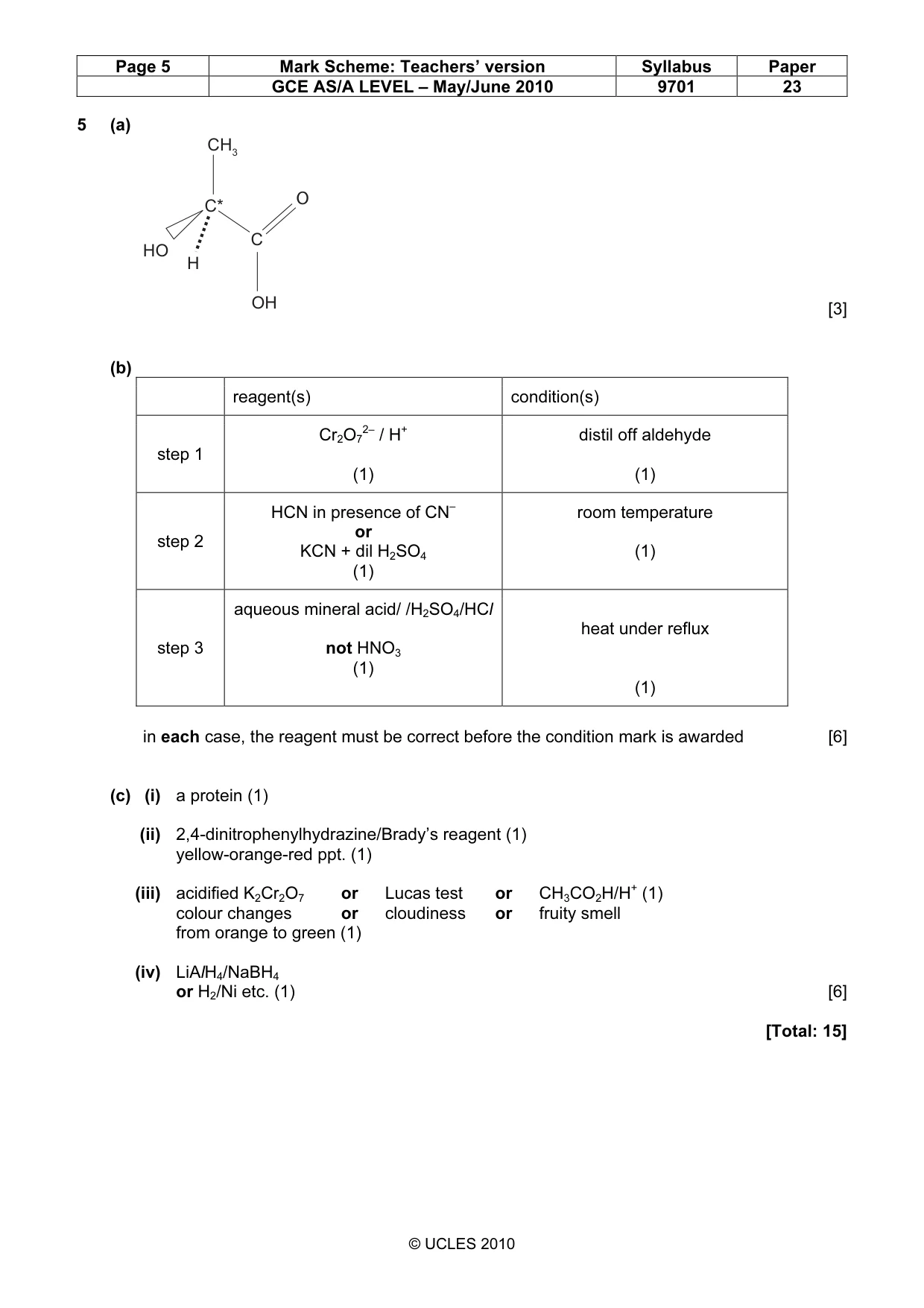
Page 5 Mark Scheme: Teachers’ version Syllabus Paper GCE AS/A LEVEL – May/June 2010 9701 23 © UCLES 2010 5 (a) C* HO H C OH CH3 O [3] (b) reagent(s) condition(s) step 1 Cr2O7 2– / H+ (1) distil off aldehyde (1) step 2 HCN in presence of CN– or KCN + dil H2SO4 (1) room temperature (1) step 3 aqueous mineral acid/ /H2SO4/HCl not HNO3 (1) heat under reflux (1) in each case, the reagent must be correct before the condition mark is awarded [6] (c) (i) a protein (1) (ii) 2,4-dinitrophenylhydrazine/Brady’s reagent (1) yellow-orange-red ppt. (1) (iii) acidified K2Cr2O7 or Lucas test or CH3CO2H/H+ (1) colour changes or cloudiness or fruity smell from orange to green (1) (iv) LiAlH4/NaBH4 or H2/Ni etc. (1) [6] [Total: 15]
What you needed in this session
Cambridge’s own grade thresholds for 2010 May/June, Paper 2 · Variant 3. A higher threshold means an easier paper — the bar moves with how the cohort did.