Cambridge A Level Chemistry 9701 — 2009 Oct/Nov Paper 5 · Variant 2
9701/52/O/N/09
The question paper and its mark scheme, free to read here and free to download. This is Cambridge’s own paper, exactly as it was sat.
Question paper12 pages

Mark scheme5 pages
Answers below. Sit the paper first if you are practising.
Paper as text
Question paper, page 1
This document consists of 10 printed pages and 2 blank pages. DC (AT/KN) 11586/2 © UCLES 2009 [Turn over UNIVERSITY OF CAMBRIDGE INTERNATIONAL EXAMINATIONS General Certificate of Education Advanced Subsidiary Level and Advanced Level READ THESE INSTRUCTIONS FIRST Write your Centre number, candidate number and name on all the work you hand in. Write in dark blue or black pen. You may use a soft pencil for any diagrams, graphs or rough working. Do not use staples, paper clips, highlighters, glue or correction fluid. DO NOT WRITE IN ANY BARCODES. Answer all questions. You are advised to show all working in calculations. Use of a Data Booklet is unnecessary. At the end of the examination, fasten all your work securely together. The number of marks is given in brackets [ ] at the end of each question or part question. * 3 7 3 4 6 6 2 5 9 3 * CHEMISTRY 9701/52 Paper 5 Planning, Analysis and Evaluation October/November 2009 1 hour 15 minutes Candidates answer on the Question Paper. No additional materials are required. For Examiner’s Use 1 2 3 Total
Question paper, page 2
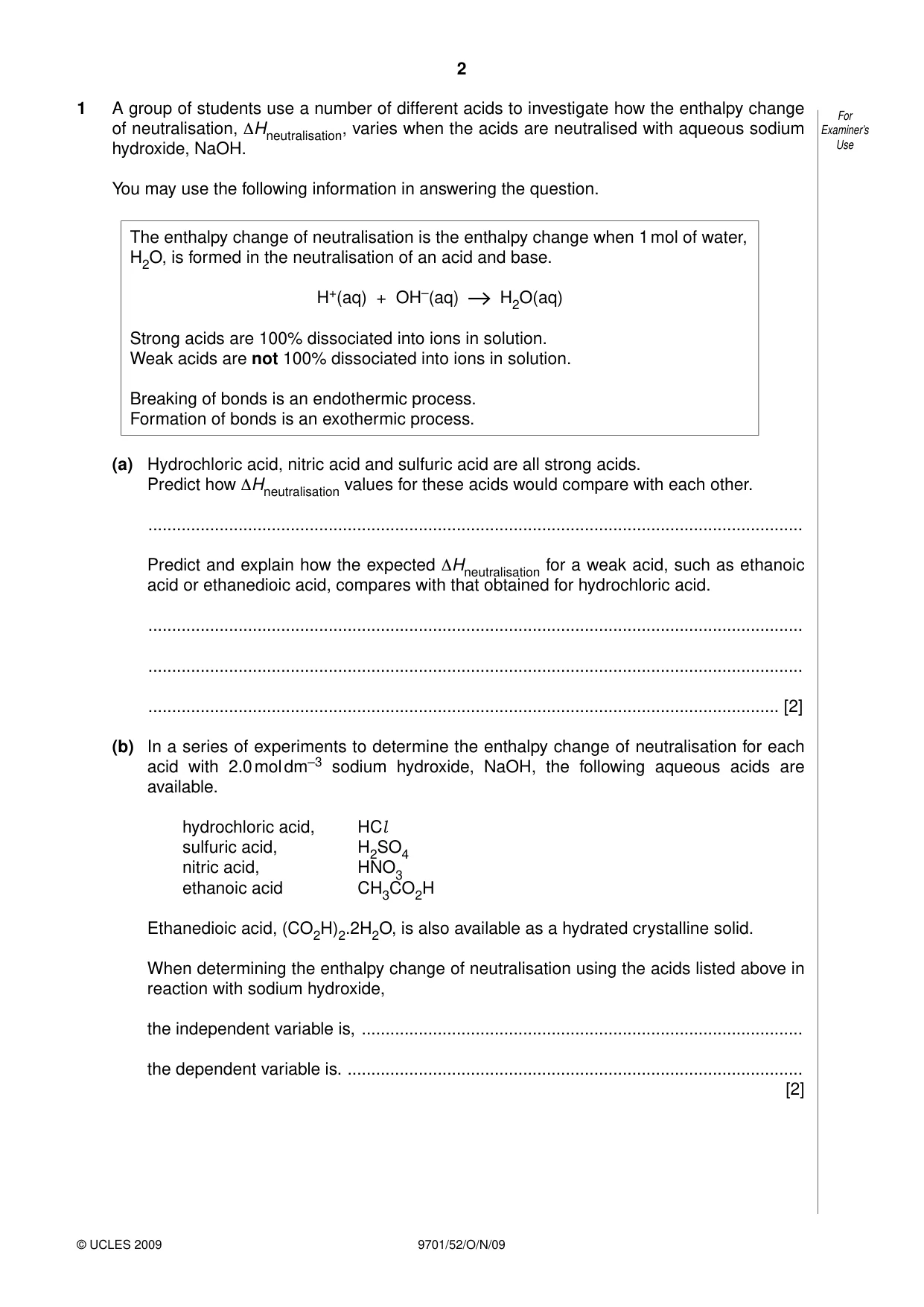
2 9701/52/O/N/09 © UCLES 2009 For Examiner’s Use 1 A group of students use a number of different acids to investigate how the enthalpy change of neutralisation, ΔHneutralisation, varies when the acids are neutralised with aqueous sodium hydroxide, NaOH. You may use the following information in answering the question. The enthalpy change of neutralisation is the enthalpy change when 1 mol of water, H2O, is formed in the neutralisation of an acid and base. H+(aq) + OH –(aq) H2O(aq) Strong acids are 100% dissociated into ions in solution. Weak acids are not 100% dissociated into ions in solution. Breaking of bonds is an endothermic process. Formation of bonds is an exothermic process. (a) Hydrochloric acid, nitric acid and sulfuric acid are all strong acids. Predict how ΔHneutralisation values for these acids would compare with each other. … Predict and explain how the expected ΔHneutralisation for a weak acid, such as ethanoic acid or ethanedioic acid, compares with that obtained for hydrochloric acid. … … … [2] (b) In a series of experiments to determine the enthalpy change of neutralisation for each acid with 2.0 mol dm–3 sodium hydroxide, NaOH, the following aqueous acids are available. hydrochloric acid, HCl sulfuric acid, H2SO4 nitric acid, HNO3 ethanoic acid CH3CO2H Ethanedioic acid, (CO2H)2.2H2O, is also available as a hydrated crystalline solid. When determining the enthalpy change of neutralisation using the acids listed above in reaction with sodium hydroxide, the independent variable is, … the dependent variable is. … [2]
Question paper, page 3
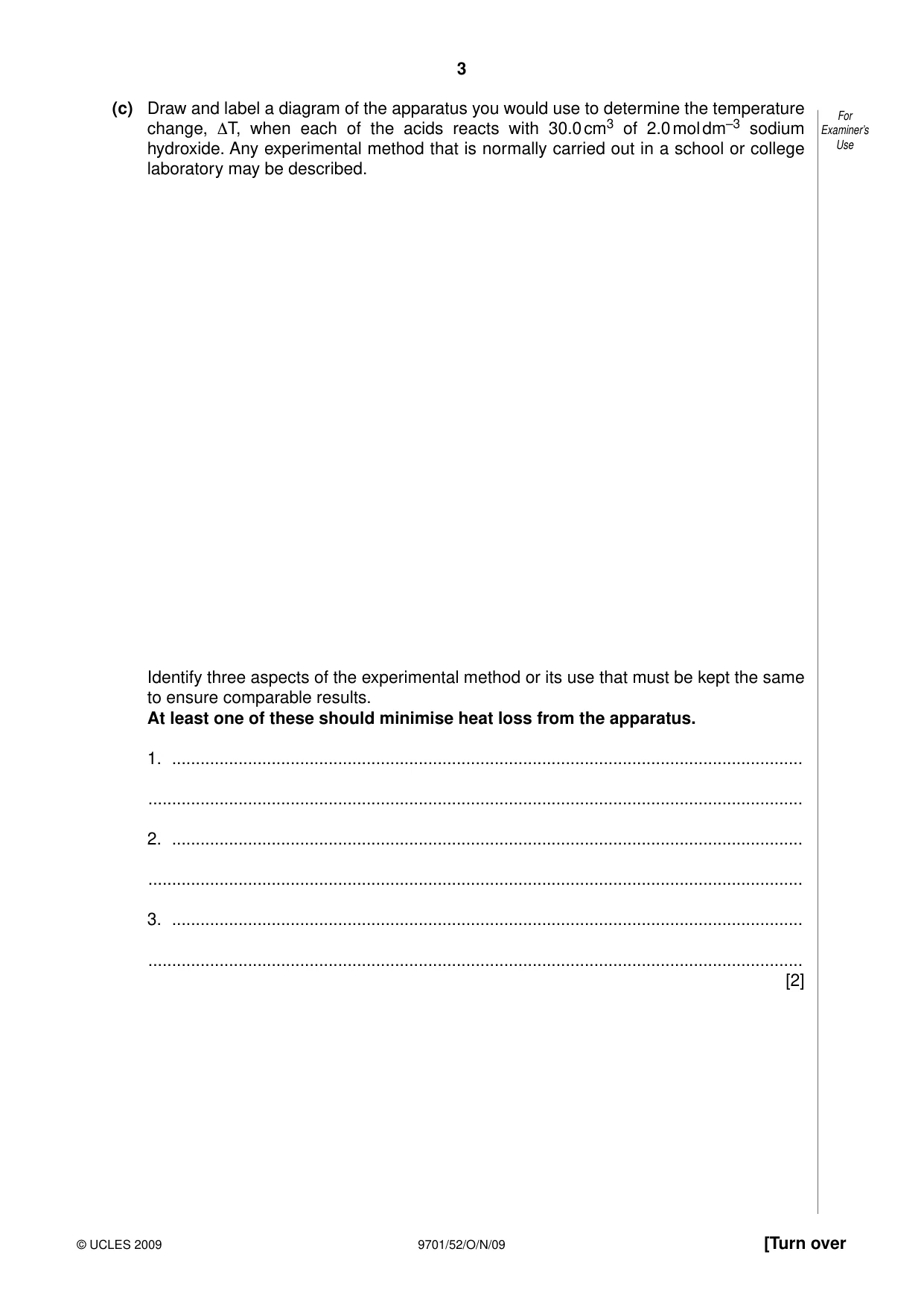
3 9701/52/O/N/09 © UCLES 2009 [Turn over For Examiner’s Use (c) Draw and label a diagram of the apparatus you would use to determine the temperature change, ΔT, when each of the acids reacts with 30.0 cm3 of 2.0 mol dm–3 sodium hydroxide. Any experimental method that is normally carried out in a school or college laboratory may be described. Identify three aspects of the experimental method or its use that must be kept the same to ensure comparable results. At least one of these should minimise heat loss from the apparatus. 1. … … 2. … … 3. … … [2]
Question paper, page 4
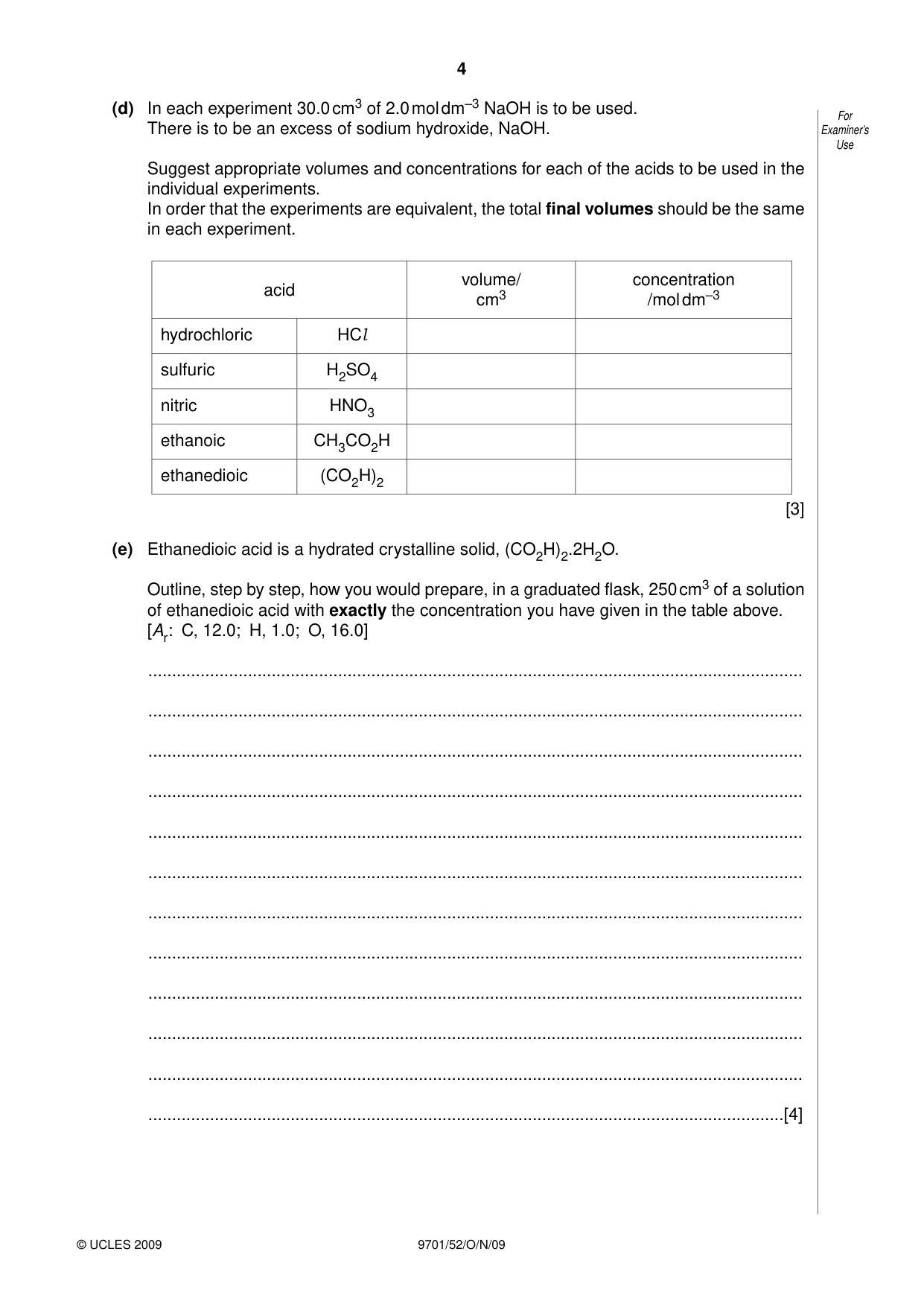
4 9701/52/O/N/09 © UCLES 2009 For Examiner’s Use (d) In each experiment 30.0 cm3 of 2.0 mol dm–3 NaOH is to be used. There is to be an excess of sodium hydroxide, NaOH. Suggest appropriate volumes and concentrations for each of the acids to be used in the individual experiments. In order that the experiments are equivalent, the total final volumes should be the same in each experiment. acid volume/ cm3 concentration /mol dm–3 hydrochloric HCl sulfuric H2SO4 nitric HNO3 ethanoic CH3CO2H ethanedioic (CO2H)2 [3] (e) Ethanedioic acid is a hydrated crystalline solid, (CO2H)2.2H2O. Outline, step by step, how you would prepare, in a graduated flask, 250 cm3 of a solution of ethanedioic acid with exactly the concentration you have given in the table above. [Ar: C, 12.0; H, 1.0; O, 16.0] … … … … … … … … … … … …[4]
Question paper, page 5
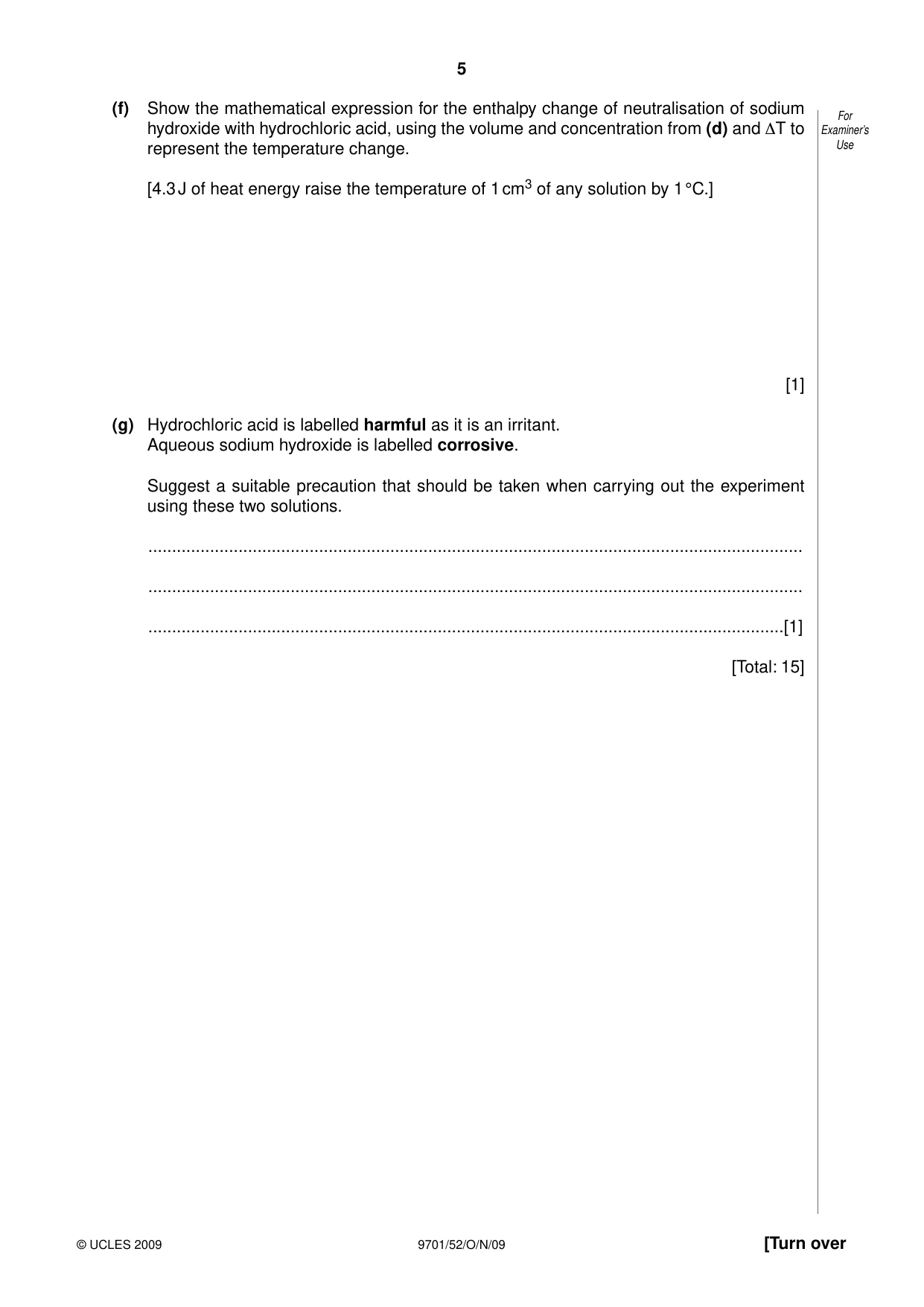
5 9701/52/O/N/09 © UCLES 2009 [Turn over For Examiner’s Use (f) Show the mathematical expression for the enthalpy change of neutralisation of sodium hydroxide with hydrochloric acid, using the volume and concentration from (d) and ΔT to represent the temperature change. [4.3 J of heat energy raise the temperature of 1 cm3 of any solution by 1 °C.] [1] (g) Hydrochloric acid is labelled harmful as it is an irritant. Aqueous sodium hydroxide is labelled corrosive. Suggest a suitable precaution that should be taken when carrying out the experiment using these two solutions. … … …[1] [Total: 15]
Question paper, page 6
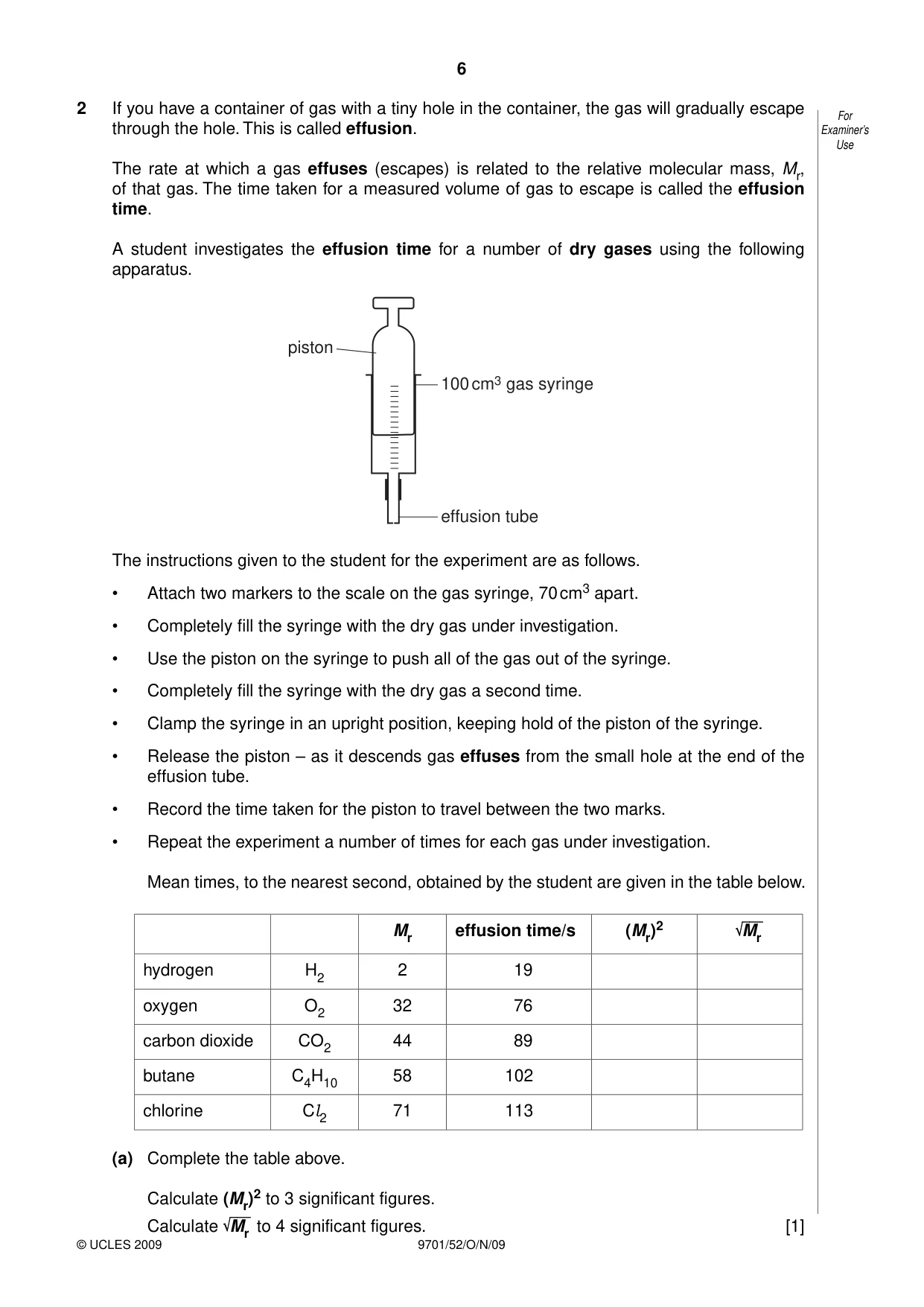
6 9701/52/O/N/09 © UCLES 2009 For Examiner’s Use 2 If you have a container of gas with a tiny hole in the container, the gas will gradually escape through the hole. This is called effusion. The rate at which a gas effuses (escapes) is related to the relative molecular mass, Mr, of that gas. The time taken for a measured volume of gas to escape is called the effusion time. A student investigates the effusion time for a number of dry gases using the following apparatus. 100 cm3 gas syringe effusion tube piston The instructions given to the student for the experiment are as follows. • Attach two markers to the scale on the gas syringe, 70 cm3 apart. • Completely fill the syringe with the dry gas under investigation. • Use the piston on the syringe to push all of the gas out of the syringe. • Completely fill the syringe with the dry gas a second time. • Clamp the syringe in an upright position, keeping hold of the piston of the syringe. • Release the piston – as it descends gas effuses from the small hole at the end of the effusion tube. • Record the time taken for the piston to travel between the two marks. • Repeat the experiment a number of times for each gas under investigation. Mean times, to the nearest second, obtained by the student are given in the table below. Mr effusion time/s (Mr)2 Mr hydrogen H2 2 19 oxygen O2 32 76 carbon dioxide CO2 44 89 butane C4H10 58 102 chlorine Cl2 71 113 (a) Complete the table above. Calculate (Mr)2 to 3 significant figures. Calculate Mr to 4 significant figures. [1]
Question paper, page 7
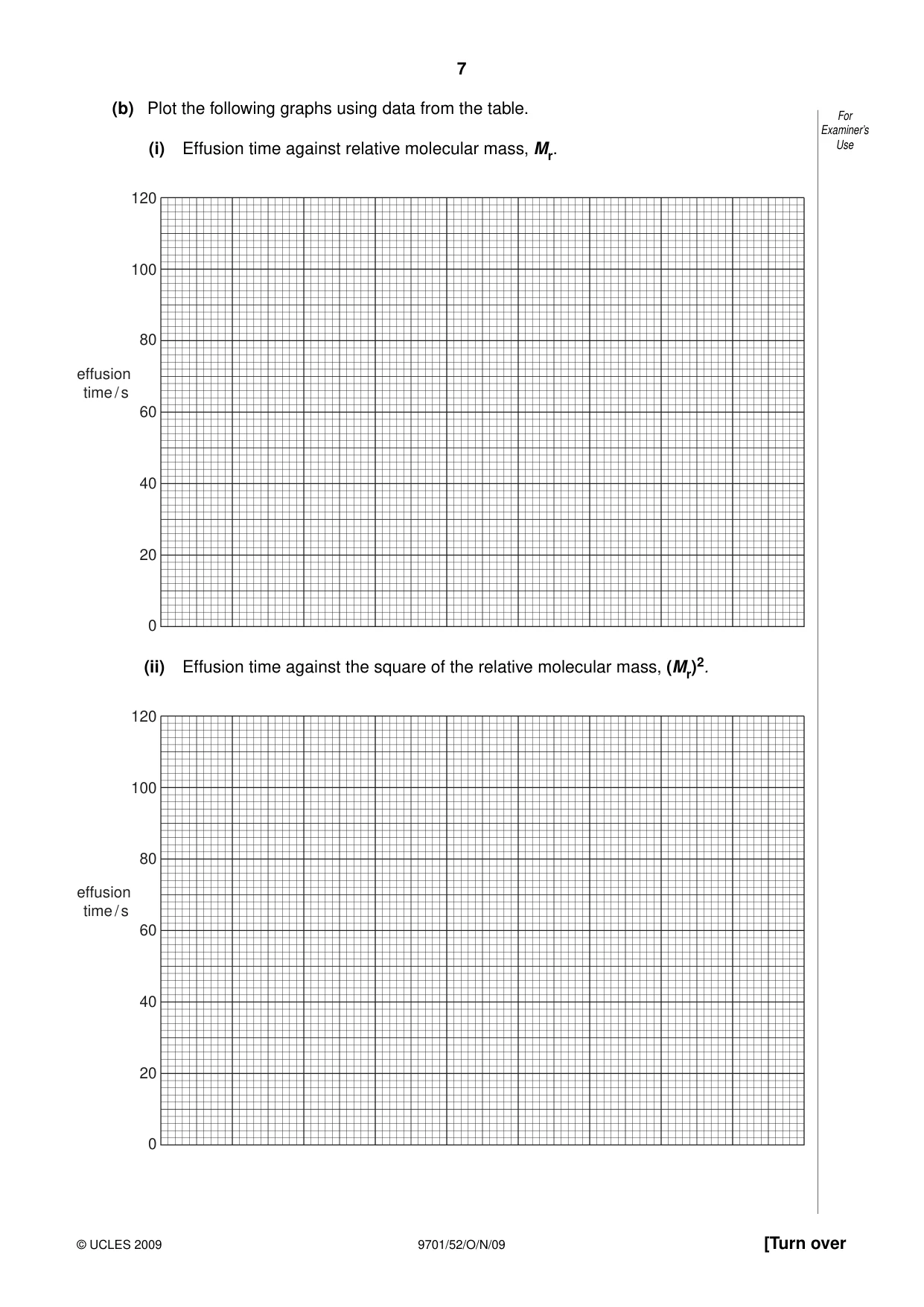
7 9701/52/O/N/09 © UCLES 2009 [Turn over For Examiner’s Use (b) Plot the following graphs using data from the table. (i) Effusion time against relative molecular mass, Mr. 0 20 40 60 80 100 120 effusion time / s (ii) Effusion time against the square of the relative molecular mass, (Mr)2. 0 20 40 60 80 100 120 effusion time / s
Question paper, page 8
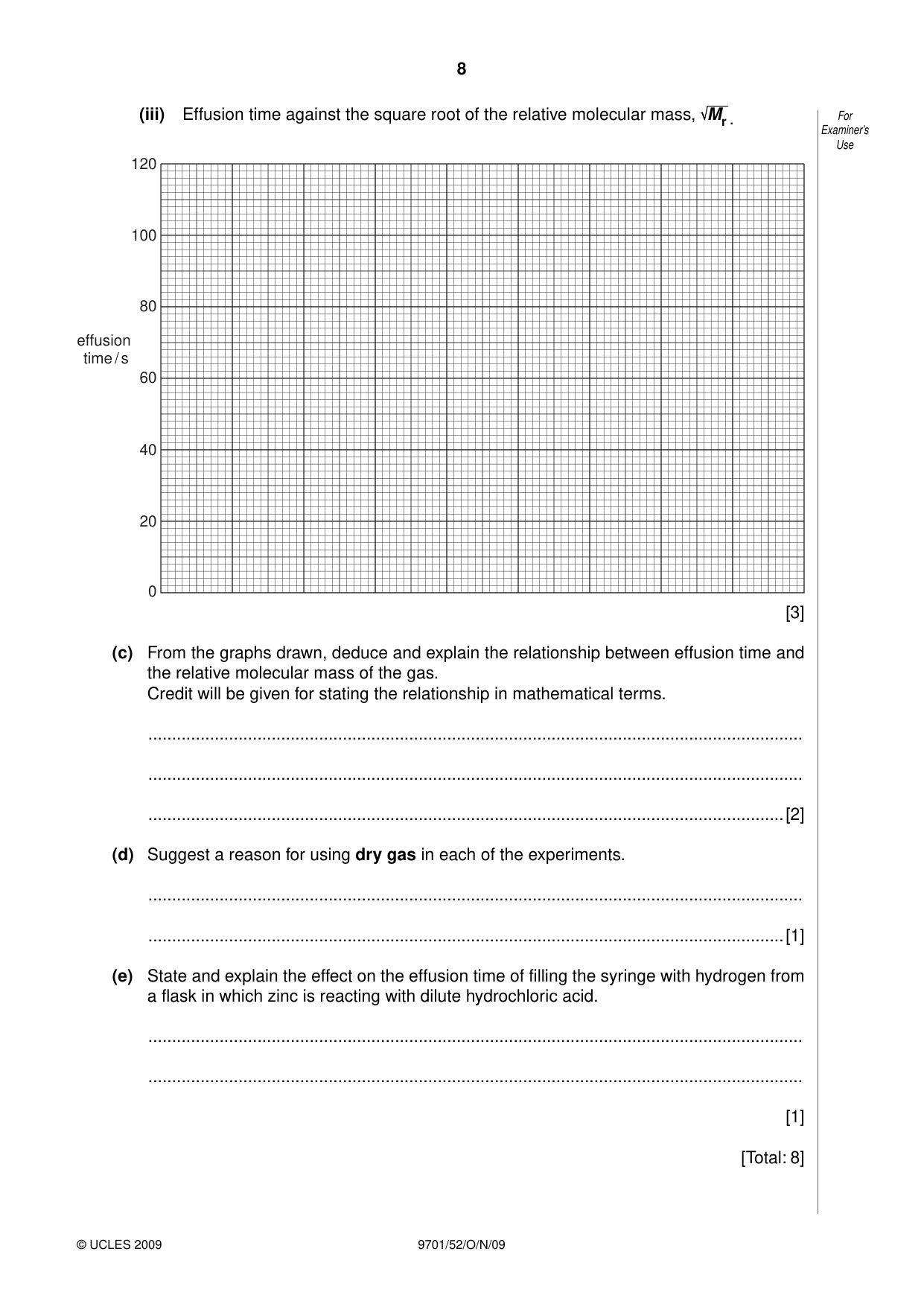
8 9701/52/O/N/09 © UCLES 2009 For Examiner’s Use (iii) Effusion time against the square root of the relative molecular mass, Mr . 0 20 40 60 80 100 120 effusion time / s [3] (c) From the graphs drawn, deduce and explain the relationship between effusion time and the relative molecular mass of the gas. Credit will be given for stating the relationship in mathematical terms. … … …[2] (d) Suggest a reason for using dry gas in each of the experiments. … …[1] (e) State and explain the effect on the effusion time of filling the syringe with hydrogen from a flask in which zinc is reacting with dilute hydrochloric acid. … … [1] [Total: 8]
Question paper, page 9
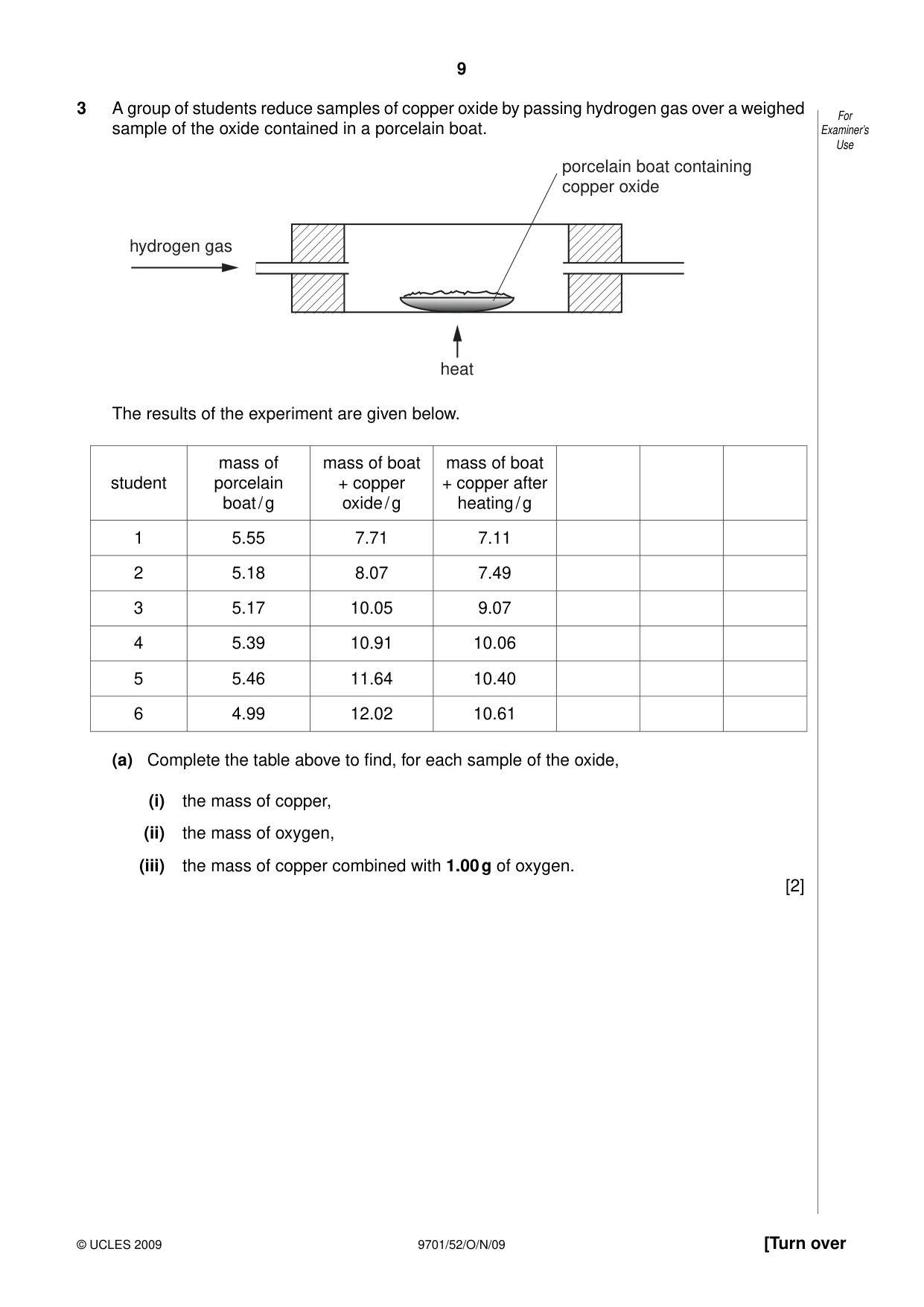
9 9701/52/O/N/09 © UCLES 2009 [Turn over For Examiner’s Use 3 A group of students reduce samples of copper oxide by passing hydrogen gas over a weighed sample of the oxide contained in a porcelain boat. heat hydrogen gas porcelain boat containing copper oxide The results of the experiment are given below. student mass of porcelain boat / g mass of boat + copper oxide / g mass of boat + copper after heating / g 1 5.55 7.71 7.11 2 5.18 8.07 7.49 3 5.17 10.05 9.07 4 5.39 10.91 10.06 5 5.46 11.64 10.40 6 4.99 12.02 10.61 (a) Complete the table above to find, for each sample of the oxide, (i) the mass of copper, (ii) the mass of oxygen, (iii) the mass of copper combined with 1.00 g of oxygen. [2]
Question paper, page 10
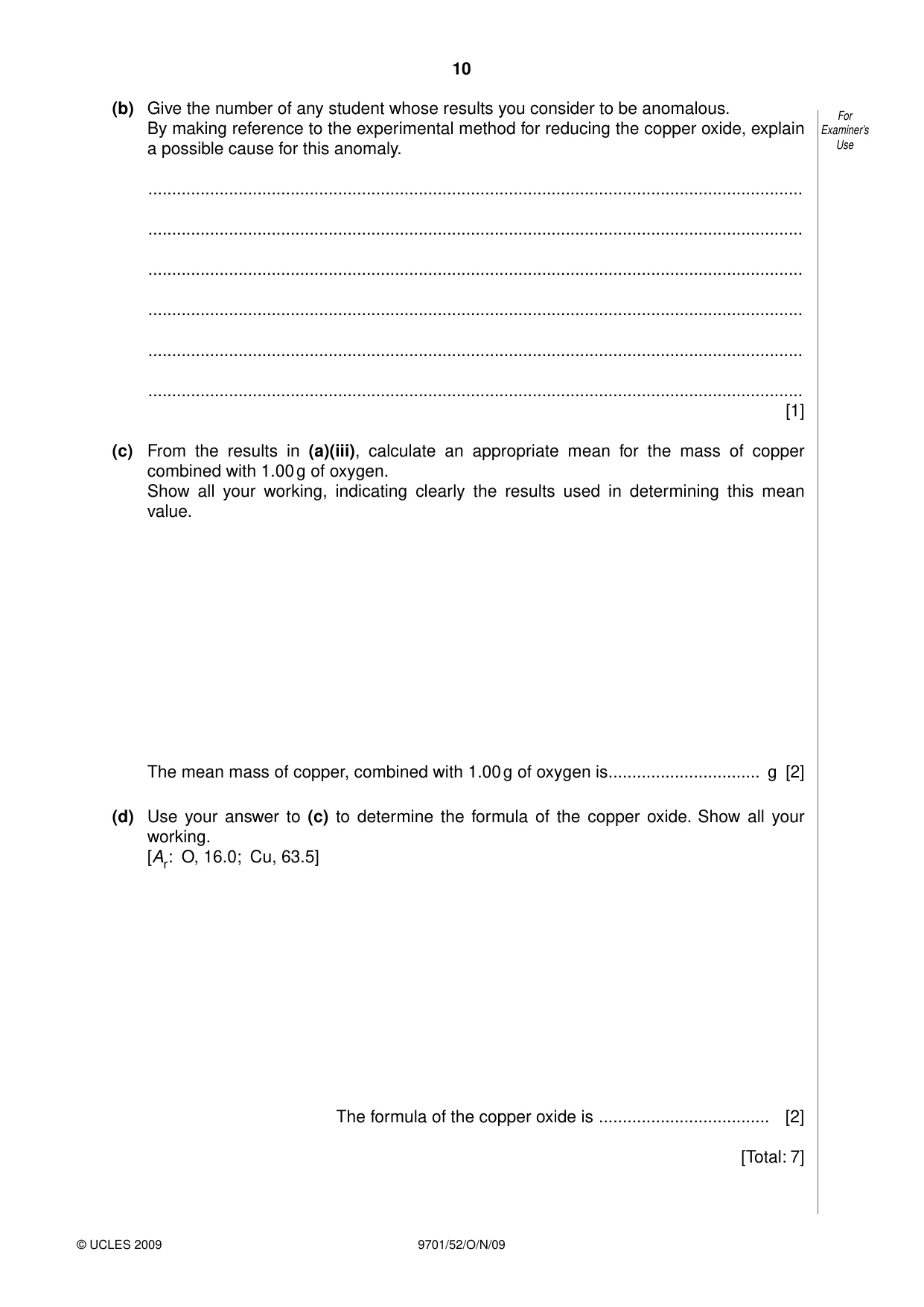
10 9701/52/O/N/09 © UCLES 2009 For Examiner’s Use (b) Give the number of any student whose results you consider to be anomalous. By making reference to the experimental method for reducing the copper oxide, explain a possible cause for this anomaly. … … … … … … [1] (c) From the results in (a)(iii), calculate an appropriate mean for the mass of copper combined with 1.00 g of oxygen. Show all your working, indicating clearly the results used in determining this mean value. The mean mass of copper, combined with 1.00 g of oxygen is … g [2] (d) Use your answer to (c) to determine the formula of the copper oxide. Show all your working. [Ar: O, 16.0; Cu, 63.5] The formula of the copper oxide is … [2] [Total: 7]
Question paper, page 12
12 9701/52/O/N/09 BLANK PAGE Permission to reproduce items where third-party owned material protected by copyright is included has been sought and cleared where possible. Every reasonable effort has been made by the publisher (UCLES) to trace copyright holders, but if any items requiring clearance have unwittingly been included, the publisher will be pleased to make amends at the earliest possible opportunity. University of Cambridge International Examinations is part of the Cambridge Assessment Group. Cambridge Assessment is the brand name of University of Cambridge Local Examinations Syndicate (UCLES), which is itself a department of the University of Cambridge.
Mark scheme, page 1
UNIVERSITY OF CAMBRIDGE INTERNATIONAL EXAMINATIONS GCE Advanced Subsidiary Level and GCE Advanced Level MARK SCHEME for the October/November 2009 question paper for the guidance of teachers 9701 CHEMISTRY 9701/52 Paper 52 (Planning, Analysis and Evaluation), maximum raw mark 30 This mark scheme is published as an aid to teachers and candidates, to indicate the requirements of the examination. It shows the basis on which Examiners were instructed to award marks. It does not indicate the details of the discussions that took place at an Examiners’ meeting before marking began, which would have considered the acceptability of alternative answers. Mark schemes must be read in conjunction with the question papers and the report on the examination. • CIE will not enter into discussions or correspondence in connection with these mark schemes. CIE is publishing the mark schemes for the October/November 2009 question papers for most IGCSE, GCE Advanced Level and Advanced Subsidiary Level syllabuses and some Ordinary Level syllabuses.
Mark scheme, page 2
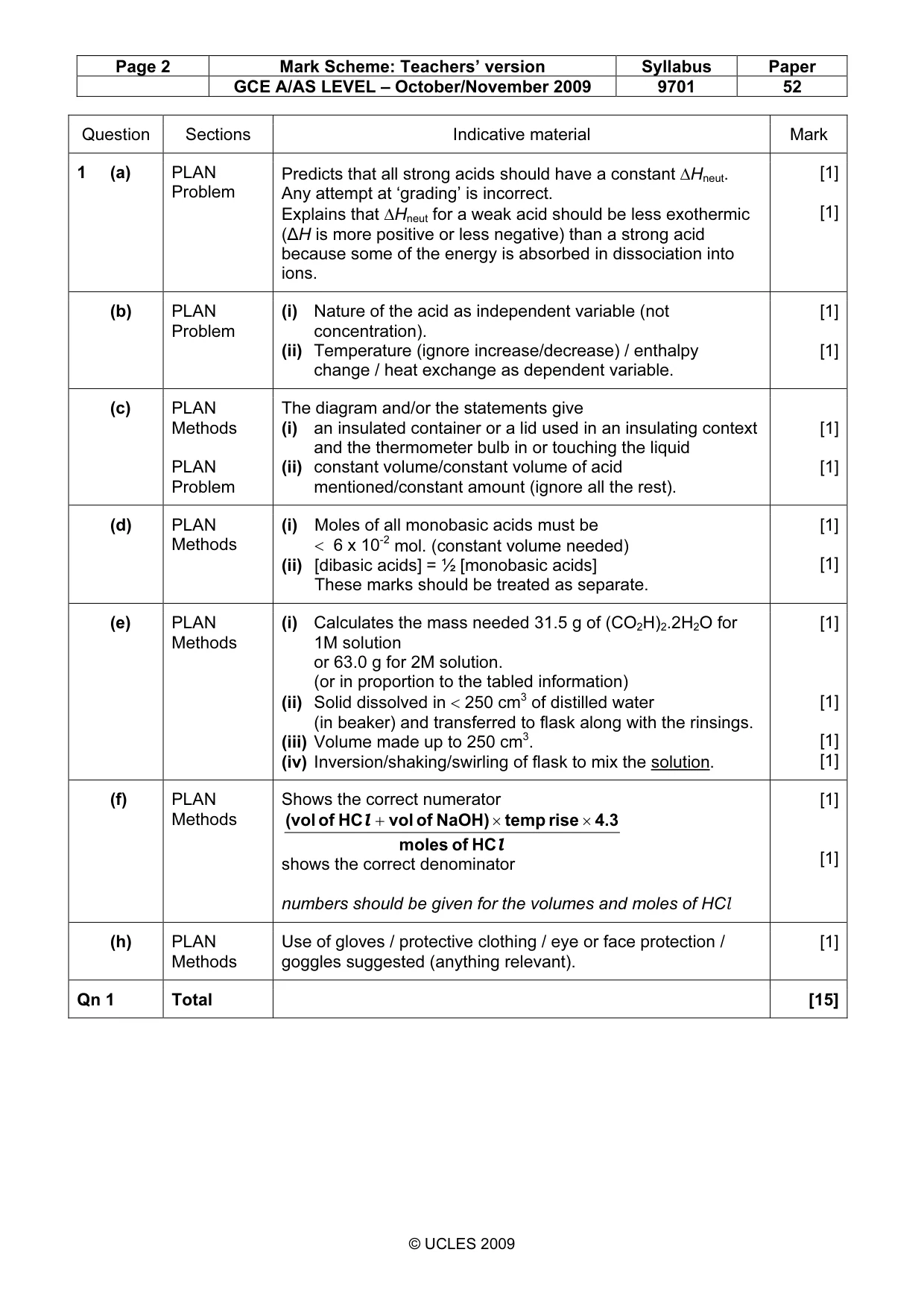
Page 2 Mark Scheme: Teachers’ version Syllabus Paper GCE A/AS LEVEL – October/November 2009 9701 52 © UCLES 2009 Question Sections Indicative material Mark 1 (a) PLAN Problem Predicts that all strong acids should have a constant ∆Hneut. Any attempt at ‘grading’ is incorrect. Explains that ∆Hneut for a weak acid should be less exothermic (∆H is more positive or less negative) than a strong acid because some of the energy is absorbed in dissociation into ions. [1] [1] (b) PLAN Problem (i) Nature of the acid as independent variable (not concentration). (ii) Temperature (ignore increase/decrease) / enthalpy change / heat exchange as dependent variable. [1] [1] (c) PLAN Methods PLAN Problem The diagram and/or the statements give (i) an insulated container or a lid used in an insulating context and the thermometer bulb in or touching the liquid (ii) constant volume/constant volume of acid mentioned/constant amount (ignore all the rest). [1] [1] (d) PLAN Methods (i) Moles of all monobasic acids must be < 6 x 10⁻² mol. (constant volume needed) (ii) [dibasic acids] = ½ [monobasic acids] These marks should be treated as separate. [1] [1] (e) PLAN Methods (i) Calculates the mass needed 31.5 g of (CO2H)2.2H2O for 1M solution or 63.0 g for 2M solution. (or in proportion to the tabled information) (ii) Solid dissolved in < 250 cm3 of distilled water (in beaker) and transferred to flask along with the rinsings. (iii) Volume made up to 250 cm3. (iv) Inversion/shaking/swirling of flask to mix the solution. [1] [1] [1] [1] (f) PLAN Methods Shows the correct numerator l l HC of moles 4.3 rise temp NaOH) of vol HC of (vol × × + shows the correct denominator numbers should be given for the volumes and moles of HCl [1] [1] (h) PLAN Methods Use of gloves / protective clothing / eye or face protection / goggles suggested (anything relevant). [1] Qn 1 Total [15]
Mark scheme, page 3
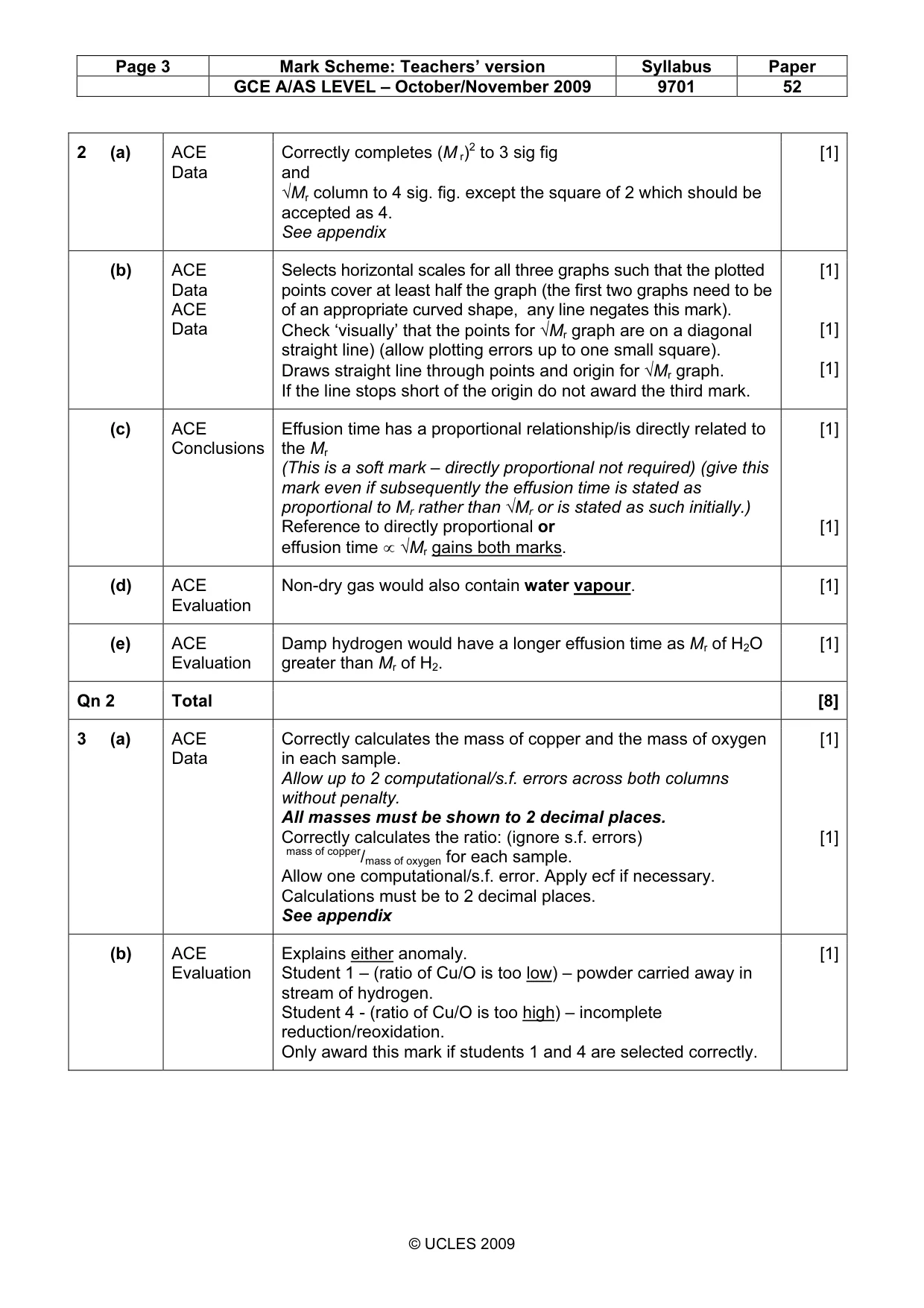
Page 3 Mark Scheme: Teachers’ version Syllabus Paper GCE A/AS LEVEL – October/November 2009 9701 52 © UCLES 2009 2 (a) ACE Data Correctly completes (M r)2 to 3 sig fig and √Mr column to 4 sig. fig. except the square of 2 which should be accepted as 4. See appendix [1] (b) ACE Data ACE Data Selects horizontal scales for all three graphs such that the plotted points cover at least half the graph (the first two graphs need to be of an appropriate curved shape, any line negates this mark). Check ‘visually’ that the points for √Mr graph are on a diagonal straight line) (allow plotting errors up to one small square). Draws straight line through points and origin for √Mr graph. If the line stops short of the origin do not award the third mark. [1] [1] [1] (c) ACE Conclusions Effusion time has a proportional relationship/is directly related to the Mr (This is a soft mark – directly proportional not required) (give this mark even if subsequently the effusion time is stated as proportional to Mr rather than √Mr or is stated as such initially.) Reference to directly proportional or effusion time ∝ √Mr gains both marks. [1] [1] (d) ACE Evaluation Non-dry gas would also contain water vapour. [1] (e) ACE Evaluation Damp hydrogen would have a longer effusion time as Mr of H2O greater than Mr of H2. [1] Qn 2 Total [8] 3 (a) ACE Data Correctly calculates the mass of copper and the mass of oxygen in each sample. Allow up to 2 computational/s.f. errors across both columns without penalty. All masses must be shown to 2 decimal places. Correctly calculates the ratio: (ignore s.f. errors) mass of copper/mass of oxygen for each sample. Allow one computational/s.f. error. Apply ecf if necessary. Calculations must be to 2 decimal places. See appendix [1] [1] (b) ACE Evaluation Explains either anomaly. Student 1 – (ratio of Cu/O is too low) – powder carried away in stream of hydrogen. Student 4 - (ratio of Cu/O is too high) – incomplete reduction/reoxidation. Only award this mark if students 1 and 4 are selected correctly. [1]
Mark scheme, page 4
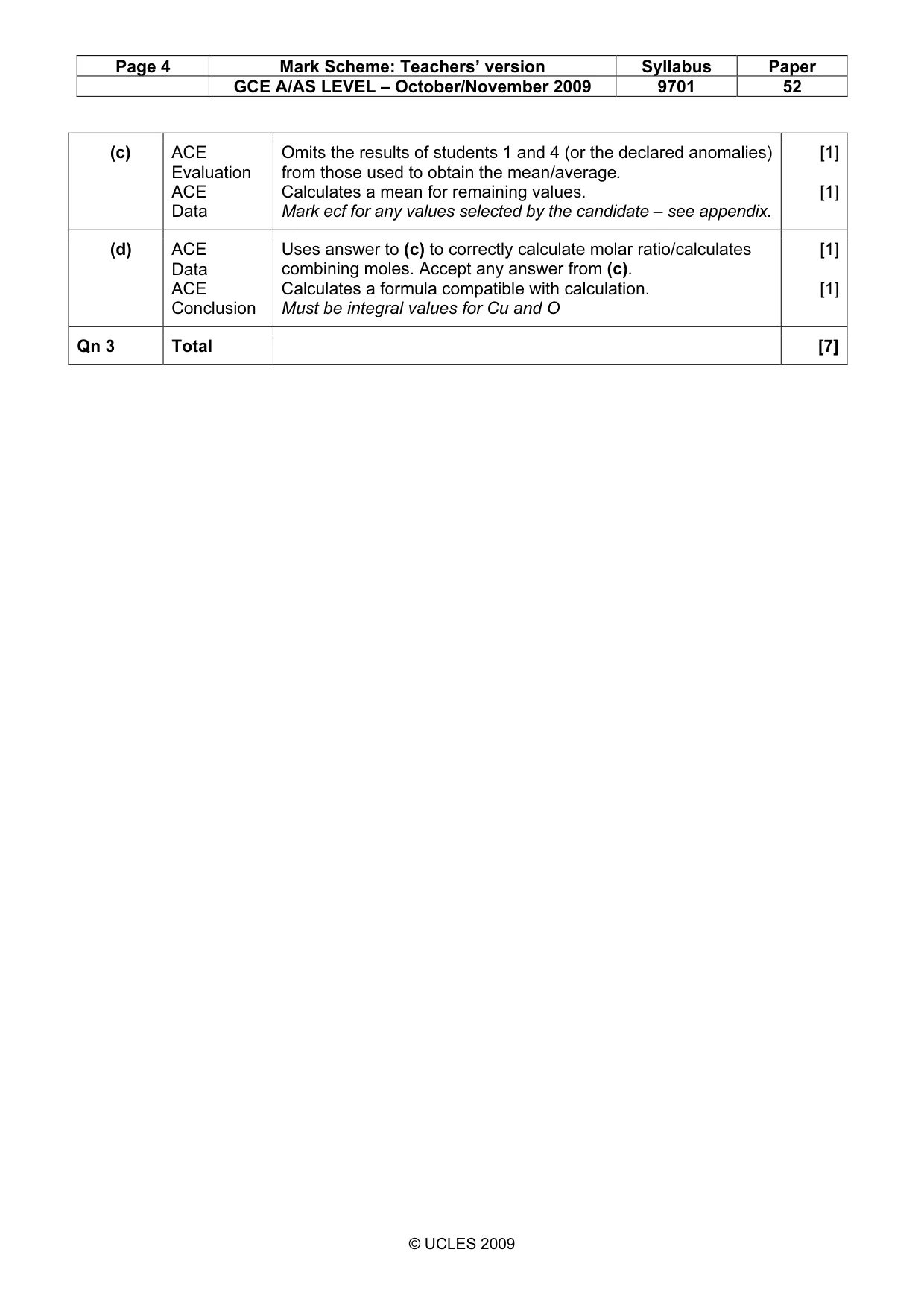
Page 4 Mark Scheme: Teachers’ version Syllabus Paper GCE A/AS LEVEL – October/November 2009 9701 52 © UCLES 2009 (c) ACE Evaluation ACE Data Omits the results of students 1 and 4 (or the declared anomalies) from those used to obtain the mean/average. Calculates a mean for remaining values. Mark ecf for any values selected by the candidate – see appendix. [1] [1] (d) ACE Data ACE Conclusion Uses answer to (c) to correctly calculate molar ratio/calculates combining moles. Accept any answer from (c). Calculates a formula compatible with calculation. Must be integral values for Cu and O [1] [1] Qn 3 Total [7]
Mark scheme, page 5
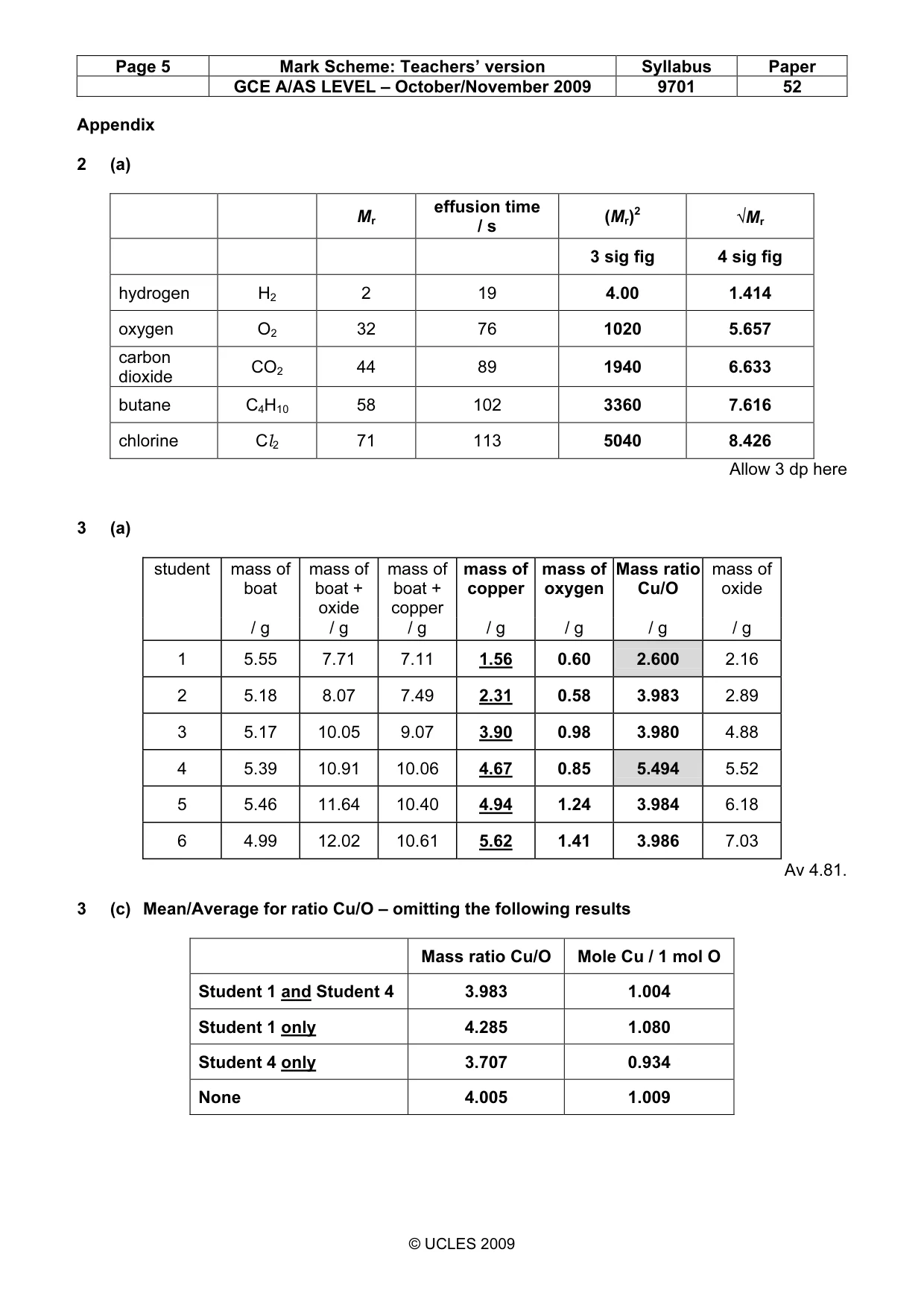
Page 5 Mark Scheme: Teachers’ version Syllabus Paper GCE A/AS LEVEL – October/November 2009 9701 52 © UCLES 2009 Appendix 2 (a) Mr effusion time / s (Mr)2 √Mr 3 sig fig 4 sig fig hydrogen H2 2 19 4.00 1.414 oxygen O2 32 76 1020 5.657 carbon dioxide CO2 44 89 1940 6.633 butane C4H10 58 102 3360 7.616 chlorine Cl2 71 113 5040 8.426 Allow 3 dp here 3 (a) student mass of boat mass of boat + oxide mass of boat + copper mass of copper mass of oxygen Mass ratio Cu/O mass of oxide / g / g / g / g / g / g / g 1 5.55 7.71 7.11 1.56 0.60 2.600 2.16 2 5.18 8.07 7.49 2.31 0.58 3.983 2.89 3 5.17 10.05 9.07 3.90 0.98 3.980 4.88 4 5.39 10.91 10.06 4.67 0.85 5.494 5.52 5 5.46 11.64 10.40 4.94 1.24 3.984 6.18 6 4.99 12.02 10.61 5.62 1.41 3.986 7.03 Av 4.81. 3 (c) Mean/Average for ratio Cu/O – omitting the following results Mass ratio Cu/O Mole Cu / 1 mol O Student 1 and Student 4 3.983 1.004 Student 1 only 4.285 1.080 Student 4 only 3.707 0.934 None 4.005 1.009