Cambridge A Level Business (for first examination in 2016) 9609 — 2025 Oct/Nov Paper 2 · Variant 2
9609/22/O/N/25 · 2 questions · 60 marks · ≈68 min
The question paper and its mark scheme, free to read here and free to download. This is Cambridge’s own paper, exactly as it was sat.
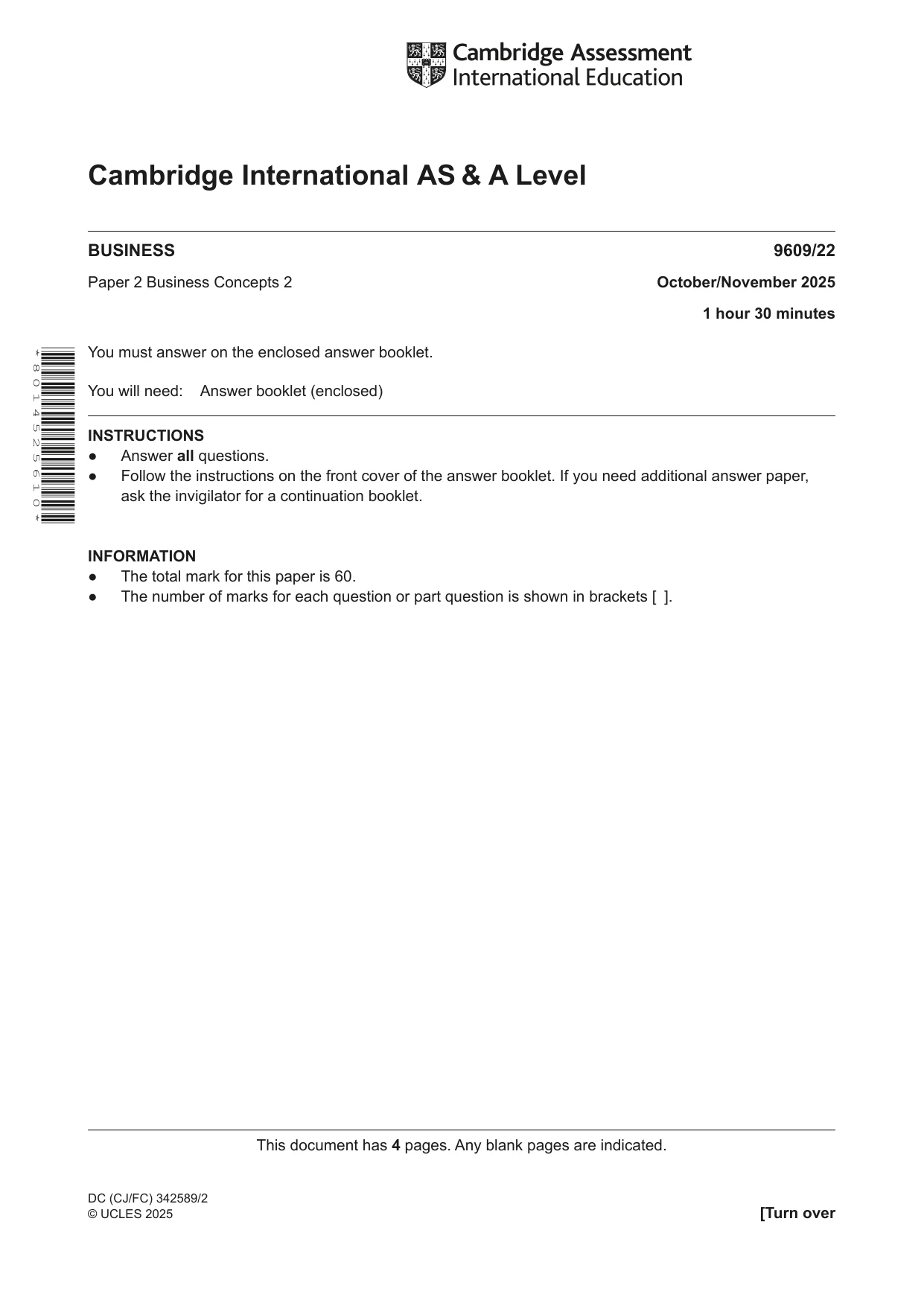
Question paper4 pages

Mark scheme38 pages
Answers below. Sit the paper first if you are practising.
Questions as text
Q1 · The Research Agency (TRA) TRA is a quaternary sector business
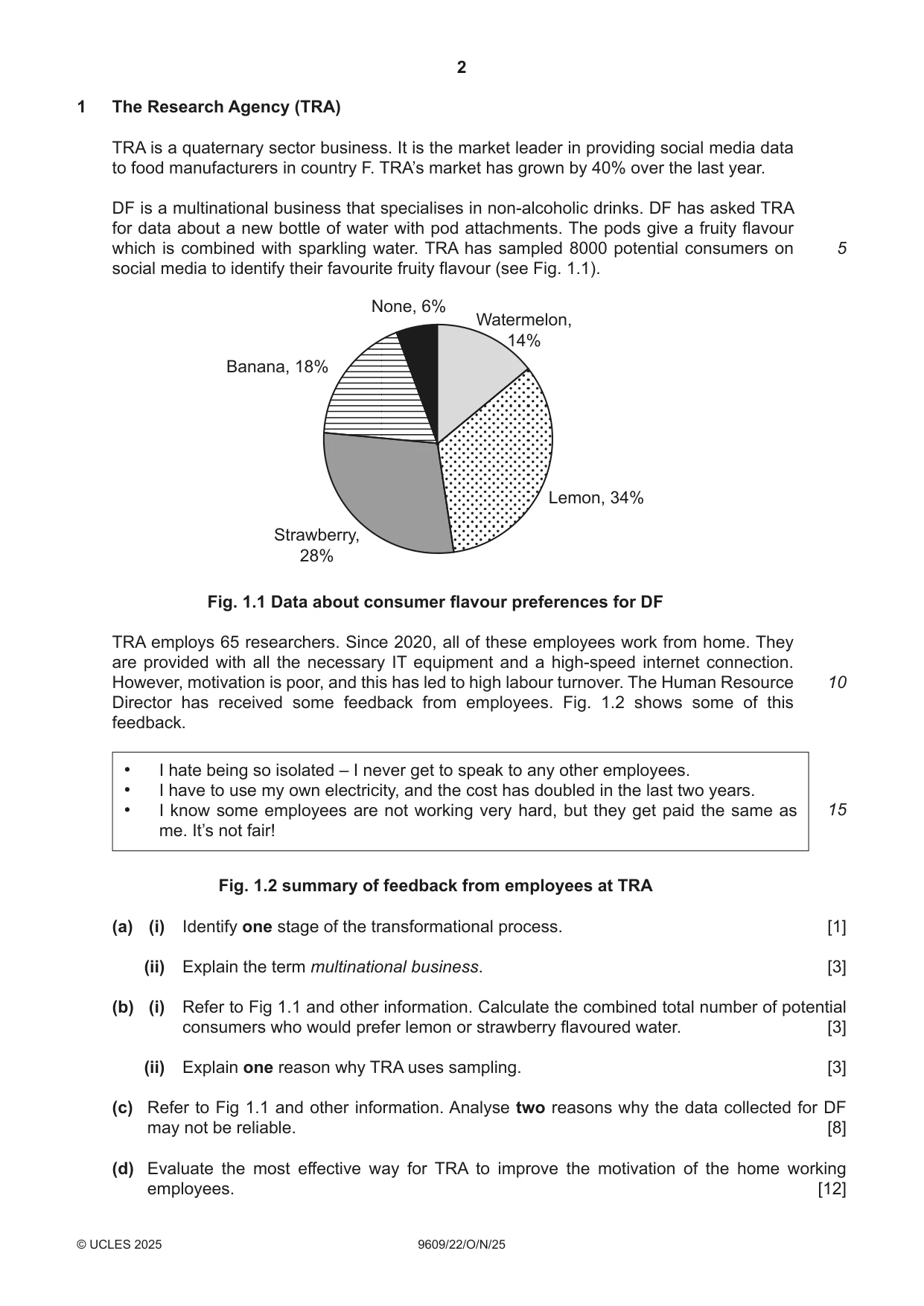
1 The Research Agency (TRA) TRA is a quaternary sector business. It is the market leader in providing social media data to food manufacturers in country F. TRA’s market has grown by 40% over the last year. DF is a multinational business that specialises in non-alcoholic drinks. DF has asked TRA for data about a new bottle of water with pod attachments. The pods give a fruity flavour which is combined with sparkling water. TRA has sampled 8000 potential consumers on 5 social media to identify their favourite fruity flavour (see Fig. 1.1). None, 6% Watermelon, 14% Banana, 18% Lemon, 34% Strawberry, 28% Fig. 1.1 Data about consumer flavour preferences for DF TRA employs 65 researchers. Since 2020, all of these employees work from home. They are provided with all the necessary IT equipment and a high-speed internet connection. However, motivation is poor, and this has led to high labour turnover. The Human Resource 10 Director has received some feedback from employees. Fig. 1.2 shows some of this feedback. • I hate being so isolated – I never get to speak to any other employees. • I have to use my own electricity, and the cost has doubled in the last two years. • I know some employees are not working very hard, but they get paid the same as 15 me. It’s not fair! Fig. 1.2 summary of feedback from employees at TRA (a) (i) Identify one stage of the transformational process. [1] (ii) Explain the term multinational business. [3] (b) (i) Refer to Fig 1.1 and other information. Calculate the combined total number of potential consumers who would prefer lemon or strawberry flavoured water. [3] (ii) Explain one reason why TRA uses sampling. [3] (c) Refer to Fig 1.1 and other information. Analyse two reasons why the data collected for DF may not be reliable. [8] (d) Evaluate the most effective way for TRA to improve the motivation of the home working employees. [12]
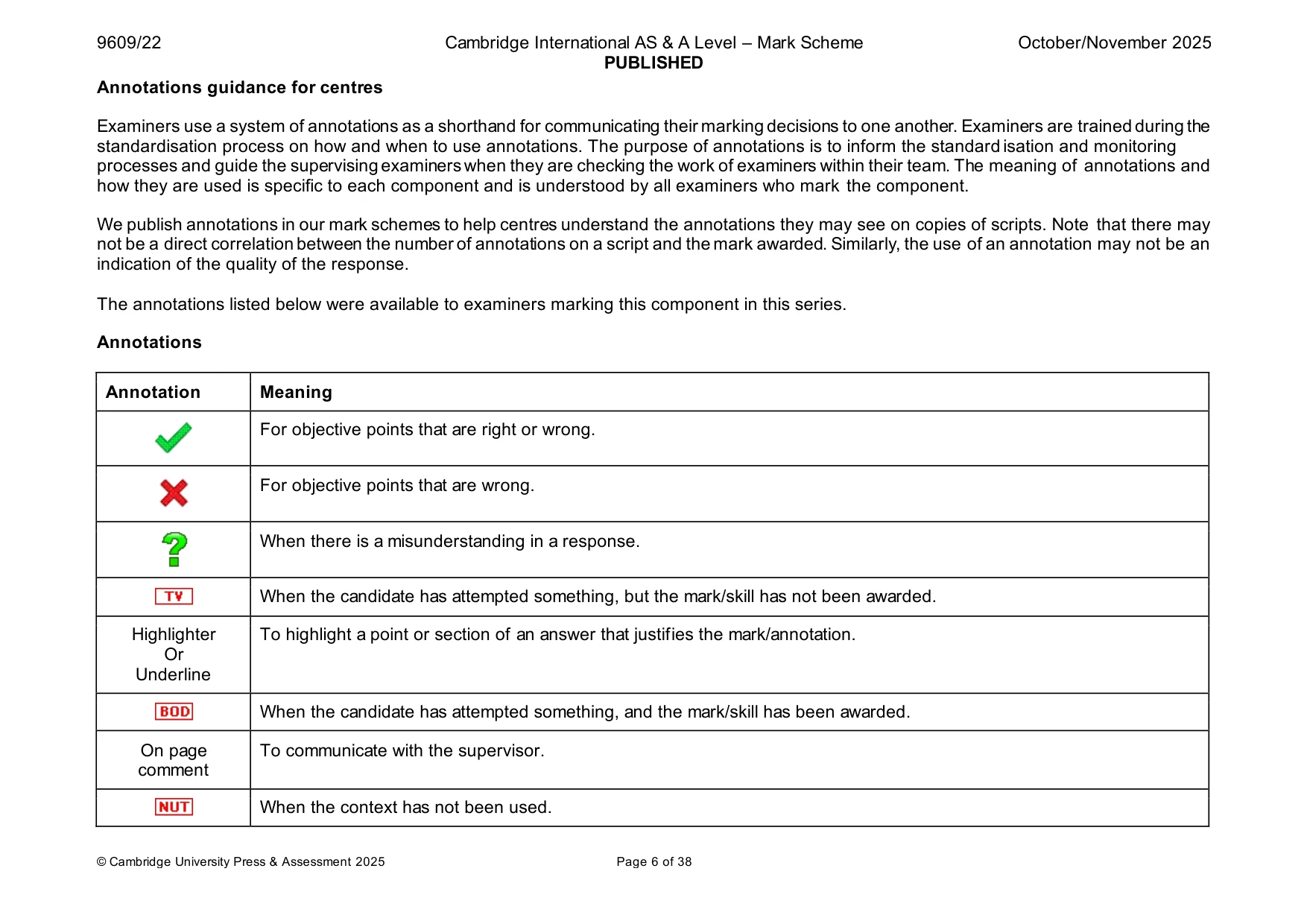
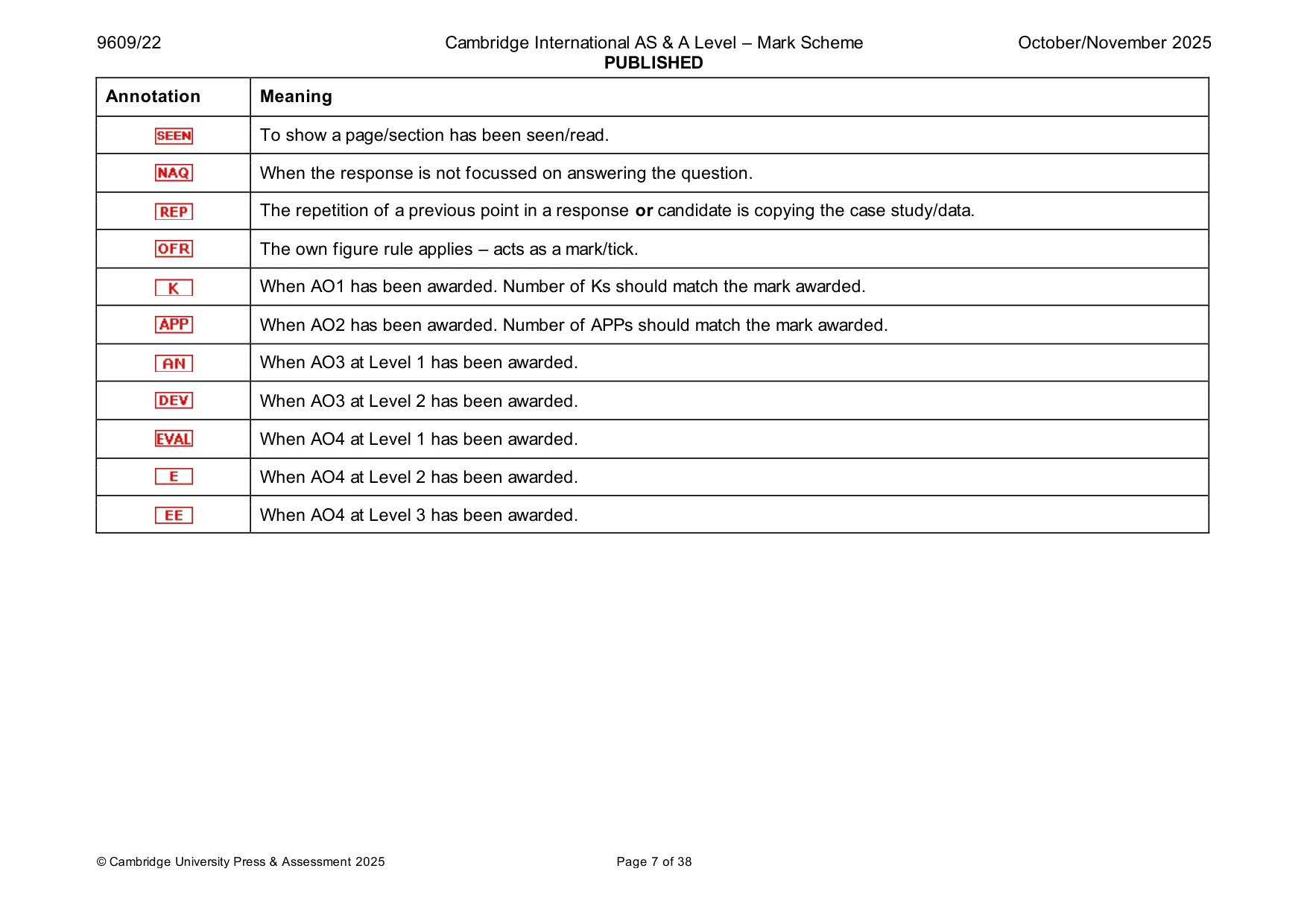
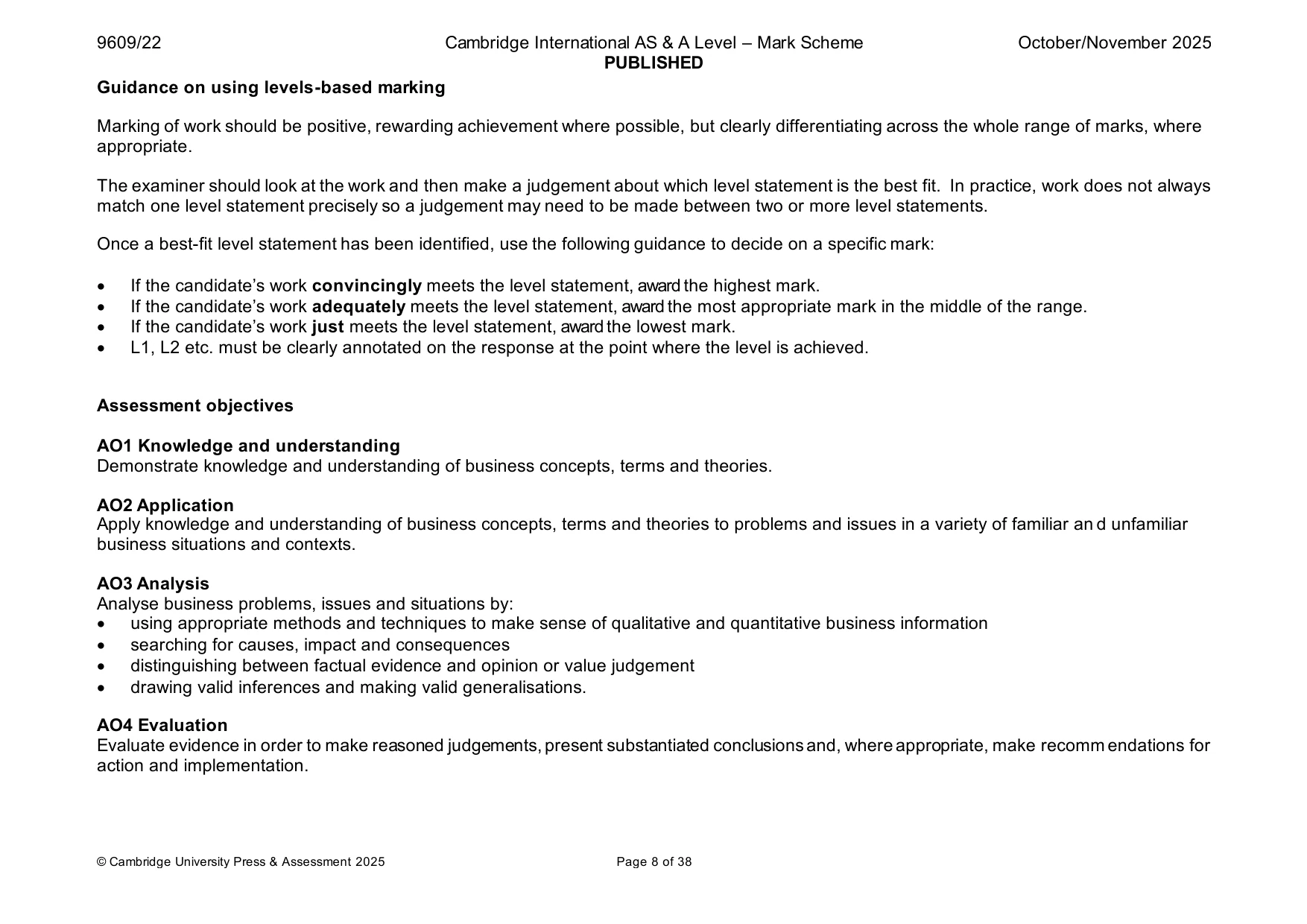
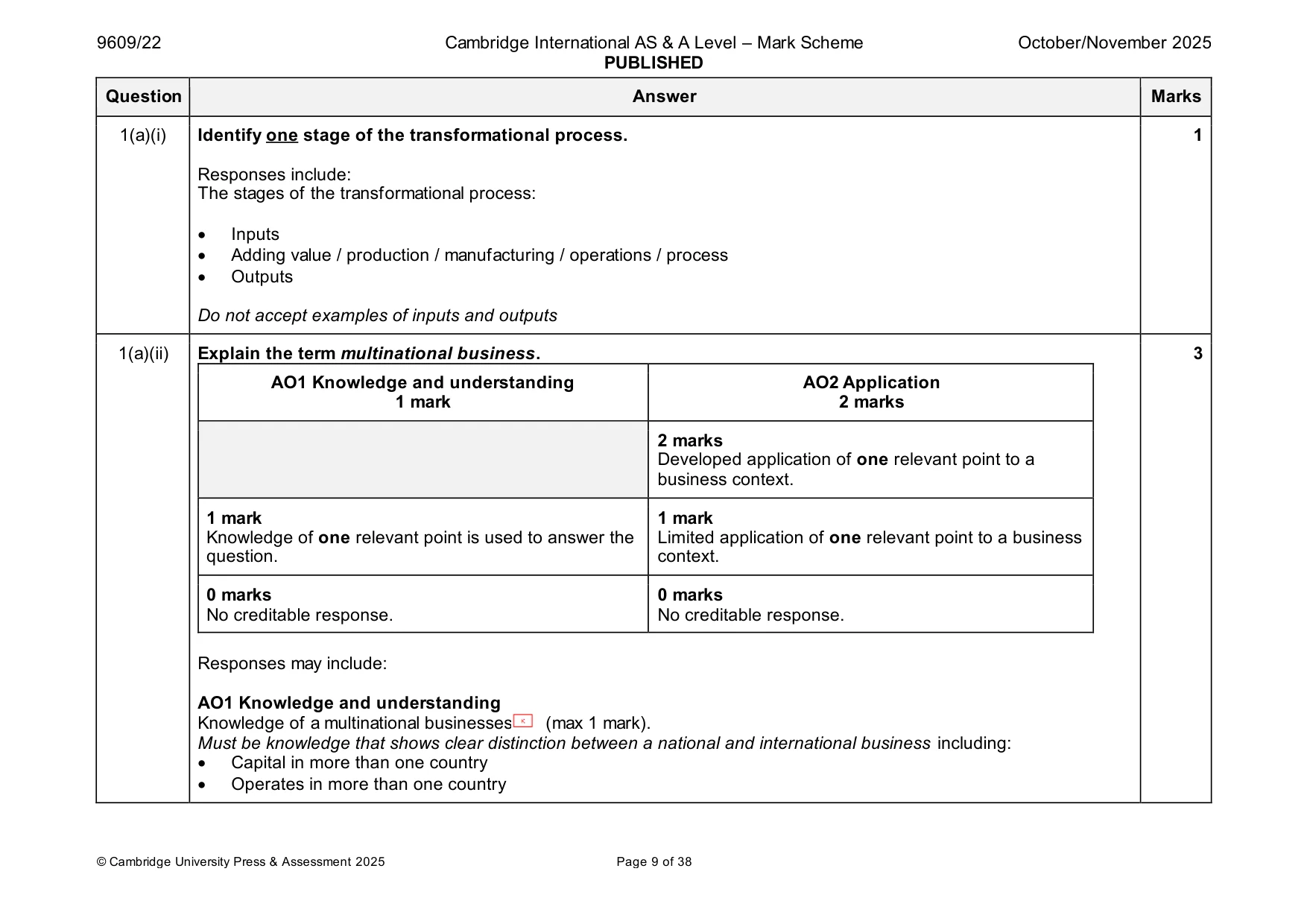
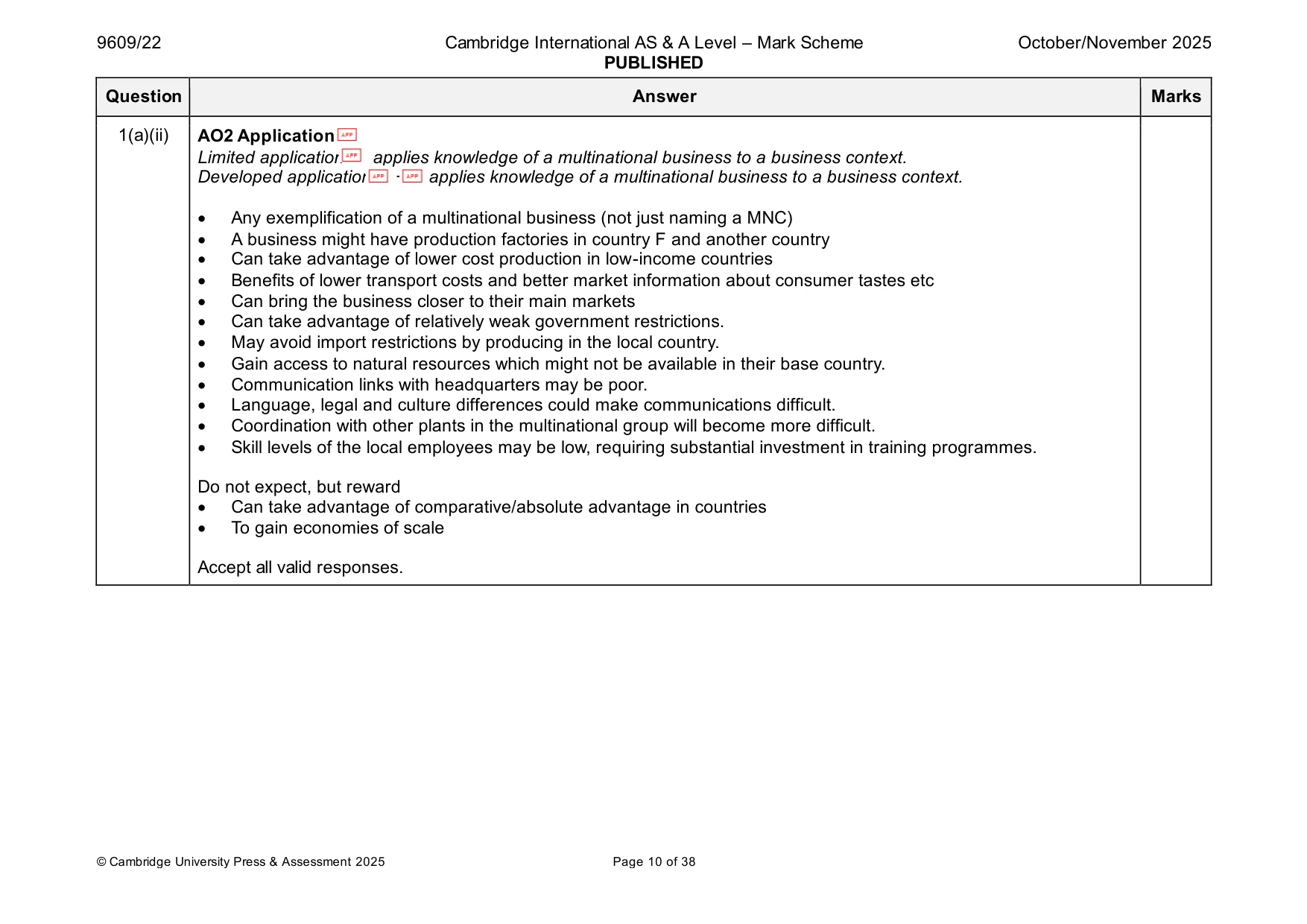
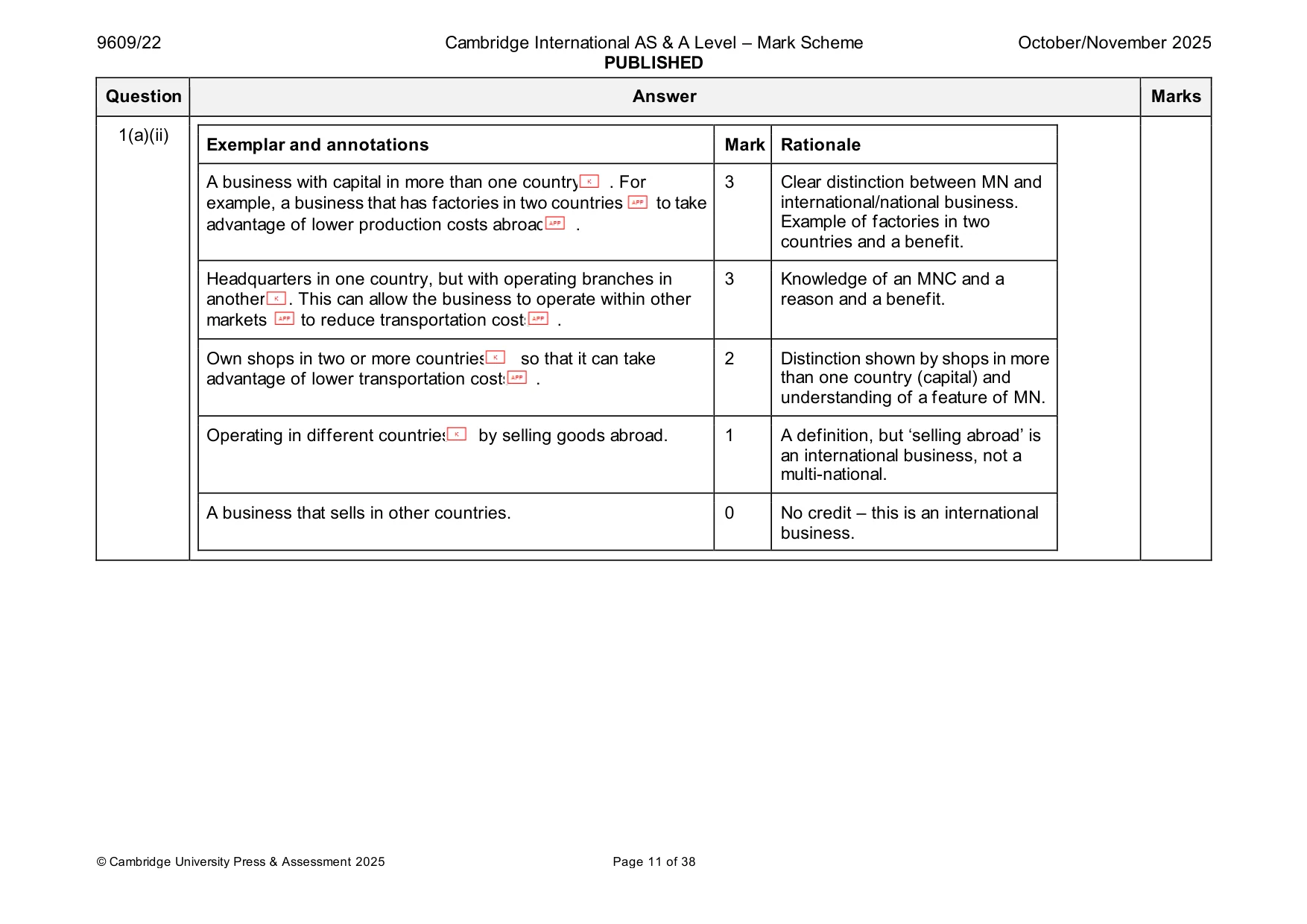
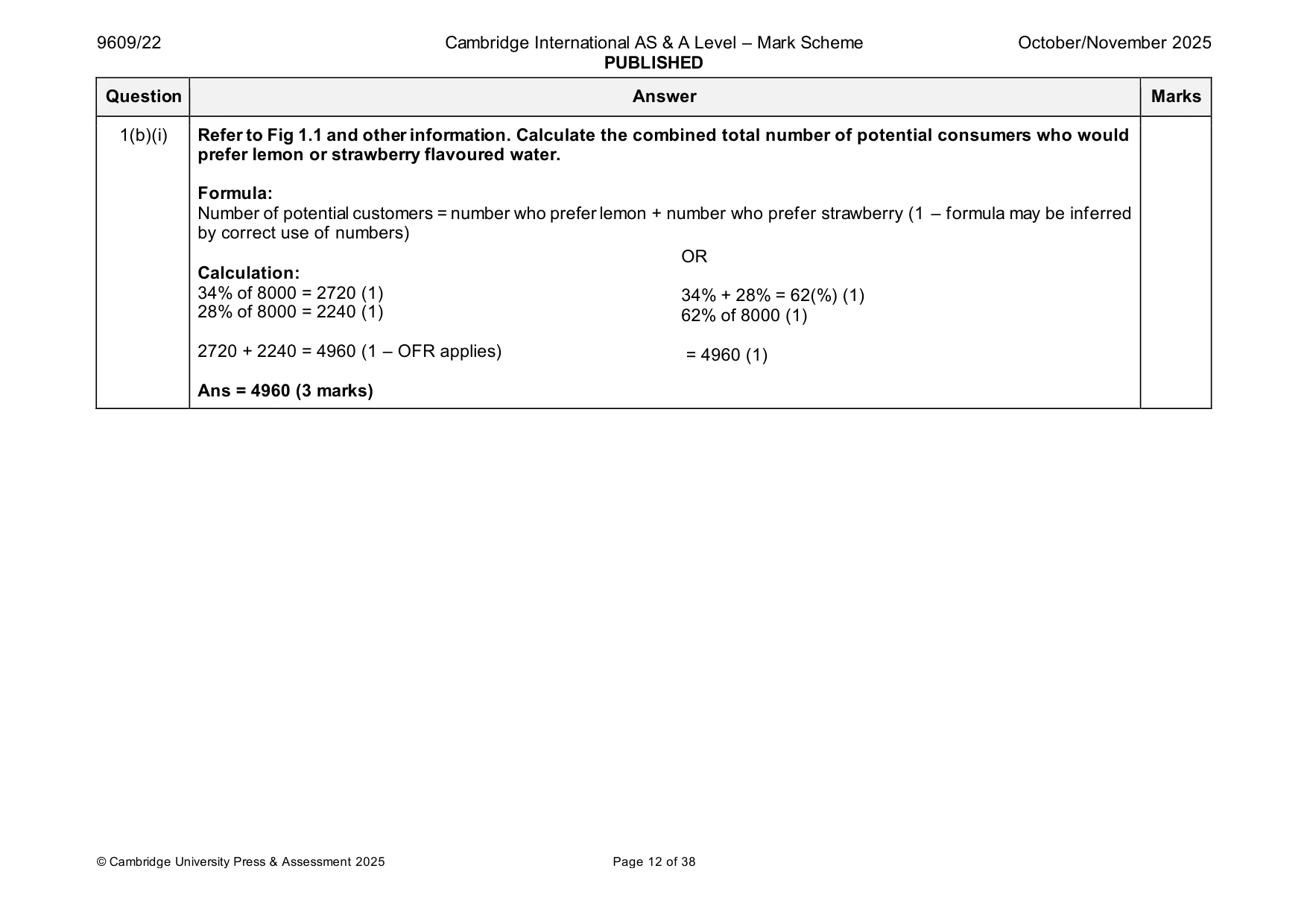
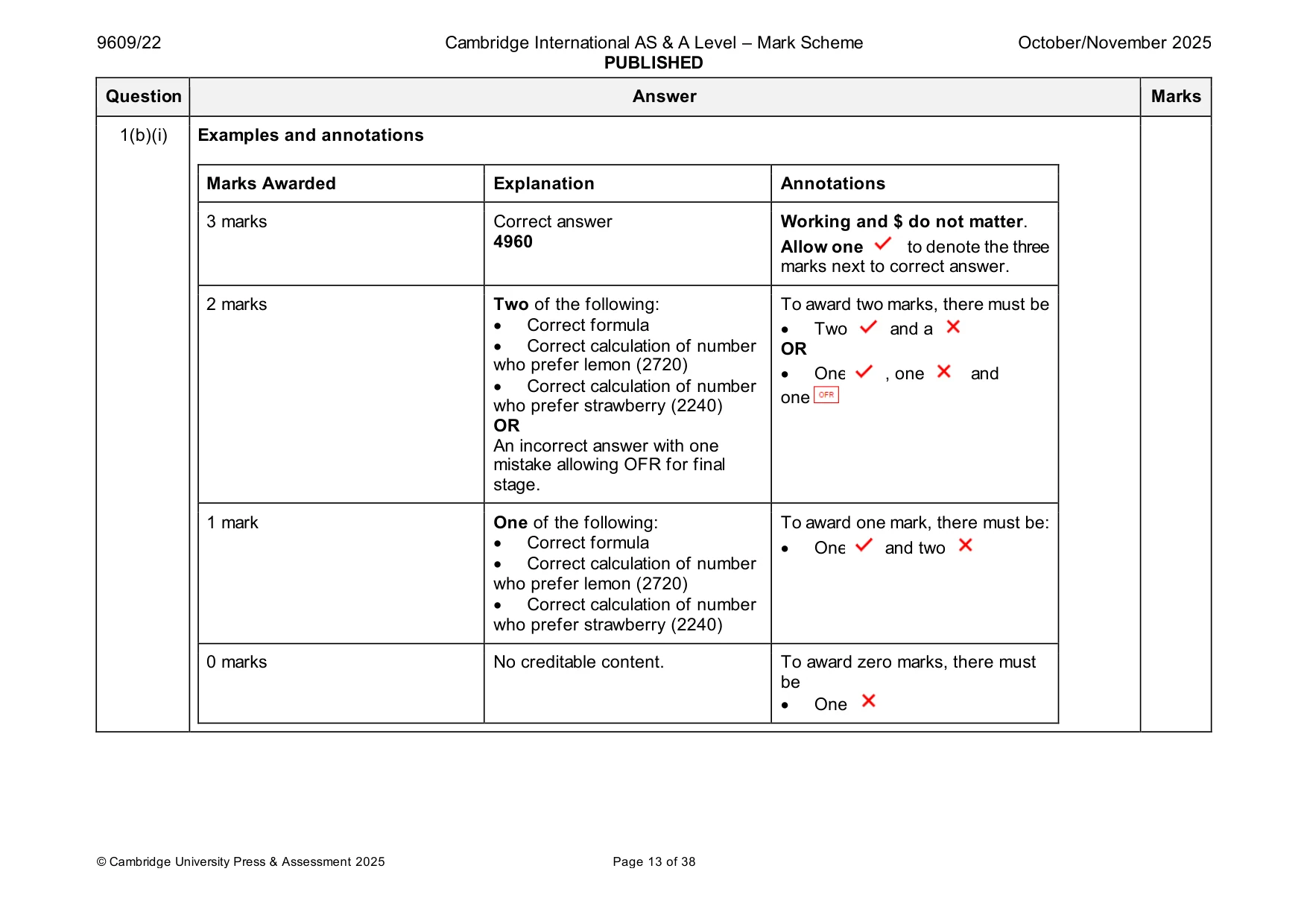
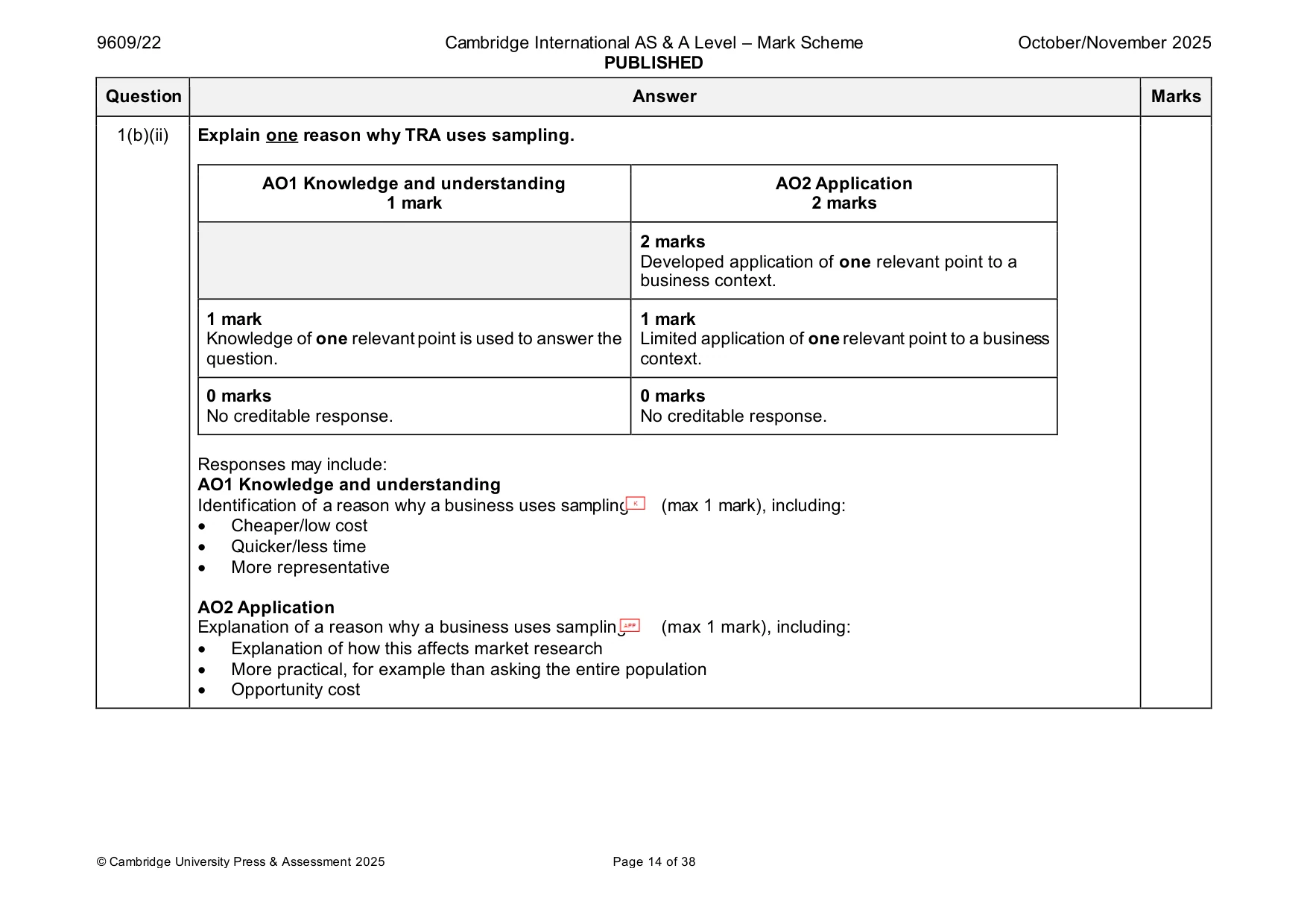
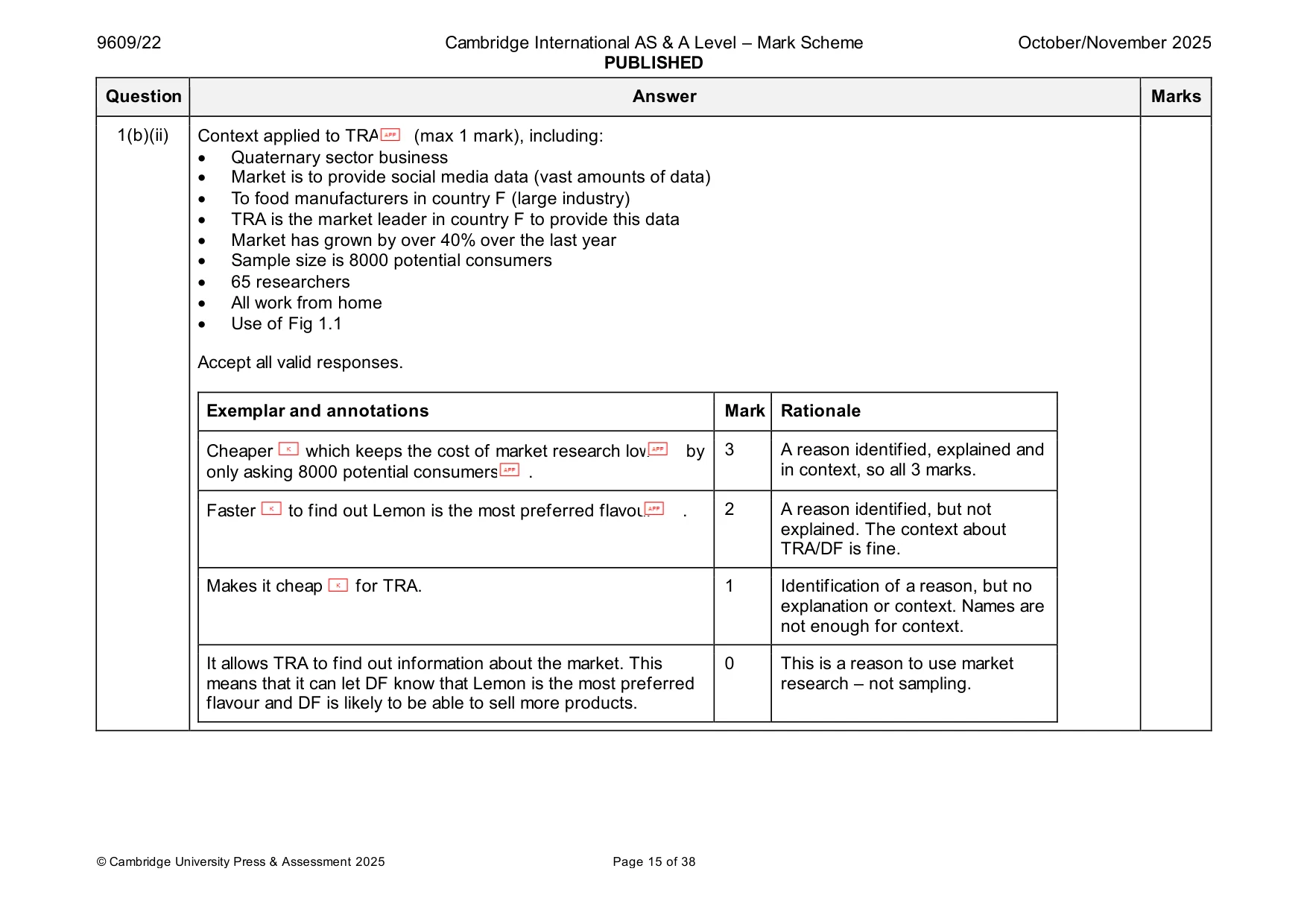
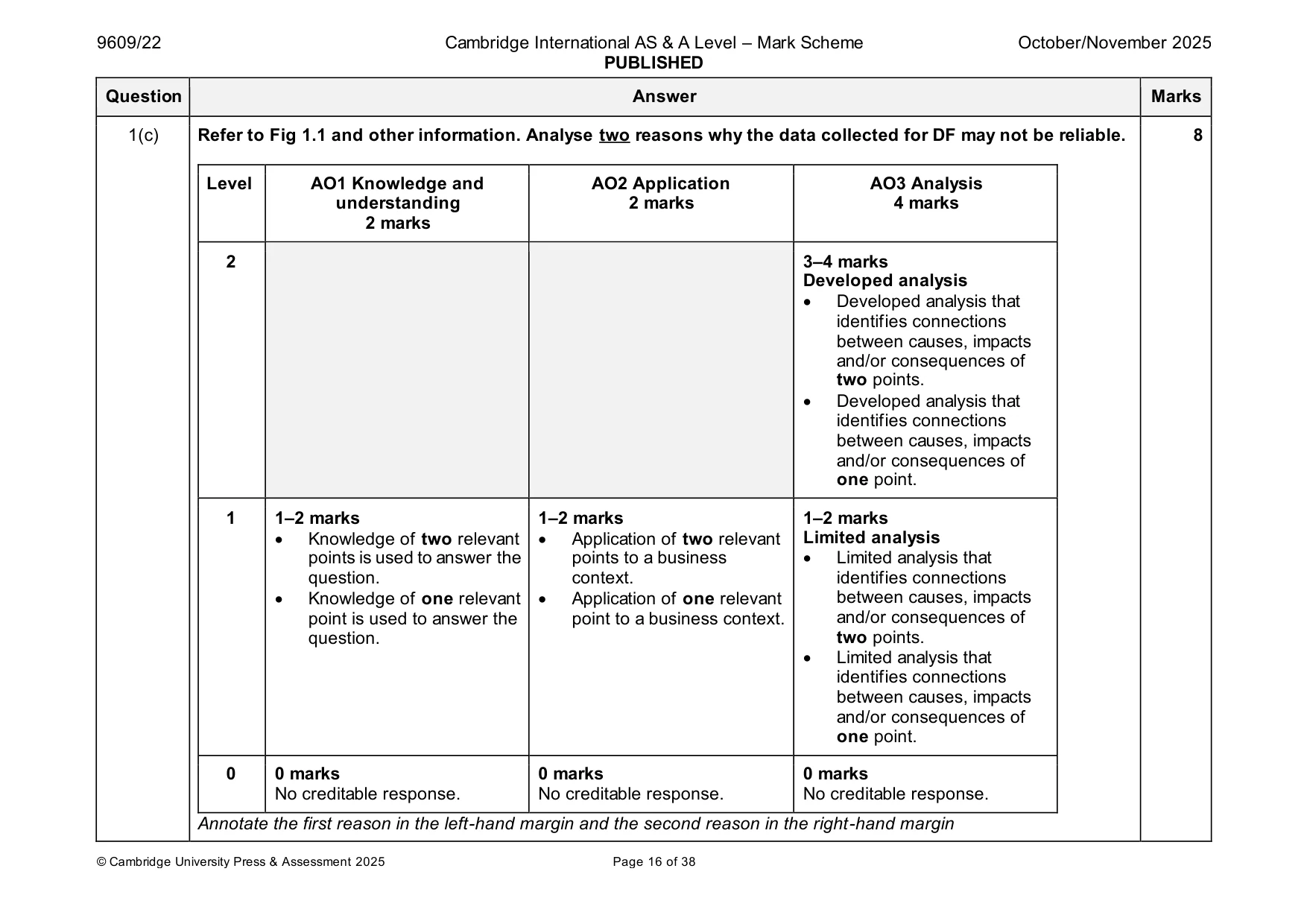
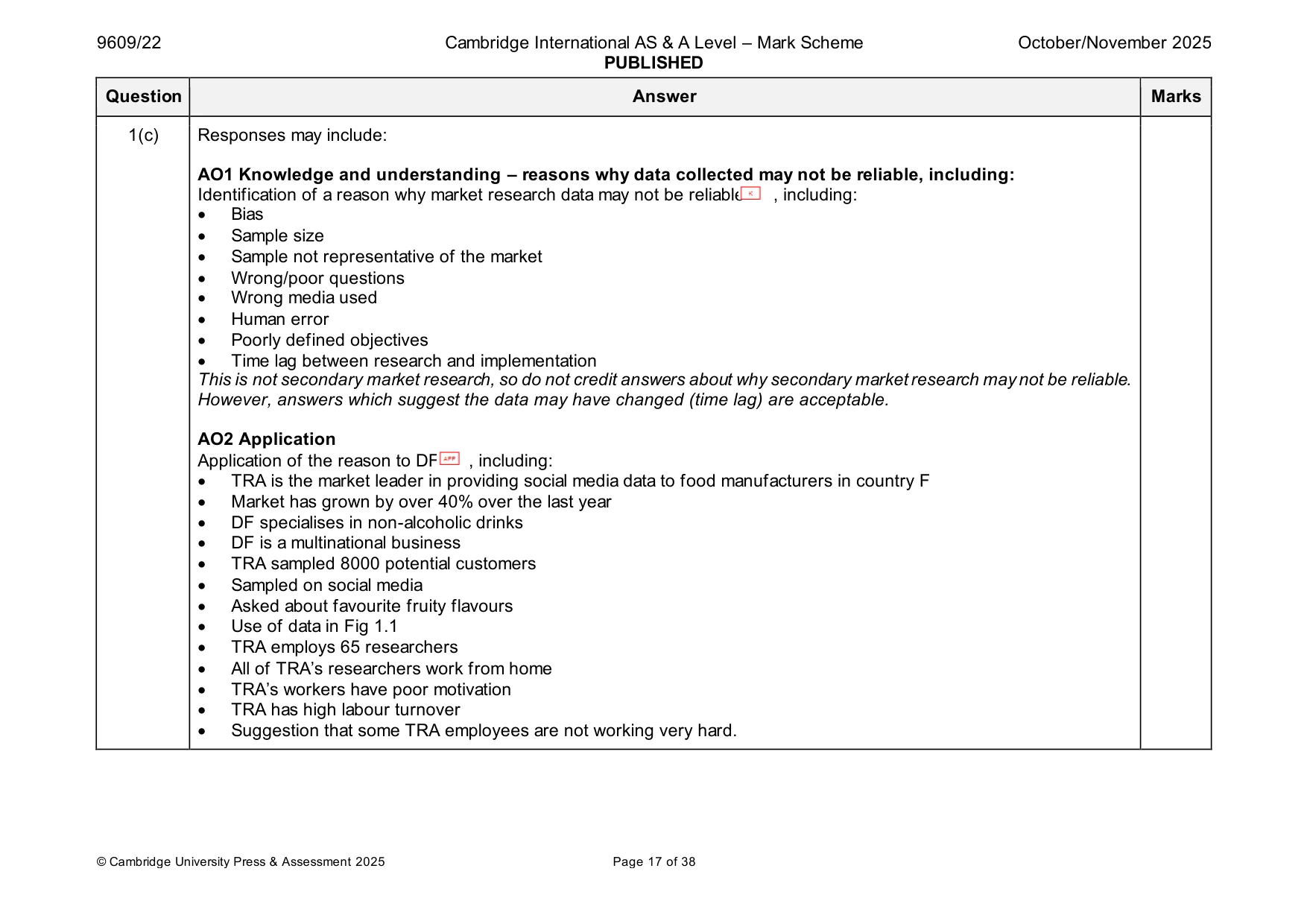
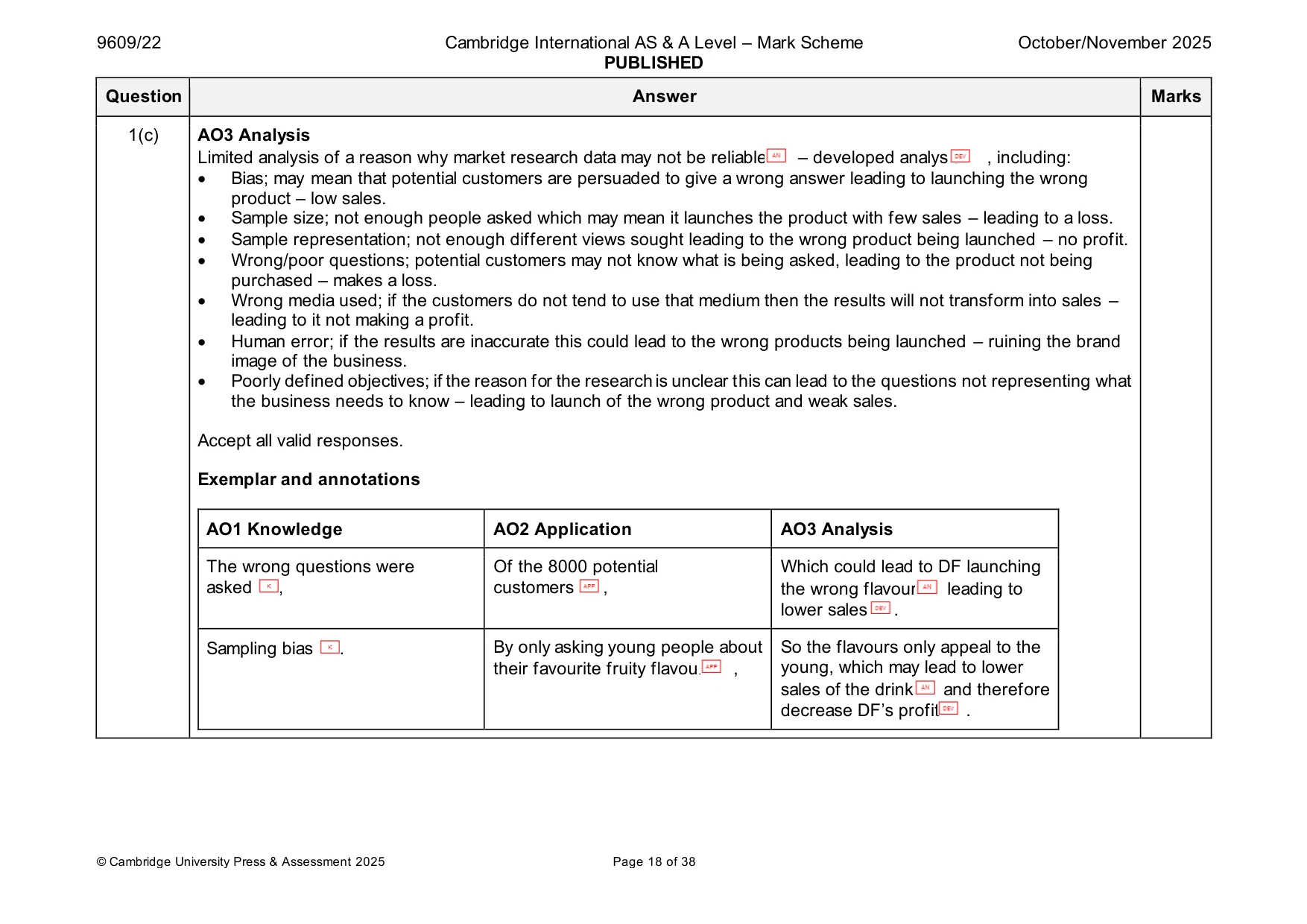
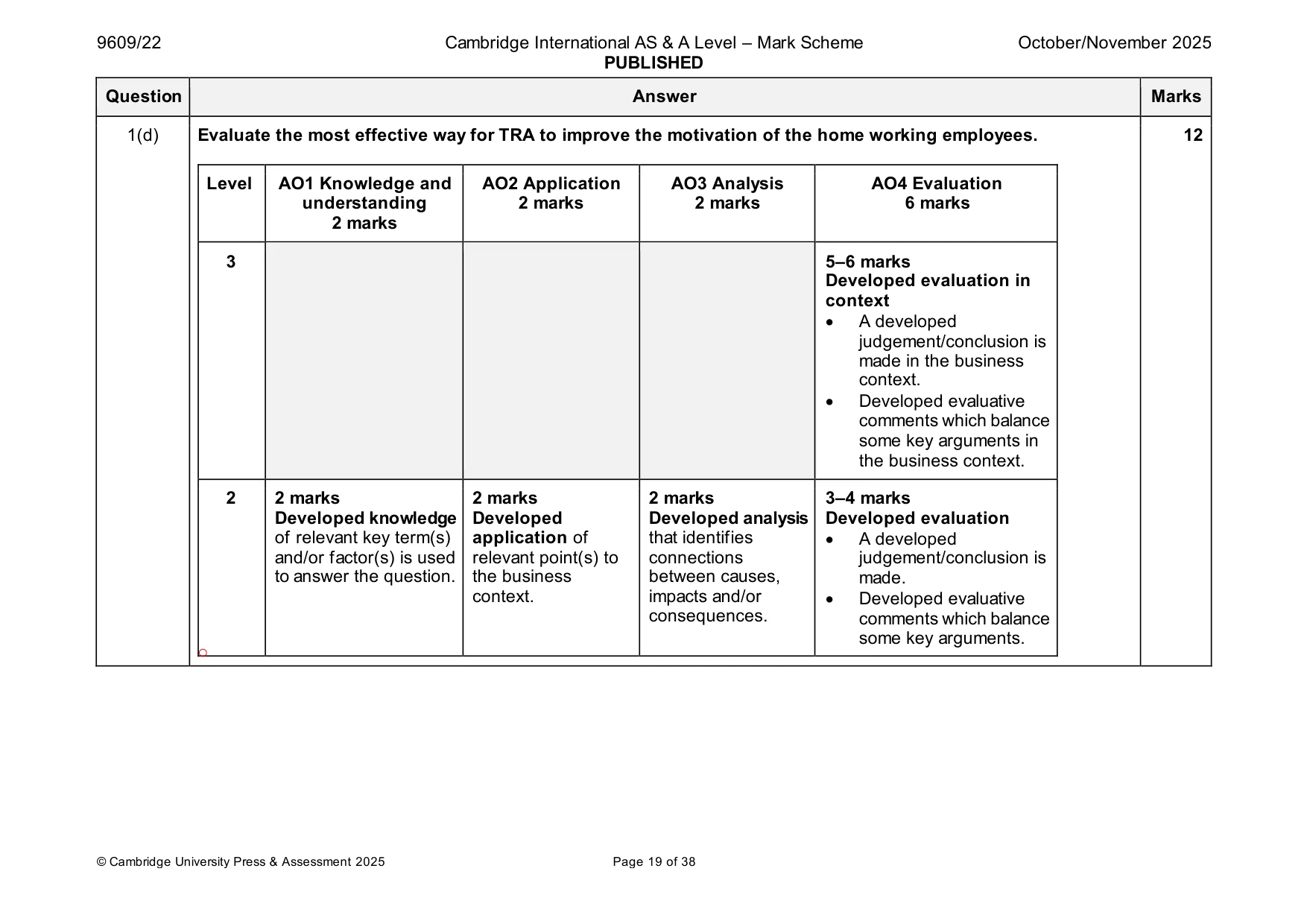
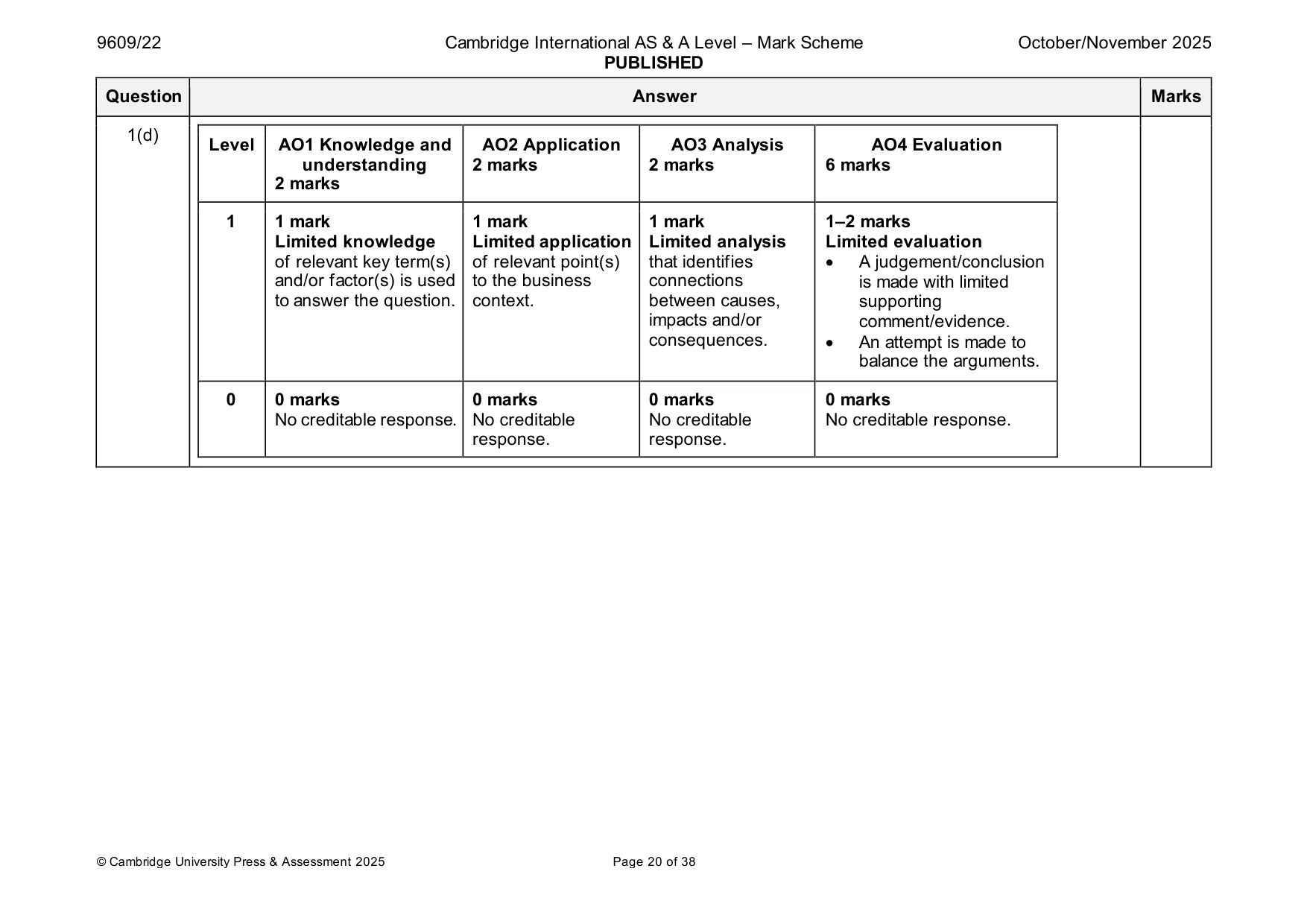
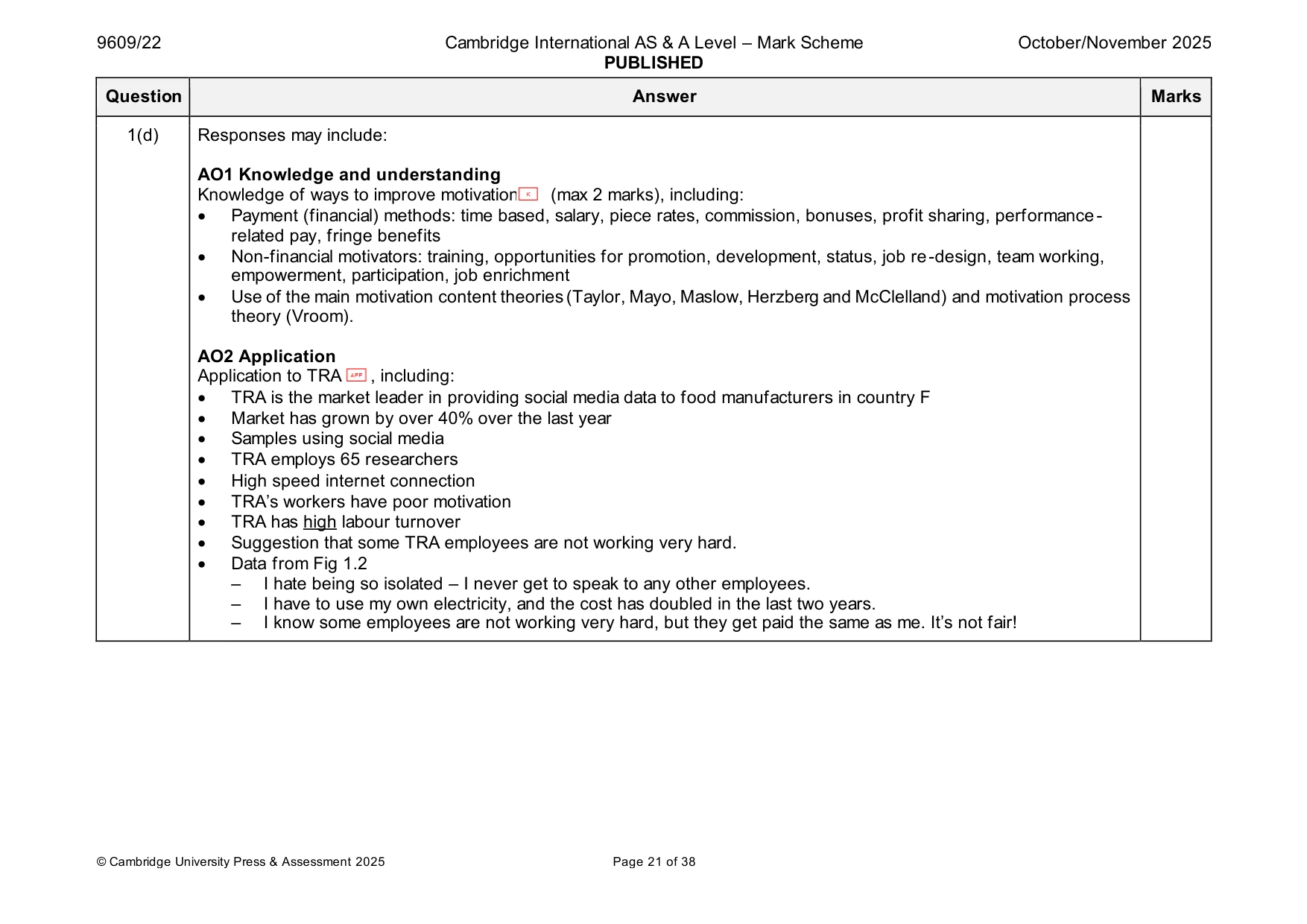
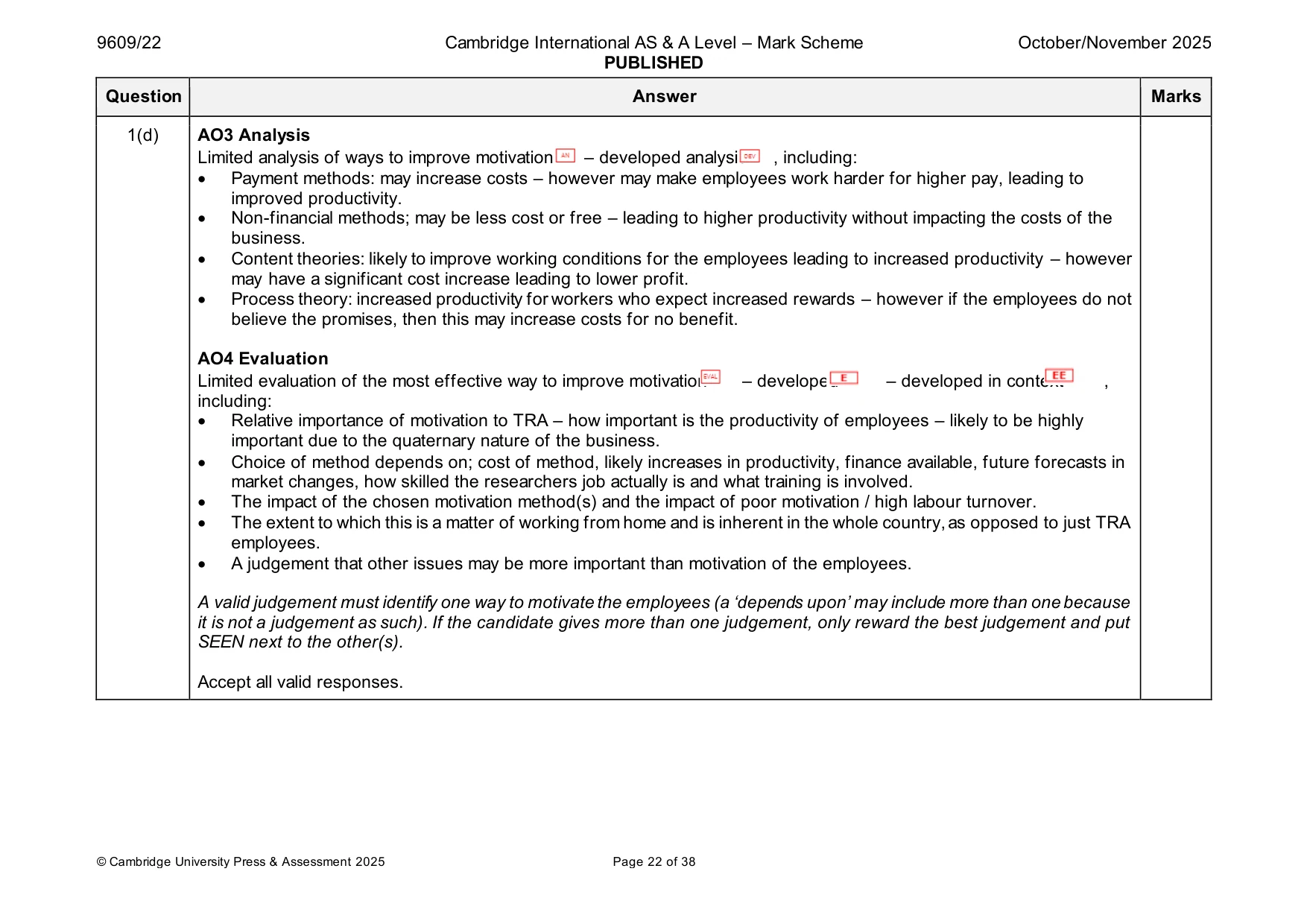
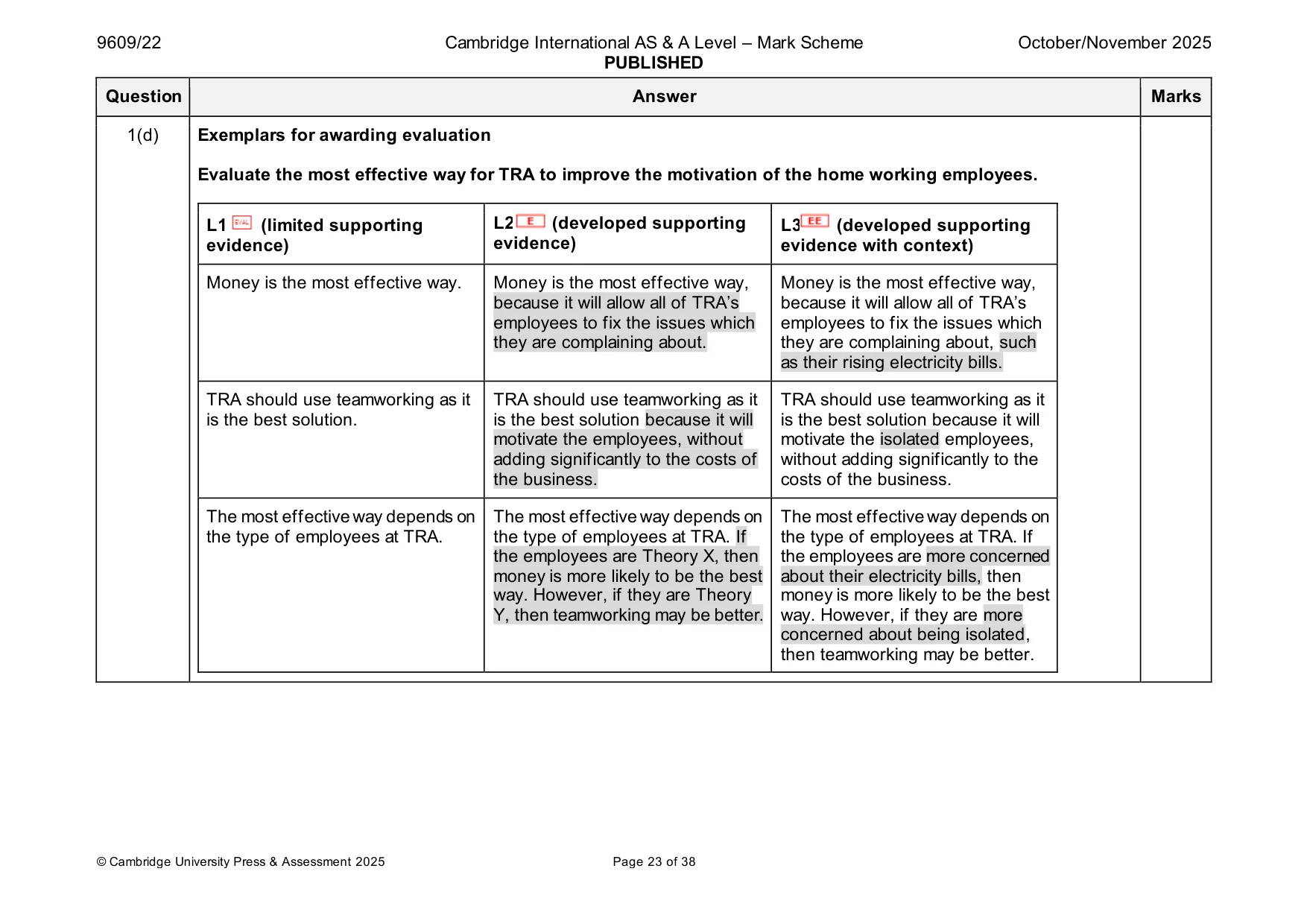
Mark scheme: Question Answer Marks 1(a)(i) Identify one stage of the transformational process. 1 Responses include: The stages of the transformational process: • Inputs • Adding value / production / manufacturing / operations / process • Outputs Do not accept examples of inputs and outputs 1(a)(ii) Explain the term multinational business. 3 AO1 Knowledge and understanding AO2 Application 1 mark 2 marks 2 marks Developed application of one relevant point to a business context. 1 mark 1 mark Knowledge of one relevant point is used to answer the Limited application of one relevant point to a business question. context. 0 marks 0 marks No creditable response. No creditable response. Responses may include: AO1 Knowledge and understanding Knowledge of a multinational businesses (max 1 mark). Must be knowledge that shows clear distinction between a national and international business including: • Capital in more than one country • Operates in more than one country 1(a)(ii) AO2 Application Limited application applies knowledge of a multinational business to a business context. Developed application + applies knowledge of a multinational business to a business context. • Any exemplification of a multinational business (not just naming a MNC) • A business might have production factories in country F and another country • Can take advantage of lower cost production in low-income countries • Benefits of lower transport costs and better market information about consumer tastes etc • Can bring the business closer to their main markets • Can take advantage of relatively weak government restrictions. • May avoid import restrictions by producing in the local country. • Gain access to natural resources which might not be available in their base country. • Communication links with headquarters may be poor. • Language, legal and culture differences could make communications difficult. • Coordination with other plants in the multinational group will become more difficult. • Skill levels of the local employees may be low, requiring substantial investment in training programmes. Do not expect, but reward • Can take advantage of comparative/absolute advantage in countries • To gain economies of scale Accept all valid responses. 1(a)(ii) Exemplar and annotations Mark Rationale A business with capital in more than one country . For 3 Clear distinction between MN and example, a business that has factories in two countries to take international/national business. advantage of lower production costs abroad . Example of factories in two countries and a benefit. Headquarters in one country, but with operating branches in 3 Knowledge of an MNC and a another . This can allow the business to operate within other reason and a benefit. markets to reduce transportation costs . Own shops in two or more countries so that it can take 2 Distinction shown by shops in more advantage of lower transportation costs . than one country (capital) and understanding of a feature of MN. Operating in different countries by selling goods abroad. 1 A definition, but ‘selling abroad’ is an international business, not a multi-national. A business that sells in other countries. 0 No credit – this is an international business. 1(b)(i) Refer to Fig 1.1 and other information. Calculate the combined total number of potential consumers who would prefer lemon or strawberry flavoured water. Formula: Number of potential customers = number who prefer lemon + number who prefer strawberry (1 – formula may be inferred by correct use of numbers) OR Calculation: 34% of 8000 = 2720 (1) 34% + 28% = 62(%) (1) 28% of 8000 = 2240 (1) 62% of 8000 (1) 2720 + 2240 = 4960 (1 – OFR applies) = 4960 (1) Ans = 4960 (3 marks) 1(b)(i) Examples and annotations Marks Awarded Explanation Annotations 3 marks Correct answer Working and $ do not matter. 4960 Allow one to denote the three marks next to correct answer. 2 marks Two of the following: To award two marks, there must be • Correct formula • Two and a • Correct calculation of number OR who prefer lemon (2720) • One , one and • Correct calculation of number one who prefer strawberry (2240) OR An incorrect answer with one mistake allowing OFR for final stage. 1 mark One of the following: To award one mark, there must be: • Correct formula • One and two • Correct calculation of number who prefer lemon (2720) • Correct calculation of number who prefer strawberry (2240) 0 marks No creditable content. To award zero marks, there must be • One 1(b)(ii) Explain one reason why TRA uses sampling. AO1 Knowledge and understanding AO2 Application 1 mark 2 marks 2 marks Developed application of one relevant point to a business context. 1 mark 1 mark Knowledge of one relevant point is used to answer the Limited application of one relevant point to a business question. context. 0 marks 0 marks No creditable response. No creditable response. Responses may include: AO1 Knowledge and understanding Identification of a reason why a business uses sampling (max 1 mark), including: • Cheaper/low cost • Quicker/less time • More representative AO2 Application Explanation of a reason why a business uses sampling (max 1 mark), including: • Explanation of how this affects market research • More practical, for example than asking the entire population • Opportunity cost 1(b)(ii) Context applied to TRA (max 1 mark), including: • Quaternary sector business • Market is to provide social media data (vast amounts of data) • To food manufacturers in country F (large industry) • TRA is the market leader in country F to provide this data • Market has grown by over 40% over the last year • Sample size is 8000 potential consumers • 65 researchers • All work from home • Use of Fig 1.1 Accept all valid responses. Exemplar and annotations Mark Rationale Cheaper which keeps the cost of market research low by 3 A reason identified, explained and only asking 8000 potential consumers . in context, so all 3 marks. Faster to find out Lemon is the most preferred flavour . 2 A reason identified, but not explained. The context about TRA/DF is fine. Makes it cheap for TRA. 1 Identification of a reason, but no explanation or context. Names are not enough for context. It allows TRA to find out information about the market. This 0 This is a reason to use market means that it can let DF know that Lemon is the most preferred research – not sampling. flavour and DF is likely to be able to sell more products. 1(c) Refer to Fig 1.1 and other information. Analyse two reasons why the data collected for DF may not be reliable. 8 Level AO1 Knowledge and AO2 Application AO3 Analysis understanding 2 marks 4 marks 2 marks 2 3–4 marks Developed analysis • Developed analysis that identifies connections between causes, impacts and/or consequences of two points. • Developed analysis that identifies connections between causes, impacts and/or consequences of one point. 1 1–2 marks 1–2 marks 1–2 marks • Knowledge of two relevant • Application of two relevant Limited analysis points is used to answer the points to a business • Limited analysis that question. context. identifies connections • Knowledge of one relevant • Application of one relevant between causes, impacts point is used to answer the point to a business context. and/or consequences of question. two points. • Limited analysis that identifies connections between causes, impacts and/or consequences of one point. 0 0 marks 0 marks 0 marks No creditable response. No creditable response. No creditable response. Annotate the first reason in the left-hand margin and the second reason in the right-hand margin 1(c) Responses may include: AO1 Knowledge and understanding – reasons why data collected may not be reliable, including: Identification of a reason why market research data may not be reliable , including: • Bias • Sample size • Sample not representative of the market • Wrong/poor questions • Wrong media used • Human error • Poorly defined objectives • Time lag between research and implementation This is not secondary market research, so do not credit answers about why secondary market research may not be reliable. However, answers which suggest the data may have changed (time lag) are acceptable. AO2 Application Application of the reason to DF , including: • TRA is the market leader in providing social media data to food manufacturers in country F • Market has grown by over 40% over the last year • DF specialises in non-alcoholic drinks • DF is a multinational business • TRA sampled 8000 potential customers • Sampled on social media • Asked about favourite fruity flavours • Use of data in Fig 1.1 • TRA employs 65 researchers • All of TRA’s researchers work from home • TRA’s workers have poor motivation • TRA has high labour turnover • Suggestion that some TRA employees are not working very hard. 1(c) AO3 Analysis Limited analysis of a reason why market research data may not be reliable – developed analysis , including: • Bias; may mean that potential customers are persuaded to give a wrong answer leading to launching the wrong product – low sales. • Sample size; not enough people asked which may mean it launches the product with few sales – leading to a loss. • Sample representation; not enough different views sought leading to the wrong product being launched – no profit. • Wrong/poor questions; potential customers may not know what is being asked, leading to the product not being purchased – makes a loss. • Wrong media used; if the customers do not tend to use that medium then the results will not transform into sales – leading to it not making a profit. • Human error; if the results are inaccurate this could lead to the wrong products being launched – ruining the brand image of the business. • Poorly defined objectives; if the reason for the research is unclear this can lead to the questions not representing what the business needs to know – leading to launch of the wrong product and weak sales. Accept all valid responses. Exemplar and annotations AO1 Knowledge AO2 Application AO3 Analysis The wrong questions were Of the 8000 potential Which could lead to DF launching asked , customers , the wrong flavour leading to lower sales . Sampling bias . By only asking young people about So the flavours only appeal to the their favourite fruity flavour , young, which may lead to lower sales of the drink and therefore decrease DF’s profit . 1(d) Evaluate the most effective way for TRA to improve the motivation of the home working employees. 12 Level AO1 Knowledge and AO2 Application AO3 Analysis AO4 Evaluation understanding 2 marks 2 marks 6 marks 2 marks 3 5–6 marks Developed evaluation in context • A developed judgement/conclusion is made in the business context. • Developed evaluative comments which balance some key arguments in the business context. 2 2 marks 2 marks 2 marks 3–4 marks Developed knowledge Developed Developed analysis Developed evaluation of relevant key term(s) application of that identifies • A developed and/or factor(s) is used relevant point(s) to connections judgement/conclusion is to answer the question. the business between causes, made. context. impacts and/or • Developed evaluative consequences. comments which balance some key arguments. o 1(d) Level AO1 Knowledge and AO2 Application AO3 Analysis AO4 Evaluation understanding 2 marks 2 marks 6 marks 2 marks 1 1 mark 1 mark 1 mark 1–2 marks Limited knowledge Limited application Limited analysis Limited evaluation of relevant key term(s) of relevant point(s) that identifies • A judgement/conclusion and/or factor(s) is used to the business connections is made with limited to answer the question. context. between causes, supporting impacts and/or comment/evidence. consequences. • An attempt is made to balance the arguments. 0 0 marks 0 marks 0 marks 0 marks No creditable response. No creditable No creditable No creditable response. response. response. 1(d) Responses may include: AO1 Knowledge and understanding Knowledge of ways to improve motivation (max 2 marks), including: • Payment (financial) methods: time based, salary, piece rates, commission, bonuses, profit sharing, performance- related pay, fringe benefits • Non-financial motivators: training, opportunities for promotion, development, status, job re-design, team working, empowerment, participation, job enrichment • Use of the main motivation content theories (Taylor, Mayo, Maslow, Herzberg and McClelland) and motivation process theory (Vroom). AO2 Application Application to TRA , including: • TRA is the market leader in providing social media data to food manufacturers in country F • Market has grown by over 40% over the last year • Samples using social media • TRA employs 65 researchers • High speed internet connection • TRA’s workers have poor motivation • TRA has high labour turnover • Suggestion that some TRA employees are not working very hard. • Data from Fig 1.2 – I hate being so isolated – I never get to speak to any other employees. – I have to use my own electricity, and the cost has doubled in the last two years. – I know some employees are not working very hard, but they get paid the same as me. It’s not fair! 1(d) AO3 Analysis Limited analysis of ways to improve motivation – developed analysis , including: • Payment methods: may increase costs – however may make employees work harder for higher pay, leading to improved productivity. • Non-financial methods; may be less cost or free – leading to higher productivity without impacting the costs of the business. • Content theories: likely to improve working conditions for the employees leading to increased productivity – however may have a significant cost increase leading to lower profit. • Process theory: increased productivity for workers who expect increased rewards – however if the employees do not believe the promises, then this may increase costs for no benefit. AO4 Evaluation Limited evaluation of the most effective way to improve motivation – developed – developed in context , including: • Relative importance of motivation to TRA – how important is the productivity of employees – likely to be highly important due to the quaternary nature of the business. • Choice of method depends on; cost of method, likely increases in productivity, finance available, future forecasts in market changes, how skilled the researchers job actually is and what training is involved. • The impact of the chosen motivation method(s) and the impact of poor motivation / high labour turnover. • The extent to which this is a matter of working from home and is inherent in the whole country, as opposed to just TRA employees. • A judgement that other issues may be more important than motivation of the employees. A valid judgement must identify one way to motivate the employees (a ‘depends upon’ may include more than one because it is not a judgement as such). If the candidate gives more than one judgement, only reward the best judgement and put SEEN next to the other(s). Accept all valid responses. 1(d) Exemplars for awarding evaluation Evaluate the most effective way for TRA to improve the motivation of the home working employees. L1 (limited supporting L2 (developed supporting L3 (developed supporting evidence) evidence) evidence with context) Money is the most effective way. Money is the most effective way, Money is the most effective way, because it will allow all of TRA’s because it will allow all of TRA’s employees to fix the issues which employees to fix the issues which they are complaining about. they are complaining about, such as their rising electricity bills. TRA should use teamworking as it TRA should use teamworking as it TRA should use teamworking as it is the best solution. is the best solution because it will is the best solution because it will motivate the employees, without motivate the isolated employees, adding significantly to the costs of without adding significantly to the the business. costs of the business. The most effective way depends on The most effective way depends on The most effective way depends on the type of employees at TRA. the type of employees at TRA. If the type of employees at TRA. If the employees are Theory X, then the employees are more concerned money is more likely to be the best about their electricity bills, then way. However, if they are Theory money is more likely to be the best Y, then teamworking may be better. way. However, if they are more concerned about being isolated, then teamworking may be better.
Q2 · Law Advice Forum (LAF) Drake has a law degree and works for a partnership of lawyers…
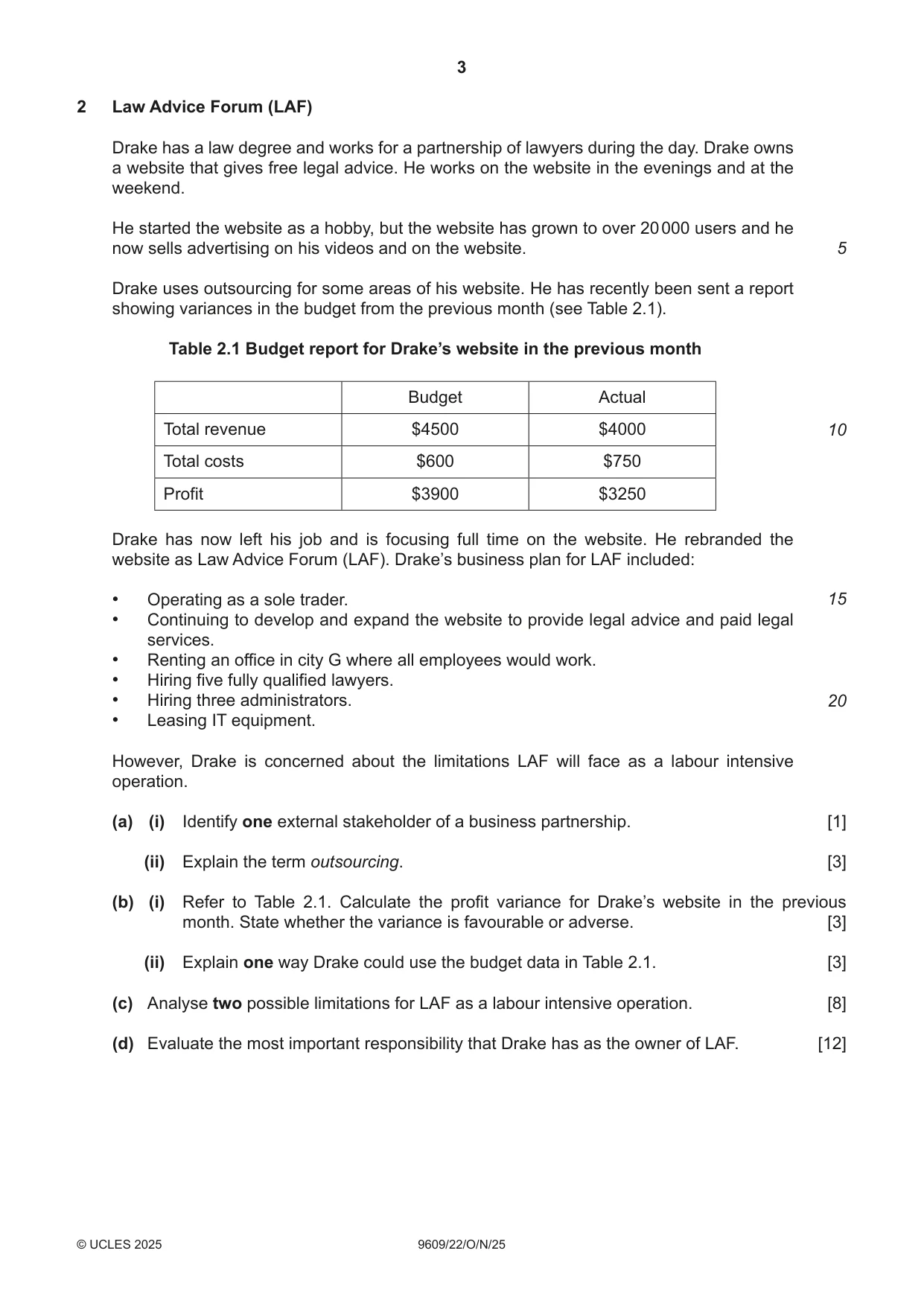
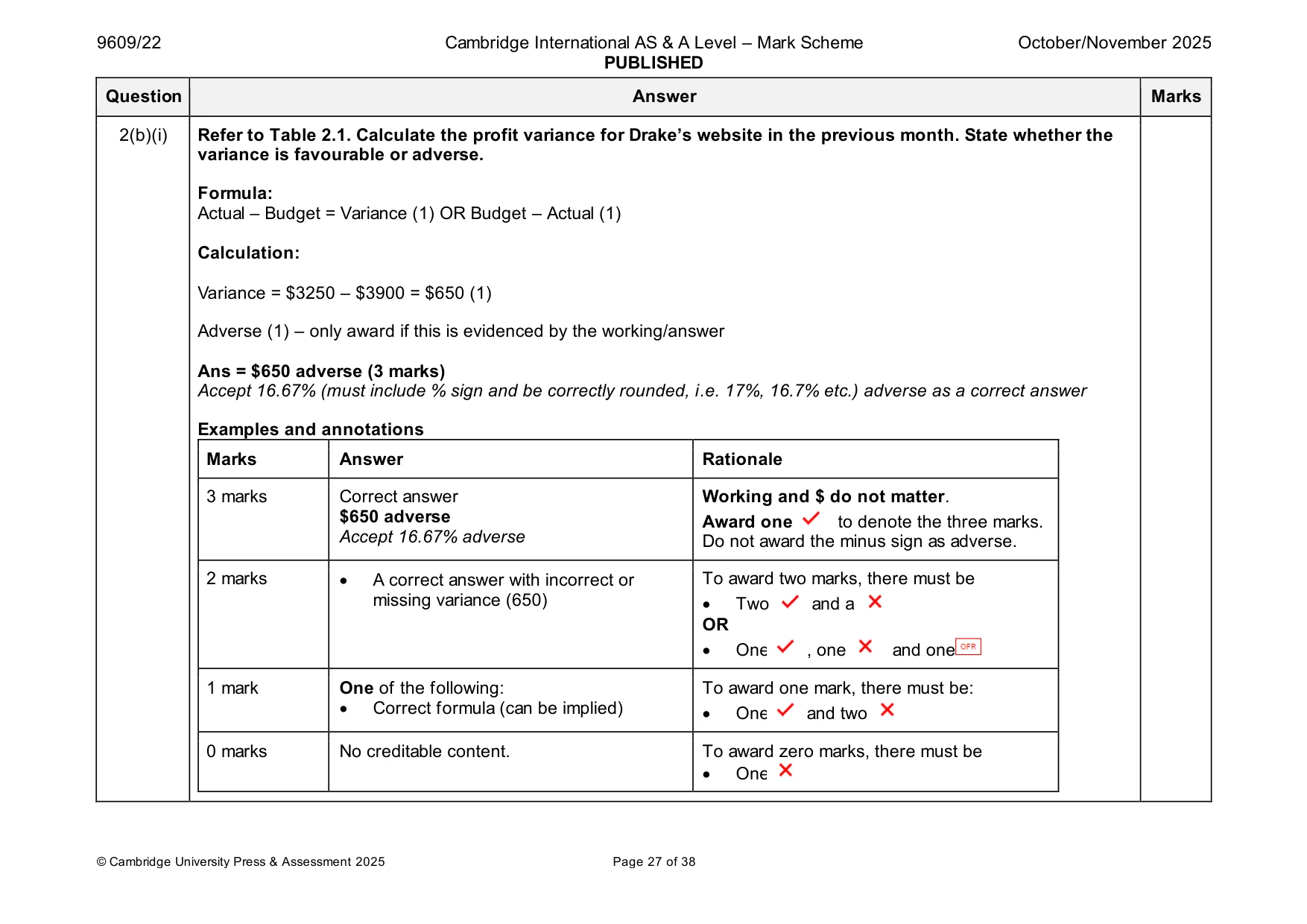
2 Law Advice Forum (LAF) Drake has a law degree and works for a partnership of lawyers during the day. Drake owns a website that gives free legal advice. He works on the website in the evenings and at the weekend. He started the website as a hobby, but the website has grown to over 20 000 users and he now sells advertising on his videos and on the website. 5 Drake uses outsourcing for some areas of his website. He has recently been sent a report showing variances in the budget from the previous month (see Table 2.1). Table 2.1 Budget report for Drake’s website in the previous month Budget Actual Total revenue $4500 $4000 10 Total costs $600 $750 Profit $3900 $3250 Drake has now left his job and is focusing full time on the website. He rebranded the website as Law Advice Forum (LAF). Drake’s business plan for LAF included: • Operating as a sole trader. 15 • Continuing to develop and expand the website to provide legal advice and paid legal services. • Renting an office in city G where all employees would work. • Hiring five fully qualified lawyers. • Hiring three administrators. 20 • Leasing IT equipment. However, Drake is concerned about the limitations LAF will face as a labour intensive operation. (a) (i) Identify one external stakeholder of a business partnership. [1] (ii) Explain the term outsourcing. [3] (b) (i) Refer to Table 2.1. Calculate the profit variance for Drake’s website in the previous month. State whether the variance is favourable or adverse. [3] (ii) Explain one way Drake could use the budget data in Table 2.1. [3] (c) Analyse two possible limitations for LAF as a labour intensive operation. [8] (d) Evaluate the most important responsibility that Drake has as the owner of LAF. [12]
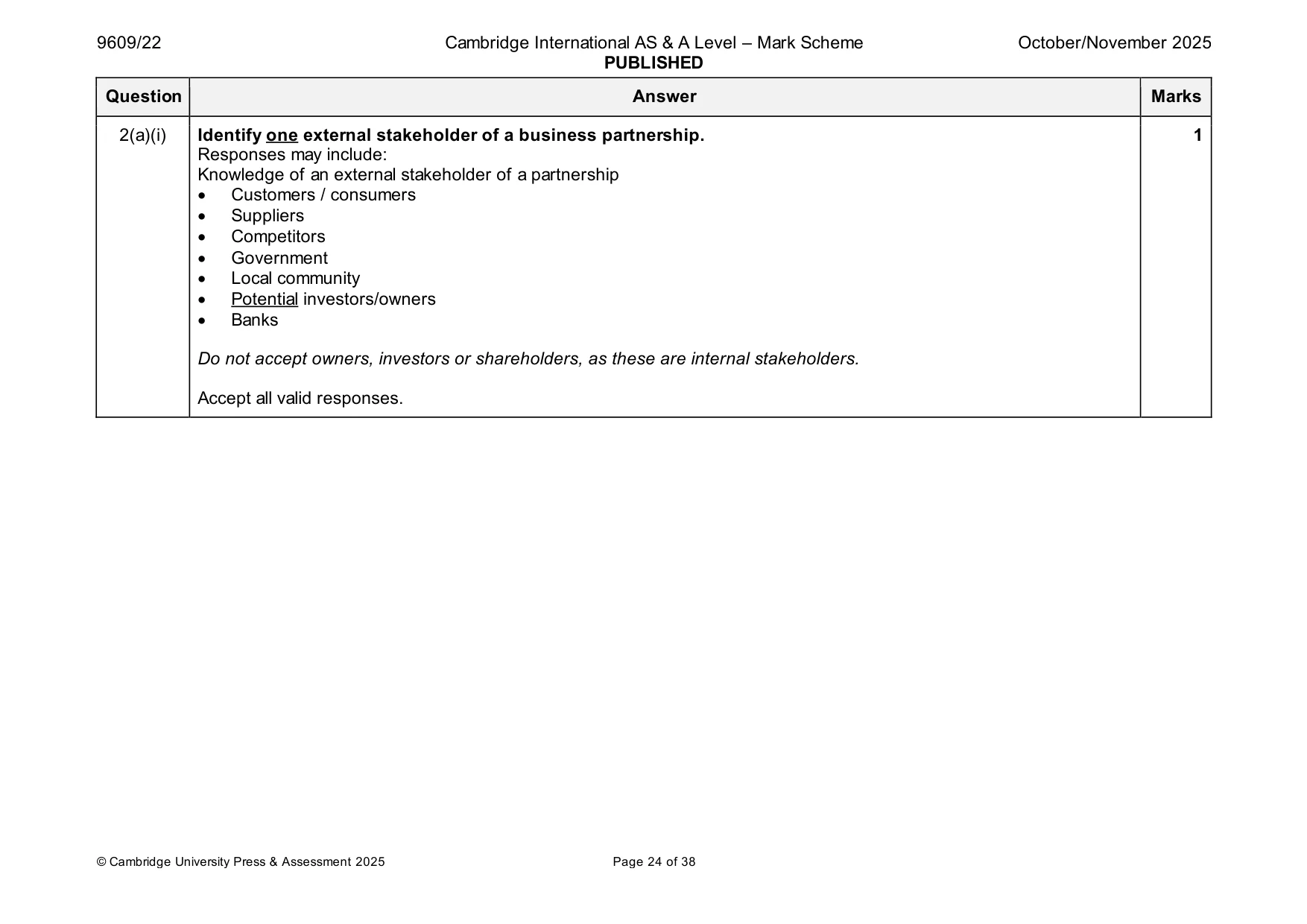
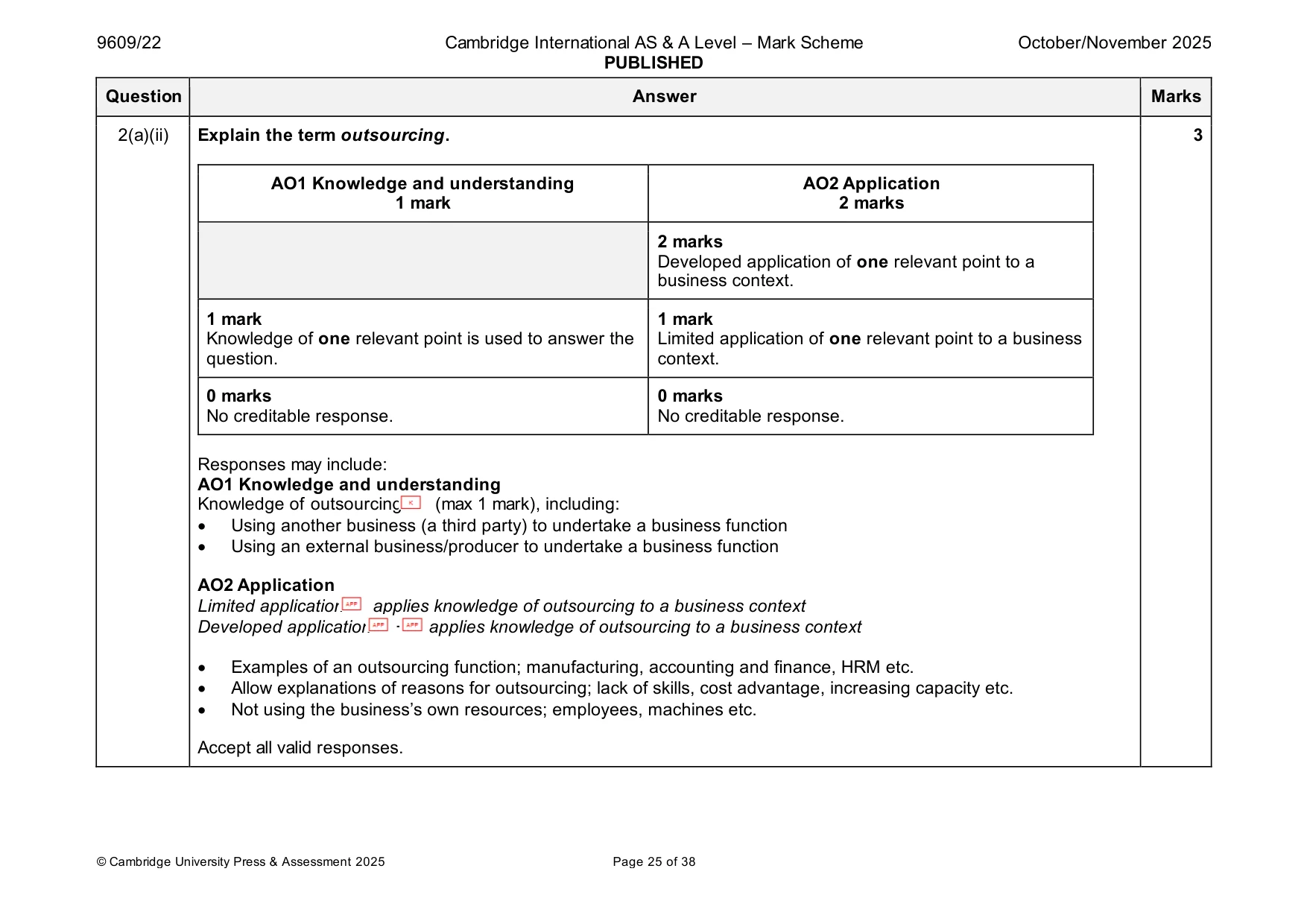
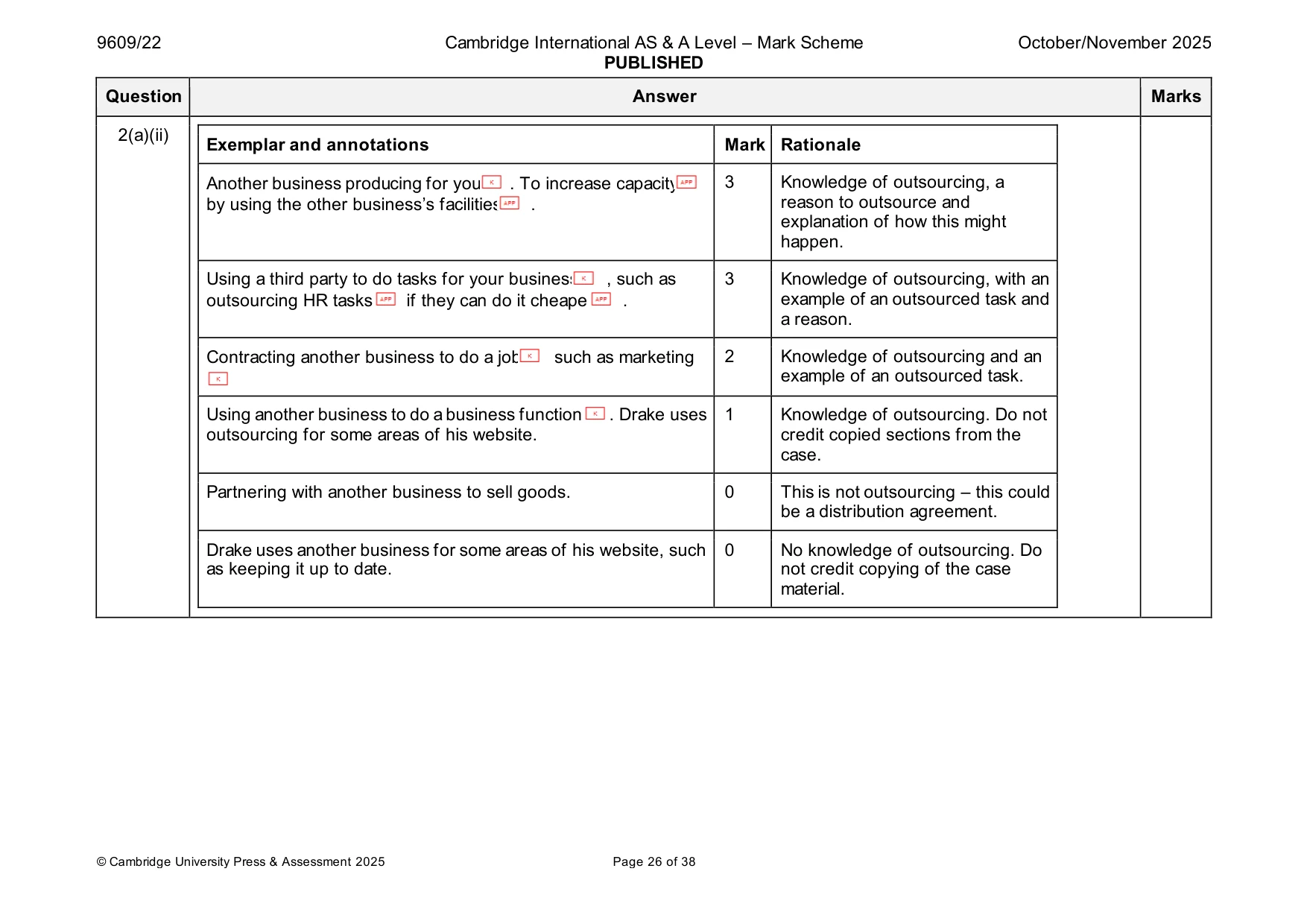
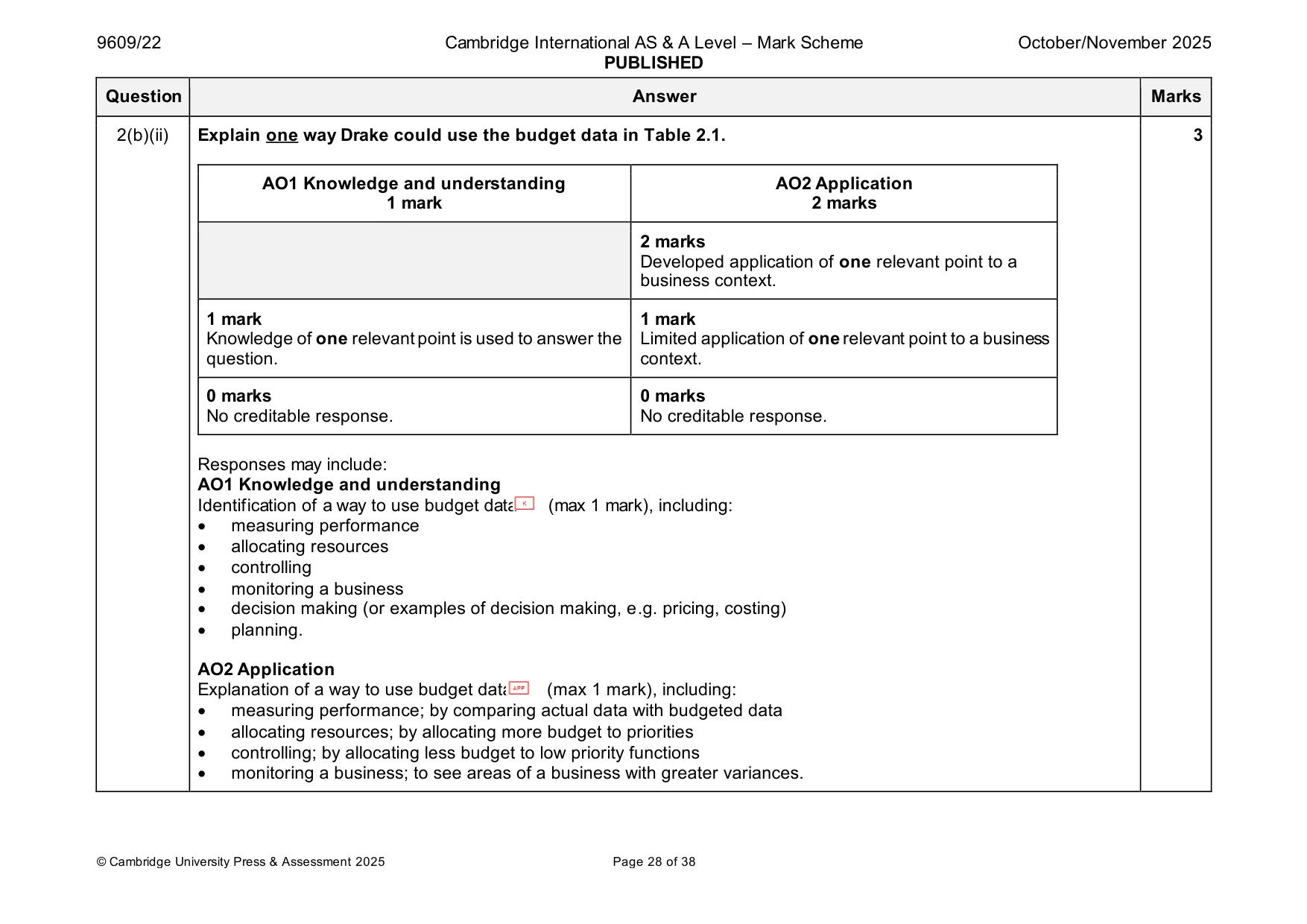
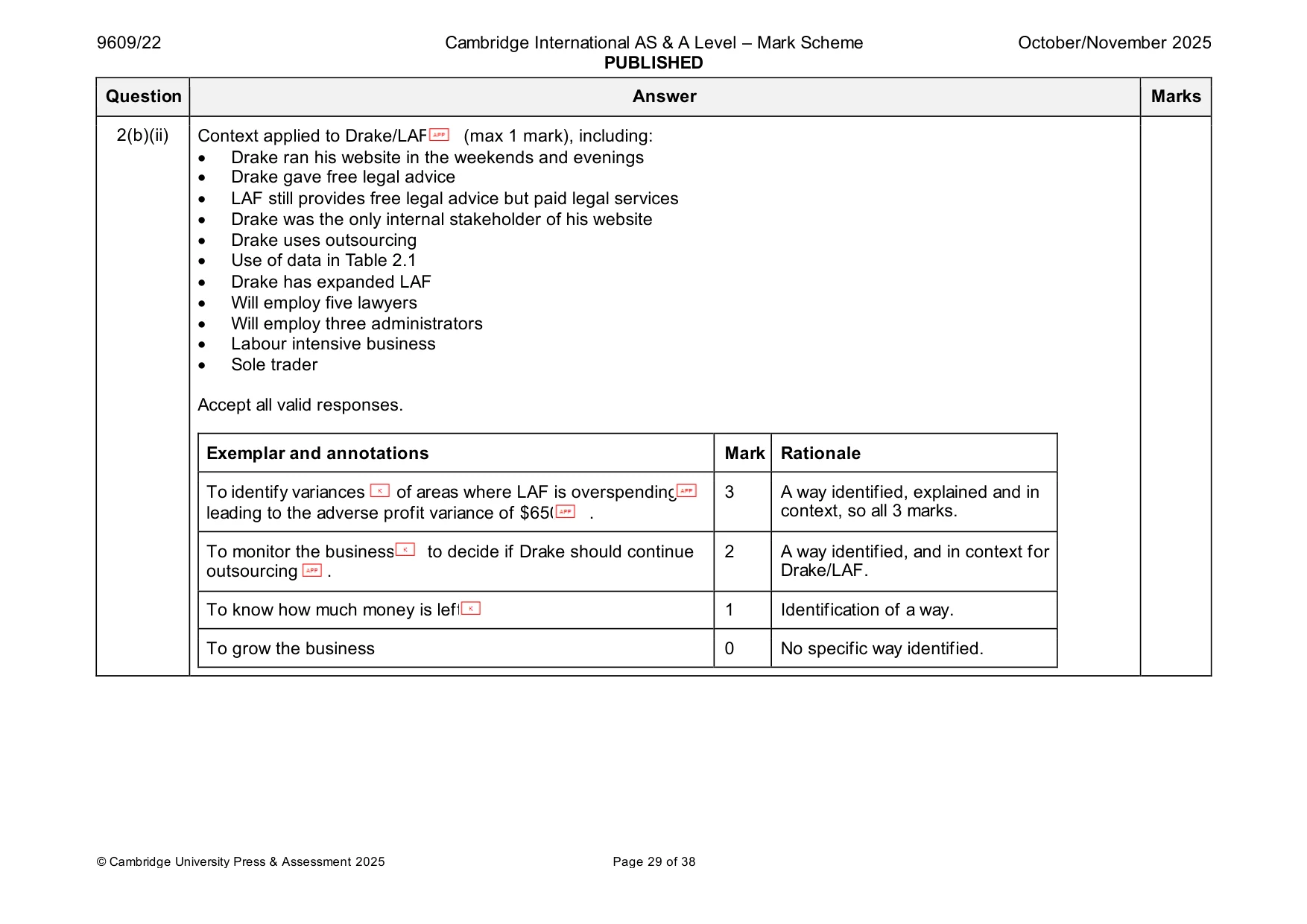
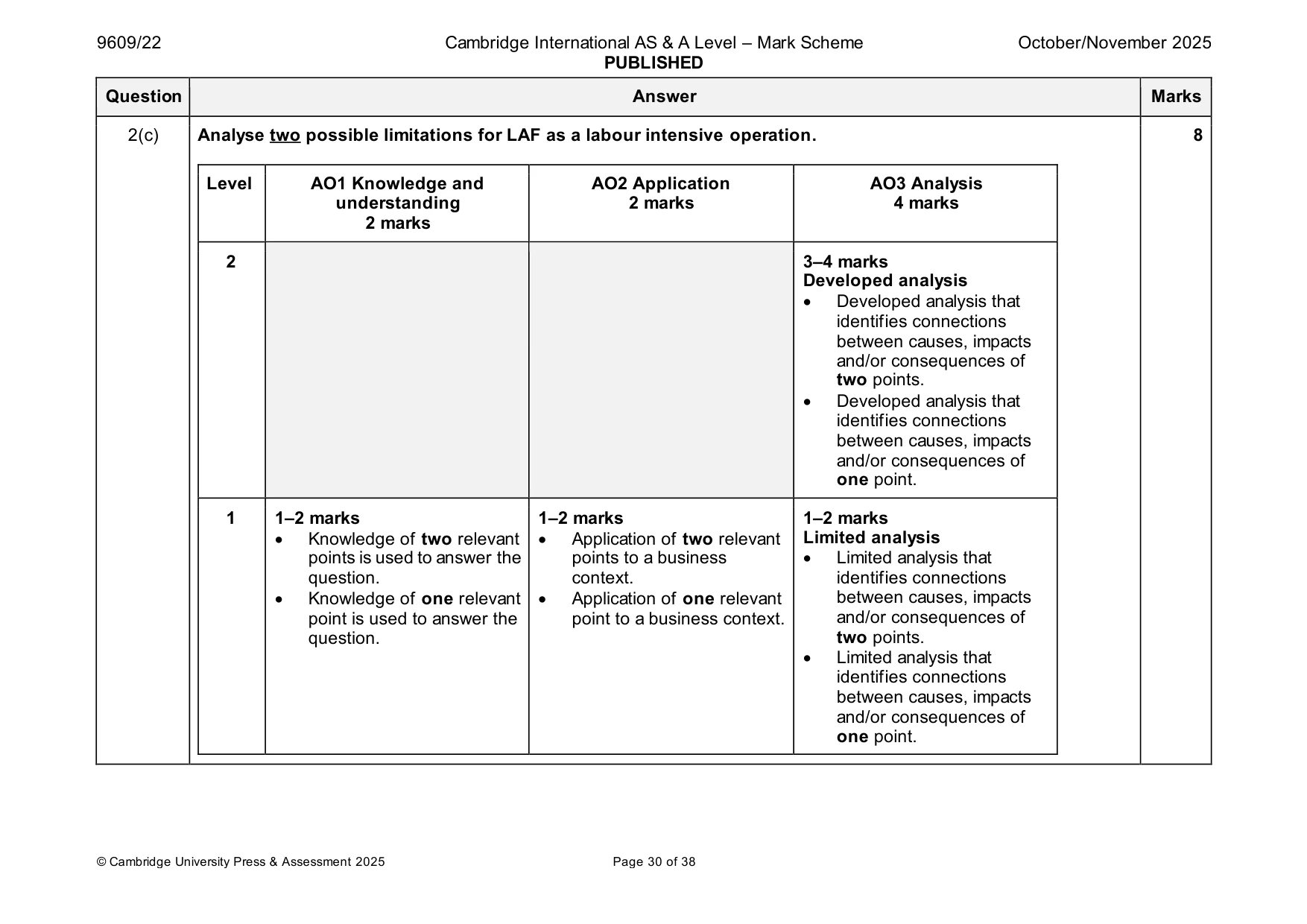
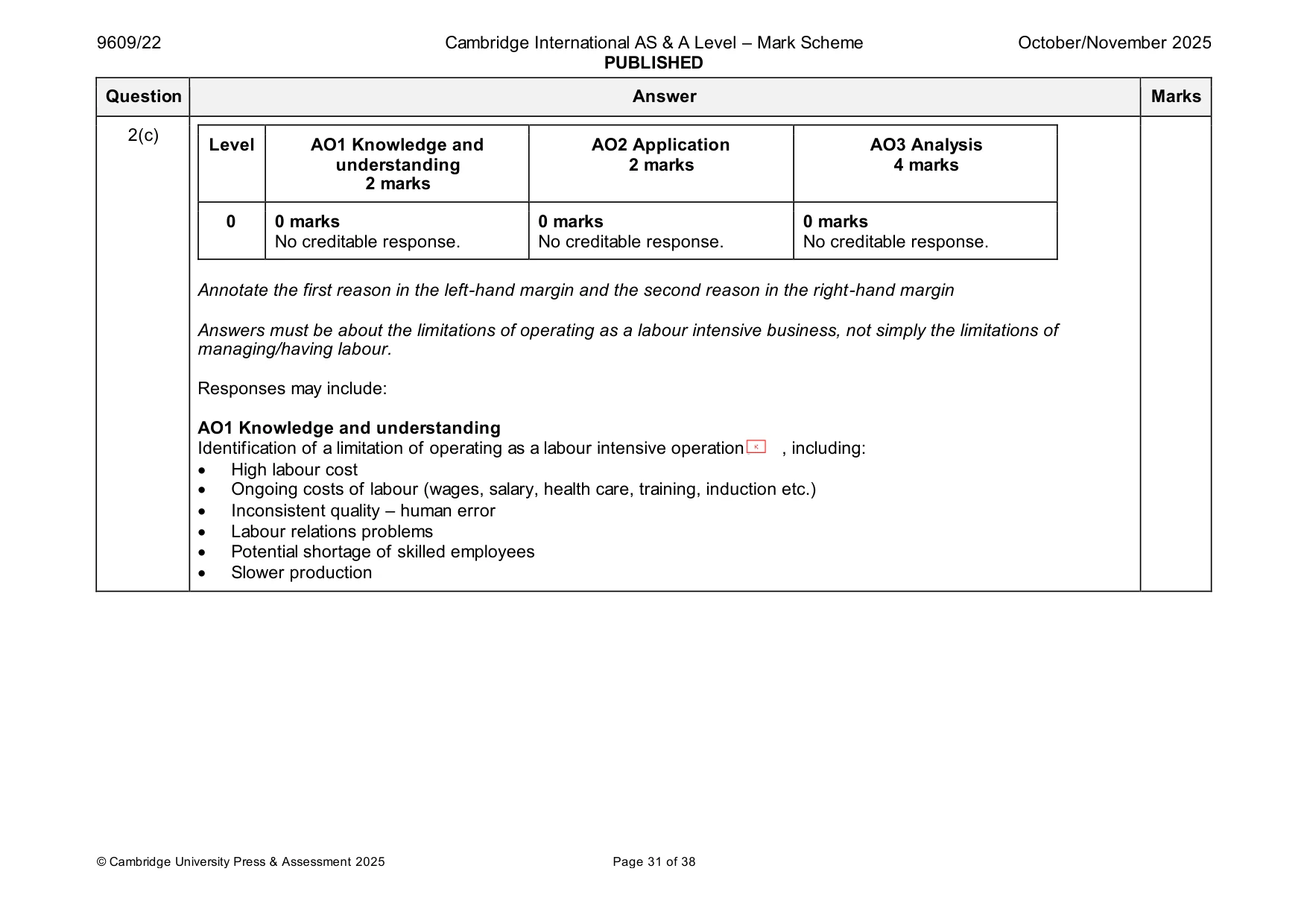
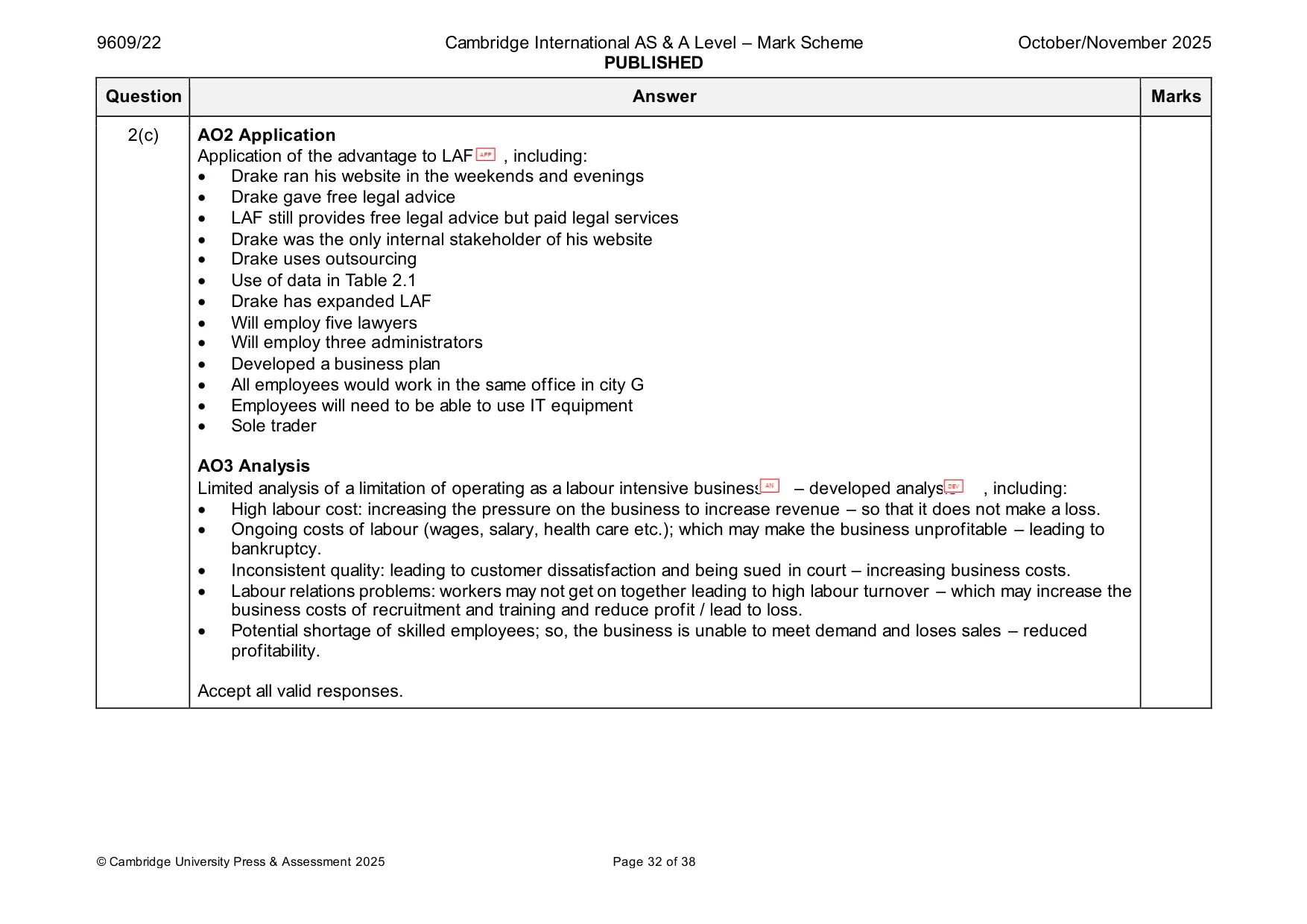
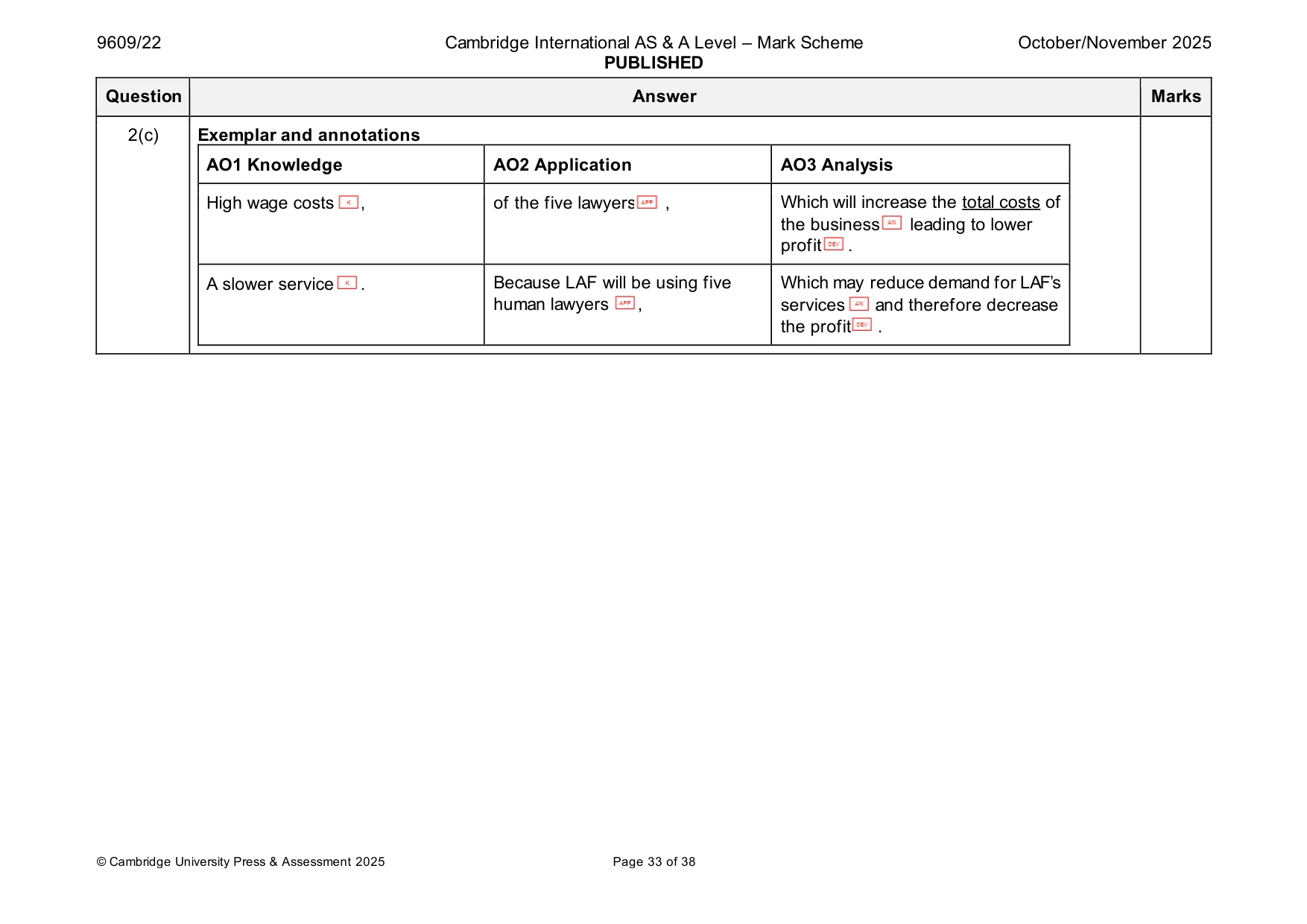
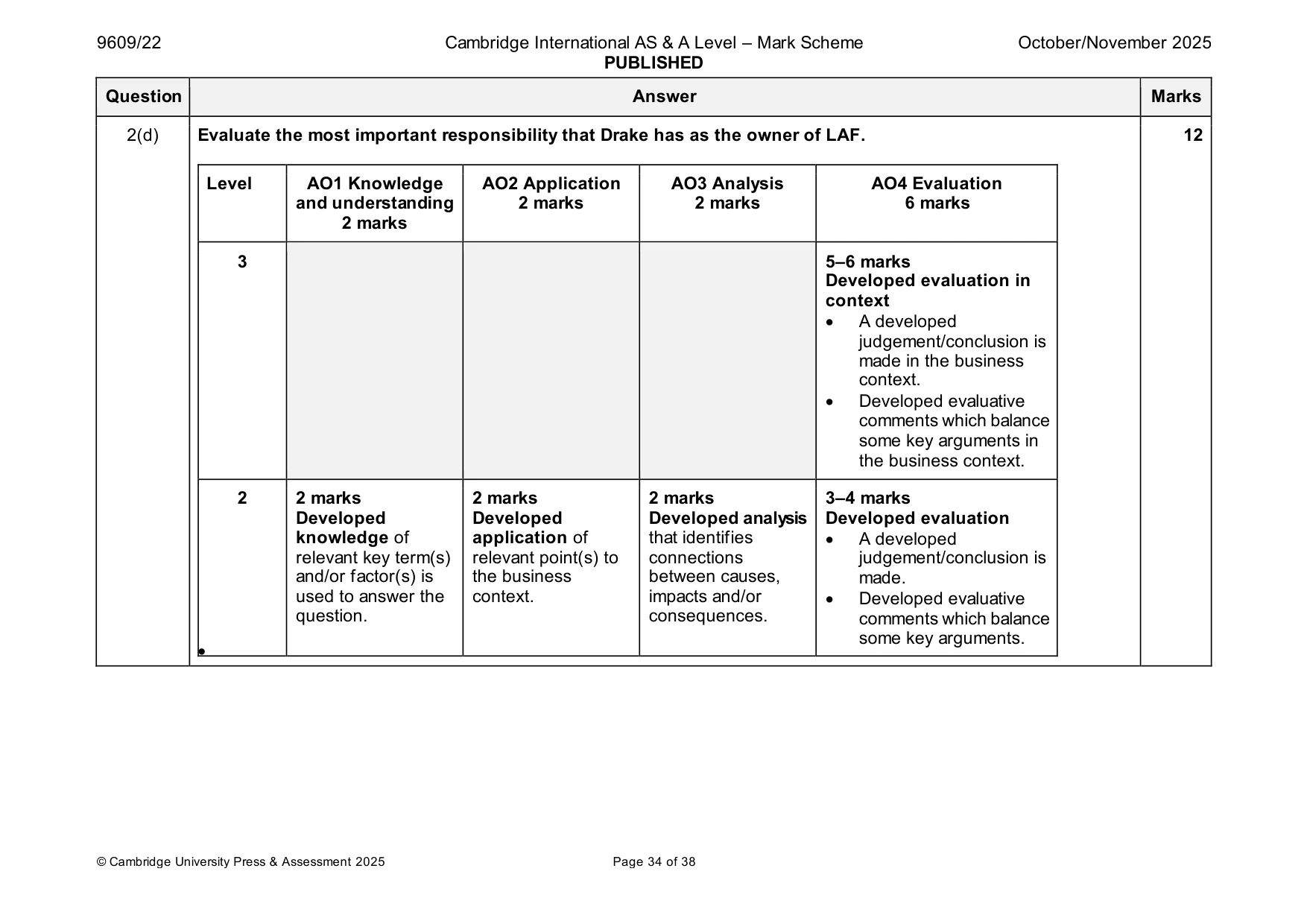
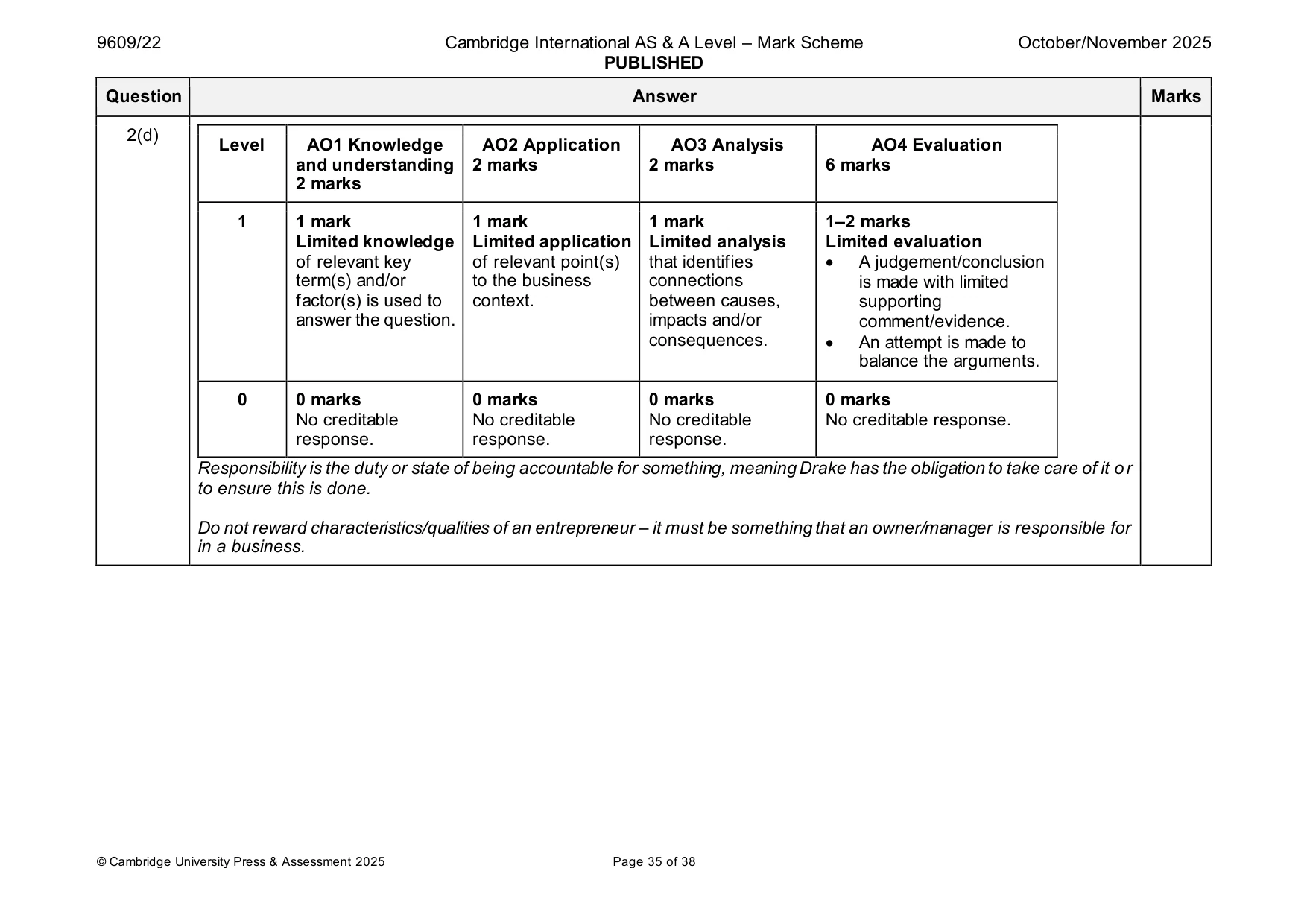
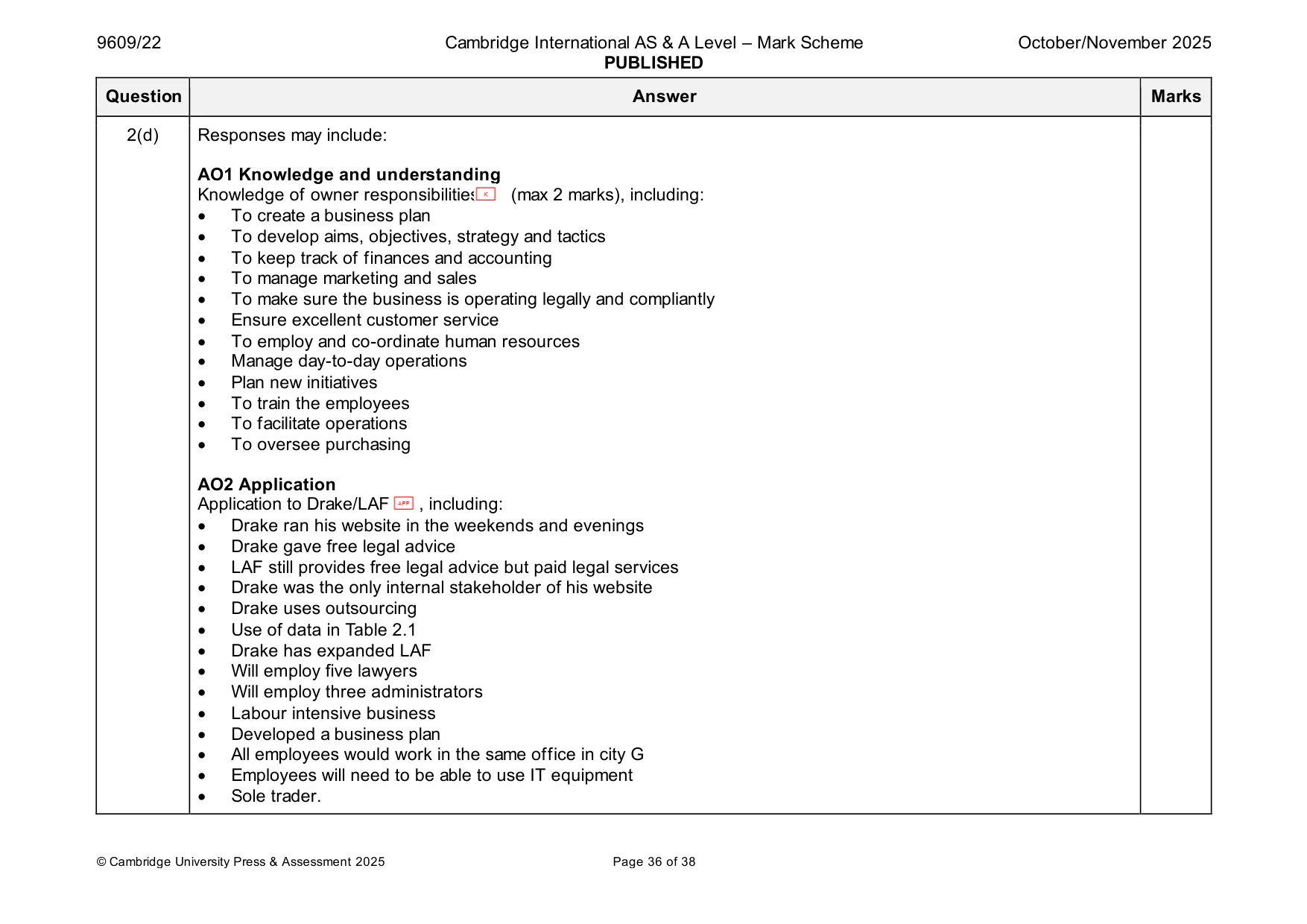
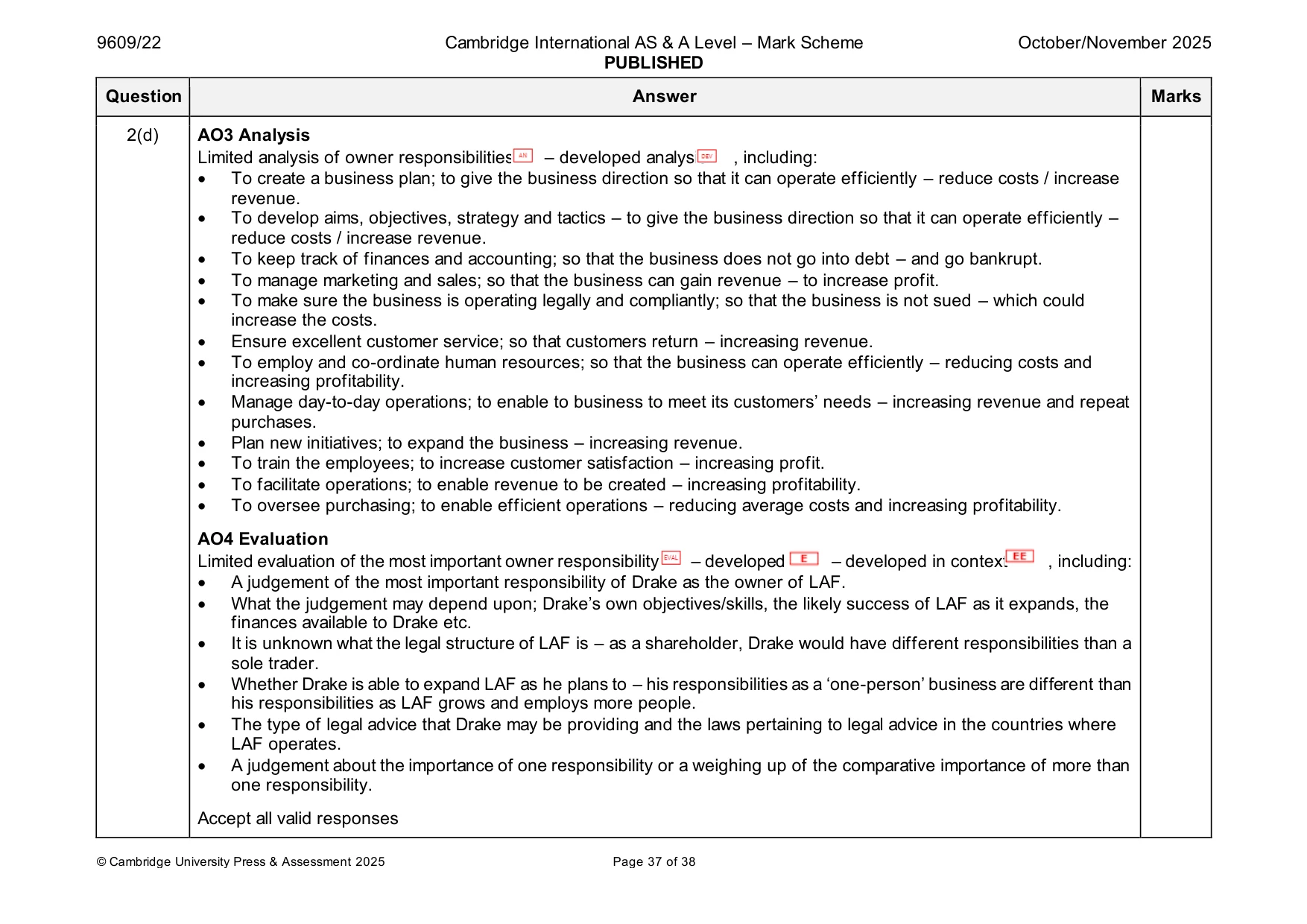
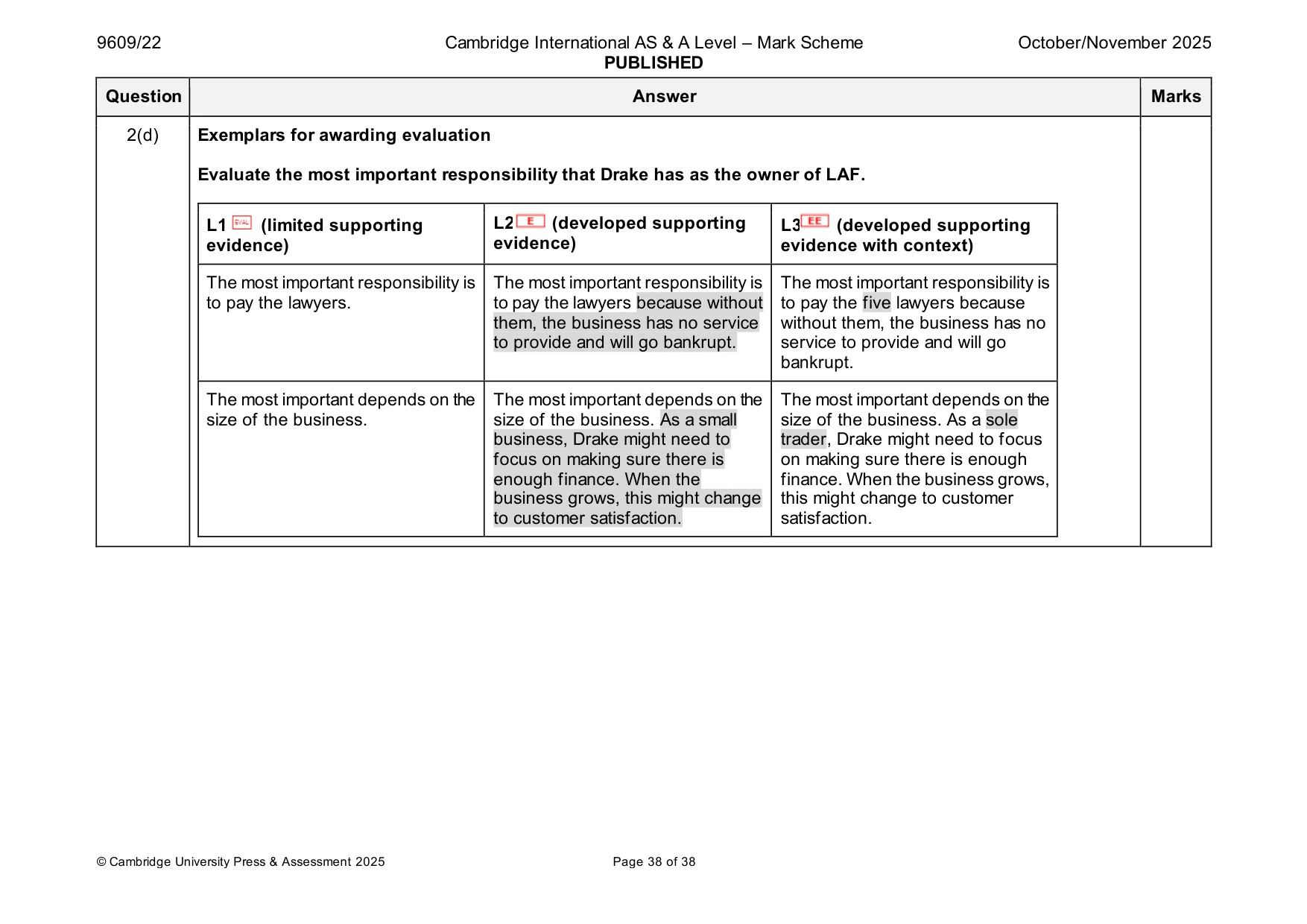
Mark scheme: 2(a)(i) Identify one external stakeholder of a business partnership. 1 Responses may include: Knowledge of an external stakeholder of a partnership • Customers / consumers • Suppliers • Competitors • Government • Local community • Potential investors/owners • Banks Do not accept owners, investors or shareholders, as these are internal stakeholders. Accept all valid responses. 2(a)(ii) Explain the term outsourcing. 3 AO1 Knowledge and understanding AO2 Application 1 mark 2 marks 2 marks Developed application of one relevant point to a business context. 1 mark 1 mark Knowledge of one relevant point is used to answer the Limited application of one relevant point to a business question. context. 0 marks 0 marks No creditable response. No creditable response. Responses may include: AO1 Knowledge and understanding Knowledge of outsourcing (max 1 mark), including: • Using another business (a third party) to undertake a business function • Using an external business/producer to undertake a business function AO2 Application Limited application applies knowledge of outsourcing to a business context Developed application + applies knowledge of outsourcing to a business context • Examples of an outsourcing function; manufacturing, accounting and finance, HRM etc. • Allow explanations of reasons for outsourcing; lack of skills, cost advantage, increasing capacity etc. • Not using the business’s own resources; employees, machines etc. Accept all valid responses. 2(a)(ii) Exemplar and annotations Mark Rationale Another business producing for you . To increase capacity 3 Knowledge of outsourcing, a by using the other business’s facilities . reason to outsource and explanation of how this might happen. Using a third party to do tasks for your business , such as 3 Knowledge of outsourcing, with an outsourcing HR tasks if they can do it cheaper . example of an outsourced task and a reason. Contracting another business to do a job such as marketing 2 Knowledge of outsourcing and an example of an outsourced task. Using another business to do a business function . Drake uses 1 Knowledge of outsourcing. Do not outsourcing for some areas of his website. credit copied sections from the case. Partnering with another business to sell goods. 0 This is not outsourcing – this could be a distribution agreement. Drake uses another business for some areas of his website, such 0 No knowledge of outsourcing. Do as keeping it up to date. not credit copying of the case material. 2(b)(i) Refer to Table 2.1. Calculate the profit variance for Drake’s website in the previous month. State whether the variance is favourable or adverse. Formula: Actual – Budget = Variance (1) OR Budget – Actual (1) Calculation: Variance = $3250 – $3900 = $650 (1) Adverse (1) – only award if this is evidenced by the working/answer Ans = $650 adverse (3 marks) Accept 16.67% (must include % sign and be correctly rounded, i.e. 17%, 16.7% etc.) adverse as a correct answer Examples and annotations Marks Answer Rationale 3 marks Correct answer Working and $ do not matter. $650 adverse Award one to denote the three marks. Accept 16.67% adverse Do not award the minus sign as adverse. 2 marks • A correct answer with incorrect or To award two marks, there must be missing variance (650) • Two and a OR • One , one and one 1 mark One of the following: To award one mark, there must be: • Correct formula (can be implied) • One and two 0 marks No creditable content. To award zero marks, there must be • One 2(b)(ii) Explain one way Drake could use the budget data in Table 2.1. 3 AO1 Knowledge and understanding AO2 Application 1 mark 2 marks 2 marks Developed application of one relevant point to a business context. 1 mark 1 mark Knowledge of one relevant point is used to answer the Limited application of one relevant point to a business question. context. 0 marks 0 marks No creditable response. No creditable response. Responses may include: AO1 Knowledge and understanding Identification of a way to use budget data (max 1 mark), including: • measuring performance • allocating resources • controlling • monitoring a business • decision making (or examples of decision making, e.g. pricing, costing) • planning. AO2 Application Explanation of a way to use budget data (max 1 mark), including: • measuring performance; by comparing actual data with budgeted data • allocating resources; by allocating more budget to priorities • controlling; by allocating less budget to low priority functions • monitoring a business; to see areas of a business with greater variances. 2(b)(ii) Context applied to Drake/LAF (max 1 mark), including: • Drake ran his website in the weekends and evenings • Drake gave free legal advice • LAF still provides free legal advice but paid legal services • Drake was the only internal stakeholder of his website • Drake uses outsourcing • Use of data in Table 2.1 • Drake has expanded LAF • Will employ five lawyers • Will employ three administrators • Labour intensive business • Sole trader Accept all valid responses. Exemplar and annotations Mark Rationale To identify variances of areas where LAF is overspending 3 A way identified, explained and in leading to the adverse profit variance of $650 . context, so all 3 marks. To monitor the business to decide if Drake should continue 2 A way identified, and in context for outsourcing . Drake/LAF. To know how much money is left 1 Identification of a way. To grow the business 0 No specific way identified. 2(c) Analyse two possible limitations for LAF as a labour intensive operation. 8 Level AO1 Knowledge and AO2 Application AO3 Analysis understanding 2 marks 4 marks 2 marks 2 3–4 marks Developed analysis • Developed analysis that identifies connections between causes, impacts and/or consequences of two points. • Developed analysis that identifies connections between causes, impacts and/or consequences of one point. 1 1–2 marks 1–2 marks 1–2 marks • Knowledge of two relevant • Application of two relevant Limited analysis points is used to answer the points to a business • Limited analysis that question. context. identifies connections • Knowledge of one relevant • Application of one relevant between causes, impacts point is used to answer the point to a business context. and/or consequences of question. two points. • Limited analysis that identifies connections between causes, impacts and/or consequences of one point. 2(c) Level AO1 Knowledge and AO2 Application AO3 Analysis understanding 2 marks 4 marks 2 marks 0 0 marks 0 marks 0 marks No creditable response. No creditable response. No creditable response. Annotate the first reason in the left-hand margin and the second reason in the right-hand margin Answers must be about the limitations of operating as a labour intensive business, not simply the limitations of managing/having labour. Responses may include: AO1 Knowledge and understanding Identification of a limitation of operating as a labour intensive operations , including: • High labour cost • Ongoing costs of labour (wages, salary, health care, training, induction etc.) • Inconsistent quality – human error • Labour relations problems • Potential shortage of skilled employees • Slower production 2(c) AO2 Application Application of the advantage to LAF , including: • Drake ran his website in the weekends and evenings • Drake gave free legal advice • LAF still provides free legal advice but paid legal services • Drake was the only internal stakeholder of his website • Drake uses outsourcing • Use of data in Table 2.1 • Drake has expanded LAF • Will employ five lawyers • Will employ three administrators • Developed a business plan • All employees would work in the same office in city G • Employees will need to be able to use IT equipment • Sole trader AO3 Analysis Limited analysis of a limitation of operating as a labour intensive business – developed analysis , including: • High labour cost: increasing the pressure on the business to increase revenue – so that it does not make a loss. • Ongoing costs of labour (wages, salary, health care etc.); which may make the business unprofitable – leading to bankruptcy. • Inconsistent quality: leading to customer dissatisfaction and being sued in court – increasing business costs. • Labour relations problems: workers may not get on together leading to high labour turnover – which may increase the business costs of recruitment and training and reduce profit / lead to loss. • Potential shortage of skilled employees; so, the business is unable to meet demand and loses sales – reduced profitability. Accept all valid responses. 2(c) Exemplar and annotations AO1 Knowledge AO2 Application AO3 Analysis High wage costs , of the five lawyers , Which will increase the total costs of the business leading to lower profit . A slower service . Because LAF will be using five Which may reduce demand for LAF’s human lawyers , services and therefore decrease the profit . 2(d) Evaluate the most important responsibility that Drake has as the owner of LAF. 12 Level AO1 Knowledge AO2 Application AO3 Analysis AO4 Evaluation and understanding 2 marks 2 marks 6 marks 2 marks 3 5–6 marks Developed evaluation in context • A developed judgement/conclusion is made in the business context. • Developed evaluative comments which balance some key arguments in the business context. 2 2 marks 2 marks 2 marks 3–4 marks Developed Developed Developed analysis Developed evaluation knowledge of application of that identifies • A developed relevant key term(s) relevant point(s) to connections judgement/conclusion is and/or factor(s) is the business between causes, made. used to answer the context. impacts and/or • Developed evaluative question. consequences. comments which balance some key arguments. • 2(d) Level AO1 Knowledge AO2 Application AO3 Analysis AO4 Evaluation and understanding 2 marks 2 marks 6 marks 2 marks 1 1 mark 1 mark 1 mark 1–2 marks Limited knowledge Limited application Limited analysis Limited evaluation of relevant key of relevant point(s) that identifies • A judgement/conclusion term(s) and/or to the business connections is made with limited factor(s) is used to context. between causes, supporting answer the question. impacts and/or comment/evidence. consequences. • An attempt is made to balance the arguments. 0 0 marks 0 marks 0 marks 0 marks No creditable No creditable No creditable No creditable response. response. response. response. Responsibility is the duty or state of being accountable for something, meaning Drake has the obligation to take care of it or to ensure this is done. Do not reward characteristics/qualities of an entrepreneur – it must be something that an owner/manager is responsible for in a business. 2(d) Responses may include: AO1 Knowledge and understanding Knowledge of owner responsibilities (max 2 marks), including: • To create a business plan • To develop aims, objectives, strategy and tactics • To keep track of finances and accounting • To manage marketing and sales • To make sure the business is operating legally and compliantly • Ensure excellent customer service • To employ and co-ordinate human resources • Manage day-to-day operations • Plan new initiatives • To train the employees • To facilitate operations • To oversee purchasing AO2 Application Application to Drake/LAF , including: • Drake ran his website in the weekends and evenings • Drake gave free legal advice • LAF still provides free legal advice but paid legal services • Drake was the only internal stakeholder of his website • Drake uses outsourcing • Use of data in Table 2.1 • Drake has expanded LAF • Will employ five lawyers • Will employ three administrators • Labour intensive business • Developed a business plan • All employees would work in the same office in city G • Employees will need to be able to use IT equipment • Sole trader. 2(d) AO3 Analysis Limited analysis of owner responsibilities – developed analysis , including: • To create a business plan; to give the business direction so that it can operate efficiently – reduce costs / increase revenue. • To develop aims, objectives, strategy and tactics – to give the business direction so that it can operate efficiently – reduce costs / increase revenue. • To keep track of finances and accounting; so that the business does not go into debt – and go bankrupt. • To manage marketing and sales; so that the business can gain revenue – to increase profit. • To make sure the business is operating legally and compliantly; so that the business is not sued – which could increase the costs. • Ensure excellent customer service; so that customers return – increasing revenue. • To employ and co-ordinate human resources; so that the business can operate efficiently – reducing costs and increasing profitability. • Manage day-to-day operations; to enable to business to meet its customers’ needs – increasing revenue and repeat purchases. • Plan new initiatives; to expand the business – increasing revenue. • To train the employees; to increase customer satisfaction – increasing profit. • To facilitate operations; to enable revenue to be created – increasing profitability. • To oversee purchasing; to enable efficient operations – reducing average costs and increasing profitability. AO4 Evaluation Limited evaluation of the most important owner responsibility – developed – developed in context , including: • A judgement of the most important responsibility of Drake as the owner of LAF. • What the judgement may depend upon; Drake’s own objectives/skills, the likely success of LAF as it expands, the finances available to Drake etc. • It is unknown what the legal structure of LAF is – as a shareholder, Drake would have different responsibilities than a sole trader. • Whether Drake is able to expand LAF as he plans to – his responsibilities as a ‘one-person’ business are different than his responsibilities as LAF grows and employs more people. • The type of legal advice that Drake may be providing and the laws pertaining to legal advice in the countries where LAF operates. • A judgement about the importance of one responsibility or a weighing up of the comparative importance of more than one responsibility. Accept all valid responses 2(d) Exemplars for awarding evaluation Evaluate the most important responsibility that Drake has as the owner of LAF. L1 (limited supporting L2 (developed supporting L3 (developed supporting evidence) evidence) evidence with context) The most important responsibility is The most important responsibility is The most important responsibility is to pay the lawyers. to pay the lawyers because without to pay the five lawyers because them, the business has no service without them, the business has no to provide and will go bankrupt. service to provide and will go bankrupt. The most important depends on the The most important depends on the The most important depends on the size of the business. size of the business. As a small size of the business. As a sole business, Drake might need to trader, Drake might need to focus focus on making sure there is on making sure there is enough enough finance. When the finance. When the business grows, business grows, this might change this might change to customer to customer satisfaction. satisfaction.
What was in this paper
The subtopics covered by these 2 questions, and how many questions each got. Open one in a new tab to see every Cambridge question on it.
What you needed in this session
Cambridge’s own grade thresholds for 2025 Oct/Nov, Paper 2 · Variant 2. A higher threshold means an easier paper — the bar moves with how the cohort did.