Cambridge A Level Business (for first examination in 2016) 9609 — 2024 Oct/Nov Paper 2 · Variant 2
9609/22/O/N/24 · 2 questions · 60 marks · ≈68 min
The question paper and its mark scheme, free to read here and free to download. This is Cambridge’s own paper, exactly as it was sat.
Question paper4 pages

Mark scheme38 pages
Answers below. Sit the paper first if you are practising.
Questions as text
Q1 · Pot Plants (PP) PP is a private limited company that grows and sells plants in pots
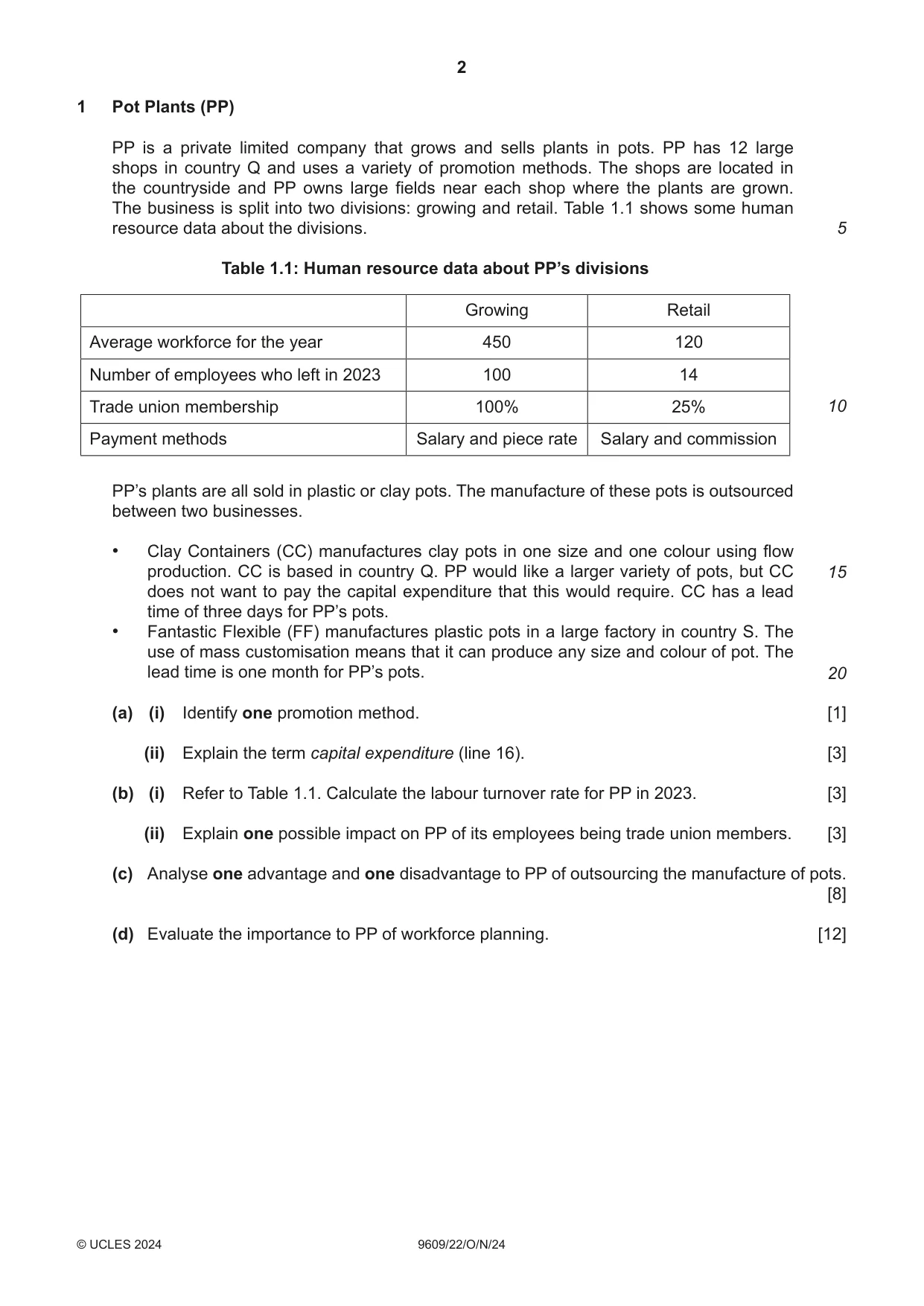
1 Pot Plants (PP) PP is a private limited company that grows and sells plants in pots. PP has 12 large shops in country Q and uses a variety of promotion methods. The shops are located in the countryside and PP owns large fields near each shop where the plants are grown. The business is split into two divisions: growing and retail. Table 1.1 shows some human resource data about the divisions. 5 Table 1.1: Human resource data about PP’s divisions Growing Retail Average workforce for the year 450 120 Number of employees who left in 2023 100 14 Trade union membership 100% 25% 10 Payment methods Salary and piece rate Salary and commission PP’s plants are all sold in plastic or clay pots. The manufacture of these pots is outsourced between two businesses. • Clay Containers (CC) manufactures clay pots in one size and one colour using flow production. CC is based in country Q. PP would like a larger variety of pots, but CC 15 does not want to pay the capital expenditure that this would require. CC has a lead time of three days for PP’s pots. • Fantastic Flexible (FF) manufactures plastic pots in a large factory in country S. The use of mass customisation means that it can produce any size and colour of pot. The lead time is one month for PP’s pots. 20 (a) (i) Identify one promotion method. [1] (ii) Explain the term capital expenditure (line 16). [3] (b) (i) Refer to Table 1.1. Calculate the labour turnover rate for PP in 2023. [3] (ii) Explain one possible impact on PP of its employees being trade union members. [3] (c) Analyse one advantage and one disadvantage to PP of outsourcing the manufacture of pots. [8] (d) Evaluate the importance to PP of workforce planning. [12]
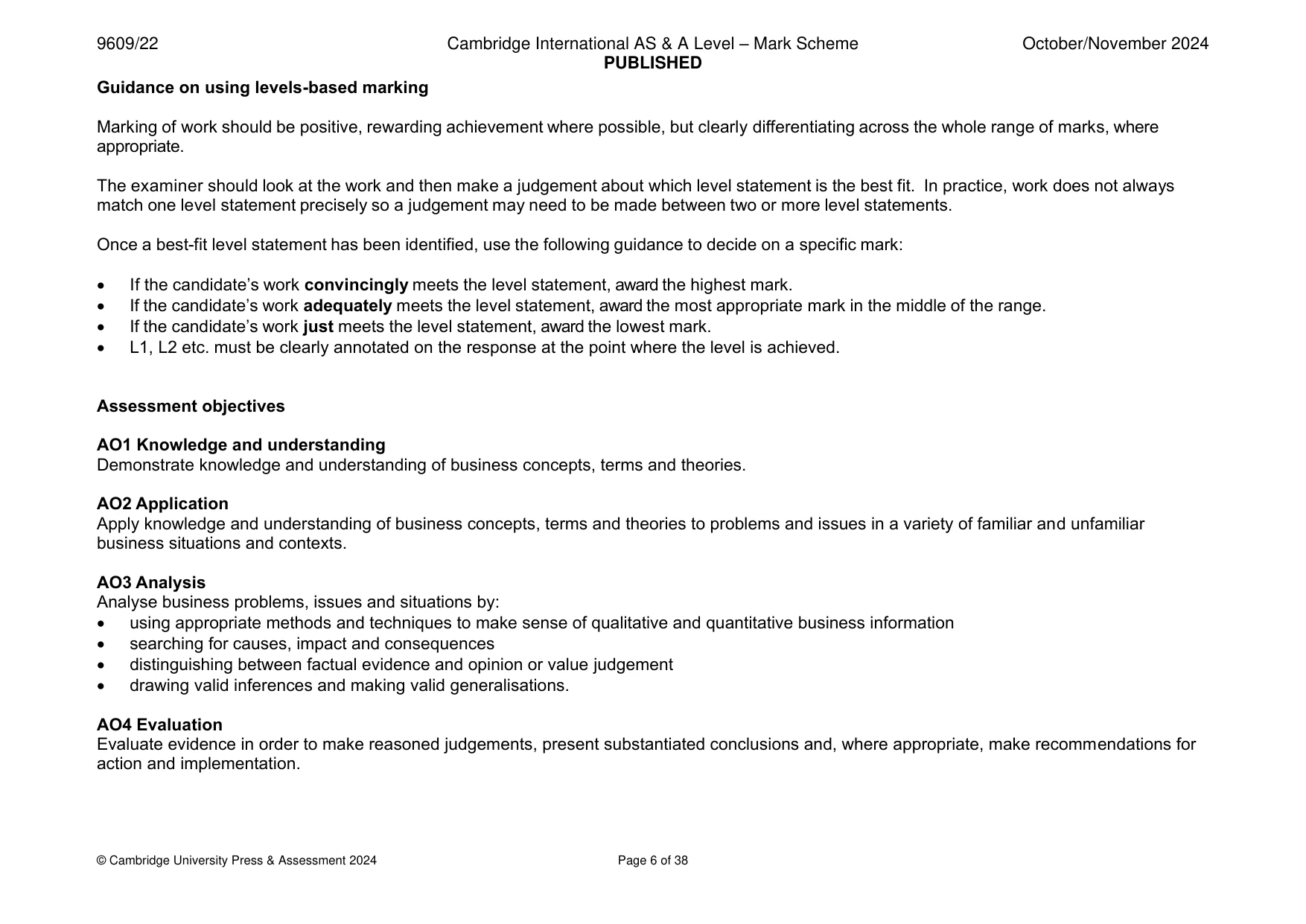
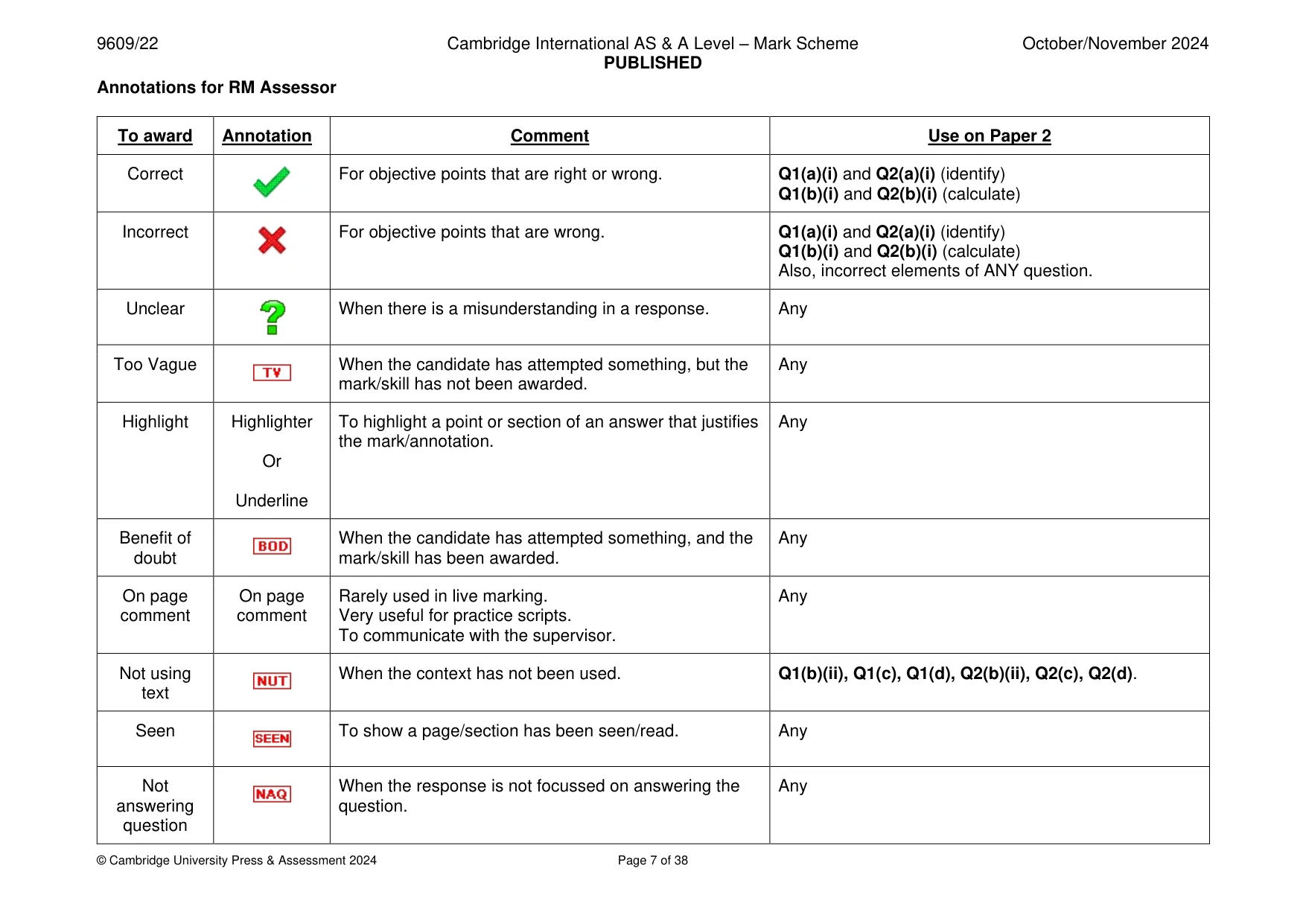
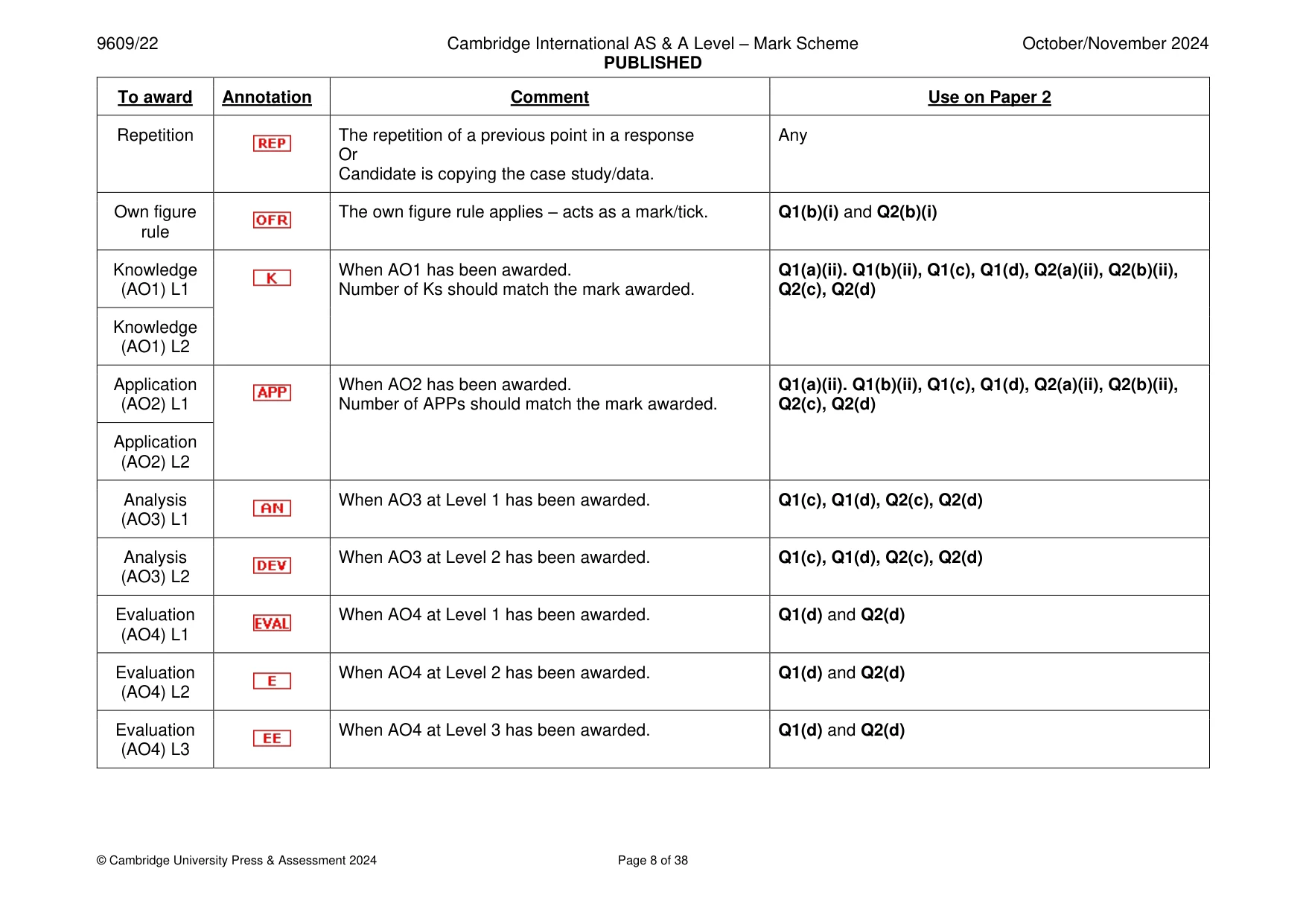
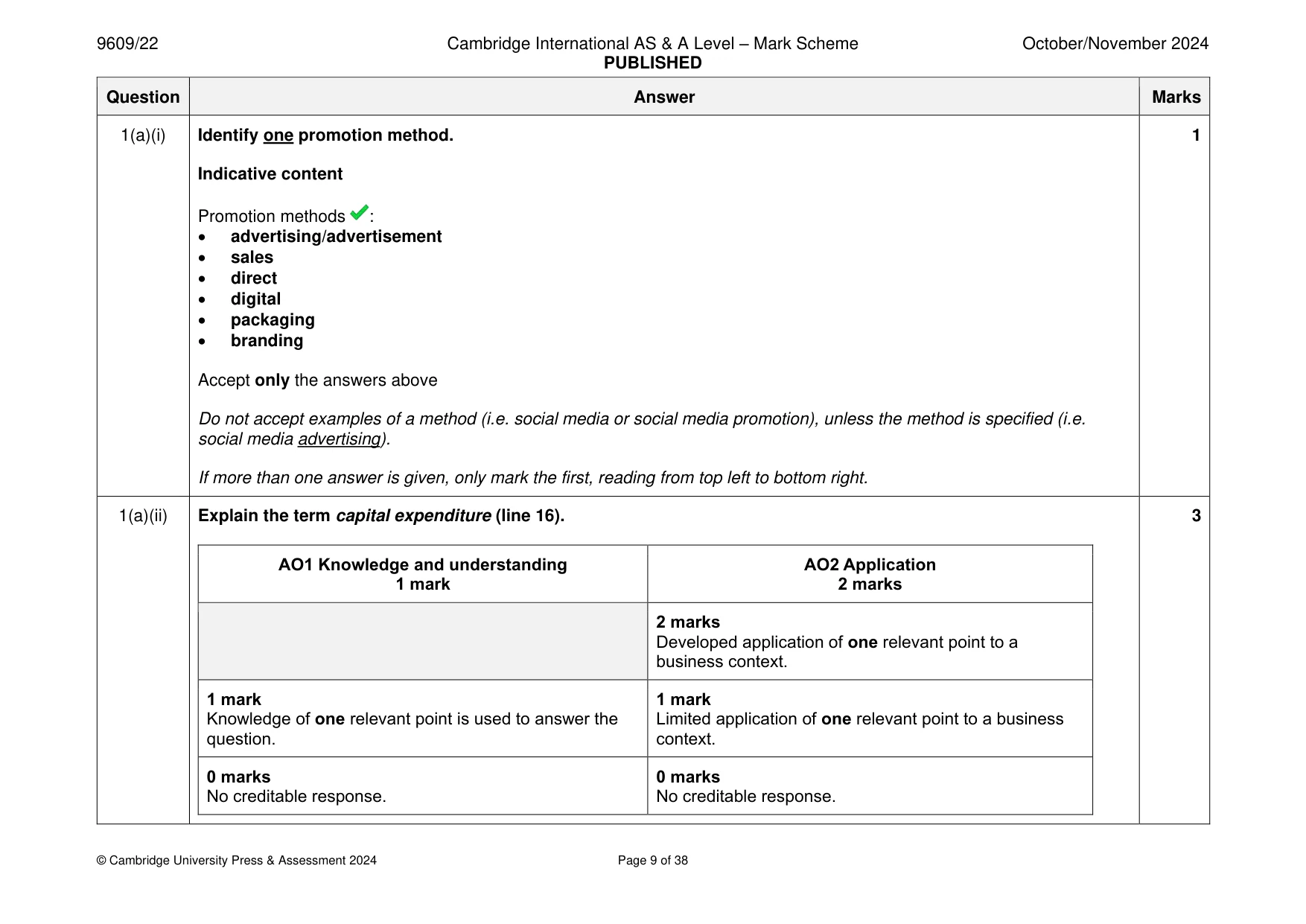
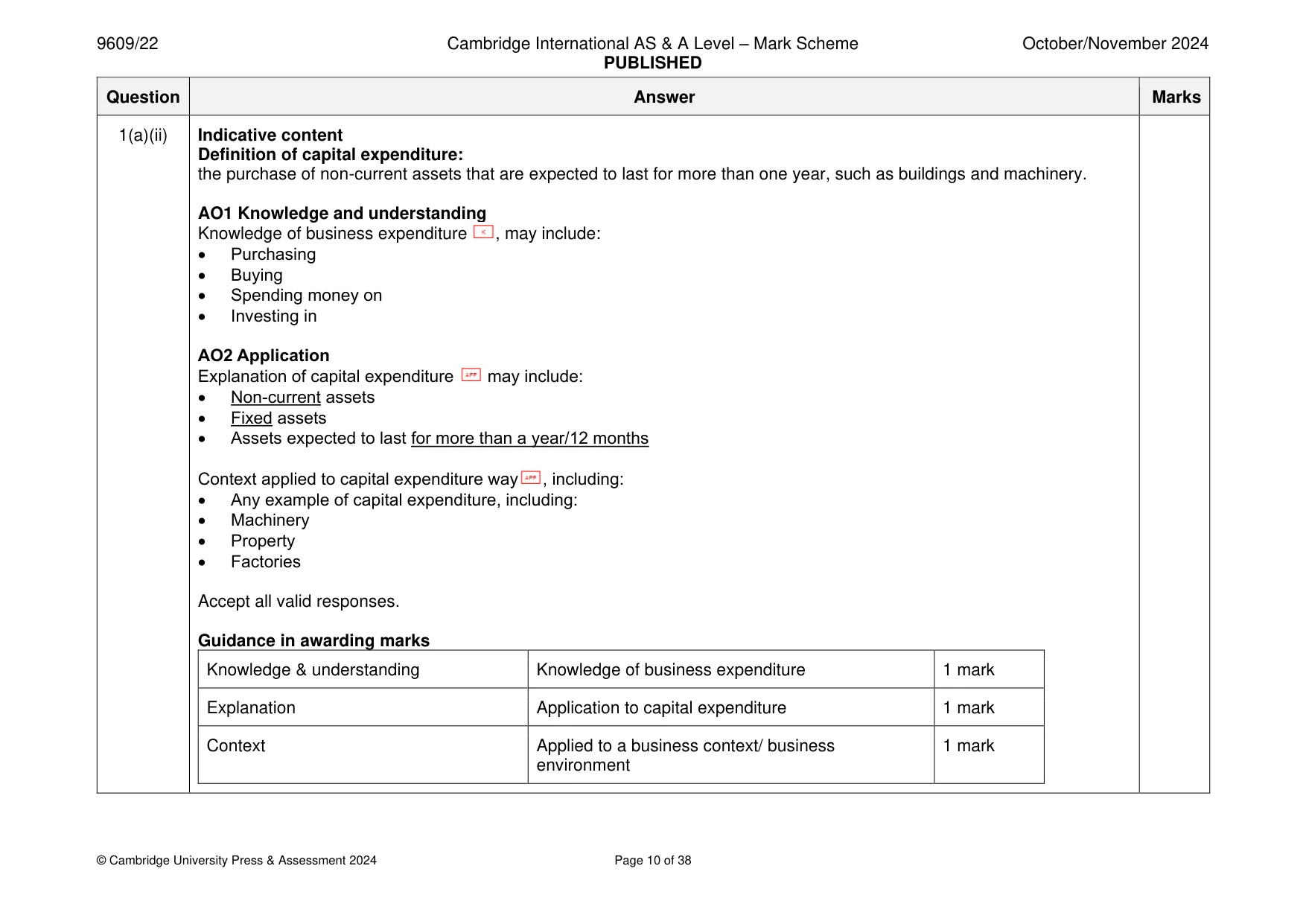
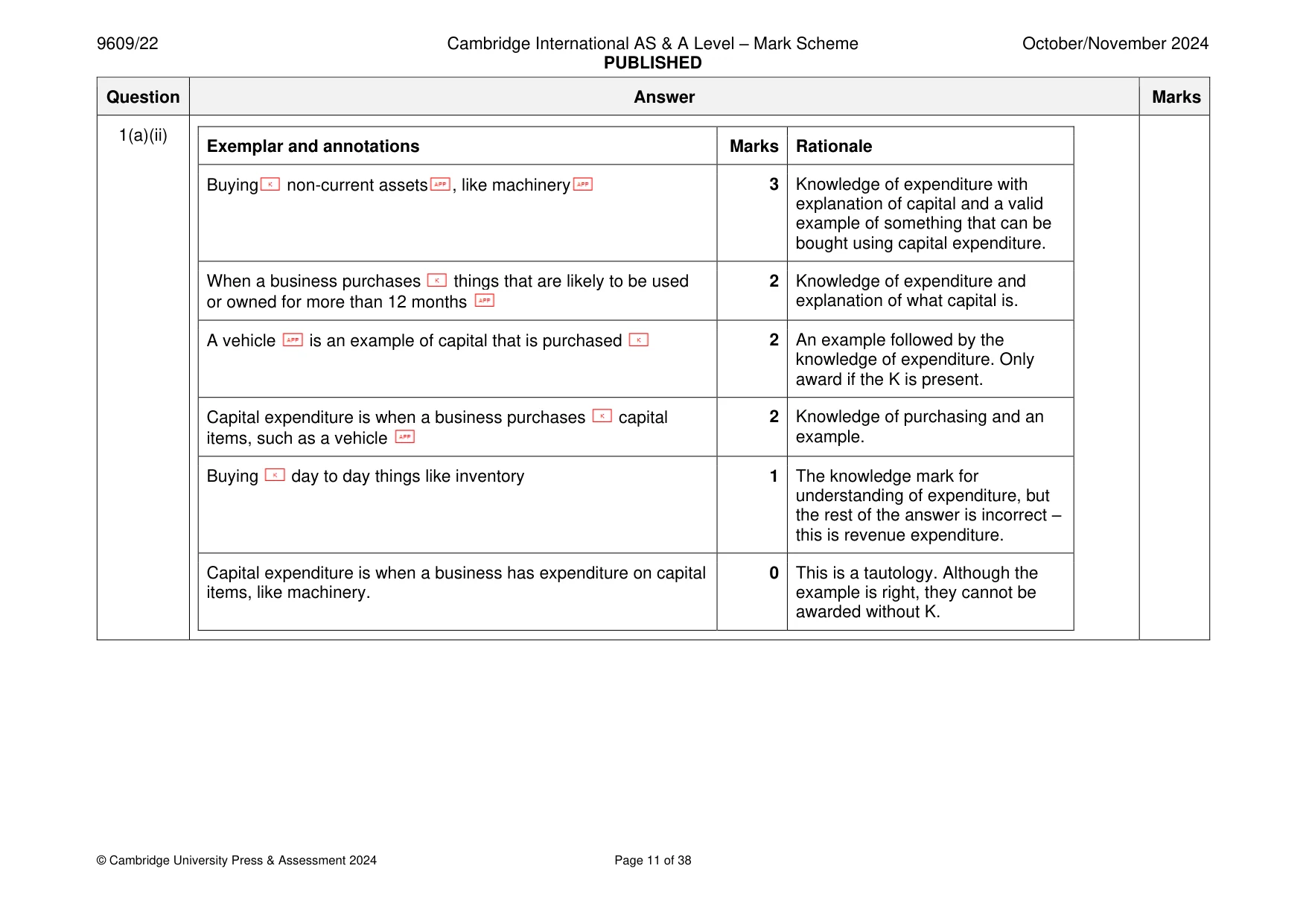
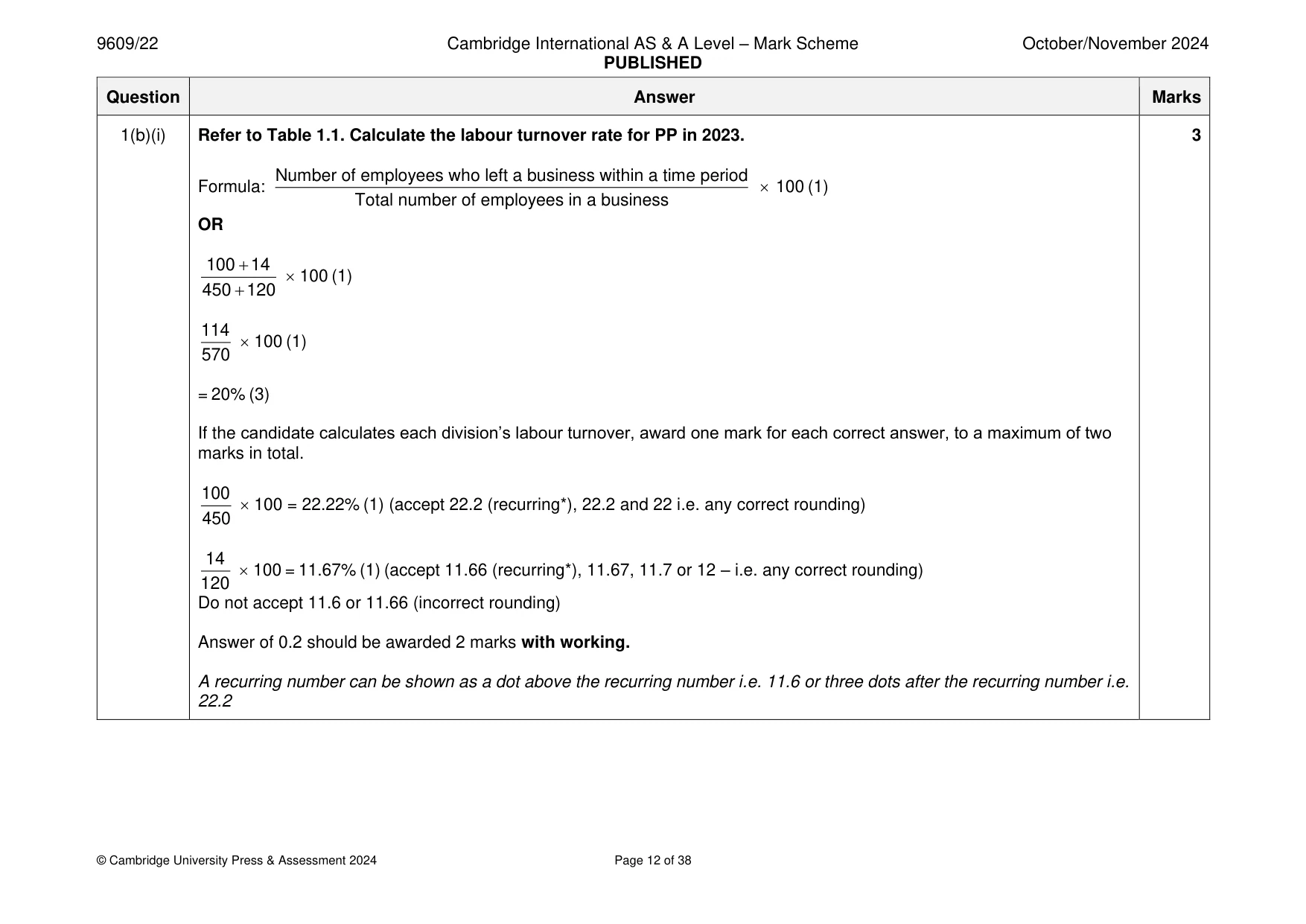
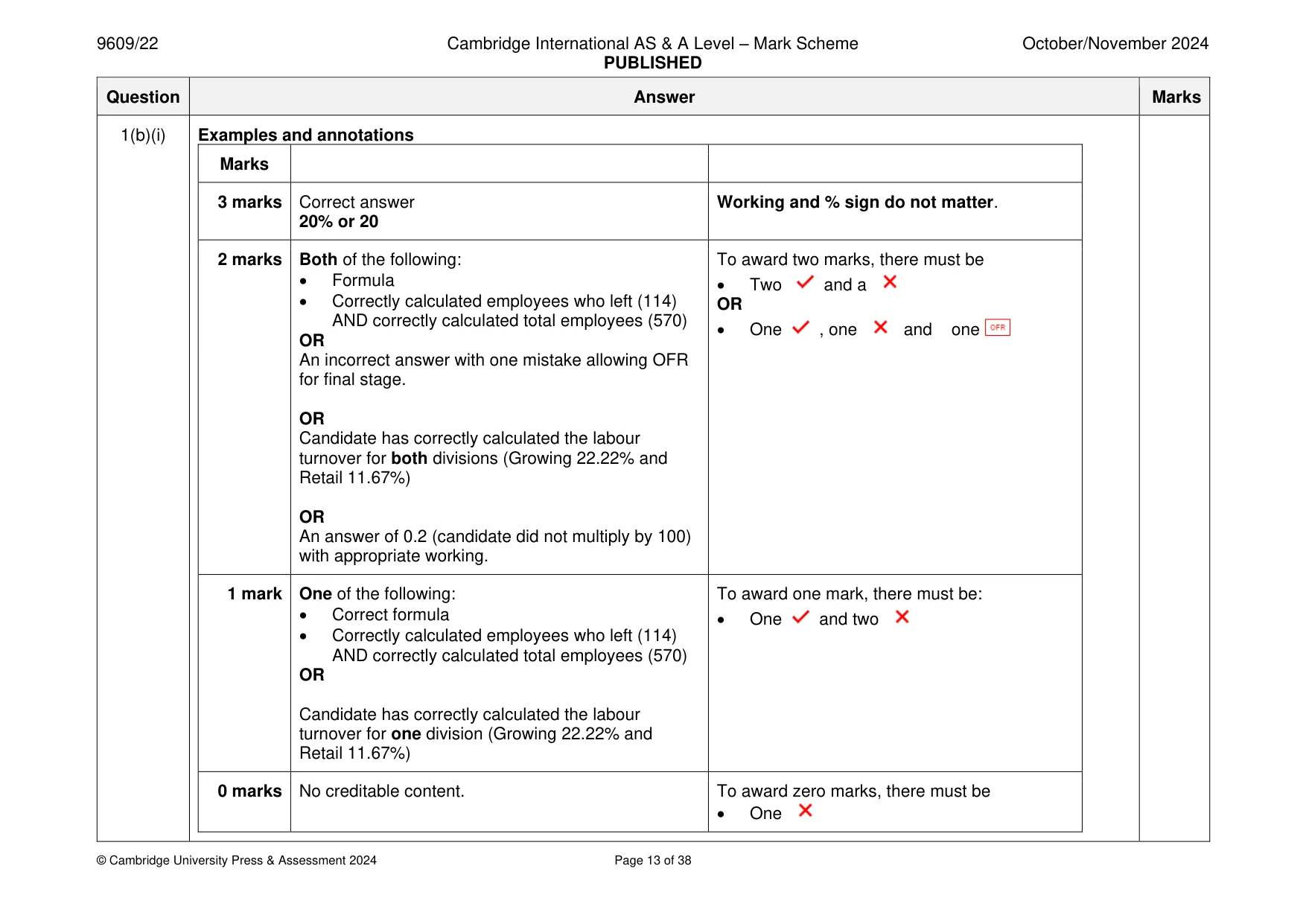
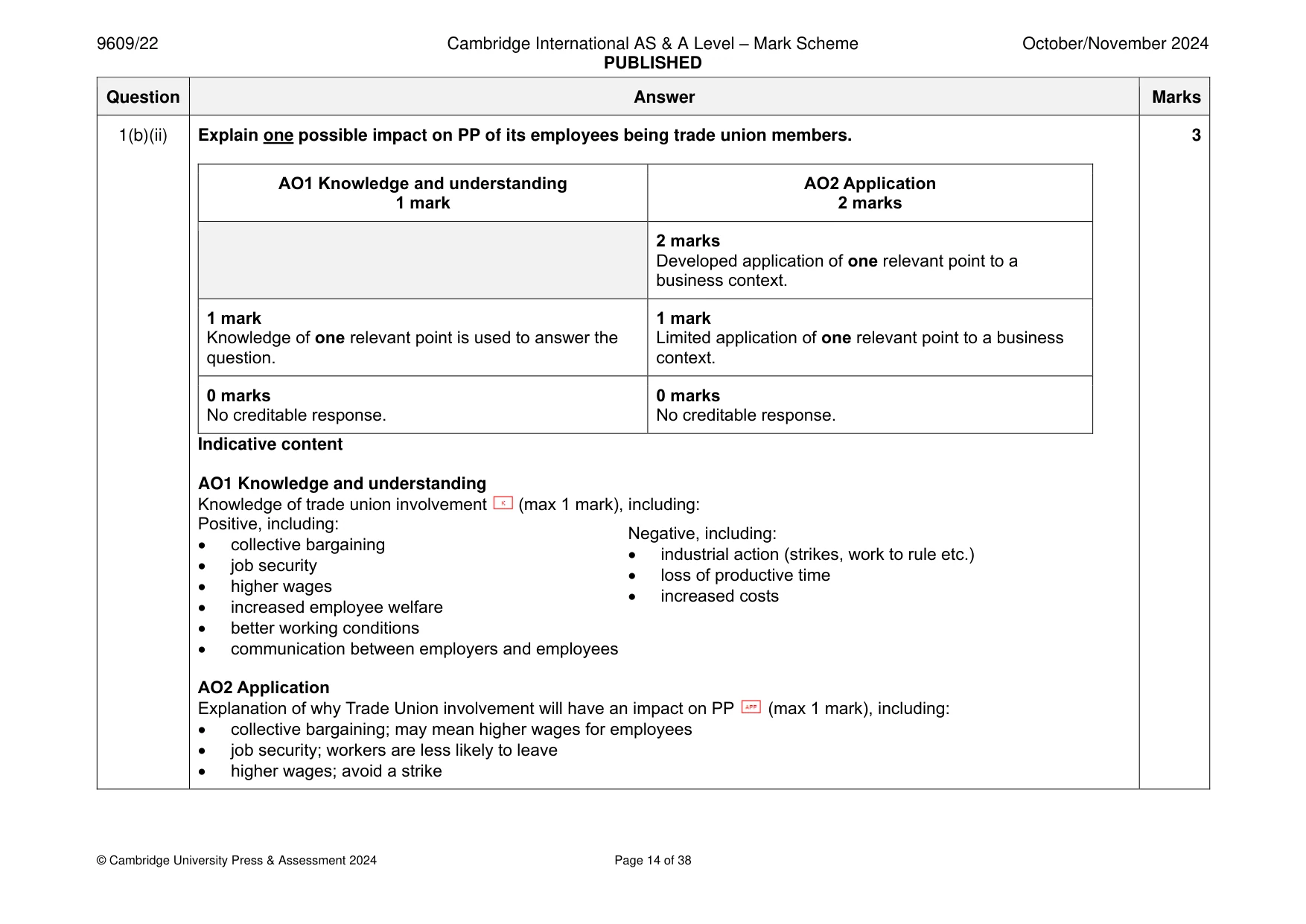
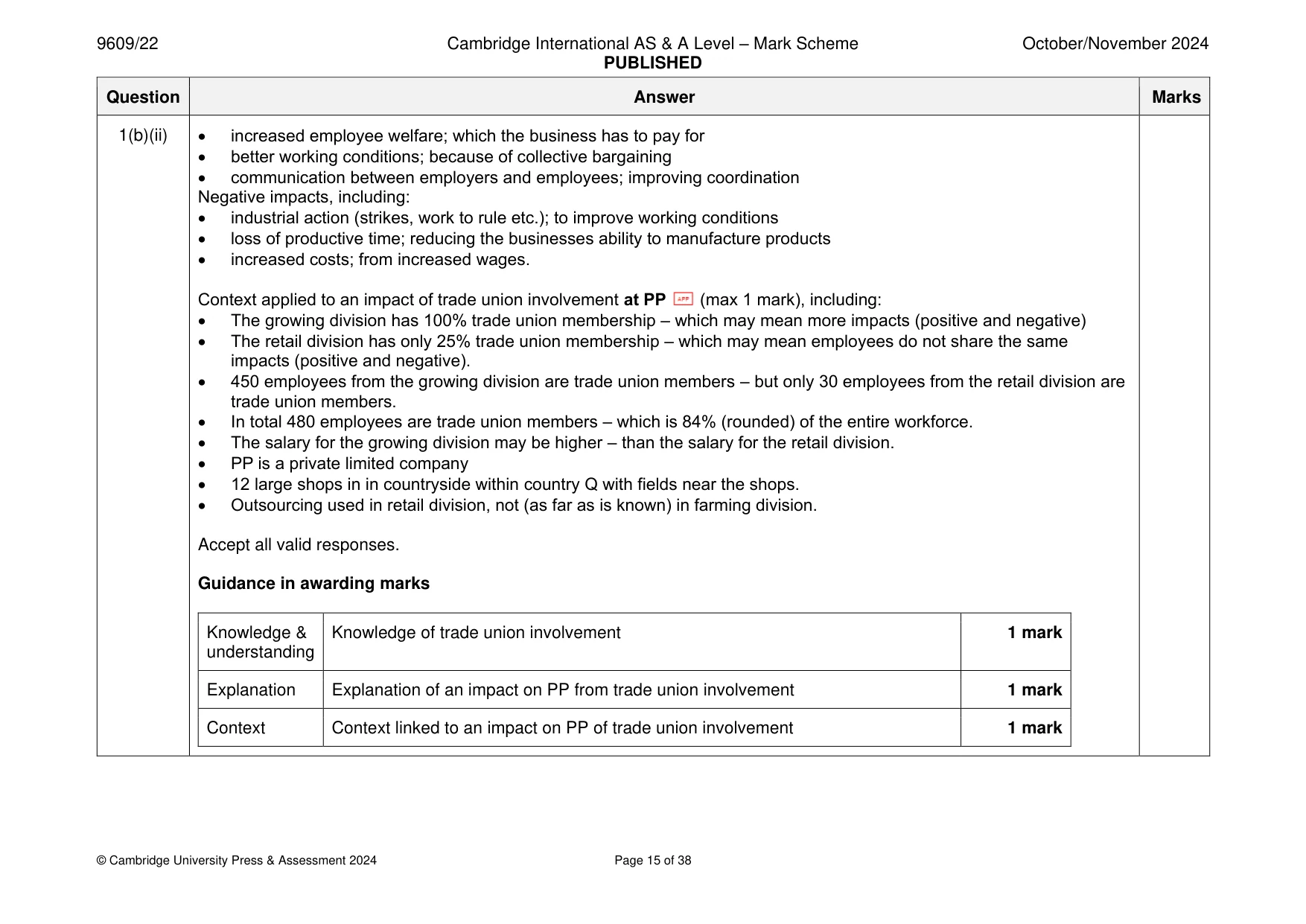
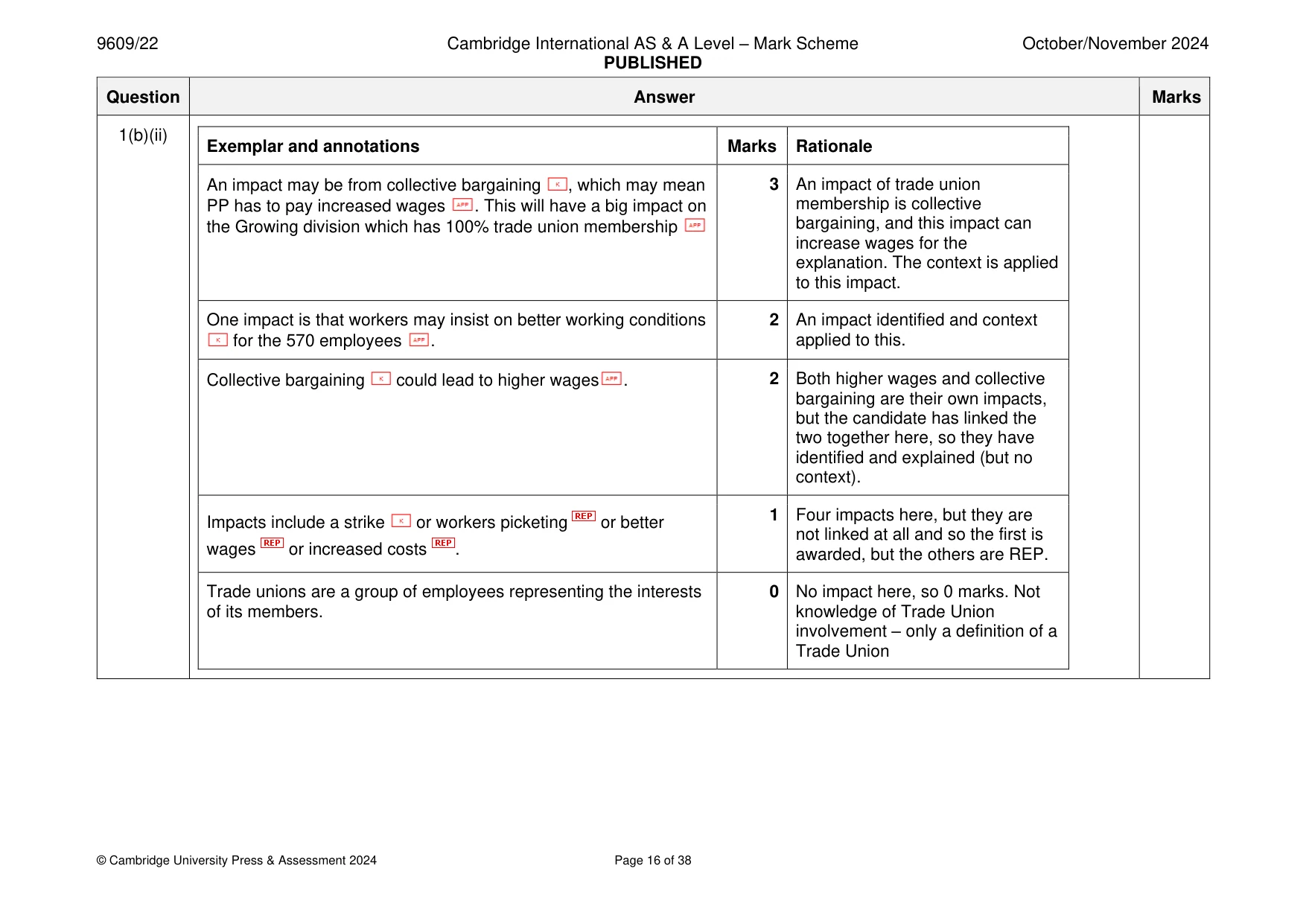
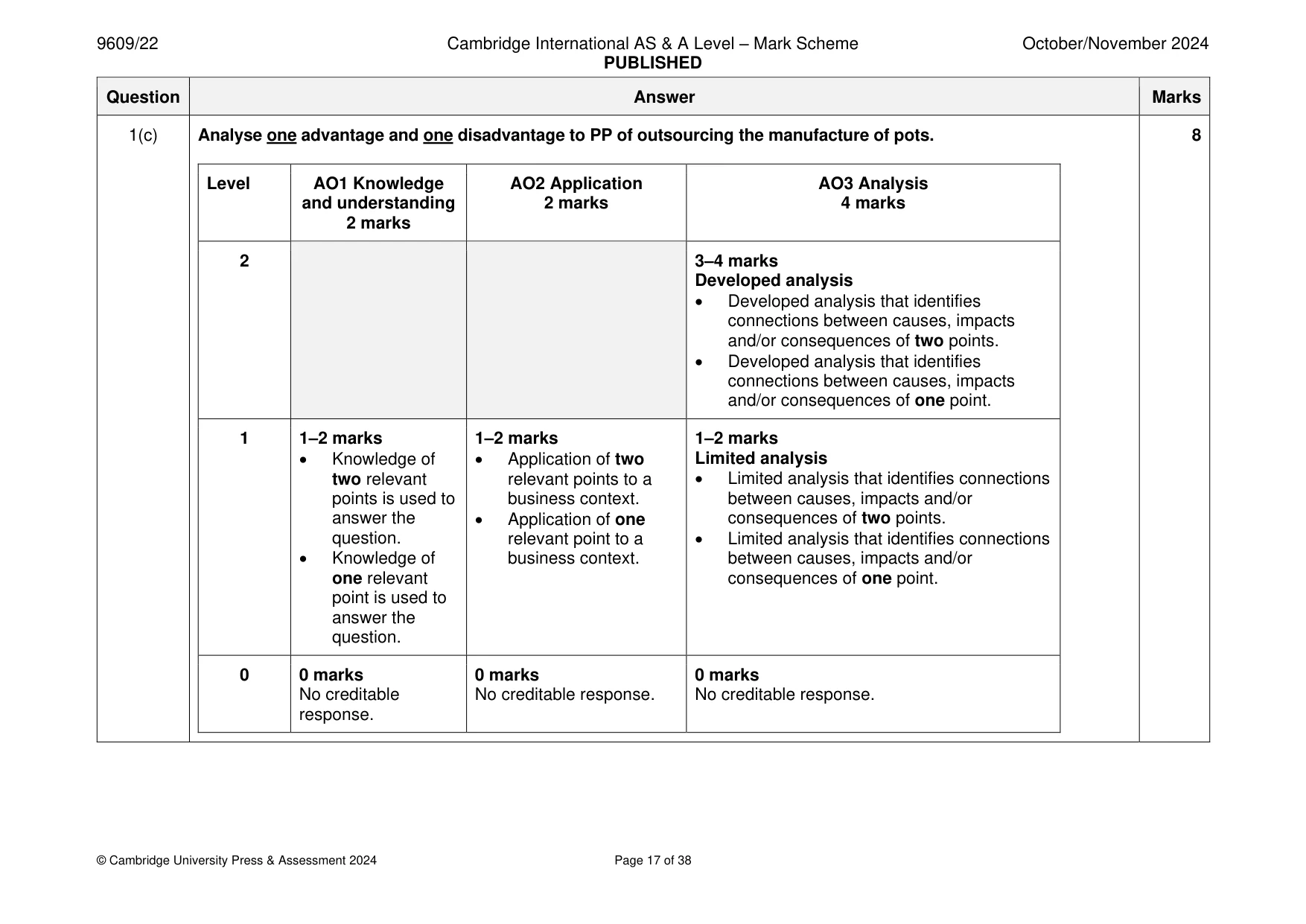
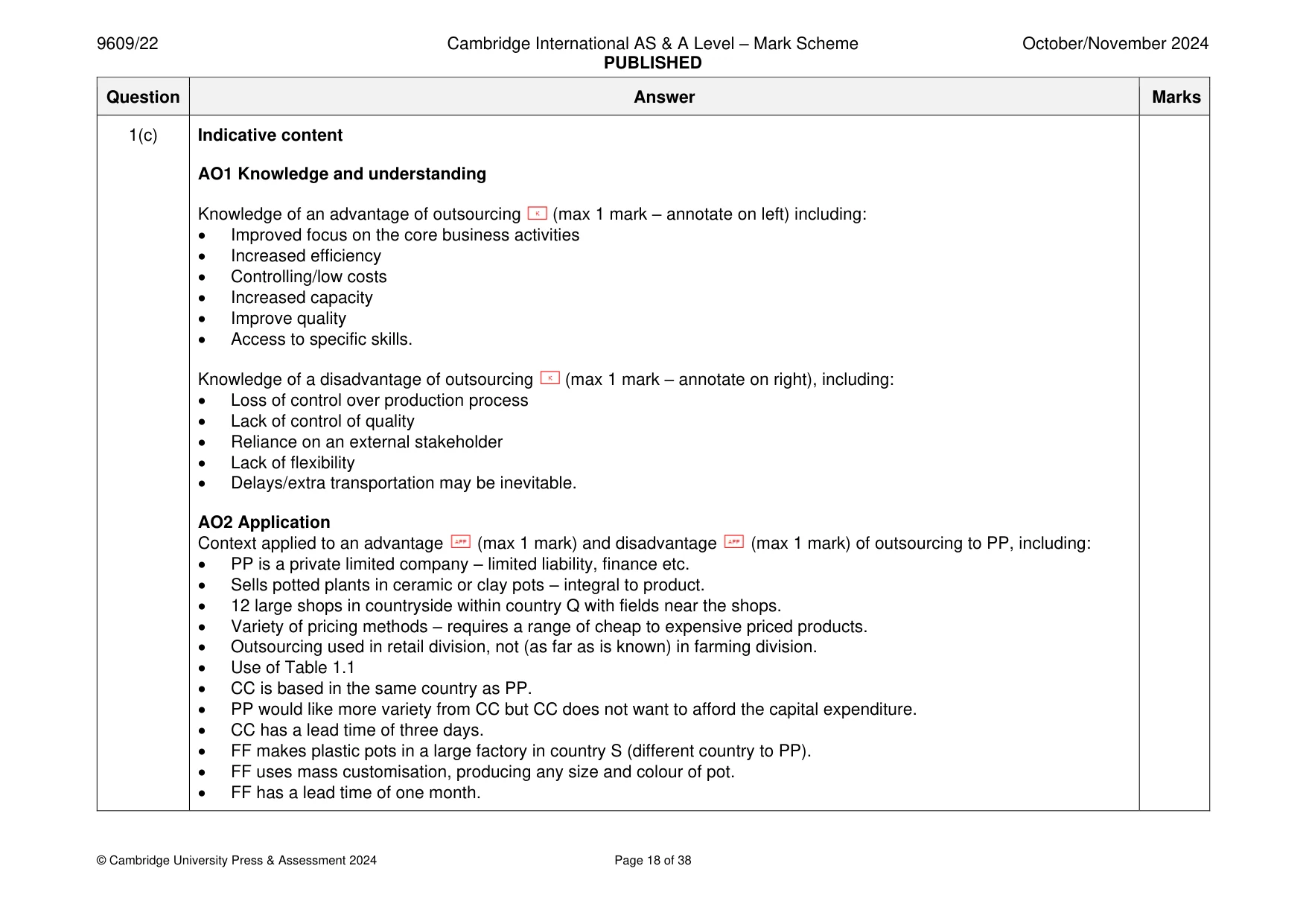
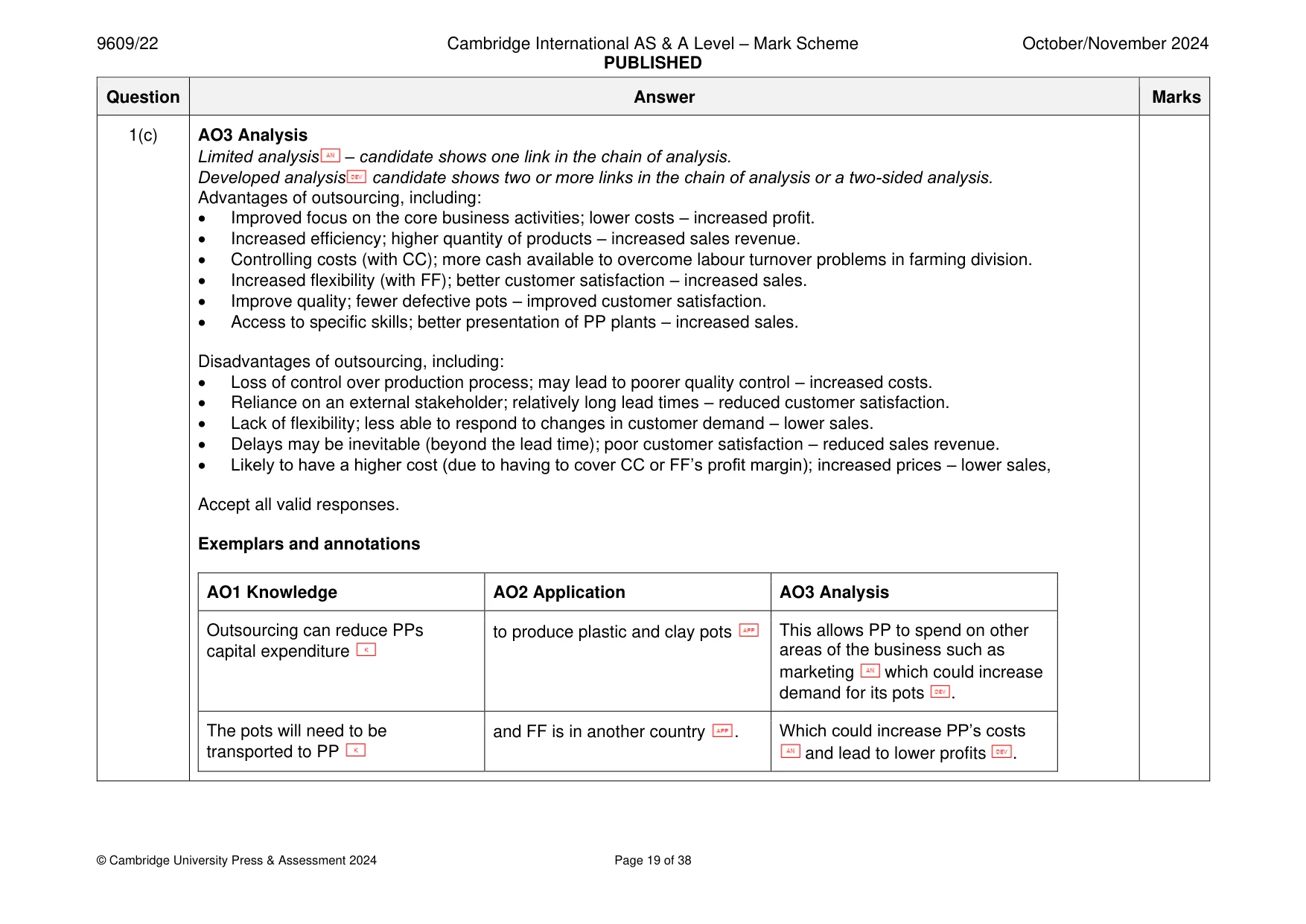
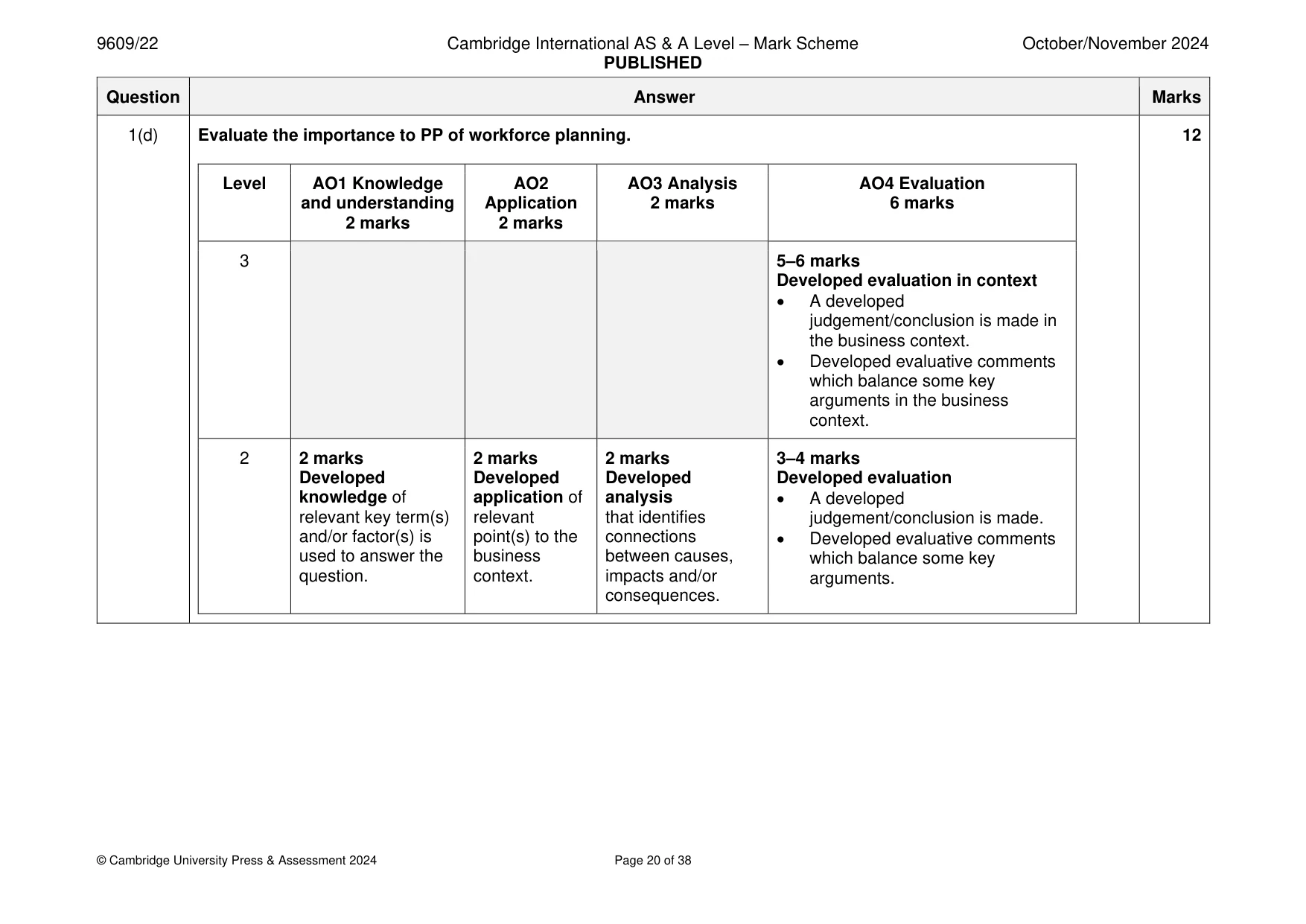
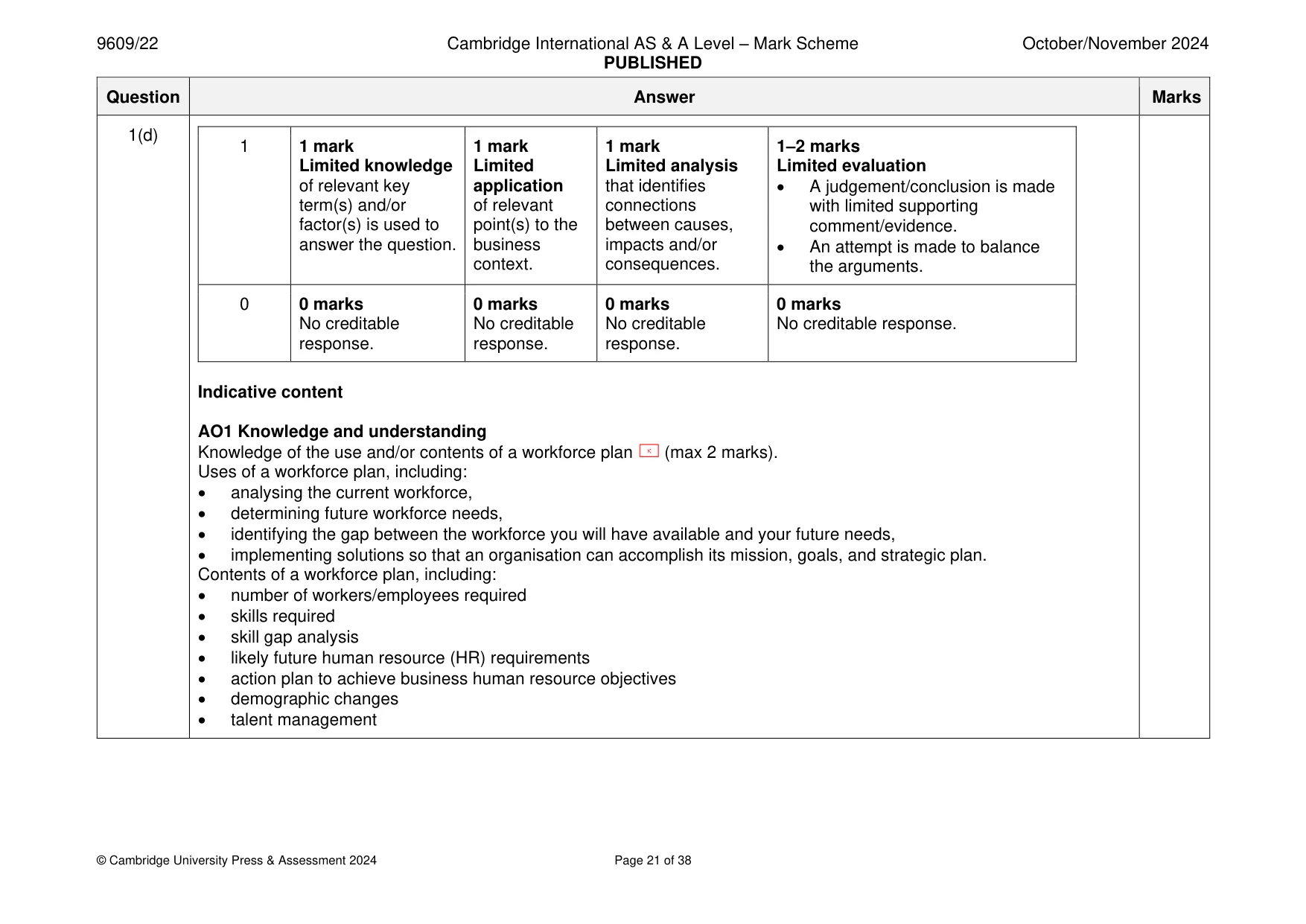
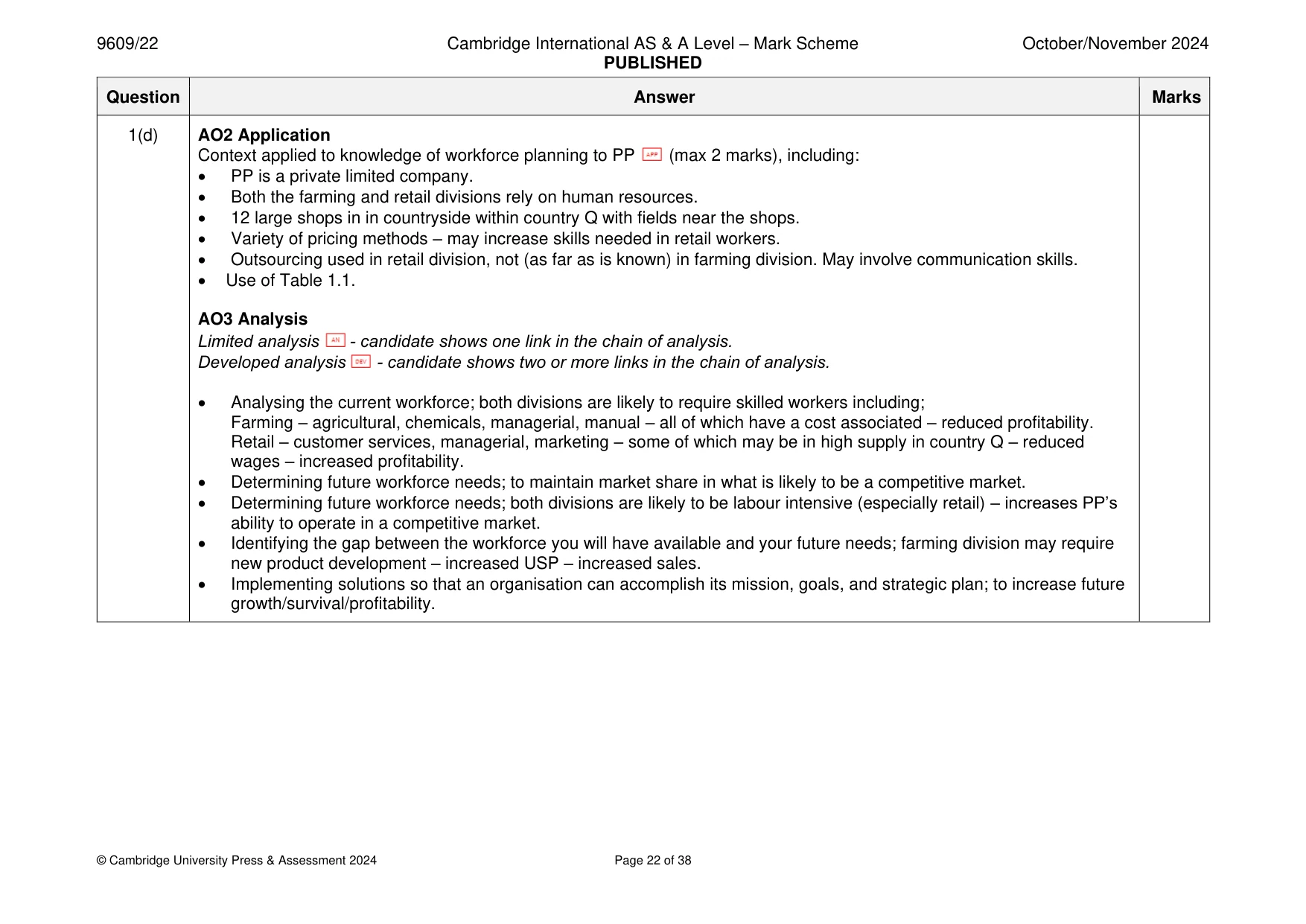
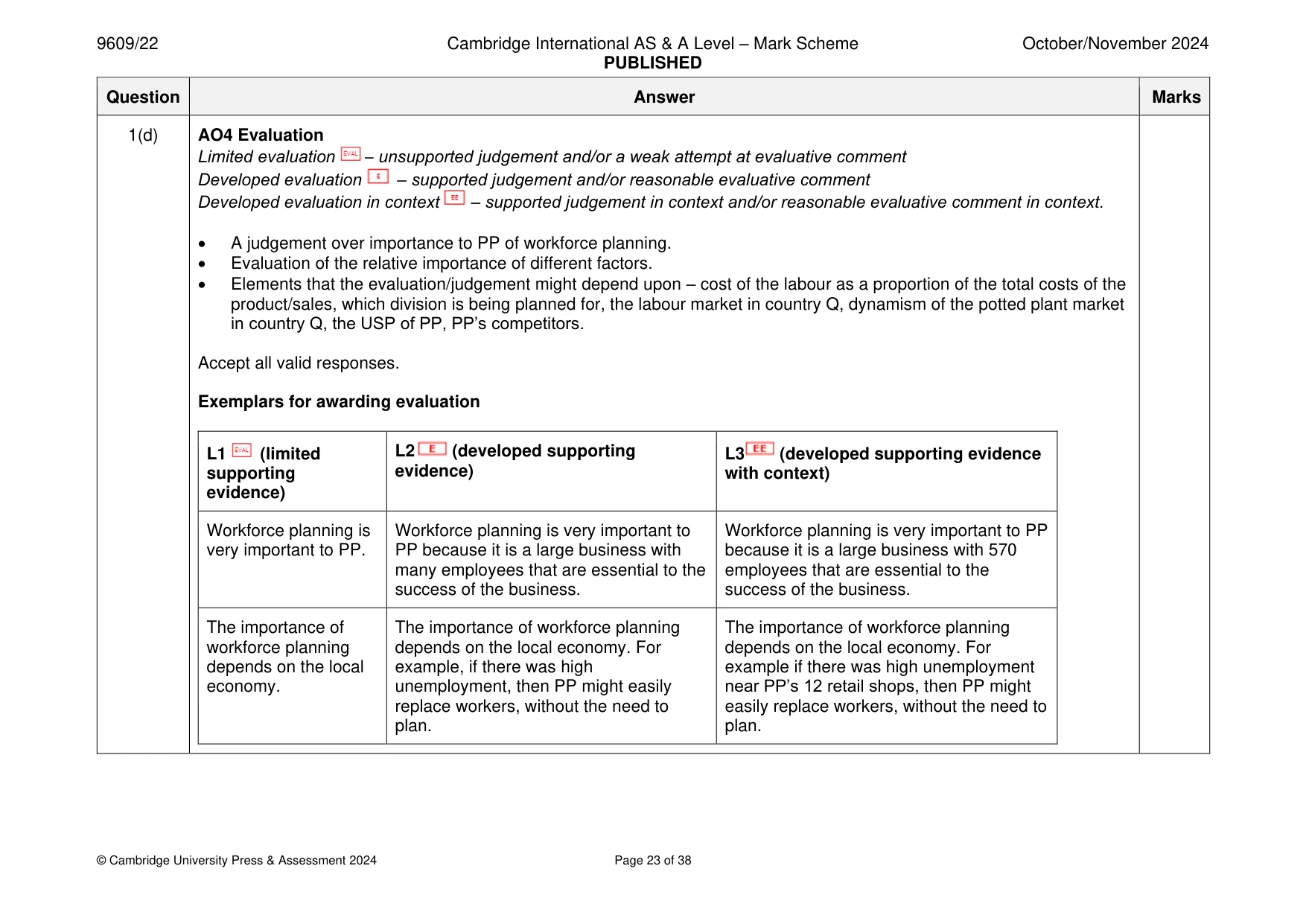
Mark scheme: Question Answer Marks 1(a)(i) Identify one promotion method. 1 Indicative content Promotion methods : • advertising/advertisement • sales • direct • digital • packaging • branding Accept only the answers above Do not accept examples of a method (i.e. social media or social media promotion), unless the method is specified (i.e. social media advertising). If more than one answer is given, only mark the first, reading from top left to bottom right. 1(a)(ii) Explain the term capital expenditure (line 16). 3 AO1 Knowledge and understanding AO2 Application 1 mark 2 marks 2 marks Developed application of one relevant point to a business context. 1 mark 1 mark Knowledge of one relevant point is used to answer the Limited application of one relevant point to a business question. context. 0 marks 0 marks No creditable response. No creditable response. 1(a)(ii) Indicative content Definition of capital expenditure: the purchase of non-current assets that are expected to last for more than one year, such as buildings and machinery. AO1 Knowledge and understanding Knowledge of business expenditure , may include: • Purchasing • Buying • Spending money on • Investing in AO2 Application Explanation of capital expenditure may include: • Non-current assets • Fixed assets • Assets expected to last for more than a year/12 months Context applied to capital expenditure way , including: • Any example of capital expenditure, including: • Machinery • Property • Factories Accept all valid responses. Guidance in awarding marks Knowledge & understanding Knowledge of business expenditure 1 mark Explanation Application to capital expenditure 1 mark Context Applied to a business context/ business 1 mark environment 1(a)(ii) Exemplar and annotations Marks Rationale Buying non-current assets , like machinery 3 Knowledge of expenditure with explanation of capital and a valid example of something that can be bought using capital expenditure. When a business purchases things that are likely to be used 2 Knowledge of expenditure and or owned for more than 12 months explanation of what capital is. A vehicle is an example of capital that is purchased 2 An example followed by the knowledge of expenditure. Only award if the K is present. Capital expenditure is when a business purchases capital 2 Knowledge of purchasing and an items, such as a vehicle example. Buying day to day things like inventory 1 The knowledge mark for understanding of expenditure, but the rest of the answer is incorrect – this is revenue expenditure. Capital expenditure is when a business has expenditure on capital 0 This is a tautology. Although the items, like machinery. example is right, they cannot be awarded without K. 1(b)(i) Refer to Table 1.1. Calculate the labour turnover rate for PP in 2023. 3 Number of employees who left a business within a time period Formula: 100 (1) Total number of employees in a business OR 100 + 14 100 (1) 450 + 120 114 100 (1) 570 = 20% (3) If the candidate calculates each division’s labour turnover, award one mark for each correct answer, to a maximum of two marks in total. 100 100 = 22.22% (1) (accept 22.2 (recurring*), 22.2 and 22 i.e. any correct rounding) 450 14 100 = 11.67% (1) (accept 11.66 (recurring*), 11.67, 11.7 or 12 – i.e. any correct rounding) 120 Do not accept 11.6 or 11.66 (incorrect rounding) Answer of 0.2 should be awarded 2 marks with working. A recurring number can be shown as a dot above the recurring number i.e. 11.6 or three dots after the recurring number i.e. 22.2 1(b)(i) Examples and annotations Marks 3 marks Correct answer Working and % sign do not matter. 20% or 20 2 marks Both of the following: To award two marks, there must be • Formula • Two and a • Correctly calculated employees who left (114) OR AND correctly calculated total employees (570) • One , one and one OR An incorrect answer with one mistake allowing OFR for final stage. OR Candidate has correctly calculated the labour turnover for both divisions (Growing 22.22% and Retail 11.67%) OR An answer of 0.2 (candidate did not multiply by 100) with appropriate working. 1 mark One of the following: To award one mark, there must be: • Correct formula • One and two • Correctly calculated employees who left (114) AND correctly calculated total employees (570) OR Candidate has correctly calculated the labour turnover for one division (Growing 22.22% and Retail 11.67%) 0 marks No creditable content. To award zero marks, there must be • One 1(b)(ii) Explain one possible impact on PP of its employees being trade union members. 3 AO1 Knowledge and understanding AO2 Application 1 mark 2 marks 2 marks Developed application of one relevant point to a business context. 1 mark 1 mark Knowledge of one relevant point is used to answer the Limited application of one relevant point to a business question. context. 0 marks 0 marks No creditable response. No creditable response. Indicative content AO1 Knowledge and understanding Knowledge of trade union involvement (max 1 mark), including: Positive, including: Negative, including: • collective bargaining • industrial action (strikes, work to rule etc.) • job security • loss of productive time • higher wages • increased costs • increased employee welfare • better working conditions • communication between employers and employees AO2 Application Explanation of why Trade Union involvement will have an impact on PP (max 1 mark), including: • collective bargaining; may mean higher wages for employees • job security; workers are less likely to leave • higher wages; avoid a strike 1(b)(ii) • increased employee welfare; which the business has to pay for • better working conditions; because of collective bargaining • communication between employers and employees; improving coordination Negative impacts, including: • industrial action (strikes, work to rule etc.); to improve working conditions • loss of productive time; reducing the businesses ability to manufacture products • increased costs; from increased wages. Context applied to an impact of trade union involvement at PP (max 1 mark), including: • The growing division has 100% trade union membership – which may mean more impacts (positive and negative) • The retail division has only 25% trade union membership – which may mean employees do not share the same impacts (positive and negative). • 450 employees from the growing division are trade union members – but only 30 employees from the retail division are trade union members. • In total 480 employees are trade union members – which is 84% (rounded) of the entire workforce. • The salary for the growing division may be higher – than the salary for the retail division. • PP is a private limited company • 12 large shops in in countryside within country Q with fields near the shops. • Outsourcing used in retail division, not (as far as is known) in farming division. Accept all valid responses. Guidance in awarding marks Knowledge & Knowledge of trade union involvement 1 mark understanding Explanation Explanation of an impact on PP from trade union involvement 1 mark Context Context linked to an impact on PP of trade union involvement 1 mark 1(b)(ii) Exemplar and annotations Marks Rationale An impact may be from collective bargaining , which may mean 3 An impact of trade union PP has to pay increased wages . This will have a big impact on membership is collective the Growing division which has 100% trade union membership bargaining, and this impact can increase wages for the explanation. The context is applied to this impact. One impact is that workers may insist on better working conditions 2 An impact identified and context for the 570 employees . applied to this. Collective bargaining could lead to higher wages . 2 Both higher wages and collective bargaining are their own impacts, but the candidate has linked the two together here, so they have identified and explained (but no context). 1 Four impacts here, but they are Impacts include a strike or workers picketing or better not linked at all and so the first is wages or increased costs . awarded, but the others are REP. Trade unions are a group of employees representing the interests 0 No impact here, so 0 marks. Not of its members. knowledge of Trade Union involvement – only a definition of a Trade Union 1(c) Analyse one advantage and one disadvantage to PP of outsourcing the manufacture of pots. 8 Level AO1 Knowledge AO2 Application AO3 Analysis and understanding 2 marks 4 marks 2 marks 2 3–4 marks Developed analysis • Developed analysis that identifies connections between causes, impacts and/or consequences of two points. • Developed analysis that identifies connections between causes, impacts and/or consequences of one point. 1 1–2 marks 1–2 marks 1–2 marks • Knowledge of • Application of two Limited analysis two relevant relevant points to a • Limited analysis that identifies connections points is used to business context. between causes, impacts and/or answer the • Application of one consequences of two points. question. relevant point to a • Limited analysis that identifies connections • Knowledge of business context. between causes, impacts and/or one relevant consequences of one point. point is used to answer the question. 0 0 marks 0 marks 0 marks No creditable No creditable response. No creditable response. response. 1(c) Indicative content AO1 Knowledge and understanding Knowledge of an advantage of outsourcing (max 1 mark – annotate on left) including: • Improved focus on the core business activities • Increased efficiency • Controlling/low costs • Increased capacity • Improve quality • Access to specific skills. Knowledge of a disadvantage of outsourcing (max 1 mark – annotate on right), including: • Loss of control over production process • Lack of control of quality • Reliance on an external stakeholder • Lack of flexibility • Delays/extra transportation may be inevitable. AO2 Application Context applied to an advantage (max 1 mark) and disadvantage (max 1 mark) of outsourcing to PP, including: • PP is a private limited company – limited liability, finance etc. • Sells potted plants in ceramic or clay pots – integral to product. • 12 large shops in countryside within country Q with fields near the shops. • Variety of pricing methods – requires a range of cheap to expensive priced products. • Outsourcing used in retail division, not (as far as is known) in farming division. • Use of Table 1.1 • CC is based in the same country as PP. • PP would like more variety from CC but CC does not want to afford the capital expenditure. • CC has a lead time of three days. • FF makes plastic pots in a large factory in country S (different country to PP). • FF uses mass customisation, producing any size and colour of pot. • FF has a lead time of one month. 1(c) AO3 Analysis Limited analysis – candidate shows one link in the chain of analysis. Developed analysis candidate shows two or more links in the chain of analysis or a two-sided analysis. Advantages of outsourcing, including: • Improved focus on the core business activities; lower costs – increased profit. • Increased efficiency; higher quantity of products – increased sales revenue. • Controlling costs (with CC); more cash available to overcome labour turnover problems in farming division. • Increased flexibility (with FF); better customer satisfaction – increased sales. • Improve quality; fewer defective pots – improved customer satisfaction. • Access to specific skills; better presentation of PP plants – increased sales. Disadvantages of outsourcing, including: • Loss of control over production process; may lead to poorer quality control – increased costs. • Reliance on an external stakeholder; relatively long lead times – reduced customer satisfaction. • Lack of flexibility; less able to respond to changes in customer demand – lower sales. • Delays may be inevitable (beyond the lead time); poor customer satisfaction – reduced sales revenue. • Likely to have a higher cost (due to having to cover CC or FF’s profit margin); increased prices – lower sales, Accept all valid responses. Exemplars and annotations AO1 Knowledge AO2 Application AO3 Analysis Outsourcing can reduce PPs to produce plastic and clay pots This allows PP to spend on other capital expenditure areas of the business such as marketing which could increase demand for its pots . The pots will need to be and FF is in another country . Which could increase PP’s costs transported to PP and lead to lower profits . 1(d) Evaluate the importance to PP of workforce planning. 12 Level AO1 Knowledge AO2 AO3 Analysis AO4 Evaluation and understanding Application 2 marks 6 marks 2 marks 2 marks 3 5–6 marks Developed evaluation in context • A developed judgement/conclusion is made in the business context. • Developed evaluative comments which balance some key arguments in the business context. 2 2 marks 2 marks 2 marks 3–4 marks Developed Developed Developed Developed evaluation knowledge of application of analysis • A developed relevant key term(s) relevant that identifies judgement/conclusion is made. and/or factor(s) is point(s) to the connections • Developed evaluative comments used to answer the business between causes, which balance some key question. context. impacts and/or arguments. consequences. 1(d) 1 1 mark 1 mark 1 mark 1–2 marks Limited knowledge Limited Limited analysis Limited evaluation of relevant key application that identifies • A judgement/conclusion is made term(s) and/or of relevant connections with limited supporting factor(s) is used to point(s) to the between causes, comment/evidence. answer the question. business impacts and/or • An attempt is made to balance context. consequences. the arguments. 0 0 marks 0 marks 0 marks 0 marks No creditable No creditable No creditable No creditable response. response. response. response. Indicative content AO1 Knowledge and understanding Knowledge of the use and/or contents of a workforce plan (max 2 marks). Uses of a workforce plan, including: • analysing the current workforce, • determining future workforce needs, • identifying the gap between the workforce you will have available and your future needs, • implementing solutions so that an organisation can accomplish its mission, goals, and strategic plan. Contents of a workforce plan, including: • number of workers/employees required • skills required • skill gap analysis • likely future human resource (HR) requirements • action plan to achieve business human resource objectives • demographic changes • talent management 1(d) AO2 Application Context applied to knowledge of workforce planning to PP (max 2 marks), including: • PP is a private limited company. • Both the farming and retail divisions rely on human resources. • 12 large shops in in countryside within country Q with fields near the shops. • Variety of pricing methods – may increase skills needed in retail workers. • Outsourcing used in retail division, not (as far as is known) in farming division. May involve communication skills. • Use of Table 1.1. AO3 Analysis Limited analysis - candidate shows one link in the chain of analysis. Developed analysis - candidate shows two or more links in the chain of analysis. • Analysing the current workforce; both divisions are likely to require skilled workers including; Farming – agricultural, chemicals, managerial, manual – all of which have a cost associated – reduced profitability. Retail – customer services, managerial, marketing – some of which may be in high supply in country Q – reduced wages – increased profitability. • Determining future workforce needs; to maintain market share in what is likely to be a competitive market. • Determining future workforce needs; both divisions are likely to be labour intensive (especially retail) – increases PP’s ability to operate in a competitive market. • Identifying the gap between the workforce you will have available and your future needs; farming division may require new product development – increased USP – increased sales. • Implementing solutions so that an organisation can accomplish its mission, goals, and strategic plan; to increase future growth/survival/profitability. 1(d) AO4 Evaluation Limited evaluation – unsupported judgement and/or a weak attempt at evaluative comment Developed evaluation – supported judgement and/or reasonable evaluative comment Developed evaluation in context – supported judgement in context and/or reasonable evaluative comment in context. • A judgement over importance to PP of workforce planning. • Evaluation of the relative importance of different factors. • Elements that the evaluation/judgement might depend upon – cost of the labour as a proportion of the total costs of the product/sales, which division is being planned for, the labour market in country Q, dynamism of the potted plant market in country Q, the USP of PP, PP’s competitors. Accept all valid responses. Exemplars for awarding evaluation L1 (limited L2 (developed supporting L3 (developed supporting evidence supporting evidence) with context) evidence) Workforce planning is Workforce planning is very important to Workforce planning is very important to PP very important to PP. PP because it is a large business with because it is a large business with 570 many employees that are essential to the employees that are essential to the success of the business. success of the business. The importance of The importance of workforce planning The importance of workforce planning workforce planning depends on the local economy. For depends on the local economy. For depends on the local example, if there was high example if there was high unemployment economy. unemployment, then PP might easily near PP’s 12 retail shops, then PP might replace workers, without the need to easily replace workers, without the need to plan. plan.
Q2 · The Drink Company (TDC) TDC is a multinational carbonated drinks manufacturer with…
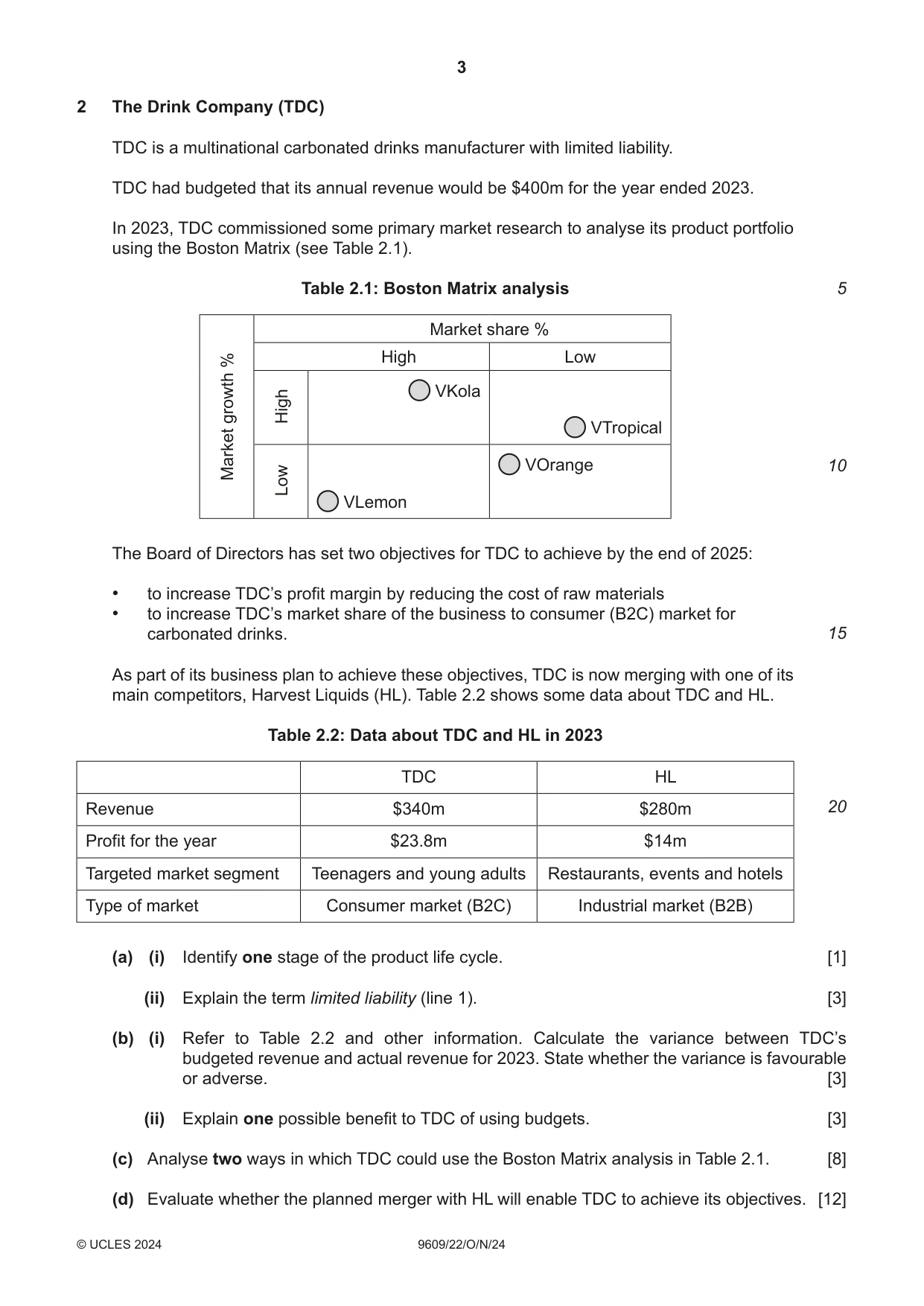
2 The Drink Company (TDC) TDC is a multinational carbonated drinks manufacturer with limited liability. TDC had budgeted that its annual revenue would be $400m for the year ended 2023. In 2023, TDC commissioned some primary market research to analyse its product portfolio using the Boston Matrix (see Table 2.1). Table 2.1: Boston Matrix analysis 5 Market share % % High Low VKola growth High VTropical Market VOrange 10 Low VLemon The Board of Directors has set two objectives for TDC to achieve by the end of 2025: • to increase TDC’s profit margin by reducing the cost of raw materials • to increase TDC’s market share of the business to consumer (B2C) market for carbonated drinks. 15 As part of its business plan to achieve these objectives, TDC is now merging with one of its main competitors, Harvest Liquids (HL). Table 2.2 shows some data about TDC and HL. Table 2.2: Data about TDC and HL in 2023 TDC HL Revenue $340m $280m 20 Profit for the year $23.8m $14m Targeted market segment Teenagers and young adults Restaurants, events and hotels Type of market Consumer market (B2C) Industrial market (B2B) (a) (i) Identify one stage of the product life cycle. [1] (ii) Explain the term limited liability (line 1). [3] (b) (i) Refer to Table 2.2 and other information. Calculate the variance between TDC’s budgeted revenue and actual revenue for 2023. State whether the variance is favourable or adverse. [3] (ii) Explain one possible benefit to TDC of using budgets. [3] (c) Analyse two ways in which TDC could use the Boston Matrix analysis in Table 2.1. [8] (d) Evaluate whether the planned merger with HL will enable TDC to achieve its objectives. [12]
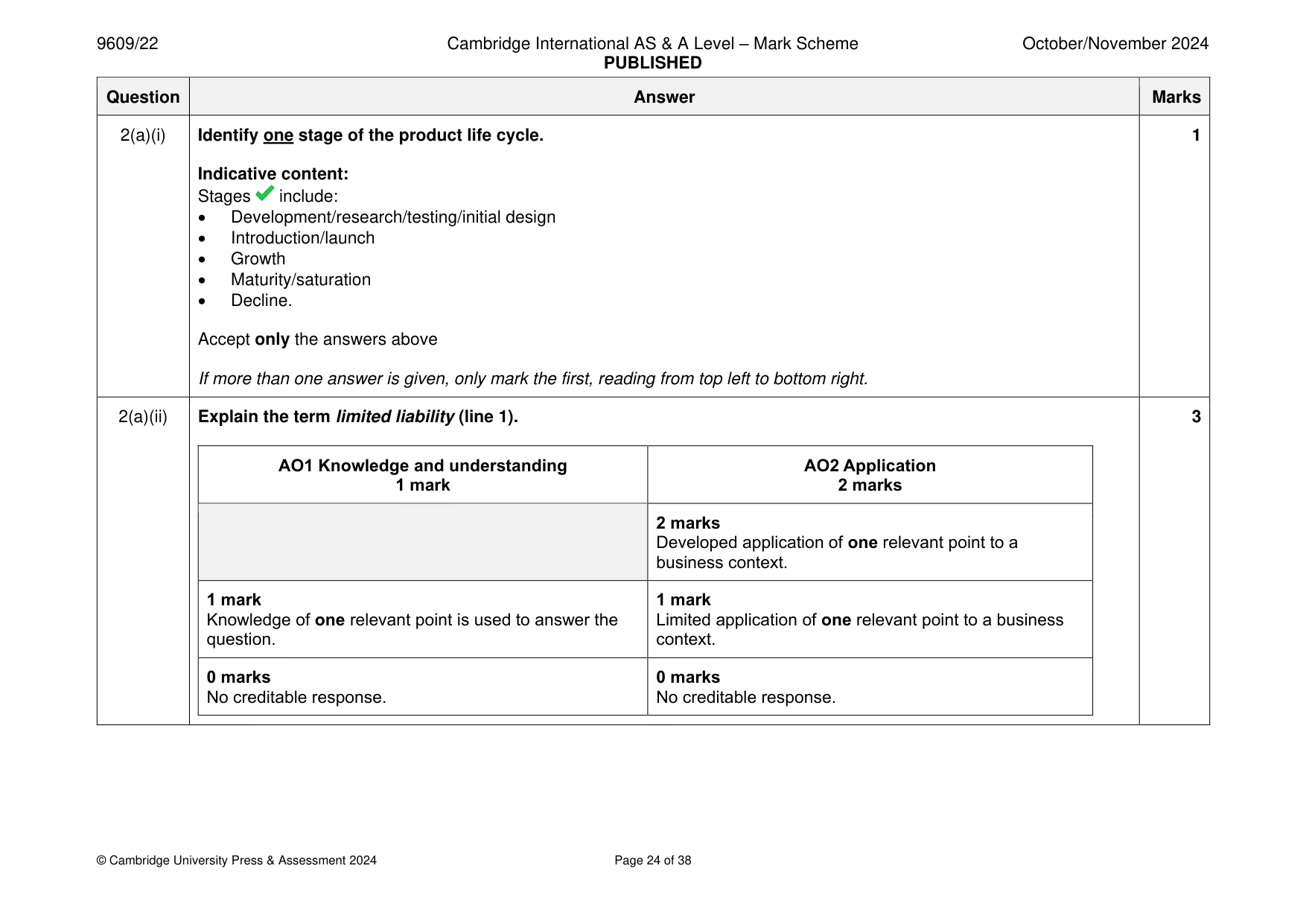
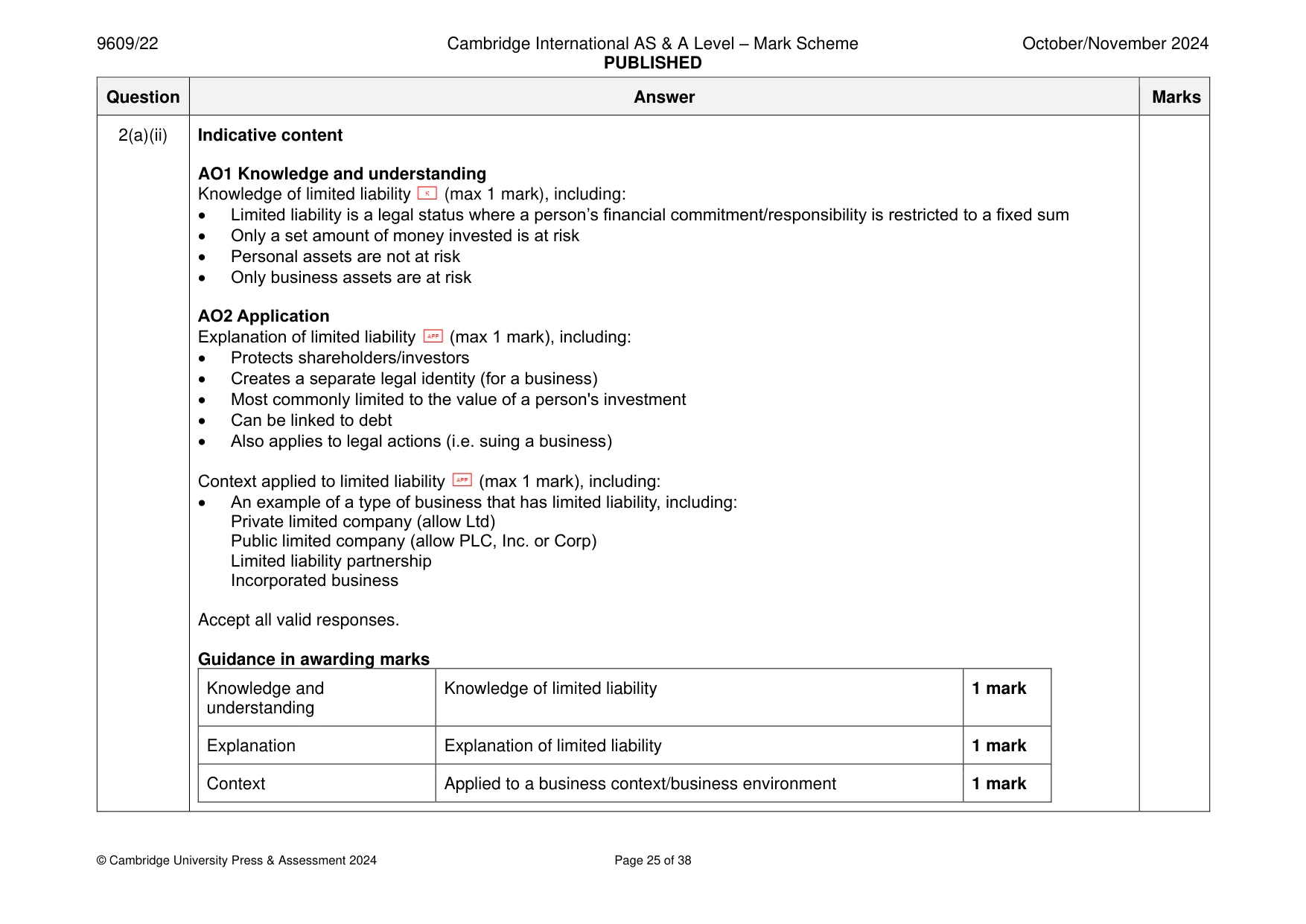
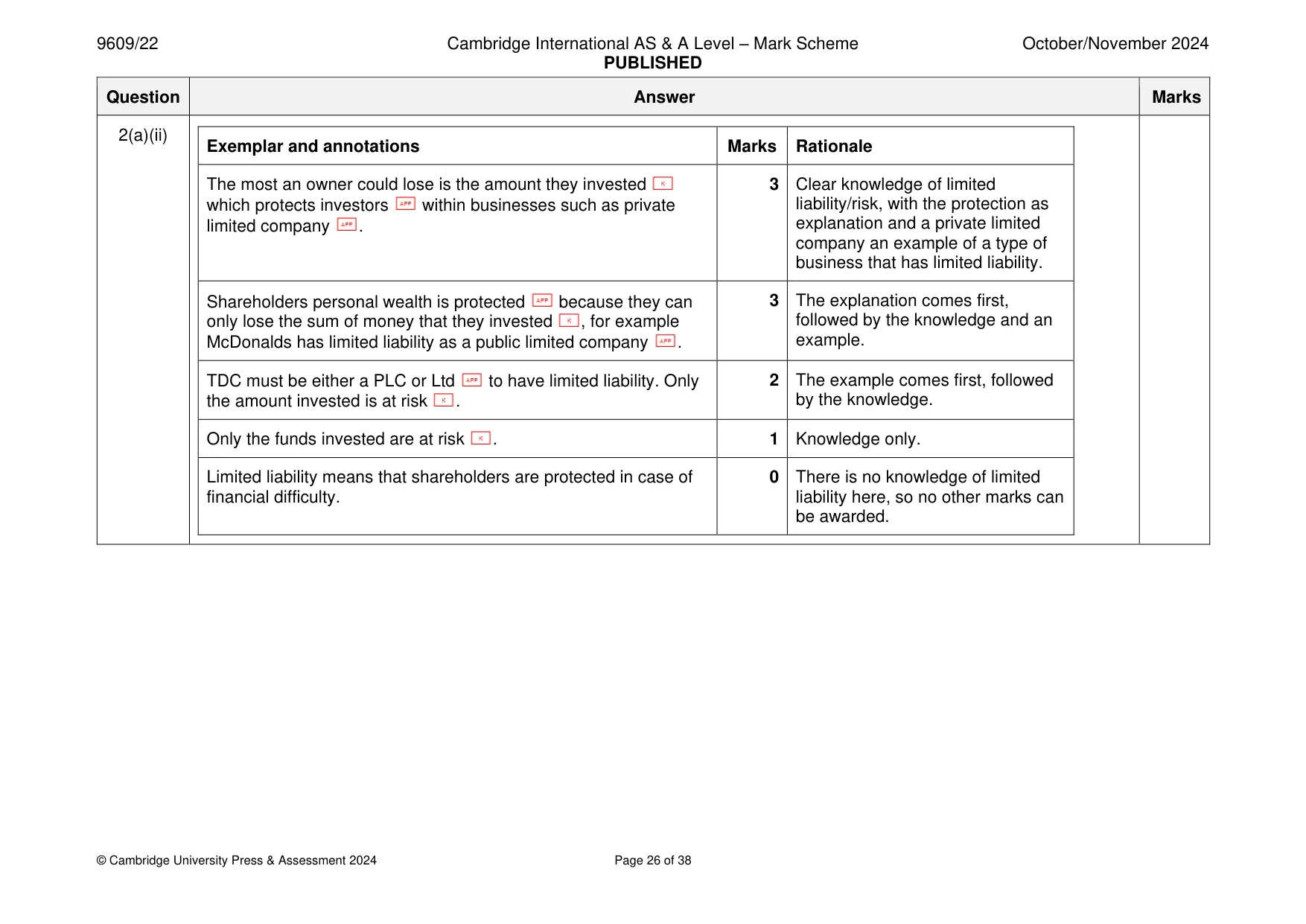
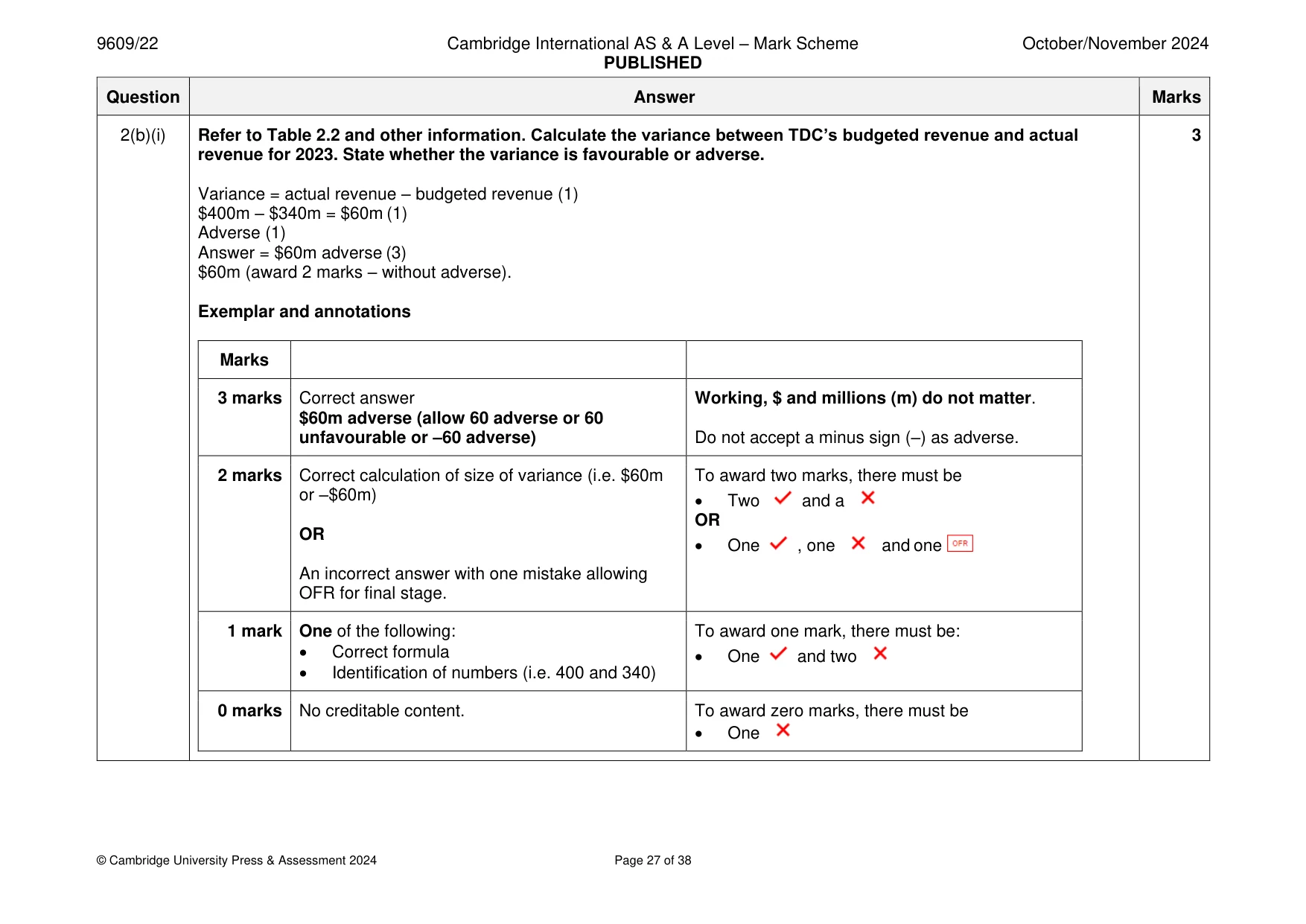
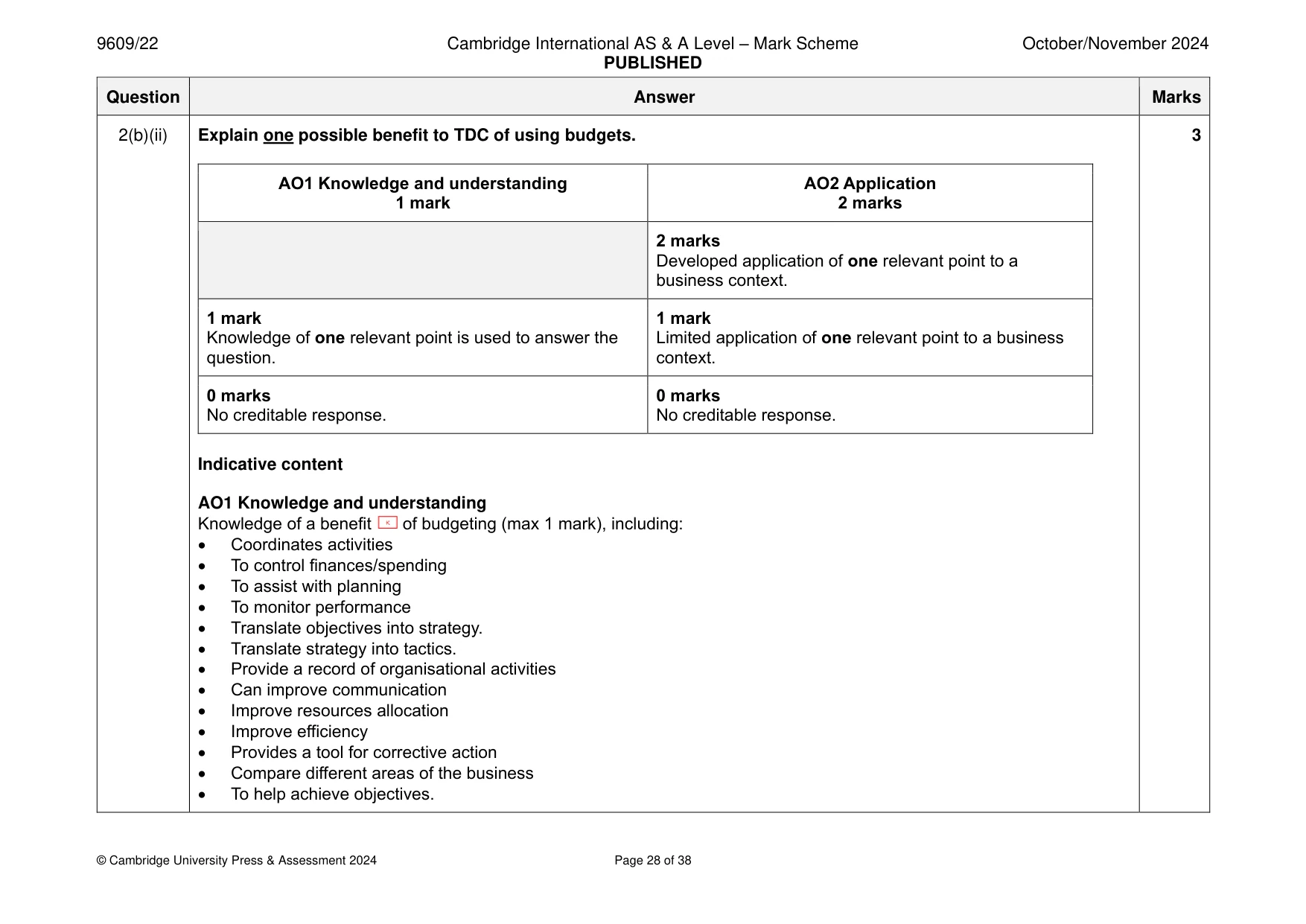
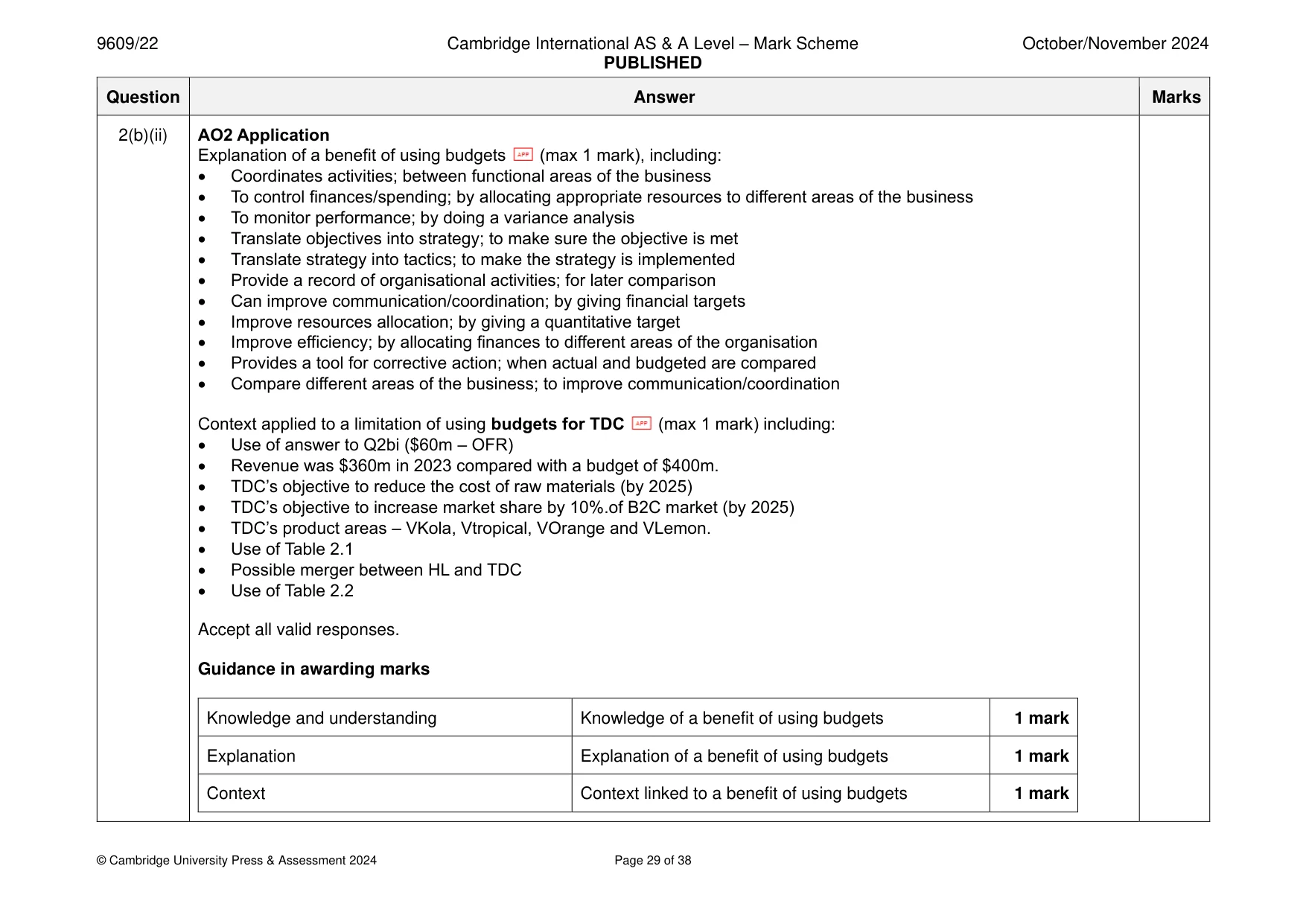
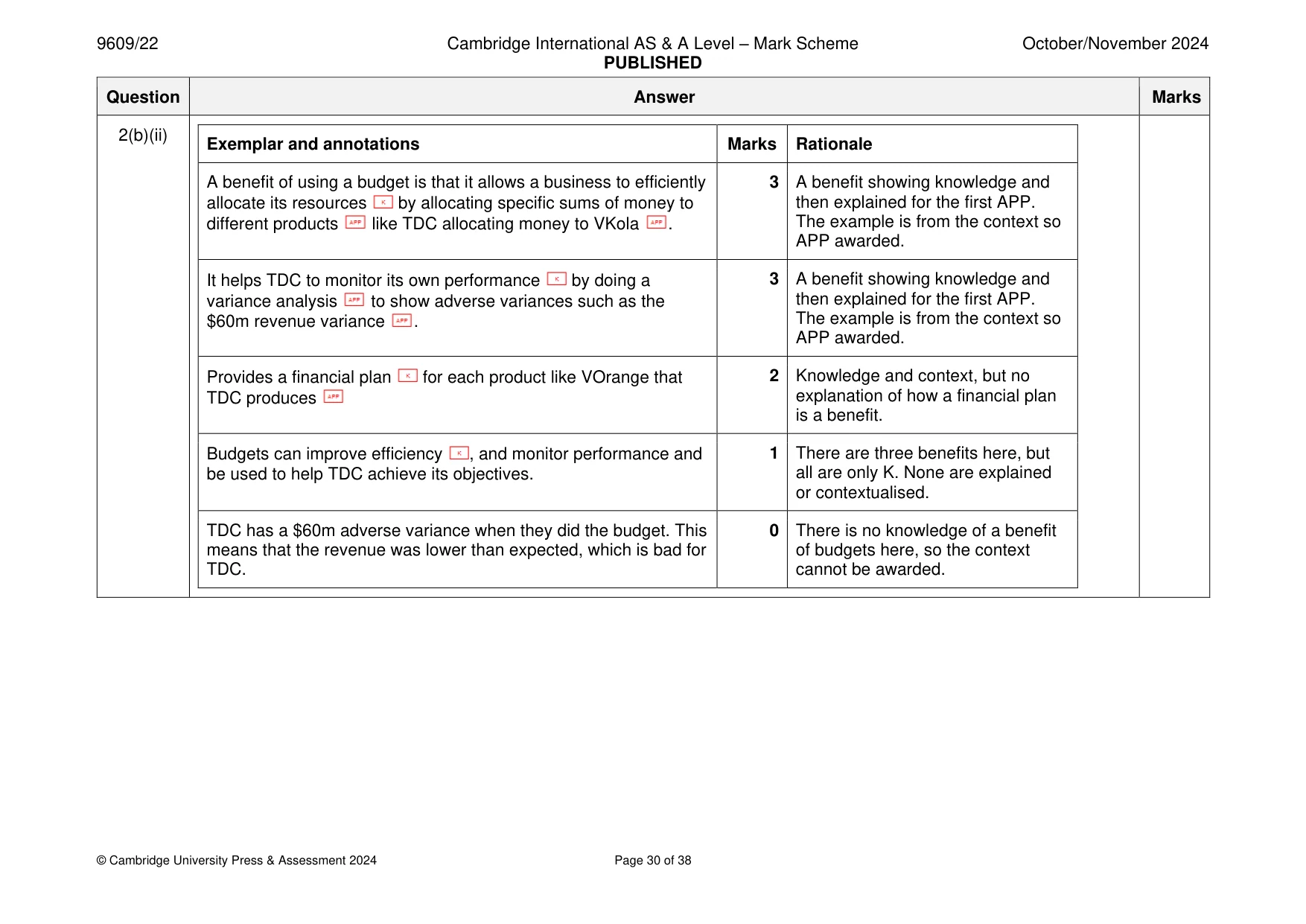
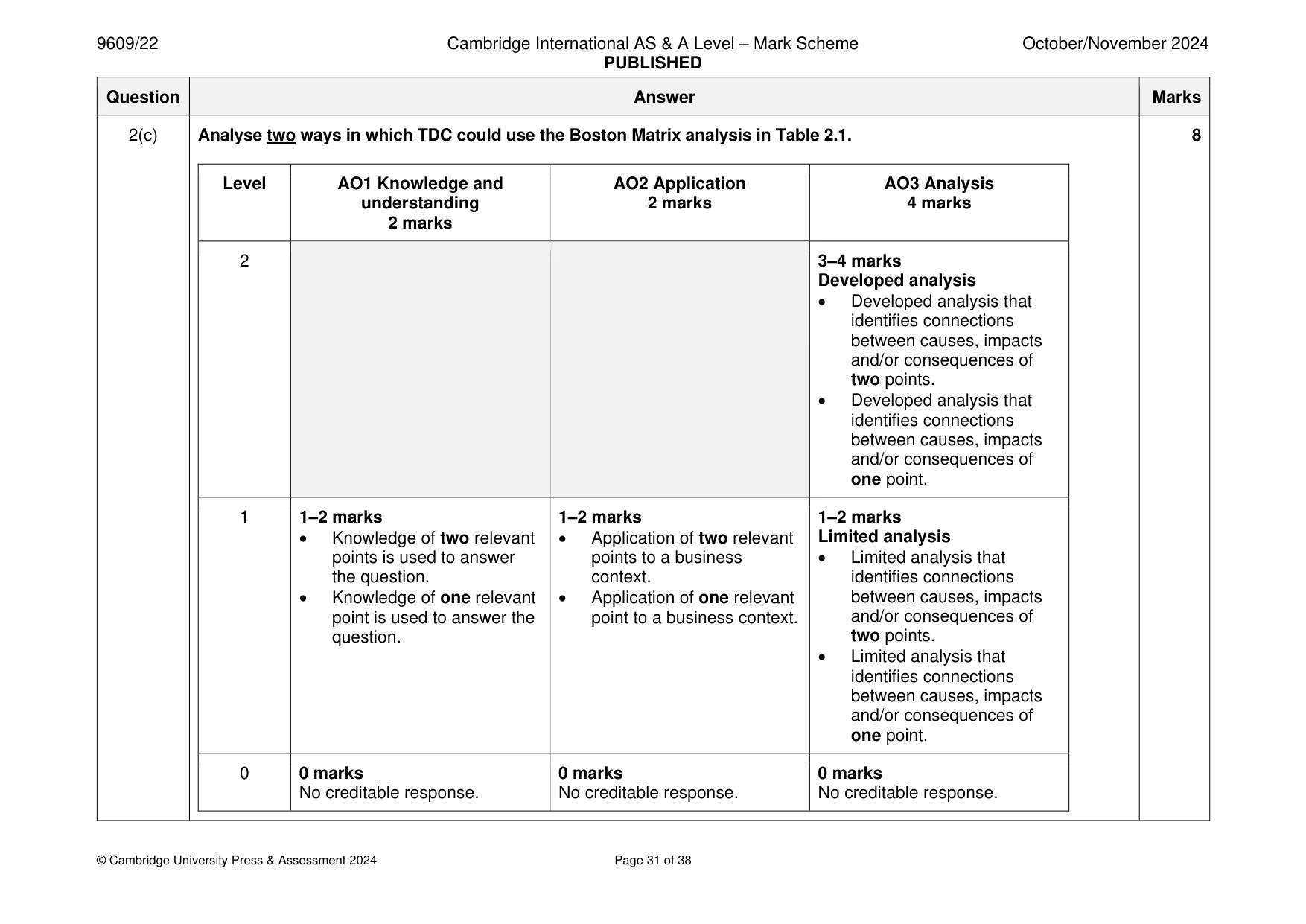
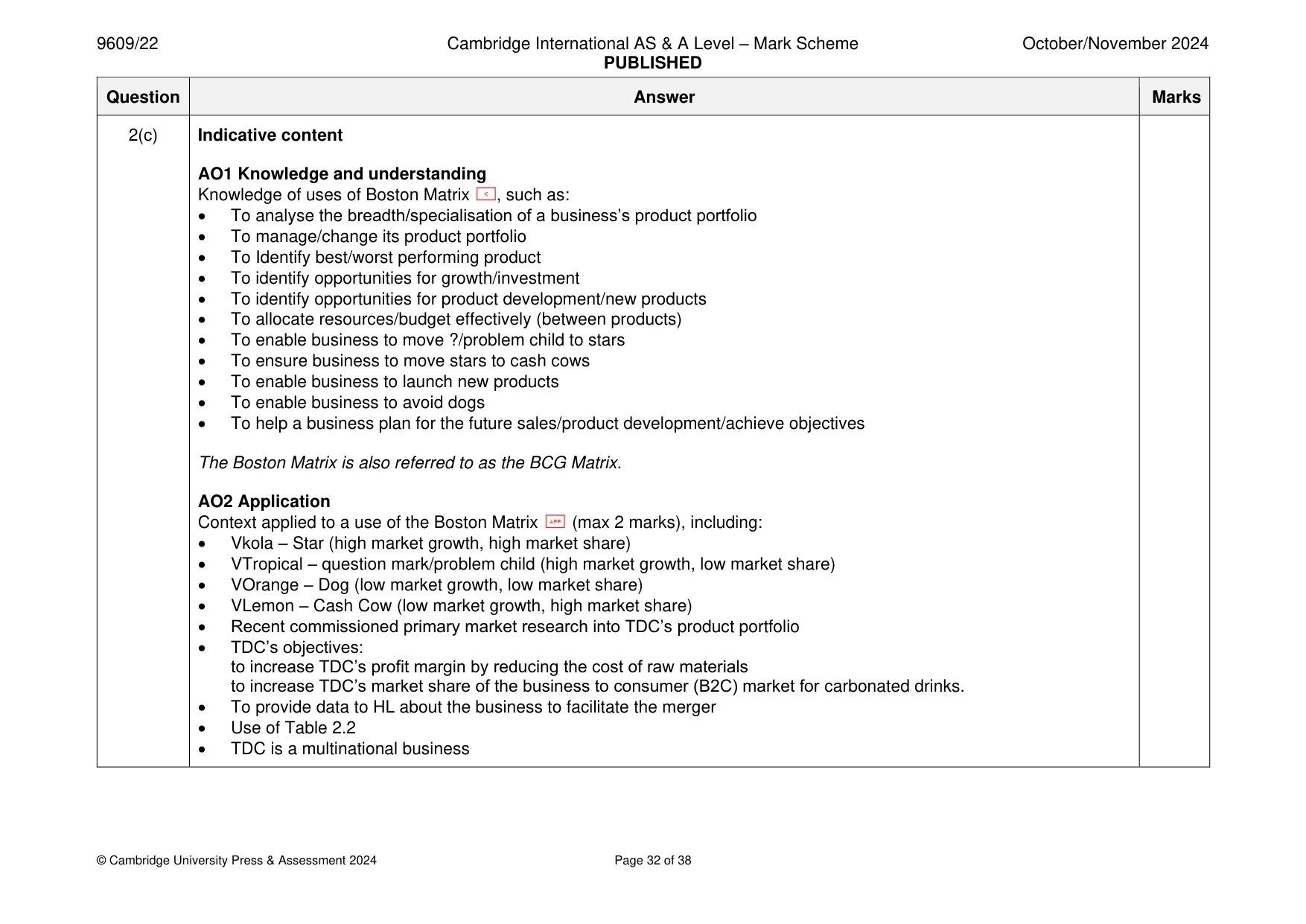
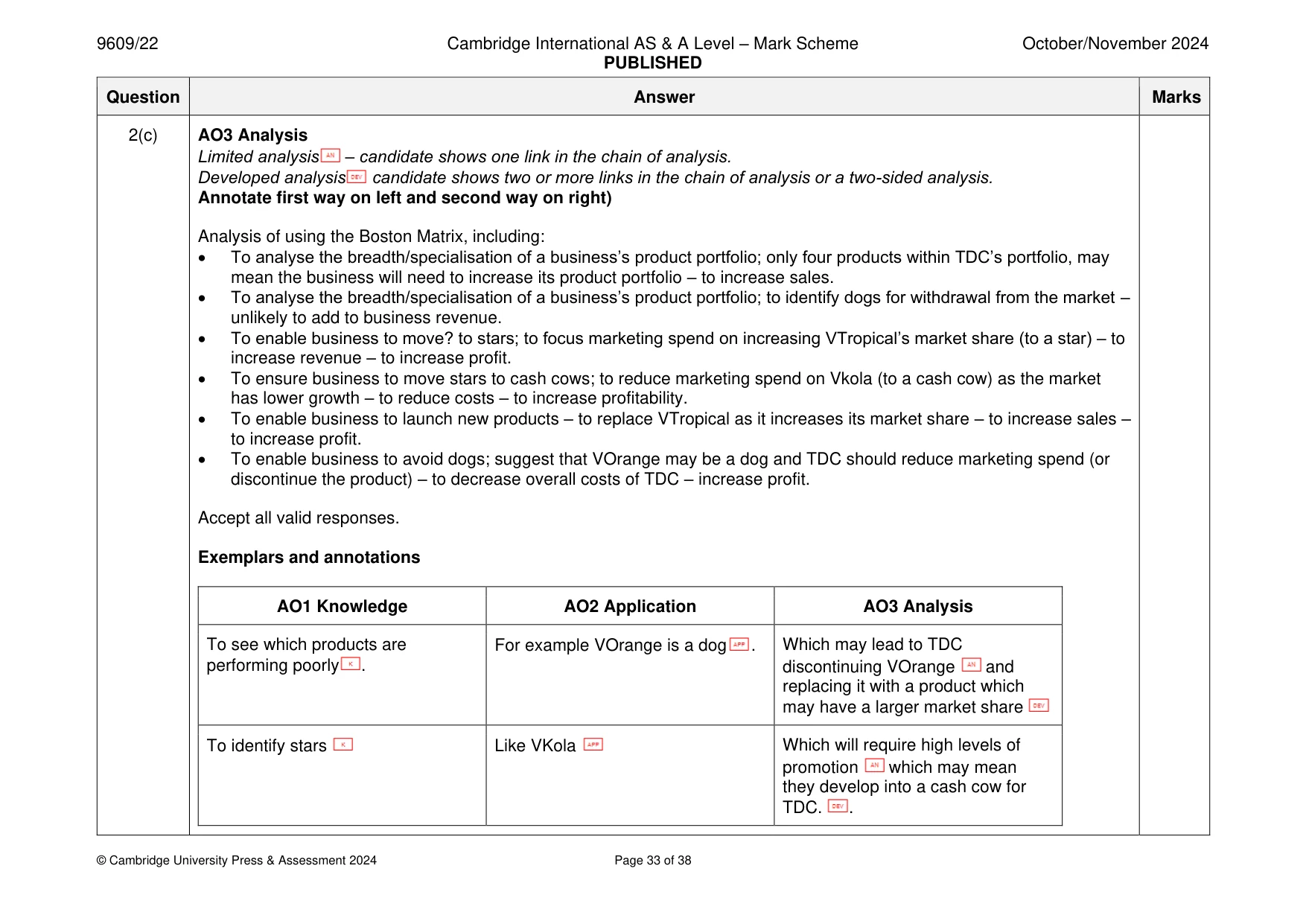
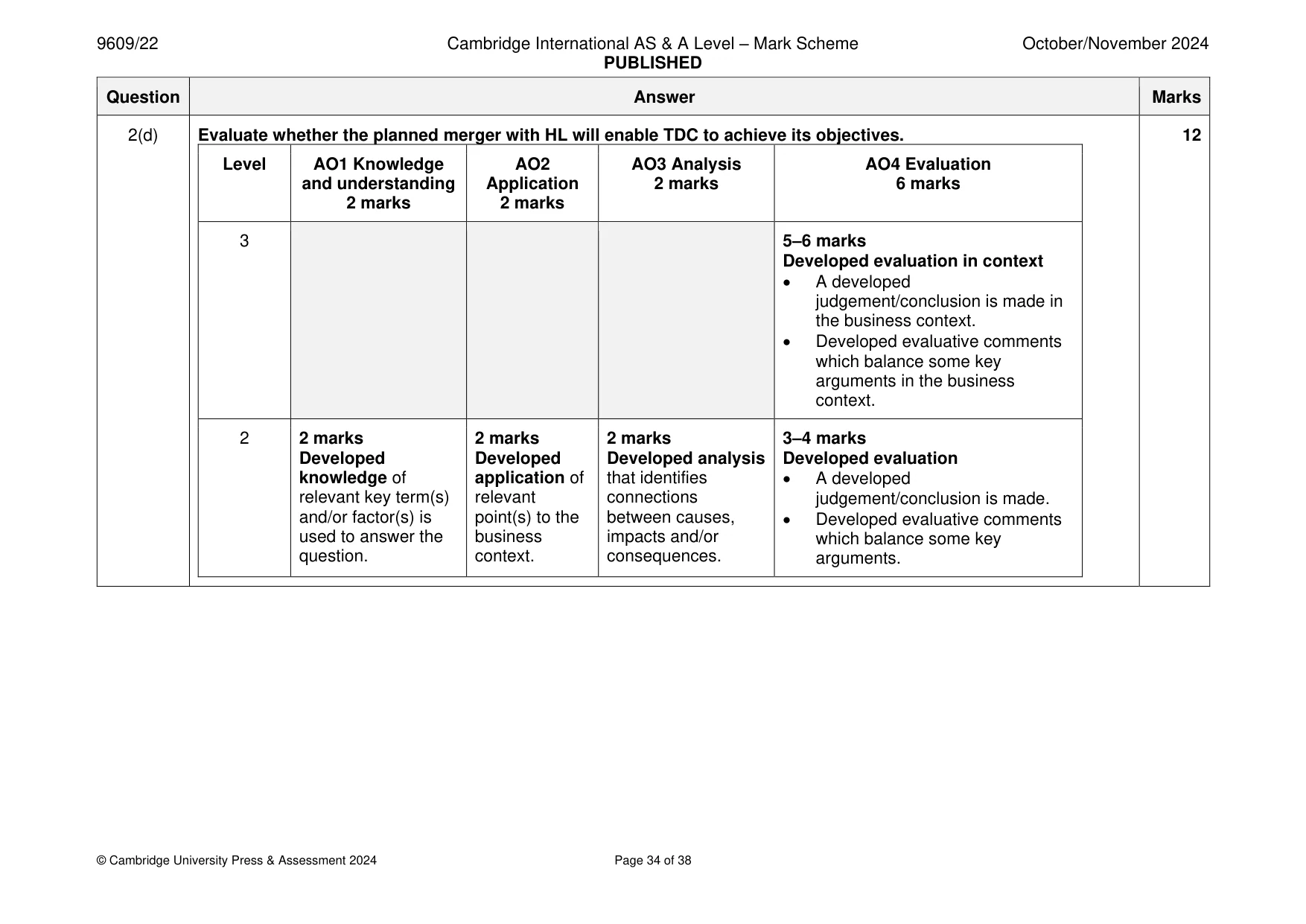
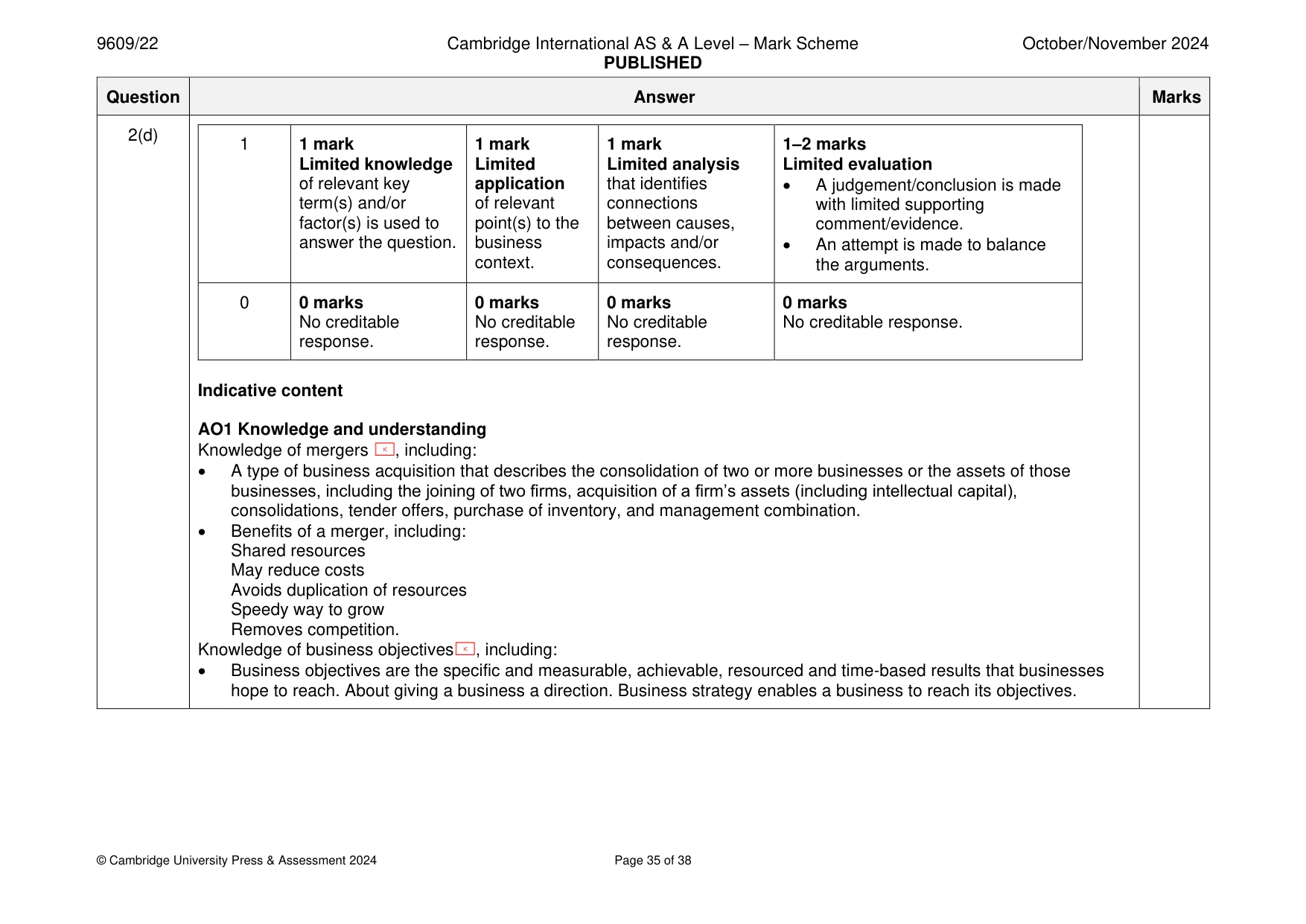
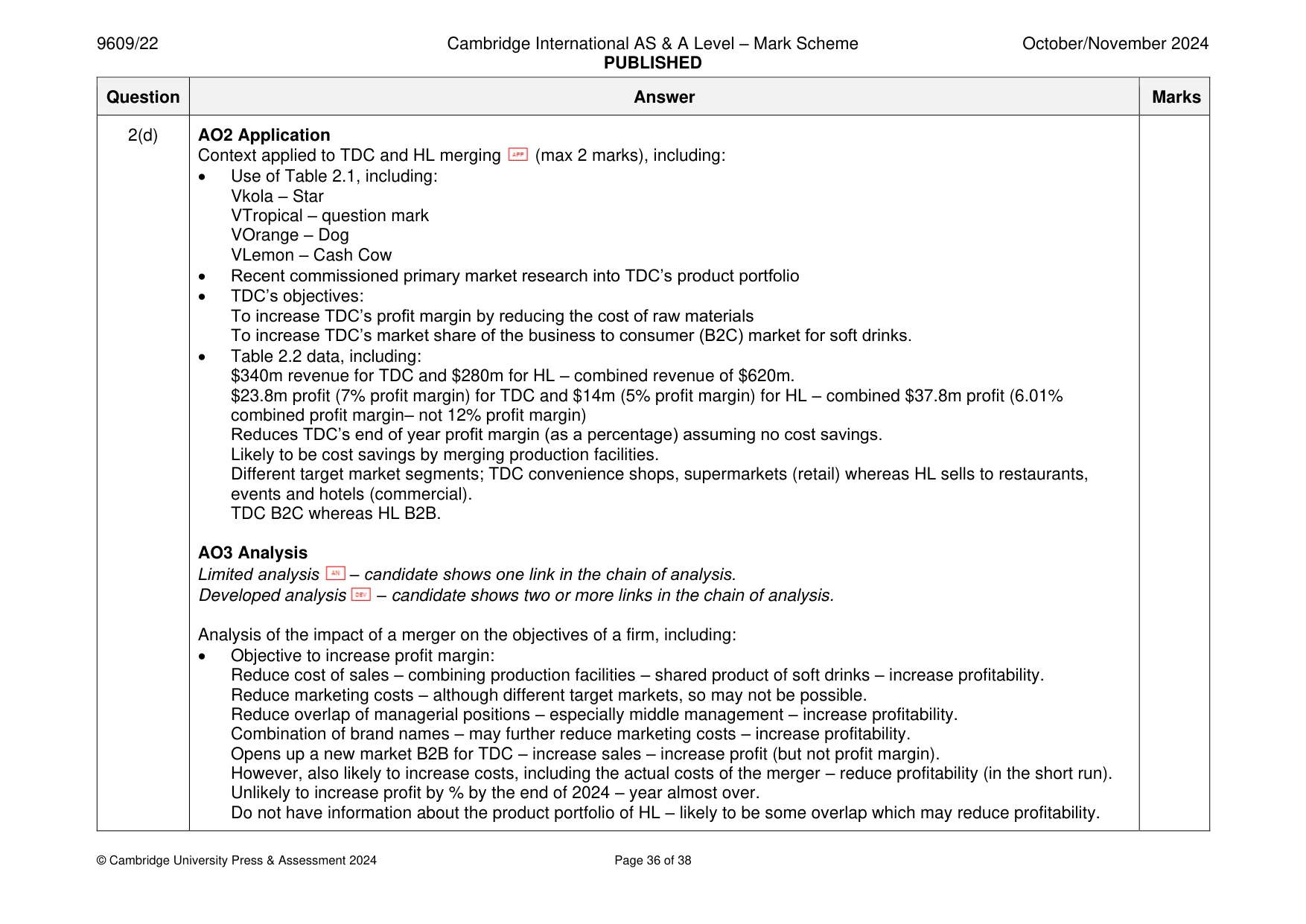
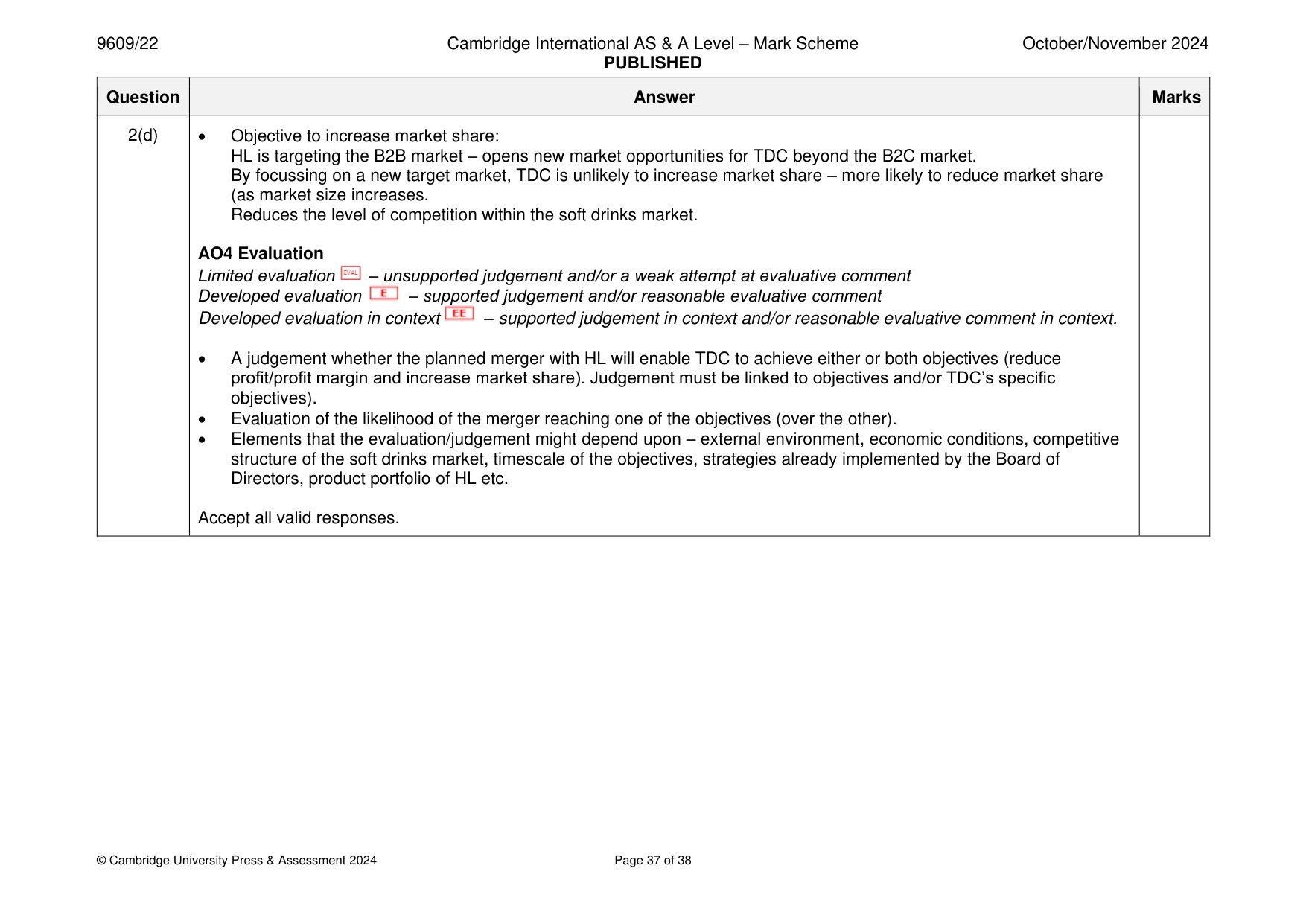
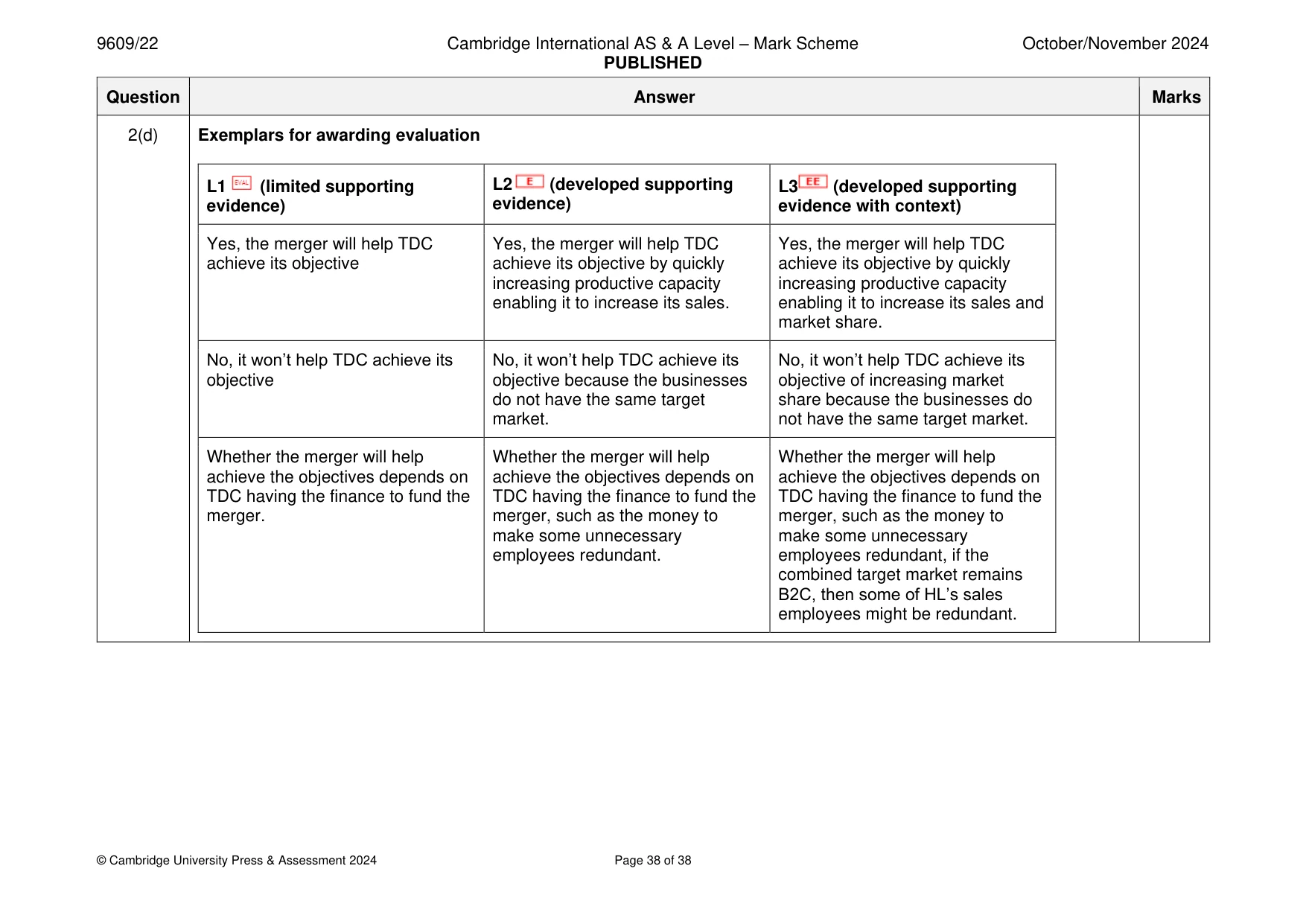
Mark scheme: 2(a)(i) Identify one stage of the product life cycle. 1 Indicative content: Stages include: • Development/research/testing/initial design • Introduction/launch • Growth • Maturity/saturation • Decline. Accept only the answers above If more than one answer is given, only mark the first, reading from top left to bottom right. 2(a)(ii) Explain the term limited liability (line 1). 3 AO1 Knowledge and understanding AO2 Application 1 mark 2 marks 2 marks Developed application of one relevant point to a business context. 1 mark 1 mark Knowledge of one relevant point is used to answer the Limited application of one relevant point to a business question. context. 0 marks 0 marks No creditable response. No creditable response. 2(a)(ii) Indicative content AO1 Knowledge and understanding Knowledge of limited liability (max 1 mark), including: • Limited liability is a legal status where a person’s financial commitment/responsibility is restricted to a fixed sum • Only a set amount of money invested is at risk • Personal assets are not at risk • Only business assets are at risk AO2 Application Explanation of limited liability (max 1 mark), including: • Protects shareholders/investors • Creates a separate legal identity (for a business) • Most commonly limited to the value of a person's investment • Can be linked to debt • Also applies to legal actions (i.e. suing a business) Context applied to limited liability (max 1 mark), including: • An example of a type of business that has limited liability, including: Private limited company (allow Ltd) Public limited company (allow PLC, Inc. or Corp) Limited liability partnership Incorporated business Accept all valid responses. Guidance in awarding marks Knowledge and Knowledge of limited liability 1 mark understanding Explanation Explanation of limited liability 1 mark Context Applied to a business context/business environment 1 mark 2(a)(ii) Exemplar and annotations Marks Rationale The most an owner could lose is the amount they invested 3 Clear knowledge of limited which protects investors within businesses such as private liability/risk, with the protection as limited company . explanation and a private limited company an example of a type of business that has limited liability. Shareholders personal wealth is protected because they can 3 The explanation comes first, only lose the sum of money that they invested , for example followed by the knowledge and an McDonalds has limited liability as a public limited company . example. TDC must be either a PLC or Ltd to have limited liability. Only 2 The example comes first, followed the amount invested is at risk . by the knowledge. Only the funds invested are at risk . 1 Knowledge only. Limited liability means that shareholders are protected in case of 0 There is no knowledge of limited financial difficulty. liability here, so no other marks can be awarded. 2(b)(i) Refer to Table 2.2 and other information. Calculate the variance between TDC’s budgeted revenue and actual 3 revenue for 2023. State whether the variance is favourable or adverse. Variance = actual revenue – budgeted revenue (1) $400m – $340m = $60m (1) Adverse (1) Answer = $60m adverse (3) $60m (award 2 marks – without adverse). Exemplar and annotations Marks 3 marks Correct answer Working, $ and millions (m) do not matter. $60m adverse (allow 60 adverse or 60 unfavourable or –60 adverse) Do not accept a minus sign (–) as adverse. 2 marks Correct calculation of size of variance (i.e. $60m To award two marks, there must be or –$60m) • Two and a OR OR • One , one and one An incorrect answer with one mistake allowing OFR for final stage. 1 mark One of the following: To award one mark, there must be: • Correct formula • One and two • Identification of numbers (i.e. 400 and 340) 0 marks No creditable content. To award zero marks, there must be • One 2(b)(ii) Explain one possible benefit to TDC of using budgets. 3 AO1 Knowledge and understanding AO2 Application 1 mark 2 marks 2 marks Developed application of one relevant point to a business context. 1 mark 1 mark Knowledge of one relevant point is used to answer the Limited application of one relevant point to a business question. context. 0 marks 0 marks No creditable response. No creditable response. Indicative content AO1 Knowledge and understanding Knowledge of a benefit of budgeting (max 1 mark), including: • Coordinates activities • To control finances/spending • To assist with planning • To monitor performance • Translate objectives into strategy. • Translate strategy into tactics. • Provide a record of organisational activities • Can improve communication • Improve resources allocation • Improve efficiency • Provides a tool for corrective action • Compare different areas of the business • To help achieve objectives. 2(b)(ii) AO2 Application Explanation of a benefit of using budgets (max 1 mark), including: • Coordinates activities; between functional areas of the business • To control finances/spending; by allocating appropriate resources to different areas of the business • To monitor performance; by doing a variance analysis • Translate objectives into strategy; to make sure the objective is met • Translate strategy into tactics; to make the strategy is implemented • Provide a record of organisational activities; for later comparison • Can improve communication/coordination; by giving financial targets • Improve resources allocation; by giving a quantitative target • Improve efficiency; by allocating finances to different areas of the organisation • Provides a tool for corrective action; when actual and budgeted are compared • Compare different areas of the business; to improve communication/coordination Context applied to a limitation of using budgets for TDC (max 1 mark) including: • Use of answer to Q2bi ($60m – OFR) • Revenue was $360m in 2023 compared with a budget of $400m. • TDC’s objective to reduce the cost of raw materials (by 2025) • TDC’s objective to increase market share by 10%.of B2C market (by 2025) • TDC’s product areas – VKola, Vtropical, VOrange and VLemon. • Use of Table 2.1 • Possible merger between HL and TDC • Use of Table 2.2 Accept all valid responses. Guidance in awarding marks Knowledge and understanding Knowledge of a benefit of using budgets 1 mark Explanation Explanation of a benefit of using budgets 1 mark Context Context linked to a benefit of using budgets 1 mark 2(b)(ii) Exemplar and annotations Marks Rationale A benefit of using a budget is that it allows a business to efficiently 3 A benefit showing knowledge and allocate its resources by allocating specific sums of money to then explained for the first APP. different products like TDC allocating money to VKola . The example is from the context so APP awarded. It helps TDC to monitor its own performance by doing a 3 A benefit showing knowledge and variance analysis to show adverse variances such as the then explained for the first APP. $60m revenue variance . The example is from the context so APP awarded. Provides a financial plan for each product like VOrange that 2 Knowledge and context, but no TDC produces explanation of how a financial plan is a benefit. Budgets can improve efficiency , and monitor performance and 1 There are three benefits here, but be used to help TDC achieve its objectives. all are only K. None are explained or contextualised. TDC has a $60m adverse variance when they did the budget. This 0 There is no knowledge of a benefit means that the revenue was lower than expected, which is bad for of budgets here, so the context TDC. cannot be awarded. 2(c) Analyse two ways in which TDC could use the Boston Matrix analysis in Table 2.1. 8 Level AO1 Knowledge and AO2 Application AO3 Analysis understanding 2 marks 4 marks 2 marks 2 3–4 marks Developed analysis • Developed analysis that identifies connections between causes, impacts and/or consequences of two points. • Developed analysis that identifies connections between causes, impacts and/or consequences of one point. 1 1–2 marks 1–2 marks 1–2 marks • Knowledge of two relevant • Application of two relevant Limited analysis points is used to answer points to a business • Limited analysis that the question. context. identifies connections • Knowledge of one relevant • Application of one relevant between causes, impacts point is used to answer the point to a business context. and/or consequences of question. two points. • Limited analysis that identifies connections between causes, impacts and/or consequences of one point. 0 0 marks 0 marks 0 marks No creditable response. No creditable response. No creditable response. 2(c) Indicative content AO1 Knowledge and understanding Knowledge of uses of Boston Matrix , such as: • To analyse the breadth/specialisation of a business’s product portfolio • To manage/change its product portfolio • To Identify best/worst performing product • To identify opportunities for growth/investment • To identify opportunities for product development/new products • To allocate resources/budget effectively (between products) • To enable business to move ?/problem child to stars • To ensure business to move stars to cash cows • To enable business to launch new products • To enable business to avoid dogs • To help a business plan for the future sales/product development/achieve objectives The Boston Matrix is also referred to as the BCG Matrix. AO2 Application Context applied to a use of the Boston Matrix (max 2 marks), including: • Vkola – Star (high market growth, high market share) • VTropical – question mark/problem child (high market growth, low market share) • VOrange – Dog (low market growth, low market share) • VLemon – Cash Cow (low market growth, high market share) • Recent commissioned primary market research into TDC’s product portfolio • TDC’s objectives: to increase TDC’s profit margin by reducing the cost of raw materials to increase TDC’s market share of the business to consumer (B2C) market for carbonated drinks. • To provide data to HL about the business to facilitate the merger • Use of Table 2.2 • TDC is a multinational business 2(c) AO3 Analysis Limited analysis – candidate shows one link in the chain of analysis. Developed analysis candidate shows two or more links in the chain of analysis or a two-sided analysis. Annotate first way on left and second way on right) Analysis of using the Boston Matrix, including: • To analyse the breadth/specialisation of a business’s product portfolio; only four products within TDC’s portfolio, may mean the business will need to increase its product portfolio – to increase sales. • To analyse the breadth/specialisation of a business’s product portfolio; to identify dogs for withdrawal from the market – unlikely to add to business revenue. • To enable business to move? to stars; to focus marketing spend on increasing VTropical’s market share (to a star) – to increase revenue – to increase profit. • To ensure business to move stars to cash cows; to reduce marketing spend on Vkola (to a cash cow) as the market has lower growth – to reduce costs – to increase profitability. • To enable business to launch new products – to replace VTropical as it increases its market share – to increase sales – to increase profit. • To enable business to avoid dogs; suggest that VOrange may be a dog and TDC should reduce marketing spend (or discontinue the product) – to decrease overall costs of TDC – increase profit. Accept all valid responses. Exemplars and annotations AO1 Knowledge AO2 Application AO3 Analysis To see which products are For example VOrange is a dog . Which may lead to TDC performing poorly . discontinuing VOrange and replacing it with a product which may have a larger market share To identify stars Like VKola Which will require high levels of promotion which may mean they develop into a cash cow for TDC. . 2(d) Evaluate whether the planned merger with HL will enable TDC to achieve its objectives. 12 Level AO1 Knowledge AO2 AO3 Analysis AO4 Evaluation and understanding Application 2 marks 6 marks 2 marks 2 marks 3 5–6 marks Developed evaluation in context • A developed judgement/conclusion is made in the business context. • Developed evaluative comments which balance some key arguments in the business context. 2 2 marks 2 marks 2 marks 3–4 marks Developed Developed Developed analysis Developed evaluation knowledge of application of that identifies • A developed relevant key term(s) relevant connections judgement/conclusion is made. and/or factor(s) is point(s) to the between causes, • Developed evaluative comments used to answer the business impacts and/or which balance some key question. context. consequences. arguments. 2(d) 1 1 mark 1 mark 1 mark 1–2 marks Limited knowledge Limited Limited analysis Limited evaluation of relevant key application that identifies • A judgement/conclusion is made term(s) and/or of relevant connections with limited supporting factor(s) is used to point(s) to the between causes, comment/evidence. answer the question. business impacts and/or • An attempt is made to balance context. consequences. the arguments. 0 0 marks 0 marks 0 marks 0 marks No creditable No creditable No creditable No creditable response. response. response. response. Indicative content AO1 Knowledge and understanding Knowledge of mergers , including: • A type of business acquisition that describes the consolidation of two or more businesses or the assets of those businesses, including the joining of two firms, acquisition of a firm’s assets (including intellectual capital), consolidations, tender offers, purchase of inventory, and management combination. • Benefits of a merger, including: Shared resources May reduce costs Avoids duplication of resources Speedy way to grow Removes competition. Knowledge of business objectives , including: • Business objectives are the specific and measurable, achievable, resourced and time-based results that businesses hope to reach. About giving a business a direction. Business strategy enables a business to reach its objectives. 2(d) AO2 Application Context applied to TDC and HL merging (max 2 marks), including: • Use of Table 2.1, including: Vkola – Star VTropical – question mark VOrange – Dog VLemon – Cash Cow • Recent commissioned primary market research into TDC’s product portfolio • TDC’s objectives: To increase TDC’s profit margin by reducing the cost of raw materials To increase TDC’s market share of the business to consumer (B2C) market for soft drinks. • Table 2.2 data, including: $340m revenue for TDC and $280m for HL – combined revenue of $620m. $23.8m profit (7% profit margin) for TDC and $14m (5% profit margin) for HL – combined $37.8m profit (6.01% combined profit margin– not 12% profit margin) Reduces TDC’s end of year profit margin (as a percentage) assuming no cost savings. Likely to be cost savings by merging production facilities. Different target market segments; TDC convenience shops, supermarkets (retail) whereas HL sells to restaurants, events and hotels (commercial). TDC B2C whereas HL B2B. AO3 Analysis Limited analysis – candidate shows one link in the chain of analysis. Developed analysis – candidate shows two or more links in the chain of analysis. Analysis of the impact of a merger on the objectives of a firm, including: • Objective to increase profit margin: Reduce cost of sales – combining production facilities – shared product of soft drinks – increase profitability. Reduce marketing costs – although different target markets, so may not be possible. Reduce overlap of managerial positions – especially middle management – increase profitability. Combination of brand names – may further reduce marketing costs – increase profitability. Opens up a new market B2B for TDC – increase sales – increase profit (but not profit margin). However, also likely to increase costs, including the actual costs of the merger – reduce profitability (in the short run). Unlikely to increase profit by % by the end of 2024 – year almost over. Do not have information about the product portfolio of HL – likely to be some overlap which may reduce profitability. 2(d) • Objective to increase market share: HL is targeting the B2B market – opens new market opportunities for TDC beyond the B2C market. By focussing on a new target market, TDC is unlikely to increase market share – more likely to reduce market share (as market size increases. Reduces the level of competition within the soft drinks market. AO4 Evaluation Limited evaluation – unsupported judgement and/or a weak attempt at evaluative comment Developed evaluation – supported judgement and/or reasonable evaluative comment Developed evaluation in context – supported judgement in context and/or reasonable evaluative comment in context. • A judgement whether the planned merger with HL will enable TDC to achieve either or both objectives (reduce profit/profit margin and increase market share). Judgement must be linked to objectives and/or TDC’s specific objectives). • Evaluation of the likelihood of the merger reaching one of the objectives (over the other). • Elements that the evaluation/judgement might depend upon – external environment, economic conditions, competitive structure of the soft drinks market, timescale of the objectives, strategies already implemented by the Board of Directors, product portfolio of HL etc. Accept all valid responses. 2(d) Exemplars for awarding evaluation L1 (limited supporting L2 (developed supporting L3 (developed supporting evidence) evidence) evidence with context) Yes, the merger will help TDC Yes, the merger will help TDC Yes, the merger will help TDC achieve its objective achieve its objective by quickly achieve its objective by quickly increasing productive capacity increasing productive capacity enabling it to increase its sales. enabling it to increase its sales and market share. No, it won’t help TDC achieve its No, it won’t help TDC achieve its No, it won’t help TDC achieve its objective objective because the businesses objective of increasing market do not have the same target share because the businesses do market. not have the same target market. Whether the merger will help Whether the merger will help Whether the merger will help achieve the objectives depends on achieve the objectives depends on achieve the objectives depends on TDC having the finance to fund the TDC having the finance to fund the TDC having the finance to fund the merger. merger, such as the money to merger, such as the money to make some unnecessary make some unnecessary employees redundant. employees redundant, if the combined target market remains B2C, then some of HL’s sales employees might be redundant.
What was in this paper
The subtopics covered by these 2 questions, and how many questions each got. Open one in a new tab to see every Cambridge question on it.
What you needed in this session
Cambridge’s own grade thresholds for 2024 Oct/Nov, Paper 2 · Variant 2. A higher threshold means an easier paper — the bar moves with how the cohort did.