Cambridge A Level Business (for first examination in 2016) 9609 — 2025 Feb/March Paper 2 · Variant 2
9609/22/F/M/25 · 2 questions · 60 marks · ≈68 min
The question paper and its mark scheme, free to read here and free to download. This is Cambridge’s own paper, exactly as it was sat.
Question paper4 pages


Mark scheme37 pages
Answers below. Sit the paper first if you are practising.

Questions as text
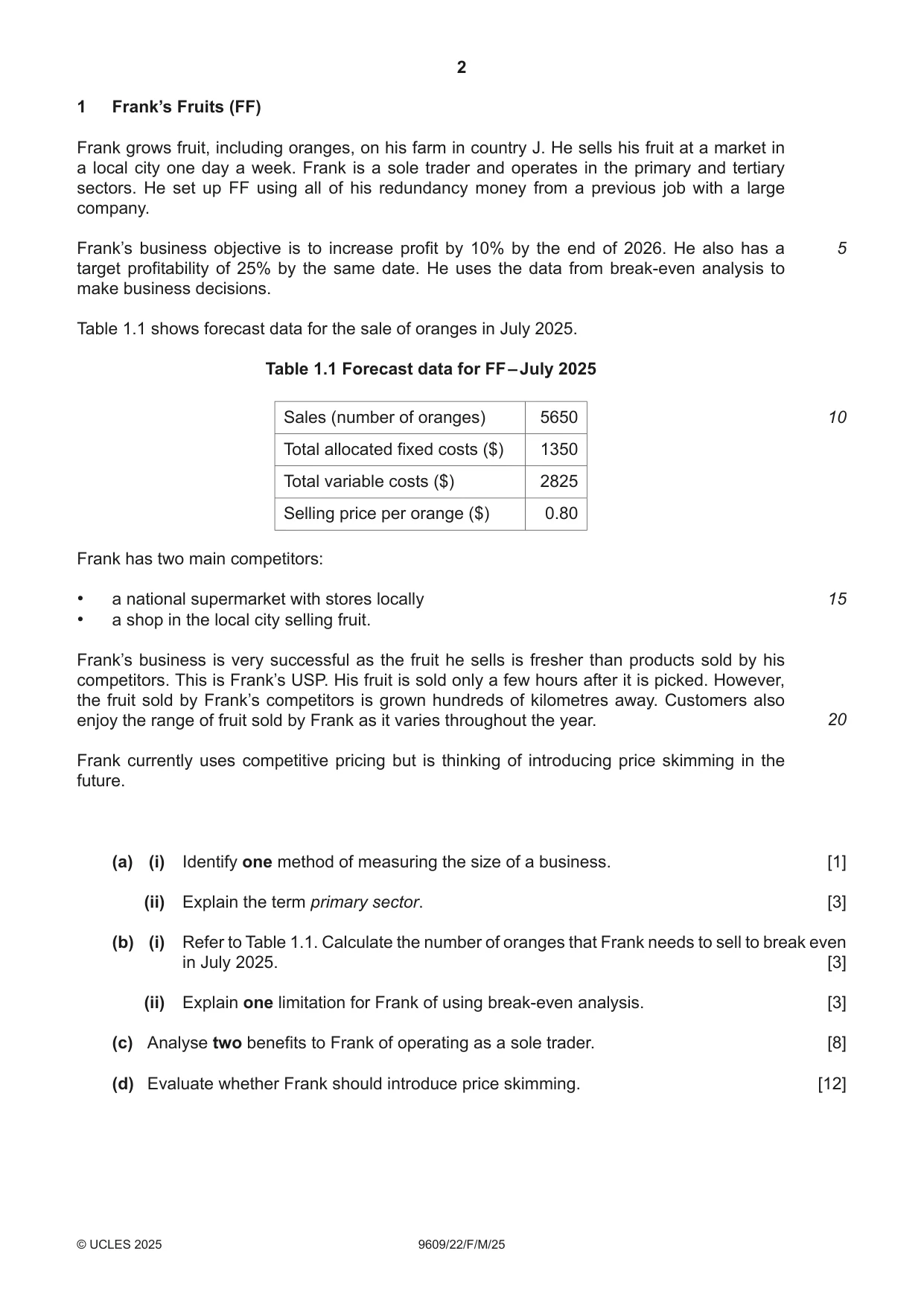
Q1 · Frank’s Fruits (FF) Frank grows fruit, including oranges, on his farm in country J
1 Frank’s Fruits (FF) Frank grows fruit, including oranges, on his farm in country J. He sells his fruit at a market in a local city one day a week. Frank is a sole trader and operates in the primary and tertiary sectors. He set up FF using all of his redundancy money from a previous job with a large company. Frank’s business objective is to increase profit by 10% by the end of 2026. He also has a 5 target profitability of 25% by the same date. He uses the data from break-even analysis to make business decisions. Table 1.1 shows forecast data for the sale of oranges in July 2025. Table 1.1 Forecast data for FF – July 2025 Sales (number of oranges) 5650 10 Total allocated fixed costs ($) 1350 Total variable costs ($) 2825 Selling price per orange ($) 0.80 Frank has two main competitors: • a national supermarket with stores locally 15 • a shop in the local city selling fruit. Frank’s business is very successful as the fruit he sells is fresher than products sold by his competitors. This is Frank’s USP. His fruit is sold only a few hours after it is picked. However, the fruit sold by Frank’s competitors is grown hundreds of kilometres away. Customers also enjoy the range of fruit sold by Frank as it varies throughout the year. 20 Frank currently uses competitive pricing but is thinking of introducing price skimming in the future. (a) (i) Identify one method of measuring the size of a business. [1] (ii) Explain the term primary sector. [3] (b) (i) Refer to Table 1.1. Calculate the number of oranges that Frank needs to sell to break even in July 2025. [3] (ii) Explain one limitation for Frank of using break-even analysis. [3] (c) Analyse two benefits to Frank of operating as a sole trader. [8] (d) Evaluate whether Frank should introduce price skimming. [12]
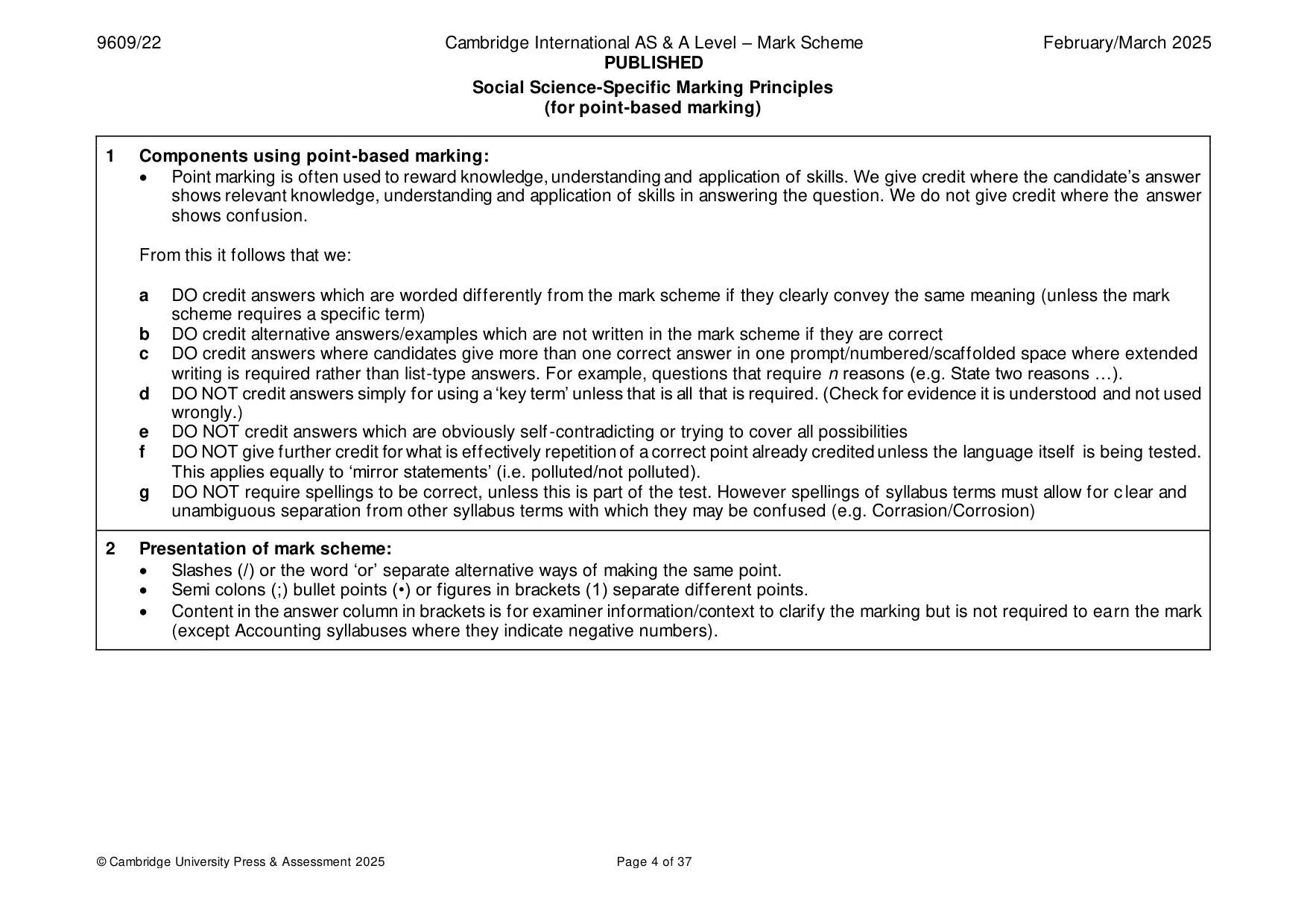
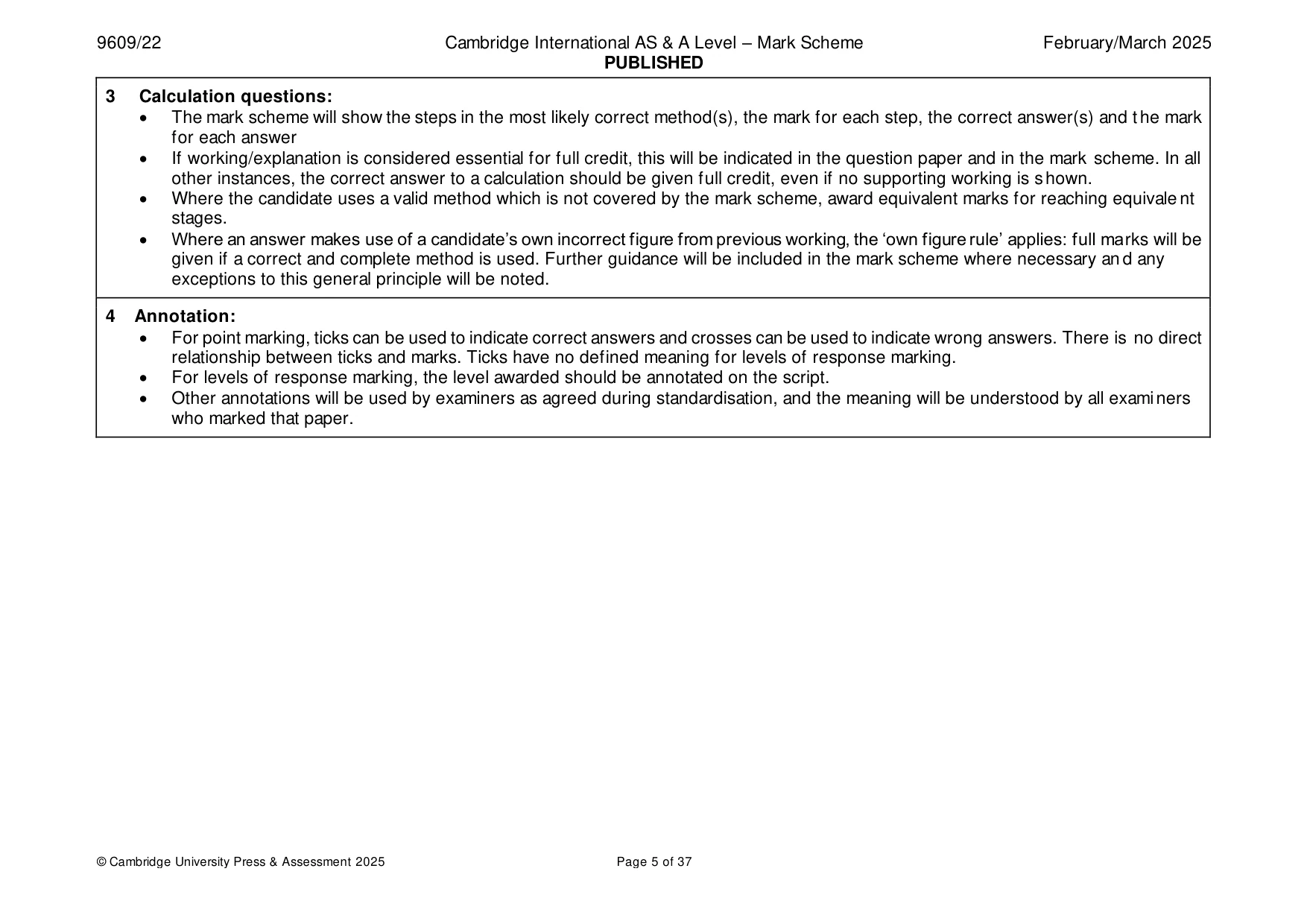
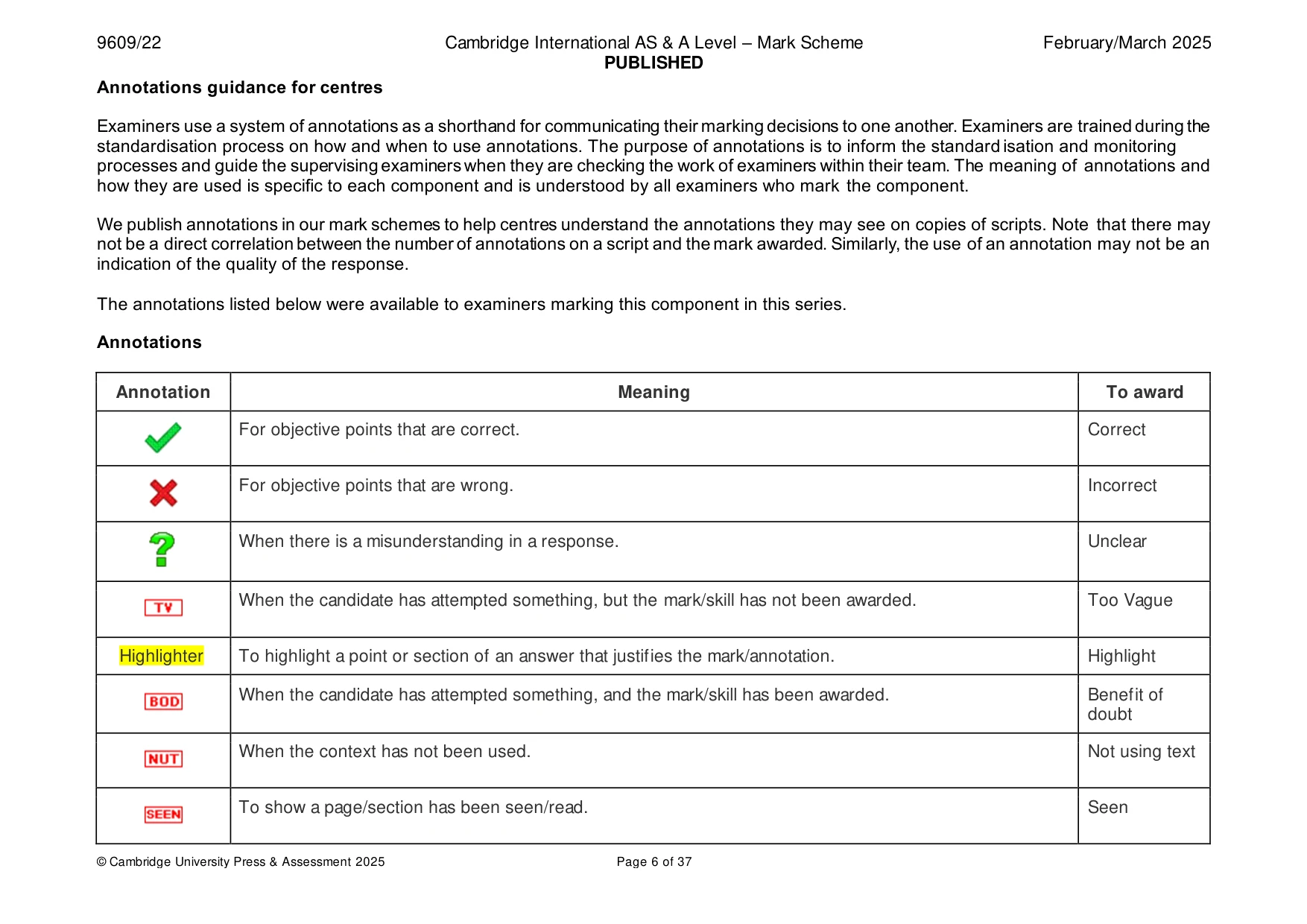
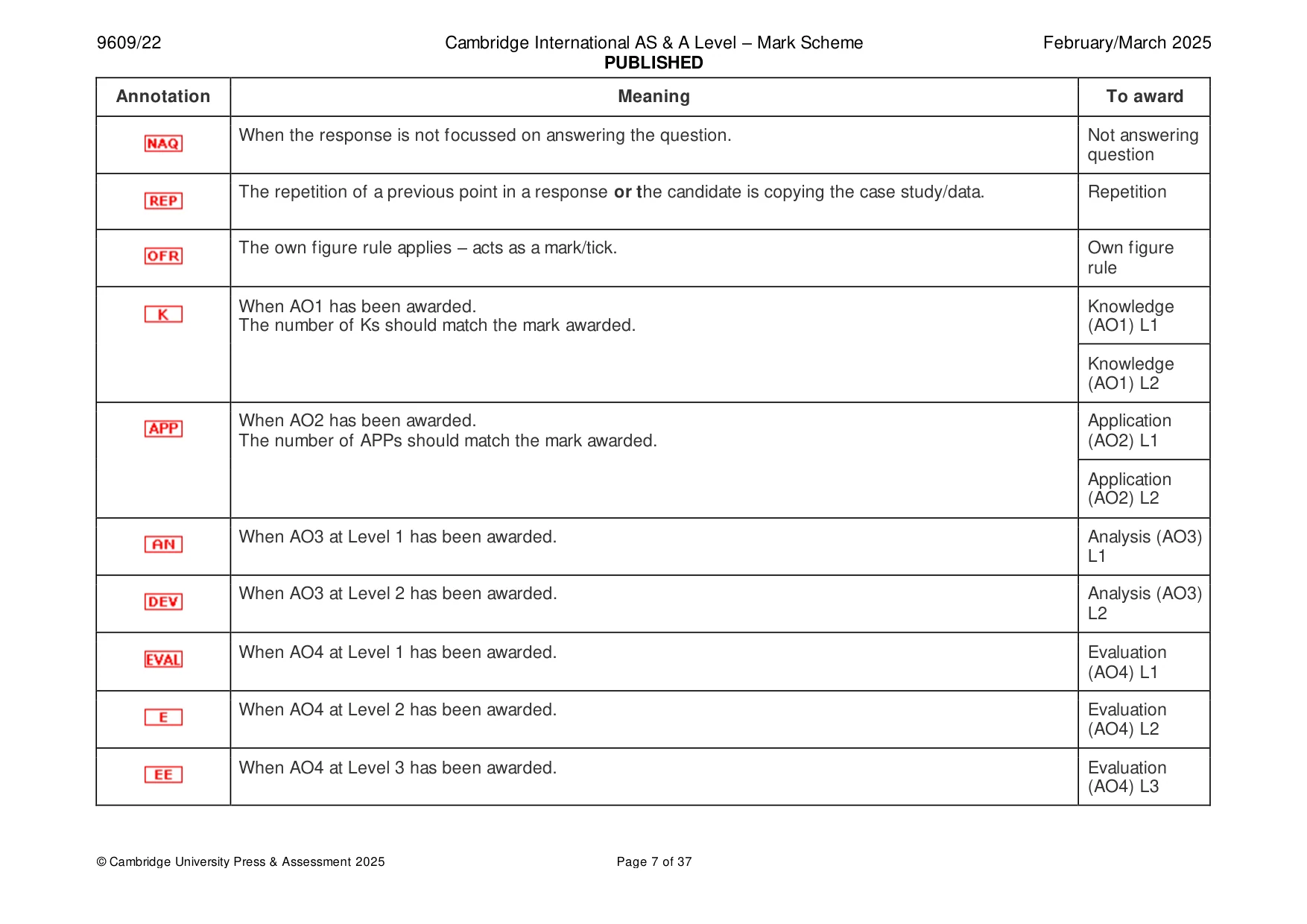
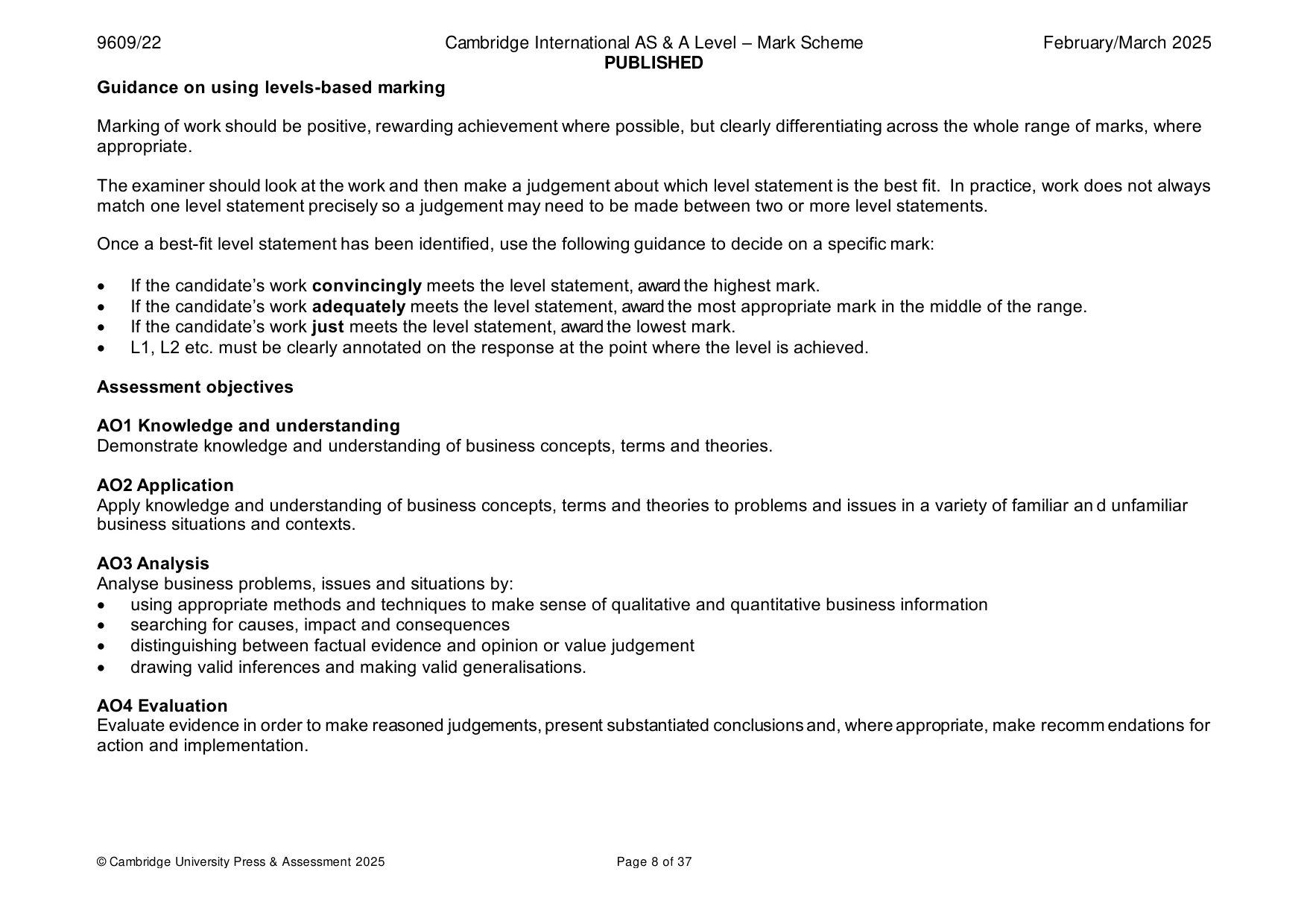
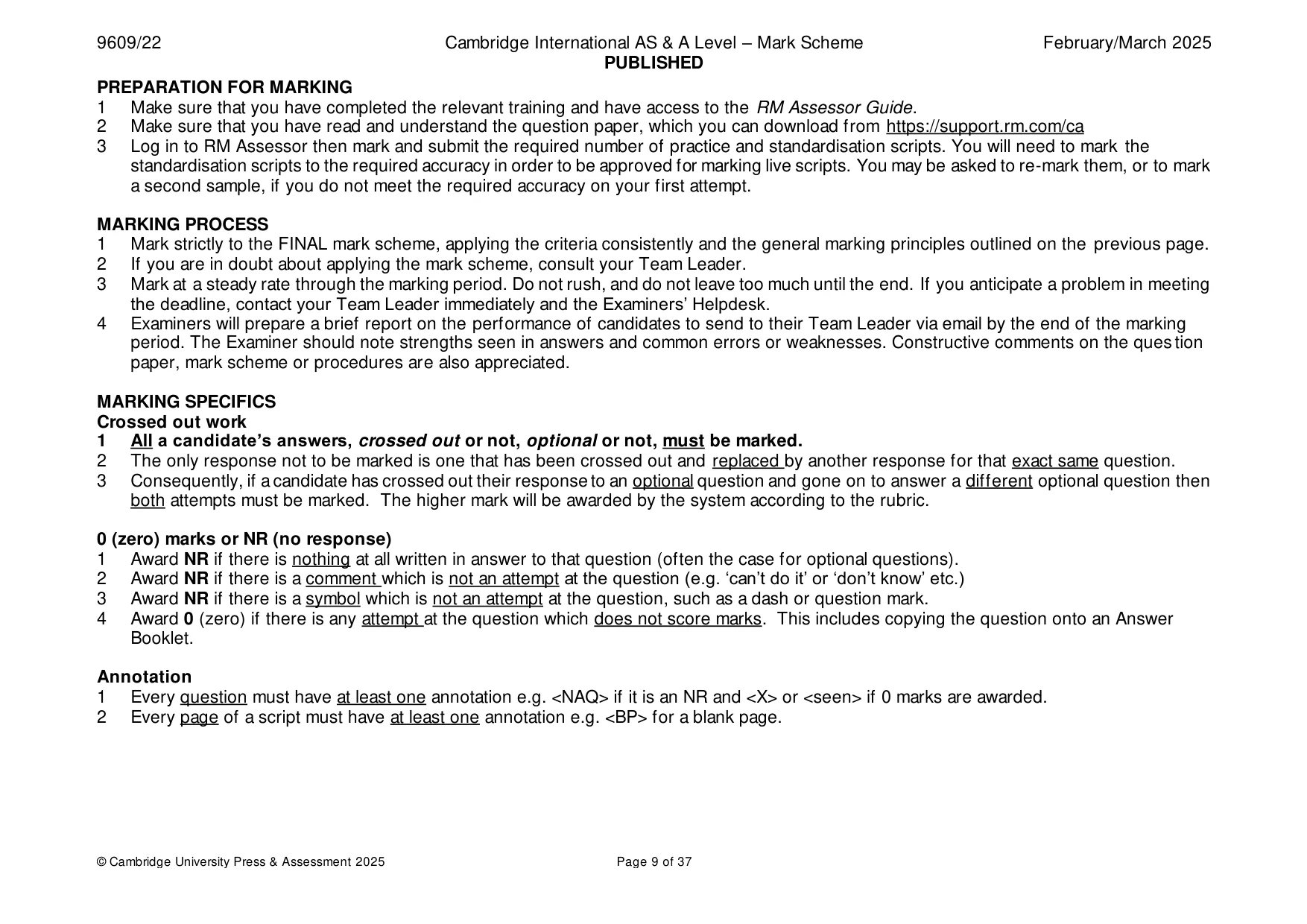
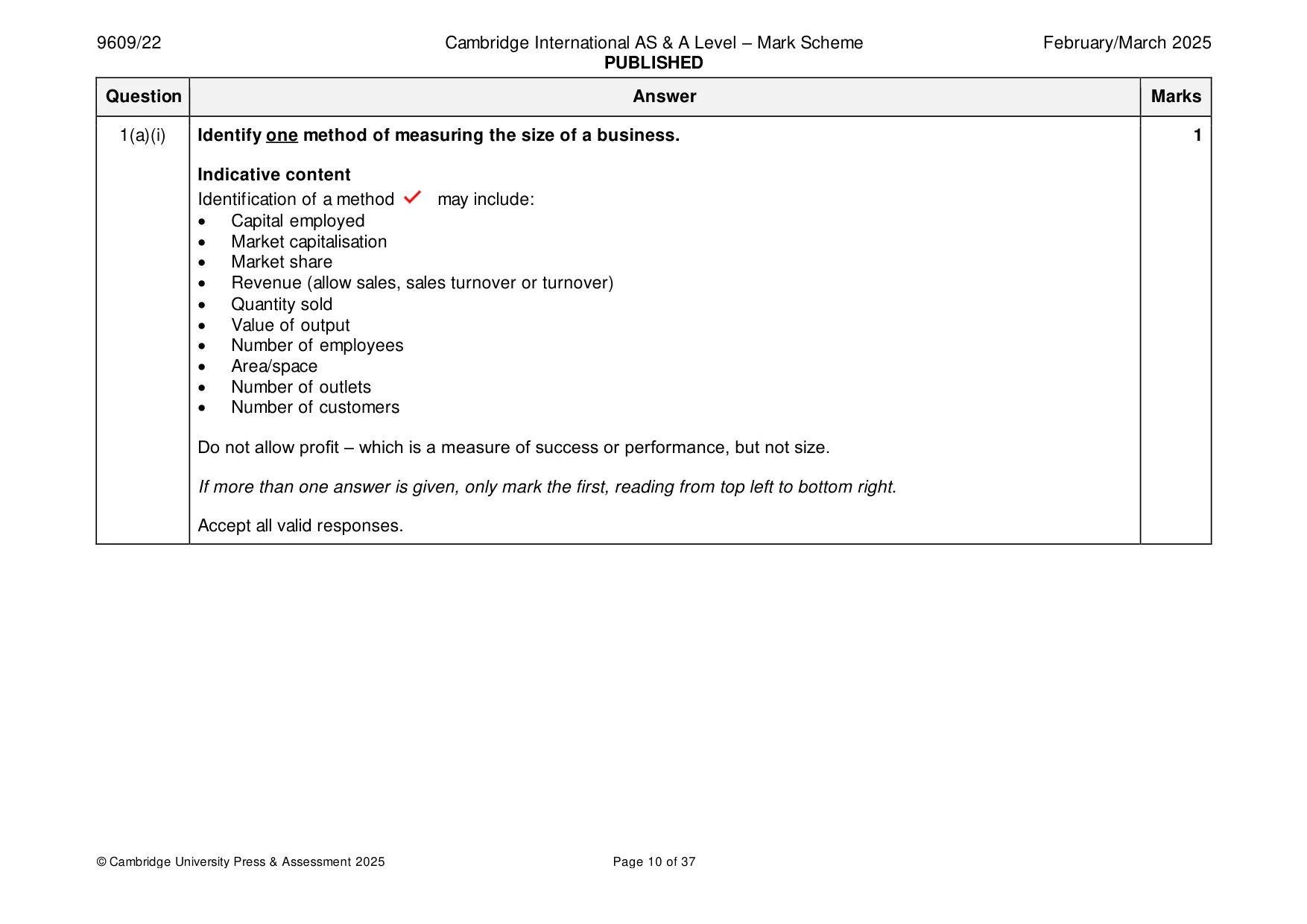
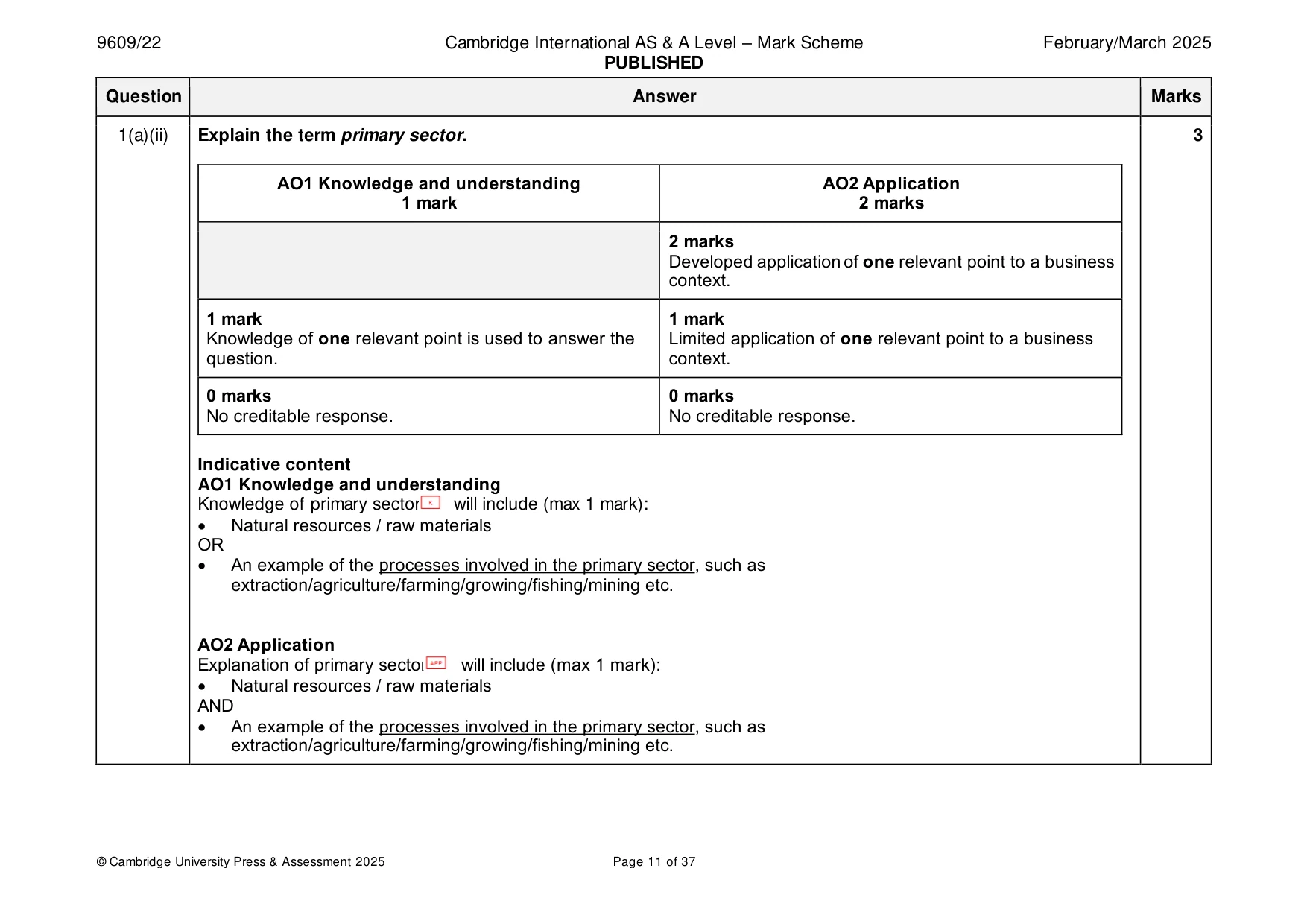
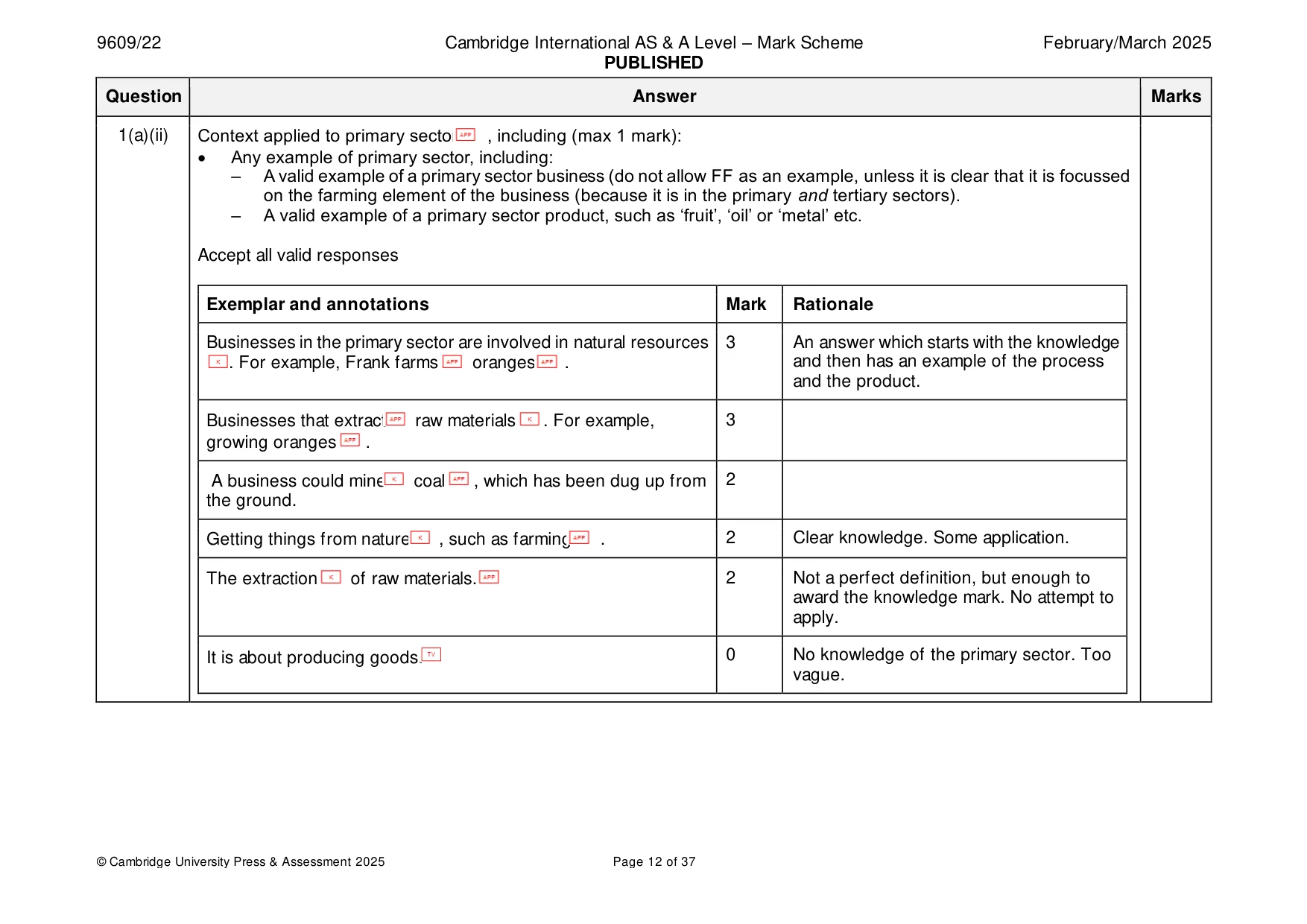
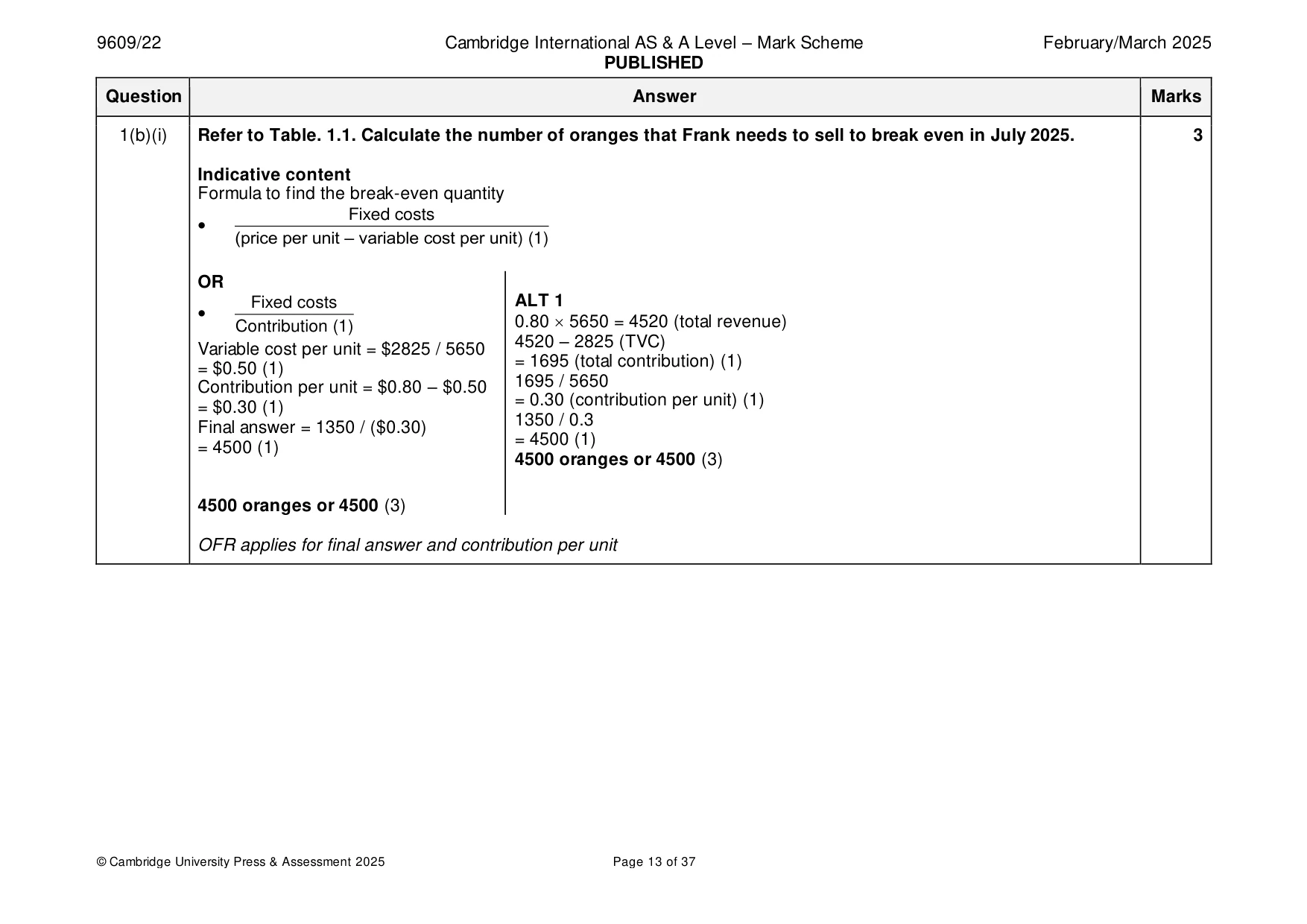
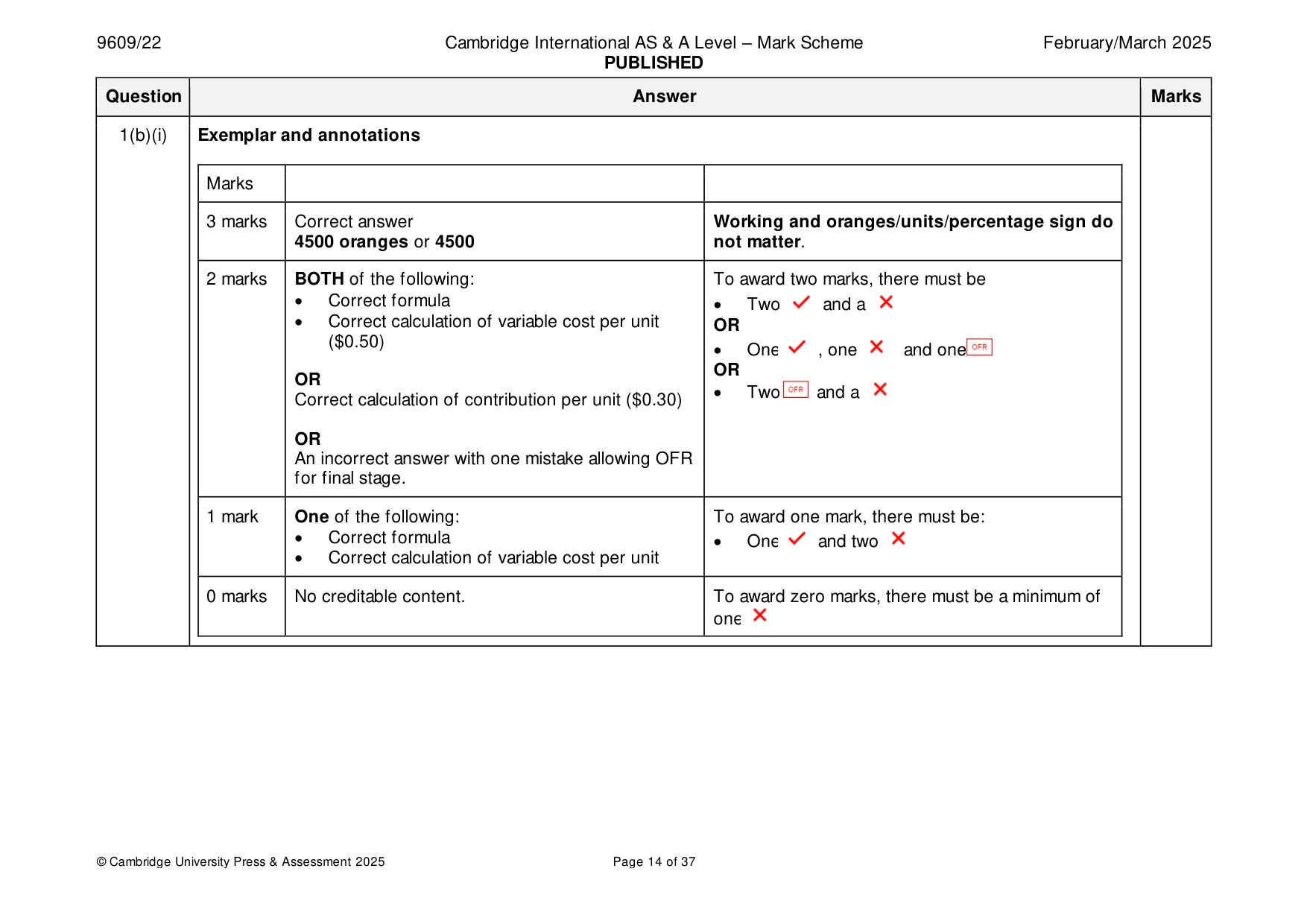
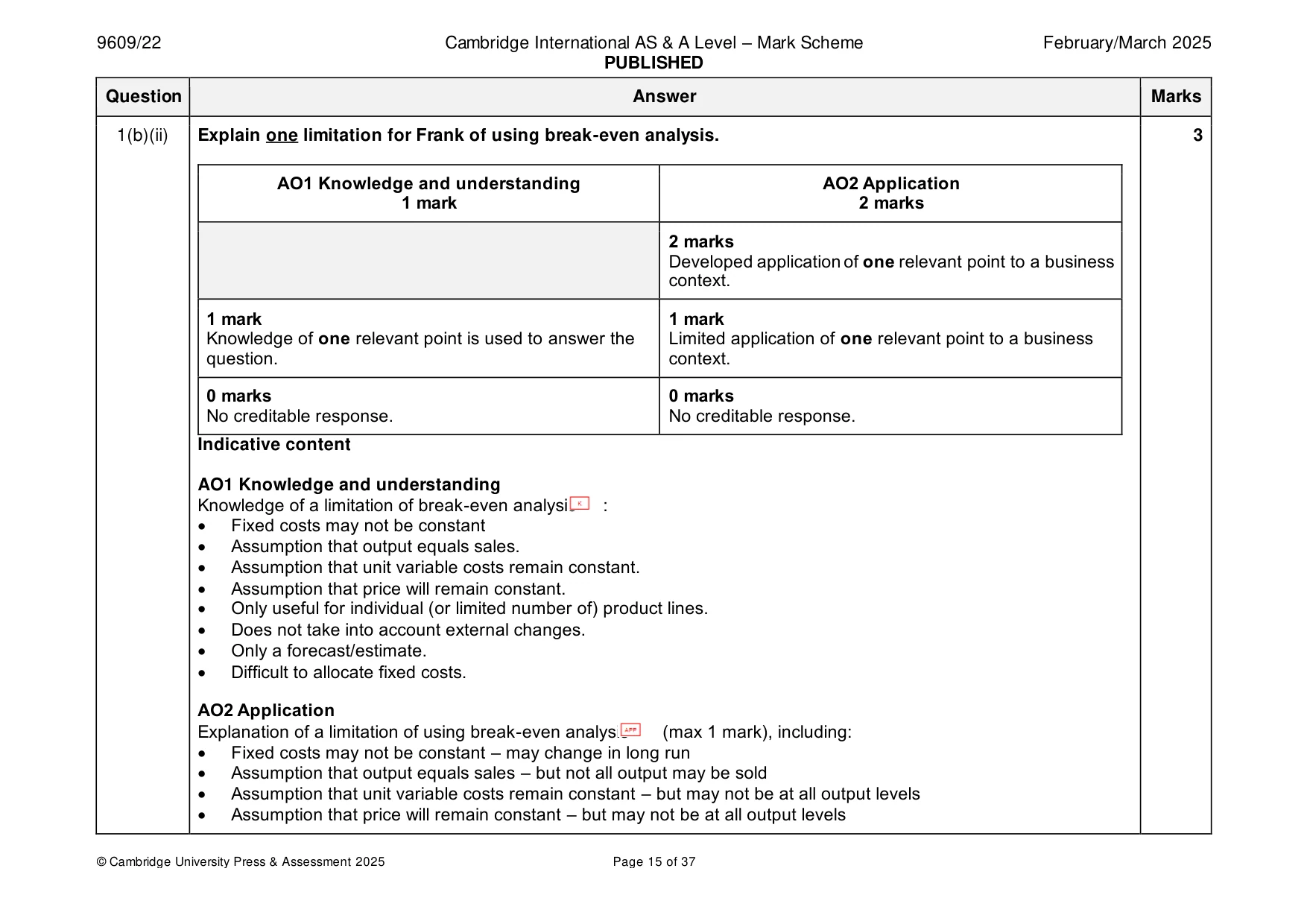
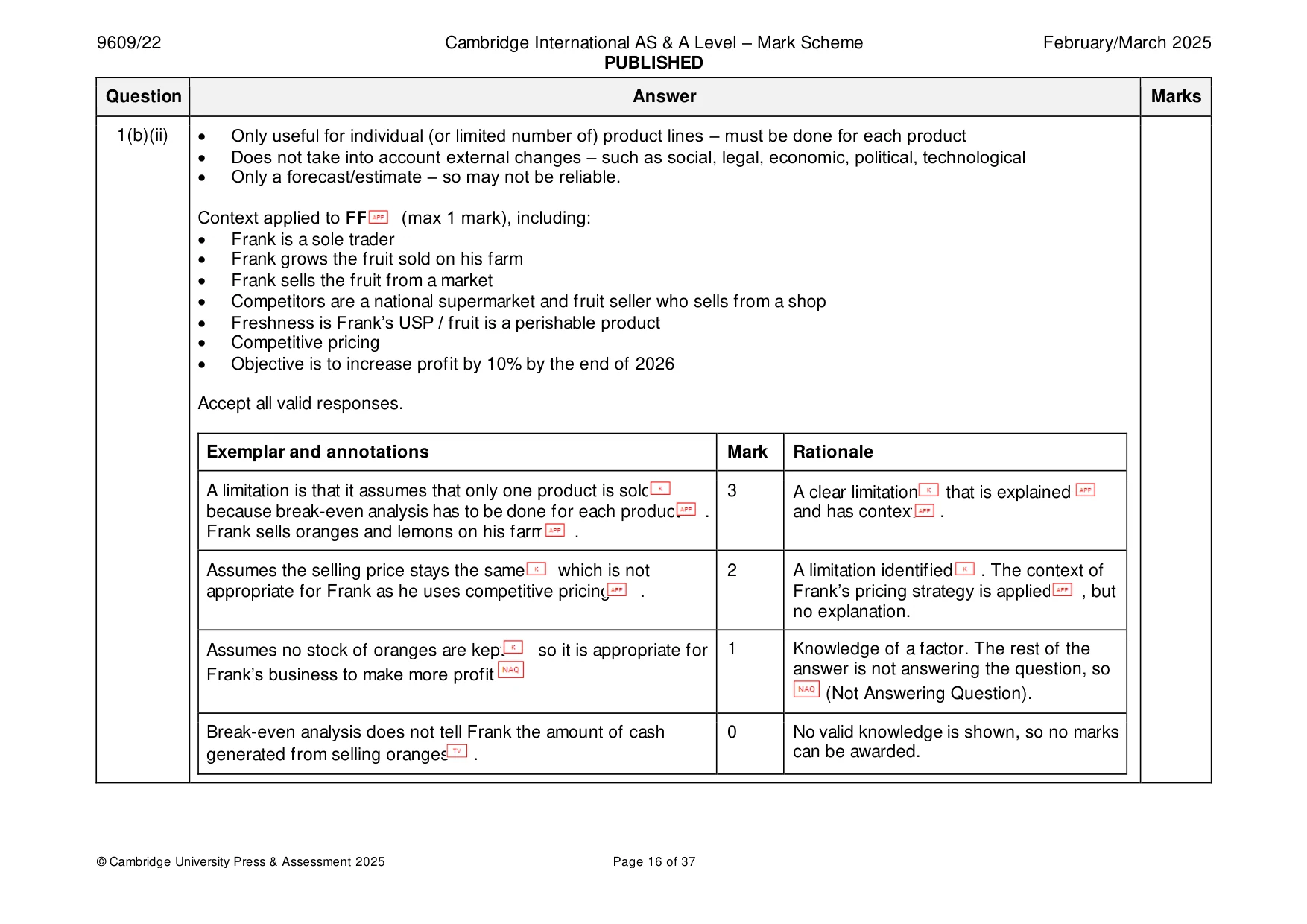
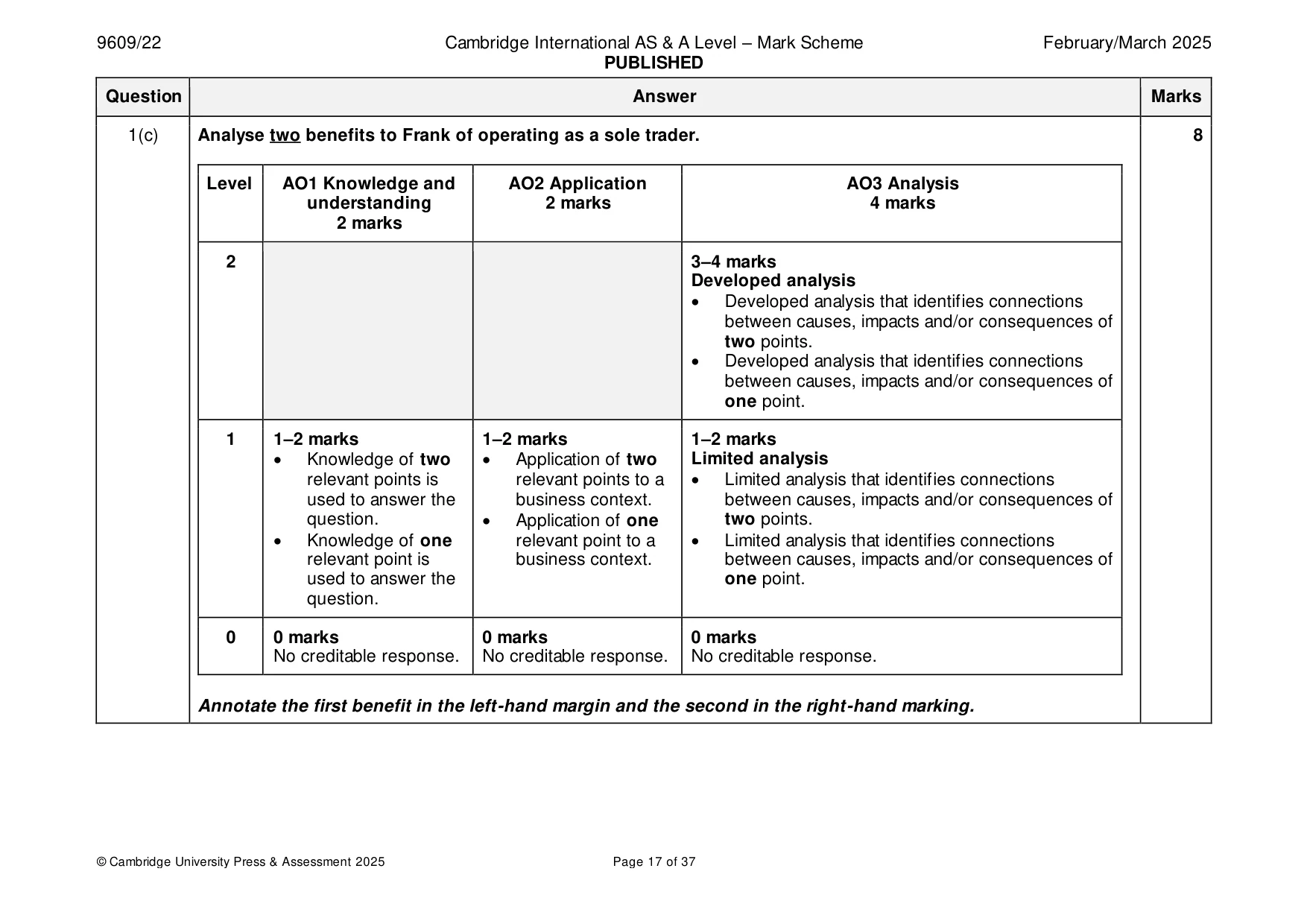
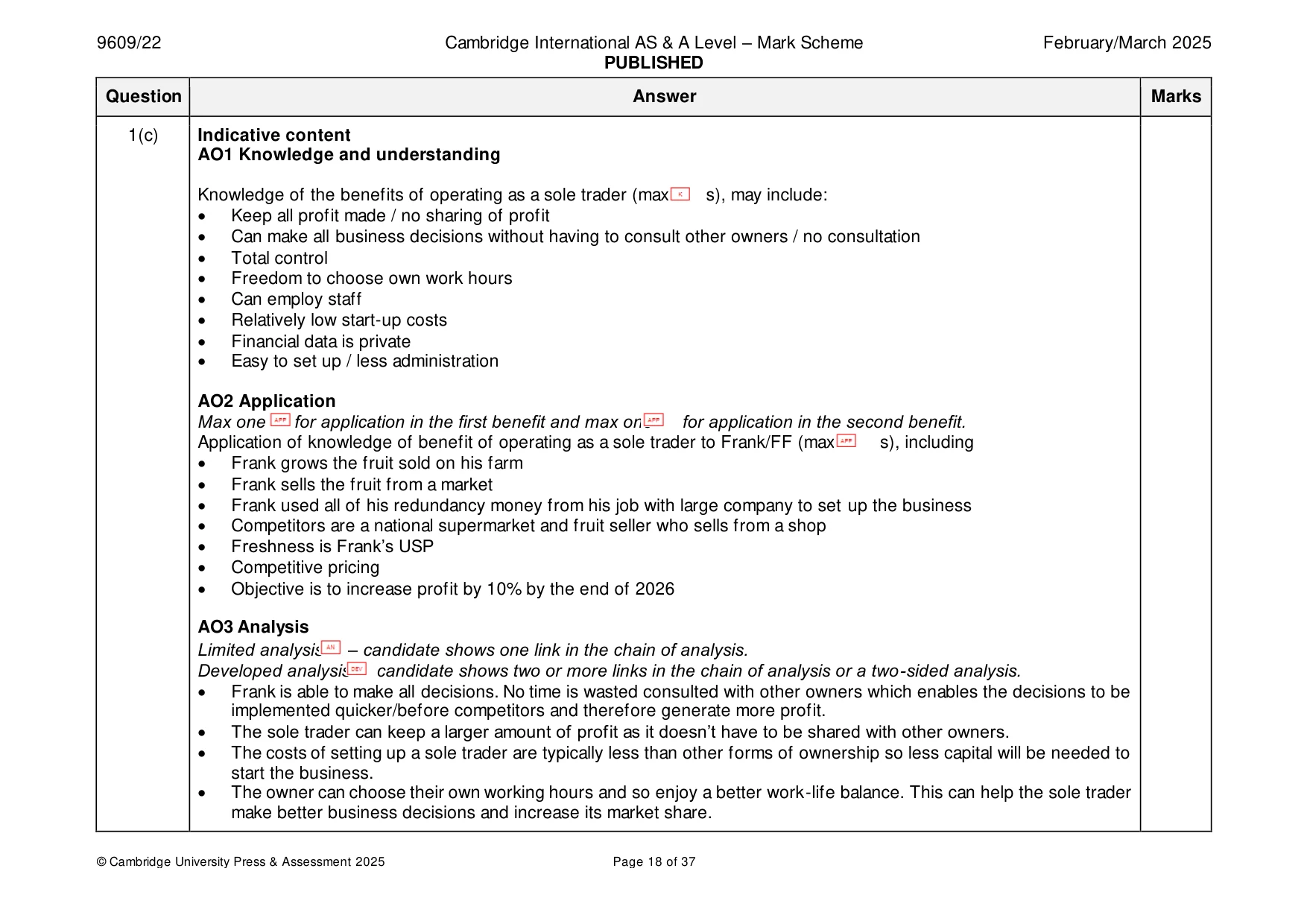
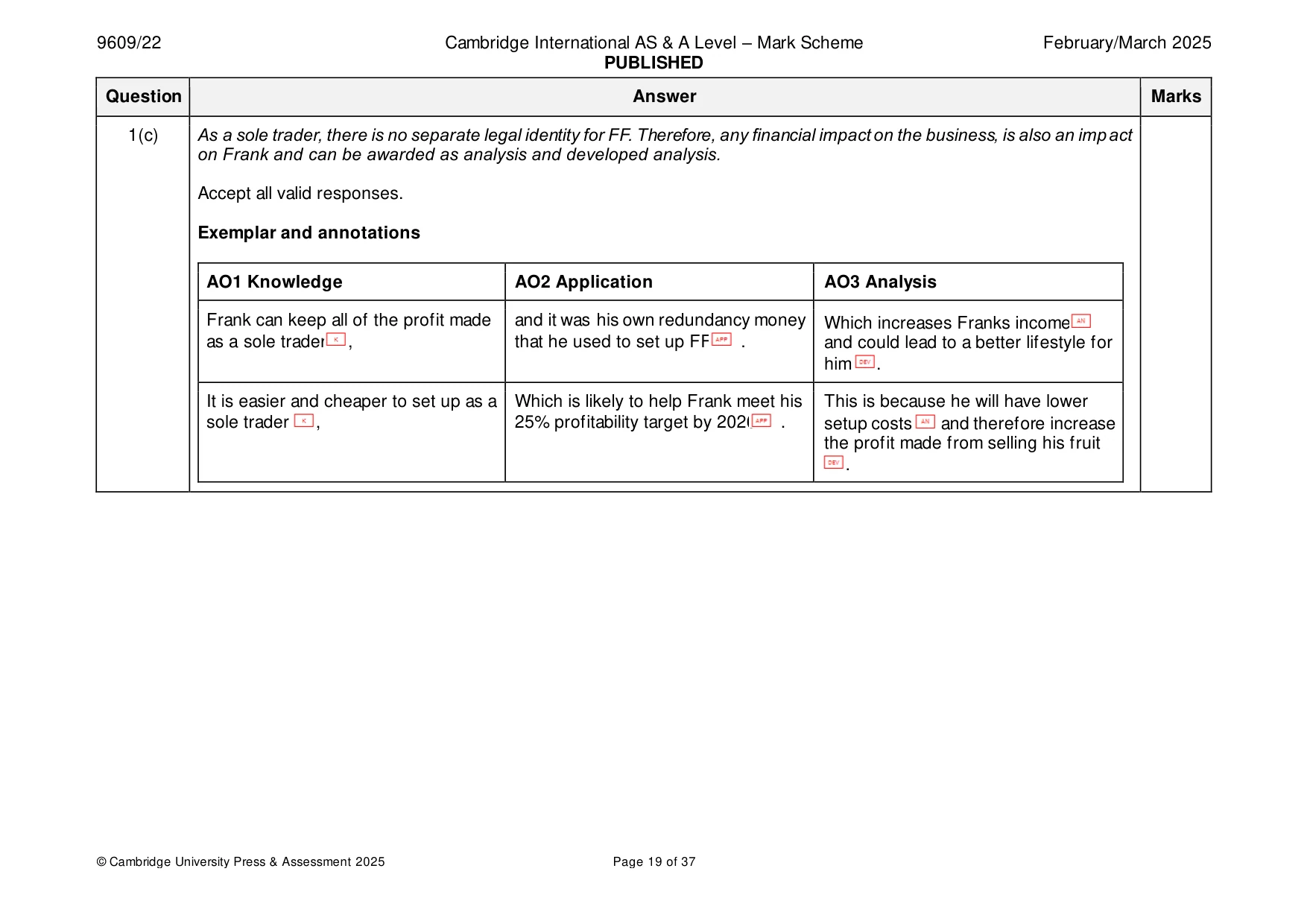
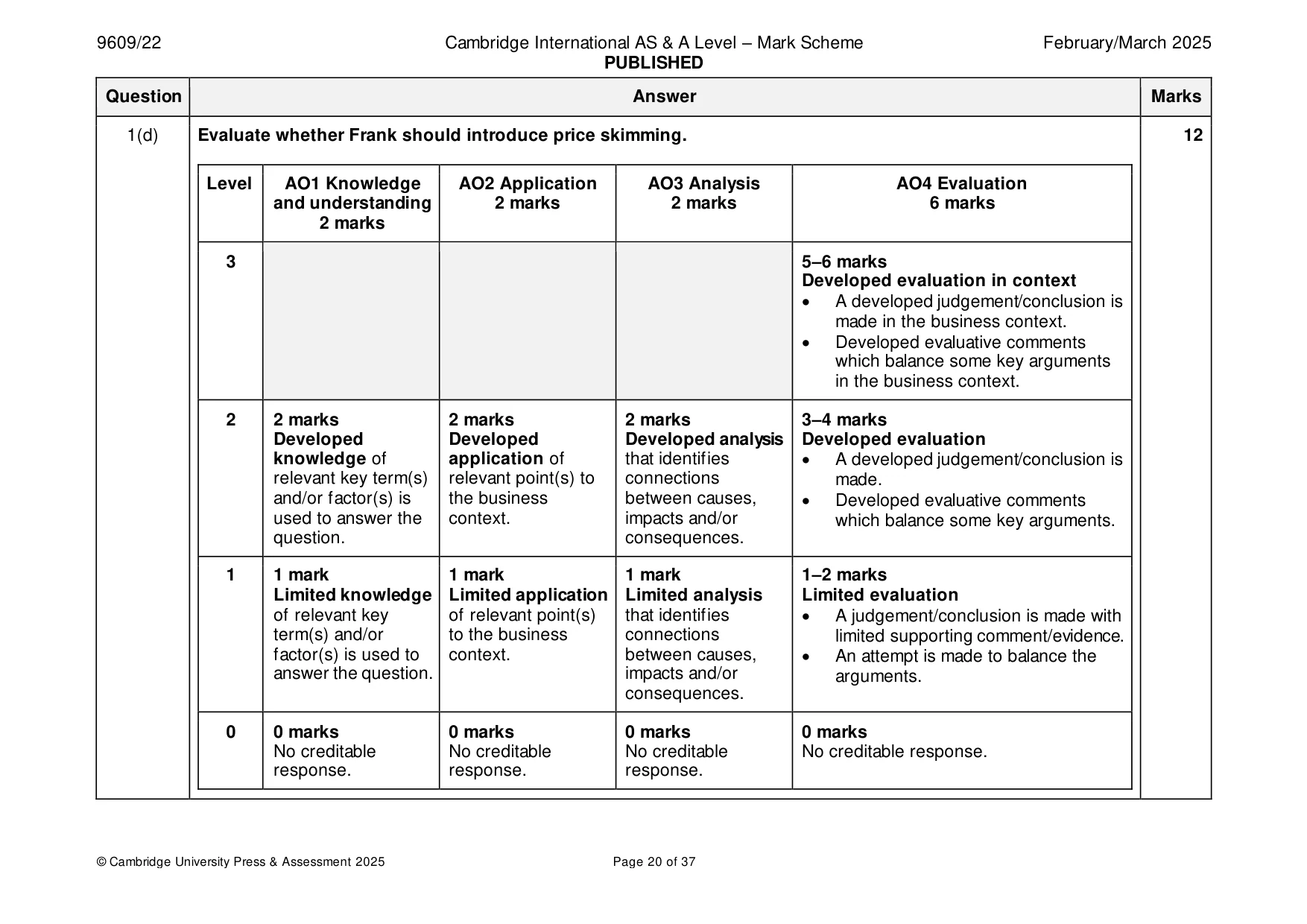
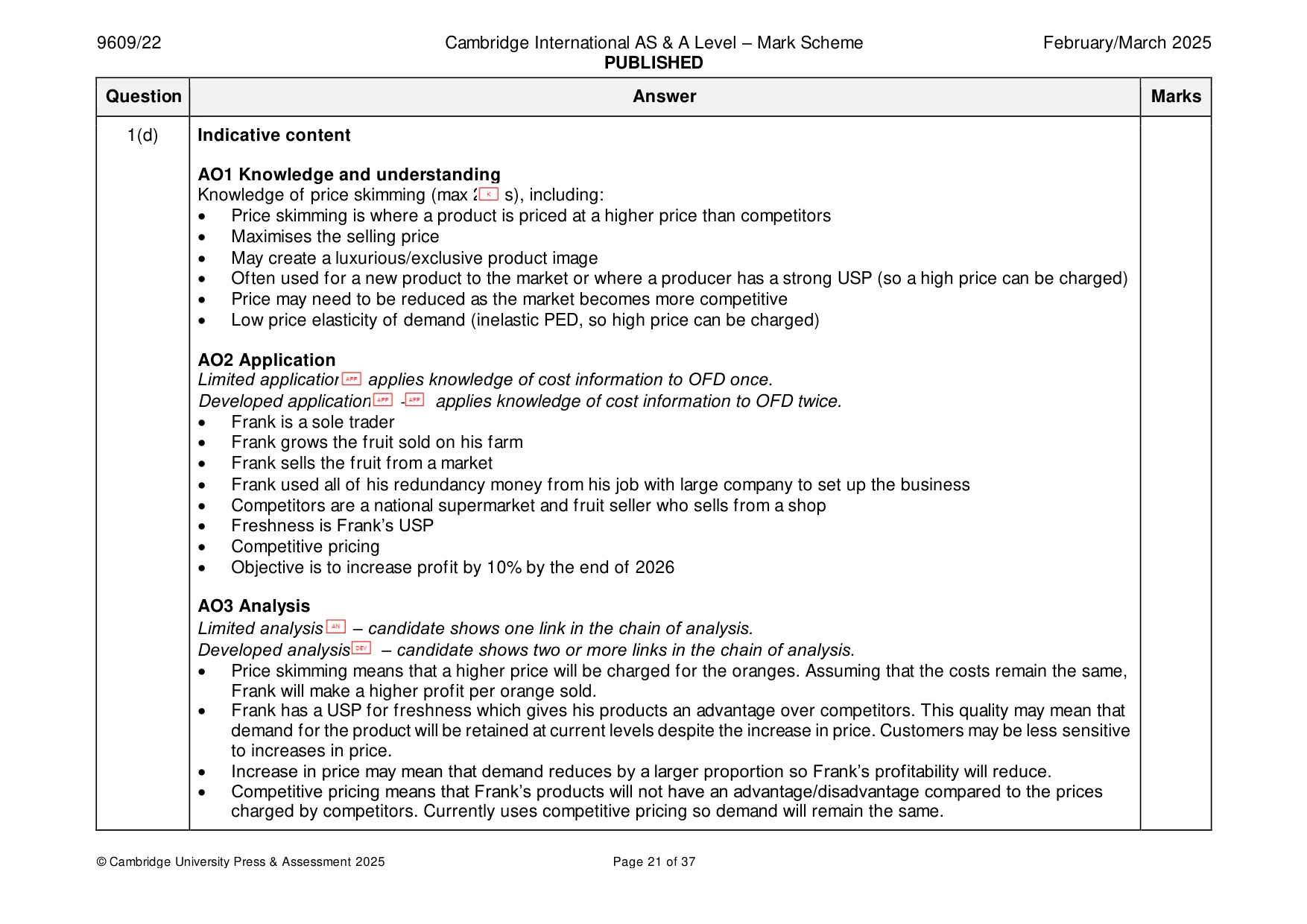
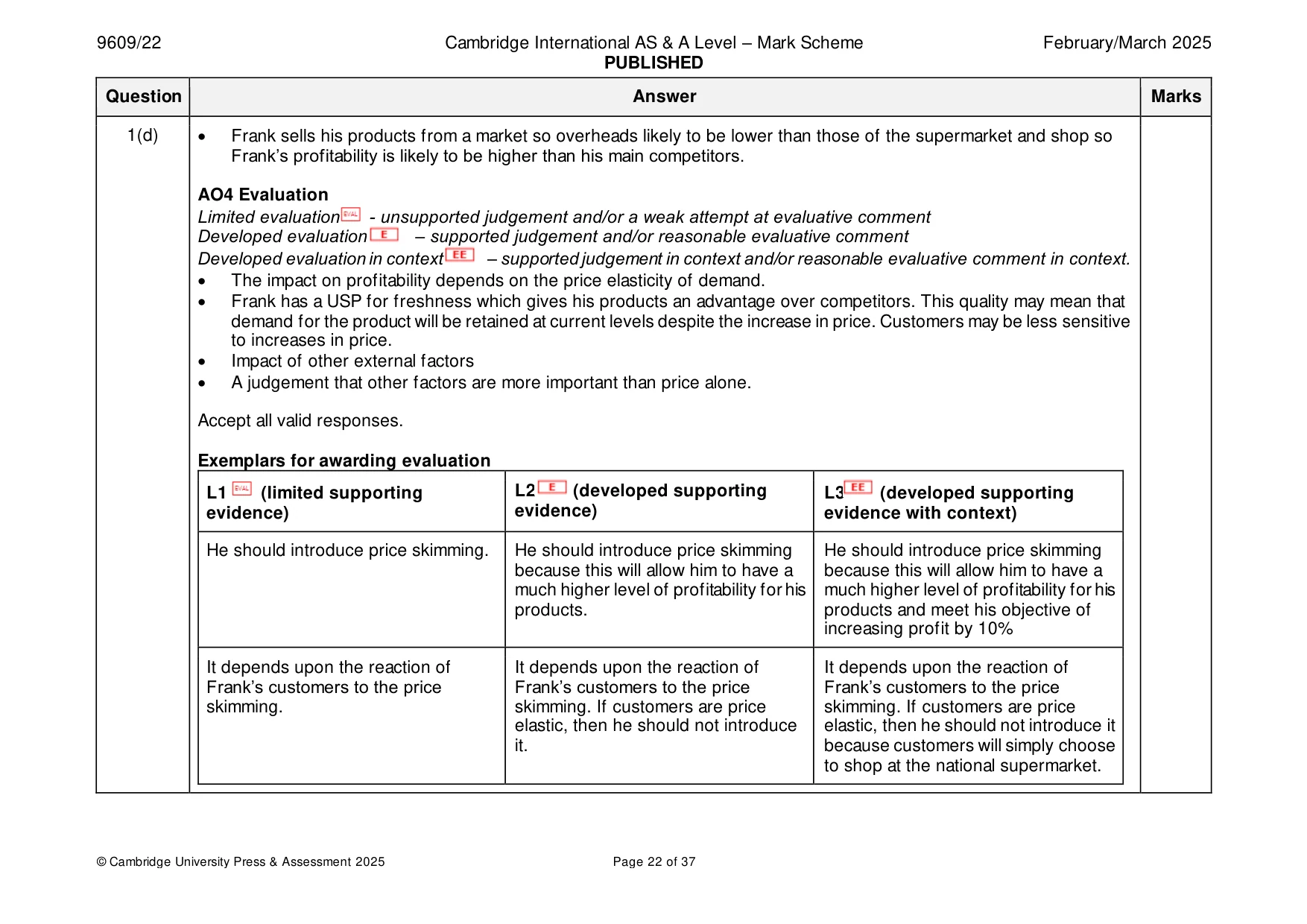
Mark scheme: Question Answer Marks 1(a)(i) Identify one method of measuring the size of a business. 1 Indicative content Identification of a method may include: • Capital employed • Market capitalisation • Market share • Revenue (allow sales, sales turnover or turnover) • Quantity sold • Value of output • Number of employees • Area/space • Number of outlets • Number of customers Do not allow profit – which is a measure of success or performance, but not size. If more than one answer is given, only mark the first, reading from top left to bottom right. Accept all valid responses. 1(a)(ii) Explain the term primary sector. 3 AO1 Knowledge and understanding AO2 Application 1 mark 2 marks 2 marks Developed application of one relevant point to a business context. 1 mark 1 mark Knowledge of one relevant point is used to answer the Limited application of one relevant point to a business question. context. 0 marks 0 marks No creditable response. No creditable response. Indicative content AO1 Knowledge and understanding Knowledge of primary sector will include (max 1 mark): • Natural resources / raw materials OR • An example of the processes involved in the primary sector, such as extraction/agriculture/farming/growing/fishing/mining etc. AO2 Application Explanation of primary sector will include (max 1 mark): • Natural resources / raw materials AND • An example of the processes involved in the primary sector, such as extraction/agriculture/farming/growing/fishing/mining etc. 1(a)(ii) Context applied to primary sector , including (max 1 mark): • Any example of primary sector, including: – A valid example of a primary sector business (do not allow FF as an example, unless it is clear that it is focussed on the farming element of the business (because it is in the primary and tertiary sectors). – A valid example of a primary sector product, such as ‘fruit’, ‘oil’ or ‘metal’ etc. Accept all valid responses Exemplar and annotations Mark Rationale Businesses in the primary sector are involved in natural resources 3 An answer which starts with the knowledge . For example, Frank farms oranges . and then has an example of the process and the product. Businesses that extract raw materials . For example, 3 growing oranges . A business could mine coal , which has been dug up from 2 the ground. Getting things from nature , such as farming . 2 Clear knowledge. Some application. The extraction of raw materials. 2 Not a perfect definition, but enough to award the knowledge mark. No attempt to apply. It is about producing goods. 0 No knowledge of the primary sector. Too vague. 1(b)(i) Refer to Table. 1.1. Calculate the number of oranges that Frank needs to sell to break even in July 2025. 3 Indicative content Formula to find the break-even quantity Fixed costs • (price per unit – variable cost per unit) (1) OR Fixed costs ALT 1 • Contribution (1) 0.80 5650 = 4520 (total revenue) 4520 – 2825 (TVC) Variable cost per unit = $2825 / 5650 = 1695 (total contribution) (1) = $0.50 (1) 1695 / 5650 Contribution per unit = $0.80 – $0.50 = 0.30 (contribution per unit) (1) = $0.30 (1) 1350 / 0.3 Final answer = 1350 / ($0.30) = 4500 (1) = 4500 (1) 4500 oranges or 4500 (3) 4500 oranges or 4500 (3) OFR applies for final answer and contribution per unit 1(b)(i) Exemplar and annotations Marks 3 marks Correct answer Working and oranges/units/percentage sign do 4500 oranges or 4500 not matter. 2 marks BOTH of the following: To award two marks, there must be • Correct formula • Two and a • Correct calculation of variable cost per unit OR ($0.50) • One , one and one OR OR • Two and a Correct calculation of contribution per unit ($0.30) OR An incorrect answer with one mistake allowing OFR for final stage. 1 mark One of the following: To award one mark, there must be: • Correct formula • One and two • Correct calculation of variable cost per unit 0 marks No creditable content. To award zero marks, there must be a minimum of one 1(b)(ii) Explain one limitation for Frank of using break-even analysis. 3 AO1 Knowledge and understanding AO2 Application 1 mark 2 marks 2 marks Developed application of one relevant point to a business context. 1 mark 1 mark Knowledge of one relevant point is used to answer the Limited application of one relevant point to a business question. context. 0 marks 0 marks No creditable response. No creditable response. Indicative content AO1 Knowledge and understanding Knowledge of a limitation of break-even analysis : • Fixed costs may not be constant • Assumption that output equals sales. • Assumption that unit variable costs remain constant. • Assumption that price will remain constant. • Only useful for individual (or limited number of) product lines. • Does not take into account external changes. • Only a forecast/estimate. • Difficult to allocate fixed costs. AO2 Application Explanation of a limitation of using break-even analysis (max 1 mark), including: • Fixed costs may not be constant – may change in long run • Assumption that output equals sales – but not all output may be sold • Assumption that unit variable costs remain constant – but may not be at all output levels • Assumption that price will remain constant – but may not be at all output levels 1(b)(ii) • Only useful for individual (or limited number of) product lines – must be done for each product • Does not take into account external changes – such as social, legal, economic, political, technological • Only a forecast/estimate – so may not be reliable. Context applied to FF (max 1 mark), including: • Frank is a sole trader • Frank grows the fruit sold on his farm • Frank sells the fruit from a market • Competitors are a national supermarket and fruit seller who sells from a shop • Freshness is Frank’s USP / fruit is a perishable product • Competitive pricing • Objective is to increase profit by 10% by the end of 2026 Accept all valid responses. Exemplar and annotations Mark Rationale A limitation is that it assumes that only one product is sold 3 A clear limitation that is explained because break-even analysis has to be done for each product . and has context . Frank sells oranges and lemons on his farm . Assumes the selling price stays the same which is not 2 A limitation identified . The context of appropriate for Frank as he uses competitive pricing . Frank’s pricing strategy is applied , but no explanation. Assumes no stock of oranges are kept so it is appropriate for 1 Knowledge of a factor. The rest of the answer is not answering the question, so Frank’s business to make more profit. (Not Answering Question). Break-even analysis does not tell Frank the amount of cash 0 No valid knowledge is shown, so no marks generated from selling oranges . can be awarded. 1(c) Analyse two benefits to Frank of operating as a sole trader. 8 Level AO1 Knowledge and AO2 Application AO3 Analysis understanding 2 marks 4 marks 2 marks 2 3–4 marks Developed analysis • Developed analysis that identifies connections between causes, impacts and/or consequences of two points. • Developed analysis that identifies connections between causes, impacts and/or consequences of one point. 1 1–2 marks 1–2 marks 1–2 marks • Knowledge of two • Application of two Limited analysis relevant points is relevant points to a • Limited analysis that identifies connections used to answer the business context. between causes, impacts and/or consequences of question. • Application of one two points. • Knowledge of one relevant point to a • Limited analysis that identifies connections relevant point is business context. between causes, impacts and/or consequences of used to answer the one point. question. 0 0 marks 0 marks 0 marks No creditable response. No creditable response. No creditable response. Annotate the first benefit in the left-hand margin and the second in the right-hand marking. 1(c) Indicative content AO1 Knowledge and understanding Knowledge of the benefits of operating as a sole trader (max 2 s), may include: • Keep all profit made / no sharing of profit • Can make all business decisions without having to consult other owners / no consultation • Total control • Freedom to choose own work hours • Can employ staff • Relatively low start-up costs • Financial data is private • Easy to set up / less administration AO2 Application Max one for application in the first benefit and max one for application in the second benefit. Application of knowledge of benefit of operating as a sole trader to Frank/FF (max 2 s), including • Frank grows the fruit sold on his farm • Frank sells the fruit from a market • Frank used all of his redundancy money from his job with large company to set up the business • Competitors are a national supermarket and fruit seller who sells from a shop • Freshness is Frank’s USP • Competitive pricing • Objective is to increase profit by 10% by the end of 2026 AO3 Analysis Limited analysis – candidate shows one link in the chain of analysis. Developed analysis candidate shows two or more links in the chain of analysis or a two-sided analysis. • Frank is able to make all decisions. No time is wasted consulted with other owners which enables the decisions to be implemented quicker/before competitors and therefore generate more profit. • The sole trader can keep a larger amount of profit as it doesn’t have to be shared with other owners. • The costs of setting up a sole trader are typically less than other forms of ownership so less capital will be needed to start the business. • The owner can choose their own working hours and so enjoy a better work-life balance. This can help the sole trader make better business decisions and increase its market share. 1(c) As a sole trader, there is no separate legal identity for FF. Therefore, any financial impact on the business, is also an impact on Frank and can be awarded as analysis and developed analysis. Accept all valid responses. Exemplar and annotations AO1 Knowledge AO2 Application AO3 Analysis Frank can keep all of the profit made and it was his own redundancy money Which increases Franks income as a sole trader , that he used to set up FF . and could lead to a better lifestyle for him . It is easier and cheaper to set up as a Which is likely to help Frank meet his This is because he will have lower sole trader , 25% profitability target by 2026 . setup costs and therefore increase the profit made from selling his fruit . 1(d) Evaluate whether Frank should introduce price skimming. 12 Level AO1 Knowledge AO2 Application AO3 Analysis AO4 Evaluation and understanding 2 marks 2 marks 6 marks 2 marks 3 5–6 marks Developed evaluation in context • A developed judgement/conclusion is made in the business context. • Developed evaluative comments which balance some key arguments in the business context. 2 2 marks 2 marks 2 marks 3–4 marks Developed Developed Developed analysis Developed evaluation knowledge of application of that identifies • A developed judgement/conclusion is relevant key term(s) relevant point(s) to connections made. and/or factor(s) is the business between causes, • Developed evaluative comments used to answer the context. impacts and/or which balance some key arguments. question. consequences. 1 1 mark 1 mark 1 mark 1–2 marks Limited knowledge Limited application Limited analysis Limited evaluation of relevant key of relevant point(s) that identifies • A judgement/conclusion is made with term(s) and/or to the business connections limited supporting comment/evidence. factor(s) is used to context. between causes, • An attempt is made to balance the answer the question. impacts and/or arguments. consequences. 0 0 marks 0 marks 0 marks 0 marks No creditable No creditable No creditable No creditable response. response. response. response. 1(d) Indicative content AO1 Knowledge and understanding Knowledge of price skimming (max 2 s), including: • Price skimming is where a product is priced at a higher price than competitors • Maximises the selling price • May create a luxurious/exclusive product image • Often used for a new product to the market or where a producer has a strong USP (so a high price can be charged) • Price may need to be reduced as the market becomes more competitive • Low price elasticity of demand (inelastic PED, so high price can be charged) AO2 Application Limited application applies knowledge of cost information to OFD once. Developed application + applies knowledge of cost information to OFD twice. • Frank is a sole trader • Frank grows the fruit sold on his farm • Frank sells the fruit from a market • Frank used all of his redundancy money from his job with large company to set up the business • Competitors are a national supermarket and fruit seller who sells from a shop • Freshness is Frank’s USP • Competitive pricing • Objective is to increase profit by 10% by the end of 2026 AO3 Analysis Limited analysis – candidate shows one link in the chain of analysis. Developed analysis – candidate shows two or more links in the chain of analysis. • Price skimming means that a higher price will be charged for the oranges. Assuming that the costs remain the same, Frank will make a higher profit per orange sold. • Frank has a USP for freshness which gives his products an advantage over competitors. This quality may mean that demand for the product will be retained at current levels despite the increase in price. Customers may be less sensitive to increases in price. • Increase in price may mean that demand reduces by a larger proportion so Frank’s profitability will reduce. • Competitive pricing means that Frank’s products will not have an advantage/disadvantage compared to the prices charged by competitors. Currently uses competitive pricing so demand will remain the same. 1(d) • Frank sells his products from a market so overheads likely to be lower than those of the supermarket and shop so Frank’s profitability is likely to be higher than his main competitors. AO4 Evaluation Limited evaluation - unsupported judgement and/or a weak attempt at evaluative comment Developed evaluation – supported judgement and/or reasonable evaluative comment Developed evaluation in context – supported judgement in context and/or reasonable evaluative comment in context. • The impact on profitability depends on the price elasticity of demand. • Frank has a USP for freshness which gives his products an advantage over competitors. This quality may mean that demand for the product will be retained at current levels despite the increase in price. Customers may be less sensitive to increases in price. • Impact of other external factors • A judgement that other factors are more important than price alone. Accept all valid responses. Exemplars for awarding evaluation L1 (limited supporting L2 (developed supporting L3 (developed supporting evidence) evidence) evidence with context) He should introduce price skimming. He should introduce price skimming He should introduce price skimming because this will allow him to have a because this will allow him to have a much higher level of profitability for his much higher level of profitability for his products. products and meet his objective of increasing profit by 10% It depends upon the reaction of It depends upon the reaction of It depends upon the reaction of Frank’s customers to the price Frank’s customers to the price Frank’s customers to the price skimming. skimming. If customers are price skimming. If customers are price elastic, then he should not introduce elastic, then he should not introduce it it. because customers will simply choose to shop at the national supermarket.
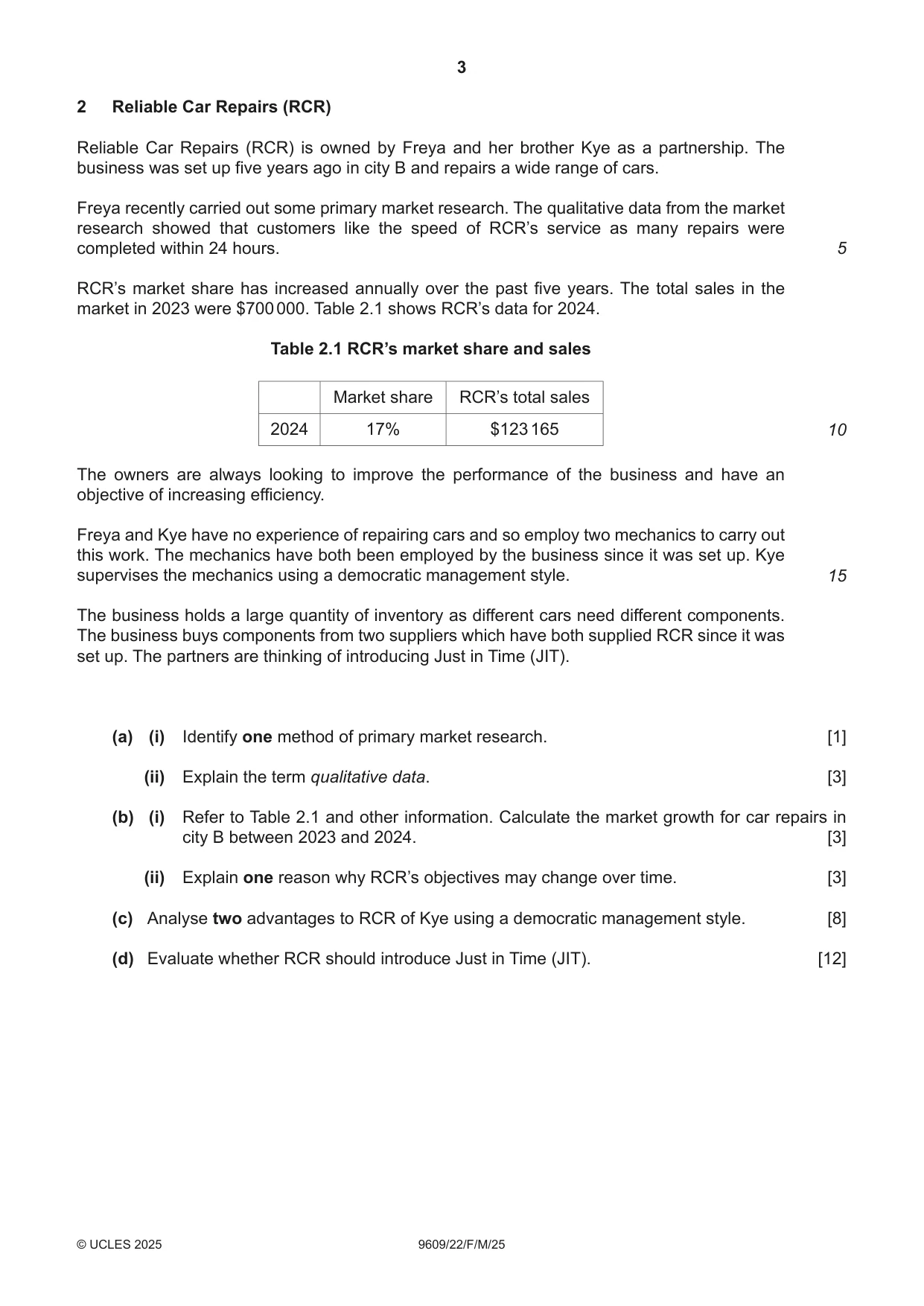
Q2 · Reliable Car Repairs (RCR) Reliable Car Repairs (RCR) is owned by Freya and her brother…
2 Reliable Car Repairs (RCR) Reliable Car Repairs (RCR) is owned by Freya and her brother Kye as a partnership. The business was set up five years ago in city B and repairs a wide range of cars. Freya recently carried out some primary market research. The qualitative data from the market research showed that customers like the speed of RCR’s service as many repairs were completed within 24 hours. 5 RCR’s market share has increased annually over the past five years. The total sales in the market in 2023 were $700 000. Table 2.1 shows RCR’s data for 2024. Table 2.1 RCR’s market share and sales Market share RCR’s total sales 2024 17% $123 165 10 The owners are always looking to improve the performance of the business and have an objective of increasing efficiency. Freya and Kye have no experience of repairing cars and so employ two mechanics to carry out this work. The mechanics have both been employed by the business since it was set up. Kye supervises the mechanics using a democratic management style. 15 The business holds a large quantity of inventory as different cars need different components. The business buys components from two suppliers which have both supplied RCR since it was set up. The partners are thinking of introducing Just in Time (JIT). (a) (i) Identify one method of primary market research. [1] (ii) Explain the term qualitative data. [3] (b) (i) Refer to Table 2.1 and other information. Calculate the market growth for car repairs in city B between 2023 and 2024. [3] (ii) Explain one reason why RCR’s objectives may change over time. [3] (c) Analyse two advantages to RCR of Kye using a democratic management style. [8] (d) Evaluate whether RCR should introduce Just in Time (JIT). [12]
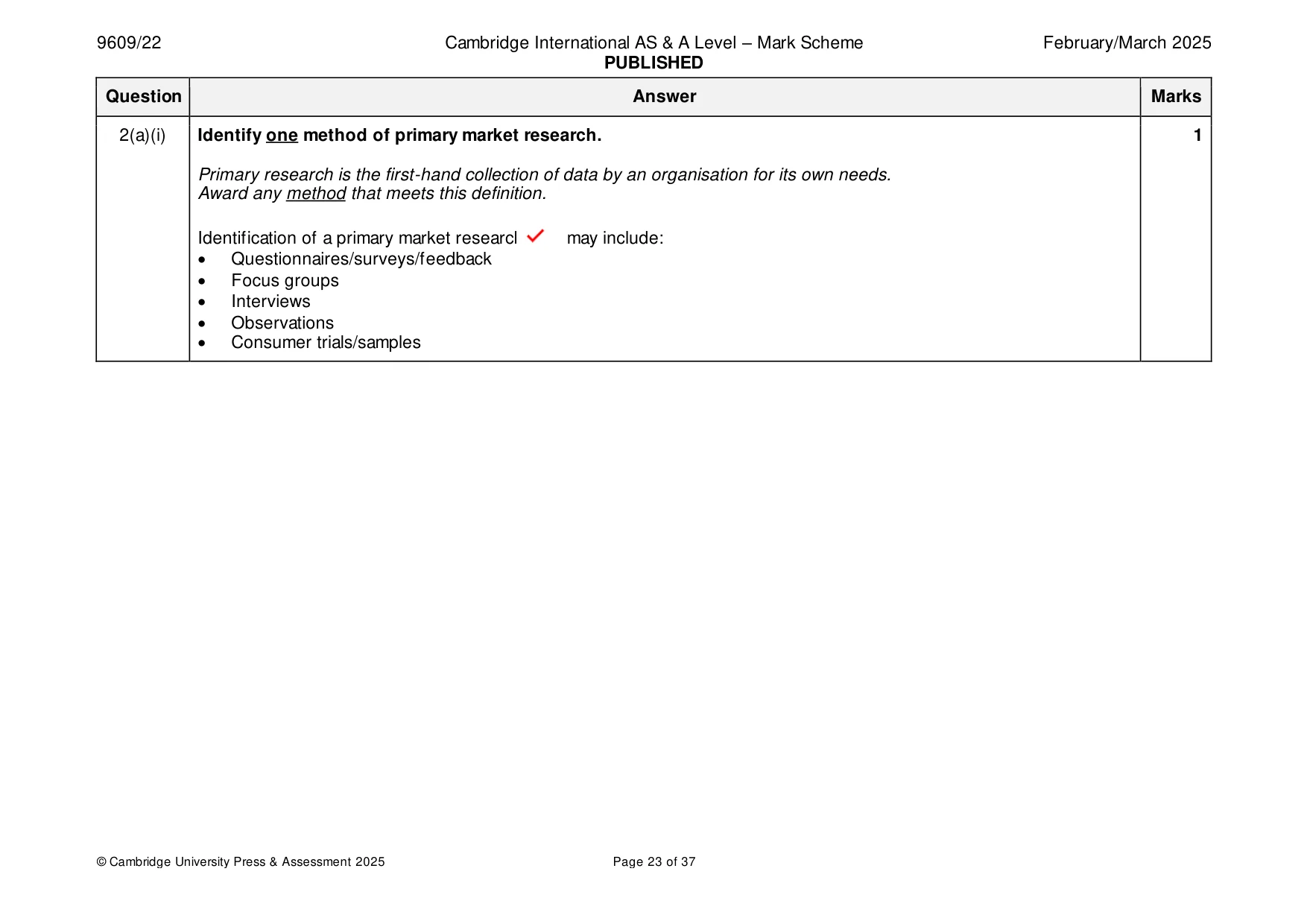
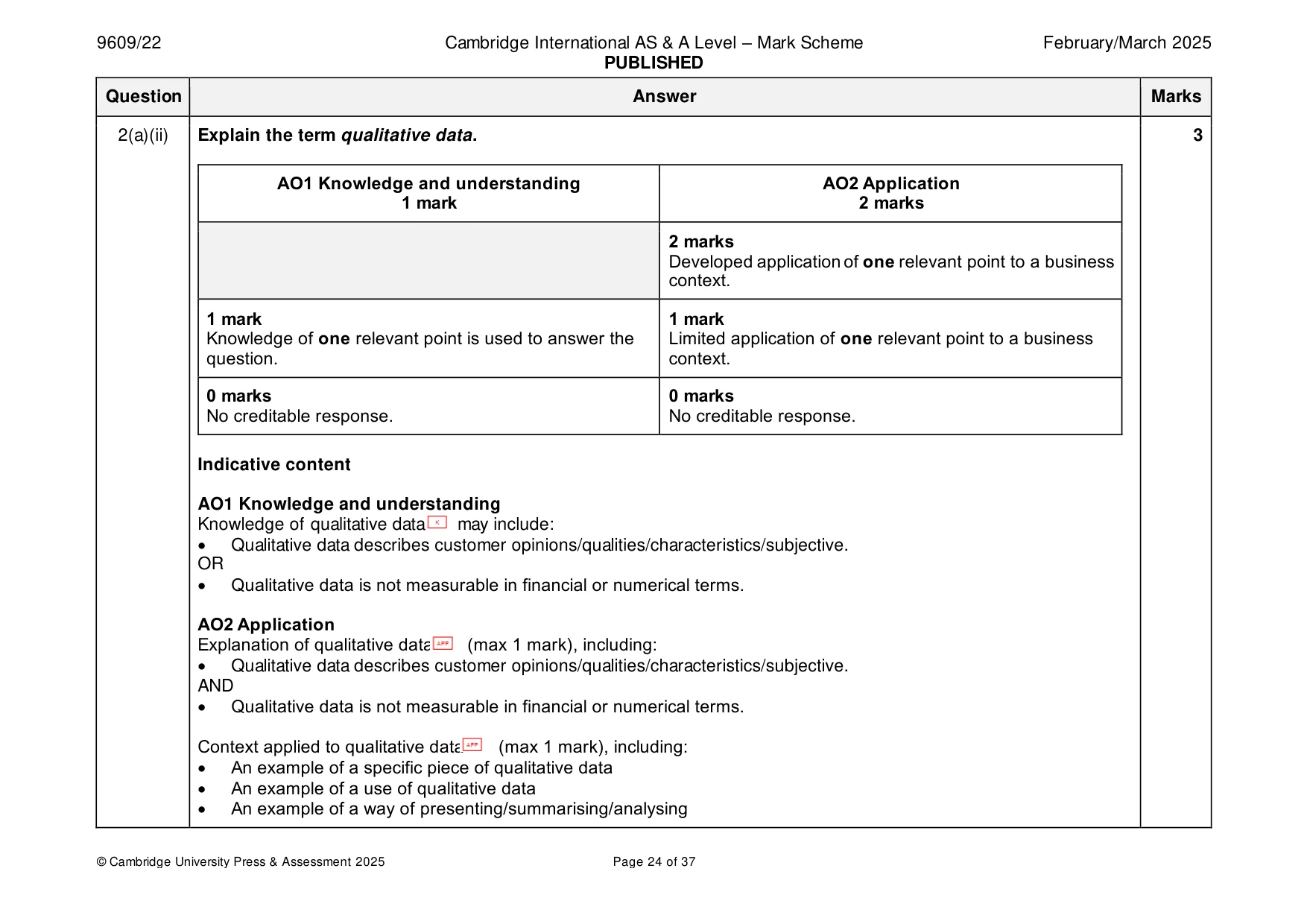
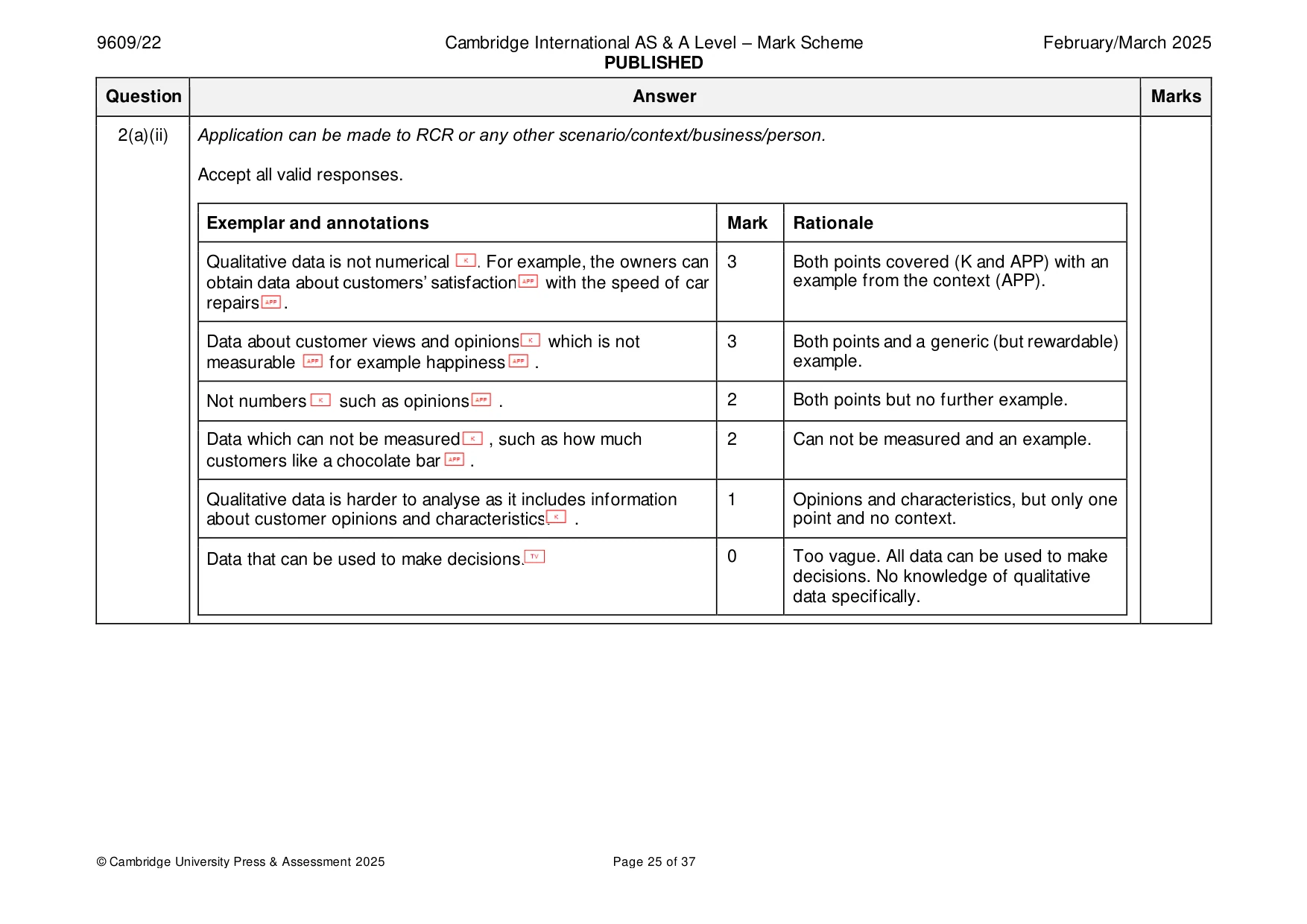
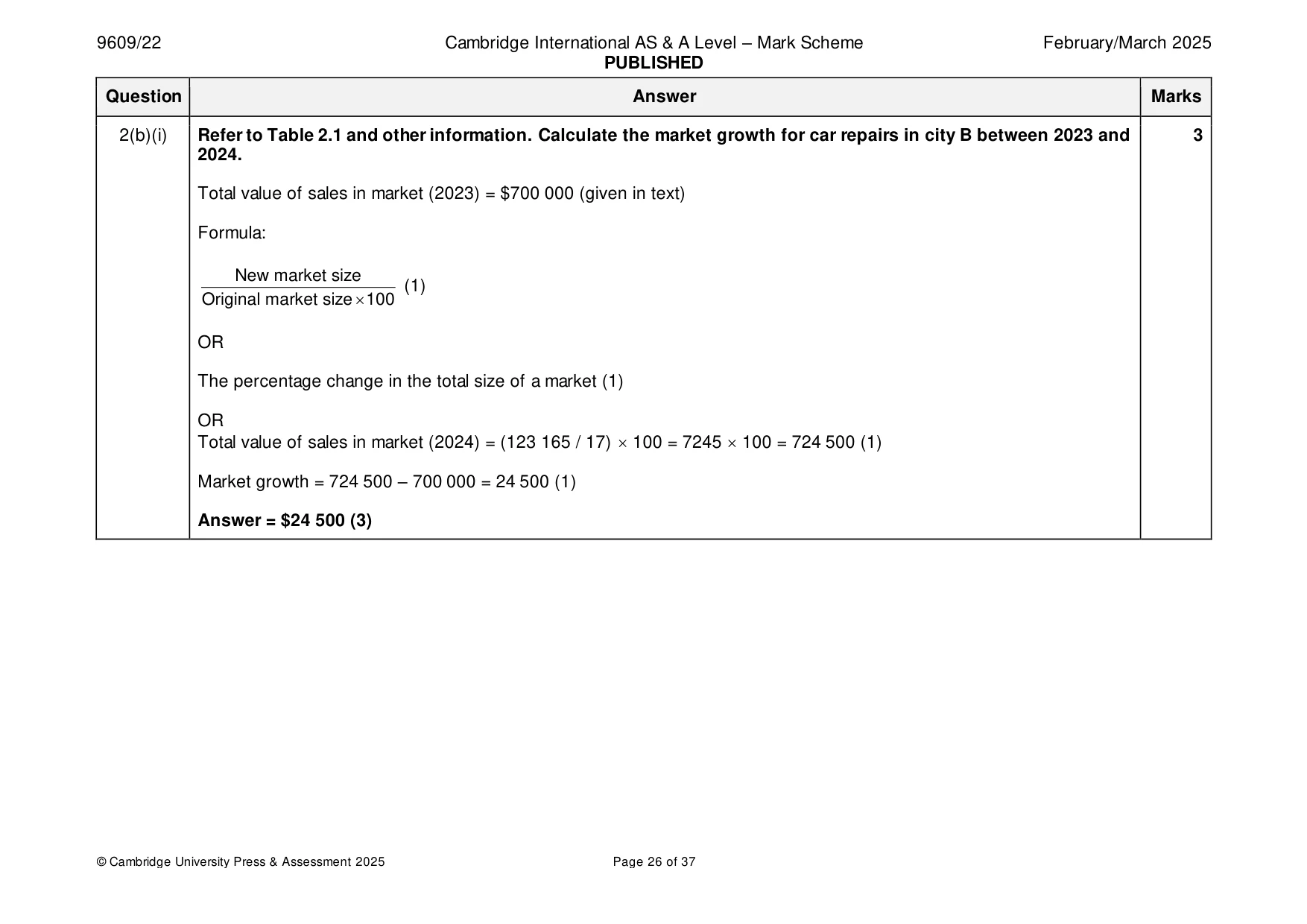
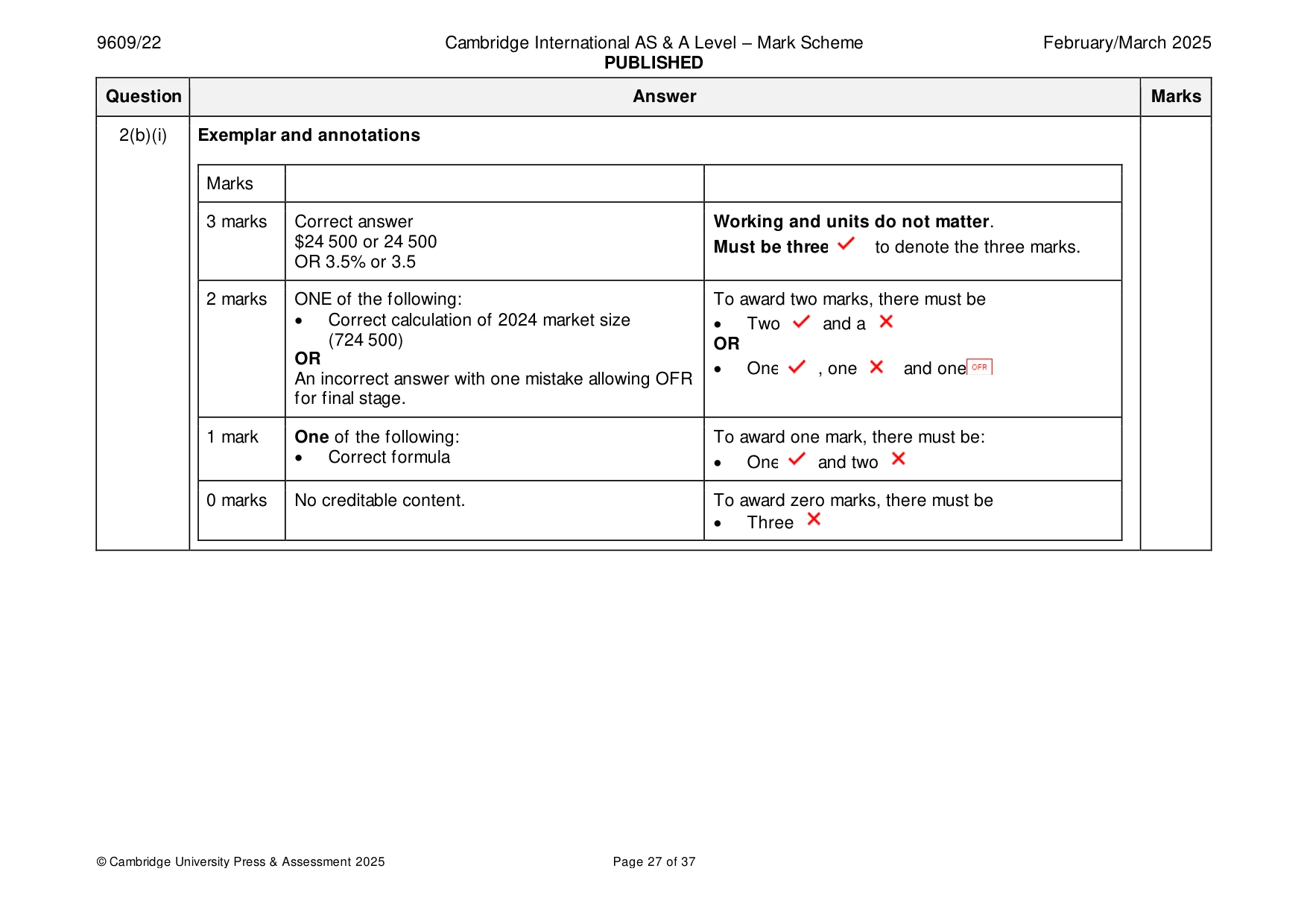
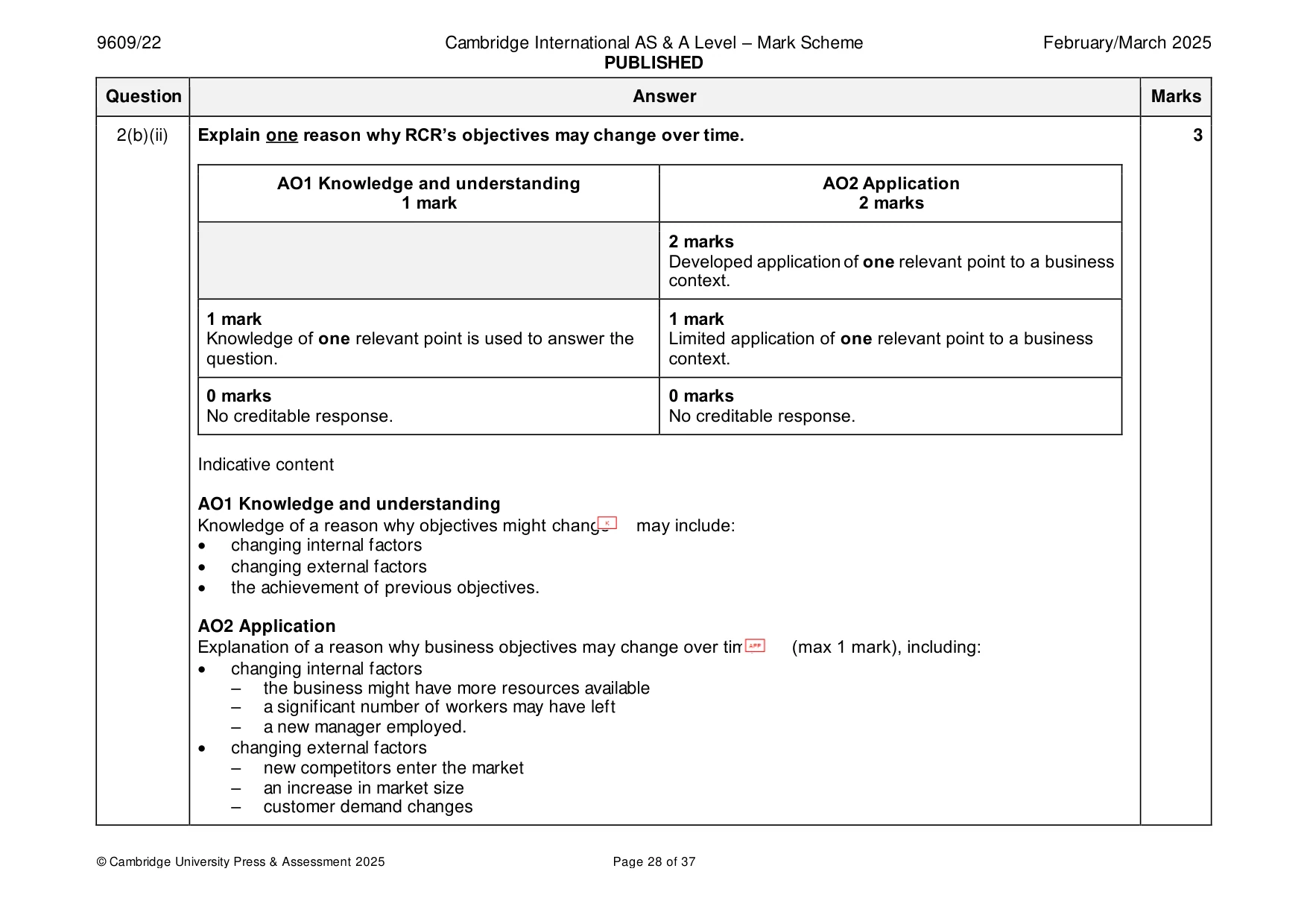
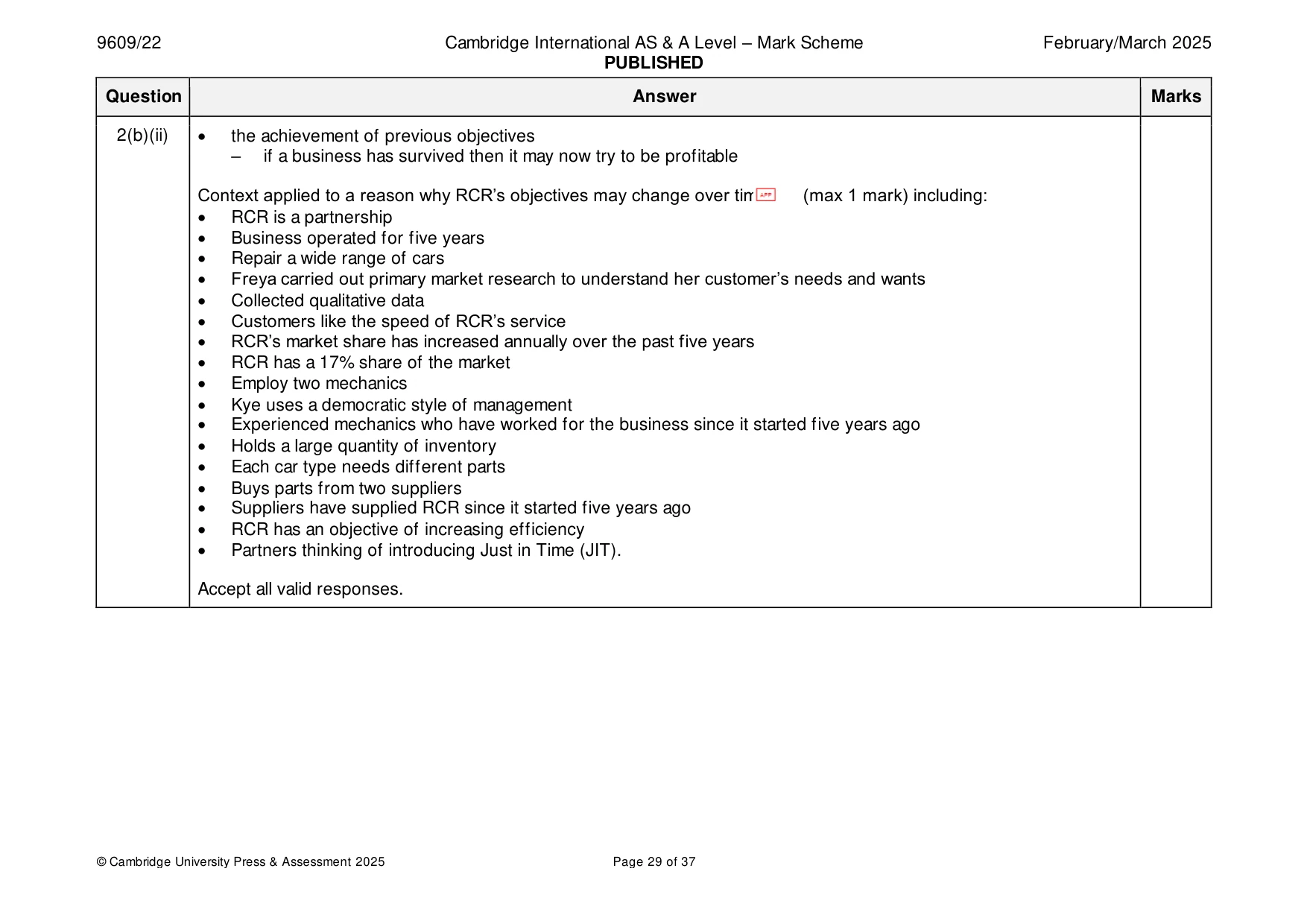
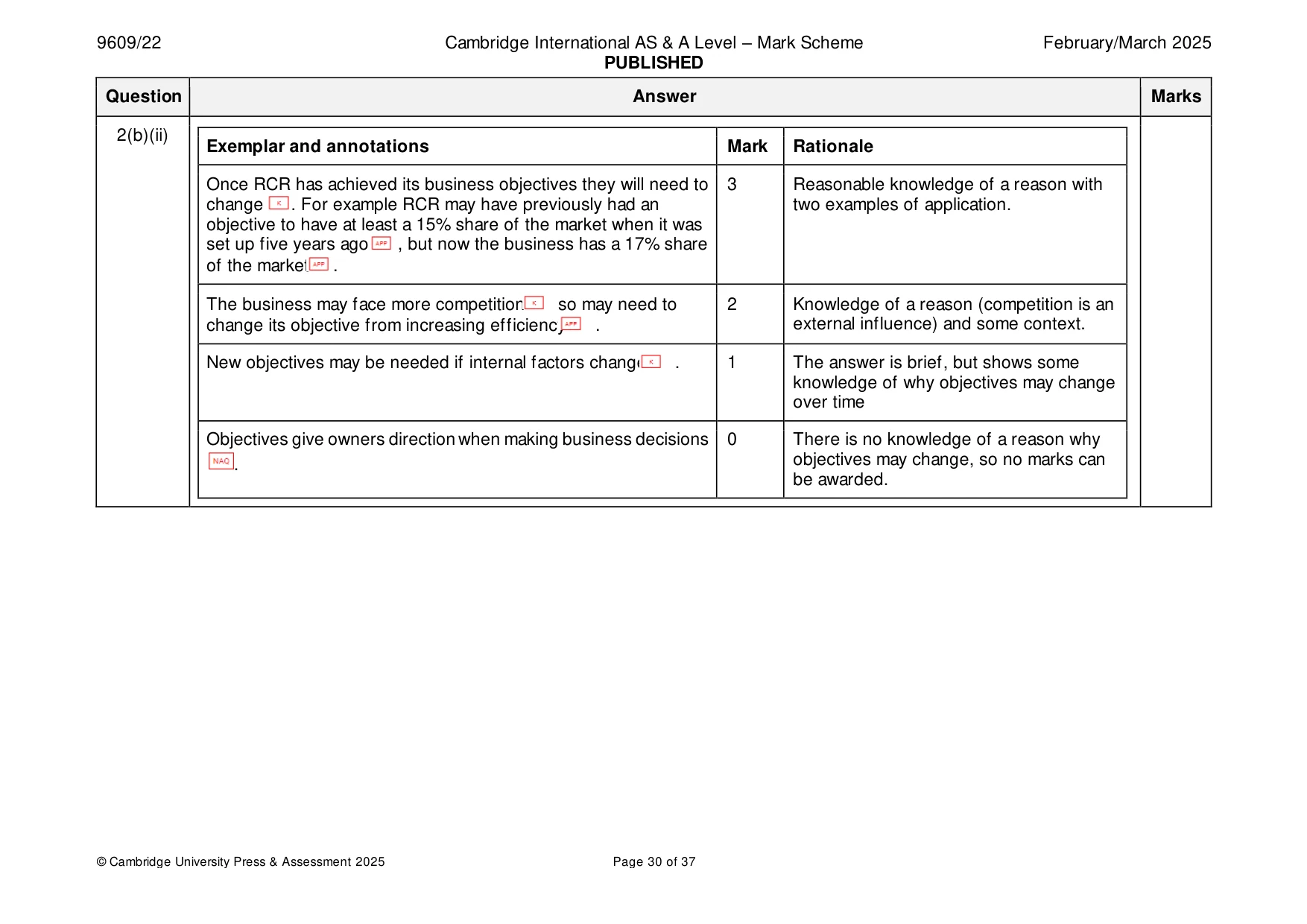
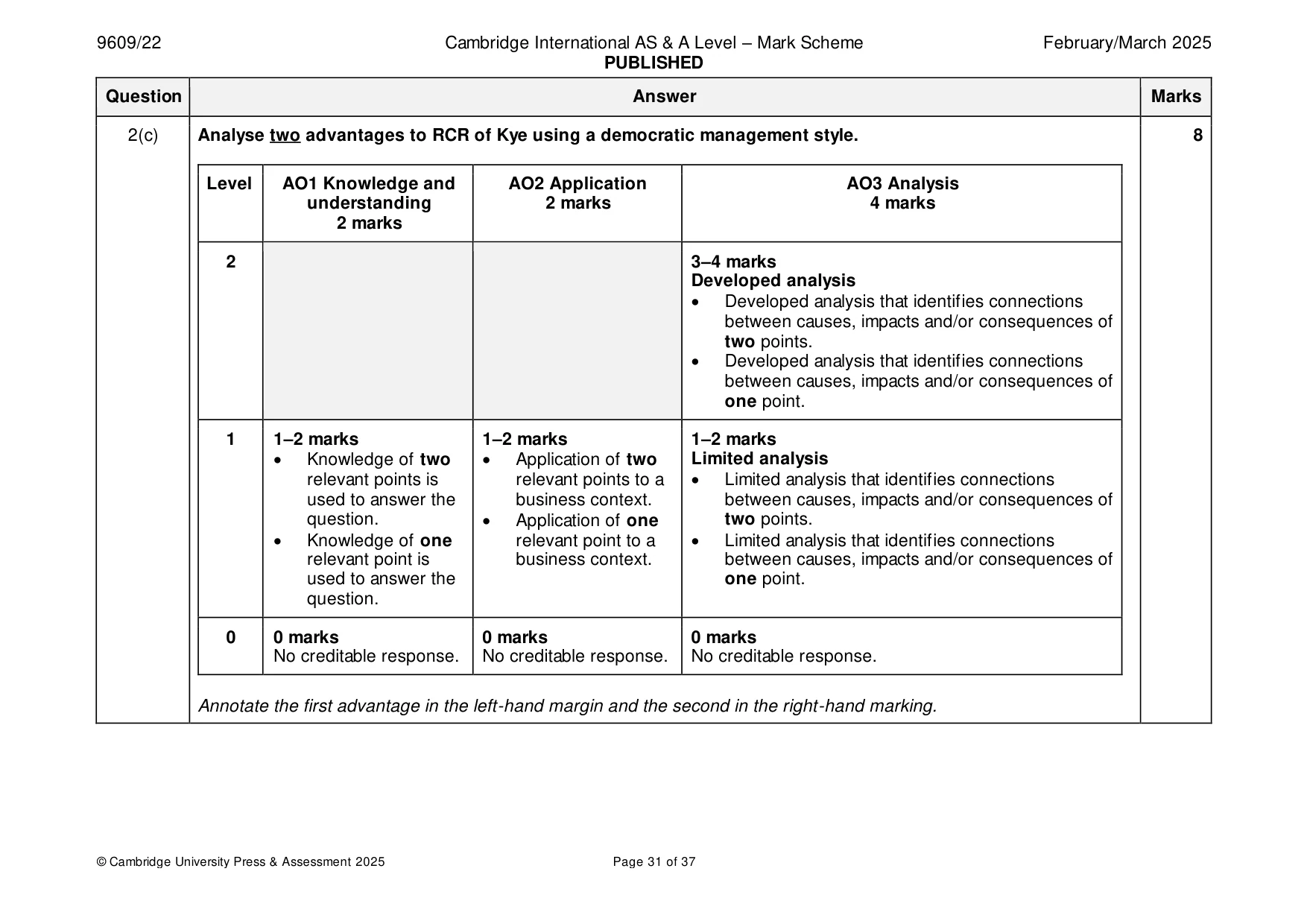
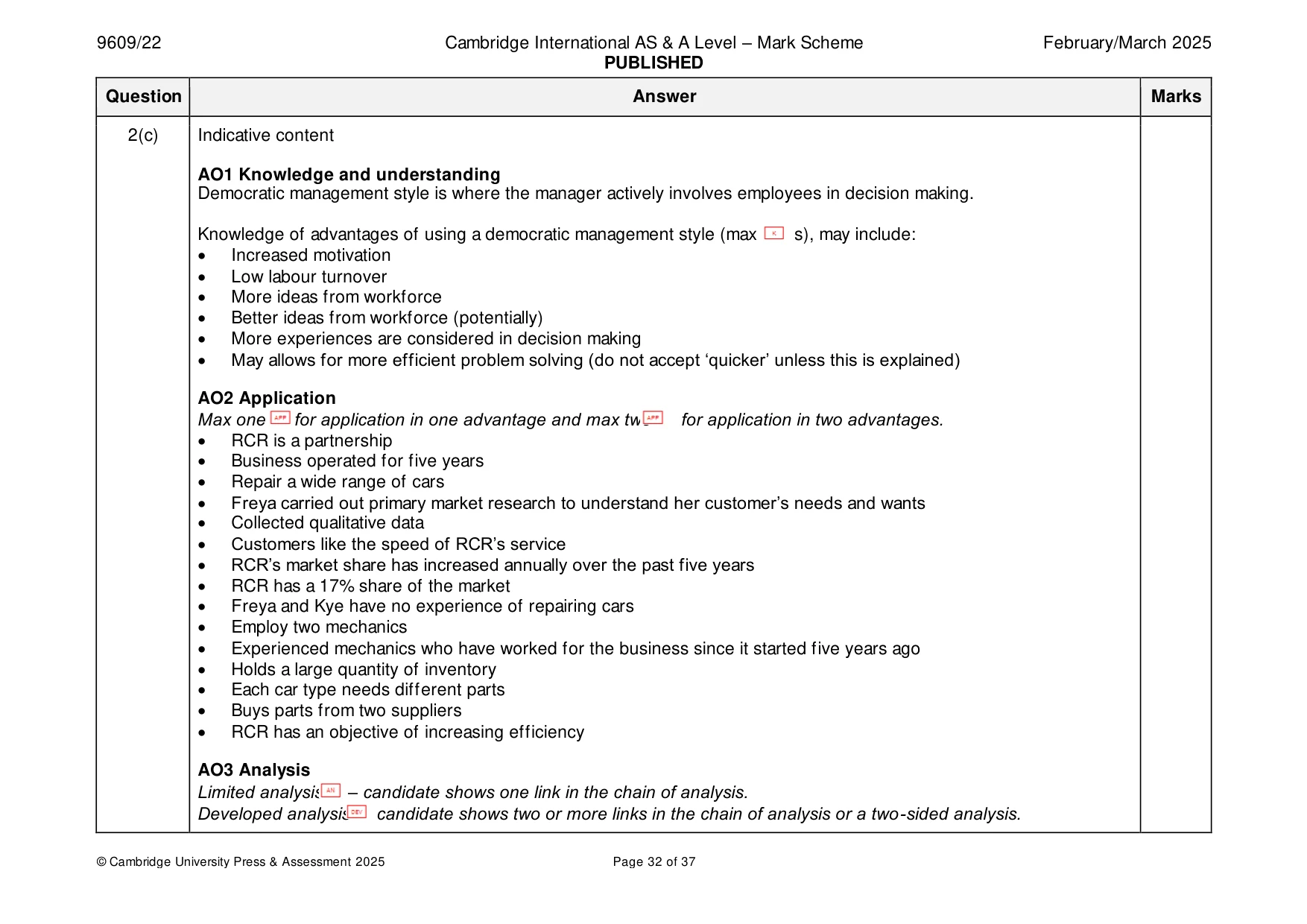
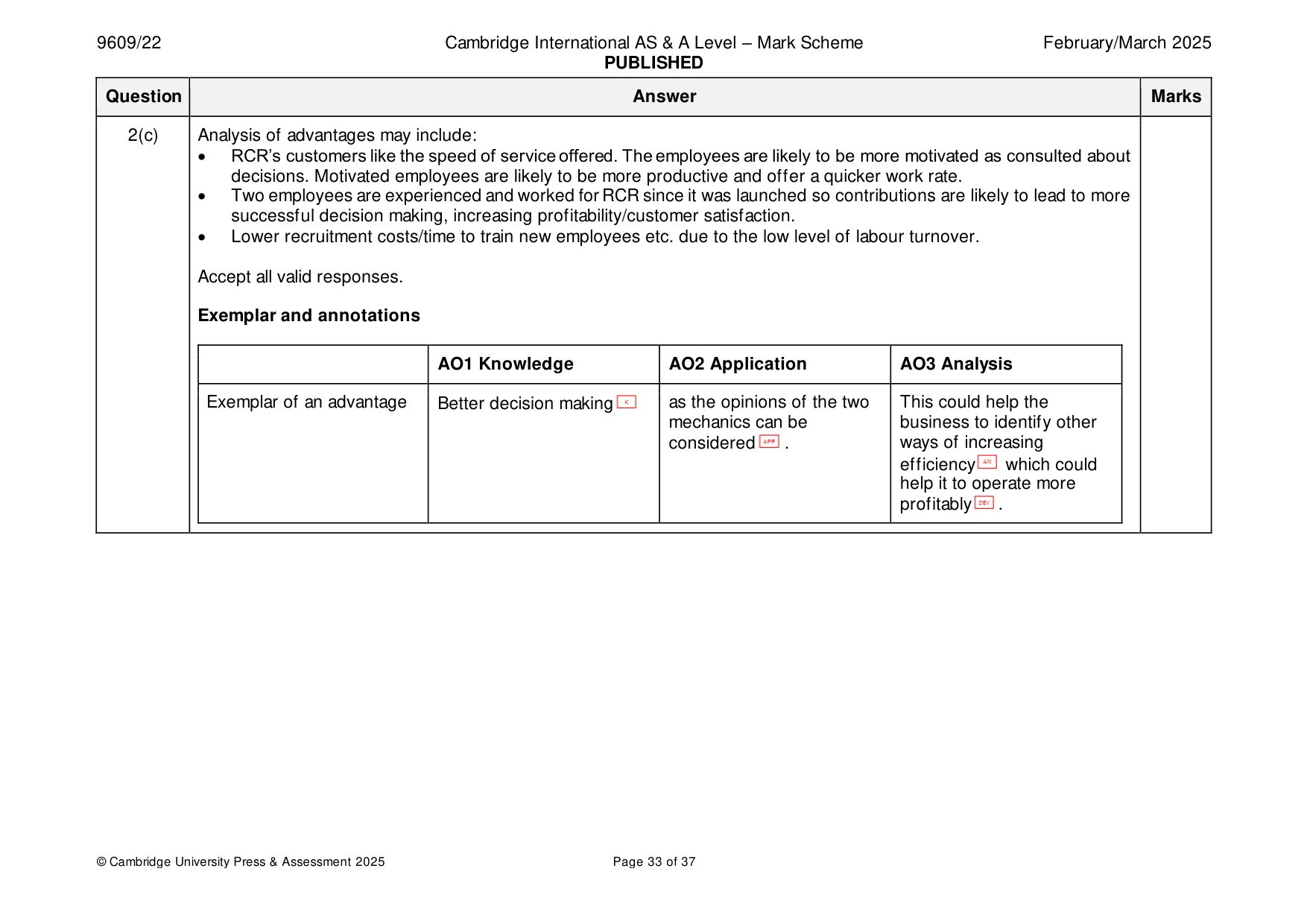
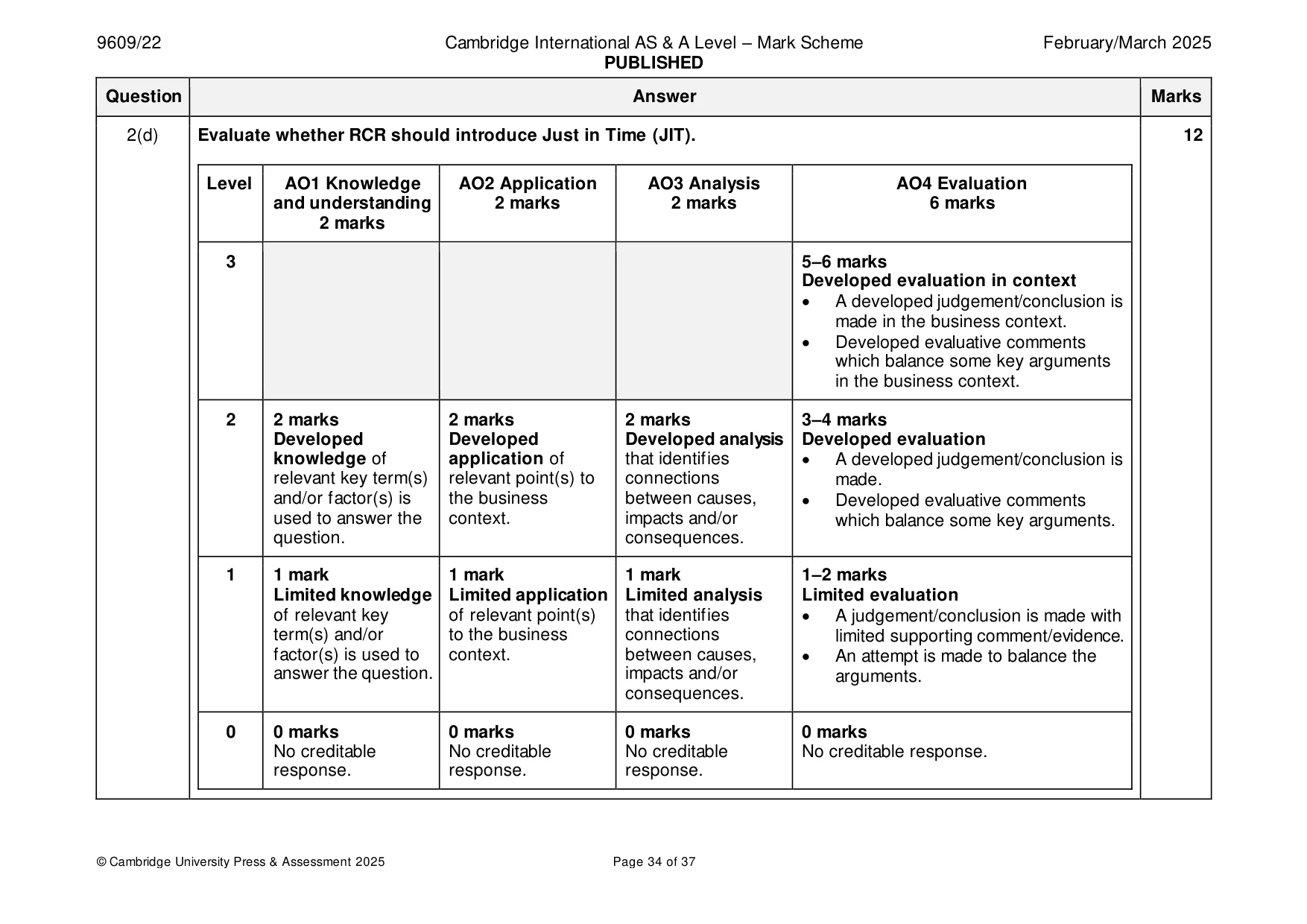
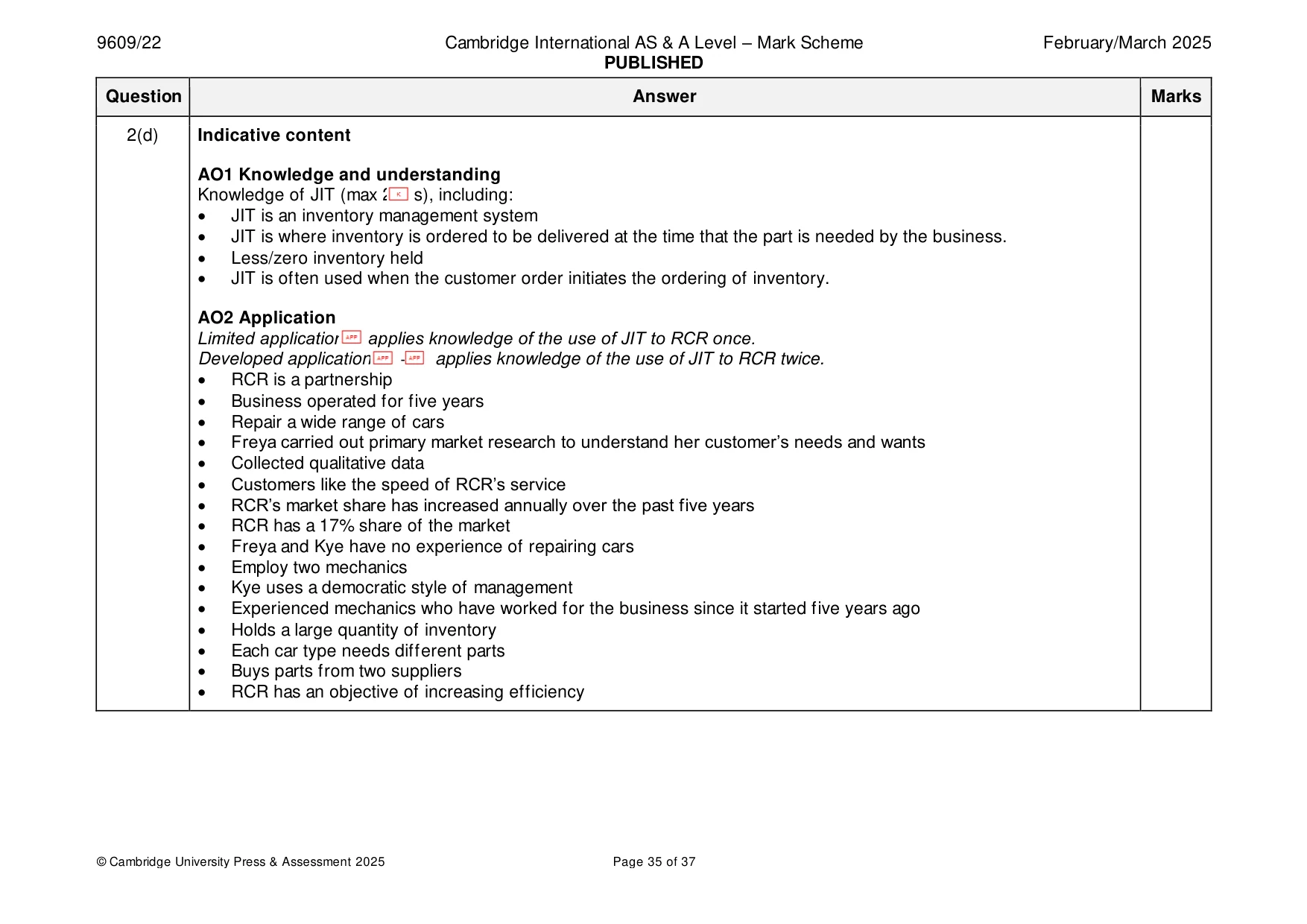
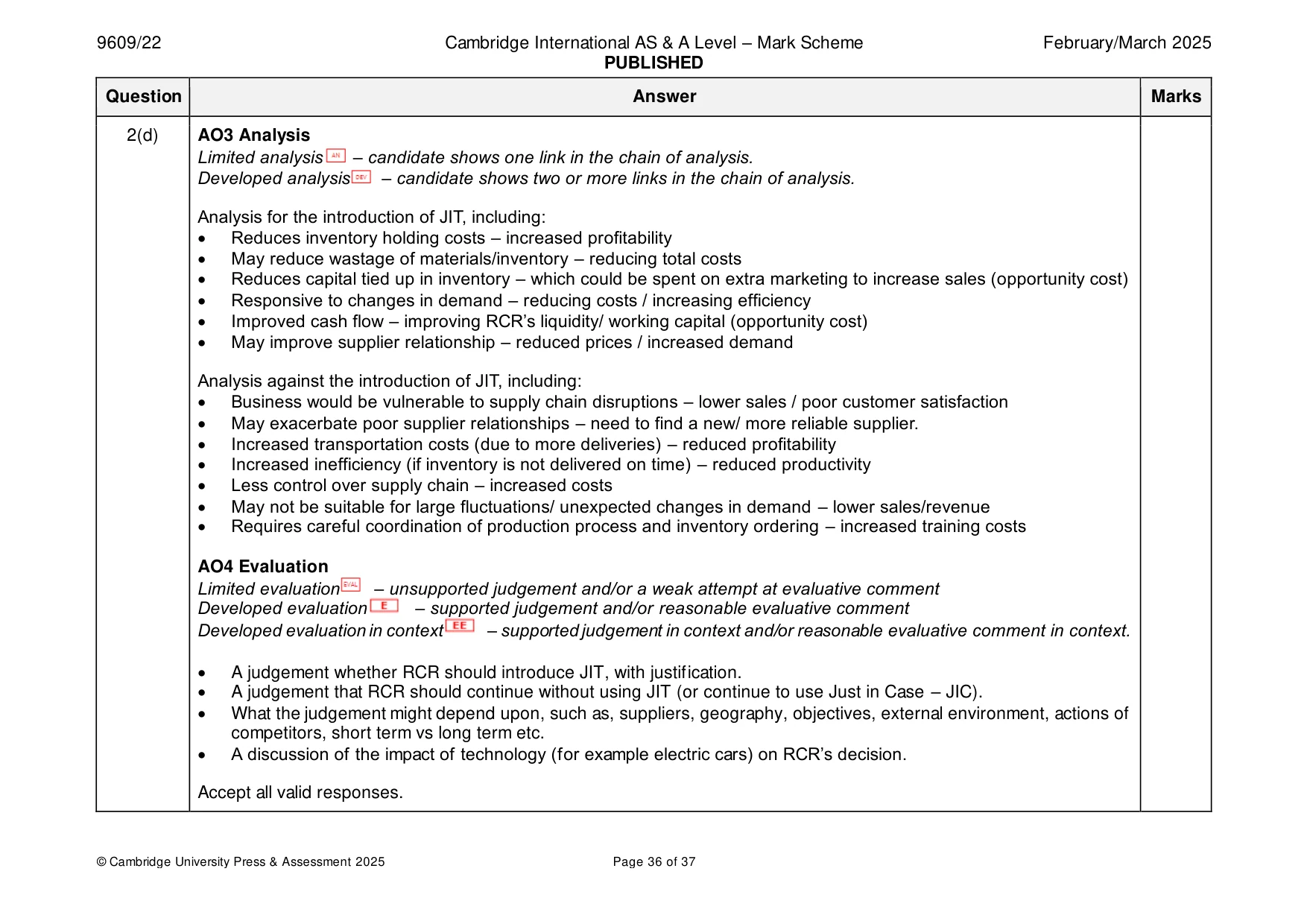
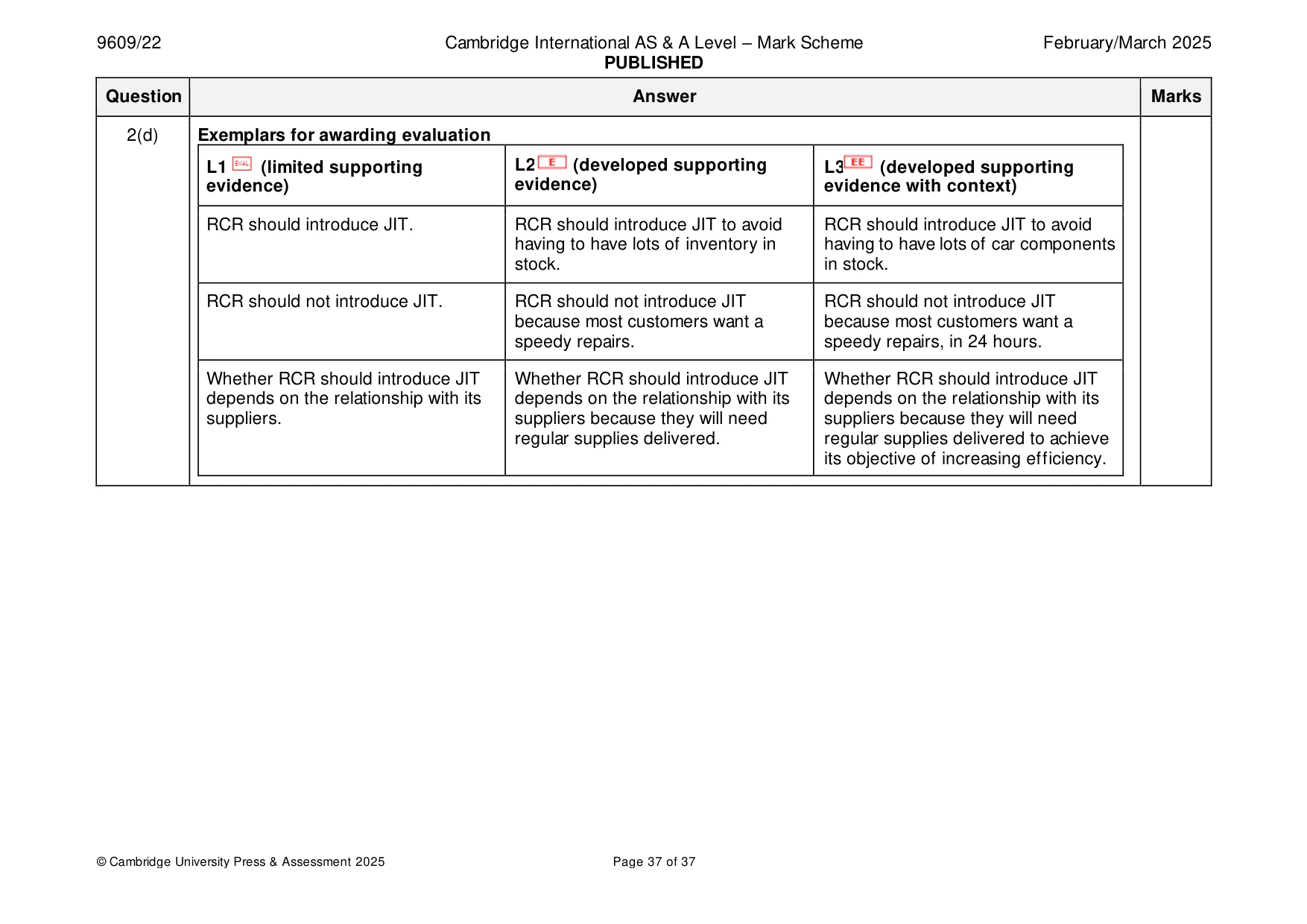
Mark scheme: 2(a)(i) Identify one method of primary market research. 1 Primary research is the first-hand collection of data by an organisation for its own needs. Award any method that meets this definition. Identification of a primary market research may include: • Questionnaires/surveys/feedback • Focus groups • Interviews • Observations • Consumer trials/samples 2(a)(ii) Explain the term qualitative data. 3 AO1 Knowledge and understanding AO2 Application 1 mark 2 marks 2 marks Developed application of one relevant point to a business context. 1 mark 1 mark Knowledge of one relevant point is used to answer the Limited application of one relevant point to a business question. context. 0 marks 0 marks No creditable response. No creditable response. Indicative content AO1 Knowledge and understanding Knowledge of qualitative data may include: • Qualitative data describes customer opinions/qualities/characteristics/subjective. OR • Qualitative data is not measurable in financial or numerical terms. AO2 Application Explanation of qualitative data (max 1 mark), including: • Qualitative data describes customer opinions/qualities/characteristics/subjective. AND • Qualitative data is not measurable in financial or numerical terms. Context applied to qualitative data (max 1 mark), including: • An example of a specific piece of qualitative data • An example of a use of qualitative data • An example of a way of presenting/summarising/analysing 2(a)(ii) Application can be made to RCR or any other scenario/context/business/person. Accept all valid responses. Exemplar and annotations Mark Rationale Qualitative data is not numerical . For example, the owners can 3 Both points covered (K and APP) with an obtain data about customers’ satisfaction with the speed of car example from the context (APP). repairs . Data about customer views and opinions which is not 3 Both points and a generic (but rewardable) measurable for example happiness . example. Not numbers such as opinions . 2 Both points but no further example. Data which can not be measured , such as how much 2 Can not be measured and an example. customers like a chocolate bar . Qualitative data is harder to analyse as it includes information 1 Opinions and characteristics, but only one about customer opinions and characteristics. . point and no context. Data that can be used to make decisions. 0 Too vague. All data can be used to make decisions. No knowledge of qualitative data specifically. 2(b)(i) Refer to Table 2.1 and other information. Calculate the market growth for car repairs in city B between 2023 and 3 2024. Total value of sales in market (2023) = $700 000 (given in text) Formula: New market size (1) Original market size 100 OR The percentage change in the total size of a market (1) OR Total value of sales in market (2024) = (123 165 / 17) 100 = 7245 100 = 724 500 (1) Market growth = 724 500 – 700 000 = 24 500 (1) Answer = $24 500 (3) 2(b)(i) Exemplar and annotations Marks 3 marks Correct answer Working and units do not matter. $24 500 or 24 500 Must be three to denote the three marks. OR 3.5% or 3.5 2 marks ONE of the following: To award two marks, there must be • Correct calculation of 2024 market size • Two and a (724 500) OR OR • One , one and one An incorrect answer with one mistake allowing OFR for final stage. 1 mark One of the following: To award one mark, there must be: • Correct formula • One and two 0 marks No creditable content. To award zero marks, there must be • Three 2(b)(ii) Explain one reason why RCR’s objectives may change over time. 3 AO1 Knowledge and understanding AO2 Application 1 mark 2 marks 2 marks Developed application of one relevant point to a business context. 1 mark 1 mark Knowledge of one relevant point is used to answer the Limited application of one relevant point to a business question. context. 0 marks 0 marks No creditable response. No creditable response. Indicative content AO1 Knowledge and understanding Knowledge of a reason why objectives might change may include: • changing internal factors • changing external factors • the achievement of previous objectives. AO2 Application Explanation of a reason why business objectives may change over time (max 1 mark), including: • changing internal factors – the business might have more resources available – a significant number of workers may have left – a new manager employed. • changing external factors – new competitors enter the market – an increase in market size – customer demand changes 2(b)(ii) • the achievement of previous objectives – if a business has survived then it may now try to be profitable Context applied to a reason why RCR’s objectives may change over time (max 1 mark) including: • RCR is a partnership • Business operated for five years • Repair a wide range of cars • Freya carried out primary market research to understand her customer’s needs and wants • Collected qualitative data • Customers like the speed of RCR’s service • RCR’s market share has increased annually over the past five years • RCR has a 17% share of the market • Employ two mechanics • Kye uses a democratic style of management • Experienced mechanics who have worked for the business since it started five years ago • Holds a large quantity of inventory • Each car type needs different parts • Buys parts from two suppliers • Suppliers have supplied RCR since it started five years ago • RCR has an objective of increasing efficiency • Partners thinking of introducing Just in Time (JIT). Accept all valid responses. 2(b)(ii) Exemplar and annotations Mark Rationale Once RCR has achieved its business objectives they will need to 3 Reasonable knowledge of a reason with change . For example RCR may have previously had an two examples of application. objective to have at least a 15% share of the market when it was set up five years ago , but now the business has a 17% share of the market . The business may face more competition so may need to 2 Knowledge of a reason (competition is an change its objective from increasing efficiency . external influence) and some context. New objectives may be needed if internal factors change . 1 The answer is brief, but shows some knowledge of why objectives may change over time Objectives give owners direction when making business decisions 0 There is no knowledge of a reason why objectives may change, so no marks can . be awarded. 2(c) Analyse two advantages to RCR of Kye using a democratic management style. 8 Level AO1 Knowledge and AO2 Application AO3 Analysis understanding 2 marks 4 marks 2 marks 2 3–4 marks Developed analysis • Developed analysis that identifies connections between causes, impacts and/or consequences of two points. • Developed analysis that identifies connections between causes, impacts and/or consequences of one point. 1 1–2 marks 1–2 marks 1–2 marks • Knowledge of two • Application of two Limited analysis relevant points is relevant points to a • Limited analysis that identifies connections used to answer the business context. between causes, impacts and/or consequences of question. • Application of one two points. • Knowledge of one relevant point to a • Limited analysis that identifies connections relevant point is business context. between causes, impacts and/or consequences of used to answer the one point. question. 0 0 marks 0 marks 0 marks No creditable response. No creditable response. No creditable response. Annotate the first advantage in the left-hand margin and the second in the right-hand marking. 2(c) Indicative content AO1 Knowledge and understanding Democratic management style is where the manager actively involves employees in decision making. Knowledge of advantages of using a democratic management style (max 2 s), may include: • Increased motivation • Low labour turnover • More ideas from workforce • Better ideas from workforce (potentially) • More experiences are considered in decision making • May allows for more efficient problem solving (do not accept ‘quicker’ unless this is explained) AO2 Application Max one for application in one advantage and max two for application in two advantages. • RCR is a partnership • Business operated for five years • Repair a wide range of cars • Freya carried out primary market research to understand her customer’s needs and wants • Collected qualitative data • Customers like the speed of RCR’s service • RCR’s market share has increased annually over the past five years • RCR has a 17% share of the market • Freya and Kye have no experience of repairing cars • Employ two mechanics • Experienced mechanics who have worked for the business since it started five years ago • Holds a large quantity of inventory • Each car type needs different parts • Buys parts from two suppliers • RCR has an objective of increasing efficiency AO3 Analysis Limited analysis – candidate shows one link in the chain of analysis. Developed analysis candidate shows two or more links in the chain of analysis or a two-sided analysis. 2(c) Analysis of advantages may include: • RCR’s customers like the speed of service offered. The employees are likely to be more motivated as consulted about decisions. Motivated employees are likely to be more productive and offer a quicker work rate. • Two employees are experienced and worked for RCR since it was launched so contributions are likely to lead to more successful decision making, increasing profitability/customer satisfaction. • Lower recruitment costs/time to train new employees etc. due to the low level of labour turnover. Accept all valid responses. Exemplar and annotations AO1 Knowledge AO2 Application AO3 Analysis Exemplar of an advantage Better decision making as the opinions of the two This could help the mechanics can be business to identify other considered . ways of increasing efficiency which could help it to operate more profitably . 2(d) Evaluate whether RCR should introduce Just in Time (JIT). 12 Level AO1 Knowledge AO2 Application AO3 Analysis AO4 Evaluation and understanding 2 marks 2 marks 6 marks 2 marks 3 5–6 marks Developed evaluation in context • A developed judgement/conclusion is made in the business context. • Developed evaluative comments which balance some key arguments in the business context. 2 2 marks 2 marks 2 marks 3–4 marks Developed Developed Developed analysis Developed evaluation knowledge of application of that identifies • A developed judgement/conclusion is relevant key term(s) relevant point(s) to connections made. and/or factor(s) is the business between causes, • Developed evaluative comments used to answer the context. impacts and/or which balance some key arguments. question. consequences. 1 1 mark 1 mark 1 mark 1–2 marks Limited knowledge Limited application Limited analysis Limited evaluation of relevant key of relevant point(s) that identifies • A judgement/conclusion is made with term(s) and/or to the business connections limited supporting comment/evidence. factor(s) is used to context. between causes, • An attempt is made to balance the answer the question. impacts and/or arguments. consequences. 0 0 marks 0 marks 0 marks 0 marks No creditable No creditable No creditable No creditable response. response. response. response. 2(d) Indicative content AO1 Knowledge and understanding Knowledge of JIT (max 2 s), including: • JIT is an inventory management system • JIT is where inventory is ordered to be delivered at the time that the part is needed by the business. • Less/zero inventory held • JIT is often used when the customer order initiates the ordering of inventory. AO2 Application Limited application applies knowledge of the use of JIT to RCR once. Developed application + applies knowledge of the use of JIT to RCR twice. • RCR is a partnership • Business operated for five years • Repair a wide range of cars • Freya carried out primary market research to understand her customer’s needs and wants • Collected qualitative data • Customers like the speed of RCR’s service • RCR’s market share has increased annually over the past five years • RCR has a 17% share of the market • Freya and Kye have no experience of repairing cars • Employ two mechanics • Kye uses a democratic style of management • Experienced mechanics who have worked for the business since it started five years ago • Holds a large quantity of inventory • Each car type needs different parts • Buys parts from two suppliers • RCR has an objective of increasing efficiency 2(d) AO3 Analysis Limited analysis – candidate shows one link in the chain of analysis. Developed analysis – candidate shows two or more links in the chain of analysis. Analysis for the introduction of JIT, including: • Reduces inventory holding costs – increased profitability • May reduce wastage of materials/inventory – reducing total costs • Reduces capital tied up in inventory – which could be spent on extra marketing to increase sales (opportunity cost) • Responsive to changes in demand – reducing costs / increasing efficiency • Improved cash flow – improving RCR’s liquidity/ working capital (opportunity cost) • May improve supplier relationship – reduced prices / increased demand Analysis against the introduction of JIT, including: • Business would be vulnerable to supply chain disruptions – lower sales / poor customer satisfaction • May exacerbate poor supplier relationships – need to find a new/ more reliable supplier. • Increased transportation costs (due to more deliveries) – reduced profitability • Increased inefficiency (if inventory is not delivered on time) – reduced productivity • Less control over supply chain – increased costs • May not be suitable for large fluctuations/ unexpected changes in demand – lower sales/revenue • Requires careful coordination of production process and inventory ordering – increased training costs AO4 Evaluation Limited evaluation – unsupported judgement and/or a weak attempt at evaluative comment Developed evaluation – supported judgement and/or reasonable evaluative comment Developed evaluation in context – supported judgement in context and/or reasonable evaluative comment in context. • A judgement whether RCR should introduce JIT, with justification. • A judgement that RCR should continue without using JIT (or continue to use Just in Case – JIC). • What the judgement might depend upon, such as, suppliers, geography, objectives, external environment, actions of competitors, short term vs long term etc. • A discussion of the impact of technology (for example electric cars) on RCR’s decision. Accept all valid responses. 2(d) Exemplars for awarding evaluation L1 (limited supporting L2 (developed supporting L3 (developed supporting evidence) evidence) evidence with context) RCR should introduce JIT. RCR should introduce JIT to avoid RCR should introduce JIT to avoid having to have lots of inventory in having to have lots of car components stock. in stock. RCR should not introduce JIT. RCR should not introduce JIT RCR should not introduce JIT because most customers want a because most customers want a speedy repairs. speedy repairs, in 24 hours. Whether RCR should introduce JIT Whether RCR should introduce JIT Whether RCR should introduce JIT depends on the relationship with its depends on the relationship with its depends on the relationship with its suppliers. suppliers because they will need suppliers because they will need regular supplies delivered. regular supplies delivered to achieve its objective of increasing efficiency.
What was in this paper
The subtopics covered by these 2 questions, and how many questions each got. Open one in a new tab to see every Cambridge question on it.
What you needed in this session
Cambridge’s own grade thresholds for 2025 Feb/March, Paper 2 · Variant 2. A higher threshold means an easier paper — the bar moves with how the cohort did.