Cambridge A Level Business (for first examination in 2016) 9609 — 2025 Oct/Nov Paper 2 · Variant 1
9609/21/O/N/25 · 2 questions · 60 marks · ≈68 min
The question paper and its mark scheme, free to read here and free to download. This is Cambridge’s own paper, exactly as it was sat.
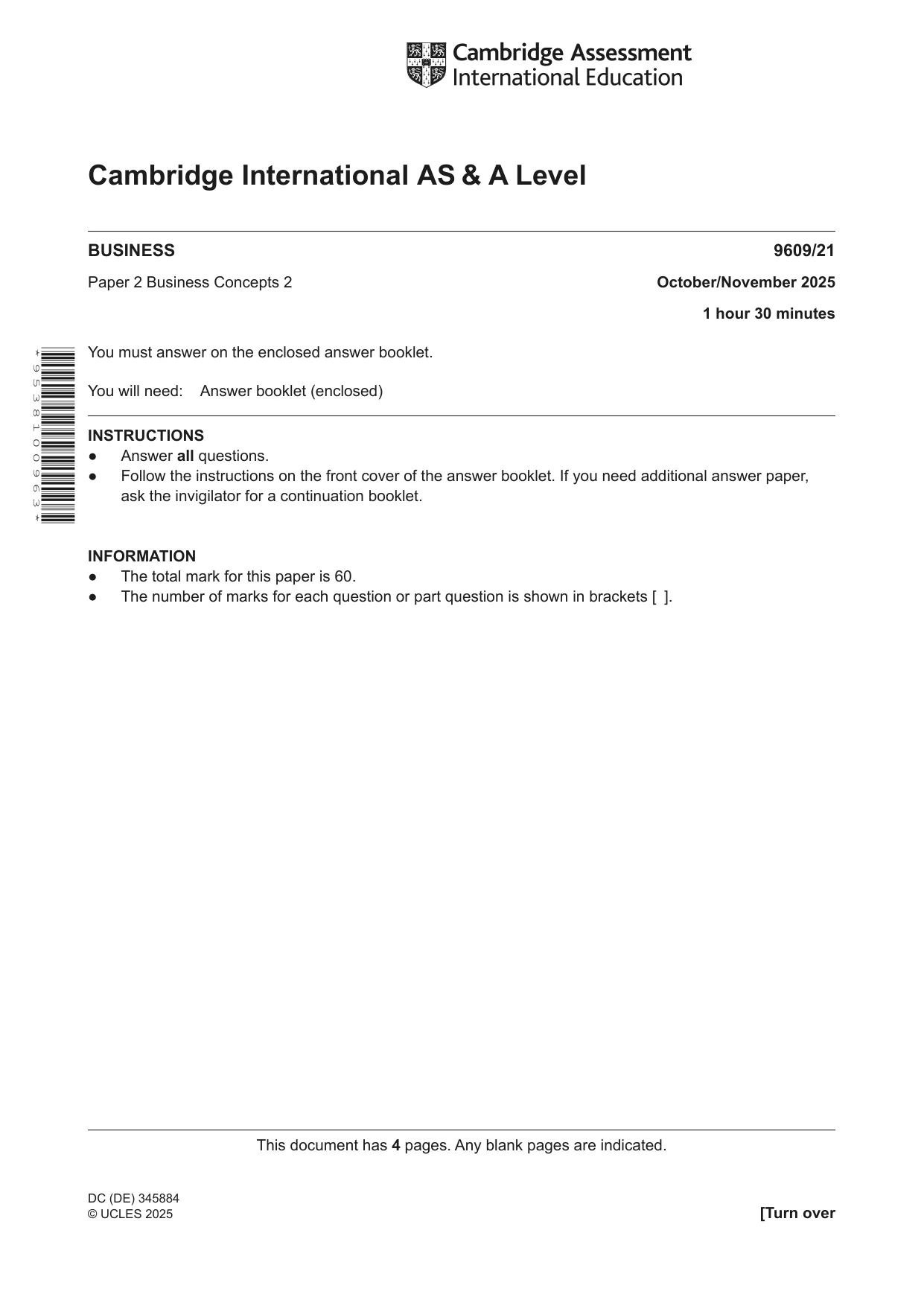
Question paper4 pages

Mark scheme30 pages
Answers below. Sit the paper first if you are practising.
Questions as text
Q1 · Clever Bean (CB) CB is a public limited company that operates a chain of coffee shops in…
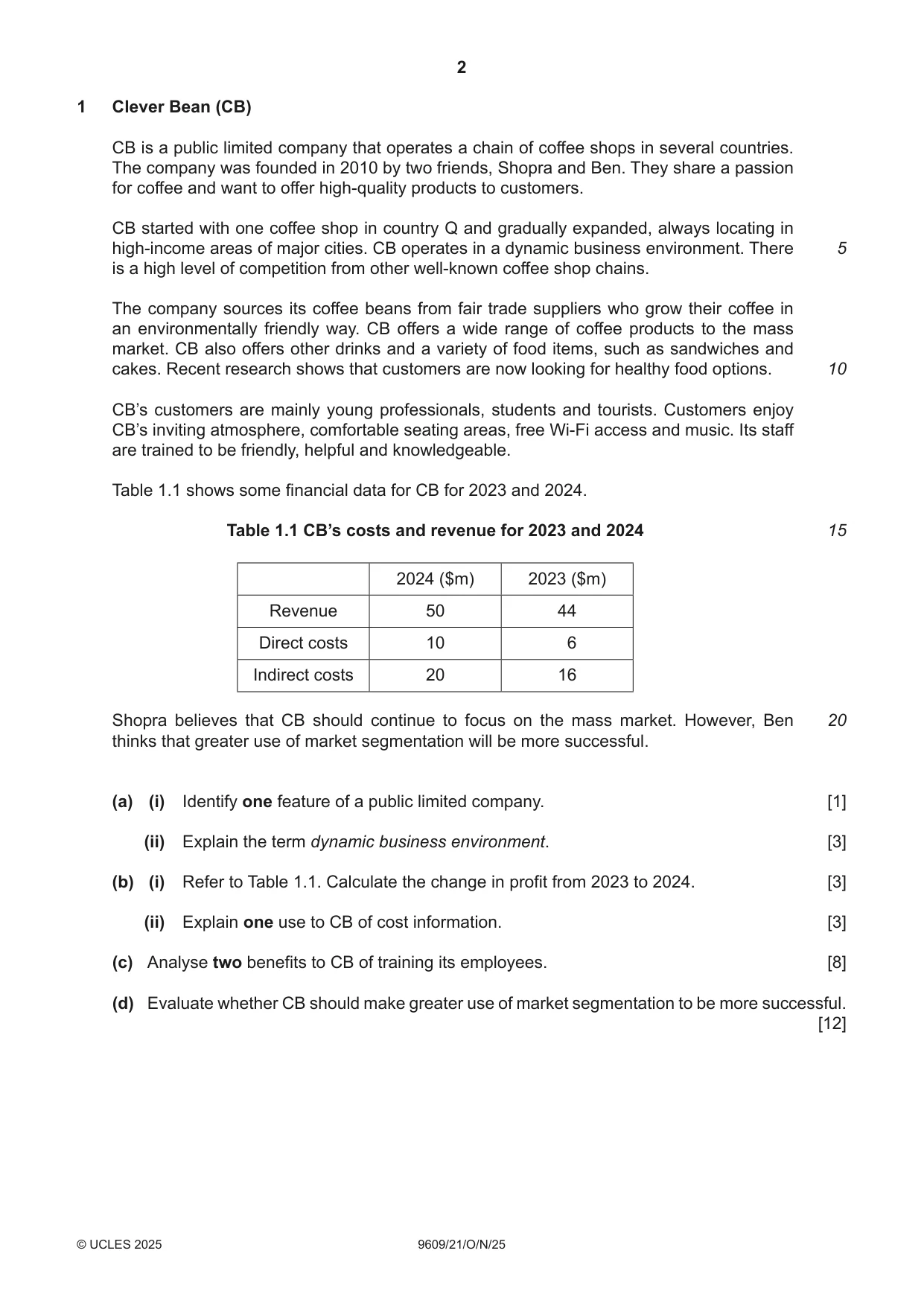
1 Clever Bean (CB) CB is a public limited company that operates a chain of coffee shops in several countries. The company was founded in 2010 by two friends, Shopra and Ben. They share a passion for coffee and want to offer high-quality products to customers. CB started with one coffee shop in country Q and gradually expanded, always locating in high-income areas of major cities. CB operates in a dynamic business environment. There 5 is a high level of competition from other well-known coffee shop chains. The company sources its coffee beans from fair trade suppliers who grow their coffee in an environmentally friendly way. CB offers a wide range of coffee products to the mass market. CB also offers other drinks and a variety of food items, such as sandwiches and cakes. Recent research shows that customers are now looking for healthy food options. 10 CB’s customers are mainly young professionals, students and tourists. Customers enjoy CB’s inviting atmosphere, comfortable seating areas, free Wi-Fi access and music. Its staff are trained to be friendly, helpful and knowledgeable. Table 1.1 shows some financial data for CB for 2023 and 2024. Table 1.1 CB’s costs and revenue for 2023 and 2024 15 2024 ($m) 2023 ($m) Revenue 50 44 Direct costs 10 6 Indirect costs 20 16 Shopra believes that CB should continue to focus on the mass market. However, Ben 20 thinks that greater use of market segmentation will be more successful. (a) (i) Identify one feature of a public limited company. [1] (ii) Explain the term dynamic business environment. [3] (b) (i) Refer to Table 1.1. Calculate the change in profit from 2023 to 2024. [3] (ii) Explain one use to CB of cost information. [3] (c) Analyse two benefits to CB of training its employees. [8] (d) Evaluate whether CB should make greater use of market segmentation to be more successful. [12]
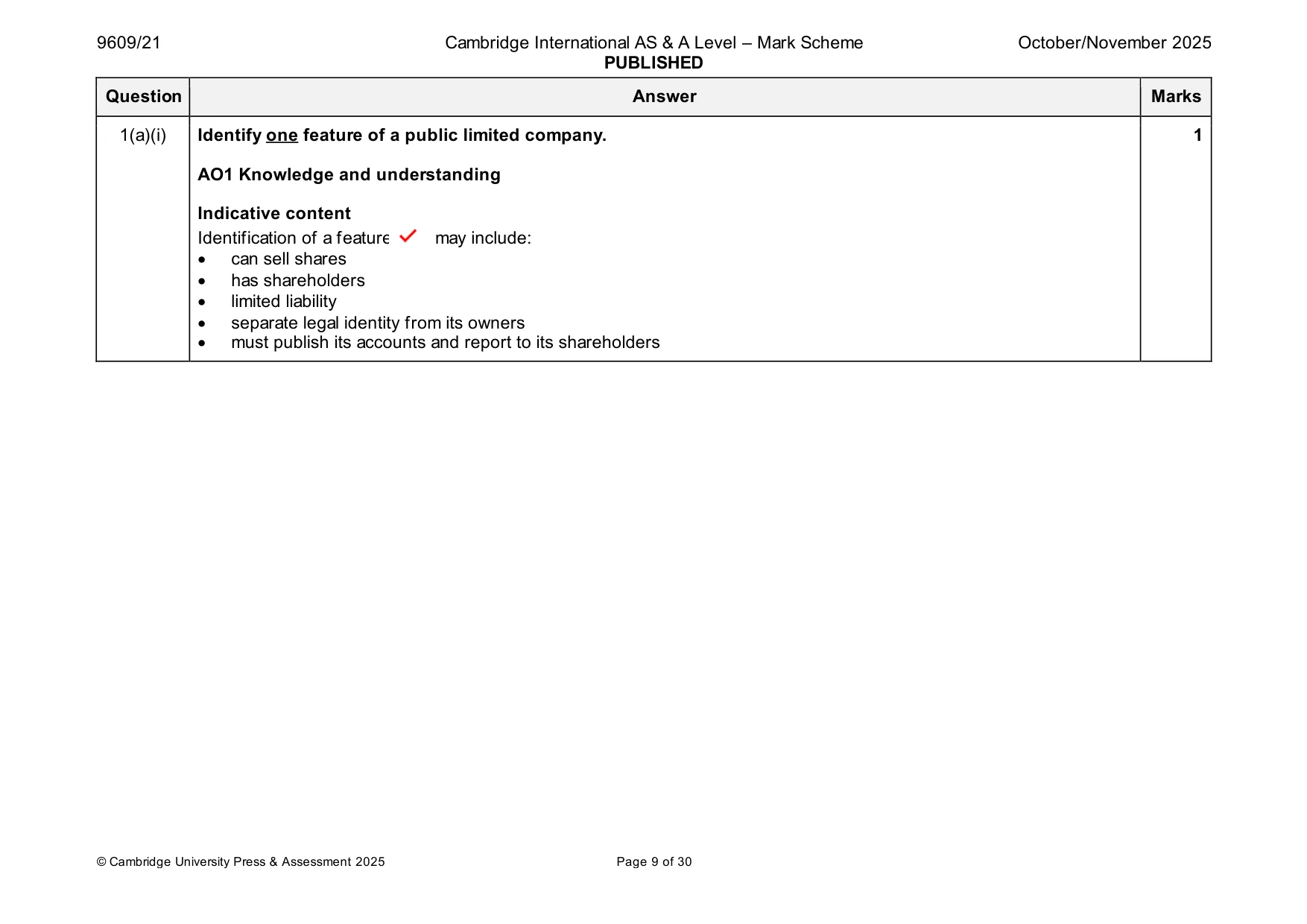
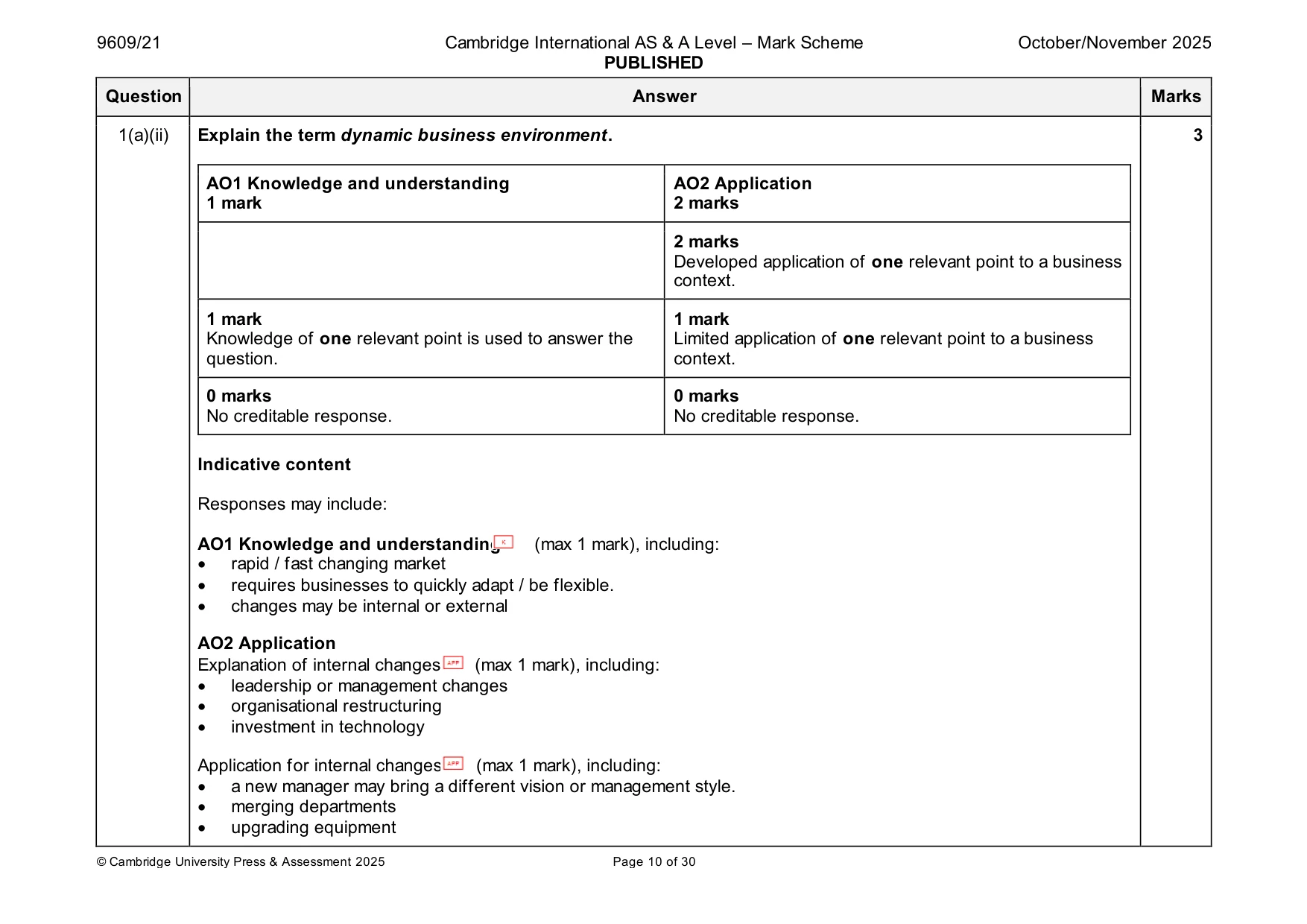
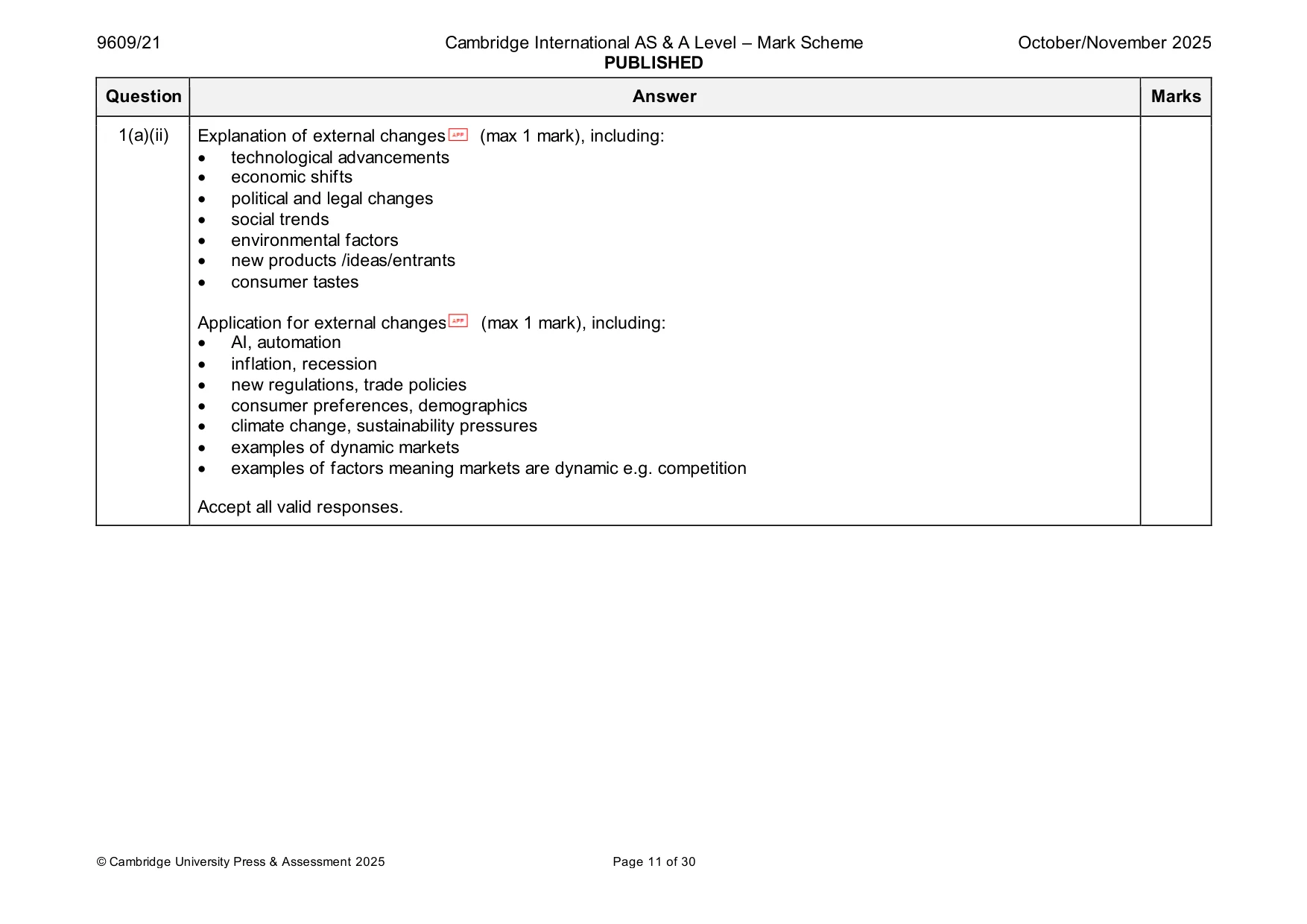
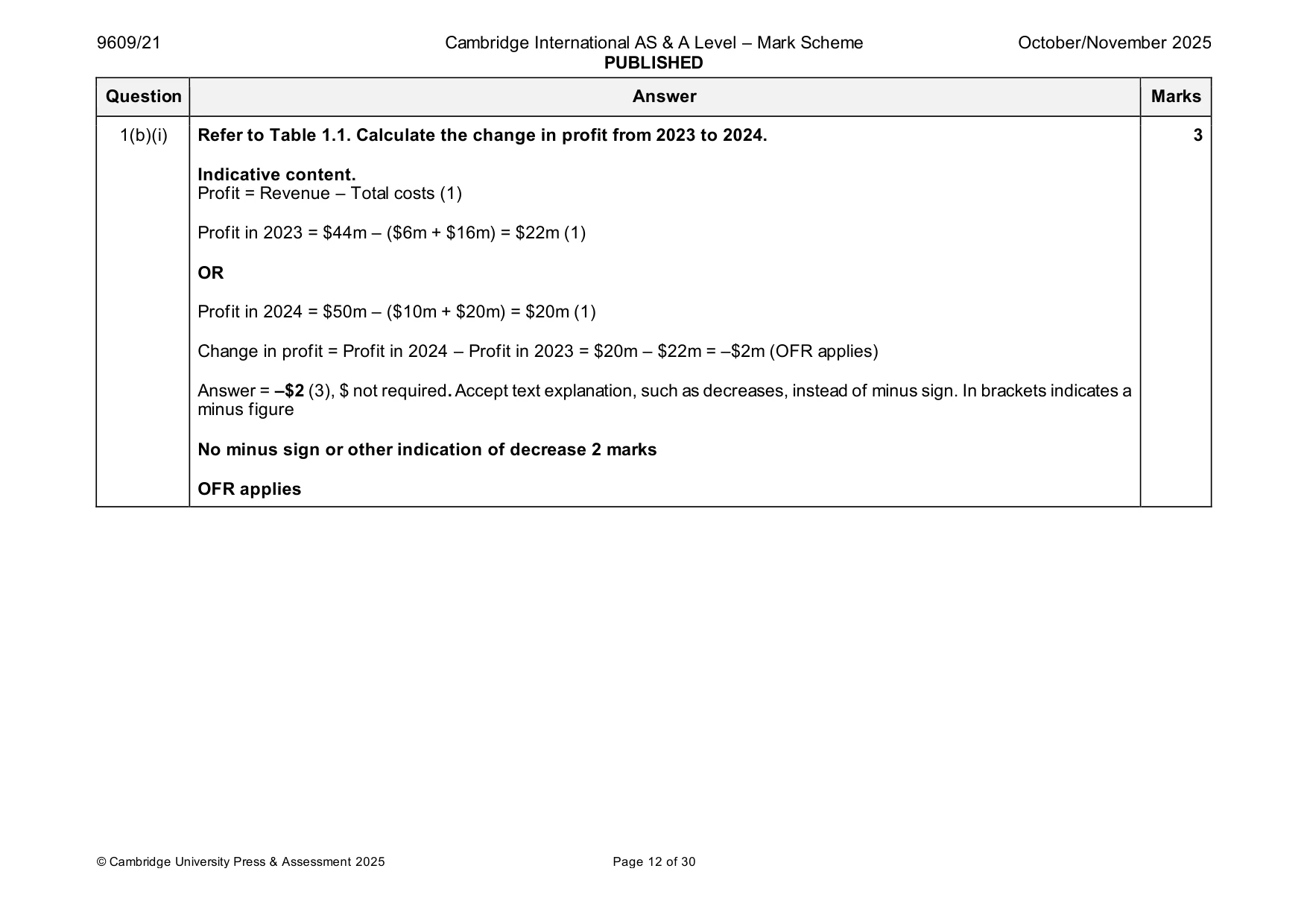
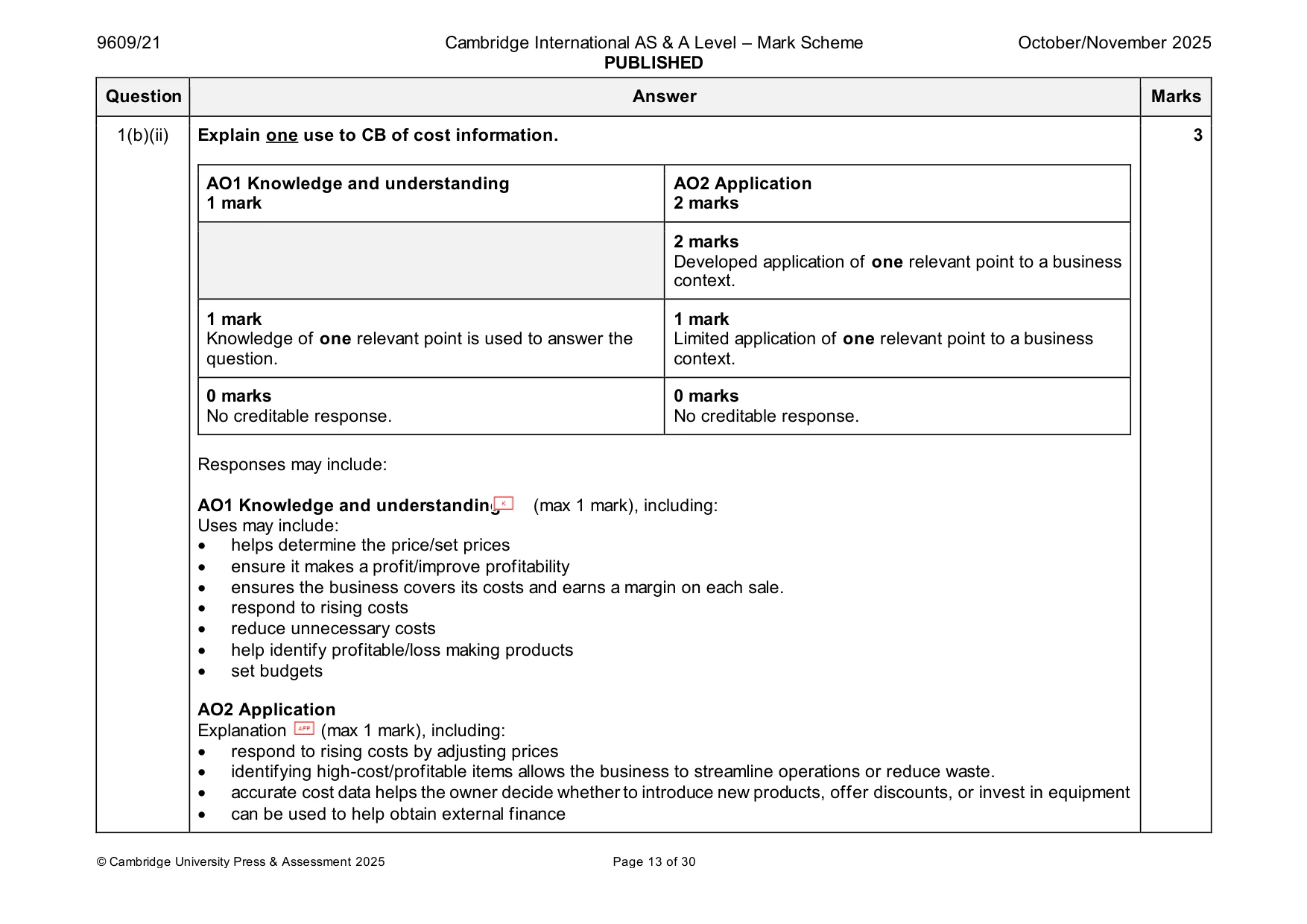
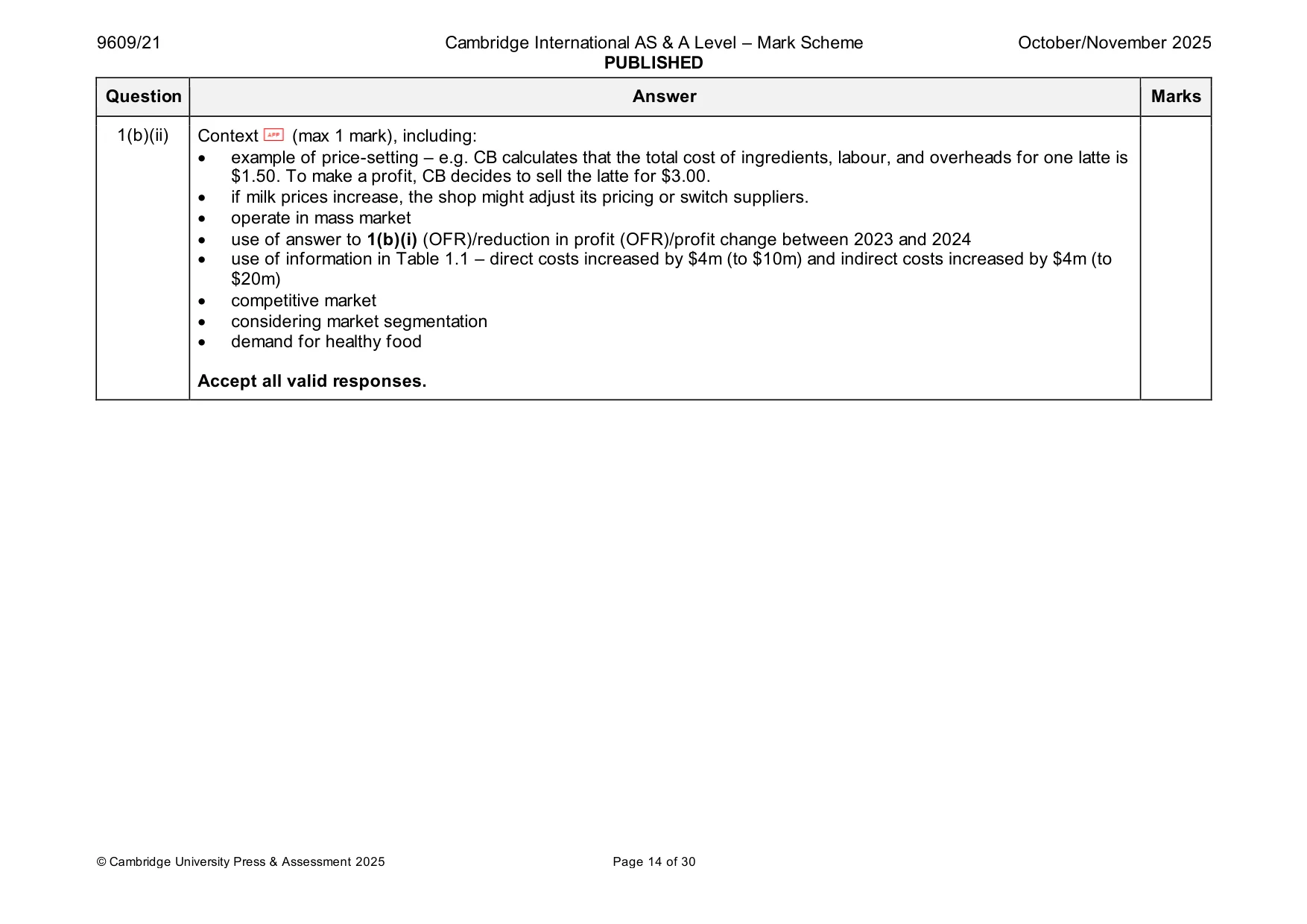
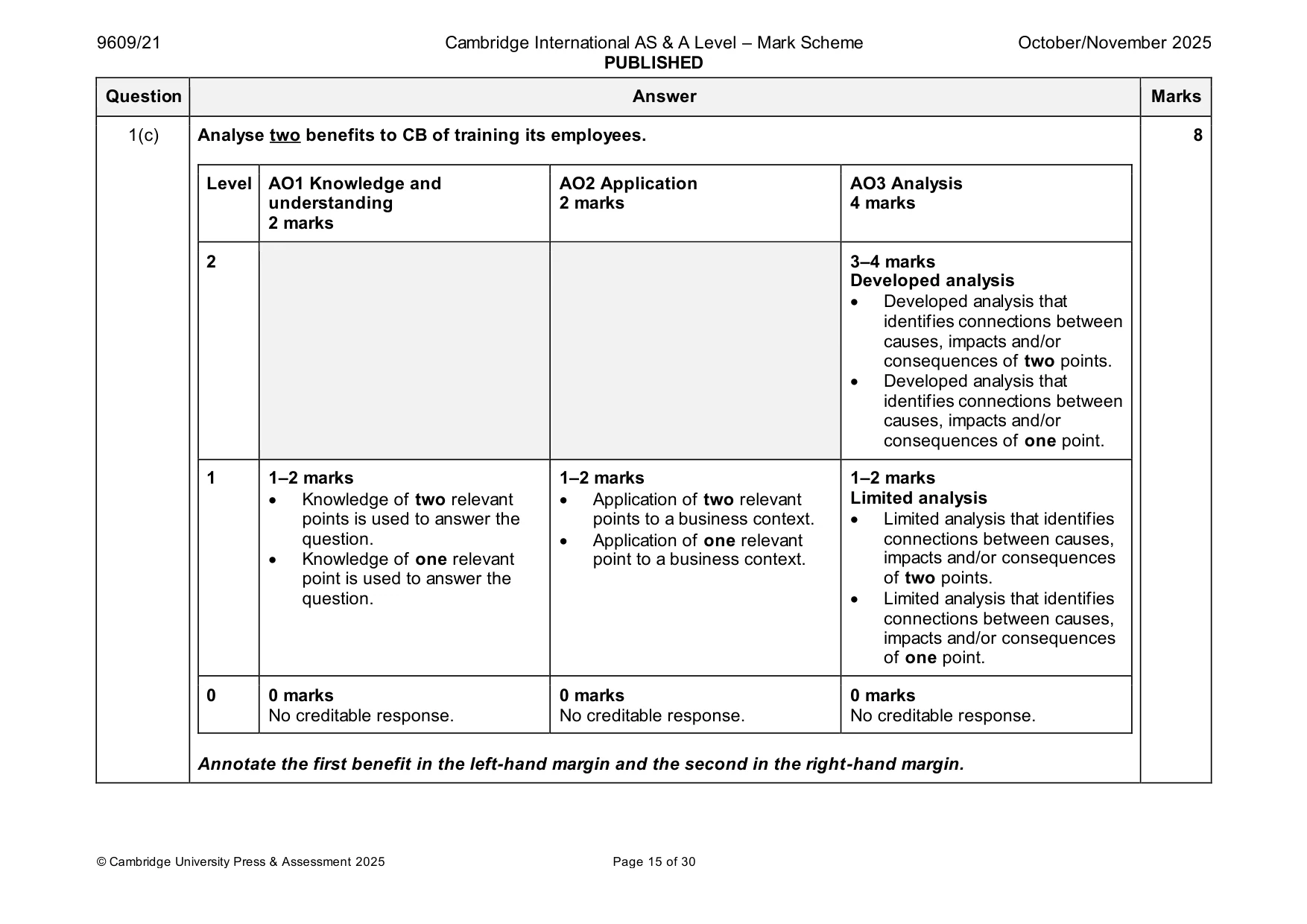
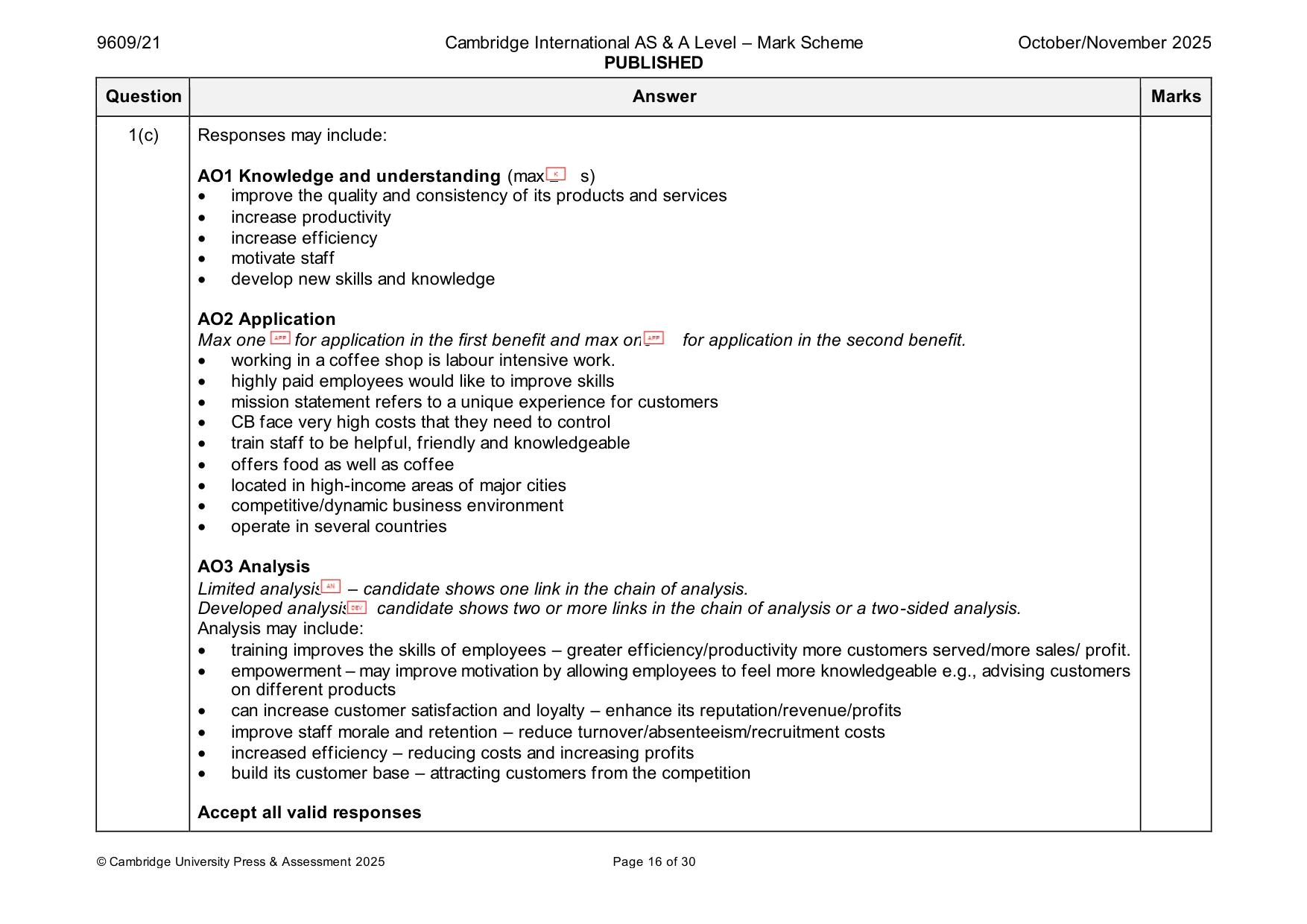
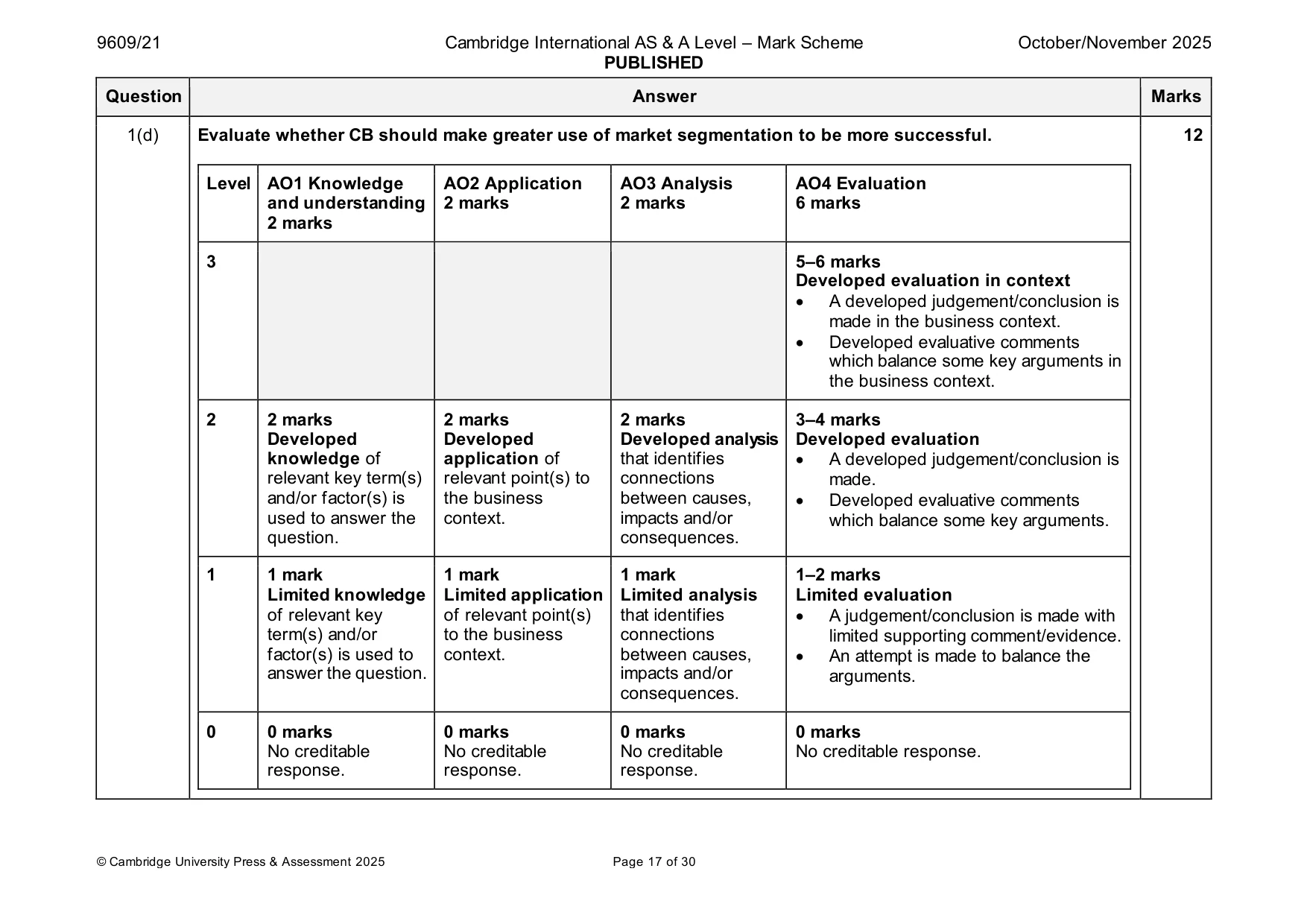
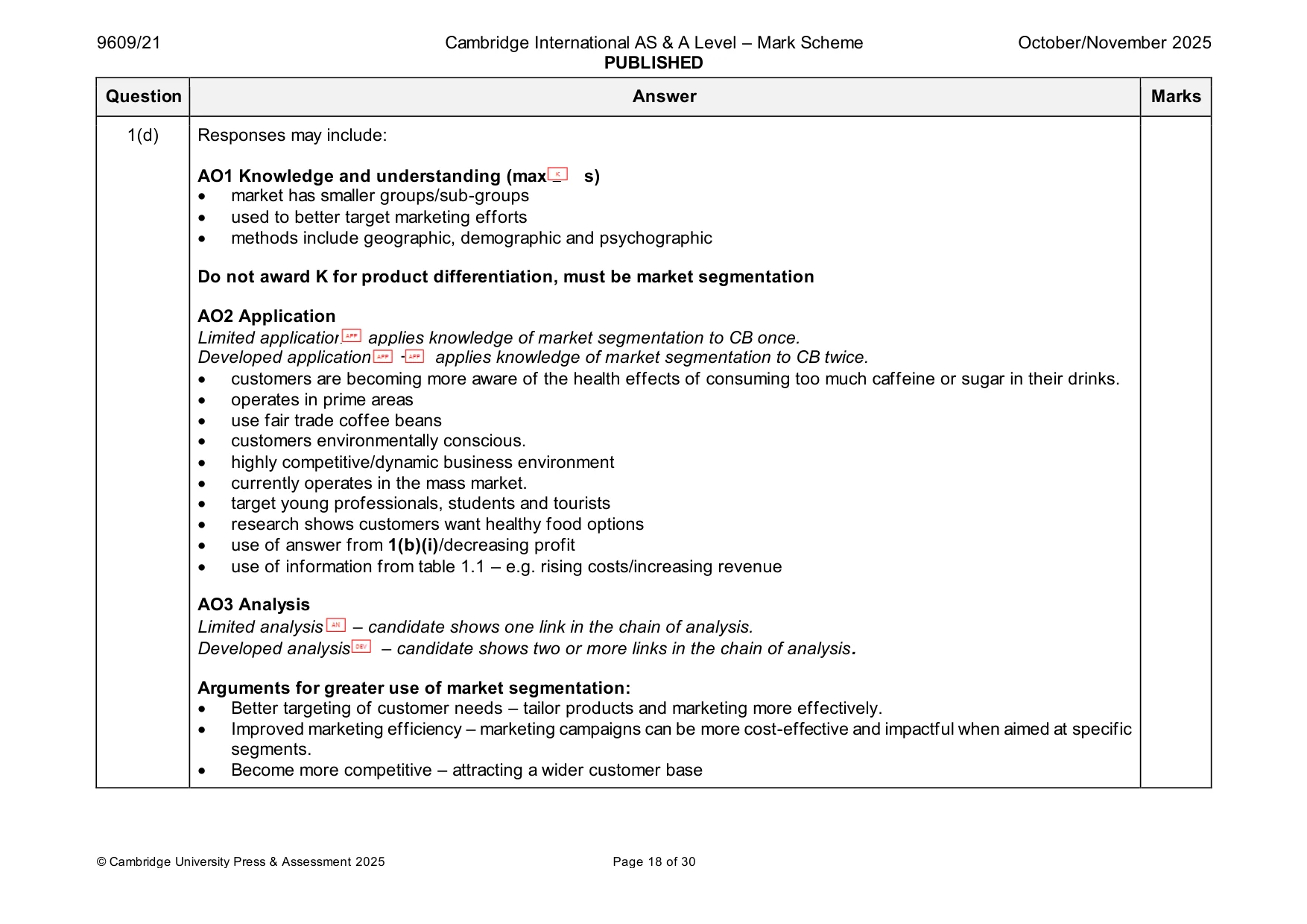
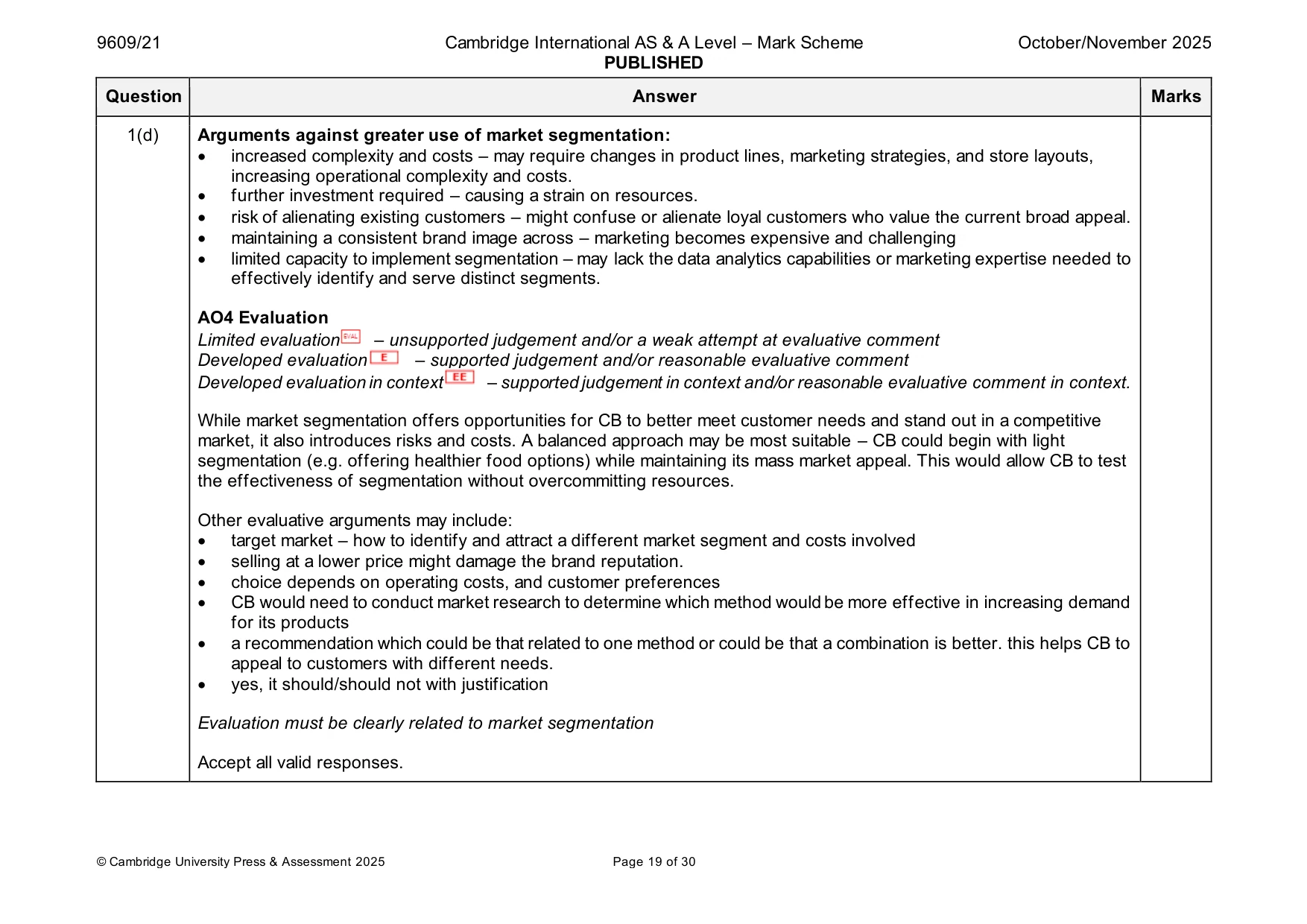
Mark scheme: Question Answer Marks 1(a)(i) Identify one feature of a public limited company. 1 AO1 Knowledge and understanding Indicative content Identification of a feature may include: • can sell shares • has shareholders • limited liability • separate legal identity from its owners • must publish its accounts and report to its shareholders 1(a)(ii) Explain the term dynamic business environment. 3 AO1 Knowledge and understanding AO2 Application 1 mark 2 marks 2 marks Developed application of one relevant point to a business context. 1 mark 1 mark Knowledge of one relevant point is used to answer the Limited application of one relevant point to a business question. context. 0 marks 0 marks No creditable response. No creditable response. Indicative content Responses may include: AO1 Knowledge and understanding (max 1 mark), including: • rapid / fast changing market • requires businesses to quickly adapt / be flexible. • changes may be internal or external AO2 Application Explanation of internal changes (max 1 mark), including: • leadership or management changes • organisational restructuring • investment in technology Application for internal changes (max 1 mark), including: • a new manager may bring a different vision or management style. • merging departments • upgrading equipment 1(a)(ii) Explanation of external changes (max 1 mark), including: • technological advancements • economic shifts • political and legal changes • social trends • environmental factors • new products /ideas/entrants • consumer tastes Application for external changes (max 1 mark), including: • AI, automation • inflation, recession • new regulations, trade policies • consumer preferences, demographics • climate change, sustainability pressures • examples of dynamic markets • examples of factors meaning markets are dynamic e.g. competition Accept all valid responses. 1(b)(i) Refer to Table 1.1. Calculate the change in profit from 2023 to 2024. 3 Indicative content. Profit = Revenue – Total costs (1) Profit in 2023 = $44m – ($6m + $16m) = $22m (1) OR Profit in 2024 = $50m – ($10m + $20m) = $20m (1) Change in profit = Profit in 2024 – Profit in 2023 = $20m – $22m = –$2m (OFR applies) Answer = –$2 (3), $ not required. Accept text explanation, such as decreases, instead of minus sign. In brackets indicates a minus figure No minus sign or other indication of decrease 2 marks OFR applies 1(b)(ii) Explain one use to CB of cost information. 3 AO1 Knowledge and understanding AO2 Application 1 mark 2 marks 2 marks Developed application of one relevant point to a business context. 1 mark 1 mark Knowledge of one relevant point is used to answer the Limited application of one relevant point to a business question. context. 0 marks 0 marks No creditable response. No creditable response. Responses may include: AO1 Knowledge and understanding (max 1 mark), including: Uses may include: • helps determine the price/set prices • ensure it makes a profit/improve profitability • ensures the business covers its costs and earns a margin on each sale. • respond to rising costs • reduce unnecessary costs • help identify profitable/loss making products • set budgets AO2 Application Explanation (max 1 mark), including: • respond to rising costs by adjusting prices • identifying high-cost/profitable items allows the business to streamline operations or reduce waste. • accurate cost data helps the owner decide whether to introduce new products, offer discounts, or invest in equipment • can be used to help obtain external finance 1(b)(ii) Context (max 1 mark), including: • example of price-setting – e.g. CB calculates that the total cost of ingredients, labour, and overheads for one latte is $1.50. To make a profit, CB decides to sell the latte for $3.00. • if milk prices increase, the shop might adjust its pricing or switch suppliers. • operate in mass market • use of answer to 1(b)(i) (OFR)/reduction in profit (OFR)/profit change between 2023 and 2024 • use of information in Table 1.1 – direct costs increased by $4m (to $10m) and indirect costs increased by $4m (to $20m) • competitive market • considering market segmentation • demand for healthy food Accept all valid responses. 1(c) Analyse two benefits to CB of training its employees. 8 Level AO1 Knowledge and AO2 Application AO3 Analysis understanding 2 marks 4 marks 2 marks 2 3–4 marks Developed analysis • Developed analysis that identifies connections between causes, impacts and/or consequences of two points. • Developed analysis that identifies connections between causes, impacts and/or consequences of one point. 1 1–2 marks 1–2 marks 1–2 marks • Knowledge of two relevant • Application of two relevant Limited analysis points is used to answer the points to a business context. • Limited analysis that identifies question. • Application of one relevant connections between causes, • Knowledge of one relevant point to a business context. impacts and/or consequences point is used to answer the of two points. question. • Limited analysis that identifies connections between causes, impacts and/or consequences of one point. 0 0 marks 0 marks 0 marks No creditable response. No creditable response. No creditable response. Annotate the first benefit in the left-hand margin and the second in the right-hand margin. 1(c) Responses may include: AO1 Knowledge and understanding (max 2 s) • improve the quality and consistency of its products and services • increase productivity • increase efficiency • motivate staff • develop new skills and knowledge AO2 Application Max one for application in the first benefit and max one for application in the second benefit. • working in a coffee shop is labour intensive work. • highly paid employees would like to improve skills • mission statement refers to a unique experience for customers • CB face very high costs that they need to control • train staff to be helpful, friendly and knowledgeable • offers food as well as coffee • located in high-income areas of major cities • competitive/dynamic business environment • operate in several countries AO3 Analysis Limited analysis – candidate shows one link in the chain of analysis. Developed analysis candidate shows two or more links in the chain of analysis or a two-sided analysis. Analysis may include: • training improves the skills of employees – greater efficiency/productivity more customers served/more sales/ profit. • empowerment – may improve motivation by allowing employees to feel more knowledgeable e.g., advising customers on different products • can increase customer satisfaction and loyalty – enhance its reputation/revenue/profits • improve staff morale and retention – reduce turnover/absenteeism/recruitment costs • increased efficiency – reducing costs and increasing profits • build its customer base – attracting customers from the competition Accept all valid responses 1(d) Evaluate whether CB should make greater use of market segmentation to be more successful. 12 Level AO1 Knowledge AO2 Application AO3 Analysis AO4 Evaluation and understanding 2 marks 2 marks 6 marks 2 marks 3 5–6 marks Developed evaluation in context • A developed judgement/conclusion is made in the business context. • Developed evaluative comments which balance some key arguments in the business context. 2 2 marks 2 marks 2 marks 3–4 marks Developed Developed Developed analysis Developed evaluation knowledge of application of that identifies • A developed judgement/conclusion is relevant key term(s) relevant point(s) to connections made. and/or factor(s) is the business between causes, • Developed evaluative comments used to answer the context. impacts and/or which balance some key arguments. question. consequences. 1 1 mark 1 mark 1 mark 1–2 marks Limited knowledge Limited application Limited analysis Limited evaluation of relevant key of relevant point(s) that identifies • A judgement/conclusion is made with term(s) and/or to the business connections limited supporting comment/evidence. factor(s) is used to context. between causes, • An attempt is made to balance the answer the question. impacts and/or arguments. consequences. 0 0 marks 0 marks 0 marks 0 marks No creditable No creditable No creditable No creditable response. response. response. response. 1(d) Responses may include: AO1 Knowledge and understanding (max 2 s) • market has smaller groups/sub-groups • used to better target marketing efforts • methods include geographic, demographic and psychographic Do not award K for product differentiation, must be market segmentation AO2 Application Limited application applies knowledge of market segmentation to CB once. Developed application + applies knowledge of market segmentation to CB twice. • customers are becoming more aware of the health effects of consuming too much caffeine or sugar in their drinks. • operates in prime areas • use fair trade coffee beans • customers environmentally conscious. • highly competitive/dynamic business environment • currently operates in the mass market. • target young professionals, students and tourists • research shows customers want healthy food options • use of answer from 1(b)(i)/decreasing profit • use of information from table 1.1 – e.g. rising costs/increasing revenue AO3 Analysis Limited analysis – candidate shows one link in the chain of analysis. Developed analysis – candidate shows two or more links in the chain of analysis. Arguments for greater use of market segmentation: • Better targeting of customer needs – tailor products and marketing more effectively. • Improved marketing efficiency – marketing campaigns can be more cost-effective and impactful when aimed at specific segments. • Become more competitive – attracting a wider customer base 1(d) Arguments against greater use of market segmentation: • increased complexity and costs – may require changes in product lines, marketing strategies, and store layouts, increasing operational complexity and costs. • further investment required – causing a strain on resources. • risk of alienating existing customers – might confuse or alienate loyal customers who value the current broad appeal. • maintaining a consistent brand image across – marketing becomes expensive and challenging • limited capacity to implement segmentation – may lack the data analytics capabilities or marketing expertise needed to effectively identify and serve distinct segments. AO4 Evaluation Limited evaluation – unsupported judgement and/or a weak attempt at evaluative comment Developed evaluation – supported judgement and/or reasonable evaluative comment Developed evaluation in context – supported judgement in context and/or reasonable evaluative comment in context. While market segmentation offers opportunities for CB to better meet customer needs and stand out in a competitive market, it also introduces risks and costs. A balanced approach may be most suitable – CB could begin with light segmentation (e.g. offering healthier food options) while maintaining its mass market appeal. This would allow CB to test the effectiveness of segmentation without overcommitting resources. Other evaluative arguments may include: • target market – how to identify and attract a different market segment and costs involved • selling at a lower price might damage the brand reputation. • choice depends on operating costs, and customer preferences • CB would need to conduct market research to determine which method would be more effective in increasing demand for its products • a recommendation which could be that related to one method or could be that a combination is better. this helps CB to appeal to customers with different needs. • yes, it should/should not with justification Evaluation must be clearly related to market segmentation Accept all valid responses.
Q2 · Natalia’s Naturals (NN) NN is a small business owned by Natalia
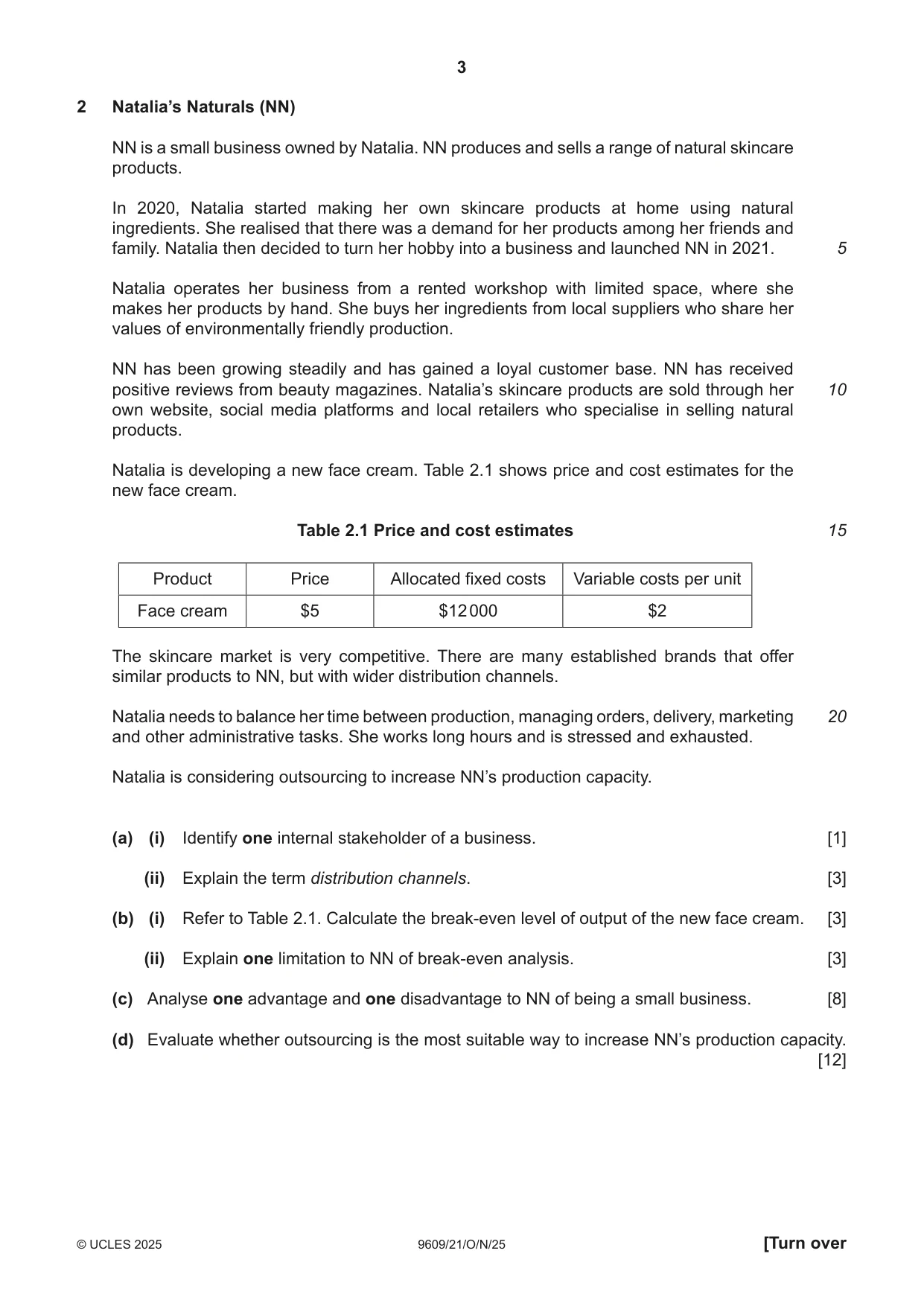
2 Natalia’s Naturals (NN) NN is a small business owned by Natalia. NN produces and sells a range of natural skincare products. In 2020, Natalia started making her own skincare products at home using natural ingredients. She realised that there was a demand for her products among her friends and family. Natalia then decided to turn her hobby into a business and launched NN in 2021. 5 Natalia operates her business from a rented workshop with limited space, where she makes her products by hand. She buys her ingredients from local suppliers who share her values of environmentally friendly production. NN has been growing steadily and has gained a loyal customer base. NN has received positive reviews from beauty magazines. Natalia’s skincare products are sold through her 10 own website, social media platforms and local retailers who specialise in selling natural products. Natalia is developing a new face cream. Table 2.1 shows price and cost estimates for the new face cream. Table 2.1 Price and cost estimates 15 Product Price Allocated fixed costs Variable costs per unit Face cream $5 $12 000 $2 The skincare market is very competitive. There are many established brands that offer similar products to NN, but with wider distribution channels. Natalia needs to balance her time between production, managing orders, delivery, marketing 20 and other administrative tasks. She works long hours and is stressed and exhausted. Natalia is considering outsourcing to increase NN’s production capacity. (a) (i) Identify one internal stakeholder of a business. [1] (ii) Explain the term distribution channels. [3] (b) (i) Refer to Table 2.1. Calculate the break-even level of output of the new face cream. [3] (ii) Explain one limitation to NN of break-even analysis. [3] (c) Analyse one advantage and one disadvantage to NN of being a small business. [8] (d) Evaluate whether outsourcing is the most suitable way to increase NN’s production capacity. [12]
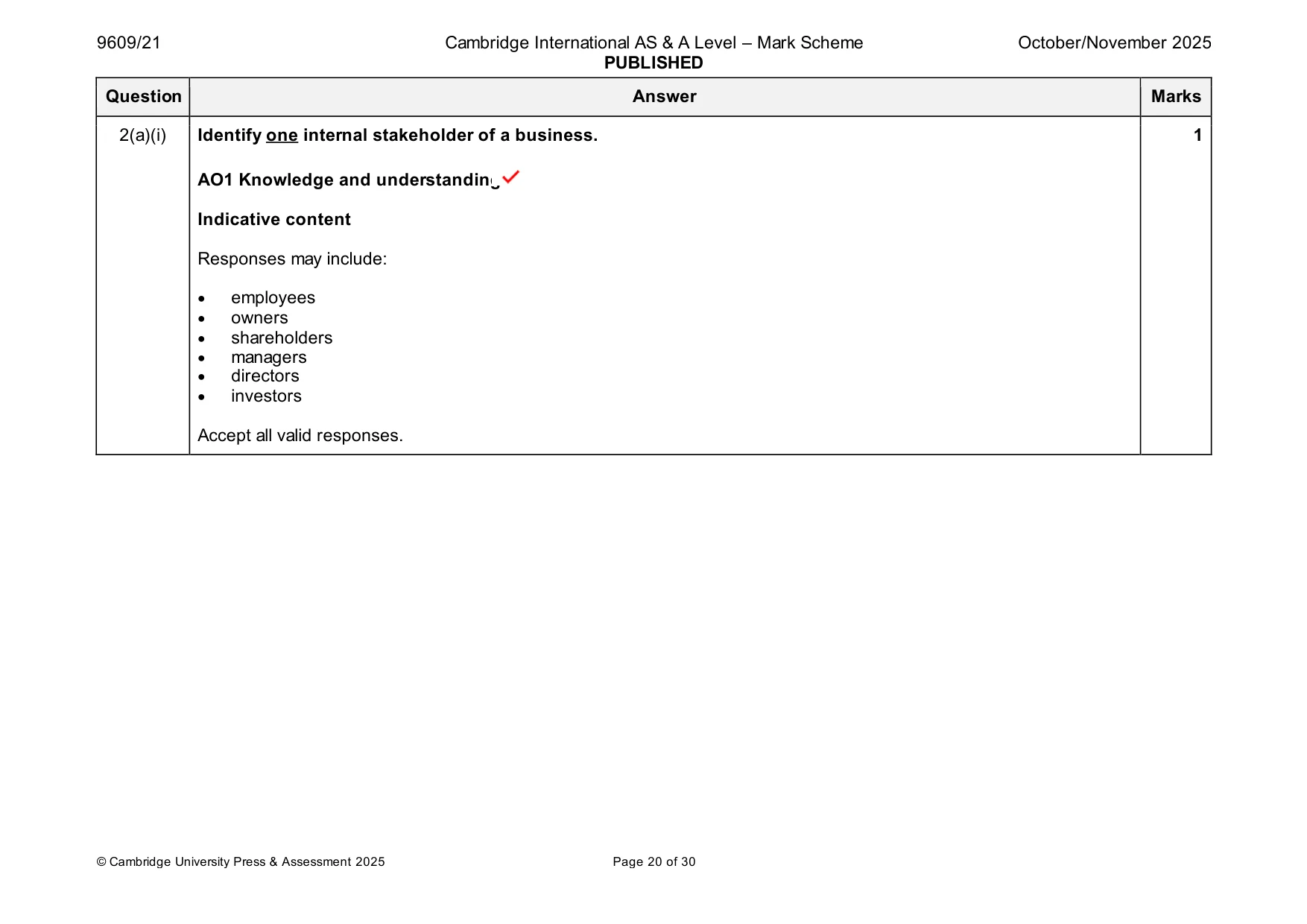
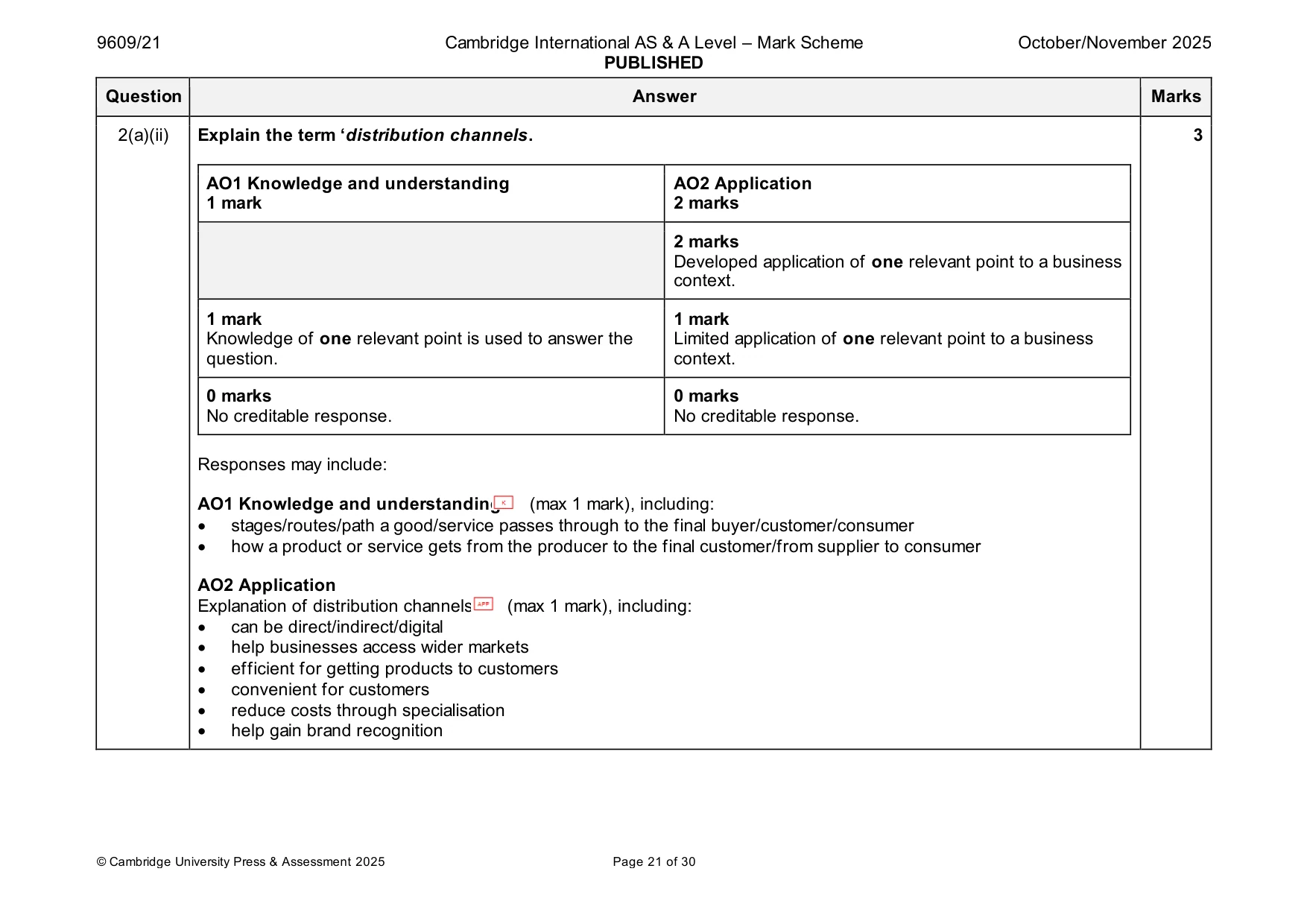
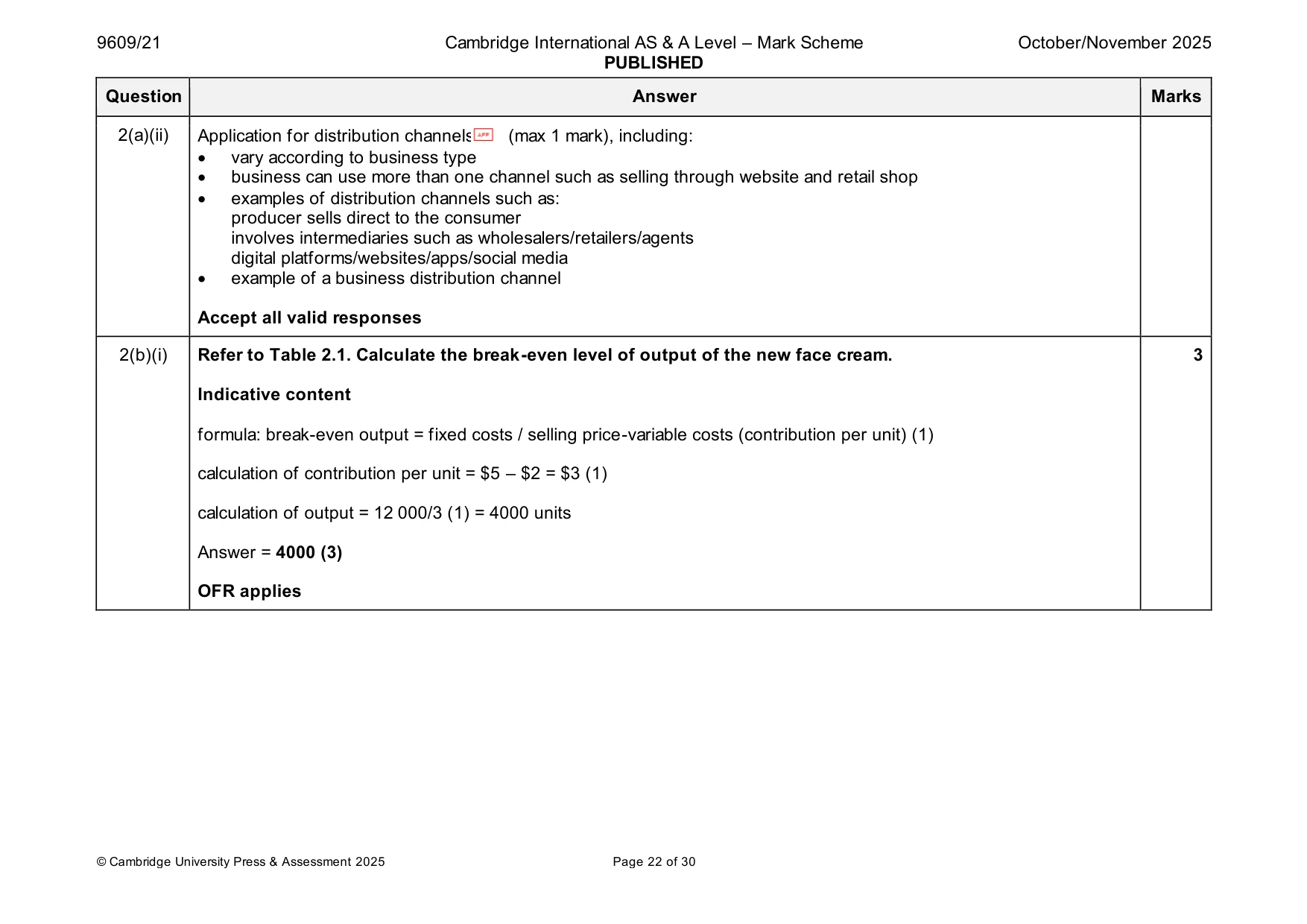
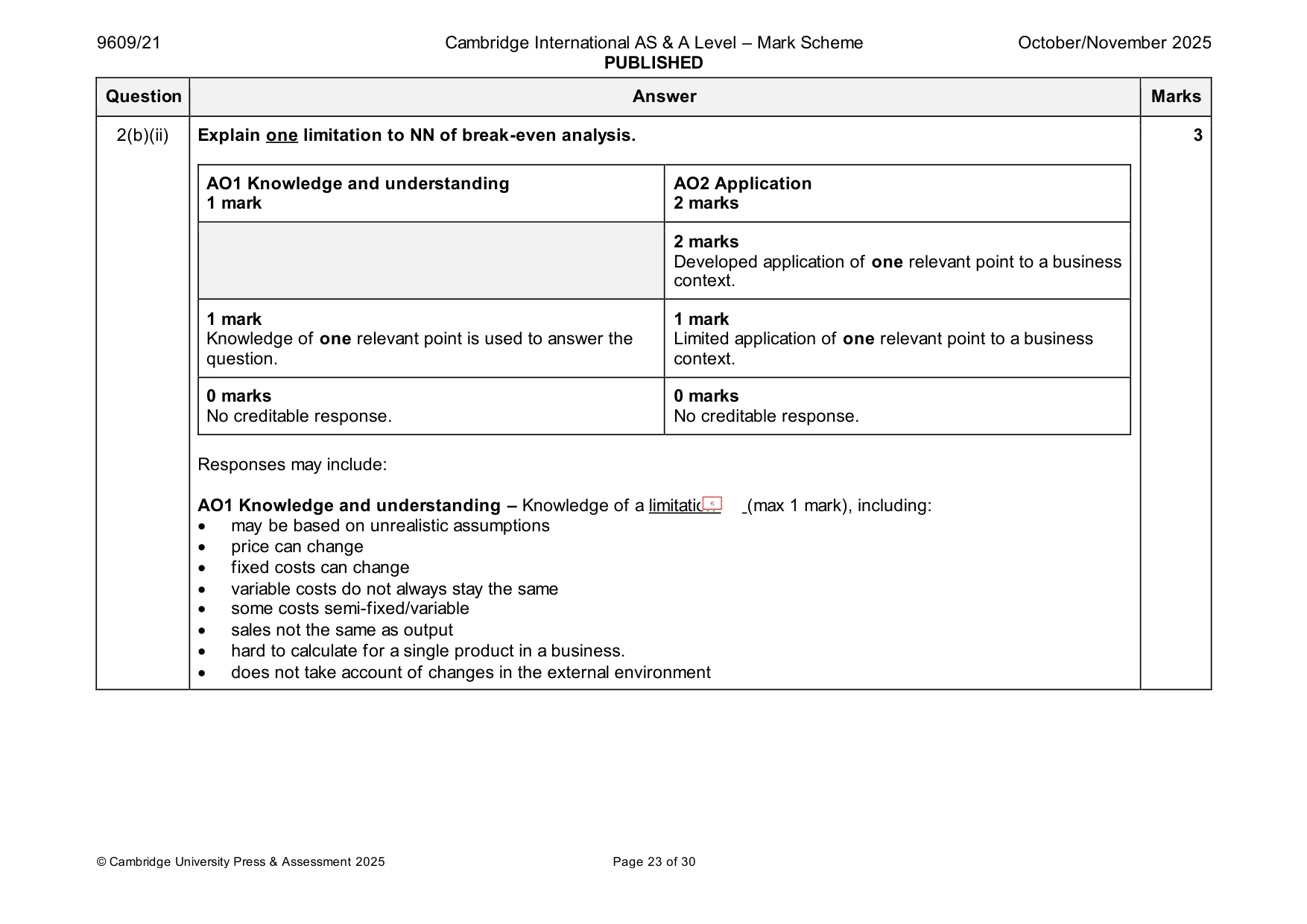
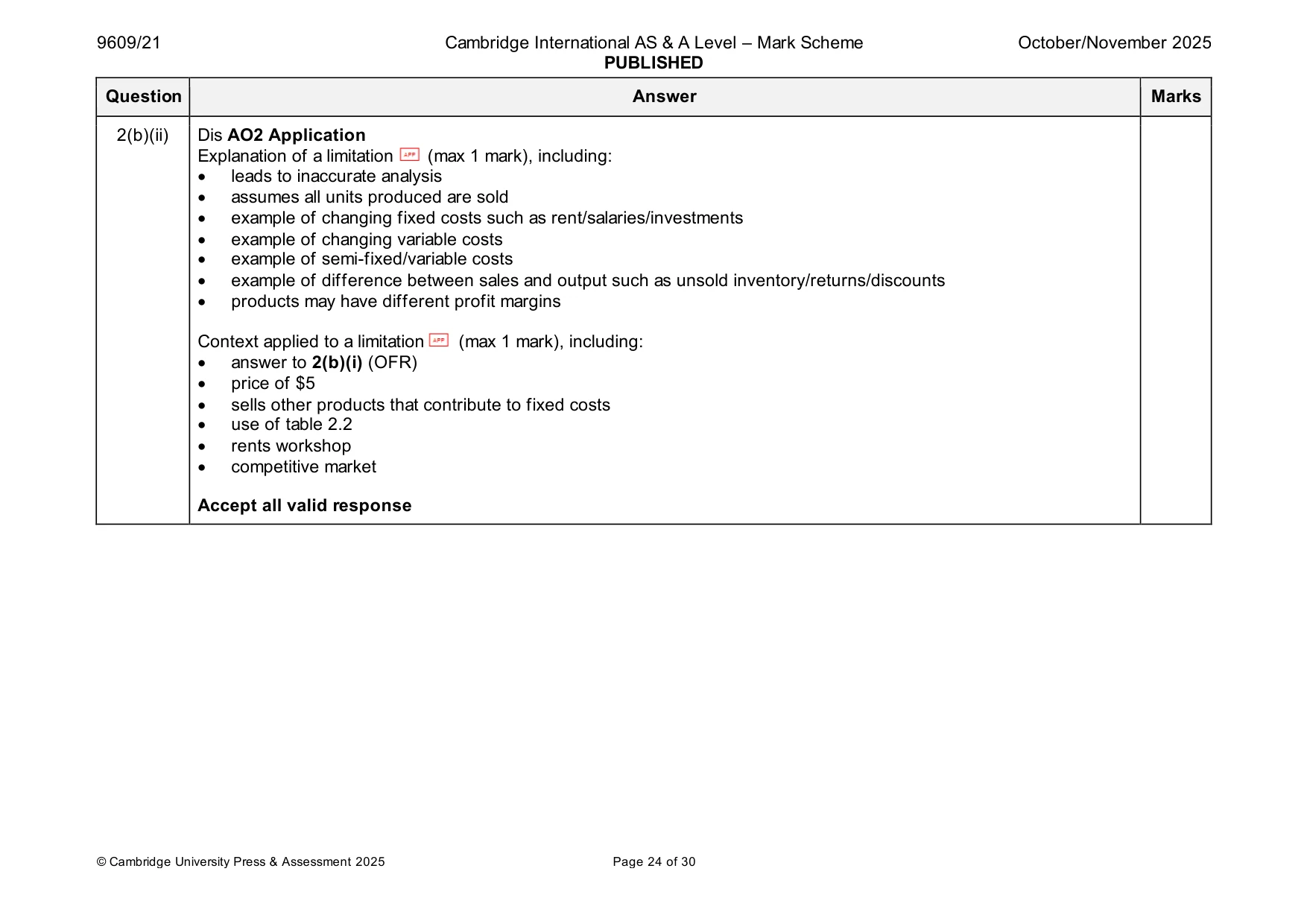
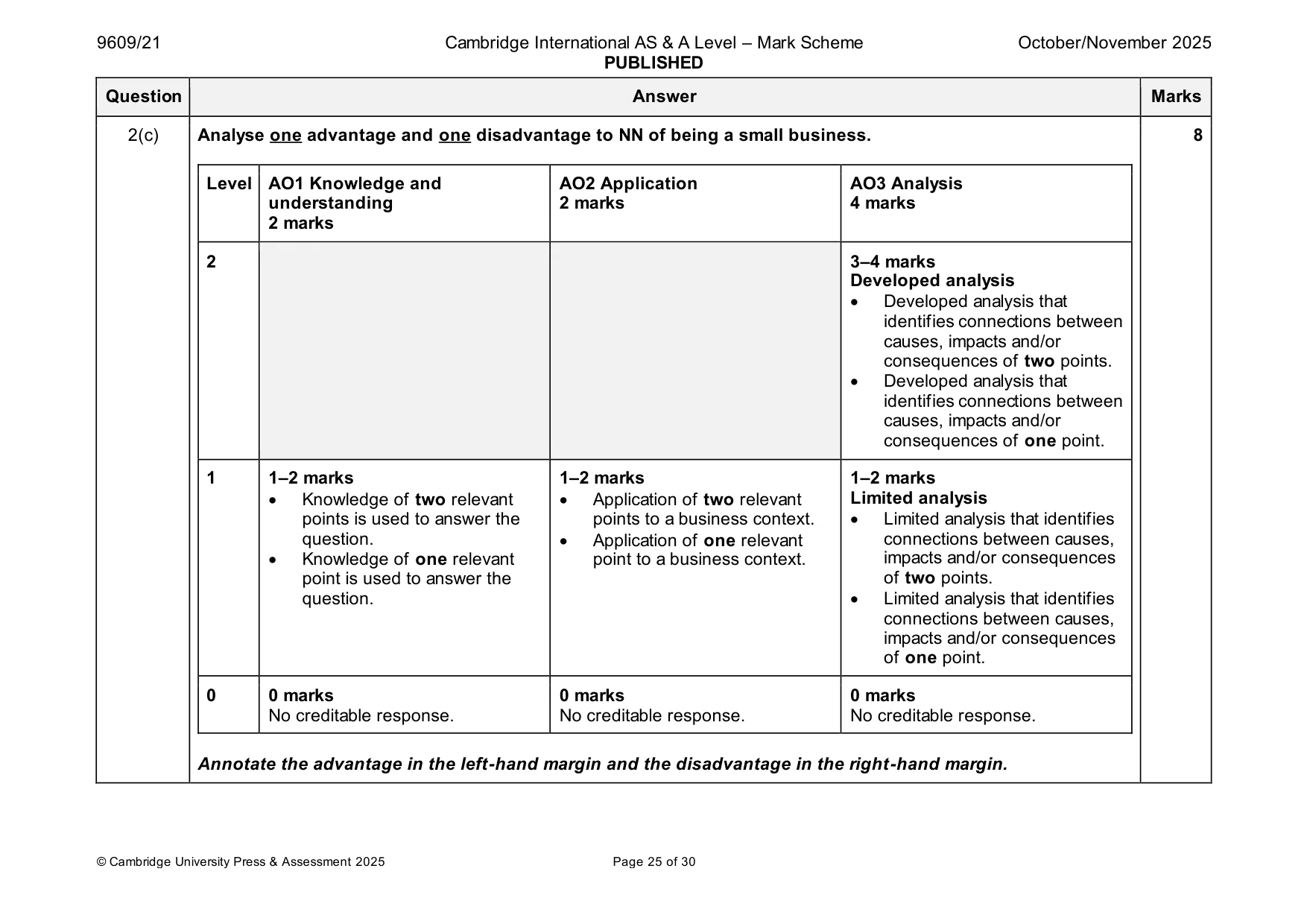
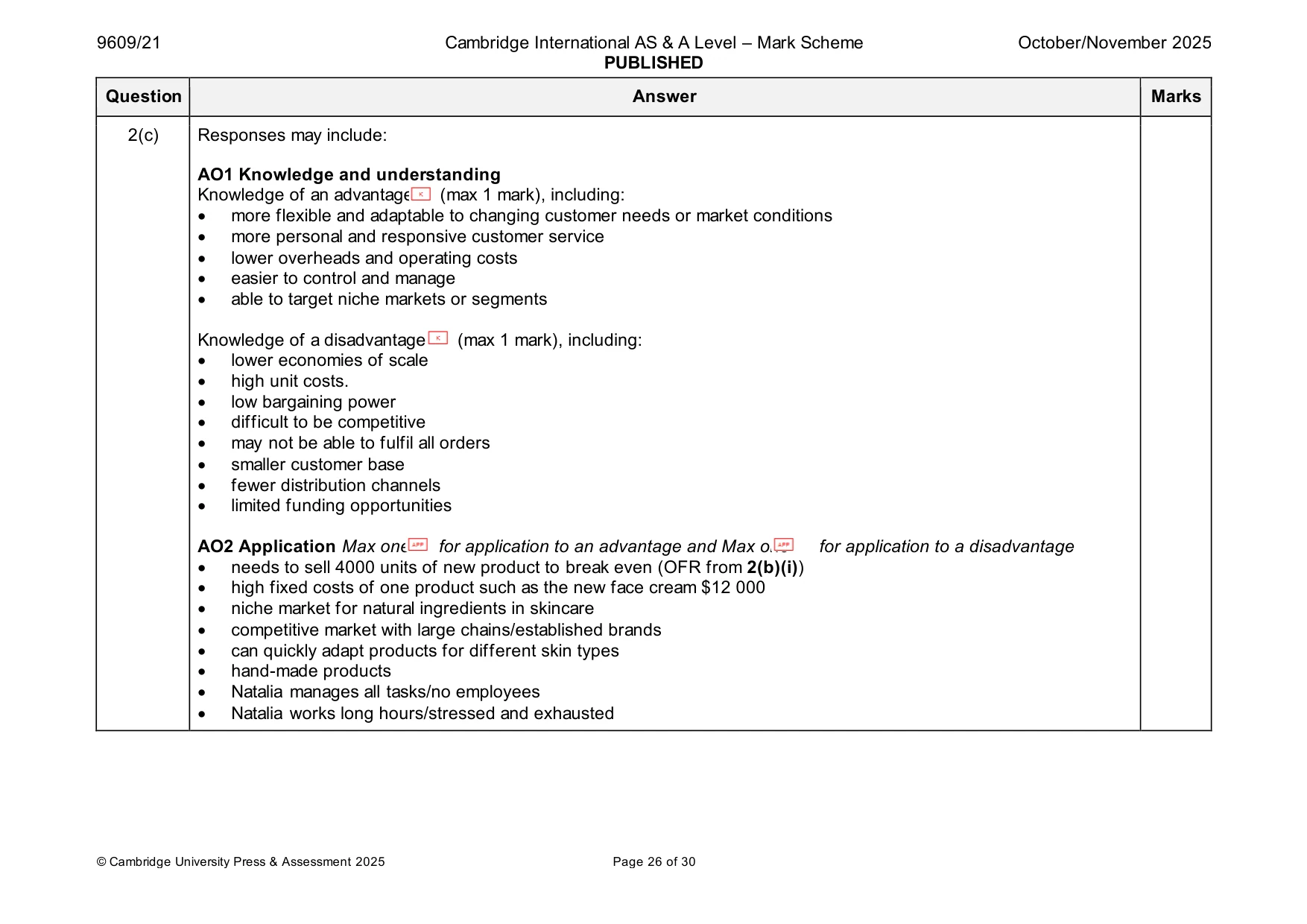
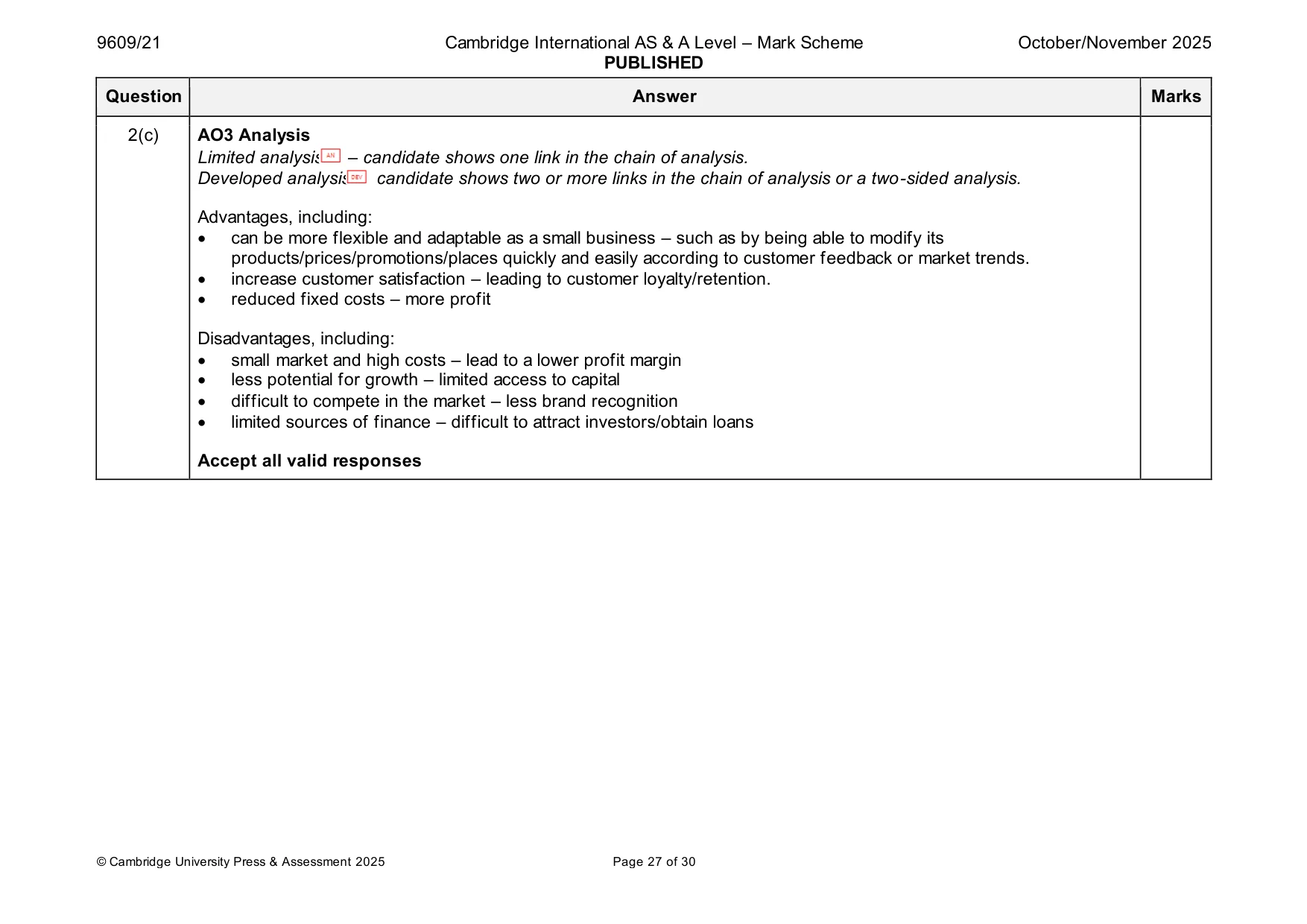
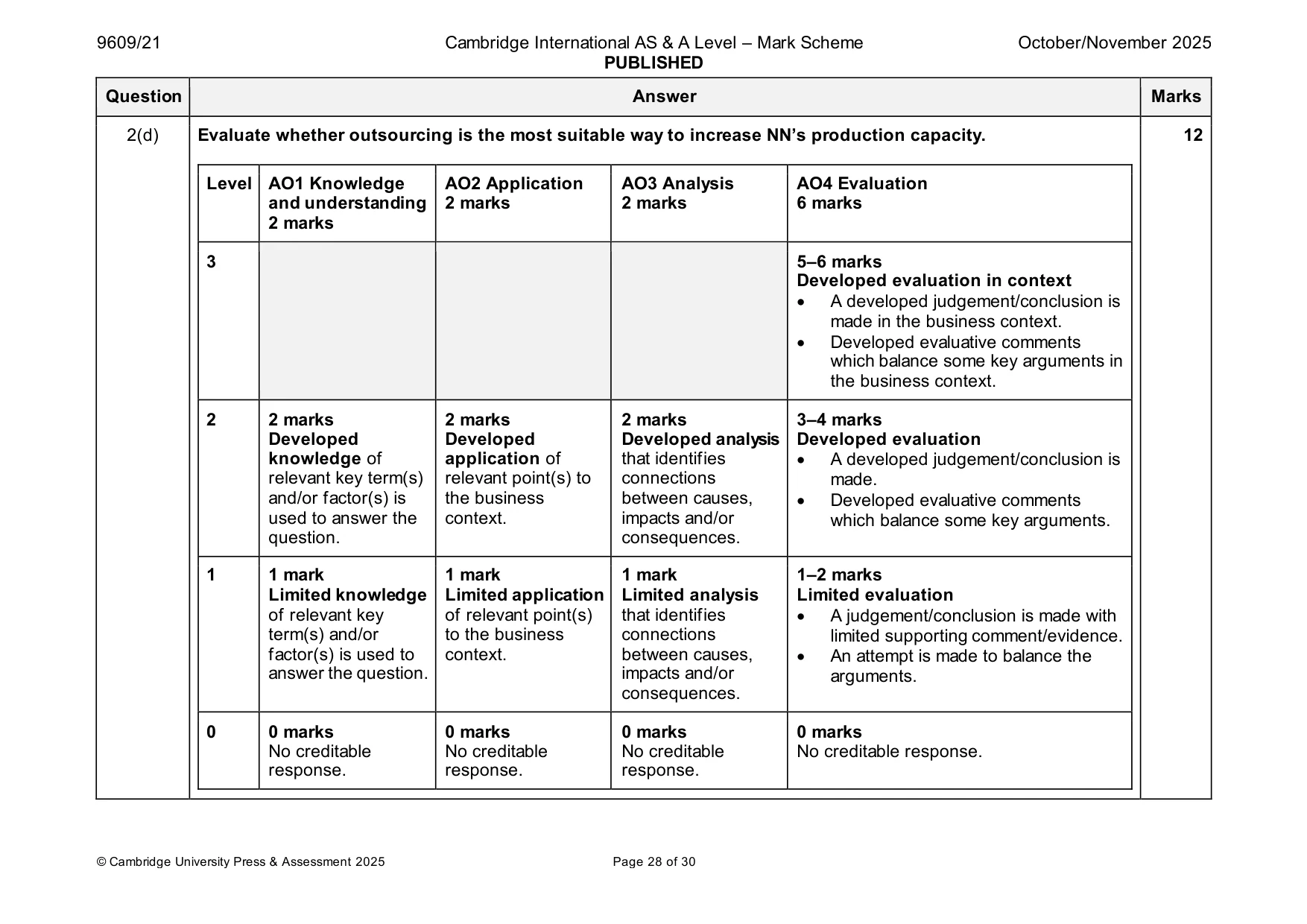
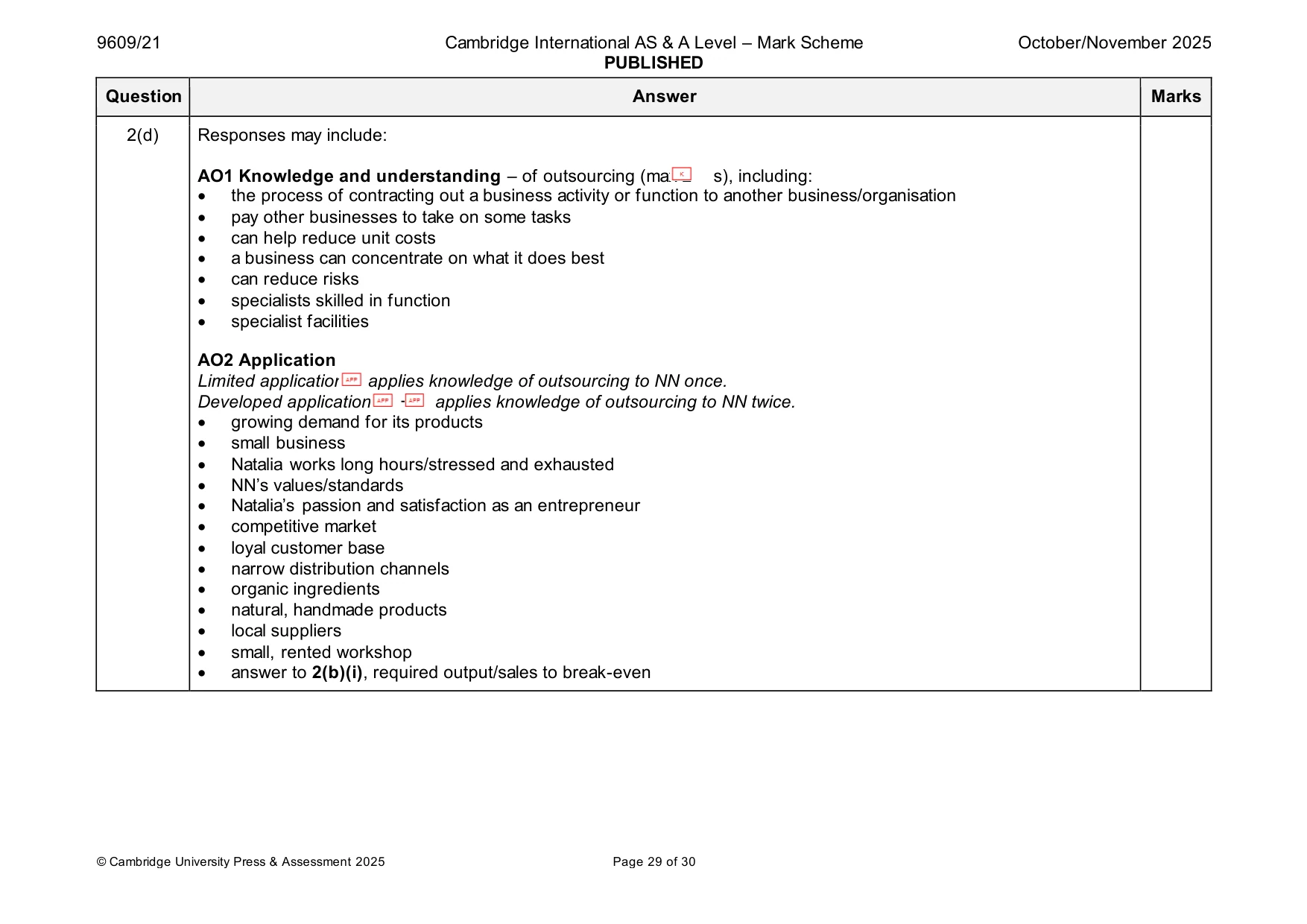
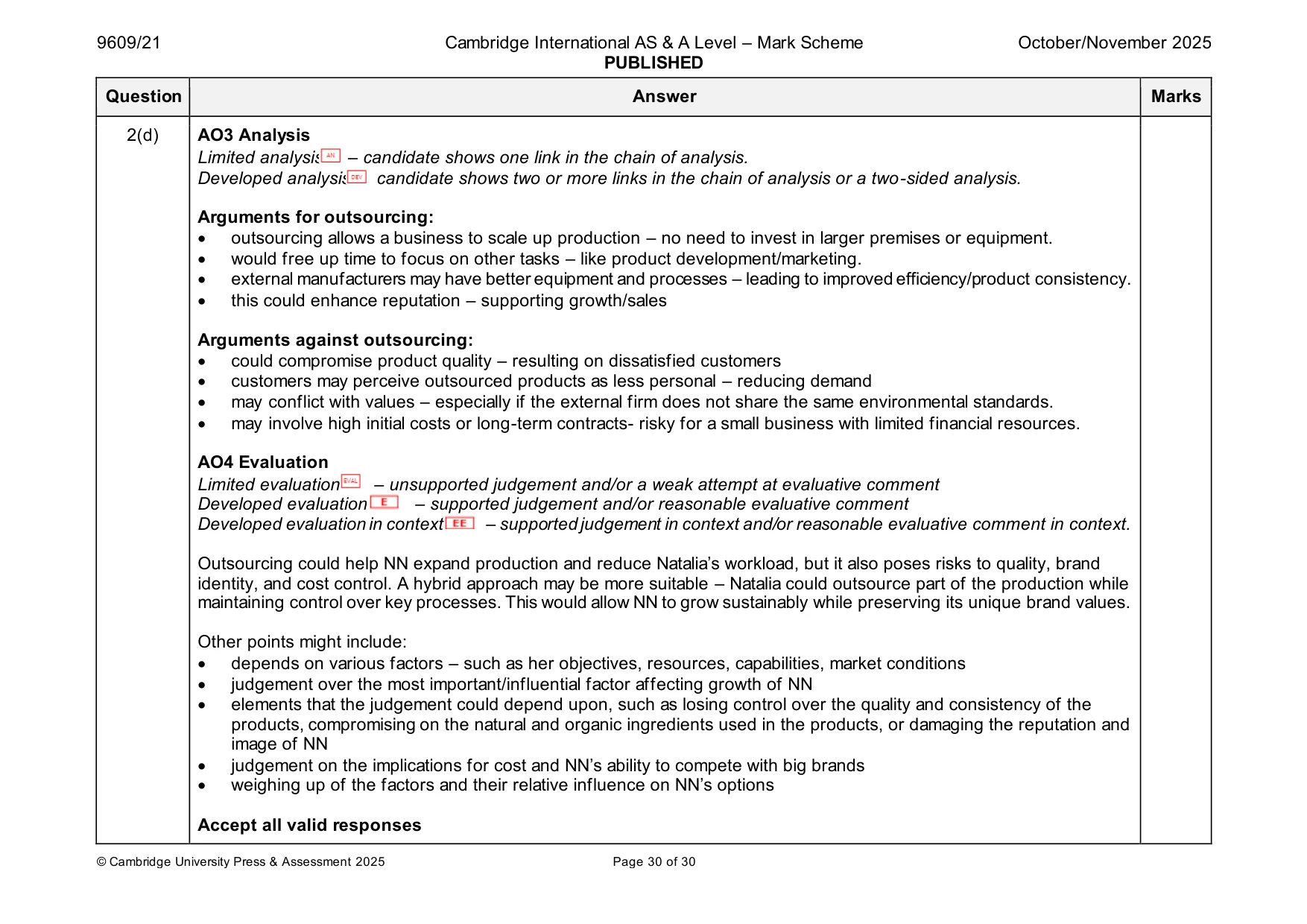
Mark scheme: 2(a)(i) Identify one internal stakeholder of a business. 1 AO1 Knowledge and understanding Indicative content Responses may include: • employees • owners • shareholders • managers • directors • investors Accept all valid responses. 2(a)(ii) Explain the term ‘distribution channels. 3 AO1 Knowledge and understanding AO2 Application 1 mark 2 marks 2 marks Developed application of one relevant point to a business context. 1 mark 1 mark Knowledge of one relevant point is used to answer the Limited application of one relevant point to a business question. context. 0 marks 0 marks No creditable response. No creditable response. Responses may include: AO1 Knowledge and understanding (max 1 mark), including: • stages/routes/path a good/service passes through to the final buyer/customer/consumer • how a product or service gets from the producer to the final customer/from supplier to consumer AO2 Application Explanation of distribution channels (max 1 mark), including: • can be direct/indirect/digital • help businesses access wider markets • efficient for getting products to customers • convenient for customers • reduce costs through specialisation • help gain brand recognition 2(a)(ii) Application for distribution channels (max 1 mark), including: • vary according to business type • business can use more than one channel such as selling through website and retail shop • examples of distribution channels such as: producer sells direct to the consumer involves intermediaries such as wholesalers/retailers/agents digital platforms/websites/apps/social media • example of a business distribution channel Accept all valid responses 2(b)(i) Refer to Table 2.1. Calculate the break-even level of output of the new face cream. 3 Indicative content formula: break-even output = fixed costs / selling price-variable costs (contribution per unit) (1) calculation of contribution per unit = $5 – $2 = $3 (1) calculation of output = 12 000/3 (1) = 4000 units Answer = 4000 (3) OFR applies 2(b)(ii) Explain one limitation to NN of break-even analysis. 3 AO1 Knowledge and understanding AO2 Application 1 mark 2 marks 2 marks Developed application of one relevant point to a business context. 1 mark 1 mark Knowledge of one relevant point is used to answer the Limited application of one relevant point to a business question. context. 0 marks 0 marks No creditable response. No creditable response. Responses may include: AO1 Knowledge and understanding – Knowledge of a limitation (max 1 mark), including: • may be based on unrealistic assumptions • price can change • fixed costs can change • variable costs do not always stay the same • some costs semi-fixed/variable • sales not the same as output • hard to calculate for a single product in a business. • does not take account of changes in the external environment 2(b)(ii) Dis AO2 Application Explanation of a limitation (max 1 mark), including: • leads to inaccurate analysis • assumes all units produced are sold • example of changing fixed costs such as rent/salaries/investments • example of changing variable costs • example of semi-fixed/variable costs • example of difference between sales and output such as unsold inventory/returns/discounts • products may have different profit margins Context applied to a limitation (max 1 mark), including: • answer to 2(b)(i) (OFR) • price of $5 • sells other products that contribute to fixed costs • use of table 2.2 • rents workshop • competitive market Accept all valid response 2(c) Analyse one advantage and one disadvantage to NN of being a small business. 8 Level AO1 Knowledge and AO2 Application AO3 Analysis understanding 2 marks 4 marks 2 marks 2 3–4 marks Developed analysis • Developed analysis that identifies connections between causes, impacts and/or consequences of two points. • Developed analysis that identifies connections between causes, impacts and/or consequences of one point. 1 1–2 marks 1–2 marks 1–2 marks • Knowledge of two relevant • Application of two relevant Limited analysis points is used to answer the points to a business context. • Limited analysis that identifies question. • Application of one relevant connections between causes, • Knowledge of one relevant point to a business context. impacts and/or consequences point is used to answer the of two points. question. • Limited analysis that identifies connections between causes, impacts and/or consequences of one point. 0 0 marks 0 marks 0 marks No creditable response. No creditable response. No creditable response. Annotate the advantage in the left-hand margin and the disadvantage in the right-hand margin. 2(c) Responses may include: AO1 Knowledge and understanding Knowledge of an advantage (max 1 mark), including: • more flexible and adaptable to changing customer needs or market conditions • more personal and responsive customer service • lower overheads and operating costs • easier to control and manage • able to target niche markets or segments Knowledge of a disadvantage (max 1 mark), including: • lower economies of scale • high unit costs. • low bargaining power • difficult to be competitive • may not be able to fulfil all orders • smaller customer base • fewer distribution channels • limited funding opportunities AO2 Application Max one for application to an advantage and Max one for application to a disadvantage • needs to sell 4000 units of new product to break even (OFR from 2(b)(i)) • high fixed costs of one product such as the new face cream $12 000 • niche market for natural ingredients in skincare • competitive market with large chains/established brands • can quickly adapt products for different skin types • hand-made products • Natalia manages all tasks/no employees • Natalia works long hours/stressed and exhausted 2(c) AO3 Analysis Limited analysis – candidate shows one link in the chain of analysis. Developed analysis candidate shows two or more links in the chain of analysis or a two-sided analysis. Advantages, including: • can be more flexible and adaptable as a small business – such as by being able to modify its products/prices/promotions/places quickly and easily according to customer feedback or market trends. • increase customer satisfaction – leading to customer loyalty/retention. • reduced fixed costs – more profit Disadvantages, including: • small market and high costs – lead to a lower profit margin • less potential for growth – limited access to capital • difficult to compete in the market – less brand recognition • limited sources of finance – difficult to attract investors/obtain loans Accept all valid responses 2(d) Evaluate whether outsourcing is the most suitable way to increase NN’s production capacity. 12 Level AO1 Knowledge AO2 Application AO3 Analysis AO4 Evaluation and understanding 2 marks 2 marks 6 marks 2 marks 3 5–6 marks Developed evaluation in context • A developed judgement/conclusion is made in the business context. • Developed evaluative comments which balance some key arguments in the business context. 2 2 marks 2 marks 2 marks 3–4 marks Developed Developed Developed analysis Developed evaluation knowledge of application of that identifies • A developed judgement/conclusion is relevant key term(s) relevant point(s) to connections made. and/or factor(s) is the business between causes, • Developed evaluative comments used to answer the context. impacts and/or which balance some key arguments. question. consequences. 1 1 mark 1 mark 1 mark 1–2 marks Limited knowledge Limited application Limited analysis Limited evaluation of relevant key of relevant point(s) that identifies • A judgement/conclusion is made with term(s) and/or to the business connections limited supporting comment/evidence. factor(s) is used to context. between causes, • An attempt is made to balance the answer the question. impacts and/or arguments. consequences. 0 0 marks 0 marks 0 marks 0 marks No creditable No creditable No creditable No creditable response. response. response. response. 2(d) Responses may include: AO1 Knowledge and understanding – of outsourcing (max 2 s), including: • the process of contracting out a business activity or function to another business/organisation • pay other businesses to take on some tasks • can help reduce unit costs • a business can concentrate on what it does best • can reduce risks • specialists skilled in function • specialist facilities AO2 Application Limited application applies knowledge of outsourcing to NN once. Developed application + applies knowledge of outsourcing to NN twice. • growing demand for its products • small business • Natalia works long hours/stressed and exhausted • NN’s values/standards • Natalia’s passion and satisfaction as an entrepreneur • competitive market • loyal customer base • narrow distribution channels • organic ingredients • natural, handmade products • local suppliers • small, rented workshop • answer to 2(b)(i), required output/sales to break-even 2(d) AO3 Analysis Limited analysis – candidate shows one link in the chain of analysis. Developed analysis candidate shows two or more links in the chain of analysis or a two-sided analysis. Arguments for outsourcing: • outsourcing allows a business to scale up production – no need to invest in larger premises or equipment. • would free up time to focus on other tasks – like product development/marketing. • external manufacturers may have better equipment and processes – leading to improved efficiency/product consistency. • this could enhance reputation – supporting growth/sales Arguments against outsourcing: • could compromise product quality – resulting on dissatisfied customers • customers may perceive outsourced products as less personal – reducing demand • may conflict with values – especially if the external firm does not share the same environmental standards. • may involve high initial costs or long-term contracts- risky for a small business with limited financial resources. AO4 Evaluation Limited evaluation – unsupported judgement and/or a weak attempt at evaluative comment Developed evaluation – supported judgement and/or reasonable evaluative comment Developed evaluation in context – supported judgement in context and/or reasonable evaluative comment in context. Outsourcing could help NN expand production and reduce Natalia’s workload, but it also poses risks to quality, brand identity, and cost control. A hybrid approach may be more suitable – Natalia could outsource part of the production while maintaining control over key processes. This would allow NN to grow sustainably while preserving its unique brand values. Other points might include: • depends on various factors – such as her objectives, resources, capabilities, market conditions • judgement over the most important/influential factor affecting growth of NN • elements that the judgement could depend upon, such as losing control over the quality and consistency of the products, compromising on the natural and organic ingredients used in the products, or damaging the reputation and image of NN • judgement on the implications for cost and NN’s ability to compete with big brands • weighing up of the factors and their relative influence on NN’s options Accept all valid responses
What was in this paper
The subtopics covered by these 2 questions, and how many questions each got. Open one in a new tab to see every Cambridge question on it.
What you needed in this session
Cambridge’s own grade thresholds for 2025 Oct/Nov, Paper 2 · Variant 1. A higher threshold means an easier paper — the bar moves with how the cohort did.