Cambridge A Level Business (for first examination in 2016) 9609 — 2025 Oct/Nov Paper 2 · Variant 3
9609/23/O/N/25 · 2 questions · 60 marks · ≈68 min
The question paper and its mark scheme, free to read here and free to download. This is Cambridge’s own paper, exactly as it was sat.
Question paper4 pages


Mark scheme38 pages
Answers below. Sit the paper first if you are practising.

Questions as text
Q1 · Solar Farms (SF) SF is a private limited company that develops and maintains large-scale…
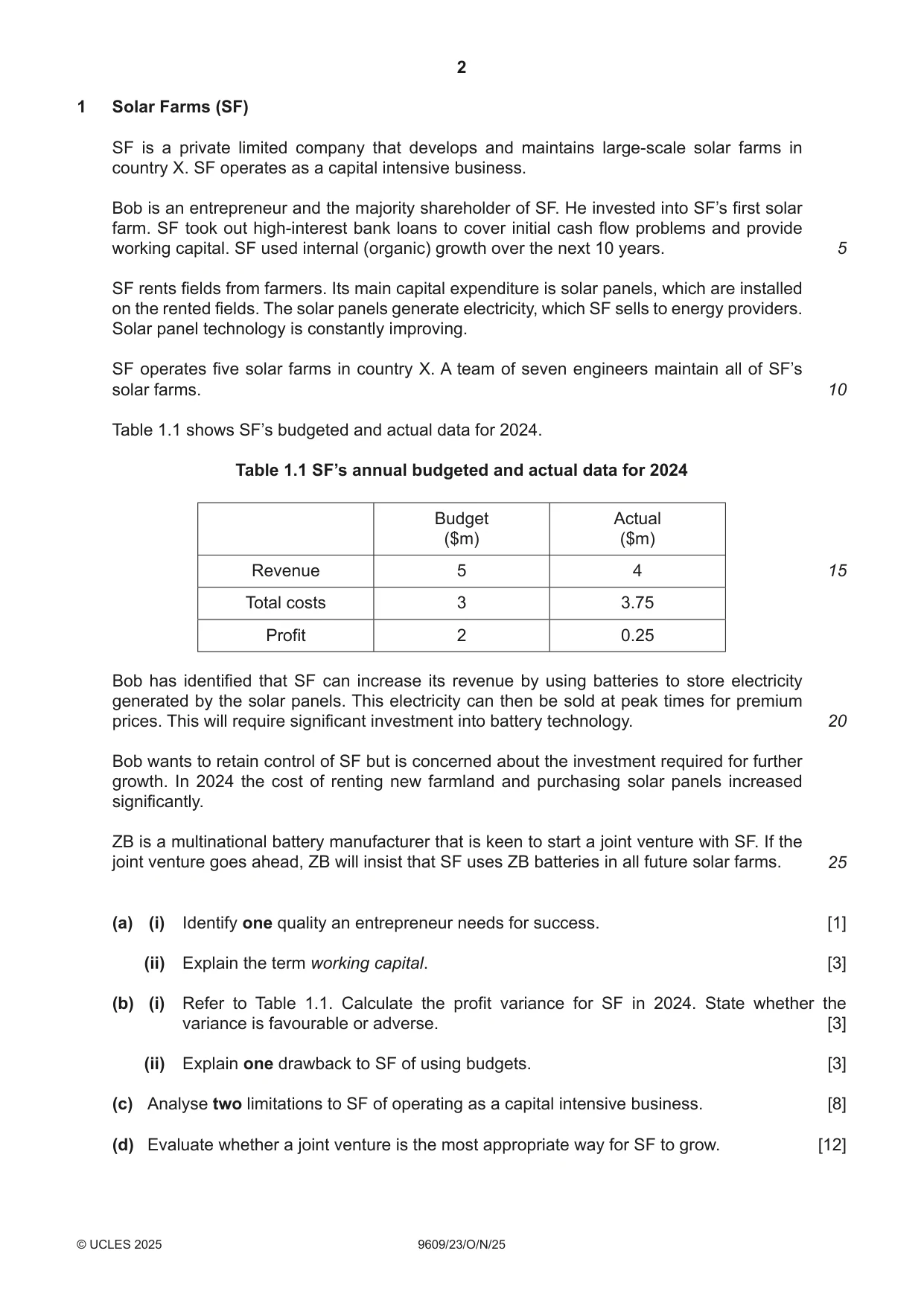
1 Solar Farms (SF) SF is a private limited company that develops and maintains large-scale solar farms in country X. SF operates as a capital intensive business. Bob is an entrepreneur and the majority shareholder of SF. He invested into SF’s first solar farm. SF took out high-interest bank loans to cover initial cash flow problems and provide working capital. SF used internal (organic) growth over the next 10 years. 5 SF rents fields from farmers. Its main capital expenditure is solar panels, which are installed on the rented fields. The solar panels generate electricity, which SF sells to energy providers. Solar panel technology is constantly improving. SF operates five solar farms in country X. A team of seven engineers maintain all of SF’s solar farms. 10 Table 1.1 shows SF’s budgeted and actual data for 2024. Table 1.1 SF’s annual budgeted and actual data for 2024 Budget Actual ($m) ($m) Revenue 5 4 15 Total costs 3 3.75 Profit 2 0.25 Bob has identified that SF can increase its revenue by using batteries to store electricity generated by the solar panels. This electricity can then be sold at peak times for premium prices. This will require significant investment into battery technology. 20 Bob wants to retain control of SF but is concerned about the investment required for further growth. In 2024 the cost of renting new farmland and purchasing solar panels increased significantly. ZB is a multinational battery manufacturer that is keen to start a joint venture with SF. If the joint venture goes ahead, ZB will insist that SF uses ZB batteries in all future solar farms. 25 (a) (i) Identify one quality an entrepreneur needs for success. [1] (ii) Explain the term working capital. [3] (b) (i) Refer to Table 1.1. Calculate the profit variance for SF in 2024. State whether the variance is favourable or adverse. [3] (ii) Explain one drawback to SF of using budgets. [3] (c) Analyse two limitations to SF of operating as a capital intensive business. [8] (d) Evaluate whether a joint venture is the most appropriate way for SF to grow. [12]
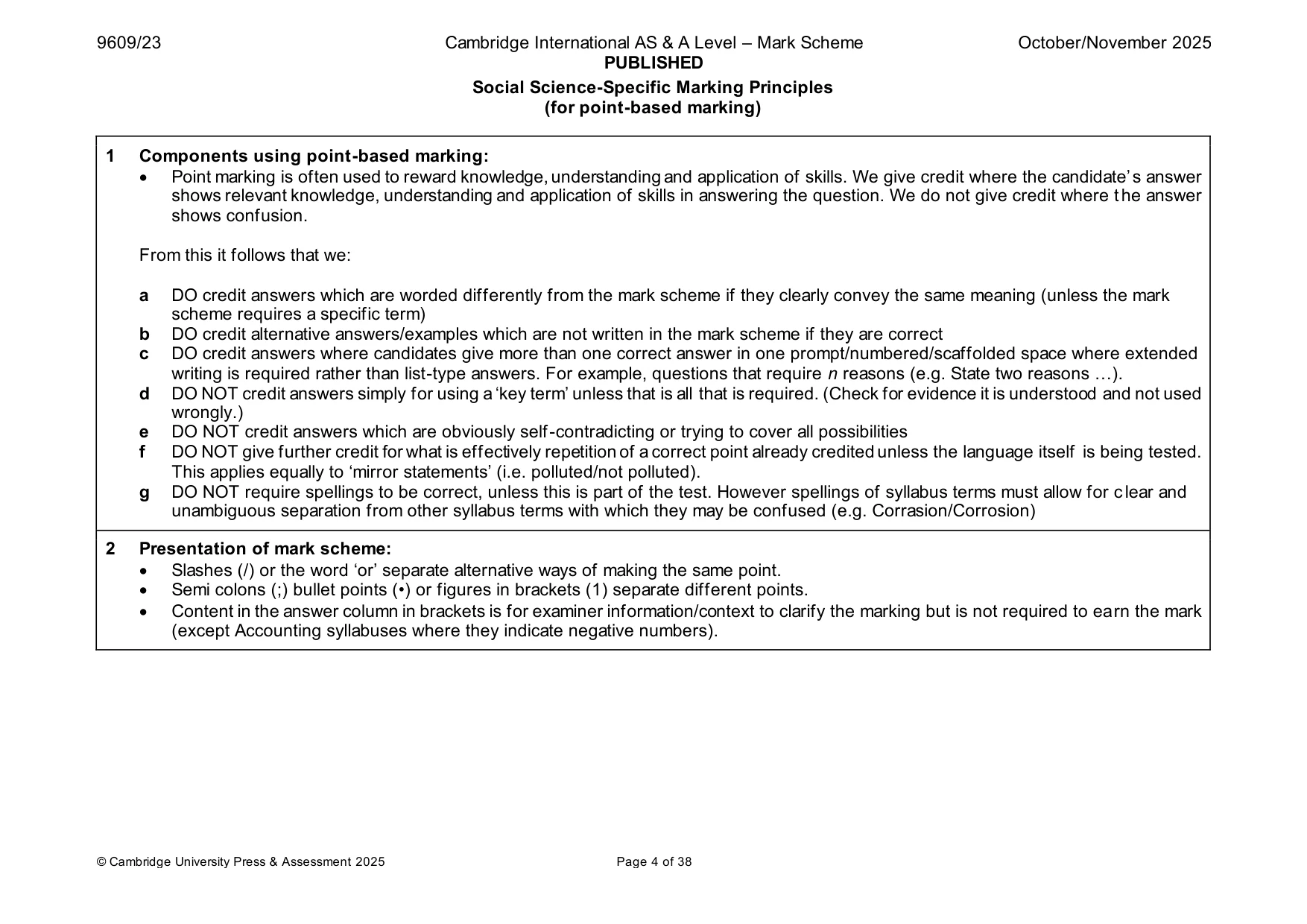
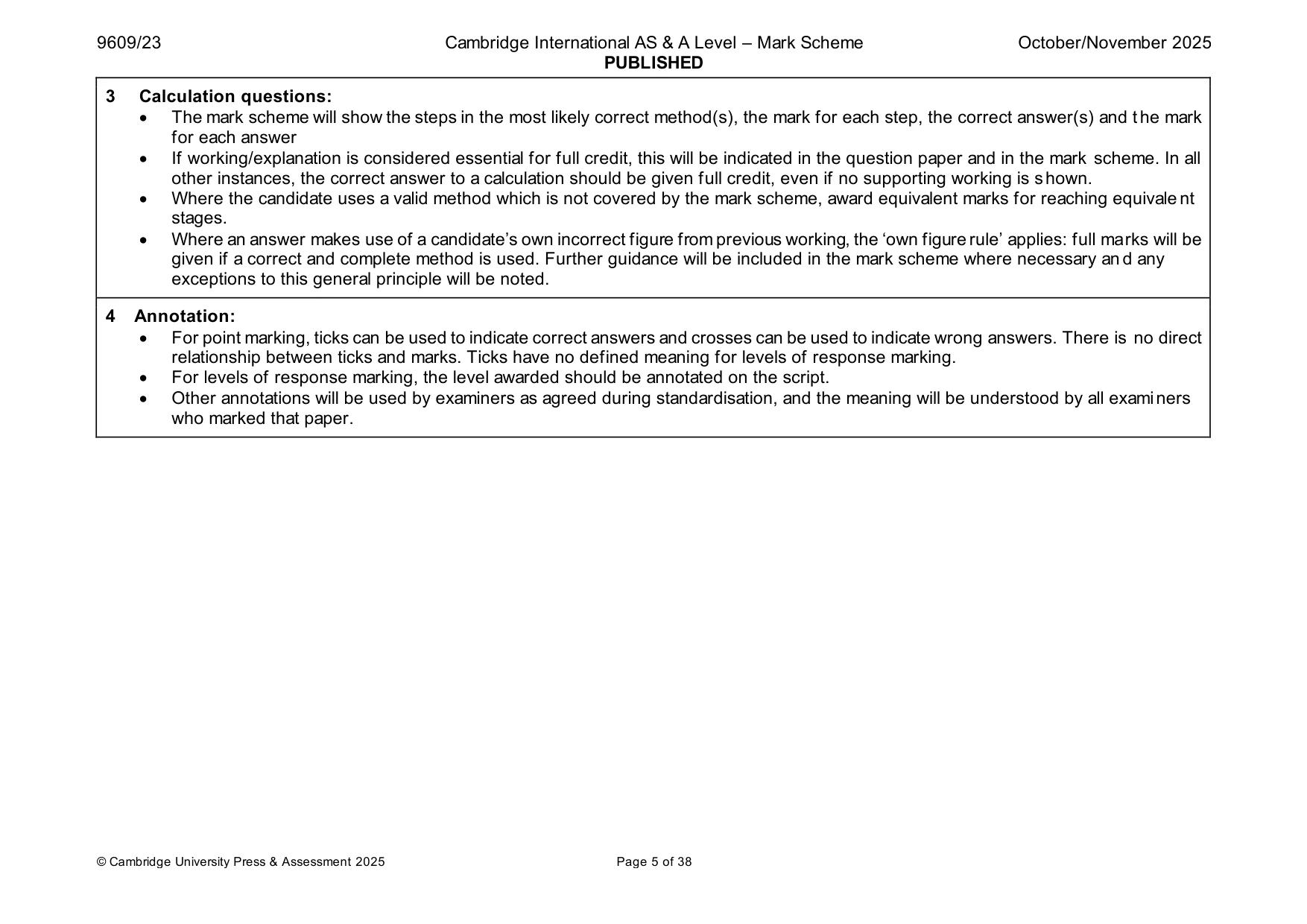
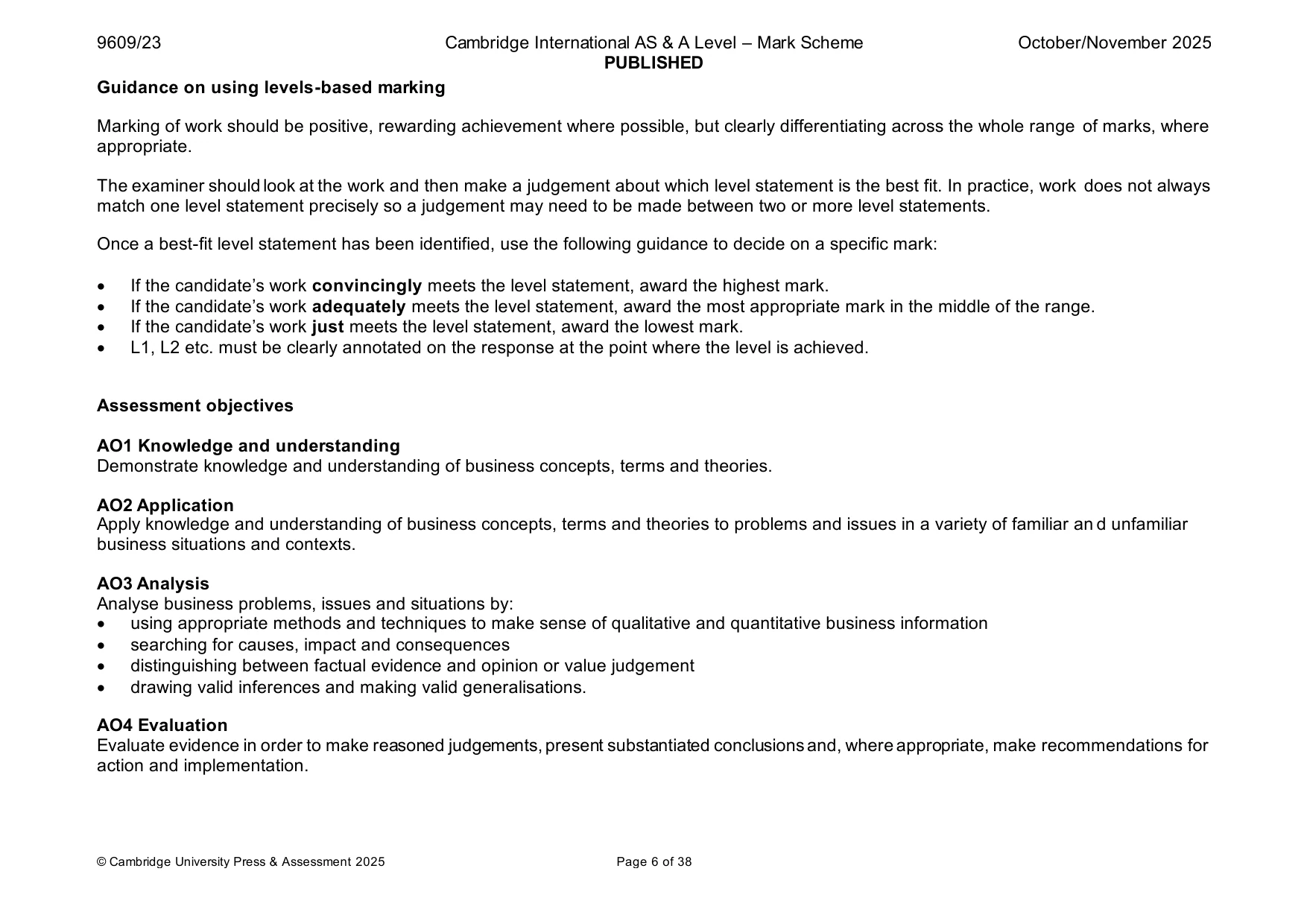
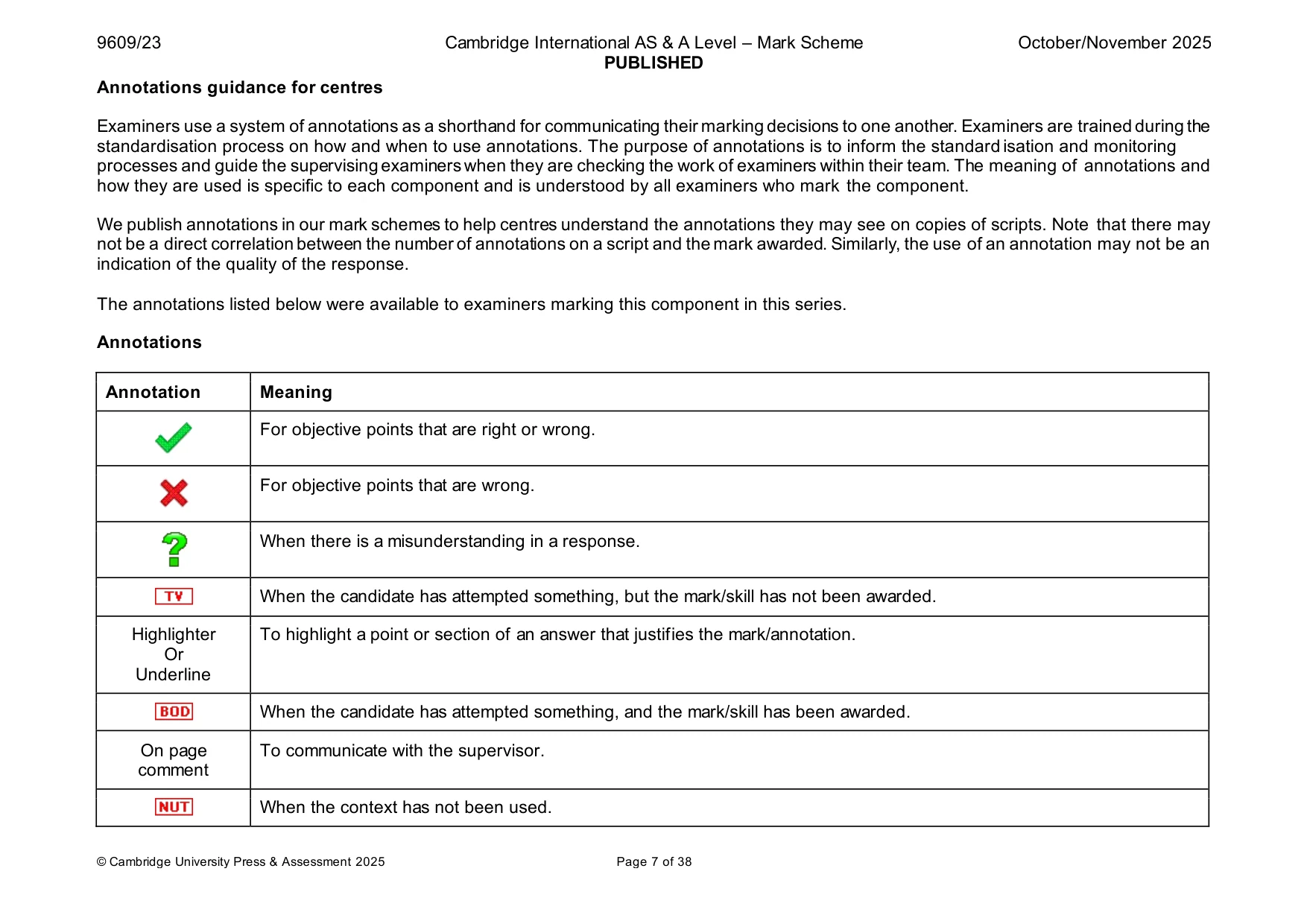
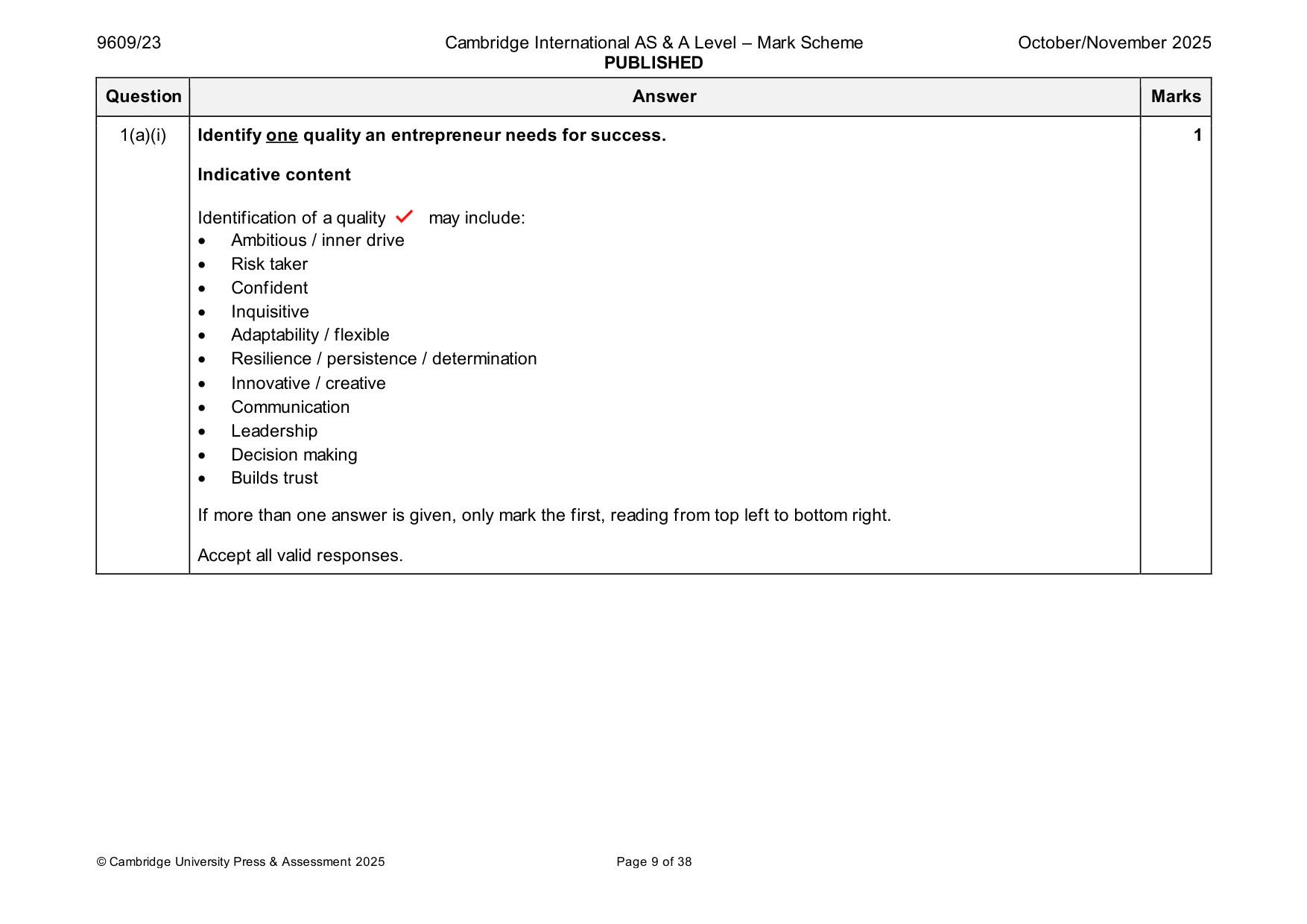
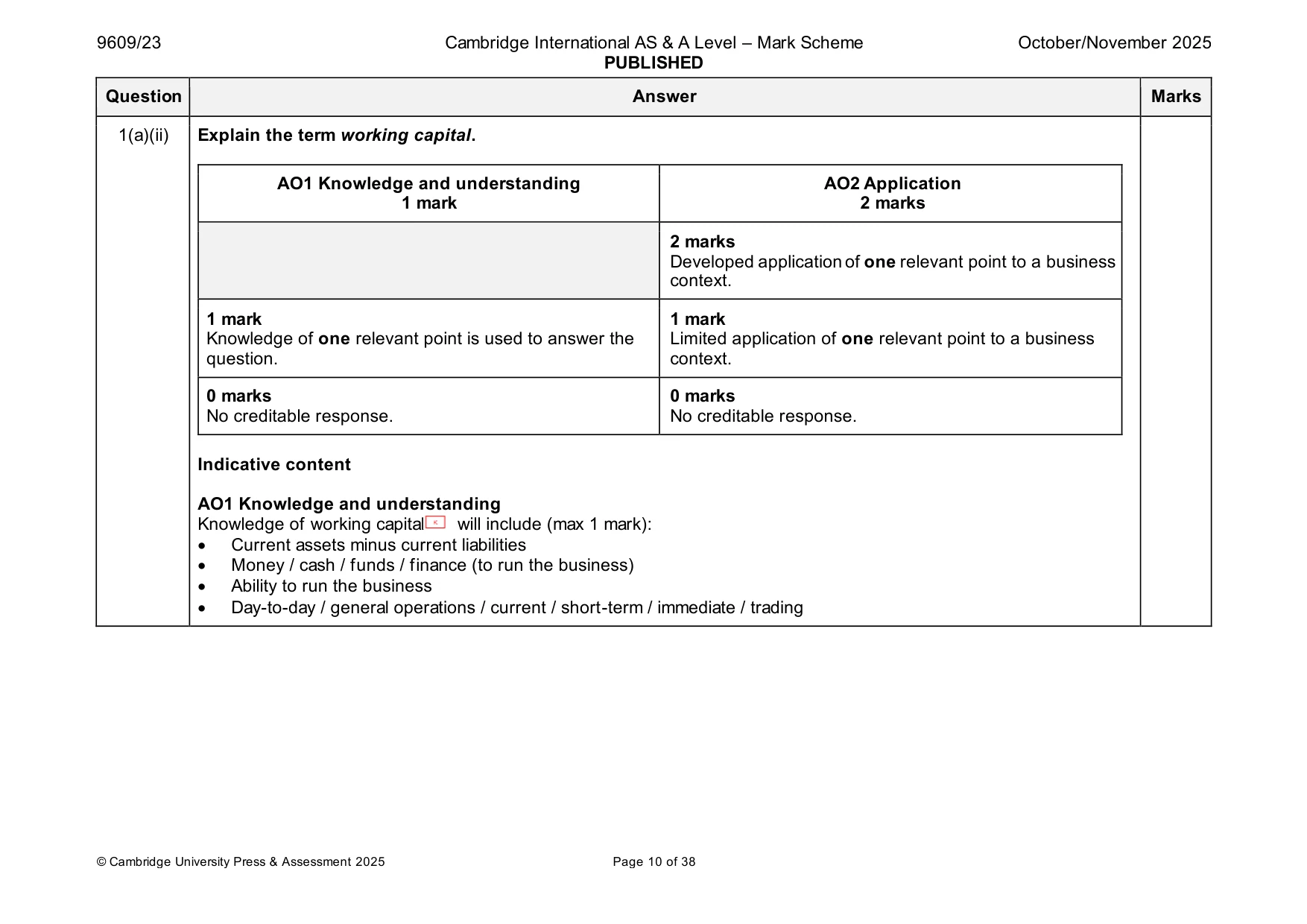
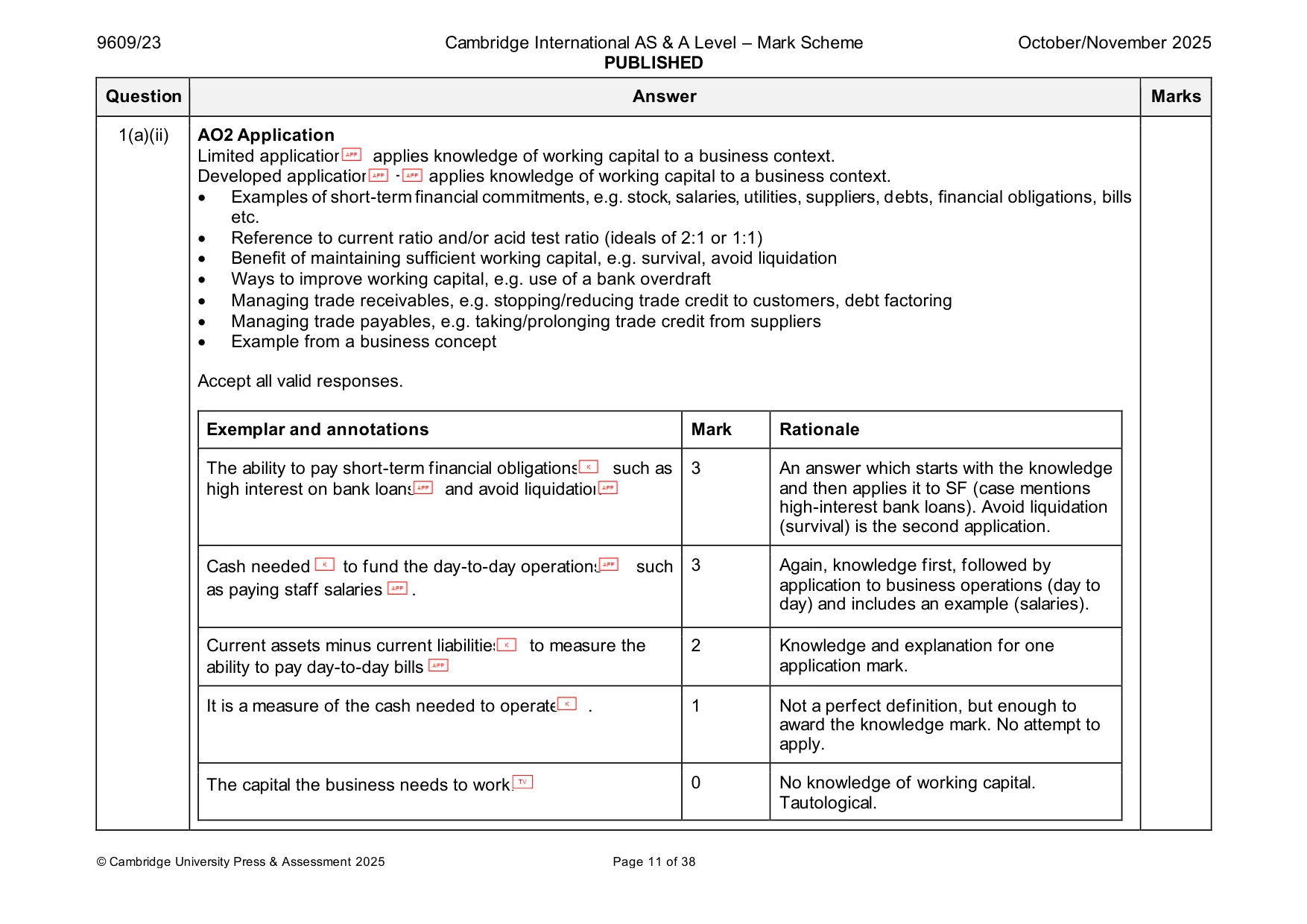
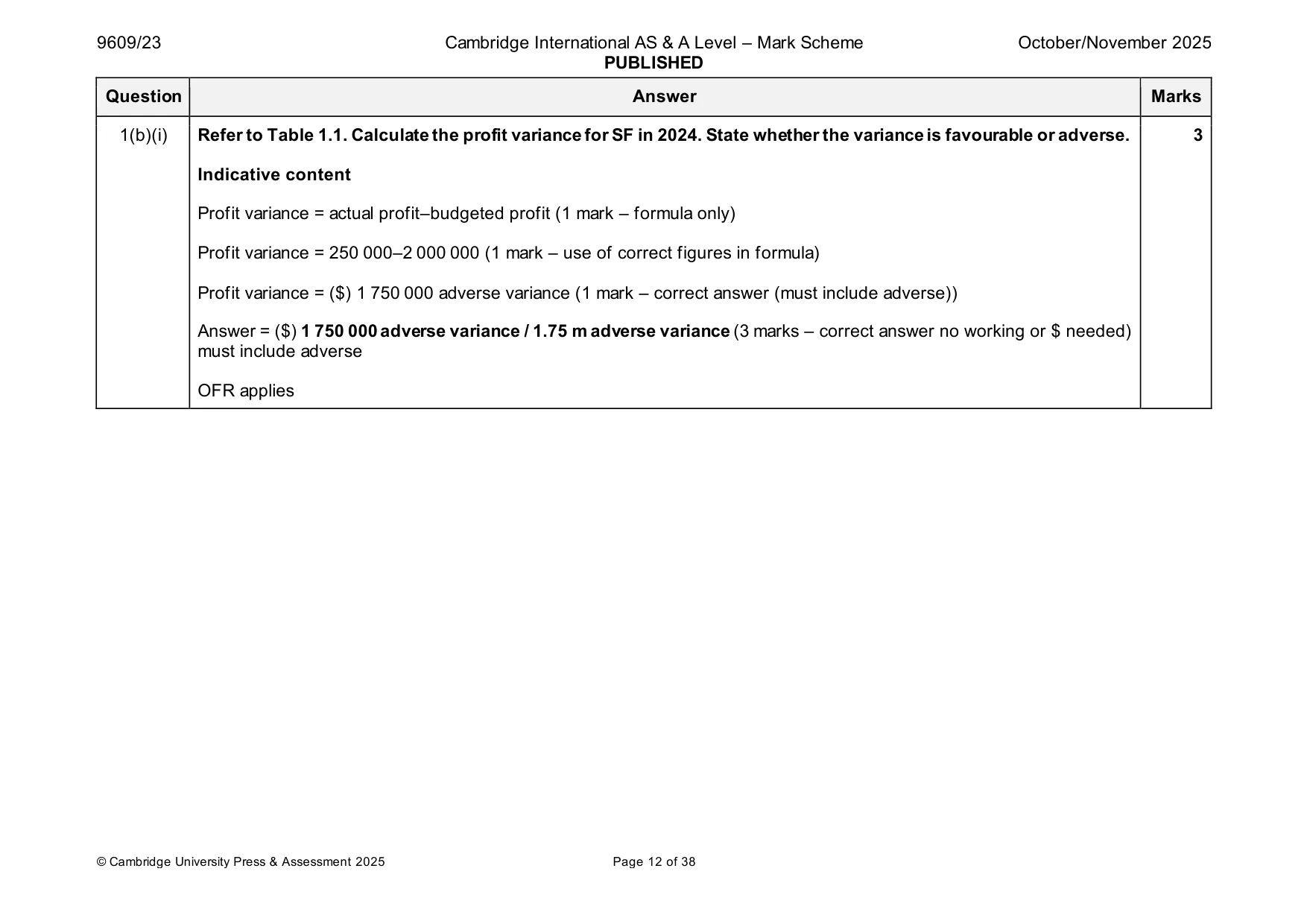
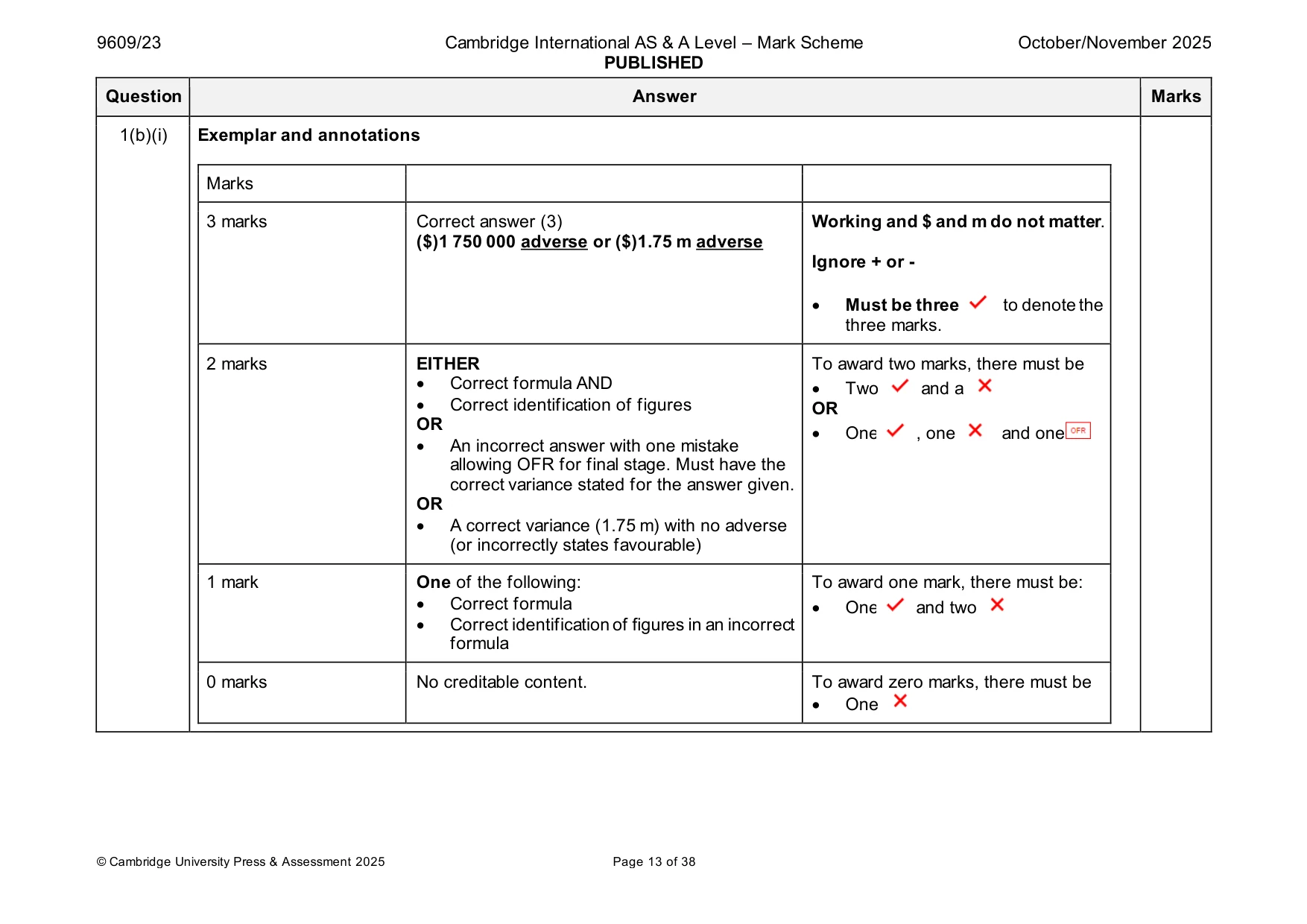
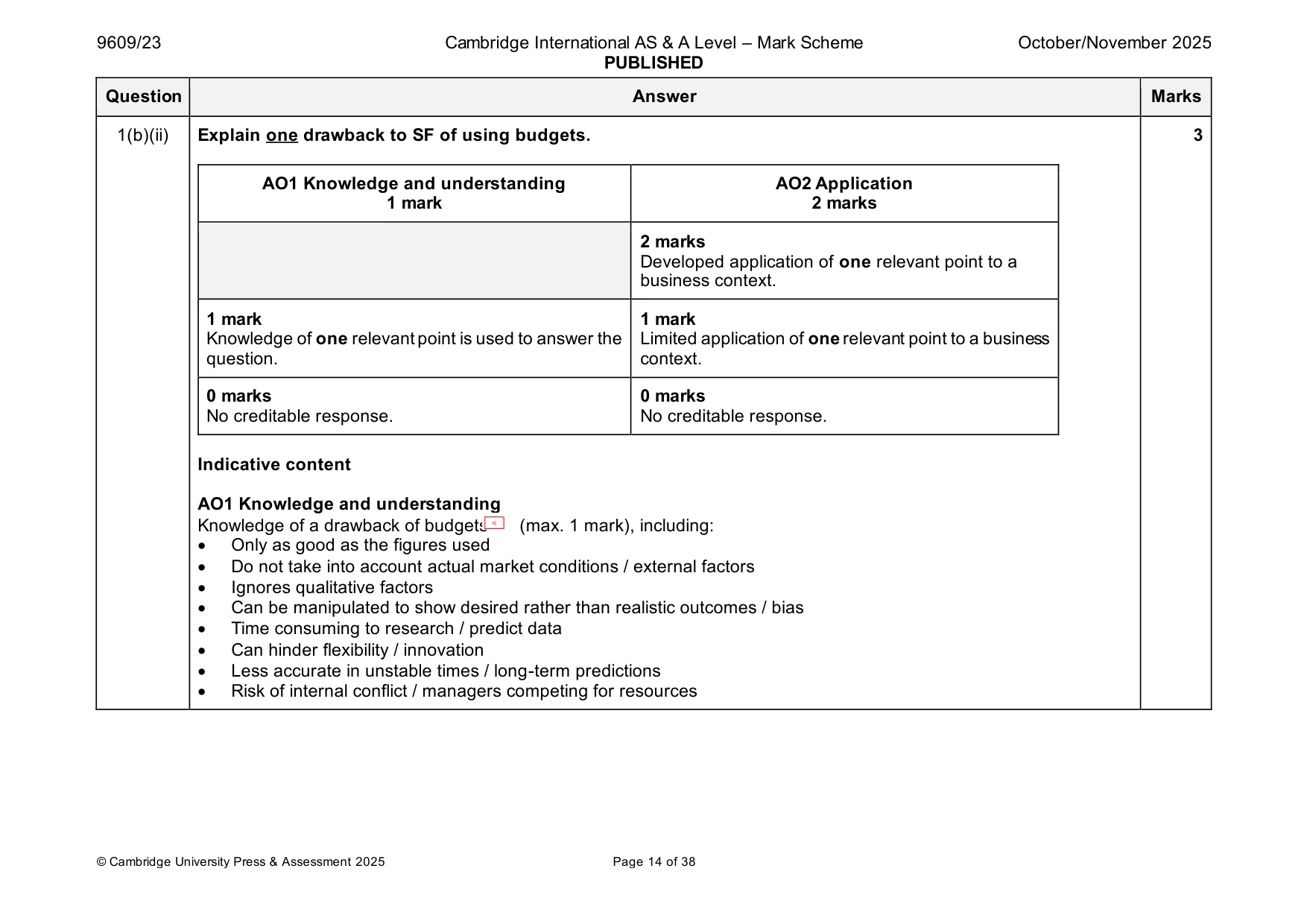
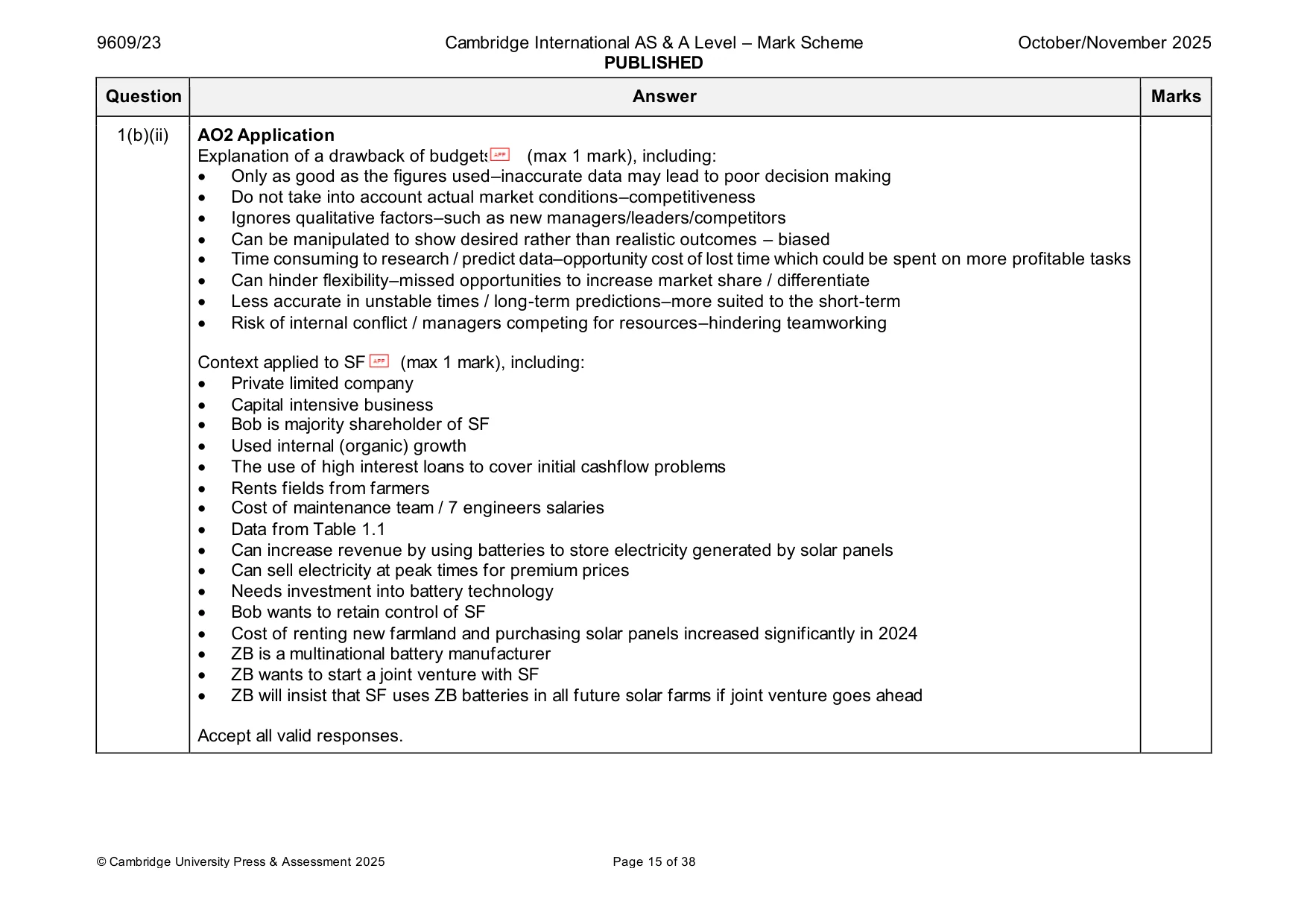
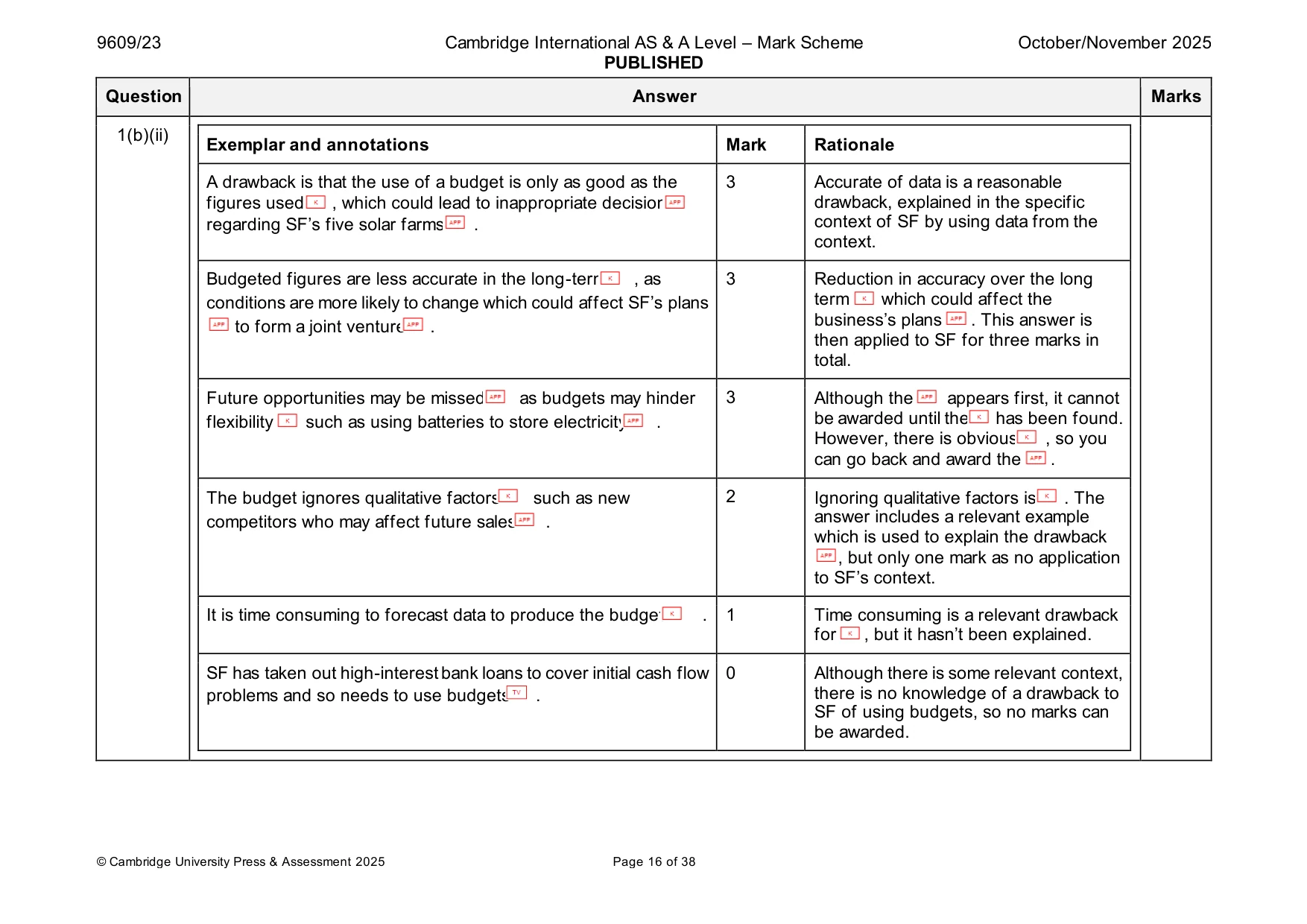
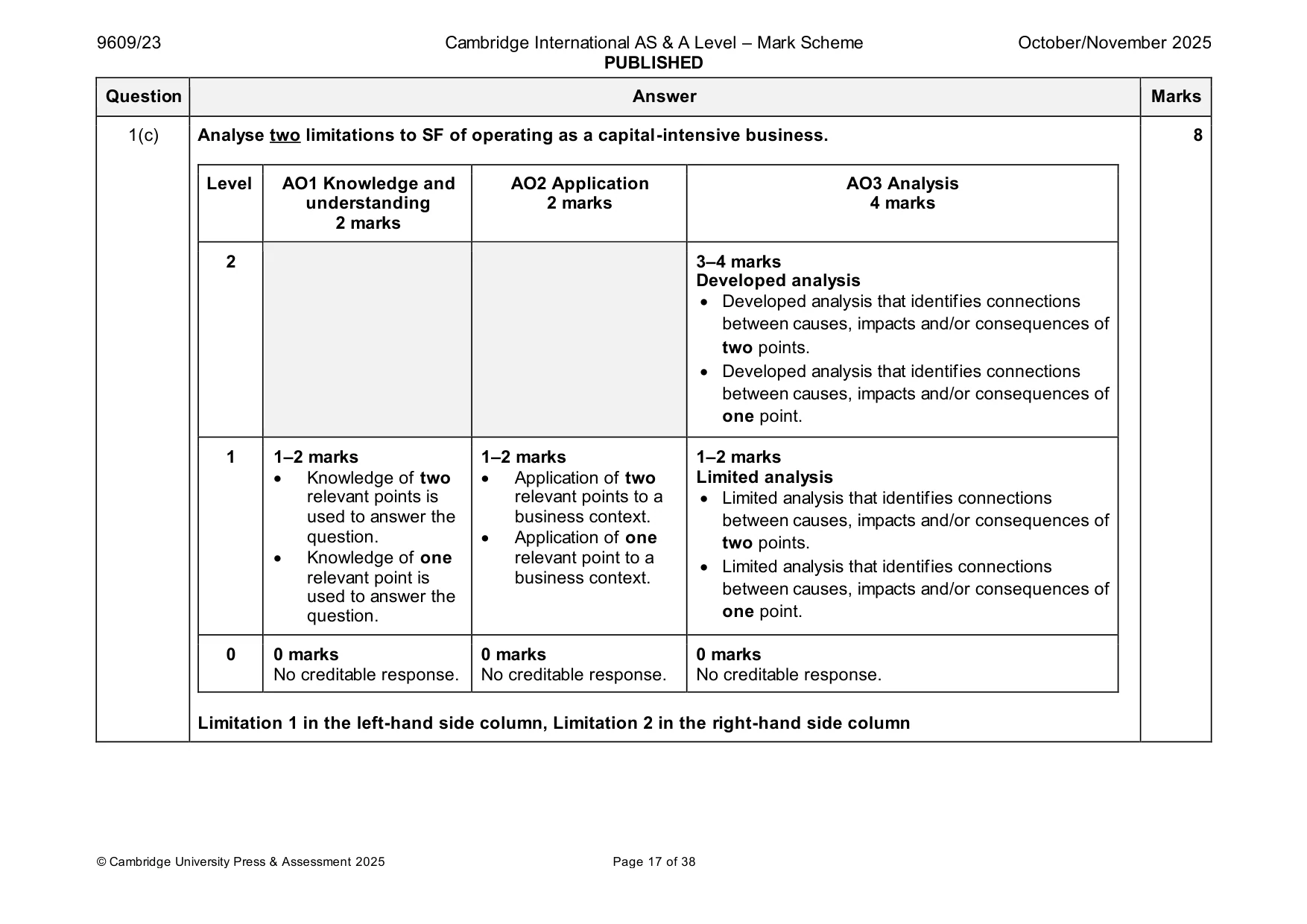
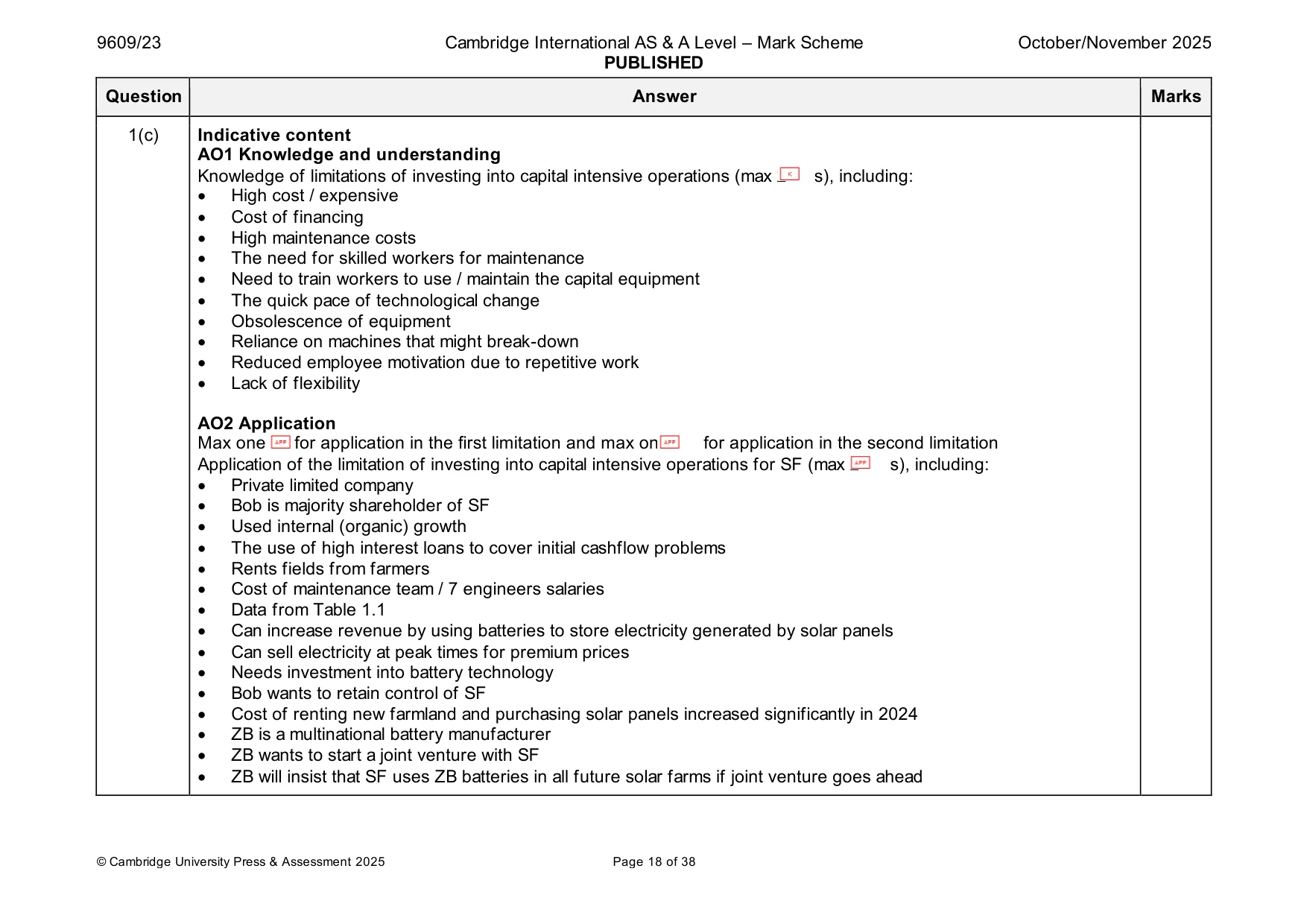
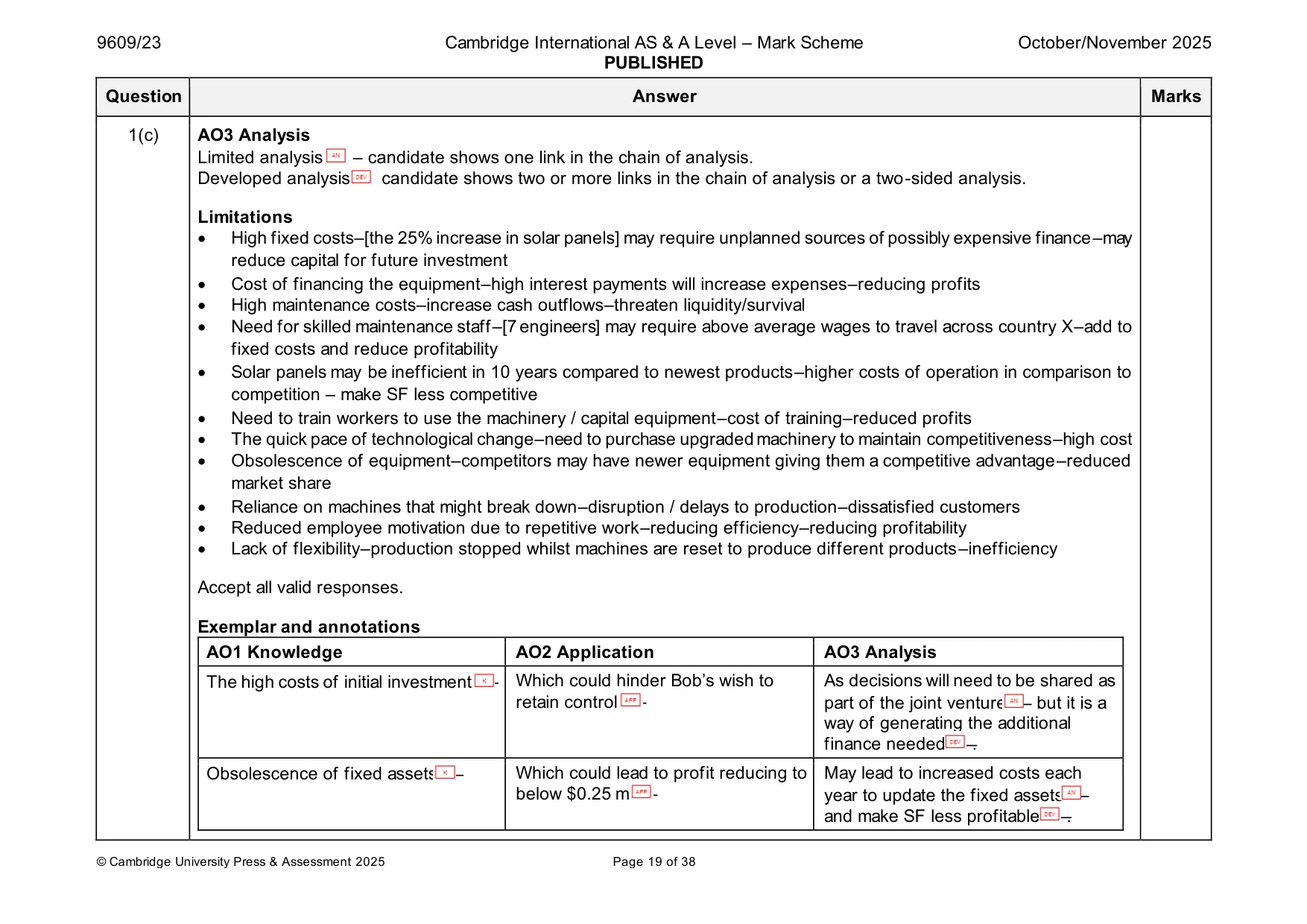
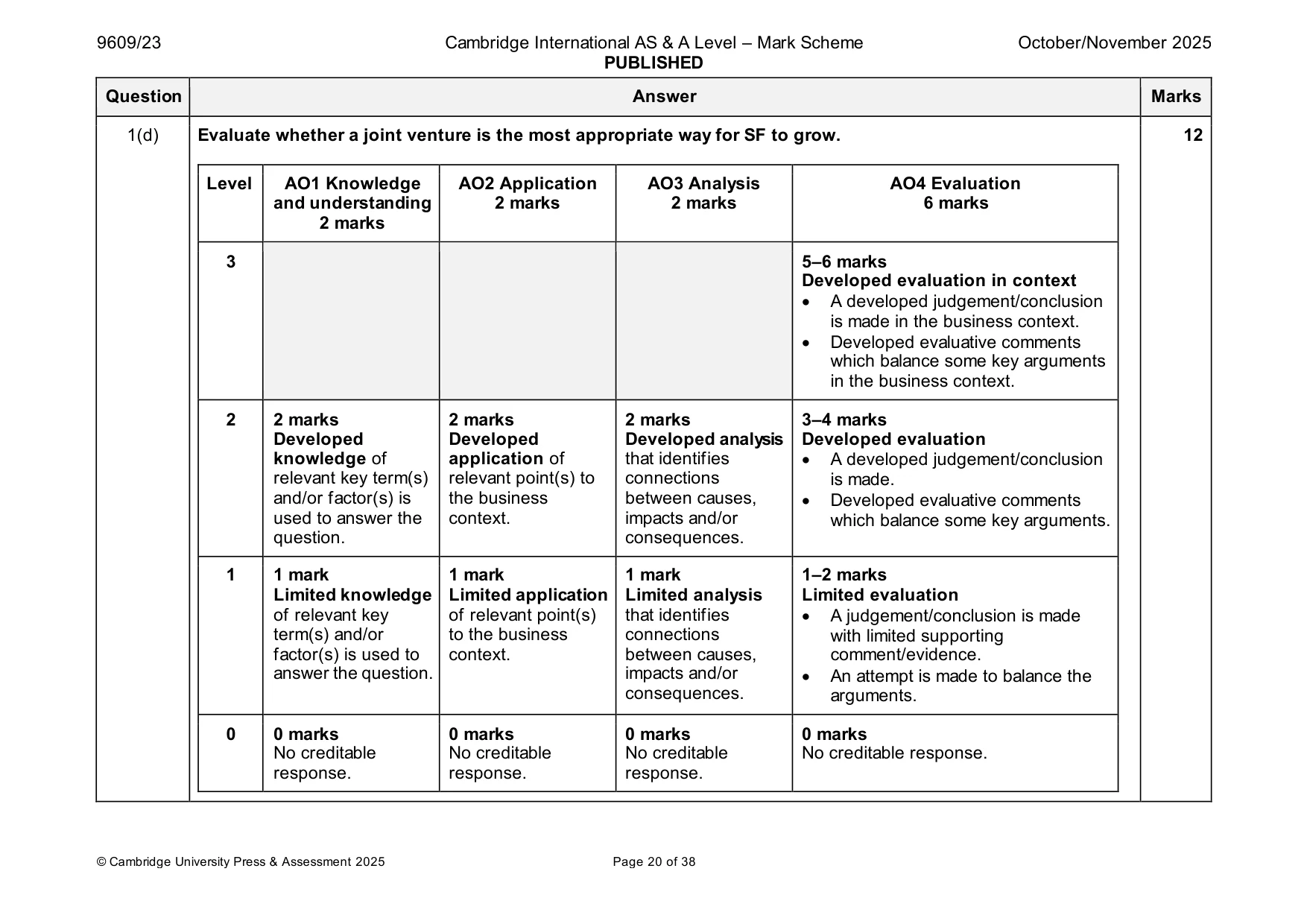
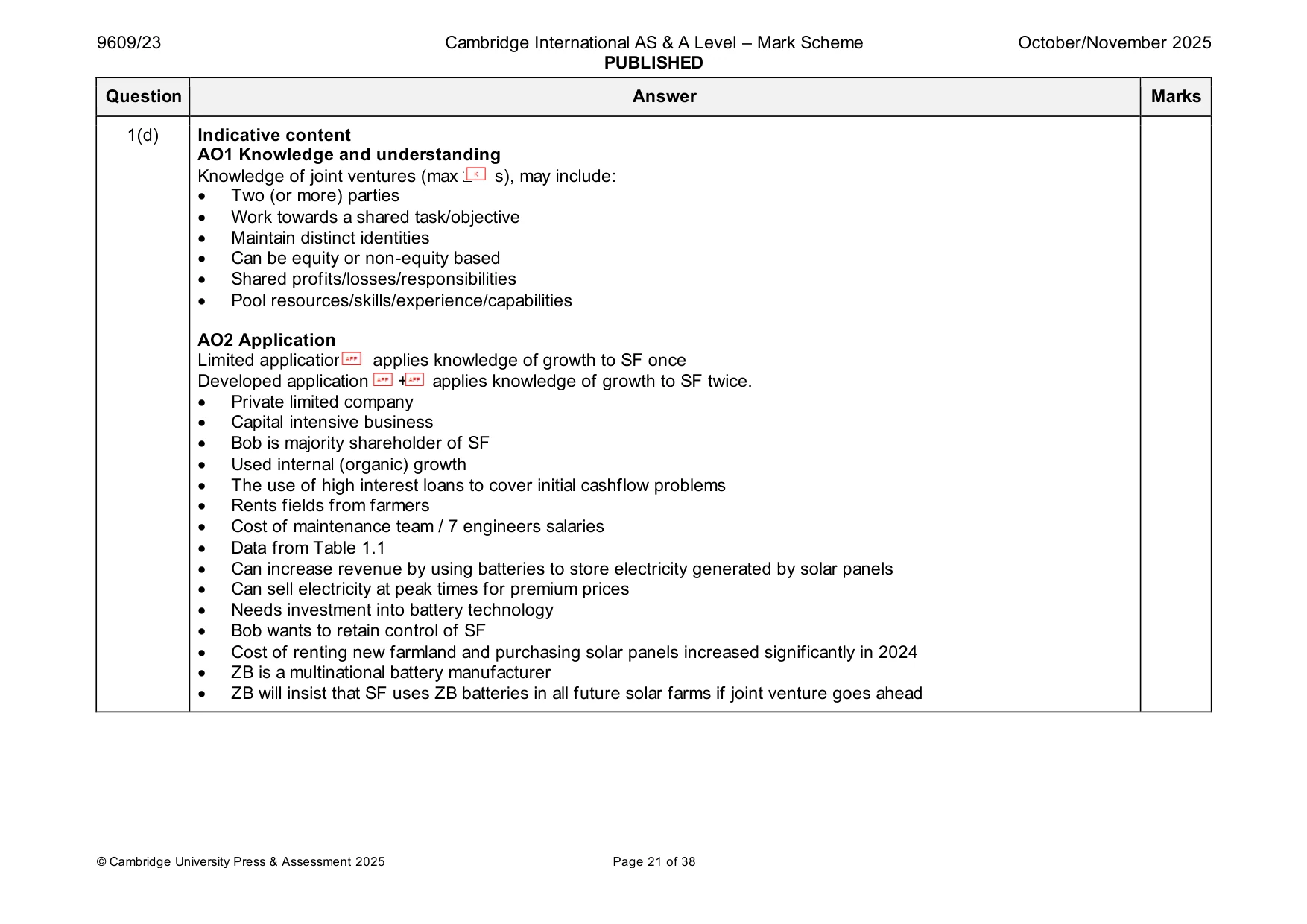
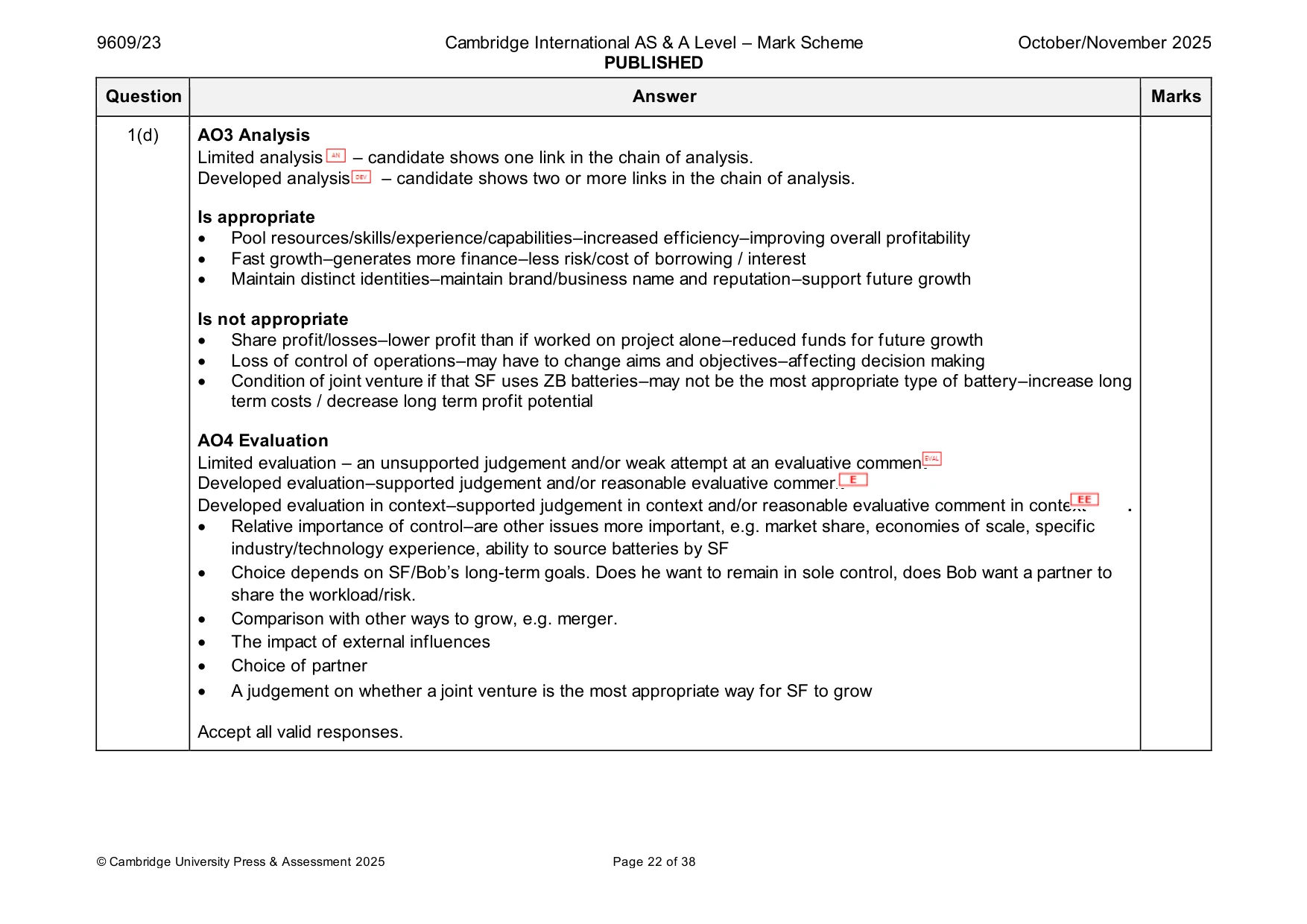
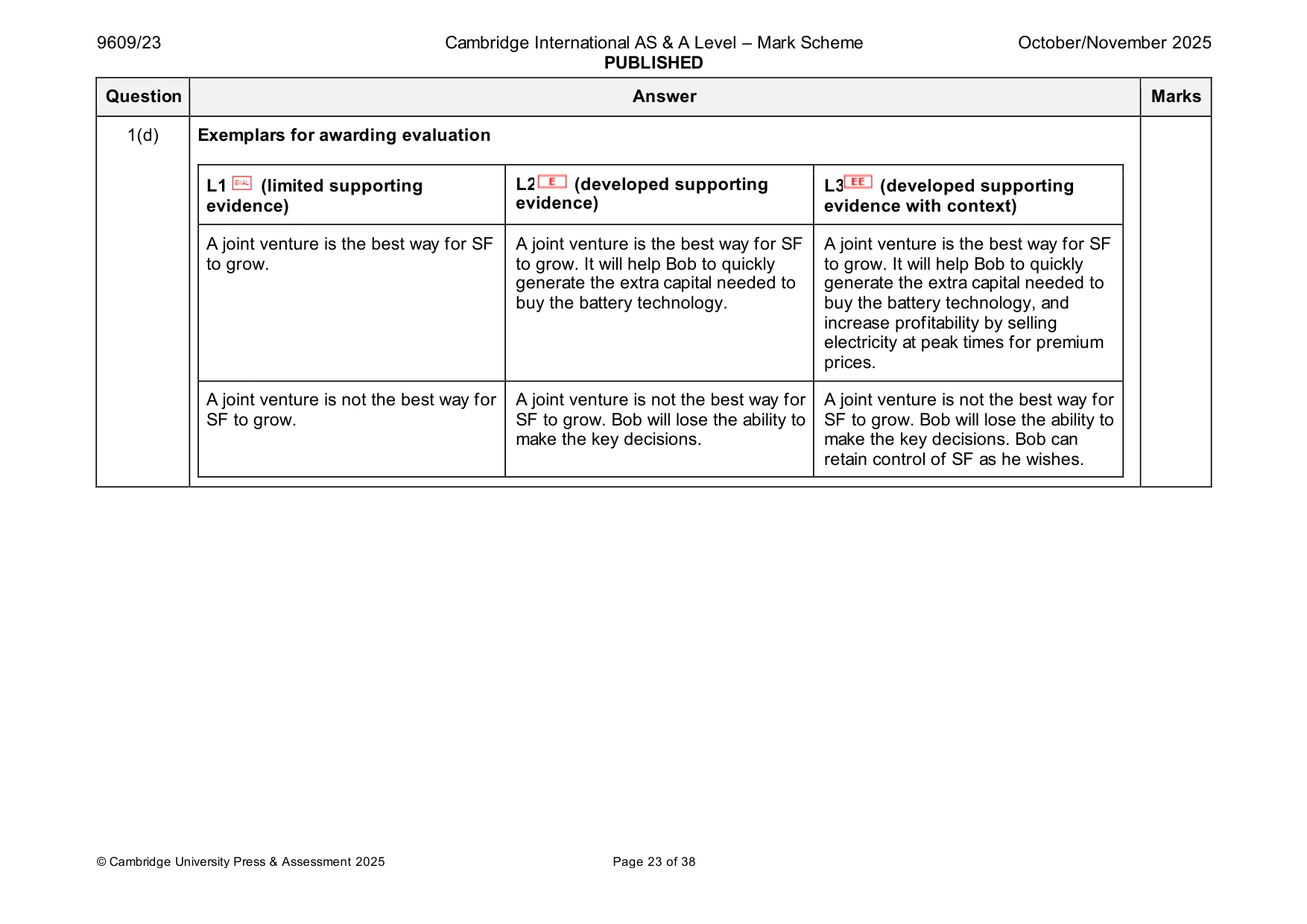
Mark scheme: Question Answer Marks 1(a)(i) Identify one quality an entrepreneur needs for success. 1 Indicative content Identification of a quality may include: • Ambitious / inner drive • Risk taker • Confident • Inquisitive • Adaptability / flexible • Resilience / persistence / determination • Innovative / creative • Communication • Leadership • Decision making • Builds trust If more than one answer is given, only mark the first, reading from top left to bottom right. Accept all valid responses. 1(a)(ii) Explain the term working capital. AO1 Knowledge and understanding AO2 Application 1 mark 2 marks 2 marks Developed application of one relevant point to a business context. 1 mark 1 mark Knowledge of one relevant point is used to answer the Limited application of one relevant point to a business question. context. 0 marks 0 marks No creditable response. No creditable response. Indicative content AO1 Knowledge and understanding Knowledge of working capital will include (max 1 mark): • Current assets minus current liabilities • Money / cash / funds / finance (to run the business) • Ability to run the business • Day-to-day / general operations / current / short-term / immediate / trading 1(a)(ii) AO2 Application Limited application applies knowledge of working capital to a business context. Developed application + applies knowledge of working capital to a business context. • Examples of short-term financial commitments, e.g. stock, salaries, utilities, suppliers, debts, financial obligations, bills etc. • Reference to current ratio and/or acid test ratio (ideals of 2:1 or 1:1) • Benefit of maintaining sufficient working capital, e.g. survival, avoid liquidation • Ways to improve working capital, e.g. use of a bank overdraft • Managing trade receivables, e.g. stopping/reducing trade credit to customers, debt factoring • Managing trade payables, e.g. taking/prolonging trade credit from suppliers • Example from a business concept Accept all valid responses. Exemplar and annotations Mark Rationale The ability to pay short-term financial obligations such as 3 An answer which starts with the knowledge high interest on bank loans and avoid liquidation and then applies it to SF (case mentions high-interest bank loans). Avoid liquidation (survival) is the second application. Cash needed to fund the day-to-day operations such 3 Again, knowledge first, followed by application to business operations (day to as paying staff salaries . day) and includes an example (salaries). Current assets minus current liabilities to measure the 2 Knowledge and explanation for one ability to pay day-to-day bills application mark. It is a measure of the cash needed to operate . 1 Not a perfect definition, but enough to award the knowledge mark. No attempt to apply. The capital the business needs to work. 0 No knowledge of working capital. Tautological. 1(b)(i) Refer to Table 1.1. Calculate the profit variance for SF in 2024. State whether the variance is favourable or adverse. 3 Indicative content Profit variance = actual profit–budgeted profit (1 mark – formula only) Profit variance = 250 000–2 000 000 (1 mark – use of correct figures in formula) Profit variance = ($) 1 750 000 adverse variance (1 mark – correct answer (must include adverse)) Answer = ($) 1 750 000 adverse variance / 1.75 m adverse variance (3 marks – correct answer no working or $ needed) must include adverse OFR applies 1(b)(i) Exemplar and annotations Marks 3 marks Correct answer (3) Working and $ and m do not matter. ($)1 750 000 adverse or ($)1.75 m adverse Ignore + or - • Must be three to denote the three marks. 2 marks EITHER To award two marks, there must be • Correct formula AND • Two and a • Correct identification of figures OR OR • One , one and one • An incorrect answer with one mistake allowing OFR for final stage. Must have the correct variance stated for the answer given. OR • A correct variance (1.75 m) with no adverse (or incorrectly states favourable) 1 mark One of the following: To award one mark, there must be: • Correct formula • One and two • Correct identification of figures in an incorrect formula 0 marks No creditable content. To award zero marks, there must be • One 1(b)(ii) Explain one drawback to SF of using budgets. 3 AO1 Knowledge and understanding AO2 Application 1 mark 2 marks 2 marks Developed application of one relevant point to a business context. 1 mark 1 mark Knowledge of one relevant point is used to answer the Limited application of one relevant point to a business question. context. 0 marks 0 marks No creditable response. No creditable response. Indicative content AO1 Knowledge and understanding Knowledge of a drawback of budgets (max. 1 mark), including: • Only as good as the figures used • Do not take into account actual market conditions / external factors • Ignores qualitative factors • Can be manipulated to show desired rather than realistic outcomes / bias • Time consuming to research / predict data • Can hinder flexibility / innovation • Less accurate in unstable times / long-term predictions • Risk of internal conflict / managers competing for resources 1(b)(ii) AO2 Application Explanation of a drawback of budgets (max 1 mark), including: • Only as good as the figures used–inaccurate data may lead to poor decision making • Do not take into account actual market conditions–competitiveness • Ignores qualitative factors–such as new managers/leaders/competitors • Can be manipulated to show desired rather than realistic outcomes – biased • Time consuming to research / predict data–opportunity cost of lost time which could be spent on more profitable tasks • Can hinder flexibility–missed opportunities to increase market share / differentiate • Less accurate in unstable times / long-term predictions–more suited to the short-term • Risk of internal conflict / managers competing for resources–hindering teamworking Context applied to SF (max 1 mark), including: • Private limited company • Capital intensive business • Bob is majority shareholder of SF • Used internal (organic) growth • The use of high interest loans to cover initial cashflow problems • Rents fields from farmers • Cost of maintenance team / 7 engineers salaries • Data from Table 1.1 • Can increase revenue by using batteries to store electricity generated by solar panels • Can sell electricity at peak times for premium prices • Needs investment into battery technology • Bob wants to retain control of SF • Cost of renting new farmland and purchasing solar panels increased significantly in 2024 • ZB is a multinational battery manufacturer • ZB wants to start a joint venture with SF • ZB will insist that SF uses ZB batteries in all future solar farms if joint venture goes ahead Accept all valid responses. 1(b)(ii) Exemplar and annotations Mark Rationale A drawback is that the use of a budget is only as good as the 3 Accurate of data is a reasonable figures used , which could lead to inappropriate decisions drawback, explained in the specific regarding SF’s five solar farms . context of SF by using data from the context. Budgeted figures are less accurate in the long-term , as 3 Reduction in accuracy over the long conditions are more likely to change which could affect SF’s plans term which could affect the business’s plans . This answer is to form a joint venture . then applied to SF for three marks in total. Future opportunities may be missed as budgets may hinder 3 Although the appears first, it cannot flexibility such as using batteries to store electricity . be awarded until the has been found. However, there is obvious , so you can go back and award the . The budget ignores qualitative factors such as new 2 Ignoring qualitative factors is . The answer includes a relevant example competitors who may affect future sales . which is used to explain the drawback , but only one mark as no application to SF’s context. It is time consuming to forecast data to produce the budget . 1 Time consuming is a relevant drawback for , but it hasn’t been explained. SF has taken out high-interest bank loans to cover initial cash flow 0 Although there is some relevant context, problems and so needs to use budgets . there is no knowledge of a drawback to SF of using budgets, so no marks can be awarded. 1(c) Analyse two limitations to SF of operating as a capital-intensive business. 8 Level AO1 Knowledge and AO2 Application AO3 Analysis understanding 2 marks 4 marks 2 marks 2 3–4 marks Developed analysis • Developed analysis that identifies connections between causes, impacts and/or consequences of two points. • Developed analysis that identifies connections between causes, impacts and/or consequences of one point. 1 1–2 marks 1–2 marks 1–2 marks • Knowledge of two • Application of two Limited analysis relevant points is relevant points to a • Limited analysis that identifies connections used to answer the business context. between causes, impacts and/or consequences of question. • Application of one two points. • Knowledge of one relevant point to a • Limited analysis that identifies connections relevant point is business context. between causes, impacts and/or consequences of used to answer the one point. question. 0 0 marks 0 marks 0 marks No creditable response. No creditable response. No creditable response. Limitation 1 in the left-hand side column, Limitation 2 in the right-hand side column 1(c) Indicative content AO1 Knowledge and understanding Knowledge of limitations of investing into capital intensive operations (max 2 s), including: • High cost / expensive • Cost of financing • High maintenance costs • The need for skilled workers for maintenance • Need to train workers to use / maintain the capital equipment • The quick pace of technological change • Obsolescence of equipment • Reliance on machines that might break-down • Reduced employee motivation due to repetitive work • Lack of flexibility AO2 Application Max one for application in the first limitation and max one for application in the second limitation Application of the limitation of investing into capital intensive operations for SF (max 2 s), including: • Private limited company • Bob is majority shareholder of SF • Used internal (organic) growth • The use of high interest loans to cover initial cashflow problems • Rents fields from farmers • Cost of maintenance team / 7 engineers salaries • Data from Table 1.1 • Can increase revenue by using batteries to store electricity generated by solar panels • Can sell electricity at peak times for premium prices • Needs investment into battery technology • Bob wants to retain control of SF • Cost of renting new farmland and purchasing solar panels increased significantly in 2024 • ZB is a multinational battery manufacturer • ZB wants to start a joint venture with SF • ZB will insist that SF uses ZB batteries in all future solar farms if joint venture goes ahead 1(c) AO3 Analysis Limited analysis – candidate shows one link in the chain of analysis. Developed analysis candidate shows two or more links in the chain of analysis or a two-sided analysis. Limitations • High fixed costs–[the 25% increase in solar panels] may require unplanned sources of possibly expensive finance–may reduce capital for future investment • Cost of financing the equipment–high interest payments will increase expenses–reducing profits • High maintenance costs–increase cash outflows–threaten liquidity/survival • Need for skilled maintenance staff–[7 engineers] may require above average wages to travel across country X–add to fixed costs and reduce profitability • Solar panels may be inefficient in 10 years compared to newest products–higher costs of operation in comparison to competition – make SF less competitive • Need to train workers to use the machinery / capital equipment–cost of training–reduced profits • The quick pace of technological change–need to purchase upgraded machinery to maintain competitiveness–high cost • Obsolescence of equipment–competitors may have newer equipment giving them a competitive advantage–reduced market share • Reliance on machines that might break down–disruption / delays to production–dissatisfied customers • Reduced employee motivation due to repetitive work–reducing efficiency–reducing profitability • Lack of flexibility–production stopped whilst machines are reset to produce different products–inefficiency Accept all valid responses. Exemplar and annotations AO1 Knowledge AO2 Application AO3 Analysis The high costs of initial investment Which could hinder Bob’s wish to As decisions will need to be shared as retain control part of the joint venture but it is a way of generating the additional finance needed . Obsolescence of fixed assets Which could lead to profit reducing to May lead to increased costs each below $0.25 m year to update the fixed assets and make SF less profitable . 1(d) Evaluate whether a joint venture is the most appropriate way for SF to grow. 12 Level AO1 Knowledge AO2 Application AO3 Analysis AO4 Evaluation and understanding 2 marks 2 marks 6 marks 2 marks 3 5–6 marks Developed evaluation in context • A developed judgement/conclusion is made in the business context. • Developed evaluative comments which balance some key arguments in the business context. 2 2 marks 2 marks 2 marks 3–4 marks Developed Developed Developed analysis Developed evaluation knowledge of application of that identifies • A developed judgement/conclusion relevant key term(s) relevant point(s) to connections is made. and/or factor(s) is the business between causes, • Developed evaluative comments used to answer the context. impacts and/or which balance some key arguments. question. consequences. 1 1 mark 1 mark 1 mark 1–2 marks Limited knowledge Limited application Limited analysis Limited evaluation of relevant key of relevant point(s) that identifies • A judgement/conclusion is made term(s) and/or to the business connections with limited supporting factor(s) is used to context. between causes, comment/evidence. answer the question. impacts and/or • An attempt is made to balance the consequences. arguments. 0 0 marks 0 marks 0 marks 0 marks No creditable No creditable No creditable No creditable response. response. response. response. 1(d) Indicative content AO1 Knowledge and understanding Knowledge of joint ventures (max 2 s), may include: • Two (or more) parties • Work towards a shared task/objective • Maintain distinct identities • Can be equity or non-equity based • Shared profits/losses/responsibilities • Pool resources/skills/experience/capabilities AO2 Application Limited application applies knowledge of growth to SF once Developed application + applies knowledge of growth to SF twice. • Private limited company • Capital intensive business • Bob is majority shareholder of SF • Used internal (organic) growth • The use of high interest loans to cover initial cashflow problems • Rents fields from farmers • Cost of maintenance team / 7 engineers salaries • Data from Table 1.1 • Can increase revenue by using batteries to store electricity generated by solar panels • Can sell electricity at peak times for premium prices • Needs investment into battery technology • Bob wants to retain control of SF • Cost of renting new farmland and purchasing solar panels increased significantly in 2024 • ZB is a multinational battery manufacturer • ZB will insist that SF uses ZB batteries in all future solar farms if joint venture goes ahead 1(d) AO3 Analysis Limited analysis – candidate shows one link in the chain of analysis. Developed analysis – candidate shows two or more links in the chain of analysis. Is appropriate • Pool resources/skills/experience/capabilities–increased efficiency–improving overall profitability • Fast growth–generates more finance–less risk/cost of borrowing / interest • Maintain distinct identities–maintain brand/business name and reputation–support future growth Is not appropriate • Share profit/losses–lower profit than if worked on project alone–reduced funds for future growth • Loss of control of operations–may have to change aims and objectives–affecting decision making • Condition of joint venture if that SF uses ZB batteries–may not be the most appropriate type of battery–increase long term costs / decrease long term profit potential AO4 Evaluation Limited evaluation – an unsupported judgement and/or weak attempt at an evaluative comment Developed evaluation–supported judgement and/or reasonable evaluative comment Developed evaluation in context–supported judgement in context and/or reasonable evaluative comment in context . • Relative importance of control–are other issues more important, e.g. market share, economies of scale, specific industry/technology experience, ability to source batteries by SF • Choice depends on SF/Bob’s long-term goals. Does he want to remain in sole control, does Bob want a partner to share the workload/risk. • Comparison with other ways to grow, e.g. merger. • The impact of external influences • Choice of partner • A judgement on whether a joint venture is the most appropriate way for SF to grow Accept all valid responses. 1(d) Exemplars for awarding evaluation L1 (limited supporting L2 (developed supporting L3 (developed supporting evidence) evidence) evidence with context) A joint venture is the best way for SF A joint venture is the best way for SF A joint venture is the best way for SF to grow. to grow. It will help Bob to quickly to grow. It will help Bob to quickly generate the extra capital needed to generate the extra capital needed to buy the battery technology. buy the battery technology, and increase profitability by selling electricity at peak times for premium prices. A joint venture is not the best way for A joint venture is not the best way for A joint venture is not the best way for SF to grow. SF to grow. Bob will lose the ability to SF to grow. Bob will lose the ability to make the key decisions. make the key decisions. Bob can retain control of SF as he wishes.
Q2 · Popular Drinks (PD) PD is a mass market fizzy drinks manufacturer in country Z
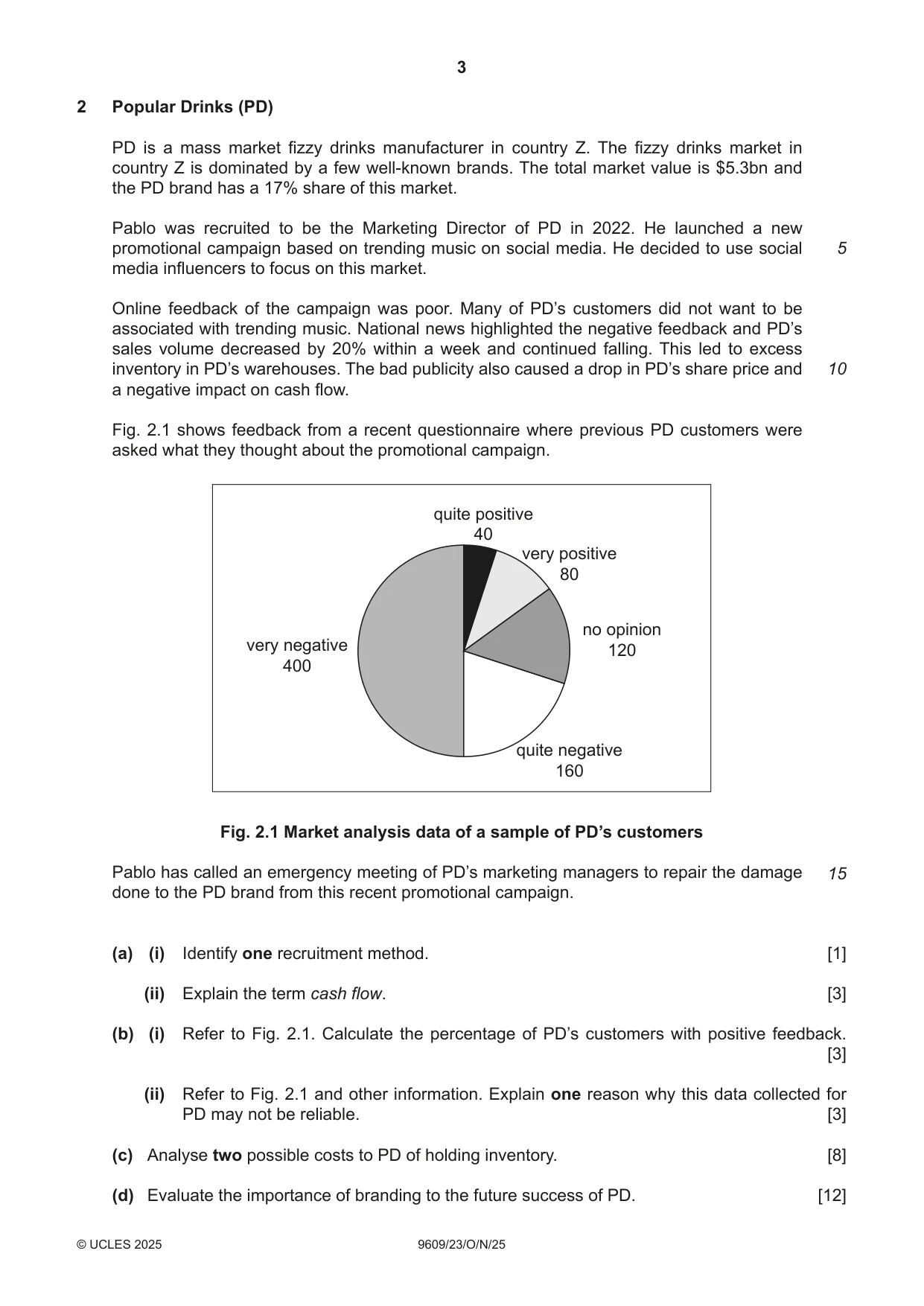
2 Popular Drinks (PD) PD is a mass market fizzy drinks manufacturer in country Z. The fizzy drinks market in country Z is dominated by a few well-known brands. The total market value is $5.3bn and the PD brand has a 17% share of this market. Pablo was recruited to be the Marketing Director of PD in 2022. He launched a new promotional campaign based on trending music on social media. He decided to use social 5 media influencers to focus on this market. Online feedback of the campaign was poor. Many of PD’s customers did not want to be associated with trending music. National news highlighted the negative feedback and PD’s sales volume decreased by 20% within a week and continued falling. This led to excess inventory in PD’s warehouses. The bad publicity also caused a drop in PD’s share price and 10 a negative impact on cash flow. Fig. 2.1 shows feedback from a recent questionnaire where previous PD customers were asked what they thought about the promotional campaign. quite positive 40 very positive 80 no opinion very negative 120 400 quite negative 160 Fig. 2.1 Market analysis data of a sample of PD’s customers Pablo has called an emergency meeting of PD’s marketing managers to repair the damage 15 done to the PD brand from this recent promotional campaign. (a) (i) Identify one recruitment method. [1] (ii) Explain the term cash flow. [3] (b) (i) Refer to Fig. 2.1. Calculate the percentage of PD’s customers with positive feedback. [3] (ii) Refer to Fig. 2.1 and other information. Explain one reason why this data collected for PD may not be reliable. [3] (c) Analyse two possible costs to PD of holding inventory. [8] (d) Evaluate the importance of branding to the future success of PD. [12]
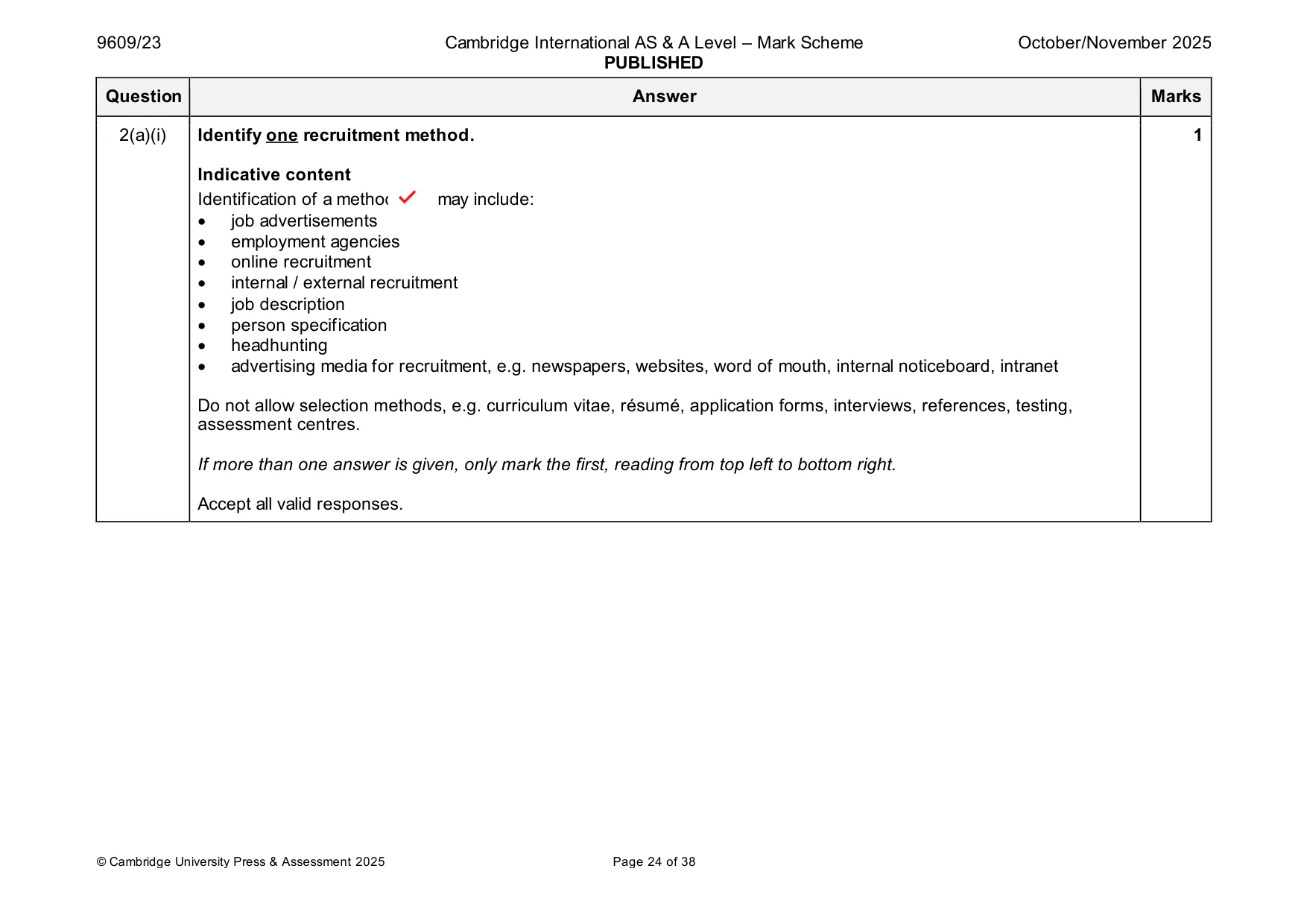
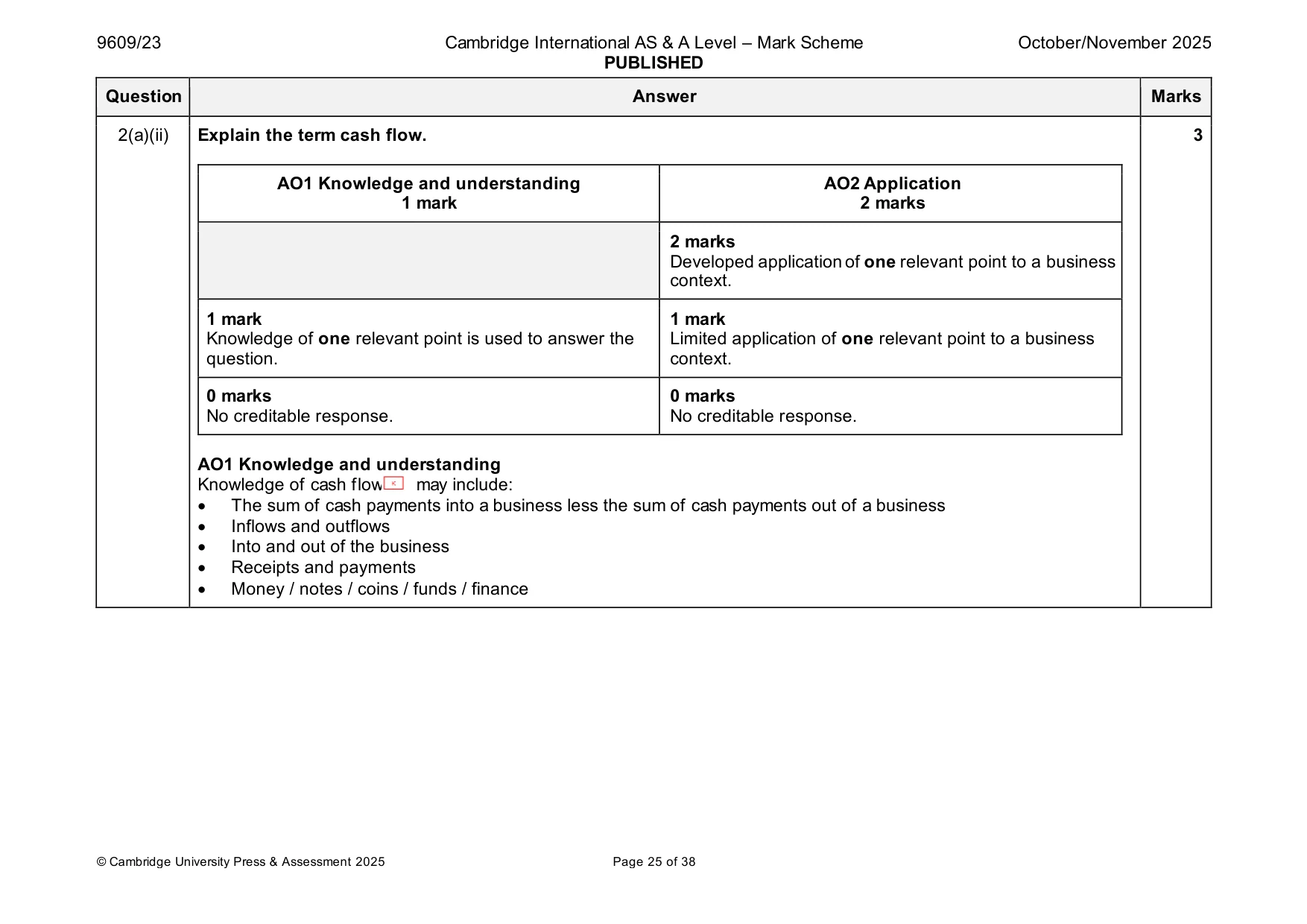
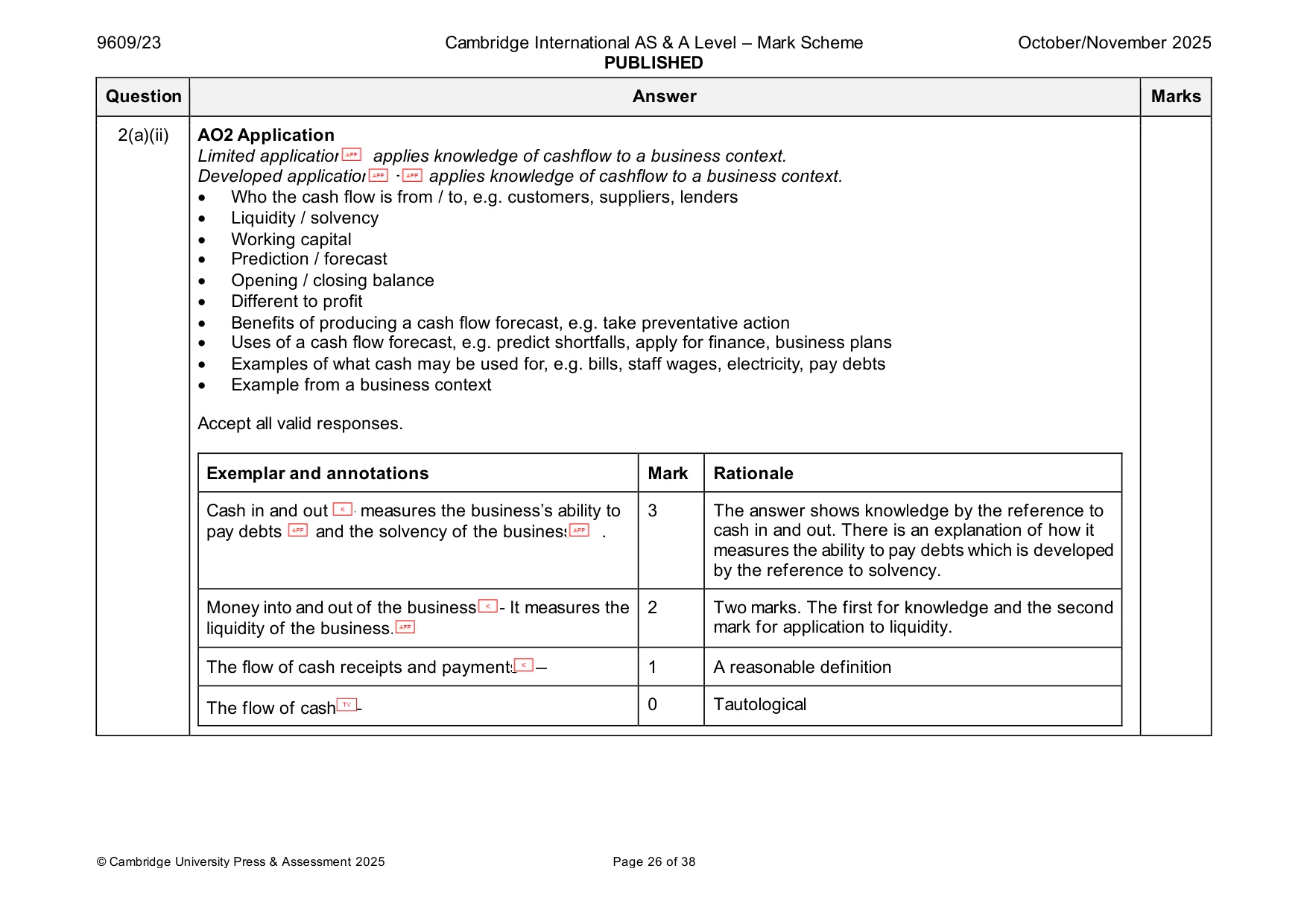
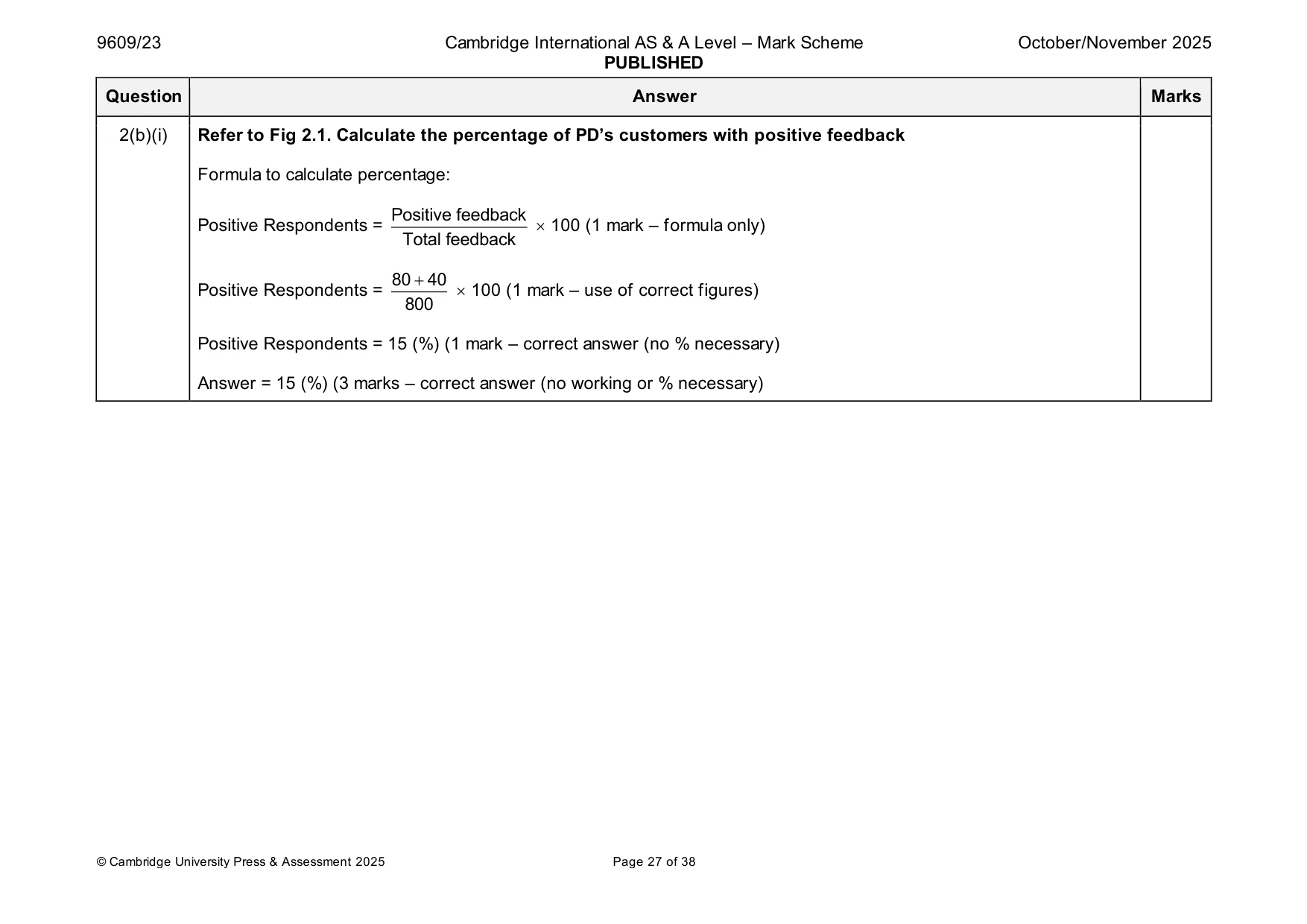
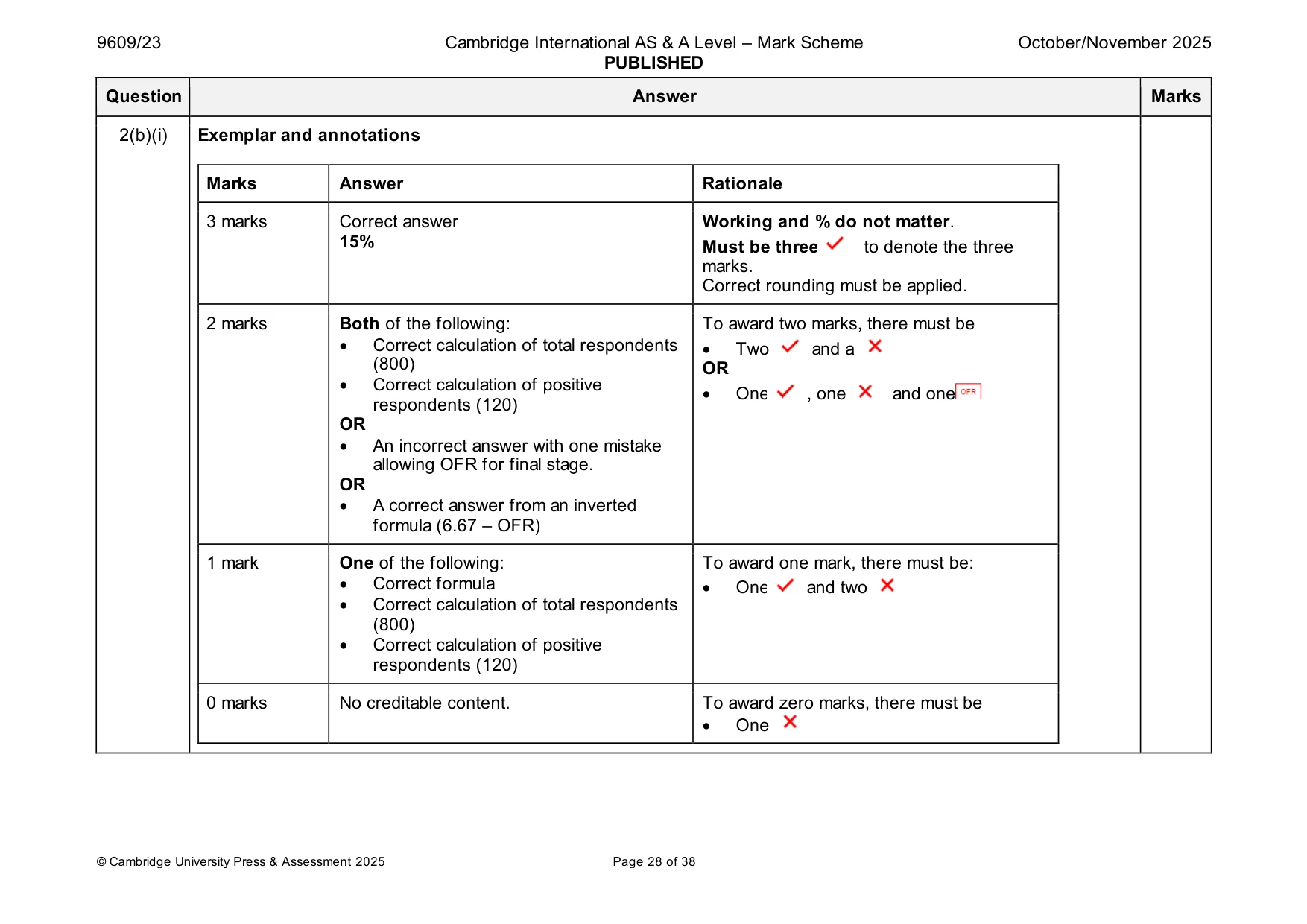
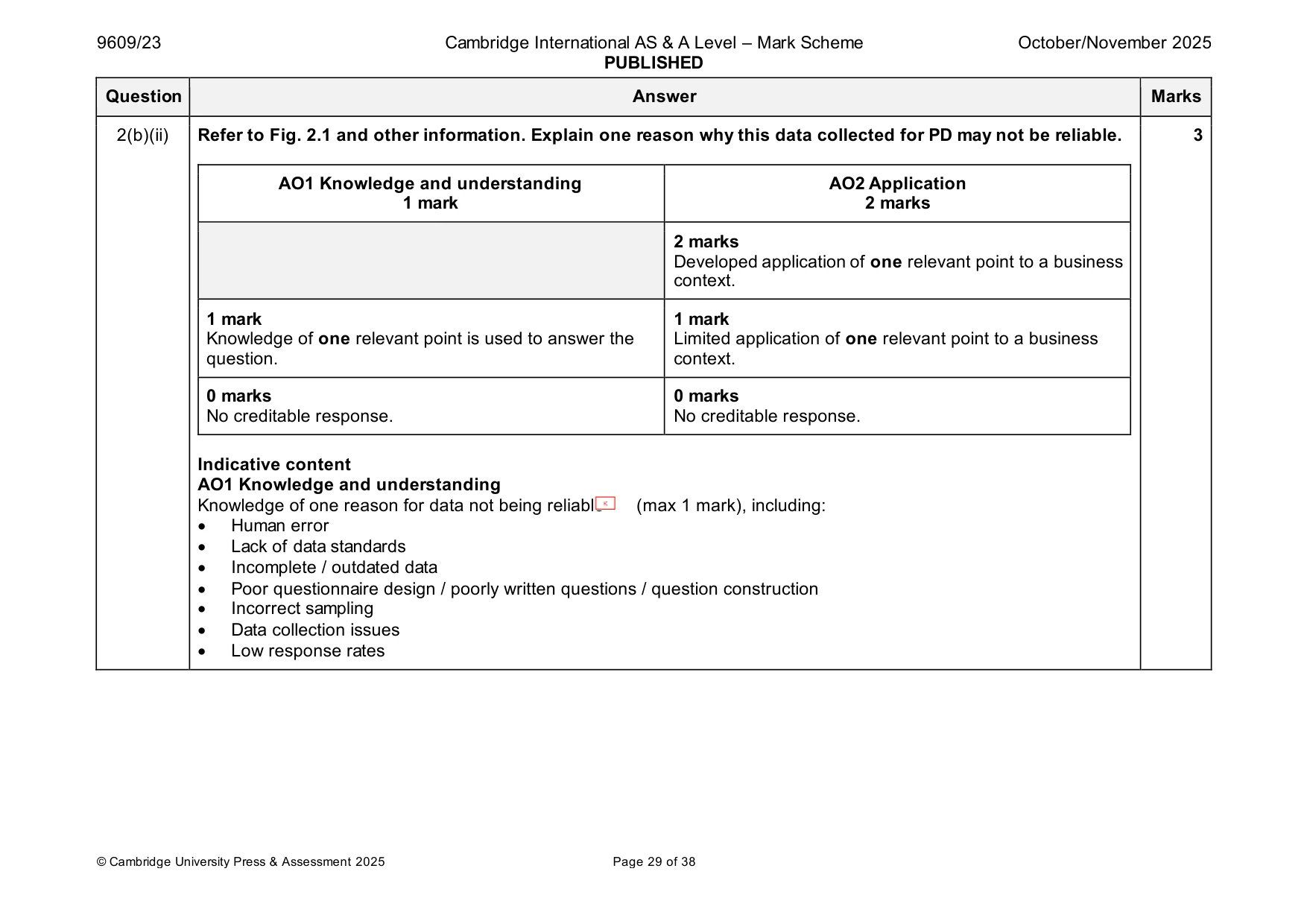
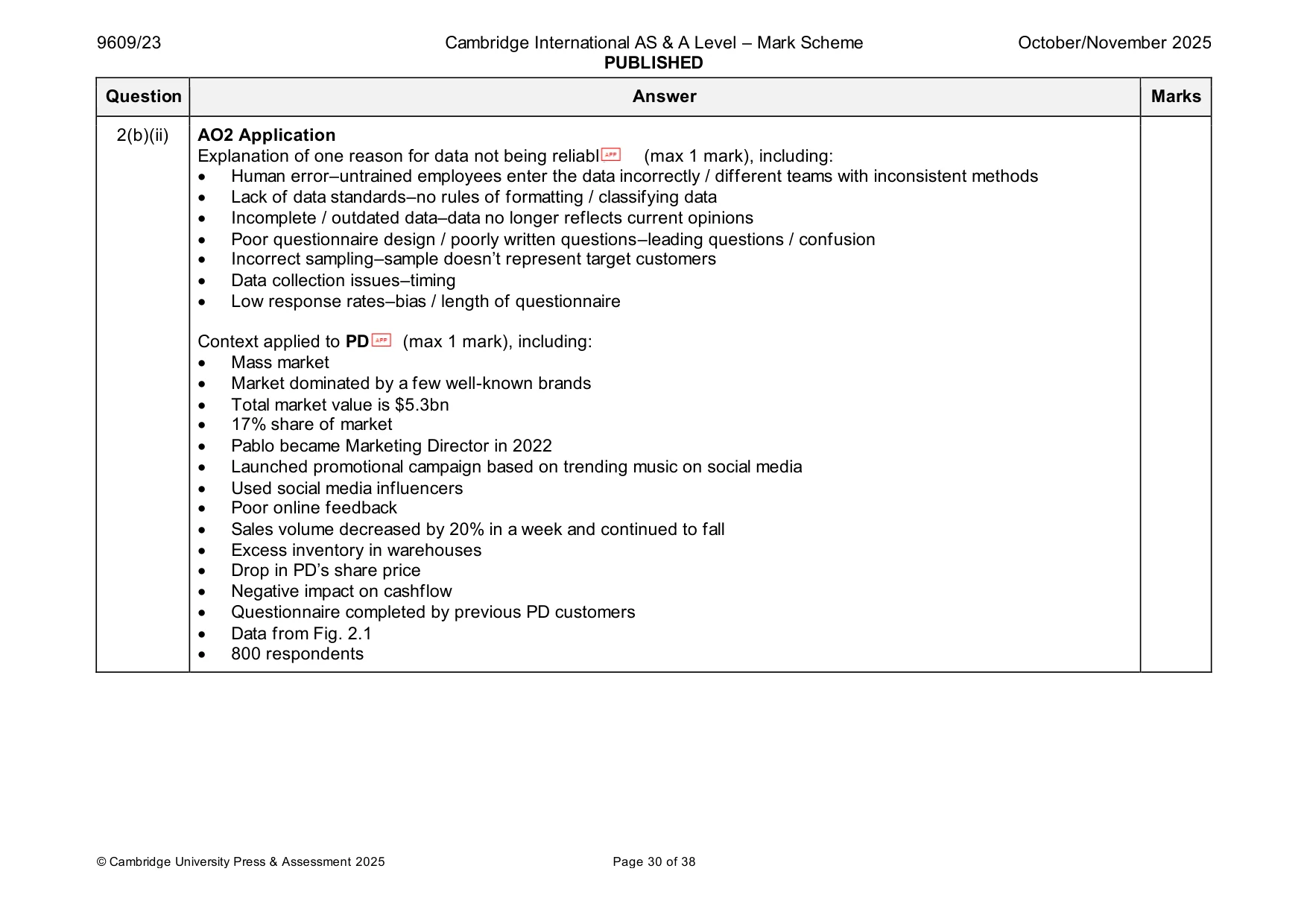
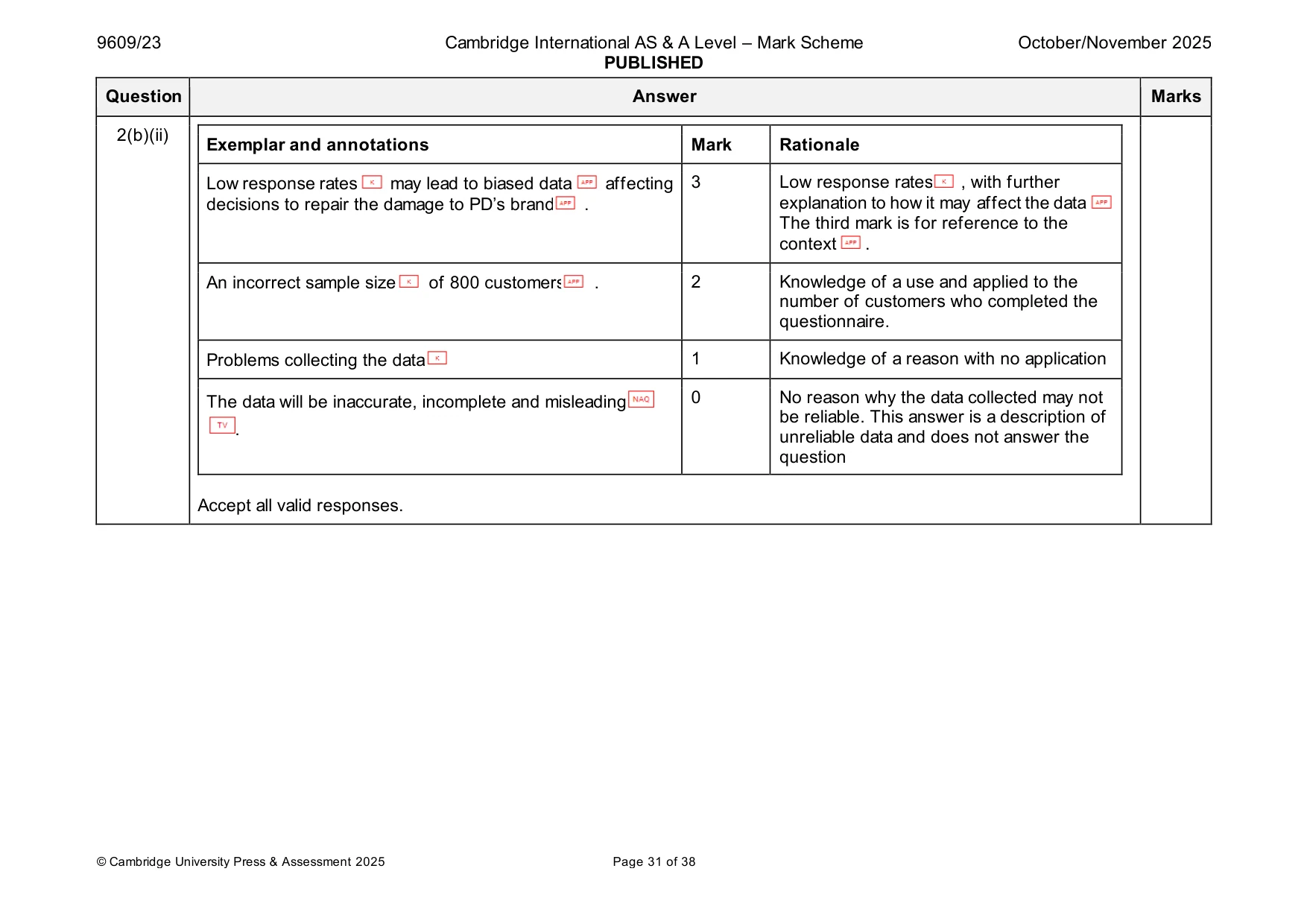
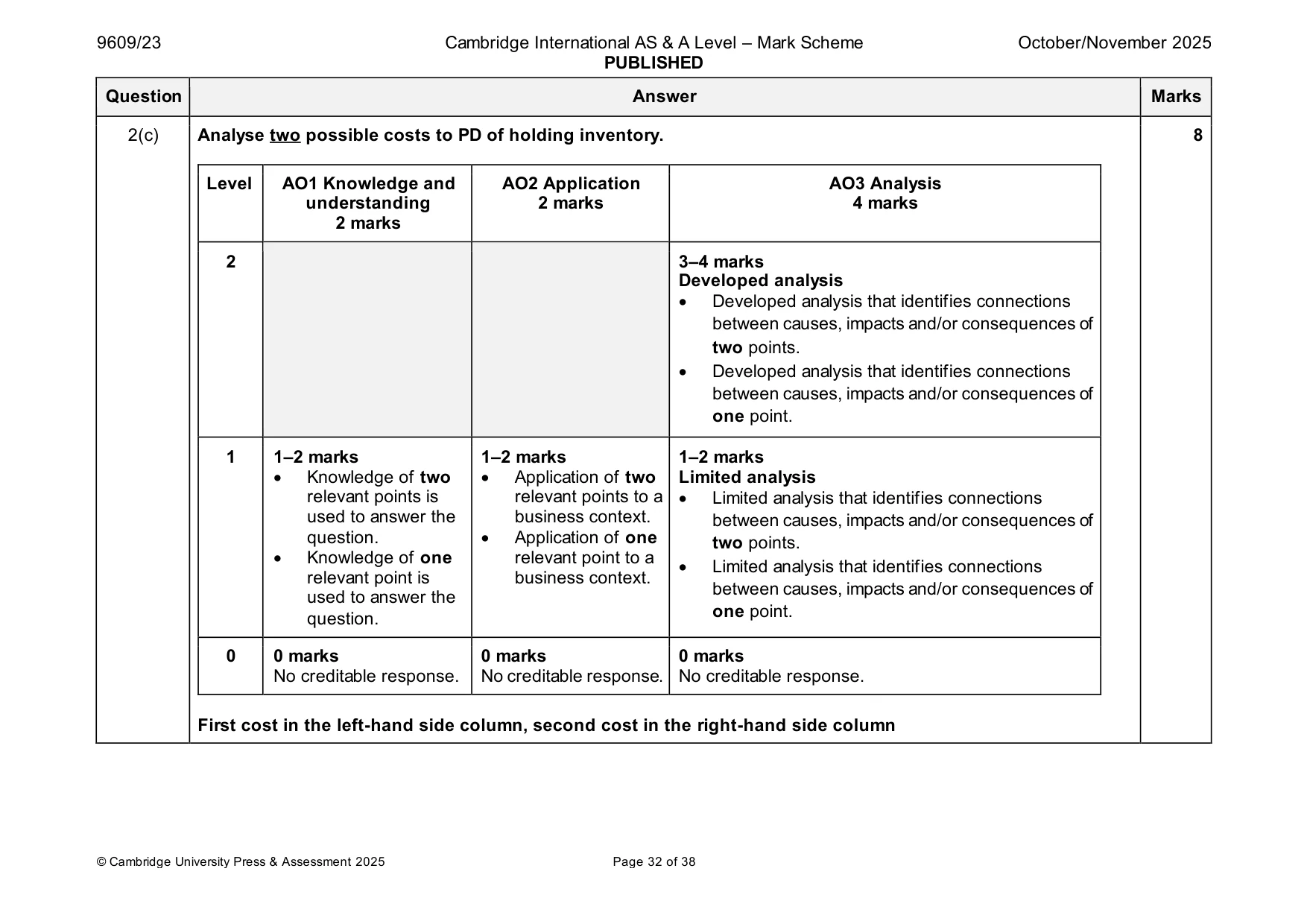
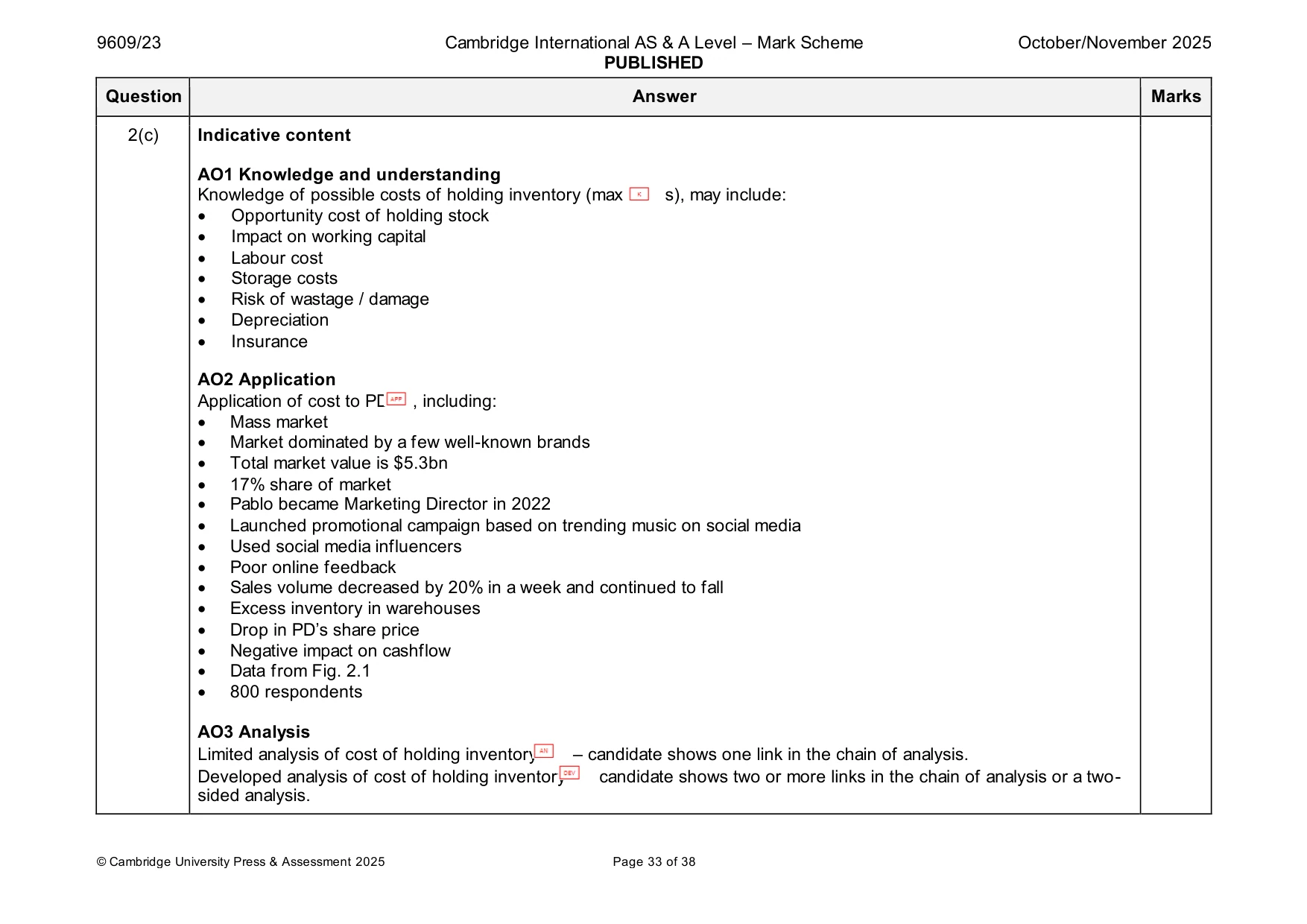
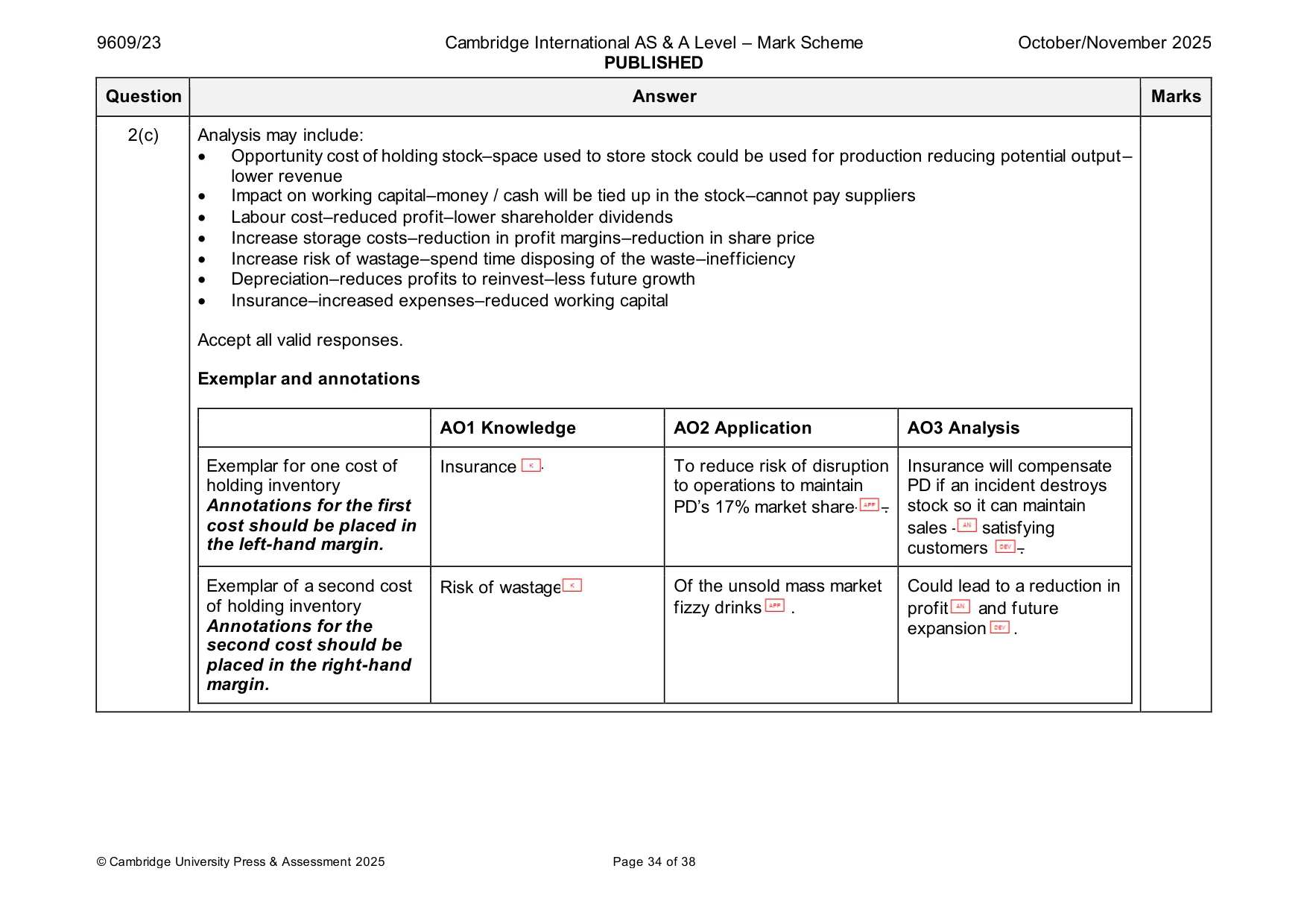
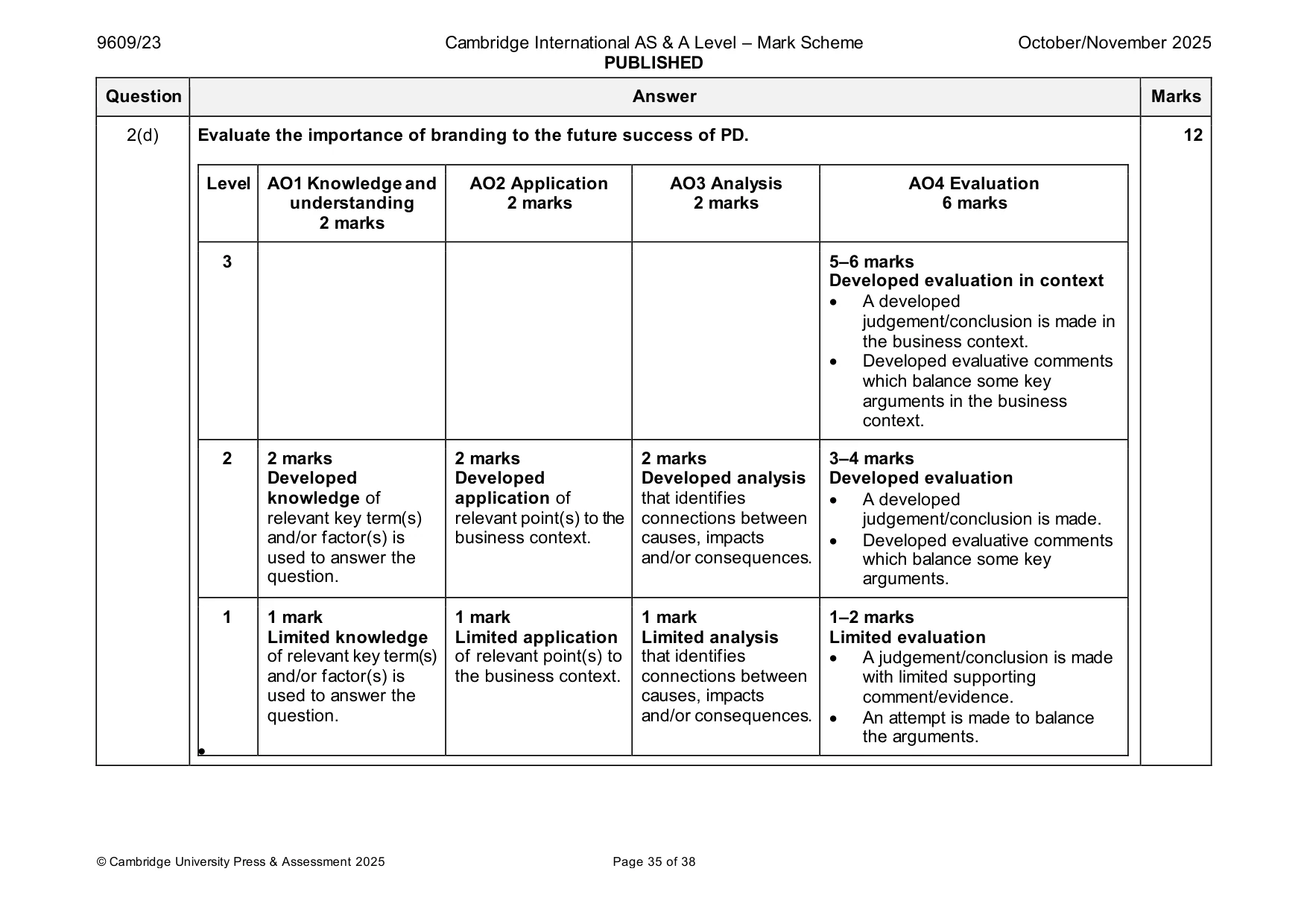
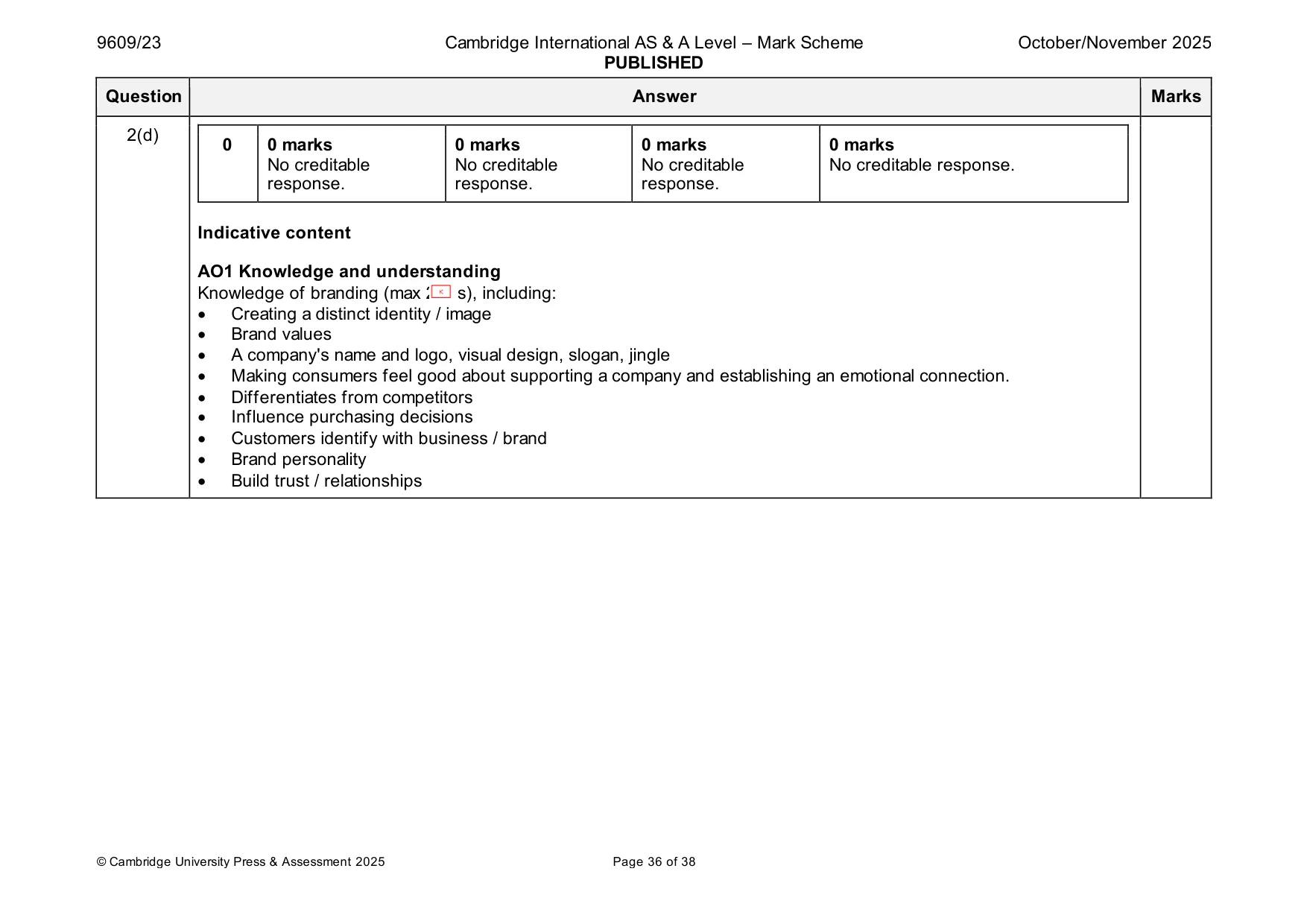
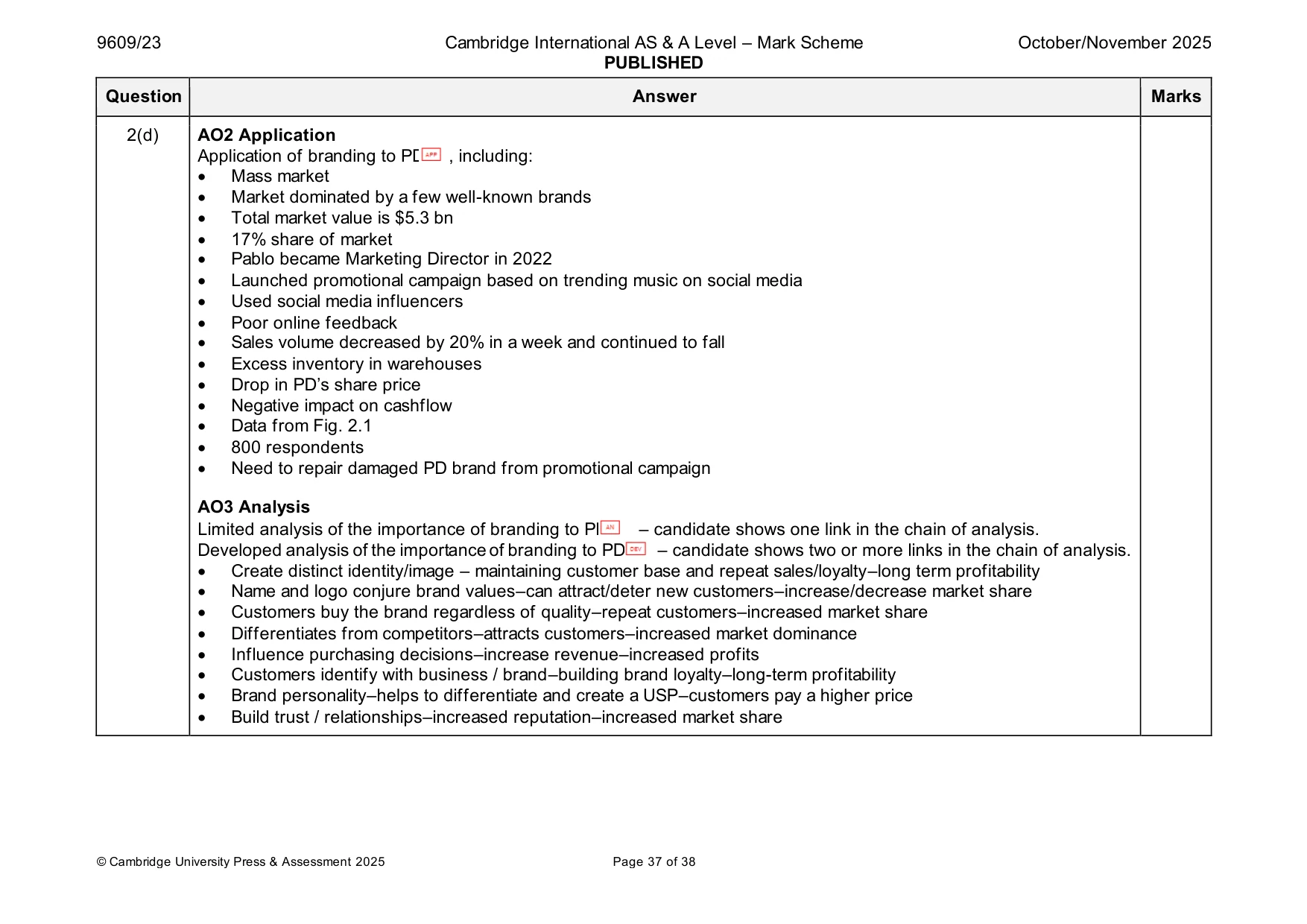
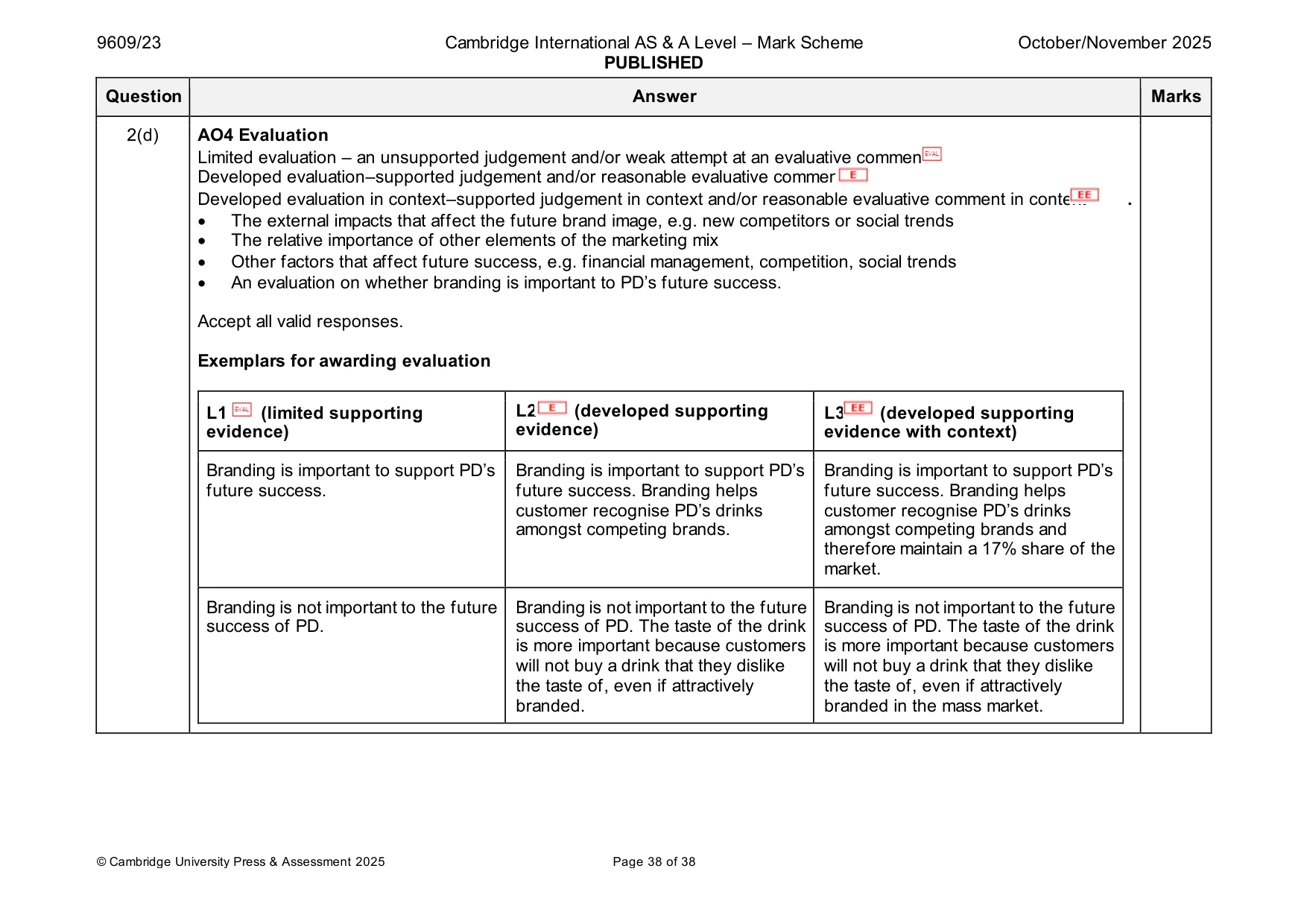
Mark scheme: 2(a)(i) Identify one recruitment method. 1 Indicative content Identification of a method may include: • job advertisements • employment agencies • online recruitment • internal / external recruitment • job description • person specification • headhunting • advertising media for recruitment, e.g. newspapers, websites, word of mouth, internal noticeboard, intranet Do not allow selection methods, e.g. curriculum vitae, résumé, application forms, interviews, references, testing, assessment centres. If more than one answer is given, only mark the first, reading from top left to bottom right. Accept all valid responses. 2(a)(ii) Explain the term cash flow. 3 AO1 Knowledge and understanding AO2 Application 1 mark 2 marks 2 marks Developed application of one relevant point to a business context. 1 mark 1 mark Knowledge of one relevant point is used to answer the Limited application of one relevant point to a business question. context. 0 marks 0 marks No creditable response. No creditable response. AO1 Knowledge and understanding Knowledge of cash flow may include: • The sum of cash payments into a business less the sum of cash payments out of a business • Inflows and outflows • Into and out of the business • Receipts and payments • Money / notes / coins / funds / finance 2(a)(ii) AO2 Application Limited application applies knowledge of cashflow to a business context. Developed application + applies knowledge of cashflow to a business context. • Who the cash flow is from / to, e.g. customers, suppliers, lenders • Liquidity / solvency • Working capital • Prediction / forecast • Opening / closing balance • Different to profit • Benefits of producing a cash flow forecast, e.g. take preventative action • Uses of a cash flow forecast, e.g. predict shortfalls, apply for finance, business plans • Examples of what cash may be used for, e.g. bills, staff wages, electricity, pay debts • Example from a business context Accept all valid responses. Exemplar and annotations Mark Rationale Cash in and out measures the business’s ability to 3 The answer shows knowledge by the reference to pay debts and the solvency of the business . cash in and out. There is an explanation of how it measures the ability to pay debts which is developed by the reference to solvency. Money into and out of the business. It measures the 2 Two marks. The first for knowledge and the second liquidity of the business. mark for application to liquidity. The flow of cash receipts and payments 1 A reasonable definition The flow of cash 0 Tautological 2(b)(i) Refer to Fig 2.1. Calculate the percentage of PD’s customers with positive feedback Formula to calculate percentage: Positive feedback Positive Respondents = 100 (1 mark – formula only) Total feedback 80 + 40 Positive Respondents = 100 (1 mark – use of correct figures) 800 Positive Respondents = 15 (%) (1 mark – correct answer (no % necessary) Answer = 15 (%) (3 marks – correct answer (no working or % necessary) 2(b)(i) Exemplar and annotations Marks Answer Rationale 3 marks Correct answer Working and % do not matter. 15% Must be three to denote the three marks. Correct rounding must be applied. 2 marks Both of the following: To award two marks, there must be • Correct calculation of total respondents • Two and a (800) OR • Correct calculation of positive • One , one and one respondents (120) OR • An incorrect answer with one mistake allowing OFR for final stage. OR • A correct answer from an inverted formula (6.67 – OFR) 1 mark One of the following: To award one mark, there must be: • Correct formula • One and two • Correct calculation of total respondents (800) • Correct calculation of positive respondents (120) 0 marks No creditable content. To award zero marks, there must be • One 2(b)(ii) Refer to Fig. 2.1 and other information. Explain one reason why this data collected for PD may not be reliable. 3 AO1 Knowledge and understanding AO2 Application 1 mark 2 marks 2 marks Developed application of one relevant point to a business context. 1 mark 1 mark Knowledge of one relevant point is used to answer the Limited application of one relevant point to a business question. context. 0 marks 0 marks No creditable response. No creditable response. Indicative content AO1 Knowledge and understanding Knowledge of one reason for data not being reliable (max 1 mark), including: • Human error • Lack of data standards • Incomplete / outdated data • Poor questionnaire design / poorly written questions / question construction • Incorrect sampling • Data collection issues • Low response rates 2(b)(ii) AO2 Application Explanation of one reason for data not being reliable (max 1 mark), including: • Human error–untrained employees enter the data incorrectly / different teams with inconsistent methods • Lack of data standards–no rules of formatting / classifying data • Incomplete / outdated data–data no longer reflects current opinions • Poor questionnaire design / poorly written questions–leading questions / confusion • Incorrect sampling–sample doesn’t represent target customers • Data collection issues–timing • Low response rates–bias / length of questionnaire Context applied to PD (max 1 mark), including: • Mass market • Market dominated by a few well-known brands • Total market value is $5.3bn • 17% share of market • Pablo became Marketing Director in 2022 • Launched promotional campaign based on trending music on social media • Used social media influencers • Poor online feedback • Sales volume decreased by 20% in a week and continued to fall • Excess inventory in warehouses • Drop in PD’s share price • Negative impact on cashflow • Questionnaire completed by previous PD customers • Data from Fig. 2.1 • 800 respondents 2(b)(ii) Exemplar and annotations Mark Rationale Low response rates may lead to biased data affecting 3 Low response rates , with further decisions to repair the damage to PD’s brand . explanation to how it may affect the data The third mark is for reference to the context . An incorrect sample size of 800 customers . 2 Knowledge of a use and applied to the number of customers who completed the questionnaire. Problems collecting the data 1 Knowledge of a reason with no application 0 No reason why the data collected may not The data will be inaccurate, incomplete and misleading be reliable. This answer is a description of . unreliable data and does not answer the question Accept all valid responses. 2(c) Analyse two possible costs to PD of holding inventory. 8 Level AO1 Knowledge and AO2 Application AO3 Analysis understanding 2 marks 4 marks 2 marks 2 3–4 marks Developed analysis • Developed analysis that identifies connections between causes, impacts and/or consequences of two points. • Developed analysis that identifies connections between causes, impacts and/or consequences of one point. 1 1–2 marks 1–2 marks 1–2 marks • Knowledge of two • Application of two Limited analysis relevant points is relevant points to a • Limited analysis that identifies connections used to answer the business context. between causes, impacts and/or consequences of question. • Application of one two points. • Knowledge of one relevant point to a • Limited analysis that identifies connections relevant point is business context. between causes, impacts and/or consequences of used to answer the one point. question. 0 0 marks 0 marks 0 marks No creditable response. No creditable response. No creditable response. First cost in the left-hand side column, second cost in the right-hand side column 2(c) Indicative content AO1 Knowledge and understanding Knowledge of possible costs of holding inventory (max 2 s), may include: • Opportunity cost of holding stock • Impact on working capital • Labour cost • Storage costs • Risk of wastage / damage • Depreciation • Insurance AO2 Application Application of cost to PD , including: • Mass market • Market dominated by a few well-known brands • Total market value is $5.3bn • 17% share of market • Pablo became Marketing Director in 2022 • Launched promotional campaign based on trending music on social media • Used social media influencers • Poor online feedback • Sales volume decreased by 20% in a week and continued to fall • Excess inventory in warehouses • Drop in PD’s share price • Negative impact on cashflow • Data from Fig. 2.1 • 800 respondents AO3 Analysis Limited analysis of cost of holding inventory – candidate shows one link in the chain of analysis. Developed analysis of cost of holding inventory candidate shows two or more links in the chain of analysis or a two- sided analysis. 2(c) Analysis may include: • Opportunity cost of holding stock–space used to store stock could be used for production reducing potential output– lower revenue • Impact on working capital–money / cash will be tied up in the stock–cannot pay suppliers • Labour cost–reduced profit–lower shareholder dividends • Increase storage costs–reduction in profit margins–reduction in share price • Increase risk of wastage–spend time disposing of the waste–inefficiency • Depreciation–reduces profits to reinvest–less future growth • Insurance–increased expenses–reduced working capital Accept all valid responses. Exemplar and annotations AO1 Knowledge AO2 Application AO3 Analysis Exemplar for one cost of Insurance To reduce risk of disruption Insurance will compensate holding inventory to operations to maintain PD if an incident destroys Annotations for the first PD’s 17% market share . stock so it can maintain cost should be placed in sales satisfying the left-hand margin. customers . Exemplar of a second cost Risk of wastage Of the unsold mass market Could lead to a reduction in of holding inventory fizzy drinks . profit and future Annotations for the expansion . second cost should be placed in the right-hand margin. 2(d) Evaluate the importance of branding to the future success of PD. 12 Level AO1 Knowledge and AO2 Application AO3 Analysis AO4 Evaluation understanding 2 marks 2 marks 6 marks 2 marks 3 5–6 marks Developed evaluation in context • A developed judgement/conclusion is made in the business context. • Developed evaluative comments which balance some key arguments in the business context. 2 2 marks 2 marks 2 marks 3–4 marks Developed Developed Developed analysis Developed evaluation knowledge of application of that identifies • A developed relevant key term(s) relevant point(s) to the connections between judgement/conclusion is made. and/or factor(s) is business context. causes, impacts • Developed evaluative comments used to answer the and/or consequences. which balance some key question. arguments. 1 1 mark 1 mark 1 mark 1–2 marks Limited knowledge Limited application Limited analysis Limited evaluation of relevant key term(s) of relevant point(s) to that identifies • A judgement/conclusion is made and/or factor(s) is the business context. connections between with limited supporting used to answer the causes, impacts comment/evidence. question. and/or consequences. • An attempt is made to balance the arguments. • 2(d) 0 0 marks 0 marks 0 marks 0 marks No creditable No creditable No creditable No creditable response. response. response. response. Indicative content AO1 Knowledge and understanding Knowledge of branding (max 2 s), including: • Creating a distinct identity / image • Brand values • A company's name and logo, visual design, slogan, jingle • Making consumers feel good about supporting a company and establishing an emotional connection. • Differentiates from competitors • Influence purchasing decisions • Customers identify with business / brand • Brand personality • Build trust / relationships 2(d) AO2 Application Application of branding to PD , including: • Mass market • Market dominated by a few well-known brands • Total market value is $5.3 bn • 17% share of market • Pablo became Marketing Director in 2022 • Launched promotional campaign based on trending music on social media • Used social media influencers • Poor online feedback • Sales volume decreased by 20% in a week and continued to fall • Excess inventory in warehouses • Drop in PD’s share price • Negative impact on cashflow • Data from Fig. 2.1 • 800 respondents • Need to repair damaged PD brand from promotional campaign AO3 Analysis Limited analysis of the importance of branding to PD – candidate shows one link in the chain of analysis. Developed analysis of the importance of branding to PD – candidate shows two or more links in the chain of analysis. • Create distinct identity/image – maintaining customer base and repeat sales/loyalty–long term profitability • Name and logo conjure brand values–can attract/deter new customers–increase/decrease market share • Customers buy the brand regardless of quality–repeat customers–increased market share • Differentiates from competitors–attracts customers–increased market dominance • Influence purchasing decisions–increase revenue–increased profits • Customers identify with business / brand–building brand loyalty–long-term profitability • Brand personality–helps to differentiate and create a USP–customers pay a higher price • Build trust / relationships–increased reputation–increased market share 2(d) AO4 Evaluation Limited evaluation – an unsupported judgement and/or weak attempt at an evaluative comment Developed evaluation–supported judgement and/or reasonable evaluative comment Developed evaluation in context–supported judgement in context and/or reasonable evaluative comment in context . • The external impacts that affect the future brand image, e.g. new competitors or social trends • The relative importance of other elements of the marketing mix • Other factors that affect future success, e.g. financial management, competition, social trends • An evaluation on whether branding is important to PD’s future success. Accept all valid responses. Exemplars for awarding evaluation L1 (limited supporting L2 (developed supporting L3 (developed supporting evidence) evidence) evidence with context) Branding is important to support PD’s Branding is important to support PD’s Branding is important to support PD’s future success. future success. Branding helps future success. Branding helps customer recognise PD’s drinks customer recognise PD’s drinks amongst competing brands. amongst competing brands and therefore maintain a 17% share of the market. Branding is not important to the future Branding is not important to the future Branding is not important to the future success of PD. success of PD. The taste of the drink success of PD. The taste of the drink is more important because customers is more important because customers will not buy a drink that they dislike will not buy a drink that they dislike the taste of, even if attractively the taste of, even if attractively branded. branded in the mass market.
What was in this paper
The subtopics covered by these 2 questions, and how many questions each got. Open one in a new tab to see every Cambridge question on it.
What you needed in this session
Cambridge’s own grade thresholds for 2025 Oct/Nov, Paper 2 · Variant 3. A higher threshold means an easier paper — the bar moves with how the cohort did.