Cambridge A Level Business (for first examination in 2016) 9609 — 2024 May/June Paper 2 · Variant 2
9609/22/M/J/24 · 2 questions · 60 marks · ≈68 min
The question paper and its mark scheme, free to read here and free to download. This is Cambridge’s own paper, exactly as it was sat.
Question paper8 pages





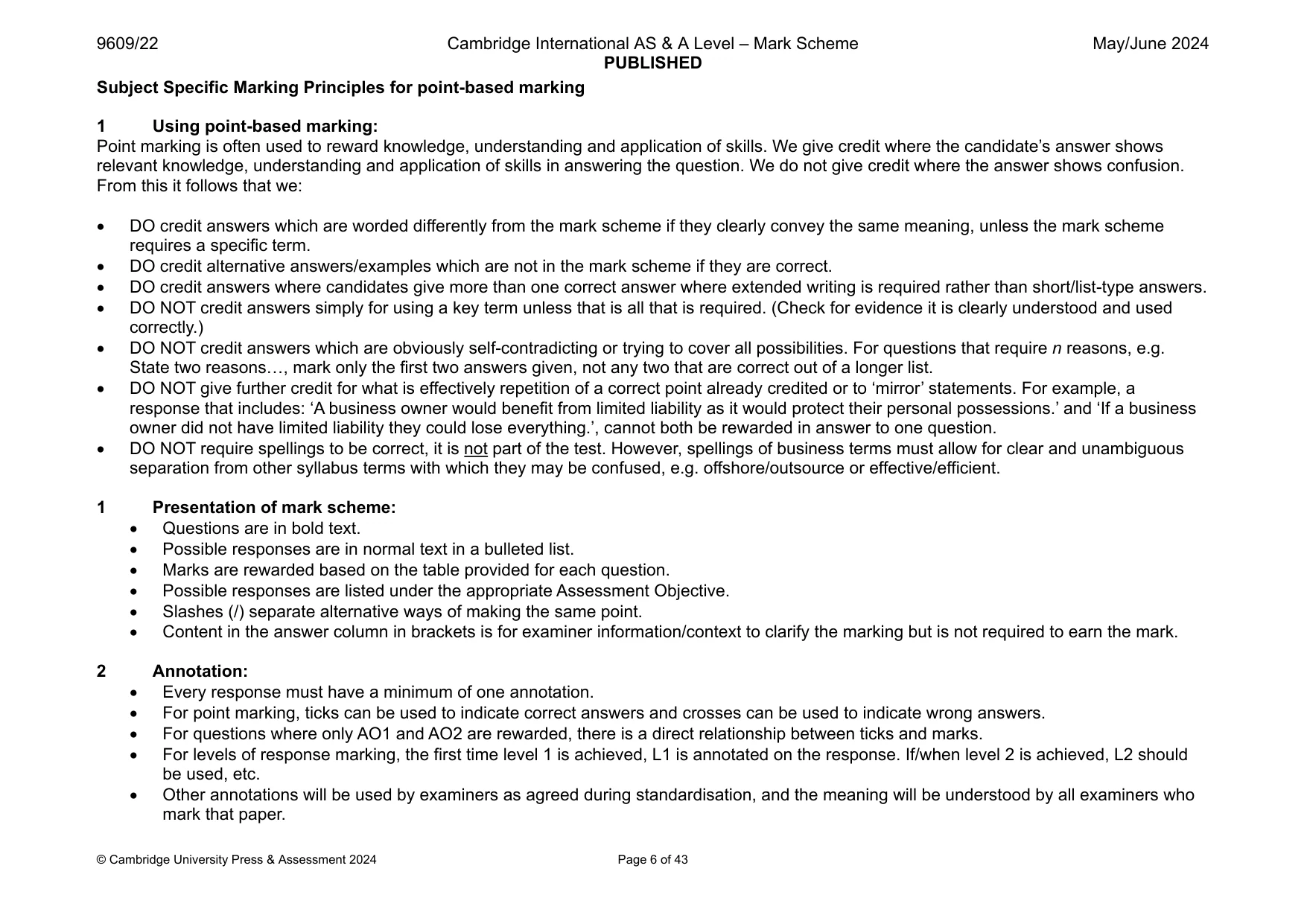
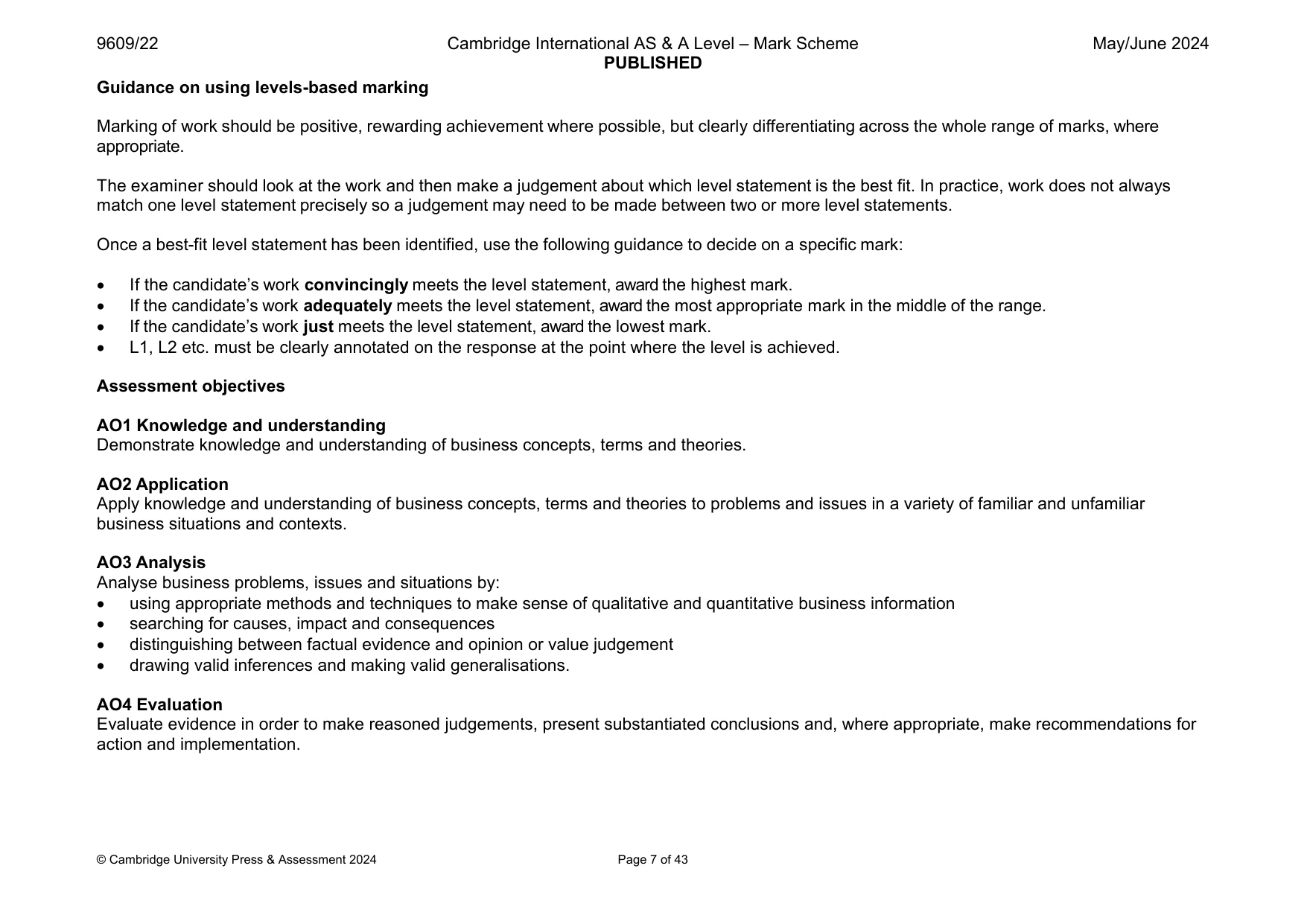
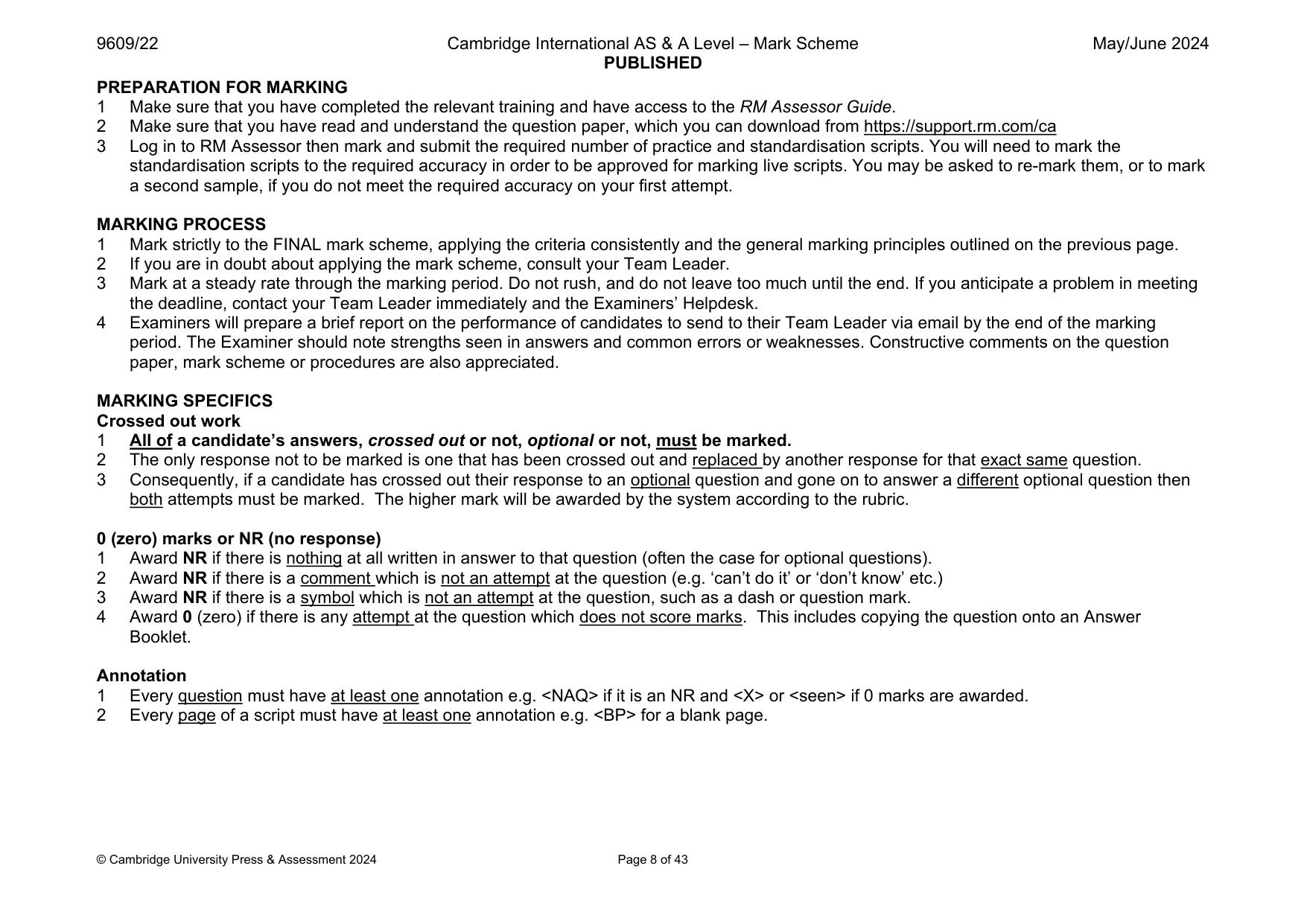
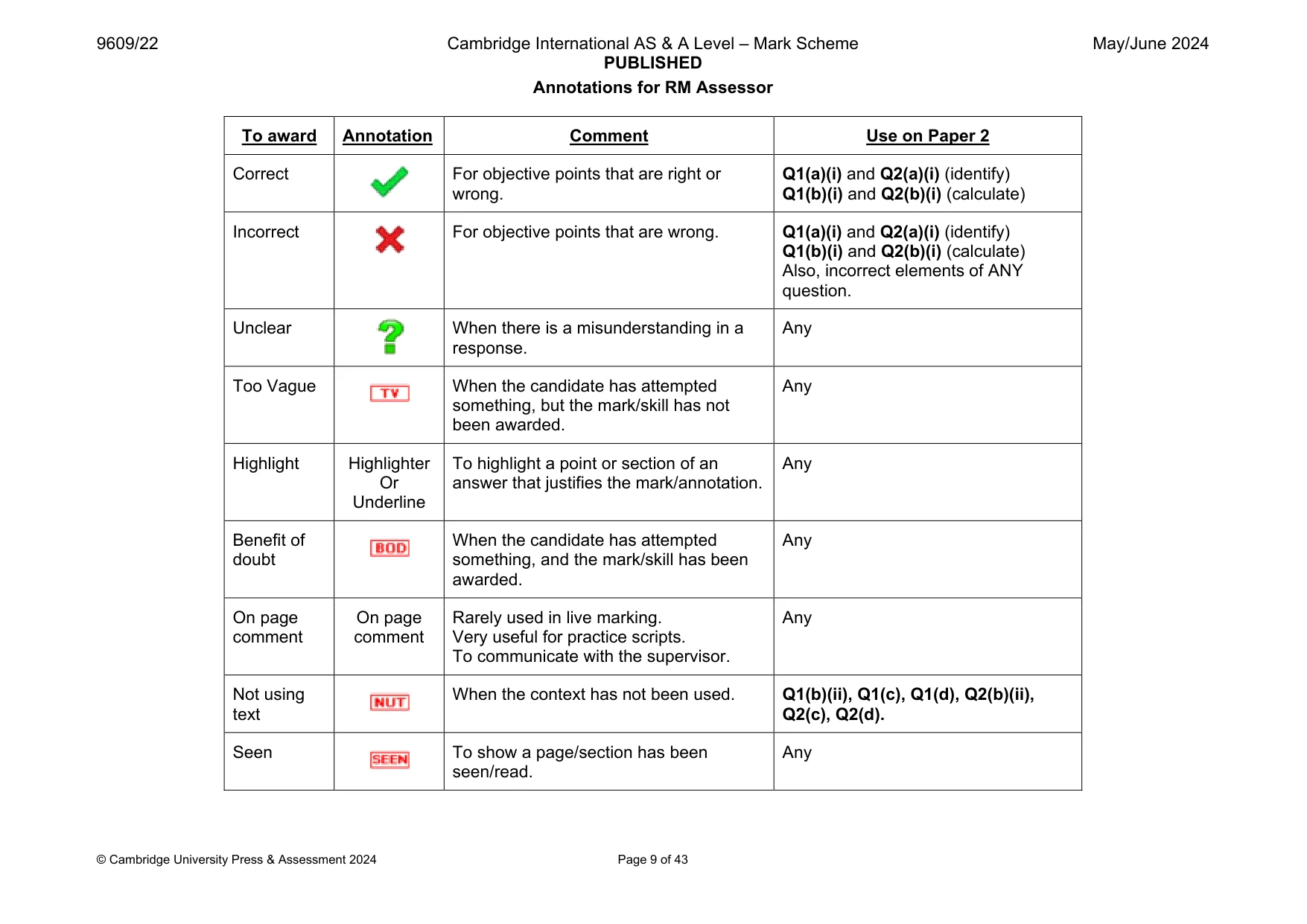
Mark scheme43 pages
Answers below. Sit the paper first if you are practising.
Questions as text
Q1 · Post Scent (PS) PS is a private limited company operating in country H
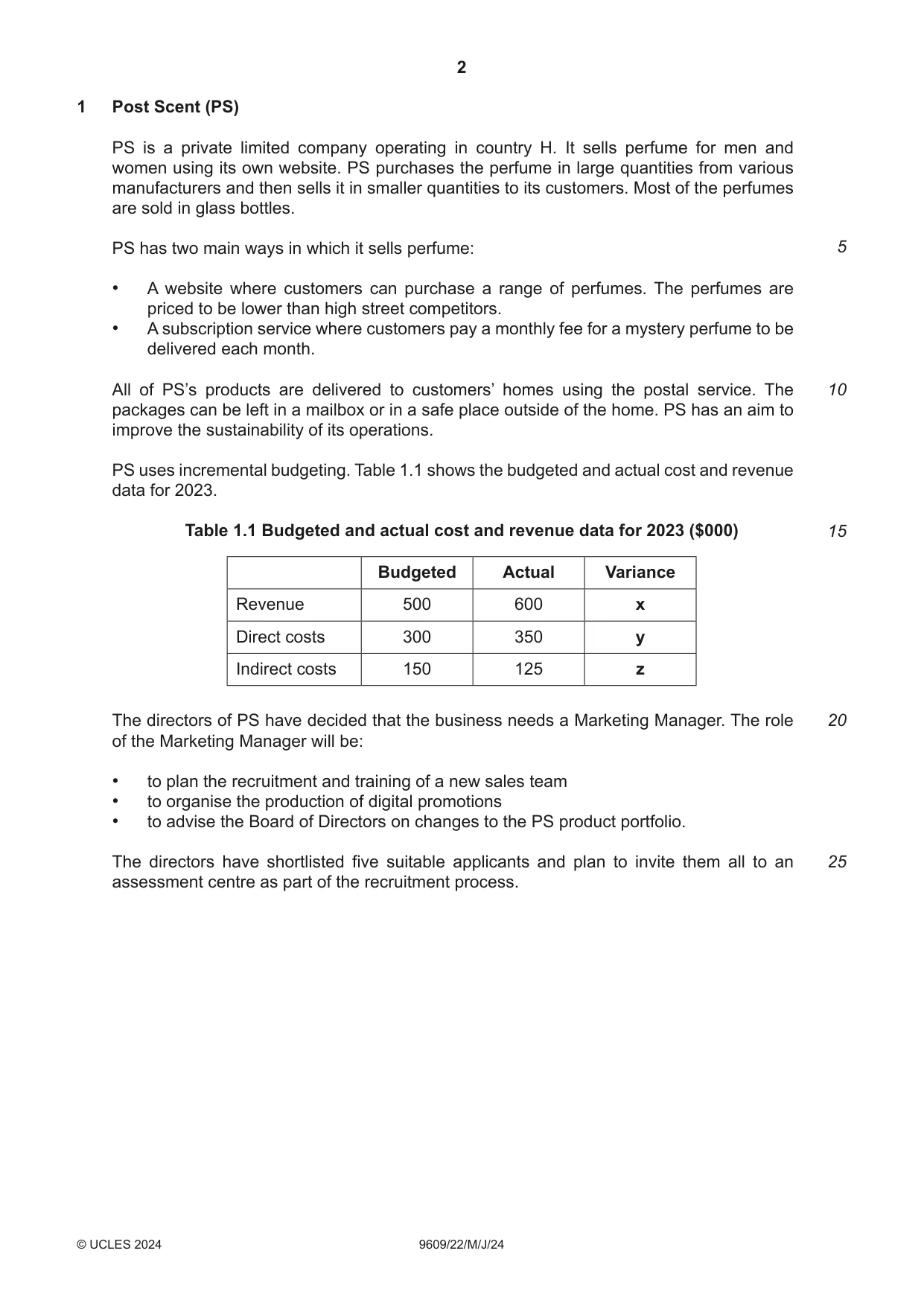
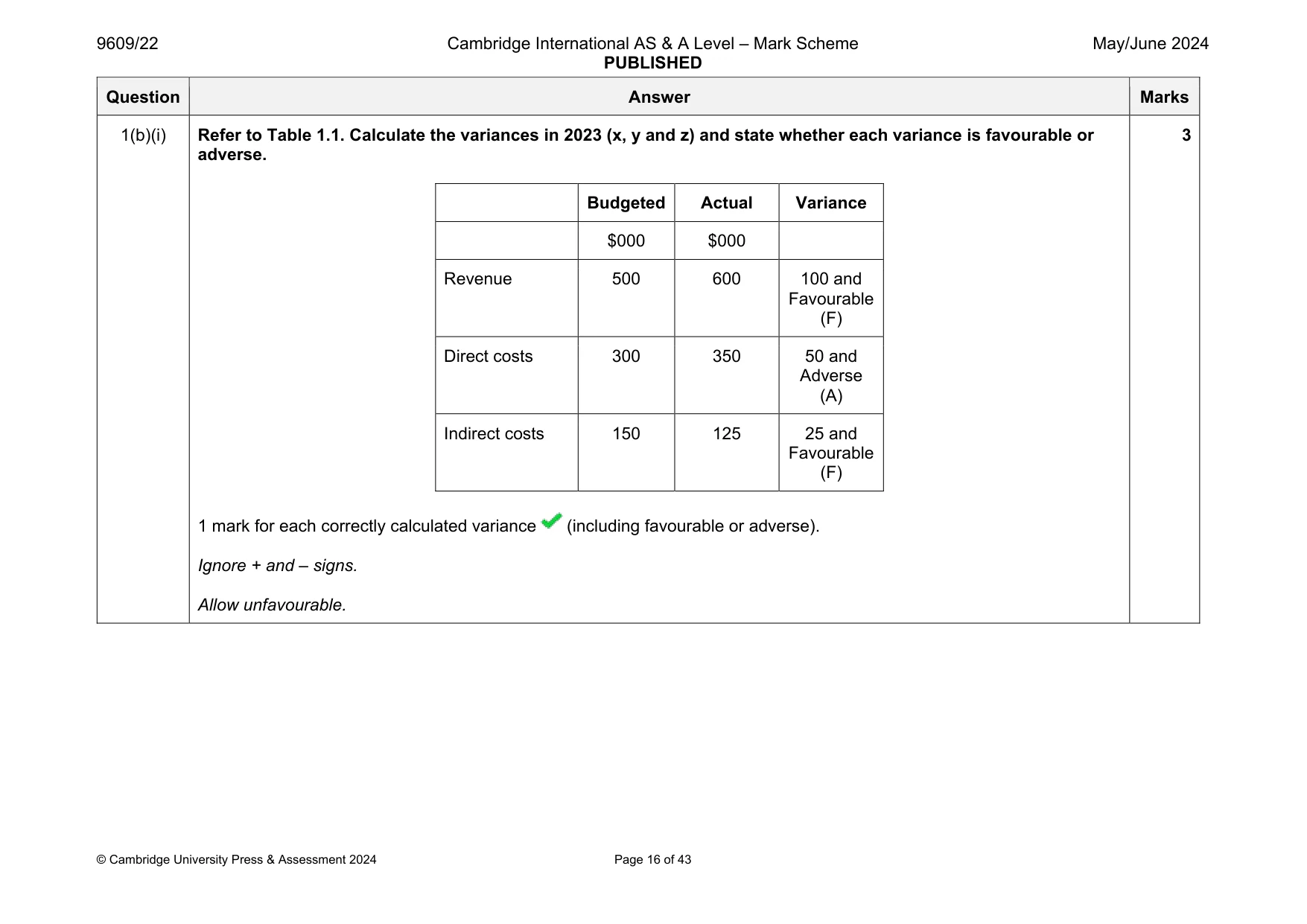
1 Post Scent (PS) PS is a private limited company operating in country H. It sells perfume for men and women using its own website. PS purchases the perfume in large quantities from various manufacturers and then sells it in smaller quantities to its customers. Most of the perfumes are sold in glass bottles. PS has two main ways in which it sells perfume: 5 • A website where customers can purchase a range of perfumes. The perfumes are priced to be lower than high street competitors. • A subscription service where customers pay a monthly fee for a mystery perfume to be delivered each month. All of PS’s products are delivered to customers’ homes using the postal service. The 10 packages can be left in a mailbox or in a safe place outside of the home. PS has an aim to improve the sustainability of its operations. PS uses incremental budgeting. Table 1.1 shows the budgeted and actual cost and revenue data for 2023. Table 1.1 Budgeted and actual cost and revenue data for 2023 ($000) 15 Budgeted Actual Variance Revenue 500 600 x Direct costs 300 350 y Indirect costs 150 125 z The directors of PS have decided that the business needs a Marketing Manager. The role 20 of the Marketing Manager will be: • to plan the recruitment and training of a new sales team • to organise the production of digital promotions • to advise the Board of Directors on changes to the PS product portfolio. The directors have shortlisted five suitable applicants and plan to invite them all to an 25 assessment centre as part of the recruitment process. (a) (i) Identify one feature of a private limited company. [1] (ii) Explain the term sustainability. [3] (b) (i) Refer to Table 1.1. Calculate the variances in 2023 (x, y and z) and state whether each variance is favourable or adverse. [3] (ii) Explain one benefit to PS of using incremental budgeting. [3] (c) Analyse one advantage and one disadvantage to PS of using an assessment centre when selecting a Marketing Manager. [8] (d) Evaluate the role of effective packaging for PS. [12]
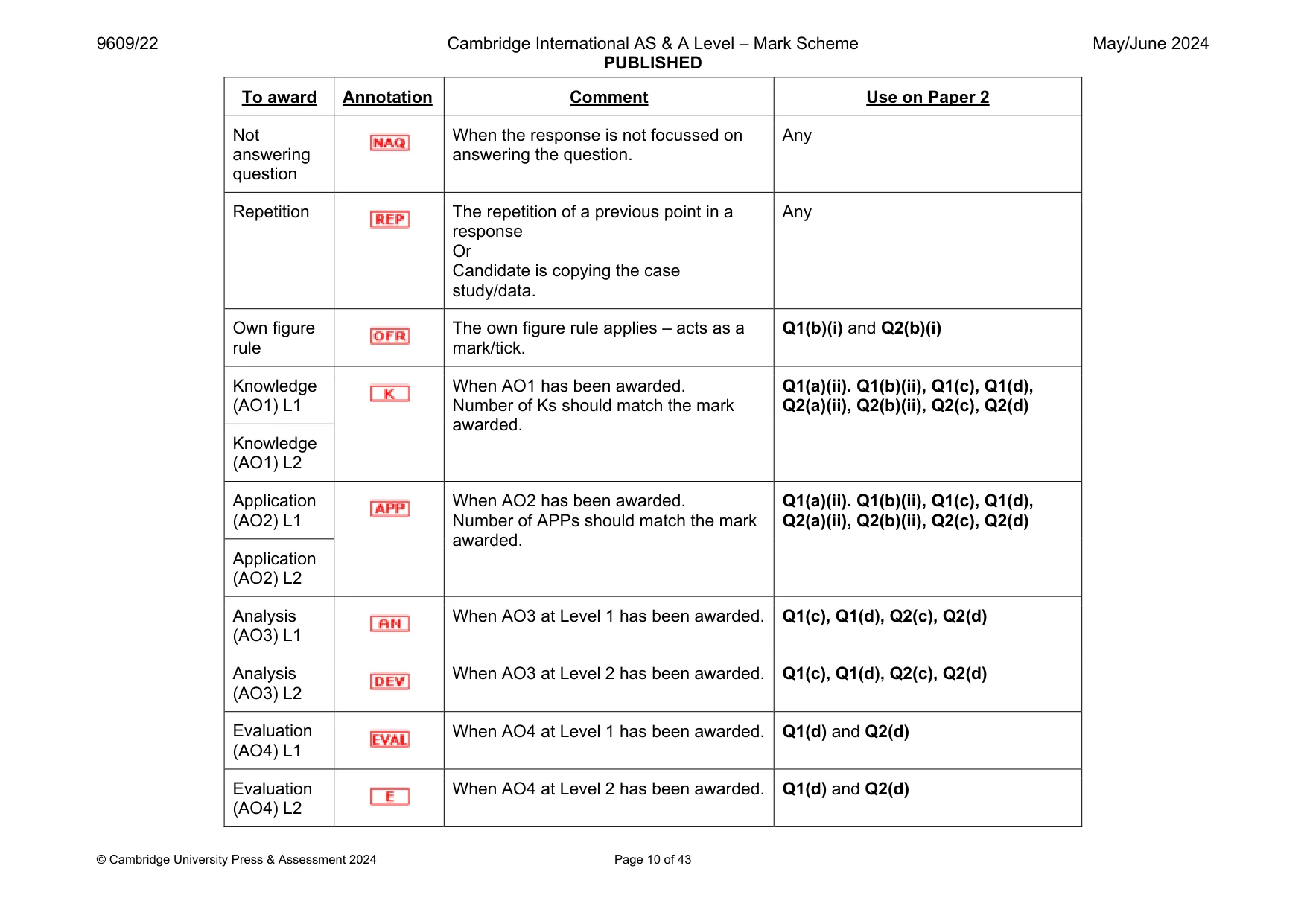
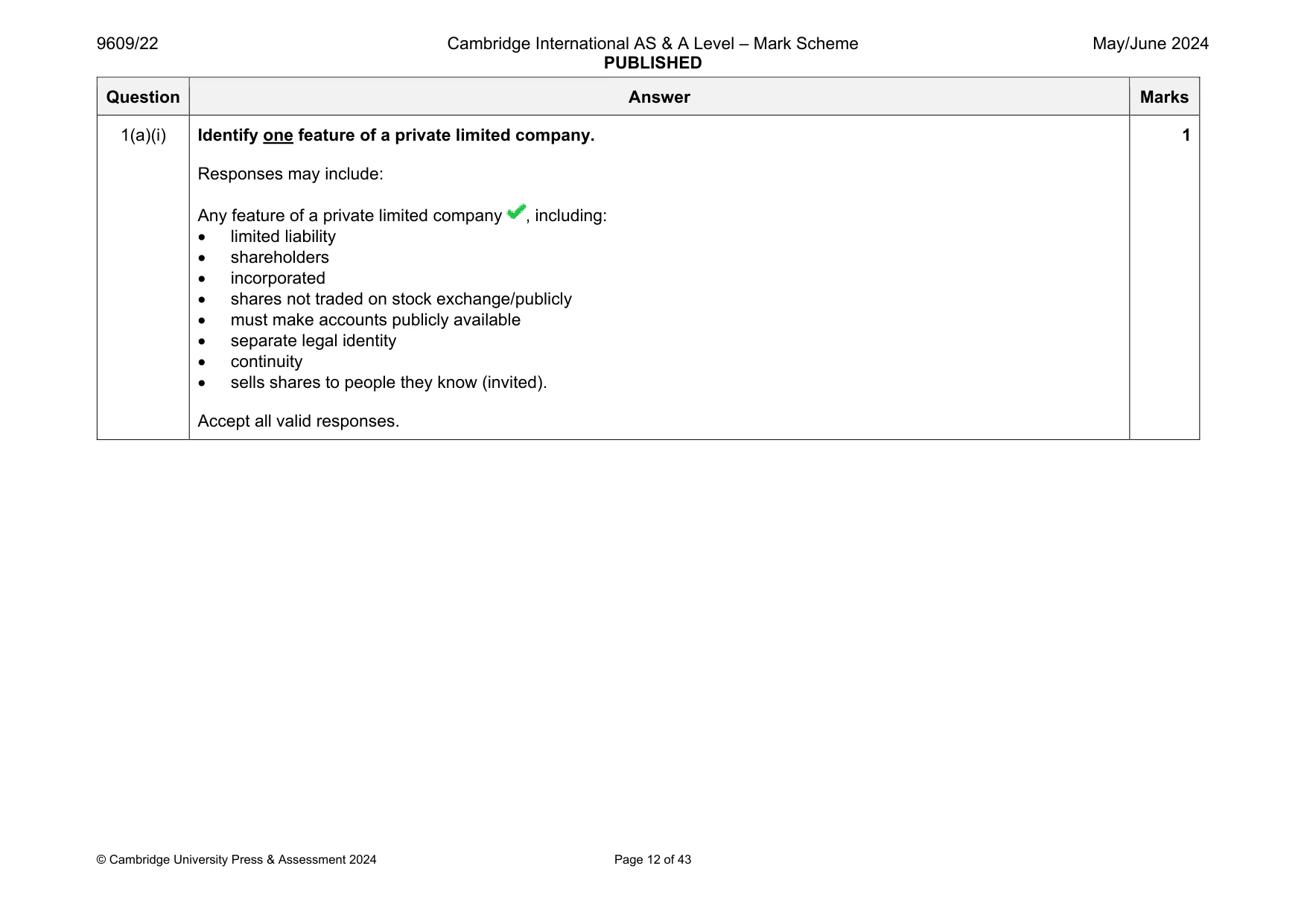
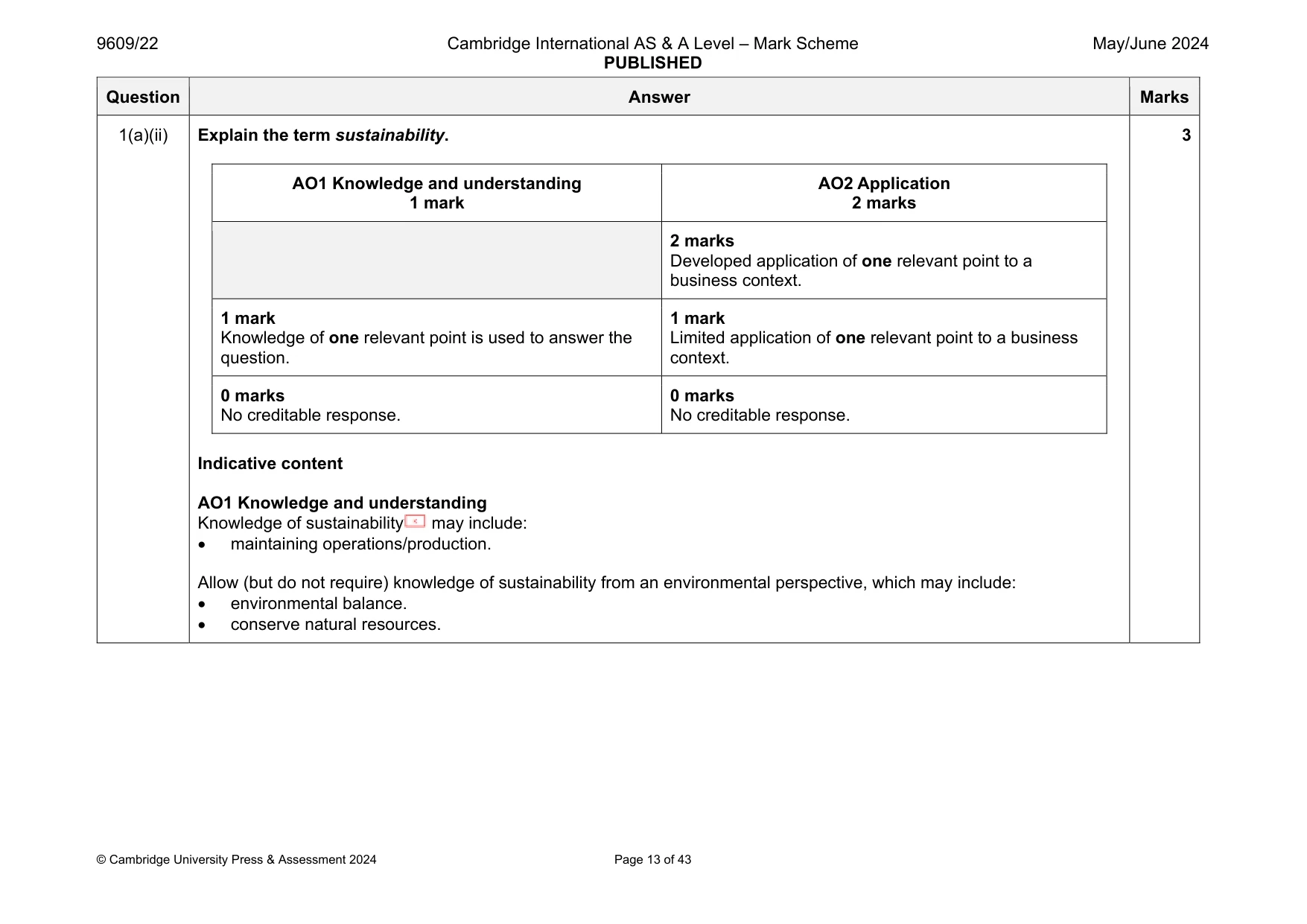
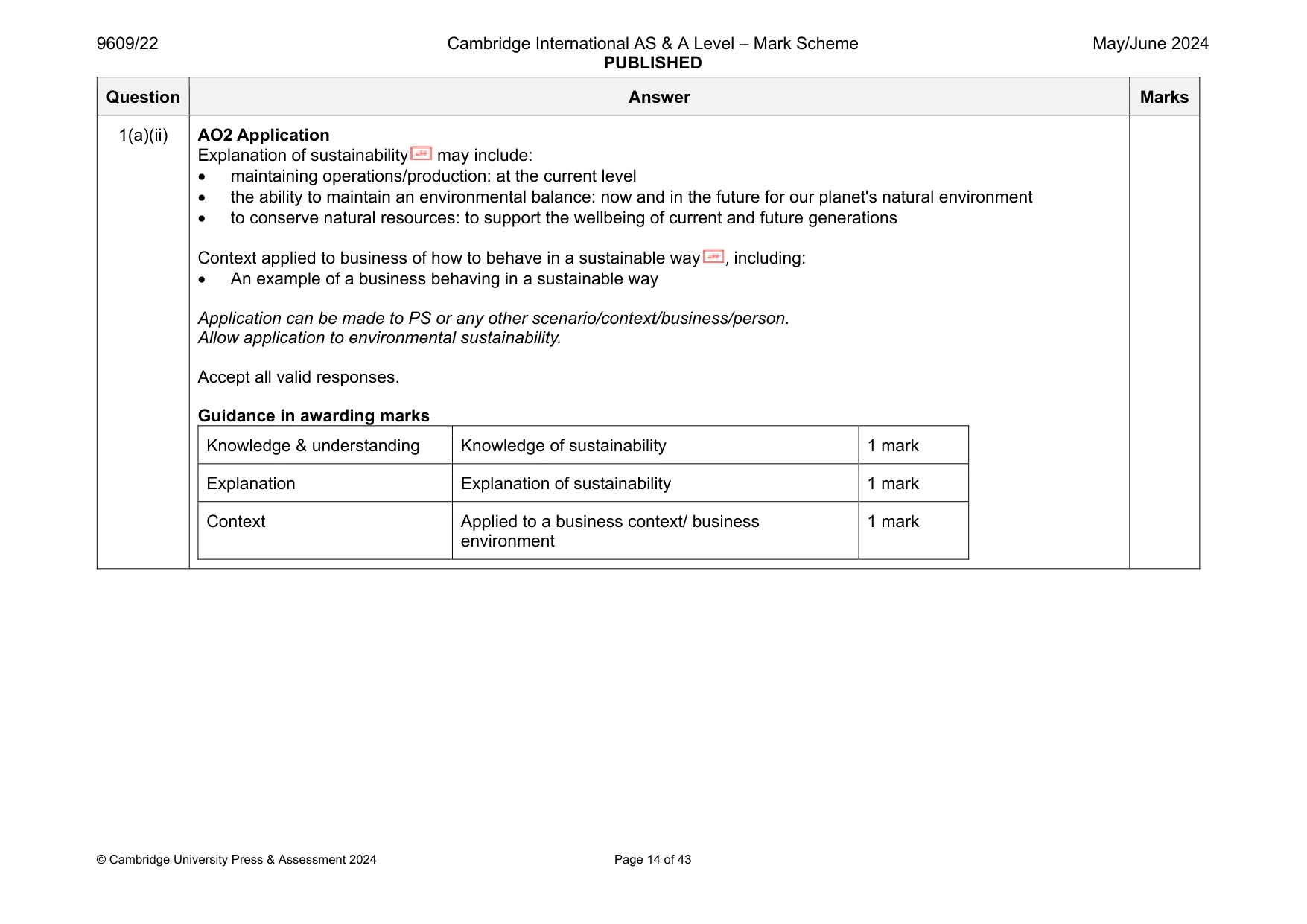
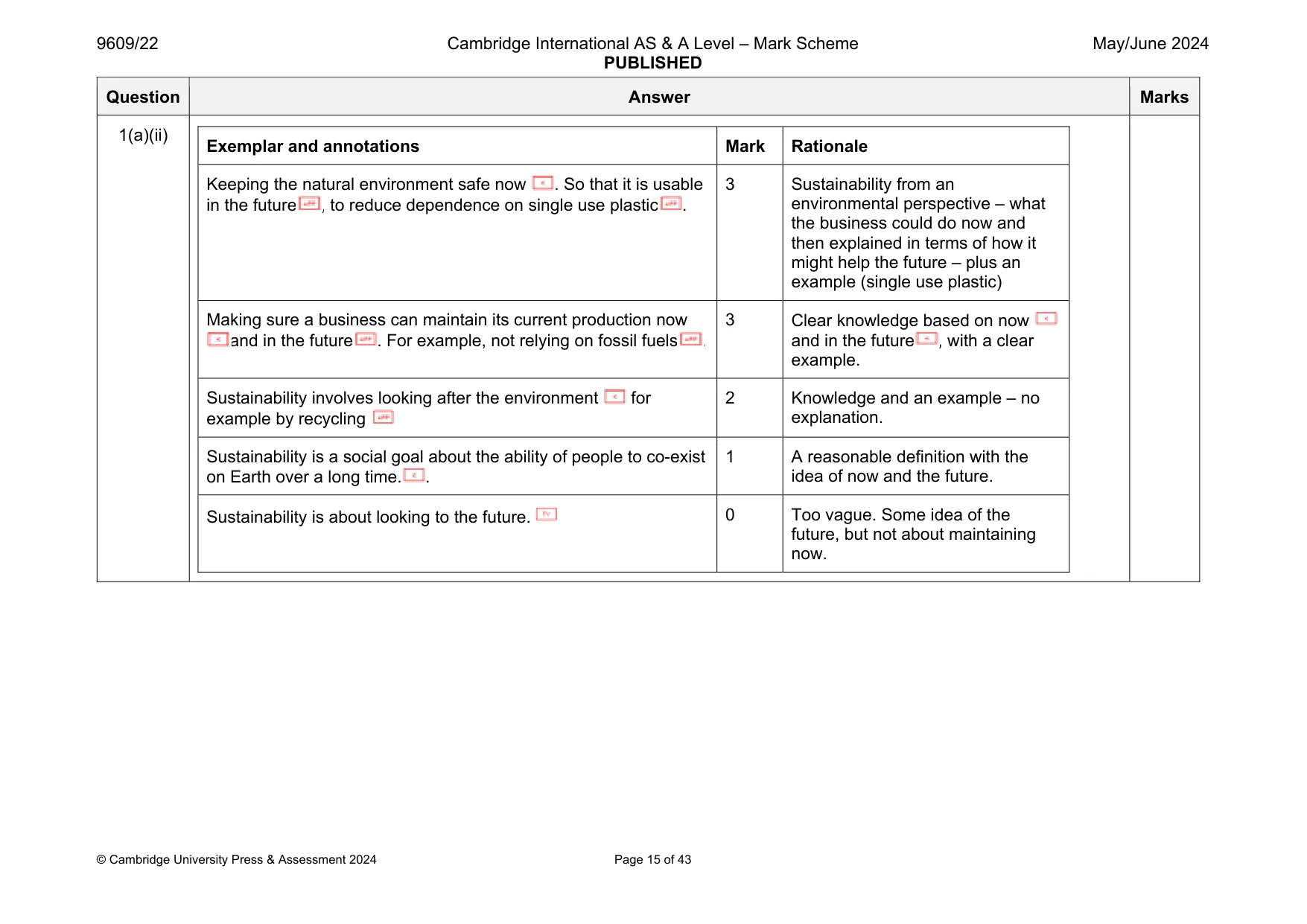
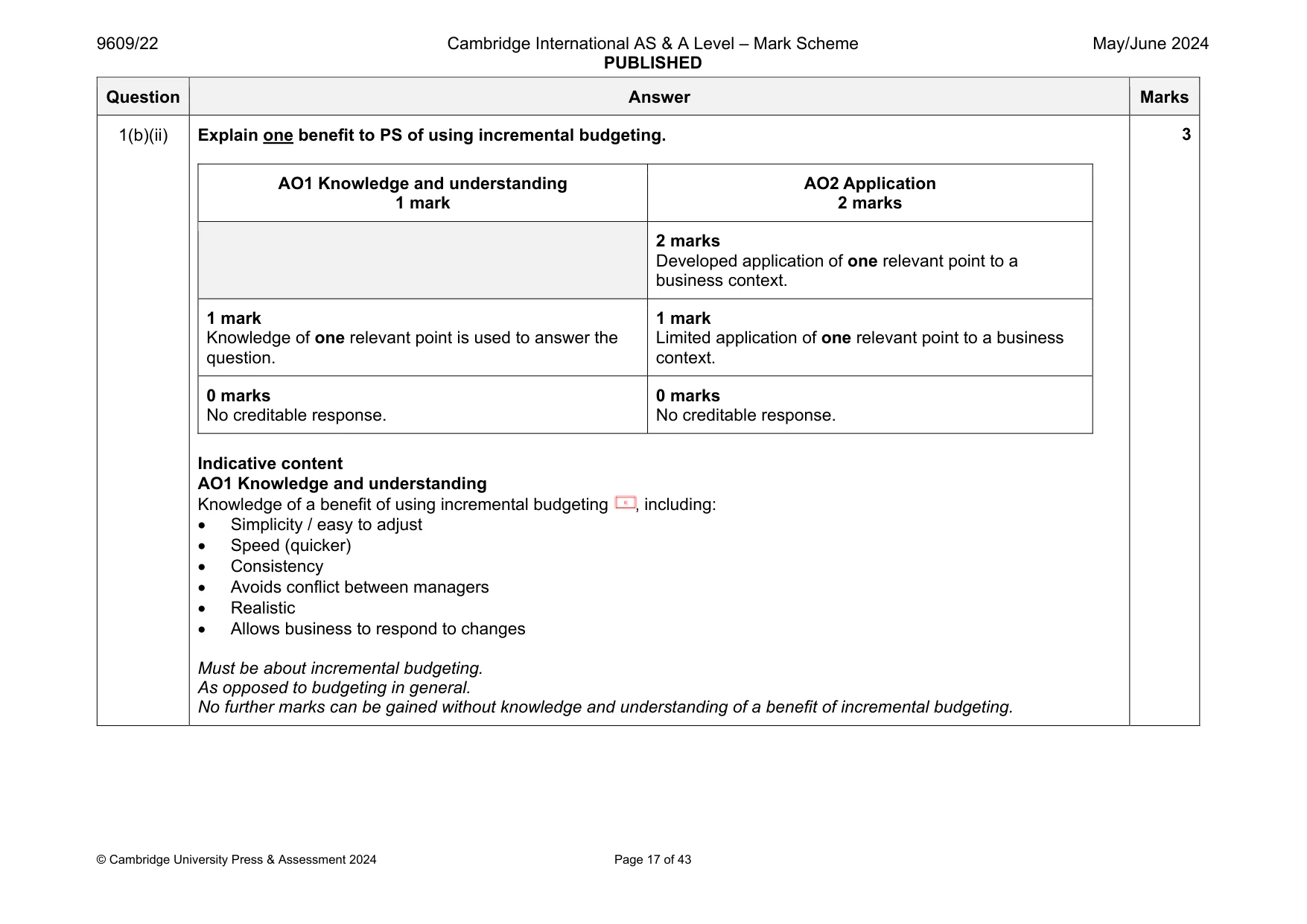
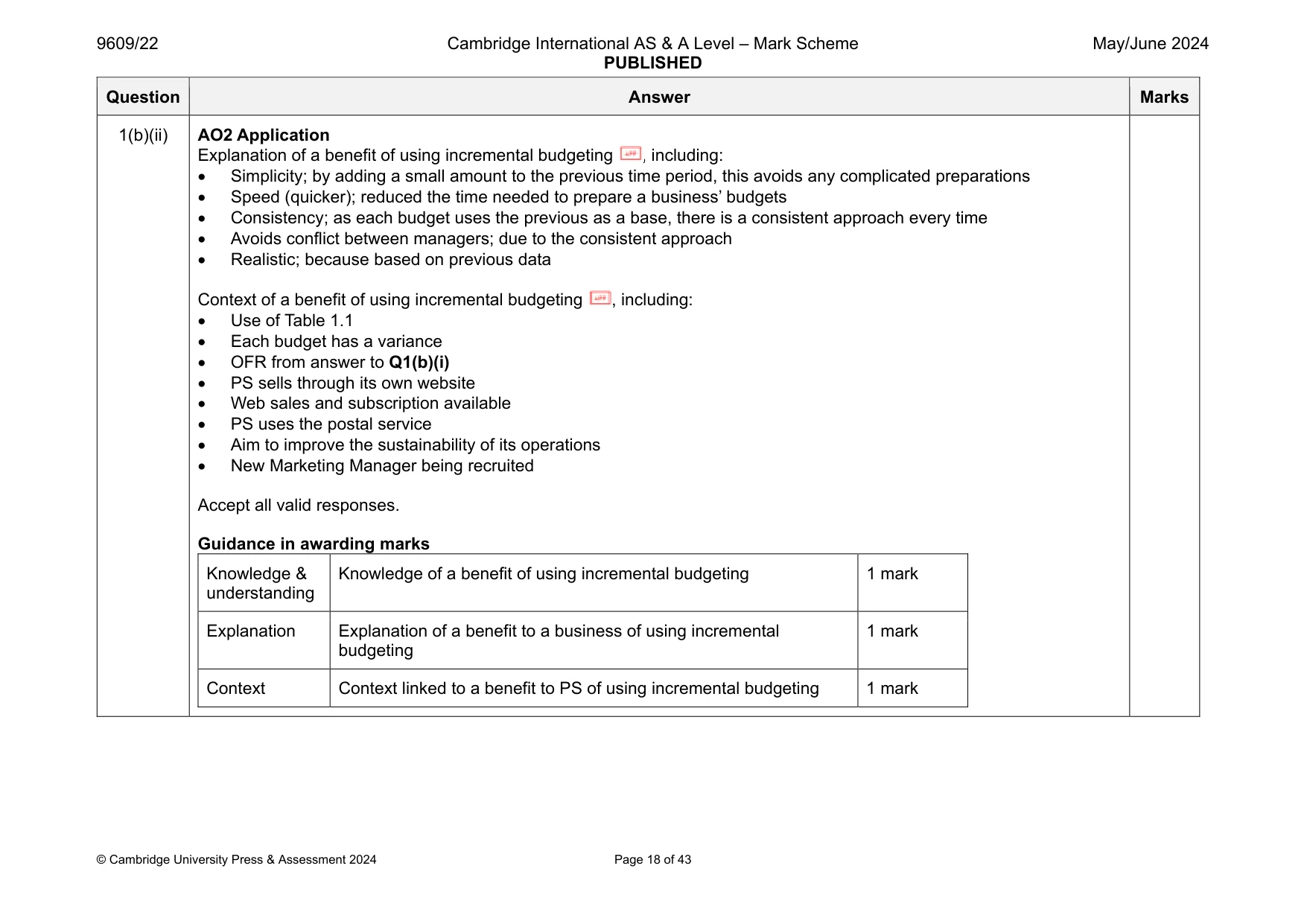
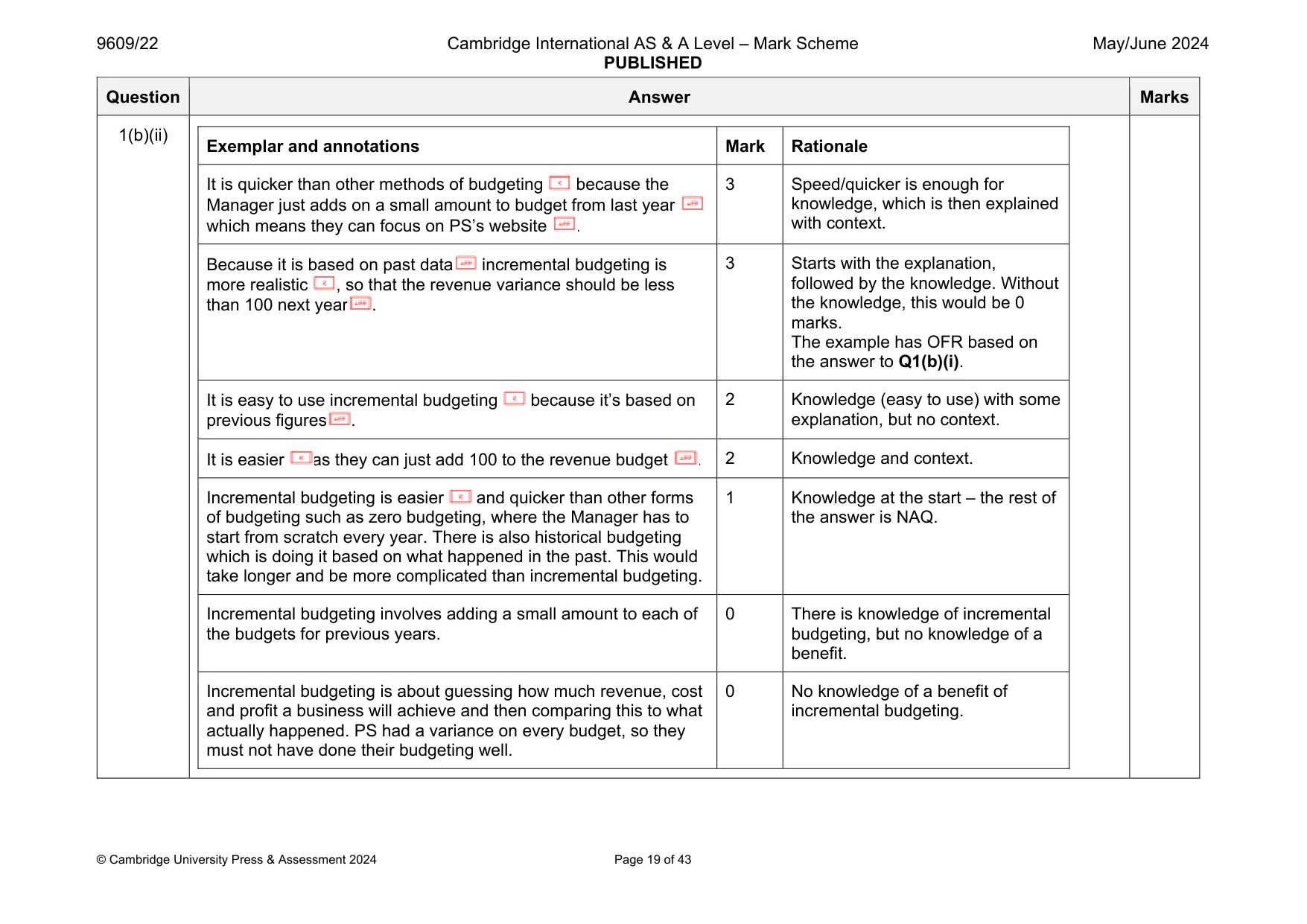
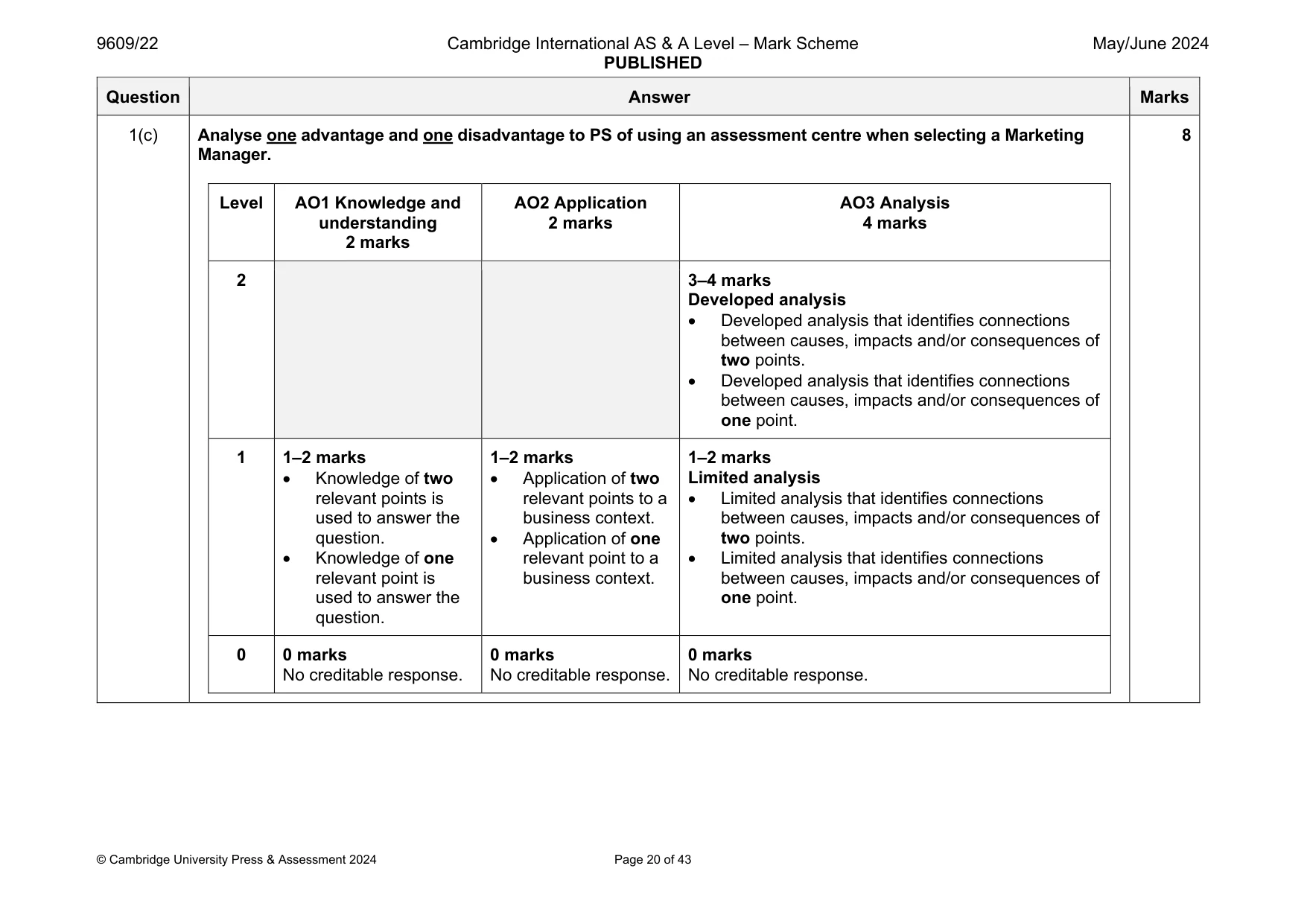
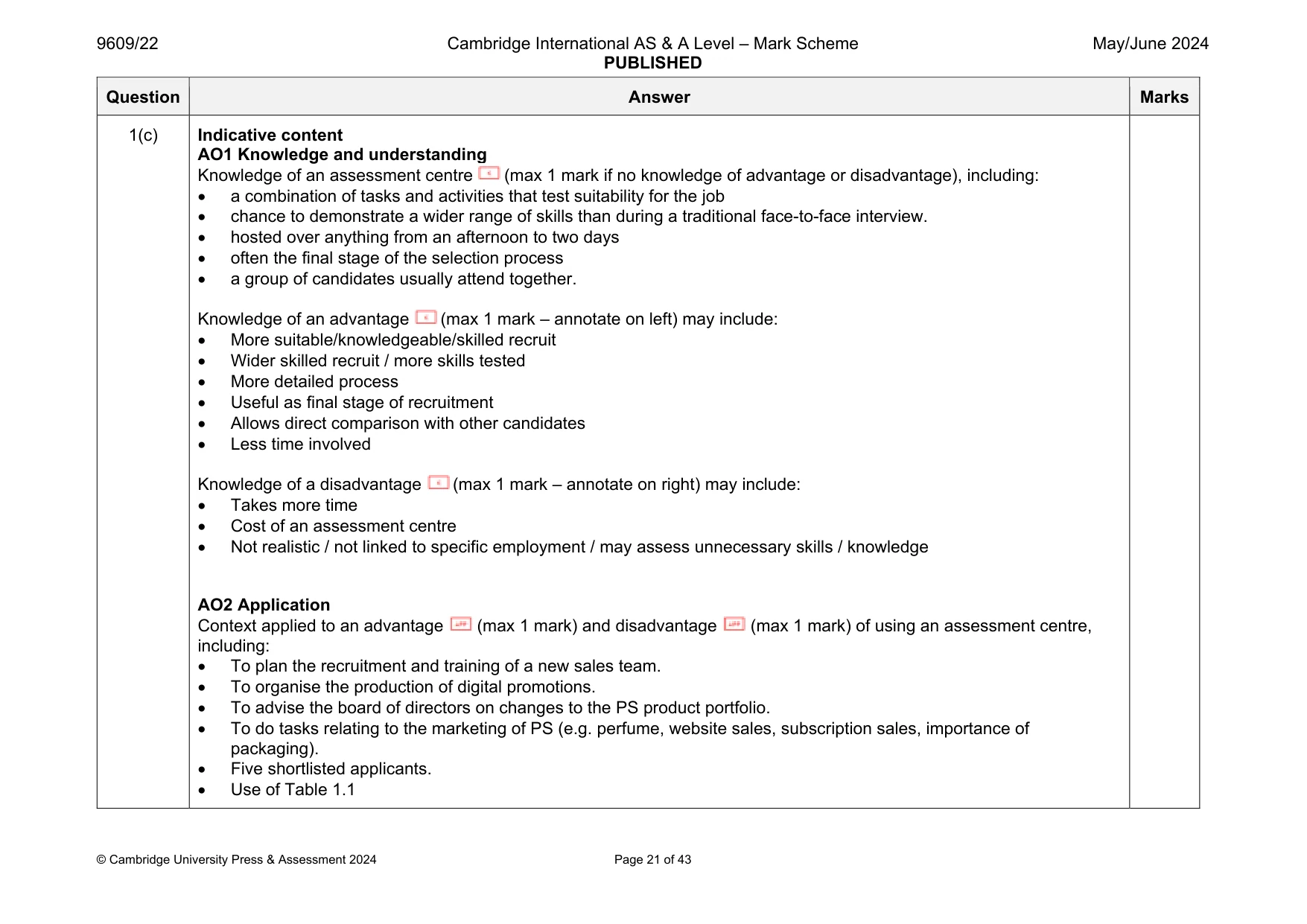
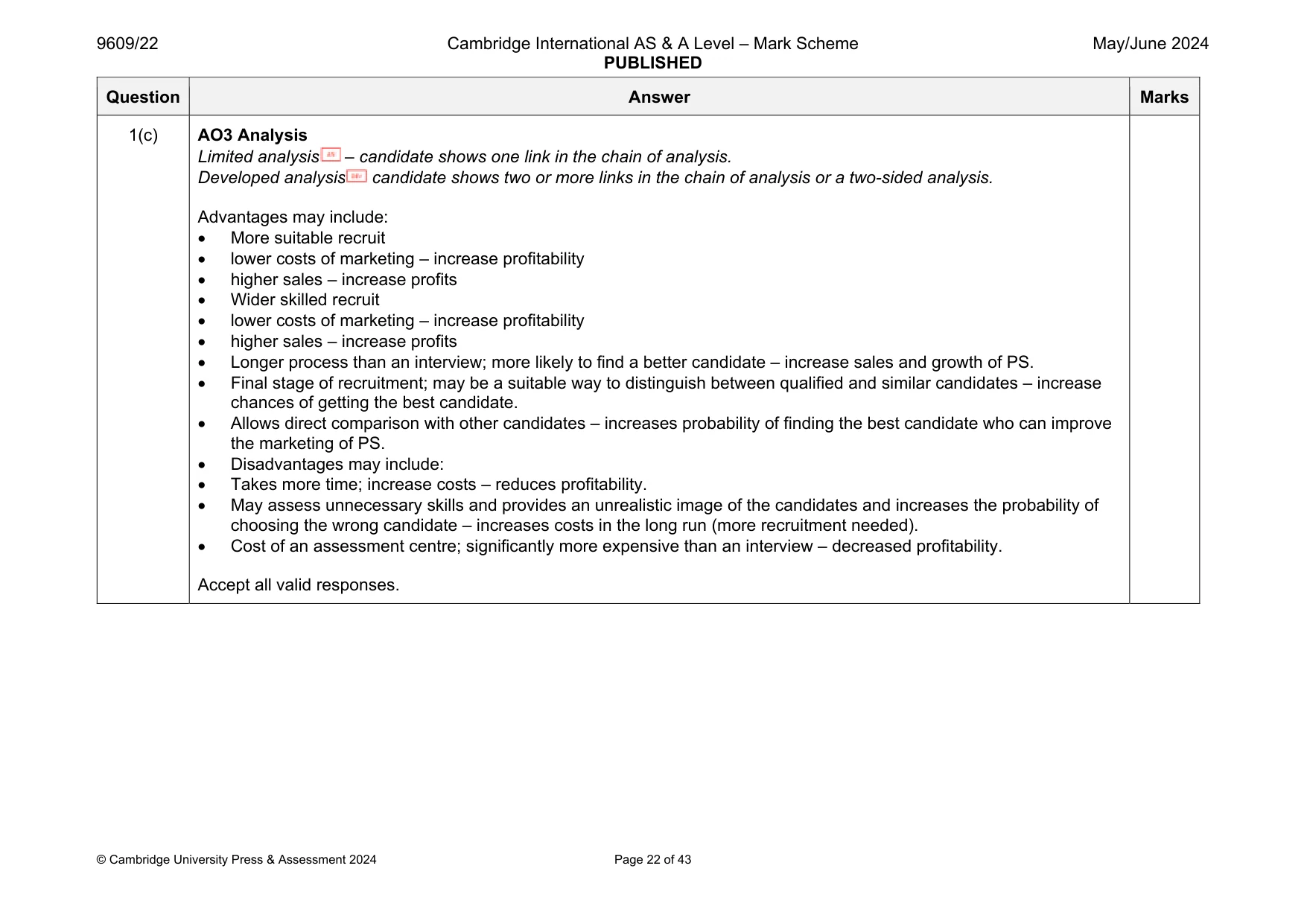
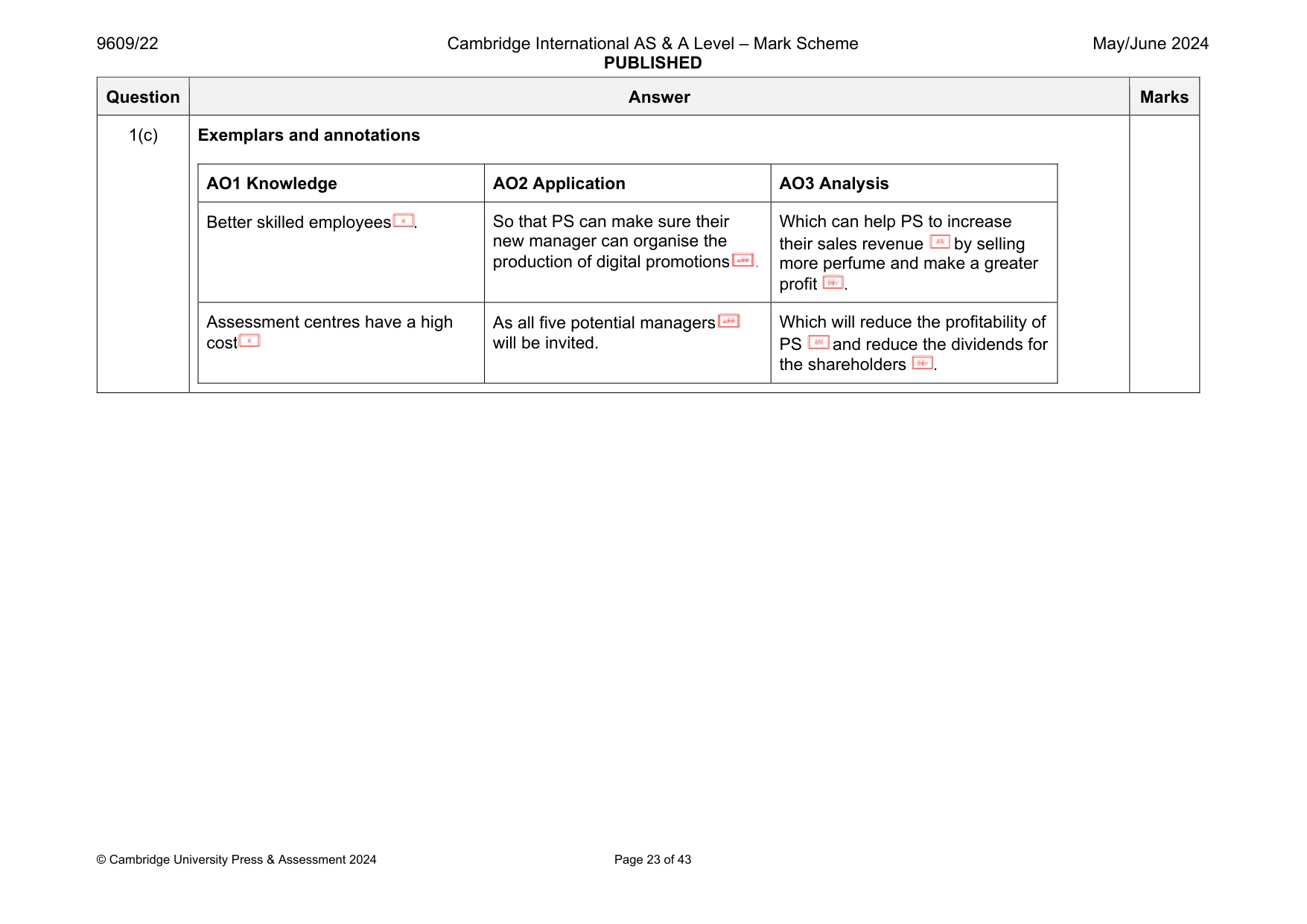
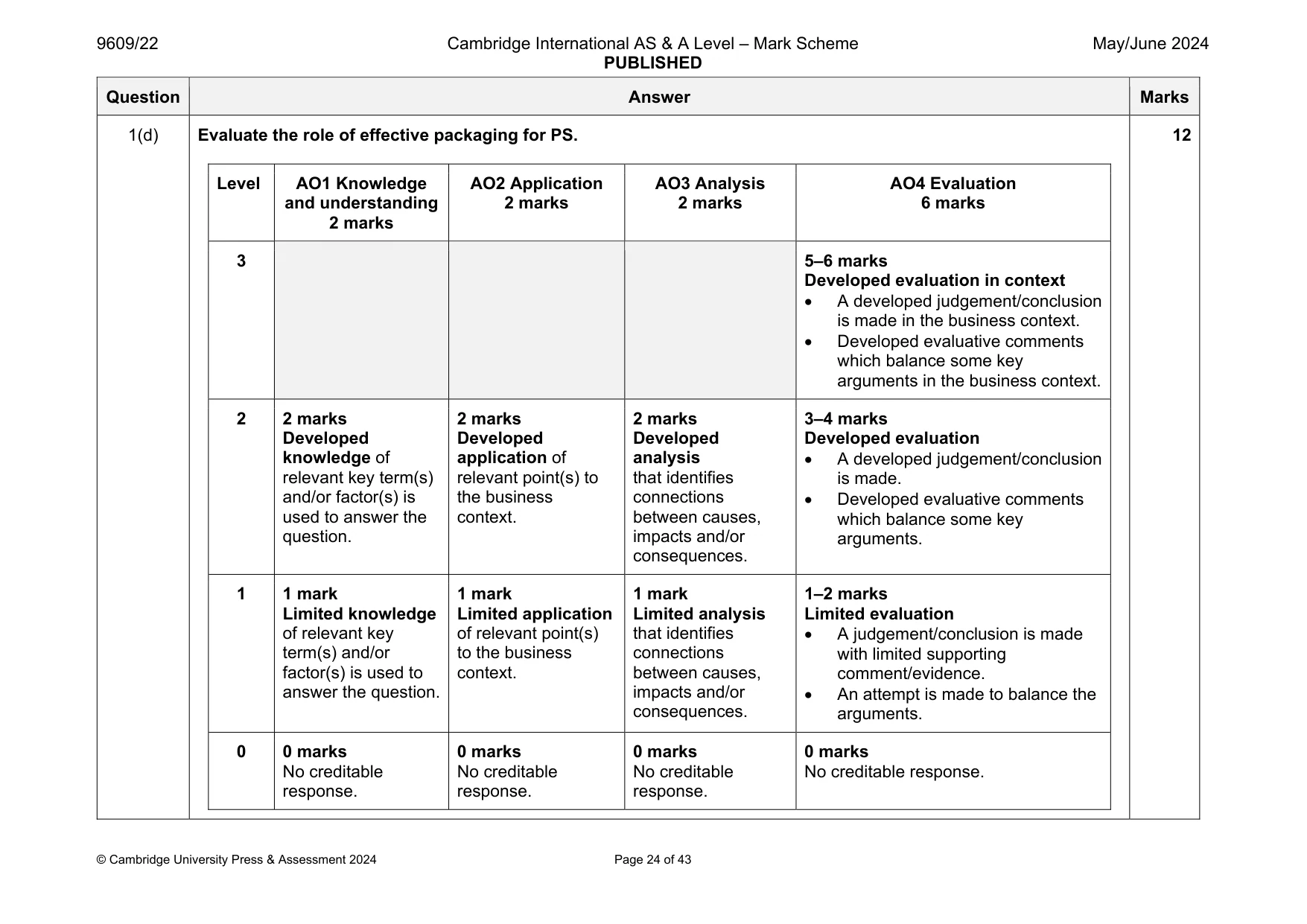
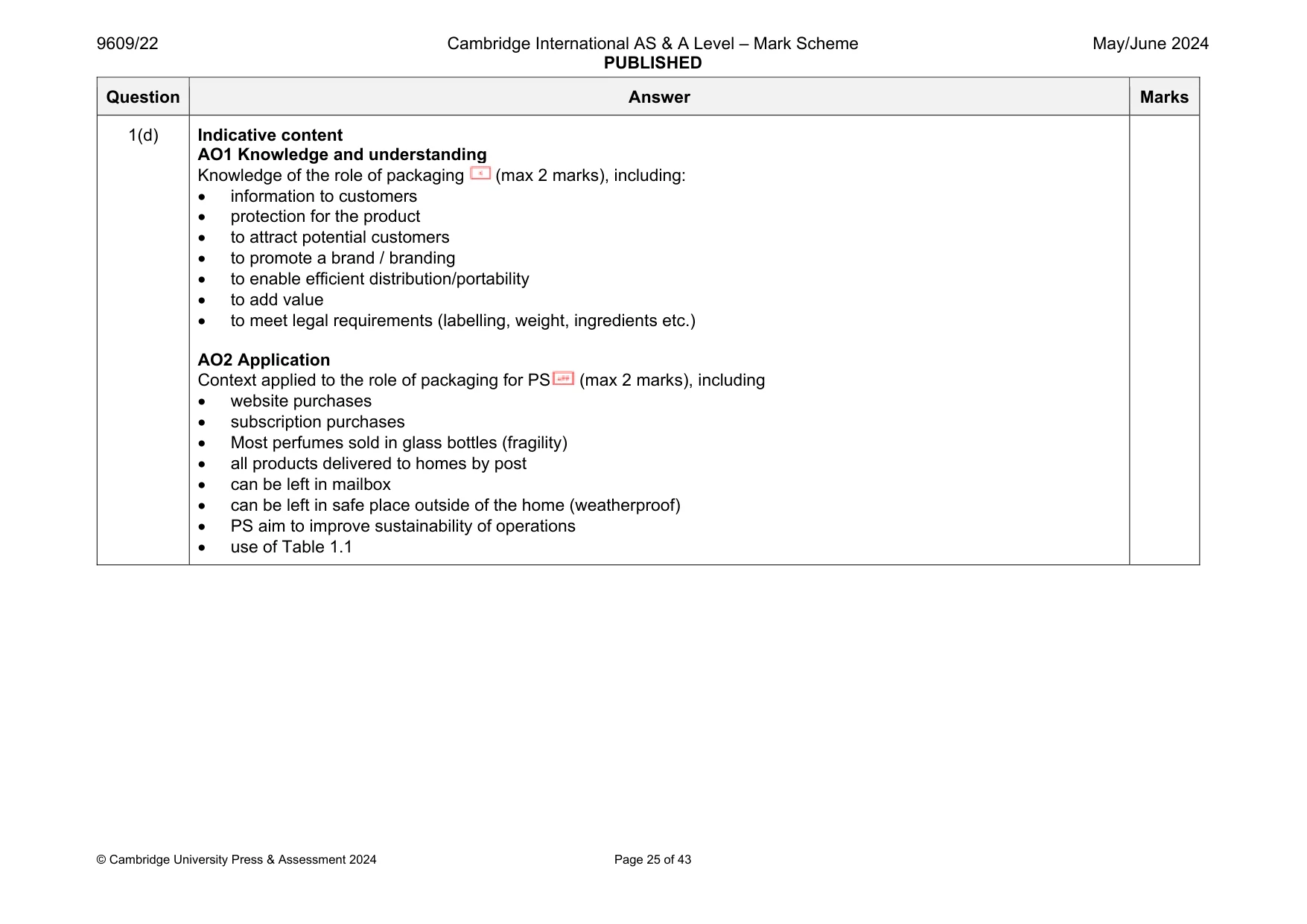
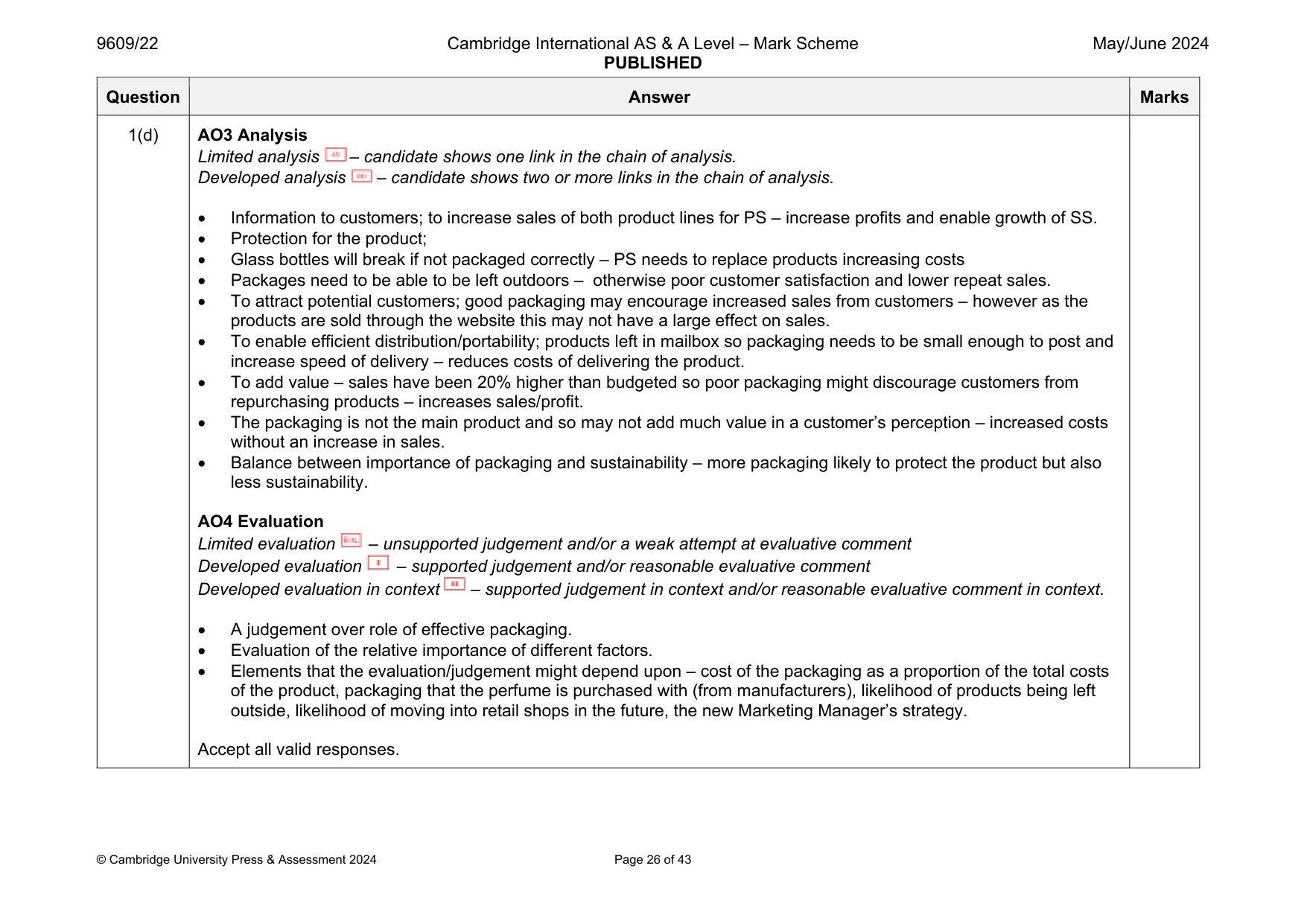
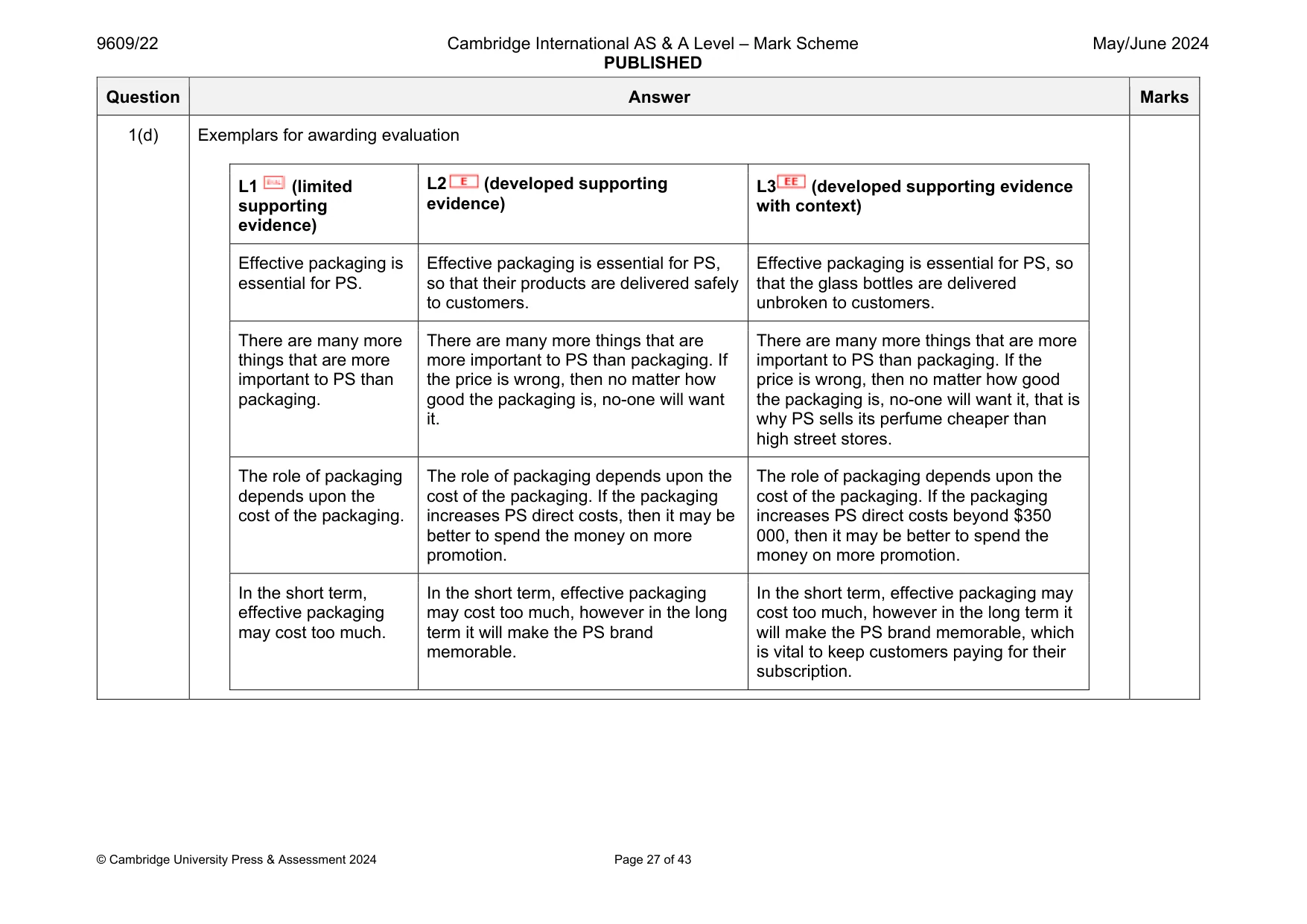
Mark scheme: 1(a)(i) Identify one feature of a private limited company. Responses may include: Any feature of a private limited company , including: limited liability shareholders incorporated shares not traded on stock exchange/publicly must make accounts publicly available separate legal identity continuity sells shares to people they know (invited). Accept all valid responses. 1 Question Answer Marks 1(a)(ii) Explain the term sustainability. AO1 Knowledge and understanding 1 mark AO2 Application 2 marks 2 marks Developed application of one relevant point to a business context. 1 mark Knowledge of one relevant point is used to answer the question. 1 mark Limited application of one relevant point to a business context. 0 marks No creditable response. 0 marks No creditable response. Indicative content AO1 Knowledge and understanding Knowledge of sustainability may include: maintaining operations/production. Allow (but do not require) knowledge of sustainability from an environmental perspective, which may include: environmental balance. conserve natural resources. 3 Question Answer Marks 1(a)(ii) AO2 Application Explanation of sustainability may include: maintaining operations/production: at the current level the ability to maintain an environmental balance: now and in the future for our planet's natural environment to conserve natural resources: to support the wellbeing of current and future generations Context applied to business of how to behave in a sustainable way , including: An example of a business behaving in a sustainable way Application can be made to PS or any other scenario/context/business/person. Allow application to environmental sustainability. Accept all valid responses. Guidance in awarding marks Knowledge & understanding Knowledge of sustainability 1 mark Explanation Explanation of sustainability 1 mark Context Applied to a business context/ business environment 1 mark Question Answer Marks 1(a)(ii) Exemplar and annotations Mark Rationale Keeping the natural environment safe now . So that it is usable in the future , to reduce dependence on single use plastic . 3 Sustainability from an environmental perspective – what the business could do now and then explained in terms of how it might help the future – plus an example (single use plastic) Making sure a business can maintain its current production now and in the future . For example, not relying on fossil fuels . 3 Clear knowledge based on now and in the future , with a clear example. Sustainability involves looking after the environment for example by recycling 2 Knowledge and an example – no explanation. Sustainability is a social goal about the ability of people to co-exist on Earth over a long time. . 1 A reasonable definition with the idea of now and the future. Sustainability is about looking to the future. 0 Too vague. Some idea of the future, but not about maintaining now. Question Answer Marks 1(b)(i) Refer to Table 1.1. Calculate the variances in 2023 (x, y and z) and state whether each variance is favourable or adverse. Budgeted Actual Variance $000 $000 Revenue 500 600 100 and Favourable (F) Direct costs 300 350 50 and Adverse (A) Indirect costs 150 125 25 and Favourable (F) 1 mark for each correctly calculated variance (including favourable or adverse). Ignore + and – signs. Allow unfavourable. 3 Question Answer Marks 1(b)(ii) Explain one benefit to PS of using incremental budgeting. AO1 Knowledge and understanding 1 mark AO2 Application 2 marks 2 marks Developed application of one relevant point to a business context. 1 mark Knowledge of one relevant point is used to answer the question. 1 mark Limited application of one relevant point to a business context. 0 marks No creditable response. 0 marks No creditable response. Indicative content AO1 Knowledge and understanding Knowledge of a benefit of using incremental budgeting , including: Simplicity / easy to adjust Speed (quicker) Consistency Avoids conflict between managers Realistic Allows business to respond to changes Must be about incremental budgeting. As opposed to budgeting in general. No further marks can be gained without knowledge and understanding of a benefit of incremental budgeting. 3 Question Answer Marks 1(b)(ii) AO2 Application Explanation of a benefit of using incremental budgeting , including: Simplicity; by adding a small amount to the previous time period, this avoids any complicated preparations Speed (quicker); reduced the time needed to prepare a business’ budgets Consistency; as each budget uses the previous as a base, there is a consistent approach every time Avoids conflict between managers; due to the consistent approach Realistic; because based on previous data Context of a benefit of using incremental budgeting , including: Use of Table 1.1 Each budget has a variance OFR from answer to Q1(b)(i) PS sells through its own website Web sales and subscription available PS uses the postal service Aim to improve the sustainability of its operations New Marketing Manager being recruited Accept all valid responses. Guidance in awarding marks Knowledge & understanding Knowledge of a benefit of using incremental budgeting 1 mark Explanation Explanation of a benefit to a business of using incremental budgeting 1 mark Context Context linked to a benefit to PS of using incremental budgeting 1 mark Question Answer Marks 1(b)(ii) Exemplar and annotations Mark Rationale It is quicker than other methods of budgeting because the Manager just adds on a small amount to budget from last year which means they can focus on PS’s website . 3 Speed/quicker is enough for knowledge, which is then explained with context. Because it is based on past data incremental budgeting is more realistic , so that the revenue variance should be less than 100 next year . 3 Starts with the explanation, followed by the knowledge. Without the knowledge, this would be 0 marks. The example has OFR based on the answer to Q1(b)(i). It is easy to use incremental budgeting because it’s based on previous figures . 2 Knowledge (easy to use) with some explanation, but no context. It is easier as they can just add 100 to the revenue budget . 2 Knowledge and context. Incremental budgeting is easier and quicker than other forms of budgeting such as zero budgeting, where the Manager has to start from scratch every year. There is also historical budgeting which is doing it based on what happened in the past. This would take longer and be more complicated than incremental budgeting. 1 Knowledge at the start – the rest of the answer is NAQ. Incremental budgeting involves adding a small amount to each of the budgets for previous years. 0 There is knowledge of incremental budgeting, but no knowledge of a benefit. Incremental budgeting is about guessing how much revenue, cost and profit a business will achieve and then comparing this to what actually happened. PS had a variance on every budget, so they must not have done their budgeting well. 0 No knowledge of a benefit of incremental budgeting. Question Answer Marks 1(c) Analyse one advantage and one disadvantage to PS of using an assessment centre when selecting a Marketing Manager. Level AO1 Knowledge and understanding 2 marks AO2 Application 2 marks AO3 Analysis 4 marks 2 3–4 marks Developed analysis Developed analysis that identifies connections between causes, impacts and/or consequences of two points. Developed analysis that identifies connections between causes, impacts and/or consequences of one point. 1 1–2 marks Knowledge of two relevant points is used to answer the question. Knowledge of one relevant point is used to answer the question. 1–2 marks Application of two relevant points to a business context. Application of one relevant point to a business context. 1–2 marks Limited analysis Limited analysis that identifies connections between causes, impacts and/or consequences of two points. Limited analysis that identifies connections between causes, impacts and/or consequences of one point. 0 0 marks No creditable response. 0 marks No creditable response. 0 marks No creditable response. 8 Question Answer Marks 1(c) Indicative content AO1 Knowledge and understanding Knowledge of an assessment centre (max 1 mark if no knowledge of advantage or disadvantage), including: a combination of tasks and activities that test suitability for the job chance to demonstrate a wider range of skills than during a traditional face-to-face interview. hosted over anything from an afternoon to two days often the final stage of the selection process a group of candidates usually attend together. Knowledge of an advantage (max 1 mark – annotate on left) may include: More suitable/knowledgeable/skilled recruit Wider skilled recruit / more skills tested More detailed process Useful as final stage of recruitment Allows direct comparison with other candidates Less time involved Knowledge of a disadvantage (max 1 mark – annotate on right) may include: Takes more time Cost of an assessment centre Not realistic / not linked to specific employment / may assess unnecessary skills / knowledge AO2 Application Context applied to an advantage (max 1 mark) and disadvantage (max 1 mark) of using an assessment centre, including: To plan the recruitment and training of a new sales team. To organise the production of digital promotions. To advise the board of directors on changes to the PS product portfolio. To do tasks relating to the marketing of PS (e.g. perfume, website sales, subscription sales, importance of packaging). Five shortlisted applicants. Use of Table 1.1 Question Answer Marks 1(c) AO3 Analysis Limited analysis – candidate shows one link in the chain of analysis. Developed analysis candidate shows two or more links in the chain of analysis or a two-sided analysis. Advantages may include: More suitable recruit lower costs of marketing – increase profitability higher sales – increase profits Wider skilled recruit lower costs of marketing – increase profitability higher sales – increase profits Longer process than an interview; more likely to find a better candidate – increase sales and growth of PS. Final stage of recruitment; may be a suitable way to distinguish between qualified and similar candidates – increase chances of getting the best candidate. Allows direct comparison with other candidates – increases probability of finding the best candidate who can improve the marketing of PS. Disadvantages may include: Takes more time; increase costs – reduces profitability. May assess unnecessary skills and provides an unrealistic image of the candidates and increases the probability of choosing the wrong candidate – increases costs in the long run (more recruitment needed). Cost of an assessment centre; significantly more expensive than an interview – decreased profitability. Accept all valid responses. Question Answer Marks 1(c) Exemplars and annotations AO1 Knowledge AO2 Application AO3 Analysis Better skilled employees . So that PS can make sure their new manager can organise the production of digital promotions . Which can help PS to increase their sales revenue by selling more perfume and make a greater profit . Assessment centres have a high cost As all five potential managers will be invited. Which will reduce the profitability of PS and reduce the dividends for the shareholders . Question Answer Marks 1(d) Evaluate the role of effective packaging for PS. Level AO1 Knowledge and understanding 2 marks AO2 Application 2 marks AO3 Analysis 2 marks AO4 Evaluation 6 marks 3 5–6 marks Developed evaluation in context A developed judgement/conclusion is made in the business context. Developed evaluative comments which balance some key arguments in the business context. 2 2 marks Developed knowledge of relevant key term(s) and/or factor(s) is used to answer the question. 2 marks Developed application of relevant point(s) to the business context. 2 marks Developed analysis that identifies connections between causes, impacts and/or consequences. 3–4 marks Developed evaluation A developed judgement/conclusion is made. Developed evaluative comments which balance some key arguments. 1 1 mark Limited knowledge of relevant key term(s) and/or factor(s) is used to answer the question. 1 mark Limited application of relevant point(s) to the business context. 1 mark Limited analysis that identifies connections between causes, impacts and/or consequences. 1–2 marks Limited evaluation A judgement/conclusion is made with limited supporting comment/evidence. An attempt is made to balance the arguments. 0 0 marks No creditable response. 0 marks No creditable response. 0 marks No creditable response. 0 marks No creditable response. 12 Question Answer Marks 1(d) Indicative content AO1 Knowledge and understanding Knowledge of the role of packaging (max 2 marks), including: information to customers protection for the product to attract potential customers to promote a brand / branding to enable efficient distribution/portability to add value to meet legal requirements (labelling, weight, ingredients etc.) AO2 Application Context applied to the role of packaging for PS (max 2 marks), including website purchases subscription purchases Most perfumes sold in glass bottles (fragility) all products delivered to homes by post can be left in mailbox can be left in safe place outside of the home (weatherproof) PS aim to improve sustainability of operations use of Table 1.1 Question Answer Marks 1(d) AO3 Analysis Limited analysis – candidate shows one link in the chain of analysis. Developed analysis – candidate shows two or more links in the chain of analysis. Information to customers; to increase sales of both product lines for PS – increase profits and enable growth of SS. Protection for the product; Glass bottles will break if not packaged correctly – PS needs to replace products increasing costs Packages need to be able to be left outdoors – otherwise poor customer satisfaction and lower repeat sales. To attract potential customers; good packaging may encourage increased sales from customers – however as the products are sold through the website this may not have a large effect on sales. To enable efficient distribution/portability; products left in mailbox so packaging needs to be small enough to post and increase speed of delivery – reduces costs of delivering the product. To add value – sales have been 20% higher than budgeted so poor packaging might discourage customers from repurchasing products – increases sales/profit. The packaging is not the main product and so may not add much value in a customer’s perception – increased costs without an increase in sales. Balance between importance of packaging and sustainability – more packaging likely to protect the product but also less sustainability. AO4 Evaluation Limited evaluation – unsupported judgement and/or a weak attempt at evaluative comment Developed evaluation – supported judgement and/or reasonable evaluative comment Developed evaluation in context – supported judgement in context and/or reasonable evaluative comment in context. A judgement over role of effective packaging. Evaluation of the relative importance of different factors. Elements that the evaluation/judgement might depend upon – cost of the packaging as a proportion of the total costs of the product, packaging that the perfume is purchased with (from manufacturers), likelihood of products being left outside, likelihood of moving into retail shops in the future, the new Marketing Manager’s strategy. Accept all valid responses. Question Answer Marks 1(d) Exemplars for awarding evaluation L1 (limited supporting evidence) L2 (developed supporting evidence) L3 (developed supporting evidence with context) Effective packaging is essential for PS. Effective packaging is essential for PS, so that their products are delivered safely to customers. Effective packaging is essential for PS, so that the glass bottles are delivered unbroken to customers. There are many more things that are more important to PS than packaging. There are many more things that are more important to PS than packaging. If the price is wrong, then no matter how good the packaging is, no-one will want it. There are many more things that are more important to PS than packaging. If the price is wrong, then no matter how good the packaging is, no-one will want it, that is why PS sells its perfume cheaper than high street stores. The role of packaging depends upon the cost of the packaging. The role of packaging depends upon the cost of the packaging. If the packaging increases PS direct costs, then it may be better to spend the money on more promotion. The role of packaging depends upon the cost of the packaging. If the packaging increases PS direct costs beyond $350 000, then it may be better to spend the money on more promotion. In the short term, effective packaging may cost too much. In the short term, effective packaging may cost too much, however in the long term it will make the PS brand memorable. In the short term, effective packaging may cost too much, however in the long term it will make the PS brand memorable, which is vital to keep customers paying for their subscription.
Q2 · Cobblestone Shoes (CS) Yazeem is a highly skilled shoemaker
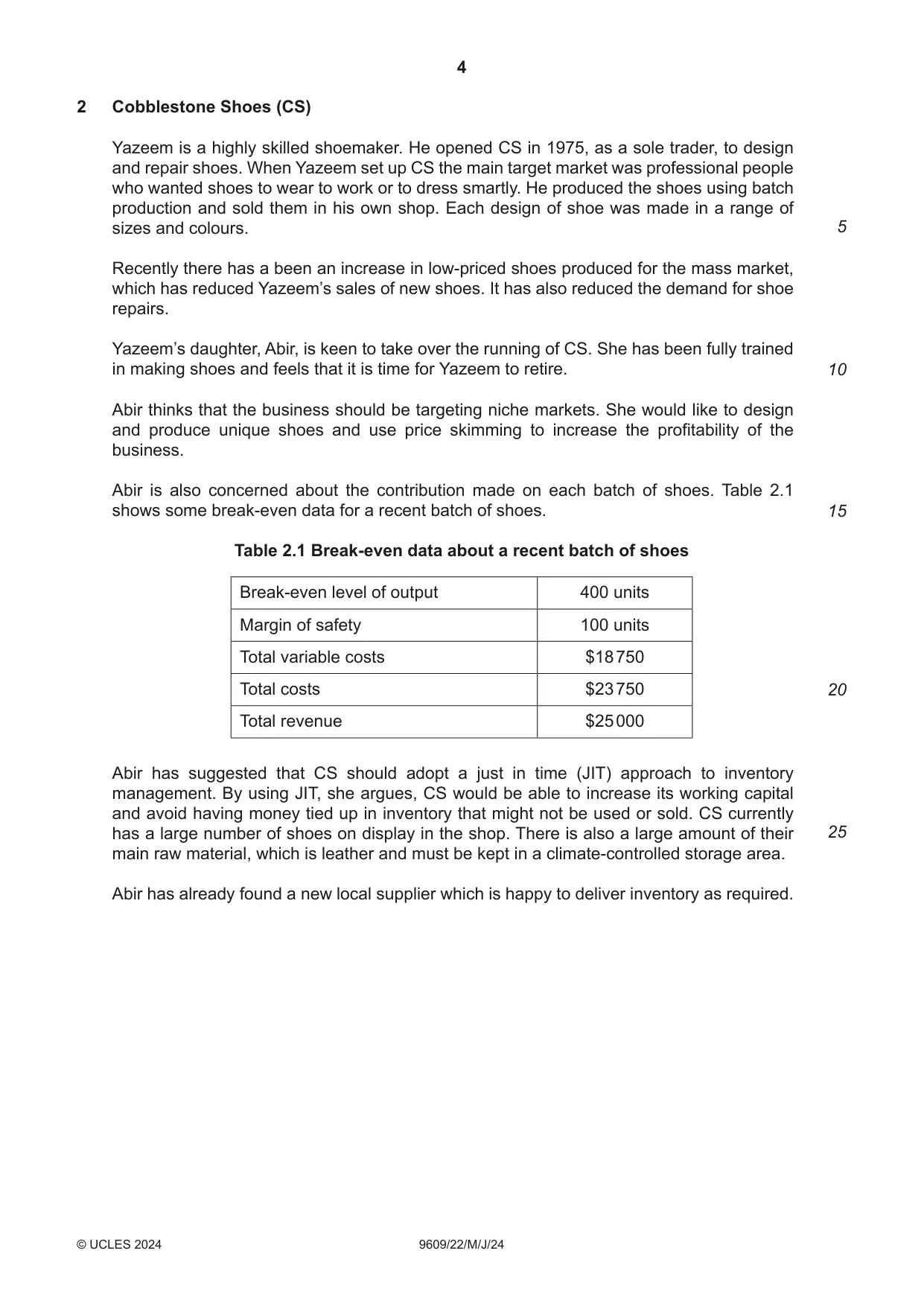
2 Cobblestone Shoes (CS) Yazeem is a highly skilled shoemaker. He opened CS in 1975, as a sole trader, to design and repair shoes. When Yazeem set up CS the main target market was professional people who wanted shoes to wear to work or to dress smartly. He produced the shoes using batch production and sold them in his own shop. Each design of shoe was made in a range of sizes and colours. 5 Recently there has a been an increase in low-priced shoes produced for the mass market, which has reduced Yazeem’s sales of new shoes. It has also reduced the demand for shoe repairs. Yazeem’s daughter, Abir, is keen to take over the running of CS. She has been fully trained in making shoes and feels that it is time for Yazeem to retire. 10 Abir thinks that the business should be targeting niche markets. She would like to design and produce unique shoes and use price skimming to increase the profitability of the business. Abir is also concerned about the contribution made on each batch of shoes. Table 2.1 shows some break-even data for a recent batch of shoes. 15 Table 2.1 Break-even data about a recent batch of shoes Break-even level of output 400 units Margin of safety 100 units Total variable costs $18 750 Total costs $23 750 20 Total revenue $25 000 Abir has suggested that CS should adopt a just in time (JIT) approach to inventory management. By using JIT, she argues, CS would be able to increase its working capital and avoid having money tied up in inventory that might not be used or sold. CS currently has a large number of shoes on display in the shop. There is also a large amount of their 25 main raw material, which is leather and must be kept in a climate-controlled storage area. Abir has already found a new local supplier which is happy to deliver inventory as required. (a) (i) Identify one type of training. [1] (ii) Explain the term mass market. [3] (b) (i) Refer to Table 2.1. Calculate the contribution per unit for the recent batch of shoes. [3] (ii) Explain one limitation for CS of using break-even analysis. [3] (c) Analyse two disadvantages to CS of adopting a JIT approach to inventory management. [8] (d) Evaluate the importance to CS of being a small business. [12]
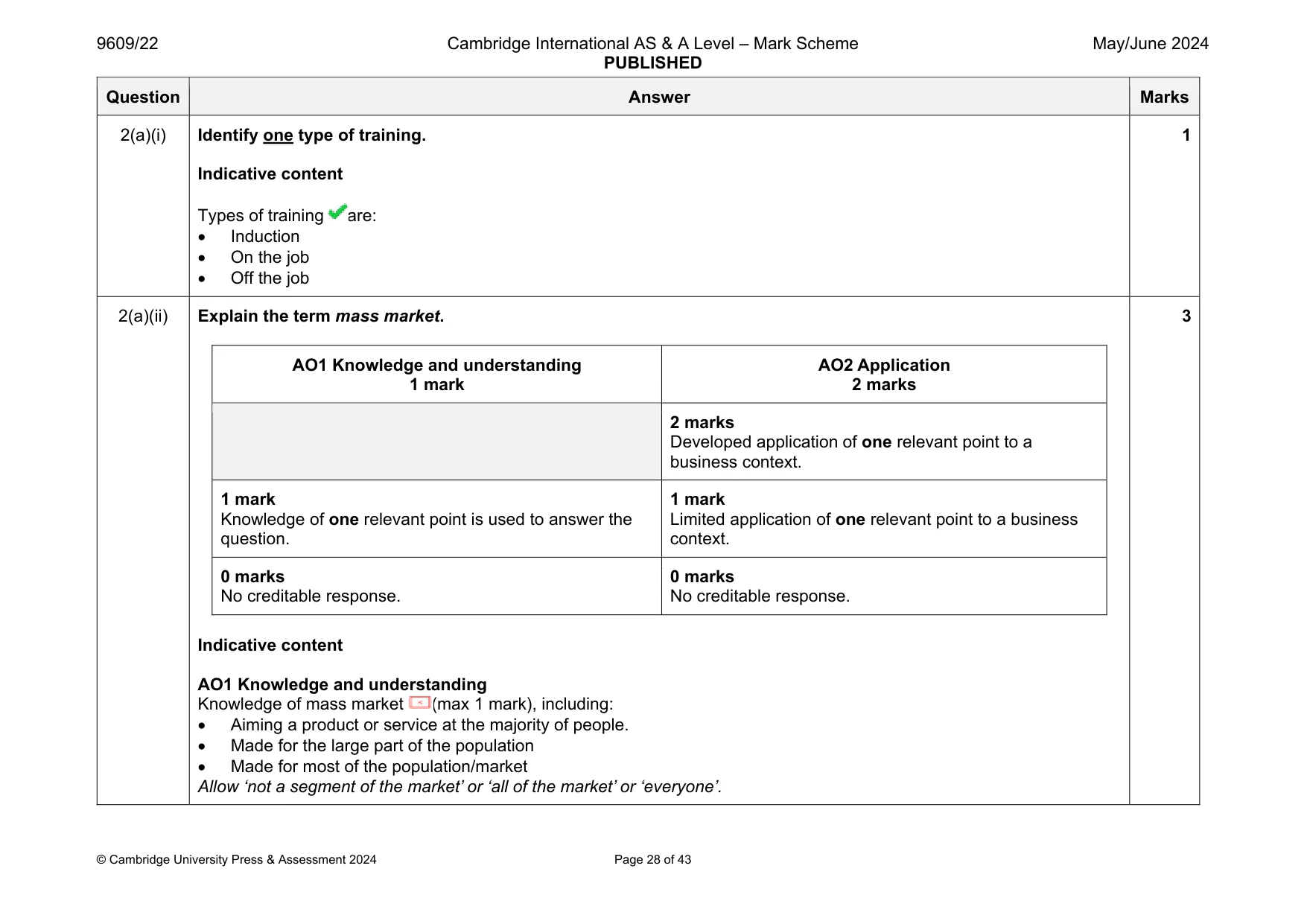
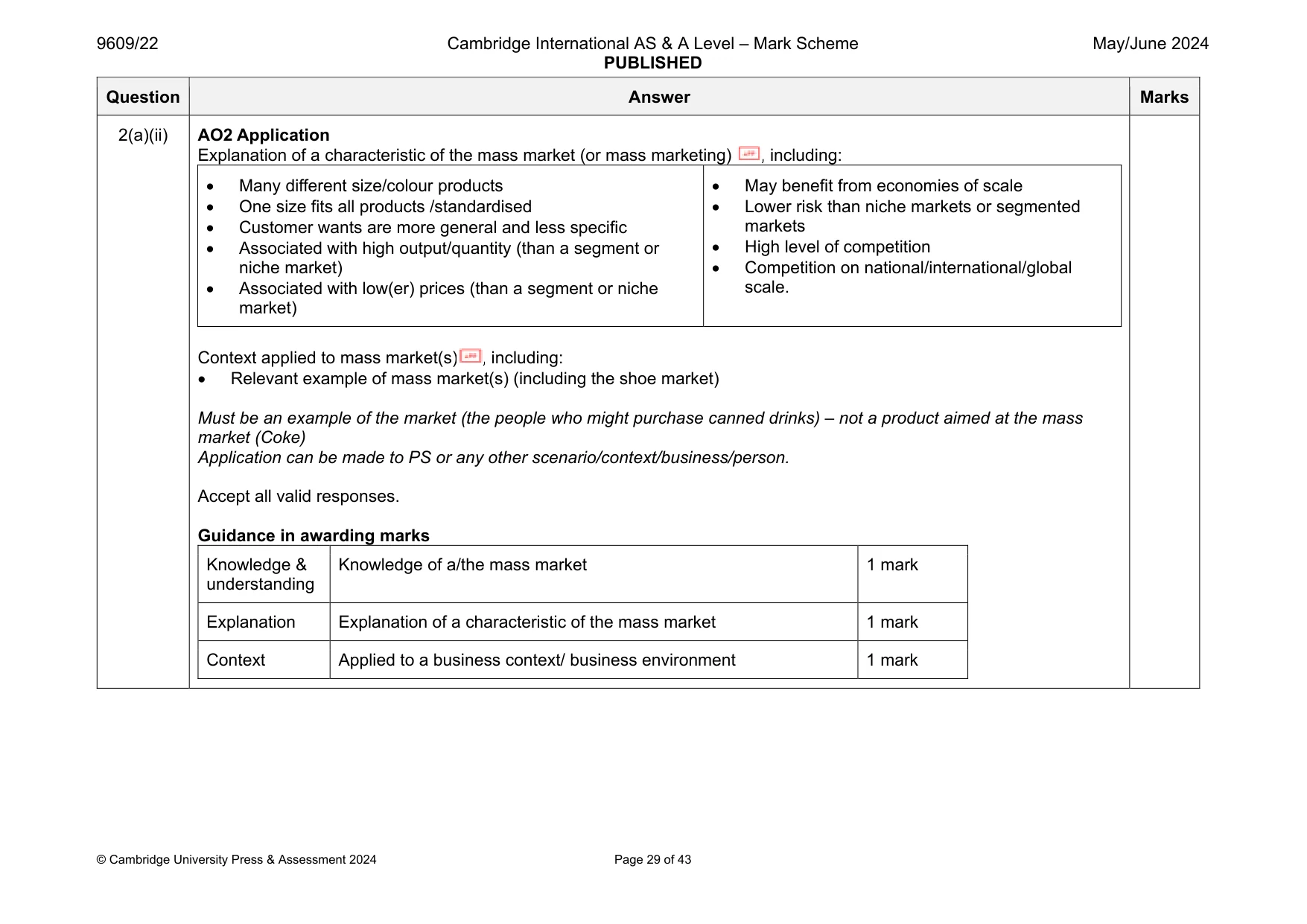
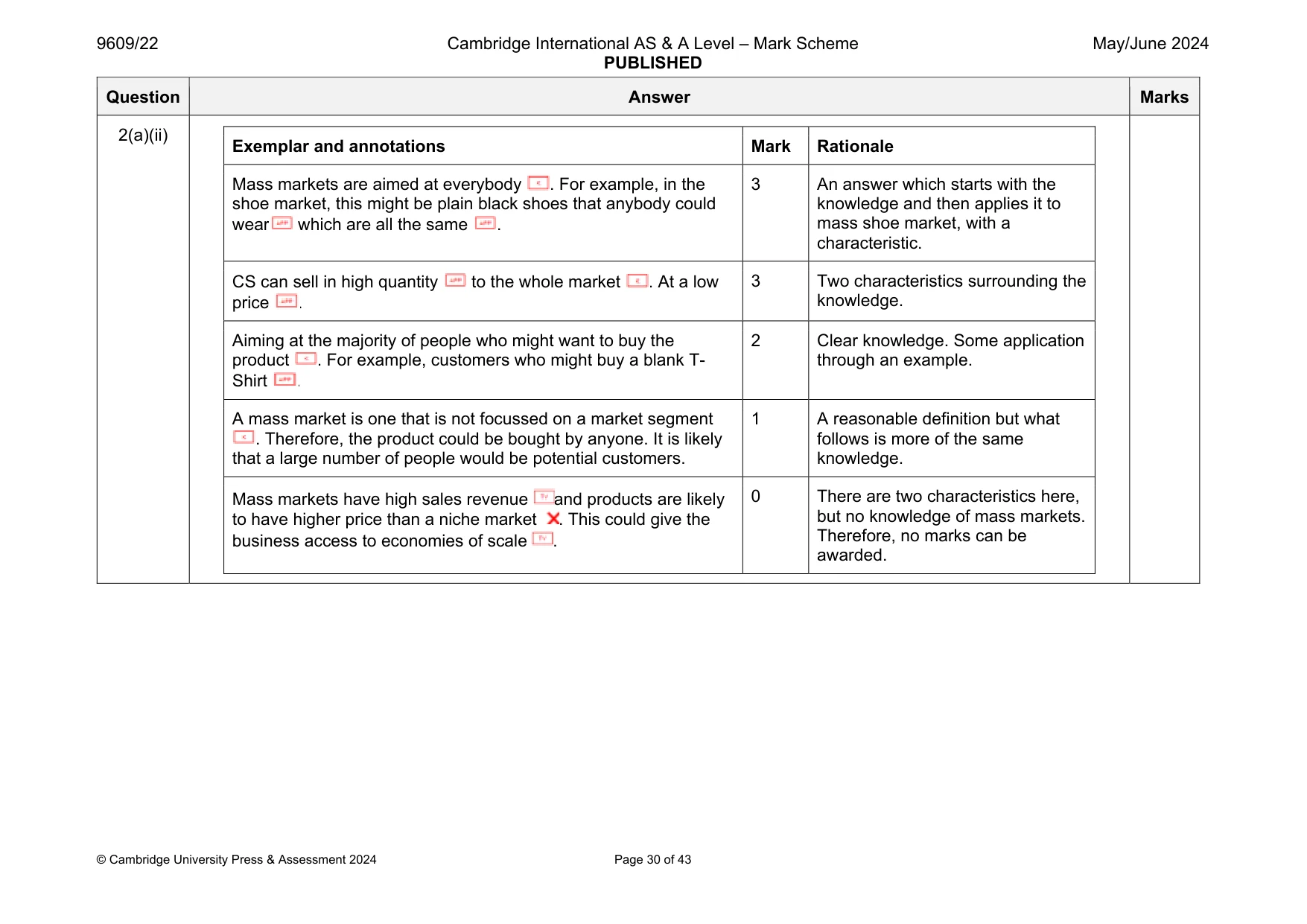
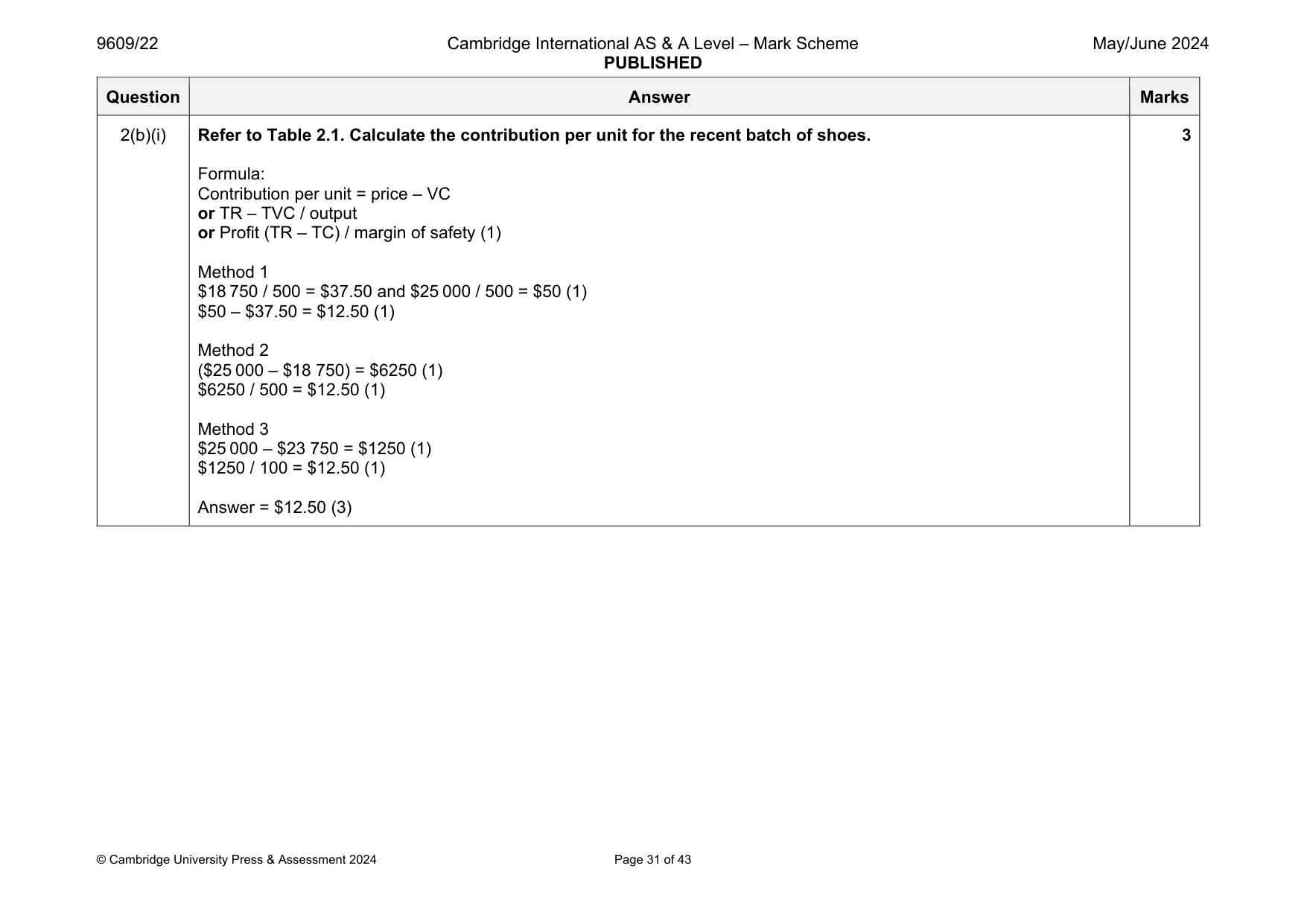
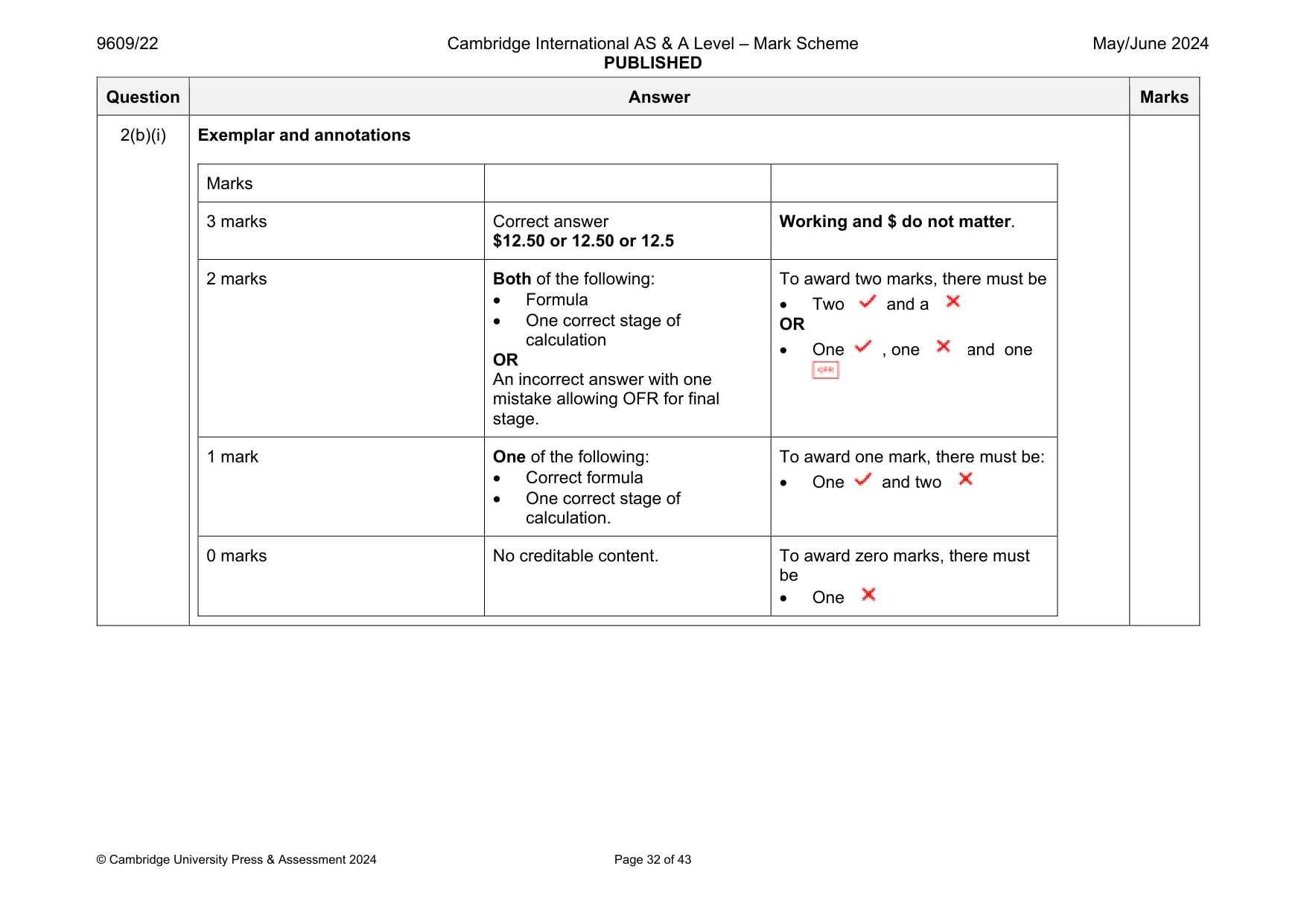
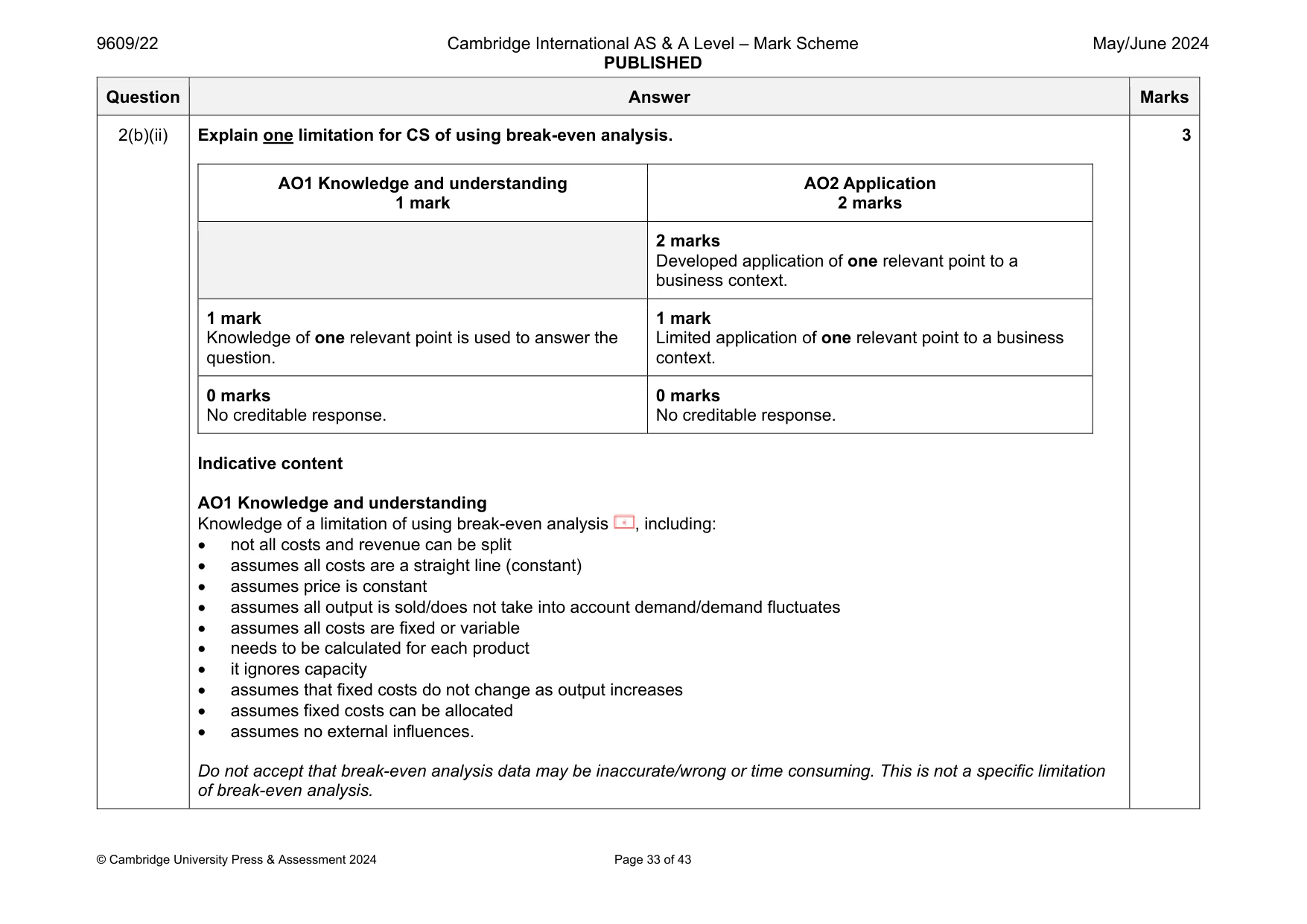
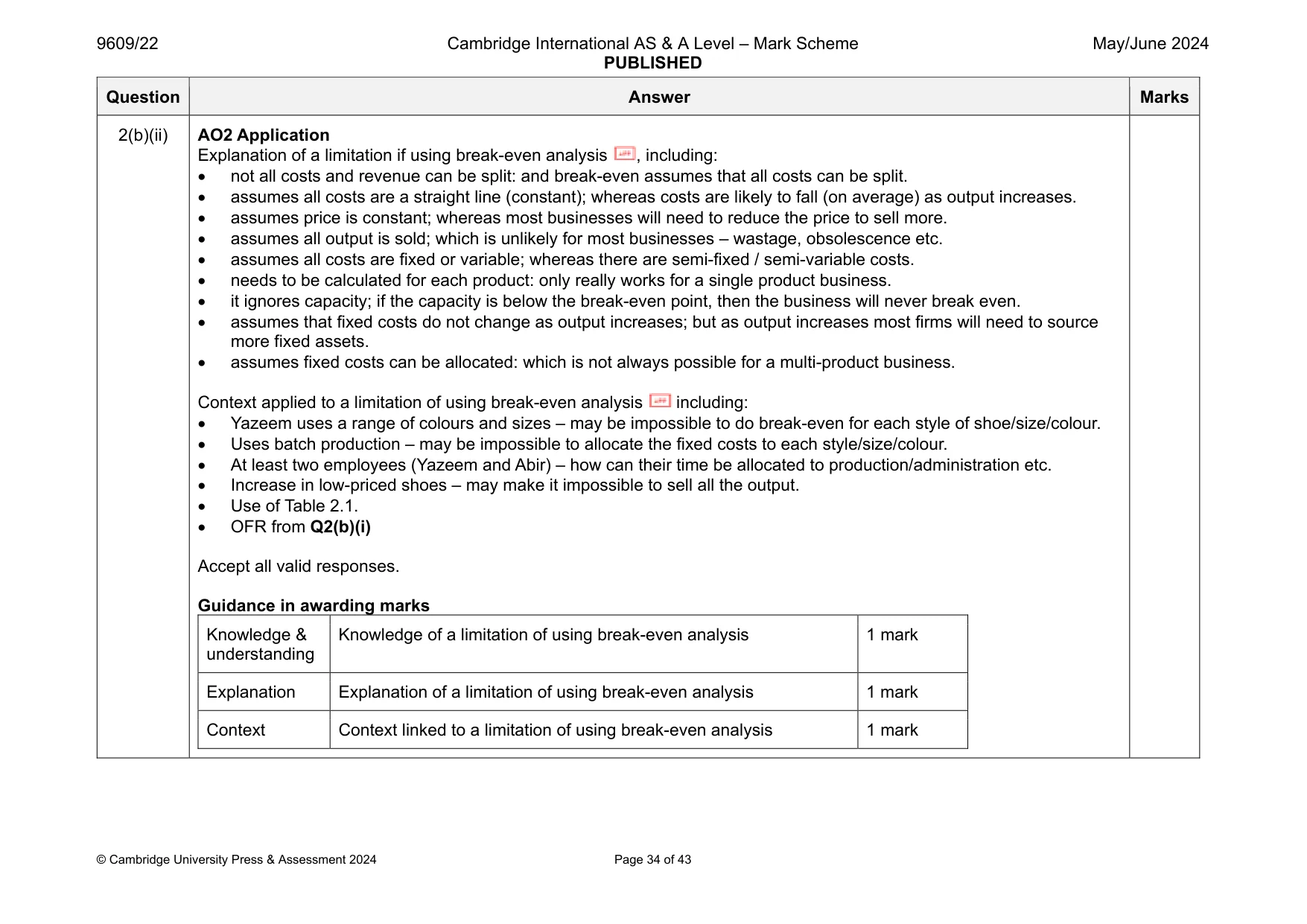
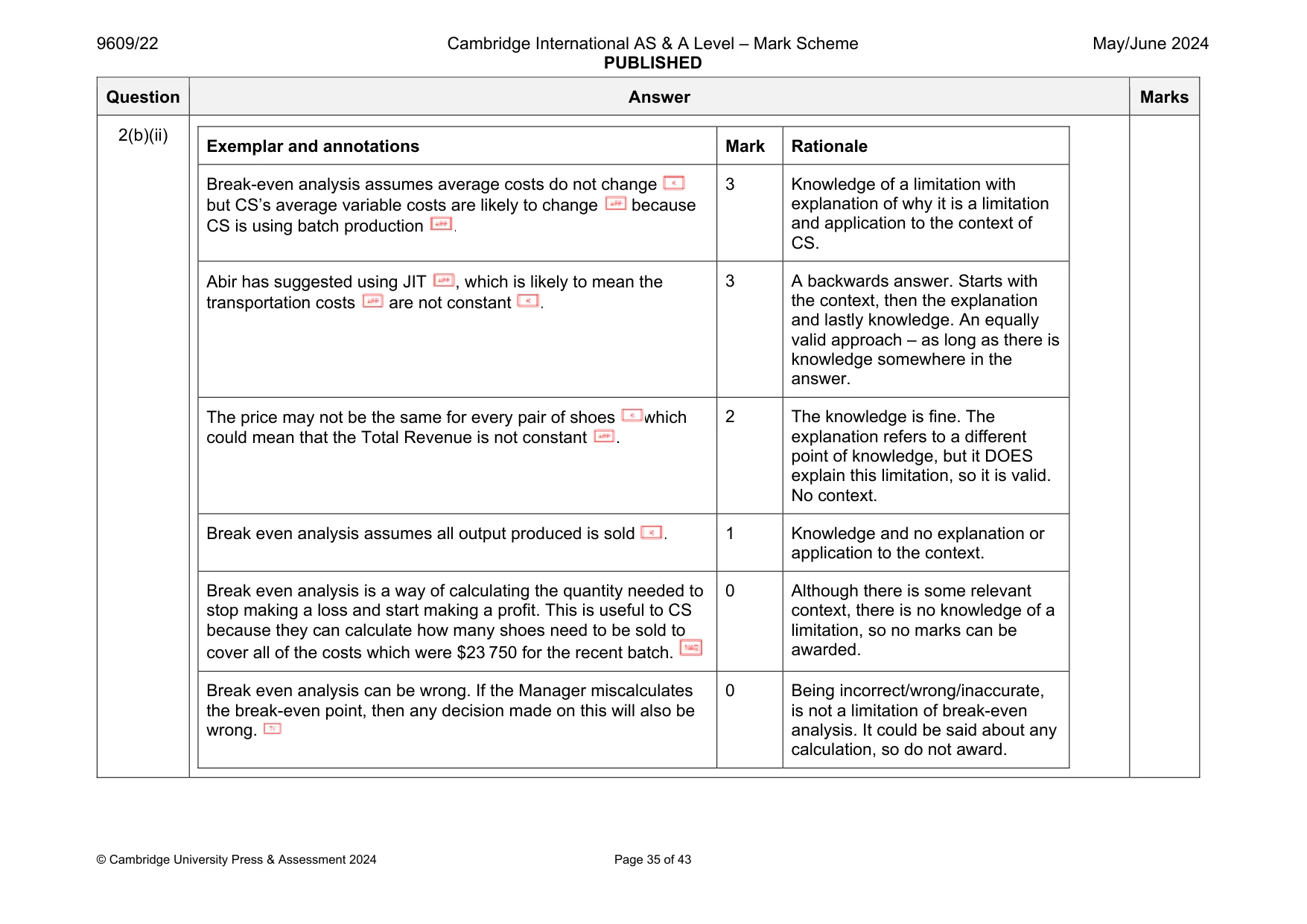
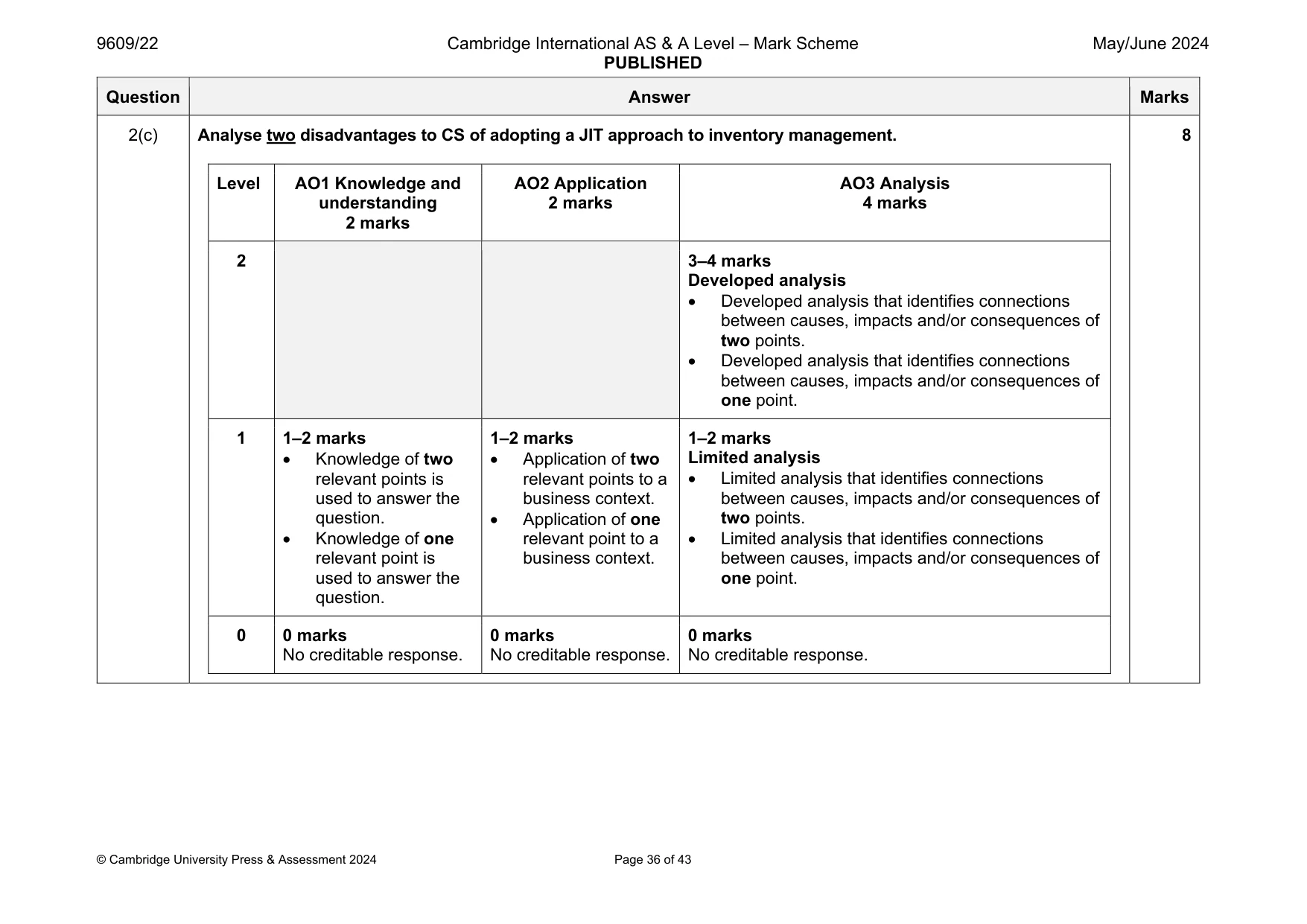
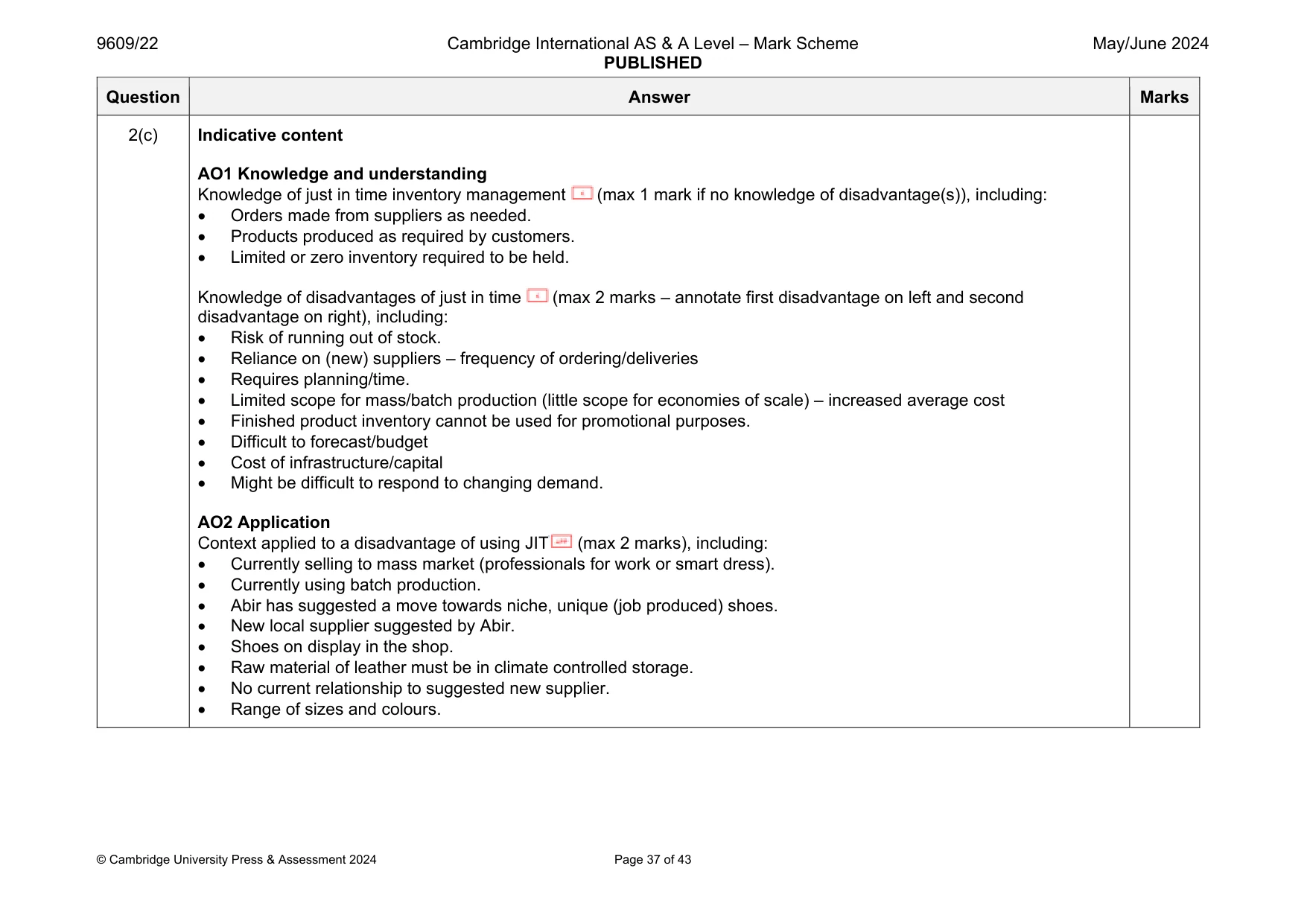
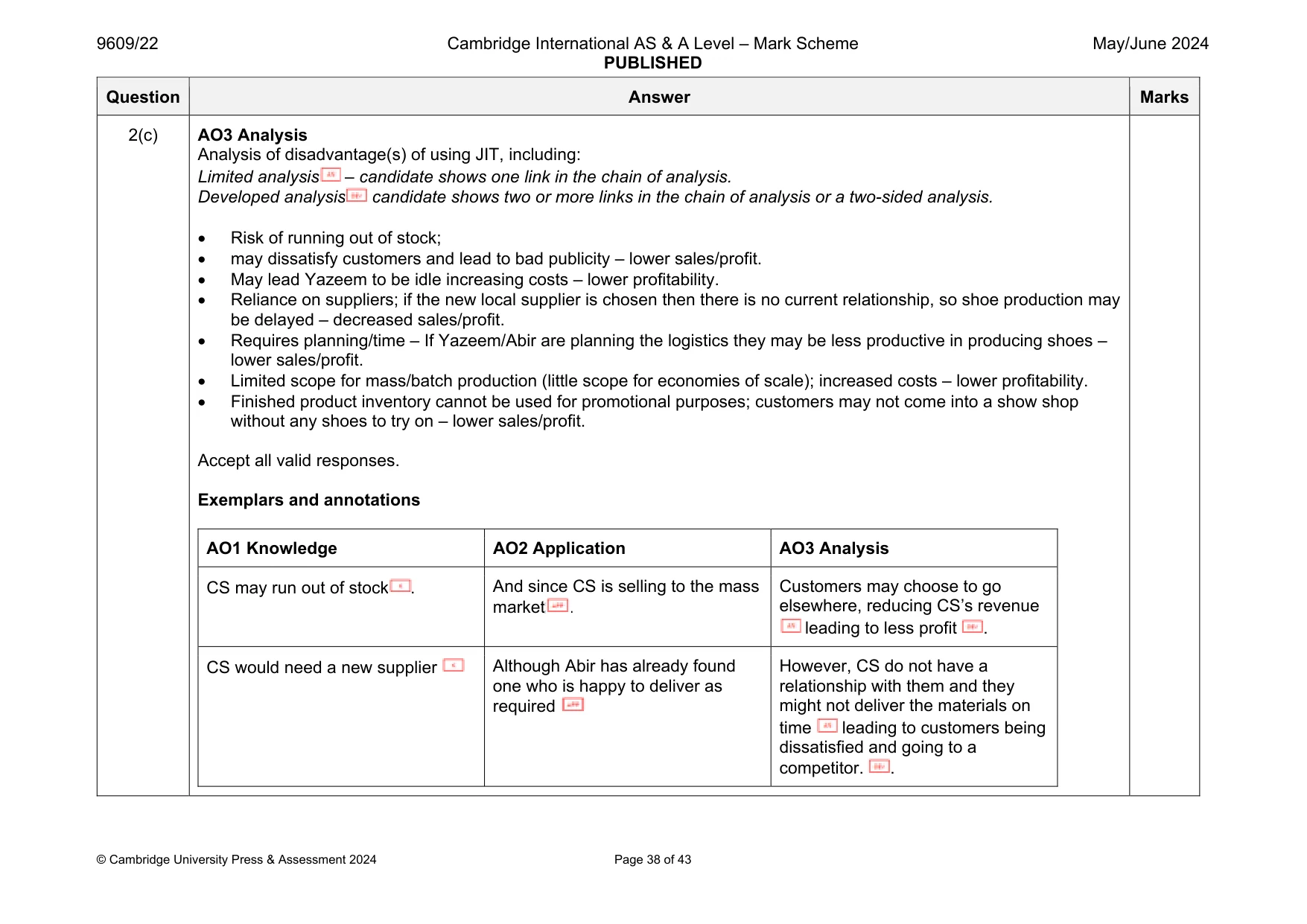
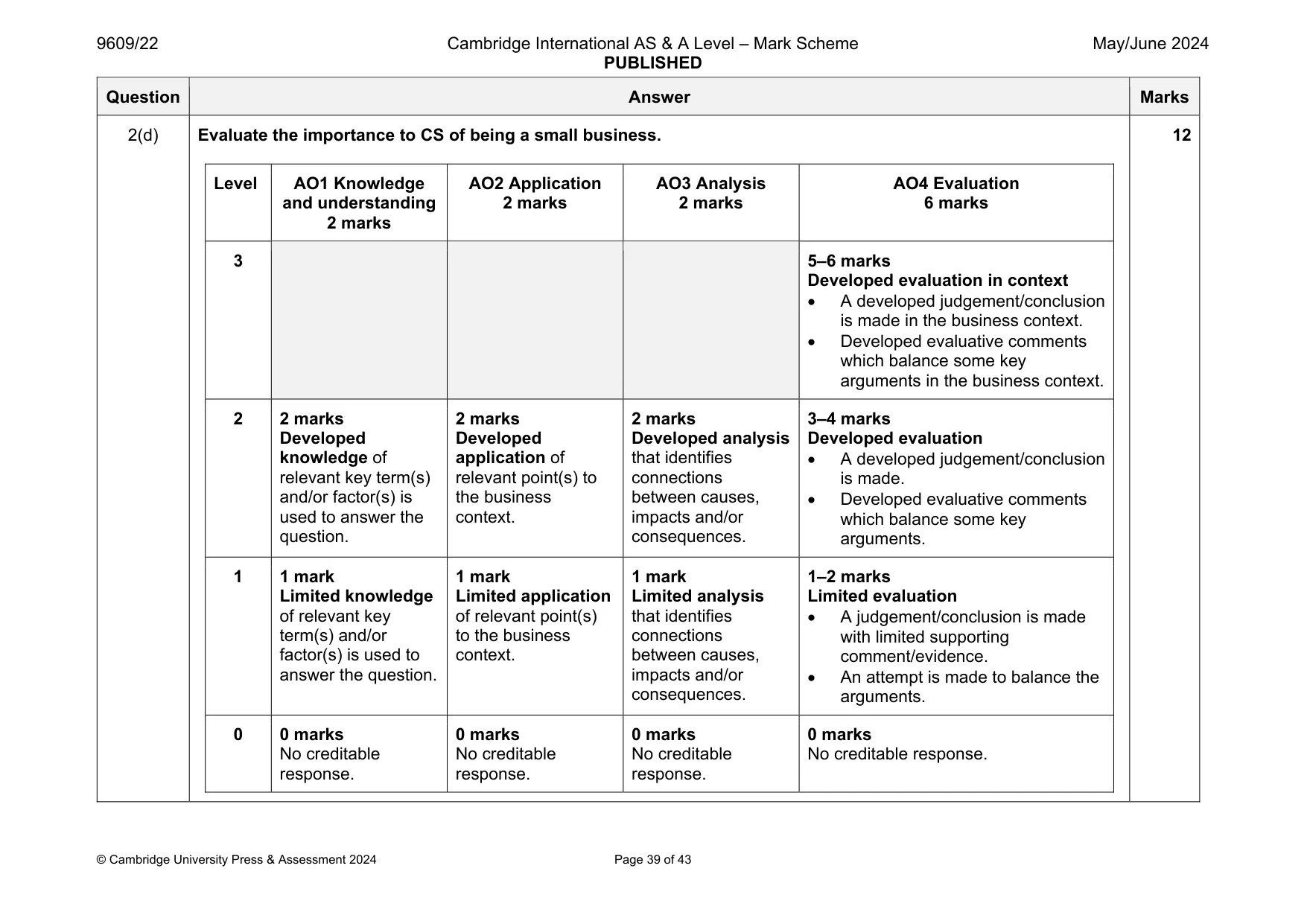
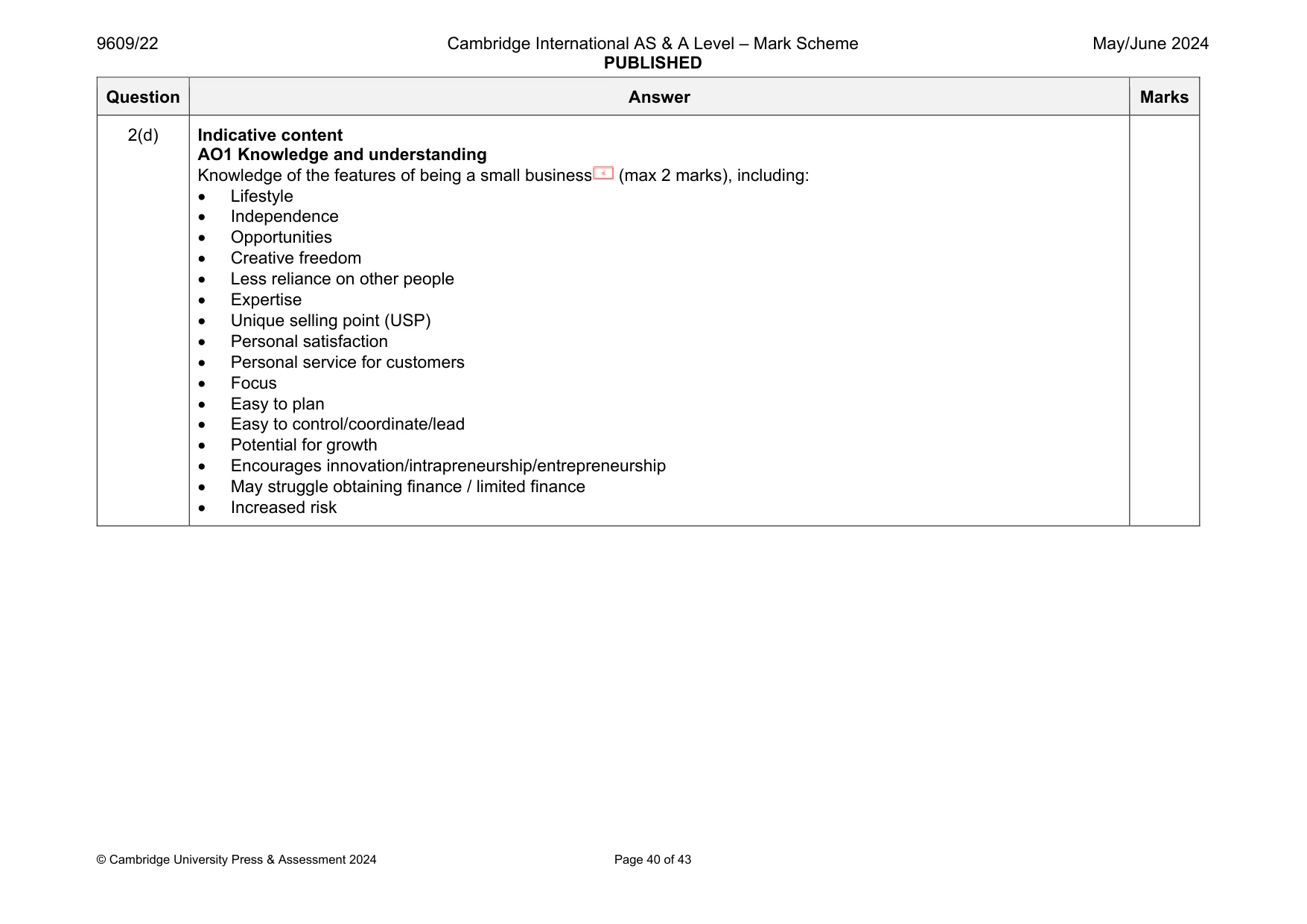
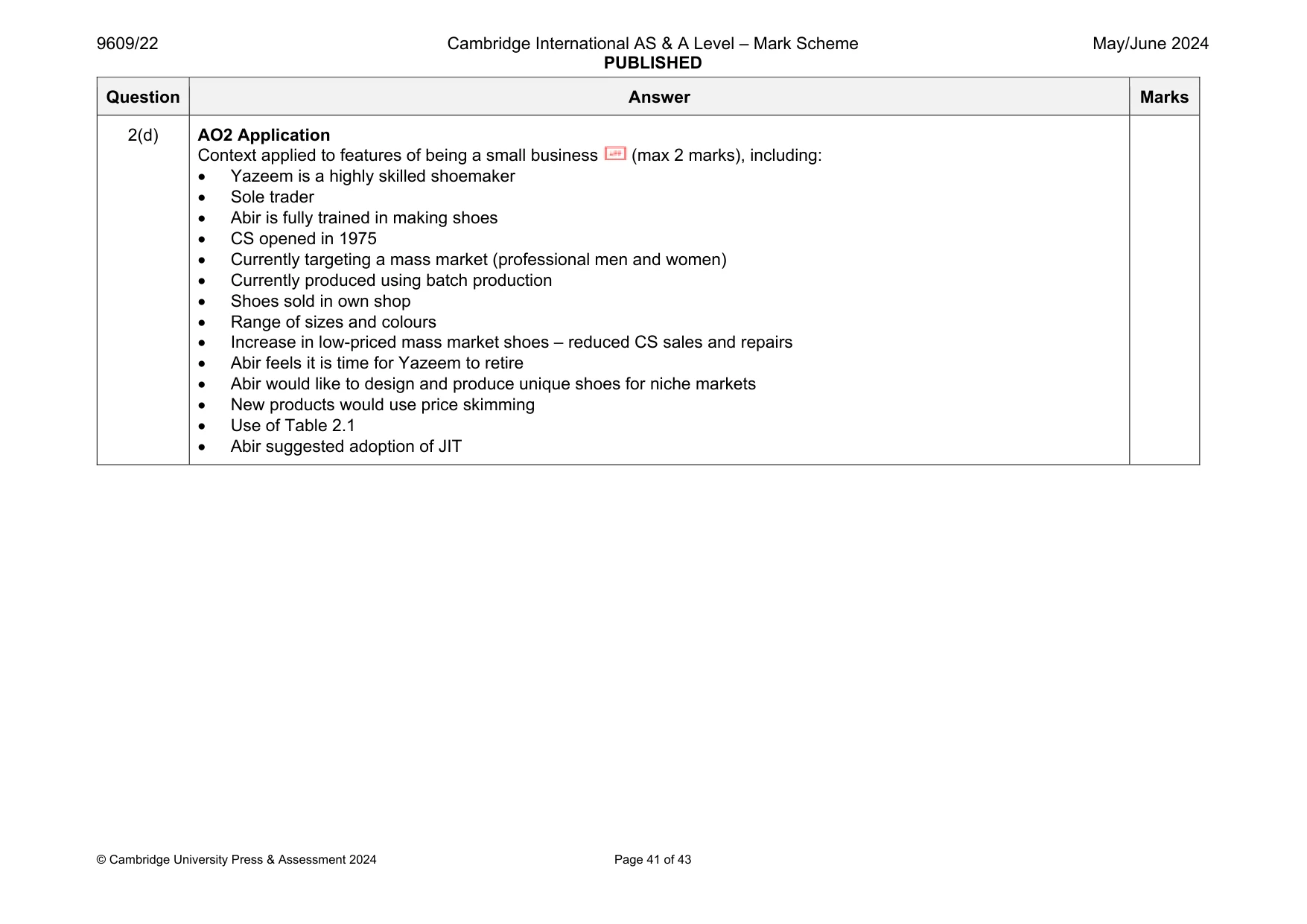
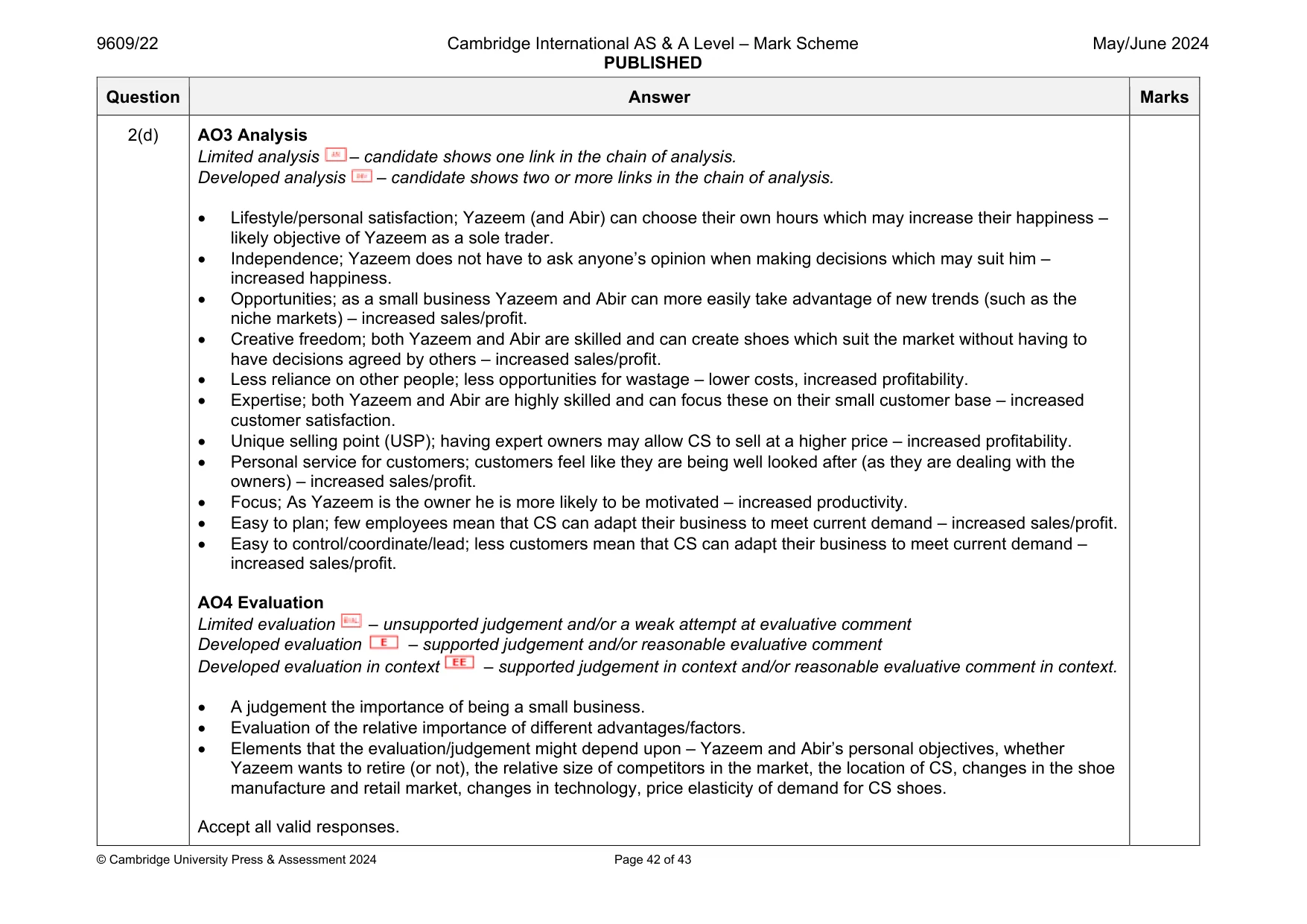
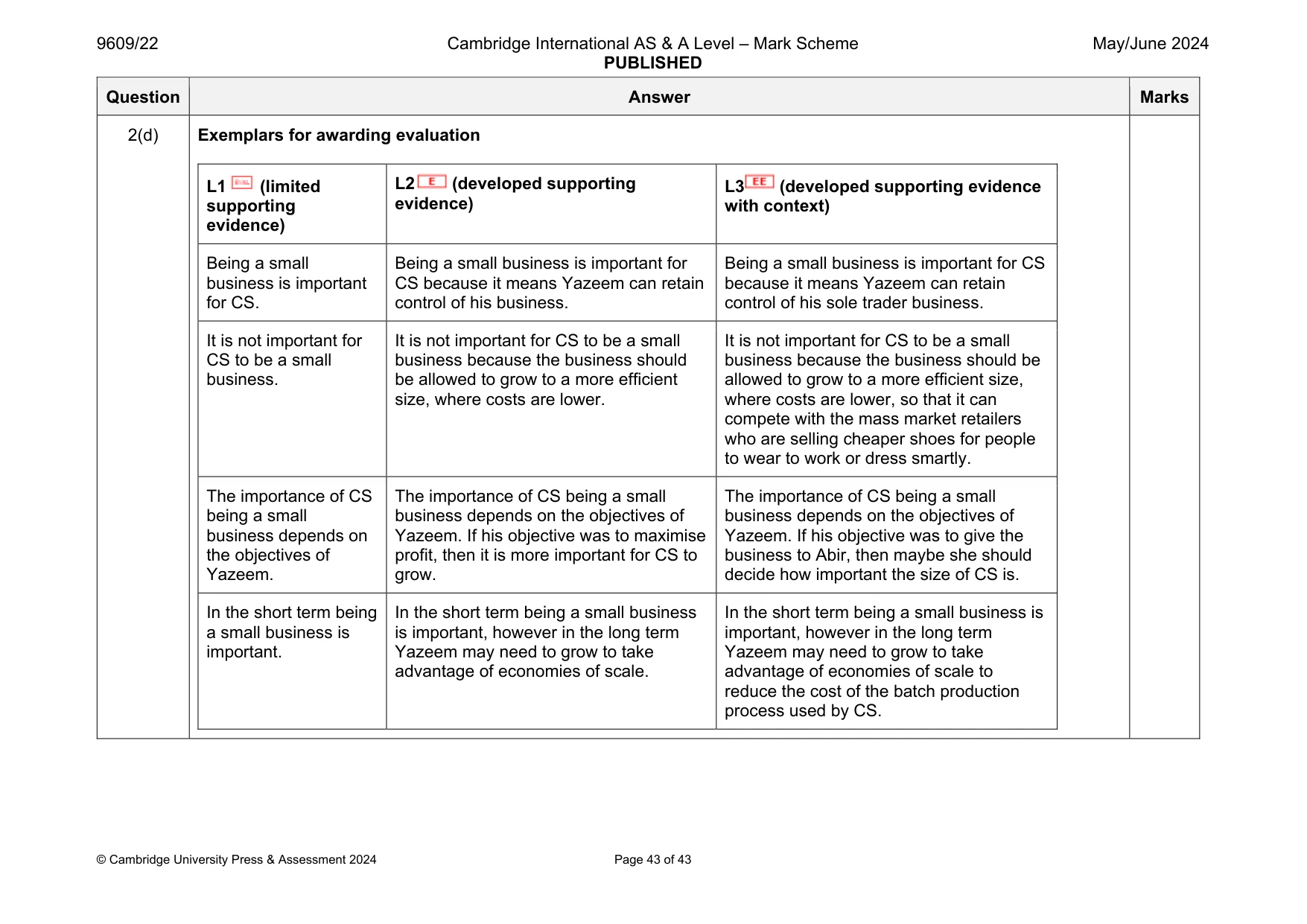
Mark scheme: 2(a)(i) Identify one type of training. Indicative content Types of training are: Induction On the job Off the job 1 2(a)(ii) Explain the term mass market. AO1 Knowledge and understanding 1 mark AO2 Application 2 marks 2 marks Developed application of one relevant point to a business context. 1 mark Knowledge of one relevant point is used to answer the question. 1 mark Limited application of one relevant point to a business context. 0 marks No creditable response. 0 marks No creditable response. Indicative content AO1 Knowledge and understanding Knowledge of mass market (max 1 mark), including: Aiming a product or service at the majority of people. Made for the large part of the population Made for most of the population/market Allow ‘not a segment of the market’ or ‘all of the market’ or ‘everyone’. 3 Question Answer Marks 2(a)(ii) AO2 Application Explanation of a characteristic of the mass market (or mass marketing) , including: Many different size/colour products One size fits all products /standardised Customer wants are more general and less specific Associated with high output/quantity (than a segment or niche market) Associated with low(er) prices (than a segment or niche market) May benefit from economies of scale Lower risk than niche markets or segmented markets High level of competition Competition on national/international/global scale. Context applied to mass market(s) , including: Relevant example of mass market(s) (including the shoe market) Must be an example of the market (the people who might purchase canned drinks) – not a product aimed at the mass market (Coke) Application can be made to PS or any other scenario/context/business/person. Accept all valid responses. Guidance in awarding marks Knowledge & understanding Knowledge of a/the mass market 1 mark Explanation Explanation of a characteristic of the mass market 1 mark Context Applied to a business context/ business environment 1 mark Question Answer Marks 2(a)(ii) Exemplar and annotations Mark Rationale Mass markets are aimed at everybody . For example, in the shoe market, this might be plain black shoes that anybody could wear which are all the same . 3 An answer which starts with the knowledge and then applies it to mass shoe market, with a characteristic. CS can sell in high quantity to the whole market . At a low price . 3 Two characteristics surrounding the knowledge. Aiming at the majority of people who might want to buy the product . For example, customers who might buy a blank T- Shirt . 2 Clear knowledge. Some application through an example. A mass market is one that is not focussed on a market segment . Therefore, the product could be bought by anyone. It is likely that a large number of people would be potential customers. 1 A reasonable definition but what follows is more of the same knowledge. Mass markets have high sales revenue and products are likely to have higher price than a niche market . This could give the business access to economies of scale . 0 There are two characteristics here, but no knowledge of mass markets. Therefore, no marks can be awarded. Question Answer Marks 2(b)(i) Refer to Table 2.1. Calculate the contribution per unit for the recent batch of shoes. Formula: Contribution per unit = price – VC or TR – TVC / output or Profit (TR – TC) / margin of safety (1) Method 1 $18 750 / 500 = $37.50 and $25 000 / 500 = $50 (1) $50 – $37.50 = $12.50 (1) Method 2 ($25 000 – $18 750) = $6250 (1) $6250 / 500 = $12.50 (1) Method 3 $25 000 – $23 750 = $1250 (1) $1250 / 100 = $12.50 (1) Answer = $12.50 (3) 3 Question Answer Marks 2(b)(i) Exemplar and annotations Marks 3 marks Correct answer $12.50 or 12.50 or 12.5 Working and $ do not matter. 2 marks Both of the following: Formula One correct stage of calculation OR An incorrect answer with one mistake allowing OFR for final stage. To award two marks, there must be Two and a OR One , one and one 1 mark One of the following: Correct formula One correct stage of calculation. To award one mark, there must be: One and two 0 marks No creditable content. To award zero marks, there must be One Question Answer Marks 2(b)(ii) Explain one limitation for CS of using break-even analysis. AO1 Knowledge and understanding 1 mark AO2 Application 2 marks 2 marks Developed application of one relevant point to a business context. 1 mark Knowledge of one relevant point is used to answer the question. 1 mark Limited application of one relevant point to a business context. 0 marks No creditable response. 0 marks No creditable response. Indicative content AO1 Knowledge and understanding Knowledge of a limitation of using break-even analysis , including: not all costs and revenue can be split assumes all costs are a straight line (constant) assumes price is constant assumes all output is sold/does not take into account demand/demand fluctuates assumes all costs are fixed or variable needs to be calculated for each product it ignores capacity assumes that fixed costs do not change as output increases assumes fixed costs can be allocated assumes no external influences. Do not accept that break-even analysis data may be inaccurate/wrong or time consuming. This is not a specific limitation of break-even analysis. 3 Question Answer Marks 2(b)(ii) AO2 Application Explanation of a limitation if using break-even analysis , including: not all costs and revenue can be split: and break-even assumes that all costs can be split. assumes all costs are a straight line (constant); whereas costs are likely to fall (on average) as output increases. assumes price is constant; whereas most businesses will need to reduce the price to sell more. assumes all output is sold; which is unlikely for most businesses – wastage, obsolescence etc. assumes all costs are fixed or variable; whereas there are semi-fixed / semi-variable costs. needs to be calculated for each product: only really works for a single product business. it ignores capacity; if the capacity is below the break-even point, then the business will never break even. assumes that fixed costs do not change as output increases; but as output increases most firms will need to source more fixed assets. assumes fixed costs can be allocated: which is not always possible for a multi-product business. Context applied to a limitation of using break-even analysis including: Yazeem uses a range of colours and sizes – may be impossible to do break-even for each style of shoe/size/colour. Uses batch production – may be impossible to allocate the fixed costs to each style/size/colour. At least two employees (Yazeem and Abir) – how can their time be allocated to production/administration etc. Increase in low-priced shoes – may make it impossible to sell all the output. Use of Table 2.1. OFR from Q2(b)(i) Accept all valid responses. Guidance in awarding marks Knowledge & understanding Knowledge of a limitation of using break-even analysis 1 mark Explanation Explanation of a limitation of using break-even analysis 1 mark Context Context linked to a limitation of using break-even analysis 1 mark Question Answer Marks 2(b)(ii) Exemplar and annotations Mark Rationale Break-even analysis assumes average costs do not change but CS’s average variable costs are likely to change because CS is using batch production . 3 Knowledge of a limitation with explanation of why it is a limitation and application to the context of CS. Abir has suggested using JIT , which is likely to mean the transportation costs are not constant . 3 A backwards answer. Starts with the context, then the explanation and lastly knowledge. An equally valid approach – as long as there is knowledge somewhere in the answer. The price may not be the same for every pair of shoes which could mean that the Total Revenue is not constant . 2 The knowledge is fine. The explanation refers to a different point of knowledge, but it DOES explain this limitation, so it is valid. No context. Break even analysis assumes all output produced is sold . 1 Knowledge and no explanation or application to the context. Break even analysis is a way of calculating the quantity needed to stop making a loss and start making a profit. This is useful to CS because they can calculate how many shoes need to be sold to cover all of the costs which were $23 750 for the recent batch. 0 Although there is some relevant context, there is no knowledge of a limitation, so no marks can be awarded. Break even analysis can be wrong. If the Manager miscalculates the break-even point, then any decision made on this will also be wrong. 0 Being incorrect/wrong/inaccurate, is not a limitation of break-even analysis. It could be said about any calculation, so do not award. Question Answer Marks 2(c) Analyse two disadvantages to CS of adopting a JIT approach to inventory management. Level AO1 Knowledge and understanding 2 marks AO2 Application 2 marks AO3 Analysis 4 marks 2 3–4 marks Developed analysis Developed analysis that identifies connections between causes, impacts and/or consequences of two points. Developed analysis that identifies connections between causes, impacts and/or consequences of one point. 1 1–2 marks Knowledge of two relevant points is used to answer the question. Knowledge of one relevant point is used to answer the question. 1–2 marks Application of two relevant points to a business context. Application of one relevant point to a business context. 1–2 marks Limited analysis Limited analysis that identifies connections between causes, impacts and/or consequences of two points. Limited analysis that identifies connections between causes, impacts and/or consequences of one point. 0 0 marks No creditable response. 0 marks No creditable response. 0 marks No creditable response. 8 Question Answer Marks 2(c) Indicative content AO1 Knowledge and understanding Knowledge of just in time inventory management (max 1 mark if no knowledge of disadvantage(s)), including: Orders made from suppliers as needed. Products produced as required by customers. Limited or zero inventory required to be held. Knowledge of disadvantages of just in time (max 2 marks – annotate first disadvantage on left and second disadvantage on right), including: Risk of running out of stock. Reliance on (new) suppliers – frequency of ordering/deliveries Requires planning/time. Limited scope for mass/batch production (little scope for economies of scale) – increased average cost Finished product inventory cannot be used for promotional purposes. Difficult to forecast/budget Cost of infrastructure/capital Might be difficult to respond to changing demand. AO2 Application Context applied to a disadvantage of using JIT (max 2 marks), including: Currently selling to mass market (professionals for work or smart dress). Currently using batch production. Abir has suggested a move towards niche, unique (job produced) shoes. New local supplier suggested by Abir. Shoes on display in the shop. Raw material of leather must be in climate controlled storage. No current relationship to suggested new supplier. Range of sizes and colours. Question Answer Marks 2(c) AO3 Analysis Analysis of disadvantage(s) of using JIT, including: Limited analysis – candidate shows one link in the chain of analysis. Developed analysis candidate shows two or more links in the chain of analysis or a two-sided analysis. Risk of running out of stock; may dissatisfy customers and lead to bad publicity – lower sales/profit. May lead Yazeem to be idle increasing costs – lower profitability. Reliance on suppliers; if the new local supplier is chosen then there is no current relationship, so shoe production may be delayed – decreased sales/profit. Requires planning/time – If Yazeem/Abir are planning the logistics they may be less productive in producing shoes – lower sales/profit. Limited scope for mass/batch production (little scope for economies of scale); increased costs – lower profitability. Finished product inventory cannot be used for promotional purposes; customers may not come into a show shop without any shoes to try on – lower sales/profit. Accept all valid responses. Exemplars and annotations AO1 Knowledge AO2 Application AO3 Analysis CS may run out of stock . And since CS is selling to the mass market . Customers may choose to go elsewhere, reducing CS’s revenue leading to less profit . CS would need a new supplier Although Abir has already found one who is happy to deliver as required However, CS do not have a relationship with them and they might not deliver the materials on time leading to customers being dissatisfied and going to a competitor. . Question Answer Marks 2(d) Evaluate the importance to CS of being a small business. Level AO1 Knowledge and understanding 2 marks AO2 Application 2 marks AO3 Analysis 2 marks AO4 Evaluation 6 marks 3 5–6 marks Developed evaluation in context A developed judgement/conclusion is made in the business context. Developed evaluative comments which balance some key arguments in the business context. 2 2 marks Developed knowledge of relevant key term(s) and/or factor(s) is used to answer the question. 2 marks Developed application of relevant point(s) to the business context. 2 marks Developed analysis that identifies connections between causes, impacts and/or consequences. 3–4 marks Developed evaluation A developed judgement/conclusion is made. Developed evaluative comments which balance some key arguments. 1 1 mark Limited knowledge of relevant key term(s) and/or factor(s) is used to answer the question. 1 mark Limited application of relevant point(s) to the business context. 1 mark Limited analysis that identifies connections between causes, impacts and/or consequences. 1–2 marks Limited evaluation A judgement/conclusion is made with limited supporting comment/evidence. An attempt is made to balance the arguments. 0 0 marks No creditable response. 0 marks No creditable response. 0 marks No creditable response. 0 marks No creditable response. 12 Question Answer Marks 2(d) Indicative content AO1 Knowledge and understanding Knowledge of the features of being a small business (max 2 marks), including: Lifestyle Independence Opportunities Creative freedom Less reliance on other people Expertise Unique selling point (USP) Personal satisfaction Personal service for customers Focus Easy to plan Easy to control/coordinate/lead Potential for growth Encourages innovation/intrapreneurship/entrepreneurship May struggle obtaining finance / limited finance Increased risk Question Answer Marks 2(d) AO2 Application Context applied to features of being a small business (max 2 marks), including: Yazeem is a highly skilled shoemaker Sole trader Abir is fully trained in making shoes CS opened in 1975 Currently targeting a mass market (professional men and women) Currently produced using batch production Shoes sold in own shop Range of sizes and colours Increase in low-priced mass market shoes – reduced CS sales and repairs Abir feels it is time for Yazeem to retire Abir would like to design and produce unique shoes for niche markets New products would use price skimming Use of Table 2.1 Abir suggested adoption of JIT Question Answer Marks 2(d) AO3 Analysis Limited analysis – candidate shows one link in the chain of analysis. Developed analysis – candidate shows two or more links in the chain of analysis. Lifestyle/personal satisfaction; Yazeem (and Abir) can choose their own hours which may increase their happiness – likely objective of Yazeem as a sole trader. Independence; Yazeem does not have to ask anyone’s opinion when making decisions which may suit him – increased happiness. Opportunities; as a small business Yazeem and Abir can more easily take advantage of new trends (such as the niche markets) – increased sales/profit. Creative freedom; both Yazeem and Abir are skilled and can create shoes which suit the market without having to have decisions agreed by others – increased sales/profit. Less reliance on other people; less opportunities for wastage – lower costs, increased profitability. Expertise; both Yazeem and Abir are highly skilled and can focus these on their small customer base – increased customer satisfaction. Unique selling point (USP); having expert owners may allow CS to sell at a higher price – increased profitability. Personal service for customers; customers feel like they are being well looked after (as they are dealing with the owners) – increased sales/profit. Focus; As Yazeem is the owner he is more likely to be motivated – increased productivity. Easy to plan; few employees mean that CS can adapt their business to meet current demand – increased sales/profit. Easy to control/coordinate/lead; less customers mean that CS can adapt their business to meet current demand – increased sales/profit. AO4 Evaluation Limited evaluation – unsupported judgement and/or a weak attempt at evaluative comment Developed evaluation – supported judgement and/or reasonable evaluative comment Developed evaluation in context – supported judgement in context and/or reasonable evaluative comment in context. A judgement the importance of being a small business. Evaluation of the relative importance of different advantages/factors. Elements that the evaluation/judgement might depend upon – Yazeem and Abir’s personal objectives, whether Yazeem wants to retire (or not), the relative size of competitors in the market, the location of CS, changes in the shoe manufacture and retail market, changes in technology, price elasticity of demand for CS shoes. Accept all valid responses. Question Answer Marks 2(d) Exemplars for awarding evaluation L1 (limited supporting evidence) L2 (developed supporting evidence) L3 (developed supporting evidence with context) Being a small business is important for CS. Being a small business is important for CS because it means Yazeem can retain control of his business. Being a small business is important for CS because it means Yazeem can retain control of his sole trader business. It is not important for CS to be a small business. It is not important for CS to be a small business because the business should be allowed to grow to a more efficient size, where costs are lower. It is not important for CS to be a small business because the business should be allowed to grow to a more efficient size, where costs are lower, so that it can compete with the mass market retailers who are selling cheaper shoes for people to wear to work or dress smartly. The importance of CS being a small business depends on the objectives of Yazeem. The importance of CS being a small business depends on the objectives of Yazeem. If his objective was to maximise profit, then it is more important for CS to grow. The importance of CS being a small business depends on the objectives of Yazeem. If his objective was to give the business to Abir, then maybe she should decide how important the size of CS is. In the short term being a small business is important. In the short term being a small business is important, however in the long term Yazeem may need to grow to take advantage of economies of scale. In the short term being a small business is important, however in the long term Yazeem may need to grow to take advantage of economies of scale to reduce the cost of the batch production process used by CS.
What was in this paper
The subtopics covered by these 2 questions, and how many questions each got. Open one in a new tab to see every Cambridge question on it.
What you needed in this session
Cambridge’s own grade thresholds for 2024 May/June, Paper 2 · Variant 2. A higher threshold means an easier paper — the bar moves with how the cohort did.