Cambridge A Level Business (for first examination in 2016) 9609 — 2023 Feb/March Paper 2 · Variant 2
9609/22/F/M/23 · 2 questions · 60 marks · ≈68 min
The question paper and its mark scheme, free to read here and free to download. This is Cambridge’s own paper, exactly as it was sat.
Question paper4 pages
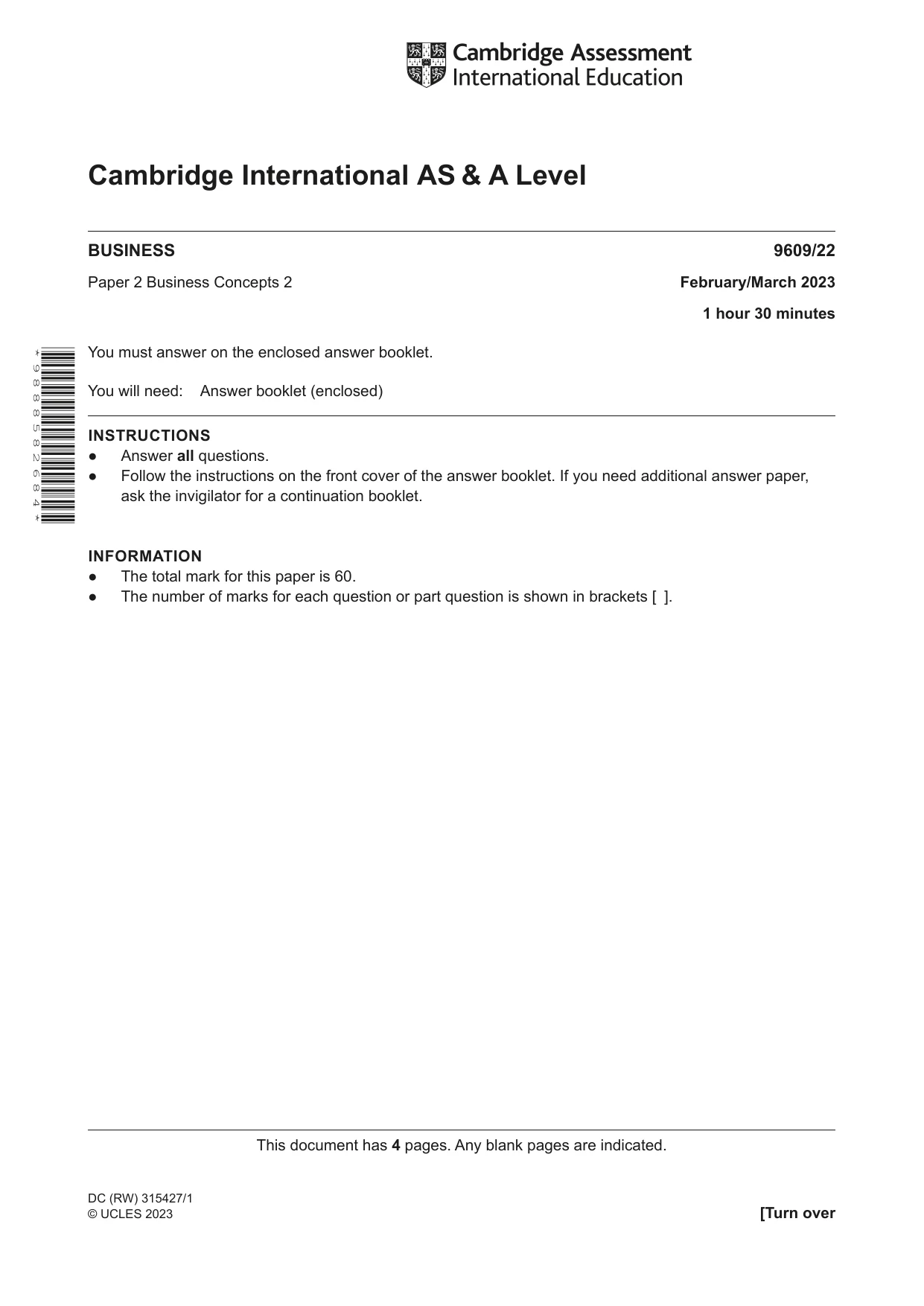

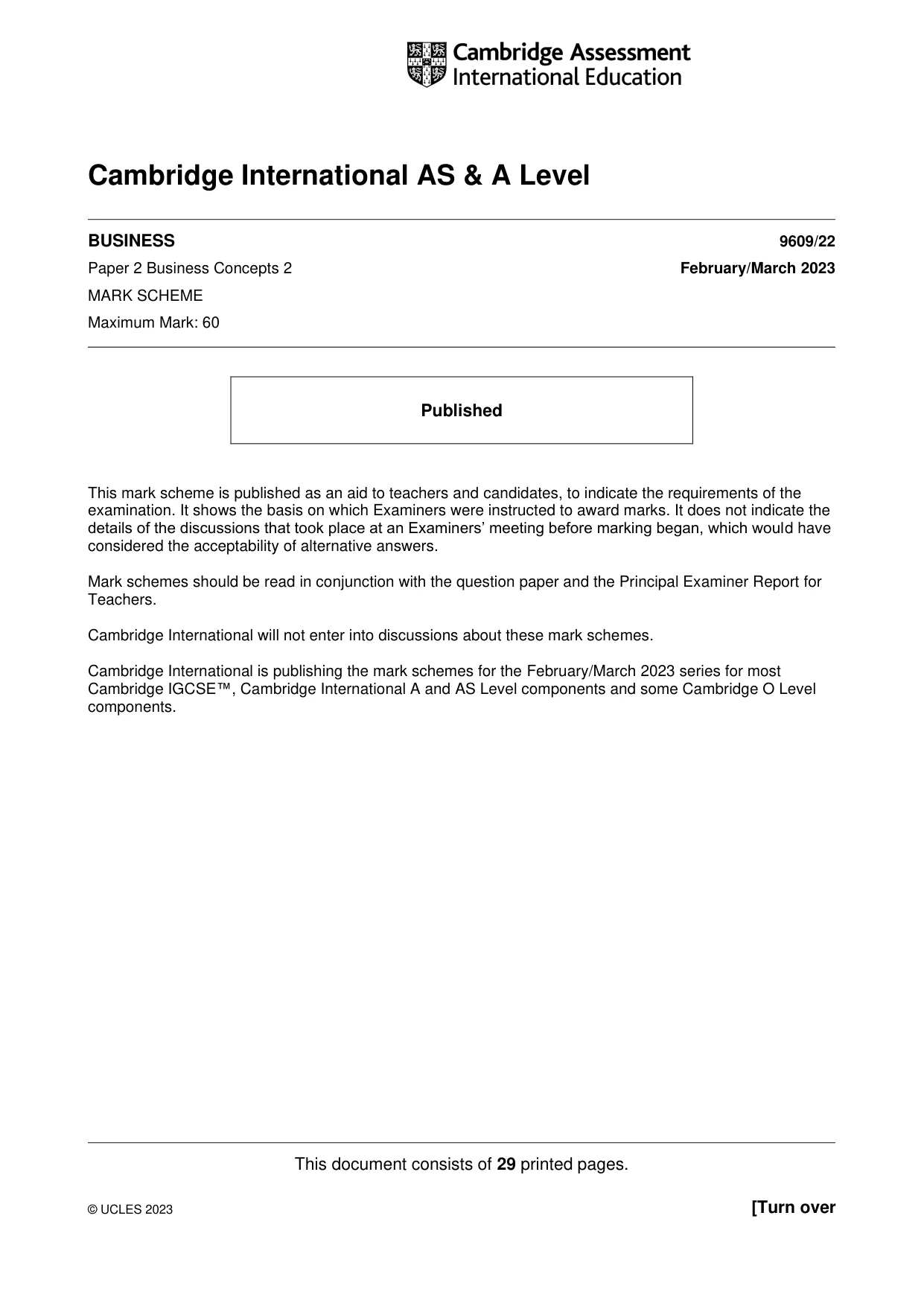
Mark scheme29 pages
Answers below. Sit the paper first if you are practising.
Questions as text
Q1 · Fruit Farm (FF) FF is a private limited company that provides packaged fruit to the…
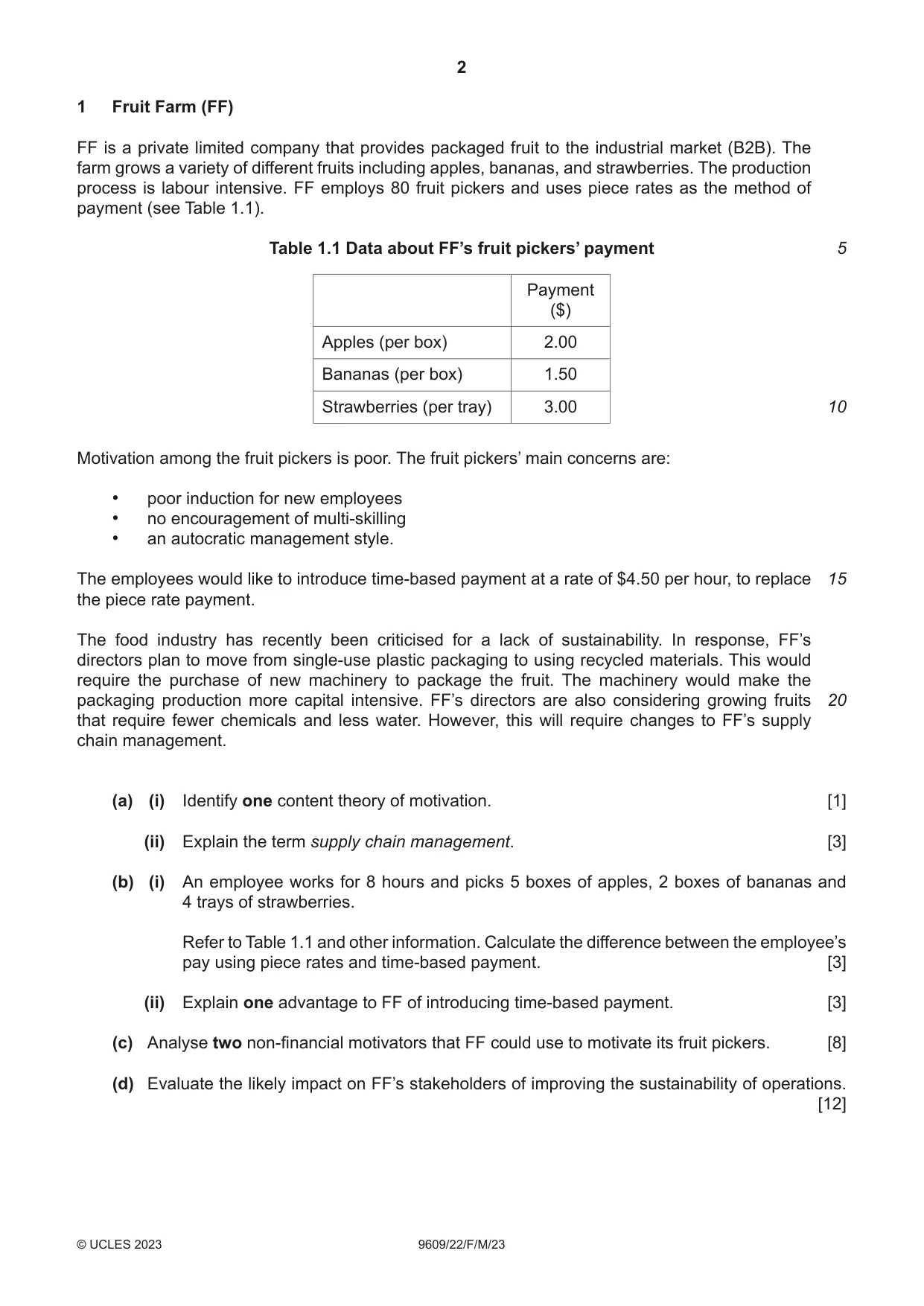
1 Fruit Farm (FF) FF is a private limited company that provides packaged fruit to the industrial market (B2B). The farm grows a variety of different fruits including apples, bananas, and strawberries. The production process is labour intensive. FF employs 80 fruit pickers and uses piece rates as the method of payment (see Table 1.1). Table 1.1 Data about FF’s fruit pickers’ payment 5 Payment ($) Apples (per box) 2.00 Bananas (per box) 1.50 Strawberries (per tray) 3.00 10 Motivation among the fruit pickers is poor. The fruit pickers’ main concerns are: • poor induction for new employees • no encouragement of multi‑skilling • an autocratic management style. The employees would like to introduce time‑based payment at a rate of $4.50 per hour, to replace 15 the piece rate payment. The food industry has recently been criticised for a lack of sustainability. In response, FF’s directors plan to move from single‑use plastic packaging to using recycled materials. This would require the purchase of new machinery to package the fruit. The machinery would make the packaging production more capital intensive. FF’s directors are also considering growing fruits 20 that require fewer chemicals and less water. However, this will require changes to FF’s supply chain management. (a) (i) Identify one content theory of motivation. [1] (ii) Explain the term supply chain management. [3] (b) (i) An employee works for 8 hours and picks 5 boxes of apples, 2 boxes of bananas and 4 trays of strawberries. Refer to Table 1.1 and other information. Calculate the difference between the employee’s pay using piece rates and time‑based payment. [3] (ii) Explain one advantage to FF of introducing time‑based payment. [3] (c) Analyse two non‑financial motivators that FF could use to motivate its fruit pickers. [8] (d) Evaluate the likely impact on FF’s stakeholders of improving the sustainability of operations. [12]
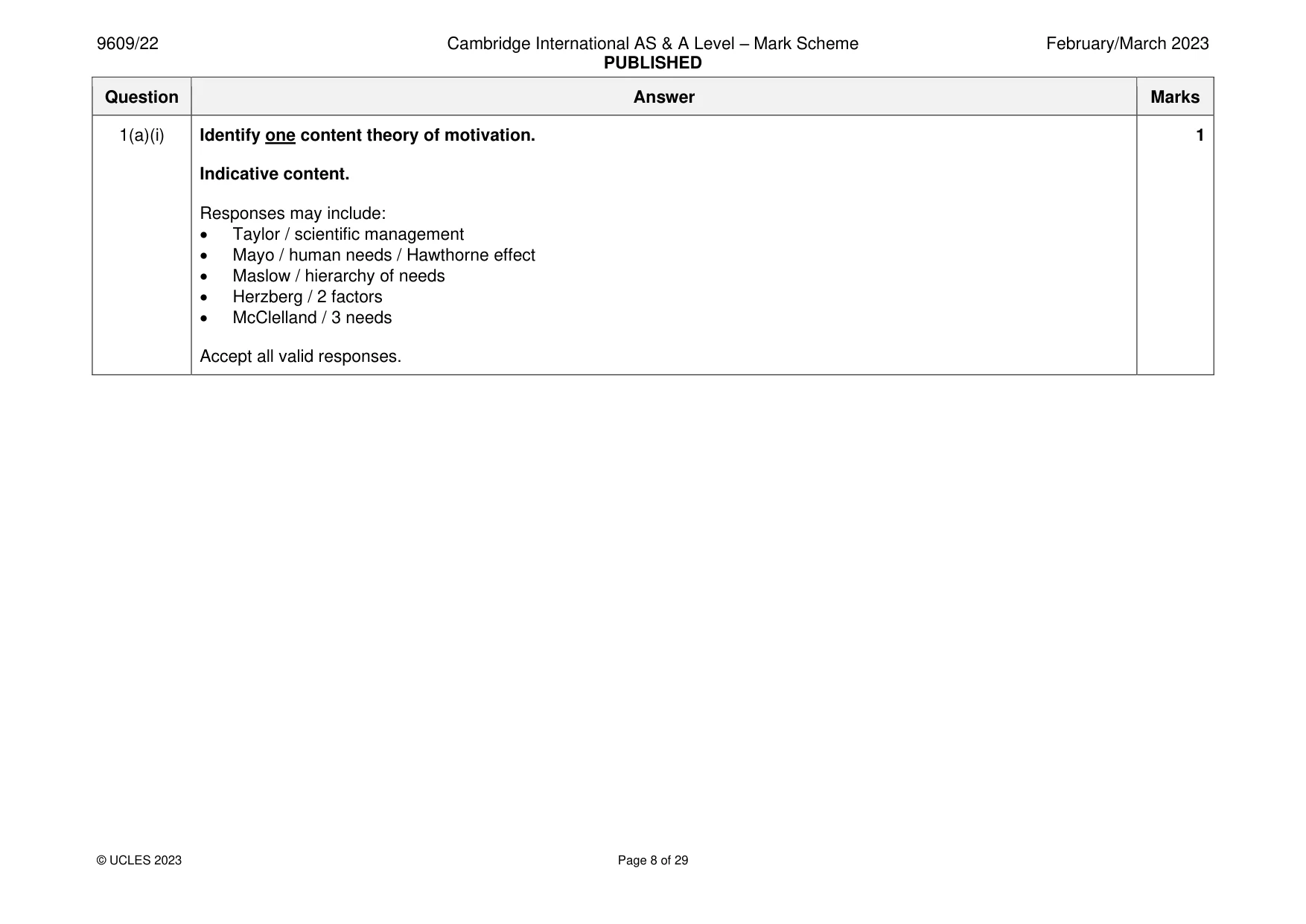
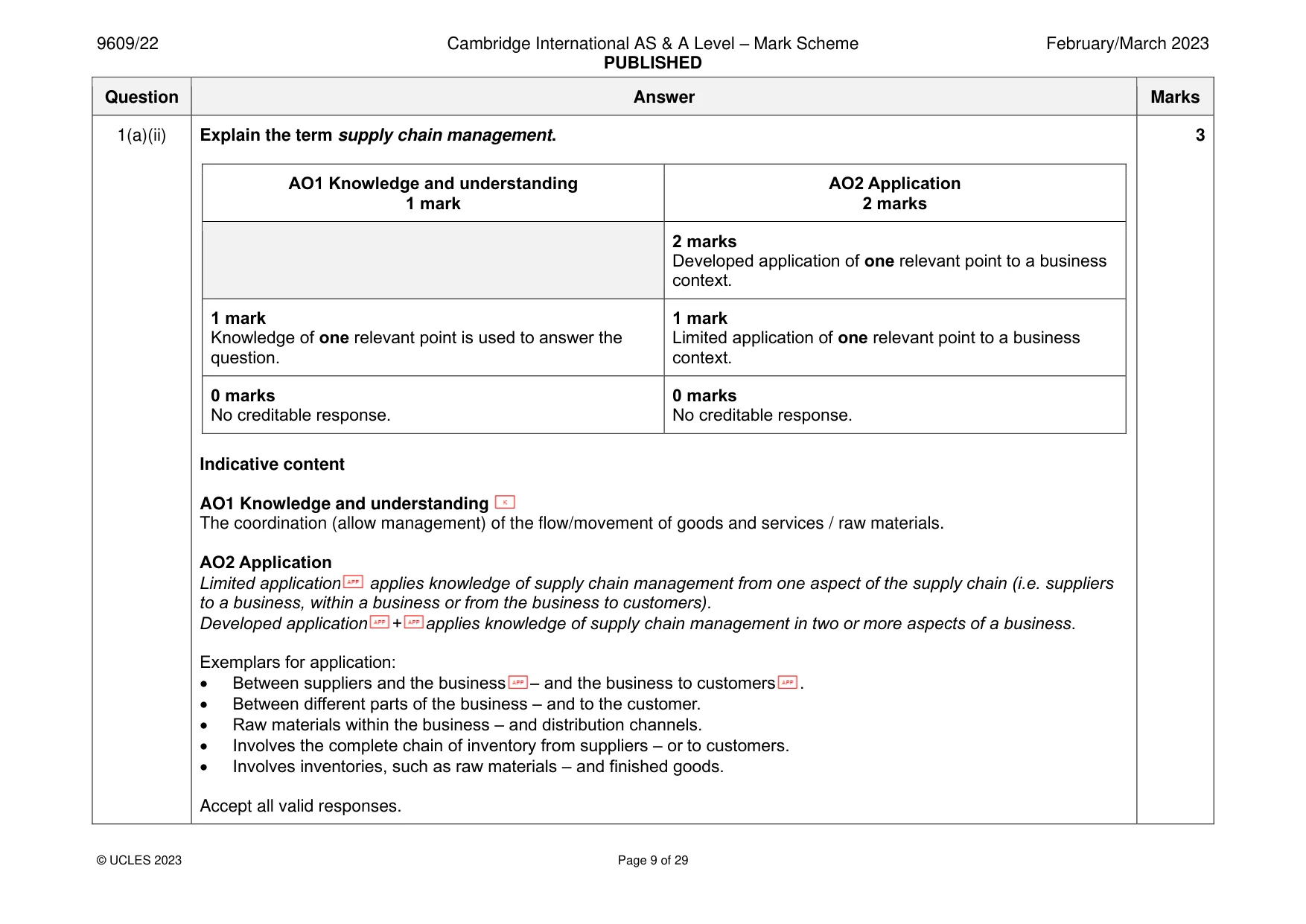
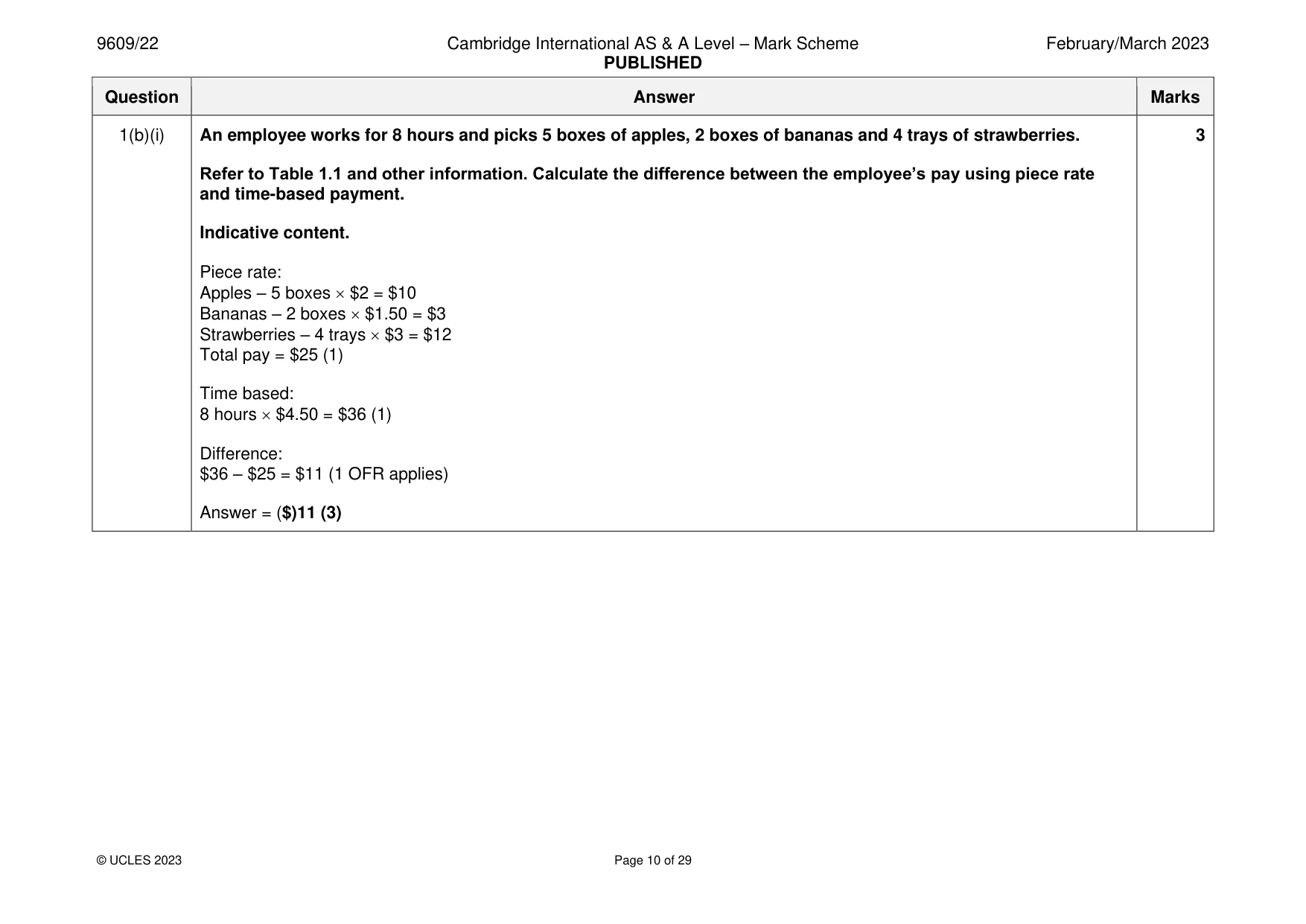
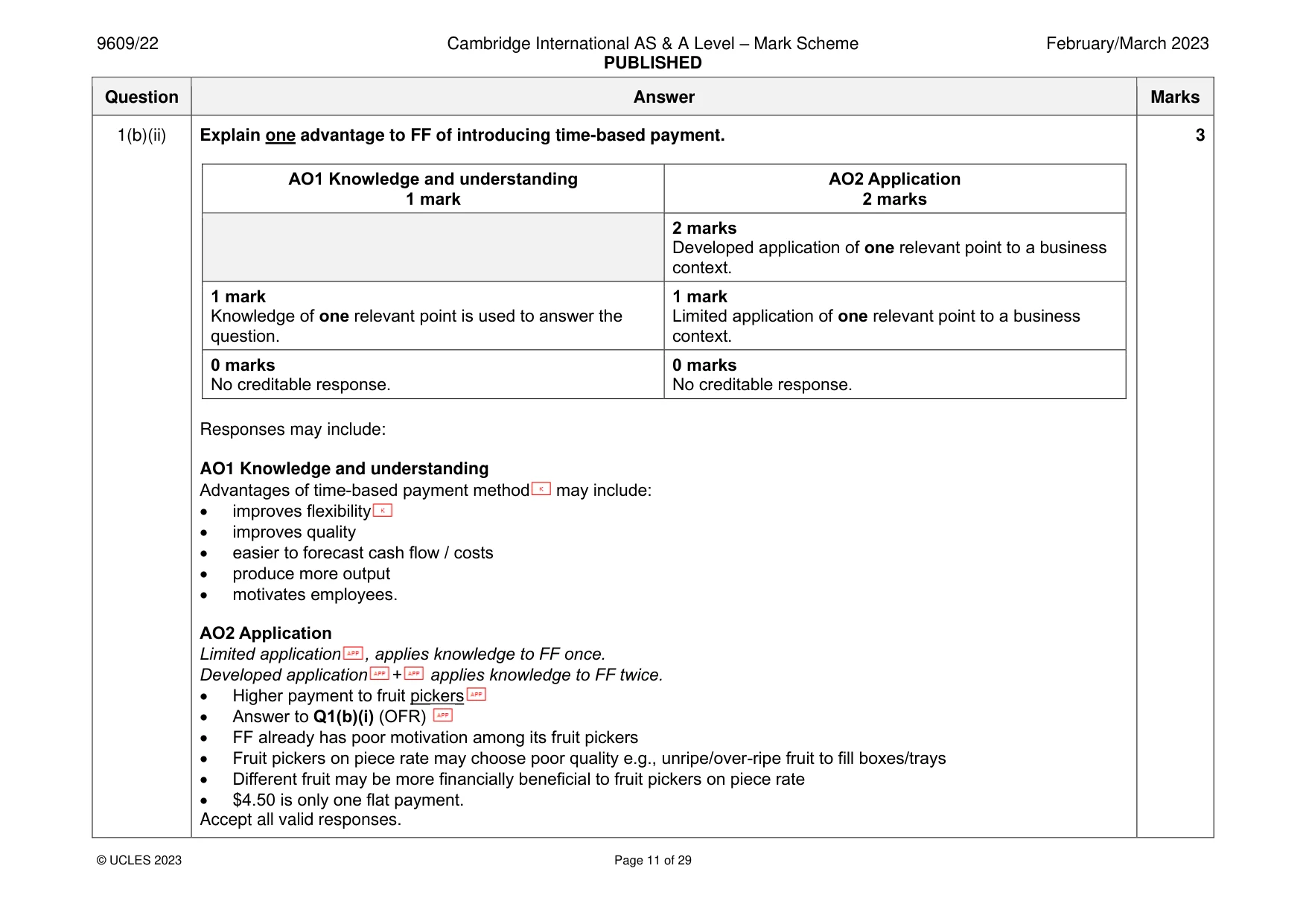
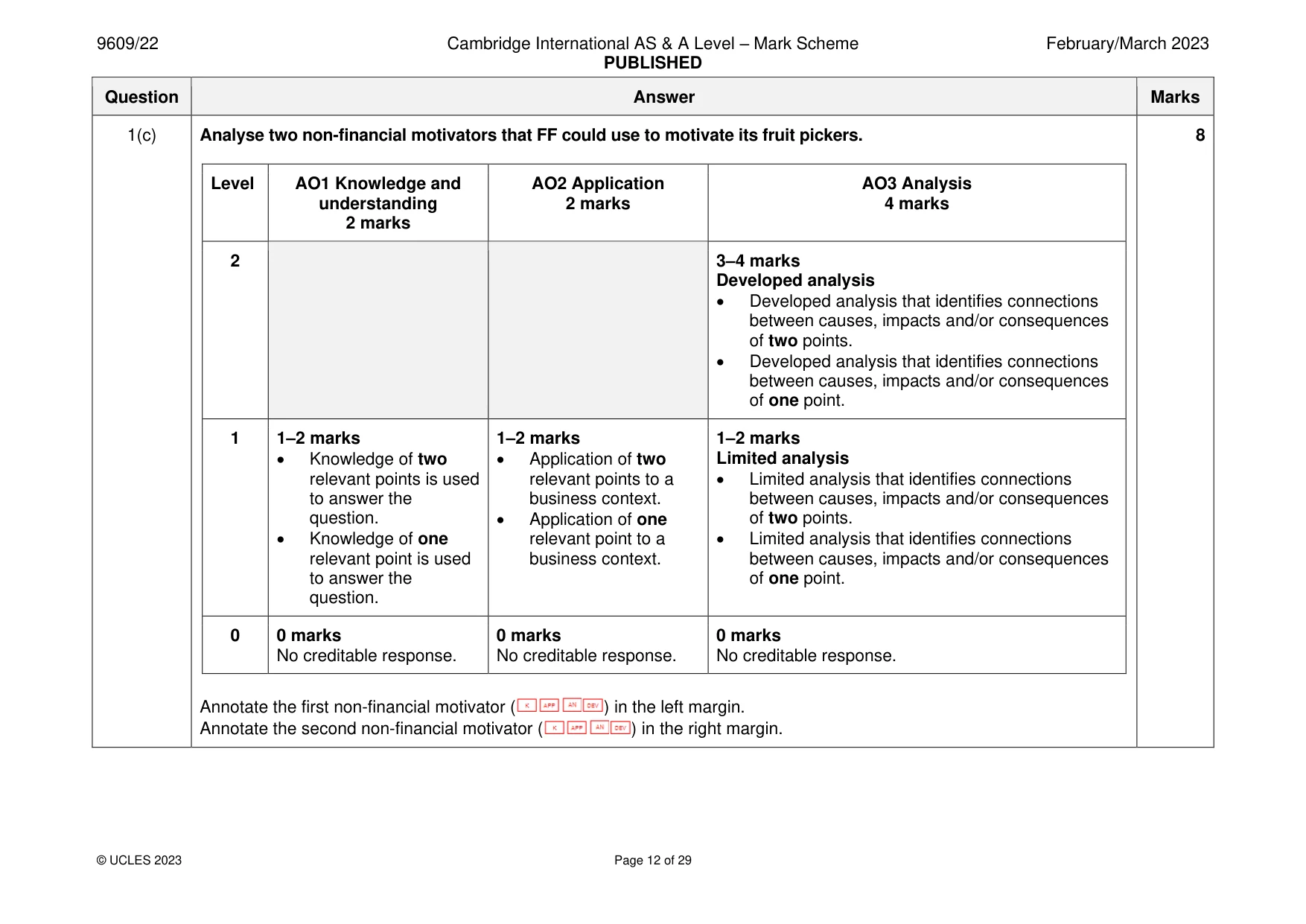
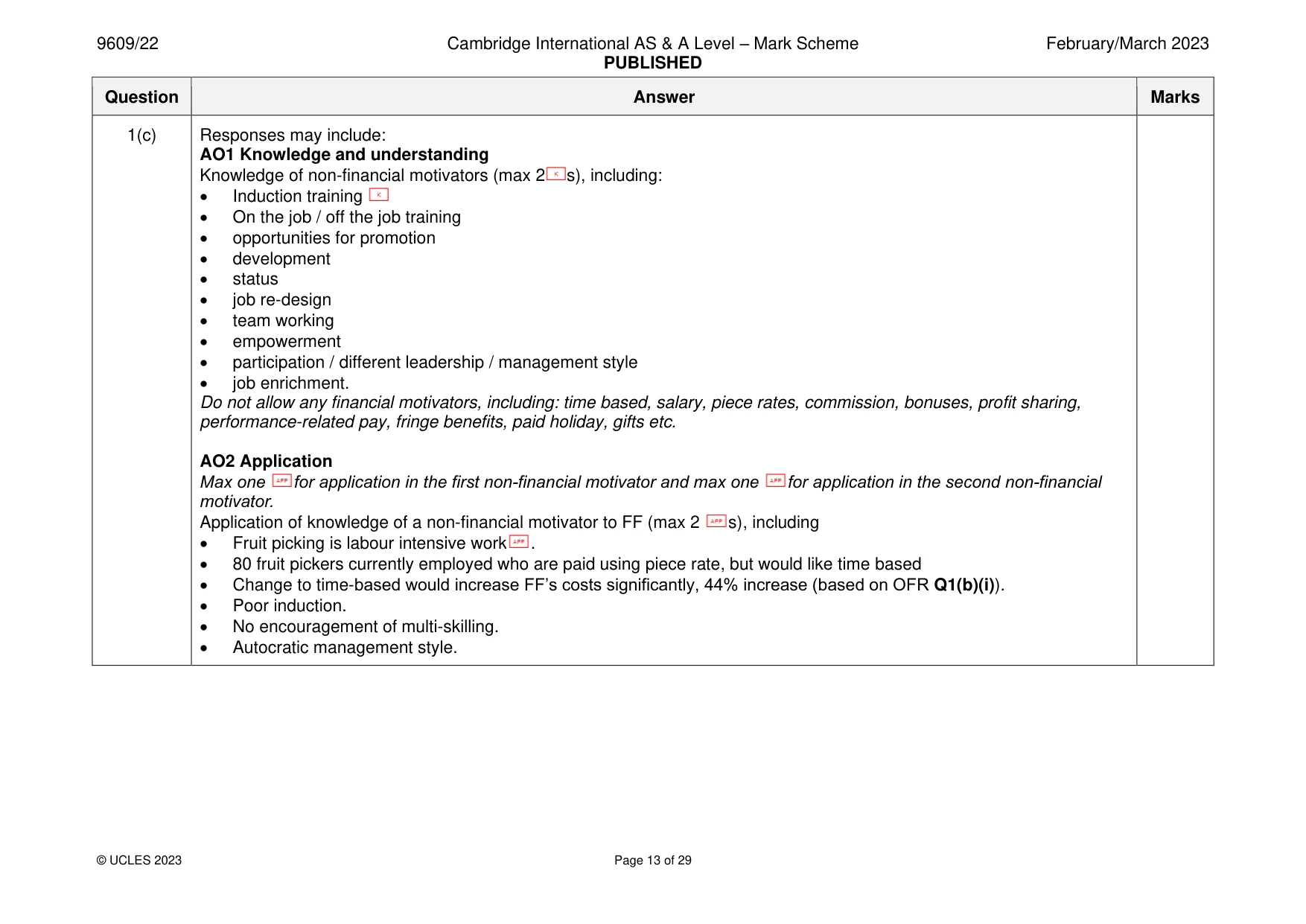
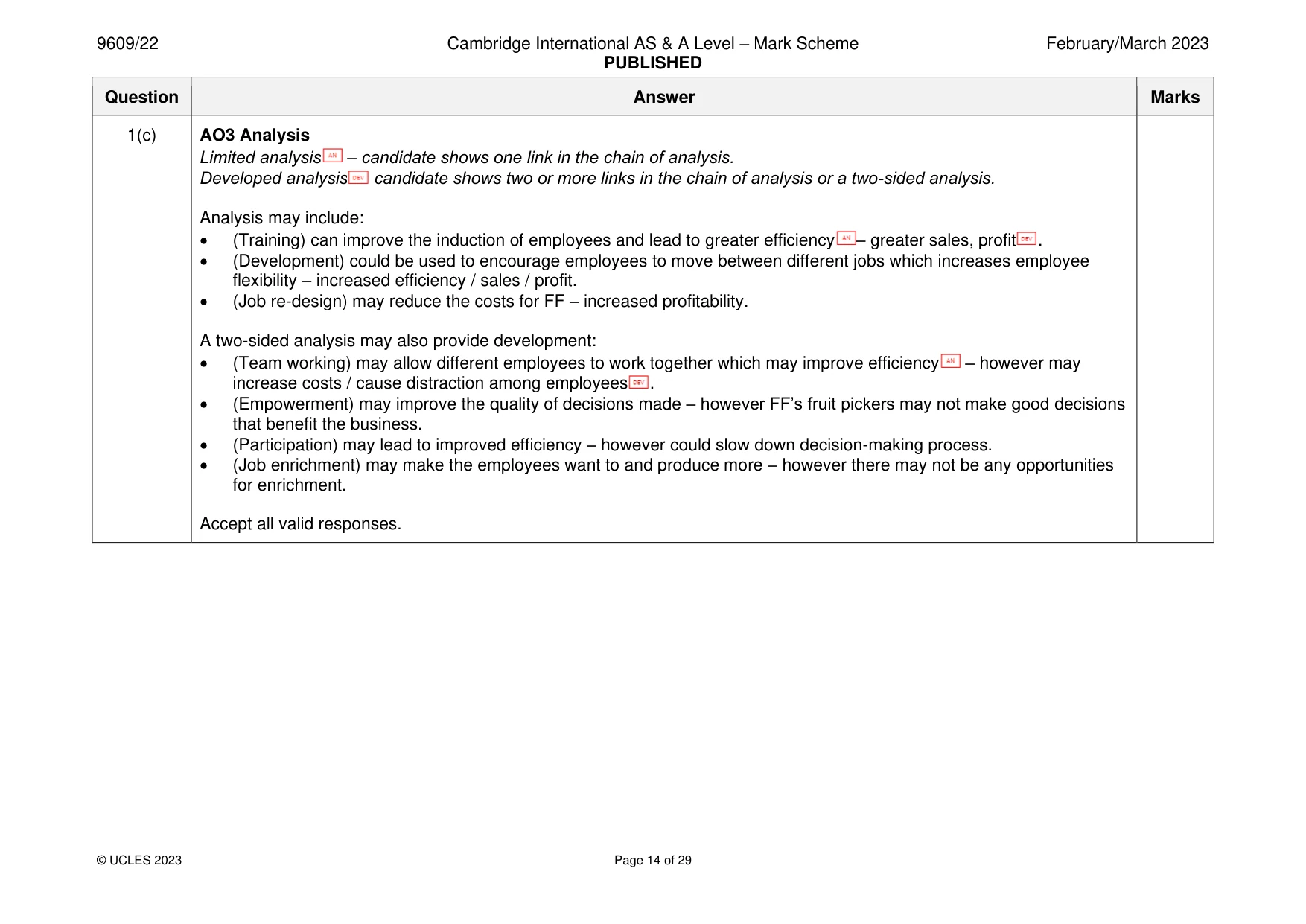
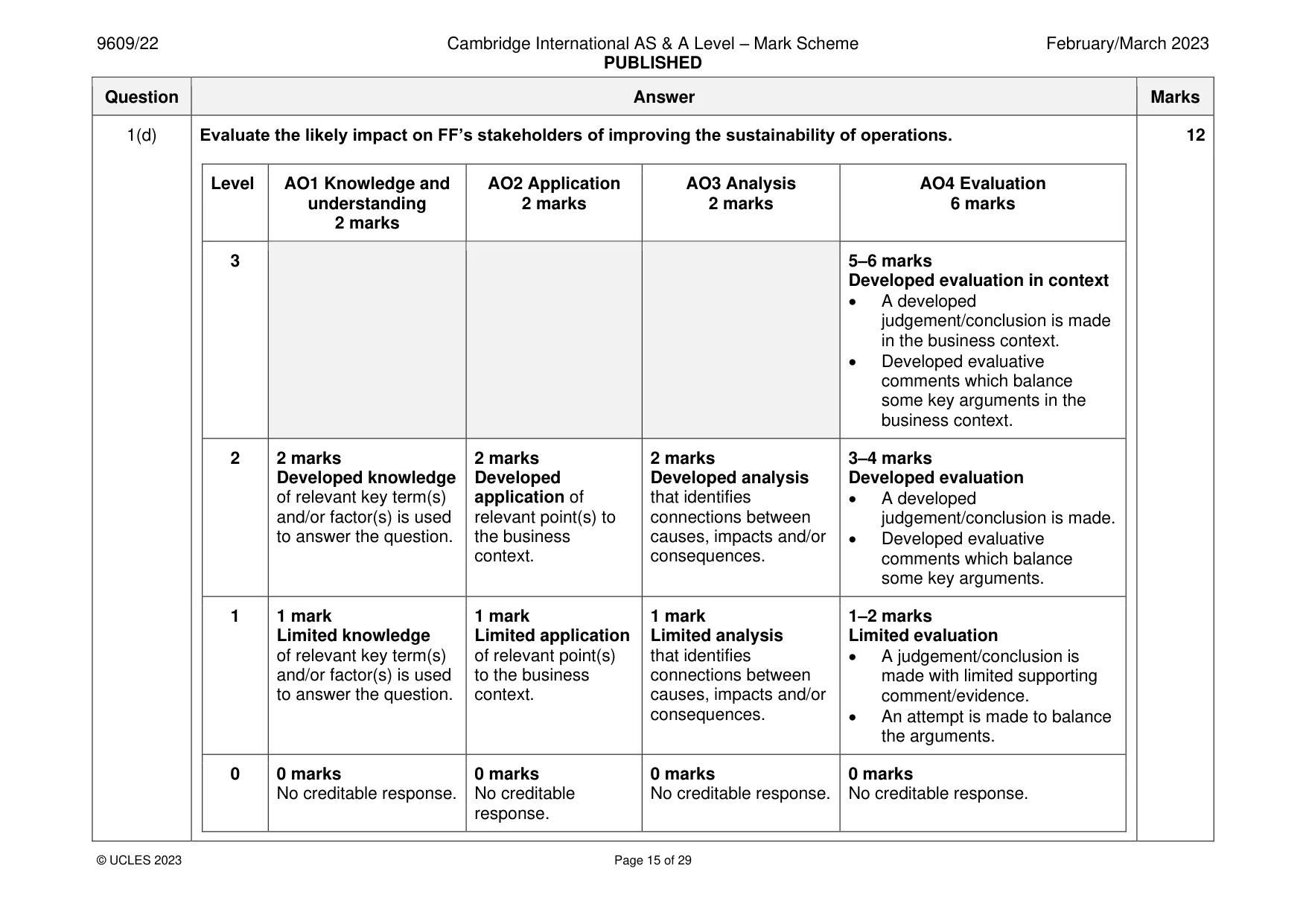
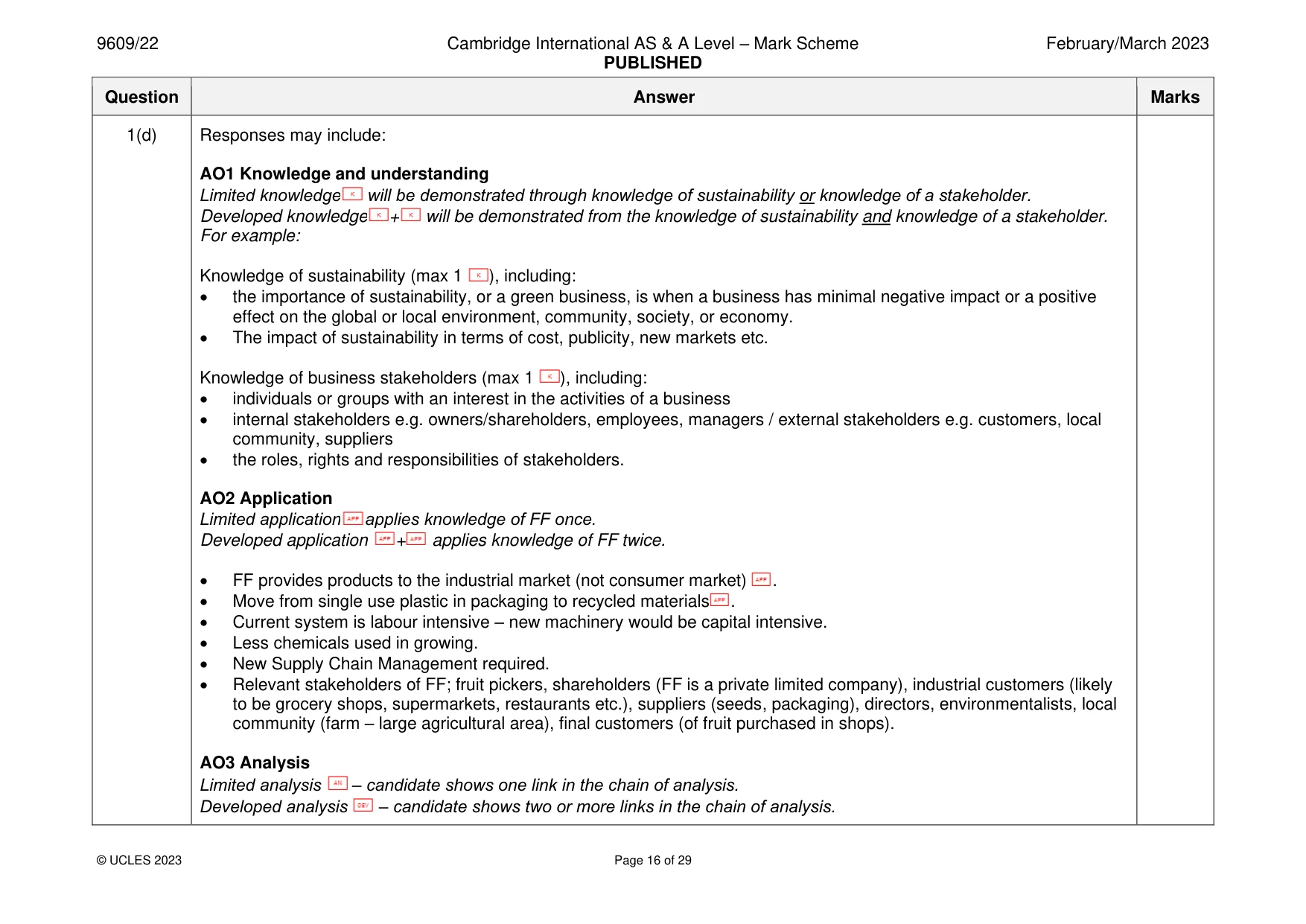
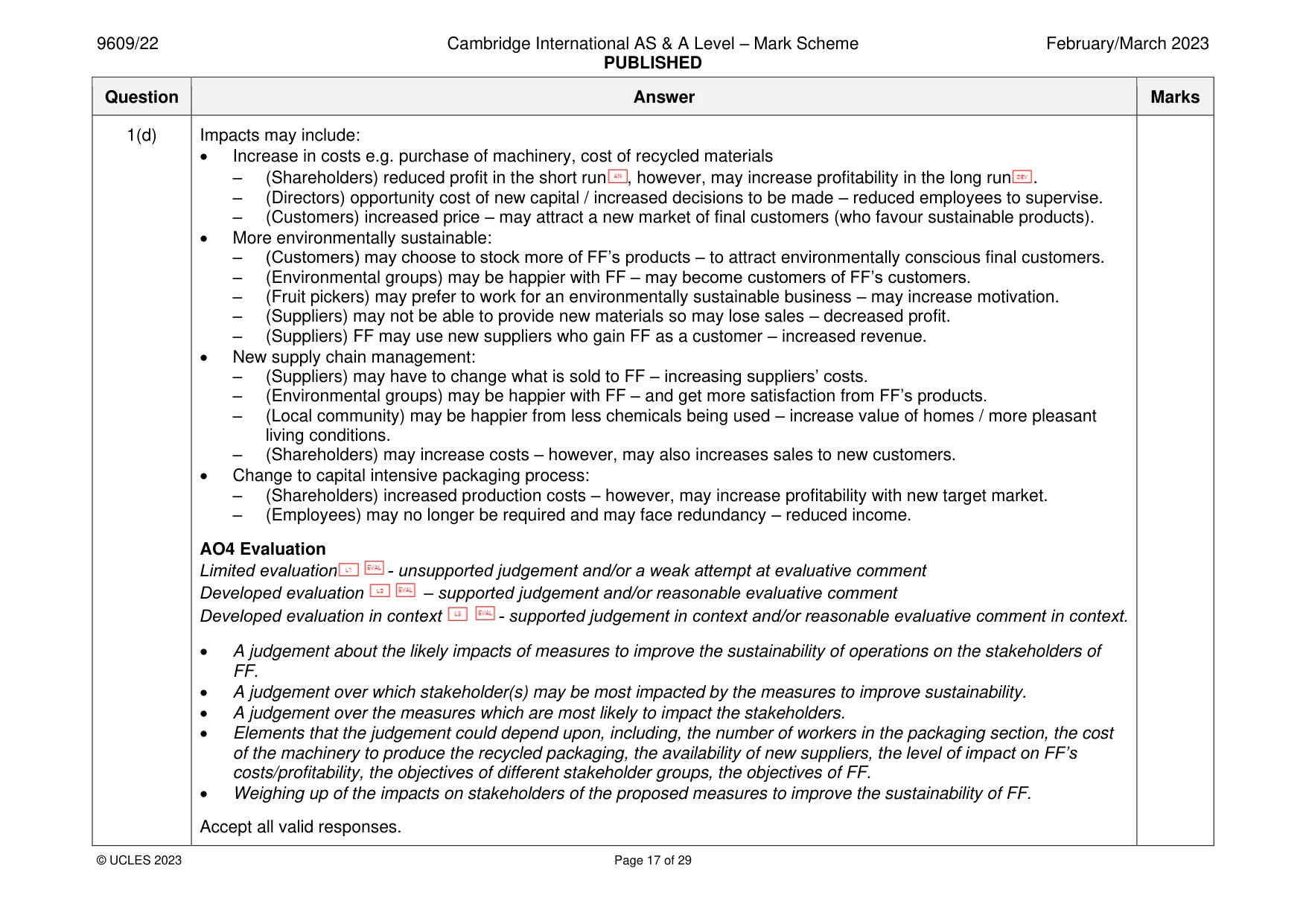
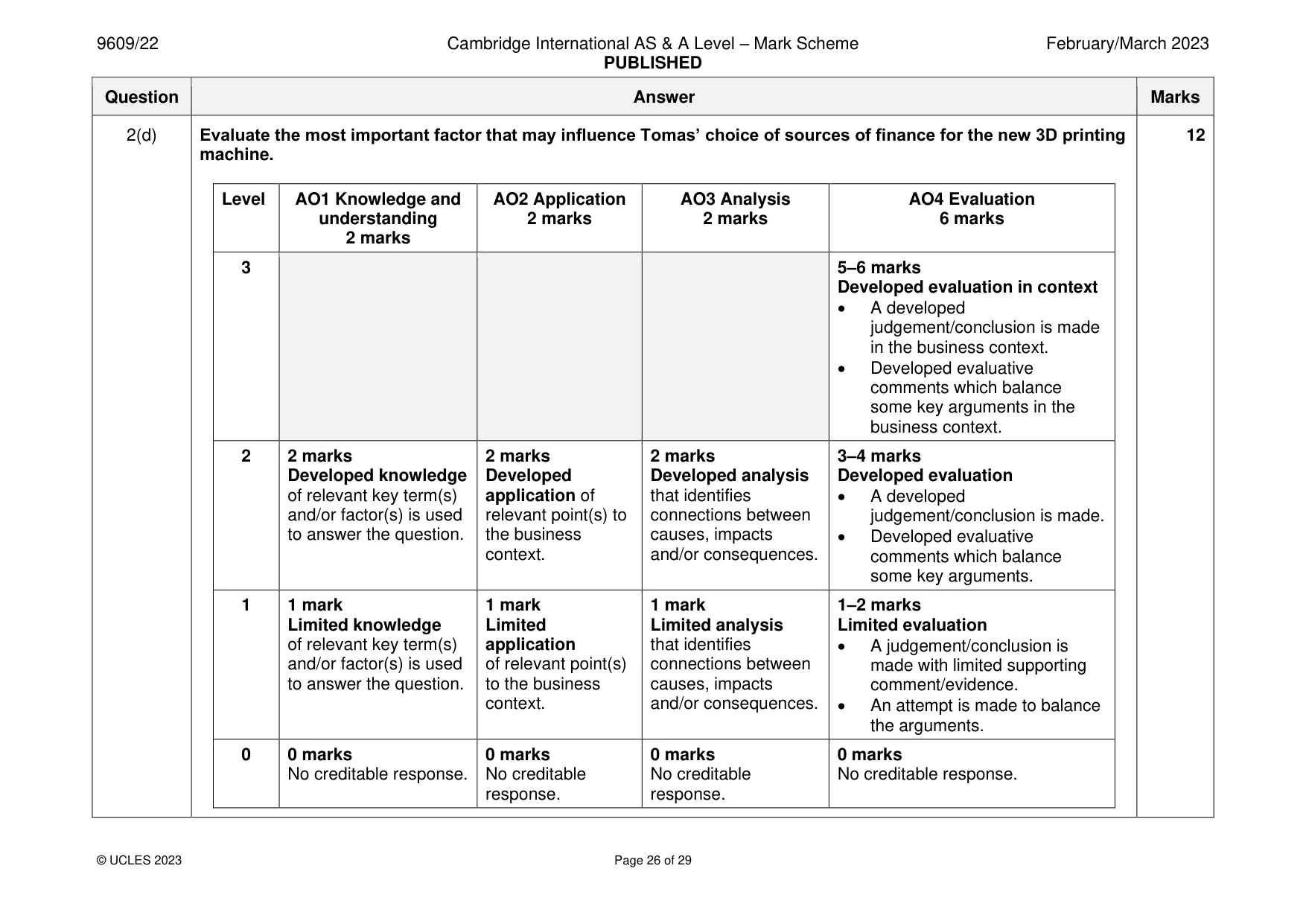
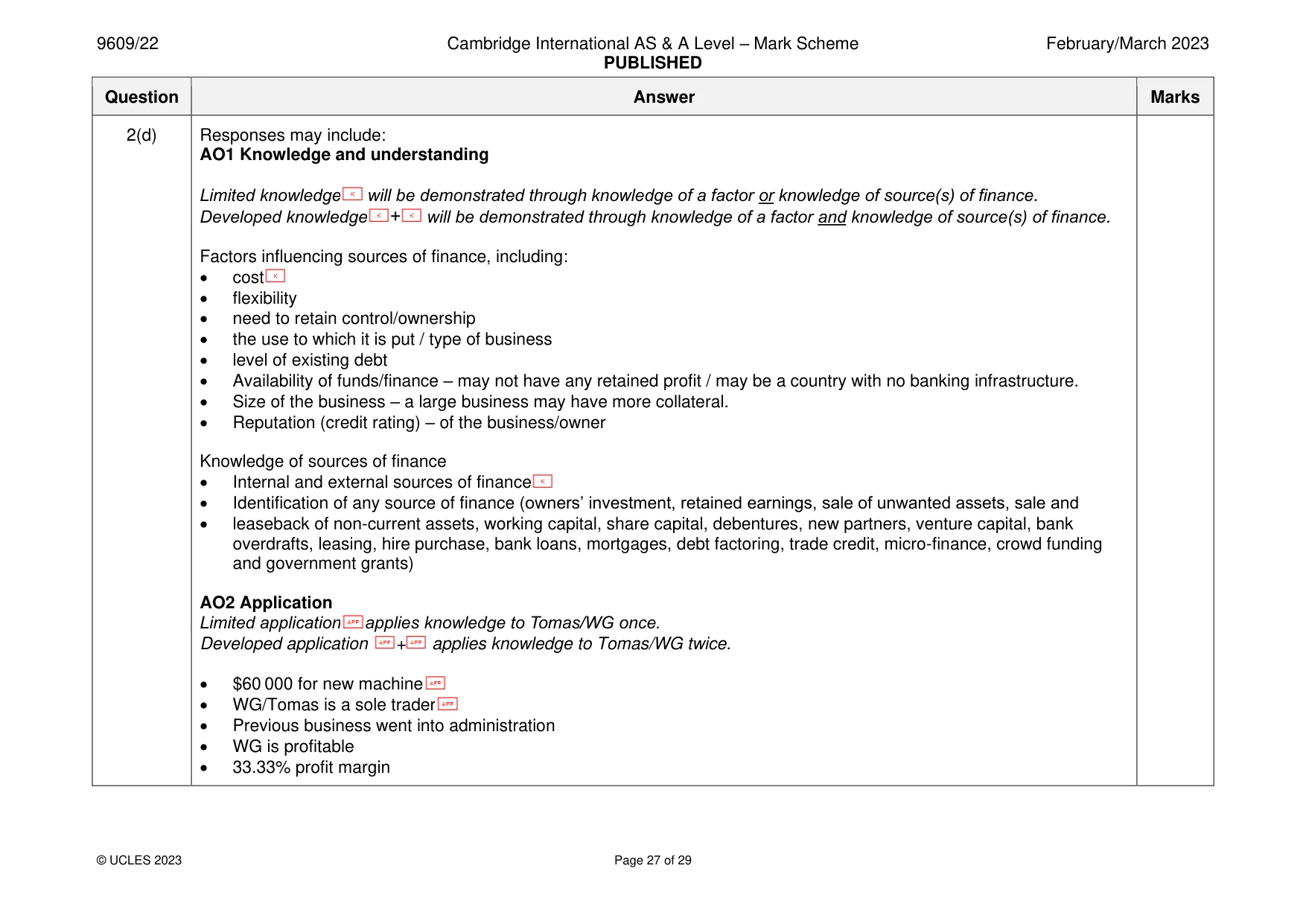
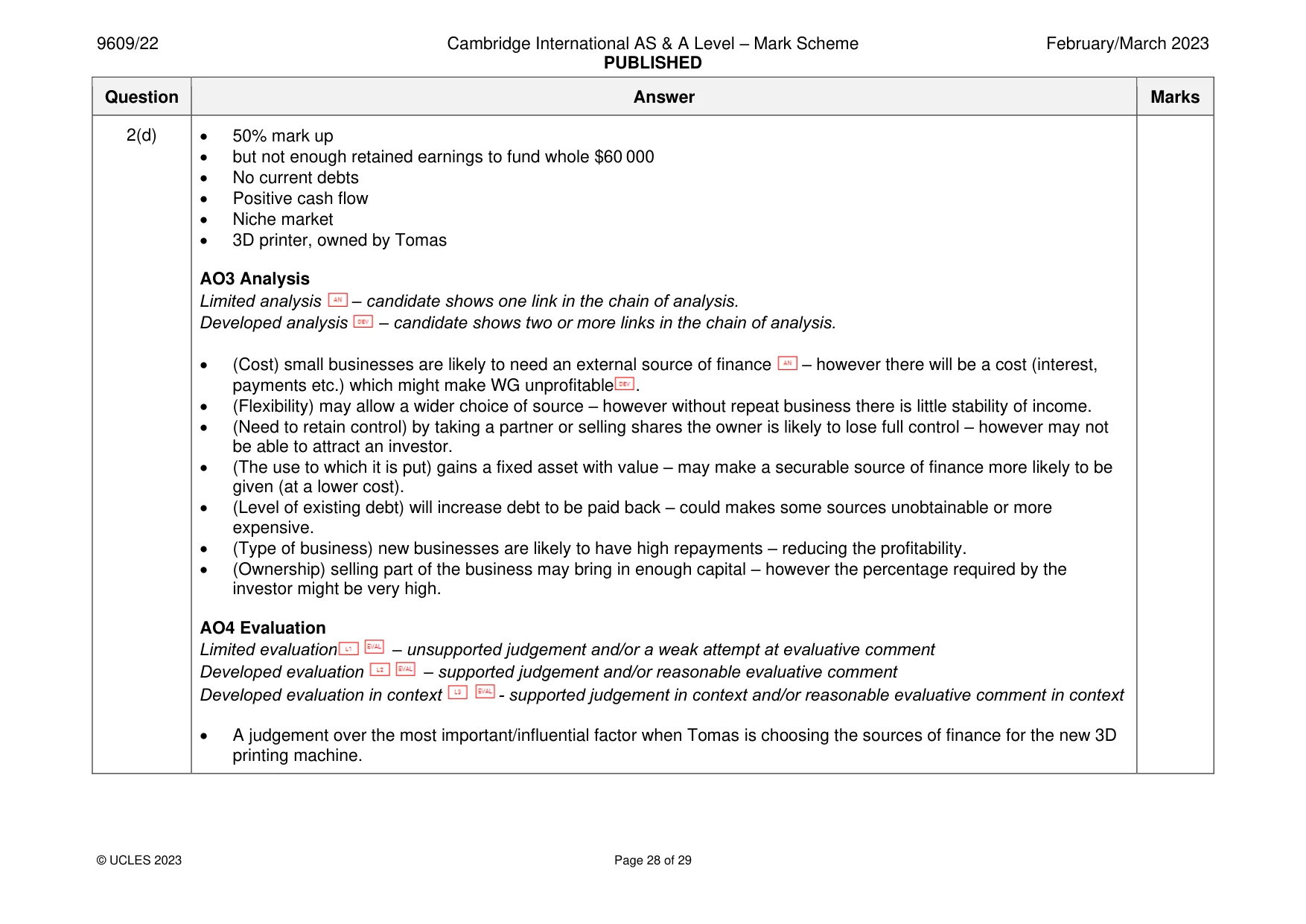
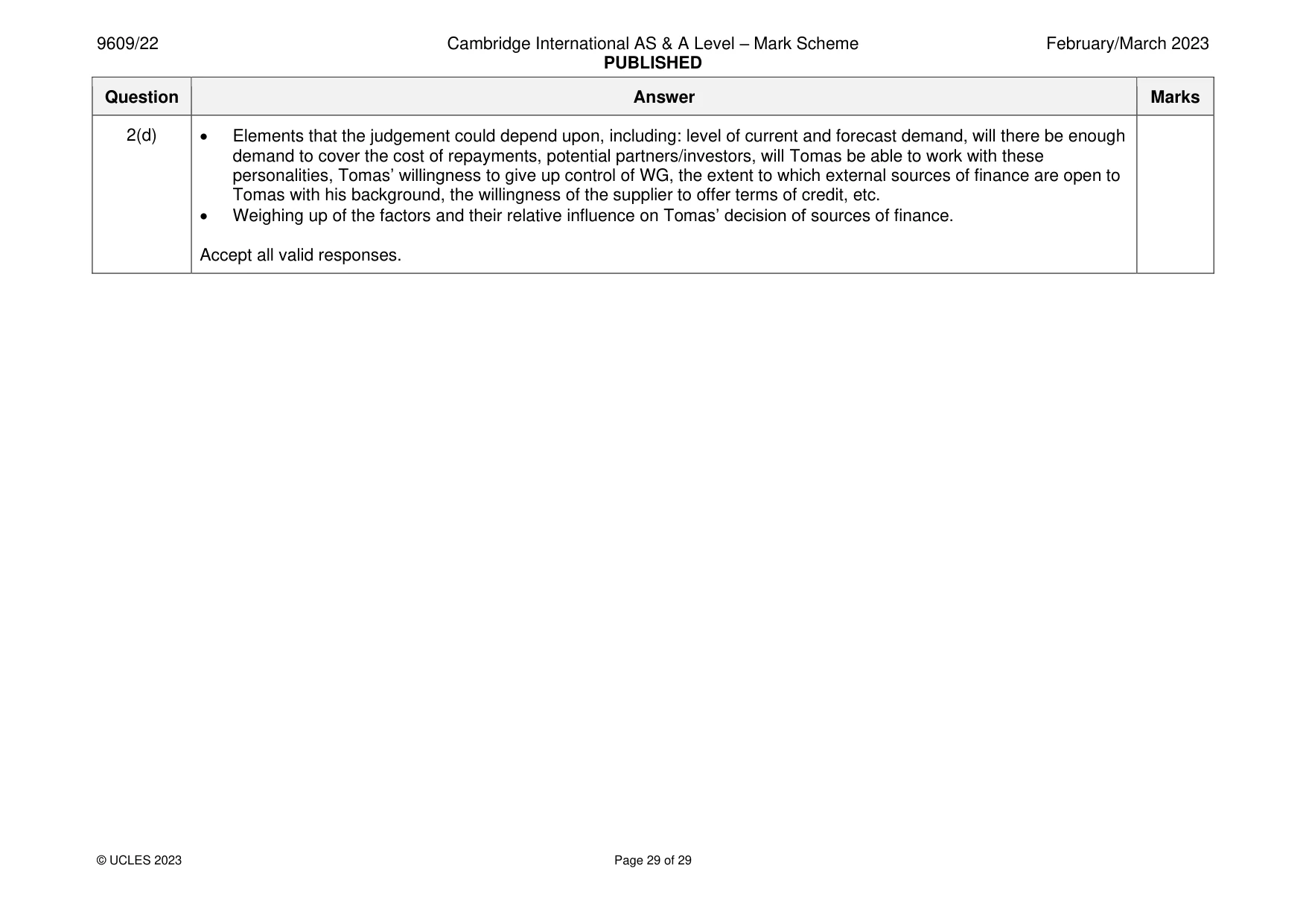
Mark scheme: Question Answer Marks 1(a)(i) Identify one content theory of motivation. 1 Indicative content. Responses may include: • Taylor / scientific management • Mayo / human needs / Hawthorne effect • Maslow / hierarchy of needs • Herzberg / 2 factors • McClelland / 3 needs Accept all valid responses. 1(a)(ii) Explain the term supply chain management. 3 AO1 Knowledge and understanding AO2 Application 1 mark 2 marks 2 marks Developed application of one relevant point to a business context. 1 mark 1 mark Knowledge of one relevant point is used to answer the Limited application of one relevant point to a business question. context. 0 marks 0 marks No creditable response. No creditable response. Indicative content AO1 Knowledge and understanding The coordination (allow management) of the flow/movement of goods and services / raw materials. AO2 Application Limited application applies knowledge of supply chain management from one aspect of the supply chain (i.e. suppliers to a business, within a business or from the business to customers). Developed application + applies knowledge of supply chain management in two or more aspects of a business. Exemplars for application: • Between suppliers and the business – and the business to customers . • Between different parts of the business – and to the customer. • Raw materials within the business – and distribution channels. • Involves the complete chain of inventory from suppliers – or to customers. • Involves inventories, such as raw materials – and finished goods. Accept all valid responses. 1(b)(i) An employee works for 8 hours and picks 5 boxes of apples, 2 boxes of bananas and 4 trays of strawberries. 3 Refer to Table 1.1 and other information. Calculate the difference between the employee’s pay using piece rate and time-based payment. Indicative content. Piece rate: Apples – 5 boxes $2 = $10 Bananas – 2 boxes $1.50 = $3 Strawberries – 4 trays $3 = $12 Total pay = $25 (1) Time based: 8 hours $4.50 = $36 (1) Difference: $36 – $25 = $11 (1 OFR applies) Answer = ($)11 (3) 1(b)(ii) Explain one advantage to FF of introducing time-based payment. 3 AO1 Knowledge and understanding AO2 Application 1 mark 2 marks 2 marks Developed application of one relevant point to a business context. 1 mark 1 mark Knowledge of one relevant point is used to answer the Limited application of one relevant point to a business question. context. 0 marks 0 marks No creditable response. No creditable response. Responses may include: AO1 Knowledge and understanding Advantages of time-based payment method may include: • improves flexibility • improves quality • easier to forecast cash flow / costs • produce more output • motivates employees. AO2 Application Limited application , applies knowledge to FF once. Developed application + applies knowledge to FF twice. • Higher payment to fruit pickers • Answer to Q1(b)(i) (OFR) • FF already has poor motivation among its fruit pickers • Fruit pickers on piece rate may choose poor quality e.g., unripe/over-ripe fruit to fill boxes/trays • Different fruit may be more financially beneficial to fruit pickers on piece rate • $4.50 is only one flat payment. Accept all valid responses. 1(c) Analyse two non-financial motivators that FF could use to motivate its fruit pickers. 8 Level AO1 Knowledge and AO2 Application AO3 Analysis understanding 2 marks 4 marks 2 marks 2 3–4 marks Developed analysis • Developed analysis that identifies connections between causes, impacts and/or consequences of two points. • Developed analysis that identifies connections between causes, impacts and/or consequences of one point. 1 1–2 marks 1–2 marks 1–2 marks • Knowledge of two • Application of two Limited analysis relevant points is used relevant points to a • Limited analysis that identifies connections to answer the business context. between causes, impacts and/or consequences question. • Application of one of two points. • Knowledge of one relevant point to a • Limited analysis that identifies connections relevant point is used business context. between causes, impacts and/or consequences to answer the of one point. question. 0 0 marks 0 marks 0 marks No creditable response. No creditable response. No creditable response. Annotate the first non-financial motivator ( ) in the left margin. Annotate the second non-financial motivator ( ) in the right margin. 1(c) Responses may include: AO1 Knowledge and understanding Knowledge of non-financial motivators (max 2 s), including: • Induction training • On the job / off the job training • opportunities for promotion • development • status • job re-design • team working • empowerment • participation / different leadership / management style • job enrichment. Do not allow any financial motivators, including: time based, salary, piece rates, commission, bonuses, profit sharing, performance-related pay, fringe benefits, paid holiday, gifts etc. AO2 Application Max one for application in the first non-financial motivator and max one for application in the second non-financial motivator. Application of knowledge of a non-financial motivator to FF (max 2 s), including • Fruit picking is labour intensive work . • 80 fruit pickers currently employed who are paid using piece rate, but would like time based • Change to time-based would increase FF’s costs significantly, 44% increase (based on OFR Q1(b)(i)). • Poor induction. • No encouragement of multi-skilling. • Autocratic management style. 1(c) AO3 Analysis Limited analysis – candidate shows one link in the chain of analysis. Developed analysis candidate shows two or more links in the chain of analysis or a two-sided analysis. Analysis may include: • (Training) can improve the induction of employees and lead to greater efficiency – greater sales, profit . • (Development) could be used to encourage employees to move between different jobs which increases employee flexibility – increased efficiency / sales / profit. • (Job re-design) may reduce the costs for FF – increased profitability. A two-sided analysis may also provide development: • (Team working) may allow different employees to work together which may improve efficiency – however may increase costs / cause distraction among employees . • (Empowerment) may improve the quality of decisions made – however FF’s fruit pickers may not make good decisions that benefit the business. • (Participation) may lead to improved efficiency – however could slow down decision-making process. • (Job enrichment) may make the employees want to and produce more – however there may not be any opportunities for enrichment. Accept all valid responses. 1(d) Evaluate the likely impact on FF’s stakeholders of improving the sustainability of operations. 12 Level AO1 Knowledge and AO2 Application AO3 Analysis AO4 Evaluation understanding 2 marks 2 marks 6 marks 2 marks 3 5–6 marks Developed evaluation in context • A developed judgement/conclusion is made in the business context. • Developed evaluative comments which balance some key arguments in the business context. 2 2 marks 2 marks 2 marks 3–4 marks Developed knowledge Developed Developed analysis Developed evaluation of relevant key term(s) application of that identifies • A developed and/or factor(s) is used relevant point(s) to connections between judgement/conclusion is made. to answer the question. the business causes, impacts and/or • Developed evaluative context. consequences. comments which balance some key arguments. 1 1 mark 1 mark 1 mark 1–2 marks Limited knowledge Limited application Limited analysis Limited evaluation of relevant key term(s) of relevant point(s) that identifies • A judgement/conclusion is and/or factor(s) is used to the business connections between made with limited supporting to answer the question. context. causes, impacts and/or comment/evidence. consequences. • An attempt is made to balance the arguments. 0 0 marks 0 marks 0 marks 0 marks No creditable response. No creditable No creditable response. No creditable response. response. 1(d) Responses may include: AO1 Knowledge and understanding Limited knowledge will be demonstrated through knowledge of sustainability or knowledge of a stakeholder. Developed knowledge + will be demonstrated from the knowledge of sustainability and knowledge of a stakeholder. For example: Knowledge of sustainability (max 1 ), including: • the importance of sustainability, or a green business, is when a business has minimal negative impact or a positive effect on the global or local environment, community, society, or economy. • The impact of sustainability in terms of cost, publicity, new markets etc. Knowledge of business stakeholders (max 1 ), including: • individuals or groups with an interest in the activities of a business • internal stakeholders e.g. owners/shareholders, employees, managers / external stakeholders e.g. customers, local community, suppliers • the roles, rights and responsibilities of stakeholders. AO2 Application Limited application applies knowledge of FF once. Developed application + applies knowledge of FF twice. • FF provides products to the industrial market (not consumer market) . • Move from single use plastic in packaging to recycled materials . • Current system is labour intensive – new machinery would be capital intensive. • Less chemicals used in growing. • New Supply Chain Management required. • Relevant stakeholders of FF; fruit pickers, shareholders (FF is a private limited company), industrial customers (likely to be grocery shops, supermarkets, restaurants etc.), suppliers (seeds, packaging), directors, environmentalists, local community (farm – large agricultural area), final customers (of fruit purchased in shops). AO3 Analysis Limited analysis – candidate shows one link in the chain of analysis. Developed analysis – candidate shows two or more links in the chain of analysis. 1(d) Impacts may include: • Increase in costs e.g. purchase of machinery, cost of recycled materials – (Shareholders) reduced profit in the short run , however, may increase profitability in the long run . – (Directors) opportunity cost of new capital / increased decisions to be made – reduced employees to supervise. – (Customers) increased price – may attract a new market of final customers (who favour sustainable products). • More environmentally sustainable: – (Customers) may choose to stock more of FF’s products – to attract environmentally conscious final customers. – (Environmental groups) may be happier with FF – may become customers of FF’s customers. – (Fruit pickers) may prefer to work for an environmentally sustainable business – may increase motivation. – (Suppliers) may not be able to provide new materials so may lose sales – decreased profit. – (Suppliers) FF may use new suppliers who gain FF as a customer – increased revenue. • New supply chain management: – (Suppliers) may have to change what is sold to FF – increasing suppliers’ costs. – (Environmental groups) may be happier with FF – and get more satisfaction from FF’s products. – (Local community) may be happier from less chemicals being used – increase value of homes / more pleasant living conditions. – (Shareholders) may increase costs – however, may also increases sales to new customers. • Change to capital intensive packaging process: – (Shareholders) increased production costs – however, may increase profitability with new target market. – (Employees) may no longer be required and may face redundancy – reduced income. AO4 Evaluation Limited evaluation - unsupported judgement and/or a weak attempt at evaluative comment Developed evaluation – supported judgement and/or reasonable evaluative comment Developed evaluation in context - supported judgement in context and/or reasonable evaluative comment in context. • A judgement about the likely impacts of measures to improve the sustainability of operations on the stakeholders of FF. • A judgement over which stakeholder(s) may be most impacted by the measures to improve sustainability. • A judgement over the measures which are most likely to impact the stakeholders. • Elements that the judgement could depend upon, including, the number of workers in the packaging section, the cost of the machinery to produce the recycled packaging, the availability of new suppliers, the level of impact on FF’s costs/profitability, the objectives of different stakeholder groups, the objectives of FF. • Weighing up of the impacts on stakeholders of the proposed measures to improve the sustainability of FF. Accept all valid responses.
Q2 · Wedding Gifts (WG) WG is owned by Tomas who is a sole trader
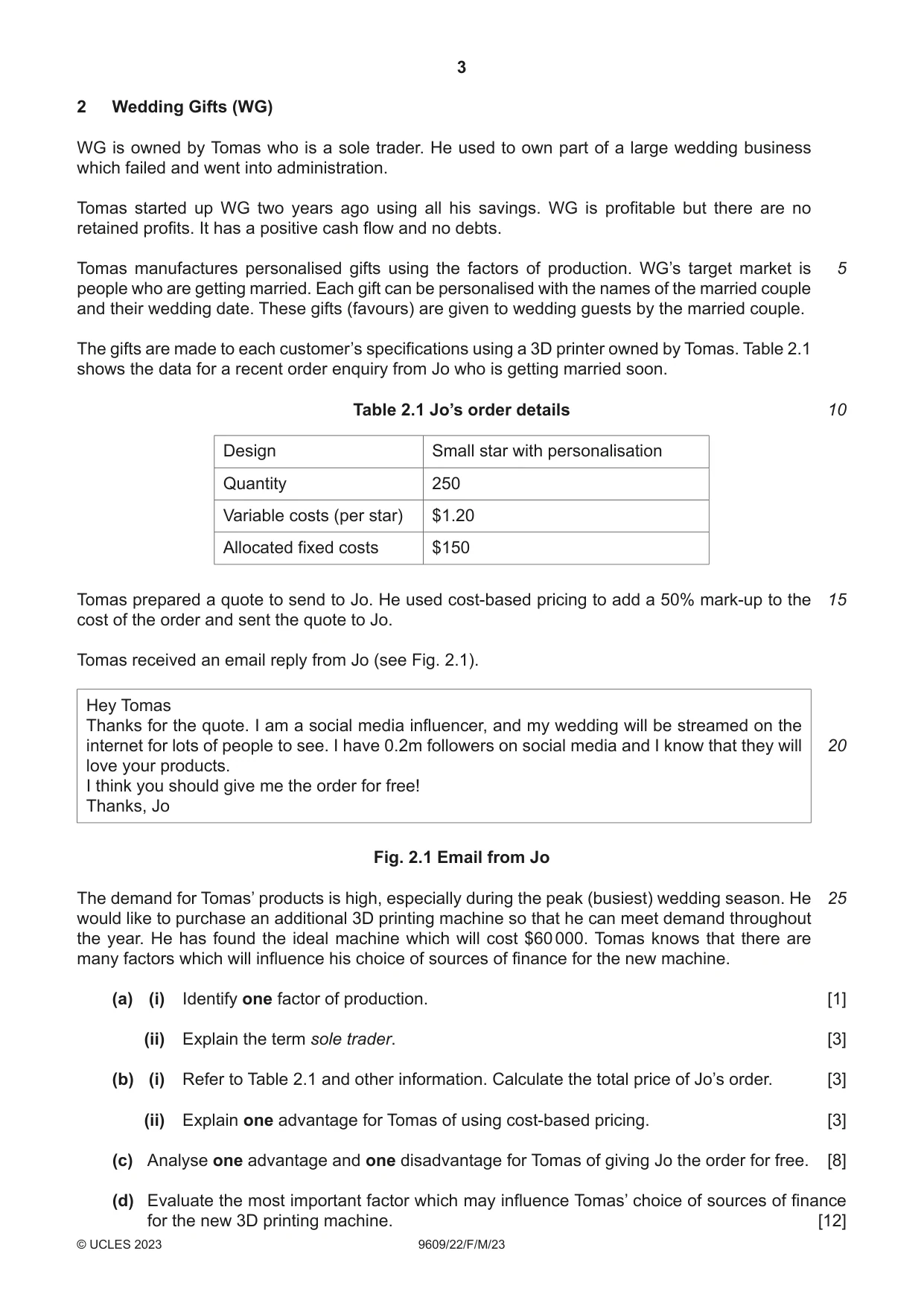
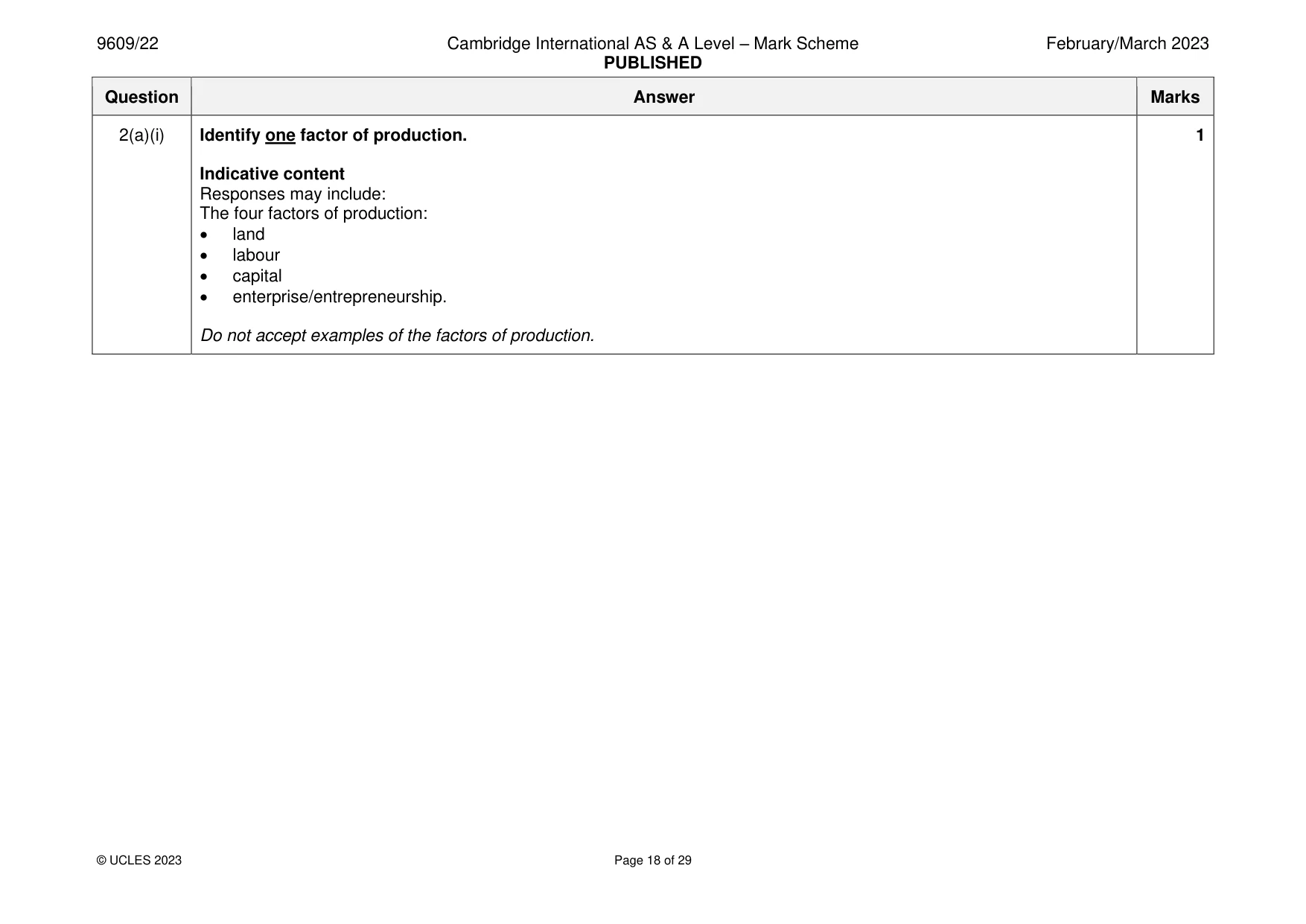
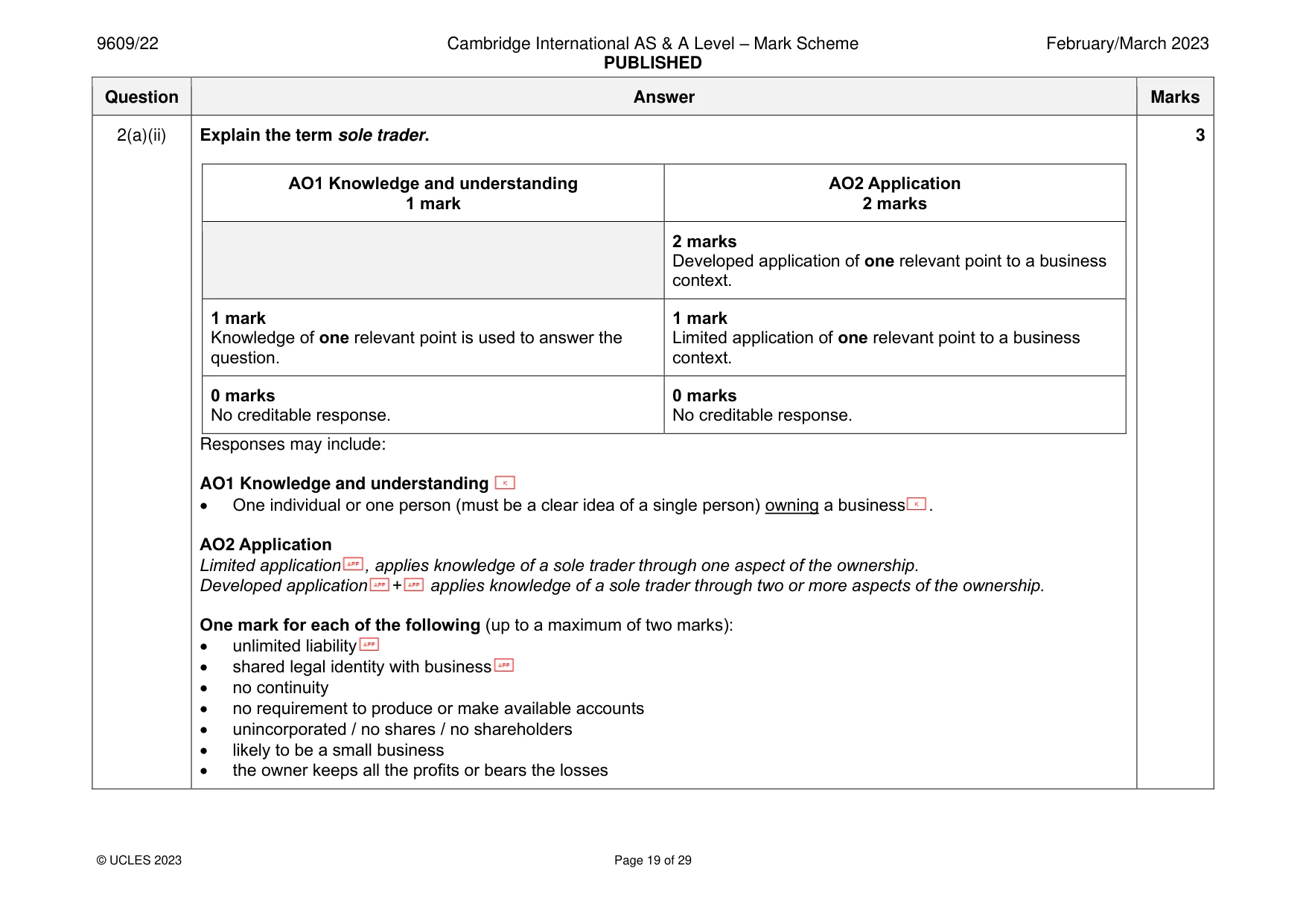
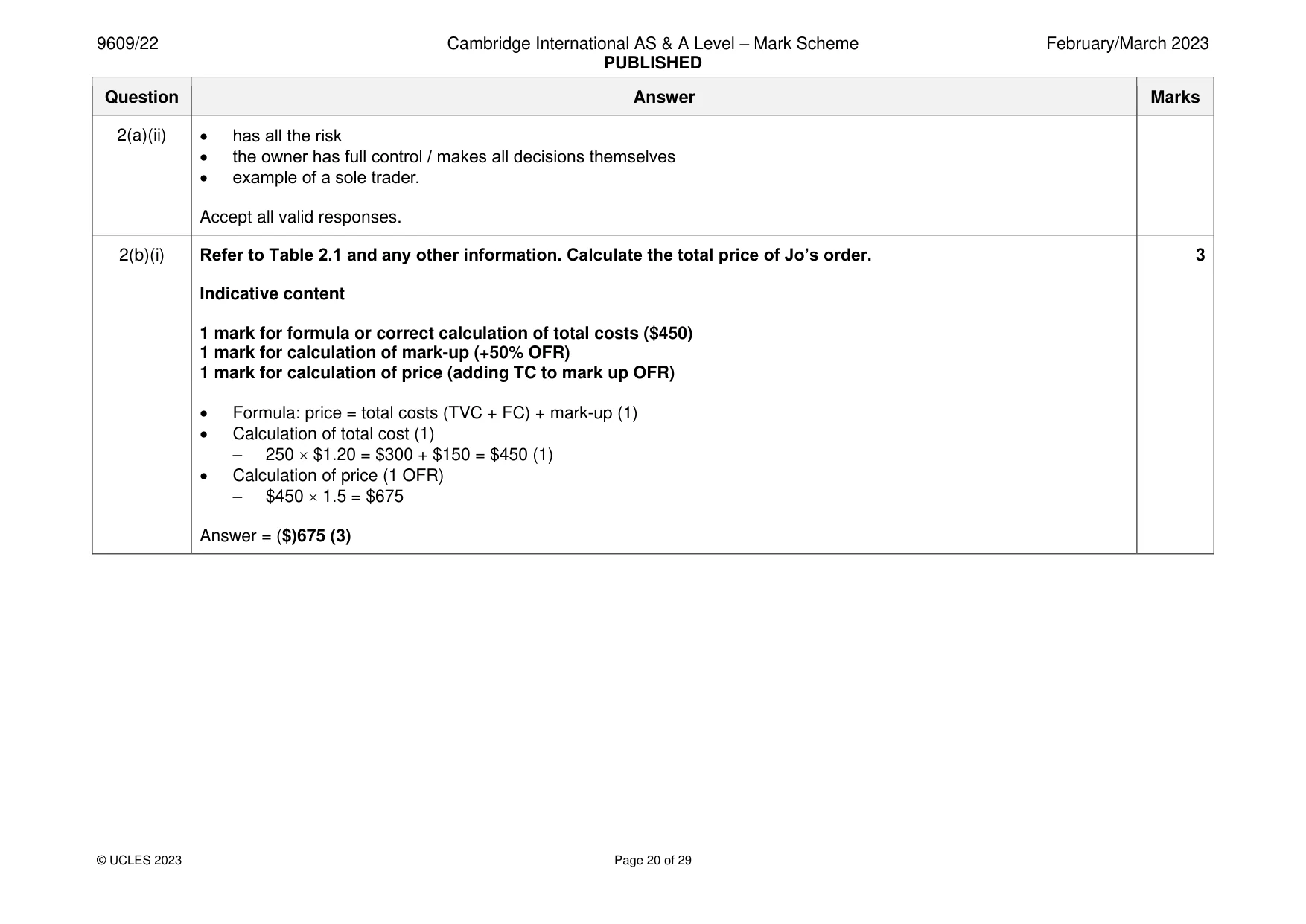
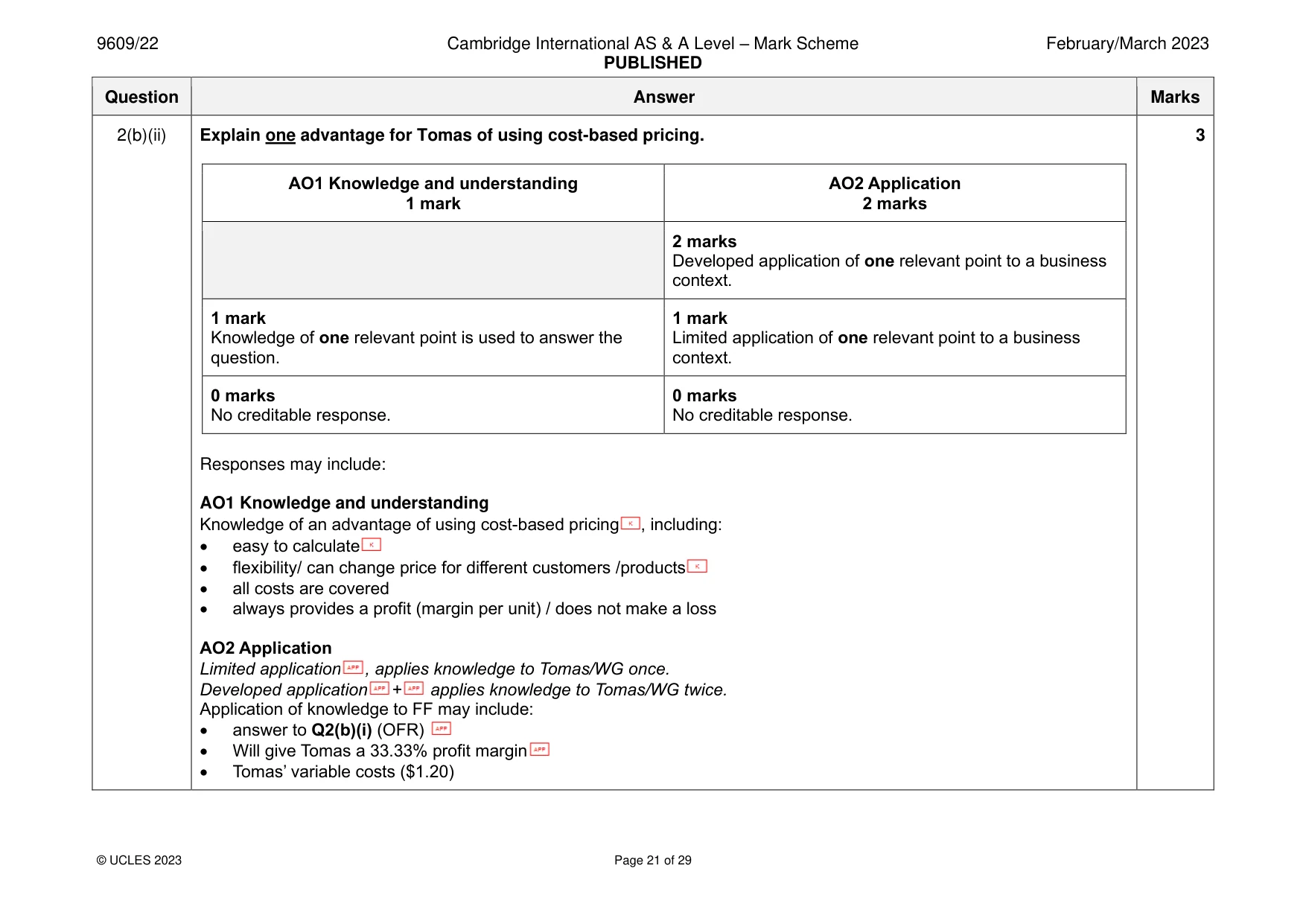
2 Wedding Gifts (WG) WG is owned by Tomas who is a sole trader. He used to own part of a large wedding business which failed and went into administration. Tomas started up WG two years ago using all his savings. WG is profitable but there are no retained profits. It has a positive cash flow and no debts. Tomas manufactures personalised gifts using the factors of production. WG’s target market is 5 people who are getting married. Each gift can be personalised with the names of the married couple and their wedding date. These gifts (favours) are given to wedding guests by the married couple. The gifts are made to each customer’s specifications using a 3D printer owned by Tomas. Table 2.1 shows the data for a recent order enquiry from Jo who is getting married soon. Table 2.1 Jo’s order details 10 Design Small star with personalisation Quantity 250 Variable costs (per star) $1.20 Allocated fixed costs $150 Tomas prepared a quote to send to Jo. He used cost‑based pricing to add a 50% mark‑up to the 15 cost of the order and sent the quote to Jo. Tomas received an email reply from Jo (see Fig. 2.1). Hey Tomas Thanks for the quote. I am a social media influencer, and my wedding will be streamed on the internet for lots of people to see. I have 0.2m followers on social media and I know that they will 20 love your products. I think you should give me the order for free! Thanks, Jo Fig. 2.1 Email from Jo The demand for Tomas’ products is high, especially during the peak (busiest) wedding season. He 25 would like to purchase an additional 3D printing machine so that he can meet demand throughout the year. He has found the ideal machine which will cost $60 000. Tomas knows that there are many factors which will influence his choice of sources of finance for the new machine. (a) (i) Identify one factor of production. [1] (ii) Explain the term sole trader. [3] (b) (i) Refer to Table 2.1 and other information. Calculate the total price of Jo’s order. [3] (ii) Explain one advantage for Tomas of using cost‑based pricing. [3] (c) Analyse one advantage and one disadvantage for Tomas of giving Jo the order for free. [8] (d) Evaluate the most important factor which may influence Tomas’ choice of sources of finance
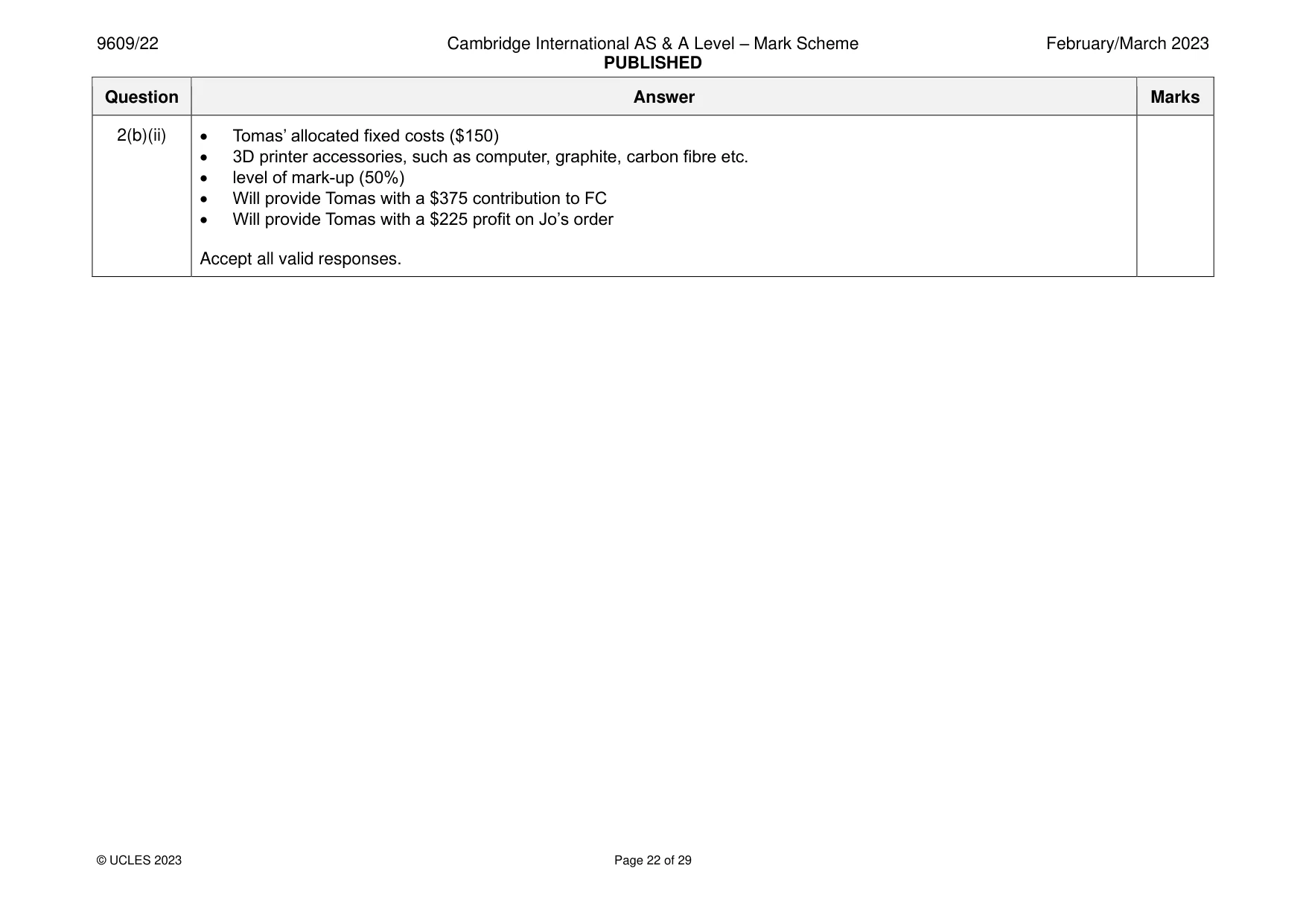
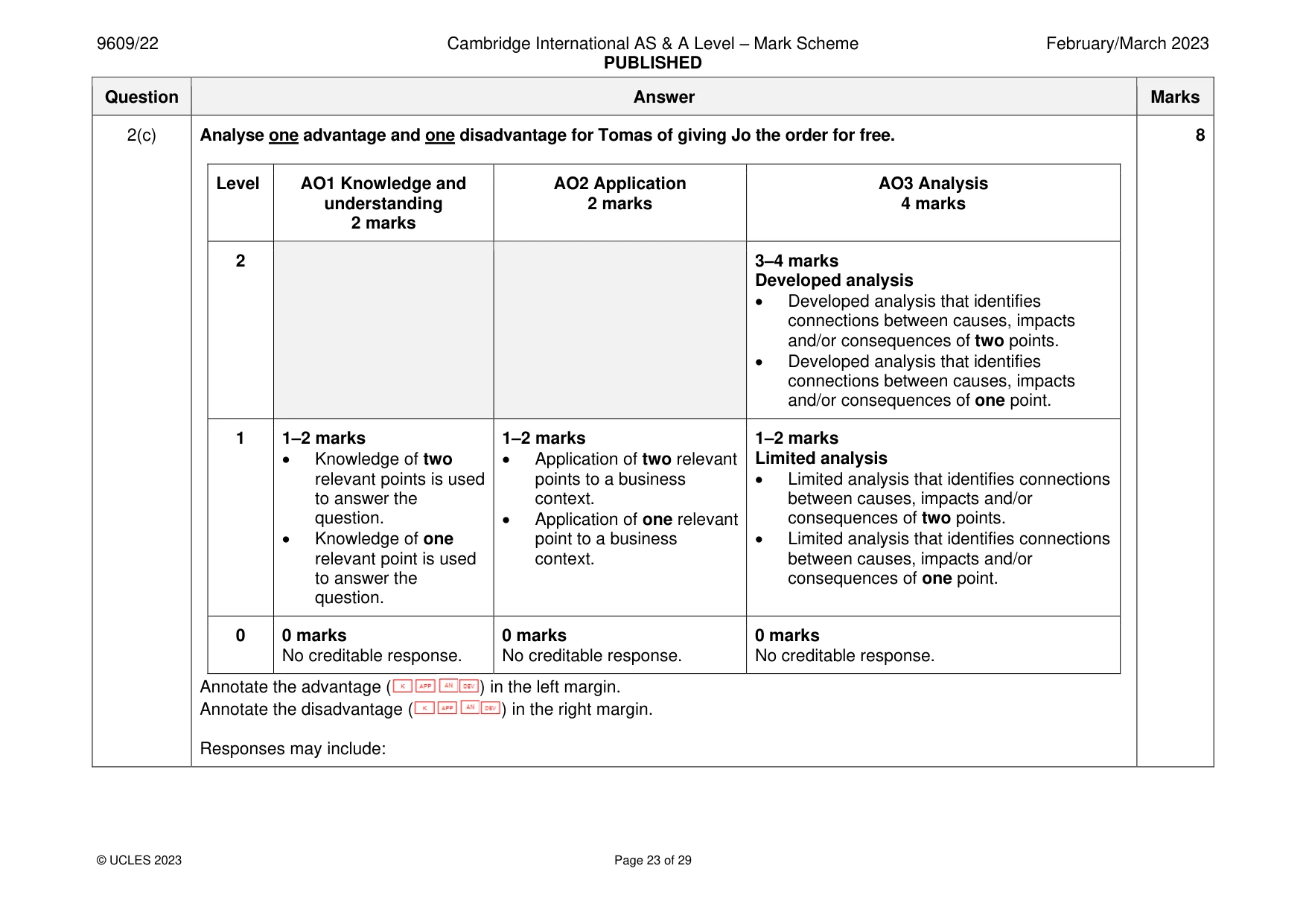
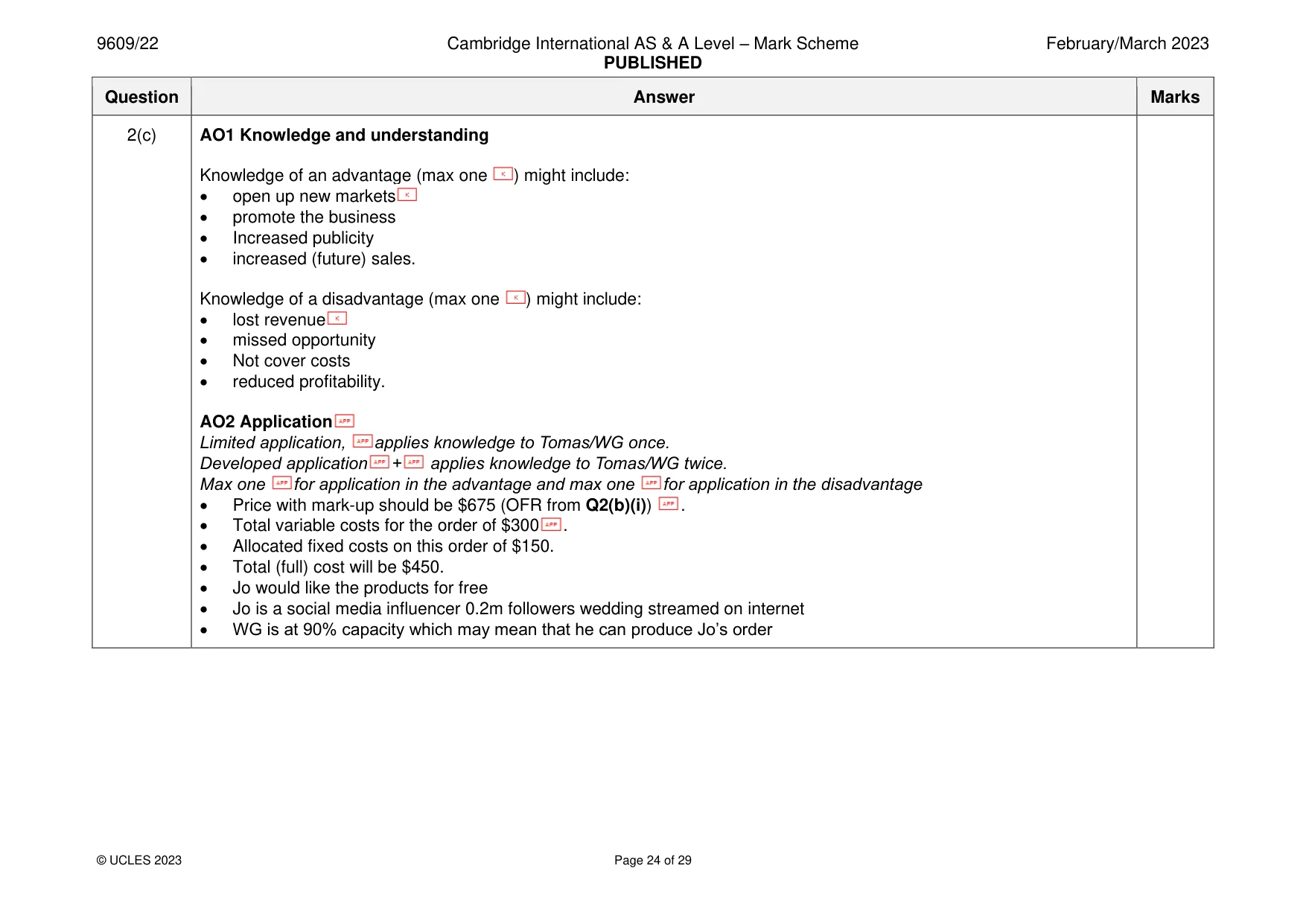
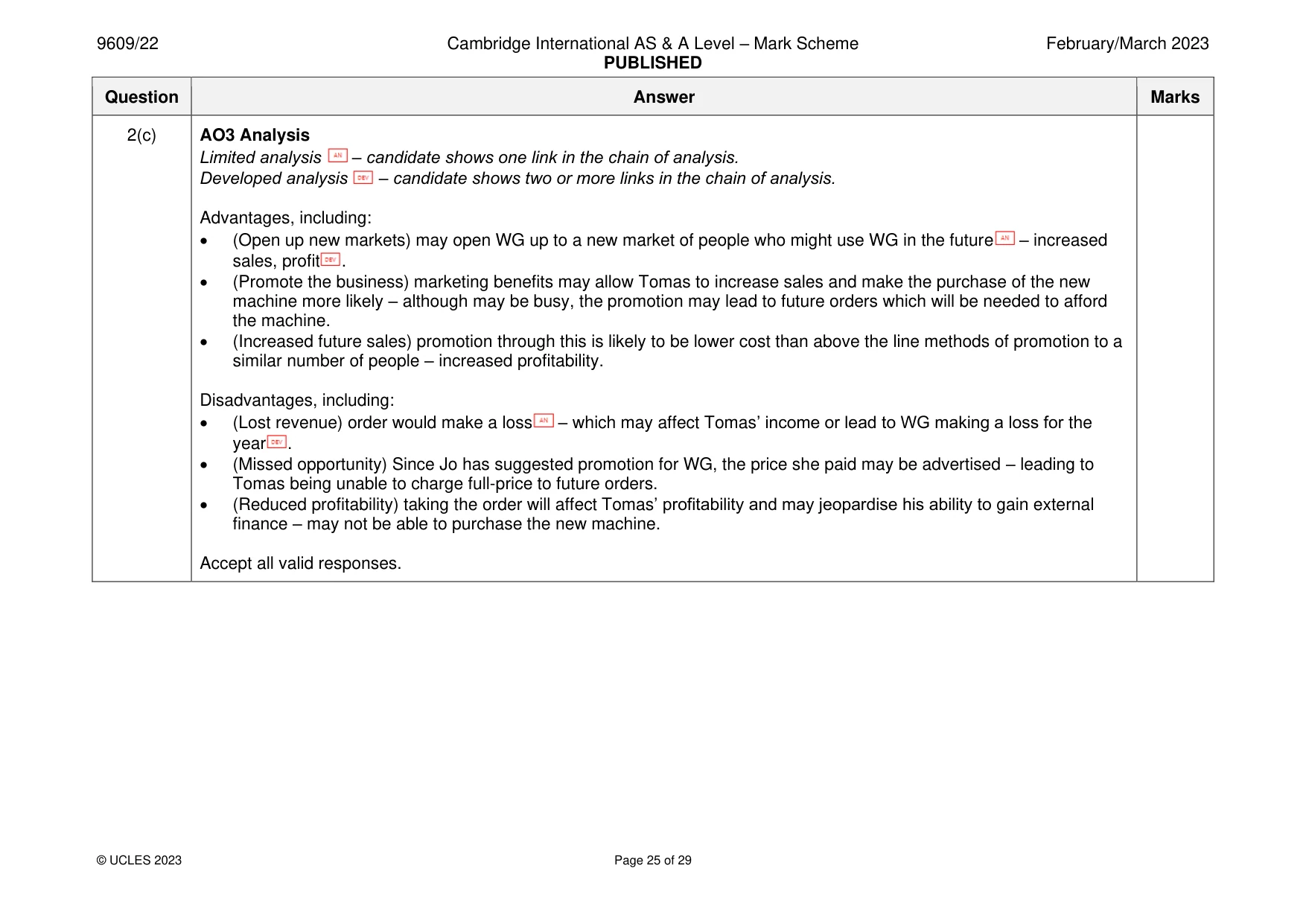
Mark scheme: 2(a)(i) Identify one factor of production. 1 Indicative content Responses may include: The four factors of production: • land • labour • capital • enterprise/entrepreneurship. Do not accept examples of the factors of production. 2(a)(ii) Explain the term sole trader. 3 AO1 Knowledge and understanding AO2 Application 1 mark 2 marks 2 marks Developed application of one relevant point to a business context. 1 mark 1 mark Knowledge of one relevant point is used to answer the Limited application of one relevant point to a business question. context. 0 marks 0 marks No creditable response. No creditable response. Responses may include: AO1 Knowledge and understanding • One individual or one person (must be a clear idea of a single person) owning a business . AO2 Application Limited application , applies knowledge of a sole trader through one aspect of the ownership. Developed application + applies knowledge of a sole trader through two or more aspects of the ownership. One mark for each of the following (up to a maximum of two marks): • unlimited liability • shared legal identity with business • no continuity • no requirement to produce or make available accounts • unincorporated / no shares / no shareholders • likely to be a small business • the owner keeps all the profits or bears the losses 2(a)(ii) • has all the risk • the owner has full control / makes all decisions themselves • example of a sole trader. Accept all valid responses. 2(b)(i) Refer to Table 2.1 and any other information. Calculate the total price of Jo’s order. 3 Indicative content 1 mark for formula or correct calculation of total costs ($450) 1 mark for calculation of mark-up (+50% OFR) 1 mark for calculation of price (adding TC to mark up OFR) • Formula: price = total costs (TVC + FC) + mark-up (1) • Calculation of total cost (1) – 250 $1.20 = $300 + $150 = $450 (1) • Calculation of price (1 OFR) – $450 1.5 = $675 Answer = ($)675 (3) 2(b)(ii) Explain one advantage for Tomas of using cost-based pricing. 3 AO1 Knowledge and understanding AO2 Application 1 mark 2 marks 2 marks Developed application of one relevant point to a business context. 1 mark 1 mark Knowledge of one relevant point is used to answer the Limited application of one relevant point to a business question. context. 0 marks 0 marks No creditable response. No creditable response. Responses may include: AO1 Knowledge and understanding Knowledge of an advantage of using cost-based pricing , including: • easy to calculate • flexibility/ can change price for different customers /products • all costs are covered • always provides a profit (margin per unit) / does not make a loss AO2 Application Limited application , applies knowledge to Tomas/WG once. Developed application + applies knowledge to Tomas/WG twice. Application of knowledge to FF may include: • answer to Q2(b)(i) (OFR) • Will give Tomas a 33.33% profit margin • Tomas’ variable costs ($1.20) 2(b)(ii) • Tomas’ allocated fixed costs ($150) • 3D printer accessories, such as computer, graphite, carbon fibre etc. • level of mark-up (50%) • Will provide Tomas with a $375 contribution to FC • Will provide Tomas with a $225 profit on Jo’s order Accept all valid responses. 2(c) Analyse one advantage and one disadvantage for Tomas of giving Jo the order for free. 8 Level AO1 Knowledge and AO2 Application AO3 Analysis understanding 2 marks 4 marks 2 marks 2 3–4 marks Developed analysis • Developed analysis that identifies connections between causes, impacts and/or consequences of two points. • Developed analysis that identifies connections between causes, impacts and/or consequences of one point. 1 1–2 marks 1–2 marks 1–2 marks • Knowledge of two • Application of two relevant Limited analysis relevant points is used points to a business • Limited analysis that identifies connections to answer the context. between causes, impacts and/or question. • Application of one relevant consequences of two points. • Knowledge of one point to a business • Limited analysis that identifies connections relevant point is used context. between causes, impacts and/or to answer the consequences of one point. question. 0 0 marks 0 marks 0 marks No creditable response. No creditable response. No creditable response. Annotate the advantage ( ) in the left margin. Annotate the disadvantage ( ) in the right margin. Responses may include: 2(c) AO1 Knowledge and understanding Knowledge of an advantage (max one ) might include: • open up new markets • promote the business • Increased publicity • increased (future) sales. Knowledge of a disadvantage (max one ) might include: • lost revenue • missed opportunity • Not cover costs • reduced profitability. AO2 Application Limited application, applies knowledge to Tomas/WG once. Developed application + applies knowledge to Tomas/WG twice. Max one for application in the advantage and max one for application in the disadvantage • Price with mark-up should be $675 (OFR from Q2(b)(i)) . • Total variable costs for the order of $300 . • Allocated fixed costs on this order of $150. • Total (full) cost will be $450. • Jo would like the products for free • Jo is a social media influencer 0.2m followers wedding streamed on internet • WG is at 90% capacity which may mean that he can produce Jo’s order 2(c) AO3 Analysis Limited analysis – candidate shows one link in the chain of analysis. Developed analysis – candidate shows two or more links in the chain of analysis. Advantages, including: • (Open up new markets) may open WG up to a new market of people who might use WG in the future – increased sales, profit . • (Promote the business) marketing benefits may allow Tomas to increase sales and make the purchase of the new machine more likely – although may be busy, the promotion may lead to future orders which will be needed to afford the machine. • (Increased future sales) promotion through this is likely to be lower cost than above the line methods of promotion to a similar number of people – increased profitability. Disadvantages, including: • (Lost revenue) order would make a loss – which may affect Tomas’ income or lead to WG making a loss for the year . • (Missed opportunity) Since Jo has suggested promotion for WG, the price she paid may be advertised – leading to Tomas being unable to charge full-price to future orders. • (Reduced profitability) taking the order will affect Tomas’ profitability and may jeopardise his ability to gain external finance – may not be able to purchase the new machine. Accept all valid responses. 2(d) Evaluate the most important factor that may influence Tomas’ choice of sources of finance for the new 3D printing 12 machine. Level AO1 Knowledge and AO2 Application AO3 Analysis AO4 Evaluation understanding 2 marks 2 marks 6 marks 2 marks 3 5–6 marks Developed evaluation in context • A developed judgement/conclusion is made in the business context. • Developed evaluative comments which balance some key arguments in the business context. 2 2 marks 2 marks 2 marks 3–4 marks Developed knowledge Developed Developed analysis Developed evaluation of relevant key term(s) application of that identifies • A developed and/or factor(s) is used relevant point(s) to connections between judgement/conclusion is made. to answer the question. the business causes, impacts • Developed evaluative context. and/or consequences. comments which balance some key arguments. 1 1 mark 1 mark 1 mark 1–2 marks Limited knowledge Limited Limited analysis Limited evaluation of relevant key term(s) application that identifies • A judgement/conclusion is and/or factor(s) is used of relevant point(s) connections between made with limited supporting to answer the question. to the business causes, impacts comment/evidence. context. and/or consequences. • An attempt is made to balance the arguments. 0 0 marks 0 marks 0 marks 0 marks No creditable response. No creditable No creditable No creditable response. response. response. 2(d) Responses may include: AO1 Knowledge and understanding Limited knowledge will be demonstrated through knowledge of a factor or knowledge of source(s) of finance. Developed knowledge + will be demonstrated through knowledge of a factor and knowledge of source(s) of finance. Factors influencing sources of finance, including: • cost • flexibility • need to retain control/ownership • the use to which it is put / type of business • level of existing debt • Availability of funds/finance – may not have any retained profit / may be a country with no banking infrastructure. • Size of the business – a large business may have more collateral. • Reputation (credit rating) – of the business/owner Knowledge of sources of finance • Internal and external sources of finance • Identification of any source of finance (owners’ investment, retained earnings, sale of unwanted assets, sale and • leaseback of non-current assets, working capital, share capital, debentures, new partners, venture capital, bank overdrafts, leasing, hire purchase, bank loans, mortgages, debt factoring, trade credit, micro-finance, crowd funding and government grants) AO2 Application Limited application applies knowledge to Tomas/WG once. Developed application + applies knowledge to Tomas/WG twice. • $60 000 for new machine • WG/Tomas is a sole trader • Previous business went into administration • WG is profitable • 33.33% profit margin 2(d) • 50% mark up • but not enough retained earnings to fund whole $60 000 • No current debts • Positive cash flow • Niche market • 3D printer, owned by Tomas AO3 Analysis Limited analysis – candidate shows one link in the chain of analysis. Developed analysis – candidate shows two or more links in the chain of analysis. • (Cost) small businesses are likely to need an external source of finance – however there will be a cost (interest, payments etc.) which might make WG unprofitable . • (Flexibility) may allow a wider choice of source – however without repeat business there is little stability of income. • (Need to retain control) by taking a partner or selling shares the owner is likely to lose full control – however may not be able to attract an investor. • (The use to which it is put) gains a fixed asset with value – may make a securable source of finance more likely to be given (at a lower cost). • (Level of existing debt) will increase debt to be paid back – could makes some sources unobtainable or more expensive. • (Type of business) new businesses are likely to have high repayments – reducing the profitability. • (Ownership) selling part of the business may bring in enough capital – however the percentage required by the investor might be very high. AO4 Evaluation Limited evaluation – unsupported judgement and/or a weak attempt at evaluative comment Developed evaluation – supported judgement and/or reasonable evaluative comment Developed evaluation in context - supported judgement in context and/or reasonable evaluative comment in context • A judgement over the most important/influential factor when Tomas is choosing the sources of finance for the new 3D printing machine. 2(d) • Elements that the judgement could depend upon, including: level of current and forecast demand, will there be enough demand to cover the cost of repayments, potential partners/investors, will Tomas be able to work with these personalities, Tomas’ willingness to give up control of WG, the extent to which external sources of finance are open to Tomas with his background, the willingness of the supplier to offer terms of credit, etc. • Weighing up of the factors and their relative influence on Tomas’ decision of sources of finance. Accept all valid responses.
What was in this paper
The subtopics covered by these 2 questions, and how many questions each got. Open one in a new tab to see every Cambridge question on it.
What you needed in this session
Cambridge’s own grade thresholds for 2023 Feb/March, Paper 2 · Variant 2. A higher threshold means an easier paper — the bar moves with how the cohort did.