Cambridge A Level Business (for first examination in 2016) 9609 — 2024 Oct/Nov Paper 2 · Variant 3
9609/23/O/N/24 · 2 questions · 60 marks · ≈68 min
The question paper and its mark scheme, free to read here and free to download. This is Cambridge’s own paper, exactly as it was sat.
Question paper4 pages

Mark scheme37 pages
Answers below. Sit the paper first if you are practising.
Questions as text
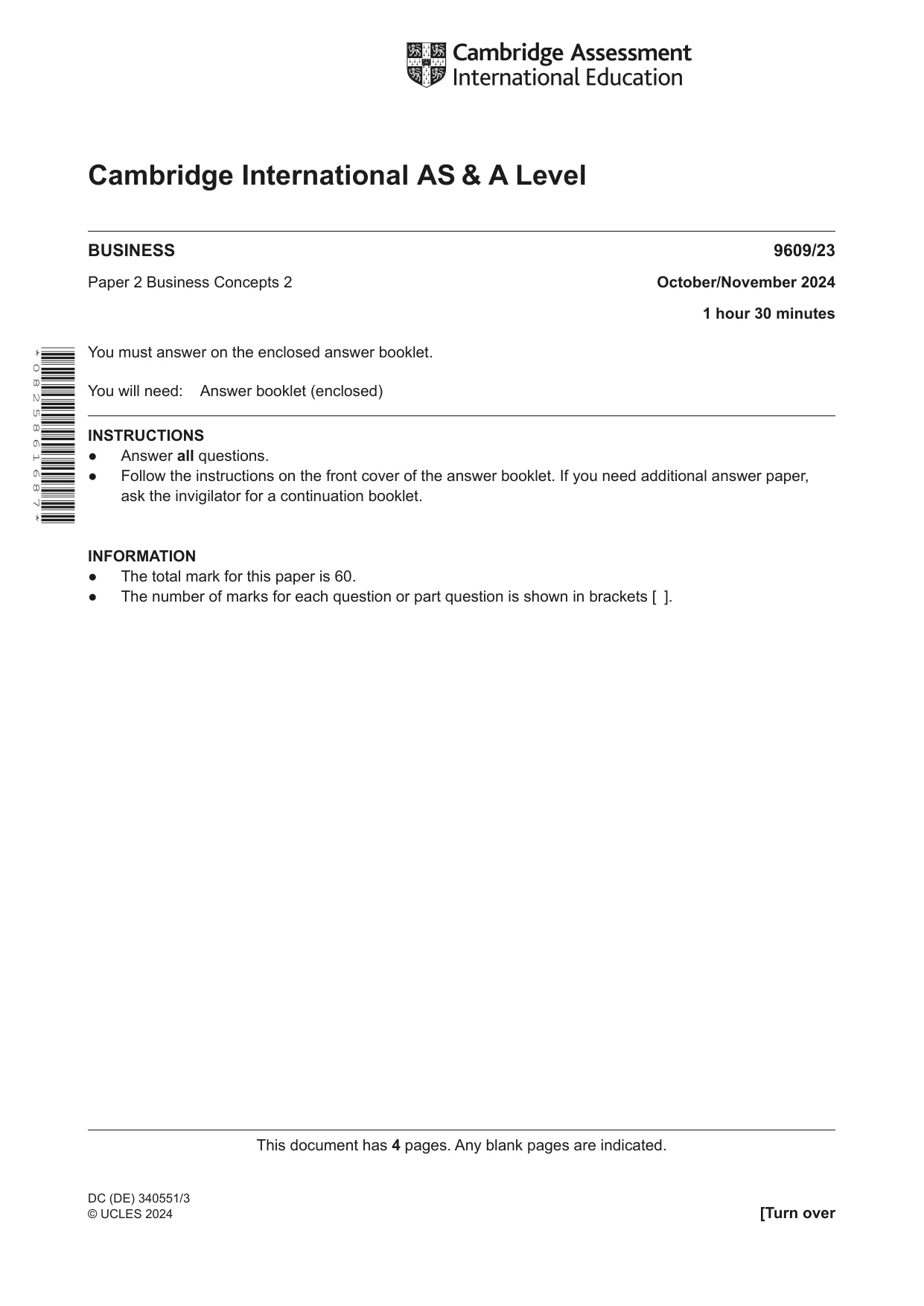
Q1 · Brenda’s Bricks (BB) BB is a newly established social enterprise in country X
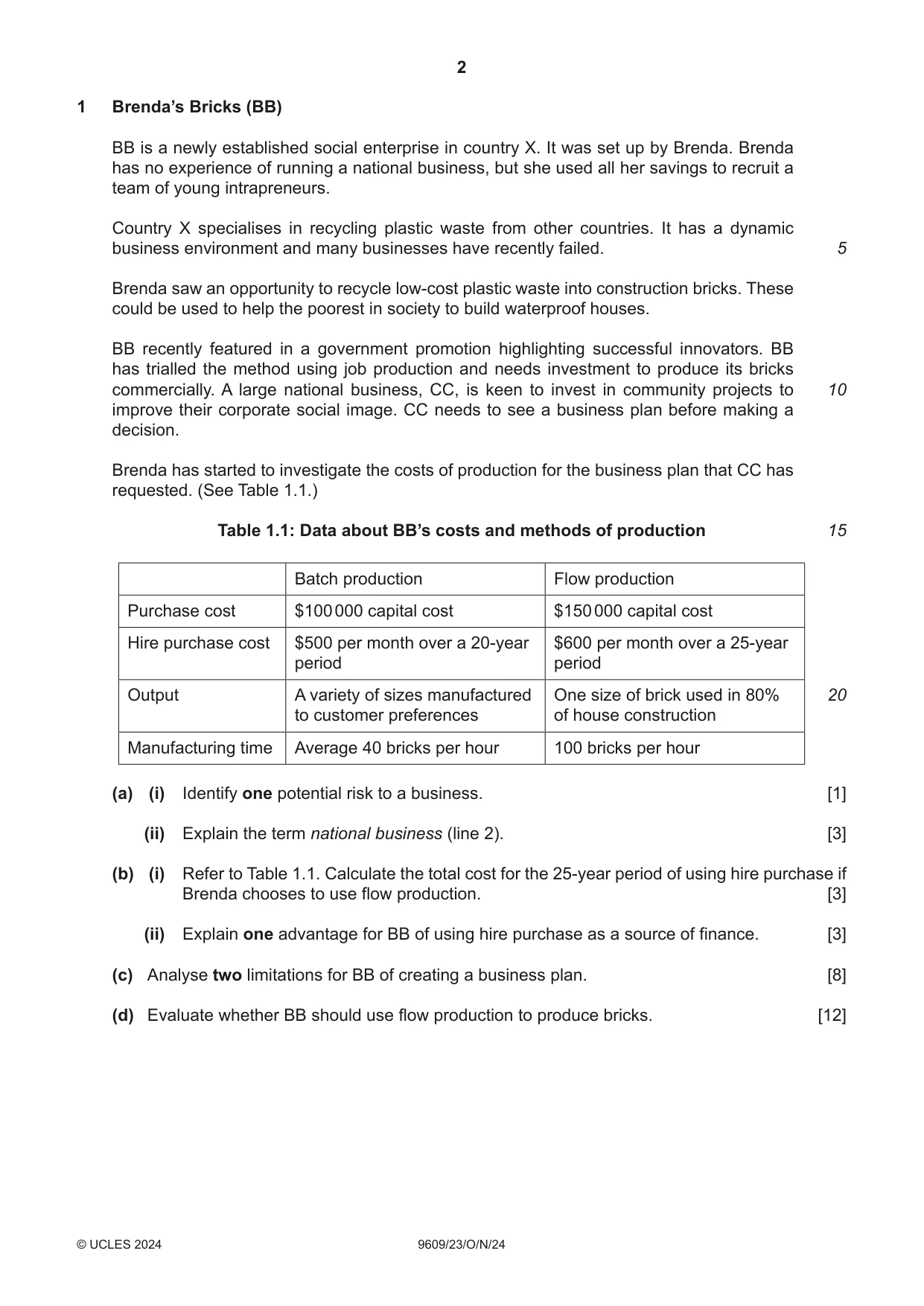
1 Brenda’s Bricks (BB) BB is a newly established social enterprise in country X. It was set up by Brenda. Brenda has no experience of running a national business, but she used all her savings to recruit a team of young intrapreneurs. Country X specialises in recycling plastic waste from other countries. It has a dynamic business environment and many businesses have recently failed. 5 Brenda saw an opportunity to recycle low-cost plastic waste into construction bricks. These could be used to help the poorest in society to build waterproof houses. BB recently featured in a government promotion highlighting successful innovators. BB has trialled the method using job production and needs investment to produce its bricks commercially. A large national business, CC, is keen to invest in community projects to 10 improve their corporate social image. CC needs to see a business plan before making a decision. Brenda has started to investigate the costs of production for the business plan that CC has requested. (See Table 1.1.) Table 1.1: Data about BB’s costs and methods of production 15 Batch production Flow production Purchase cost $100 000 capital cost $150 000 capital cost Hire purchase cost $500 per month over a 20-year $600 per month over a 25-year period period Output A variety of sizes manufactured One size of brick used in 80% 20 to customer preferences of house construction Manufacturing time Average 40 bricks per hour 100 bricks per hour (a) (i) Identify one potential risk to a business. [1] (ii) Explain the term national business (line 2). [3] (b) (i) Refer to Table 1.1. Calculate the total cost for the 25-year period of using hire purchase if Brenda chooses to use flow production. [3] (ii) Explain one advantage for BB of using hire purchase as a source of finance. [3] (c) Analyse two limitations for BB of creating a business plan. [8] (d) Evaluate whether BB should use flow production to produce bricks. [12]
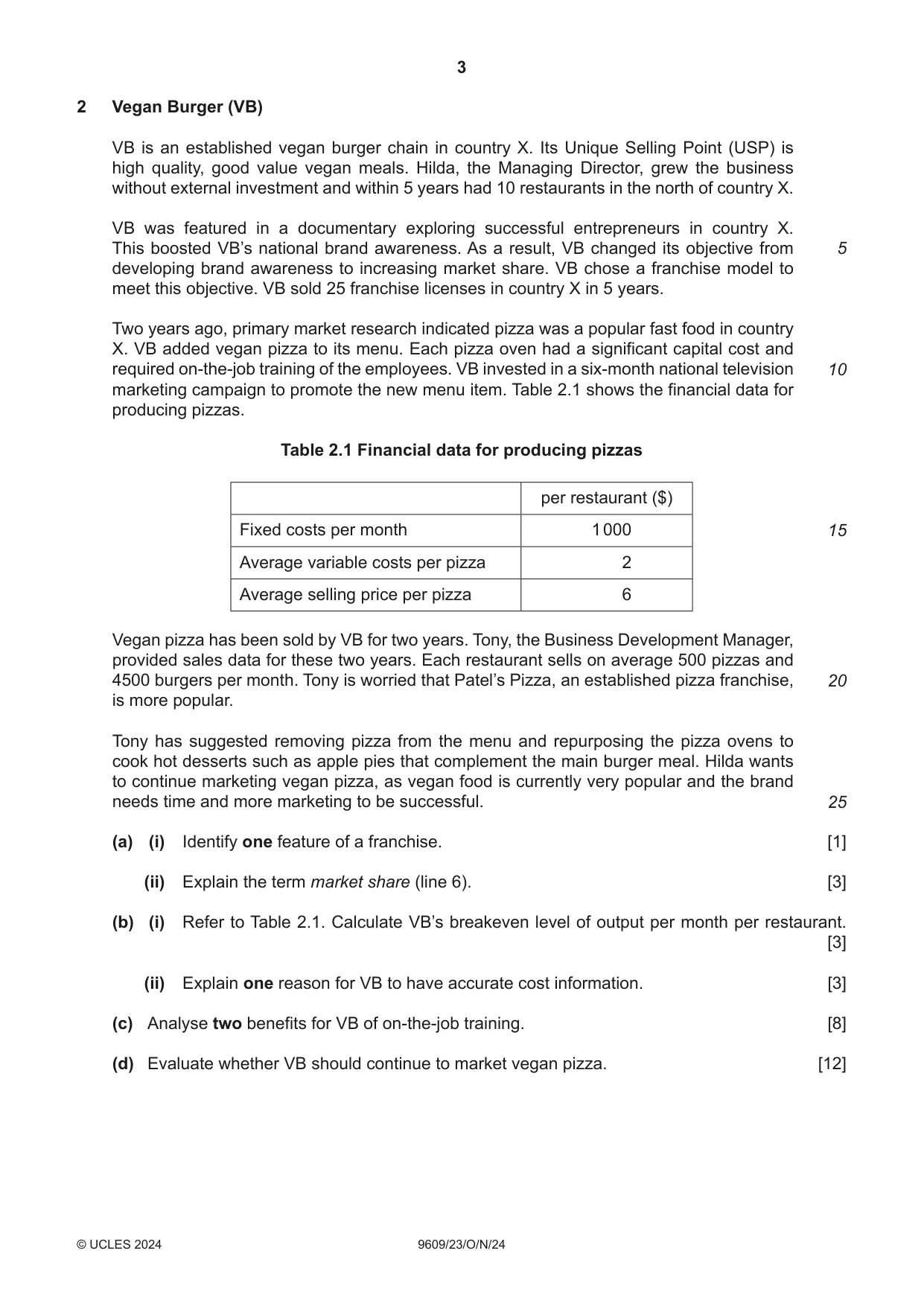
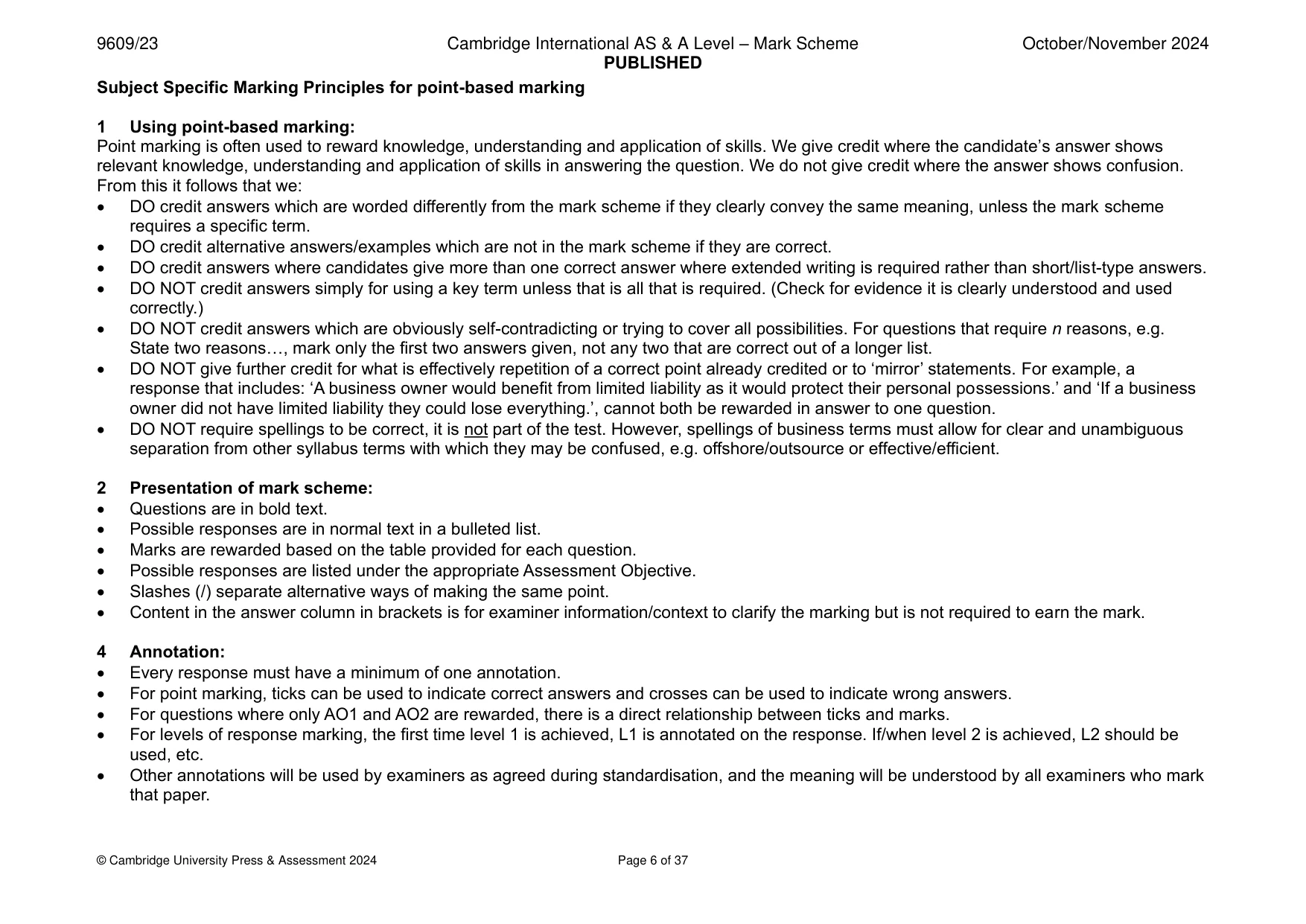
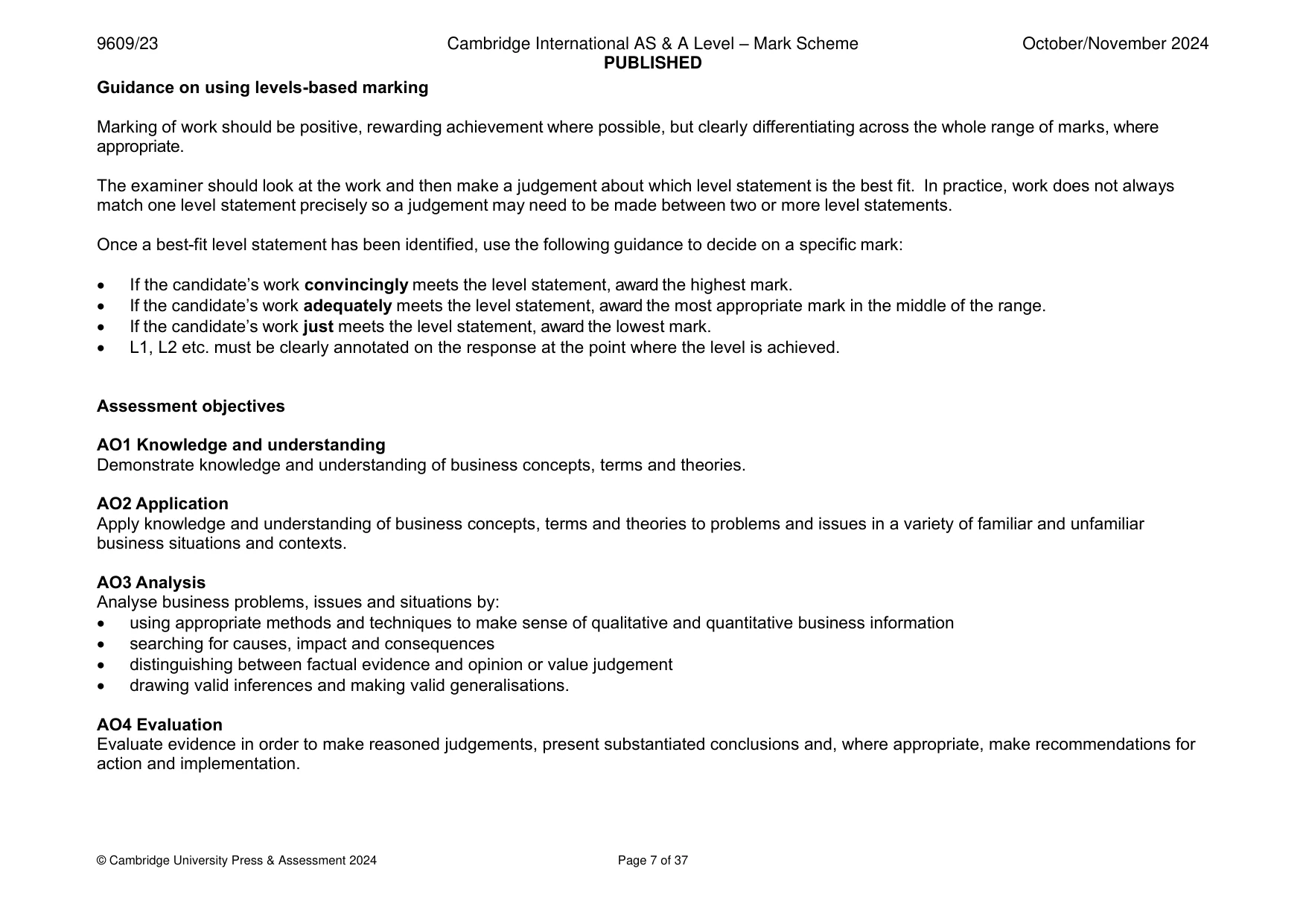
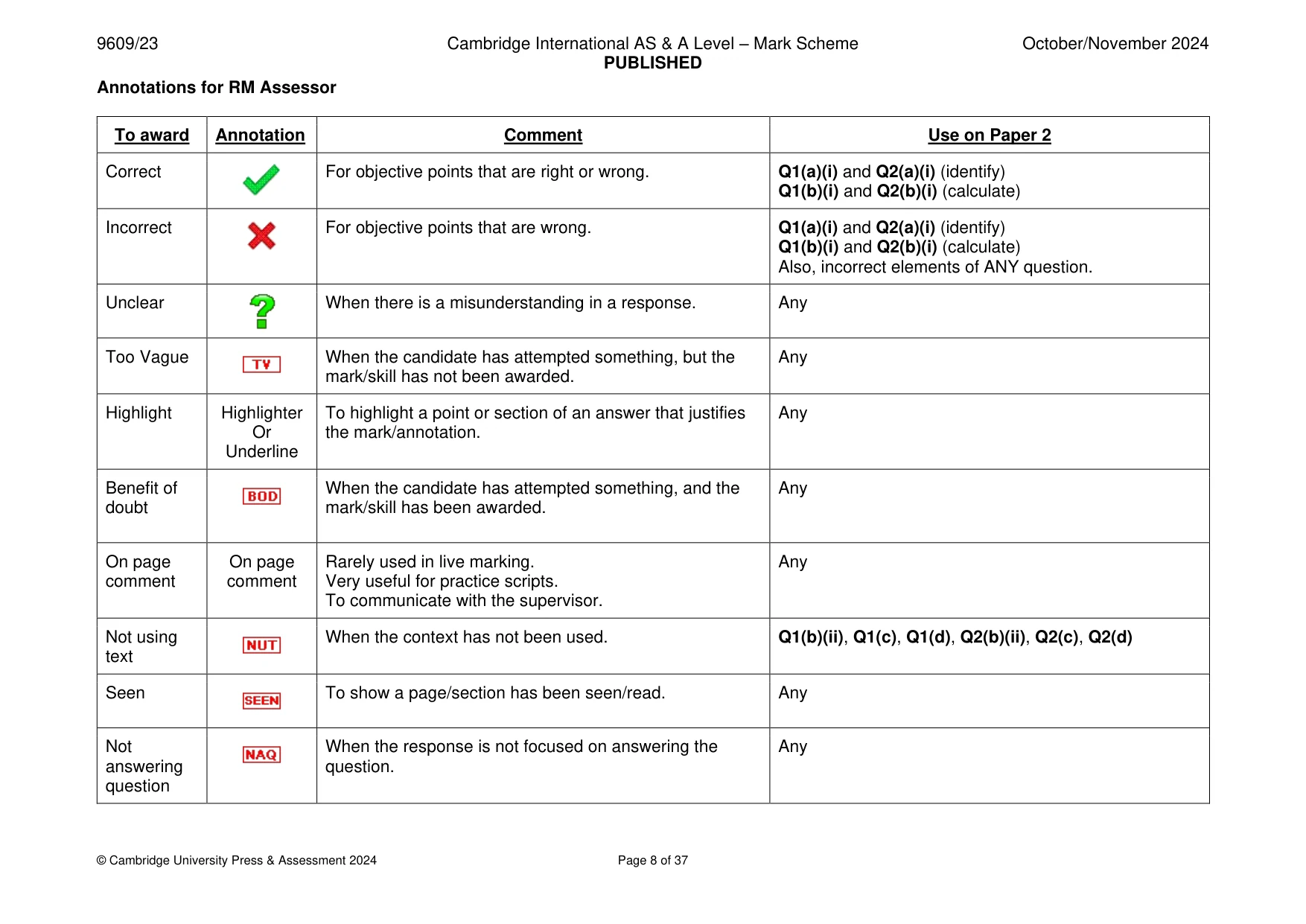
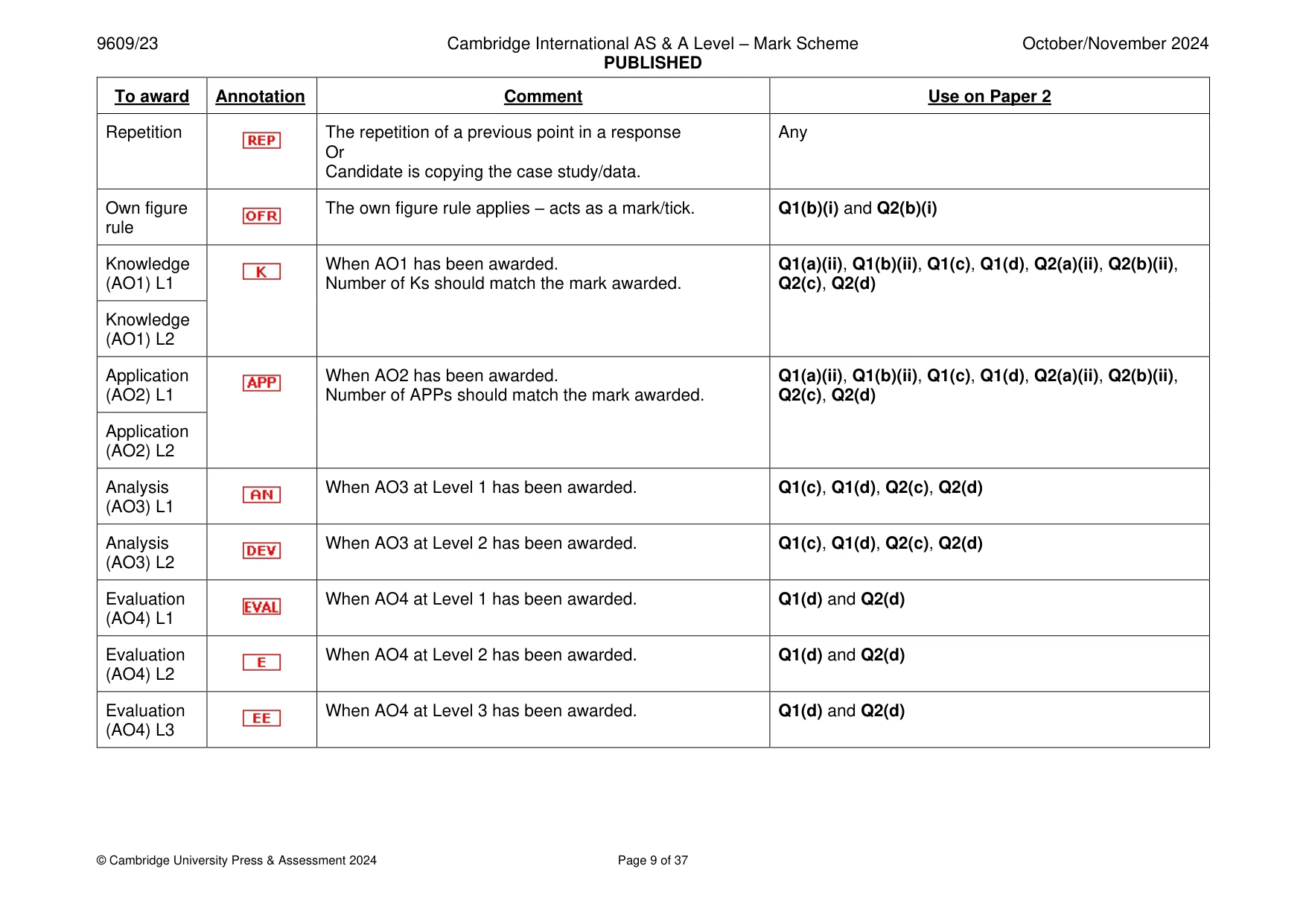
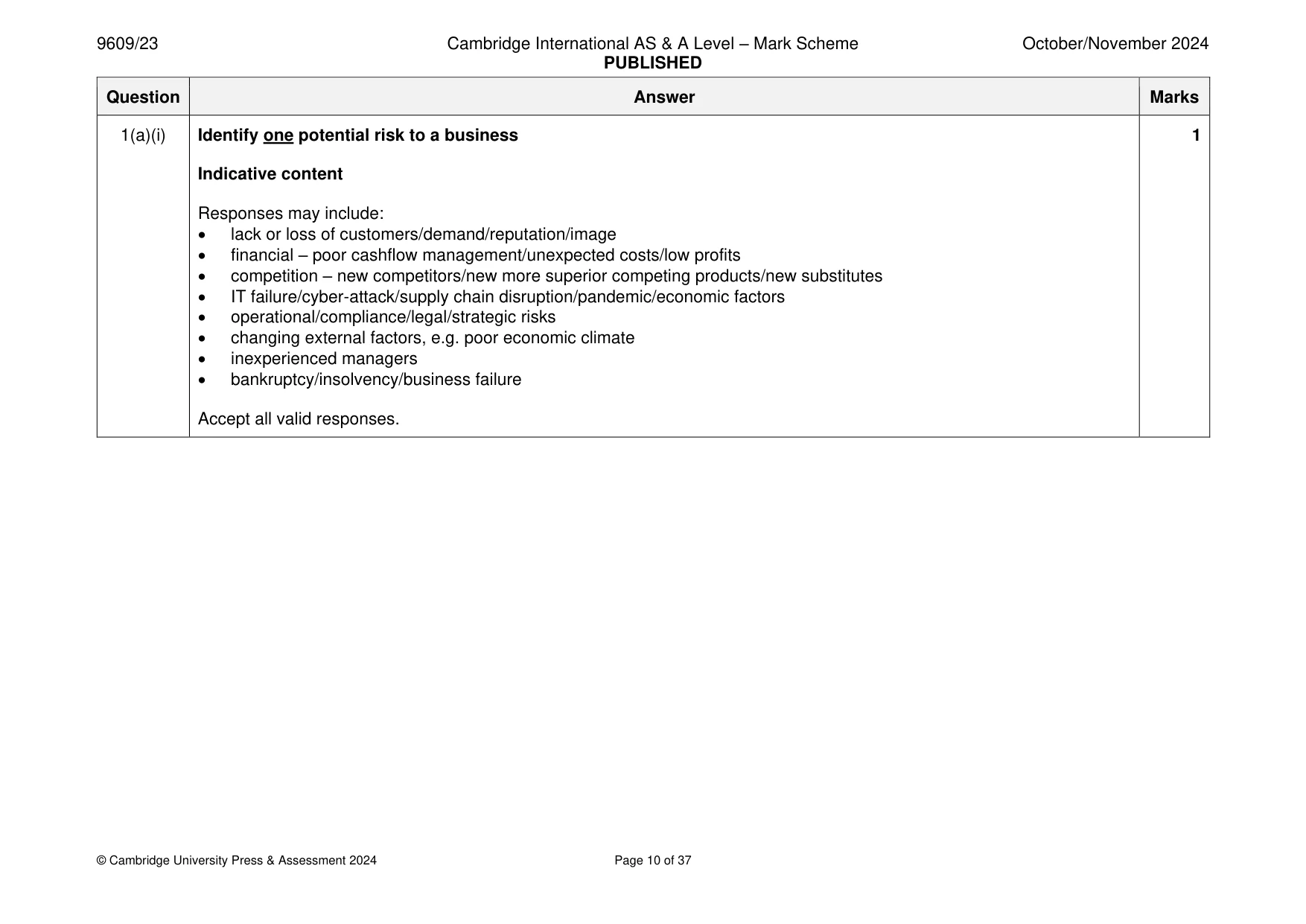
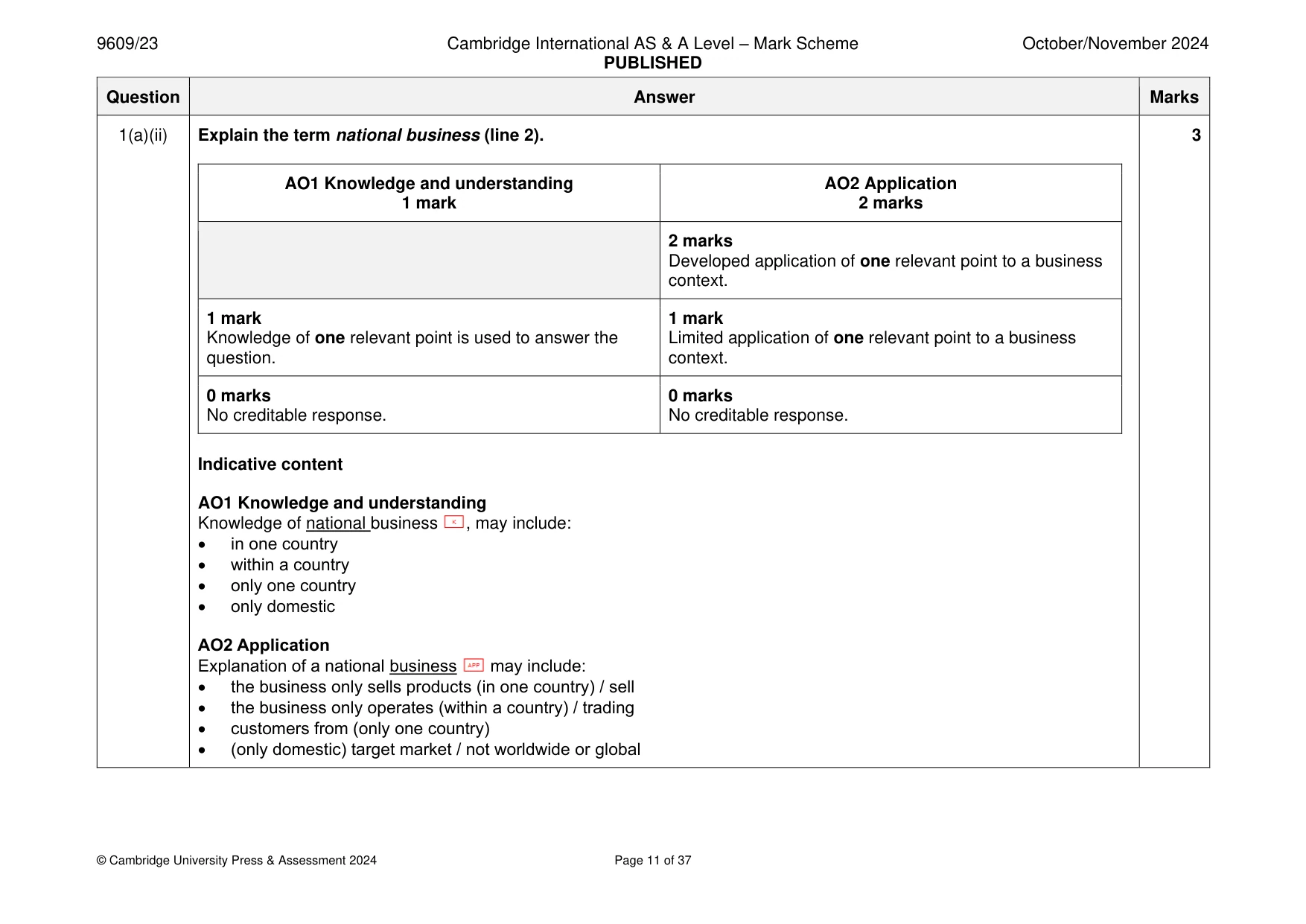
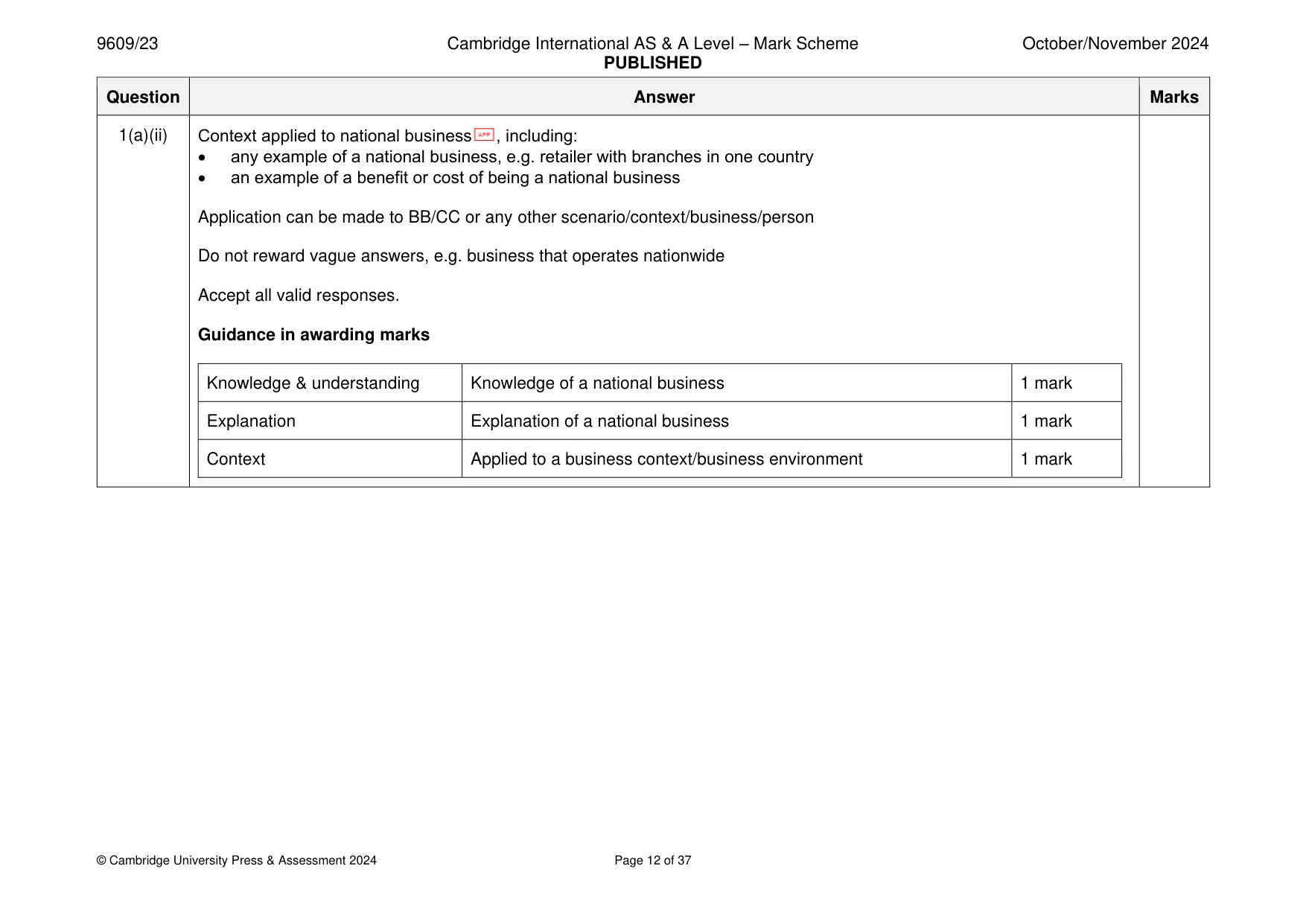
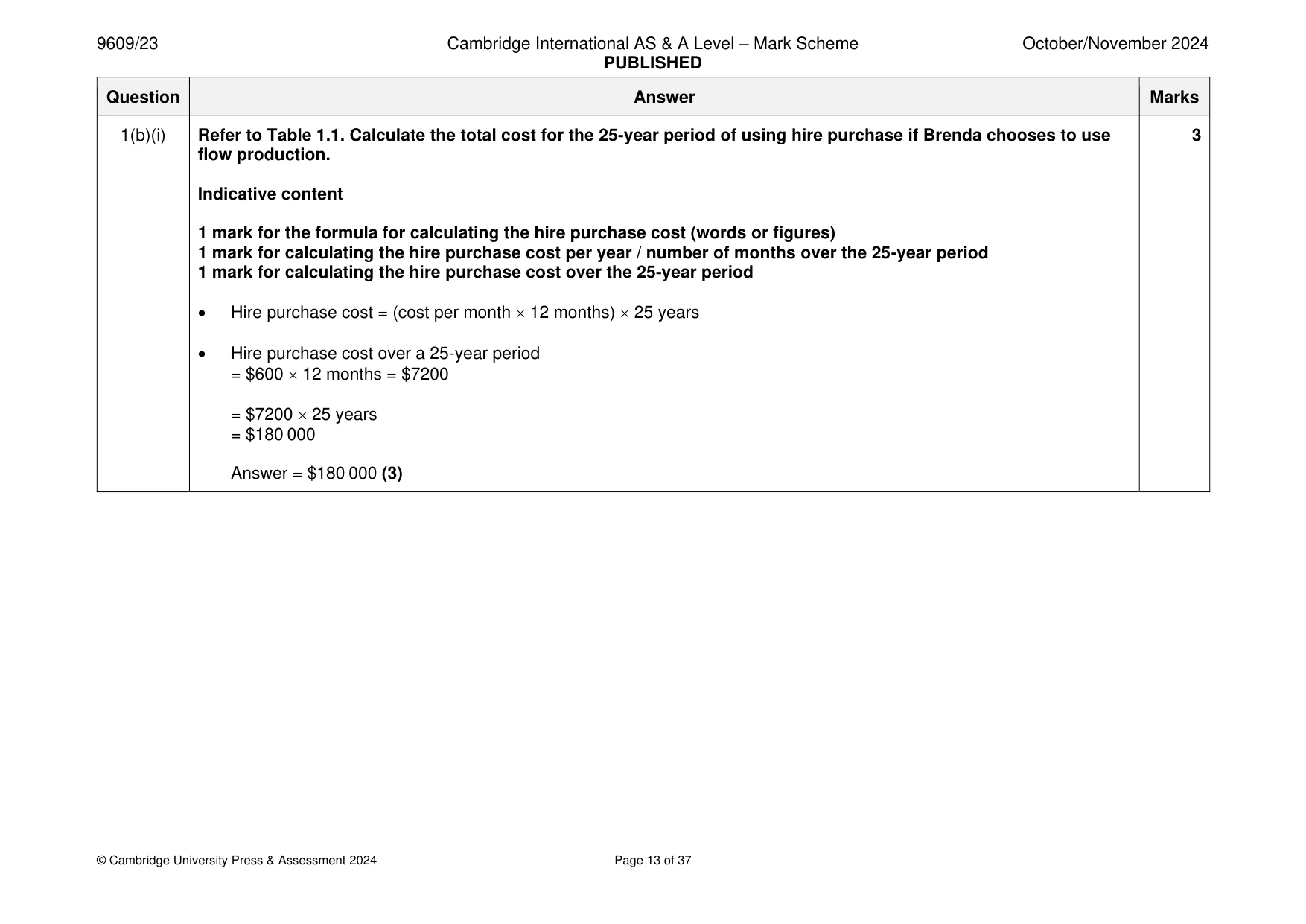
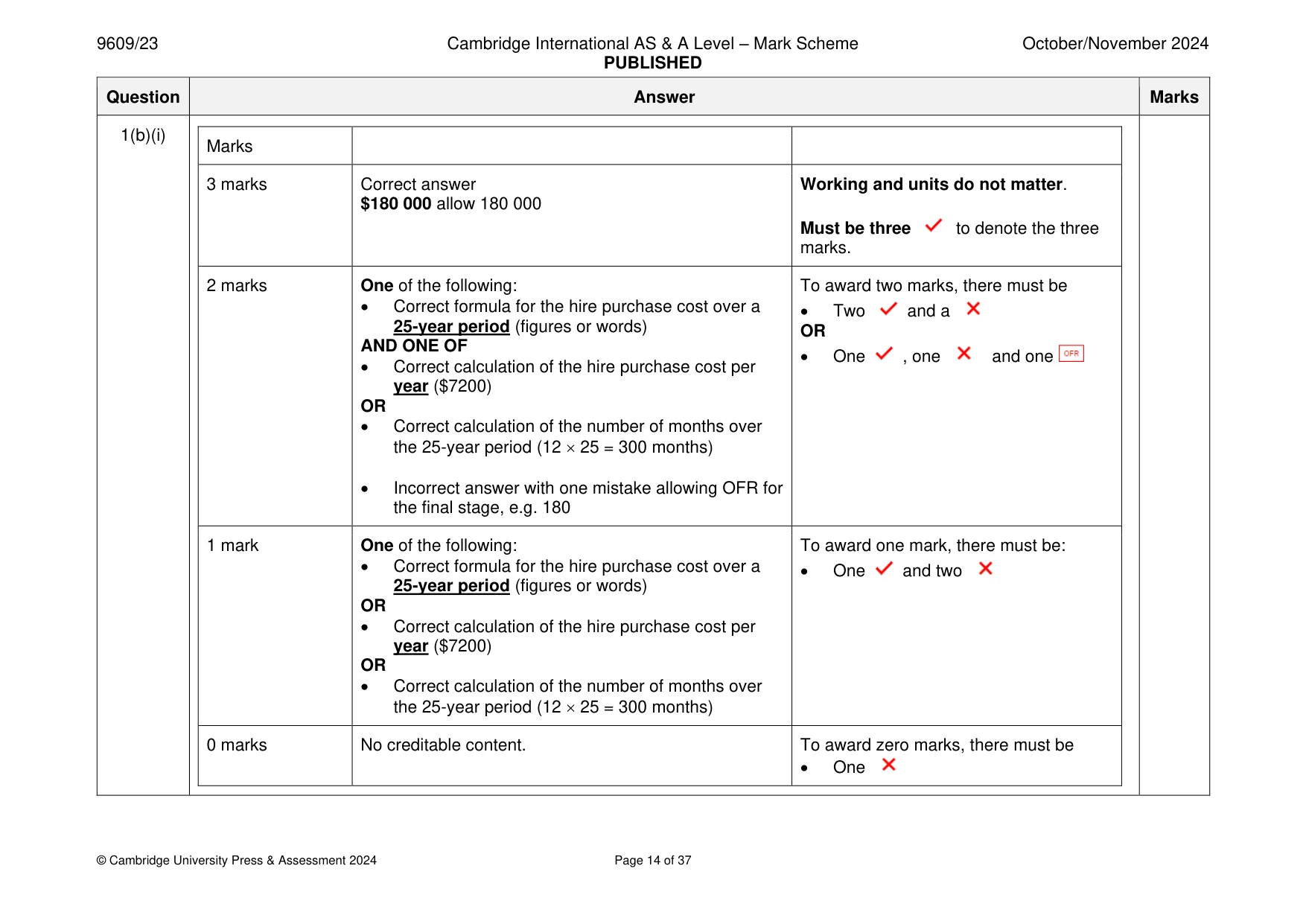
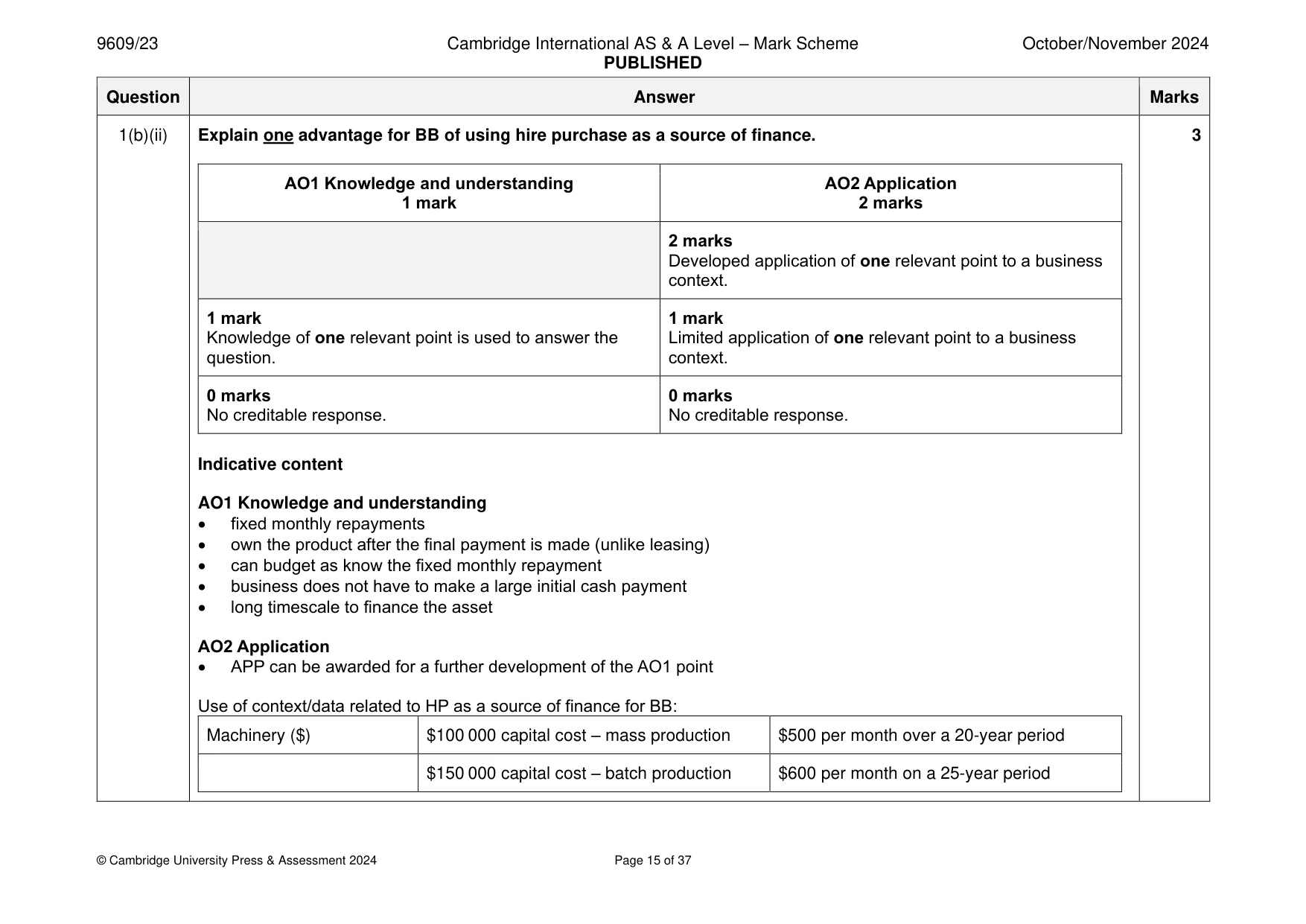
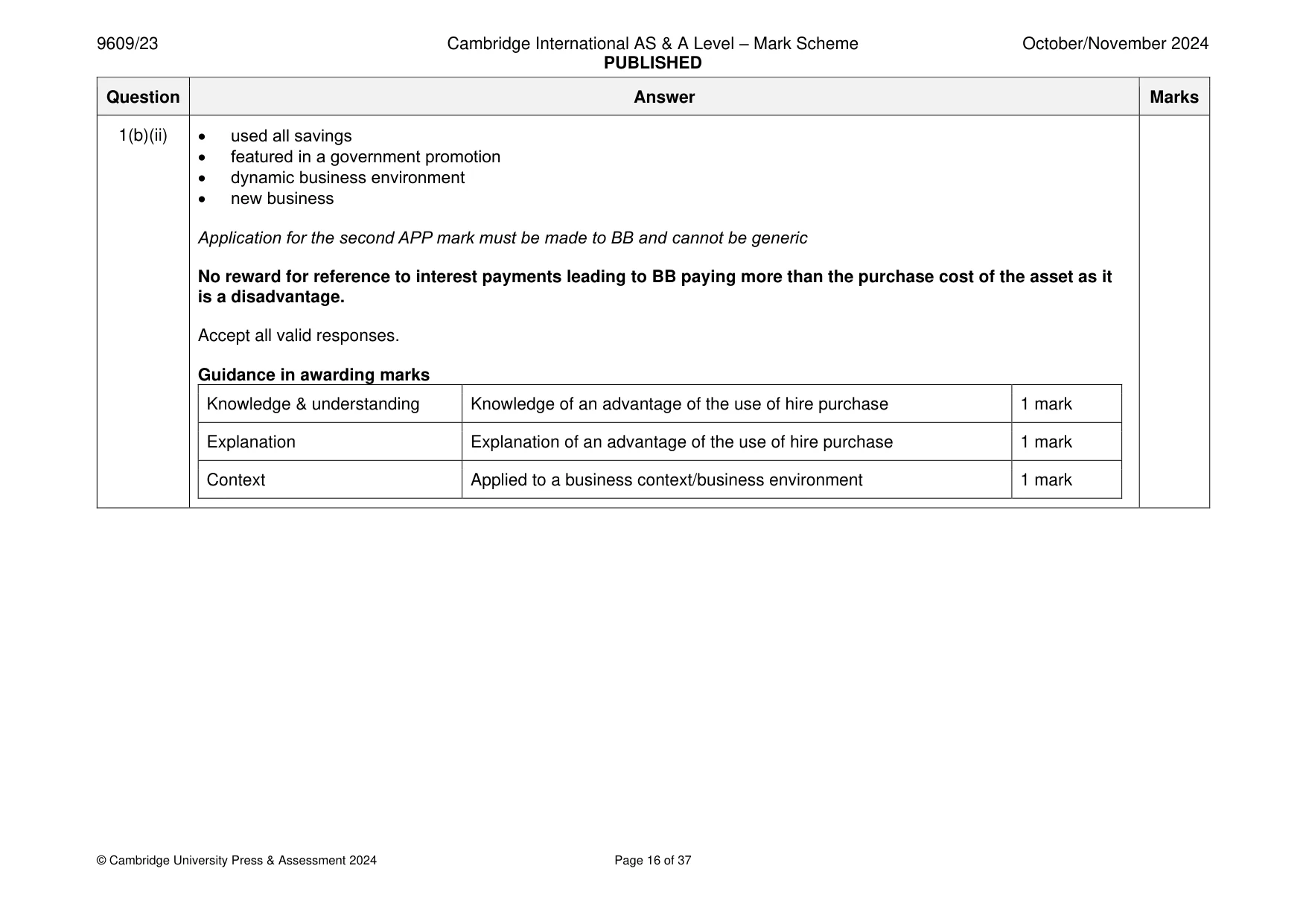
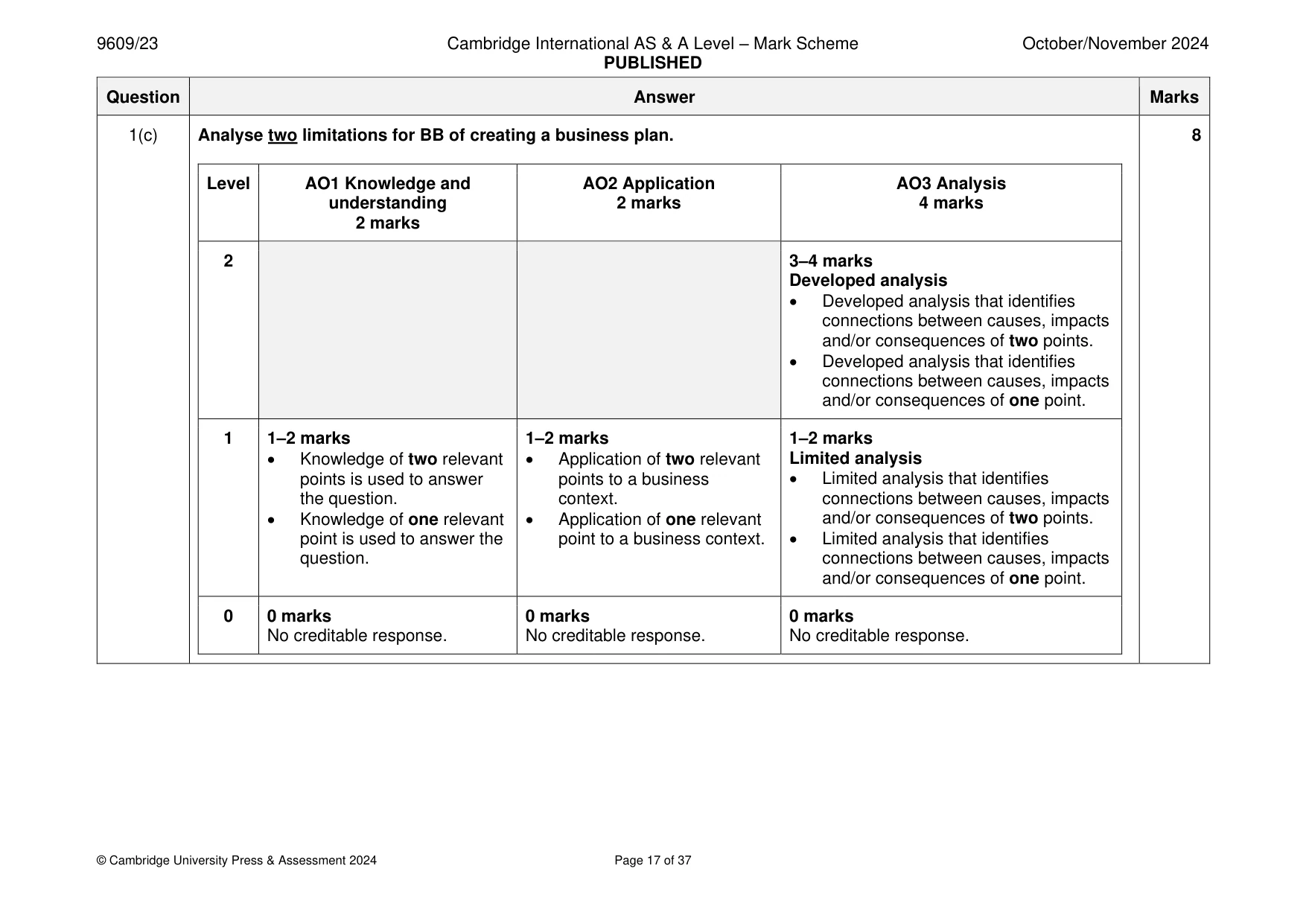
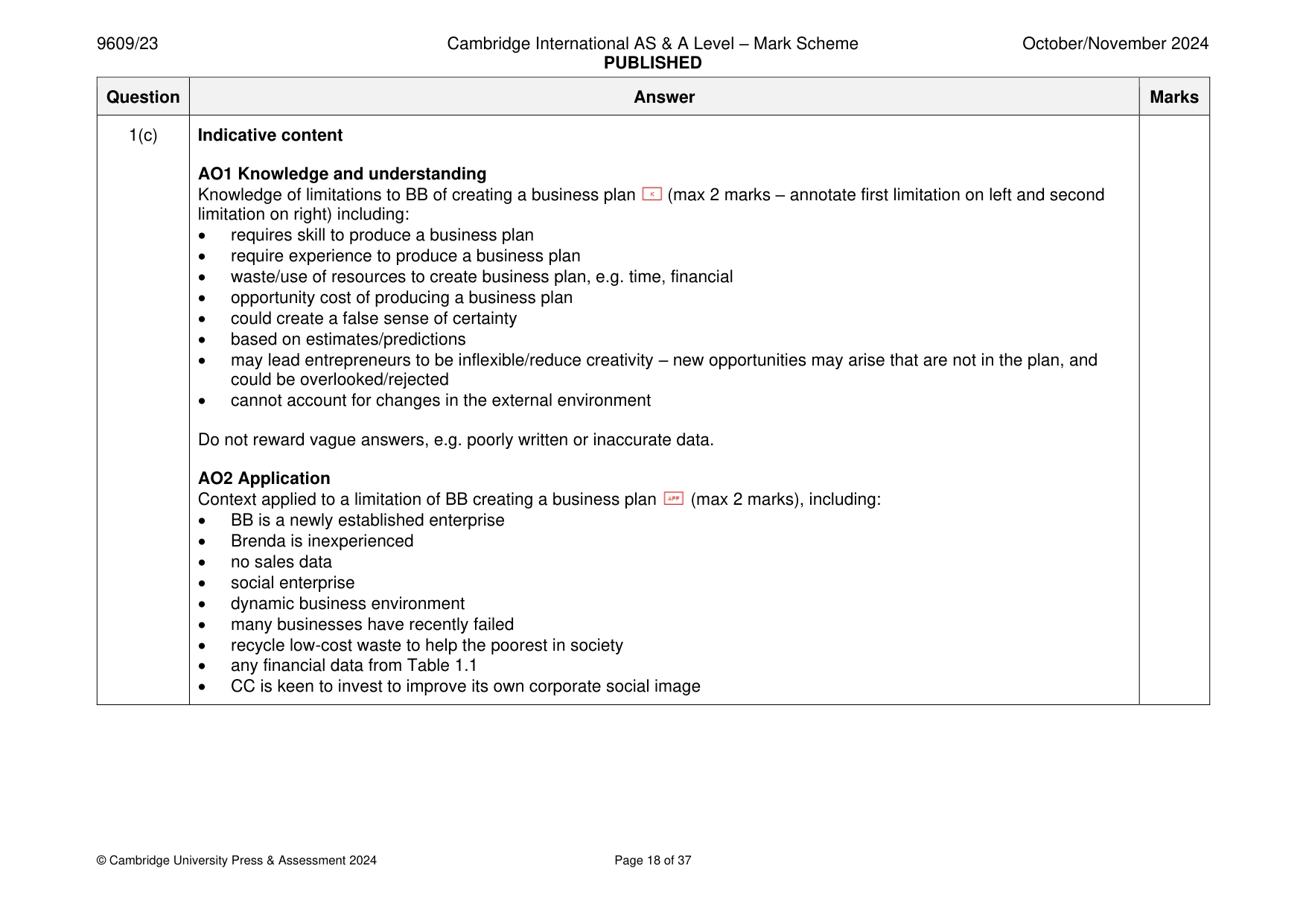
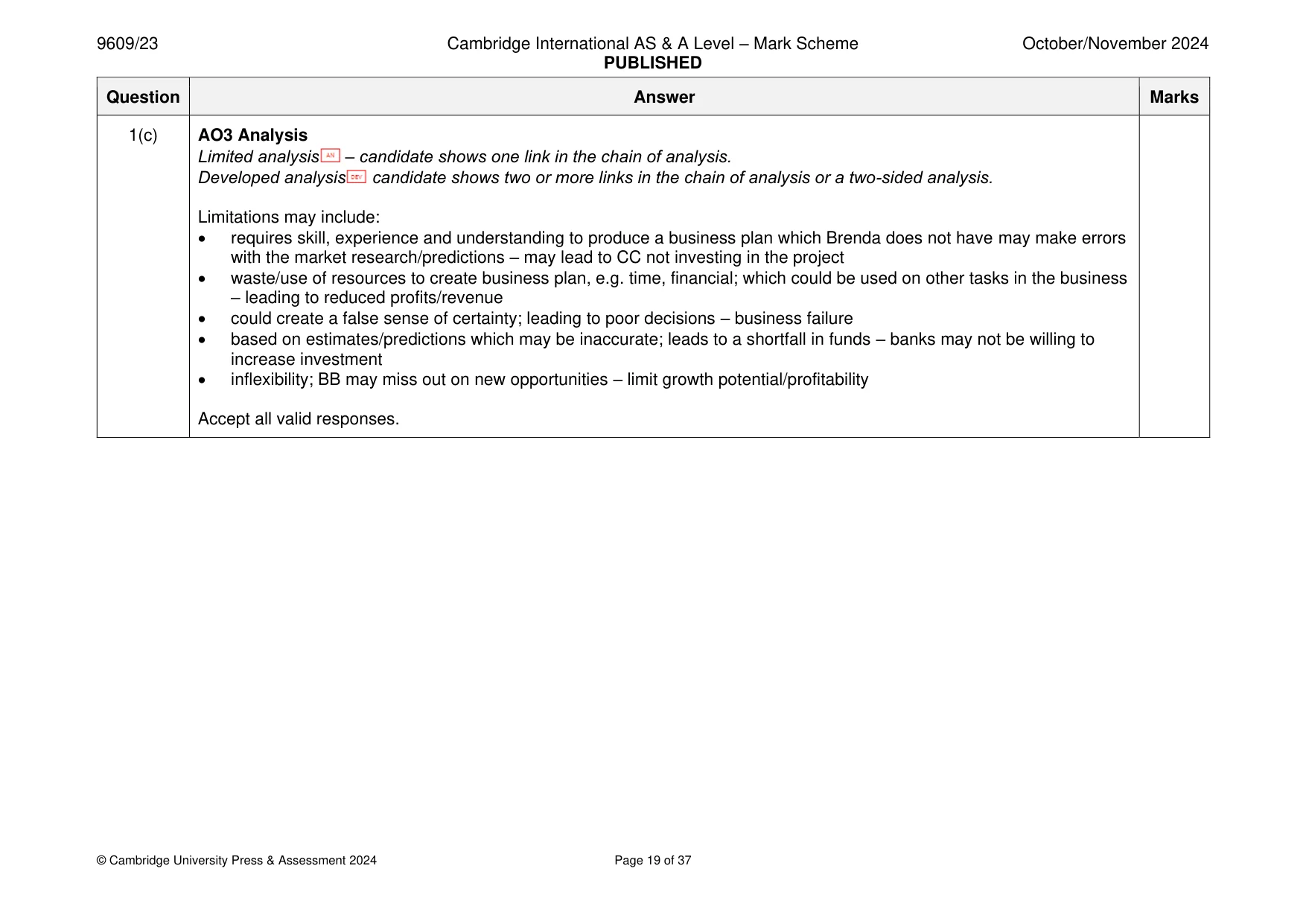
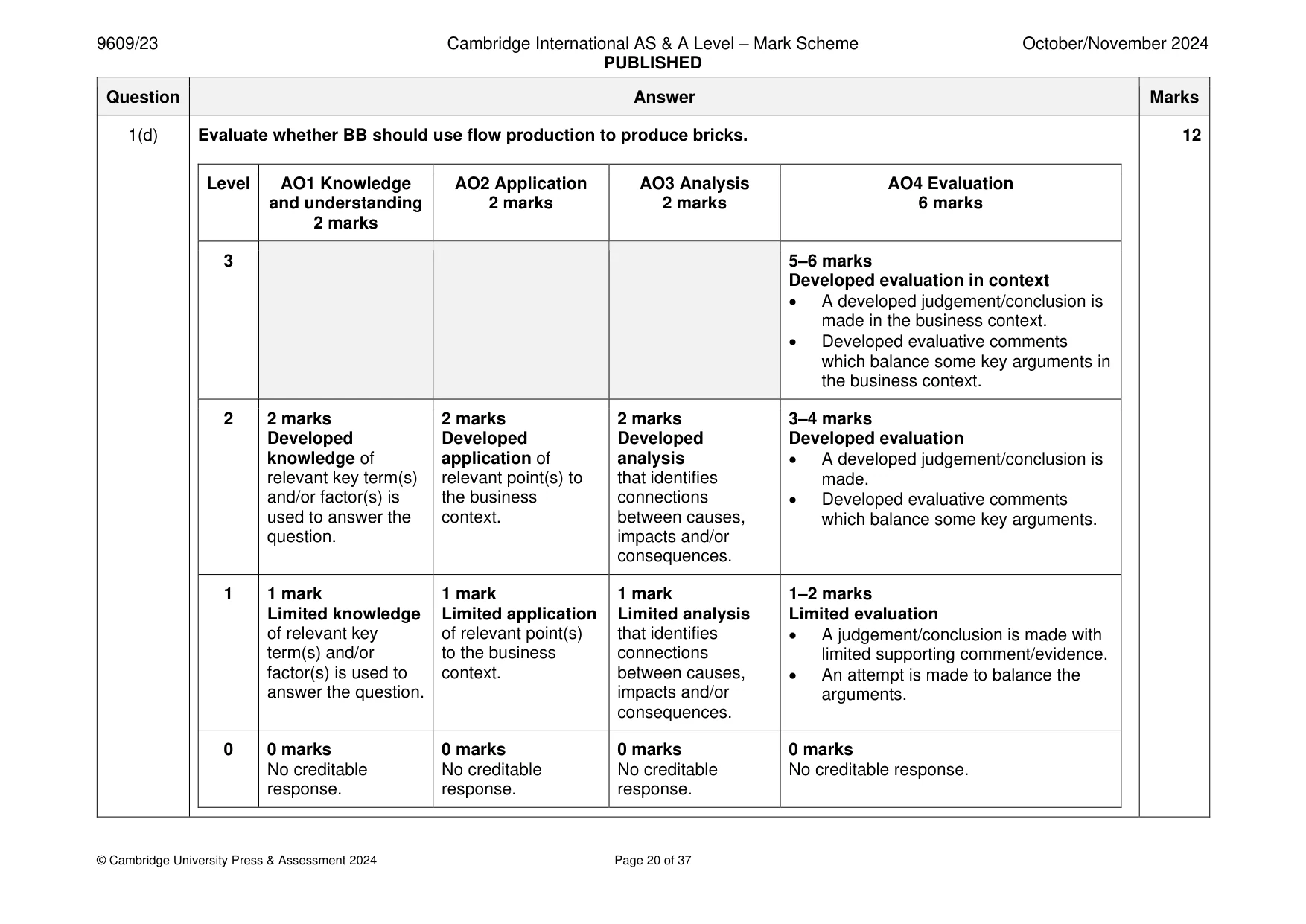
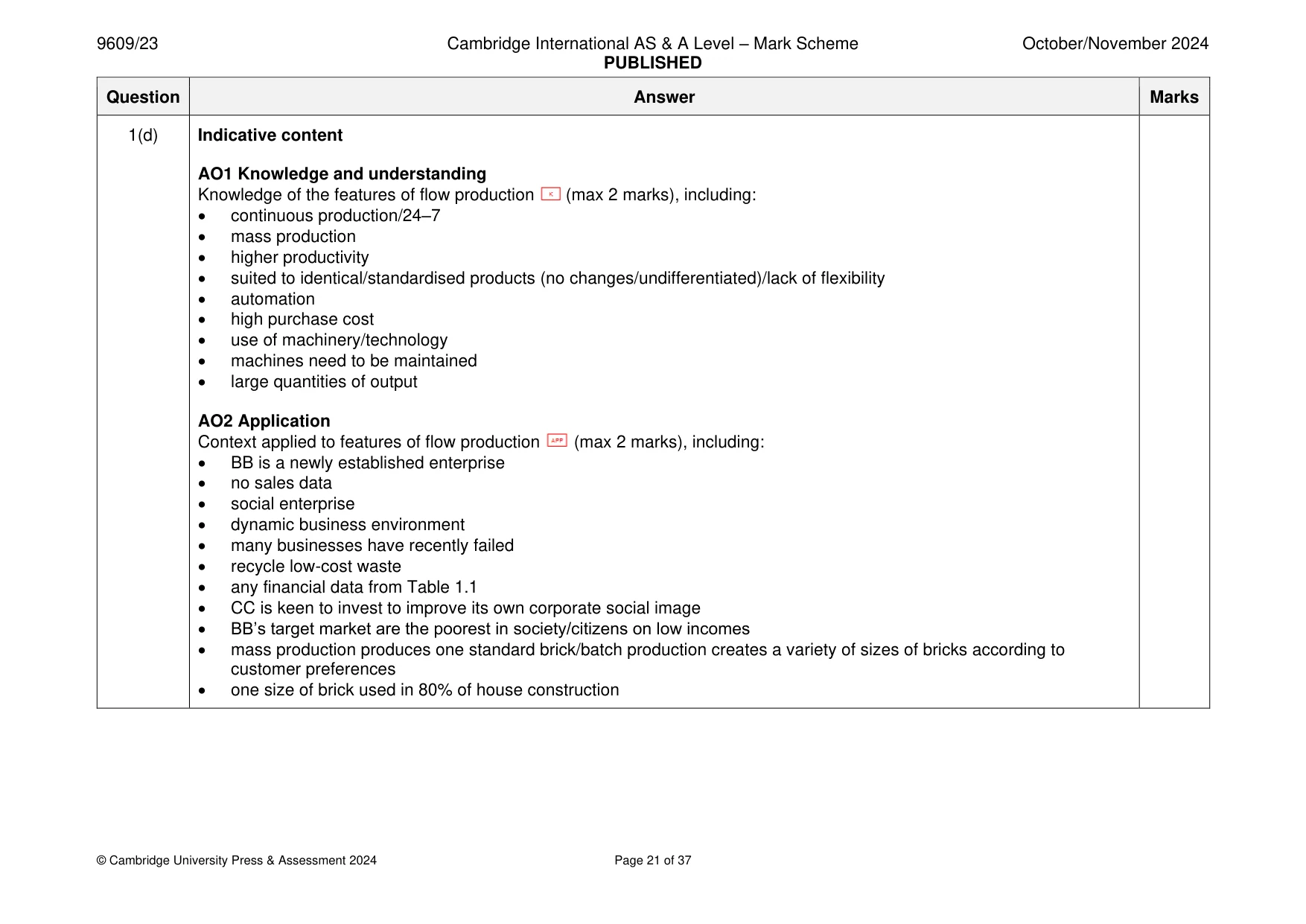
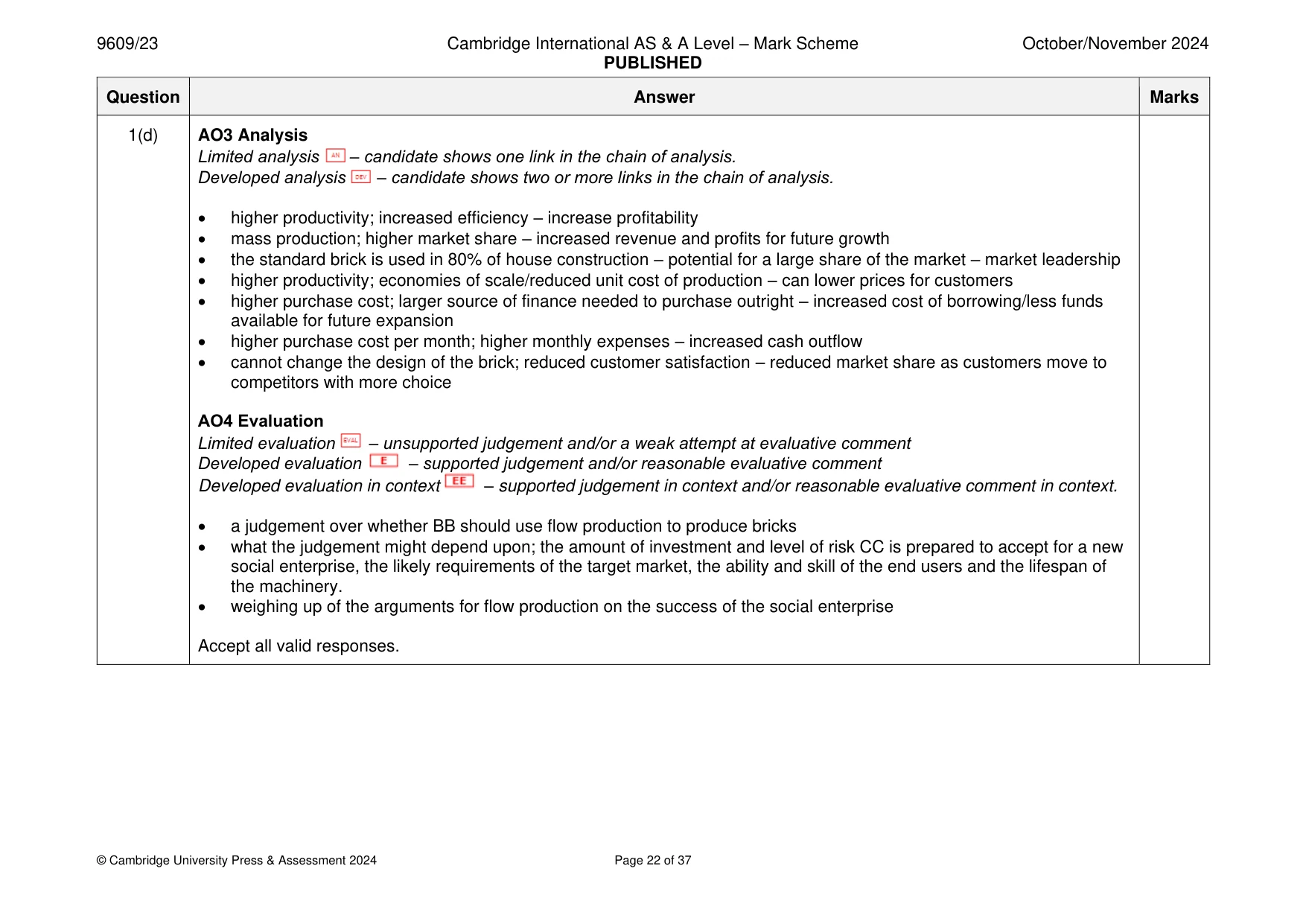
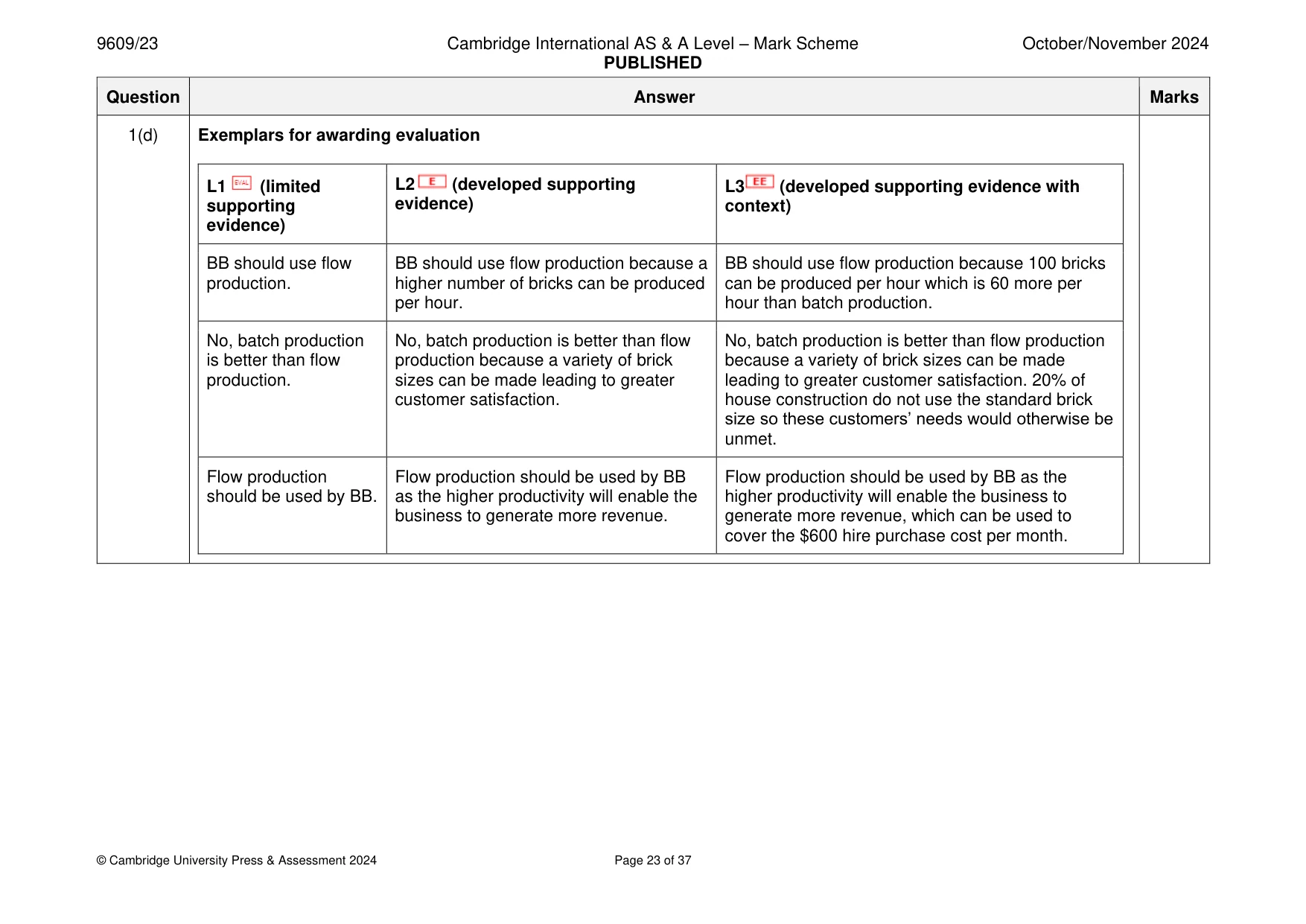
Mark scheme: Question Answer Marks 1(a)(i) Identify one potential risk to a business 1 Indicative content Responses may include: • lack or loss of customers/demand/reputation/image • financial – poor cashflow management/unexpected costs/low profits • competition – new competitors/new more superior competing products/new substitutes • IT failure/cyber-attack/supply chain disruption/pandemic/economic factors • operational/compliance/legal/strategic risks • changing external factors, e.g. poor economic climate • inexperienced managers • bankruptcy/insolvency/business failure Accept all valid responses. 1(a)(ii) Explain the term national business (line 2). 3 AO1 Knowledge and understanding AO2 Application 1 mark 2 marks 2 marks Developed application of one relevant point to a business context. 1 mark 1 mark Knowledge of one relevant point is used to answer the Limited application of one relevant point to a business question. context. 0 marks 0 marks No creditable response. No creditable response. Indicative content AO1 Knowledge and understanding Knowledge of national business , may include: • in one country • within a country • only one country • only domestic AO2 Application Explanation of a national business may include: • the business only sells products (in one country) / sell • the business only operates (within a country) / trading • customers from (only one country) • (only domestic) target market / not worldwide or global 1(a)(ii) Context applied to national business , including: • any example of a national business, e.g. retailer with branches in one country • an example of a benefit or cost of being a national business Application can be made to BB/CC or any other scenario/context/business/person Do not reward vague answers, e.g. business that operates nationwide Accept all valid responses. Guidance in awarding marks Knowledge & understanding Knowledge of a national business 1 mark Explanation Explanation of a national business 1 mark Context Applied to a business context/business environment 1 mark 1(b)(i) Refer to Table 1.1. Calculate the total cost for the 25-year period of using hire purchase if Brenda chooses to use 3 flow production. Indicative content 1 mark for the formula for calculating the hire purchase cost (words or figures) 1 mark for calculating the hire purchase cost per year / number of months over the 25-year period 1 mark for calculating the hire purchase cost over the 25-year period • Hire purchase cost = (cost per month 12 months) 25 years • Hire purchase cost over a 25-year period = $600 12 months = $7200 = $7200 25 years = $180 000 Answer = $180 000 (3) 1(b)(i) Marks 3 marks Correct answer Working and units do not matter. $180 000 allow 180 000 Must be three to denote the three marks. 2 marks One of the following: To award two marks, there must be • Correct formula for the hire purchase cost over a • Two and a 25-year period (figures or words) OR AND ONE OF • One , one and one • Correct calculation of the hire purchase cost per year ($7200) OR • Correct calculation of the number of months over the 25-year period (12 25 = 300 months) • Incorrect answer with one mistake allowing OFR for the final stage, e.g. 180 1 mark One of the following: To award one mark, there must be: • Correct formula for the hire purchase cost over a • One and two 25-year period (figures or words) OR • Correct calculation of the hire purchase cost per year ($7200) OR • Correct calculation of the number of months over the 25-year period (12 25 = 300 months) 0 marks No creditable content. To award zero marks, there must be • One 1(b)(ii) Explain one advantage for BB of using hire purchase as a source of finance. 3 AO1 Knowledge and understanding AO2 Application 1 mark 2 marks 2 marks Developed application of one relevant point to a business context. 1 mark 1 mark Knowledge of one relevant point is used to answer the Limited application of one relevant point to a business question. context. 0 marks 0 marks No creditable response. No creditable response. Indicative content AO1 Knowledge and understanding • fixed monthly repayments • own the product after the final payment is made (unlike leasing) • can budget as know the fixed monthly repayment • business does not have to make a large initial cash payment • long timescale to finance the asset AO2 Application • APP can be awarded for a further development of the AO1 point Use of context/data related to HP as a source of finance for BB: Machinery ($) $100 000 capital cost – mass production $500 per month over a 20-year period $150 000 capital cost – batch production $600 per month on a 25-year period 1(b)(ii) • used all savings • featured in a government promotion • dynamic business environment • new business Application for the second APP mark must be made to BB and cannot be generic No reward for reference to interest payments leading to BB paying more than the purchase cost of the asset as it is a disadvantage. Accept all valid responses. Guidance in awarding marks Knowledge & understanding Knowledge of an advantage of the use of hire purchase 1 mark Explanation Explanation of an advantage of the use of hire purchase 1 mark Context Applied to a business context/business environment 1 mark 1(c) Analyse two limitations for BB of creating a business plan. 8 Level AO1 Knowledge and AO2 Application AO3 Analysis understanding 2 marks 4 marks 2 marks 2 3–4 marks Developed analysis • Developed analysis that identifies connections between causes, impacts and/or consequences of two points. • Developed analysis that identifies connections between causes, impacts and/or consequences of one point. 1 1–2 marks 1–2 marks 1–2 marks • Knowledge of two relevant • Application of two relevant Limited analysis points is used to answer points to a business • Limited analysis that identifies the question. context. connections between causes, impacts • Knowledge of one relevant • Application of one relevant and/or consequences of two points. point is used to answer the point to a business context. • Limited analysis that identifies question. connections between causes, impacts and/or consequences of one point. 0 0 marks 0 marks 0 marks No creditable response. No creditable response. No creditable response. 1(c) Indicative content AO1 Knowledge and understanding Knowledge of limitations to BB of creating a business plan (max 2 marks – annotate first limitation on left and second limitation on right) including: • requires skill to produce a business plan • require experience to produce a business plan • waste/use of resources to create business plan, e.g. time, financial • opportunity cost of producing a business plan • could create a false sense of certainty • based on estimates/predictions • may lead entrepreneurs to be inflexible/reduce creativity – new opportunities may arise that are not in the plan, and could be overlooked/rejected • cannot account for changes in the external environment Do not reward vague answers, e.g. poorly written or inaccurate data. AO2 Application Context applied to a limitation of BB creating a business plan (max 2 marks), including: • BB is a newly established enterprise • Brenda is inexperienced • no sales data • social enterprise • dynamic business environment • many businesses have recently failed • recycle low-cost waste to help the poorest in society • any financial data from Table 1.1 • CC is keen to invest to improve its own corporate social image 1(c) AO3 Analysis Limited analysis – candidate shows one link in the chain of analysis. Developed analysis candidate shows two or more links in the chain of analysis or a two-sided analysis. Limitations may include: • requires skill, experience and understanding to produce a business plan which Brenda does not have may make errors with the market research/predictions – may lead to CC not investing in the project • waste/use of resources to create business plan, e.g. time, financial; which could be used on other tasks in the business – leading to reduced profits/revenue • could create a false sense of certainty; leading to poor decisions – business failure • based on estimates/predictions which may be inaccurate; leads to a shortfall in funds – banks may not be willing to increase investment • inflexibility; BB may miss out on new opportunities – limit growth potential/profitability Accept all valid responses. 1(d) Evaluate whether BB should use flow production to produce bricks. 12 Level AO1 Knowledge AO2 Application AO3 Analysis AO4 Evaluation and understanding 2 marks 2 marks 6 marks 2 marks 3 5–6 marks Developed evaluation in context • A developed judgement/conclusion is made in the business context. • Developed evaluative comments which balance some key arguments in the business context. 2 2 marks 2 marks 2 marks 3–4 marks Developed Developed Developed Developed evaluation knowledge of application of analysis • A developed judgement/conclusion is relevant key term(s) relevant point(s) to that identifies made. and/or factor(s) is the business connections • Developed evaluative comments used to answer the context. between causes, which balance some key arguments. question. impacts and/or consequences. 1 1 mark 1 mark 1 mark 1–2 marks Limited knowledge Limited application Limited analysis Limited evaluation of relevant key of relevant point(s) that identifies • A judgement/conclusion is made with term(s) and/or to the business connections limited supporting comment/evidence. factor(s) is used to context. between causes, • An attempt is made to balance the answer the question. impacts and/or arguments. consequences. 0 0 marks 0 marks 0 marks 0 marks No creditable No creditable No creditable No creditable response. response. response. response. 1(d) Indicative content AO1 Knowledge and understanding Knowledge of the features of flow production (max 2 marks), including: • continuous production/24–7 • mass production • higher productivity • suited to identical/standardised products (no changes/undifferentiated)/lack of flexibility • automation • high purchase cost • use of machinery/technology • machines need to be maintained • large quantities of output AO2 Application Context applied to features of flow production (max 2 marks), including: • BB is a newly established enterprise • no sales data • social enterprise • dynamic business environment • many businesses have recently failed • recycle low-cost waste • any financial data from Table 1.1 • CC is keen to invest to improve its own corporate social image • BB’s target market are the poorest in society/citizens on low incomes • mass production produces one standard brick/batch production creates a variety of sizes of bricks according to customer preferences • one size of brick used in 80% of house construction 1(d) AO3 Analysis Limited analysis – candidate shows one link in the chain of analysis. Developed analysis – candidate shows two or more links in the chain of analysis. • higher productivity; increased efficiency – increase profitability • mass production; higher market share – increased revenue and profits for future growth • the standard brick is used in 80% of house construction – potential for a large share of the market – market leadership • higher productivity; economies of scale/reduced unit cost of production – can lower prices for customers • higher purchase cost; larger source of finance needed to purchase outright – increased cost of borrowing/less funds available for future expansion • higher purchase cost per month; higher monthly expenses – increased cash outflow • cannot change the design of the brick; reduced customer satisfaction – reduced market share as customers move to competitors with more choice AO4 Evaluation Limited evaluation – unsupported judgement and/or a weak attempt at evaluative comment Developed evaluation – supported judgement and/or reasonable evaluative comment Developed evaluation in context – supported judgement in context and/or reasonable evaluative comment in context. • a judgement over whether BB should use flow production to produce bricks • what the judgement might depend upon; the amount of investment and level of risk CC is prepared to accept for a new social enterprise, the likely requirements of the target market, the ability and skill of the end users and the lifespan of the machinery. • weighing up of the arguments for flow production on the success of the social enterprise Accept all valid responses. 1(d) Exemplars for awarding evaluation L1 (limited L2 (developed supporting L3 (developed supporting evidence with supporting evidence) context) evidence) BB should use flow BB should use flow production because a BB should use flow production because 100 bricks production. higher number of bricks can be produced can be produced per hour which is 60 more per per hour. hour than batch production. No, batch production No, batch production is better than flow No, batch production is better than flow production is better than flow production because a variety of brick because a variety of brick sizes can be made production. sizes can be made leading to greater leading to greater customer satisfaction. 20% of customer satisfaction. house construction do not use the standard brick size so these customers’ needs would otherwise be unmet. Flow production Flow production should be used by BB Flow production should be used by BB as the should be used by BB. as the higher productivity will enable the higher productivity will enable the business to business to generate more revenue. generate more revenue, which can be used to cover the $600 hire purchase cost per month.
Q2 · Vegan Burger (VB) VB is an established vegan burger chain in country X
2 Vegan Burger (VB) VB is an established vegan burger chain in country X. Its Unique Selling Point (USP) is high quality, good value vegan meals. Hilda, the Managing Director, grew the business without external investment and within 5 years had 10 restaurants in the north of country X. VB was featured in a documentary exploring successful entrepreneurs in country X. This boosted VB’s national brand awareness. As a result, VB changed its objective from 5 developing brand awareness to increasing market share. VB chose a franchise model to meet this objective. VB sold 25 franchise licenses in country X in 5 years. Two years ago, primary market research indicated pizza was a popular fast food in country X. VB added vegan pizza to its menu. Each pizza oven had a significant capital cost and required on-the-job training of the employees. VB invested in a six-month national television 10 marketing campaign to promote the new menu item. Table 2.1 shows the financial data for producing pizzas. Table 2.1 Financial data for producing pizzas per restaurant ($) Fixed costs per month 1 000 15 Average variable costs per pizza 2 Average selling price per pizza 6 Vegan pizza has been sold by VB for two years. Tony, the Business Development Manager, provided sales data for these two years. Each restaurant sells on average 500 pizzas and 4500 burgers per month. Tony is worried that Patel’s Pizza, an established pizza franchise, 20 is more popular. Tony has suggested removing pizza from the menu and repurposing the pizza ovens to cook hot desserts such as apple pies that complement the main burger meal. Hilda wants to continue marketing vegan pizza, as vegan food is currently very popular and the brand needs time and more marketing to be successful. 25 (a) (i) Identify one feature of a franchise. [1] (ii) Explain the term market share (line 6). [3] (b) (i) Refer to Table 2.1. Calculate VB’s breakeven level of output per month per restaurant. [3] (ii) Explain one reason for VB to have accurate cost information. [3] (c) Analyse two benefits for VB of on-the-job training. [8] (d) Evaluate whether VB should continue to market vegan pizza. [12]
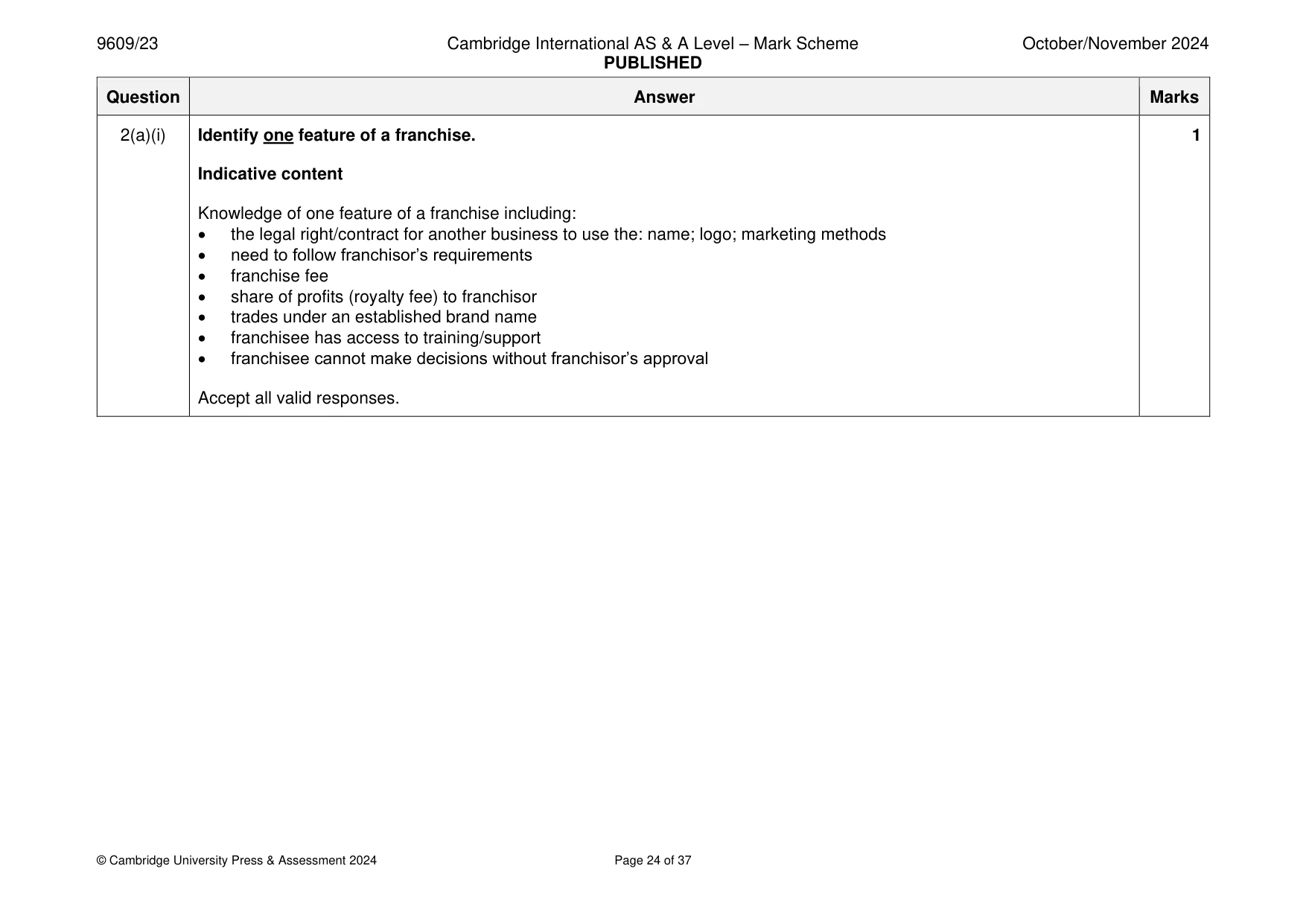
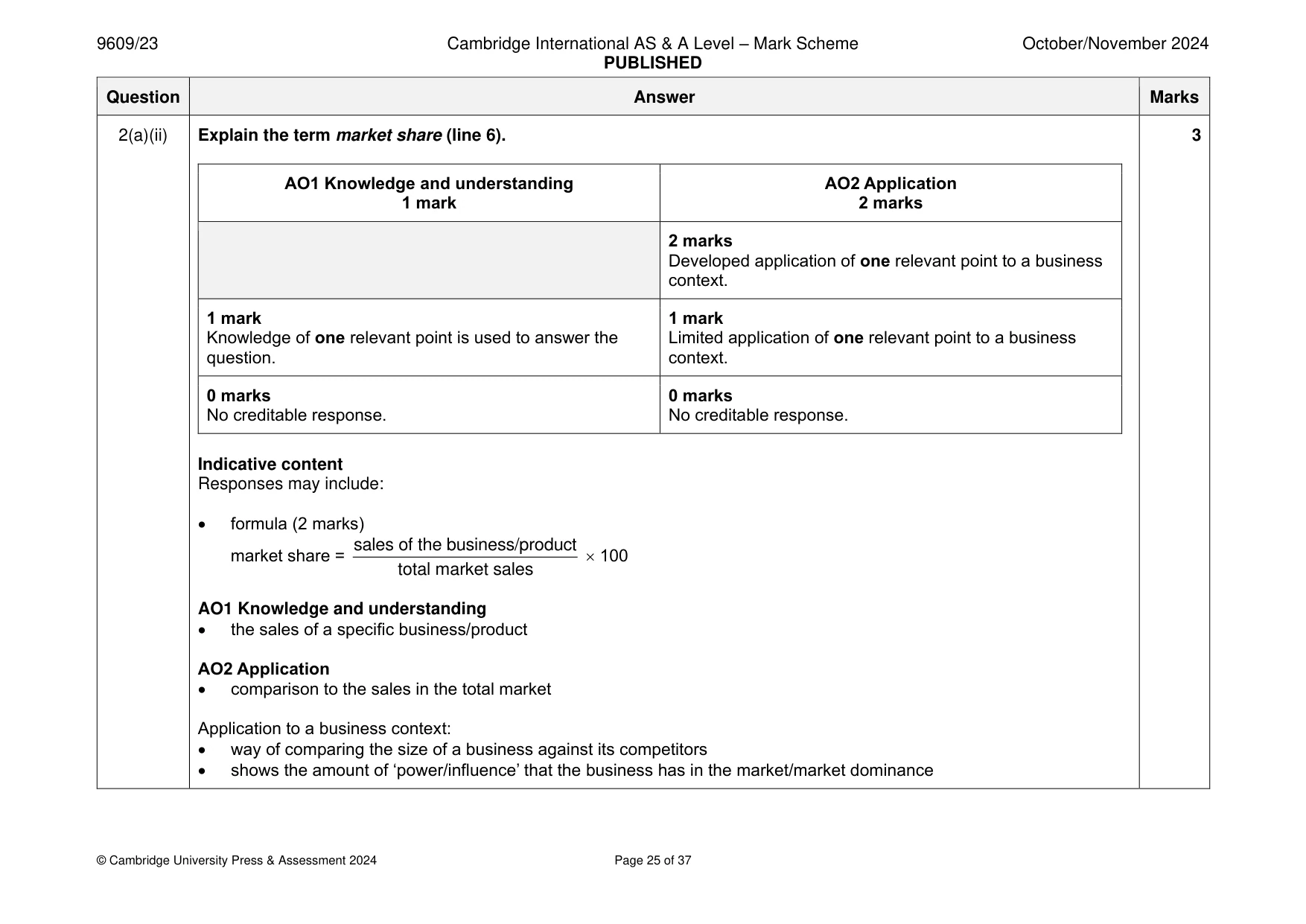
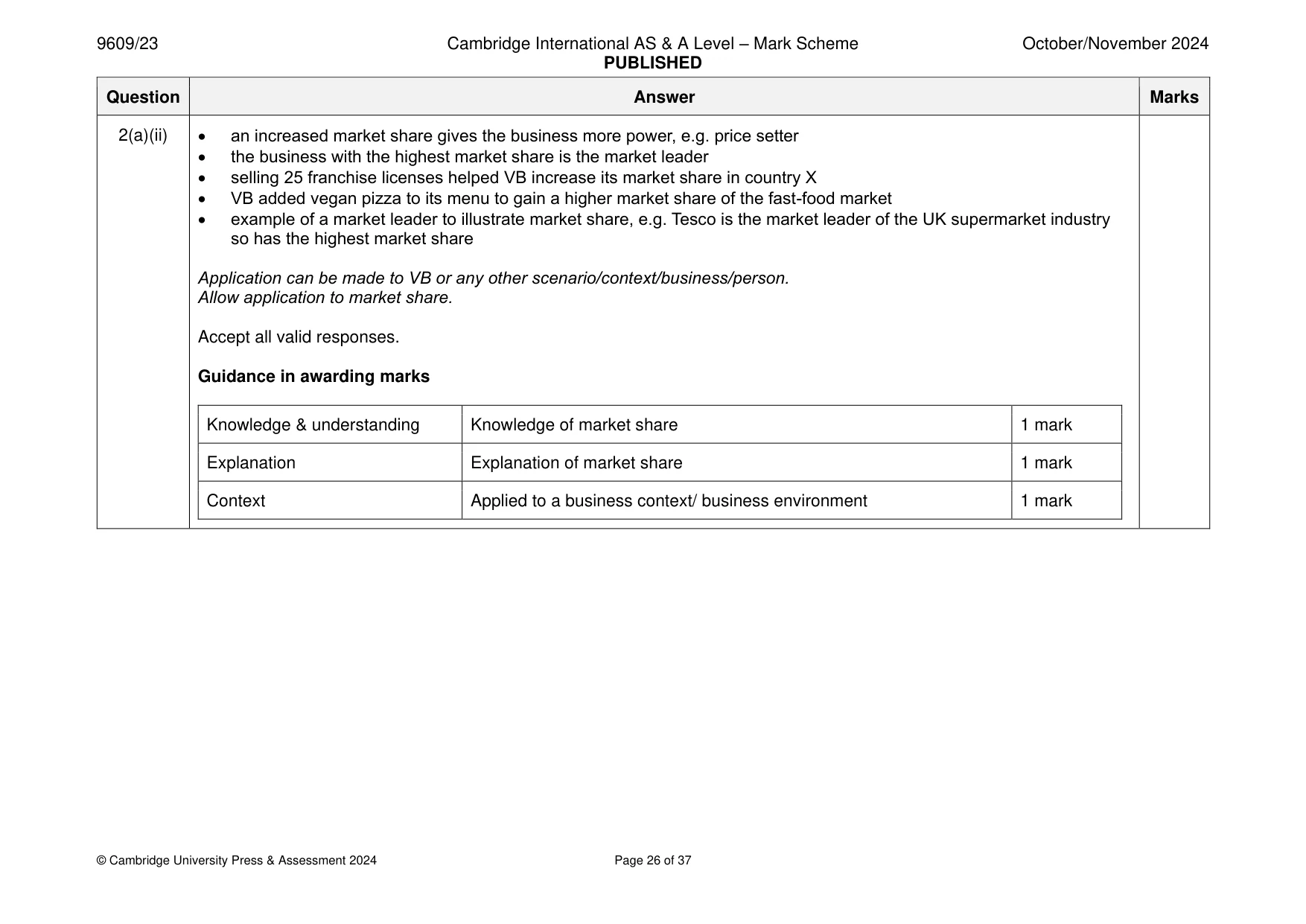
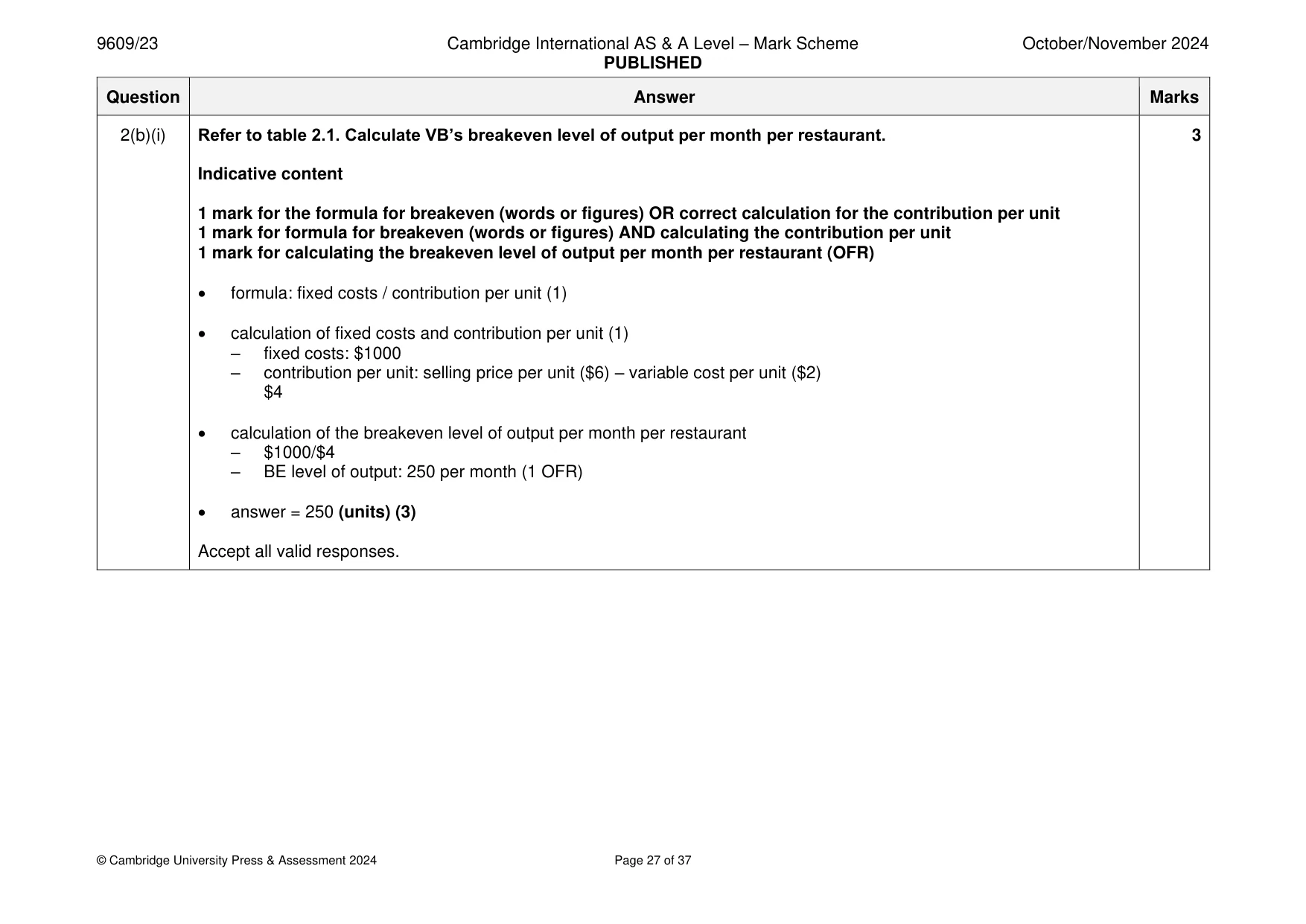
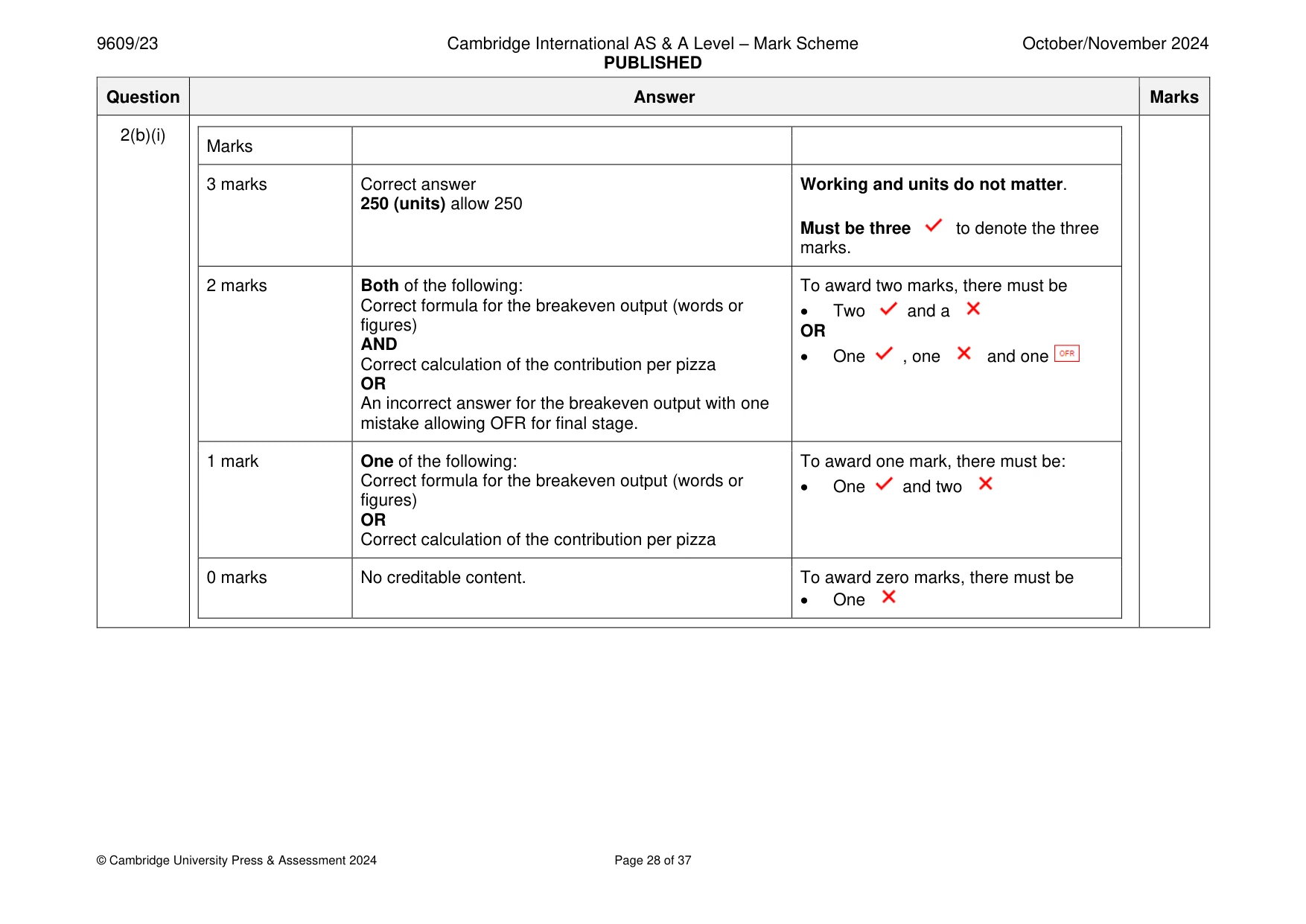
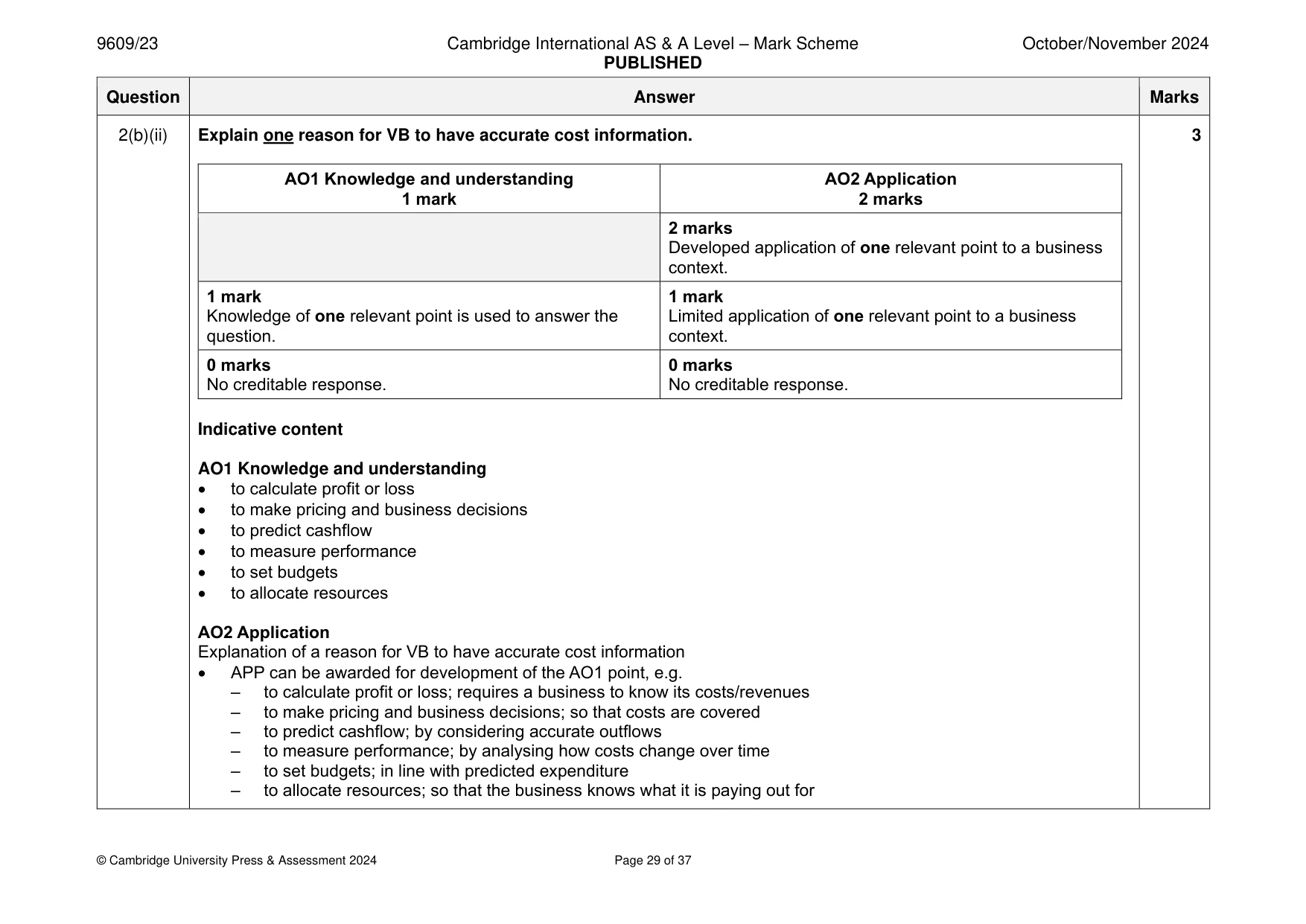
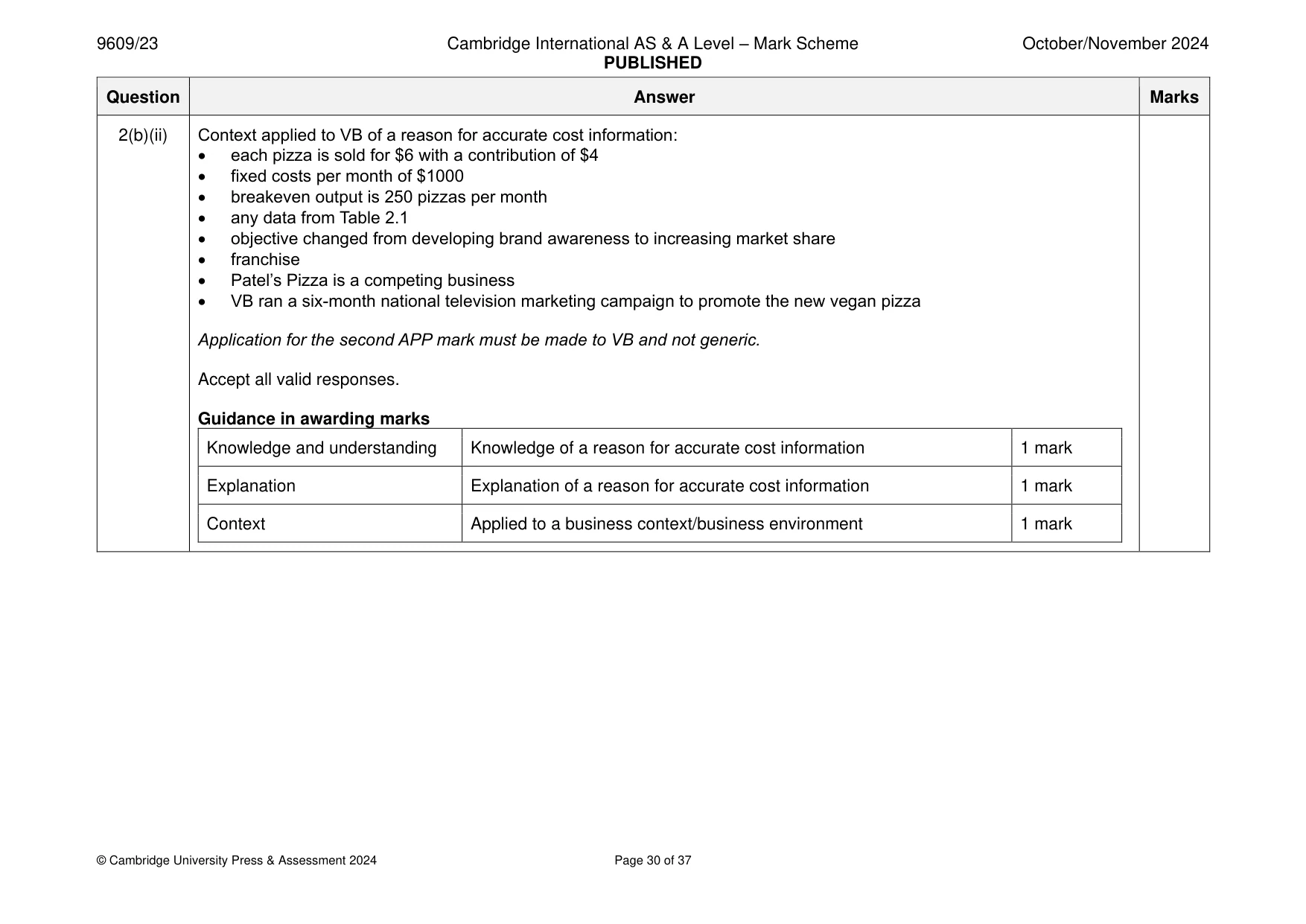
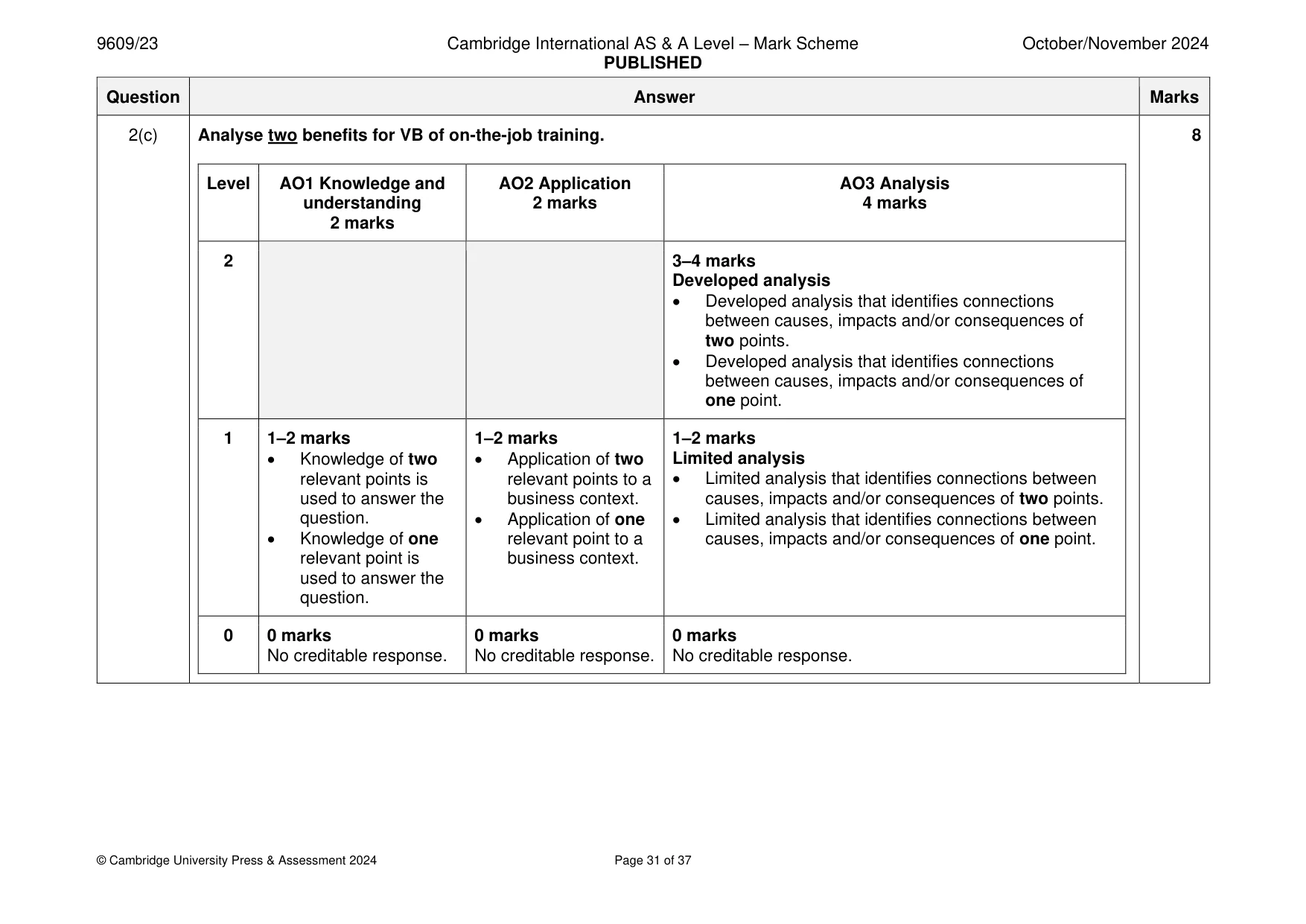
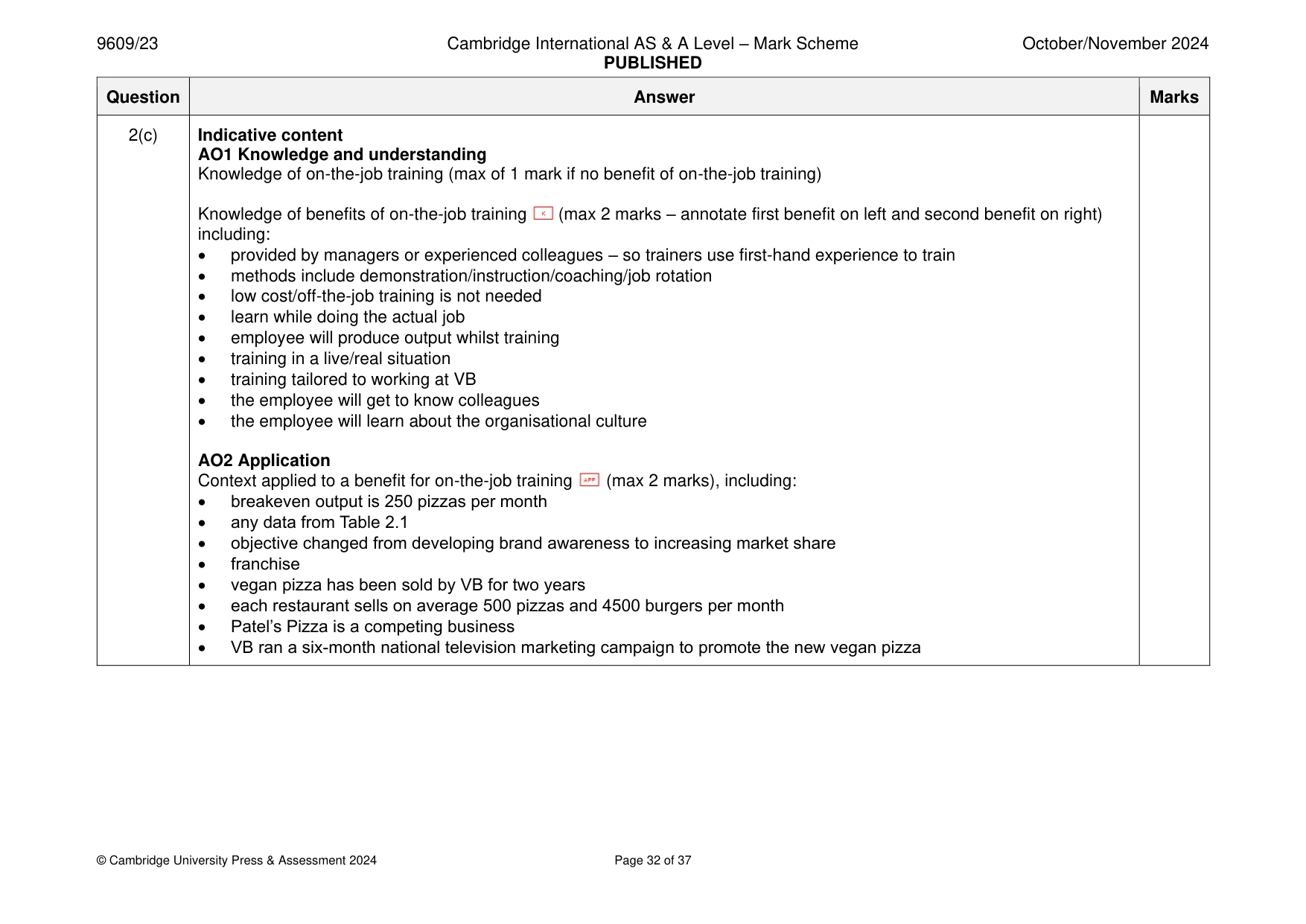
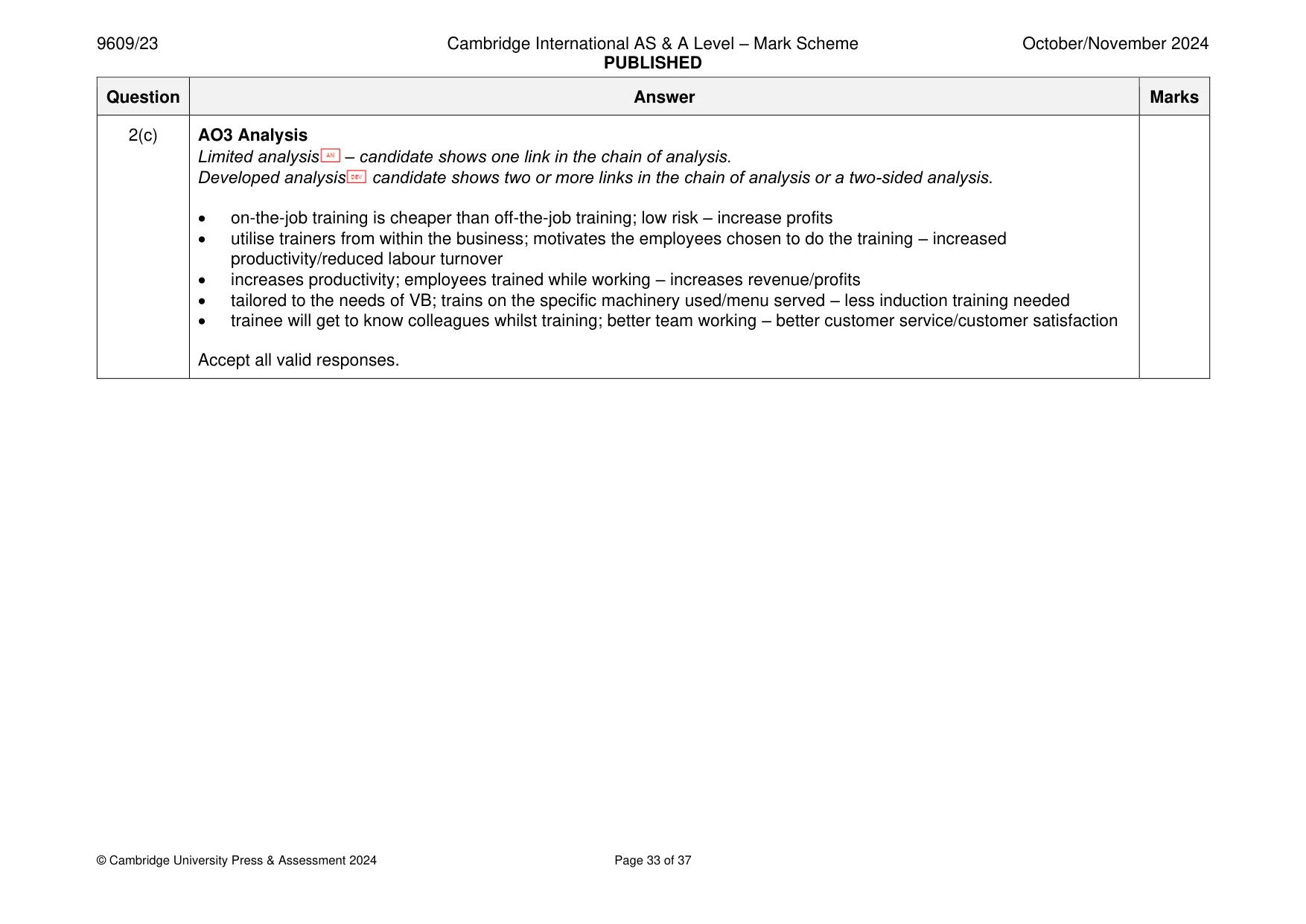
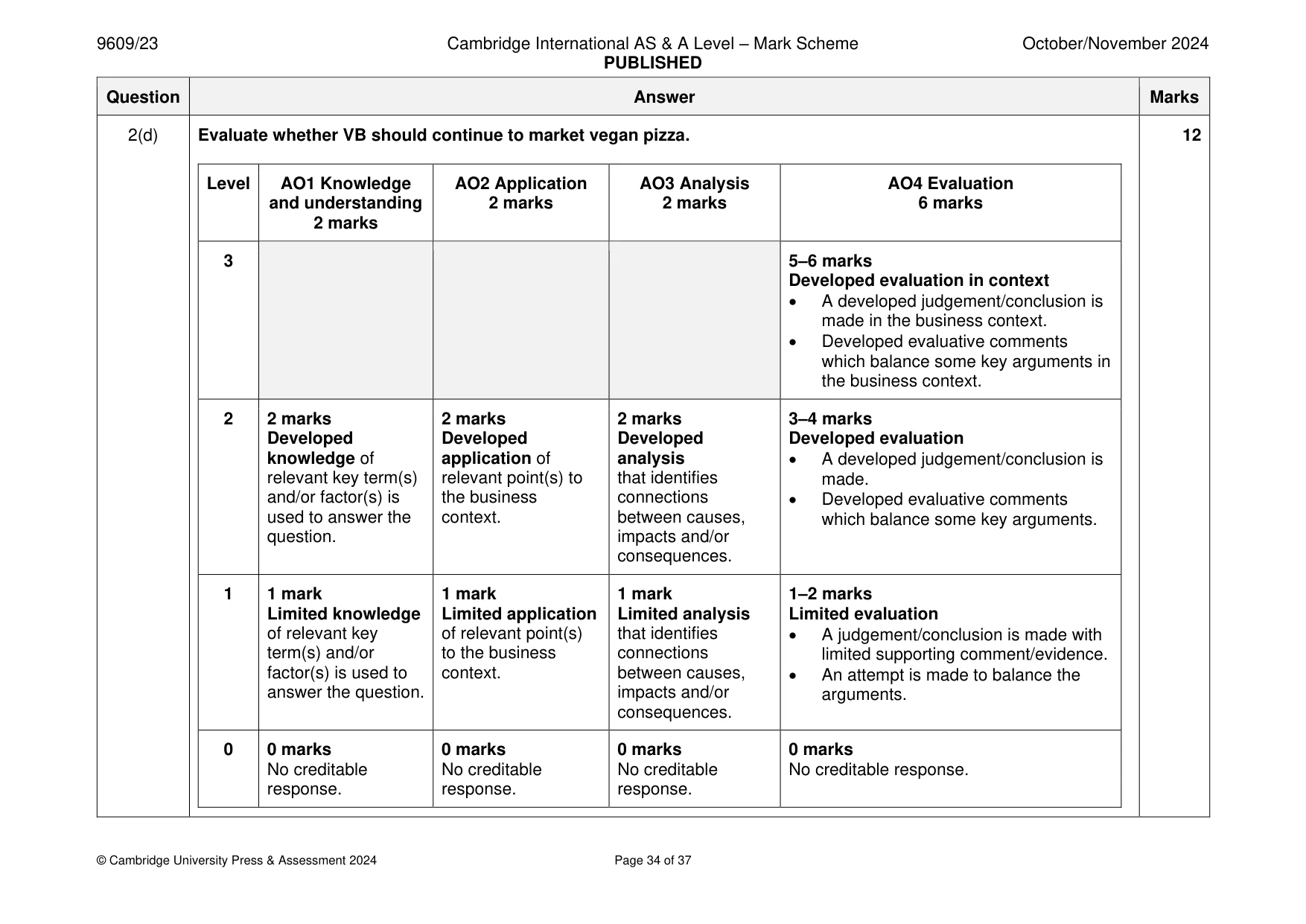
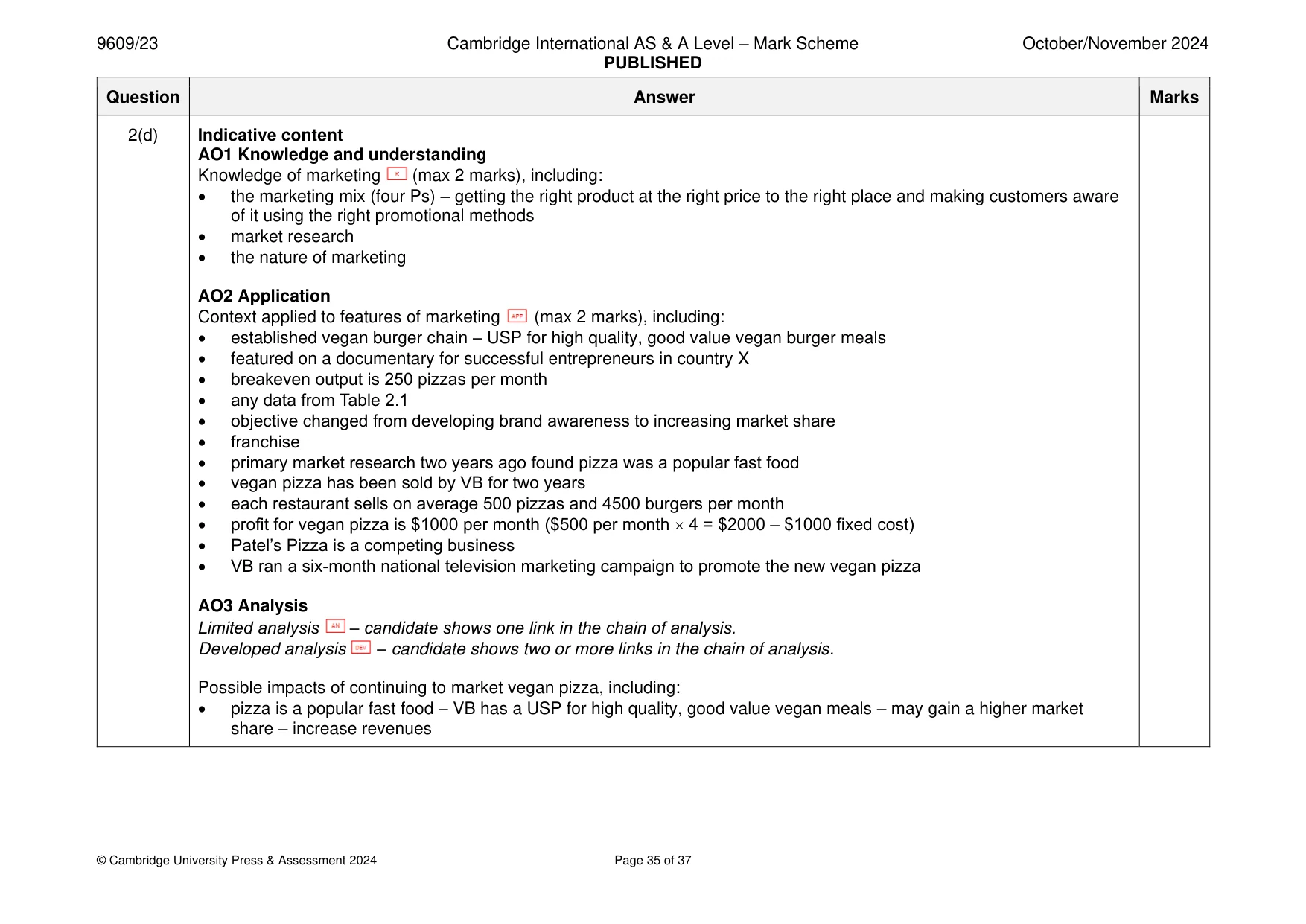
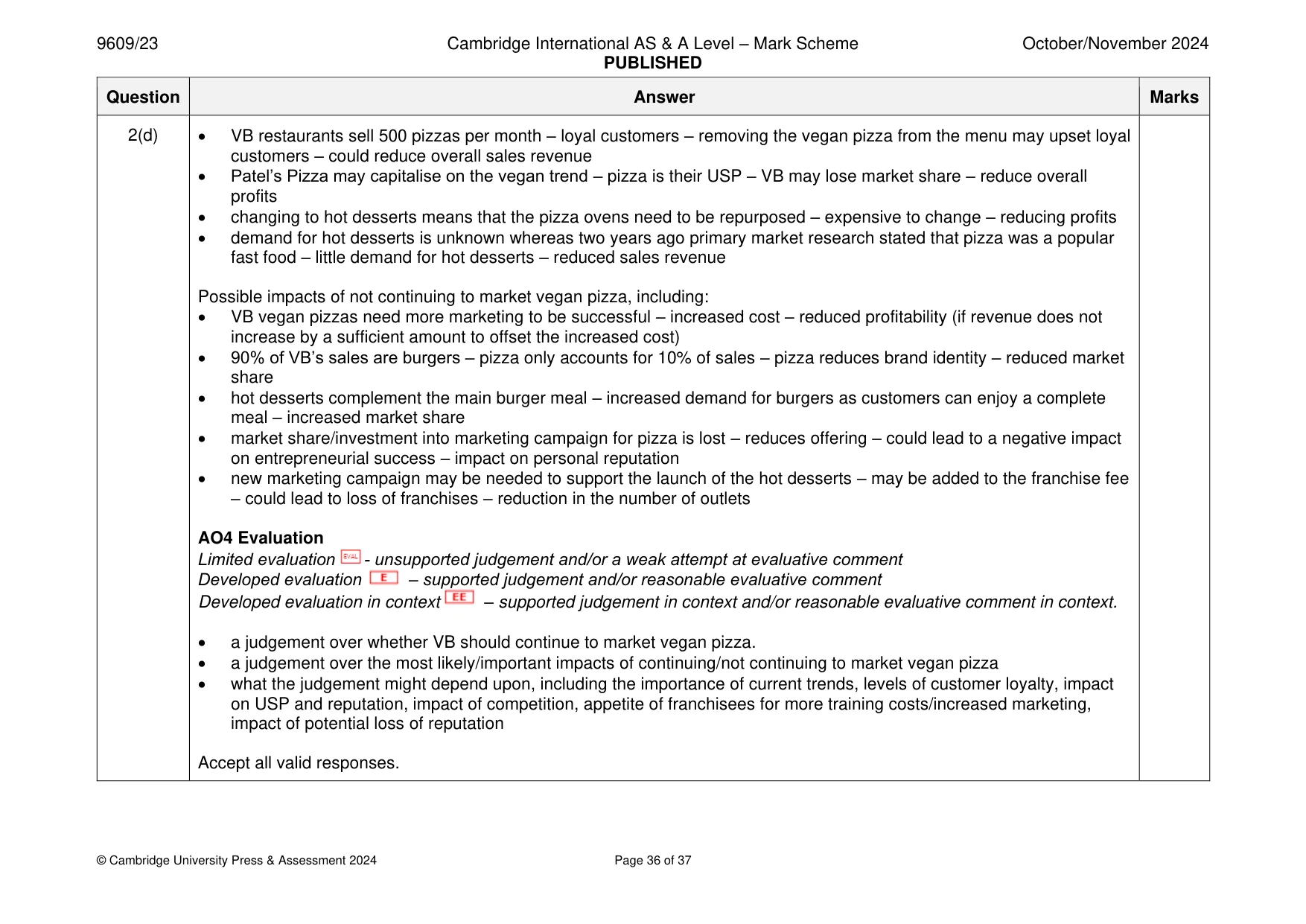
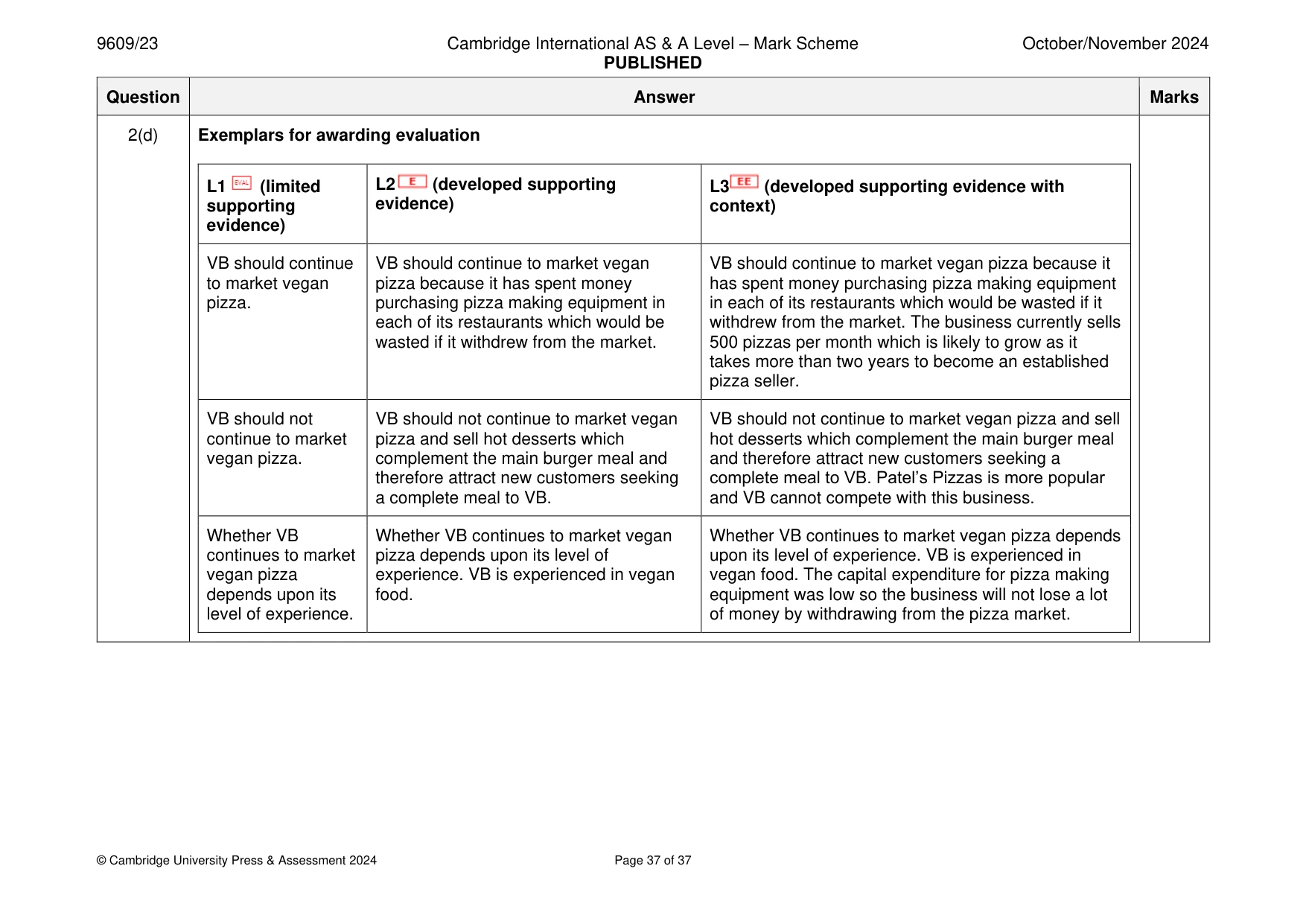
Mark scheme: 2(a)(i) Identify one feature of a franchise. 1 Indicative content Knowledge of one feature of a franchise including: • the legal right/contract for another business to use the: name; logo; marketing methods • need to follow franchisor’s requirements • franchise fee • share of profits (royalty fee) to franchisor • trades under an established brand name • franchisee has access to training/support • franchisee cannot make decisions without franchisor’s approval Accept all valid responses. 2(a)(ii) Explain the term market share (line 6). 3 AO1 Knowledge and understanding AO2 Application 1 mark 2 marks 2 marks Developed application of one relevant point to a business context. 1 mark 1 mark Knowledge of one relevant point is used to answer the Limited application of one relevant point to a business question. context. 0 marks 0 marks No creditable response. No creditable response. Indicative content Responses may include: • formula (2 marks) sales of the business/product market share = 100 total market sales AO1 Knowledge and understanding • the sales of a specific business/product AO2 Application • comparison to the sales in the total market Application to a business context: • way of comparing the size of a business against its competitors • shows the amount of ‘power/influence’ that the business has in the market/market dominance 2(a)(ii) • an increased market share gives the business more power, e.g. price setter • the business with the highest market share is the market leader • selling 25 franchise licenses helped VB increase its market share in country X • VB added vegan pizza to its menu to gain a higher market share of the fast-food market • example of a market leader to illustrate market share, e.g. Tesco is the market leader of the UK supermarket industry so has the highest market share Application can be made to VB or any other scenario/context/business/person. Allow application to market share. Accept all valid responses. Guidance in awarding marks Knowledge & understanding Knowledge of market share 1 mark Explanation Explanation of market share 1 mark Context Applied to a business context/ business environment 1 mark 2(b)(i) Refer to table 2.1. Calculate VB’s breakeven level of output per month per restaurant. 3 Indicative content 1 mark for the formula for breakeven (words or figures) OR correct calculation for the contribution per unit 1 mark for formula for breakeven (words or figures) AND calculating the contribution per unit 1 mark for calculating the breakeven level of output per month per restaurant (OFR) • formula: fixed costs / contribution per unit (1) • calculation of fixed costs and contribution per unit (1) – fixed costs: $1000 – contribution per unit: selling price per unit ($6) – variable cost per unit ($2) $4 • calculation of the breakeven level of output per month per restaurant – $1000/$4 – BE level of output: 250 per month (1 OFR) • answer = 250 (units) (3) Accept all valid responses. 2(b)(i) Marks 3 marks Correct answer Working and units do not matter. 250 (units) allow 250 Must be three to denote the three marks. 2 marks Both of the following: To award two marks, there must be Correct formula for the breakeven output (words or • Two and a figures) OR AND • One , one and one Correct calculation of the contribution per pizza OR An incorrect answer for the breakeven output with one mistake allowing OFR for final stage. 1 mark One of the following: To award one mark, there must be: Correct formula for the breakeven output (words or • One and two figures) OR Correct calculation of the contribution per pizza 0 marks No creditable content. To award zero marks, there must be • One 2(b)(ii) Explain one reason for VB to have accurate cost information. 3 AO1 Knowledge and understanding AO2 Application 1 mark 2 marks 2 marks Developed application of one relevant point to a business context. 1 mark 1 mark Knowledge of one relevant point is used to answer the Limited application of one relevant point to a business question. context. 0 marks 0 marks No creditable response. No creditable response. Indicative content AO1 Knowledge and understanding • to calculate profit or loss • to make pricing and business decisions • to predict cashflow • to measure performance • to set budgets • to allocate resources AO2 Application Explanation of a reason for VB to have accurate cost information • APP can be awarded for development of the AO1 point, e.g. – to calculate profit or loss; requires a business to know its costs/revenues – to make pricing and business decisions; so that costs are covered – to predict cashflow; by considering accurate outflows – to measure performance; by analysing how costs change over time – to set budgets; in line with predicted expenditure – to allocate resources; so that the business knows what it is paying out for 2(b)(ii) Context applied to VB of a reason for accurate cost information: • each pizza is sold for $6 with a contribution of $4 • fixed costs per month of $1000 • breakeven output is 250 pizzas per month • any data from Table 2.1 • objective changed from developing brand awareness to increasing market share • franchise • Patel’s Pizza is a competing business • VB ran a six-month national television marketing campaign to promote the new vegan pizza Application for the second APP mark must be made to VB and not generic. Accept all valid responses. Guidance in awarding marks Knowledge and understanding Knowledge of a reason for accurate cost information 1 mark Explanation Explanation of a reason for accurate cost information 1 mark Context Applied to a business context/business environment 1 mark 2(c) Analyse two benefits for VB of on-the-job training. 8 Level AO1 Knowledge and AO2 Application AO3 Analysis understanding 2 marks 4 marks 2 marks 2 3–4 marks Developed analysis • Developed analysis that identifies connections between causes, impacts and/or consequences of two points. • Developed analysis that identifies connections between causes, impacts and/or consequences of one point. 1 1–2 marks 1–2 marks 1–2 marks • Knowledge of two • Application of two Limited analysis relevant points is relevant points to a • Limited analysis that identifies connections between used to answer the business context. causes, impacts and/or consequences of two points. question. • Application of one • Limited analysis that identifies connections between • Knowledge of one relevant point to a causes, impacts and/or consequences of one point. relevant point is business context. used to answer the question. 0 0 marks 0 marks 0 marks No creditable response. No creditable response. No creditable response. 2(c) Indicative content AO1 Knowledge and understanding Knowledge of on-the-job training (max of 1 mark if no benefit of on-the-job training) Knowledge of benefits of on-the-job training (max 2 marks – annotate first benefit on left and second benefit on right) including: • provided by managers or experienced colleagues – so trainers use first-hand experience to train • methods include demonstration/instruction/coaching/job rotation • low cost/off-the-job training is not needed • learn while doing the actual job • employee will produce output whilst training • training in a live/real situation • training tailored to working at VB • the employee will get to know colleagues • the employee will learn about the organisational culture AO2 Application Context applied to a benefit for on-the-job training (max 2 marks), including: • breakeven output is 250 pizzas per month • any data from Table 2.1 • objective changed from developing brand awareness to increasing market share • franchise • vegan pizza has been sold by VB for two years • each restaurant sells on average 500 pizzas and 4500 burgers per month • Patel’s Pizza is a competing business • VB ran a six-month national television marketing campaign to promote the new vegan pizza 2(c) AO3 Analysis Limited analysis – candidate shows one link in the chain of analysis. Developed analysis candidate shows two or more links in the chain of analysis or a two-sided analysis. • on-the-job training is cheaper than off-the-job training; low risk – increase profits • utilise trainers from within the business; motivates the employees chosen to do the training – increased productivity/reduced labour turnover • increases productivity; employees trained while working – increases revenue/profits • tailored to the needs of VB; trains on the specific machinery used/menu served – less induction training needed • trainee will get to know colleagues whilst training; better team working – better customer service/customer satisfaction Accept all valid responses. 2(d) Evaluate whether VB should continue to market vegan pizza. 12 Level AO1 Knowledge AO2 Application AO3 Analysis AO4 Evaluation and understanding 2 marks 2 marks 6 marks 2 marks 3 5–6 marks Developed evaluation in context • A developed judgement/conclusion is made in the business context. • Developed evaluative comments which balance some key arguments in the business context. 2 2 marks 2 marks 2 marks 3–4 marks Developed Developed Developed Developed evaluation knowledge of application of analysis • A developed judgement/conclusion is relevant key term(s) relevant point(s) to that identifies made. and/or factor(s) is the business connections • Developed evaluative comments used to answer the context. between causes, which balance some key arguments. question. impacts and/or consequences. 1 1 mark 1 mark 1 mark 1–2 marks Limited knowledge Limited application Limited analysis Limited evaluation of relevant key of relevant point(s) that identifies • A judgement/conclusion is made with term(s) and/or to the business connections limited supporting comment/evidence. factor(s) is used to context. between causes, • An attempt is made to balance the answer the question. impacts and/or arguments. consequences. 0 0 marks 0 marks 0 marks 0 marks No creditable No creditable No creditable No creditable response. response. response. response. 2(d) Indicative content AO1 Knowledge and understanding Knowledge of marketing (max 2 marks), including: • the marketing mix (four Ps) – getting the right product at the right price to the right place and making customers aware of it using the right promotional methods • market research • the nature of marketing AO2 Application Context applied to features of marketing (max 2 marks), including: • established vegan burger chain – USP for high quality, good value vegan burger meals • featured on a documentary for successful entrepreneurs in country X • breakeven output is 250 pizzas per month • any data from Table 2.1 • objective changed from developing brand awareness to increasing market share • franchise • primary market research two years ago found pizza was a popular fast food • vegan pizza has been sold by VB for two years • each restaurant sells on average 500 pizzas and 4500 burgers per month • profit for vegan pizza is $1000 per month ($500 per month 4 = $2000 – $1000 fixed cost) • Patel’s Pizza is a competing business • VB ran a six-month national television marketing campaign to promote the new vegan pizza AO3 Analysis Limited analysis – candidate shows one link in the chain of analysis. Developed analysis – candidate shows two or more links in the chain of analysis. Possible impacts of continuing to market vegan pizza, including: • pizza is a popular fast food – VB has a USP for high quality, good value vegan meals – may gain a higher market share – increase revenues 2(d) • VB restaurants sell 500 pizzas per month – loyal customers – removing the vegan pizza from the menu may upset loyal customers – could reduce overall sales revenue • Patel’s Pizza may capitalise on the vegan trend – pizza is their USP – VB may lose market share – reduce overall profits • changing to hot desserts means that the pizza ovens need to be repurposed – expensive to change – reducing profits • demand for hot desserts is unknown whereas two years ago primary market research stated that pizza was a popular fast food – little demand for hot desserts – reduced sales revenue Possible impacts of not continuing to market vegan pizza, including: • VB vegan pizzas need more marketing to be successful – increased cost – reduced profitability (if revenue does not increase by a sufficient amount to offset the increased cost) • 90% of VB’s sales are burgers – pizza only accounts for 10% of sales – pizza reduces brand identity – reduced market share • hot desserts complement the main burger meal – increased demand for burgers as customers can enjoy a complete meal – increased market share • market share/investment into marketing campaign for pizza is lost – reduces offering – could lead to a negative impact on entrepreneurial success – impact on personal reputation • new marketing campaign may be needed to support the launch of the hot desserts – may be added to the franchise fee – could lead to loss of franchises – reduction in the number of outlets AO4 Evaluation Limited evaluation - unsupported judgement and/or a weak attempt at evaluative comment Developed evaluation – supported judgement and/or reasonable evaluative comment Developed evaluation in context – supported judgement in context and/or reasonable evaluative comment in context. • a judgement over whether VB should continue to market vegan pizza. • a judgement over the most likely/important impacts of continuing/not continuing to market vegan pizza • what the judgement might depend upon, including the importance of current trends, levels of customer loyalty, impact on USP and reputation, impact of competition, appetite of franchisees for more training costs/increased marketing, impact of potential loss of reputation Accept all valid responses. 2(d) Exemplars for awarding evaluation L1 (limited L2 (developed supporting L3 (developed supporting evidence with supporting evidence) context) evidence) VB should continue VB should continue to market vegan VB should continue to market vegan pizza because it to market vegan pizza because it has spent money has spent money purchasing pizza making equipment pizza. purchasing pizza making equipment in in each of its restaurants which would be wasted if it each of its restaurants which would be withdrew from the market. The business currently sells wasted if it withdrew from the market. 500 pizzas per month which is likely to grow as it takes more than two years to become an established pizza seller. VB should not VB should not continue to market vegan VB should not continue to market vegan pizza and sell continue to market pizza and sell hot desserts which hot desserts which complement the main burger meal vegan pizza. complement the main burger meal and and therefore attract new customers seeking a therefore attract new customers seeking complete meal to VB. Patel’s Pizzas is more popular a complete meal to VB. and VB cannot compete with this business. Whether VB Whether VB continues to market vegan Whether VB continues to market vegan pizza depends continues to market pizza depends upon its level of upon its level of experience. VB is experienced in vegan pizza experience. VB is experienced in vegan vegan food. The capital expenditure for pizza making depends upon its food. equipment was low so the business will not lose a lot level of experience. of money by withdrawing from the pizza market.
What was in this paper
The subtopics covered by these 2 questions, and how many questions each got. Open one in a new tab to see every Cambridge question on it.
What you needed in this session
Cambridge’s own grade thresholds for 2024 Oct/Nov, Paper 2 · Variant 3. A higher threshold means an easier paper — the bar moves with how the cohort did.