Cambridge A Level Business (for first examination in 2016) 9609 — 2024 Oct/Nov Paper 2 · Variant 1
9609/21/O/N/24 · 2 questions · 60 marks · ≈68 min
The question paper and its mark scheme, free to read here and free to download. This is Cambridge’s own paper, exactly as it was sat.
Question paper4 pages


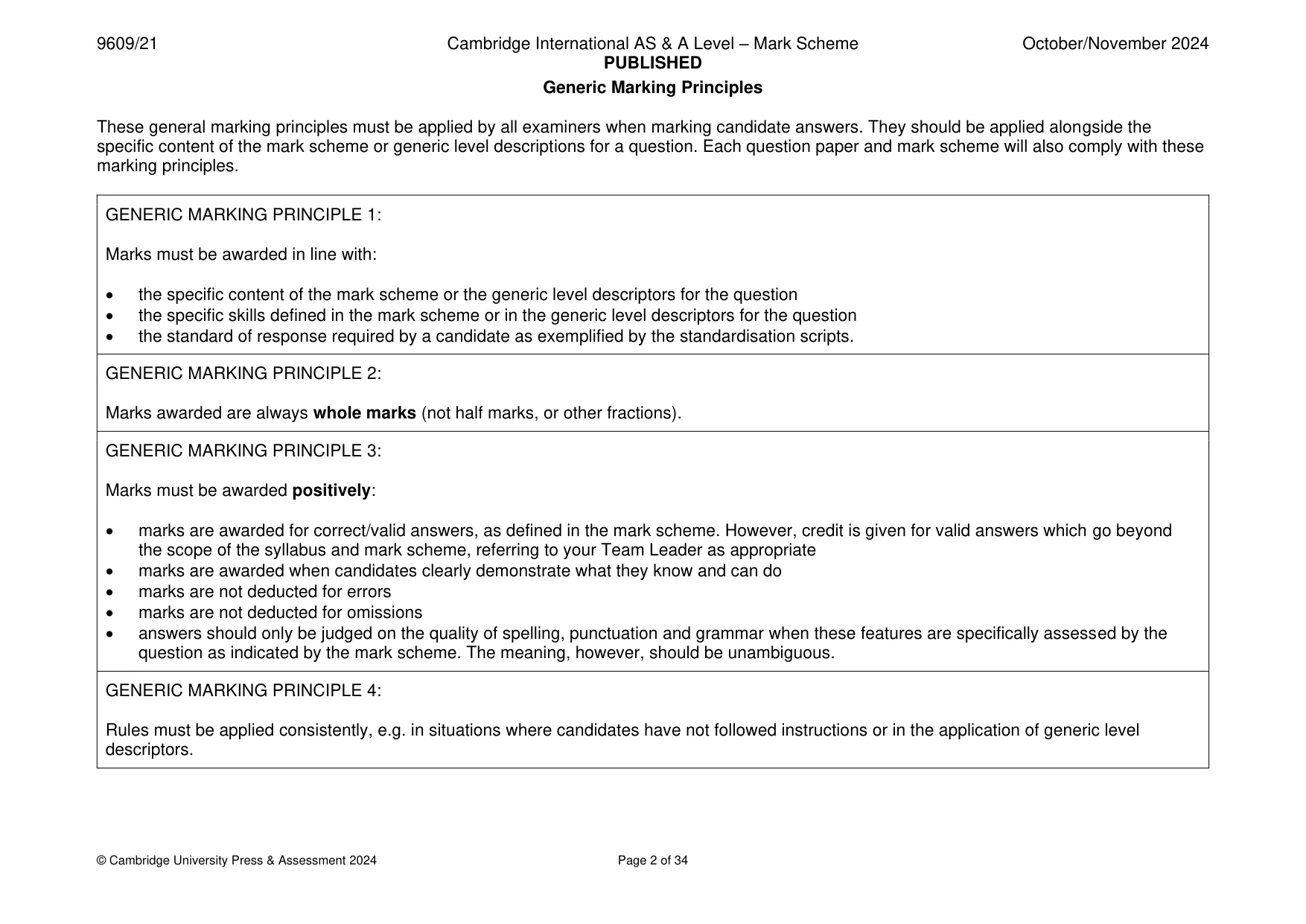
Mark scheme34 pages
Answers below. Sit the paper first if you are practising.
Questions as text
Q1 · Farm Equipment (FE) FE is a public limited company based in country Z, where the primary…
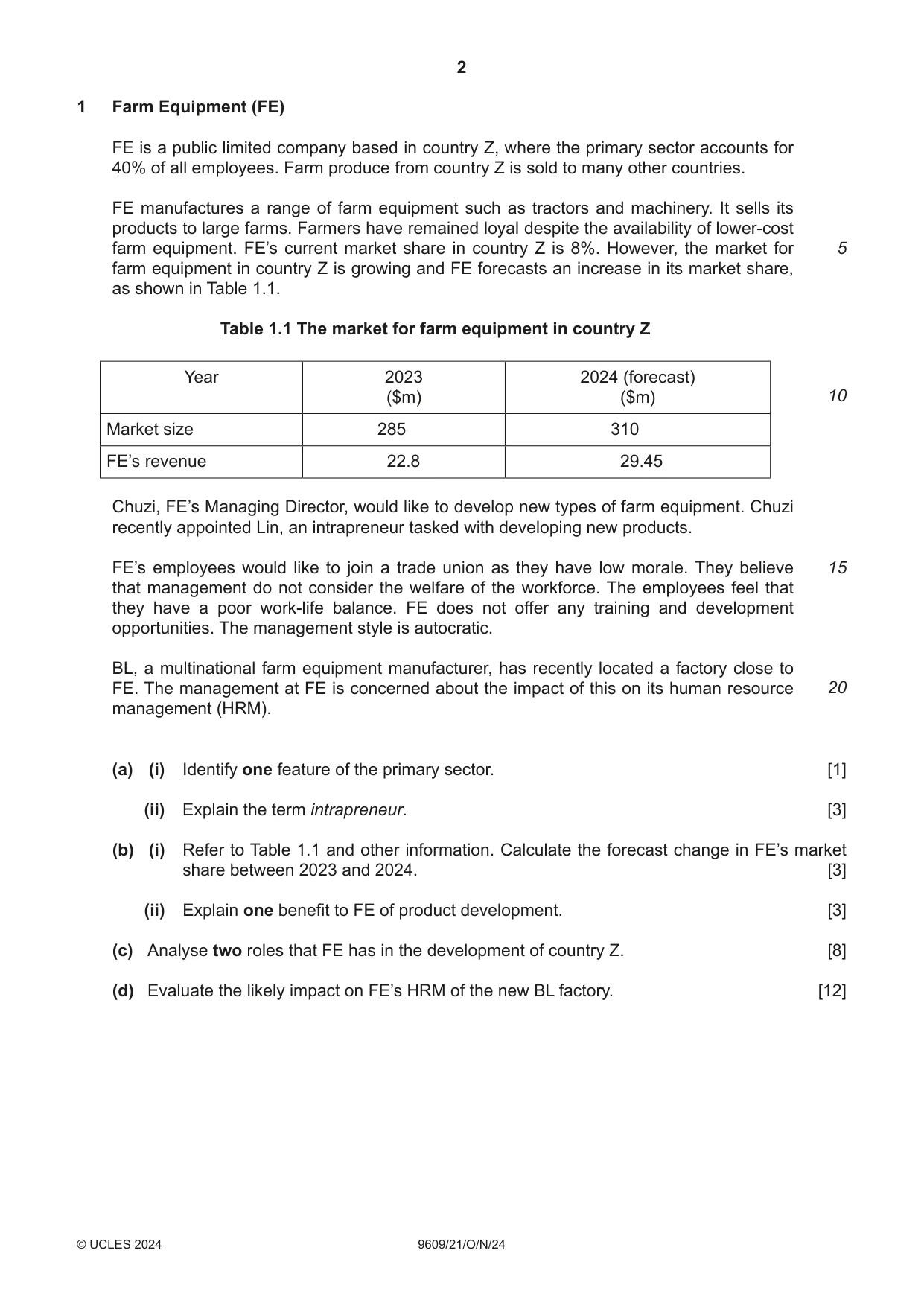
1 Farm Equipment (FE) FE is a public limited company based in country Z, where the primary sector accounts for 40% of all employees. Farm produce from country Z is sold to many other countries. FE manufactures a range of farm equipment such as tractors and machinery. It sells its products to large farms. Farmers have remained loyal despite the availability of lower-cost farm equipment. FE’s current market share in country Z is 8%. However, the market for 5 farm equipment in country Z is growing and FE forecasts an increase in its market share, as shown in Table 1.1. Table 1.1 The market for farm equipment in country Z Year 2023 2024 (forecast) ($m) ($m) 10 Market size 285 310 FE’s revenue 22.8 29.45 Chuzi, FE’s Managing Director, would like to develop new types of farm equipment. Chuzi recently appointed Lin, an intrapreneur tasked with developing new products. FE’s employees would like to join a trade union as they have low morale. They believe 15 that management do not consider the welfare of the workforce. The employees feel that they have a poor work-life balance. FE does not offer any training and development opportunities. The management style is autocratic. BL, a multinational farm equipment manufacturer, has recently located a factory close to FE. The management at FE is concerned about the impact of this on its human resource 20 management (HRM). (a) (i) Identify one feature of the primary sector. [1] (ii) Explain the term intrapreneur. [3] (b) (i) Refer to Table 1.1 and other information. Calculate the forecast change in FE’s market share between 2023 and 2024. [3] (ii) Explain one benefit to FE of product development. [3] (c) Analyse two roles that FE has in the development of country Z. [8] (d) Evaluate the likely impact on FE’s HRM of the new BL factory. [12]
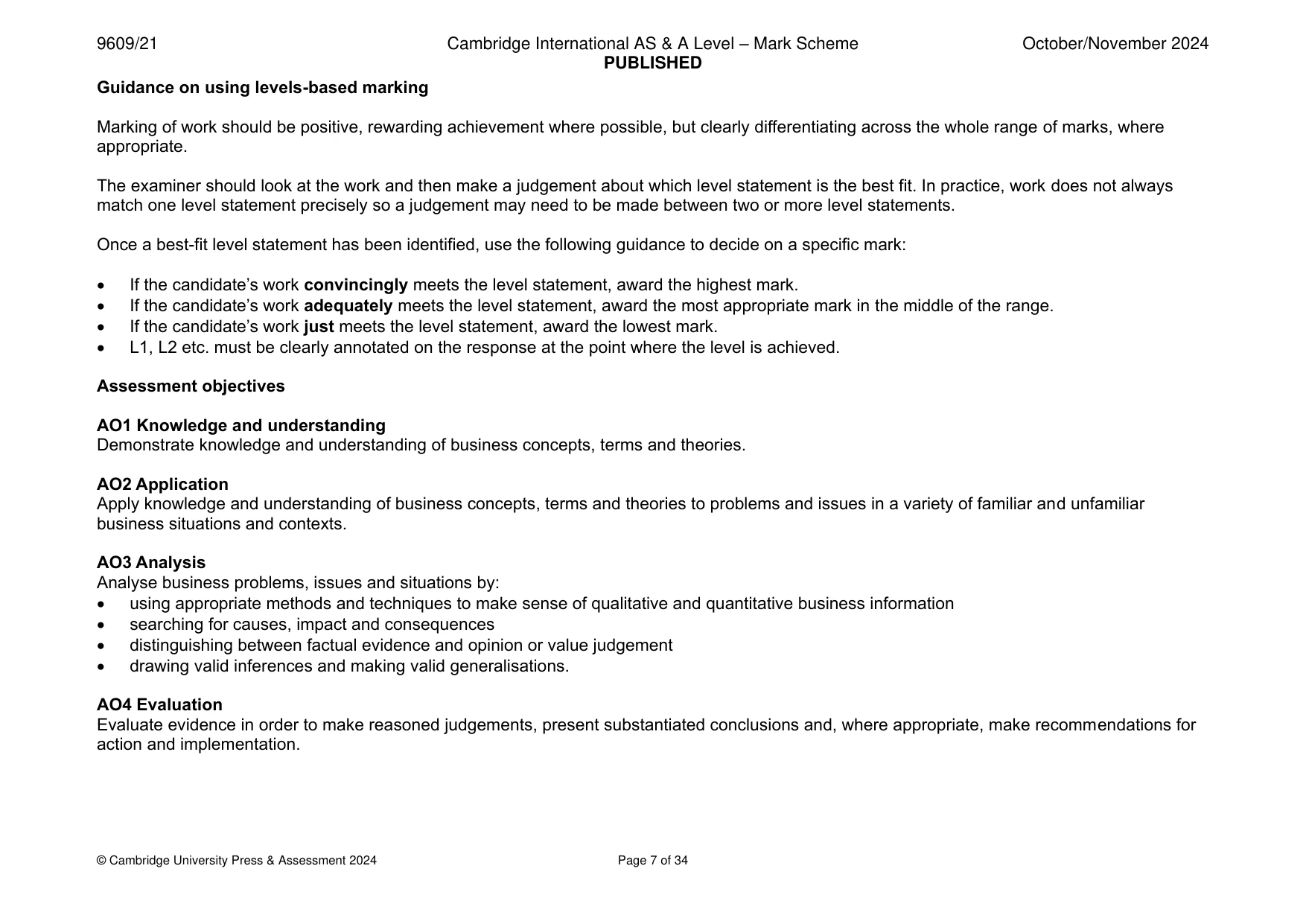
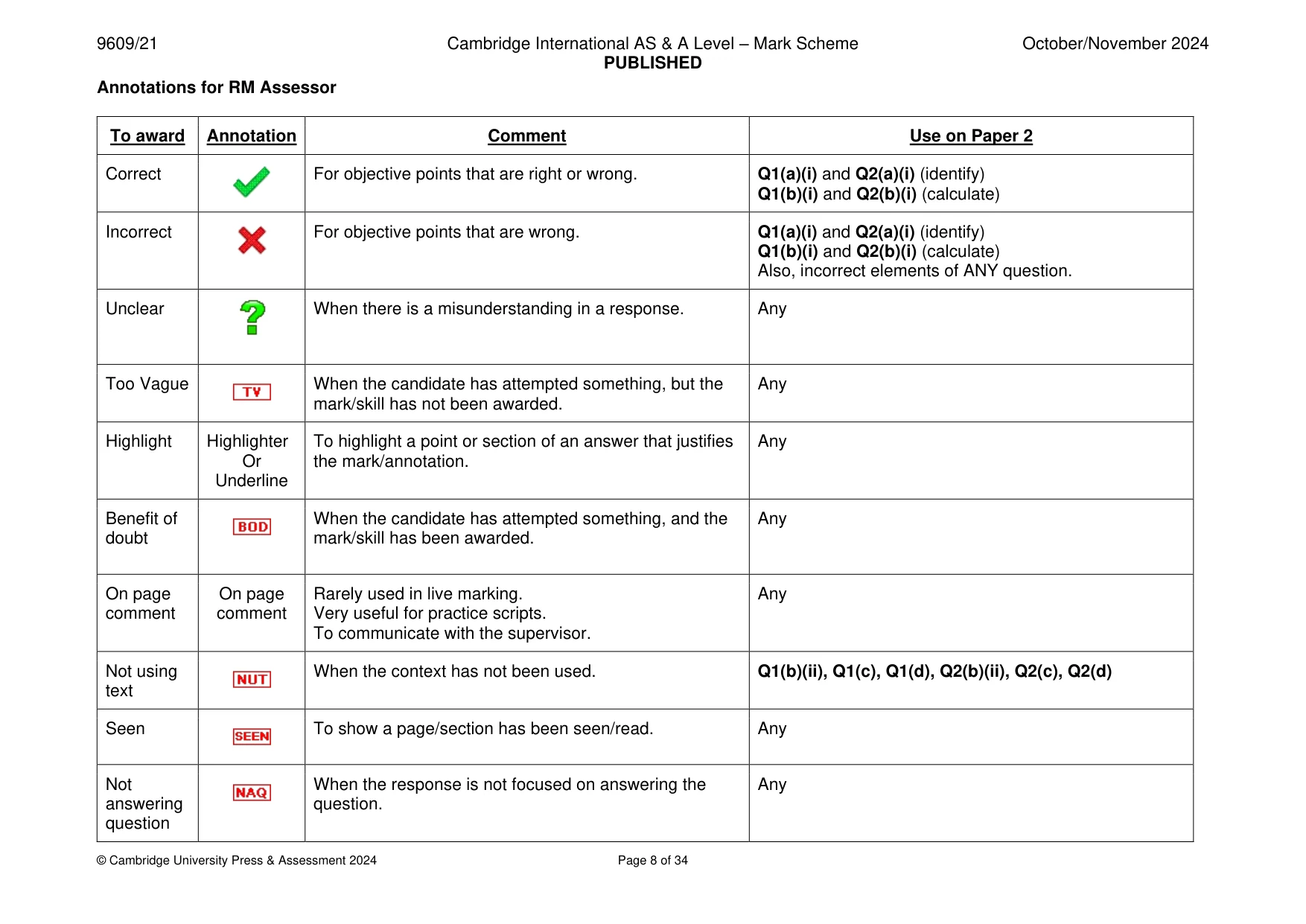
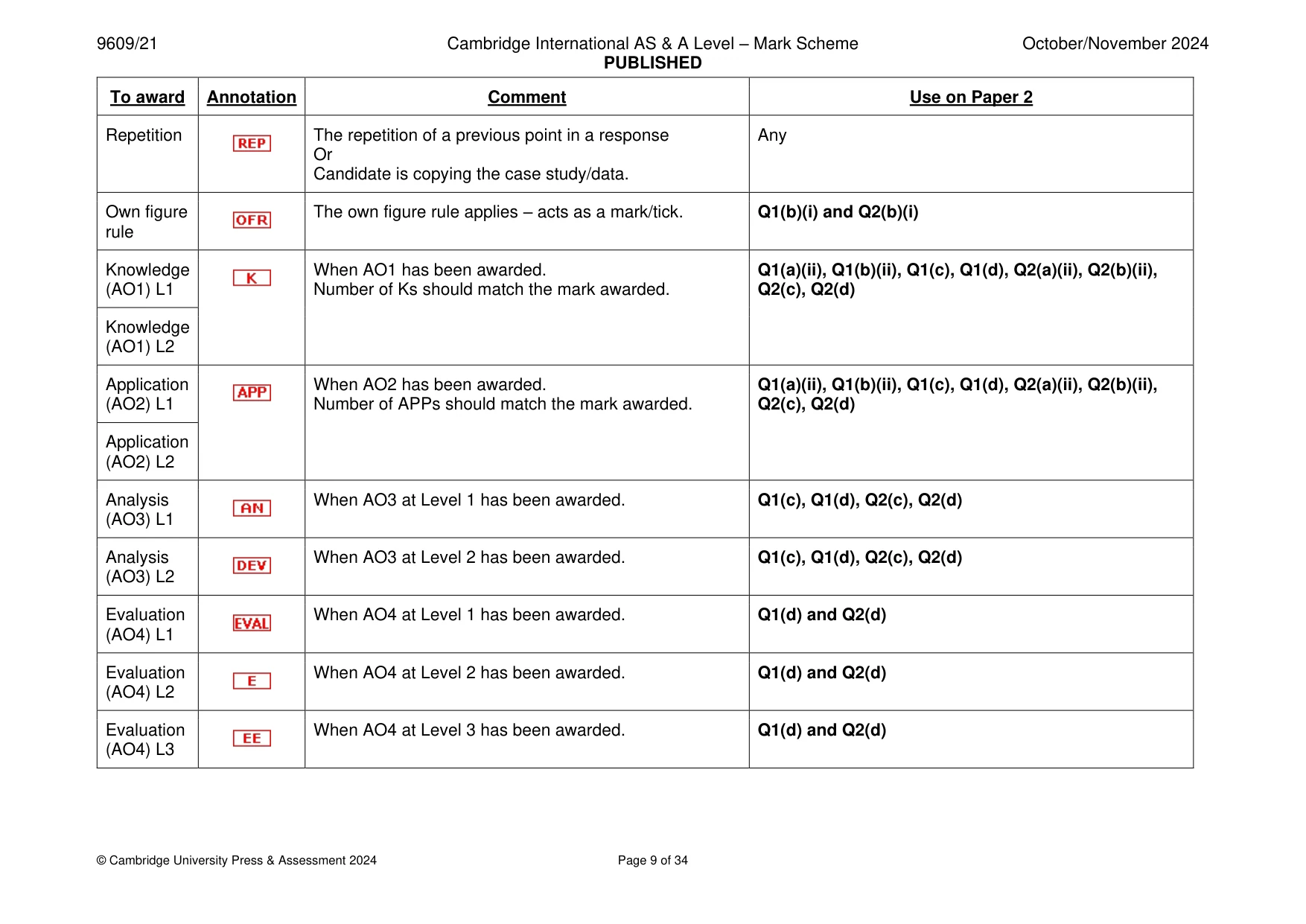
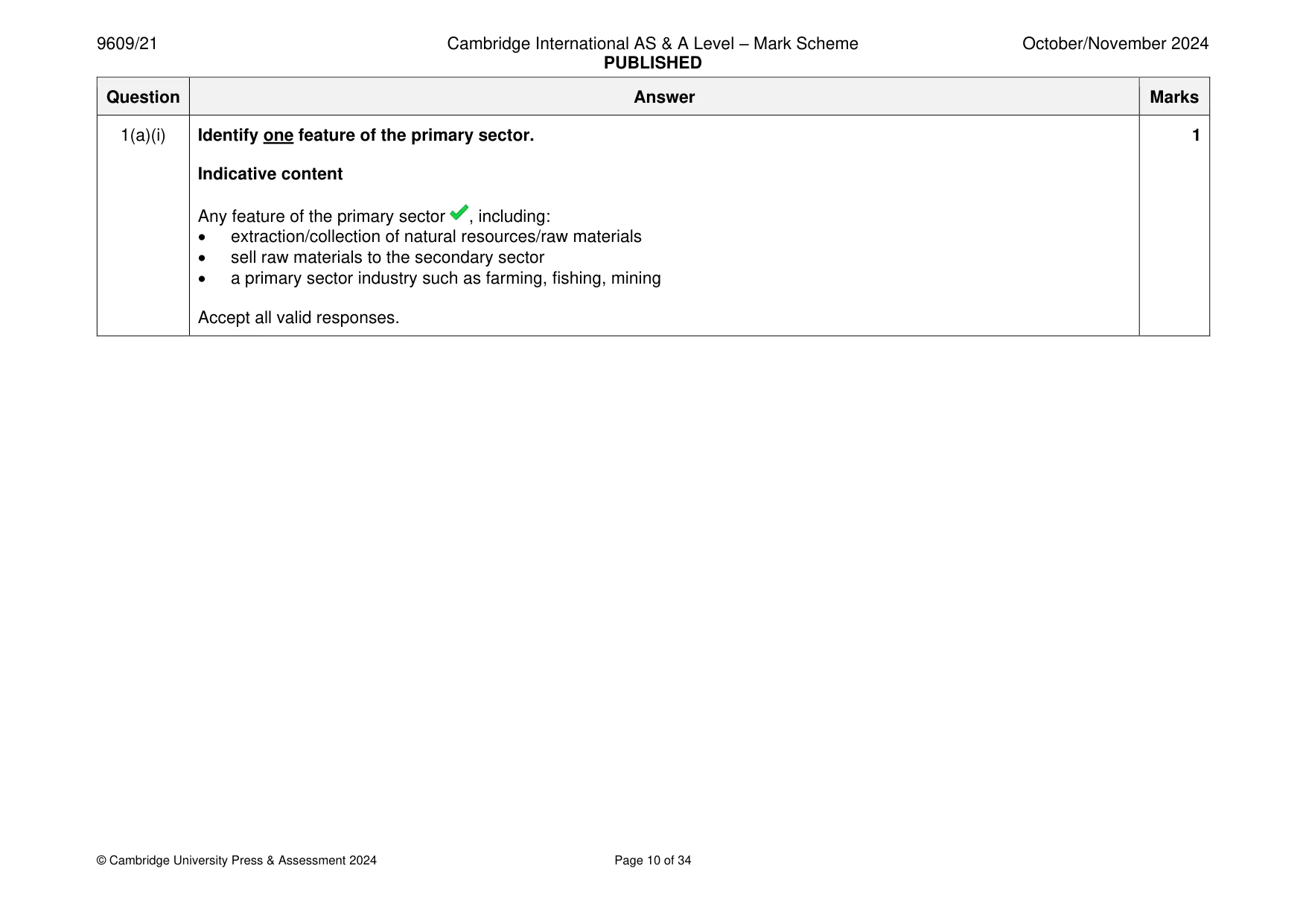
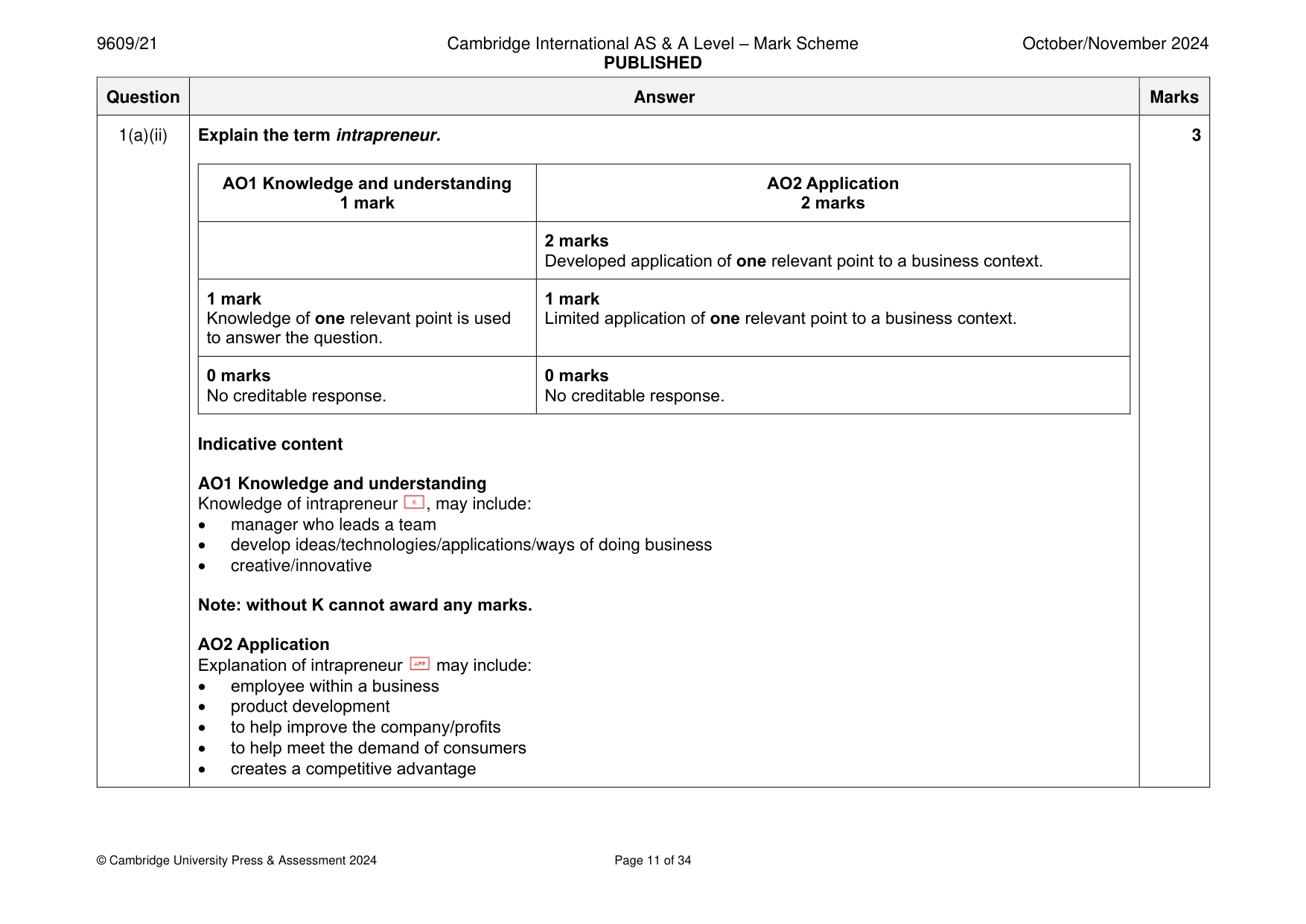
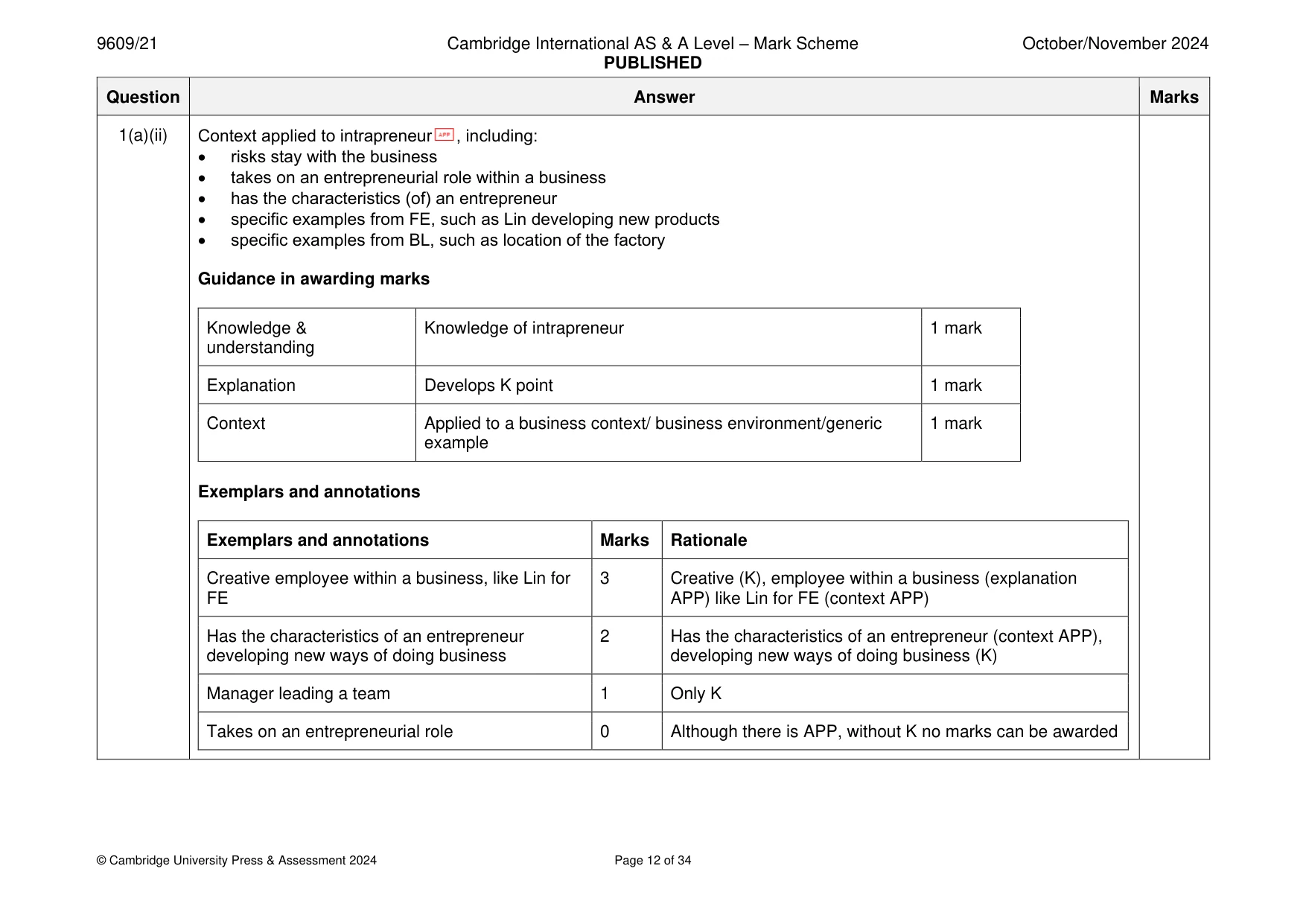
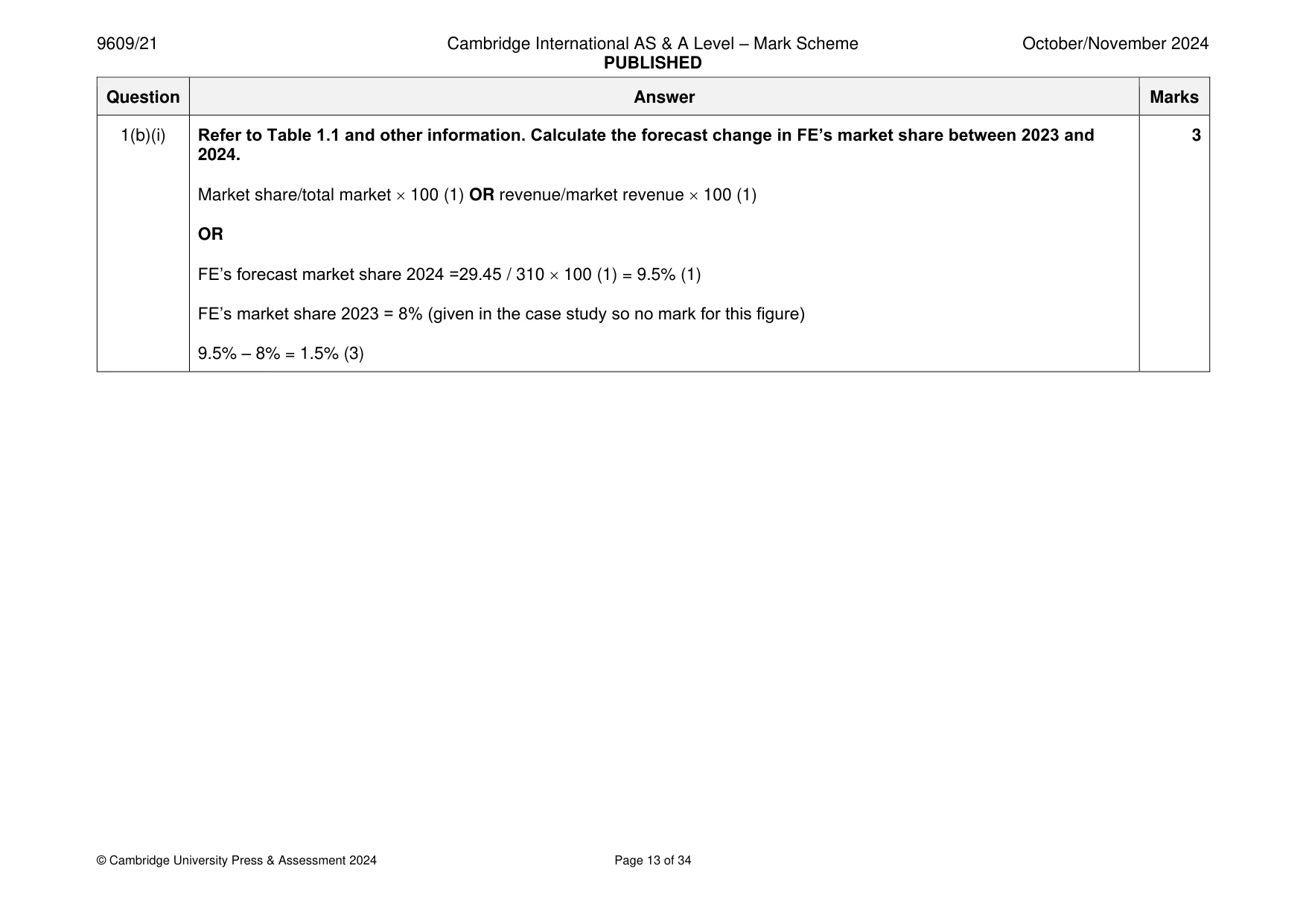
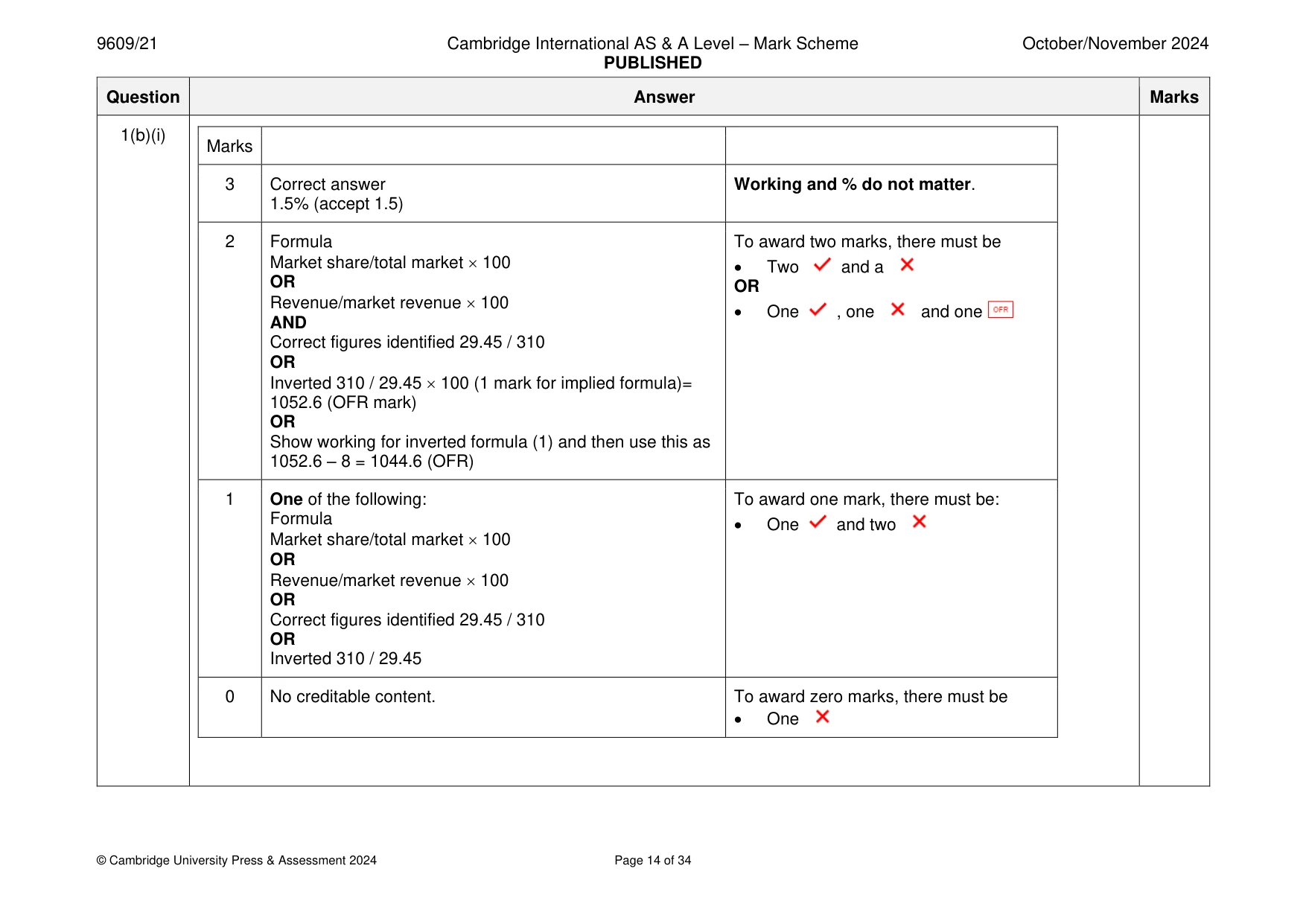
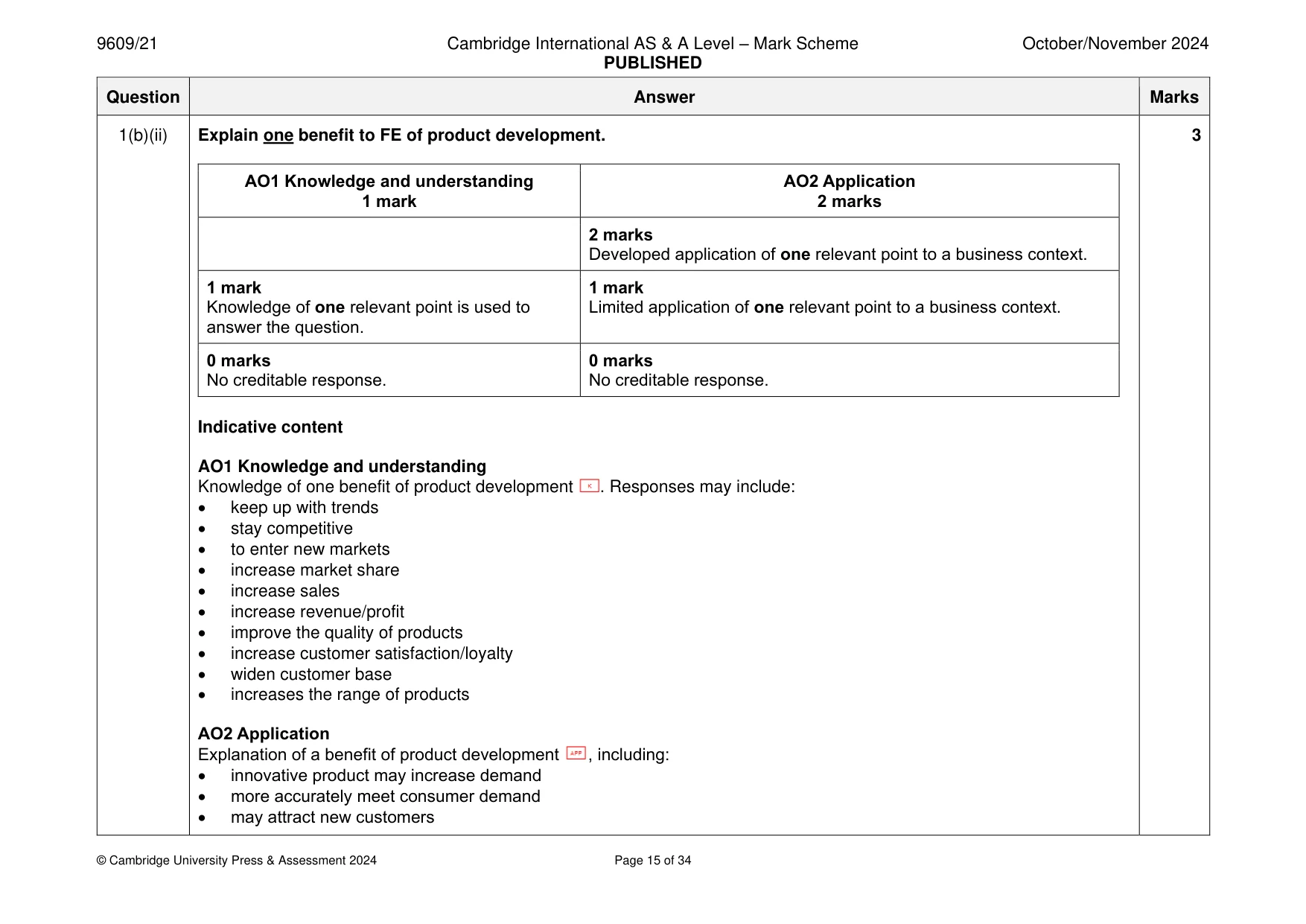
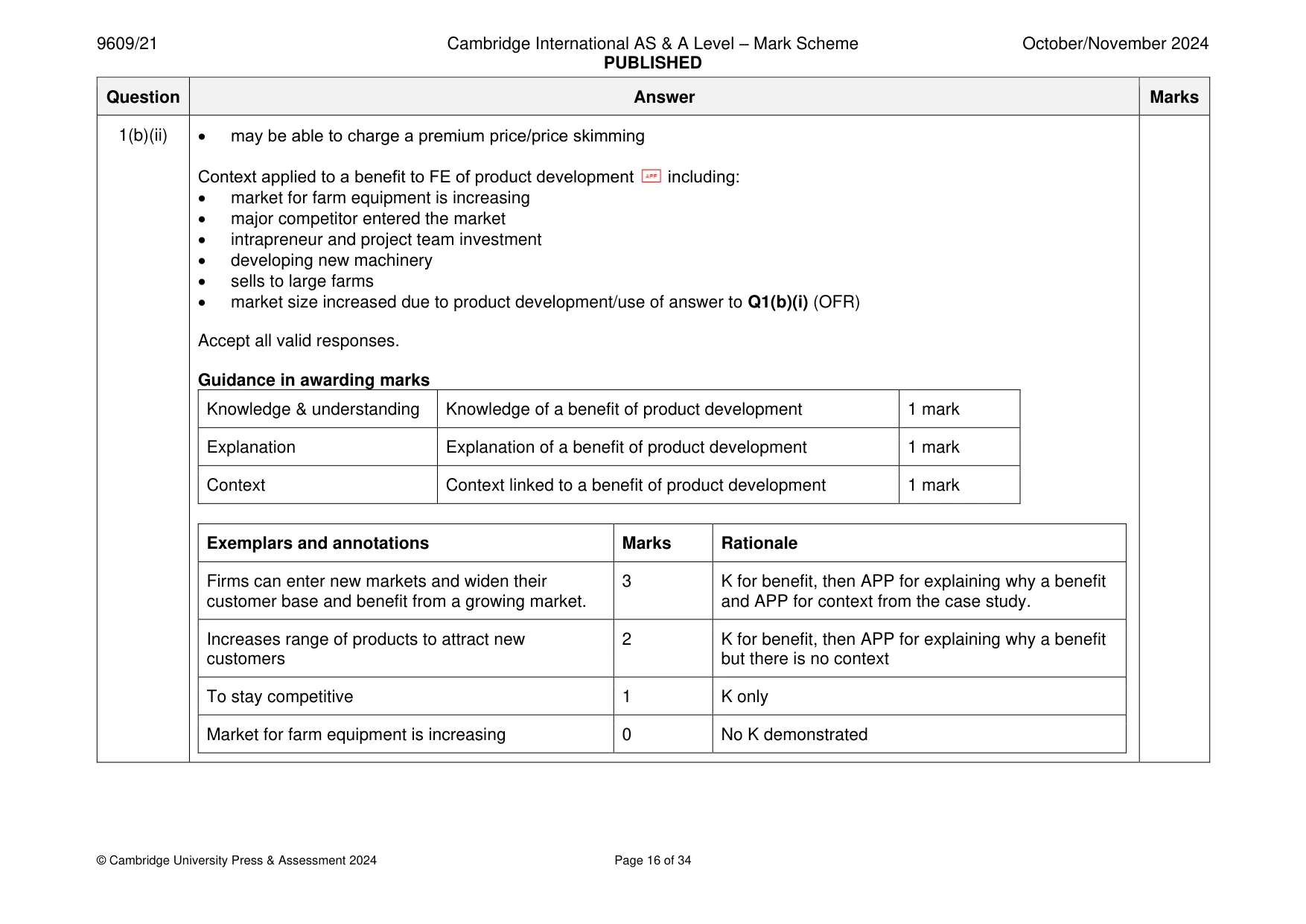
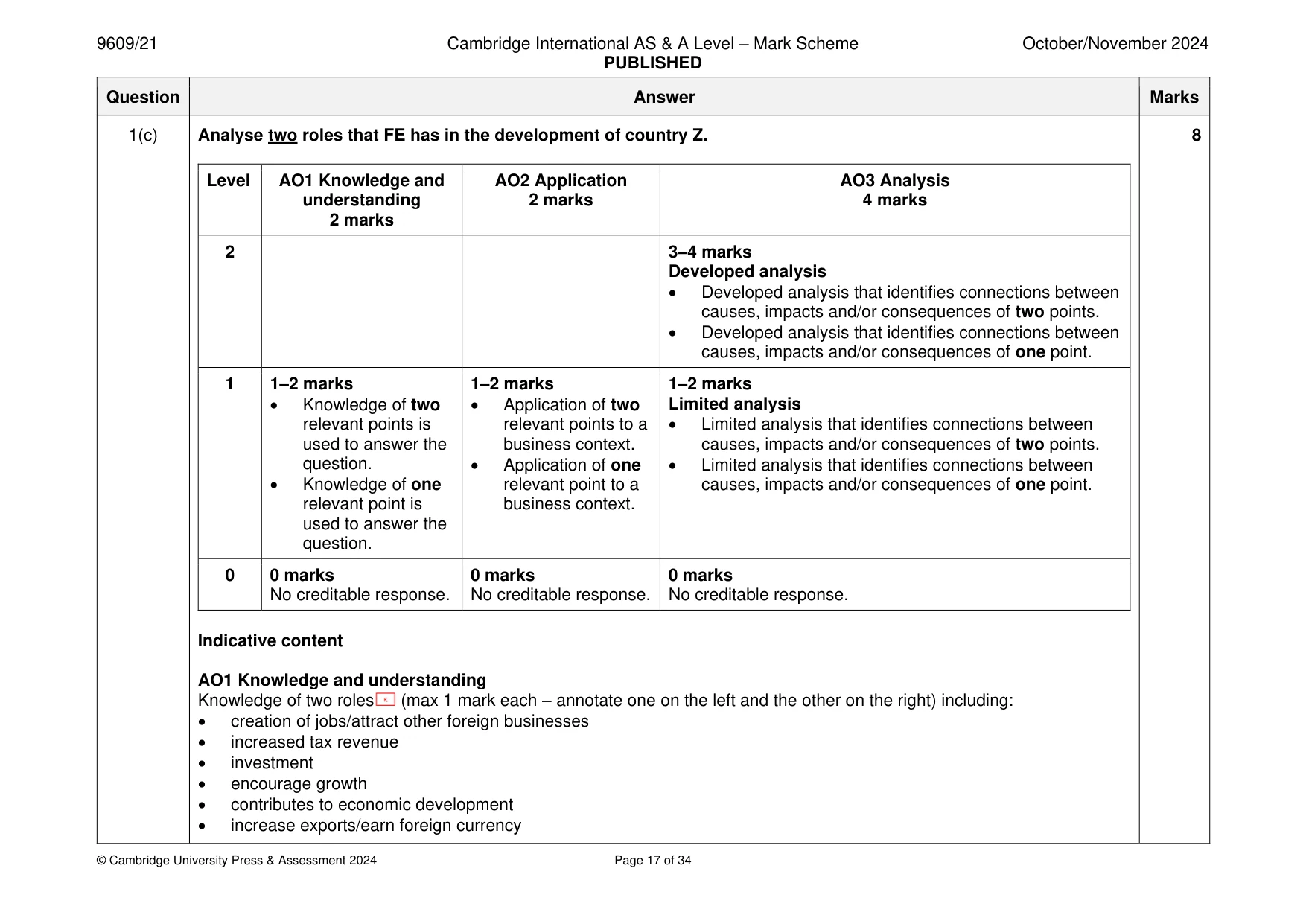
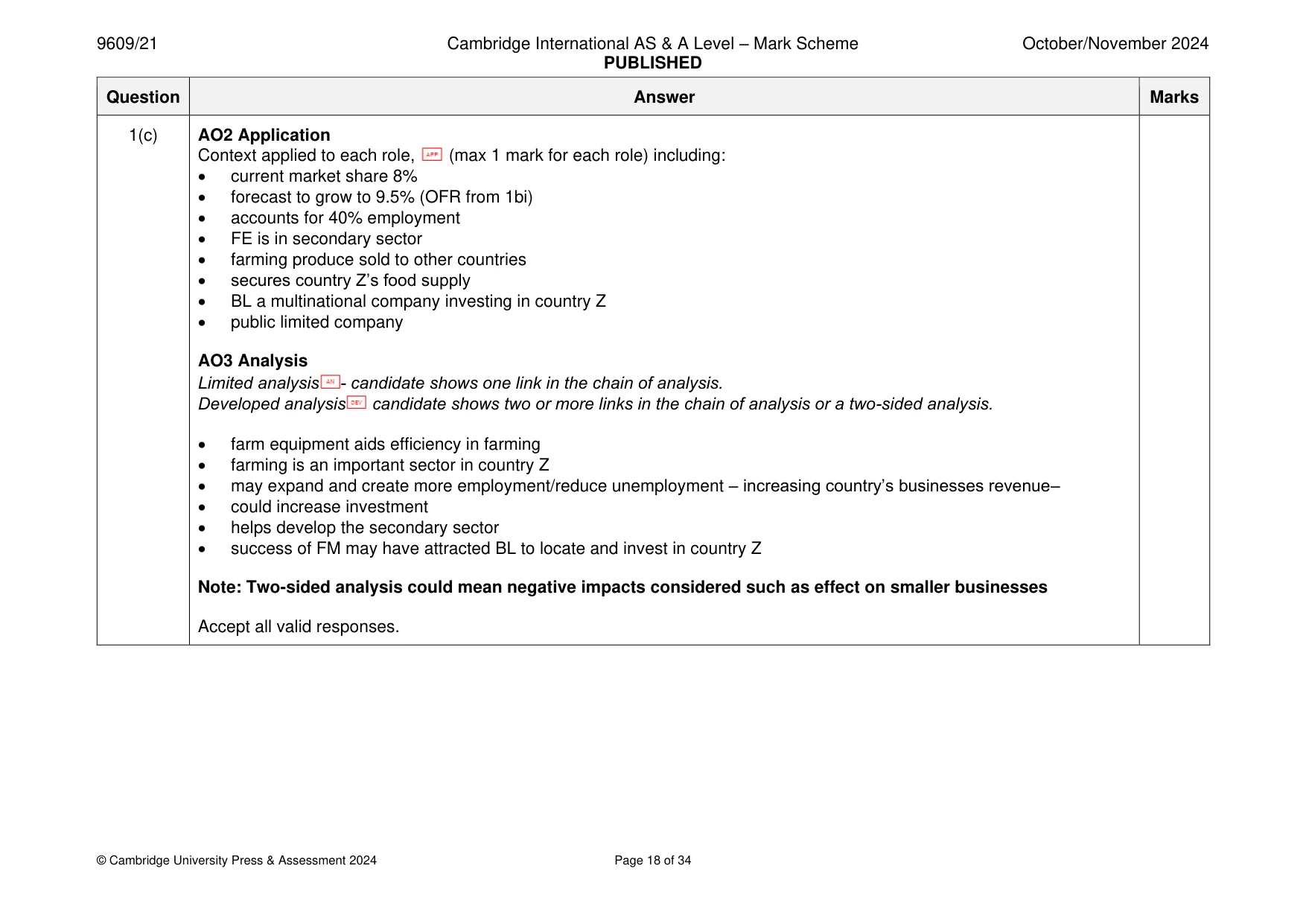
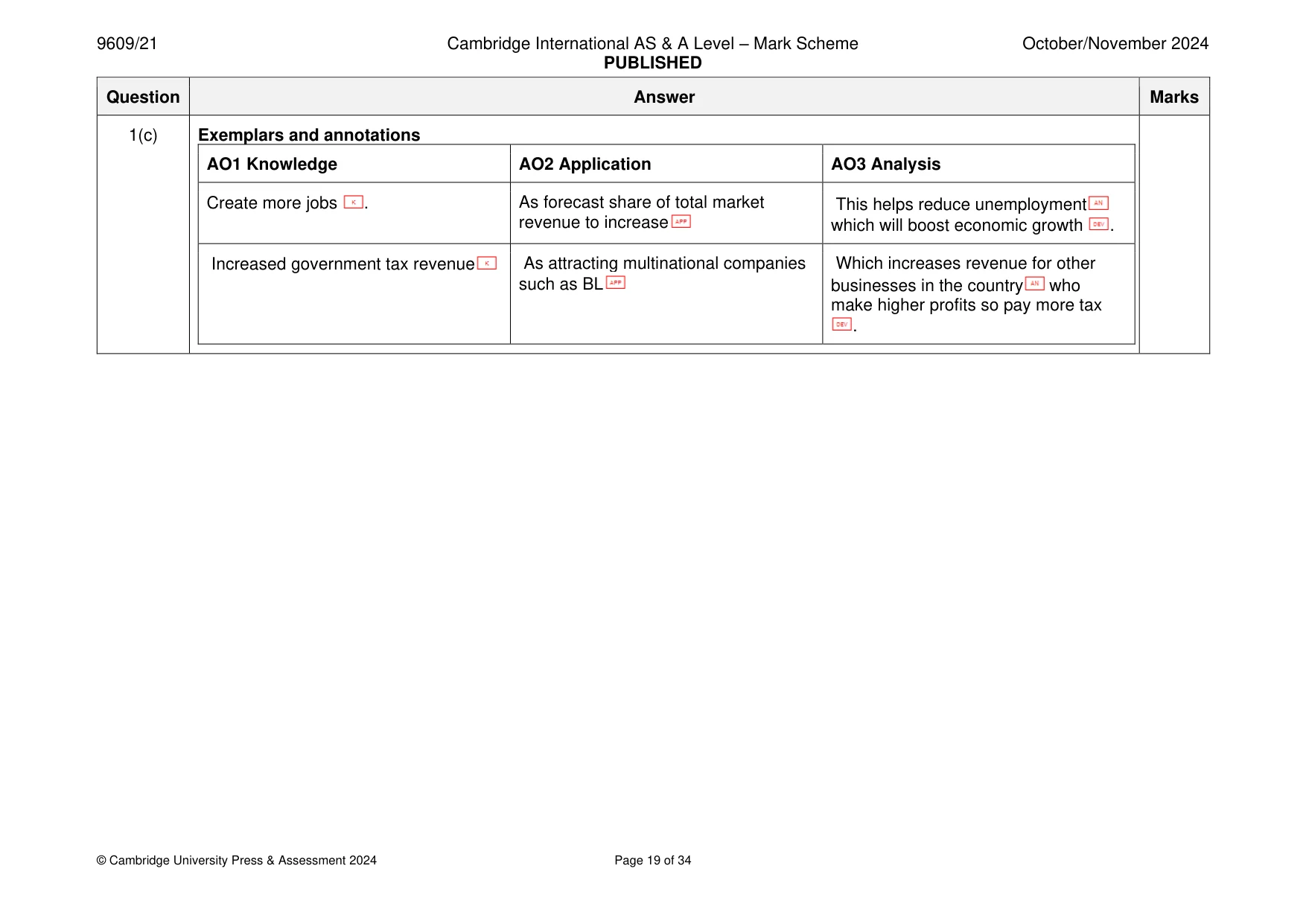
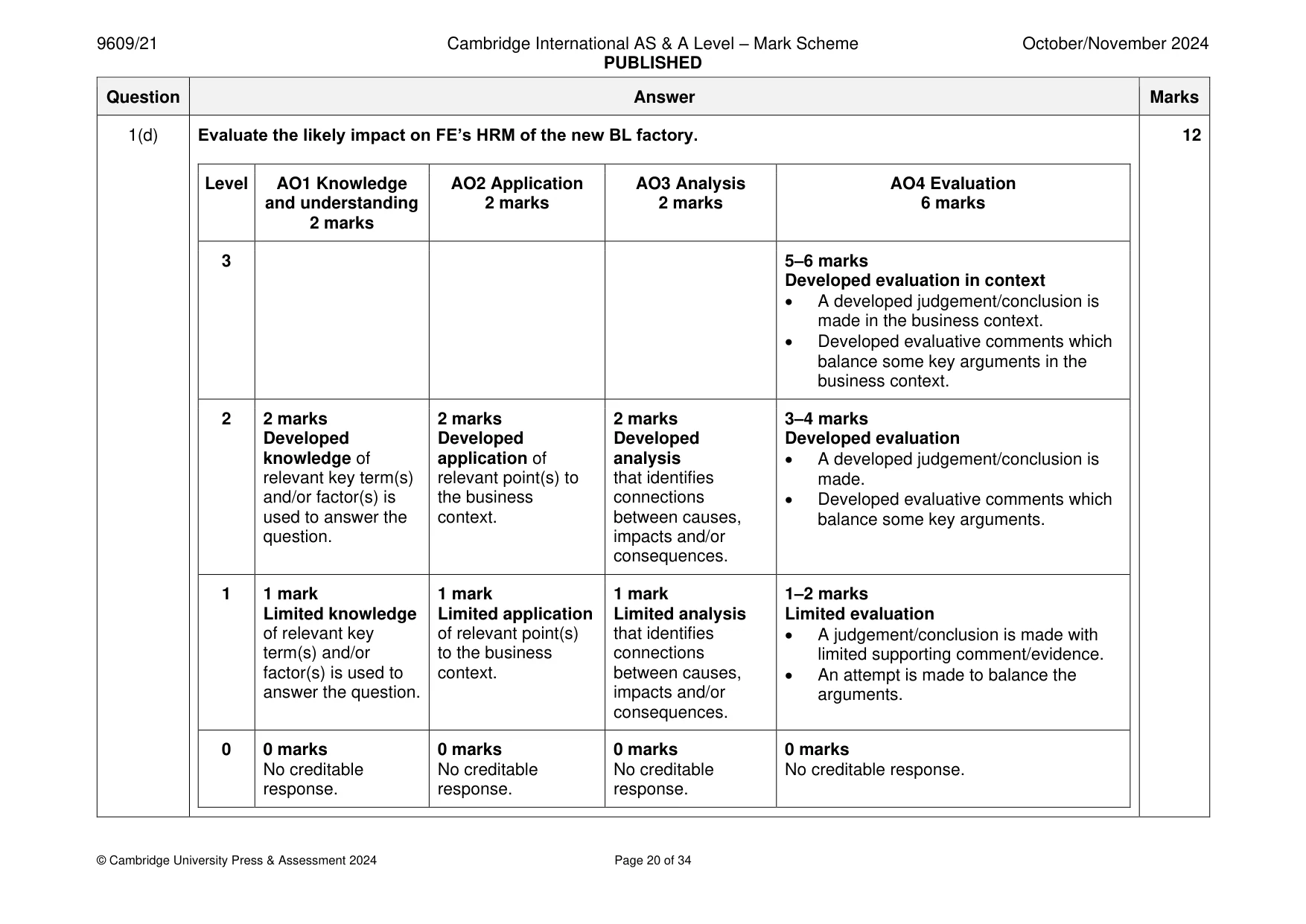
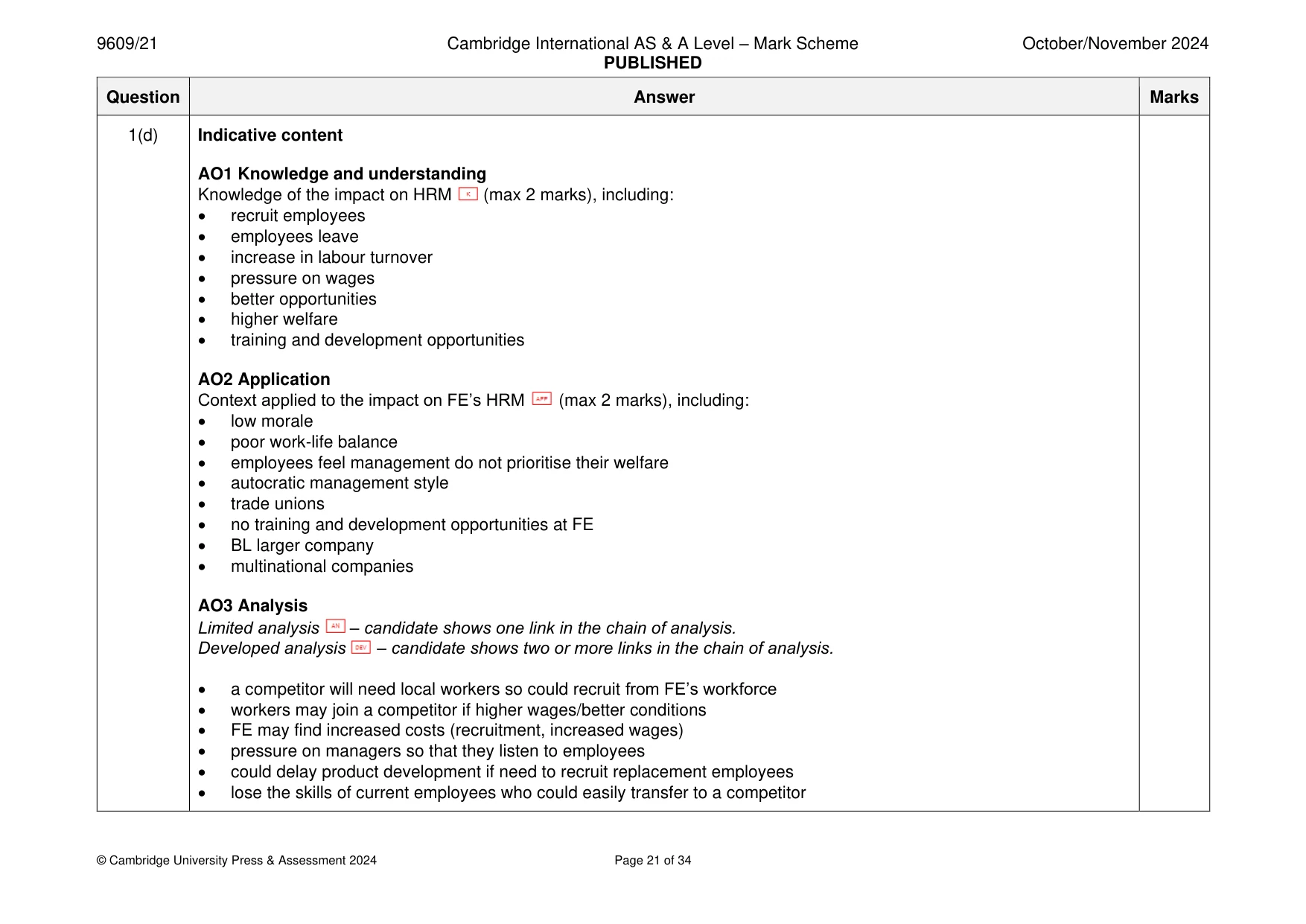
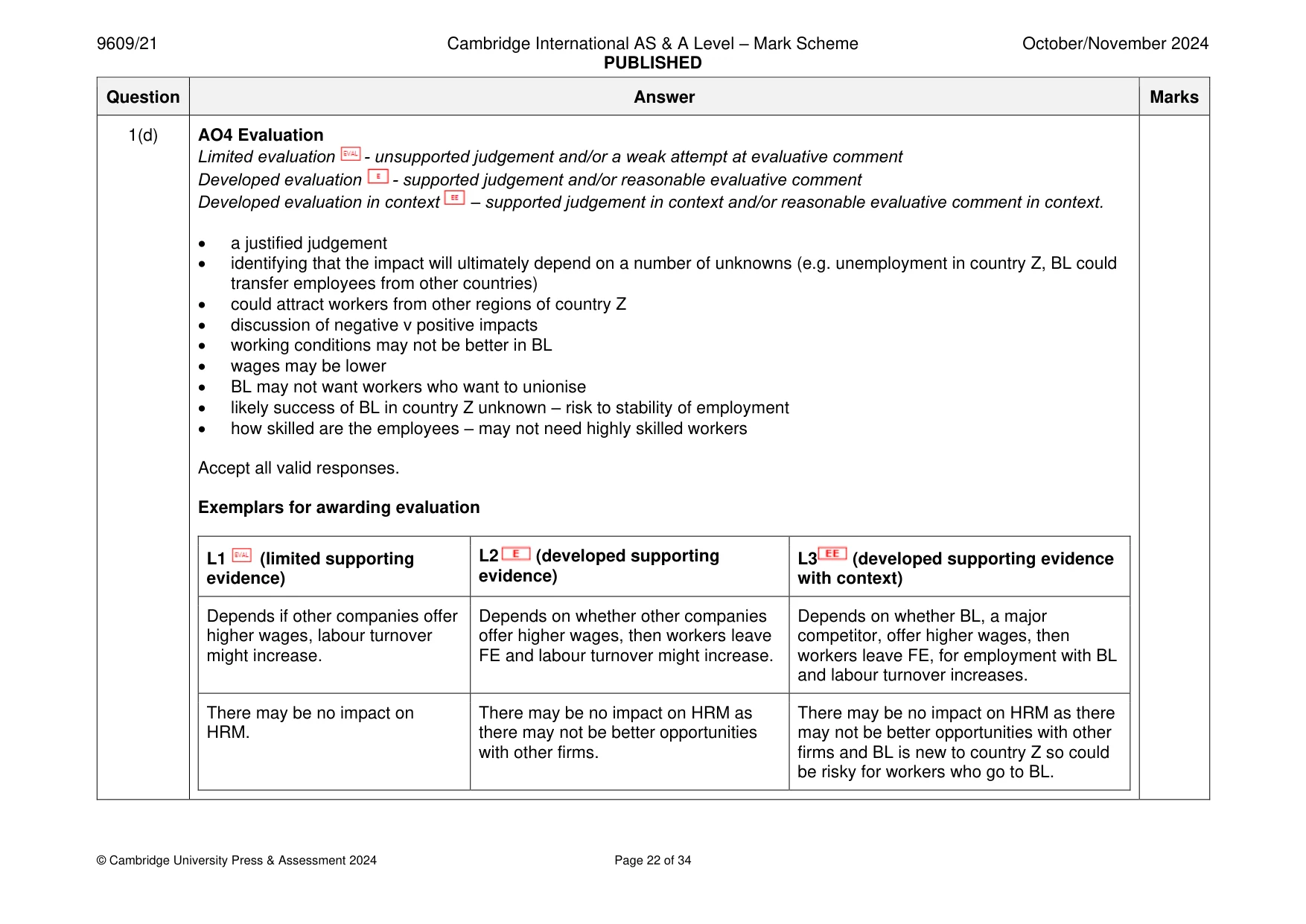
Mark scheme: Question Answer Marks 1(a)(i) Identify one feature of the primary sector. 1 Indicative content Any feature of the primary sector , including: • extraction/collection of natural resources/raw materials • sell raw materials to the secondary sector • a primary sector industry such as farming, fishing, mining Accept all valid responses. 1(a)(ii) Explain the term intrapreneur. 3 AO1 Knowledge and understanding AO2 Application 1 mark 2 marks 2 marks Developed application of one relevant point to a business context. 1 mark 1 mark Knowledge of one relevant point is used Limited application of one relevant point to a business context. to answer the question. 0 marks 0 marks No creditable response. No creditable response. Indicative content AO1 Knowledge and understanding Knowledge of intrapreneur , may include: • manager who leads a team • develop ideas/technologies/applications/ways of doing business • creative/innovative Note: without K cannot award any marks. AO2 Application Explanation of intrapreneur may include: • employee within a business • product development • to help improve the company/profits • to help meet the demand of consumers • creates a competitive advantage 1(a)(ii) Context applied to intrapreneur , including: • risks stay with the business • takes on an entrepreneurial role within a business • has the characteristics (of) an entrepreneur • specific examples from FE, such as Lin developing new products • specific examples from BL, such as location of the factory Guidance in awarding marks Knowledge & Knowledge of intrapreneur 1 mark understanding Explanation Develops K point 1 mark Context Applied to a business context/ business environment/generic 1 mark example Exemplars and annotations Exemplars and annotations Marks Rationale Creative employee within a business, like Lin for 3 Creative (K), employee within a business (explanation FE APP) like Lin for FE (context APP) Has the characteristics of an entrepreneur 2 Has the characteristics of an entrepreneur (context APP), developing new ways of doing business developing new ways of doing business (K) Manager leading a team 1 Only K Takes on an entrepreneurial role 0 Although there is APP, without K no marks can be awarded 1(b)(i) Refer to Table 1.1 and other information. Calculate the forecast change in FE’s market share between 2023 and 3 2024. Market share/total market 100 (1) OR revenue/market revenue 100 (1) OR FE’s forecast market share 2024 =29.45 / 310 100 (1) = 9.5% (1) FE’s market share 2023 = 8% (given in the case study so no mark for this figure) 9.5% – 8% = 1.5% (3) 1(b)(i) Marks 3 Correct answer Working and % do not matter. 1.5% (accept 1.5) 2 Formula To award two marks, there must be Market share/total market 100 • Two and a OR OR Revenue/market revenue 100 • One , one and one AND Correct figures identified 29.45 / 310 OR Inverted 310 / 29.45 100 (1 mark for implied formula)= 1052.6 (OFR mark) OR Show working for inverted formula (1) and then use this as 1052.6 – 8 = 1044.6 (OFR) 1 One of the following: To award one mark, there must be: Formula • One and two Market share/total market 100 OR Revenue/market revenue 100 OR Correct figures identified 29.45 / 310 OR Inverted 310 / 29.45 0 No creditable content. To award zero marks, there must be • One 1(b)(ii) Explain one benefit to FE of product development. 3 AO1 Knowledge and understanding AO2 Application 1 mark 2 marks 2 marks Developed application of one relevant point to a business context. 1 mark 1 mark Knowledge of one relevant point is used to Limited application of one relevant point to a business context. answer the question. 0 marks 0 marks No creditable response. No creditable response. Indicative content AO1 Knowledge and understanding Knowledge of one benefit of product development . Responses may include: • keep up with trends • stay competitive • to enter new markets • increase market share • increase sales • increase revenue/profit • improve the quality of products • increase customer satisfaction/loyalty • widen customer base • increases the range of products AO2 Application Explanation of a benefit of product development , including: • innovative product may increase demand • more accurately meet consumer demand • may attract new customers 1(b)(ii) • may be able to charge a premium price/price skimming Context applied to a benefit to FE of product development including: • market for farm equipment is increasing • major competitor entered the market • intrapreneur and project team investment • developing new machinery • sells to large farms • market size increased due to product development/use of answer to Q1(b)(i) (OFR) Accept all valid responses. Guidance in awarding marks Knowledge & understanding Knowledge of a benefit of product development 1 mark Explanation Explanation of a benefit of product development 1 mark Context Context linked to a benefit of product development 1 mark Exemplars and annotations Marks Rationale Firms can enter new markets and widen their 3 K for benefit, then APP for explaining why a benefit customer base and benefit from a growing market. and APP for context from the case study. Increases range of products to attract new 2 K for benefit, then APP for explaining why a benefit customers but there is no context To stay competitive 1 K only Market for farm equipment is increasing 0 No K demonstrated 1(c) Analyse two roles that FE has in the development of country Z. 8 Level AO1 Knowledge and AO2 Application AO3 Analysis understanding 2 marks 4 marks 2 marks 2 3–4 marks Developed analysis • Developed analysis that identifies connections between causes, impacts and/or consequences of two points. • Developed analysis that identifies connections between causes, impacts and/or consequences of one point. 1 1–2 marks 1–2 marks 1–2 marks • Knowledge of two • Application of two Limited analysis relevant points is relevant points to a • Limited analysis that identifies connections between used to answer the business context. causes, impacts and/or consequences of two points. question. • Application of one • Limited analysis that identifies connections between • Knowledge of one relevant point to a causes, impacts and/or consequences of one point. relevant point is business context. used to answer the question. 0 0 marks 0 marks 0 marks No creditable response. No creditable response. No creditable response. Indicative content AO1 Knowledge and understanding Knowledge of two roles (max 1 mark each – annotate one on the left and the other on the right) including: • creation of jobs/attract other foreign businesses • increased tax revenue • investment • encourage growth • contributes to economic development • increase exports/earn foreign currency 1(c) AO2 Application Context applied to each role, (max 1 mark for each role) including: • current market share 8% • forecast to grow to 9.5% (OFR from 1bi) • accounts for 40% employment • FE is in secondary sector • farming produce sold to other countries • secures country Z’s food supply • BL a multinational company investing in country Z • public limited company AO3 Analysis Limited analysis - candidate shows one link in the chain of analysis. Developed analysis candidate shows two or more links in the chain of analysis or a two-sided analysis. • farm equipment aids efficiency in farming • farming is an important sector in country Z • may expand and create more employment/reduce unemployment – increasing country’s businesses revenue– • could increase investment • helps develop the secondary sector • success of FM may have attracted BL to locate and invest in country Z Note: Two-sided analysis could mean negative impacts considered such as effect on smaller businesses Accept all valid responses. 1(c) Exemplars and annotations AO1 Knowledge AO2 Application AO3 Analysis Create more jobs . As forecast share of total market This helps reduce unemployment revenue to increase which will boost economic growth . Increased government tax revenue As attracting multinational companies Which increases revenue for other such as BL businesses in the country who make higher profits so pay more tax . 1(d) Evaluate the likely impact on FE’s HRM of the new BL factory. 12 Level AO1 Knowledge AO2 Application AO3 Analysis AO4 Evaluation and understanding 2 marks 2 marks 6 marks 2 marks 3 5–6 marks Developed evaluation in context • A developed judgement/conclusion is made in the business context. • Developed evaluative comments which balance some key arguments in the business context. 2 2 marks 2 marks 2 marks 3–4 marks Developed Developed Developed Developed evaluation knowledge of application of analysis • A developed judgement/conclusion is relevant key term(s) relevant point(s) to that identifies made. and/or factor(s) is the business connections • Developed evaluative comments which used to answer the context. between causes, balance some key arguments. question. impacts and/or consequences. 1 1 mark 1 mark 1 mark 1–2 marks Limited knowledge Limited application Limited analysis Limited evaluation of relevant key of relevant point(s) that identifies • A judgement/conclusion is made with term(s) and/or to the business connections limited supporting comment/evidence. factor(s) is used to context. between causes, • An attempt is made to balance the answer the question. impacts and/or arguments. consequences. 0 0 marks 0 marks 0 marks 0 marks No creditable No creditable No creditable No creditable response. response. response. response. 1(d) Indicative content AO1 Knowledge and understanding Knowledge of the impact on HRM (max 2 marks), including: • recruit employees • employees leave • increase in labour turnover • pressure on wages • better opportunities • higher welfare • training and development opportunities AO2 Application Context applied to the impact on FE’s HRM (max 2 marks), including: • low morale • poor work-life balance • employees feel management do not prioritise their welfare • autocratic management style • trade unions • no training and development opportunities at FE • BL larger company • multinational companies AO3 Analysis Limited analysis – candidate shows one link in the chain of analysis. Developed analysis – candidate shows two or more links in the chain of analysis. • a competitor will need local workers so could recruit from FE’s workforce • workers may join a competitor if higher wages/better conditions • FE may find increased costs (recruitment, increased wages) • pressure on managers so that they listen to employees • could delay product development if need to recruit replacement employees • lose the skills of current employees who could easily transfer to a competitor 1(d) AO4 Evaluation Limited evaluation - unsupported judgement and/or a weak attempt at evaluative comment Developed evaluation - supported judgement and/or reasonable evaluative comment Developed evaluation in context – supported judgement in context and/or reasonable evaluative comment in context. • a justified judgement • identifying that the impact will ultimately depend on a number of unknowns (e.g. unemployment in country Z, BL could transfer employees from other countries) • could attract workers from other regions of country Z • discussion of negative v positive impacts • working conditions may not be better in BL • wages may be lower • BL may not want workers who want to unionise • likely success of BL in country Z unknown – risk to stability of employment • how skilled are the employees – may not need highly skilled workers Accept all valid responses. Exemplars for awarding evaluation L1 (limited supporting L2 (developed supporting L3 (developed supporting evidence evidence) evidence) with context) Depends if other companies offer Depends on whether other companies Depends on whether BL, a major higher wages, labour turnover offer higher wages, then workers leave competitor, offer higher wages, then might increase. FE and labour turnover might increase. workers leave FE, for employment with BL and labour turnover increases. There may be no impact on There may be no impact on HRM as There may be no impact on HRM as there HRM. there may not be better opportunities may not be better opportunities with other with other firms. firms and BL is new to country Z so could be risky for workers who go to BL.
Q2 · Coffee Company Local (CCL) CCL is a family business in country Y
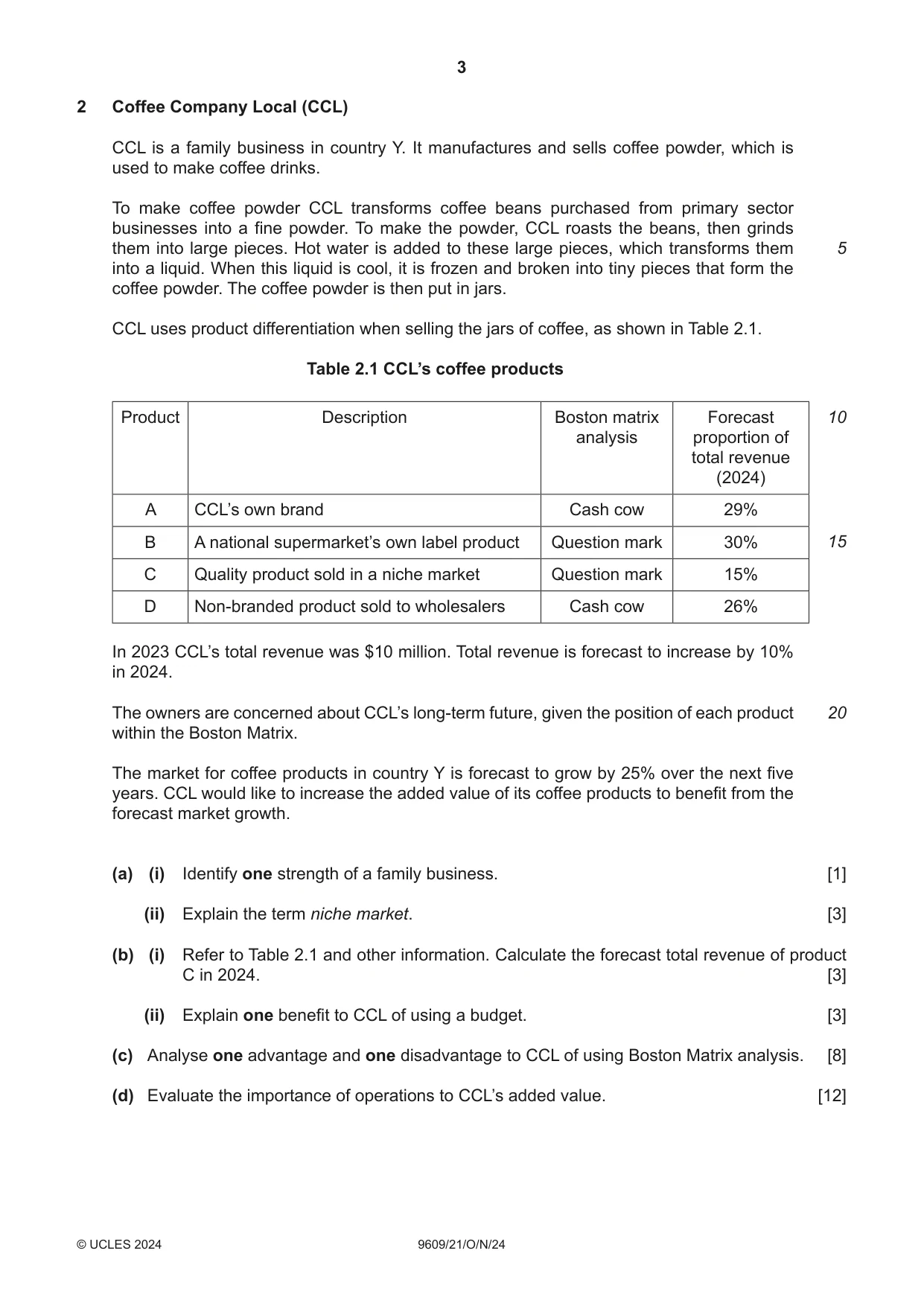
2 Coffee Company Local (CCL) CCL is a family business in country Y. It manufactures and sells coffee powder, which is used to make coffee drinks. To make coffee powder CCL transforms coffee beans purchased from primary sector businesses into a fine powder. To make the powder, CCL roasts the beans, then grinds them into large pieces. Hot water is added to these large pieces, which transforms them 5 into a liquid. When this liquid is cool, it is frozen and broken into tiny pieces that form the coffee powder. The coffee powder is then put in jars. CCL uses product differentiation when selling the jars of coffee, as shown in Table 2.1. Table 2.1 CCL’s coffee products Product Description Boston matrix Forecast 10 analysis proportion of total revenue (2024) A CCL’s own brand Cash cow 29% B A national supermarket’s own label product Question mark 30% 15 C Quality product sold in a niche market Question mark 15% D Non-branded product sold to wholesalers Cash cow 26% In 2023 CCL’s total revenue was $10 million. Total revenue is forecast to increase by 10% in 2024. The owners are concerned about CCL’s long-term future, given the position of each product 20 within the Boston Matrix. The market for coffee products in country Y is forecast to grow by 25% over the next five years. CCL would like to increase the added value of its coffee products to benefit from the forecast market growth. (a) (i) Identify one strength of a family business. [1] (ii) Explain the term niche market. [3] (b) (i) Refer to Table 2.1 and other information. Calculate the forecast total revenue of product C in 2024. [3] (ii) Explain one benefit to CCL of using a budget. [3] (c) Analyse one advantage and one disadvantage to CCL of using Boston Matrix analysis. [8] (d) Evaluate the importance of operations to CCL’s added value. [12]
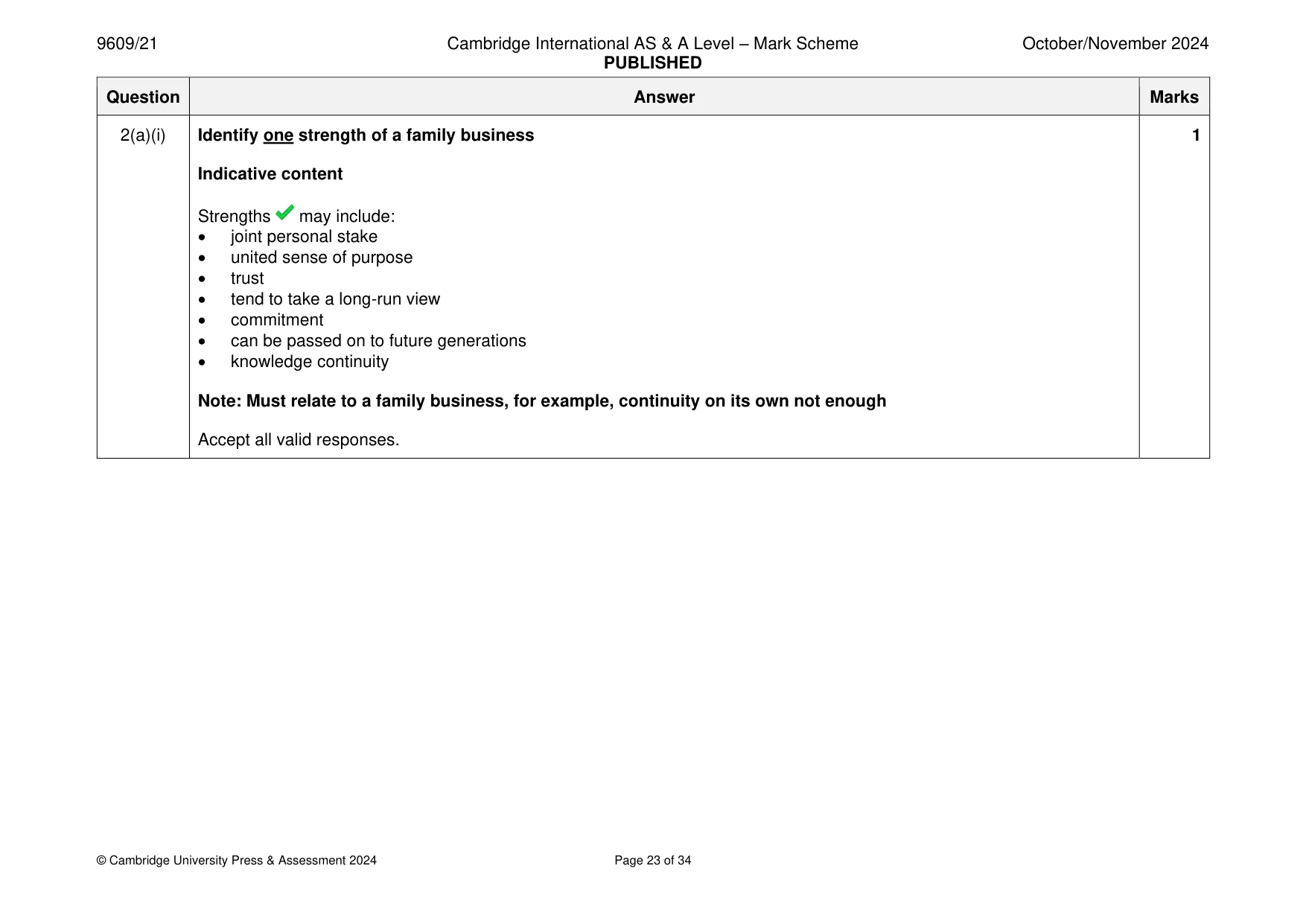
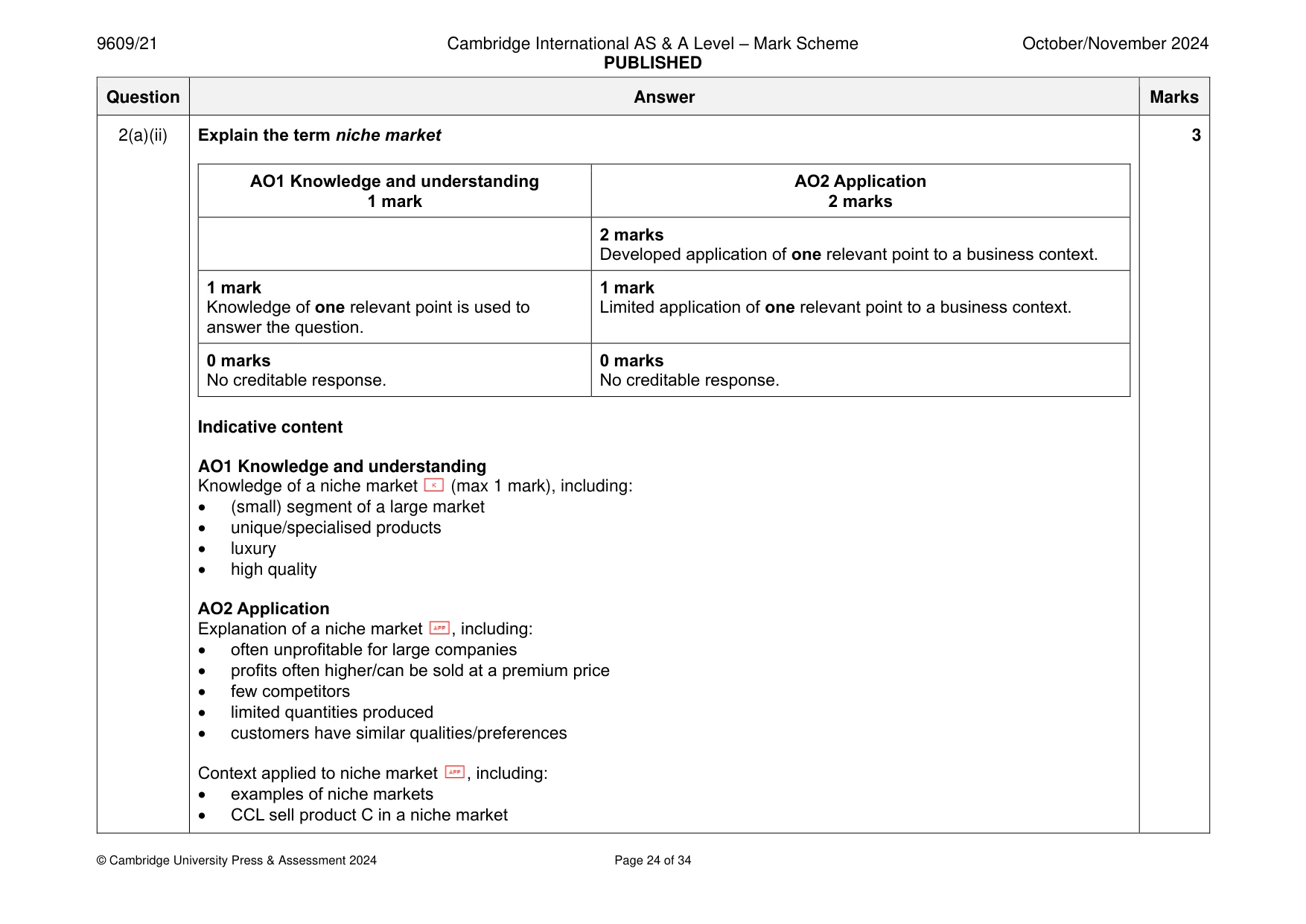
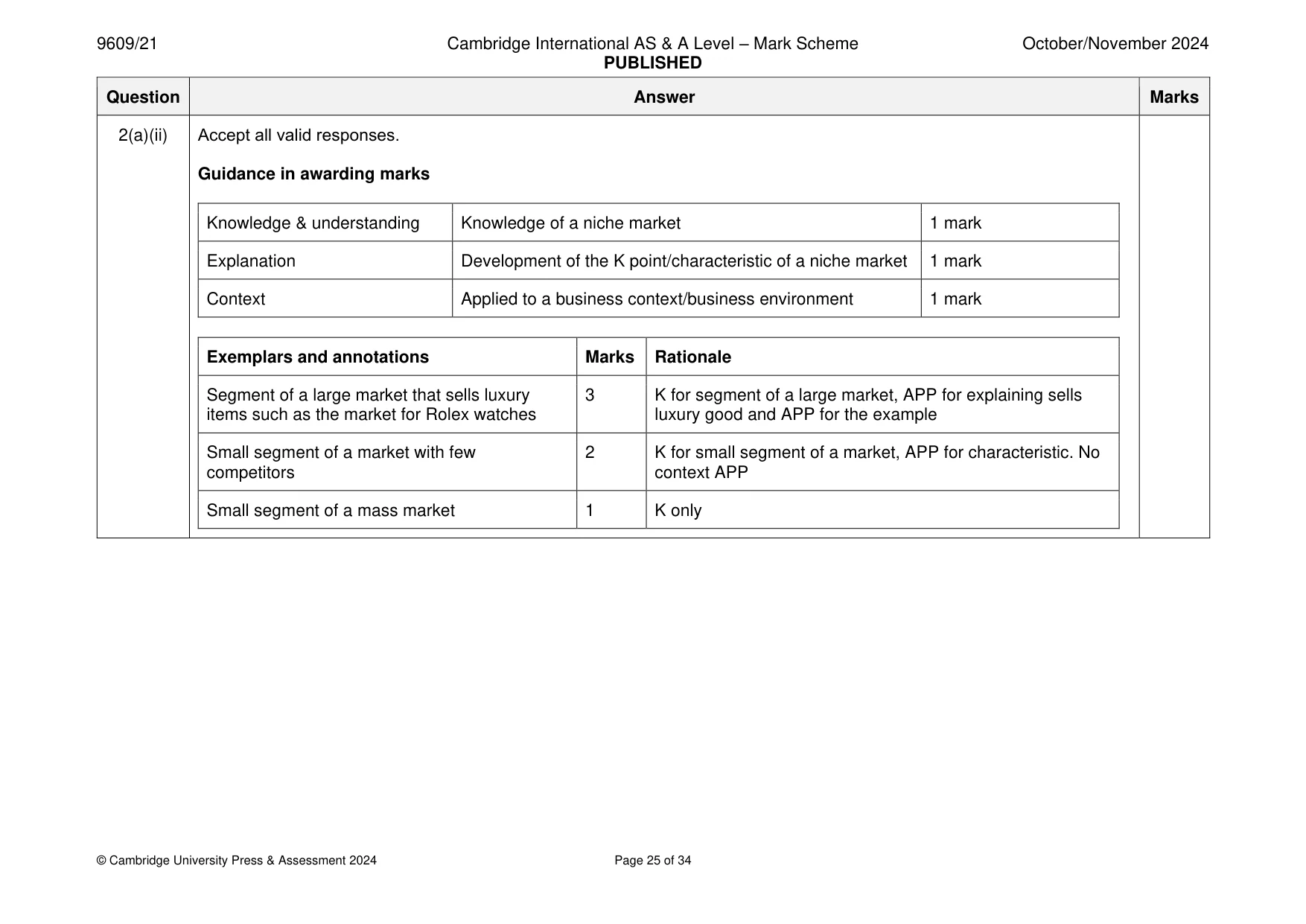
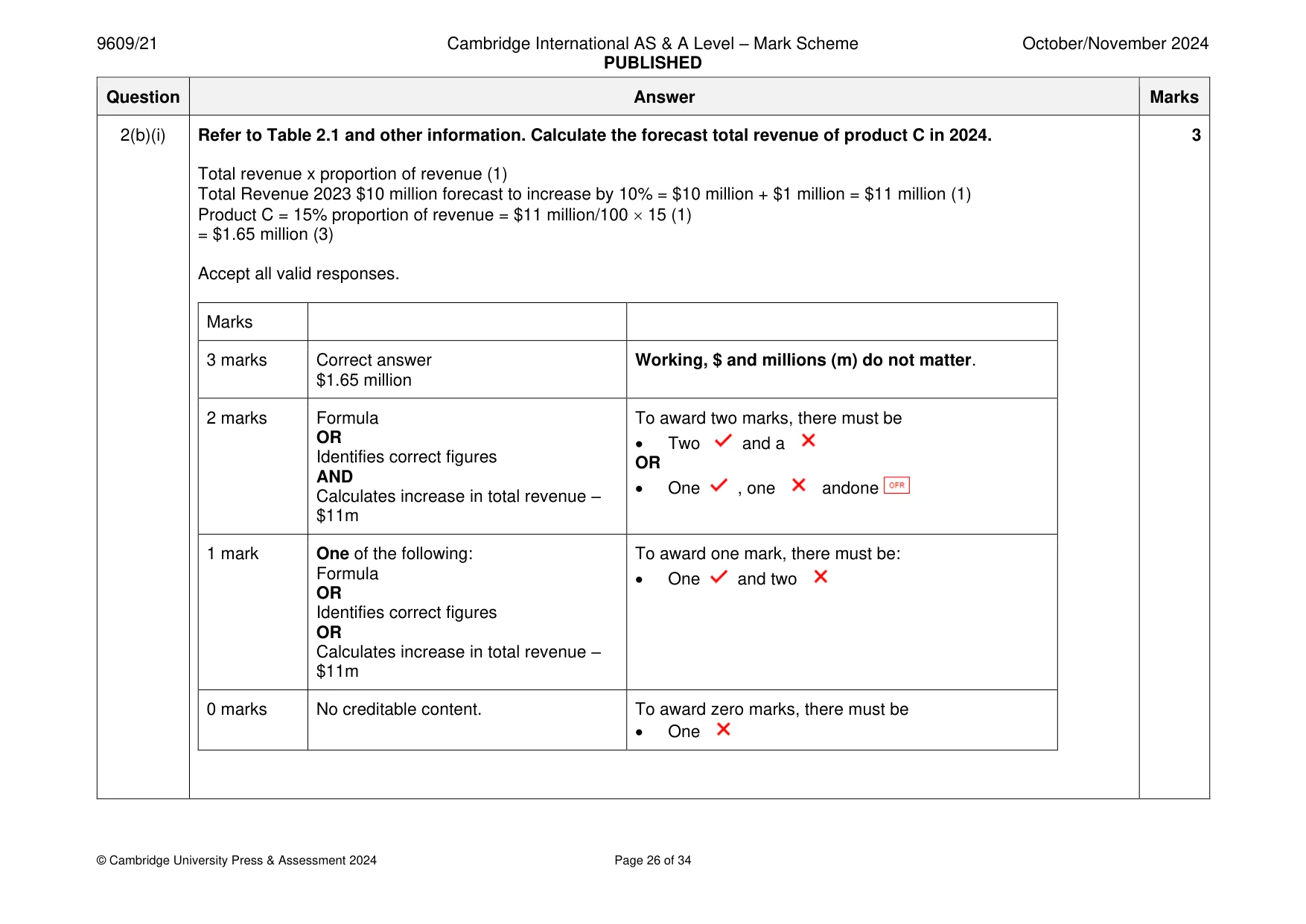
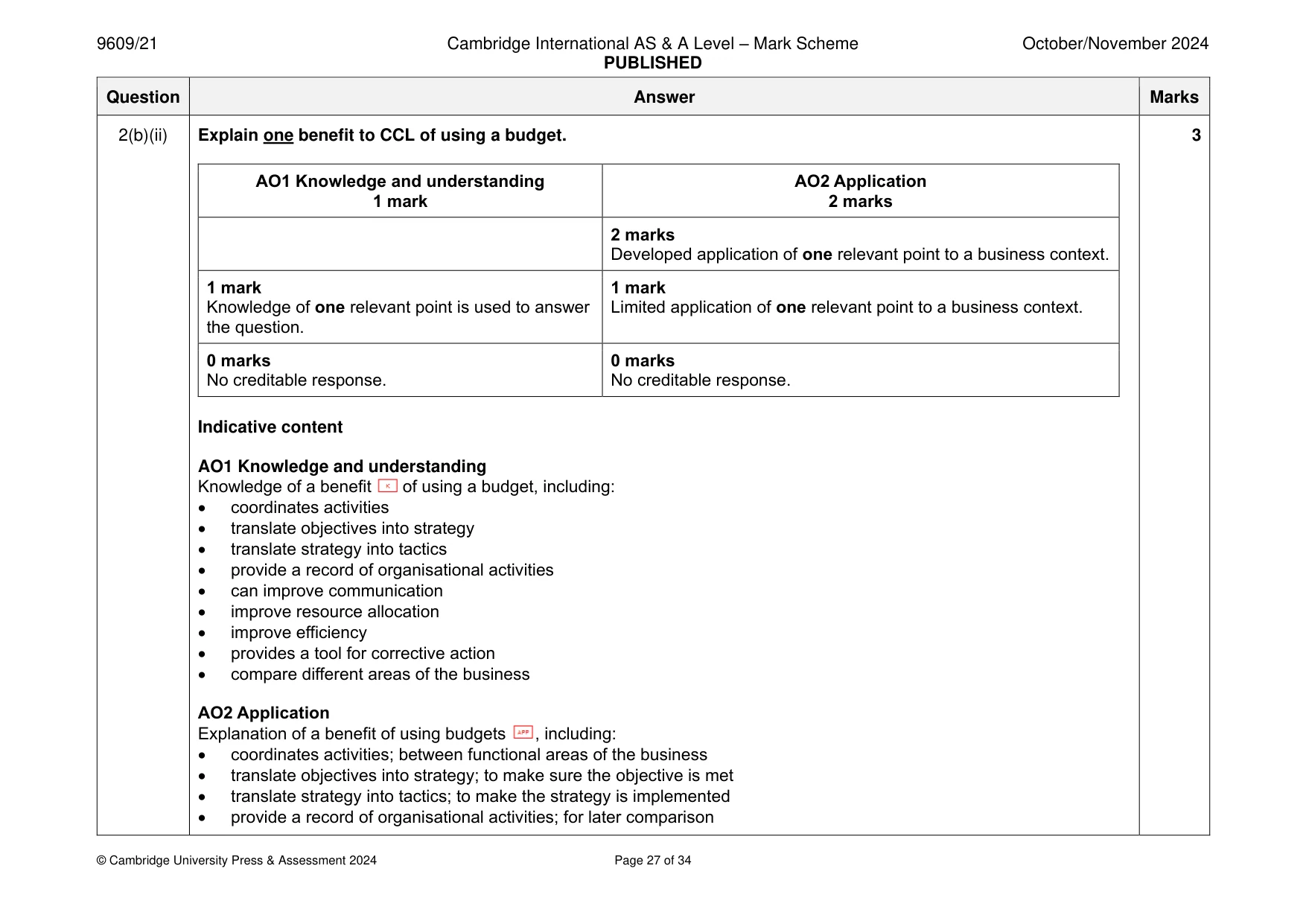
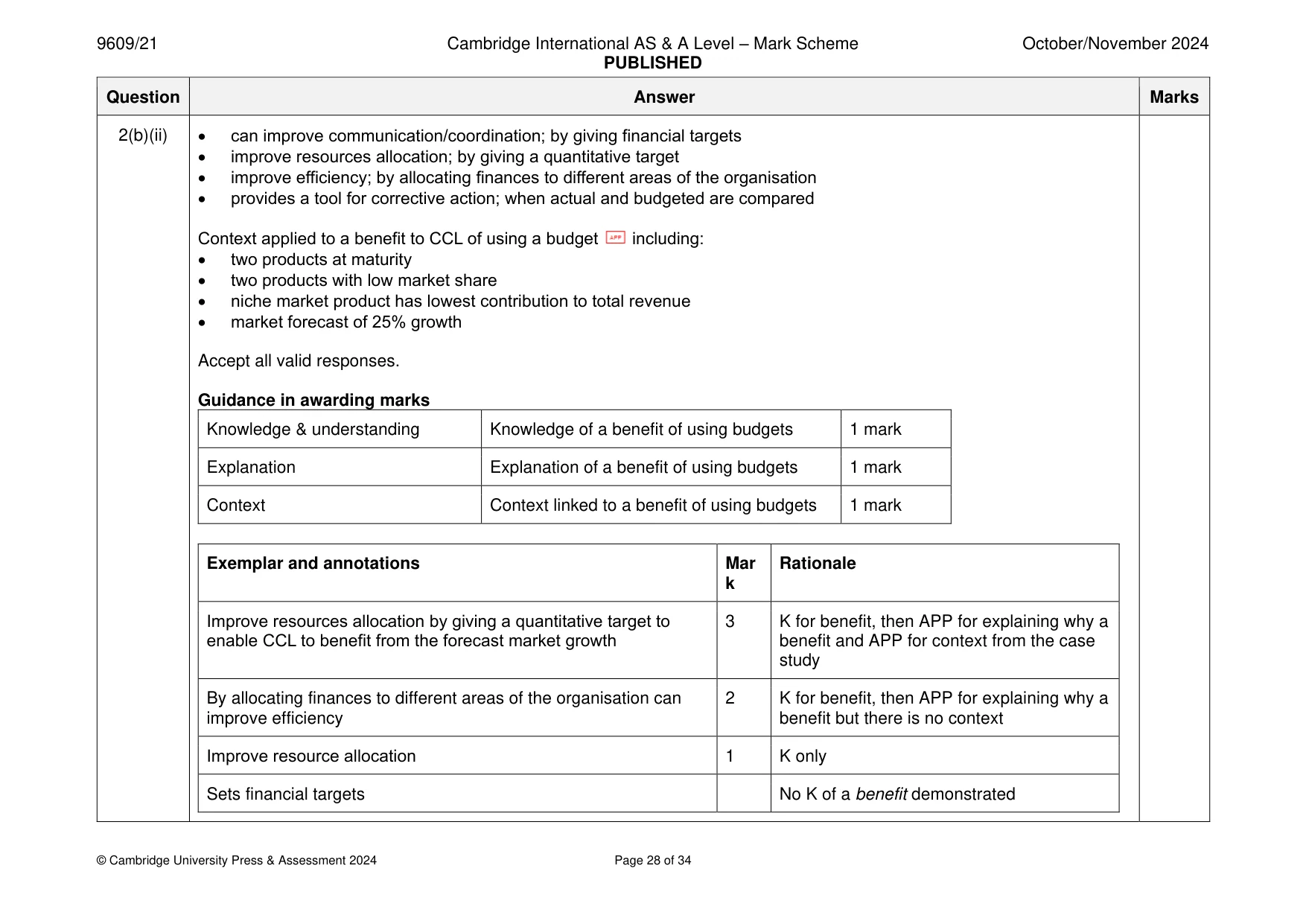
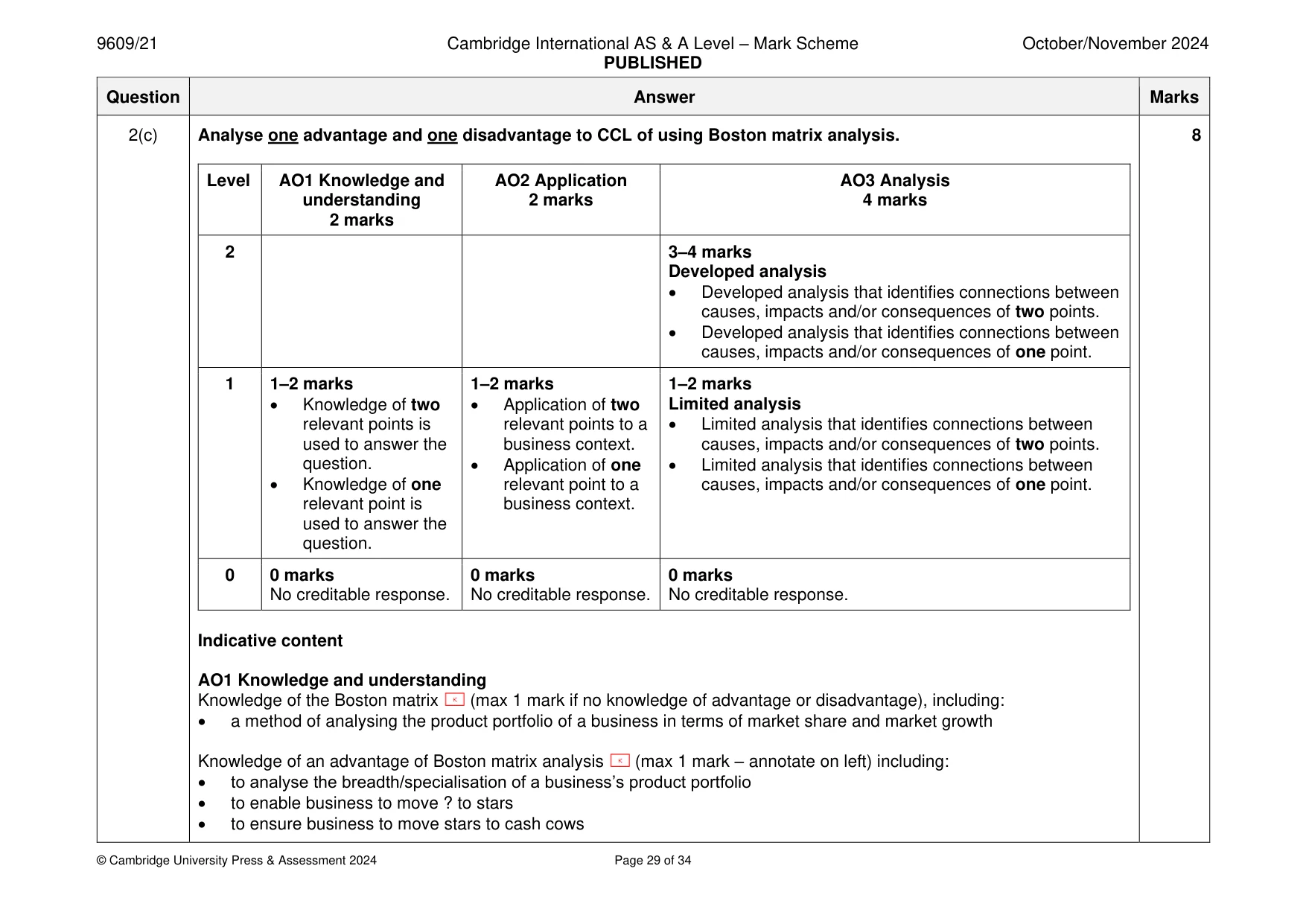
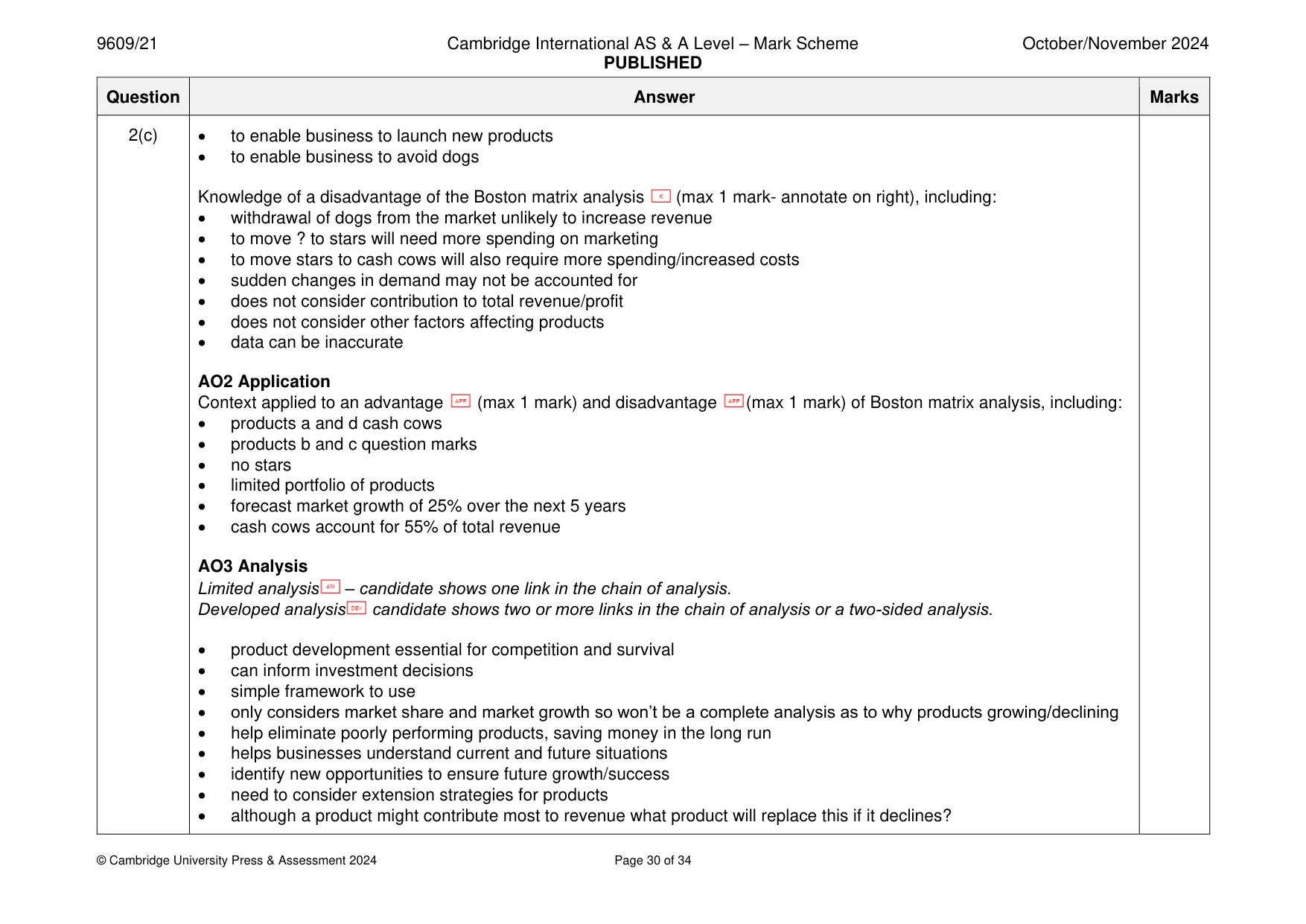
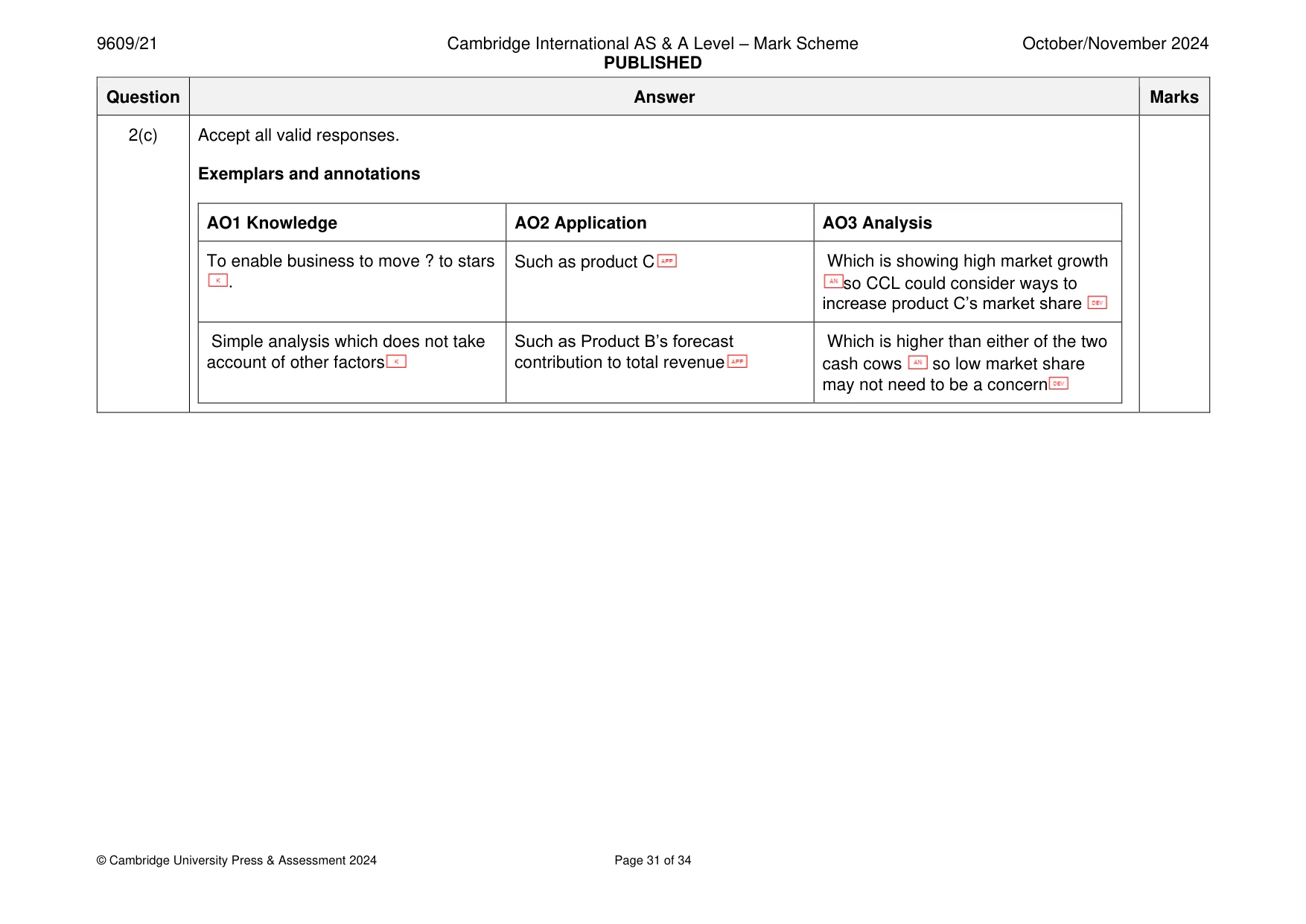
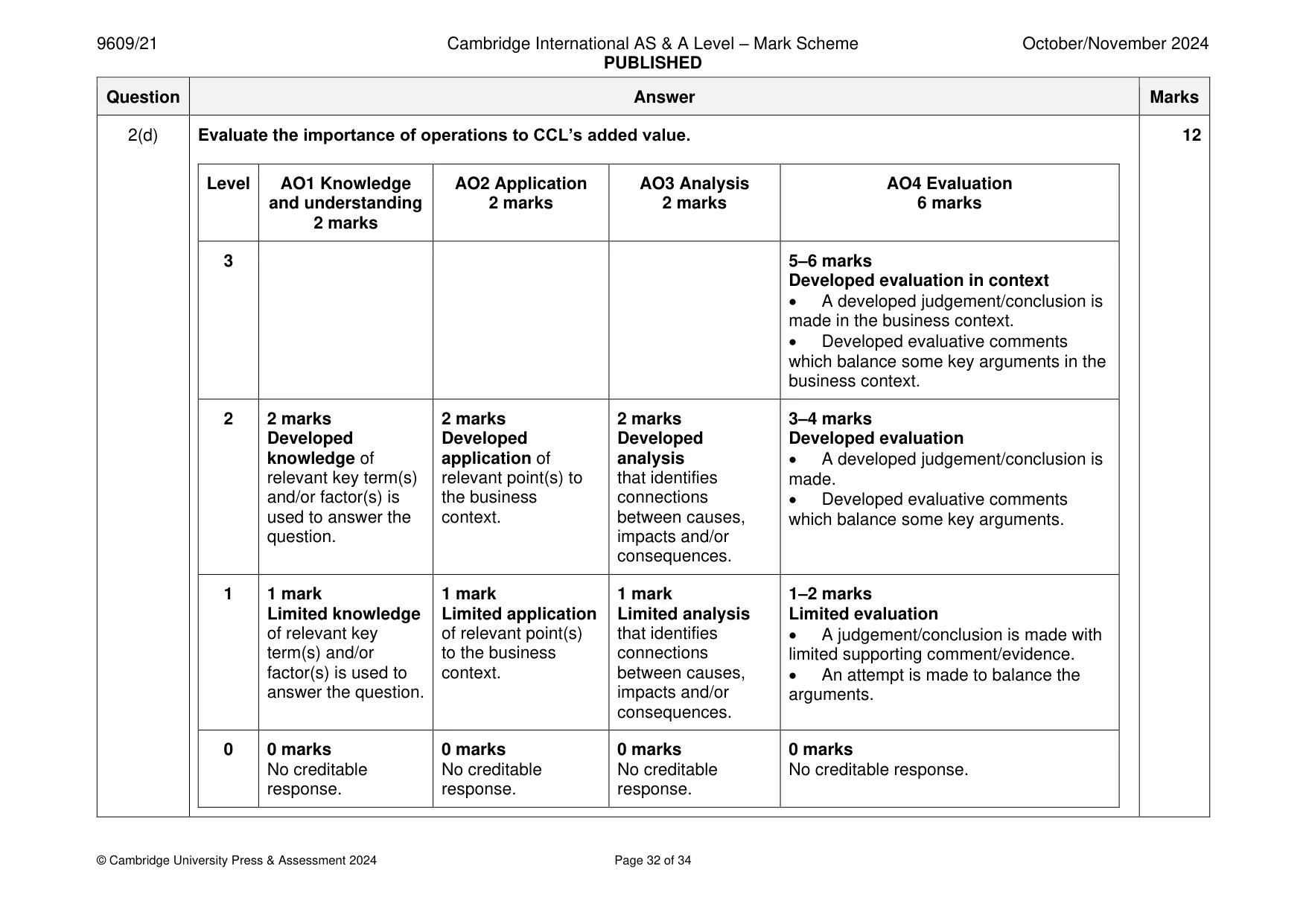
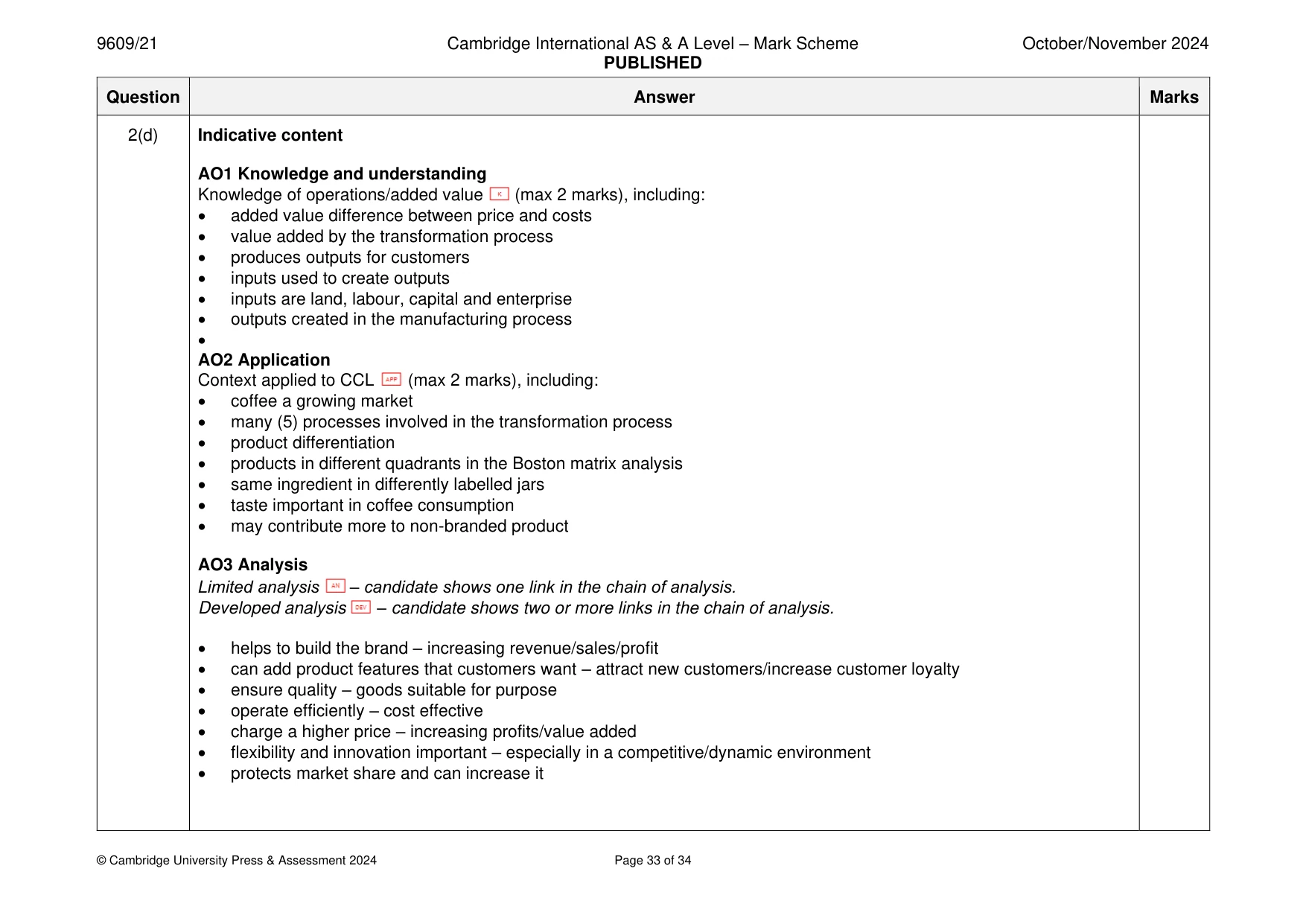
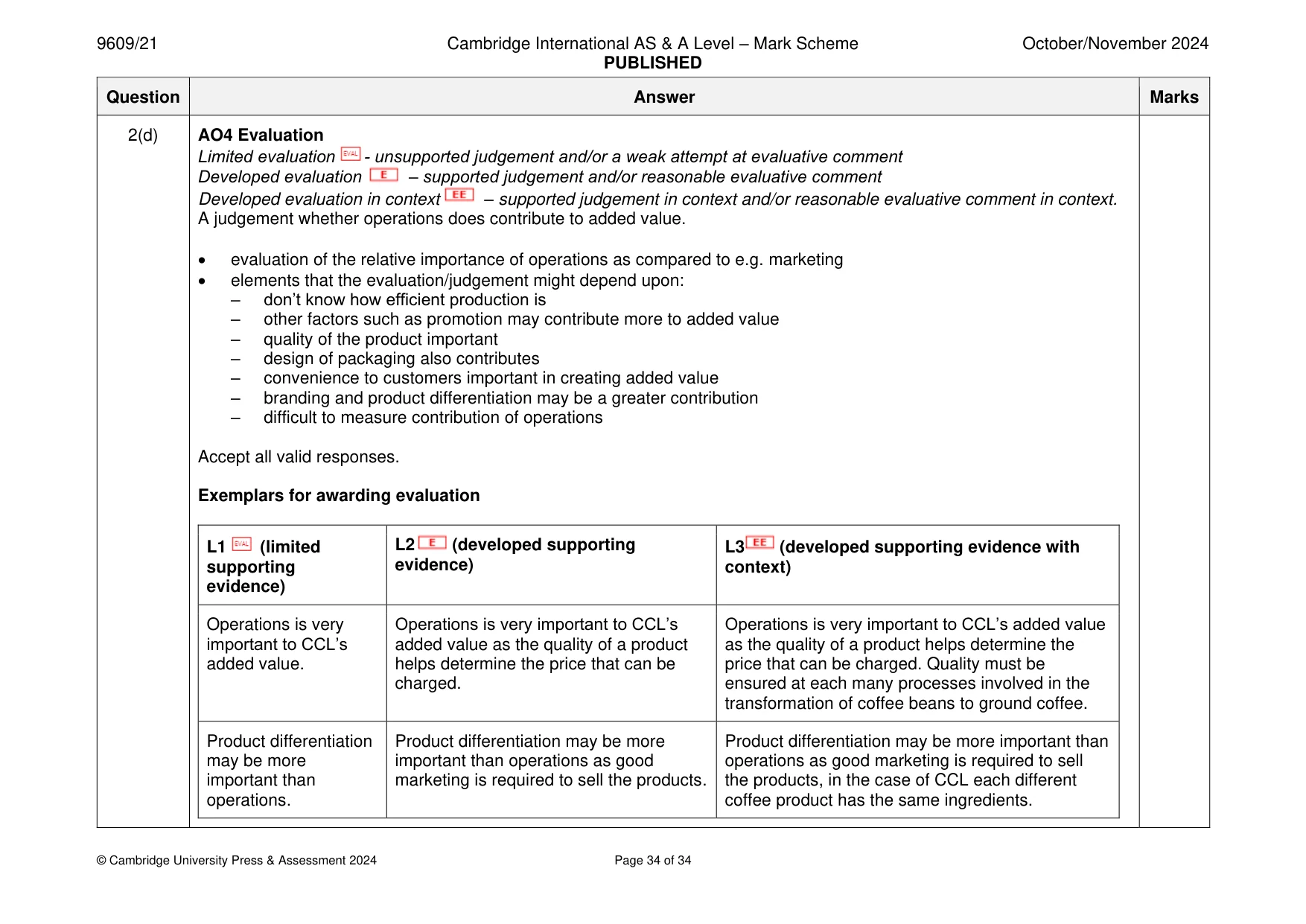
Mark scheme: 2(a)(i) Identify one strength of a family business 1 Indicative content Strengths may include: • joint personal stake • united sense of purpose • trust • tend to take a long-run view • commitment • can be passed on to future generations • knowledge continuity Note: Must relate to a family business, for example, continuity on its own not enough Accept all valid responses. 2(a)(ii) Explain the term niche market 3 AO1 Knowledge and understanding AO2 Application 1 mark 2 marks 2 marks Developed application of one relevant point to a business context. 1 mark 1 mark Knowledge of one relevant point is used to Limited application of one relevant point to a business context. answer the question. 0 marks 0 marks No creditable response. No creditable response. Indicative content AO1 Knowledge and understanding Knowledge of a niche market (max 1 mark), including: • (small) segment of a large market • unique/specialised products • luxury • high quality AO2 Application Explanation of a niche market , including: • often unprofitable for large companies • profits often higher/can be sold at a premium price • few competitors • limited quantities produced • customers have similar qualities/preferences Context applied to niche market , including: • examples of niche markets • CCL sell product C in a niche market 2(a)(ii) Accept all valid responses. Guidance in awarding marks Knowledge & understanding Knowledge of a niche market 1 mark Explanation Development of the K point/characteristic of a niche market 1 mark Context Applied to a business context/business environment 1 mark Exemplars and annotations Marks Rationale Segment of a large market that sells luxury 3 K for segment of a large market, APP for explaining sells items such as the market for Rolex watches luxury good and APP for the example Small segment of a market with few 2 K for small segment of a market, APP for characteristic. No competitors context APP Small segment of a mass market 1 K only 2(b)(i) Refer to Table 2.1 and other information. Calculate the forecast total revenue of product C in 2024. 3 Total revenue x proportion of revenue (1) Total Revenue 2023 $10 million forecast to increase by 10% = $10 million + $1 million = $11 million (1) Product C = 15% proportion of revenue = $11 million/100 15 (1) = $1.65 million (3) Accept all valid responses. Marks 3 marks Correct answer Working, $ and millions (m) do not matter. $1.65 million 2 marks Formula To award two marks, there must be OR • Two and a Identifies correct figures OR AND • One , one andone Calculates increase in total revenue – $11m 1 mark One of the following: To award one mark, there must be: Formula • One and two OR Identifies correct figures OR Calculates increase in total revenue – $11m 0 marks No creditable content. To award zero marks, there must be • One 2(b)(ii) Explain one benefit to CCL of using a budget. 3 AO1 Knowledge and understanding AO2 Application 1 mark 2 marks 2 marks Developed application of one relevant point to a business context. 1 mark 1 mark Knowledge of one relevant point is used to answer Limited application of one relevant point to a business context. the question. 0 marks 0 marks No creditable response. No creditable response. Indicative content AO1 Knowledge and understanding Knowledge of a benefit of using a budget, including: • coordinates activities • translate objectives into strategy • translate strategy into tactics • provide a record of organisational activities • can improve communication • improve resource allocation • improve efficiency • provides a tool for corrective action • compare different areas of the business AO2 Application Explanation of a benefit of using budgets , including: • coordinates activities; between functional areas of the business • translate objectives into strategy; to make sure the objective is met • translate strategy into tactics; to make the strategy is implemented • provide a record of organisational activities; for later comparison 2(b)(ii) • can improve communication/coordination; by giving financial targets • improve resources allocation; by giving a quantitative target • improve efficiency; by allocating finances to different areas of the organisation • provides a tool for corrective action; when actual and budgeted are compared Context applied to a benefit to CCL of using a budget including: • two products at maturity • two products with low market share • niche market product has lowest contribution to total revenue • market forecast of 25% growth Accept all valid responses. Guidance in awarding marks Knowledge & understanding Knowledge of a benefit of using budgets 1 mark Explanation Explanation of a benefit of using budgets 1 mark Context Context linked to a benefit of using budgets 1 mark Exemplar and annotations Mar Rationale k Improve resources allocation by giving a quantitative target to 3 K for benefit, then APP for explaining why a enable CCL to benefit from the forecast market growth benefit and APP for context from the case study By allocating finances to different areas of the organisation can 2 K for benefit, then APP for explaining why a improve efficiency benefit but there is no context Improve resource allocation 1 K only Sets financial targets No K of a benefit demonstrated 2(c) Analyse one advantage and one disadvantage to CCL of using Boston matrix analysis. 8 Level AO1 Knowledge and AO2 Application AO3 Analysis understanding 2 marks 4 marks 2 marks 2 3–4 marks Developed analysis • Developed analysis that identifies connections between causes, impacts and/or consequences of two points. • Developed analysis that identifies connections between causes, impacts and/or consequences of one point. 1 1–2 marks 1–2 marks 1–2 marks • Knowledge of two • Application of two Limited analysis relevant points is relevant points to a • Limited analysis that identifies connections between used to answer the business context. causes, impacts and/or consequences of two points. question. • Application of one • Limited analysis that identifies connections between • Knowledge of one relevant point to a causes, impacts and/or consequences of one point. relevant point is business context. used to answer the question. 0 0 marks 0 marks 0 marks No creditable response. No creditable response. No creditable response. Indicative content AO1 Knowledge and understanding Knowledge of the Boston matrix (max 1 mark if no knowledge of advantage or disadvantage), including: • a method of analysing the product portfolio of a business in terms of market share and market growth Knowledge of an advantage of Boston matrix analysis (max 1 mark – annotate on left) including: • to analyse the breadth/specialisation of a business’s product portfolio • to enable business to move ? to stars • to ensure business to move stars to cash cows 2(c) • to enable business to launch new products • to enable business to avoid dogs Knowledge of a disadvantage of the Boston matrix analysis (max 1 mark- annotate on right), including: • withdrawal of dogs from the market unlikely to increase revenue • to move ? to stars will need more spending on marketing • to move stars to cash cows will also require more spending/increased costs • sudden changes in demand may not be accounted for • does not consider contribution to total revenue/profit • does not consider other factors affecting products • data can be inaccurate AO2 Application Context applied to an advantage (max 1 mark) and disadvantage (max 1 mark) of Boston matrix analysis, including: • products a and d cash cows • products b and c question marks • no stars • limited portfolio of products • forecast market growth of 25% over the next 5 years • cash cows account for 55% of total revenue AO3 Analysis Limited analysis – candidate shows one link in the chain of analysis. Developed analysis candidate shows two or more links in the chain of analysis or a two-sided analysis. • product development essential for competition and survival • can inform investment decisions • simple framework to use • only considers market share and market growth so won’t be a complete analysis as to why products growing/declining • help eliminate poorly performing products, saving money in the long run • helps businesses understand current and future situations • identify new opportunities to ensure future growth/success • need to consider extension strategies for products • although a product might contribute most to revenue what product will replace this if it declines? 2(c) Accept all valid responses. Exemplars and annotations AO1 Knowledge AO2 Application AO3 Analysis To enable business to move ? to stars Such as product C Which is showing high market growth . so CCL could consider ways to increase product C’s market share Simple analysis which does not take Such as Product B’s forecast Which is higher than either of the two account of other factors contribution to total revenue cash cows so low market share may not need to be a concern 2(d) Evaluate the importance of operations to CCL’s added value. 12 Level AO1 Knowledge AO2 Application AO3 Analysis AO4 Evaluation and understanding 2 marks 2 marks 6 marks 2 marks 3 5–6 marks Developed evaluation in context • A developed judgement/conclusion is made in the business context. • Developed evaluative comments which balance some key arguments in the business context. 2 2 marks 2 marks 2 marks 3–4 marks Developed Developed Developed Developed evaluation knowledge of application of analysis • A developed judgement/conclusion is relevant key term(s) relevant point(s) to that identifies made. and/or factor(s) is the business connections • Developed evaluative comments used to answer the context. between causes, which balance some key arguments. question. impacts and/or consequences. 1 1 mark 1 mark 1 mark 1–2 marks Limited knowledge Limited application Limited analysis Limited evaluation of relevant key of relevant point(s) that identifies • A judgement/conclusion is made with term(s) and/or to the business connections limited supporting comment/evidence. factor(s) is used to context. between causes, • An attempt is made to balance the answer the question. impacts and/or arguments. consequences. 0 0 marks 0 marks 0 marks 0 marks No creditable No creditable No creditable No creditable response. response. response. response. 2(d) Indicative content AO1 Knowledge and understanding Knowledge of operations/added value (max 2 marks), including: • added value difference between price and costs • value added by the transformation process • produces outputs for customers • inputs used to create outputs • inputs are land, labour, capital and enterprise • outputs created in the manufacturing process • AO2 Application Context applied to CCL (max 2 marks), including: • coffee a growing market • many (5) processes involved in the transformation process • product differentiation • products in different quadrants in the Boston matrix analysis • same ingredient in differently labelled jars • taste important in coffee consumption • may contribute more to non-branded product AO3 Analysis Limited analysis – candidate shows one link in the chain of analysis. Developed analysis – candidate shows two or more links in the chain of analysis. • helps to build the brand – increasing revenue/sales/profit • can add product features that customers want – attract new customers/increase customer loyalty • ensure quality – goods suitable for purpose • operate efficiently – cost effective • charge a higher price – increasing profits/value added • flexibility and innovation important – especially in a competitive/dynamic environment • protects market share and can increase it 2(d) AO4 Evaluation Limited evaluation - unsupported judgement and/or a weak attempt at evaluative comment Developed evaluation – supported judgement and/or reasonable evaluative comment Developed evaluation in context – supported judgement in context and/or reasonable evaluative comment in context. A judgement whether operations does contribute to added value. • evaluation of the relative importance of operations as compared to e.g. marketing • elements that the evaluation/judgement might depend upon: – don’t know how efficient production is – other factors such as promotion may contribute more to added value – quality of the product important – design of packaging also contributes – convenience to customers important in creating added value – branding and product differentiation may be a greater contribution – difficult to measure contribution of operations Accept all valid responses. Exemplars for awarding evaluation L1 (limited L2 (developed supporting L3 (developed supporting evidence with supporting evidence) context) evidence) Operations is very Operations is very important to CCL’s Operations is very important to CCL’s added value important to CCL’s added value as the quality of a product as the quality of a product helps determine the added value. helps determine the price that can be price that can be charged. Quality must be charged. ensured at each many processes involved in the transformation of coffee beans to ground coffee. Product differentiation Product differentiation may be more Product differentiation may be more important than may be more important than operations as good operations as good marketing is required to sell important than marketing is required to sell the products. the products, in the case of CCL each different operations. coffee product has the same ingredients.
What was in this paper
The subtopics covered by these 2 questions, and how many questions each got. Open one in a new tab to see every Cambridge question on it.
What you needed in this session
Cambridge’s own grade thresholds for 2024 Oct/Nov, Paper 2 · Variant 1. A higher threshold means an easier paper — the bar moves with how the cohort did.