Cambridge A Level Business (for first examination in 2016) 9609 — 2021 Oct/Nov Paper 2 · Variant 2
9609/22/O/N/21 · 2 questions · 60 marks · ≈68 min
The question paper and its mark scheme, free to read here and free to download. This is Cambridge’s own paper, exactly as it was sat.
Question paper4 pages

Mark scheme30 pages
Answers below. Sit the paper first if you are practising.

Questions as text
Q1 · Snappy Box (SB) SB is owned by Ralph who is a sole trader
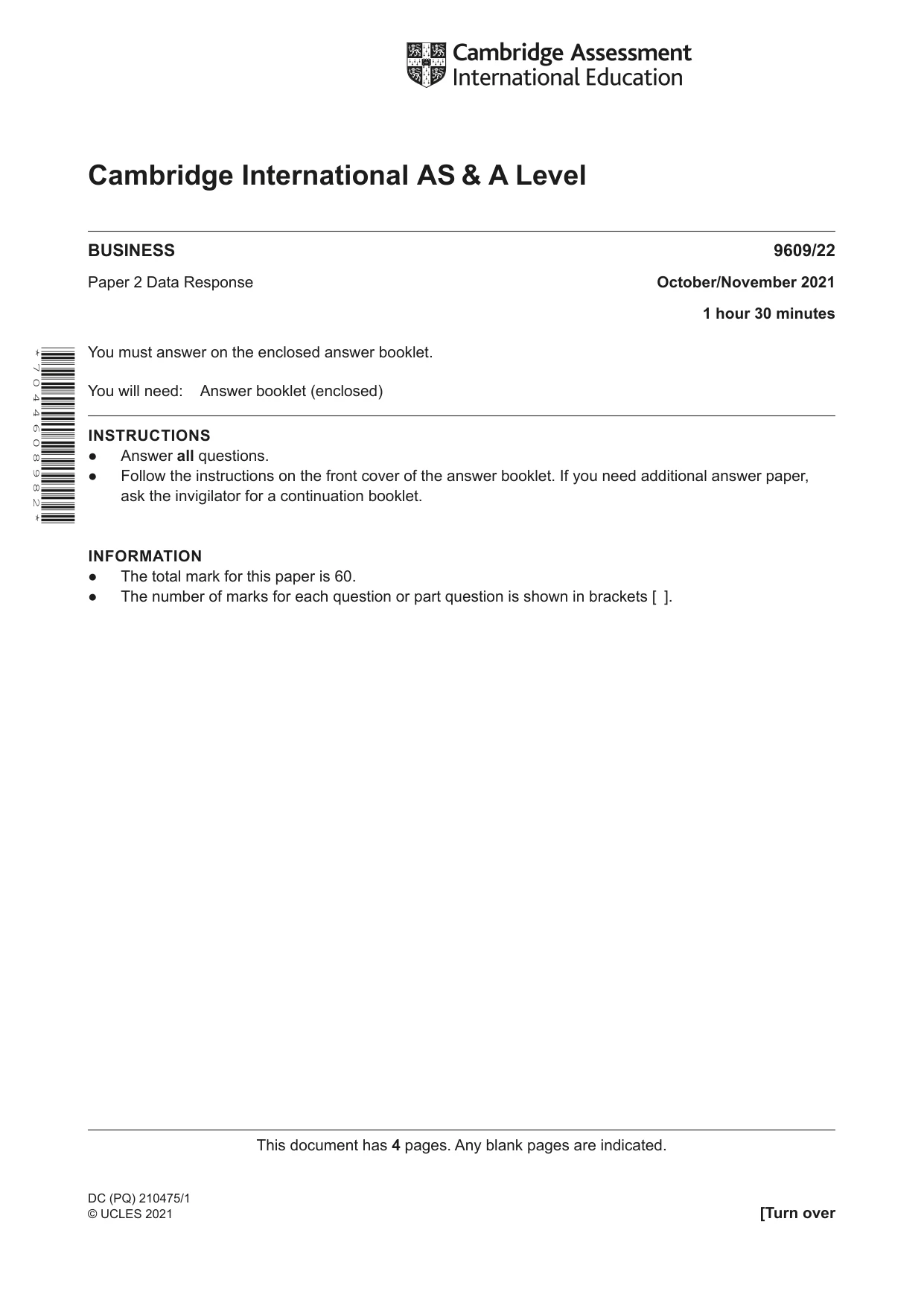
1 Snappy Box (SB) SB is owned by Ralph who is a sole trader. The business prints photographs. Ralph has one shop on the main street of city D. Customers bring their saved digital photographs into the shop and these are printed on high-quality paper. SB uses a large printing machine that can print on almost any size of paper to produce different sized photograph prints. The process is very capital-intensive and most customers 5 request a batch of photographs to be printed. SB is the only shop in city D that prints photographs. However, recently a number of online competitors have started to offer low-priced photograph prints to customers. Ralph has noticed that his sales have decreased significantly because of this competition. Ralph estimates the demand for his photograph prints has a price elasticity of demand of –4. 10 SB already has a low profit margin and Ralph is struggling to compete with the online retailers. However, Ralph has an idea to introduce job production into his shop. He could stop printing photographs and instead focus on framing individual photographs for customers. These frames will be made for any sized photograph or picture and can be made from a variety of materials chosen by the customer. 15 Ralph will need specialised equipment to allow him to make the frames. The equipment would cost $10 000. He has identified two possible sources of finance for this equipment. The first possible source of finance is for Ralph to lease the equipment from the company that produces it. The lease would be for five years at a fixed cost of $400 per month. The second possible source of finance is for Ralph to sell the photograph printing machine 20 for at least $10 000, to purchase the equipment to make frames. (a) (i) Define the term ‘fixed cost’ (line 19). [2] (ii) Explain the term ‘profit margin’ (line 11). [3] (b) (i) Use Ralph’s estimate of the price elasticity of demand (line 10) to calculate the percentage change in demand for printed photographs if the price is reduced by 10%. [3] (ii) Explain one way in which Ralph could use price elasticity of demand when making pricing decisions. [3] (c) Analyse one advantage and one disadvantage to Ralph of introducing job production. [8] (d) Recommend whether Ralph should use leasing or should sell his photograph printing machine as a source of finance for the equipment to make frames. Justify your recommendation. [11]
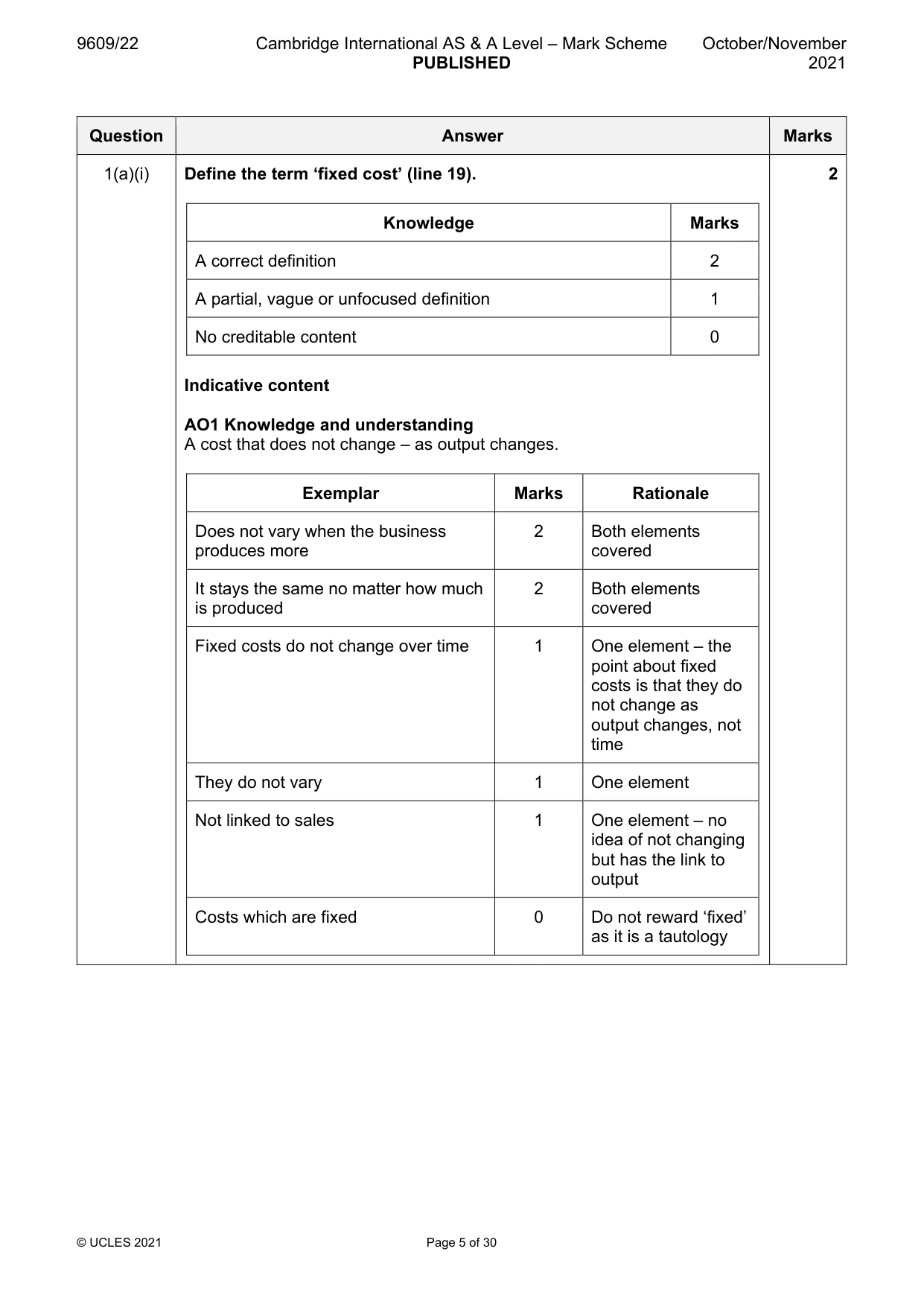
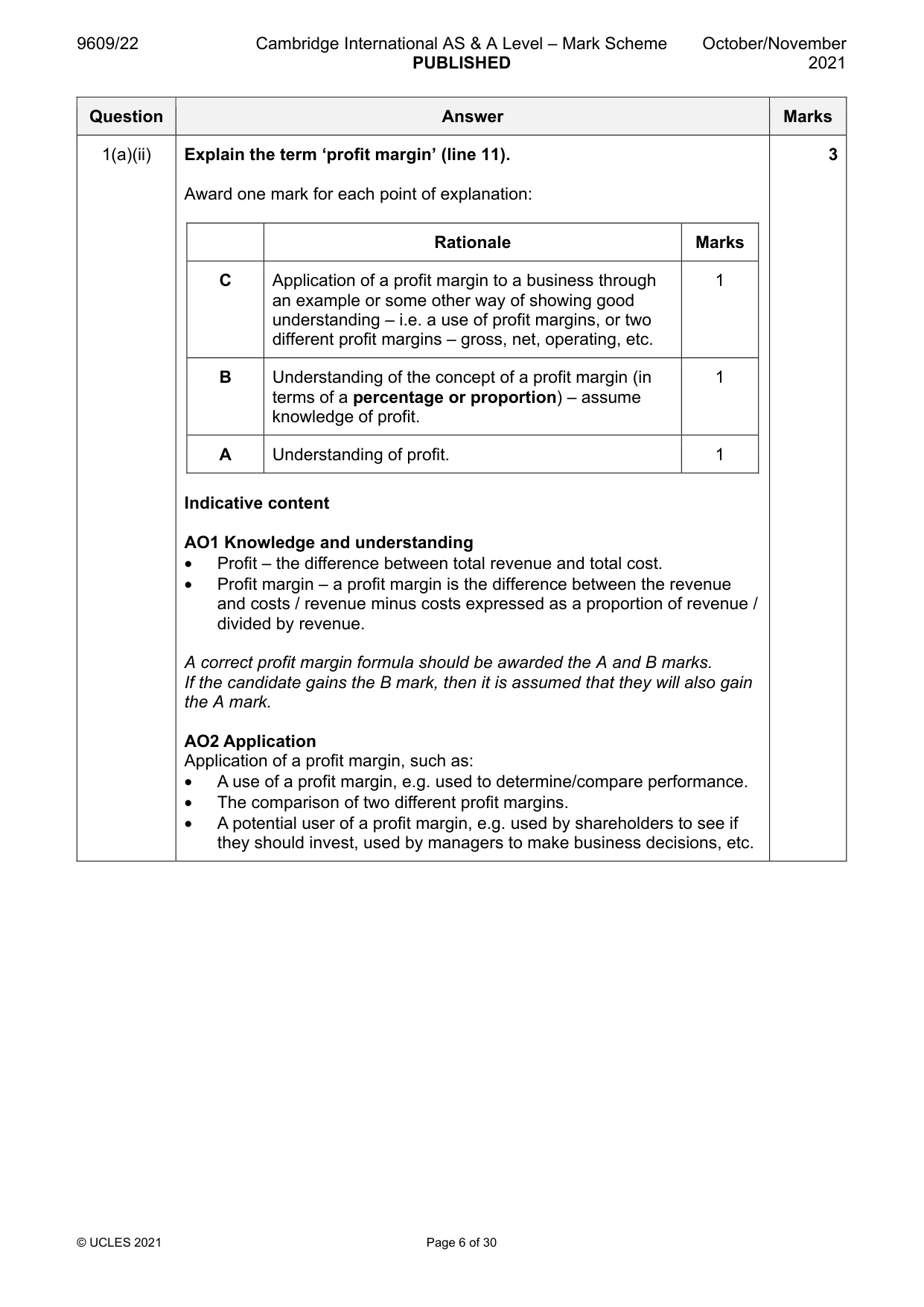
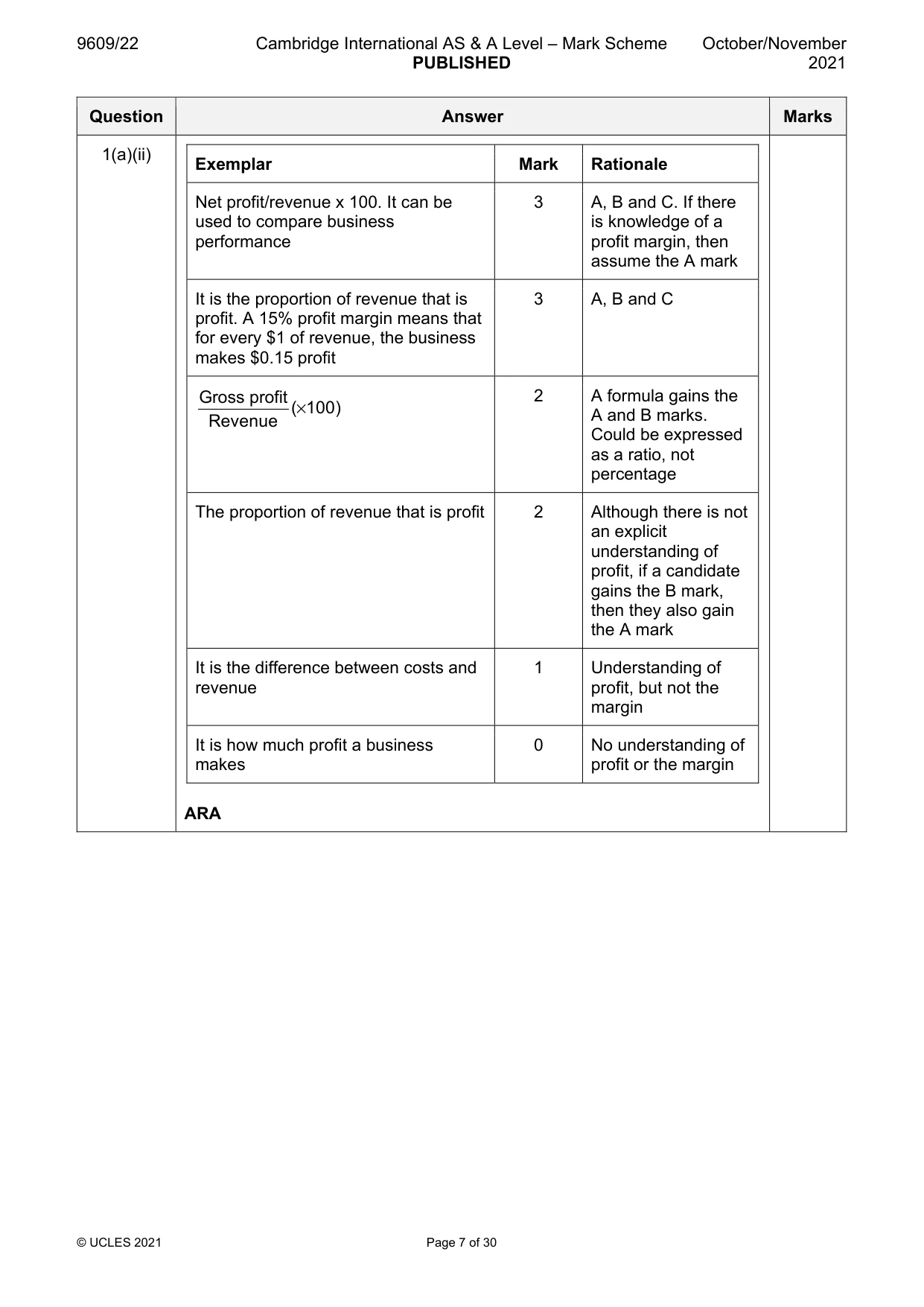
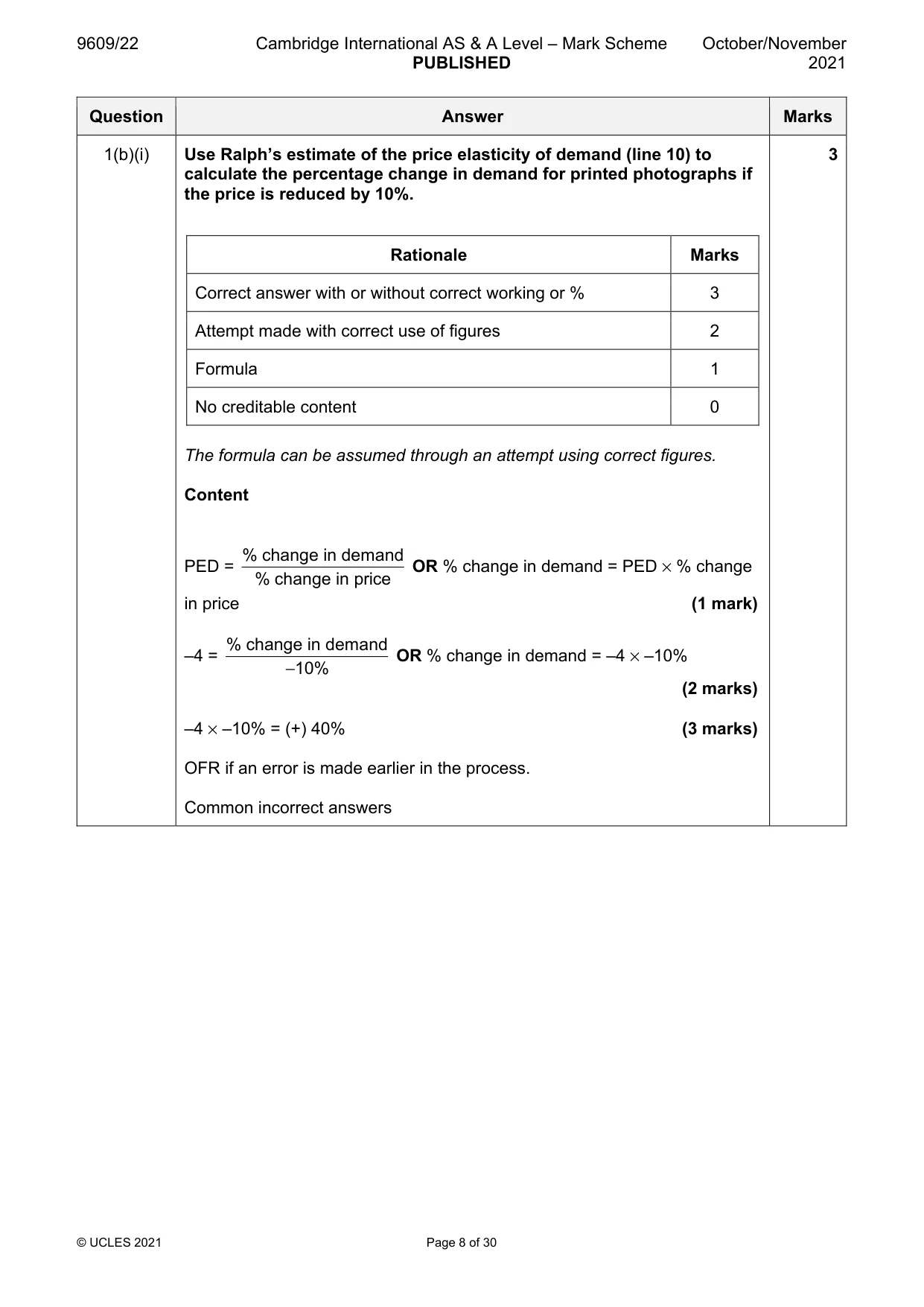
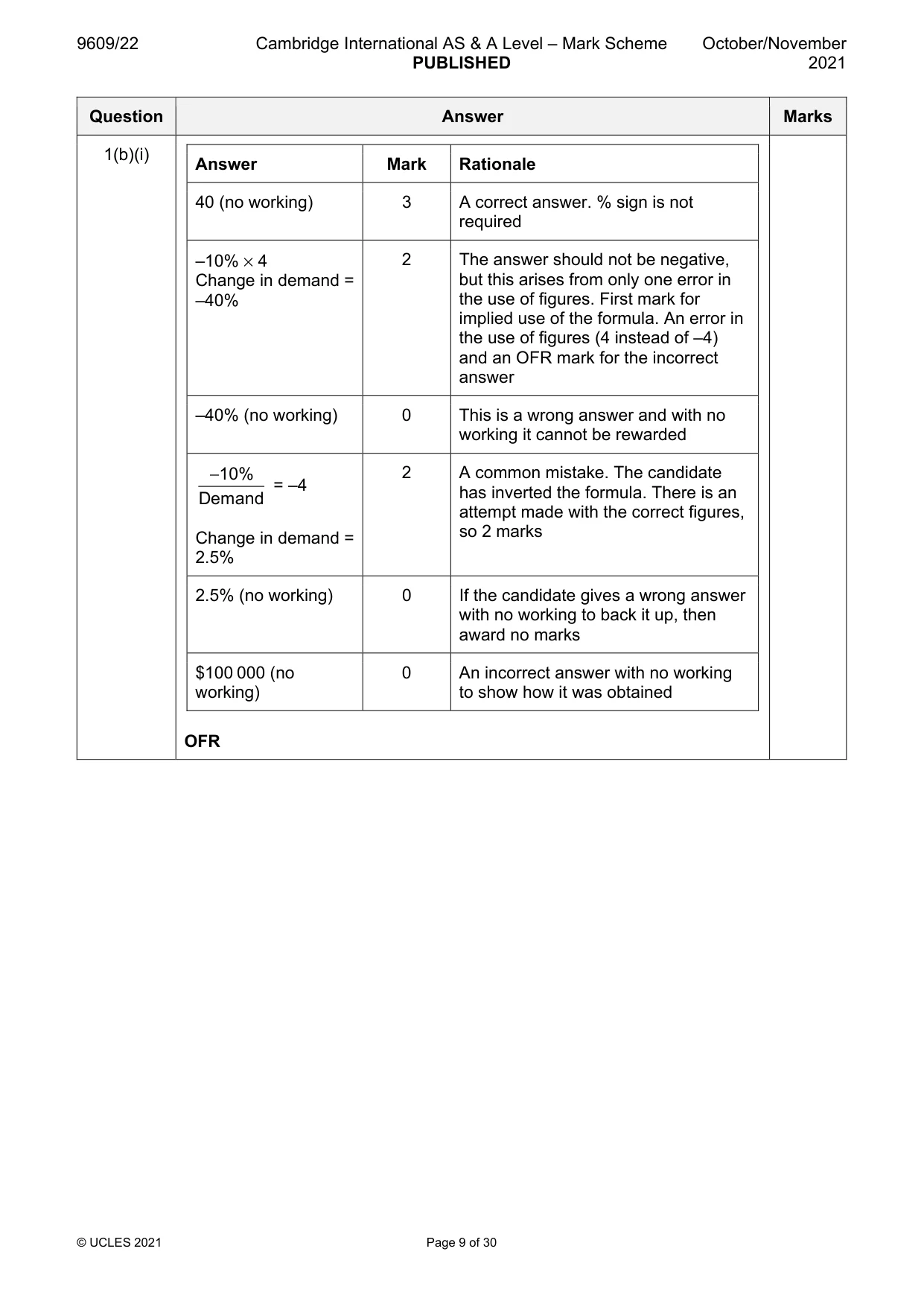
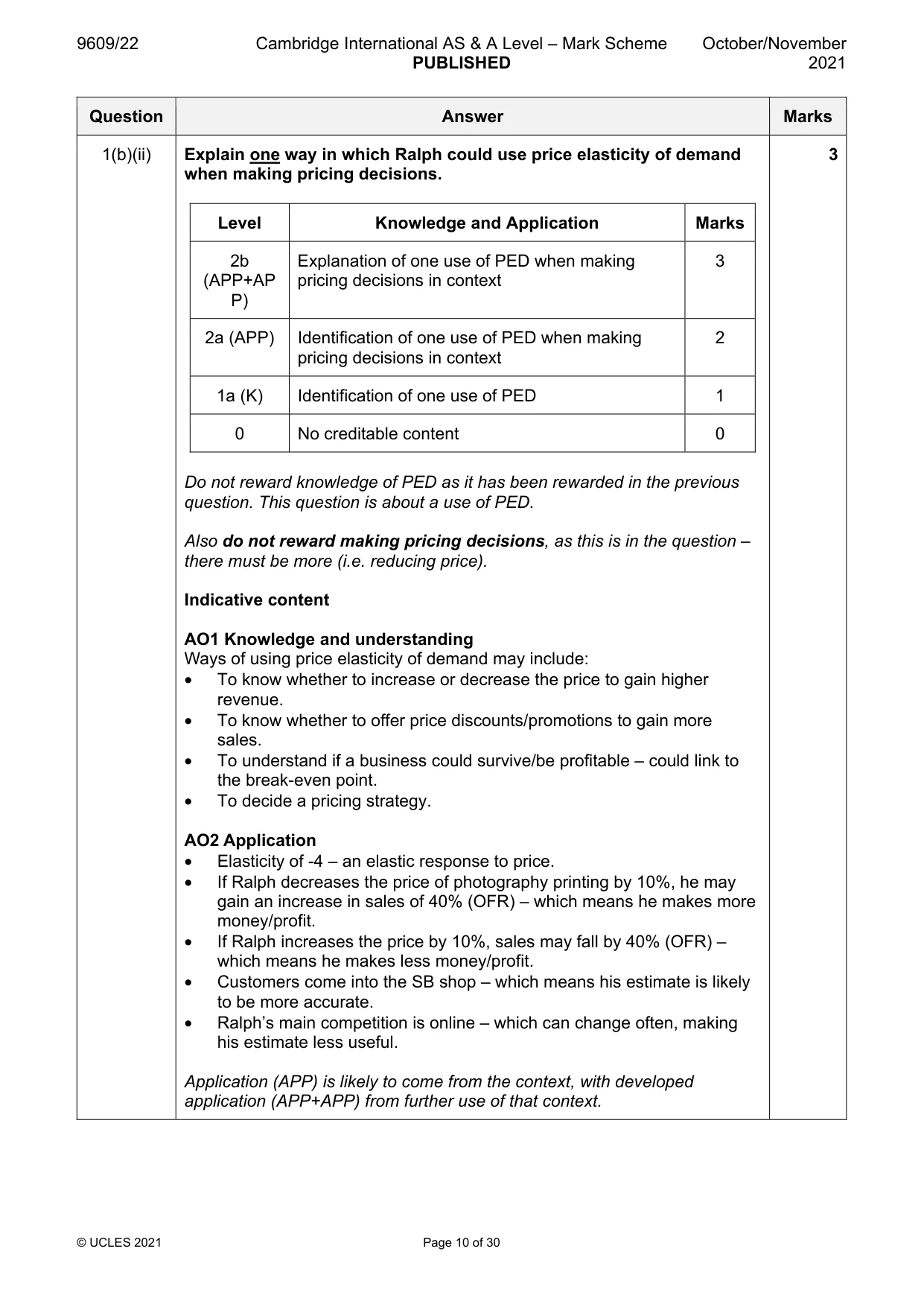
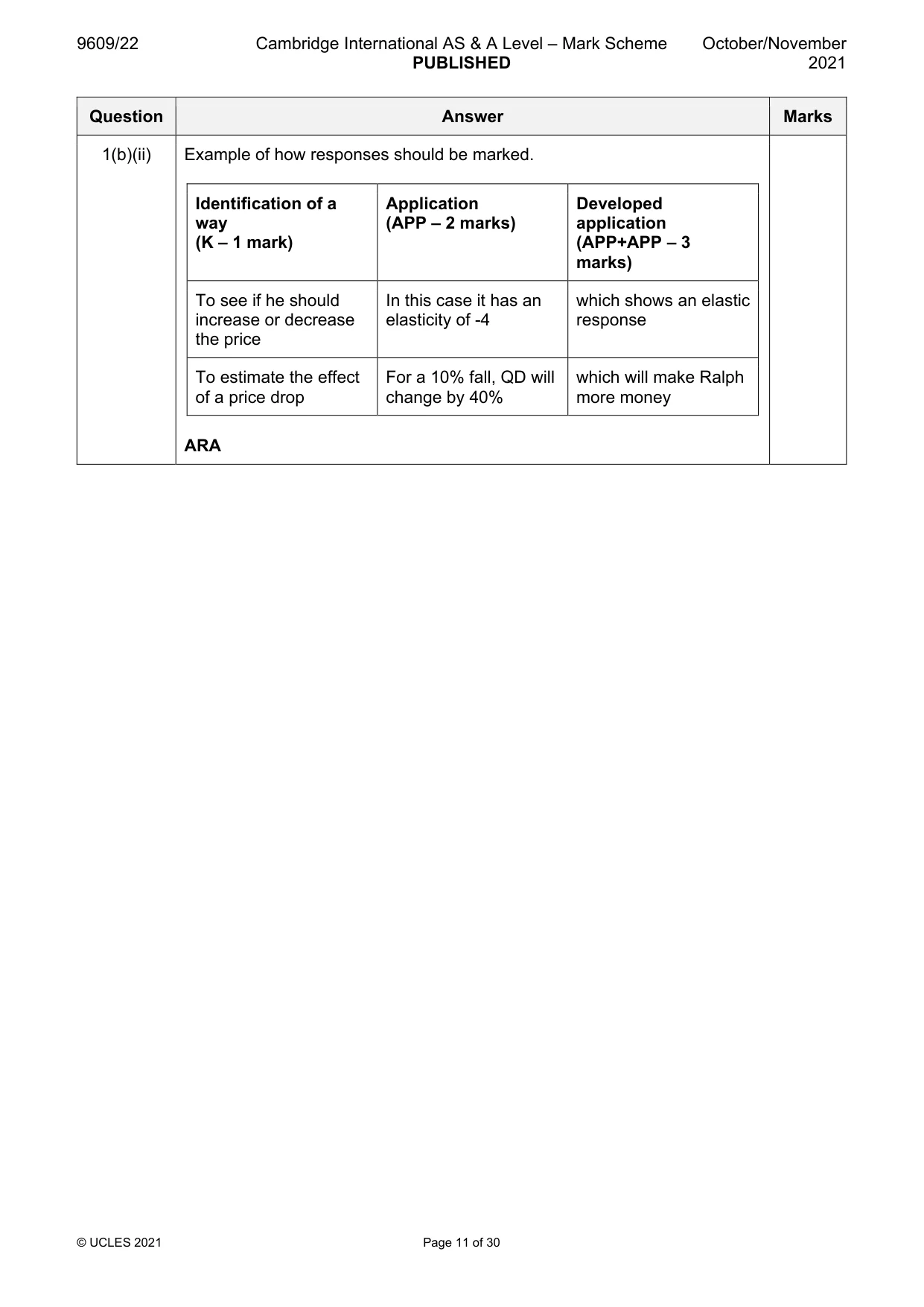
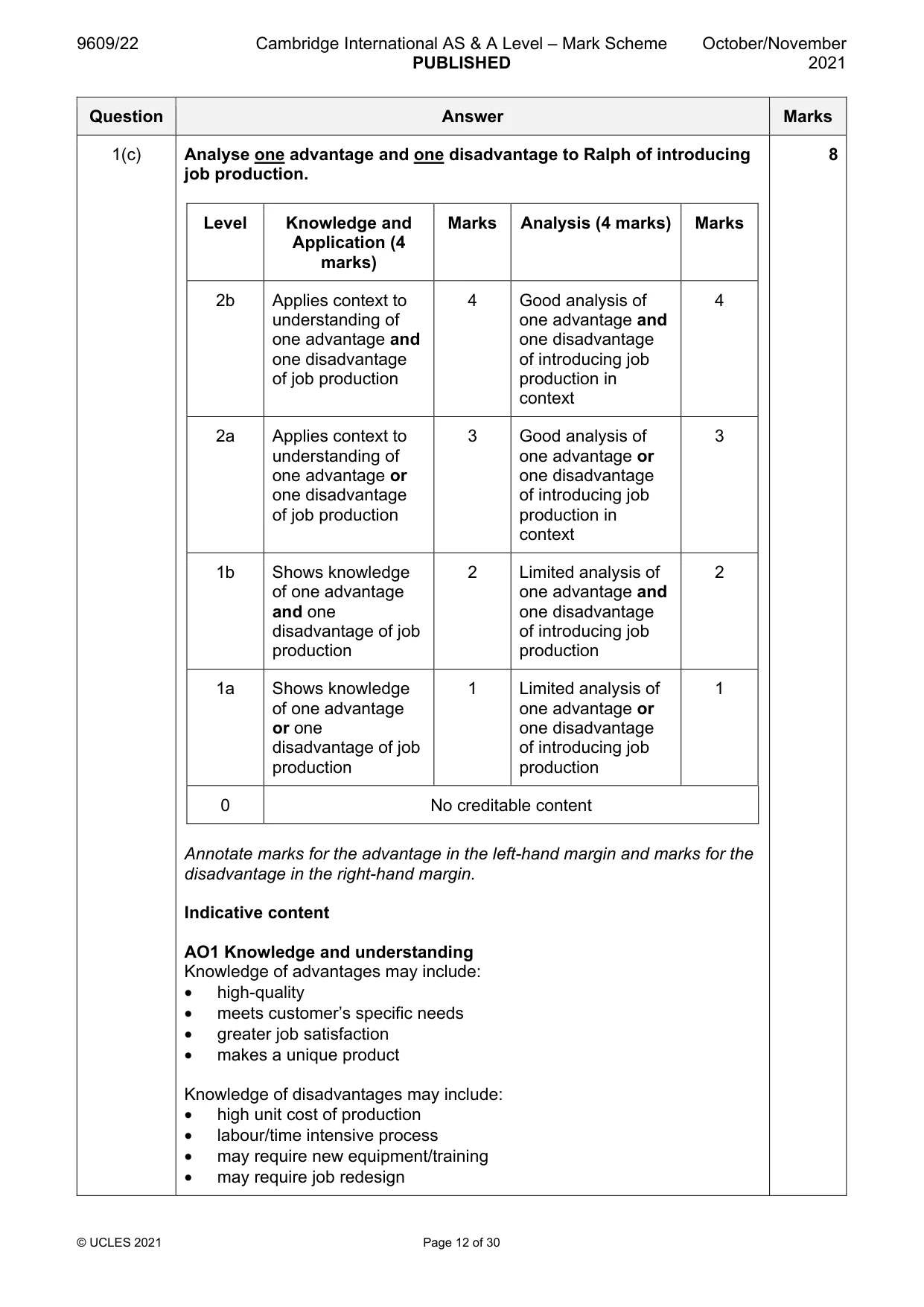
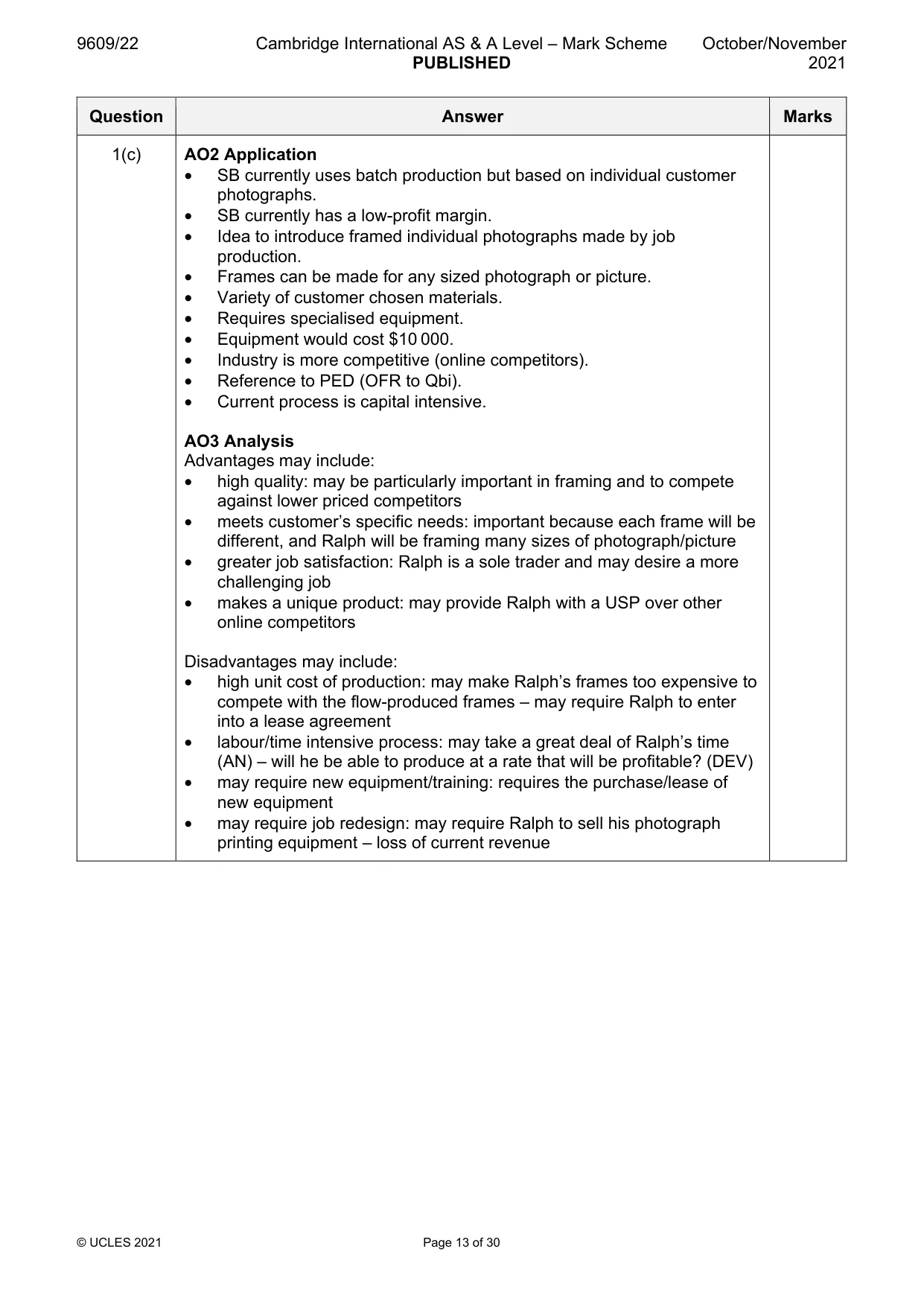
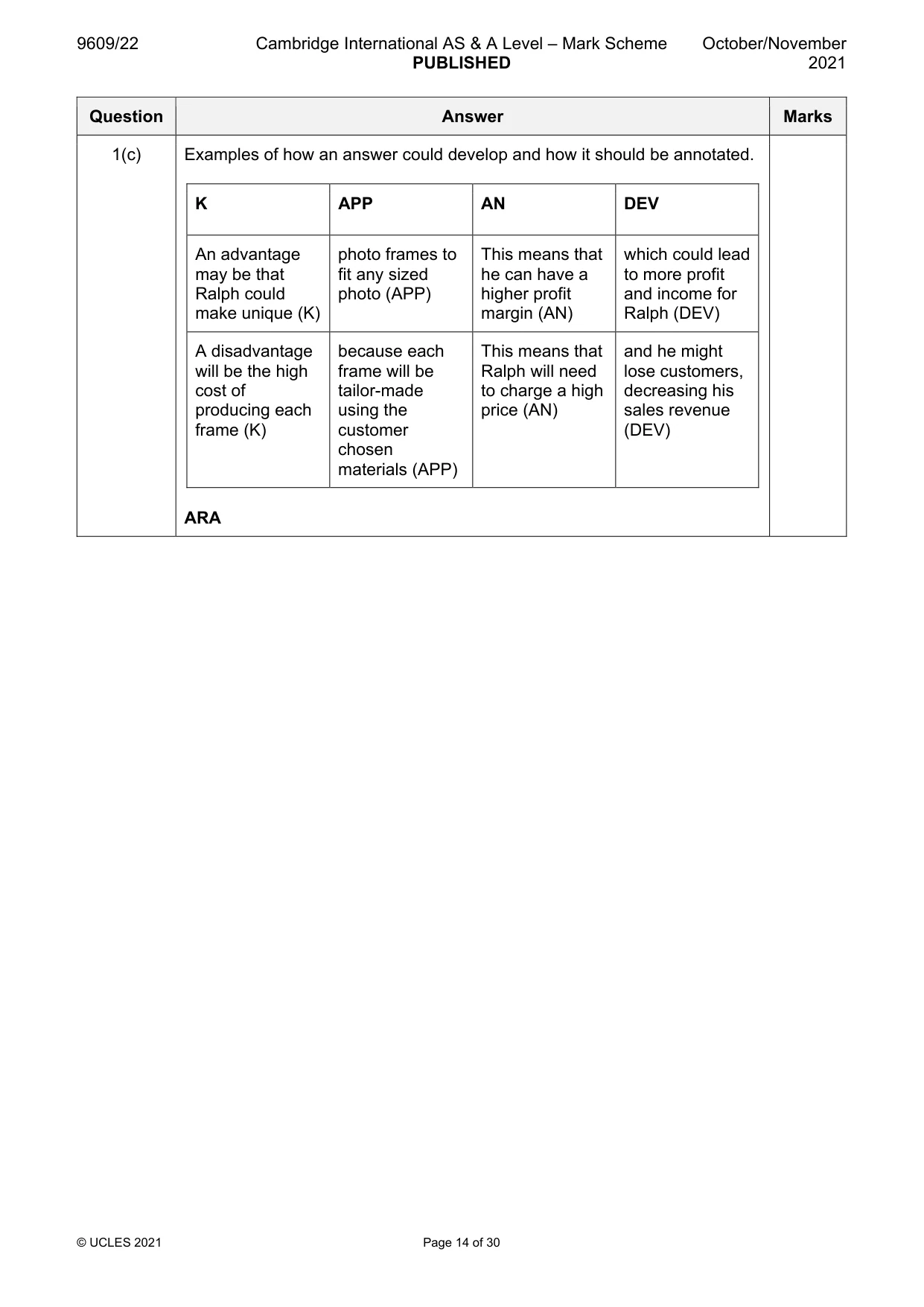
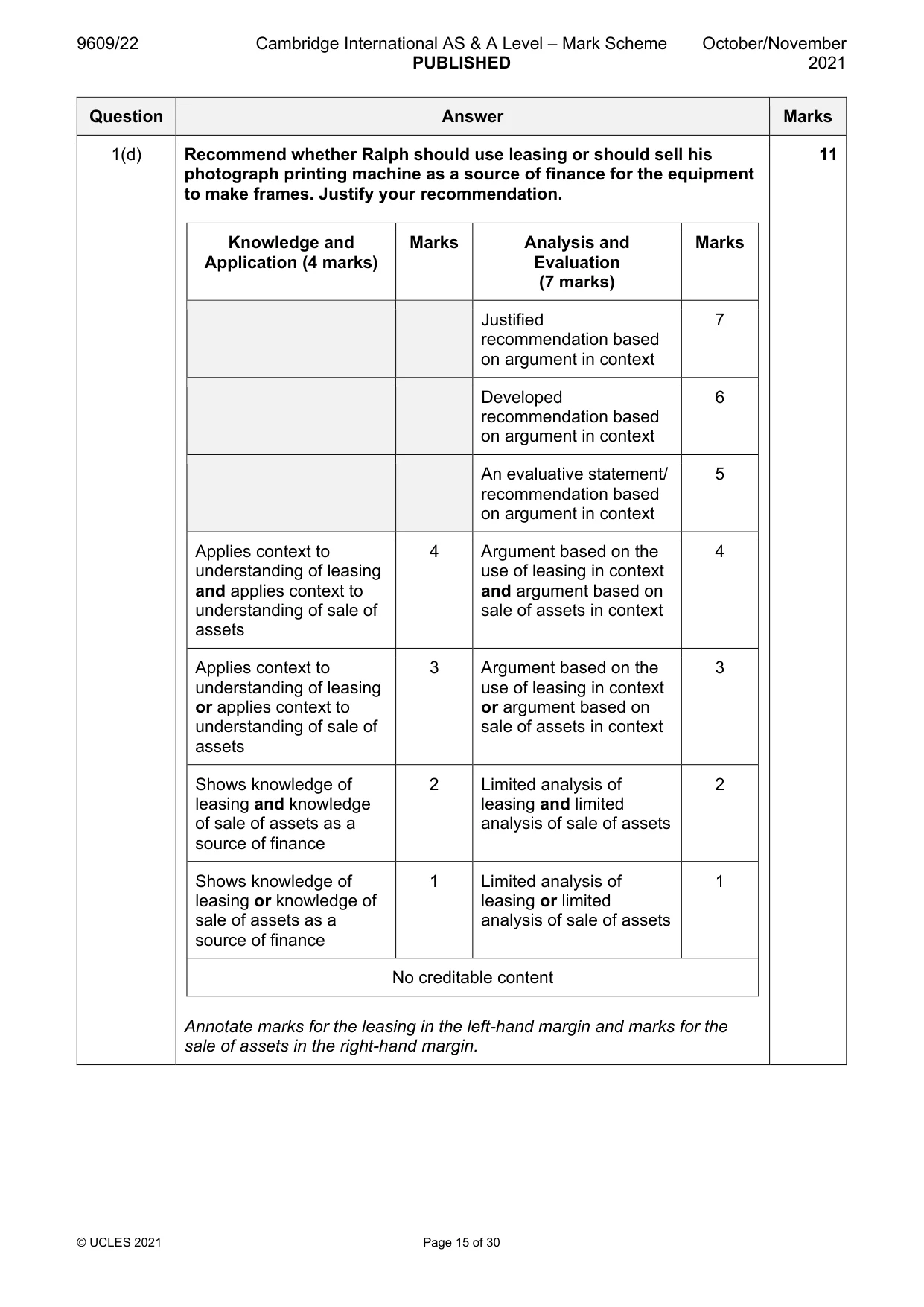
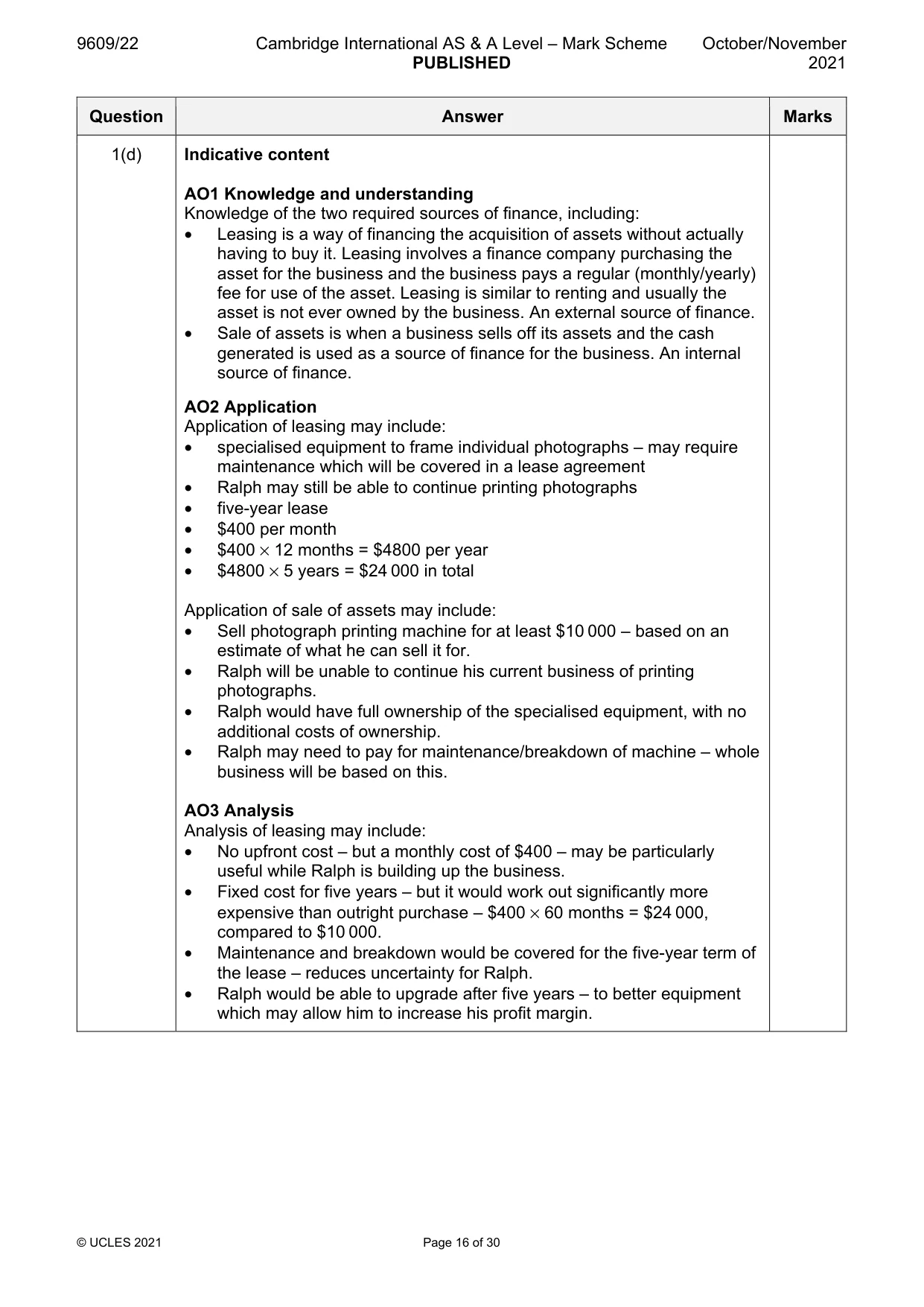
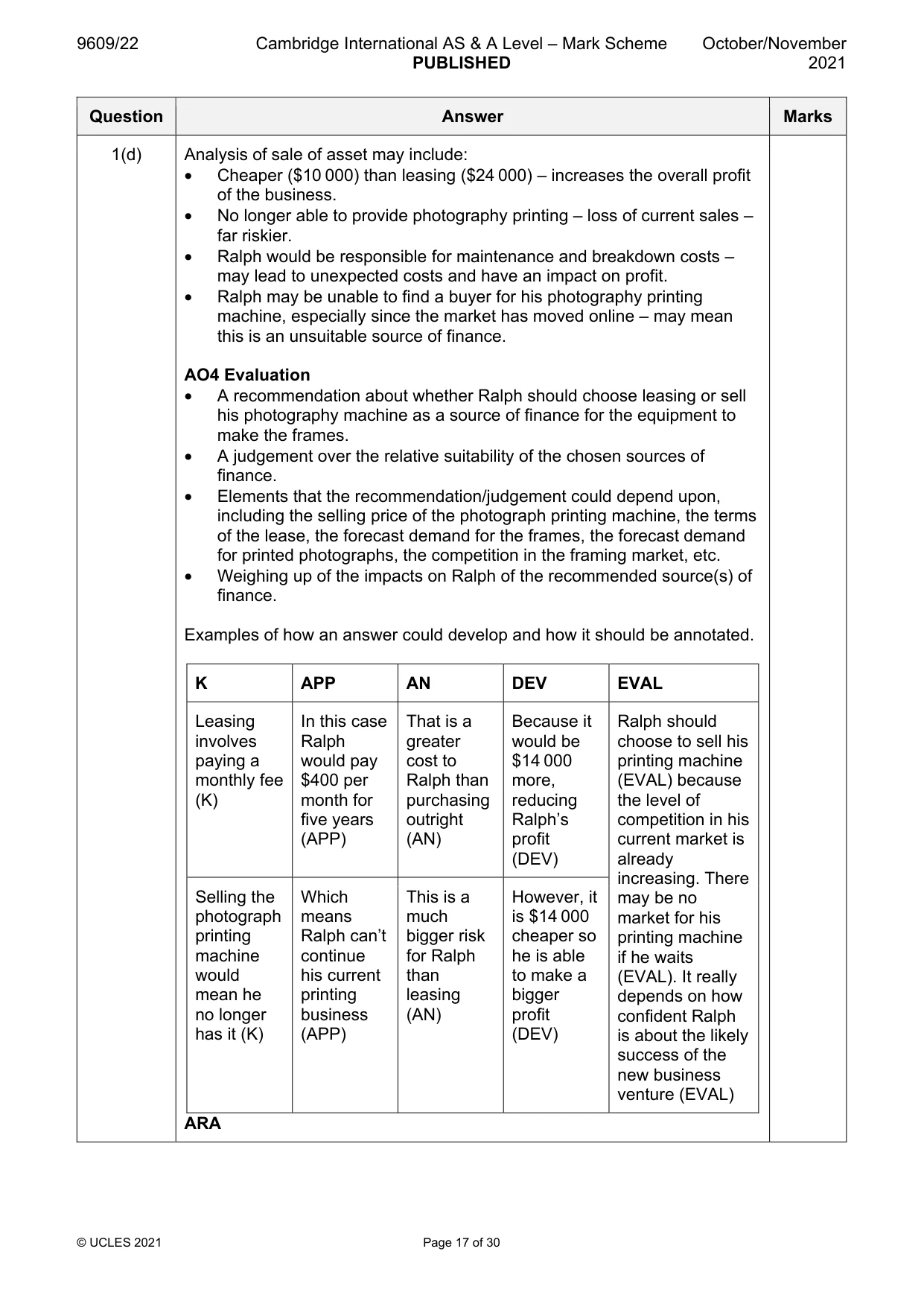
Mark scheme: Question Answer Marks 1(a)(i) Define the term ‘fixed cost’ (line 19). 2 Knowledge Marks A correct definition 2 A partial, vague or unfocused definition 1 No creditable content 0 Indicative content AO1 Knowledge and understanding A cost that does not change – as output changes. Exemplar Marks Rationale Does not vary when the business 2 Both elements produces more covered It stays the same no matter how much 2 Both elements is produced covered Fixed costs do not change over time 1 One element – the point about fixed costs is that they do not change as output changes, not time They do not vary 1 One element Not linked to sales 1 One element – no idea of not changing but has the link to output Costs which are fixed 0 Do not reward ‘fixed’ as it is a tautology 1(a)(ii) Explain the term ‘profit margin’ (line 11). 3 Award one mark for each point of explanation: Rationale Marks C Application of a profit margin to a business through 1 an example or some other way of showing good understanding – i.e. a use of profit margins, or two different profit margins – gross, net, operating, etc. B Understanding of the concept of a profit margin (in 1 terms of a percentage or proportion) – assume knowledge of profit. A Understanding of profit. 1 Indicative content AO1 Knowledge and understanding • Profit – the difference between total revenue and total cost. • Profit margin – a profit margin is the difference between the revenue and costs / revenue minus costs expressed as a proportion of revenue / divided by revenue. A correct profit margin formula should be awarded the A and B marks. If the candidate gains the B mark, then it is assumed that they will also gain the A mark. AO2 Application Application of a profit margin, such as: • A use of a profit margin, e.g. used to determine/compare performance. • The comparison of two different profit margins. • A potential user of a profit margin, e.g. used by shareholders to see if they should invest, used by managers to make business decisions, etc. 1(a)(ii) Exemplar Mark Rationale Net profit/revenue x 100. It can be 3 A, B and C. If there used to compare business is knowledge of a performance profit margin, then assume the A mark It is the proportion of revenue that is 3 A, B and C profit. A 15% profit margin means that for every $1 of revenue, the business makes $0.15 profit Gross profit 2 A formula gains the (× 100) A and B marks. Revenue Could be expressed as a ratio, not percentage The proportion of revenue that is profit 2 Although there is not an explicit understanding of profit, if a candidate gains the B mark, then they also gain the A mark It is the difference between costs and 1 Understanding of revenue profit, but not the margin It is how much profit a business 0 No understanding of makes profit or the margin ARA 1(b)(i) Use Ralph’s estimate of the price elasticity of demand (line 10) to 3 calculate the percentage change in demand for printed photographs if the price is reduced by 10%. Rationale Marks Correct answer with or without correct working or % 3 Attempt made with correct use of figures 2 Formula 1 No creditable content 0 The formula can be assumed through an attempt using correct figures. Content % change in demand PED = OR % change in demand = PED × % change % change in price in price (1 mark) % change in demand –4 = OR % change in demand = –4 × –10% −10% (2 marks) –4 × –10% = (+) 40% (3 marks) OFR if an error is made earlier in the process. Common incorrect answers 1(b)(i) Answer Mark Rationale 40 (no working) 3 A correct answer. % sign is not required –10% × 4 2 The answer should not be negative, Change in demand = but this arises from only one error in –40% the use of figures. First mark for implied use of the formula. An error in the use of figures (4 instead of –4) and an OFR mark for the incorrect answer –40% (no working) 0 This is a wrong answer and with no working it cannot be rewarded −10% 2 A common mistake. The candidate = –4 has inverted the formula. There is an Demand attempt made with the correct figures, so 2 marks Change in demand = 2.5% 2.5% (no working) 0 If the candidate gives a wrong answer with no working to back it up, then award no marks $100 000 (no 0 An incorrect answer with no working working) to show how it was obtained OFR 1(b)(ii) Explain one way in which Ralph could use price elasticity of demand 3 when making pricing decisions. Level Knowledge and Application Marks 2b Explanation of one use of PED when making 3 (APP+AP pricing decisions in context P) 2a (APP) Identification of one use of PED when making 2 pricing decisions in context 1a (K) Identification of one use of PED 1 0 No creditable content 0 Do not reward knowledge of PED as it has been rewarded in the previous question. This question is about a use of PED. Also do not reward making pricing decisions, as this is in the question – there must be more (i.e. reducing price). Indicative content AO1 Knowledge and understanding Ways of using price elasticity of demand may include: • To know whether to increase or decrease the price to gain higher revenue. • To know whether to offer price discounts/promotions to gain more sales. • To understand if a business could survive/be profitable – could link to the break-even point. • To decide a pricing strategy. AO2 Application • Elasticity of -4 – an elastic response to price. • If Ralph decreases the price of photography printing by 10%, he may gain an increase in sales of 40% (OFR) – which means he makes more money/profit. • If Ralph increases the price by 10%, sales may fall by 40% (OFR) – which means he makes less money/profit. • Customers come into the SB shop – which means his estimate is likely to be more accurate. • Ralph’s main competition is online – which can change often, making his estimate less useful. Application (APP) is likely to come from the context, with developed application (APP+APP) from further use of that context. 1(b)(ii) Example of how responses should be marked. Identification of a Application Developed way (APP – 2 marks) application (K – 1 mark) (APP+APP – 3 marks) To see if he should In this case it has an which shows an elastic increase or decrease elasticity of -4 response the price To estimate the effect For a 10% fall, QD will which will make Ralph of a price drop change by 40% more money ARA 1(c) Analyse one advantage and one disadvantage to Ralph of introducing 8 job production. Level Knowledge and Marks Analysis (4 marks) Marks Application (4 marks) 2b Applies context to 4 Good analysis of 4 understanding of one advantage and one advantage and one disadvantage one disadvantage of introducing job of job production production in context 2a Applies context to 3 Good analysis of 3 understanding of one advantage or one advantage or one disadvantage one disadvantage of introducing job of job production production in context 1b Shows knowledge 2 Limited analysis of 2 of one advantage one advantage and and one one disadvantage disadvantage of job of introducing job production production 1a Shows knowledge 1 Limited analysis of 1 of one advantage one advantage or or one one disadvantage disadvantage of job of introducing job production production 0 No creditable content Annotate marks for the advantage in the left-hand margin and marks for the disadvantage in the right-hand margin. Indicative content AO1 Knowledge and understanding Knowledge of advantages may include: • high-quality • meets customer’s specific needs • greater job satisfaction • makes a unique product Knowledge of disadvantages may include: • high unit cost of production • labour/time intensive process • may require new equipment/training • may require job redesign 1(c) AO2 Application • SB currently uses batch production but based on individual customer photographs. • SB currently has a low-profit margin. • Idea to introduce framed individual photographs made by job production. • Frames can be made for any sized photograph or picture. • Variety of customer chosen materials. • Requires specialised equipment. • Equipment would cost $10 000. • Industry is more competitive (online competitors). • Reference to PED (OFR to Qbi). • Current process is capital intensive. AO3 Analysis Advantages may include: • high quality: may be particularly important in framing and to compete against lower priced competitors • meets customer’s specific needs: important because each frame will be different, and Ralph will be framing many sizes of photograph/picture • greater job satisfaction: Ralph is a sole trader and may desire a more challenging job • makes a unique product: may provide Ralph with a USP over other online competitors Disadvantages may include: • high unit cost of production: may make Ralph’s frames too expensive to compete with the flow-produced frames – may require Ralph to enter into a lease agreement • labour/time intensive process: may take a great deal of Ralph’s time (AN) – will he be able to produce at a rate that will be profitable? (DEV) • may require new equipment/training: requires the purchase/lease of new equipment • may require job redesign: may require Ralph to sell his photograph printing equipment – loss of current revenue 1(c) Examples of how an answer could develop and how it should be annotated. K APP AN DEV An advantage photo frames to This means that which could lead may be that fit any sized he can have a to more profit Ralph could photo (APP) higher profit and income for make unique (K) margin (AN) Ralph (DEV) A disadvantage because each This means that and he might will be the high frame will be Ralph will need lose customers, cost of tailor-made to charge a high decreasing his producing each using the price (AN) sales revenue frame (K) customer (DEV) chosen materials (APP) ARA 1(d) Recommend whether Ralph should use leasing or should sell his 11 photograph printing machine as a source of finance for the equipment to make frames. Justify your recommendation. Knowledge and Marks Analysis and Marks Application (4 marks) Evaluation (7 marks) Justified 7 recommendation based on argument in context Developed 6 recommendation based on argument in context An evaluative statement/ 5 recommendation based on argument in context Applies context to 4 Argument based on the 4 understanding of leasing use of leasing in context and applies context to and argument based on understanding of sale of sale of assets in context assets Applies context to 3 Argument based on the 3 understanding of leasing use of leasing in context or applies context to or argument based on understanding of sale of sale of assets in context assets Shows knowledge of 2 Limited analysis of 2 leasing and knowledge leasing and limited of sale of assets as a analysis of sale of assets source of finance Shows knowledge of 1 Limited analysis of 1 leasing or knowledge of leasing or limited sale of assets as a analysis of sale of assets source of finance No creditable content Annotate marks for the leasing in the left-hand margin and marks for the sale of assets in the right-hand margin. 1(d) Indicative content AO1 Knowledge and understanding Knowledge of the two required sources of finance, including: • Leasing is a way of financing the acquisition of assets without actually having to buy it. Leasing involves a finance company purchasing the asset for the business and the business pays a regular (monthly/yearly) fee for use of the asset. Leasing is similar to renting and usually the asset is not ever owned by the business. An external source of finance. • Sale of assets is when a business sells off its assets and the cash generated is used as a source of finance for the business. An internal source of finance. AO2 Application Application of leasing may include: • specialised equipment to frame individual photographs – may require maintenance which will be covered in a lease agreement • Ralph may still be able to continue printing photographs • five-year lease • $400 per month • $400 × 12 months = $4800 per year • $4800 × 5 years = $24 000 in total Application of sale of assets may include: • Sell photograph printing machine for at least $10 000 – based on an estimate of what he can sell it for. • Ralph will be unable to continue his current business of printing photographs. • Ralph would have full ownership of the specialised equipment, with no additional costs of ownership. • Ralph may need to pay for maintenance/breakdown of machine – whole business will be based on this. AO3 Analysis Analysis of leasing may include: • No upfront cost – but a monthly cost of $400 – may be particularly useful while Ralph is building up the business. • Fixed cost for five years – but it would work out significantly more expensive than outright purchase – $400 × 60 months = $24 000, compared to $10 000. • Maintenance and breakdown would be covered for the five-year term of the lease – reduces uncertainty for Ralph. • Ralph would be able to upgrade after five years – to better equipment which may allow him to increase his profit margin. 1(d) Analysis of sale of asset may include: • Cheaper ($10 000) than leasing ($24 000) – increases the overall profit of the business. • No longer able to provide photography printing – loss of current sales – far riskier. • Ralph would be responsible for maintenance and breakdown costs – may lead to unexpected costs and have an impact on profit. • Ralph may be unable to find a buyer for his photography printing machine, especially since the market has moved online – may mean this is an unsuitable source of finance. AO4 Evaluation • A recommendation about whether Ralph should choose leasing or sell his photography machine as a source of finance for the equipment to make the frames. • A judgement over the relative suitability of the chosen sources of finance. • Elements that the recommendation/judgement could depend upon, including the selling price of the photograph printing machine, the terms of the lease, the forecast demand for the frames, the forecast demand for printed photographs, the competition in the framing market, etc. • Weighing up of the impacts on Ralph of the recommended source(s) of finance. Examples of how an answer could develop and how it should be annotated. K APP AN DEV EVAL Leasing In this case That is a Because it Ralph should involves Ralph greater would be choose to sell his paying a would pay cost to $14 000 printing machine monthly fee $400 per Ralph than more, (EVAL) because (K) month for purchasing reducing the level of five years outright Ralph’s competition in his (APP) (AN) profit current market is (DEV) already increasing. There Selling the Which This is a However, it may be no photograph means much is $14 000 market for his printing Ralph can’t bigger risk cheaper so printing machine machine continue for Ralph he is able if he waits would his current than to make a (EVAL). It really mean he printing leasing bigger depends on how no longer business (AN) profit confident Ralph has it (K) (APP) (DEV) is about the likely success of the new business venture (EVAL) ARA
Q2 · Auto Bike (AB) AB is a private limited company that repairs and maintains motorbikes
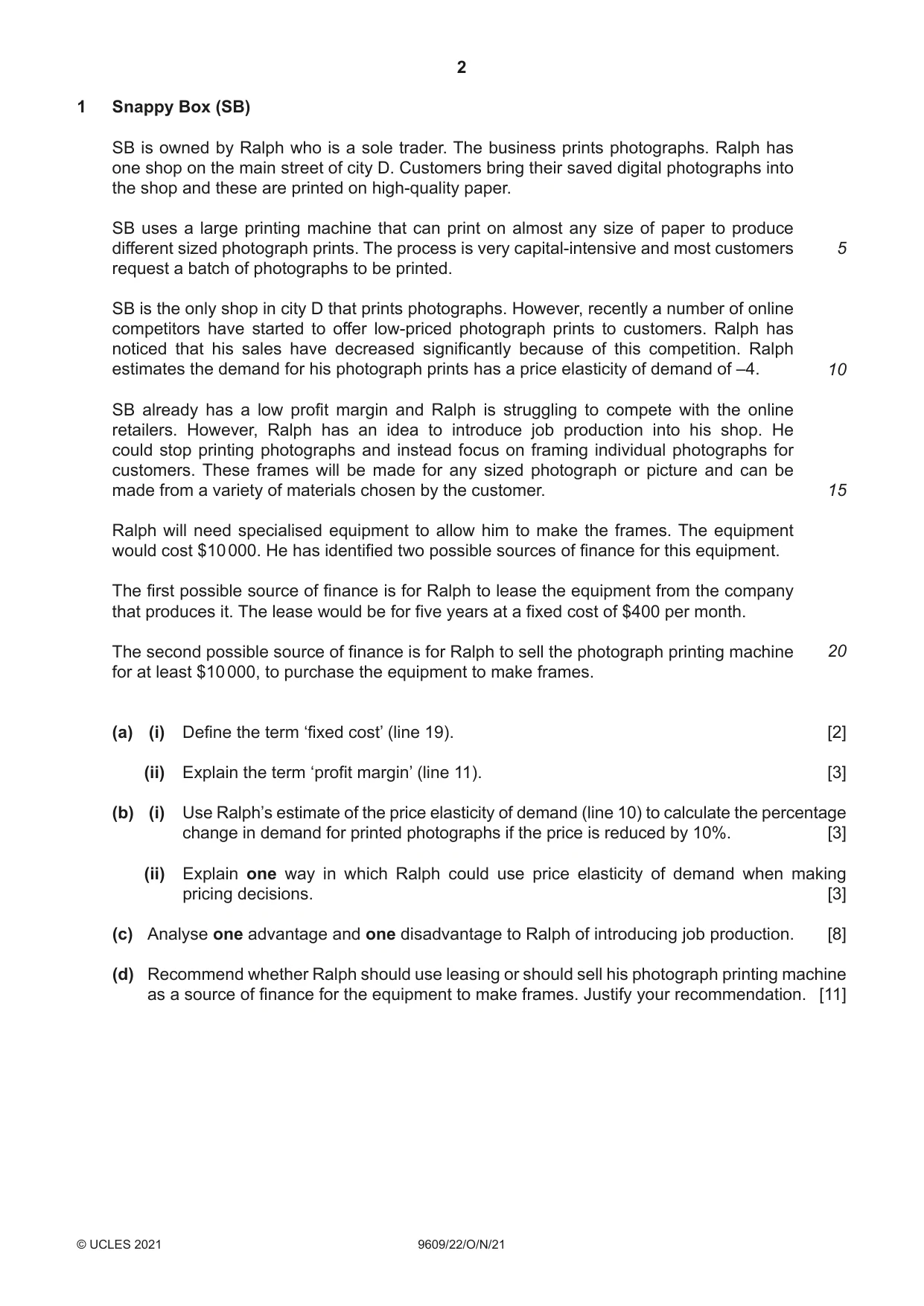
2 Auto Bike (AB) AB is a private limited company that repairs and maintains motorbikes. AB has nine garages in country J and employs eight highly qualified mechanics in each garage. Two of the most popular motorbike services that AB sells are the standard service and the advanced service. Table 2.1 contains price and cost information for these services. Table 2.1: Price and cost information 5 Price Direct costs Allocated indirect per service costs per service Standard service $250 $50 $60 Advanced service $400 $60 $100 In April, AB sold 1000 standard services and 200 advanced services. The profit margin for 10 an advanced service is higher than the standard service. The directors have decided to promote the advanced service to try and increase sales. Each garage has been given a budget to use for below the line promotion methods with an objective of increasing sales of advanced services in the next six months. The level of motivation of the mechanics is low. Many mechanics believe that they are not 15 paid well and the conditions of work are dirty and noisy. AB uses a time-based payment method which rewards each mechanic at the same hourly rate. In a recent survey, many mechanics complained that the payment method was unfair. They believe it rewards ‘lazy workers’ as much as those who work hard. It also does not take into account the difficulties involved in some jobs and the simplicity of others. The Human Resources Director has 20 been asked to investigate a new payment method. (a) (i) Define the term ‘objective’ (line 13). [2] (ii) Explain the term ‘private limited company’ (line 1). [3] (b) (i) Calculate the profit made from selling standard and advanced services in April. [3] (ii) Explain one possible problem for AB of trying to allocate indirect costs. [3] (c) Analyse two below the line promotion methods that AB could use to increase the sales of advanced services. [8] (d) Recommend a new payment method for the mechanics at AB. Justify your recommendation. [11]
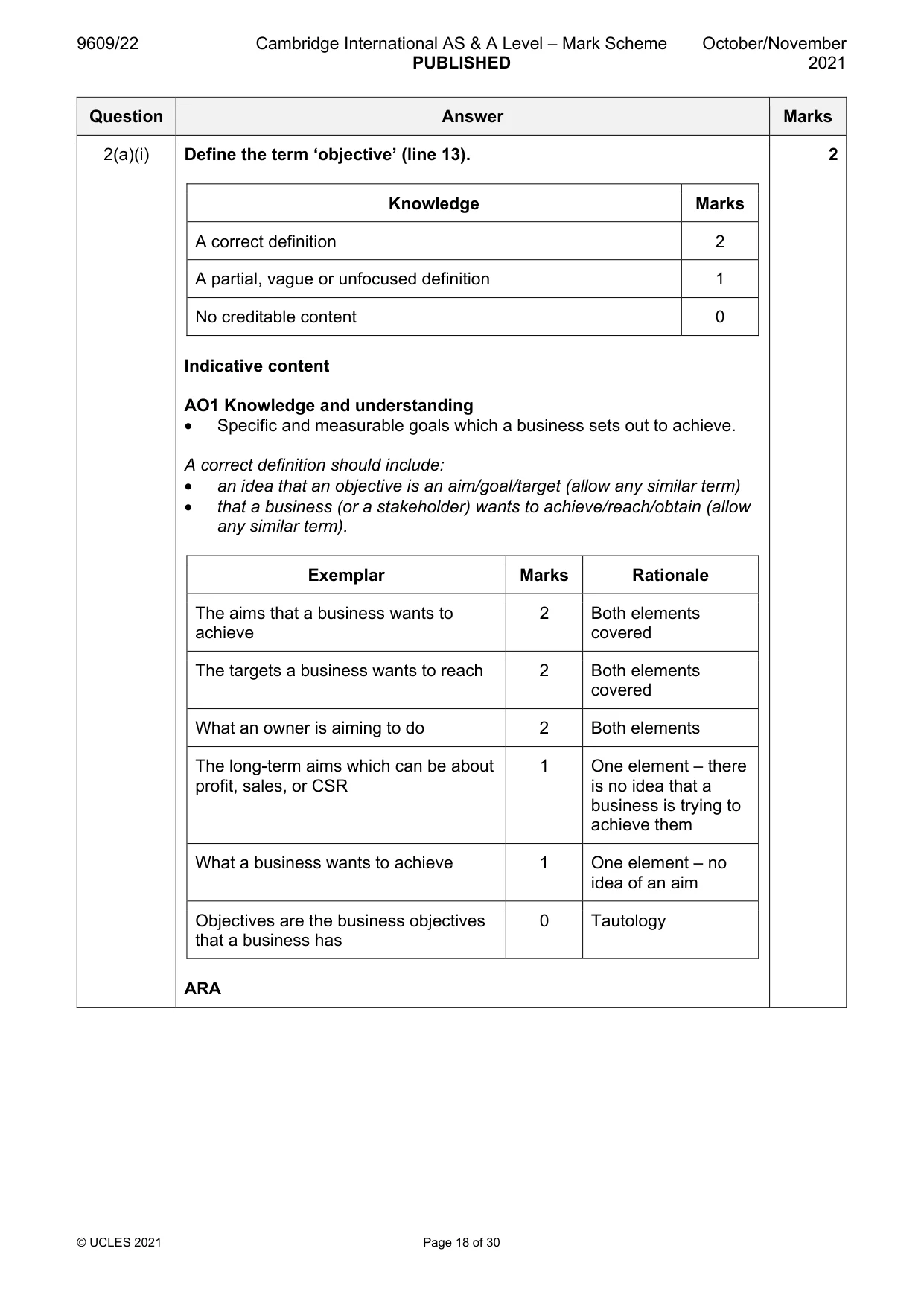
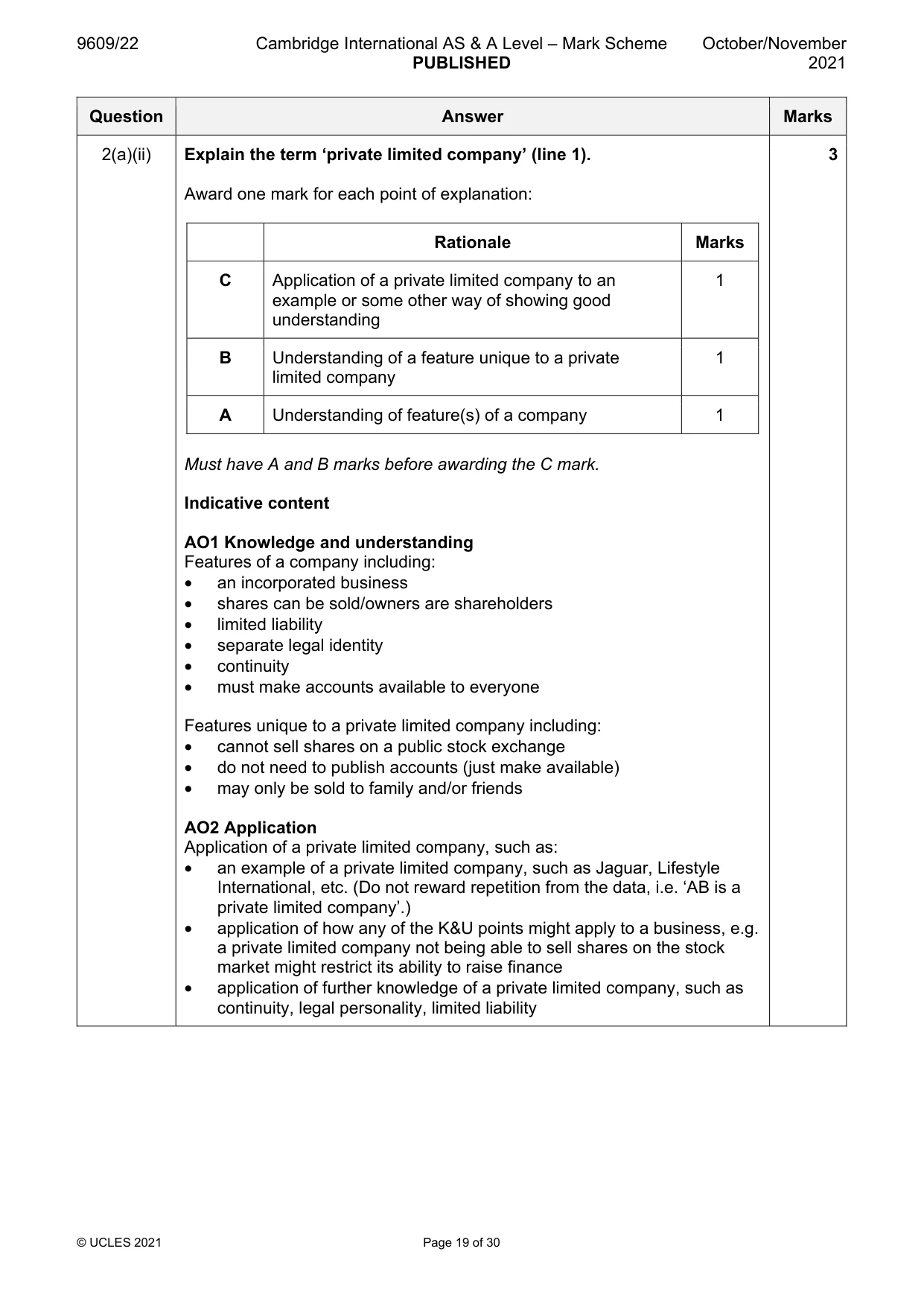
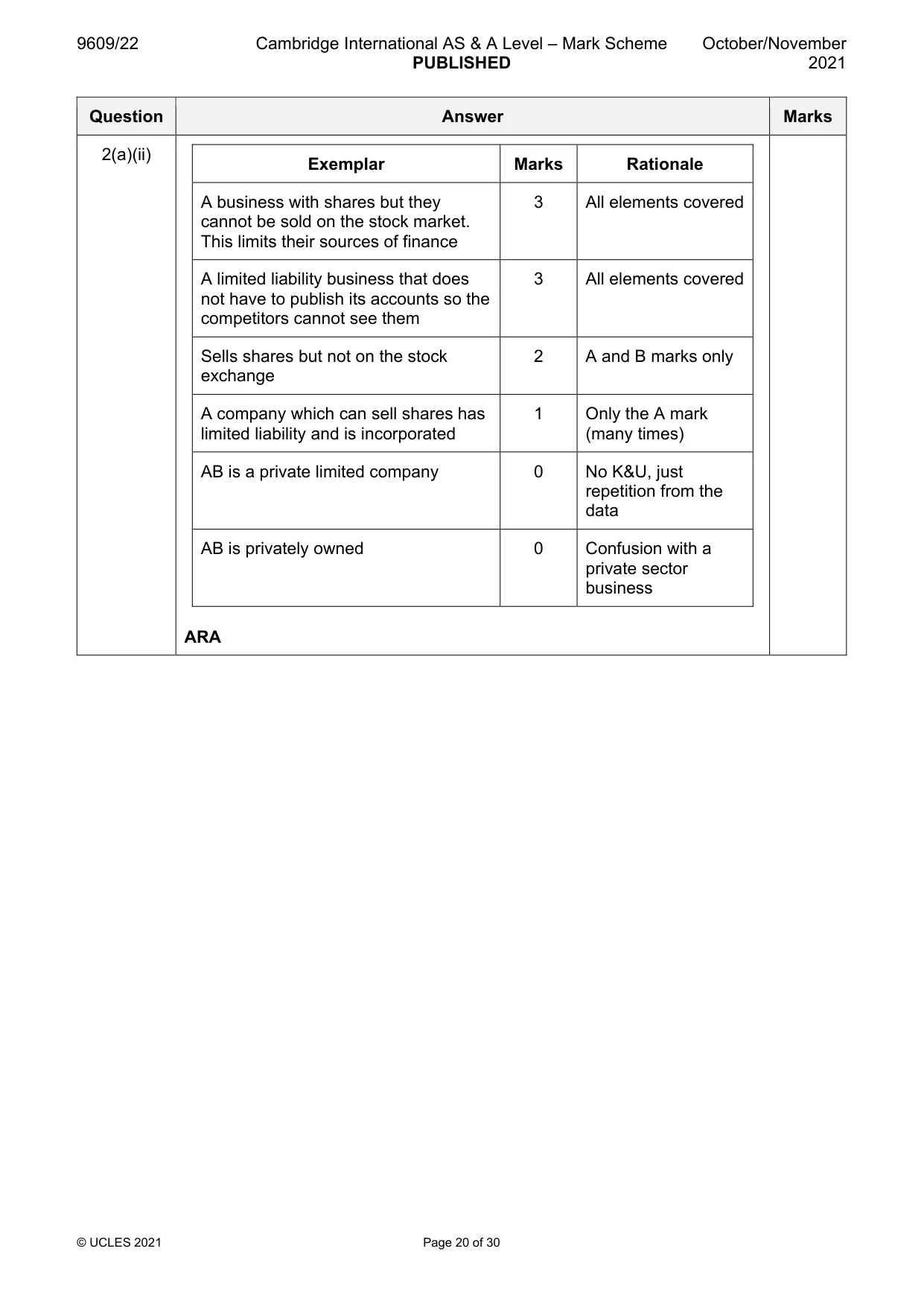
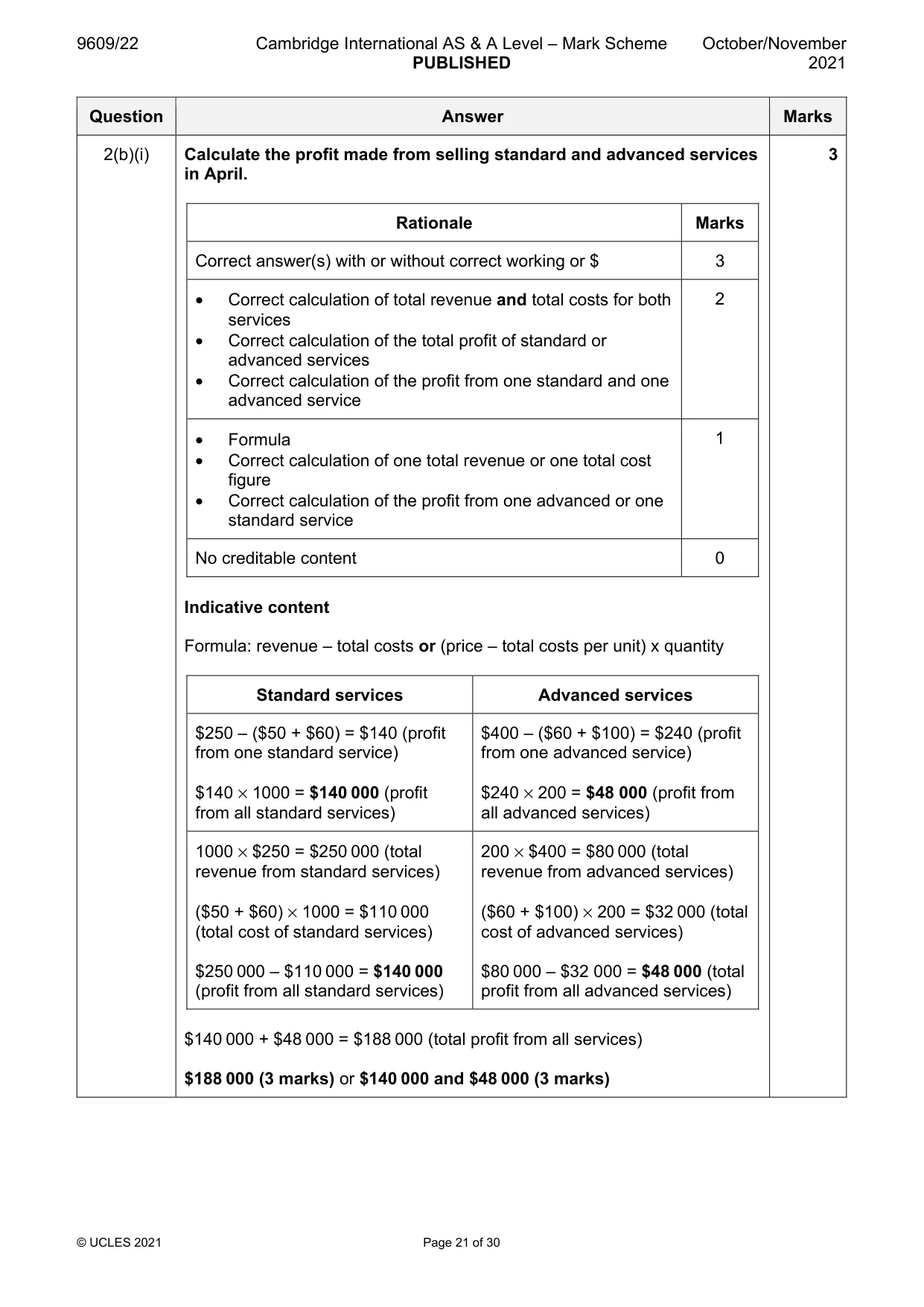
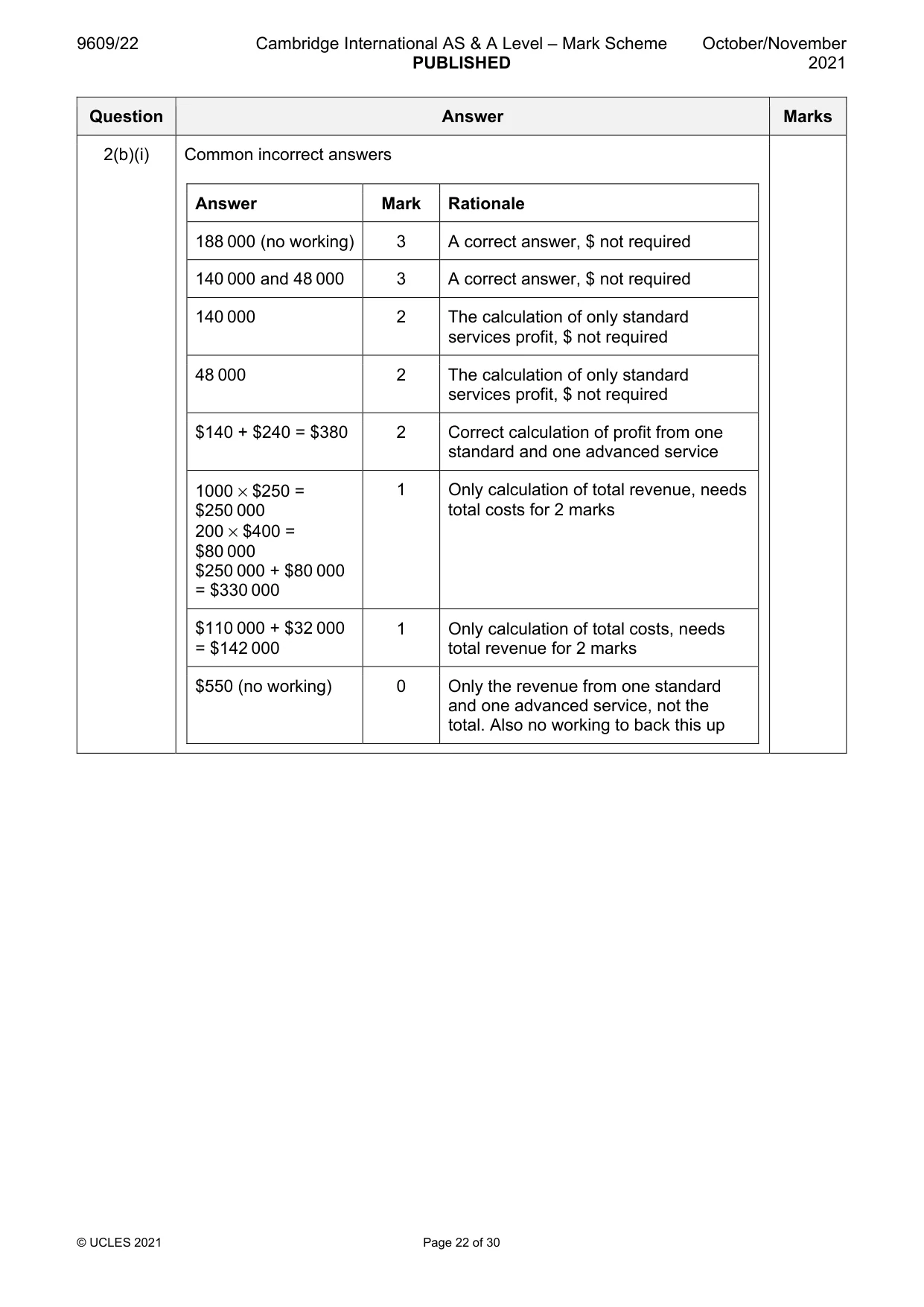
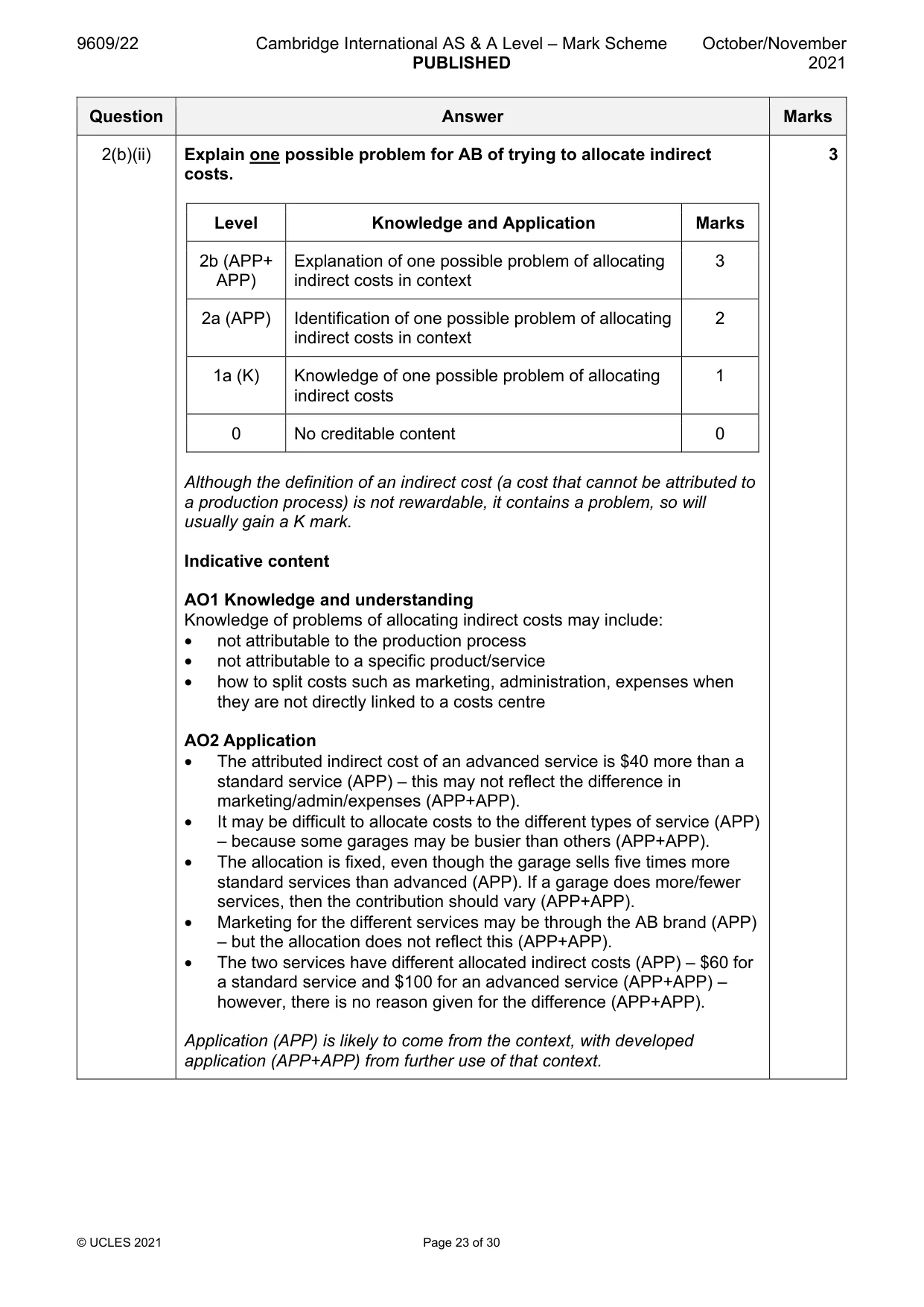
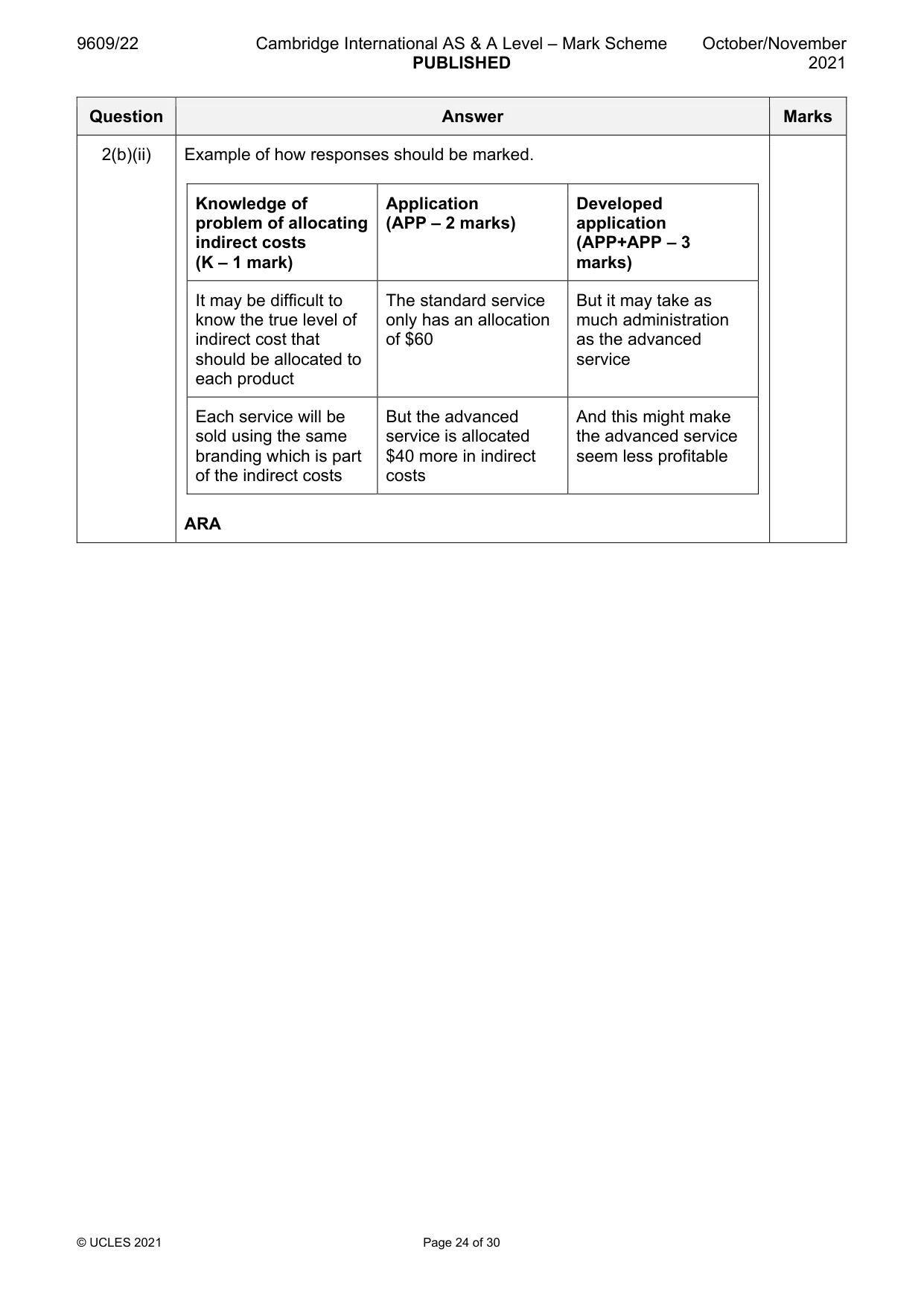
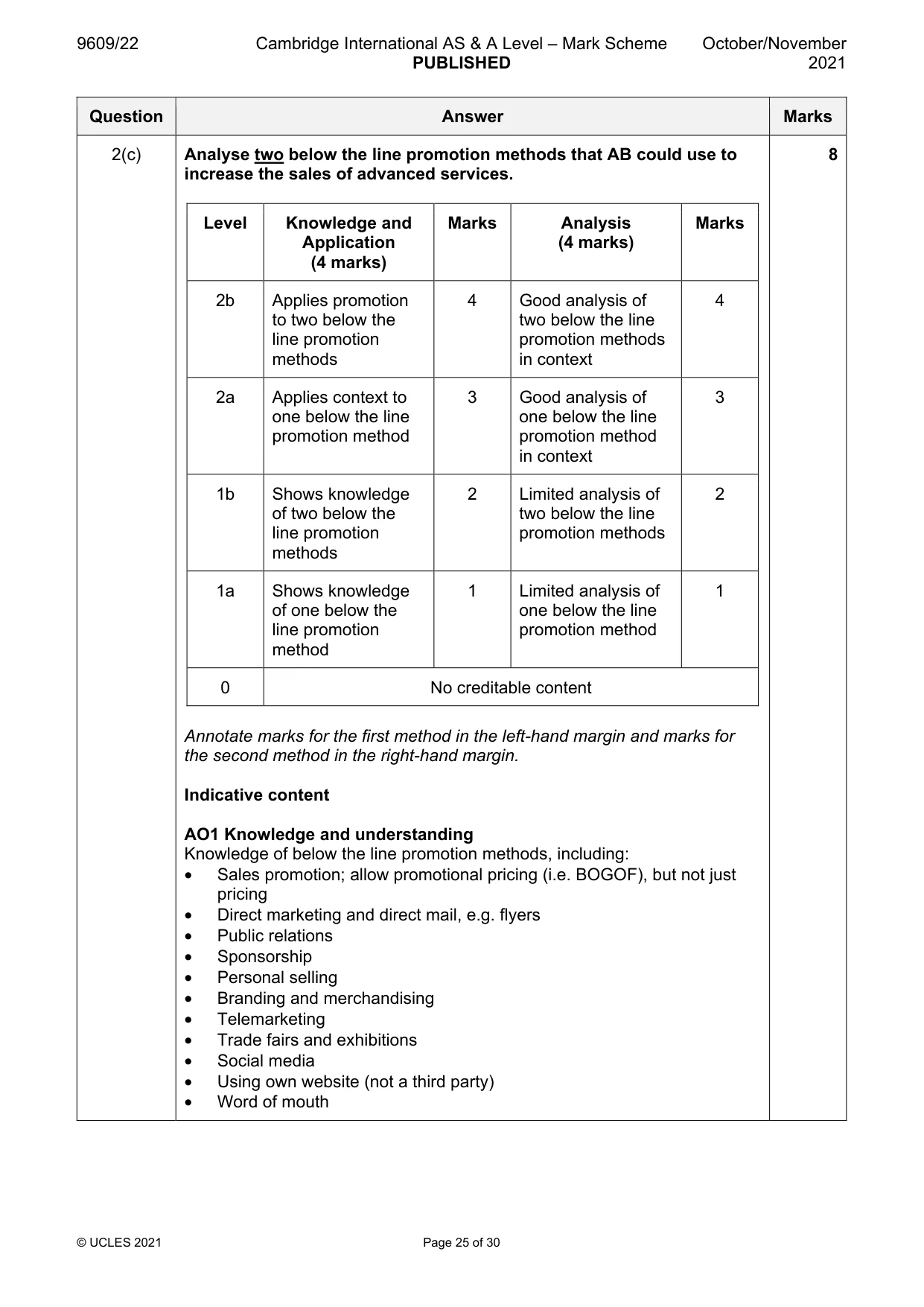
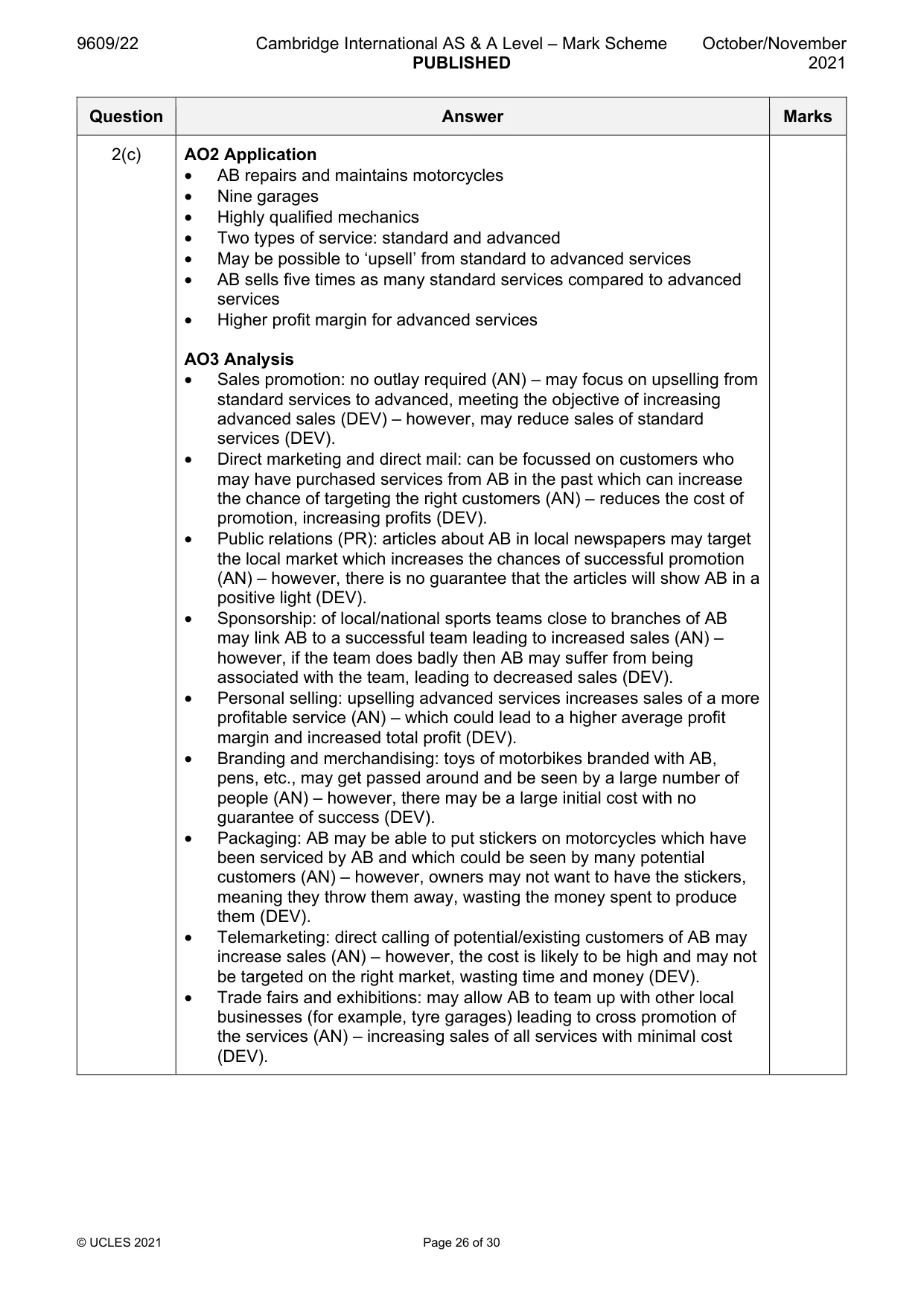
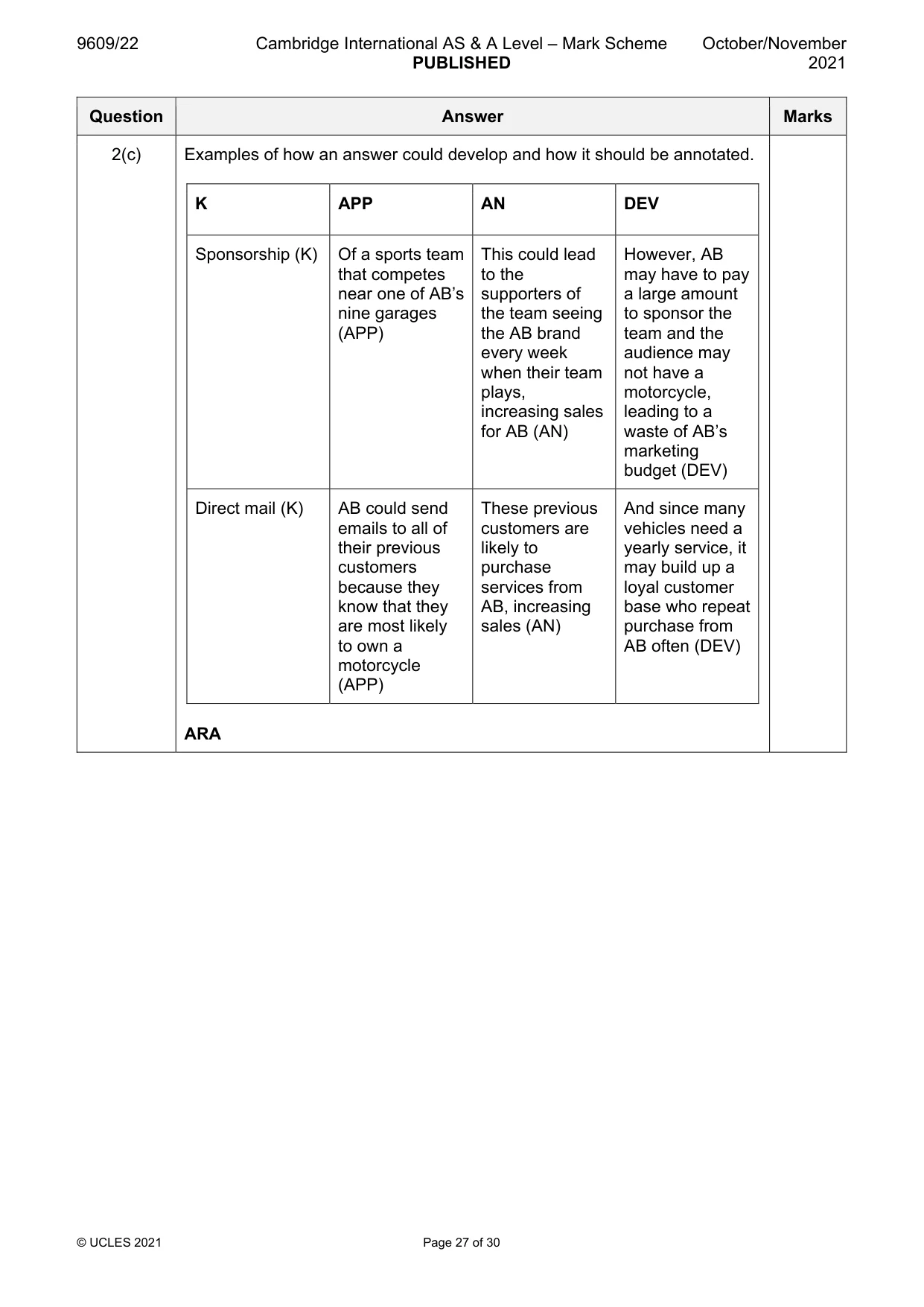
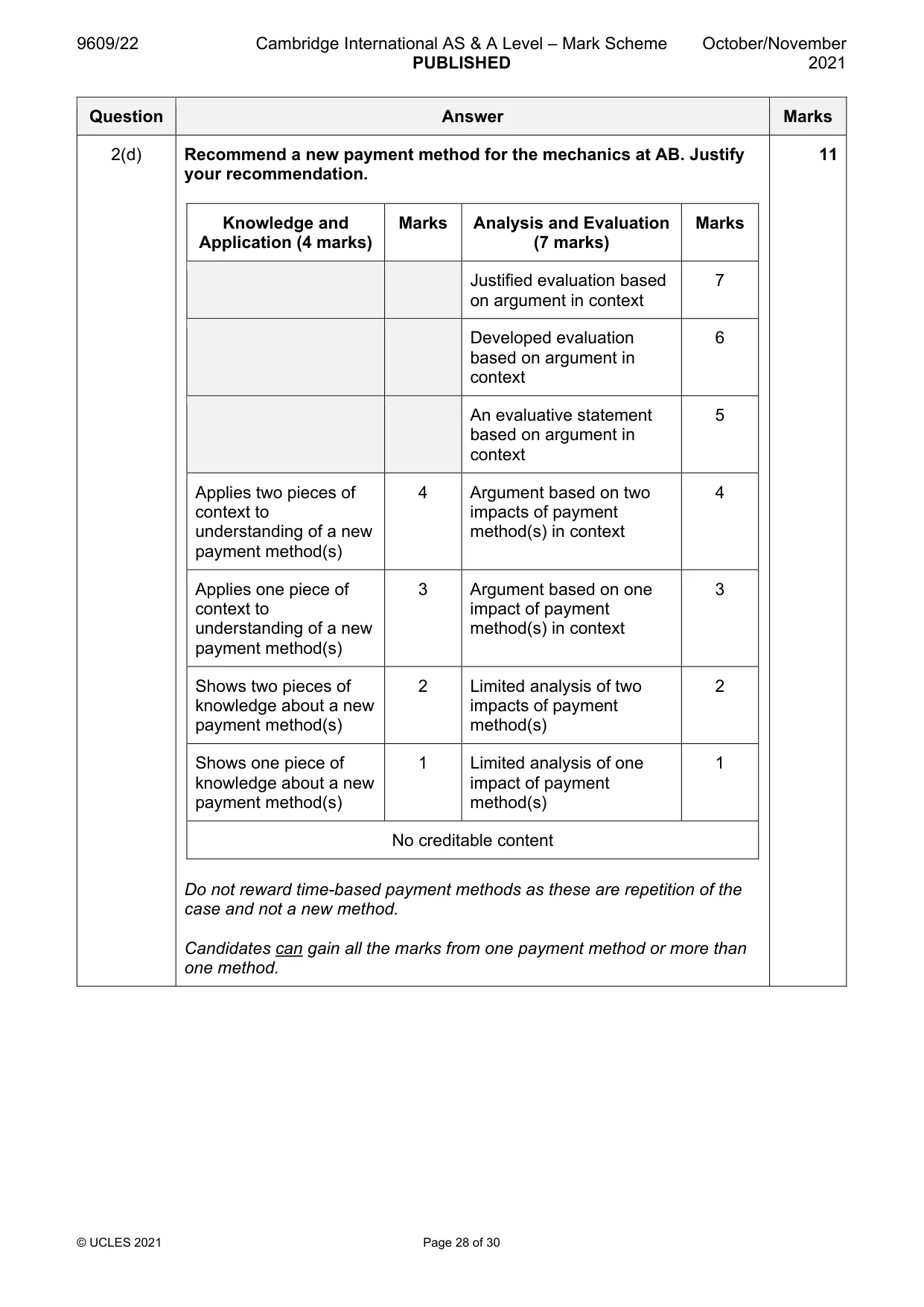
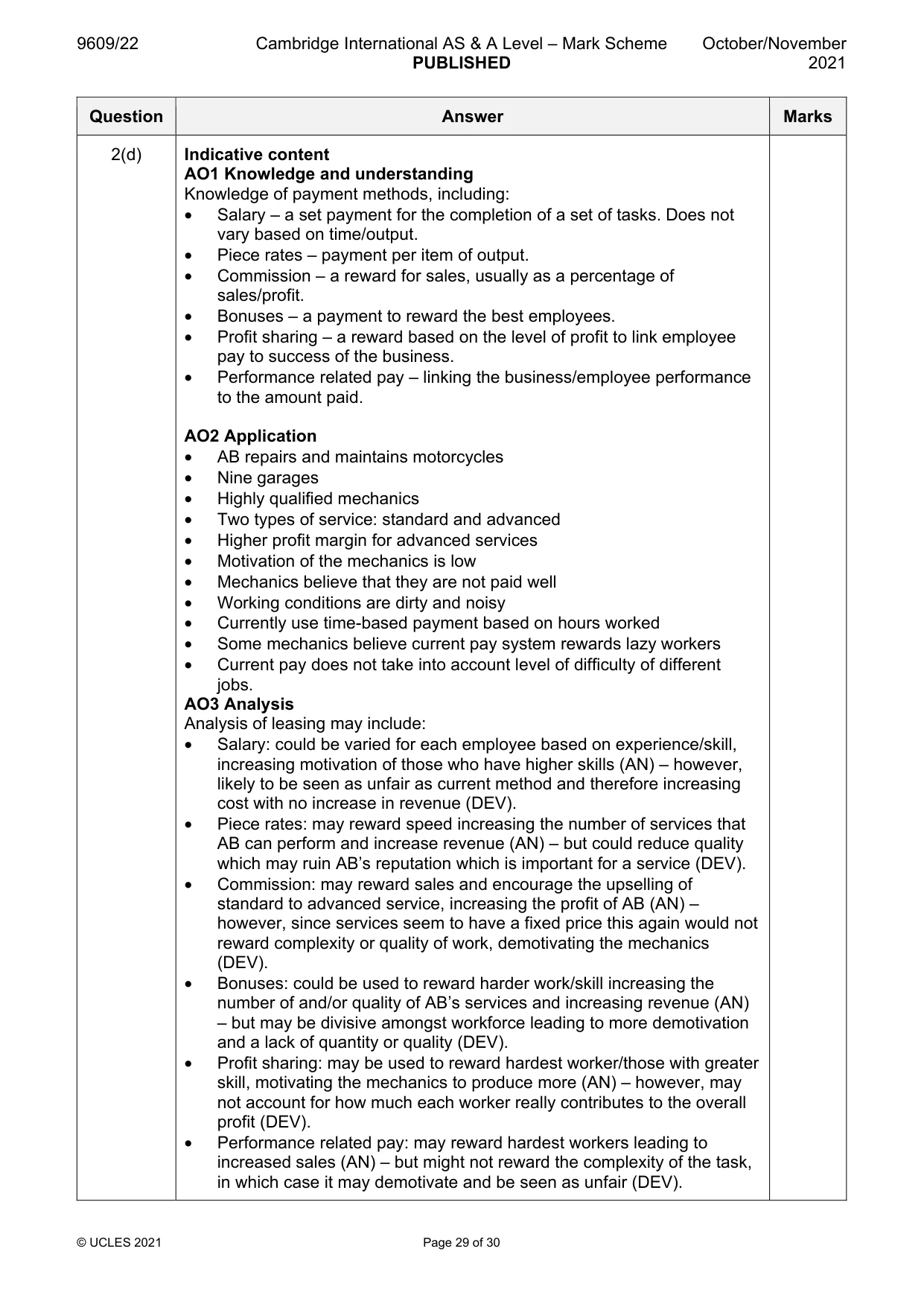
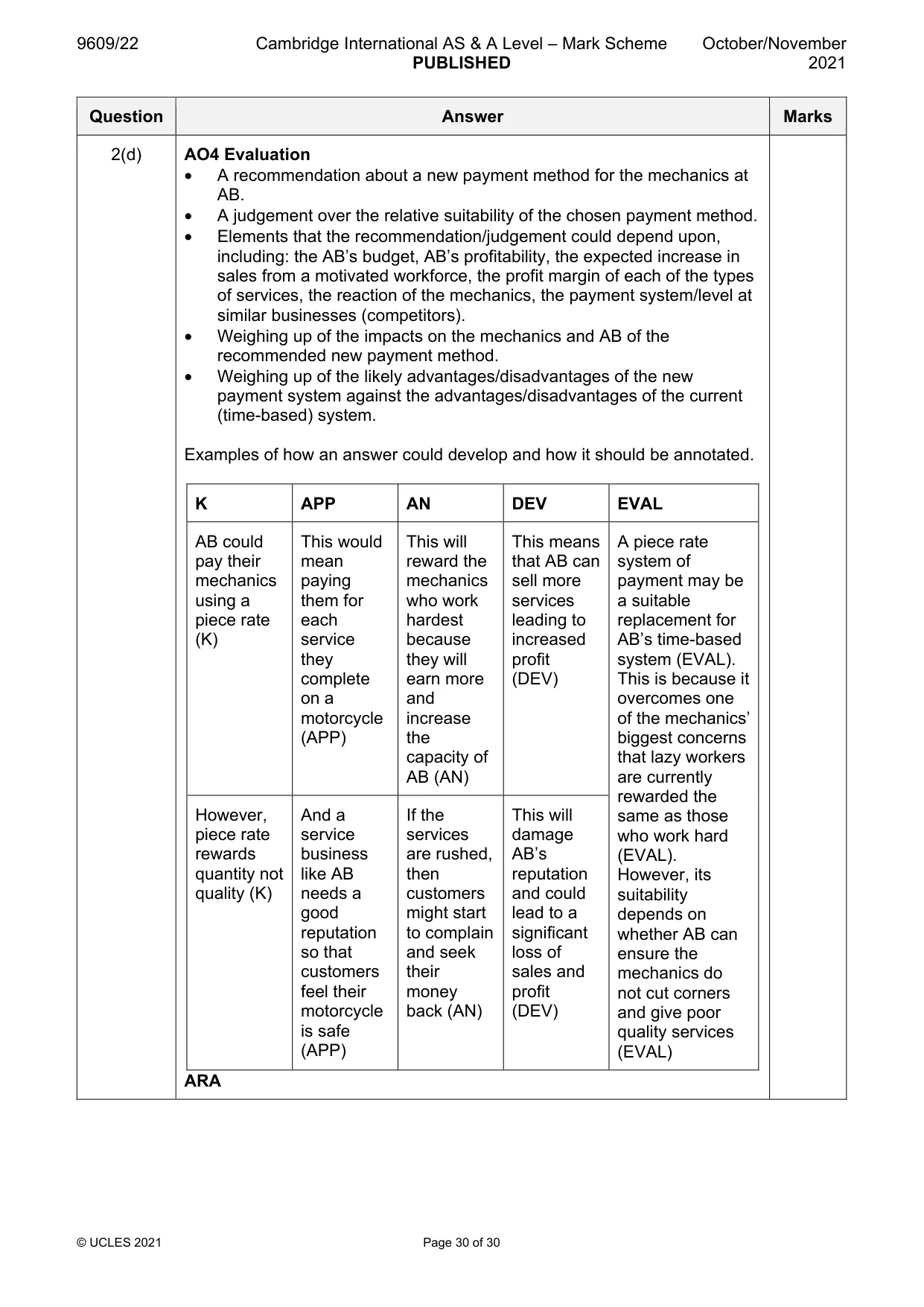
Mark scheme: 2(a)(i) Define the term ‘objective’ (line 13). 2 Knowledge Marks A correct definition 2 A partial, vague or unfocused definition 1 No creditable content 0 Indicative content AO1 Knowledge and understanding • Specific and measurable goals which a business sets out to achieve. A correct definition should include: • an idea that an objective is an aim/goal/target (allow any similar term) • that a business (or a stakeholder) wants to achieve/reach/obtain (allow any similar term). Exemplar Marks Rationale The aims that a business wants to 2 Both elements achieve covered The targets a business wants to reach 2 Both elements covered What an owner is aiming to do 2 Both elements The long-term aims which can be about 1 One element – there profit, sales, or CSR is no idea that a business is trying to achieve them What a business wants to achieve 1 One element – no idea of an aim Objectives are the business objectives 0 Tautology that a business has ARA 2(a)(ii) Explain the term ‘private limited company’ (line 1). 3 Award one mark for each point of explanation: Rationale Marks C Application of a private limited company to an 1 example or some other way of showing good understanding B Understanding of a feature unique to a private 1 limited company A Understanding of feature(s) of a company 1 Must have A and B marks before awarding the C mark. Indicative content AO1 Knowledge and understanding Features of a company including: • an incorporated business • shares can be sold/owners are shareholders • limited liability • separate legal identity • continuity • must make accounts available to everyone Features unique to a private limited company including: • cannot sell shares on a public stock exchange • do not need to publish accounts (just make available) • may only be sold to family and/or friends AO2 Application Application of a private limited company, such as: • an example of a private limited company, such as Jaguar, Lifestyle International, etc. (Do not reward repetition from the data, i.e. ‘AB is a private limited company’.) • application of how any of the K&U points might apply to a business, e.g. a private limited company not being able to sell shares on the stock market might restrict its ability to raise finance • application of further knowledge of a private limited company, such as continuity, legal personality, limited liability 2(a)(ii) Exemplar Marks Rationale A business with shares but they 3 All elements covered cannot be sold on the stock market. This limits their sources of finance A limited liability business that does 3 All elements covered not have to publish its accounts so the competitors cannot see them Sells shares but not on the stock 2 A and B marks only exchange A company which can sell shares has 1 Only the A mark limited liability and is incorporated (many times) AB is a private limited company 0 No K&U, just repetition from the data AB is privately owned 0 Confusion with a private sector business ARA 2(b)(i) Calculate the profit made from selling standard and advanced services 3 in April. Rationale Marks Correct answer(s) with or without correct working or $ 3 • Correct calculation of total revenue and total costs for both 2 services • Correct calculation of the total profit of standard or advanced services • Correct calculation of the profit from one standard and one advanced service • Formula 1 • Correct calculation of one total revenue or one total cost figure • Correct calculation of the profit from one advanced or one standard service No creditable content 0 Indicative content Formula: revenue – total costs or (price – total costs per unit) x quantity Standard services Advanced services $250 – ($50 + $60) = $140 (profit $400 – ($60 + $100) = $240 (profit from one standard service) from one advanced service) $140 × 1000 = $140 000 (profit $240 × 200 = $48 000 (profit from from all standard services) all advanced services) 1000 × $250 = $250 000 (total 200 × $400 = $80 000 (total revenue from standard services) revenue from advanced services) ($50 + $60) × 1000 = $110 000 ($60 + $100) × 200 = $32 000 (total (total cost of standard services) cost of advanced services) $250 000 – $110 000 = $140 000 $80 000 – $32 000 = $48 000 (total (profit from all standard services) profit from all advanced services) $140 000 + $48 000 = $188 000 (total profit from all services) $188 000 (3 marks) or $140 000 and $48 000 (3 marks) 2(b)(i) Common incorrect answers Answer Mark Rationale 188 000 (no working) 3 A correct answer, $ not required 140 000 and 48 000 3 A correct answer, $ not required 140 000 2 The calculation of only standard services profit, $ not required 48 000 2 The calculation of only standard services profit, $ not required $140 + $240 = $380 2 Correct calculation of profit from one standard and one advanced service 1000 × $250 = 1 Only calculation of total revenue, needs $250 000 total costs for 2 marks 200 × $400 = $80 000 $250 000 + $80 000 = $330 000 $110 000 + $32 000 1 Only calculation of total costs, needs = $142 000 total revenue for 2 marks $550 (no working) 0 Only the revenue from one standard and one advanced service, not the total. Also no working to back this up 2(b)(ii) Explain one possible problem for AB of trying to allocate indirect 3 costs. Level Knowledge and Application Marks 2b (APP+ Explanation of one possible problem of allocating 3 APP) indirect costs in context 2a (APP) Identification of one possible problem of allocating 2 indirect costs in context 1a (K) Knowledge of one possible problem of allocating 1 indirect costs 0 No creditable content 0 Although the definition of an indirect cost (a cost that cannot be attributed to a production process) is not rewardable, it contains a problem, so will usually gain a K mark. Indicative content AO1 Knowledge and understanding Knowledge of problems of allocating indirect costs may include: • not attributable to the production process • not attributable to a specific product/service • how to split costs such as marketing, administration, expenses when they are not directly linked to a costs centre AO2 Application • The attributed indirect cost of an advanced service is $40 more than a standard service (APP) – this may not reflect the difference in marketing/admin/expenses (APP+APP). • It may be difficult to allocate costs to the different types of service (APP) – because some garages may be busier than others (APP+APP). • The allocation is fixed, even though the garage sells five times more standard services than advanced (APP). If a garage does more/fewer services, then the contribution should vary (APP+APP). • Marketing for the different services may be through the AB brand (APP) – but the allocation does not reflect this (APP+APP). • The two services have different allocated indirect costs (APP) – $60 for a standard service and $100 for an advanced service (APP+APP) – however, there is no reason given for the difference (APP+APP). Application (APP) is likely to come from the context, with developed application (APP+APP) from further use of that context. 2(b)(ii) Example of how responses should be marked. Knowledge of Application Developed problem of allocating (APP – 2 marks) application indirect costs (APP+APP – 3 (K – 1 mark) marks) It may be difficult to The standard service But it may take as know the true level of only has an allocation much administration indirect cost that of $60 as the advanced should be allocated to service each product Each service will be But the advanced And this might make sold using the same service is allocated the advanced service branding which is part $40 more in indirect seem less profitable of the indirect costs costs ARA 2(c) Analyse two below the line promotion methods that AB could use to 8 increase the sales of advanced services. Level Knowledge and Marks Analysis Marks Application (4 marks) (4 marks) 2b Applies promotion 4 Good analysis of 4 to two below the two below the line line promotion promotion methods methods in context 2a Applies context to 3 Good analysis of 3 one below the line one below the line promotion method promotion method in context 1b Shows knowledge 2 Limited analysis of 2 of two below the two below the line line promotion promotion methods methods 1a Shows knowledge 1 Limited analysis of 1 of one below the one below the line line promotion promotion method method 0 No creditable content Annotate marks for the first method in the left-hand margin and marks for the second method in the right-hand margin. Indicative content AO1 Knowledge and understanding Knowledge of below the line promotion methods, including: • Sales promotion; allow promotional pricing (i.e. BOGOF), but not just pricing • Direct marketing and direct mail, e.g. flyers • Public relations • Sponsorship • Personal selling • Branding and merchandising • Telemarketing • Trade fairs and exhibitions • Social media • Using own website (not a third party) • Word of mouth 2(c) AO2 Application • AB repairs and maintains motorcycles • Nine garages • Highly qualified mechanics • Two types of service: standard and advanced • May be possible to ‘upsell’ from standard to advanced services • AB sells five times as many standard services compared to advanced services • Higher profit margin for advanced services AO3 Analysis • Sales promotion: no outlay required (AN) – may focus on upselling from standard services to advanced, meeting the objective of increasing advanced sales (DEV) – however, may reduce sales of standard services (DEV). • Direct marketing and direct mail: can be focussed on customers who may have purchased services from AB in the past which can increase the chance of targeting the right customers (AN) – reduces the cost of promotion, increasing profits (DEV). • Public relations (PR): articles about AB in local newspapers may target the local market which increases the chances of successful promotion (AN) – however, there is no guarantee that the articles will show AB in a positive light (DEV). • Sponsorship: of local/national sports teams close to branches of AB may link AB to a successful team leading to increased sales (AN) – however, if the team does badly then AB may suffer from being associated with the team, leading to decreased sales (DEV). • Personal selling: upselling advanced services increases sales of a more profitable service (AN) – which could lead to a higher average profit margin and increased total profit (DEV). • Branding and merchandising: toys of motorbikes branded with AB, pens, etc., may get passed around and be seen by a large number of people (AN) – however, there may be a large initial cost with no guarantee of success (DEV). • Packaging: AB may be able to put stickers on motorcycles which have been serviced by AB and which could be seen by many potential customers (AN) – however, owners may not want to have the stickers, meaning they throw them away, wasting the money spent to produce them (DEV). • Telemarketing: direct calling of potential/existing customers of AB may increase sales (AN) – however, the cost is likely to be high and may not be targeted on the right market, wasting time and money (DEV). • Trade fairs and exhibitions: may allow AB to team up with other local businesses (for example, tyre garages) leading to cross promotion of the services (AN) – increasing sales of all services with minimal cost (DEV). 2(c) Examples of how an answer could develop and how it should be annotated. K APP AN DEV Sponsorship (K) Of a sports team This could lead However, AB that competes to the may have to pay near one of AB’s supporters of a large amount nine garages the team seeing to sponsor the (APP) the AB brand team and the every week audience may when their team not have a plays, motorcycle, increasing sales leading to a for AB (AN) waste of AB’s marketing budget (DEV) Direct mail (K) AB could send These previous And since many emails to all of customers are vehicles need a their previous likely to yearly service, it customers purchase may build up a because they services from loyal customer know that they AB, increasing base who repeat are most likely sales (AN) purchase from to own a AB often (DEV) motorcycle (APP) ARA 2(d) Recommend a new payment method for the mechanics at AB. Justify 11 your recommendation. Knowledge and Marks Analysis and Evaluation Marks Application (4 marks) (7 marks) Justified evaluation based 7 on argument in context Developed evaluation 6 based on argument in context An evaluative statement 5 based on argument in context Applies two pieces of 4 Argument based on two 4 context to impacts of payment understanding of a new method(s) in context payment method(s) Applies one piece of 3 Argument based on one 3 context to impact of payment understanding of a new method(s) in context payment method(s) Shows two pieces of 2 Limited analysis of two 2 knowledge about a new impacts of payment payment method(s) method(s) Shows one piece of 1 Limited analysis of one 1 knowledge about a new impact of payment payment method(s) method(s) No creditable content Do not reward time-based payment methods as these are repetition of the case and not a new method. Candidates can gain all the marks from one payment method or more than one method. 2(d) Indicative content AO1 Knowledge and understanding Knowledge of payment methods, including: • Salary – a set payment for the completion of a set of tasks. Does not vary based on time/output. • Piece rates – payment per item of output. • Commission – a reward for sales, usually as a percentage of sales/profit. • Bonuses – a payment to reward the best employees. • Profit sharing – a reward based on the level of profit to link employee pay to success of the business. • Performance related pay – linking the business/employee performance to the amount paid. AO2 Application • AB repairs and maintains motorcycles • Nine garages • Highly qualified mechanics • Two types of service: standard and advanced • Higher profit margin for advanced services • Motivation of the mechanics is low • Mechanics believe that they are not paid well • Working conditions are dirty and noisy • Currently use time-based payment based on hours worked • Some mechanics believe current pay system rewards lazy workers • Current pay does not take into account level of difficulty of different jobs. AO3 Analysis Analysis of leasing may include: • Salary: could be varied for each employee based on experience/skill, increasing motivation of those who have higher skills (AN) – however, likely to be seen as unfair as current method and therefore increasing cost with no increase in revenue (DEV). • Piece rates: may reward speed increasing the number of services that AB can perform and increase revenue (AN) – but could reduce quality which may ruin AB’s reputation which is important for a service (DEV). • Commission: may reward sales and encourage the upselling of standard to advanced service, increasing the profit of AB (AN) – however, since services seem to have a fixed price this again would not reward complexity or quality of work, demotivating the mechanics (DEV). • Bonuses: could be used to reward harder work/skill increasing the number of and/or quality of AB’s services and increasing revenue (AN) – but may be divisive amongst workforce leading to more demotivation and a lack of quantity or quality (DEV). • Profit sharing: may be used to reward hardest worker/those with greater skill, motivating the mechanics to produce more (AN) – however, may not account for how much each worker really contributes to the overall profit (DEV). • Performance related pay: may reward hardest workers leading to increased sales (AN) – but might not reward the complexity of the task, in which case it may demotivate and be seen as unfair (DEV). 2(d) AO4 Evaluation • A recommendation about a new payment method for the mechanics at AB. • A judgement over the relative suitability of the chosen payment method. • Elements that the recommendation/judgement could depend upon, including: the AB’s budget, AB’s profitability, the expected increase in sales from a motivated workforce, the profit margin of each of the types of services, the reaction of the mechanics, the payment system/level at similar businesses (competitors). • Weighing up of the impacts on the mechanics and AB of the recommended new payment method. • Weighing up of the likely advantages/disadvantages of the new payment system against the advantages/disadvantages of the current (time-based) system. Examples of how an answer could develop and how it should be annotated. K APP AN DEV EVAL AB could This would This will This means A piece rate pay their mean reward the that AB can system of mechanics paying mechanics sell more payment may be using a them for who work services a suitable piece rate each hardest leading to replacement for (K) service because increased AB’s time-based they they will profit system (EVAL). complete earn more (DEV) This is because it on a and overcomes one motorcycle increase of the mechanics’ (APP) the biggest concerns capacity of that lazy workers AB (AN) are currently rewarded the However, And a If the This will same as those piece rate service services damage who work hard rewards business are rushed, AB’s (EVAL). quantity not like AB then reputation However, its quality (K) needs a customers and could suitability good might start lead to a depends on reputation to complain significant whether AB can so that and seek loss of ensure the customers their sales and mechanics do feel their money profit not cut corners motorcycle back (AN) (DEV) and give poor is safe quality services (APP) (EVAL) ARA
What was in this paper
The subtopics covered by these 2 questions, and how many questions each got. Open one in a new tab to see every Cambridge question on it.
What you needed in this session
Cambridge’s own grade thresholds for 2021 Oct/Nov, Paper 2 · Variant 2. A higher threshold means an easier paper — the bar moves with how the cohort did.