Cambridge A Level Business (for first examination in 2016) 9609 — 2021 Oct/Nov Paper 2 · Variant 3
9609/23/O/N/21 · 2 questions · 60 marks · ≈68 min
The question paper and its mark scheme, free to read here and free to download. This is Cambridge’s own paper, exactly as it was sat.
Question paper4 pages
Mark scheme25 pages
Answers below. Sit the paper first if you are practising.
Questions as text
Q1 · Van Man (VM) Obi is a sole trader who operates a van service
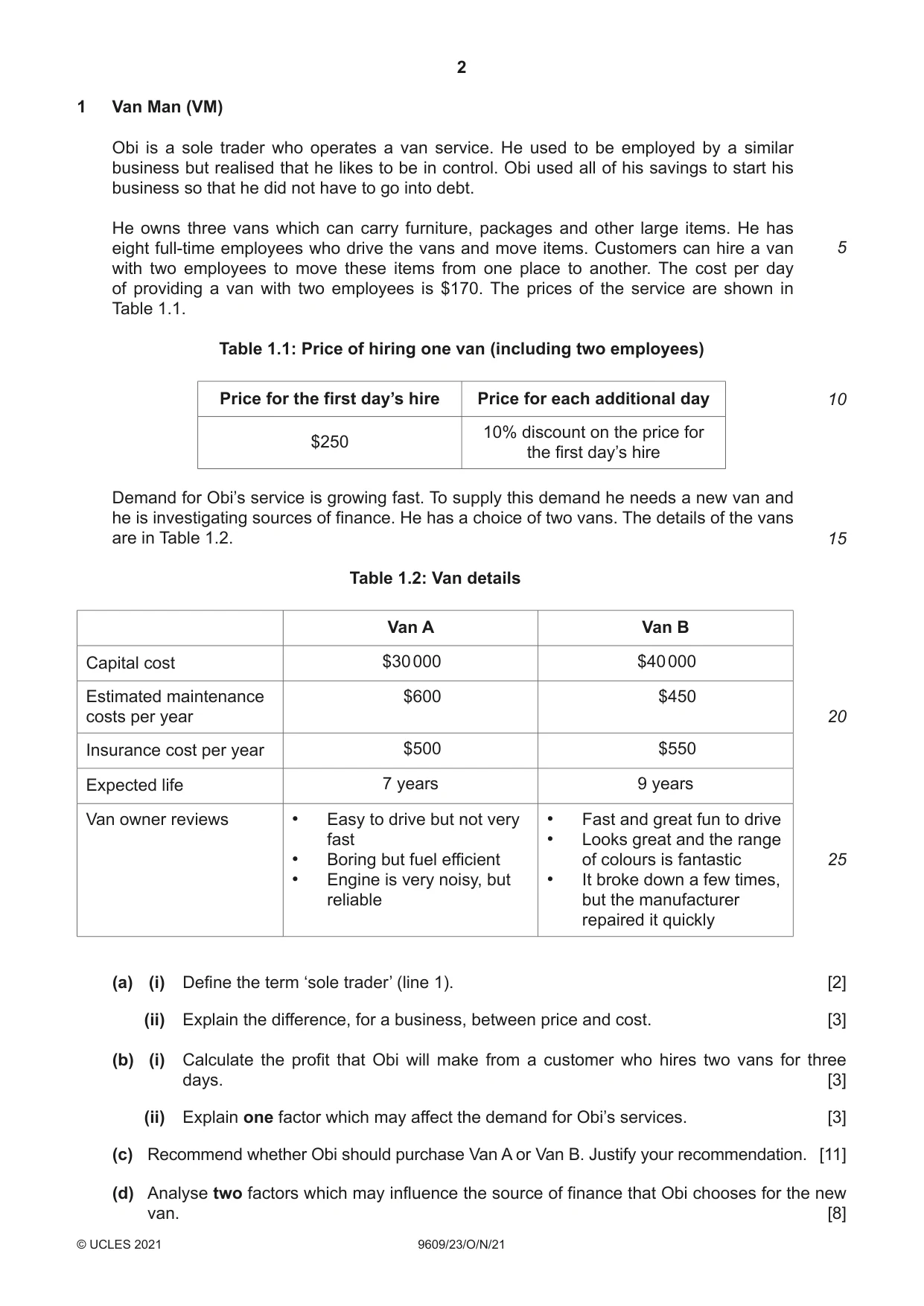
1 Van Man (VM) Obi is a sole trader who operates a van service. He used to be employed by a similar business but realised that he likes to be in control. Obi used all of his savings to start his business so that he did not have to go into debt. He owns three vans which can carry furniture, packages and other large items. He has eight full-time employees who drive the vans and move items. Customers can hire a van 5 with two employees to move these items from one place to another. The cost per day of providing a van with two employees is $170. The prices of the service are shown in Table 1.1. Table 1.1: Price of hiring one van (including two employees) Price for the first day’s hire Price for each additional day 10 10% discount on the price for $250 the first day’s hire Demand for Obi’s service is growing fast. To supply this demand he needs a new van and he is investigating sources of finance. He has a choice of two vans. The details of the vans are in Table 1.2. 15 Table 1.2: Van details Van A Van B Capital cost $30 000 $40 000 Estimated maintenance $600 $450 costs per year 20 Insurance cost per year $500 $550 Expected life 7 years 9 years Van owner reviews • Easy to drive but not very • Fast and great fun to drive fast • Looks great and the range • Boring but fuel efficient of colours is fantastic 25 • Engine is very noisy, but • It broke down a few times, reliable but the manufacturer repaired it quickly (a) (i) Define the term ‘sole trader’ (line 1). [2] (ii) Explain the difference, for a business, between price and cost. [3] (b) (i) Calculate the profit that Obi will make from a customer who hires two vans for three days. [3] (ii) Explain one factor which may affect the demand for Obi’s services. [3] (c) Recommend whether Obi should purchase Van A or Van B. Justify your recommendation. [11] (d) Analyse two factors which may influence the source of finance that Obi chooses for the new van. [8]
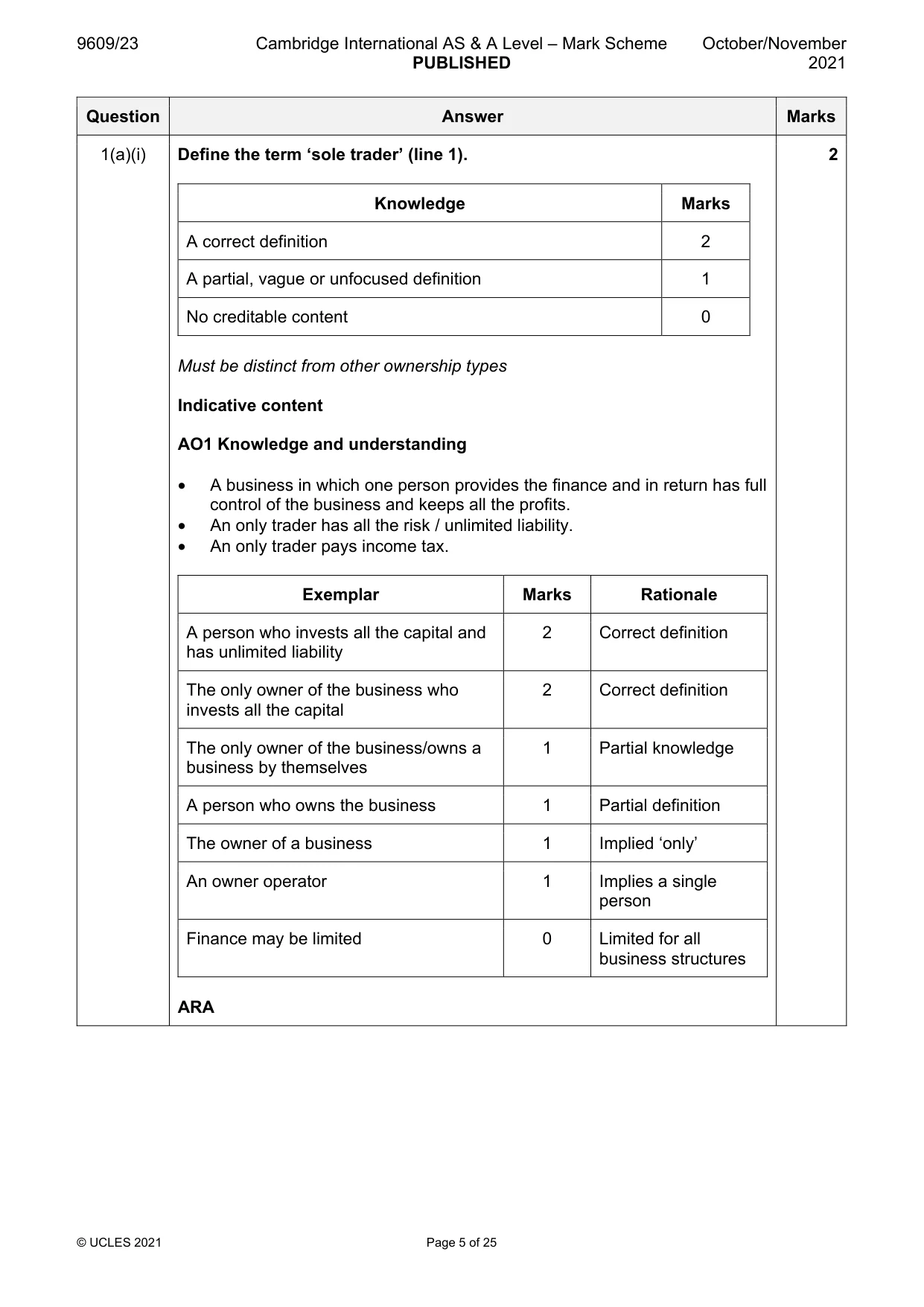
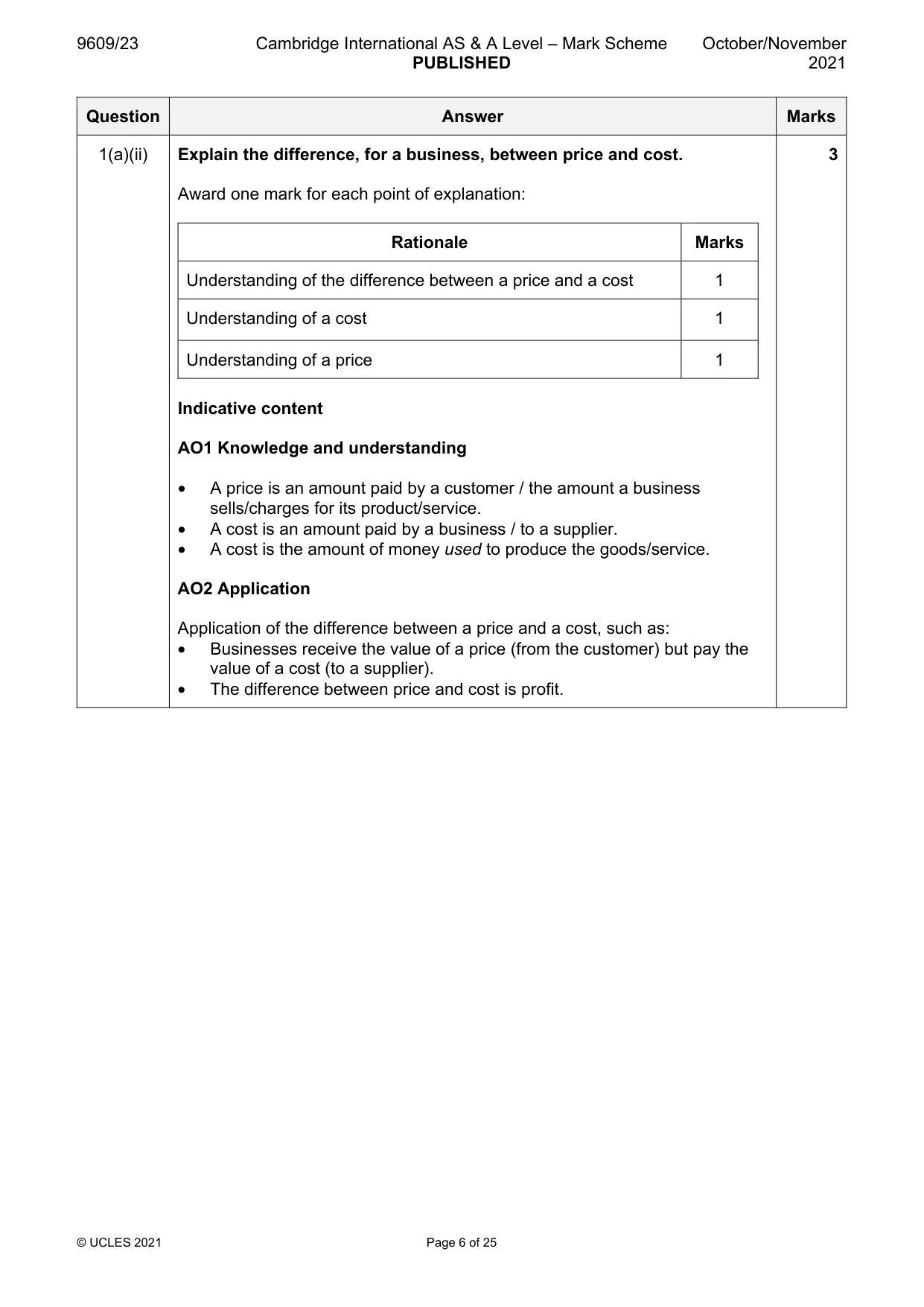
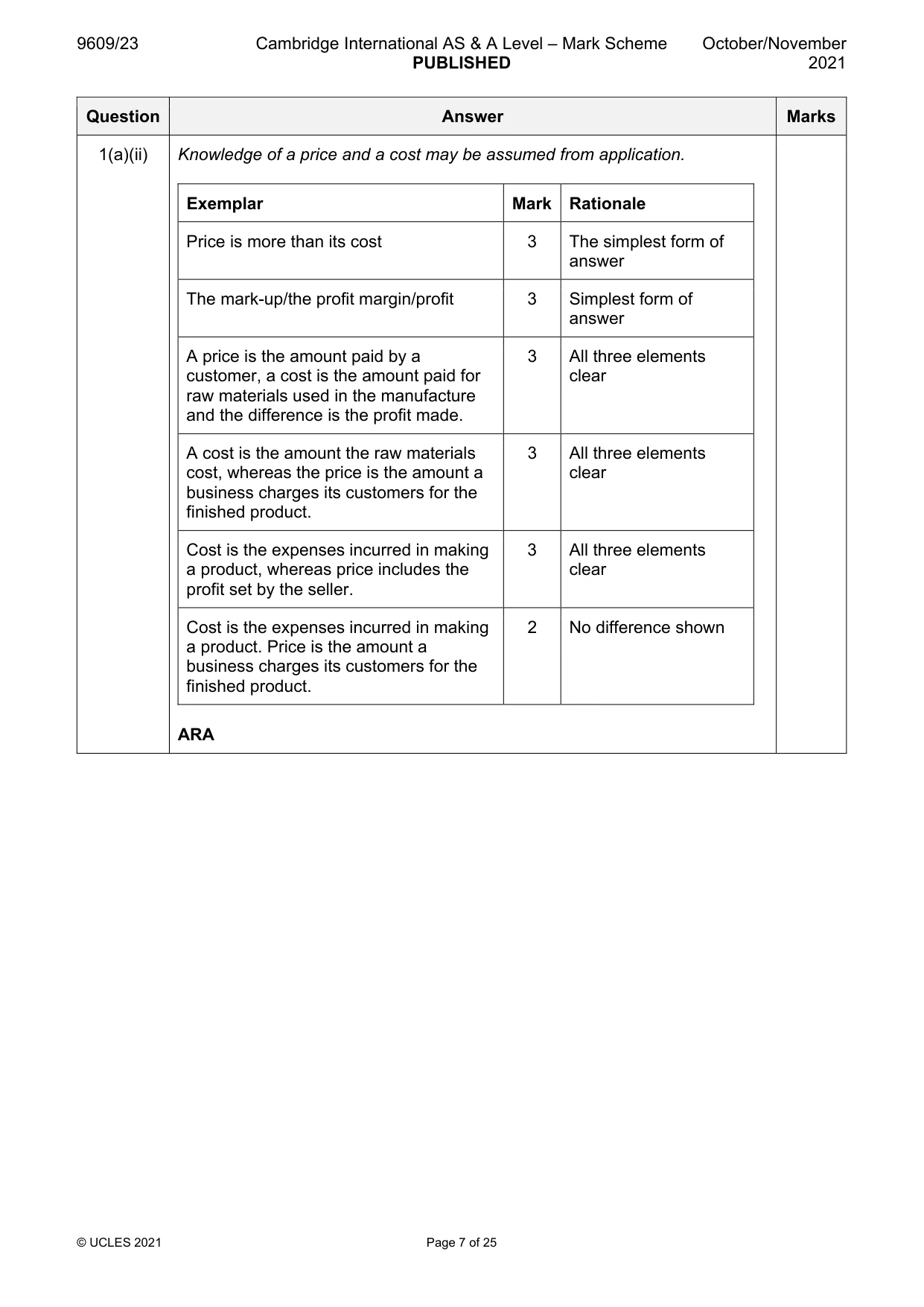
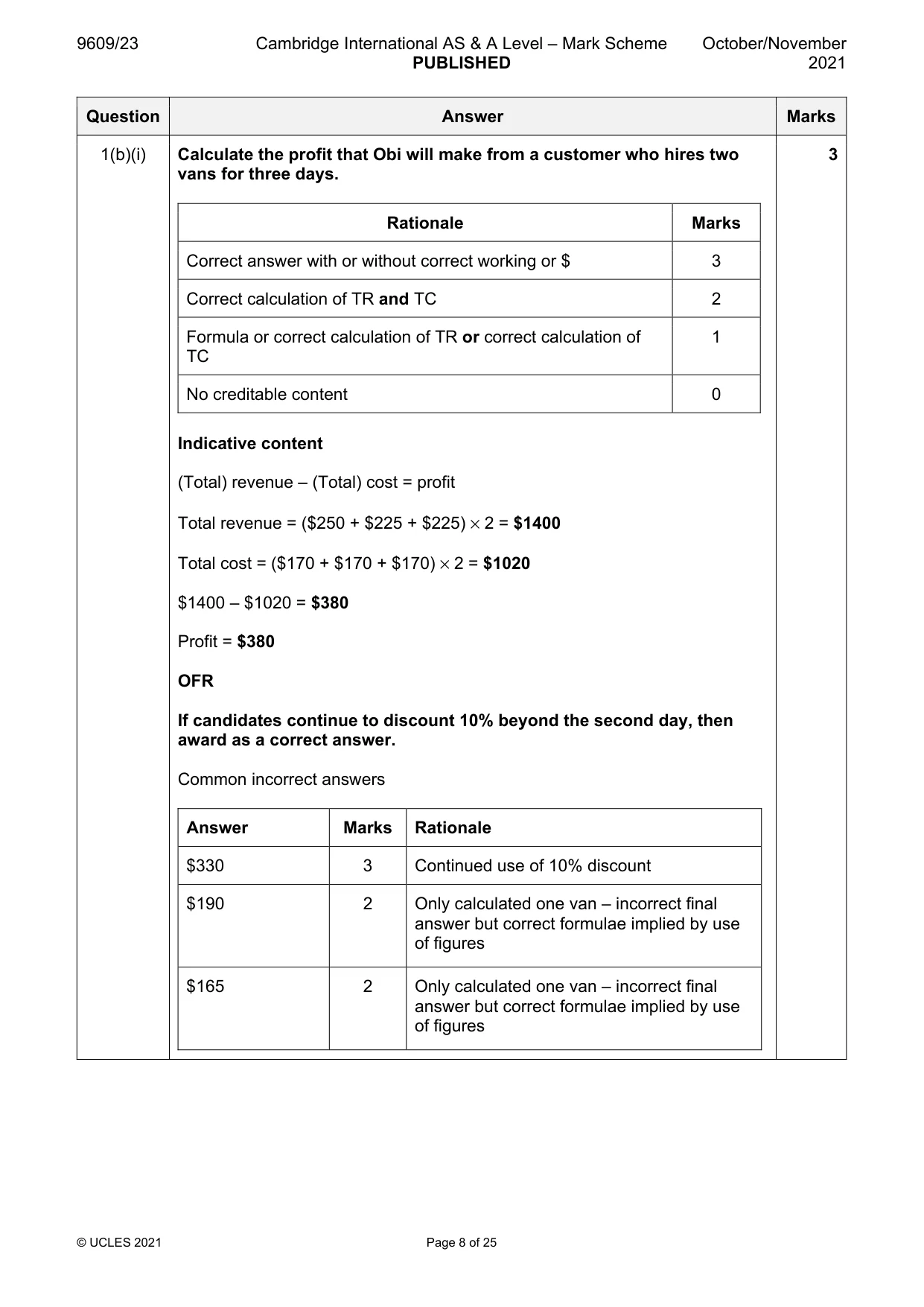
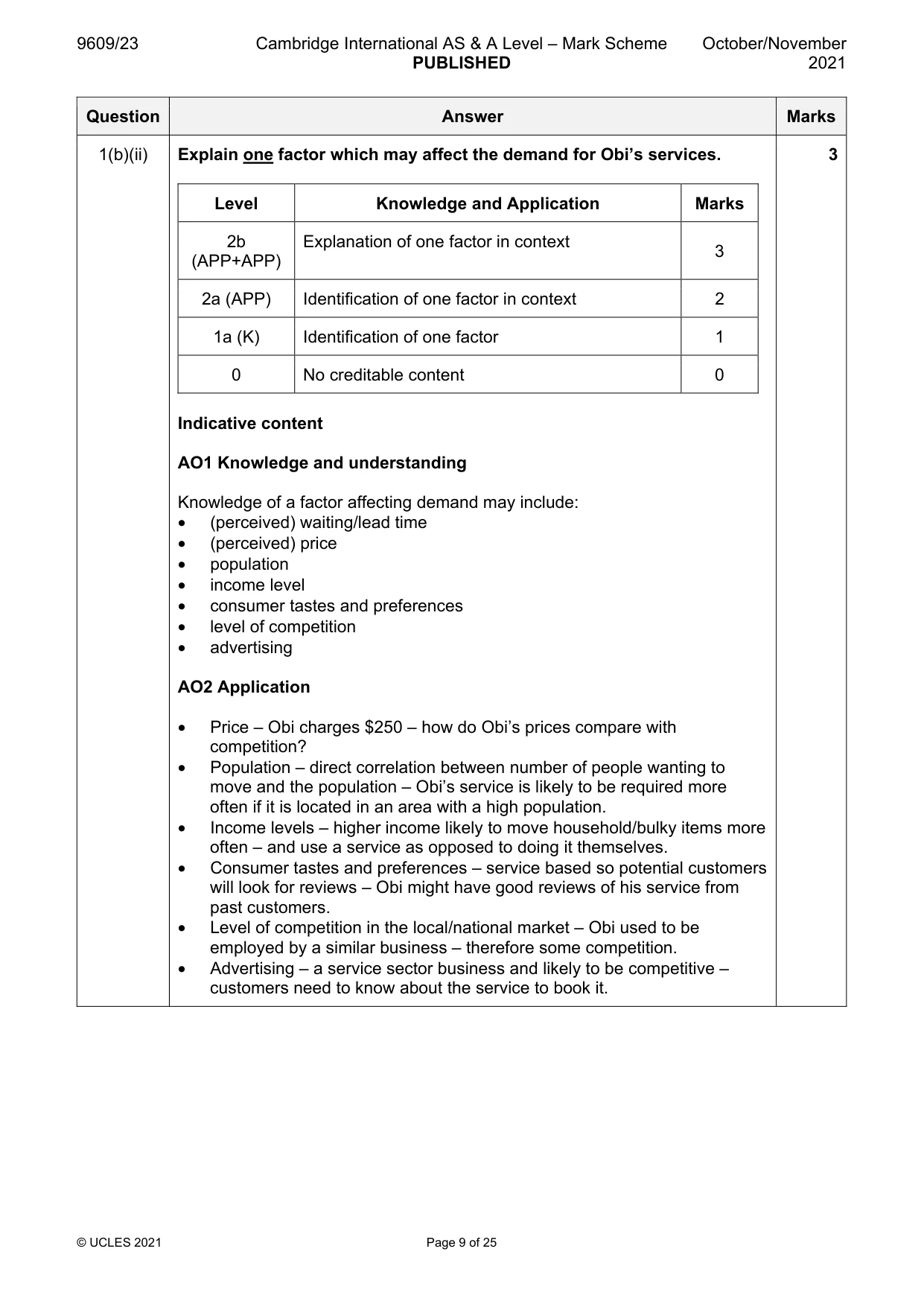
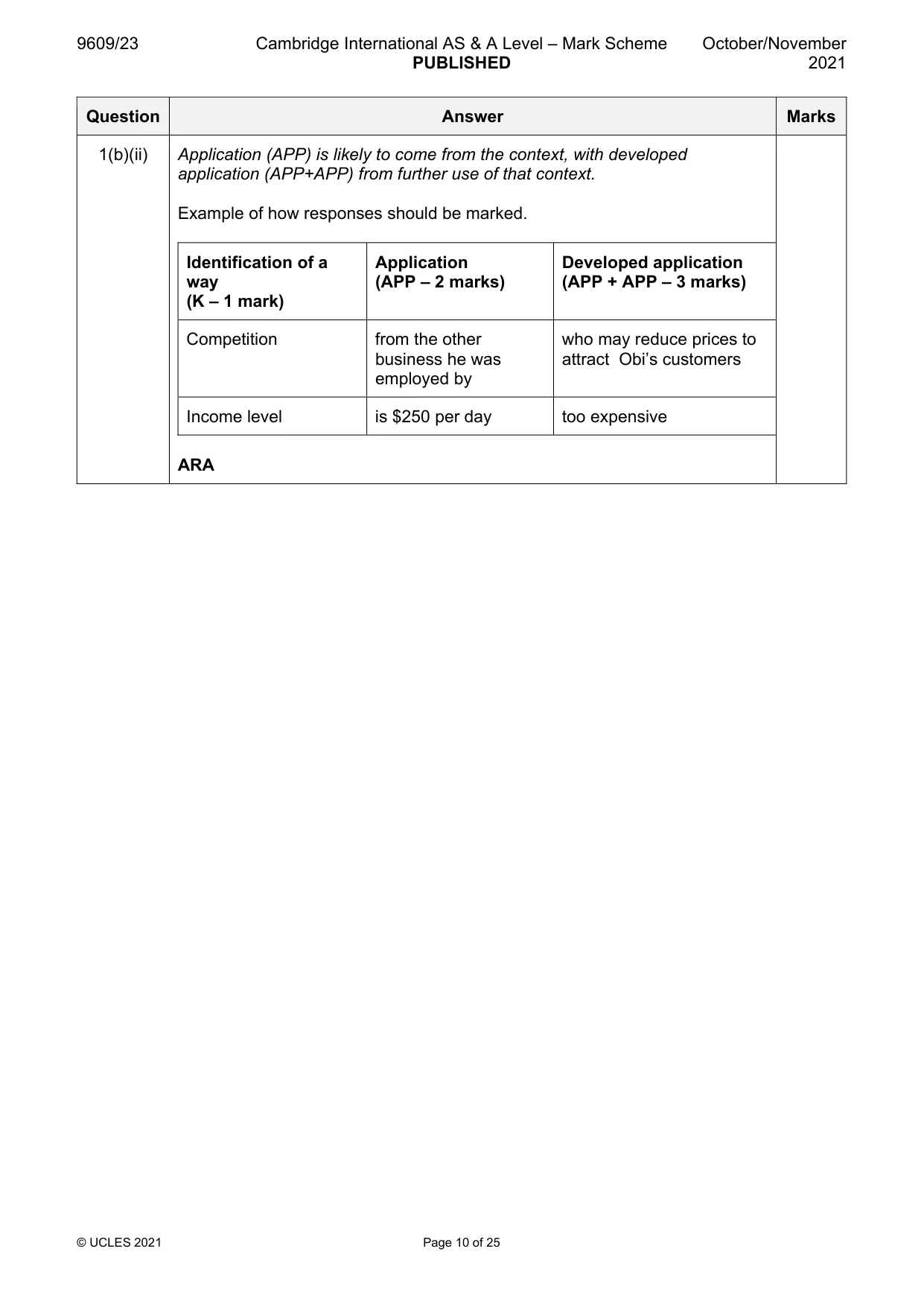
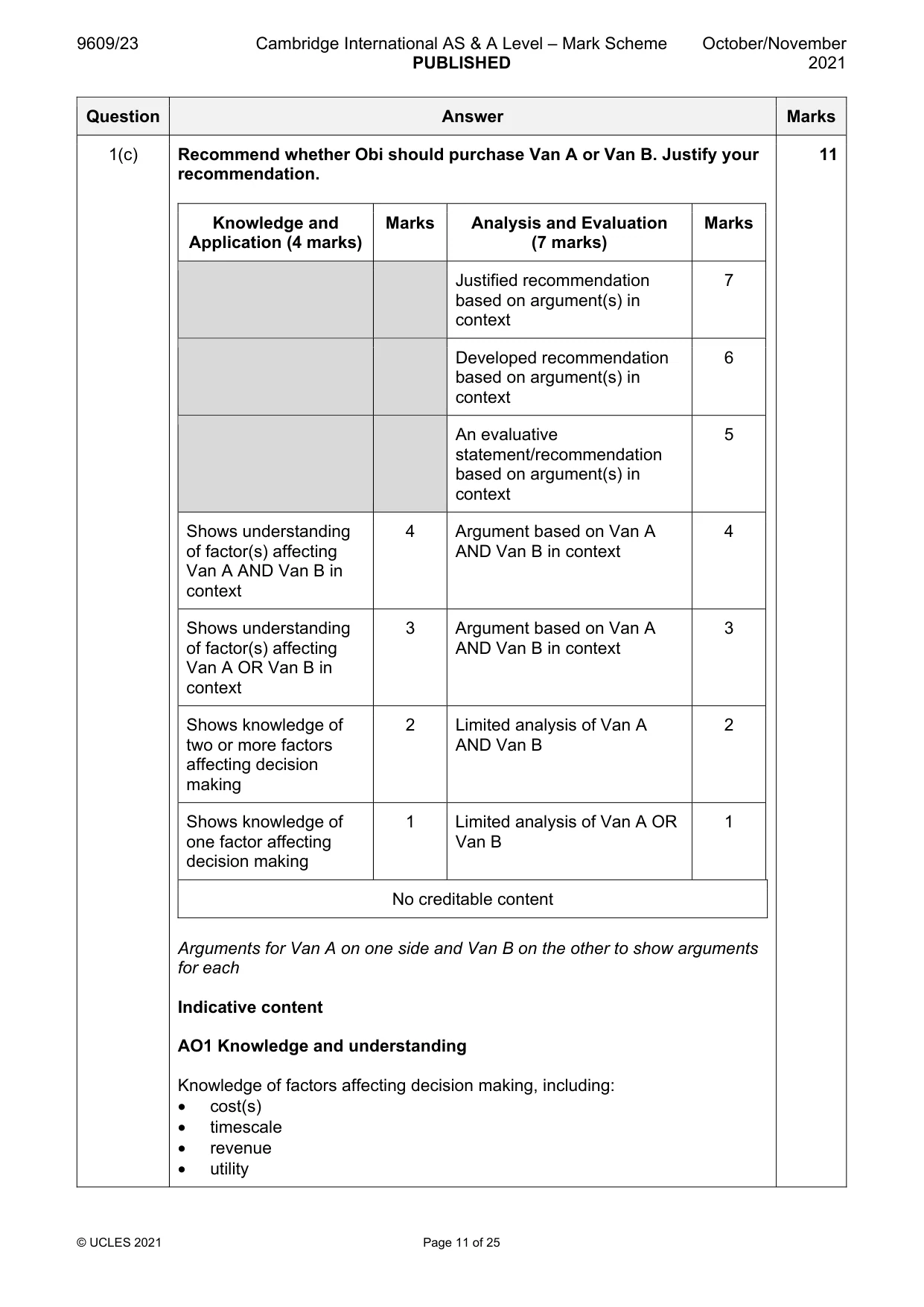
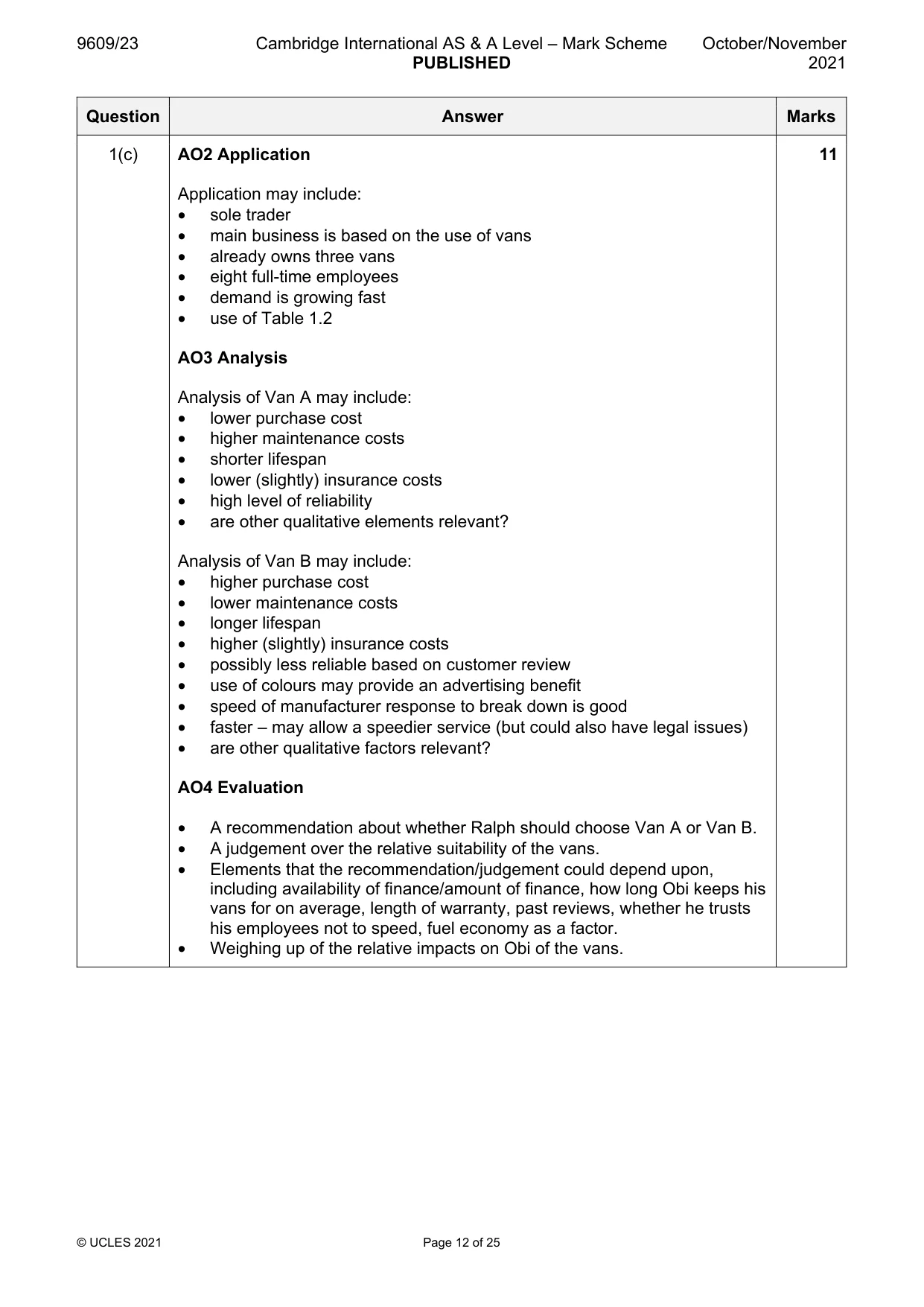
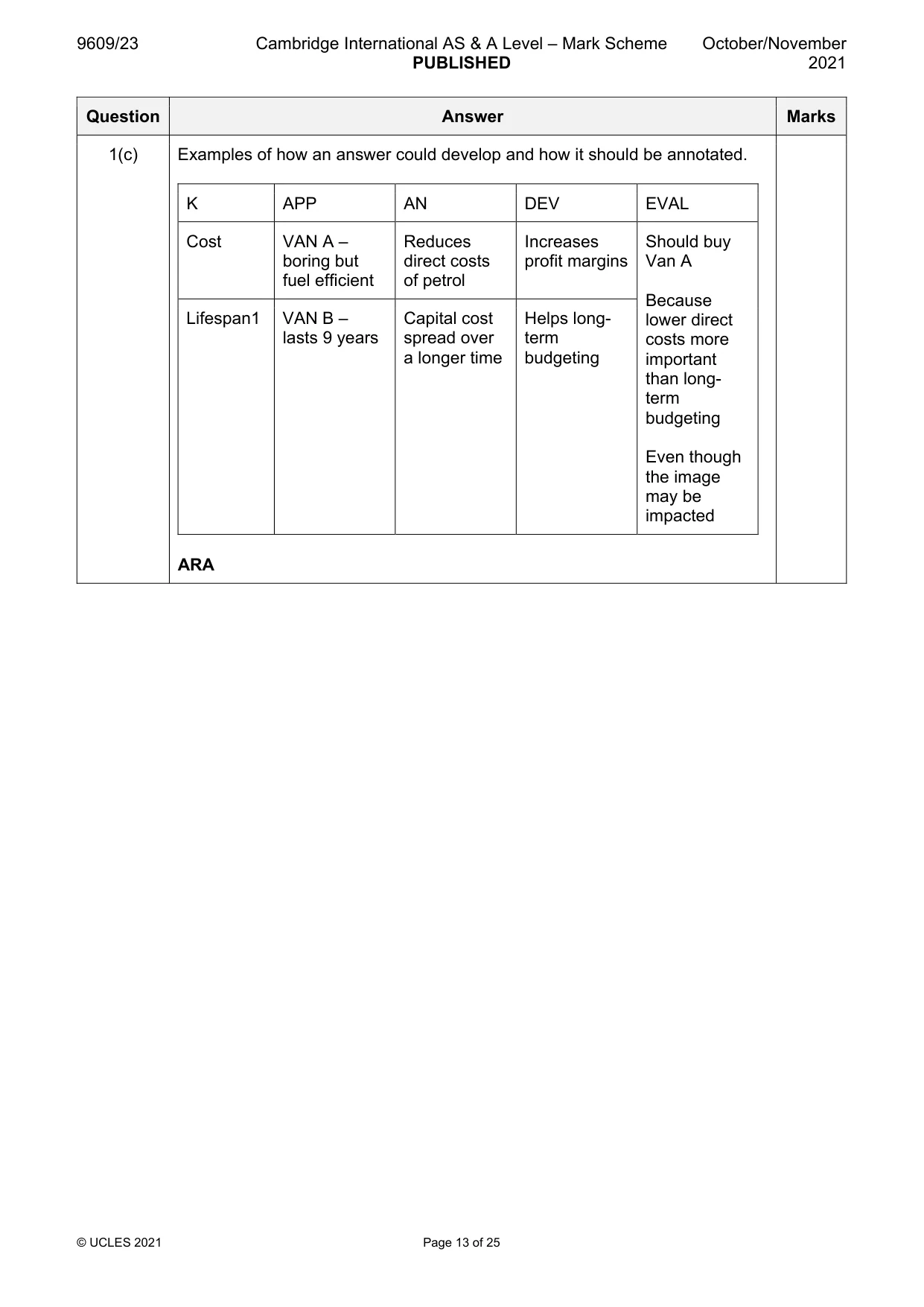
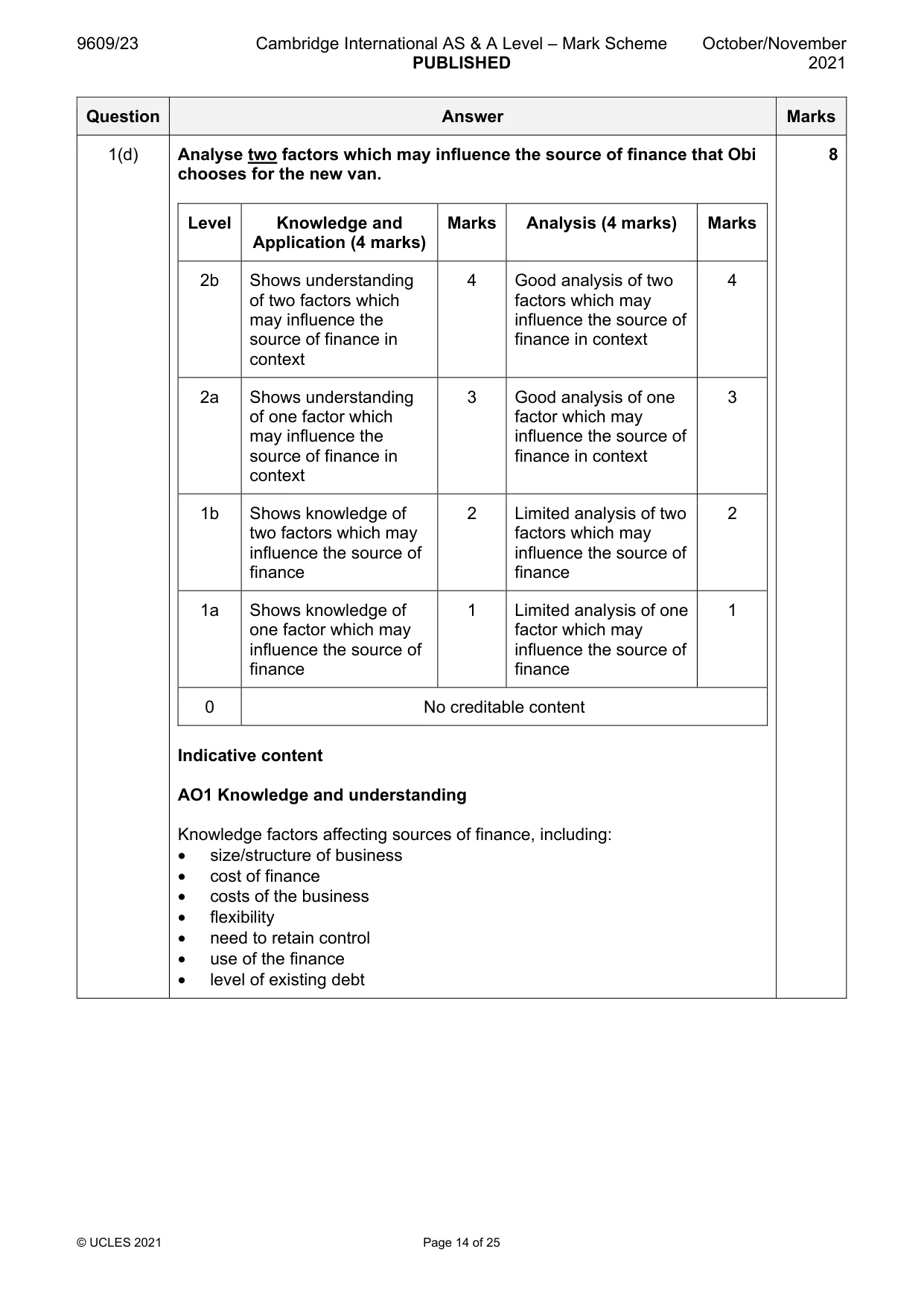
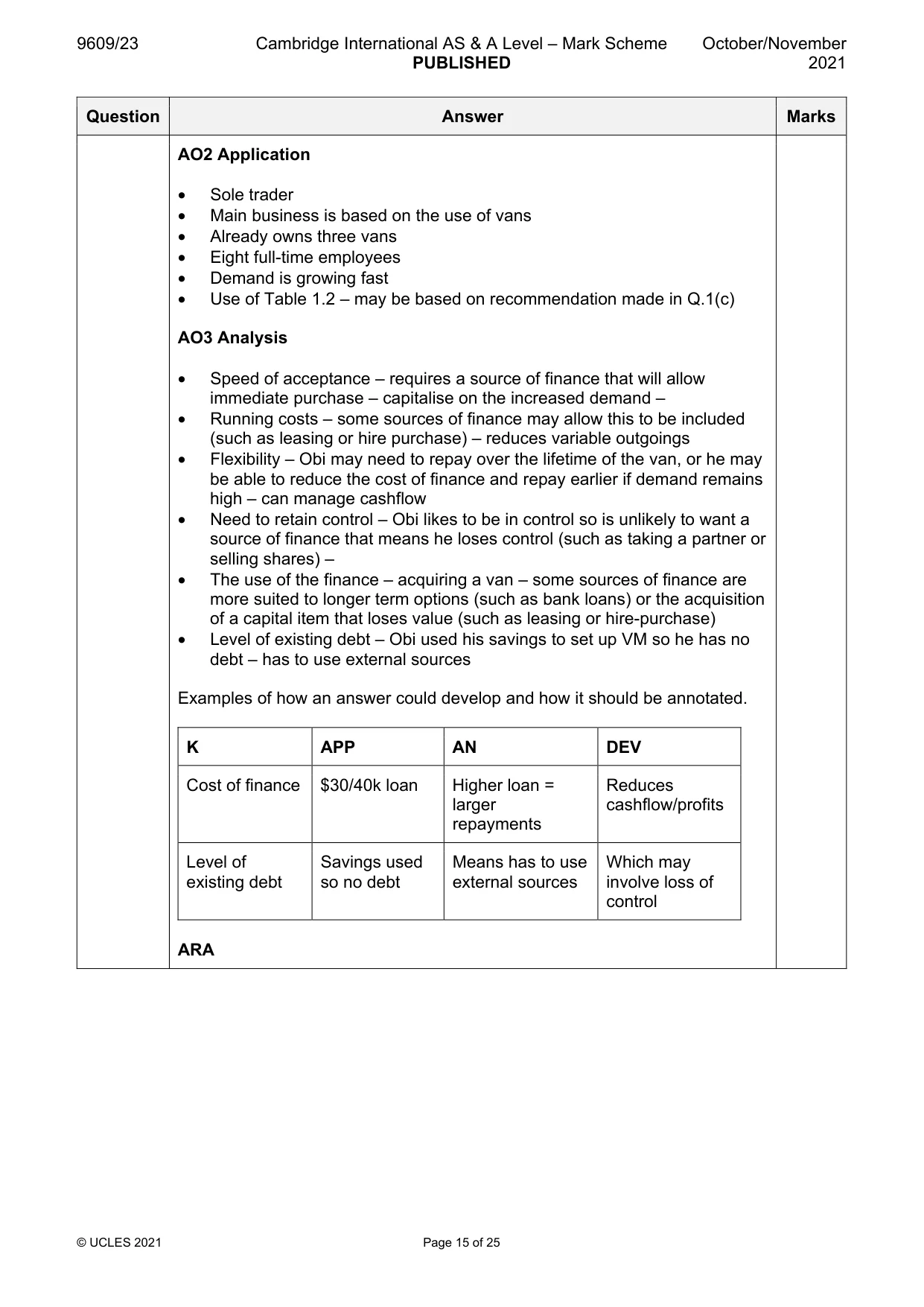
Mark scheme: Question Answer Marks 1(a)(i) Define the term ‘sole trader’ (line 1). 2 Knowledge Marks A correct definition 2 A partial, vague or unfocused definition 1 No creditable content 0 Must be distinct from other ownership types Indicative content AO1 Knowledge and understanding • A business in which one person provides the finance and in return has full control of the business and keeps all the profits. • An only trader has all the risk / unlimited liability. • An only trader pays income tax. Exemplar Marks Rationale A person who invests all the capital and 2 Correct definition has unlimited liability The only owner of the business who 2 Correct definition invests all the capital The only owner of the business/owns a 1 Partial knowledge business by themselves A person who owns the business 1 Partial definition The owner of a business 1 Implied ‘only’ An owner operator 1 Implies a single person Finance may be limited 0 Limited for all business structures ARA 1(a)(ii) Explain the difference, for a business, between price and cost. 3 Award one mark for each point of explanation: Rationale Marks Understanding of the difference between a price and a cost 1 Understanding of a cost 1 Understanding of a price 1 Indicative content AO1 Knowledge and understanding • A price is an amount paid by a customer / the amount a business sells/charges for its product/service. • A cost is an amount paid by a business / to a supplier. • A cost is the amount of money used to produce the goods/service. AO2 Application Application of the difference between a price and a cost, such as: • Businesses receive the value of a price (from the customer) but pay the value of a cost (to a supplier). • The difference between price and cost is profit. 1(a)(ii) Knowledge of a price and a cost may be assumed from application. Exemplar Mark Rationale Price is more than its cost 3 The simplest form of answer The mark-up/the profit margin/profit 3 Simplest form of answer A price is the amount paid by a 3 All three elements customer, a cost is the amount paid for clear raw materials used in the manufacture and the difference is the profit made. A cost is the amount the raw materials 3 All three elements cost, whereas the price is the amount a clear business charges its customers for the finished product. Cost is the expenses incurred in making 3 All three elements a product, whereas price includes the clear profit set by the seller. Cost is the expenses incurred in making 2 No difference shown a product. Price is the amount a business charges its customers for the finished product. ARA 1(b)(i) Calculate the profit that Obi will make from a customer who hires two 3 vans for three days. Rationale Marks Correct answer with or without correct working or $ 3 Correct calculation of TR and TC 2 Formula or correct calculation of TR or correct calculation of 1 TC No creditable content 0 Indicative content (Total) revenue – (Total) cost = profit Total revenue = ($250 + $225 + $225) × 2 = $1400 Total cost = ($170 + $170 + $170) × 2 = $1020 $1400 – $1020 = $380 Profit = $380 OFR If candidates continue to discount 10% beyond the second day, then award as a correct answer. Common incorrect answers Answer Marks Rationale $330 3 Continued use of 10% discount $190 2 Only calculated one van – incorrect final answer but correct formulae implied by use of figures $165 2 Only calculated one van – incorrect final answer but correct formulae implied by use of figures 1(b)(ii) Explain one factor which may affect the demand for Obi’s services. 3 Level Knowledge and Application Marks 2b Explanation of one factor in context 3 (APP+APP) 2a (APP) Identification of one factor in context 2 1a (K) Identification of one factor 1 0 No creditable content 0 Indicative content AO1 Knowledge and understanding Knowledge of a factor affecting demand may include: • (perceived) waiting/lead time • (perceived) price • population • income level • consumer tastes and preferences • level of competition • advertising AO2 Application • Price – Obi charges $250 – how do Obi’s prices compare with competition? • Population – direct correlation between number of people wanting to move and the population – Obi’s service is likely to be required more often if it is located in an area with a high population. • Income levels – higher income likely to move household/bulky items more often – and use a service as opposed to doing it themselves. • Consumer tastes and preferences – service based so potential customers will look for reviews – Obi might have good reviews of his service from past customers. • Level of competition in the local/national market – Obi used to be employed by a similar business – therefore some competition. • Advertising – a service sector business and likely to be competitive – customers need to know about the service to book it. 1(b)(ii) Application (APP) is likely to come from the context, with developed application (APP+APP) from further use of that context. Example of how responses should be marked. Identification of a Application Developed application way (APP – 2 marks) (APP + APP – 3 marks) (K – 1 mark) Competition from the other who may reduce prices to business he was attract Obi’s customers employed by Income level is $250 per day too expensive ARA 1(c) Recommend whether Obi should purchase Van A or Van B. Justify your 11 recommendation. Knowledge and Marks Analysis and Evaluation Marks Application (4 marks) (7 marks) Justified recommendation 7 based on argument(s) in context Developed recommendation 6 based on argument(s) in context An evaluative 5 statement/recommendation based on argument(s) in context Shows understanding 4 Argument based on Van A 4 of factor(s) affecting AND Van B in context Van A AND Van B in context Shows understanding 3 Argument based on Van A 3 of factor(s) affecting AND Van B in context Van A OR Van B in context Shows knowledge of 2 Limited analysis of Van A 2 two or more factors AND Van B affecting decision making Shows knowledge of 1 Limited analysis of Van A OR 1 one factor affecting Van B decision making No creditable content Arguments for Van A on one side and Van B on the other to show arguments for each Indicative content AO1 Knowledge and understanding Knowledge of factors affecting decision making, including: • cost(s) • timescale • revenue • utility 1(c) AO2 Application 11 Application may include: • sole trader • main business is based on the use of vans • already owns three vans • eight full-time employees • demand is growing fast • use of Table 1.2 AO3 Analysis Analysis of Van A may include: • lower purchase cost • higher maintenance costs • shorter lifespan • lower (slightly) insurance costs • high level of reliability • are other qualitative elements relevant? Analysis of Van B may include: • higher purchase cost • lower maintenance costs • longer lifespan • higher (slightly) insurance costs • possibly less reliable based on customer review • use of colours may provide an advertising benefit • speed of manufacturer response to break down is good • faster – may allow a speedier service (but could also have legal issues) • are other qualitative factors relevant? AO4 Evaluation • A recommendation about whether Ralph should choose Van A or Van B. • A judgement over the relative suitability of the vans. • Elements that the recommendation/judgement could depend upon, including availability of finance/amount of finance, how long Obi keeps his vans for on average, length of warranty, past reviews, whether he trusts his employees not to speed, fuel economy as a factor. • Weighing up of the relative impacts on Obi of the vans. 1(c) Examples of how an answer could develop and how it should be annotated. K APP AN DEV EVAL Cost VAN A – Reduces Increases Should buy boring but direct costs profit margins Van A fuel efficient of petrol Because Lifespan1 VAN B – Capital cost Helps long- lower direct lasts 9 years spread over term costs more a longer time budgeting important than long- term budgeting Even though the image may be impacted ARA 1(d) Analyse two factors which may influence the source of finance that Obi 8 chooses for the new van. Level Knowledge and Marks Analysis (4 marks) Marks Application (4 marks) 2b Shows understanding 4 Good analysis of two 4 of two factors which factors which may may influence the influence the source of source of finance in finance in context context 2a Shows understanding 3 Good analysis of one 3 of one factor which factor which may may influence the influence the source of source of finance in finance in context context 1b Shows knowledge of 2 Limited analysis of two 2 two factors which may factors which may influence the source of influence the source of finance finance 1a Shows knowledge of 1 Limited analysis of one 1 one factor which may factor which may influence the source of influence the source of finance finance 0 No creditable content Indicative content AO1 Knowledge and understanding Knowledge factors affecting sources of finance, including: • size/structure of business • cost of finance • costs of the business • flexibility • need to retain control • use of the finance • level of existing debt AO2 Application • Sole trader • Main business is based on the use of vans • Already owns three vans • Eight full-time employees • Demand is growing fast • Use of Table 1.2 – may be based on recommendation made in Q.1(c) AO3 Analysis • Speed of acceptance – requires a source of finance that will allow immediate purchase – capitalise on the increased demand – • Running costs – some sources of finance may allow this to be included (such as leasing or hire purchase) – reduces variable outgoings • Flexibility – Obi may need to repay over the lifetime of the van, or he may be able to reduce the cost of finance and repay earlier if demand remains high – can manage cashflow • Need to retain control – Obi likes to be in control so is unlikely to want a source of finance that means he loses control (such as taking a partner or selling shares) – • The use of the finance – acquiring a van – some sources of finance are more suited to longer term options (such as bank loans) or the acquisition of a capital item that loses value (such as leasing or hire-purchase) • Level of existing debt – Obi used his savings to set up VM so he has no debt – has to use external sources Examples of how an answer could develop and how it should be annotated. K APP AN DEV Cost of finance $30/40k loan Higher loan = Reduces larger cashflow/profits repayments Level of Savings used Means has to use Which may existing debt so no debt external sources involve loss of control ARA
Q2 · Super Candy (SC) SC is a large public limited company that sells low-sugar candy (sweets)…
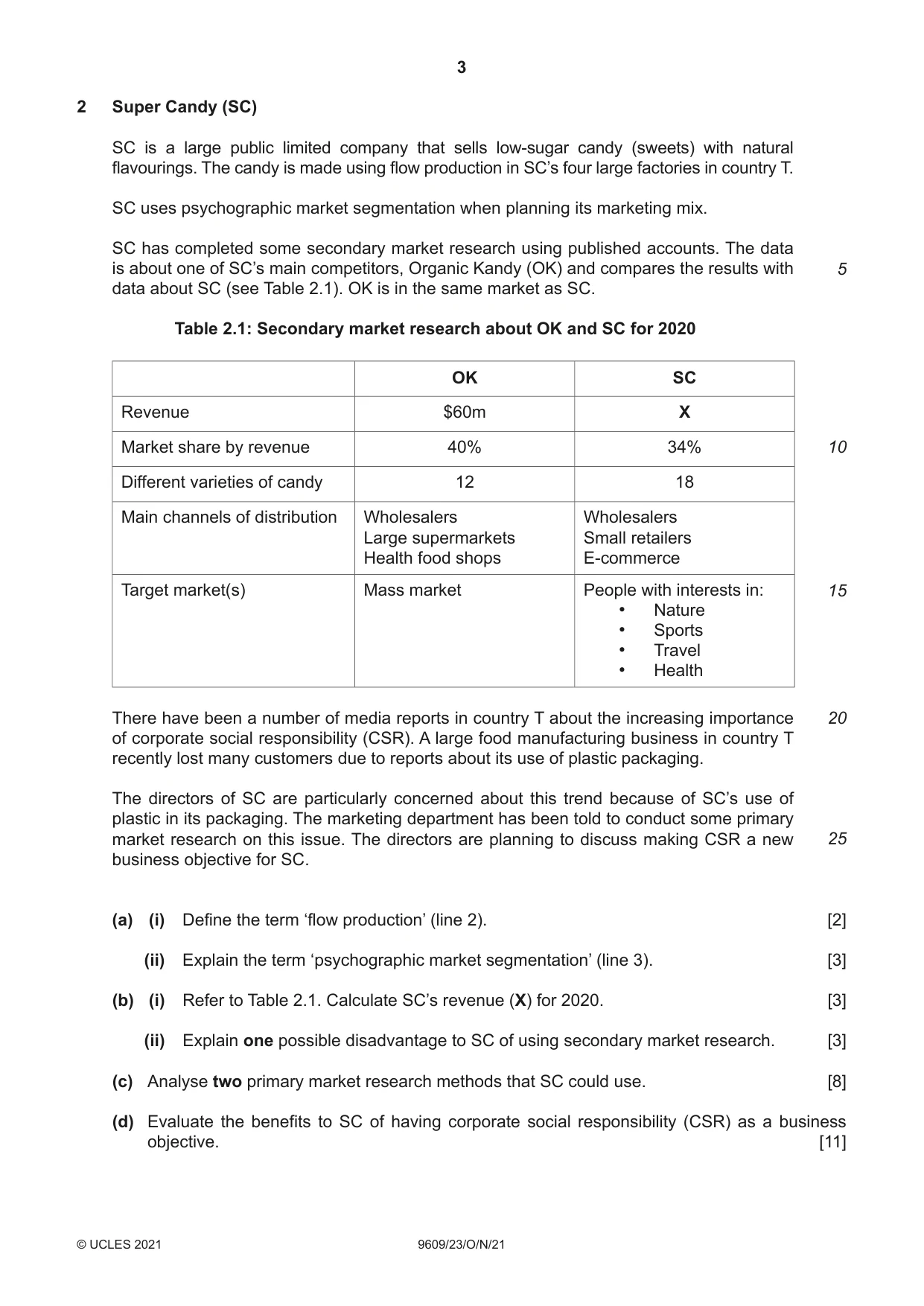
2 Super Candy (SC) SC is a large public limited company that sells low-sugar candy (sweets) with natural flavourings. The candy is made using flow production in SC’s four large factories in country T. SC uses psychographic market segmentation when planning its marketing mix. SC has completed some secondary market research using published accounts. The data is about one of SC’s main competitors, Organic Kandy (OK) and compares the results with 5 data about SC (see Table 2.1). OK is in the same market as SC. Table 2.1: Secondary market research about OK and SC for 2020 OK SC Revenue $60m X Market share by revenue 40% 34% 10 Different varieties of candy 12 18 Main channels of distribution Wholesalers Wholesalers Large supermarkets Small retailers Health food shops E-commerce Target market(s) Mass market People with interests in: 15 • Nature • Sports • Travel • Health There have been a number of media reports in country T about the increasing importance 20 of corporate social responsibility (CSR). A large food manufacturing business in country T recently lost many customers due to reports about its use of plastic packaging. The directors of SC are particularly concerned about this trend because of SC’s use of plastic in its packaging. The marketing department has been told to conduct some primary market research on this issue. The directors are planning to discuss making CSR a new 25 business objective for SC. (a) (i) Define the term ‘flow production’ (line 2). [2] (ii) Explain the term ‘psychographic market segmentation’ (line 3). [3] (b) (i) Refer to Table 2.1. Calculate SC’s revenue (X) for 2020. [3] (ii) Explain one possible disadvantage to SC of using secondary market research. [3] (c) Analyse two primary market research methods that SC could use. [8] (d) Evaluate the benefits to SC of having corporate social responsibility (CSR) as a business objective. [11]
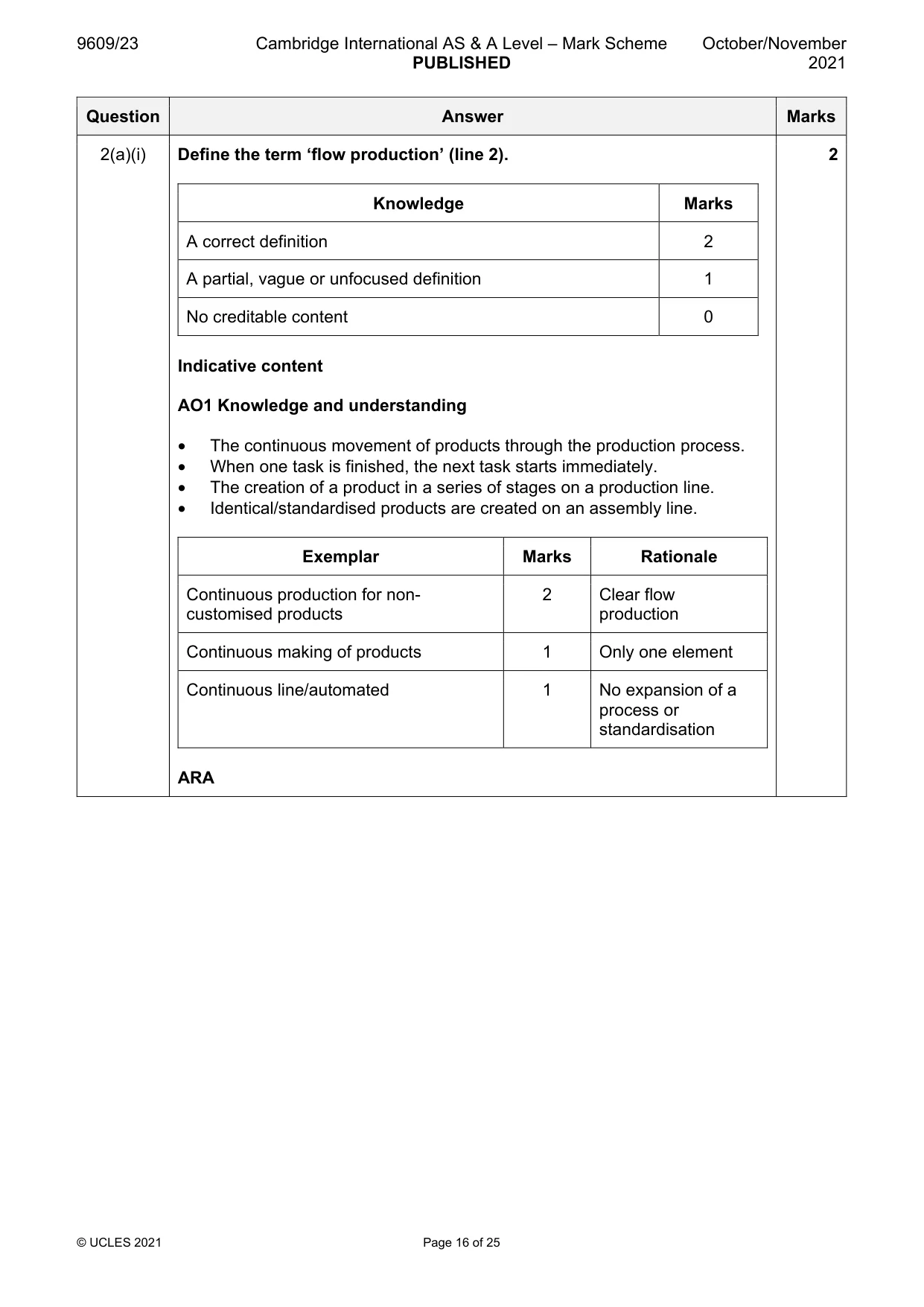
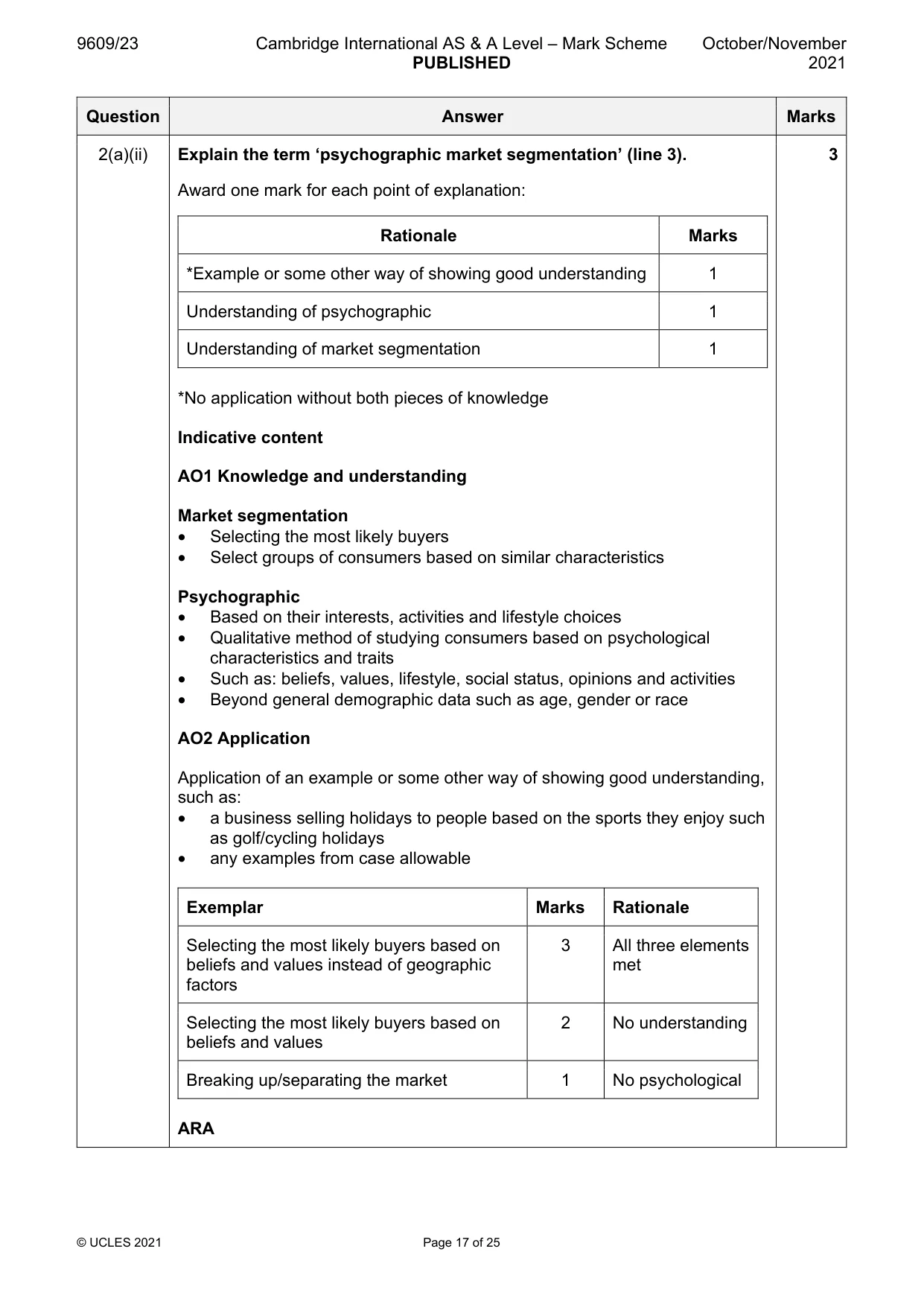
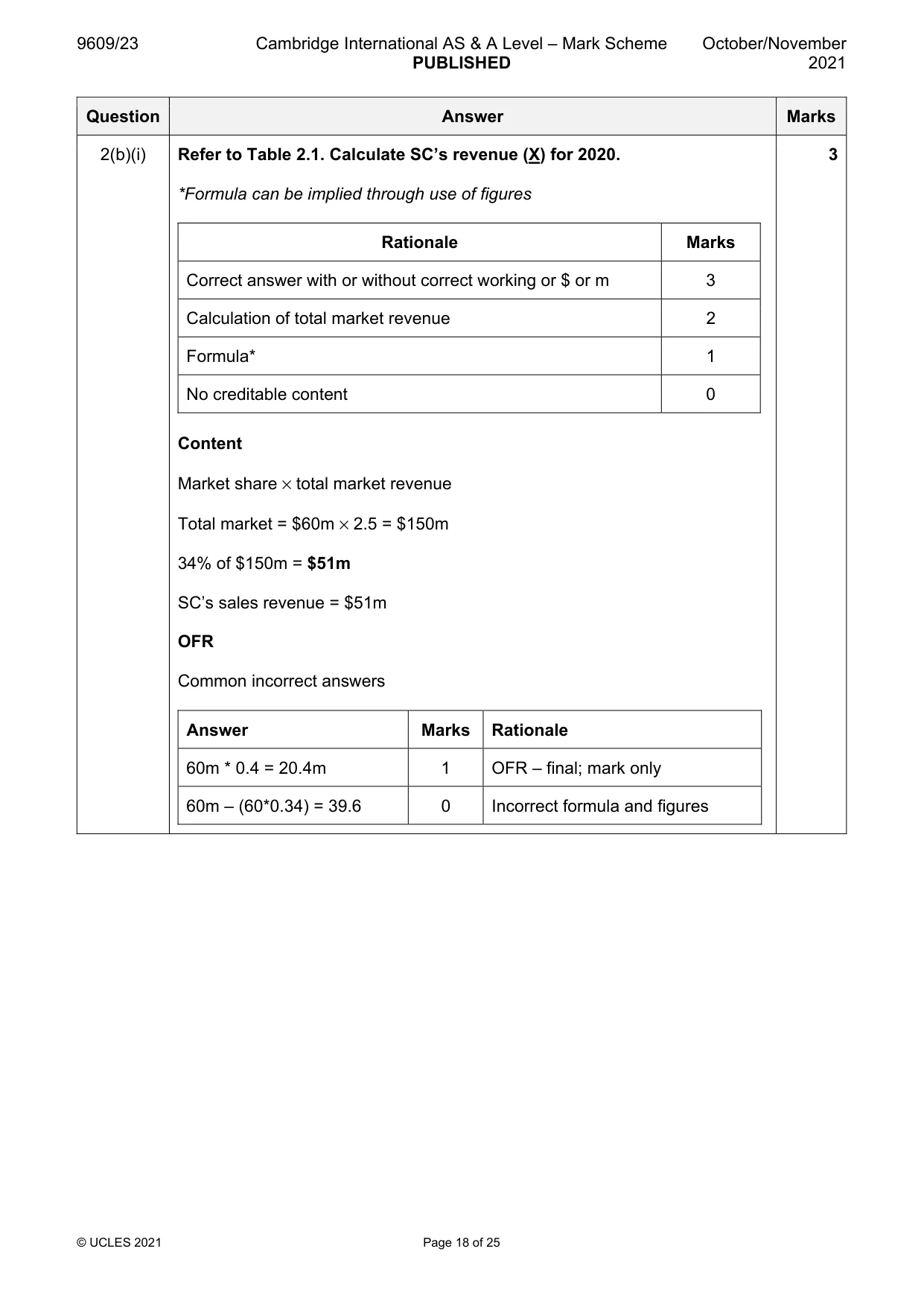
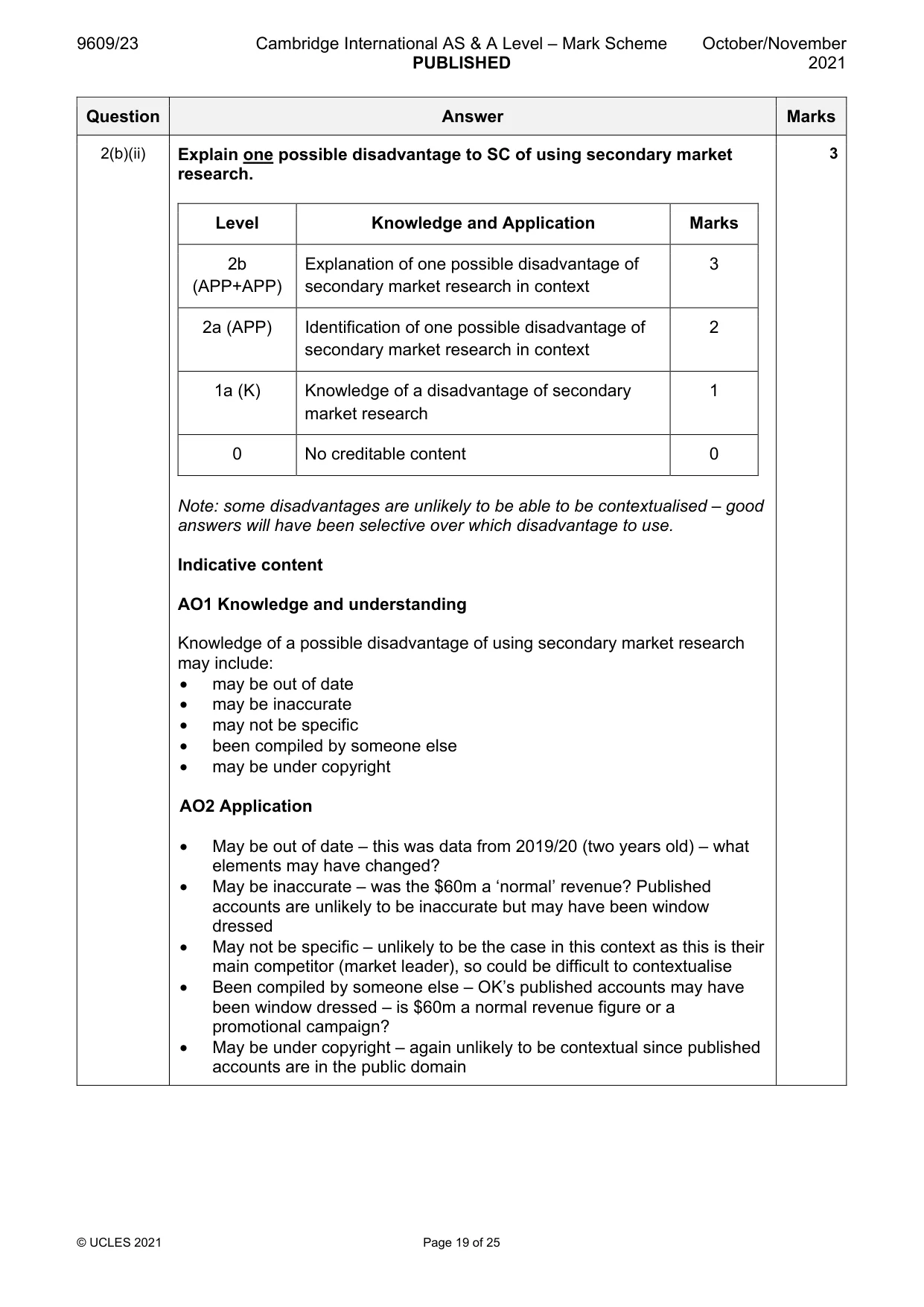
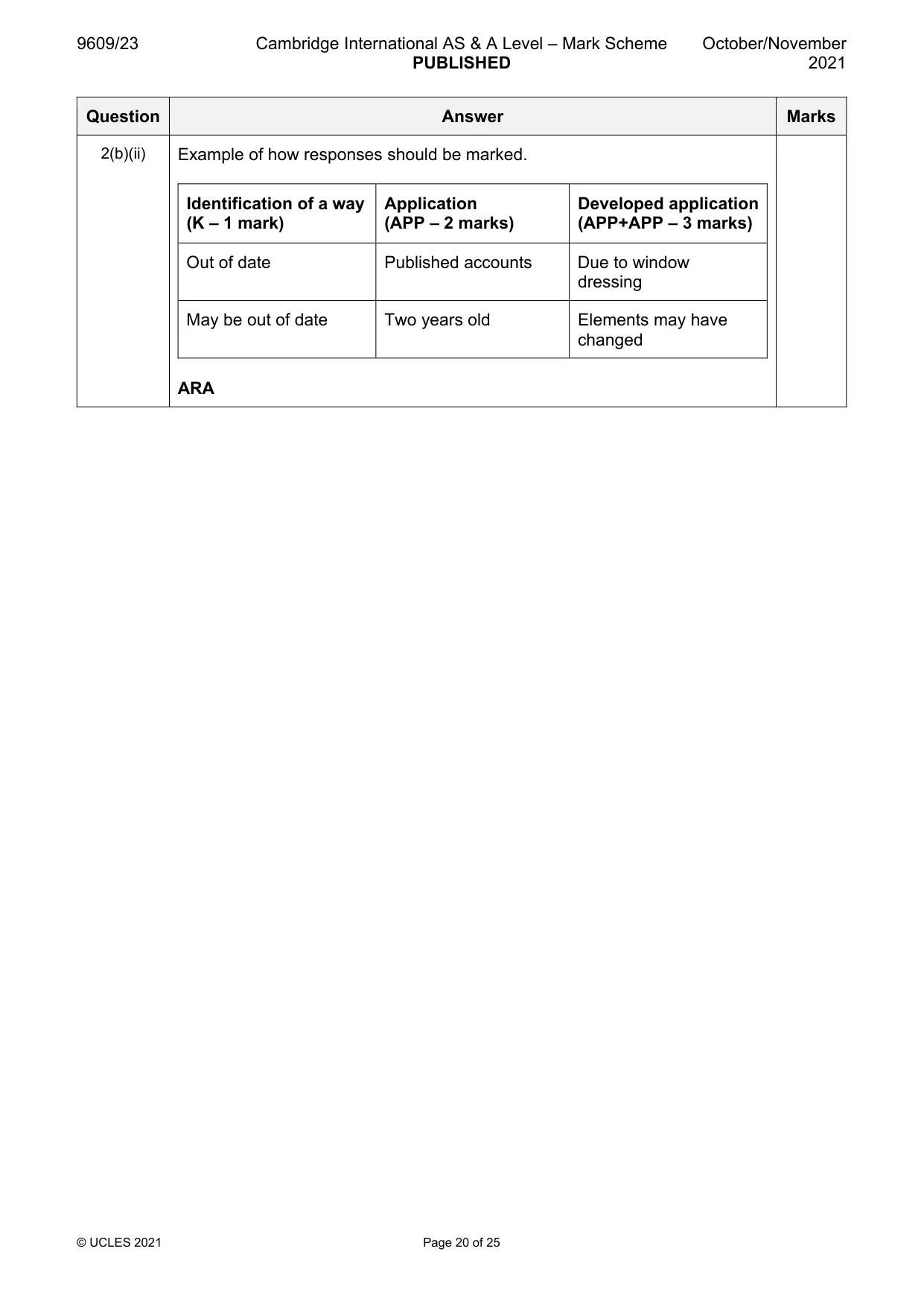
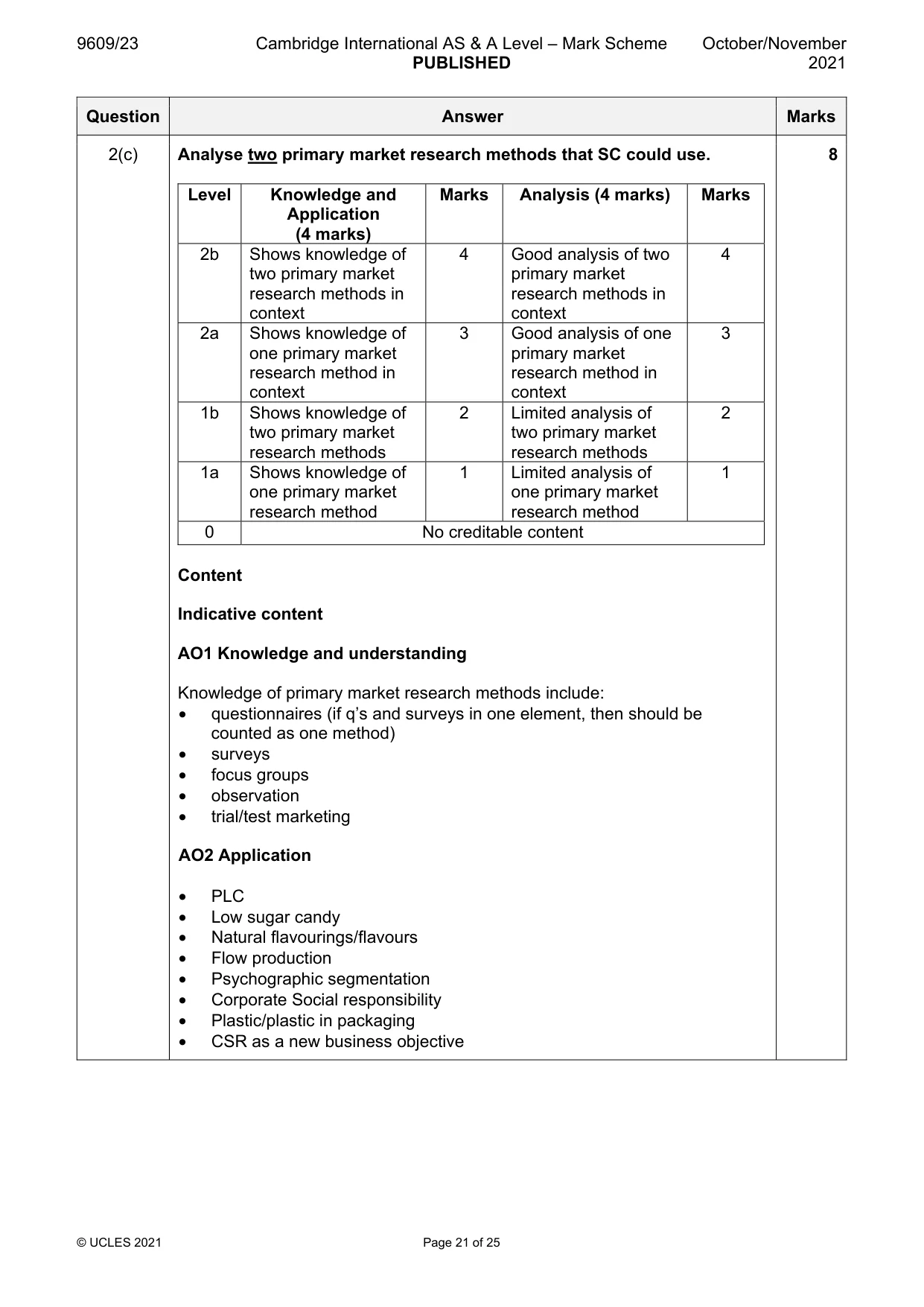
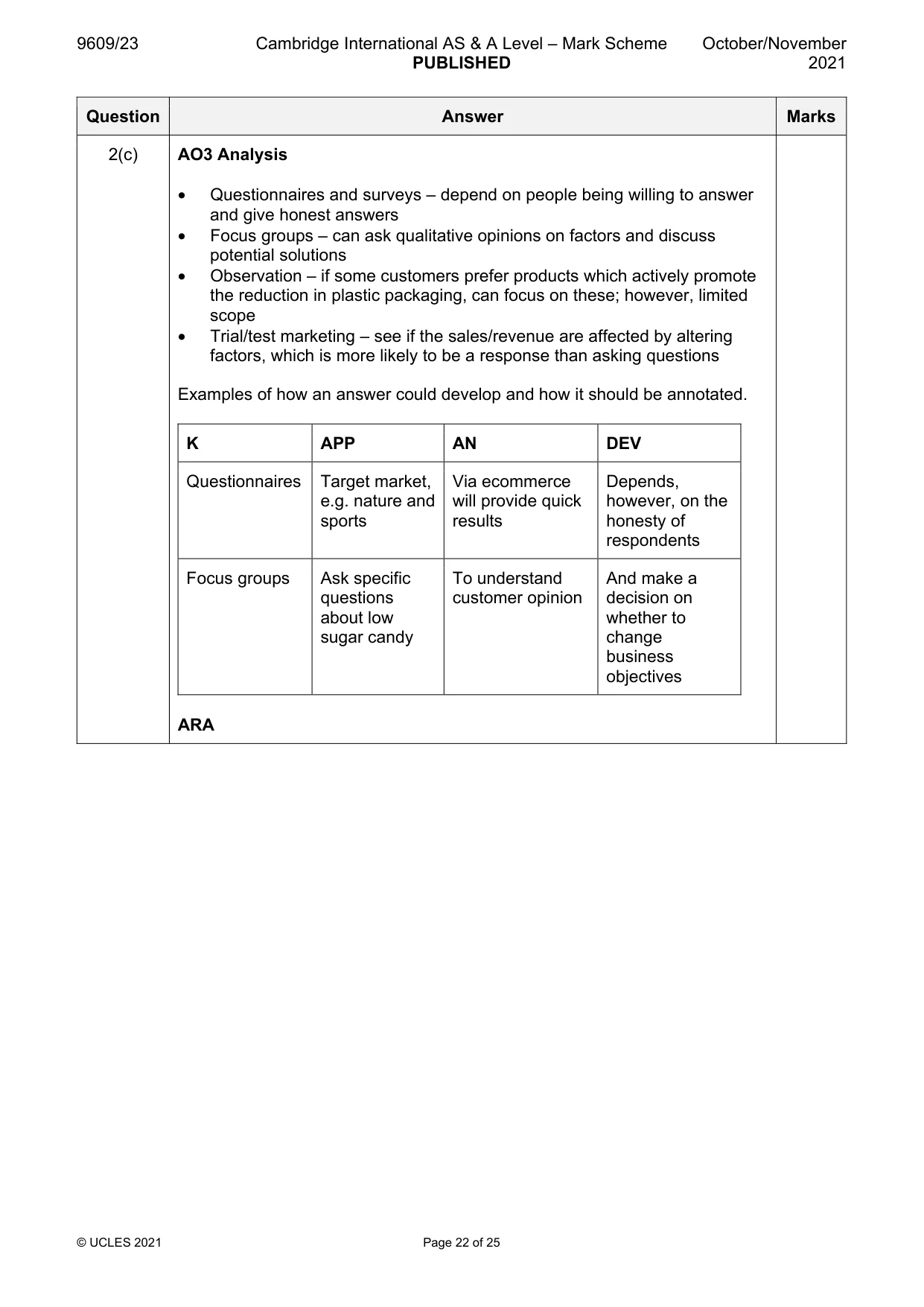
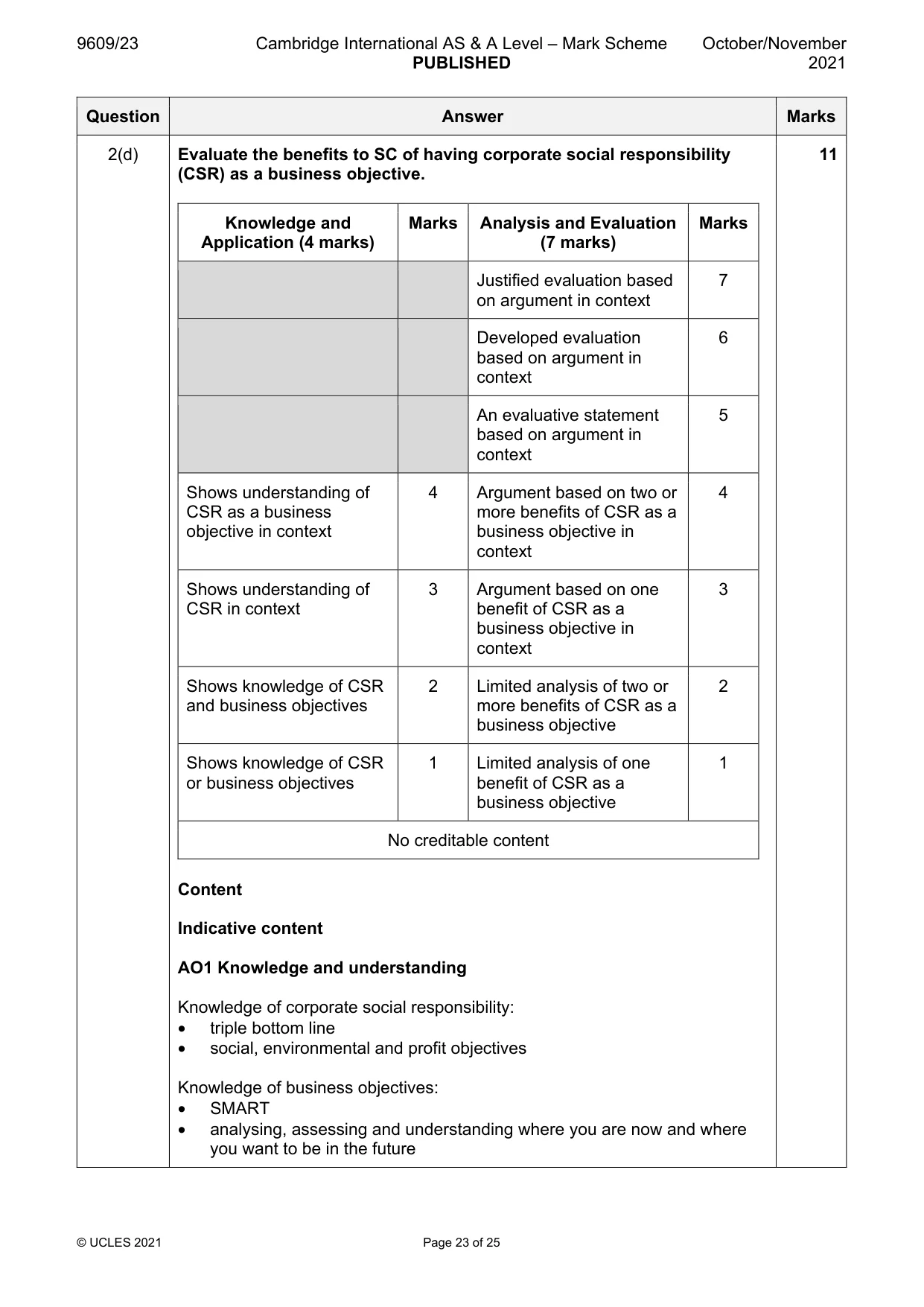
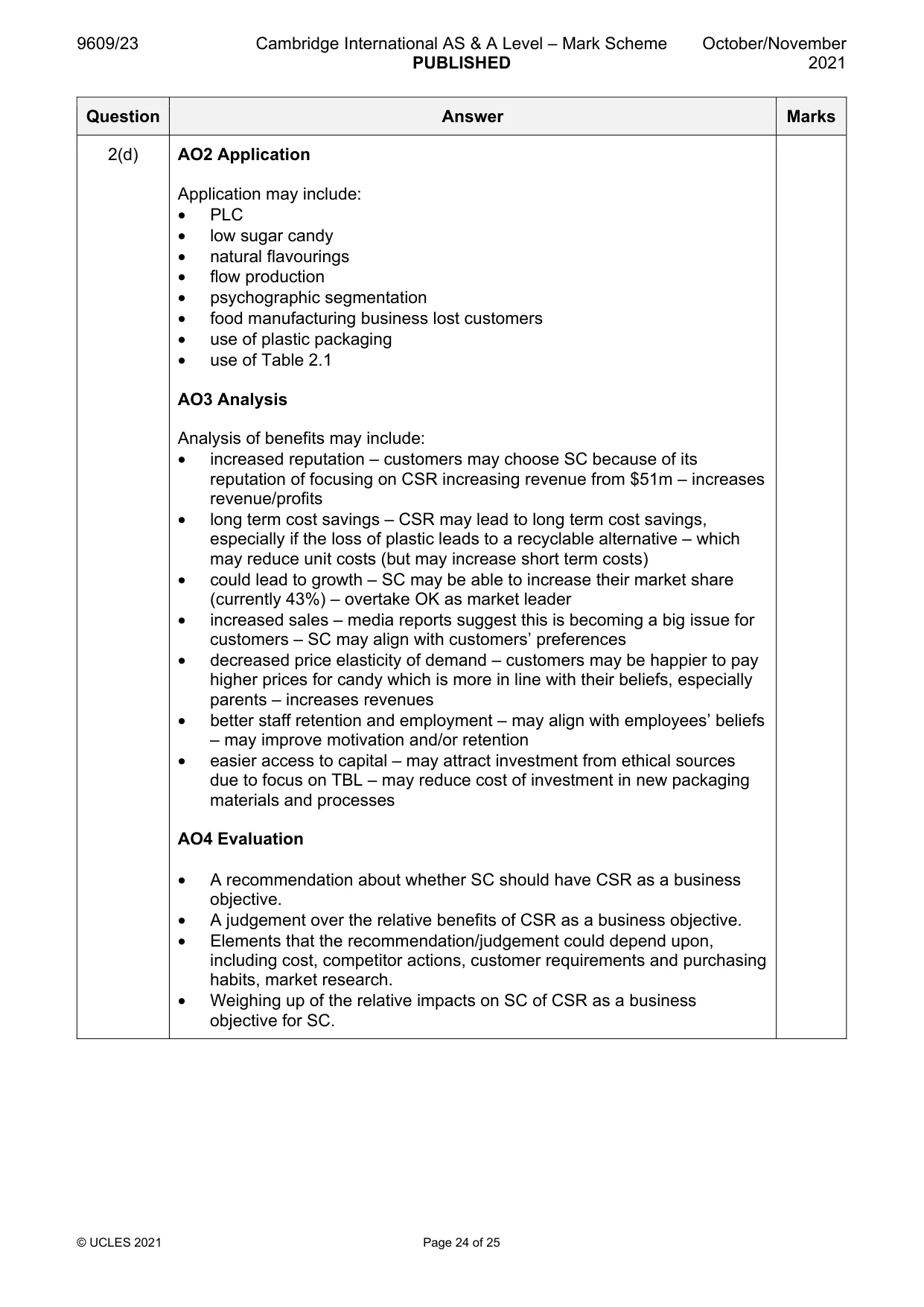
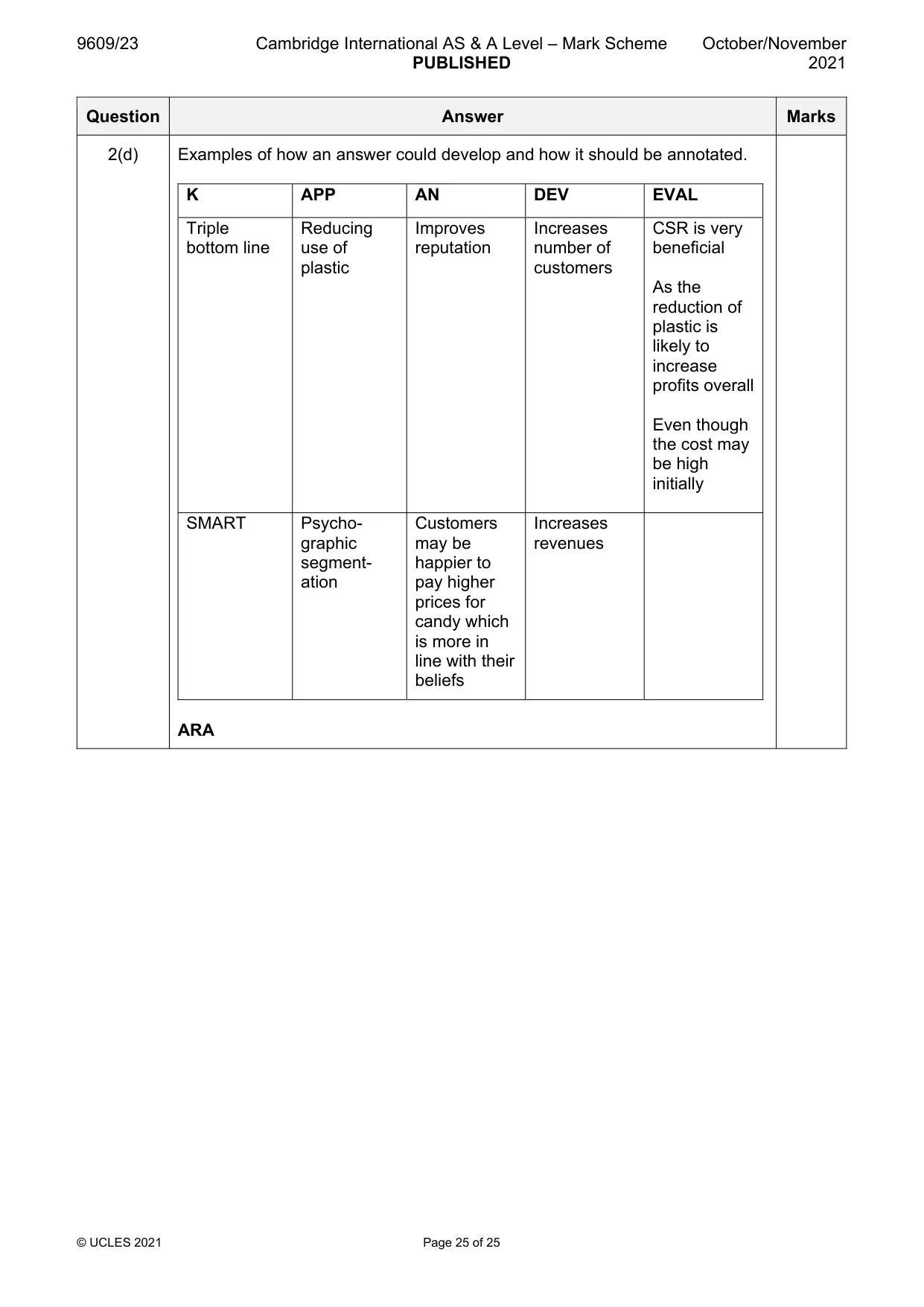
Mark scheme: 2(a)(i) Define the term ‘flow production’ (line 2). 2 Knowledge Marks A correct definition 2 A partial, vague or unfocused definition 1 No creditable content 0 Indicative content AO1 Knowledge and understanding • The continuous movement of products through the production process. • When one task is finished, the next task starts immediately. • The creation of a product in a series of stages on a production line. • Identical/standardised products are created on an assembly line. Exemplar Marks Rationale Continuous production for non- 2 Clear flow customised products production Continuous making of products 1 Only one element Continuous line/automated 1 No expansion of a process or standardisation ARA 2(a)(ii) Explain the term ‘psychographic market segmentation’ (line 3). 3 Award one mark for each point of explanation: Rationale Marks *Example or some other way of showing good understanding 1 Understanding of psychographic 1 Understanding of market segmentation 1 *No application without both pieces of knowledge Indicative content AO1 Knowledge and understanding Market segmentation • Selecting the most likely buyers • Select groups of consumers based on similar characteristics Psychographic • Based on their interests, activities and lifestyle choices • Qualitative method of studying consumers based on psychological characteristics and traits • Such as: beliefs, values, lifestyle, social status, opinions and activities • Beyond general demographic data such as age, gender or race AO2 Application Application of an example or some other way of showing good understanding, such as: • a business selling holidays to people based on the sports they enjoy such as golf/cycling holidays • any examples from case allowable Exemplar Marks Rationale Selecting the most likely buyers based on 3 All three elements beliefs and values instead of geographic met factors Selecting the most likely buyers based on 2 No understanding beliefs and values Breaking up/separating the market 1 No psychological ARA 2(b)(i) Refer to Table 2.1. Calculate SC’s revenue (X) for 2020. 3 *Formula can be implied through use of figures Rationale Marks Correct answer with or without correct working or $ or m 3 Calculation of total market revenue 2 Formula* 1 No creditable content 0 Content Market share × total market revenue Total market = $60m × 2.5 = $150m 34% of $150m = $51m SC’s sales revenue = $51m OFR Common incorrect answers Answer Marks Rationale 60m * 0.4 = 20.4m 1 OFR – final; mark only 60m – (60*0.34) = 39.6 0 Incorrect formula and figures 2(b)(ii) Explain one possible disadvantage to SC of using secondary market 3 research. Level Knowledge and Application Marks 2b Explanation of one possible disadvantage of 3 (APP+APP) secondary market research in context 2a (APP) Identification of one possible disadvantage of 2 secondary market research in context 1a (K) Knowledge of a disadvantage of secondary 1 market research 0 No creditable content 0 Note: some disadvantages are unlikely to be able to be contextualised – good answers will have been selective over which disadvantage to use. Indicative content AO1 Knowledge and understanding Knowledge of a possible disadvantage of using secondary market research may include: • may be out of date • may be inaccurate • may not be specific • been compiled by someone else • may be under copyright AO2 Application • May be out of date – this was data from 2019/20 (two years old) – what elements may have changed? • May be inaccurate – was the $60m a ‘normal’ revenue? Published accounts are unlikely to be inaccurate but may have been window dressed • May not be specific – unlikely to be the case in this context as this is their main competitor (market leader), so could be difficult to contextualise • Been compiled by someone else – OK’s published accounts may have been window dressed – is $60m a normal revenue figure or a promotional campaign? • May be under copyright – again unlikely to be contextual since published accounts are in the public domain 2(b)(ii) Example of how responses should be marked. Identification of a way Application Developed application (K – 1 mark) (APP – 2 marks) (APP+APP – 3 marks) Out of date Published accounts Due to window dressing May be out of date Two years old Elements may have changed ARA 2(c) Analyse two primary market research methods that SC could use. 8 Level Knowledge and Marks Analysis (4 marks) Marks Application (4 marks) 2b Shows knowledge of 4 Good analysis of two 4 two primary market primary market research methods in research methods in context context 2a Shows knowledge of 3 Good analysis of one 3 one primary market primary market research method in research method in context context 1b Shows knowledge of 2 Limited analysis of 2 two primary market two primary market research methods research methods 1a Shows knowledge of 1 Limited analysis of 1 one primary market one primary market research method research method 0 No creditable content Content Indicative content AO1 Knowledge and understanding Knowledge of primary market research methods include: • questionnaires (if q’s and surveys in one element, then should be counted as one method) • surveys • focus groups • observation • trial/test marketing AO2 Application • PLC • Low sugar candy • Natural flavourings/flavours • Flow production • Psychographic segmentation • Corporate Social responsibility • Plastic/plastic in packaging • CSR as a new business objective 2(c) AO3 Analysis • Questionnaires and surveys – depend on people being willing to answer and give honest answers • Focus groups – can ask qualitative opinions on factors and discuss potential solutions • Observation – if some customers prefer products which actively promote the reduction in plastic packaging, can focus on these; however, limited scope • Trial/test marketing – see if the sales/revenue are affected by altering factors, which is more likely to be a response than asking questions Examples of how an answer could develop and how it should be annotated. K APP AN DEV Questionnaires Target market, Via ecommerce Depends, e.g. nature and will provide quick however, on the sports results honesty of respondents Focus groups Ask specific To understand And make a questions customer opinion decision on about low whether to sugar candy change business objectives ARA 2(d) Evaluate the benefits to SC of having corporate social responsibility 11 (CSR) as a business objective. Knowledge and Marks Analysis and Evaluation Marks Application (4 marks) (7 marks) Justified evaluation based 7 on argument in context Developed evaluation 6 based on argument in context An evaluative statement 5 based on argument in context Shows understanding of 4 Argument based on two or 4 CSR as a business more benefits of CSR as a objective in context business objective in context Shows understanding of 3 Argument based on one 3 CSR in context benefit of CSR as a business objective in context Shows knowledge of CSR 2 Limited analysis of two or 2 and business objectives more benefits of CSR as a business objective Shows knowledge of CSR 1 Limited analysis of one 1 or business objectives benefit of CSR as a business objective No creditable content Content Indicative content AO1 Knowledge and understanding Knowledge of corporate social responsibility: • triple bottom line • social, environmental and profit objectives Knowledge of business objectives: • SMART • analysing, assessing and understanding where you are now and where you want to be in the future 2(d) AO2 Application Application may include: • PLC • low sugar candy • natural flavourings • flow production • psychographic segmentation • food manufacturing business lost customers • use of plastic packaging • use of Table 2.1 AO3 Analysis Analysis of benefits may include: • increased reputation – customers may choose SC because of its reputation of focusing on CSR increasing revenue from $51m – increases revenue/profits • long term cost savings – CSR may lead to long term cost savings, especially if the loss of plastic leads to a recyclable alternative – which may reduce unit costs (but may increase short term costs) • could lead to growth – SC may be able to increase their market share (currently 43%) – overtake OK as market leader • increased sales – media reports suggest this is becoming a big issue for customers – SC may align with customers’ preferences • decreased price elasticity of demand – customers may be happier to pay higher prices for candy which is more in line with their beliefs, especially parents – increases revenues • better staff retention and employment – may align with employees’ beliefs – may improve motivation and/or retention • easier access to capital – may attract investment from ethical sources due to focus on TBL – may reduce cost of investment in new packaging materials and processes AO4 Evaluation • A recommendation about whether SC should have CSR as a business objective. • A judgement over the relative benefits of CSR as a business objective. • Elements that the recommendation/judgement could depend upon, including cost, competitor actions, customer requirements and purchasing habits, market research. • Weighing up of the relative impacts on SC of CSR as a business objective for SC. 2(d) Examples of how an answer could develop and how it should be annotated. K APP AN DEV EVAL Triple Reducing Improves Increases CSR is very bottom line use of reputation number of beneficial plastic customers As the reduction of plastic is likely to increase profits overall Even though the cost may be high initially SMART Psycho- Customers Increases graphic may be revenues segment- happier to ation pay higher prices for candy which is more in line with their beliefs ARA
What was in this paper
The subtopics covered by these 2 questions, and how many questions each got. Open one in a new tab to see every Cambridge question on it.
What you needed in this session
Cambridge’s own grade thresholds for 2021 Oct/Nov, Paper 2 · Variant 3. A higher threshold means an easier paper — the bar moves with how the cohort did.