Cambridge A Level Business (for first examination in 2016) 9609 — 2021 May/June Paper 2 · Variant 2
9609/22/M/J/21 · 2 questions · 60 marks · ≈68 min
The question paper and its mark scheme, free to read here and free to download. This is Cambridge’s own paper, exactly as it was sat.
Question paper4 pages
Mark scheme22 pages
Answers below. Sit the paper first if you are practising.
Questions as text
Q1 · Hot Bubblez (HB) Karen is a sole trader who operates a service business called Hot…
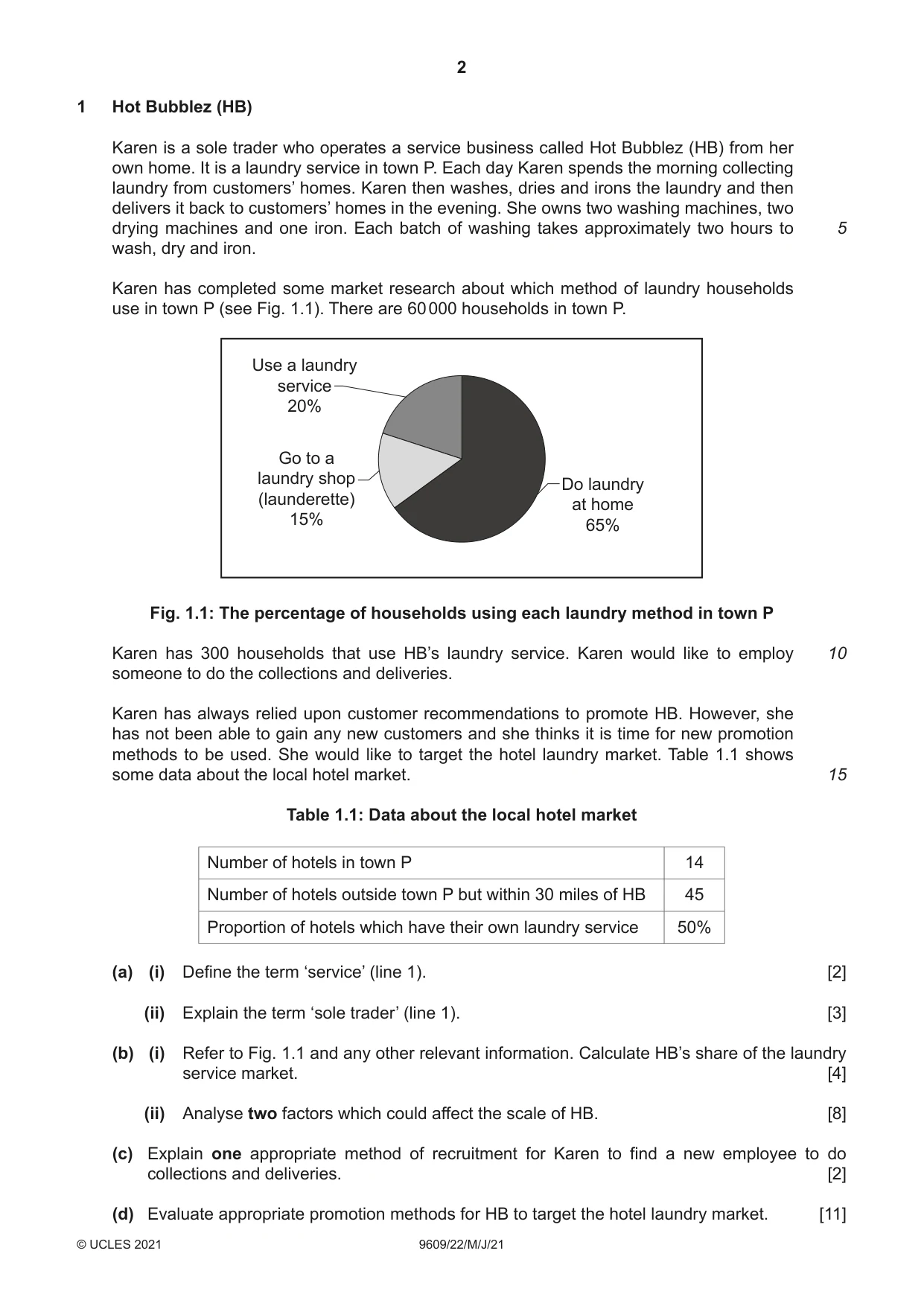
1 Hot Bubblez (HB) Karen is a sole trader who operates a service business called Hot Bubblez (HB) from her own home. It is a laundry service in town P. Each day Karen spends the morning collecting laundry from customers’ homes. Karen then washes, dries and irons the laundry and then delivers it back to customers’ homes in the evening. She owns two washing machines, two drying machines and one iron. Each batch of washing takes approximately two hours to 5 wash, dry and iron. Karen has completed some market research about which method of laundry households use in town P (see Fig. 1.1). There are 60 000 households in town P. Use a laundry service 20% Go to a laundry shop Do laundry (launderette) at home 15% 65% Fig. 1.1: The percentage of households using each laundry method in town P Karen has 300 households that use HB’s laundry service. Karen would like to employ 10 someone to do the collections and deliveries. Karen has always relied upon customer recommendations to promote HB. However, she has not been able to gain any new customers and she thinks it is time for new promotion methods to be used. She would like to target the hotel laundry market. Table 1.1 shows some data about the local hotel market. 15 Table 1.1: Data about the local hotel market Number of hotels in town P 14 Number of hotels outside town P but within 30 miles of HB 45 Proportion of hotels which have their own laundry service 50% (a) (i) Define the term ‘service’ (line 1). [2] (ii) Explain the term ‘sole trader’ (line 1). [3] (b) (i) Refer to Fig. 1.1 and any other relevant information. Calculate HB’s share of the laundry service market. [4] (ii) Analyse two factors which could affect the scale of HB. [8] (c) Explain one appropriate method of recruitment for Karen to find a new employee to do collections and deliveries. [2] (d) Evaluate appropriate promotion methods for HB to target the hotel laundry market. [11]
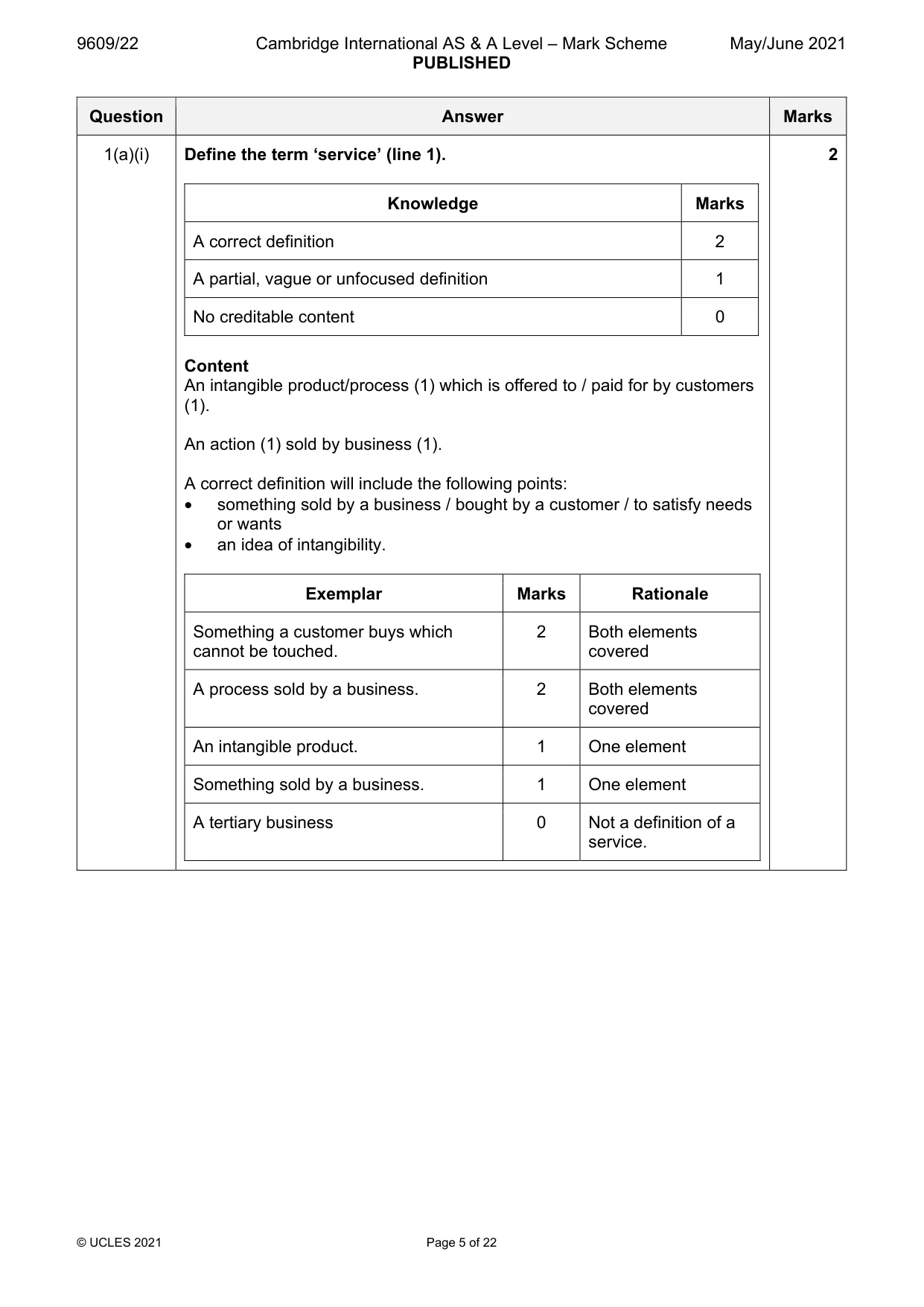
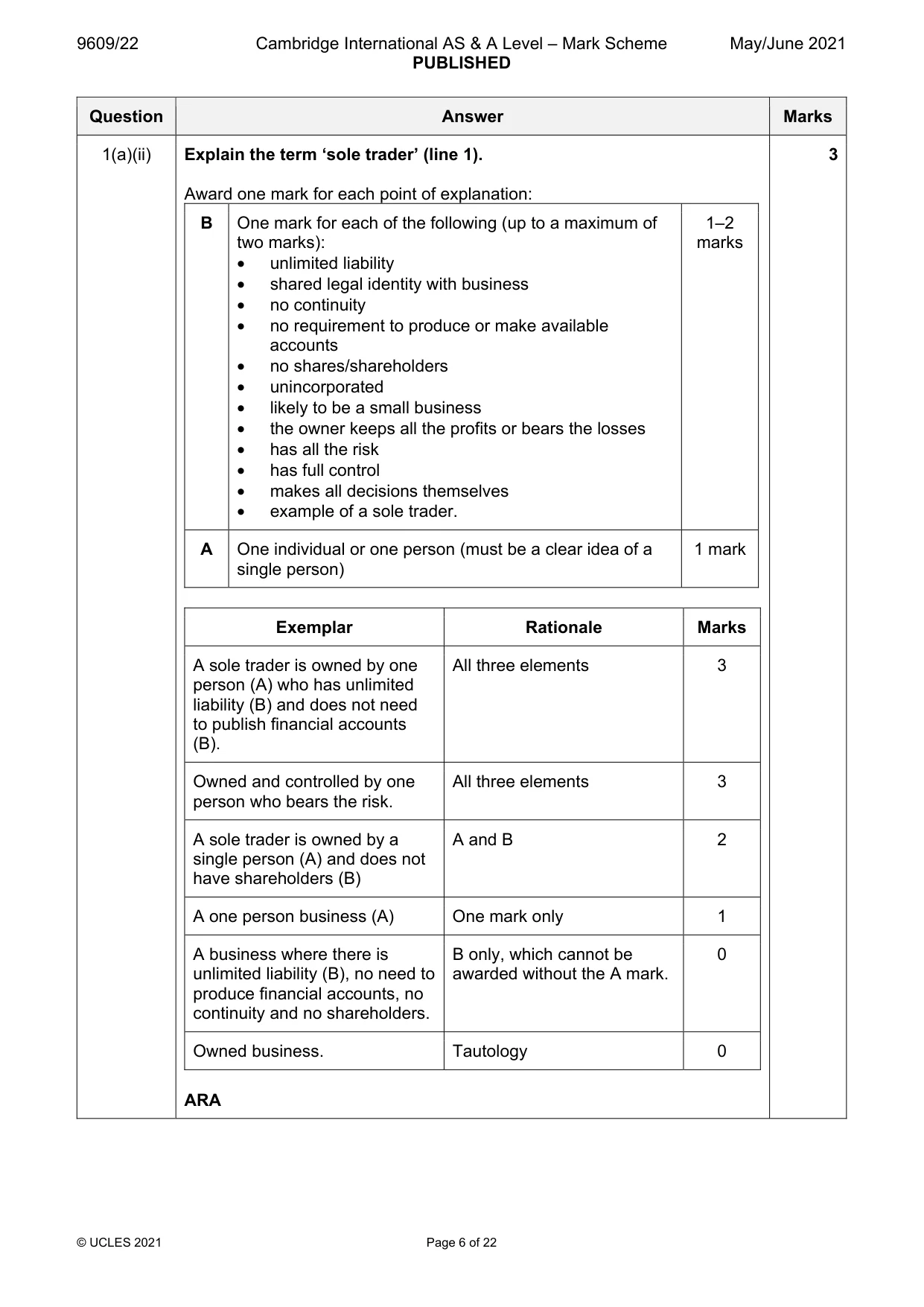
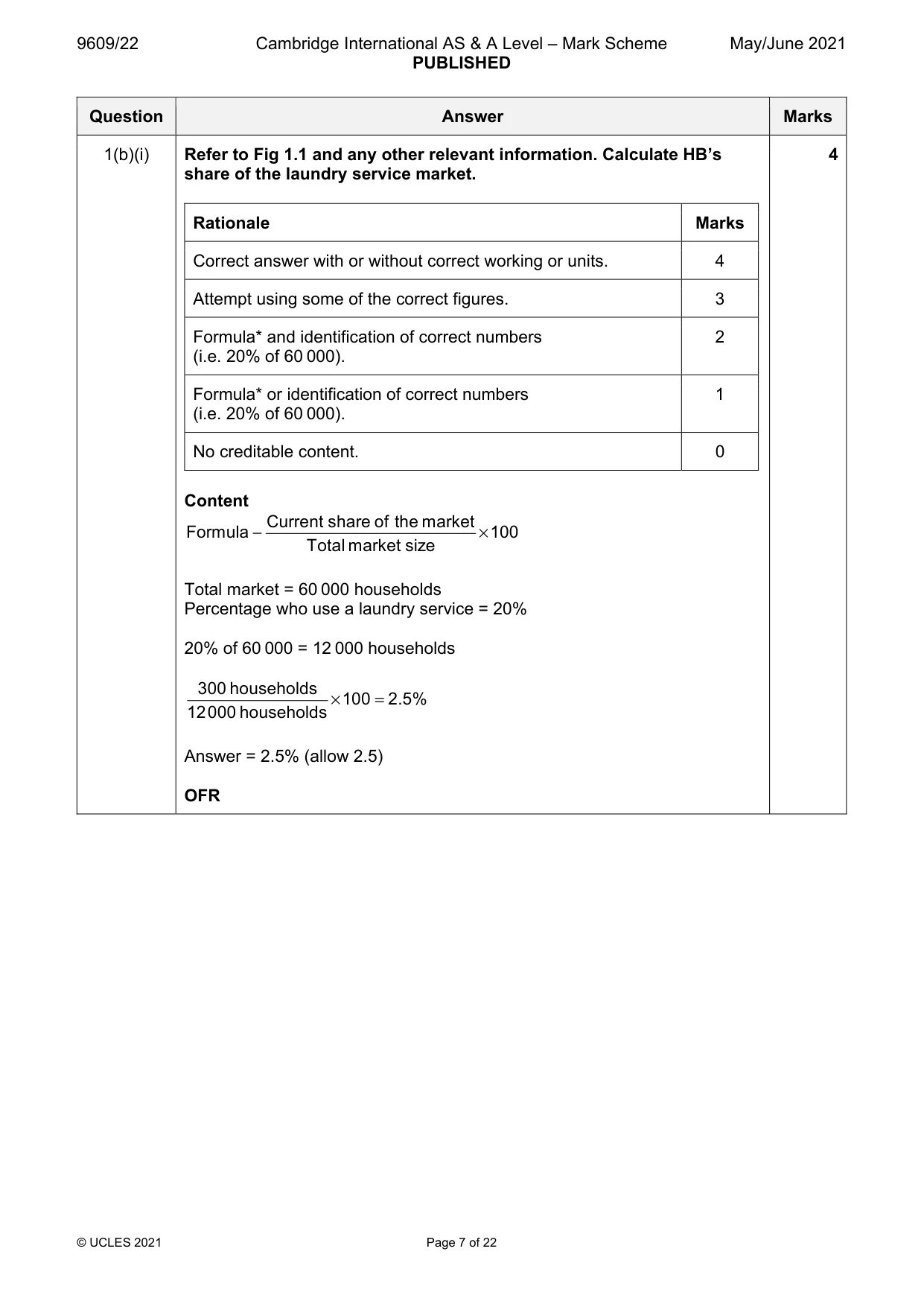
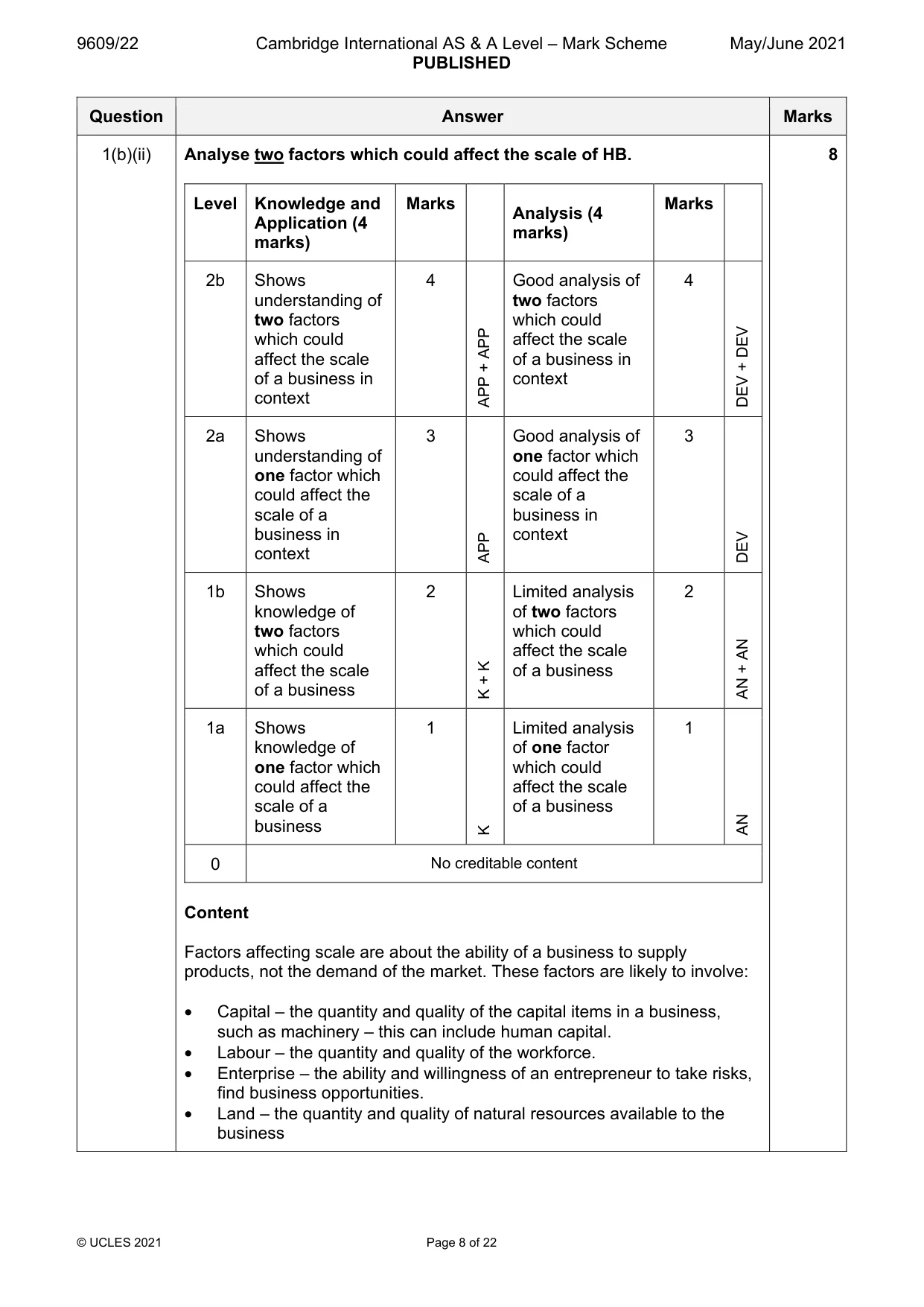
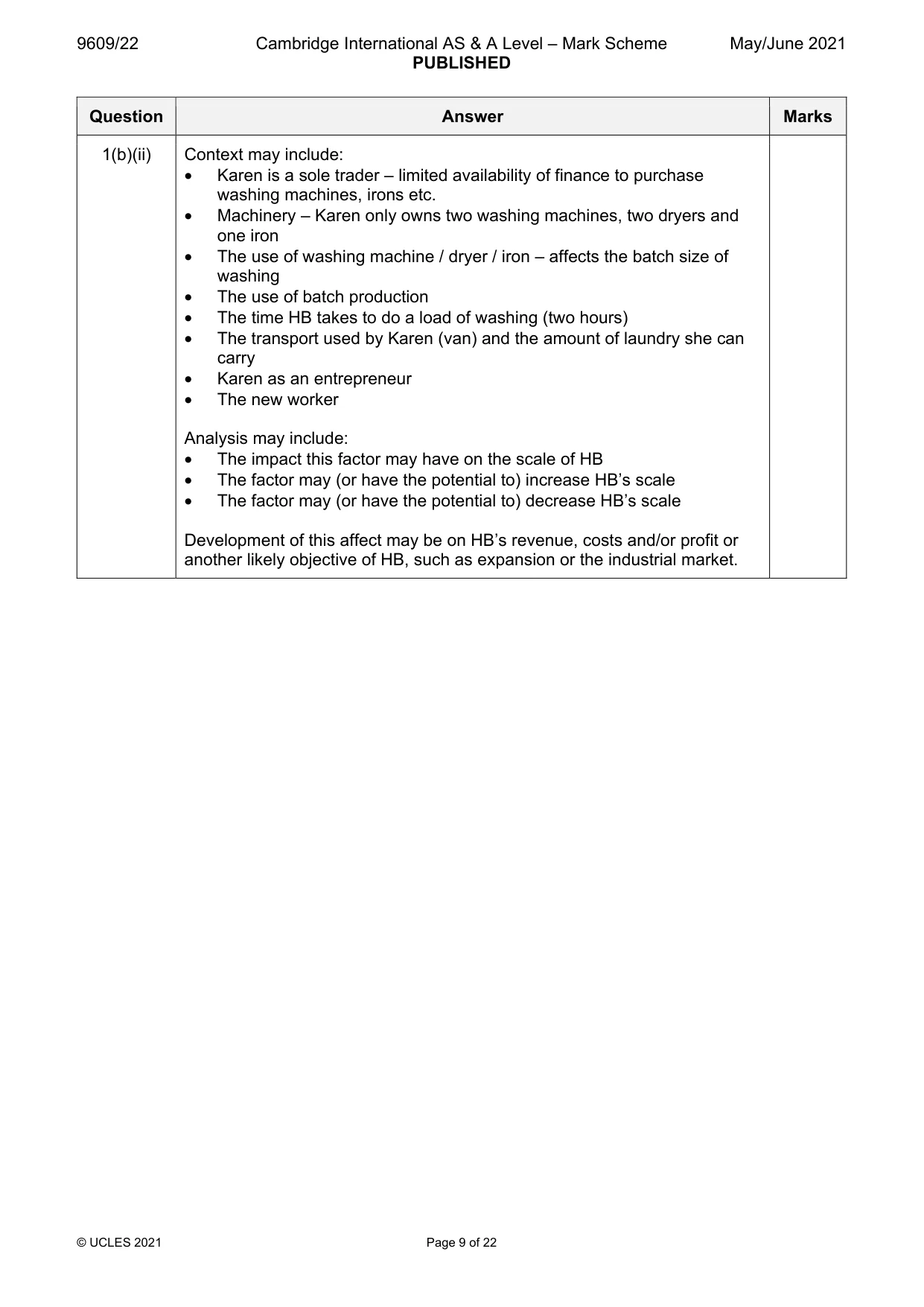
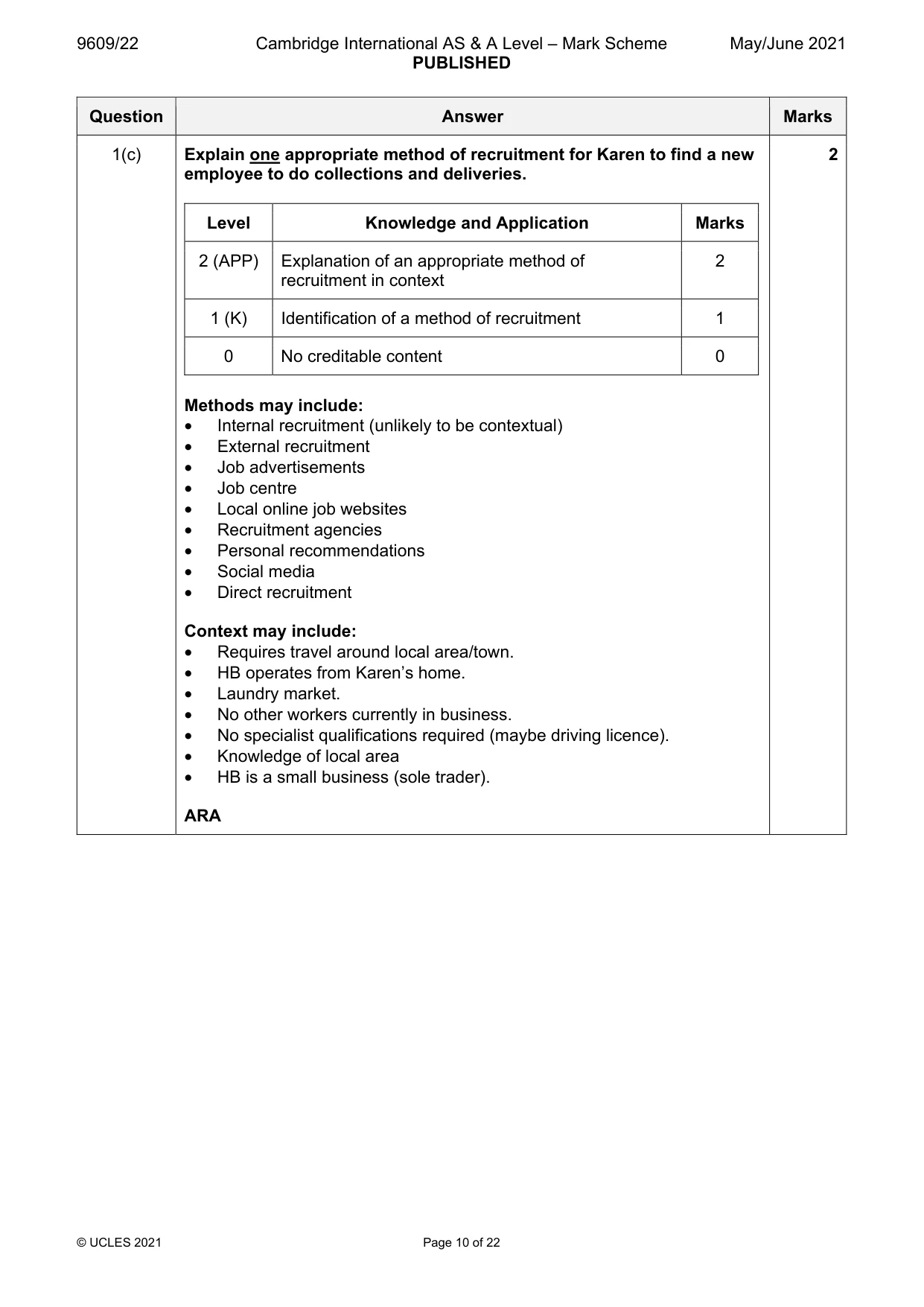
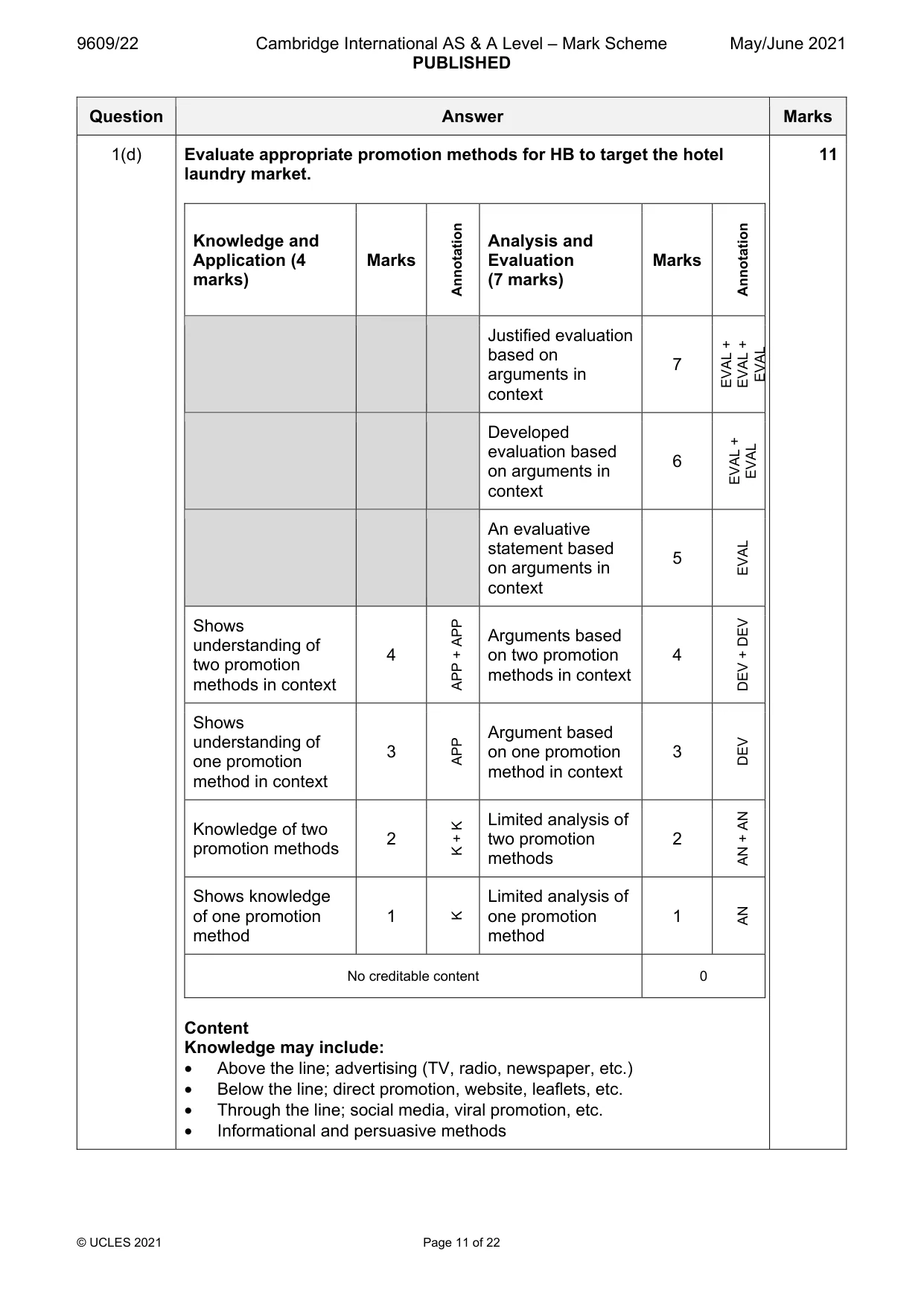
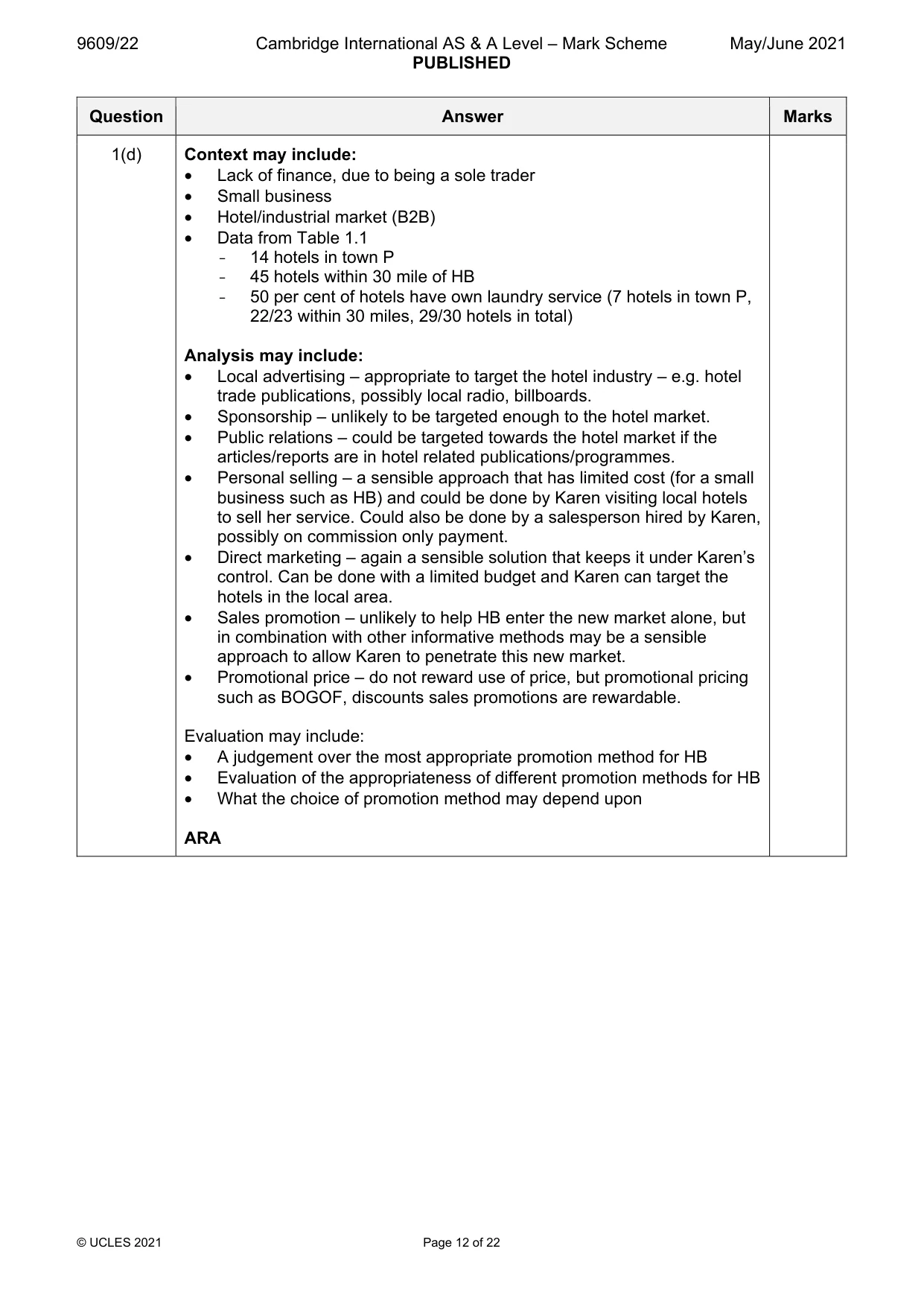
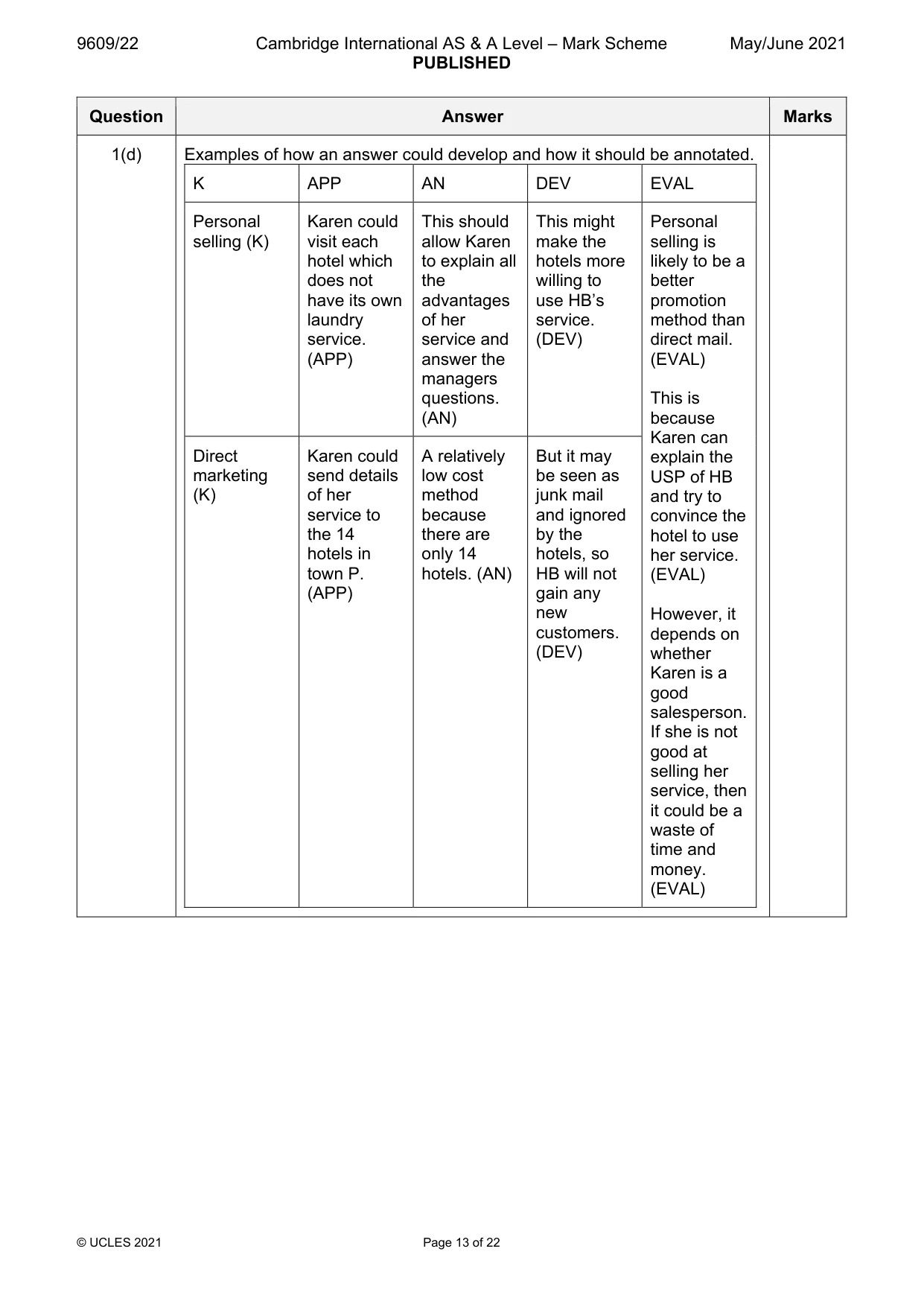
Mark scheme: Question Answer Marks 1(a)(i) Define the term ‘service’ (line 1). 2 Knowledge Marks A correct definition 2 A partial, vague or unfocused definition 1 No creditable content 0 Content An intangible product/process (1) which is offered to / paid for by customers (1). An action (1) sold by business (1). A correct definition will include the following points: • something sold by a business / bought by a customer / to satisfy needs or wants • an idea of intangibility. Exemplar Marks Rationale Something a customer buys which 2 Both elements cannot be touched. covered A process sold by a business. 2 Both elements covered An intangible product. 1 One element Something sold by a business. 1 One element A tertiary business 0 Not a definition of a service. 1(a)(ii) Explain the term ‘sole trader’ (line 1). 3 Award one mark for each point of explanation: B One mark for each of the following (up to a maximum of 1–2 two marks): marks • unlimited liability • shared legal identity with business • no continuity • no requirement to produce or make available accounts • no shares/shareholders • unincorporated • likely to be a small business • the owner keeps all the profits or bears the losses • has all the risk • has full control • makes all decisions themselves • example of a sole trader. A One individual or one person (must be a clear idea of a 1 mark single person) Exemplar Rationale Marks A sole trader is owned by one All three elements 3 person (A) who has unlimited liability (B) and does not need to publish financial accounts (B). Owned and controlled by one All three elements 3 person who bears the risk. A sole trader is owned by a A and B 2 single person (A) and does not have shareholders (B) A one person business (A) One mark only 1 A business where there is B only, which cannot be 0 unlimited liability (B), no need to awarded without the A mark. produce financial accounts, no continuity and no shareholders. Owned business. Tautology 0 ARA 1(b)(i) Refer to Fig 1.1 and any other relevant information. Calculate HB’s 4 share of the laundry service market. Rationale Marks Correct answer with or without correct working or units. 4 Attempt using some of the correct figures. 3 Formula* and identification of correct numbers 2 (i.e. 20% of 60 000). Formula* or identification of correct numbers 1 (i.e. 20% of 60 000). No creditable content. 0 Content Current share of the market Formula − × 100 Total market size Total market = 60 000 households Percentage who use a laundry service = 20% 20% of 60 000 = 12 000 households 300 households × 100 = 2.5% 12000 households Answer = 2.5% (allow 2.5) OFR 1(b)(ii) Analyse two factors which could affect the scale of HB. 8 Level Knowledge and Marks Marks Analysis (4 Application (4 marks) marks) 2b Shows 4 Good analysis of 4 understanding of two factors two factors which could which could APP affect the scale DEV affect the scale + of a business in + of a business in context context APP DEV 2a Shows 3 Good analysis of 3 understanding of one factor which one factor which could affect the could affect the scale of a scale of a business in business in context context APP DEV 1b Shows 2 Limited analysis 2 knowledge of of two factors two factors which could which could affect the scale AN affect the scale K of a business + of a business +K AN 1a Shows 1 Limited analysis 1 knowledge of of one factor one factor which which could could affect the affect the scale scale of a of a business business K AN 0 No creditable content Content Factors affecting scale are about the ability of a business to supply products, not the demand of the market. These factors are likely to involve: • Capital – the quantity and quality of the capital items in a business, such as machinery – this can include human capital. • Labour – the quantity and quality of the workforce. • Enterprise – the ability and willingness of an entrepreneur to take risks, find business opportunities. • Land – the quantity and quality of natural resources available to the business 1(b)(ii) Context may include: • Karen is a sole trader – limited availability of finance to purchase washing machines, irons etc. • Machinery – Karen only owns two washing machines, two dryers and one iron • The use of washing machine / dryer / iron – affects the batch size of washing • The use of batch production • The time HB takes to do a load of washing (two hours) • The transport used by Karen (van) and the amount of laundry she can carry • Karen as an entrepreneur • The new worker Analysis may include: • The impact this factor may have on the scale of HB • The factor may (or have the potential to) increase HB’s scale • The factor may (or have the potential to) decrease HB’s scale Development of this affect may be on HB’s revenue, costs and/or profit or another likely objective of HB, such as expansion or the industrial market. 1(c) Explain one appropriate method of recruitment for Karen to find a new 2 employee to do collections and deliveries. Level Knowledge and Application Marks 2 (APP) Explanation of an appropriate method of 2 recruitment in context 1 (K) Identification of a method of recruitment 1 0 No creditable content 0 Methods may include: • Internal recruitment (unlikely to be contextual) • External recruitment • Job advertisements • Job centre • Local online job websites • Recruitment agencies • Personal recommendations • Social media • Direct recruitment Context may include: • Requires travel around local area/town. • HB operates from Karen’s home. • Laundry market. • No other workers currently in business. • No specialist qualifications required (maybe driving licence). • Knowledge of local area • HB is a small business (sole trader). ARA 1(d) Evaluate appropriate promotion methods for HB to target the hotel 11 laundry market. Knowledge and Analysis and Application (4 Marks Evaluation Marks marks) (7 marks) Annotation Annotation Justified evaluation + + based on 7 EVAL arguments in EVAL EVAL context Developed + evaluation based 6 EVAL on arguments in EVAL context An evaluative statement based 5 on arguments in EVAL context Shows APP Arguments based DEV understanding of + + 4 on two promotion 4 two promotion methods in context APP methods in context DEV Shows Argument based understanding of 3 APP on one promotion 3 DEV one promotion method in context method in context K Limited analysis of AN Knowledge of two + + 2 two promotion 2 promotion methods K methods AN Shows knowledge Limited analysis of of one promotion 1 K one promotion 1 AN method method No creditable content 0 Content Knowledge may include: • Above the line; advertising (TV, radio, newspaper, etc.) • Below the line; direct promotion, website, leaflets, etc. • Through the line; social media, viral promotion, etc. • Informational and persuasive methods 1(d) Context may include: • Lack of finance, due to being a sole trader • Small business • Hotel/industrial market (B2B) • Data from Table 1.1 - 14 hotels in town P - 45 hotels within 30 mile of HB - 50 per cent of hotels have own laundry service (7 hotels in town P, 22/23 within 30 miles, 29/30 hotels in total) Analysis may include: • Local advertising – appropriate to target the hotel industry – e.g. hotel trade publications, possibly local radio, billboards. • Sponsorship – unlikely to be targeted enough to the hotel market. • Public relations – could be targeted towards the hotel market if the articles/reports are in hotel related publications/programmes. • Personal selling – a sensible approach that has limited cost (for a small business such as HB) and could be done by Karen visiting local hotels to sell her service. Could also be done by a salesperson hired by Karen, possibly on commission only payment. • Direct marketing – again a sensible solution that keeps it under Karen’s control. Can be done with a limited budget and Karen can target the hotels in the local area. • Sales promotion – unlikely to help HB enter the new market alone, but in combination with other informative methods may be a sensible approach to allow Karen to penetrate this new market. • Promotional price – do not reward use of price, but promotional pricing such as BOGOF, discounts sales promotions are rewardable. Evaluation may include: • A judgement over the most appropriate promotion method for HB • Evaluation of the appropriateness of different promotion methods for HB • What the choice of promotion method may depend upon ARA 1(d) Examples of how an answer could develop and how it should be annotated. K APP AN DEV EVAL Personal Karen could This should This might Personal selling (K) visit each allow Karen make the selling is hotel which to explain all hotels more likely to be a does not the willing to better have its own advantages use HB’s promotion laundry of her service. method than service. service and (DEV) direct mail. (APP) answer the (EVAL) managers questions. This is (AN) because Karen can Direct Karen could A relatively But it may explain the marketing send details low cost be seen as USP of HB (K) of her method junk mail and try to service to because and ignored convince the the 14 there are by the hotel to use hotels in only 14 hotels, so her service. town P. hotels. (AN) HB will not (EVAL) (APP) gain any new However, it customers. depends on (DEV) whether Karen is a good salesperson. If she is not good at selling her service, then it could be a waste of time and money. (EVAL)
Q2 · Lakeland Oysters (LO) Lakeland Oysters (LO) is a private limited company in country G…
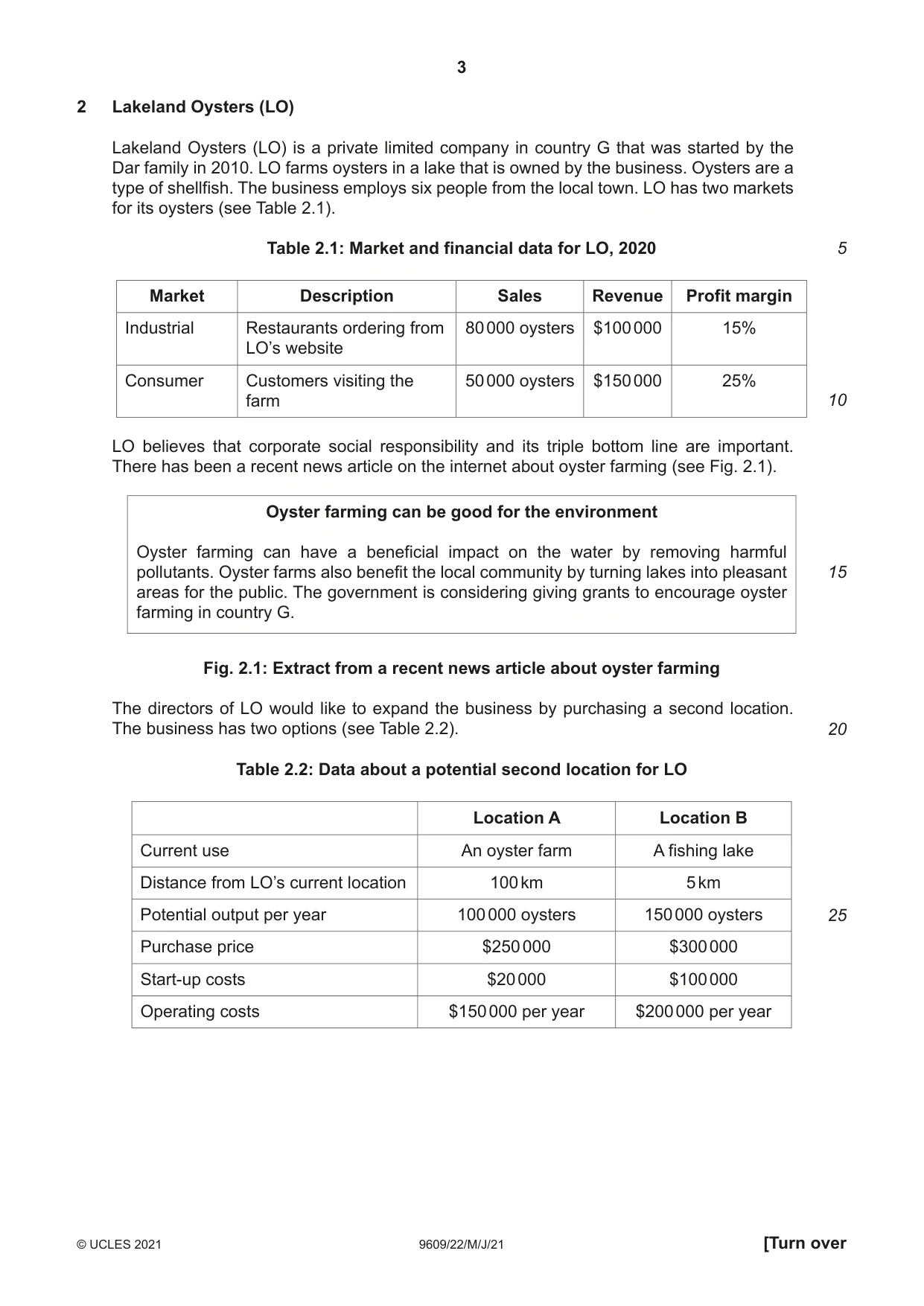
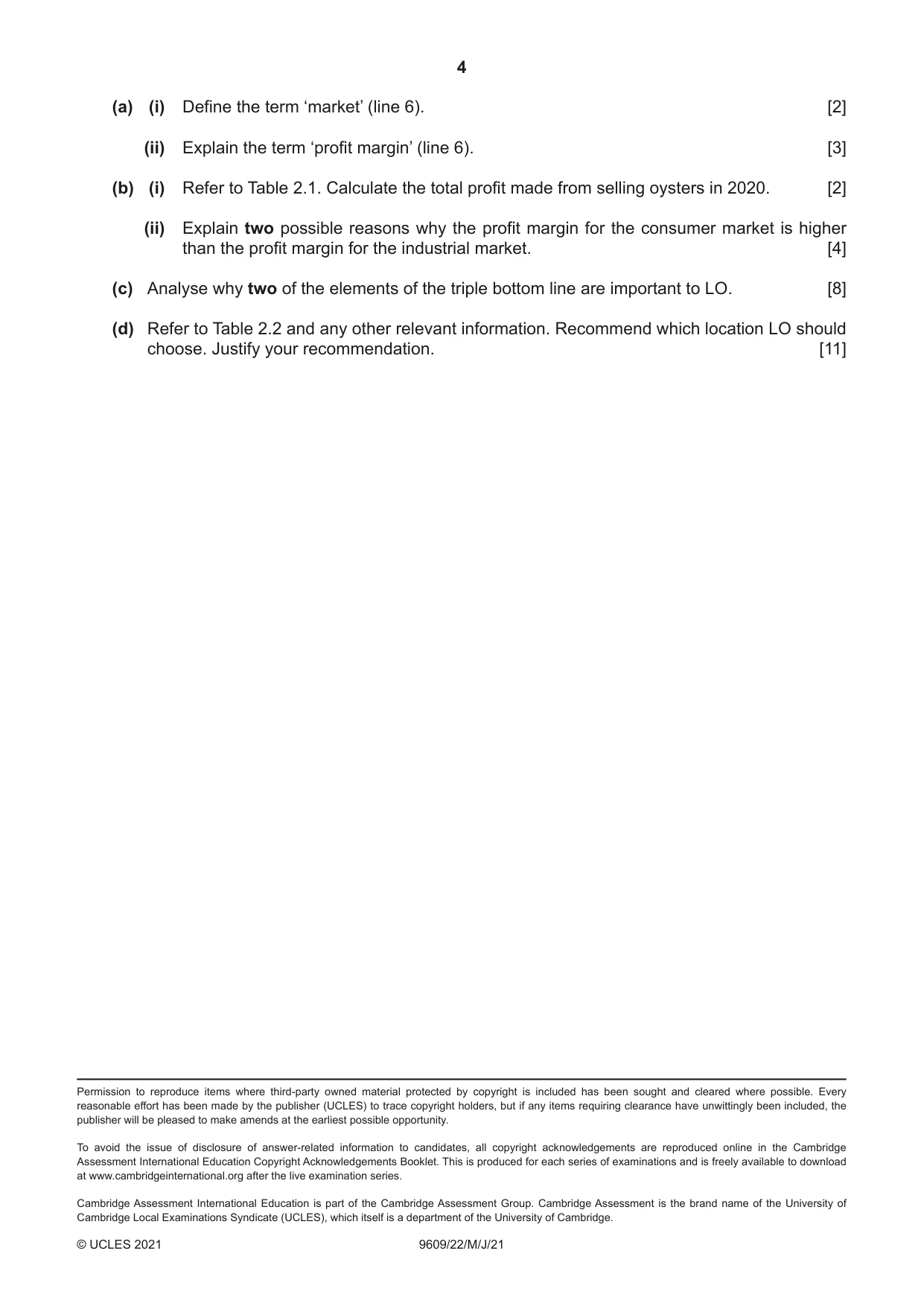
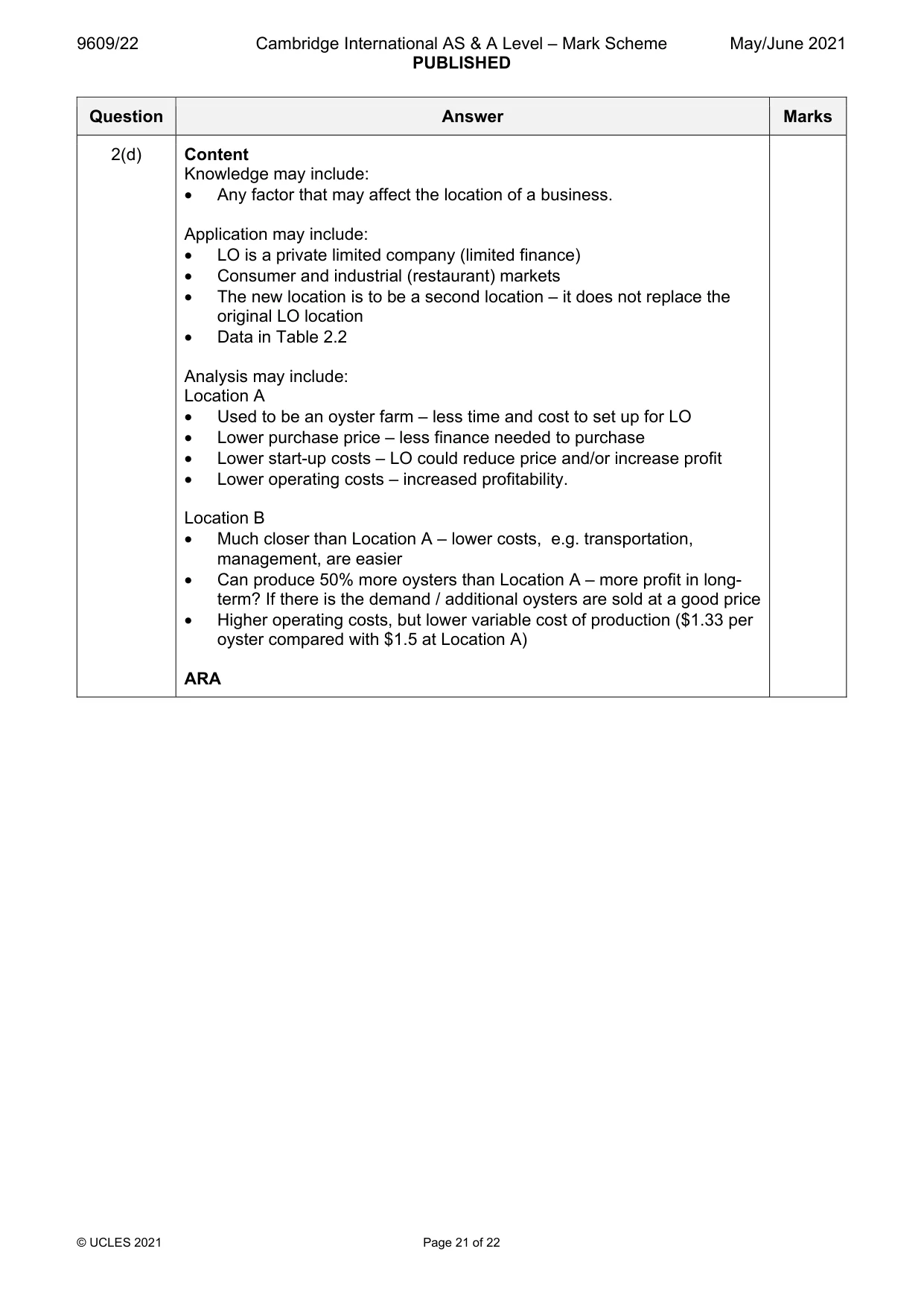
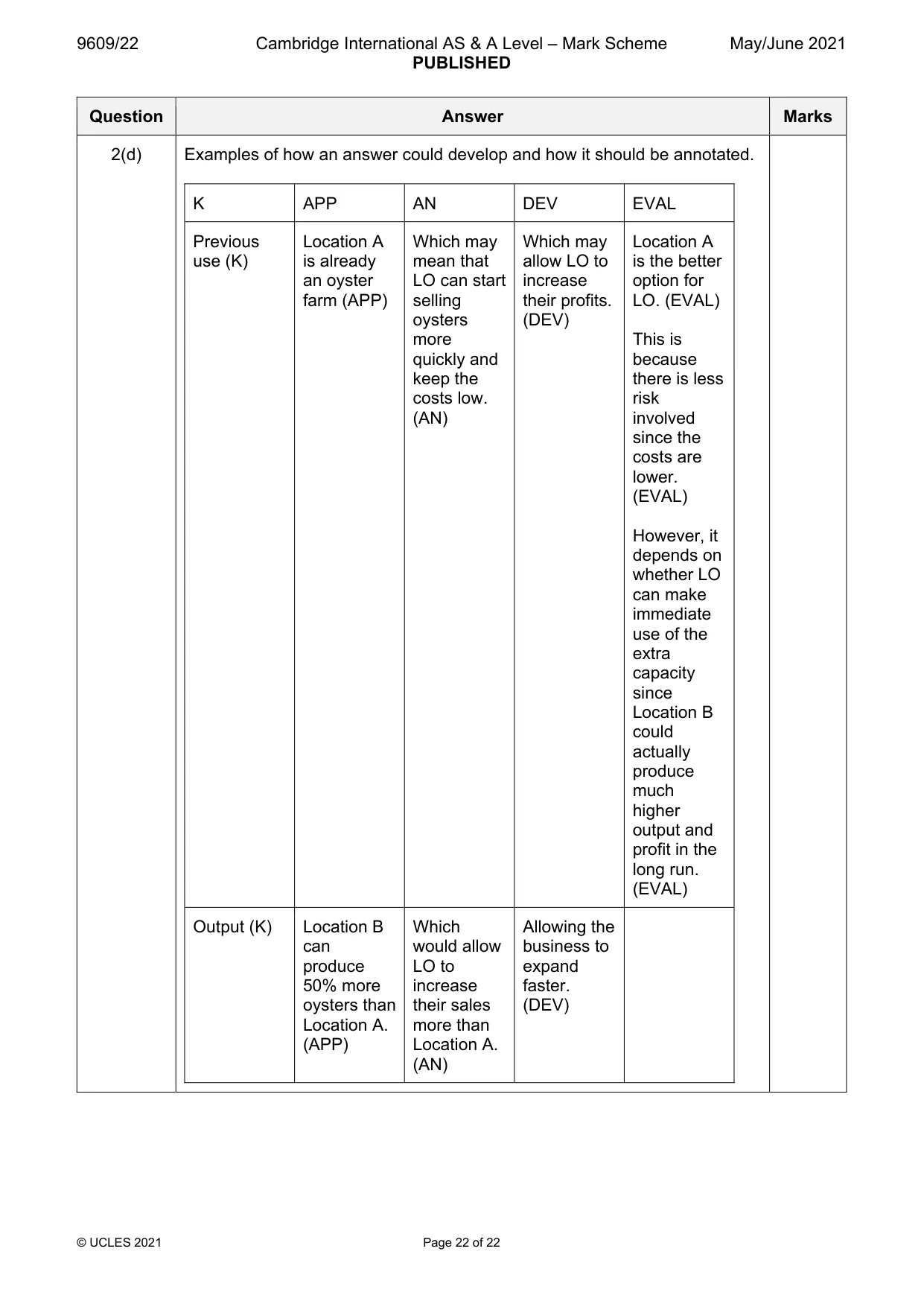
2 Lakeland Oysters (LO) Lakeland Oysters (LO) is a private limited company in country G that was started by the Dar family in 2010. LO farms oysters in a lake that is owned by the business. Oysters are a type of shellfish. The business employs six people from the local town. LO has two markets for its oysters (see Table 2.1). Table 2.1: Market and financial data for LO, 2020 5 Market Description Sales Revenue Profit margin Industrial Restaurants ordering from 80 000 oysters $100 000 15% LO’s website Consumer Customers visiting the 50 000 oysters $150 000 25% farm 10 LO believes that corporate social responsibility and its triple bottom line are important. There has been a recent news article on the internet about oyster farming (see Fig. 2.1). Oyster farming can be good for the environment Oyster farming can have a beneficial impact on the water by removing harmful pollutants. Oyster farms also benefit the local community by turning lakes into pleasant 15 areas for the public. The government is considering giving grants to encourage oyster farming in country G. Fig. 2.1: Extract from a recent news article about oyster farming The directors of LO would like to expand the business by purchasing a second location. The business has two options (see Table 2.2). 20 Table 2.2: Data about a potential second location for LO Location A Location B Current use An oyster farm A fishing lake Distance from LO’s current location 100 km 5 km Potential output per year 100 000 oysters 150 000 oysters 25 Purchase price $250 000 $300 000 Start-up costs $20 000 $100 000 Operating costs $150 000 per year $200 000 per year (a) (i) Define the term ‘market’ (line 6). [2] (ii) Explain the term ‘profit margin’ (line 6). [3] (b) (i) Refer to Table 2.1. Calculate the total profit made from selling oysters in 2020. [2] (ii) Explain two possible reasons why the profit margin for the consumer market is higher than the profit margin for the industrial market. [4] (c) Analyse why two of the elements of the triple bottom line are important to LO. [8] (d) Refer to Table 2.2 and any other relevant information. Recommend which location LO should choose. Justify your recommendation. [11]
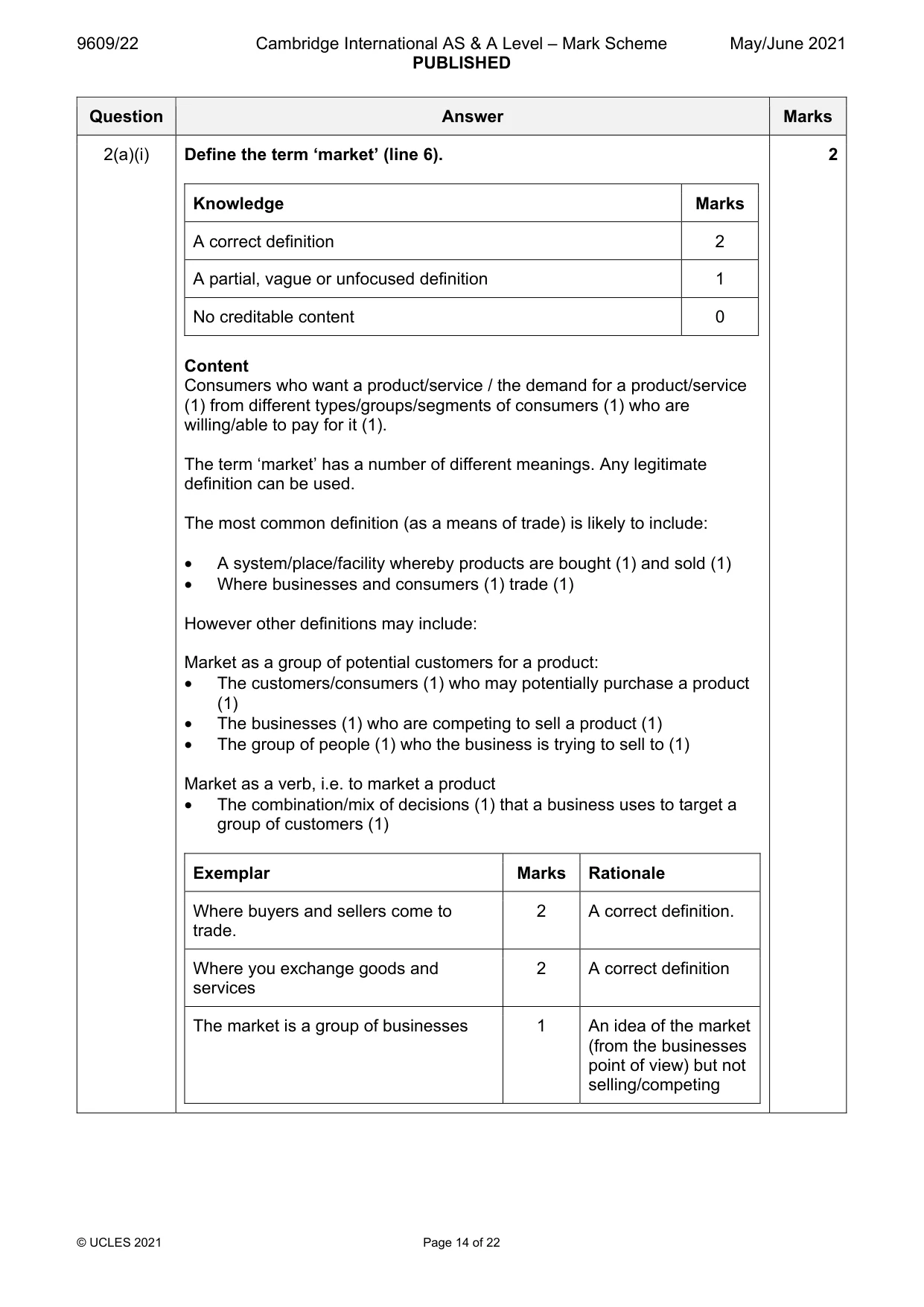
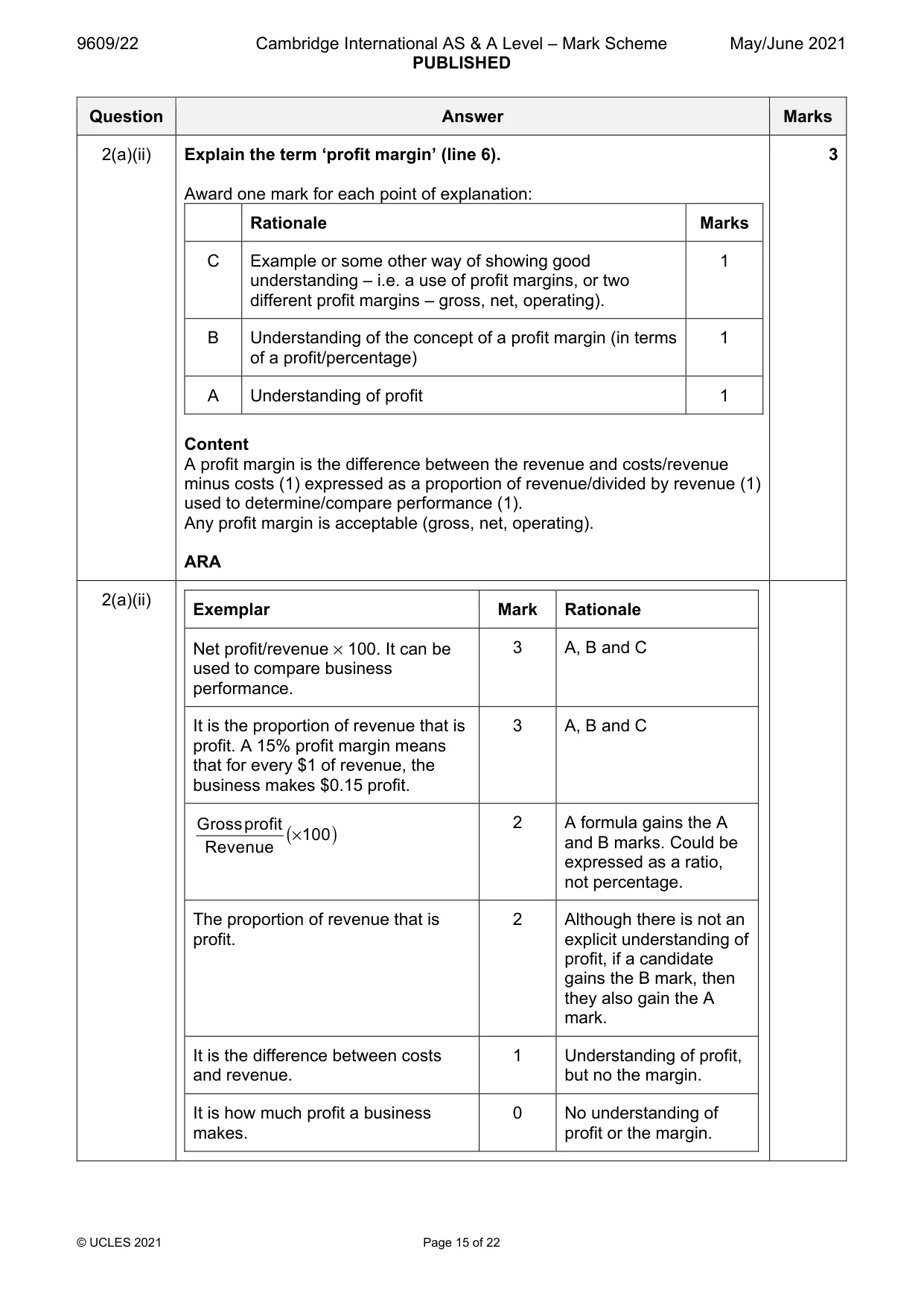
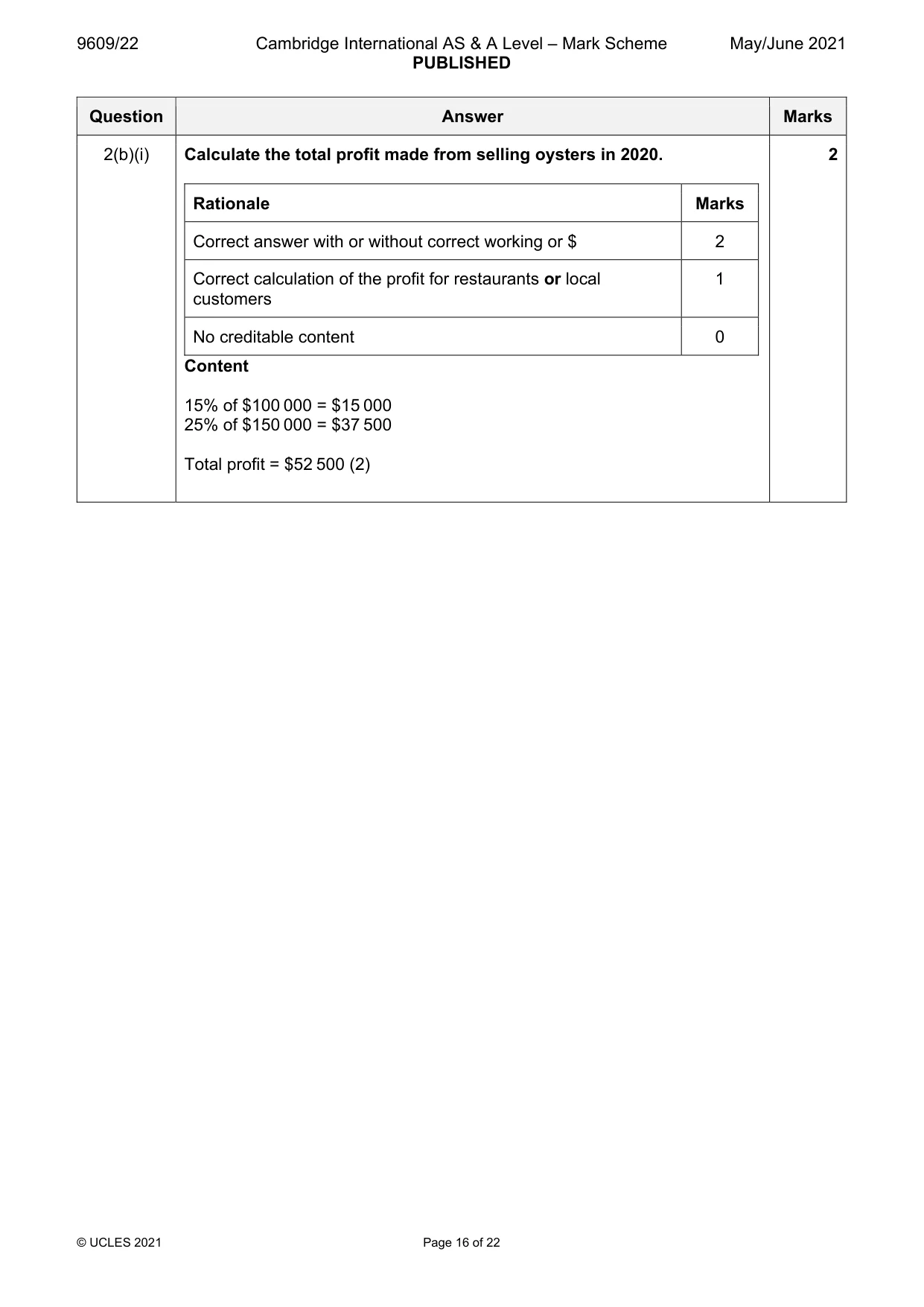
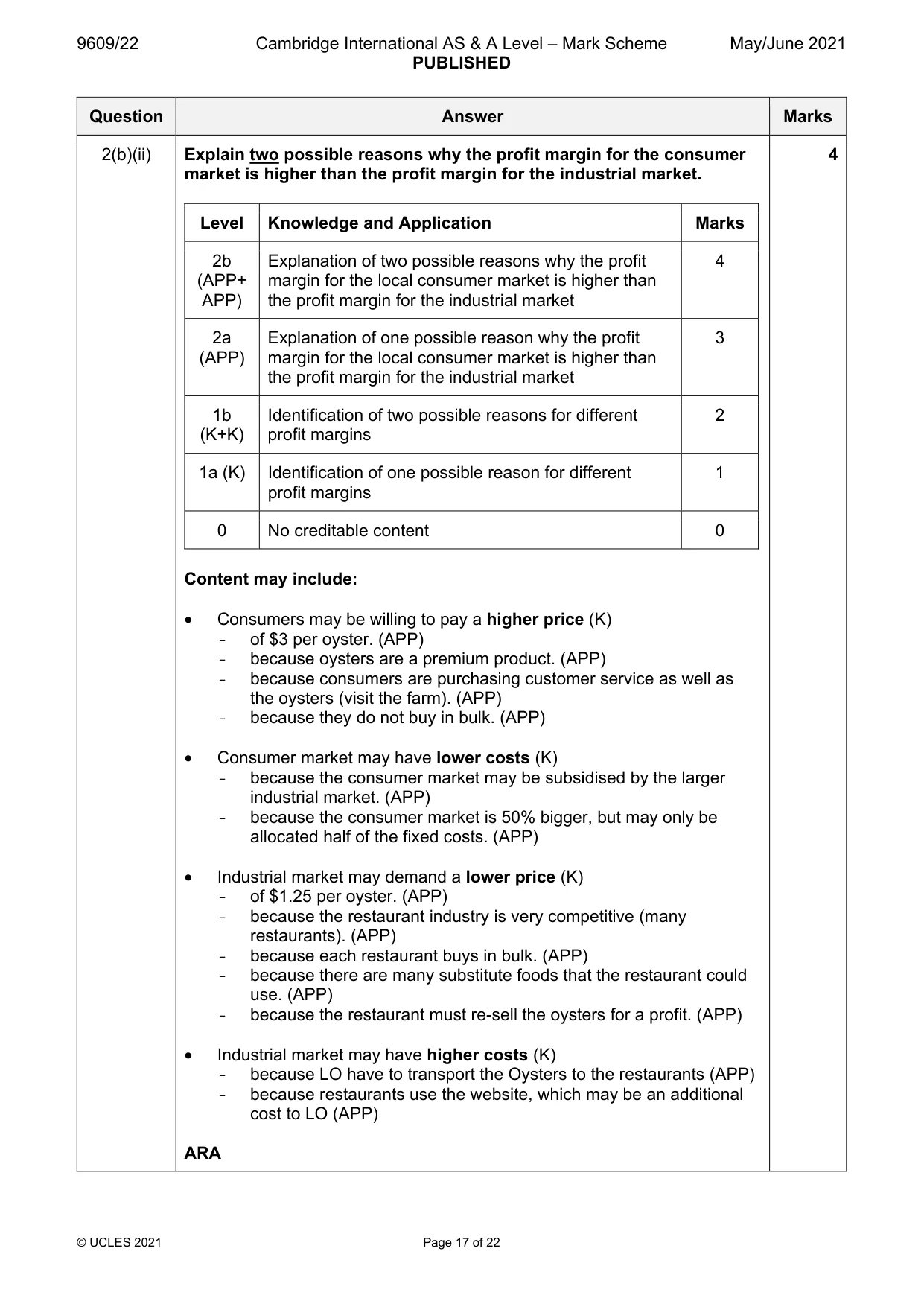
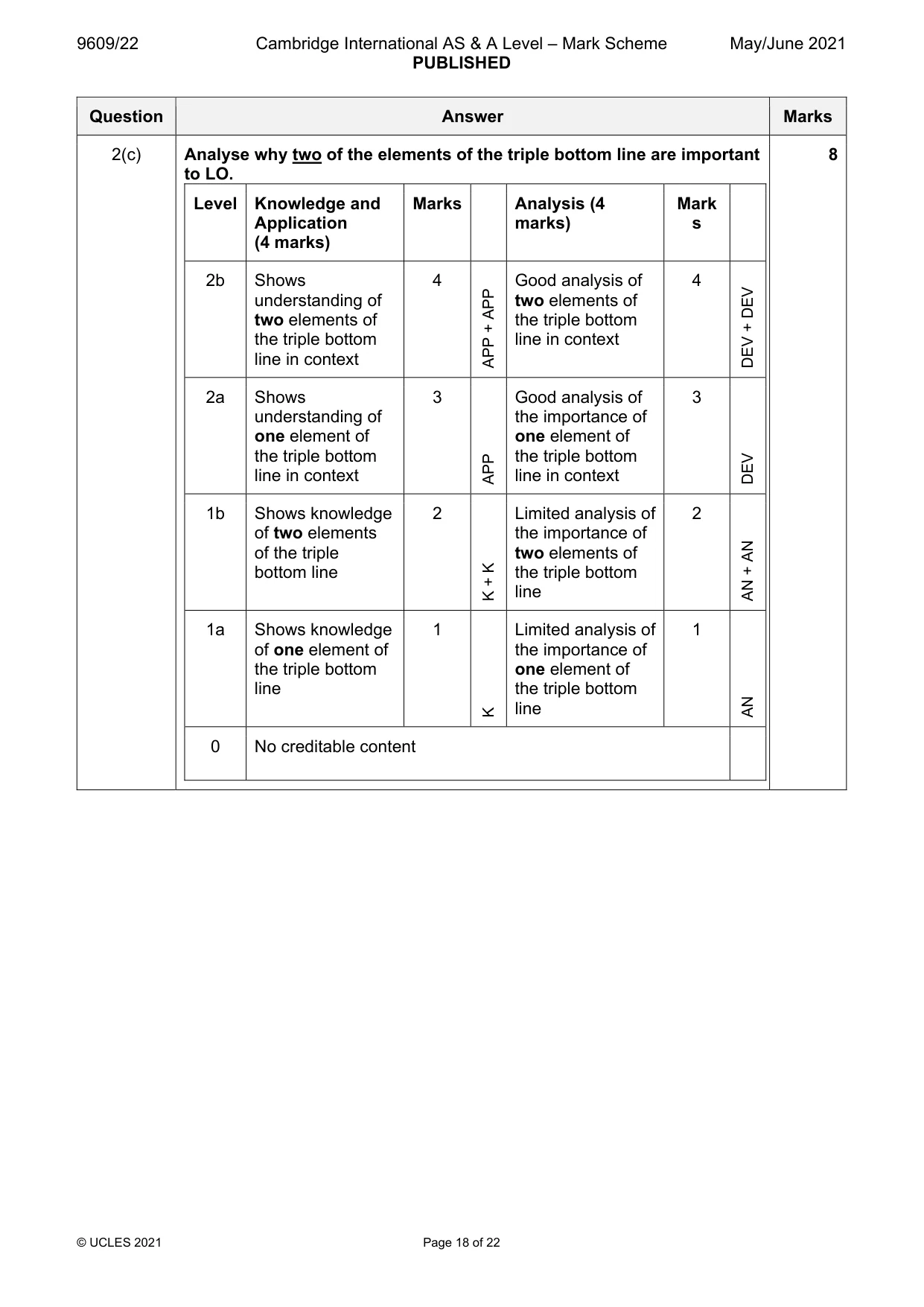
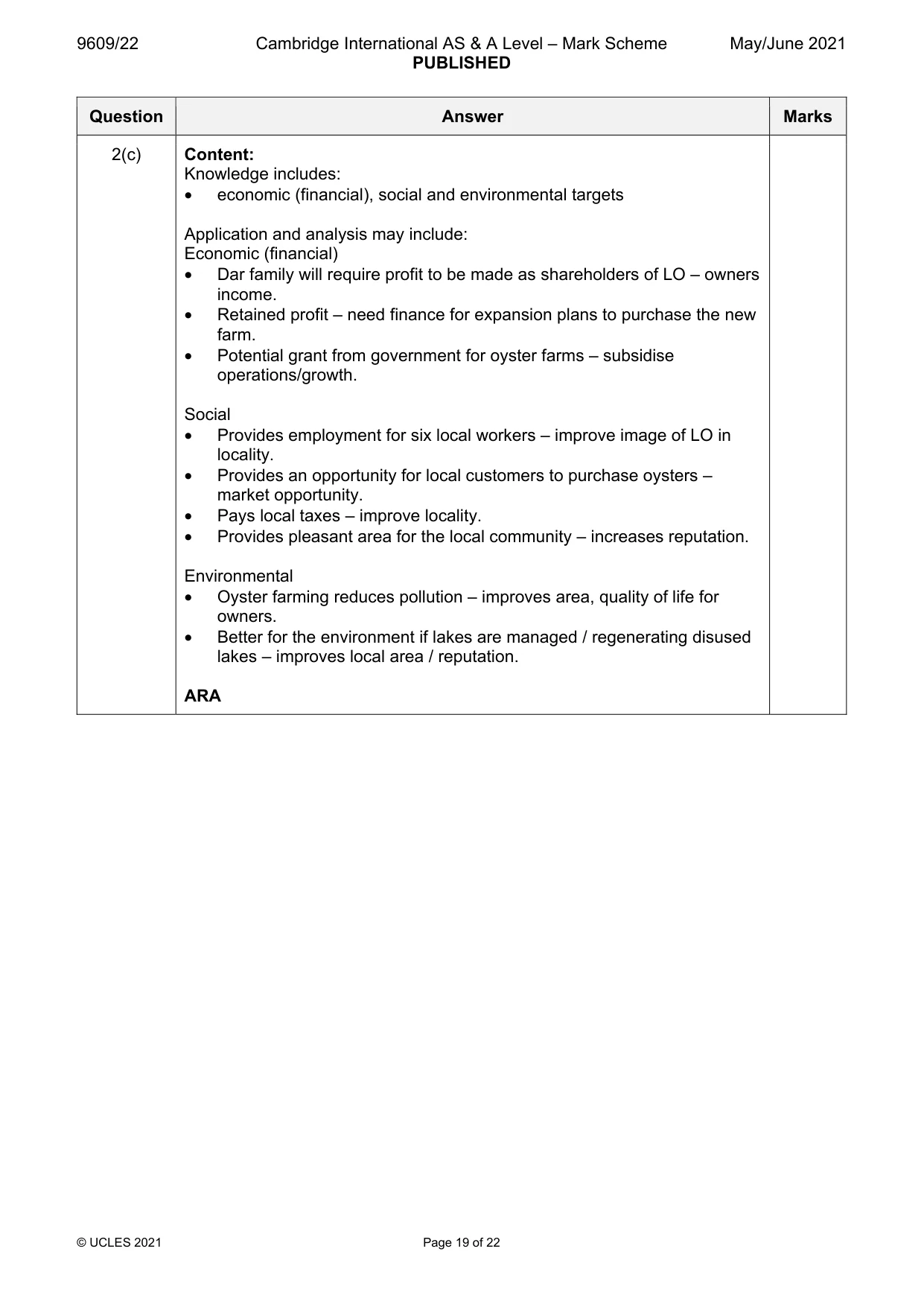
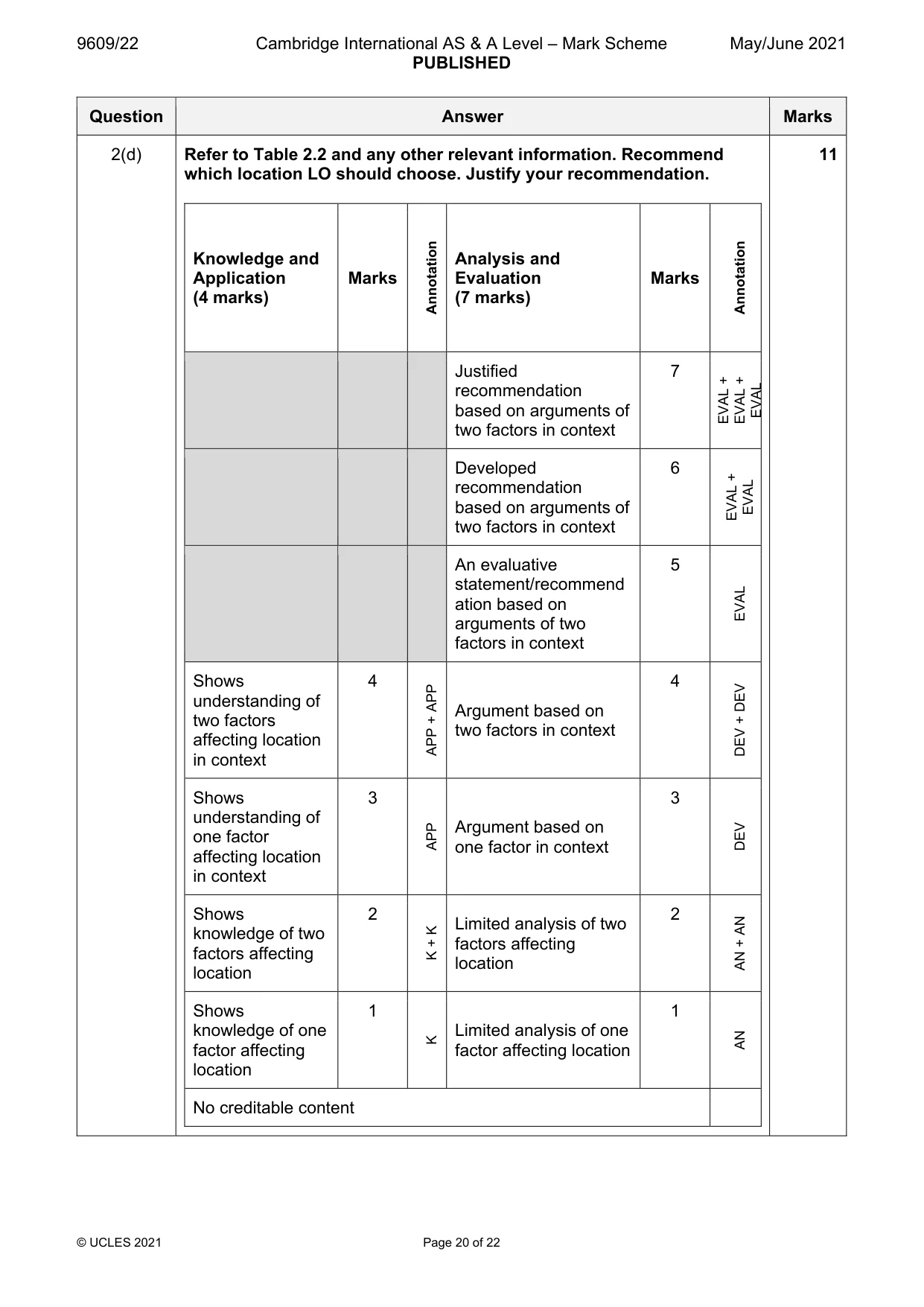
Mark scheme: 2(a)(i) Define the term ‘market’ (line 6). 2 Knowledge Marks A correct definition 2 A partial, vague or unfocused definition 1 No creditable content 0 Content Consumers who want a product/service / the demand for a product/service (1) from different types/groups/segments of consumers (1) who are willing/able to pay for it (1). The term ‘market’ has a number of different meanings. Any legitimate definition can be used. The most common definition (as a means of trade) is likely to include: • A system/place/facility whereby products are bought (1) and sold (1) • Where businesses and consumers (1) trade (1) However other definitions may include: Market as a group of potential customers for a product: • The customers/consumers (1) who may potentially purchase a product (1) • The businesses (1) who are competing to sell a product (1) • The group of people (1) who the business is trying to sell to (1) Market as a verb, i.e. to market a product • The combination/mix of decisions (1) that a business uses to target a group of customers (1) Exemplar Marks Rationale Where buyers and sellers come to 2 A correct definition. trade. Where you exchange goods and 2 A correct definition services The market is a group of businesses 1 An idea of the market (from the businesses point of view) but not selling/competing 2(a)(ii) Explain the term ‘profit margin’ (line 6). 3 Award one mark for each point of explanation: Rationale Marks C Example or some other way of showing good 1 understanding – i.e. a use of profit margins, or two different profit margins – gross, net, operating). B Understanding of the concept of a profit margin (in terms 1 of a profit/percentage) A Understanding of profit 1 Content A profit margin is the difference between the revenue and costs/revenue minus costs (1) expressed as a proportion of revenue/divided by revenue (1) used to determine/compare performance (1). Any profit margin is acceptable (gross, net, operating). ARA 2(a)(ii) Exemplar Mark Rationale Net profit/revenue × 100. It can be 3 A, B and C used to compare business performance. It is the proportion of revenue that is 3 A, B and C profit. A 15% profit margin means that for every $1 of revenue, the business makes $0.15 profit. Grossprofit 2 A formula gains the A ( × 100 ) and B marks. Could be Revenue expressed as a ratio, not percentage. The proportion of revenue that is 2 Although there is not an profit. explicit understanding of profit, if a candidate gains the B mark, then they also gain the A mark. It is the difference between costs 1 Understanding of profit, and revenue. but no the margin. It is how much profit a business 0 No understanding of makes. profit or the margin. 2(b)(i) Calculate the total profit made from selling oysters in 2020. 2 Rationale Marks Correct answer with or without correct working or $ 2 Correct calculation of the profit for restaurants or local 1 customers No creditable content 0 Content 15% of $100 000 = $15 000 25% of $150 000 = $37 500 Total profit = $52 500 (2) 2(b)(ii) Explain two possible reasons why the profit margin for the consumer 4 market is higher than the profit margin for the industrial market. Level Knowledge and Application Marks 2b Explanation of two possible reasons why the profit 4 (APP+ margin for the local consumer market is higher than APP) the profit margin for the industrial market 2a Explanation of one possible reason why the profit 3 (APP) margin for the local consumer market is higher than the profit margin for the industrial market 1b Identification of two possible reasons for different 2 (K+K) profit margins 1a (K) Identification of one possible reason for different 1 profit margins 0 No creditable content 0 Content may include: • Consumers may be willing to pay a higher price (K) - of $3 per oyster. (APP) - because oysters are a premium product. (APP) - because consumers are purchasing customer service as well as the oysters (visit the farm). (APP) - because they do not buy in bulk. (APP) • Consumer market may have lower costs (K) - because the consumer market may be subsidised by the larger industrial market. (APP) - because the consumer market is 50% bigger, but may only be allocated half of the fixed costs. (APP) • Industrial market may demand a lower price (K) - of $1.25 per oyster. (APP) - because the restaurant industry is very competitive (many restaurants). (APP) - because each restaurant buys in bulk. (APP) - because there are many substitute foods that the restaurant could use. (APP) - because the restaurant must re-sell the oysters for a profit. (APP) • Industrial market may have higher costs (K) - because LO have to transport the Oysters to the restaurants (APP) - because restaurants use the website, which may be an additional cost to LO (APP) ARA 2(c) Analyse why two of the elements of the triple bottom line are important 8 to LO. Level Knowledge and Marks Analysis (4 Mark Application marks) s (4 marks) 2b Shows 4 Good analysis of 4 understanding of APP two elements of DEV two elements of + the triple bottom + the triple bottom line in context line in context APP DEV 2a Shows 3 Good analysis of 3 understanding of the importance of one element of one element of the triple bottom the triple bottom line in context APP line in context DEV 1b Shows knowledge 2 Limited analysis of 2 of two elements the importance of of the triple two elements of AN bottom line K the triple bottom + + K line AN 1a Shows knowledge 1 Limited analysis of 1 of one element of the importance of the triple bottom one element of line the triple bottom K line AN 0 No creditable content 2(c) Content: Knowledge includes: • economic (financial), social and environmental targets Application and analysis may include: Economic (financial) • Dar family will require profit to be made as shareholders of LO – owners income. • Retained profit – need finance for expansion plans to purchase the new farm. • Potential grant from government for oyster farms – subsidise operations/growth. Social • Provides employment for six local workers – improve image of LO in locality. • Provides an opportunity for local customers to purchase oysters – market opportunity. • Pays local taxes – improve locality. • Provides pleasant area for the local community – increases reputation. Environmental • Oyster farming reduces pollution – improves area, quality of life for owners. • Better for the environment if lakes are managed / regenerating disused lakes – improves local area / reputation. ARA 2(d) Refer to Table 2.2 and any other relevant information. Recommend 11 which location LO should choose. Justify your recommendation. Knowledge and Analysis and Application Marks Evaluation Marks (4 marks) (7 marks) Annotation Annotation Justified 7 + + recommendation EVAL based on arguments of EVAL EVAL two factors in context Developed 6 + recommendation EVAL based on arguments of EVAL two factors in context An evaluative 5 statement/recommend ation based on EVAL arguments of two factors in context Shows 4 4 understanding of APP DEV + Argument based on + two factors two factors in context affecting location APP DEV in context Shows 3 3 understanding of Argument based on one factor APP DEV one factor in context affecting location in context Shows 2 2 K Limited analysis of two AN knowledge of two + + factors affecting factors affecting K location AN location Shows 1 1 knowledge of one Limited analysis of one K AN factor affecting factor affecting location location No creditable content 2(d) Content Knowledge may include: • Any factor that may affect the location of a business. Application may include: • LO is a private limited company (limited finance) • Consumer and industrial (restaurant) markets • The new location is to be a second location – it does not replace the original LO location • Data in Table 2.2 Analysis may include: Location A • Used to be an oyster farm – less time and cost to set up for LO • Lower purchase price – less finance needed to purchase • Lower start-up costs – LO could reduce price and/or increase profit • Lower operating costs – increased profitability. Location B • Much closer than Location A – lower costs, e.g. transportation, management, are easier • Can produce 50% more oysters than Location A – more profit in long- term? If there is the demand / additional oysters are sold at a good price • Higher operating costs, but lower variable cost of production ($1.33 per oyster compared with $1.5 at Location A) ARA 2(d) Examples of how an answer could develop and how it should be annotated. K APP AN DEV EVAL Previous Location A Which may Which may Location A use (K) is already mean that allow LO to is the better an oyster LO can start increase option for farm (APP) selling their profits. LO. (EVAL) oysters (DEV) more This is quickly and because keep the there is less costs low. risk (AN) involved since the costs are lower. (EVAL) However, it depends on whether LO can make immediate use of the extra capacity since Location B could actually produce much higher output and profit in the long run. (EVAL) Output (K) Location B Which Allowing the can would allow business to produce LO to expand 50% more increase faster. oysters than their sales (DEV) Location A. more than (APP) Location A. (AN)
What was in this paper
The subtopics covered by these 2 questions, and how many questions each got. Open one in a new tab to see every Cambridge question on it.
What you needed in this session
Cambridge’s own grade thresholds for 2021 May/June, Paper 2 · Variant 2. A higher threshold means an easier paper — the bar moves with how the cohort did.