Cambridge A Level Business (for first examination in 2016) 9609 — 2021 May/June Paper 2 · Variant 3
9609/23/M/J/21 · 2 questions · 60 marks · ≈68 min
The question paper and its mark scheme, free to read here and free to download. This is Cambridge’s own paper, exactly as it was sat.
Question paper4 pages
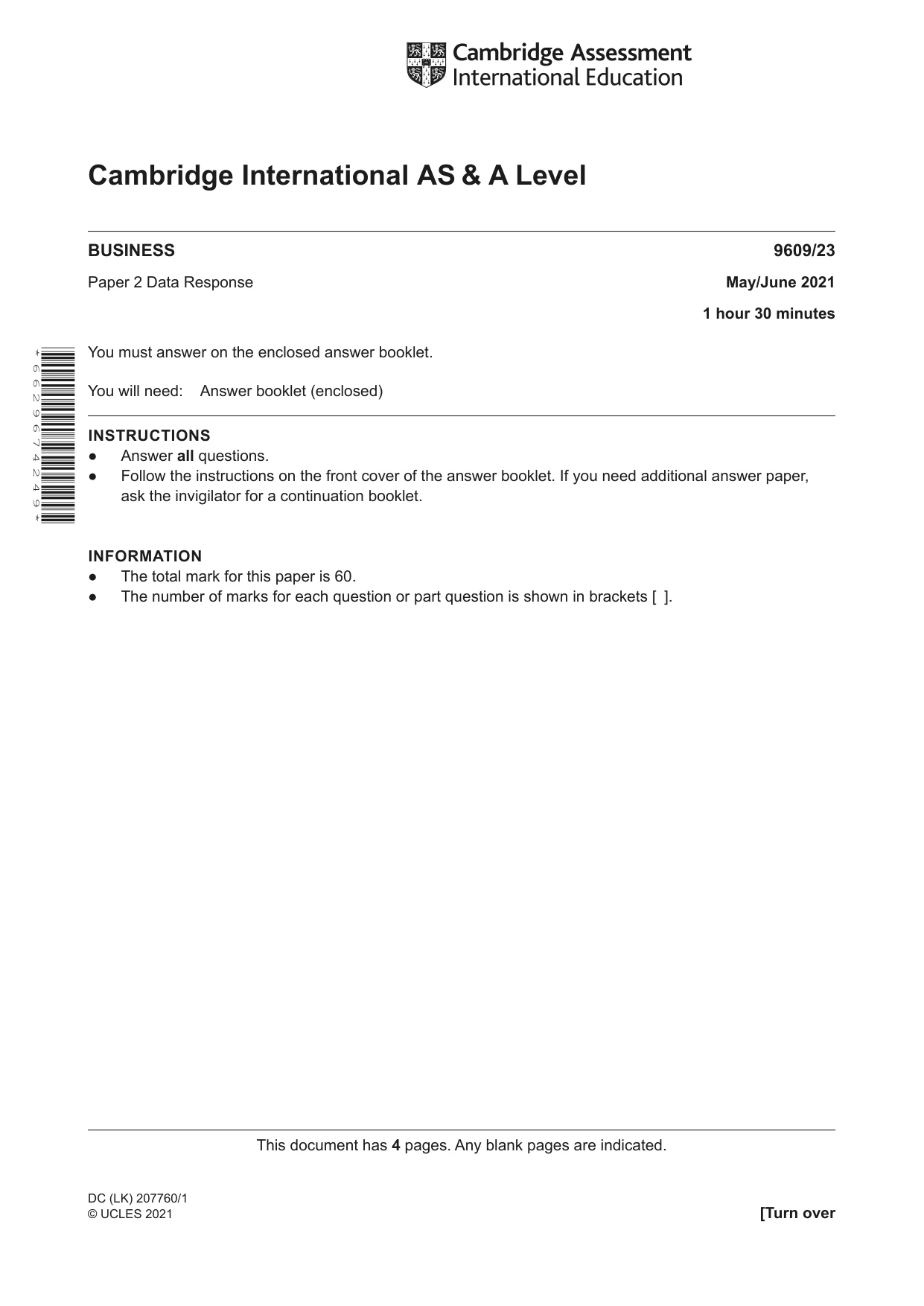

Mark scheme17 pages
Answers below. Sit the paper first if you are practising.
Questions as text
Q1 · Bilal’s Homes (BH) Bilal is a sole trader, who buys and sells apartments for a profit
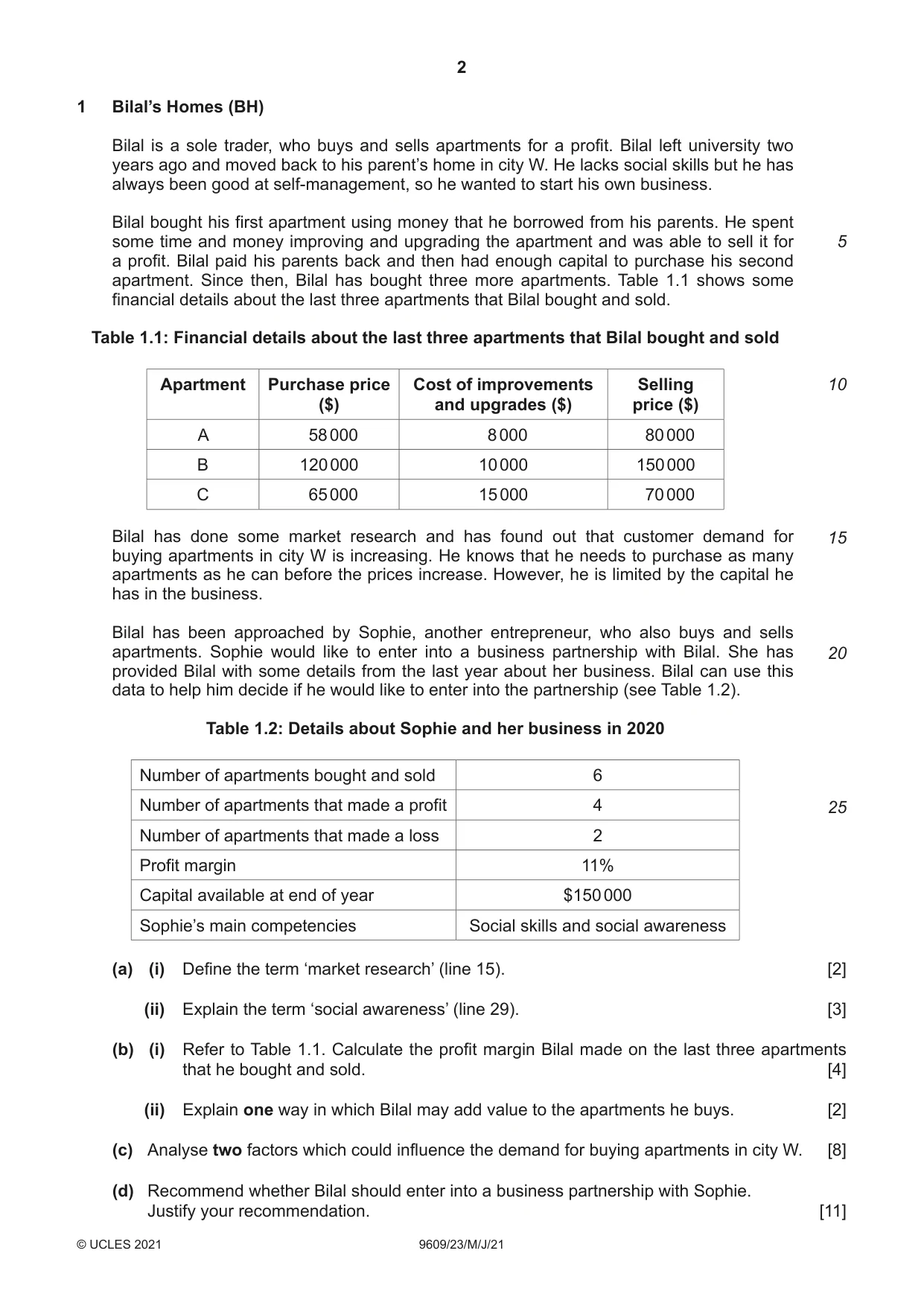
1 Bilal’s Homes (BH) Bilal is a sole trader, who buys and sells apartments for a profit. Bilal left university two years ago and moved back to his parent’s home in city W. He lacks social skills but he has always been good at self-management, so he wanted to start his own business. Bilal bought his first apartment using money that he borrowed from his parents. He spent some time and money improving and upgrading the apartment and was able to sell it for 5 a profit. Bilal paid his parents back and then had enough capital to purchase his second apartment. Since then, Bilal has bought three more apartments. Table 1.1 shows some financial details about the last three apartments that Bilal bought and sold. Table 1.1: Financial details about the last three apartments that Bilal bought and sold Apartment Purchase price Cost of improvements Selling 10 ($) and upgrades ($) price ($) A 58 000 8 000 80 000 B 120 000 10 000 150 000 C 65 000 15 000 70 000 Bilal has done some market research and has found out that customer demand for 15 buying apartments in city W is increasing. He knows that he needs to purchase as many apartments as he can before the prices increase. However, he is limited by the capital he has in the business. Bilal has been approached by Sophie, another entrepreneur, who also buys and sells apartments. Sophie would like to enter into a business partnership with Bilal. She has 20 provided Bilal with some details from the last year about her business. Bilal can use this data to help him decide if he would like to enter into the partnership (see Table 1.2). Table 1.2: Details about Sophie and her business in 2020 Number of apartments bought and sold 6 Number of apartments that made a profit 4 25 Number of apartments that made a loss 2 Profit margin 11% Capital available at end of year $150 000 Sophie’s main competencies Social skills and social awareness (a) (i) Define the term ‘market research’ (line 15). [2] (ii) Explain the term ‘social awareness’ (line 29). [3] (b) (i) Refer to Table 1.1. Calculate the profit margin Bilal made on the last three apartments that he bought and sold. [4] (ii) Explain one way in which Bilal may add value to the apartments he buys. [2] (c) Analyse two factors which could influence the demand for buying apartments in city W. [8] (d) Recommend whether Bilal should enter into a business partnership with Sophie. Justify your recommendation. [11]
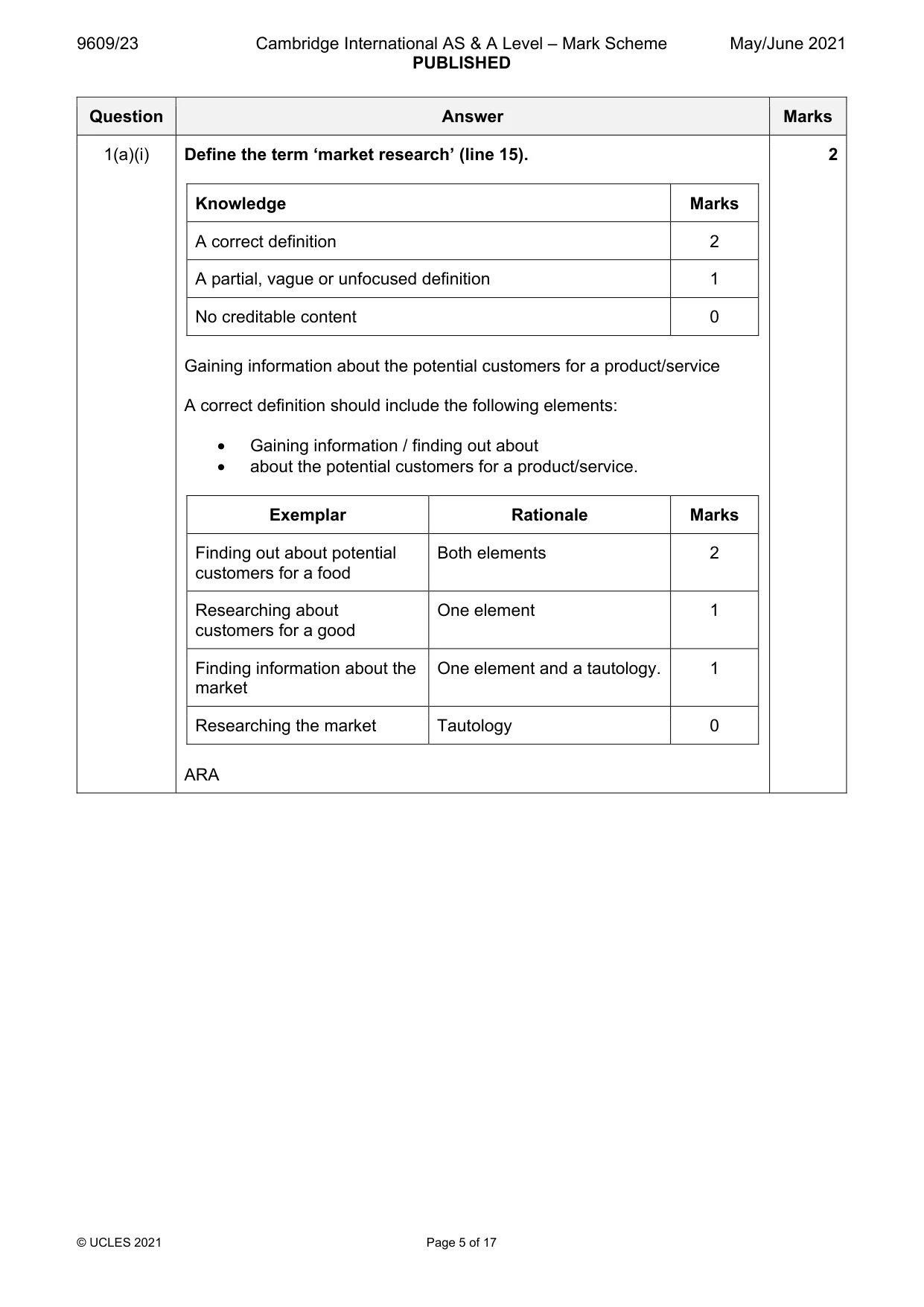
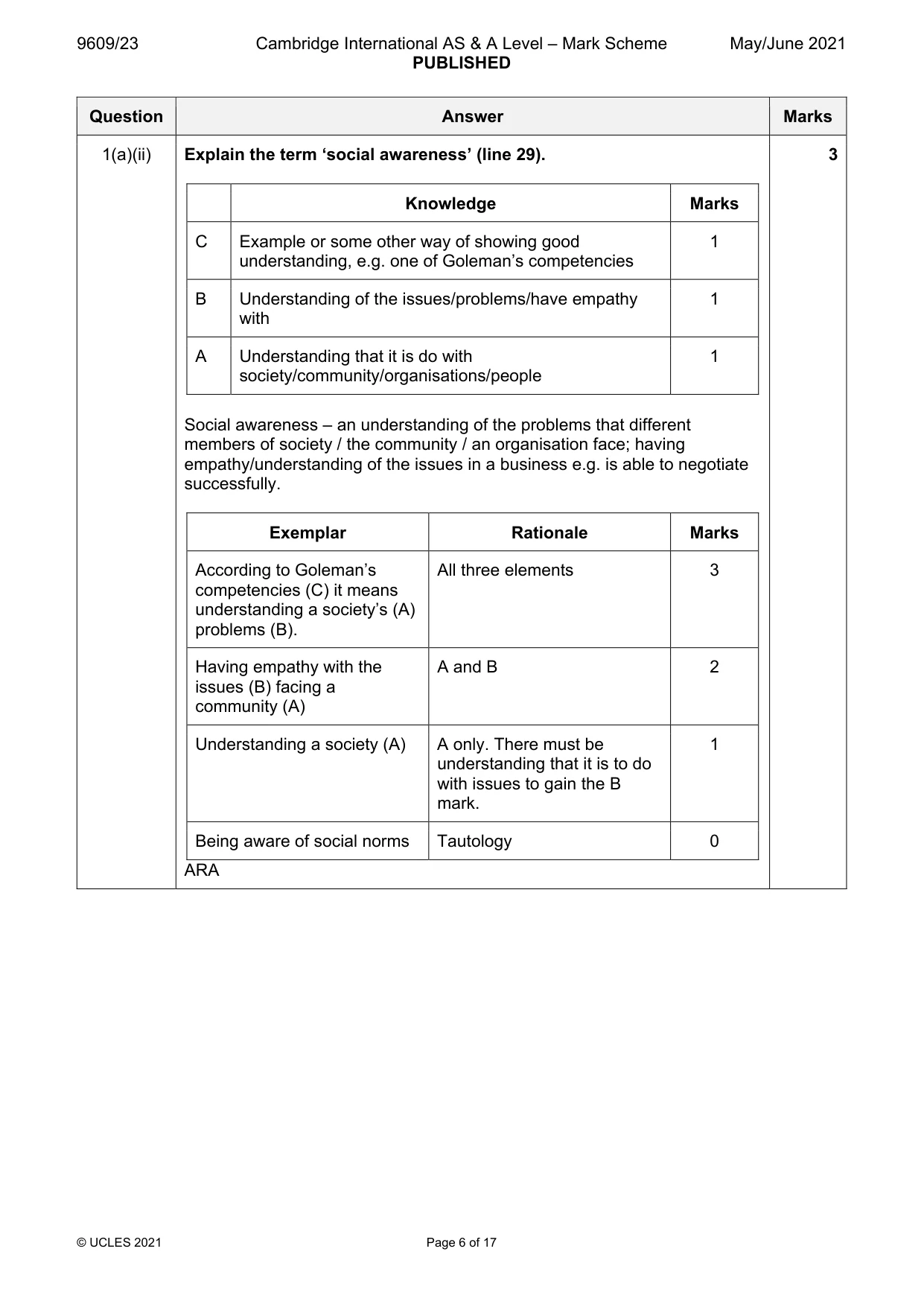
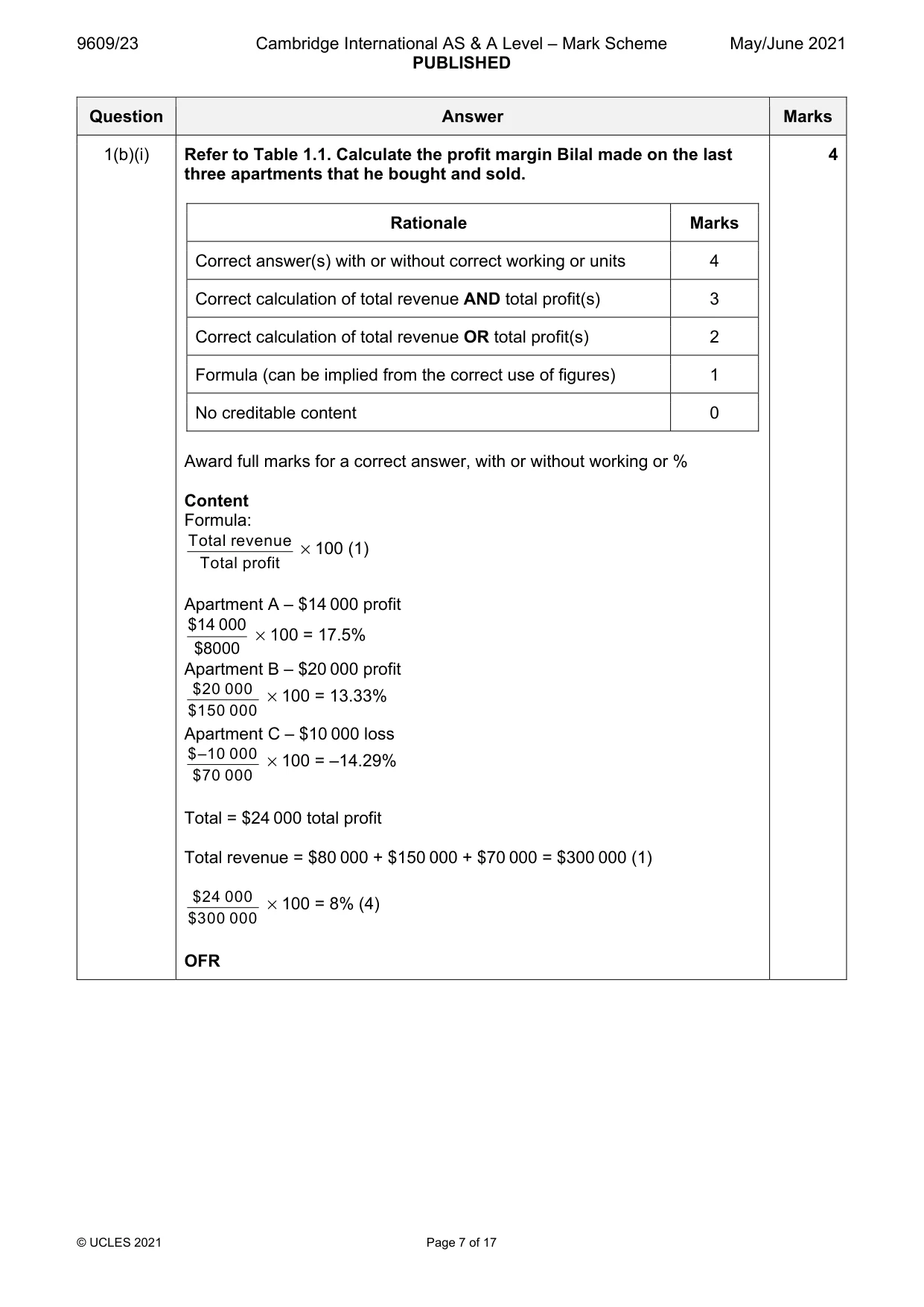
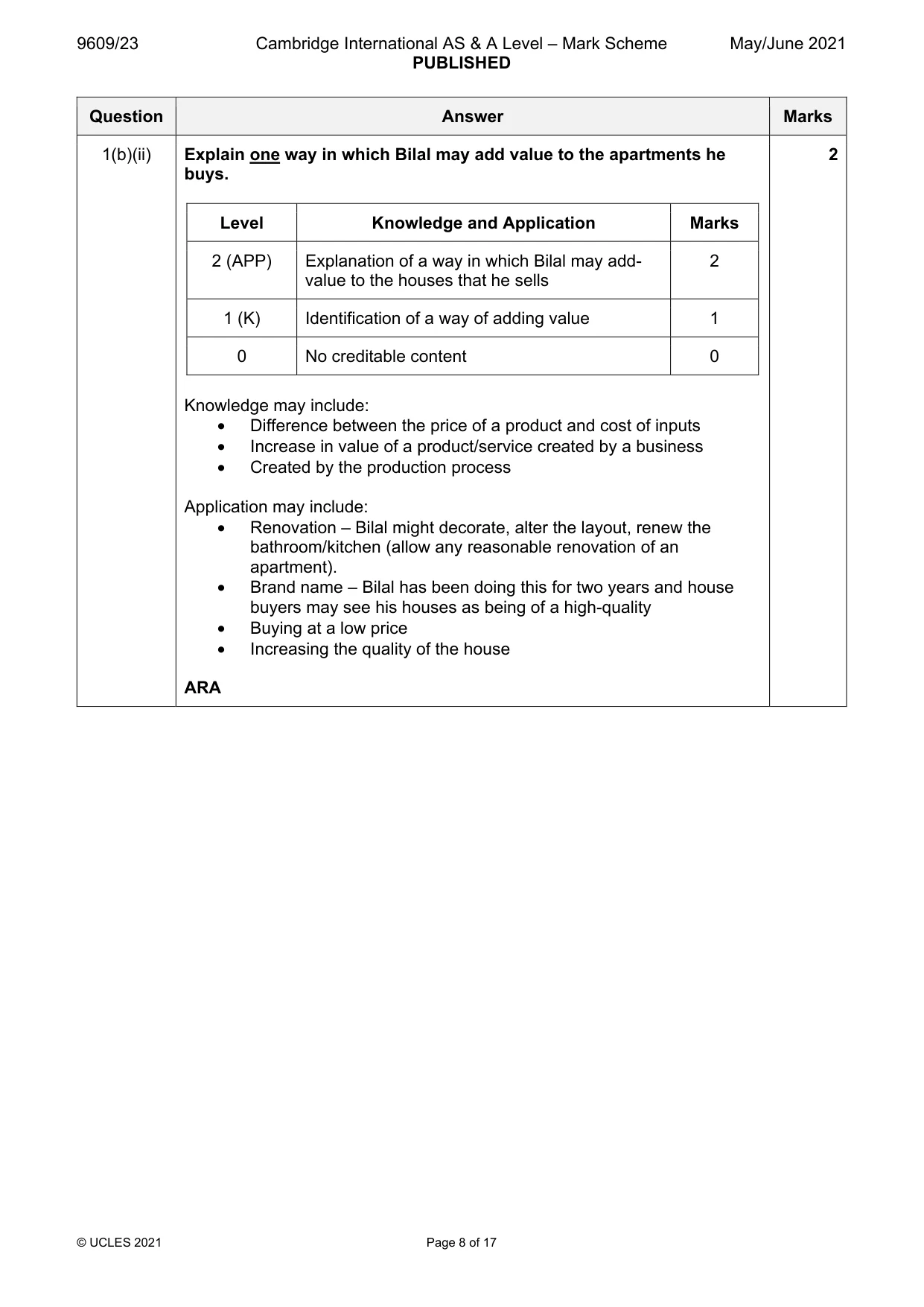
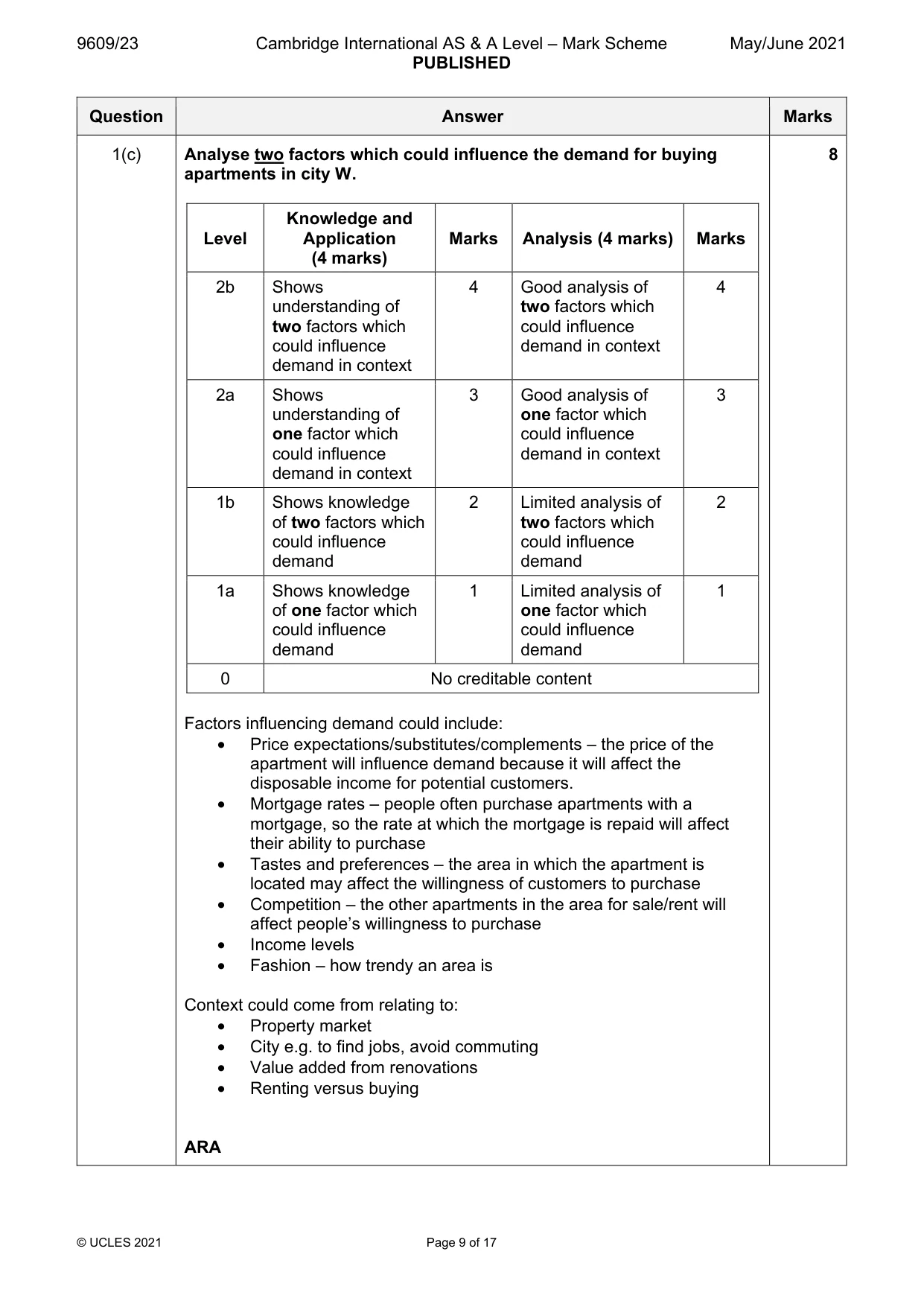
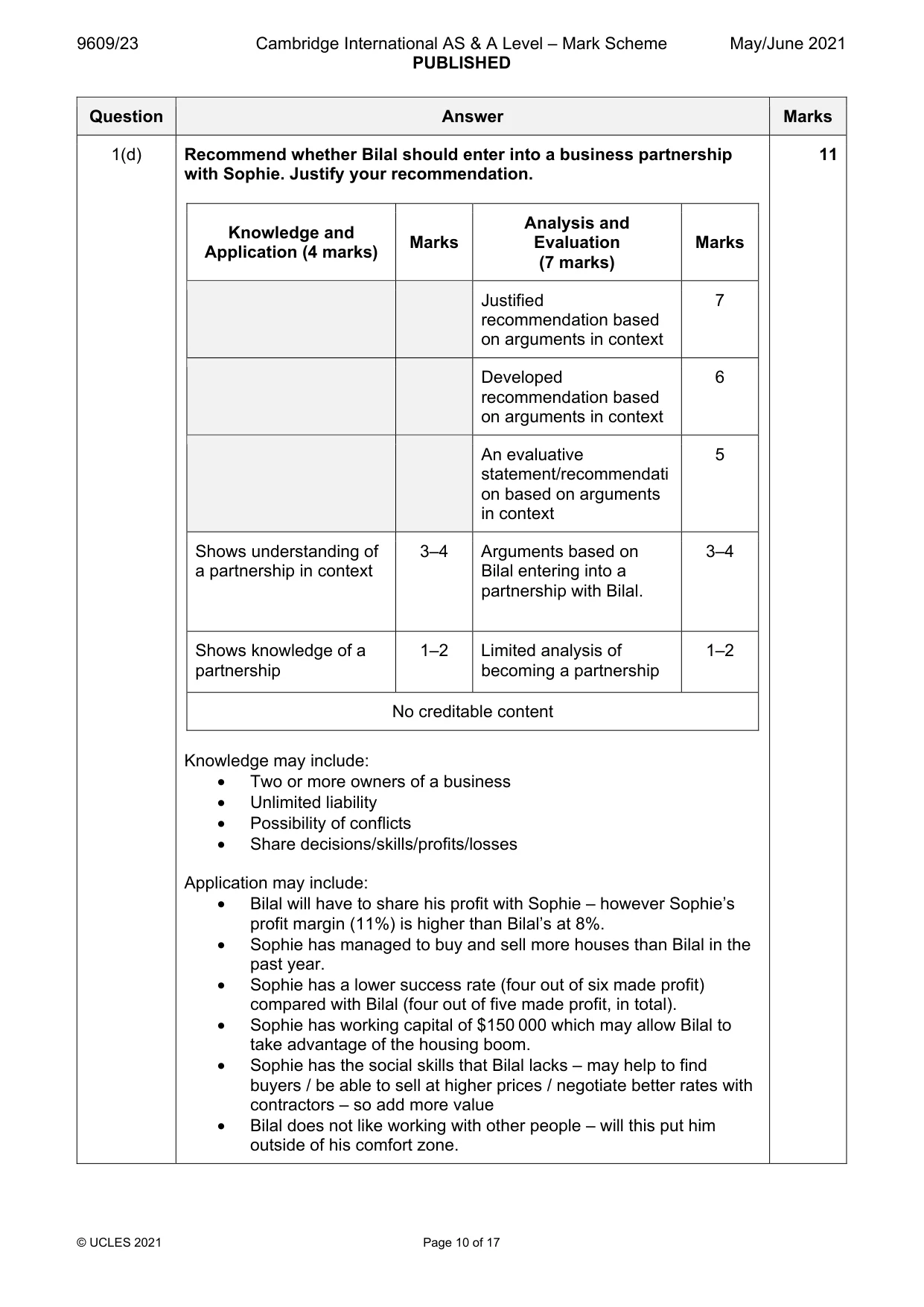
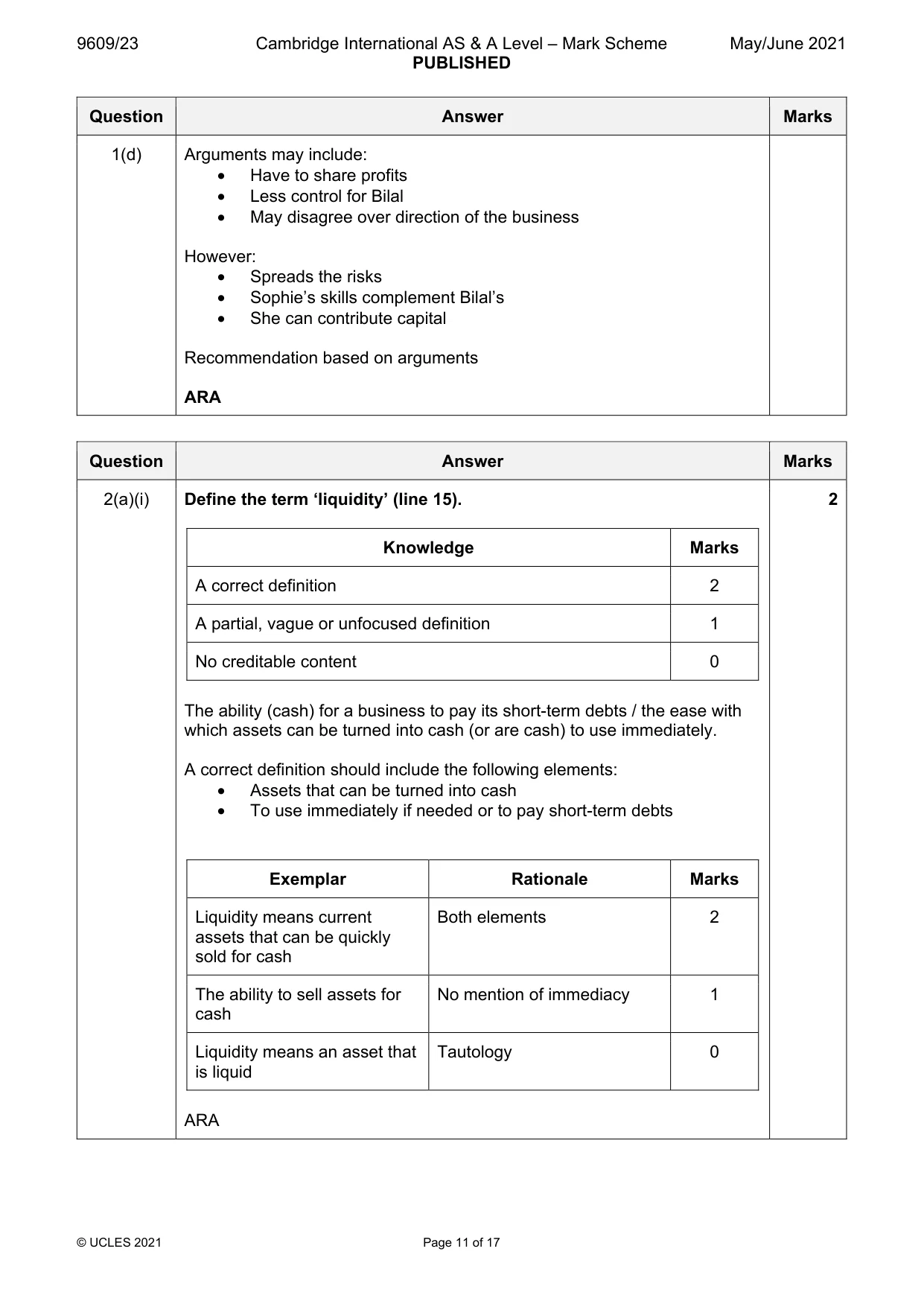
Mark scheme: Question Answer Marks 1(a)(i) Define the term ‘market research’ (line 15). 2 Knowledge Marks A correct definition 2 A partial, vague or unfocused definition 1 No creditable content 0 Gaining information about the potential customers for a product/service A correct definition should include the following elements: • Gaining information / finding out about • about the potential customers for a product/service. Exemplar Rationale Marks Finding out about potential Both elements 2 customers for a food Researching about One element 1 customers for a good Finding information about the One element and a tautology. 1 market Researching the market Tautology 0 ARA 1(a)(ii) Explain the term ‘social awareness’ (line 29). 3 Knowledge Marks C Example or some other way of showing good 1 understanding, e.g. one of Goleman’s competencies B Understanding of the issues/problems/have empathy 1 with A Understanding that it is do with 1 society/community/organisations/people Social awareness – an understanding of the problems that different members of society / the community / an organisation face; having empathy/understanding of the issues in a business e.g. is able to negotiate successfully. Exemplar Rationale Marks According to Goleman’s All three elements 3 competencies (C) it means understanding a society’s (A) problems (B). Having empathy with the A and B 2 issues (B) facing a community (A) Understanding a society (A) A only. There must be 1 understanding that it is to do with issues to gain the B mark. Being aware of social norms Tautology 0 ARA 1(b)(i) Refer to Table 1.1. Calculate the profit margin Bilal made on the last 4 three apartments that he bought and sold. Rationale Marks Correct answer(s) with or without correct working or units 4 Correct calculation of total revenue AND total profit(s) 3 Correct calculation of total revenue OR total profit(s) 2 Formula (can be implied from the correct use of figures) 1 No creditable content 0 Award full marks for a correct answer, with or without working or % Content Formula: Total revenue × 100 (1) Total profit Apartment A – $14 000 profit $14 000 × 100 = 17.5% $8000 Apartment B – $20 000 profit $20 000 × 100 = 13.33% $150 000 Apartment C – $10 000 loss $–10 000 × 100 = –14.29% $70 000 Total = $24 000 total profit Total revenue = $80 000 + $150 000 + $70 000 = $300 000 (1) $24 000 × 100 = 8% (4) $300 000 OFR 1(b)(ii) Explain one way in which Bilal may add value to the apartments he 2 buys. Level Knowledge and Application Marks 2 (APP) Explanation of a way in which Bilal may add- 2 value to the houses that he sells 1 (K) Identification of a way of adding value 1 0 No creditable content 0 Knowledge may include: • Difference between the price of a product and cost of inputs • Increase in value of a product/service created by a business • Created by the production process Application may include: • Renovation – Bilal might decorate, alter the layout, renew the bathroom/kitchen (allow any reasonable renovation of an apartment). • Brand name – Bilal has been doing this for two years and house buyers may see his houses as being of a high-quality • Buying at a low price • Increasing the quality of the house ARA 1(c) Analyse two factors which could influence the demand for buying 8 apartments in city W . Knowledge and Level Application Marks Analysis (4 marks) Marks (4 marks) 2b Shows 4 Good analysis of 4 understanding of two factors which two factors which could influence could influence demand in context demand in context 2a Shows 3 Good analysis of 3 understanding of one factor which one factor which could influence could influence demand in context demand in context 1b Shows knowledge 2 Limited analysis of 2 of two factors which two factors which could influence could influence demand demand 1a Shows knowledge 1 Limited analysis of 1 of one factor which one factor which could influence could influence demand demand 0 No creditable content Factors influencing demand could include: • Price expectations/substitutes/complements – the price of the apartment will influence demand because it will affect the disposable income for potential customers. • Mortgage rates – people often purchase apartments with a mortgage, so the rate at which the mortgage is repaid will affect their ability to purchase • Tastes and preferences – the area in which the apartment is located may affect the willingness of customers to purchase • Competition – the other apartments in the area for sale/rent will affect people’s willingness to purchase • Income levels • Fashion – how trendy an area is Context could come from relating to: • Property market • City e.g. to find jobs, avoid commuting • Value added from renovations • Renting versus buying ARA 1(d) Recommend whether Bilal should enter into a business partnership 11 with Sophie. Justify your recommendation. Analysis and Knowledge and Marks Evaluation Marks Application (4 marks) (7 marks) Justified 7 recommendation based on arguments in context Developed 6 recommendation based on arguments in context An evaluative 5 statement/recommendati on based on arguments in context Shows understanding of 3–4 Arguments based on 3–4 a partnership in context Bilal entering into a partnership with Bilal. Shows knowledge of a 1–2 Limited analysis of 1–2 partnership becoming a partnership No creditable content Knowledge may include: • Two or more owners of a business • Unlimited liability • Possibility of conflicts • Share decisions/skills/profits/losses Application may include: • Bilal will have to share his profit with Sophie – however Sophie’s profit margin (11%) is higher than Bilal’s at 8%. • Sophie has managed to buy and sell more houses than Bilal in the past year. • Sophie has a lower success rate (four out of six made profit) compared with Bilal (four out of five made profit, in total). • Sophie has working capital of $150 000 which may allow Bilal to take advantage of the housing boom. • Sophie has the social skills that Bilal lacks – may help to find buyers / be able to sell at higher prices / negotiate better rates with contractors – so add more value • Bilal does not like working with other people – will this put him outside of his comfort zone. 1(d) Arguments may include: • Have to share profits • Less control for Bilal • May disagree over direction of the business However: • Spreads the risks • Sophie’s skills complement Bilal’s • She can contribute capital Recommendation based on arguments ARA
Q2 · Belted Up (BU) Belted Up (BU) is a manufacturer of hand-made leather belts for clothing
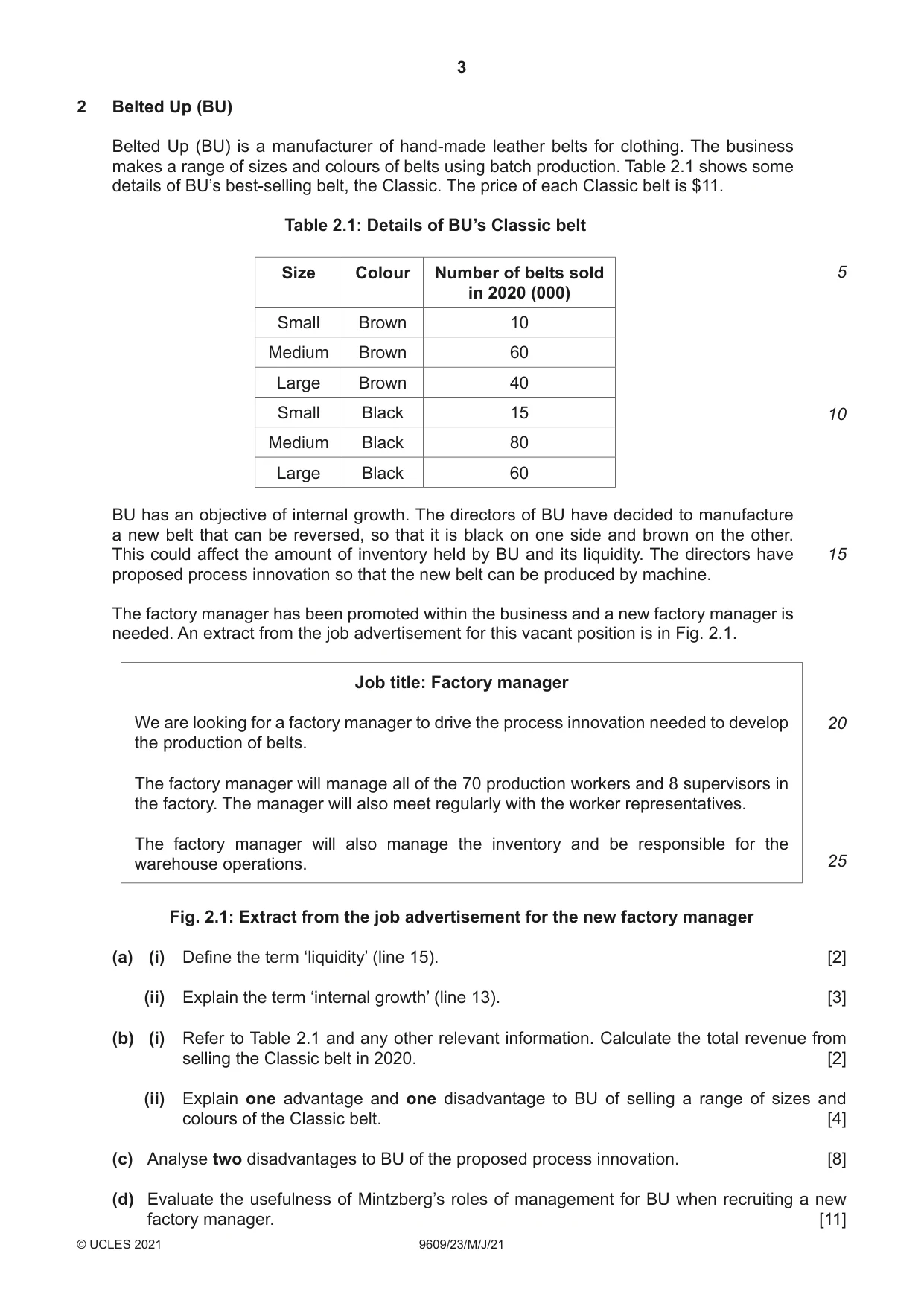
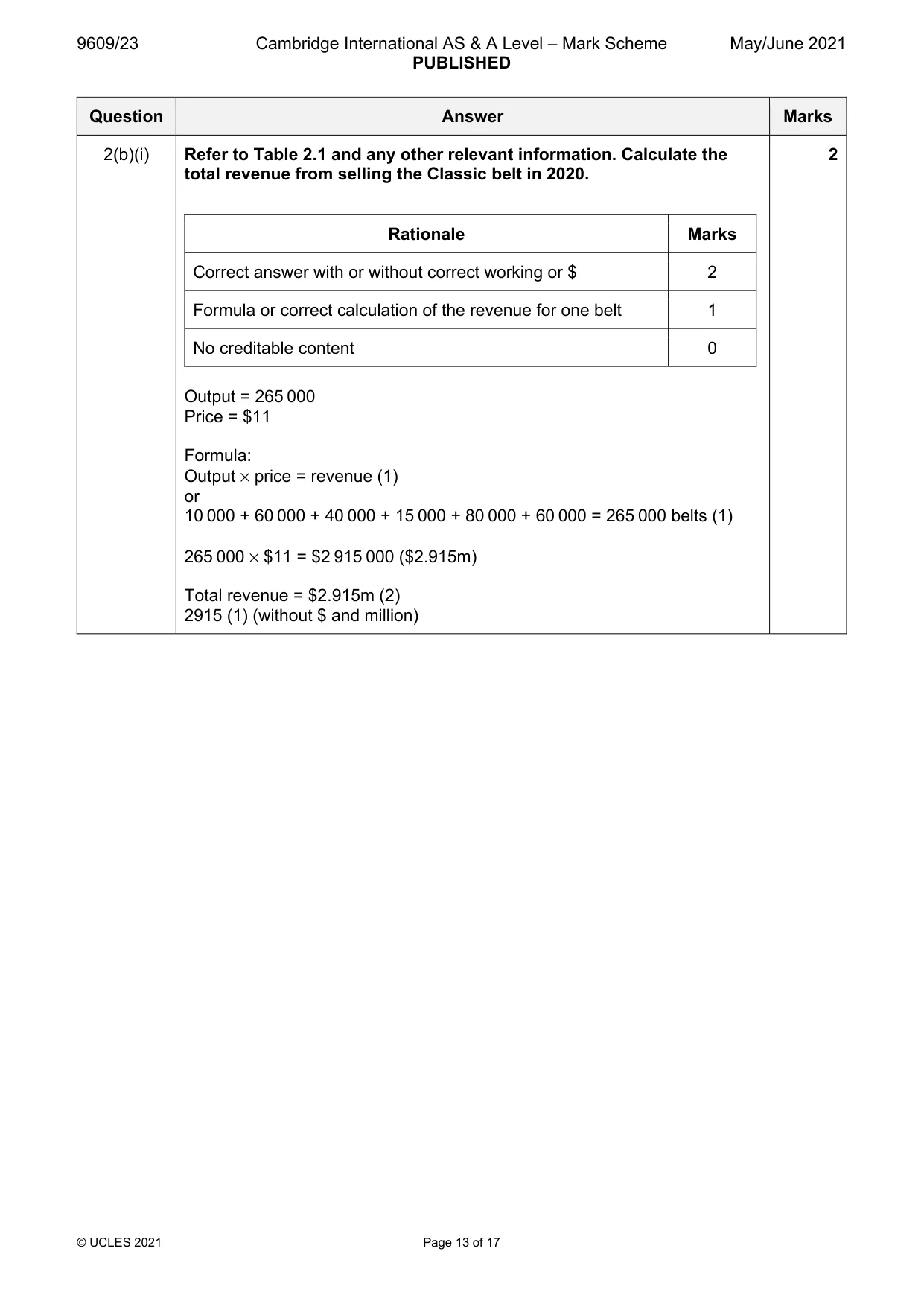
2 Belted Up (BU) Belted Up (BU) is a manufacturer of hand-made leather belts for clothing. The business makes a range of sizes and colours of belts using batch production. Table 2.1 shows some details of BU’s best-selling belt, the Classic. The price of each Classic belt is $11. Table 2.1: Details of BU’s Classic belt Size Colour Number of belts sold 5 in 2020 (000) Small Brown 10 Medium Brown 60 Large Brown 40 Small Black 15 10 Medium Black 80 Large Black 60 BU has an objective of internal growth. The directors of BU have decided to manufacture a new belt that can be reversed, so that it is black on one side and brown on the other. This could affect the amount of inventory held by BU and its liquidity. The directors have 15 proposed process innovation so that the new belt can be produced by machine. The factory manager has been promoted within the business and a new factory manager is needed. An extract from the job advertisement for this vacant position is in Fig. 2.1. Job title: Factory manager We are looking for a factory manager to drive the process innovation needed to develop 20 the production of belts. The factory manager will manage all of the 70 production workers and 8 supervisors in the factory. The manager will also meet regularly with the worker representatives. The factory manager will also manage the inventory and be responsible for the warehouse operations. 25 Fig. 2.1: Extract from the job advertisement for the new factory manager (a) (i) Define the term ‘liquidity’ (line 15). [2] (ii) Explain the term ‘internal growth’ (line 13). [3] (b) (i) Refer to Table 2.1 and any other relevant information. Calculate the total revenue from selling the Classic belt in 2020. [2] (ii) Explain one advantage and one disadvantage to BU of selling a range of sizes and colours of the Classic belt. [4] (c) Analyse two disadvantages to BU of the proposed process innovation. [8] (d) Evaluate the usefulness of Mintzberg’s roles of management for BU when recruiting a new
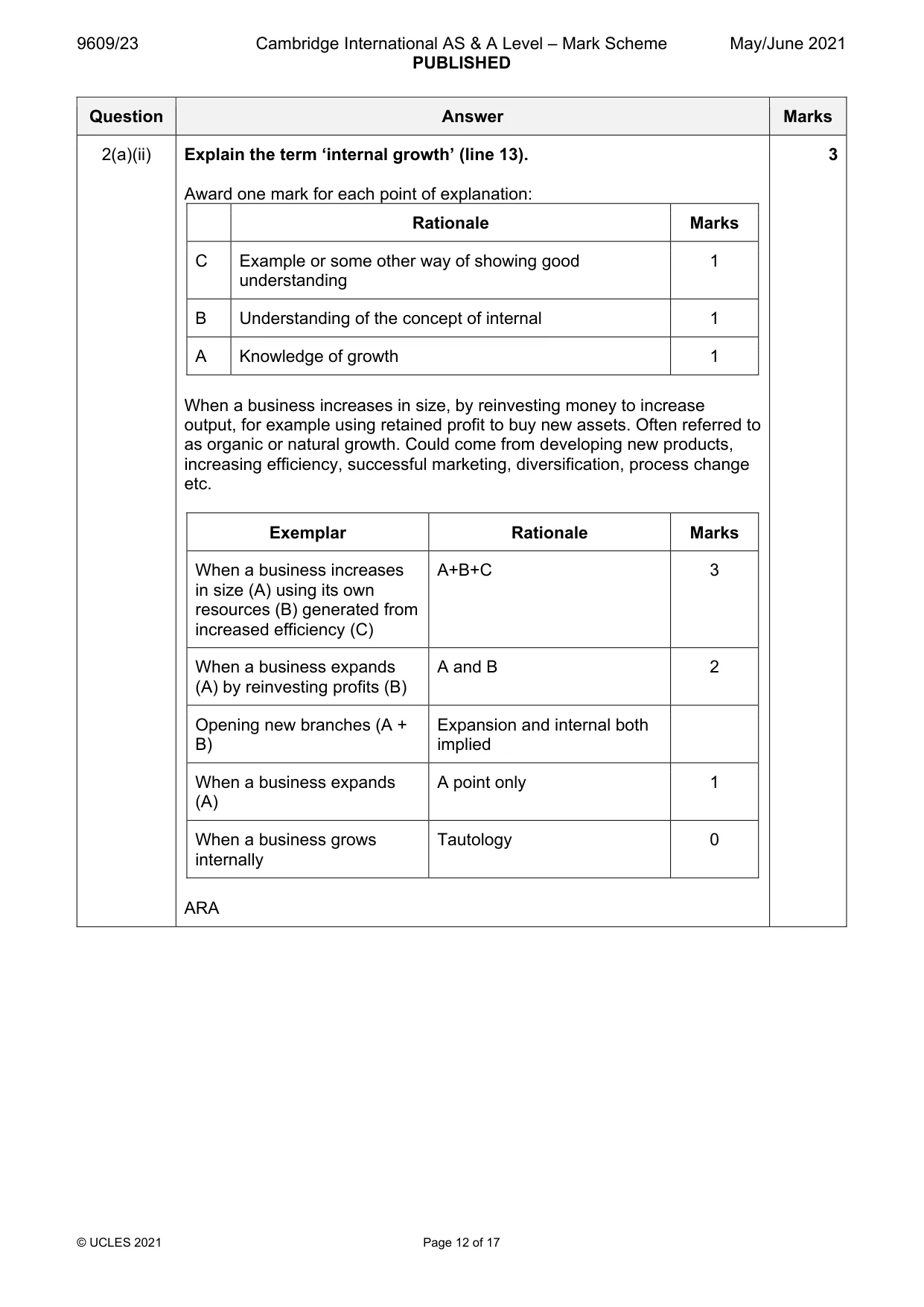
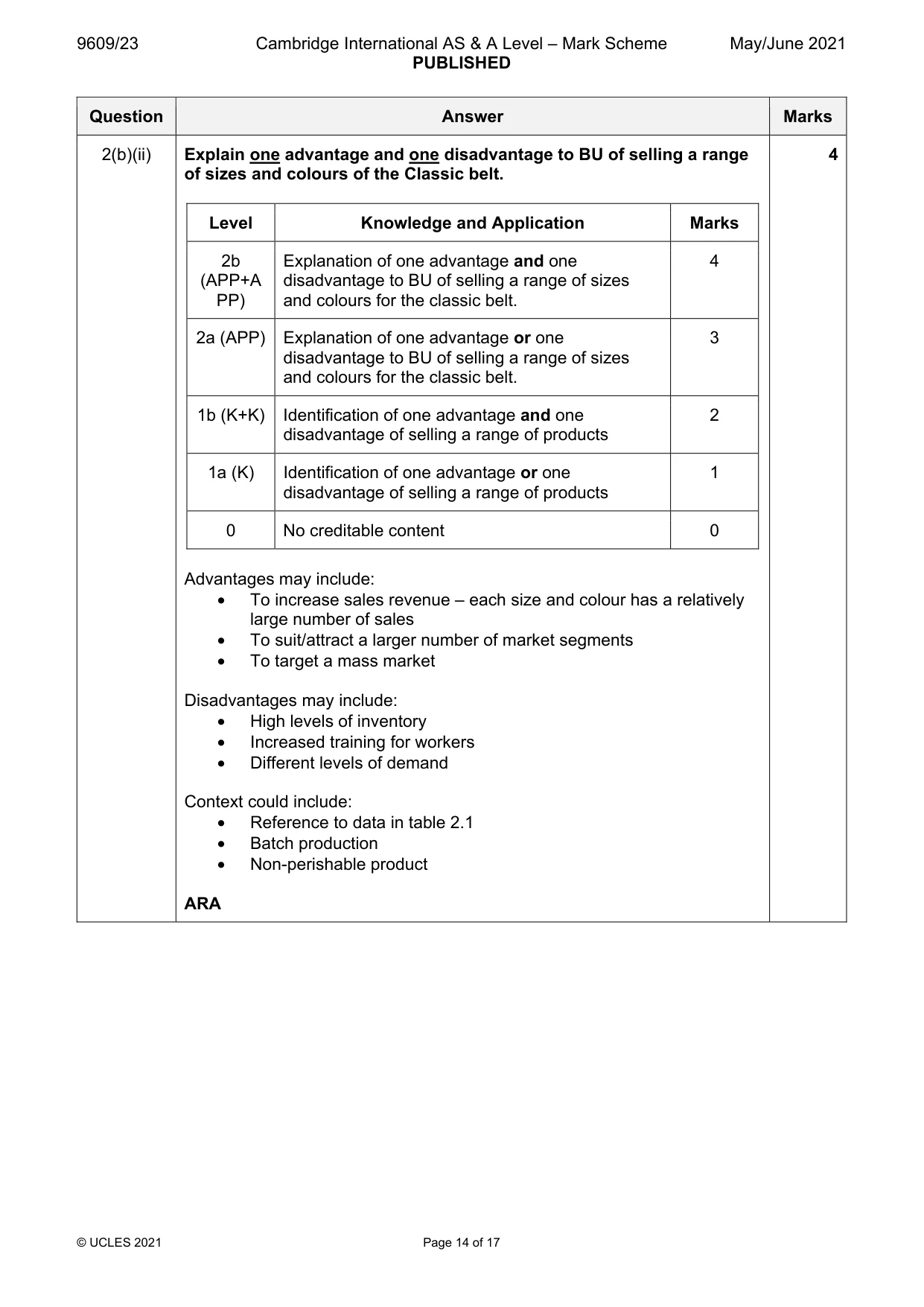
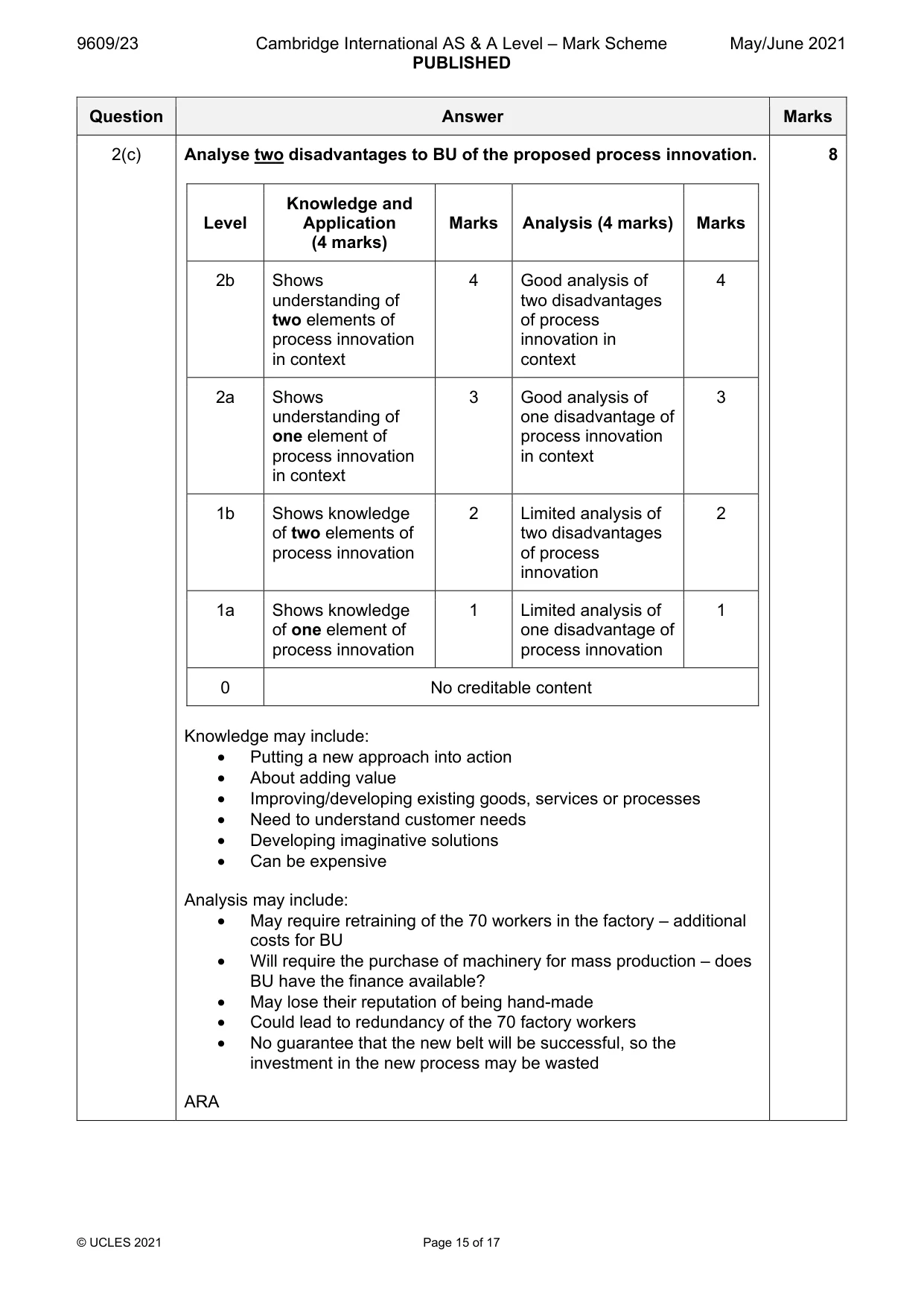
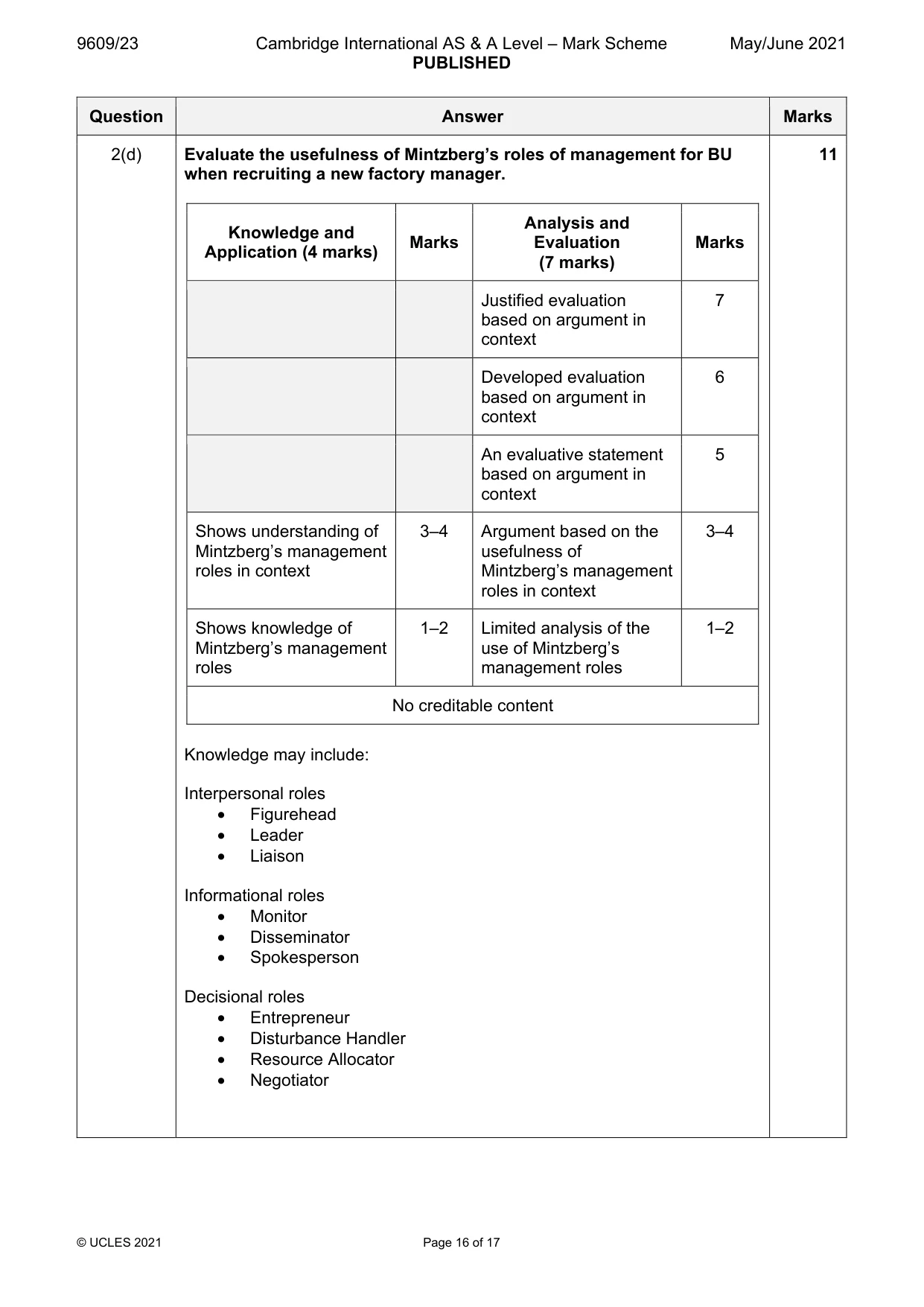
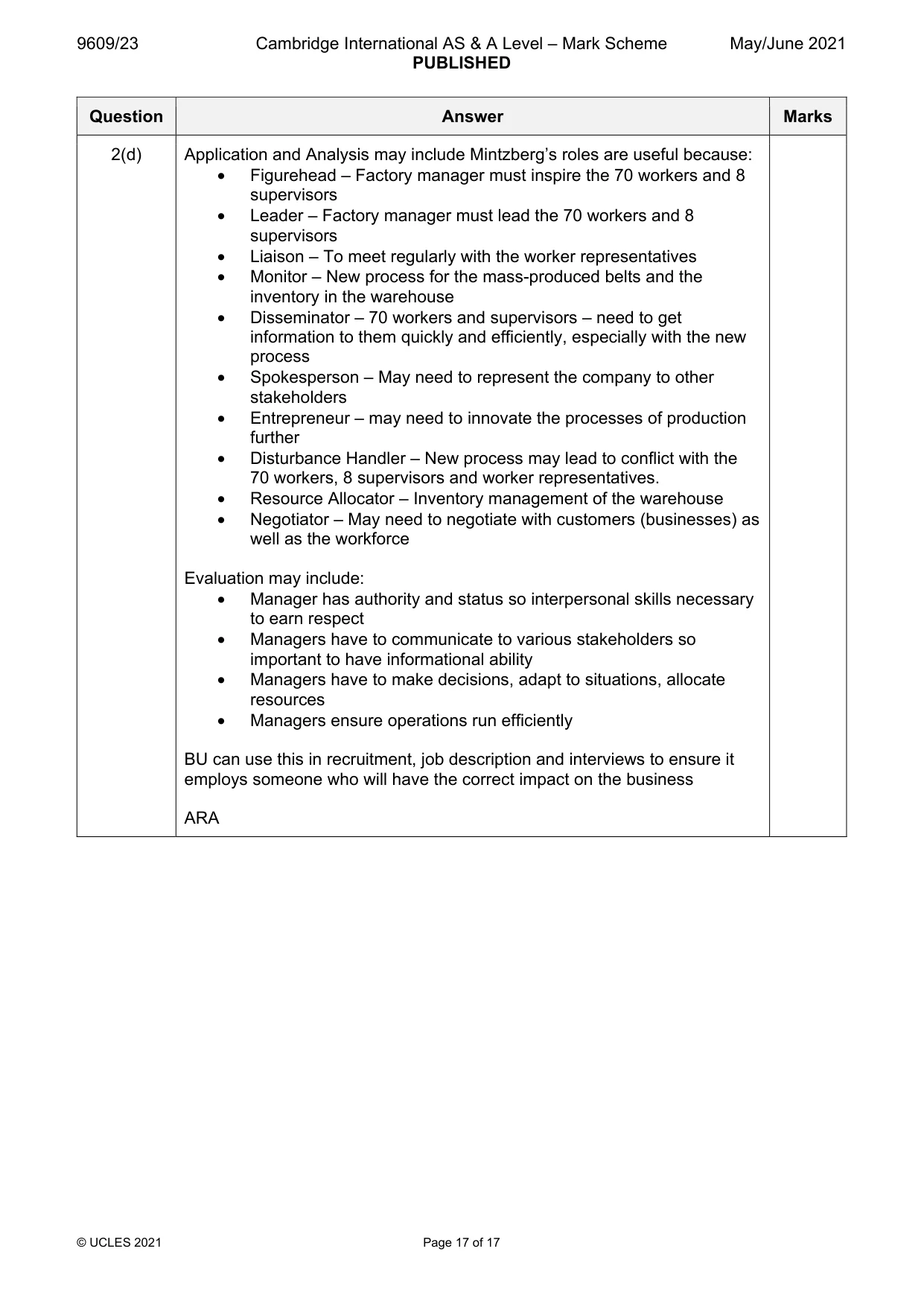
Mark scheme: 2(a)(i) Define the term ‘liquidity’ (line 15). 2 Knowledge Marks A correct definition 2 A partial, vague or unfocused definition 1 No creditable content 0 The ability (cash) for a business to pay its short-term debts / the ease with which assets can be turned into cash (or are cash) to use immediately. A correct definition should include the following elements: • Assets that can be turned into cash • To use immediately if needed or to pay short-term debts Exemplar Rationale Marks Liquidity means current Both elements 2 assets that can be quickly sold for cash The ability to sell assets for No mention of immediacy 1 cash Liquidity means an asset that Tautology 0 is liquid ARA 2(a)(ii) Explain the term ‘internal growth’ (line 13). 3 Award one mark for each point of explanation: Rationale Marks C Example or some other way of showing good 1 understanding B Understanding of the concept of internal 1 A Knowledge of growth 1 When a business increases in size, by reinvesting money to increase output, for example using retained profit to buy new assets. Often referred to as organic or natural growth. Could come from developing new products, increasing efficiency, successful marketing, diversification, process change etc. Exemplar Rationale Marks When a business increases A+B+C 3 in size (A) using its own resources (B) generated from increased efficiency (C) When a business expands A and B 2 (A) by reinvesting profits (B) Opening new branches (A + Expansion and internal both B) implied When a business expands A point only 1 (A) When a business grows Tautology 0 internally ARA 2(b)(i) Refer to Table 2.1 and any other relevant information. Calculate the 2 total revenue from selling the Classic belt in 2020. Rationale Marks Correct answer with or without correct working or $ 2 Formula or correct calculation of the revenue for one belt 1 No creditable content 0 Output = 265 000 Price = $11 Formula: Output × price = revenue (1) or 10 000 + 60 000 + 40 000 + 15 000 + 80 000 + 60 000 = 265 000 belts (1) 265 000 × $11 = $2 915 000 ($2.915m) Total revenue = $2.915m (2) 2915 (1) (without $ and million) 2(b)(ii) Explain one advantage and one disadvantage to BU of selling a range 4 of sizes and colours of the Classic belt. Level Knowledge and Application Marks 2b Explanation of one advantage and one 4 (APP+A disadvantage to BU of selling a range of sizes PP) and colours for the classic belt. 2a (APP) Explanation of one advantage or one 3 disadvantage to BU of selling a range of sizes and colours for the classic belt. 1b (K+K) Identification of one advantage and one 2 disadvantage of selling a range of products 1a (K) Identification of one advantage or one 1 disadvantage of selling a range of products 0 No creditable content 0 Advantages may include: • To increase sales revenue – each size and colour has a relatively large number of sales • To suit/attract a larger number of market segments • To target a mass market Disadvantages may include: • High levels of inventory • Increased training for workers • Different levels of demand Context could include: • Reference to data in table 2.1 • Batch production • Non-perishable product ARA 2(c) Analyse two disadvantages to BU of the proposed process innovation. 8 Knowledge and Level Application Marks Analysis (4 marks) Marks (4 marks) 2b Shows 4 Good analysis of 4 understanding of two disadvantages two elements of of process process innovation innovation in in context context 2a Shows 3 Good analysis of 3 understanding of one disadvantage of one element of process innovation process innovation in context in context 1b Shows knowledge 2 Limited analysis of 2 of two elements of two disadvantages process innovation of process innovation 1a Shows knowledge 1 Limited analysis of 1 of one element of one disadvantage of process innovation process innovation 0 No creditable content Knowledge may include: • Putting a new approach into action • About adding value • Improving/developing existing goods, services or processes • Need to understand customer needs • Developing imaginative solutions • Can be expensive Analysis may include: • May require retraining of the 70 workers in the factory – additional costs for BU • Will require the purchase of machinery for mass production – does BU have the finance available? • May lose their reputation of being hand-made • Could lead to redundancy of the 70 factory workers • No guarantee that the new belt will be successful, so the investment in the new process may be wasted ARA 2(d) Evaluate the usefulness of Mintzberg’s roles of management for BU 11 when recruiting a new factory manager. Analysis and Knowledge and Marks Evaluation Marks Application (4 marks) (7 marks) Justified evaluation 7 based on argument in context Developed evaluation 6 based on argument in context An evaluative statement 5 based on argument in context Shows understanding of 3–4 Argument based on the 3–4 Mintzberg’s management usefulness of roles in context Mintzberg’s management roles in context Shows knowledge of 1–2 Limited analysis of the 1–2 Mintzberg’s management use of Mintzberg’s roles management roles No creditable content Knowledge may include: Interpersonal roles • Figurehead • Leader • Liaison Informational roles • Monitor • Disseminator • Spokesperson Decisional roles • Entrepreneur • Disturbance Handler • Resource Allocator • Negotiator 2(d) Application and Analysis may include Mintzberg’s roles are useful because: • Figurehead – Factory manager must inspire the 70 workers and 8 supervisors • Leader – Factory manager must lead the 70 workers and 8 supervisors • Liaison – To meet regularly with the worker representatives • Monitor – New process for the mass-produced belts and the inventory in the warehouse • Disseminator – 70 workers and supervisors – need to get information to them quickly and efficiently, especially with the new process • Spokesperson – May need to represent the company to other stakeholders • Entrepreneur – may need to innovate the processes of production further • Disturbance Handler – New process may lead to conflict with the 70 workers, 8 supervisors and worker representatives. • Resource Allocator – Inventory management of the warehouse • Negotiator – May need to negotiate with customers (businesses) as well as the workforce Evaluation may include: • Manager has authority and status so interpersonal skills necessary to earn respect • Managers have to communicate to various stakeholders so important to have informational ability • Managers have to make decisions, adapt to situations, allocate resources • Managers ensure operations run efficiently BU can use this in recruitment, job description and interviews to ensure it employs someone who will have the correct impact on the business ARA
What was in this paper
The subtopics covered by these 2 questions, and how many questions each got. Open one in a new tab to see every Cambridge question on it.
What you needed in this session
Cambridge’s own grade thresholds for 2021 May/June, Paper 2 · Variant 3. A higher threshold means an easier paper — the bar moves with how the cohort did.