Cambridge A Level Business (for first examination in 2016) 9609 — 2021 May/June Paper 2 · Variant 4
9609/24/M/J/21 · 2 questions · 60 marks · ≈68 min
The question paper and its mark scheme, free to read here and free to download. This is Cambridge’s own paper, exactly as it was sat.
Question paper4 pages

Mark scheme18 pages
Answers below. Sit the paper first if you are practising.
Questions as text
Q1 · Apple Farm (AF) AF is owned by Desi
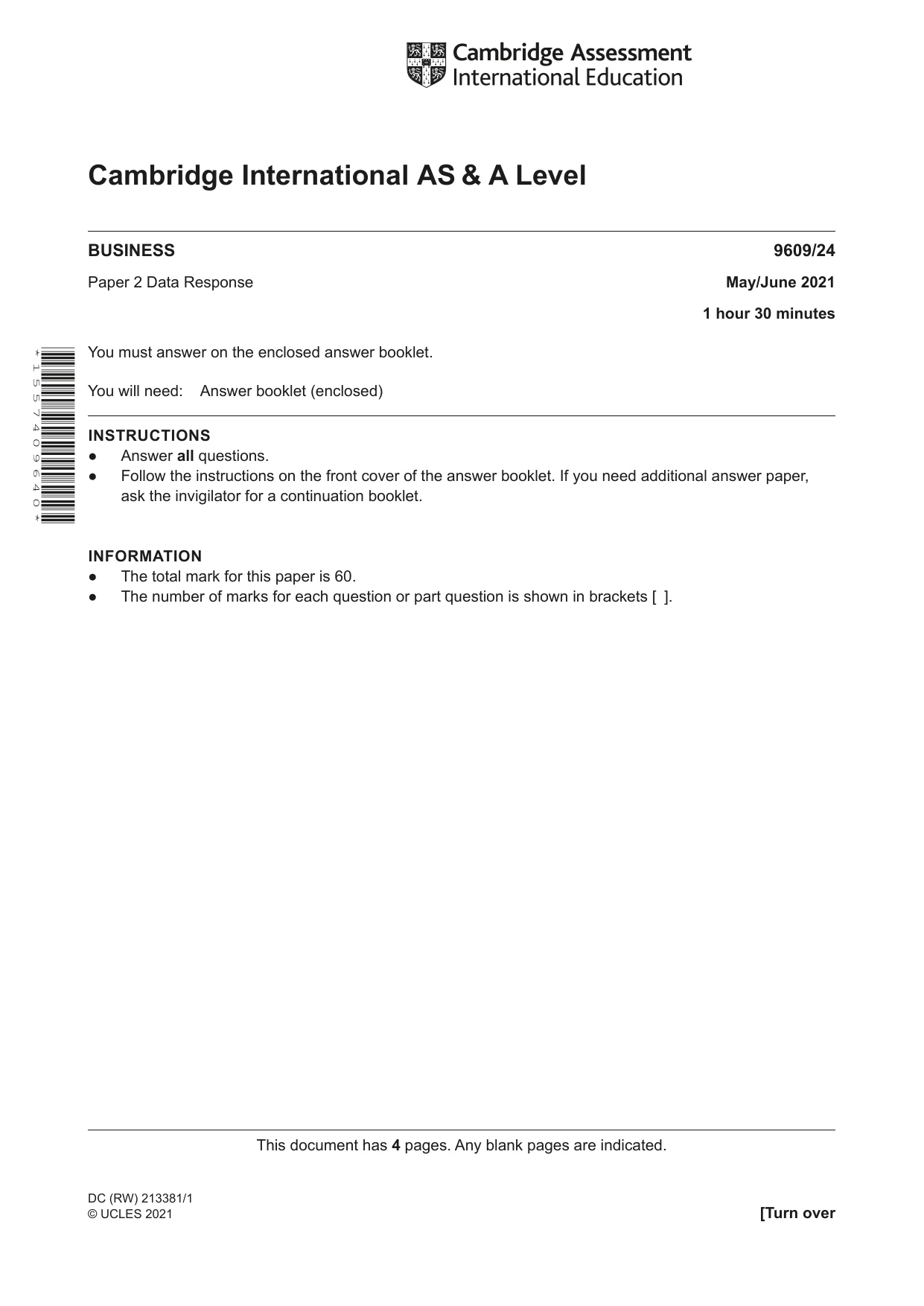
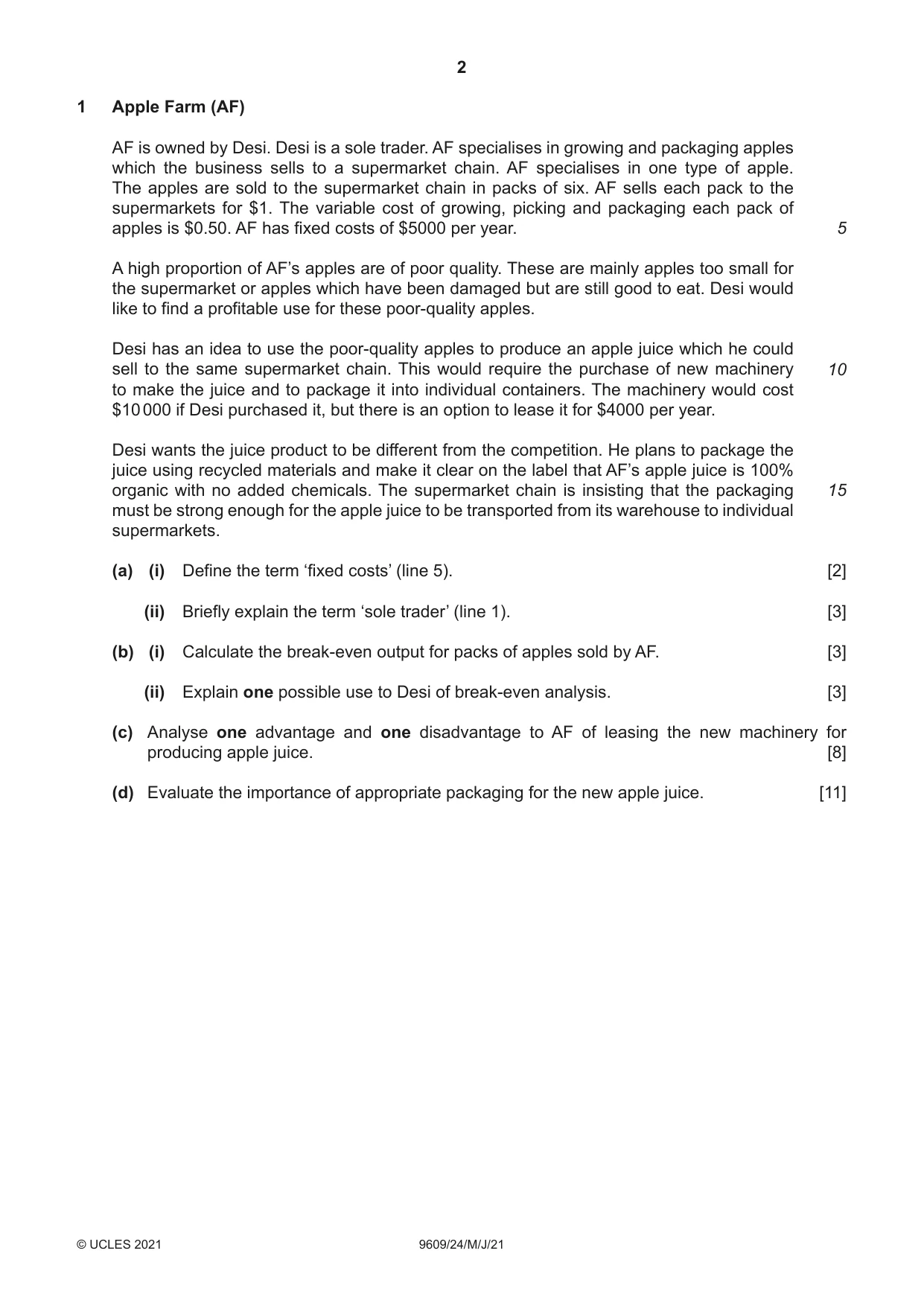
1 Apple Farm (AF) AF is owned by Desi. Desi is a sole trader. AF specialises in growing and packaging apples which the business sells to a supermarket chain. AF specialises in one type of apple. The apples are sold to the supermarket chain in packs of six. AF sells each pack to the supermarkets for $1. The variable cost of growing, picking and packaging each pack of apples is $0.50. AF has fixed costs of $5000 per year. 5 A high proportion of AF’s apples are of poor quality. These are mainly apples too small for the supermarket or apples which have been damaged but are still good to eat. Desi would like to find a profitable use for these poor-quality apples. Desi has an idea to use the poor-quality apples to produce an apple juice which he could sell to the same supermarket chain. This would require the purchase of new machinery 10 to make the juice and to package it into individual containers. The machinery would cost $10 000 if Desi purchased it, but there is an option to lease it for $4000 per year. Desi wants the juice product to be different from the competition. He plans to package the juice using recycled materials and make it clear on the label that AF’s apple juice is 100% organic with no added chemicals. The supermarket chain is insisting that the packaging 15 must be strong enough for the apple juice to be transported from its warehouse to individual supermarkets. (a) (i) Define the term ‘fixed costs’ (line 5). [2] (ii) Briefly explain the term ‘sole trader’ (line 1). [3] (b) (i) Calculate the break-even output for packs of apples sold by AF. [3] (ii) Explain one possible use to Desi of break-even analysis. [3] (c) Analyse one advantage and one disadvantage to AF of leasing the new machinery for producing apple juice. [8] (d) Evaluate the importance of appropriate packaging for the new apple juice. [11]
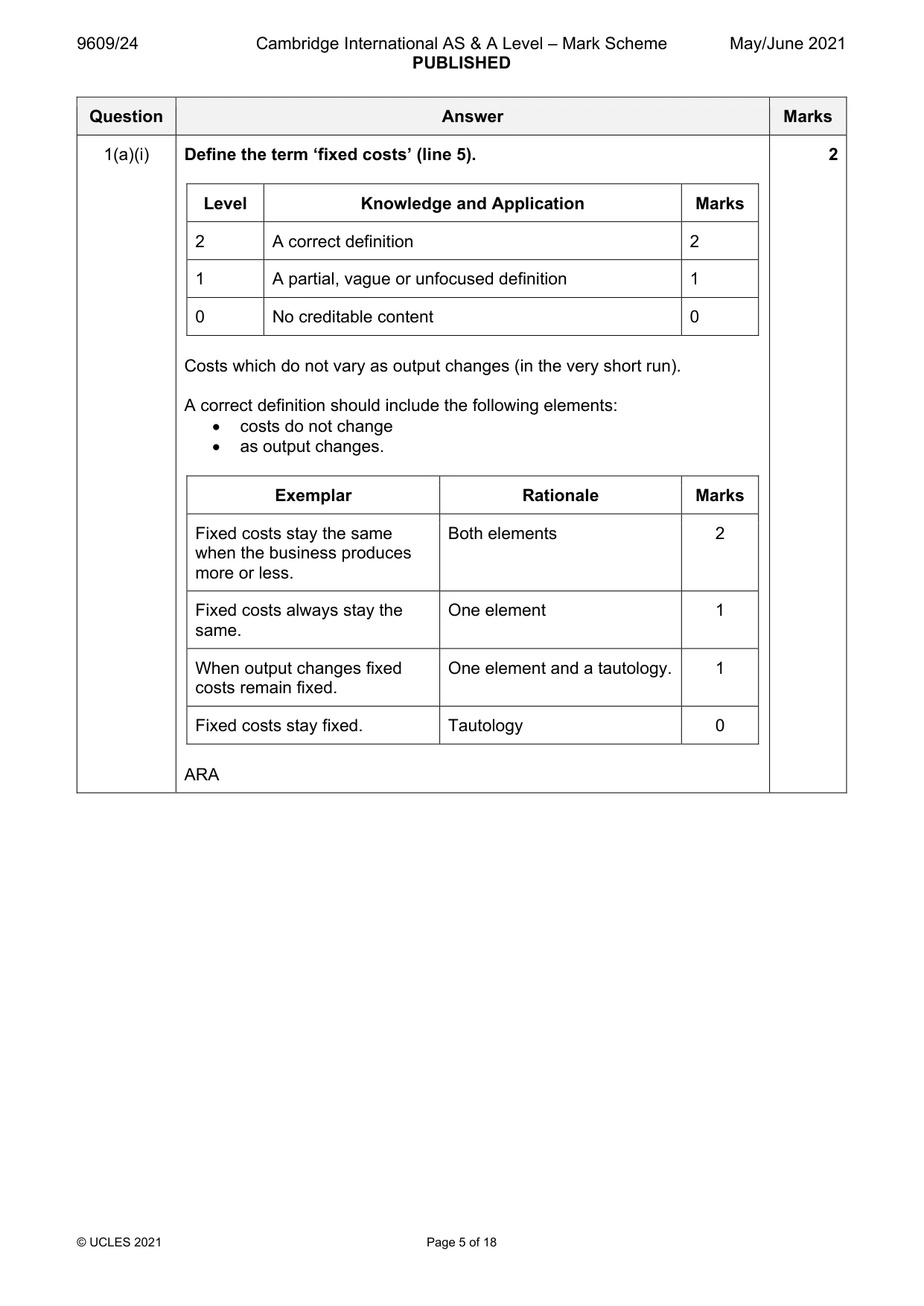
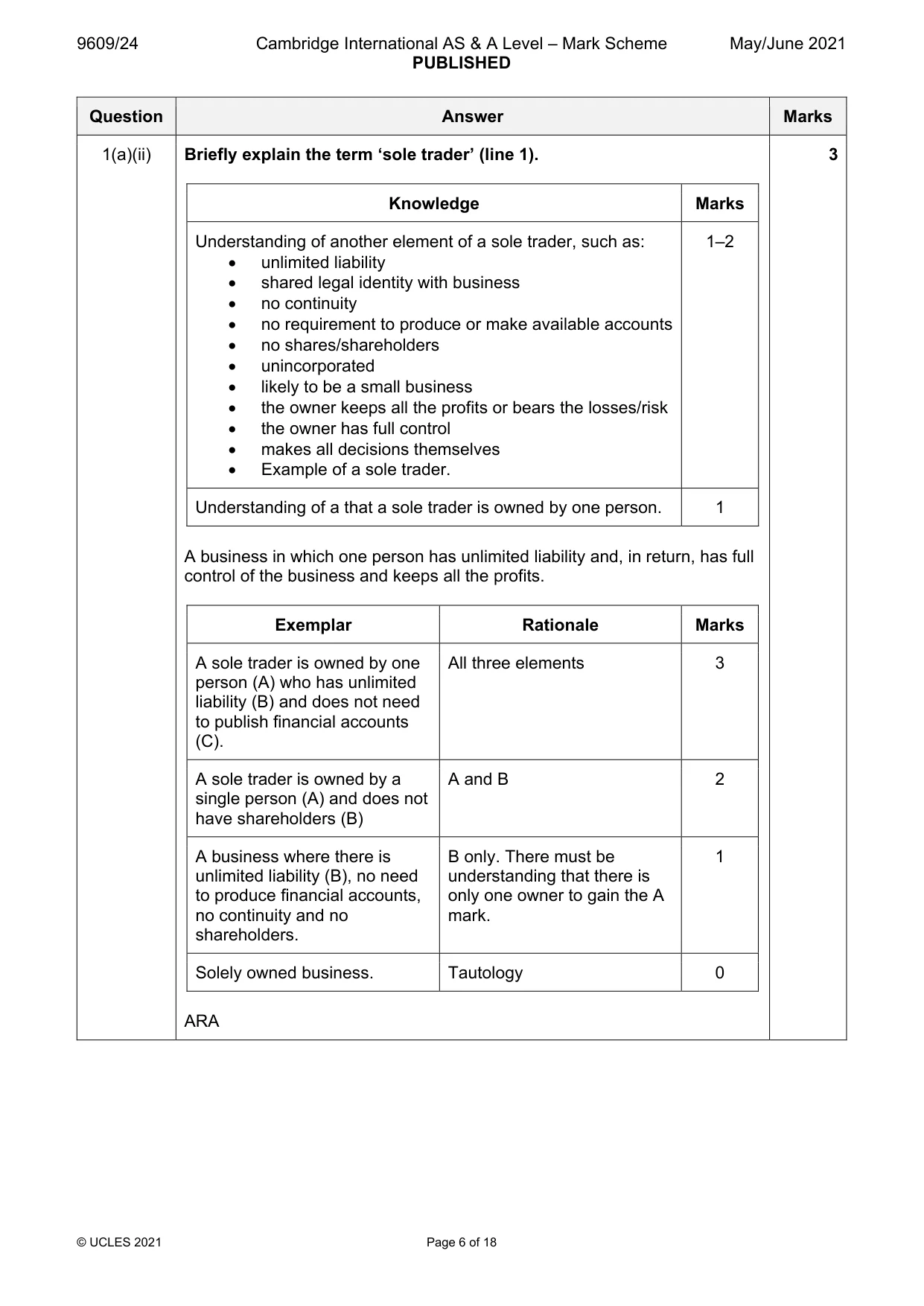
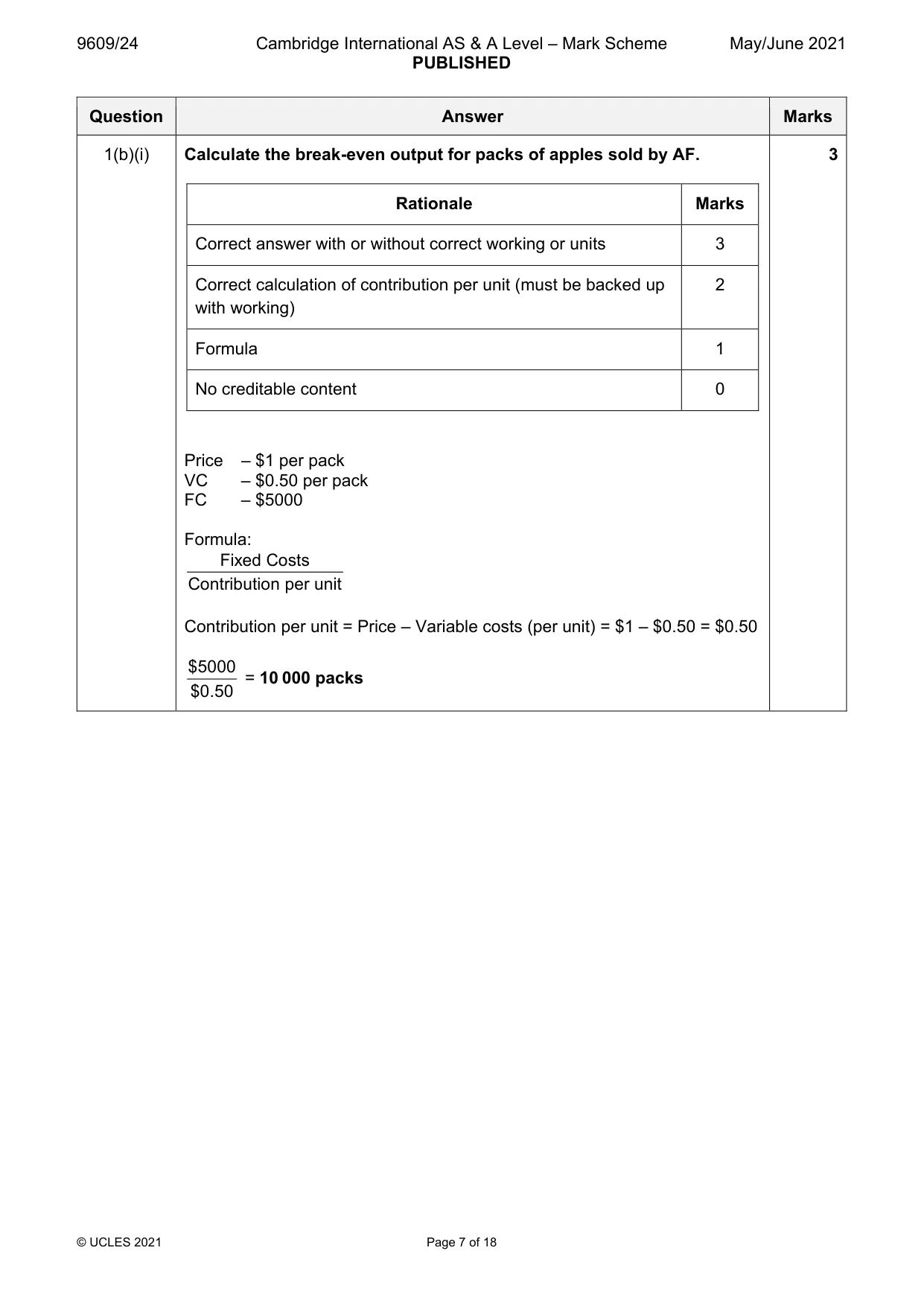
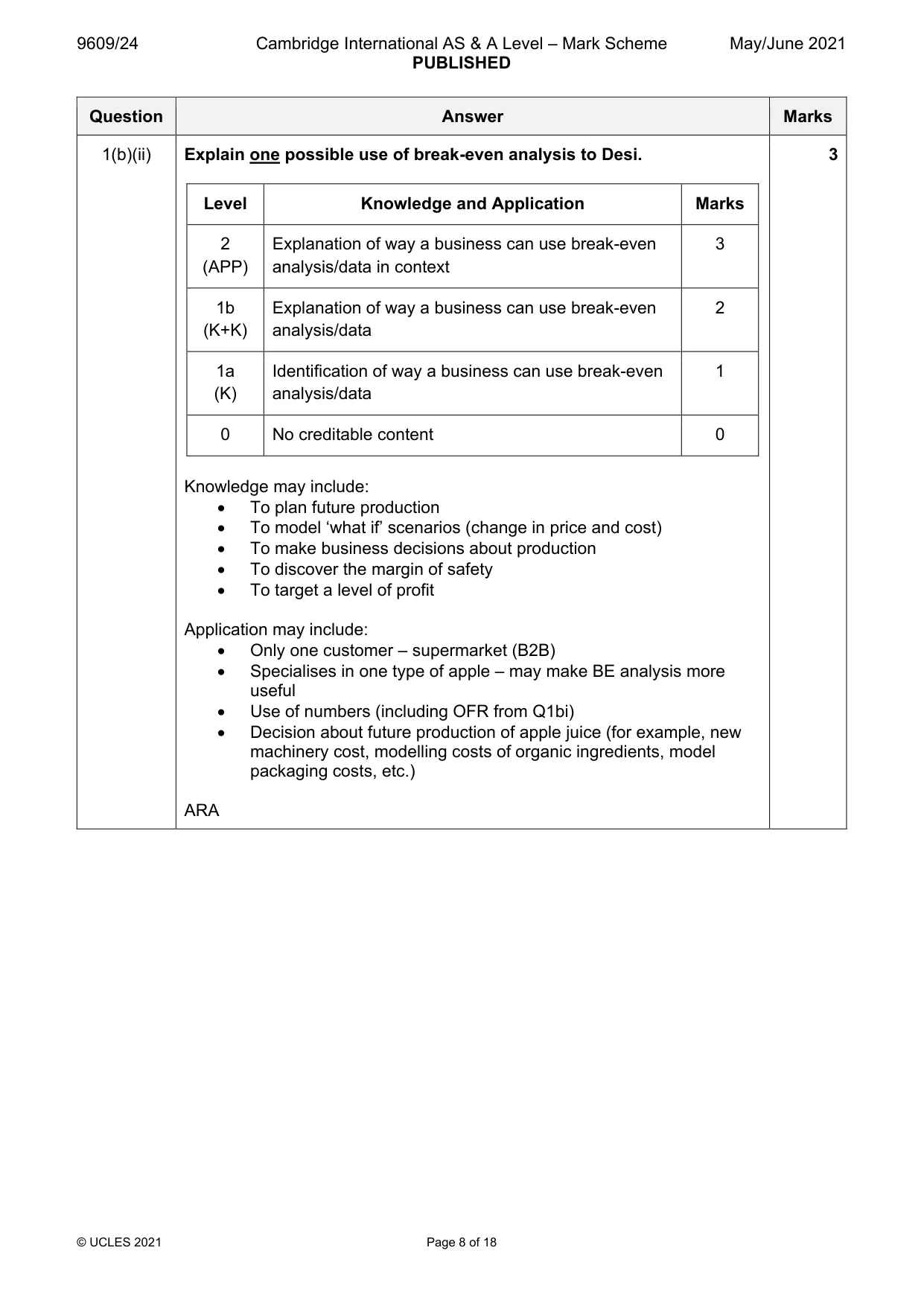
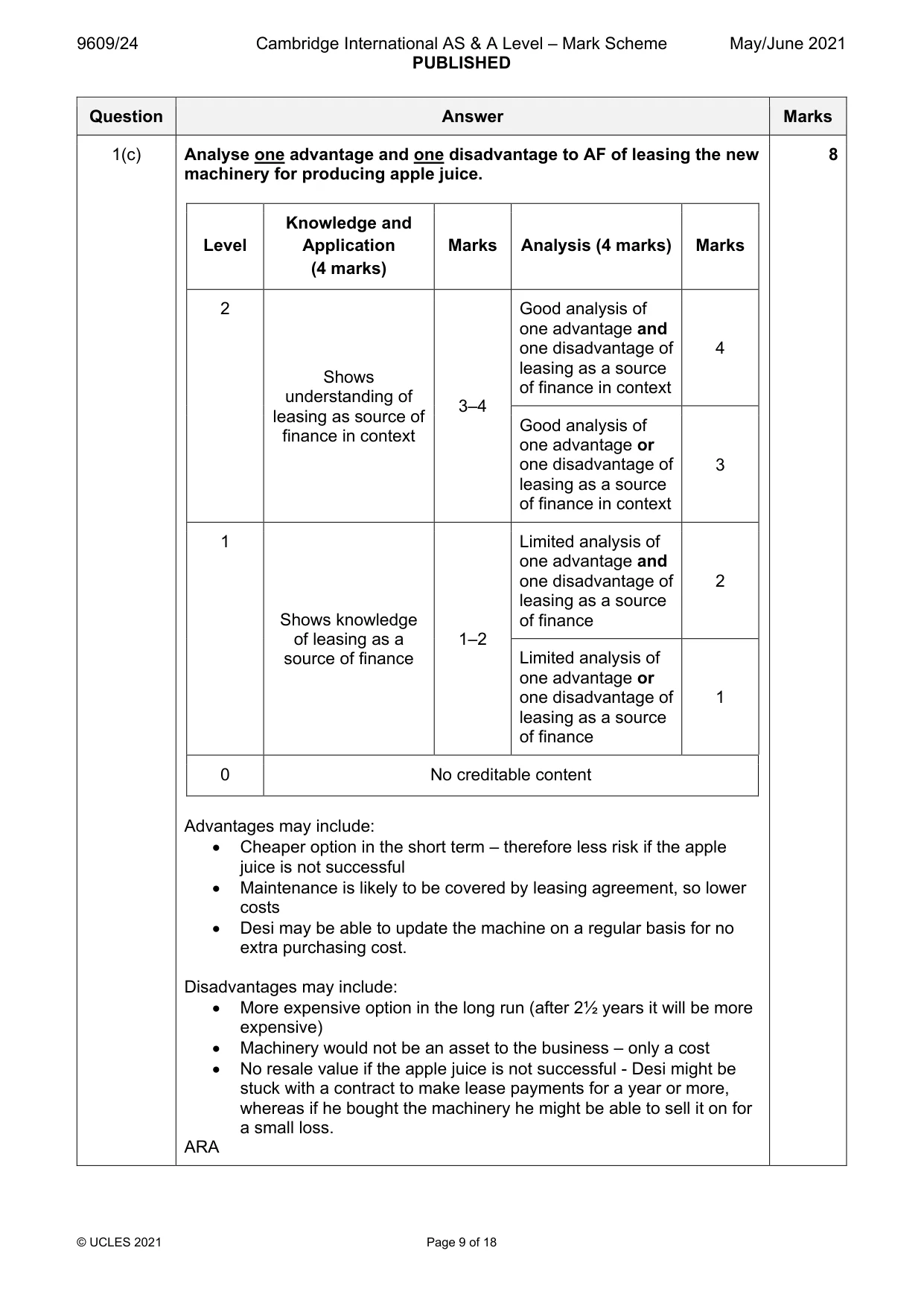
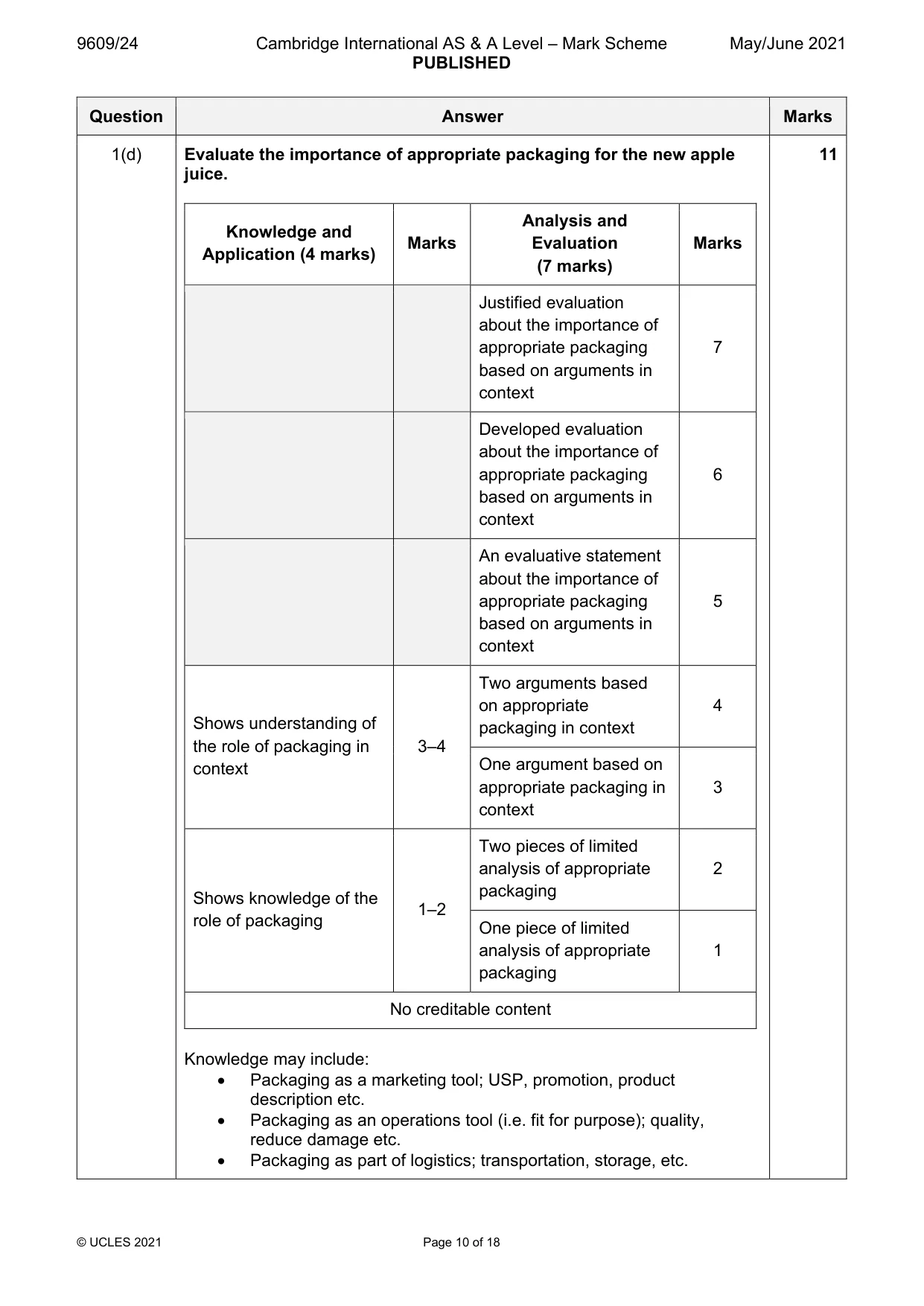
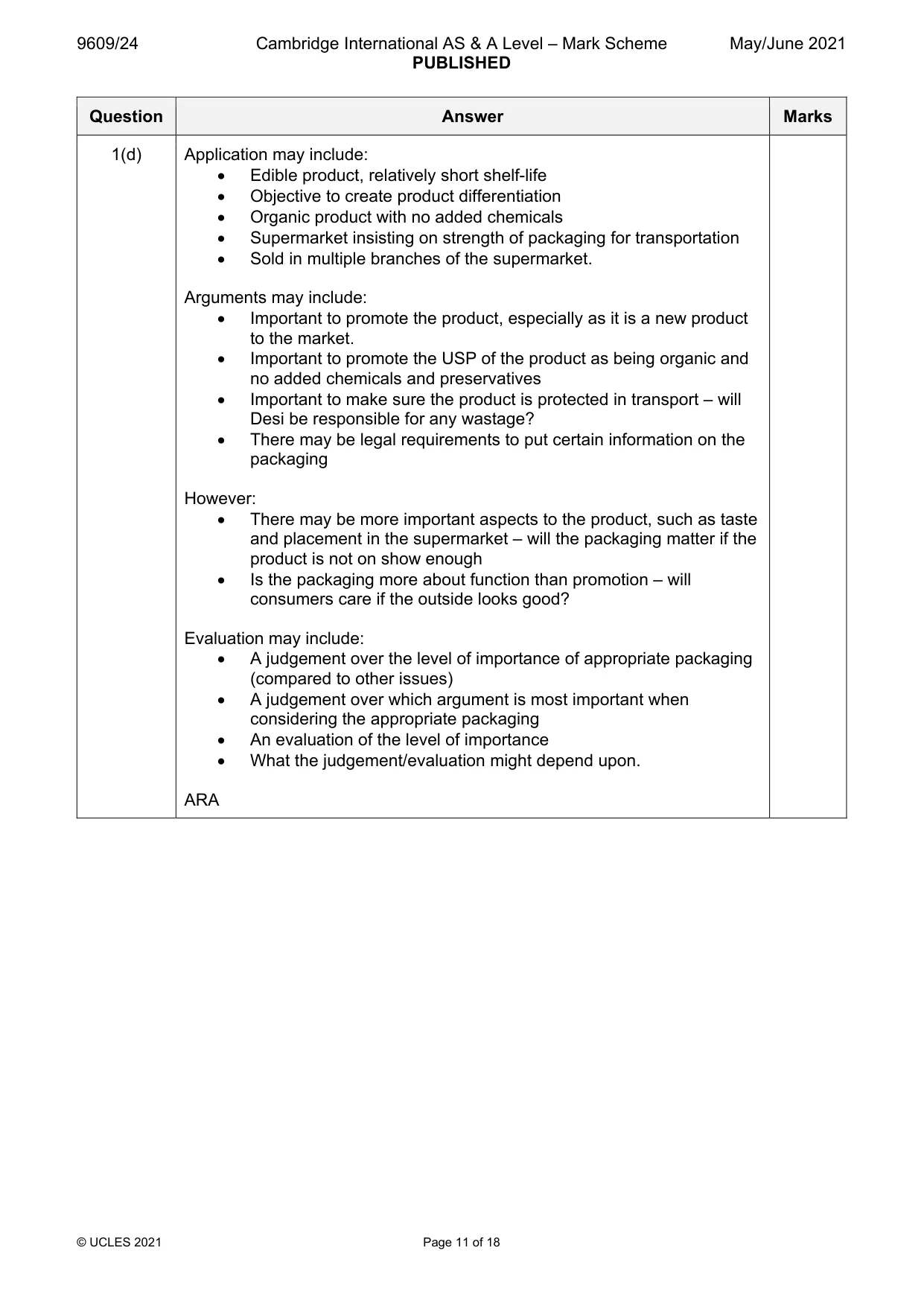
Mark scheme: Question Answer Marks 1(a)(i) Define the term ‘fixed costs’ (line 5). 2 Level Knowledge and Application Marks 2 A correct definition 2 1 A partial, vague or unfocused definition 1 0 No creditable content 0 Costs which do not vary as output changes (in the very short run). A correct definition should include the following elements: • costs do not change • as output changes. Exemplar Rationale Marks Fixed costs stay the same Both elements 2 when the business produces more or less. Fixed costs always stay the One element 1 same. When output changes fixed One element and a tautology. 1 costs remain fixed. Fixed costs stay fixed. Tautology 0 ARA 1(a)(ii) Briefly explain the term ‘sole trader’ (line 1). 3 Knowledge Marks Understanding of another element of a sole trader, such as: 1–2 • unlimited liability • shared legal identity with business • no continuity • no requirement to produce or make available accounts • no shares/shareholders • unincorporated • likely to be a small business • the owner keeps all the profits or bears the losses/risk • the owner has full control • makes all decisions themselves • Example of a sole trader. Understanding of a that a sole trader is owned by one person. 1 A business in which one person has unlimited liability and, in return, has full control of the business and keeps all the profits. Exemplar Rationale Marks A sole trader is owned by one All three elements 3 person (A) who has unlimited liability (B) and does not need to publish financial accounts (C). A sole trader is owned by a A and B 2 single person (A) and does not have shareholders (B) A business where there is B only. There must be 1 unlimited liability (B), no need understanding that there is to produce financial accounts, only one owner to gain the A no continuity and no mark. shareholders. Solely owned business. Tautology 0 ARA 1(b)(i) Calculate the break-even output for packs of apples sold by AF. 3 Rationale Marks Correct answer with or without correct working or units 3 Correct calculation of contribution per unit (must be backed up 2 with working) Formula 1 No creditable content 0 Price – $1 per pack VC – $0.50 per pack FC – $5000 Formula: Fixed Costs Contribution per unit Contribution per unit = Price – Variable costs (per unit) = $1 – $0.50 = $0.50 $5000 = 10 000 packs $0.50 1(b)(ii) Explain one possible use of break-even analysis to Desi. 3 Level Knowledge and Application Marks 2 Explanation of way a business can use break-even 3 (APP) analysis/data in context 1b Explanation of way a business can use break-even 2 (K+K) analysis/data 1a Identification of way a business can use break-even 1 (K) analysis/data 0 No creditable content 0 Knowledge may include: • To plan future production • To model ‘what if’ scenarios (change in price and cost) • To make business decisions about production • To discover the margin of safety • To target a level of profit Application may include: • Only one customer – supermarket (B2B) • Specialises in one type of apple – may make BE analysis more useful • Use of numbers (including OFR from Q1bi) • Decision about future production of apple juice (for example, new machinery cost, modelling costs of organic ingredients, model packaging costs, etc.) ARA 1(c) Analyse one advantage and one disadvantage to AF of leasing the new 8 machinery for producing apple juice. Knowledge and Level Application Marks Analysis (4 marks) Marks (4 marks) 2 Good analysis of one advantage and one disadvantage of 4 leasing as a source Shows of finance in context understanding of 3–4 leasing as source of Good analysis of finance in context one advantage or one disadvantage of 3 leasing as a source of finance in context 1 Limited analysis of one advantage and one disadvantage of 2 leasing as a source Shows knowledge of finance of leasing as a 1–2 source of finance Limited analysis of one advantage or one disadvantage of 1 leasing as a source of finance 0 No creditable content Advantages may include: • Cheaper option in the short term – therefore less risk if the apple juice is not successful • Maintenance is likely to be covered by leasing agreement, so lower costs • Desi may be able to update the machine on a regular basis for no extra purchasing cost. Disadvantages may include: • More expensive option in the long run (after 2½ years it will be more expensive) • Machinery would not be an asset to the business – only a cost • No resale value if the apple juice is not successful - Desi might be stuck with a contract to make lease payments for a year or more, whereas if he bought the machinery he might be able to sell it on for a small loss. ARA 1(d) Evaluate the importance of appropriate packaging for the new apple 11 juice. Analysis and Knowledge and Marks Evaluation Marks Application (4 marks) (7 marks) Justified evaluation about the importance of appropriate packaging 7 based on arguments in context Developed evaluation about the importance of appropriate packaging 6 based on arguments in context An evaluative statement about the importance of appropriate packaging 5 based on arguments in context Two arguments based on appropriate 4 Shows understanding of packaging in context the role of packaging in 3–4 context One argument based on appropriate packaging in 3 context Two pieces of limited analysis of appropriate 2 packaging Shows knowledge of the 1–2 role of packaging One piece of limited analysis of appropriate 1 packaging No creditable content Knowledge may include: • Packaging as a marketing tool; USP, promotion, product description etc. • Packaging as an operations tool (i.e. fit for purpose); quality, reduce damage etc. • Packaging as part of logistics; transportation, storage, etc. 1(d) Application may include: • Edible product, relatively short shelf-life • Objective to create product differentiation • Organic product with no added chemicals • Supermarket insisting on strength of packaging for transportation • Sold in multiple branches of the supermarket. Arguments may include: • Important to promote the product, especially as it is a new product to the market. • Important to promote the USP of the product as being organic and no added chemicals and preservatives • Important to make sure the product is protected in transport – will Desi be responsible for any wastage? • There may be legal requirements to put certain information on the packaging However: • There may be more important aspects to the product, such as taste and placement in the supermarket – will the packaging matter if the product is not on show enough • Is the packaging more about function than promotion – will consumers care if the outside looks good? Evaluation may include: • A judgement over the level of importance of appropriate packaging (compared to other issues) • A judgement over which argument is most important when considering the appropriate packaging • An evaluation of the level of importance • What the judgement/evaluation might depend upon. ARA
Q2 · Delicious Chicken (DC) DC is a fast-food restaurant that specialises in fried chicken and…
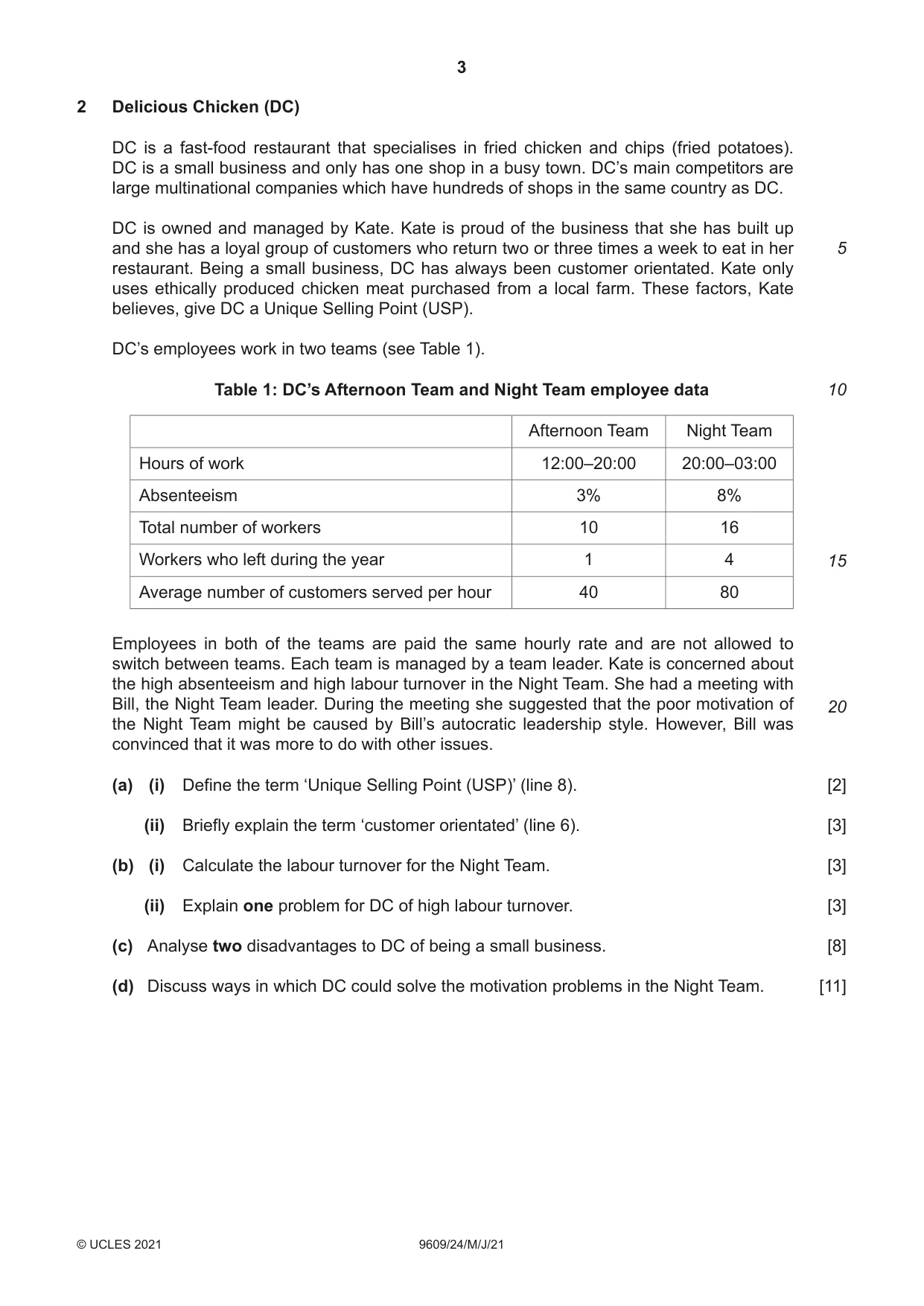
2 Delicious Chicken (DC) DC is a fast-food restaurant that specialises in fried chicken and chips (fried potatoes). DC is a small business and only has one shop in a busy town. DC’s main competitors are large multinational companies which have hundreds of shops in the same country as DC. DC is owned and managed by Kate. Kate is proud of the business that she has built up and she has a loyal group of customers who return two or three times a week to eat in her 5 restaurant. Being a small business, DC has always been customer orientated. Kate only uses ethically produced chicken meat purchased from a local farm. These factors, Kate believes, give DC a Unique Selling Point (USP). DC’s employees work in two teams (see Table 1). Table 1: DC’s Afternoon Team and Night Team employee data 10 Afternoon Team Night Team Hours of work 12:00–20:00 20:00–03:00 Absenteeism 3% 8% Total number of workers 10 16 Workers who left during the year 1 4 15 Average number of customers served per hour 40 80 Employees in both of the teams are paid the same hourly rate and are not allowed to switch between teams. Each team is managed by a team leader. Kate is concerned about the high absenteeism and high labour turnover in the Night Team. She had a meeting with Bill, the Night Team leader. During the meeting she suggested that the poor motivation of 20 the Night Team might be caused by Bill’s autocratic leadership style. However, Bill was convinced that it was more to do with other issues. (a) (i) Define the term ‘Unique Selling Point (USP)’ (line 8). [2] (ii) Briefly explain the term ‘customer orientated’ (line 6). [3] (b) (i) Calculate the labour turnover for the Night Team. [3] (ii) Explain one problem for DC of high labour turnover. [3] (c) Analyse two disadvantages to DC of being a small business. [8] (d) Discuss ways in which DC could solve the motivation problems in the Night Team. [11]
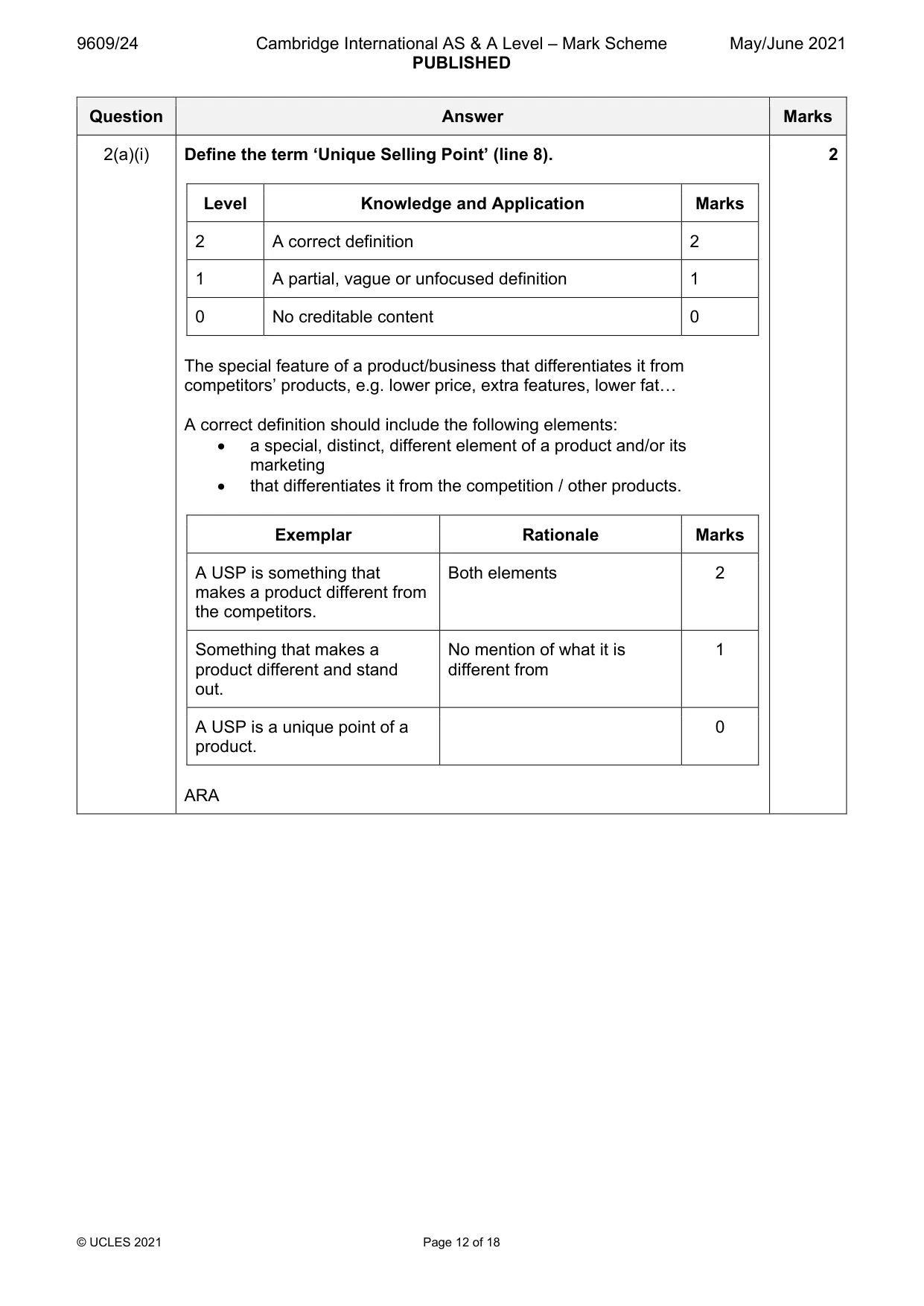
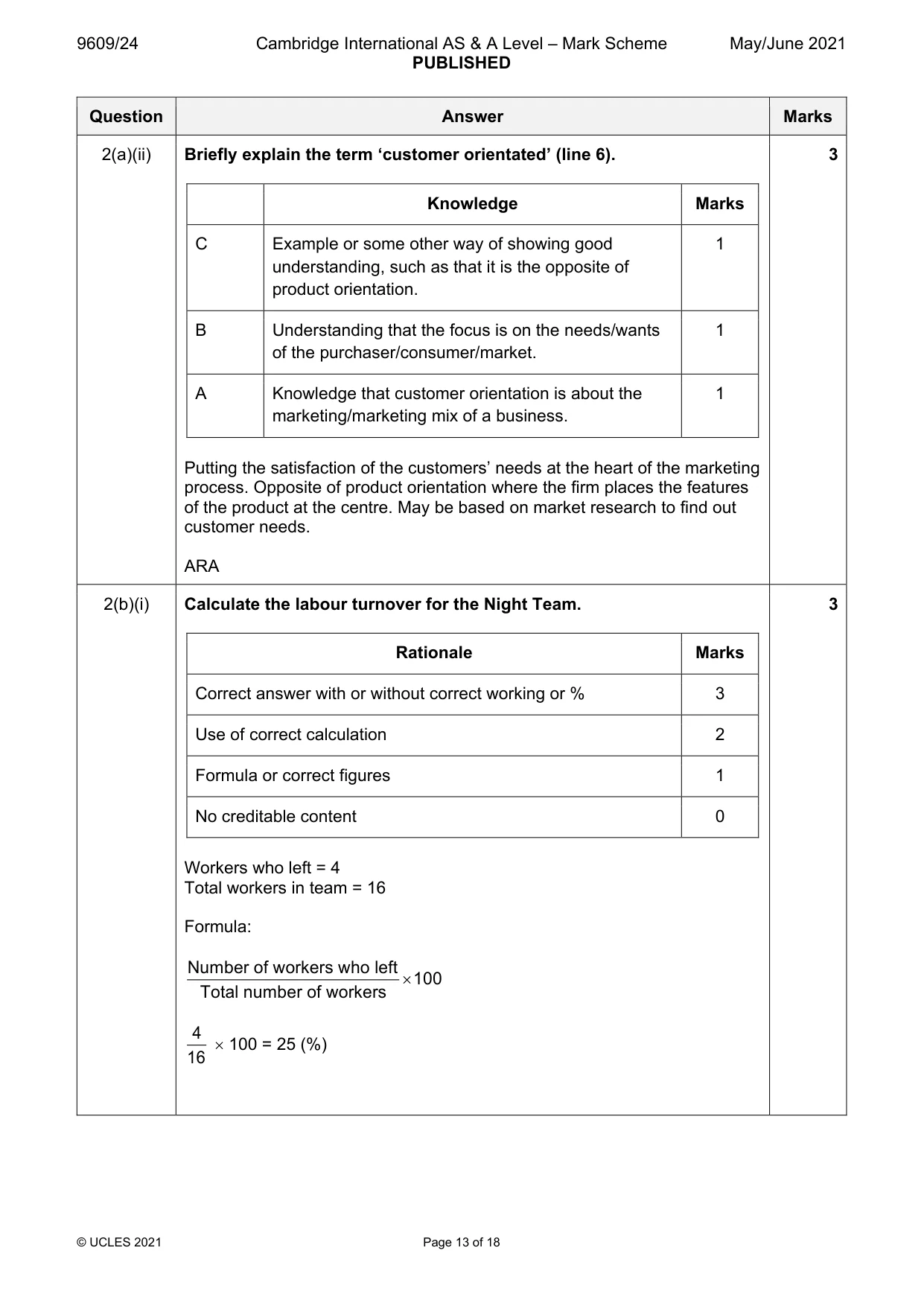
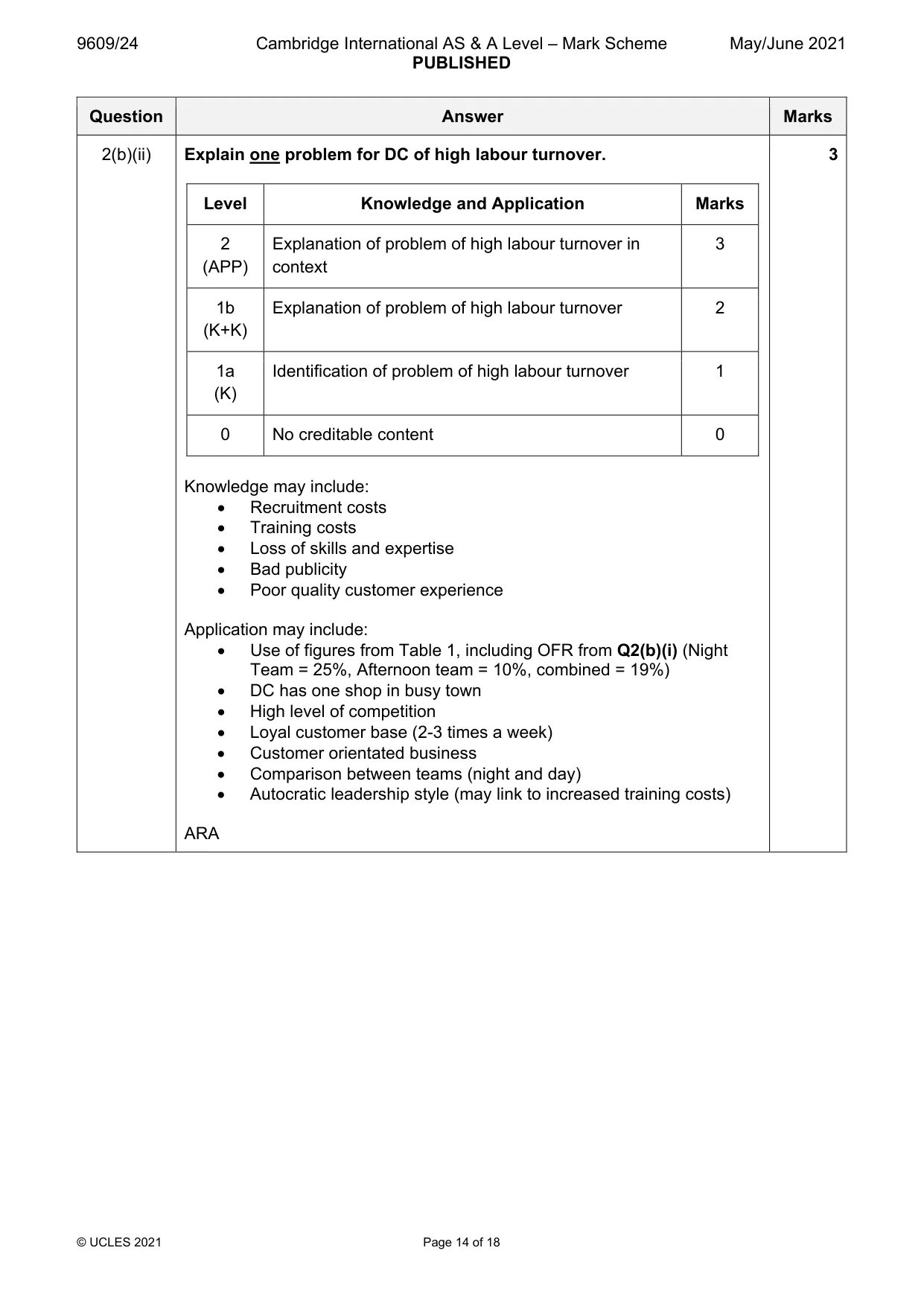
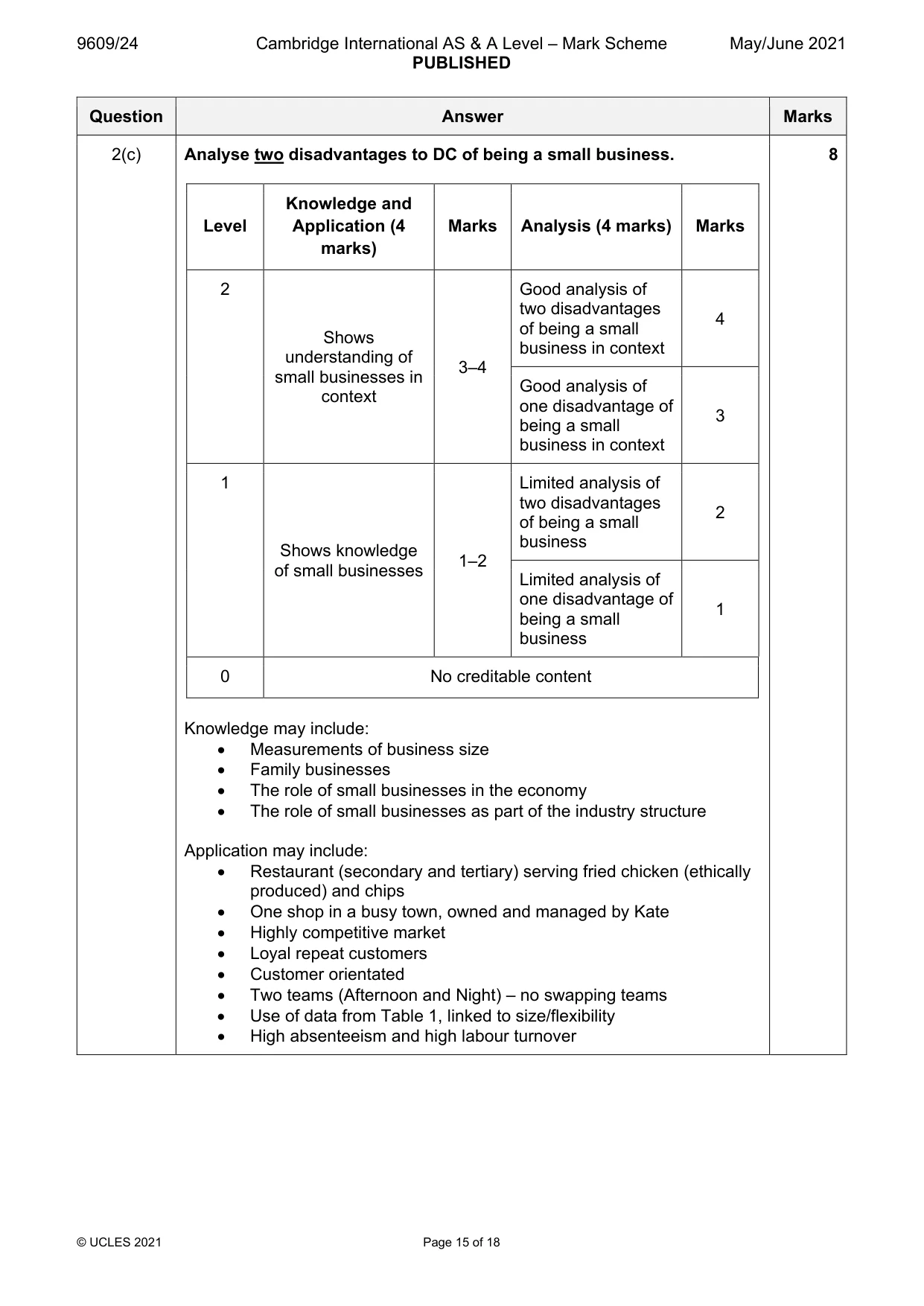
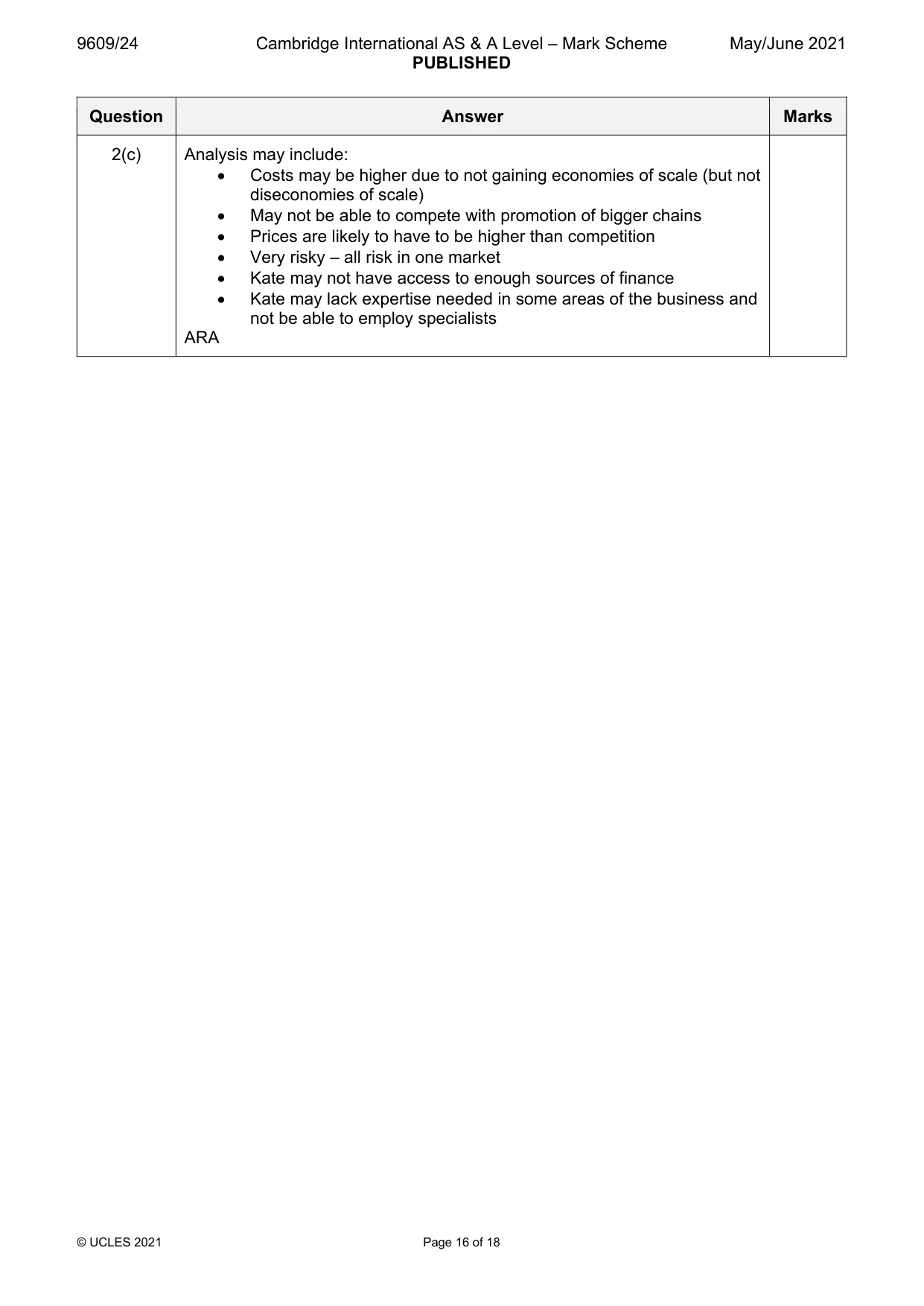
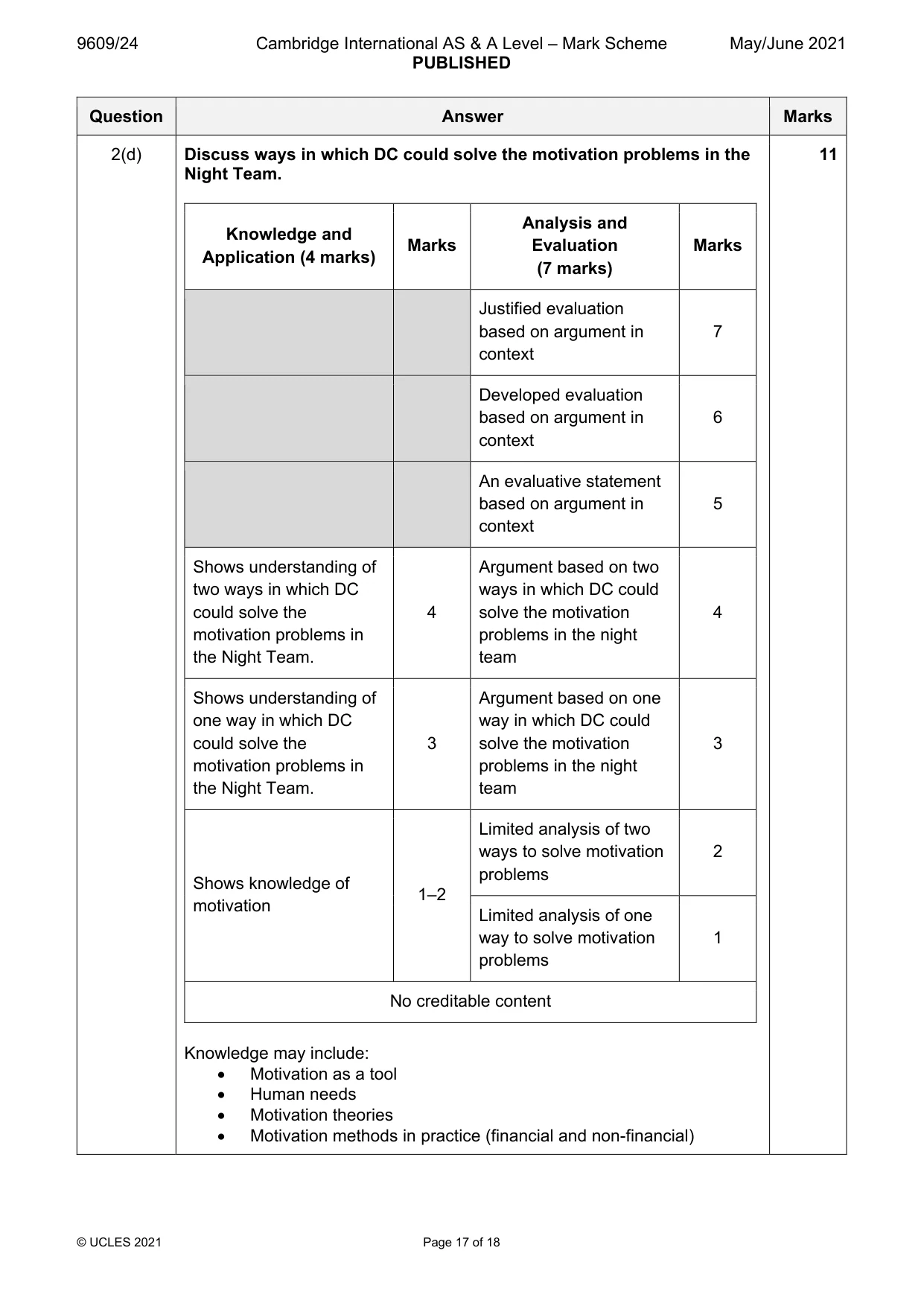
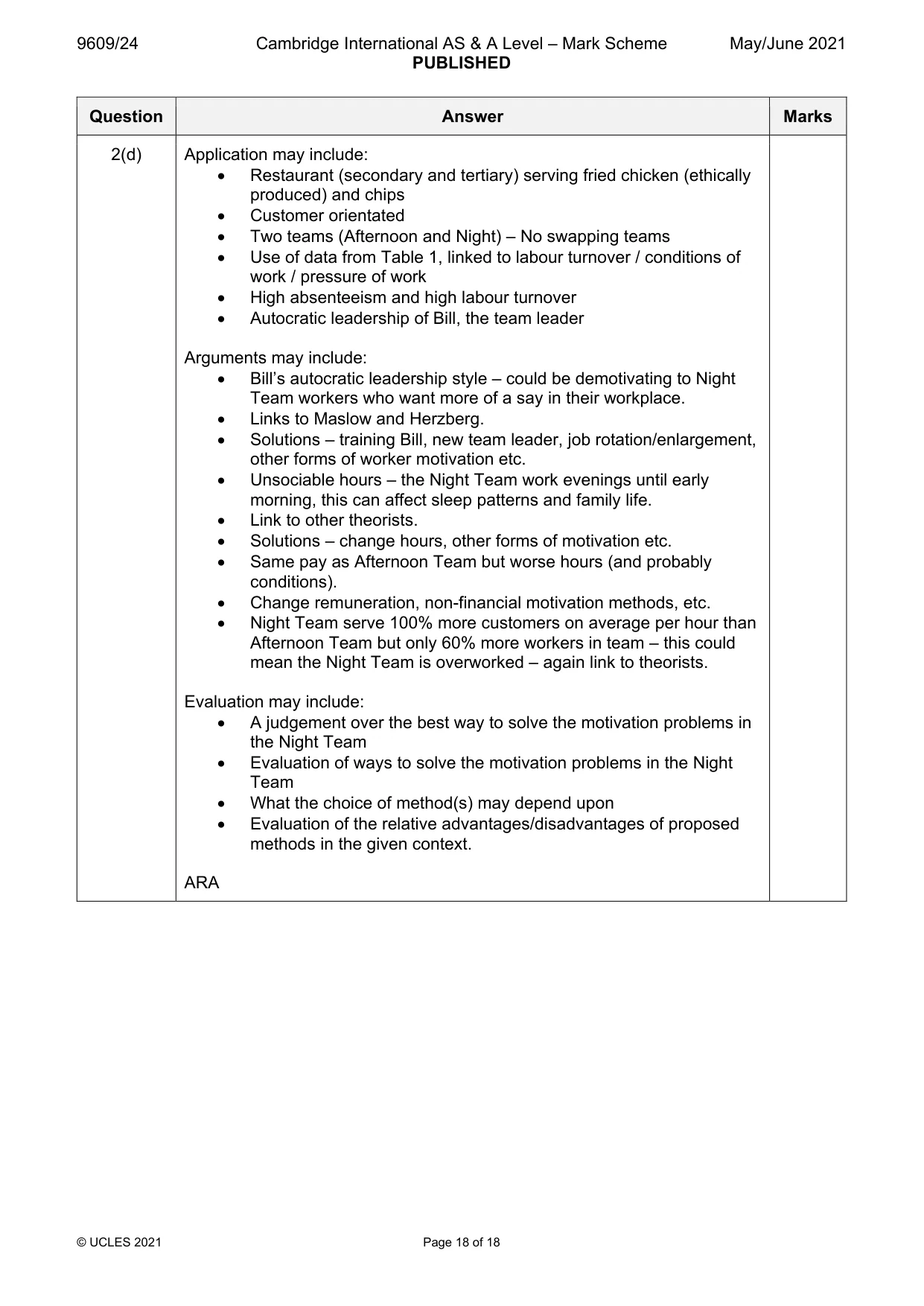
Mark scheme: 2(a)(i) Define the term ‘Unique Selling Point’ (line 8). 2 Level Knowledge and Application Marks 2 A correct definition 2 1 A partial, vague or unfocused definition 1 0 No creditable content 0 The special feature of a product/business that differentiates it from competitors’ products, e.g. lower price, extra features, lower fat… A correct definition should include the following elements: • a special, distinct, different element of a product and/or its marketing • that differentiates it from the competition / other products. Exemplar Rationale Marks A USP is something that Both elements 2 makes a product different from the competitors. Something that makes a No mention of what it is 1 product different and stand different from out. A USP is a unique point of a 0 product. ARA 2(a)(ii) Briefly explain the term ‘customer orientated’ (line 6). 3 Knowledge Marks C Example or some other way of showing good 1 understanding, such as that it is the opposite of product orientation. B Understanding that the focus is on the needs/wants 1 of the purchaser/consumer/market. A Knowledge that customer orientation is about the 1 marketing/marketing mix of a business. Putting the satisfaction of the customers’ needs at the heart of the marketing process. Opposite of product orientation where the firm places the features of the product at the centre. May be based on market research to find out customer needs. ARA 2(b)(i) Calculate the labour turnover for the Night Team. 3 Rationale Marks Correct answer with or without correct working or % 3 Use of correct calculation 2 Formula or correct figures 1 No creditable content 0 Workers who left = 4 Total workers in team = 16 Formula: Number of workers who left × 100 Total number of workers 4 × 100 = 25 (%) 16 2(b)(ii) Explain one problem for DC of high labour turnover. 3 Level Knowledge and Application Marks 2 Explanation of problem of high labour turnover in 3 (APP) context 1b Explanation of problem of high labour turnover 2 (K+K) 1a Identification of problem of high labour turnover 1 (K) 0 No creditable content 0 Knowledge may include: • Recruitment costs • Training costs • Loss of skills and expertise • Bad publicity • Poor quality customer experience Application may include: • Use of figures from Table 1, including OFR from Q2(b)(i) (Night Team = 25%, Afternoon team = 10%, combined = 19%) • DC has one shop in busy town • High level of competition • Loyal customer base (2-3 times a week) • Customer orientated business • Comparison between teams (night and day) • Autocratic leadership style (may link to increased training costs) ARA 2(c) Analyse two disadvantages to DC of being a small business. 8 Knowledge and Level Application (4 Marks Analysis (4 marks) Marks marks) 2 Good analysis of two disadvantages 4 of being a small Shows business in context understanding of 3–4 small businesses in Good analysis of context one disadvantage of 3 being a small business in context 1 Limited analysis of two disadvantages 2 of being a small business Shows knowledge 1–2 of small businesses Limited analysis of one disadvantage of 1 being a small business 0 No creditable content Knowledge may include: • Measurements of business size • Family businesses • The role of small businesses in the economy • The role of small businesses as part of the industry structure Application may include: • Restaurant (secondary and tertiary) serving fried chicken (ethically produced) and chips • One shop in a busy town, owned and managed by Kate • Highly competitive market • Loyal repeat customers • Customer orientated • Two teams (Afternoon and Night) – no swapping teams • Use of data from Table 1, linked to size/flexibility • High absenteeism and high labour turnover 2(c) Analysis may include: • Costs may be higher due to not gaining economies of scale (but not diseconomies of scale) • May not be able to compete with promotion of bigger chains • Prices are likely to have to be higher than competition • Very risky – all risk in one market • Kate may not have access to enough sources of finance • Kate may lack expertise needed in some areas of the business and not be able to employ specialists ARA 2(d) Discuss ways in which DC could solve the motivation problems in the 11 Night Team. Analysis and Knowledge and Marks Evaluation Marks Application (4 marks) (7 marks) Justified evaluation based on argument in 7 context Developed evaluation based on argument in 6 context An evaluative statement based on argument in 5 context Shows understanding of Argument based on two two ways in which DC ways in which DC could could solve the 4 solve the motivation 4 motivation problems in problems in the night the Night Team. team Shows understanding of Argument based on one one way in which DC way in which DC could could solve the 3 solve the motivation 3 motivation problems in problems in the night the Night Team. team Limited analysis of two ways to solve motivation 2 problems Shows knowledge of 1–2 motivation Limited analysis of one way to solve motivation 1 problems No creditable content Knowledge may include: • Motivation as a tool • Human needs • Motivation theories • Motivation methods in practice (financial and non-financial) 2(d) Application may include: • Restaurant (secondary and tertiary) serving fried chicken (ethically produced) and chips • Customer orientated • Two teams (Afternoon and Night) – No swapping teams • Use of data from Table 1, linked to labour turnover / conditions of work / pressure of work • High absenteeism and high labour turnover • Autocratic leadership of Bill, the team leader Arguments may include: • Bill’s autocratic leadership style – could be demotivating to Night Team workers who want more of a say in their workplace. • Links to Maslow and Herzberg. • Solutions – training Bill, new team leader, job rotation/enlargement, other forms of worker motivation etc. • Unsociable hours – the Night Team work evenings until early morning, this can affect sleep patterns and family life. • Link to other theorists. • Solutions – change hours, other forms of motivation etc. • Same pay as Afternoon Team but worse hours (and probably conditions). • Change remuneration, non-financial motivation methods, etc. • Night Team serve 100% more customers on average per hour than Afternoon Team but only 60% more workers in team – this could mean the Night Team is overworked – again link to theorists. Evaluation may include: • A judgement over the best way to solve the motivation problems in the Night Team • Evaluation of ways to solve the motivation problems in the Night Team • What the choice of method(s) may depend upon • Evaluation of the relative advantages/disadvantages of proposed methods in the given context. ARA
What was in this paper
The subtopics covered by these 2 questions, and how many questions each got. Open one in a new tab to see every Cambridge question on it.
What you needed in this session
Cambridge’s own grade thresholds for 2021 May/June, Paper 2 · Variant 4. A higher threshold means an easier paper — the bar moves with how the cohort did.