Cambridge A Level Business (for first examination in 2016) 9609 — 2020 Oct/Nov Paper 2 · Variant 2
9609/22/O/N/20 · 2 questions · 60 marks · ≈68 min
The question paper and its mark scheme, free to read here and free to download. This is Cambridge’s own paper, exactly as it was sat.
Question paper4 pages
Mark scheme20 pages
Answers below. Sit the paper first if you are practising.
Questions as text
Q1 · Energy Solutions (ES) ES is a public limited company in country X
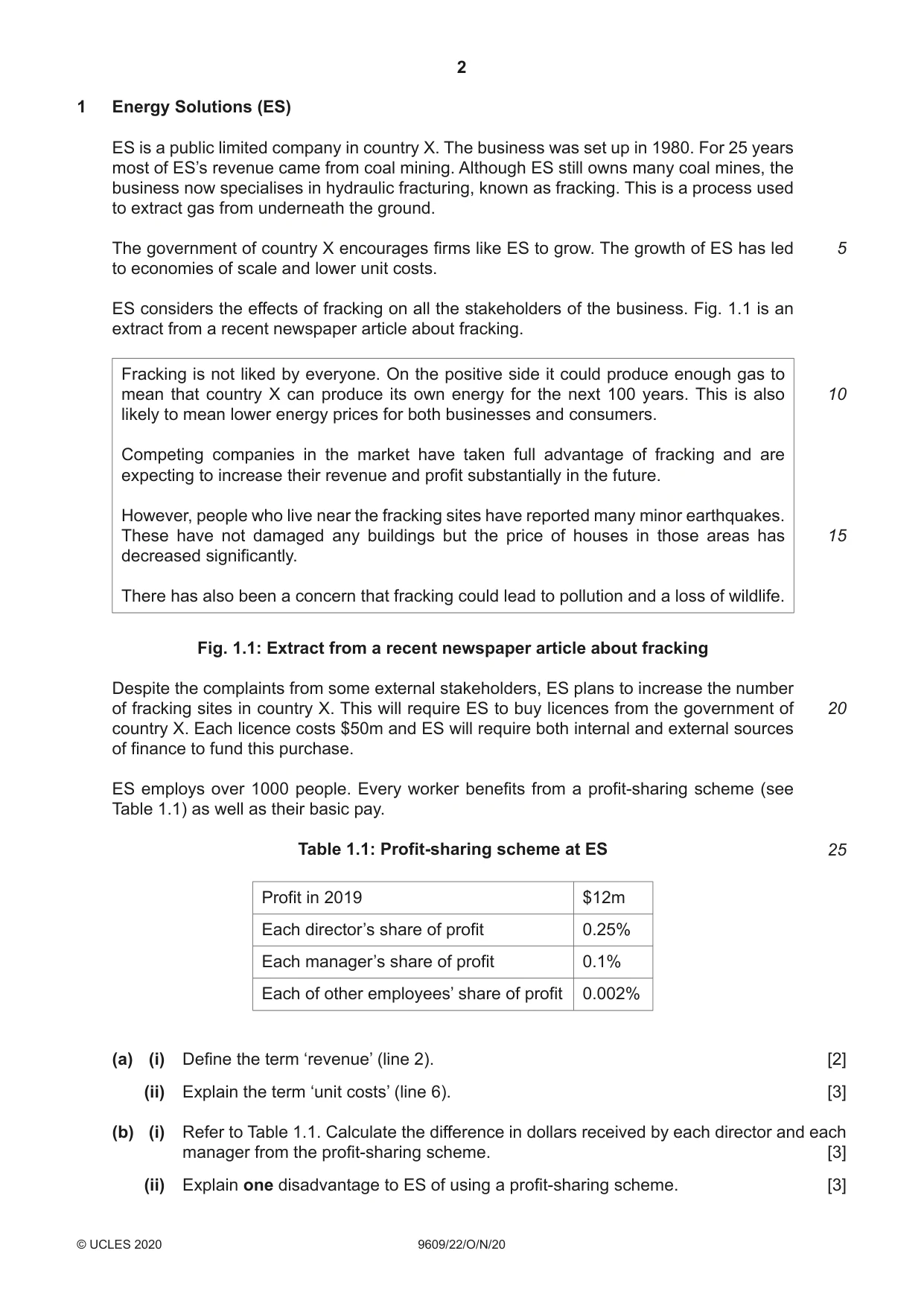
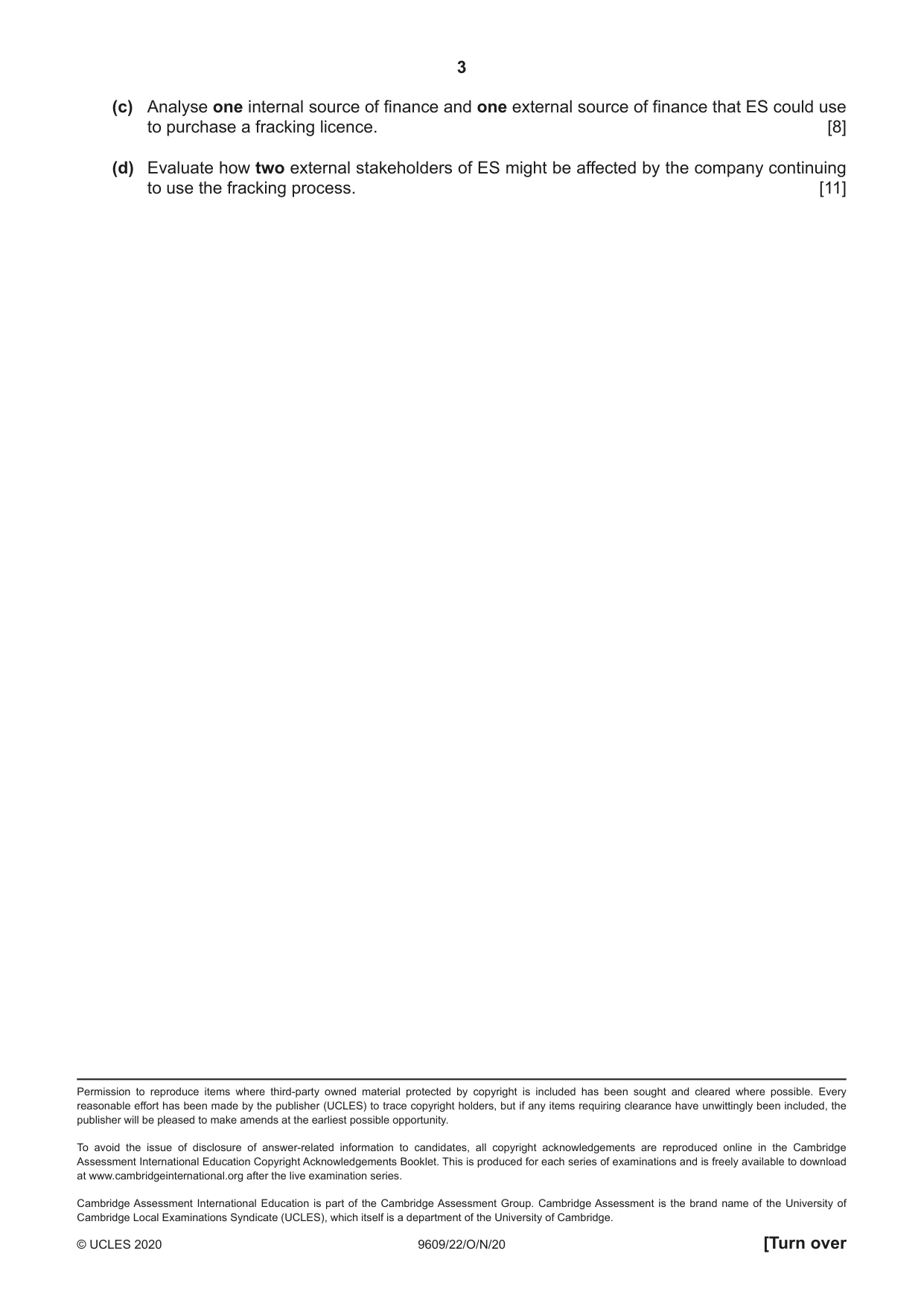
1 Energy Solutions (ES) ES is a public limited company in country X. The business was set up in 1980. For 25 years most of ES’s revenue came from coal mining. Although ES still owns many coal mines, the business now specialises in hydraulic fracturing, known as fracking. This is a process used to extract gas from underneath the ground. The government of country X encourages firms like ES to grow. The growth of ES has led 5 to economies of scale and lower unit costs. ES considers the effects of fracking on all the stakeholders of the business. Fig. 1.1 is an extract from a recent newspaper article about fracking. Fracking is not liked by everyone. On the positive side it could produce enough gas to mean that country X can produce its own energy for the next 100 years. This is also 10 likely to mean lower energy prices for both businesses and consumers. Competing companies in the market have taken full advantage of fracking and are expecting to increase their revenue and profit substantially in the future. However, people who live near the fracking sites have reported many minor earthquakes. These have not damaged any buildings but the price of houses in those areas has 15 decreased significantly. There has also been a concern that fracking could lead to pollution and a loss of wildlife. Fig. 1.1: Extract from a recent newspaper article about fracking Despite the complaints from some external stakeholders, ES plans to increase the number of fracking sites in country X. This will require ES to buy licences from the government of 20 country X. Each licence costs $50m and ES will require both internal and external sources of finance to fund this purchase. ES employs over 1000 people. Every worker benefits from a profit-sharing scheme (see Table 1.1) as well as their basic pay. Table 1.1: Profit-sharing scheme at ES 25 Profit in 2019 $12m Each director’s share of profit 0.25% Each manager’s share of profit 0.1% Each of other employees’ share of profit 0.002% (a) (i) Define the term ‘revenue’ (line 2). [2] (ii) Explain the term ‘unit costs’ (line 6). [3] (b) (i) Refer to Table 1.1. Calculate the difference in dollars received by each director and each manager from the profit-sharing scheme. [3] (ii) Explain one disadvantage to ES of using a profit-sharing scheme. [3] (c) Analyse one internal source of finance and one external source of finance that ES could use to purchase a fracking licence. [8] (d) Evaluate how two external stakeholders of ES might be affected by the company continuing to use the fracking process. [11]
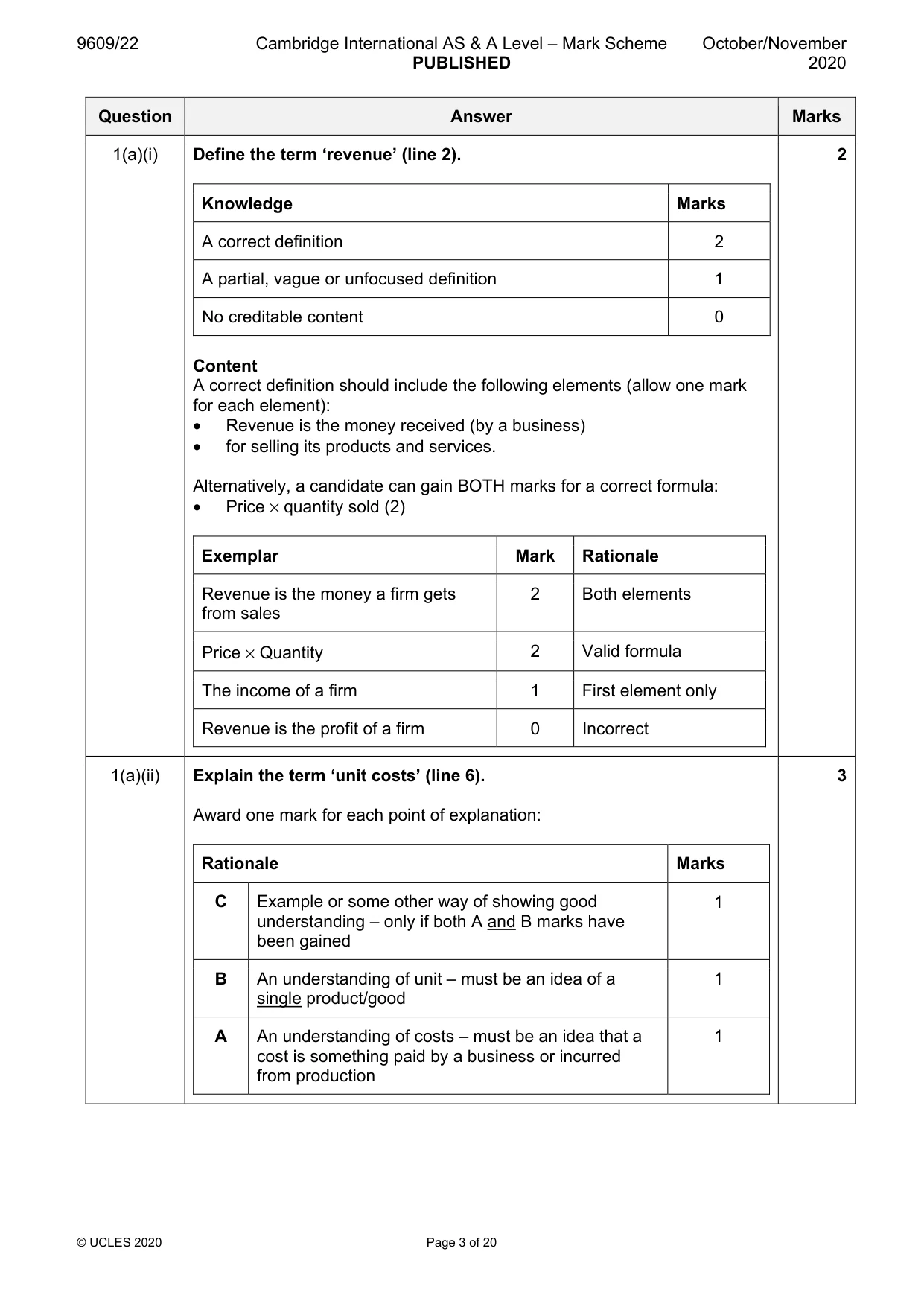
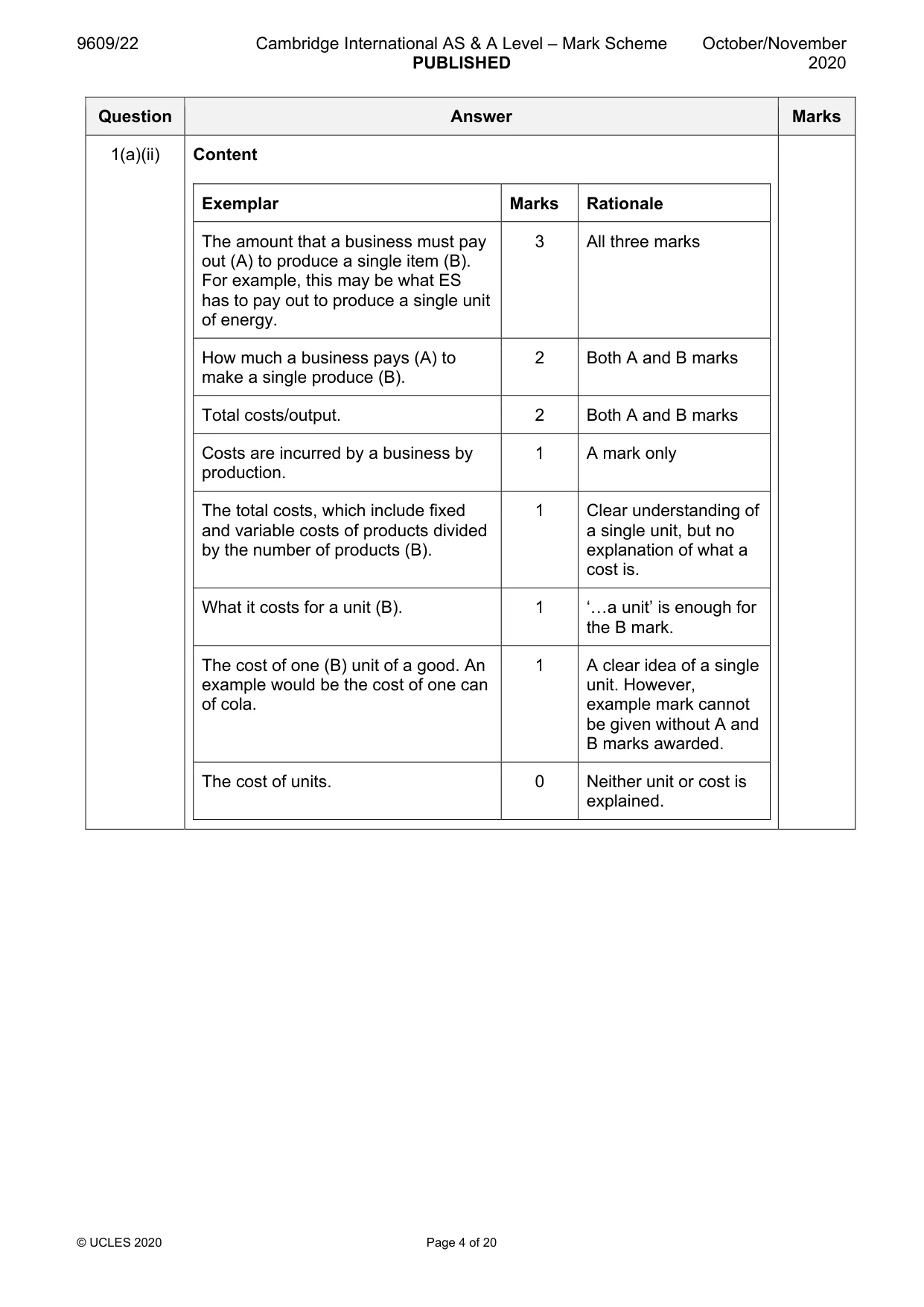
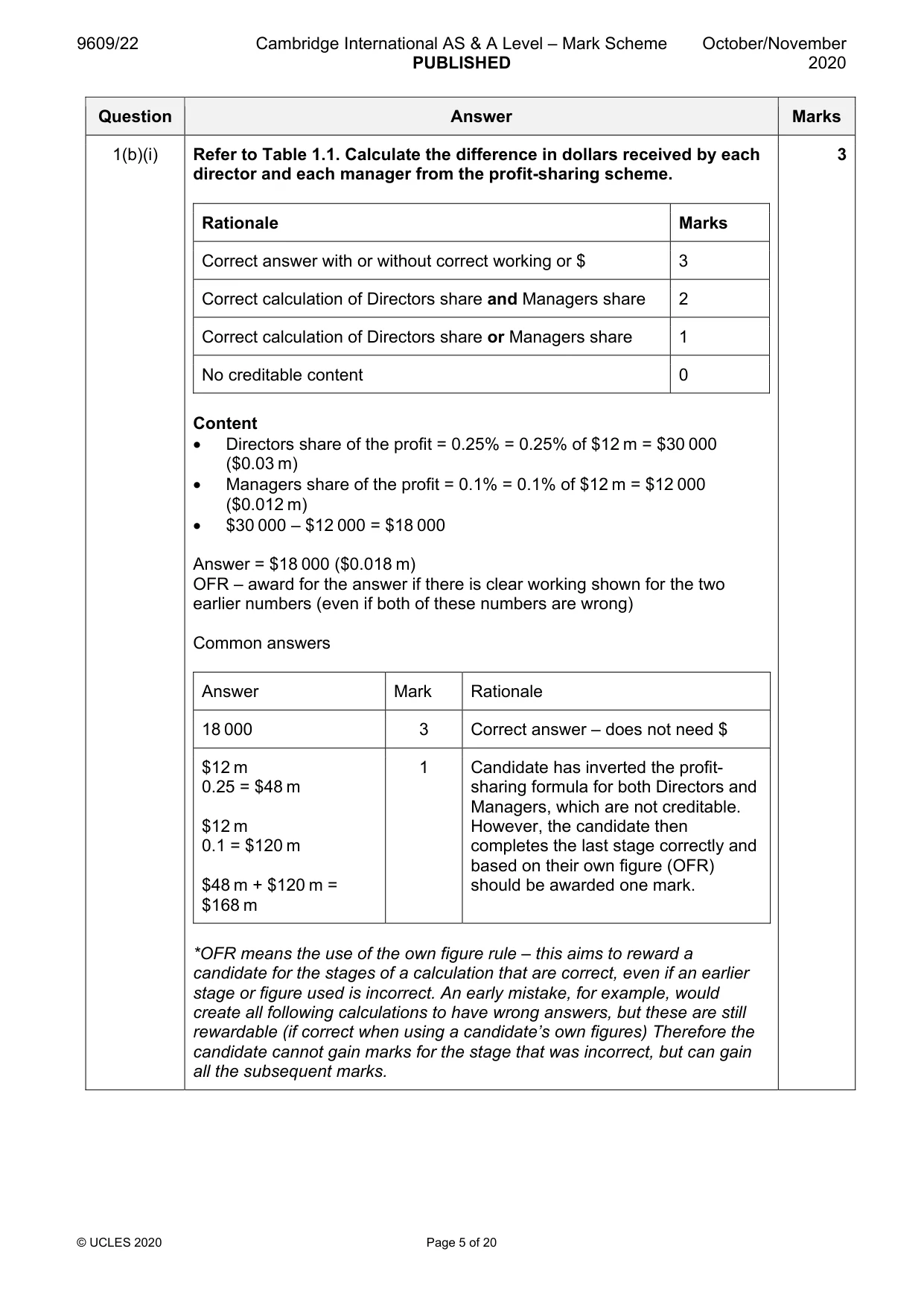
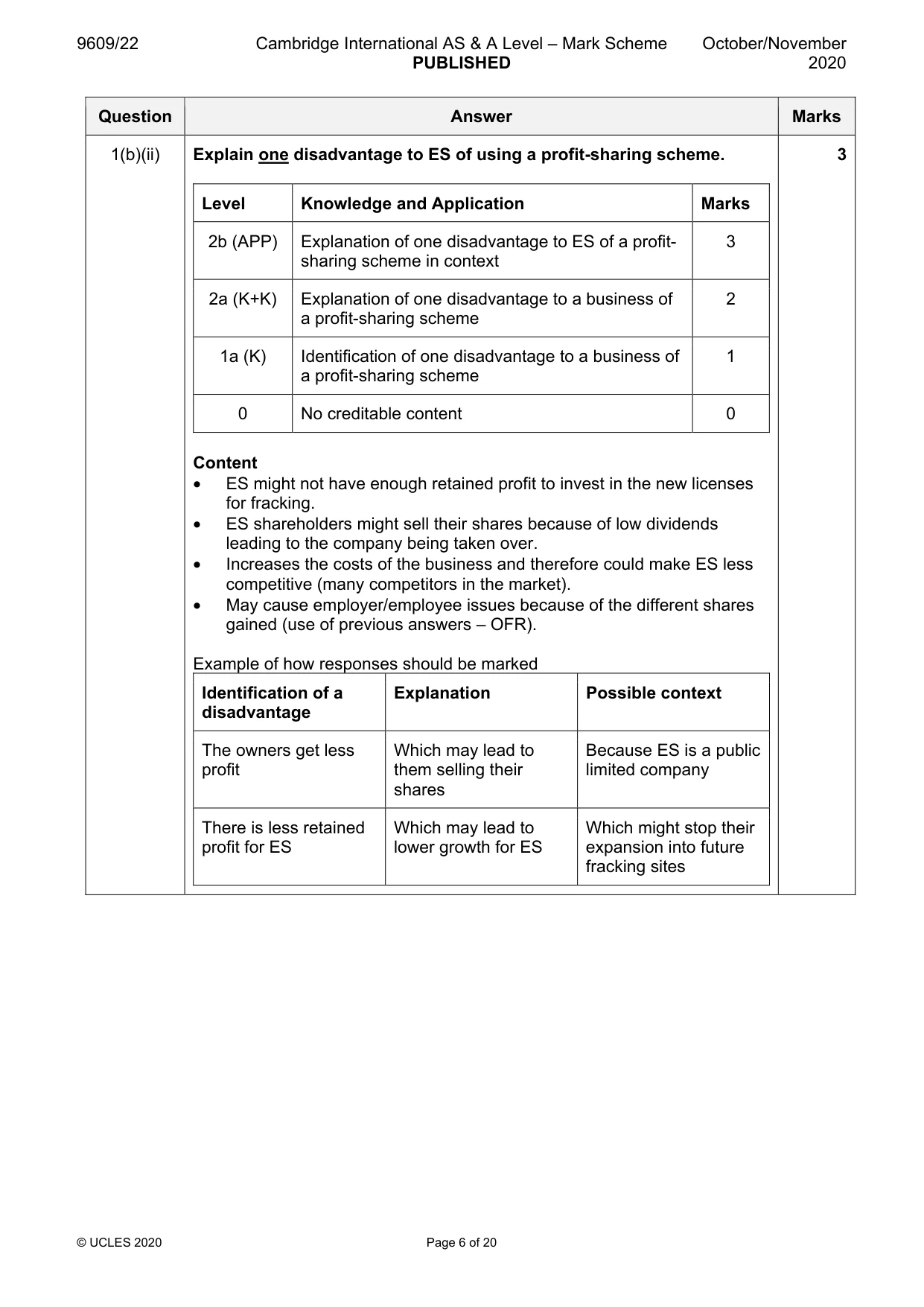
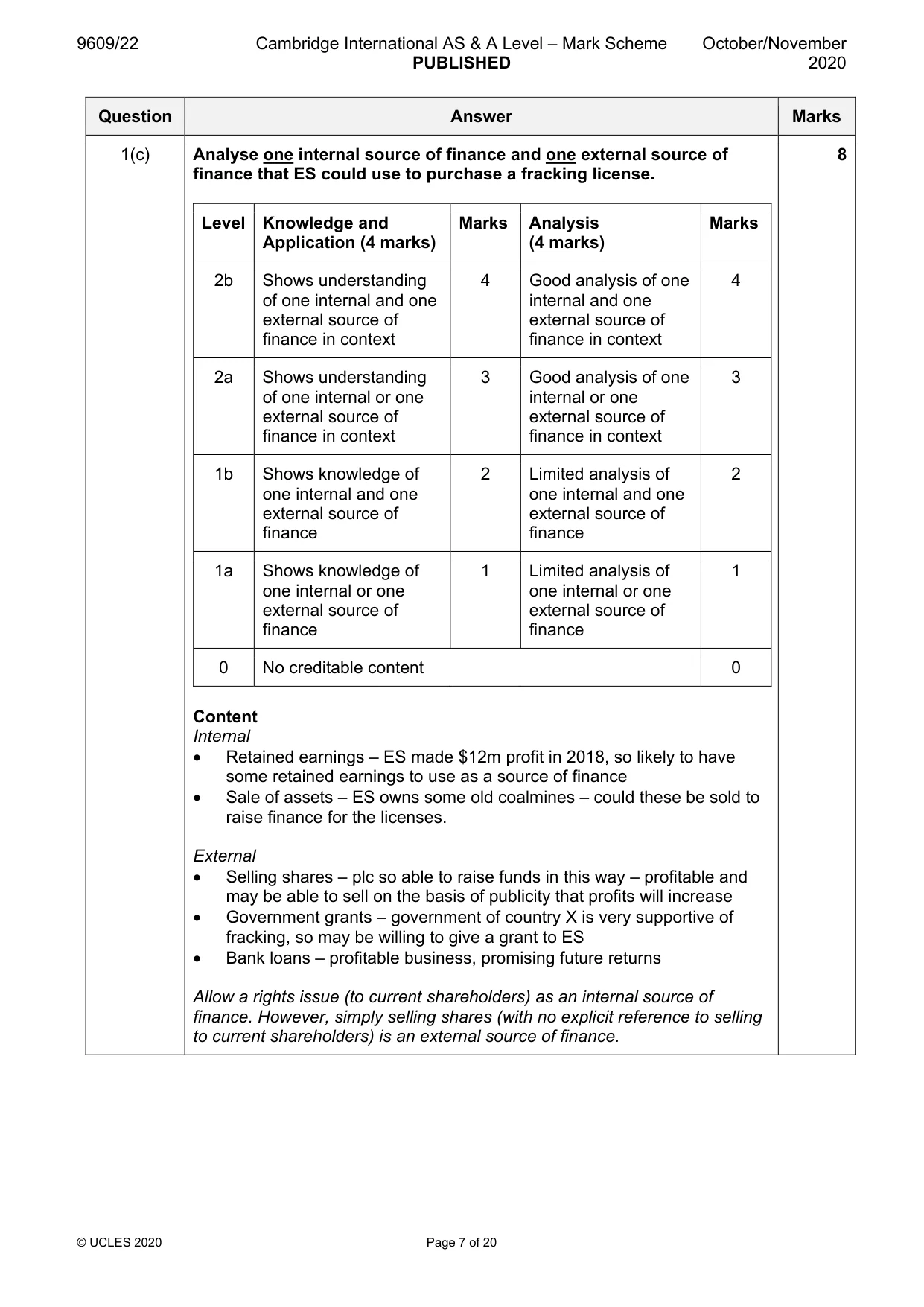
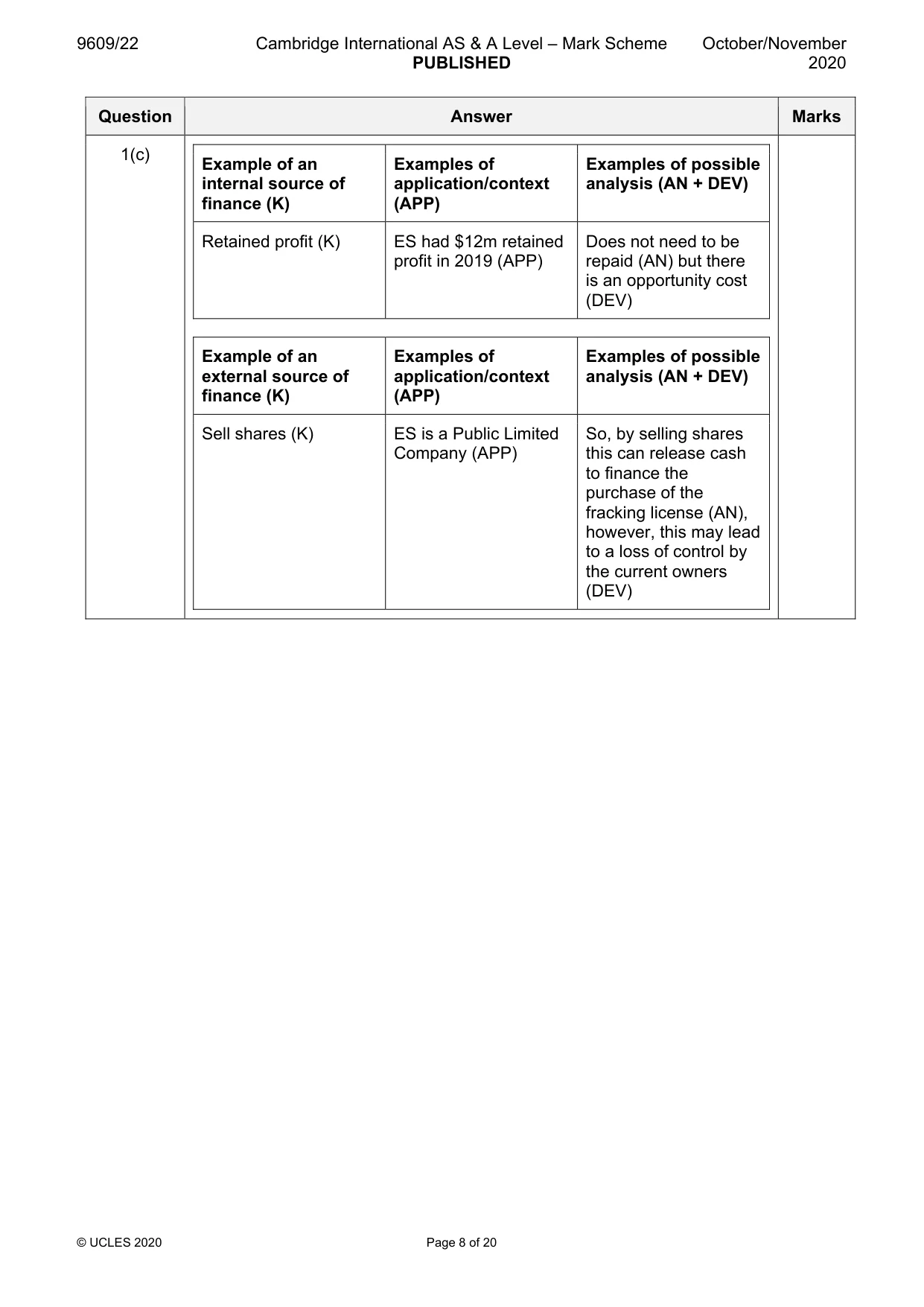
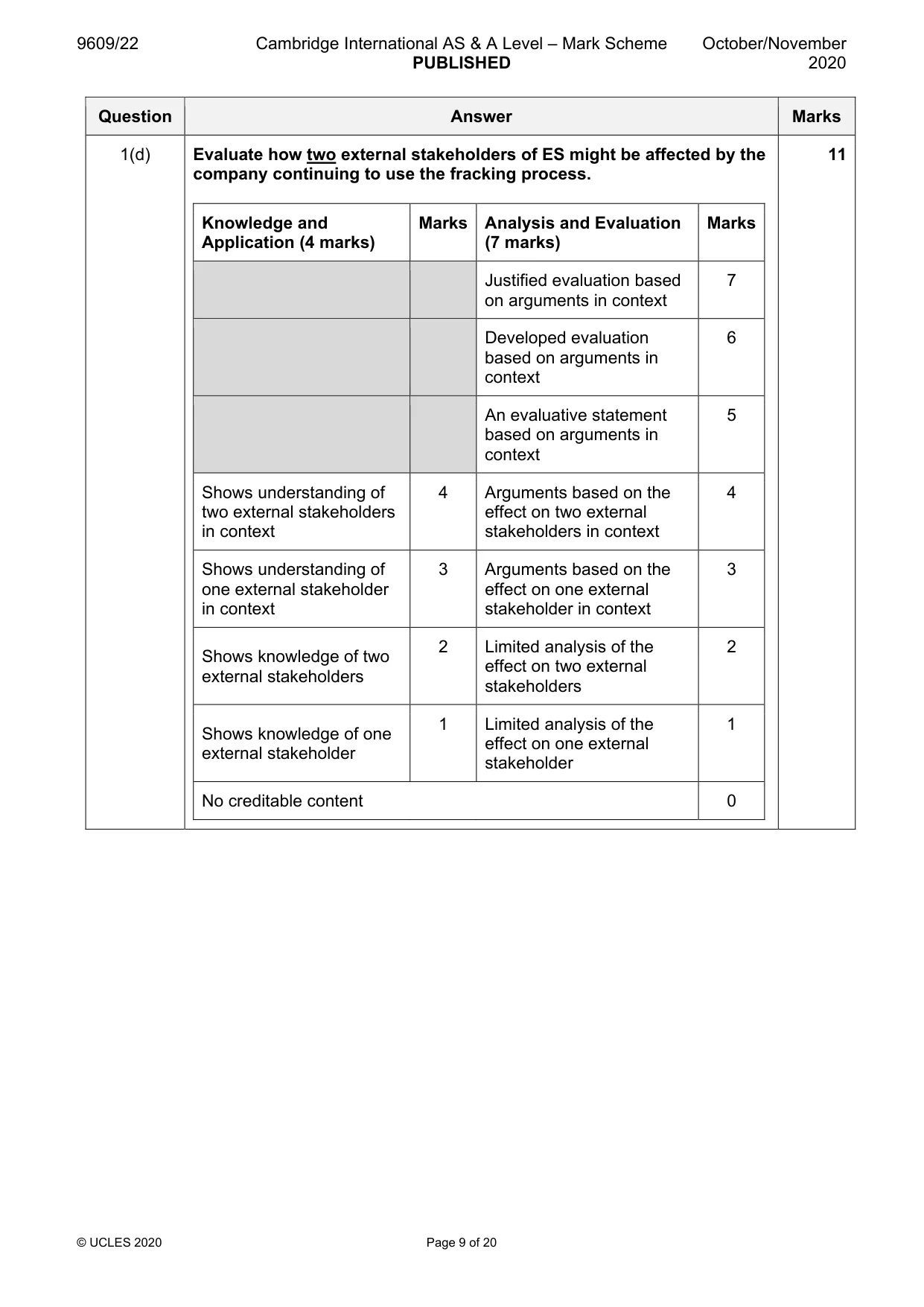
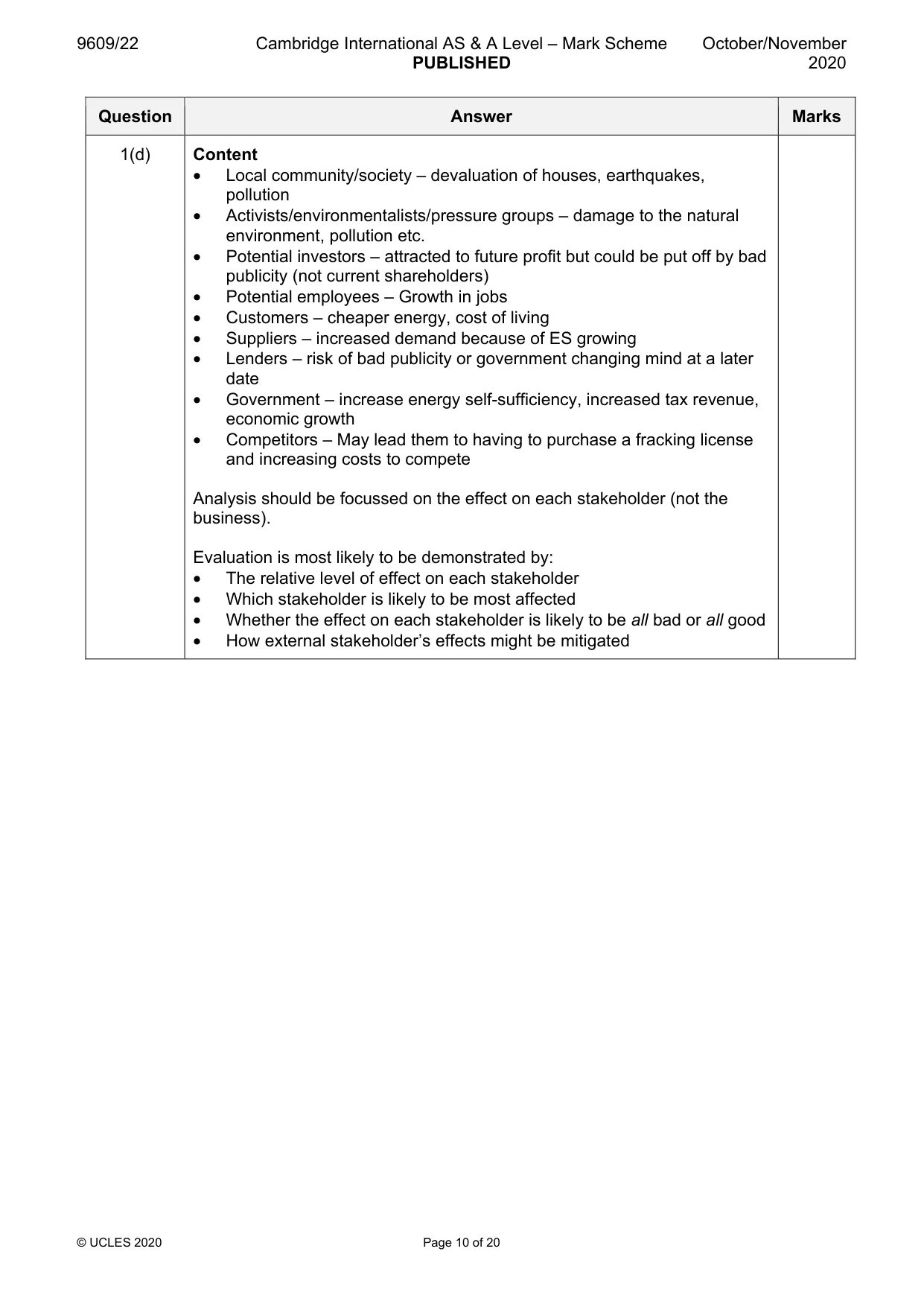
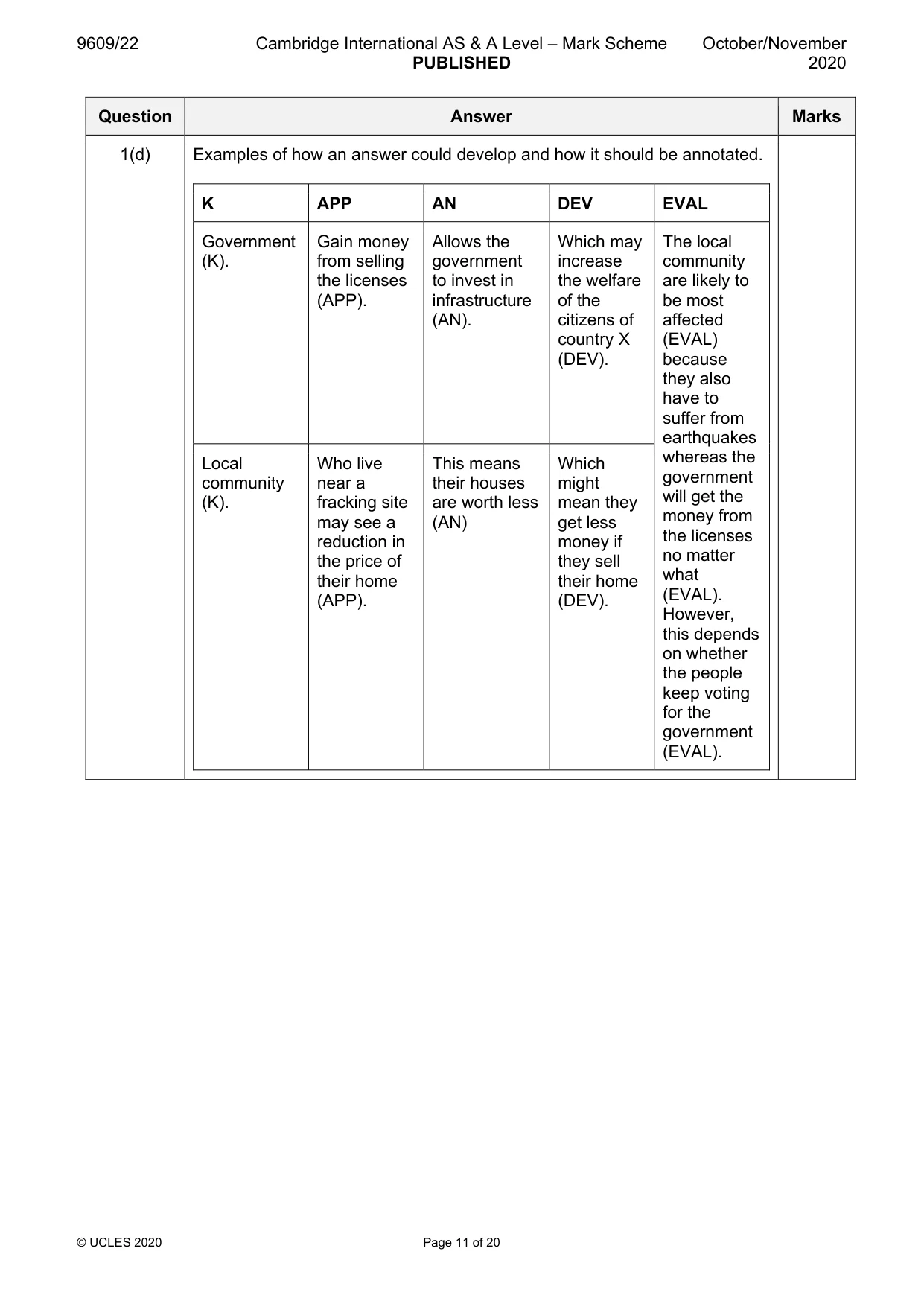
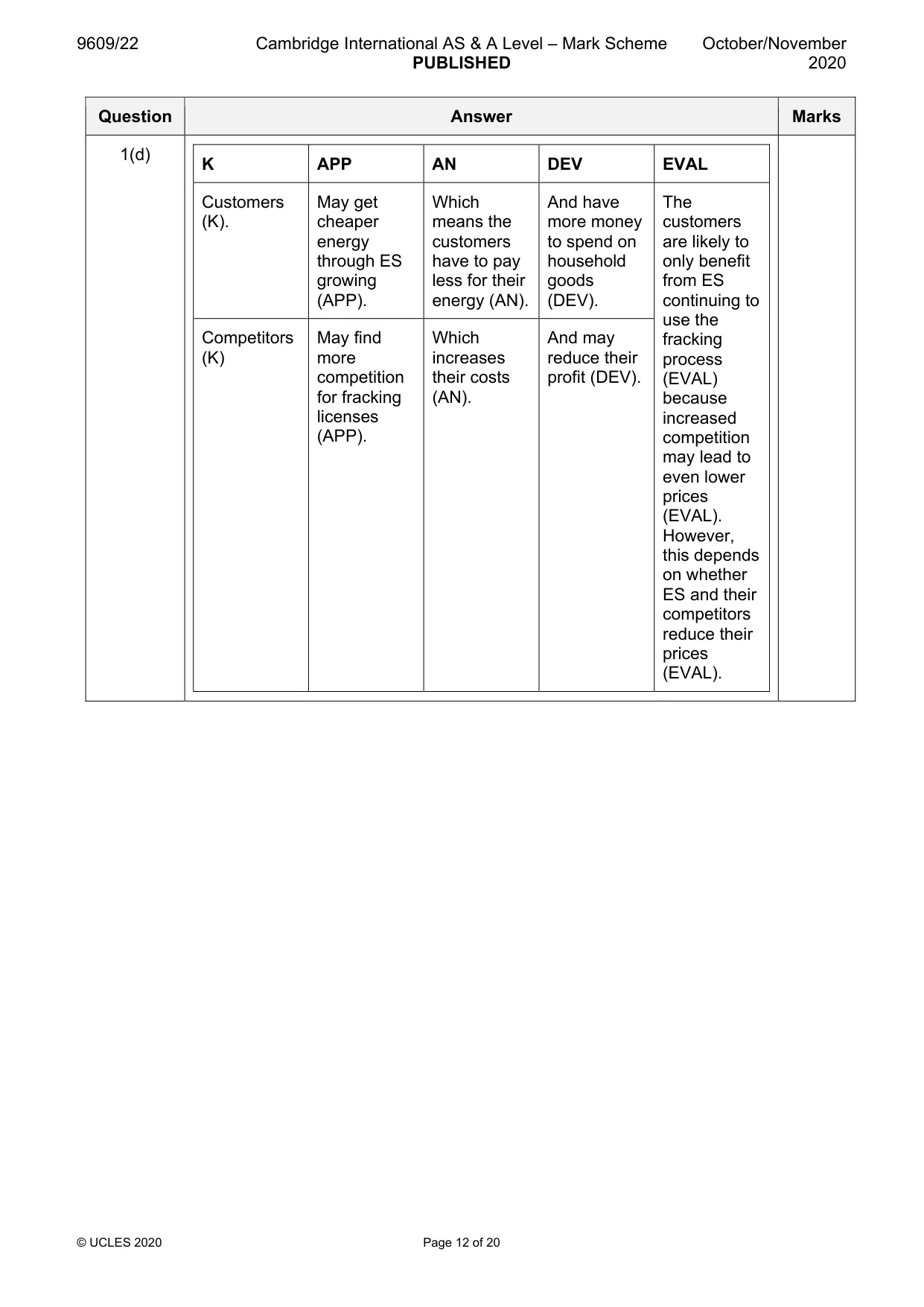
Mark scheme: Question Answer Marks 1(a)(i) Define the term ‘revenue’ (line 2). 2 Knowledge Marks A correct definition 2 A partial, vague or unfocused definition 1 No creditable content 0 Content A correct definition should include the following elements (allow one mark for each element): • Revenue is the money received (by a business) • for selling its products and services. Alternatively, a candidate can gain BOTH marks for a correct formula: • Price × quantity sold (2) Exemplar Mark Rationale Revenue is the money a firm gets 2 Both elements from sales Price × Quantity 2 Valid formula The income of a firm 1 First element only Revenue is the profit of a firm 0 Incorrect 1(a)(ii) Explain the term ‘unit costs’ (line 6). 3 Award one mark for each point of explanation: Rationale Marks C Example or some other way of showing good 1 understanding – only if both A and B marks have been gained B An understanding of unit – must be an idea of a 1 single product/good A An understanding of costs – must be an idea that a 1 cost is something paid by a business or incurred from production 1(a)(ii) Content Exemplar Marks Rationale The amount that a business must pay 3 All three marks out (A) to produce a single item (B). For example, this may be what ES has to pay out to produce a single unit of energy. How much a business pays (A) to 2 Both A and B marks make a single produce (B). Total costs/output. 2 Both A and B marks Costs are incurred by a business by 1 A mark only production. The total costs, which include fixed 1 Clear understanding of and variable costs of products divided a single unit, but no by the number of products (B). explanation of what a cost is. What it costs for a unit (B). 1 ‘…a unit’ is enough for the B mark. The cost of one (B) unit of a good. An 1 A clear idea of a single example would be the cost of one can unit. However, of cola. example mark cannot be given without A and B marks awarded. The cost of units. 0 Neither unit or cost is explained. 1(b)(i) Refer to Table 1.1. Calculate the difference in dollars received by each 3 director and each manager from the profit-sharing scheme. Rationale Marks Correct answer with or without correct working or $ 3 Correct calculation of Directors share and Managers share 2 Correct calculation of Directors share or Managers share 1 No creditable content 0 Content • Directors share of the profit = 0.25% = 0.25% of $12 m = $30 000 ($0.03 m) • Managers share of the profit = 0.1% = 0.1% of $12 m = $12 000 ($0.012 m) • $30 000 – $12 000 = $18 000 Answer = $18 000 ($0.018 m) OFR – award for the answer if there is clear working shown for the two earlier numbers (even if both of these numbers are wrong) Common answers Answer Mark Rationale 18 000 3 Correct answer – does not need $ $12 m 1 Candidate has inverted the profit- 0.25 = $48 m sharing formula for both Directors and Managers, which are not creditable. $12 m However, the candidate then 0.1 = $120 m completes the last stage correctly and based on their own figure (OFR) $48 m + $120 m = should be awarded one mark. $168 m *OFR means the use of the own figure rule – this aims to reward a candidate for the stages of a calculation that are correct, even if an earlier stage or figure used is incorrect. An early mistake, for example, would create all following calculations to have wrong answers, but these are still rewardable (if correct when using a candidate’s own figures) Therefore the candidate cannot gain marks for the stage that was incorrect, but can gain all the subsequent marks. 1(b)(ii) Explain one disadvantage to ES of using a profit-sharing scheme. 3 Level Knowledge and Application Marks 2b (APP) Explanation of one disadvantage to ES of a profit- 3 sharing scheme in context 2a (K+K) Explanation of one disadvantage to a business of 2 a profit-sharing scheme 1a (K) Identification of one disadvantage to a business of 1 a profit-sharing scheme 0 No creditable content 0 Content • ES might not have enough retained profit to invest in the new licenses for fracking. • ES shareholders might sell their shares because of low dividends leading to the company being taken over. • Increases the costs of the business and therefore could make ES less competitive (many competitors in the market). • May cause employer/employee issues because of the different shares gained (use of previous answers – OFR). Example of how responses should be marked Identification of a Explanation Possible context disadvantage The owners get less Which may lead to Because ES is a public profit them selling their limited company shares There is less retained Which may lead to Which might stop their profit for ES lower growth for ES expansion into future fracking sites 1(c) Analyse one internal source of finance and one external source of 8 finance that ES could use to purchase a fracking license. Level Knowledge and Marks Analysis Marks Application (4 marks) (4 marks) 2b Shows understanding 4 Good analysis of one 4 of one internal and one internal and one external source of external source of finance in context finance in context 2a Shows understanding 3 Good analysis of one 3 of one internal or one internal or one external source of external source of finance in context finance in context 1b Shows knowledge of 2 Limited analysis of 2 one internal and one one internal and one external source of external source of finance finance 1a Shows knowledge of 1 Limited analysis of 1 one internal or one one internal or one external source of external source of finance finance 0 No creditable content 0 Content Internal • Retained earnings – ES made $12m profit in 2018, so likely to have some retained earnings to use as a source of finance • Sale of assets – ES owns some old coalmines – could these be sold to raise finance for the licenses. External • Selling shares – plc so able to raise funds in this way – profitable and may be able to sell on the basis of publicity that profits will increase • Government grants – government of country X is very supportive of fracking, so may be willing to give a grant to ES • Bank loans – profitable business, promising future returns Allow a rights issue (to current shareholders) as an internal source of finance. However, simply selling shares (with no explicit reference to selling to current shareholders) is an external source of finance. 1(c) Example of an Examples of Examples of possible internal source of application/context analysis (AN + DEV) finance (K) (APP) Retained profit (K) ES had $12m retained Does not need to be profit in 2019 (APP) repaid (AN) but there is an opportunity cost (DEV) Example of an Examples of Examples of possible external source of application/context analysis (AN + DEV) finance (K) (APP) Sell shares (K) ES is a Public Limited So, by selling shares Company (APP) this can release cash to finance the purchase of the fracking license (AN), however, this may lead to a loss of control by the current owners (DEV) 1(d) Evaluate how two external stakeholders of ES might be affected by the 11 company continuing to use the fracking process. Knowledge and Marks Analysis and Evaluation Marks Application (4 marks) (7 marks) Justified evaluation based 7 on arguments in context Developed evaluation 6 based on arguments in context An evaluative statement 5 based on arguments in context Shows understanding of 4 Arguments based on the 4 two external stakeholders effect on two external in context stakeholders in context Shows understanding of 3 Arguments based on the 3 one external stakeholder effect on one external in context stakeholder in context 2 Limited analysis of the 2 Shows knowledge of two effect on two external external stakeholders stakeholders 1 Limited analysis of the 1 Shows knowledge of one effect on one external external stakeholder stakeholder No creditable content 0 1(d) Content • Local community/society – devaluation of houses, earthquakes, pollution • Activists/environmentalists/pressure groups – damage to the natural environment, pollution etc. • Potential investors – attracted to future profit but could be put off by bad publicity (not current shareholders) • Potential employees – Growth in jobs • Customers – cheaper energy, cost of living • Suppliers – increased demand because of ES growing • Lenders – risk of bad publicity or government changing mind at a later date • Government – increase energy self-sufficiency, increased tax revenue, economic growth • Competitors – May lead them to having to purchase a fracking license and increasing costs to compete Analysis should be focussed on the effect on each stakeholder (not the business). Evaluation is most likely to be demonstrated by: • The relative level of effect on each stakeholder • Which stakeholder is likely to be most affected • Whether the effect on each stakeholder is likely to be all bad or all good • How external stakeholder’s effects might be mitigated 1(d) Examples of how an answer could develop and how it should be annotated. K APP AN DEV EVAL Government Gain money Allows the Which may The local (K). from selling government increase community the licenses to invest in the welfare are likely to (APP). infrastructure of the be most (AN). citizens of affected country X (EVAL) (DEV). because they also have to suffer from earthquakes whereas the Local Who live This means Which government community near a their houses might will get the (K). fracking site are worth less mean they money from may see a (AN) get less the licenses reduction in money if no matter the price of they sell what their home their home (EVAL). (APP). (DEV). However, this depends on whether the people keep voting for the government (EVAL). 1(d) K APP AN DEV EVAL Customers May get Which And have The (K). cheaper means the more money customers energy customers to spend on are likely to through ES have to pay household only benefit growing less for their goods from ES (APP). energy (AN). (DEV). continuing to use the Competitors May find Which And may fracking (K) more increases reduce their process competition their costs profit (DEV). (EVAL) for fracking (AN). because licenses increased (APP). competition may lead to even lower prices (EVAL). However, this depends on whether ES and their competitors reduce their prices (EVAL).
Q2 · Gemini Theatre (GT) GT is a private limited company fully owned by the Gemini family
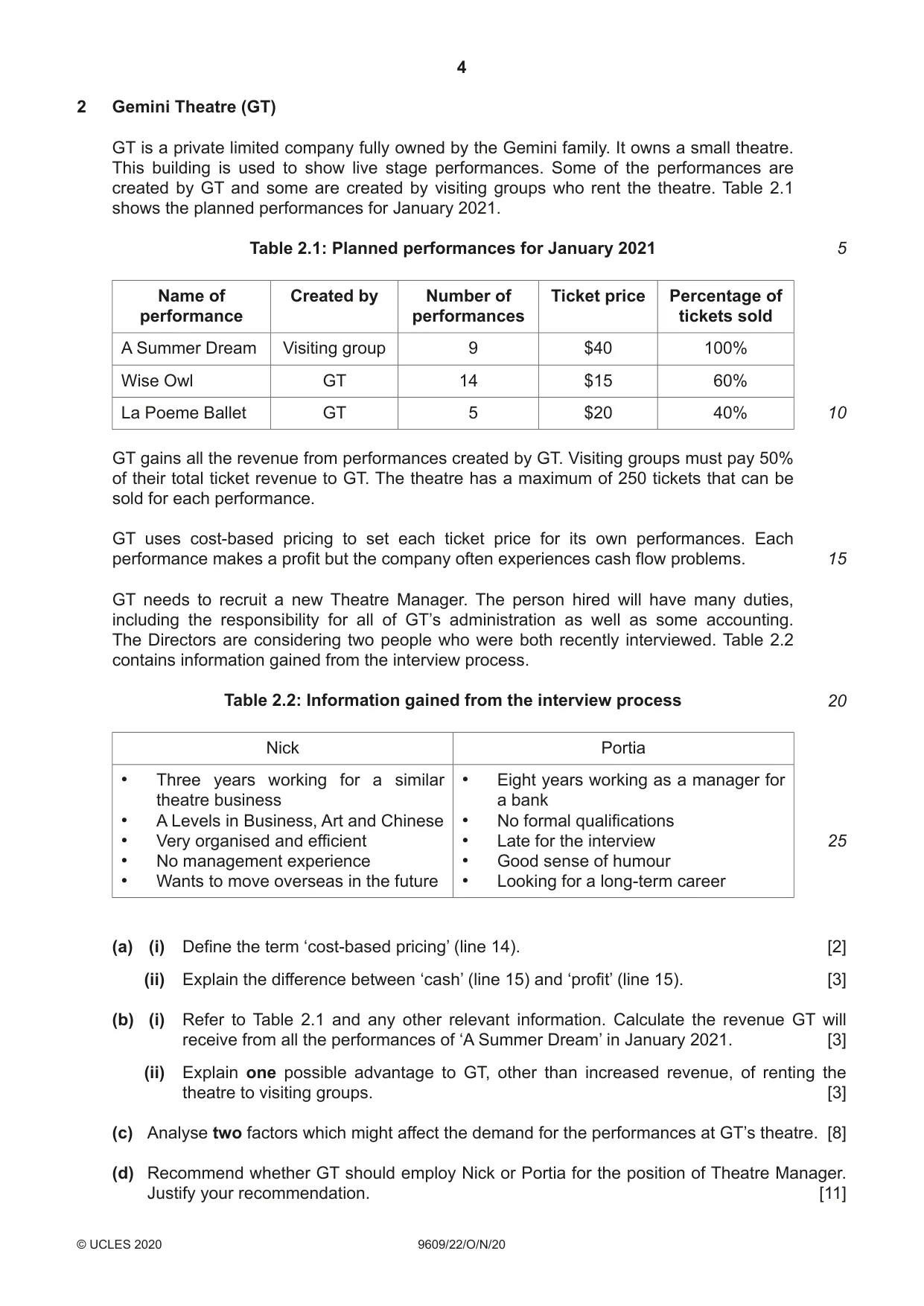
2 Gemini Theatre (GT) GT is a private limited company fully owned by the Gemini family. It owns a small theatre. This building is used to show live stage performances. Some of the performances are created by GT and some are created by visiting groups who rent the theatre. Table 2.1 shows the planned performances for January 2021. Table 2.1: Planned performances for January 2021 5 Name of Created by Number of Ticket price Percentage of performance performances tickets sold A Summer Dream Visiting group 9 $40 100% Wise Owl GT 14 $15 60% La Poeme Ballet GT 5 $20 40% 10 GT gains all the revenue from performances created by GT. Visiting groups must pay 50% of their total ticket revenue to GT. The theatre has a maximum of 250 tickets that can be sold for each performance. GT uses cost-based pricing to set each ticket price for its own performances. Each performance makes a profit but the company often experiences cash flow problems. 15 GT needs to recruit a new Theatre Manager. The person hired will have many duties, including the responsibility for all of GT’s administration as well as some accounting. The Directors are considering two people who were both recently interviewed. Table 2.2 contains information gained from the interview process. Table 2.2: Information gained from the interview process 20 Nick Portia • Three years working for a similar • Eight years working as a manager for theatre business a bank • A Levels in Business, Art and Chinese • No formal qualifications • Very organised and efficient • Late for the interview 25 • No management experience • Good sense of humour • Wants to move overseas in the future • Looking for a long-term career (a) (i) Define the term ‘cost-based pricing’ (line 14). [2] (ii) Explain the difference between ‘cash’ (line 15) and ‘profit’ (line 15). [3] (b) (i) Refer to Table 2.1 and any other relevant information. Calculate the revenue GT will receive from all the performances of ‘A Summer Dream’ in January 2021. [3] (ii) Explain one possible advantage to GT, other than increased revenue, of renting the theatre to visiting groups. [3] (c) Analyse two factors which might affect the demand for the performances at GT’s theatre. [8] (d) Recommend whether GT should employ Nick or Portia for the position of Theatre Manager. Justify your recommendation. [11]
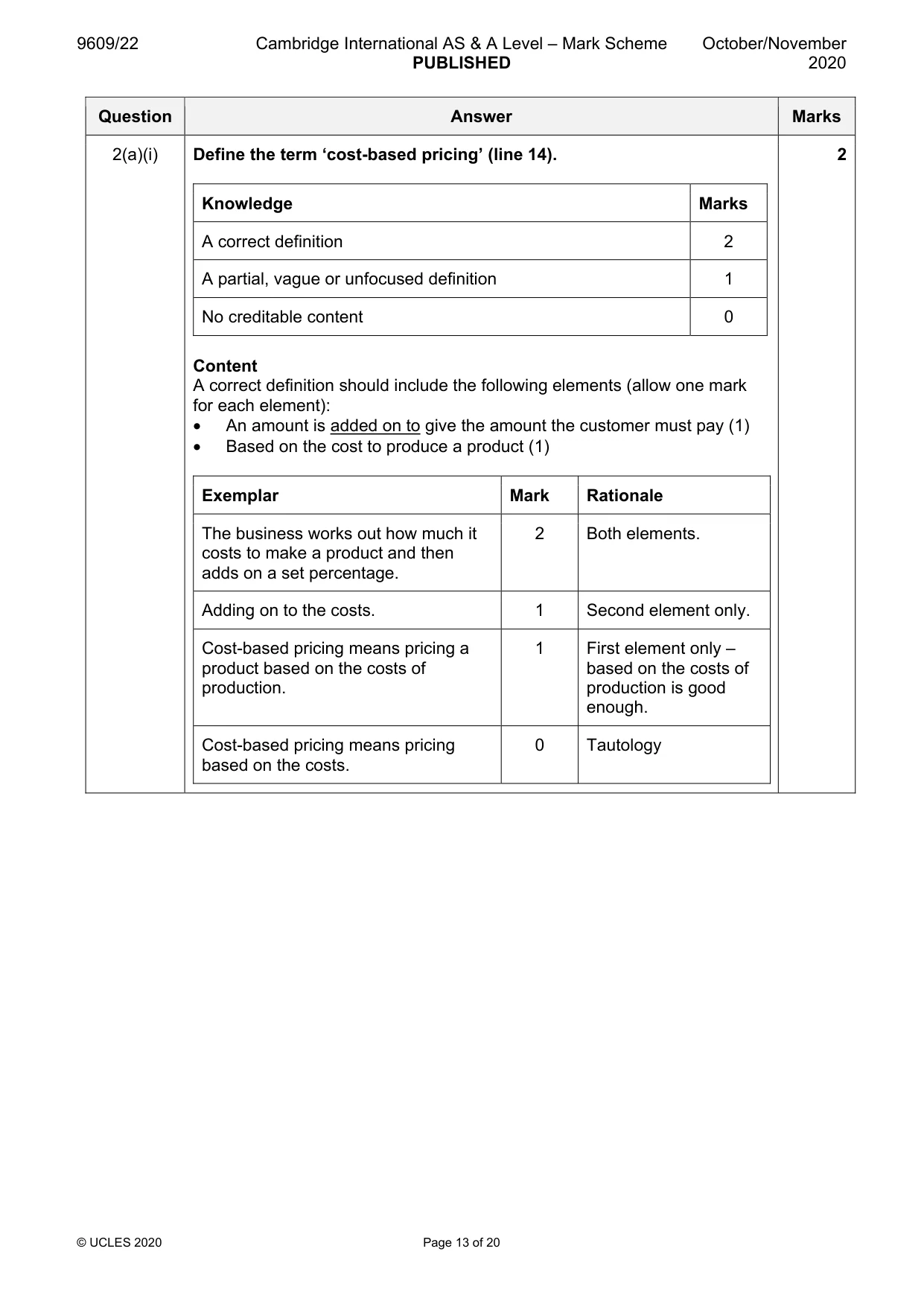
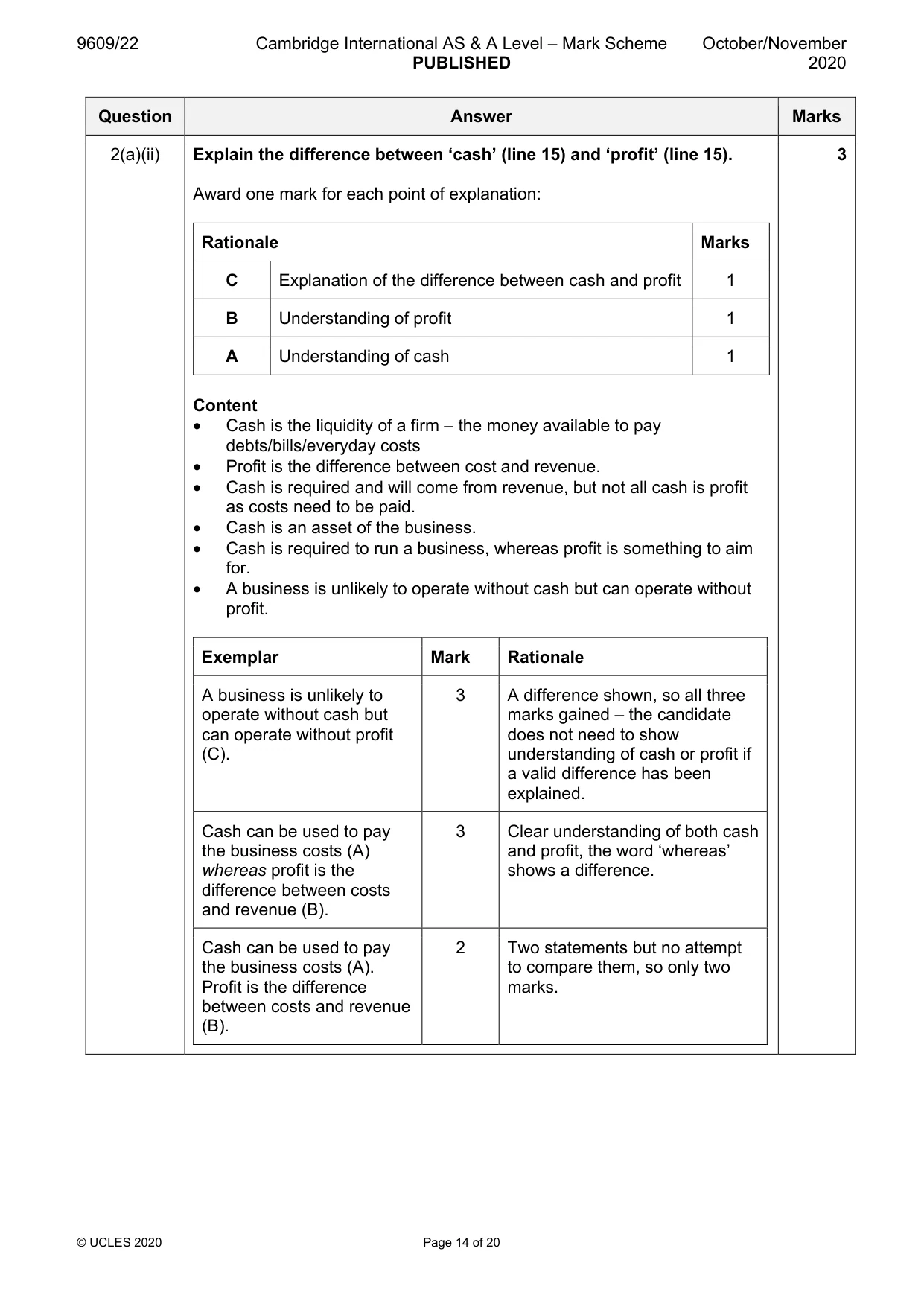
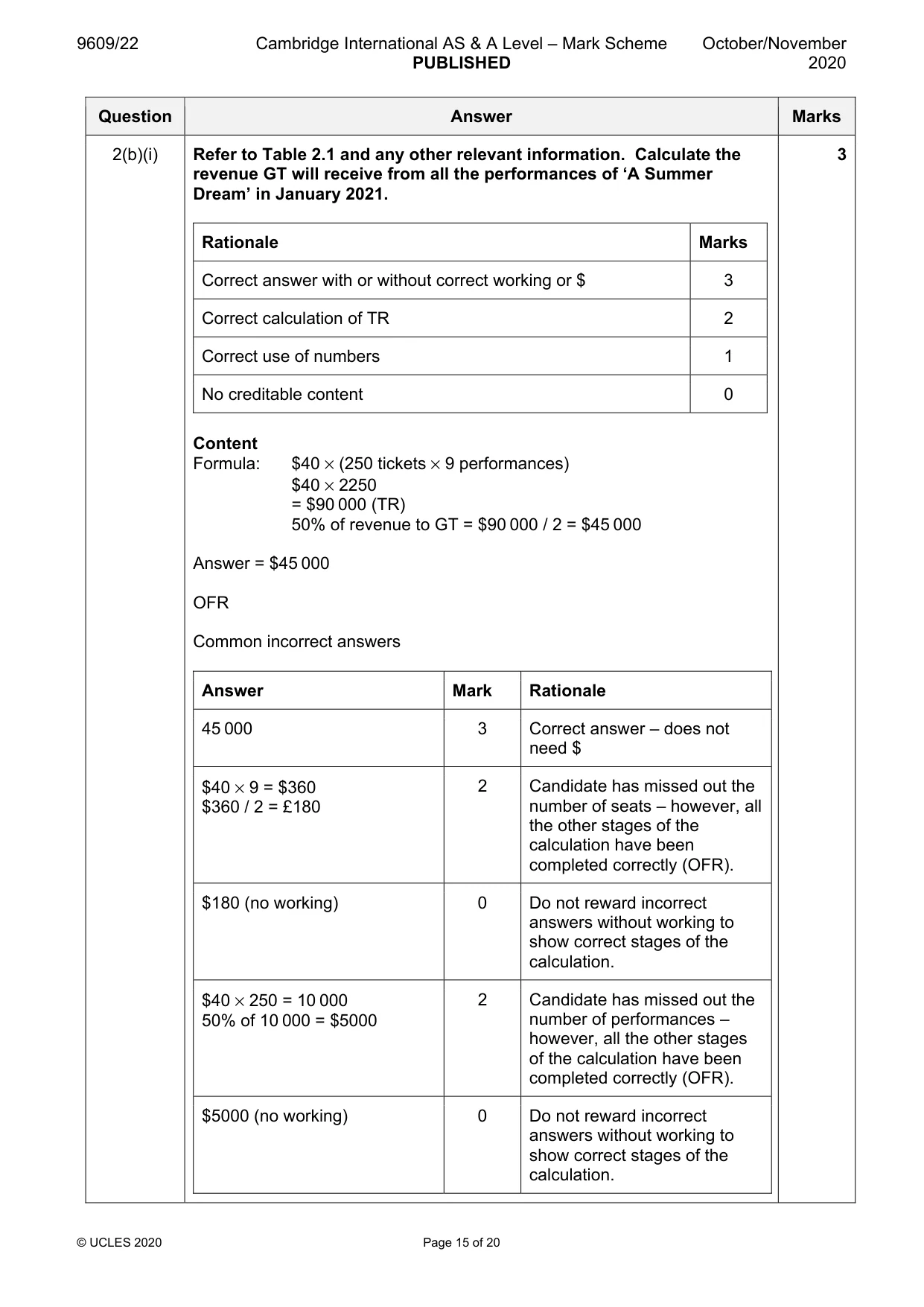
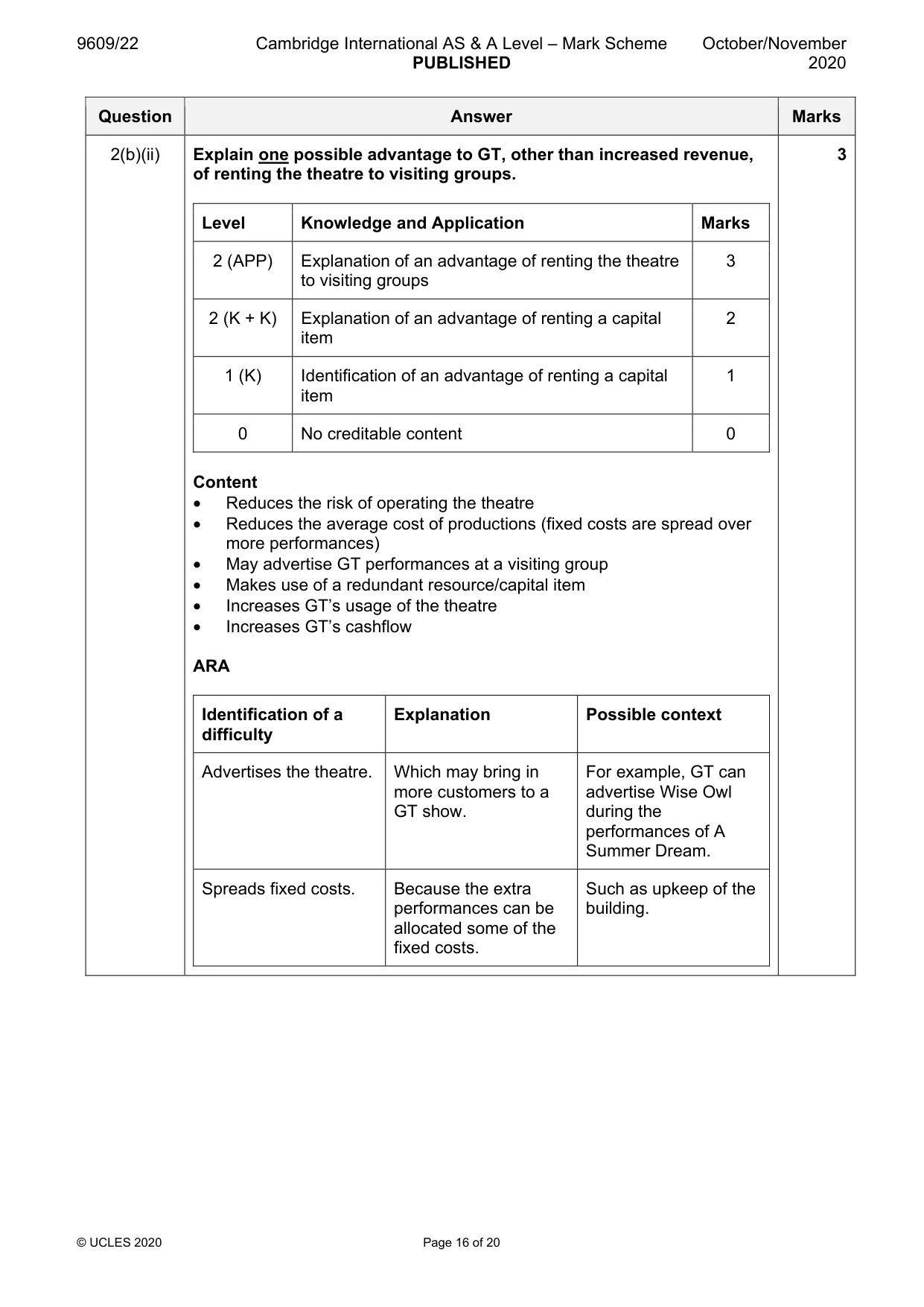
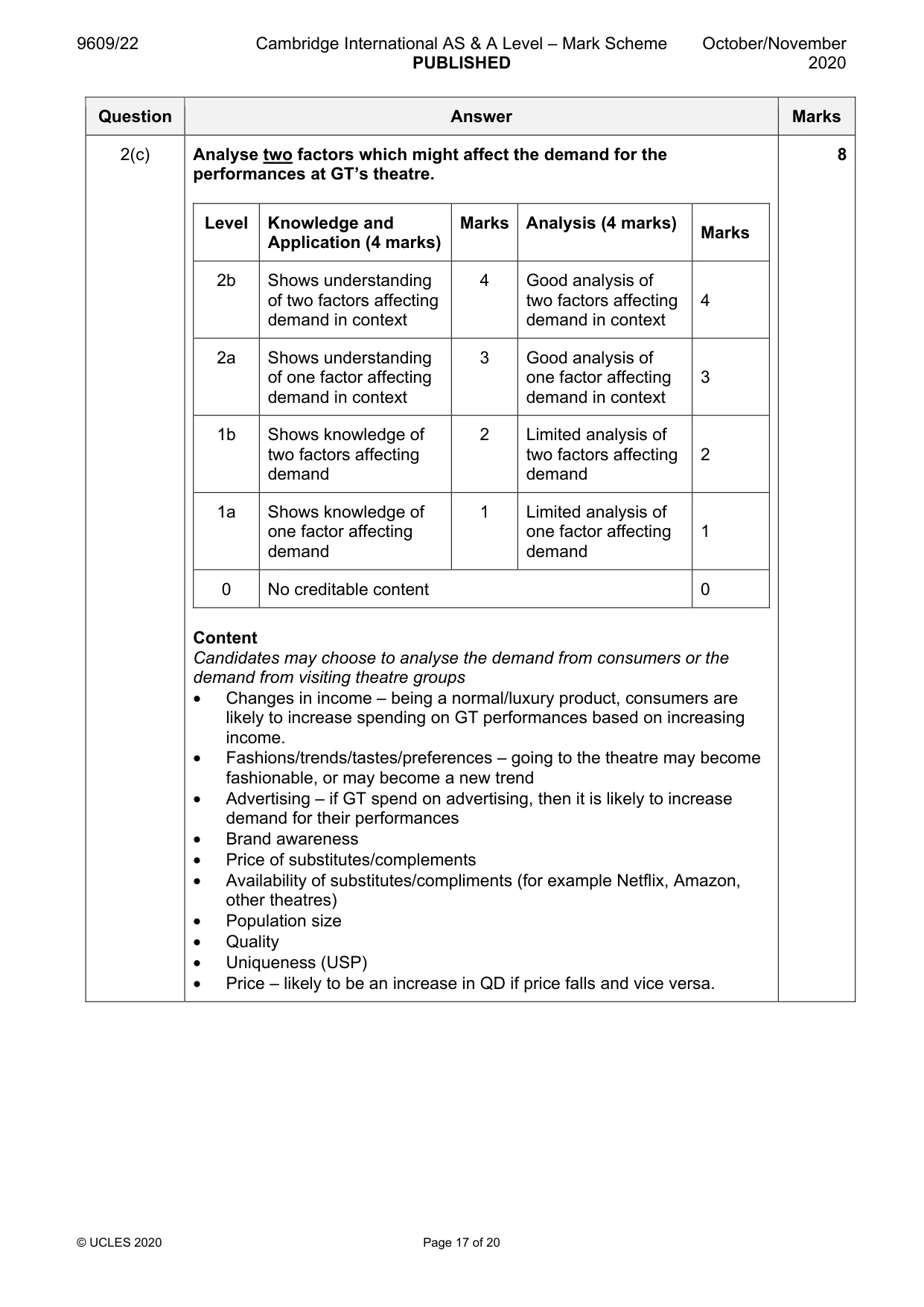
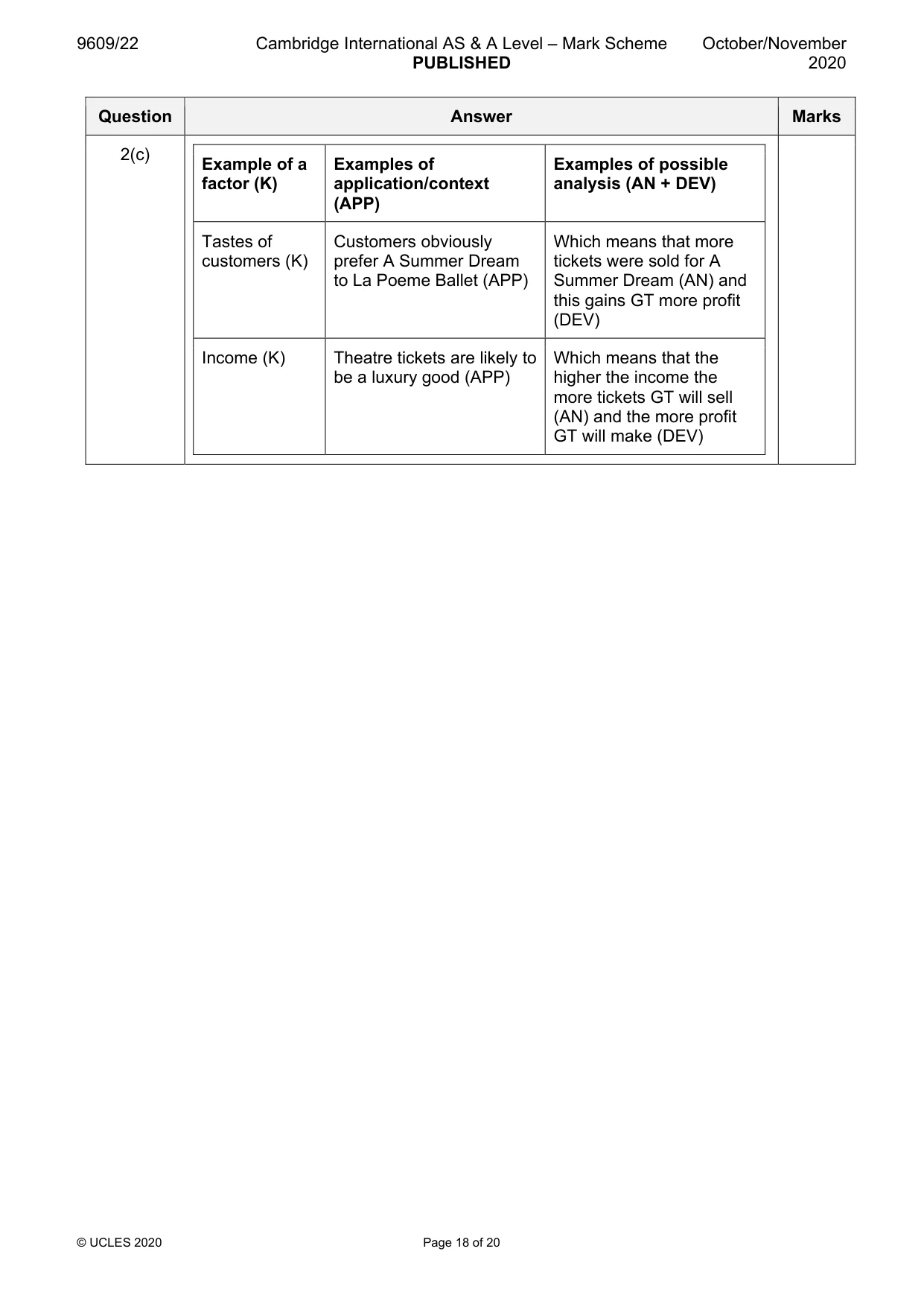
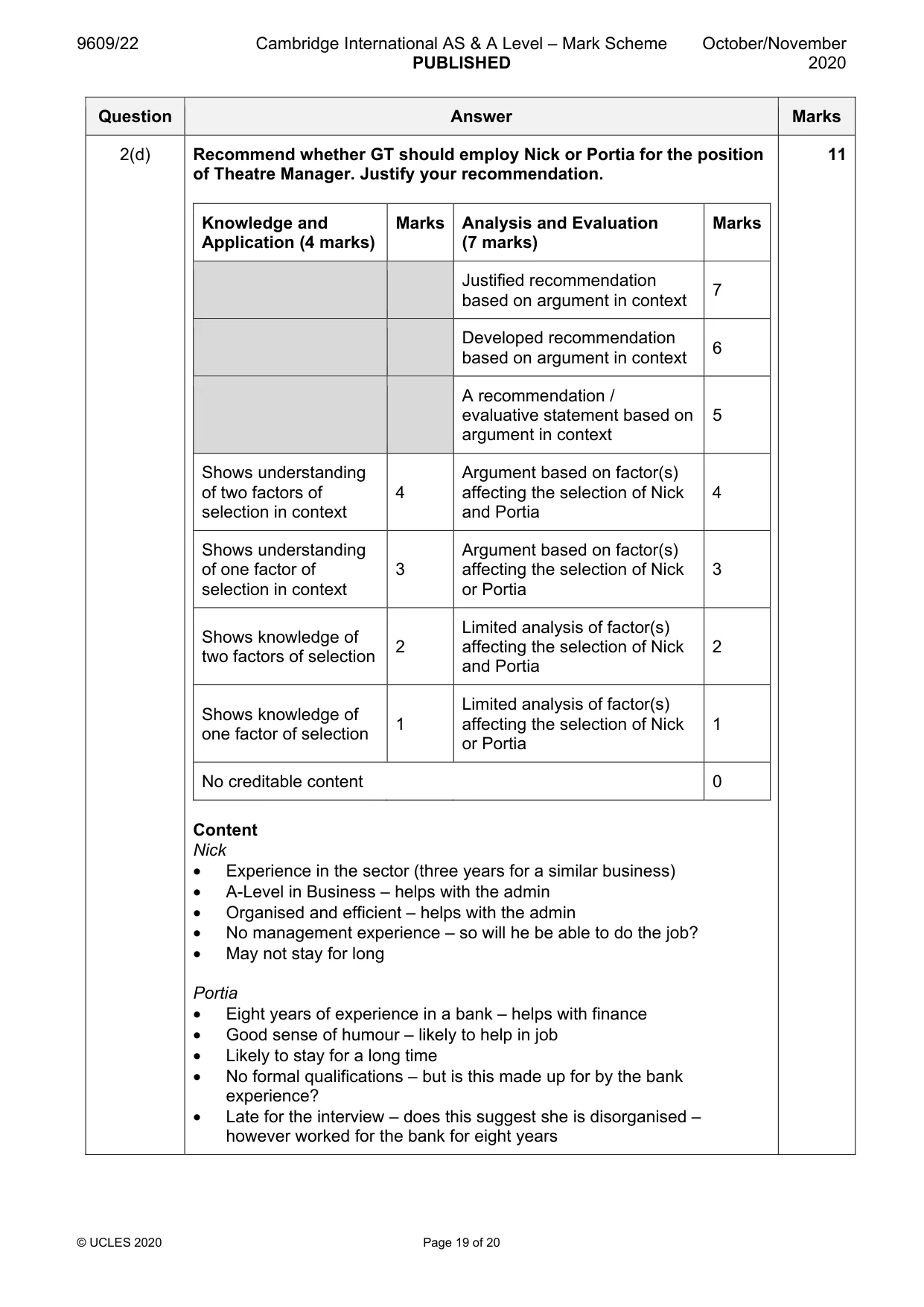
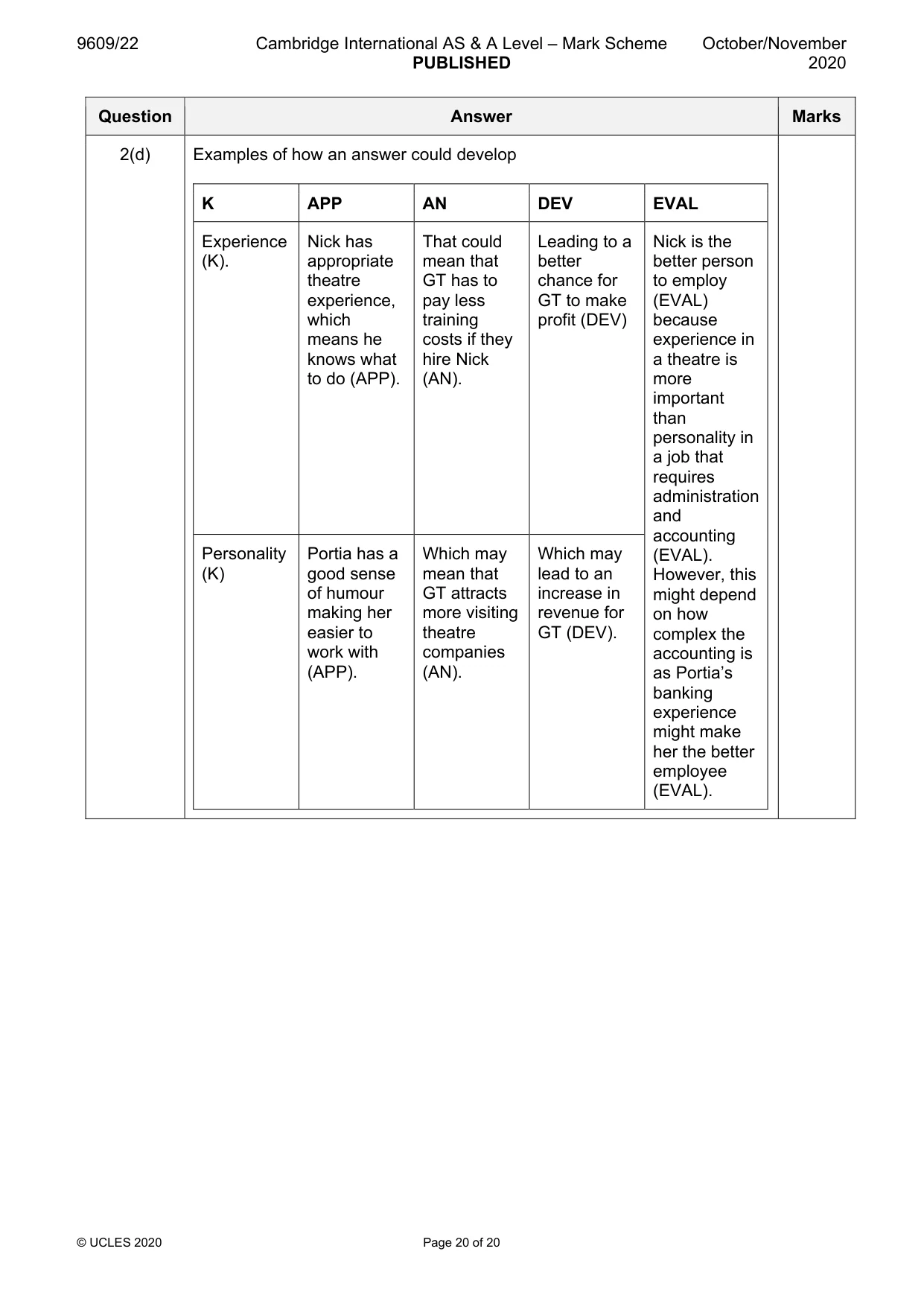
Mark scheme: 2(a)(i) Define the term ‘cost-based pricing’ (line 14). 2 Knowledge Marks A correct definition 2 A partial, vague or unfocused definition 1 No creditable content 0 Content A correct definition should include the following elements (allow one mark for each element): • An amount is added on to give the amount the customer must pay (1) • Based on the cost to produce a product (1) Exemplar Mark Rationale The business works out how much it 2 Both elements. costs to make a product and then adds on a set percentage. Adding on to the costs. 1 Second element only. Cost-based pricing means pricing a 1 First element only – product based on the costs of based on the costs of production. production is good enough. Cost-based pricing means pricing 0 Tautology based on the costs. 2(a)(ii) Explain the difference between ‘cash’ (line 15) and ‘profit’ (line 15). 3 Award one mark for each point of explanation: Rationale Marks C Explanation of the difference between cash and profit 1 B Understanding of profit 1 A Understanding of cash 1 Content • Cash is the liquidity of a firm – the money available to pay debts/bills/everyday costs • Profit is the difference between cost and revenue. • Cash is required and will come from revenue, but not all cash is profit as costs need to be paid. • Cash is an asset of the business. • Cash is required to run a business, whereas profit is something to aim for. • A business is unlikely to operate without cash but can operate without profit. Exemplar Mark Rationale A business is unlikely to 3 A difference shown, so all three operate without cash but marks gained – the candidate can operate without profit does not need to show (C). understanding of cash or profit if a valid difference has been explained. Cash can be used to pay 3 Clear understanding of both cash the business costs (A) and profit, the word ‘whereas’ whereas profit is the shows a difference. difference between costs and revenue (B). Cash can be used to pay 2 Two statements but no attempt the business costs (A). to compare them, so only two Profit is the difference marks. between costs and revenue (B). 2(b)(i) Refer to Table 2.1 and any other relevant information. Calculate the 3 revenue GT will receive from all the performances of ‘A Summer Dream’ in January 2021. Rationale Marks Correct answer with or without correct working or $ 3 Correct calculation of TR 2 Correct use of numbers 1 No creditable content 0 Content Formula: $40 × (250 tickets × 9 performances) $40 × 2250 = $90 000 (TR) 50% of revenue to GT = $90 000 / 2 = $45 000 Answer = $45 000 OFR Common incorrect answers Answer Mark Rationale 45 000 3 Correct answer – does not need $ $40 × 9 = $360 2 Candidate has missed out the $360 / 2 = £180 number of seats – however, all the other stages of the calculation have been completed correctly (OFR). $180 (no working) 0 Do not reward incorrect answers without working to show correct stages of the calculation. $40 × 250 = 10 000 2 Candidate has missed out the 50% of 10 000 = $5000 number of performances – however, all the other stages of the calculation have been completed correctly (OFR). $5000 (no working) 0 Do not reward incorrect answers without working to show correct stages of the calculation. 2(b)(ii) Explain one possible advantage to GT, other than increased revenue, 3 of renting the theatre to visiting groups. Level Knowledge and Application Marks 2 (APP) Explanation of an advantage of renting the theatre 3 to visiting groups 2 (K + K) Explanation of an advantage of renting a capital 2 item 1 (K) Identification of an advantage of renting a capital 1 item 0 No creditable content 0 Content • Reduces the risk of operating the theatre • Reduces the average cost of productions (fixed costs are spread over more performances) • May advertise GT performances at a visiting group • Makes use of a redundant resource/capital item • Increases GT’s usage of the theatre • Increases GT’s cashflow ARA Identification of a Explanation Possible context difficulty Advertises the theatre. Which may bring in For example, GT can more customers to a advertise Wise Owl GT show. during the performances of A Summer Dream. Spreads fixed costs. Because the extra Such as upkeep of the performances can be building. allocated some of the fixed costs. 2(c) Analyse two factors which might affect the demand for the 8 performances at GT’s theatre. Level Knowledge and Marks Analysis (4 marks) Marks Application (4 marks) 2b Shows understanding 4 Good analysis of of two factors affecting two factors affecting 4 demand in context demand in context 2a Shows understanding 3 Good analysis of of one factor affecting one factor affecting 3 demand in context demand in context 1b Shows knowledge of 2 Limited analysis of two factors affecting two factors affecting 2 demand demand 1a Shows knowledge of 1 Limited analysis of one factor affecting one factor affecting 1 demand demand 0 No creditable content 0 Content Candidates may choose to analyse the demand from consumers or the demand from visiting theatre groups • Changes in income – being a normal/luxury product, consumers are likely to increase spending on GT performances based on increasing income. • Fashions/trends/tastes/preferences – going to the theatre may become fashionable, or may become a new trend • Advertising – if GT spend on advertising, then it is likely to increase demand for their performances • Brand awareness • Price of substitutes/complements • Availability of substitutes/compliments (for example Netflix, Amazon, other theatres) • Population size • Quality • Uniqueness (USP) • Price – likely to be an increase in QD if price falls and vice versa. 2(c) Example of a Examples of Examples of possible factor (K) application/context analysis (AN + DEV) (APP) Tastes of Customers obviously Which means that more customers (K) prefer A Summer Dream tickets were sold for A to La Poeme Ballet (APP) Summer Dream (AN) and this gains GT more profit (DEV) Income (K) Theatre tickets are likely to Which means that the be a luxury good (APP) higher the income the more tickets GT will sell (AN) and the more profit GT will make (DEV) 2(d) Recommend whether GT should employ Nick or Portia for the position 11 of Theatre Manager. Justify your recommendation. Knowledge and Marks Analysis and Evaluation Marks Application (4 marks) (7 marks) Justified recommendation 7 based on argument in context Developed recommendation 6 based on argument in context A recommendation / evaluative statement based on 5 argument in context Shows understanding Argument based on factor(s) of two factors of 4 affecting the selection of Nick 4 selection in context and Portia Shows understanding Argument based on factor(s) of one factor of 3 affecting the selection of Nick 3 selection in context or Portia Limited analysis of factor(s) Shows knowledge of 2 affecting the selection of Nick 2 two factors of selection and Portia Limited analysis of factor(s) Shows knowledge of 1 affecting the selection of Nick 1 one factor of selection or Portia No creditable content 0 Content Nick • Experience in the sector (three years for a similar business) • A-Level in Business – helps with the admin • Organised and efficient – helps with the admin • No management experience – so will he be able to do the job? • May not stay for long Portia • Eight years of experience in a bank – helps with finance • Good sense of humour – likely to help in job • Likely to stay for a long time • No formal qualifications – but is this made up for by the bank experience? • Late for the interview – does this suggest she is disorganised – however worked for the bank for eight years 2(d) Examples of how an answer could develop K APP AN DEV EVAL Experience Nick has That could Leading to a Nick is the (K). appropriate mean that better better person theatre GT has to chance for to employ experience, pay less GT to make (EVAL) which training profit (DEV) because means he costs if they experience in knows what hire Nick a theatre is to do (APP). (AN). more important than personality in a job that requires administration and accounting Personality Portia has a Which may Which may (EVAL). (K) good sense mean that lead to an However, this of humour GT attracts increase in might depend making her more visiting revenue for on how easier to theatre GT (DEV). complex the work with companies accounting is (APP). (AN). as Portia’s banking experience might make her the better employee (EVAL).
What was in this paper
The subtopics covered by these 2 questions, and how many questions each got. Open one in a new tab to see every Cambridge question on it.
What you needed in this session
Cambridge’s own grade thresholds for 2020 Oct/Nov, Paper 2 · Variant 2. A higher threshold means an easier paper — the bar moves with how the cohort did.