Cambridge A Level Business (for first examination in 2016) 9609 — 2020 Oct/Nov Paper 2 · Variant 1
9609/21/O/N/20 · 2 questions · 60 marks · ≈68 min
The question paper and its mark scheme, free to read here and free to download. This is Cambridge’s own paper, exactly as it was sat.
Question paper4 pages


Mark scheme19 pages
Answers below. Sit the paper first if you are practising.



Questions as text
Q1 · UPlane Components (UC) UC is a private limited company providing engine parts for…
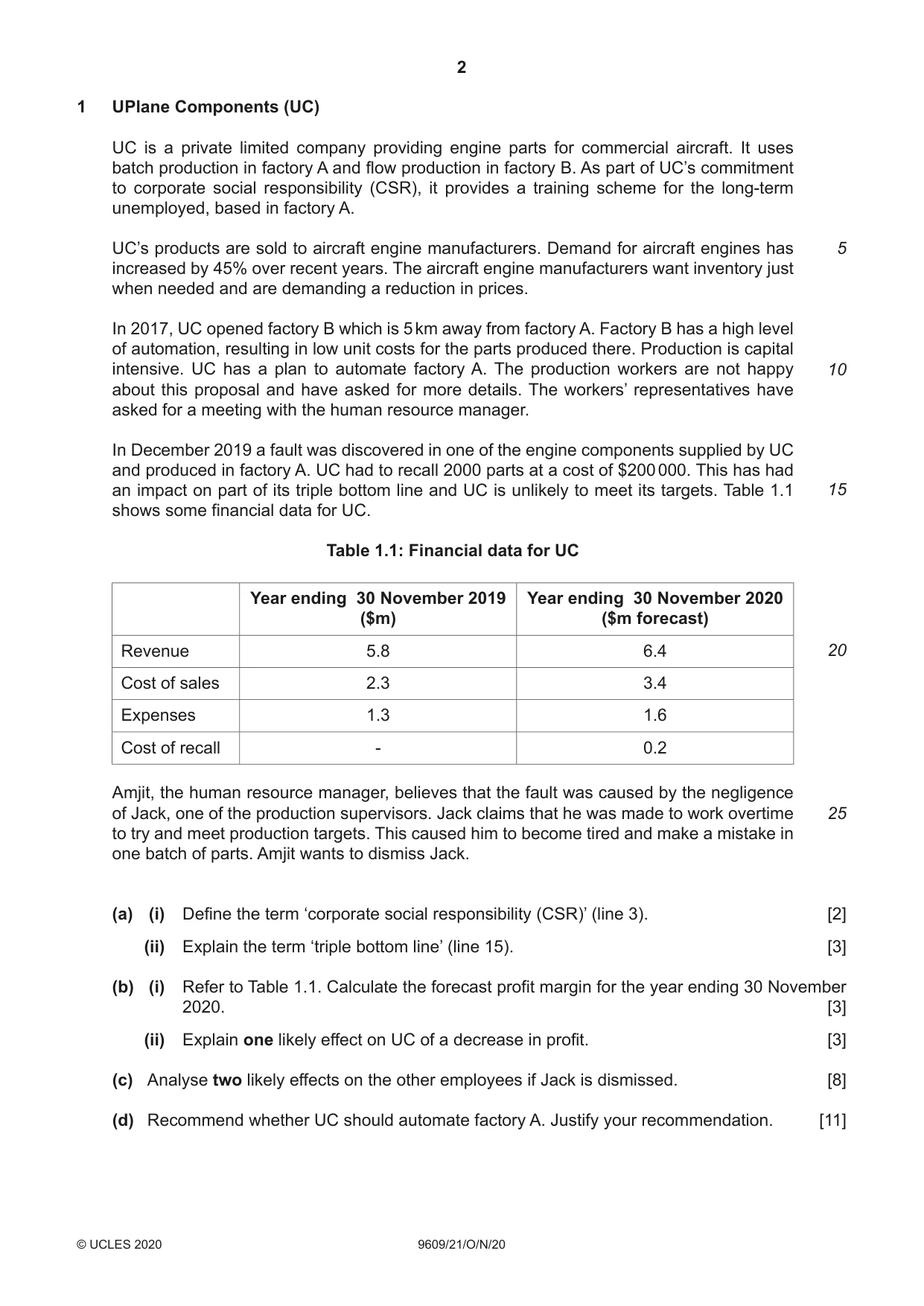
1 UPlane Components (UC) UC is a private limited company providing engine parts for commercial aircraft. It uses batch production in factory A and flow production in factory B. As part of UC’s commitment to corporate social responsibility (CSR), it provides a training scheme for the long-term unemployed, based in factory A. UC’s products are sold to aircraft engine manufacturers. Demand for aircraft engines has 5 increased by 45% over recent years. The aircraft engine manufacturers want inventory just when needed and are demanding a reduction in prices. In 2017, UC opened factory B which is 5 km away from factory A. Factory B has a high level of automation, resulting in low unit costs for the parts produced there. Production is capital intensive. UC has a plan to automate factory A. The production workers are not happy 10 about this proposal and have asked for more details. The workers’ representatives have asked for a meeting with the human resource manager. In December 2019 a fault was discovered in one of the engine components supplied by UC and produced in factory A. UC had to recall 2000 parts at a cost of $200 000. This has had an impact on part of its triple bottom line and UC is unlikely to meet its targets. Table 1.1 15 shows some financial data for UC. Table 1.1: Financial data for UC Year ending 30 November 2019 Year ending 30 November 2020 ($m) ($m forecast) Revenue 5.8 6.4 20 Cost of sales 2.3 3.4 Expenses 1.3 1.6 Cost of recall - 0.2 Amjit, the human resource manager, believes that the fault was caused by the negligence of Jack, one of the production supervisors. Jack claims that he was made to work overtime 25 to try and meet production targets. This caused him to become tired and make a mistake in one batch of parts. Amjit wants to dismiss Jack. (a) (i) Define the term ‘corporate social responsibility (CSR)’ (line 3). [2] (ii) Explain the term ‘triple bottom line’ (line 15). [3] (b) (i) Refer to Table 1.1. Calculate the forecast profit margin for the year ending 30 November 2020. [3] (ii) Explain one likely effect on UC of a decrease in profit. [3] (c) Analyse two likely effects on the other employees if Jack is dismissed. [8] (d) Recommend whether UC should automate factory A. Justify your recommendation. [11]
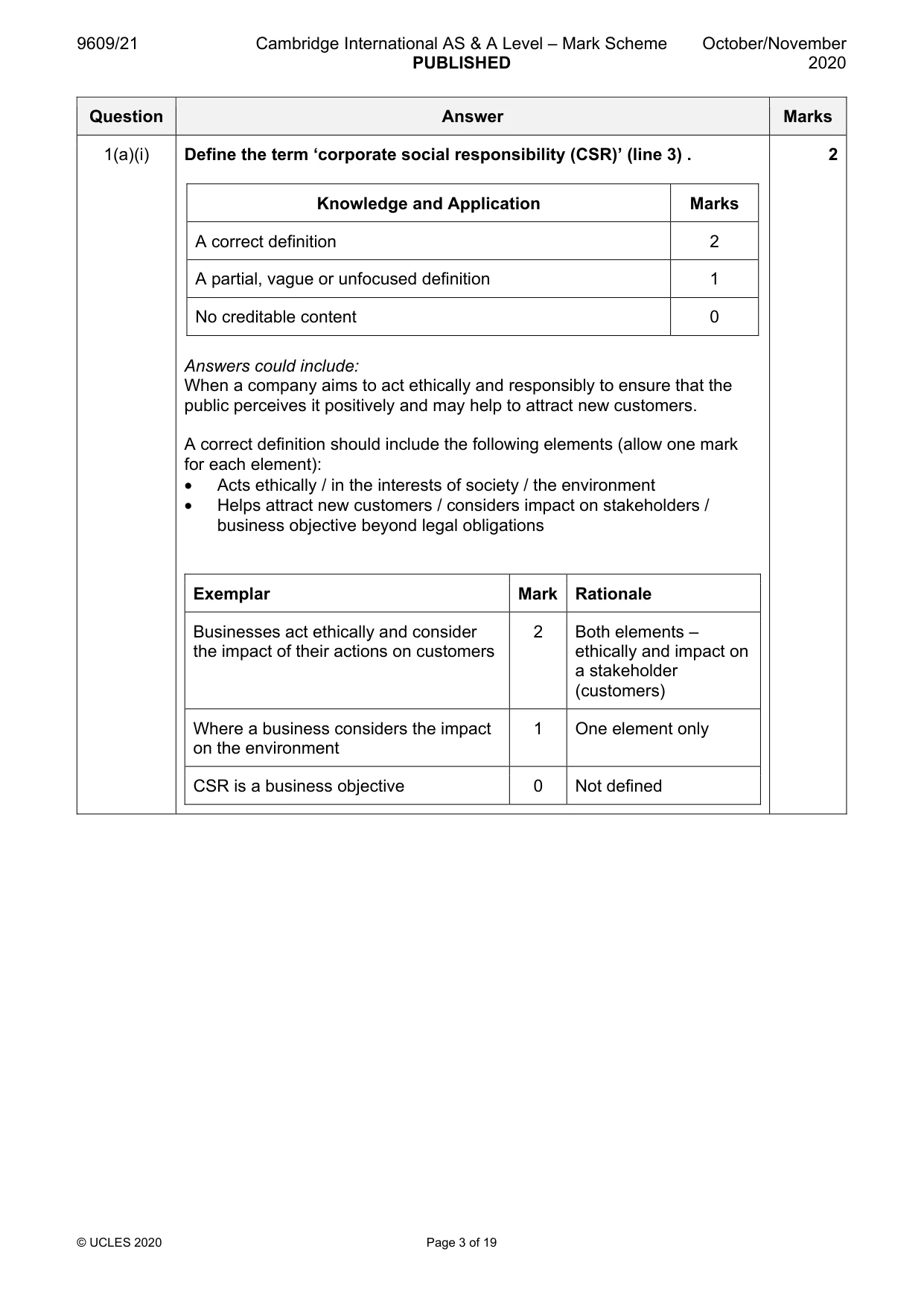
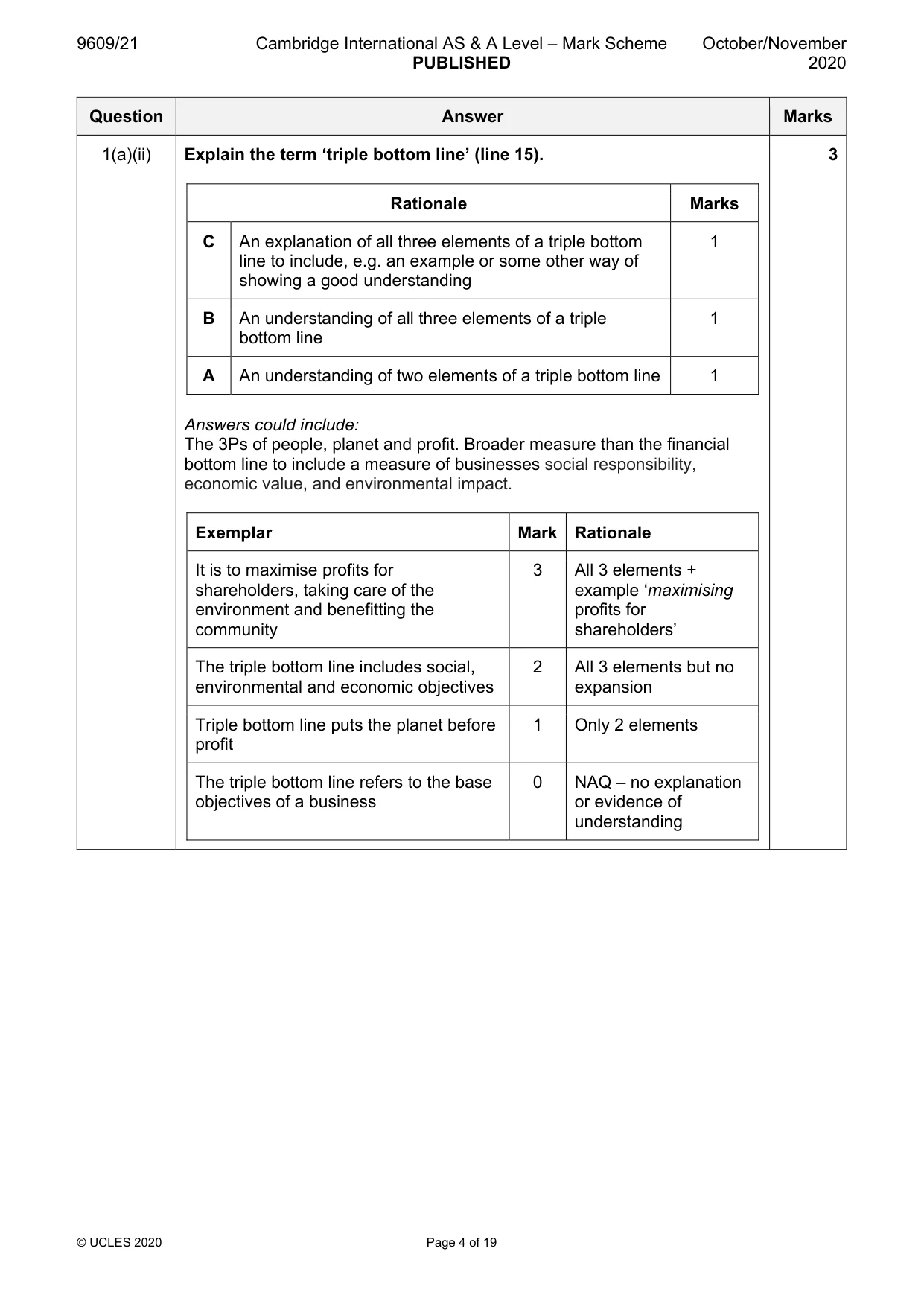
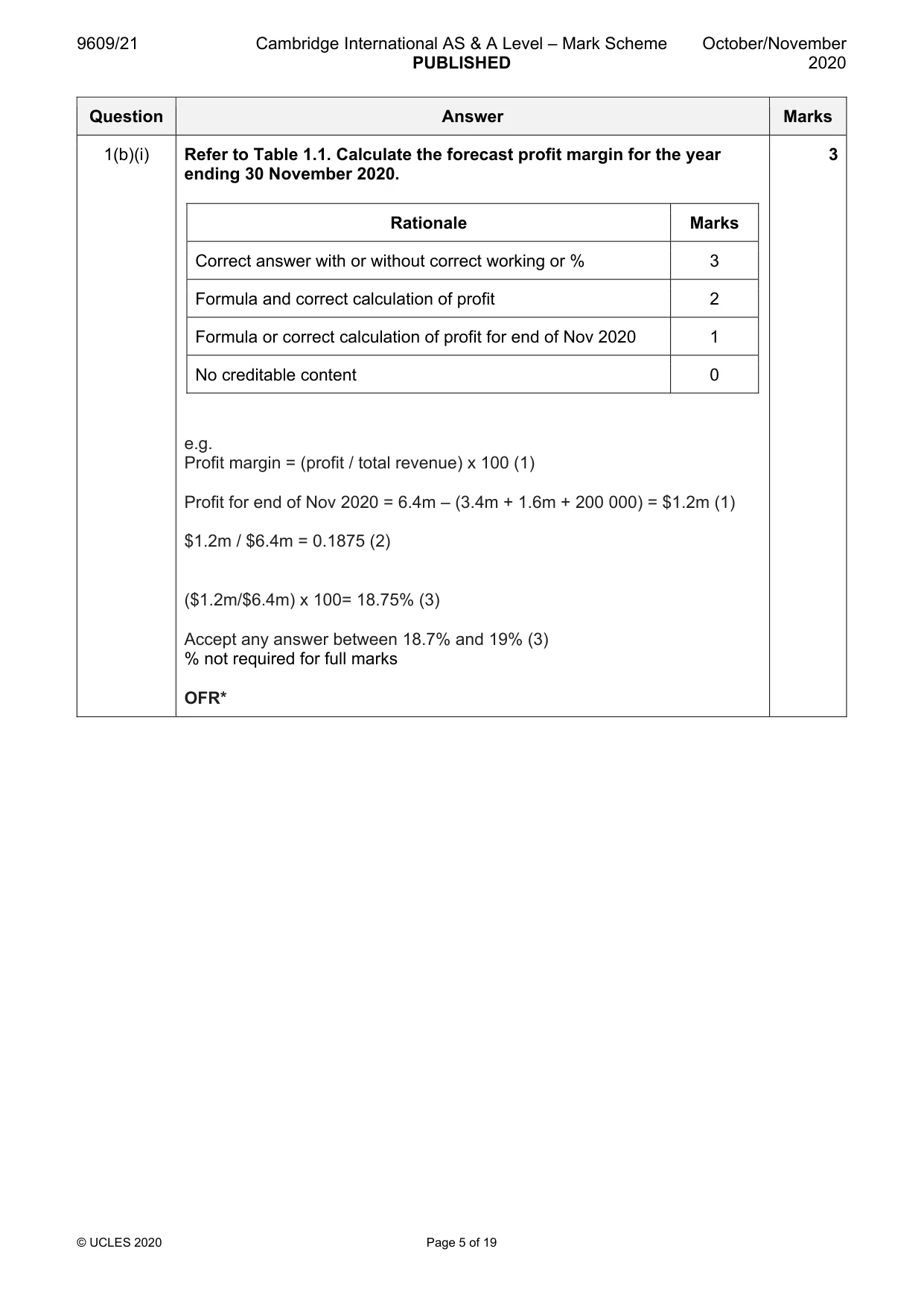
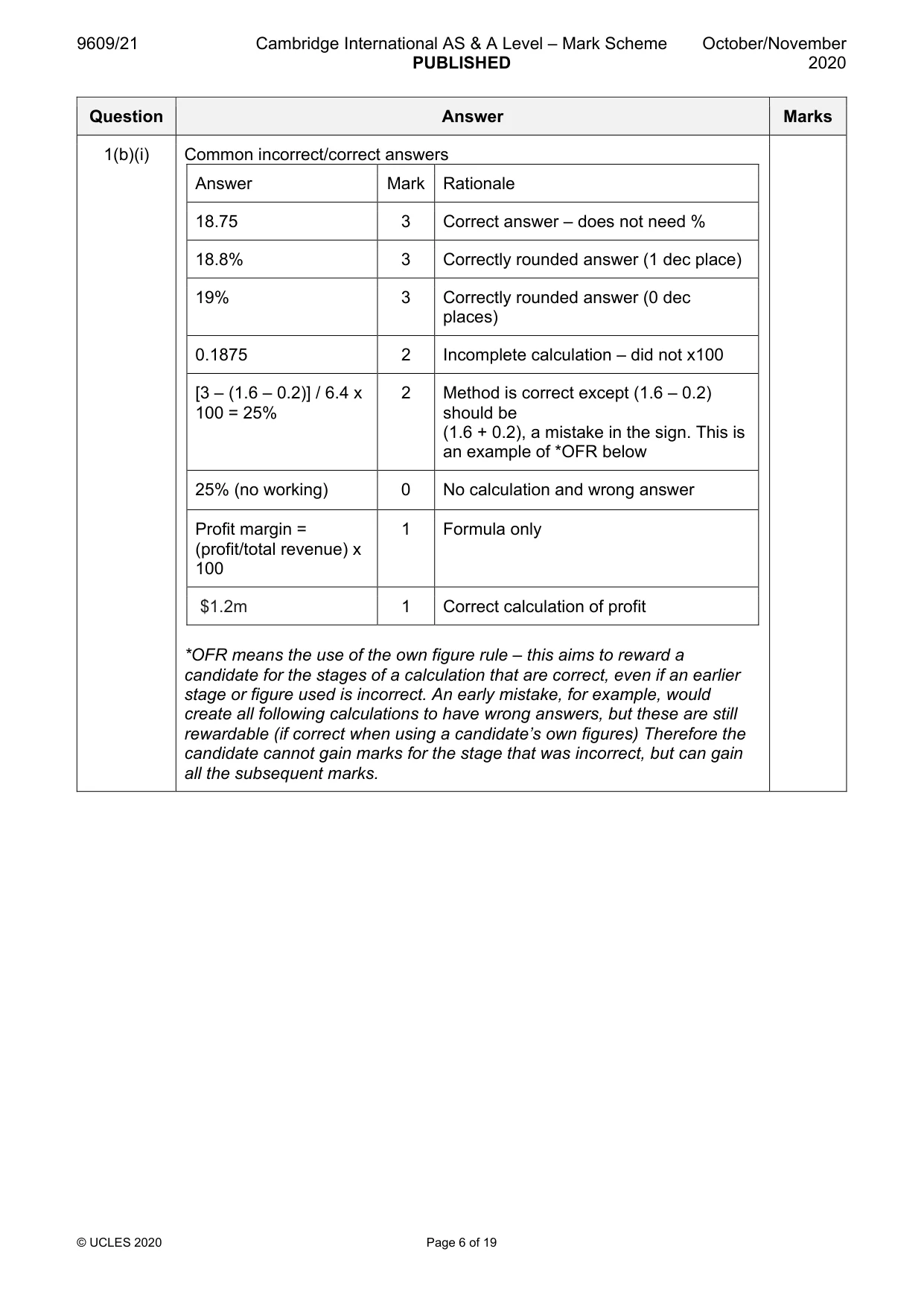
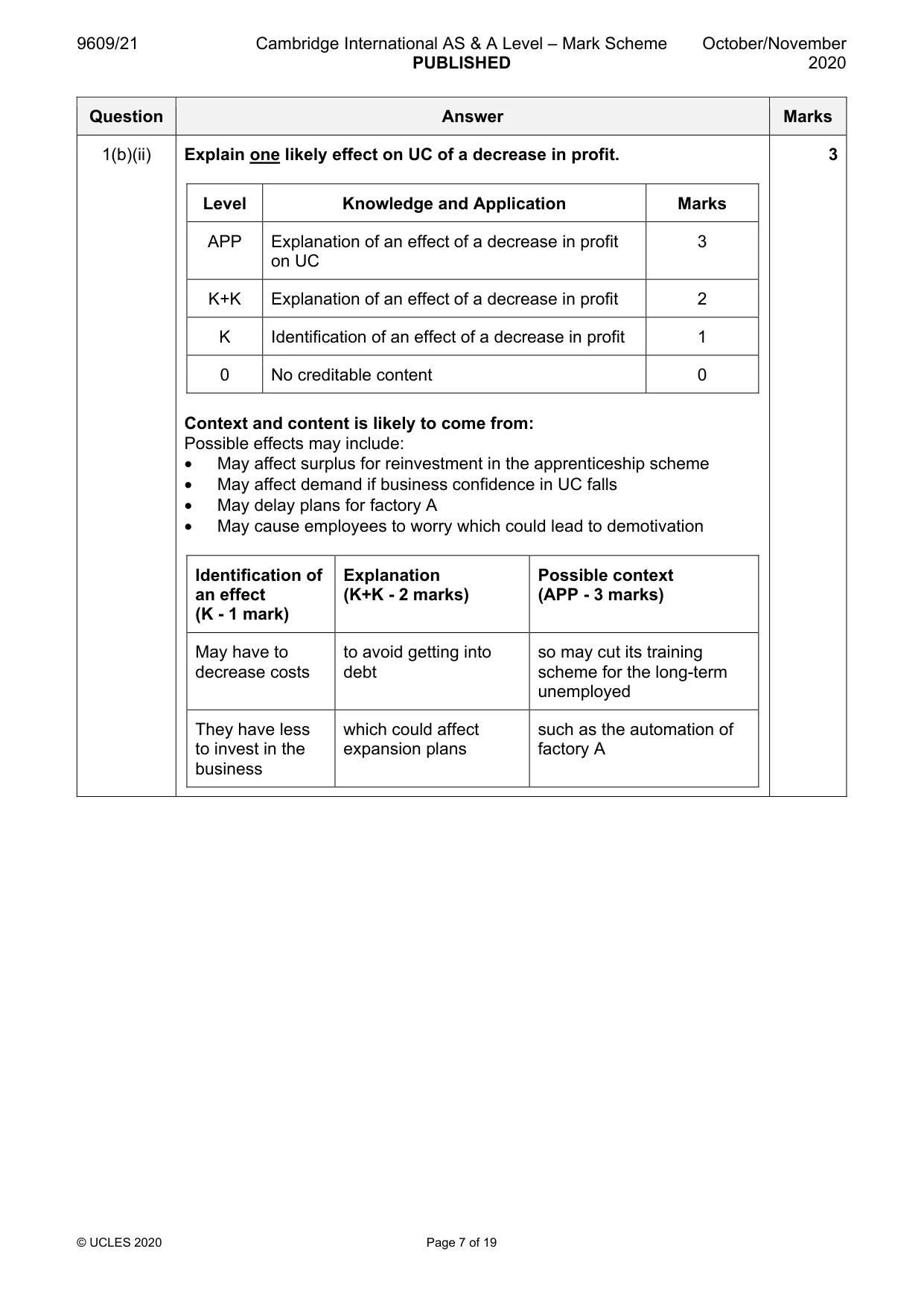
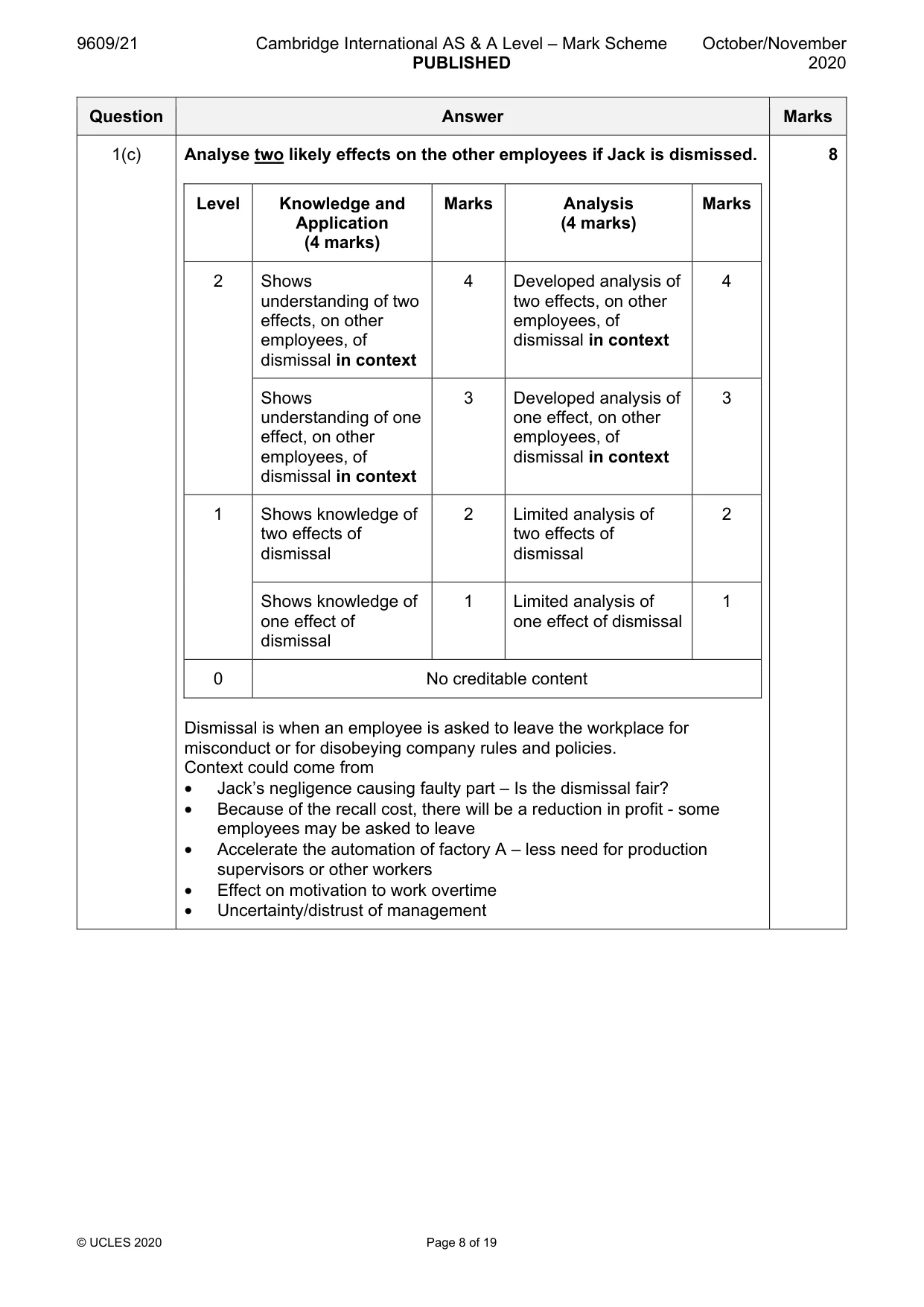
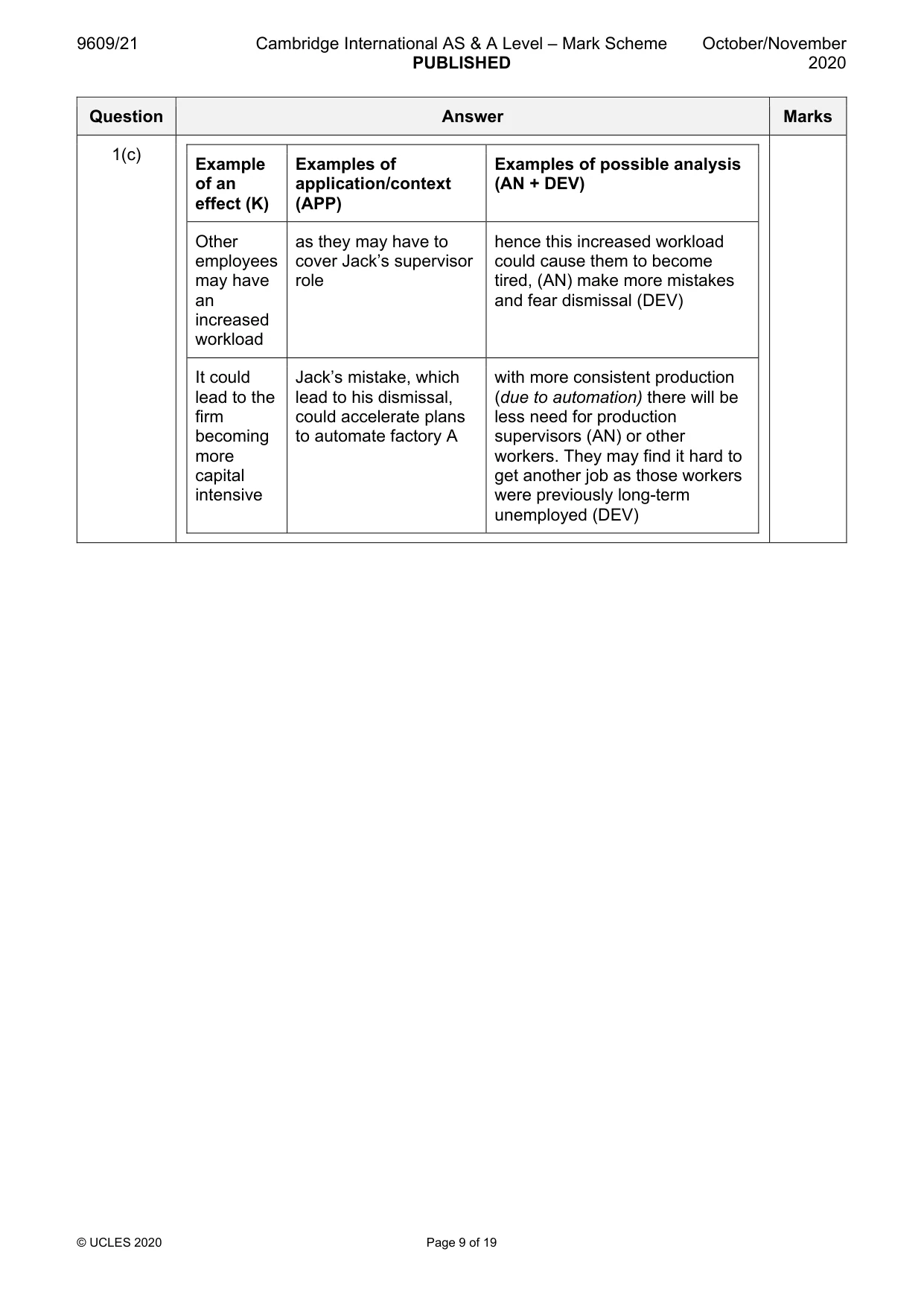
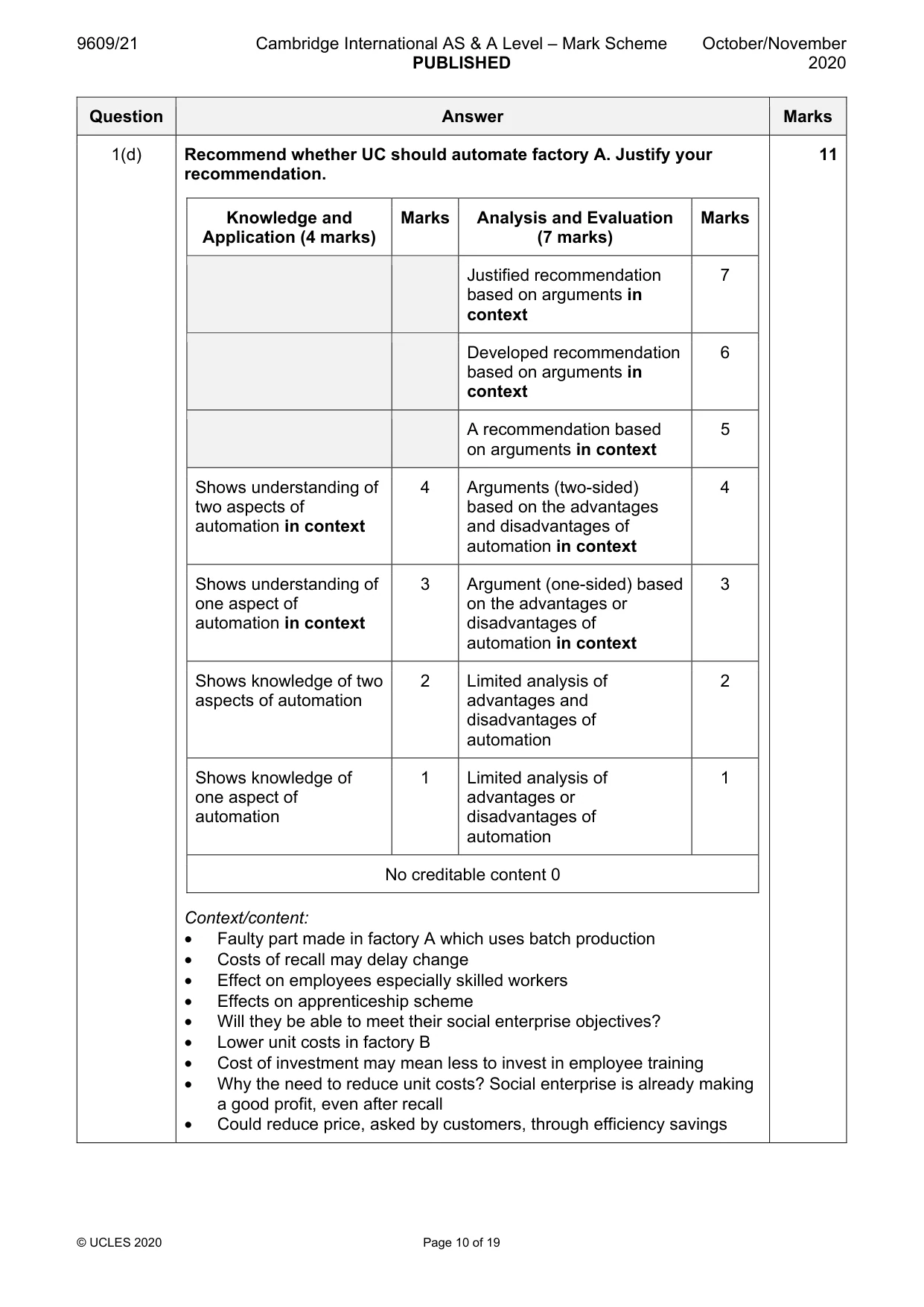
Mark scheme: Question Answer Marks 1(a)(i) Define the term ‘corporate social responsibility (CSR)’ (line 3) . 2 Knowledge and Application Marks A correct definition 2 A partial, vague or unfocused definition 1 No creditable content 0 Answers could include: When a company aims to act ethically and responsibly to ensure that the public perceives it positively and may help to attract new customers. A correct definition should include the following elements (allow one mark for each element): • Acts ethically / in the interests of society / the environment • Helps attract new customers / considers impact on stakeholders / business objective beyond legal obligations Exemplar Mark Rationale Businesses act ethically and consider 2 Both elements – the impact of their actions on customers ethically and impact on a stakeholder (customers) Where a business considers the impact 1 One element only on the environment CSR is a business objective 0 Not defined 1(a)(ii) Explain the term ‘triple bottom line’ (line 15). 3 Rationale Marks C An explanation of all three elements of a triple bottom 1 line to include, e.g. an example or some other way of showing a good understanding B An understanding of all three elements of a triple 1 bottom line A An understanding of two elements of a triple bottom line 1 Answers could include: The 3Ps of people, planet and profit. Broader measure than the financial bottom line to include a measure of businesses social responsibility, economic value, and environmental impact. Exemplar Mark Rationale It is to maximise profits for 3 All 3 elements + shareholders, taking care of the example ‘maximising environment and benefitting the profits for community shareholders’ The triple bottom line includes social, 2 All 3 elements but no environmental and economic objectives expansion Triple bottom line puts the planet before 1 Only 2 elements profit The triple bottom line refers to the base 0 NAQ – no explanation objectives of a business or evidence of understanding 1(b)(i) Refer to Table 1.1. Calculate the forecast profit margin for the year 3 ending 30 November 2020. Rationale Marks Correct answer with or without correct working or % 3 Formula and correct calculation of profit 2 Formula or correct calculation of profit for end of Nov 2020 1 No creditable content 0 e.g. Profit margin = (profit / total revenue) x 100 (1) Profit for end of Nov 2020 = 6.4m – (3.4m + 1.6m + 200 000) = $1.2m (1) $1.2m / $6.4m = 0.1875 (2) ($1.2m/$6.4m) x 100= 18.75% (3) Accept any answer between 18.7% and 19% (3) % not required for full marks OFR* 1(b)(i) Common incorrect/correct answers Answer Mark Rationale 18.75 3 Correct answer – does not need % 18.8% 3 Correctly rounded answer (1 dec place) 19% 3 Correctly rounded answer (0 dec places) 0.1875 2 Incomplete calculation – did not x100 [3 – (1.6 – 0.2)] / 6.4 x 2 Method is correct except (1.6 – 0.2) 100 = 25% should be (1.6 + 0.2), a mistake in the sign. This is an example of *OFR below 25% (no working) 0 No calculation and wrong answer Profit margin = 1 Formula only (profit/total revenue) x 100 $1.2m 1 Correct calculation of profit *OFR means the use of the own figure rule – this aims to reward a candidate for the stages of a calculation that are correct, even if an earlier stage or figure used is incorrect. An early mistake, for example, would create all following calculations to have wrong answers, but these are still rewardable (if correct when using a candidate’s own figures) Therefore the candidate cannot gain marks for the stage that was incorrect, but can gain all the subsequent marks. 1(b)(ii) Explain one likely effect on UC of a decrease in profit. 3 Level Knowledge and Application Marks APP Explanation of an effect of a decrease in profit 3 on UC K+K Explanation of an effect of a decrease in profit 2 K Identification of an effect of a decrease in profit 1 0 No creditable content 0 Context and content is likely to come from: Possible effects may include: • May affect surplus for reinvestment in the apprenticeship scheme • May affect demand if business confidence in UC falls • May delay plans for factory A • May cause employees to worry which could lead to demotivation Identification of Explanation Possible context an effect (K+K - 2 marks) (APP - 3 marks) (K - 1 mark) May have to to avoid getting into so may cut its training decrease costs debt scheme for the long-term unemployed They have less which could affect such as the automation of to invest in the expansion plans factory A business 1(c) Analyse two likely effects on the other employees if Jack is dismissed. 8 Level Knowledge and Marks Analysis Marks Application (4 marks) (4 marks) 2 Shows 4 Developed analysis of 4 understanding of two two effects, on other effects, on other employees, of employees, of dismissal in context dismissal in context Shows 3 Developed analysis of 3 understanding of one one effect, on other effect, on other employees, of employees, of dismissal in context dismissal in context 1 Shows knowledge of 2 Limited analysis of 2 two effects of two effects of dismissal dismissal Shows knowledge of 1 Limited analysis of 1 one effect of one effect of dismissal dismissal 0 No creditable content Dismissal is when an employee is asked to leave the workplace for misconduct or for disobeying company rules and policies. Context could come from • Jack’s negligence causing faulty part – Is the dismissal fair? • Because of the recall cost, there will be a reduction in profit - some employees may be asked to leave • Accelerate the automation of factory A – less need for production supervisors or other workers • Effect on motivation to work overtime • Uncertainty/distrust of management 1(c) Example Examples of Examples of possible analysis of an application/context (AN + DEV) effect (K) (APP) Other as they may have to hence this increased workload employees cover Jack’s supervisor could cause them to become may have role tired, (AN) make more mistakes an and fear dismissal (DEV) increased workload It could Jack’s mistake, which with more consistent production lead to the lead to his dismissal, (due to automation) there will be firm could accelerate plans less need for production becoming to automate factory A supervisors (AN) or other more workers. They may find it hard to capital get another job as those workers intensive were previously long-term unemployed (DEV) 1(d) Recommend whether UC should automate factory A. Justify your 11 recommendation. Knowledge and Marks Analysis and Evaluation Marks Application (4 marks) (7 marks) Justified recommendation 7 based on arguments in context Developed recommendation 6 based on arguments in context A recommendation based 5 on arguments in context Shows understanding of 4 Arguments (two-sided) 4 two aspects of based on the advantages automation in context and disadvantages of automation in context Shows understanding of 3 Argument (one-sided) based 3 one aspect of on the advantages or automation in context disadvantages of automation in context Shows knowledge of two 2 Limited analysis of 2 aspects of automation advantages and disadvantages of automation Shows knowledge of 1 Limited analysis of 1 one aspect of advantages or automation disadvantages of automation No creditable content 0 Context/content: • Faulty part made in factory A which uses batch production • Costs of recall may delay change • Effect on employees especially skilled workers • Effects on apprenticeship scheme • Will they be able to meet their social enterprise objectives? • Lower unit costs in factory B • Cost of investment may mean less to invest in employee training • Why the need to reduce unit costs? Social enterprise is already making a good profit, even after recall • Could reduce price, asked by customers, through efficiency savings 1(d) Examples of how an answer could develop and how it should be annotated. K APP AN DEV EVAL Automated The This should Therefore UC To some machinery company mean that could re-invest extent is more will be the average the extra profits automation consistent able to unit cost will into the could be produce fall company, as a damaging to engine source of UC because parts finance, and of high start- more help it achieve up costs quickly its CSR (EVAL) objective. However, I would UC should The cost This could Consequently, recommend not of sales mean that as UC is a that UC automate are UC’s private should as it would already profitability company it automate have high forecast will cannot sell Factory A set-up costs to rise by decrease shares to the (EVAL) as it $1.1m in public to cover will have a 2020 these costs so higher level of they may face consistent a cash-flow output leading problem and to lower their liquidity average costs may not be and higher sustainable. profits in the long-run (EVAL)
Q2 · Electric Cars (EC) EC is a public limited company producing electric cars
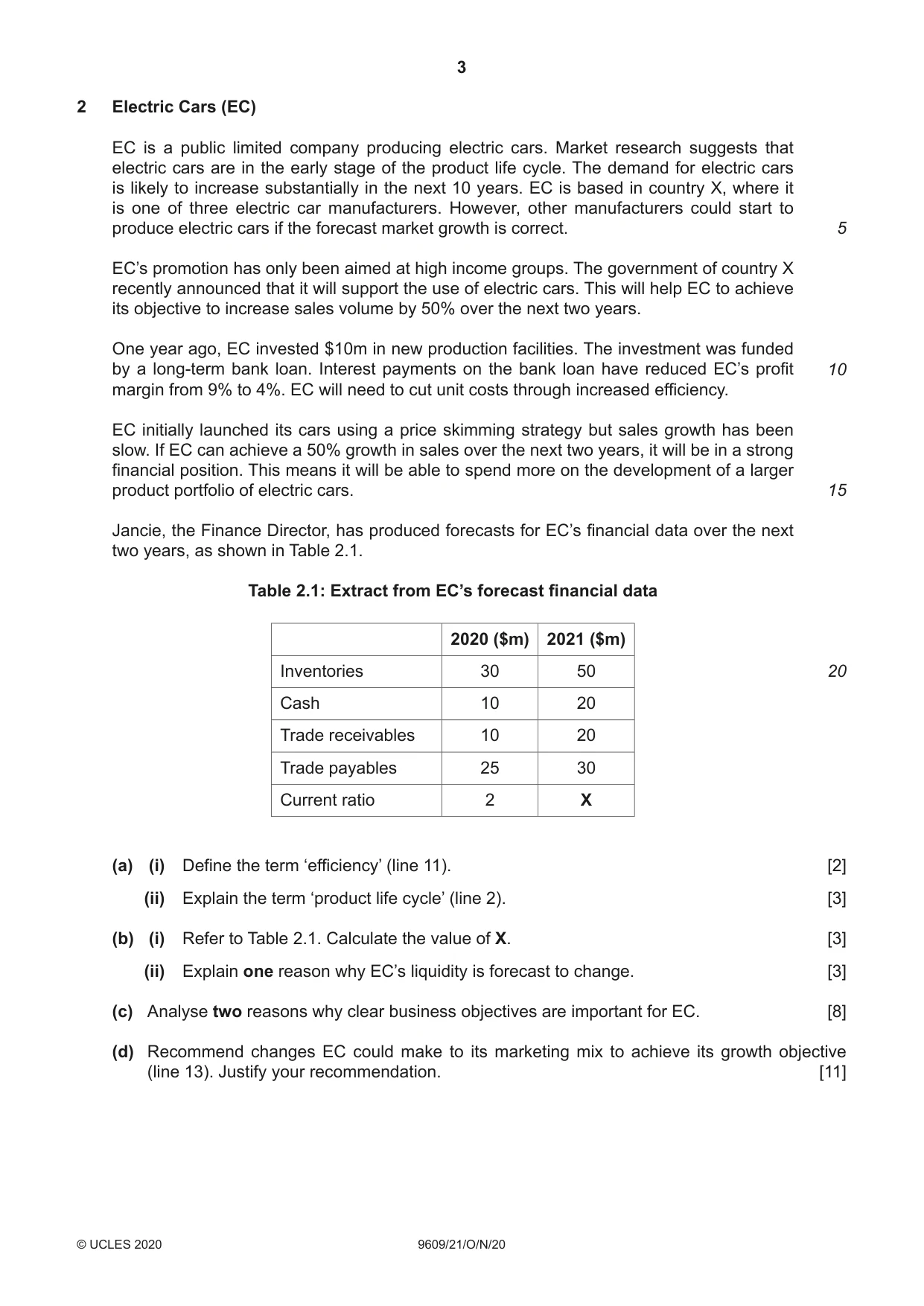
2 Electric Cars (EC) EC is a public limited company producing electric cars. Market research suggests that electric cars are in the early stage of the product life cycle. The demand for electric cars is likely to increase substantially in the next 10 years. EC is based in country X, where it is one of three electric car manufacturers. However, other manufacturers could start to produce electric cars if the forecast market growth is correct. 5 EC’s promotion has only been aimed at high income groups. The government of country X recently announced that it will support the use of electric cars. This will help EC to achieve its objective to increase sales volume by 50% over the next two years. One year ago, EC invested $10m in new production facilities. The investment was funded by a long-term bank loan. Interest payments on the bank loan have reduced EC’s profit 10 margin from 9% to 4%. EC will need to cut unit costs through increased efficiency. EC initially launched its cars using a price skimming strategy but sales growth has been slow. If EC can achieve a 50% growth in sales over the next two years, it will be in a strong financial position. This means it will be able to spend more on the development of a larger product portfolio of electric cars. 15 Jancie, the Finance Director, has produced forecasts for EC’s financial data over the next two years, as shown in Table 2.1. Table 2.1: Extract from EC’s forecast financial data 2020 ($m) 2021 ($m) Inventories 30 50 20 Cash 10 20 Trade receivables 10 20 Trade payables 25 30 Current ratio 2 X (a) (i) Define the term ‘efficiency’ (line 11). [2] (ii) Explain the term ‘product life cycle’ (line 2). [3] (b) (i) Refer to Table 2.1. Calculate the value of X. [3] (ii) Explain one reason why EC’s liquidity is forecast to change. [3] (c) Analyse two reasons why clear business objectives are important for EC. [8] (d) Recommend changes EC could make to its marketing mix to achieve its growth objective (line 13). Justify your recommendation. [11]
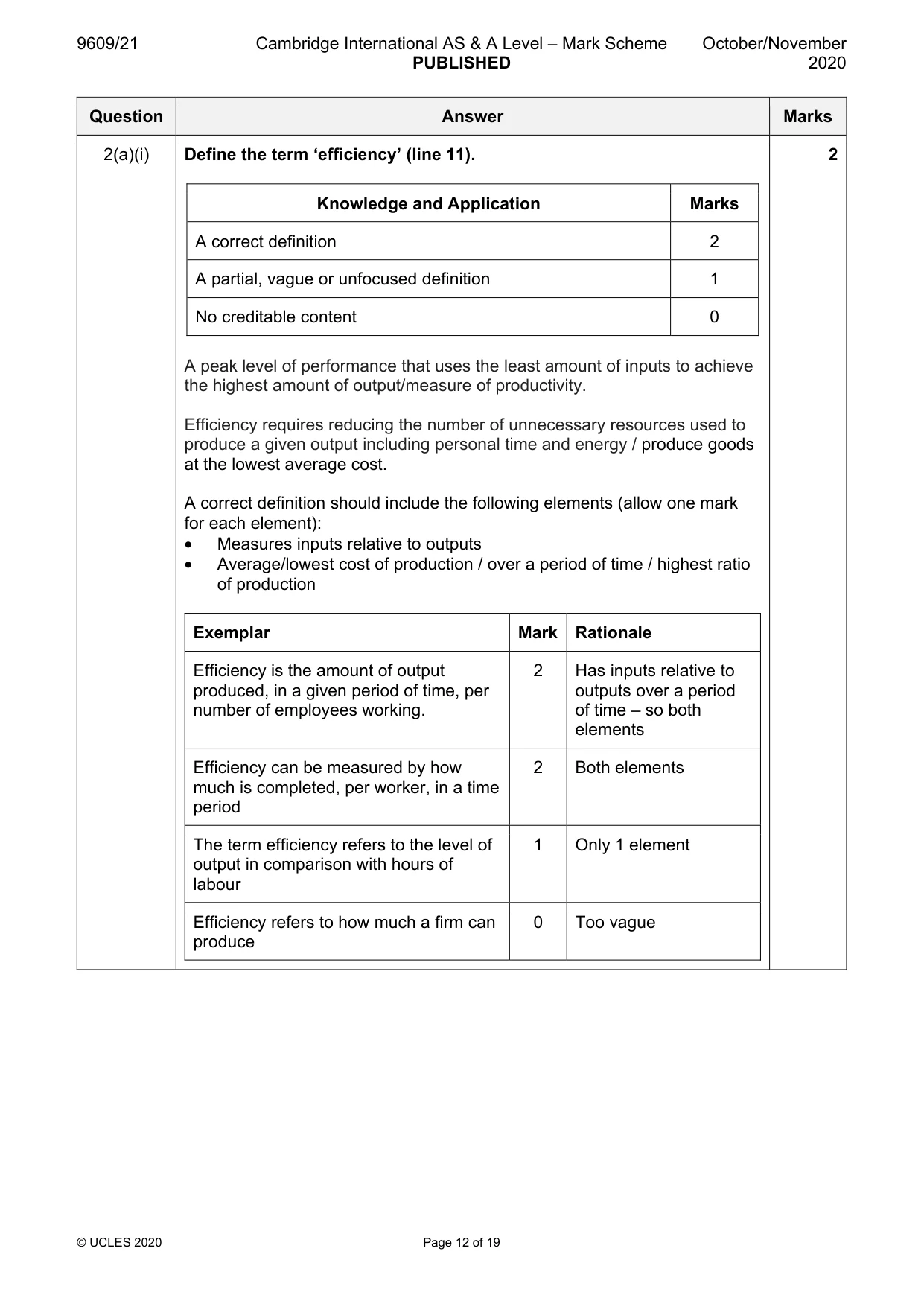
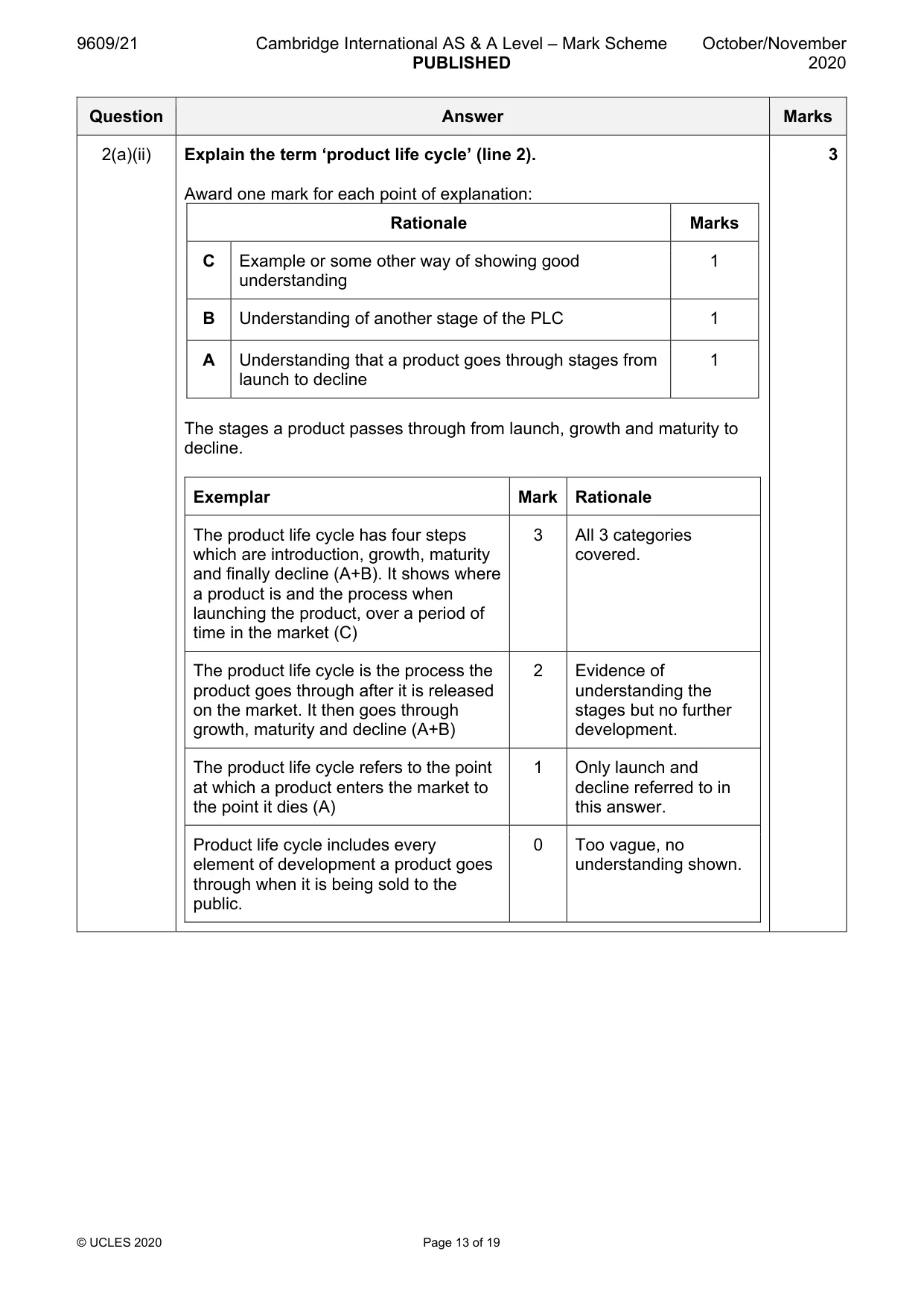
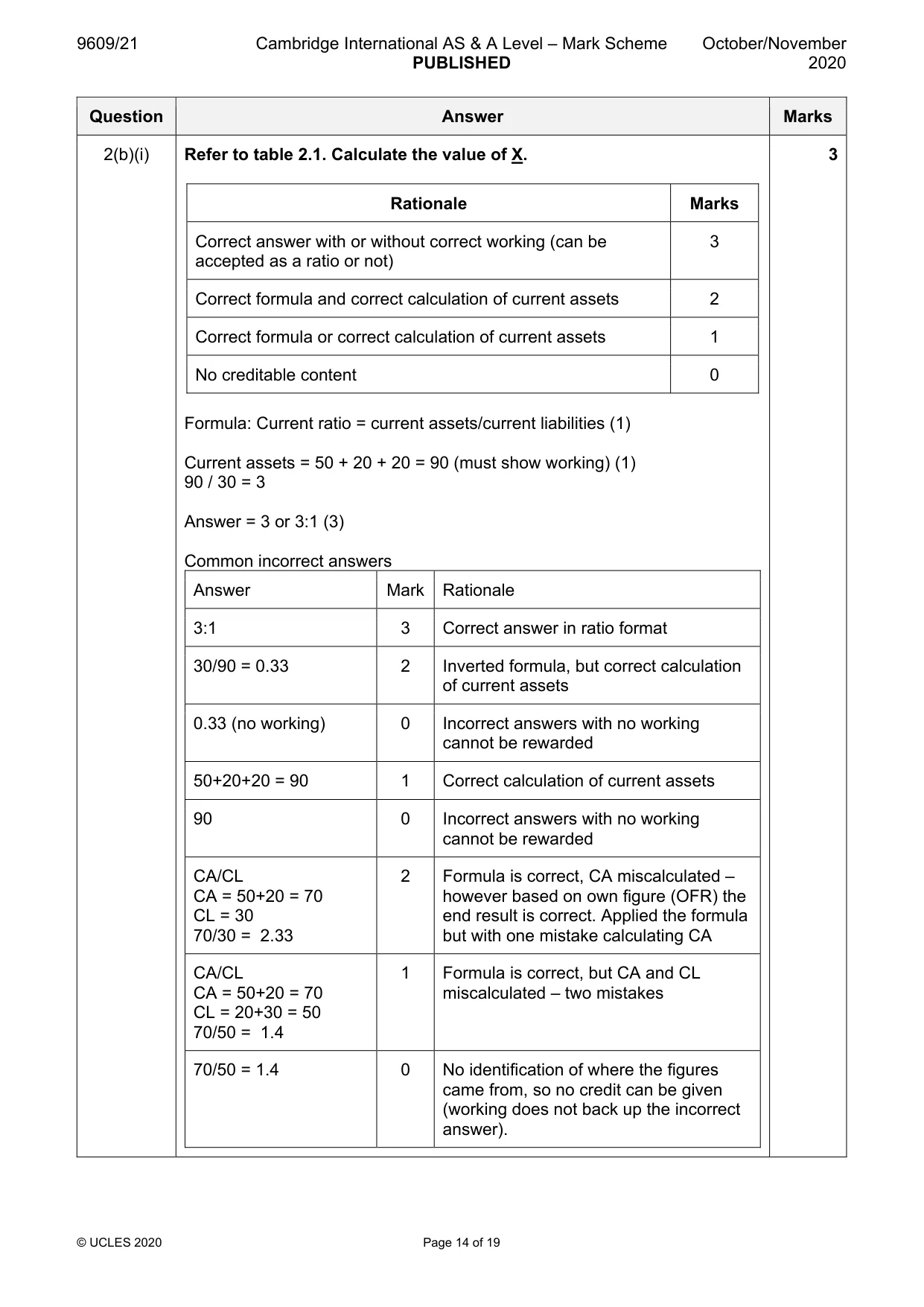
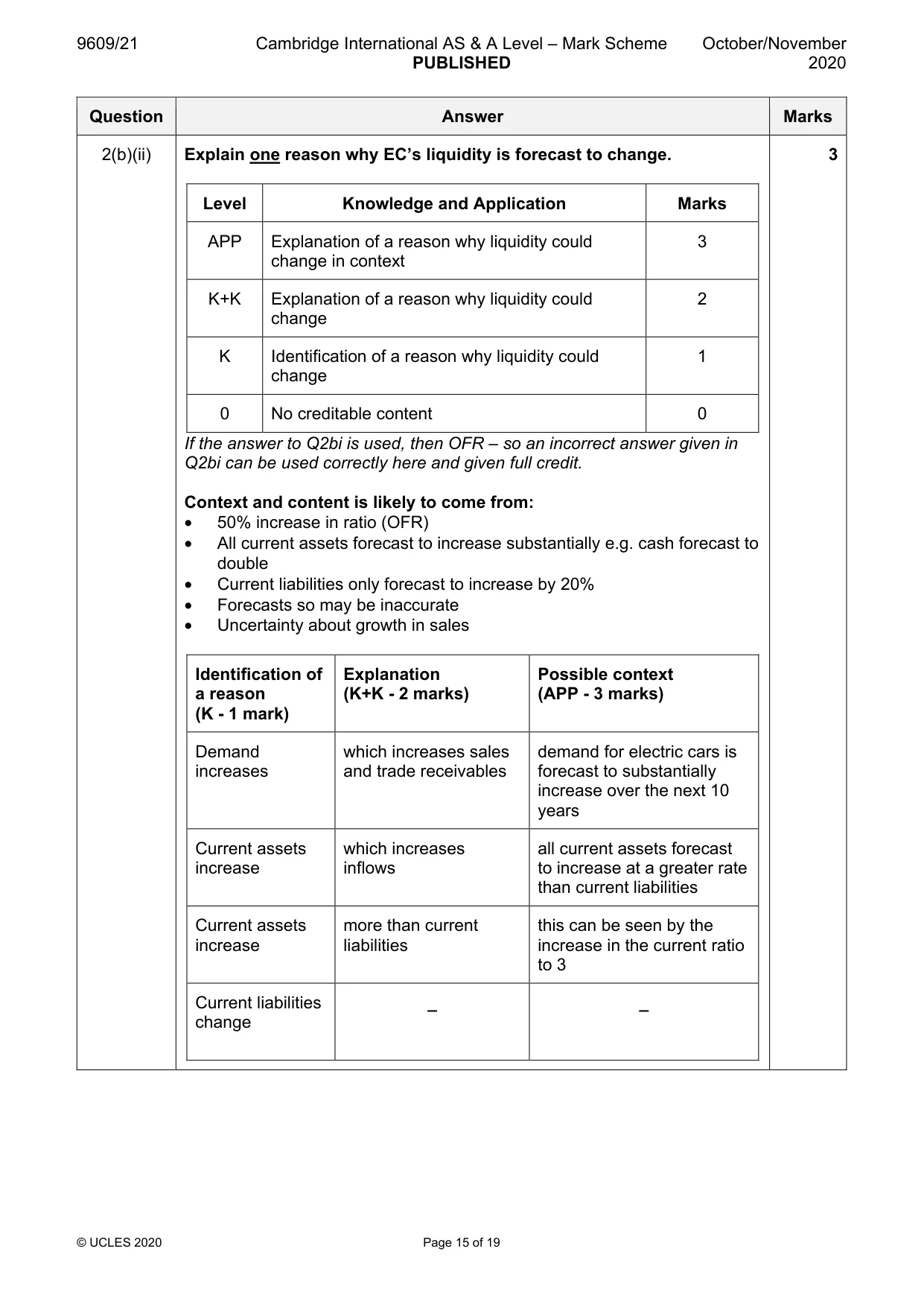
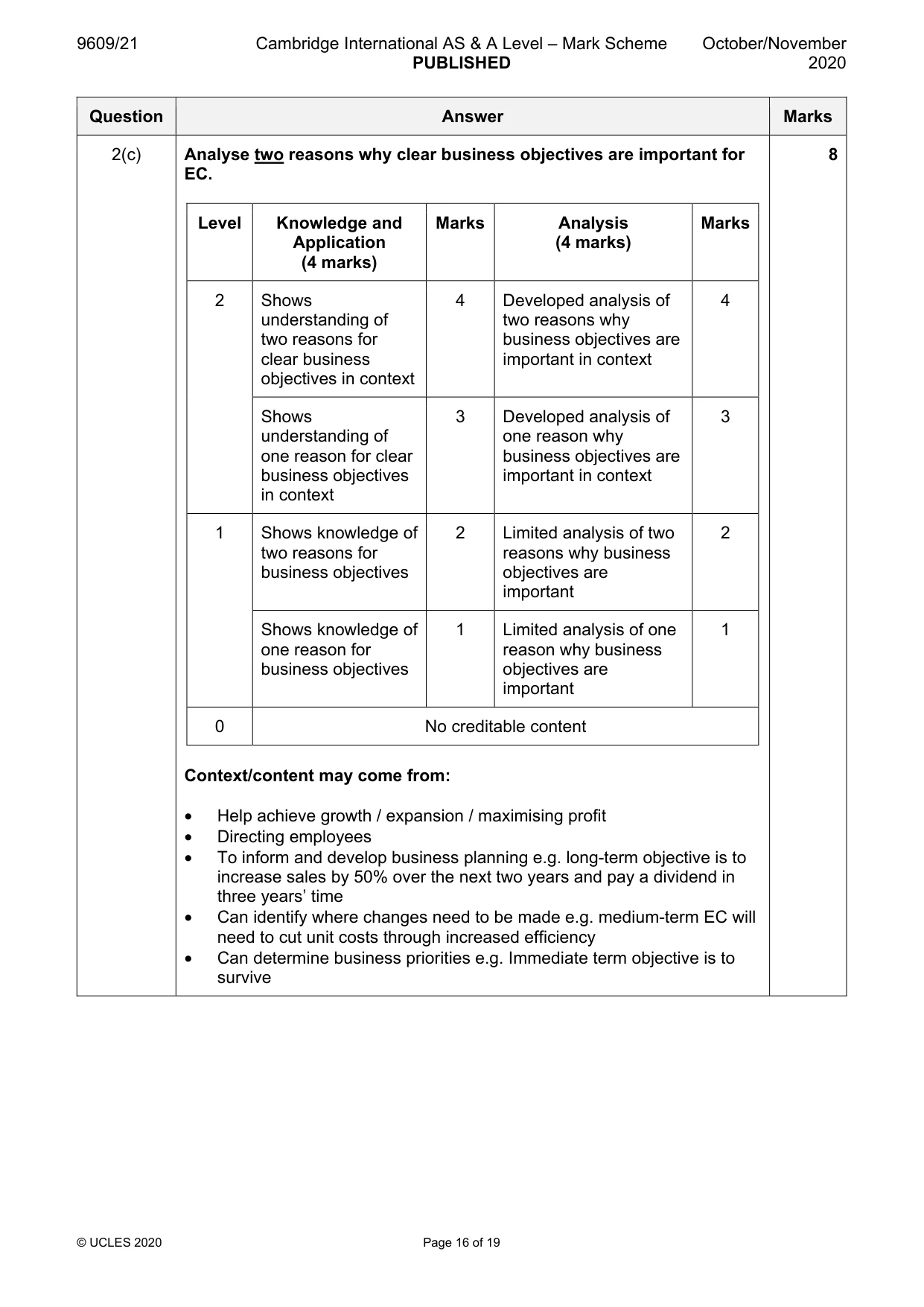
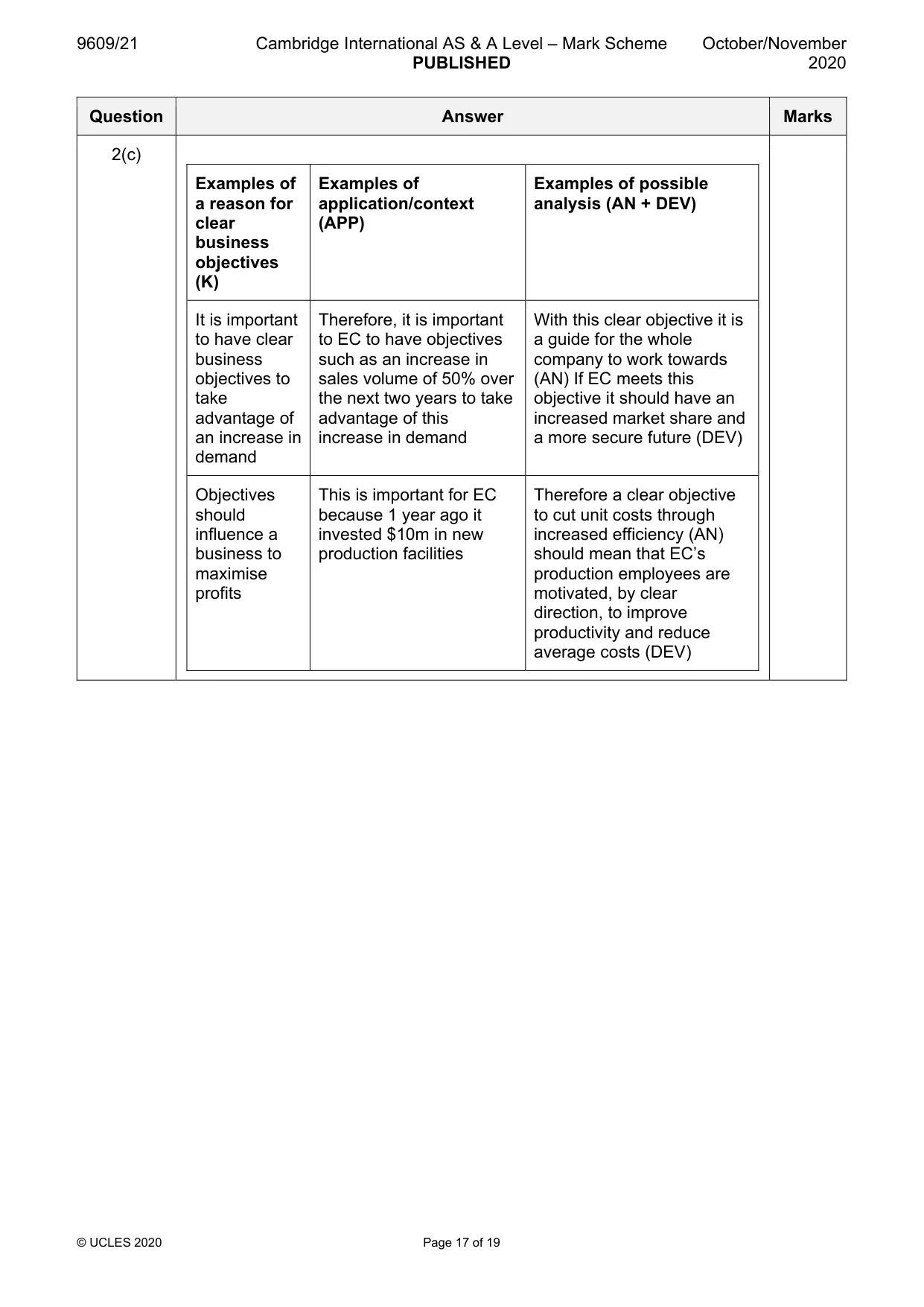
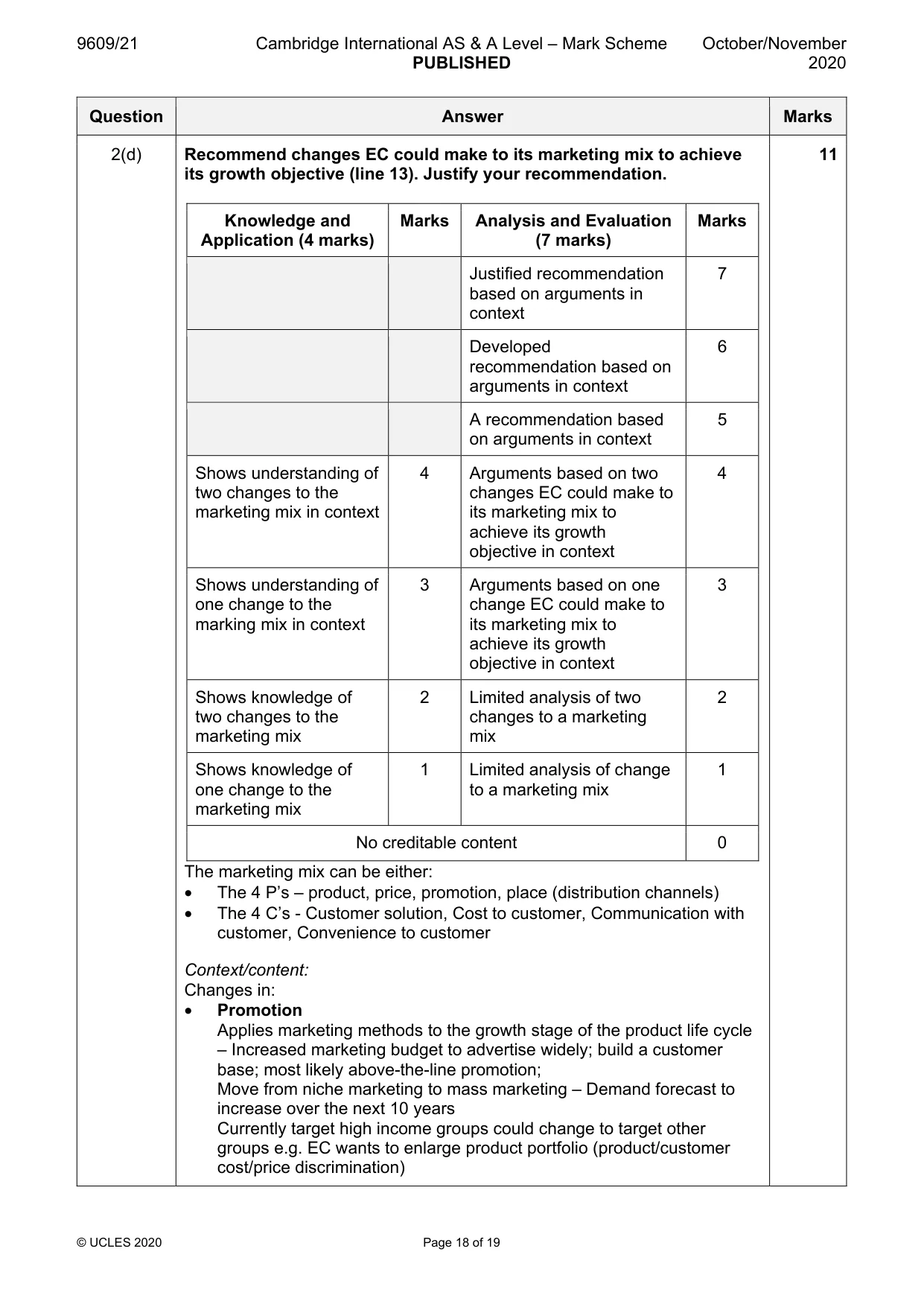
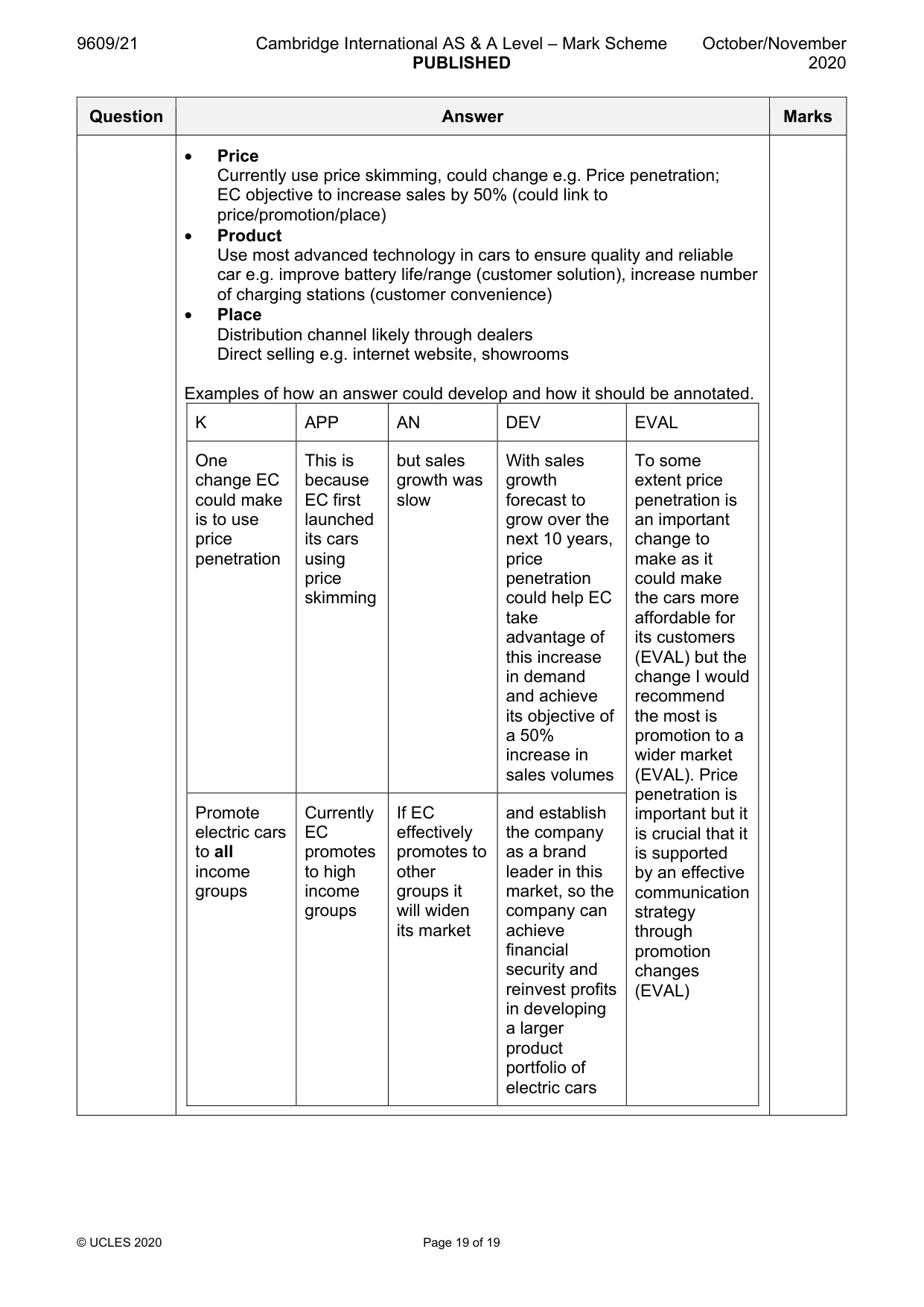
Mark scheme: 2(a)(i) Define the term ‘efficiency’ (line 11). 2 Knowledge and Application Marks A correct definition 2 A partial, vague or unfocused definition 1 No creditable content 0 A peak level of performance that uses the least amount of inputs to achieve the highest amount of output/measure of productivity. Efficiency requires reducing the number of unnecessary resources used to produce a given output including personal time and energy / produce goods at the lowest average cost. A correct definition should include the following elements (allow one mark for each element): • Measures inputs relative to outputs • Average/lowest cost of production / over a period of time / highest ratio of production Exemplar Mark Rationale Efficiency is the amount of output 2 Has inputs relative to produced, in a given period of time, per outputs over a period number of employees working. of time – so both elements Efficiency can be measured by how 2 Both elements much is completed, per worker, in a time period The term efficiency refers to the level of 1 Only 1 element output in comparison with hours of labour Efficiency refers to how much a firm can 0 Too vague produce 2(a)(ii) Explain the term ‘product life cycle’ (line 2). 3 Award one mark for each point of explanation: Rationale Marks C Example or some other way of showing good 1 understanding B Understanding of another stage of the PLC 1 A Understanding that a product goes through stages from 1 launch to decline The stages a product passes through from launch, growth and maturity to decline. Exemplar Mark Rationale The product life cycle has four steps 3 All 3 categories which are introduction, growth, maturity covered. and finally decline (A+B). It shows where a product is and the process when launching the product, over a period of time in the market (C) The product life cycle is the process the 2 Evidence of product goes through after it is released understanding the on the market. It then goes through stages but no further growth, maturity and decline (A+B) development. The product life cycle refers to the point 1 Only launch and at which a product enters the market to decline referred to in the point it dies (A) this answer. Product life cycle includes every 0 Too vague, no element of development a product goes understanding shown. through when it is being sold to the public. 2(b)(i) Refer to table 2.1. Calculate the value of X. 3 Rationale Marks Correct answer with or without correct working (can be 3 accepted as a ratio or not) Correct formula and correct calculation of current assets 2 Correct formula or correct calculation of current assets 1 No creditable content 0 Formula: Current ratio = current assets/current liabilities (1) Current assets = 50 + 20 + 20 = 90 (must show working) (1) 90 / 30 = 3 Answer = 3 or 3:1 (3) Common incorrect answers Answer Mark Rationale 3:1 3 Correct answer in ratio format 30/90 = 0.33 2 Inverted formula, but correct calculation of current assets 0.33 (no working) 0 Incorrect answers with no working cannot be rewarded 50+20+20 = 90 1 Correct calculation of current assets 90 0 Incorrect answers with no working cannot be rewarded CA/CL 2 Formula is correct, CA miscalculated – CA = 50+20 = 70 however based on own figure (OFR) the CL = 30 end result is correct. Applied the formula 70/30 = 2.33 but with one mistake calculating CA CA/CL 1 Formula is correct, but CA and CL CA = 50+20 = 70 miscalculated – two mistakes CL = 20+30 = 50 70/50 = 1.4 70/50 = 1.4 0 No identification of where the figures came from, so no credit can be given (working does not back up the incorrect answer). 2(b)(ii) Explain one reason why EC’s liquidity is forecast to change. 3 Level Knowledge and Application Marks APP Explanation of a reason why liquidity could 3 change in context K+K Explanation of a reason why liquidity could 2 change K Identification of a reason why liquidity could 1 change 0 No creditable content 0 If the answer to Q2bi is used, then OFR – so an incorrect answer given in Q2bi can be used correctly here and given full credit. Context and content is likely to come from: • 50% increase in ratio (OFR) • All current assets forecast to increase substantially e.g. cash forecast to double • Current liabilities only forecast to increase by 20% • Forecasts so may be inaccurate • Uncertainty about growth in sales Identification of Explanation Possible context a reason (K+K - 2 marks) (APP - 3 marks) (K - 1 mark) Demand which increases sales demand for electric cars is increases and trade receivables forecast to substantially increase over the next 10 years Current assets which increases all current assets forecast increase inflows to increase at a greater rate than current liabilities Current assets more than current this can be seen by the increase liabilities increase in the current ratio to 3 Current liabilities _ _ change 2(c) Analyse two reasons why clear business objectives are important for 8 EC. Level Knowledge and Marks Analysis Marks Application (4 marks) (4 marks) 2 Shows 4 Developed analysis of 4 understanding of two reasons why two reasons for business objectives are clear business important in context objectives in context Shows 3 Developed analysis of 3 understanding of one reason why one reason for clear business objectives are business objectives important in context in context 1 Shows knowledge of 2 Limited analysis of two 2 two reasons for reasons why business business objectives objectives are important Shows knowledge of 1 Limited analysis of one 1 one reason for reason why business business objectives objectives are important 0 No creditable content Context/content may come from: • Help achieve growth / expansion / maximising profit • Directing employees • To inform and develop business planning e.g. long-term objective is to increase sales by 50% over the next two years and pay a dividend in three years’ time • Can identify where changes need to be made e.g. medium-term EC will need to cut unit costs through increased efficiency • Can determine business priorities e.g. Immediate term objective is to survive 2(c) Examples of Examples of Examples of possible a reason for application/context analysis (AN + DEV) clear (APP) business objectives (K) It is important Therefore, it is important With this clear objective it is to have clear to EC to have objectives a guide for the whole business such as an increase in company to work towards objectives to sales volume of 50% over (AN) If EC meets this take the next two years to take objective it should have an advantage of advantage of this increased market share and an increase in increase in demand a more secure future (DEV) demand Objectives This is important for EC Therefore a clear objective should because 1 year ago it to cut unit costs through influence a invested $10m in new increased efficiency (AN) business to production facilities should mean that EC’s maximise production employees are profits motivated, by clear direction, to improve productivity and reduce average costs (DEV) 2(d) Recommend changes EC could make to its marketing mix to achieve 11 its growth objective (line 13). Justify your recommendation. Knowledge and Marks Analysis and Evaluation Marks Application (4 marks) (7 marks) Justified recommendation 7 based on arguments in context Developed 6 recommendation based on arguments in context A recommendation based 5 on arguments in context Shows understanding of 4 Arguments based on two 4 two changes to the changes EC could make to marketing mix in context its marketing mix to achieve its growth objective in context Shows understanding of 3 Arguments based on one 3 one change to the change EC could make to marking mix in context its marketing mix to achieve its growth objective in context Shows knowledge of 2 Limited analysis of two 2 two changes to the changes to a marketing marketing mix mix Shows knowledge of 1 Limited analysis of change 1 one change to the to a marketing mix marketing mix No creditable content 0 The marketing mix can be either: • The 4 P’s – product, price, promotion, place (distribution channels) • The 4 C’s - Customer solution, Cost to customer, Communication with customer, Convenience to customer Context/content: Changes in: • Promotion Applies marketing methods to the growth stage of the product life cycle – Increased marketing budget to advertise widely; build a customer base; most likely above-the-line promotion; Move from niche marketing to mass marketing – Demand forecast to increase over the next 10 years Currently target high income groups could change to target other groups e.g. EC wants to enlarge product portfolio (product/customer cost/price discrimination) • Price Currently use price skimming, could change e.g. Price penetration; EC objective to increase sales by 50% (could link to price/promotion/place) • Product Use most advanced technology in cars to ensure quality and reliable car e.g. improve battery life/range (customer solution), increase number of charging stations (customer convenience) • Place Distribution channel likely through dealers Direct selling e.g. internet website, showrooms Examples of how an answer could develop and how it should be annotated. K APP AN DEV EVAL One This is but sales With sales To some change EC because growth was growth extent price could make EC first slow forecast to penetration is is to use launched grow over the an important price its cars next 10 years, change to penetration using price make as it price penetration could make skimming could help EC the cars more take affordable for advantage of its customers this increase (EVAL) but the in demand change I would and achieve recommend its objective of the most is a 50% promotion to a increase in wider market sales volumes (EVAL). Price penetration is Promote Currently If EC and establish important but it electric cars EC effectively the company is crucial that it to all promotes promotes to as a brand is supported income to high other leader in this by an effective groups income groups it market, so the communication groups will widen company can strategy its market achieve through financial promotion security and changes reinvest profits (EVAL) in developing a larger product portfolio of electric cars
What was in this paper
The subtopics covered by these 2 questions, and how many questions each got. Open one in a new tab to see every Cambridge question on it.
What you needed in this session
Cambridge’s own grade thresholds for 2020 Oct/Nov, Paper 2 · Variant 1. A higher threshold means an easier paper — the bar moves with how the cohort did.