Cambridge A Level Business (for first examination in 2016) 9609 — 2020 Oct/Nov Paper 2 · Variant 3
9609/23/O/N/20 · 2 questions · 60 marks · ≈68 min
The question paper and its mark scheme, free to read here and free to download. This is Cambridge’s own paper, exactly as it was sat.
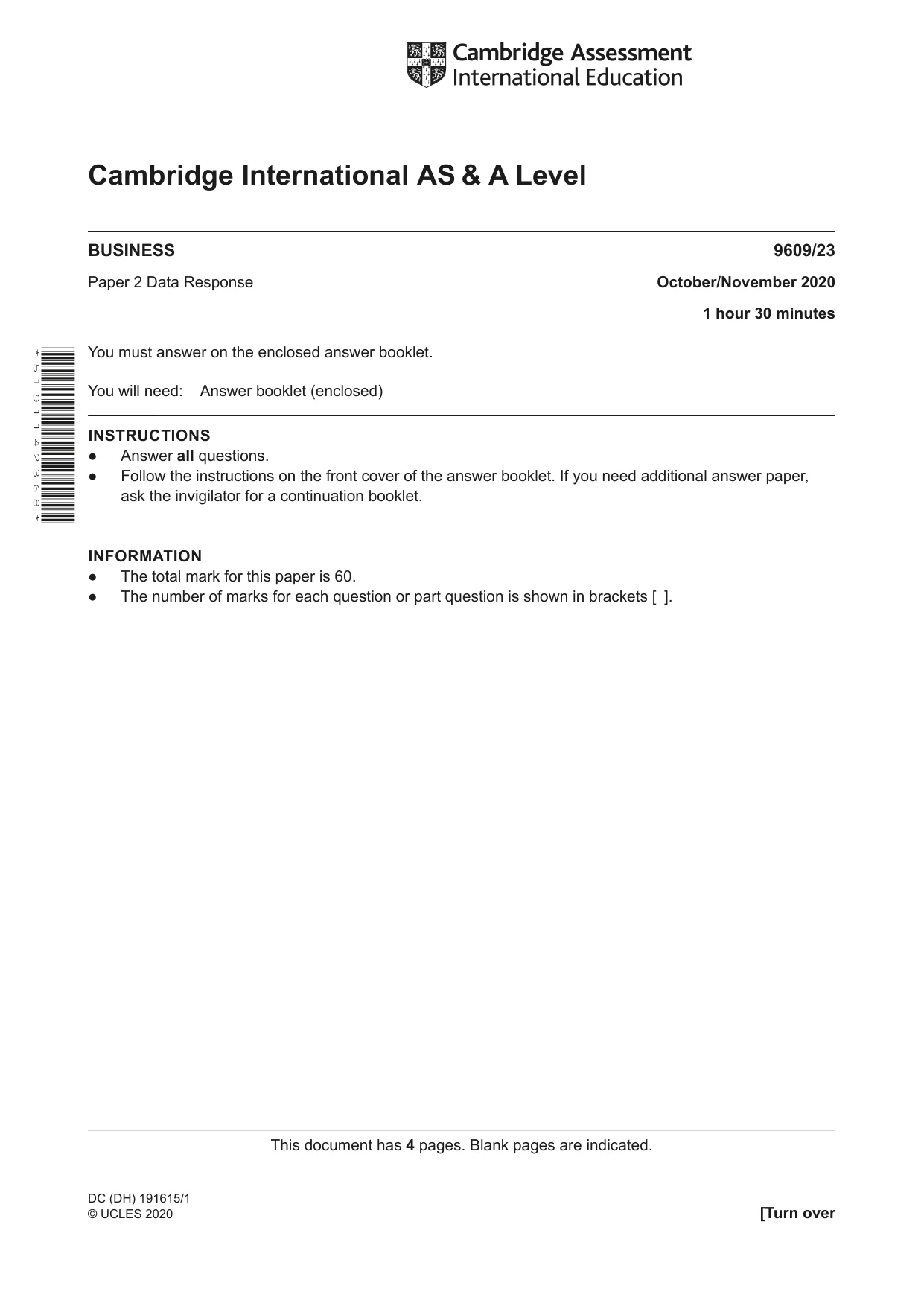
Question paper4 pages
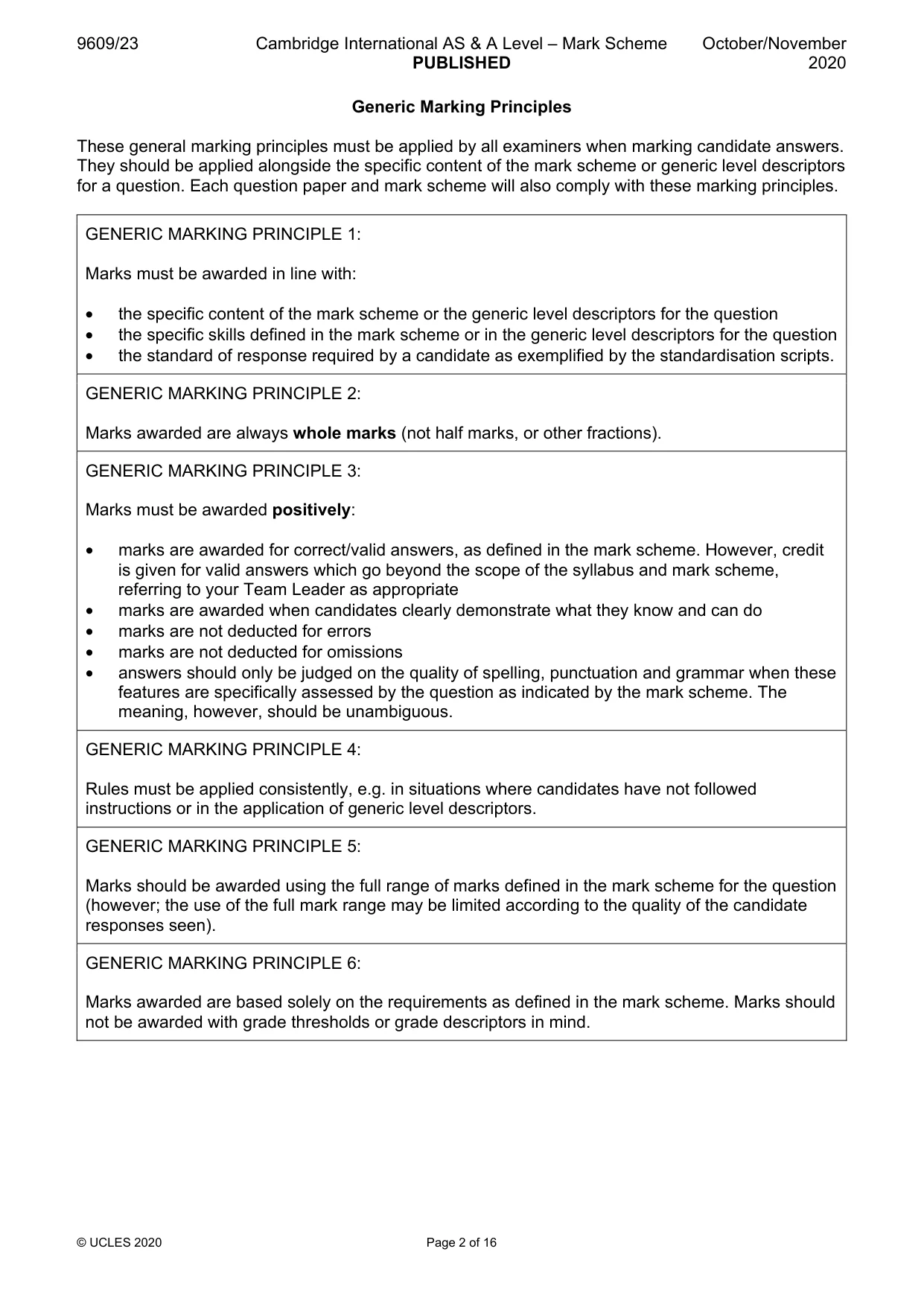
Mark scheme16 pages
Answers below. Sit the paper first if you are practising.
Questions as text
Q1 · Aashna’s Pies (AP) AP produces and sells high quality pies
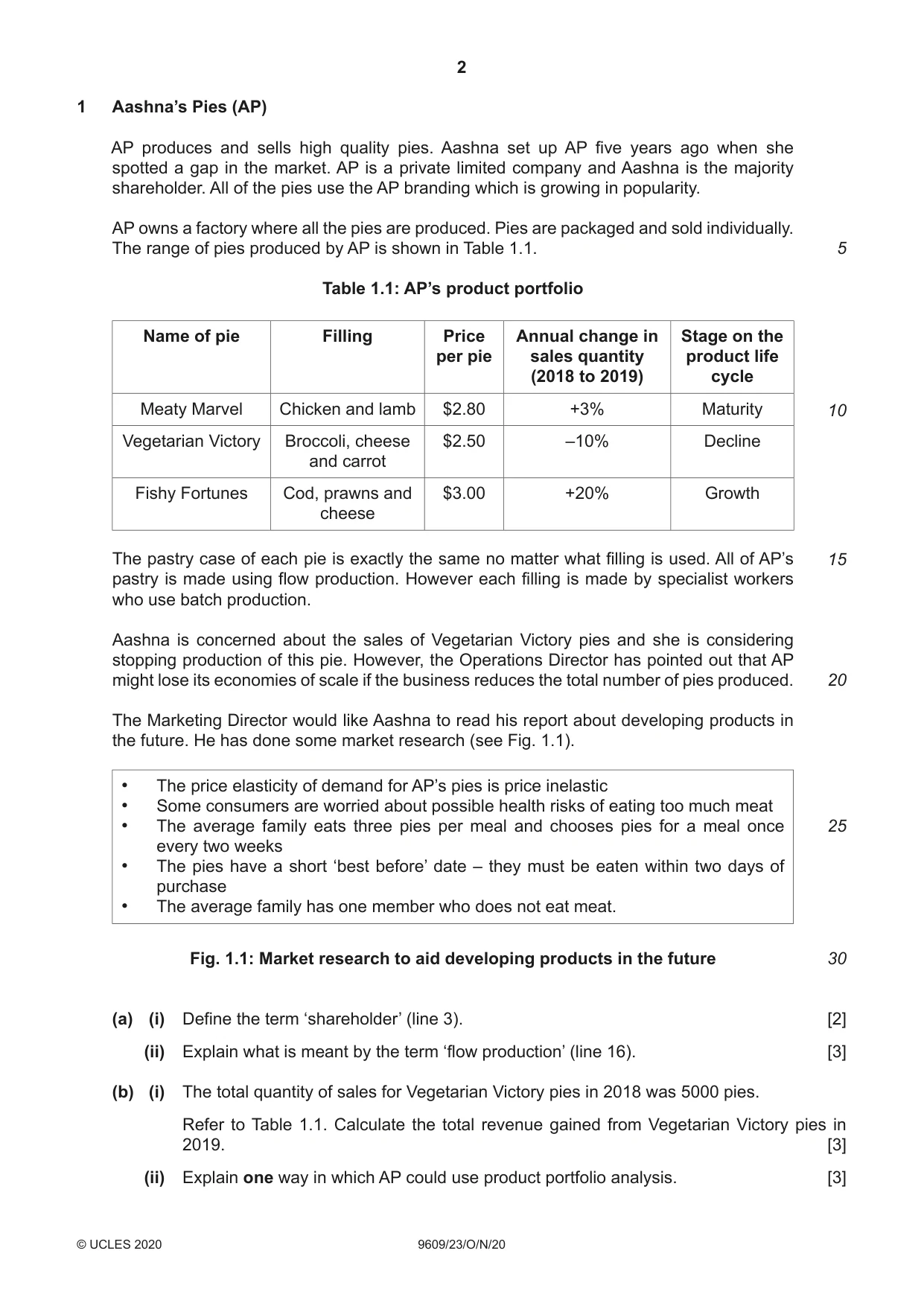
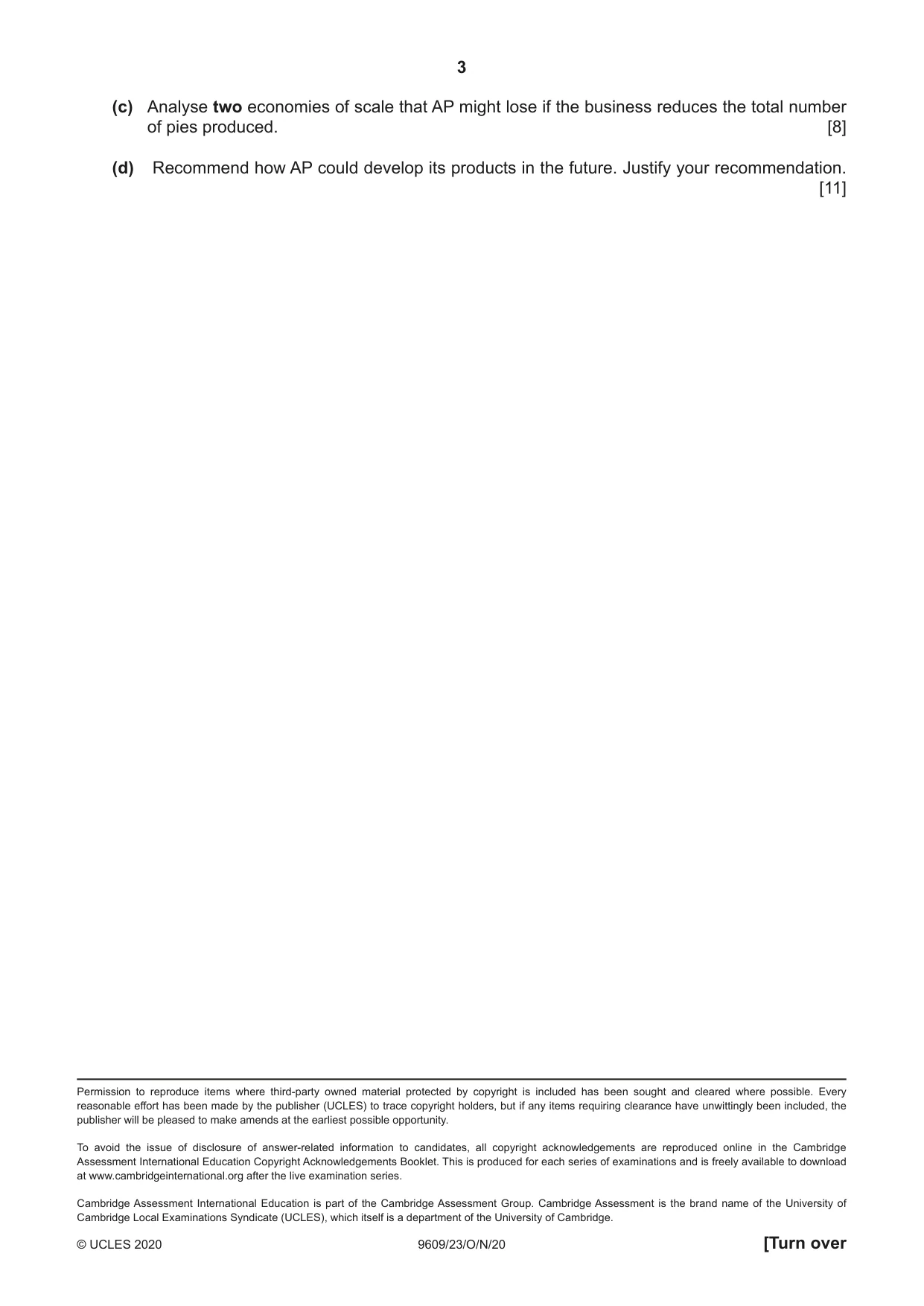
1 Aashna’s Pies (AP) AP produces and sells high quality pies. Aashna set up AP five years ago when she spotted a gap in the market. AP is a private limited company and Aashna is the majority shareholder. All of the pies use the AP branding which is growing in popularity. AP owns a factory where all the pies are produced. Pies are packaged and sold individually. The range of pies produced by AP is shown in Table 1.1. 5 Table 1.1: AP’s product portfolio Name of pie Filling Price Annual change in Stage on the per pie sales quantity product life (2018 to 2019) cycle Meaty Marvel Chicken and lamb $2.80 +3% Maturity 10 Vegetarian Victory Broccoli, cheese $2.50 –10% Decline and carrot Fishy Fortunes Cod, prawns and $3.00 +20% Growth cheese The pastry case of each pie is exactly the same no matter what filling is used. All of AP’s 15 pastry is made using flow production. However each filling is made by specialist workers who use batch production. Aashna is concerned about the sales of Vegetarian Victory pies and she is considering stopping production of this pie. However, the Operations Director has pointed out that AP might lose its economies of scale if the business reduces the total number of pies produced. 20 The Marketing Director would like Aashna to read his report about developing products in the future. He has done some market research (see Fig. 1.1). • The price elasticity of demand for AP’s pies is price inelastic • Some consumers are worried about possible health risks of eating too much meat • The average family eats three pies per meal and chooses pies for a meal once 25 every two weeks • The pies have a short ‘best before’ date – they must be eaten within two days of purchase • The average family has one member who does not eat meat. Fig. 1.1: Market research to aid developing products in the future 30 (a) (i) Define the term ‘shareholder’ (line 3). [2] (ii) Explain what is meant by the term ‘flow production’ (line 16). [3] (b) (i) The total quantity of sales for Vegetarian Victory pies in 2018 was 5000 pies. Refer to Table 1.1. Calculate the total revenue gained from Vegetarian Victory pies in 2019. [3] (ii) Explain one way in which AP could use product portfolio analysis. [3] (c) Analyse two economies of scale that AP might lose if the business reduces the total number of pies produced. [8] (d) Recommend how AP could develop its products in the future. Justify your recommendation. [11]
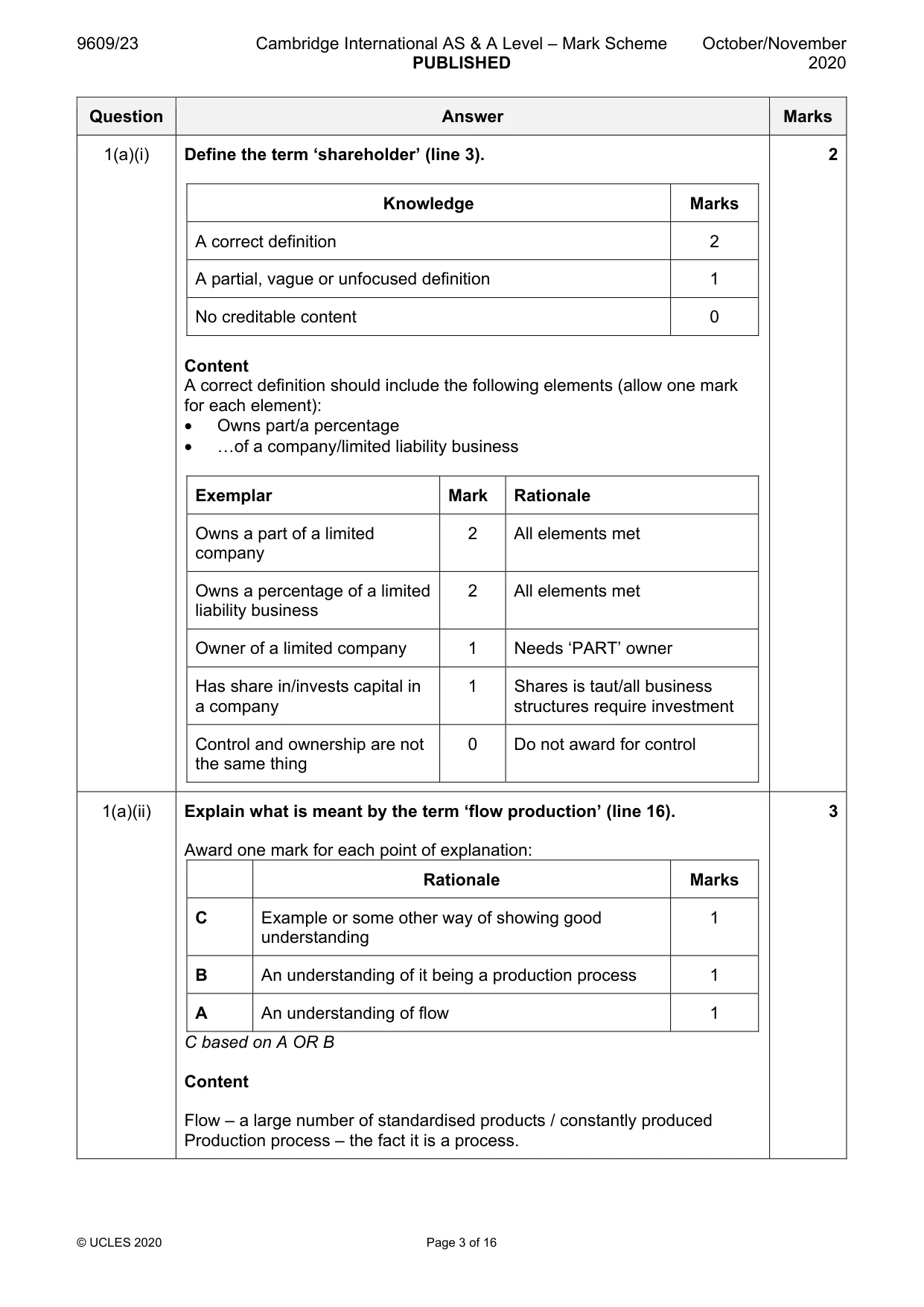
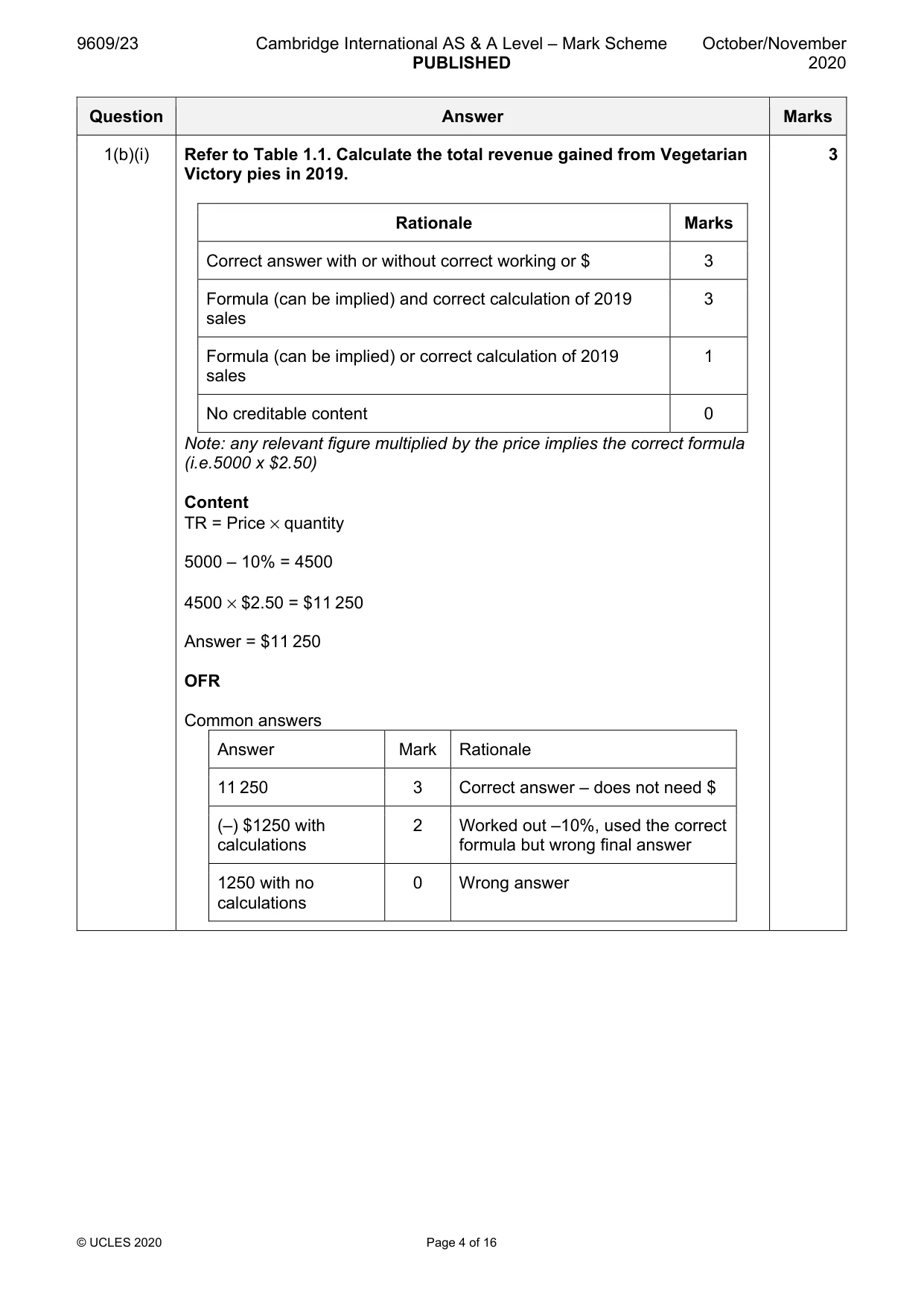
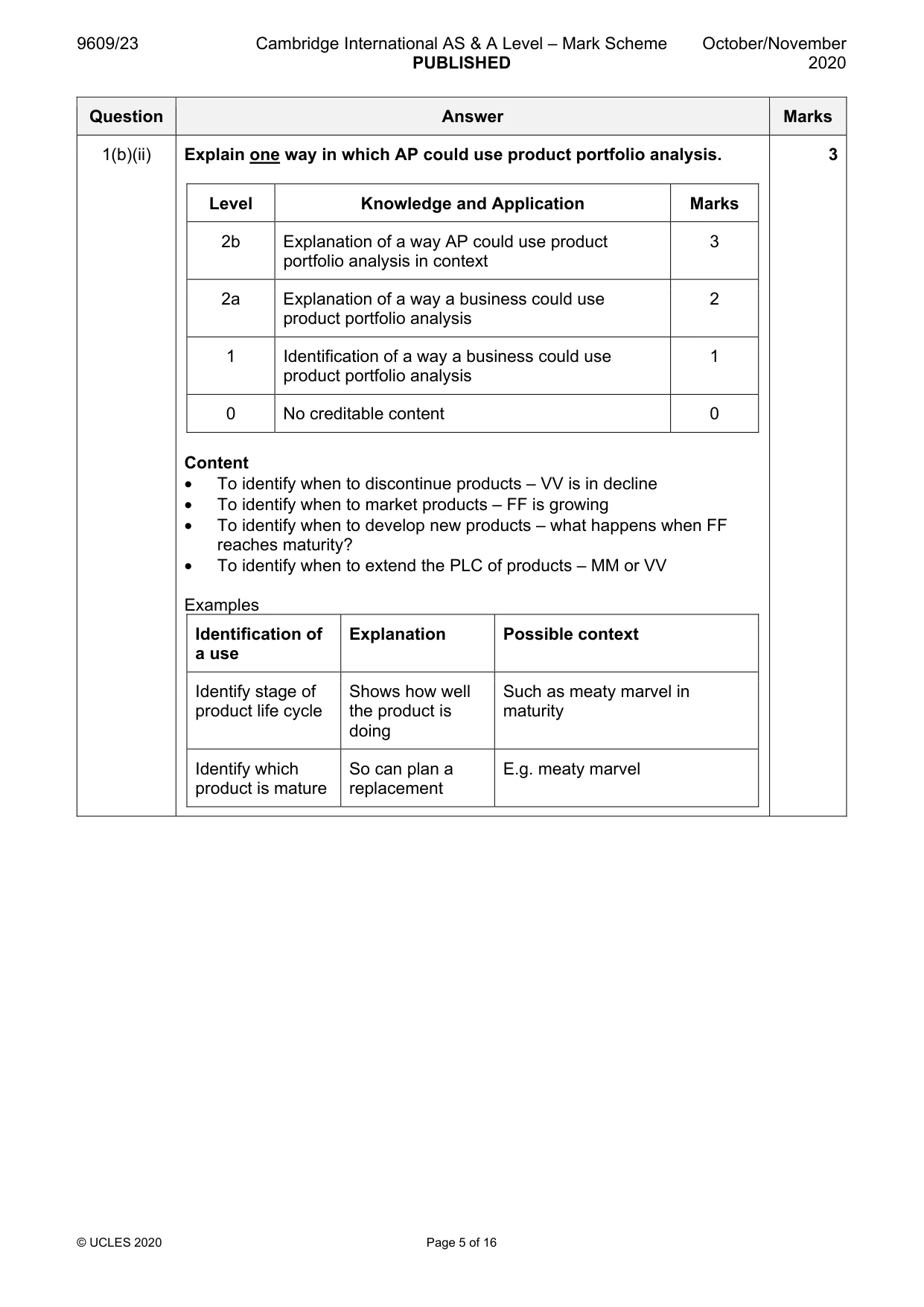
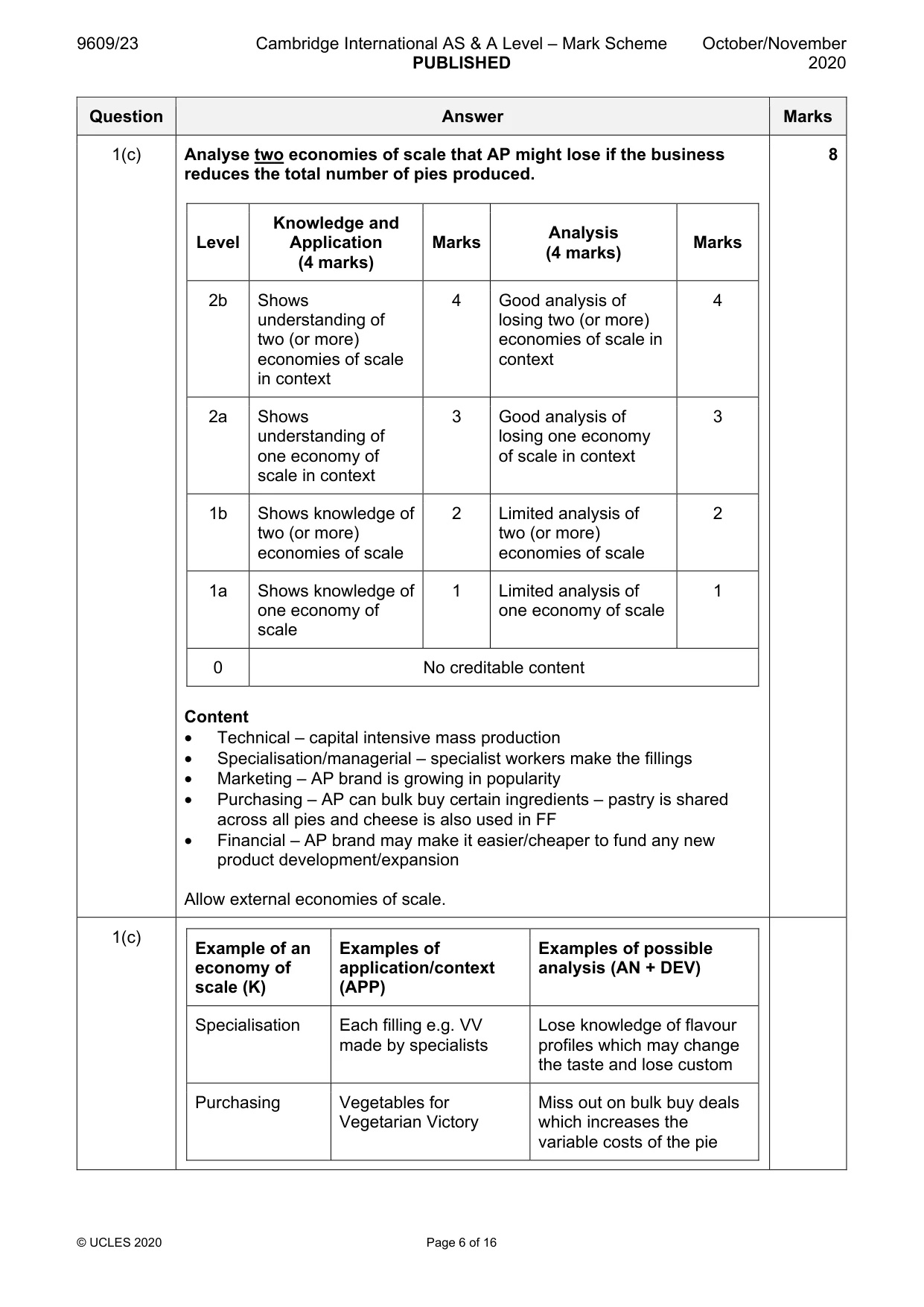
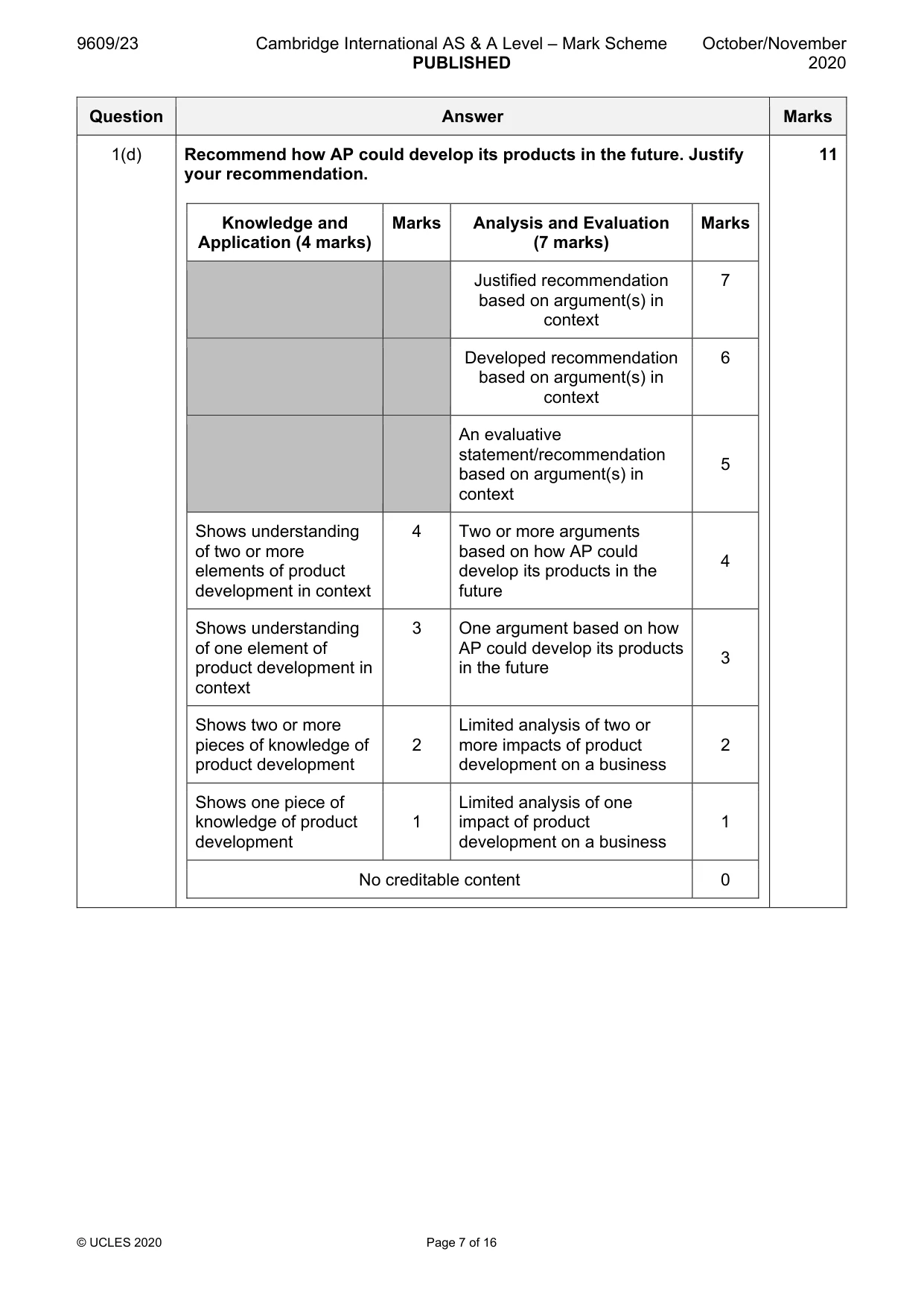
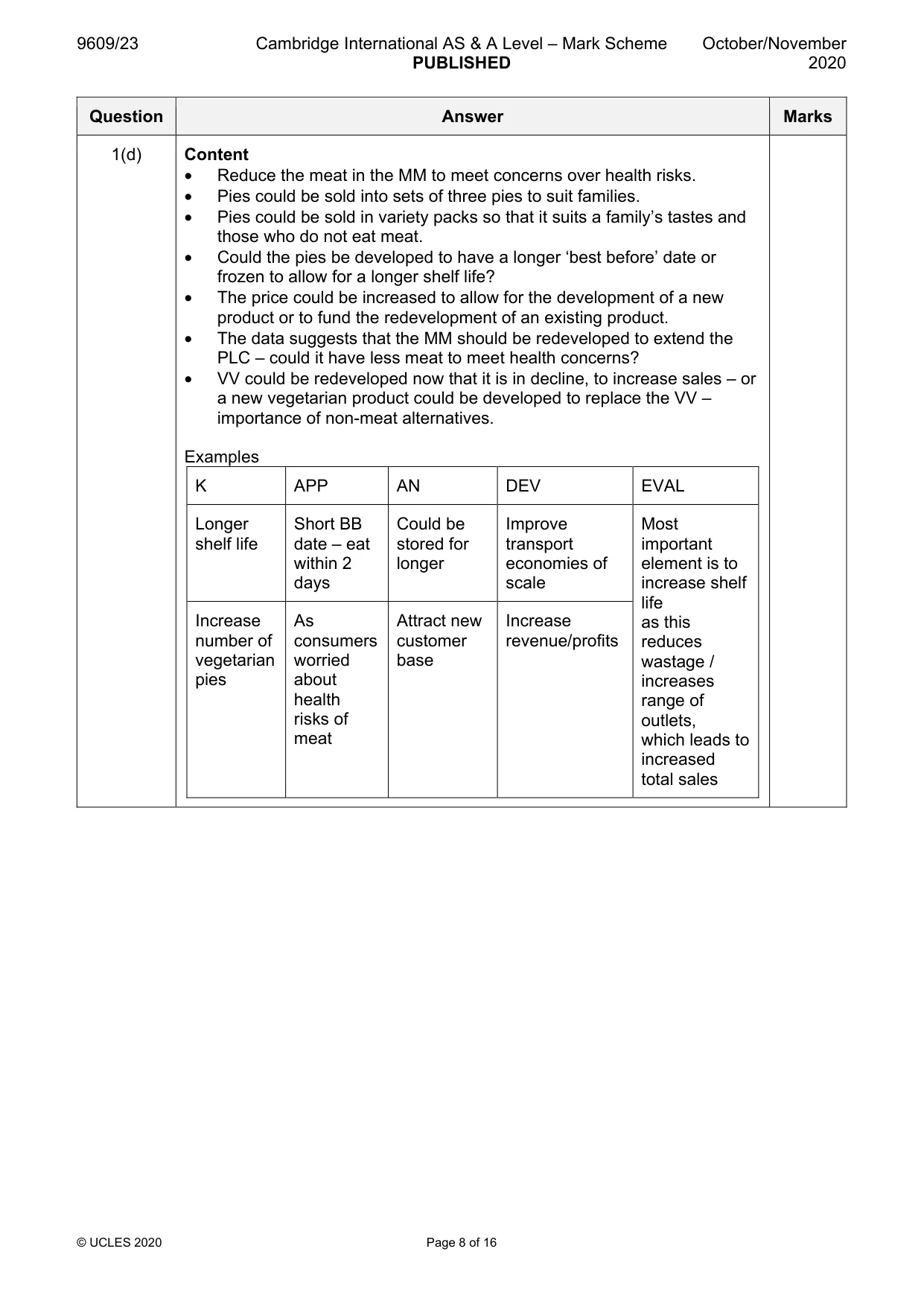
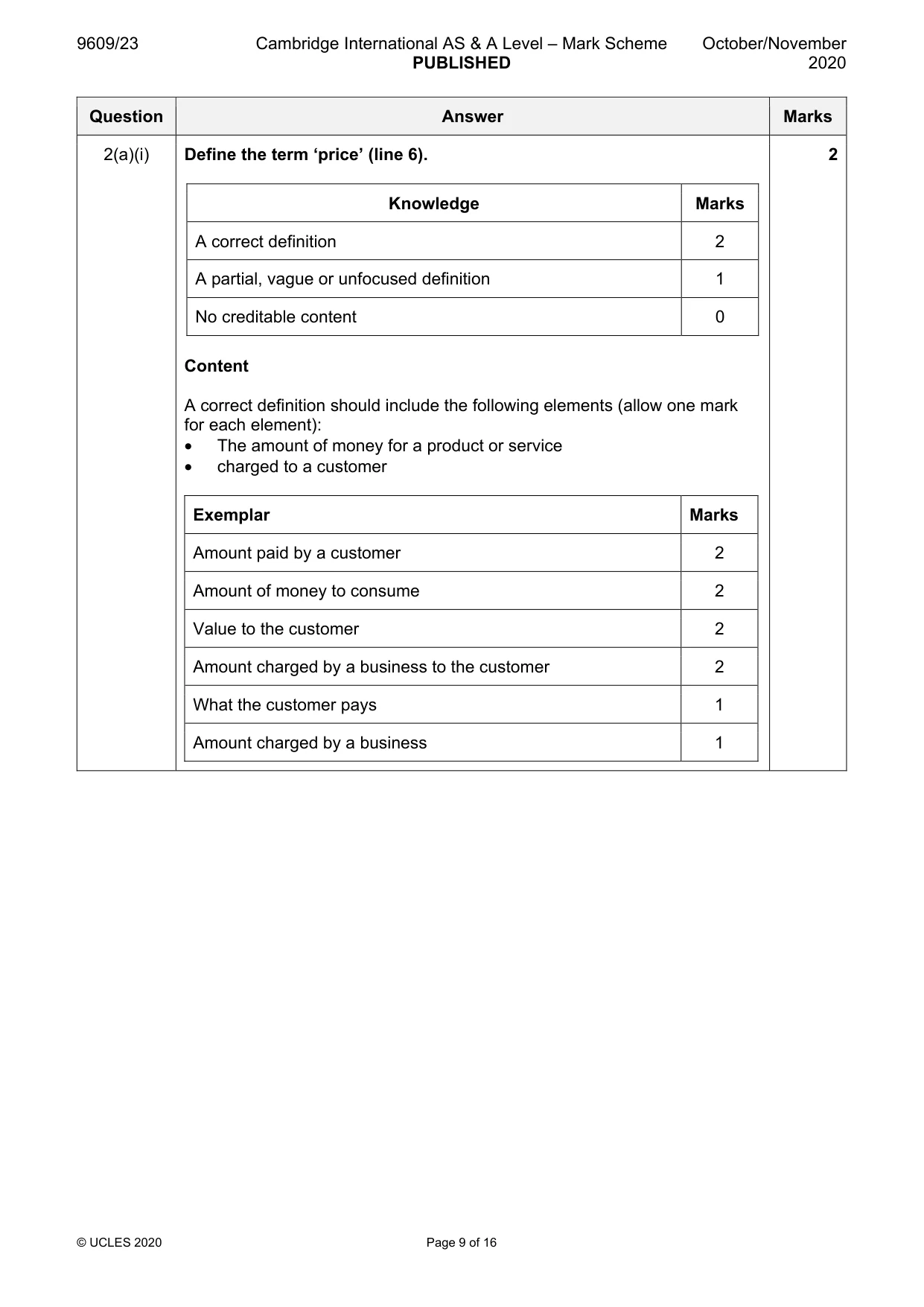
Mark scheme: Question Answer Marks 1(a)(i) Define the term ‘shareholder’ (line 3). 2 Knowledge Marks A correct definition 2 A partial, vague or unfocused definition 1 No creditable content 0 Content A correct definition should include the following elements (allow one mark for each element): • Owns part/a percentage • …of a company/limited liability business Exemplar Mark Rationale Owns a part of a limited 2 All elements met company Owns a percentage of a limited 2 All elements met liability business Owner of a limited company 1 Needs ‘PART’ owner Has share in/invests capital in 1 Shares is taut/all business a company structures require investment Control and ownership are not 0 Do not award for control the same thing 1(a)(ii) Explain what is meant by the term ‘flow production’ (line 16). 3 Award one mark for each point of explanation: Rationale Marks C Example or some other way of showing good 1 understanding B An understanding of it being a production process 1 A An understanding of flow 1 C based on A OR B Content Flow – a large number of standardised products / constantly produced Production process – the fact it is a process. 1(b)(i) Refer to Table 1.1. Calculate the total revenue gained from Vegetarian 3 Victory pies in 2019. Rationale Marks Correct answer with or without correct working or $ 3 Formula (can be implied) and correct calculation of 2019 3 sales Formula (can be implied) or correct calculation of 2019 1 sales No creditable content 0 Note: any relevant figure multiplied by the price implies the correct formula (i.e.5000 x $2.50) Content TR = Price × quantity 5000 – 10% = 4500 4500 × $2.50 = $11 250 Answer = $11 250 OFR Common answers Answer Mark Rationale 11 250 3 Correct answer – does not need $ (–) $1250 with 2 Worked out –10%, used the correct calculations formula but wrong final answer 1250 with no 0 Wrong answer calculations 1(b)(ii) Explain one way in which AP could use product portfolio analysis. 3 Level Knowledge and Application Marks 2b Explanation of a way AP could use product 3 portfolio analysis in context 2a Explanation of a way a business could use 2 product portfolio analysis 1 Identification of a way a business could use 1 product portfolio analysis 0 No creditable content 0 Content • To identify when to discontinue products – VV is in decline • To identify when to market products – FF is growing • To identify when to develop new products – what happens when FF reaches maturity? • To identify when to extend the PLC of products – MM or VV Examples Identification of Explanation Possible context a use Identify stage of Shows how well Such as meaty marvel in product life cycle the product is maturity doing Identify which So can plan a E.g. meaty marvel product is mature replacement 1(c) Analyse two economies of scale that AP might lose if the business 8 reduces the total number of pies produced. Knowledge and Analysis Level Application Marks Marks (4 marks) (4 marks) 2b Shows 4 Good analysis of 4 understanding of losing two (or more) two (or more) economies of scale in economies of scale context in context 2a Shows 3 Good analysis of 3 understanding of losing one economy one economy of of scale in context scale in context 1b Shows knowledge of 2 Limited analysis of 2 two (or more) two (or more) economies of scale economies of scale 1a Shows knowledge of 1 Limited analysis of 1 one economy of one economy of scale scale 0 No creditable content Content • Technical – capital intensive mass production • Specialisation/managerial – specialist workers make the fillings • Marketing – AP brand is growing in popularity • Purchasing – AP can bulk buy certain ingredients – pastry is shared across all pies and cheese is also used in FF • Financial – AP brand may make it easier/cheaper to fund any new product development/expansion Allow external economies of scale. 1(c) Example of an Examples of Examples of possible economy of application/context analysis (AN + DEV) scale (K) (APP) Specialisation Each filling e.g. VV Lose knowledge of flavour made by specialists profiles which may change the taste and lose custom Purchasing Vegetables for Miss out on bulk buy deals Vegetarian Victory which increases the variable costs of the pie 1(d) Recommend how AP could develop its products in the future. Justify 11 your recommendation. Knowledge and Marks Analysis and Evaluation Marks Application (4 marks) (7 marks) Justified recommendation 7 based on argument(s) in context Developed recommendation 6 based on argument(s) in context An evaluative statement/recommendation 5 based on argument(s) in context Shows understanding 4 Two or more arguments of two or more based on how AP could 4 elements of product develop its products in the development in context future Shows understanding 3 One argument based on how of one element of AP could develop its products 3 product development in in the future context Shows two or more Limited analysis of two or pieces of knowledge of 2 more impacts of product 2 product development development on a business Shows one piece of Limited analysis of one knowledge of product 1 impact of product 1 development development on a business No creditable content 0 1(d) Content • Reduce the meat in the MM to meet concerns over health risks. • Pies could be sold into sets of three pies to suit families. • Pies could be sold in variety packs so that it suits a family’s tastes and those who do not eat meat. • Could the pies be developed to have a longer ‘best before’ date or frozen to allow for a longer shelf life? • The price could be increased to allow for the development of a new product or to fund the redevelopment of an existing product. • The data suggests that the MM should be redeveloped to extend the PLC – could it have less meat to meet health concerns? • VV could be redeveloped now that it is in decline, to increase sales – or a new vegetarian product could be developed to replace the VV – importance of non-meat alternatives. Examples K APP AN DEV EVAL Longer Short BB Could be Improve Most shelf life date – eat stored for transport important within 2 longer economies of element is to days scale increase shelf life Increase As Attract new Increase as this number of consumers customer revenue/profits reduces vegetarian worried base wastage / pies about increases health range of risks of outlets, meat which leads to increased total sales
Q2 · Braid Runner (BR) Lewis is a hairdresser
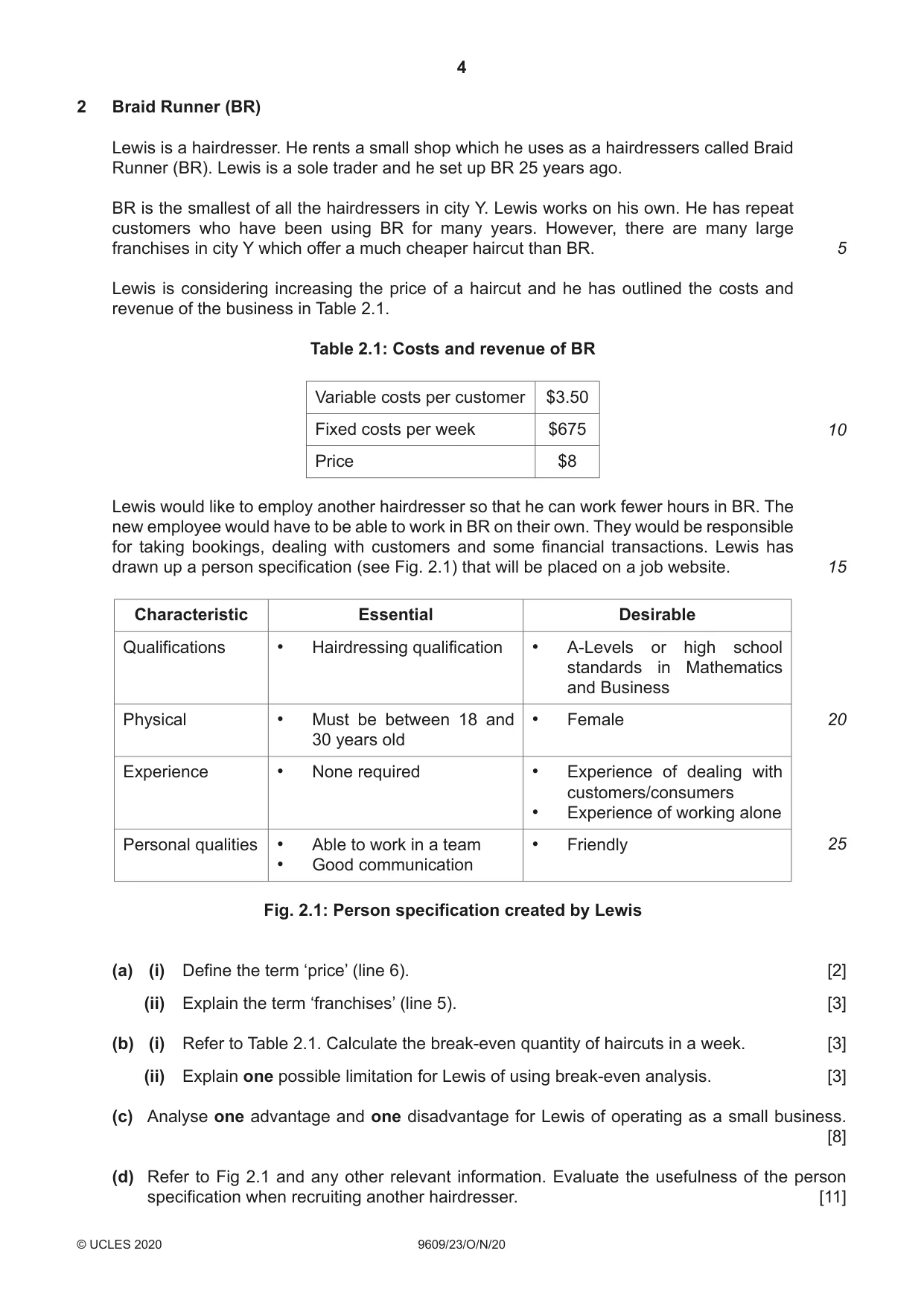
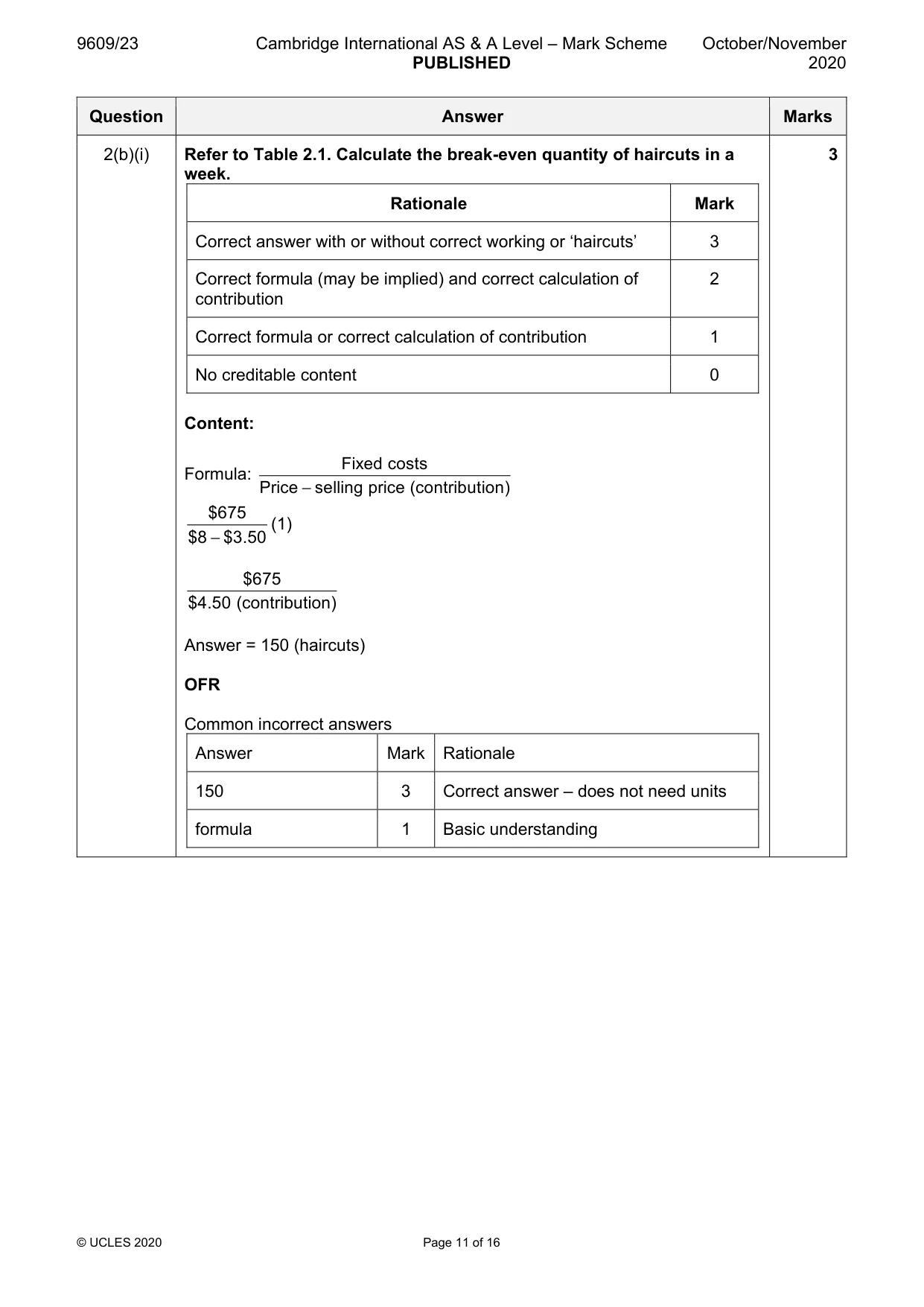
2 Braid Runner (BR) Lewis is a hairdresser. He rents a small shop which he uses as a hairdressers called Braid Runner (BR). Lewis is a sole trader and he set up BR 25 years ago. BR is the smallest of all the hairdressers in city Y. Lewis works on his own. He has repeat customers who have been using BR for many years. However, there are many large franchises in city Y which offer a much cheaper haircut than BR. 5 Lewis is considering increasing the price of a haircut and he has outlined the costs and revenue of the business in Table 2.1. Table 2.1: Costs and revenue of BR Variable costs per customer $3.50 Fixed costs per week $675 10 Price $8 Lewis would like to employ another hairdresser so that he can work fewer hours in BR. The new employee would have to be able to work in BR on their own. They would be responsible for taking bookings, dealing with customers and some financial transactions. Lewis has drawn up a person specification (see Fig. 2.1) that will be placed on a job website. 15 Characteristic Essential Desirable Qualifications • Hairdressing qualification • A-Levels or high school standards in Mathematics and Business Physical • Must be between 18 and • Female 20 30 years old Experience • None required • Experience of dealing with customers/consumers • Experience of working alone Personal qualities • Able to work in a team • Friendly 25 • Good communication Fig. 2.1: Person specification created by Lewis (a) (i) Define the term ‘price’ (line 6). [2] (ii) Explain the term ‘franchises’ (line 5). [3] (b) (i) Refer to Table 2.1. Calculate the break-even quantity of haircuts in a week. [3] (ii) Explain one possible limitation for Lewis of using break-even analysis. [3] (c) Analyse one advantage and one disadvantage for Lewis of operating as a small business. [8] (d) Refer to Fig 2.1 and any other relevant information. Evaluate the usefulness of the person specification when recruiting another hairdresser. [11]
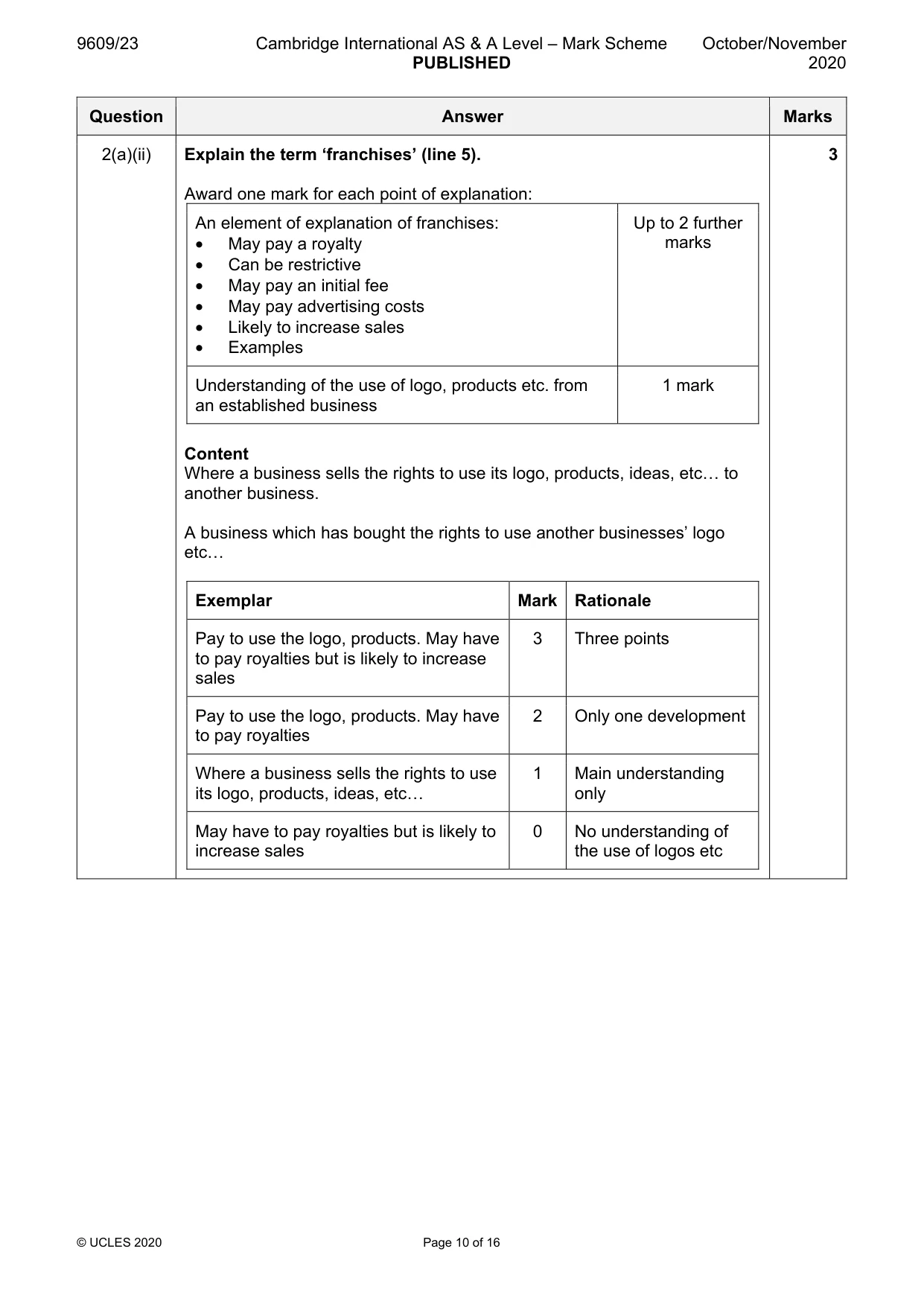
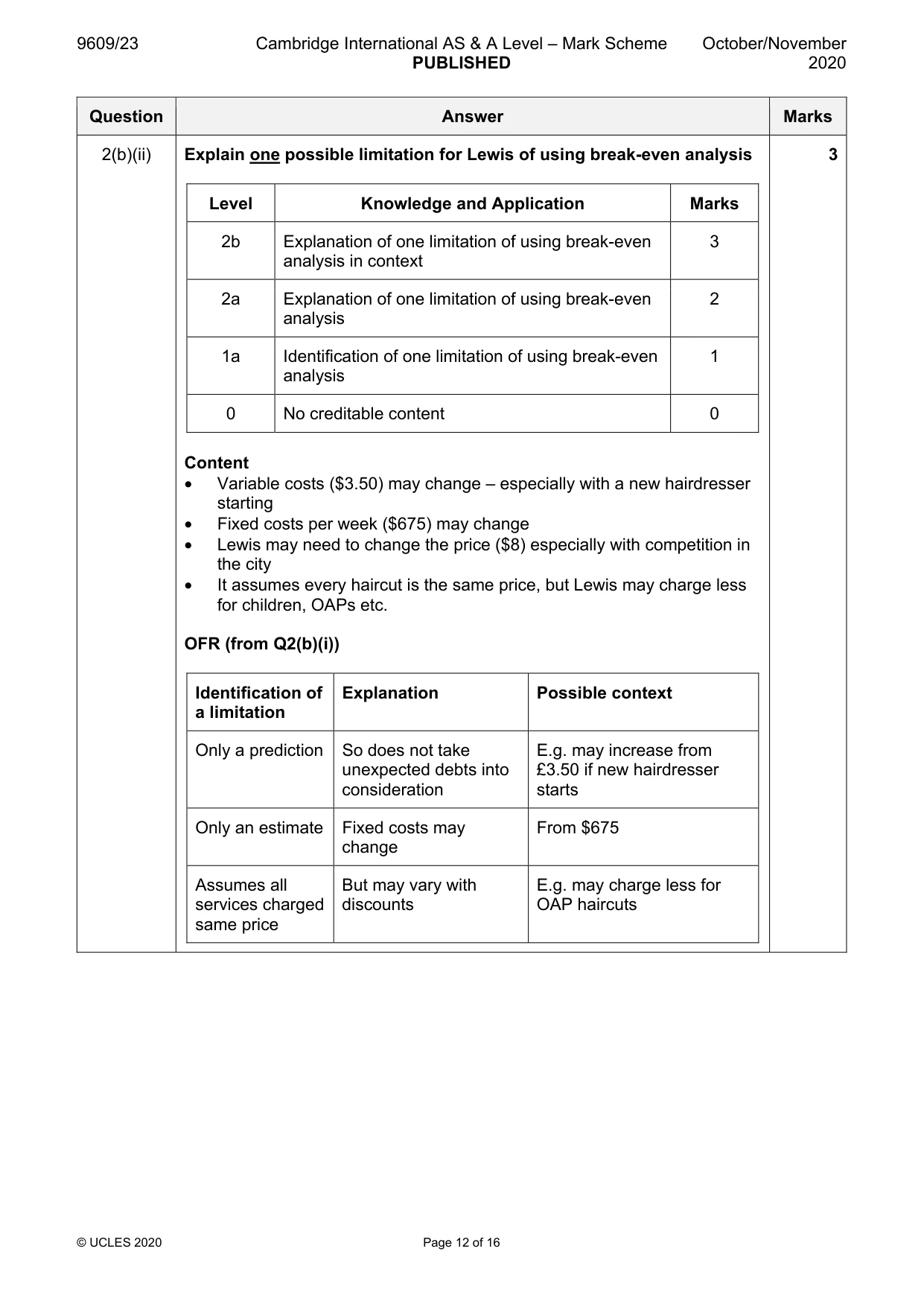
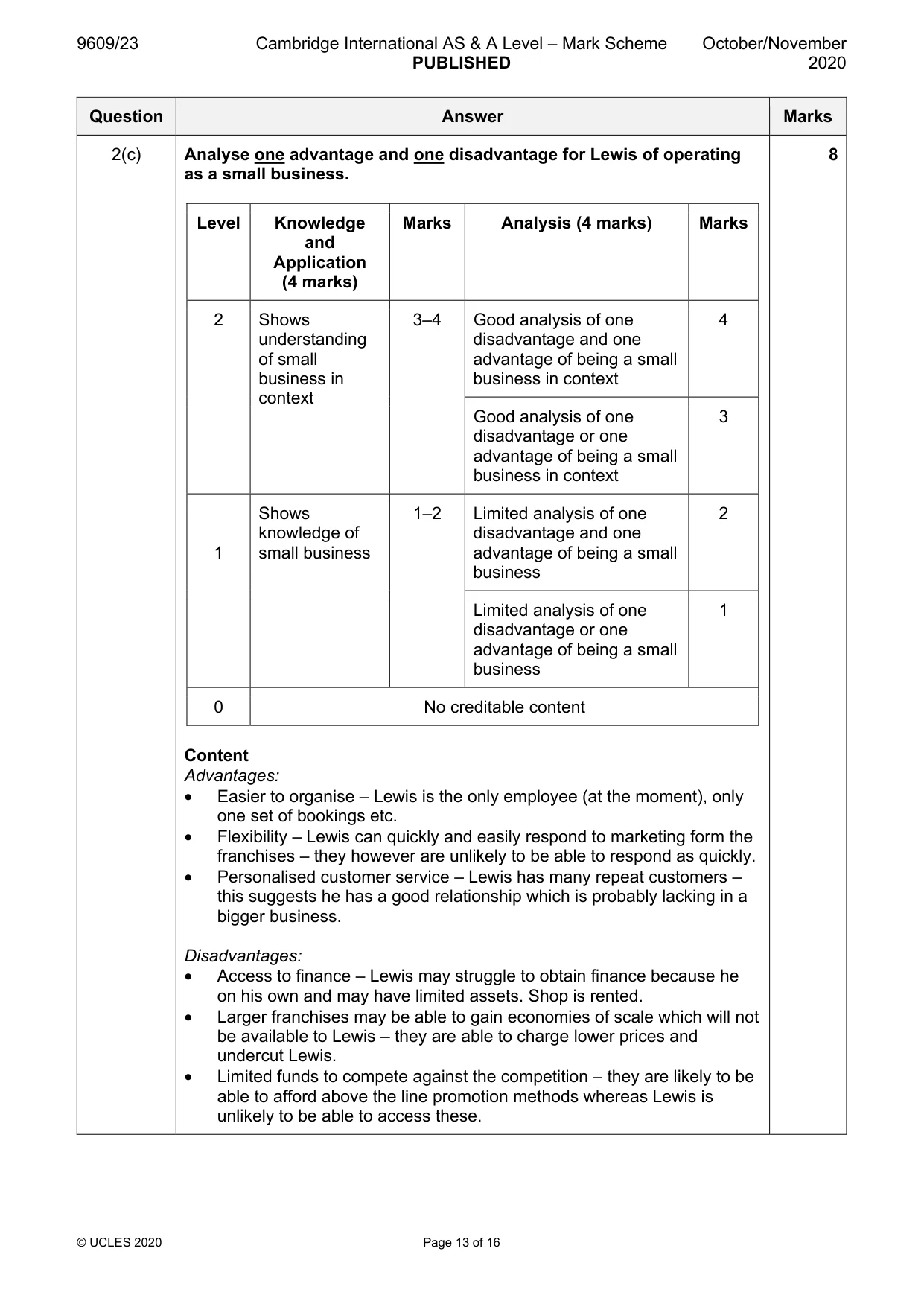
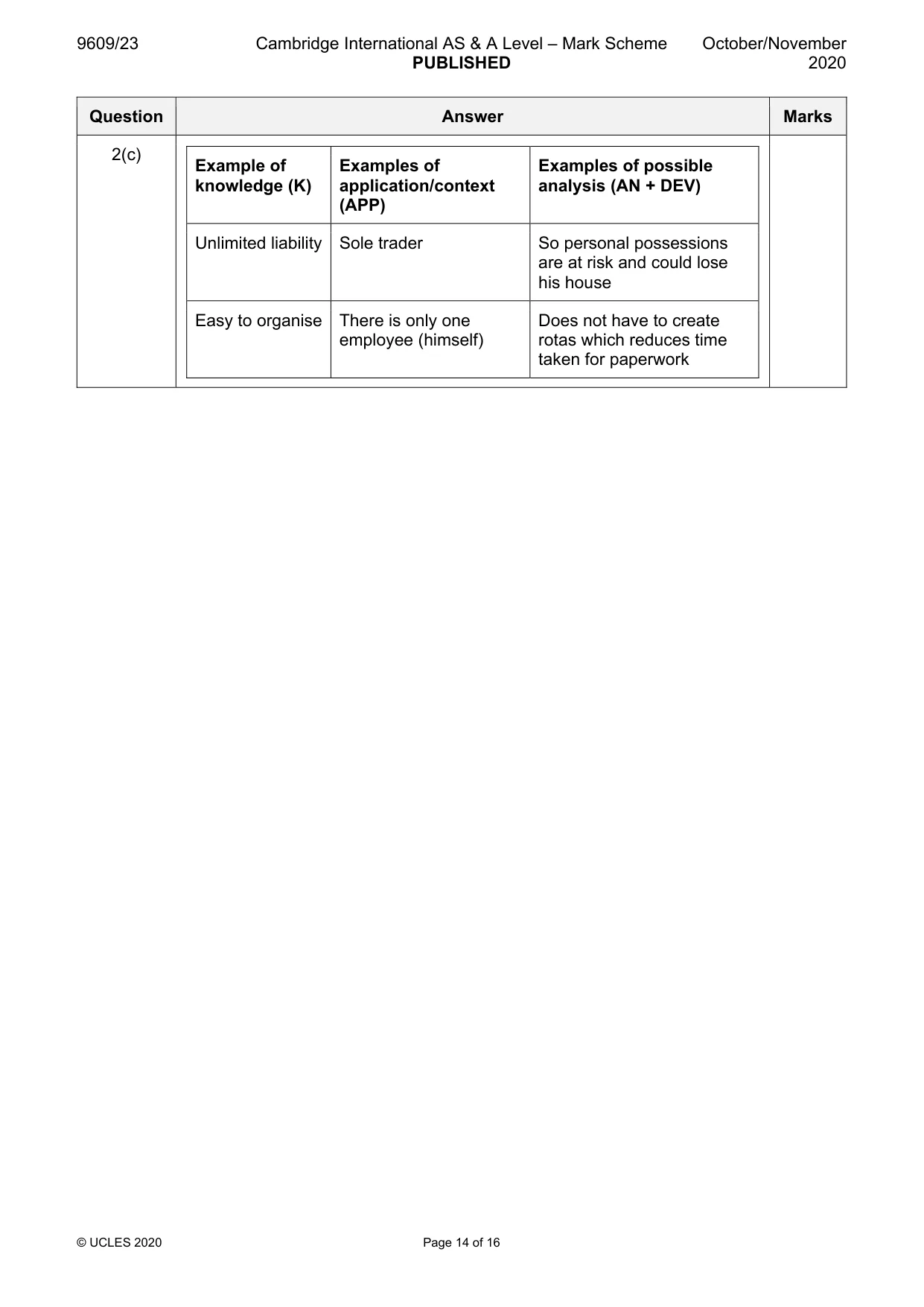
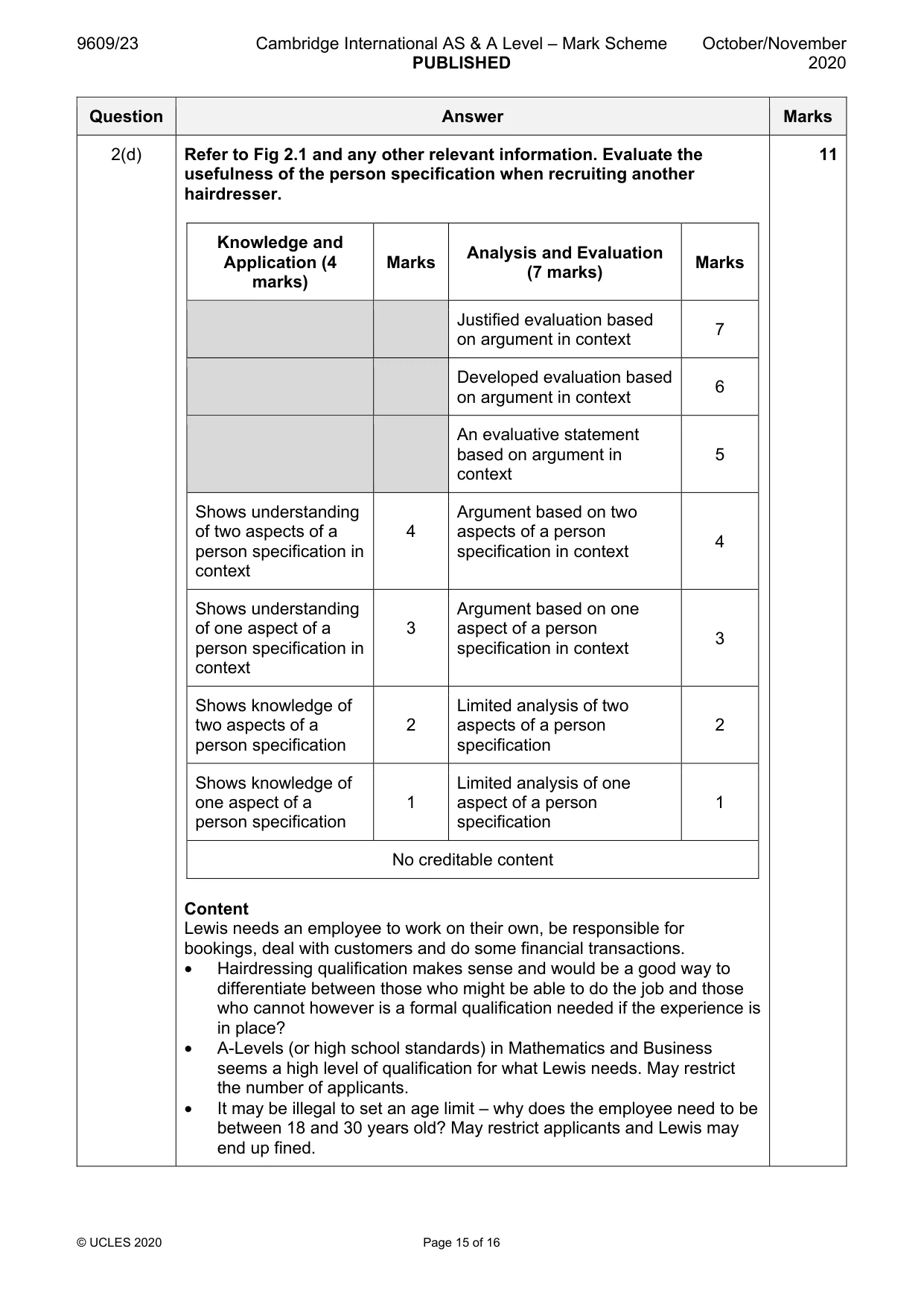
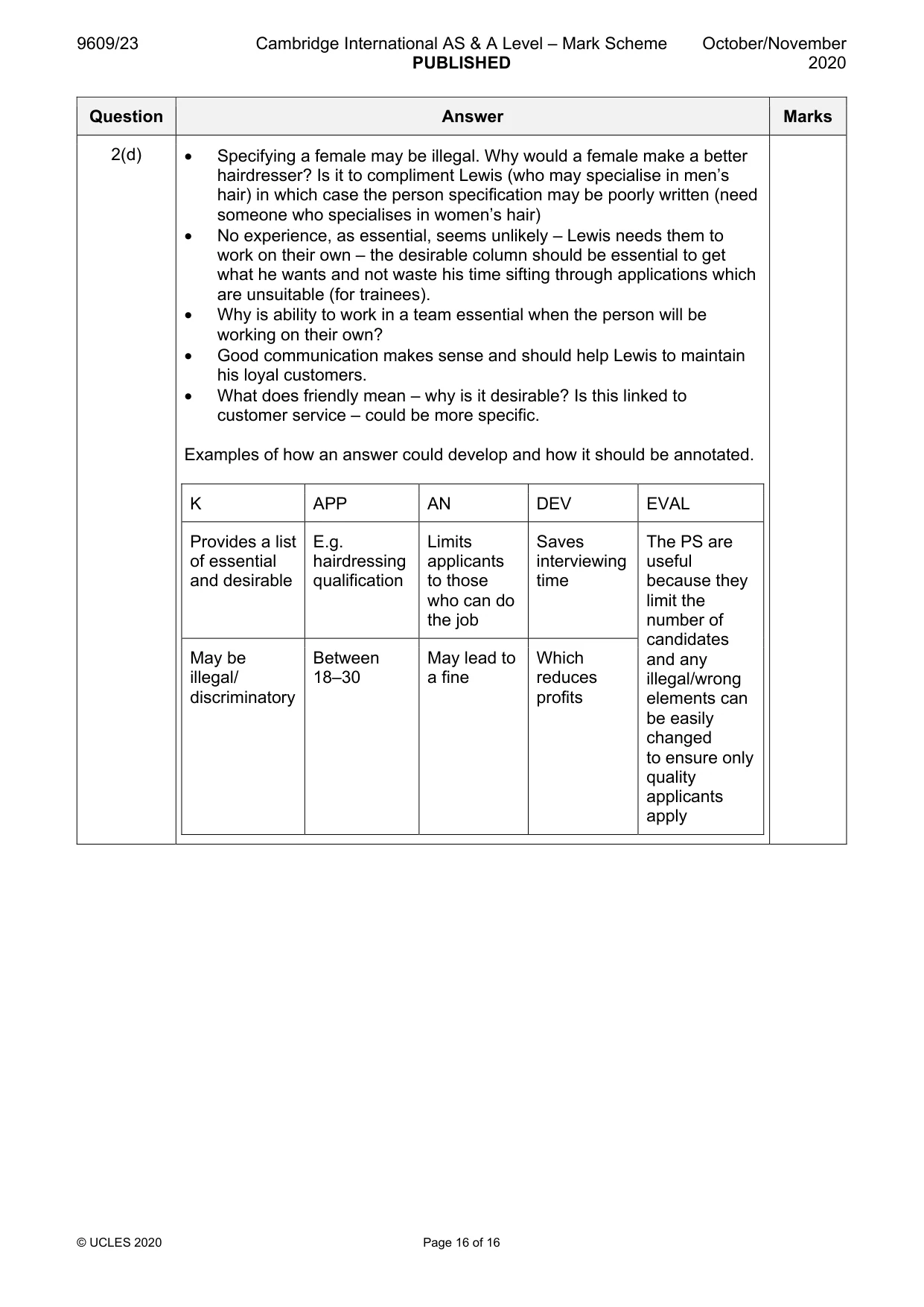
Mark scheme: 2(a)(i) Define the term ‘price’ (line 6). 2 Knowledge Marks A correct definition 2 A partial, vague or unfocused definition 1 No creditable content 0 Content A correct definition should include the following elements (allow one mark for each element): • The amount of money for a product or service • charged to a customer Exemplar Marks Amount paid by a customer 2 Amount of money to consume 2 Value to the customer 2 Amount charged by a business to the customer 2 What the customer pays 1 Amount charged by a business 1 2(a)(ii) Explain the term ‘franchises’ (line 5). 3 Award one mark for each point of explanation: An element of explanation of franchises: Up to 2 further • May pay a royalty marks • Can be restrictive • May pay an initial fee • May pay advertising costs • Likely to increase sales • Examples Understanding of the use of logo, products etc. from 1 mark an established business Content Where a business sells the rights to use its logo, products, ideas, etc… to another business. A business which has bought the rights to use another businesses’ logo etc… Exemplar Mark Rationale Pay to use the logo, products. May have 3 Three points to pay royalties but is likely to increase sales Pay to use the logo, products. May have 2 Only one development to pay royalties Where a business sells the rights to use 1 Main understanding its logo, products, ideas, etc… only May have to pay royalties but is likely to 0 No understanding of increase sales the use of logos etc 2(b)(i) Refer to Table 2.1. Calculate the break-even quantity of haircuts in a 3 week. Rationale Mark Correct answer with or without correct working or ‘haircuts’ 3 Correct formula (may be implied) and correct calculation of 2 contribution Correct formula or correct calculation of contribution 1 No creditable content 0 Content: Fixed costs Formula: Price − selling price (contribution) $675 (1) $8 − $3.50 $675 $4.50 (contribution) Answer = 150 (haircuts) OFR Common incorrect answers Answer Mark Rationale 150 3 Correct answer – does not need units formula 1 Basic understanding 2(b)(ii) Explain one possible limitation for Lewis of using break-even analysis 3 Level Knowledge and Application Marks 2b Explanation of one limitation of using break-even 3 analysis in context 2a Explanation of one limitation of using break-even 2 analysis 1a Identification of one limitation of using break-even 1 analysis 0 No creditable content 0 Content • Variable costs ($3.50) may change – especially with a new hairdresser starting • Fixed costs per week ($675) may change • Lewis may need to change the price ($8) especially with competition in the city • It assumes every haircut is the same price, but Lewis may charge less for children, OAPs etc. OFR (from Q2(b)(i)) Identification of Explanation Possible context a limitation Only a prediction So does not take E.g. may increase from unexpected debts into £3.50 if new hairdresser consideration starts Only an estimate Fixed costs may From $675 change Assumes all But may vary with E.g. may charge less for services charged discounts OAP haircuts same price 2(c) Analyse one advantage and one disadvantage for Lewis of operating 8 as a small business. Level Knowledge Marks Analysis (4 marks) Marks and Application (4 marks) 2 Shows 3–4 Good analysis of one 4 understanding disadvantage and one of small advantage of being a small business in business in context context Good analysis of one 3 disadvantage or one advantage of being a small business in context Shows 1–2 Limited analysis of one 2 knowledge of disadvantage and one 1 small business advantage of being a small business Limited analysis of one 1 disadvantage or one advantage of being a small business 0 No creditable content Content Advantages: • Easier to organise – Lewis is the only employee (at the moment), only one set of bookings etc. • Flexibility – Lewis can quickly and easily respond to marketing form the franchises – they however are unlikely to be able to respond as quickly. • Personalised customer service – Lewis has many repeat customers – this suggests he has a good relationship which is probably lacking in a bigger business. Disadvantages: • Access to finance – Lewis may struggle to obtain finance because he on his own and may have limited assets. Shop is rented. • Larger franchises may be able to gain economies of scale which will not be available to Lewis – they are able to charge lower prices and undercut Lewis. • Limited funds to compete against the competition – they are likely to be able to afford above the line promotion methods whereas Lewis is unlikely to be able to access these. 2(c) Example of Examples of Examples of possible knowledge (K) application/context analysis (AN + DEV) (APP) Unlimited liability Sole trader So personal possessions are at risk and could lose his house Easy to organise There is only one Does not have to create employee (himself) rotas which reduces time taken for paperwork 2(d) Refer to Fig 2.1 and any other relevant information. Evaluate the 11 usefulness of the person specification when recruiting another hairdresser. Knowledge and Analysis and Evaluation Application (4 Marks Marks (7 marks) marks) Justified evaluation based 7 on argument in context Developed evaluation based 6 on argument in context An evaluative statement based on argument in 5 context Shows understanding Argument based on two of two aspects of a 4 aspects of a person 4 person specification in specification in context context Shows understanding Argument based on one of one aspect of a 3 aspect of a person 3 person specification in specification in context context Shows knowledge of Limited analysis of two two aspects of a 2 aspects of a person 2 person specification specification Shows knowledge of Limited analysis of one one aspect of a 1 aspect of a person 1 person specification specification No creditable content Content Lewis needs an employee to work on their own, be responsible for bookings, deal with customers and do some financial transactions. • Hairdressing qualification makes sense and would be a good way to differentiate between those who might be able to do the job and those who cannot however is a formal qualification needed if the experience is in place? • A-Levels (or high school standards) in Mathematics and Business seems a high level of qualification for what Lewis needs. May restrict the number of applicants. • It may be illegal to set an age limit – why does the employee need to be between 18 and 30 years old? May restrict applicants and Lewis may end up fined. 2(d) • Specifying a female may be illegal. Why would a female make a better hairdresser? Is it to compliment Lewis (who may specialise in men’s hair) in which case the person specification may be poorly written (need someone who specialises in women’s hair) • No experience, as essential, seems unlikely – Lewis needs them to work on their own – the desirable column should be essential to get what he wants and not waste his time sifting through applications which are unsuitable (for trainees). • Why is ability to work in a team essential when the person will be working on their own? • Good communication makes sense and should help Lewis to maintain his loyal customers. • What does friendly mean – why is it desirable? Is this linked to customer service – could be more specific. Examples of how an answer could develop and how it should be annotated. K APP AN DEV EVAL Provides a list E.g. Limits Saves The PS are of essential hairdressing applicants interviewing useful and desirable qualification to those time because they who can do limit the the job number of candidates May be Between May lead to Which and any illegal/ 18–30 a fine reduces illegal/wrong discriminatory profits elements can be easily changed to ensure only quality applicants apply
What was in this paper
The subtopics covered by these 2 questions, and how many questions each got. Open one in a new tab to see every Cambridge question on it.
What you needed in this session
Cambridge’s own grade thresholds for 2020 Oct/Nov, Paper 2 · Variant 3. A higher threshold means an easier paper — the bar moves with how the cohort did.