Cambridge A Level Business (for first examination in 2016) 9609 — 2017 May/June Paper 2 · Variant 2
9609/22/M/J/17 · 2 questions · 60 marks · ≈68 min
The question paper and its mark scheme, free to read here and free to download. This is Cambridge’s own paper, exactly as it was sat.
Question paper4 pages
Mark scheme20 pages
Answers below. Sit the paper first if you are practising.
Questions as text
Q1 · Perfect Pizza (PP) Paul is a chef
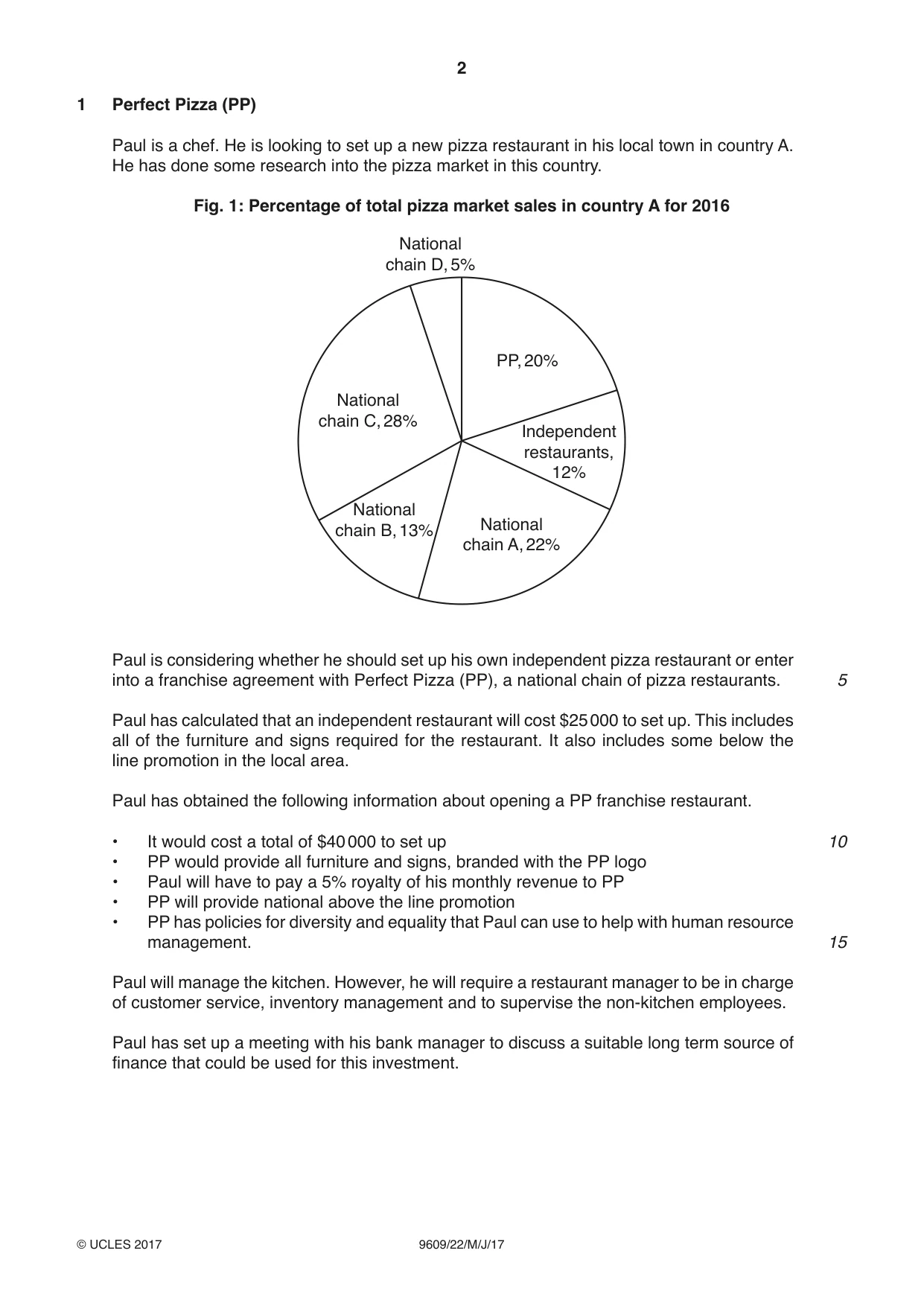
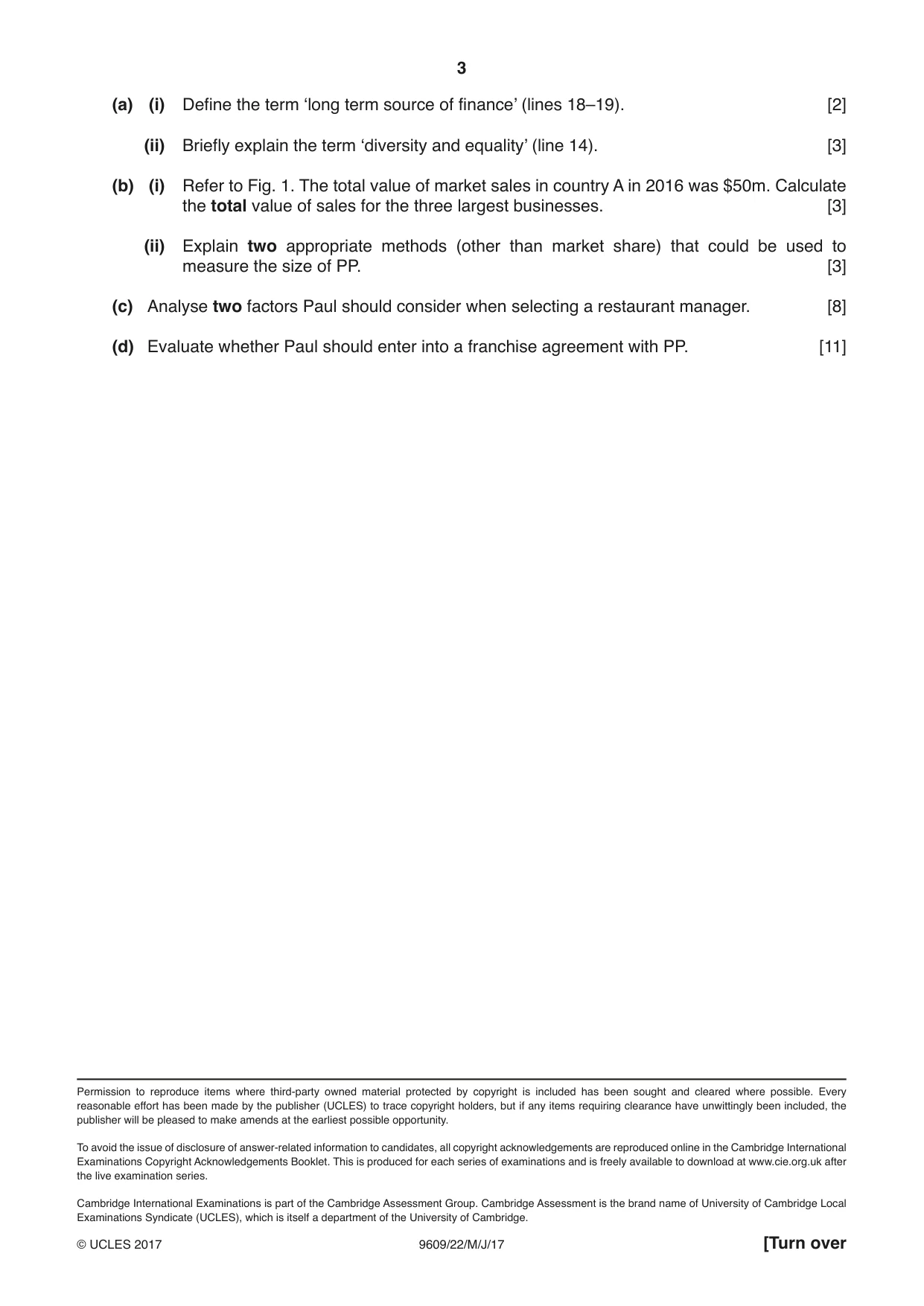
1 Perfect Pizza (PP) Paul is a chef. He is looking to set up a new pizza restaurant in his local town in country A. He has done some research into the pizza market in this country. Fig. 1: Percentage of total pizza market sales in country A for 2016 National chain D, 5% PP, 20% National chain C, 28% Independent restaurants, 12% National National chain B, 13% chain A, 22% Paul is considering whether he should set up his own independent pizza restaurant or enter into a franchise agreement with Perfect Pizza (PP), a national chain of pizza restaurants. 5 Paul has calculated that an independent restaurant will cost $25 000 to set up. This includes all of the furniture and signs required for the restaurant. It also includes some below the line promotion in the local area. Paul has obtained the following information about opening a PP franchise restaurant. • It would cost a total of $40 000 to set up 10 • PP would provide all furniture and signs, branded with the PP logo • Paul will have to pay a 5% royalty of his monthly revenue to PP • PP will provide national above the line promotion • PP has policies for diversity and equality that Paul can use to help with human resource management. 15 Paul will manage the kitchen. However, he will require a restaurant manager to be in charge of customer service, inventory management and to supervise the non-kitchen employees. Paul has set up a meeting with his bank manager to discuss a suitable long term source of finance that could be used for this investment. (a) (i) Define the term ‘long term source of finance’ (lines 18–19). [2] (ii) Briefly explain the term ‘diversity and equality’ (line 14). [3] (b) (i) Refer to Fig. 1. The total value of market sales in country A in 2016 was $50m. Calculate the total value of sales for the three largest businesses. [3] (ii) Explain two appropriate methods (other than market share) that could be used to measure the size of PP. [3] (c) Analyse two factors Paul should consider when selecting a restaurant manager. [8] (d) Evaluate whether Paul should enter into a franchise agreement with PP. [11]
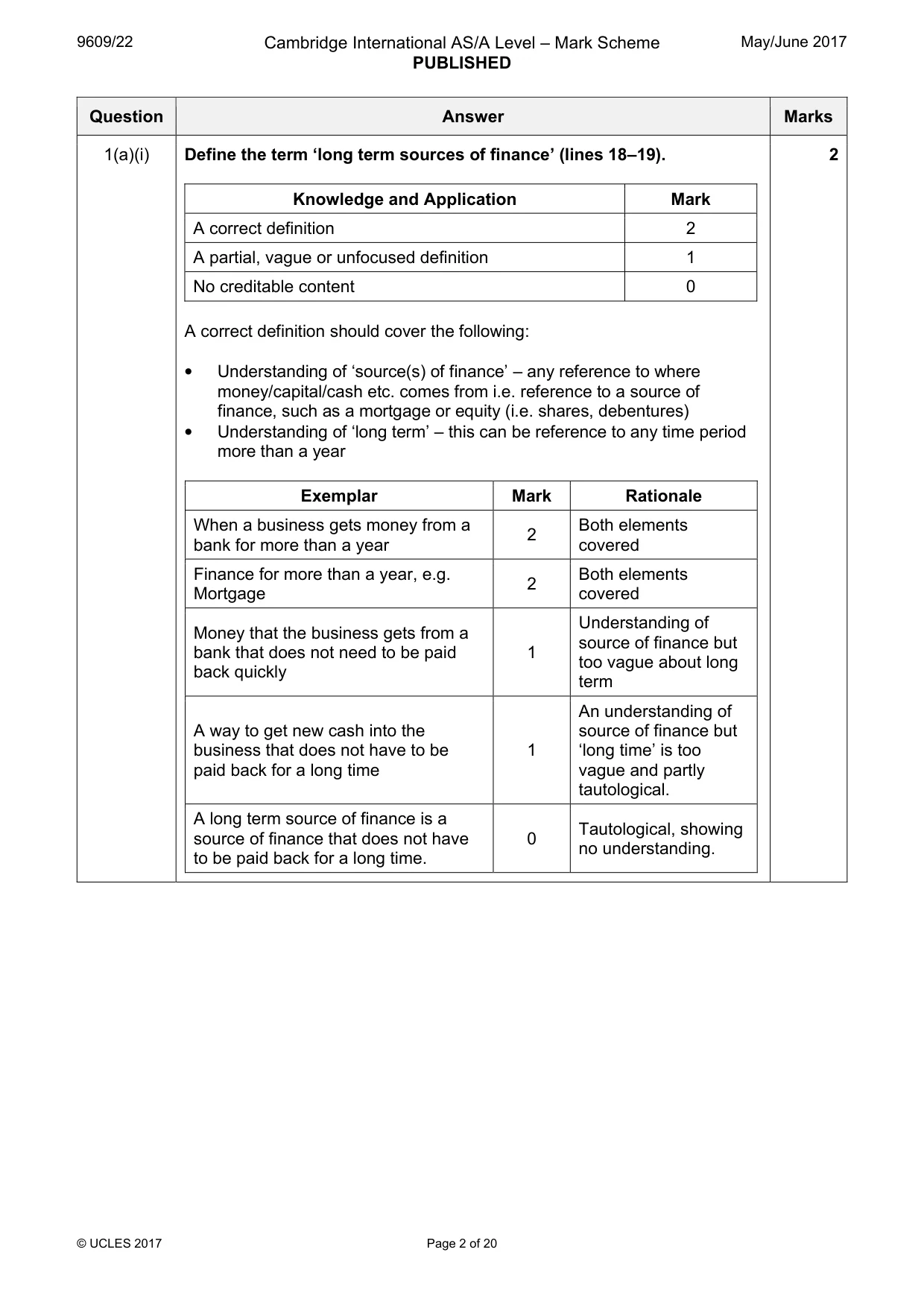
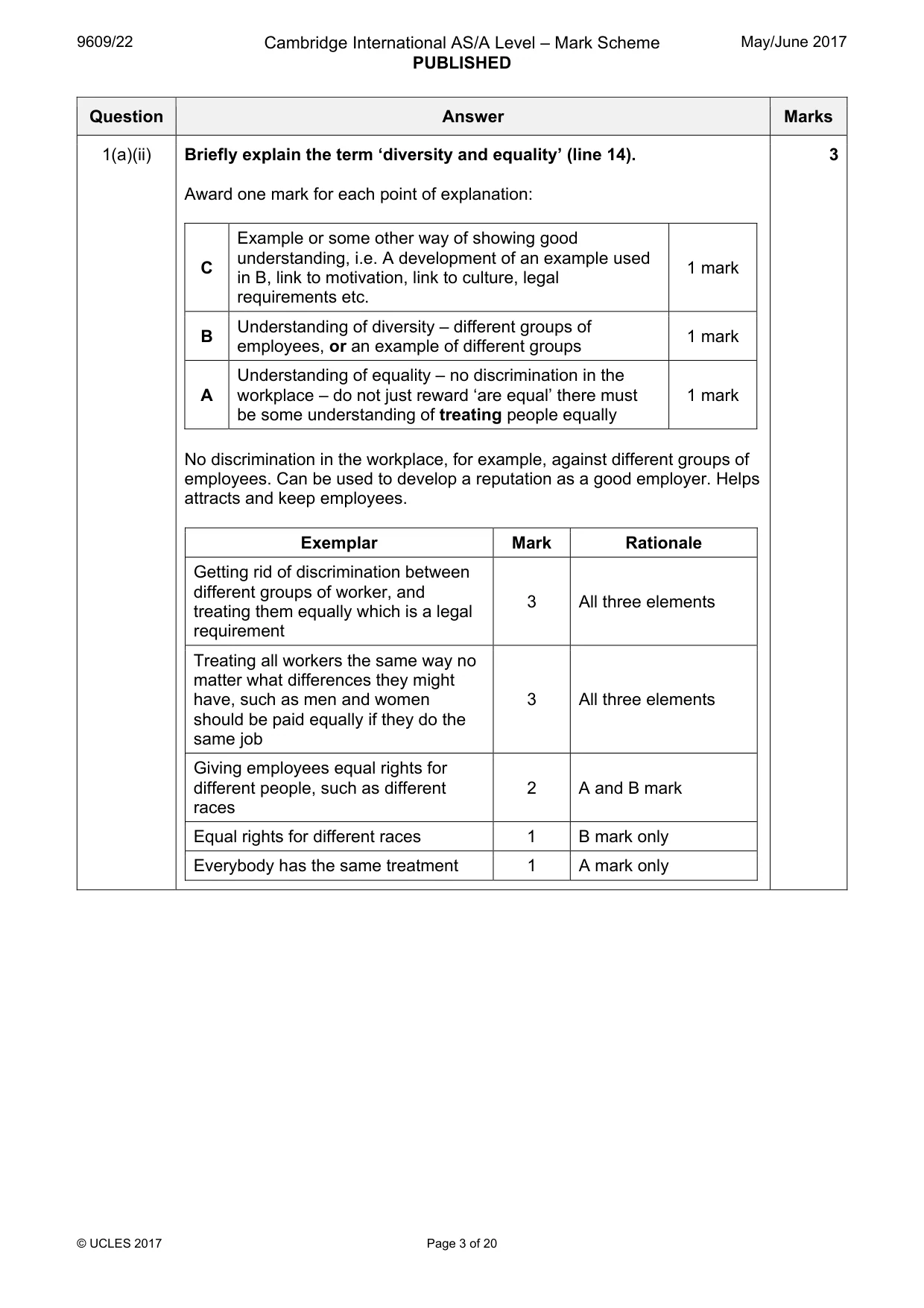
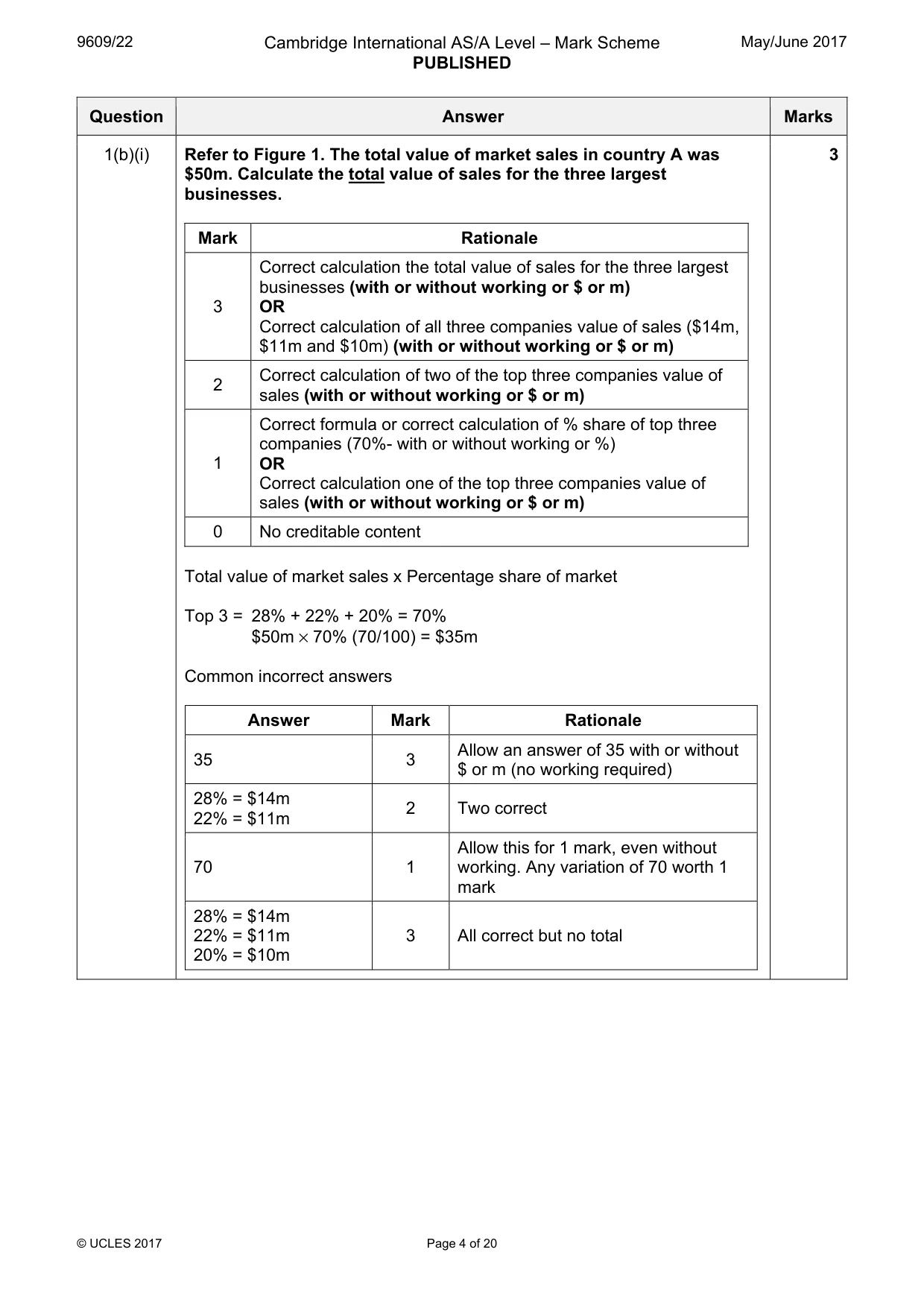
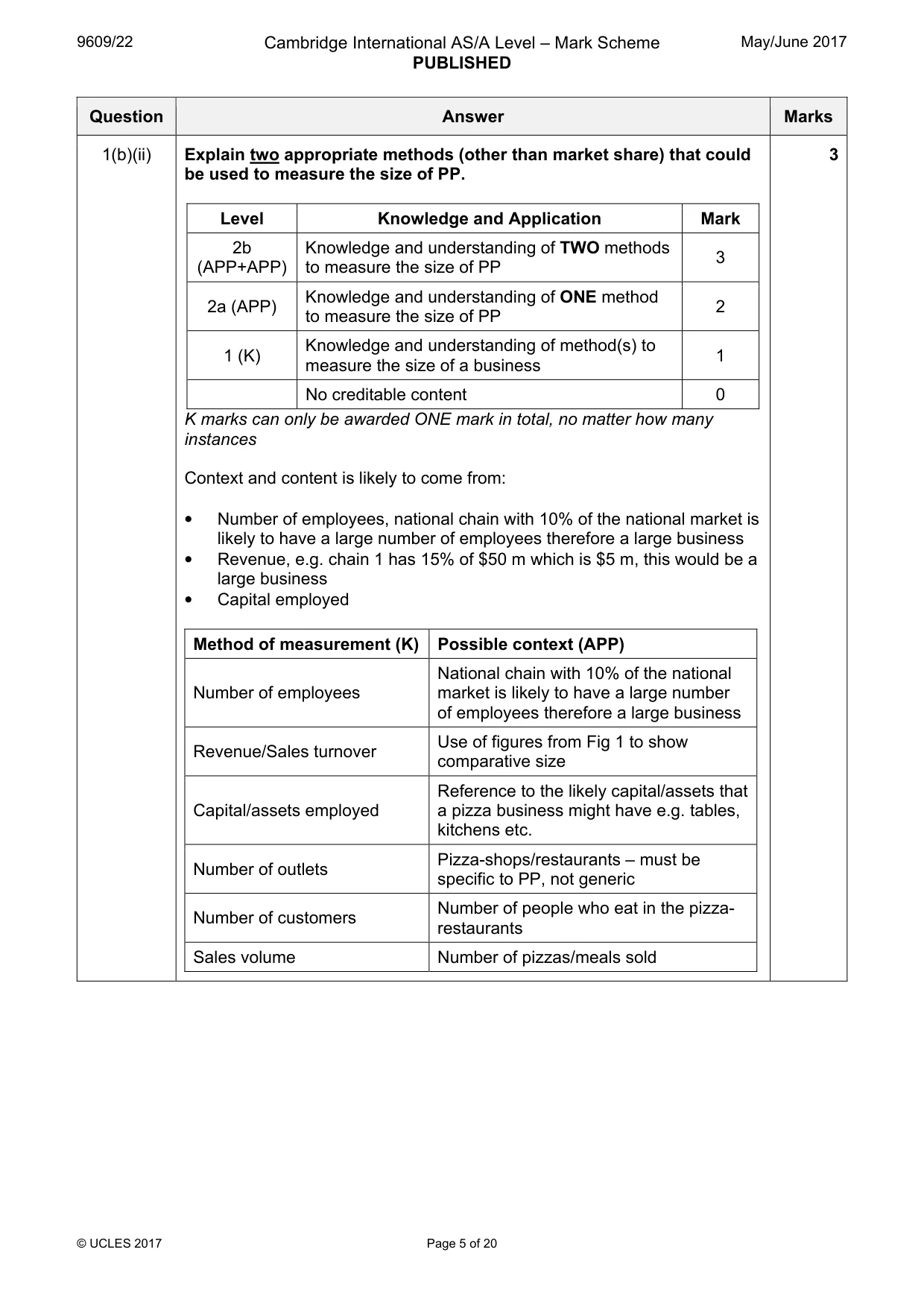
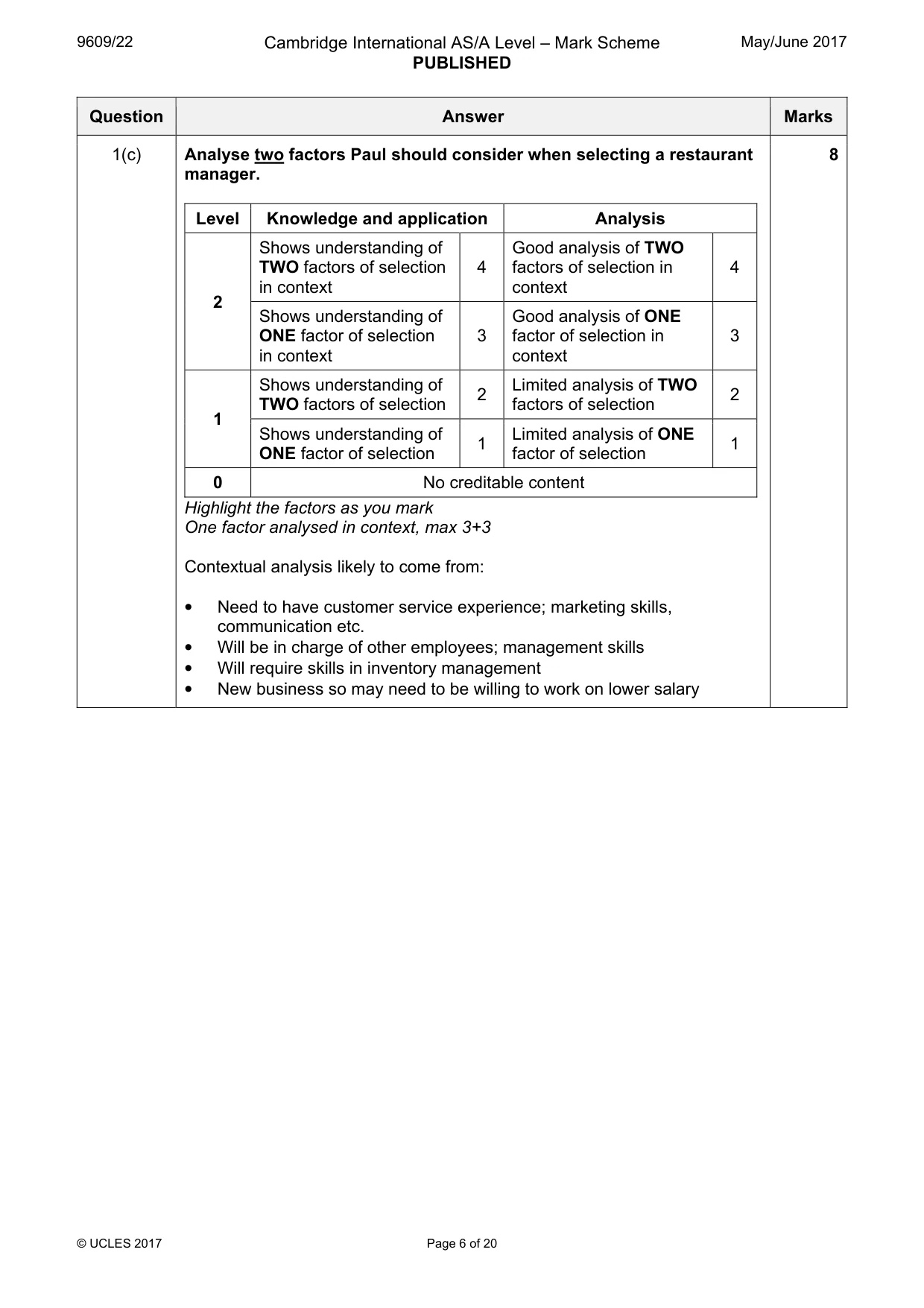
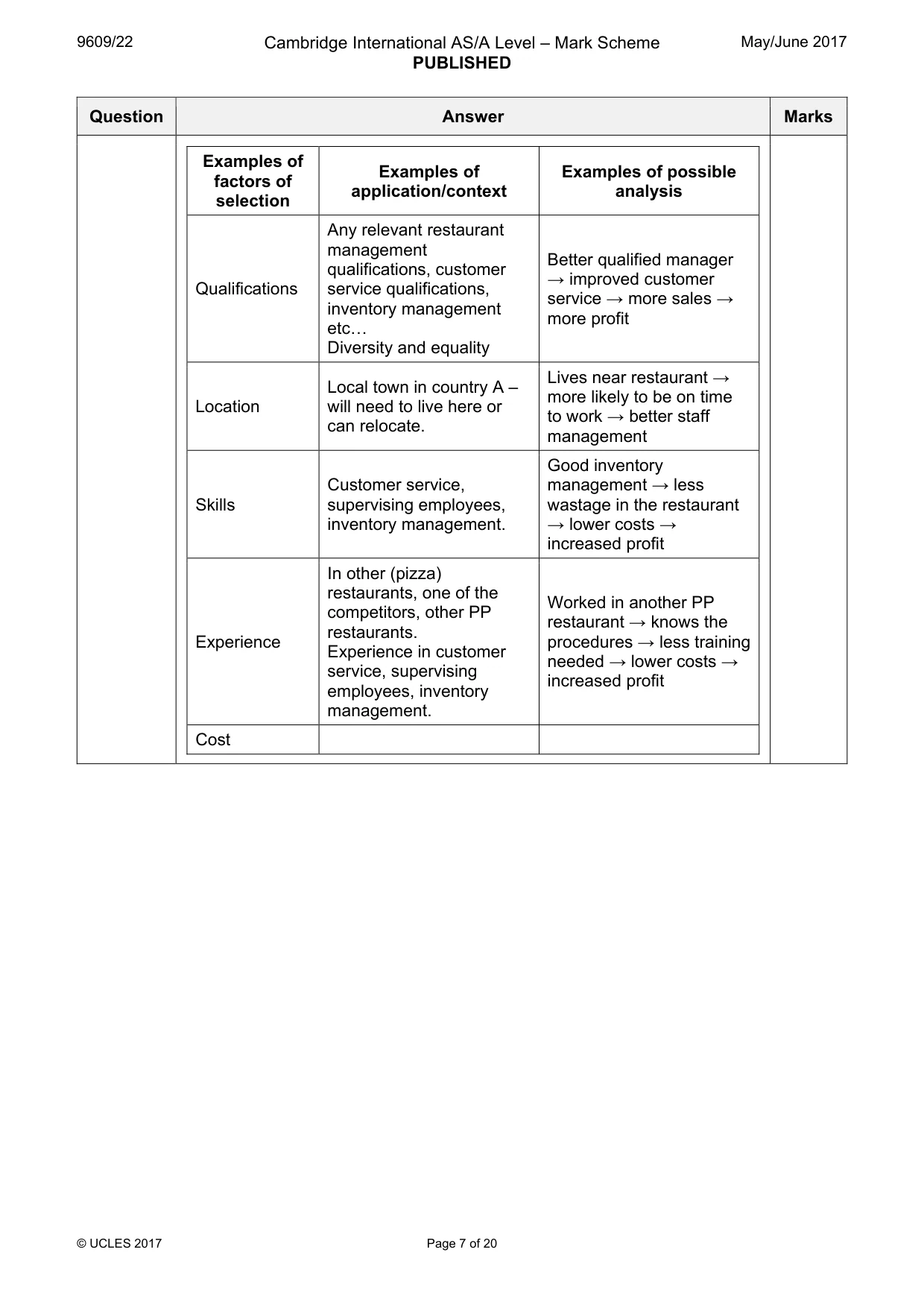
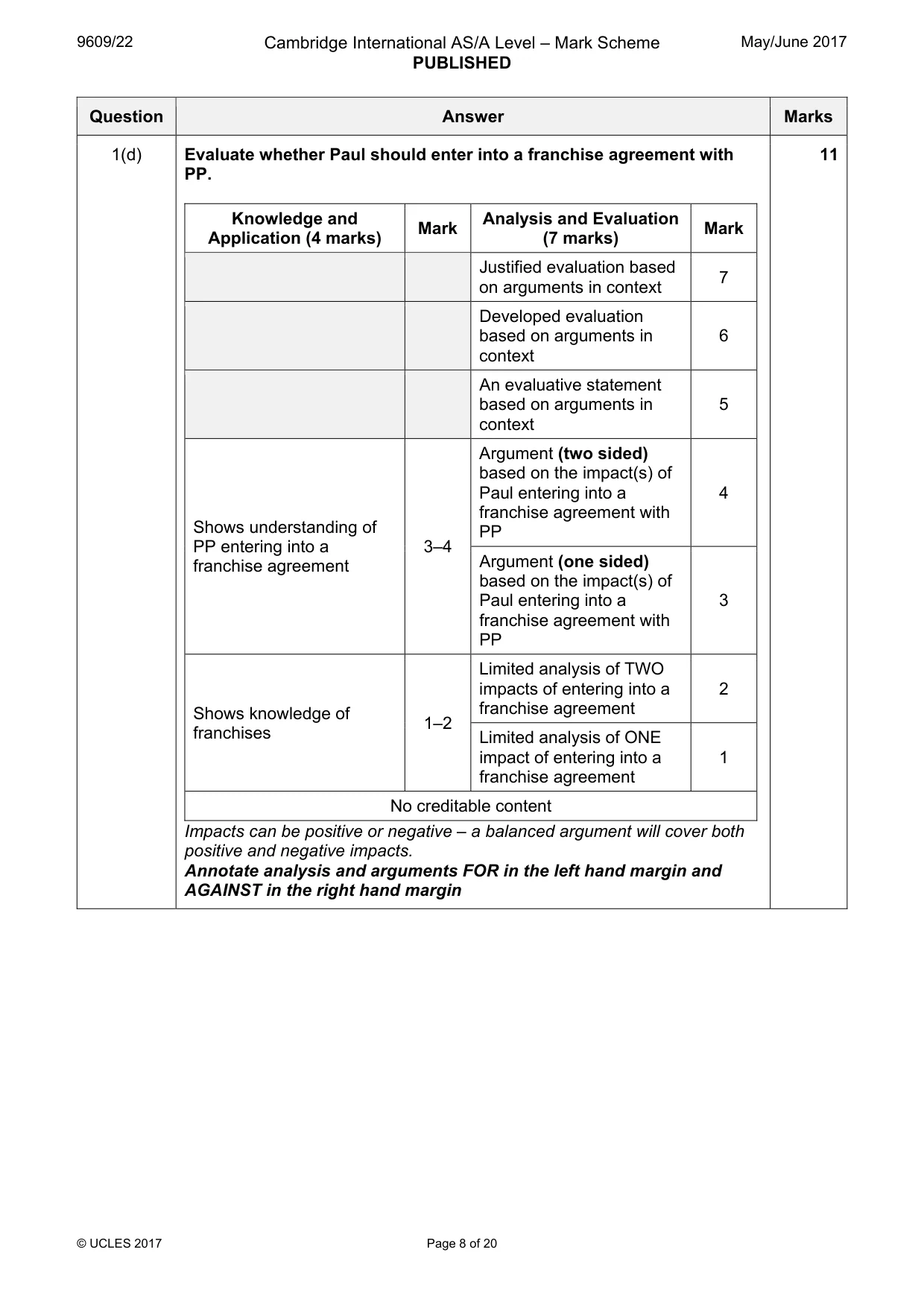
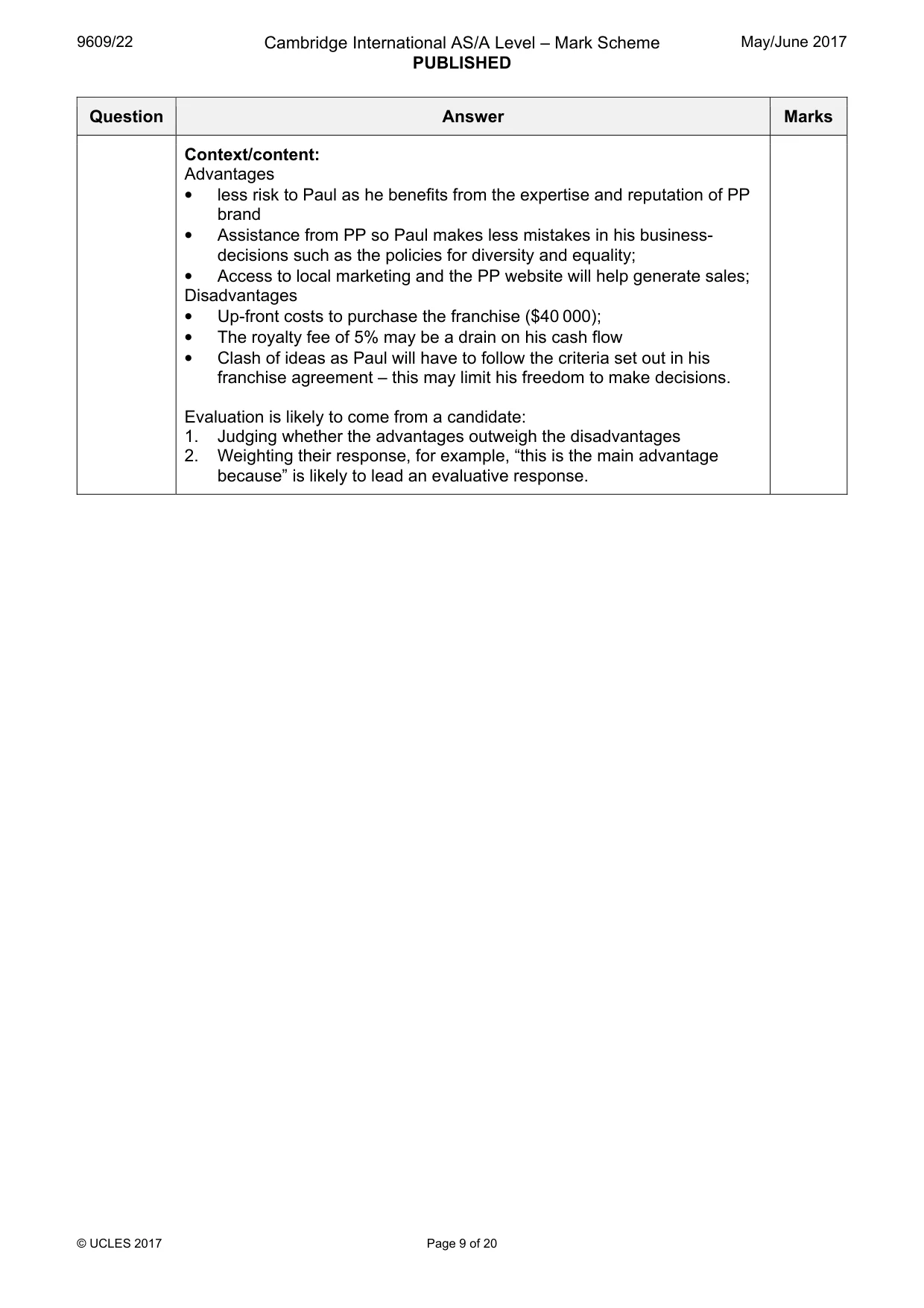
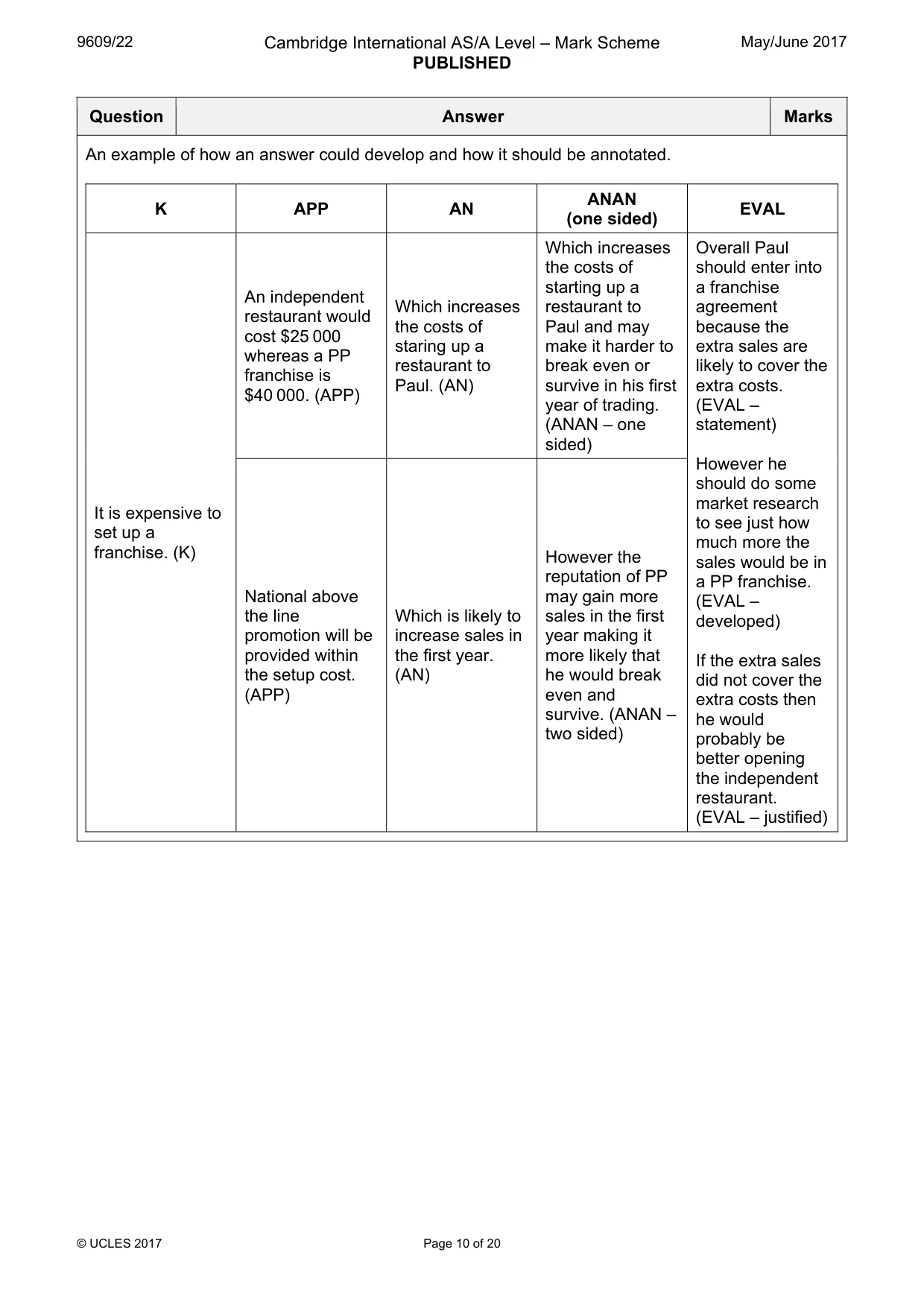
Mark scheme: Question Answer Marks 1(a)(i) Define the term ‘long term sources of finance’ (lines 18–19). 2 Knowledge and Application Mark A correct definition 2 A partial, vague or unfocused definition 1 No creditable content 0 A correct definition should cover the following: • Understanding of ‘source(s) of finance’ – any reference to where money/capital/cash etc. comes from i.e. reference to a source of finance, such as a mortgage or equity (i.e. shares, debentures) • Understanding of ‘long term’ – this can be reference to any time period more than a year Exemplar Mark Rationale When a business gets money from a Both elements 2 bank for more than a year covered Finance for more than a year, e.g. Both elements 2 Mortgage covered Understanding of Money that the business gets from a source of finance but bank that does not need to be paid 1 too vague about long back quickly term An understanding of A way to get new cash into the source of finance but business that does not have to be 1 ‘long time’ is too paid back for a long time vague and partly tautological. A long term source of finance is a Tautological, showing source of finance that does not have 0 no understanding. to be paid back for a long time. 1(a)(ii) Briefly explain the term ‘diversity and equality’ (line 14). 3 Award one mark for each point of explanation: Example or some other way of showing good understanding, i.e. A development of an example used C 1 mark in B, link to motivation, link to culture, legal requirements etc. Understanding of diversity – different groups of B 1 mark employees, or an example of different groups Understanding of equality – no discrimination in the A workplace – do not just reward ‘are equal’ there must 1 mark be some understanding of treating people equally No discrimination in the workplace, for example, against different groups of employees. Can be used to develop a reputation as a good employer. Helps attracts and keep employees. Exemplar Mark Rationale Getting rid of discrimination between different groups of worker, and 3 All three elements treating them equally which is a legal requirement Treating all workers the same way no matter what differences they might have, such as men and women 3 All three elements should be paid equally if they do the same job Giving employees equal rights for different people, such as different 2 A and B mark races Equal rights for different races 1 B mark only Everybody has the same treatment 1 A mark only 1(b)(i) Refer to Figure 1. The total value of market sales in country A was 3 $50m. Calculate the total value of sales for the three largest businesses. Mark Rationale Correct calculation the total value of sales for the three largest businesses (with or without working or $ or m) 3 OR Correct calculation of all three companies value of sales ($14m, $11m and $10m) (with or without working or $ or m) Correct calculation of two of the top three companies value of 2 sales (with or without working or $ or m) Correct formula or correct calculation of % share of top three companies (70%- with or without working or %) 1 OR Correct calculation one of the top three companies value of sales (with or without working or $ or m) 0 No creditable content Total value of market sales x Percentage share of market Top 3 = 28% + 22% + 20% = 70% $50m × 70% (70/100) = $35m Common incorrect answers Answer Mark Rationale Allow an answer of 35 with or without 35 3 $ or m (no working required) 28% = $14m 2 Two correct 22% = $11m Allow this for 1 mark, even without 70 1 working. Any variation of 70 worth 1 mark 28% = $14m 22% = $11m 3 All correct but no total 20% = $10m 1(b)(ii) Explain two appropriate methods (other than market share) that could 3 be used to measure the size of PP. Level Knowledge and Application Mark 2b Knowledge and understanding of TWO methods 3 (APP+APP) to measure the size of PP Knowledge and understanding of ONE method 2a (APP) 2 to measure the size of PP Knowledge and understanding of method(s) to 1 (K) 1 measure the size of a business No creditable content 0 K marks can only be awarded ONE mark in total, no matter how many instances Context and content is likely to come from: • Number of employees, national chain with 10% of the national market is likely to have a large number of employees therefore a large business • Revenue, e.g. chain 1 has 15% of $50 m which is $5 m, this would be a large business • Capital employed Method of measurement (K) Possible context (APP) National chain with 10% of the national Number of employees market is likely to have a large number of employees therefore a large business Use of figures from Fig 1 to show Revenue/Sales turnover comparative size Reference to the likely capital/assets that Capital/assets employed a pizza business might have e.g. tables, kitchens etc. Pizza-shops/restaurants – must be Number of outlets specific to PP, not generic Number of people who eat in the pizza- Number of customers restaurants Sales volume Number of pizzas/meals sold 1(c) Analyse two factors Paul should consider when selecting a restaurant 8 manager. Level Knowledge and application Analysis Shows understanding of Good analysis of TWO TWO factors of selection 4 factors of selection in 4 in context context 2 Shows understanding of Good analysis of ONE ONE factor of selection 3 factor of selection in 3 in context context Shows understanding of Limited analysis of TWO 2 2 TWO factors of selection factors of selection 1 Shows understanding of Limited analysis of ONE 1 1 ONE factor of selection factor of selection 0 No creditable content Highlight the factors as you mark One factor analysed in context, max 3+3 Contextual analysis likely to come from: • Need to have customer service experience; marketing skills, communication etc. • Will be in charge of other employees; management skills • Will require skills in inventory management • New business so may need to be willing to work on lower salary Examples of Examples of Examples of possible factors of application/context analysis selection Any relevant restaurant management Better qualified manager qualifications, customer → improved customer Qualifications service qualifications, service → more sales → inventory management more profit etc« Diversity and equality Lives near restaurant → Local town in country A – more likely to be on time Location will need to live here or to work → better staff can relocate. management Good inventory Customer service, management → less Skills supervising employees, wastage in the restaurant inventory management. → lower costs → increased profit In other (pizza) restaurants, one of the Worked in another PP competitors, other PP restaurant → knows the restaurants. Experience procedures → less training Experience in customer needed → lower costs → service, supervising increased profit employees, inventory management. Cost 1(d) Evaluate whether Paul should enter into a franchise agreement with 11 PP. Knowledge and Analysis and Evaluation Mark Mark Application (4 marks) (7 marks) Justified evaluation based 7 on arguments in context Developed evaluation based on arguments in 6 context An evaluative statement based on arguments in 5 context Argument (two sided) based on the impact(s) of Paul entering into a 4 franchise agreement with Shows understanding of PP PP entering into a 3–4 Argument (one sided) franchise agreement based on the impact(s) of Paul entering into a 3 franchise agreement with PP Limited analysis of TWO impacts of entering into a 2 franchise agreement Shows knowledge of 1–2 franchises Limited analysis of ONE impact of entering into a 1 franchise agreement No creditable content Impacts can be positive or negative – a balanced argument will cover both positive and negative impacts. Annotate analysis and arguments FOR in the left hand margin and AGAINST in the right hand margin Context/content: Advantages • less risk to Paul as he benefits from the expertise and reputation of PP brand • Assistance from PP so Paul makes less mistakes in his business- decisions such as the policies for diversity and equality; • Access to local marketing and the PP website will help generate sales; Disadvantages • Up-front costs to purchase the franchise ($40 000); • The royalty fee of 5% may be a drain on his cash flow • Clash of ideas as Paul will have to follow the criteria set out in his franchise agreement – this may limit his freedom to make decisions. Evaluation is likely to come from a candidate: 1. Judging whether the advantages outweigh the disadvantages 2. Weighting their response, for example, “this is the main advantage because” is likely to lead an evaluative response. An example of how an answer could develop and how it should be annotated. ANAN K APP AN EVAL (one sided) Which increases Overall Paul the costs of should enter into starting up a a franchise An independent Which increases restaurant to agreement restaurant would the costs of Paul and may because the cost $25 000 staring up a make it harder to extra sales are whereas a PP restaurant to break even or likely to cover the franchise is Paul. (AN) survive in his first extra costs. $40 000. (APP) year of trading. (EVAL – (ANAN – one statement) sided) However he should do some market research It is expensive to to see just how set up a much more the franchise. (K) However the sales would be in reputation of PP a PP franchise. National above may gain more (EVAL – the line Which is likely to sales in the first developed) promotion will be increase sales in year making it provided within the first year. more likely that If the extra sales the setup cost. (AN) he would break did not cover the (APP) even and extra costs then survive. (ANAN – he would two sided) probably be better opening the independent restaurant. (EVAL – justified)
Q2 · Quality Leather (QL) QL is a worker co-operative
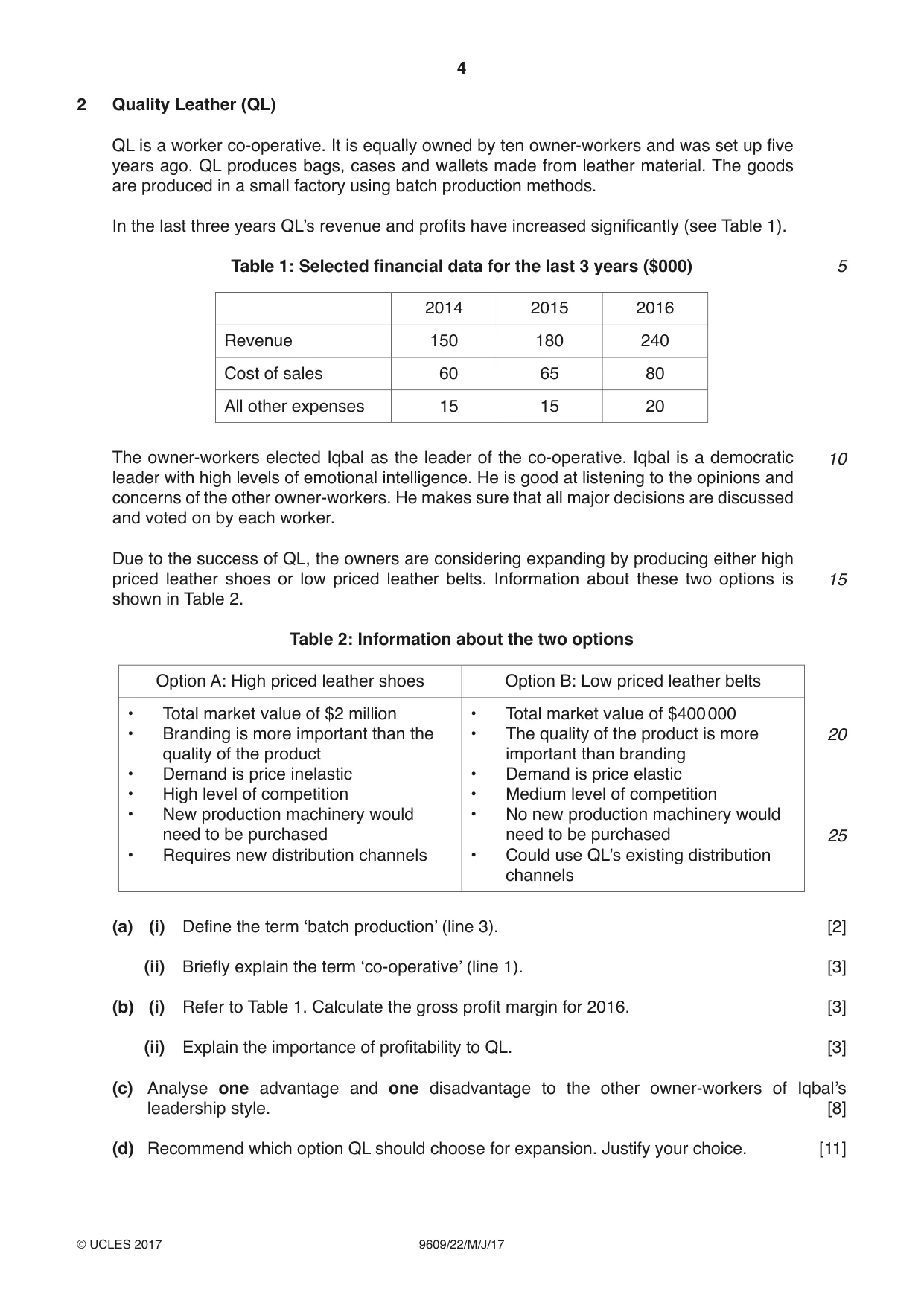
2 Quality Leather (QL) QL is a worker co-operative. It is equally owned by ten owner-workers and was set up five years ago. QL produces bags, cases and wallets made from leather material. The goods are produced in a small factory using batch production methods. In the last three years QL’s revenue and profits have increased significantly (see Table 1). Table 1: Selected financial data for the last 3 years ($000) 5 2014 2015 2016 Revenue 150 180 240 Cost of sales 60 65 80 All other expenses 15 15 20 The owner-workers elected Iqbal as the leader of the co-operative. Iqbal is a democratic 10 leader with high levels of emotional intelligence. He is good at listening to the opinions and concerns of the other owner-workers. He makes sure that all major decisions are discussed and voted on by each worker. Due to the success of QL, the owners are considering expanding by producing either high priced leather shoes or low priced leather belts. Information about these two options is 15 shown in Table 2. Table 2: Information about the two options Option A: High priced leather shoes Option B: Low priced leather belts • Total market value of $2 million • Total market value of $400 000 • Branding is more important than the • The quality of the product is more 20 quality of the product important than branding • Demand is price inelastic • Demand is price elastic • High level of competition • Medium level of competition • New production machinery would • No new production machinery would need to be purchased need to be purchased 25 • Requires new distribution channels • Could use QL’s existing distribution channels (a) (i) Define the term ‘batch production’ (line 3). [2] (ii) Briefly explain the term ‘co-operative’ (line 1). [3] (b) (i) Refer to Table 1. Calculate the gross profit margin for 2016. [3] (ii) Explain the importance of profitability to QL. [3] (c) Analyse one advantage and one disadvantage to the other owner-workers of Iqbal’s leadership style. [8] (d) Recommend which option QL should choose for expansion. Justify your choice. [11]
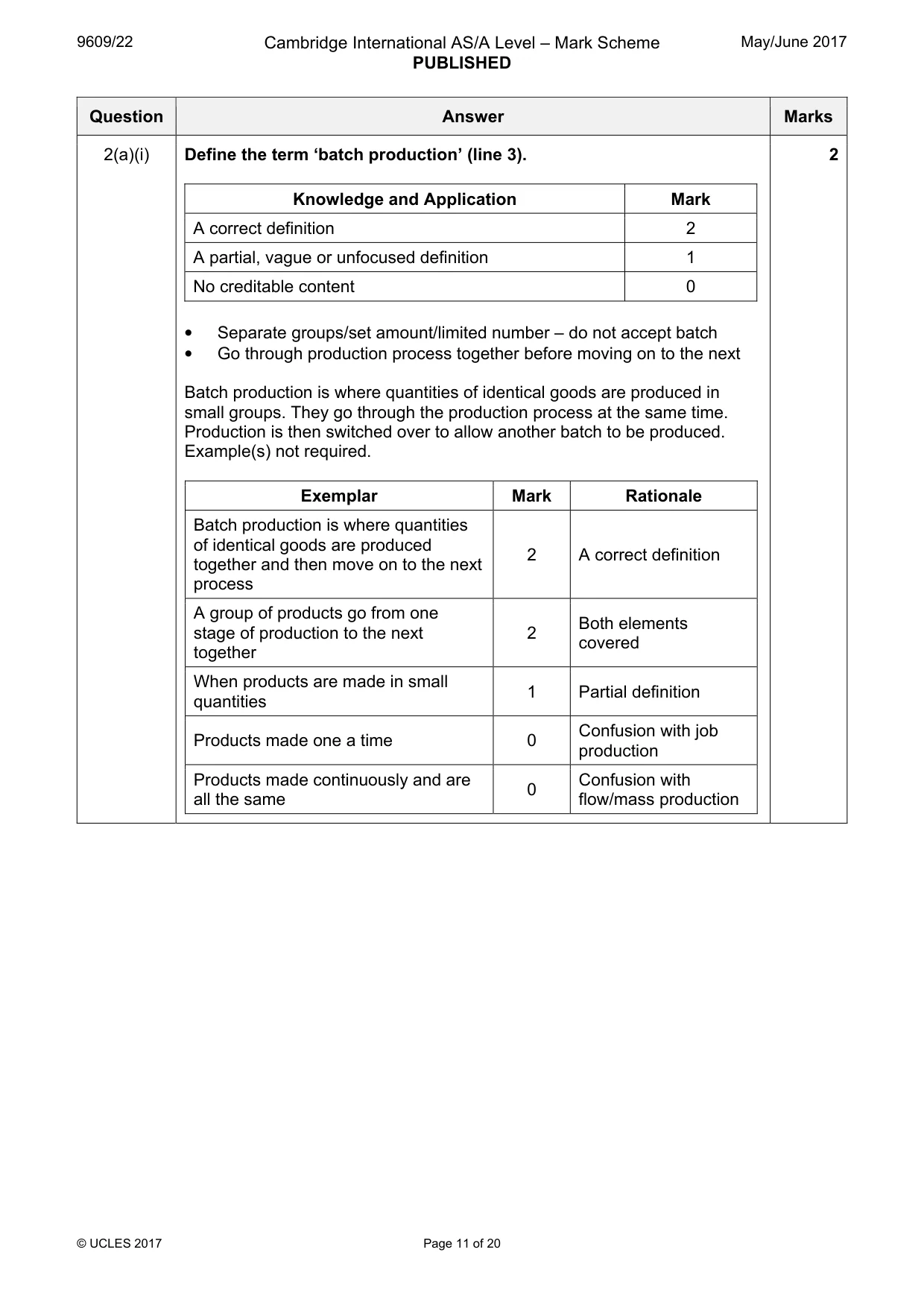
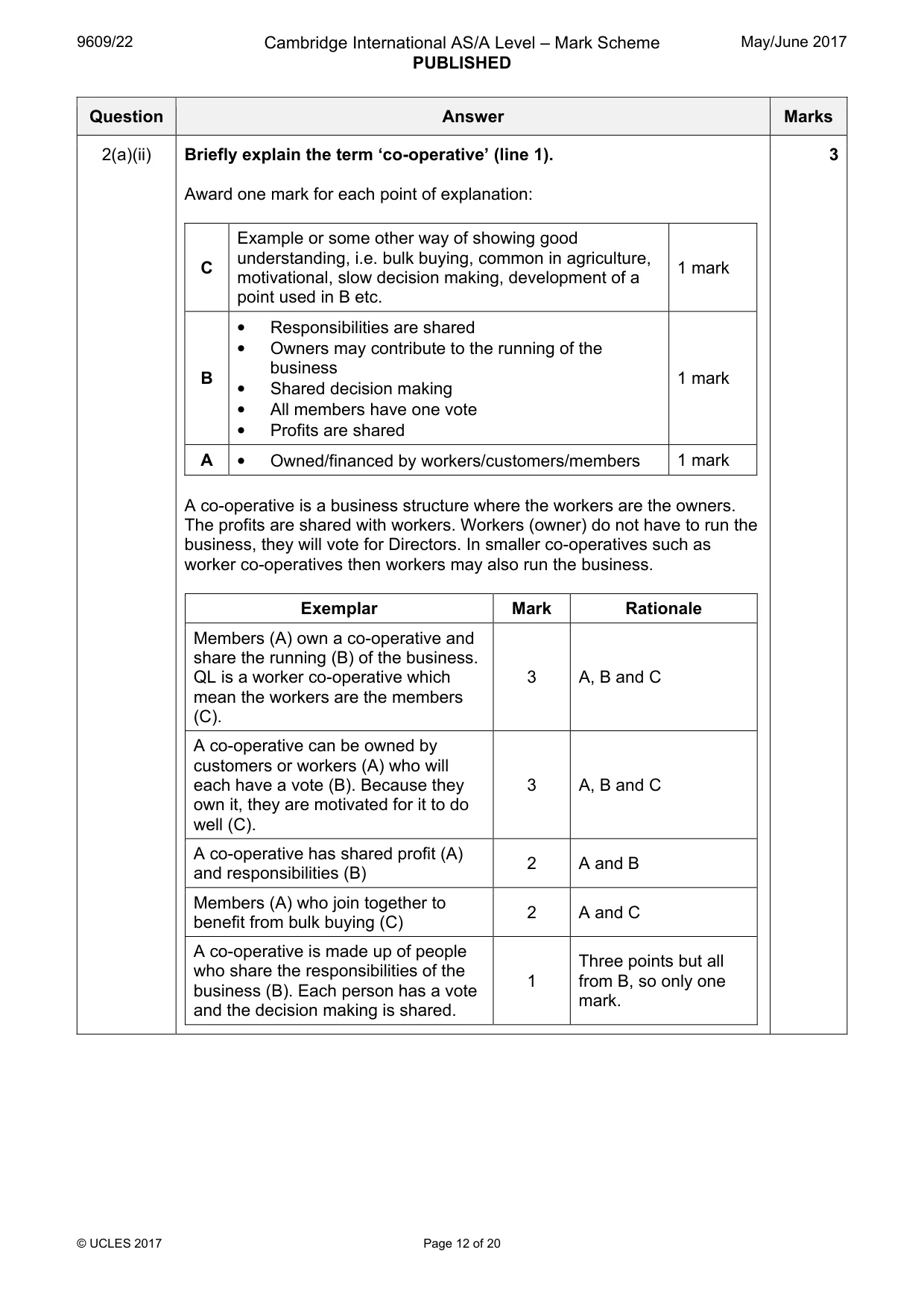
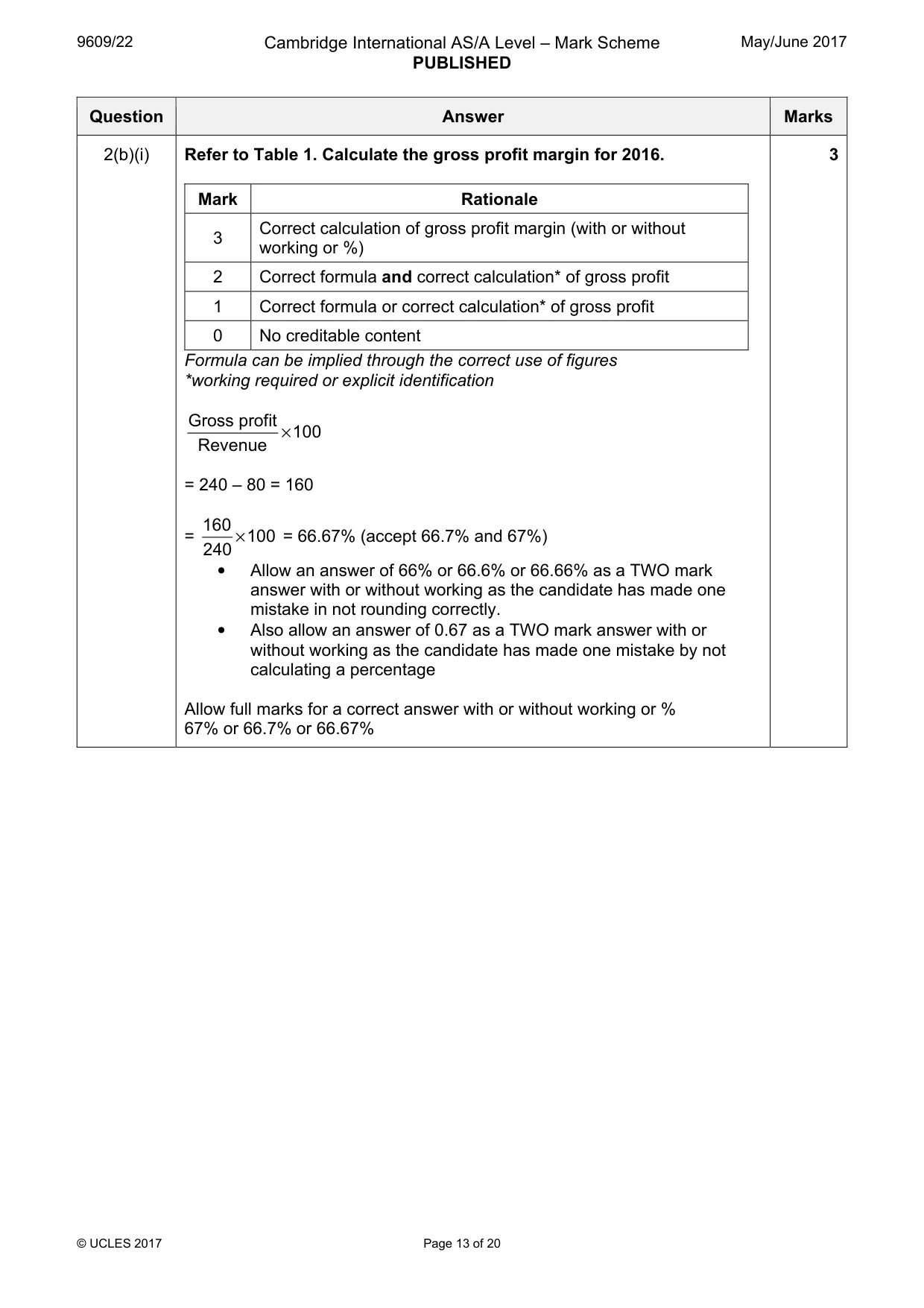
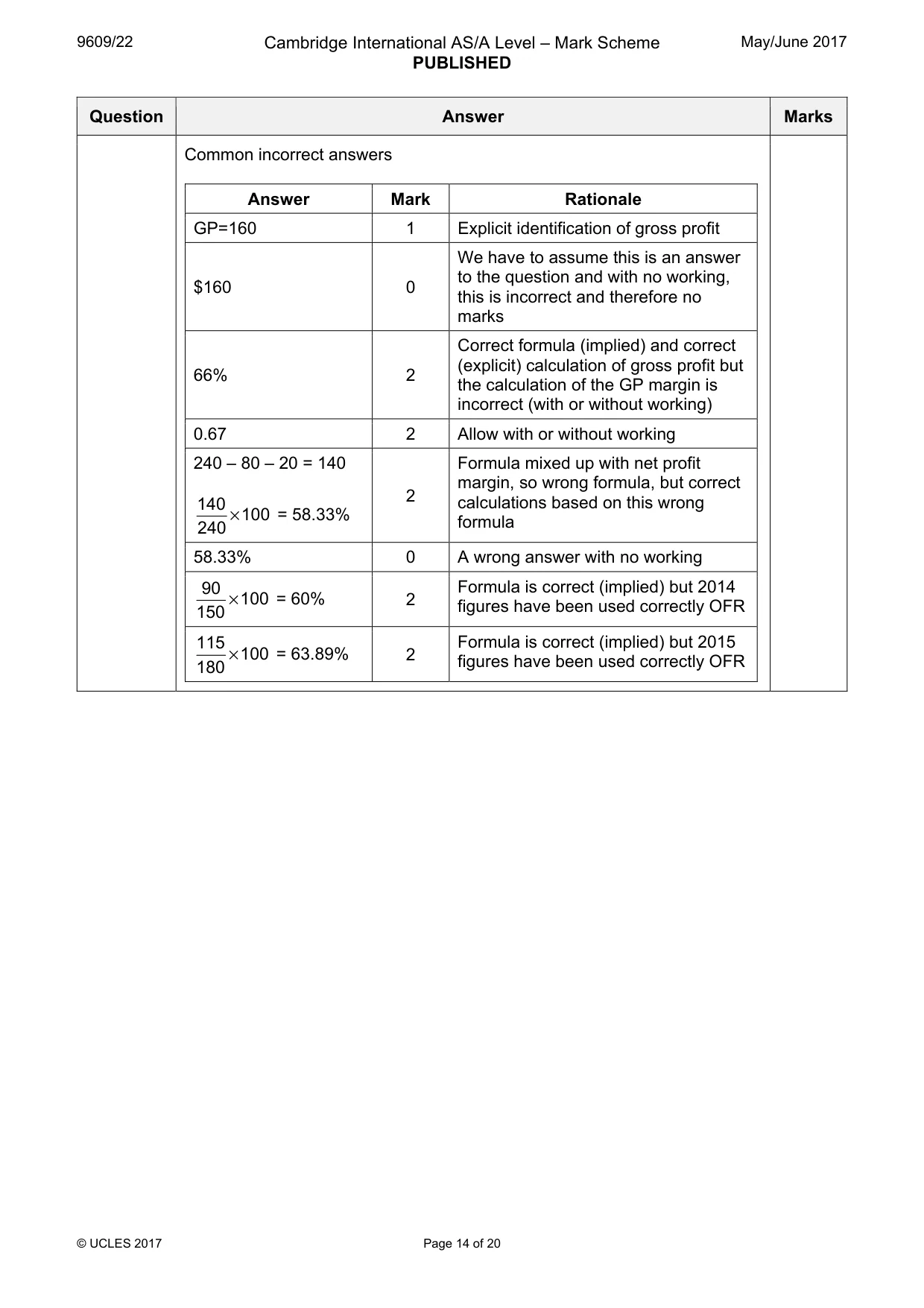
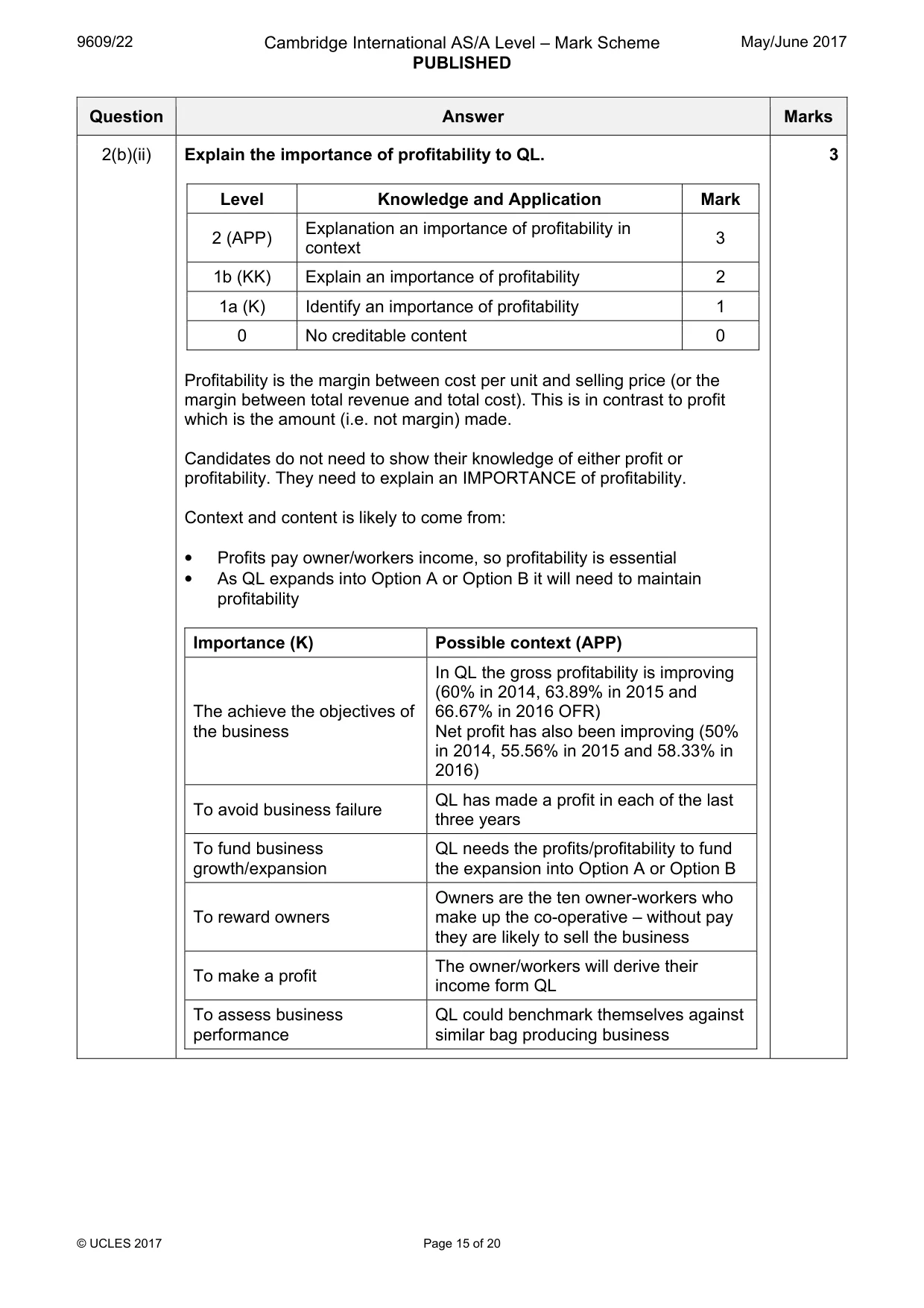
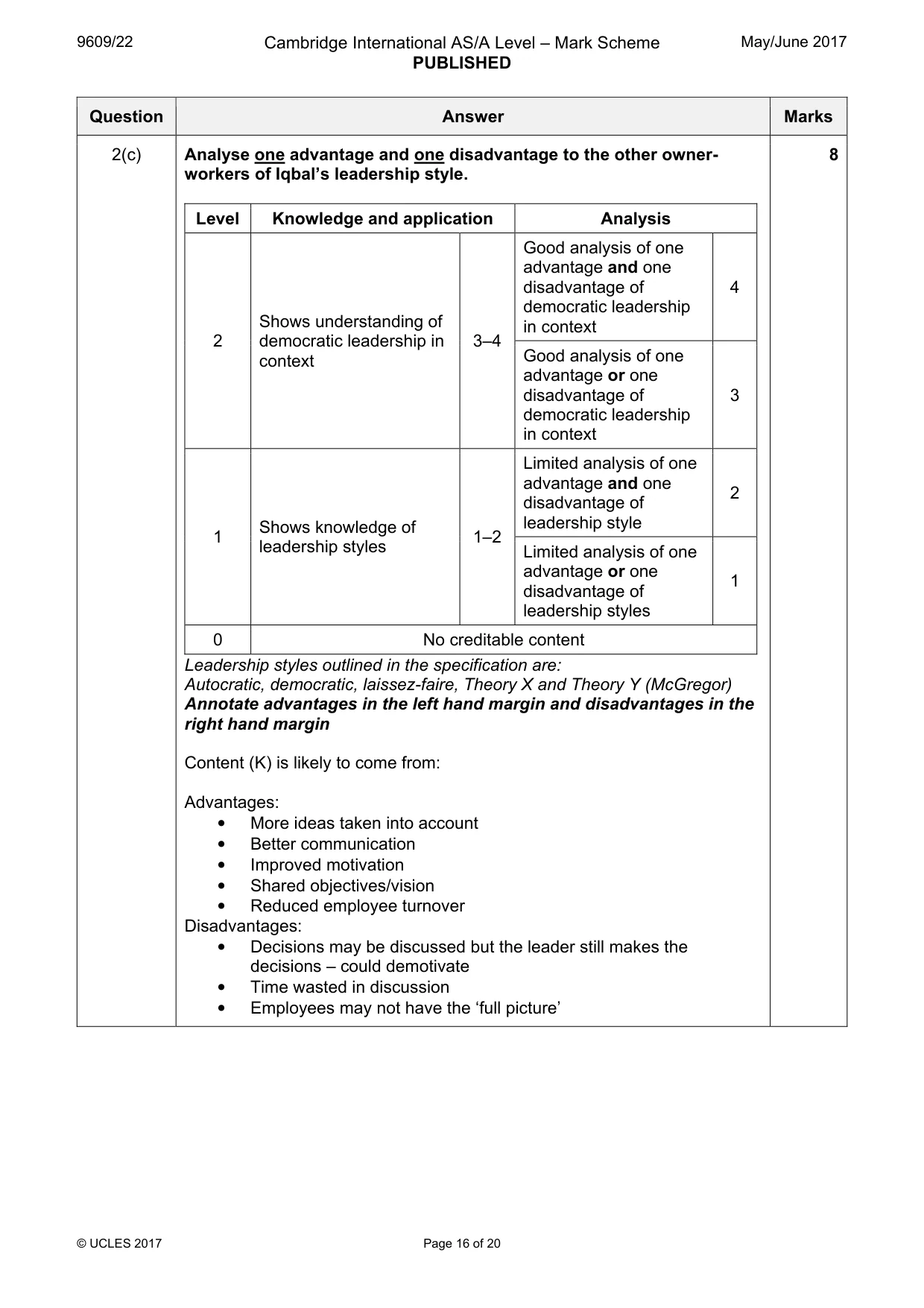
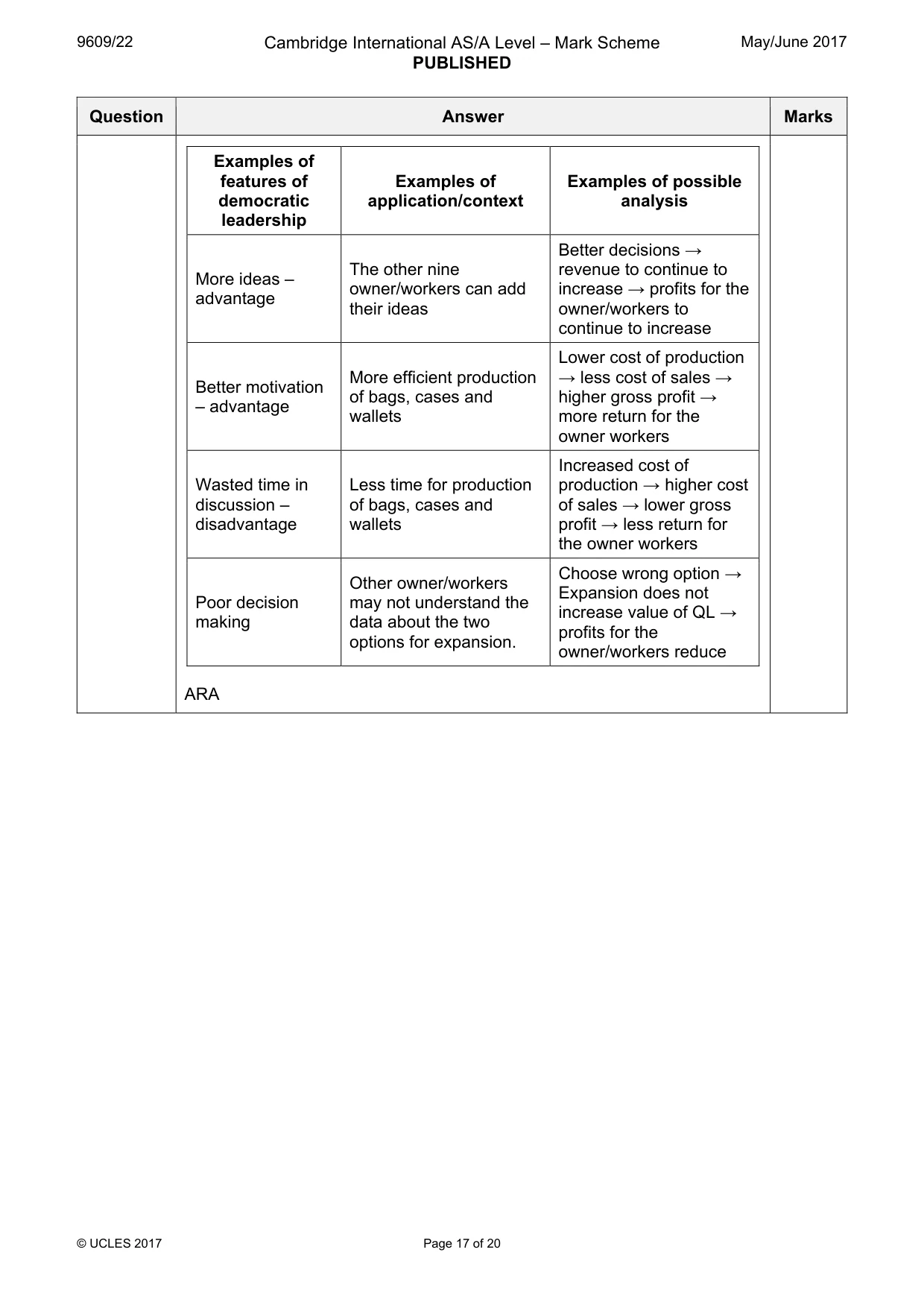
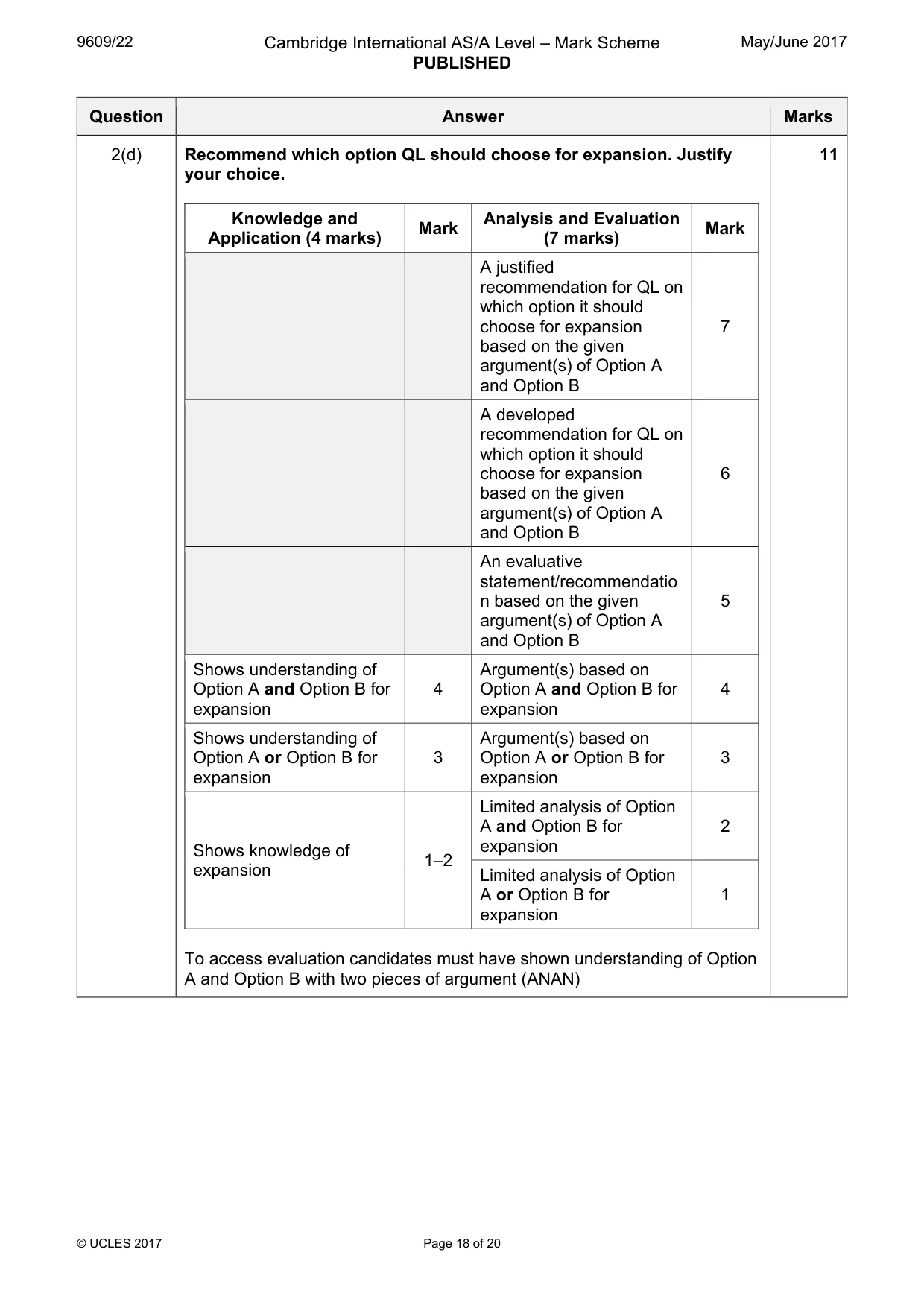
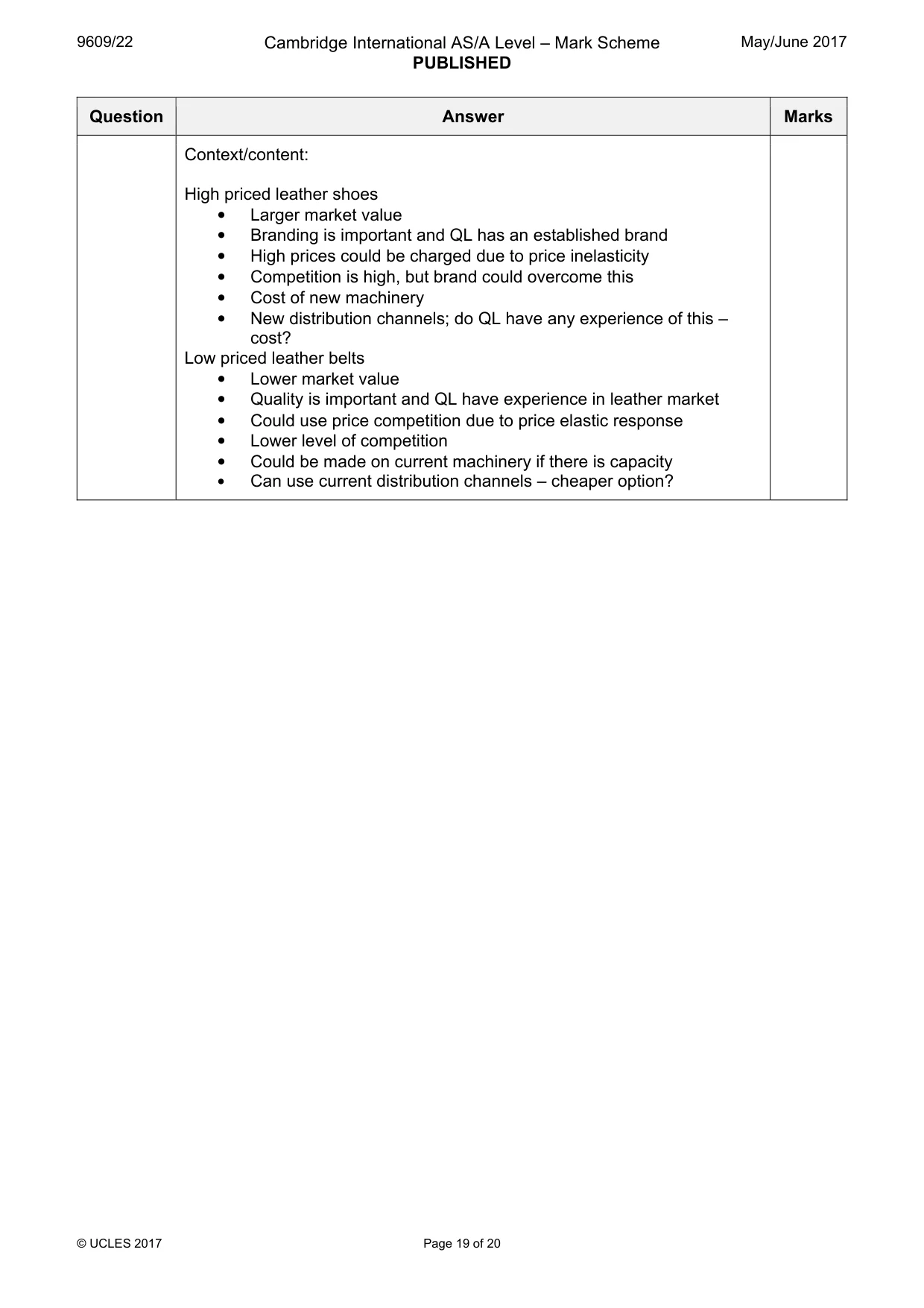
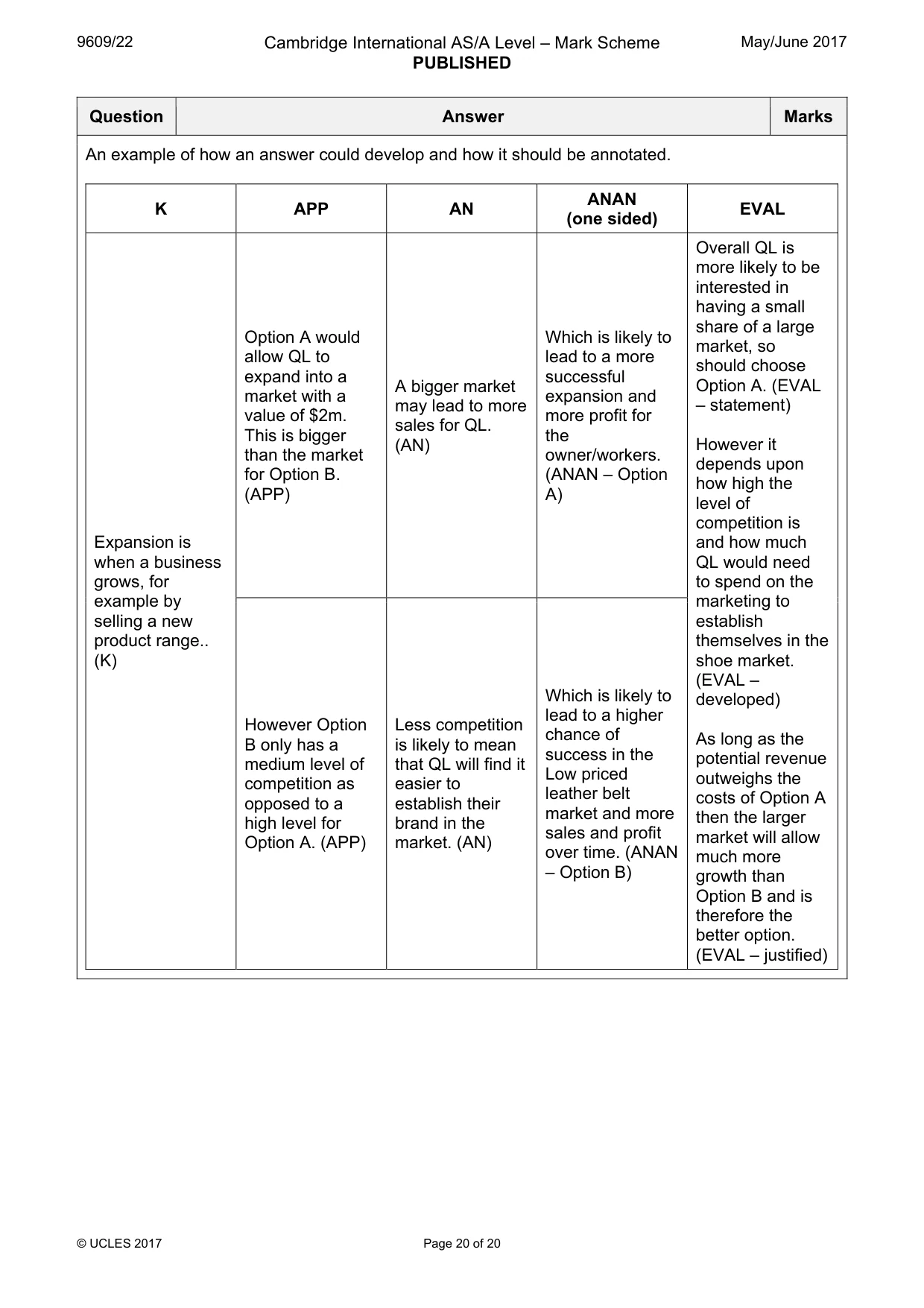
Mark scheme: 2(a)(i) Define the term ‘batch production’ (line 3). 2 Knowledge and Application Mark A correct definition 2 A partial, vague or unfocused definition 1 No creditable content 0 • Separate groups/set amount/limited number – do not accept batch • Go through production process together before moving on to the next Batch production is where quantities of identical goods are produced in small groups. They go through the production process at the same time. Production is then switched over to allow another batch to be produced. Example(s) not required. Exemplar Mark Rationale Batch production is where quantities of identical goods are produced 2 A correct definition together and then move on to the next process A group of products go from one Both elements stage of production to the next 2 covered together When products are made in small 1 Partial definition quantities Confusion with job Products made one a time 0 production Products made continuously and are Confusion with 0 all the same flow/mass production 2(a)(ii) Briefly explain the term ‘co-operative’ (line 1). 3 Award one mark for each point of explanation: Example or some other way of showing good understanding, i.e. bulk buying, common in agriculture, C 1 mark motivational, slow decision making, development of a point used in B etc. • Responsibilities are shared • Owners may contribute to the running of the business B 1 mark • Shared decision making • All members have one vote • Profits are shared A • Owned/financed by workers/customers/members 1 mark A co-operative is a business structure where the workers are the owners. The profits are shared with workers. Workers (owner) do not have to run the business, they will vote for Directors. In smaller co-operatives such as worker co-operatives then workers may also run the business. Exemplar Mark Rationale Members (A) own a co-operative and share the running (B) of the business. QL is a worker co-operative which 3 A, B and C mean the workers are the members (C). A co-operative can be owned by customers or workers (A) who will each have a vote (B). Because they 3 A, B and C own it, they are motivated for it to do well (C). A co-operative has shared profit (A) 2 A and B and responsibilities (B) Members (A) who join together to 2 A and C benefit from bulk buying (C) A co-operative is made up of people Three points but all who share the responsibilities of the 1 from B, so only one business (B). Each person has a vote mark. and the decision making is shared. 2(b)(i) Refer to Table 1. Calculate the gross profit margin for 2016. 3 Mark Rationale Correct calculation of gross profit margin (with or without 3 working or %) 2 Correct formula and correct calculation* of gross profit 1 Correct formula or correct calculation* of gross profit 0 No creditable content Formula can be implied through the correct use of figures *working required or explicit identification Gross profit × 100 Revenue = 240 – 80 = 160 160 = × 100 = 66.67% (accept 66.7% and 67%) 240 • Allow an answer of 66% or 66.6% or 66.66% as a TWO mark answer with or without working as the candidate has made one mistake in not rounding correctly. • Also allow an answer of 0.67 as a TWO mark answer with or without working as the candidate has made one mistake by not calculating a percentage Allow full marks for a correct answer with or without working or % 67% or 66.7% or 66.67% Common incorrect answers Answer Mark Rationale GP=160 1 Explicit identification of gross profit We have to assume this is an answer to the question and with no working, $160 0 this is incorrect and therefore no marks Correct formula (implied) and correct (explicit) calculation of gross profit but 66% 2 the calculation of the GP margin is incorrect (with or without working) 0.67 2 Allow with or without working 240 – 80 – 20 = 140 Formula mixed up with net profit margin, so wrong formula, but correct 2 140 calculations based on this wrong × 100 = 58.33% formula 240 58.33% 0 A wrong answer with no working 90 Formula is correct (implied) but 2014 × 100 = 60% 2 figures have been used correctly OFR 150 115 Formula is correct (implied) but 2015 × 100 = 63.89% 2 figures have been used correctly OFR 180 2(b)(ii) Explain the importance of profitability to QL. 3 Level Knowledge and Application Mark Explanation an importance of profitability in 2 (APP) 3 context 1b (KK) Explain an importance of profitability 2 1a (K) Identify an importance of profitability 1 0 No creditable content 0 Profitability is the margin between cost per unit and selling price (or the margin between total revenue and total cost). This is in contrast to profit which is the amount (i.e. not margin) made. Candidates do not need to show their knowledge of either profit or profitability. They need to explain an IMPORTANCE of profitability. Context and content is likely to come from: • Profits pay owner/workers income, so profitability is essential • As QL expands into Option A or Option B it will need to maintain profitability Importance (K) Possible context (APP) In QL the gross profitability is improving (60% in 2014, 63.89% in 2015 and The achieve the objectives of 66.67% in 2016 OFR) the business Net profit has also been improving (50% in 2014, 55.56% in 2015 and 58.33% in 2016) QL has made a profit in each of the last To avoid business failure three years To fund business QL needs the profits/profitability to fund growth/expansion the expansion into Option A or Option B Owners are the ten owner-workers who To reward owners make up the co-operative – without pay they are likely to sell the business The owner/workers will derive their To make a profit income form QL To assess business QL could benchmark themselves against performance similar bag producing business 2(c) Analyse one advantage and one disadvantage to the other owner- 8 workers of Iqbal’s leadership style. Level Knowledge and application Analysis Good analysis of one advantage and one disadvantage of 4 democratic leadership Shows understanding of in context 2 democratic leadership in 3–4 Good analysis of one context advantage or one disadvantage of 3 democratic leadership in context Limited analysis of one advantage and one 2 disadvantage of leadership style Shows knowledge of 1 1–2 leadership styles Limited analysis of one advantage or one 1 disadvantage of leadership styles 0 No creditable content Leadership styles outlined in the specification are: Autocratic, democratic, laissez-faire, Theory X and Theory Y (McGregor) Annotate advantages in the left hand margin and disadvantages in the right hand margin Content (K) is likely to come from: Advantages: • More ideas taken into account • Better communication • Improved motivation • Shared objectives/vision • Reduced employee turnover Disadvantages: • Decisions may be discussed but the leader still makes the decisions – could demotivate • Time wasted in discussion • Employees may not have the ‘full picture’ Examples of features of Examples of Examples of possible democratic application/context analysis leadership Better decisions → The other nine revenue to continue to More ideas – owner/workers can add increase → profits for the advantage their ideas owner/workers to continue to increase Lower cost of production More efficient production → less cost of sales → Better motivation of bags, cases and higher gross profit → – advantage wallets more return for the owner workers Increased cost of Wasted time in Less time for production production → higher cost discussion – of bags, cases and of sales → lower gross disadvantage wallets profit → less return for the owner workers Choose wrong option → Other owner/workers Expansion does not Poor decision may not understand the increase value of QL → making data about the two profits for the options for expansion. owner/workers reduce ARA 2(d) Recommend which option QL should choose for expansion. Justify 11 your choice. Knowledge and Analysis and Evaluation Mark Mark Application (4 marks) (7 marks) A justified recommendation for QL on which option it should choose for expansion 7 based on the given argument(s) of Option A and Option B A developed recommendation for QL on which option it should choose for expansion 6 based on the given argument(s) of Option A and Option B An evaluative statement/recommendatio n based on the given 5 argument(s) of Option A and Option B Shows understanding of Argument(s) based on Option A and Option B for 4 Option A and Option B for 4 expansion expansion Shows understanding of Argument(s) based on Option A or Option B for 3 Option A or Option B for 3 expansion expansion Limited analysis of Option A and Option B for 2 expansion Shows knowledge of 1–2 expansion Limited analysis of Option A or Option B for 1 expansion To access evaluation candidates must have shown understanding of Option A and Option B with two pieces of argument (ANAN) Context/content: High priced leather shoes • Larger market value • Branding is important and QL has an established brand • High prices could be charged due to price inelasticity • Competition is high, but brand could overcome this • Cost of new machinery • New distribution channels; do QL have any experience of this – cost? Low priced leather belts • Lower market value • Quality is important and QL have experience in leather market • Could use price competition due to price elastic response • Lower level of competition • Could be made on current machinery if there is capacity • Can use current distribution channels – cheaper option? An example of how an answer could develop and how it should be annotated. ANAN K APP AN EVAL (one sided) Overall QL is more likely to be interested in having a small share of a large Option A would Which is likely to market, so allow QL to lead to a more should choose expand into a successful A bigger market Option A. (EVAL market with a expansion and may lead to more – statement) value of $2m. more profit for sales for QL. This is bigger the (AN) However it than the market owner/workers. depends upon for Option B. (ANAN – Option how high the (APP) A) level of competition is Expansion is and how much when a business QL would need grows, for to spend on the example by marketing to selling a new establish product range.. themselves in the (K) shoe market. (EVAL – Which is likely to developed) lead to a higher However Option Less competition chance of As long as the B only has a is likely to mean success in the potential revenue medium level of that QL will find it Low priced outweighs the competition as easier to leather belt costs of Option A opposed to a establish their market and more then the larger high level for brand in the sales and profit market will allow Option A. (APP) market. (AN) over time. (ANAN much more – Option B) growth than Option B and is therefore the better option. (EVAL – justified)
What was in this paper
The subtopics covered by these 2 questions, and how many questions each got. Open one in a new tab to see every Cambridge question on it.