Cambridge A Level Business (for first examination in 2016) 9609 — 2017 May/June Paper 2 · Variant 3
9609/23/M/J/17 · 2 questions · 60 marks · ≈68 min
The question paper and its mark scheme, free to read here and free to download. This is Cambridge’s own paper, exactly as it was sat.
Question paper4 pages
Mark scheme14 pages
Answers below. Sit the paper first if you are practising.
Questions as text
Q1 · Designer Clothing (DC) DC is a medium sized private limited company
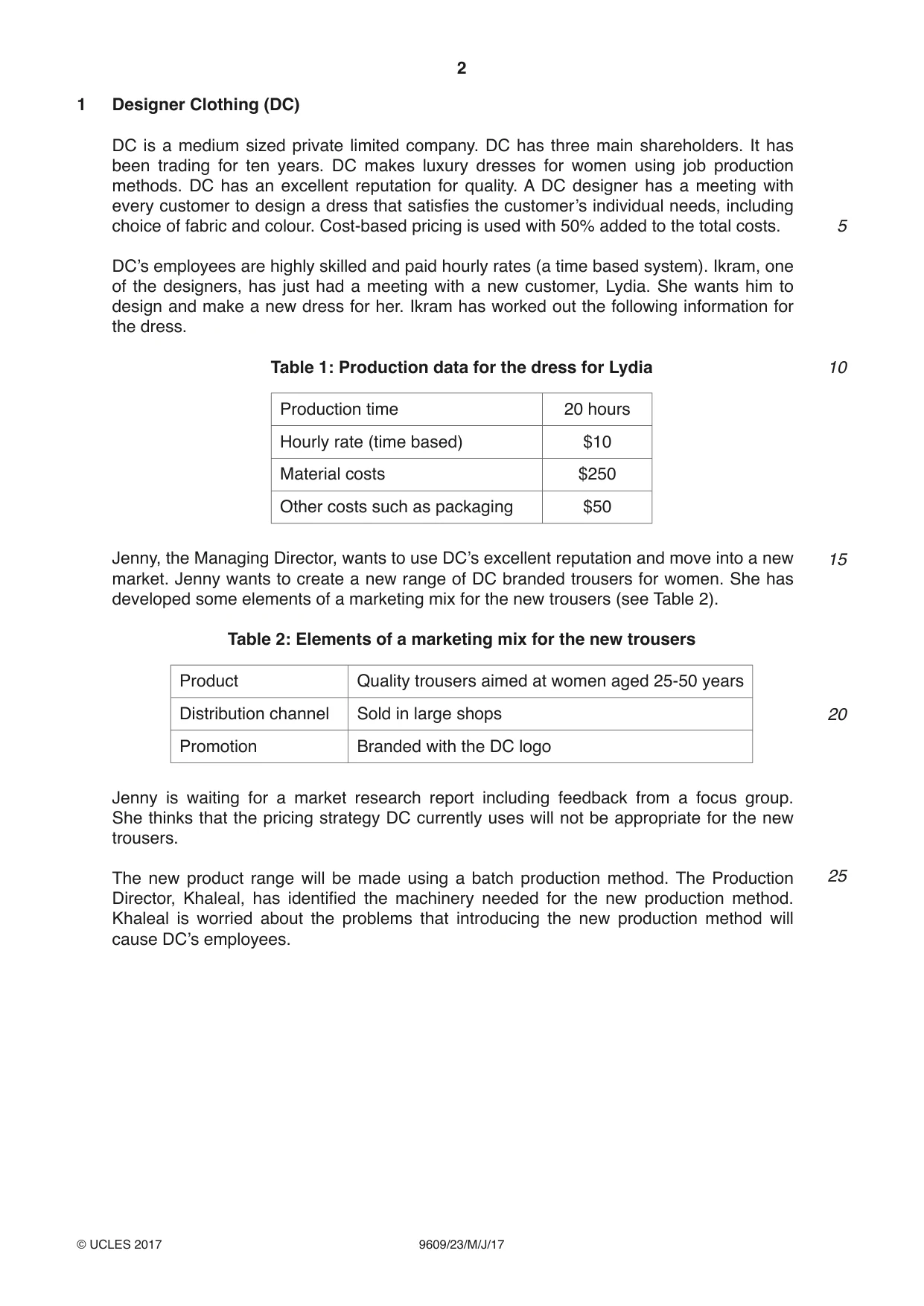
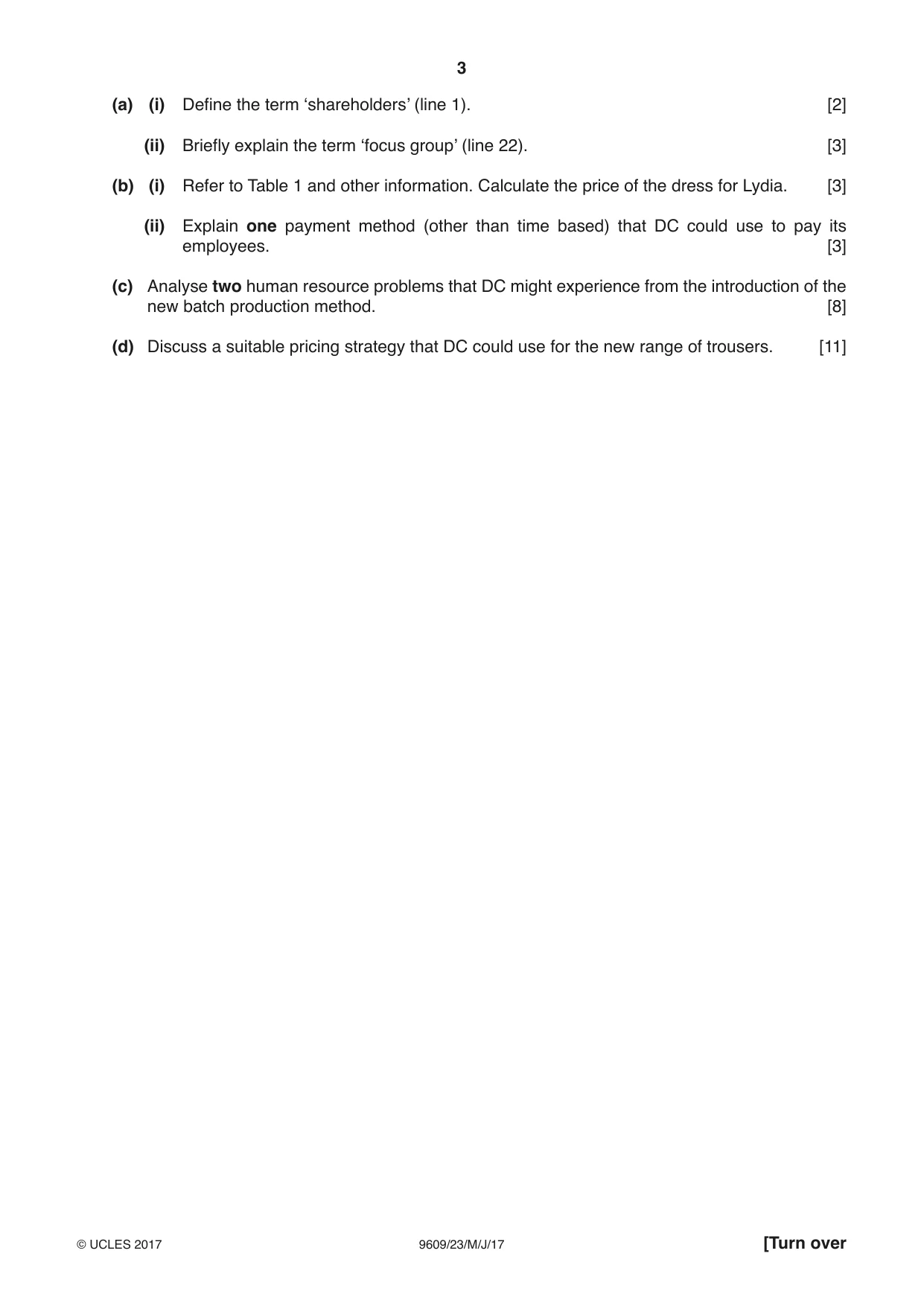
1 Designer Clothing (DC) DC is a medium sized private limited company. DC has three main shareholders. It has been trading for ten years. DC makes luxury dresses for women using job production methods. DC has an excellent reputation for quality. A DC designer has a meeting with every customer to design a dress that satisfies the customer’s individual needs, including choice of fabric and colour. Cost-based pricing is used with 50% added to the total costs. 5 DC’s employees are highly skilled and paid hourly rates (a time based system). Ikram, one of the designers, has just had a meeting with a new customer, Lydia. She wants him to design and make a new dress for her. Ikram has worked out the following information for the dress. Table 1: Production data for the dress for Lydia 10 Production time 20 hours Hourly rate (time based) $10 Material costs $250 Other costs such as packaging $50 Jenny, the Managing Director, wants to use DC’s excellent reputation and move into a new 15 market. Jenny wants to create a new range of DC branded trousers for women. She has developed some elements of a marketing mix for the new trousers (see Table 2). Table 2: Elements of a marketing mix for the new trousers Product Quality trousers aimed at women aged 25-50 years Distribution channel Sold in large shops 20 Promotion Branded with the DC logo Jenny is waiting for a market research report including feedback from a focus group. She thinks that the pricing strategy DC currently uses will not be appropriate for the new trousers. The new product range will be made using a batch production method. The Production 25 Director, Khaleal, has identified the machinery needed for the new production method. Khaleal is worried about the problems that introducing the new production method will cause DC’s employees. (a) (i) Define the term ‘shareholders’ (line 1). [2] (ii) Briefly explain the term ‘focus group’ (line 22). [3] (b) (i) Refer to Table 1 and other information. Calculate the price of the dress for Lydia. [3] (ii) Explain one payment method (other than time based) that DC could use to pay its employees. [3] (c) Analyse two human resource problems that DC might experience from the introduction of the new batch production method. [8] (d) Discuss a suitable pricing strategy that DC could use for the new range of trousers. [11]
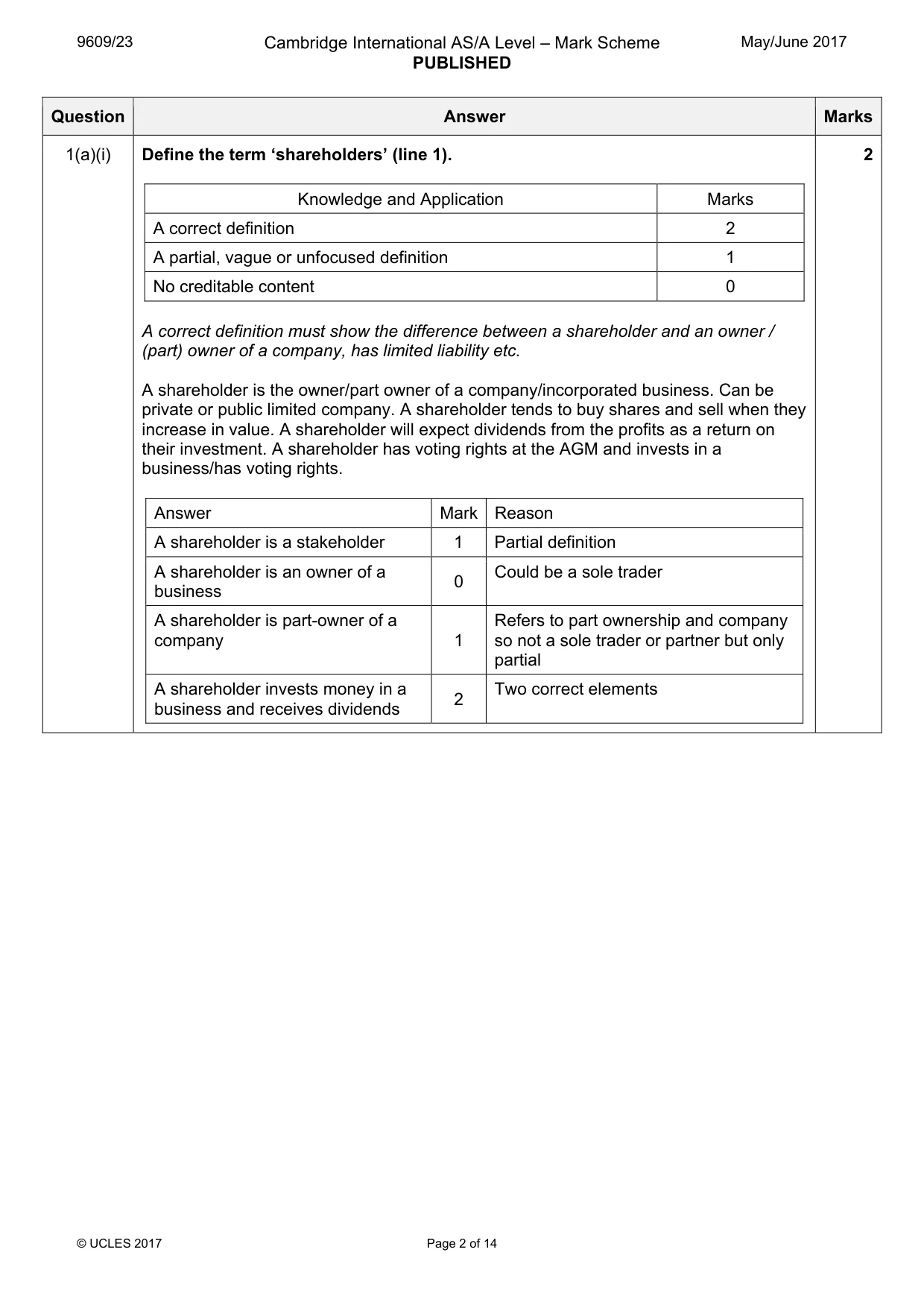
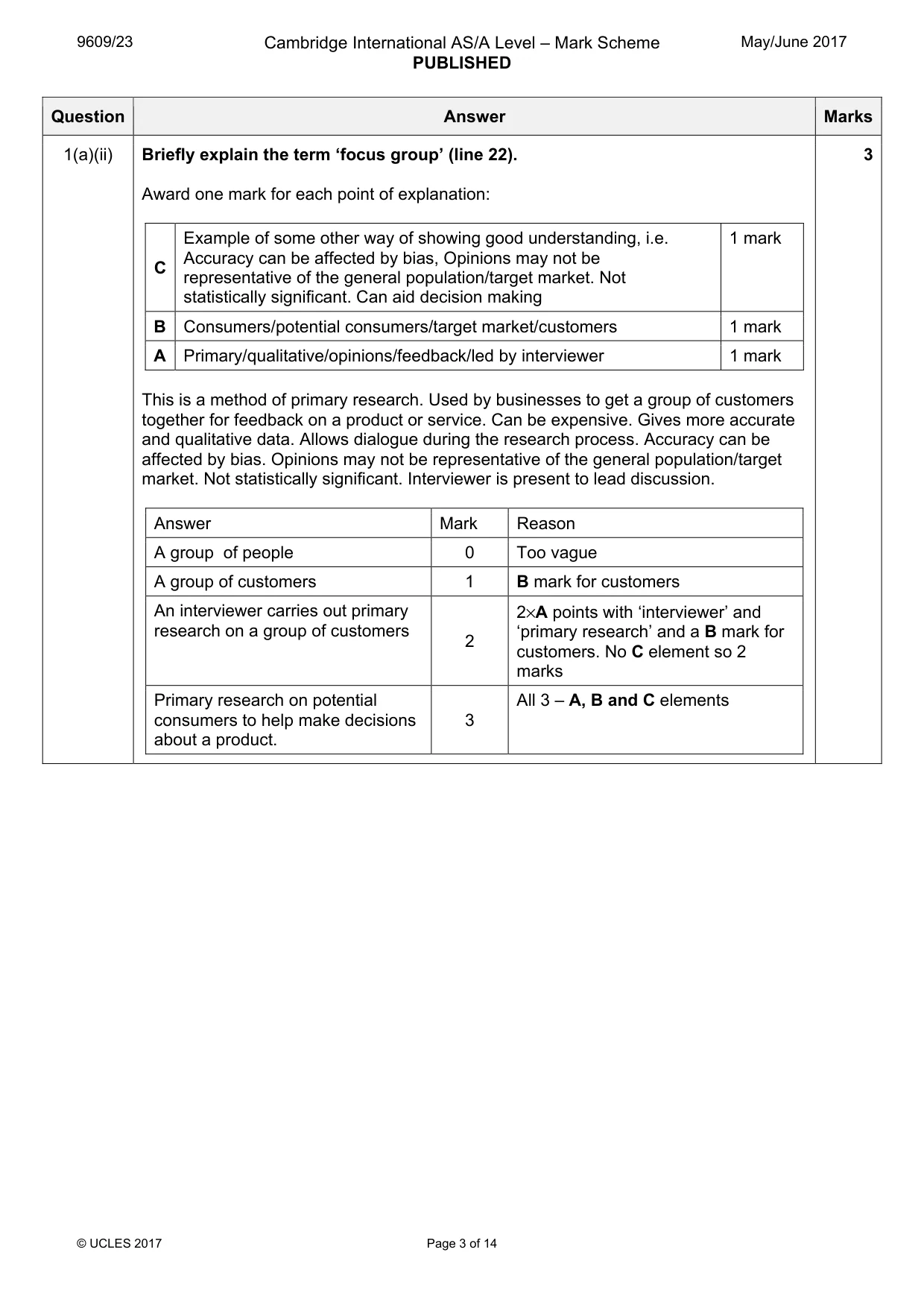
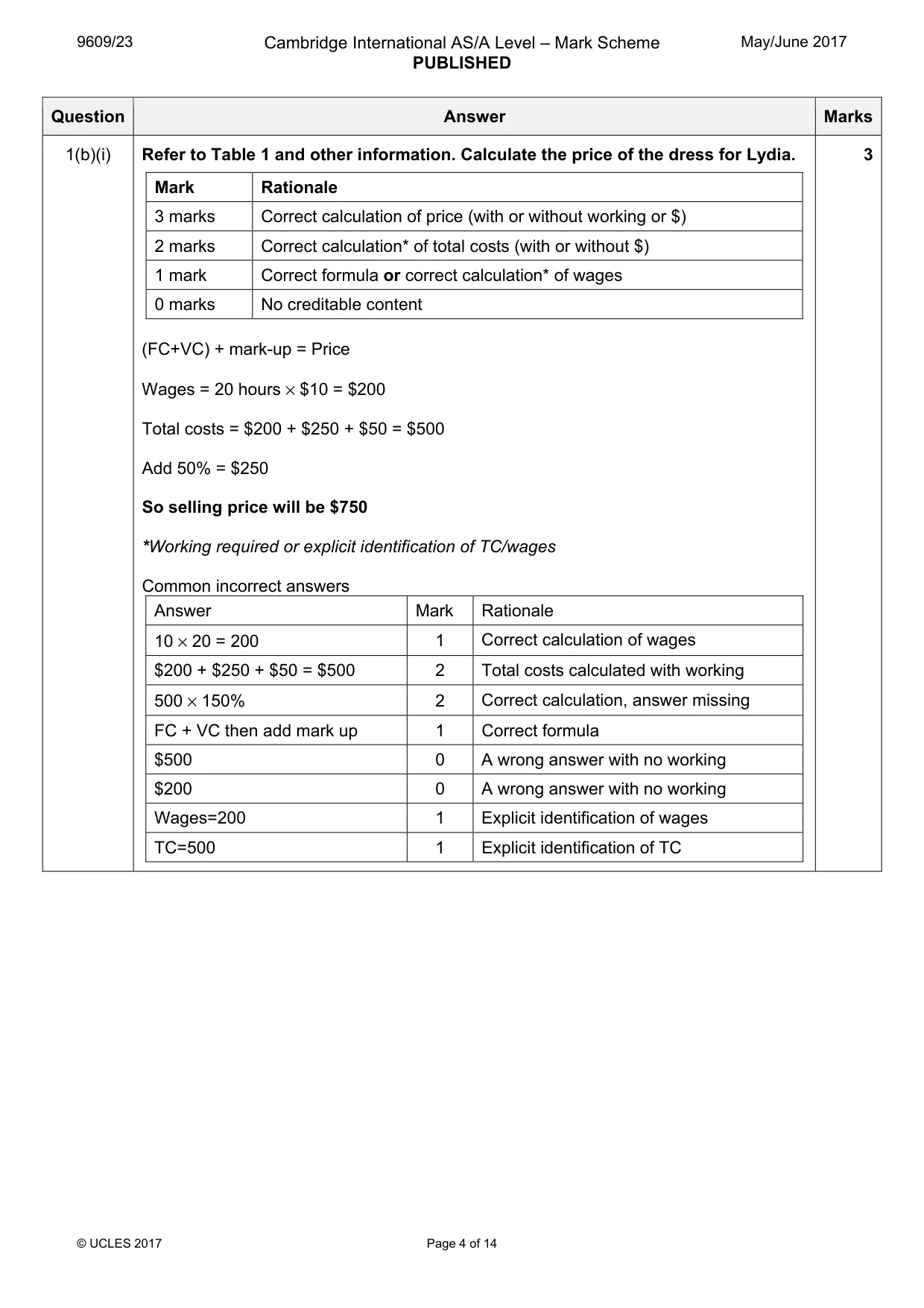
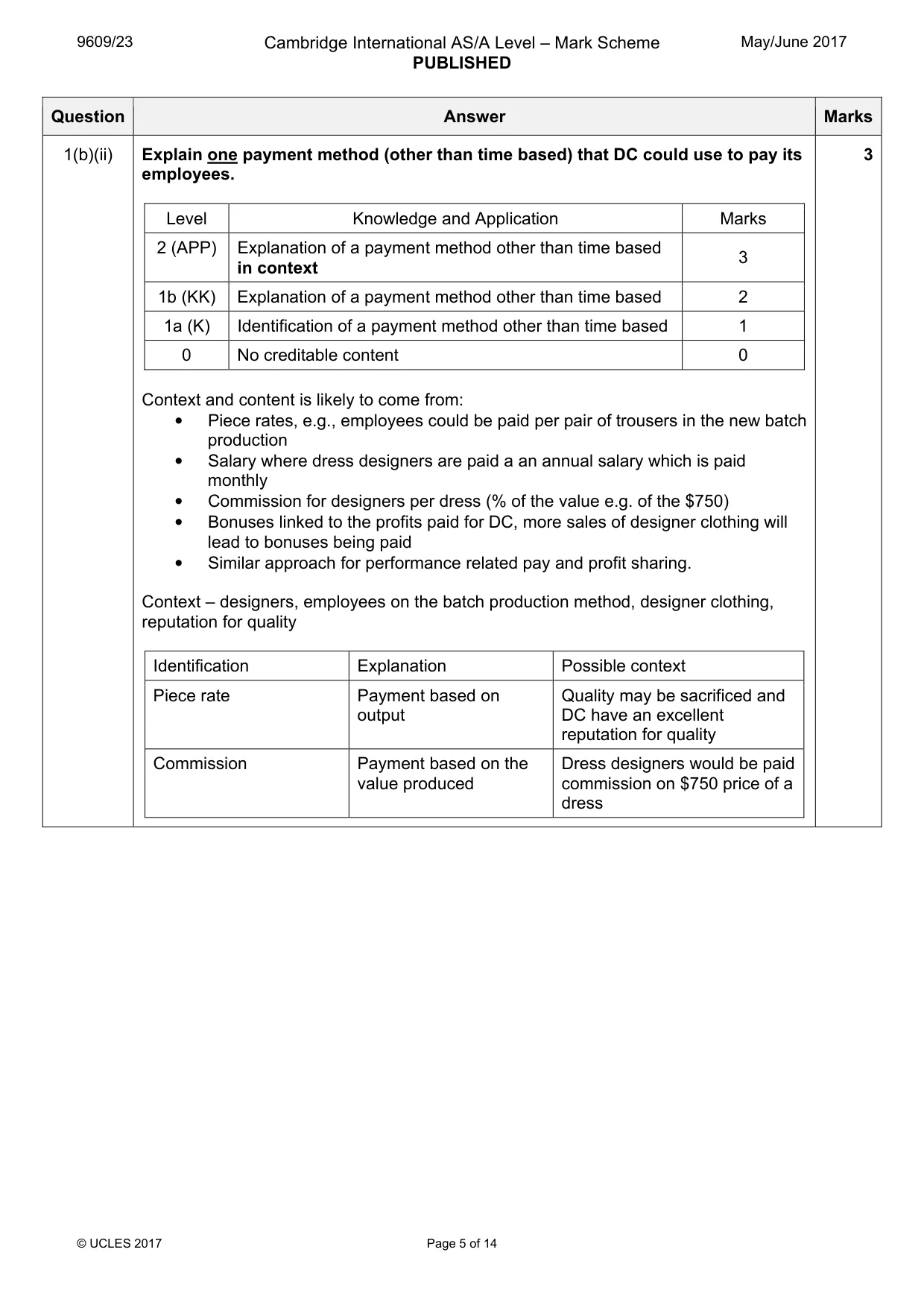
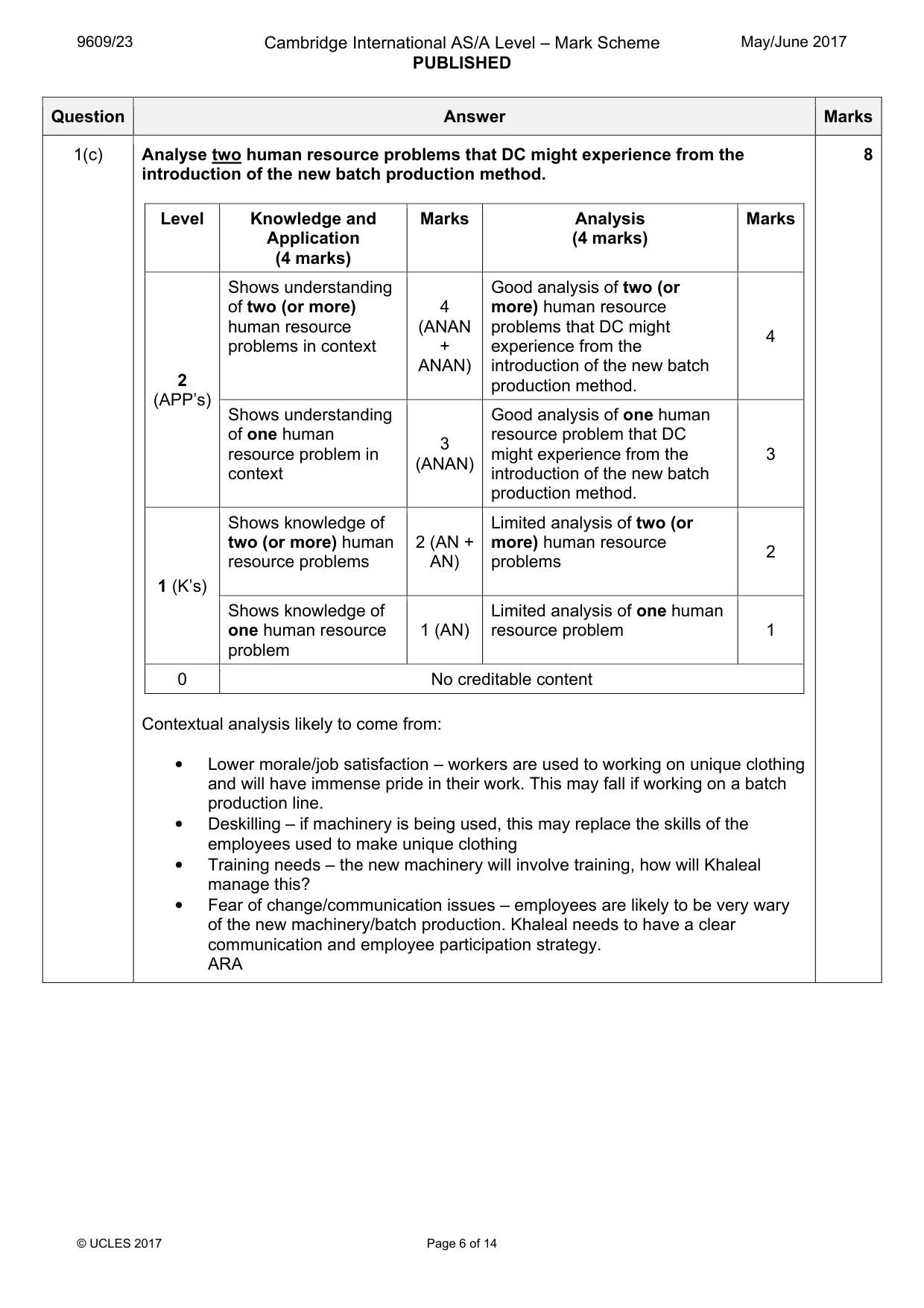
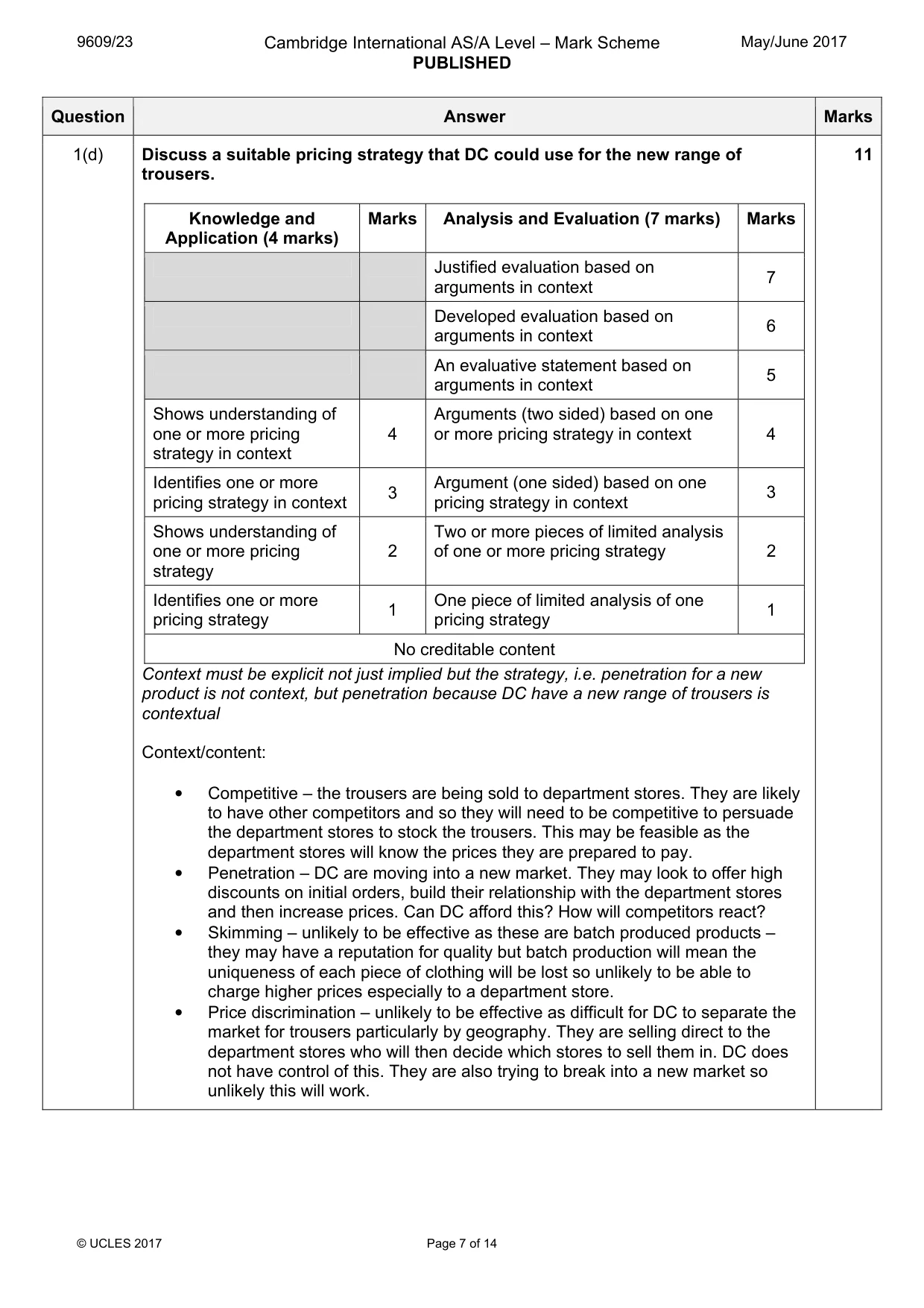
Mark scheme: Question Answer Marks 1(a)(i) Define the term ‘shareholders’ (line 1). 2 Knowledge and Application Marks A correct definition 2 A partial, vague or unfocused definition 1 No creditable content 0 A correct definition must show the difference between a shareholder and an owner / (part) owner of a company, has limited liability etc. A shareholder is the owner/part owner of a company/incorporated business. Can be private or public limited company. A shareholder tends to buy shares and sell when they increase in value. A shareholder will expect dividends from the profits as a return on their investment. A shareholder has voting rights at the AGM and invests in a business/has voting rights. Answer Mark Reason A shareholder is a stakeholder 1 Partial definition A shareholder is an owner of a Could be a sole trader 0 business A shareholder is part-owner of a Refers to part ownership and company company 1 so not a sole trader or partner but only partial A shareholder invests money in a Two correct elements 2 business and receives dividends 1(a)(ii) Briefly explain the term ‘focus group’ (line 22). 3 Award one mark for each point of explanation: Example of some other way of showing good understanding, i.e. 1 mark Accuracy can be affected by bias, Opinions may not be C representative of the general population/target market. Not statistically significant. Can aid decision making B Consumers/potential consumers/target market/customers 1 mark A Primary/qualitative/opinions/feedback/led by interviewer 1 mark This is a method of primary research. Used by businesses to get a group of customers together for feedback on a product or service. Can be expensive. Gives more accurate and qualitative data. Allows dialogue during the research process. Accuracy can be affected by bias. Opinions may not be representative of the general population/target market. Not statistically significant. Interviewer is present to lead discussion. Answer Mark Reason A group of people 0 Too vague A group of customers 1 B mark for customers An interviewer carries out primary 2×A points with ‘interviewer’ and research on a group of customers ‘primary research’ and a B mark for 2 customers. No C element so 2 marks Primary research on potential All 3 – A, B and C elements consumers to help make decisions 3 about a product. 1(b)(i) Refer to Table 1 and other information. Calculate the price of the dress for Lydia. 3 Mark Rationale 3 marks Correct calculation of price (with or without working or $) 2 marks Correct calculation* of total costs (with or without $) 1 mark Correct formula or correct calculation* of wages 0 marks No creditable content (FC+VC) + mark-up = Price Wages = 20 hours × $10 = $200 Total costs = $200 + $250 + $50 = $500 Add 50% = $250 So selling price will be $750 *Working required or explicit identification of TC/wages Common incorrect answers Answer Mark Rationale 10 × 20 = 200 1 Correct calculation of wages $200 + $250 + $50 = $500 2 Total costs calculated with working 500 × 150% 2 Correct calculation, answer missing FC + VC then add mark up 1 Correct formula $500 0 A wrong answer with no working $200 0 A wrong answer with no working Wages=200 1 Explicit identification of wages TC=500 1 Explicit identification of TC 1(b)(ii) Explain one payment method (other than time based) that DC could use to pay its 3 employees. Level Knowledge and Application Marks 2 (APP) Explanation of a payment method other than time based 3 in context 1b (KK) Explanation of a payment method other than time based 2 1a (K) Identification of a payment method other than time based 1 0 No creditable content 0 Context and content is likely to come from: • Piece rates, e.g., employees could be paid per pair of trousers in the new batch production • Salary where dress designers are paid a an annual salary which is paid monthly • Commission for designers per dress (% of the value e.g. of the $750) • Bonuses linked to the profits paid for DC, more sales of designer clothing will lead to bonuses being paid • Similar approach for performance related pay and profit sharing. Context – designers, employees on the batch production method, designer clothing, reputation for quality Identification Explanation Possible context Piece rate Payment based on Quality may be sacrificed and output DC have an excellent reputation for quality Commission Payment based on the Dress designers would be paid value produced commission on $750 price of a dress 1(c) Analyse two human resource problems that DC might experience from the 8 introduction of the new batch production method. Level Knowledge and Marks Analysis Marks Application (4 marks) (4 marks) Shows understanding Good analysis of two (or of two (or more) 4 more) human resource human resource (ANAN problems that DC might 4 problems in context + experience from the ANAN) introduction of the new batch 2 production method. (APP’s) Shows understanding Good analysis of one human of one human resource problem that DC 3 resource problem in might experience from the 3 (ANAN) context introduction of the new batch production method. Shows knowledge of Limited analysis of two (or two (or more) human 2 (AN + more) human resource 2 resource problems AN) problems 1 (K’s) Shows knowledge of Limited analysis of one human one human resource 1 (AN) resource problem 1 problem 0 No creditable content Contextual analysis likely to come from: • Lower morale/job satisfaction – workers are used to working on unique clothing and will have immense pride in their work. This may fall if working on a batch production line. • Deskilling – if machinery is being used, this may replace the skills of the employees used to make unique clothing • Training needs – the new machinery will involve training, how will Khaleal manage this? • Fear of change/communication issues – employees are likely to be very wary of the new machinery/batch production. Khaleal needs to have a clear communication and employee participation strategy. ARA 1(d) Discuss a suitable pricing strategy that DC could use for the new range of 11 trousers. Knowledge and Marks Analysis and Evaluation (7 marks) Marks Application (4 marks) Justified evaluation based on 7 arguments in context Developed evaluation based on 6 arguments in context An evaluative statement based on 5 arguments in context Shows understanding of Arguments (two sided) based on one one or more pricing 4 or more pricing strategy in context 4 strategy in context Identifies one or more Argument (one sided) based on one 3 3 pricing strategy in context pricing strategy in context Shows understanding of Two or more pieces of limited analysis one or more pricing 2 of one or more pricing strategy 2 strategy Identifies one or more One piece of limited analysis of one 1 1 pricing strategy pricing strategy No creditable content Context must be explicit not just implied but the strategy, i.e. penetration for a new product is not context, but penetration because DC have a new range of trousers is contextual Context/content: • Competitive – the trousers are being sold to department stores. They are likely to have other competitors and so they will need to be competitive to persuade the department stores to stock the trousers. This may be feasible as the department stores will know the prices they are prepared to pay. • Penetration – DC are moving into a new market. They may look to offer high discounts on initial orders, build their relationship with the department stores and then increase prices. Can DC afford this? How will competitors react? • Skimming – unlikely to be effective as these are batch produced products – they may have a reputation for quality but batch production will mean the uniqueness of each piece of clothing will be lost so unlikely to be able to charge higher prices especially to a department store. • Price discrimination – unlikely to be effective as difficult for DC to separate the market for trousers particularly by geography. They are selling direct to the department stores who will then decide which stores to sell them in. DC does not have control of this. They are also trying to break into a new market so unlikely this will work.
Q2 · Budding Gardens (BG) BG is a partnership owned and managed by Barry and Michael
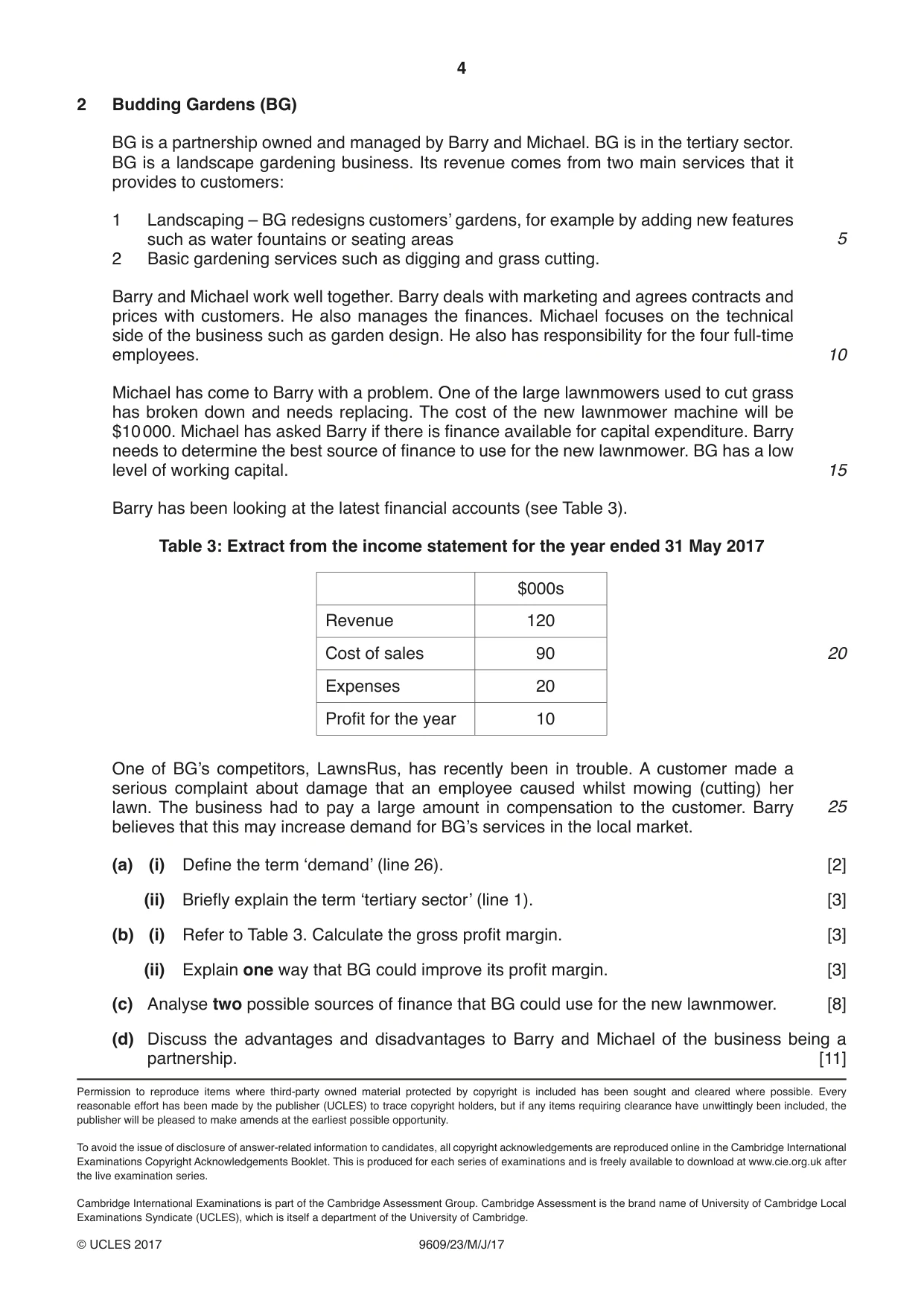
2 Budding Gardens (BG) BG is a partnership owned and managed by Barry and Michael. BG is in the tertiary sector. BG is a landscape gardening business. Its revenue comes from two main services that it provides to customers: 1 Landscaping – BG redesigns customers’ gardens, for example by adding new features such as water fountains or seating areas 5 2 Basic gardening services such as digging and grass cutting. Barry and Michael work well together. Barry deals with marketing and agrees contracts and prices with customers. He also manages the finances. Michael focuses on the technical side of the business such as garden design. He also has responsibility for the four full-time employees. 10 Michael has come to Barry with a problem. One of the large lawnmowers used to cut grass has broken down and needs replacing. The cost of the new lawnmower machine will be $10 000. Michael has asked Barry if there is finance available for capital expenditure. Barry needs to determine the best source of finance to use for the new lawnmower. BG has a low level of working capital. 15 Barry has been looking at the latest financial accounts (see Table 3). Table 3: Extract from the income statement for the year ended 31 May 2017 $000s Revenue 120 Cost of sales 90 20 Expenses 20 Profit for the year 10 One of BG’s competitors, LawnsRus, has recently been in trouble. A customer made a serious complaint about damage that an employee caused whilst mowing (cutting) her lawn. The business had to pay a large amount in compensation to the customer. Barry 25 believes that this may increase demand for BG’s services in the local market. (a) (i) Define the term ‘demand’ (line 26). [2] (ii) Briefly explain the term ‘tertiary sector’ (line 1). [3] (b) (i) Refer to Table 3. Calculate the gross profit margin. [3] (ii) Explain one way that BG could improve its profit margin. [3] (c) Analyse two possible sources of finance that BG could use for the new lawnmower. [8] (d) Discuss the advantages and disadvantages to Barry and Michael of the business being a partnership. [11]
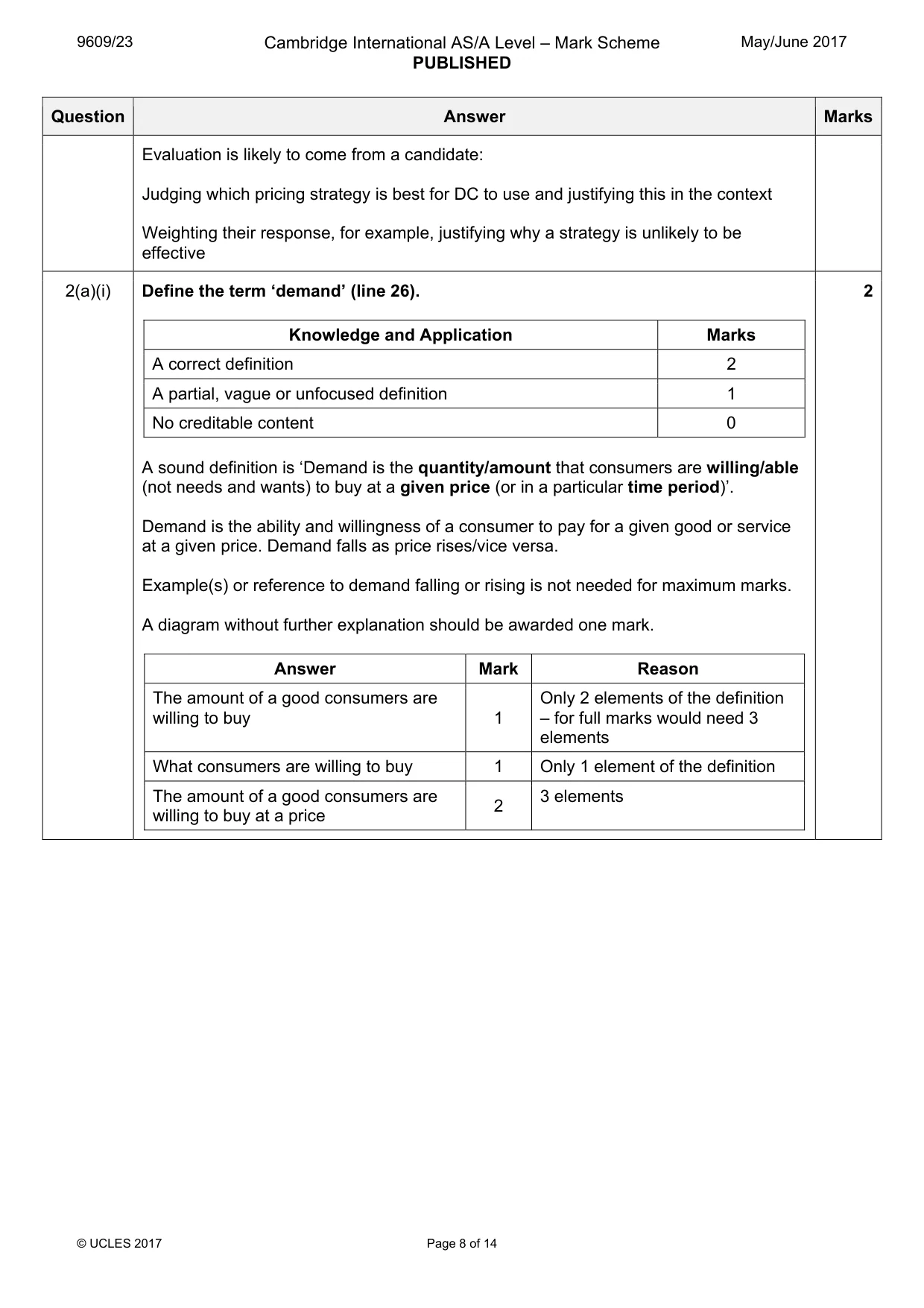
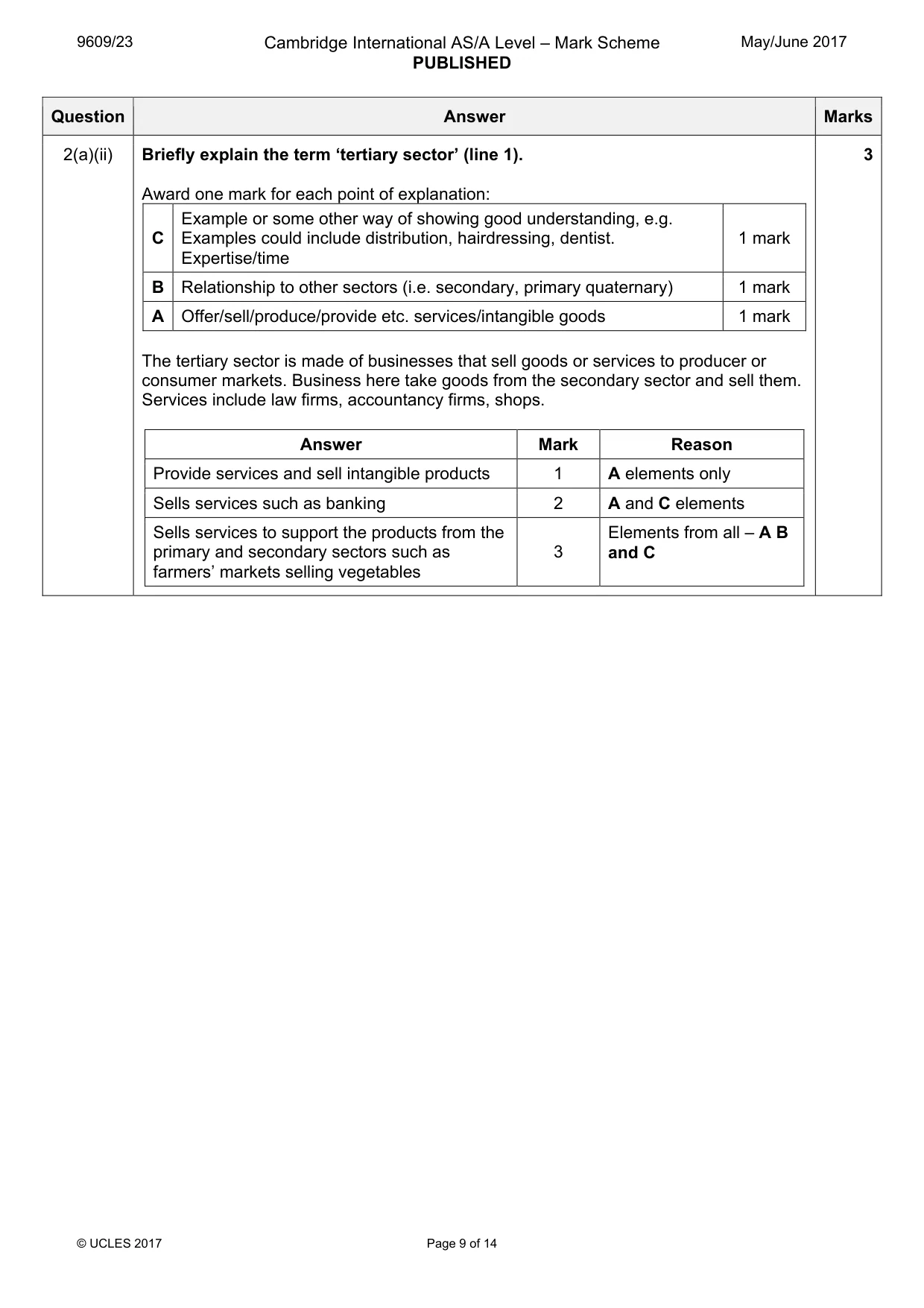
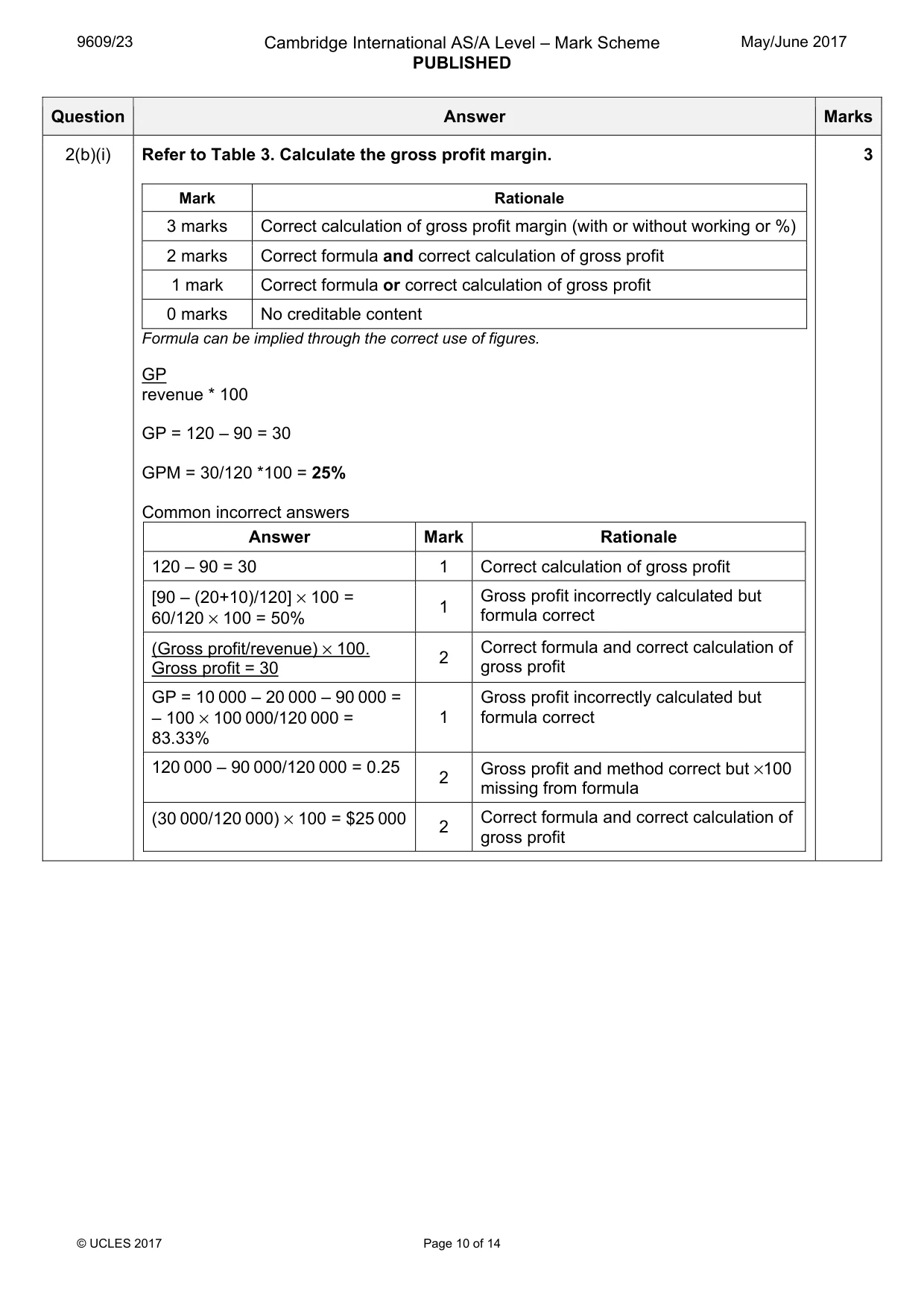
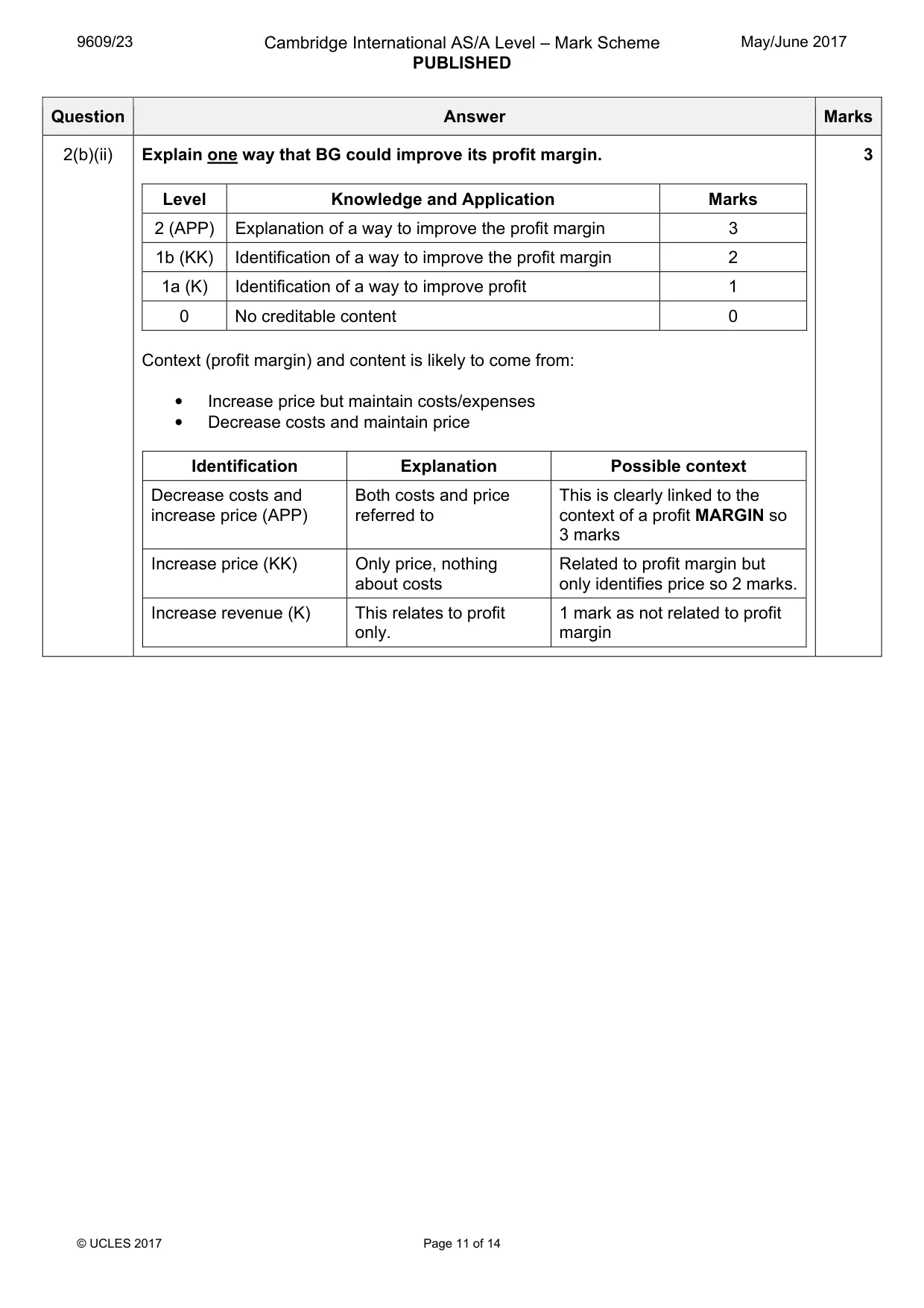
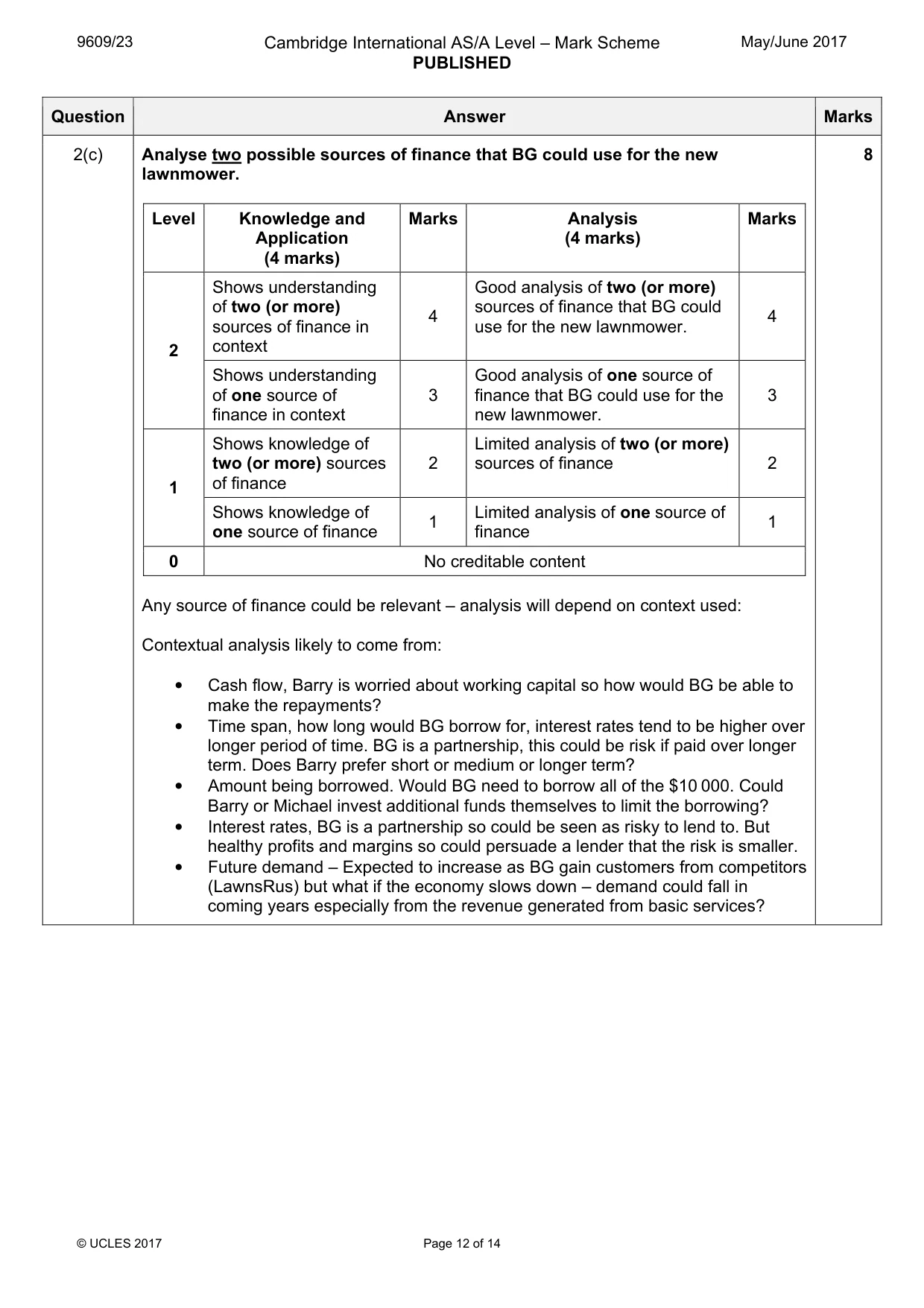
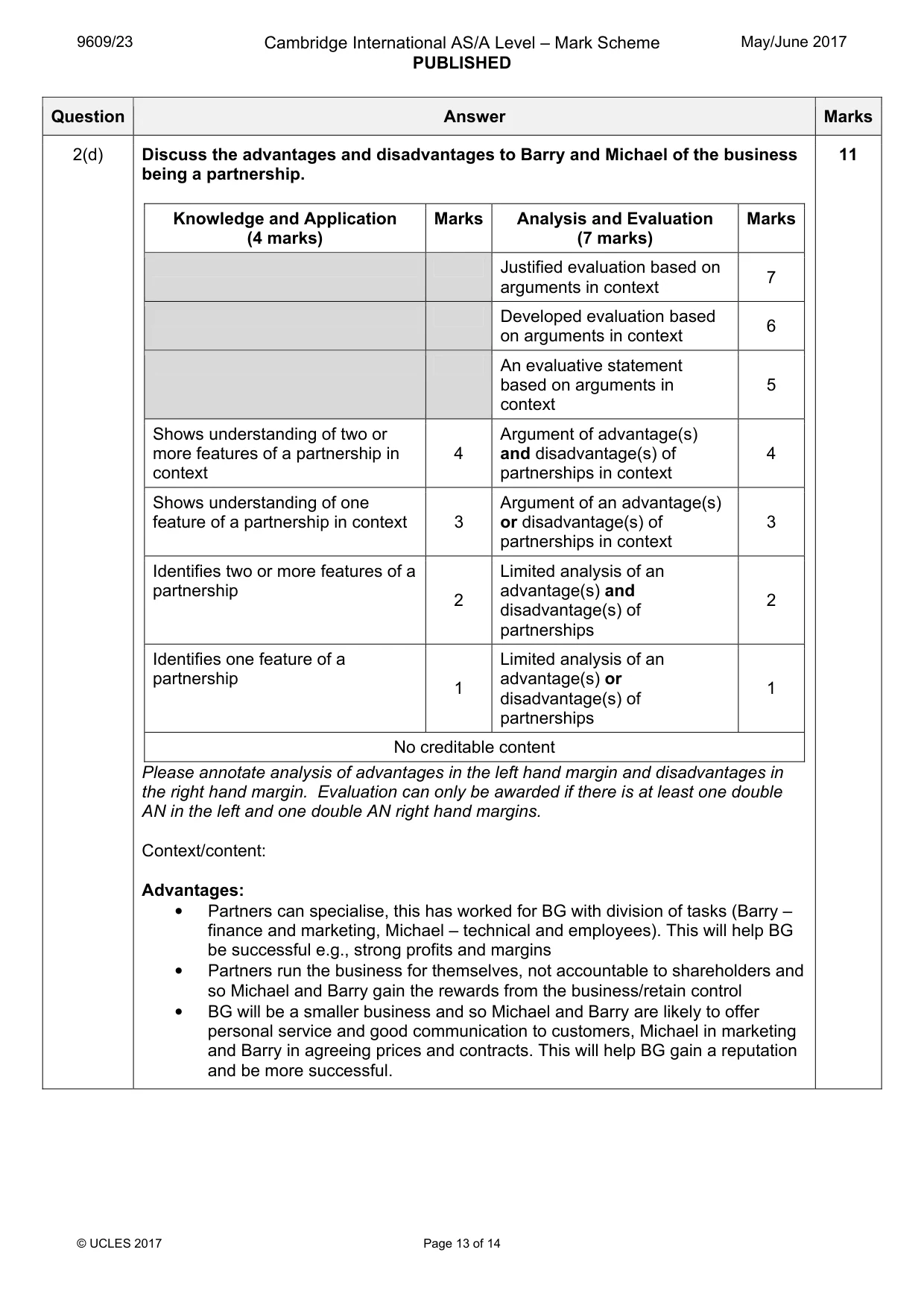
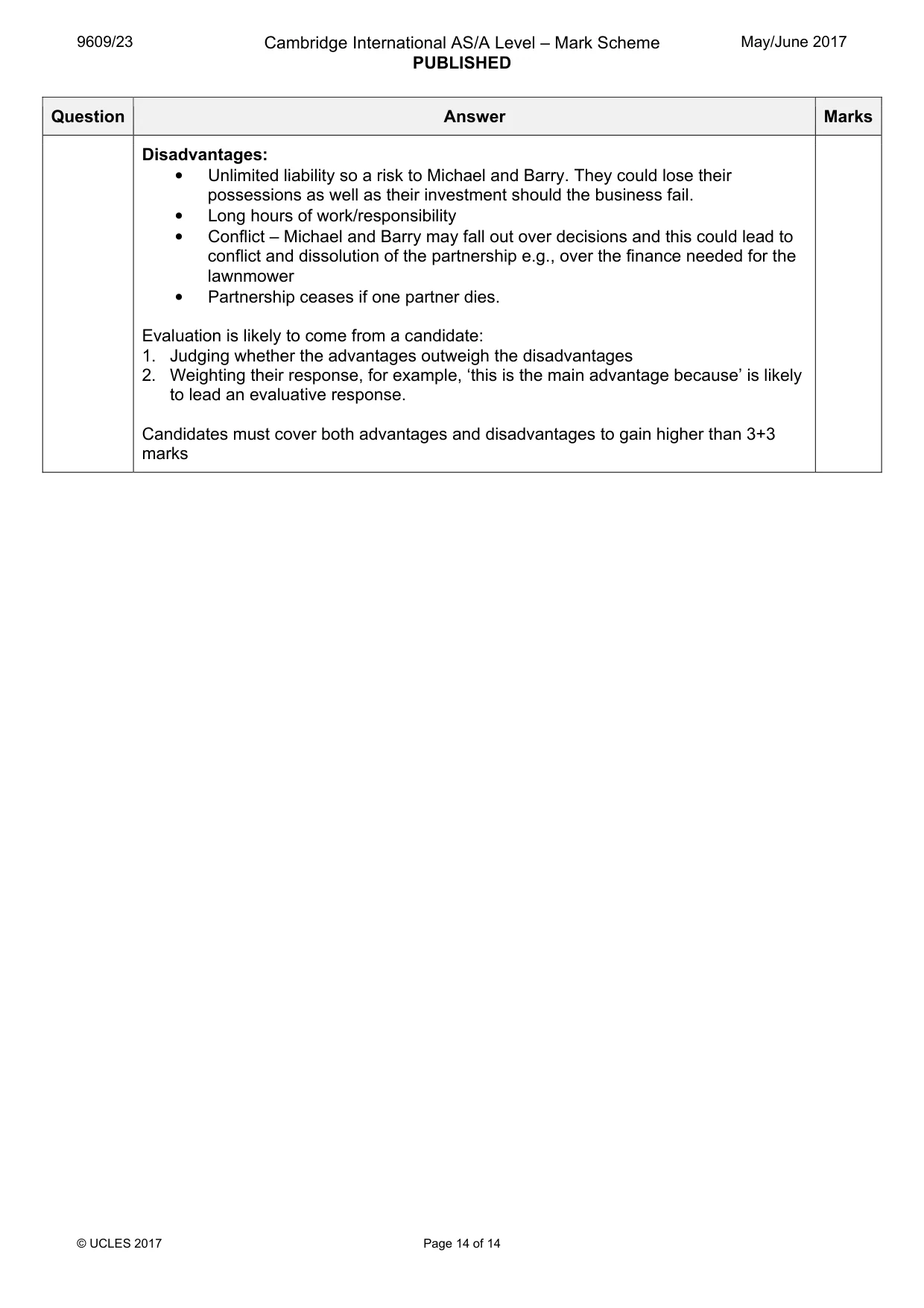
Mark scheme: 2(a)(i) Define the term ‘demand’ (line 26). 2 Knowledge and Application Marks A correct definition 2 A partial, vague or unfocused definition 1 No creditable content 0 A sound definition is ‘Demand is the quantity/amount that consumers are willing/able (not needs and wants) to buy at a given price (or in a particular time period)’. Demand is the ability and willingness of a consumer to pay for a given good or service at a given price. Demand falls as price rises/vice versa. Example(s) or reference to demand falling or rising is not needed for maximum marks. A diagram without further explanation should be awarded one mark. Answer Mark Reason The amount of a good consumers are Only 2 elements of the definition willing to buy 1 – for full marks would need 3 elements What consumers are willing to buy 1 Only 1 element of the definition The amount of a good consumers are 3 elements 2 willing to buy at a price 2(a)(ii) Briefly explain the term ‘tertiary sector’ (line 1). 3 Award one mark for each point of explanation: Example or some other way of showing good understanding, e.g. C Examples could include distribution, hairdressing, dentist. 1 mark Expertise/time B Relationship to other sectors (i.e. secondary, primary quaternary) 1 mark A Offer/sell/produce/provide etc. services/intangible goods 1 mark The tertiary sector is made of businesses that sell goods or services to producer or consumer markets. Business here take goods from the secondary sector and sell them. Services include law firms, accountancy firms, shops. Answer Mark Reason Provide services and sell intangible products 1 A elements only Sells services such as banking 2 A and C elements Sells services to support the products from the Elements from all – A B primary and secondary sectors such as 3 and C farmers’ markets selling vegetables 2(b)(i) Refer to Table 3. Calculate the gross profit margin. 3 Mark Rationale 3 marks Correct calculation of gross profit margin (with or without working or %) 2 marks Correct formula and correct calculation of gross profit 1 mark Correct formula or correct calculation of gross profit 0 marks No creditable content Formula can be implied through the correct use of figures. GP revenue * 100 GP = 120 – 90 = 30 GPM = 30/120 *100 = 25% Common incorrect answers Answer Mark Rationale 120 – 90 = 30 1 Correct calculation of gross profit [90 – (20+10)/120] × 100 = Gross profit incorrectly calculated but 1 60/120 × 100 = 50% formula correct (Gross profit/revenue) × 100. Correct formula and correct calculation of 2 Gross profit = 30 gross profit GP = 10 000 – 20 000 – 90 000 = Gross profit incorrectly calculated but – 100 × 100 000/120 000 = 1 formula correct 83.33% 120 000 – 90 000/120 000 = 0.25 Gross profit and method correct but ×100 2 missing from formula (30 000/120 000) × 100 = $25 000 Correct formula and correct calculation of 2 gross profit 2(b)(ii) Explain one way that BG could improve its profit margin. 3 Level Knowledge and Application Marks 2 (APP) Explanation of a way to improve the profit margin 3 1b (KK) Identification of a way to improve the profit margin 2 1a (K) Identification of a way to improve profit 1 0 No creditable content 0 Context (profit margin) and content is likely to come from: • Increase price but maintain costs/expenses • Decrease costs and maintain price Identification Explanation Possible context Decrease costs and Both costs and price This is clearly linked to the increase price (APP) referred to context of a profit MARGIN so 3 marks Increase price (KK) Only price, nothing Related to profit margin but about costs only identifies price so 2 marks. Increase revenue (K) This relates to profit 1 mark as not related to profit only. margin 2(c) Analyse two possible sources of finance that BG could use for the new 8 lawnmower. Level Knowledge and Marks Analysis Marks Application (4 marks) (4 marks) Shows understanding Good analysis of two (or more) of two (or more) sources of finance that BG could 4 4 sources of finance in use for the new lawnmower. context 2 Shows understanding Good analysis of one source of of one source of 3 finance that BG could use for the 3 finance in context new lawnmower. Shows knowledge of Limited analysis of two (or more) two (or more) sources 2 sources of finance 2 of finance 1 Shows knowledge of Limited analysis of one source of 1 1 one source of finance finance 0 No creditable content Any source of finance could be relevant – analysis will depend on context used: Contextual analysis likely to come from: • Cash flow, Barry is worried about working capital so how would BG be able to make the repayments? • Time span, how long would BG borrow for, interest rates tend to be higher over longer period of time. BG is a partnership, this could be risk if paid over longer term. Does Barry prefer short or medium or longer term? • Amount being borrowed. Would BG need to borrow all of the $10 000. Could Barry or Michael invest additional funds themselves to limit the borrowing? • Interest rates, BG is a partnership so could be seen as risky to lend to. But healthy profits and margins so could persuade a lender that the risk is smaller. • Future demand – Expected to increase as BG gain customers from competitors (LawnsRus) but what if the economy slows down – demand could fall in coming years especially from the revenue generated from basic services? 2(d) Discuss the advantages and disadvantages to Barry and Michael of the business 11 being a partnership. Knowledge and Application Marks Analysis and Evaluation Marks (4 marks) (7 marks) Justified evaluation based on 7 arguments in context Developed evaluation based 6 on arguments in context An evaluative statement based on arguments in 5 context Shows understanding of two or Argument of advantage(s) more features of a partnership in 4 and disadvantage(s) of 4 context partnerships in context Shows understanding of one Argument of an advantage(s) feature of a partnership in context 3 or disadvantage(s) of 3 partnerships in context Identifies two or more features of a Limited analysis of an partnership advantage(s) and 2 2 disadvantage(s) of partnerships Identifies one feature of a Limited analysis of an partnership advantage(s) or 1 1 disadvantage(s) of partnerships No creditable content Please annotate analysis of advantages in the left hand margin and disadvantages in the right hand margin. Evaluation can only be awarded if there is at least one double AN in the left and one double AN right hand margins. Context/content: Advantages: • Partners can specialise, this has worked for BG with division of tasks (Barry – finance and marketing, Michael – technical and employees). This will help BG be successful e.g., strong profits and margins • Partners run the business for themselves, not accountable to shareholders and so Michael and Barry gain the rewards from the business/retain control • BG will be a smaller business and so Michael and Barry are likely to offer personal service and good communication to customers, Michael in marketing and Barry in agreeing prices and contracts. This will help BG gain a reputation and be more successful. Disadvantages: • Unlimited liability so a risk to Michael and Barry. They could lose their possessions as well as their investment should the business fail. • Long hours of work/responsibility • Conflict – Michael and Barry may fall out over decisions and this could lead to conflict and dissolution of the partnership e.g., over the finance needed for the lawnmower • Partnership ceases if one partner dies. Evaluation is likely to come from a candidate: 1. Judging whether the advantages outweigh the disadvantages 2. Weighting their response, for example, ‘this is the main advantage because’ is likely to lead an evaluative response. Candidates must cover both advantages and disadvantages to gain higher than 3+3 marks
What was in this paper
The subtopics covered by these 2 questions, and how many questions each got. Open one in a new tab to see every Cambridge question on it.