Cambridge A Level Business (for first examination in 2016) 9609 — 2016 May/June Paper 2 · Variant 2
9609/22/M/J/16 · 60 marks · ≈68 min
The question paper and its mark scheme, free to read here and free to download. This is Cambridge’s own paper, exactly as it was sat.
Question paper4 pages

Mark scheme9 pages
Answers below. Sit the paper first if you are practising.
Paper as text
Question paper, page 1
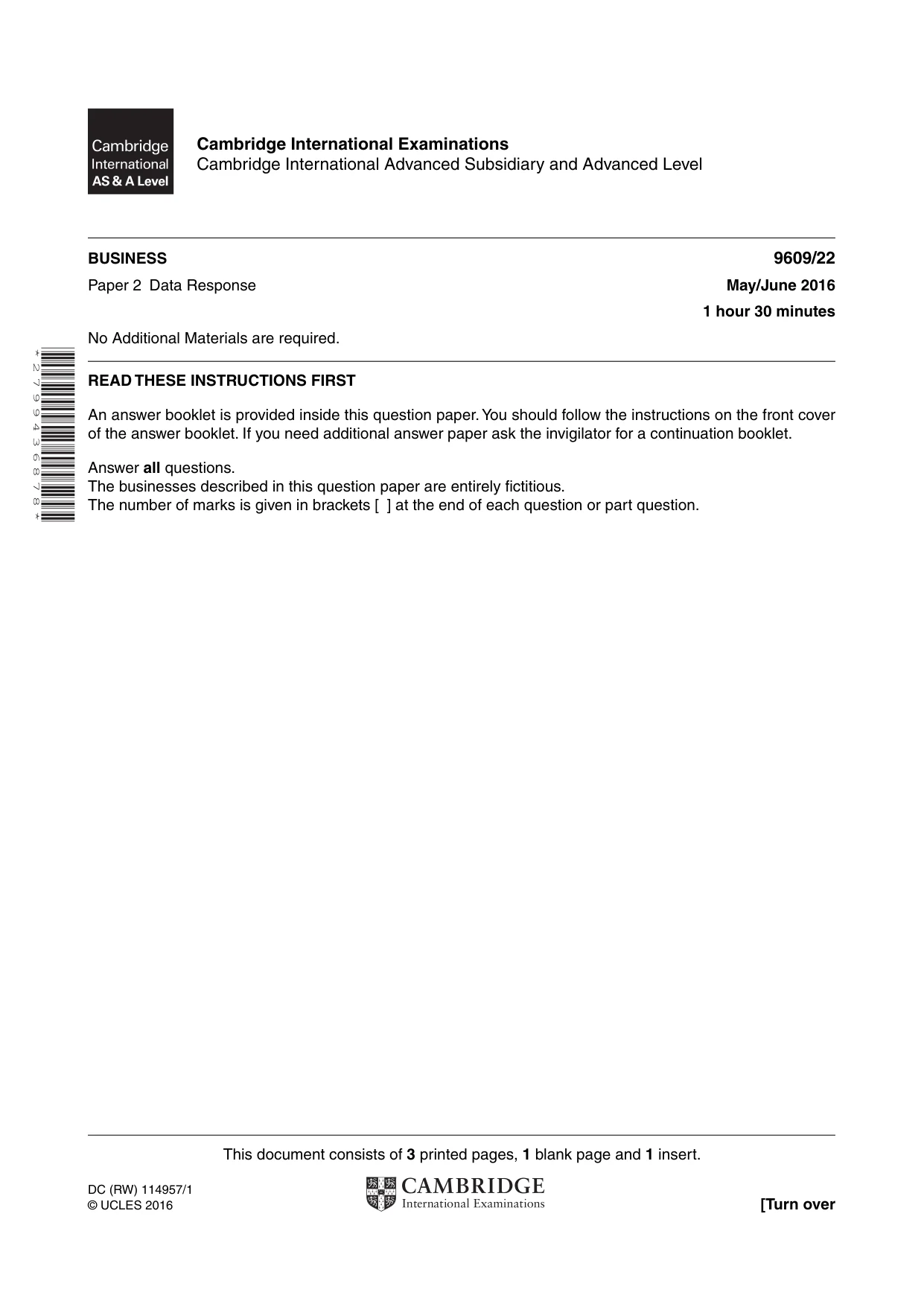
This document consists of 3 printed pages, 1 blank page and 1 insert. DC (RW) 114957/1 © UCLES 2016 [Turn over Cambridge International Examinations Cambridge International Advanced Subsidiary and Advanced Level * 2 7 9 9 4 3 6 8 7 8 * BUSINESS 9609/22 Paper 2 Data Response May/June 2016 1 hour 30 minutes No Additional Materials are required. READ THESE INSTRUCTIONS FIRST An answer booklet is provided inside this question paper. You should follow the instructions on the front cover of the answer booklet. If you need additional answer paper ask the invigilator for a continuation booklet. Answer all questions. The businesses described in this question paper are entirely fictitious. The number of marks is given in brackets [ ] at the end of each question or part question.
Question paper, page 2
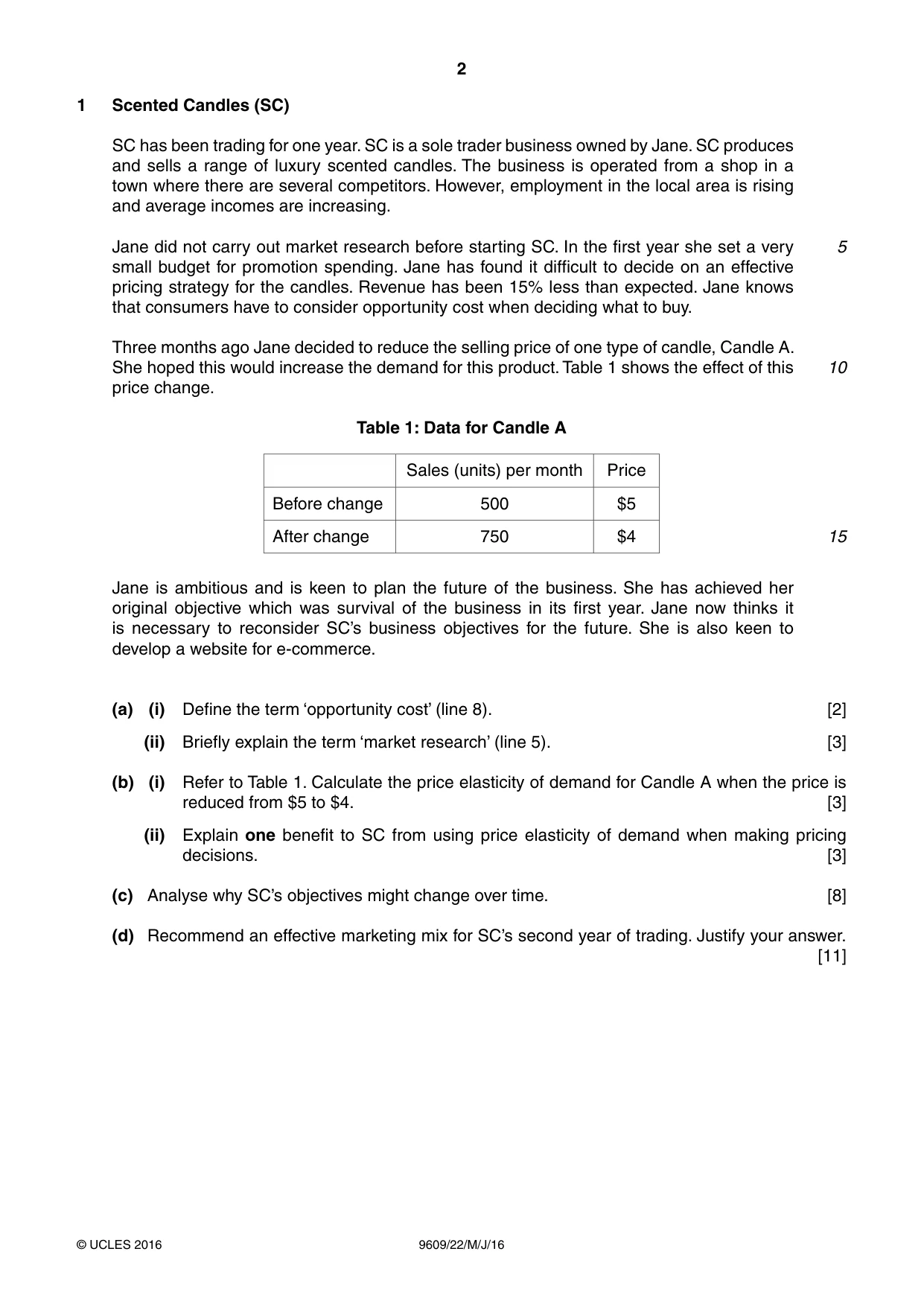
2 9609/22/M/J/16 © UCLES 2016 1 Scented Candles (SC) SC has been trading for one year. SC is a sole trader business owned by Jane. SC produces and sells a range of luxury scented candles. The business is operated from a shop in a town where there are several competitors. However, employment in the local area is rising and average incomes are increasing. Jane did not carry out market research before starting SC. In the first year she set a very small budget for promotion spending. Jane has found it difficult to decide on an effective pricing strategy for the candles. Revenue has been 15% less than expected. Jane knows that consumers have to consider opportunity cost when deciding what to buy. Three months ago Jane decided to reduce the selling price of one type of candle, Candle A. She hoped this would increase the demand for this product. Table 1 shows the effect of this price change. Table 1: Data for Candle A Sales (units) per month Price Before change 500 $5 After change 750 $4 Jane is ambitious and is keen to plan the future of the business. She has achieved her original objective which was survival of the business in its first year. Jane now thinks it is necessary to reconsider SC’s business objectives for the future. She is also keen to develop a website for e-commerce. (a) (i) Define the term ‘opportunity cost’ (line 8). [2] (ii) Briefly explain the term ‘market research’ (line 5). [3] (b) (i) Refer to Table 1. Calculate the price elasticity of demand for Candle A when the price is reduced from $5 to $4. [3] (ii) Explain one benefit to SC from using price elasticity of demand when making pricing decisions. [3] (c) Analyse why SC’s objectives might change over time. [8] (d) Recommend an effective marketing mix for SC’s second year of trading. Justify your answer. [11] 5 10 15
Question paper, page 3
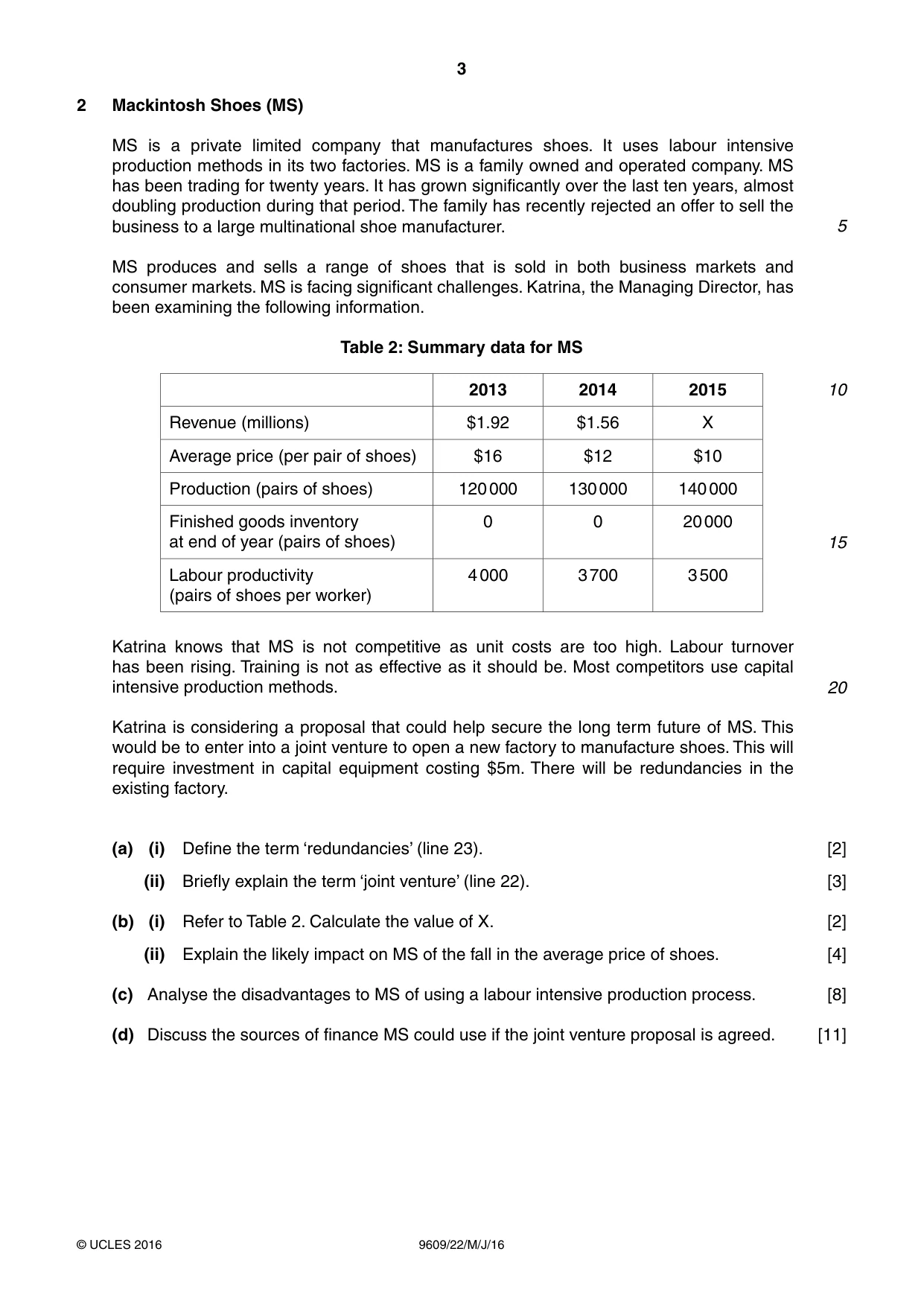
3 9609/22/M/J/16 © UCLES 2016 2 Mackintosh Shoes (MS) MS is a private limited company that manufactures shoes. It uses labour intensive production methods in its two factories. MS is a family owned and operated company. MS has been trading for twenty years. It has grown significantly over the last ten years, almost doubling production during that period. The family has recently rejected an offer to sell the business to a large multinational shoe manufacturer. MS produces and sells a range of shoes that is sold in both business markets and consumer markets. MS is facing significant challenges. Katrina, the Managing Director, has been examining the following information. Table 2: Summary data for MS 2013 2014 2015 Revenue (millions) $1.92 $1.56 X Average price (per pair of shoes) $16 $12 $10 Production (pairs of shoes) 120 000 130 000 140 000 Finished goods inventory at end of year (pairs of shoes) 0 0 20 000 Labour productivity (pairs of shoes per worker) 4 000 3 700 3 500 Katrina knows that MS is not competitive as unit costs are too high. Labour turnover has been rising. Training is not as effective as it should be. Most competitors use capital intensive production methods. Katrina is considering a proposal that could help secure the long term future of MS. This would be to enter into a joint venture to open a new factory to manufacture shoes. This will require investment in capital equipment costing $5m. There will be redundancies in the existing factory. (a) (i) Define the term ‘redundancies’ (line 23). [2] (ii) Briefly explain the term ‘joint venture’ (line 22). [3] (b) (i) Refer to Table 2. Calculate the value of X. [2] (ii) Explain the likely impact on MS of the fall in the average price of shoes. [4] (c) Analyse the disadvantages to MS of using a labour intensive production process. [8] (d) Discuss the sources of finance MS could use if the joint venture proposal is agreed. [11] 5 10 15 20
Question paper, page 4
4 9609/22/M/J/16 © UCLES 2016 BLANK PAGE Permission to reproduce items where third-party owned material protected by copyright is included has been sought and cleared where possible. Every reasonable effort has been made by the publisher (UCLES) to trace copyright holders, but if any items requiring clearance have unwittingly been included, the publisher will be pleased to make amends at the earliest possible opportunity. To avoid the issue of disclosure of answer-related information to candidates, all copyright acknowledgements are reproduced online in the Cambridge International Examinations Copyright Acknowledgements Booklet. This is produced for each series of examinations and is freely available to download at www.cie.org.uk after the live examination series. Cambridge International Examinations is part of the Cambridge Assessment Group. Cambridge Assessment is the brand name of University of Cambridge Local Examinations Syndicate (UCLES), which is itself a department of the University of Cambridge.
Mark scheme, page 1
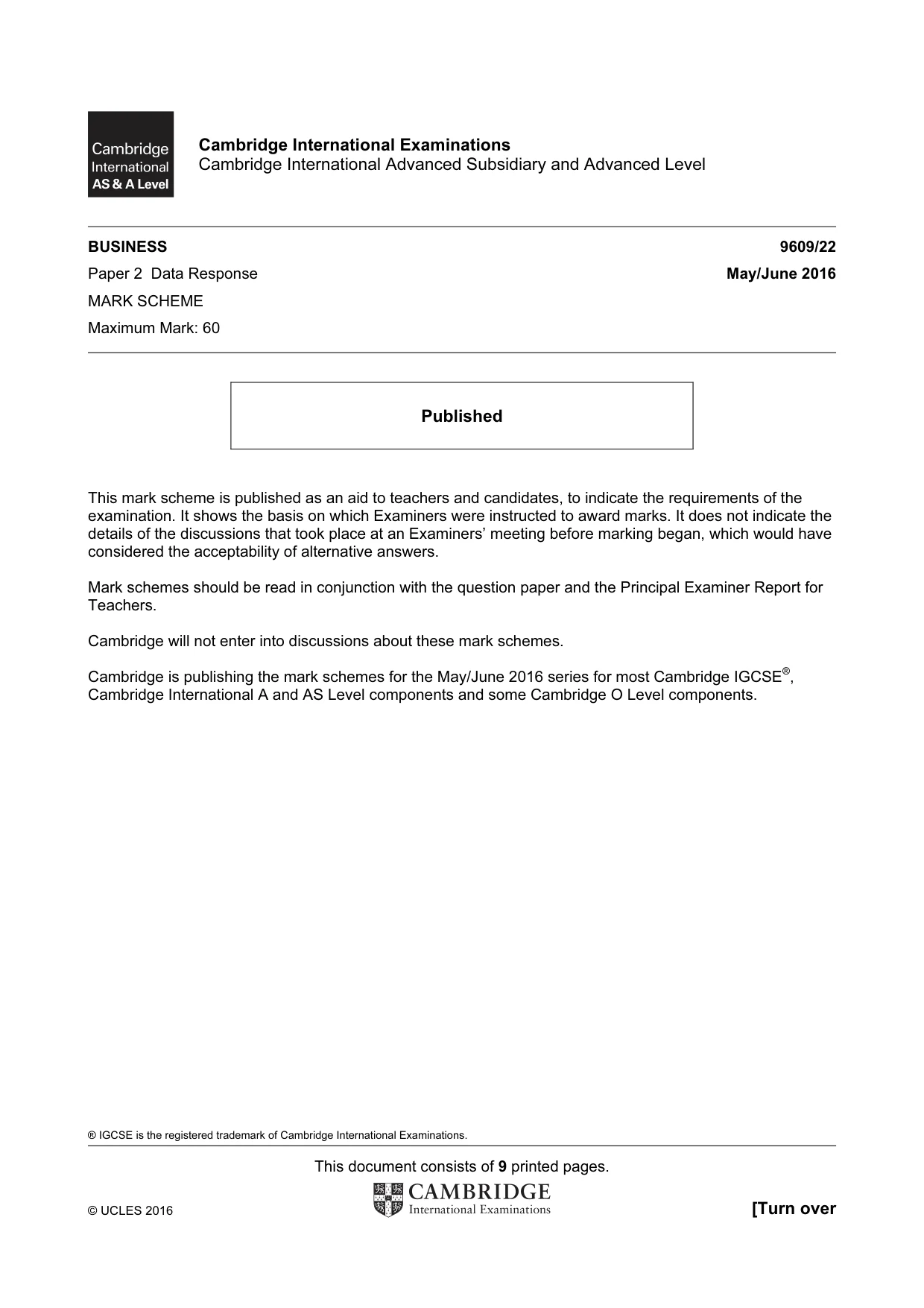
® IGCSE is the registered trademark of Cambridge International Examinations. This document consists of 9 printed pages. © UCLES 2016 [Turn over Cambridge International Examinations Cambridge International Advanced Subsidiary and Advanced Level BUSINESS 9609/22 Paper 2 Data Response May/June 2016 MARK SCHEME Maximum Mark: 60 Published This mark scheme is published as an aid to teachers and candidates, to indicate the requirements of the examination. It shows the basis on which Examiners were instructed to award marks. It does not indicate the details of the discussions that took place at an Examiners’ meeting before marking began, which would have considered the acceptability of alternative answers. Mark schemes should be read in conjunction with the question paper and the Principal Examiner Report for Teachers. Cambridge will not enter into discussions about these mark schemes. Cambridge is publishing the mark schemes for the May/June 2016 series for most Cambridge IGCSE®, Cambridge International A and AS Level components and some Cambridge O Level components.
Mark scheme, page 2
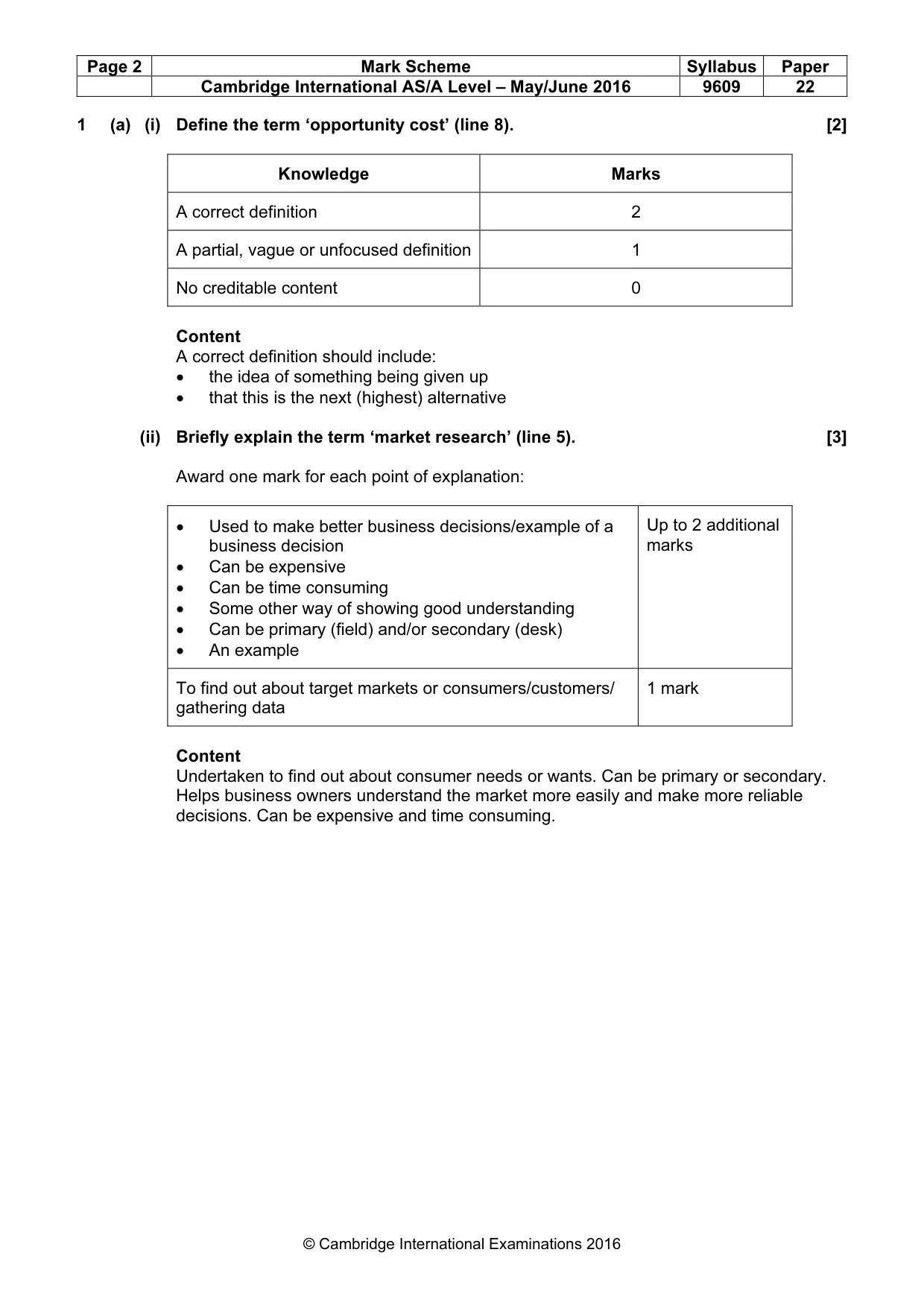
Page 2 Mark Scheme Syllabus Paper Cambridge International AS/A Level – May/June 2016 9609 22 © Cambridge International Examinations 2016 1 (a) (i) Define the term ‘opportunity cost’ (line 8). [2] Knowledge Marks A correct definition 2 A partial, vague or unfocused definition 1 No creditable content 0 Content A correct definition should include: • the idea of something being given up • that this is the next (highest) alternative (ii) Briefly explain the term ‘market research’ (line 5). [3] Award one mark for each point of explanation: • Used to make better business decisions/example of a business decision • Can be expensive • Can be time consuming • Some other way of showing good understanding • Can be primary (field) and/or secondary (desk) • An example Up to 2 additional marks To find out about target markets or consumers/customers/ gathering data 1 mark Content Undertaken to find out about consumer needs or wants. Can be primary or secondary. Helps business owners understand the market more easily and make more reliable decisions. Can be expensive and time consuming.
Mark scheme, page 3
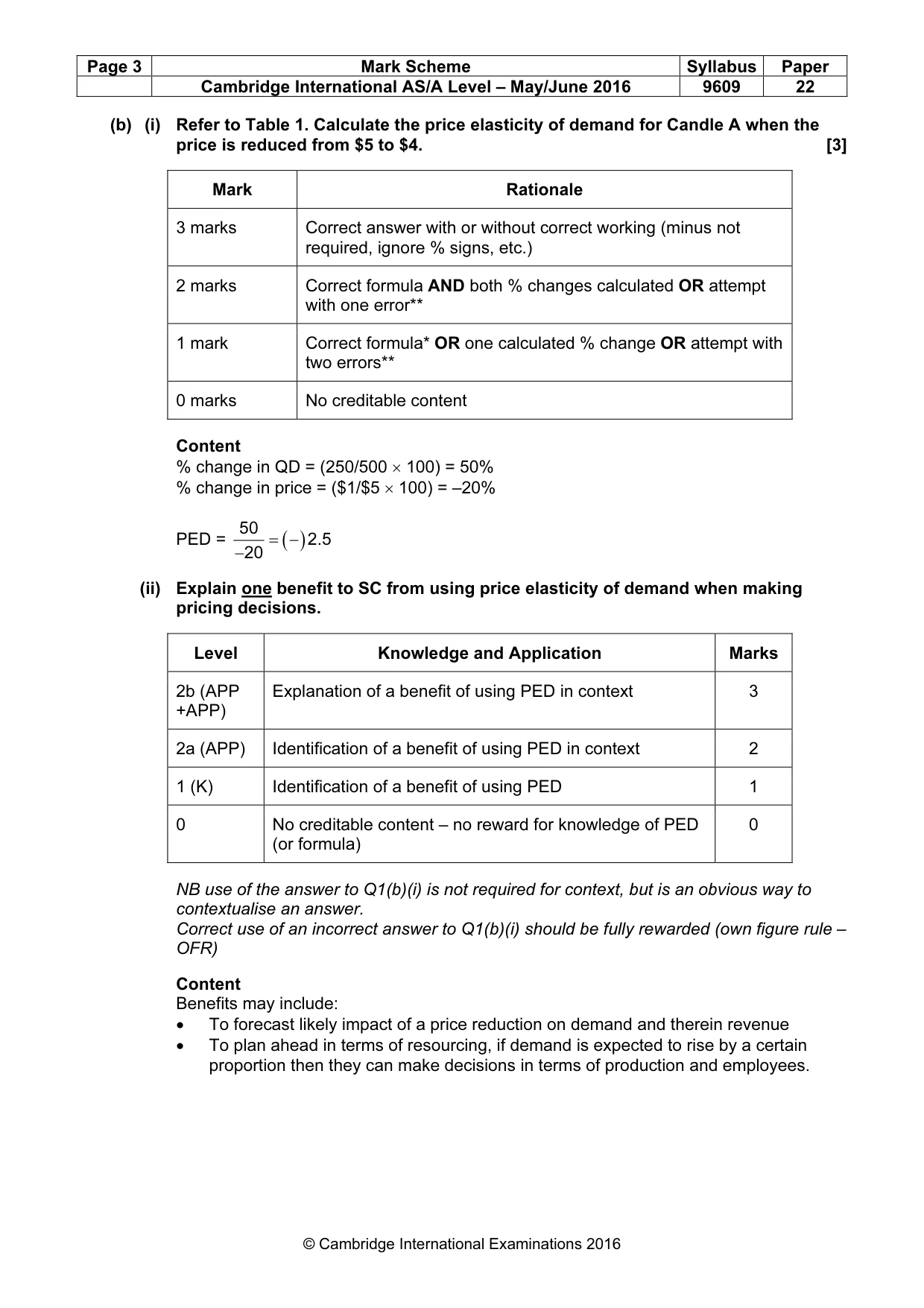
Page 3 Mark Scheme Syllabus Paper Cambridge International AS/A Level – May/June 2016 9609 22 © Cambridge International Examinations 2016 (b) (i) Refer to Table 1. Calculate the price elasticity of demand for Candle A when the price is reduced from $5 to $4. [3] Mark Rationale 3 marks Correct answer with or without correct working (minus not required, ignore % signs, etc.) 2 marks Correct formula AND both % changes calculated OR attempt with one error** 1 mark Correct formula* OR one calculated % change OR attempt with two errors** 0 marks No creditable content Content % change in QD = (250/500 × 100) = 50% % change in price = ($1/$5 × 100) = –20% PED = ( ) 50 2.5 20 = − − (ii) Explain one benefit to SC from using price elasticity of demand when making pricing decisions. Level Knowledge and Application Marks 2b (APP +APP) Explanation of a benefit of using PED in context 3 2a (APP) Identification of a benefit of using PED in context 2 1 (K) Identification of a benefit of using PED 1 0 No creditable content – no reward for knowledge of PED (or formula) 0 NB use of the answer to Q1(b)(i) is not required for context, but is an obvious way to contextualise an answer. Correct use of an incorrect answer to Q1(b)(i) should be fully rewarded (own figure rule – OFR) Content Benefits may include: • To forecast likely impact of a price reduction on demand and therein revenue • To plan ahead in terms of resourcing, if demand is expected to rise by a certain proportion then they can make decisions in terms of production and employees.
Mark scheme, page 4
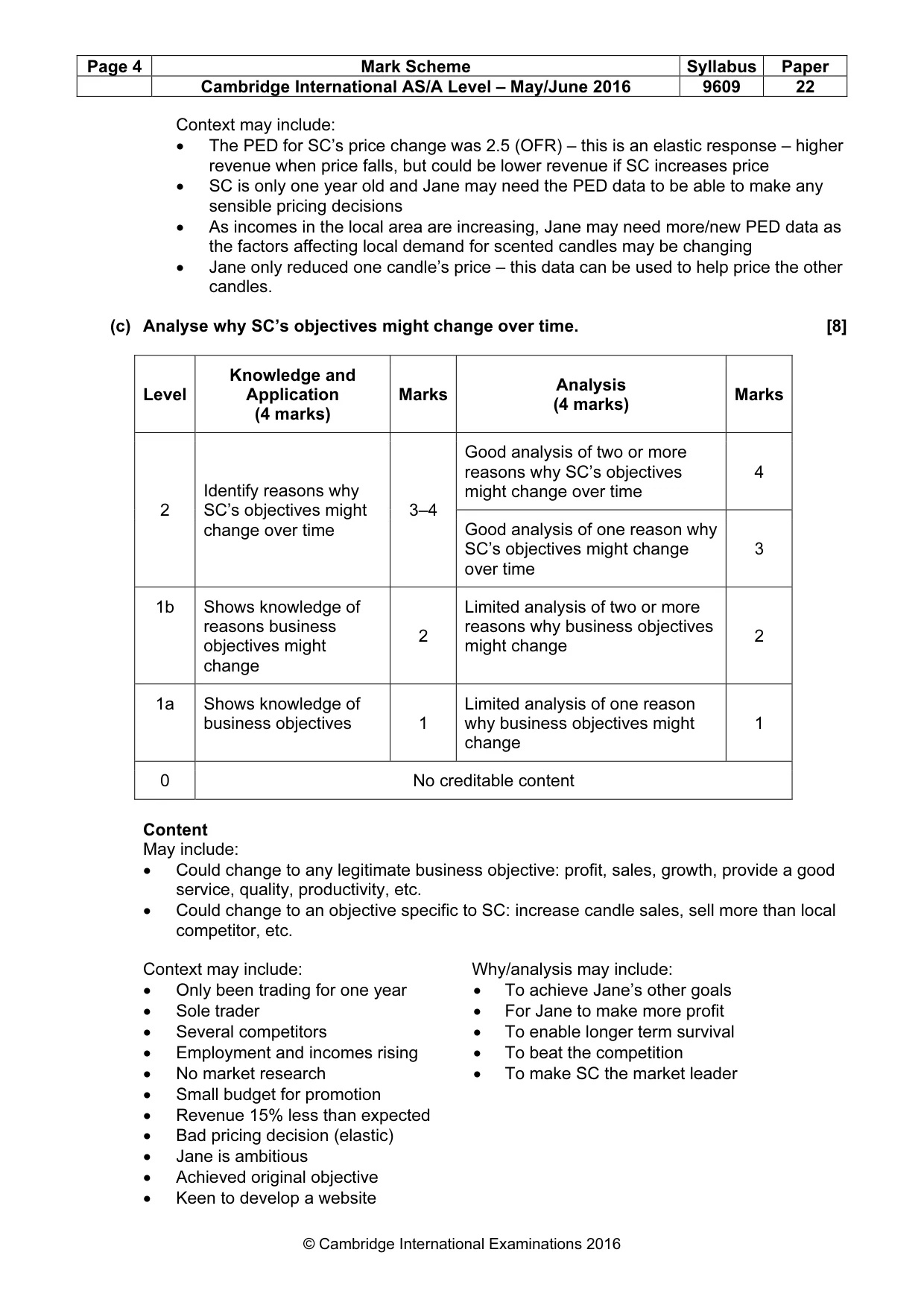
Page 4 Mark Scheme Syllabus Paper Cambridge International AS/A Level – May/June 2016 9609 22 © Cambridge International Examinations 2016 Context may include: • The PED for SC’s price change was 2.5 (OFR) – this is an elastic response – higher revenue when price falls, but could be lower revenue if SC increases price • SC is only one year old and Jane may need the PED data to be able to make any sensible pricing decisions • As incomes in the local area are increasing, Jane may need more/new PED data as the factors affecting local demand for scented candles may be changing • Jane only reduced one candle’s price – this data can be used to help price the other candles. (c) Analyse why SC’s objectives might change over time. [8] Level Knowledge and Application (4 marks) Marks Analysis (4 marks) Marks 2 Identify reasons why SC’s objectives might change over time 3–4 Good analysis of two or more reasons why SC’s objectives might change over time 4 Good analysis of one reason why SC’s objectives might change over time 3 1b Shows knowledge of reasons business objectives might change 2 Limited analysis of two or more reasons why business objectives might change 2 1a Shows knowledge of business objectives 1 Limited analysis of one reason why business objectives might change 1 0 No creditable content Content May include: • Could change to any legitimate business objective: profit, sales, growth, provide a good service, quality, productivity, etc. • Could change to an objective specific to SC: increase candle sales, sell more than local competitor, etc. Context may include: • Only been trading for one year • Sole trader • Several competitors • Employment and incomes rising • No market research • Small budget for promotion • Revenue 15% less than expected • Bad pricing decision (elastic) • Jane is ambitious • Achieved original objective • Keen to develop a website Why/analysis may include: • To achieve Jane’s other goals • For Jane to make more profit • To enable longer term survival • To beat the competition • To make SC the market leader
Mark scheme, page 5
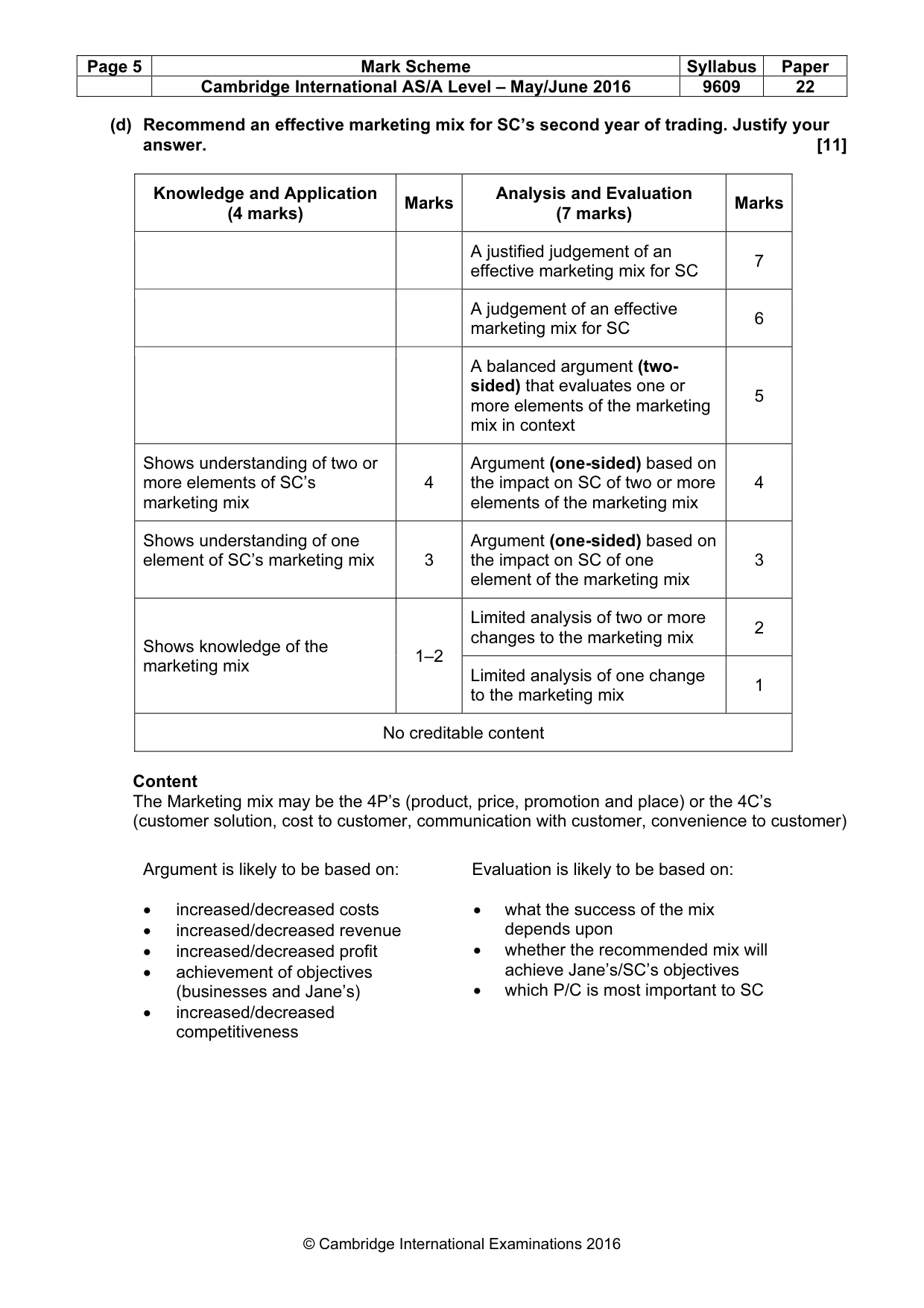
Page 5 Mark Scheme Syllabus Paper Cambridge International AS/A Level – May/June 2016 9609 22 © Cambridge International Examinations 2016 (d) Recommend an effective marketing mix for SC’s second year of trading. Justify your answer. [11] Knowledge and Application (4 marks) Marks Analysis and Evaluation (7 marks) Marks A justified judgement of an effective marketing mix for SC 7 A judgement of an effective marketing mix for SC 6 A balanced argument (two- sided) that evaluates one or more elements of the marketing mix in context 5 Shows understanding of two or more elements of SC’s marketing mix 4 Argument (one-sided) based on the impact on SC of two or more elements of the marketing mix 4 Shows understanding of one element of SC’s marketing mix 3 Argument (one-sided) based on the impact on SC of one element of the marketing mix 3 Shows knowledge of the marketing mix 1–2 Limited analysis of two or more changes to the marketing mix 2 Limited analysis of one change to the marketing mix 1 No creditable content Content The Marketing mix may be the 4P’s (product, price, promotion and place) or the 4C’s (customer solution, cost to customer, communication with customer, convenience to customer) Argument is likely to be based on: • increased/decreased costs • increased/decreased revenue • increased/decreased profit • achievement of objectives (businesses and Jane’s) • increased/decreased competitiveness Evaluation is likely to be based on: • what the success of the mix depends upon • whether the recommended mix will achieve Jane’s/SC’s objectives • which P/C is most important to SC
Mark scheme, page 6
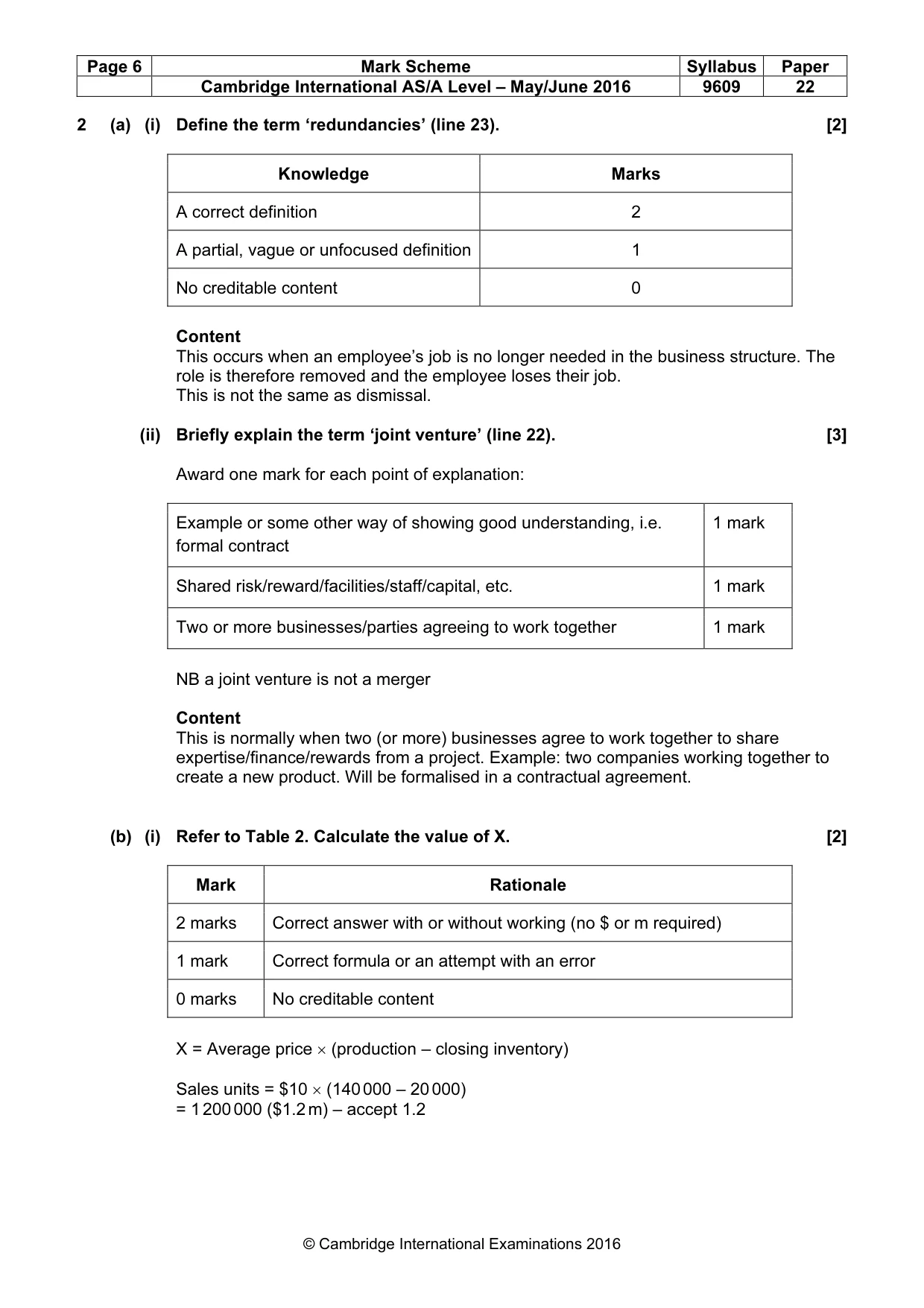
Page 6 Mark Scheme Syllabus Paper Cambridge International AS/A Level – May/June 2016 9609 22 © Cambridge International Examinations 2016 2 (a) (i) Define the term ‘redundancies’ (line 23). [2] Knowledge Marks A correct definition 2 A partial, vague or unfocused definition 1 No creditable content 0 Content This occurs when an employee’s job is no longer needed in the business structure. The role is therefore removed and the employee loses their job. This is not the same as dismissal. (ii) Briefly explain the term ‘joint venture’ (line 22). [3] Award one mark for each point of explanation: Example or some other way of showing good understanding, i.e. formal contract 1 mark Shared risk/reward/facilities/staff/capital, etc. 1 mark Two or more businesses/parties agreeing to work together 1 mark NB a joint venture is not a merger Content This is normally when two (or more) businesses agree to work together to share expertise/finance/rewards from a project. Example: two companies working together to create a new product. Will be formalised in a contractual agreement. (b) (i) Refer to Table 2. Calculate the value of X. [2] Mark Rationale 2 marks Correct answer with or without working (no $ or m required) 1 mark Correct formula or an attempt with an error 0 marks No creditable content X = Average price × (production – closing inventory) Sales units = $10 × (140 000 – 20 000) = 1 200 000 ($1.2 m) – accept 1.2
Mark scheme, page 7
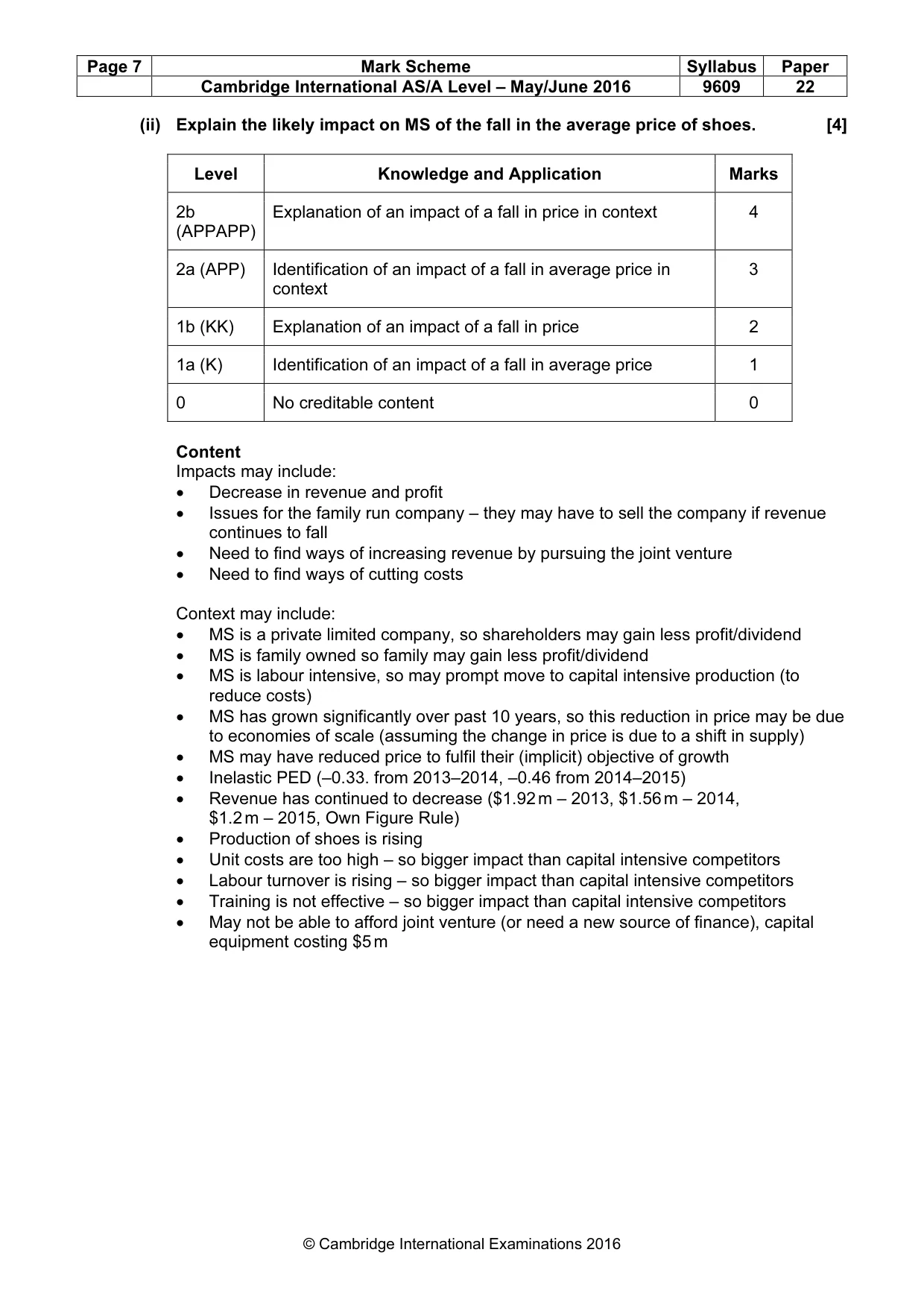
Page 7 Mark Scheme Syllabus Paper Cambridge International AS/A Level – May/June 2016 9609 22 © Cambridge International Examinations 2016 (ii) Explain the likely impact on MS of the fall in the average price of shoes. [4] Level Knowledge and Application Marks 2b (APPAPP) Explanation of an impact of a fall in price in context 4 2a (APP) Identification of an impact of a fall in average price in context 3 1b (KK) Explanation of an impact of a fall in price 2 1a (K) Identification of an impact of a fall in average price 1 0 No creditable content 0 Content Impacts may include: • Decrease in revenue and profit • Issues for the family run company – they may have to sell the company if revenue continues to fall • Need to find ways of increasing revenue by pursuing the joint venture • Need to find ways of cutting costs Context may include: • MS is a private limited company, so shareholders may gain less profit/dividend • MS is family owned so family may gain less profit/dividend • MS is labour intensive, so may prompt move to capital intensive production (to reduce costs) • MS has grown significantly over past 10 years, so this reduction in price may be due to economies of scale (assuming the change in price is due to a shift in supply) • MS may have reduced price to fulfil their (implicit) objective of growth • Inelastic PED (–0.33. from 2013–2014, –0.46 from 2014–2015) • Revenue has continued to decrease ($1.92 m – 2013, $1.56 m – 2014, $1.2 m – 2015, Own Figure Rule) • Production of shoes is rising • Unit costs are too high – so bigger impact than capital intensive competitors • Labour turnover is rising – so bigger impact than capital intensive competitors • Training is not effective – so bigger impact than capital intensive competitors • May not be able to afford joint venture (or need a new source of finance), capital equipment costing $5 m
Mark scheme, page 8
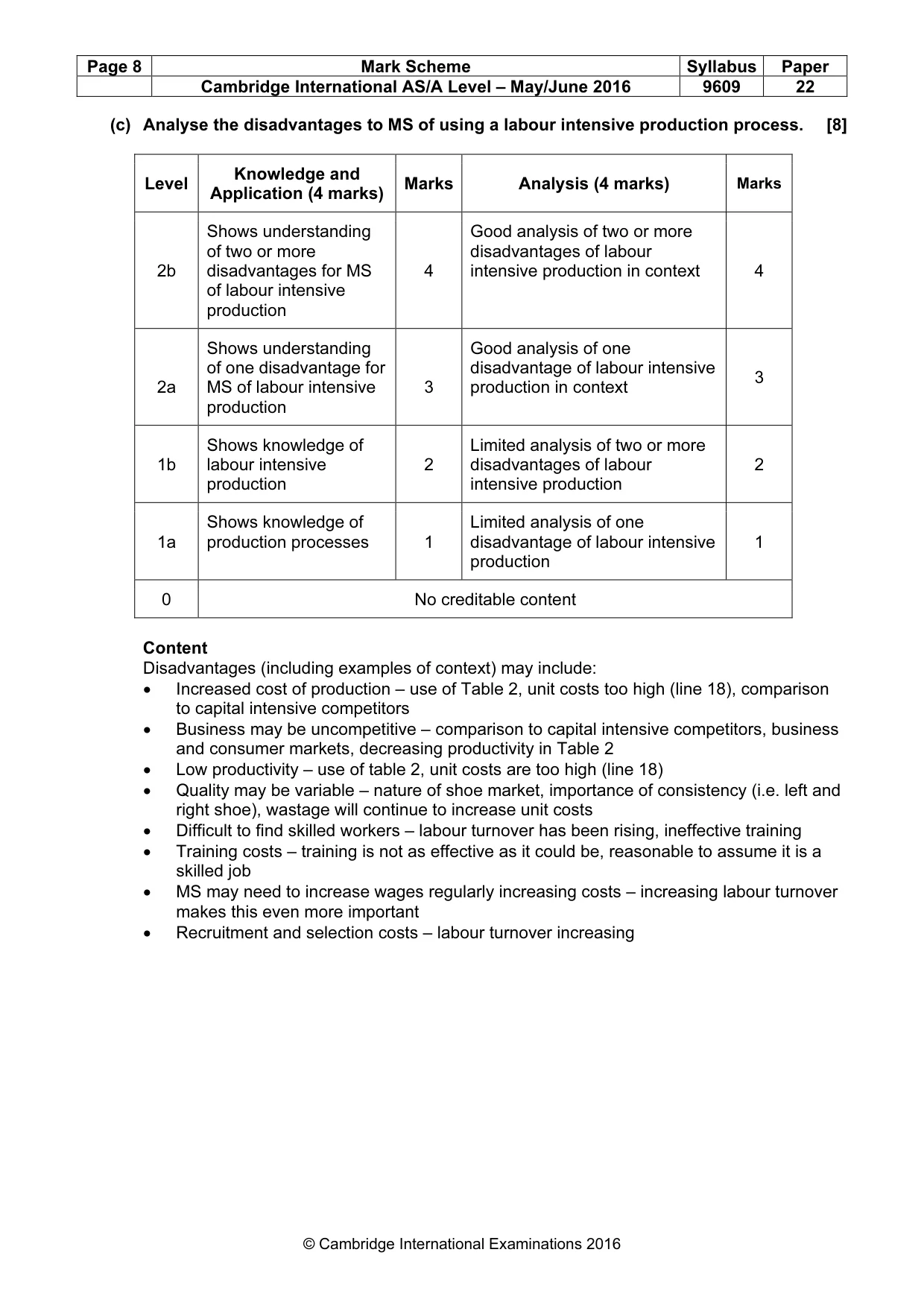
Page 8 Mark Scheme Syllabus Paper Cambridge International AS/A Level – May/June 2016 9609 22 © Cambridge International Examinations 2016 (c) Analyse the disadvantages to MS of using a labour intensive production process. [8] Level Knowledge and Application (4 marks) Marks Analysis (4 marks) Marks 2b Shows understanding of two or more disadvantages for MS of labour intensive production 4 Good analysis of two or more disadvantages of labour intensive production in context 4 2a Shows understanding of one disadvantage for MS of labour intensive production 3 Good analysis of one disadvantage of labour intensive production in context 3 1b Shows knowledge of labour intensive production 2 Limited analysis of two or more disadvantages of labour intensive production 2 1a Shows knowledge of production processes 1 Limited analysis of one disadvantage of labour intensive production 1 0 No creditable content Content Disadvantages (including examples of context) may include: • Increased cost of production – use of Table 2, unit costs too high (line 18), comparison to capital intensive competitors • Business may be uncompetitive – comparison to capital intensive competitors, business and consumer markets, decreasing productivity in Table 2 • Low productivity – use of table 2, unit costs are too high (line 18) • Quality may be variable – nature of shoe market, importance of consistency (i.e. left and right shoe), wastage will continue to increase unit costs • Difficult to find skilled workers – labour turnover has been rising, ineffective training • Training costs – training is not as effective as it could be, reasonable to assume it is a skilled job • MS may need to increase wages regularly increasing costs – increasing labour turnover makes this even more important • Recruitment and selection costs – labour turnover increasing
Mark scheme, page 9
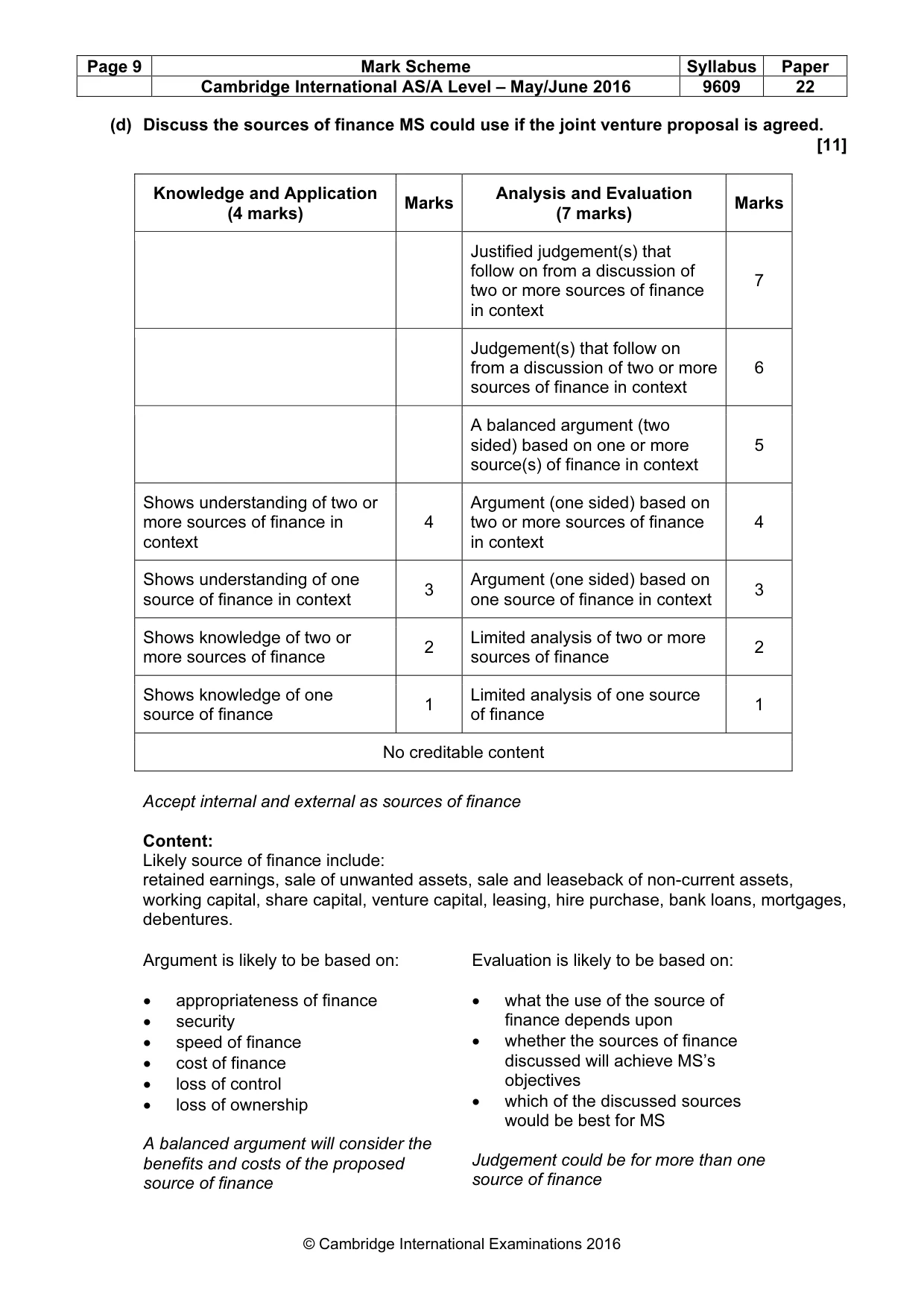
Page 9 Mark Scheme Syllabus Paper Cambridge International AS/A Level – May/June 2016 9609 22 © Cambridge International Examinations 2016 (d) Discuss the sources of finance MS could use if the joint venture proposal is agreed. [11] Knowledge and Application (4 marks) Marks Analysis and Evaluation (7 marks) Marks Justified judgement(s) that follow on from a discussion of two or more sources of finance in context 7 Judgement(s) that follow on from a discussion of two or more sources of finance in context 6 A balanced argument (two sided) based on one or more source(s) of finance in context 5 Shows understanding of two or more sources of finance in context 4 Argument (one sided) based on two or more sources of finance in context 4 Shows understanding of one source of finance in context 3 Argument (one sided) based on one source of finance in context 3 Shows knowledge of two or more sources of finance 2 Limited analysis of two or more sources of finance 2 Shows knowledge of one source of finance 1 Limited analysis of one source of finance 1 No creditable content Accept internal and external as sources of finance Content: Likely source of finance include: retained earnings, sale of unwanted assets, sale and leaseback of non-current assets, working capital, share capital, venture capital, leasing, hire purchase, bank loans, mortgages, debentures. Argument is likely to be based on: • appropriateness of finance • security • speed of finance • cost of finance • loss of control • loss of ownership A balanced argument will consider the benefits and costs of the proposed source of finance Evaluation is likely to be based on: • what the use of the source of finance depends upon • whether the sources of finance discussed will achieve MS’s objectives • which of the discussed sources would be best for MS Judgement could be for more than one source of finance
What you needed in this session
Cambridge’s own grade thresholds for 2016 May/June, Paper 2 · Variant 2. A higher threshold means an easier paper — the bar moves with how the cohort did.