Cambridge A Level Business (for first examination in 2016) 9609 — 2016 May/June Paper 2 · Variant 3
9609/23/M/J/16 · 60 marks · ≈68 min
The question paper and its mark scheme, free to read here and free to download. This is Cambridge’s own paper, exactly as it was sat.
Question paper4 pages
Mark scheme10 pages
Answers below. Sit the paper first if you are practising.
Paper as text
Question paper, page 1
This document consists of 4 printed pages and 1 insert. DC (CW) 114956/1 © UCLES 2016 [Turn over Cambridge International Examinations Cambridge International Advanced Subsidiary and Advanced Level * 9 7 3 5 6 1 8 5 6 5 * BUSINESS 9609/23 Paper 2 Data Response May/June 2016 1 hour 30 minutes No Additional Materials are required. READ THESE INSTRUCTIONS FIRST An answer booklet is provided inside this question paper. You should follow the instructions on the front cover of the answer booklet. If you need additional answer paper ask the invigilator for a continuation booklet. Answer all questions. The businesses described in this question paper are entirely fictitious. The number of marks is given in brackets [ ] at the end of each question or part question.
Question paper, page 2
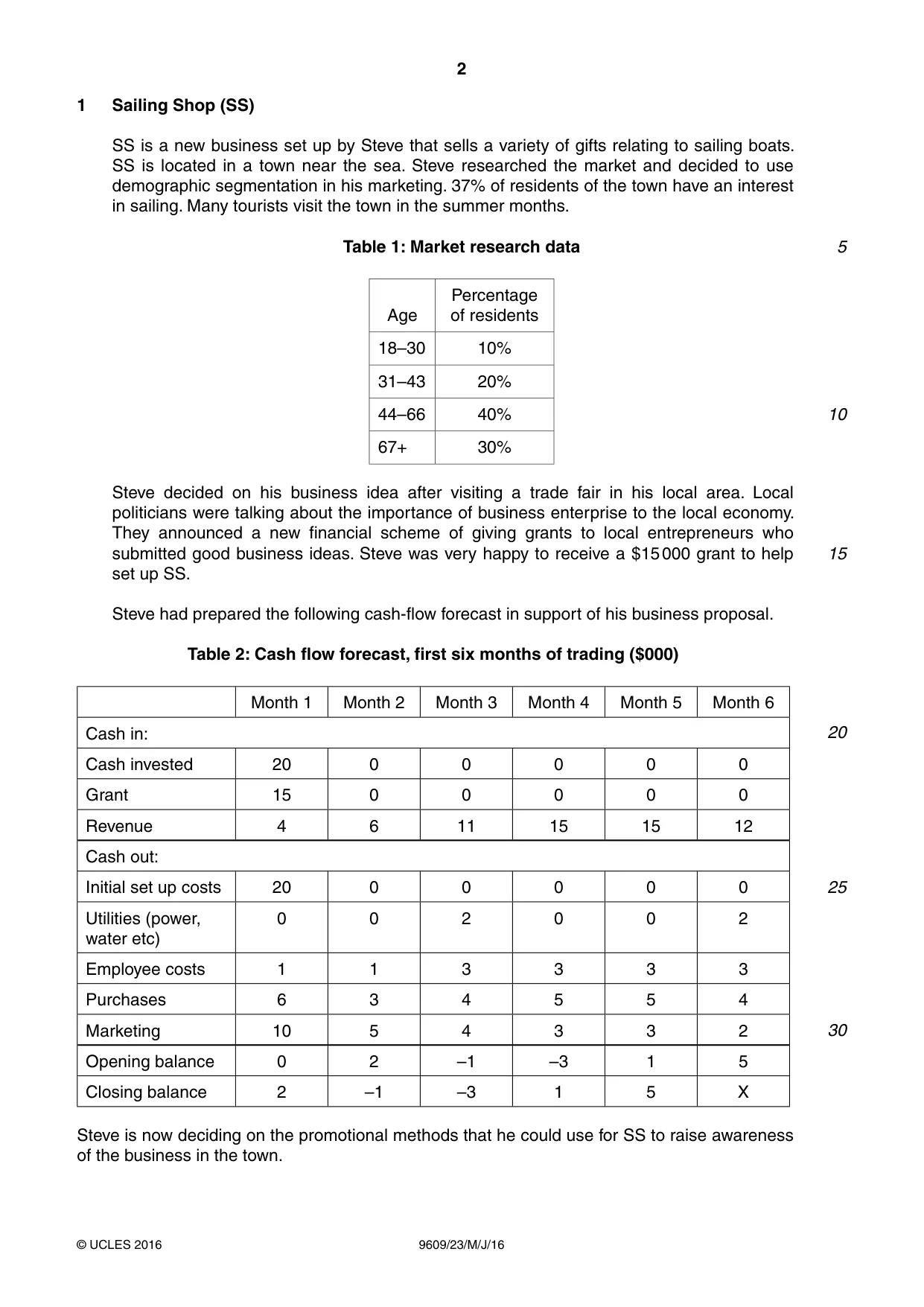
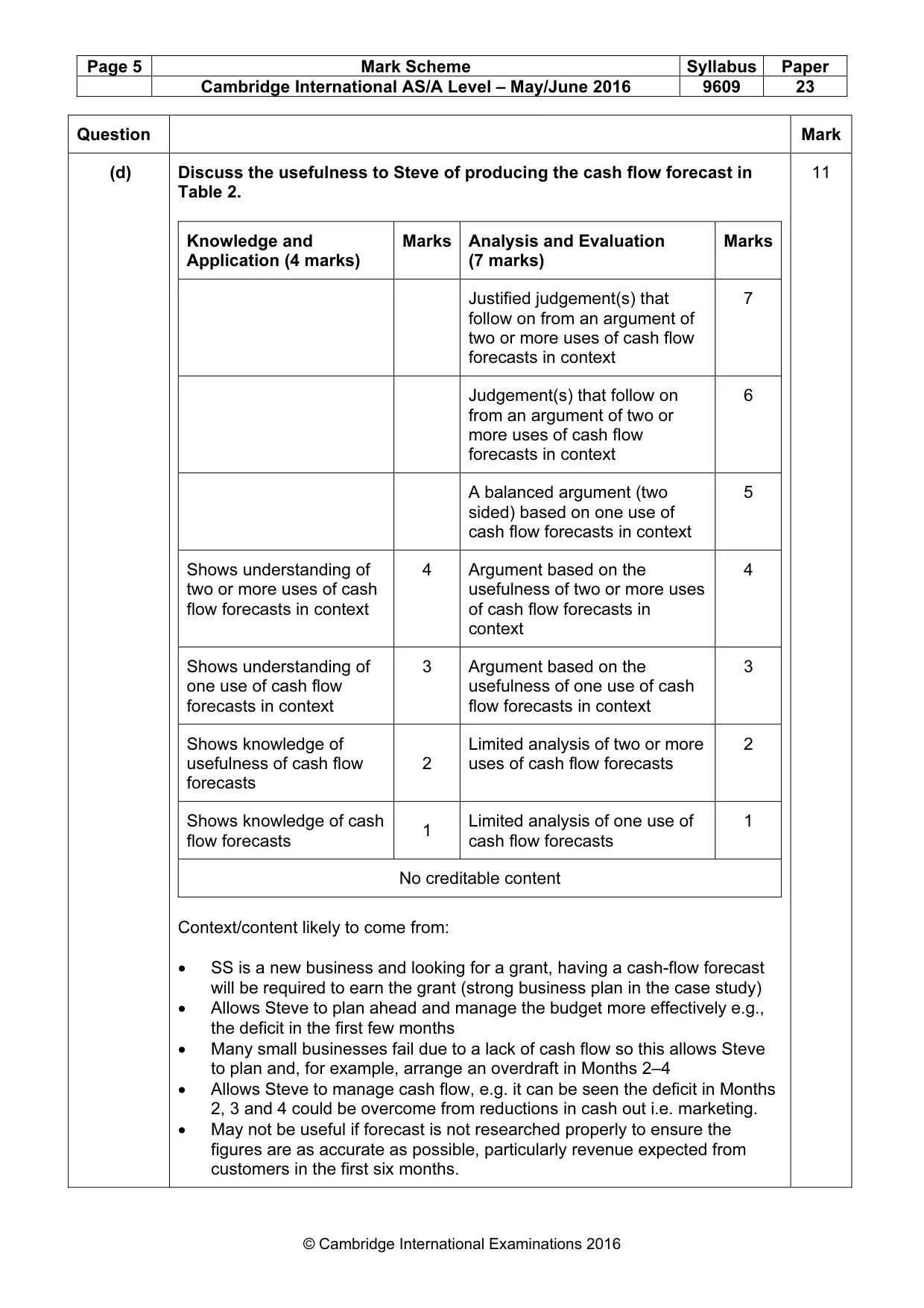
2 9609/23/M/J/16 © UCLES 2016 1 Sailing Shop (SS) SS is a new business set up by Steve that sells a variety of gifts relating to sailing boats. SS is located in a town near the sea. Steve researched the market and decided to use demographic segmentation in his marketing. 37% of residents of the town have an interest in sailing. Many tourists visit the town in the summer months. Table 1: Market research data Age Percentage of residents 18–30 10% 31–43 20% 44–66 40% 67+ 30% Steve decided on his business idea after visiting a trade fair in his local area. Local politicians were talking about the importance of business enterprise to the local economy. They announced a new financial scheme of giving grants to local entrepreneurs who submitted good business ideas. Steve was very happy to receive a $15 000 grant to help set up SS. Steve had prepared the following cash-flow forecast in support of his business proposal. Table 2: Cash flow forecast, first six months of trading ($000) Month 1 Month 2 Month 3 Month 4 Month 5 Month 6 Cash in: Cash invested 20 0 0 0 0 0 Grant 15 0 0 0 0 0 Revenue 4 6 11 15 15 12 Cash out: Initial set up costs 20 0 0 0 0 0 Utilities (power, water etc) 0 0 2 0 0 2 Employee costs 1 1 3 3 3 3 Purchases 6 3 4 5 5 4 Marketing 10 5 4 3 3 2 Opening balance 0 2 –1 –3 1 5 Closing balance 2 –1 –3 1 5 X Steve is now deciding on the promotional methods that he could use for SS to raise awareness of the business in the town. 5 10 15 20 25 30
Question paper, page 3
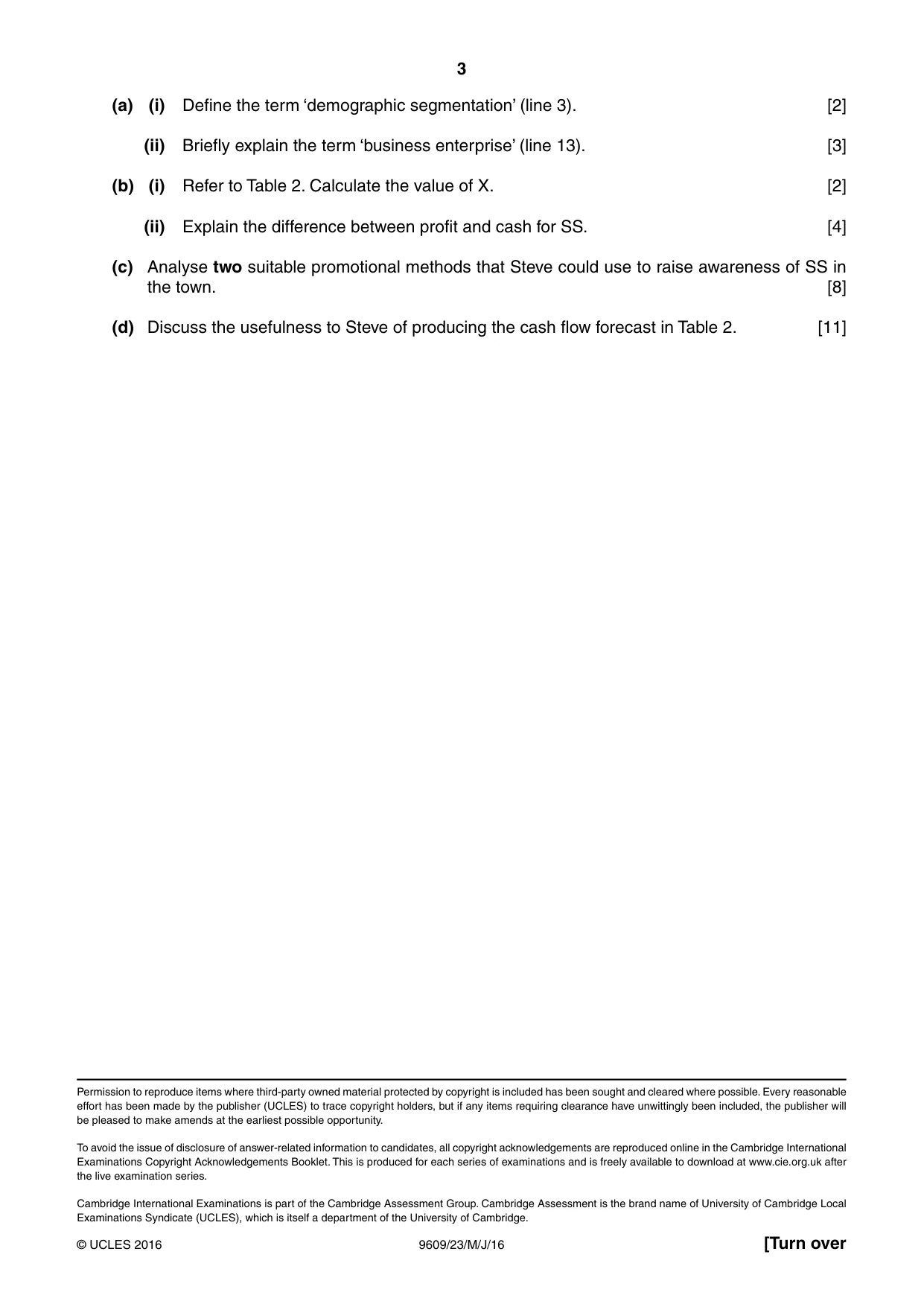
3 9609/23/M/J/16 © UCLES 2016 [Turn over (a) (i) Define the term ‘demographic segmentation’ (line 3). [2] (ii) Briefly explain the term ‘business enterprise’ (line 13). [3] (b) (i) Refer to Table 2. Calculate the value of X. [2] (ii) Explain the difference between profit and cash for SS. [4] (c) Analyse two suitable promotional methods that Steve could use to raise awareness of SS in the town. [8] (d) Discuss the usefulness to Steve of producing the cash flow forecast in Table 2. [11] Permission to reproduce items where third-party owned material protected by copyright is included has been sought and cleared where possible. Every reasonable effort has been made by the publisher (UCLES) to trace copyright holders, but if any items requiring clearance have unwittingly been included, the publisher will be pleased to make amends at the earliest possible opportunity. To avoid the issue of disclosure of answer-related information to candidates, all copyright acknowledgements are reproduced online in the Cambridge International Examinations Copyright Acknowledgements Booklet. This is produced for each series of examinations and is freely available to download at www.cie.org.uk after the live examination series. Cambridge International Examinations is part of the Cambridge Assessment Group. Cambridge Assessment is the brand name of University of Cambridge Local Examinations Syndicate (UCLES), which is itself a department of the University of Cambridge.
Question paper, page 4
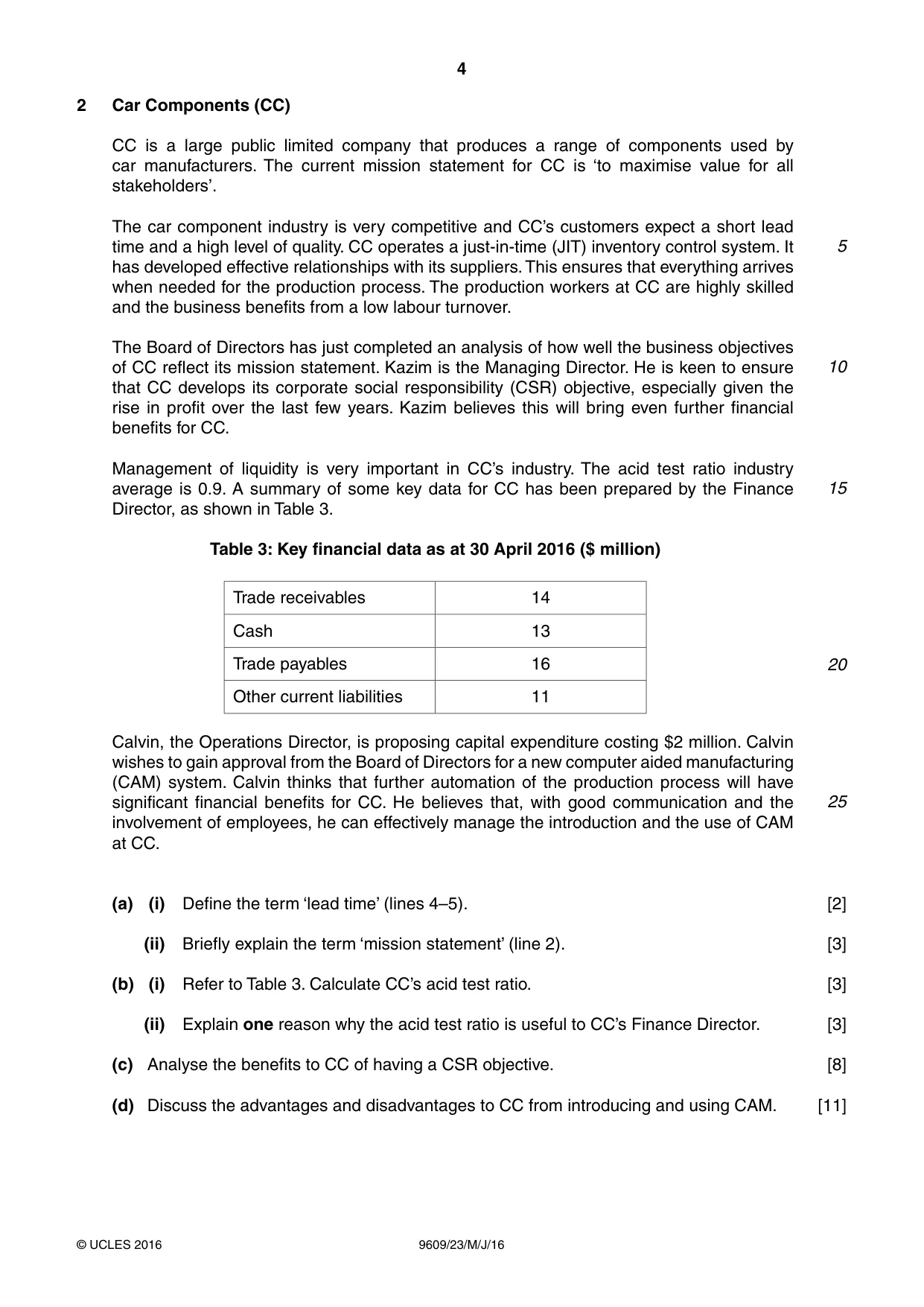
4 9609/23/M/J/16 © UCLES 2016 2 Car Components (CC) CC is a large public limited company that produces a range of components used by car manufacturers. The current mission statement for CC is ‘to maximise value for all stakeholders’. The car component industry is very competitive and CC’s customers expect a short lead time and a high level of quality. CC operates a just-in-time (JIT) inventory control system. It has developed effective relationships with its suppliers. This ensures that everything arrives when needed for the production process. The production workers at CC are highly skilled and the business benefits from a low labour turnover. The Board of Directors has just completed an analysis of how well the business objectives of CC reflect its mission statement. Kazim is the Managing Director. He is keen to ensure that CC develops its corporate social responsibility (CSR) objective, especially given the rise in profit over the last few years. Kazim believes this will bring even further financial benefits for CC. Management of liquidity is very important in CC’s industry. The acid test ratio industry average is 0.9. A summary of some key data for CC has been prepared by the Finance Director, as shown in Table 3. Table 3: Key financial data as at 30 April 2016 ($ million) Trade receivables 14 Cash 13 Trade payables 16 Other current liabilities 11 Calvin, the Operations Director, is proposing capital expenditure costing $2 million. Calvin wishes to gain approval from the Board of Directors for a new computer aided manufacturing (CAM) system. Calvin thinks that further automation of the production process will have significant financial benefits for CC. He believes that, with good communication and the involvement of employees, he can effectively manage the introduction and the use of CAM at CC. (a) (i) Define the term ‘lead time’ (lines 4–5). [2] (ii) Briefly explain the term ‘mission statement’ (line 2). [3] (b) (i) Refer to Table 3. Calculate CC’s acid test ratio. [3] (ii) Explain one reason why the acid test ratio is useful to CC’s Finance Director. [3] (c) Analyse the benefits to CC of having a CSR objective. [8] (d) Discuss the advantages and disadvantages to CC from introducing and using CAM. [11] 5 10 15 20 25
Mark scheme, page 1
® IGCSE is the registered trademark of Cambridge International Examinations. This document consists of 10 printed pages. © UCLES 2016 [Turn over Cambridge International Examinations Cambridge International Advanced Subsidiary and Advanced Level BUSINESS 9609/23 Paper 2 Data Response May/June 2016 MARK SCHEME Maximum Mark: 60 Published This mark scheme is published as an aid to teachers and candidates, to indicate the requirements of the examination. It shows the basis on which Examiners were instructed to award marks. It does not indicate the details of the discussions that took place at an Examiners’ meeting before marking began, which would have considered the acceptability of alternative answers. Mark schemes should be read in conjunction with the question paper and the Principal Examiner Report for Teachers. Cambridge will not enter into discussions about these mark schemes. Cambridge is publishing the mark schemes for the May/June 2016 series for most Cambridge IGCSE®, Cambridge International A and AS Level components and some Cambridge O Level components.
Mark scheme, page 2
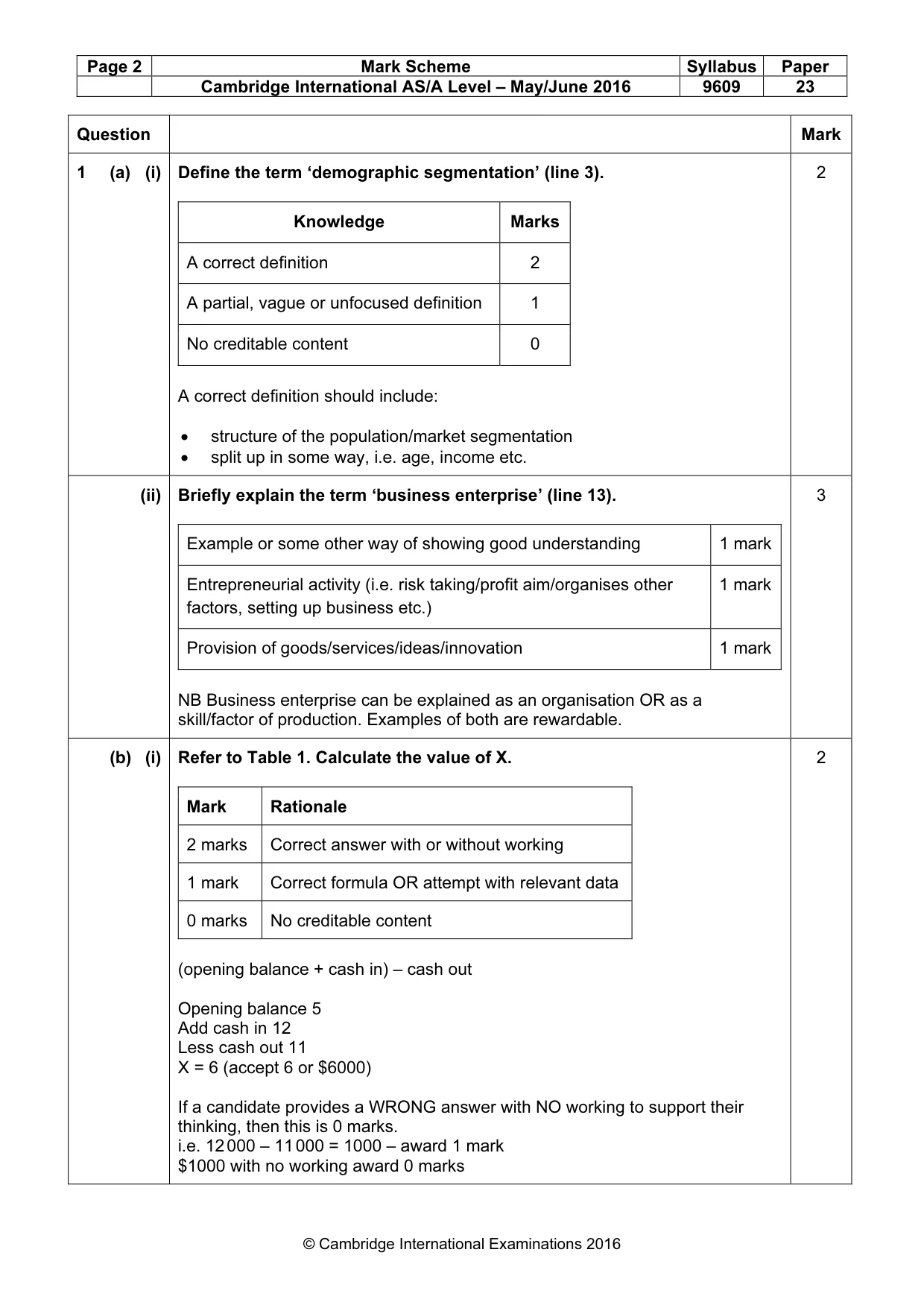
Page 2 Mark Scheme Syllabus Paper Cambridge International AS/A Level – May/June 2016 9609 23 © Cambridge International Examinations 2016 Question Mark 1 (a) (i) Define the term ‘demographic segmentation’ (line 3). Knowledge Marks A correct definition 2 A partial, vague or unfocused definition 1 No creditable content 0 A correct definition should include: • structure of the population/market segmentation • split up in some way, i.e. age, income etc. 2 (ii) Briefly explain the term ‘business enterprise’ (line 13). Example or some other way of showing good understanding 1 mark Entrepreneurial activity (i.e. risk taking/profit aim/organises other factors, setting up business etc.) 1 mark Provision of goods/services/ideas/innovation 1 mark NB Business enterprise can be explained as an organisation OR as a skill/factor of production. Examples of both are rewardable. 3 (b) (i) Refer to Table 1. Calculate the value of X. Mark Rationale 2 marks Correct answer with or without working 1 mark Correct formula OR attempt with relevant data 0 marks No creditable content (opening balance + cash in) – cash out Opening balance 5 Add cash in 12 Less cash out 11 X = 6 (accept 6 or $6000) If a candidate provides a WRONG answer with NO working to support their thinking, then this is 0 marks. i.e. 12 000 – 11 000 = 1000 – award 1 mark $1000 with no working award 0 marks 2
Mark scheme, page 3
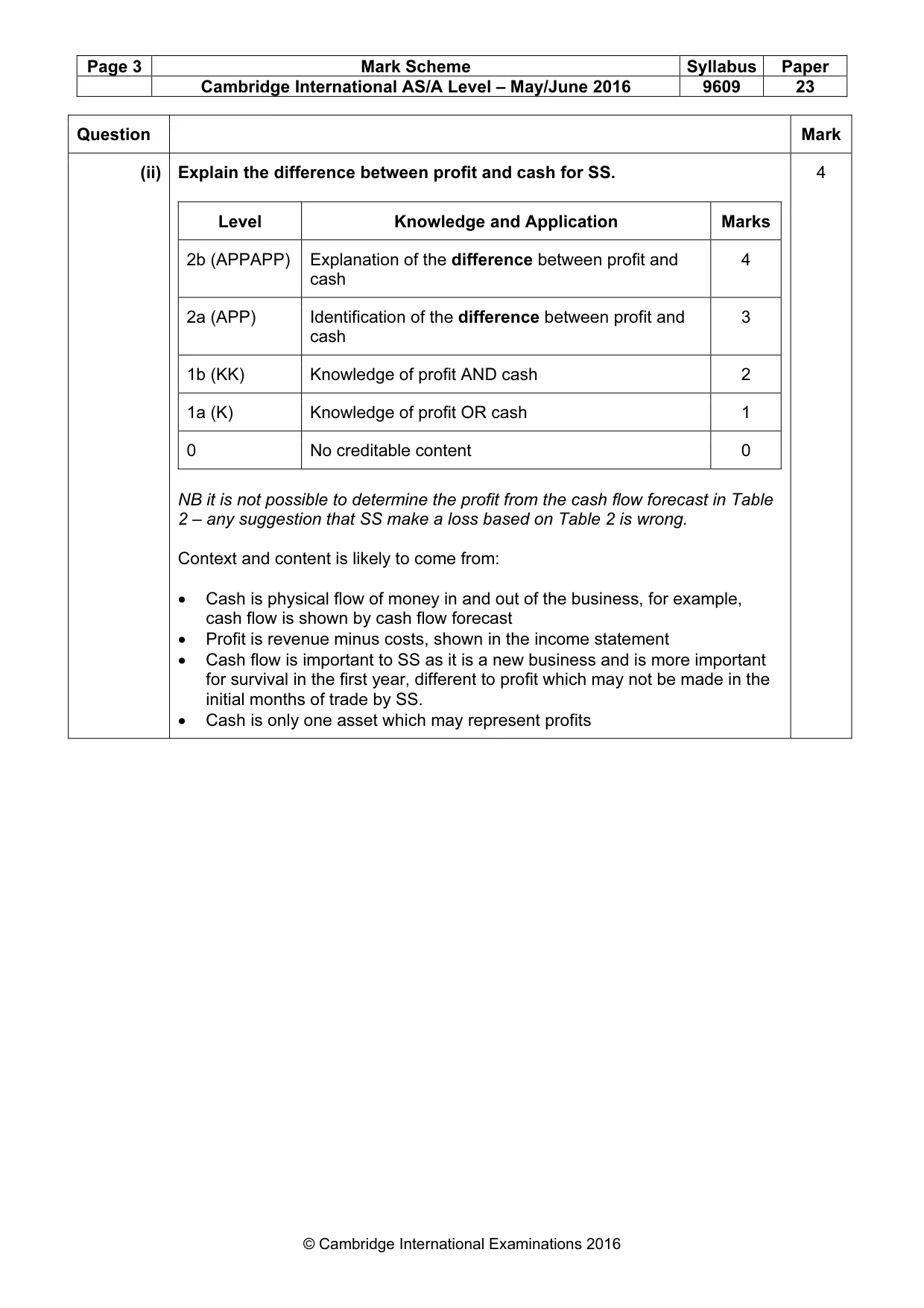
Page 3 Mark Scheme Syllabus Paper Cambridge International AS/A Level – May/June 2016 9609 23 © Cambridge International Examinations 2016 Question Mark (ii) Explain the difference between profit and cash for SS. Level Knowledge and Application Marks 2b (APPAPP) Explanation of the difference between profit and cash 4 2a (APP) Identification of the difference between profit and cash 3 1b (KK) Knowledge of profit AND cash 2 1a (K) Knowledge of profit OR cash 1 0 No creditable content 0 NB it is not possible to determine the profit from the cash flow forecast in Table 2 – any suggestion that SS make a loss based on Table 2 is wrong. Context and content is likely to come from: • Cash is physical flow of money in and out of the business, for example, cash flow is shown by cash flow forecast • Profit is revenue minus costs, shown in the income statement • Cash flow is important to SS as it is a new business and is more important for survival in the first year, different to profit which may not be made in the initial months of trade by SS. • Cash is only one asset which may represent profits 4
Mark scheme, page 4
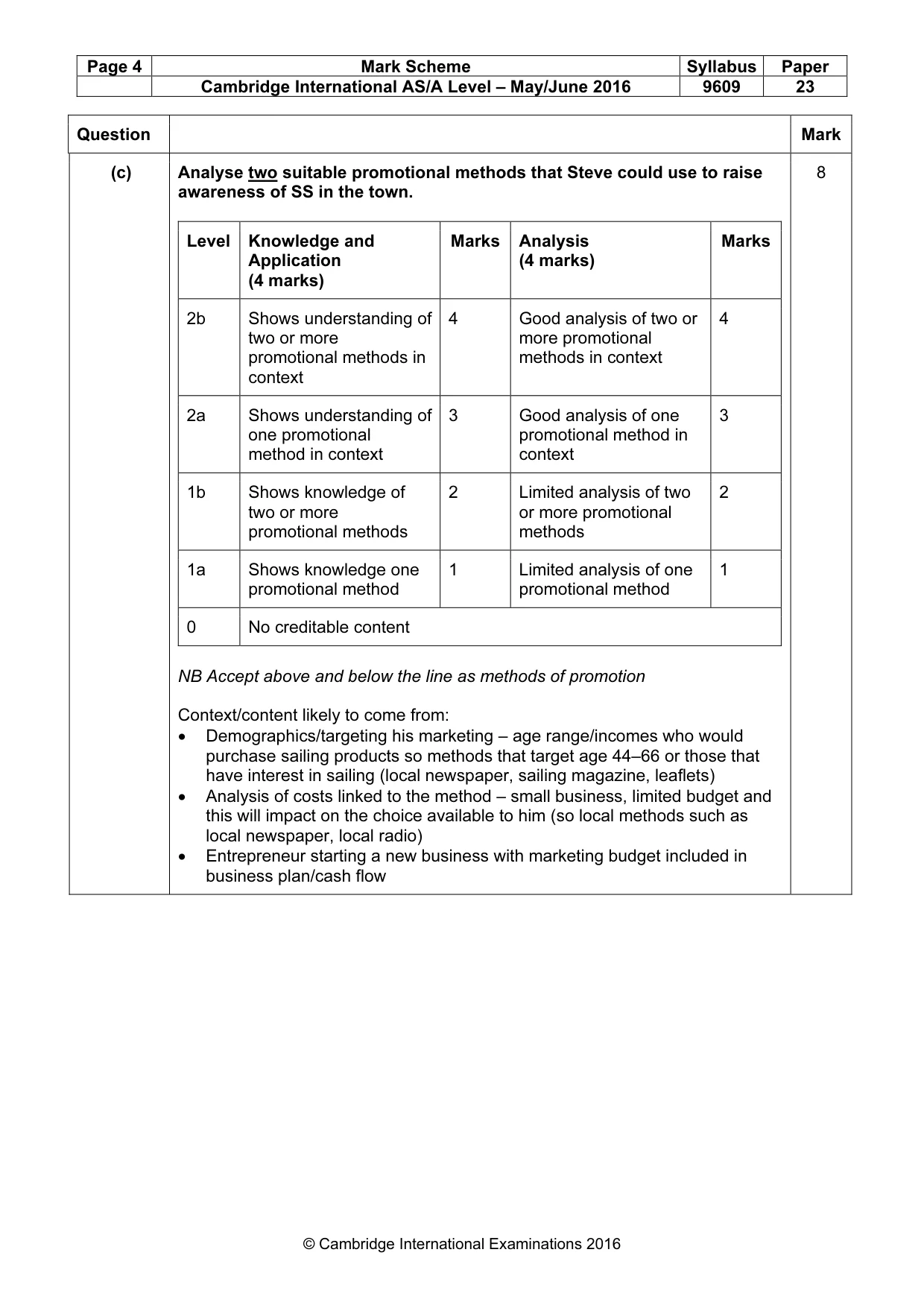
Page 4 Mark Scheme Syllabus Paper Cambridge International AS/A Level – May/June 2016 9609 23 © Cambridge International Examinations 2016 Question Mark (c) Analyse two suitable promotional methods that Steve could use to raise awareness of SS in the town. Level Knowledge and Application (4 marks) Marks Analysis (4 marks) Marks 2b Shows understanding of two or more promotional methods in context 4 Good analysis of two or more promotional methods in context 4 2a Shows understanding of one promotional method in context 3 Good analysis of one promotional method in context 3 1b Shows knowledge of two or more promotional methods 2 Limited analysis of two or more promotional methods 2 1a Shows knowledge one promotional method 1 Limited analysis of one promotional method 1 0 No creditable content NB Accept above and below the line as methods of promotion Context/content likely to come from: • Demographics/targeting his marketing – age range/incomes who would purchase sailing products so methods that target age 44–66 or those that have interest in sailing (local newspaper, sailing magazine, leaflets) • Analysis of costs linked to the method – small business, limited budget and this will impact on the choice available to him (so local methods such as local newspaper, local radio) • Entrepreneur starting a new business with marketing budget included in business plan/cash flow 8
Mark scheme, page 5
Page 5 Mark Scheme Syllabus Paper Cambridge International AS/A Level – May/June 2016 9609 23 © Cambridge International Examinations 2016 Question Mark (d) Discuss the usefulness to Steve of producing the cash flow forecast in Table 2. Knowledge and Application (4 marks) Marks Analysis and Evaluation (7 marks) Marks Justified judgement(s) that follow on from an argument of two or more uses of cash flow forecasts in context 7 Judgement(s) that follow on from an argument of two or more uses of cash flow forecasts in context 6 A balanced argument (two sided) based on one use of cash flow forecasts in context 5 Shows understanding of two or more uses of cash flow forecasts in context 4 Argument based on the usefulness of two or more uses of cash flow forecasts in context 4 Shows understanding of one use of cash flow forecasts in context 3 Argument based on the usefulness of one use of cash flow forecasts in context 3 Shows knowledge of usefulness of cash flow forecasts 2 Limited analysis of two or more uses of cash flow forecasts 2 Shows knowledge of cash flow forecasts 1 Limited analysis of one use of cash flow forecasts 1 No creditable content Context/content likely to come from: • SS is a new business and looking for a grant, having a cash-flow forecast will be required to earn the grant (strong business plan in the case study) • Allows Steve to plan ahead and manage the budget more effectively e.g., the deficit in the first few months • Many small businesses fail due to a lack of cash flow so this allows Steve to plan and, for example, arrange an overdraft in Months 2–4 • Allows Steve to manage cash flow, e.g. it can be seen the deficit in Months 2, 3 and 4 could be overcome from reductions in cash out i.e. marketing. • May not be useful if forecast is not researched properly to ensure the figures are as accurate as possible, particularly revenue expected from customers in the first six months. 11
Mark scheme, page 6
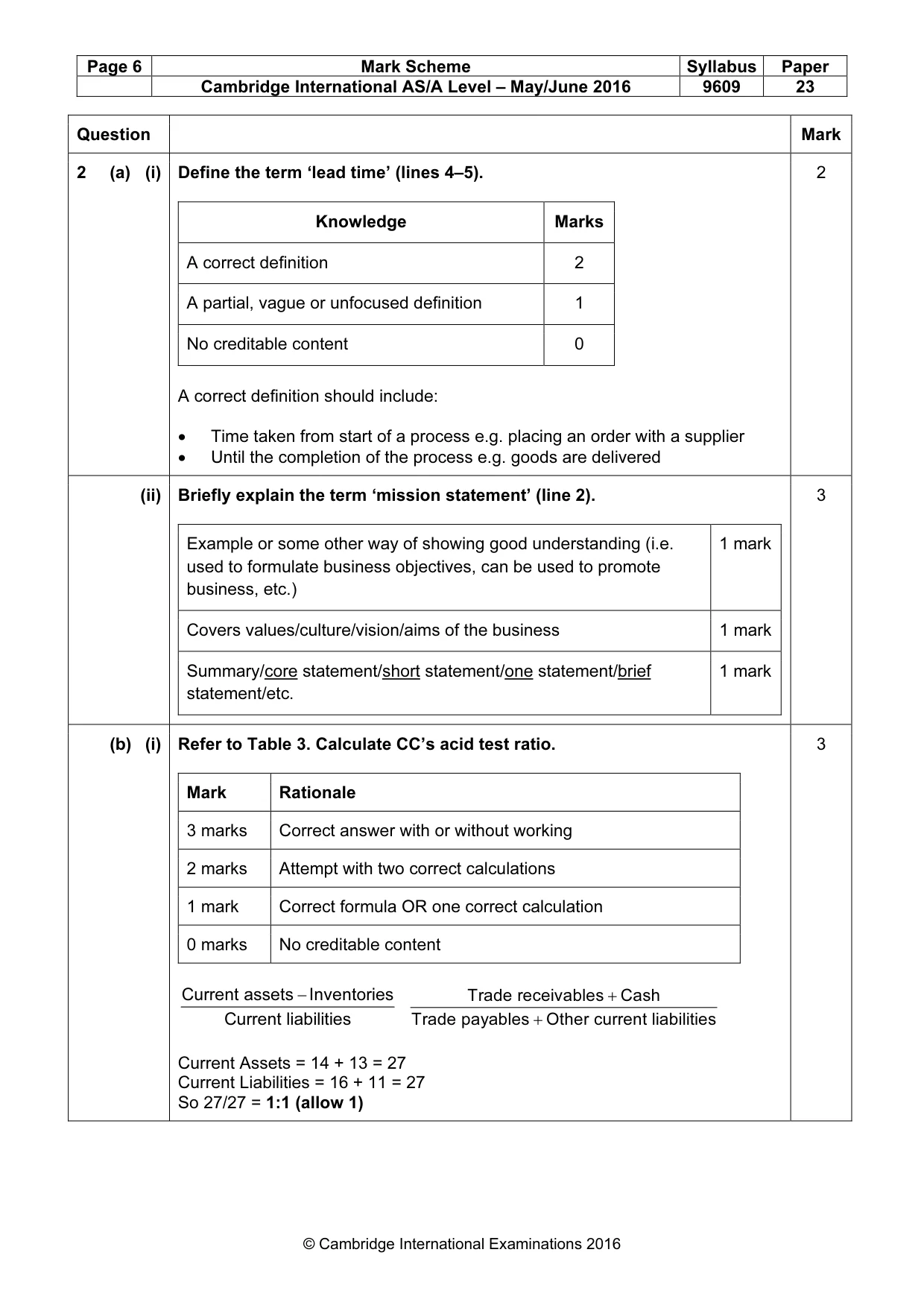
Page 6 Mark Scheme Syllabus Paper Cambridge International AS/A Level – May/June 2016 9609 23 © Cambridge International Examinations 2016 Question Mark 2 (a) (i) Define the term ‘lead time’ (lines 4–5). Knowledge Marks A correct definition 2 A partial, vague or unfocused definition 1 No creditable content 0 A correct definition should include: • Time taken from start of a process e.g. placing an order with a supplier • Until the completion of the process e.g. goods are delivered 2 (ii) Briefly explain the term ‘mission statement’ (line 2). Example or some other way of showing good understanding (i.e. used to formulate business objectives, can be used to promote business, etc.) 1 mark Covers values/culture/vision/aims of the business 1 mark Summary/core statement/short statement/one statement/brief statement/etc. 1 mark 3 (b) (i) Refer to Table 3. Calculate CC’s acid test ratio. Mark Rationale 3 marks Correct answer with or without working 2 marks Attempt with two correct calculations 1 mark Correct formula OR one correct calculation 0 marks No creditable content − Current assets Inventories Current liabilities Trade receivables Cash Trade payables Other current liabilities + + Current Assets = 14 + 13 = 27 Current Liabilities = 16 + 11 = 27 So 27/27 = 1:1 (allow 1) 3
Mark scheme, page 7
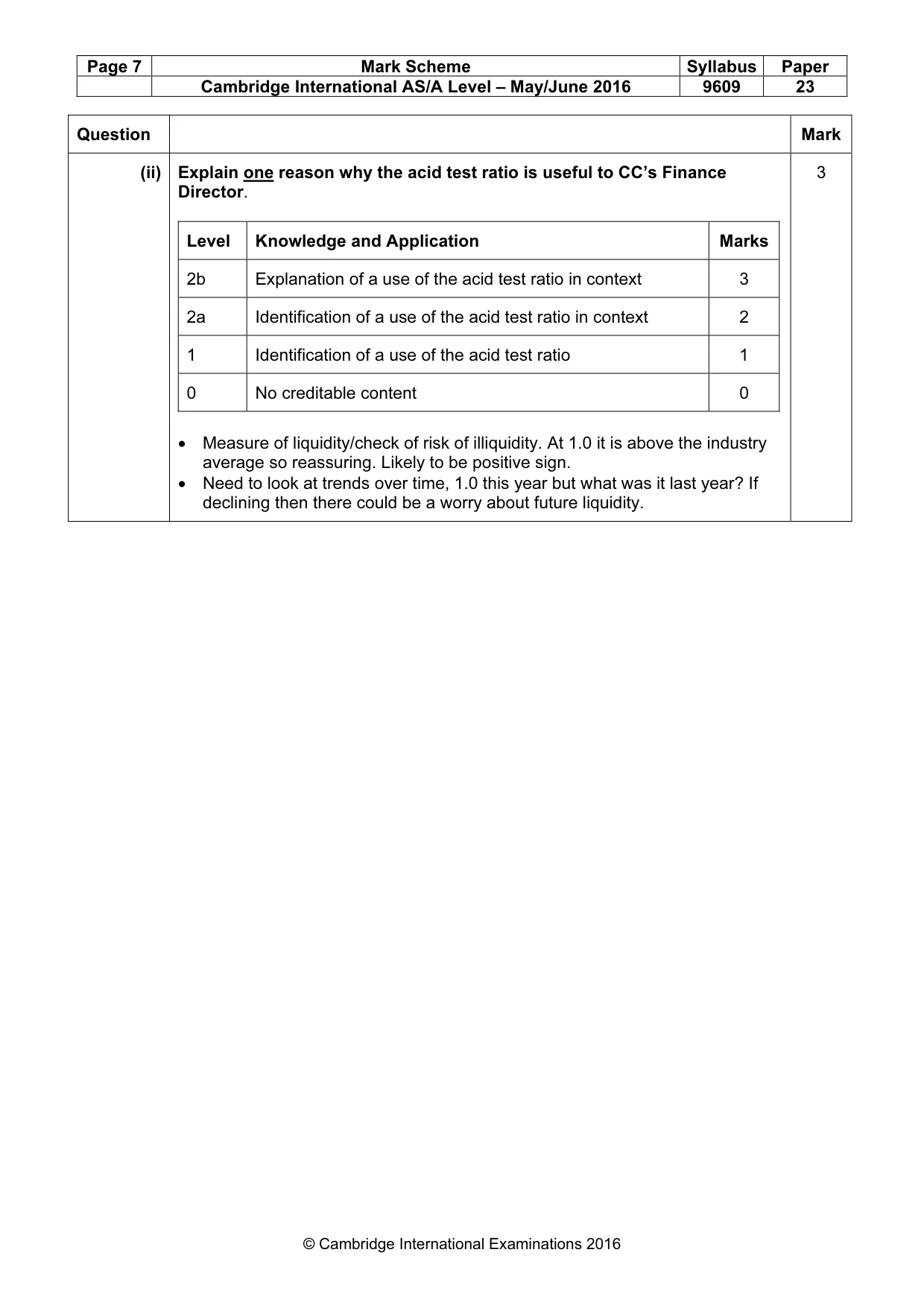
Page 7 Mark Scheme Syllabus Paper Cambridge International AS/A Level – May/June 2016 9609 23 © Cambridge International Examinations 2016 Question Mark (ii) Explain one reason why the acid test ratio is useful to CC’s Finance Director. Level Knowledge and Application Marks 2b Explanation of a use of the acid test ratio in context 3 2a Identification of a use of the acid test ratio in context 2 1 Identification of a use of the acid test ratio 1 0 No creditable content 0 • Measure of liquidity/check of risk of illiquidity. At 1.0 it is above the industry average so reassuring. Likely to be positive sign. • Need to look at trends over time, 1.0 this year but what was it last year? If declining then there could be a worry about future liquidity. 3
Mark scheme, page 8
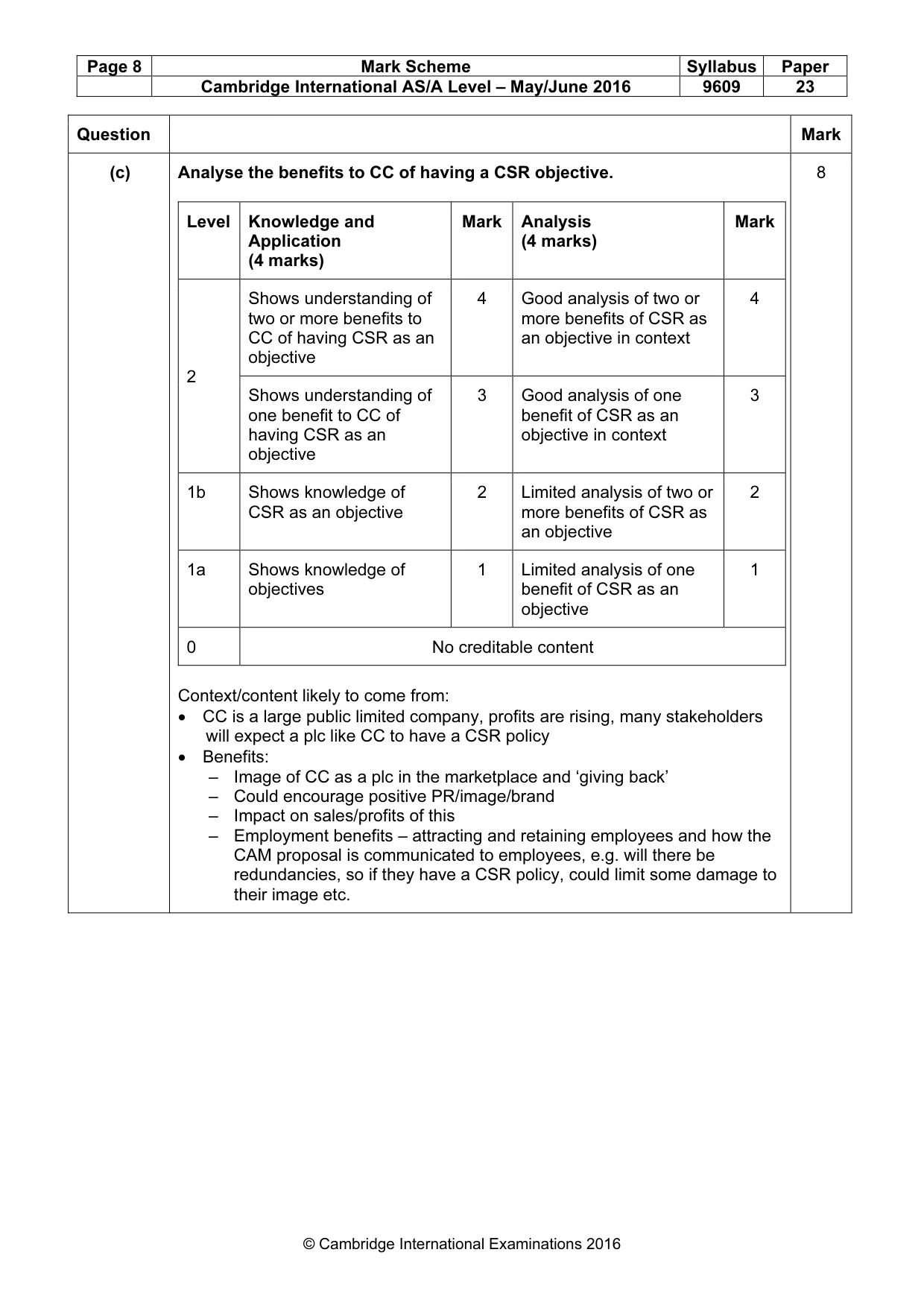
Page 8 Mark Scheme Syllabus Paper Cambridge International AS/A Level – May/June 2016 9609 23 © Cambridge International Examinations 2016 Question Mark (c) Analyse the benefits to CC of having a CSR objective. Level Knowledge and Application (4 marks) Mark Analysis (4 marks) Mark 2 Shows understanding of two or more benefits to CC of having CSR as an objective 4 Good analysis of two or more benefits of CSR as an objective in context 4 Shows understanding of one benefit to CC of having CSR as an objective 3 Good analysis of one benefit of CSR as an objective in context 3 1b Shows knowledge of CSR as an objective 2 Limited analysis of two or more benefits of CSR as an objective 2 1a Shows knowledge of objectives 1 Limited analysis of one benefit of CSR as an objective 1 0 No creditable content Context/content likely to come from: • CC is a large public limited company, profits are rising, many stakeholders will expect a plc like CC to have a CSR policy • Benefits: – Image of CC as a plc in the marketplace and ‘giving back’ – Could encourage positive PR/image/brand – Impact on sales/profits of this – Employment benefits – attracting and retaining employees and how the CAM proposal is communicated to employees, e.g. will there be redundancies, so if they have a CSR policy, could limit some damage to their image etc. 8
Mark scheme, page 9
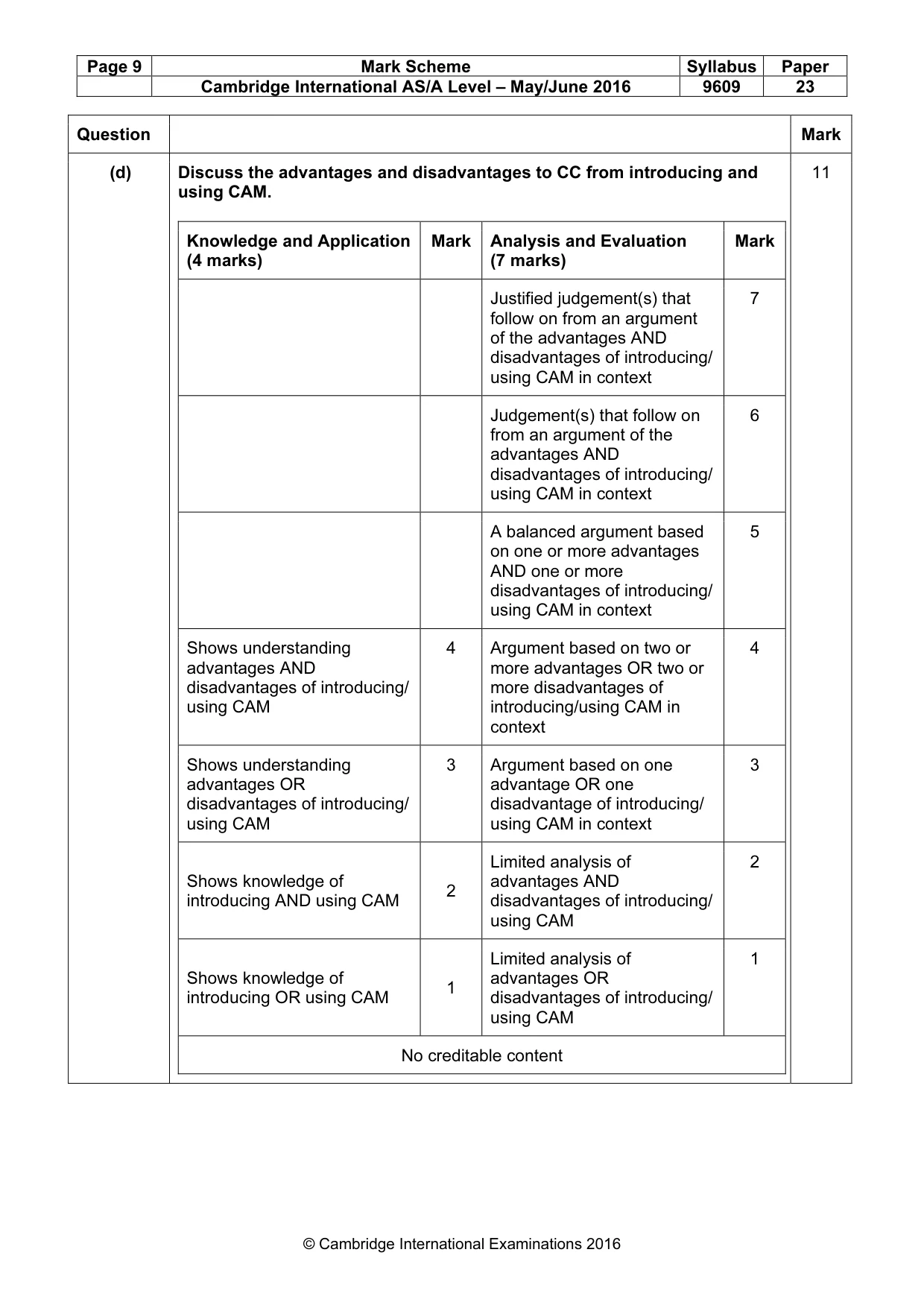
Page 9 Mark Scheme Syllabus Paper Cambridge International AS/A Level – May/June 2016 9609 23 © Cambridge International Examinations 2016 Question Mark (d) Discuss the advantages and disadvantages to CC from introducing and using CAM. Knowledge and Application (4 marks) Mark Analysis and Evaluation (7 marks) Mark Justified judgement(s) that follow on from an argument of the advantages AND disadvantages of introducing/ using CAM in context 7 Judgement(s) that follow on from an argument of the advantages AND disadvantages of introducing/ using CAM in context 6 A balanced argument based on one or more advantages AND one or more disadvantages of introducing/ using CAM in context 5 Shows understanding advantages AND disadvantages of introducing/ using CAM 4 Argument based on two or more advantages OR two or more disadvantages of introducing/using CAM in context 4 Shows understanding advantages OR disadvantages of introducing/ using CAM 3 Argument based on one advantage OR one disadvantage of introducing/ using CAM in context 3 Shows knowledge of introducing AND using CAM 2 Limited analysis of advantages AND disadvantages of introducing/ using CAM 2 Shows knowledge of introducing OR using CAM 1 Limited analysis of advantages OR disadvantages of introducing/ using CAM 1 No creditable content 11
Mark scheme, page 10
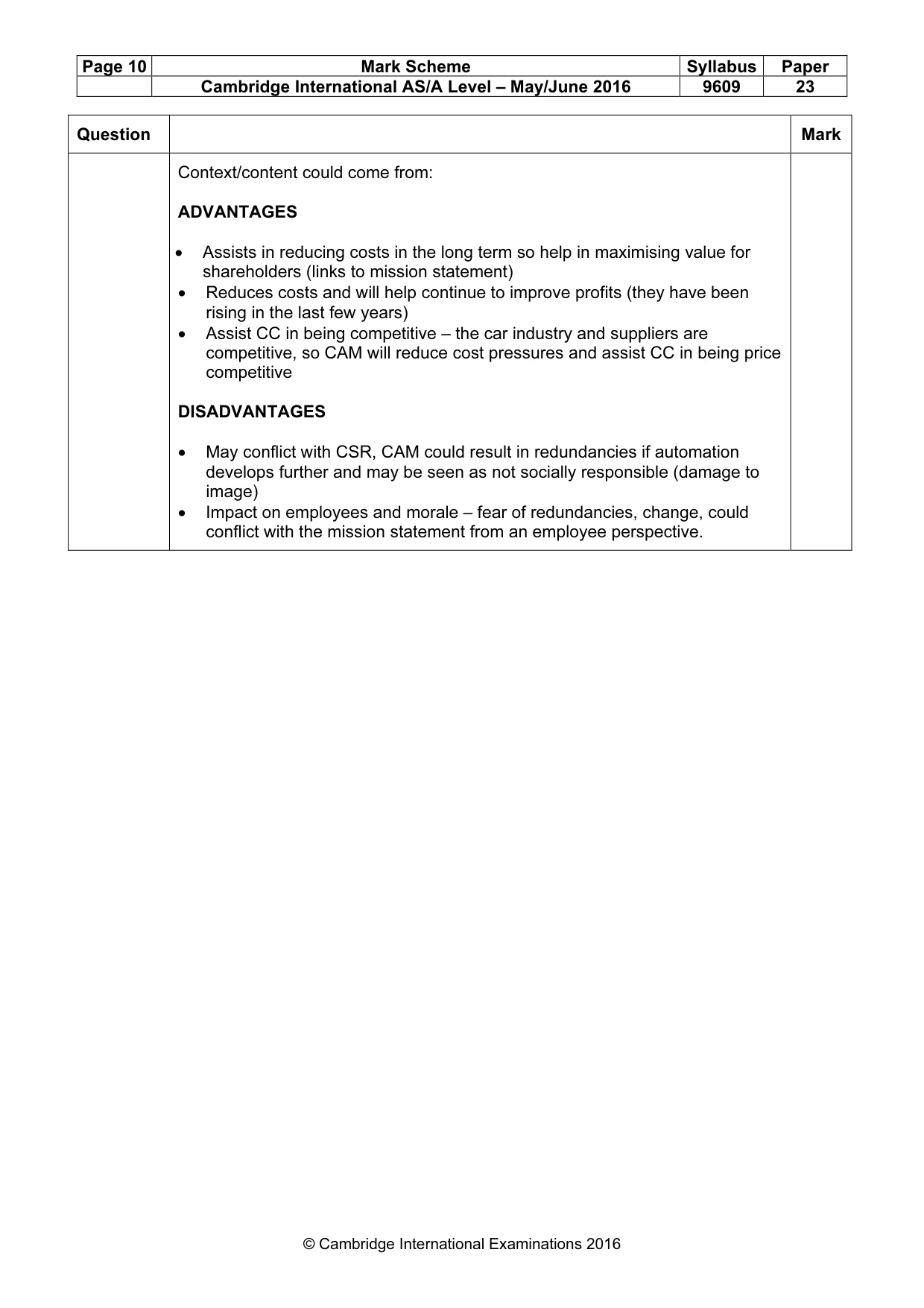
Page 10 Mark Scheme Syllabus Paper Cambridge International AS/A Level – May/June 2016 9609 23 © Cambridge International Examinations 2016 Question Mark Context/content could come from: ADVANTAGES • Assists in reducing costs in the long term so help in maximising value for shareholders (links to mission statement) • Reduces costs and will help continue to improve profits (they have been rising in the last few years) • Assist CC in being competitive – the car industry and suppliers are competitive, so CAM will reduce cost pressures and assist CC in being price competitive DISADVANTAGES • May conflict with CSR, CAM could result in redundancies if automation develops further and may be seen as not socially responsible (damage to image) • Impact on employees and morale – fear of redundancies, change, could conflict with the mission statement from an employee perspective.
What you needed in this session
Cambridge’s own grade thresholds for 2016 May/June, Paper 2 · Variant 3. A higher threshold means an easier paper — the bar moves with how the cohort did.