Cambridge A Level Business (for first examination in 2016) 9609 — 2016 May/June Paper 2 · Variant 1
9609/21/M/J/16 · 60 marks · ≈68 min
The question paper and its mark scheme, free to read here and free to download. This is Cambridge’s own paper, exactly as it was sat.
Question paper4 pages

Mark scheme9 pages
Answers below. Sit the paper first if you are practising.
Paper as text
Question paper, page 1
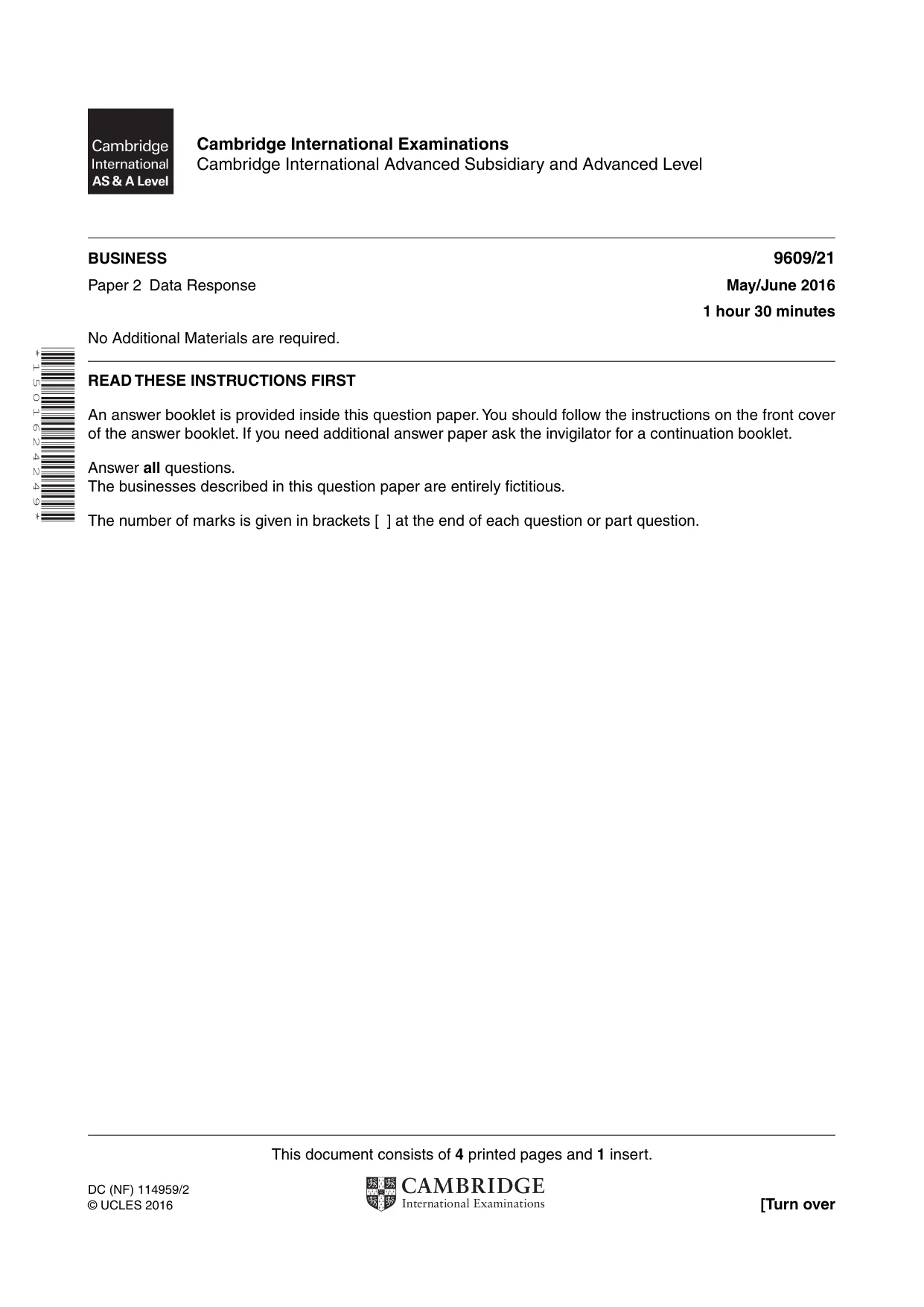
This document consists of 4 printed pages and 1 insert. DC (NF) 114959/2 © UCLES 2016 [Turn over Cambridge International Examinations Cambridge International Advanced Subsidiary and Advanced Level * 1 5 0 1 6 2 4 2 4 9 * BUSINESS 9609/21 Paper 2 Data Response May/June 2016 1 hour 30 minutes No Additional Materials are required. READ THESE INSTRUCTIONS FIRST An answer booklet is provided inside this question paper. You should follow the instructions on the front cover of the answer booklet. If you need additional answer paper ask the invigilator for a continuation booklet. Answer all questions. The businesses described in this question paper are entirely fictitious. The number of marks is given in brackets [ ] at the end of each question or part question.
Question paper, page 2
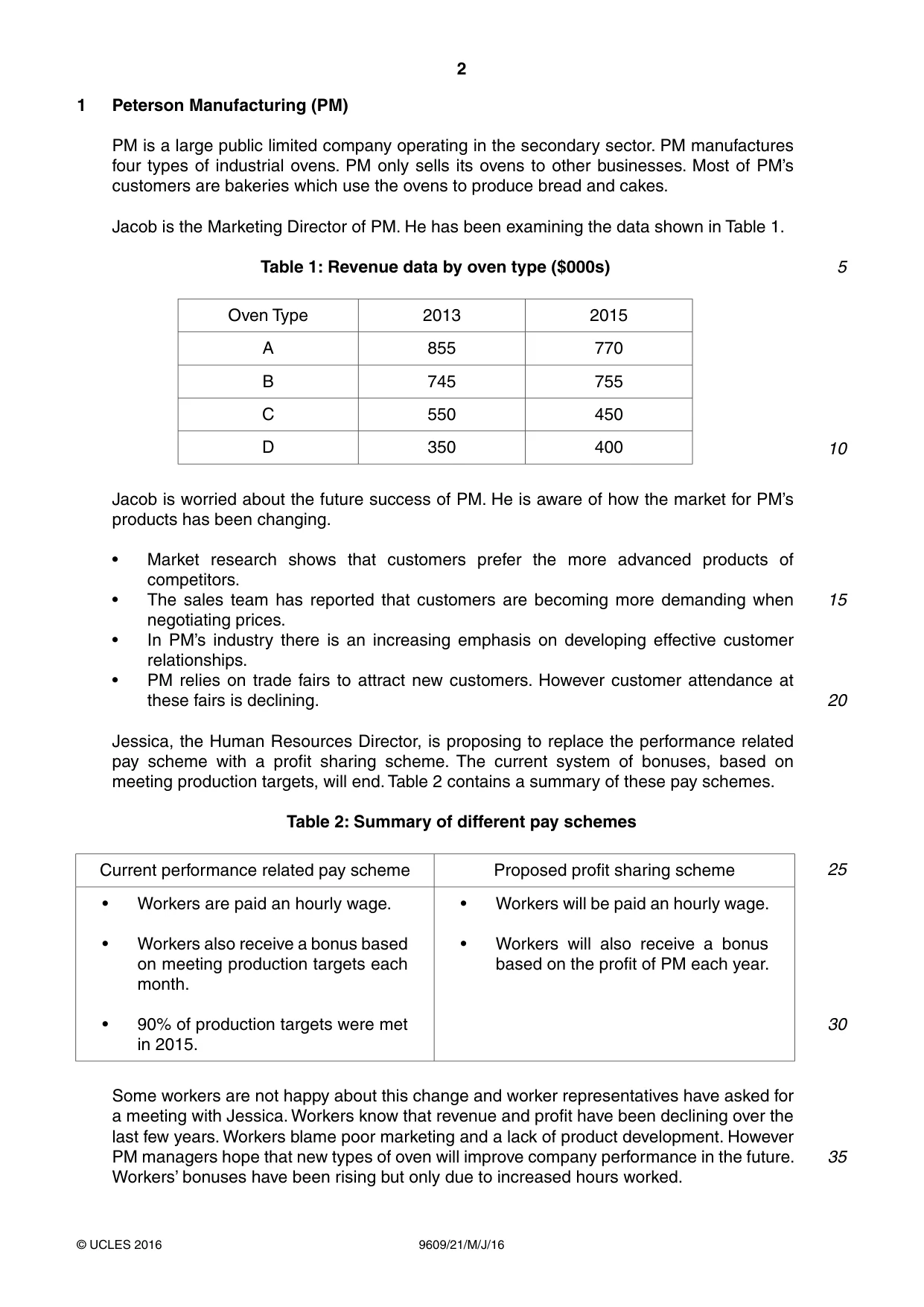
2 9609/21/M/J/16 © UCLES 2016 1 Peterson Manufacturing (PM) PM is a large public limited company operating in the secondary sector. PM manufactures four types of industrial ovens. PM only sells its ovens to other businesses. Most of PM’s customers are bakeries which use the ovens to produce bread and cakes. Jacob is the Marketing Director of PM. He has been examining the data shown in Table 1. Table 1: Revenue data by oven type ($000s) Oven Type 2013 2015 A 855 770 B 745 755 C 550 450 D 350 400 Jacob is worried about the future success of PM. He is aware of how the market for PM’s products has been changing. • Market research shows that customers prefer the more advanced products of competitors. • The sales team has reported that customers are becoming more demanding when negotiating prices. • In PM’s industry there is an increasing emphasis on developing effective customer relationships. • PM relies on trade fairs to attract new customers. However customer attendance at these fairs is declining. Jessica, the Human Resources Director, is proposing to replace the performance related pay scheme with a profit sharing scheme. The current system of bonuses, based on meeting production targets, will end. Table 2 contains a summary of these pay schemes. Table 2: Summary of different pay schemes Current performance related pay scheme Proposed profit sharing scheme • Workers are paid an hourly wage. • Workers also receive a bonus based on meeting production targets each month. • 90% of production targets were met in 2015. • Workers will be paid an hourly wage. • Workers will also receive a bonus based on the profit of PM each year. Some workers are not happy about this change and worker representatives have asked for a meeting with Jessica. Workers know that revenue and profit have been declining over the last few years. Workers blame poor marketing and a lack of product development. However PM managers hope that new types of oven will improve company performance in the future. Workers’ bonuses have been rising but only due to increased hours worked. 5 10 15 20 25 30 35
Question paper, page 3
3 9609/21/M/J/16 © UCLES 2016 [Turn over (a) (i) Define the term ‘public limited company’ (line 1). [2] (ii) Briefly explain the term ‘worker representatives’ (line 32). [3] (b) (i) Refer to Table 1. Calculate the percentage decrease in total revenue between 2013 and 2015. [3] (ii) Briefly explain one likely effect on PM of this decrease in total revenue. [3] (c) Analyse how PM could use the 4Cs to improve its customer relationships. [8] (d) Discuss the advantages a nd disadvantages to PM’s employees of the change from performance related pay to a profit sharing scheme. [11]
Question paper, page 4
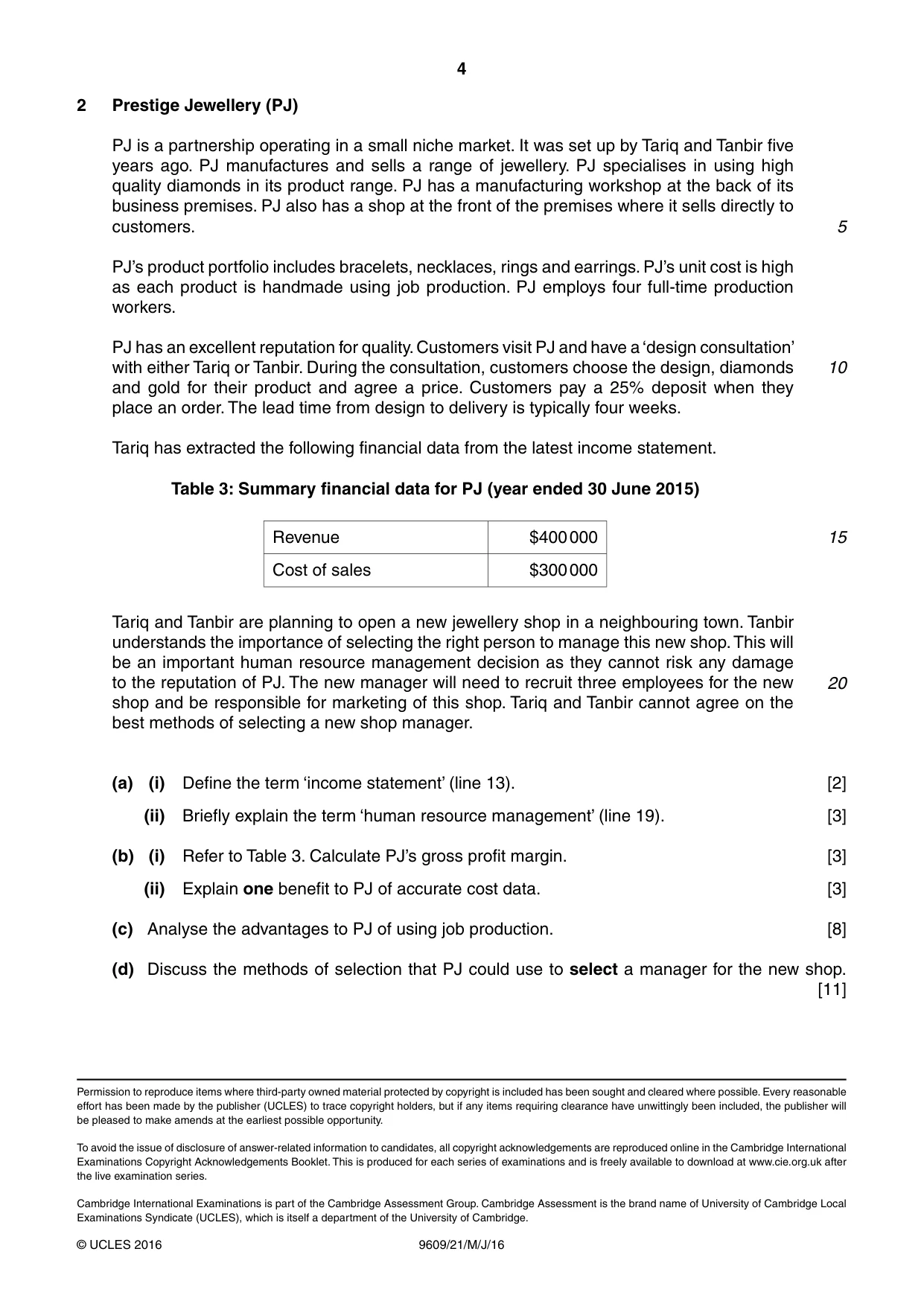
4 9609/21/M/J/16 © UCLES 2016 2 Prestige Jewellery (PJ) PJ is a partnership operating in a small niche market. It was set up by Tariq and Tanbir five years ago. PJ manufactures and sells a range of jewellery. PJ specialises in using high quality diamonds in its product range. PJ has a manufacturing workshop at the back of its business premises. PJ also has a shop at the front of the premises where it sells directly to customers. PJ’s product portfolio includes bracelets, necklaces, rings and earrings. PJ’s unit cost is high as each product is handmade using job production. PJ employs four full-time production workers. PJ has an excellent reputation for quality. Customers visit PJ and have a ‘design consultation’ with either Tariq or Tanbir. During the consultation, customers choose the design, diamonds and gold for their product and agree a price. Customers pay a 25% deposit when they place an order. The lead time from design to delivery is typically four weeks. Tariq has extracted the following financial data from the latest income statement. Table 3: Summary financial data for PJ (year ended 30 June 2015) Revenue $400 000 Cost of sales $300 000 Tariq and Tanbir are planning to open a new jewellery shop in a neighbouring town. Tanbir understands the importance of selecting the right person to manage this new shop. This will be an important human resource management decision as they cannot risk any damage to the reputation of PJ. The new manager will need to recruit three employees for the new shop and be responsible for marketing of this shop. Tariq and Tanbir cannot agree on the best methods of selecting a new shop manager. (a) (i) Define the term ‘income statement’ (line 13). [2] (ii) Briefly explain the term ‘human resource management’ (line 19). [3] (b) (i) Refer to Table 3. Calculate PJ’s gross profit margin. [3] (ii) Explain one benefit to PJ of accurate cost data. [3] (c) Analyse the advantages to PJ of using job production. [8] (d) Discuss the methods of selection that PJ could use to select a manager for the new shop. [11] Permission to reproduce items where third-party owned material protected by copyright is included has been sought and cleared where possible. Every reasonable effort has been made by the publisher (UCLES) to trace copyright holders, but if any items requiring clearance have unwittingly been included, the publisher will be pleased to make amends at the earliest possible opportunity. To avoid the issue of disclosure of answer-related information to candidates, all copyright acknowledgements are reproduced online in the Cambridge International Examinations Copyright Acknowledgements Booklet. This is produced for each series of examinations and is freely available to download at www.cie.org.uk after the live examination series. Cambridge International Examinations is part of the Cambridge Assessment Group. Cambridge Assessment is the brand name of University of Cambridge Local Examinations Syndicate (UCLES), which is itself a department of the University of Cambridge. 5 10 15 20
Mark scheme, page 1
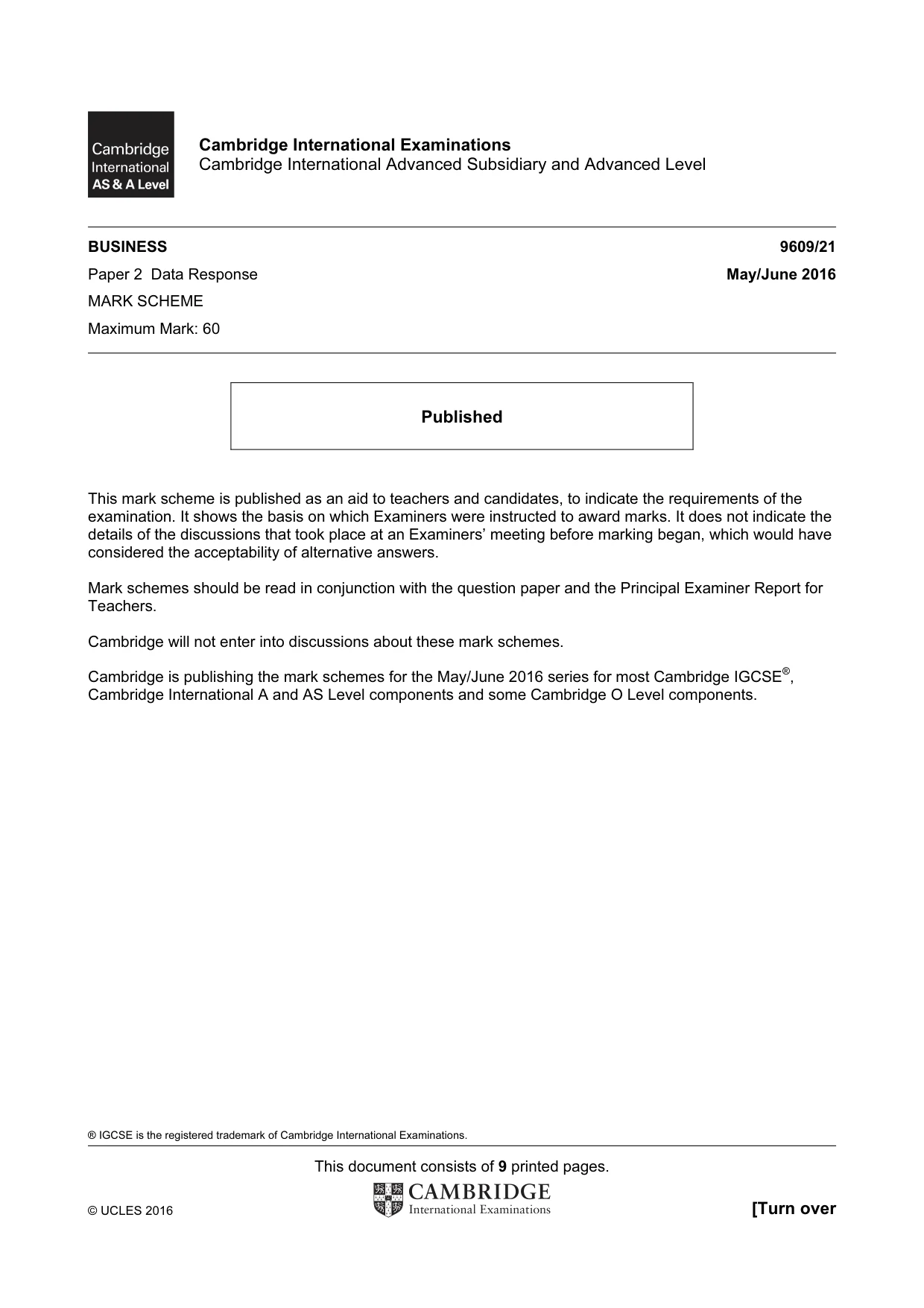
® IGCSE is the registered trademark of Cambridge International Examinations. This document consists of 9 printed pages. © UCLES 2016 [Turn over Cambridge International Examinations Cambridge International Advanced Subsidiary and Advanced Level BUSINESS 9609/21 Paper 2 Data Response May/June 2016 MARK SCHEME Maximum Mark: 60 Published This mark scheme is published as an aid to teachers and candidates, to indicate the requirements of the examination. It shows the basis on which Examiners were instructed to award marks. It does not indicate the details of the discussions that took place at an Examiners’ meeting before marking began, which would have considered the acceptability of alternative answers. Mark schemes should be read in conjunction with the question paper and the Principal Examiner Report for Teachers. Cambridge will not enter into discussions about these mark schemes. Cambridge is publishing the mark schemes for the May/June 2016 series for most Cambridge IGCSE®, Cambridge International A and AS Level components and some Cambridge O Level components.
Mark scheme, page 2
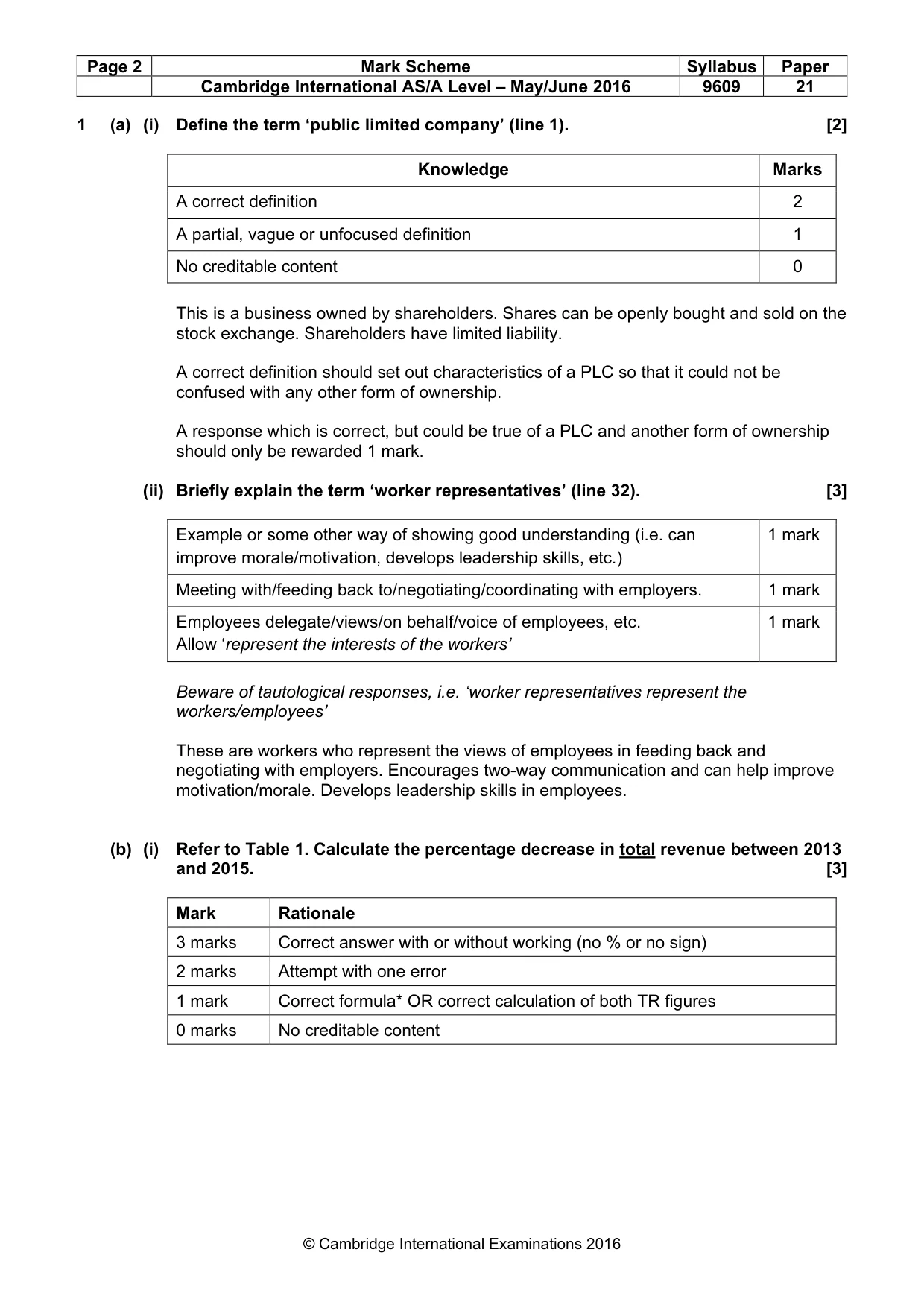
Page 2 Mark Scheme Syllabus Paper Cambridge International AS/A Level – May/June 2016 9609 21 © Cambridge International Examinations 2016 1 (a) (i) Define the term ‘public limited company’ (line 1). [2] Knowledge Marks A correct definition 2 A partial, vague or unfocused definition 1 No creditable content 0 This is a business owned by shareholders. Shares can be openly bought and sold on the stock exchange. Shareholders have limited liability. A correct definition should set out characteristics of a PLC so that it could not be confused with any other form of ownership. A response which is correct, but could be true of a PLC and another form of ownership should only be rewarded 1 mark. (ii) Briefly explain the term ‘worker representatives’ (line 32). [3] Example or some other way of showing good understanding (i.e. can improve morale/motivation, develops leadership skills, etc.) 1 mark Meeting with/feeding back to/negotiating/coordinating with employers. 1 mark Employees delegate/views/on behalf/voice of employees, etc. Allow ‘represent the interests of the workers’ 1 mark Beware of tautological responses, i.e. ‘worker representatives represent the workers/employees’ These are workers who represent the views of employees in feeding back and negotiating with employers. Encourages two-way communication and can help improve motivation/morale. Develops leadership skills in employees. (b) (i) Refer to Table 1. Calculate the percentage decrease in total revenue between 2013 and 2015. [3] Mark Rationale 3 marks Correct answer with or without working (no % or no sign) 2 marks Attempt with one error 1 mark Correct formula* OR correct calculation of both TR figures 0 marks No creditable content
Mark scheme, page 3
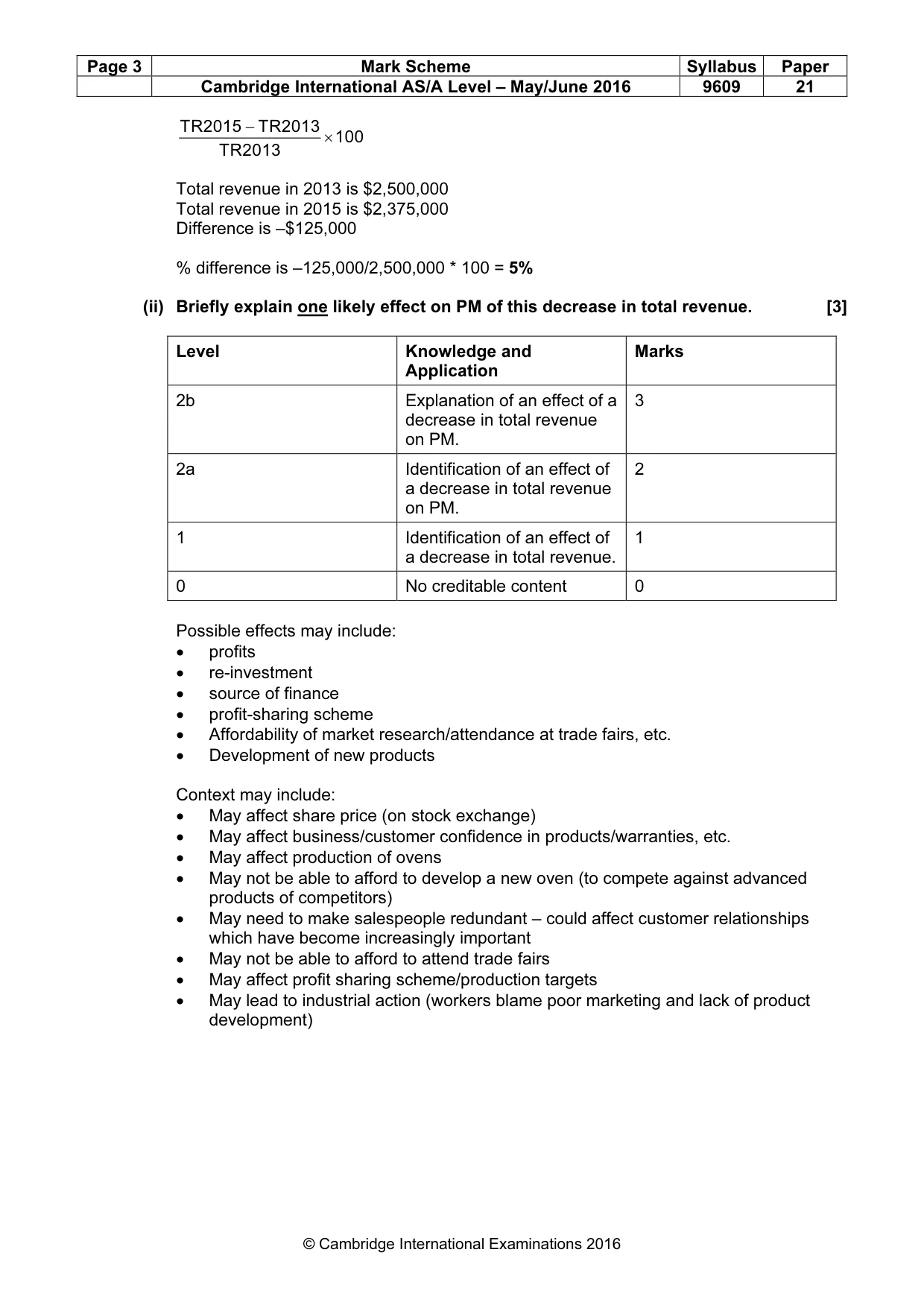
Page 3 Mark Scheme Syllabus Paper Cambridge International AS/A Level – May/June 2016 9609 21 © Cambridge International Examinations 2016 TR2015 TR2013 100 TR2013 − × Total revenue in 2013 is $2,500,000 Total revenue in 2015 is $2,375,000 Difference is –$125,000 % difference is –125,000/2,500,000 * 100 = 5% (ii) Briefly explain one likely effect on PM of this decrease in total revenue. [3] Level Knowledge and Application Marks 2b Explanation of an effect of a decrease in total revenue on PM. 3 2a Identification of an effect of a decrease in total revenue on PM. 2 1 Identification of an effect of a decrease in total revenue. 1 0 No creditable content 0 Possible effects may include: • profits • re-investment • source of finance • profit-sharing scheme • Affordability of market research/attendance at trade fairs, etc. • Development of new products Context may include: • May affect share price (on stock exchange) • May affect business/customer confidence in products/warranties, etc. • May affect production of ovens • May not be able to afford to develop a new oven (to compete against advanced products of competitors) • May need to make salespeople redundant – could affect customer relationships which have become increasingly important • May not be able to afford to attend trade fairs • May affect profit sharing scheme/production targets • May lead to industrial action (workers blame poor marketing and lack of product development)
Mark scheme, page 4
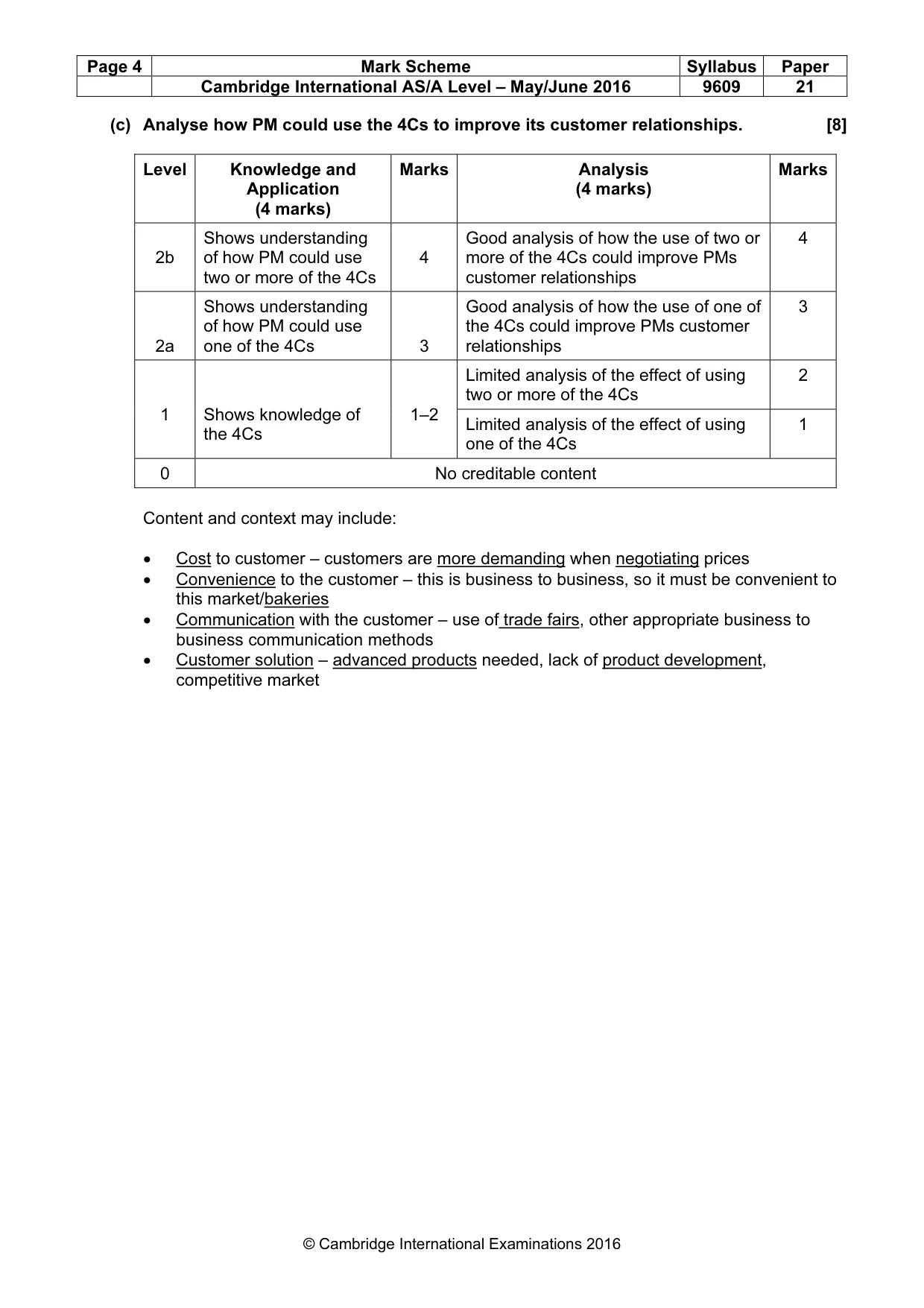
Page 4 Mark Scheme Syllabus Paper Cambridge International AS/A Level – May/June 2016 9609 21 © Cambridge International Examinations 2016 (c) Analyse how PM could use the 4Cs to improve its customer relationships. [8] Level Knowledge and Application (4 marks) Marks Analysis (4 marks) Marks 2b Shows understanding of how PM could use two or more of the 4Cs 4 Good analysis of how the use of two or more of the 4Cs could improve PMs customer relationships 4 2a Shows understanding of how PM could use one of the 4Cs 3 Good analysis of how the use of one of the 4Cs could improve PMs customer relationships 3 1 Shows knowledge of the 4Cs 1–2 Limited analysis of the effect of using two or more of the 4Cs 2 Limited analysis of the effect of using one of the 4Cs 1 0 No creditable content Content and context may include: • Cost to customer – customers are more demanding when negotiating prices • Convenience to the customer – this is business to business, so it must be convenient to this market/bakeries • Communication with the customer – use of trade fairs, other appropriate business to business communication methods • Customer solution – advanced products needed, lack of product development, competitive market
Mark scheme, page 5
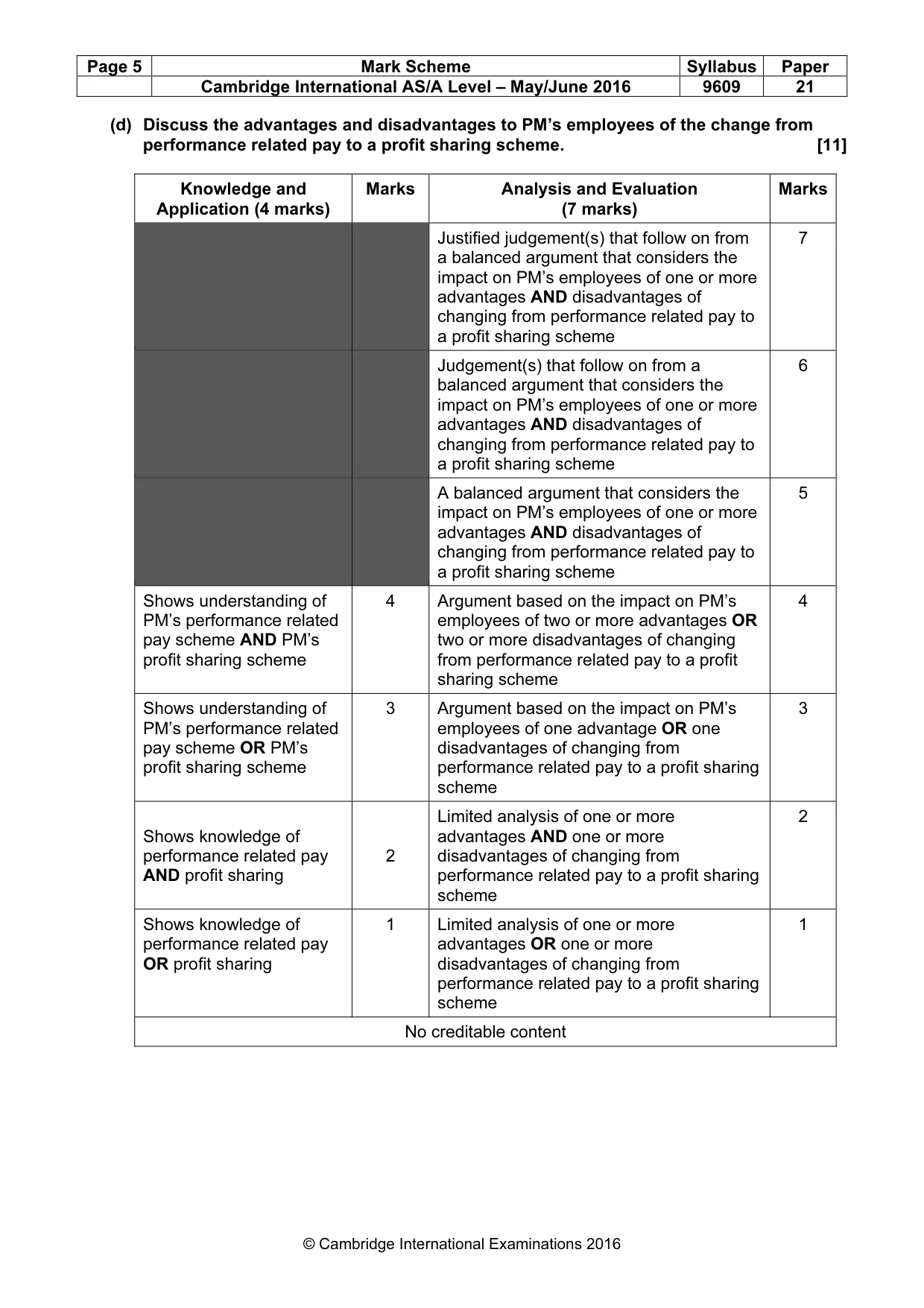
Page 5 Mark Scheme Syllabus Paper Cambridge International AS/A Level – May/June 2016 9609 21 © Cambridge International Examinations 2016 (d) Discuss the advantages and disadvantages to PM’s employees of the change from performance related pay to a profit sharing scheme. [11] Knowledge and Application (4 marks) Marks Analysis and Evaluation (7 marks) Marks Justified judgement(s) that follow on from a balanced argument that considers the impact on PM’s employees of one or more advantages AND disadvantages of changing from performance related pay to a profit sharing scheme 7 Judgement(s) that follow on from a balanced argument that considers the impact on PM’s employees of one or more advantages AND disadvantages of changing from performance related pay to a profit sharing scheme 6 A balanced argument that considers the impact on PM’s employees of one or more advantages AND disadvantages of changing from performance related pay to a profit sharing scheme 5 Shows understanding of PM’s performance related pay scheme AND PM’s profit sharing scheme 4 Argument based on the impact on PM’s employees of two or more advantages OR two or more disadvantages of changing from performance related pay to a profit sharing scheme 4 Shows understanding of PM’s performance related pay scheme OR PM’s profit sharing scheme 3 Argument based on the impact on PM’s employees of one advantage OR one disadvantages of changing from performance related pay to a profit sharing scheme 3 Shows knowledge of performance related pay AND profit sharing 2 Limited analysis of one or more advantages AND one or more disadvantages of changing from performance related pay to a profit sharing scheme 2 Shows knowledge of performance related pay OR profit sharing 1 Limited analysis of one or more advantages OR one or more disadvantages of changing from performance related pay to a profit sharing scheme 1 No creditable content
Mark scheme, page 6
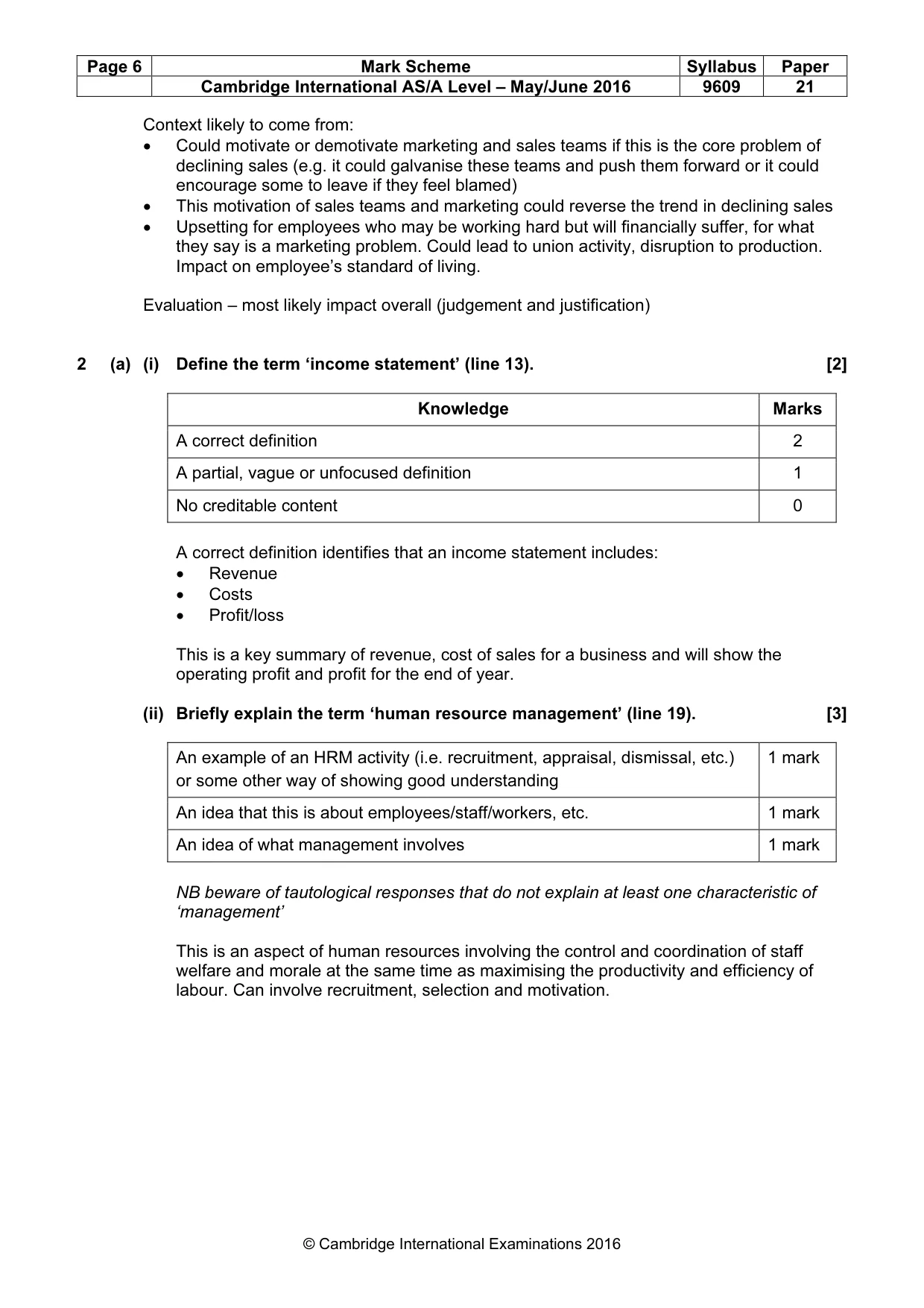
Page 6 Mark Scheme Syllabus Paper Cambridge International AS/A Level – May/June 2016 9609 21 © Cambridge International Examinations 2016 Context likely to come from: • Could motivate or demotivate marketing and sales teams if this is the core problem of declining sales (e.g. it could galvanise these teams and push them forward or it could encourage some to leave if they feel blamed) • This motivation of sales teams and marketing could reverse the trend in declining sales • Upsetting for employees who may be working hard but will financially suffer, for what they say is a marketing problem. Could lead to union activity, disruption to production. Impact on employee’s standard of living. Evaluation – most likely impact overall (judgement and justification) 2 (a) (i) Define the term ‘income statement’ (line 13). [2] Knowledge Marks A correct definition 2 A partial, vague or unfocused definition 1 No creditable content 0 A correct definition identifies that an income statement includes: • Revenue • Costs • Profit/loss This is a key summary of revenue, cost of sales for a business and will show the operating profit and profit for the end of year. (ii) Briefly explain the term ‘human resource management’ (line 19). [3] An example of an HRM activity (i.e. recruitment, appraisal, dismissal, etc.) or some other way of showing good understanding 1 mark An idea that this is about employees/staff/workers, etc. 1 mark An idea of what management involves 1 mark NB beware of tautological responses that do not explain at least one characteristic of ‘management’ This is an aspect of human resources involving the control and coordination of staff welfare and morale at the same time as maximising the productivity and efficiency of labour. Can involve recruitment, selection and motivation.
Mark scheme, page 7
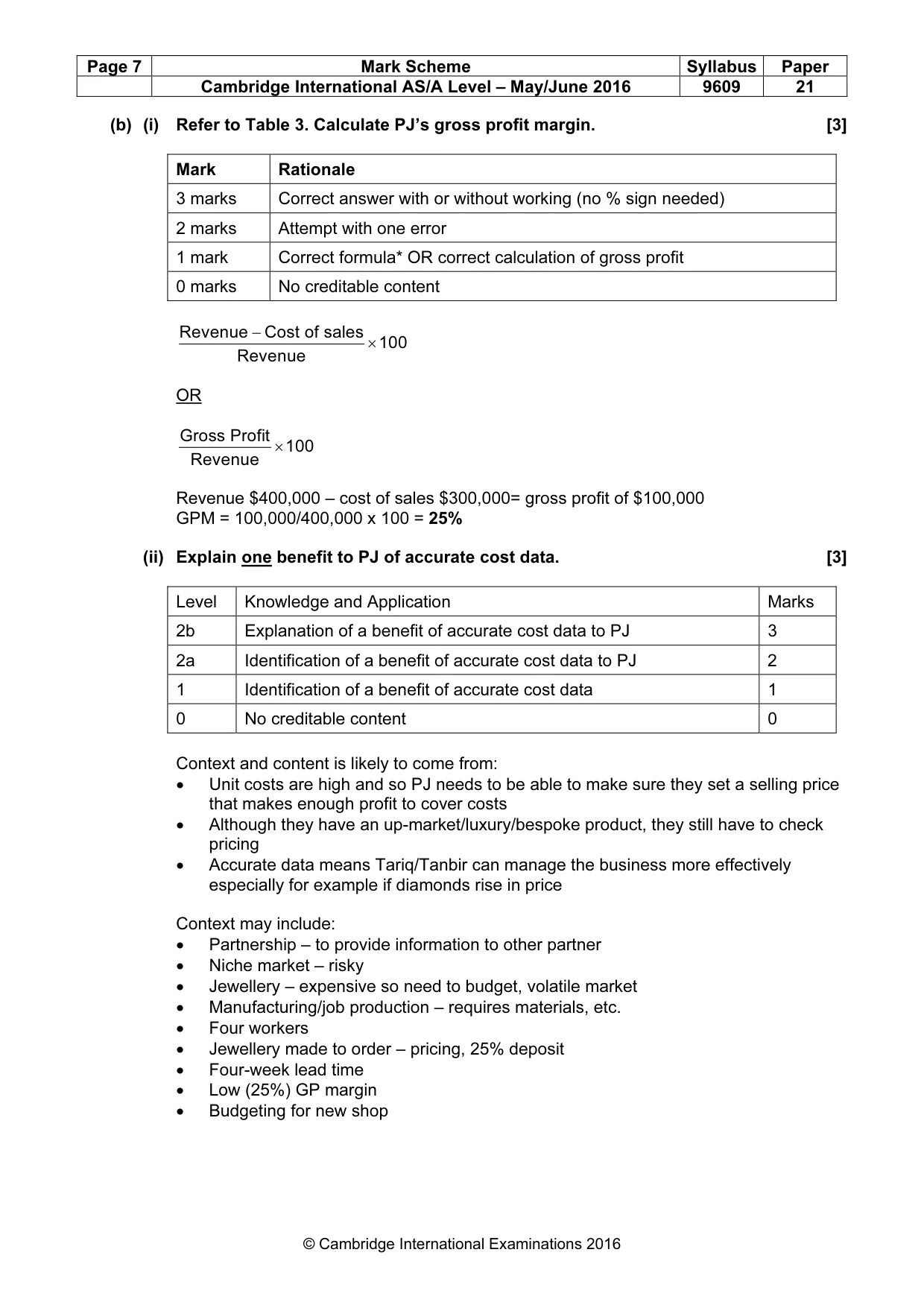
Page 7 Mark Scheme Syllabus Paper Cambridge International AS/A Level – May/June 2016 9609 21 © Cambridge International Examinations 2016 (b) (i) Refer to Table 3. Calculate PJ’s gross profit margin. [3] Mark Rationale 3 marks Correct answer with or without working (no % sign needed) 2 marks Attempt with one error 1 mark Correct formula* OR correct calculation of gross profit 0 marks No creditable content Revenue Cost of sales 100 Revenue − × OR Gross Profit 100 Revenue × Revenue $400,000 – cost of sales $300,000= gross profit of $100,000 GPM = 100,000/400,000 x 100 = 25% (ii) Explain one benefit to PJ of accurate cost data. [3] Level Knowledge and Application Marks 2b Explanation of a benefit of accurate cost data to PJ 3 2a Identification of a benefit of accurate cost data to PJ 2 1 Identification of a benefit of accurate cost data 1 0 No creditable content 0 Context and content is likely to come from: • Unit costs are high and so PJ needs to be able to make sure they set a selling price that makes enough profit to cover costs • Although they have an up-market/luxury/bespoke product, they still have to check pricing • Accurate data means Tariq/Tanbir can manage the business more effectively especially for example if diamonds rise in price Context may include: • Partnership – to provide information to other partner • Niche market – risky • Jewellery – expensive so need to budget, volatile market • Manufacturing/job production – requires materials, etc. • Four workers • Jewellery made to order – pricing, 25% deposit • Four-week lead time • Low (25%) GP margin • Budgeting for new shop
Mark scheme, page 8
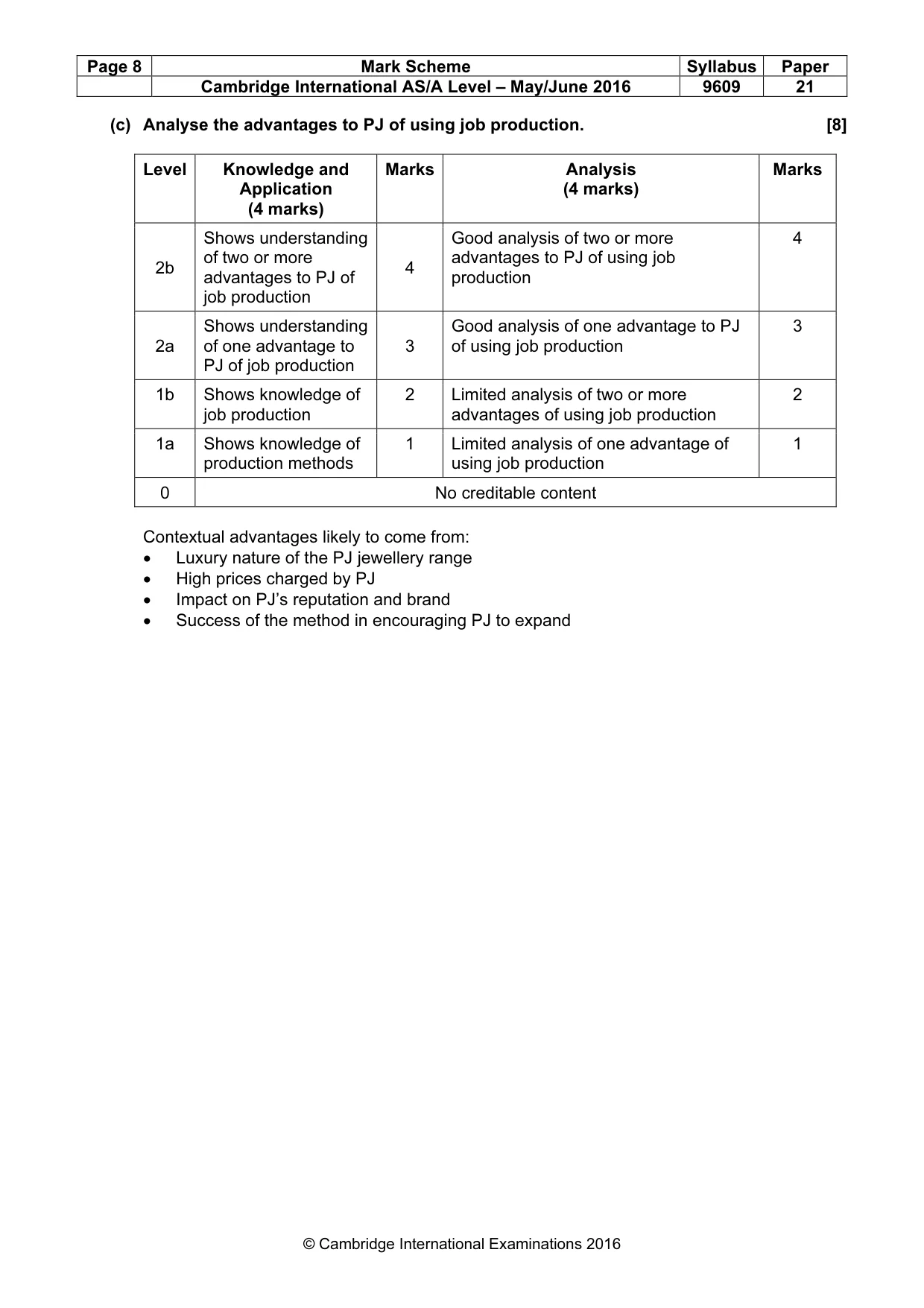
Page 8 Mark Scheme Syllabus Paper Cambridge International AS/A Level – May/June 2016 9609 21 © Cambridge International Examinations 2016 (c) Analyse the advantages to PJ of using job production. [8] Level Knowledge and Application (4 marks) Marks Analysis (4 marks) Marks 2b Shows understanding of two or more advantages to PJ of job production 4 Good analysis of two or more advantages to PJ of using job production 4 2a Shows understanding of one advantage to PJ of job production 3 Good analysis of one advantage to PJ of using job production 3 1b Shows knowledge of job production 2 Limited analysis of two or more advantages of using job production 2 1a Shows knowledge of production methods 1 Limited analysis of one advantage of using job production 1 0 No creditable content Contextual advantages likely to come from: • Luxury nature of the PJ jewellery range • High prices charged by PJ • Impact on PJ’s reputation and brand • Success of the method in encouraging PJ to expand
Mark scheme, page 9
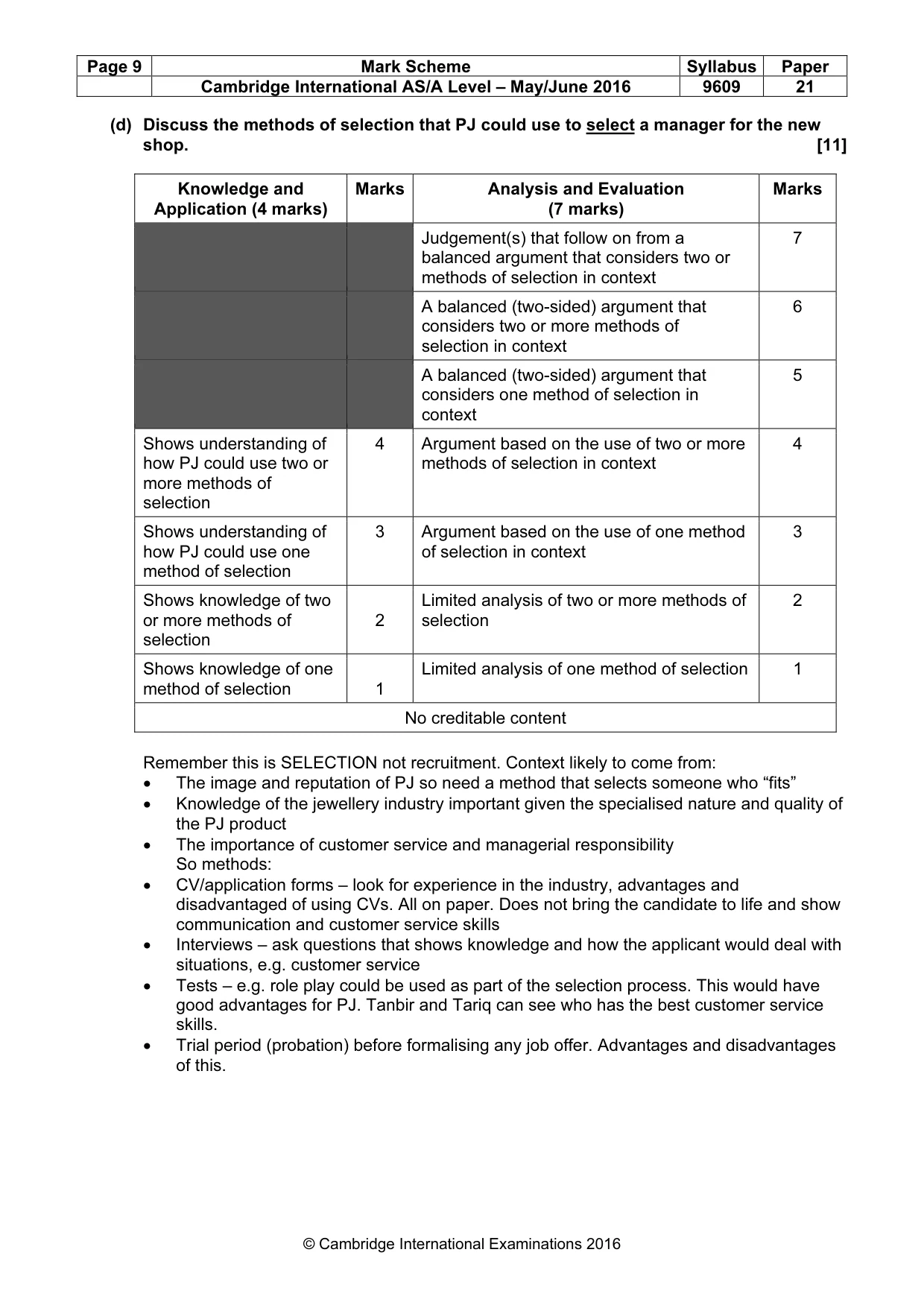
Page 9 Mark Scheme Syllabus Paper Cambridge International AS/A Level – May/June 2016 9609 21 © Cambridge International Examinations 2016 (d) Discuss the methods of selection that PJ could use to select a manager for the new shop. [11] Knowledge and Application (4 marks) Marks Analysis and Evaluation (7 marks) Marks Judgement(s) that follow on from a balanced argument that considers two or methods of selection in context 7 A balanced (two-sided) argument that considers two or more methods of selection in context 6 A balanced (two-sided) argument that considers one method of selection in context 5 Shows understanding of how PJ could use two or more methods of selection 4 Argument based on the use of two or more methods of selection in context 4 Shows understanding of how PJ could use one method of selection 3 Argument based on the use of one method of selection in context 3 Shows knowledge of two or more methods of selection 2 Limited analysis of two or more methods of selection 2 Shows knowledge of one method of selection 1 Limited analysis of one method of selection 1 No creditable content Remember this is SELECTION not recruitment. Context likely to come from: • The image and reputation of PJ so need a method that selects someone who “fits” • Knowledge of the jewellery industry important given the specialised nature and quality of the PJ product • The importance of customer service and managerial responsibility So methods: • CV/application forms – look for experience in the industry, advantages and disadvantaged of using CVs. All on paper. Does not bring the candidate to life and show communication and customer service skills • Interviews – ask questions that shows knowledge and how the applicant would deal with situations, e.g. customer service • Tests – e.g. role play could be used as part of the selection process. This would have good advantages for PJ. Tanbir and Tariq can see who has the best customer service skills. • Trial period (probation) before formalising any job offer. Advantages and disadvantages of this.
What you needed in this session
Cambridge’s own grade thresholds for 2016 May/June, Paper 2 · Variant 1. A higher threshold means an easier paper — the bar moves with how the cohort did.