Cambridge A Level Biology 9700 — 2024 May/June Paper 4 · Variant 3
9700/43/M/J/24 · 10 questions · 100 marks · ≈113 min
The question paper and its mark scheme, free to read here and free to download. This is Cambridge’s own paper, exactly as it was sat.
Question paper24 pages



Mark scheme20 pages
Answers below. Sit the paper first if you are practising.
Questions as text
Question 1
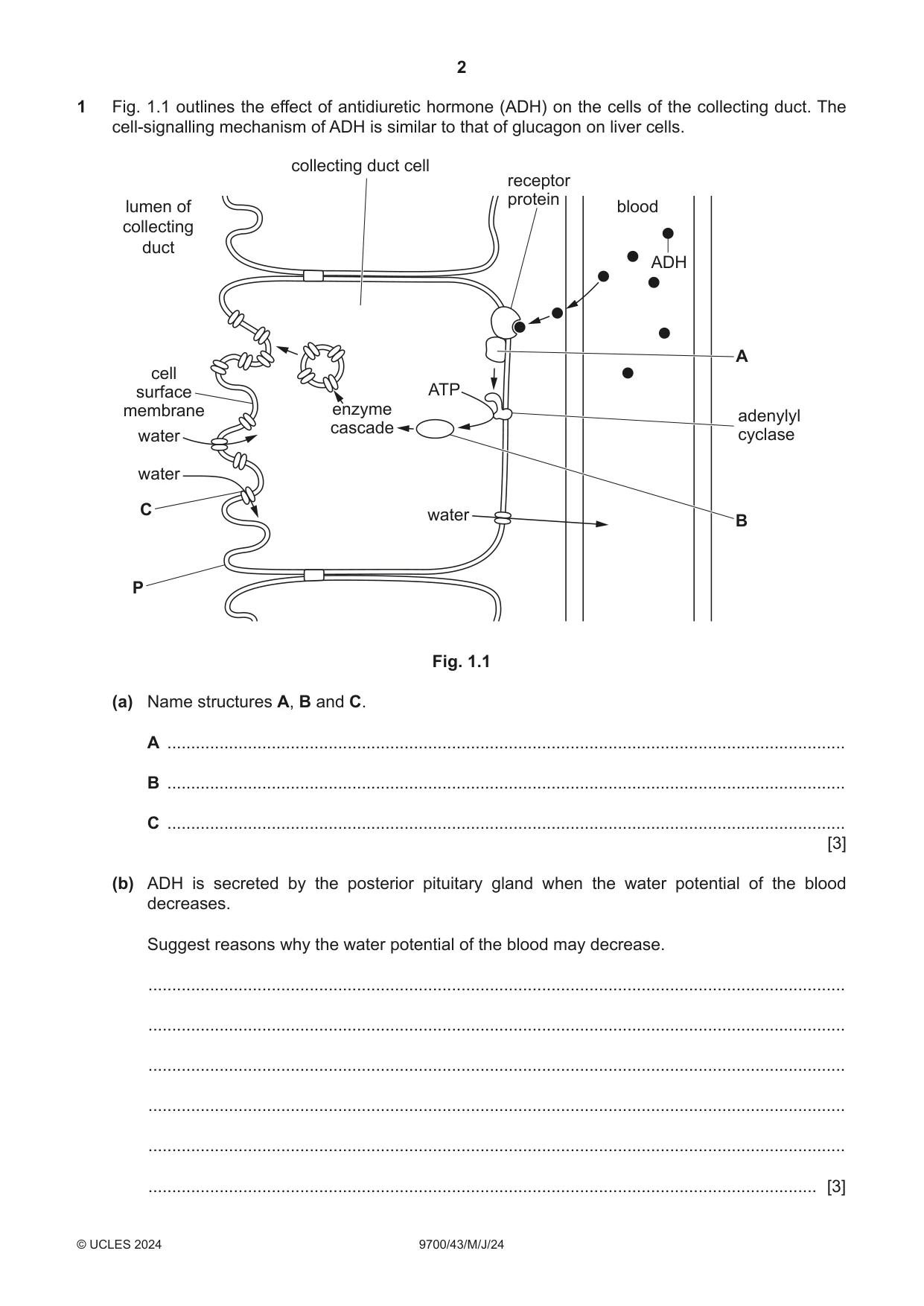
1 Fig. 1.1 outlines the effect of antidiuretic hormone (ADH) on the cells of the collecting duct. The cell-signalling mechanism of ADH is similar to that of glucagon on liver cells. collecting duct cell receptor protein lumen of blood collecting duct ADH A cell surface ATP membrane enzyme adenylyl cascade water cyclase water C water B P Fig. 1.1 (a) Name structures A, B and C. A ............................................................................................................................................... B ............................................................................................................................................... C ............................................................................................................................................... [3] (b) ADH is secreted by the posterior pituitary gland when the water potential of the blood decreases. Suggest reasons why the water potential of the blood may decrease. ................................................................................................................................................... ................................................................................................................................................... ................................................................................................................................................... ................................................................................................................................................... ................................................................................................................................................... ............................................................................................................................................. [3] (c) Diabetes insipidus is a condition affecting osmoregulation by the kidney. One form of diabetes insipidus is caused by a tumour in the pituitary gland, which results in a decreased secretion of ADH. Suggest the symptoms that would occur in a person with diabetes insipidus. ................................................................................................................................................... ................................................................................................................................................... ................................................................................................................................................... ............................................................................................................................................. [2] (d) Neurogenic diabetes insipidus (NDI) is another form of diabetes insipidus. In NDI, ADH molecules cannot bind to the receptor proteins located in the cell surface membranes of the cells of the collecting duct. With reference to Fig. 1.1, explain the effect on the cell surface membrane labelled P if ADH cannot bind to the receptor proteins. ................................................................................................................................................... ................................................................................................................................................... ................................................................................................................................................... ................................................................................................................................................... ............................................................................................................................................. [2] (e) NDI is caused by a recessive allele of the gene coding for the receptor protein. The gene is located on the X chromosome. Explain why a man with NDI could not have inherited the condition from his father. ................................................................................................................................................... ................................................................................................................................................... ................................................................................................................................................... ................................................................................................................................................... ............................................................................................................................................. [2] [Total: 12]
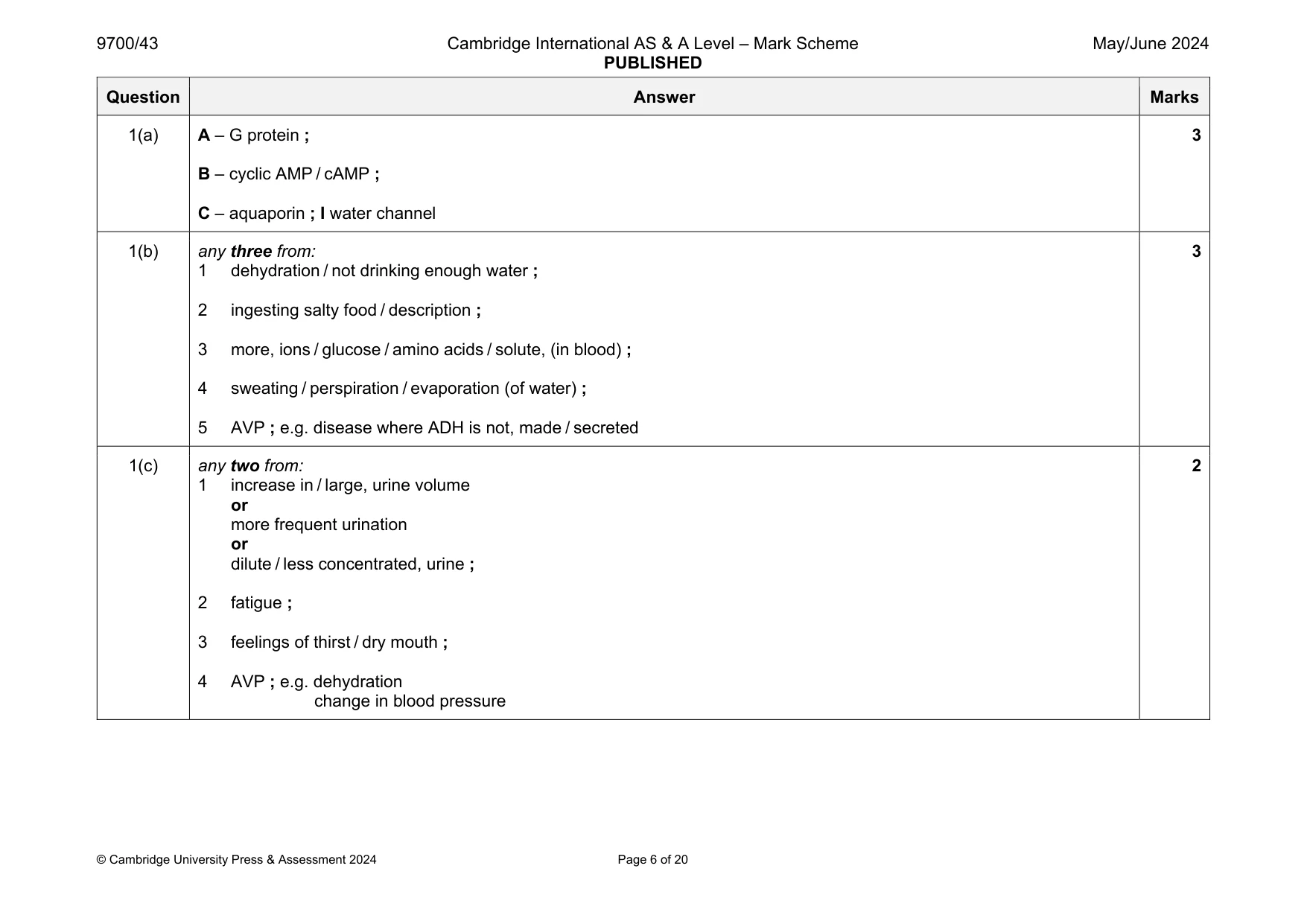
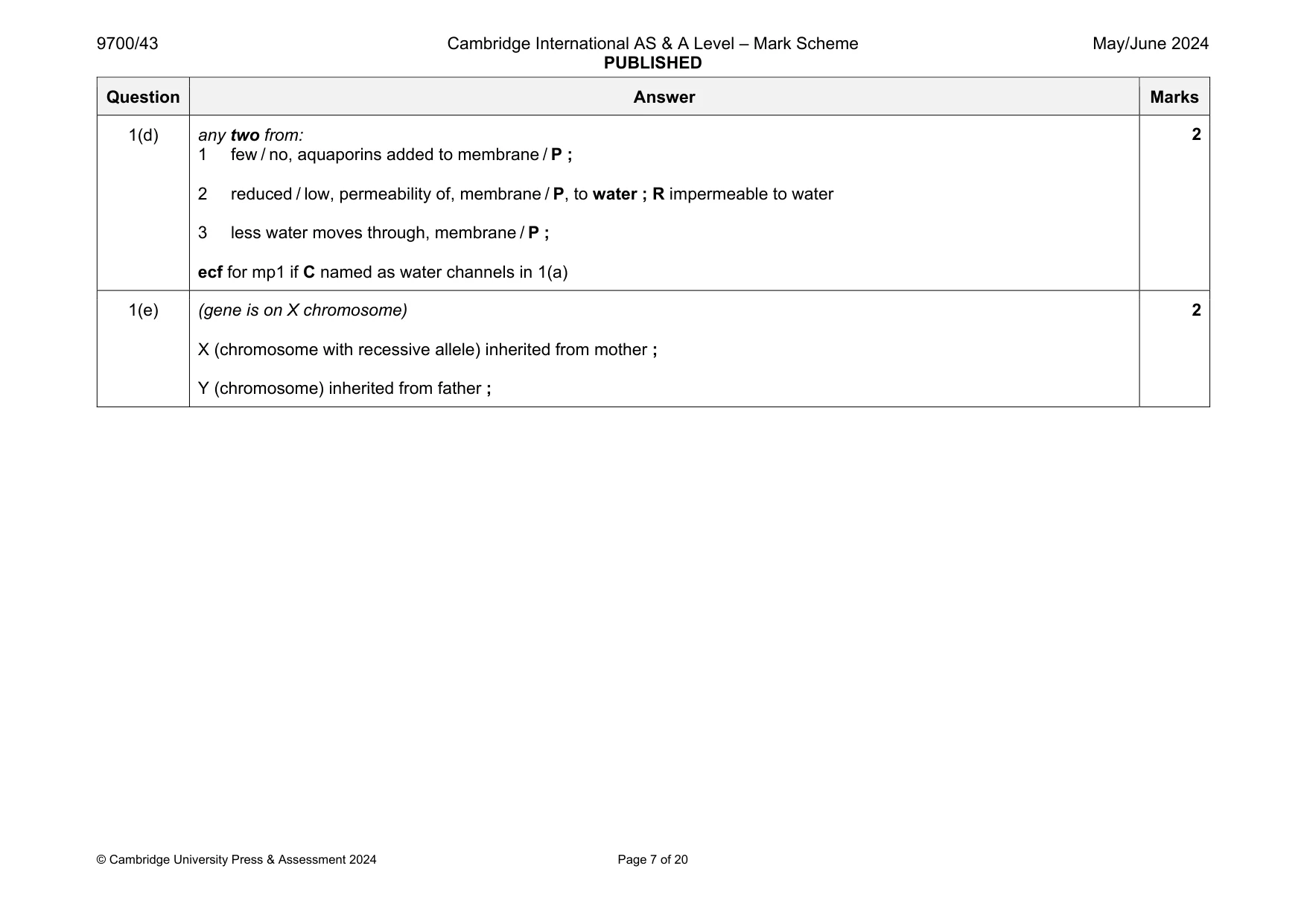
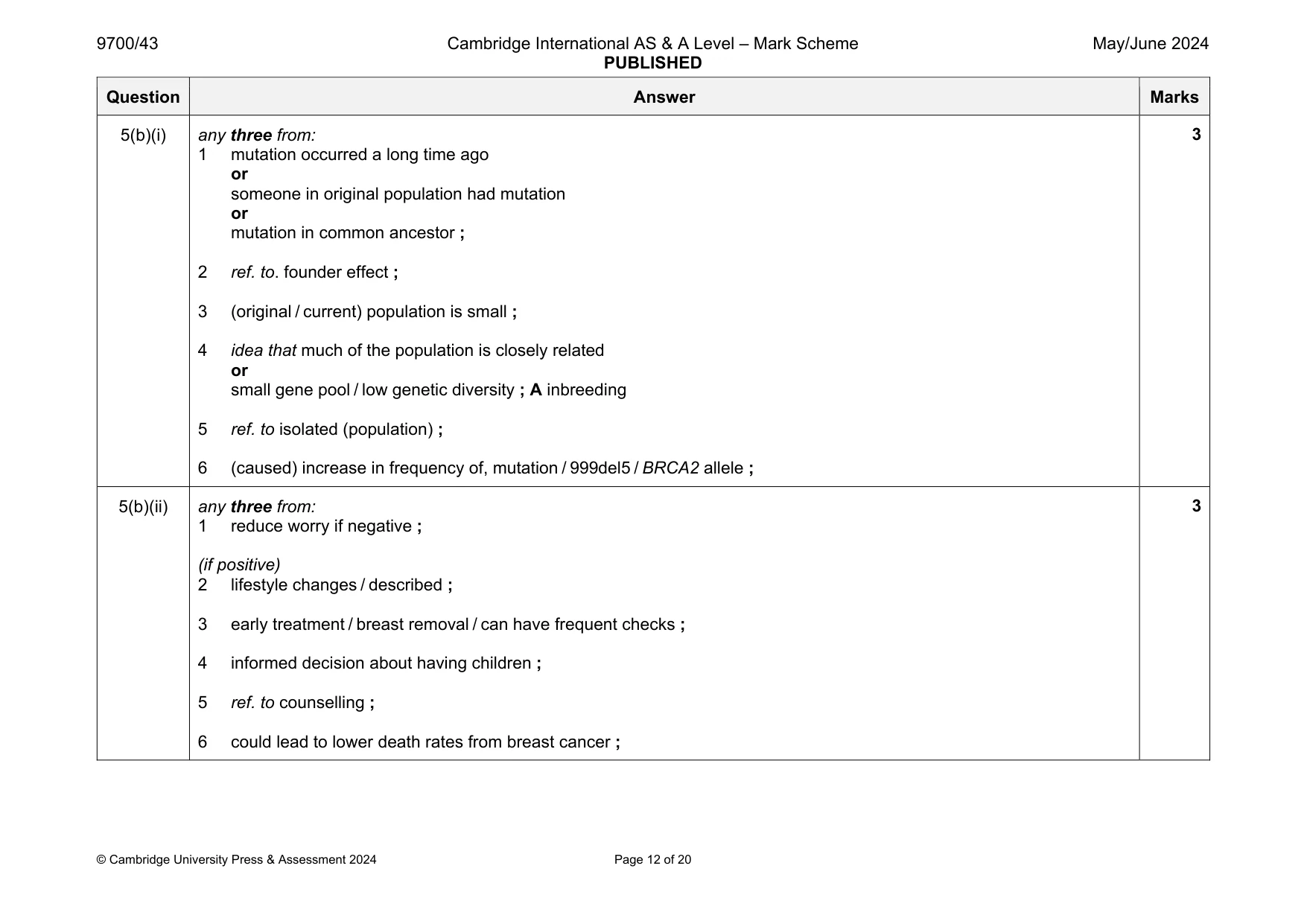
Mark scheme: 1(a) A – G protein ; B – cyclic AMP / cAMP ; C – aquaporin ; I water channel 3 1(b) any three from: 1 dehydration / not drinking enough water ; 2 ingesting salty food / description ; 3 more, ions / glucose / amino acids / solute, (in blood) ; 4 sweating / perspiration / evaporation (of water) ; 5 AVP ; e.g. disease where ADH is not, made / secreted 3 1(c) any two from: 1 increase in / large, urine volume or more frequent urination or dilute / less concentrated, urine ; 2 fatigue ; 3 feelings of thirst / dry mouth ; 4 AVP ; e.g. dehydration change in blood pressure 2 Question Answer Marks 1(d) any two from: 1 few / no, aquaporins added to membrane / P ; 2 reduced / low, permeability of, membrane / P, to water ; R impermeable to water 3 less water moves through, membrane / P ; ecf for mp1 if C named as water channels in 1(a) 2 1(e) (gene is on X chromosome) X (chromosome with recessive allele) inherited from mother ; Y (chromosome) inherited from father ; 2
Q2 · Phenotypic variation exists in many forms
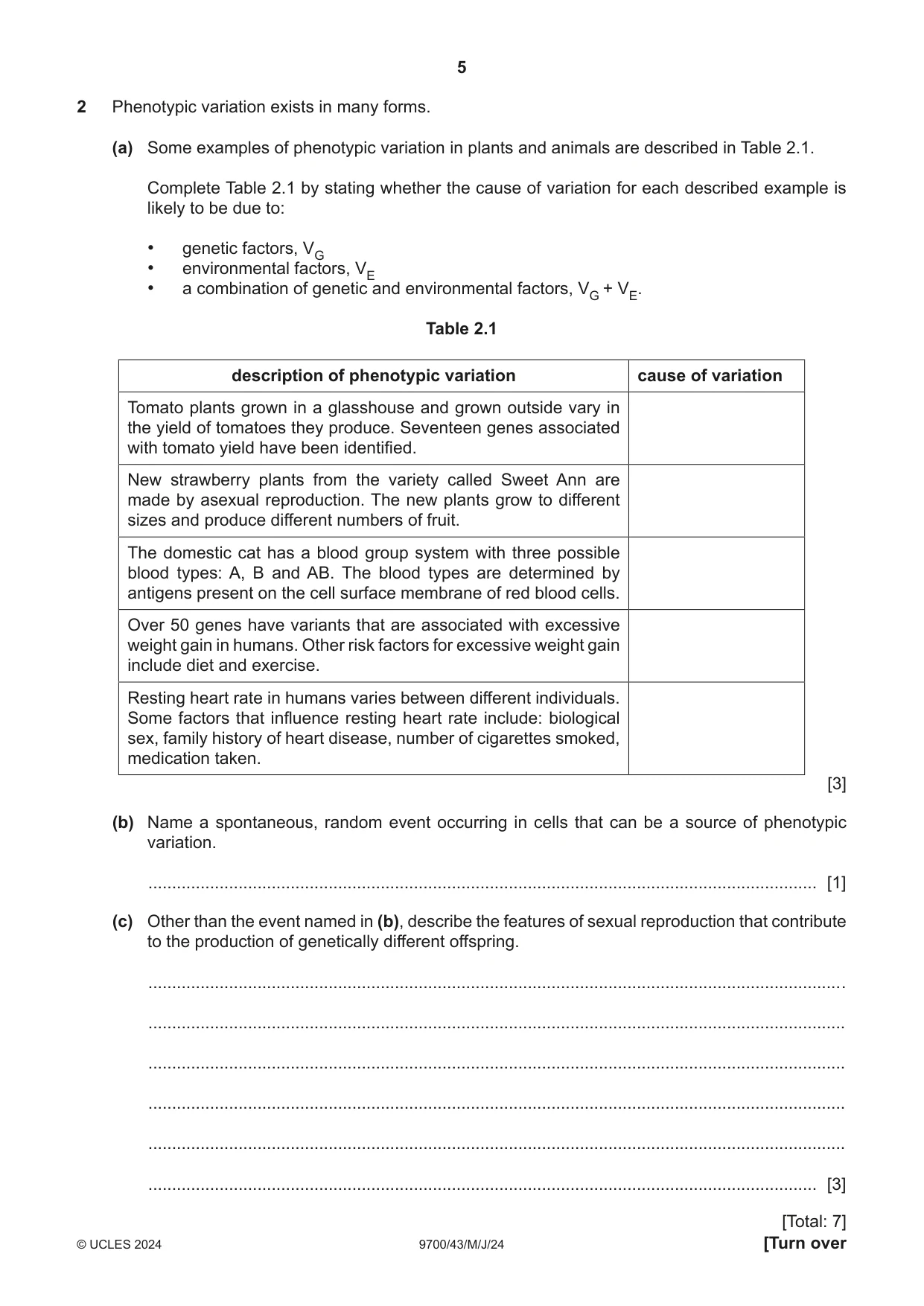
2 Phenotypic variation exists in many forms. (a) Some examples of phenotypic variation in plants and animals are described in Table 2.1. Complete Table 2.1 by stating whether the cause of variation for each described example is likely to be due to: • genetic factors, VG • environmental factors, VE • a combination of genetic and environmental factors, VG + VE. Table 2.1 description of phenotypic variation cause of variation Tomato plants grown in a glasshouse and grown outside vary in the yield of tomatoes they produce. Seventeen genes associated with tomato yield have been identified. New strawberry plants from the variety called Sweet Ann are made by asexual reproduction. The new plants grow to different sizes and produce different numbers of fruit. The domestic cat has a blood group system with three possible blood types: A, B and AB. The blood types are determined by antigens present on the cell surface membrane of red blood cells. Over 50 genes have variants that are associated with excessive weight gain in humans. Other risk factors for excessive weight gain include diet and exercise. Resting heart rate in humans varies between different individuals. Some factors that influence resting heart rate include: biological sex, family history of heart disease, number of cigarettes smoked, medication taken. [3] (b) Name a spontaneous, random event occurring in cells that can be a source of phenotypic variation. ............................................................................................................................................. [1] (c) Other than the event named in (b), describe the features of sexual reproduction that contribute to the production of genetically different offspring. ................................................................................................................................................... ................................................................................................................................................... ................................................................................................................................................... ................................................................................................................................................... ................................................................................................................................................... ............................................................................................................................................. [3] [Total: 7]
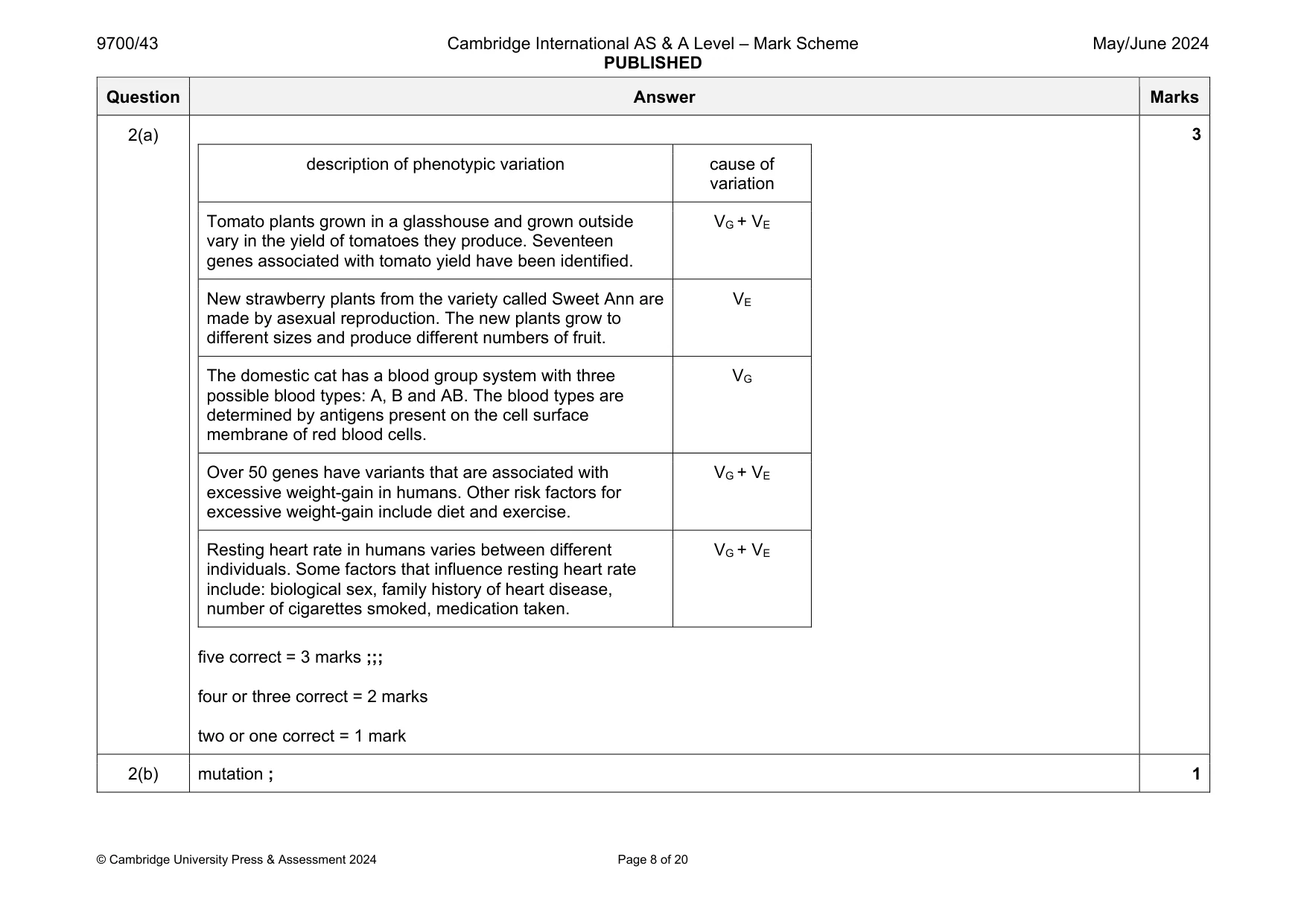
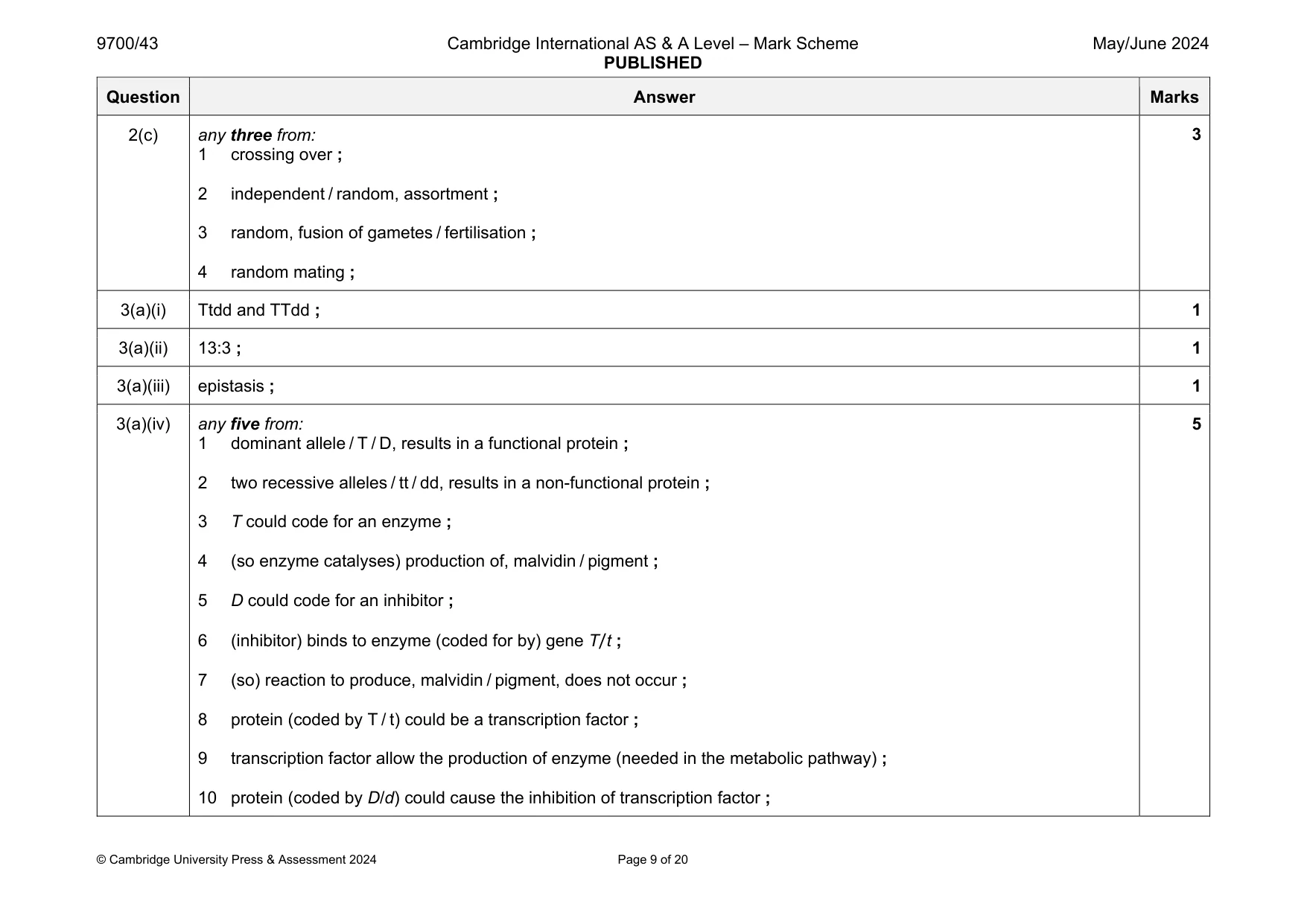
Mark scheme: 2(a) description of phenotypic variation cause of variation Tomato plants grown in a glasshouse and grown outside vary in the yield of tomatoes they produce. Seventeen genes associated with tomato yield have been identified. VG + VE New strawberry plants from the variety called Sweet Ann are made by asexual reproduction. The new plants grow to different sizes and produce different numbers of fruit. VE The domestic cat has a blood group system with three possible blood types: A, B and AB. The blood types are determined by antigens present on the cell surface membrane of red blood cells. VG Over 50 genes have variants that are associated with excessive weight-gain in humans. Other risk factors for excessive weight-gain include diet and exercise. VG + VE Resting heart rate in humans varies between different individuals. Some factors that influence resting heart rate include: biological sex, family history of heart disease, number of cigarettes smoked, medication taken. VG + VE five correct = 3 marks ;;; four or three correct = 2 marks two or one correct = 1 mark 2(b) mutation ; 1 Question Answer Marks 2(c) any three from: 1 crossing over ; 2 independent / random, assortment ; 3 random, fusion of gametes / fertilisation ; 4 random mating ; 3
Q3 · In plants and humans, the phenotype of an organism is determined by the genotype and the…
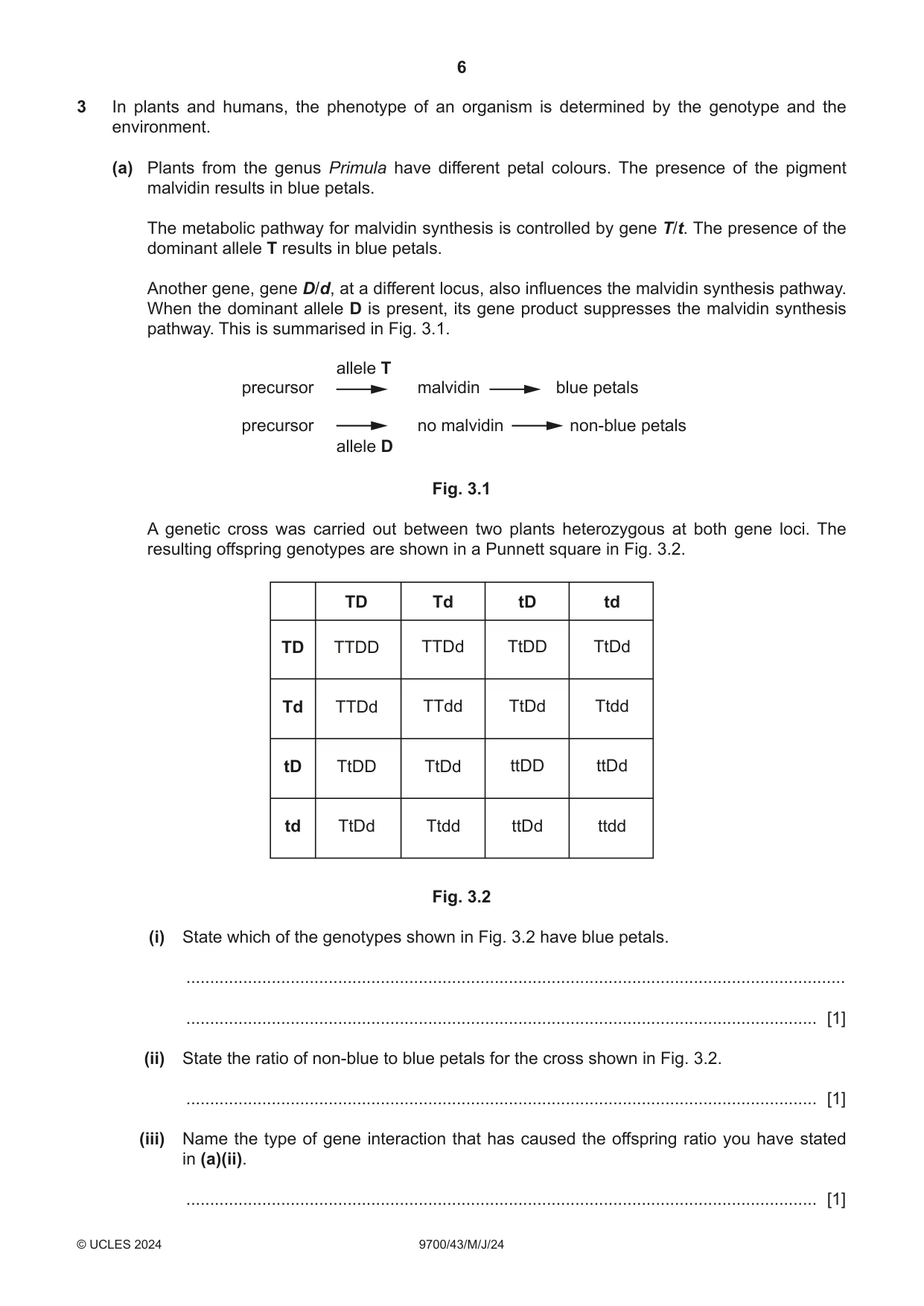
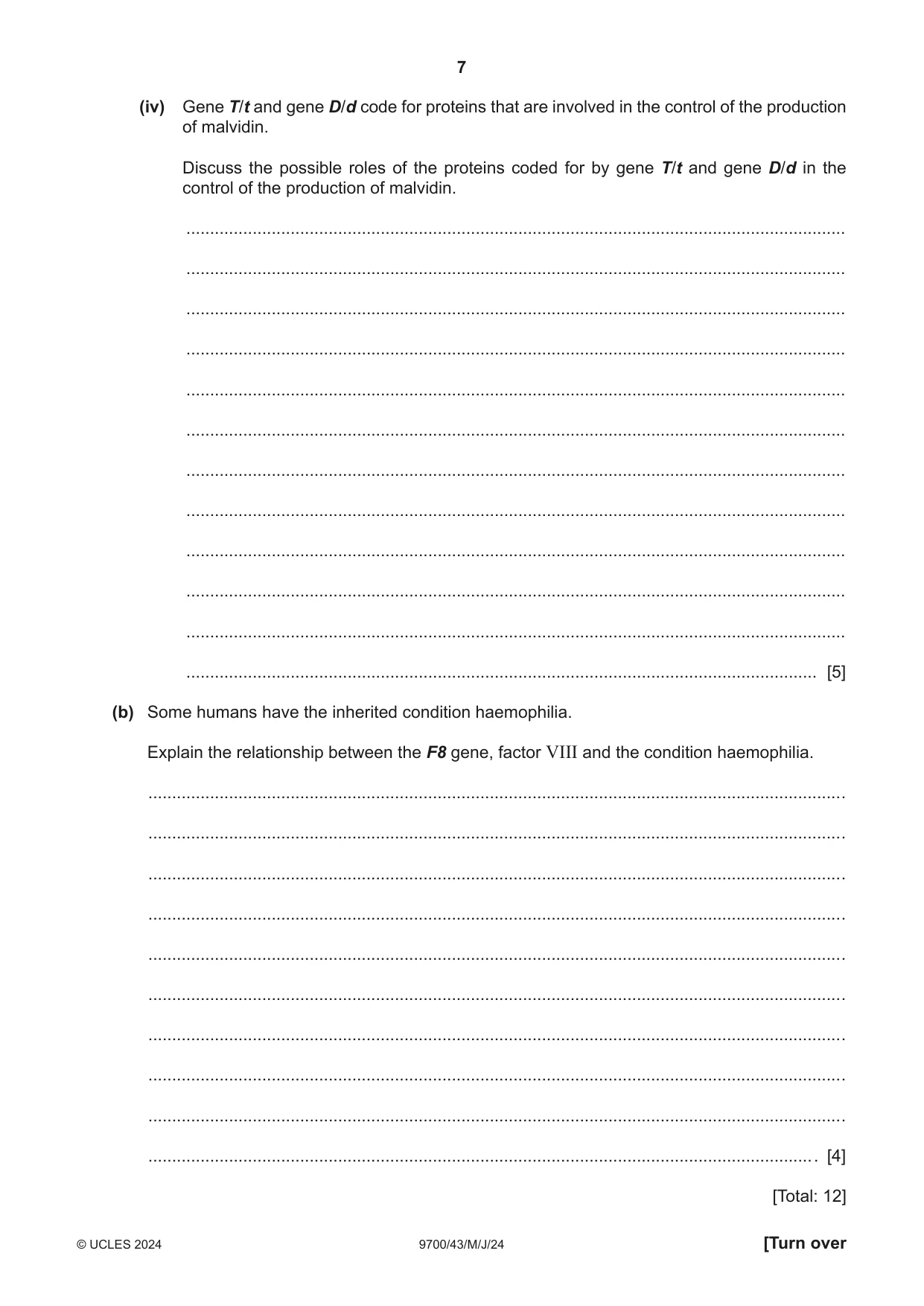
3 In plants and humans, the phenotype of an organism is determined by the genotype and the environment. (a) Plants from the genus Primula have different petal colours. The presence of the pigment malvidin results in blue petals. The metabolic pathway for malvidin synthesis is controlled by gene T/t. The presence of the dominant allele T results in blue petals. Another gene, gene D/d, at a different locus, also influences the malvidin synthesis pathway. When the dominant allele D is present, its gene product suppresses the malvidin synthesis pathway. This is summarised in Fig. 3.1. allele T precursor malvidin blue petals precursor no malvidin non-blue petals allele D Fig. 3.1 A genetic cross was carried out between two plants heterozygous at both gene loci. The resulting offspring genotypes are shown in a Punnett square in Fig. 3.2. TD Td tD td TD TTDD TTDd TtDD TtDd Td TTDd TTdd TtDd Ttdd tD TtDD TtDd ttDD ttDd td TtDd Ttdd ttDd ttdd Fig. 3.2 (i) State which of the genotypes shown in Fig. 3.2 have blue petals. ........................................................................................................................................... ..................................................................................................................................... [1] (ii) State the ratio of non-blue to blue petals for the cross shown in Fig. 3.2. ..................................................................................................................................... [1] (iii) Name the type of gene interaction that has caused the offspring ratio you have stated in (a)(ii). ..................................................................................................................................... [1] (iv) Gene T/t and gene D/d code for proteins that are involved in the control of the production of malvidin. Discuss the possible roles of the proteins coded for by gene T/t and gene D/d in the control of the production of malvidin. ........................................................................................................................................... ........................................................................................................................................... ........................................................................................................................................... ........................................................................................................................................... ........................................................................................................................................... ........................................................................................................................................... ........................................................................................................................................... ........................................................................................................................................... ........................................................................................................................................... ........................................................................................................................................... ........................................................................................................................................... ..................................................................................................................................... [5] (b) Some humans have the inherited condition haemophilia. Explain the relationship between the F8 gene, factor VIII and the condition haemophilia. ................................................................................................................................................... ................................................................................................................................................... ................................................................................................................................................... ................................................................................................................................................... ................................................................................................................................................... ................................................................................................................................................... ................................................................................................................................................... ................................................................................................................................................... ................................................................................................................................................... ............................................................................................................................................. [4] [Total: 12]
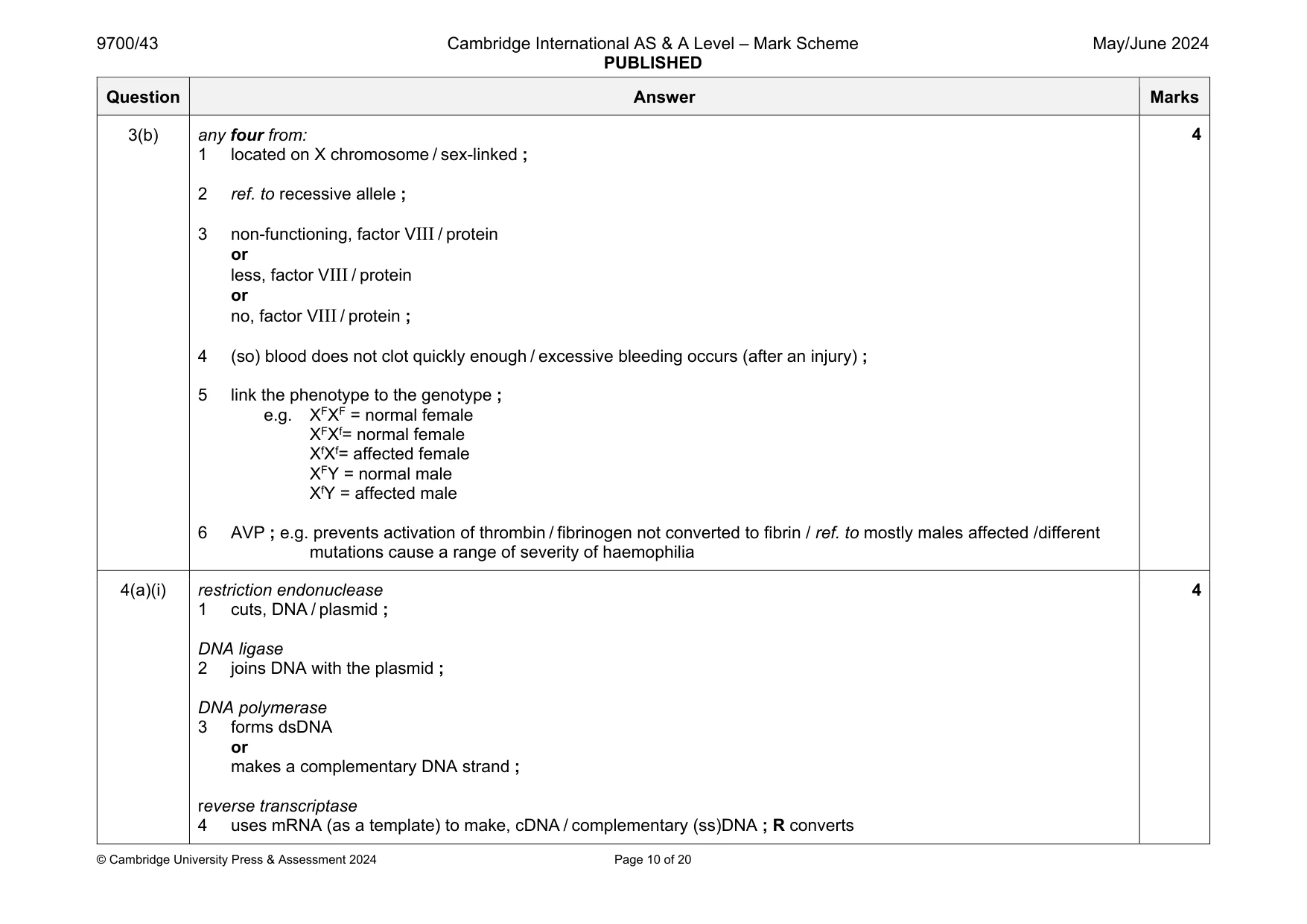
Mark scheme: 3(a)(i) Ttdd and TTdd ; 1 3(a)(ii) 13:3 ; 1 3(a)(iii) epistasis ; 1 3(a)(iv) any five from: 1 dominant allele / T / D, results in a functional protein ; 2 two recessive alleles / tt / dd, results in a non-functional protein ; 3 T could code for an enzyme ; 4 (so enzyme catalyses) production of, malvidin / pigment ; 5 D could code for an inhibitor ; 6 (inhibitor) binds to enzyme (coded for by) gene T/t ; 7 (so) reaction to produce, malvidin / pigment, does not occur ; 8 protein (coded by T / t) could be a transcription factor ; 9 transcription factor allow the production of enzyme (needed in the metabolic pathway) ; 10 protein (coded by D/d) could cause the inhibition of transcription factor ; 5 Question Answer Marks 3(b) any four from: 1 located on X chromosome / sex-linked ; 2 ref. to recessive allele ; 3 non-functioning, factor VIII / protein or less, factor VIII / protein or no, factor VIII / protein ; 4 (so) blood does not clot quickly enough / excessive bleeding occurs (after an injury) ; 5 link the phenotype to the genotype ; e.g. XFXF = normal female XFXf= normal female XfXf= affected female XFY = normal male XfY = affected male 6 AVP ; e.g. prevents activation of thrombin / fibrinogen not converted to fibrin / ref. to mostly males affected /different mutations cause a range of severity of haemophilia 4 4
Q4 · Genetic engineering is a technique used to modify the genetic material of a specific…
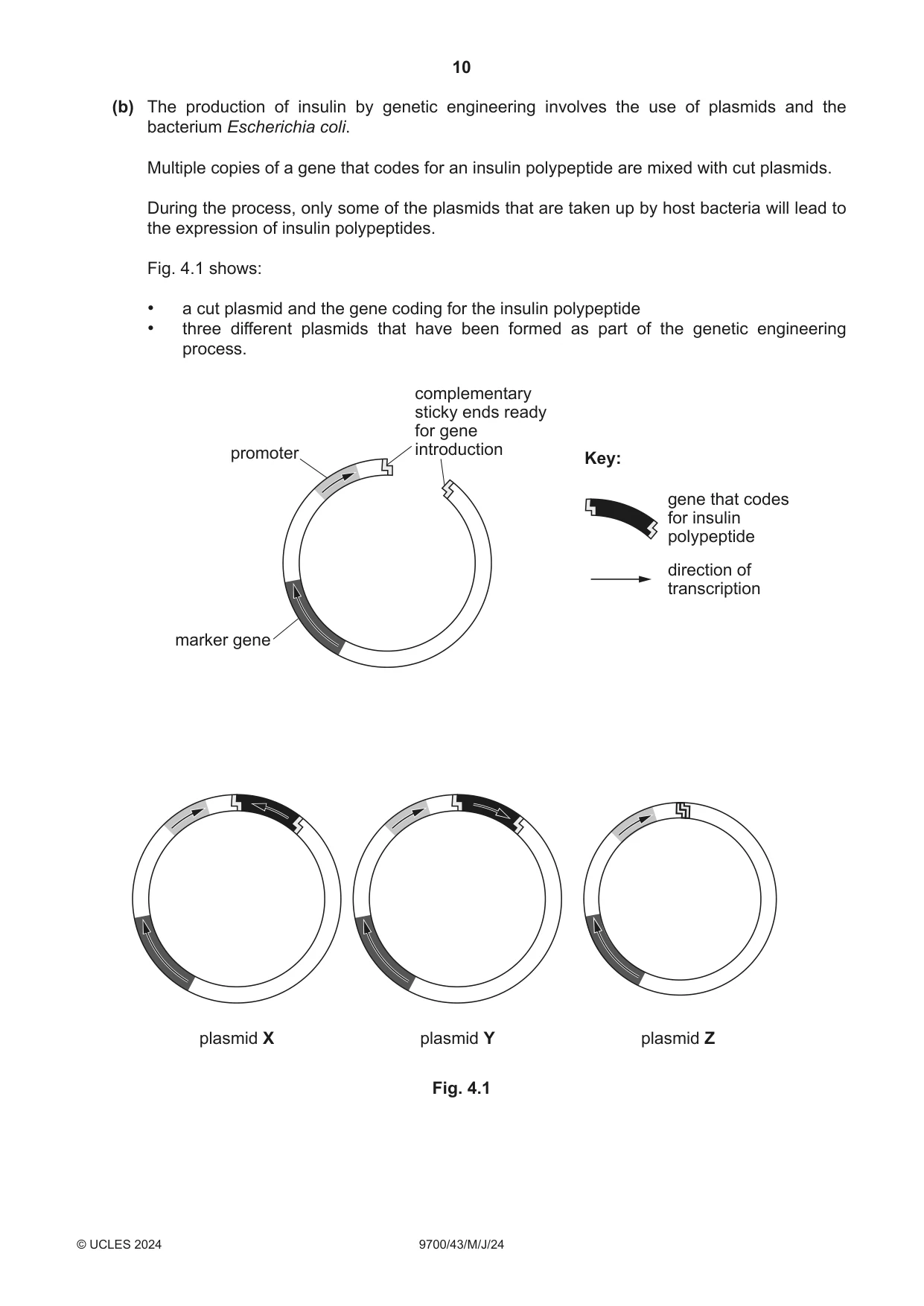
4 Genetic engineering is a technique used to modify the genetic material of a specific organism to change a characteristic. (a) (i) Genetic engineering uses specific enzymes and commonly involves the use of plasmids for the transfer of genes into an organism. Four enzymes that are used in genetic engineering techniques involving plasmids are: • restriction endonuclease • DNA ligase • DNA polymerase • reverse transcriptase. Outline the role of these enzymes in genetic engineering involving plasmids. restriction endonuclease ................................................................................................... ........................................................................................................................................... ........................................................................................................................................... DNA ligase ........................................................................................................................ ........................................................................................................................................... ........................................................................................................................................... DNA polymerase ............................................................................................................... ........................................................................................................................................... ........................................................................................................................................... reverse transcriptase ......................................................................................................... ........................................................................................................................................... ........................................................................................................................................... [4] (ii) Explain why a promoter, as well as the desired gene, is often transferred into an organism. ........................................................................................................................................... ........................................................................................................................................... ........................................................................................................................................... ........................................................................................................................................... ........................................................................................................................................... ..................................................................................................................................... [3] (b) The production of insulin by genetic engineering involves the use of plasmids and the bacterium Escherichia coli. Multiple copies of a gene that codes for an insulin polypeptide are mixed with cut plasmids. During the process, only some of the plasmids that are taken up by host bacteria will lead to the expression of insulin polypeptides. Fig. 4.1 shows: • a cut plasmid and the gene coding for the insulin polypeptide • three different plasmids that have been formed as part of the genetic engineering process. complementary sticky ends ready for gene promoter introduction Key: gene that codes for insulin polypeptide direction of transcription marker gene plasmid X plasmid Y plasmid Z Fig. 4.1 Comment on whether a bacterium will produce the insulin polypeptide if it has either plasmid X or plasmid Y or plasmid Z and explain the reason for your choice. plasmid X .................................................................................................................................. ................................................................................................................................................... ................................................................................................................................................... plasmid Y .................................................................................................................................. ................................................................................................................................................... ................................................................................................................................................... plasmid Z .................................................................................................................................. ................................................................................................................................................... ................................................................................................................................................... [3] [Total: 10]
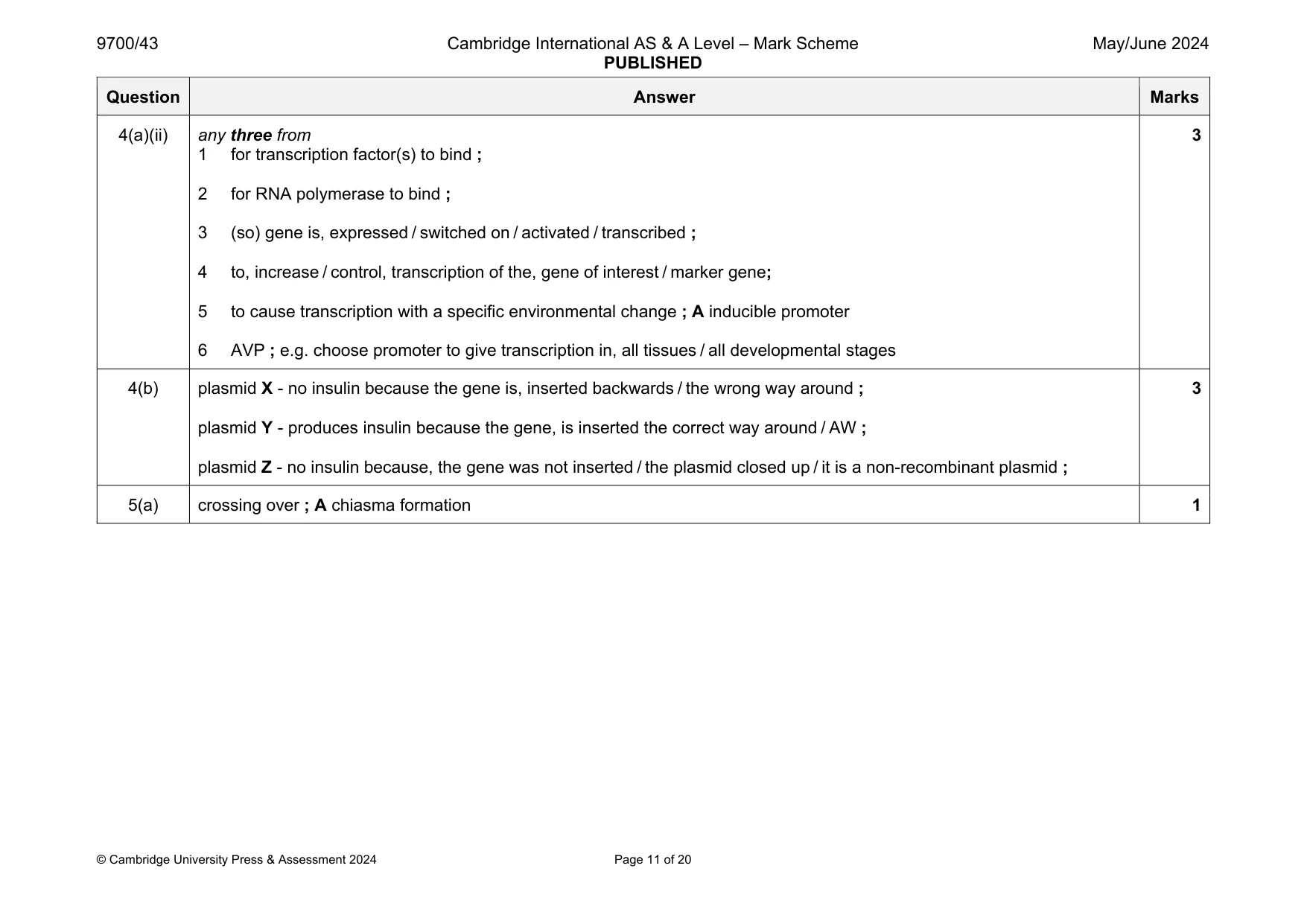
Mark scheme: 4(a)(i) restriction endonuclease 1 cuts, DNA / plasmid ; DNA ligase 2 joins DNA with the plasmid ; DNA polymerase 3 forms dsDNA or makes a complementary DNA strand ; reverse transcriptase 4 uses mRNA (as a template) to make, cDNA / complementary (ss)DNA ; R converts Question Answer Marks 4(a)(ii) any three from 1 for transcription factor(s) to bind ; 2 for RNA polymerase to bind ; 3 (so) gene is, expressed / switched on / activated / transcribed ; 4 to, increase / control, transcription of the, gene of interest / marker gene; 5 to cause transcription with a specific environmental change ; A inducible promoter 6 AVP ; e.g. choose promoter to give transcription in, all tissues / all developmental stages 3 4(b) plasmid X - no insulin because the gene is, inserted backwards / the wrong way around ; plasmid Y - produces insulin because the gene, is inserted the correct way around / AW ; plasmid Z - no insulin because, the gene was not inserted / the plasmid closed up / it is a non-recombinant plasmid ; 3
Q5 · BRCA2 is a tumour-suppressor gene
5 BRCA2 is a tumour-suppressor gene. Its gene product, BRCA2, is involved in DNA repair. If the DNA cannot be repaired, BRCA2 has a role in causing the cell to die. BRCA2 is found in cells of breast tissue. When a mutation occurs in BRCA2, damaged DNA may not be repaired and this increases the risk of breast cancer. When a double-stranded piece of DNA breaks, BRCA2 binds to the damaged DNA directly and interacts with the enzyme RAD51 to repair the damage. Repairing DNA prevents other mutations and gene rearrangements from occurring which could otherwise lead to breast cancer. (a) Double-stranded DNA breaks occur naturally during meiosis. State the event that is initiated as a result of double-stranded breaks during meiosis. ............................................................................................................................................. [1] (b) Scientists have identified hundreds of mutations in BRCA2, but not all of these mutations will increase the risk of cancer. One specific mutation in BRCA2, known as 999del5, is found in 0.6% of the general global population. Iceland is an island country in the North Atlantic Ocean. The ancestors of most of the current population are people who arrived to settle in Iceland in AD 874. In the Icelandic population, mutation 999del5 is the cause of 7–8% of breast cancer cases in women and 40% of breast cancer cases in men. This is much higher than the percentage of breast cancer cases in the general global population. (i) Suggest and explain how mutation 999del5 accounts for a very high percentage of breast cancer cases in Iceland compared with the general global population. ........................................................................................................................................... ........................................................................................................................................... ........................................................................................................................................... ........................................................................................................................................... ........................................................................................................................................... ........................................................................................................................................... ........................................................................................................................................... ..................................................................................................................................... [3] (ii) One of the largest global genetic screening programmes for breast cancer involves identifying people with mutations in BRCA2. Outline the advantages of genetic screening for mutations in BRCA2. ........................................................................................................................................... ........................................................................................................................................... ........................................................................................................................................... ........................................................................................................................................... ........................................................................................................................................... ..................................................................................................................................... [3] (iii) Suggest one advantage to a country of a genetic screening programme for breast cancer that screens for specific mutations in BRCA2 in the population. ........................................................................................................................................... ..................................................................................................................................... [1] (c) Lipocalin 2 (Lcn2) is a cancer-promoting gene (oncogene). When Lcn2 is expressed, it can result in breast cancer. Research is being carried out to see if gene editing of Lcn2 could be used to treat breast cancer. Gene editing was used to treat human cancer cells that had been implanted into mice to form a tumour. The treatment stopped Lcn2 from being expressed in the cancer cells and resulted in a significant reduction in the growth of the tumour. There was no negative effect in normal tissues. (i) Suggest how DNA editing stopped Lcn2 from being expressed in cancer cells. ........................................................................................................................................... ........................................................................................................................................... ........................................................................................................................................... ........................................................................................................................................... ..................................................................................................................................... [2] (ii) Suggest why the expression of only Lcn2 was affected. ........................................................................................................................................... ..................................................................................................................................... [1] [Total: 11]
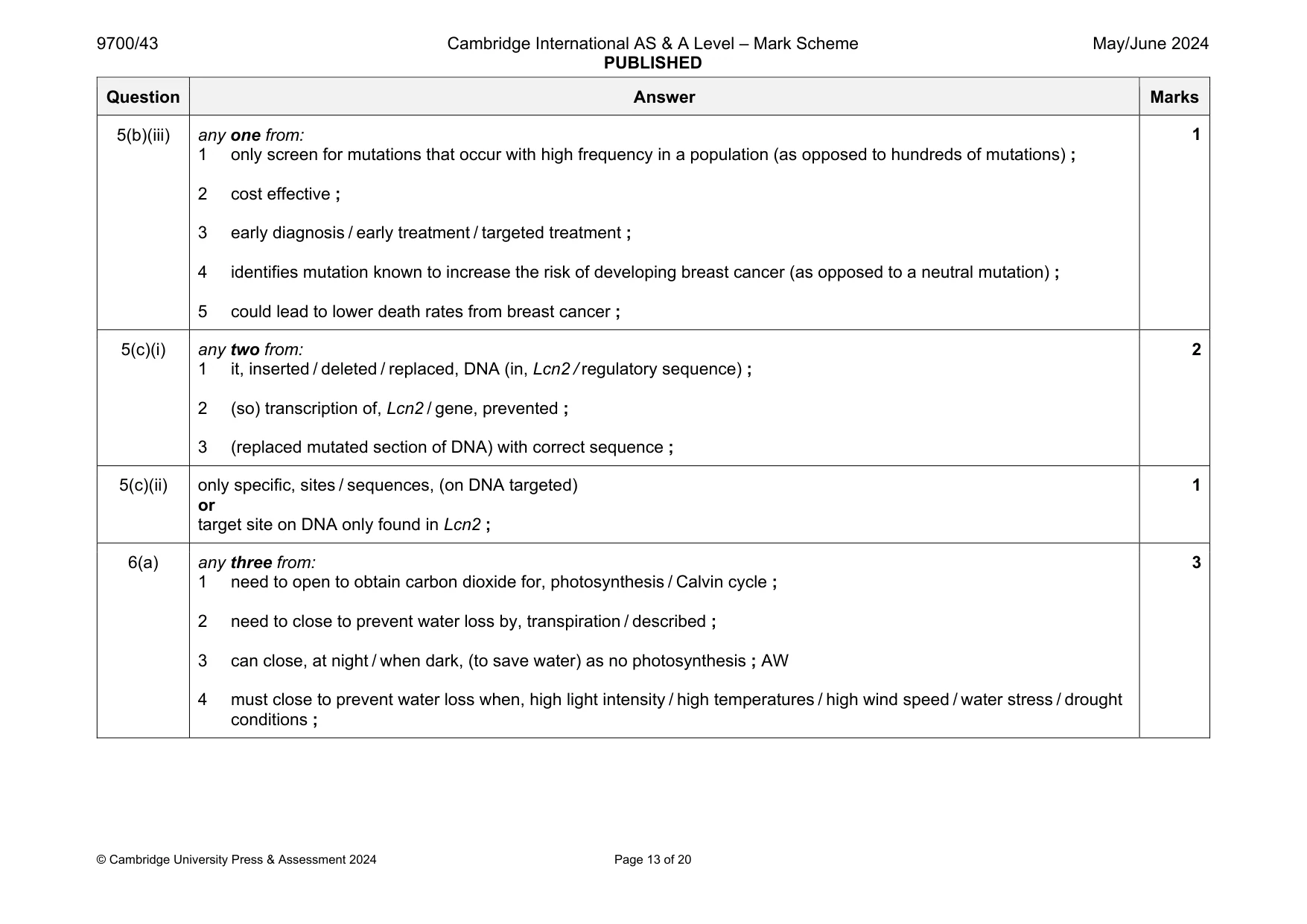
Mark scheme: 5(a) crossing over ; A chiasma formation 1 Question Answer Marks 5(b)(i) any three from: 1 mutation occurred a long time ago or someone in original population had mutation or mutation in common ancestor ; 2 ref. to. founder effect ; 3 (original / current) population is small ; 4 idea that much of the population is closely related or small gene pool / low genetic diversity ; A inbreeding 5 ref. to isolated (population) ; 6 (caused) increase in frequency of, mutation / 999del5 / BRCA2 allele ; 3 5(b)(ii) any three from: 1 reduce worry if negative ; (if positive) 2 lifestyle changes / described ; 3 early treatment / breast removal / can have frequent checks ; 4 informed decision about having children ; 5 ref. to counselling ; 6 could lead to lower death rates from breast cancer ; 3 Question Answer Marks 5(b)(iii) any one from: 1 only screen for mutations that occur with high frequency in a population (as opposed to hundreds of mutations) ; 2 cost effective ; 3 early diagnosis / early treatment / targeted treatment ; 4 identifies mutation known to increase the risk of developing breast cancer (as opposed to a neutral mutation) ; 5 could lead to lower death rates from breast cancer ; 1 5(c)(i) any two from: 1 it, inserted / deleted / replaced, DNA (in, Lcn2 / regulatory sequence) ; 2 (so) transcription of, Lcn2 / gene, prevented ; 3 (replaced mutated section of DNA) with correct sequence ; 2 5(c)(ii) only specific, sites / sequences, (on DNA targeted) or target site on DNA only found in Lcn2 ; 1 3
Q6 · In plants, stomata open and close in response to changes in environmental conditions
6 (a) In plants, stomata open and close in response to changes in environmental conditions. Explain why stomata need to open and close according to environmental conditions. ................................................................................................................................................... ................................................................................................................................................... ................................................................................................................................................... ................................................................................................................................................... ................................................................................................................................................... ................................................................................................................................................... ............................................................................................................................................. [3] (b) Describe the mechanism occurring in guard cells that leads to the opening of a stoma. ................................................................................................................................................... ................................................................................................................................................... ................................................................................................................................................... ................................................................................................................................................... ................................................................................................................................................... ................................................................................................................................................... ................................................................................................................................................... ................................................................................................................................................... ................................................................................................................................................... ................................................................................................................................................... ................................................................................................................................................... ................................................................................................................................................... ............................................................................................................................................. [6] [Total: 9]
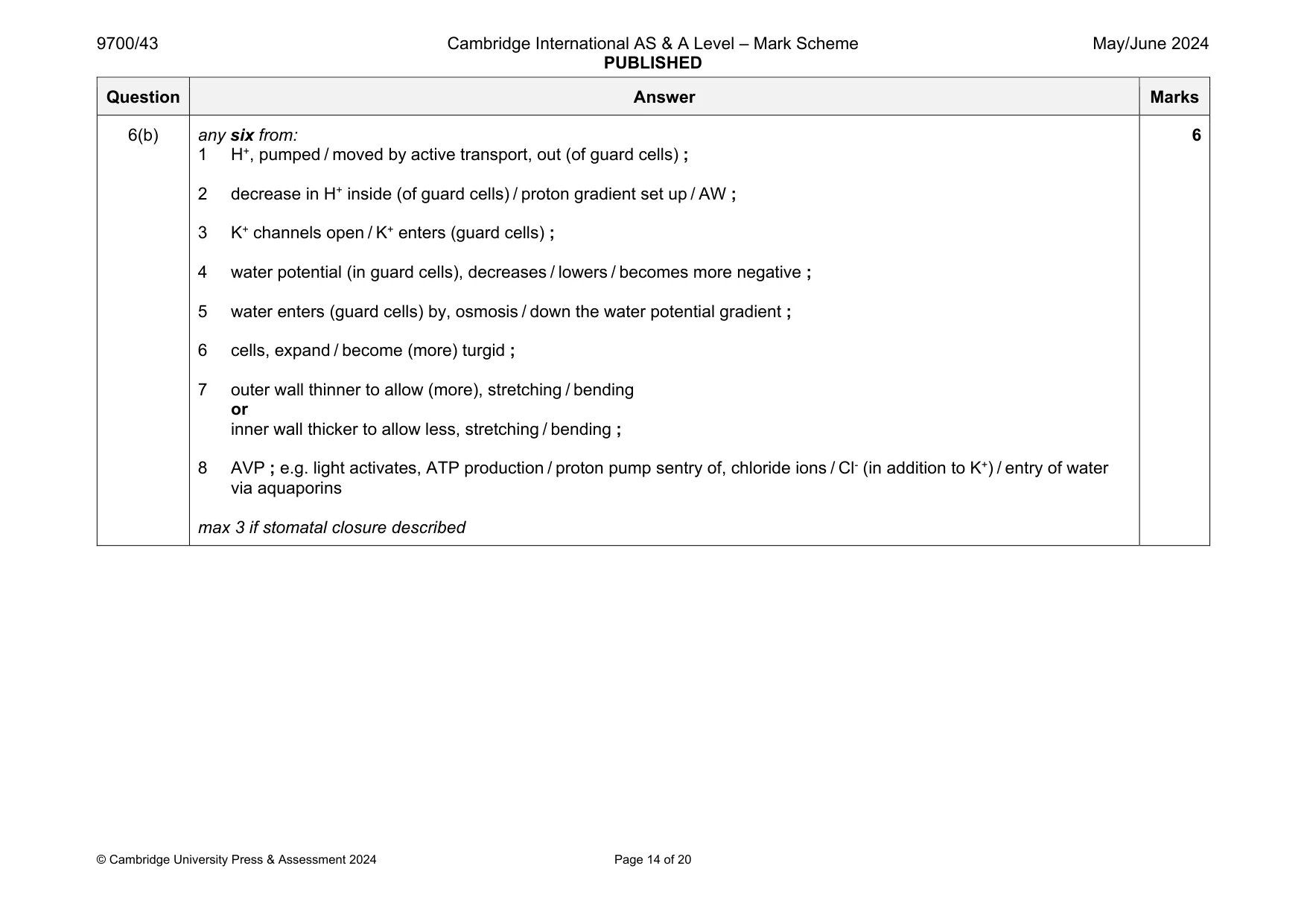
Mark scheme: 6(a) any three from: 1 need to open to obtain carbon dioxide for, photosynthesis / Calvin cycle ; 2 need to close to prevent water loss by, transpiration / described ; 3 can close, at night / when dark, (to save water) as no photosynthesis ; AW 4 must close to prevent water loss when, high light intensity / high temperatures / high wind speed / water stress / drought conditions ; Question Answer Marks 6(b) any six from: 1 H+, pumped / moved by active transport, out (of guard cells) ; 2 decrease in H+ inside (of guard cells) / proton gradient set up / AW ; 3 K+ channels open / K+ enters (guard cells) ; 4 water potential (in guard cells), decreases / lowers / becomes more negative ; 5 water enters (guard cells) by, osmosis / down the water potential gradient ; 6 cells, expand / become (more) turgid ; 7 outer wall thinner to allow (more), stretching / bending or inner wall thicker to allow less, stretching / bending ; 8 AVP ; e.g. light activates, ATP production / proton pump sentry of, chloride ions / Cl- (in addition to K+) / entry of water via aquaporins max 3 if stomatal closure described 6
Q7 · Experiments were carried out to determine the effect of light intensity on the rate of…
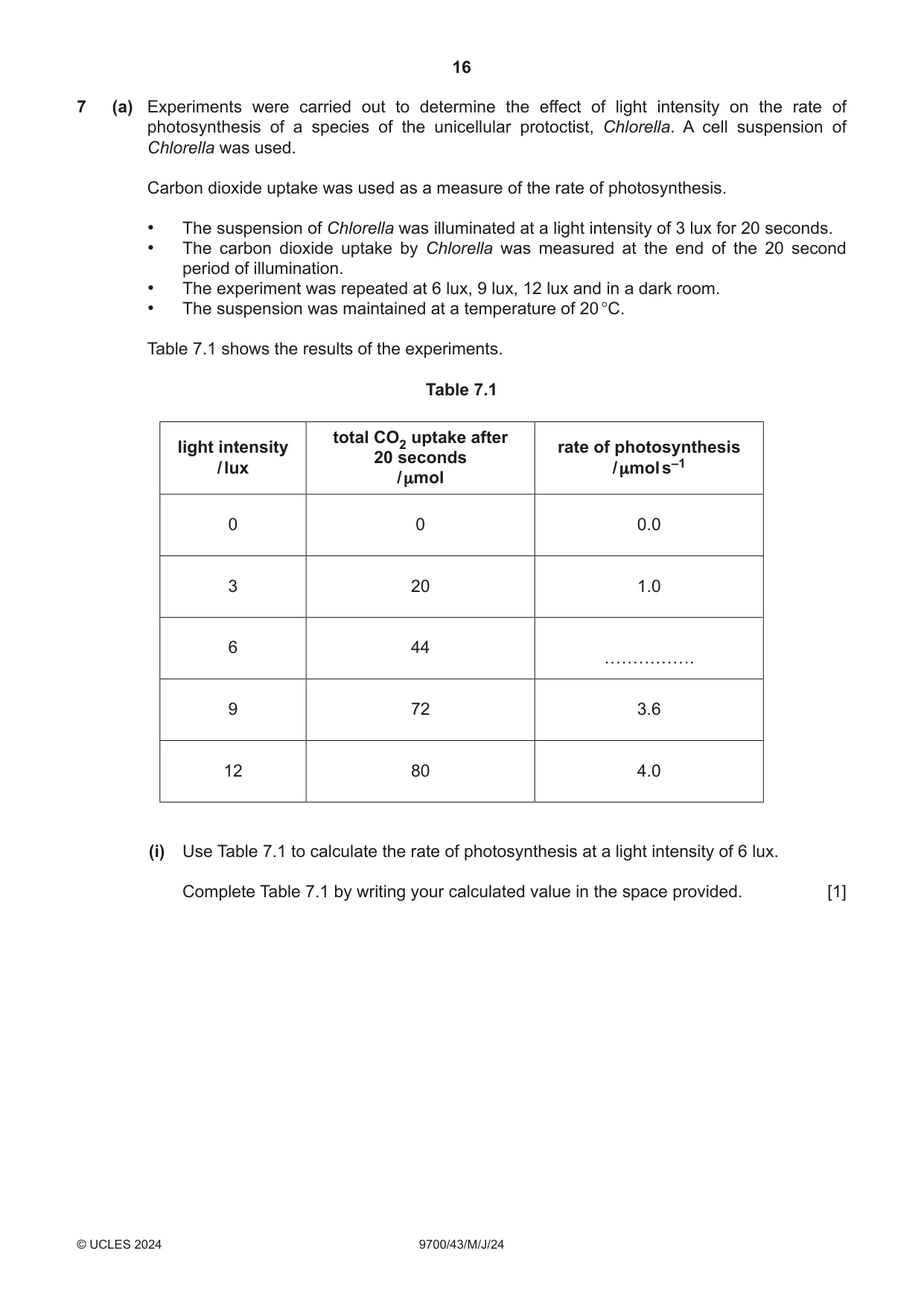
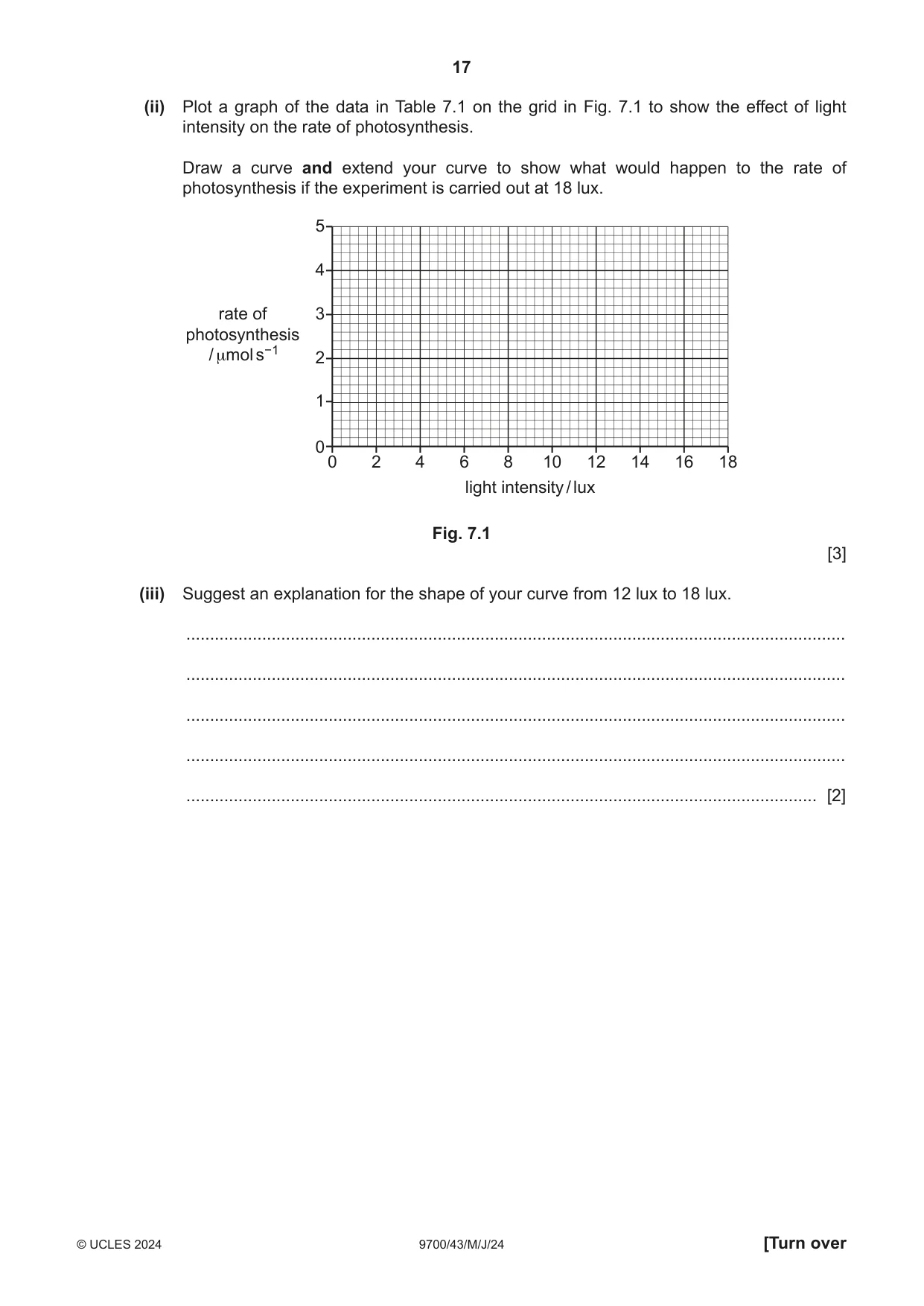
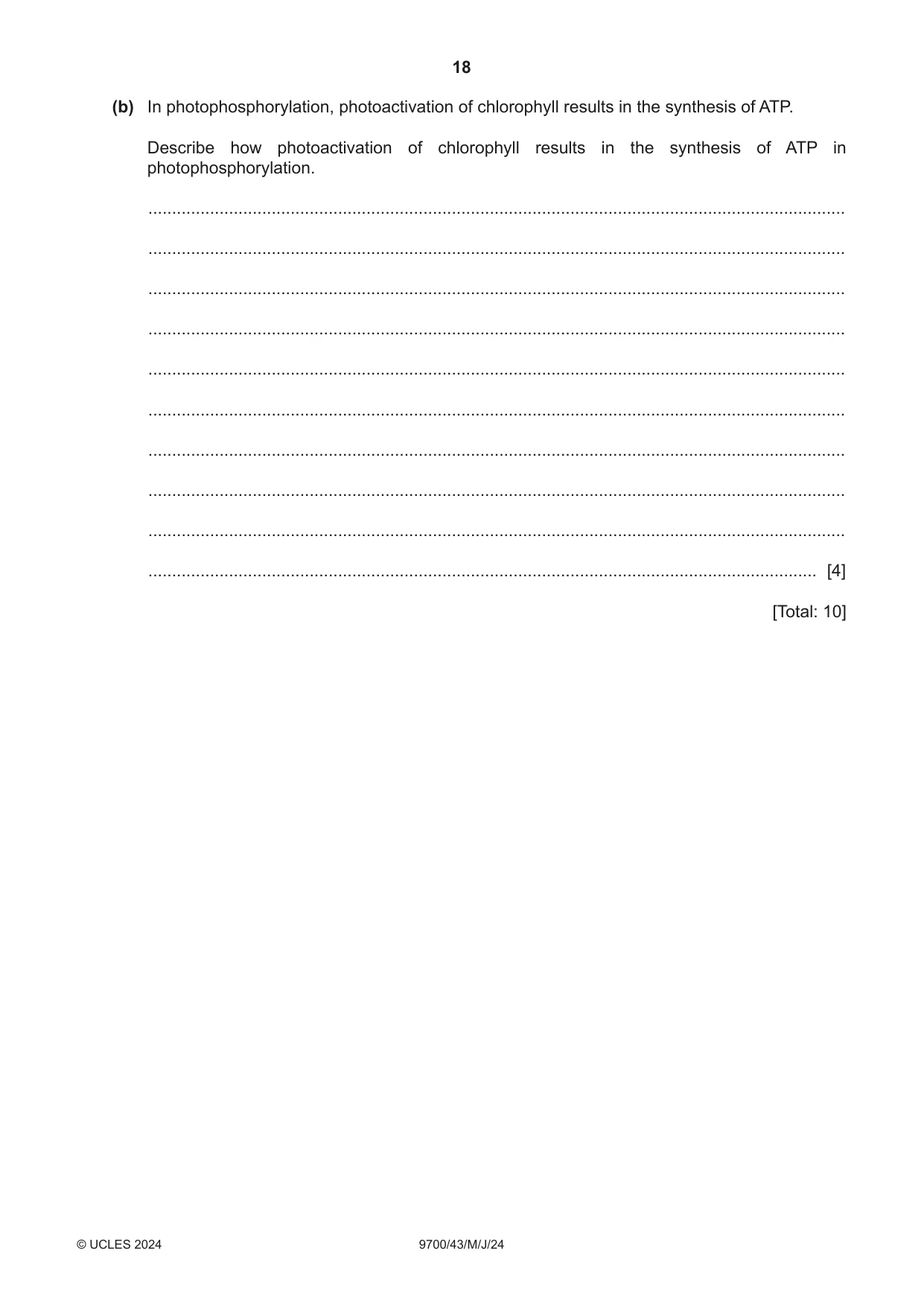
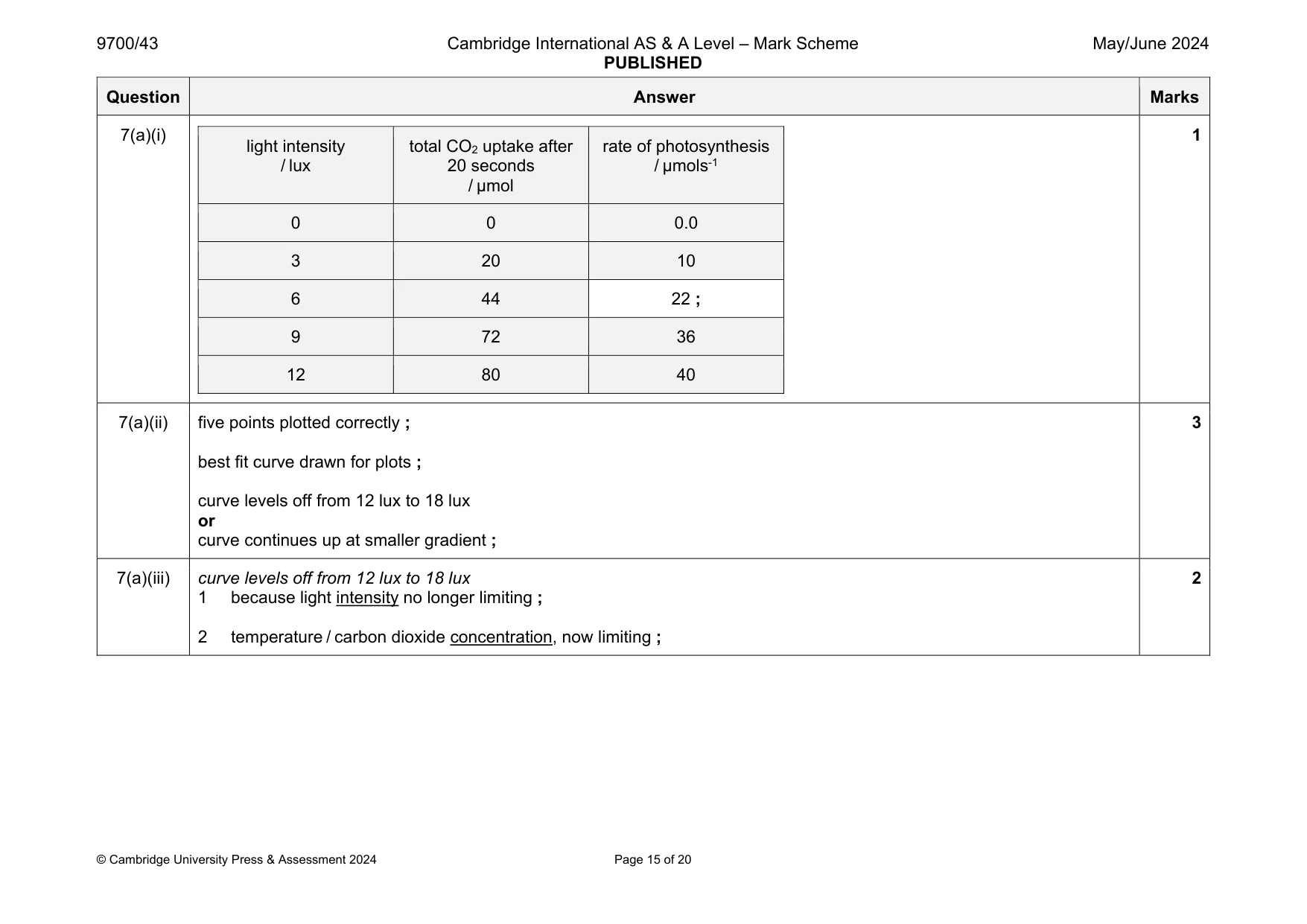
7 (a) Experiments were carried out to determine the effect of light intensity on the rate of photosynthesis of a species of the unicellular protoctist, Chlorella. A cell suspension of Chlorella was used. Carbon dioxide uptake was used as a measure of the rate of photosynthesis. • The suspension of Chlorella was illuminated at a light intensity of 3 lux for 20 seconds. • The carbon dioxide uptake by Chlorella was measured at the end of the 20 second period of illumination. • The experiment was repeated at 6 lux, 9 lux, 12 lux and in a dark room. • The suspension was maintained at a temperature of 20 °C. Table 7.1 shows the results of the experiments. Table 7.1 total CO2 uptake after light intensity rate of photosynthesis 20 seconds / lux / μmol s–1 / μmol 0 0 0.0 3 20 1.0 6 44 ……………. 9 72 3.6 12 80 4.0 (i) Use Table 7.1 to calculate the rate of photosynthesis at a light intensity of 6 lux. Complete Table 7.1 by writing your calculated value in the space provided. [1] (ii) Plot a graph of the data in Table 7.1 on the grid in Fig. 7.1 to show the effect of light intensity on the rate of photosynthesis. Draw a curve and extend your curve to show what would happen to the rate of photosynthesis if the experiment is carried out at 18 lux. 5 4 rate of 3 photosynthesis / μmol s−1 2 1 0 0 2 4 6 8 10 12 14 16 18 light intensity / lux Fig. 7.1 [3] (iii) Suggest an explanation for the shape of your curve from 12 lux to 18 lux. ........................................................................................................................................... ........................................................................................................................................... ........................................................................................................................................... ........................................................................................................................................... ..................................................................................................................................... [2] (b) In photophosphorylation, photoactivation of chlorophyll results in the synthesis of ATP. Describe how photoactivation of chlorophyll results in the synthesis of ATP in photophosphorylation. ................................................................................................................................................... ................................................................................................................................................... ................................................................................................................................................... ................................................................................................................................................... ................................................................................................................................................... ................................................................................................................................................... ................................................................................................................................................... ................................................................................................................................................... ................................................................................................................................................... ............................................................................................................................................. [4] [Total: 10]
Mark scheme: 7(a)(i) light intensity / lux total CO2 uptake after 20 seconds / μmol rate of photosynthesis / μmols-1 0 0 0.0 3 20 10 6 44 22 ; 9 72 36 12 80 40 1 7(a)(ii) five points plotted correctly ; best fit curve drawn for plots ; curve levels off from 12 lux to 18 lux or curve continues up at smaller gradient ; 3 7(a)(iii) curve levels off from 12 lux to 18 lux 1 because light intensity no longer limiting ; 2 temperature / carbon dioxide concentration, now limiting ; 2 Question Answer Marks 7(b) any four from: 1 electrons, excited / emitted / described ; 2 electrons travel along ETC and energy released ; 3 (use energy released) to pump H+ into thylakoid, space/ lumen ; 4 increases concentration of H+ / protons (in thylakoid space / lumen) / creates proton gradient ; 5 H+ / protons, diffuse through ATP synthase ; 6 (from thylakoid space) to stroma ; 7 chemiosmosis ; 4
Q8 · A diagram of a mitochondrion
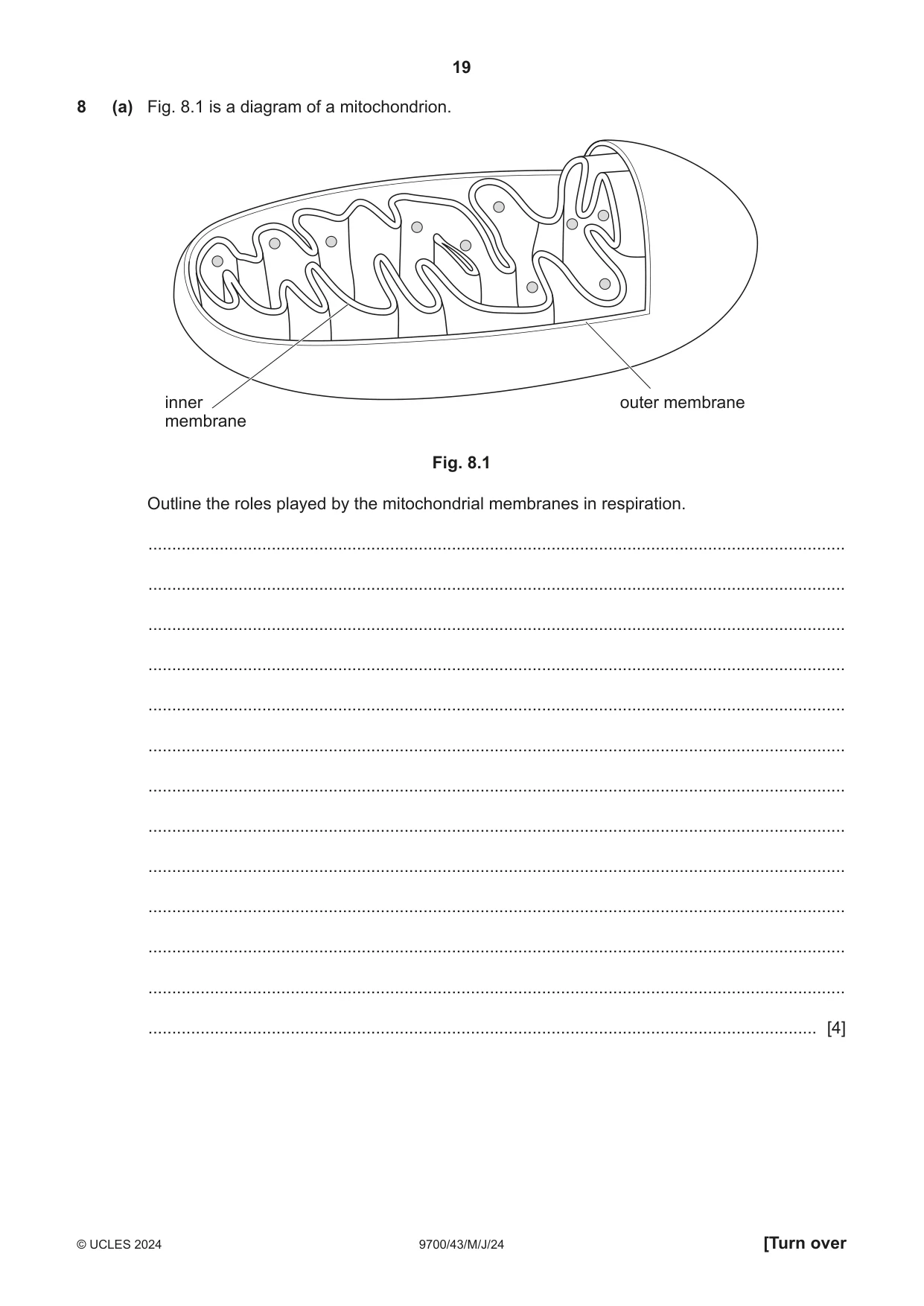
8 (a) Fig. 8.1 is a diagram of a mitochondrion. inner outer membrane membrane Fig. 8.1 Outline the roles played by the mitochondrial membranes in respiration. ................................................................................................................................................... ................................................................................................................................................... ................................................................................................................................................... ................................................................................................................................................... ................................................................................................................................................... ................................................................................................................................................... ................................................................................................................................................... ................................................................................................................................................... ................................................................................................................................................... ................................................................................................................................................... ................................................................................................................................................... ................................................................................................................................................... ............................................................................................................................................. [4] (b) The shapes and numbers of mitochondria are continually changing due to fission. Fission occurs when one mitochondrion splits to form two mitochondria. (i) Suggest reasons why mitochondria carry out fission. ........................................................................................................................................... ........................................................................................................................................... ........................................................................................................................................... ........................................................................................................................................... ..................................................................................................................................... [2] (ii) Guanosine triphosphate (GTP) is a molecule that is used as a source of energy in some reactions, instead of ATP. Guanosine is composed of a purine, similar to adenine, and ribose. Suggest why GTP can be a suitable source of energy in some reactions. ........................................................................................................................................... ..................................................................................................................................... [1] (c) Old or damaged mitochondria reduce the ability of a cell to carry out aerobic respiration and produce the ATP needed for the metabolic processes of the cell. Suggest what occurs to these mitochondria to allow the cell to maintain the same overall rate of respiration and ATP production. ................................................................................................................................................... ................................................................................................................................................... ................................................................................................................................................... ................................................................................................................................................... ............................................................................................................................................. [2] [Total: 9]
Mark scheme: 8(a) any four from: outer / inner membranes 1 allow entry of, oxygen for oxidative phosphorylation / pyruvate for link reaction ; I Krebs cycle 2 allow exit of carbon dioxide from, Krebs cycle / link reaction ; 3 compartmentalisation / described ; inner membrane 4 (location of) ETC to release energy to pump protons into intermembrane space ; 5 (location of) ATP synthase for production of ATP ; 6 cristae / infoldings, to increase surface area for many, ETCs / ATP synthases ; 7 impermeable to, hydrogen ions / protons, to maintain proton gradient or impermeable to, hydrogen ions / protons, to maintain, high H+ concentration in intermembrane space ; 8 site of, oxidative phosphorylation / chemiosmosis ; 4 8(b)(i) any two from: 1 ref. to cells, metabolic rate / energy needs ; 2 in cells about to undergo, mitosis / cell division ; 3 AVP ; e.g. to replace damaged mitochondria 2 8(b)(ii) hydrolysed / bond broken, (to release energy) or G proteins bind to GTP rather than to ATP ; 1 8(c) 1 degraded / broken down by, lysosomes / hydrolytic enzymes ; 2 components of breakdown / AW, used to produce new mitochondria ; 2
Q9 · How the mean global atmospheric carbon dioxide concentration has changed over the 800 000…
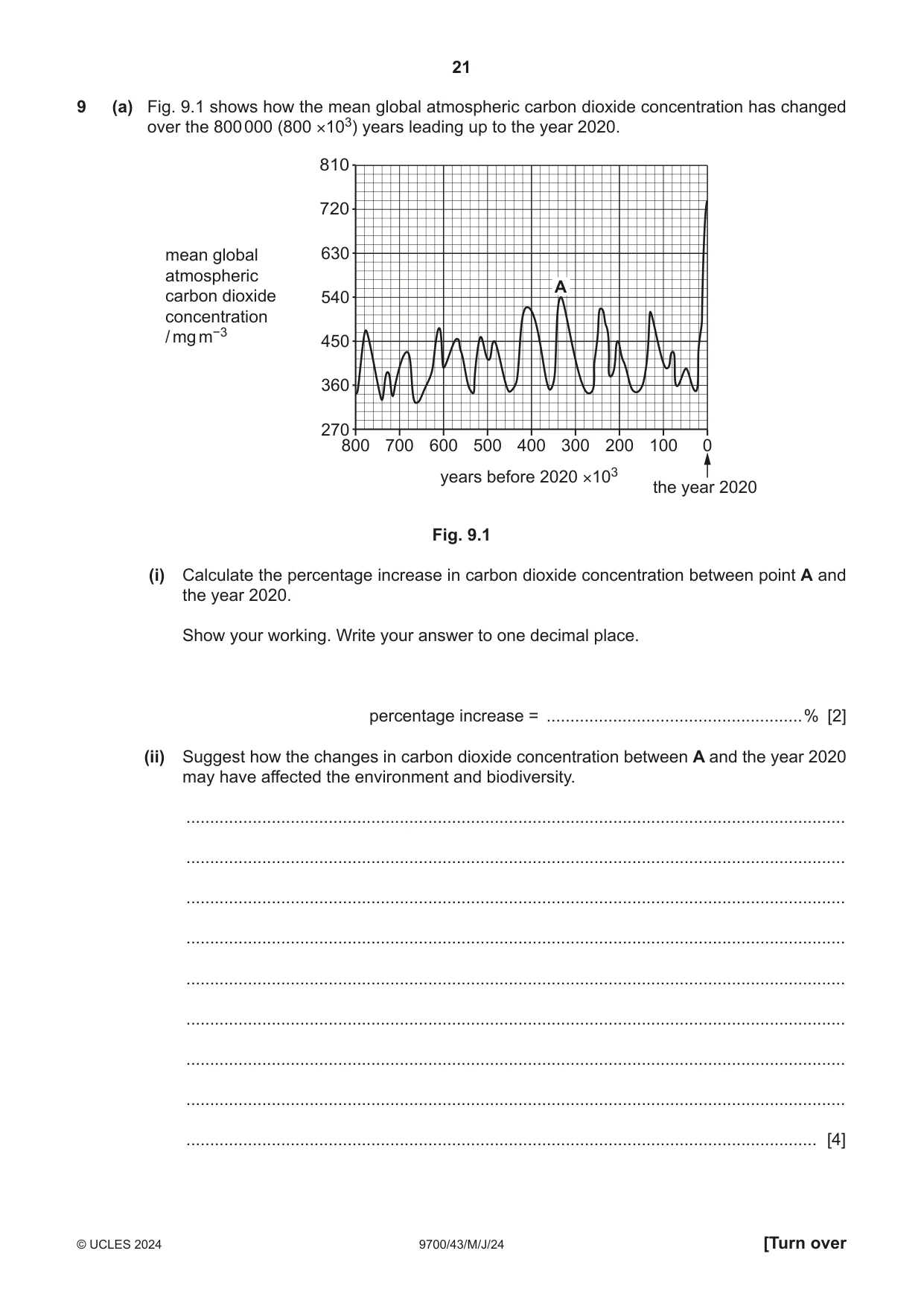
9 (a) Fig. 9.1 shows how the mean global atmospheric carbon dioxide concentration has changed over the 800 000 (800 ×103) years leading up to the year 2020. 810 720 mean global 630 atmospheric A carbon dioxide 540 concentration / mg m−3 450 360 270 800 700 600 500 400 300 200 100 0 years before 2020 ×103 the year 2020 Fig. 9.1 (i) Calculate the percentage increase in carbon dioxide concentration between point A and the year 2020. Show your working. Write your answer to one decimal place. percentage increase = ......................................................% [2] (ii) Suggest how the changes in carbon dioxide concentration between A and the year 2020 may have affected the environment and biodiversity. ........................................................................................................................................... ........................................................................................................................................... ........................................................................................................................................... ........................................................................................................................................... ........................................................................................................................................... ........................................................................................................................................... ........................................................................................................................................... ........................................................................................................................................... ..................................................................................................................................... [4] (b) Outline reasons for maintaining plant biodiversity. ................................................................................................................................................... ................................................................................................................................................... ................................................................................................................................................... ................................................................................................................................................... ................................................................................................................................................... ................................................................................................................................................... ................................................................................................................................................... ................................................................................................................................................... ................................................................................................................................................... ............................................................................................................................................. [4] [Total: 10]
Mark scheme: 9(a)(i) 367 (%) ;; allow 1 mark for: (738 540) 540 100 or 36.66666667 9(a)(ii) any four from: 1 increase in temperature / global warming ; 2 sea levels increase ; 3 habitat change / example ; e.g. forest fires / ocean acidification 4 food web / food chain / ecosystem, disrupted ; 5 change in biodiversity ; 6 ref. to extinction ; 7 AVP ; 4 Question Answer Marks 9(b) any four from: 1 may have future use ; 2 aesthetic / ethical / cultural, reasons ; 3 medical uses / example ; 4 ecotourism ; 5 idea of maintaining stability in, ecosystems / food chains / food webs ; 6 resource material ; e.g. wood for building / fibres for clothes / food (for humans) / agriculture 7 maintain / increase, gene pool / genetic diversity ; 8 ref. to soil stability / desertification ; 4
Q10 · A diagram of part of a neurone membrane while the resting potential is maintained
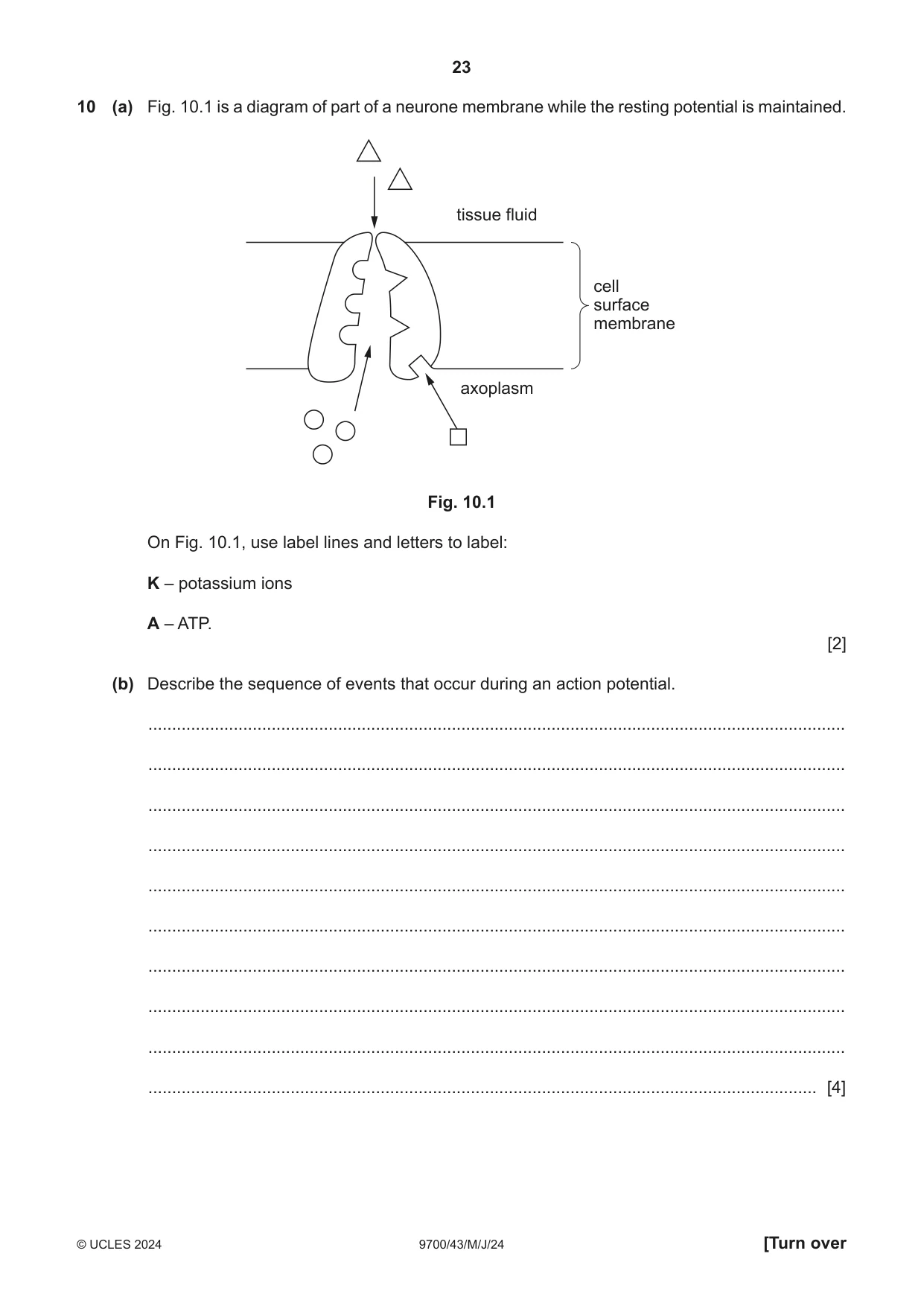
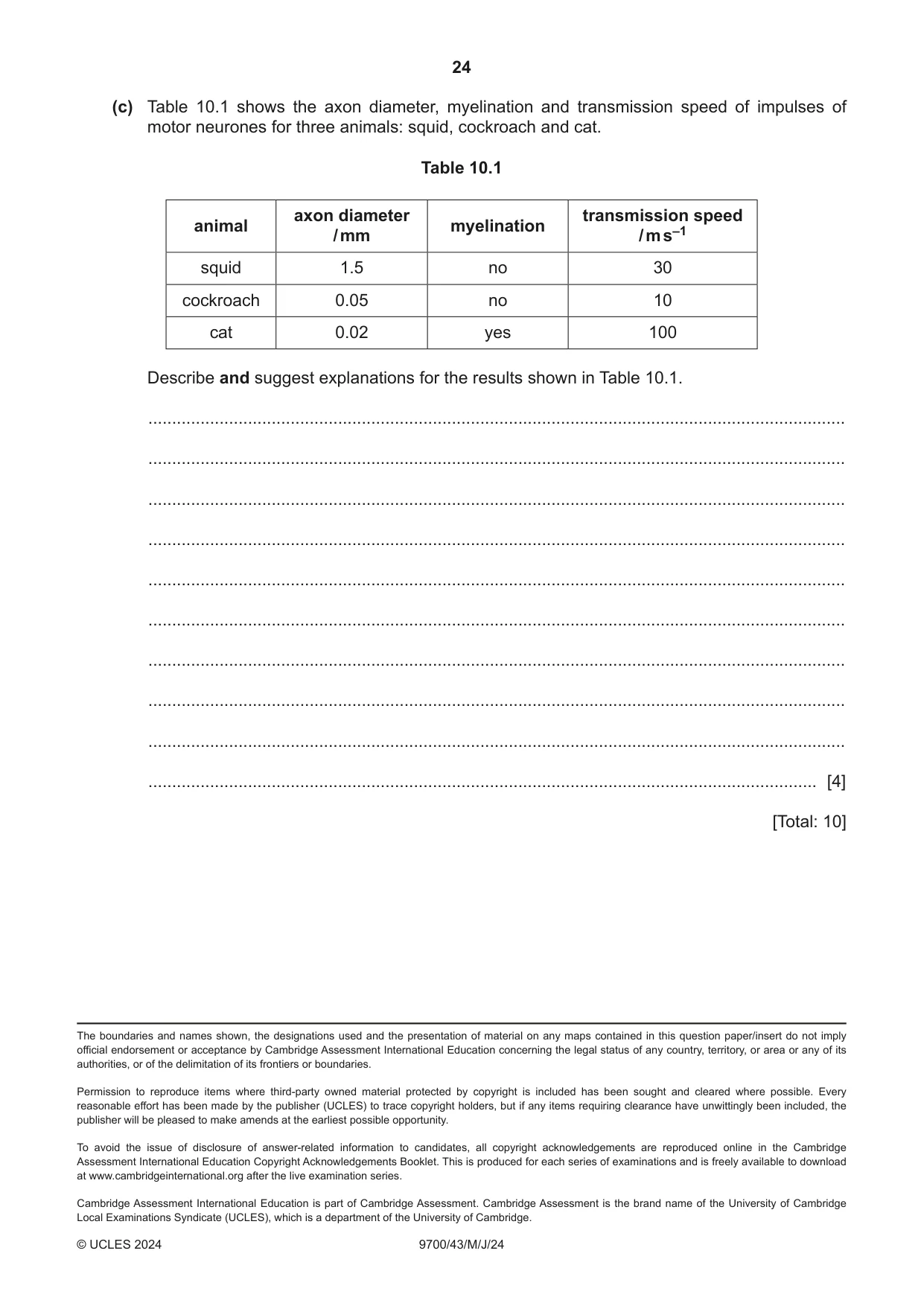
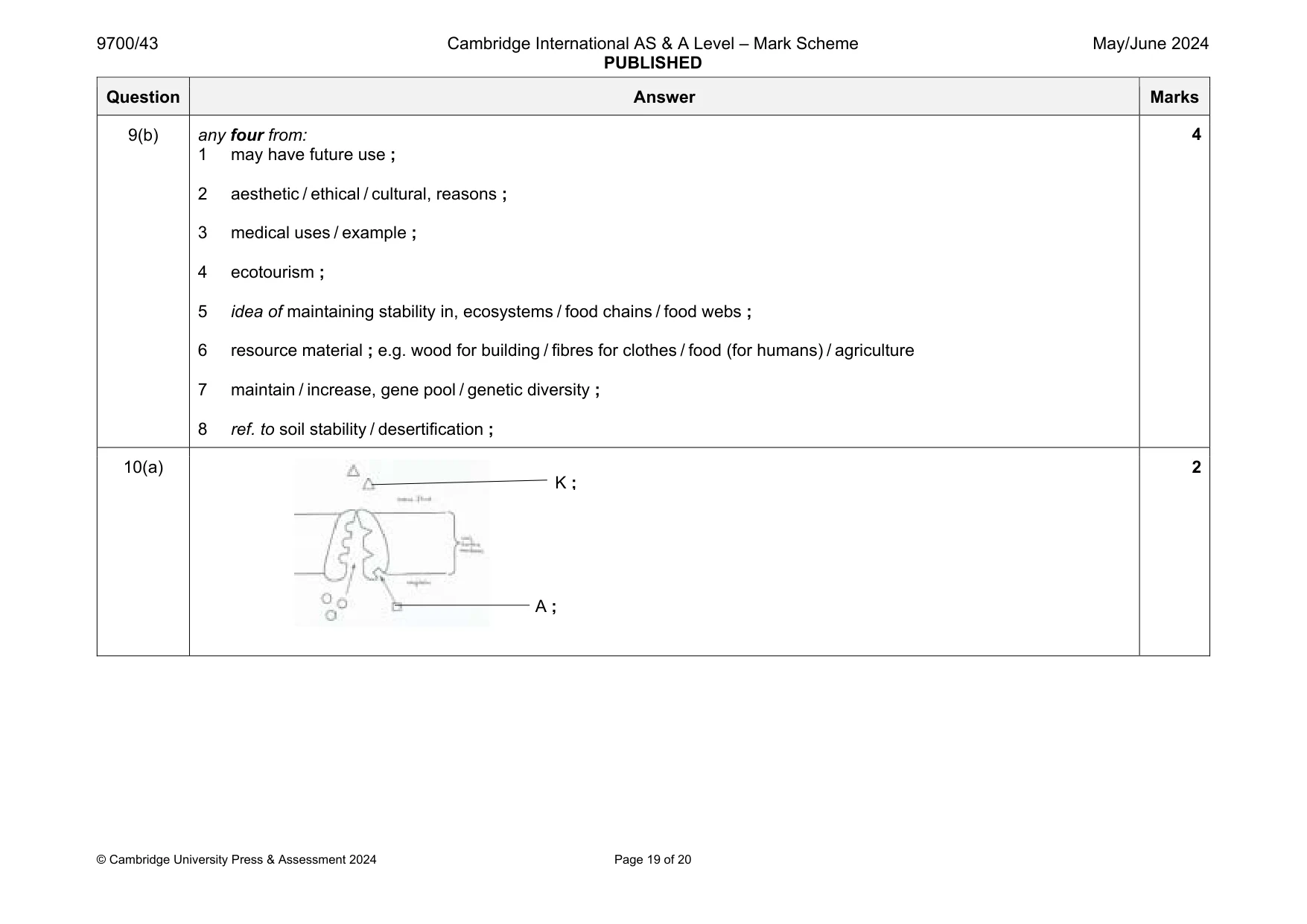
10 (a) Fig. 10.1 is a diagram of part of a neurone membrane while the resting potential is maintained. tissue fluid cell surface membrane axoplasm Fig. 10.1 On Fig. 10.1, use label lines and letters to label: K – potassium ions A – ATP. [2] (b) Describe the sequence of events that occur during an action potential. ................................................................................................................................................... ................................................................................................................................................... ................................................................................................................................................... ................................................................................................................................................... ................................................................................................................................................... ................................................................................................................................................... ................................................................................................................................................... ................................................................................................................................................... ................................................................................................................................................... ............................................................................................................................................. [4] (c) Table 10.1 shows the axon diameter, myelination and transmission speed of impulses of motor neurones for three animals: squid, cockroach and cat. Table 10.1 axon diameter transmission speed animal myelination / mm / m s–1 squid 1.5 no 30 cockroach 0.05 no 10 cat 0.02 yes 100 Describe and suggest explanations for the results shown in Table 10.1. ................................................................................................................................................... ................................................................................................................................................... ................................................................................................................................................... ................................................................................................................................................... ................................................................................................................................................... ................................................................................................................................................... ................................................................................................................................................... ................................................................................................................................................... ................................................................................................................................................... ............................................................................................................................................. [4] [Total: 10] The boundaries and names shown, the designations used and the presentation of material on any maps contained in this question paper/insert do not imply official endorsement or acceptance by Cambridge Assessment International Education concerning the legal status of any country, territory, or area or any of its authorities, or of the delimitation of its frontiers or boundaries.
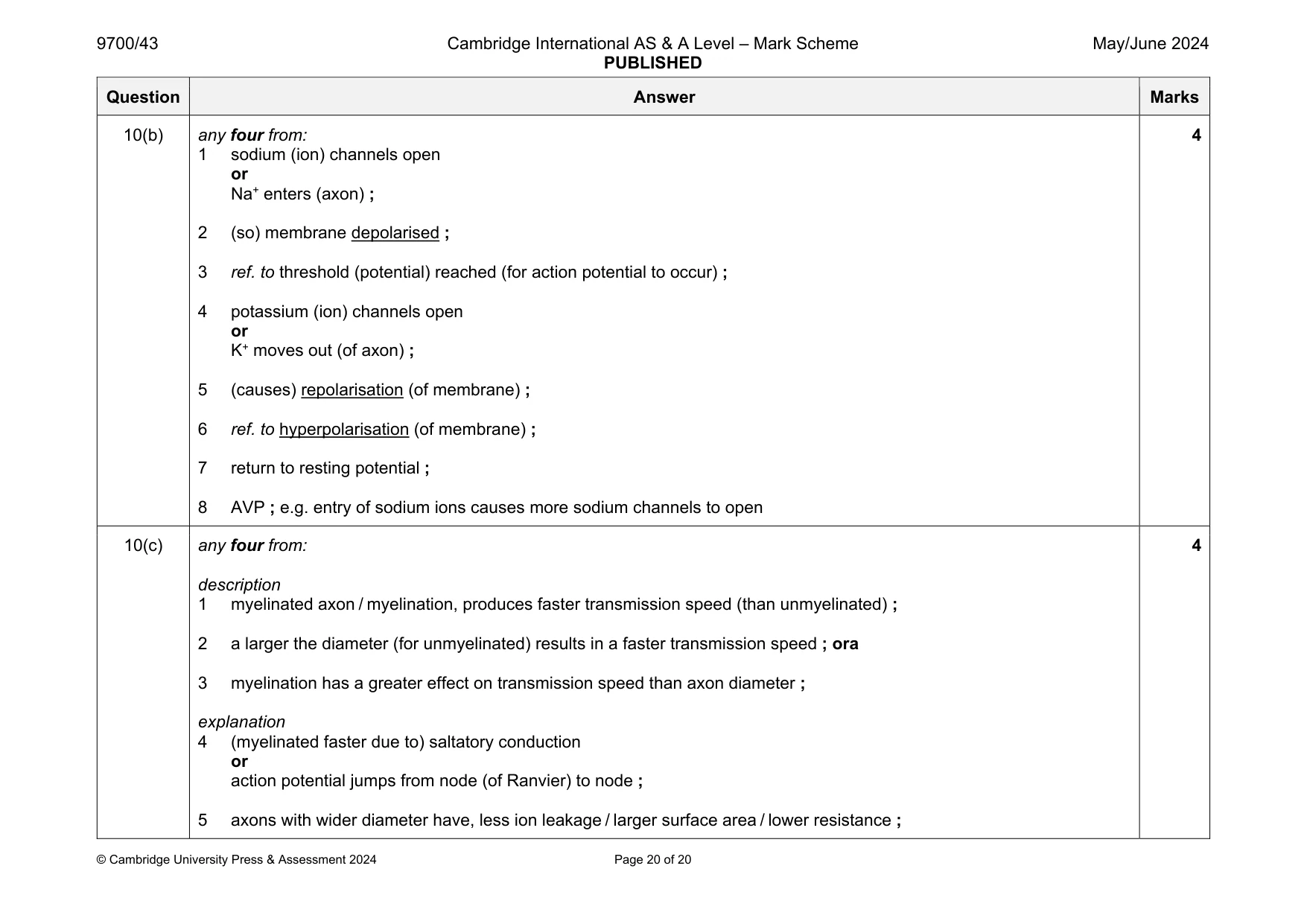
Mark scheme: 10(a) 2 K ; A ; Question Answer Marks 10(b) any four from: 1 sodium (ion) channels open or Na+ enters (axon) ; 2 (so) membrane depolarised ; 3 ref. to threshold (potential) reached (for action potential to occur) ; 4 potassium (ion) channels open or K+ moves out (of axon) ; 5 (causes) repolarisation (of membrane) ; 6 ref. to hyperpolarisation (of membrane) ; 7 return to resting potential ; 8 AVP ; e.g. entry of sodium ions causes more sodium channels to open 4 10(c) any four from: description 1 myelinated axon / myelination, produces faster transmission speed (than unmyelinated) ; 2 a larger the diameter (for unmyelinated) results in a faster transmission speed ; ora 3 myelination has a greater effect on transmission speed than axon diameter ; explanation 4 (myelinated faster due to) saltatory conduction or action potential jumps from node (of Ranvier) to node ; 5 axons with wider diameter have, less ion leakage / larger surface area / lower resistance ; 4
What was in this paper
The subtopics covered by these 10 questions, and how many questions each got. Open one in a new tab to see every Cambridge question on it.
What you needed in this session
Cambridge’s own grade thresholds for 2024 May/June, Paper 4 · Variant 3. A higher threshold means an easier paper — the bar moves with how the cohort did.