Cambridge A Level Biology 9700 — 2023 Oct/Nov Paper 4 · Variant 2
9700/42/O/N/23 · 10 questions · 100 marks · ≈113 min
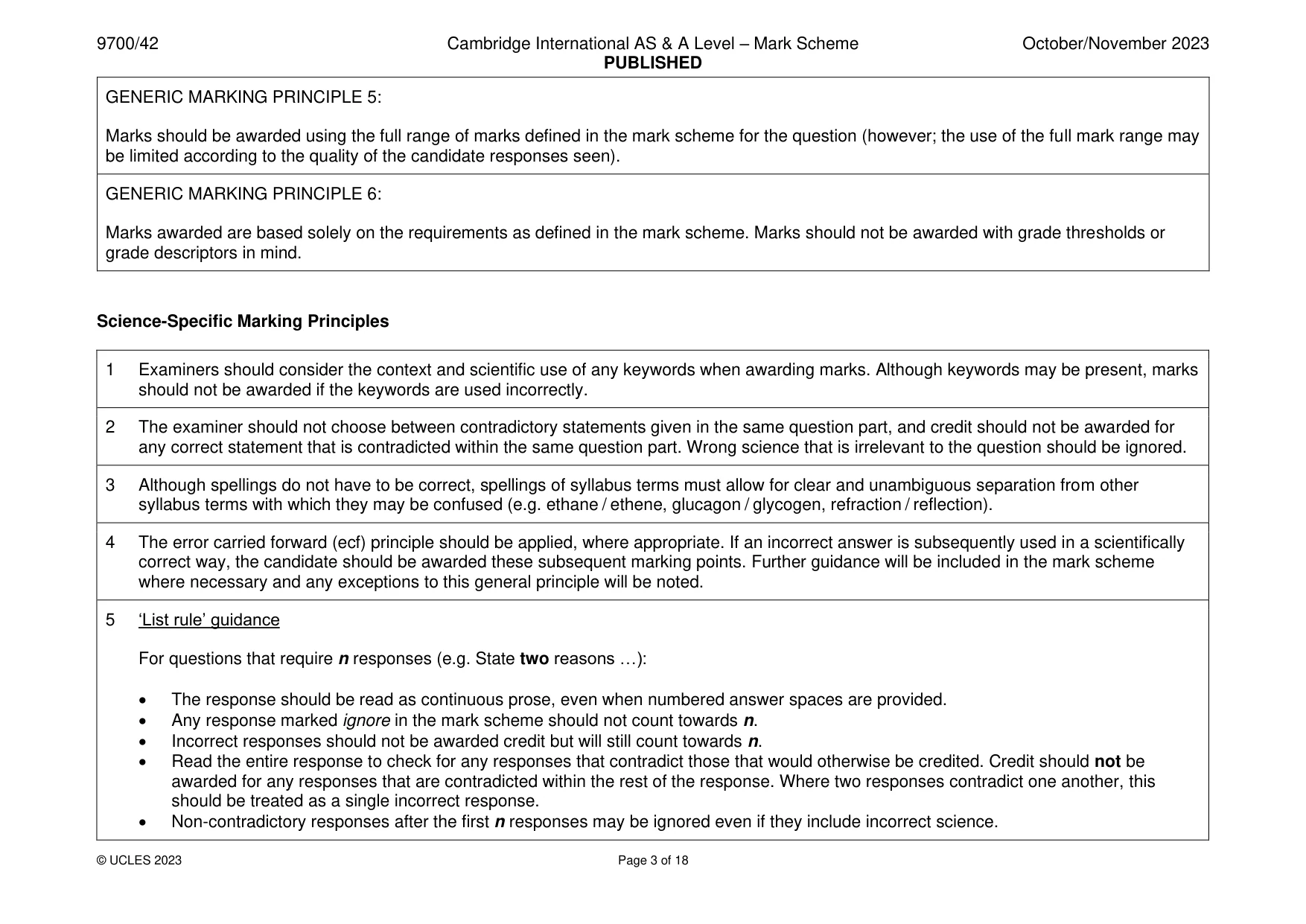
The question paper and its mark scheme, free to read here and free to download. This is Cambridge’s own paper, exactly as it was sat.
Question paper24 pages


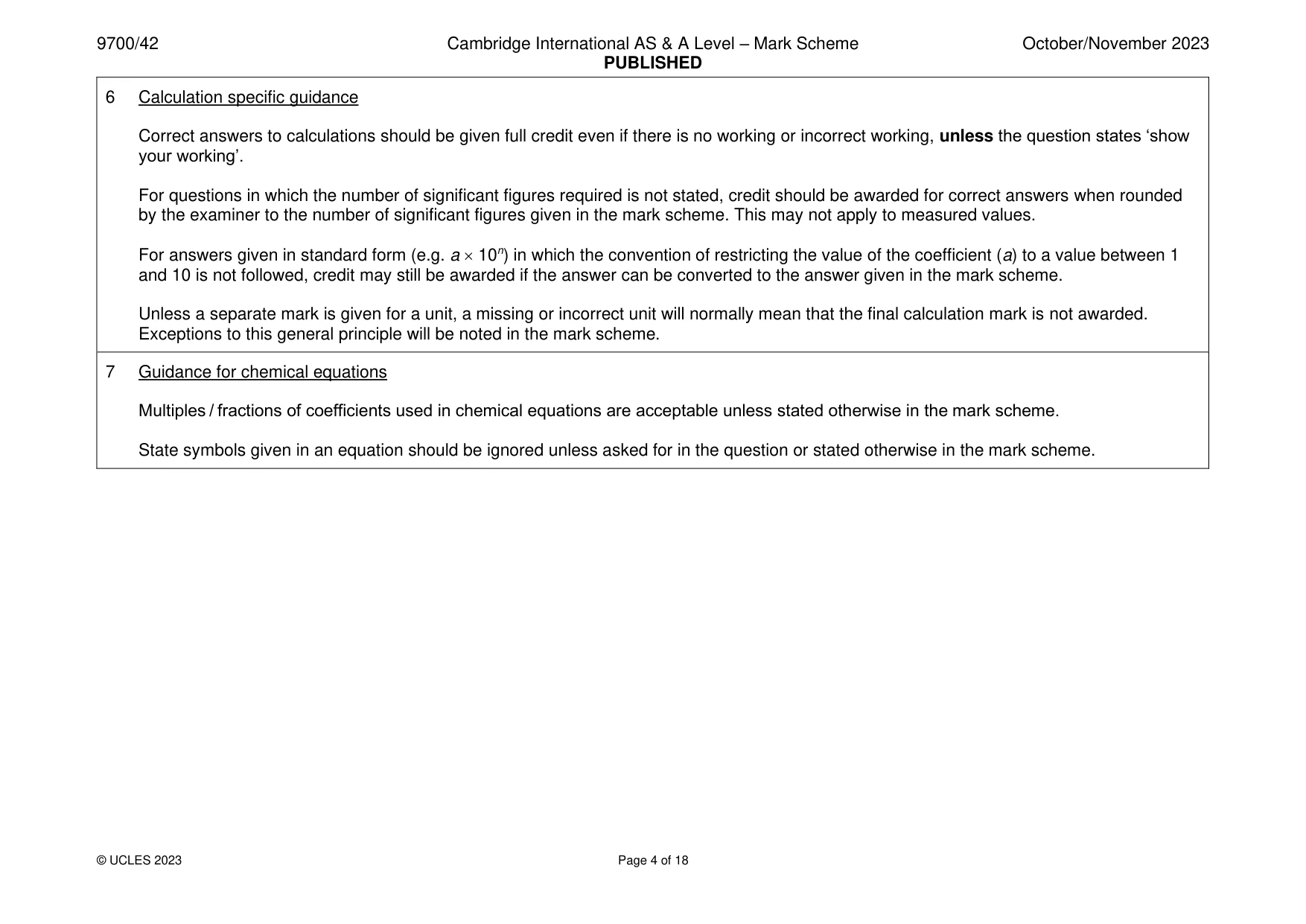
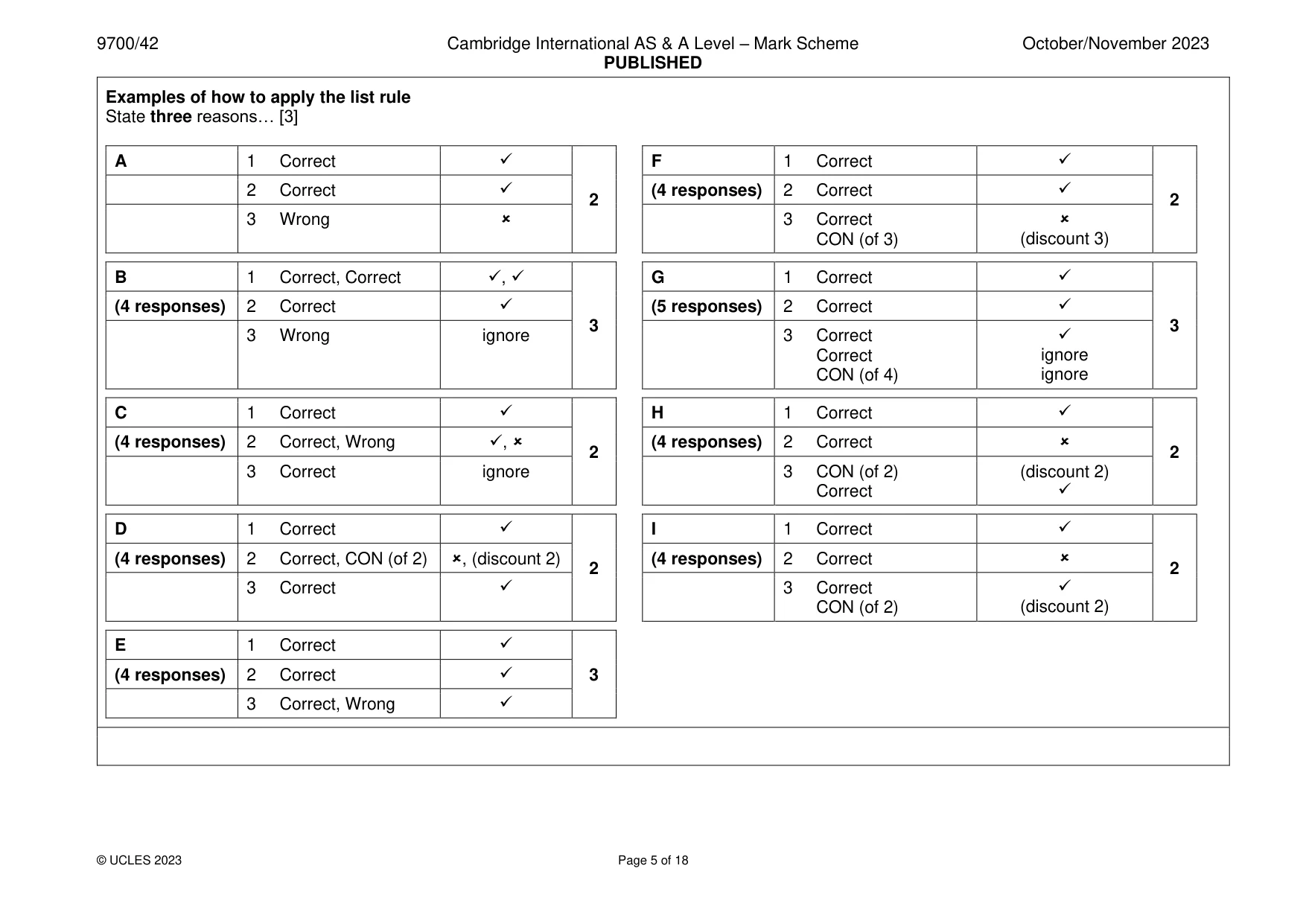
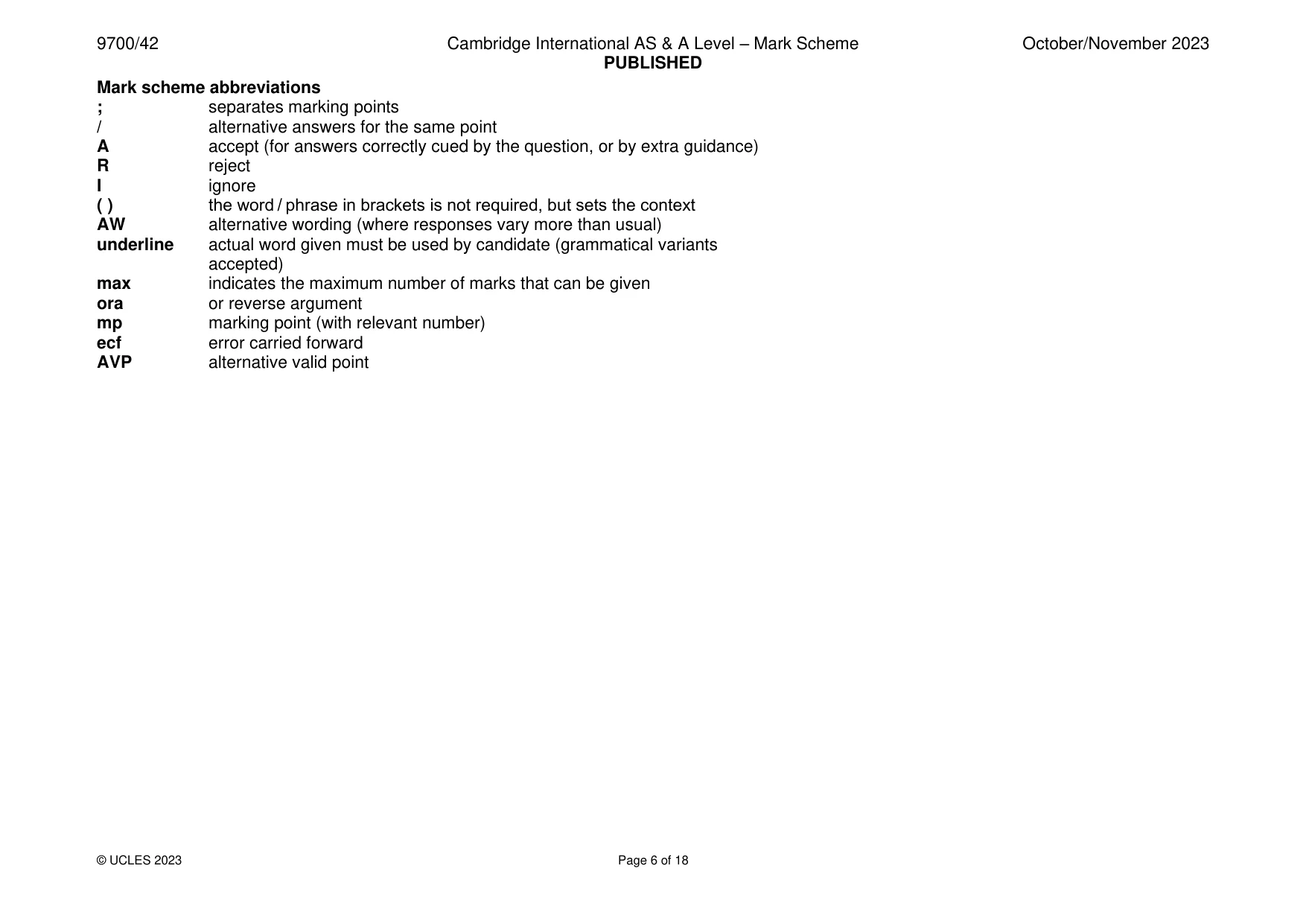
Mark scheme18 pages
Answers below. Sit the paper first if you are practising.
Questions as text
Q1 · Some organisms carry out respiration in anaerobic conditions when oxygen is not available…
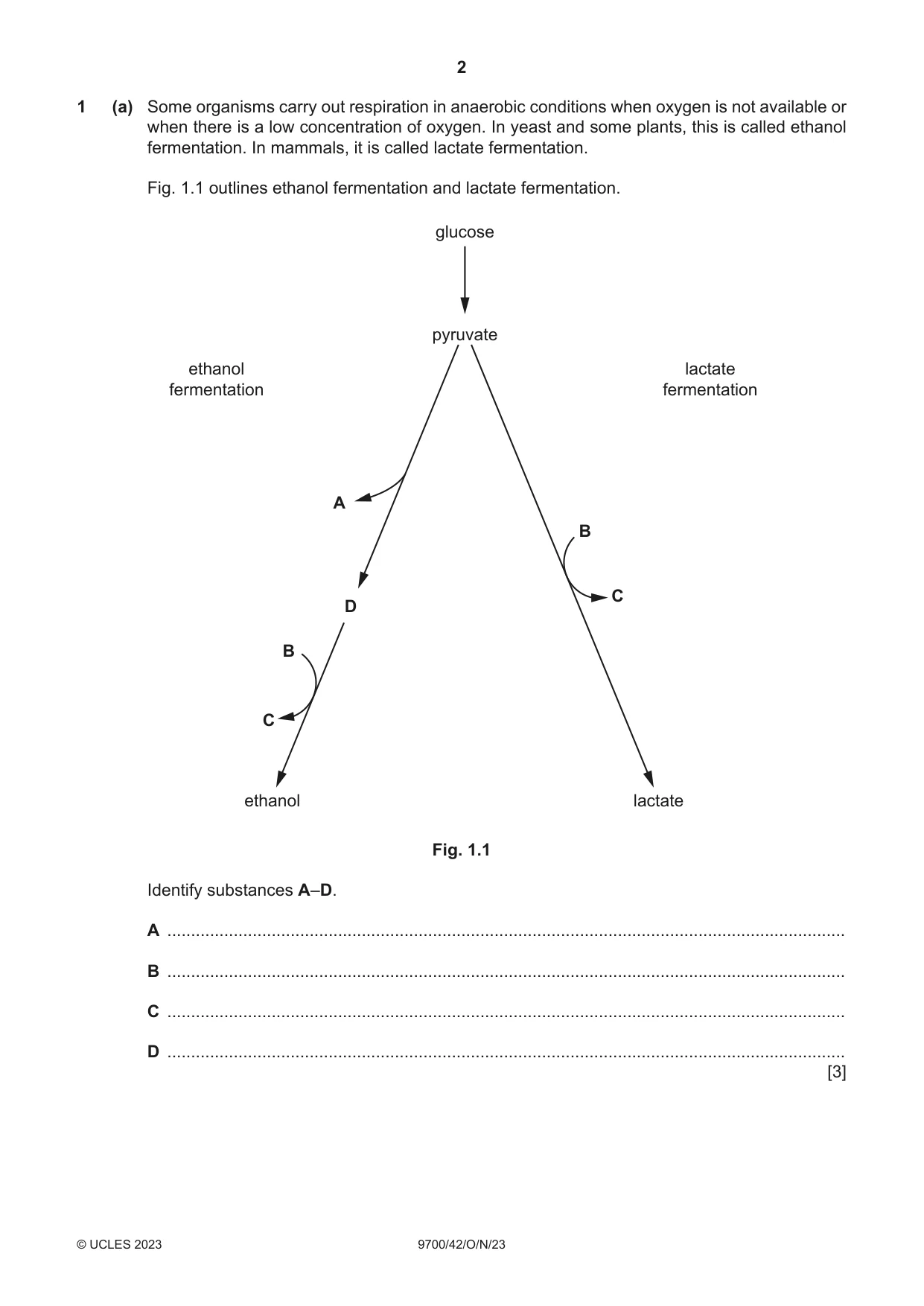
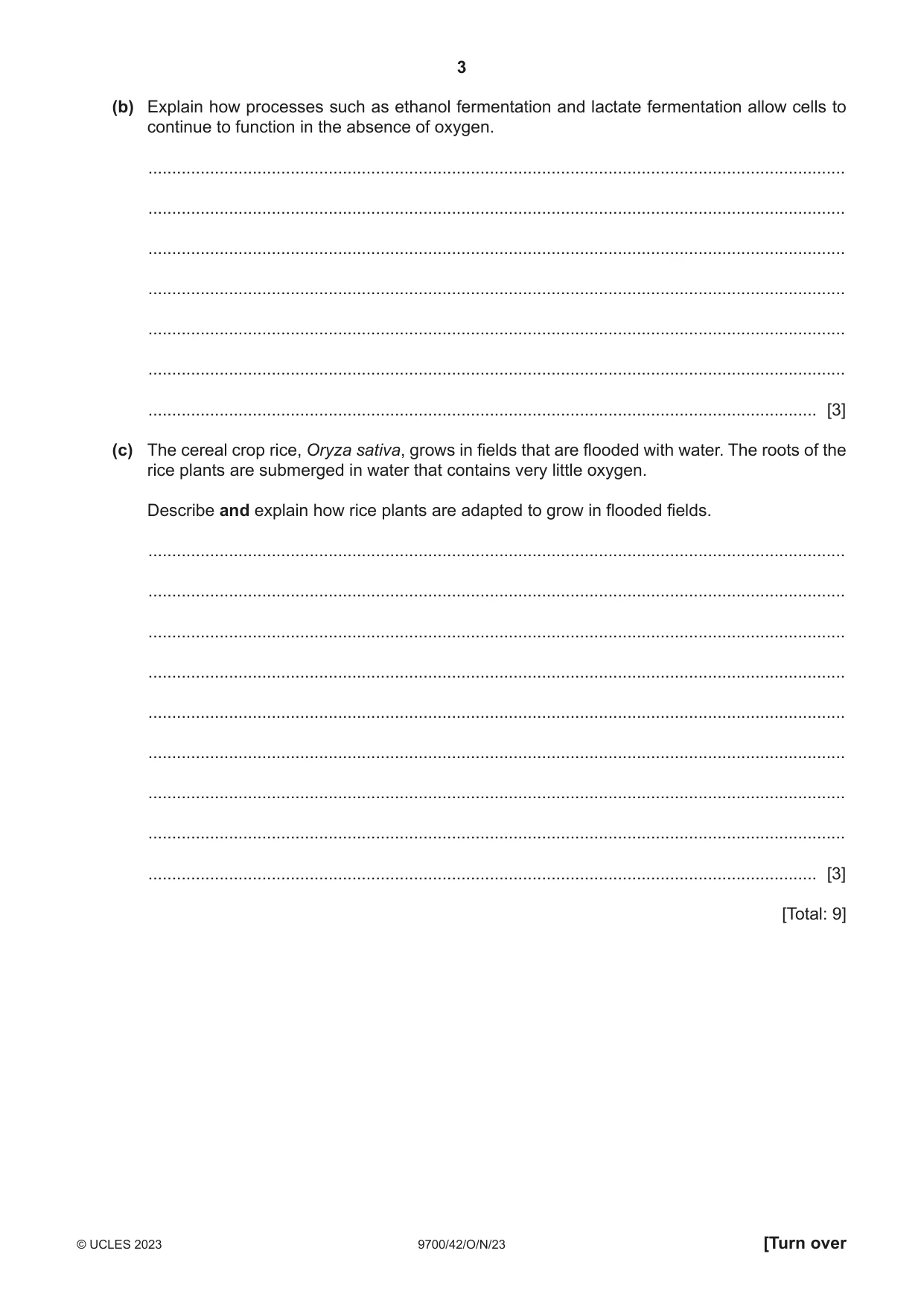
1 (a) Some organisms carry out respiration in anaerobic conditions when oxygen is not available or when there is a low concentration of oxygen. In yeast and some plants, this is called ethanol fermentation. In mammals, it is called lactate fermentation. Fig. 1.1 outlines ethanol fermentation and lactate fermentation. glucose pyruvate ethanol lactate fermentation fermentation A B C D B C ethanol lactate Fig. 1.1 Identify substances A–D. A ............................................................................................................................................... B ............................................................................................................................................... C ............................................................................................................................................... D ............................................................................................................................................... [3] (b) Explain how processes such as ethanol fermentation and lactate fermentation allow cells to continue to function in the absence of oxygen. ................................................................................................................................................... ................................................................................................................................................... ................................................................................................................................................... ................................................................................................................................................... ................................................................................................................................................... ................................................................................................................................................... ............................................................................................................................................. [3] (c) The cereal crop rice, Oryza sativa, grows in fields that are flooded with water. The roots of the rice plants are submerged in water that contains very little oxygen. Describe and explain how rice plants are adapted to grow in flooded fields. ................................................................................................................................................... ................................................................................................................................................... ................................................................................................................................................... ................................................................................................................................................... ................................................................................................................................................... ................................................................................................................................................... ................................................................................................................................................... ................................................................................................................................................... ............................................................................................................................................. [3] [Total: 9]
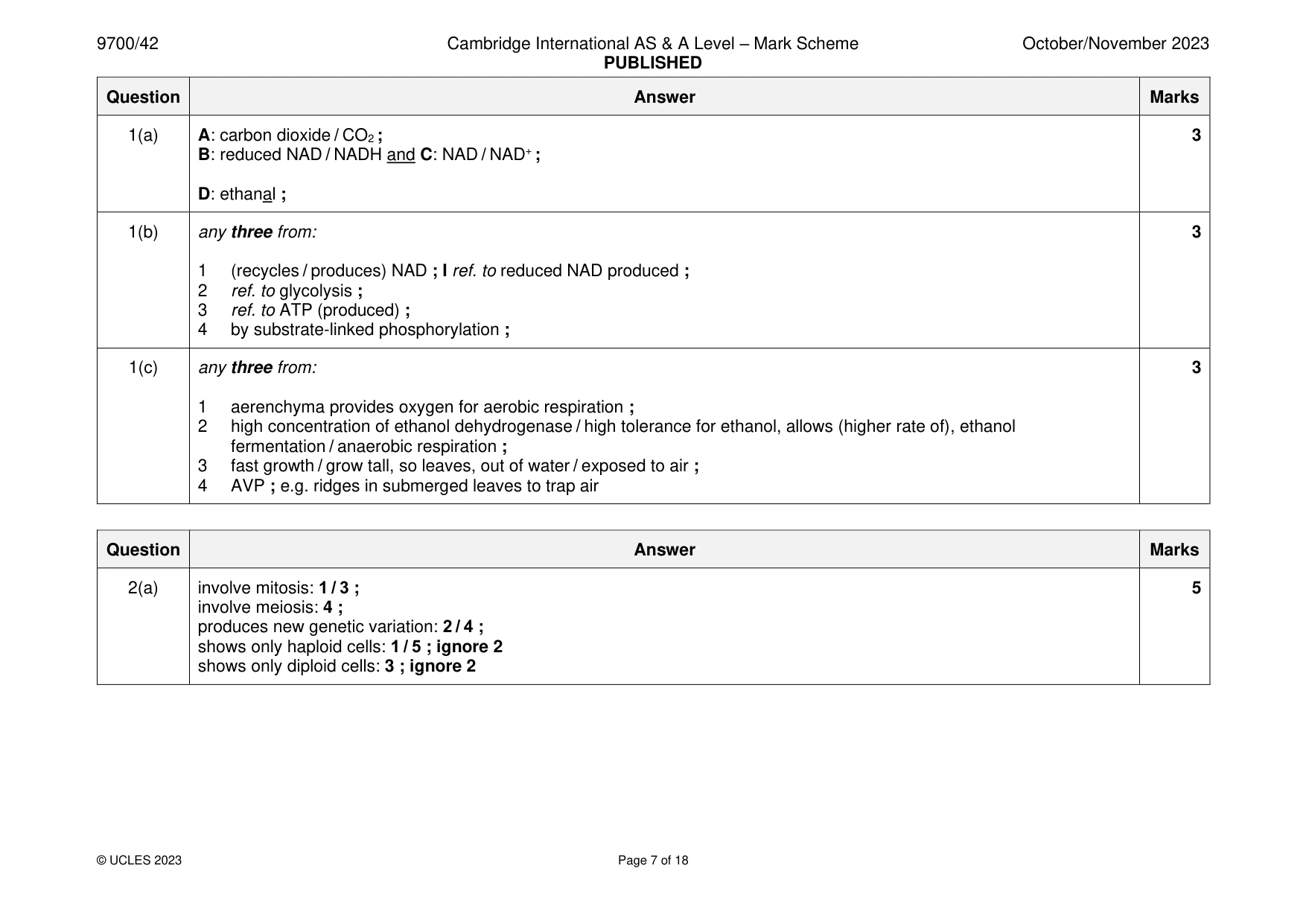
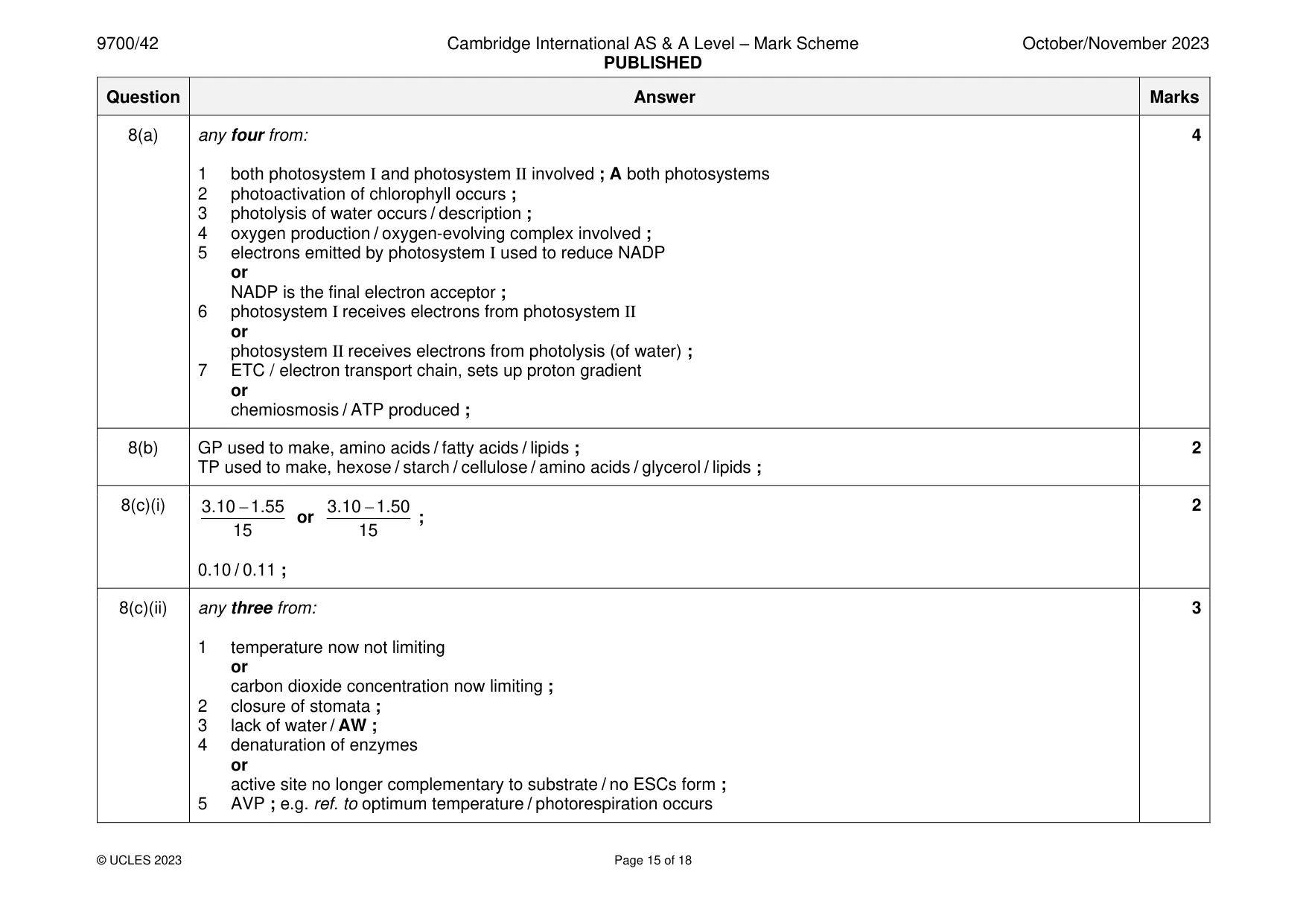
Mark scheme: Question Answer Marks 1(a) A: carbon dioxide / CO2 ; 3 B: reduced NAD / NADH and C: NAD / NAD+ ; D: ethanal ; 1(b) any three from: 3 1 (recycles / produces) NAD ; I ref. to reduced NAD produced ; 2 ref. to glycolysis ; 3 ref. to ATP (produced) ; 4 by substrate-linked phosphorylation ; 1(c) any three from: 3 1 aerenchyma provides oxygen for aerobic respiration ; 2 high concentration of ethanol dehydrogenase / high tolerance for ethanol, allows (higher rate of), ethanol fermentation / anaerobic respiration ; 3 fast growth / grow tall, so leaves, out of water / exposed to air ; 4 AVP ; e.g. ridges in submerged leaves to trap air
Q2 · Yeasts are unicellular organisms from the kingdom Fungi
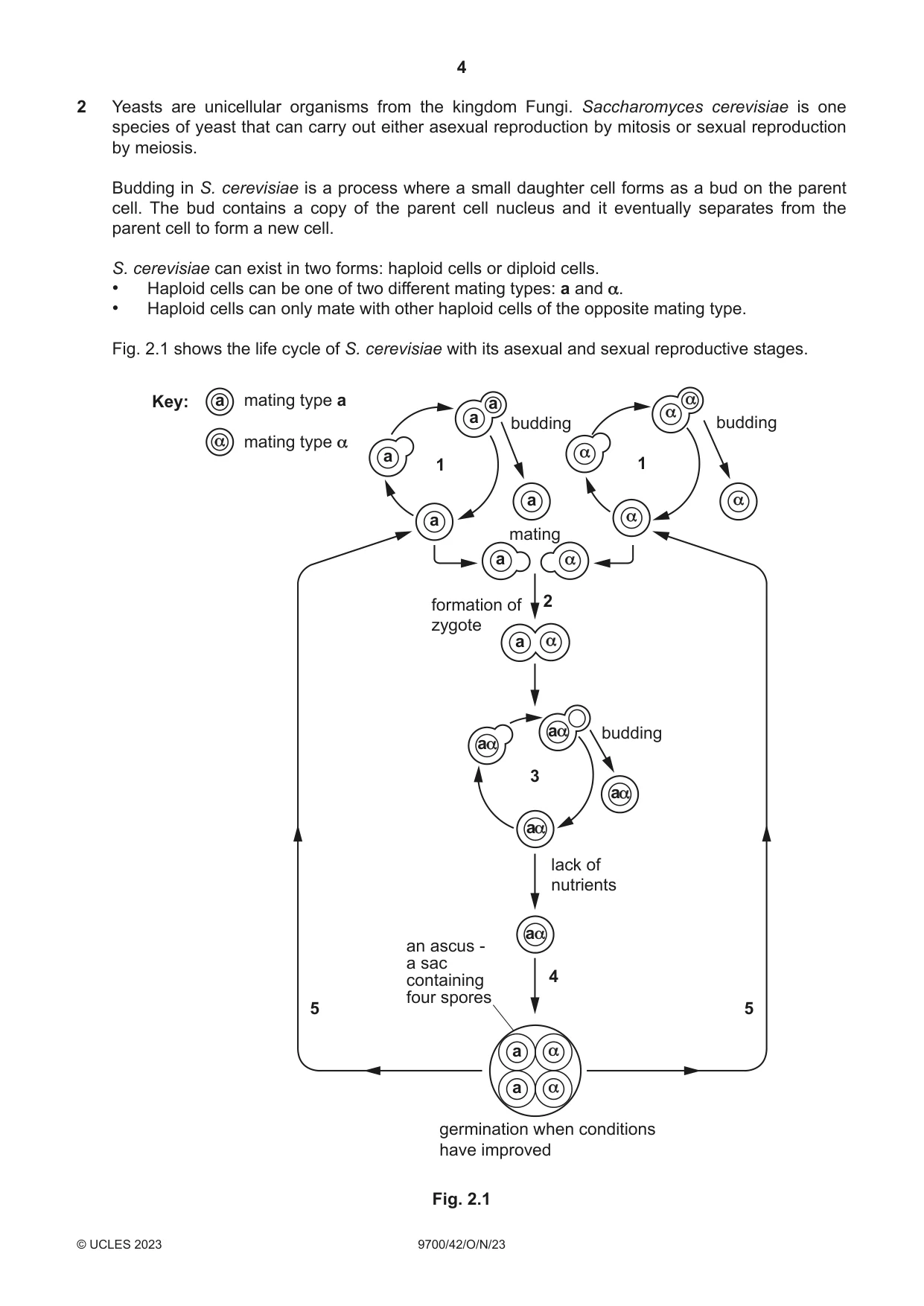
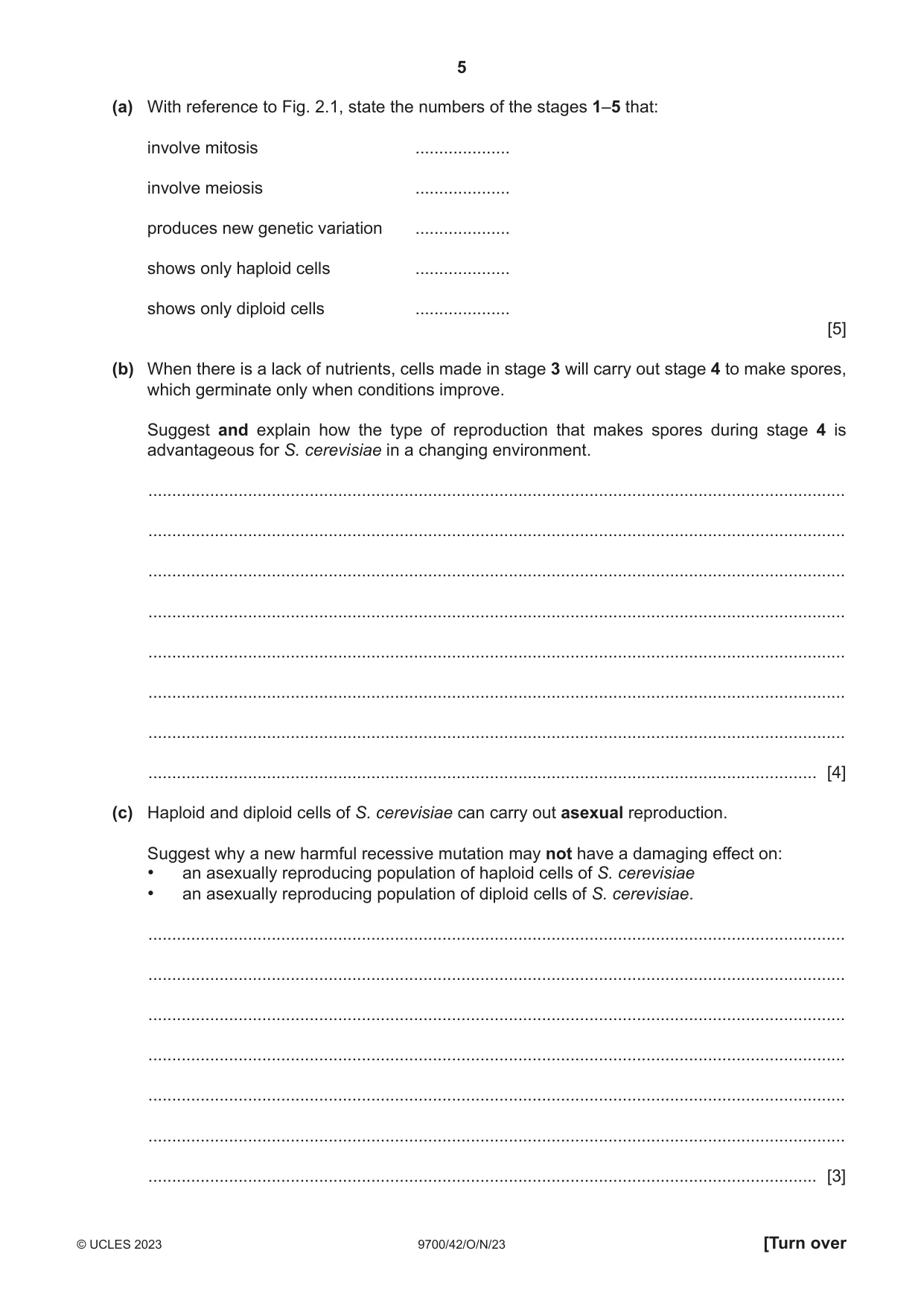
2 Yeasts are unicellular organisms from the kingdom Fungi. Saccharomyces cerevisiae is one species of yeast that can carry out either asexual reproduction by mitosis or sexual reproduction by meiosis. Budding in S. cerevisiae is a process where a small daughter cell forms as a bud on the parent cell. The bud contains a copy of the parent cell nucleus and it eventually separates from the parent cell to form a new cell. S. cerevisiae can exist in two forms: haploid cells or diploid cells. • Haploid cells can be one of two different mating types: a and α. • Haploid cells can only mate with other haploid cells of the opposite mating type. Fig. 2.1 shows the life cycle of S. cerevisiae with its asexual and sexual reproductive stages. Key: a mating type a a α α a budding budding α mating type α a α 1 1 a α a α mating a α formation of 2 zygote a α aα budding aα 3 aα aα lack of nutrients aα an ascus - a sac containing 4 four spores 5 5 a α a α germination when conditions have improved Fig. 2.1 (a) With reference to Fig. 2.1, state the numbers of the stages 1–5 that: involve mitosis .................... involve meiosis .................... produces new genetic variation .................... shows only haploid cells .................... shows only diploid cells .................... [5] (b) When there is a lack of nutrients, cells made in stage 3 will carry out stage 4 to make spores, which germinate only when conditions improve. Suggest and explain how the type of reproduction that makes spores during stage 4 is advantageous for S. cerevisiae in a changing environment. ................................................................................................................................................... ................................................................................................................................................... ................................................................................................................................................... ................................................................................................................................................... ................................................................................................................................................... ................................................................................................................................................... ................................................................................................................................................... ............................................................................................................................................. [4] (c) Haploid and diploid cells of S. cerevisiae can carry out asexual reproduction. Suggest why a new harmful recessive mutation may not have a damaging effect on: • an asexually reproducing population of haploid cells of S. cerevisiae • an asexually reproducing population of diploid cells of S. cerevisiae. ................................................................................................................................................... ................................................................................................................................................... ................................................................................................................................................... ................................................................................................................................................... ................................................................................................................................................... ................................................................................................................................................... ............................................................................................................................................. [3] (d) State two features, other than reproduction using spores, of the kingdom Fungi. ................................................................................................................................................... ................................................................................................................................................... ............................................................................................................................................. [2] [Total: 14]
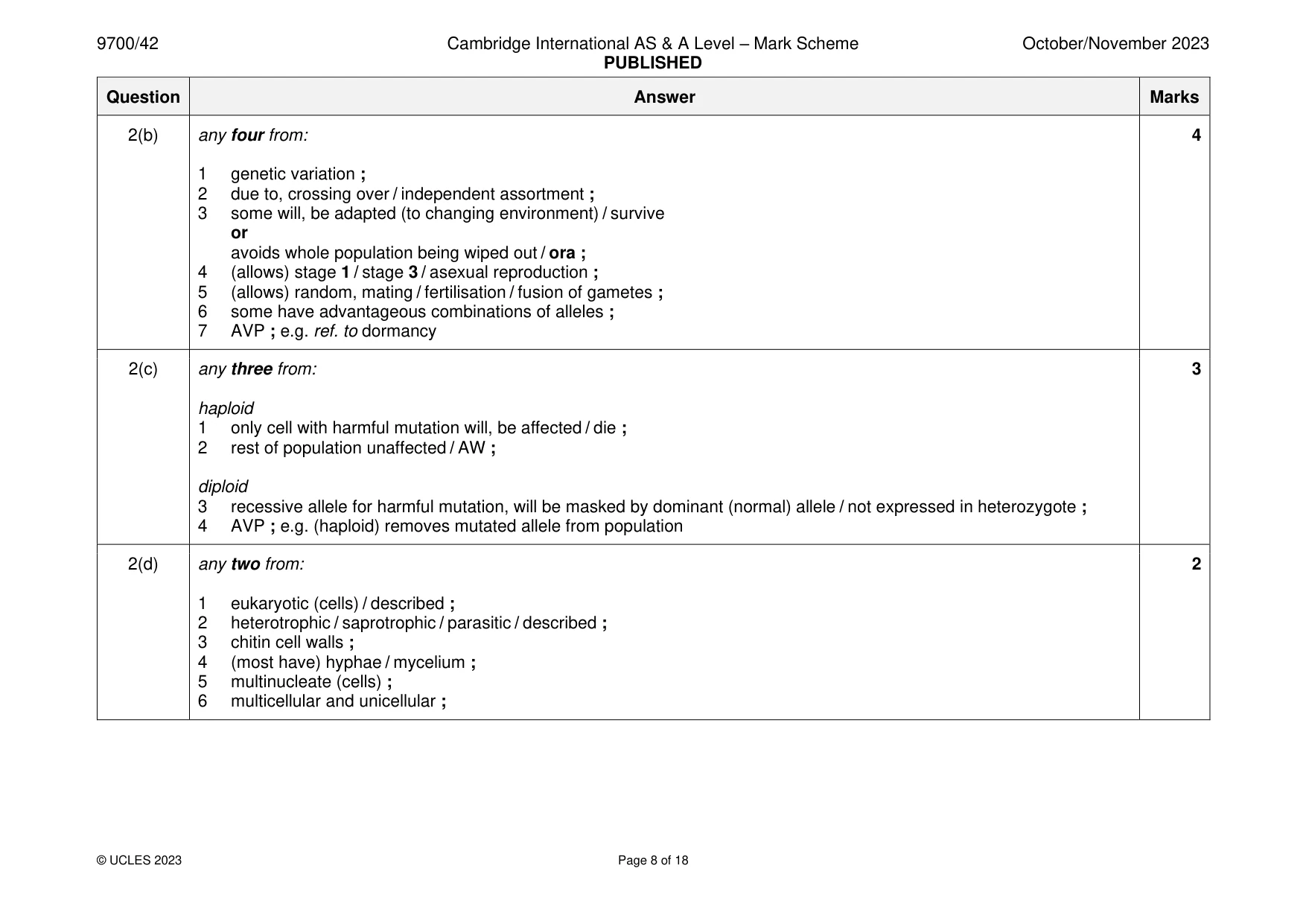
Mark scheme: 2(a) involve mitosis: 1 / 3 ; 5 involve meiosis: 4 ; produces new genetic variation: 2 / 4 ; shows only haploid cells: 1 / 5 ; ignore 2 shows only diploid cells: 3 ; ignore 2 2(b) any four from: 4 1 genetic variation ; 2 due to, crossing over / independent assortment ; 3 some will, be adapted (to changing environment) / survive or avoids whole population being wiped out / ora ; 4 (allows) stage 1 / stage 3 / asexual reproduction ; 5 (allows) random, mating / fertilisation / fusion of gametes ; 6 some have advantageous combinations of alleles ; 7 AVP ; e.g. ref. to dormancy 2(c) any three from: 3 haploid 1 only cell with harmful mutation will, be affected / die ; 2 rest of population unaffected / AW ; diploid 3 recessive allele for harmful mutation, will be masked by dominant (normal) allele / not expressed in heterozygote ; 4 AVP ; e.g. (haploid) removes mutated allele from population 2(d) any two from: 2 1 eukaryotic (cells) / described ; 2 heterotrophic / saprotrophic / parasitic / described ; 3 chitin cell walls ; 4 (most have) hyphae / mycelium ; 5 multinucleate (cells) ; 6 multicellular and unicellular ;
More questions on Replication and division of nuclei and cells
Q3 · Research suggests that selective breeding began about 10 000 years ago
3 Research suggests that selective breeding began about 10 000 years ago. Selective breeding has been important in satisfying the global demand for food. (a) The introduction of disease resistance to varieties of wheat is an example of selective breeding. Outline the steps involved in the introduction of disease resistance to varieties of wheat. ................................................................................................................................................... ................................................................................................................................................... ................................................................................................................................................... ................................................................................................................................................... ................................................................................................................................................... ................................................................................................................................................... ................................................................................................................................................... ................................................................................................................................................... ................................................................................................................................................... ................................................................................................................................................... ................................................................................................................................................... ................................................................................................................................................... ................................................................................................................................................... ................................................................................................................................................... ............................................................................................................................................. [5] (b) Suggest two possible disadvantages of selective breeding. ................................................................................................................................................... ................................................................................................................................................... ................................................................................................................................................... ................................................................................................................................................... ............................................................................................................................................. [2] [Total: 7]
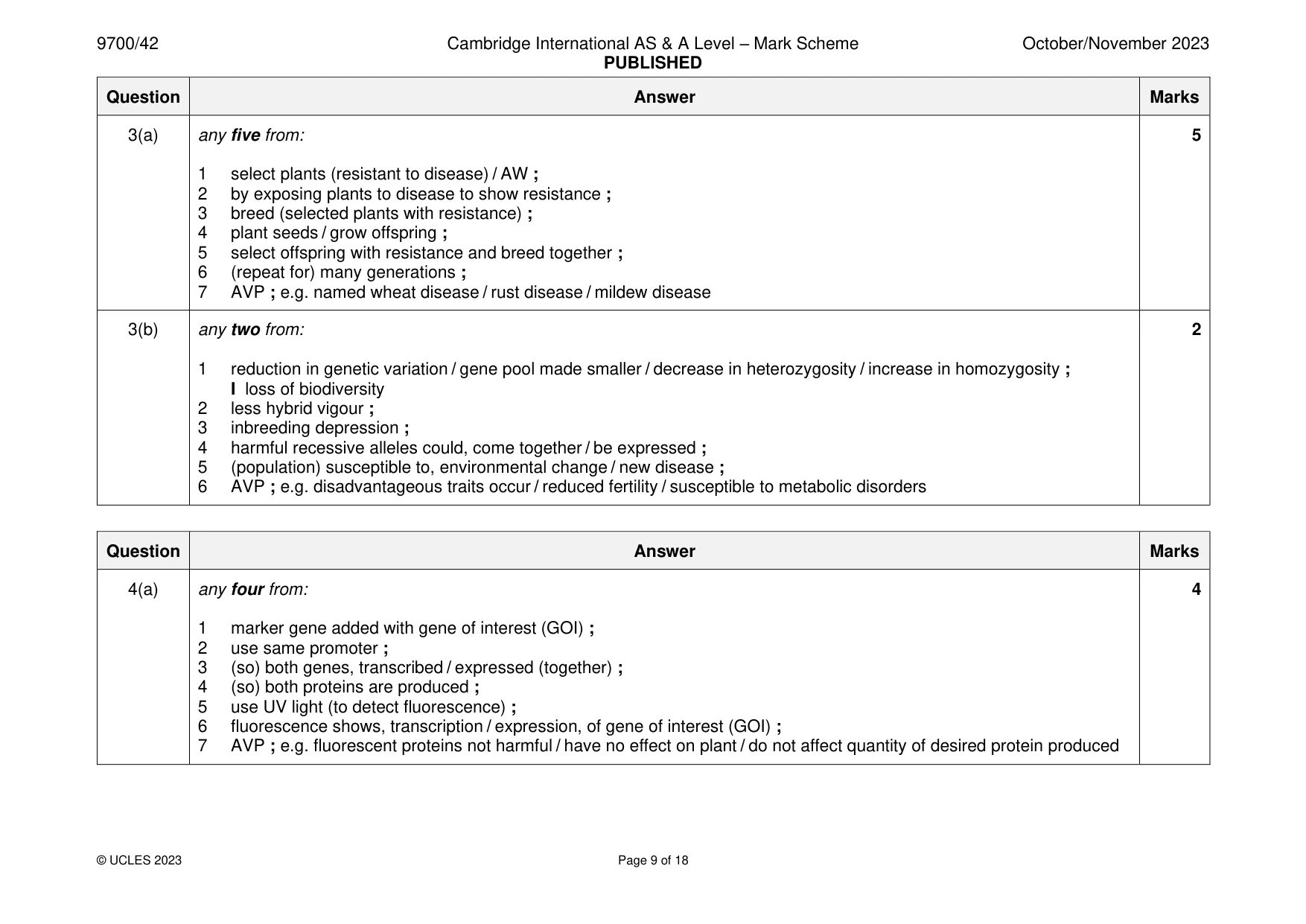
Mark scheme: 3(a) any five from: 5 1 select plants (resistant to disease) / AW ; 2 by exposing plants to disease to show resistance ; 3 breed (selected plants with resistance) ; 4 plant seeds / grow offspring ; 5 select offspring with resistance and breed together ; 6 (repeat for) many generations ; 7 AVP ; e.g. named wheat disease / rust disease / mildew disease 3(b) any two from: 2 1 reduction in genetic variation / gene pool made smaller / decrease in heterozygosity / increase in homozygosity ; I loss of biodiversity 2 less hybrid vigour ; 3 inbreeding depression ; 4 harmful recessive alleles could, come together / be expressed ; 5 (population) susceptible to, environmental change / new disease ; 6 AVP ; e.g. disadvantageous traits occur / reduced fertility / susceptible to metabolic disorders
Q4 · A marker gene can be used when a gene of interest is introduced into a plant by genetic…
4 (a) A marker gene can be used when a gene of interest is introduced into a plant by genetic engineering. Describe and explain how the use of a marker gene coding for a fluorescent product can show that the introduced gene of interest is being expressed in plants. ................................................................................................................................................... ................................................................................................................................................... ................................................................................................................................................... ................................................................................................................................................... ................................................................................................................................................... ................................................................................................................................................... ................................................................................................................................................... ................................................................................................................................................... ................................................................................................................................................... ................................................................................................................................................... ................................................................................................................................................... ............................................................................................................................................. [4] (b) Give two advantages of genetically engineering herbicide resistance in crop plants such as soybean. ................................................................................................................................................... ................................................................................................................................................... ................................................................................................................................................... ............................................................................................................................................. [2] (c) DNA microarray analysis is a technique used in genetic technology that involves fluorescence. A DNA microarray has single-stranded probes attached to its surface. These probes hybridise to the fluorescently tagged single-stranded DNA that is added. (i) Explain why DNA hybridisation occurs between the probe DNA and the added DNA. ........................................................................................................................................... ..................................................................................................................................... [1] (ii) A DNA microarray analysis can be used to identify the level of expression of some genes. Describe and explain how the level of expression of some genes can be identified using the DNA microarray analysis technique. ........................................................................................................................................... ........................................................................................................................................... ........................................................................................................................................... ........................................................................................................................................... ........................................................................................................................................... ........................................................................................................................................... ........................................................................................................................................... ..................................................................................................................................... [3] [Total: 10]
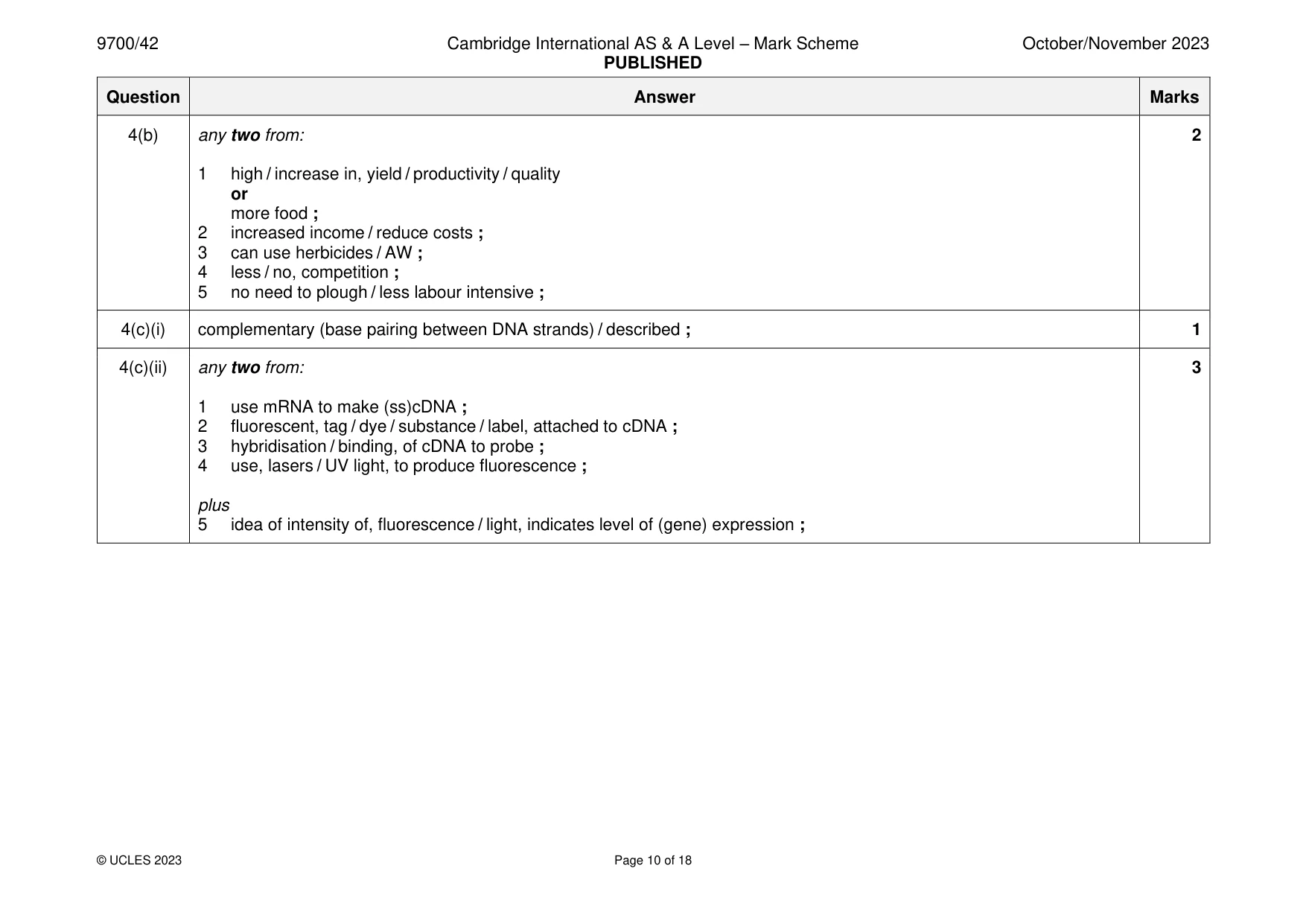
Mark scheme: 4(a) any four from: 4 1 marker gene added with gene of interest (GOI) ; 2 use same promoter ; 3 (so) both genes, transcribed / expressed (together) ; 4 (so) both proteins are produced ; 5 use UV light (to detect fluorescence) ; 6 fluorescence shows, transcription / expression, of gene of interest (GOI) ; 7 AVP ; e.g. fluorescent proteins not harmful / have no effect on plant / do not affect quantity of desired protein produced 4(b) any two from: 2 1 high / increase in, yield / productivity / quality or more food ; 2 increased income / reduce costs ; 3 can use herbicides / AW ; 4 less / no, competition ; 5 no need to plough / less labour intensive ; 4(c)(i) complementary (base pairing between DNA strands) / described ; 1 4(c)(ii) any two from: 3 1 use mRNA to make (ss)cDNA ; 2 fluorescent, tag / dye / substance / label, attached to cDNA ; 3 hybridisation / binding, of cDNA to probe ; 4 use, lasers / UV light, to produce fluorescence ; plus 5 idea of intensity of, fluorescence / light, indicates level of (gene) expression ;
Q5 · The fruit fly, Drosophila melanogaster, has autosomal genes for body colour and wing shape
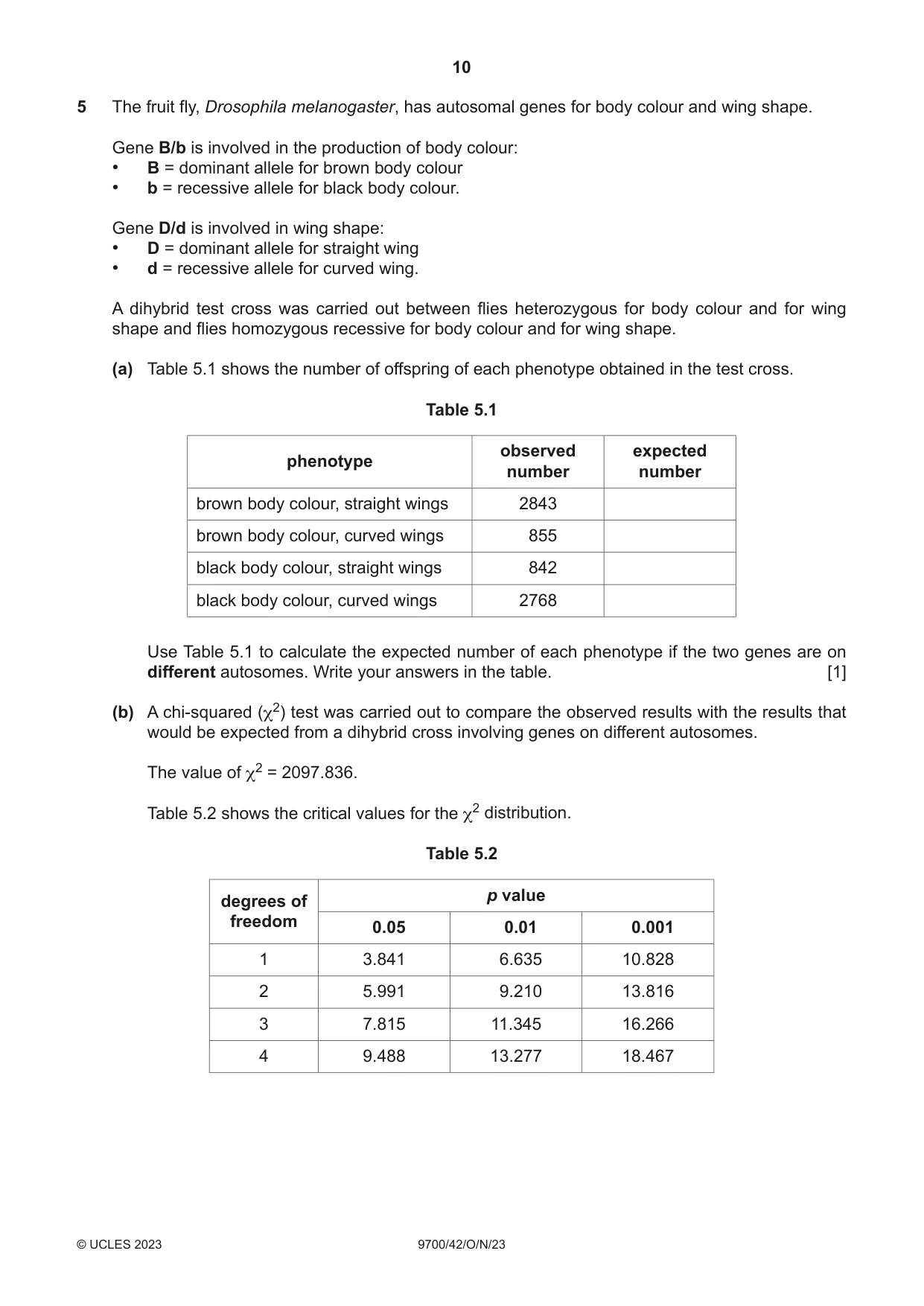
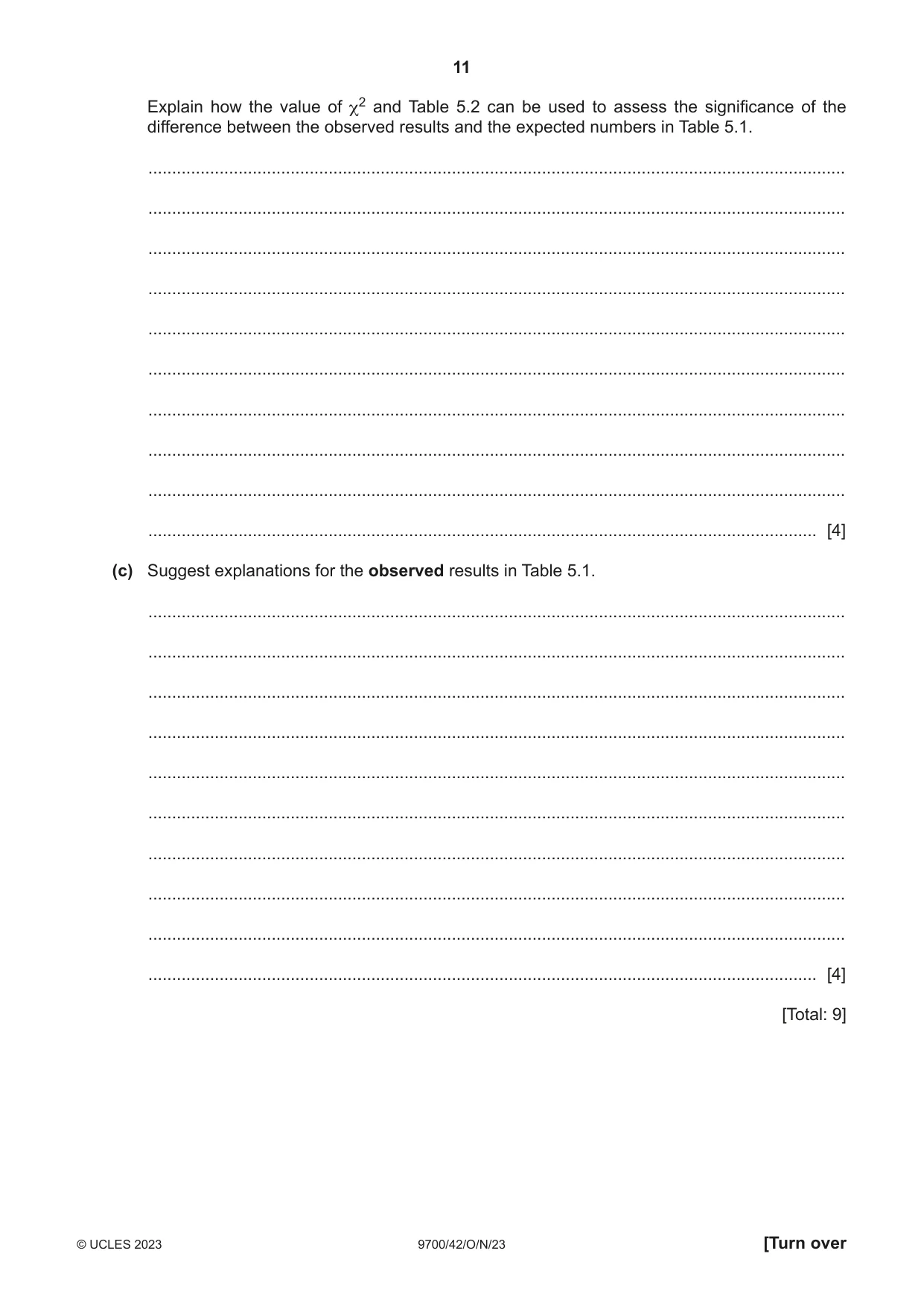
5 The fruit fly, Drosophila melanogaster, has autosomal genes for body colour and wing shape. Gene B/b is involved in the production of body colour: • B = dominant allele for brown body colour • b = recessive allele for black body colour. Gene D/d is involved in wing shape: • D = dominant allele for straight wing • d = recessive allele for curved wing. A dihybrid test cross was carried out between flies heterozygous for body colour and for wing shape and flies homozygous recessive for body colour and for wing shape. (a) Table 5.1 shows the number of offspring of each phenotype obtained in the test cross. Table 5.1 observed expected phenotype number number brown body colour, straight wings 2843 brown body colour, curved wings 855 black body colour, straight wings 842 black body colour, curved wings 2768 Use Table 5.1 to calculate the expected number of each phenotype if the two genes are on different autosomes. Write your answers in the table. [1] (b) A chi-squared (χ2) test was carried out to compare the observed results with the results that would be expected from a dihybrid cross involving genes on different autosomes. The value of χ2 = 2097.836. Table 5.2 shows the critical values for the χ2 distribution. Table 5.2 p value degrees of freedom 0.05 0.01 0.001 1 3.841 6.635 10.828 2 5.991 9.210 13.816 3 7.815 11.345 16.266 4 9.488 13.277 18.467 Explain how the value of χ2 and Table 5.2 can be used to assess the significance of the difference between the observed results and the expected numbers in Table 5.1. ................................................................................................................................................... ................................................................................................................................................... ................................................................................................................................................... ................................................................................................................................................... ................................................................................................................................................... ................................................................................................................................................... ................................................................................................................................................... ................................................................................................................................................... ................................................................................................................................................... ............................................................................................................................................. [4] (c) Suggest explanations for the observed results in Table 5.1. ................................................................................................................................................... ................................................................................................................................................... ................................................................................................................................................... ................................................................................................................................................... ................................................................................................................................................... ................................................................................................................................................... ................................................................................................................................................... ................................................................................................................................................... ................................................................................................................................................... ............................................................................................................................................. [4] [Total: 9]
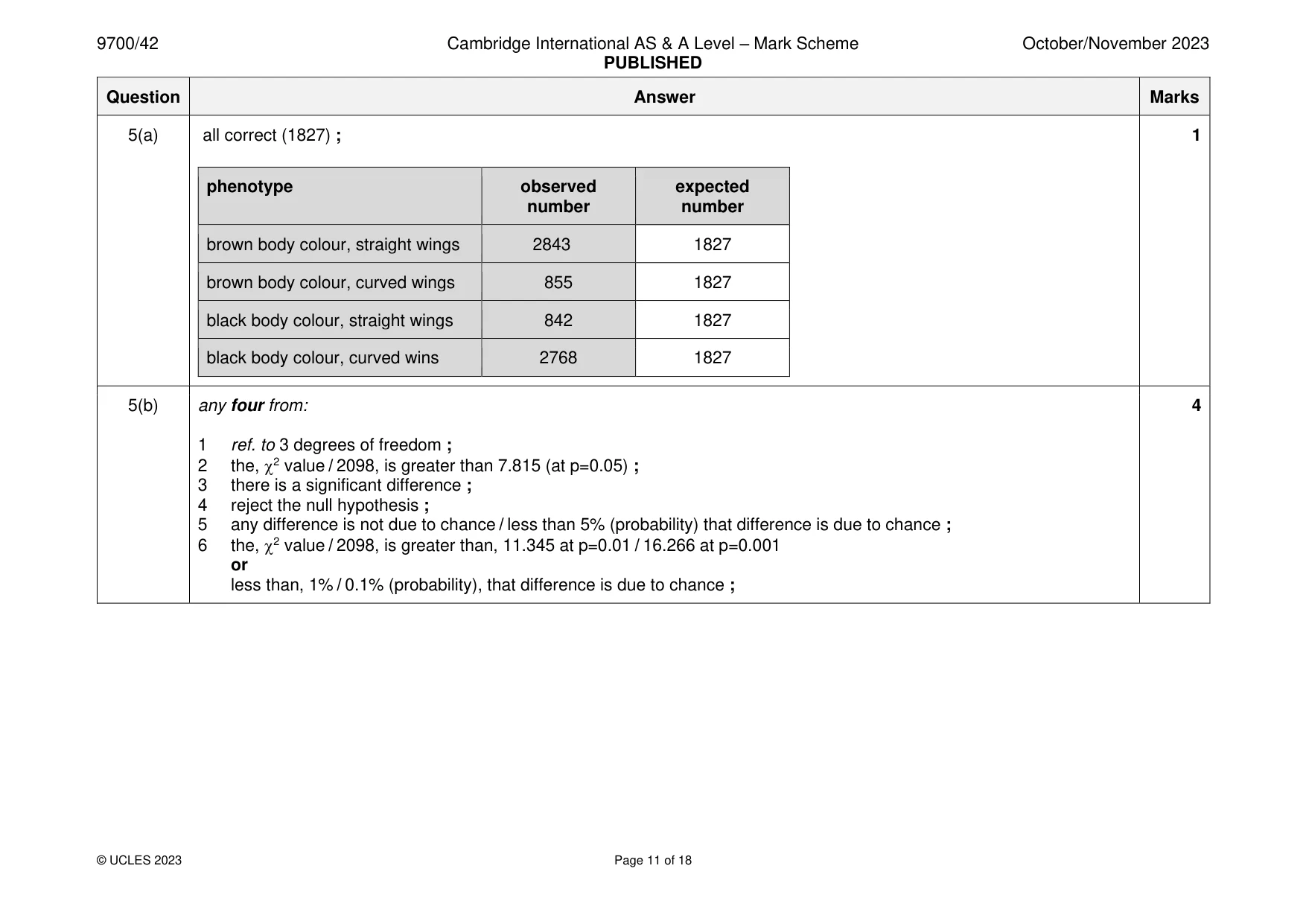
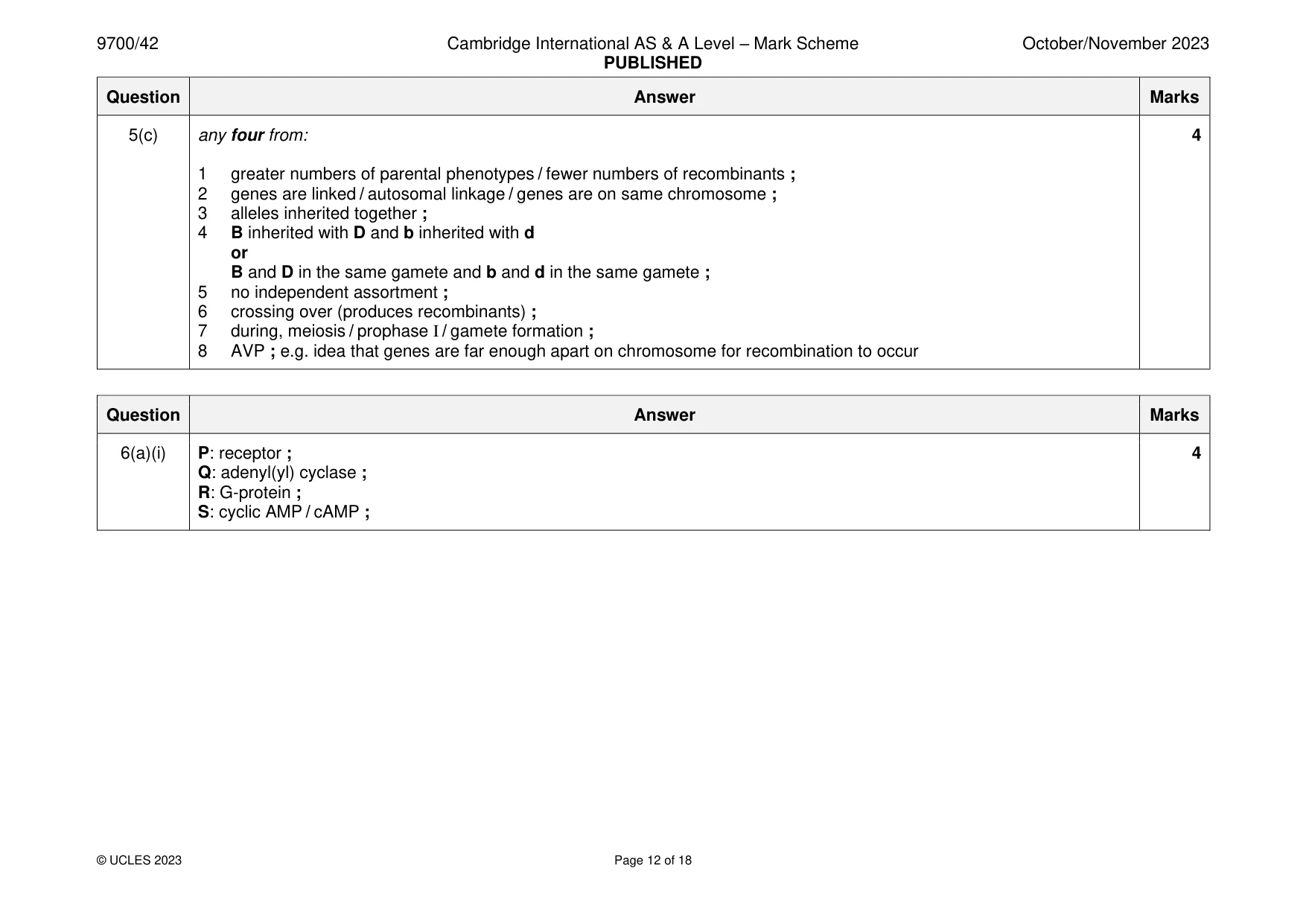
Mark scheme: 5(a) all correct (1827) ; 1 phenotype observed expected number number brown body colour, straight wings 2843 1827 brown body colour, curved wings 855 1827 black body colour, straight wings 842 1827 black body colour, curved wins 2768 1827 5(b) any four from: 4 1 ref. to 3 degrees of freedom ; 2 the, 2 value / 2098, is greater than 7.815 (at p=0.05) ; 3 there is a significant difference ; 4 reject the null hypothesis ; 5 any difference is not due to chance / less than 5% (probability) that difference is due to chance ; 6 the, 2 value / 2098, is greater than, 11.345 at p=0.01 / 16.266 at p=0.001 or less than, 1% / 0.1% (probability), that difference is due to chance ; 5(c) any four from: 4 1 greater numbers of parental phenotypes / fewer numbers of recombinants ; 2 genes are linked / autosomal linkage / genes are on same chromosome ; 3 alleles inherited together ; 4 B inherited with D and b inherited with d or B and D in the same gamete and b and d in the same gamete ; 5 no independent assortment ; 6 crossing over (produces recombinants) ; 7 during, meiosis / prophase I / gamete formation ; 8 AVP ; e.g. idea that genes are far enough apart on chromosome for recombination to occur
More questions on Passage of information from parents to offspring
Q6 · When blood glucose concentration decreases, glucagon is released by the pancreas into the…
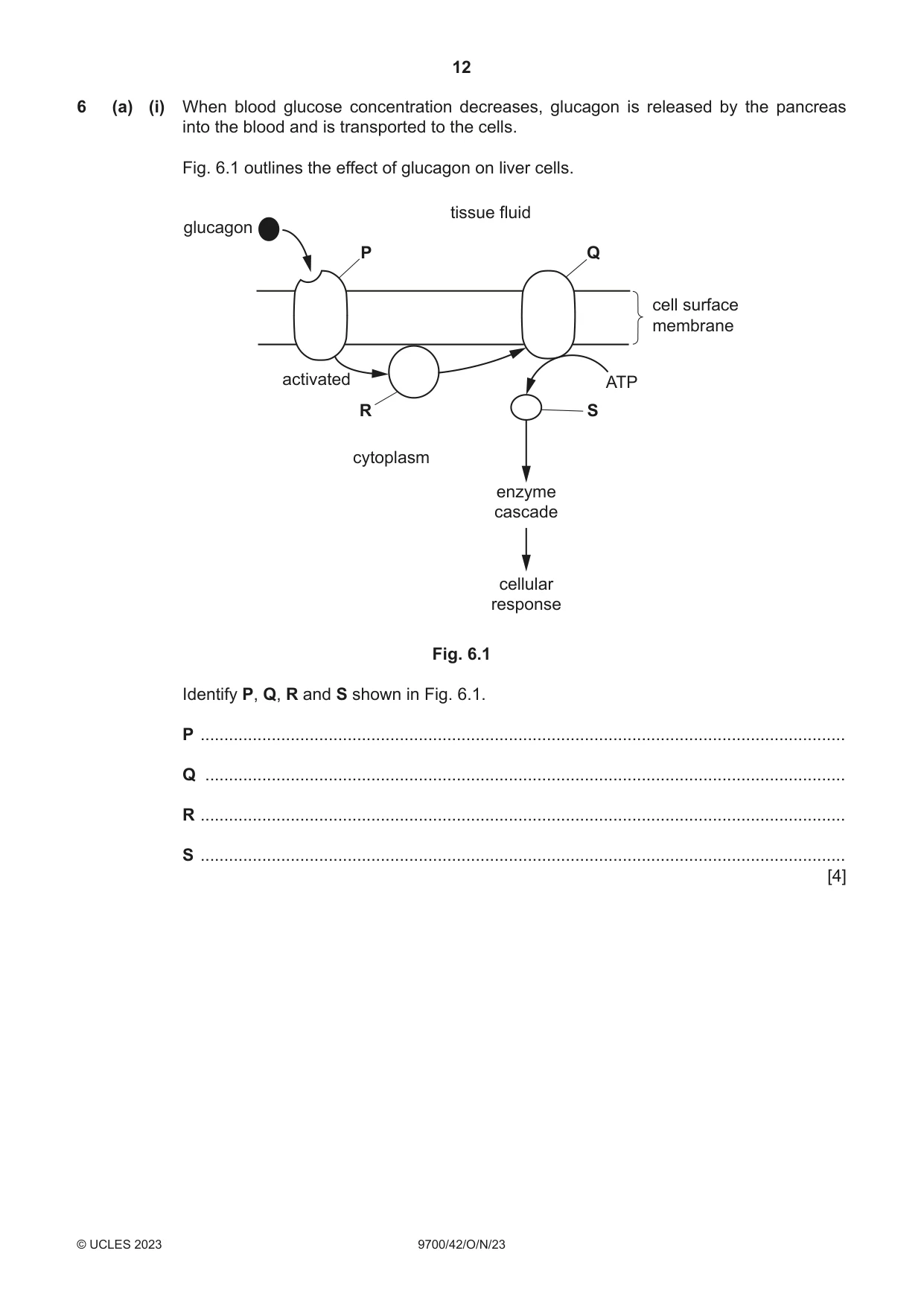
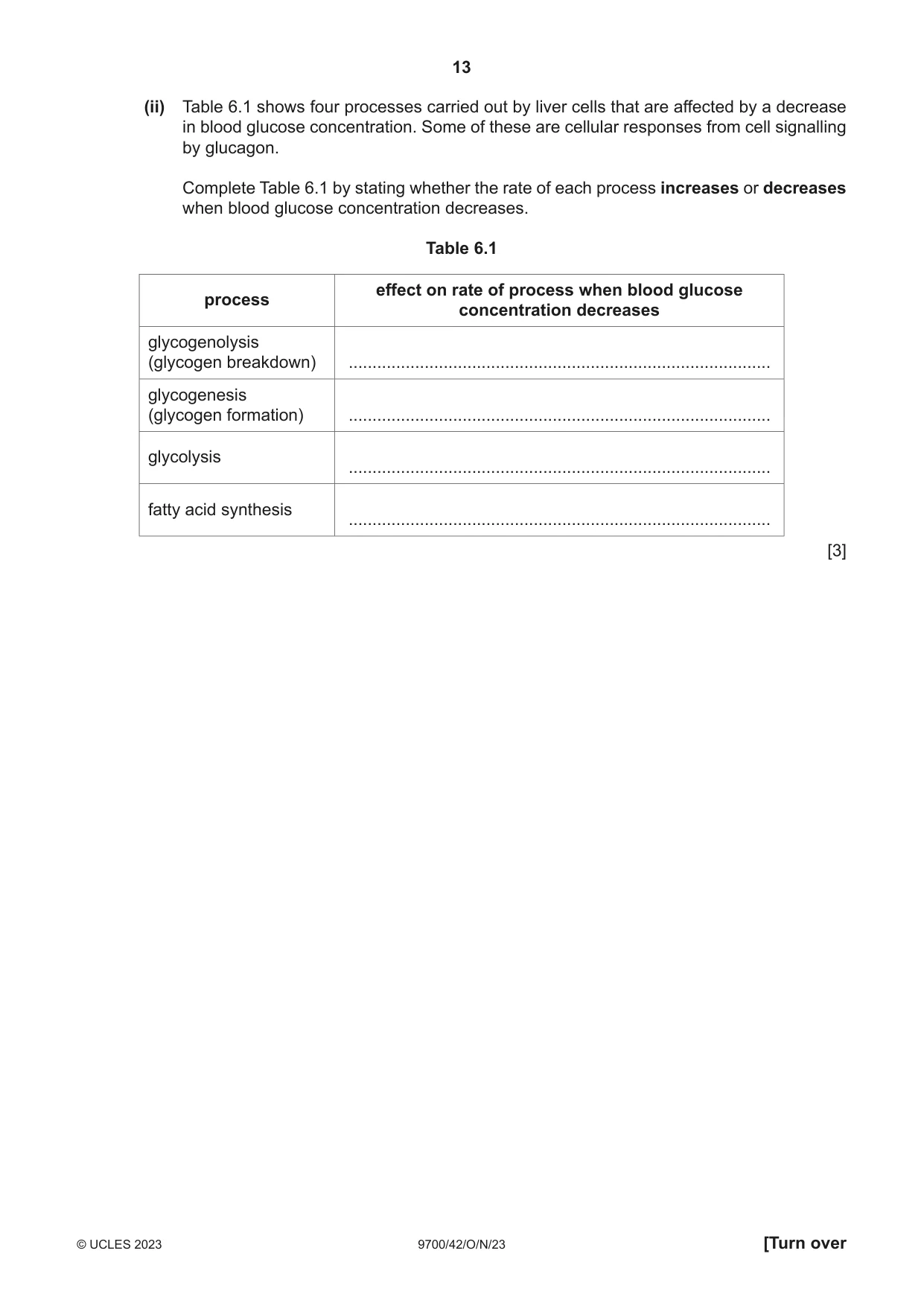
6 (a) (i) When blood glucose concentration decreases, glucagon is released by the pancreas into the blood and is transported to the cells. Fig. 6.1 outlines the effect of glucagon on liver cells. tissue fluid glucagon P Q cell surface membrane activated ATP R S cytoplasm enzyme cascade cellular response Fig. 6.1 Identify P, Q, R and S shown in Fig. 6.1. P ........................................................................................................................................ Q ....................................................................................................................................... R ........................................................................................................................................ S ........................................................................................................................................ [4] (ii) Table 6.1 shows four processes carried out by liver cells that are affected by a decrease in blood glucose concentration. Some of these are cellular responses from cell signalling by glucagon. Complete Table 6.1 by stating whether the rate of each process increases or decreases when blood glucose concentration decreases. Table 6.1 effect on rate of process when blood glucose process concentration decreases glycogenolysis (glycogen breakdown) ......................................................................................... glycogenesis (glycogen formation) ......................................................................................... glycolysis ......................................................................................... fatty acid synthesis ......................................................................................... [3] (b) Type 2 diabetes is a condition affecting the homeostatic control of blood glucose concentration. In type 2 diabetes, target cells have a much lower response to insulin and some glucose is excreted in the urine. Test strips can be used to measure the concentration of glucose in a sample of urine, but many people with type 2 diabetes measure blood glucose concentration using a biosensor. Explain the principles of operation of a test strip for glucose and suggest advantages for a person with type 2 diabetes of using a biosensor instead of a test strip. ................................................................................................................................................... ................................................................................................................................................... ................................................................................................................................................... ................................................................................................................................................... ................................................................................................................................................... ................................................................................................................................................... ................................................................................................................................................... ................................................................................................................................................... ................................................................................................................................................... ................................................................................................................................................... ................................................................................................................................................... ................................................................................................................................................... ................................................................................................................................................... ............................................................................................................................................. [7] [Total: 14]
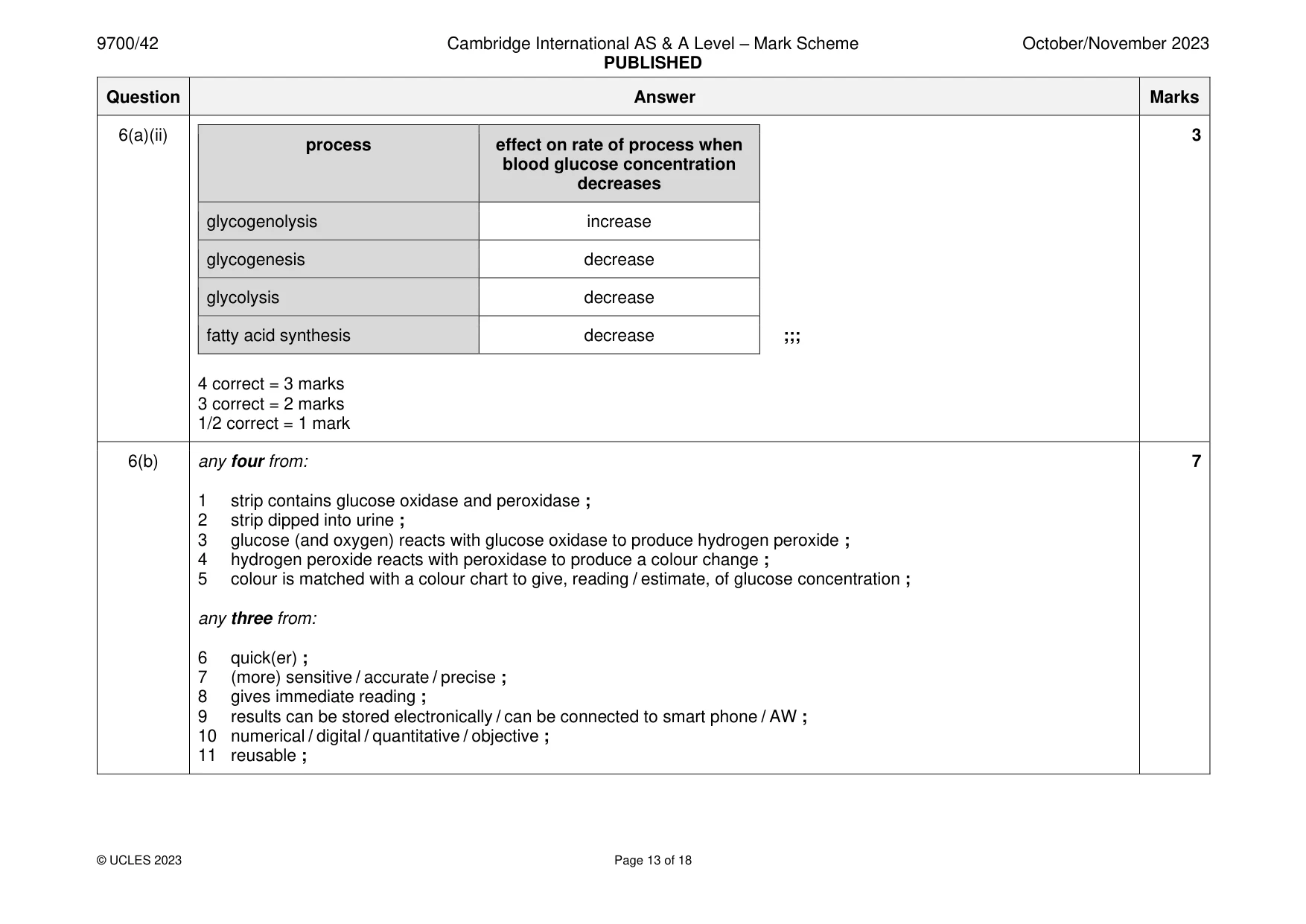
Mark scheme: 6(a)(i) P: receptor ; 4 Q: adenyl(yl) cyclase ; R: G-protein ; S: cyclic AMP / cAMP ; 6(a)(ii) 3 process effect on rate of process when blood glucose concentration decreases glycogenolysis increase glycogenesis decrease glycolysis decrease fatty acid synthesis decrease ;;; 4 correct = 3 marks 3 correct = 2 marks 1/2 correct = 1 mark 6(b) any four from: 7 1 strip contains glucose oxidase and peroxidase ; 2 strip dipped into urine ; 3 glucose (and oxygen) reacts with glucose oxidase to produce hydrogen peroxide ; 4 hydrogen peroxide reacts with peroxidase to produce a colour change ; 5 colour is matched with a colour chart to give, reading / estimate, of glucose concentration ; any three from: 6 quick(er) ; 7 (more) sensitive / accurate / precise ; 8 gives immediate reading ; 9 results can be stored electronically / can be connected to smart phone / AW ; 10 numerical / digital / quantitative / objective ; 11 reusable ;
Q7 · There are many mitochondria located in the presynaptic knobs of neuromuscular junctions…
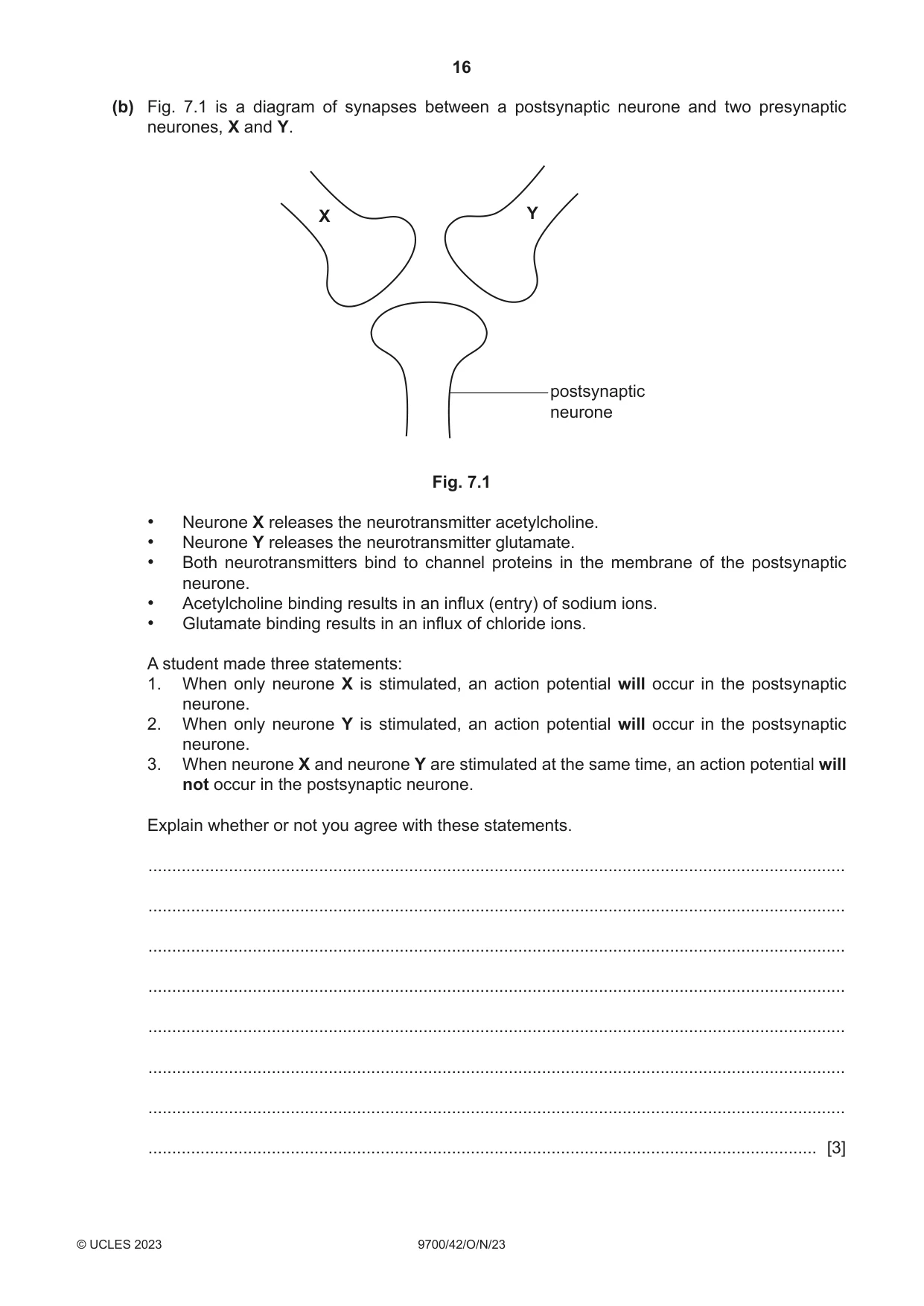
7 (a) There are many mitochondria located in the presynaptic knobs of neuromuscular junctions and in the sarcomeres of muscle fibres of striated muscle. Explain the need for many mitochondria in the presynaptic knobs and in the sarcomeres. ................................................................................................................................................... ................................................................................................................................................... ................................................................................................................................................... ................................................................................................................................................... ................................................................................................................................................... ................................................................................................................................................... ................................................................................................................................................... ................................................................................................................................................... ................................................................................................................................................... ............................................................................................................................................. [4] (b) Fig. 7.1 is a diagram of synapses between a postsynaptic neurone and two presynaptic neurones, X and Y. X Y postsynaptic neurone Fig. 7.1 • Neurone X releases the neurotransmitter acetylcholine. • Neurone Y releases the neurotransmitter glutamate. • Both neurotransmitters bind to channel proteins in the membrane of the postsynaptic neurone. • Acetylcholine binding results in an influx (entry) of sodium ions. • Glutamate binding results in an influx of chloride ions. A student made three statements: 1. When only neurone X is stimulated, an action potential will occur in the postsynaptic neurone. 2. When only neurone Y is stimulated, an action potential will occur in the postsynaptic neurone. 3. When neurone X and neurone Y are stimulated at the same time, an action potential will not occur in the postsynaptic neurone. Explain whether or not you agree with these statements. ................................................................................................................................................... ................................................................................................................................................... ................................................................................................................................................... ................................................................................................................................................... ................................................................................................................................................... ................................................................................................................................................... ................................................................................................................................................... ............................................................................................................................................. [3] (c) Multiple sclerosis is a condition in which the myelin sheath breaks down in some neurones. Suggest the effect of multiple sclerosis on the transmission of action potentials in the affected neurones. ................................................................................................................................................... ................................................................................................................................................... ................................................................................................................................................... ................................................................................................................................................... ............................................................................................................................................. [2] [Total: 9]
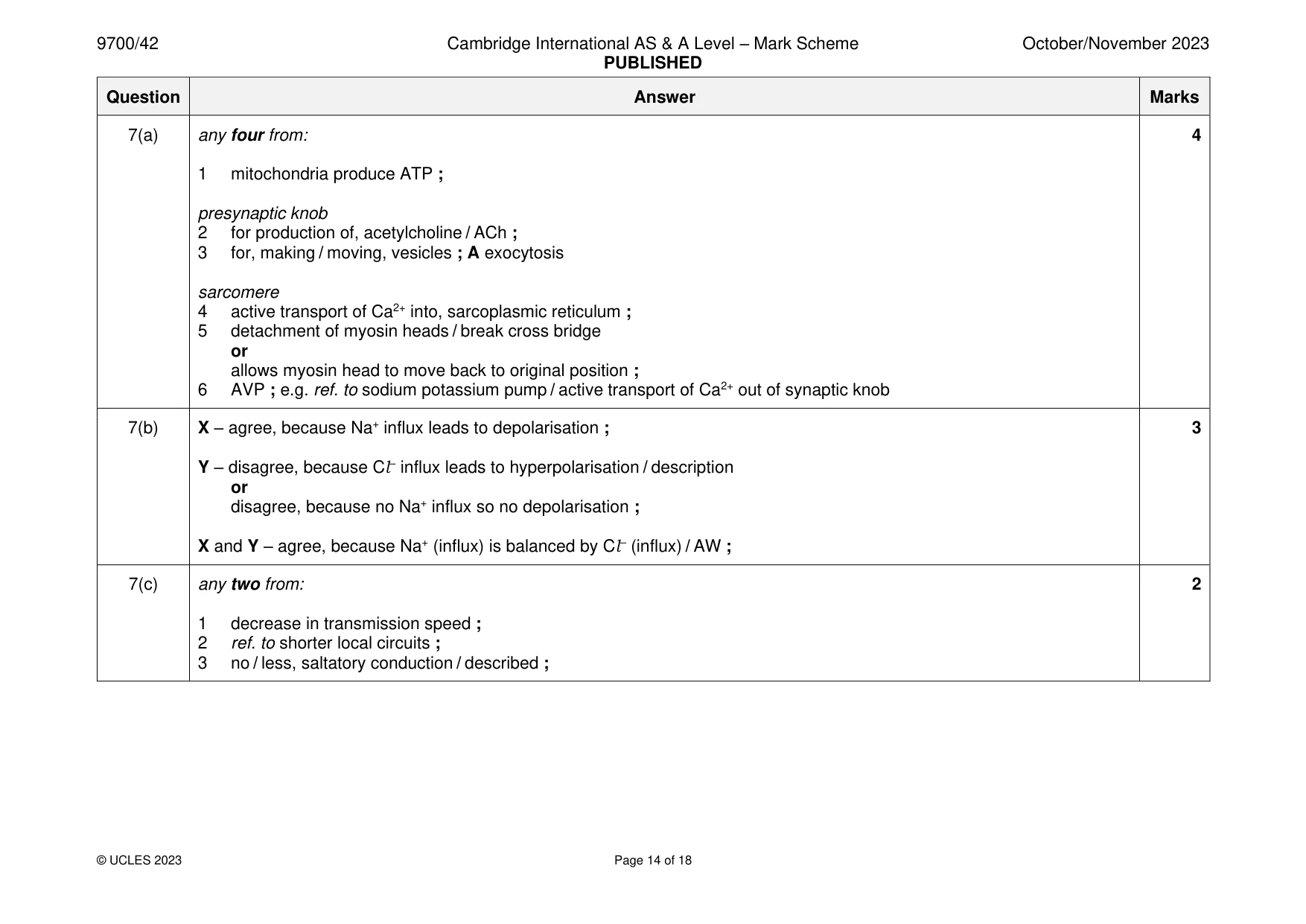
Mark scheme: 7(a) any four from: 4 1 mitochondria produce ATP ; presynaptic knob 2 for production of, acetylcholine / ACh ; 3 for, making / moving, vesicles ; A exocytosis sarcomere 4 active transport of Ca2+ into, sarcoplasmic reticulum ; 5 detachment of myosin heads / break cross bridge or allows myosin head to move back to original position ; 6 AVP ; e.g. ref. to sodium potassium pump / active transport of Ca2+ out of synaptic knob 7(b) X – agree, because Na+ influx leads to depolarisation ; 3 Y – disagree, because Cl– influx leads to hyperpolarisation / description or disagree, because no Na+ influx so no depolarisation ; X and Y – agree, because Na+ (influx) is balanced by Cl– (influx) / AW ; 7(c) any two from: 2 1 decrease in transmission speed ; 2 ref. to shorter local circuits ; 3 no / less, saltatory conduction / described ;
Q8 · Non-cyclic photophosphorylation occurs in the light-dependent stage of photosynthesis
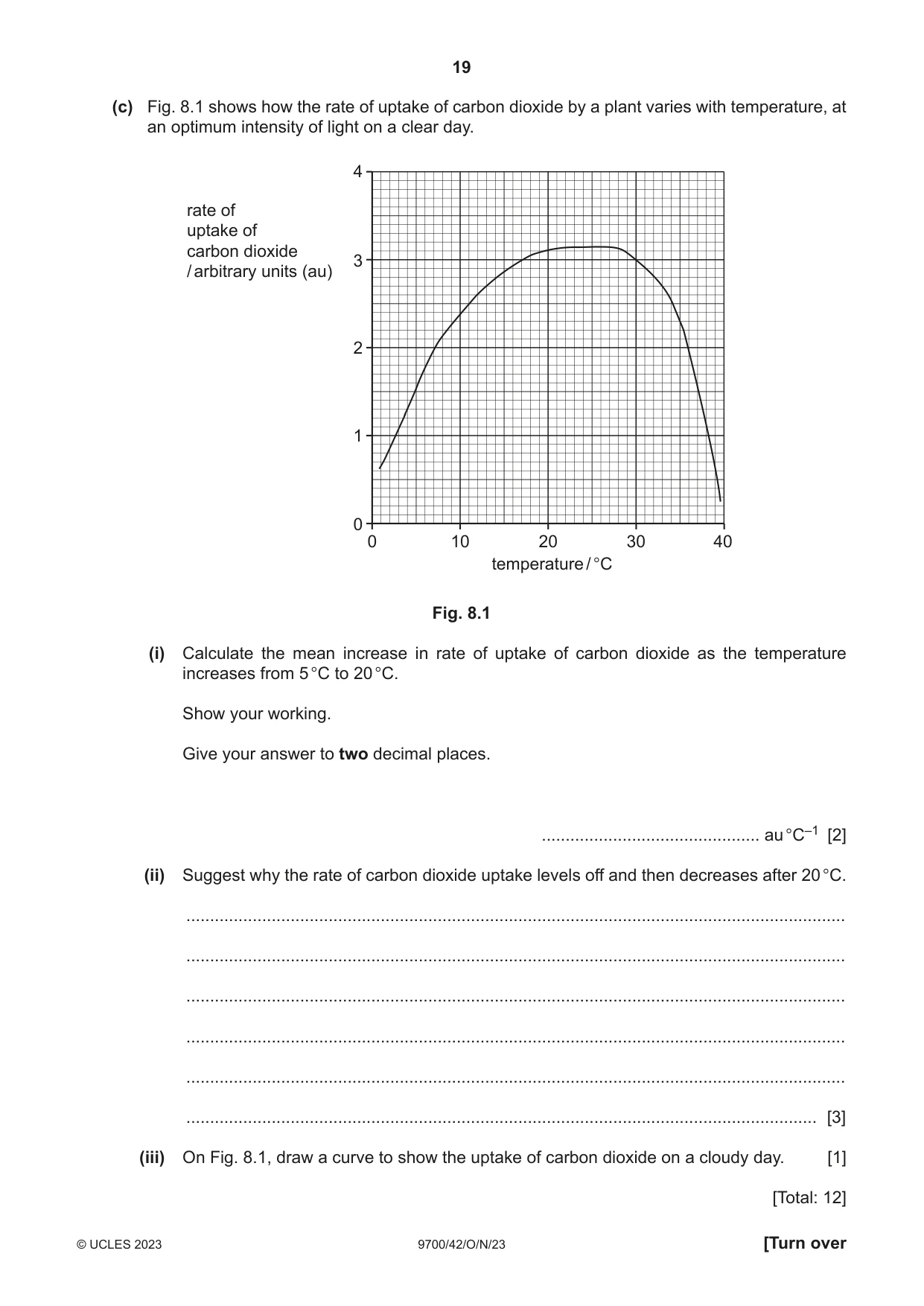
8 (a) Non-cyclic photophosphorylation occurs in the light-dependent stage of photosynthesis. Outline the main features of non-cyclic photophosphorylation. ................................................................................................................................................... ................................................................................................................................................... ................................................................................................................................................... ................................................................................................................................................... ................................................................................................................................................... ................................................................................................................................................... ................................................................................................................................................... ................................................................................................................................................... ................................................................................................................................................... ............................................................................................................................................. [4] (b) Some Calvin cycle intermediates are used to produce other molecules that are not part of the Calvin cycle. Name two of these intermediates. For each intermediate, state one example of the type of molecule that is produced. intermediate .............................................. molecule produced .............................................. intermediate .............................................. molecule produced .............................................. [2] (c) Fig. 8.1 shows how the rate of uptake of carbon dioxide by a plant varies with temperature, at an optimum intensity of light on a clear day. 4 rate of uptake of carbon dioxide 3 / arbitrary units (au) 2 1 0 0 10 20 30 40 temperature / °C Fig. 8.1 (i) Calculate the mean increase in rate of uptake of carbon dioxide as the temperature increases from 5 °C to 20 °C. Show your working. Give your answer to two decimal places. .............................................. au °C–1 [2] (ii) Suggest why the rate of carbon dioxide uptake levels off and then decreases after 20 °C. ........................................................................................................................................... ........................................................................................................................................... ........................................................................................................................................... ........................................................................................................................................... ........................................................................................................................................... ..................................................................................................................................... [3] (iii) On Fig. 8.1, draw a curve to show the uptake of carbon dioxide on a cloudy day. [1] [Total: 12]
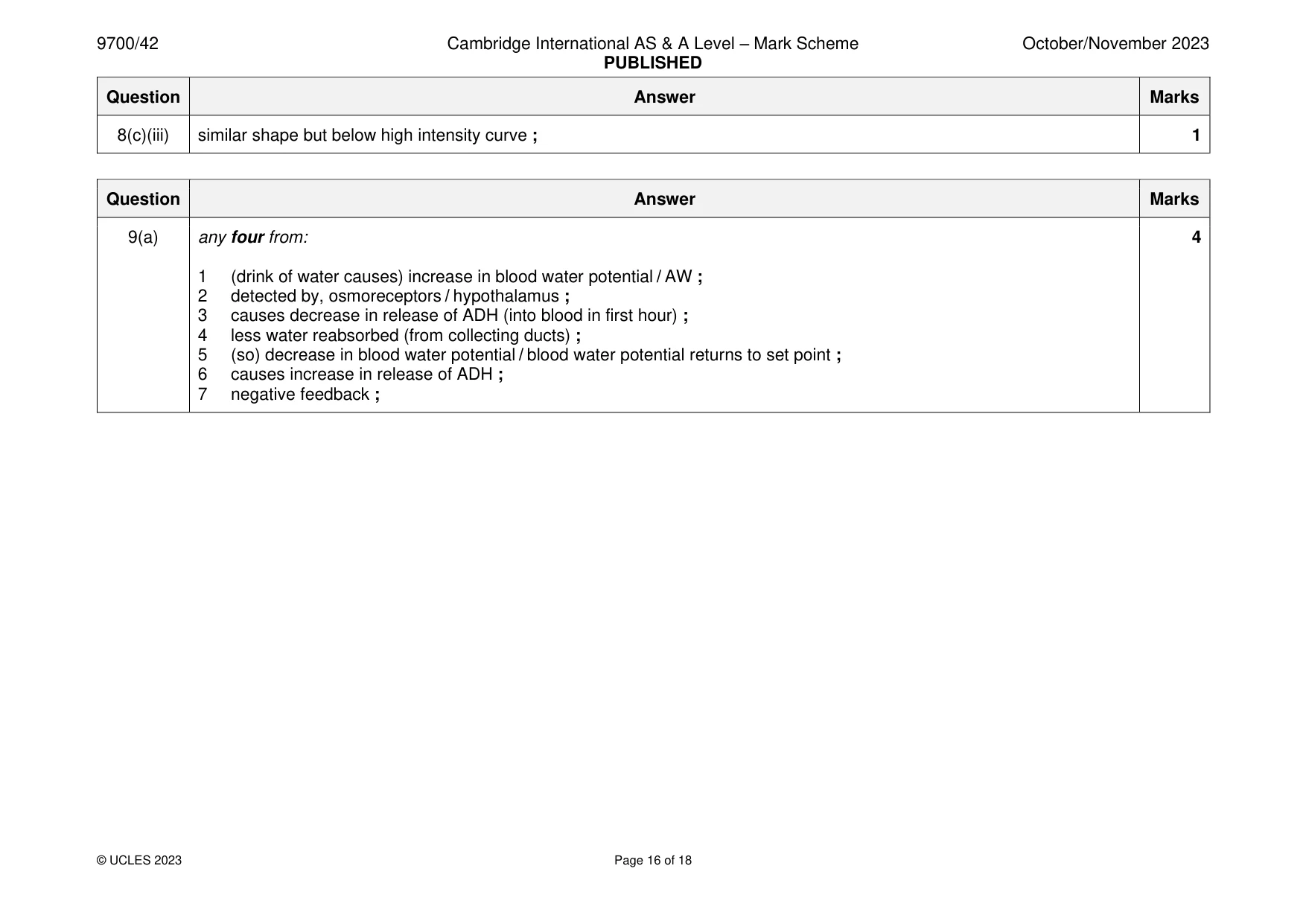
Mark scheme: 8(a) any four from: 4 1 both photosystem I and photosystem II involved ; A both photosystems 2 photoactivation of chlorophyll occurs ; 3 photolysis of water occurs / description ; 4 oxygen production / oxygen-evolving complex involved ; 5 electrons emitted by photosystem I used to reduce NADP or NADP is the final electron acceptor ; 6 photosystem I receives electrons from photosystem II or photosystem II receives electrons from photolysis (of water) ; 7 ETC / electron transport chain, sets up proton gradient or chemiosmosis / ATP produced ; 8(b) GP used to make, amino acids / fatty acids / lipids ; 2 TP used to make, hexose / starch / cellulose / amino acids / glycerol / lipids ; 8(c)(i) 3.10 − 1.55 3.10 − 1.50 2 or ; 15 15 0.10 / 0.11 ; 8(c)(ii) any three from: 3 1 temperature now not limiting or carbon dioxide concentration now limiting ; 2 closure of stomata ; 3 lack of water / AW ; 4 denaturation of enzymes or active site no longer complementary to substrate / no ESCs form ; 5 AVP ; e.g. ref. to optimum temperature / photorespiration occurs 8(c)(iii) similar shape but below high intensity curve ; 1
More questions on Photosynthesis as an energy transfer process
Q9 · Antidiuretic hormone (ADH) is involved in the maintenance of a constant blood water…
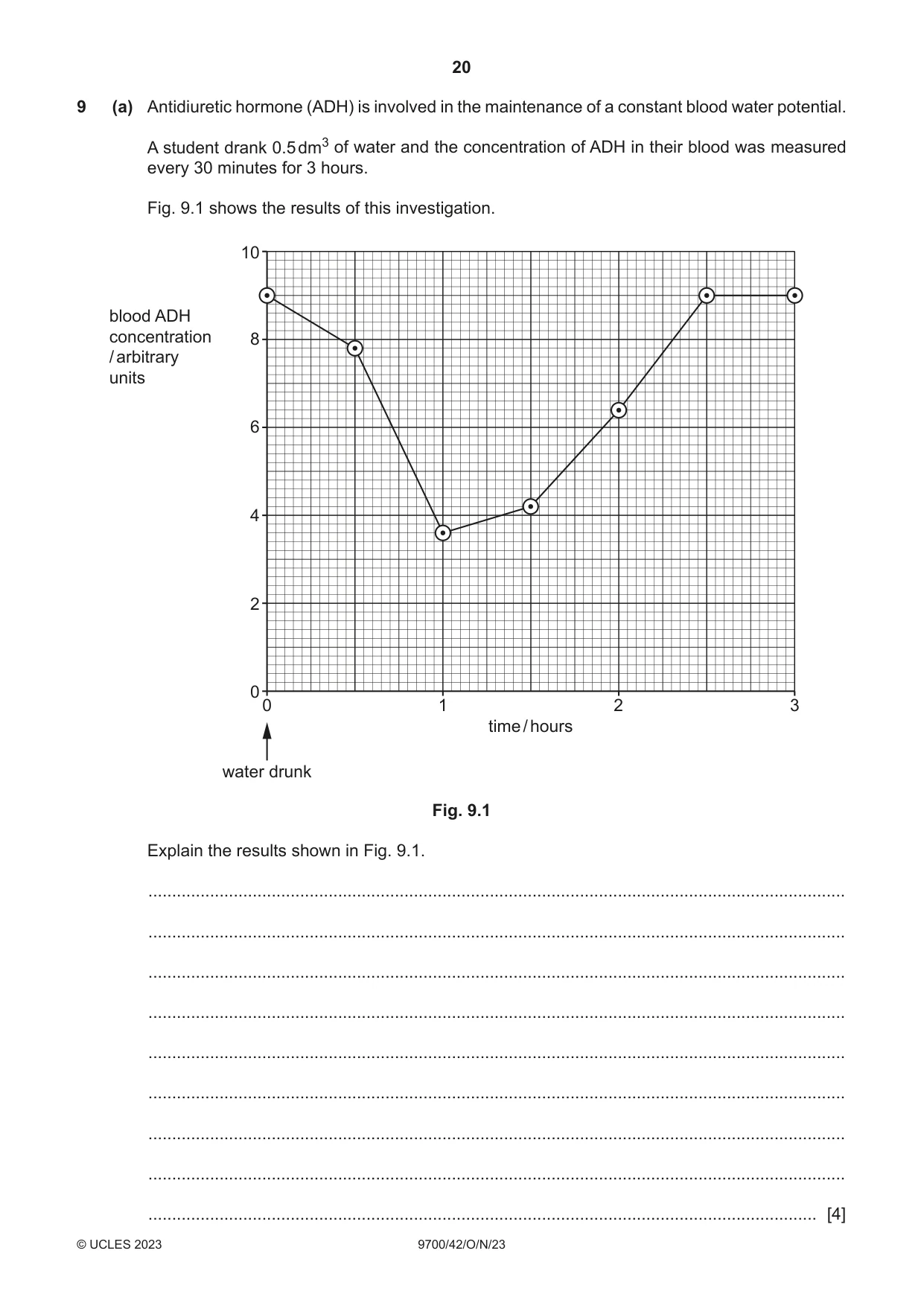
9 (a) Antidiuretic hormone (ADH) is involved in the maintenance of a constant blood water potential. A student drank 0.5 dm3 of water and the concentration of ADH in their blood was measured every 30 minutes for 3 hours. Fig. 9.1 shows the results of this investigation. 10 blood ADH concentration 8 / arbitrary units 6 4 2 0 0 1 2 3 time / hours water drunk Fig. 9.1 Explain the results shown in Fig. 9.1. ................................................................................................................................................... ................................................................................................................................................... ................................................................................................................................................... ................................................................................................................................................... ................................................................................................................................................... ................................................................................................................................................... ................................................................................................................................................... ................................................................................................................................................... ............................................................................................................................................. [4] (b) Outline the differences between the endocrine system and the nervous system. ................................................................................................................................................... ................................................................................................................................................... ................................................................................................................................................... ................................................................................................................................................... ................................................................................................................................................... ................................................................................................................................................... ................................................................................................................................................... ................................................................................................................................................... ............................................................................................................................................. [4] [Total: 8]
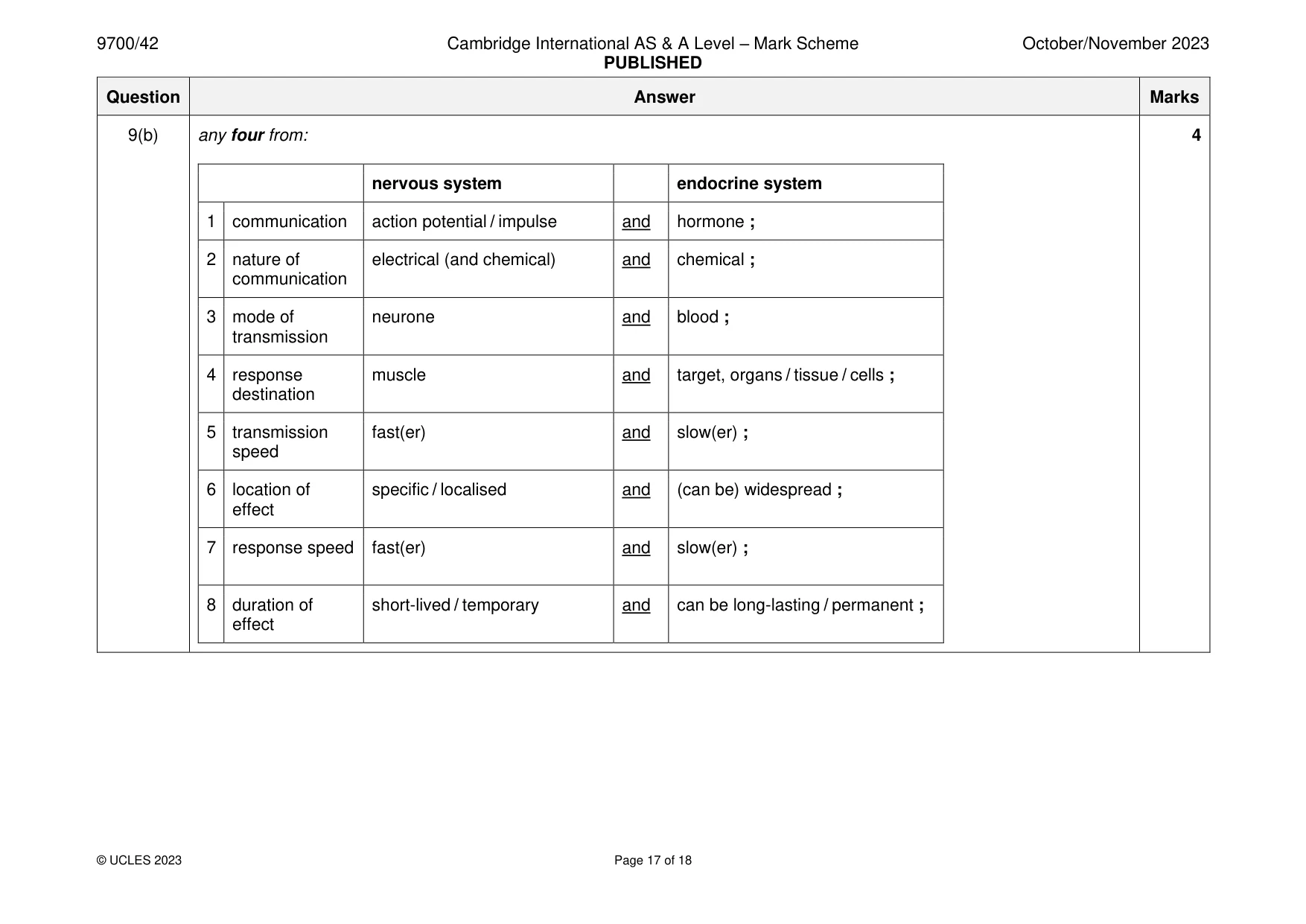
Mark scheme: 9(a) any four from: 4 1 (drink of water causes) increase in blood water potential / AW ; 2 detected by, osmoreceptors / hypothalamus ; 3 causes decrease in release of ADH (into blood in first hour) ; 4 less water reabsorbed (from collecting ducts) ; 5 (so) decrease in blood water potential / blood water potential returns to set point ; 6 causes increase in release of ADH ; 7 negative feedback ; 9(b) any four from: 4 nervous system endocrine system 1 communication action potential / impulse and hormone ; 2 nature of electrical (and chemical) and chemical ; communication 3 mode of neurone and blood ; transmission 4 response muscle and target, organs / tissue / cells ; destination 5 transmission fast(er) and slow(er) ; speed 6 location of specific / localised and (can be) widespread ; effect 7 response speed fast(er) and slow(er) ; 8 duration of short-lived / temporary and can be long-lasting / permanent ; effect
Q10 · The passage outlines one method of estimating the size of an animal population
10 (a) The passage outlines one method of estimating the size of an animal population. Complete the passage by using the most appropriate scientific terms. The size of a population of animals can be estimated using the mark-release-recapture method. A sample of animals is captured using a humane (harmless) trap and is counted. The animals are marked using a method that does not harm them. This can be done using a small tag or ................................................. . The marked animals are released into the area where they were captured. Time is allowed for the marked animals to mix into the population. This period of time must be short so that emigration, immigration, migration or ........................................ do not occur. A second sample of animals is then captured and the number of marked and unmarked animals is counted. The population size can be estimated using the ........................................ Index. For reliability, the method should be ........................................ . [4] (b) Himalayan balsam, Impatiens glandulifera, is an annual plant native to Pakistan, India and Nepal. It was first introduced into the United Kingdom (UK) in 1839 because of its attractive flowers. Individual plants can produce thousands of mature seeds. These can be dispersed for long distances when the capsules that contain the seeds burst. Fig. 10.1 shows Himalayan balsam growing in a woodland. Fig. 10.1 Himalayan balsam has now become established in the UK. It is listed as an invasive alien species and attempts are being made to eradicate (remove) the plant. Not all alien plant species are considered to be invasive. Suggest why Himalayan balsam has been listed as an invasive alien species in the UK. ................................................................................................................................................... ................................................................................................................................................... ................................................................................................................................................... ................................................................................................................................................... ................................................................................................................................................... ................................................................................................................................................... ................................................................................................................................................... ................................................................................................................................................... ............................................................................................................................................. [4] [Total: 8]
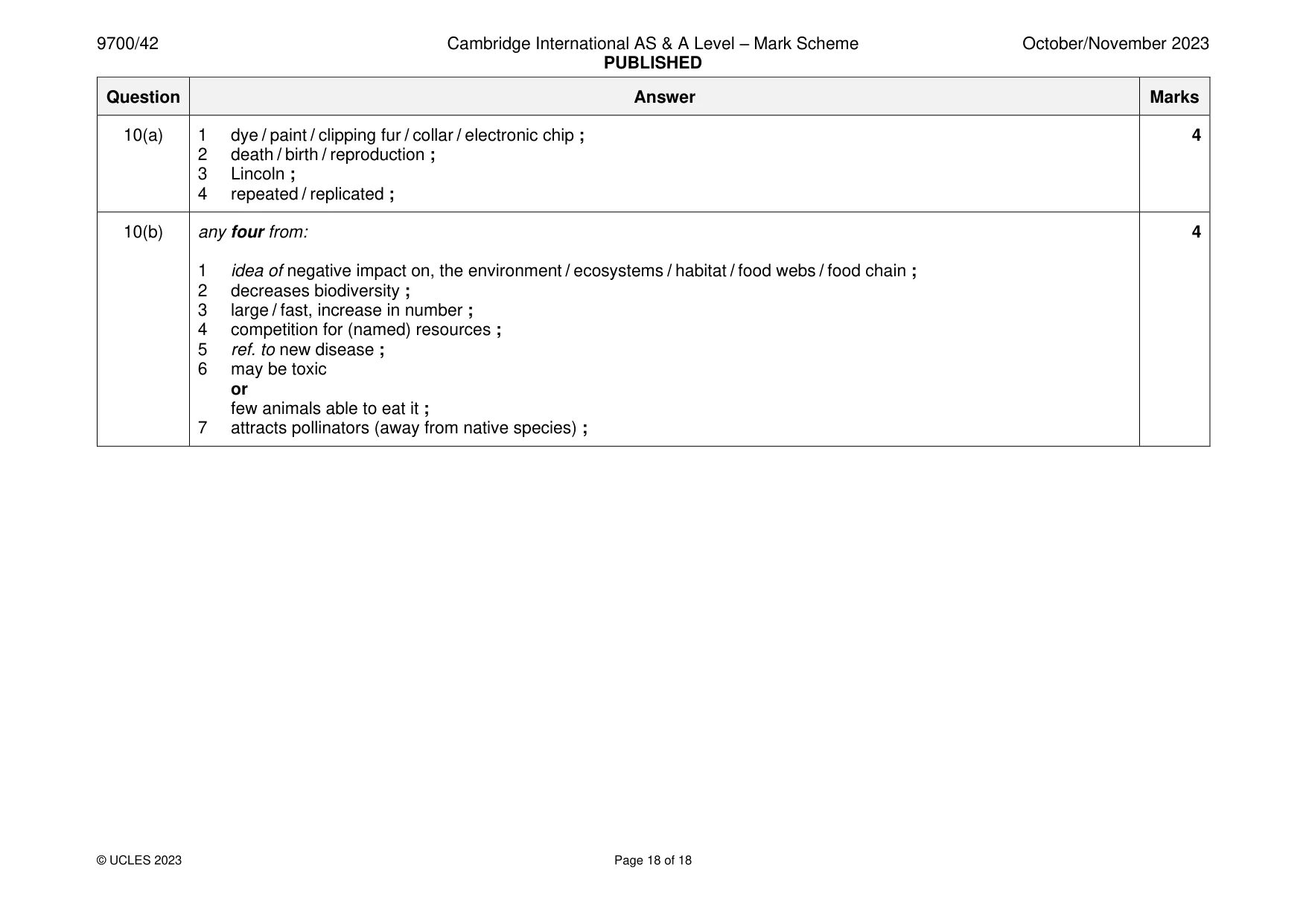
Mark scheme: 10(a) 1 dye / paint / clipping fur / collar / electronic chip ; 4 2 death / birth / reproduction ; 3 Lincoln ; 4 repeated / replicated ; 10(b) any four from: 4 1 idea of negative impact on, the environment / ecosystems / habitat / food webs / food chain ; 2 decreases biodiversity ; 3 large / fast, increase in number ; 4 competition for (named) resources ; 5 ref. to new disease ; 6 may be toxic or few animals able to eat it ; 7 attracts pollinators (away from native species) ;
What was in this paper
The subtopics covered by these 10 questions, and how many questions each got. Open one in a new tab to see every Cambridge question on it.
What you needed in this session
Cambridge’s own grade thresholds for 2023 Oct/Nov, Paper 4 · Variant 2. A higher threshold means an easier paper — the bar moves with how the cohort did.