Cambridge A Level Biology 9700 — 2022 Oct/Nov Paper 4 · Variant 2
9700/42/O/N/22 · 10 questions · 100 marks · ≈113 min
The question paper and its mark scheme, free to read here and free to download. This is Cambridge’s own paper, exactly as it was sat.
Question paper28 pages



Mark scheme19 pages
Answers below. Sit the paper first if you are practising.
Questions as text
Q1 · The Asiatic lion, Panthera leo persica, is found only in the Gir Forest National Park in…
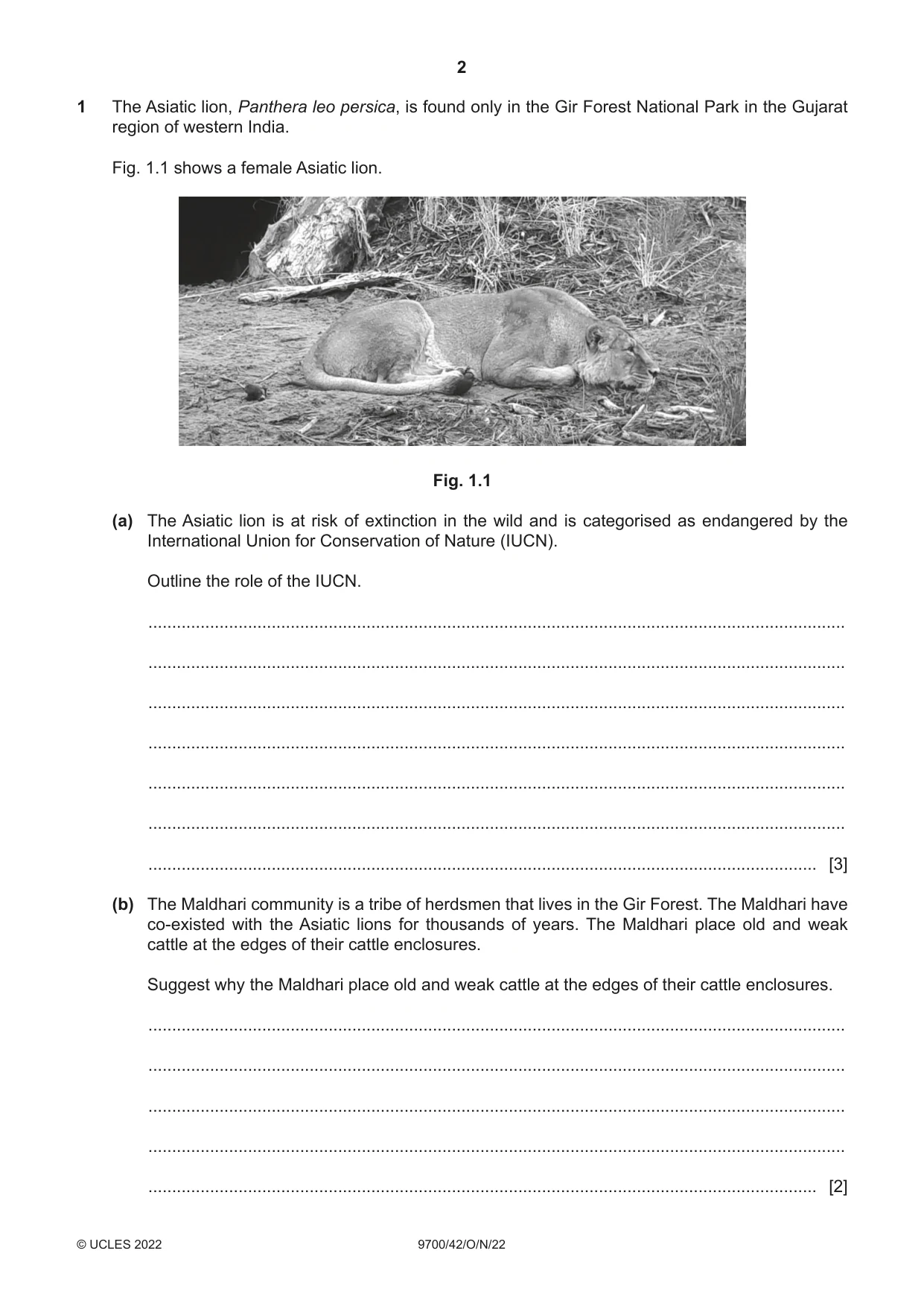
1 The Asiatic lion, Panthera leo persica, is found only in the Gir Forest National Park in the Gujarat region of western India. Fig. 1.1 shows a female Asiatic lion. Fig. 1.1 (a) The Asiatic lion is at risk of extinction in the wild and is categorised as endangered by the International Union for Conservation of Nature (IUCN). Outline the role of the IUCN. ................................................................................................................................................... ................................................................................................................................................... ................................................................................................................................................... ................................................................................................................................................... ................................................................................................................................................... ................................................................................................................................................... ............................................................................................................................................. [3] (b) The Maldhari community is a tribe of herdsmen that lives in the Gir Forest. The Maldhari have co-existed with the Asiatic lions for thousands of years. The Maldhari place old and weak cattle at the edges of their cattle enclosures. Suggest why the Maldhari place old and weak cattle at the edges of their cattle enclosures. ................................................................................................................................................... ................................................................................................................................................... ................................................................................................................................................... ................................................................................................................................................... ............................................................................................................................................. [2] (c) Some zoos use assisted reproduction techniques, such as IVF, in their captive breeding programmes for endangered species. Describe how IVF can be used with an endangered species such as the Asiatic lion. ................................................................................................................................................... ................................................................................................................................................... ................................................................................................................................................... ................................................................................................................................................... ................................................................................................................................................... ................................................................................................................................................... ................................................................................................................................................... ................................................................................................................................................... ............................................................................................................................................. [4] [Total: 9]
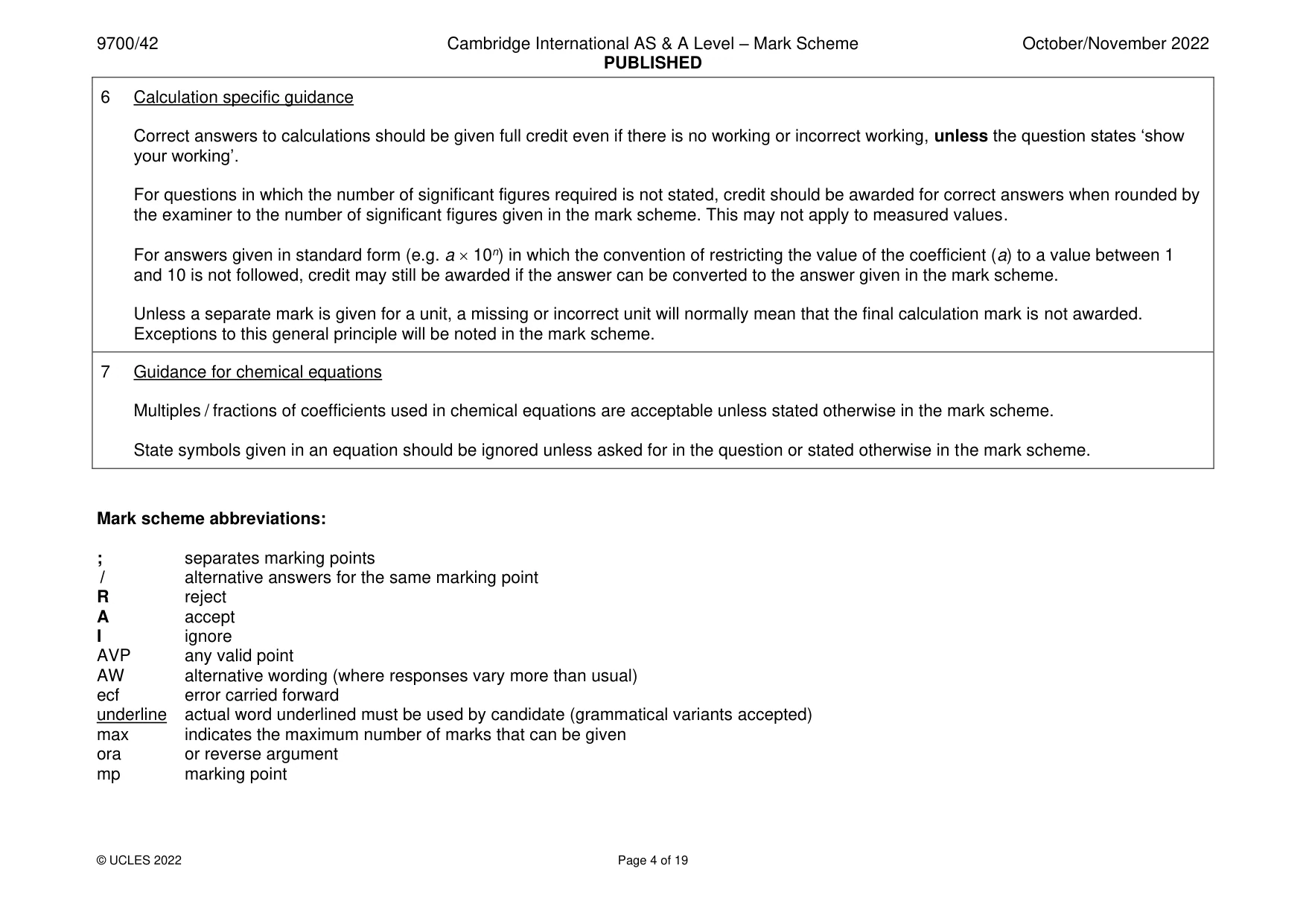
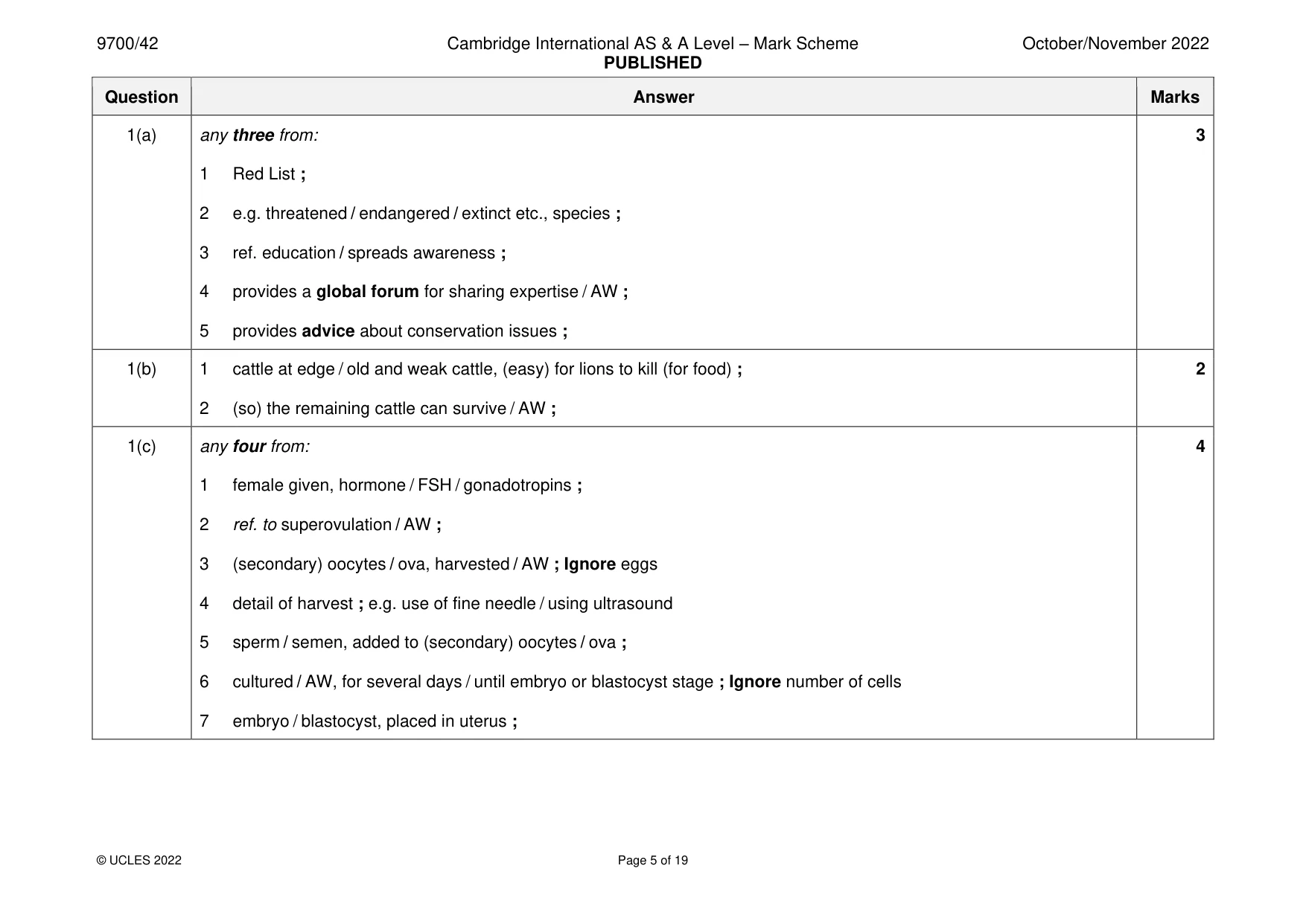
Mark scheme: Question Answer Marks 1(a) any three from: 3 1 Red List ; 2 e.g. threatened / endangered / extinct etc., species ; 3 ref. education / spreads awareness ; 4 provides a global forum for sharing expertise / AW ; 5 provides advice about conservation issues ; 1(b) 1 cattle at edge / old and weak cattle, (easy) for lions to kill (for food) ; 2 2 (so) the remaining cattle can survive / AW ; 1(c) any four from: 4 1 female given, hormone / FSH / gonadotropins ; 2 ref. to superovulation / AW ; 3 (secondary) oocytes / ova, harvested / AW ; Ignore eggs 4 detail of harvest ; e.g. use of fine needle / using ultrasound 5 sperm / semen, added to (secondary) oocytes / ova ; 6 cultured / AW, for several days / until embryo or blastocyst stage ; Ignore number of cells 7 embryo / blastocyst, placed in uterus ;
Q2 · Yeast cells can respire in anaerobic conditions
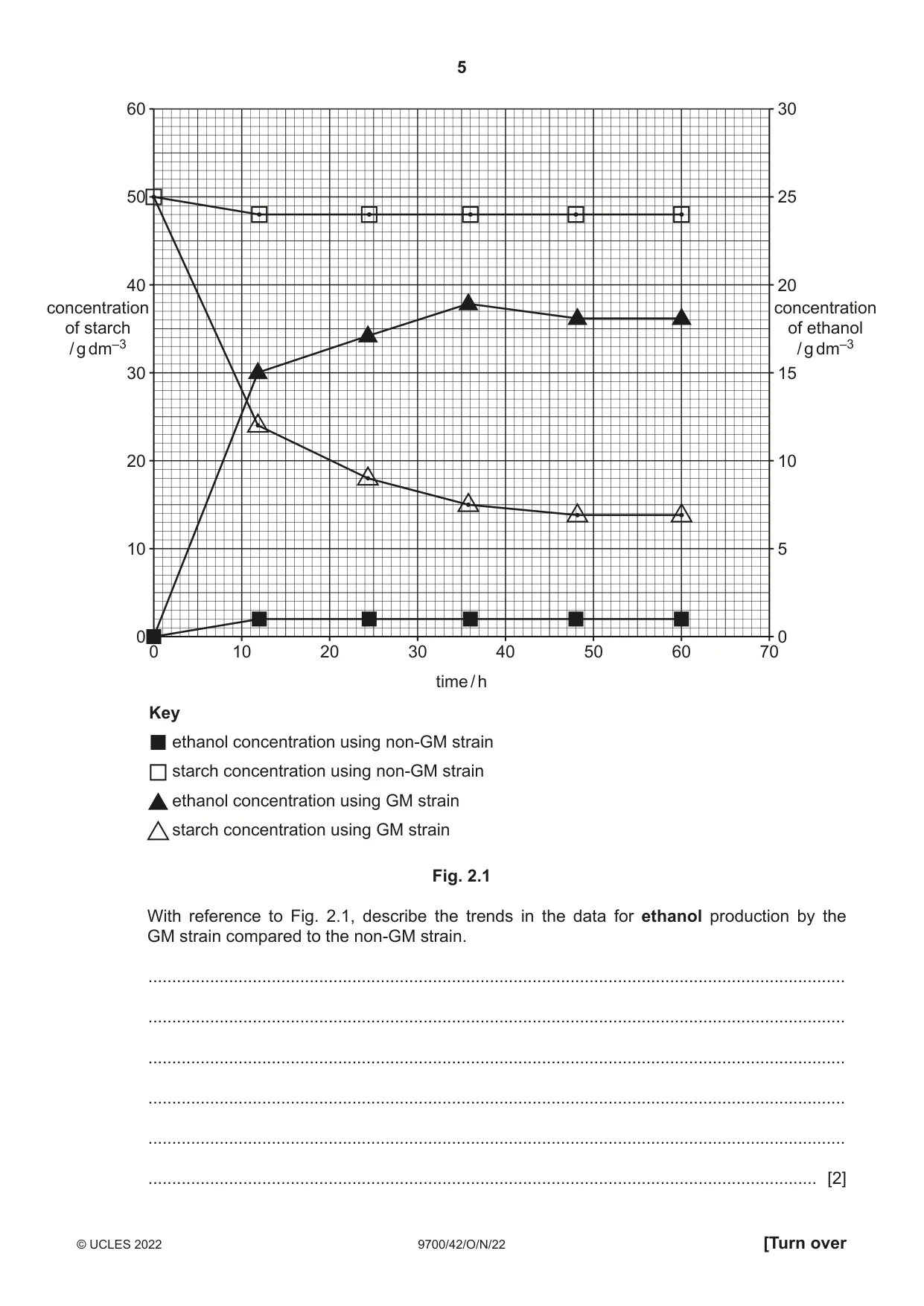
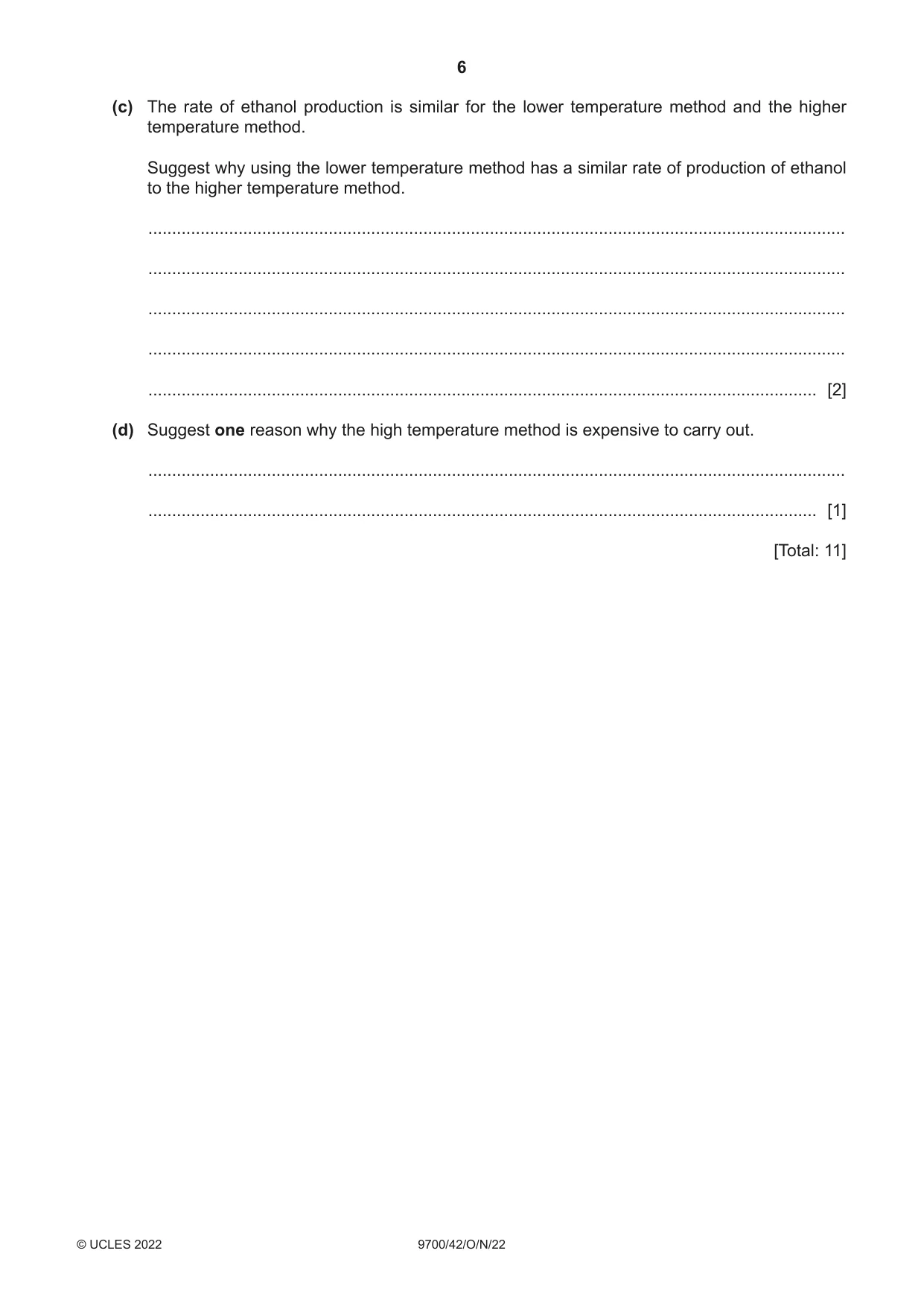
2 Yeast cells can respire in anaerobic conditions. (a) (i) Outline how yeast carries out respiration in anaerobic conditions. ........................................................................................................................................... ........................................................................................................................................... ........................................................................................................................................... ........................................................................................................................................... ........................................................................................................................................... ........................................................................................................................................... ........................................................................................................................................... ........................................................................................................................................... ..................................................................................................................................... [4] (ii) Explain why respiration in anaerobic conditions is an advantage to yeast. ........................................................................................................................................... ........................................................................................................................................... ........................................................................................................................................... ........................................................................................................................................... ..................................................................................................................................... [2] Bioethanol is a type of biofuel produced from maize starch on an industrial scale. In the high temperature method, heating to 120 °C is used to break apart starch molecules. The enzymes α-amylase and glucoamylase are added to the resulting starch suspension once it has cooled down. These enzymes hydrolyse the starch to glucose. Yeast cells are then added and maintained in anaerobic conditions to produce ethanol. The high temperature method is expensive to carry out, so a new method has been developed which heats starch to a lower temperature of 80 °C. In the lower temperature method, enzymes catalysing the hydrolysis of starch do not need to be added to the starch suspension. A genetically modified (GM) strain of the same yeast species is used. The GM strain of yeast has genes that allow the cell to produce α-amylase and glucoamylase and to attach these enzymes to the external surface of the cell surface membrane. The GM yeast cells are added to the starch that was heated to 80 °C and are maintained in anaerobic conditions to produce ethanol. (b) An investigation was carried out to compare the GM strain of yeast with the yeast that had not been genetically modified (non-GM strain). In this investigation, the starch suspension produced after heating to 80 °C was allowed to cool to 30 °C before adding yeast cells. The results are shown in Fig. 2.1. 60 30 50 25 40 20 concentration concentration of starch of ethanol / g dm–3 / g dm–3 30 15 20 10 10 5 0 0 0 10 20 30 40 50 60 70 time / h Key ethanol concentration using non-GM strain starch concentration using non-GM strain ethanol concentration using GM strain starch concentration using GM strain Fig. 2.1 With reference to Fig. 2.1, describe the trends in the data for ethanol production by the GM strain compared to the non-GM strain. ................................................................................................................................................... ................................................................................................................................................... ................................................................................................................................................... ................................................................................................................................................... ................................................................................................................................................... ............................................................................................................................................. [2] (c) The rate of ethanol production is similar for the lower temperature method and the higher temperature method. Suggest why using the lower temperature method has a similar rate of production of ethanol to the higher temperature method. ................................................................................................................................................... ................................................................................................................................................... ................................................................................................................................................... ................................................................................................................................................... ............................................................................................................................................. [2] (d) Suggest one reason why the high temperature method is expensive to carry out. ................................................................................................................................................... ............................................................................................................................................. [1] [Total: 11]
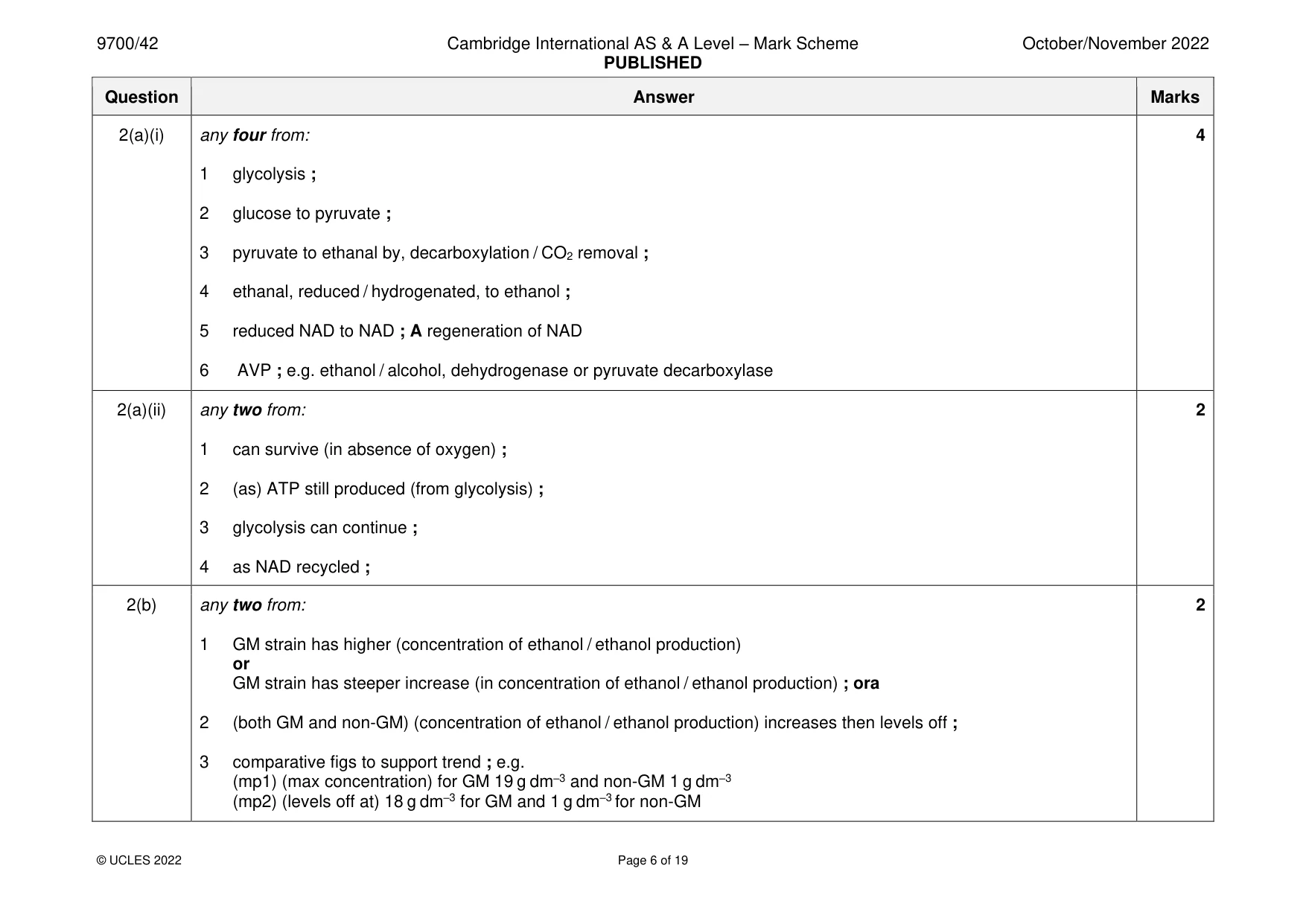
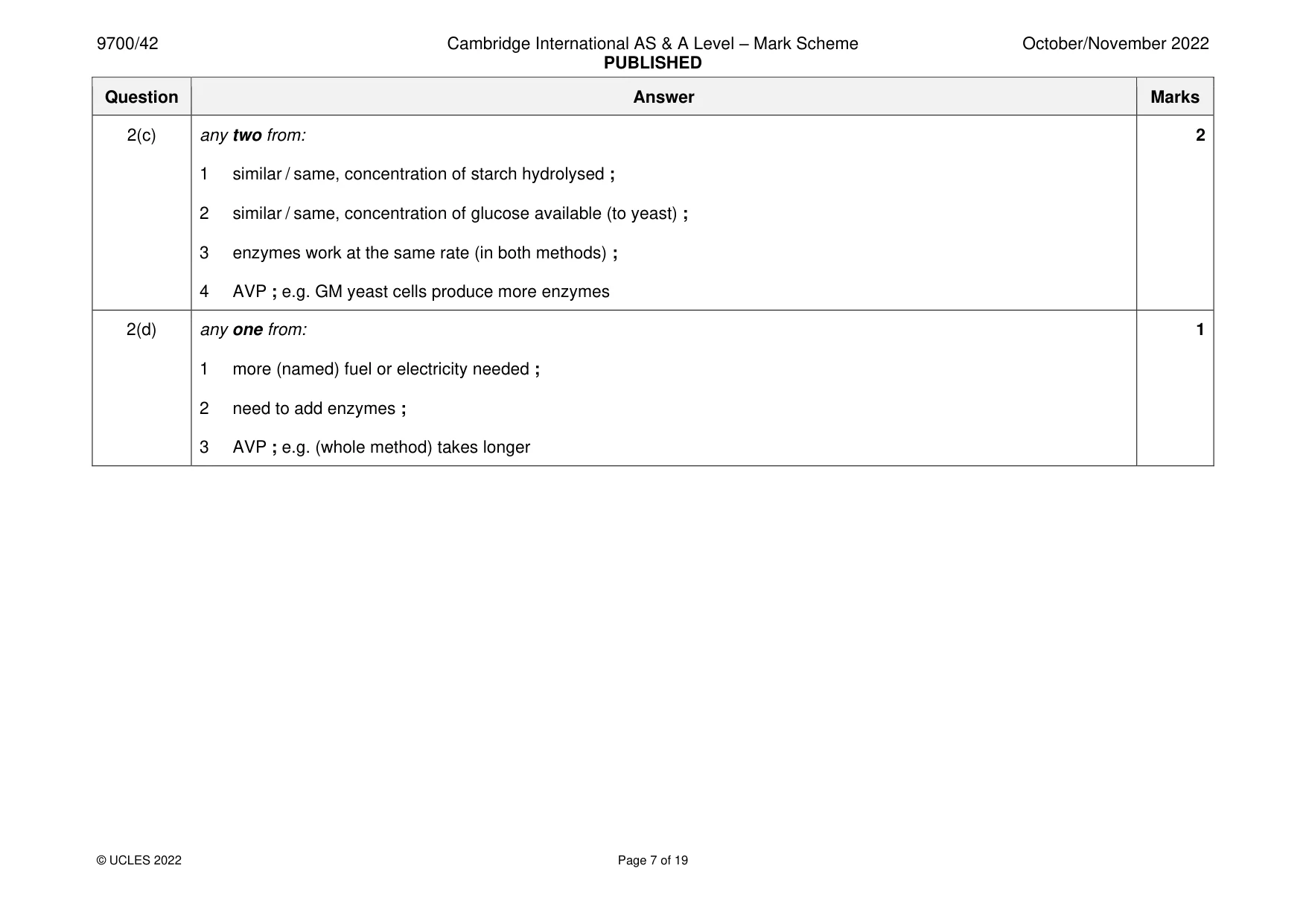
Mark scheme: 2(a)(i) any four from: 4 1 glycolysis ; 2 glucose to pyruvate ; 3 pyruvate to ethanal by, decarboxylation / CO2 removal ; 4 ethanal, reduced / hydrogenated, to ethanol ; 5 reduced NAD to NAD ; A regeneration of NAD 6 AVP ; e.g. ethanol / alcohol, dehydrogenase or pyruvate decarboxylase 2(a)(ii) any two from: 2 1 can survive (in absence of oxygen) ; 2 (as) ATP still produced (from glycolysis) ; 3 glycolysis can continue ; 4 as NAD recycled ; 2(b) any two from: 2 1 GM strain has higher (concentration of ethanol / ethanol production) or GM strain has steeper increase (in concentration of ethanol / ethanol production) ; ora 2 (both GM and non-GM) (concentration of ethanol / ethanol production) increases then levels off ; 3 comparative figs to support trend ; e.g. (mp1) (max concentration) for GM 19 g dm–3 and non-GM 1 g dm–3 (mp2) (levels off at) 18 g dm–3 for GM and 1 g dm–3 for non-GM 2(c) any two from: 2 1 similar / same, concentration of starch hydrolysed ; 2 similar / same, concentration of glucose available (to yeast) ; 3 enzymes work at the same rate (in both methods) ; 4 AVP ; e.g. GM yeast cells produce more enzymes 2(d) any one from: 1 1 more (named) fuel or electricity needed ; 2 need to add enzymes ; 3 AVP ; e.g. (whole method) takes longer
Q3 · Photosynthesis is an energy transfer process that takes place in chloroplasts of plant…
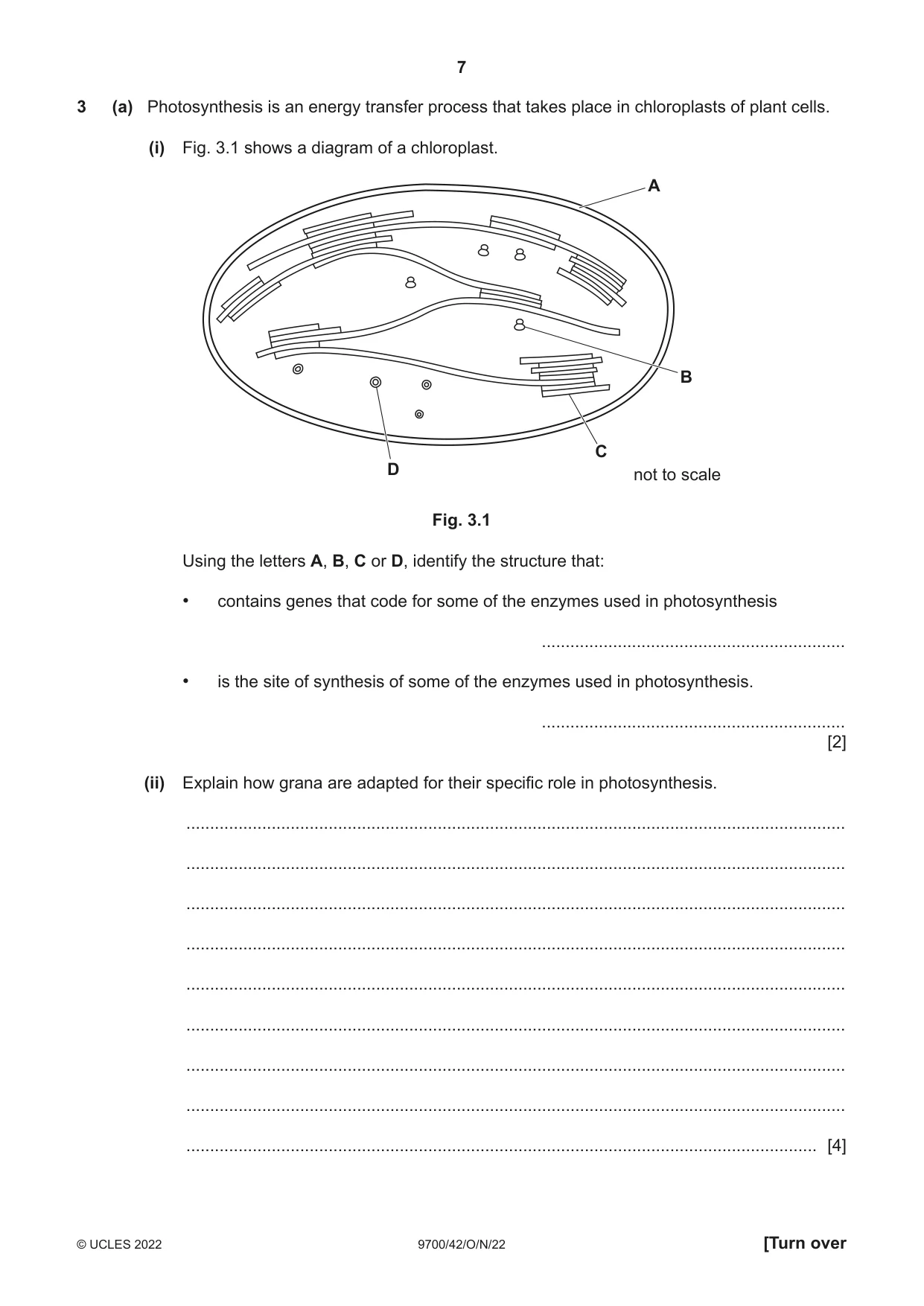
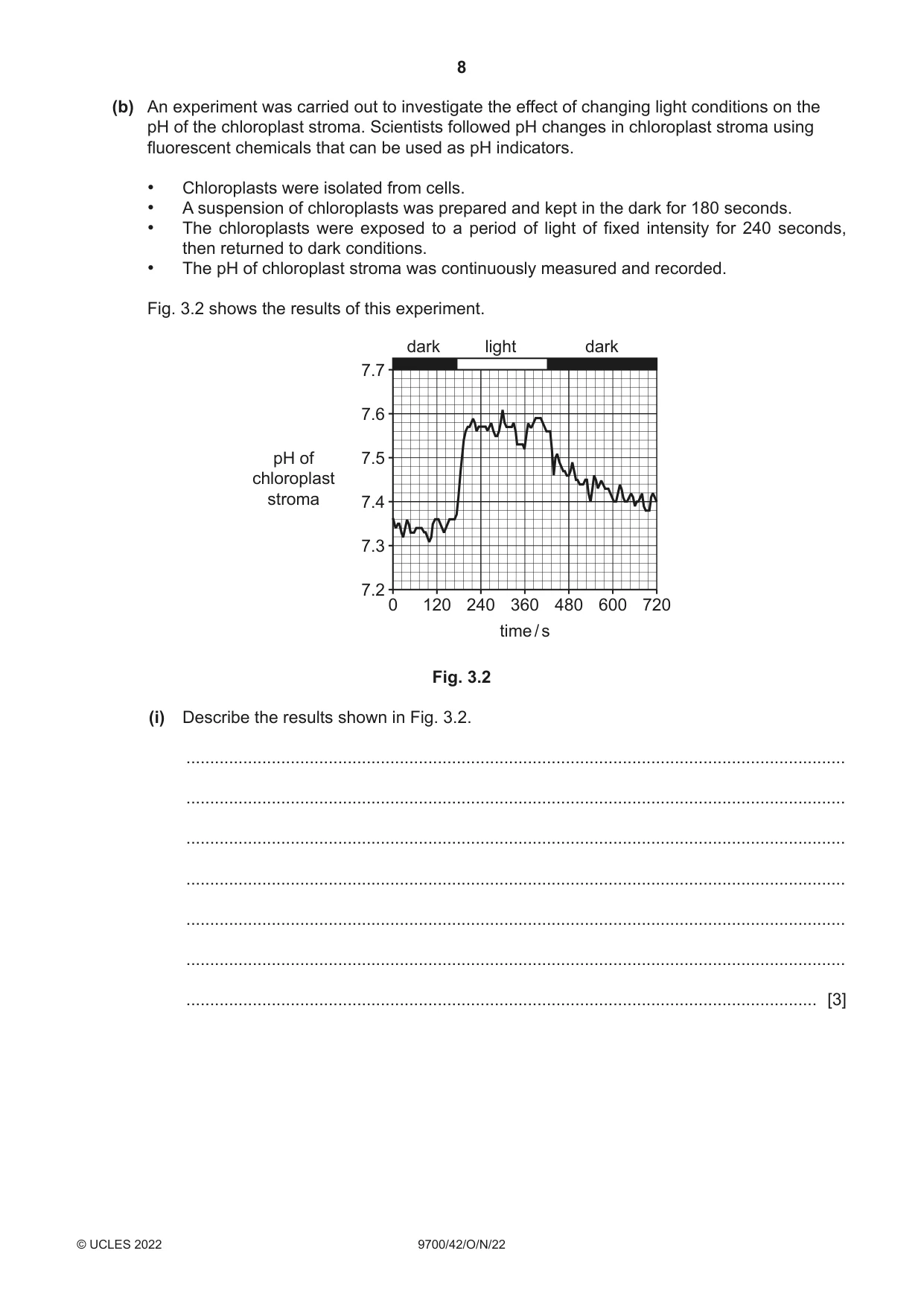
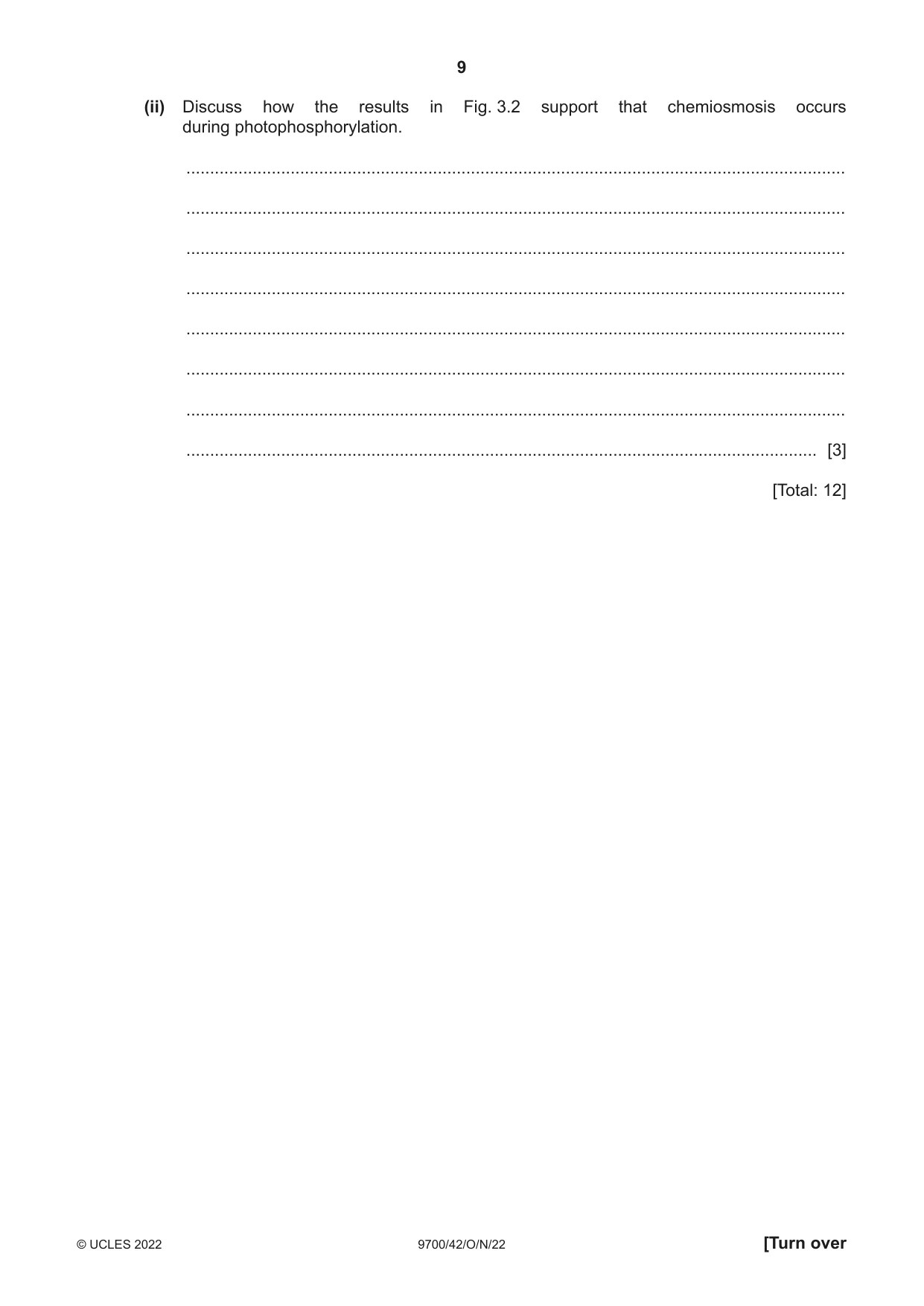
3 (a) Photosynthesis is an energy transfer process that takes place in chloroplasts of plant cells. (i) Fig. 3.1 shows a diagram of a chloroplast. A B C D not to scale Fig. 3.1 Using the letters A, B, C or D, identify the structure that: • contains genes that code for some of the enzymes used in photosynthesis ................................................................ • is the site of synthesis of some of the enzymes used in photosynthesis. ................................................................ [2] (ii) Explain how grana are adapted for their specific role in photosynthesis. ........................................................................................................................................... ........................................................................................................................................... ........................................................................................................................................... ........................................................................................................................................... ........................................................................................................................................... ........................................................................................................................................... ........................................................................................................................................... ........................................................................................................................................... ..................................................................................................................................... [4] (b) An experiment was carried out to investigate the effect of changing light conditions on the pH of the chloroplast stroma. Scientists followed pH changes in chloroplast stroma using fluorescent chemicals that can be used as pH indicators. • Chloroplasts were isolated from cells. • A suspension of chloroplasts was prepared and kept in the dark for 180 seconds. • The chloroplasts were exposed to a period of light of fixed intensity for 240 seconds, then returned to dark conditions. • The pH of chloroplast stroma was continuously measured and recorded. Fig. 3.2 shows the results of this experiment. dark light dark 7.7 7.6 pH of 7.5 chloroplast stroma 7.4 7.3 7.2 0 120 240 360 480 600 720 time / s Fig. 3.2 (i) Describe the results shown in Fig. 3.2. ........................................................................................................................................... ........................................................................................................................................... ........................................................................................................................................... ........................................................................................................................................... ........................................................................................................................................... ........................................................................................................................................... ..................................................................................................................................... [3] (ii) Discuss how the results in Fig. 3.2 support that chemiosmosis occurs during photophosphorylation. ........................................................................................................................................... ........................................................................................................................................... ........................................................................................................................................... ........................................................................................................................................... ........................................................................................................................................... ........................................................................................................................................... ........................................................................................................................................... ..................................................................................................................................... [3] [Total: 12]
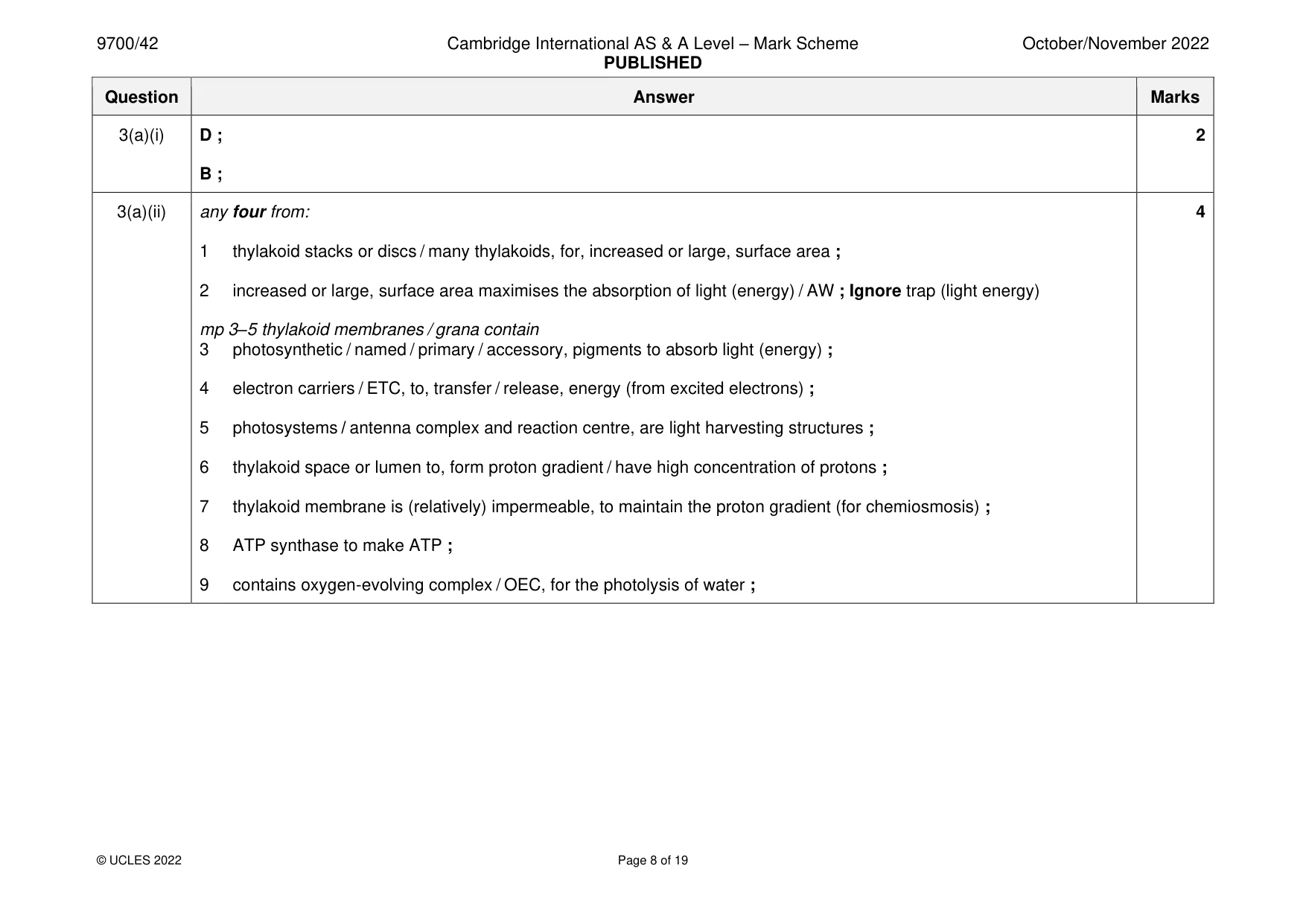
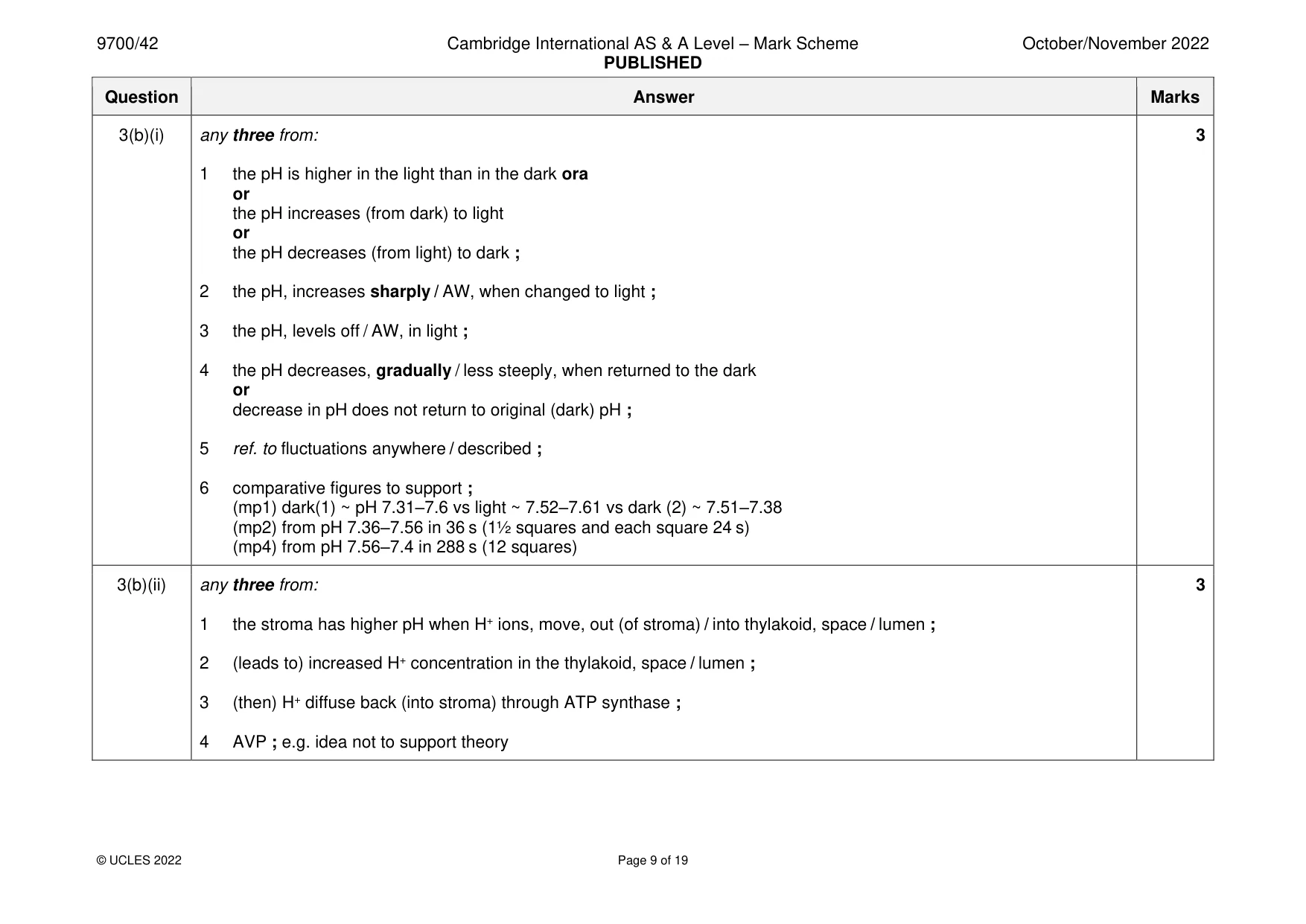
Mark scheme: 3(a)(i) D ; 2 B ; 3(a)(ii) any four from: 4 1 thylakoid stacks or discs / many thylakoids, for, increased or large, surface area ; 2 increased or large, surface area maximises the absorption of light (energy) / AW ; Ignore trap (light energy) mp 3–5 thylakoid membranes / grana contain 3 photosynthetic / named / primary / accessory, pigments to absorb light (energy) ; 4 electron carriers / ETC, to, transfer / release, energy (from excited electrons) ; 5 photosystems / antenna complex and reaction centre, are light harvesting structures ; 6 thylakoid space or lumen to, form proton gradient / have high concentration of protons ; 7 thylakoid membrane is (relatively) impermeable, to maintain the proton gradient (for chemiosmosis) ; 8 ATP synthase to make ATP ; 9 contains oxygen-evolving complex / OEC, for the photolysis of water ; 3(b)(i) any three from: 3 1 the pH is higher in the light than in the dark ora or the pH increases (from dark) to light or the pH decreases (from light) to dark ; 2 the pH, increases sharply / AW, when changed to light ; 3 the pH, levels off / AW, in light ; 4 the pH decreases, gradually / less steeply, when returned to the dark or decrease in pH does not return to original (dark) pH ; 5 ref. to fluctuations anywhere / described ; 6 comparative figures to support ; (mp1) dark(1) ~ pH 7.31–7.6 vs light ~ 7.52–7.61 vs dark (2) ~ 7.51–7.38 (mp2) from pH 7.36–7.56 in 36 s (1½ squares and each square 24 s) (mp4) from pH 7.56–7.4 in 288 s (12 squares) 3(b)(ii) any three from: 3 1 the stroma has higher pH when H+ ions, move, out (of stroma) / into thylakoid, space / lumen ; 2 (leads to) increased H+ concentration in the thylakoid, space / lumen ; 3 (then) H+ diffuse back (into stroma) through ATP synthase ; 4 AVP ; e.g. idea not to support theory
More questions on Photosynthesis as an energy transfer process
Q4 · Haemophilia is a blood clotting disorder in humans caused by a mutant allele on the X…
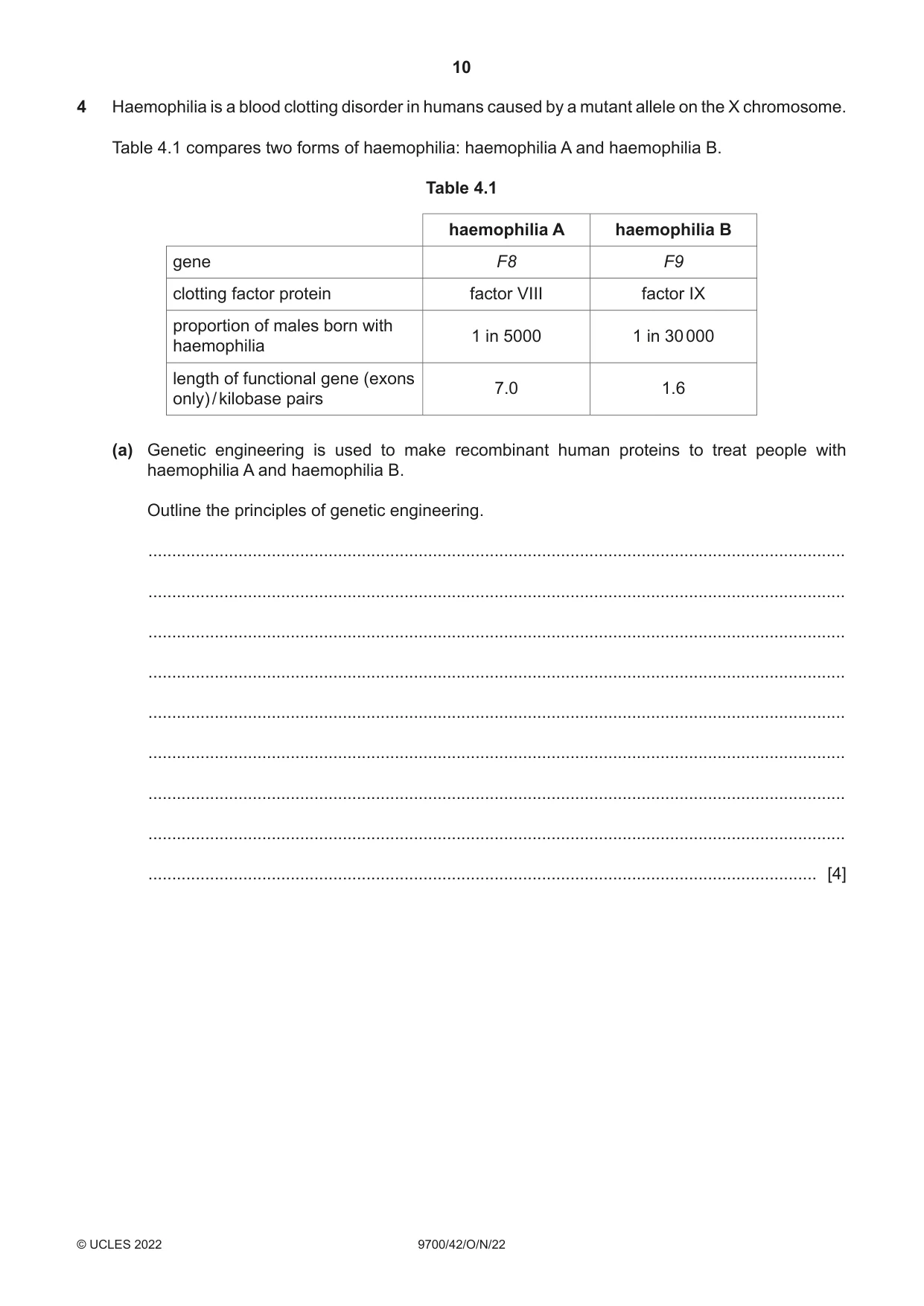
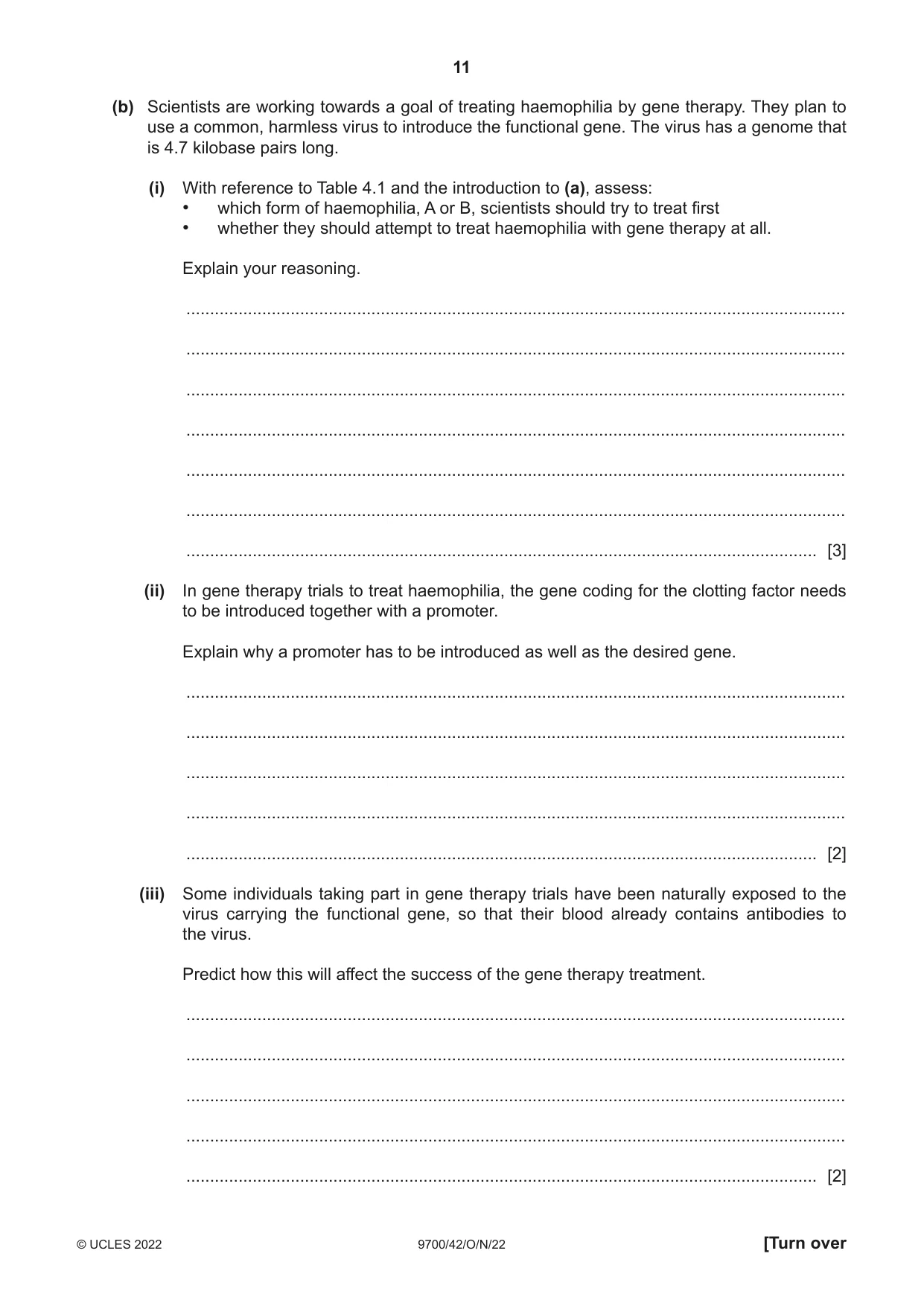
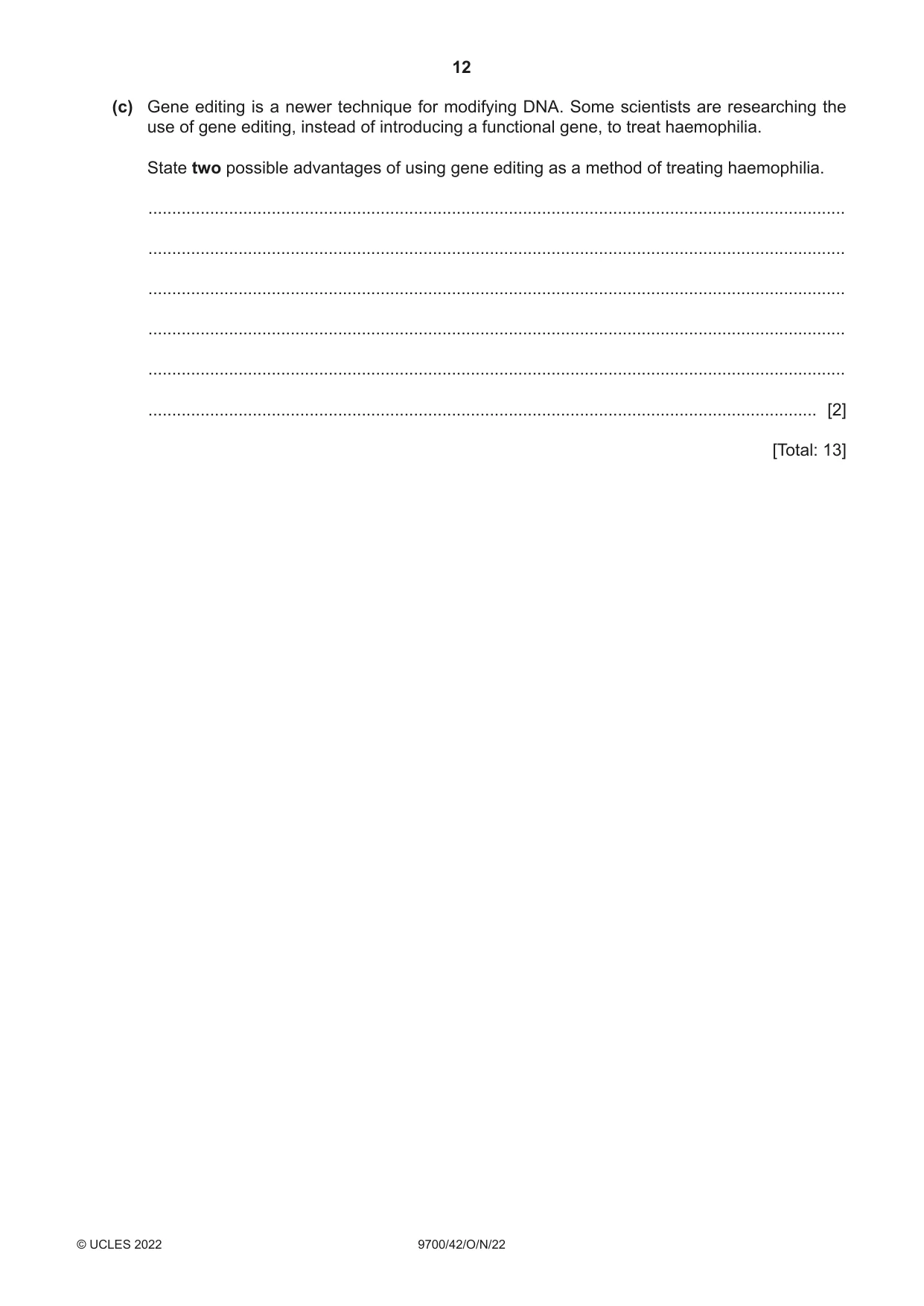
4 Haemophilia is a blood clotting disorder in humans caused by a mutant allele on the X chromosome. Table 4.1 compares two forms of haemophilia: haemophilia A and haemophilia B. Table 4.1 haemophilia A haemophilia B gene F8 F9 clotting factor protein factor VIII factor IX proportion of males born with 1 in 5000 1 in 30 000 haemophilia length of functional gene (exons 7.0 1.6 only) / kilobase pairs (a) Genetic engineering is used to make recombinant human proteins to treat people with haemophilia A and haemophilia B. Outline the principles of genetic engineering. ................................................................................................................................................... ................................................................................................................................................... ................................................................................................................................................... ................................................................................................................................................... ................................................................................................................................................... ................................................................................................................................................... ................................................................................................................................................... ................................................................................................................................................... ............................................................................................................................................. [4] (b) Scientists are working towards a goal of treating haemophilia by gene therapy. They plan to use a common, harmless virus to introduce the functional gene. The virus has a genome that is 4.7 kilobase pairs long. (i) With reference to Table 4.1 and the introduction to (a), assess: • which form of haemophilia, A or B, scientists should try to treat first • whether they should attempt to treat haemophilia with gene therapy at all. Explain your reasoning. ........................................................................................................................................... ........................................................................................................................................... ........................................................................................................................................... ........................................................................................................................................... ........................................................................................................................................... ........................................................................................................................................... ..................................................................................................................................... [3] (ii) In gene therapy trials to treat haemophilia, the gene coding for the clotting factor needs to be introduced together with a promoter. Explain why a promoter has to be introduced as well as the desired gene. ........................................................................................................................................... ........................................................................................................................................... ........................................................................................................................................... ........................................................................................................................................... ..................................................................................................................................... [2] (iii) Some individuals taking part in gene therapy trials have been naturally exposed to the virus carrying the functional gene, so that their blood already contains antibodies to the virus. Predict how this will affect the success of the gene therapy treatment. ........................................................................................................................................... ........................................................................................................................................... ........................................................................................................................................... ........................................................................................................................................... ..................................................................................................................................... [2] (c) Gene editing is a newer technique for modifying DNA. Some scientists are researching the use of gene editing, instead of introducing a functional gene, to treat haemophilia. State two possible advantages of using gene editing as a method of treating haemophilia. ................................................................................................................................................... ................................................................................................................................................... ................................................................................................................................................... ................................................................................................................................................... ................................................................................................................................................... ............................................................................................................................................. [2] [Total: 13]
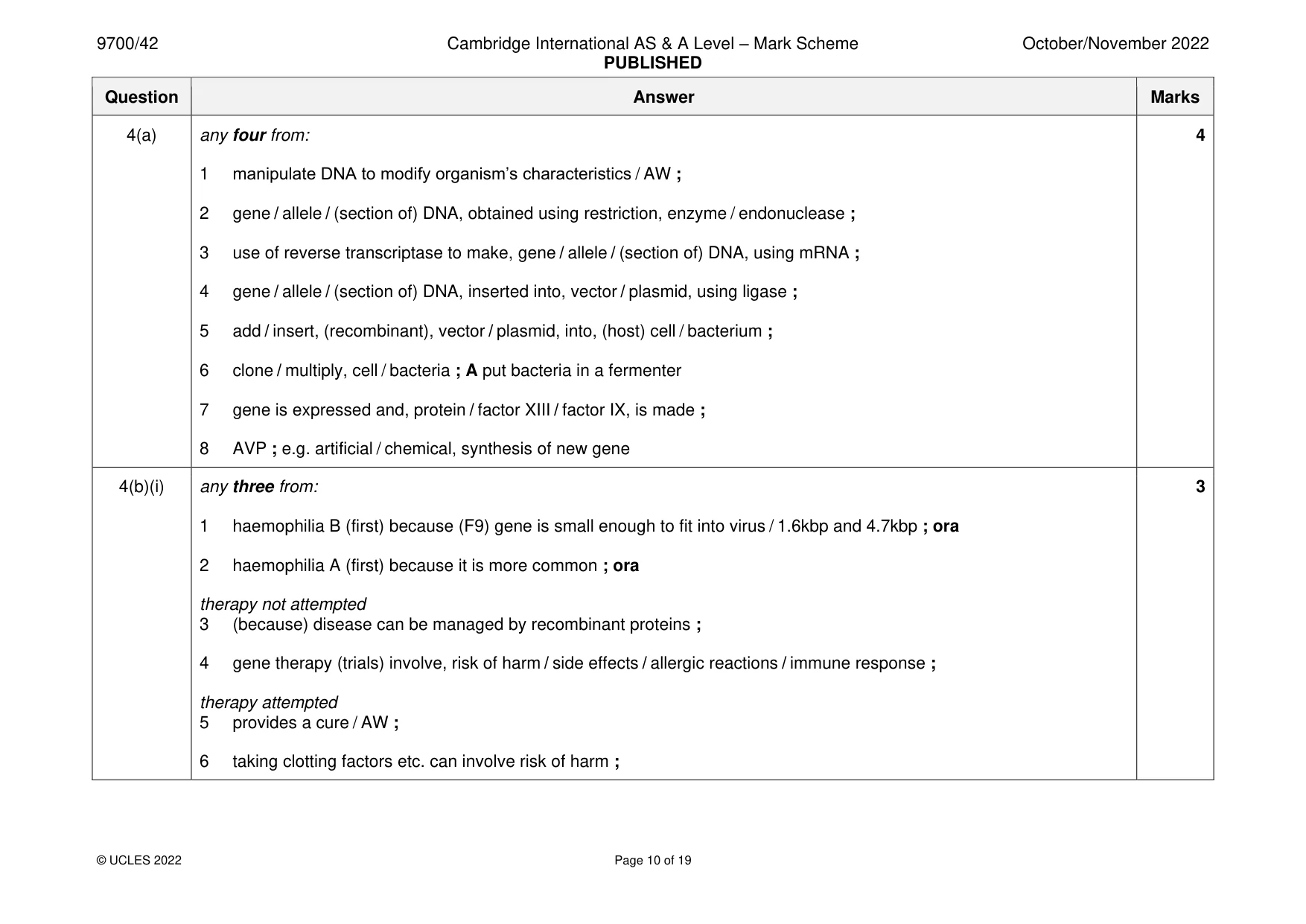
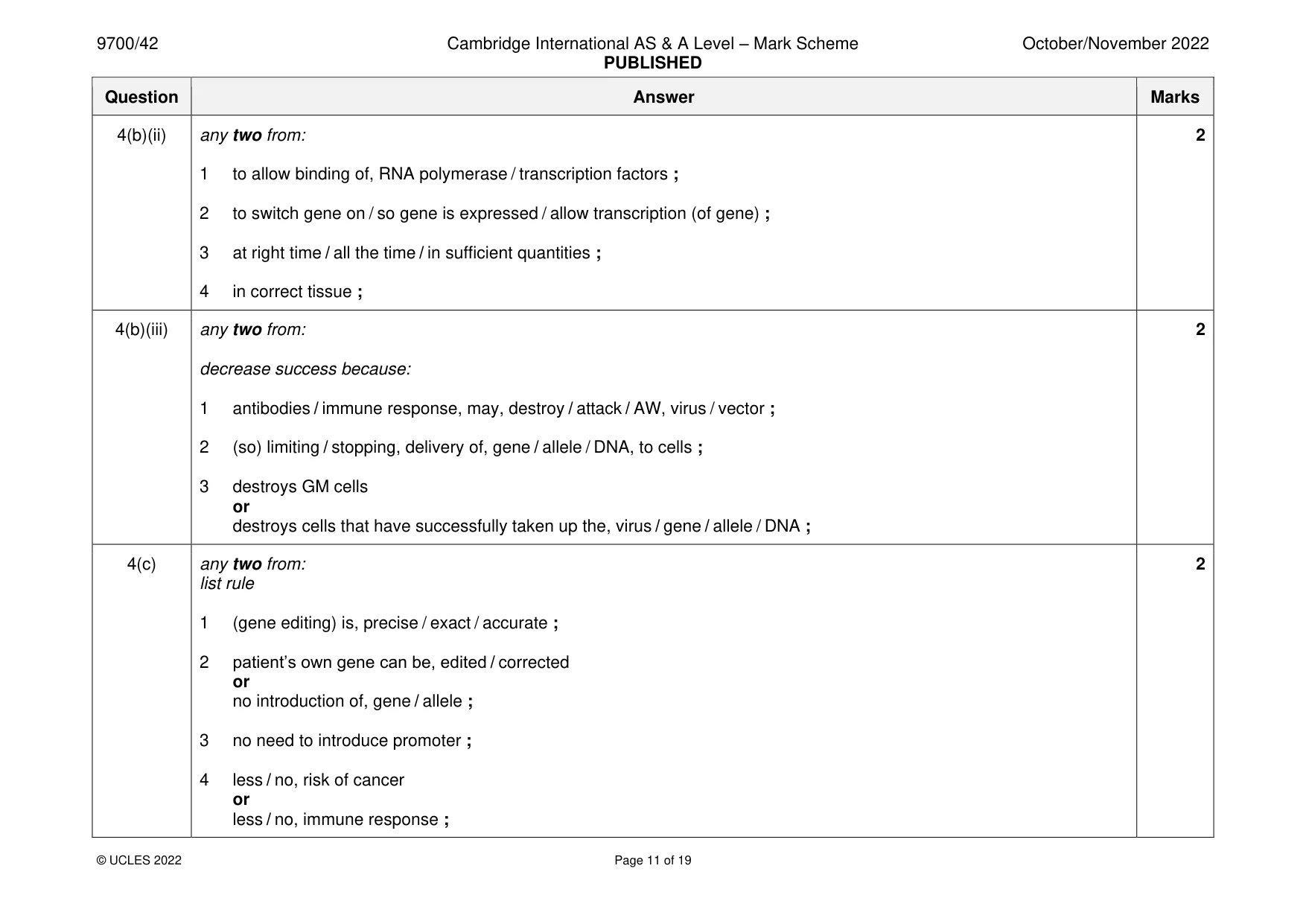
Mark scheme: 4(a) any four from: 4 1 manipulate DNA to modify organism’s characteristics / AW ; 2 gene / allele / (section of) DNA, obtained using restriction, enzyme / endonuclease ; 3 use of reverse transcriptase to make, gene / allele / (section of) DNA, using mRNA ; 4 gene / allele / (section of) DNA, inserted into, vector / plasmid, using ligase ; 5 add / insert, (recombinant), vector / plasmid, into, (host) cell / bacterium ; 6 clone / multiply, cell / bacteria ; A put bacteria in a fermenter 7 gene is expressed and, protein / factor XIII / factor IX, is made ; 8 AVP ; e.g. artificial / chemical, synthesis of new gene 4(b)(i) any three from: 3 1 haemophilia B (first) because (F9) gene is small enough to fit into virus / 1.6kbp and 4.7kbp ; ora 2 haemophilia A (first) because it is more common ; ora therapy not attempted 3 (because) disease can be managed by recombinant proteins ; 4 gene therapy (trials) involve, risk of harm / side effects / allergic reactions / immune response ; therapy attempted 5 provides a cure / AW ; 6 taking clotting factors etc. can involve risk of harm ; 4(b)(ii) any two from: 2 1 to allow binding of, RNA polymerase / transcription factors ; 2 to switch gene on / so gene is expressed / allow transcription (of gene) ; 3 at right time / all the time / in sufficient quantities ; 4 in correct tissue ; 4(b)(iii) any two from: 2 decrease success because: 1 antibodies / immune response, may, destroy / attack / AW, virus / vector ; 2 (so) limiting / stopping, delivery of, gene / allele / DNA, to cells ; 3 destroys GM cells or destroys cells that have successfully taken up the, virus / gene / allele / DNA ; 4(c) any two from: 2 list rule 1 (gene editing) is, precise / exact / accurate ; 2 patient’s own gene can be, edited / corrected or no introduction of, gene / allele ; 3 no need to introduce promoter ; 4 less / no, risk of cancer or less / no, immune response ;
Q5 · Myosotis is a genus of small flowering plants
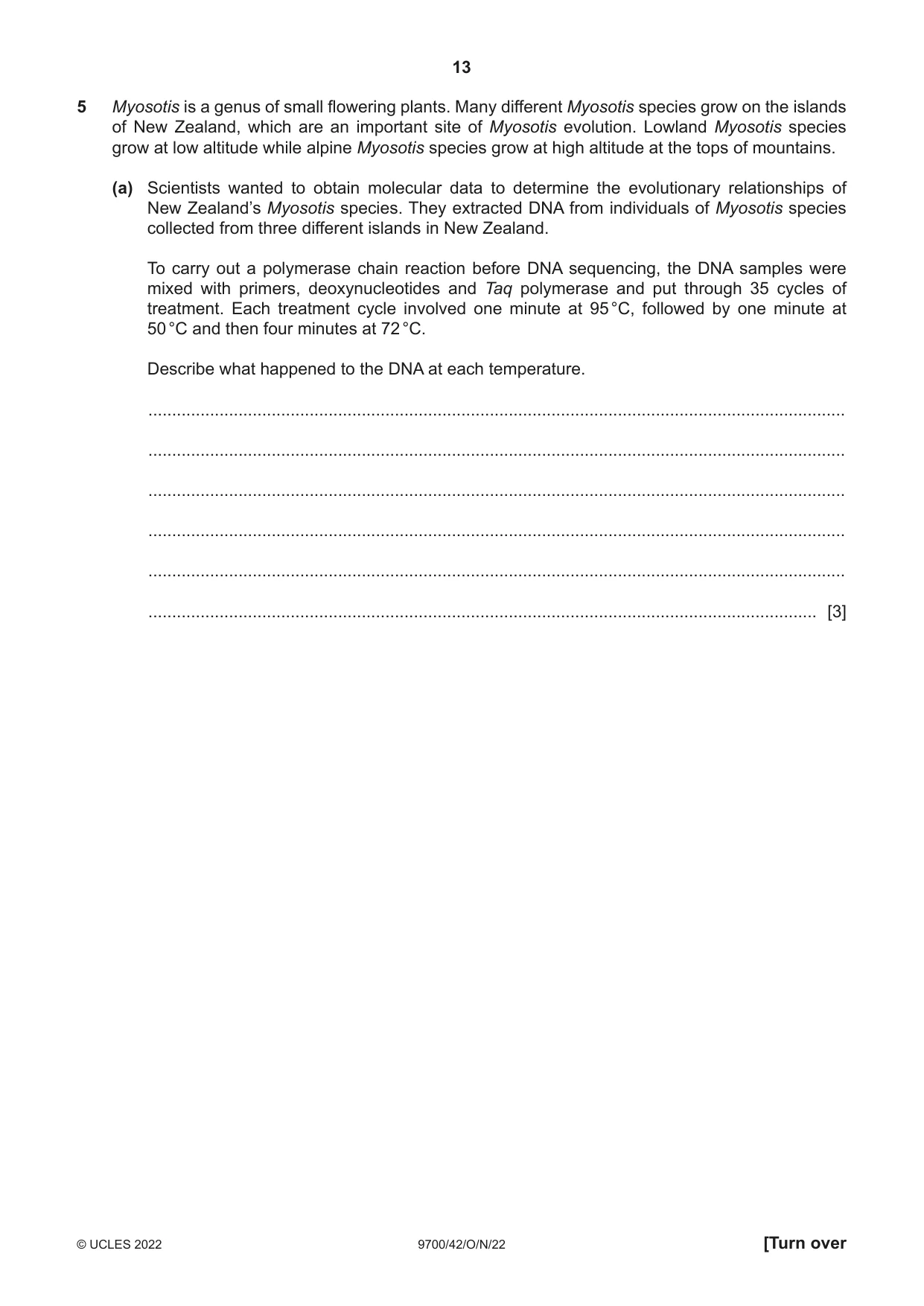
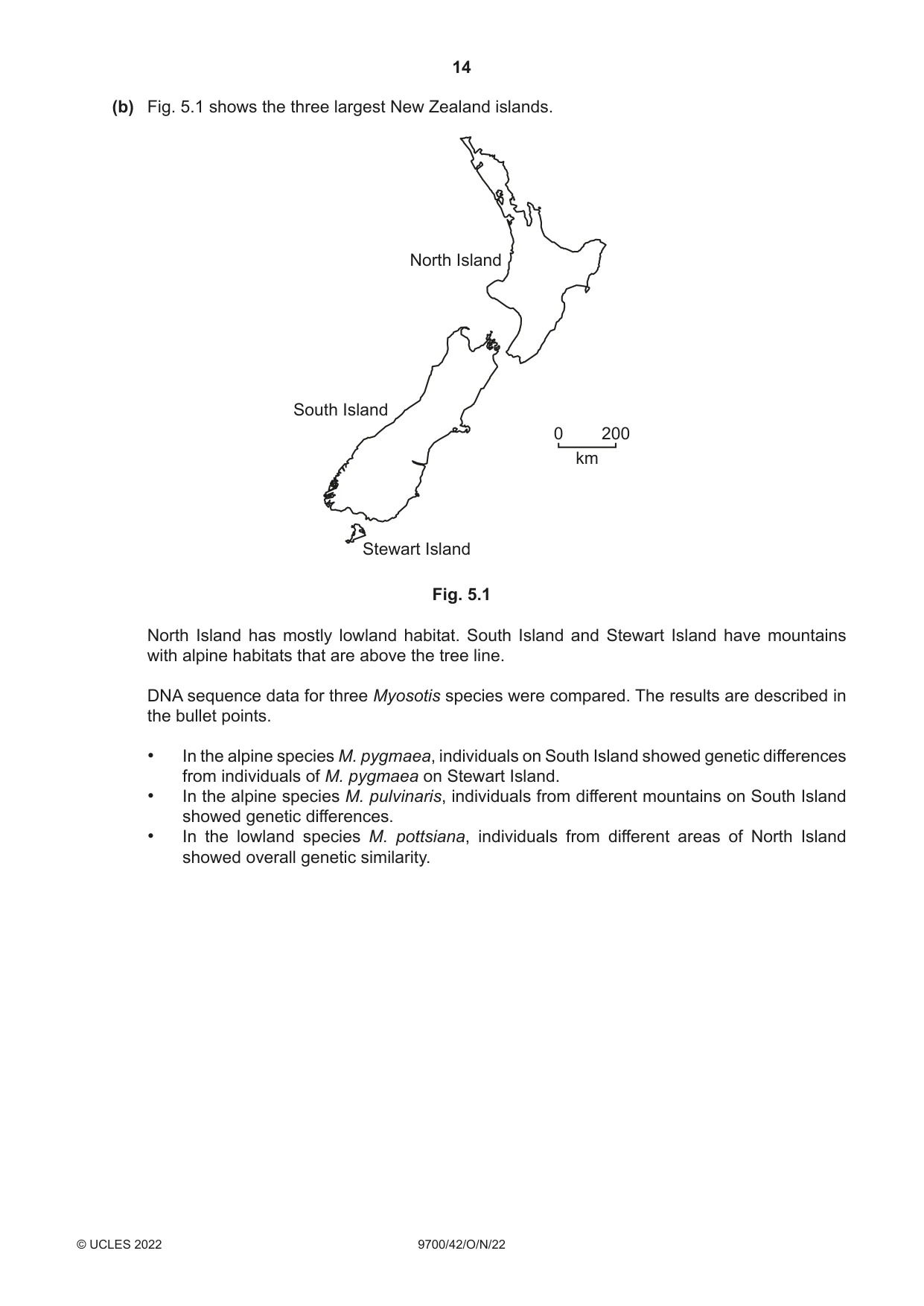
5 Myosotis is a genus of small flowering plants. Many different Myosotis species grow on the islands of New Zealand, which are an important site of Myosotis evolution. Lowland Myosotis species grow at low altitude while alpine Myosotis species grow at high altitude at the tops of mountains. (a) Scientists wanted to obtain molecular data to determine the evolutionary relationships of New Zealand’s Myosotis species. They extracted DNA from individuals of Myosotis species collected from three different islands in New Zealand. To carry out a polymerase chain reaction before DNA sequencing, the DNA samples were mixed with primers, deoxynucleotides and Taq polymerase and put through 35 cycles of treatment. Each treatment cycle involved one minute at 95 °C, followed by one minute at 50 °C and then four minutes at 72 °C. Describe what happened to the DNA at each temperature. ................................................................................................................................................... ................................................................................................................................................... ................................................................................................................................................... ................................................................................................................................................... ................................................................................................................................................... ............................................................................................................................................. [3] (b) Fig. 5.1 shows the three largest New Zealand islands. North Island South Island 0 200 km Stewart Island Fig. 5.1 North Island has mostly lowland habitat. South Island and Stewart Island have mountains with alpine habitats that are above the tree line. DNA sequence data for three Myosotis species were compared. The results are described in the bullet points. • In the alpine species M. pygmaea, individuals on South Island showed genetic differences from individuals of M. pygmaea on Stewart Island. • In the alpine species M. pulvinaris, individuals from different mountains on South Island showed genetic differences. • In the lowland species M. pottsiana, individuals from different areas of North Island showed overall genetic similarity. Discuss reasons for the results in the three species. ................................................................................................................................................... ................................................................................................................................................... ................................................................................................................................................... ................................................................................................................................................... ................................................................................................................................................... ................................................................................................................................................... ................................................................................................................................................... ................................................................................................................................................... ................................................................................................................................................... ................................................................................................................................................... ................................................................................................................................................... ............................................................................................................................................. [5] (c) State two factors, other than natural selection, that could drive genetic changes in populations of Myosotis. ................................................................................................................................................... ................................................................................................................................................... ................................................................................................................................................... ................................................................................................................................................... ............................................................................................................................................. [2] [Total: 10]
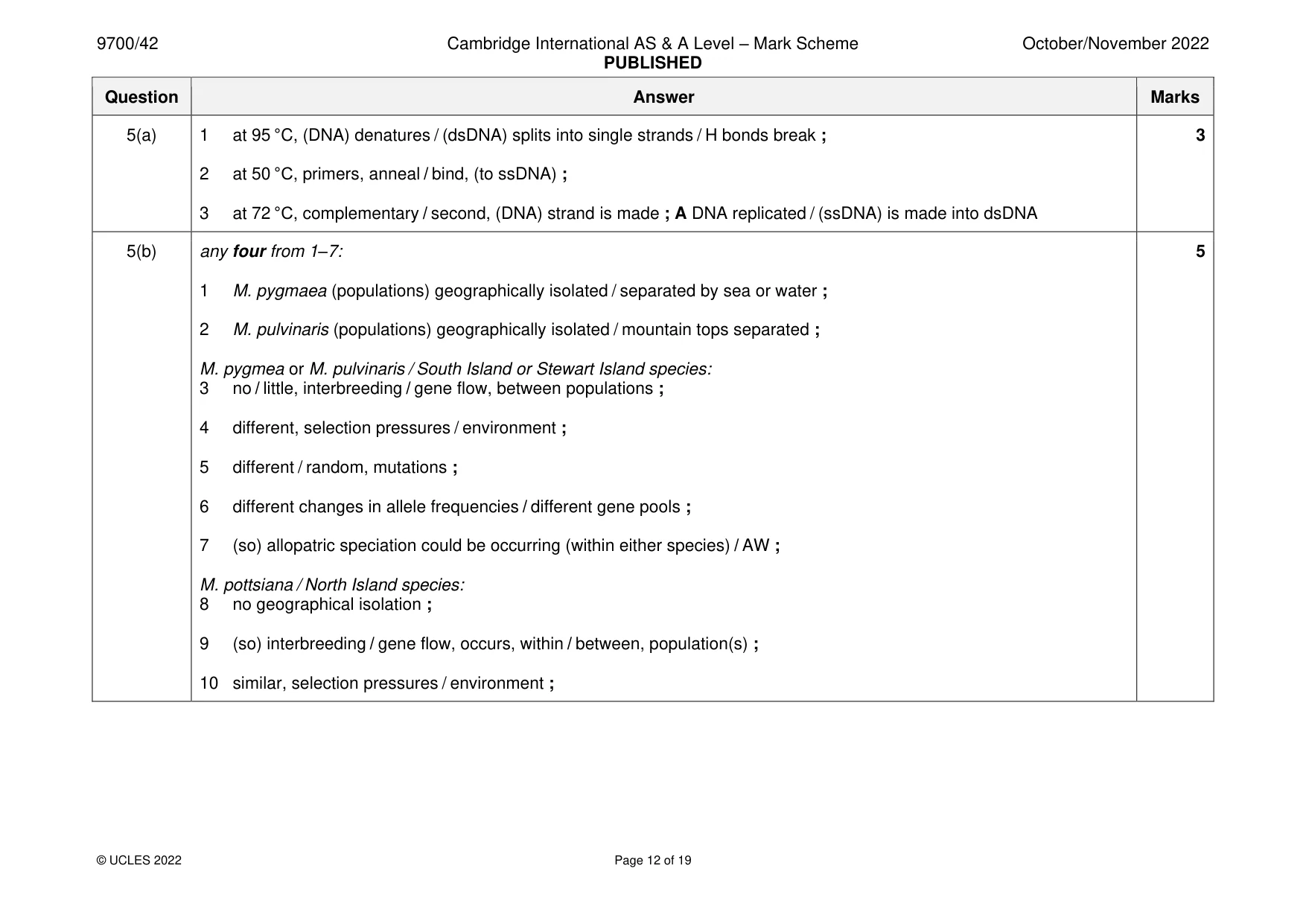
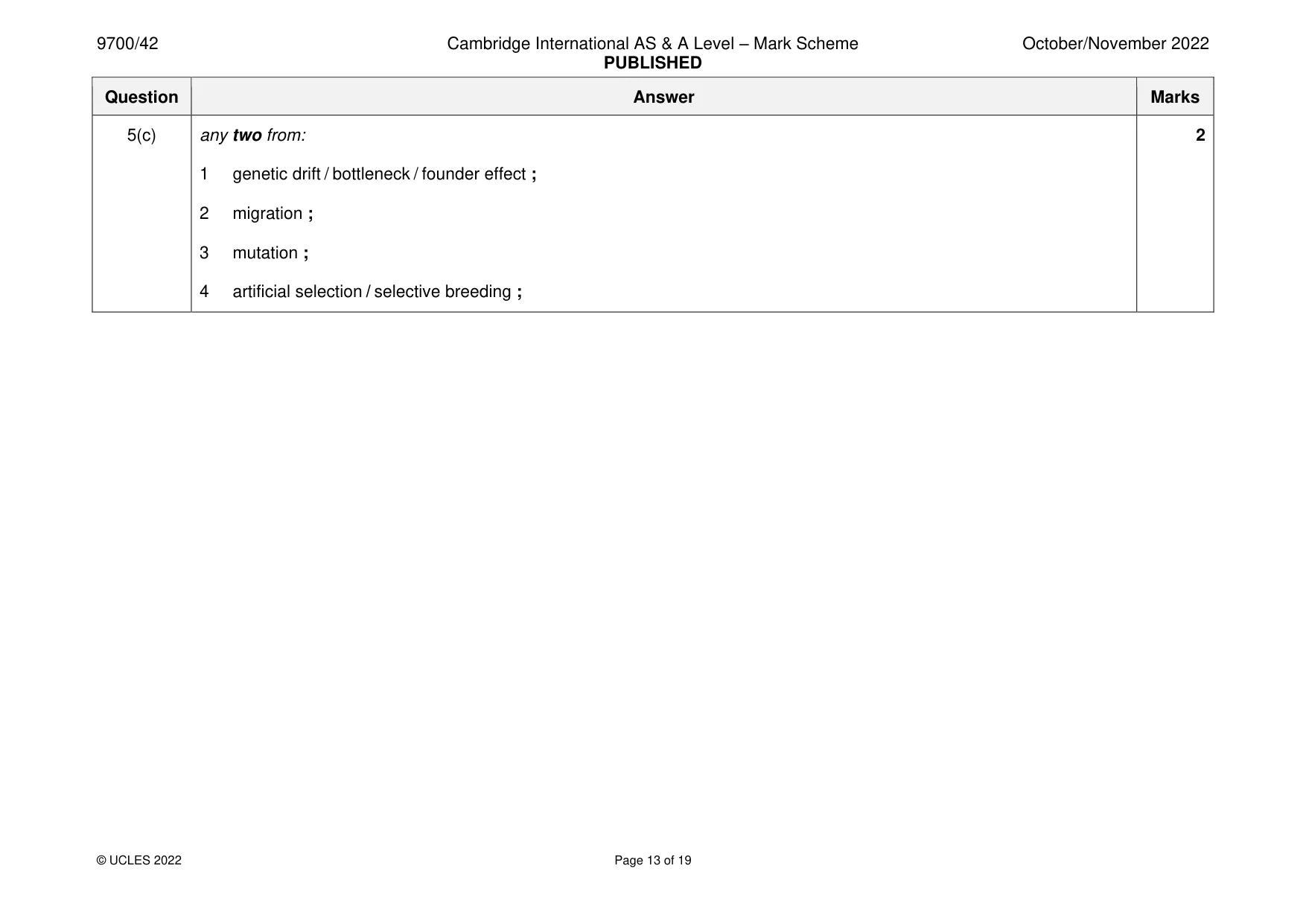
Mark scheme: 5(a) 1 at 95 °C, (DNA) denatures / (dsDNA) splits into single strands / H bonds break ; 3 2 at 50 °C, primers, anneal / bind, (to ssDNA) ; 3 at 72 °C, complementary / second, (DNA) strand is made ; A DNA replicated / (ssDNA) is made into dsDNA 5(b) any four from 1–7: 5 1 M. pygmaea (populations) geographically isolated / separated by sea or water ; 2 M. pulvinaris (populations) geographically isolated / mountain tops separated ; M. pygmea or M. pulvinaris / South Island or Stewart Island species: 3 no / little, interbreeding / gene flow, between populations ; 4 different, selection pressures / environment ; 5 different / random, mutations ; 6 different changes in allele frequencies / different gene pools ; 7 (so) allopatric speciation could be occurring (within either species) / AW ; M. pottsiana / North Island species: 8 no geographical isolation ; 9 (so) interbreeding / gene flow, occurs, within / between, population(s) ; 10 similar, selection pressures / environment ; 5(c) any two from: 2 1 genetic drift / bottleneck / founder effect ; 2 migration ; 3 mutation ; 4 artificial selection / selective breeding ;
Q6 · The lac operon of prokaryotes contains a group of structural genes that are under the…
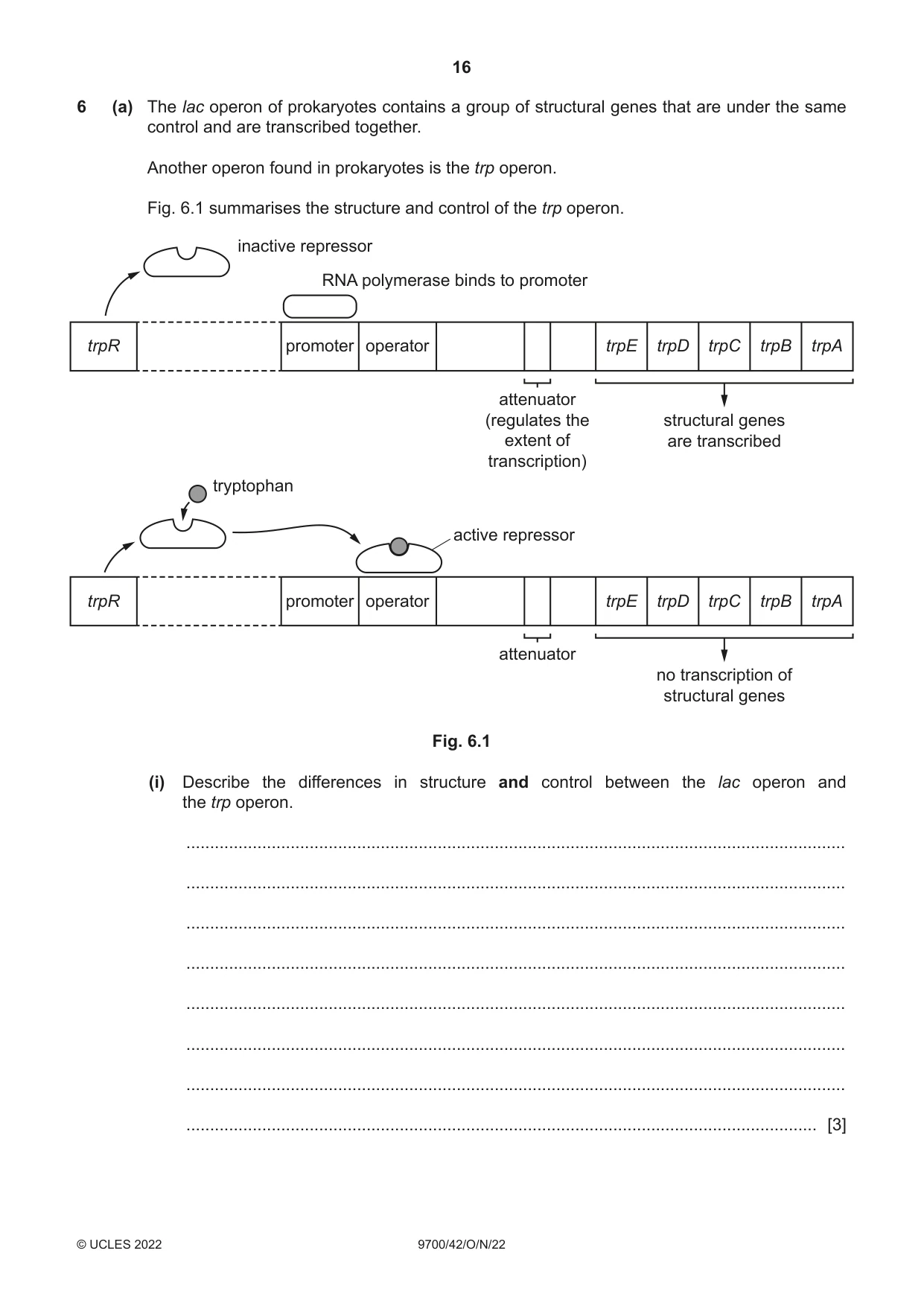
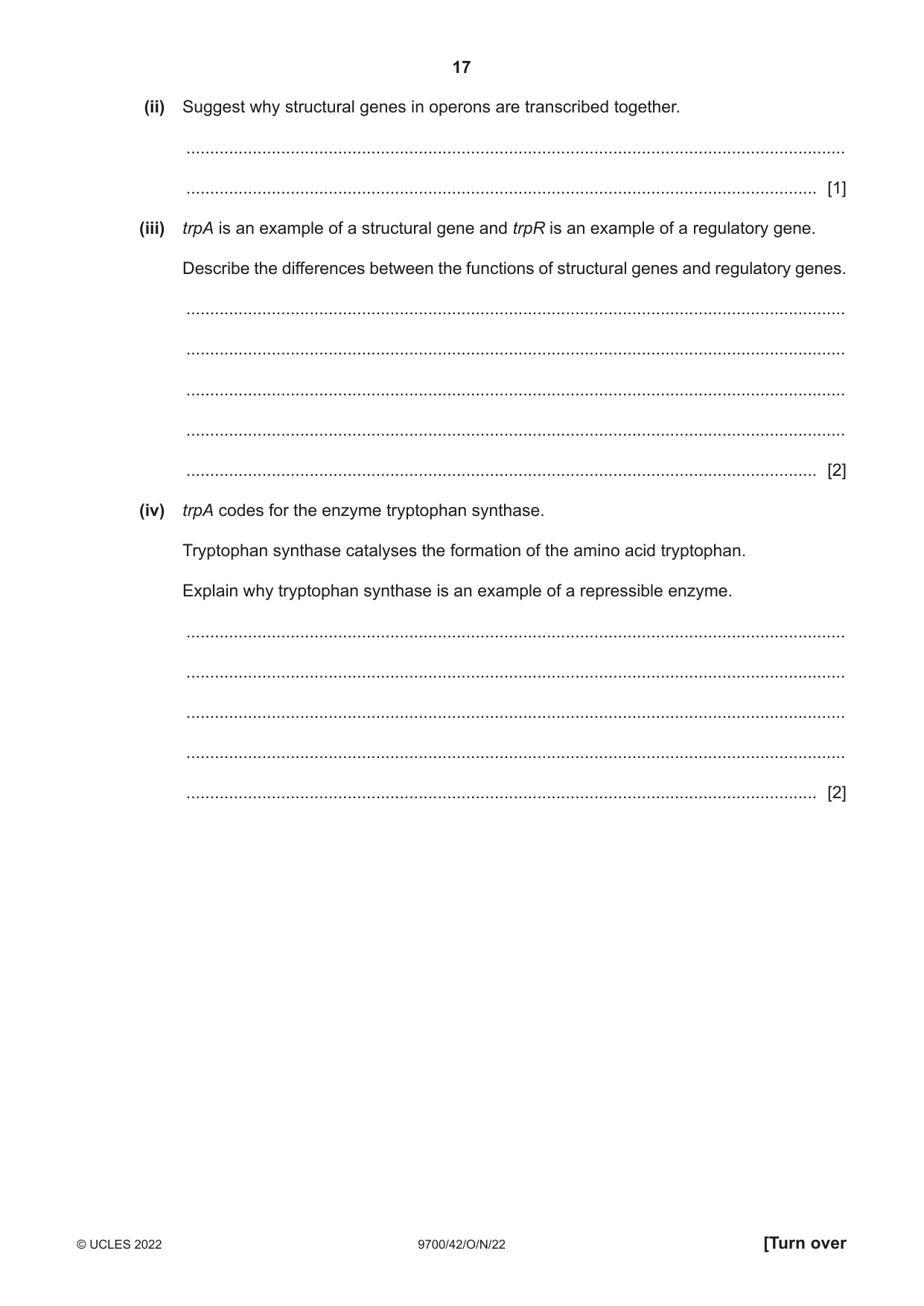
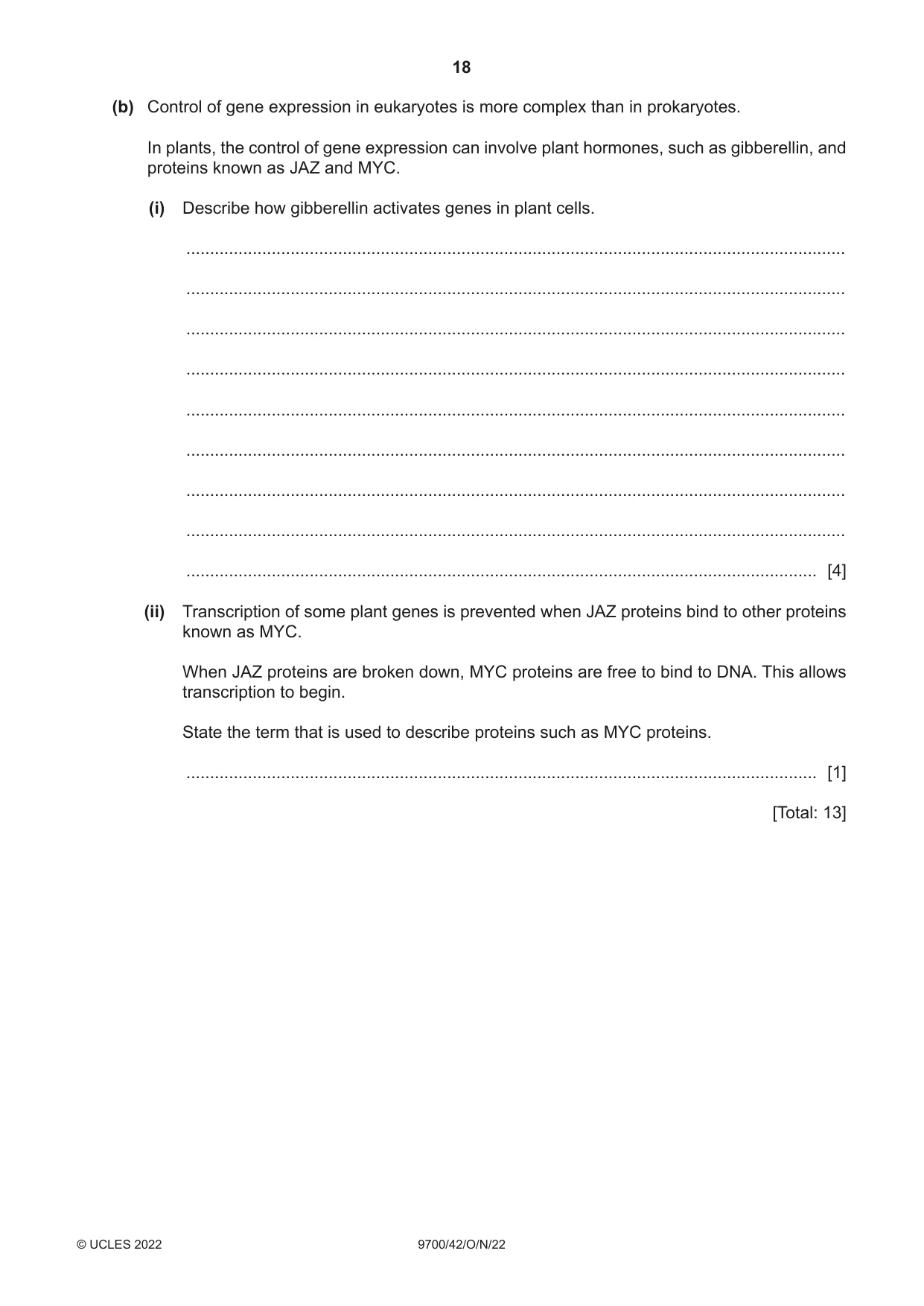
6 (a) The lac operon of prokaryotes contains a group of structural genes that are under the same control and are transcribed together. Another operon found in prokaryotes is the trp operon. Fig. 6.1 summarises the structure and control of the trp operon. inactive repressor RNA polymerase binds to promoter trpR promoter operator trpE trpD trpC trpB trpA attenuator (regulates the structural genes extent of are transcribed transcription) tryptophan active repressor trpR promoter operator trpE trpD trpC trpB trpA attenuator no transcription of structural genes Fig. 6.1 (i) Describe the differences in structure and control between the lac operon and the trp operon. ........................................................................................................................................... ........................................................................................................................................... ........................................................................................................................................... ........................................................................................................................................... ........................................................................................................................................... ........................................................................................................................................... ........................................................................................................................................... ..................................................................................................................................... [3] (ii) Suggest why structural genes in operons are transcribed together. ........................................................................................................................................... ..................................................................................................................................... [1] (iii) trpA is an example of a structural gene and trpR is an example of a regulatory gene. Describe the differences between the functions of structural genes and regulatory genes. ........................................................................................................................................... ........................................................................................................................................... ........................................................................................................................................... ........................................................................................................................................... ..................................................................................................................................... [2] (iv) trpA codes for the enzyme tryptophan synthase. Tryptophan synthase catalyses the formation of the amino acid tryptophan. Explain why tryptophan synthase is an example of a repressible enzyme. ........................................................................................................................................... ........................................................................................................................................... ........................................................................................................................................... ........................................................................................................................................... ..................................................................................................................................... [2] (b) Control of gene expression in eukaryotes is more complex than in prokaryotes. In plants, the control of gene expression can involve plant hormones, such as gibberellin, and proteins known as JAZ and MYC. (i) Describe how gibberellin activates genes in plant cells. ........................................................................................................................................... ........................................................................................................................................... ........................................................................................................................................... ........................................................................................................................................... ........................................................................................................................................... ........................................................................................................................................... ........................................................................................................................................... ........................................................................................................................................... ..................................................................................................................................... [4] (ii) Transcription of some plant genes is prevented when JAZ proteins bind to other proteins known as MYC. When JAZ proteins are broken down, MYC proteins are free to bind to DNA. This allows transcription to begin. State the term that is used to describe proteins such as MYC proteins. ..................................................................................................................................... [1] [Total: 13] Turn over for Question 7.
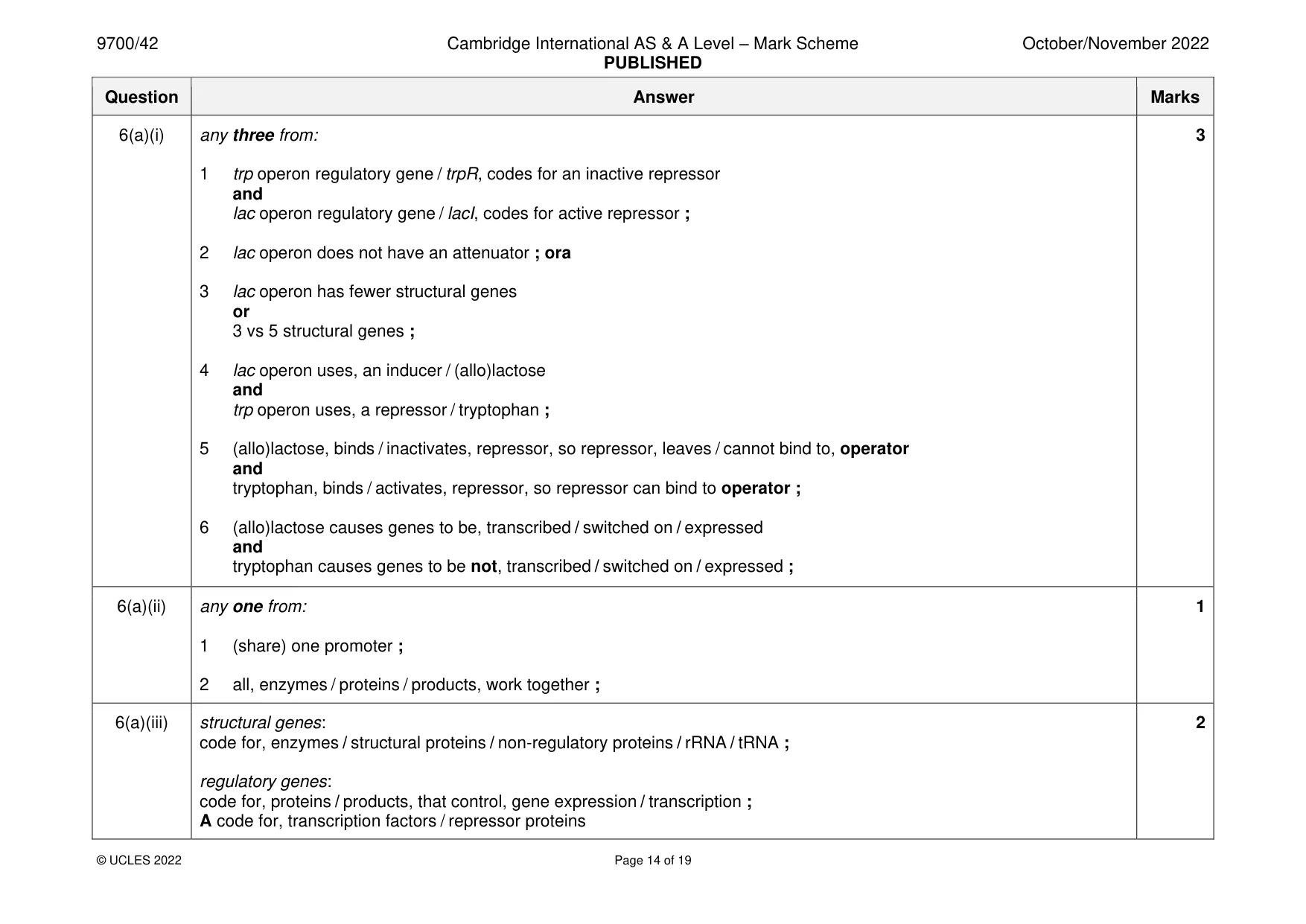
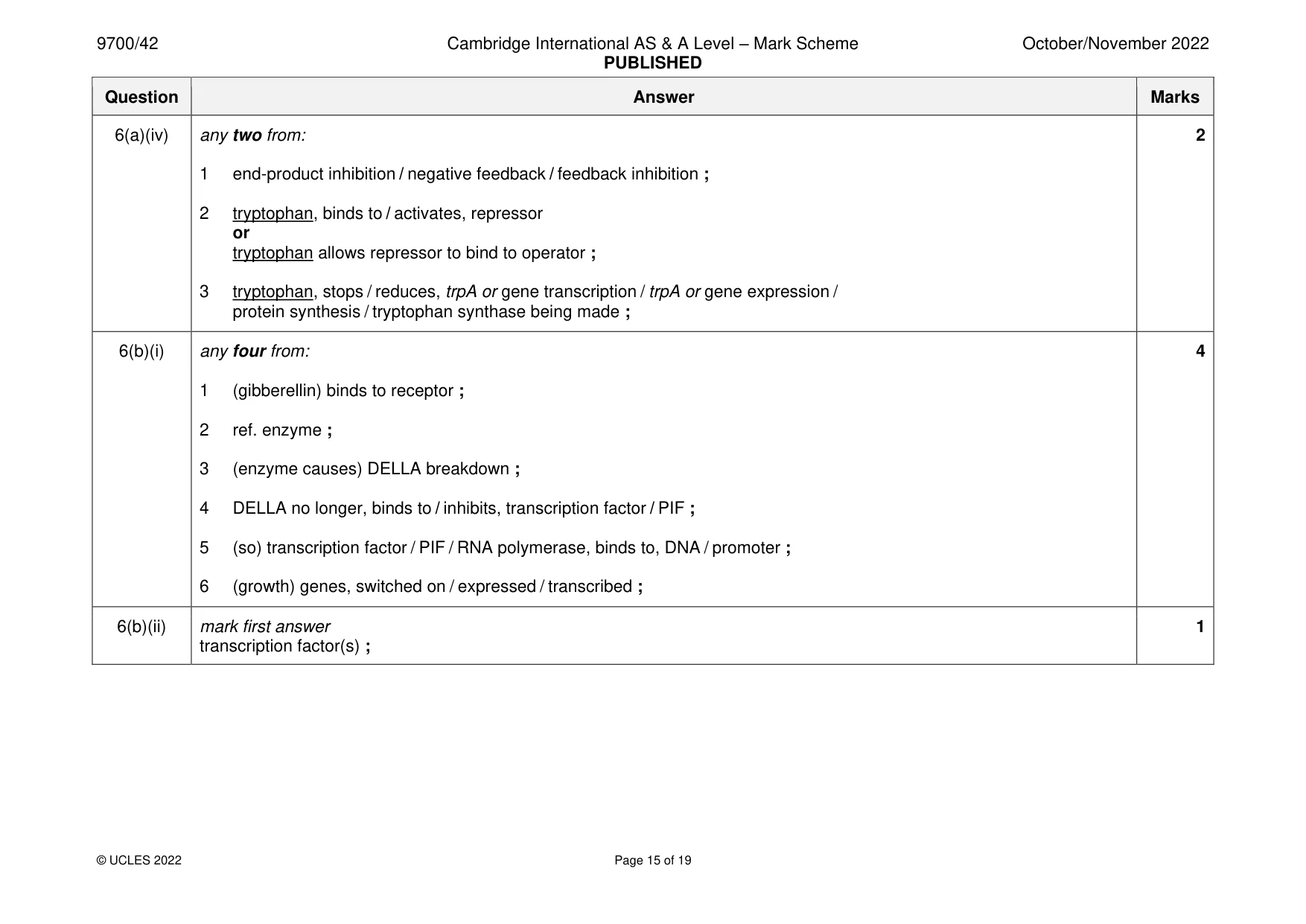
Mark scheme: 6(a)(i) any three from: 3 1 trp operon regulatory gene / trpR, codes for an inactive repressor and lac operon regulatory gene / lacI, codes for active repressor ; 2 lac operon does not have an attenuator ; ora 3 lac operon has fewer structural genes or 3 vs 5 structural genes ; 4 lac operon uses, an inducer / (allo)lactose and trp operon uses, a repressor / tryptophan ; 5 (allo)lactose, binds / inactivates, repressor, so repressor, leaves / cannot bind to, operator and tryptophan, binds / activates, repressor, so repressor can bind to operator ; 6 (allo)lactose causes genes to be, transcribed / switched on / expressed and tryptophan causes genes to be not, transcribed / switched on / expressed ; 6(a)(ii) any one from: 1 1 (share) one promoter ; 2 all, enzymes / proteins / products, work together ; 6(a)(iii) structural genes: 2 code for, enzymes / structural proteins / non-regulatory proteins / rRNA / tRNA ; regulatory genes: code for, proteins / products, that control, gene expression / transcription ; A code for, transcription factors / repressor proteins 6(a)(iv) any two from: 2 1 end-product inhibition / negative feedback / feedback inhibition ; 2 tryptophan, binds to / activates, repressor or tryptophan allows repressor to bind to operator ; 3 tryptophan, stops / reduces, trpA or gene transcription / trpA or gene expression / protein synthesis / tryptophan synthase being made ; 6(b)(i) any four from: 4 1 (gibberellin) binds to receptor ; 2 ref. enzyme ; 3 (enzyme causes) DELLA breakdown ; 4 DELLA no longer, binds to / inhibits, transcription factor / PIF ; 5 (so) transcription factor / PIF / RNA polymerase, binds to, DNA / promoter ; 6 (growth) genes, switched on / expressed / transcribed ; 6(b)(ii) mark first answer 1 transcription factor(s) ;
Q7 · The determination of sex in domestic turkeys is different from that in humans
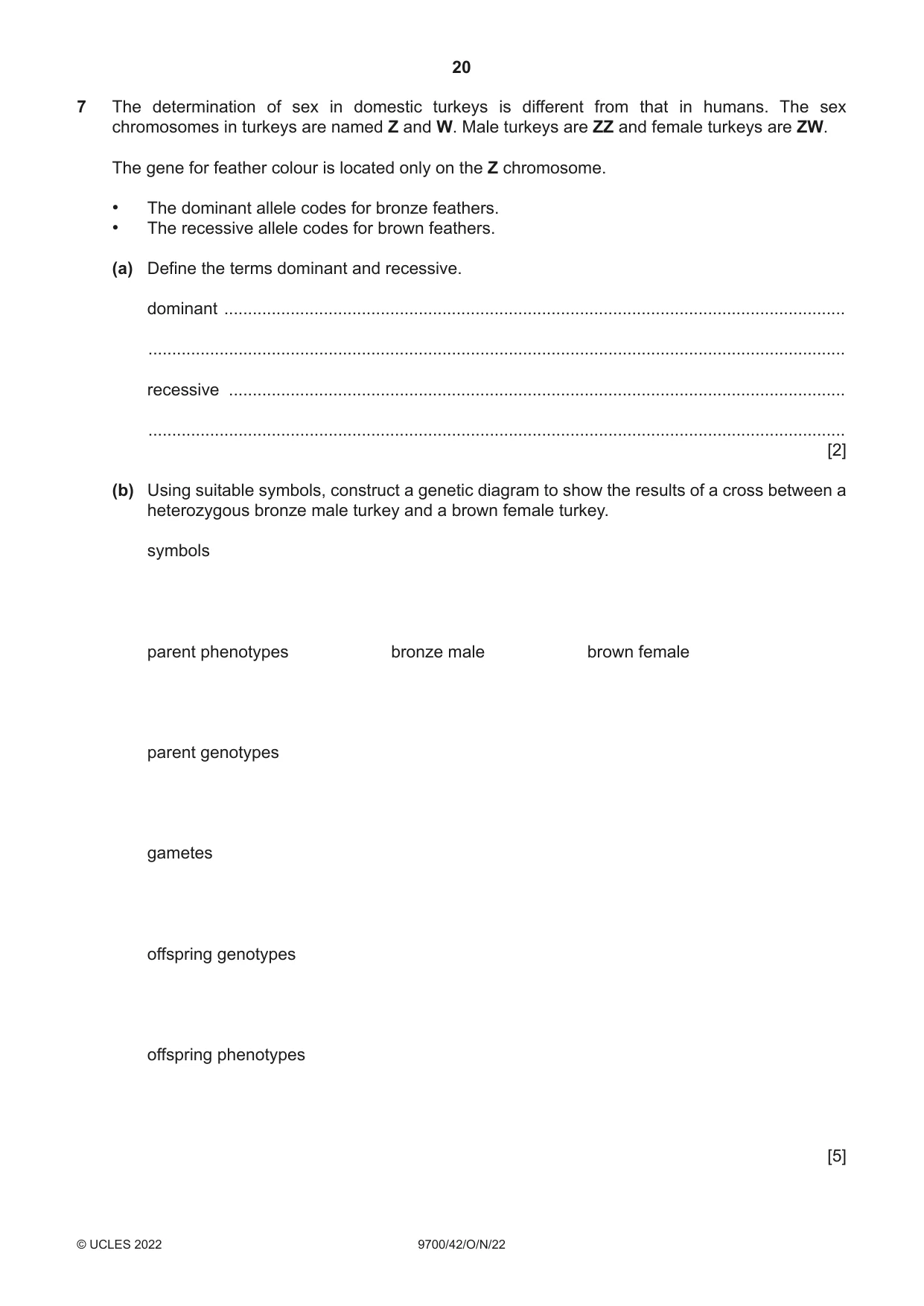
7 The determination of sex in domestic turkeys is different from that in humans. The sex chromosomes in turkeys are named Z and W. Male turkeys are ZZ and female turkeys are ZW. The gene for feather colour is located only on the Z chromosome. • The dominant allele codes for bronze feathers. • The recessive allele codes for brown feathers. (a) Define the terms dominant and recessive. dominant ................................................................................................................................... ................................................................................................................................................... recessive .................................................................................................................................. ................................................................................................................................................... [2] (b) Using suitable symbols, construct a genetic diagram to show the results of a cross between a heterozygous bronze male turkey and a brown female turkey. symbols parent phenotypes bronze male brown female parent genotypes gametes offspring genotypes offspring phenotypes [5] (c) Explain how you would carry out a test cross to determine the genotype of a bronze male turkey. ................................................................................................................................................... ................................................................................................................................................... ................................................................................................................................................... ................................................................................................................................................... ................................................................................................................................................... ................................................................................................................................................... ............................................................................................................................................. [3] [Total: 10]
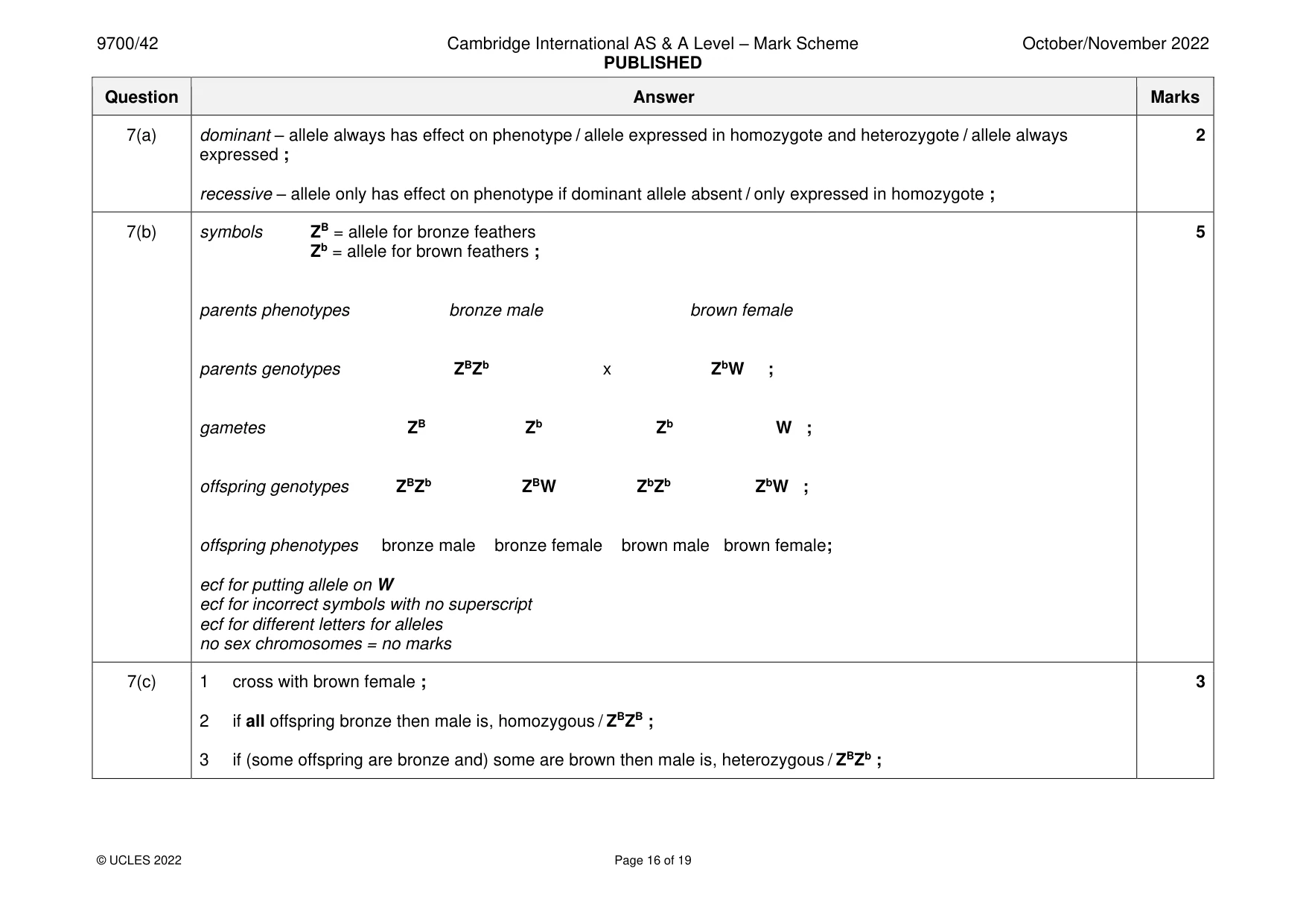
Mark scheme: 7(a) dominant – allele always has effect on phenotype / allele expressed in homozygote and heterozygote / allele always 2 expressed ; recessive – allele only has effect on phenotype if dominant allele absent / only expressed in homozygote ; 7(b) symbols ZB = allele for bronze feathers 5 Zb = allele for brown feathers ; parents phenotypes bronze male brown female parents genotypes ZBZb x ZbW ; gametes ZB Zb Zb W ; offspring genotypes ZBZb ZBW ZbZb ZbW ; offspring phenotypes bronze male bronze female brown male brown female; ecf for putting allele on W ecf for incorrect symbols with no superscript ecf for different letters for alleles no sex chromosomes = no marks 7(c) 1 cross with brown female ; 3 2 if all offspring bronze then male is, homozygous / ZBZB ; 3 if (some offspring are bronze and) some are brown then male is, heterozygous / ZBZb ;
More questions on Passage of information from parents to offspring
Q8 · Selective reabsorption takes place in the proximal convoluted tubule of a kidney nephron
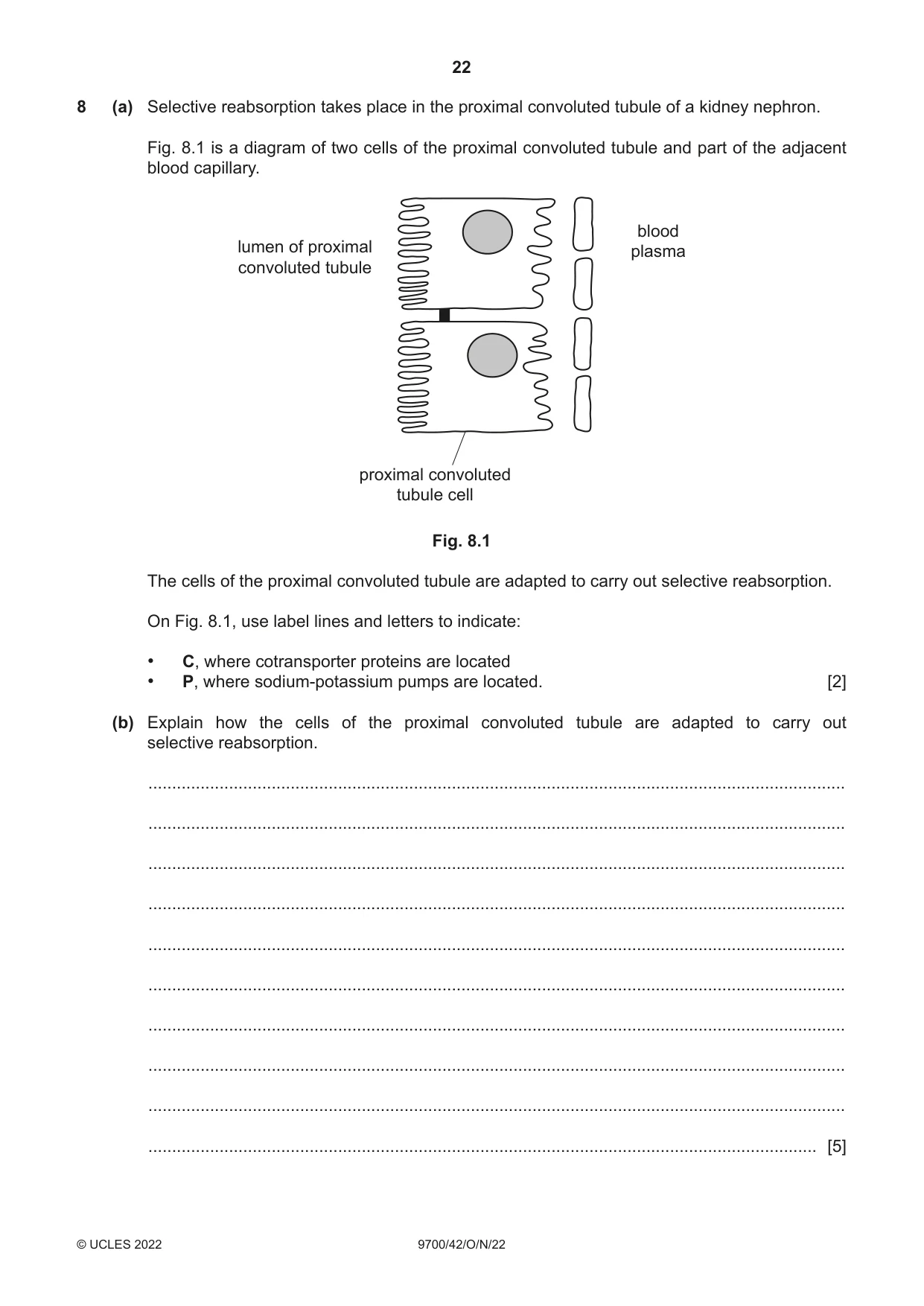
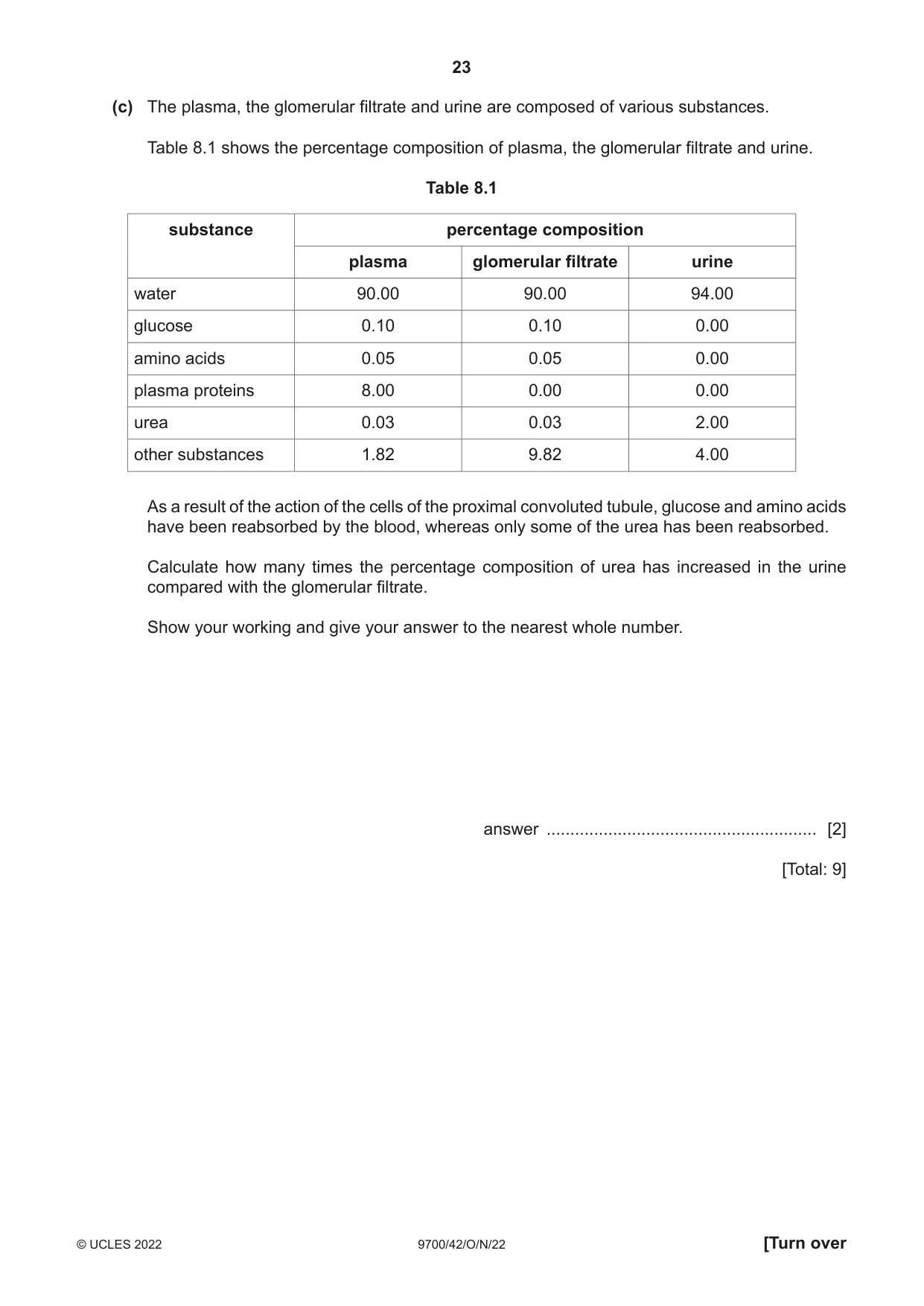
8 (a) Selective reabsorption takes place in the proximal convoluted tubule of a kidney nephron. Fig. 8.1 is a diagram of two cells of the proximal convoluted tubule and part of the adjacent blood capillary. blood lumen of proximal plasma convoluted tubule proximal convoluted tubule cell Fig. 8.1 The cells of the proximal convoluted tubule are adapted to carry out selective reabsorption. On Fig. 8.1, use label lines and letters to indicate: • C, where cotransporter proteins are located • P, where sodium-potassium pumps are located. [2] (b) Explain how the cells of the proximal convoluted tubule are adapted to carry out selective reabsorption. ................................................................................................................................................... ................................................................................................................................................... ................................................................................................................................................... ................................................................................................................................................... ................................................................................................................................................... ................................................................................................................................................... ................................................................................................................................................... ................................................................................................................................................... ................................................................................................................................................... ............................................................................................................................................. [5] (c) The plasma, the glomerular filtrate and urine are composed of various substances. Table 8.1 shows the percentage composition of plasma, the glomerular filtrate and urine. Table 8.1 substance percentage composition plasma glomerular filtrate urine water 90.00 90.00 94.00 glucose 0.10 0.10 0.00 amino acids 0.05 0.05 0.00 plasma proteins 8.00 0.00 0.00 urea 0.03 0.03 2.00 other substances 1.82 9.82 4.00 As a result of the action of the cells of the proximal convoluted tubule, glucose and amino acids have been reabsorbed by the blood, whereas only some of the urea has been reabsorbed. Calculate how many times the percentage composition of urea has increased in the urine compared with the glomerular filtrate. Show your working and give your answer to the nearest whole number. answer ......................................................... [2] [Total: 9]
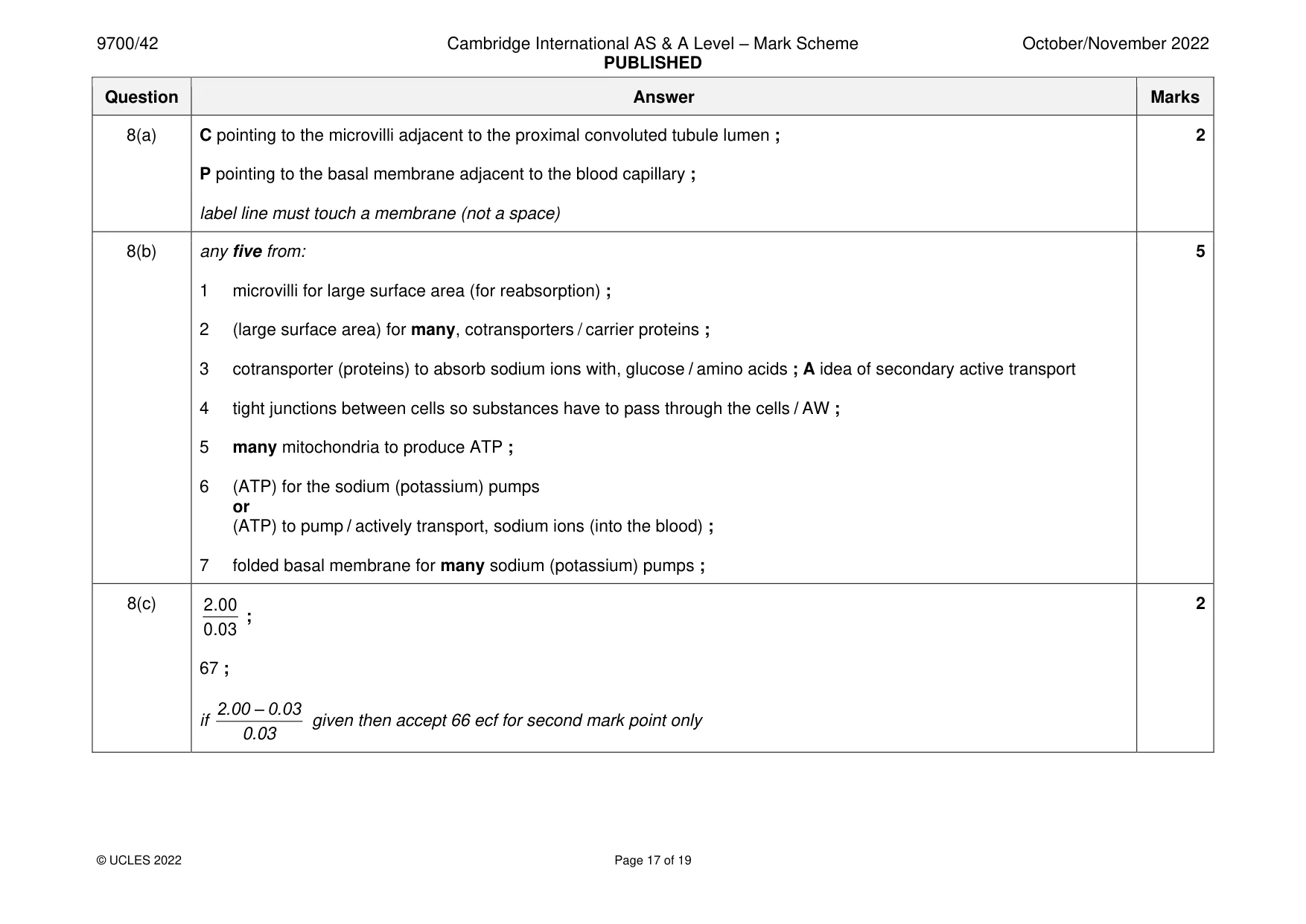
Mark scheme: 8(a) C pointing to the microvilli adjacent to the proximal convoluted tubule lumen ; 2 P pointing to the basal membrane adjacent to the blood capillary ; label line must touch a membrane (not a space) 8(b) any five from: 5 1 microvilli for large surface area (for reabsorption) ; 2 (large surface area) for many, cotransporters / carrier proteins ; 3 cotransporter (proteins) to absorb sodium ions with, glucose / amino acids ; A idea of secondary active transport 4 tight junctions between cells so substances have to pass through the cells / AW ; 5 many mitochondria to produce ATP ; 6 (ATP) for the sodium (potassium) pumps or (ATP) to pump / actively transport, sodium ions (into the blood) ; 7 folded basal membrane for many sodium (potassium) pumps ; 8(c) 2.00 2 ; 0.03 67 ; 2.00 – 0.03 if given then accept 66 ecf for second mark point only 0.03
Q9 · Voltage-gated channels are involved in the generation of an action potential
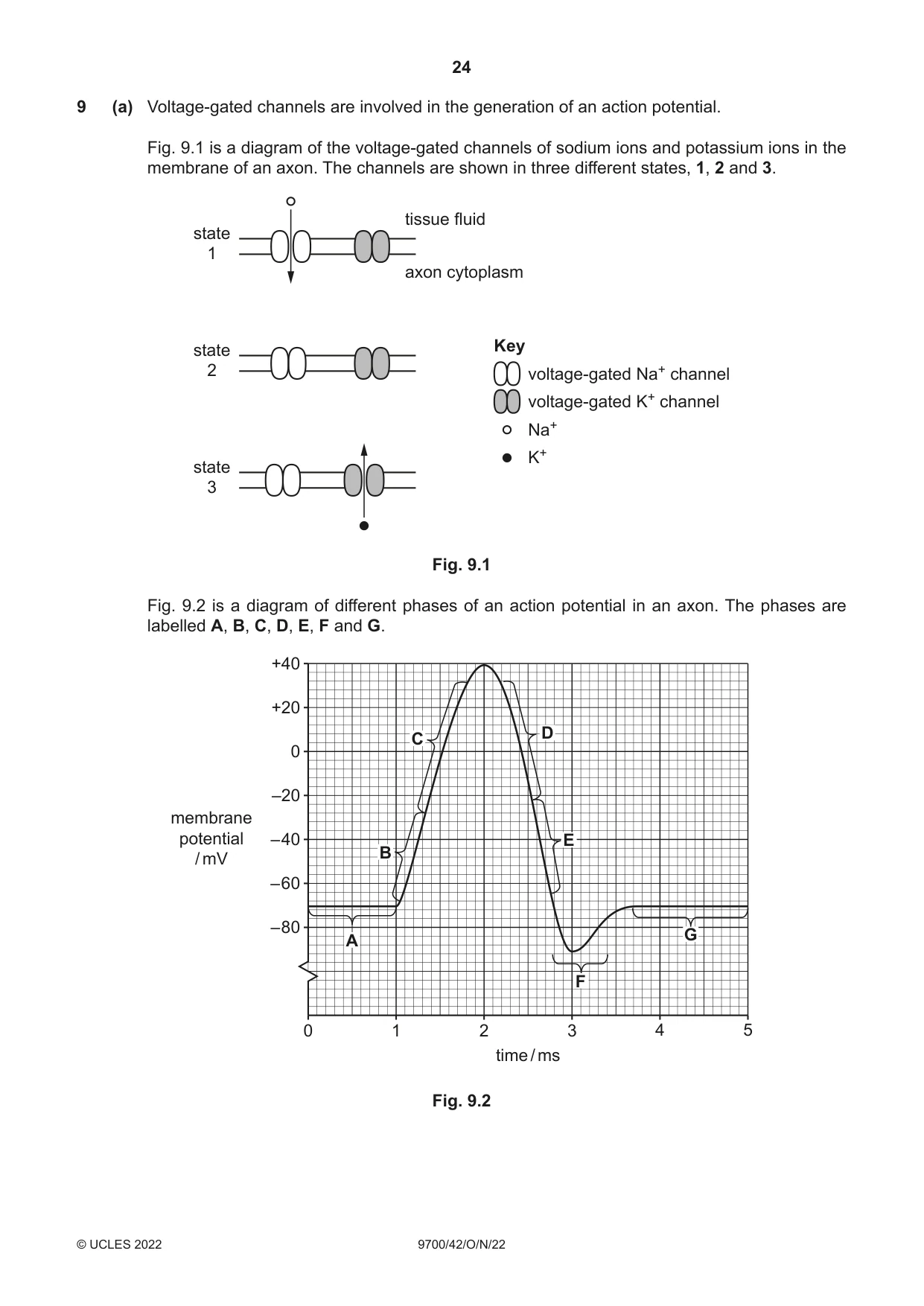
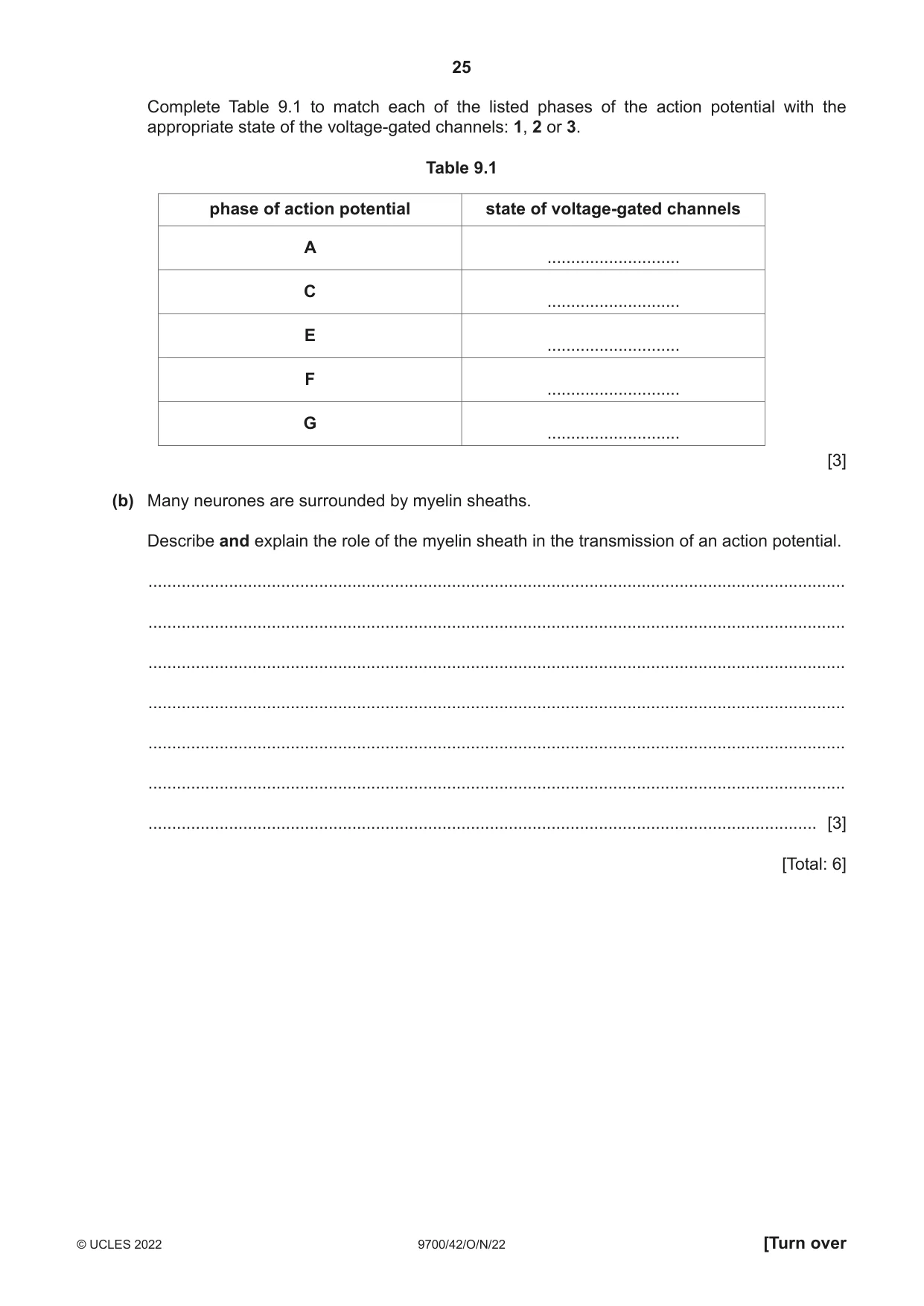
9 (a) Voltage-gated channels are involved in the generation of an action potential. Fig. 9.1 is a diagram of the voltage-gated channels of sodium ions and potassium ions in the membrane of an axon. The channels are shown in three different states, 1, 2 and 3. tissue fluid state 1 axon cytoplasm state Key 2 voltage-gated Na+ channel voltage-gated K+ channel Na+ K+ state 3 Fig. 9.1 Fig. 9.2 is a diagram of different phases of an action potential in an axon. The phases are labelled A, B, C, D, E, F and G. +40 +20 D C 0 –20 membrane potential –40 E B / mV –60 –80 G A F 0 1 2 3 4 5 time / ms Fig. 9.2 Complete Table 9.1 to match each of the listed phases of the action potential with the appropriate state of the voltage-gated channels: 1, 2 or 3. Table 9.1 phase of action potential state of voltage-gated channels A ............................ C ............................ E ............................ F ............................ G ............................ [3] (b) Many neurones are surrounded by myelin sheaths. Describe and explain the role of the myelin sheath in the transmission of an action potential. ................................................................................................................................................... ................................................................................................................................................... ................................................................................................................................................... ................................................................................................................................................... ................................................................................................................................................... ................................................................................................................................................... ............................................................................................................................................. [3] [Total: 6]
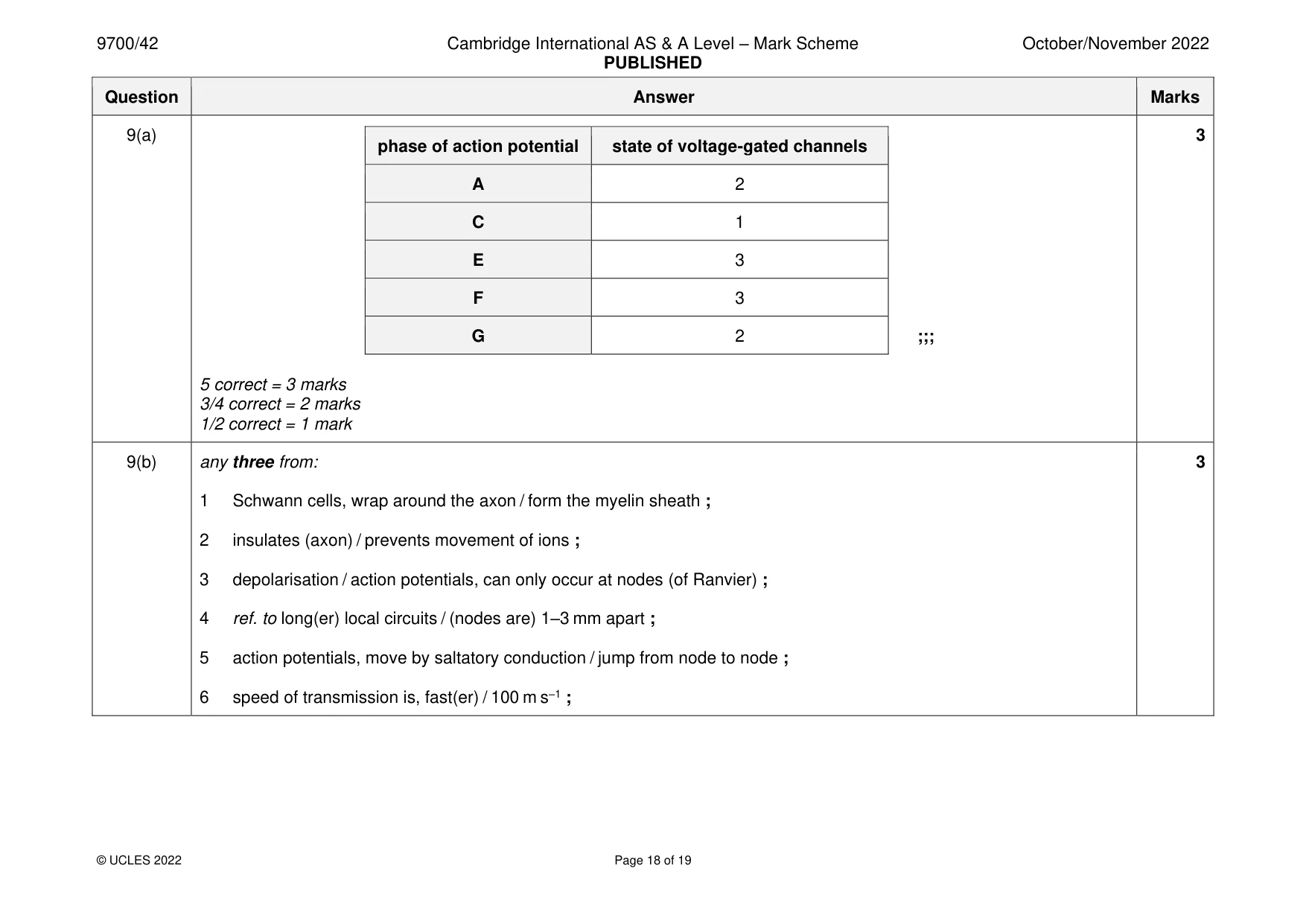
Mark scheme: 9(a) 3 phase of action potential state of voltage-gated channels A 2 C 1 E 3 F 3 G 2 ;;; 5 correct = 3 marks 3/4 correct = 2 marks 1/2 correct = 1 mark 9(b) any three from: 3 1 Schwann cells, wrap around the axon / form the myelin sheath ; 2 insulates (axon) / prevents movement of ions ; 3 depolarisation / action potentials, can only occur at nodes (of Ranvier) ; 4 ref. to long(er) local circuits / (nodes are) 1–3 mm apart ; 5 action potentials, move by saltatory conduction / jump from node to node ; 6 speed of transmission is, fast(er) / 100 m s–1 ;
Q10 · Glucagon has a role in the maintenance of blood glucose concentration
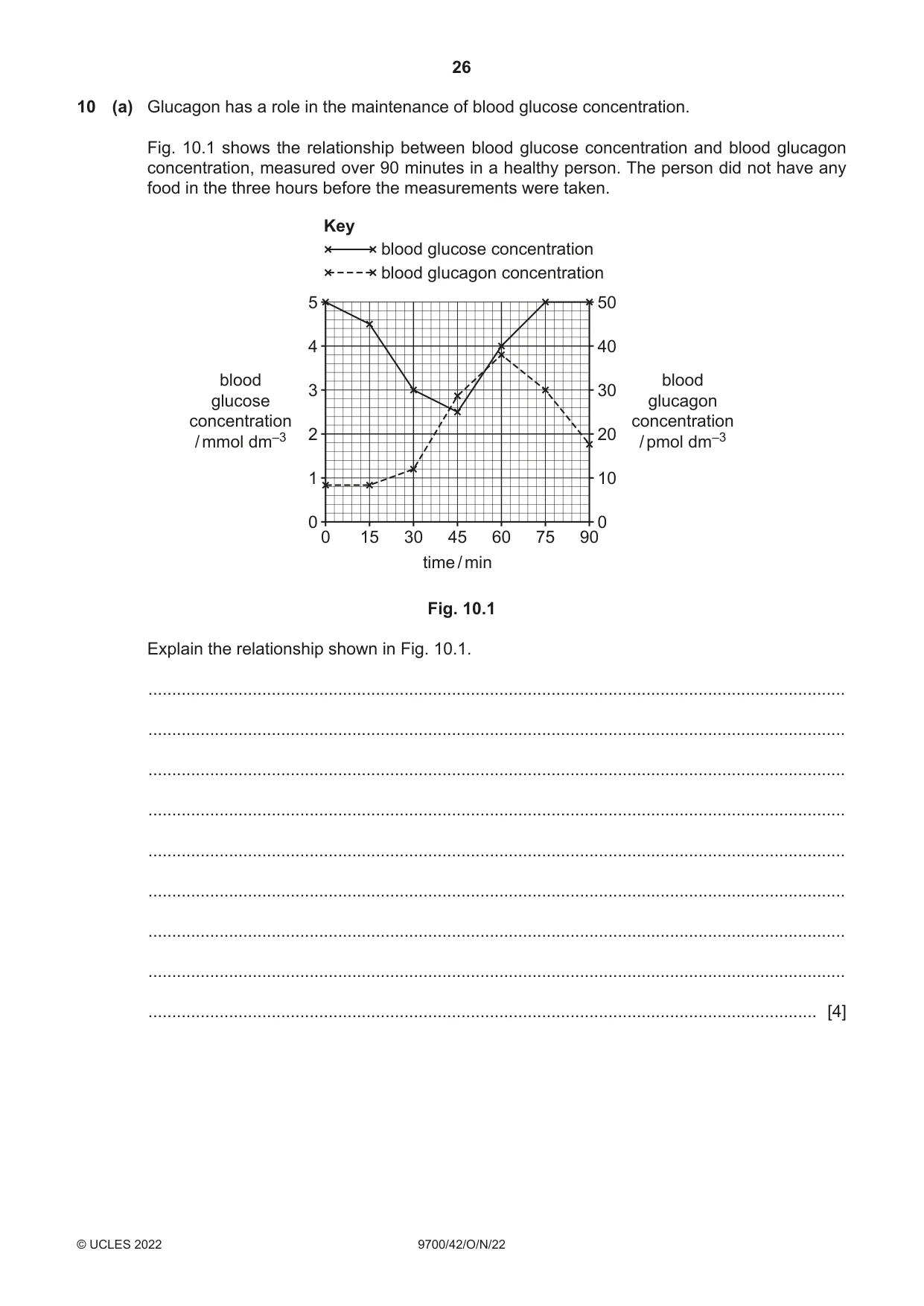
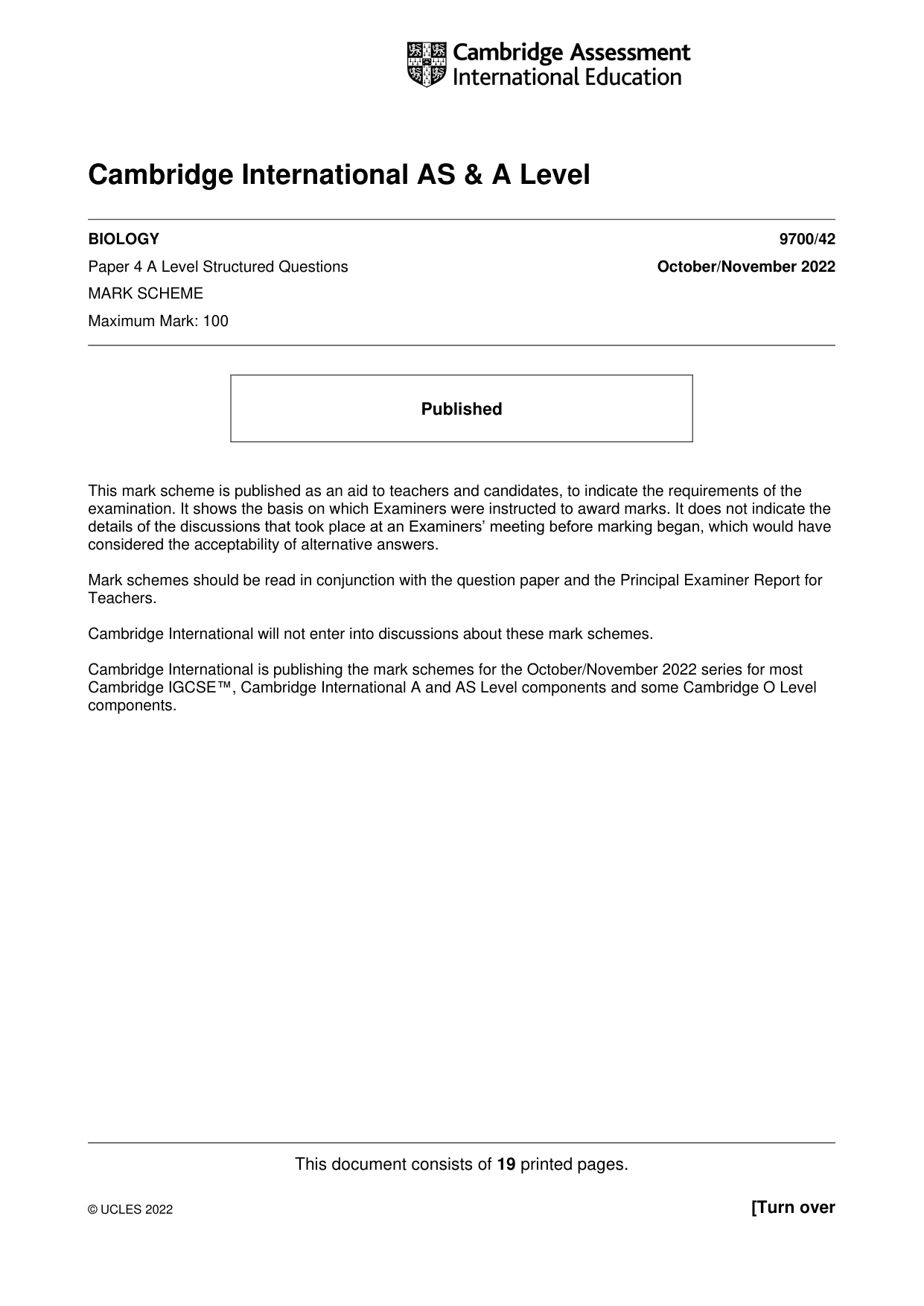
10 (a) Glucagon has a role in the maintenance of blood glucose concentration. Fig. 10.1 shows the relationship between blood glucose concentration and blood glucagon concentration, measured over 90 minutes in a healthy person. The person did not have any food in the three hours before the measurements were taken. Key blood glucose concentration blood glucagon concentration 5 50 4 40 blood blood 3 30 glucose glucagon concentration concentration 2 20 / mmol dm–3 / pmol dm–3 1 10 0 0 0 15 30 45 60 75 90 time / min Fig. 10.1 Explain the relationship shown in Fig. 10.1. ................................................................................................................................................... ................................................................................................................................................... ................................................................................................................................................... ................................................................................................................................................... ................................................................................................................................................... ................................................................................................................................................... ................................................................................................................................................... ................................................................................................................................................... ............................................................................................................................................. [4] (b) The passage below outlines cell signalling. Complete the passage by using the most appropriate scientific terms. Cells need to interact with their environment and other cells around them. This is called cell signalling. Cells in mammals are involved in a complex system of communication with each other. For example, liver cells detect signals using receptors in their cell surface membranes. Glucagon binds to the receptors because its shape is ........................................ . This binding activates a ........................................ , leading to stimulation of the enzyme ........................................ . [3] [Total: 7]
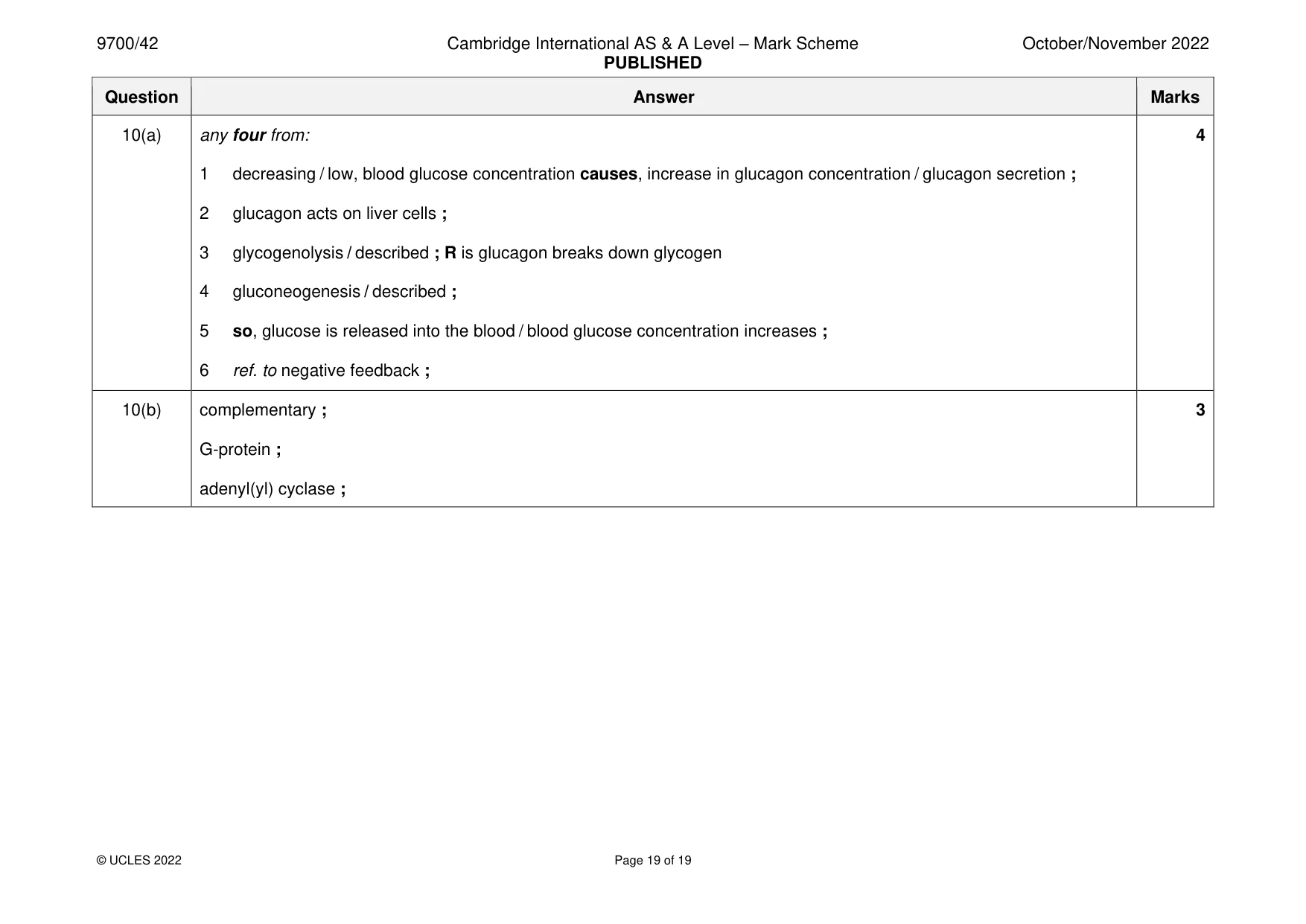
Mark scheme: 10(a) any four from: 4 1 decreasing / low, blood glucose concentration causes, increase in glucagon concentration / glucagon secretion ; 2 glucagon acts on liver cells ; 3 glycogenolysis / described ; R is glucagon breaks down glycogen 4 gluconeogenesis / described ; 5 so, glucose is released into the blood / blood glucose concentration increases ; 6 ref. to negative feedback ; 10(b) complementary ; 3 G-protein ; adenyl(yl) cyclase ;
What was in this paper
The subtopics covered by these 10 questions, and how many questions each got. Open one in a new tab to see every Cambridge question on it.
What you needed in this session
Cambridge’s own grade thresholds for 2022 Oct/Nov, Paper 4 · Variant 2. A higher threshold means an easier paper — the bar moves with how the cohort did.