Cambridge A Level Biology 9700 — 2021 Oct/Nov Paper 4 · Variant 2
9700/42/O/N/21 · 10 questions · 100 marks · ≈113 min
The question paper and its mark scheme, free to read here and free to download. This is Cambridge’s own paper, exactly as it was sat.
Question paper28 pages


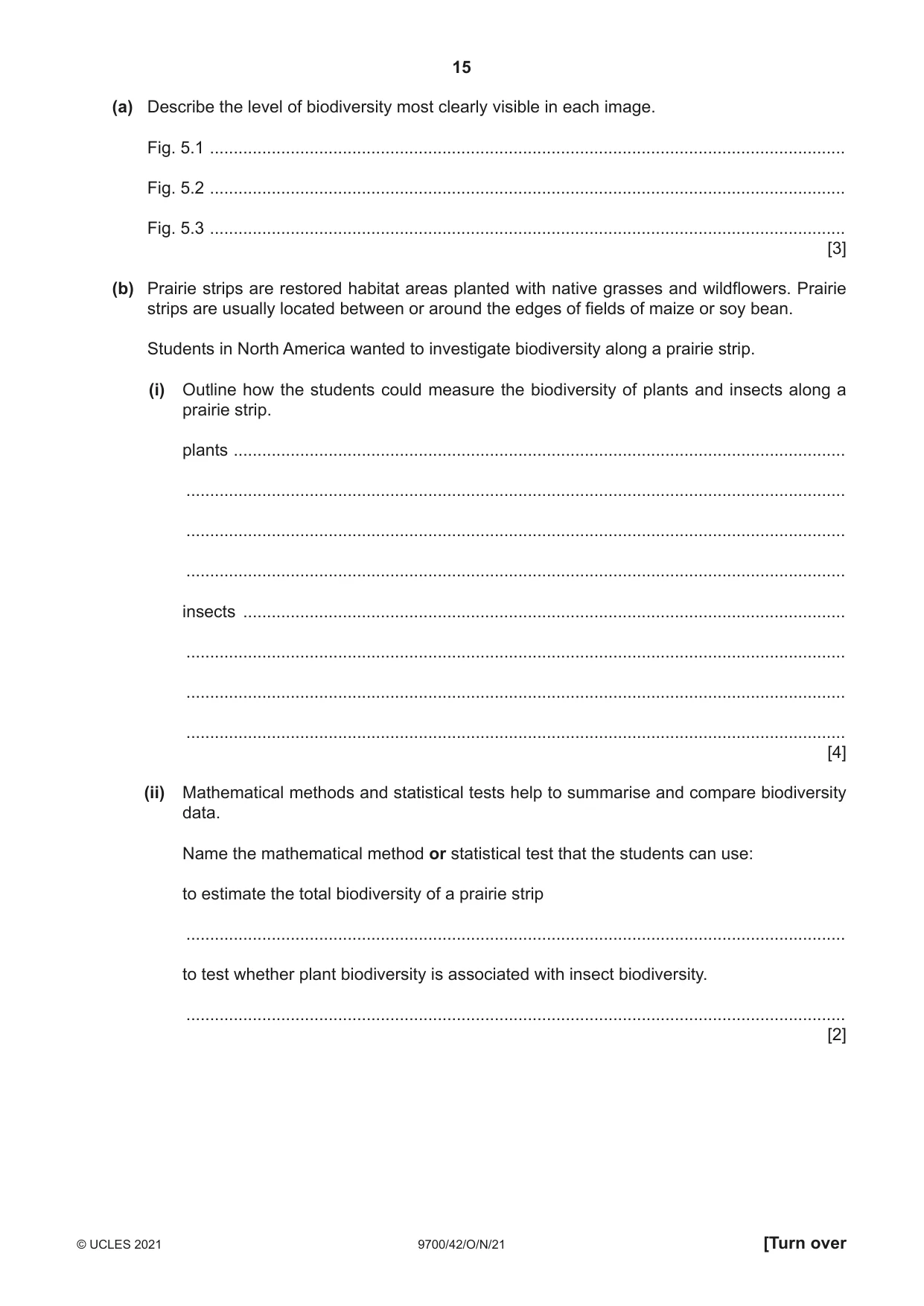
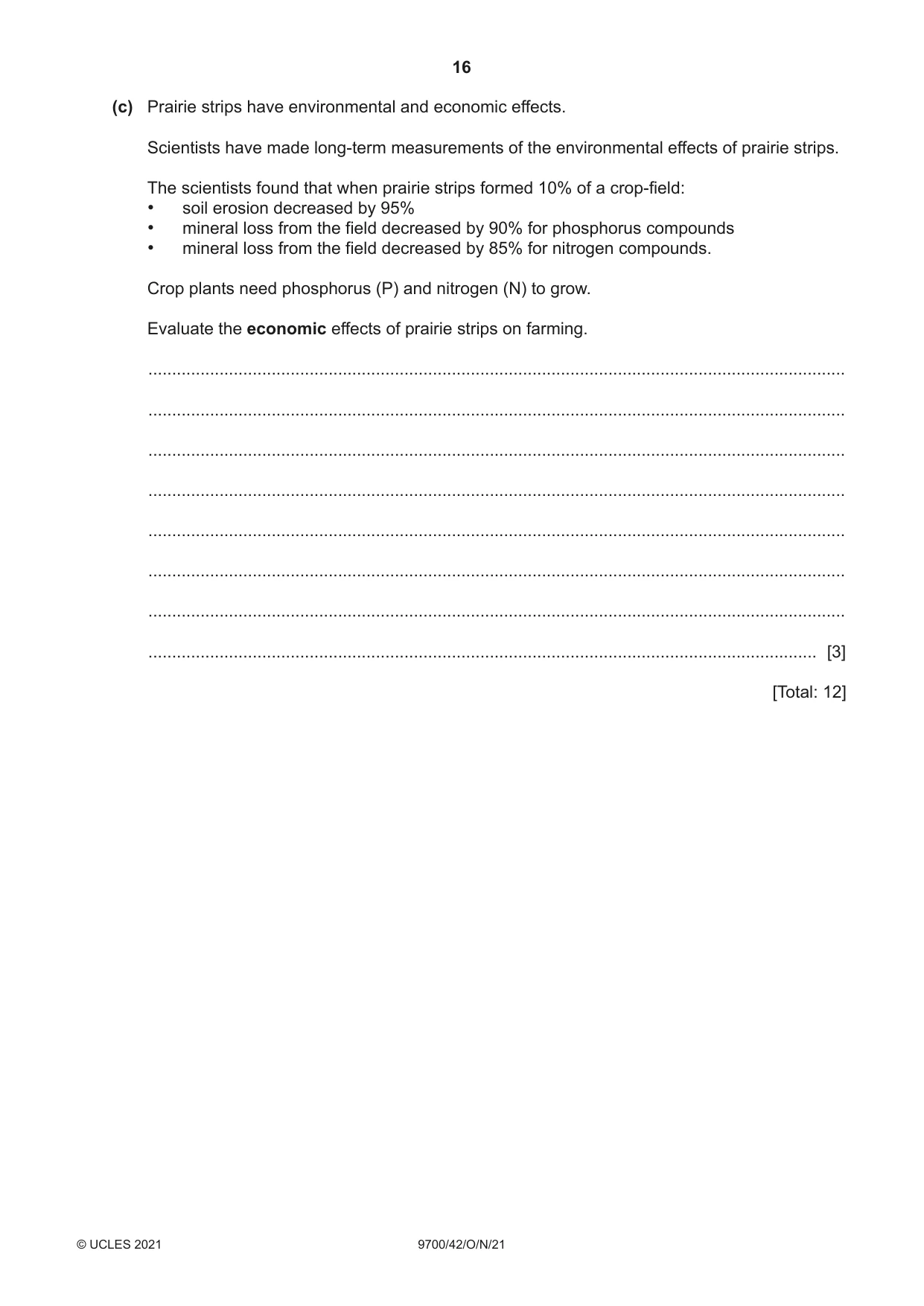





Mark scheme24 pages
Answers below. Sit the paper first if you are practising.
Questions as text
Q1 · The Bowman’s capsule of a nephron is involved in ultrafiltration
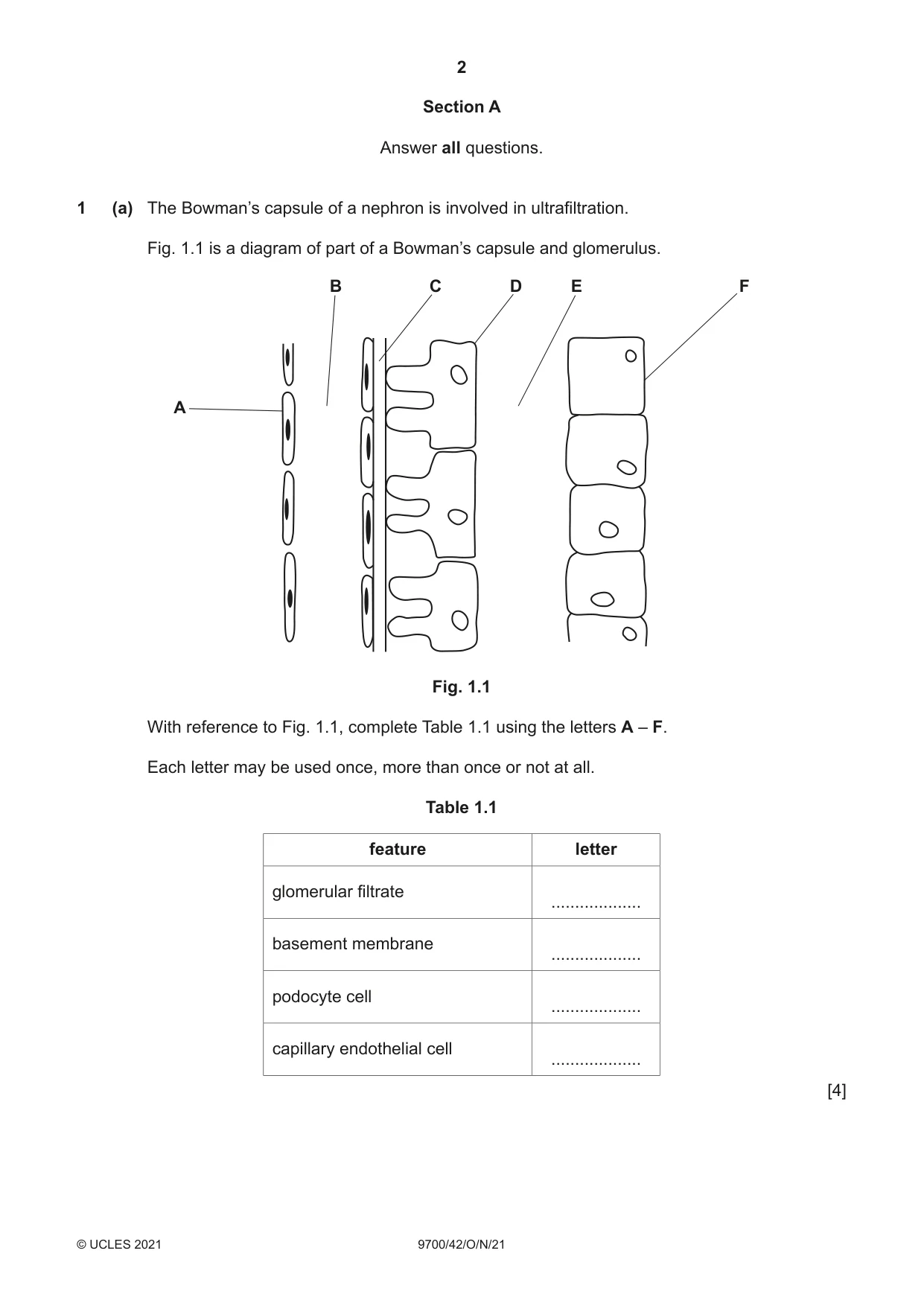
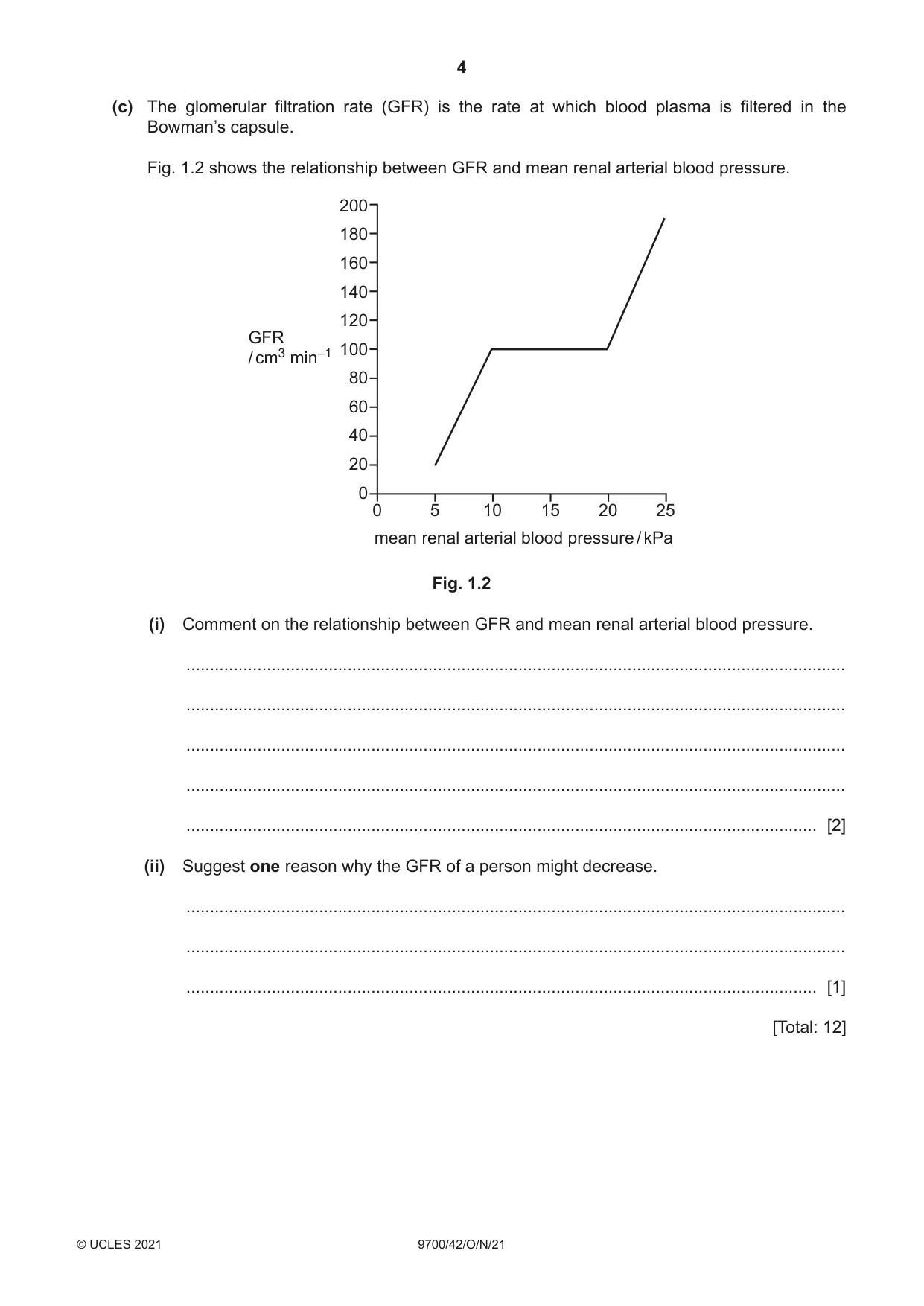
1 (a) The Bowman’s capsule of a nephron is involved in ultrafiltration. Fig. 1.1 is a diagram of part of a Bowman’s capsule and glomerulus. B C D E F A Fig. 1.1 With reference to Fig. 1.1, complete Table 1.1 using the letters A – F. Each letter may be used once, more than once or not at all. Table 1.1 feature letter glomerular filtrate ................... basement membrane ................... podocyte cell ................... capillary endothelial cell ................... [4] (b) Describe and explain how the structures in the Bowman’s capsule and its associated blood supply are adapted to allow ultrafiltration to take place. ................................................................................................................................................... ................................................................................................................................................... ................................................................................................................................................... ................................................................................................................................................... ................................................................................................................................................... ................................................................................................................................................... ................................................................................................................................................... ................................................................................................................................................... ................................................................................................................................................... ................................................................................................................................................... ............................................................................................................................................. [5] (c) The glomerular filtration rate (GFR) is the rate at which blood plasma is filtered in the Bowman’s capsule. Fig. 1.2 shows the relationship between GFR and mean renal arterial blood pressure. 200 180 160 140 120 GFR 100 / cm3 min–1 80 60 40 20 0 0 5 10 15 20 25 mean renal arterial blood pressure / kPa Fig. 1.2 (i) Comment on the relationship between GFR and mean renal arterial blood pressure. ........................................................................................................................................... ........................................................................................................................................... ........................................................................................................................................... ........................................................................................................................................... ..................................................................................................................................... [2] (ii) Suggest one reason why the GFR of a person might decrease. ........................................................................................................................................... ........................................................................................................................................... ..................................................................................................................................... [1] [Total: 12] Question 2 starts on page 6.
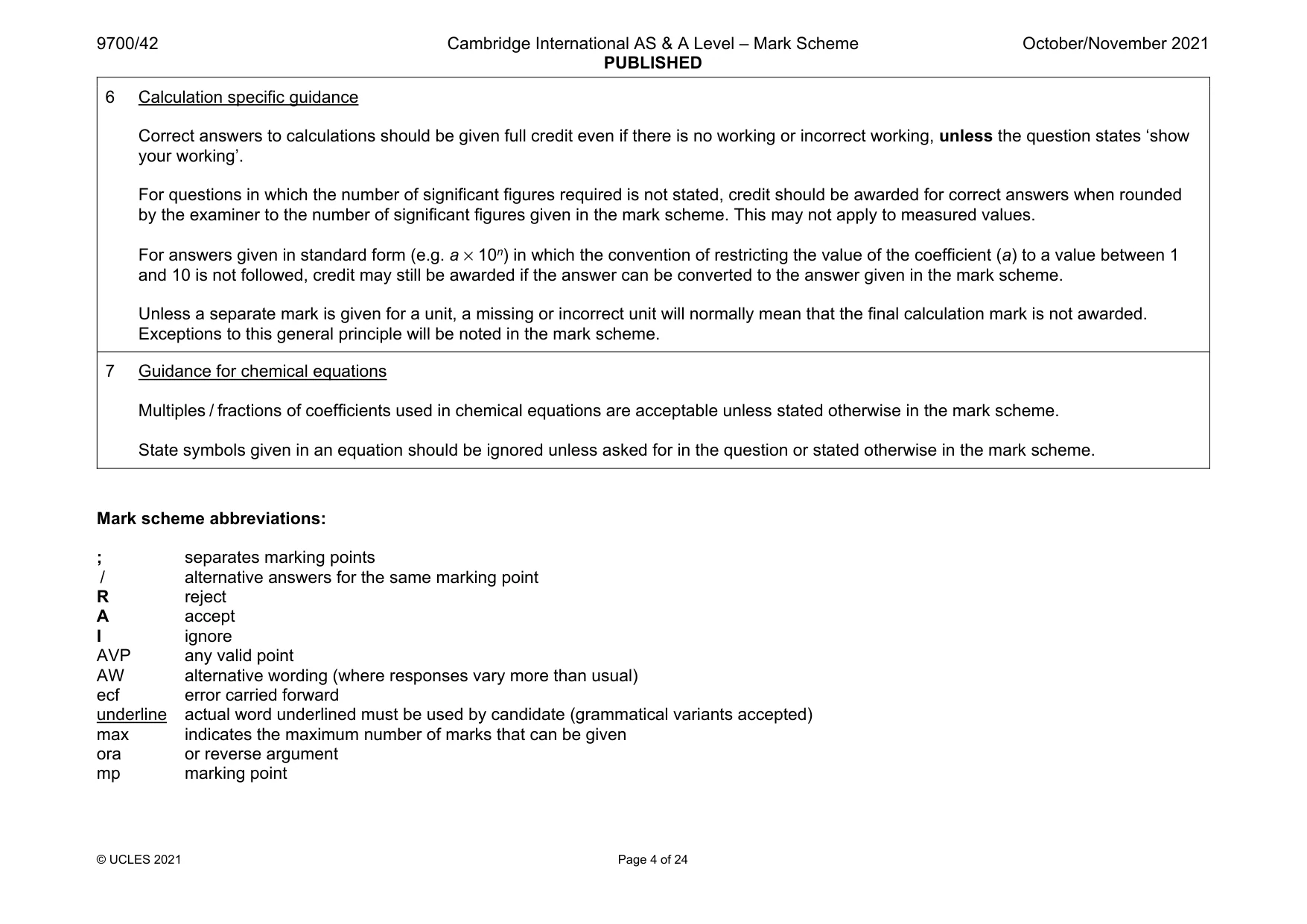
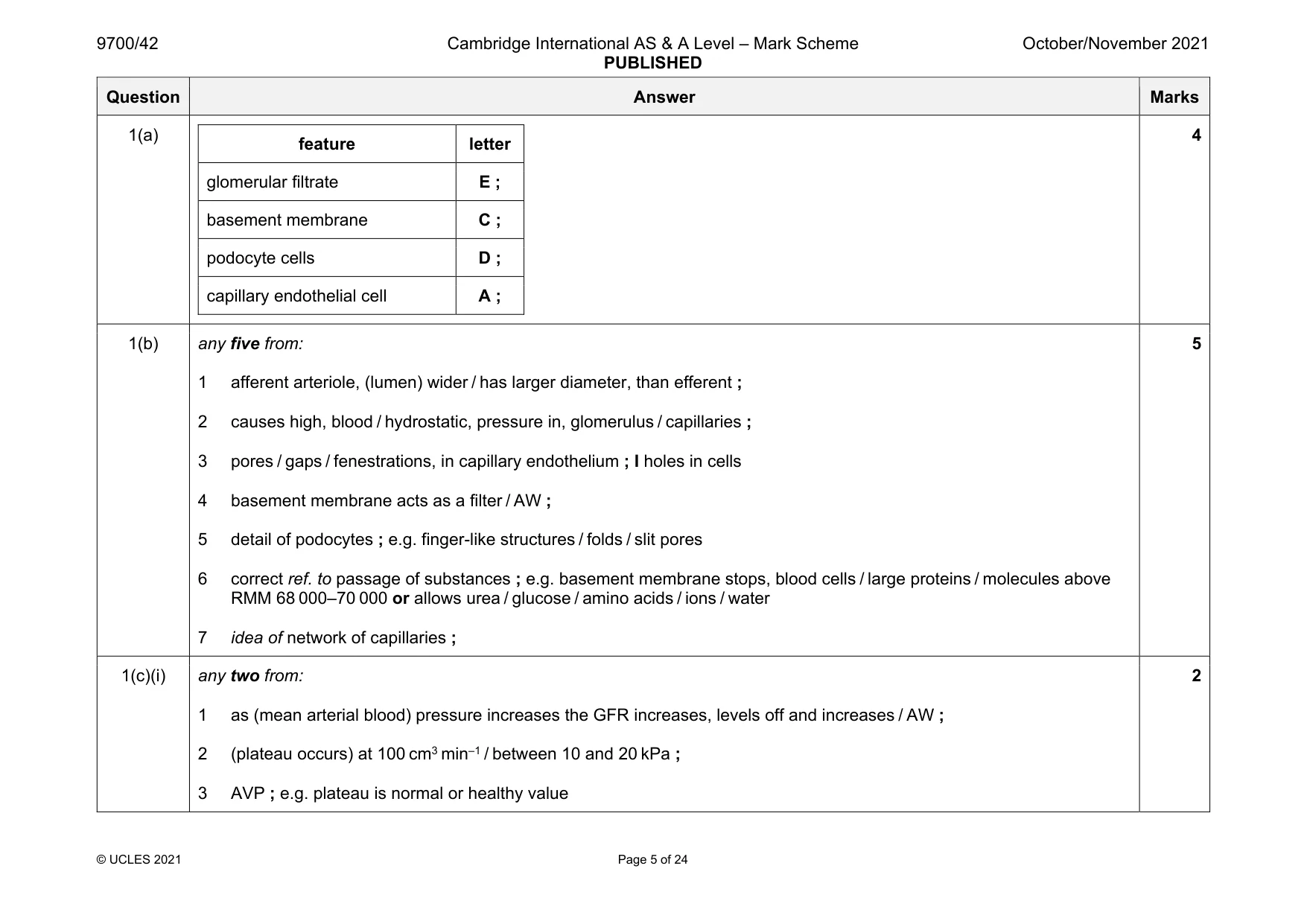
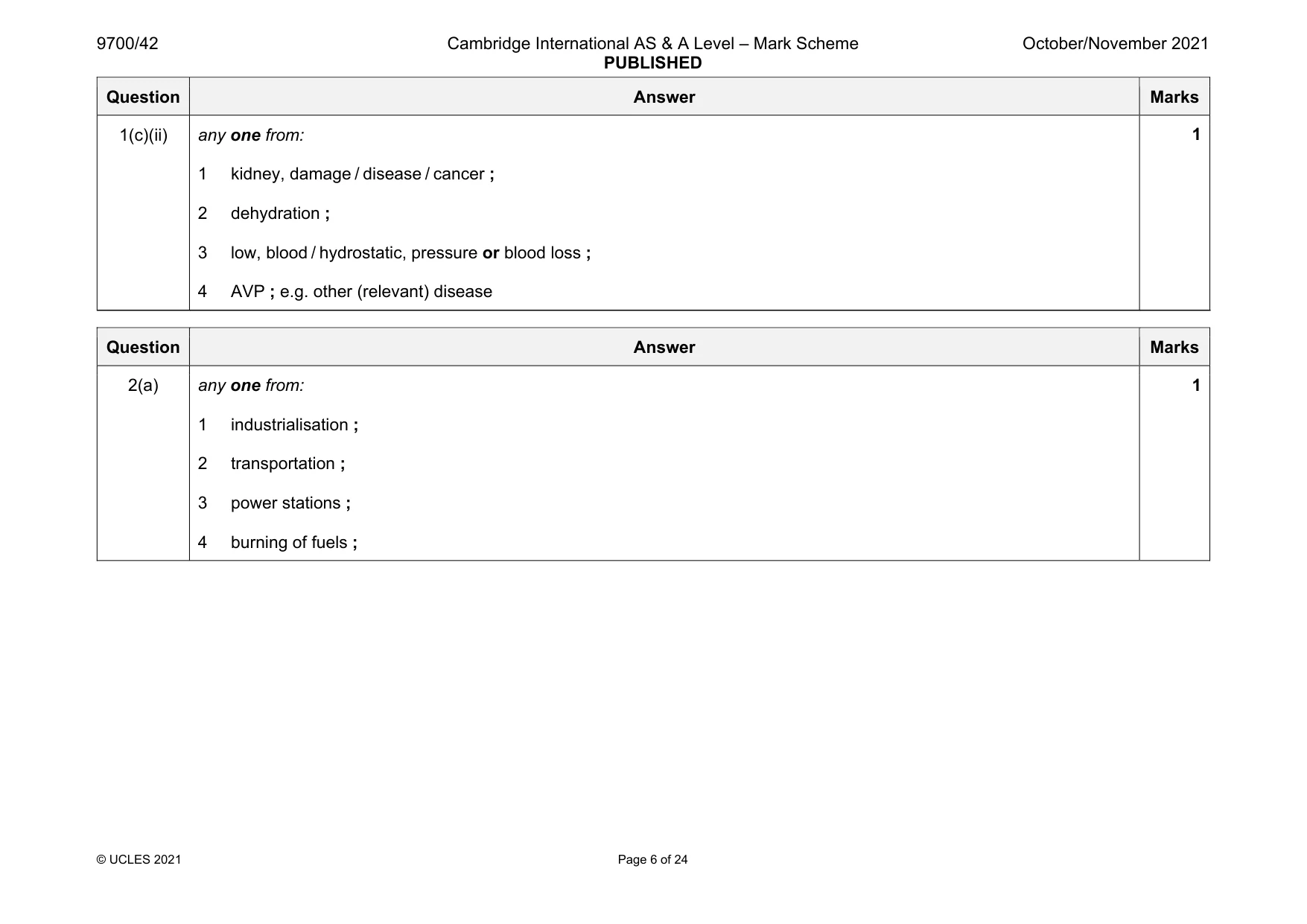
Mark scheme: 1(a) feature letter glomerular filtrate E ; basement membrane C ; podocyte cells D ; capillary endothelial cell A ; 4 1(b) any five from: 1 afferent arteriole, (lumen) wider / has larger diameter, than efferent ; 2 causes high, blood / hydrostatic, pressure in, glomerulus / capillaries ; 3 pores / gaps / fenestrations, in capillary endothelium ; I holes in cells 4 basement membrane acts as a filter / AW ; 5 detail of podocytes ; e.g. finger-like structures / folds / slit pores 6 correct ref. to passage of substances ; e.g. basement membrane stops, blood cells / large proteins / molecules above RMM 68 000–70 000 or allows urea / glucose / amino acids / ions / water 7 idea of network of capillaries ; 5 1(c)(i) any two from: 1 as (mean arterial blood) pressure increases the GFR increases, levels off and increases / AW ; 2 (plateau occurs) at 100 cm3 min–1 / between 10 and 20 kPa ; 3 AVP ; e.g. plateau is normal or healthy value 2 Question Answer Marks 1(c)(ii) any one from: 1 kidney, damage / disease / cancer ; 2 dehydration ; 3 low, blood / hydrostatic, pressure or blood loss ; 4 AVP ; e.g. other (relevant) disease 1
Q2 · Scientists are researching new ways to reduce the global atmospheric carbon dioxide (CO2)…
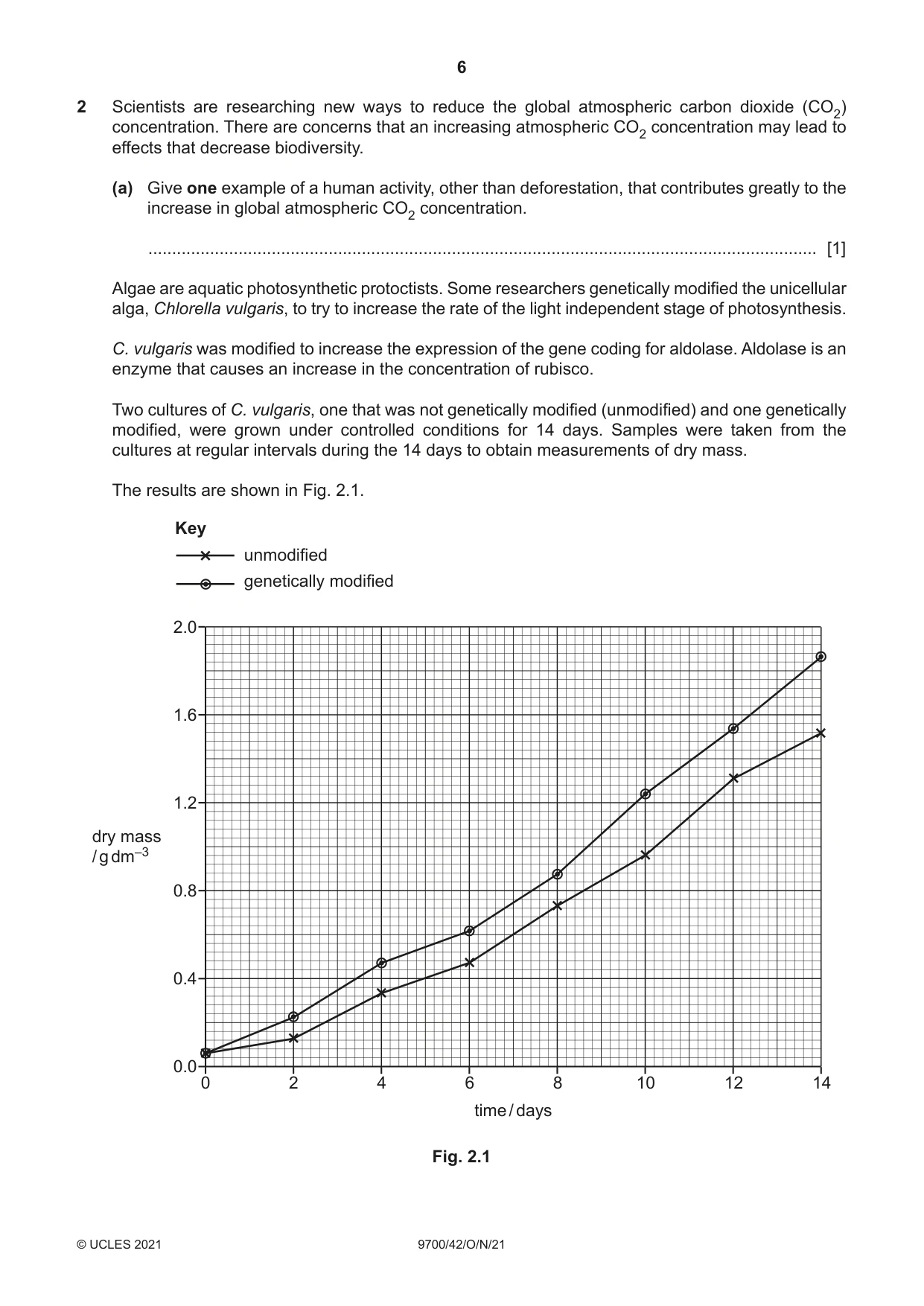
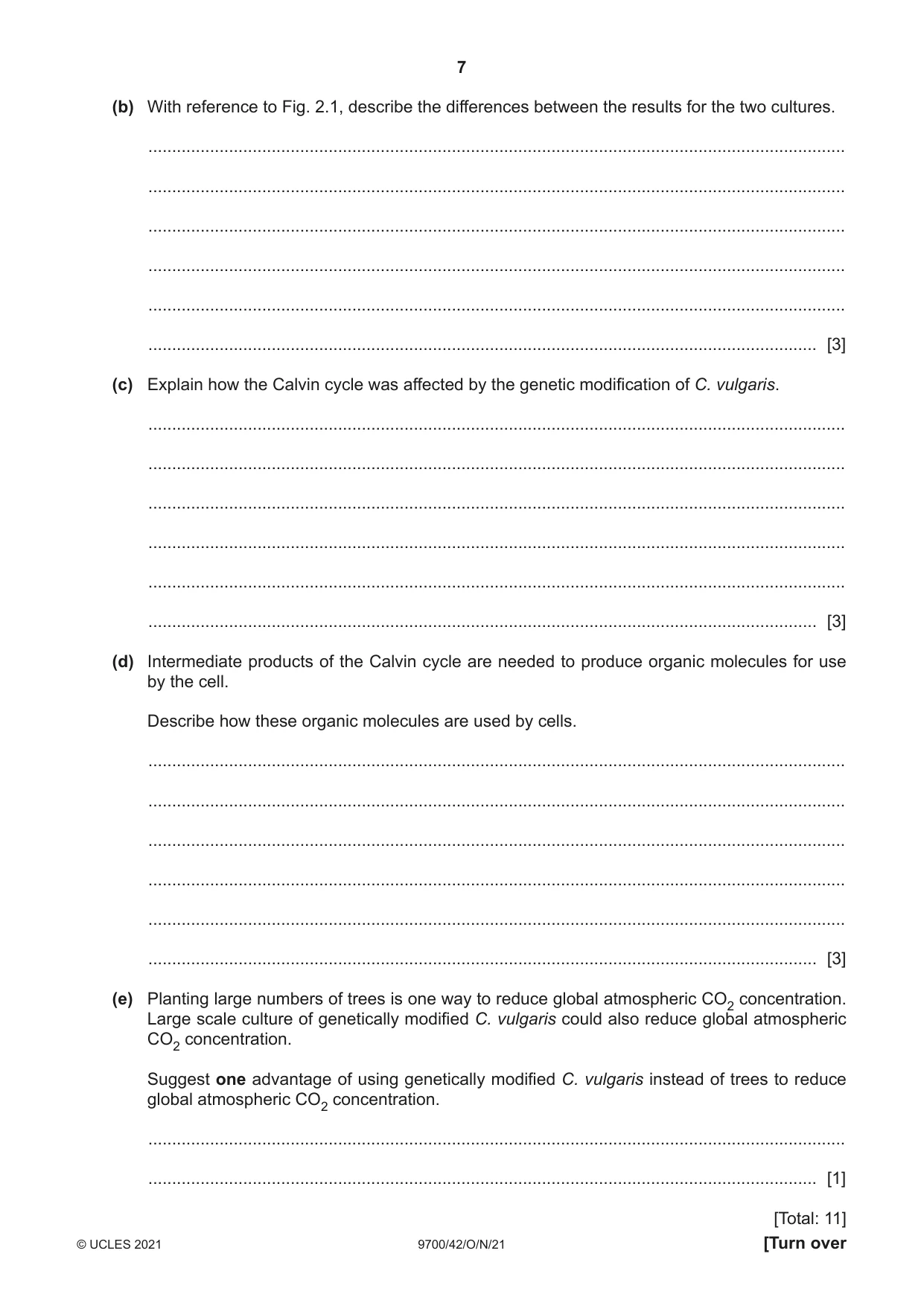
2 Scientists are researching new ways to reduce the global atmospheric carbon dioxide (CO2) concentration. There are concerns that an increasing atmospheric CO2 concentration may lead to effects that decrease biodiversity. (a) Give one example of a human activity, other than deforestation, that contributes greatly to the increase in global atmospheric CO2 concentration. ............................................................................................................................................. [1] Algae are aquatic photosynthetic protoctists. Some researchers genetically modified the unicellular alga, Chlorella vulgaris, to try to increase the rate of the light independent stage of photosynthesis. C. vulgaris was modified to increase the expression of the gene coding for aldolase. Aldolase is an enzyme that causes an increase in the concentration of rubisco. Two cultures of C. vulgaris, one that was not genetically modified (unmodified) and one genetically modified, were grown under controlled conditions for 14 days. Samples were taken from the cultures at regular intervals during the 14 days to obtain measurements of dry mass. The results are shown in Fig. 2.1. Key unmodified genetically modified 2.0 1.6 1.2 dry mass / g dm–3 0.8 0.4 0.0 0 2 4 6 8 10 12 14 time / days Fig. 2.1 (b) With reference to Fig. 2.1, describe the differences between the results for the two cultures. ................................................................................................................................................... ................................................................................................................................................... ................................................................................................................................................... ................................................................................................................................................... ................................................................................................................................................... ............................................................................................................................................. [3] (c) Explain how the Calvin cycle was affected by the genetic modification of C. vulgaris. ................................................................................................................................................... ................................................................................................................................................... ................................................................................................................................................... ................................................................................................................................................... ................................................................................................................................................... ............................................................................................................................................. [3] (d) Intermediate products of the Calvin cycle are needed to produce organic molecules for use by the cell. Describe how these organic molecules are used by cells. ................................................................................................................................................... ................................................................................................................................................... ................................................................................................................................................... ................................................................................................................................................... ................................................................................................................................................... ............................................................................................................................................. [3] (e) Planting large numbers of trees is one way to reduce global atmospheric CO2 concentration. Large scale culture of genetically modified C. vulgaris could also reduce global atmospheric CO2 concentration. Suggest one advantage of using genetically modified C. vulgaris instead of trees to reduce global atmospheric CO2 concentration. ................................................................................................................................................... ............................................................................................................................................. [1] [Total: 11]
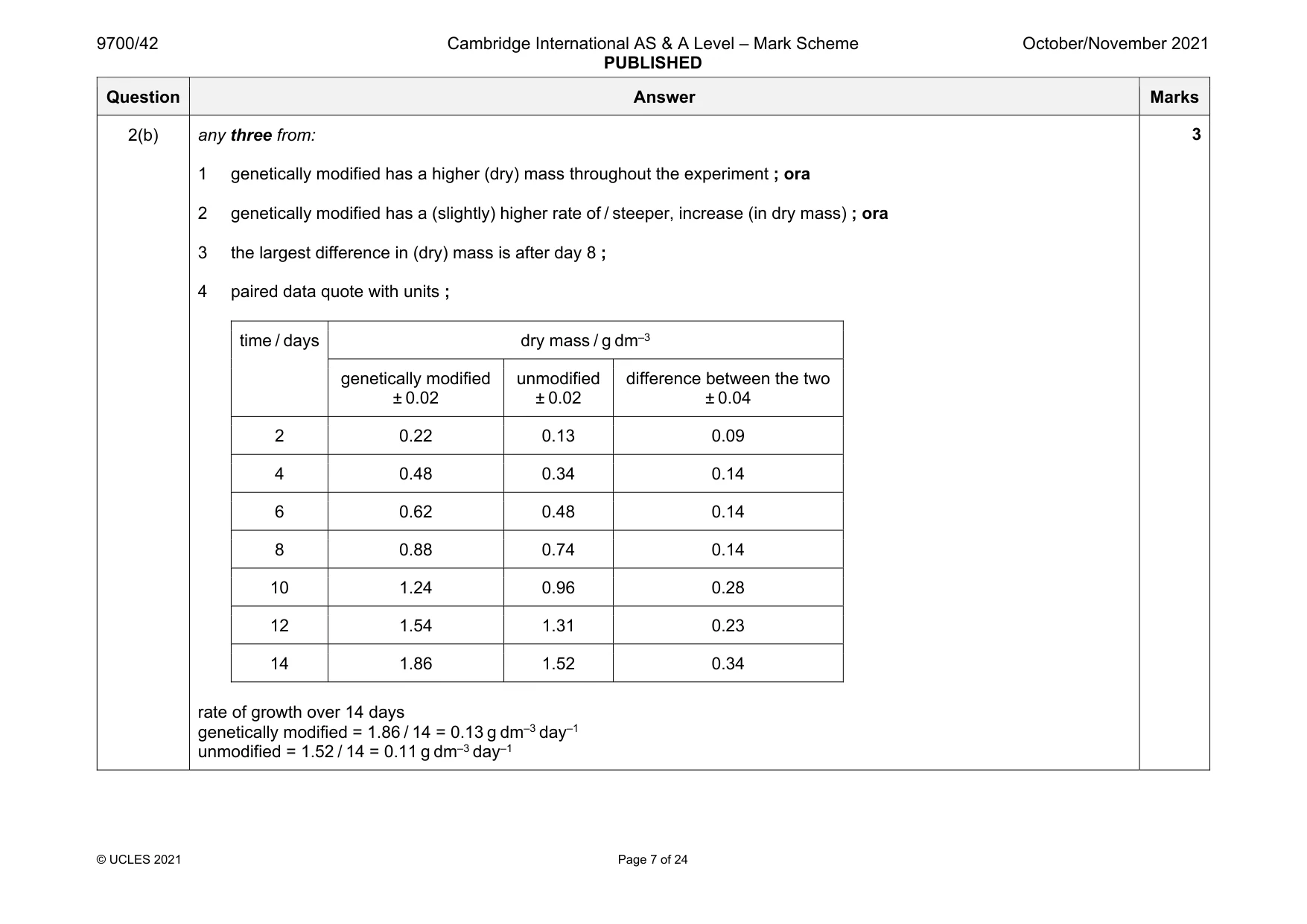
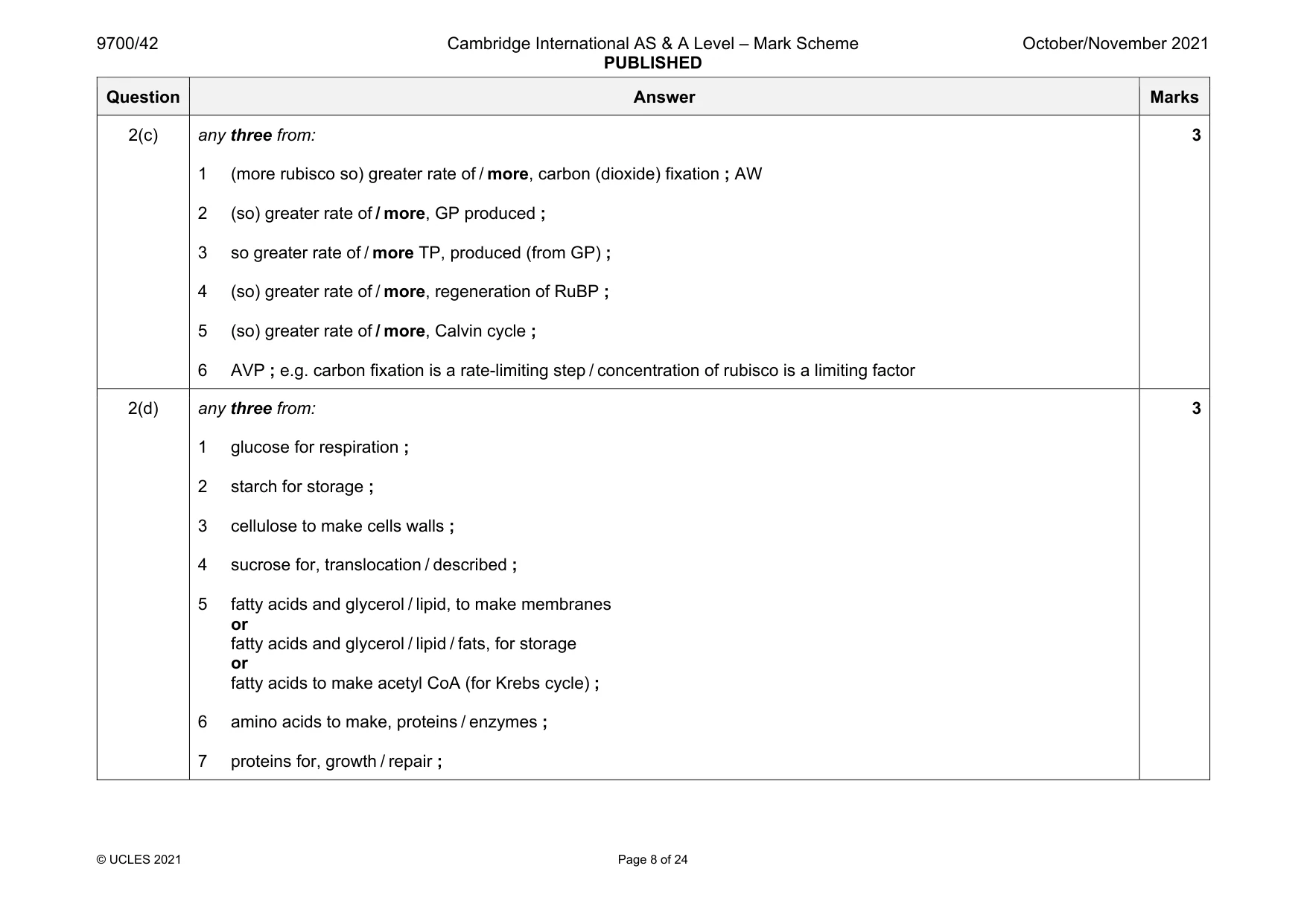
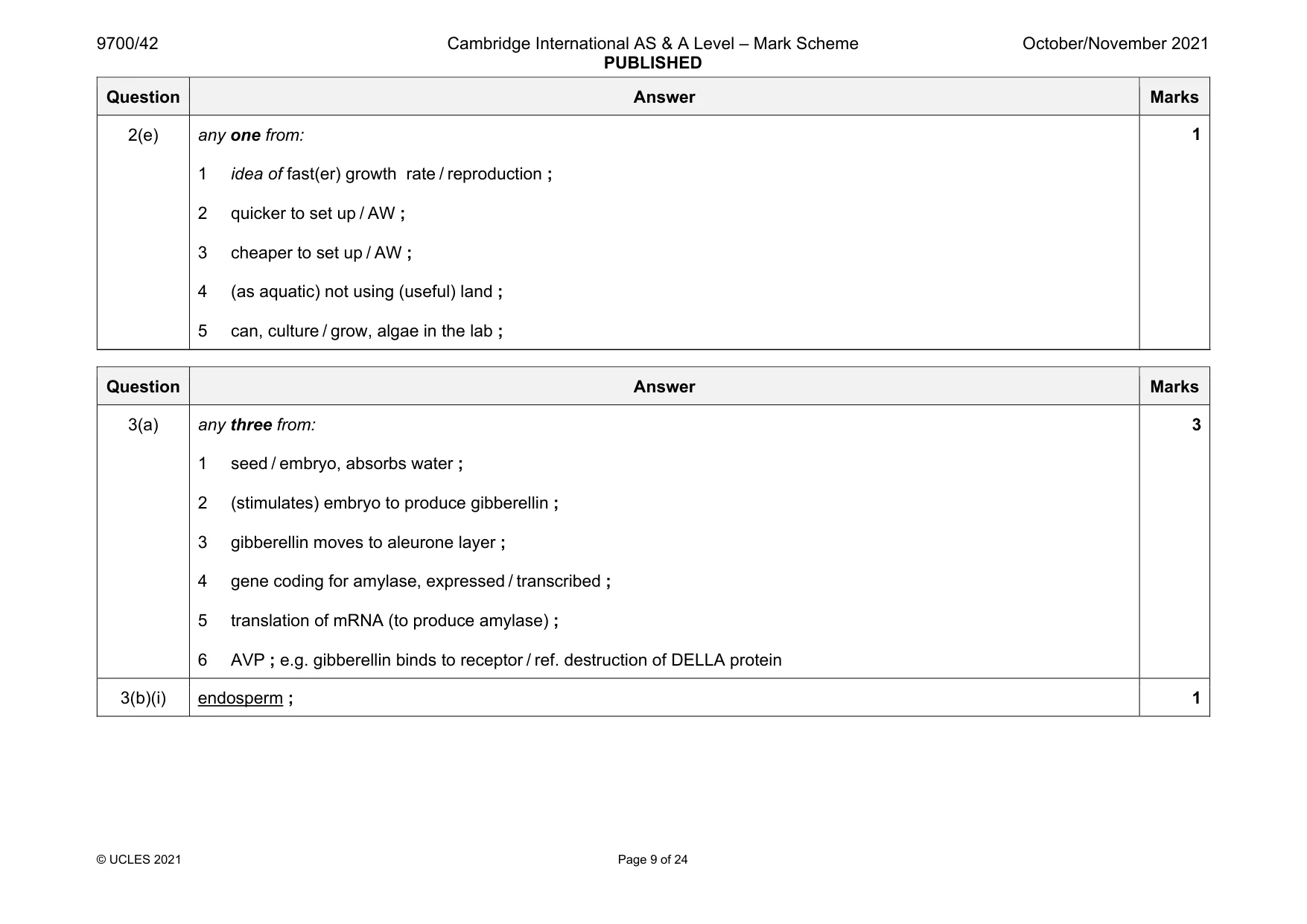
Mark scheme: 2(a) any one from: 1 industrialisation ; 2 transportation ; 3 power stations ; 4 burning of fuels ; Question Answer Marks 2(b) any three from: 1 genetically modified has a higher (dry) mass throughout the experiment ; ora 2 genetically modified has a (slightly) higher rate of / steeper, increase (in dry mass) ; ora 3 the largest difference in (dry) mass is after day 8 ; 4 paired data quote with units ; time / days dry mass / g dm–3 genetically modified ± 0.02 unmodified ± 0.02 difference between the two ± 0.04 2 0.22 0.13 0.09 4 0.48 0.34 0.14 6 0.62 0.48 0.14 8 0.88 0.74 0.14 10 1.24 0.96 0.28 12 1.54 1.31 0.23 14 1.86 1.52 0.34 rate of growth over 14 days genetically modified = 1.86 / 14 = 0.13 g dm–3 day–1 unmodified = 1.52 / 14 = 0.11 g dm–3 day–1 3 Question Answer Marks 2(c) any three from: 1 (more rubisco so) greater rate of / more, carbon (dioxide) fixation ; AW 2 (so) greater rate of / more, GP produced ; 3 so greater rate of / more TP, produced (from GP) ; 4 (so) greater rate of / more, regeneration of RuBP ; 5 (so) greater rate of / more, Calvin cycle ; 6 AVP ; e.g. carbon fixation is a rate-limiting step / concentration of rubisco is a limiting factor 3 2(d) any three from: 1 glucose for respiration ; 2 starch for storage ; 3 cellulose to make cells walls ; 4 sucrose for, translocation / described ; 5 fatty acids and glycerol / lipid, to make membranes or fatty acids and glycerol / lipid / fats, for storage or fatty acids to make acetyl CoA (for Krebs cycle) ; 6 amino acids to make, proteins / enzymes ; 7 proteins for, growth / repair ; 3 Question Answer Marks 2(e) any one from: 1 idea of fast(er) growth rate / reproduction ; 2 quicker to set up / AW ; 3 cheaper to set up / AW ; 4 (as aquatic) not using (useful) land ; 5 can, culture / grow, algae in the lab ; 1
More questions on Photosynthesis as an energy transfer process
Q3 · During the germination of barley seeds, amylase is produced
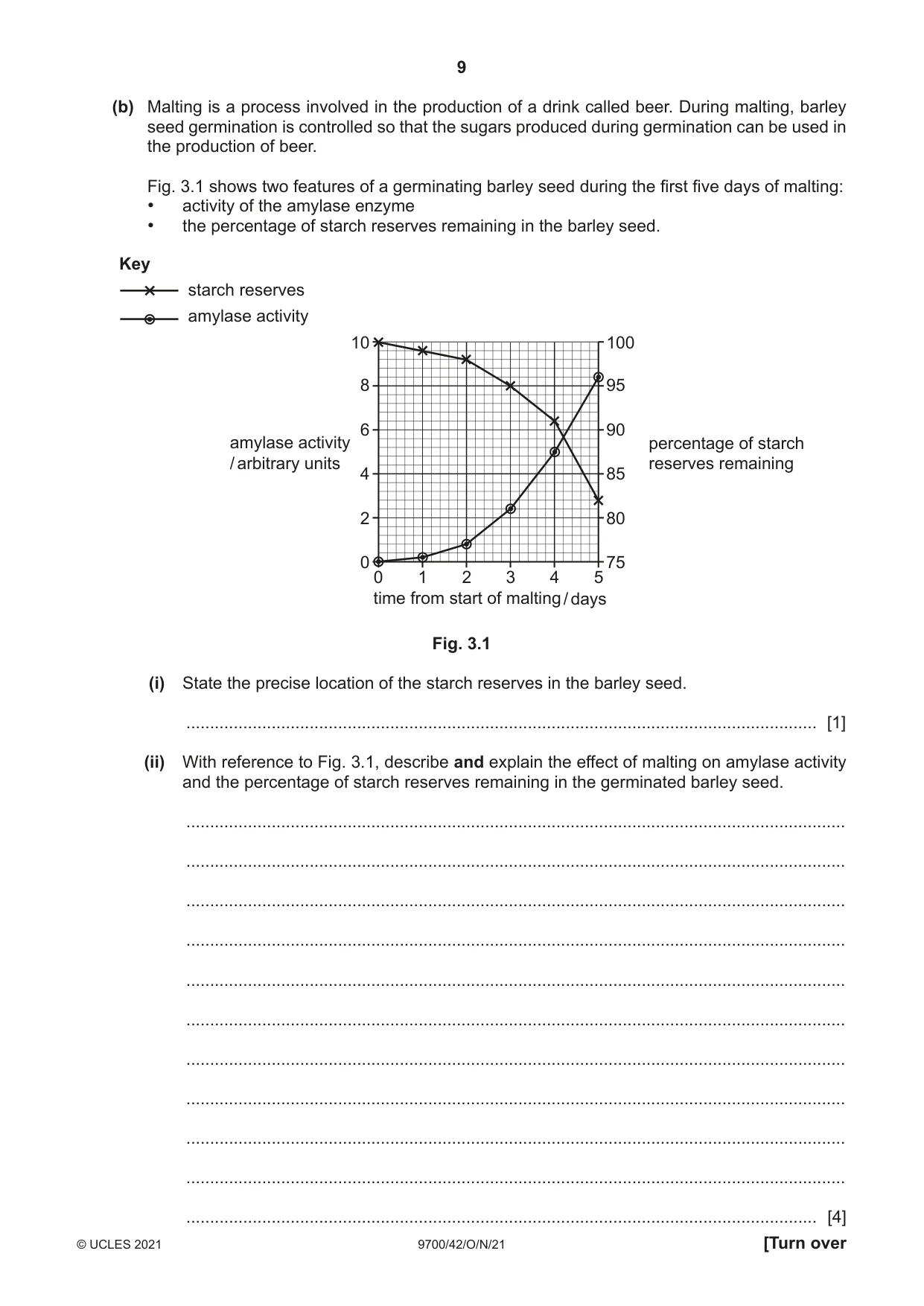
3 During the germination of barley seeds, amylase is produced. (a) Describe the sequence of events that lead to the production of amylase during germination of barley seeds. ................................................................................................................................................... ................................................................................................................................................... ................................................................................................................................................... ................................................................................................................................................... ................................................................................................................................................... ................................................................................................................................................... ................................................................................................................................................... ............................................................................................................................................. [3] (b) Malting is a process involved in the production of a drink called beer. During malting, barley seed germination is controlled so that the sugars produced during germination can be used in the production of beer. Fig. 3.1 shows two features of a germinating barley seed during the first five days of malting: • activity of the amylase enzyme • the percentage of starch reserves remaining in the barley seed. Key starch reserves amylase activity 10 100 8 95 6 90 amylase activity percentage of starch / arbitrary units reserves remaining 4 85 2 80 0 75 0 1 2 3 4 5 time from start of malting / days Fig. 3.1 (i) State the precise location of the starch reserves in the barley seed. ..................................................................................................................................... [1] (ii) With reference to Fig. 3.1, describe and explain the effect of malting on amylase activity and the percentage of starch reserves remaining in the germinated barley seed. ........................................................................................................................................... ........................................................................................................................................... ........................................................................................................................................... ........................................................................................................................................... ........................................................................................................................................... ........................................................................................................................................... ........................................................................................................................................... ........................................................................................................................................... ........................................................................................................................................... ........................................................................................................................................... ..................................................................................................................................... [4] (c) In the malting process, germination is stopped before the concentration of sugars in the germinating barley seeds exceeds a concentration that causes shoot or root growth. Drying the germinating barley seeds at 50 °C is one method used to stop malting. (i) Explain how this method would stop malting. ........................................................................................................................................... ........................................................................................................................................... ........................................................................................................................................... ........................................................................................................................................... ........................................................................................................................................... ........................................................................................................................................... ..................................................................................................................................... [3] (ii) Suggest why malting is stopped before shoot or root growth occurs. ........................................................................................................................................... ........................................................................................................................................... ..................................................................................................................................... [1] [Total: 12]
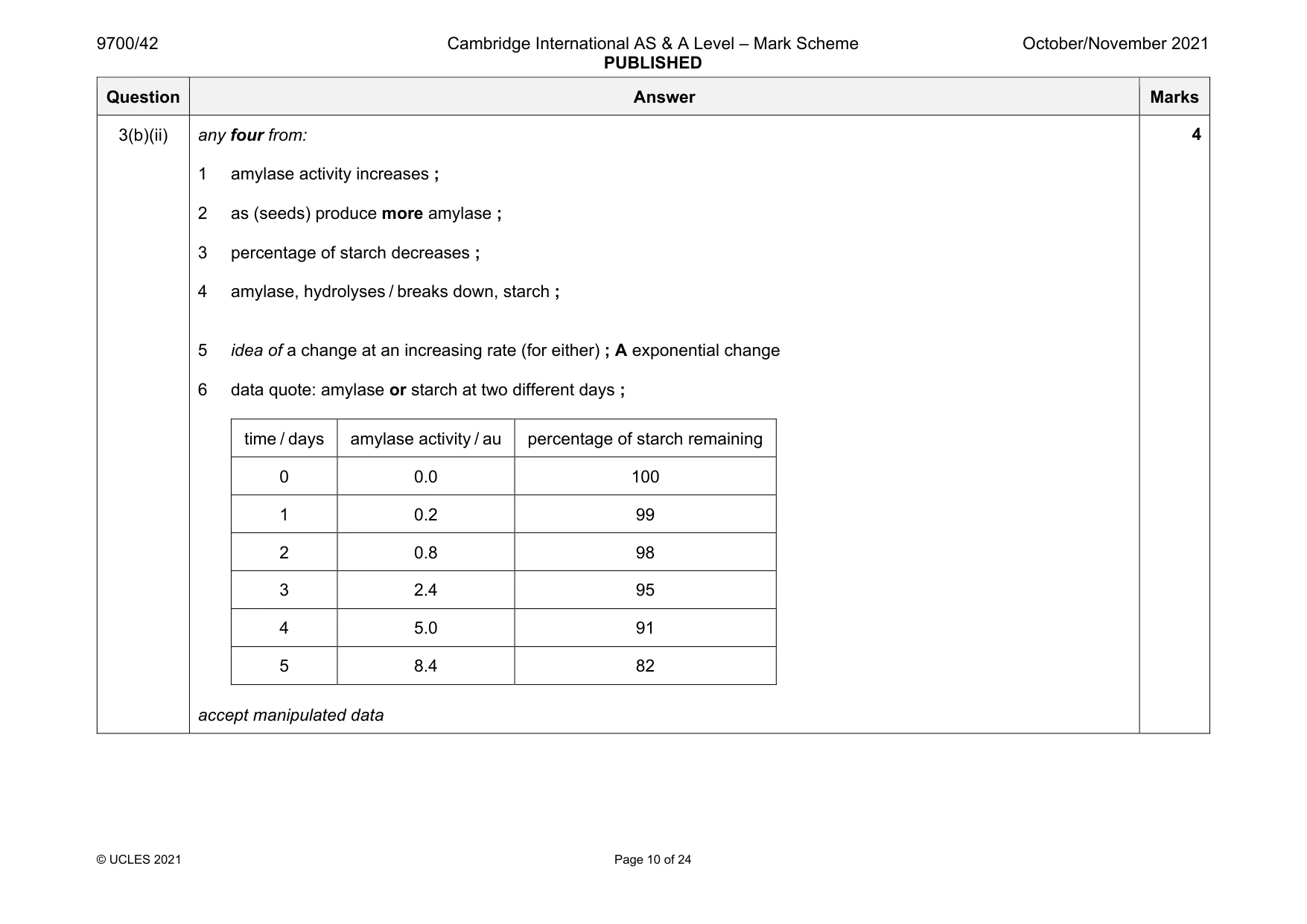
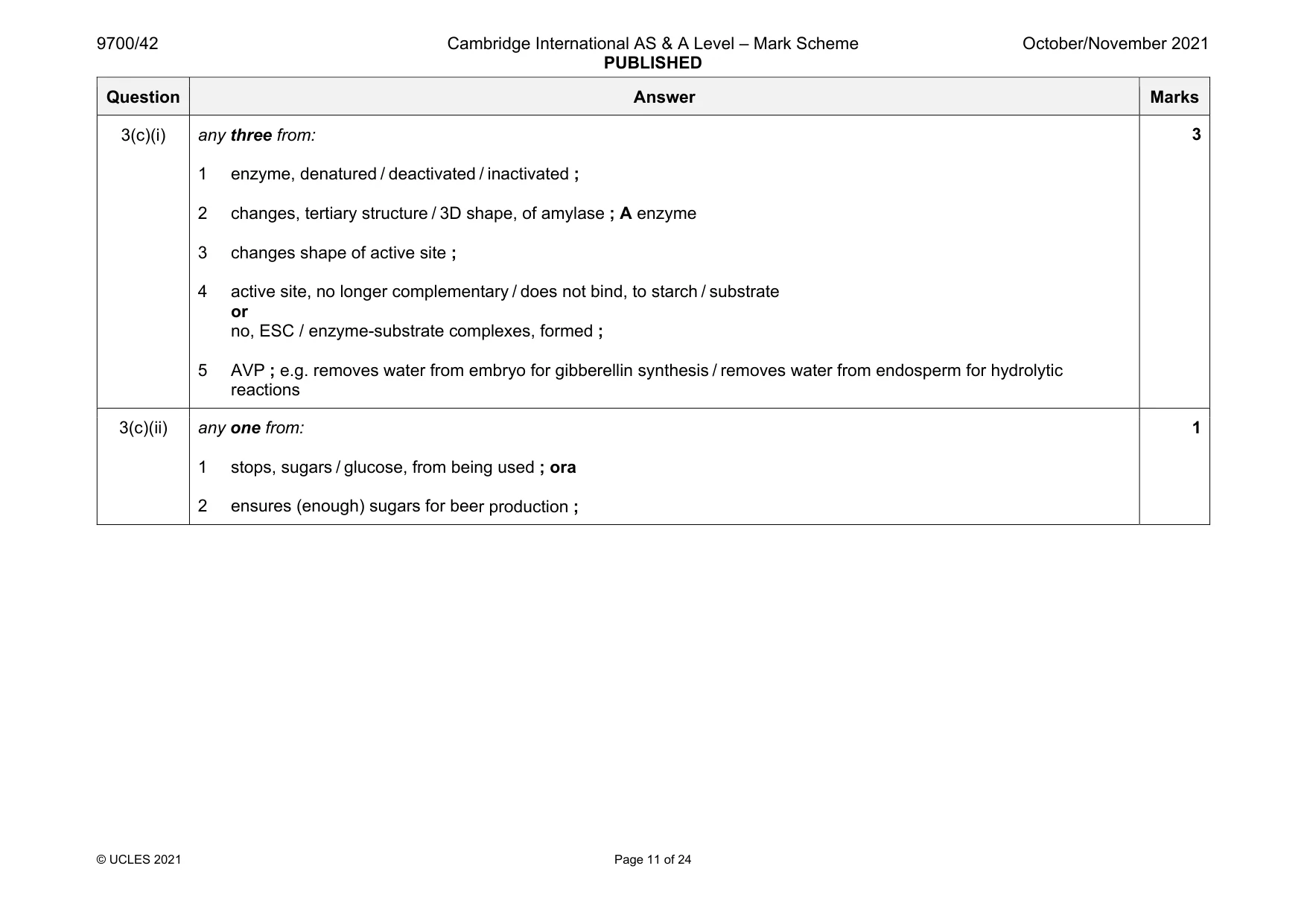
Mark scheme: 3(a) any three from: 1 seed / embryo, absorbs water ; 2 (stimulates) embryo to produce gibberellin ; 3 gibberellin moves to aleurone layer ; 4 gene coding for amylase, expressed / transcribed ; 5 translation of mRNA (to produce amylase) ; 6 AVP ; e.g. gibberellin binds to receptor / ref. destruction of DELLA protein 3 3(b)(i) endosperm ; 1 Question Answer Marks 3(b)(ii) any four from: 1 amylase activity increases ; 2 as (seeds) produce more amylase ; 3 percentage of starch decreases ; 4 amylase, hydrolyses / breaks down, starch ; 5 idea of a change at an increasing rate (for either) ; A exponential change 6 data quote: amylase or starch at two different days ; time / days amylase activity / au percentage of starch remaining 0 0.0 100 1 0.2 99 2 0.8 98 3 2.4 95 4 5.0 91 5 8.4 82 accept manipulated data 4 Question Answer Marks 3(c)(i) any three from: 1 enzyme, denatured / deactivated / inactivated ; 2 changes, tertiary structure / 3D shape, of amylase ; A enzyme 3 changes shape of active site ; 4 active site, no longer complementary / does not bind, to starch / substrate or no, ESC / enzyme-substrate complexes, formed ; 5 AVP ; e.g. removes water from embryo for gibberellin synthesis / removes water from endosperm for hydrolytic reactions 3 3(c)(ii) any one from: 1 stops, sugars / glucose, from being used ; ora 2 ensures (enough) sugars for beer production ; 1
Q4 · Genome-wide association studies find links between single nucleotide polymorphisms (SNPs)…
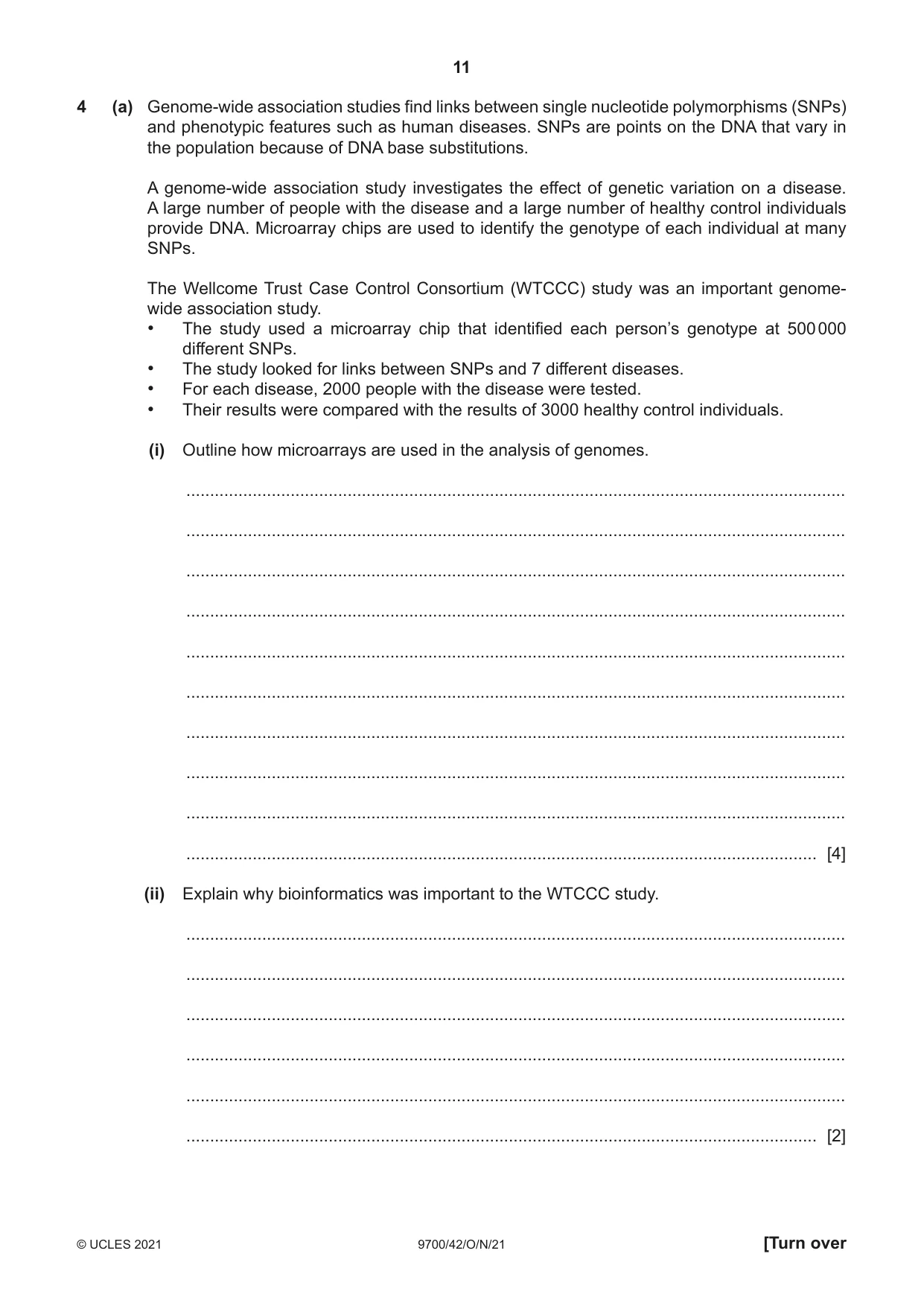
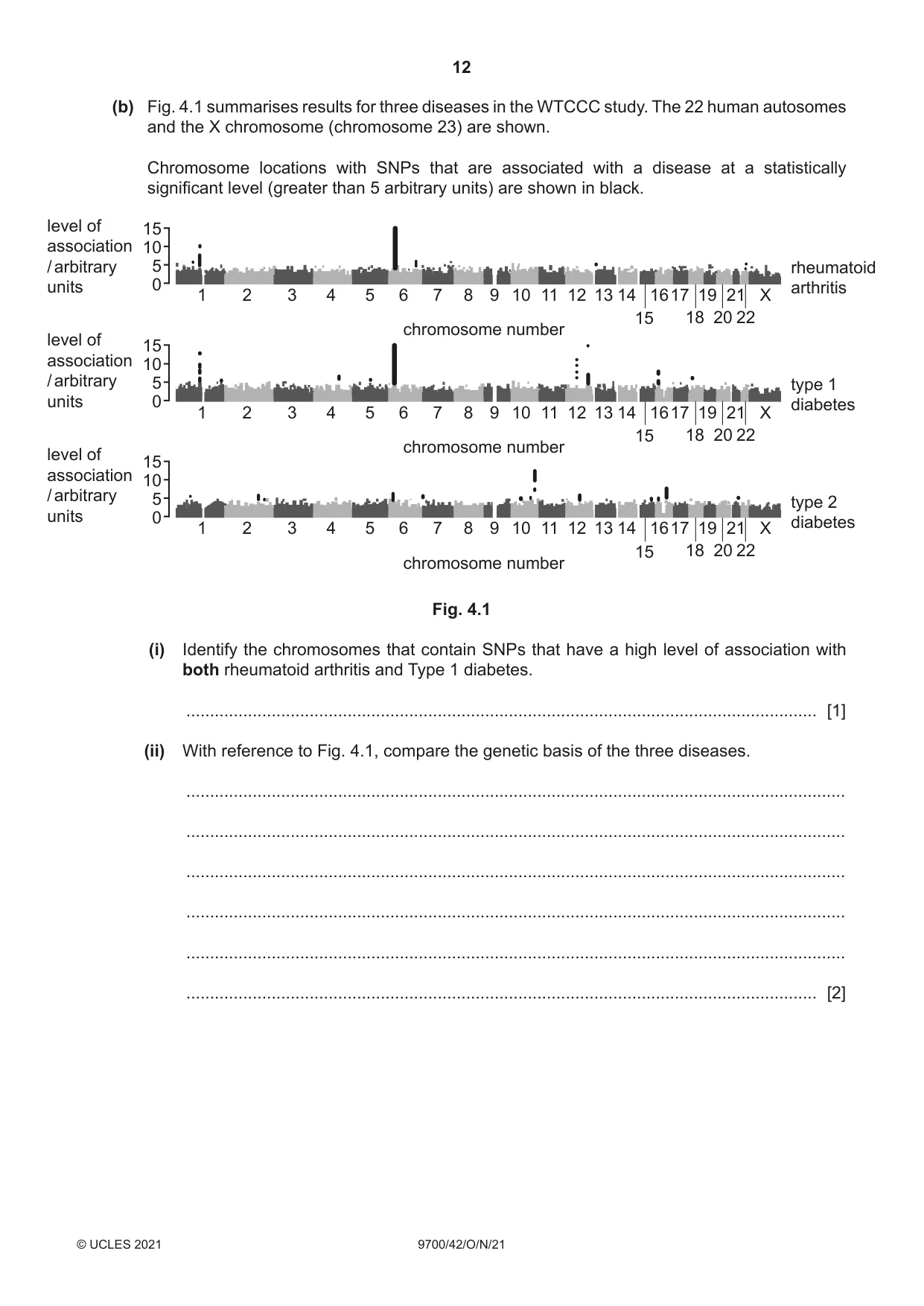
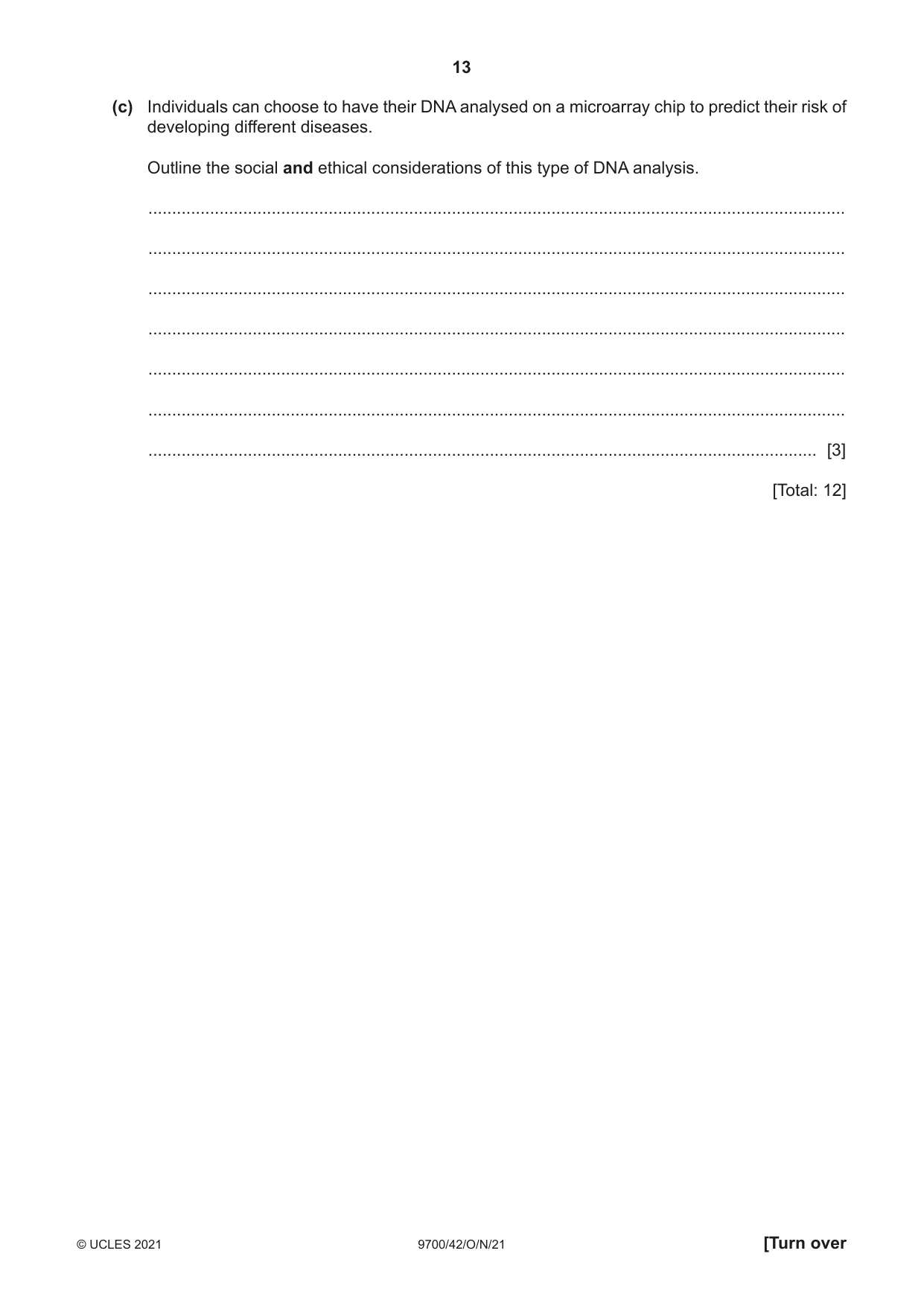
4 (a) Genome-wide association studies find links between single nucleotide polymorphisms (SNPs) and phenotypic features such as human diseases. SNPs are points on the DNA that vary in the population because of DNA base substitutions. A genome-wide association study investigates the effect of genetic variation on a disease. A large number of people with the disease and a large number of healthy control individuals provide DNA. Microarray chips are used to identify the genotype of each individual at many SNPs. The Wellcome Trust Case Control Consortium (WTCCC) study was an important genome- wide association study. • The study used a microarray chip that identified each person’s genotype at 500 000 different SNPs. • The study looked for links between SNPs and 7 different diseases. • For each disease, 2000 people with the disease were tested. • Their results were compared with the results of 3000 healthy control individuals. (i) Outline how microarrays are used in the analysis of genomes. ........................................................................................................................................... ........................................................................................................................................... ........................................................................................................................................... ........................................................................................................................................... ........................................................................................................................................... ........................................................................................................................................... ........................................................................................................................................... ........................................................................................................................................... ........................................................................................................................................... ..................................................................................................................................... [4] (ii) Explain why bioinformatics was important to the WTCCC study. ........................................................................................................................................... ........................................................................................................................................... ........................................................................................................................................... ........................................................................................................................................... ........................................................................................................................................... ..................................................................................................................................... [2] (b) Fig. 4.1 summarises results for three diseases in the WTCCC study. The 22 human autosomes and the X chromosome (chromosome 23) are shown. Chromosome locations with SNPs that are associated with a disease at a statistically significant level (greater than 5 arbitrary units) are shown in black. level of 15 association 10 / arbitrary 5 rheumatoid units 0 arthritis 1 2 3 4 5 6 7 8 9 10 11 12 13 14 16 17 19 21 X 15 18 20 22 chromosome numberlevel of 15 association 10 / arbitrary 5 type 1 units 0 diabetes 1 2 3 4 5 6 7 8 9 10 11 12 13 14 16 17 19 21 X 15 18 20 22 chromosome numberlevel of 15 association 10 / arbitrary 5 type 2 units 0 diabetes 1 2 3 4 5 6 7 8 9 10 11 12 13 14 16 17 19 21 X 15 18 20 22 chromosome number Fig. 4.1 (i) Identify the chromosomes that contain SNPs that have a high level of association with both rheumatoid arthritis and Type 1 diabetes. ..................................................................................................................................... [1] (ii) With reference to Fig. 4.1, compare the genetic basis of the three diseases. ........................................................................................................................................... ........................................................................................................................................... ........................................................................................................................................... ........................................................................................................................................... ........................................................................................................................................... ..................................................................................................................................... [2] (c) Individuals can choose to have their DNA analysed on a microarray chip to predict their risk of developing different diseases. Outline the social and ethical considerations of this type of DNA analysis. ................................................................................................................................................... ................................................................................................................................................... ................................................................................................................................................... ................................................................................................................................................... ................................................................................................................................................... ................................................................................................................................................... ............................................................................................................................................. [3] [Total: 12]
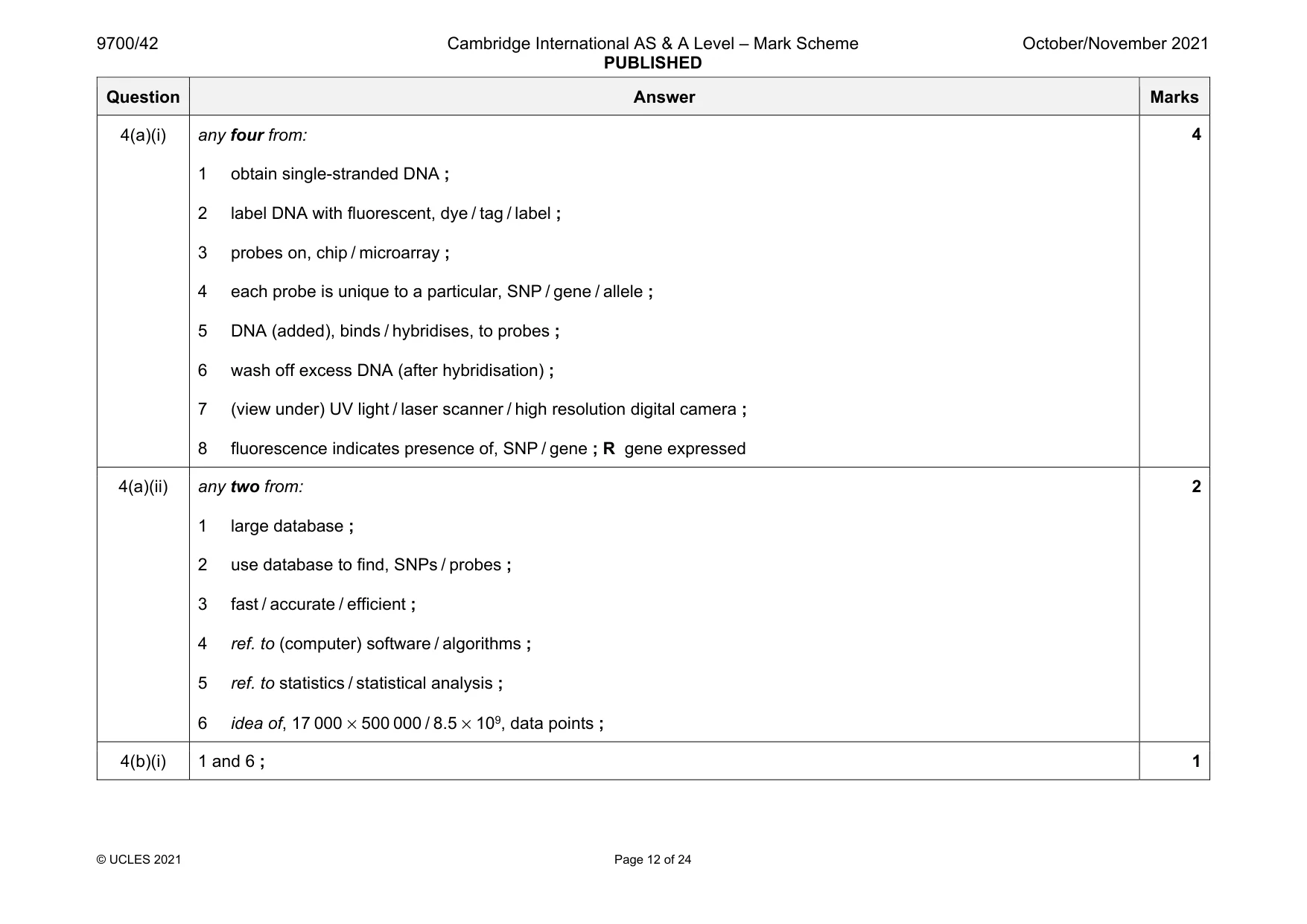
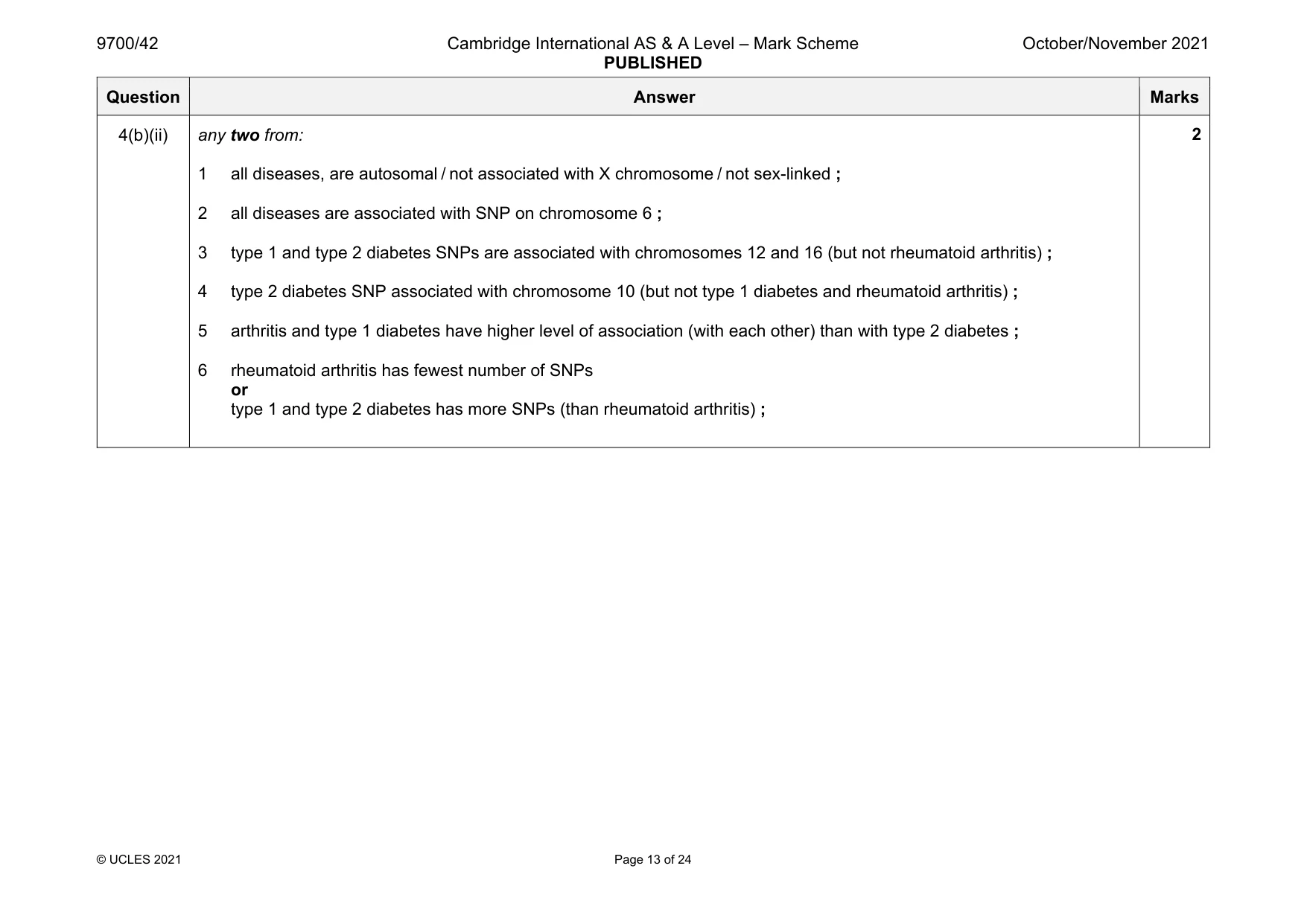
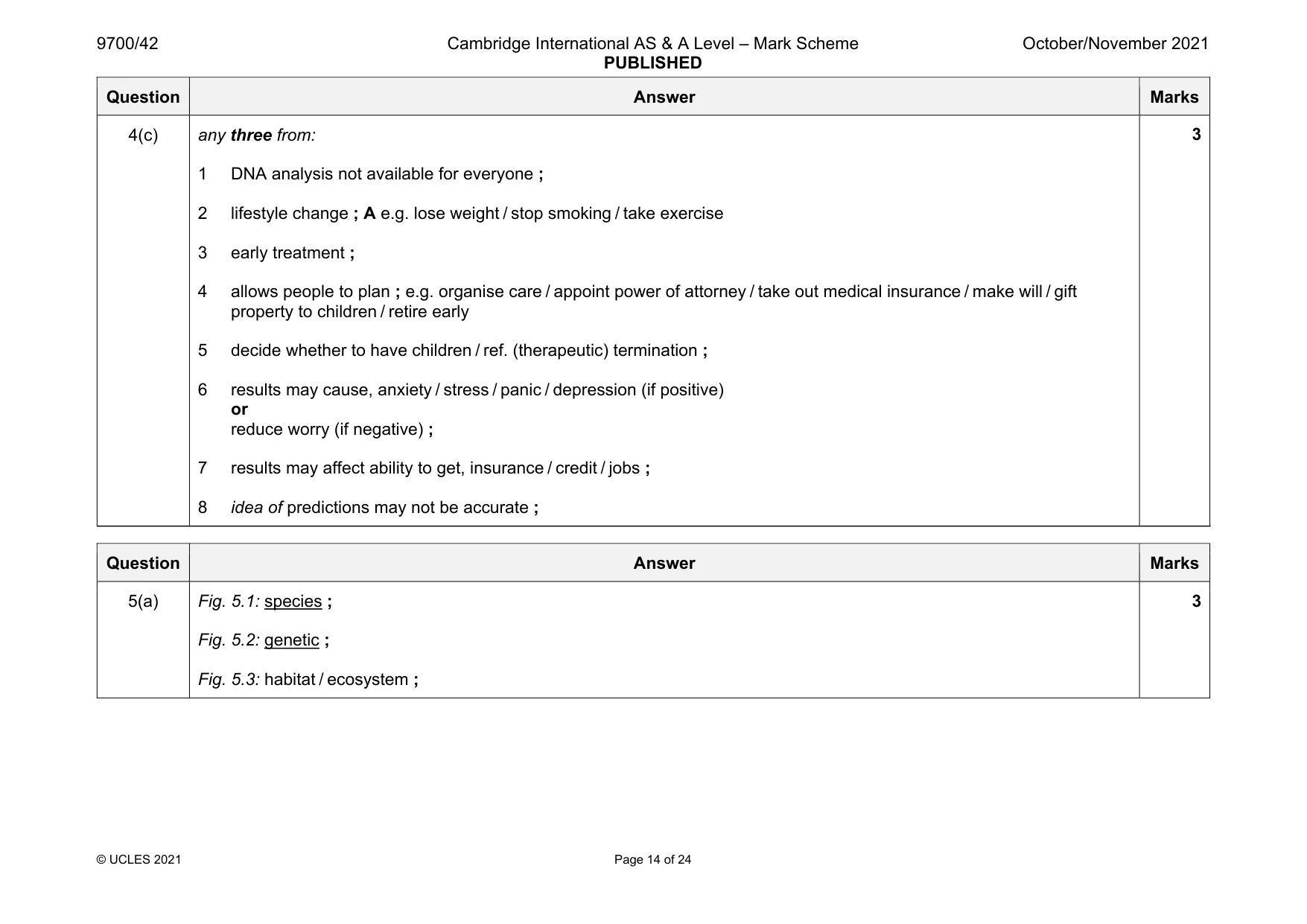
Mark scheme: 4(a)(i) any four from: 1 obtain single-stranded DNA ; 2 label DNA with fluorescent, dye / tag / label ; 3 probes on, chip / microarray ; 4 each probe is unique to a particular, SNP / gene / allele ; 5 DNA (added), binds / hybridises, to probes ; 6 wash off excess DNA (after hybridisation) ; 7 (view under) UV light / laser scanner / high resolution digital camera ; 8 fluorescence indicates presence of, SNP / gene ; R gene expressed 4(a)(ii) any two from: 1 large database ; 2 use database to find, SNPs / probes ; 3 fast / accurate / efficient ; 4 ref. to (computer) software / algorithms ; 5 ref. to statistics / statistical analysis ; 6 idea of, 17 000 × 500 000 / 8.5 × 10⁹, data points ; 2 4(b)(i) 1 and 6 ; 1 Question Answer Marks 4(b)(ii) any two from: 1 all diseases, are autosomal / not associated with X chromosome / not sex-linked ; 2 all diseases are associated with SNP on chromosome 6 ; 3 type 1 and type 2 diabetes SNPs are associated with chromosomes 12 and 16 (but not rheumatoid arthritis) ; 4 type 2 diabetes SNP associated with chromosome 10 (but not type 1 diabetes and rheumatoid arthritis) ; 5 arthritis and type 1 diabetes have higher level of association (with each other) than with type 2 diabetes ; 6 rheumatoid arthritis has fewest number of SNPs or type 1 and type 2 diabetes has more SNPs (than rheumatoid arthritis) ; 2 Question Answer Marks 4(c) any three from: 1 DNA analysis not available for everyone ; 2 lifestyle change ; A e.g. lose weight / stop smoking / take exercise 3 early treatment ; 4 allows people to plan ; e.g. organise care / appoint power of attorney / take out medical insurance / make will / gift property to children / retire early 5 decide whether to have children / ref. (therapeutic) termination ; 6 results may cause, anxiety / stress / panic / depression (if positive) or reduce worry (if negative) ; 7 results may affect ability to get, insurance / credit / jobs ; 8 idea of predictions may not be accurate ; 3
Q5 · Biodiversity can be considered at three different levels
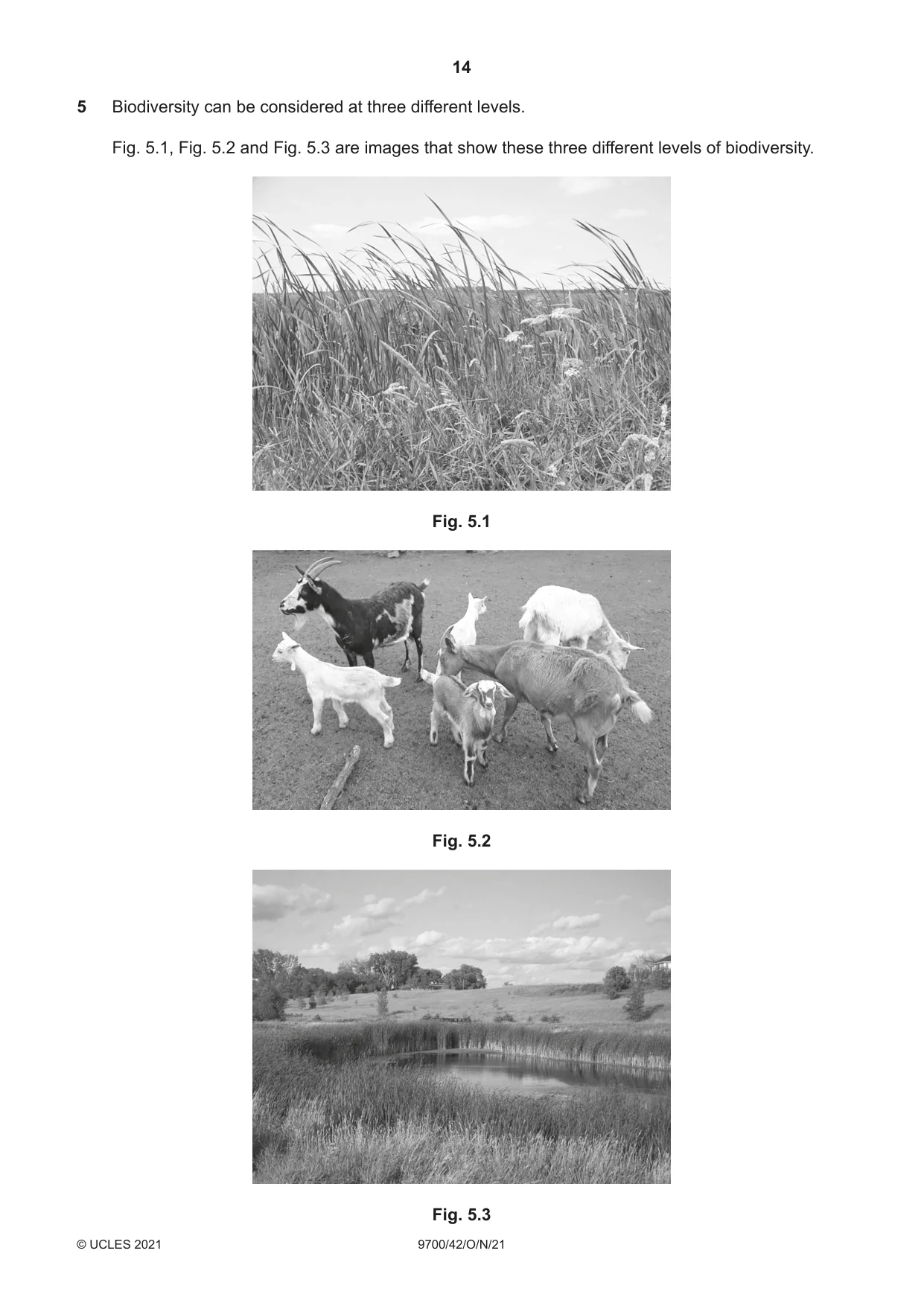
5 Biodiversity can be considered at three different levels. Fig. 5.1, Fig. 5.2 and Fig. 5.3 are images that show these three different levels of biodiversity. Fig. 5.1 Fig. 5.2 Fig. 5.3 (a) Describe the level of biodiversity most clearly visible in each image. Fig. 5.1 ...................................................................................................................................... Fig. 5.2 ...................................................................................................................................... Fig. 5.3 ...................................................................................................................................... [3] (b) Prairie strips are restored habitat areas planted with native grasses and wildflowers. Prairie strips are usually located between or around the edges of fields of maize or soy bean. Students in North America wanted to investigate biodiversity along a prairie strip. (i) Outline how the students could measure the biodiversity of plants and insects along a prairie strip. plants ................................................................................................................................. ........................................................................................................................................... ........................................................................................................................................... ........................................................................................................................................... insects ............................................................................................................................... ........................................................................................................................................... ........................................................................................................................................... ........................................................................................................................................... [4] (ii) Mathematical methods and statistical tests help to summarise and compare biodiversity data. Name the mathematical method or statistical test that the students can use: to estimate the total biodiversity of a prairie strip ........................................................................................................................................... to test whether plant biodiversity is associated with insect biodiversity. ........................................................................................................................................... [2] (c) Prairie strips have environmental and economic effects. Scientists have made long-term measurements of the environmental effects of prairie strips. The scientists found that when prairie strips formed 10% of a crop-field: • soil erosion decreased by 95% • mineral loss from the field decreased by 90% for phosphorus compounds • mineral loss from the field decreased by 85% for nitrogen compounds. Crop plants need phosphorus (P) and nitrogen (N) to grow. Evaluate the economic effects of prairie strips on farming. ................................................................................................................................................... ................................................................................................................................................... ................................................................................................................................................... ................................................................................................................................................... ................................................................................................................................................... ................................................................................................................................................... ................................................................................................................................................... ............................................................................................................................................. [3] [Total: 12] Question 6 starts on page 18.
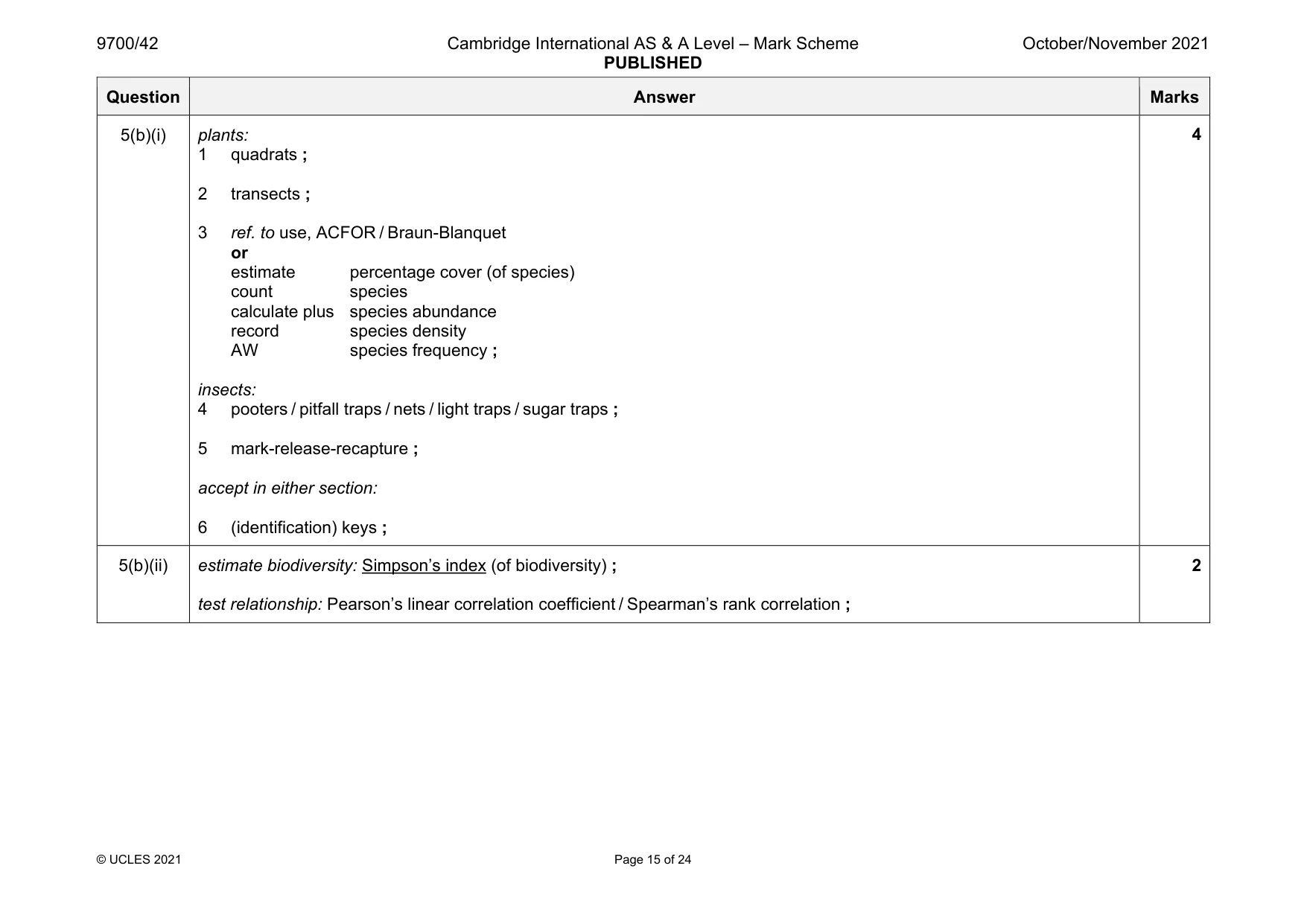
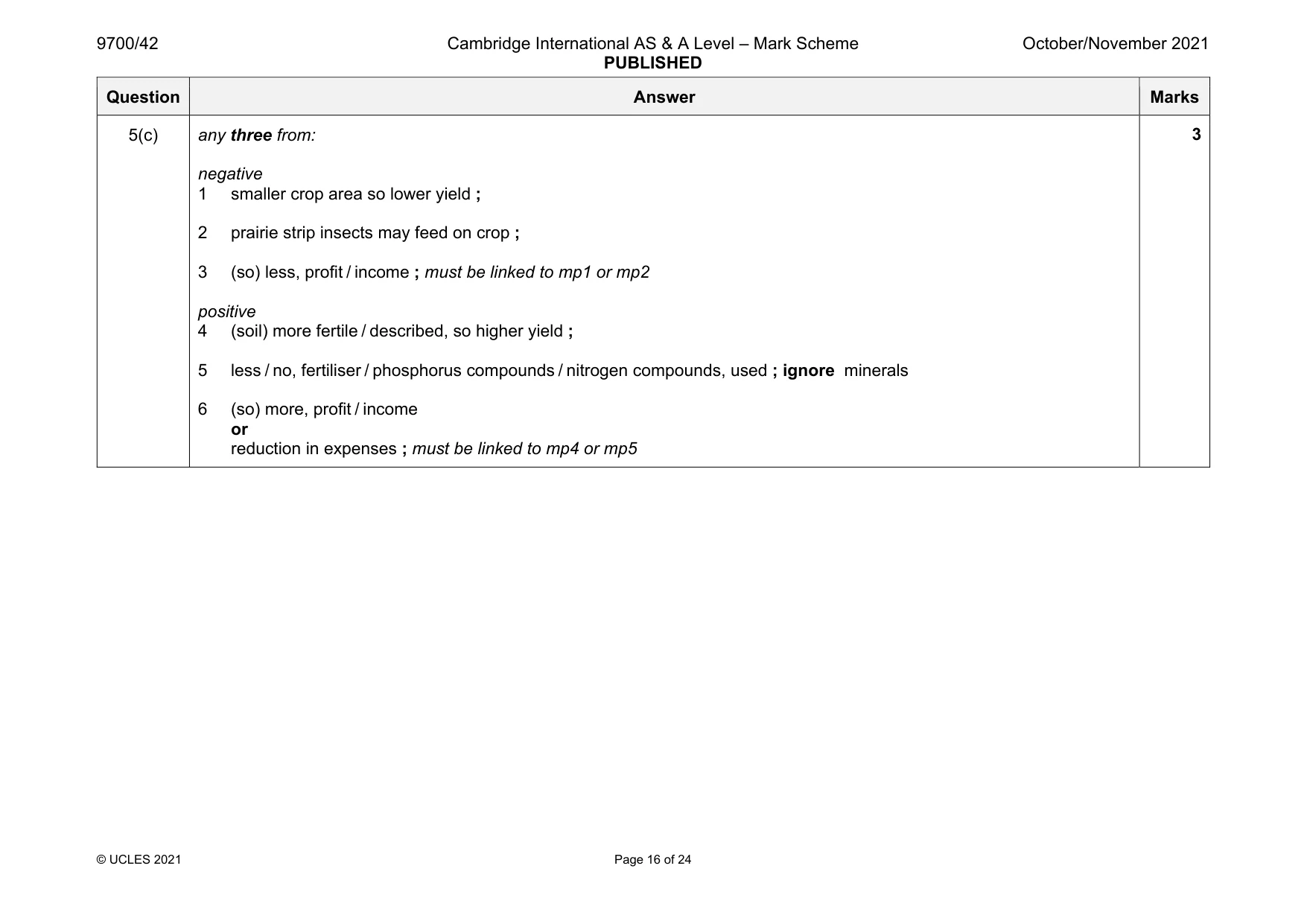
Mark scheme: 5(a) Fig. 5.1: species ; Fig. 5.2: genetic ; Fig. 5.3: habitat / ecosystem ; Question Answer Marks 5(b)(i) plants: 1 quadrats ; 2 transects ; 3 ref. to use, ACFOR / Braun-Blanquet or estimate percentage cover (of species) count species calculate plus species abundance record species density AW species frequency ; insects: 4 pooters / pitfall traps / nets / light traps / sugar traps ; 5 mark-release-recapture ; accept in either section: 6 (identification) keys ; 4 5(b)(ii) estimate biodiversity: Simpson’s index (of biodiversity) ; test relationship: Pearson’s linear correlation coefficient / Spearman’s rank correlation ; 2 Question Answer Marks 5(c) any three from: negative 1 smaller crop area so lower yield ; 2 prairie strip insects may feed on crop ; 3 (so) less, profit / income ; must be linked to mp1 or mp2 positive 4 (soil) more fertile / described, so higher yield ; 5 less / no, fertiliser / phosphorus compounds / nitrogen compounds, used ; ignore minerals 6 (so) more, profit / income or reduction in expenses ; must be linked to mp4 or mp5 3
Q6 · ATP is needed for many metabolic processes in living organisms
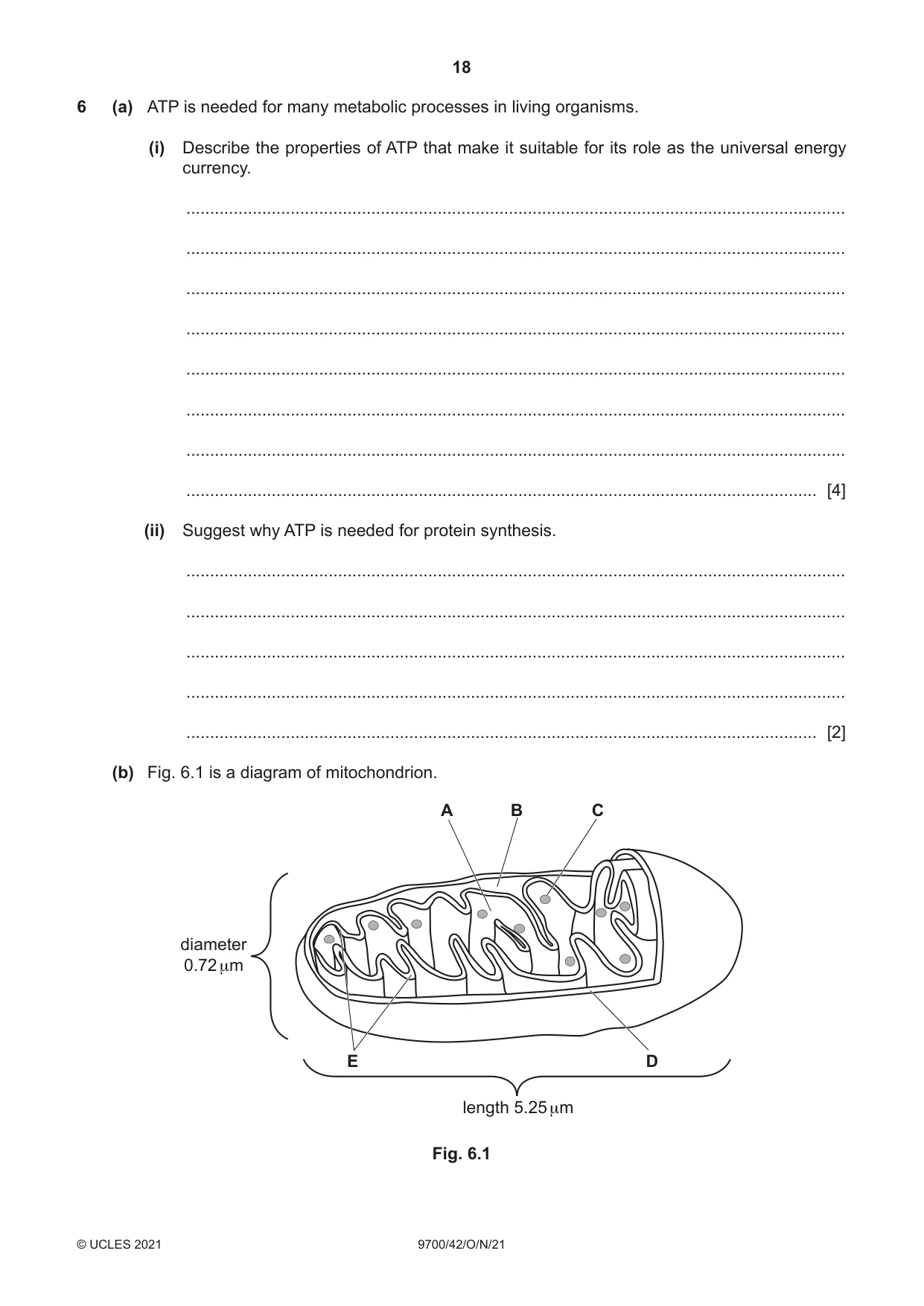
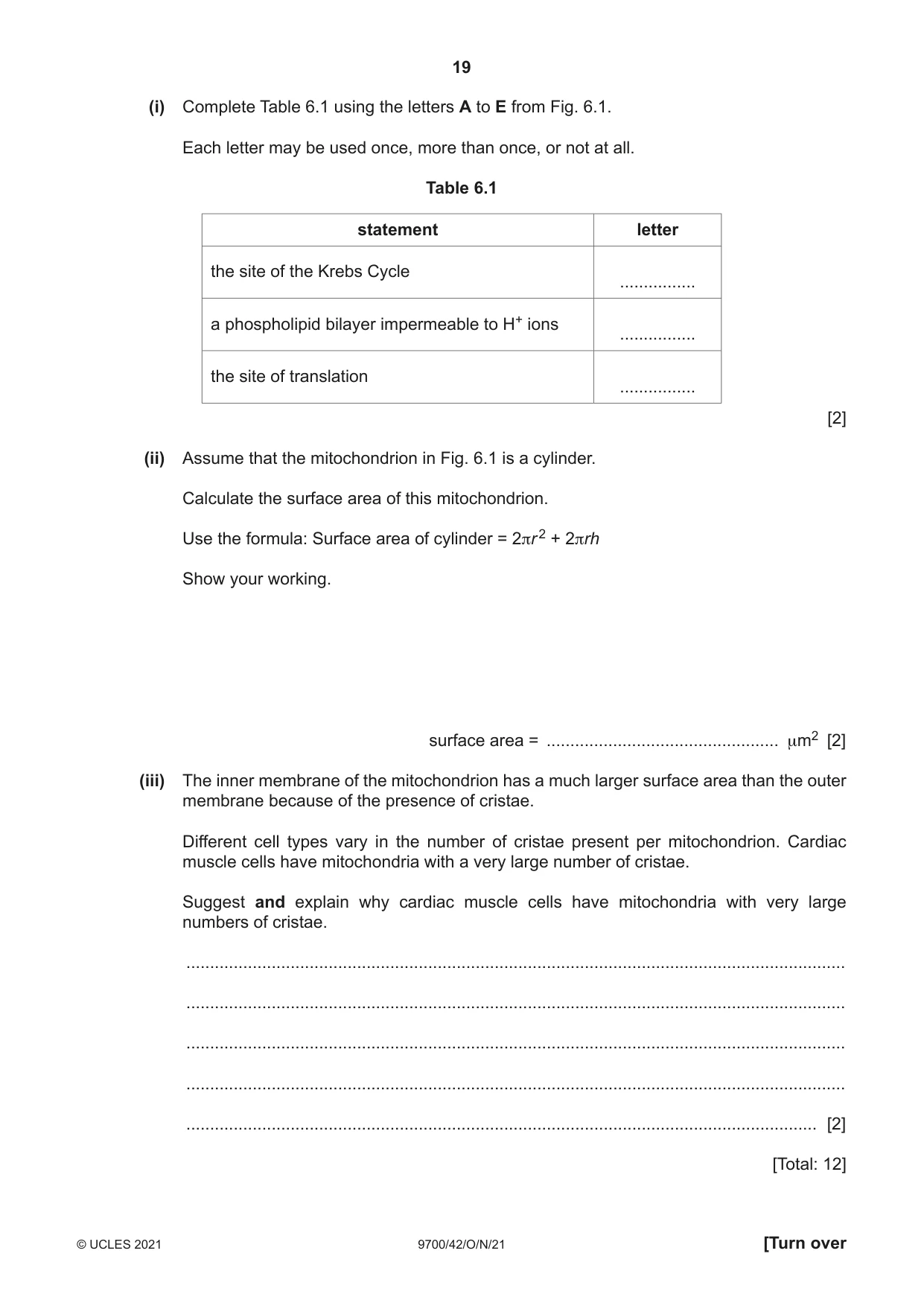
6 (a) ATP is needed for many metabolic processes in living organisms. (i) Describe the properties of ATP that make it suitable for its role as the universal energy currency. ........................................................................................................................................... ........................................................................................................................................... ........................................................................................................................................... ........................................................................................................................................... ........................................................................................................................................... ........................................................................................................................................... ........................................................................................................................................... ..................................................................................................................................... [4] (ii) Suggest why ATP is needed for protein synthesis. ........................................................................................................................................... ........................................................................................................................................... ........................................................................................................................................... ........................................................................................................................................... ..................................................................................................................................... [2] (b) Fig. 6.1 is a diagram of mitochondrion. A B C diameter 0.72 μm E D length 5.25 μm Fig. 6.1 (i) Complete Table 6.1 using the letters A to E from Fig. 6.1. Each letter may be used once, more than once, or not at all. Table 6.1 statement letter the site of the Krebs Cycle ................ a phospholipid bilayer impermeable to H+ ions ................ the site of translation ................ [2] (ii) Assume that the mitochondrion in Fig. 6.1 is a cylinder. Calculate the surface area of this mitochondrion. Use the formula: Surface area of cylinder = 2πr 2 + 2πrh Show your working. surface area = ................................................. µm2 [2] (iii) The inner membrane of the mitochondrion has a much larger surface area than the outer membrane because of the presence of cristae. Different cell types vary in the number of cristae present per mitochondrion. Cardiac muscle cells have mitochondria with a very large number of cristae. Suggest and explain why cardiac muscle cells have mitochondria with very large numbers of cristae. ........................................................................................................................................... ........................................................................................................................................... ........................................................................................................................................... ........................................................................................................................................... ..................................................................................................................................... [2] [Total: 12]
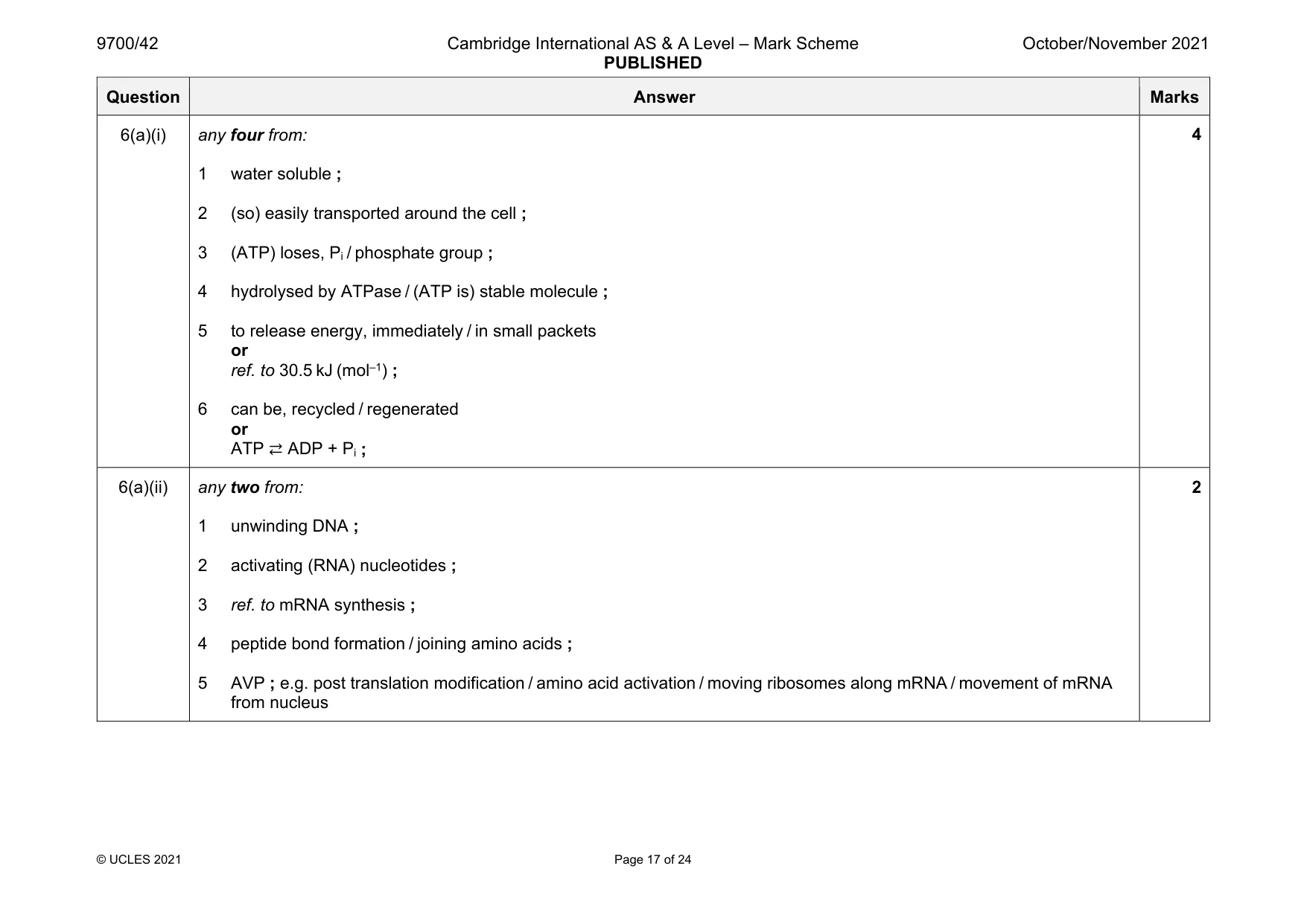
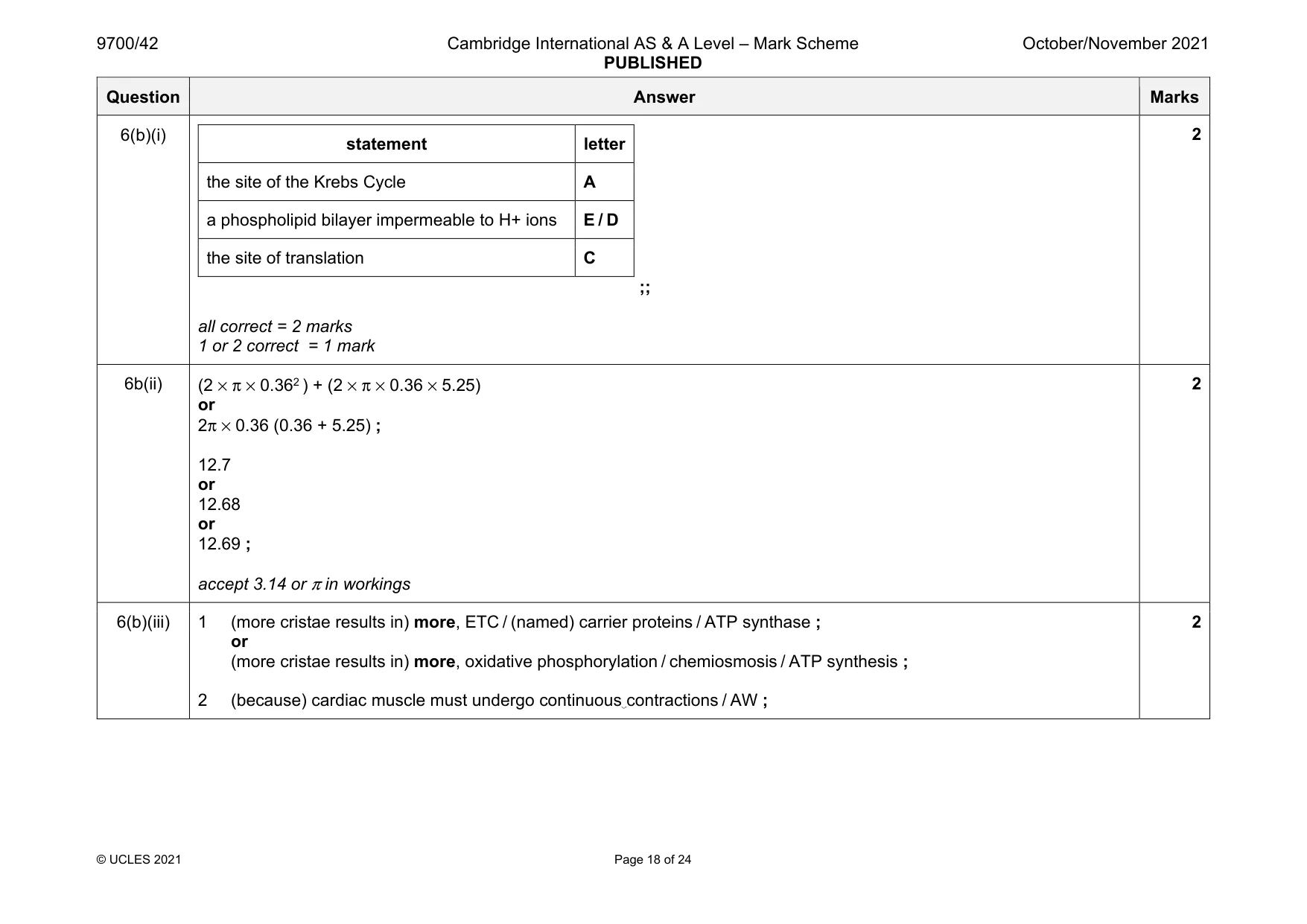
Mark scheme: 6(a)(i) any four from: 1 water soluble ; 2 (so) easily transported around the cell ; 3 (ATP) loses, Pi / phosphate group ; 4 hydrolysed by ATPase / (ATP is) stable molecule ; 5 to release energy, immediately / in small packets or ref. to 30.5 kJ (mol–1) ; 6 can be, recycled / regenerated or ATP ⇄ ADP + Pi ; 6(a)(ii) any two from: 1 unwinding DNA ; 2 activating (RNA) nucleotides ; 3 ref. to mRNA synthesis ; 4 peptide bond formation / joining amino acids ; 5 AVP ; e.g. post translation modification / amino acid activation / moving ribosomes along mRNA / movement of mRNA from nucleus 2 Question Answer Marks 6(b)(i) statement letter the site of the Krebs Cycle A a phospholipid bilayer impermeable to H+ ions E / D the site of translation C ;; all correct = 2 marks 1 or 2 correct = 1 mark 2 6b(ii) (2 × π × 0.362 ) + (2 × π × 0.36 × 5.25) or 2π × 0.36 (0.36 + 5.25) ; 12.7 or 12.68 or 12.69 ; accept 3.14 or π in workings 2 6(b)(iii) 1 (more cristae results in) more, ETC / (named) carrier proteins / ATP synthase ; or (more cristae results in) more, oxidative phosphorylation / chemiosmosis / ATP synthesis ; 2 (because) cardiac muscle must undergo continuous contractions / AW ; 2
Q7 · The Labrador is a variety of domestic dog
7 (a) The Labrador is a variety of domestic dog. Labradors have fur that can be brown, black or yellow. In Labradors, TYRP1 is one gene that codes for fur colour. This gene has two alleles, B and b. • The dominant allele, B, codes for the enzyme tyrosinase that functions in the pathway to produce melanin, leading to black fur. • The production of melanin in Labradors is very similar to the production of melanin in humans. • The recessive allele, b, codes for an enzyme that results in the production of a brown form of melanin, leading to brown fur. Outline how melanin may be produced in Labradors to produce black fur. ................................................................................................................................................... ................................................................................................................................................... ................................................................................................................................................... ................................................................................................................................................... ............................................................................................................................................. [2] (b) Another gene, MC1R, interacts with TYRP1. MC1R has two alleles, E and e. • The dominant allele, E, allows the alleles of TYRP1 to be expressed. • The recessive allele, e, prevents the alleles of TYRP1 from being expressed. • When no form of melanin is produced the Labrador will have yellow fur. (i) Construct a genetic diagram to show the ratio of possible offspring from a cross between a black male Labrador, heterozygous for both genes, and a yellow female Labrador, heterozygous for TYRP1. parental black × yellow phenotype parental genotype gametes offspring genotypes offspring phenotypes ratio ................................................................................................................................... [6] (ii) State the term used to describe a protein that is involved in the control of gene expression in eukaryotes. ..................................................................................................................................... [1] [Total: 9]
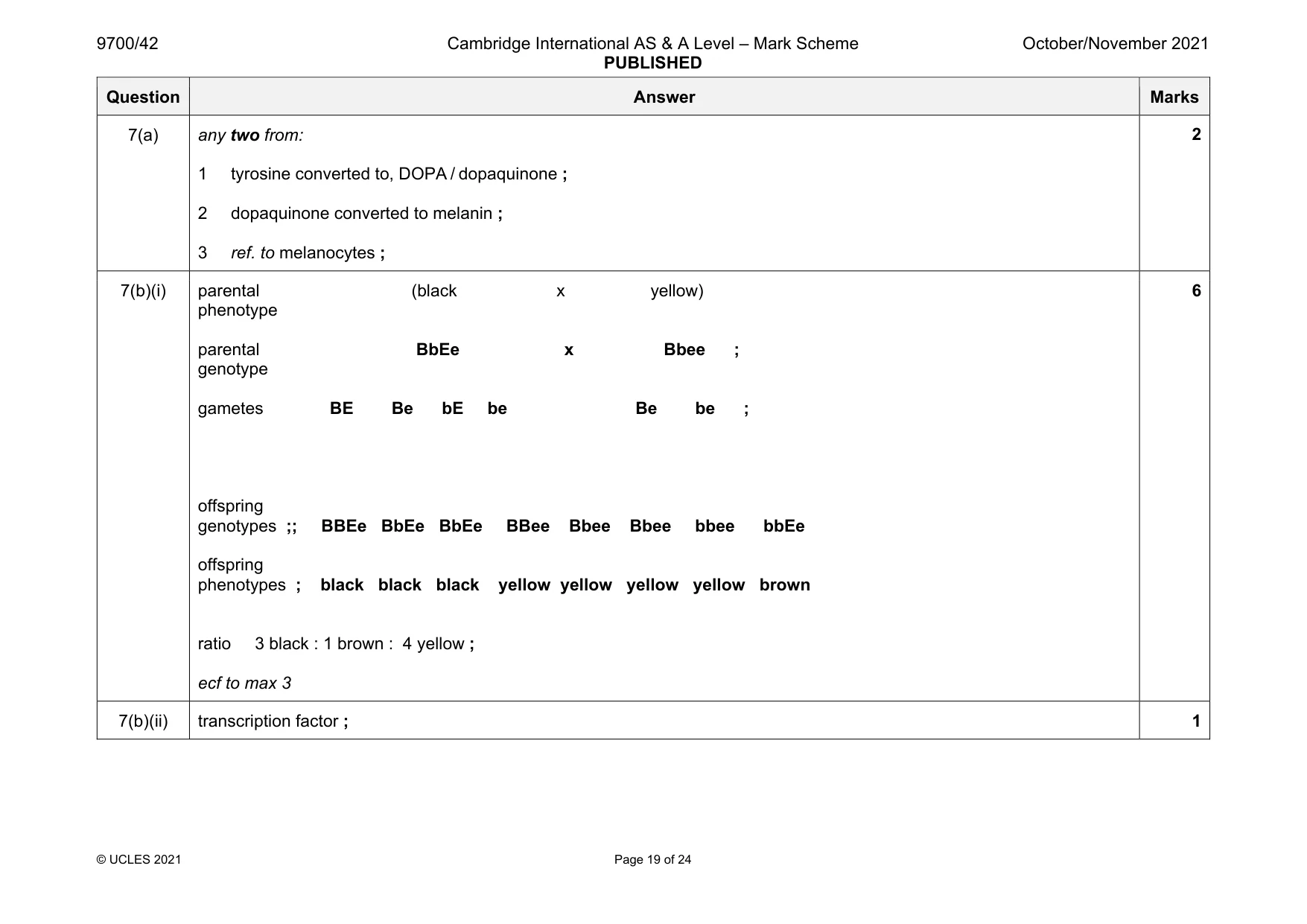
Mark scheme: 7(a) any two from: 1 tyrosine converted to, DOPA / dopaquinone ; 2 dopaquinone converted to melanin ; 3 ref. to melanocytes ; 7(b)(i) parental (black x yellow) phenotype parental BbEe x Bbee ; genotype gametes BE Be bE be Be be ; offspring genotypes ;; BBEe BbEe BbEe BBee Bbee Bbee bbee bbEe offspring phenotypes ; black black black yellow yellow yellow yellow brown ratio 3 black : 1 brown : 4 yellow ; ecf to max 3 6 7(b)(ii) transcription factor ; 1
More questions on Passage of information from parents to offspring
Q8 · Twenty million years ago, an ocean covered the area where the country of Panama is now…
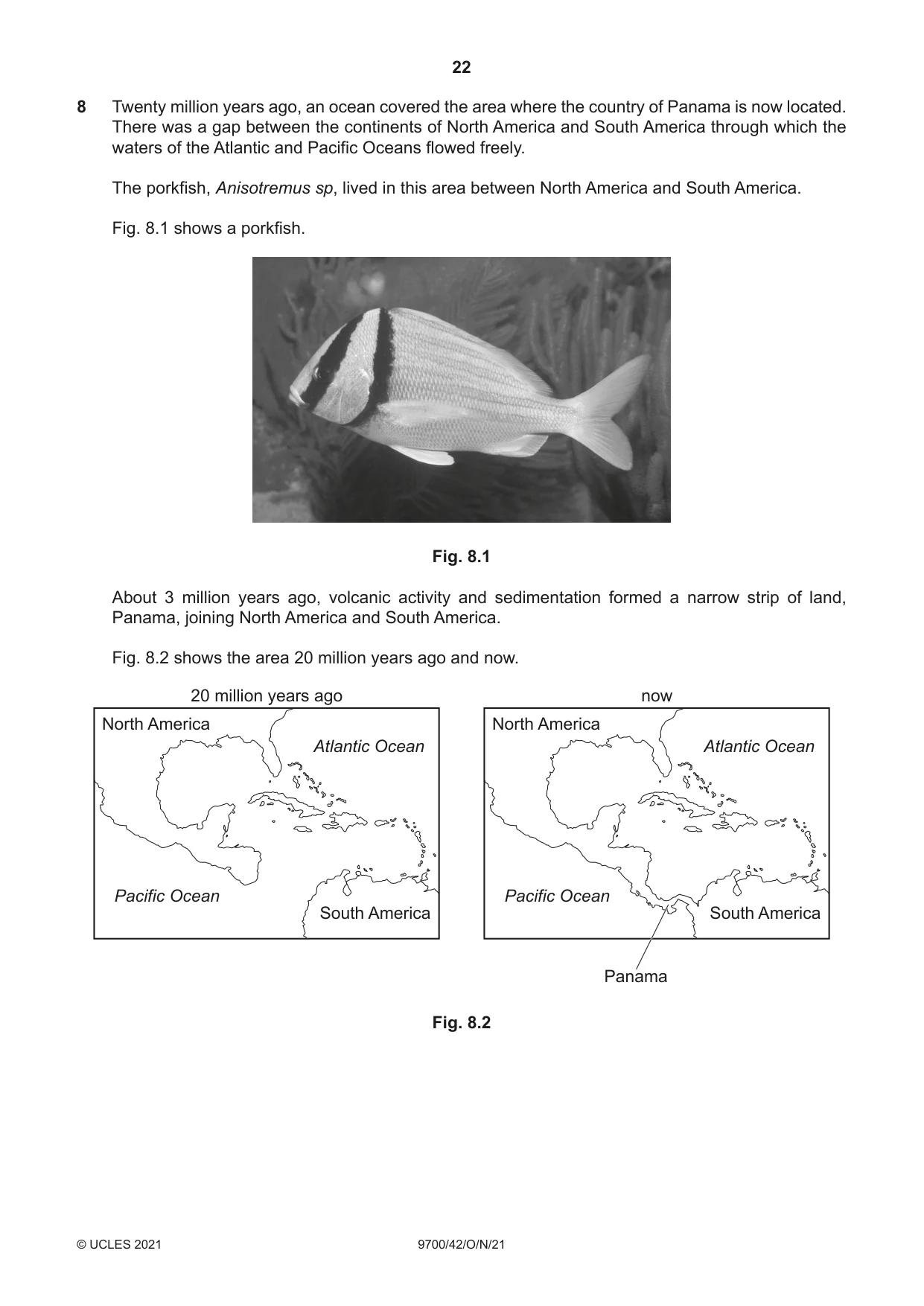
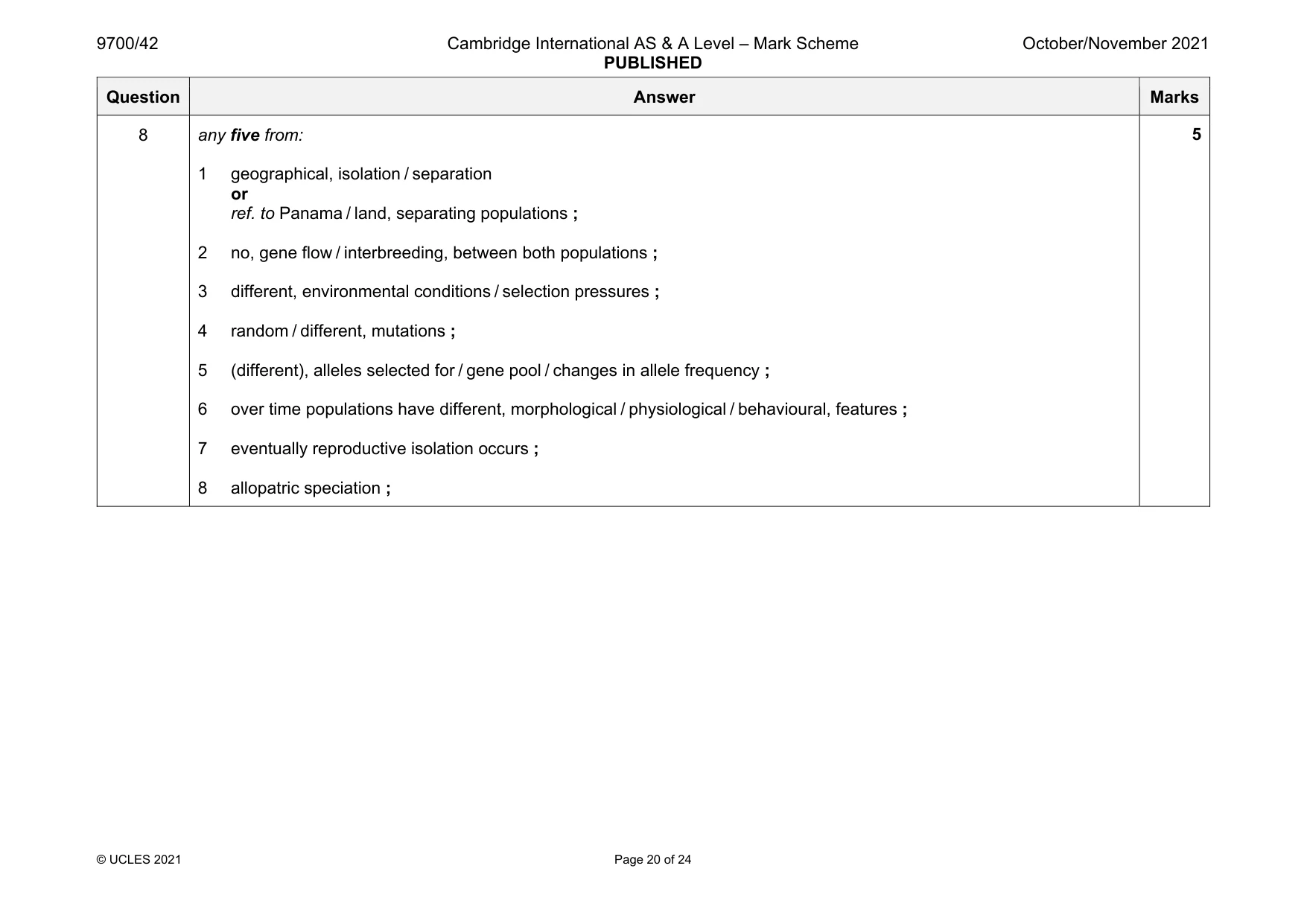
8 Twenty million years ago, an ocean covered the area where the country of Panama is now located. There was a gap between the continents of North America and South America through which the waters of the Atlantic and Pacific Oceans flowed freely. The porkfish, Anisotremus sp, lived in this area between North America and South America. Fig. 8.1 shows a porkfish. Fig. 8.1 About 3 million years ago, volcanic activity and sedimentation formed a narrow strip of land, Panama, joining North America and South America. Fig. 8.2 shows the area 20 million years ago and now. 20 million years ago now North America North America Atlantic Ocean Atlantic Ocean Pacific Ocean Pacific Ocean South America South America Panama Fig. 8.2 Twenty million years ago, porkfish in the Atlantic and Pacific Oceans were able to breed successfully and produce fertile offspring. Explain why Atlantic porkfish and Pacific porkfish are now not able to breed successfully to produce fertile offspring. .......................................................................................................................................................... .......................................................................................................................................................... .......................................................................................................................................................... .......................................................................................................................................................... .......................................................................................................................................................... .......................................................................................................................................................... .......................................................................................................................................................... .......................................................................................................................................................... .......................................................................................................................................................... .................................................................................................................................................... [5] [Total: 5]
Mark scheme: 8 any five from: 1 geographical, isolation / separation or ref. to Panama / land, separating populations ; 2 no, gene flow / interbreeding, between both populations ; 3 different, environmental conditions / selection pressures ; 4 random / different, mutations ; 5 (different), alleles selected for / gene pool / changes in allele frequency ; 6 over time populations have different, morphological / physiological / behavioural, features ; 7 eventually reproductive isolation occurs ; 8 allopatric speciation ;
Q9 · Describe the roles of ADH and the collecting ducts in osmoregulation
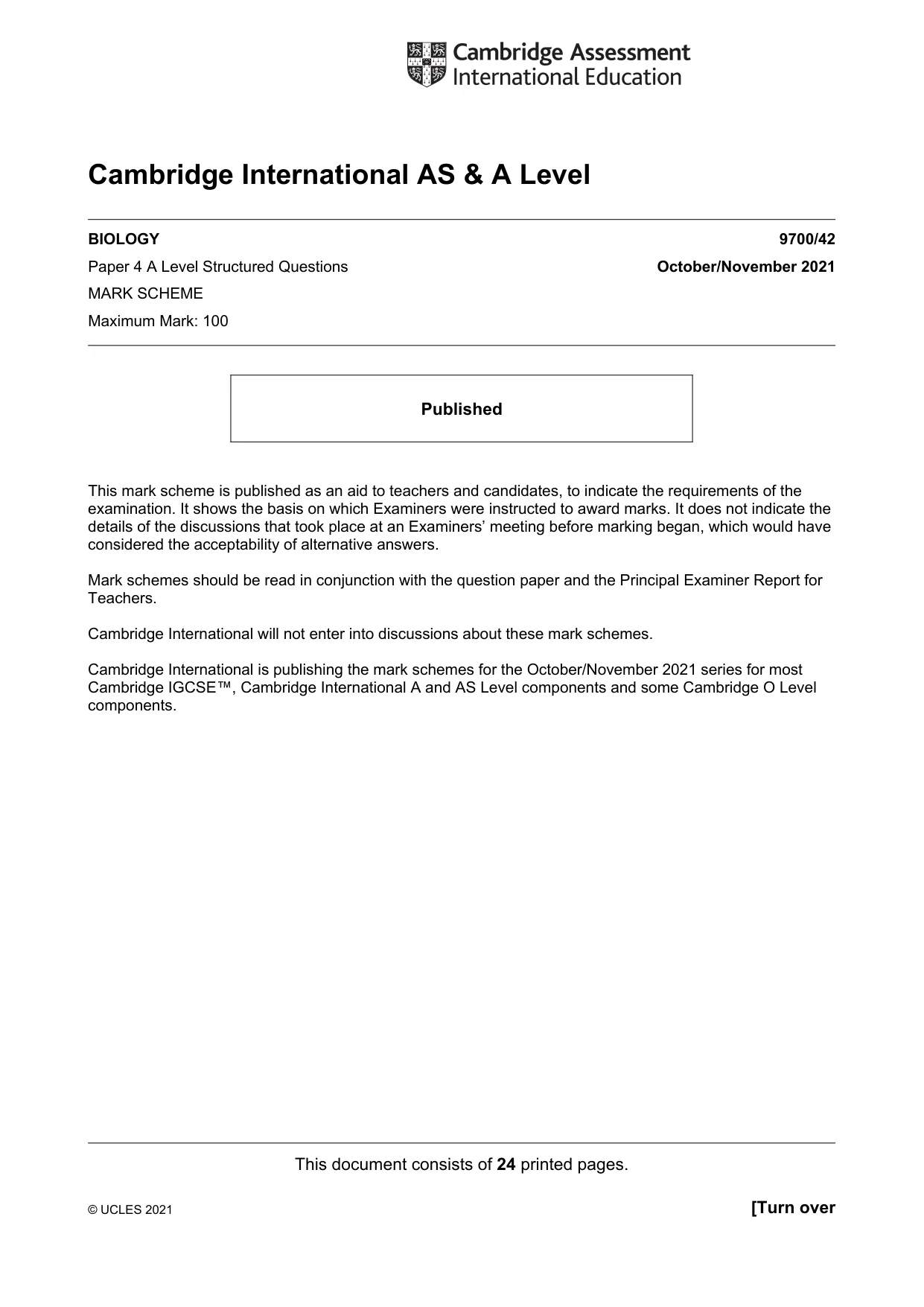
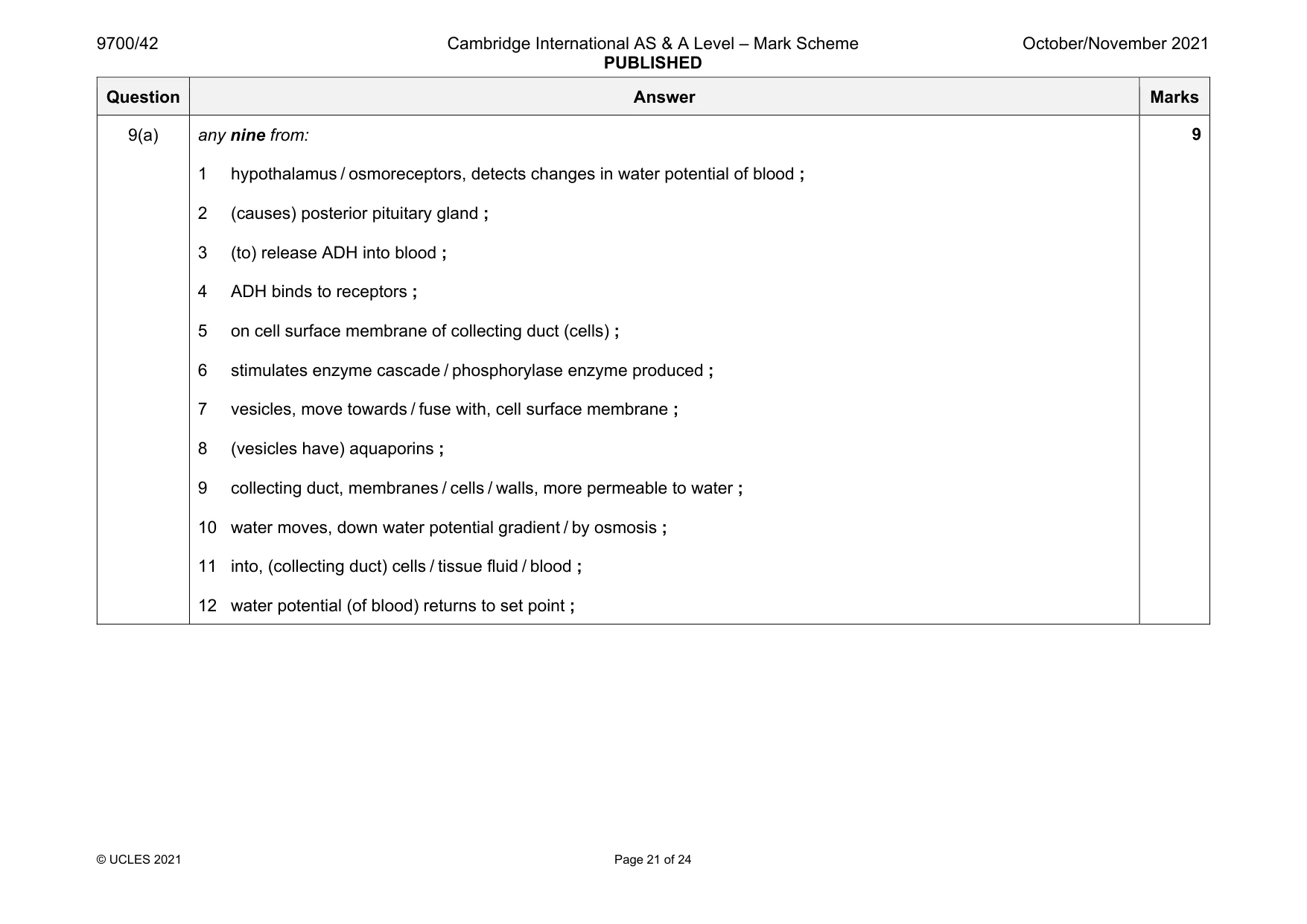
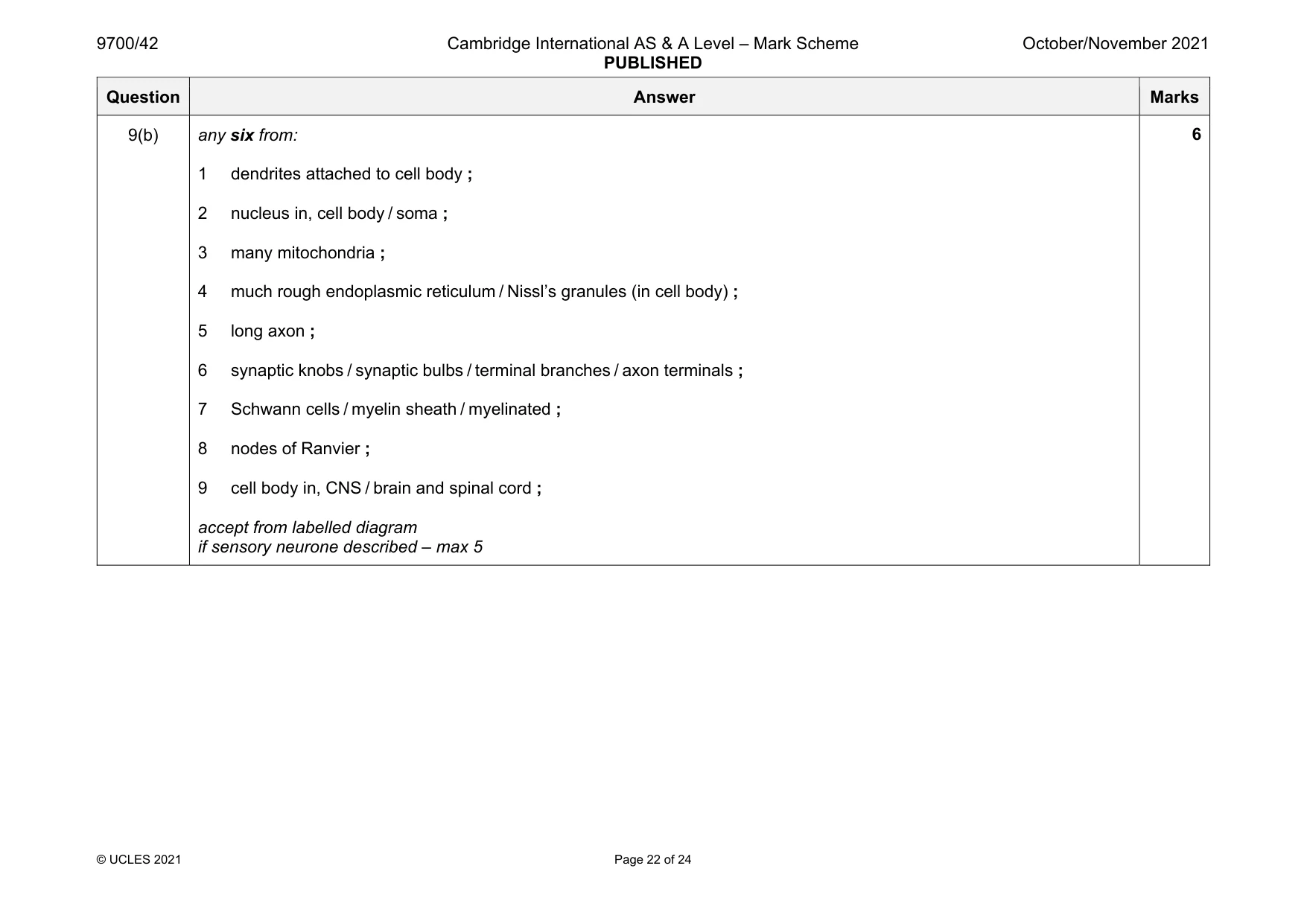
9 (a) Describe the roles of ADH and the collecting ducts in osmoregulation. [9] (b) Describe the structure of a motor neurone. [6] [Total: 15]
Mark scheme: 9(a) any nine from: 1 hypothalamus / osmoreceptors, detects changes in water potential of blood ; 2 (causes) posterior pituitary gland ; 3 (to) release ADH into blood ; 4 ADH binds to receptors ; 5 on cell surface membrane of collecting duct (cells) ; 6 stimulates enzyme cascade / phosphorylase enzyme produced ; 7 vesicles, move towards / fuse with, cell surface membrane ; 8 (vesicles have) aquaporins ; 9 collecting duct, membranes / cells / walls, more permeable to water ; 10 water moves, down water potential gradient / by osmosis ; 11 into, (collecting duct) cells / tissue fluid / blood ; 12 water potential (of blood) returns to set point ; Question Answer Marks 9(b) any six from: 1 dendrites attached to cell body ; 2 nucleus in, cell body / soma ; 3 many mitochondria ; 4 much rough endoplasmic reticulum / Nissl’s granules (in cell body) ; 5 long axon ; 6 synaptic knobs / synaptic bulbs / terminal branches / axon terminals ; 7 Schwann cells / myelin sheath / myelinated ; 8 nodes of Ranvier ; 9 cell body in, CNS / brain and spinal cord ; accept from labelled diagram if sensory neurone described – max 5 6
Q10 · Explain how dip sticks function to test for glucose in a sample of urine
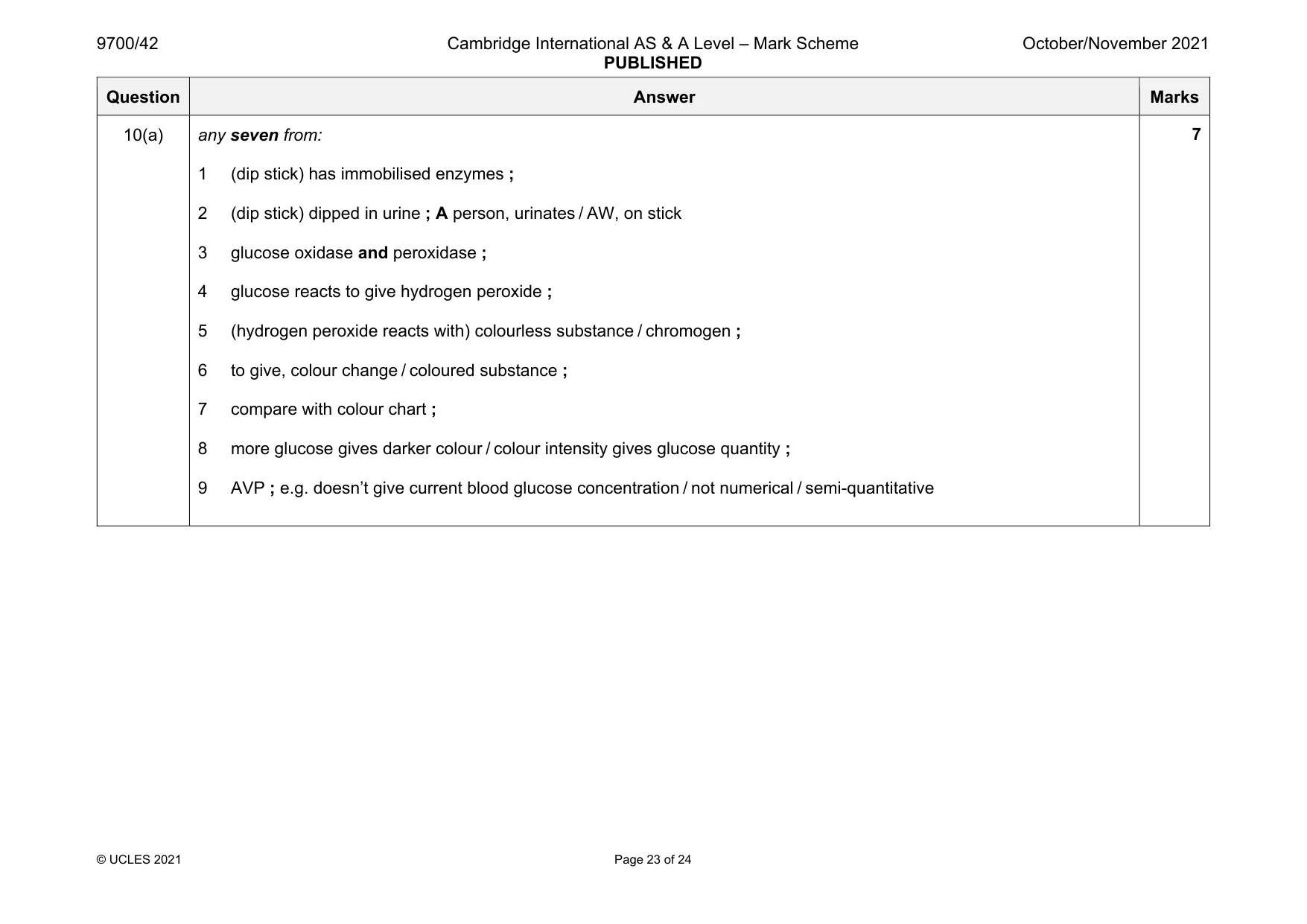
10 (a) Explain how dip sticks function to test for glucose in a sample of urine. [7] (b) Explain the control of gibberellin synthesis and outline how gibberellin stimulates stem elongation. [8] [Total: 15] .................................................................................................................................................................. .................................................................................................................................................................. .................................................................................................................................................................. .................................................................................................................................................................. .................................................................................................................................................................. .................................................................................................................................................................. .................................................................................................................................................................. .................................................................................................................................................................. .................................................................................................................................................................. .................................................................................................................................................................. .................................................................................................................................................................. .................................................................................................................................................................. .................................................................................................................................................................. .................................................................................................................................................................. .................................................................................................................................................................. .................................................................................................................................................................. .................................................................................................................................................................. .................................................................................................................................................................. .................................................................................................................................................................. .................................................................................................................................................................. .................................................................................................................................................................. .................................................................................................................................................................. .................................................................................................................................................................. .................................................................................................................................................................. .................................................................................................................................................................. .................................................................................................................................................................. .................................................................................................................................................................. .................................................................................................................................................................. .................................................................................................................................................................. .................................................................................................................................................................. .................................................................................................................................................................. .................................................................................................................................................................. .................................................................................................................................................................. .................................................................................................................................................................. .................................................................................................................................................................. .................................................................................................................................................................. .................................................................................................................................................................. .................................................................................................................................................................. .................................................................................................................................................................. .................................................................................................................................................................. .................................................................................................................................................................. .................................................................................................................................................................. .................................................................................................................................................................. .................................................................................................................................................................. .................................................................................................................................................................. .................................................................................................................................................................. .................................................................................................................................................................. .................................................................................................................................................................. .................................................................................................................................................................. .................................................................................................................................................................. .................................................................................................................................................................. .................................................................................................................................................................. .................................................................................................................................................................. .................................................................................................................................................................. .................................................................................................................................................................. .................................................................................................................................................................. .................................................................................................................................................................. .................................................................................................................................................................. .................................................................................................................................................................. .................................................................................................................................................................. .................................................................................................................................................................. .................................................................................................................................................................. .................................................................................................................................................................. .................................................................................................................................................................. .................................................................................................................................................................. .................................................................................................................................................................. .................................................................................................................................................................. .................................................................................................................................................................. .................................................................................................................................................................. .................................................................................................................................................................. .................................................................................................................................................................. .................................................................................................................................................................. ..................................................................................................................................................................
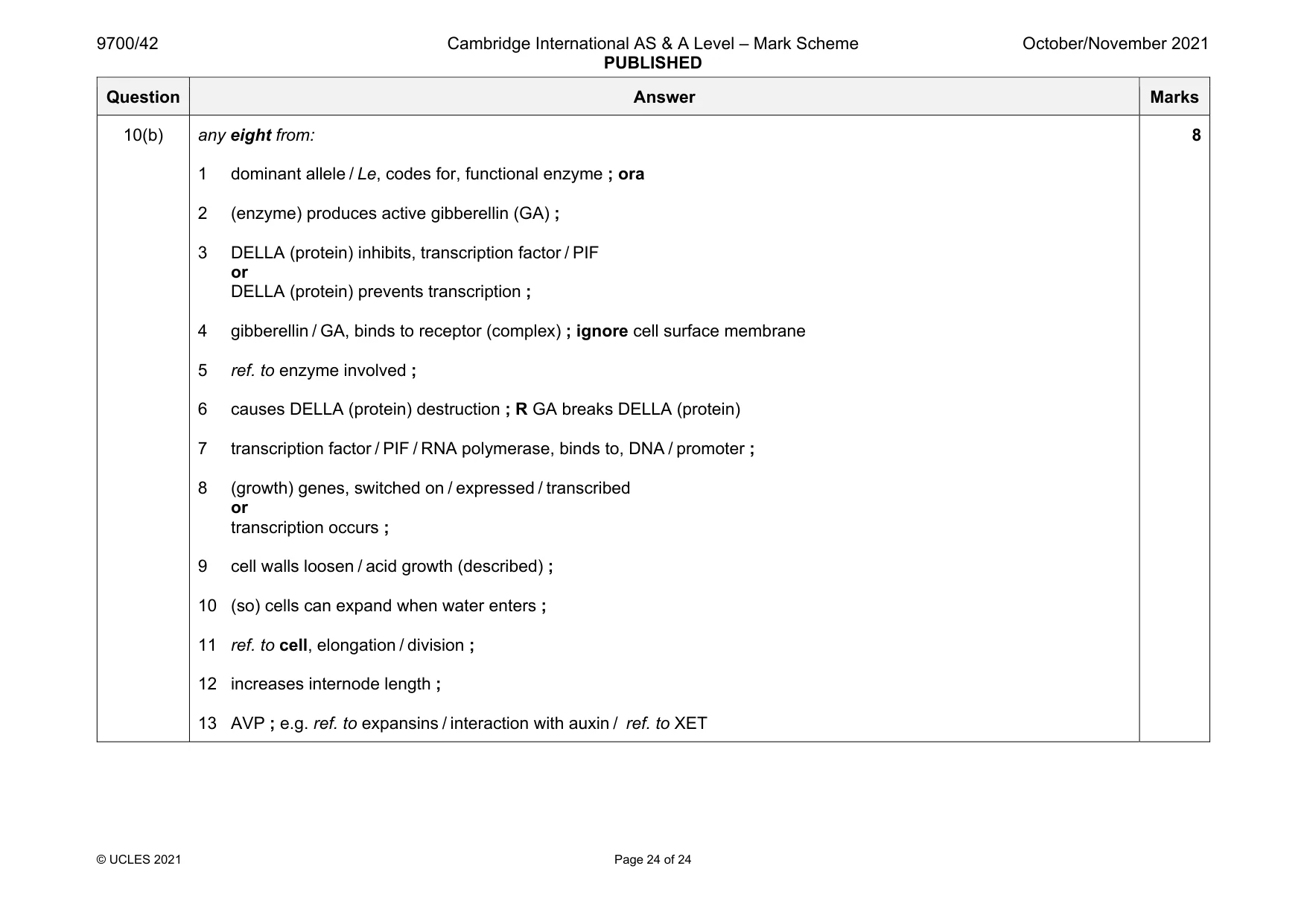
Mark scheme: 10(a) any seven from: 1 (dip stick) has immobilised enzymes ; 2 (dip stick) dipped in urine ; A person, urinates / AW, on stick 3 glucose oxidase and peroxidase ; 4 glucose reacts to give hydrogen peroxide ; 5 (hydrogen peroxide reacts with) colourless substance / chromogen ; 6 to give, colour change / coloured substance ; 7 compare with colour chart ; 8 more glucose gives darker colour / colour intensity gives glucose quantity ; 9 AVP ; e.g. doesn’t give current blood glucose concentration / not numerical / semi-quantitative Question Answer Marks 10(b) any eight from: 1 dominant allele / Le, codes for, functional enzyme ; ora 2 (enzyme) produces active gibberellin (GA) ; 3 DELLA (protein) inhibits, transcription factor / PIF or DELLA (protein) prevents transcription ; 4 gibberellin / GA, binds to receptor (complex) ; ignore cell surface membrane 5 ref. to enzyme involved ; 6 causes DELLA (protein) destruction ; R GA breaks DELLA (protein) 7 transcription factor / PIF / RNA polymerase, binds to, DNA / promoter ; 8 (growth) genes, switched on / expressed / transcribed or transcription occurs ; 9 cell walls loosen / acid growth (described) ; 10 (so) cells can expand when water enters ; 11 ref. to cell, elongation / division ; 12 increases internode length ; 13 AVP ; e.g. ref. to expansins / interaction with auxin / ref. to XET 8
What was in this paper
The subtopics covered by these 10 questions, and how many questions each got. Open one in a new tab to see every Cambridge question on it.
What you needed in this session
Cambridge’s own grade thresholds for 2021 Oct/Nov, Paper 4 · Variant 2. A higher threshold means an easier paper — the bar moves with how the cohort did.