Cambridge A Level Biology 9700 — 2021 Oct/Nov Paper 4 · Variant 3
9700/43/O/N/21 · 10 questions · 100 marks · ≈113 min
The question paper and its mark scheme, free to read here and free to download. This is Cambridge’s own paper, exactly as it was sat.
Question paper24 pages




Mark scheme21 pages
Answers below. Sit the paper first if you are practising.
Questions as text
Q1 · A diagram of a kidney nephron and some of its blood vessels
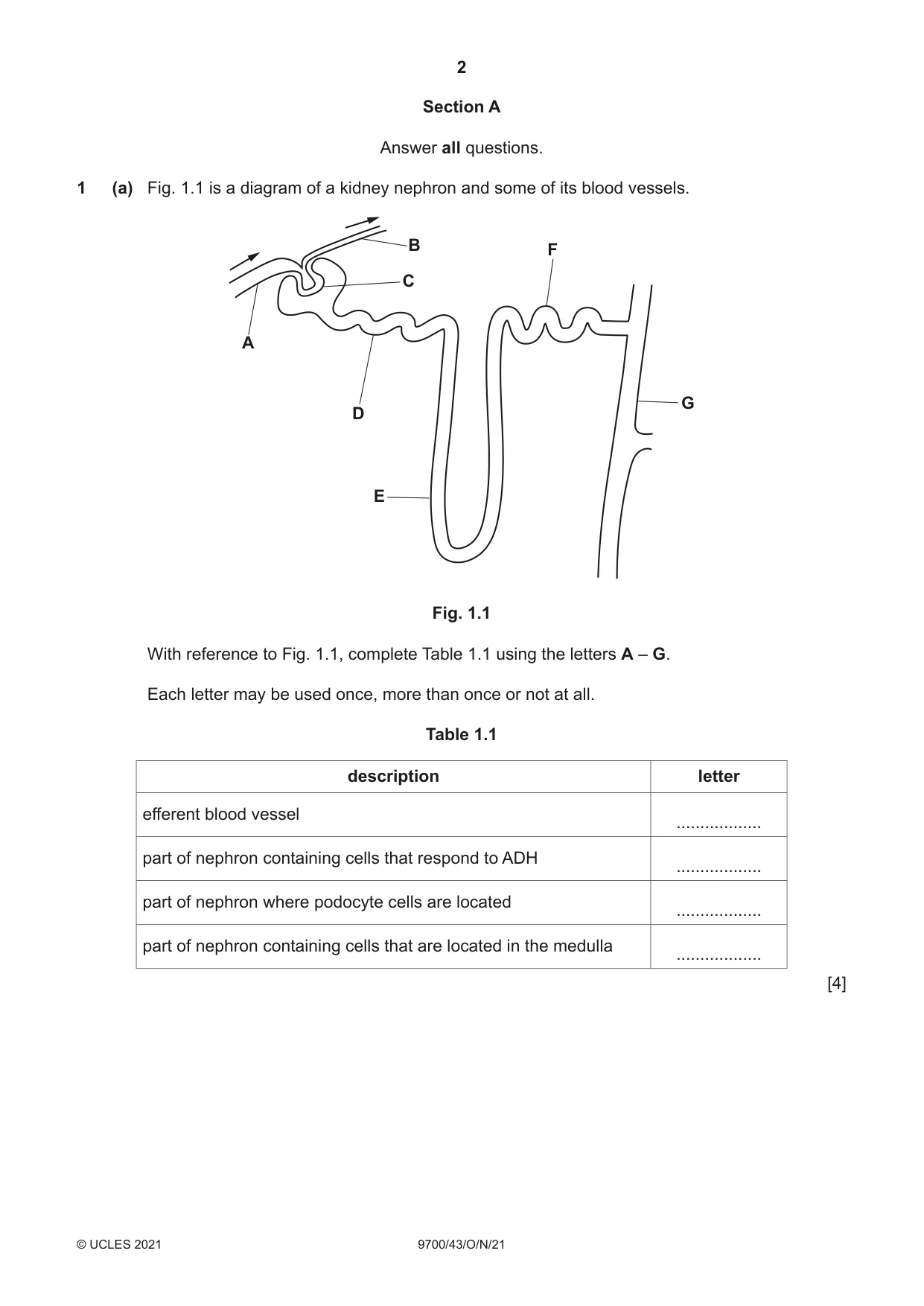
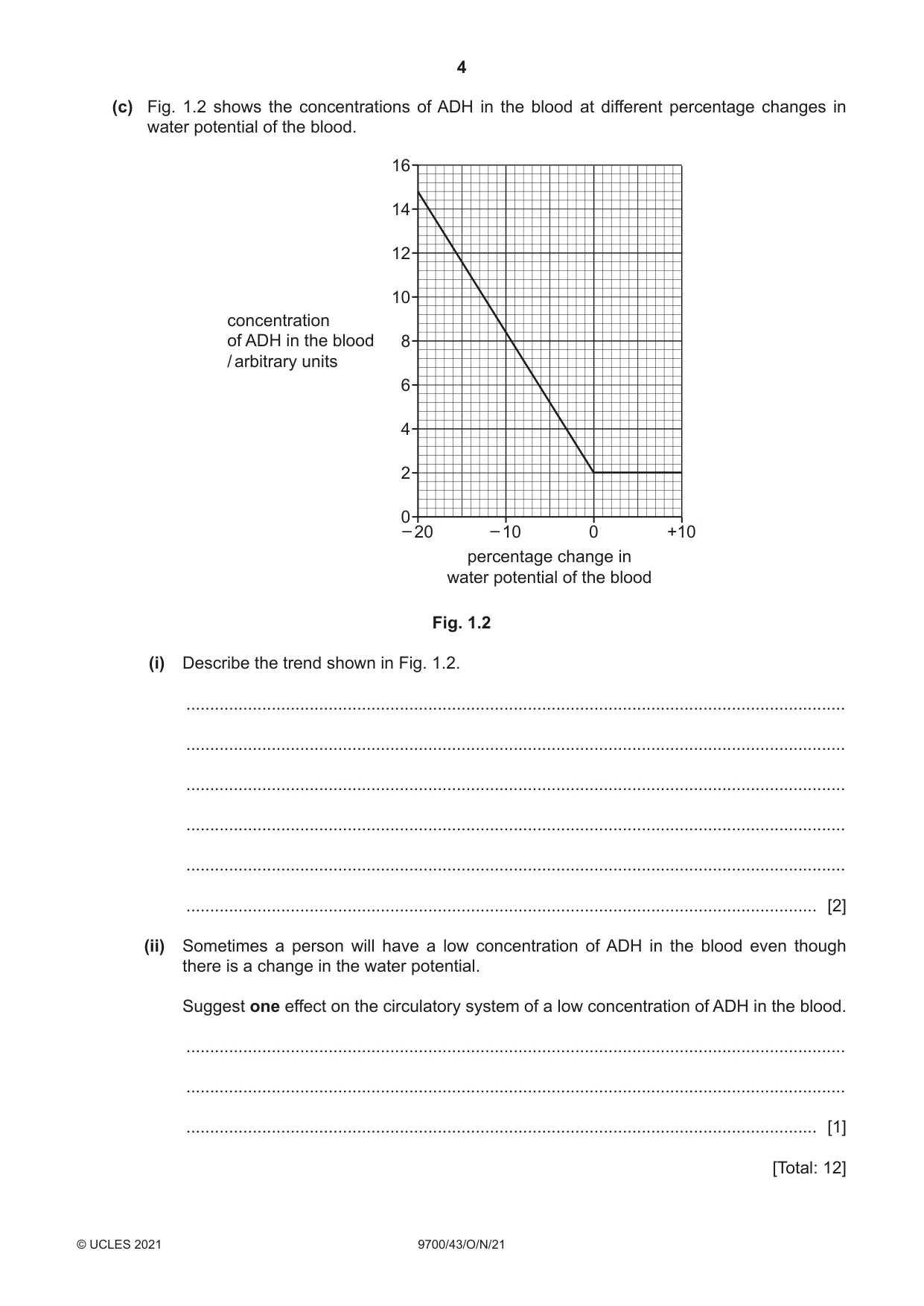
1 (a) Fig. 1.1 is a diagram of a kidney nephron and some of its blood vessels. B F C A G D E Fig. 1.1 With reference to Fig. 1.1, complete Table 1.1 using the letters A – G. Each letter may be used once, more than once or not at all. Table 1.1 description letter efferent blood vessel .................. part of nephron containing cells that respond to ADH .................. part of nephron where podocyte cells are located .................. part of nephron containing cells that are located in the medulla .................. [4] (b) Describe and explain how the cells of the proximal convoluted tubule are adapted to carry out selective reabsorption. ................................................................................................................................................... ................................................................................................................................................... ................................................................................................................................................... ................................................................................................................................................... ................................................................................................................................................... ................................................................................................................................................... ................................................................................................................................................... ................................................................................................................................................... ................................................................................................................................................... ................................................................................................................................................... ............................................................................................................................................. [5] (c) Fig. 1.2 shows the concentrations of ADH in the blood at different percentage changes in water potential of the blood. 16 14 12 10 concentration of ADH in the blood 8 / arbitrary units 6 4 2 0– 20 – 10 0 +10 percentage change in water potential of the blood Fig. 1.2 (i) Describe the trend shown in Fig. 1.2. ........................................................................................................................................... ........................................................................................................................................... ........................................................................................................................................... ........................................................................................................................................... ........................................................................................................................................... ..................................................................................................................................... [2] (ii) Sometimes a person will have a low concentration of ADH in the blood even though there is a change in the water potential. Suggest one effect on the circulatory system of a low concentration of ADH in the blood. ........................................................................................................................................... ........................................................................................................................................... ..................................................................................................................................... [1] [Total: 12] Turn over for Question 2
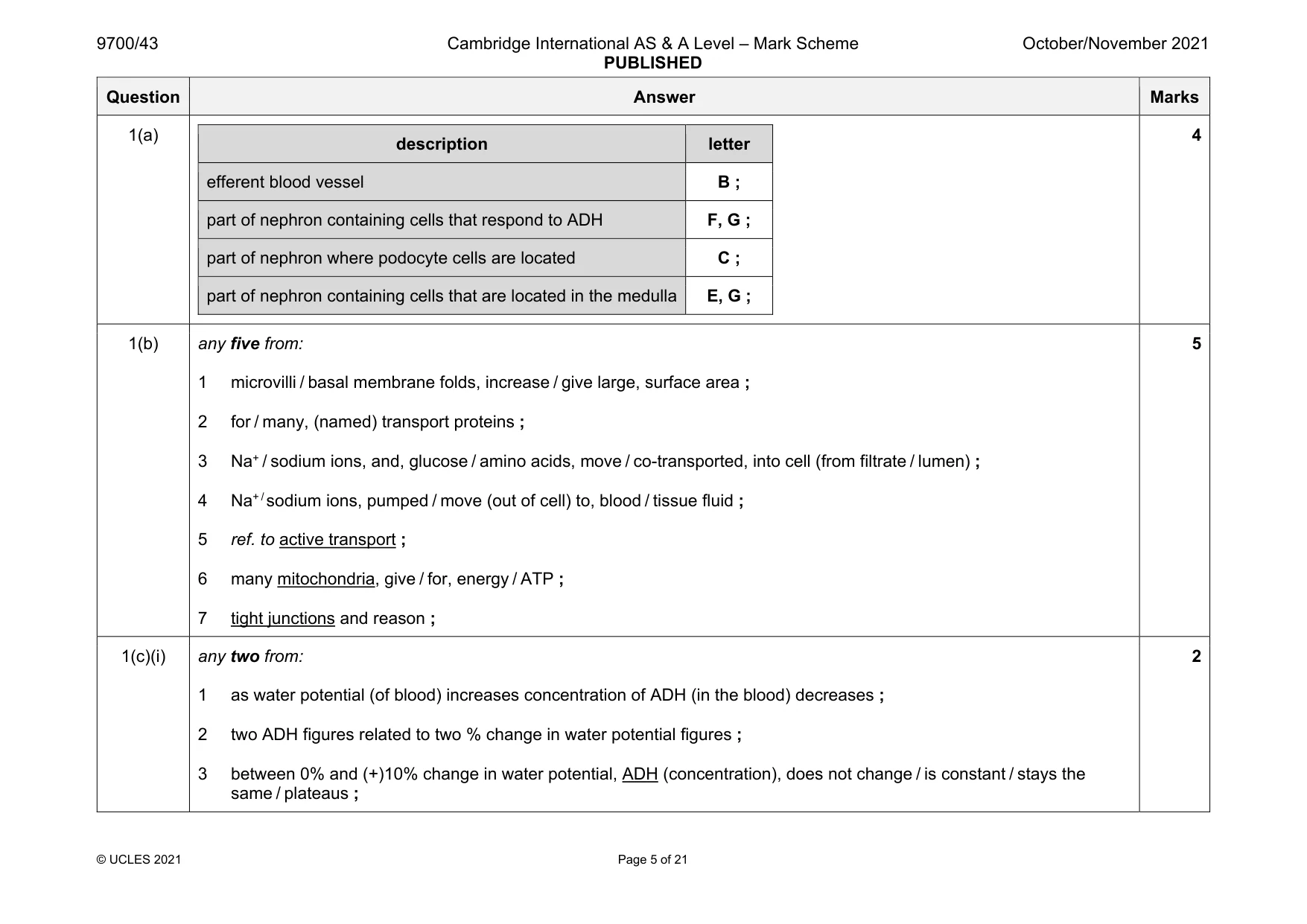
Mark scheme: 1(a) description letter efferent blood vessel B ; part of nephron containing cells that respond to ADH F, G ; part of nephron where podocyte cells are located C ; part of nephron containing cells that are located in the medulla E, G ; 4 1(b) any five from: 1 microvilli / basal membrane folds, increase / give large, surface area ; 2 for / many, (named) transport proteins ; 3 Na+ / sodium ions, and, glucose / amino acids, move / co-transported, into cell (from filtrate / lumen) ; 4 Na+ / sodium ions, pumped / move (out of cell) to, blood / tissue fluid ; 5 ref. to active transport ; 6 many mitochondria, give / for, energy / ATP ; 7 tight junctions and reason ; 5 1(c)(i) any two from: 1 as water potential (of blood) increases concentration of ADH (in the blood) decreases ; 2 two ADH figures related to two % change in water potential figures ; 3 between 0% and (+)10% change in water potential, ADH (concentration), does not change / is constant / stays the same / plateaus ; 2 Question Answer Marks 1(c)(ii) blood, volume / pressure, decreases ; 1
Q2 · Cotton, Gossypium hirsutum, and false flax, Camelina sativa, are crop plants that are…
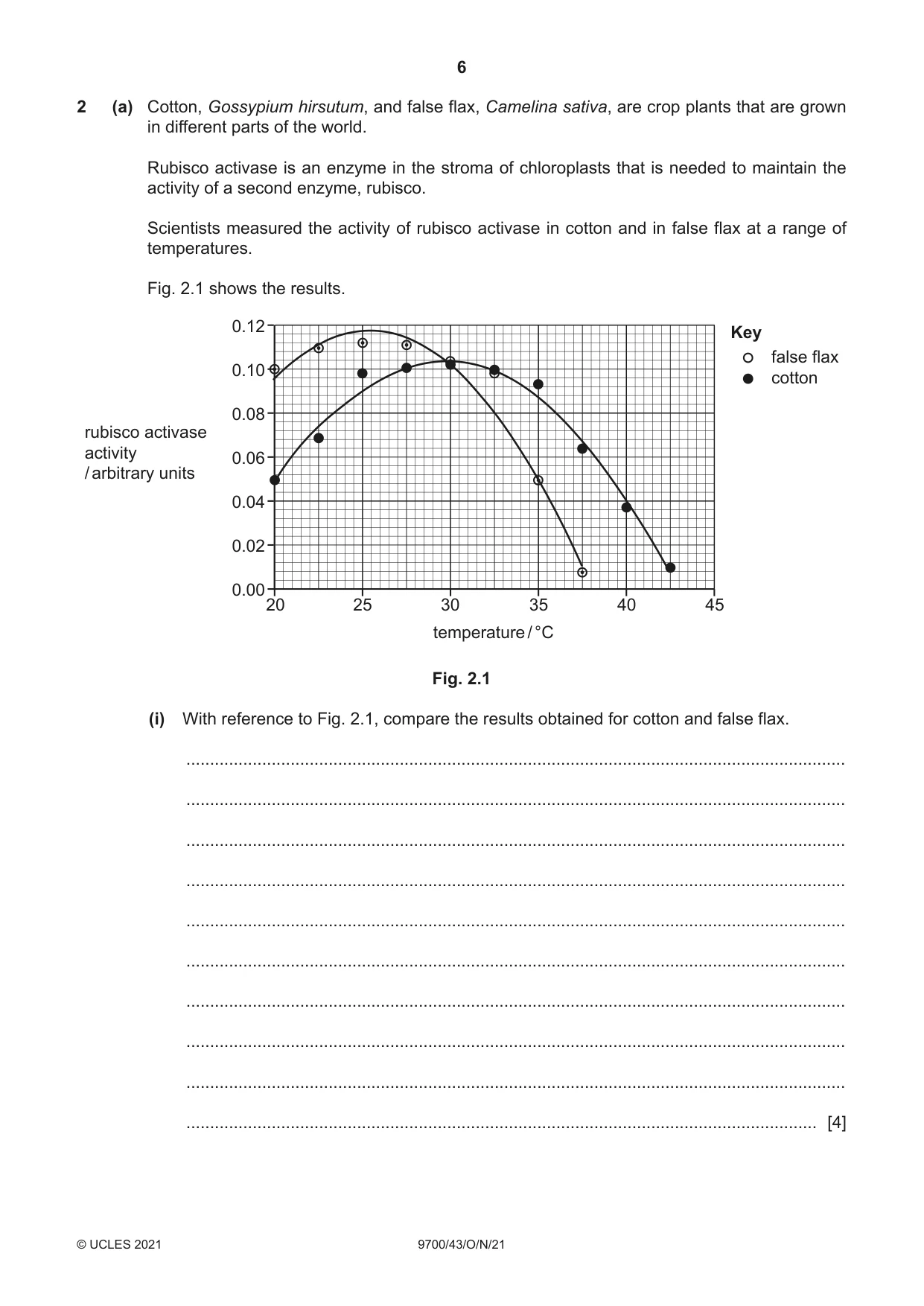
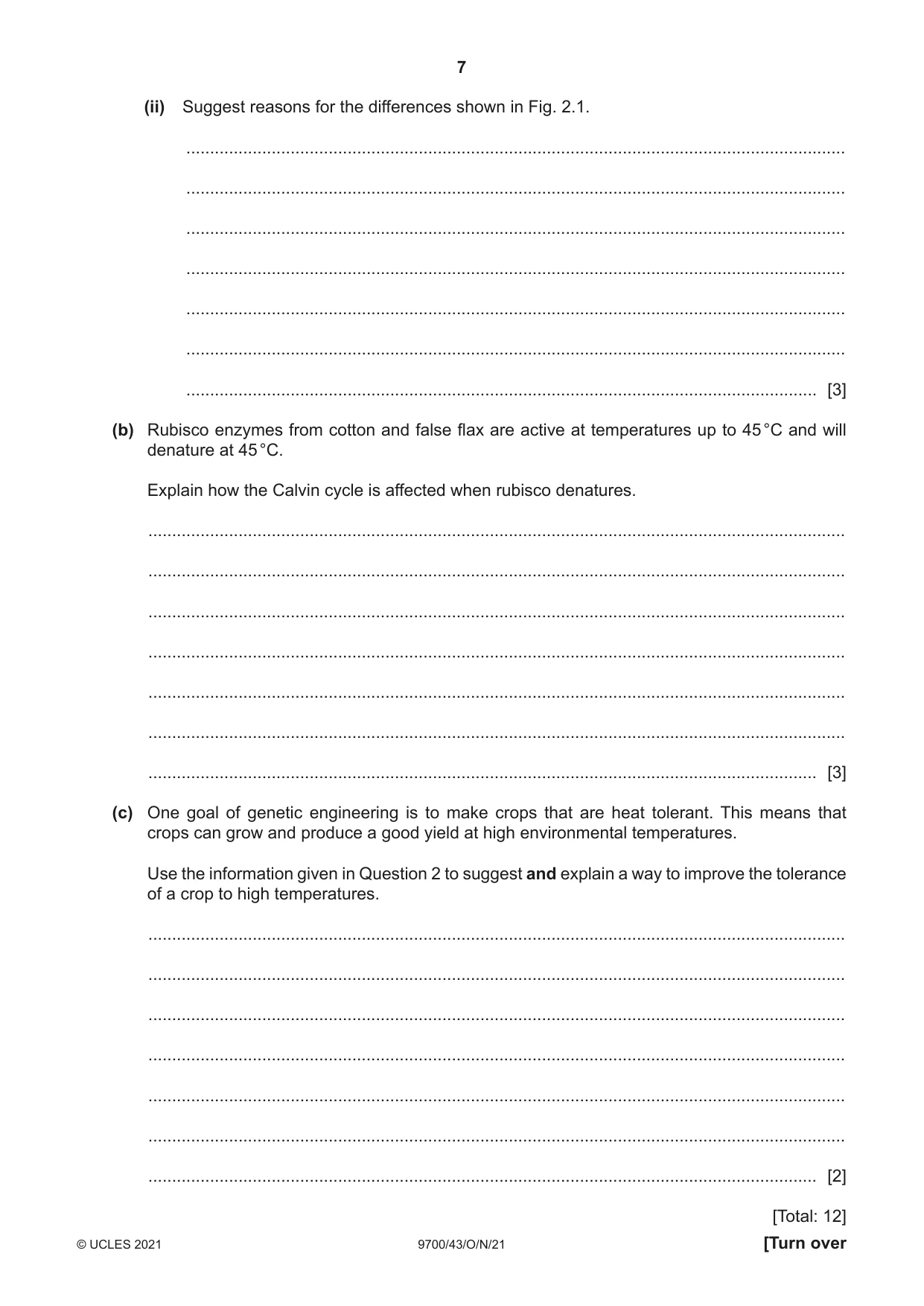
2 (a) Cotton, Gossypium hirsutum, and false flax, Camelina sativa, are crop plants that are grown in different parts of the world. Rubisco activase is an enzyme in the stroma of chloroplasts that is needed to maintain the activity of a second enzyme, rubisco. Scientists measured the activity of rubisco activase in cotton and in false flax at a range of temperatures. Fig. 2.1 shows the results. 0.12 Key false flax 0.10 cotton 0.08 rubisco activase activity 0.06 / arbitrary units 0.04 0.02 0.00 20 25 30 35 40 45 temperature / °C Fig. 2.1 (i) With reference to Fig. 2.1, compare the results obtained for cotton and false flax. ........................................................................................................................................... ........................................................................................................................................... ........................................................................................................................................... ........................................................................................................................................... ........................................................................................................................................... ........................................................................................................................................... ........................................................................................................................................... ........................................................................................................................................... ........................................................................................................................................... ..................................................................................................................................... [4] (ii) Suggest reasons for the differences shown in Fig. 2.1. ........................................................................................................................................... ........................................................................................................................................... ........................................................................................................................................... ........................................................................................................................................... ........................................................................................................................................... ........................................................................................................................................... ..................................................................................................................................... [3] (b) Rubisco enzymes from cotton and false flax are active at temperatures up to 45 °C and will denature at 45 °C. Explain how the Calvin cycle is affected when rubisco denatures. ................................................................................................................................................... ................................................................................................................................................... ................................................................................................................................................... ................................................................................................................................................... ................................................................................................................................................... ................................................................................................................................................... ............................................................................................................................................. [3] (c) One goal of genetic engineering is to make crops that are heat tolerant. This means that crops can grow and produce a good yield at high environmental temperatures. Use the information given in Question 2 to suggest and explain a way to improve the tolerance of a crop to high temperatures. ................................................................................................................................................... ................................................................................................................................................... ................................................................................................................................................... ................................................................................................................................................... ................................................................................................................................................... ................................................................................................................................................... ............................................................................................................................................. [2] [Total: 12]
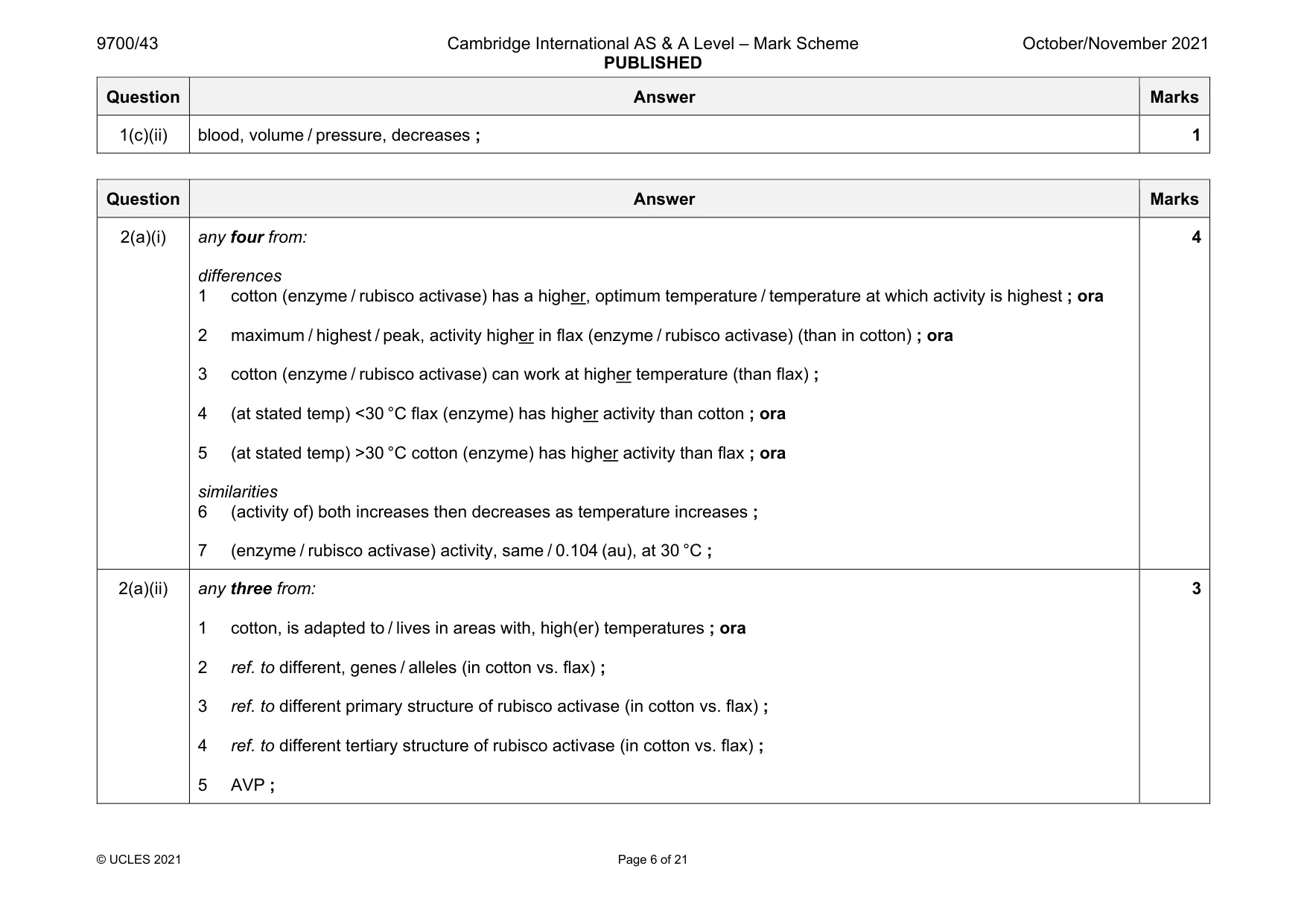
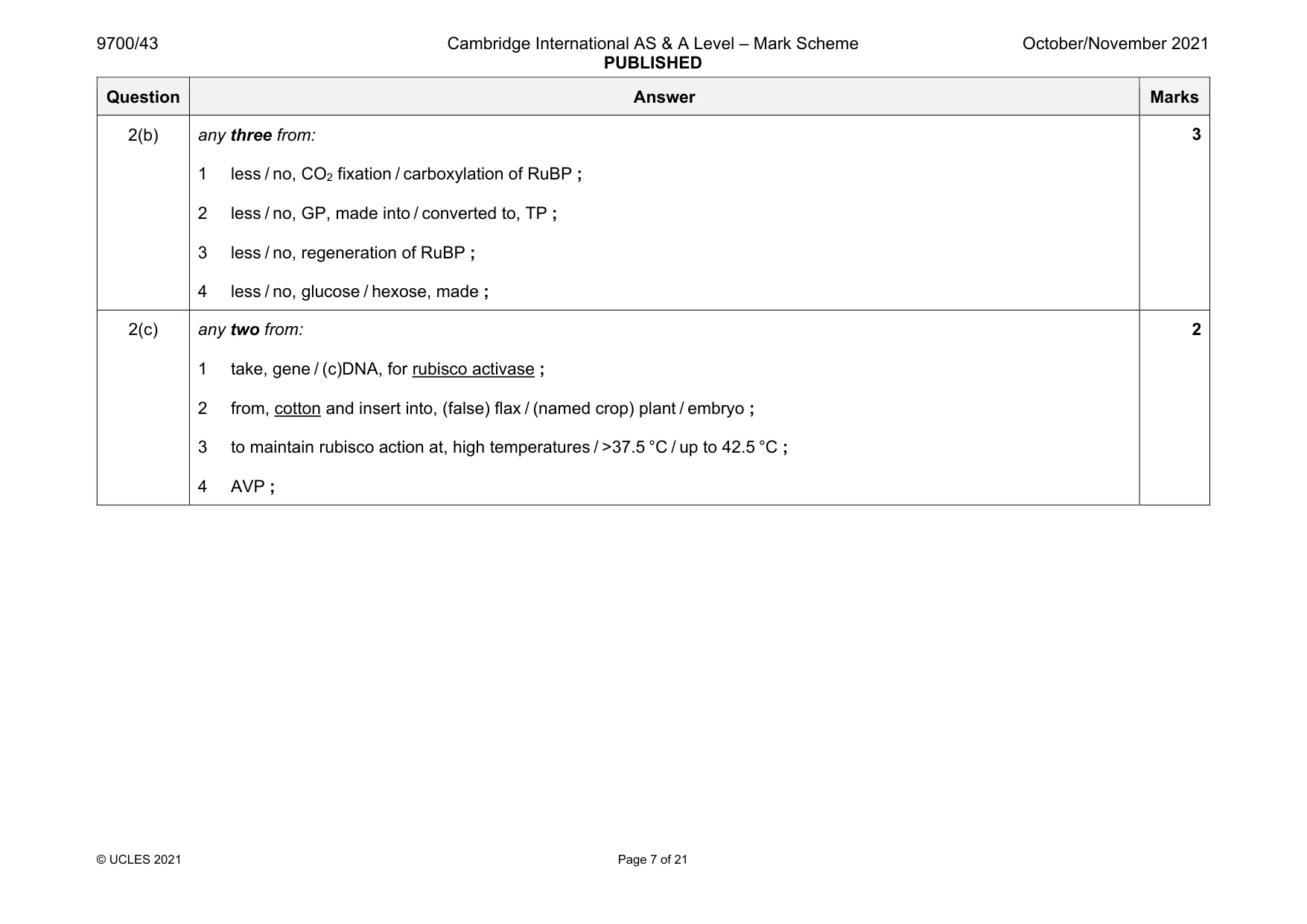
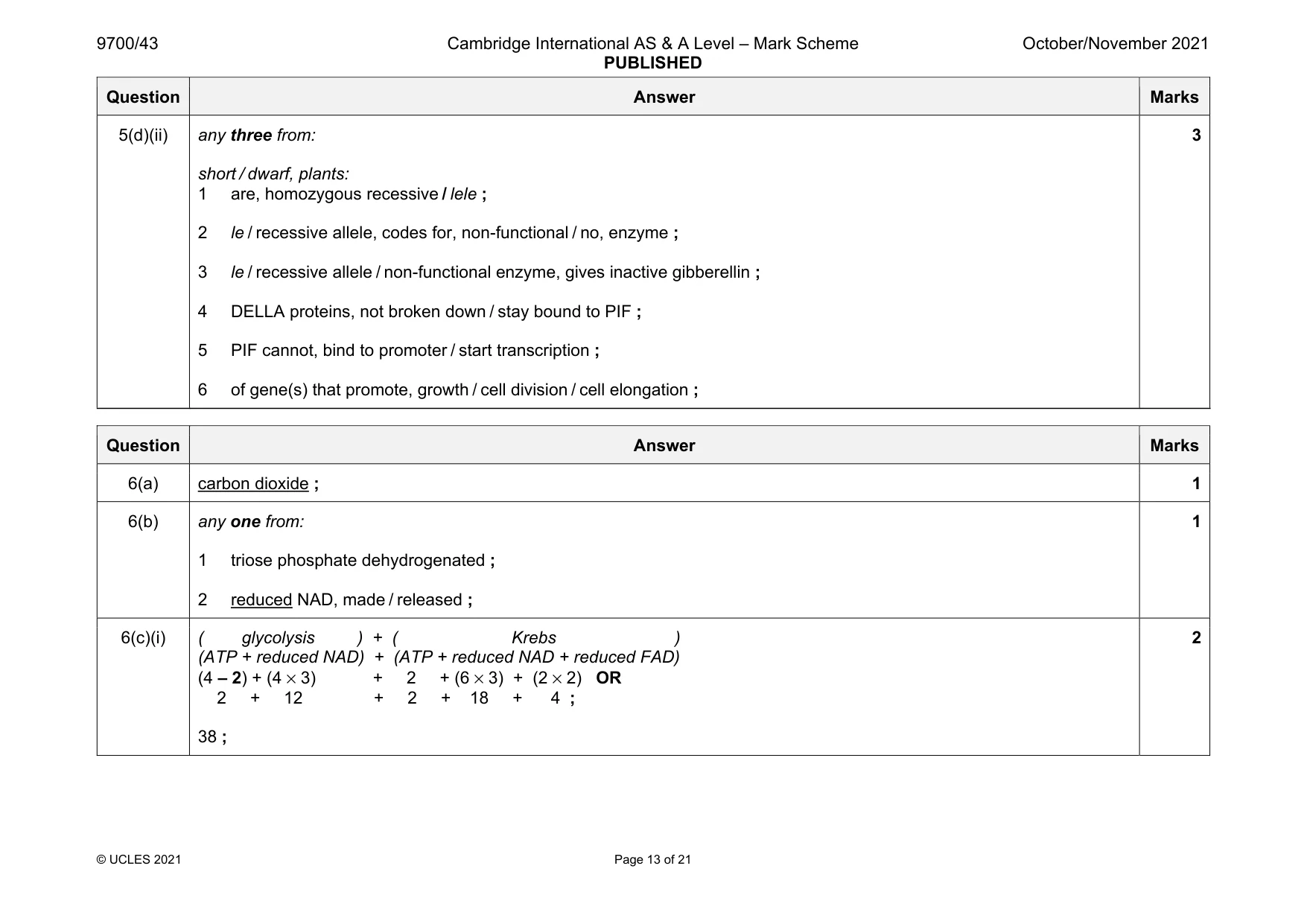
Mark scheme: 2(a)(i) any four from: differences 1 cotton (enzyme / rubisco activase) has a higher, optimum temperature / temperature at which activity is highest ; ora 2 maximum / highest / peak, activity higher in flax (enzyme / rubisco activase) (than in cotton) ; ora 3 cotton (enzyme / rubisco activase) can work at higher temperature (than flax) ; 4 (at stated temp) <30 °C flax (enzyme) has higher activity than cotton ; ora 5 (at stated temp) >30 °C cotton (enzyme) has higher activity than flax ; ora similarities 6 (activity of) both increases then decreases as temperature increases ; 7 (enzyme / rubisco activase) activity, same / 0.104 (au), at 30 °C ; 2(a)(ii) any three from: 1 cotton, is adapted to / lives in areas with, high(er) temperatures ; ora 2 ref. to different, genes / alleles (in cotton vs. flax) ; 3 ref. to different primary structure of rubisco activase (in cotton vs. flax) ; 4 ref. to different tertiary structure of rubisco activase (in cotton vs. flax) ; 5 AVP ; 3 Question Answer Marks 2(b) any three from: 1 less / no, CO2 fixation / carboxylation of RuBP ; 2 less / no, GP, made into / converted to, TP ; 3 less / no, regeneration of RuBP ; 4 less / no, glucose / hexose, made ; 3 2(c) any two from: 1 take, gene / (c)DNA, for rubisco activase ; 2 from, cotton and insert into, (false) flax / (named crop) plant / embryo ; 3 to maintain rubisco action at, high temperatures / >37.5 °C / up to 42.5 °C ; 4 AVP ; 2
Q3 · Ecological surveys are conducted before conservation decisions are made
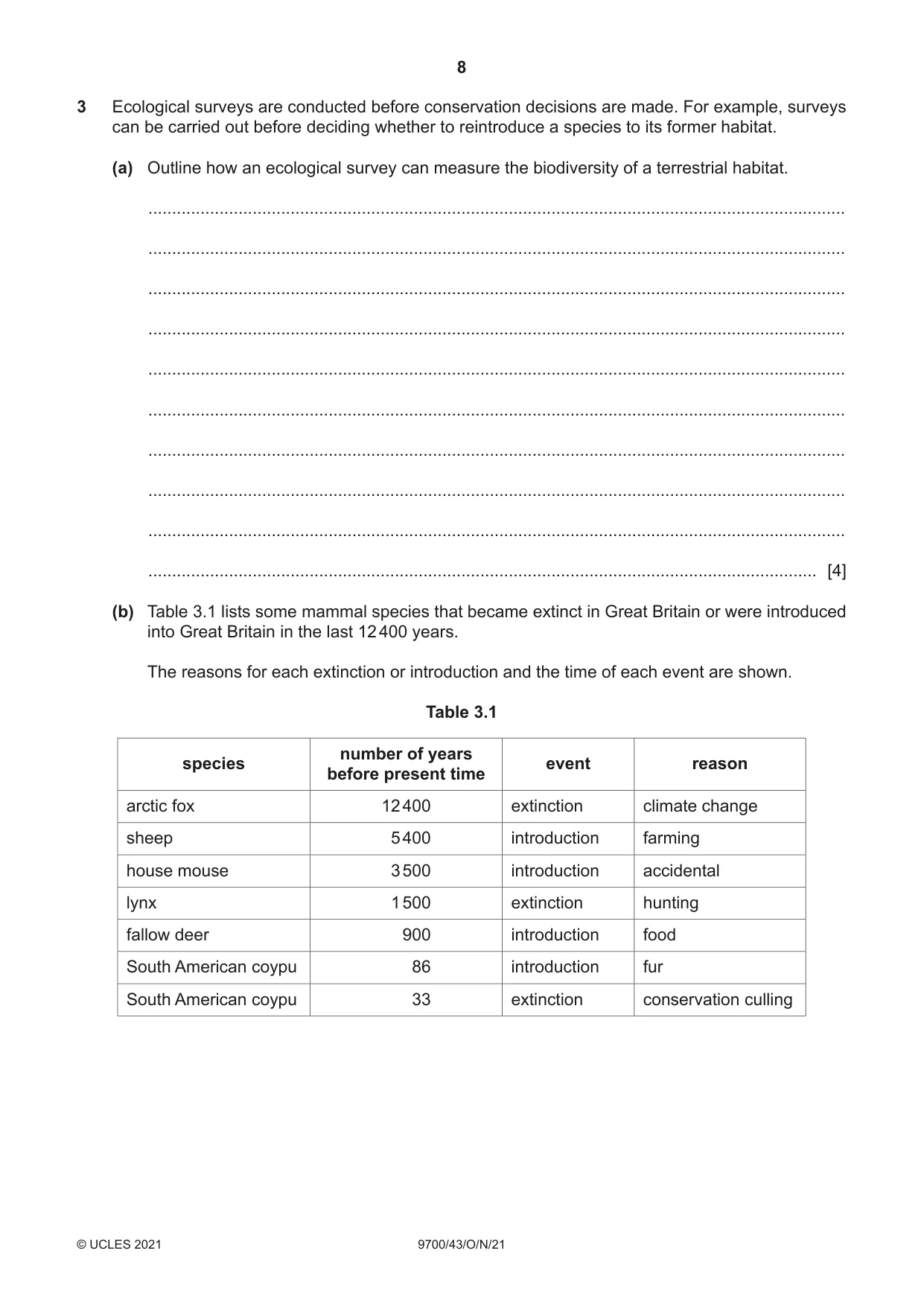
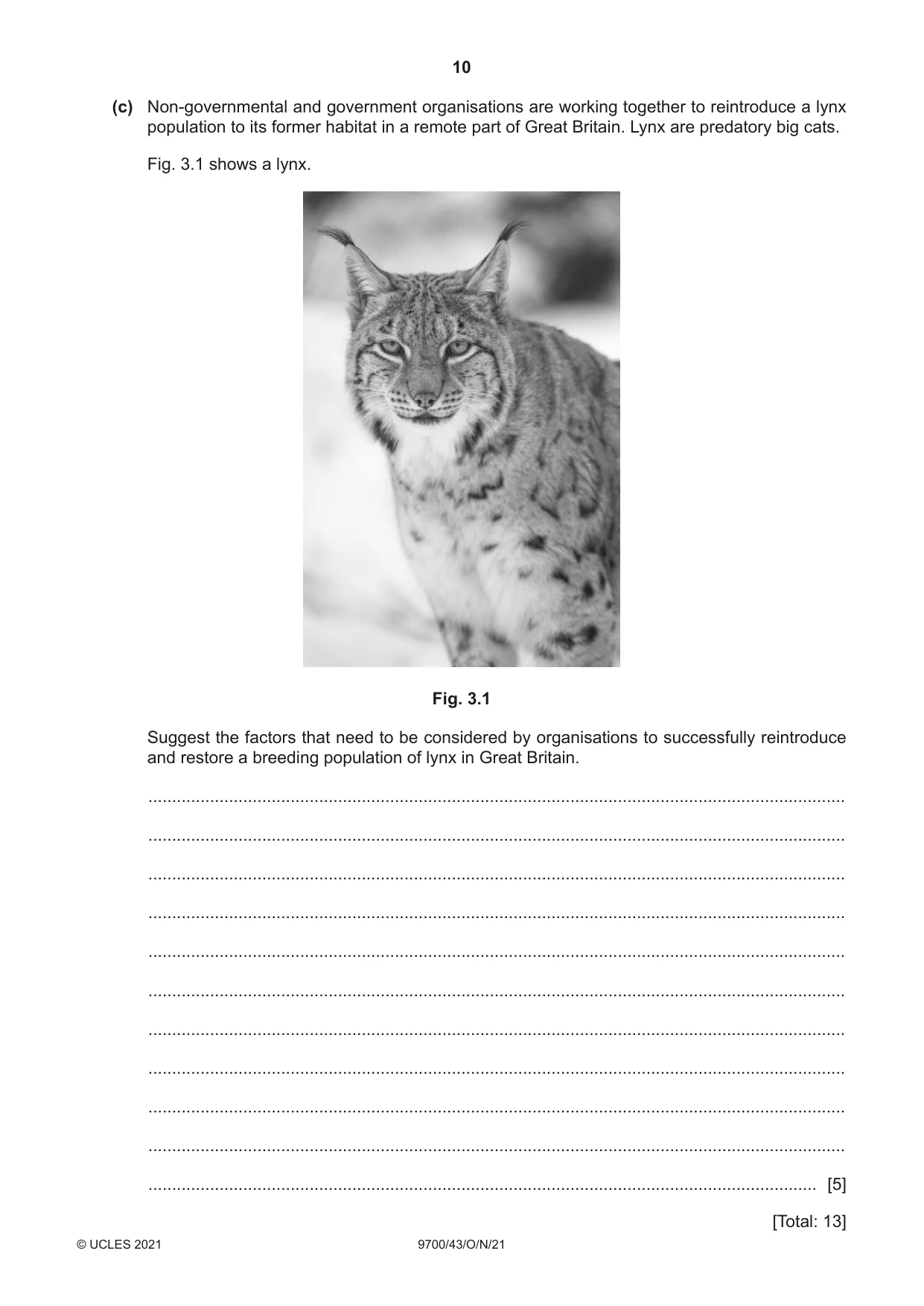
3 Ecological surveys are conducted before conservation decisions are made. For example, surveys can be carried out before deciding whether to reintroduce a species to its former habitat. (a) Outline how an ecological survey can measure the biodiversity of a terrestrial habitat. ................................................................................................................................................... ................................................................................................................................................... ................................................................................................................................................... ................................................................................................................................................... ................................................................................................................................................... ................................................................................................................................................... ................................................................................................................................................... ................................................................................................................................................... ................................................................................................................................................... ............................................................................................................................................. [4] (b) Table 3.1 lists some mammal species that became extinct in Great Britain or were introduced into Great Britain in the last 12 400 years. The reasons for each extinction or introduction and the time of each event are shown. Table 3.1 number of years species event reason before present time arctic fox 12 400 extinction climate change sheep 5 400 introduction farming house mouse 3 500 introduction accidental lynx 1 500 extinction hunting fallow deer 900 introduction food South American coypu 86 introduction fur South American coypu 33 extinction conservation culling With reference to Table 3.1, state and explain the factors that have had a negative impact on biodiversity in Great Britain. ................................................................................................................................................... ................................................................................................................................................... ................................................................................................................................................... ................................................................................................................................................... ................................................................................................................................................... ................................................................................................................................................... ................................................................................................................................................... ................................................................................................................................................... ................................................................................................................................................... ............................................................................................................................................. [4] (c) Non-governmental and government organisations are working together to reintroduce a lynx population to its former habitat in a remote part of Great Britain. Lynx are predatory big cats. Fig. 3.1 shows a lynx. Fig. 3.1 Suggest the factors that need to be considered by organisations to successfully reintroduce and restore a breeding population of lynx in Great Britain. ................................................................................................................................................... ................................................................................................................................................... ................................................................................................................................................... ................................................................................................................................................... ................................................................................................................................................... ................................................................................................................................................... ................................................................................................................................................... ................................................................................................................................................... ................................................................................................................................................... ................................................................................................................................................... ............................................................................................................................................. [5] [Total: 13] Turn over for Question 4
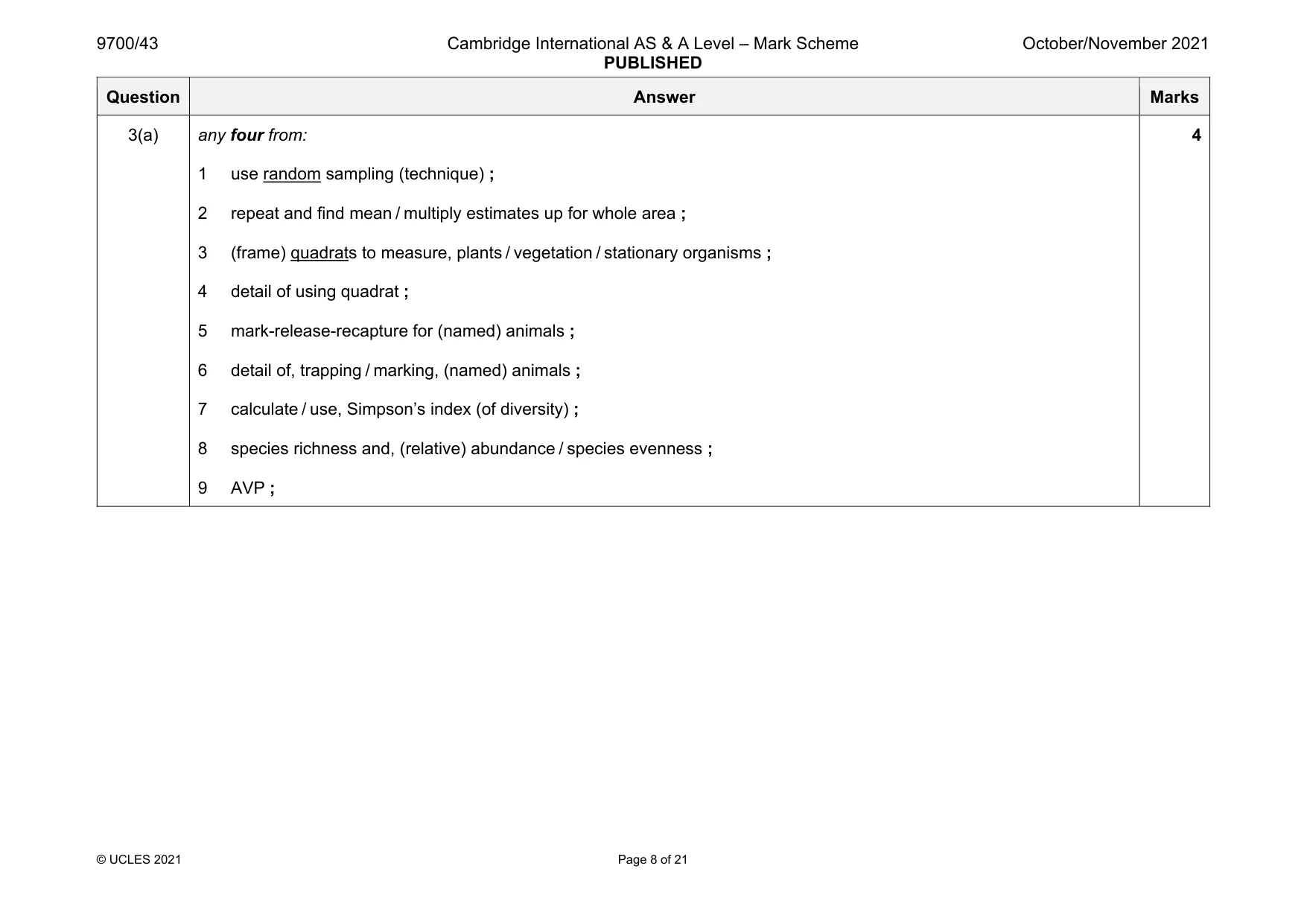
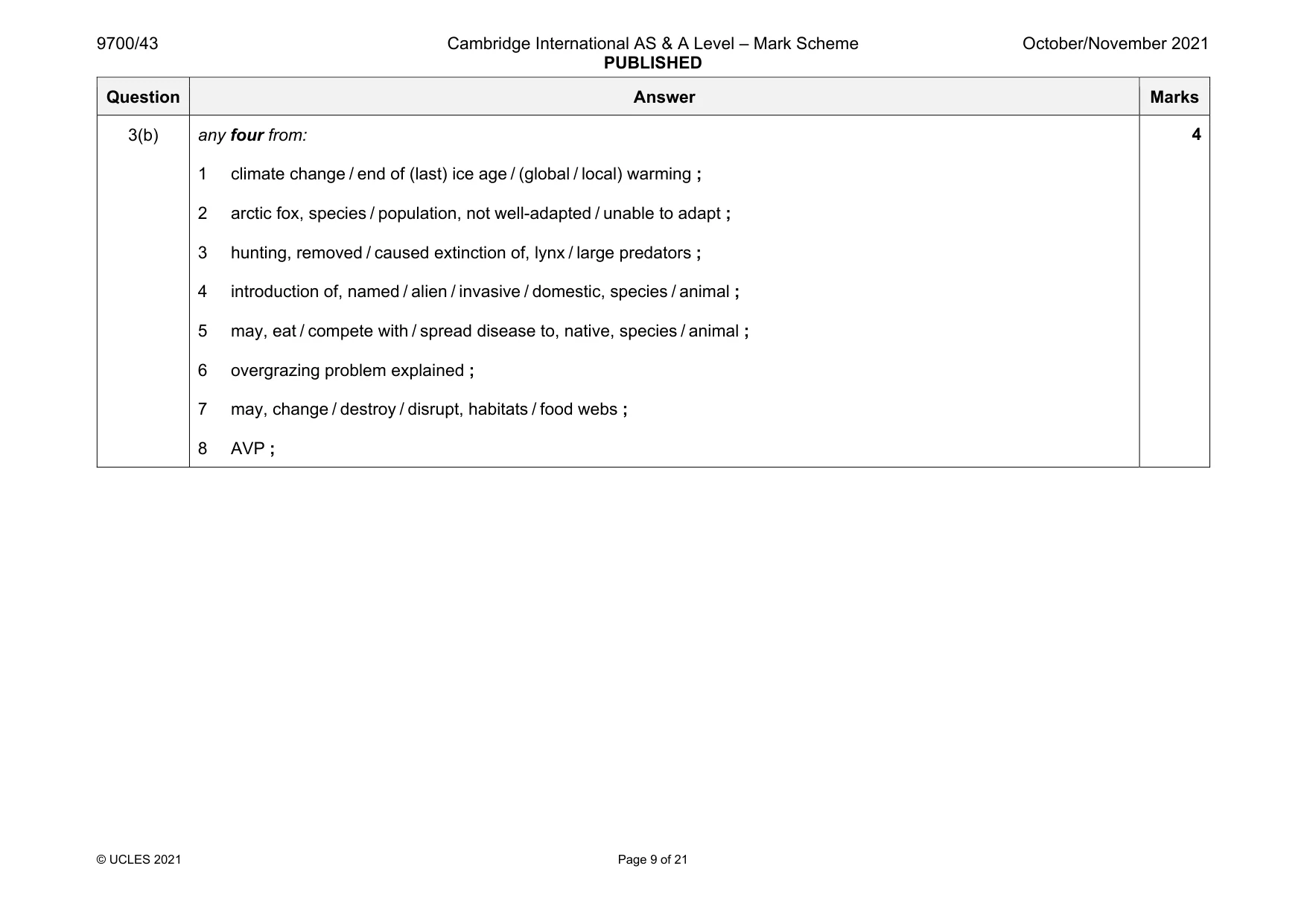
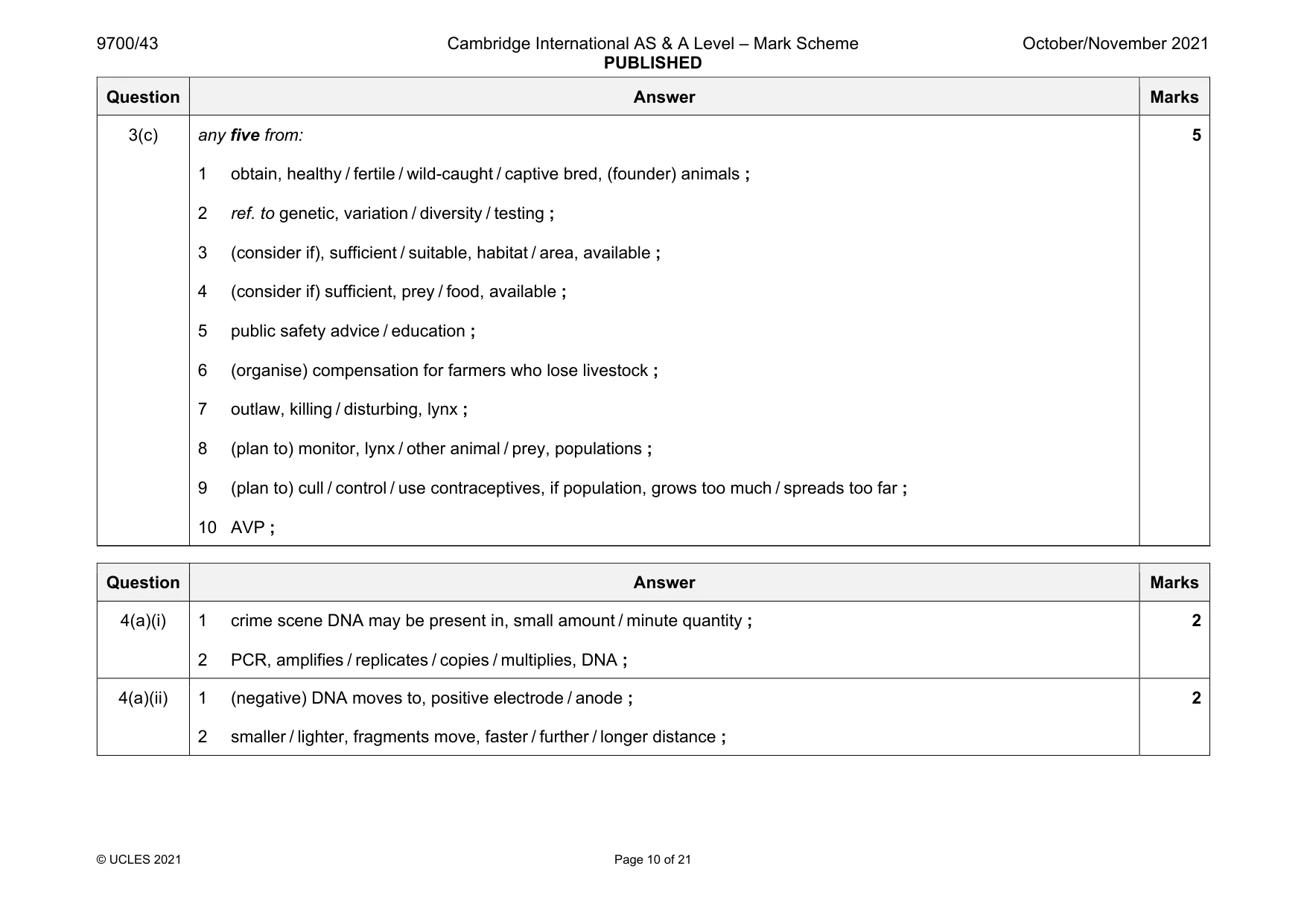
Mark scheme: 3(a) any four from: 1 use random sampling (technique) ; 2 repeat and find mean / multiply estimates up for whole area ; 3 (frame) quadrats to measure, plants / vegetation / stationary organisms ; 4 detail of using quadrat ; 5 mark-release-recapture for (named) animals ; 6 detail of, trapping / marking, (named) animals ; 7 calculate / use, Simpson’s index (of diversity) ; 8 species richness and, (relative) abundance / species evenness ; 9 AVP ; 4 Question Answer Marks 3(b) any four from: 1 climate change / end of (last) ice age / (global / local) warming ; 2 arctic fox, species / population, not well-adapted / unable to adapt ; 3 hunting, removed / caused extinction of, lynx / large predators ; 4 introduction of, named / alien / invasive / domestic, species / animal ; 5 may, eat / compete with / spread disease to, native, species / animal ; 6 overgrazing problem explained ; 7 may, change / destroy / disrupt, habitats / food webs ; 8 AVP ; 4 Question Answer Marks 3(c) any five from: 1 obtain, healthy / fertile / wild-caught / captive bred, (founder) animals ; 2 ref. to genetic, variation / diversity / testing ; 3 (consider if), sufficient / suitable, habitat / area, available ; 4 (consider if) sufficient, prey / food, available ; 5 public safety advice / education ; 6 (organise) compensation for farmers who lose livestock ; 7 outlaw, killing / disturbing, lynx ; 8 (plan to) monitor, lynx / other animal / prey, populations ; 9 (plan to) cull / control / use contraceptives, if population, grows too much / spreads too far ; 10 AVP ; 5
Q4 · In 1984, the geneticist Alec Jeffreys invented a DNA testing technique, known as DNA…
4 (a) In 1984, the geneticist Alec Jeffreys invented a DNA testing technique, known as DNA profiling, that produces a DNA banding pattern on a gel. The DNA banding pattern (profile) is unique to each individual. DNA profiling can be used in police forensic work to catch criminals. Since 1987, police in many countries have collected and stored DNA from crime scenes to create DNA profiles, which they try to match with the DNA profiles of criminal suspects. (i) DNA at a crime scene may be obtained from hairs and traces of blood, semen and saliva. Explain why PCR may be needed before DNA from a crime scene can be profiled. ........................................................................................................................................... ........................................................................................................................................... ........................................................................................................................................... ........................................................................................................................................... ..................................................................................................................................... [2] (ii) Explain why electrophoresis produces a DNA banding pattern on a gel. ........................................................................................................................................... ........................................................................................................................................... ........................................................................................................................................... ........................................................................................................................................... ........................................................................................................................................... ........................................................................................................................................... ..................................................................................................................................... [2] (b) GEDmatch is described as ‘an open data personal genomics website’. It can be used by people who want to upload their DNA data to trace their ancestors and other relatives. In 2018, police in the USA solved a large number of serious crimes. Some of these crimes had been unsolved for over thirty years. The police used GEDmatch to profile DNA taken from crime scenes and to look for matching DNA profiles. In many cases the police found partial matches to the relatives of criminals. This allowed the criminals to be identified and then charged on the basis of a complete DNA profile match. (i) Suggest why the police strategy of comparing crime scene DNA with the GEDmatch database was so successful. ........................................................................................................................................... ........................................................................................................................................... ........................................................................................................................................... ........................................................................................................................................... ..................................................................................................................................... [2] (ii) Explain why GEDmatch is an example of bioinformatics. ........................................................................................................................................... ........................................................................................................................................... ........................................................................................................................................... ........................................................................................................................................... ..................................................................................................................................... [2] (iii) The first successful conviction resulting from the use of GEDmatch by the police was widely reported. Some journalists and broadcasters thought that the GEDmatch website should not have been used by the police in this way. In the days following the news, the number of citizens choosing to upload their DNA data to GEDmatch increased from 1500 to 5000 a day. Comment on the social and ethical issues raised by this first successful conviction. ........................................................................................................................................... ........................................................................................................................................... ........................................................................................................................................... ........................................................................................................................................... ..................................................................................................................................... [2] [Total: 10]
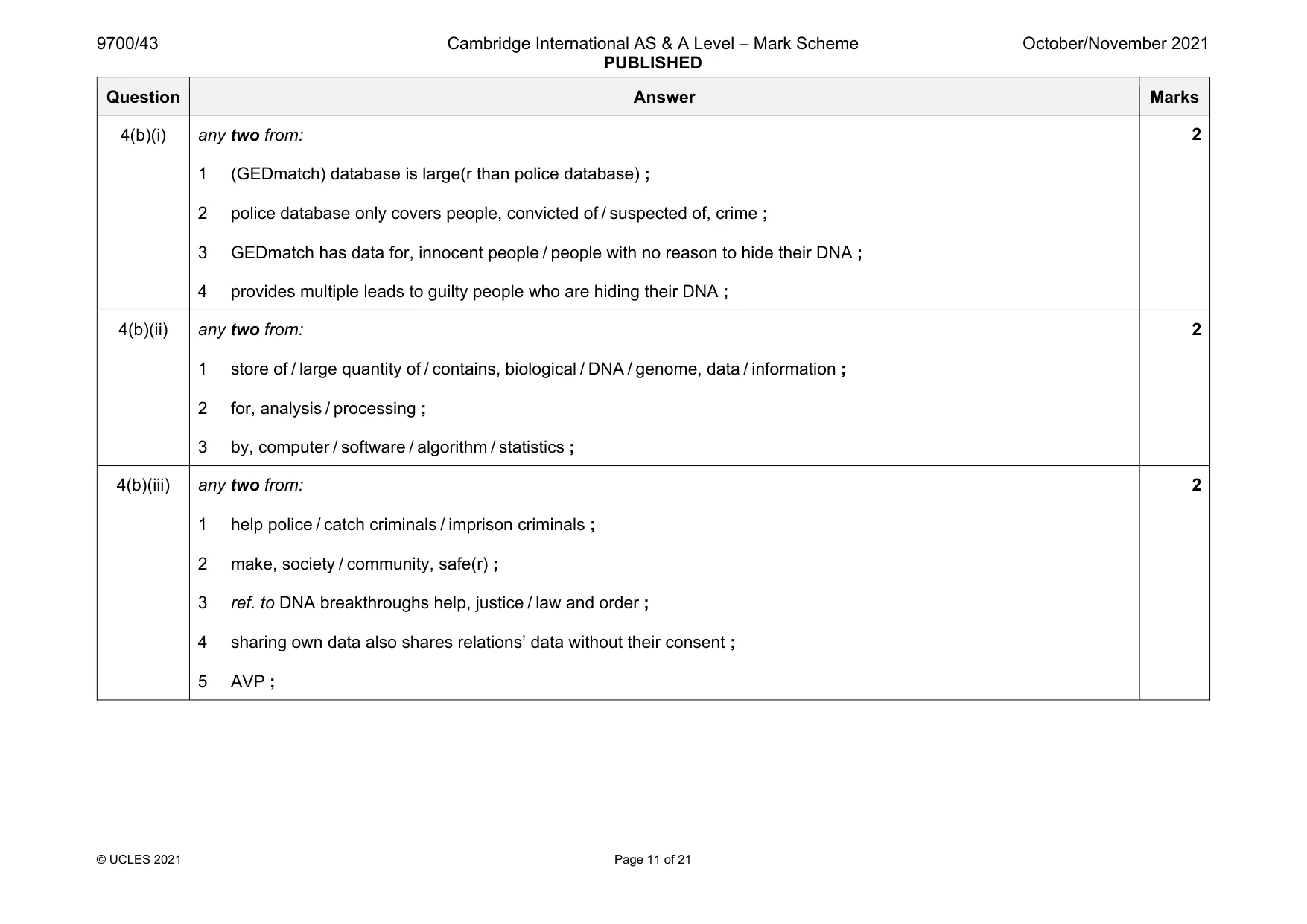
Mark scheme: 4(a)(i) 1 crime scene DNA may be present in, small amount / minute quantity ; 2 PCR, amplifies / replicates / copies / multiplies, DNA ; 2 4(a)(ii) 1 (negative) DNA moves to, positive electrode / anode ; 2 smaller / lighter, fragments move, faster / further / longer distance ; 2 Question Answer Marks 4(b)(i) any two from: 1 (GEDmatch) database is large(r than police database) ; 2 police database only covers people, convicted of / suspected of, crime ; 3 GEDmatch has data for, innocent people / people with no reason to hide their DNA ; 4 provides multiple leads to guilty people who are hiding their DNA ; 2 4(b)(ii) any two from: 1 store of / large quantity of / contains, biological / DNA / genome, data / information ; 2 for, analysis / processing ; 3 by, computer / software / algorithm / statistics ; 2 4(b)(iii) any two from: 1 help police / catch criminals / imprison criminals ; 2 make, society / community, safe(r) ; 3 ref. to DNA breakthroughs help, justice / law and order ; 4 sharing own data also shares relations’ data without their consent ; 5 AVP ; 2
Q5 · Gibberellin is a plant growth regulator involved in barley seed germination
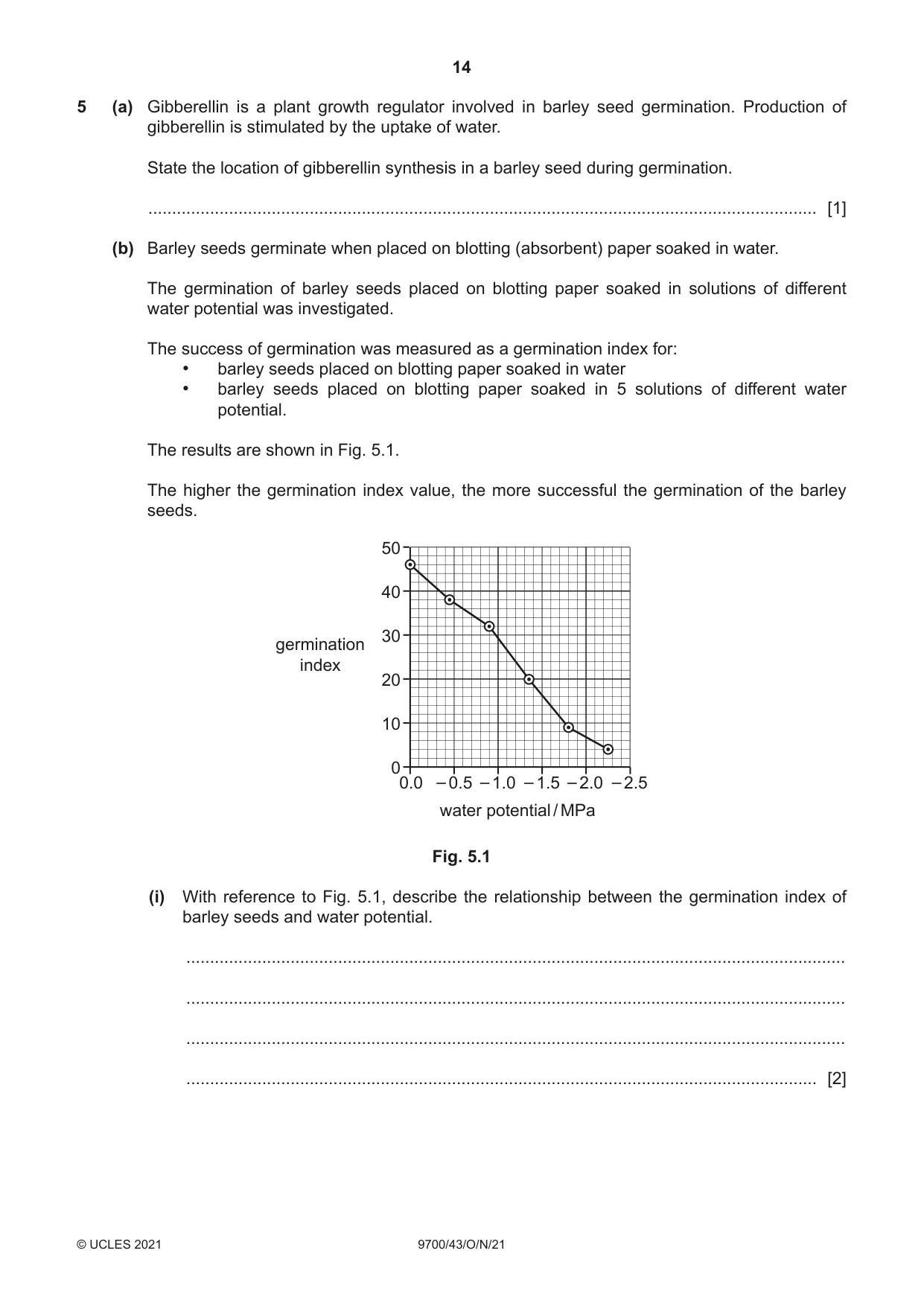
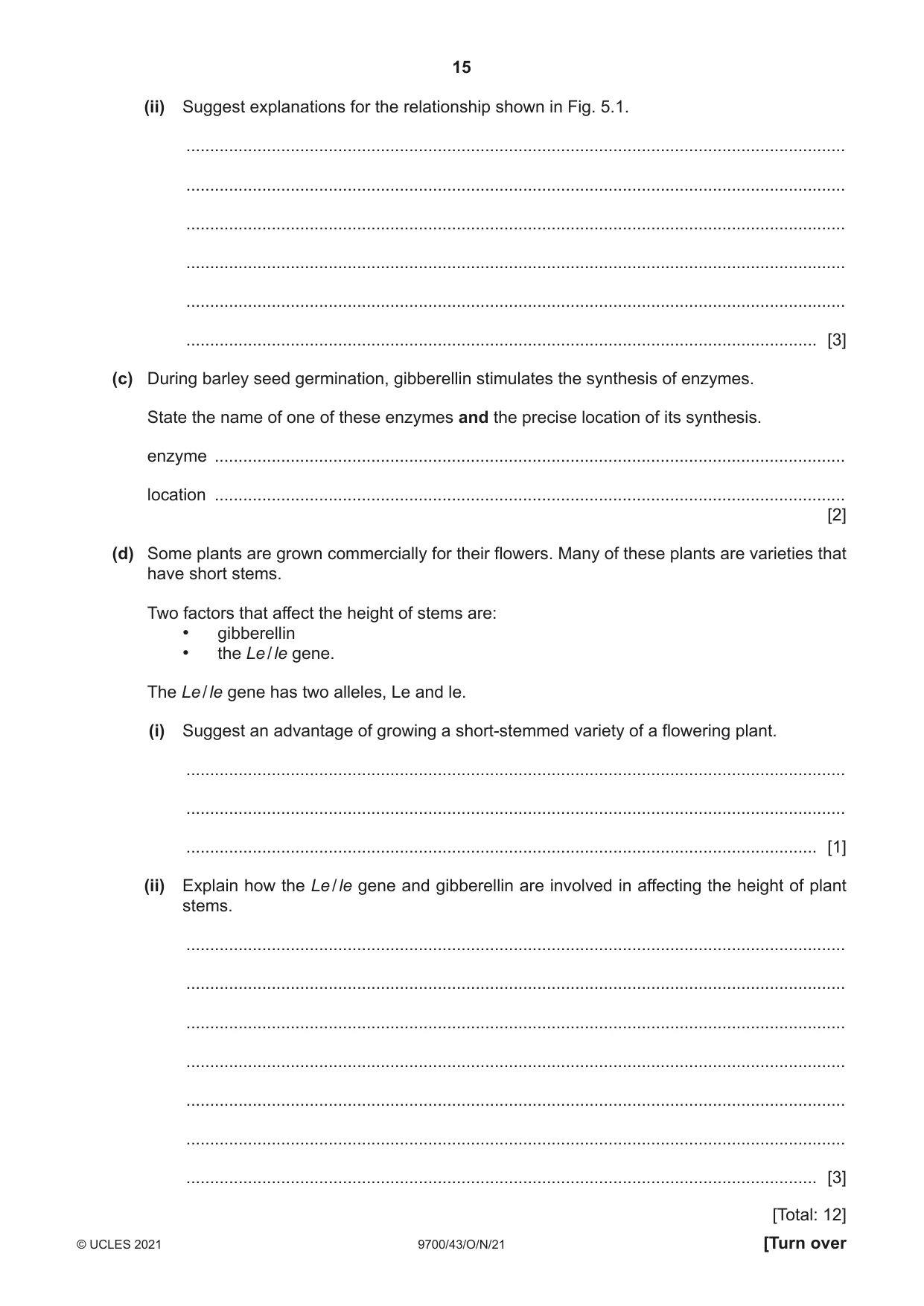
5 (a) Gibberellin is a plant growth regulator involved in barley seed germination. Production of gibberellin is stimulated by the uptake of water. State the location of gibberellin synthesis in a barley seed during germination. ............................................................................................................................................. [1] (b) Barley seeds germinate when placed on blotting (absorbent) paper soaked in water. The germination of barley seeds placed on blotting paper soaked in solutions of different water potential was investigated. The success of germination was measured as a germination index for: • barley seeds placed on blotting paper soaked in water • barley seeds placed on blotting paper soaked in 5 solutions of different water potential. The results are shown in Fig. 5.1. The higher the germination index value, the more successful the germination of the barley seeds. 50 40 30 germination index 20 10 0 0.0 – 0.5 – 1.0 – 1.5 – 2.0 – 2.5 water potential / MPa Fig. 5.1 (i) With reference to Fig. 5.1, describe the relationship between the germination index of barley seeds and water potential. ........................................................................................................................................... ........................................................................................................................................... ........................................................................................................................................... ..................................................................................................................................... [2] (ii) Suggest explanations for the relationship shown in Fig. 5.1. ........................................................................................................................................... ........................................................................................................................................... ........................................................................................................................................... ........................................................................................................................................... ........................................................................................................................................... ..................................................................................................................................... [3] (c) During barley seed germination, gibberellin stimulates the synthesis of enzymes. State the name of one of these enzymes and the precise location of its synthesis. enzyme ..................................................................................................................................... location ..................................................................................................................................... [2] (d) Some plants are grown commercially for their flowers. Many of these plants are varieties that have short stems. Two factors that affect the height of stems are: • gibberellin • the Le / le gene. The Le / le gene has two alleles, Le and le. (i) Suggest an advantage of growing a short-stemmed variety of a flowering plant. ........................................................................................................................................... ........................................................................................................................................... ..................................................................................................................................... [1] (ii) Explain how the Le / le gene and gibberellin are involved in affecting the height of plant stems. ........................................................................................................................................... ........................................................................................................................................... ........................................................................................................................................... ........................................................................................................................................... ........................................................................................................................................... ........................................................................................................................................... ..................................................................................................................................... [3] [Total: 12]
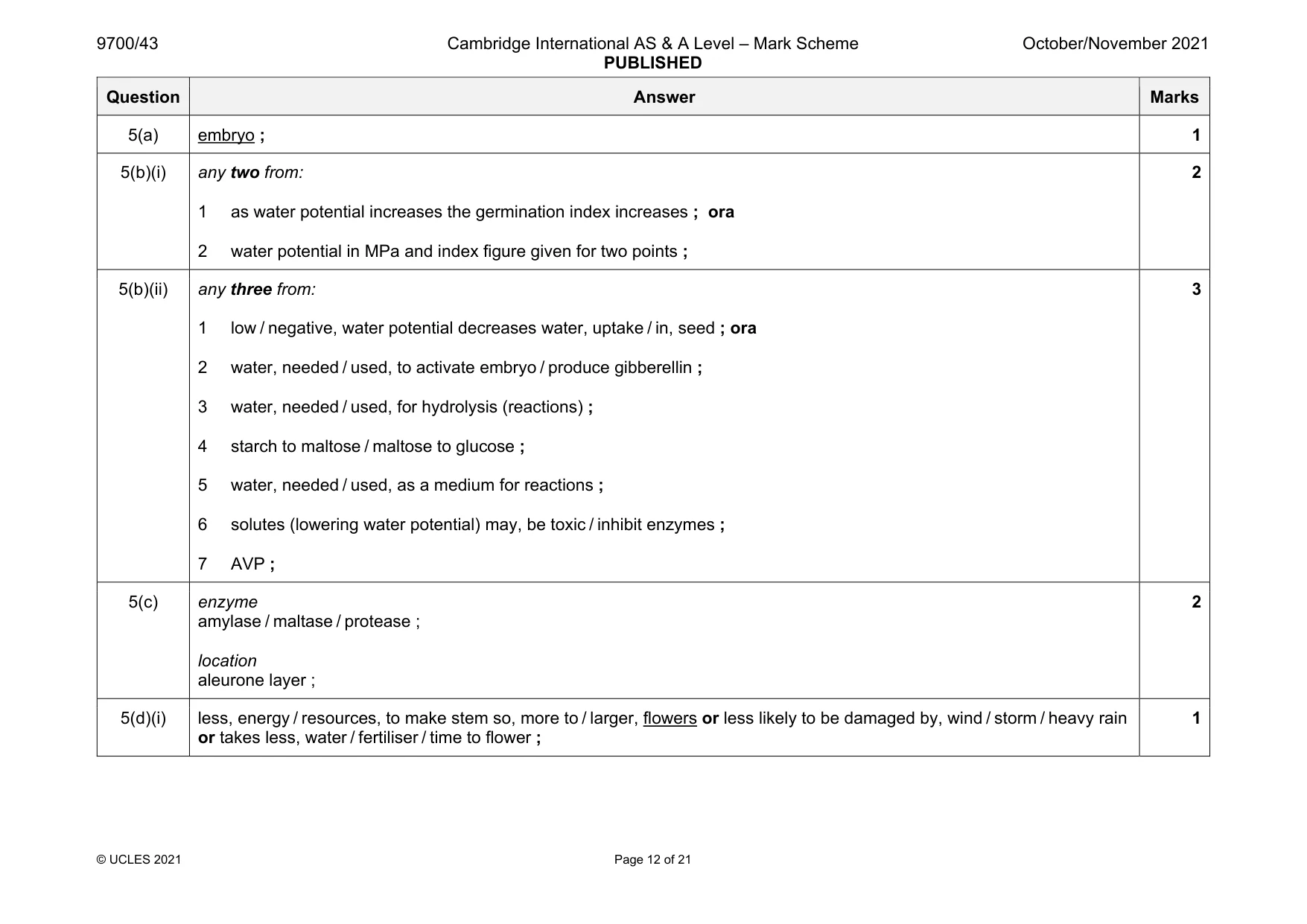
Mark scheme: 5(a) embryo ; 1 5(b)(i) any two from: 1 as water potential increases the germination index increases ; ora 2 water potential in MPa and index figure given for two points ; 2 5(b)(ii) any three from: 1 low / negative, water potential decreases water, uptake / in, seed ; ora 2 water, needed / used, to activate embryo / produce gibberellin ; 3 water, needed / used, for hydrolysis (reactions) ; 4 starch to maltose / maltose to glucose ; 5 water, needed / used, as a medium for reactions ; 6 solutes (lowering water potential) may, be toxic / inhibit enzymes ; 7 AVP ; 3 5(c) enzyme amylase / maltase / protease ; location aleurone layer ; 2 5(d)(i) less, energy / resources, to make stem so, more to / larger, flowers or less likely to be damaged by, wind / storm / heavy rain or takes less, water / fertiliser / time to flower ; 1 Question Answer Marks 5(d)(ii) any three from: short / dwarf, plants: 1 are, homozygous recessive / lele ; 2 le / recessive allele, codes for, non-functional / no, enzyme ; 3 le / recessive allele / non-functional enzyme, gives inactive gibberellin ; 4 DELLA proteins, not broken down / stay bound to PIF ; 5 PIF cannot, bind to promoter / start transcription ; 6 of gene(s) that promote, growth / cell division / cell elongation ; 3
Question 6
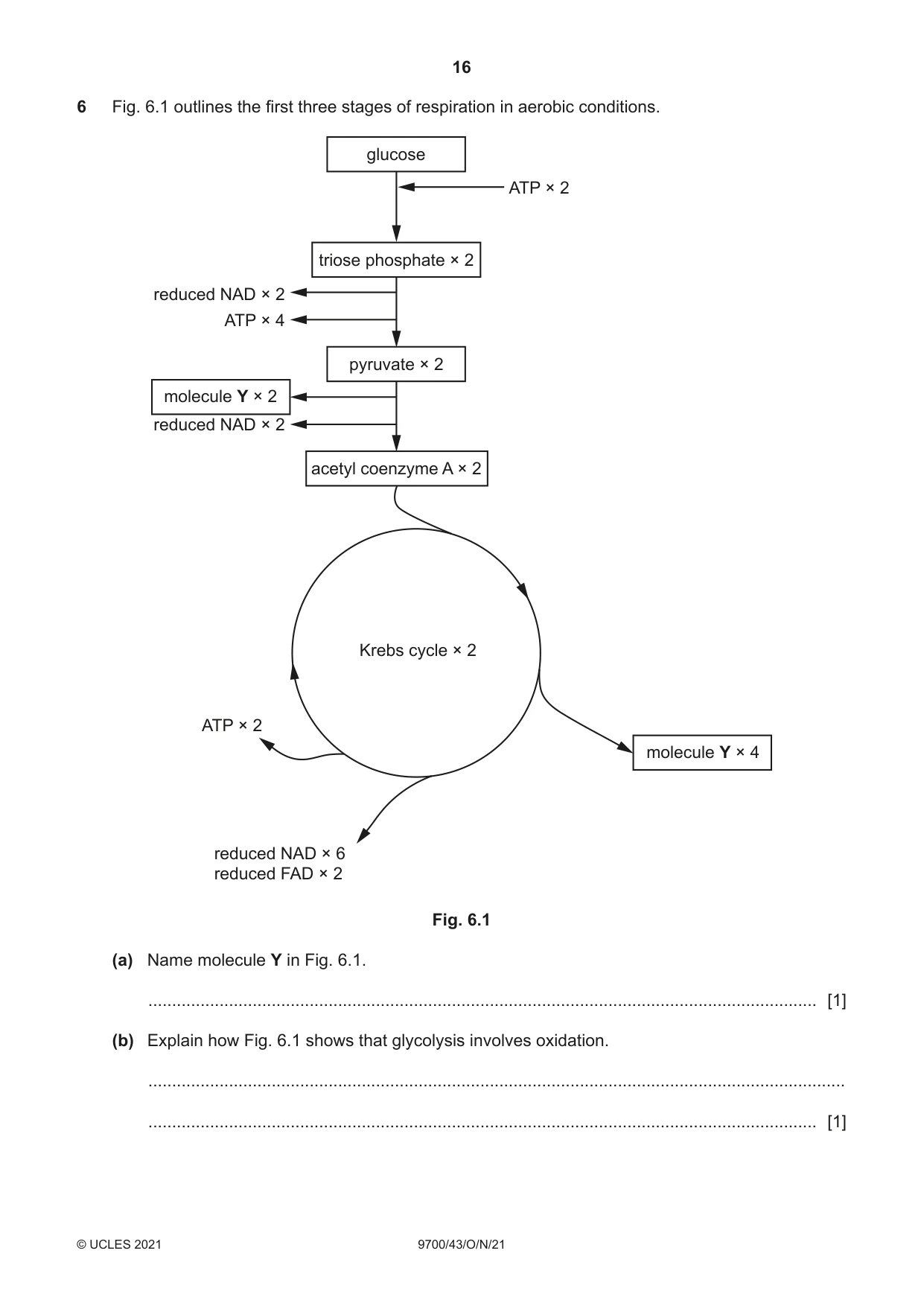
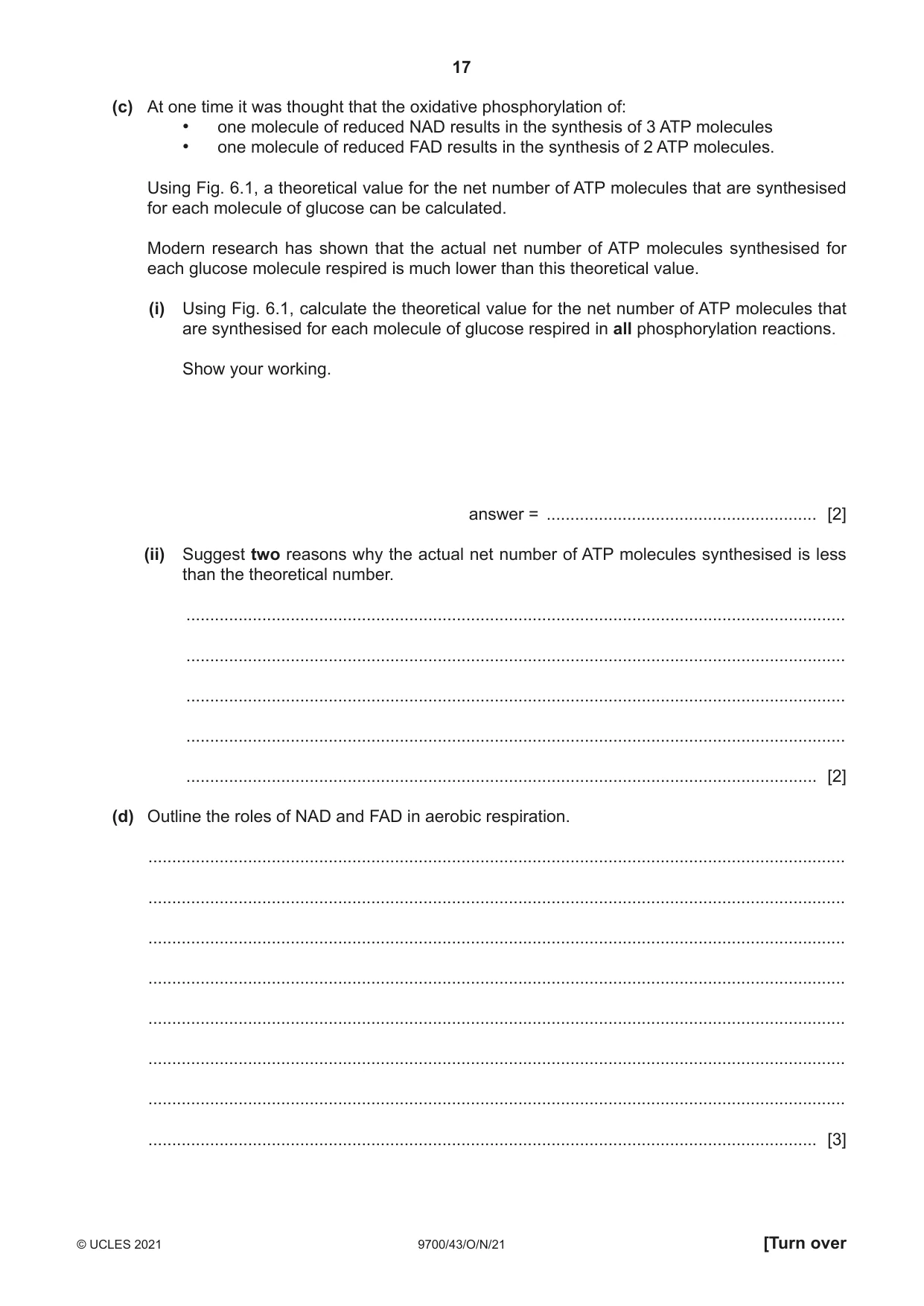
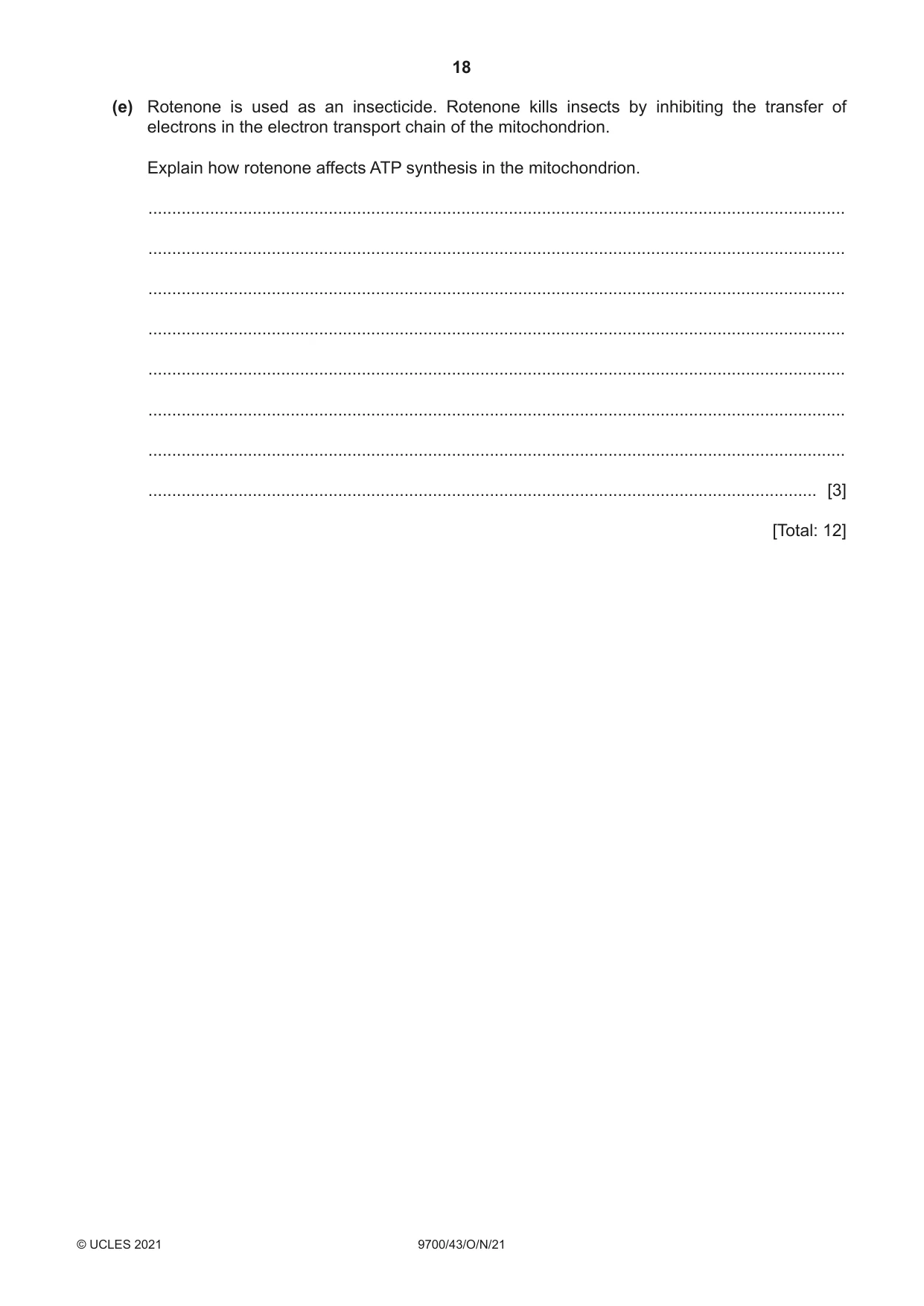
6 Fig. 6.1 outlines the first three stages of respiration in aerobic conditions. glucose ATP × 2 triose phosphate × 2 reduced NAD × 2 ATP × 4 pyruvate × 2 molecule Y × 2 reduced NAD × 2 acetyl coenzyme A × 2 Krebs cycle × 2 ATP × 2 molecule Y × 4 reduced NAD × 6 reduced FAD × 2 Fig. 6.1 (a) Name molecule Y in Fig. 6.1. ............................................................................................................................................. [1] (b) Explain how Fig. 6.1 shows that glycolysis involves oxidation. ................................................................................................................................................... ............................................................................................................................................. [1] (c) At one time it was thought that the oxidative phosphorylation of: • one molecule of reduced NAD results in the synthesis of 3 ATP molecules • one molecule of reduced FAD results in the synthesis of 2 ATP molecules. Using Fig. 6.1, a theoretical value for the net number of ATP molecules that are synthesised for each molecule of glucose can be calculated. Modern research has shown that the actual net number of ATP molecules synthesised for each glucose molecule respired is much lower than this theoretical value. (i) Using Fig. 6.1, calculate the theoretical value for the net number of ATP molecules that are synthesised for each molecule of glucose respired in all phosphorylation reactions. Show your working. answer = ......................................................... [2] (ii) Suggest two reasons why the actual net number of ATP molecules synthesised is less than the theoretical number. ........................................................................................................................................... ........................................................................................................................................... ........................................................................................................................................... ........................................................................................................................................... ..................................................................................................................................... [2] (d) Outline the roles of NAD and FAD in aerobic respiration. ................................................................................................................................................... ................................................................................................................................................... ................................................................................................................................................... ................................................................................................................................................... ................................................................................................................................................... ................................................................................................................................................... ................................................................................................................................................... ............................................................................................................................................. [3] (e) Rotenone is used as an insecticide. Rotenone kills insects by inhibiting the transfer of electrons in the electron transport chain of the mitochondrion. Explain how rotenone affects ATP synthesis in the mitochondrion. ................................................................................................................................................... ................................................................................................................................................... ................................................................................................................................................... ................................................................................................................................................... ................................................................................................................................................... ................................................................................................................................................... ................................................................................................................................................... ............................................................................................................................................. [3] [Total: 12]
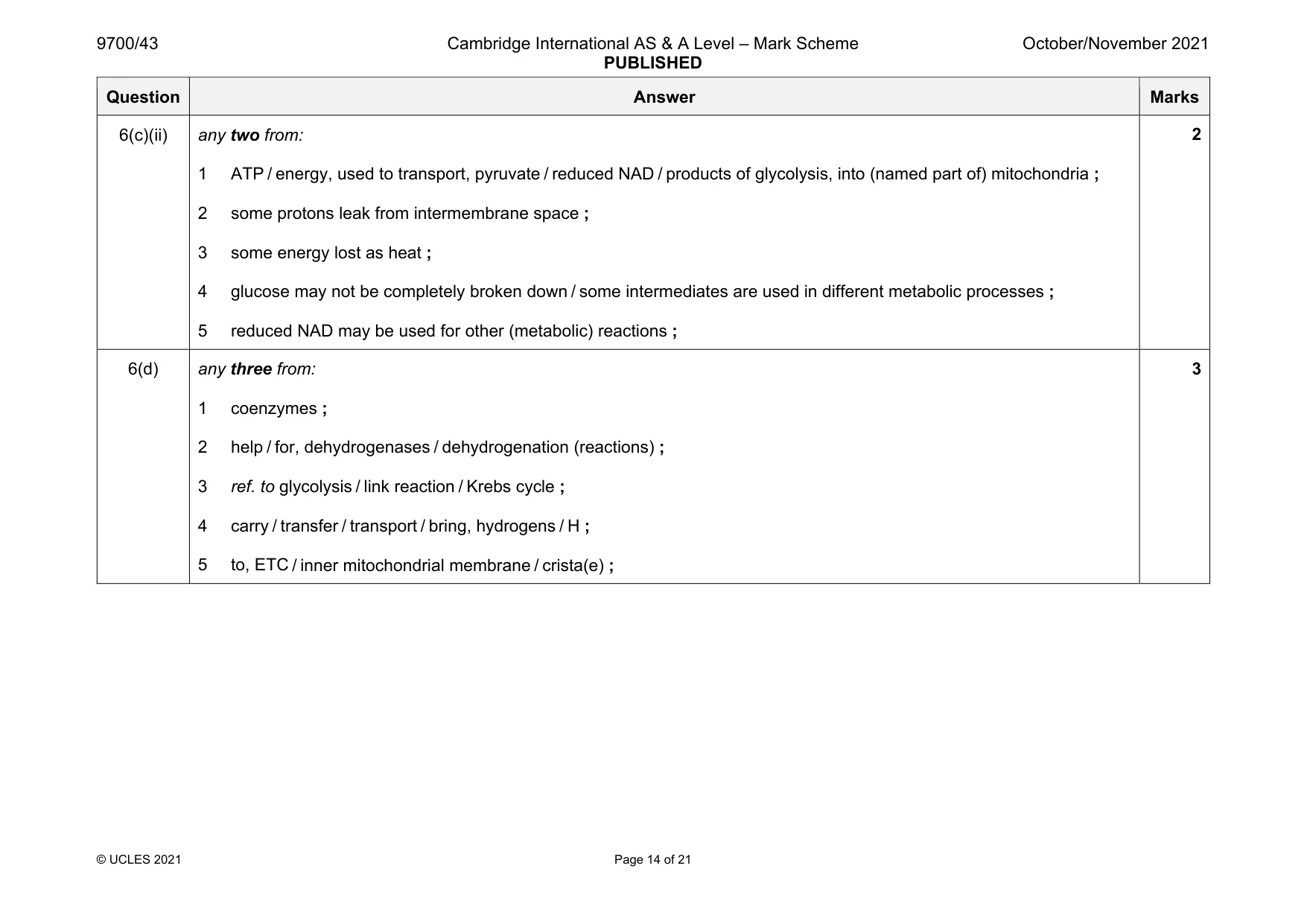
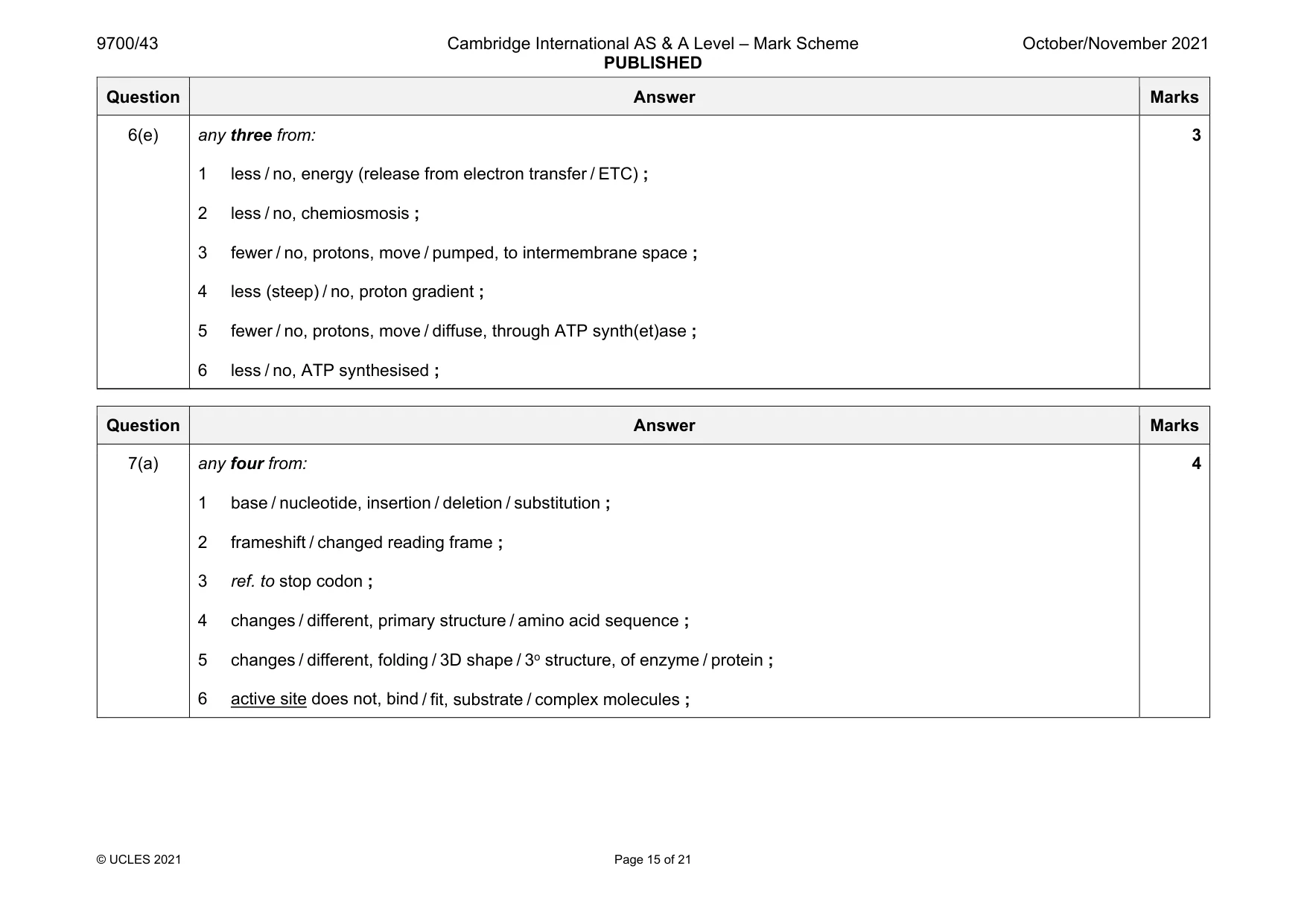
Mark scheme: 6(a) carbon dioxide ; 1 6(b) any one from: 1 triose phosphate dehydrogenated ; 2 reduced NAD, made / released ; 1 6(c)(i) ( glycolysis ) + ( Krebs ) (ATP + reduced NAD) + (ATP + reduced NAD + reduced FAD) (4 – 2) + (4 × 3) + 2 + (6 × 3) + (2 × 2) OR 2 + 12 + 2 + 18 + 4 ; 38 ; 2 Question Answer Marks 6(c)(ii) any two from: 1 ATP / energy, used to transport, pyruvate / reduced NAD / products of glycolysis, into (named part of) mitochondria ; 2 some protons leak from intermembrane space ; 3 some energy lost as heat ; 4 glucose may not be completely broken down / some intermediates are used in different metabolic processes ; 5 reduced NAD may be used for other (metabolic) reactions ; 2 6(d) any three from: 1 coenzymes ; 2 help / for, dehydrogenases / dehydrogenation (reactions) ; 3 ref. to glycolysis / link reaction / Krebs cycle ; 4 carry / transfer / transport / bring, hydrogens / H ; 5 to, ETC / inner mitochondrial membrane / crista(e) ; 3 Question Answer Marks 6(e) any three from: 1 less / no, energy (release from electron transfer / ETC) ; 2 less / no, chemiosmosis ; 3 fewer / no, protons, move / pumped, to intermembrane space ; 4 less (steep) / no, proton gradient ; 5 fewer / no, protons, move / diffuse, through ATP synth(et)ase ; 6 less / no, ATP synthesised ; 3
Q7 · The function of the enzyme iduronate 2-sulfatase is to break down certain complex…
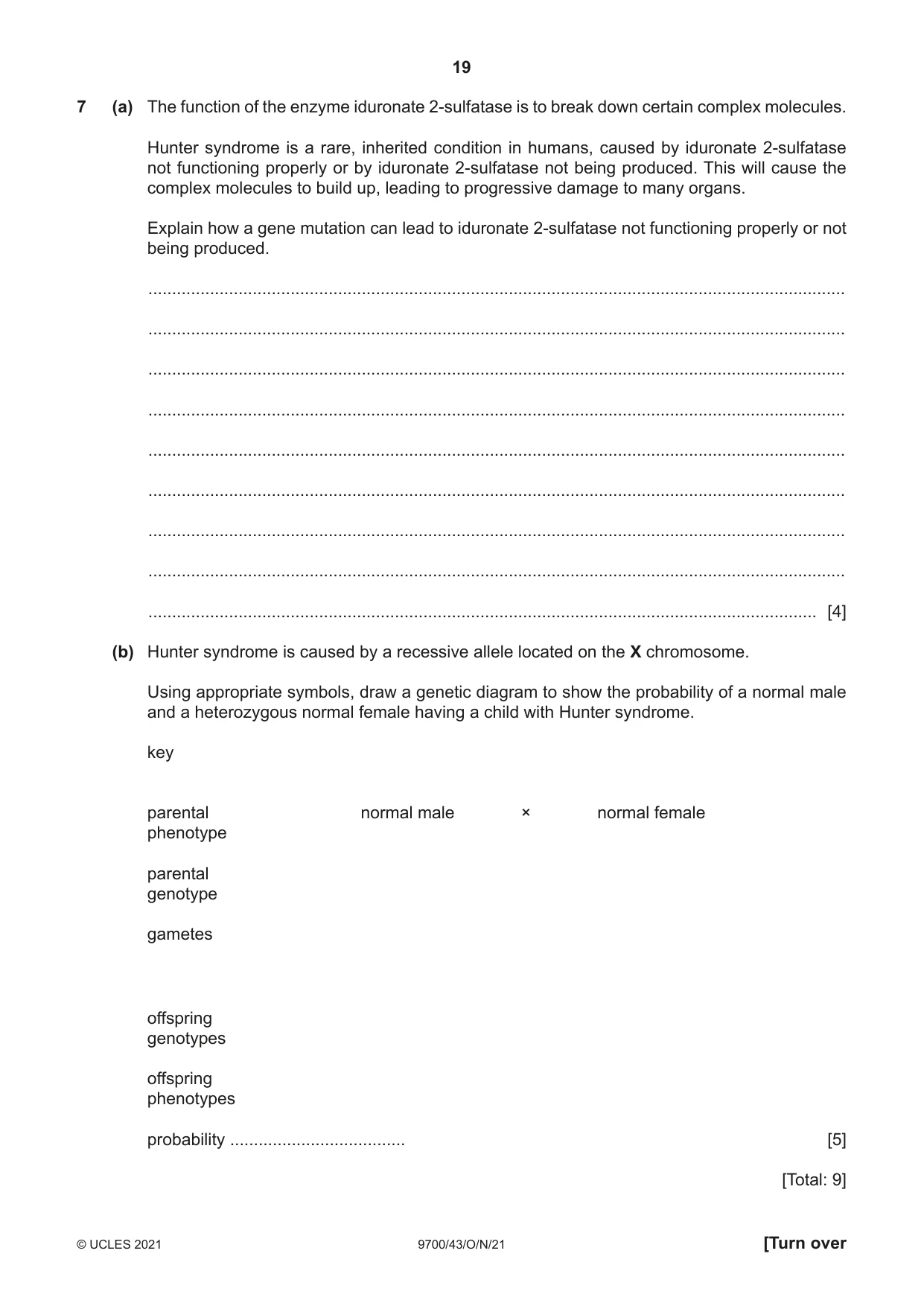
7 (a) The function of the enzyme iduronate 2-sulfatase is to break down certain complex molecules. Hunter syndrome is a rare, inherited condition in humans, caused by iduronate 2-sulfatase not functioning properly or by iduronate 2-sulfatase not being produced. This will cause the complex molecules to build up, leading to progressive damage to many organs. Explain how a gene mutation can lead to iduronate 2-sulfatase not functioning properly or not being produced. ................................................................................................................................................... ................................................................................................................................................... ................................................................................................................................................... ................................................................................................................................................... ................................................................................................................................................... ................................................................................................................................................... ................................................................................................................................................... ................................................................................................................................................... ............................................................................................................................................. [4] (b) Hunter syndrome is caused by a recessive allele located on the X chromosome. Using appropriate symbols, draw a genetic diagram to show the probability of a normal male and a heterozygous normal female having a child with Hunter syndrome. key parental normal male × normal female phenotype parental genotype gametes offspring genotypes offspring phenotypes probability ..................................... [5] [Total: 9]
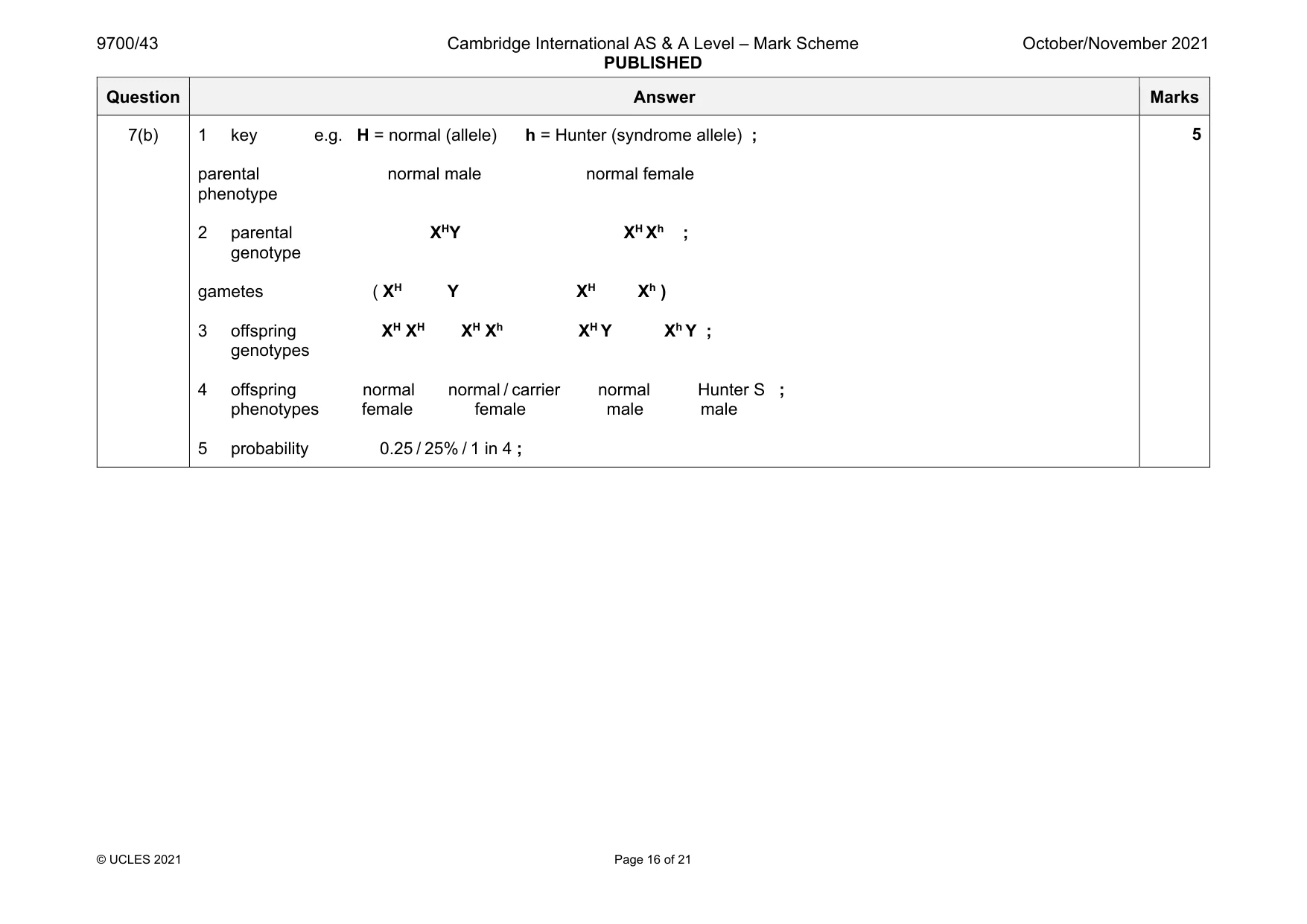
Mark scheme: 7(a) any four from: 1 base / nucleotide, insertion / deletion / substitution ; 2 frameshift / changed reading frame ; 3 ref. to stop codon ; 4 changes / different, primary structure / amino acid sequence ; 5 changes / different, folding / 3D shape / 3o structure, of enzyme / protein ; 6 active site does not, bind / fit, substrate / complex molecules ; 4 Question Answer Marks 7(b) 1 key e.g. H = normal (allele) h = Hunter (syndrome allele) ; parental normal male normal female phenotype 2 parental XHY XH Xh ; genotype gametes ( XH Y XH Xh ) 3 offspring XH XH XH Xh XH Y Xh Y ; genotypes 4 offspring normal normal / carrier normal Hunter S ; phenotypes female female male male 5 probability 0.25 / 25% / 1 in 4 ; 5
More questions on Passage of information from parents to offspring
Q8 · California salamanders are terrestrial amphibians
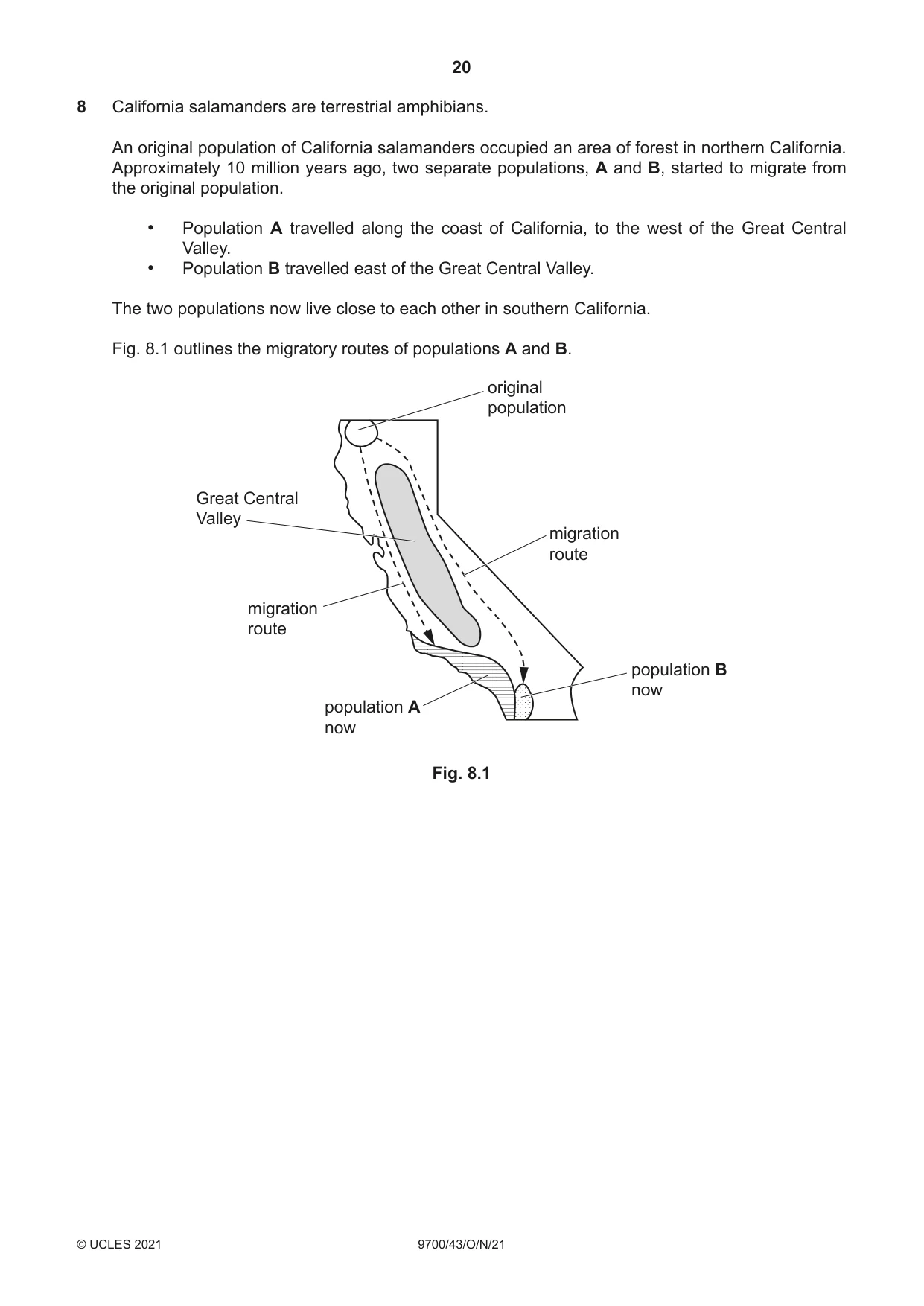
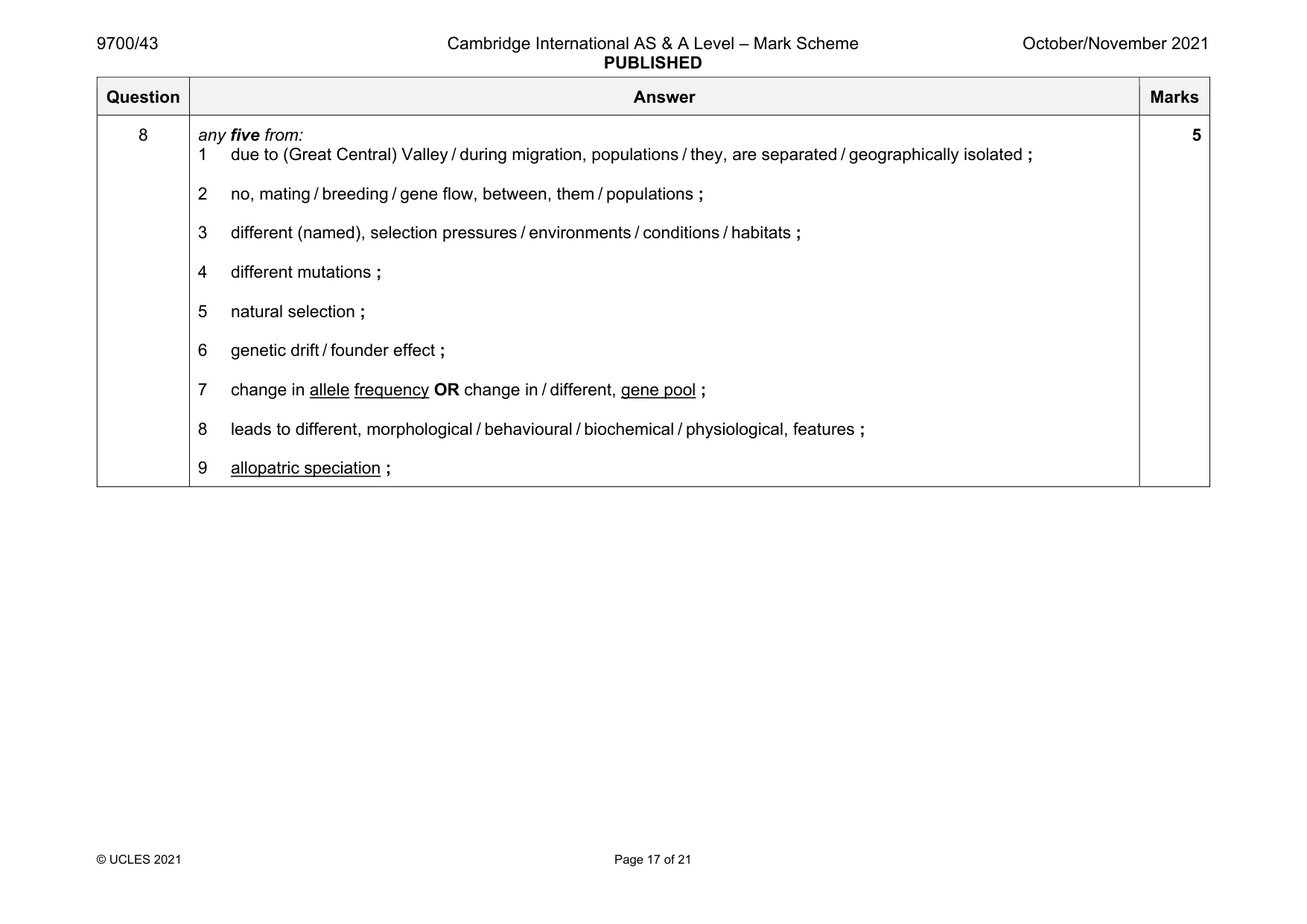
8 California salamanders are terrestrial amphibians. An original population of California salamanders occupied an area of forest in northern California. Approximately 10 million years ago, two separate populations, A and B, started to migrate from the original population. • Population A travelled along the coast of California, to the west of the Great Central Valley. • Population B travelled east of the Great Central Valley. The two populations now live close to each other in southern California. Fig. 8.1 outlines the migratory routes of populations A and B. original population Great Central Valley migration route migration route population B now population A now Fig. 8.1 Salamanders from population A rarely interbreed with salamanders of population B. If they do interbreed, the offspring are infertile. Suggest and explain the sequence of events that have resulted in these two populations becoming reproductively isolated from each other. .......................................................................................................................................................... .......................................................................................................................................................... .......................................................................................................................................................... .......................................................................................................................................................... .......................................................................................................................................................... .......................................................................................................................................................... .......................................................................................................................................................... .......................................................................................................................................................... .......................................................................................................................................................... .......................................................................................................................................................... .................................................................................................................................................... [5] [Total: 5]
Mark scheme: 8 any five from: 1 due to (Great Central) Valley / during migration, populations / they, are separated / geographically isolated ; 2 no, mating / breeding / gene flow, between, them / populations ; 3 different (named), selection pressures / environments / conditions / habitats ; 4 different mutations ; 5 natural selection ; 6 genetic drift / founder effect ; 7 change in allele frequency OR change in / different, gene pool ; 8 leads to different, morphological / behavioural / biochemical / physiological, features ; 9 allopatric speciation ; 5
Q9 · Describe and explain the mechanism by which guard cells open stomata
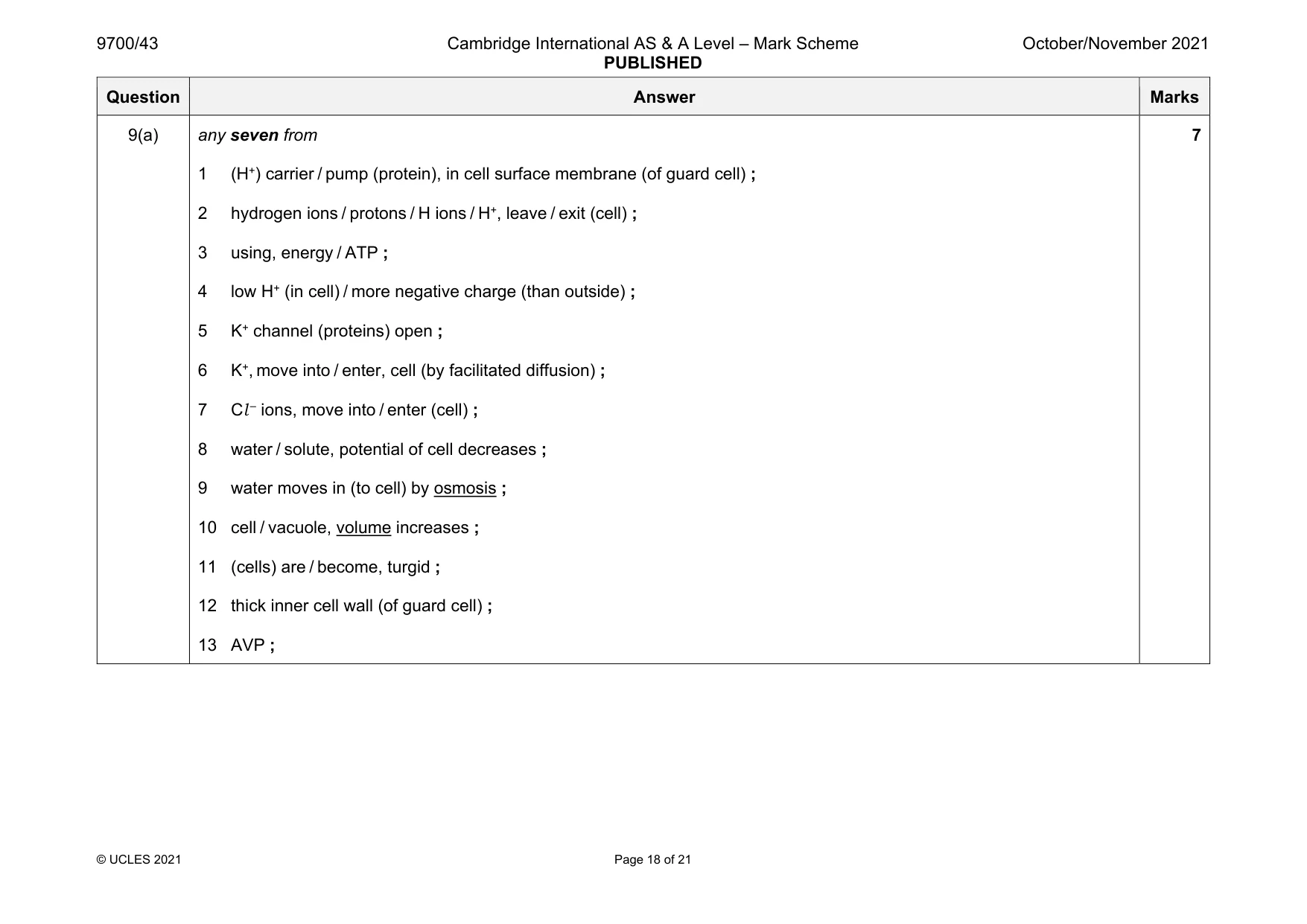
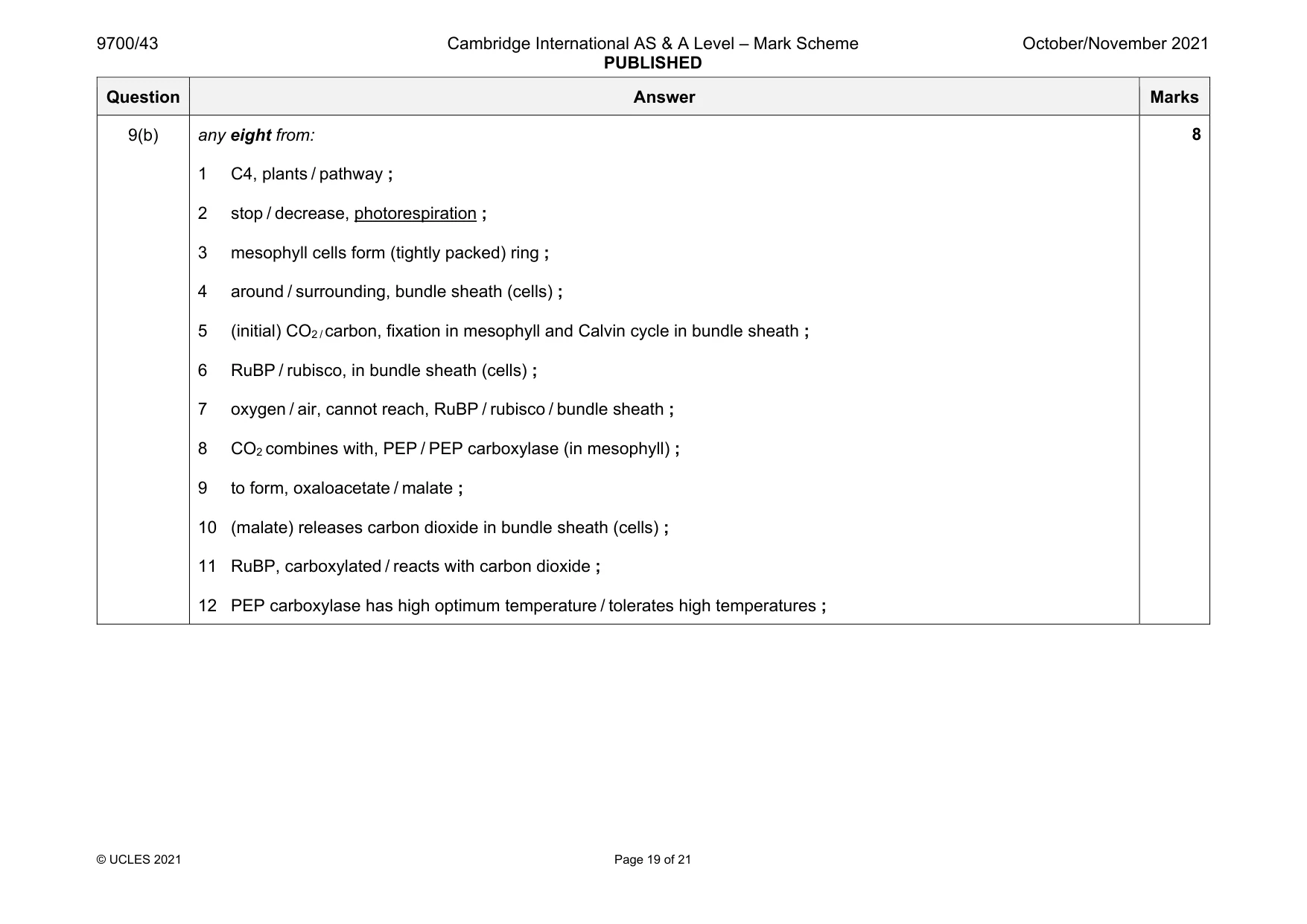
9 (a) Describe and explain the mechanism by which guard cells open stomata. [7] (b) Explain how the anatomy and physiology of the leaves of maize or sorghum are able to maximise carbon dioxide fixation at high temperatures. [8] [Total: 15]
Mark scheme: 9(a) any seven from 1 (H+) carrier / pump (protein), in cell surface membrane (of guard cell) ; 2 hydrogen ions / protons / H ions / H+, leave / exit (cell) ; 3 using, energy / ATP ; 4 low H+ (in cell) / more negative charge (than outside) ; 5 K+ channel (proteins) open ; 6 K+, move into / enter, cell (by facilitated diffusion) ; 7 Cl – ions, move into / enter (cell) ; 8 water / solute, potential of cell decreases ; 9 water moves in (to cell) by osmosis ; 10 cell / vacuole, volume increases ; 11 (cells) are / become, turgid ; 12 thick inner cell wall (of guard cell) ; 13 AVP ; 7 Question Answer Marks 9(b) any eight from: 1 C4, plants / pathway ; 2 stop / decrease, photorespiration ; 3 mesophyll cells form (tightly packed) ring ; 4 around / surrounding, bundle sheath (cells) ; 5 (initial) CO2 / carbon, fixation in mesophyll and Calvin cycle in bundle sheath ; 6 RuBP / rubisco, in bundle sheath (cells) ; 7 oxygen / air, cannot reach, RuBP / rubisco / bundle sheath ; 8 CO2 combines with, PEP / PEP carboxylase (in mesophyll) ; 9 to form, oxaloacetate / malate ; 10 (malate) releases carbon dioxide in bundle sheath (cells) ; 11 RuBP, carboxylated / reacts with carbon dioxide ; 12 PEP carboxylase has high optimum temperature / tolerates high temperatures ; 8
More questions on Photosynthesis as an energy transfer process
Q10 · Describe and explain the transmission of an action potential in a myelinated neurone
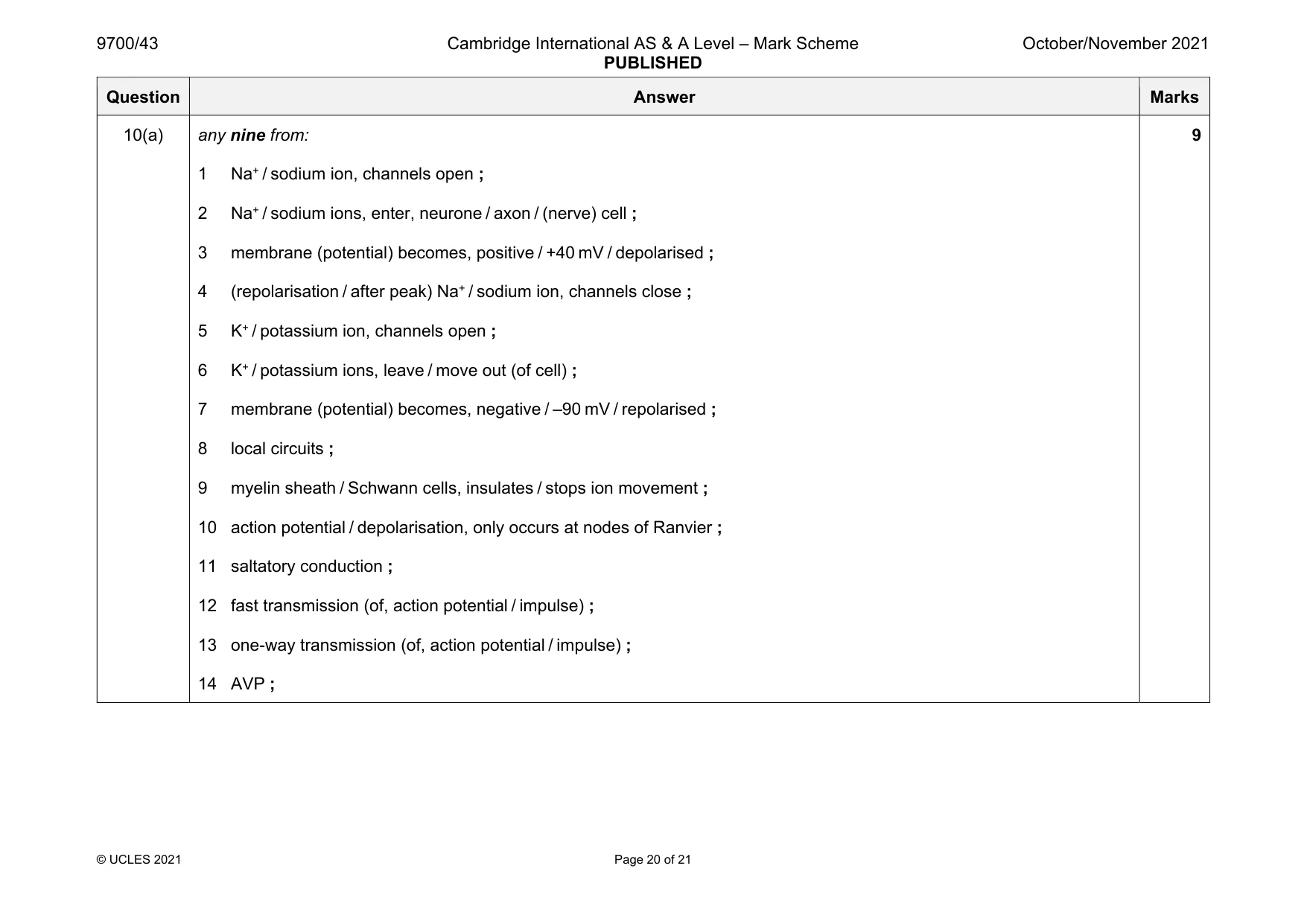
10 (a) Describe and explain the transmission of an action potential in a myelinated neurone. [9] (b) Explain what is meant by homeostasis in a mammal and explain why it is important to maintain body temperature, blood glucose concentration and the water potential of blood. [6] [Total: 15] .................................................................................................................................................................. .................................................................................................................................................................. .................................................................................................................................................................. .................................................................................................................................................................. .................................................................................................................................................................. .................................................................................................................................................................. .................................................................................................................................................................. .................................................................................................................................................................. .................................................................................................................................................................. .................................................................................................................................................................. .................................................................................................................................................................. .................................................................................................................................................................. .................................................................................................................................................................. .................................................................................................................................................................. .................................................................................................................................................................. .................................................................................................................................................................. .................................................................................................................................................................. .................................................................................................................................................................. .................................................................................................................................................................. .................................................................................................................................................................. .................................................................................................................................................................. .................................................................................................................................................................. .................................................................................................................................................................. .................................................................................................................................................................. .................................................................................................................................................................. .................................................................................................................................................................. .................................................................................................................................................................. .................................................................................................................................................................. .................................................................................................................................................................. .................................................................................................................................................................. .................................................................................................................................................................. .................................................................................................................................................................. .................................................................................................................................................................. .................................................................................................................................................................. .................................................................................................................................................................. .................................................................................................................................................................. .................................................................................................................................................................. .................................................................................................................................................................. .................................................................................................................................................................. .................................................................................................................................................................. .................................................................................................................................................................. .................................................................................................................................................................. .................................................................................................................................................................. .................................................................................................................................................................. .................................................................................................................................................................. .................................................................................................................................................................. .................................................................................................................................................................. .................................................................................................................................................................. .................................................................................................................................................................. .................................................................................................................................................................. .................................................................................................................................................................. .................................................................................................................................................................. .................................................................................................................................................................. .................................................................................................................................................................. .................................................................................................................................................................. .................................................................................................................................................................. .................................................................................................................................................................. .................................................................................................................................................................. .................................................................................................................................................................. .................................................................................................................................................................. .................................................................................................................................................................. .................................................................................................................................................................. .................................................................................................................................................................. .................................................................................................................................................................. .................................................................................................................................................................. .................................................................................................................................................................. .................................................................................................................................................................. .................................................................................................................................................................. .................................................................................................................................................................. ..................................................................................................................................................................
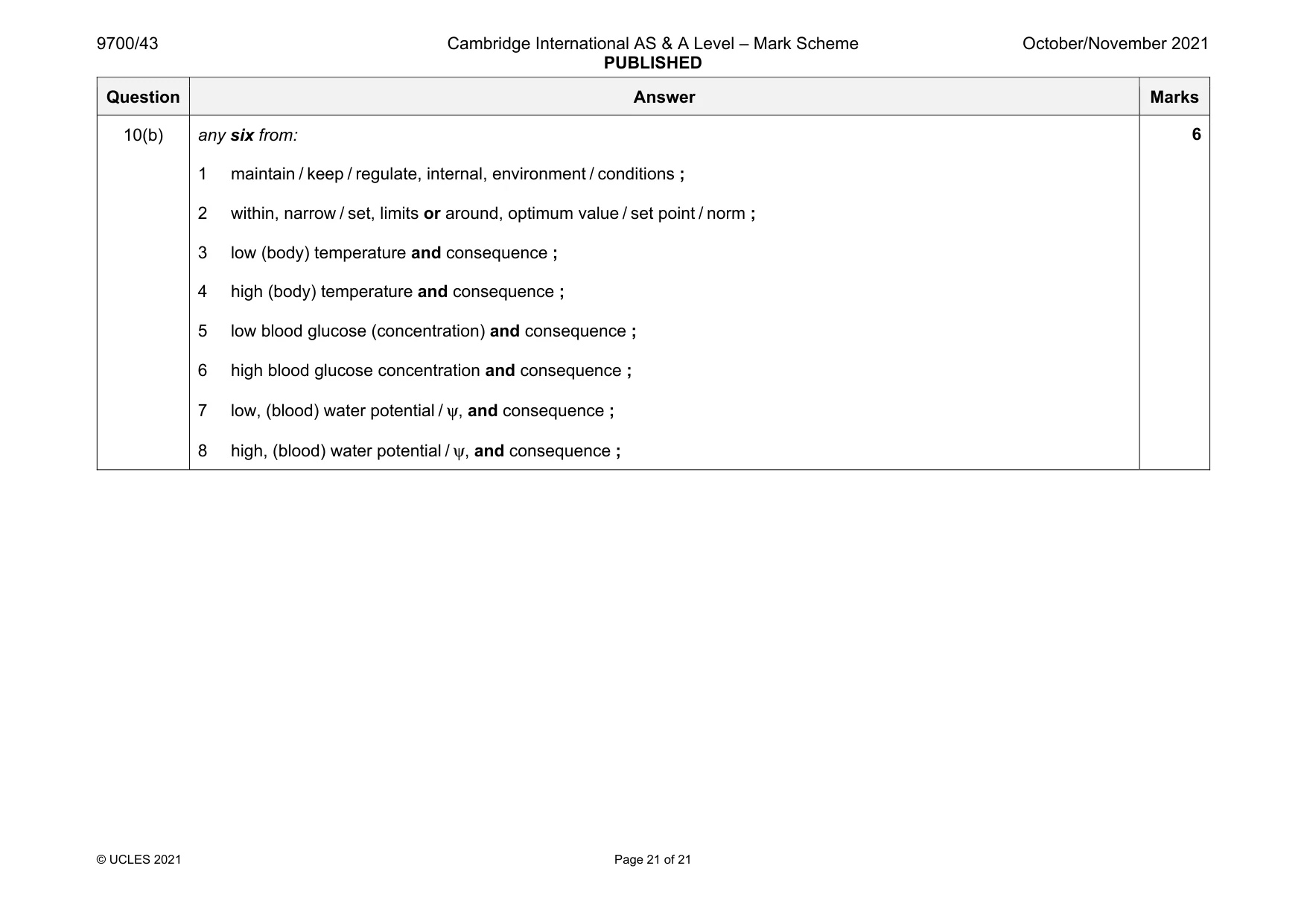
Mark scheme: 10(a) any nine from: 1 Na+ / sodium ion, channels open ; 2 Na+ / sodium ions, enter, neurone / axon / (nerve) cell ; 3 membrane (potential) becomes, positive / +40 mV / depolarised ; 4 (repolarisation / after peak) Na+ / sodium ion, channels close ; 5 K+ / potassium ion, channels open ; 6 K+ / potassium ions, leave / move out (of cell) ; 7 membrane (potential) becomes, negative / –90 mV / repolarised ; 8 local circuits ; 9 myelin sheath / Schwann cells, insulates / stops ion movement ; 10 action potential / depolarisation, only occurs at nodes of Ranvier ; 11 saltatory conduction ; 12 fast transmission (of, action potential / impulse) ; 13 one-way transmission (of, action potential / impulse) ; 14 AVP ; 9 Question Answer Marks 10(b) any six from: 1 maintain / keep / regulate, internal, environment / conditions ; 2 within, narrow / set, limits or around, optimum value / set point / norm ; 3 low (body) temperature and consequence ; 4 high (body) temperature and consequence ; 5 low blood glucose (concentration) and consequence ; 6 high blood glucose concentration and consequence ; 7 low, (blood) water potential / ψ, and consequence ; 8 high, (blood) water potential / ψ, and consequence ; 6
What was in this paper
The subtopics covered by these 10 questions, and how many questions each got. Open one in a new tab to see every Cambridge question on it.
What you needed in this session
Cambridge’s own grade thresholds for 2021 Oct/Nov, Paper 4 · Variant 3. A higher threshold means an easier paper — the bar moves with how the cohort did.