Cambridge A Level Biology 9700 — 2021 May/June Paper 4 · Variant 2
9700/42/M/J/21 · 10 questions · 100 marks · ≈113 min
The question paper and its mark scheme, free to read here and free to download. This is Cambridge’s own paper, exactly as it was sat.
Question paper24 pages




Mark scheme22 pages
Answers below. Sit the paper first if you are practising.
Questions as text
Q1 · A diagram of part of a neurone membrane at resting potential
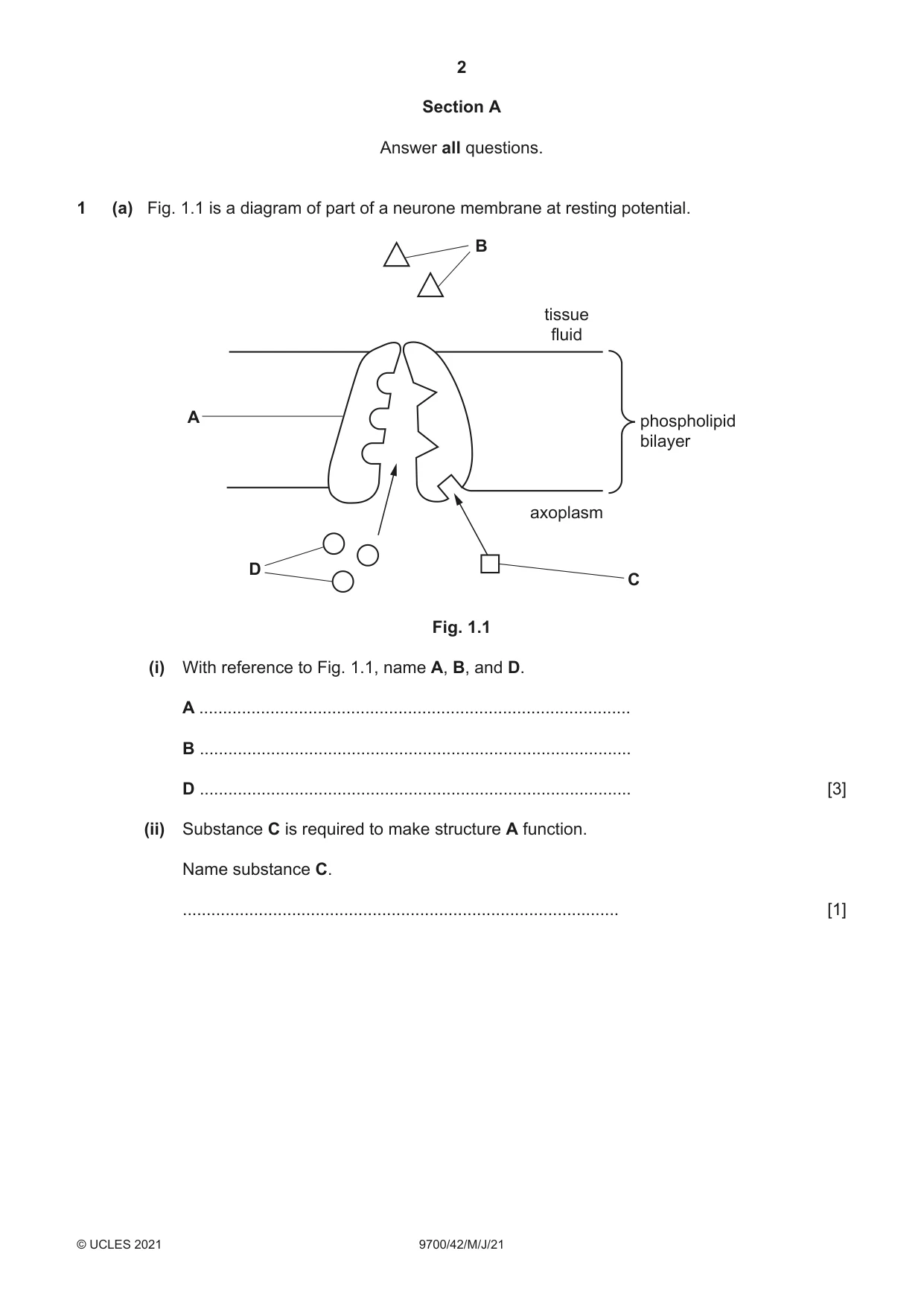
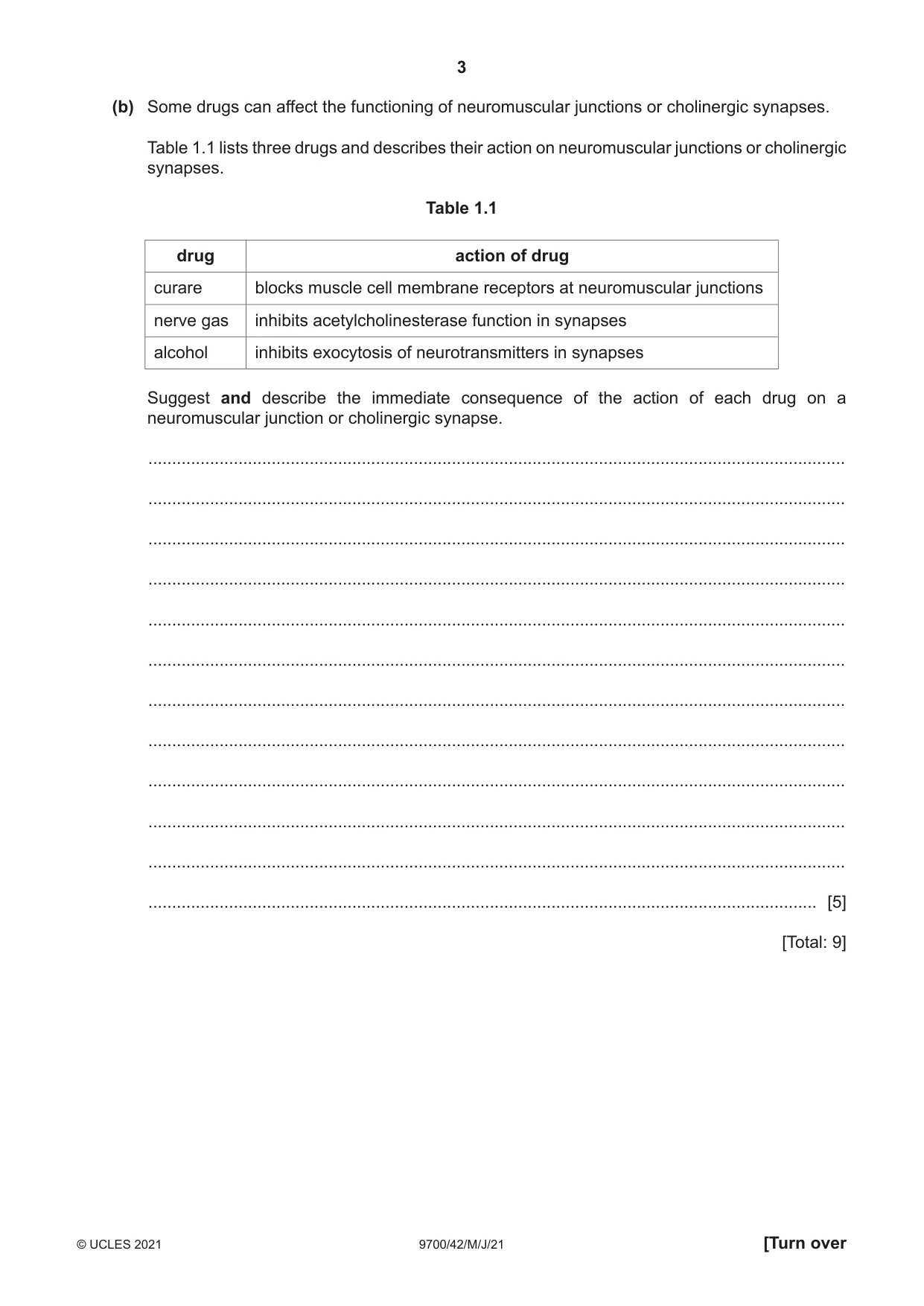
1 (a) Fig. 1.1 is a diagram of part of a neurone membrane at resting potential. B tissue fluid A phospholipid bilayer axoplasm D C Fig. 1.1 (i) With reference to Fig. 1.1, name A, B, and D. A ........................................................................................... B ........................................................................................... D ........................................................................................... [3] (ii) Substance C is required to make structure A function. Name substance C. ............................................................................................ [1] (b) Some drugs can affect the functioning of neuromuscular junctions or cholinergic synapses. Table 1.1 lists three drugs and describes their action on neuromuscular junctions or cholinergic synapses. Table 1.1 drug action of drug curare blocks muscle cell membrane receptors at neuromuscular junctions nerve gas inhibits acetylcholinesterase function in synapses alcohol inhibits exocytosis of neurotransmitters in synapses Suggest and describe the immediate consequence of the action of each drug on a neuromuscular junction or cholinergic synapse. ................................................................................................................................................... ................................................................................................................................................... ................................................................................................................................................... ................................................................................................................................................... ................................................................................................................................................... ................................................................................................................................................... ................................................................................................................................................... ................................................................................................................................................... ................................................................................................................................................... ................................................................................................................................................... ................................................................................................................................................... ............................................................................................................................................. [5] [Total: 9]
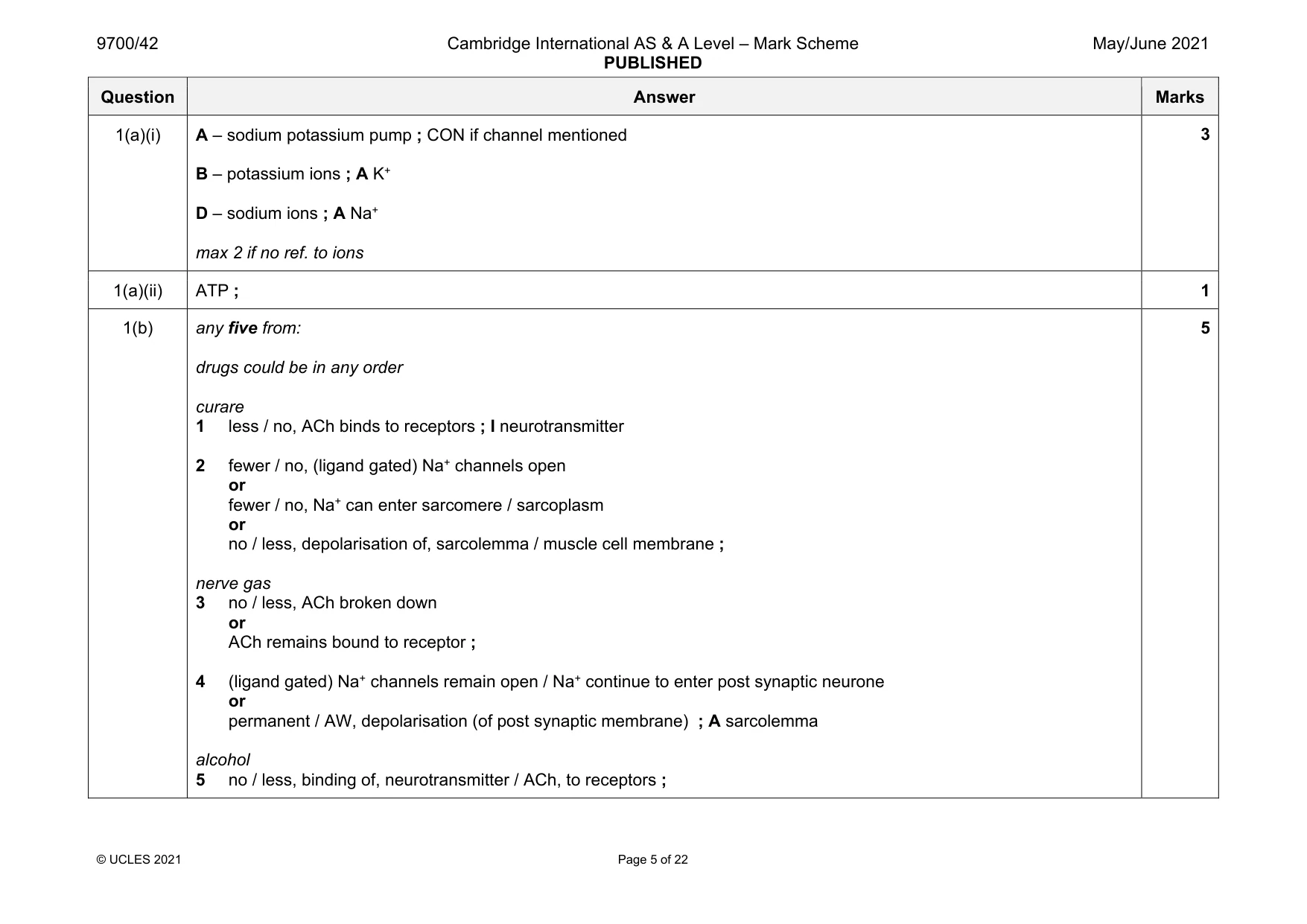
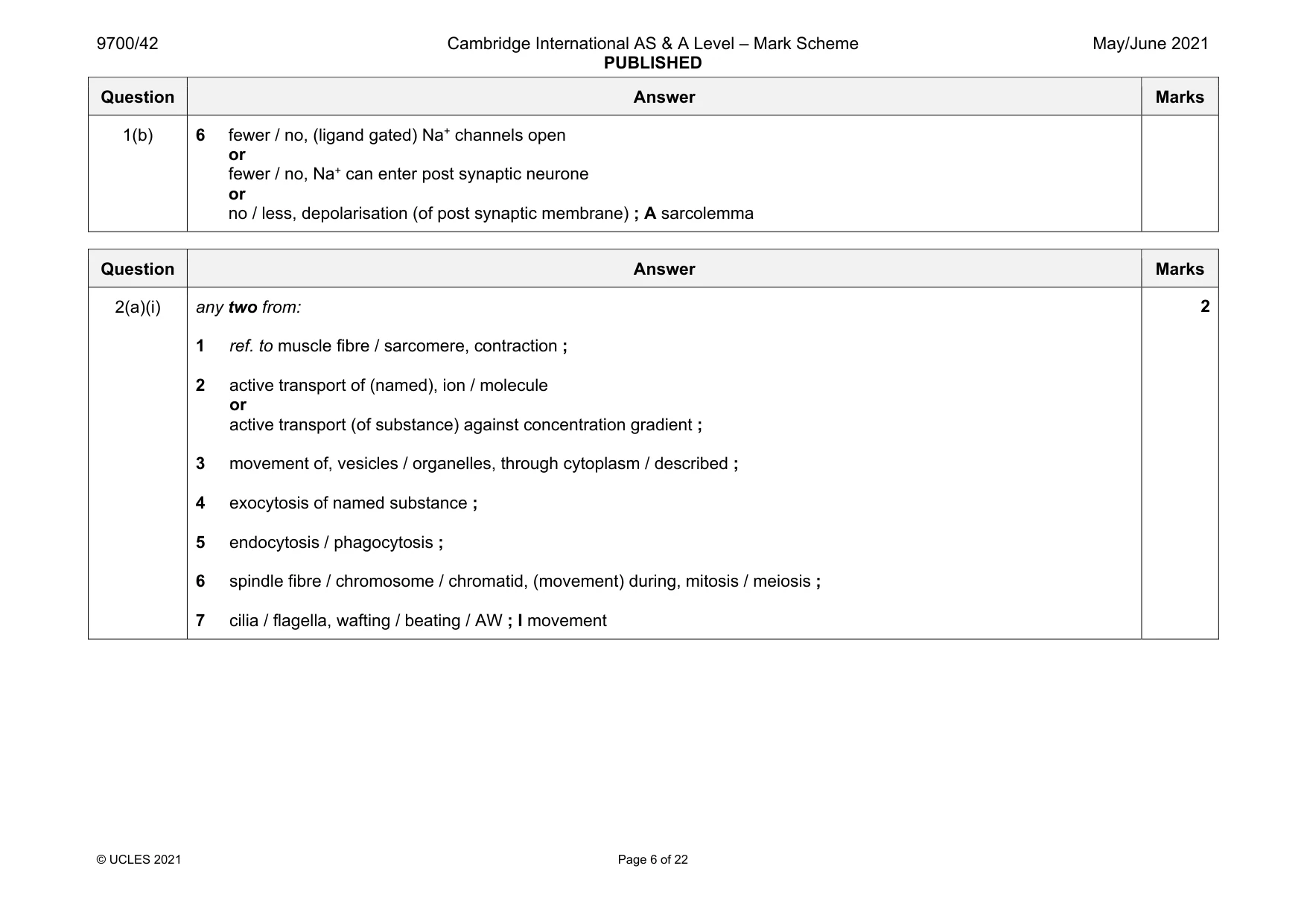
Mark scheme: 1(a)(i) A – sodium potassium pump ; CON if channel mentioned B – potassium ions ; A K+ D – sodium ions ; A Na+ max 2 if no ref. to ions 1(a)(ii) ATP ; 1 1(b) any five from: drugs could be in any order curare 1 less / no, ACh binds to receptors ; I neurotransmitter 2 fewer / no, (ligand gated) Na+ channels open or fewer / no, Na+ can enter sarcomere / sarcoplasm or no / less, depolarisation of, sarcolemma / muscle cell membrane ; nerve gas 3 no / less, ACh broken down or ACh remains bound to receptor ; 4 (ligand gated) Na+ channels remain open / Na+ continue to enter post synaptic neurone or permanent / AW, depolarisation (of post synaptic membrane) ; A sarcolemma alcohol 5 no / less, binding of, neurotransmitter / ACh, to receptors ; 5 Question Answer Marks 1(b) 6 fewer / no, (ligand gated) Na+ channels open or fewer / no, Na+ can enter post synaptic neurone or no / less, depolarisation (of post synaptic membrane) ; A sarcolemma
Question 2
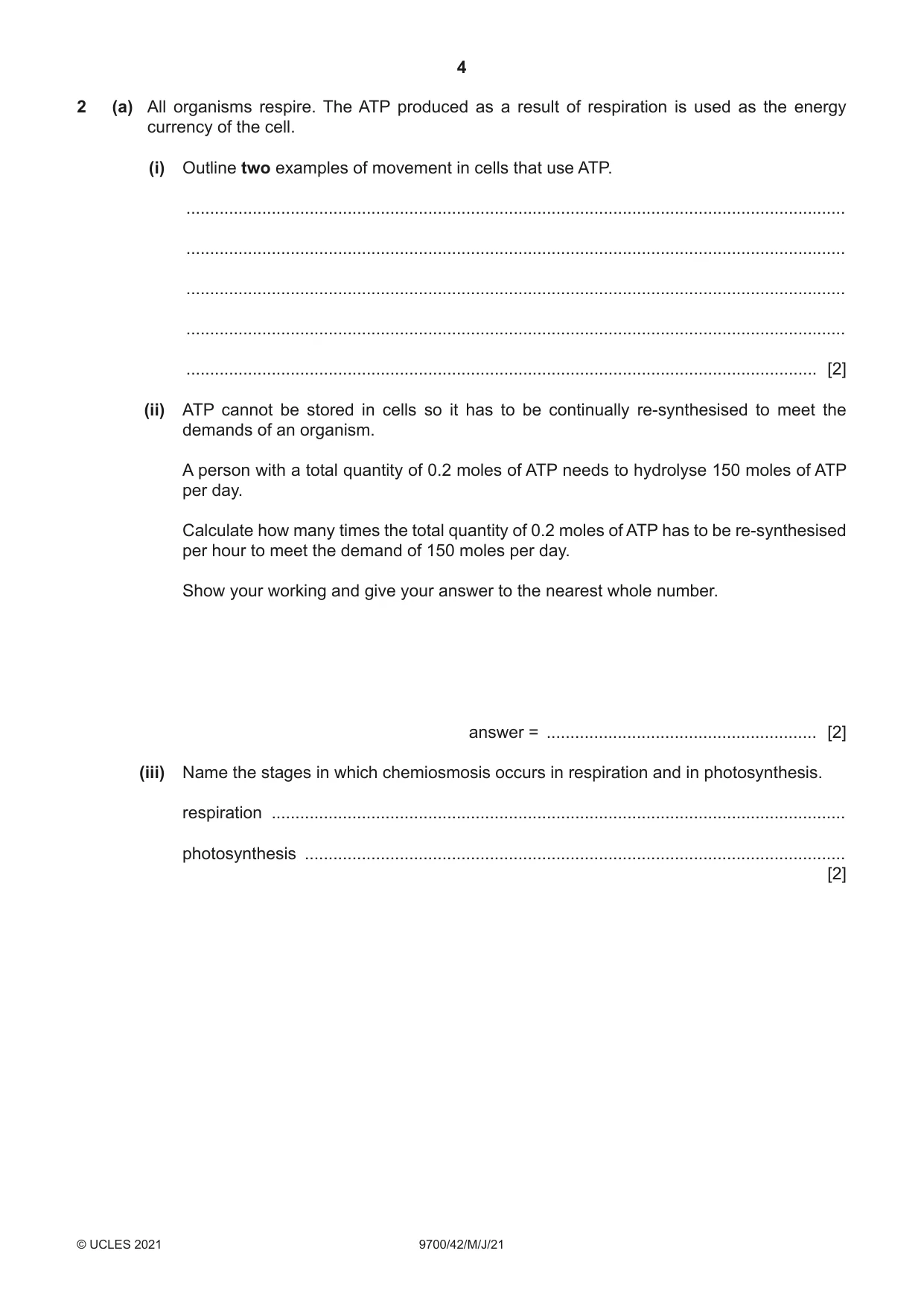
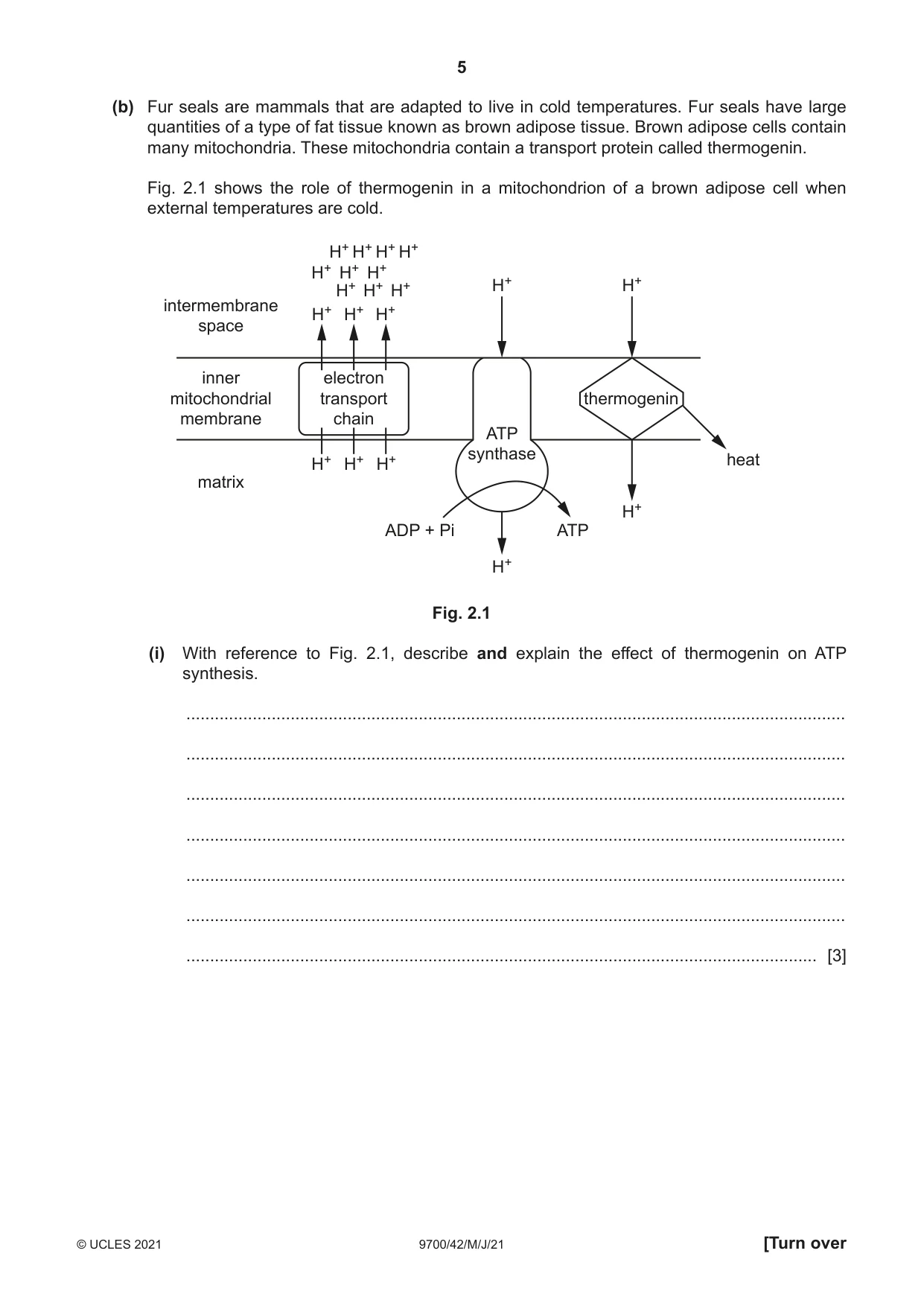
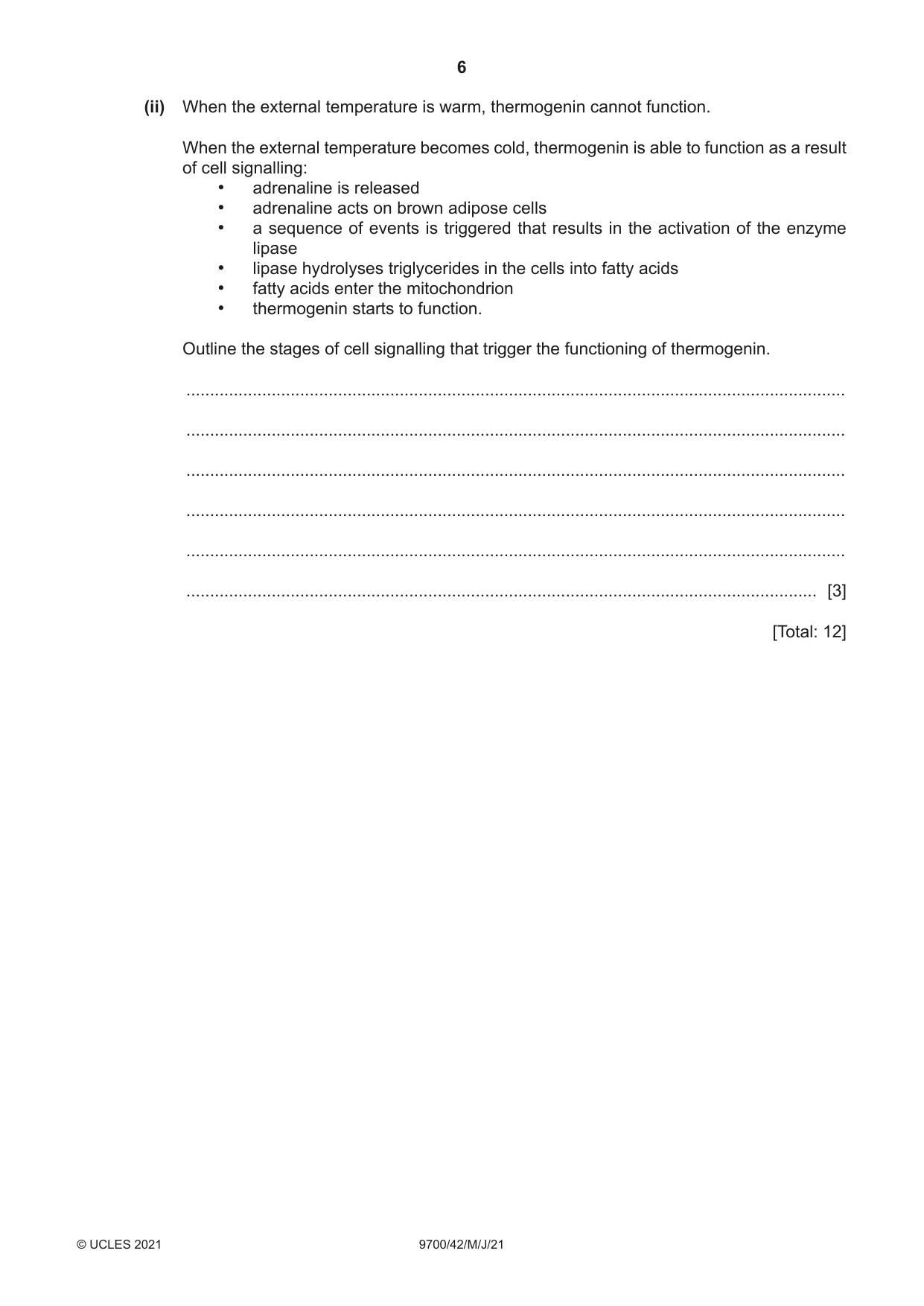
2 (a) All organisms respire. The ATP produced as a result of respiration is used as the energy currency of the cell. (i) Outline two examples of movement in cells that use ATP. ........................................................................................................................................... ........................................................................................................................................... ........................................................................................................................................... ........................................................................................................................................... ..................................................................................................................................... [2] (ii) ATP cannot be stored in cells so it has to be continually re-synthesised to meet the demands of an organism. A person with a total quantity of 0.2 moles of ATP needs to hydrolyse 150 moles of ATP per day. Calculate how many times the total quantity of 0.2 moles of ATP has to be re-synthesised per hour to meet the demand of 150 moles per day. Show your working and give your answer to the nearest whole number. answer = ......................................................... [2] (iii) Name the stages in which chemiosmosis occurs in respiration and in photosynthesis. respiration ......................................................................................................................... photosynthesis .................................................................................................................. [2] (b) Fur seals are mammals that are adapted to live in cold temperatures. Fur seals have large quantities of a type of fat tissue known as brown adipose tissue. Brown adipose cells contain many mitochondria. These mitochondria contain a transport protein called thermogenin. Fig. 2.1 shows the role of thermogenin in a mitochondrion of a brown adipose cell when external temperatures are cold. H+ H+ H+ H+ H+ H+ H+ H+ H+ H+ H+ H+ intermembrane H+ H+ H+ space inner electron mitochondrial transport thermogenin membrane chain ATP synthase H+ H+ H+ heat matrix H+ ADP + Pi ATP H+ Fig. 2.1 (i) With reference to Fig. 2.1, describe and explain the effect of thermogenin on ATP synthesis. ........................................................................................................................................... ........................................................................................................................................... ........................................................................................................................................... ........................................................................................................................................... ........................................................................................................................................... ........................................................................................................................................... ..................................................................................................................................... [3] (ii) When the external temperature is warm, thermogenin cannot function. When the external temperature becomes cold, thermogenin is able to function as a result of cell signalling: • adrenaline is released • adrenaline acts on brown adipose cells • a sequence of events is triggered that results in the activation of the enzyme lipase • lipase hydrolyses triglycerides in the cells into fatty acids • fatty acids enter the mitochondrion • thermogenin starts to function. Outline the stages of cell signalling that trigger the functioning of thermogenin. ........................................................................................................................................... ........................................................................................................................................... ........................................................................................................................................... ........................................................................................................................................... ........................................................................................................................................... ..................................................................................................................................... [3] [Total: 12] Question 3 starts on page 8.
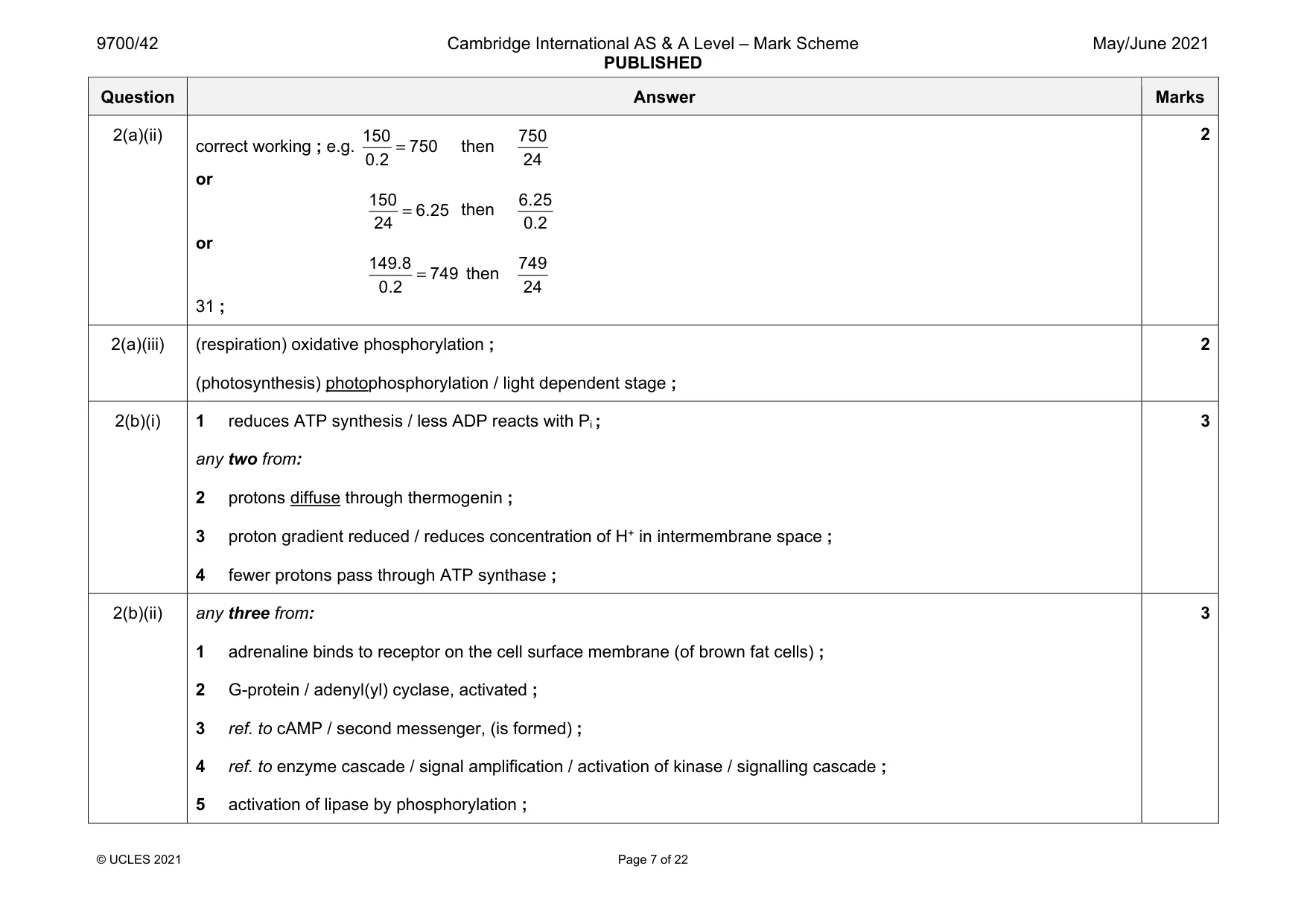
Mark scheme: 2(a)(i) any two from: 1 ref. to muscle fibre / sarcomere, contraction ; 2 active transport of (named), ion / molecule or active transport (of substance) against concentration gradient ; 3 movement of, vesicles / organelles, through cytoplasm / described ; 4 exocytosis of named substance ; 5 endocytosis / phagocytosis ; 6 spindle fibre / chromosome / chromatid, (movement) during, mitosis / meiosis ; 7 cilia / flagella, wafting / beating / AW ; I movement Question Answer Marks 2(a)(ii) correct working ; e.g. 150 750 0.2 = then 750 24 or 150 6.25 24 = then 6.25 0.2 or 149.8 749 0.2 = then 749 24 31 ; 2 2(a)(iii) (respiration) oxidative phosphorylation ; (photosynthesis) photophosphorylation / light dependent stage ; 2 2(b)(i) 1 reduces ATP synthesis / less ADP reacts with Pi ; any two from: 2 protons diffuse through thermogenin ; 3 proton gradient reduced / reduces concentration of H+ in intermembrane space ; 4 fewer protons pass through ATP synthase ; 3 2(b)(ii) any three from: 1 adrenaline binds to receptor on the cell surface membrane (of brown fat cells) ; 2 G-protein / adenyl(yl) cyclase, activated ; 3 ref. to cAMP / second messenger, (is formed) ; 4 ref. to enzyme cascade / signal amplification / activation of kinase / signalling cascade ; 5 activation of lipase by phosphorylation ; 3
Q3 · One way to measure global biodiversity is to count the number of species of organisms
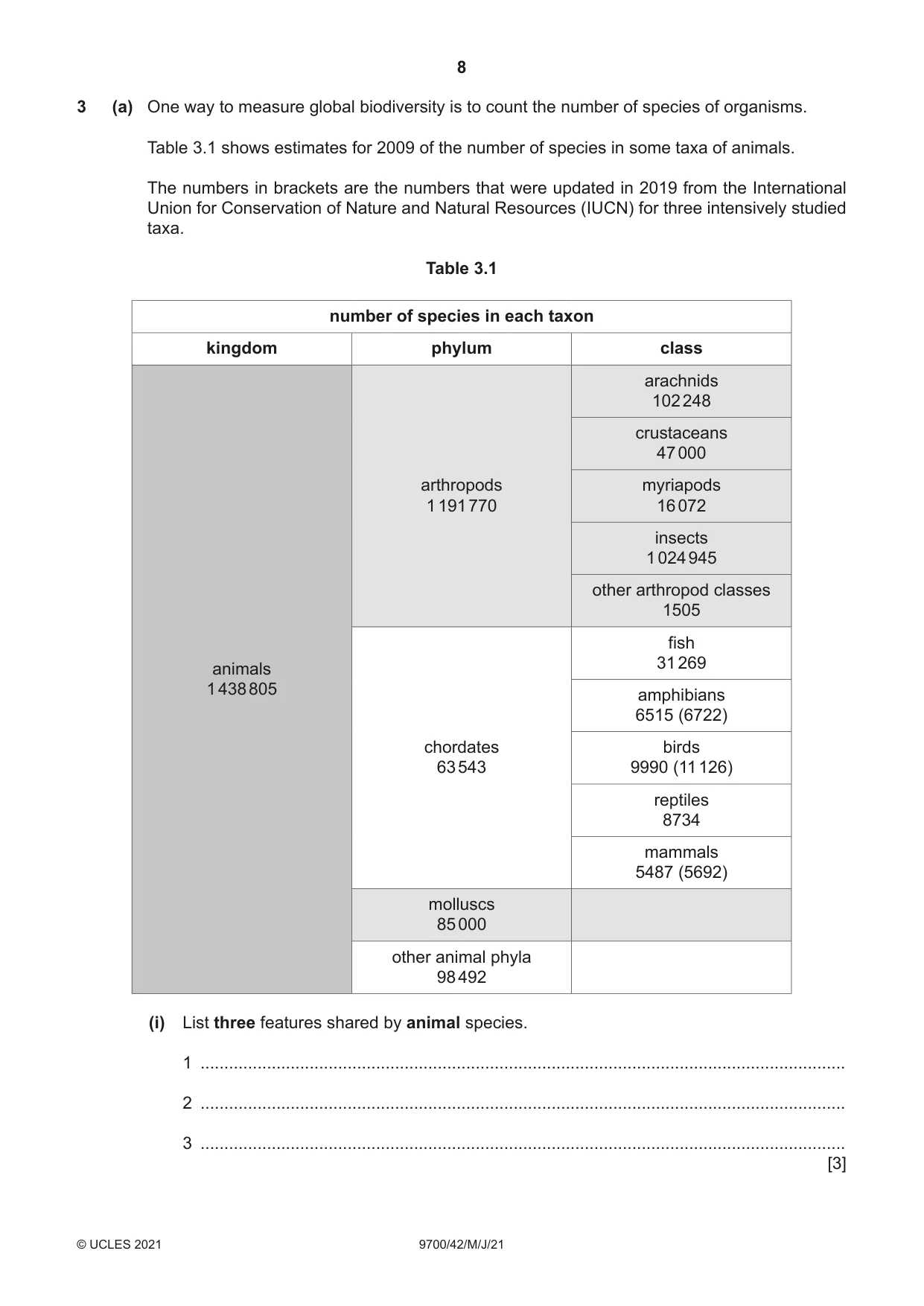
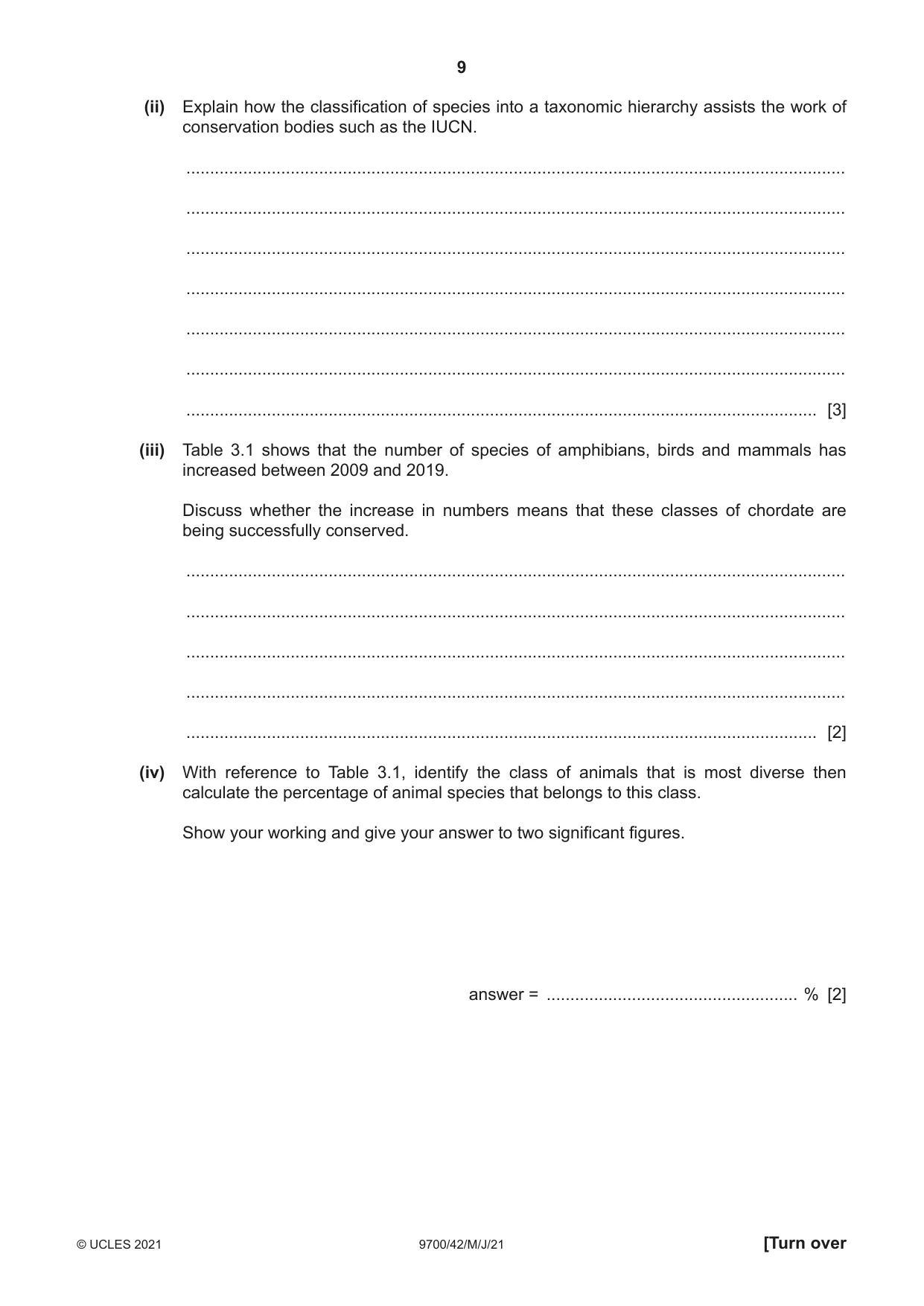
3 (a) One way to measure global biodiversity is to count the number of species of organisms. Table 3.1 shows estimates for 2009 of the number of species in some taxa of animals. The numbers in brackets are the numbers that were updated in 2019 from the International Union for Conservation of Nature and Natural Resources (IUCN) for three intensively studied taxa. Table 3.1 number of species in each taxon kingdom phylum class arachnids 102 248 crustaceans 47 000 arthropods myriapods 1 191 770 16 072 insects 1 024 945 other arthropod classes 1505 fish 31 269 animals 1 438 805 amphibians 6515 (6722) chordates birds 63 543 9990 (11 126) reptiles 8734 mammals 5487 (5692) molluscs 85 000 other animal phyla 98 492 (i) List three features shared by animal species. 1 ........................................................................................................................................ 2 ........................................................................................................................................ 3 ........................................................................................................................................ [3] (ii) Explain how the classification of species into a taxonomic hierarchy assists the work of conservation bodies such as the IUCN. ........................................................................................................................................... ........................................................................................................................................... ........................................................................................................................................... ........................................................................................................................................... ........................................................................................................................................... ........................................................................................................................................... ..................................................................................................................................... [3] (iii) Table 3.1 shows that the number of species of amphibians, birds and mammals has increased between 2009 and 2019. Discuss whether the increase in numbers means that these classes of chordate are being successfully conserved. ........................................................................................................................................... ........................................................................................................................................... ........................................................................................................................................... ........................................................................................................................................... ..................................................................................................................................... [2] (iv) With reference to Table 3.1, identify the class of animals that is most diverse then calculate the percentage of animal species that belongs to this class. Show your working and give your answer to two significant figures. answer = ..................................................... % [2] (b) An analysis in 2019 concluded that twice as many insect species have populations that are decreasing in size compared with chordate species. This analysis focused on developed countries that have large human populations. (i) Outline two factors that may cause populations of insects to decrease in size in developed countries that have large human populations. ........................................................................................................................................... ........................................................................................................................................... ........................................................................................................................................... ........................................................................................................................................... ..................................................................................................................................... [2] (ii) Explain how the introduction of crops that are genetically modified to express the Bt toxin can benefit biodiversity. ........................................................................................................................................... ........................................................................................................................................... ........................................................................................................................................... ........................................................................................................................................... ..................................................................................................................................... [2] [Total: 14]
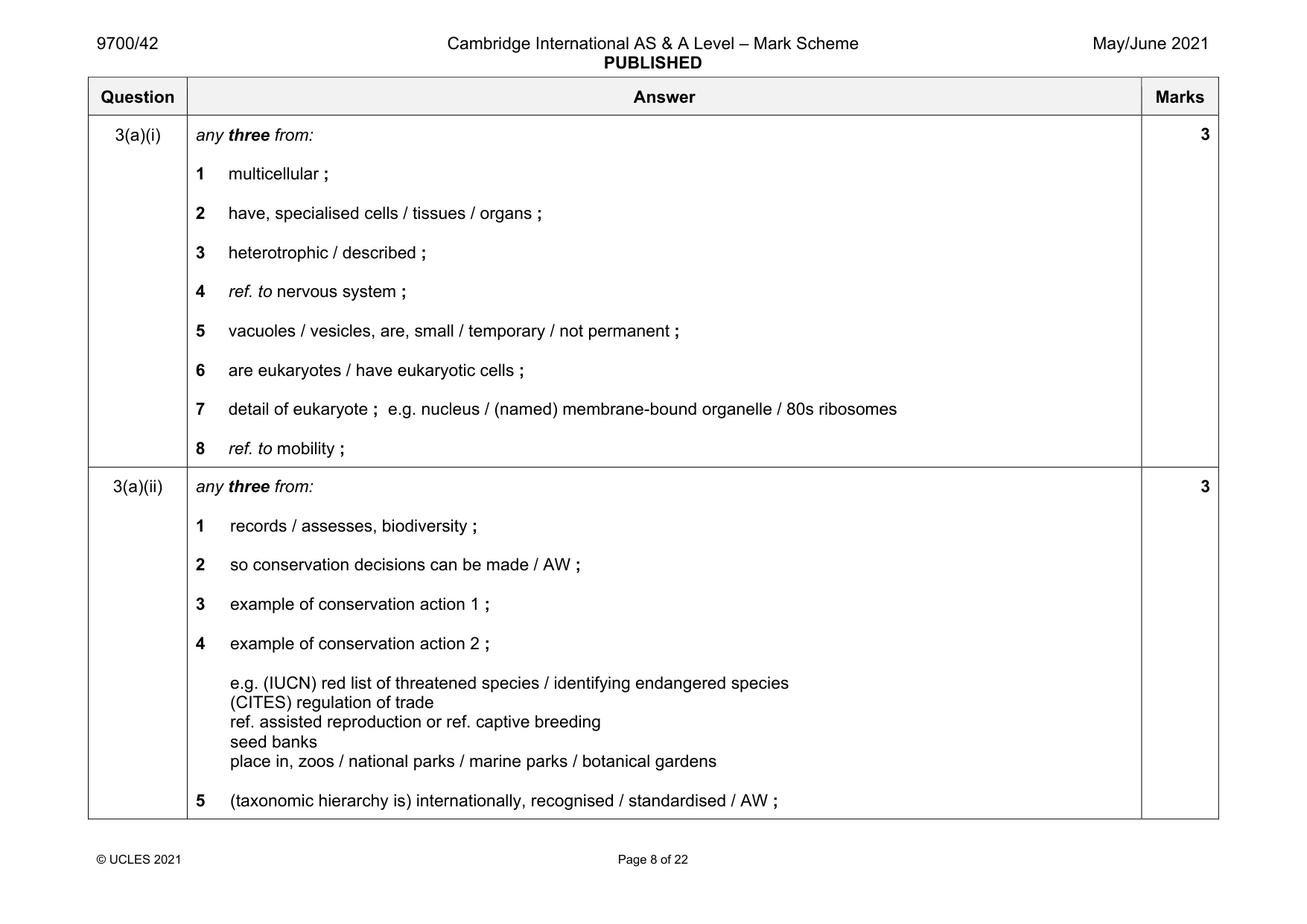
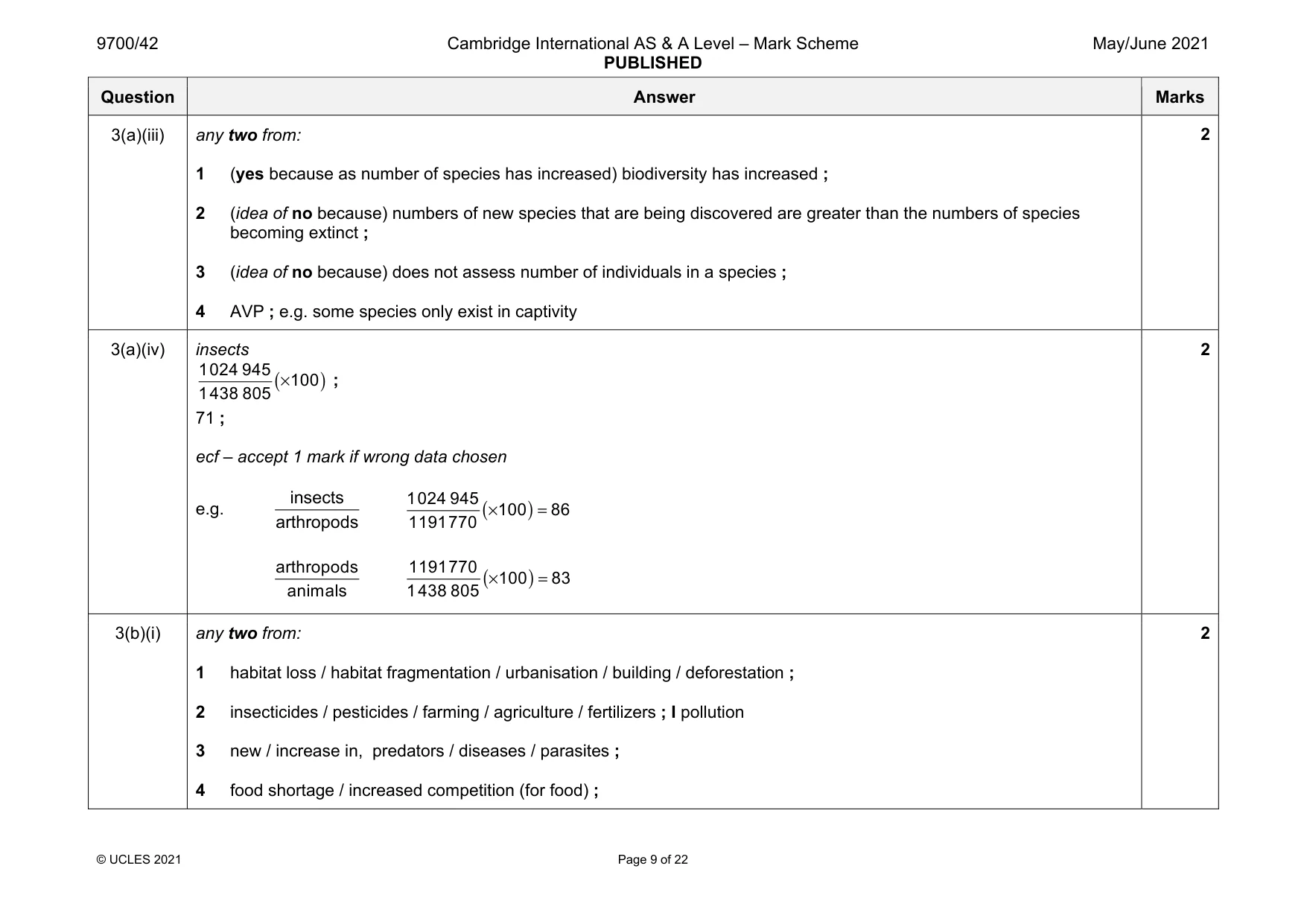
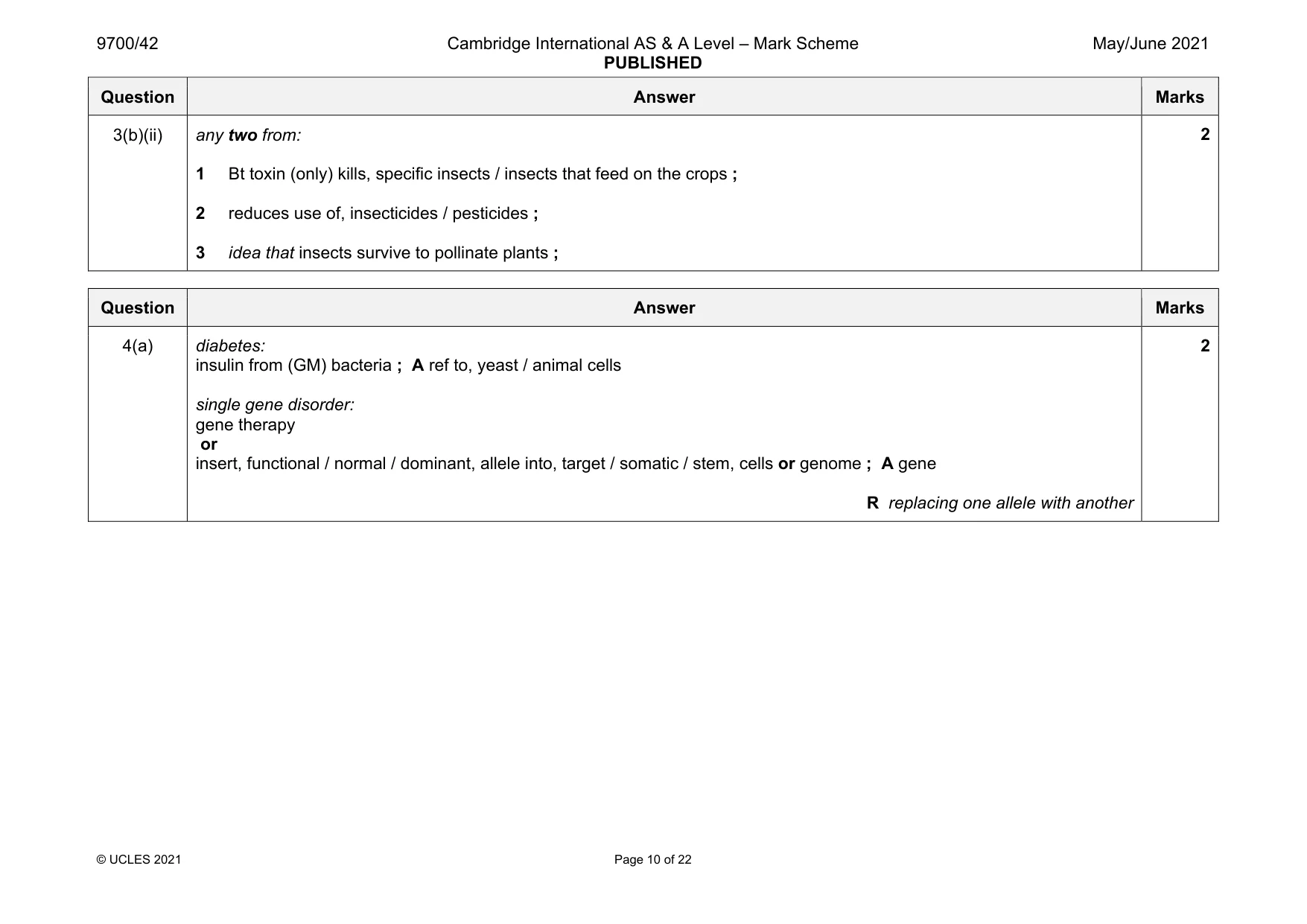
Mark scheme: 3(a)(i) any three from: 1 multicellular ; 2 have, specialised cells / tissues / organs ; 3 heterotrophic / described ; 4 ref. to nervous system ; 5 vacuoles / vesicles, are, small / temporary / not permanent ; 6 are eukaryotes / have eukaryotic cells ; 7 detail of eukaryote ; e.g. nucleus / (named) membrane-bound organelle / 80s ribosomes 8 ref. to mobility ; 3(a)(ii) any three from: 1 records / assesses, biodiversity ; 2 so conservation decisions can be made / AW ; 3 example of conservation action 1 ; 4 example of conservation action 2 ; e.g. (IUCN) red list of threatened species / identifying endangered species (CITES) regulation of trade ref. assisted reproduction or ref. captive breeding seed banks place in, zoos / national parks / marine parks / botanical gardens 5 (taxonomic hierarchy is) internationally, recognised / standardised / AW ; 3 Question Answer Marks 3(a)(iii) any two from: 1 (yes because as number of species has increased) biodiversity has increased ; 2 (idea of no because) numbers of new species that are being discovered are greater than the numbers of species becoming extinct ; 3 (idea of no because) does not assess number of individuals in a species ; 4 AVP ; e.g. some species only exist in captivity 2 3(a)(iv) insects ( ) 1024 945 100 1438 805 × ; 71 ; ecf – accept 1 mark if wrong data chosen e.g. insects arthropods ( ) 1024 945 100 86 1191770 × = arthropods animals ( ) 1191770 100 83 1438 805 × = 2 3(b)(i) any two from: 1 habitat loss / habitat fragmentation / urbanisation / building / deforestation ; 2 insecticides / pesticides / farming / agriculture / fertilizers ; I pollution 3 new / increase in, predators / diseases / parasites ; 4 food shortage / increased competition (for food) ; 2 Question Answer Marks 3(b)(ii) any two from: 1 Bt toxin (only) kills, specific insects / insects that feed on the crops ; 2 reduces use of, insecticides / pesticides ; 3 idea that insects survive to pollinate plants ; 2
Q4 · Genetic technology involving the creation of recombinant DNA can be used to treat…
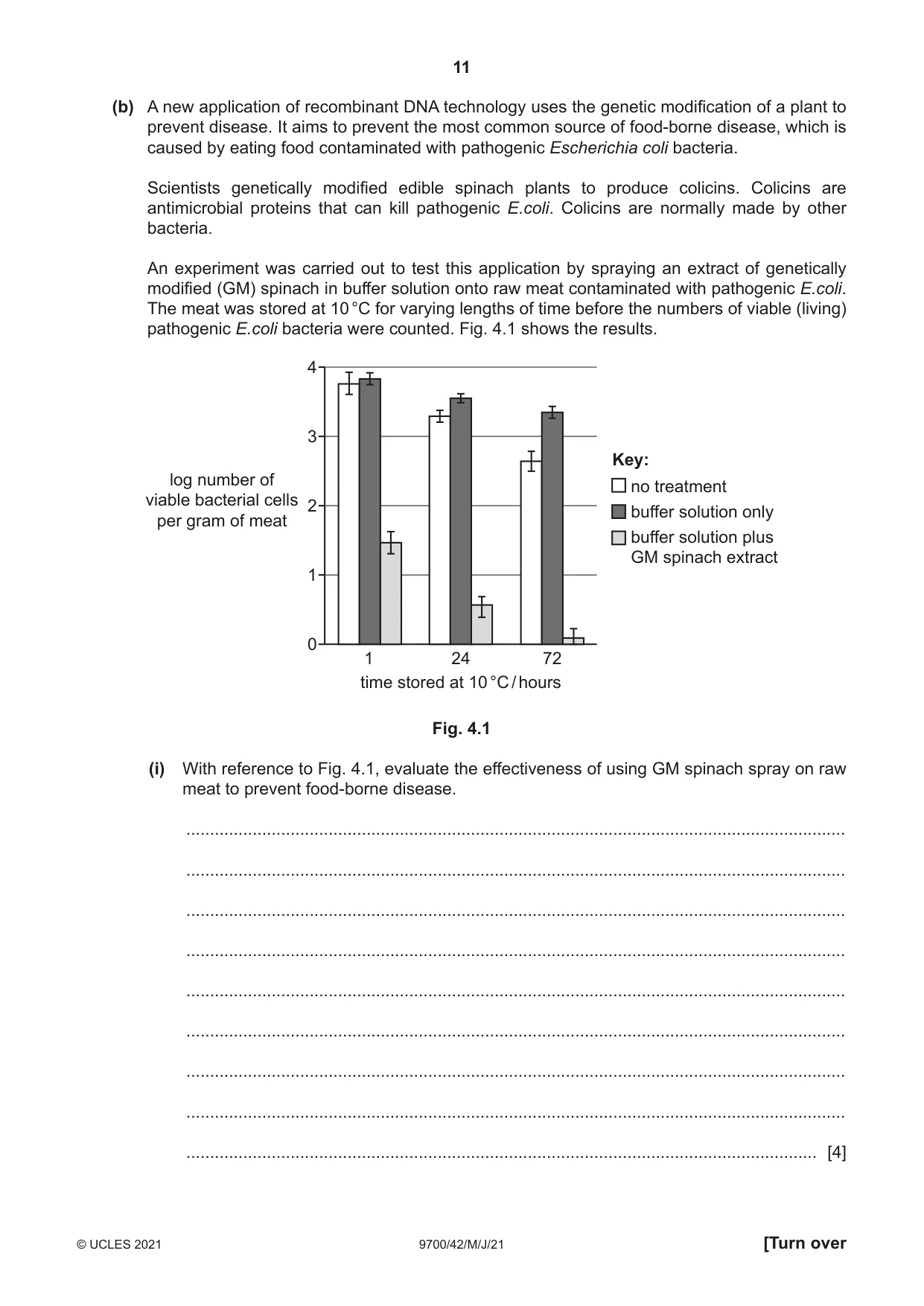
4 (a) Genetic technology involving the creation of recombinant DNA can be used to treat different human diseases. These include diseases such as diabetes that may have multiple causes and inherited disorders that are caused by a single gene. Outline two different ways of using recombinant DNA technology to treat these diseases. diabetes .................................................................................................................................... ................................................................................................................................................... ................................................................................................................................................... single gene disorder ................................................................................................................. ................................................................................................................................................... ................................................................................................................................................... [2] (b) A new application of recombinant DNA technology uses the genetic modification of a plant to prevent disease. It aims to prevent the most common source of food-borne disease, which is caused by eating food contaminated with pathogenic Escherichia coli bacteria. Scientists genetically modified edible spinach plants to produce colicins. Colicins are antimicrobial proteins that can kill pathogenic E.coli. Colicins are normally made by other bacteria. An experiment was carried out to test this application by spraying an extract of genetically modified (GM) spinach in buffer solution onto raw meat contaminated with pathogenic E.coli. The meat was stored at 10 °C for varying lengths of time before the numbers of viable (living) pathogenic E.coli bacteria were counted. Fig. 4.1 shows the results. 4 3 Key: log number of no treatment viable bacterial cells 2 buffer solution only per gram of meat buffer solution plus GM spinach extract 1 0 1 24 72 time stored at 10 °C / hours Fig. 4.1 (i) With reference to Fig. 4.1, evaluate the effectiveness of using GM spinach spray on raw meat to prevent food-borne disease. ........................................................................................................................................... ........................................................................................................................................... ........................................................................................................................................... ........................................................................................................................................... ........................................................................................................................................... ........................................................................................................................................... ........................................................................................................................................... ........................................................................................................................................... ..................................................................................................................................... [4] (ii) Regulatory authorities may not approve the use of GM spinach spray on raw meat to protect consumers. Discuss the concerns that may stop regulatory authorities approving this application of recombinant DNA technology. ........................................................................................................................................... ........................................................................................................................................... ........................................................................................................................................... ........................................................................................................................................... ........................................................................................................................................... ........................................................................................................................................... ........................................................................................................................................... ..................................................................................................................................... [3] [Total: 9]
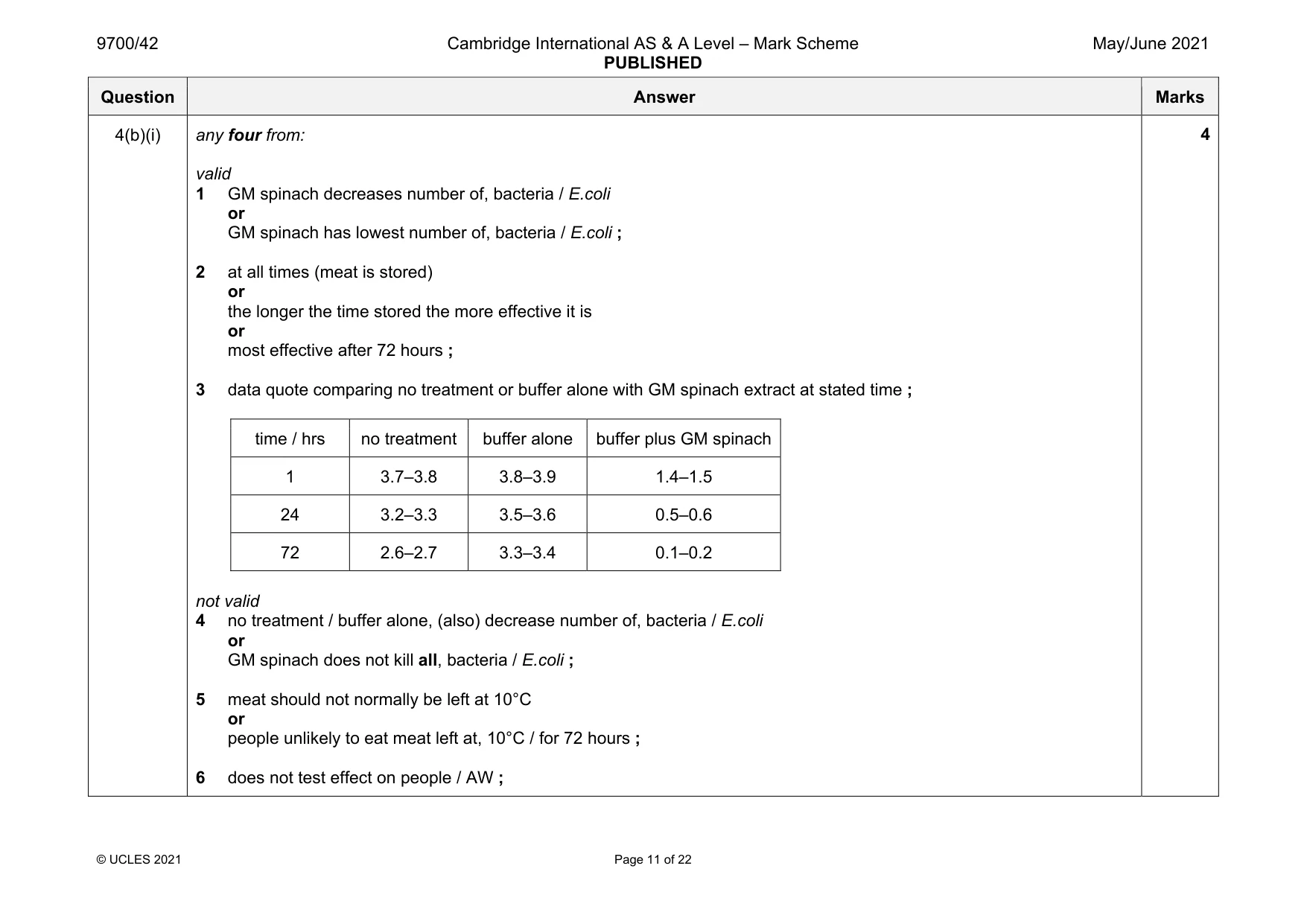
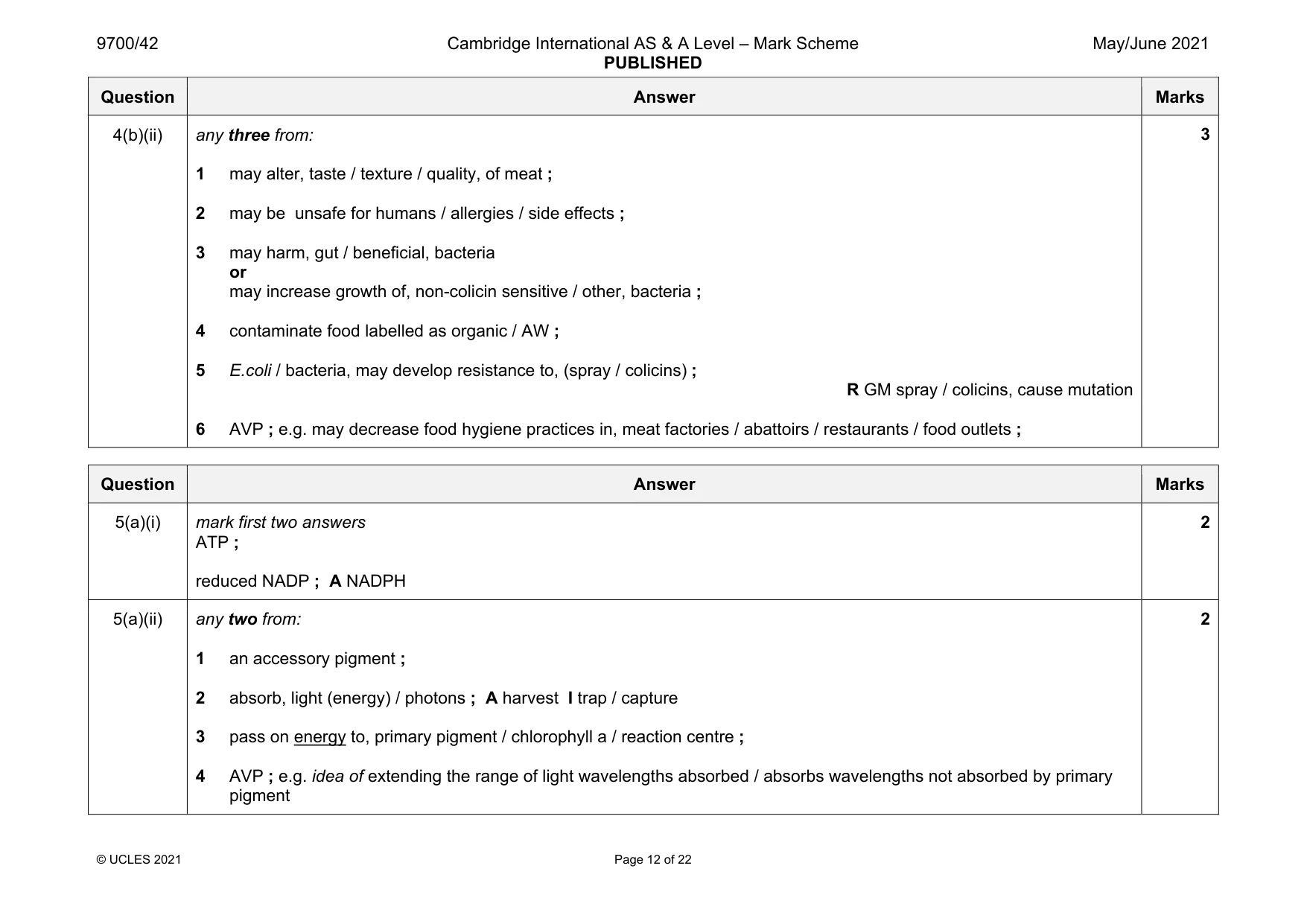
Mark scheme: 4(a) diabetes: insulin from (GM) bacteria ; A ref to, yeast / animal cells single gene disorder: gene therapy or insert, functional / normal / dominant, allele into, target / somatic / stem, cells or genome ; A gene R replacing one allele with another Question Answer Marks 4(b)(i) any four from: valid 1 GM spinach decreases number of, bacteria / E.coli or GM spinach has lowest number of, bacteria / E.coli ; 2 at all times (meat is stored) or the longer the time stored the more effective it is or most effective after 72 hours ; 3 data quote comparing no treatment or buffer alone with GM spinach extract at stated time ; time / hrs no treatment buffer alone buffer plus GM spinach 1 3.7–3.8 3.8–3.9 1.4–1.5 24 3.2–3.3 3.5–3.6 0.5–0.6 72 2.6–2.7 3.3–3.4 0.1–0.2 not valid 4 no treatment / buffer alone, (also) decrease number of, bacteria / E.coli or GM spinach does not kill all, bacteria / E.coli ; 5 meat should not normally be left at 10°C or people unlikely to eat meat left at, 10°C / for 72 hours ; 6 does not test effect on people / AW ; 4 Question Answer Marks 4(b)(ii) any three from: 1 may alter, taste / texture / quality, of meat ; 2 may be unsafe for humans / allergies / side effects ; 3 may harm, gut / beneficial, bacteria or may increase growth of, non-colicin sensitive / other, bacteria ; 4 contaminate food labelled as organic / AW ; 5 E.coli / bacteria, may develop resistance to, (spray / colicins) ; R GM spray / colicins, cause mutation 6 AVP ; e.g. may decrease food hygiene practices in, meat factories / abattoirs / restaurants / food outlets ; 3
More questions on Genetically modified organisms in agriculture
Q5 · Photosynthesis is a complex process involving a light dependent stage and a light…
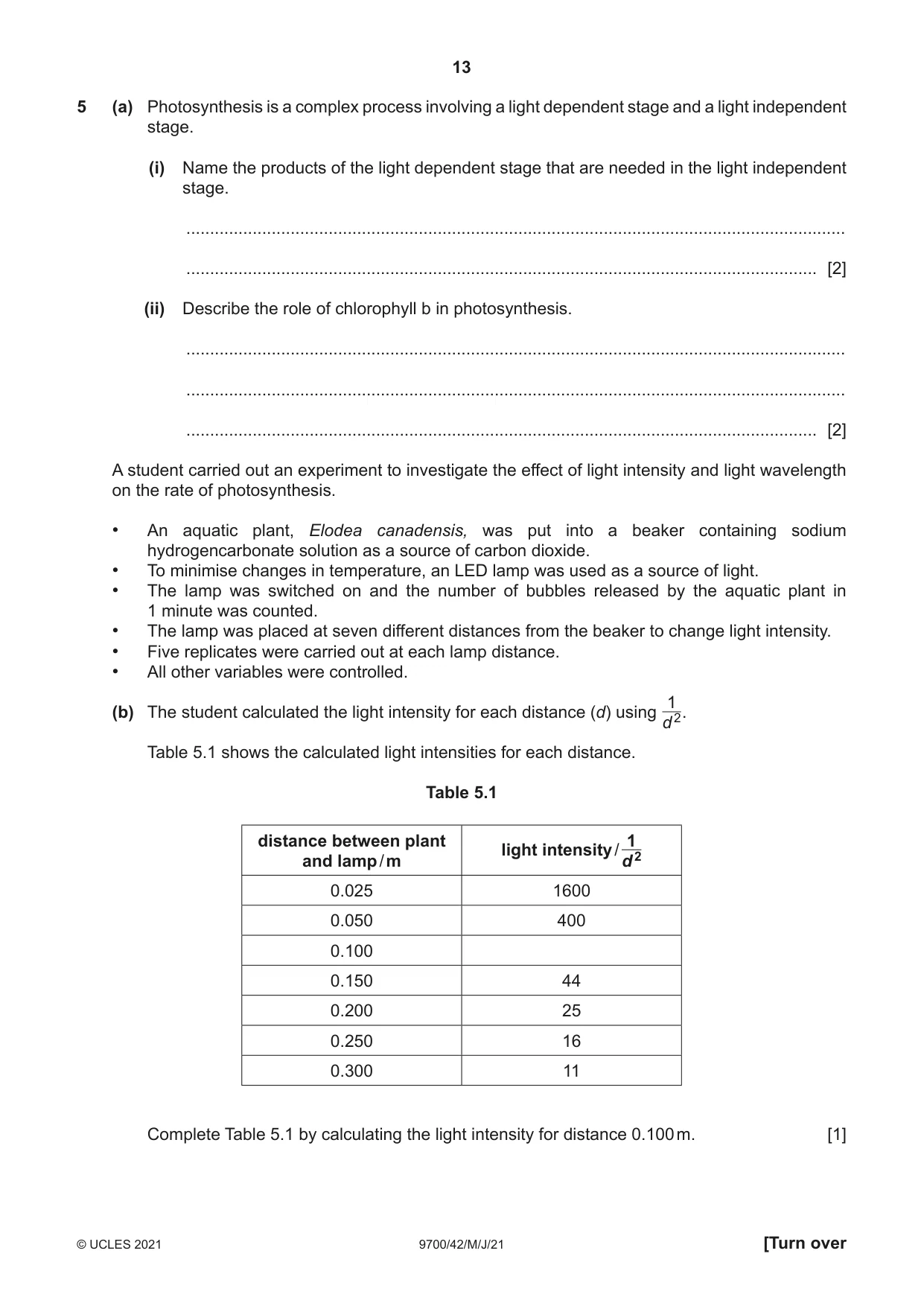
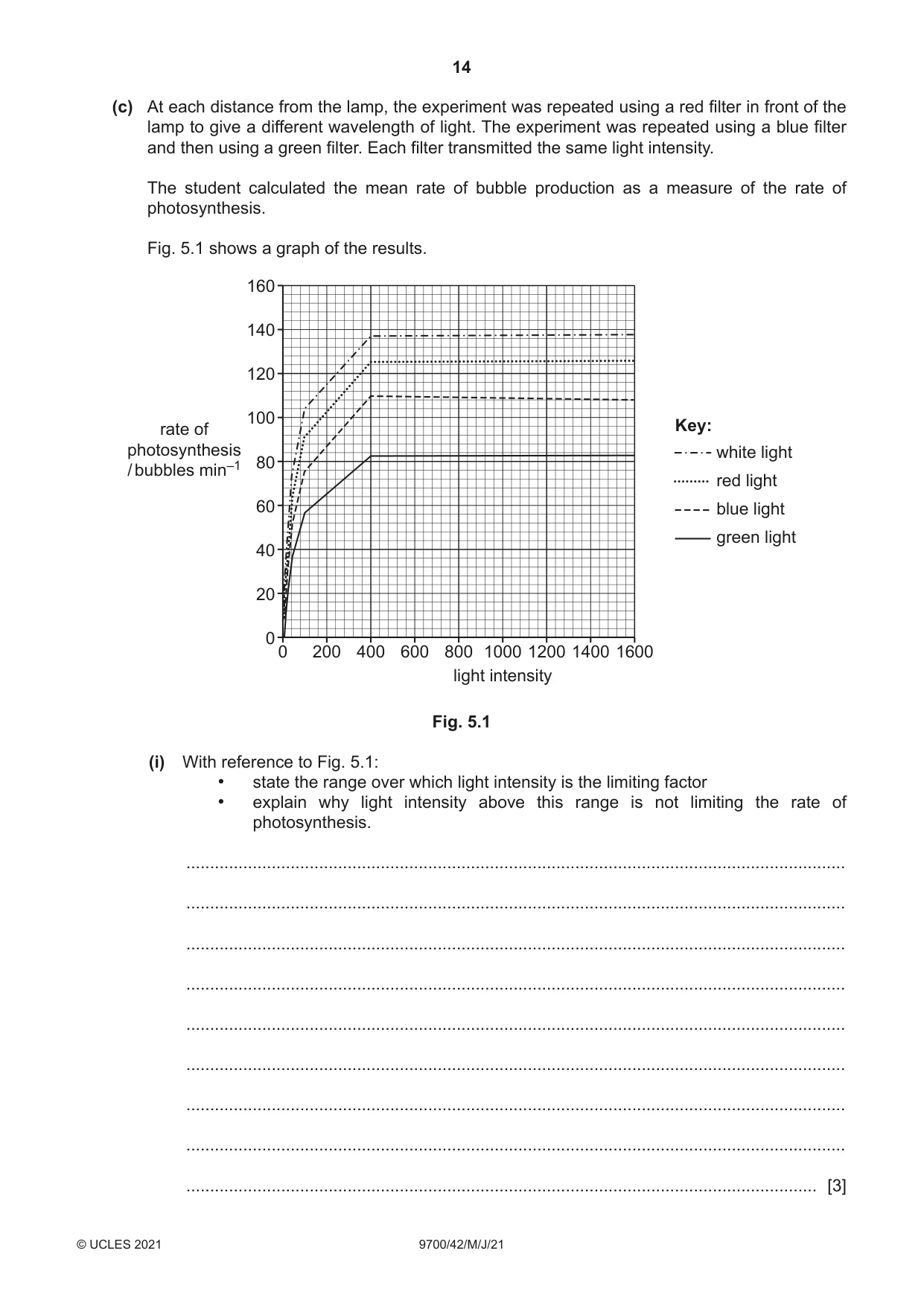
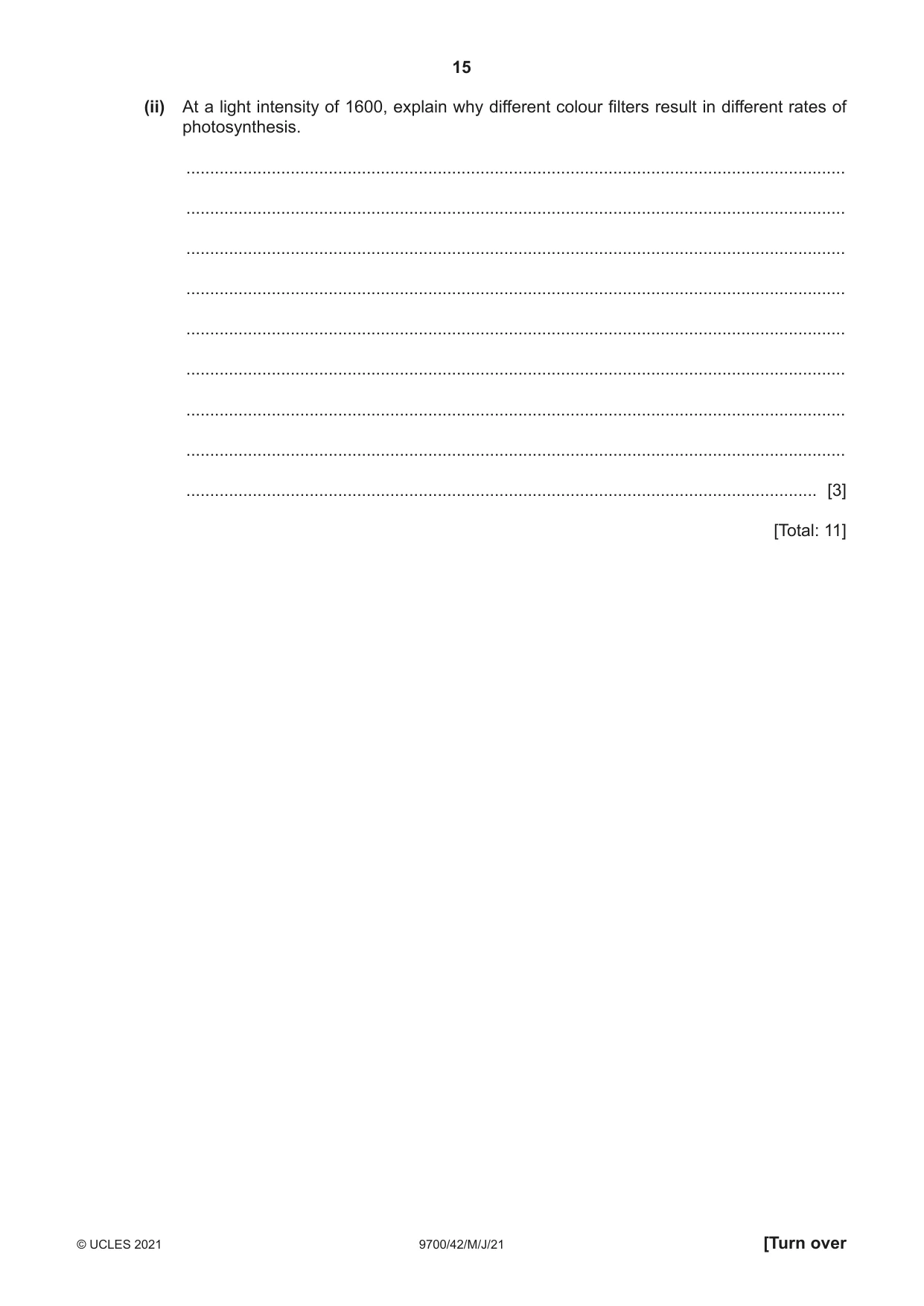
5 (a) Photosynthesis is a complex process involving a light dependent stage and a light independent stage. (i) Name the products of the light dependent stage that are needed in the light independent stage. ........................................................................................................................................... ..................................................................................................................................... [2] (ii) Describe the role of chlorophyll b in photosynthesis. ........................................................................................................................................... ........................................................................................................................................... ..................................................................................................................................... [2] A student carried out an experiment to investigate the effect of light intensity and light wavelength on the rate of photosynthesis. • An aquatic plant, Elodea canadensis, was put into a beaker containing sodium hydrogencarbonate solution as a source of carbon dioxide. • To minimise changes in temperature, an LED lamp was used as a source of light. • The lamp was switched on and the number of bubbles released by the aquatic plant in 1 minute was counted. • The lamp was placed at seven different distances from the beaker to change light intensity. • Five replicates were carried out at each lamp distance. • All other variables were controlled. 1 (b) The student calculated the light intensity for each distance (d) using 2. d Table 5.1 shows the calculated light intensities for each distance. Table 5.1 distance between plant 1 light intensity / 2 and lamp / m d 0.025 1600 0.050 400 0.100 0.150 44 0.200 25 0.250 16 0.300 11 Complete Table 5.1 by calculating the light intensity for distance 0.100 m. [1] (c) At each distance from the lamp, the experiment was repeated using a red filter in front of the lamp to give a different wavelength of light. The experiment was repeated using a blue filter and then using a green filter. Each filter transmitted the same light intensity. The student calculated the mean rate of bubble production as a measure of the rate of photosynthesis. Fig. 5.1 shows a graph of the results. 160 140 120 100 rate of Key: photosynthesis white light 80 / bubbles min–1 red light 60 blue light green light 40 20 0 0 200 400 600 800 1000 1200 1400 1600 light intensity Fig. 5.1 (i) With reference to Fig. 5.1: • state the range over which light intensity is the limiting factor • explain why light intensity above this range is not limiting the rate of photosynthesis. ........................................................................................................................................... ........................................................................................................................................... ........................................................................................................................................... ........................................................................................................................................... ........................................................................................................................................... ........................................................................................................................................... ........................................................................................................................................... ........................................................................................................................................... ..................................................................................................................................... [3] (ii) At a light intensity of 1600, explain why different colour filters result in different rates of photosynthesis. ........................................................................................................................................... ........................................................................................................................................... ........................................................................................................................................... ........................................................................................................................................... ........................................................................................................................................... ........................................................................................................................................... ........................................................................................................................................... ........................................................................................................................................... ..................................................................................................................................... [3] [Total: 11]
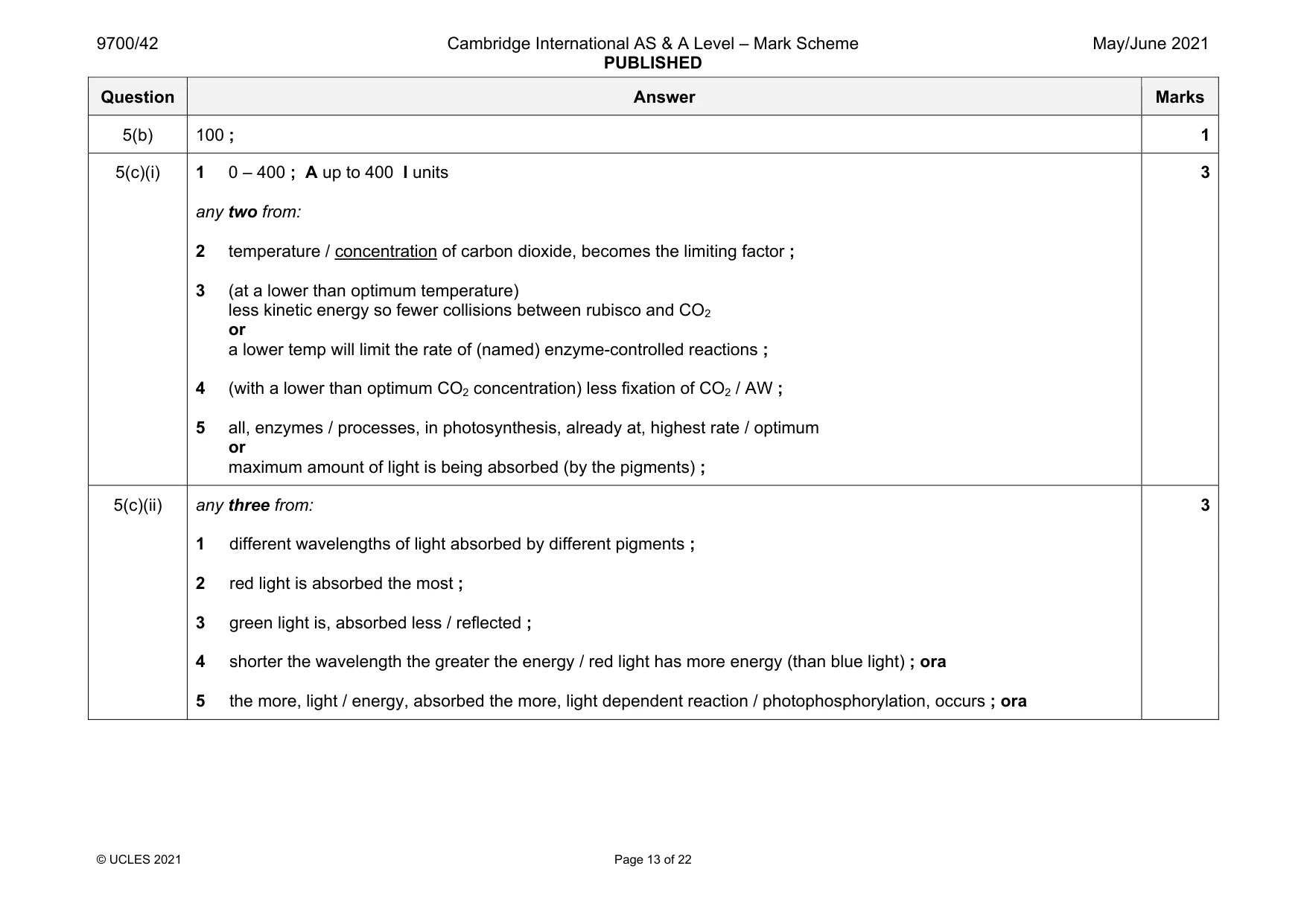
Mark scheme: 5(a)(i) mark first two answers ATP ; reduced NADP ; A NADPH 5(a)(ii) any two from: 1 an accessory pigment ; 2 absorb, light (energy) / photons ; A harvest I trap / capture 3 pass on energy to, primary pigment / chlorophyll a / reaction centre ; 4 AVP ; e.g. idea of extending the range of light wavelengths absorbed / absorbs wavelengths not absorbed by primary pigment 2 Question Answer Marks 5(b) 100 ; 1 5(c)(i) 1 0 – 400 ; A up to 400 I units any two from: 2 temperature / concentration of carbon dioxide, becomes the limiting factor ; 3 (at a lower than optimum temperature) less kinetic energy so fewer collisions between rubisco and CO2 or a lower temp will limit the rate of (named) enzyme-controlled reactions ; 4 (with a lower than optimum CO2 concentration) less fixation of CO2 / AW ; 5 all, enzymes / processes, in photosynthesis, already at, highest rate / optimum or maximum amount of light is being absorbed (by the pigments) ; 3 5(c)(ii) any three from: 1 different wavelengths of light absorbed by different pigments ; 2 red light is absorbed the most ; 3 green light is, absorbed less / reflected ; 4 shorter the wavelength the greater the energy / red light has more energy (than blue light) ; ora 5 the more, light / energy, absorbed the more, light dependent reaction / photophosphorylation, occurs ; ora 3
Q6 · Glucagon-like peptide-1 (GLP-1) is a hormone consisting of 31 amino acids
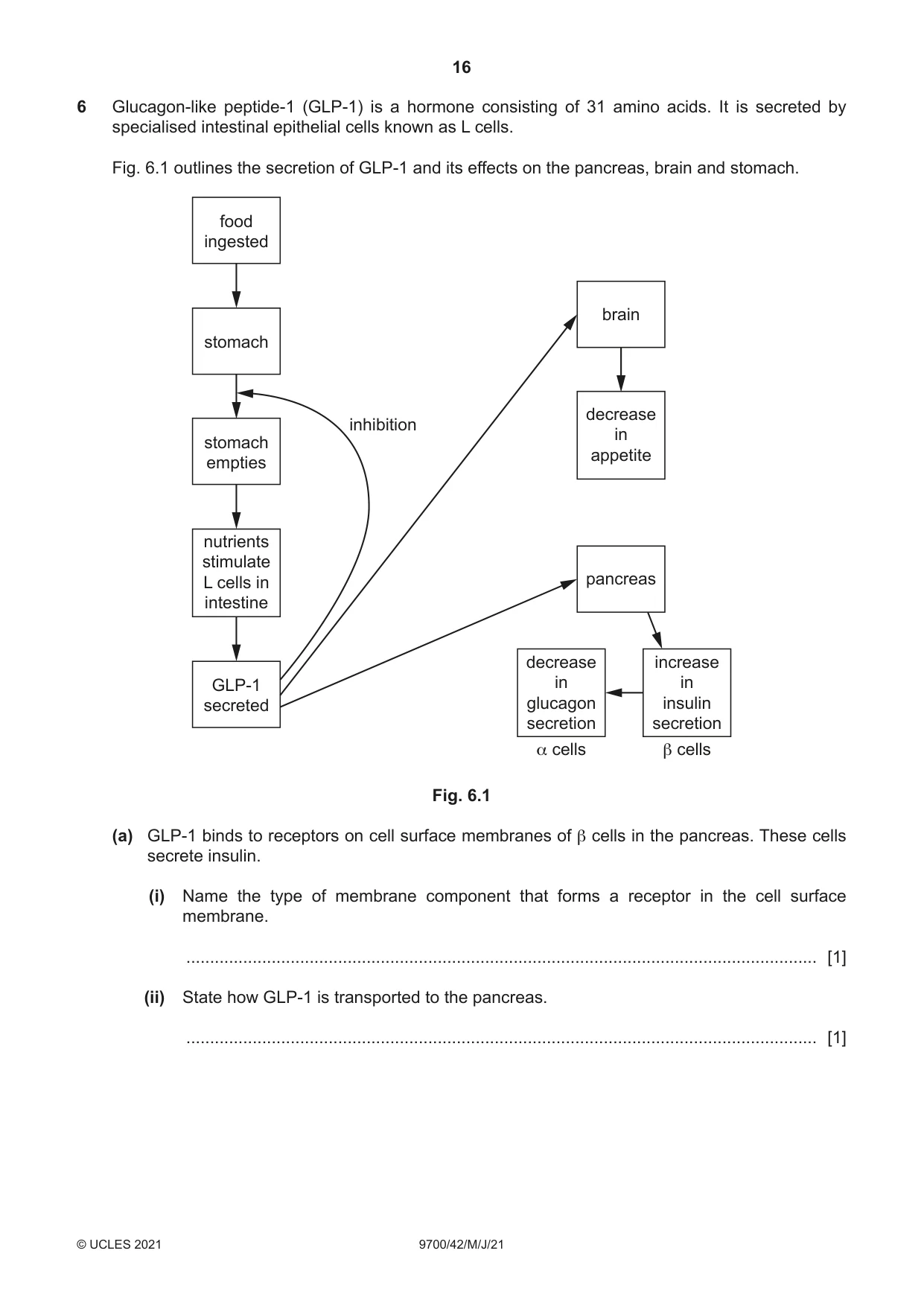
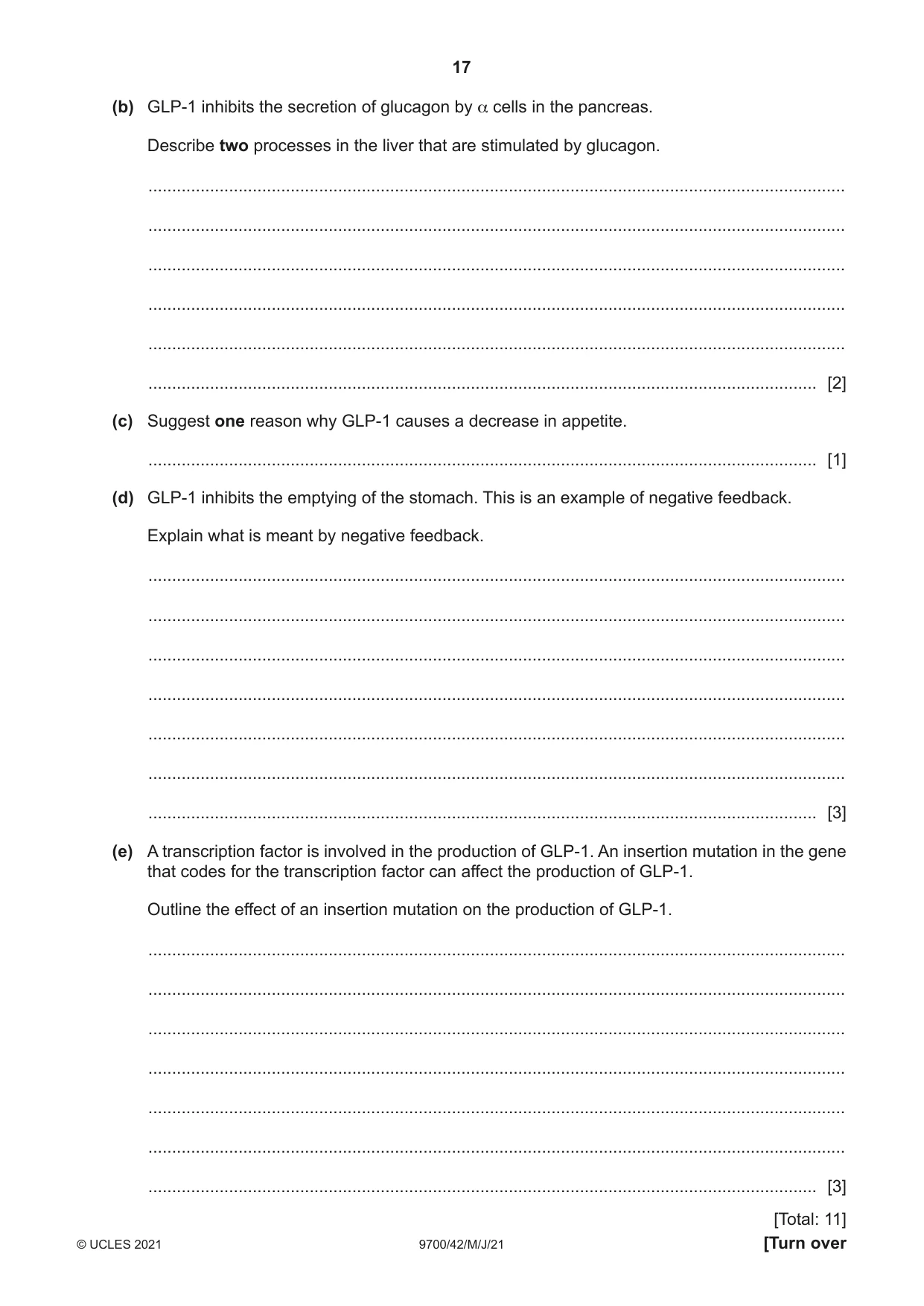
6 Glucagon-like peptide-1 (GLP-1) is a hormone consisting of 31 amino acids. It is secreted by specialised intestinal epithelial cells known as L cells. Fig. 6.1 outlines the secretion of GLP-1 and its effects on the pancreas, brain and stomach. food ingested brain stomach decrease inhibition in stomach appetite empties nutrients stimulate L cells in pancreas intestine decrease increase GLP-1 in in secreted glucagon insulin secretion secretion α cells β cells Fig. 6.1 (a) GLP-1 binds to receptors on cell surface membranes of β cells in the pancreas. These cells secrete insulin. (i) Name the type of membrane component that forms a receptor in the cell surface membrane. ..................................................................................................................................... [1] (ii) State how GLP-1 is transported to the pancreas. ..................................................................................................................................... [1] (b) GLP-1 inhibits the secretion of glucagon by α cells in the pancreas. Describe two processes in the liver that are stimulated by glucagon. ................................................................................................................................................... ................................................................................................................................................... ................................................................................................................................................... ................................................................................................................................................... ................................................................................................................................................... ............................................................................................................................................. [2] (c) Suggest one reason why GLP-1 causes a decrease in appetite. ............................................................................................................................................. [1] (d) GLP-1 inhibits the emptying of the stomach. This is an example of negative feedback. Explain what is meant by negative feedback. ................................................................................................................................................... ................................................................................................................................................... ................................................................................................................................................... ................................................................................................................................................... ................................................................................................................................................... ................................................................................................................................................... ............................................................................................................................................. [3] (e) A transcription factor is involved in the production of GLP-1. An insertion mutation in the gene that codes for the transcription factor can affect the production of GLP-1. Outline the effect of an insertion mutation on the production of GLP-1. ................................................................................................................................................... ................................................................................................................................................... ................................................................................................................................................... ................................................................................................................................................... ................................................................................................................................................... ................................................................................................................................................... ............................................................................................................................................. [3] [Total: 11]
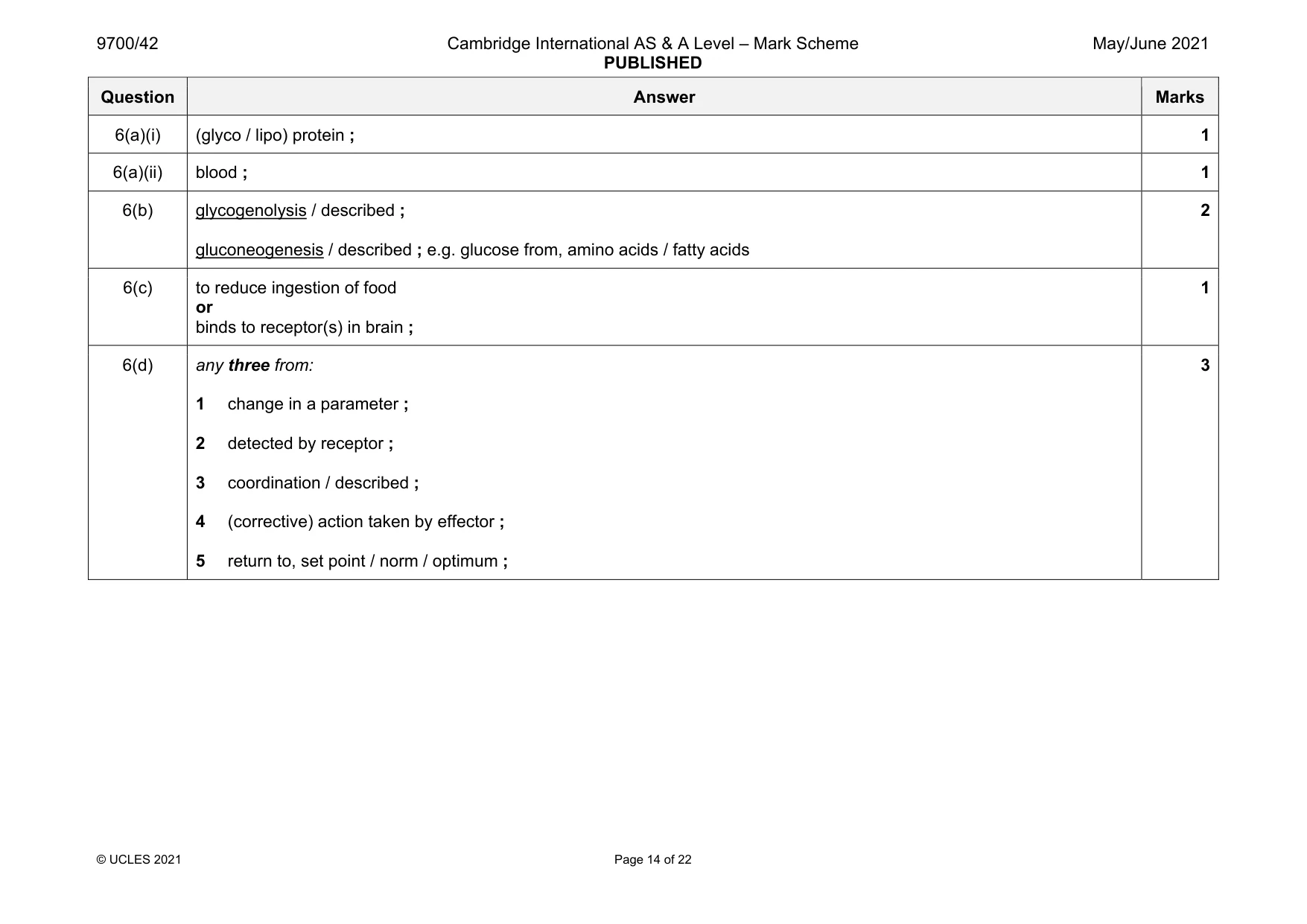
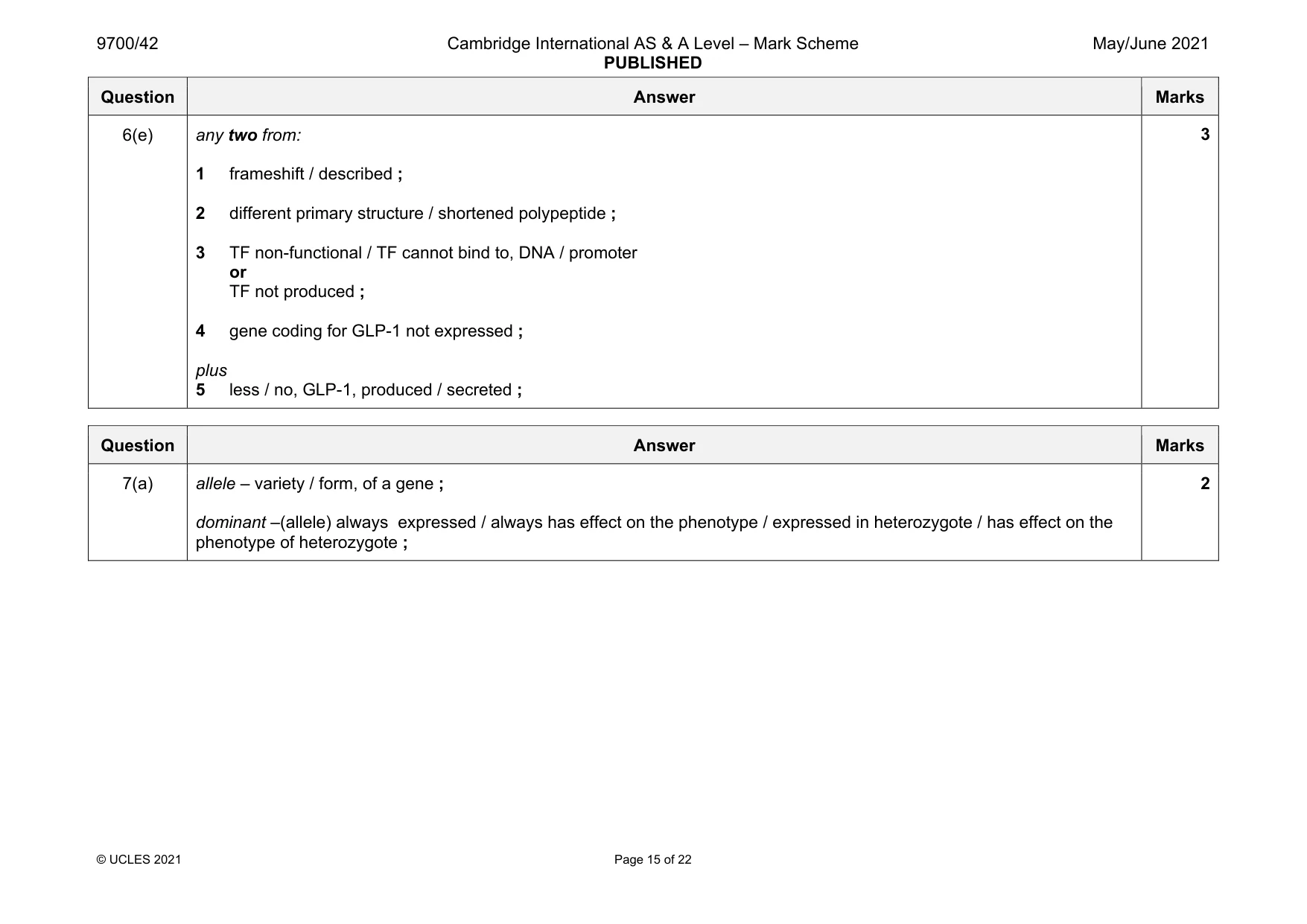
Mark scheme: 6(a)(i) (glyco / lipo) protein ; 1 6(a)(ii) blood ; 1 6(b) glycogenolysis / described ; gluconeogenesis / described ; e.g. glucose from, amino acids / fatty acids 2 6(c) to reduce ingestion of food or binds to receptor(s) in brain ; 1 6(d) any three from: 1 change in a parameter ; 2 detected by receptor ; 3 coordination / described ; 4 (corrective) action taken by effector ; 5 return to, set point / norm / optimum ; 3 Question Answer Marks 6(e) any two from: 1 frameshift / described ; 2 different primary structure / shortened polypeptide ; 3 TF non-functional / TF cannot bind to, DNA / promoter or TF not produced ; 4 gene coding for GLP-1 not expressed ; plus 5 less / no, GLP-1, produced / secreted ; 3
Q7 · The fruit fly, Drosophila melanogaster, feeds on sugars found in damaged fruits
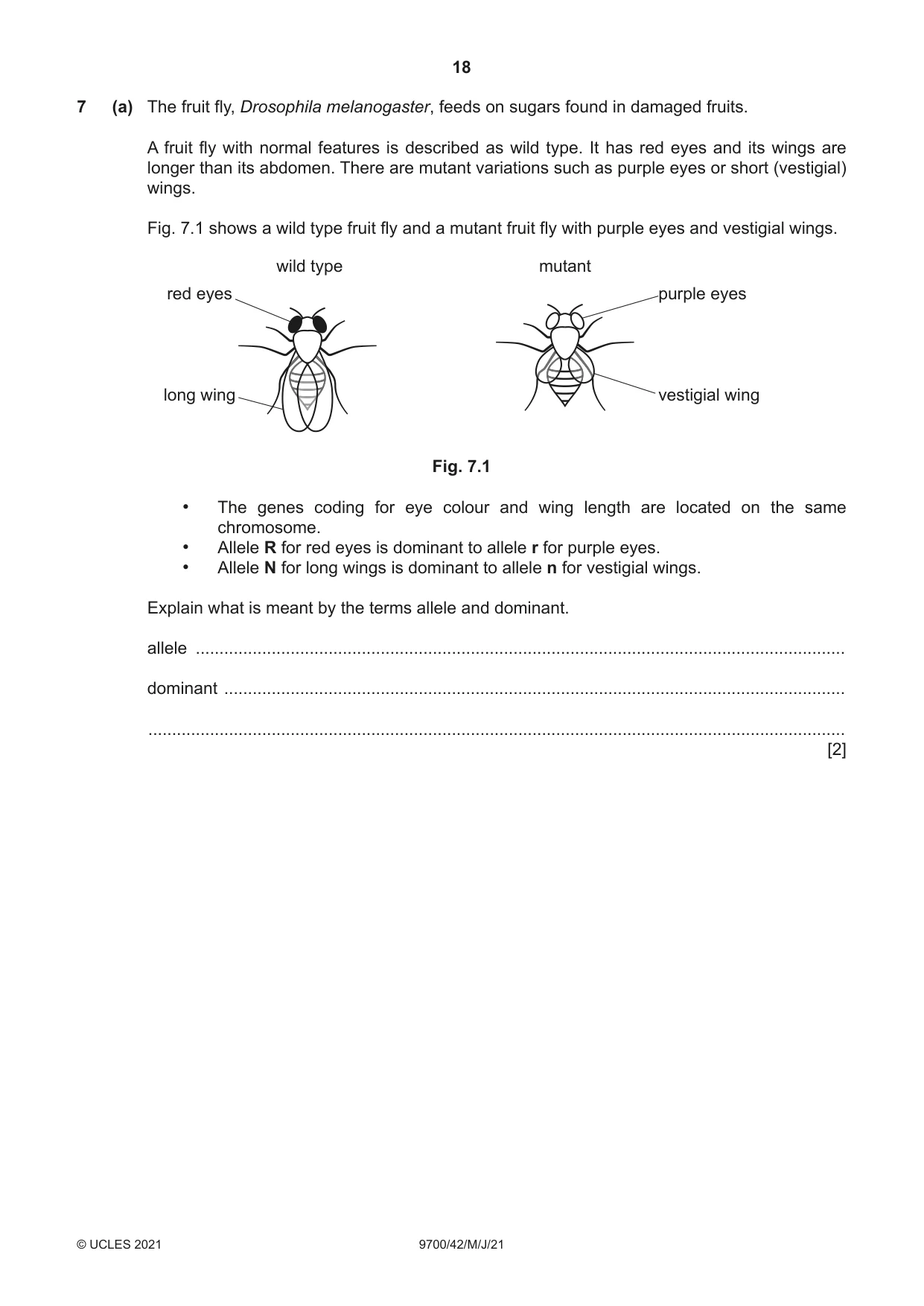
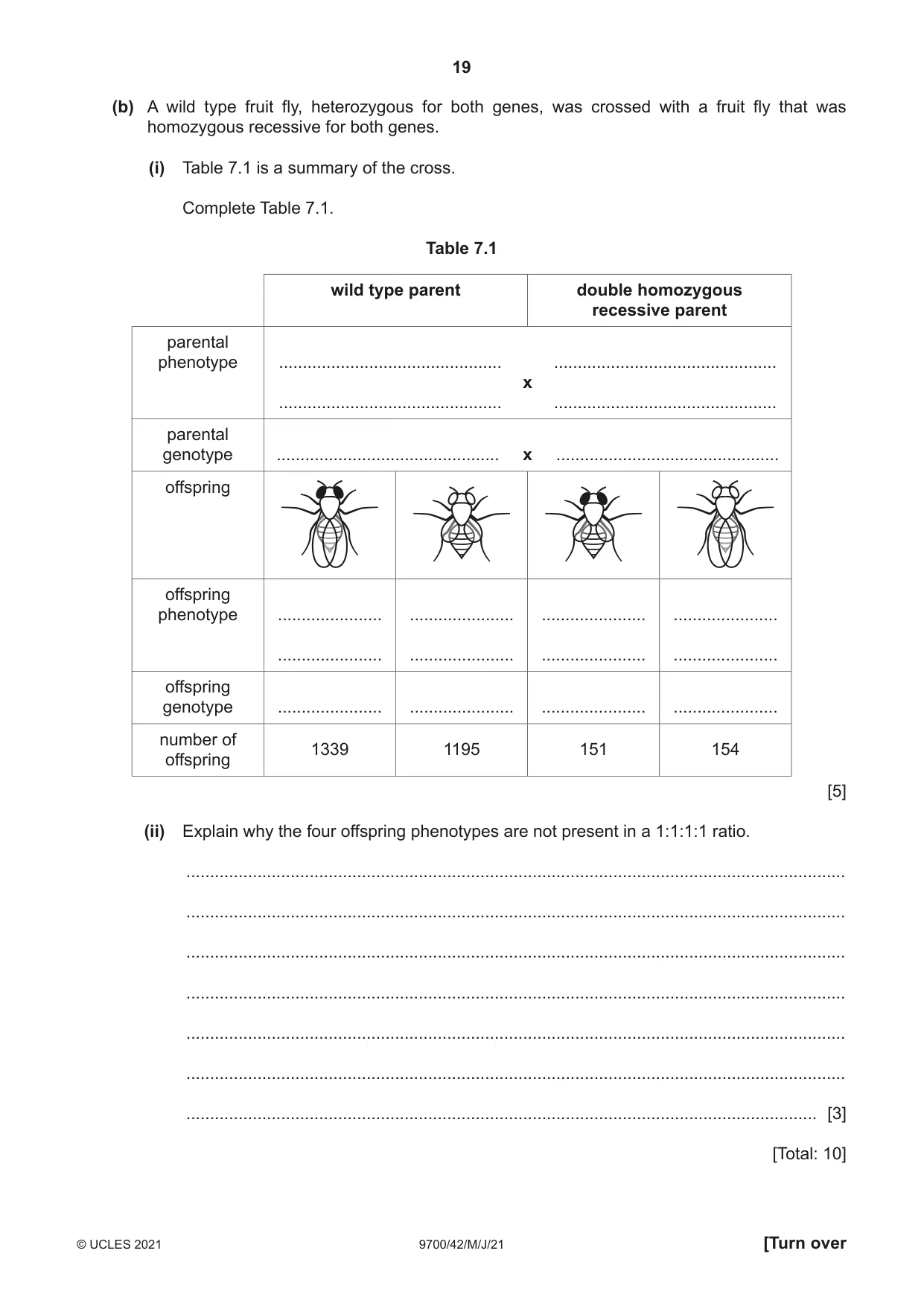
7 (a) The fruit fly, Drosophila melanogaster, feeds on sugars found in damaged fruits. A fruit fly with normal features is described as wild type. It has red eyes and its wings are longer than its abdomen. There are mutant variations such as purple eyes or short (vestigial) wings. Fig. 7.1 shows a wild type fruit fly and a mutant fruit fly with purple eyes and vestigial wings. wild type mutant red eyes purple eyes long wing vestigial wing Fig. 7.1 • The genes coding for eye colour and wing length are located on the same chromosome. • Allele R for red eyes is dominant to allele r for purple eyes. • Allele N for long wings is dominant to allele n for vestigial wings. Explain what is meant by the terms allele and dominant. allele ......................................................................................................................................... dominant ................................................................................................................................... ................................................................................................................................................... [2] (b) A wild type fruit fly, heterozygous for both genes, was crossed with a fruit fly that was homozygous recessive for both genes. (i) Table 7.1 is a summary of the cross. Complete Table 7.1. Table 7.1 wild type parent double homozygous recessive parent parental phenotype ............................................... ............................................... x ............................................... ............................................... parental genotype ............................................... x ............................................... offspring offspring phenotype ...................... ...................... ...................... ...................... ...................... ...................... ...................... ...................... offspring genotype ...................... ...................... ...................... ...................... number of 1339 1195 151 154 offspring [5] (ii) Explain why the four offspring phenotypes are not present in a 1:1:1:1 ratio. ........................................................................................................................................... ........................................................................................................................................... ........................................................................................................................................... ........................................................................................................................................... ........................................................................................................................................... ........................................................................................................................................... ..................................................................................................................................... [3] [Total: 10]
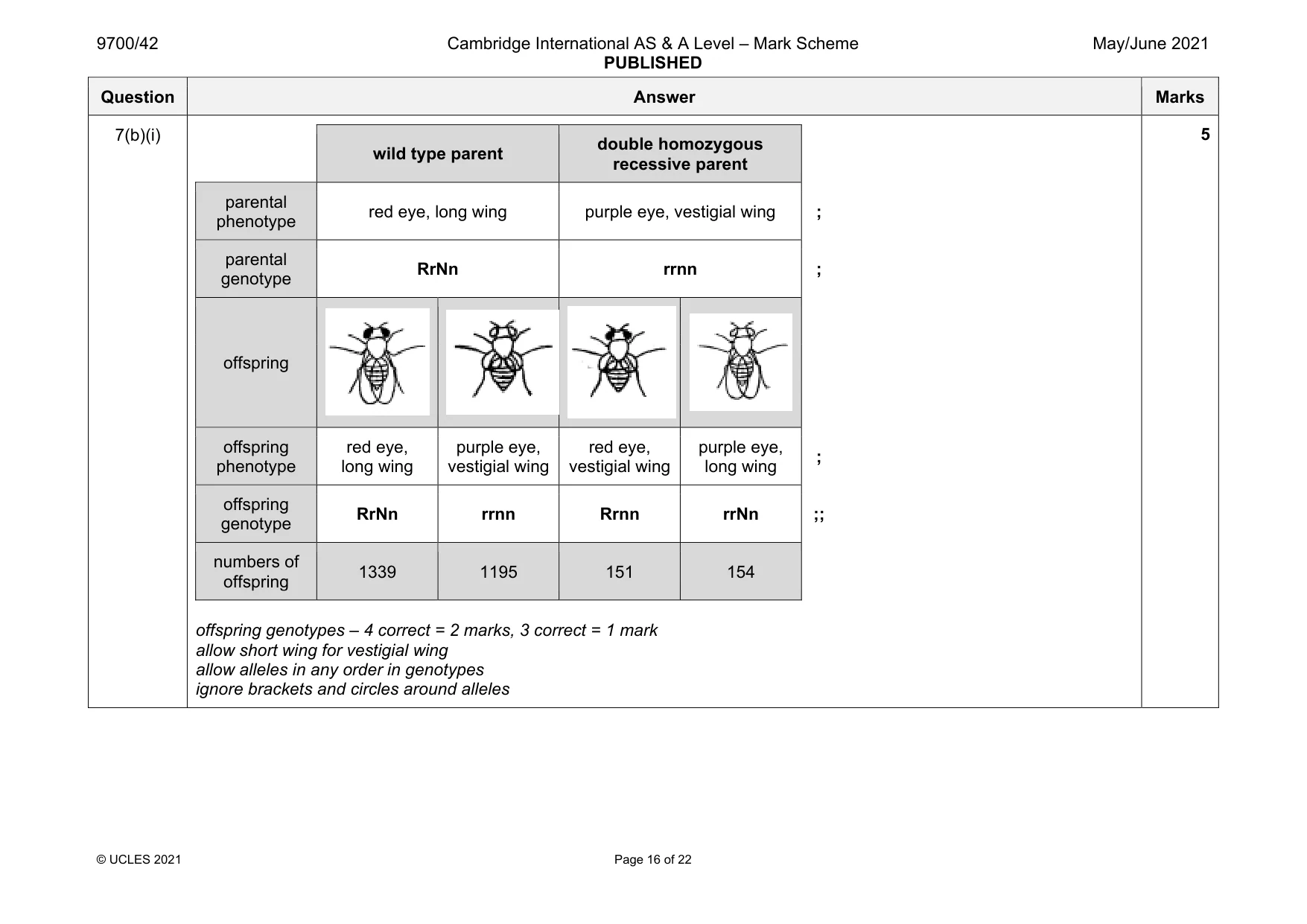
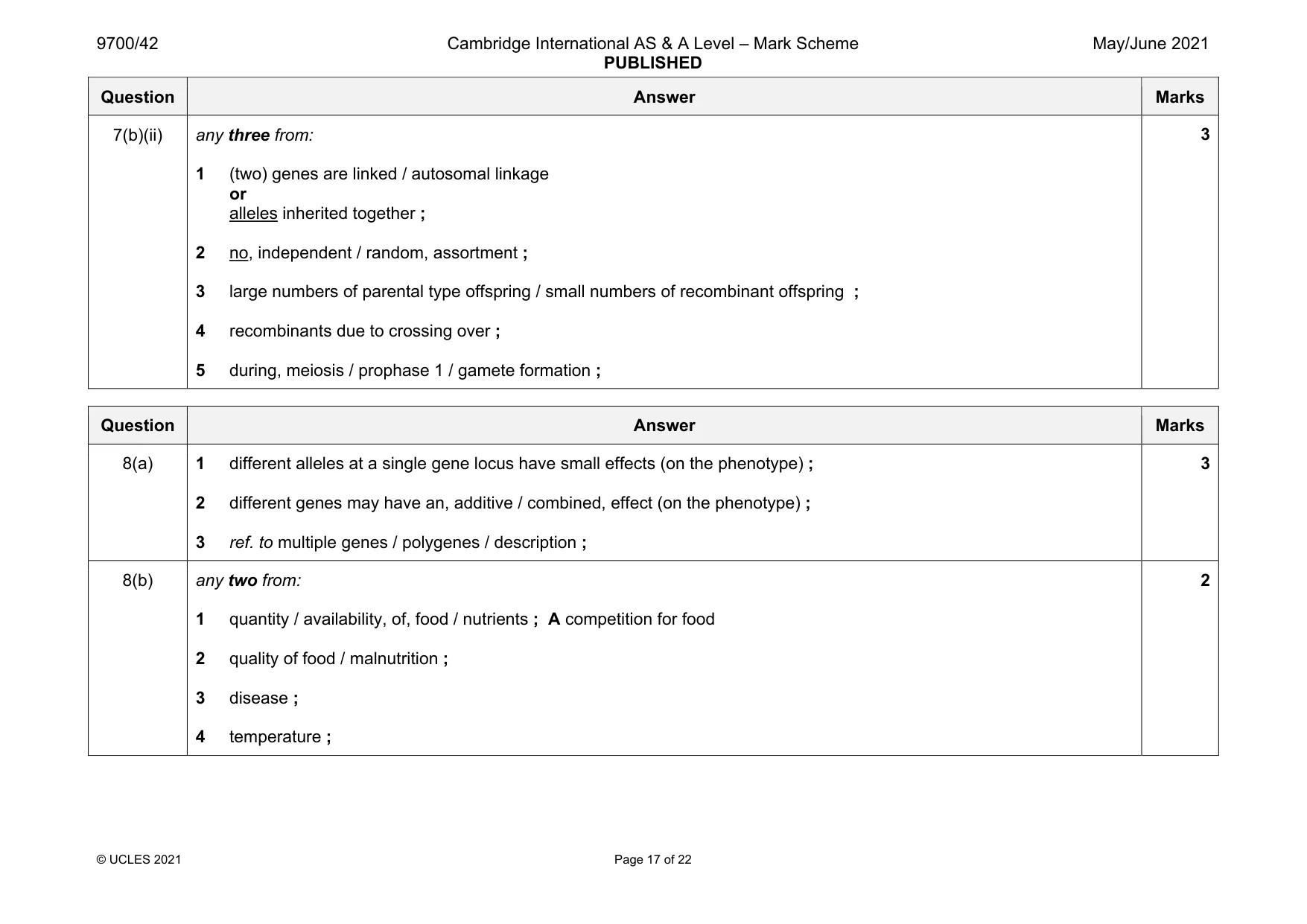
Mark scheme: 7(a) allele – variety / form, of a gene ; dominant –(allele) always expressed / always has effect on the phenotype / expressed in heterozygote / has effect on the phenotype of heterozygote ; 2 Question Answer Marks 7(b)(i) wild type parent double homozygous recessive parent parental phenotype red eye, long wing purple eye, vestigial wing ; parental genotype RrNn rrnn ; offspring offspring phenotype red eye, long wing purple eye, vestigial wing red eye, vestigial wing purple eye, long wing ; offspring genotype RrNn rrnn Rrnn rrNn ;; numbers of offspring 1339 1195 151 154 offspring genotypes – 4 correct = 2 marks, 3 correct = 1 mark allow short wing for vestigial wing allow alleles in any order in genotypes ignore brackets and circles around alleles 5 Question Answer Marks 7(b)(ii) any three from: 1 (two) genes are linked / autosomal linkage or alleles inherited together ; 2 no, independent / random, assortment ; 3 large numbers of parental type offspring / small numbers of recombinant offspring ; 4 recombinants due to crossing over ; 5 during, meiosis / prophase 1 / gamete formation ; 3
More questions on Passage of information from parents to offspring
Q8 · In continuous variation, a population shows a range of phenotypes between two extremes…
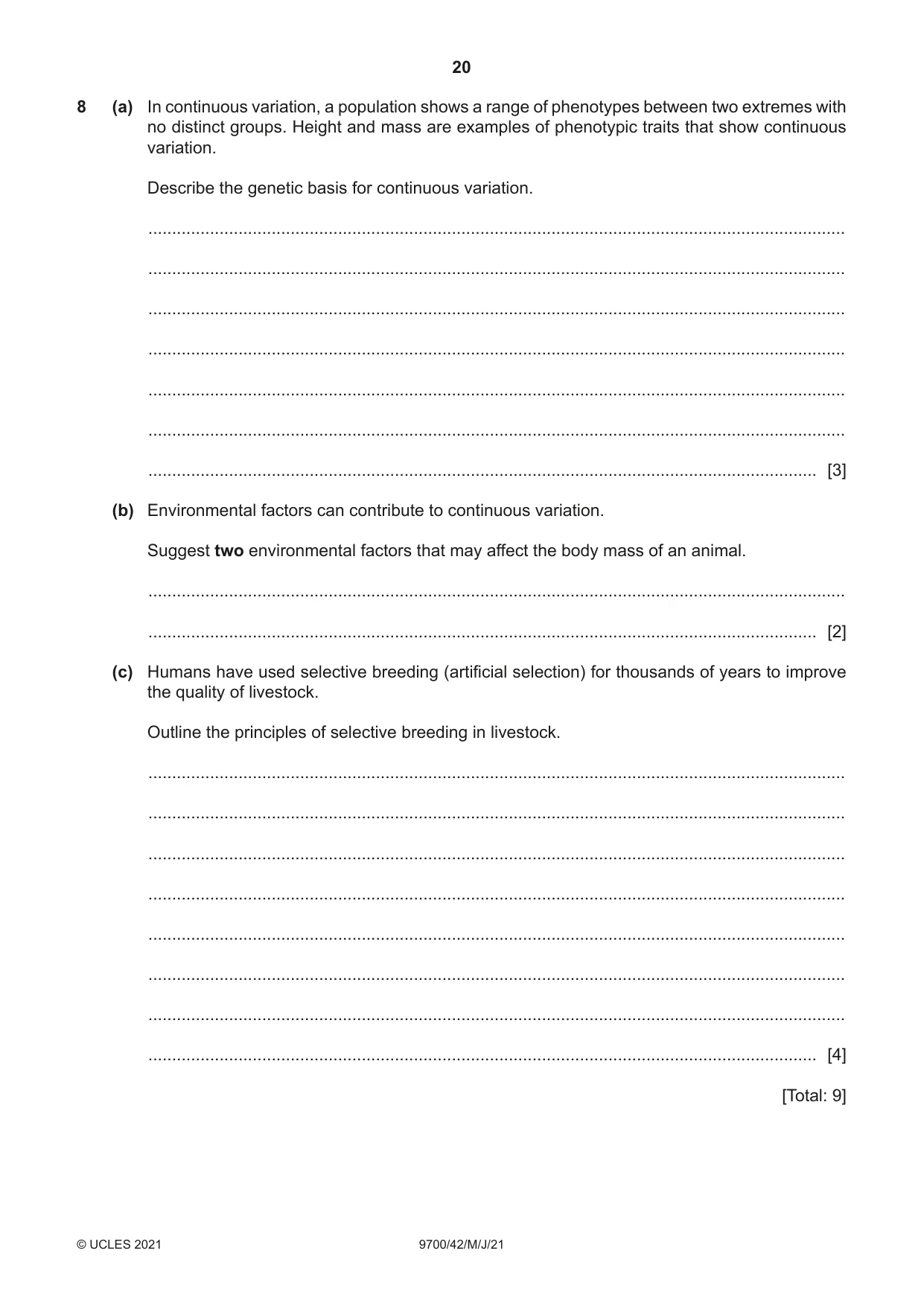
8 (a) In continuous variation, a population shows a range of phenotypes between two extremes with no distinct groups. Height and mass are examples of phenotypic traits that show continuous variation. Describe the genetic basis for continuous variation. ................................................................................................................................................... ................................................................................................................................................... ................................................................................................................................................... ................................................................................................................................................... ................................................................................................................................................... ................................................................................................................................................... ............................................................................................................................................. [3] (b) Environmental factors can contribute to continuous variation. Suggest two environmental factors that may affect the body mass of an animal. ................................................................................................................................................... ............................................................................................................................................. [2] (c) Humans have used selective breeding (artificial selection) for thousands of years to improve the quality of livestock. Outline the principles of selective breeding in livestock. ................................................................................................................................................... ................................................................................................................................................... ................................................................................................................................................... ................................................................................................................................................... ................................................................................................................................................... ................................................................................................................................................... ................................................................................................................................................... ............................................................................................................................................. [4] [Total: 9]
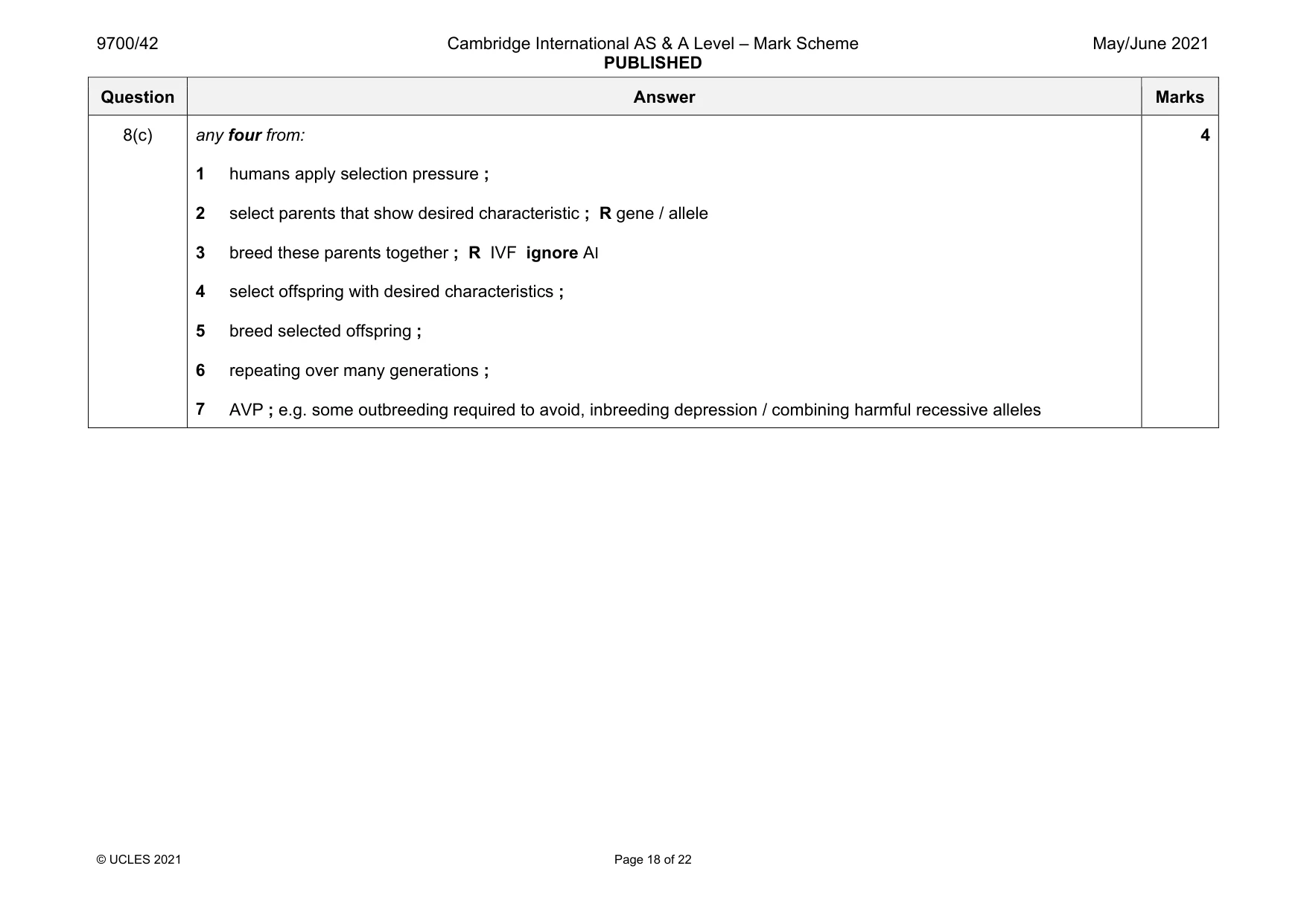
Mark scheme: 8(a) 1 different alleles at a single gene locus have small effects (on the phenotype) ; 2 different genes may have an, additive / combined, effect (on the phenotype) ; 3 ref. to multiple genes / polygenes / description ; 3 8(b) any two from: 1 quantity / availability, of, food / nutrients ; A competition for food 2 quality of food / malnutrition ; 3 disease ; 4 temperature ; 2 Question Answer Marks 8(c) any four from: 1 humans apply selection pressure ; 2 select parents that show desired characteristic ; R gene / allele 3 breed these parents together ; R IVF ignore AI 4 select offspring with desired characteristics ; 5 breed selected offspring ; 6 repeating over many generations ; 7 AVP ; e.g. some outbreeding required to avoid, inbreeding depression / combining harmful recessive alleles 4
Q9 · Describe how the structure of a mitochondrion is related to its function
9 (a) Describe how the structure of a mitochondrion is related to its function. [9] (b) Explain how rice is adapted to grow with its roots submerged in water. [6] [Total: 15]
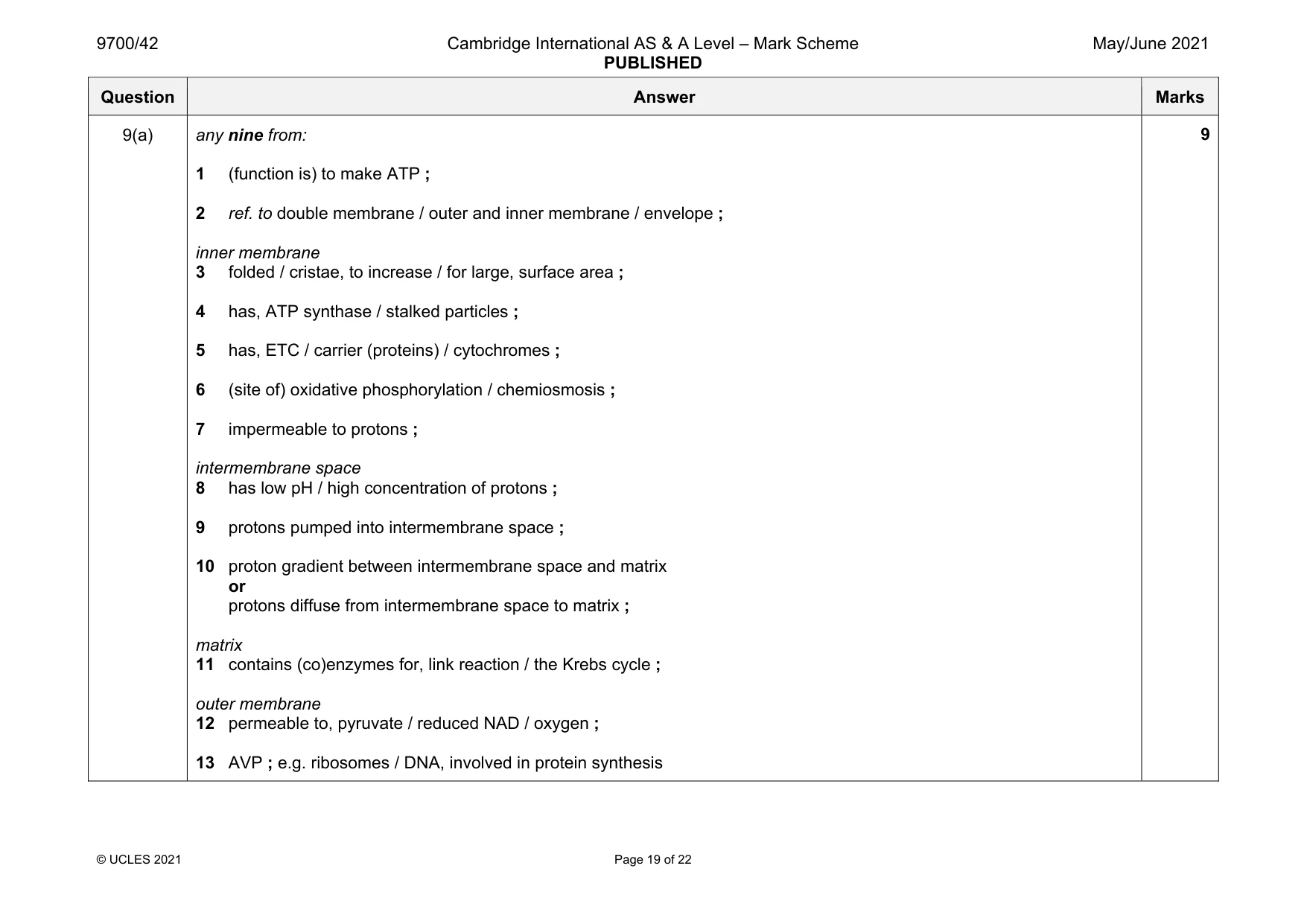
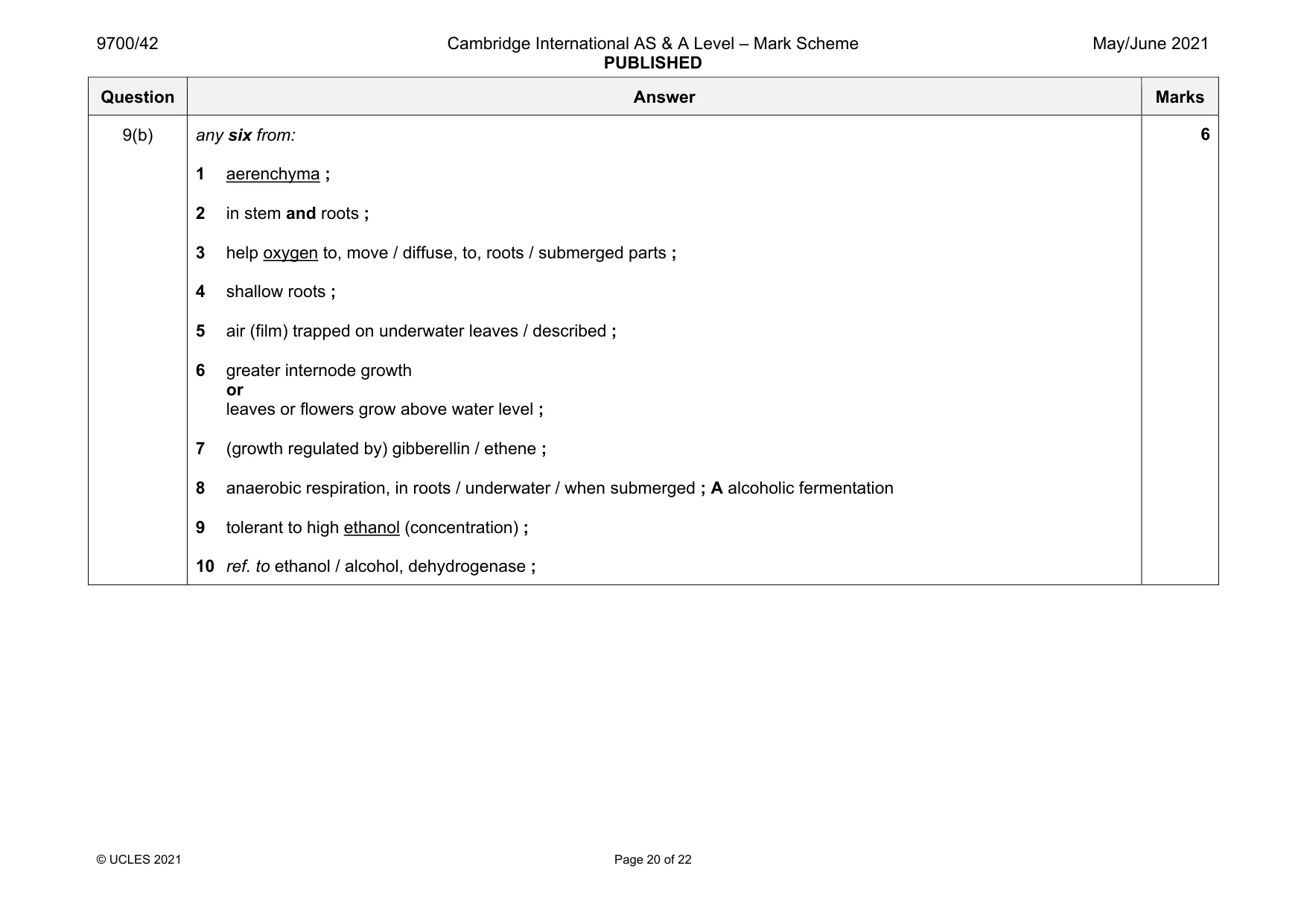
Mark scheme: 9(a) any nine from: 1 (function is) to make ATP ; 2 ref. to double membrane / outer and inner membrane / envelope ; inner membrane 3 folded / cristae, to increase / for large, surface area ; 4 has, ATP synthase / stalked particles ; 5 has, ETC / carrier (proteins) / cytochromes ; 6 (site of) oxidative phosphorylation / chemiosmosis ; 7 impermeable to protons ; intermembrane space 8 has low pH / high concentration of protons ; 9 protons pumped into intermembrane space ; 10 proton gradient between intermembrane space and matrix or protons diffuse from intermembrane space to matrix ; matrix 11 contains (co)enzymes for, link reaction / the Krebs cycle ; outer membrane 12 permeable to, pyruvate / reduced NAD / oxygen ; 13 AVP ; e.g. ribosomes / DNA, involved in protein synthesis Question Answer Marks 9(b) any six from: 1 aerenchyma ; 2 in stem and roots ; 3 help oxygen to, move / diffuse, to, roots / submerged parts ; 4 shallow roots ; 5 air (film) trapped on underwater leaves / described ; 6 greater internode growth or leaves or flowers grow above water level ; 7 (growth regulated by) gibberellin / ethene ; 8 anaerobic respiration, in roots / underwater / when submerged ; A alcoholic fermentation 9 tolerant to high ethanol (concentration) ; 10 ref. to ethanol / alcohol, dehydrogenase ; 6
Q10 · Explain how different types of gene mutation can affect the phenotype and outline the…
10 (a) Explain how different types of gene mutation can affect the phenotype and outline the effects of the mutant alleles that cause Huntington’s disease on the phenotype of a person. [9] (b) Explain how gibberellin acts on DELLA proteins to stimulate the production of amylase in a germinating seed. [6] [Total: 15] .................................................................................................................................................................. .................................................................................................................................................................. .................................................................................................................................................................. .................................................................................................................................................................. .................................................................................................................................................................. .................................................................................................................................................................. .................................................................................................................................................................. .................................................................................................................................................................. .................................................................................................................................................................. .................................................................................................................................................................. .................................................................................................................................................................. .................................................................................................................................................................. .................................................................................................................................................................. .................................................................................................................................................................. .................................................................................................................................................................. .................................................................................................................................................................. .................................................................................................................................................................. .................................................................................................................................................................. .................................................................................................................................................................. .................................................................................................................................................................. .................................................................................................................................................................. .................................................................................................................................................................. .................................................................................................................................................................. .................................................................................................................................................................. .................................................................................................................................................................. .................................................................................................................................................................. .................................................................................................................................................................. .................................................................................................................................................................. .................................................................................................................................................................. .................................................................................................................................................................. .................................................................................................................................................................. .................................................................................................................................................................. .................................................................................................................................................................. .................................................................................................................................................................. .................................................................................................................................................................. .................................................................................................................................................................. .................................................................................................................................................................. .................................................................................................................................................................. .................................................................................................................................................................. .................................................................................................................................................................. .................................................................................................................................................................. .................................................................................................................................................................. .................................................................................................................................................................. .................................................................................................................................................................. .................................................................................................................................................................. .................................................................................................................................................................. .................................................................................................................................................................. .................................................................................................................................................................. .................................................................................................................................................................. .................................................................................................................................................................. .................................................................................................................................................................. .................................................................................................................................................................. .................................................................................................................................................................. .................................................................................................................................................................. .................................................................................................................................................................. .................................................................................................................................................................. .................................................................................................................................................................. .................................................................................................................................................................. .................................................................................................................................................................. .................................................................................................................................................................. .................................................................................................................................................................. .................................................................................................................................................................. .................................................................................................................................................................. .................................................................................................................................................................. .................................................................................................................................................................. .................................................................................................................................................................. .................................................................................................................................................................. .................................................................................................................................................................. .................................................................................................................................................................. .................................................................................................................................................................. .................................................................................................................................................................. .................................................................................................................................................................. ..................................................................................................................................................................
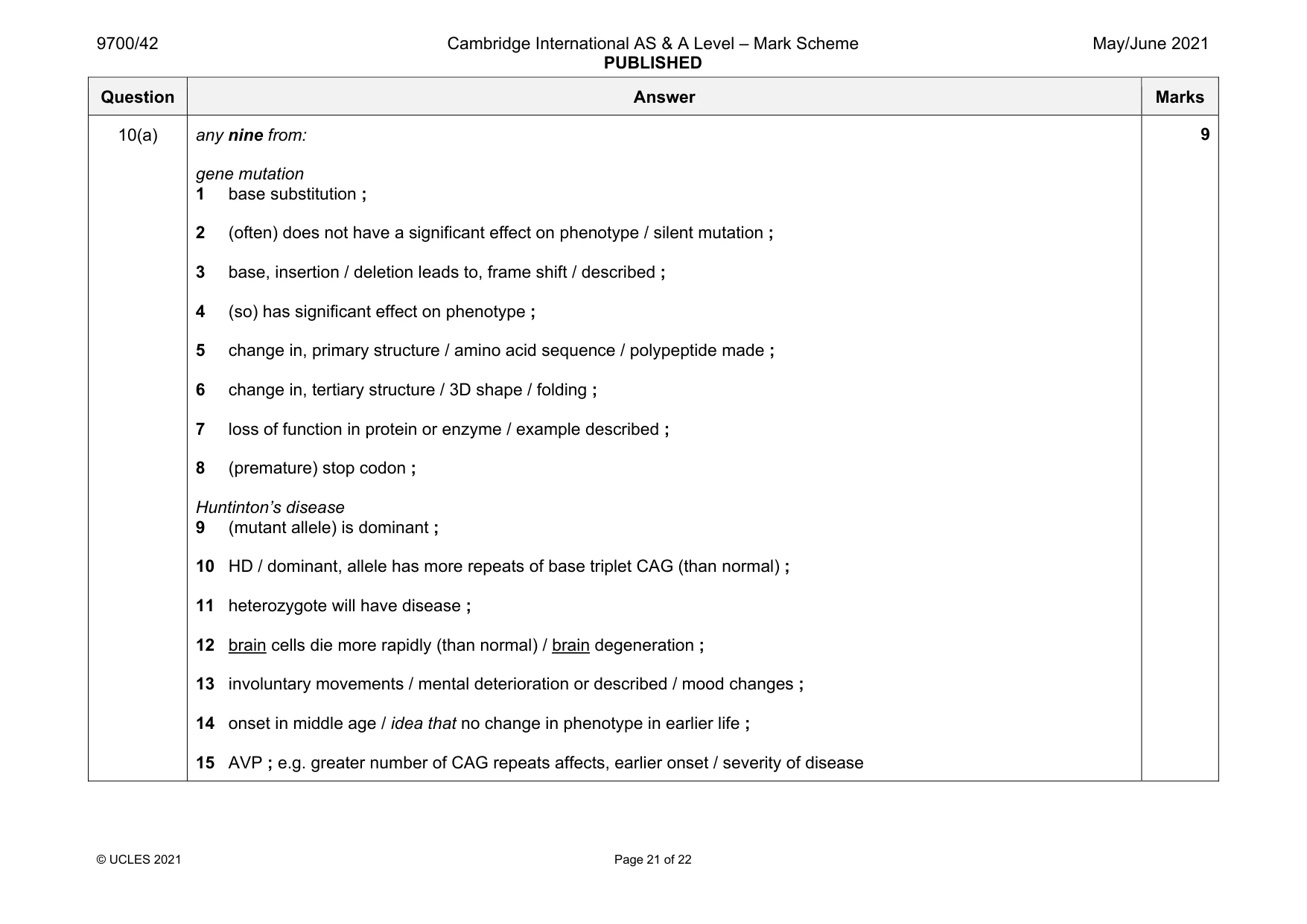
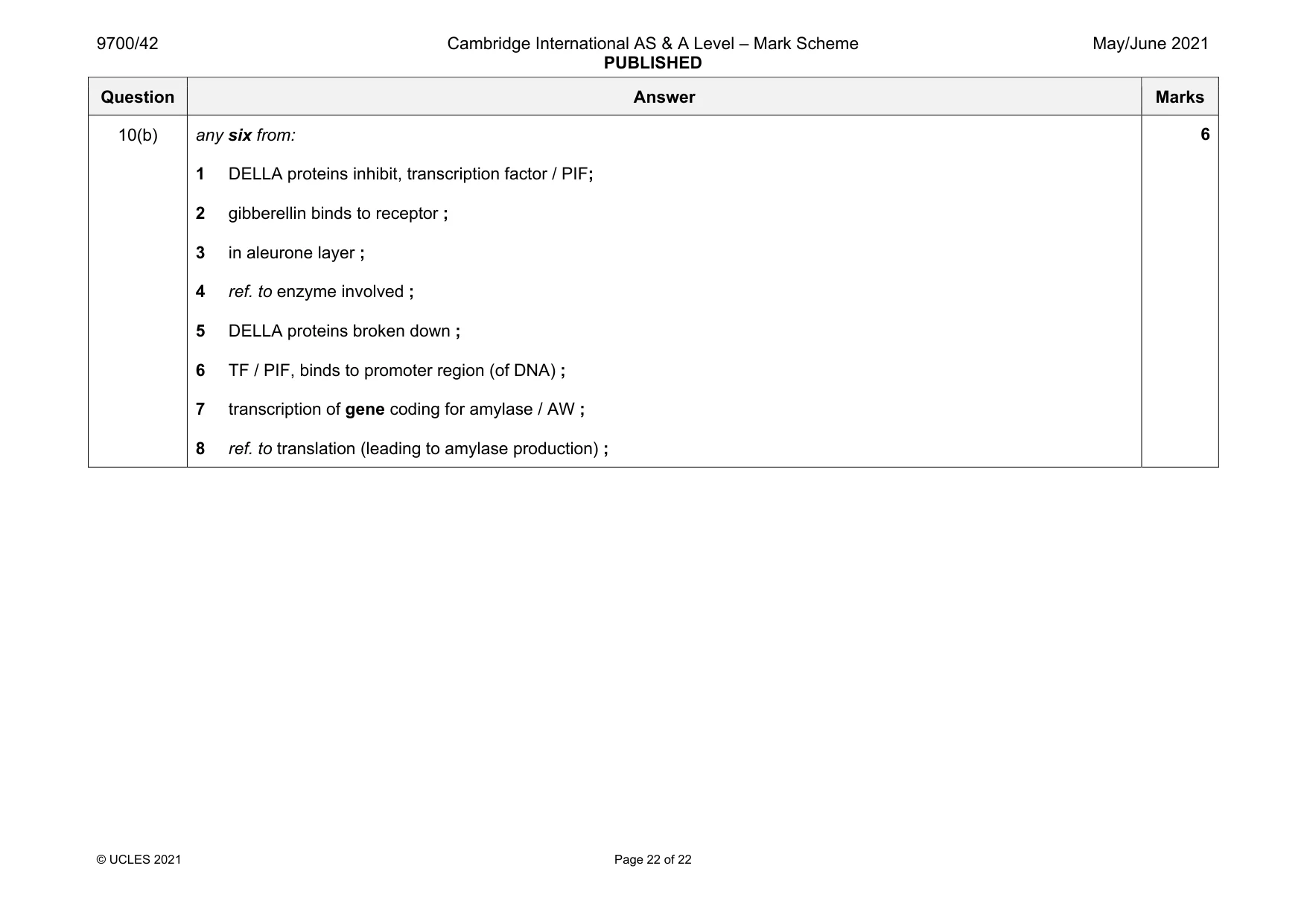
Mark scheme: 10(a) any nine from: gene mutation 1 base substitution ; 2 (often) does not have a significant effect on phenotype / silent mutation ; 3 base, insertion / deletion leads to, frame shift / described ; 4 (so) has significant effect on phenotype ; 5 change in, primary structure / amino acid sequence / polypeptide made ; 6 change in, tertiary structure / 3D shape / folding ; 7 loss of function in protein or enzyme / example described ; 8 (premature) stop codon ; Huntinton’s disease 9 (mutant allele) is dominant ; 10 HD / dominant, allele has more repeats of base triplet CAG (than normal) ; 11 heterozygote will have disease ; 12 brain cells die more rapidly (than normal) / brain degeneration ; 13 involuntary movements / mental deterioration or described / mood changes ; 14 onset in middle age / idea that no change in phenotype in earlier life ; 15 AVP ; e.g. greater number of CAG repeats affects, earlier onset / severity of disease Question Answer Marks 10(b) any six from: 1 DELLA proteins inhibit, transcription factor / PIF; 2 gibberellin binds to receptor ; 3 in aleurone layer ; 4 ref. to enzyme involved ; 5 DELLA proteins broken down ; 6 TF / PIF, binds to promoter region (of DNA) ; 7 transcription of gene coding for amylase / AW ; 8 ref. to translation (leading to amylase production) ; 6
What was in this paper
The subtopics covered by these 10 questions, and how many questions each got. Open one in a new tab to see every Cambridge question on it.
What you needed in this session
Cambridge’s own grade thresholds for 2021 May/June, Paper 4 · Variant 2. A higher threshold means an easier paper — the bar moves with how the cohort did.