Cambridge A Level Biology 9700 — 2020 Oct/Nov Paper 4 · Variant 2
9700/42/O/N/20 · 10 questions · 100 marks · ≈113 min
The question paper and its mark scheme, free to read here and free to download. This is Cambridge’s own paper, exactly as it was sat.
Question paper24 pages



Mark scheme23 pages
Answers below. Sit the paper first if you are practising.
Questions as text
Q1 · A transmission electron micrograph of a chloroplast
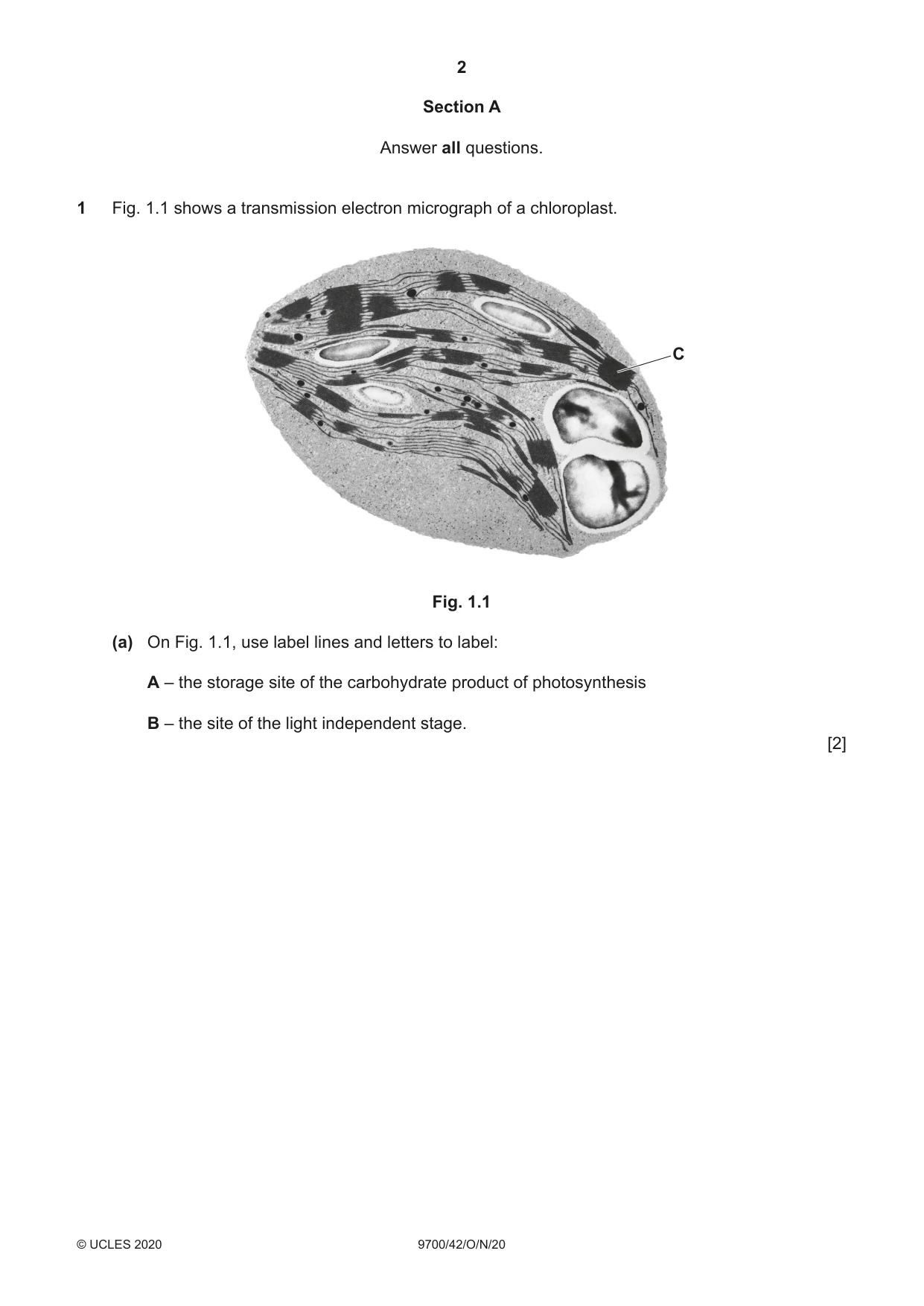
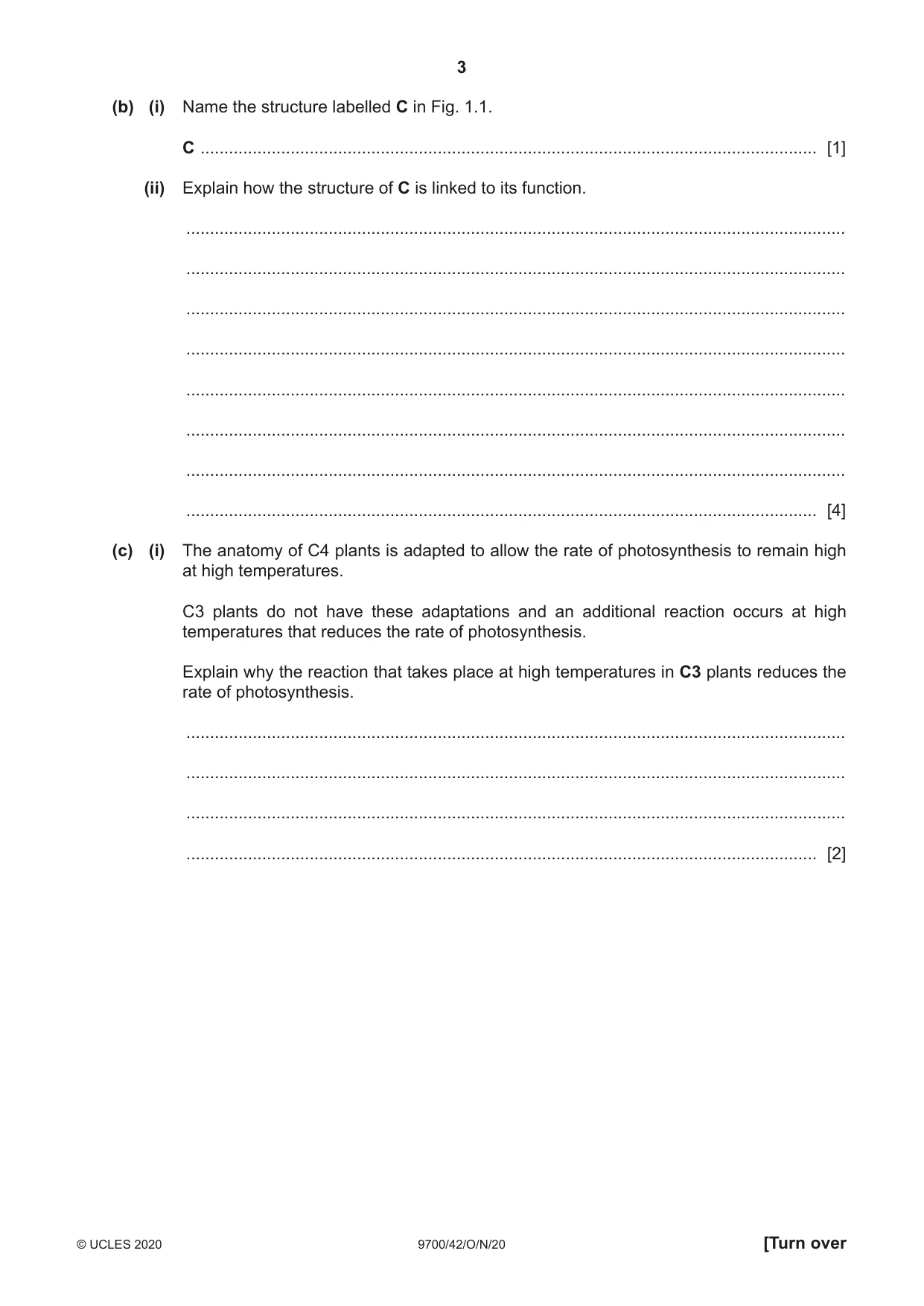
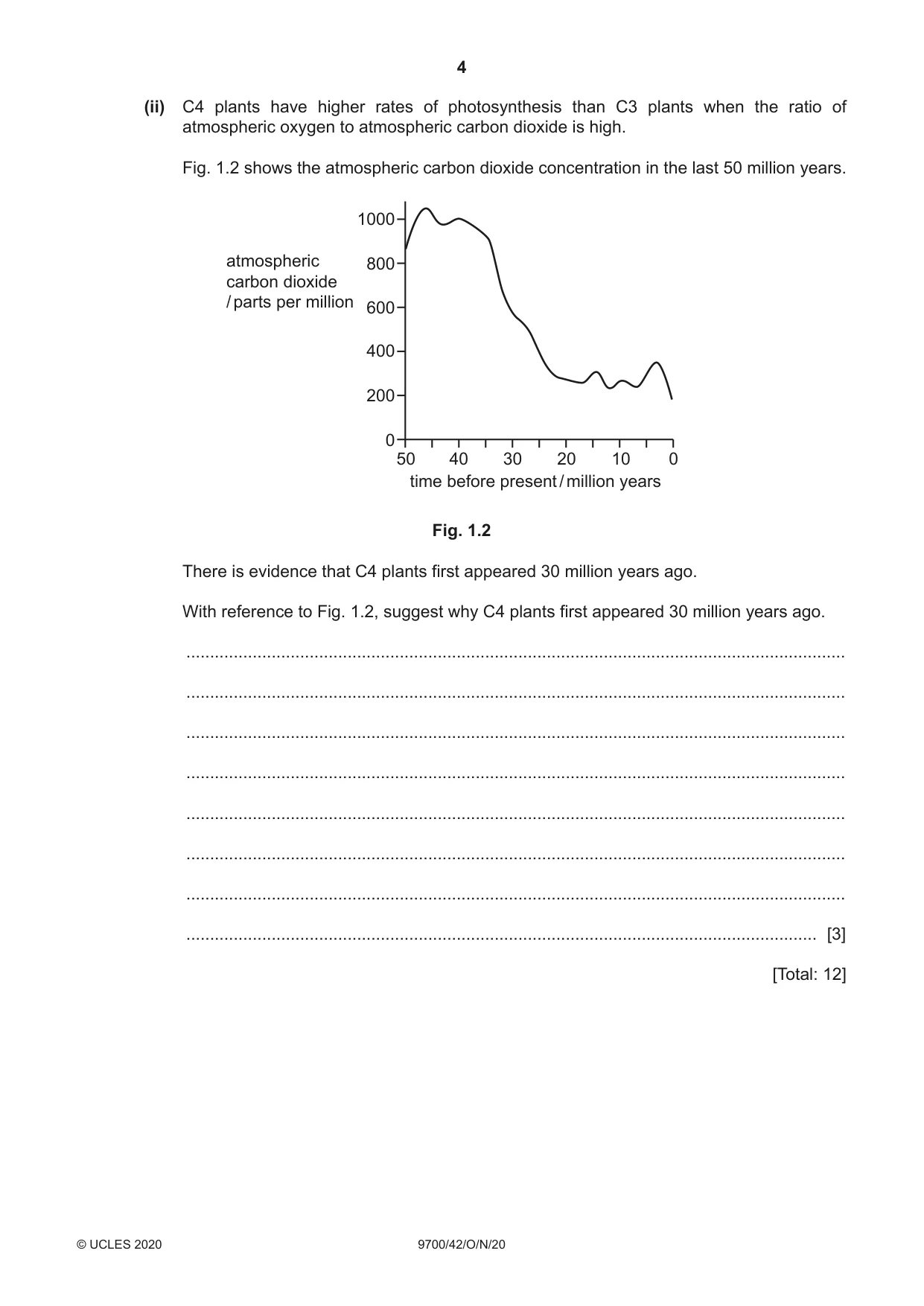
1 Fig. 1.1 shows a transmission electron micrograph of a chloroplast. C Fig. 1.1 (a) On Fig. 1.1, use label lines and letters to label: A – the storage site of the carbohydrate product of photosynthesis B – the site of the light independent stage. [2] (b) (i) Name the structure labelled C in Fig. 1.1. C .................................................................................................................................. [1] (ii) Explain how the structure of C is linked to its function. ........................................................................................................................................... ........................................................................................................................................... ........................................................................................................................................... ........................................................................................................................................... ........................................................................................................................................... ........................................................................................................................................... ........................................................................................................................................... ..................................................................................................................................... [4] (c) (i) The anatomy of C4 plants is adapted to allow the rate of photosynthesis to remain high at high temperatures. C3 plants do not have these adaptations and an additional reaction occurs at high temperatures that reduces the rate of photosynthesis. Explain why the reaction that takes place at high temperatures in C3 plants reduces the rate of photosynthesis. ........................................................................................................................................... ........................................................................................................................................... ........................................................................................................................................... ..................................................................................................................................... [2] (ii) C4 plants have higher rates of photosynthesis than C3 plants when the ratio of atmospheric oxygen to atmospheric carbon dioxide is high. Fig. 1.2 shows the atmospheric carbon dioxide concentration in the last 50 million years. 1000 atmospheric 800 carbon dioxide / parts per million 600 400 200 0 50 40 30 20 10 0 time before present / million years Fig. 1.2 There is evidence that C4 plants first appeared 30 million years ago. With reference to Fig. 1.2, suggest why C4 plants first appeared 30 million years ago. ........................................................................................................................................... ........................................................................................................................................... ........................................................................................................................................... ........................................................................................................................................... ........................................................................................................................................... ........................................................................................................................................... ........................................................................................................................................... ..................................................................................................................................... [3] [Total: 12]
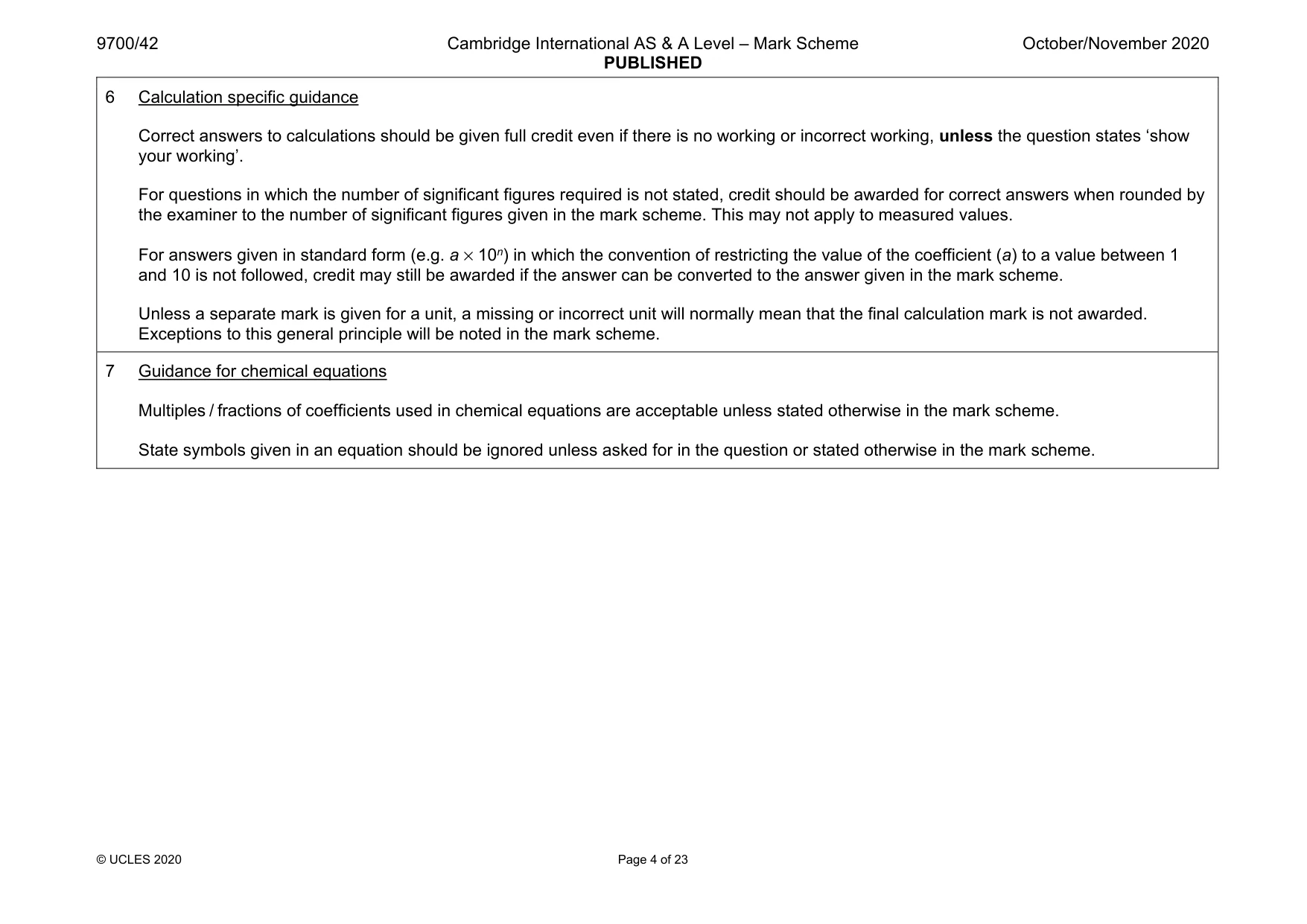
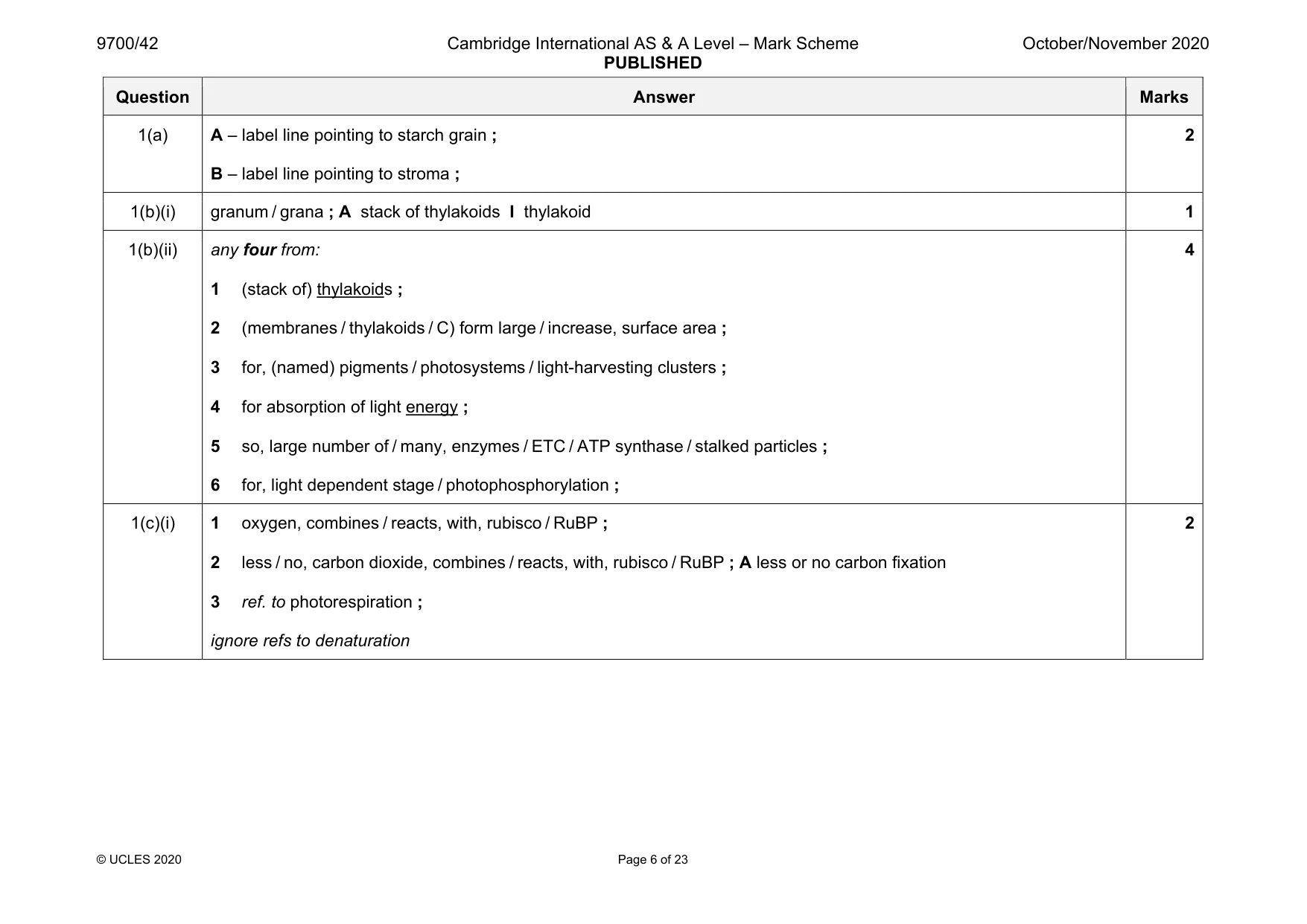
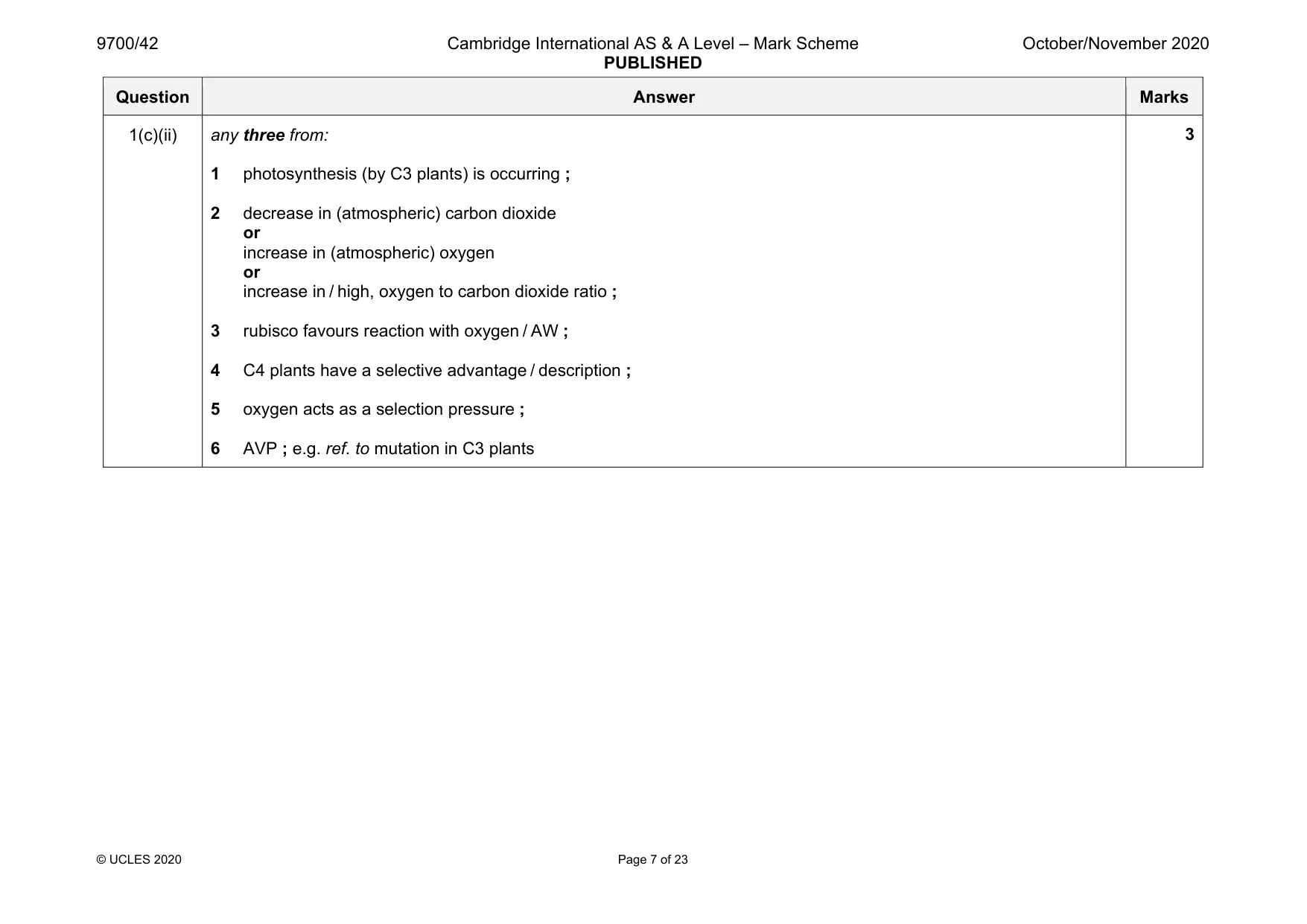
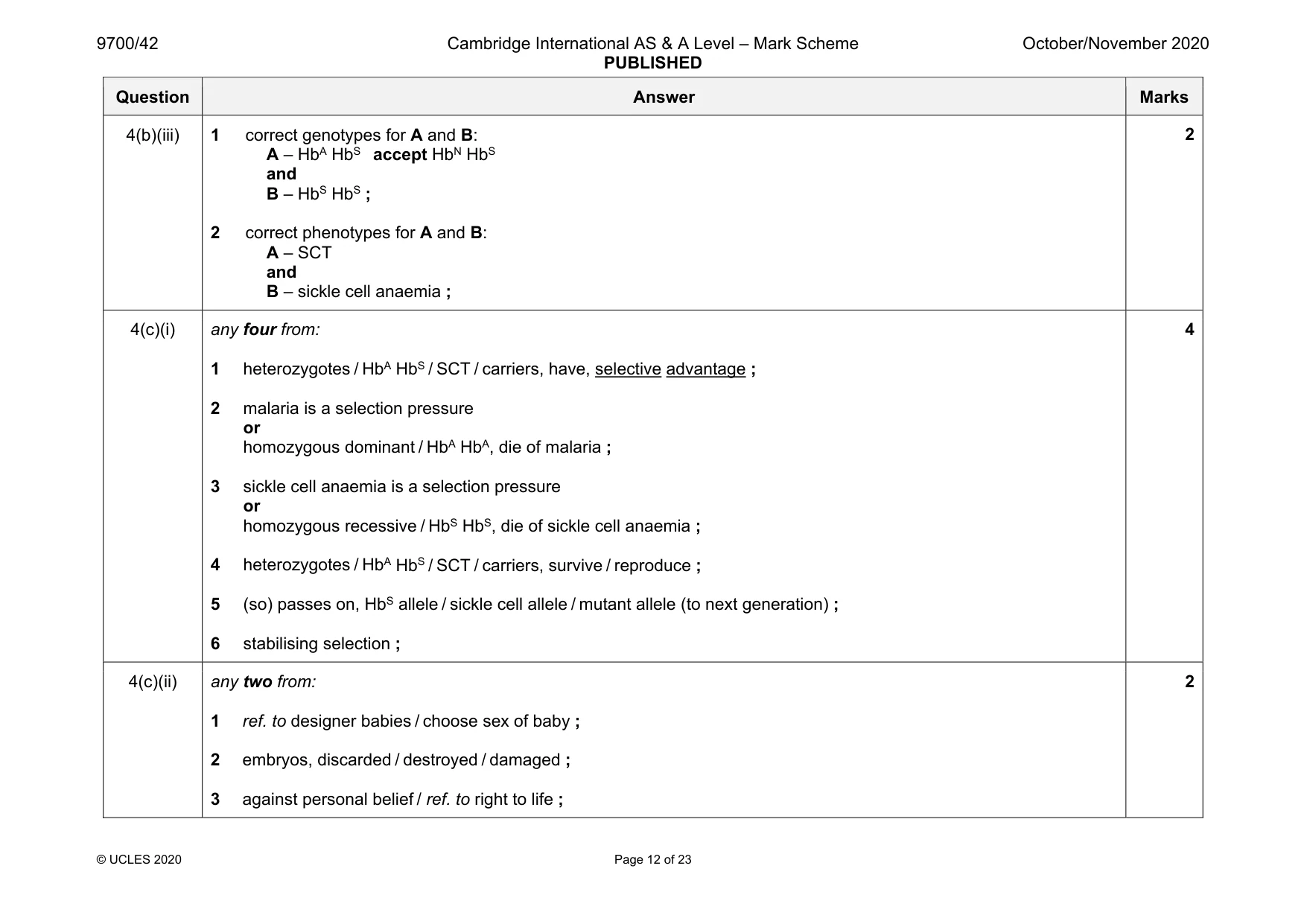
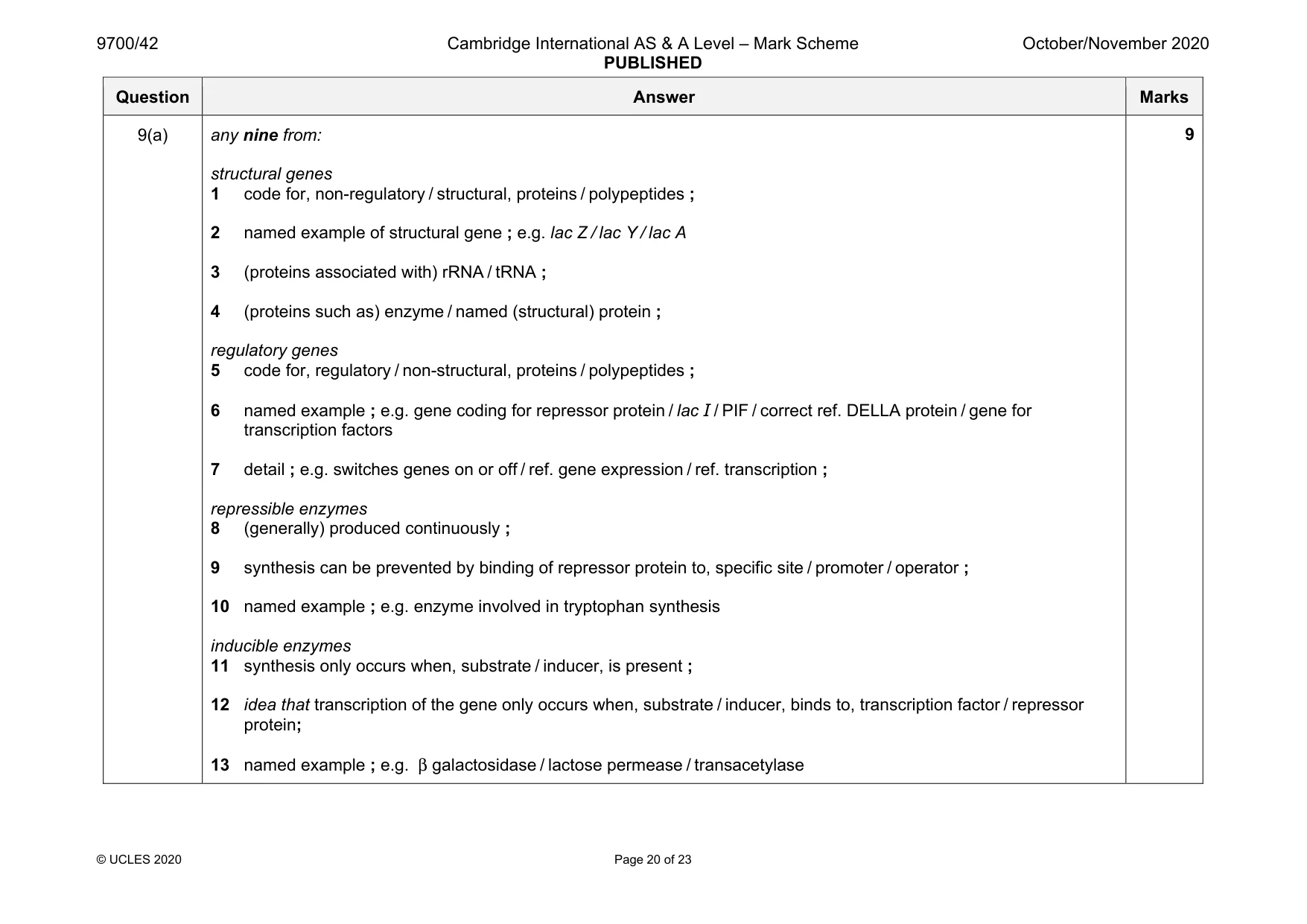
Mark scheme: 1(a) A – label line pointing to starch grain ; B – label line pointing to stroma ; 2 1(b)(i) granum / grana ; A stack of thylakoids I thylakoid 1 1(b)(ii) any four from: 1 (stack of) thylakoids ; 2 (membranes / thylakoids / C) form large / increase, surface area ; 3 for, (named) pigments / photosystems / light-harvesting clusters ; 4 for absorption of light energy ; 5 so, large number of / many, enzymes / ETC / ATP synthase / stalked particles ; 6 for, light dependent stage / photophosphorylation ; 4 1(c)(i) 1 oxygen, combines / reacts, with, rubisco / RuBP ; 2 less / no, carbon dioxide, combines / reacts, with, rubisco / RuBP ; A less or no carbon fixation 3 ref. to photorespiration ; ignore refs to denaturation 2 Question Answer Marks 1(c)(ii) any three from: 1 photosynthesis (by C3 plants) is occurring ; 2 decrease in (atmospheric) carbon dioxide or increase in (atmospheric) oxygen or increase in / high, oxygen to carbon dioxide ratio ; 3 rubisco favours reaction with oxygen / AW ; 4 C4 plants have a selective advantage / description ; 5 oxygen acts as a selection pressure ; 6 AVP ; e.g. ref. to mutation in C3 plants 3
More questions on Photosynthesis as an energy transfer process
Q2 · Domestic goats are small, herbivorous animals that provide milk for human use
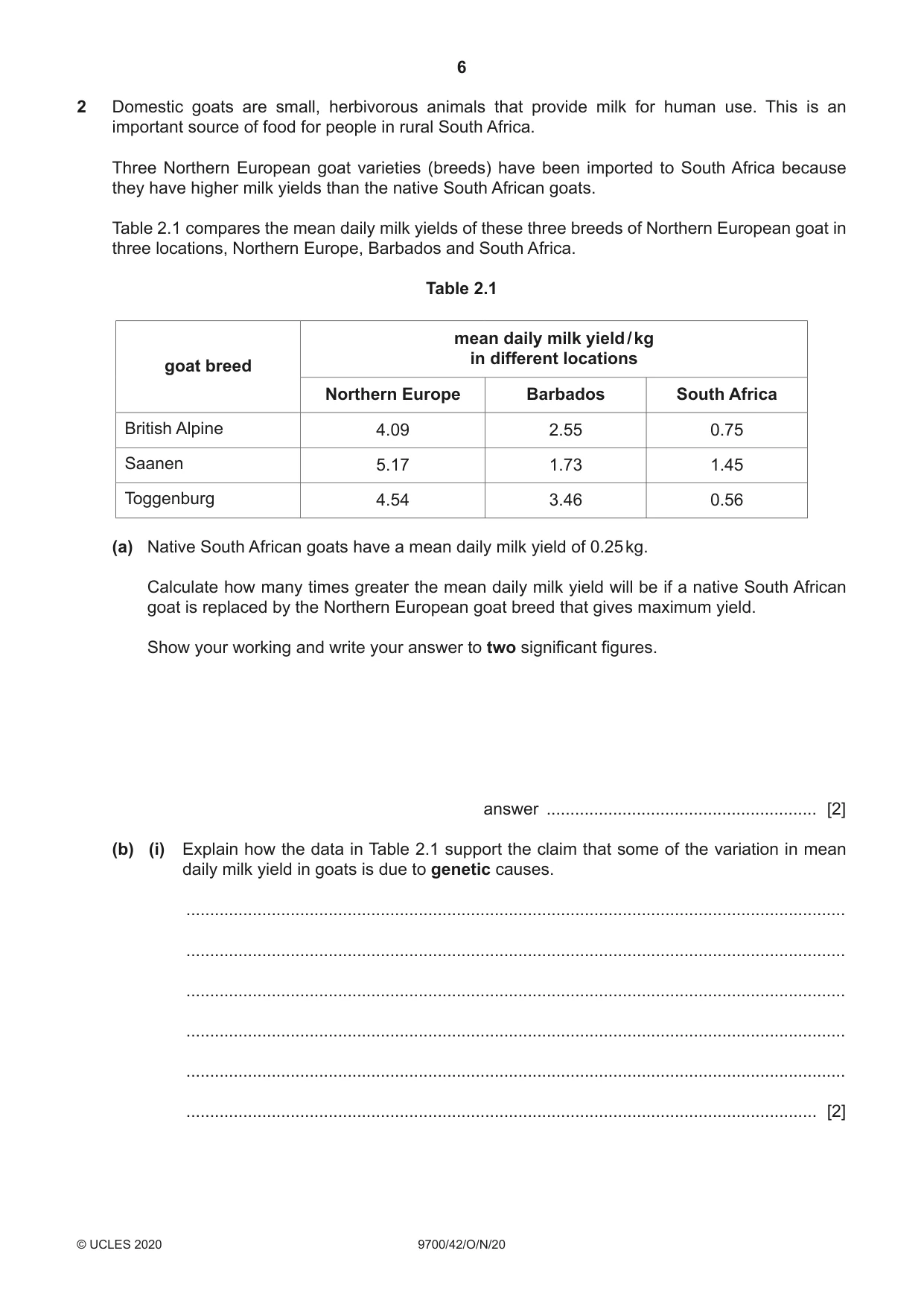
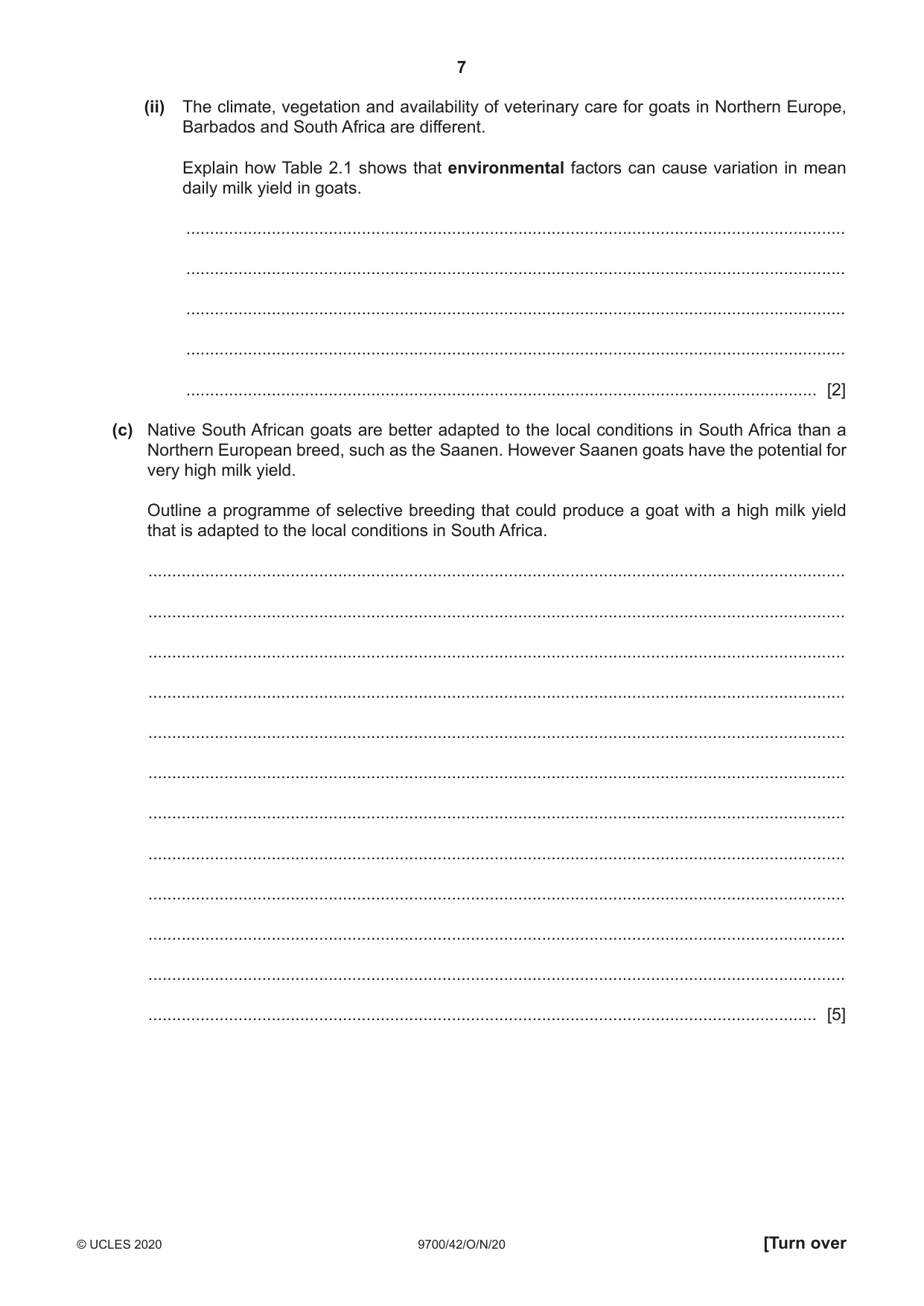
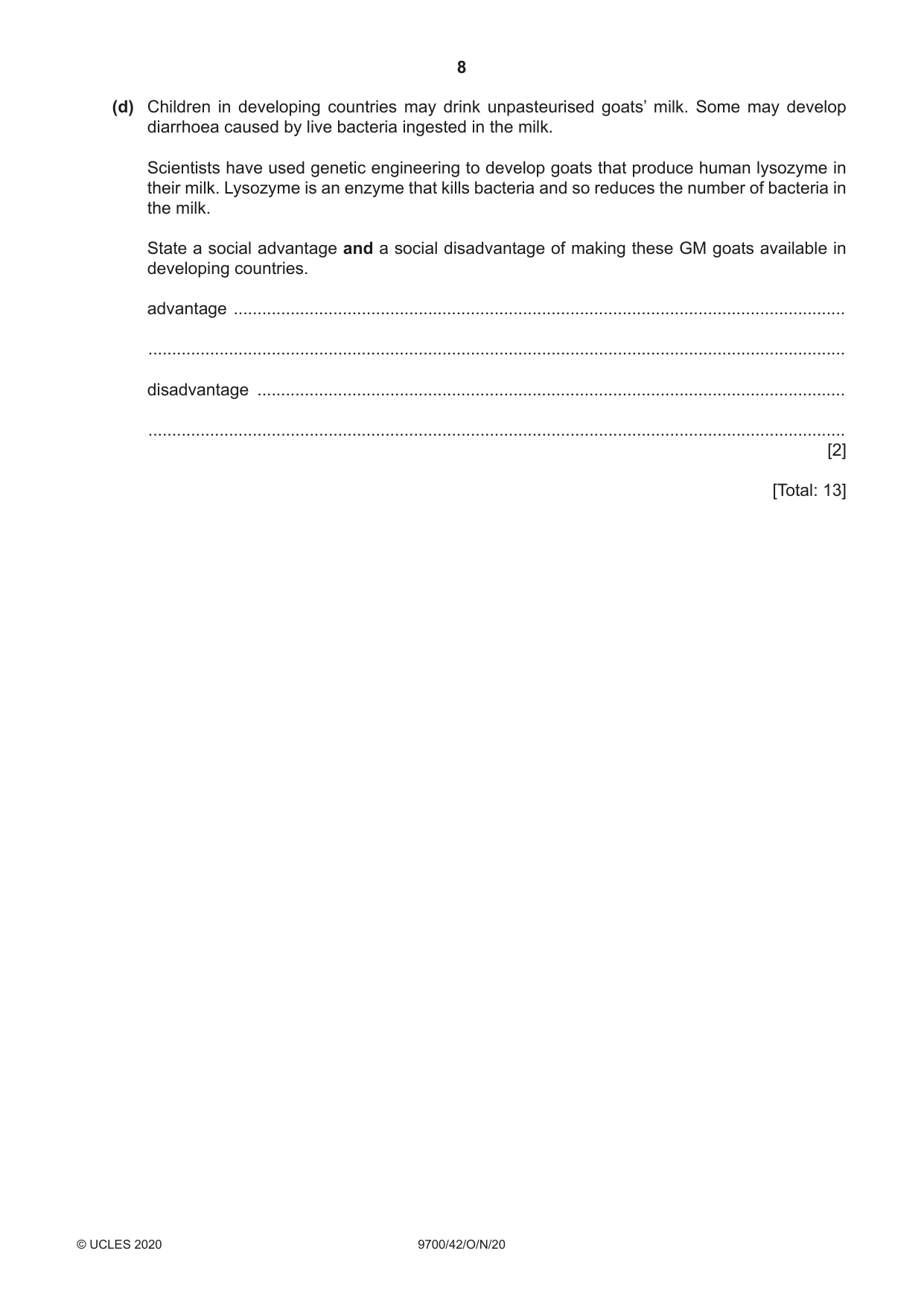
2 Domestic goats are small, herbivorous animals that provide milk for human use. This is an important source of food for people in rural South Africa. Three Northern European goat varieties (breeds) have been imported to South Africa because they have higher milk yields than the native South African goats. Table 2.1 compares the mean daily milk yields of these three breeds of Northern European goat in three locations, Northern Europe, Barbados and South Africa. Table 2.1 mean daily milk yield / kg in different locations goat breed Northern Europe Barbados South Africa British Alpine 4.09 2.55 0.75 Saanen 5.17 1.73 1.45 Toggenburg 4.54 3.46 0.56 (a) Native South African goats have a mean daily milk yield of 0.25 kg. Calculate how many times greater the mean daily milk yield will be if a native South African goat is replaced by the Northern European goat breed that gives maximum yield. Show your working and write your answer to two significant figures. answer ......................................................... [2] (b) (i) Explain how the data in Table 2.1 support the claim that some of the variation in mean daily milk yield in goats is due to genetic causes. ........................................................................................................................................... ........................................................................................................................................... ........................................................................................................................................... ........................................................................................................................................... ........................................................................................................................................... ..................................................................................................................................... [2] (ii) The climate, vegetation and availability of veterinary care for goats in Northern Europe, Barbados and South Africa are different. Explain how Table 2.1 shows that environmental factors can cause variation in mean daily milk yield in goats. ........................................................................................................................................... ........................................................................................................................................... ........................................................................................................................................... ........................................................................................................................................... ..................................................................................................................................... [2] (c) Native South African goats are better adapted to the local conditions in South Africa than a Northern European breed, such as the Saanen. However Saanen goats have the potential for very high milk yield. Outline a programme of selective breeding that could produce a goat with a high milk yield that is adapted to the local conditions in South Africa. ................................................................................................................................................... ................................................................................................................................................... ................................................................................................................................................... ................................................................................................................................................... ................................................................................................................................................... ................................................................................................................................................... ................................................................................................................................................... ................................................................................................................................................... ................................................................................................................................................... ................................................................................................................................................... ................................................................................................................................................... ............................................................................................................................................. [5] (d) Children in developing countries may drink unpasteurised goats’ milk. Some may develop diarrhoea caused by live bacteria ingested in the milk. Scientists have used genetic engineering to develop goats that produce human lysozyme in their milk. Lysozyme is an enzyme that kills bacteria and so reduces the number of bacteria in the milk. State a social advantage and a social disadvantage of making these GM goats available in developing countries. advantage ................................................................................................................................. ................................................................................................................................................... disadvantage ............................................................................................................................ ................................................................................................................................................... [2] [Total: 13]
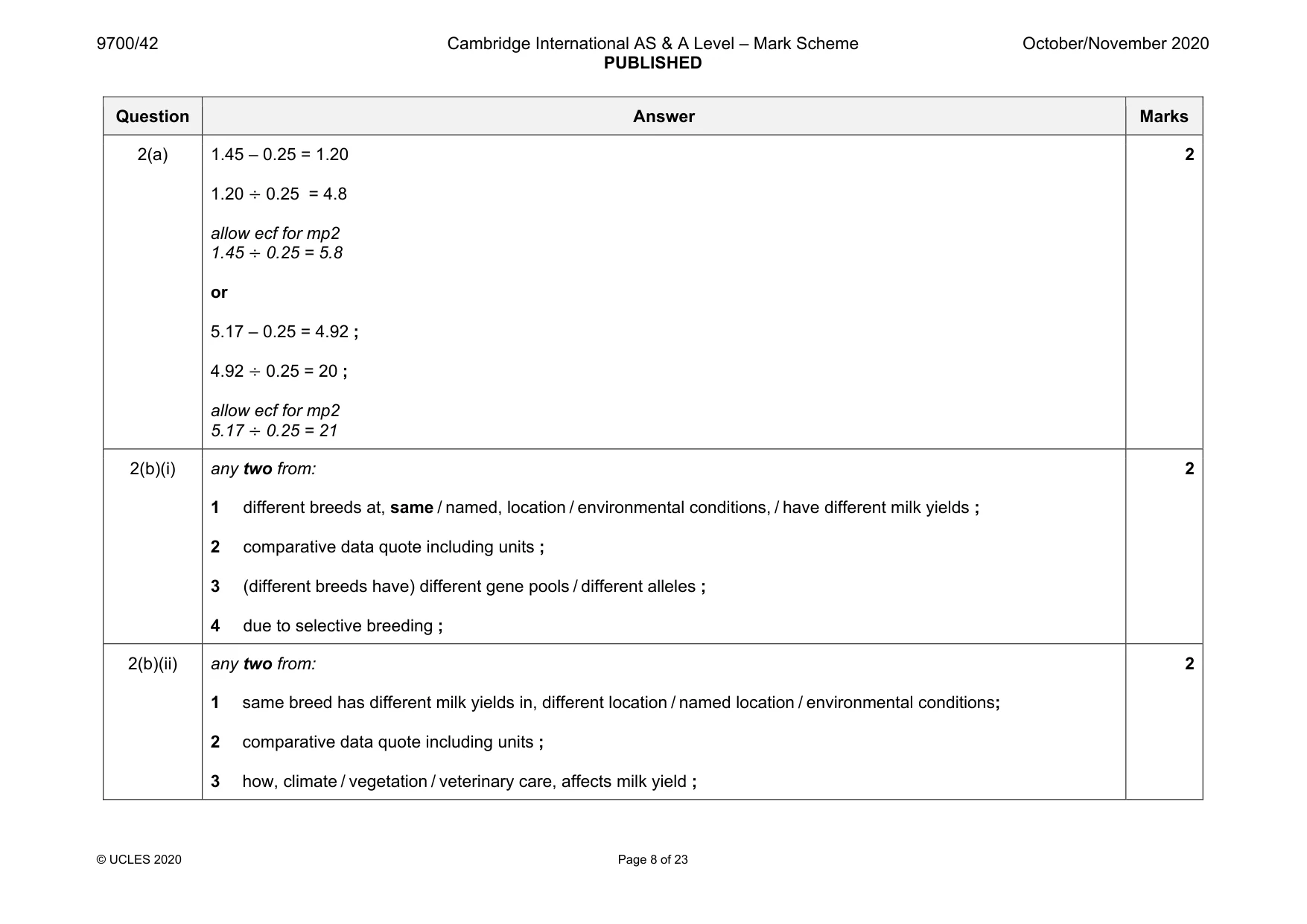
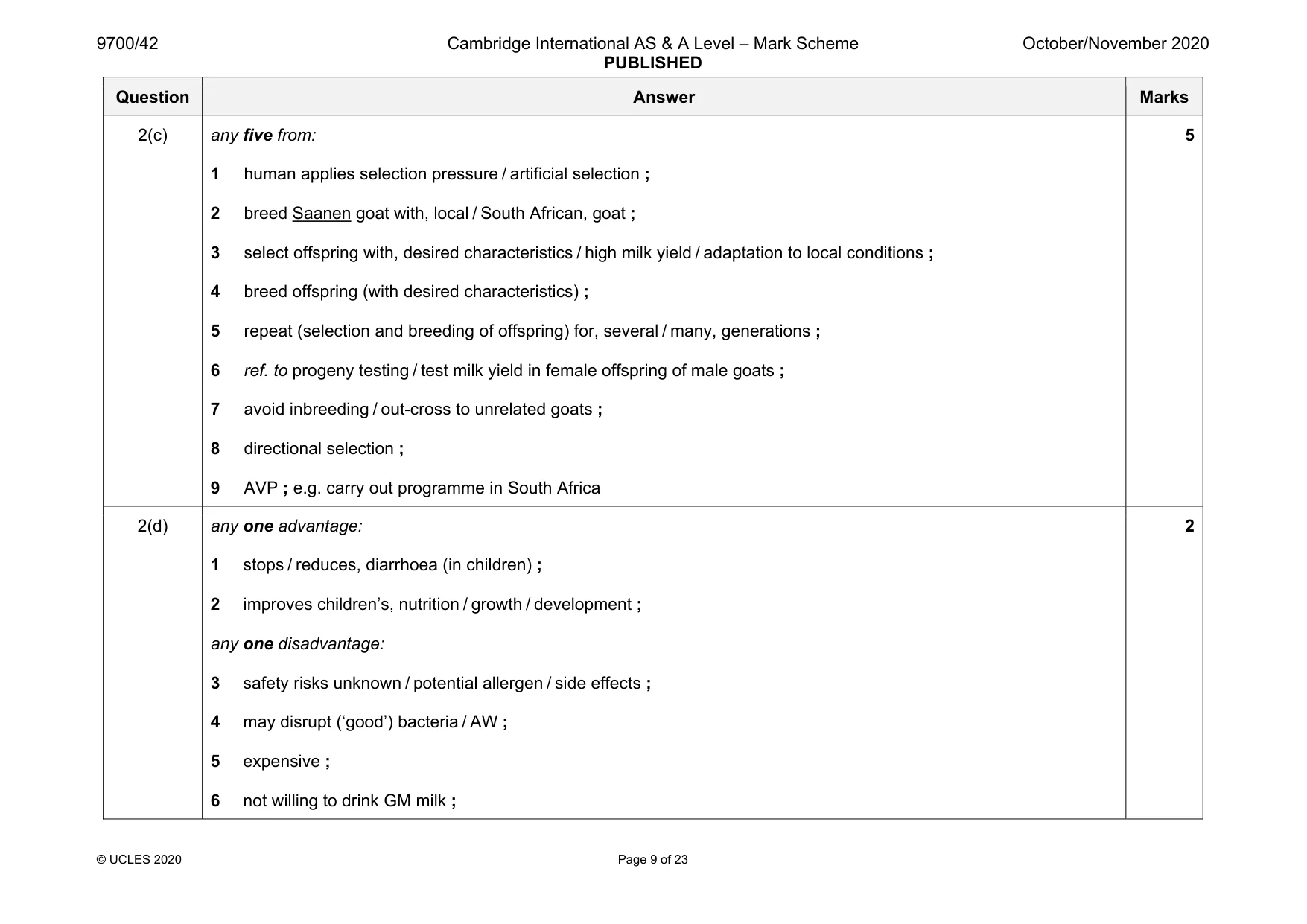
Mark scheme: 2(a) 1.45 – 0.25 = 1.20 1.20 ÷ 0.25 = 4.8 allow ecf for mp2 1.45 ÷ 0.25 = 5.8 or 5.17 – 0.25 = 4.92 ; 4.92 ÷ 0.25 = 20 ; allow ecf for mp2 5.17 ÷ 0.25 = 21 2(b)(i) any two from: 1 different breeds at, same / named, location / environmental conditions, / have different milk yields ; 2 comparative data quote including units ; 3 (different breeds have) different gene pools / different alleles ; 4 due to selective breeding ; 2 2(b)(ii) any two from: 1 same breed has different milk yields in, different location / named location / environmental conditions; 2 comparative data quote including units ; 3 how, climate / vegetation / veterinary care, affects milk yield ; 2 Question Answer Marks 2(c) any five from: 1 human applies selection pressure / artificial selection ; 2 breed Saanen goat with, local / South African, goat ; 3 select offspring with, desired characteristics / high milk yield / adaptation to local conditions ; 4 breed offspring (with desired characteristics) ; 5 repeat (selection and breeding of offspring) for, several / many, generations ; 6 ref. to progeny testing / test milk yield in female offspring of male goats ; 7 avoid inbreeding / out-cross to unrelated goats ; 8 directional selection ; 9 AVP ; e.g. carry out programme in South Africa 5 2(d) any one advantage: 1 stops / reduces, diarrhoea (in children) ; 2 improves children’s, nutrition / growth / development ; any one disadvantage: 3 safety risks unknown / potential allergen / side effects ; 4 may disrupt (‘good’) bacteria / AW ; 5 expensive ; 6 not willing to drink GM milk ; 2
Q3 · A subspecies is a genetically distinct population of a species that has some phenotypic…
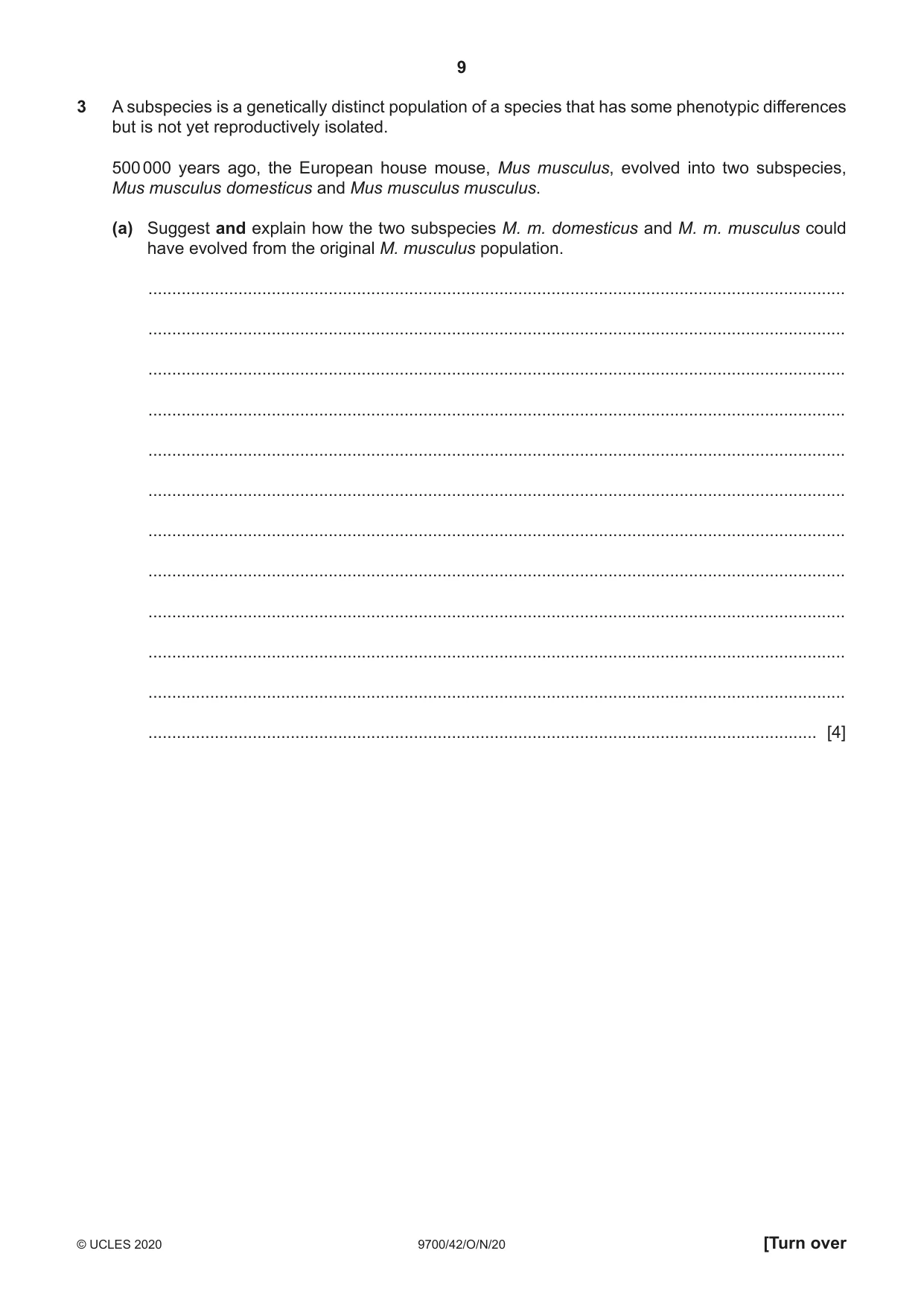
3 A subspecies is a genetically distinct population of a species that has some phenotypic differences but is not yet reproductively isolated. 500 000 years ago, the European house mouse, Mus musculus, evolved into two subspecies, Mus musculus domesticus and Mus musculus musculus. (a) Suggest and explain how the two subspecies M. m. domesticus and M. m. musculus could have evolved from the original M. musculus population. ................................................................................................................................................... ................................................................................................................................................... ................................................................................................................................................... ................................................................................................................................................... ................................................................................................................................................... ................................................................................................................................................... ................................................................................................................................................... ................................................................................................................................................... ................................................................................................................................................... ................................................................................................................................................... ................................................................................................................................................... ............................................................................................................................................. [4] (b) Today, M. m. domesticus populations are separated from M. m. musculus populations by a large hybrid zone. The hybrid zone formed 5000–1000 years ago when populations of the two subspecies overlapped and interbreeding occurred between the two subspecies, resulting in hybrids. Researchers investigated the populations in the hybrid zone. It was observed that: • hybrid mice were infected by more intestinal worms than M. m. domesticus and M. m. musculus • M. m. domesticus and M. m. musculus individuals frequently mate together • hybrid male mice had a very low fertility score based on testis weight and total sperm production, whereas M. m. domesticus and M. m. musculus males had a very high fertility score • some female hybrids were sterile • crosses between a fertile female hybrid and a male from either subspecies produced a very low number of offspring. M. m. domesticus and M. m. musculus usually have the same diploid number (2n = 40). Some individuals of M. m. domesticus have a different diploid number (2n = 34). Discuss the extent to which pre-zygotic and post-zygotic isolating mechanisms maintain M. m. domesticus and M. m. musculus as two separate subspecies within the hybrid zone. ................................................................................................................................................... ................................................................................................................................................... ................................................................................................................................................... ................................................................................................................................................... ................................................................................................................................................... ................................................................................................................................................... ................................................................................................................................................... ................................................................................................................................................... ............................................................................................................................................. [3] [Total: 7]
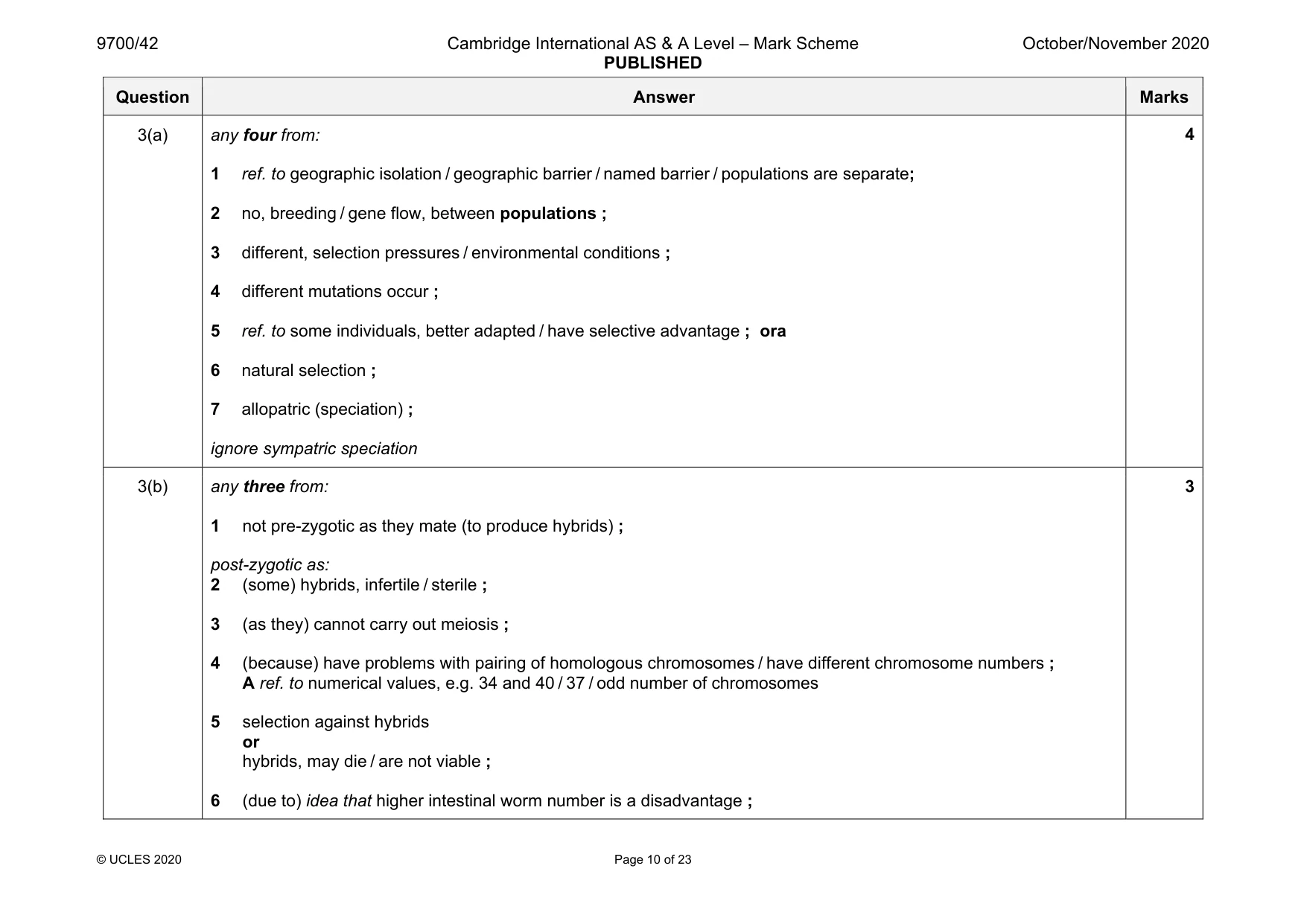
Mark scheme: 3(a) any four from: 1 ref. to geographic isolation / geographic barrier / named barrier / populations are separate; 2 no, breeding / gene flow, between populations ; 3 different, selection pressures / environmental conditions ; 4 different mutations occur ; 5 ref. to some individuals, better adapted / have selective advantage ; ora 6 natural selection ; 7 allopatric (speciation) ; ignore sympatric speciation 3(b) any three from: 1 not pre-zygotic as they mate (to produce hybrids) ; post-zygotic as: 2 (some) hybrids, infertile / sterile ; 3 (as they) cannot carry out meiosis ; 4 (because) have problems with pairing of homologous chromosomes / have different chromosome numbers ; A ref. to numerical values, e.g. 34 and 40 / 37 / odd number of chromosomes 5 selection against hybrids or hybrids, may die / are not viable ; 6 (due to) idea that higher intestinal worm number is a disadvantage ; 3
Q4 · Sickle cell anaemia is a non-infectious chronic disease
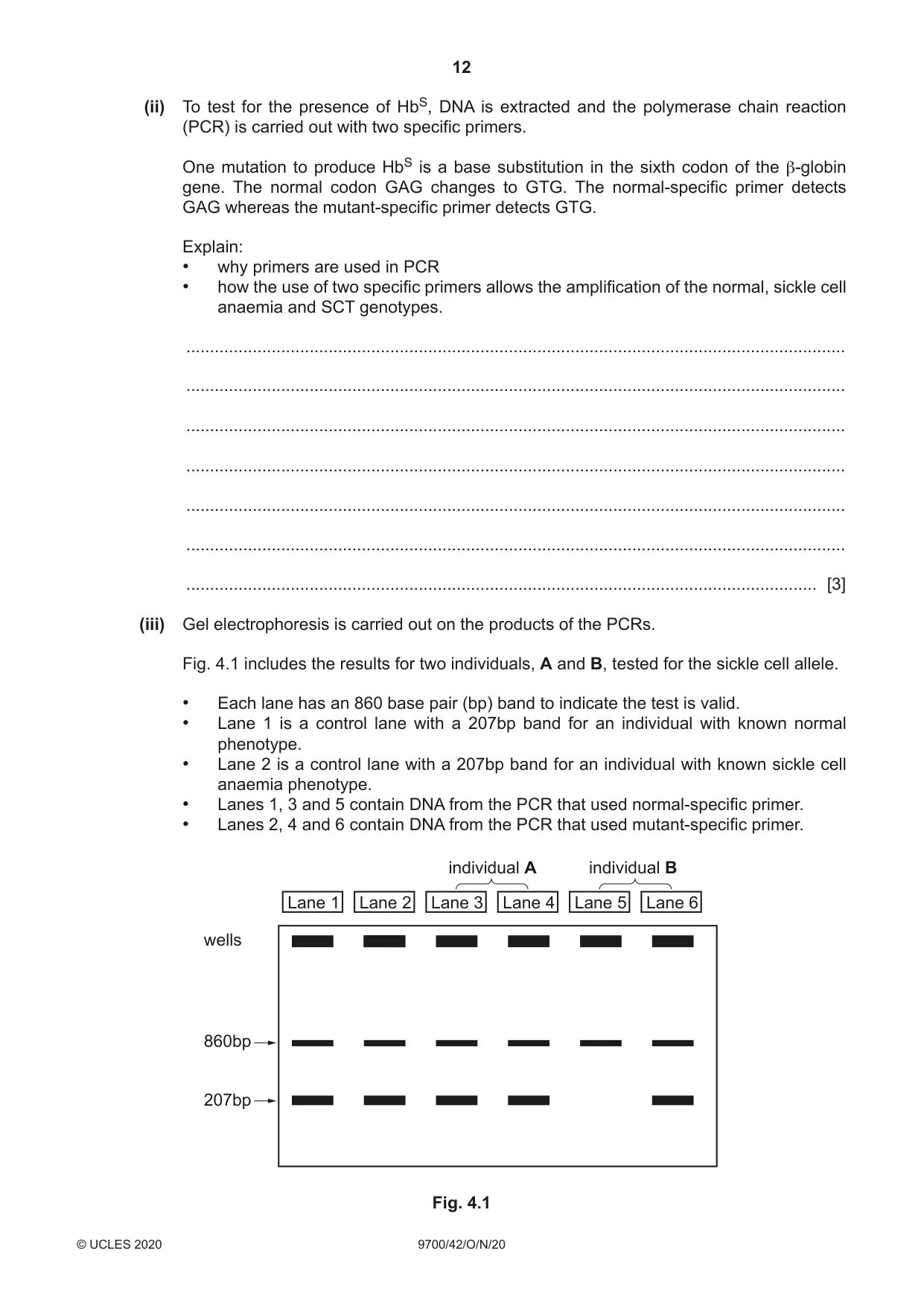
4 Sickle cell anaemia is a non-infectious chronic disease. If not treated, sickle cell anaemia can be painful and life-threatening. Sickle cell anaemia is caused by a base substitution mutation in the gene coding for the β-globin polypeptide of haemoglobin. This leads to a change in the primary structure of the polypeptide, as valine is present instead of glutamine. This results in abnormal sickle-shaped red blood cells, which stick together in blood vessels. Symptoms of sickle cell anaemia include painful attacks when red blood cells block capillaries in tissues and organs. (a) Suggest the consequences to cells when sickle-shaped red blood cells block capillaries in tissues and organs. ................................................................................................................................................... ................................................................................................................................................... ................................................................................................................................................... ............................................................................................................................................. [2] (b) Sickle cell anaemia is an autosomal recessive inherited disorder: • allele HbA codes for the normal β-globin polypeptide • allele HbS codes for the sickle-cell polypeptide. People who are heterozygous (HbA HbS) have sickle cell trait (SCT). For a child to inherit sickle cell anaemia (HbS HbS), both parents must have SCT. A genetic screening program is available for sickle cell anaemia and SCT: • when a mother is screened and found to have SCT, the father is then screened • if the mother becomes pregnant, the fetus is screened for both sickle cell anaemia and for SCT • the test is done either by amniocentesis or by chorionic villus sampling, both of which carry a small risk of the pregnancy failing. (i) Outline two advantages of genetic screening for sickle cell anaemia and SCT. ........................................................................................................................................... ........................................................................................................................................... ........................................................................................................................................... ........................................................................................................................................... ........................................................................................................................................... ..................................................................................................................................... [2] (ii) To test for the presence of HbS, DNA is extracted and the polymerase chain reaction (PCR) is carried out with two specific primers. One mutation to produce HbS is a base substitution in the sixth codon of the β-globin gene. The normal codon GAG changes to GTG. The normal-specific primer detects GAG whereas the mutant-specific primer detects GTG. Explain: • why primers are used in PCR • how the use of two specific primers allows the amplification of the normal, sickle cell anaemia and SCT genotypes. ........................................................................................................................................... ........................................................................................................................................... ........................................................................................................................................... ........................................................................................................................................... ........................................................................................................................................... ........................................................................................................................................... ..................................................................................................................................... [3] (iii) Gel electrophoresis is carried out on the products of the PCRs. Fig. 4.1 includes the results for two individuals, A and B, tested for the sickle cell allele. • Each lane has an 860 base pair (bp) band to indicate the test is valid. • Lane 1 is a control lane with a 207bp band for an individual with known normal phenotype. • Lane 2 is a control lane with a 207bp band for an individual with known sickle cell anaemia phenotype. • Lanes 1, 3 and 5 contain DNA from the PCR that used normal-specific primer. • Lanes 2, 4 and 6 contain DNA from the PCR that used mutant-specific primer. individual A individual B Lane 1 Lane 2 Lane 3 Lane 4 Lane 5 Lane 6 wells 860bp 207bp Fig. 4.1 Deduce the genotypes and phenotypes of individuals A and B in Fig. 4.1. A ........................................................................................................................................ B ........................................................................................................................................ [2] (c) The number of cases of sickle cell anaemia is highest in sub-Saharan Africa, the Middle East and India. These areas also have a high incidence of malaria. People with SCT (heterozygotes) are either unaffected or may have mild symptoms of sickle cell anaemia. One advantage of SCT is an increased resistance to malaria. (i) Explain how natural selection operates to maintain the presence of the sickle cell allele in populations in areas with malaria. ........................................................................................................................................... ........................................................................................................................................... ........................................................................................................................................... ........................................................................................................................................... ........................................................................................................................................... ........................................................................................................................................... ........................................................................................................................................... ........................................................................................................................................... ..................................................................................................................................... [4] (ii) Parents who use IVF to produce embryos may decide to have embryos genetically screened by a test known as pre-implantation genetic diagnosis (PGD). Only embryos that do not have sickle cell alleles are transferred to the woman’s uterus. Discuss two ethical reasons why parents using IVF may choose not to have PGD. ........................................................................................................................................... ........................................................................................................................................... ........................................................................................................................................... ........................................................................................................................................... ..................................................................................................................................... [2] [Total: 15]
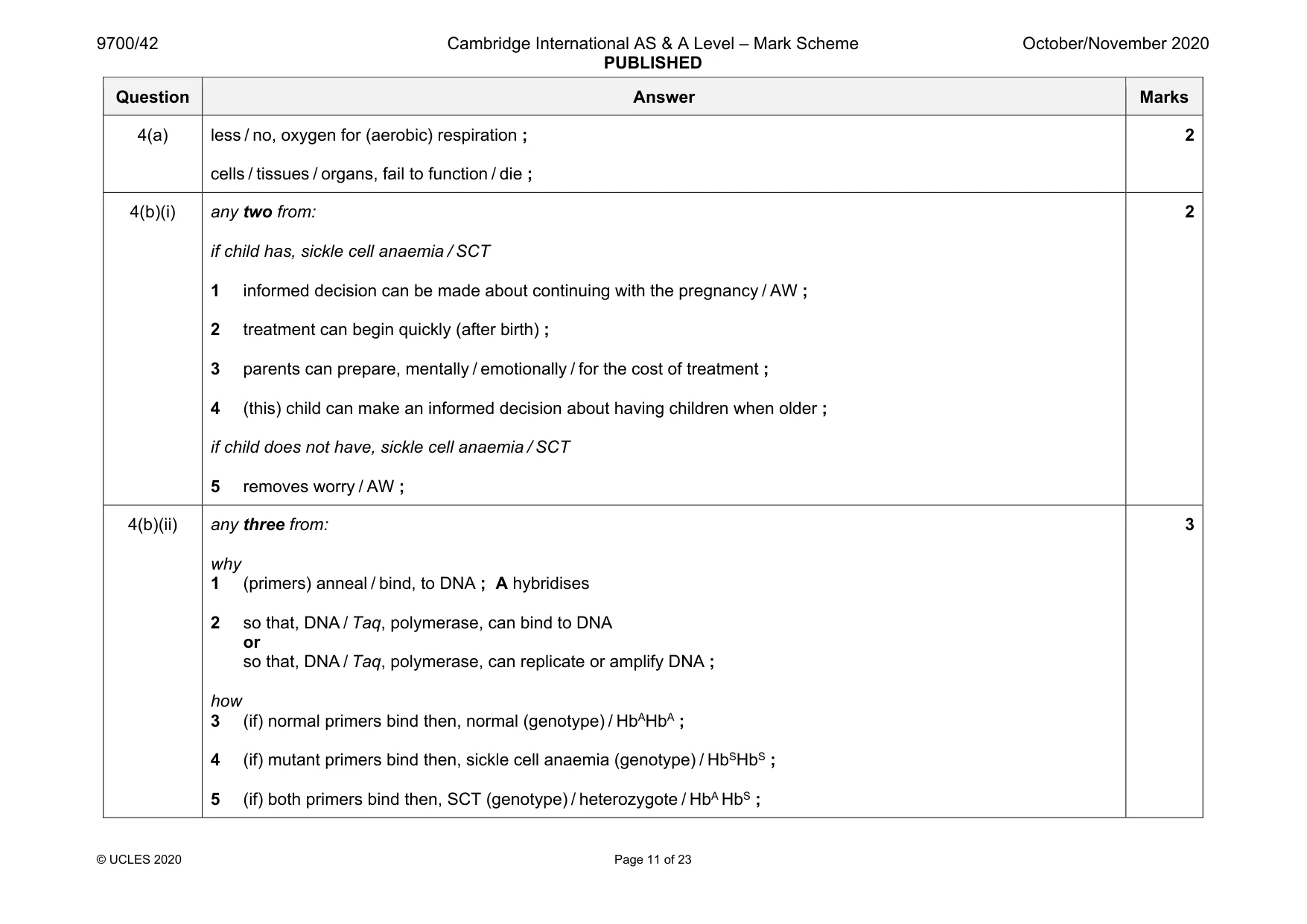
Mark scheme: 4(a) less / no, oxygen for (aerobic) respiration ; cells / tissues / organs, fail to function / die ; 2 4(b)(i) any two from: if child has, sickle cell anaemia / SCT 1 informed decision can be made about continuing with the pregnancy / AW ; 2 treatment can begin quickly (after birth) ; 3 parents can prepare, mentally / emotionally / for the cost of treatment ; 4 (this) child can make an informed decision about having children when older ; if child does not have, sickle cell anaemia / SCT 5 removes worry / AW ; 2 4(b)(ii) any three from: why 1 (primers) anneal / bind, to DNA ; A hybridises 2 so that, DNA / Taq, polymerase, can bind to DNA or so that, DNA / Taq, polymerase, can replicate or amplify DNA ; how 3 (if) normal primers bind then, normal (genotype) / HbAHbA ; 4 (if) mutant primers bind then, sickle cell anaemia (genotype) / HbSHbS ; 5 (if) both primers bind then, SCT (genotype) / heterozygote / HbA HbS ; 3 Question Answer Marks 4(b)(iii) 1 correct genotypes for A and B: A – HbA HbS accept HbN HbS and B – HbS HbS ; 2 correct phenotypes for A and B: A – SCT and B – sickle cell anaemia ; 2 4(c)(i) any four from: 1 heterozygotes / HbA HbS / SCT / carriers, have, selective advantage ; 2 malaria is a selection pressure or homozygous dominant / HbA HbA, die of malaria ; 3 sickle cell anaemia is a selection pressure or homozygous recessive / HbS HbS, die of sickle cell anaemia ; 4 heterozygotes / HbA HbS / SCT / carriers, survive / reproduce ; 5 (so) passes on, HbS allele / sickle cell allele / mutant allele (to next generation) ; 6 stabilising selection ; 4 4(c)(ii) any two from: 1 ref. to designer babies / choose sex of baby ; 2 embryos, discarded / destroyed / damaged ; 3 against personal belief / ref. to right to life ; 2
Q5 · Tyrosinase is an enzyme found in mammals
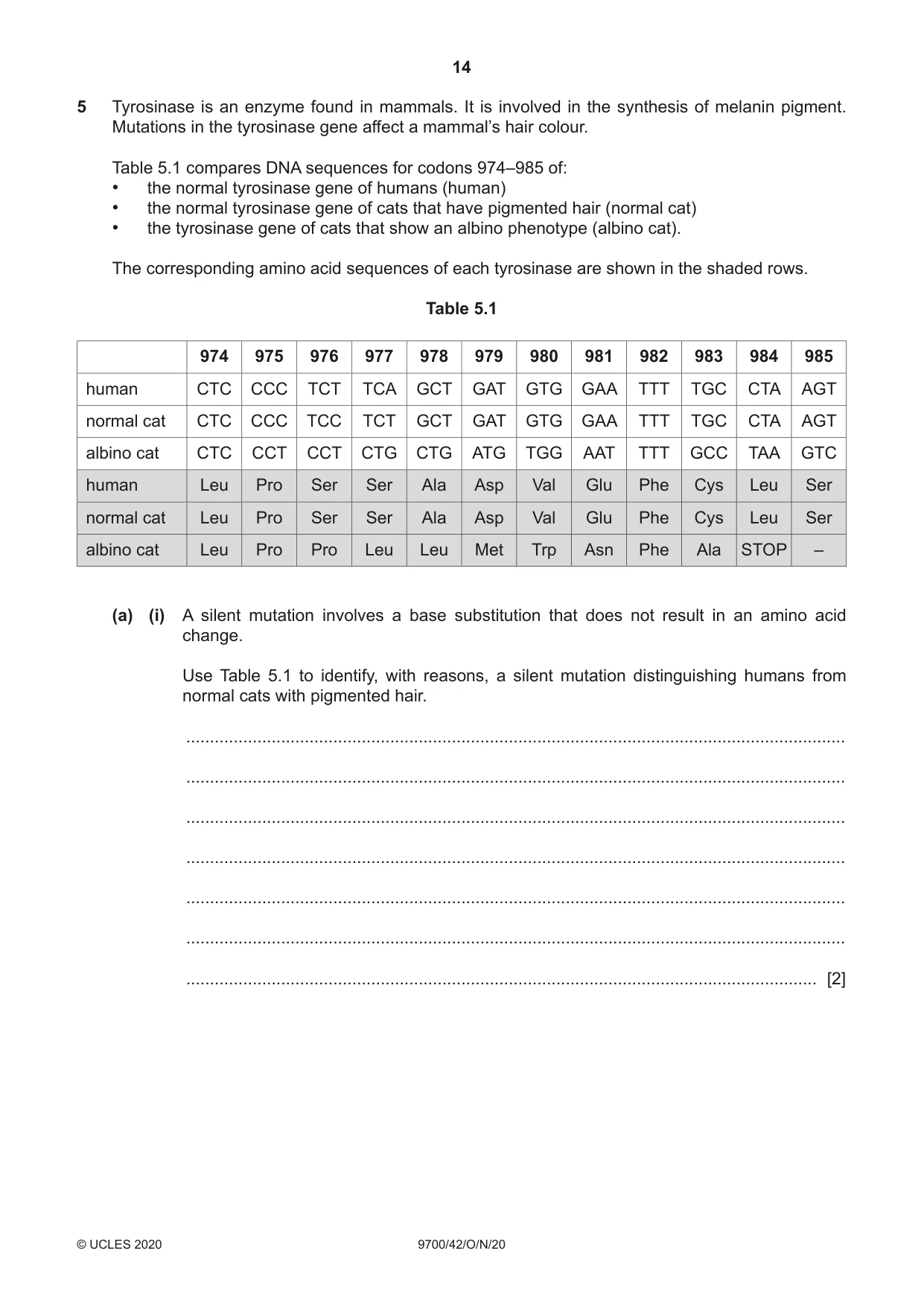
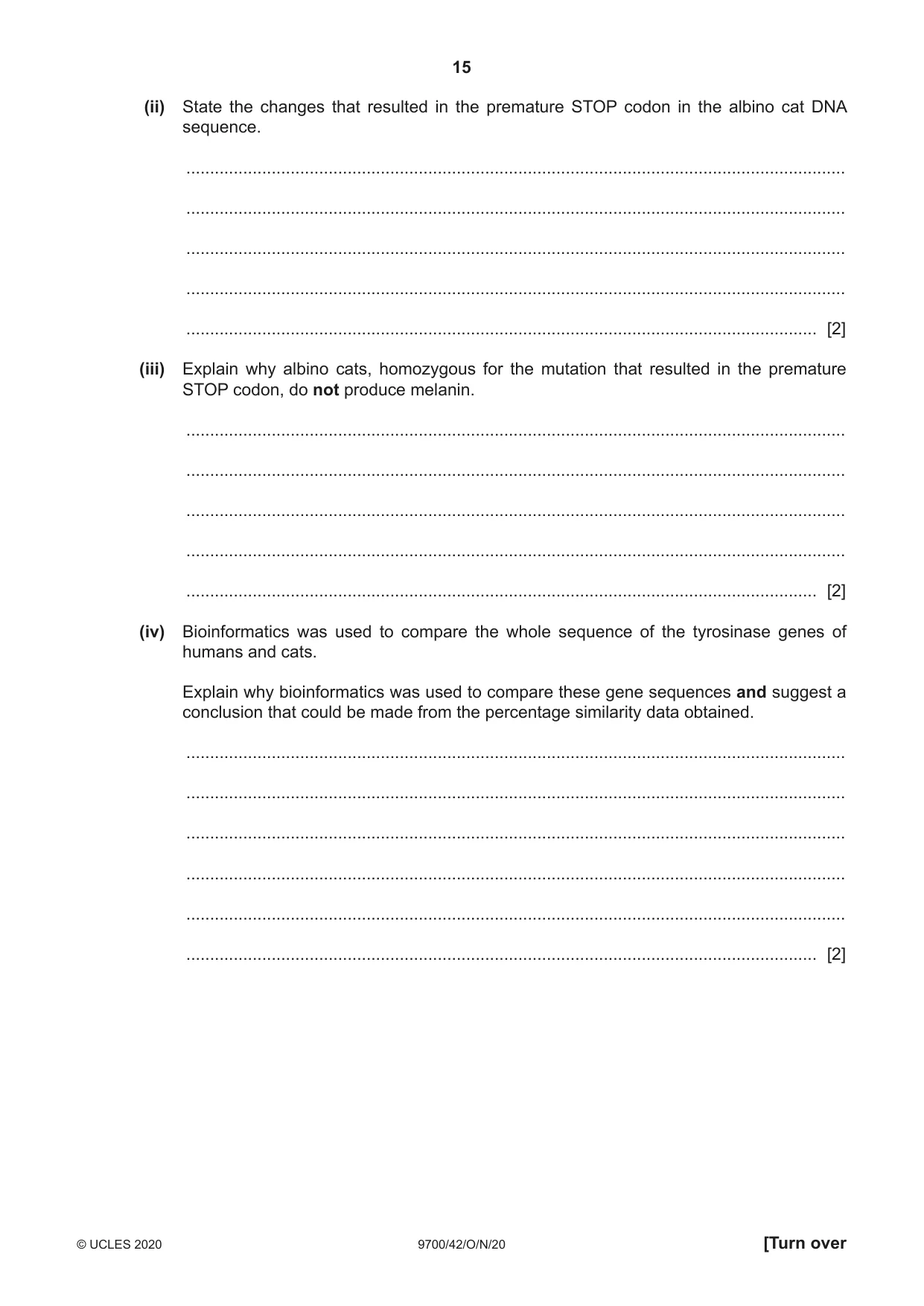
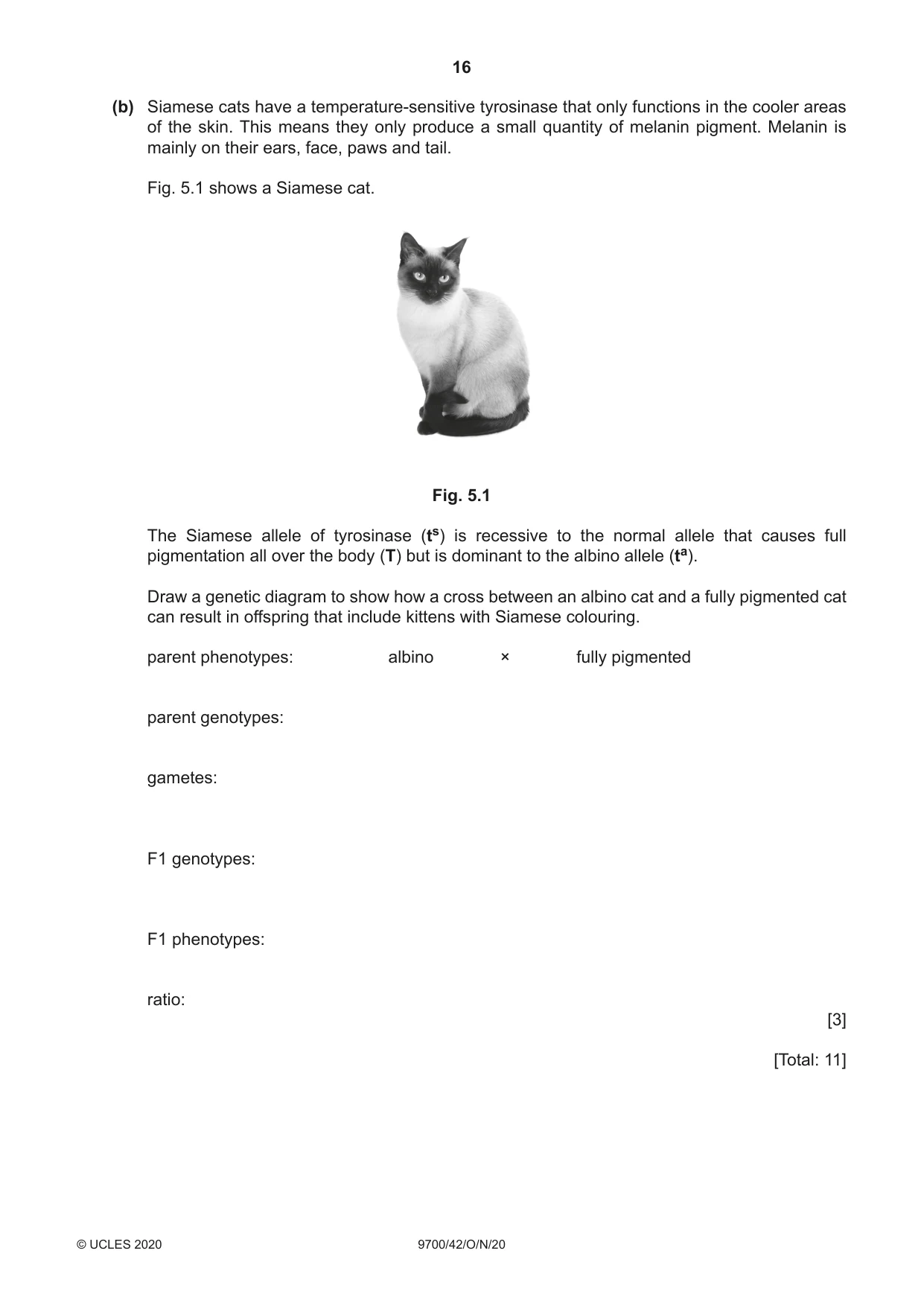
5 Tyrosinase is an enzyme found in mammals. It is involved in the synthesis of melanin pigment. Mutations in the tyrosinase gene affect a mammal’s hair colour. Table 5.1 compares DNA sequences for codons 974–985 of: • the normal tyrosinase gene of humans (human) • the normal tyrosinase gene of cats that have pigmented hair (normal cat) • the tyrosinase gene of cats that show an albino phenotype (albino cat). The corresponding amino acid sequences of each tyrosinase are shown in the shaded rows. Table 5.1 974 975 976 977 978 979 980 981 982 983 984 985 human CTC CCC TCT TCA GCT GAT GTG GAA TTT TGC CTA AGT normal cat CTC CCC TCC TCT GCT GAT GTG GAA TTT TGC CTA AGT albino cat CTC CCT CCT CTG CTG ATG TGG AAT TTT GCC TAA GTC human Leu Pro Ser Ser Ala Asp Val Glu Phe Cys Leu Ser normal cat Leu Pro Ser Ser Ala Asp Val Glu Phe Cys Leu Ser albino cat Leu Pro Pro Leu Leu Met Trp Asn Phe Ala STOP – (a) (i) A silent mutation involves a base substitution that does not result in an amino acid change. Use Table 5.1 to identify, with reasons, a silent mutation distinguishing humans from normal cats with pigmented hair. ........................................................................................................................................... ........................................................................................................................................... ........................................................................................................................................... ........................................................................................................................................... ........................................................................................................................................... ........................................................................................................................................... ..................................................................................................................................... [2] (ii) State the changes that resulted in the premature STOP codon in the albino cat DNA sequence. ........................................................................................................................................... ........................................................................................................................................... ........................................................................................................................................... ........................................................................................................................................... ..................................................................................................................................... [2] (iii) Explain why albino cats, homozygous for the mutation that resulted in the premature STOP codon, do not produce melanin. ........................................................................................................................................... ........................................................................................................................................... ........................................................................................................................................... ........................................................................................................................................... ..................................................................................................................................... [2] (iv) Bioinformatics was used to compare the whole sequence of the tyrosinase genes of humans and cats. Explain why bioinformatics was used to compare these gene sequences and suggest a conclusion that could be made from the percentage similarity data obtained. ........................................................................................................................................... ........................................................................................................................................... ........................................................................................................................................... ........................................................................................................................................... ........................................................................................................................................... ..................................................................................................................................... [2] (b) Siamese cats have a temperature-sensitive tyrosinase that only functions in the cooler areas of the skin. This means they only produce a small quantity of melanin pigment. Melanin is mainly on their ears, face, paws and tail. Fig. 5.1 shows a Siamese cat. Fig. 5.1 The Siamese allele of tyrosinase (ts) is recessive to the normal allele that causes full pigmentation all over the body (T) but is dominant to the albino allele (ta). Draw a genetic diagram to show how a cross between an albino cat and a fully pigmented cat can result in offspring that include kittens with Siamese colouring. parent phenotypes: albino × fully pigmented parent genotypes: gametes: F1 genotypes: F1 phenotypes: ratio: [3] [Total: 11]
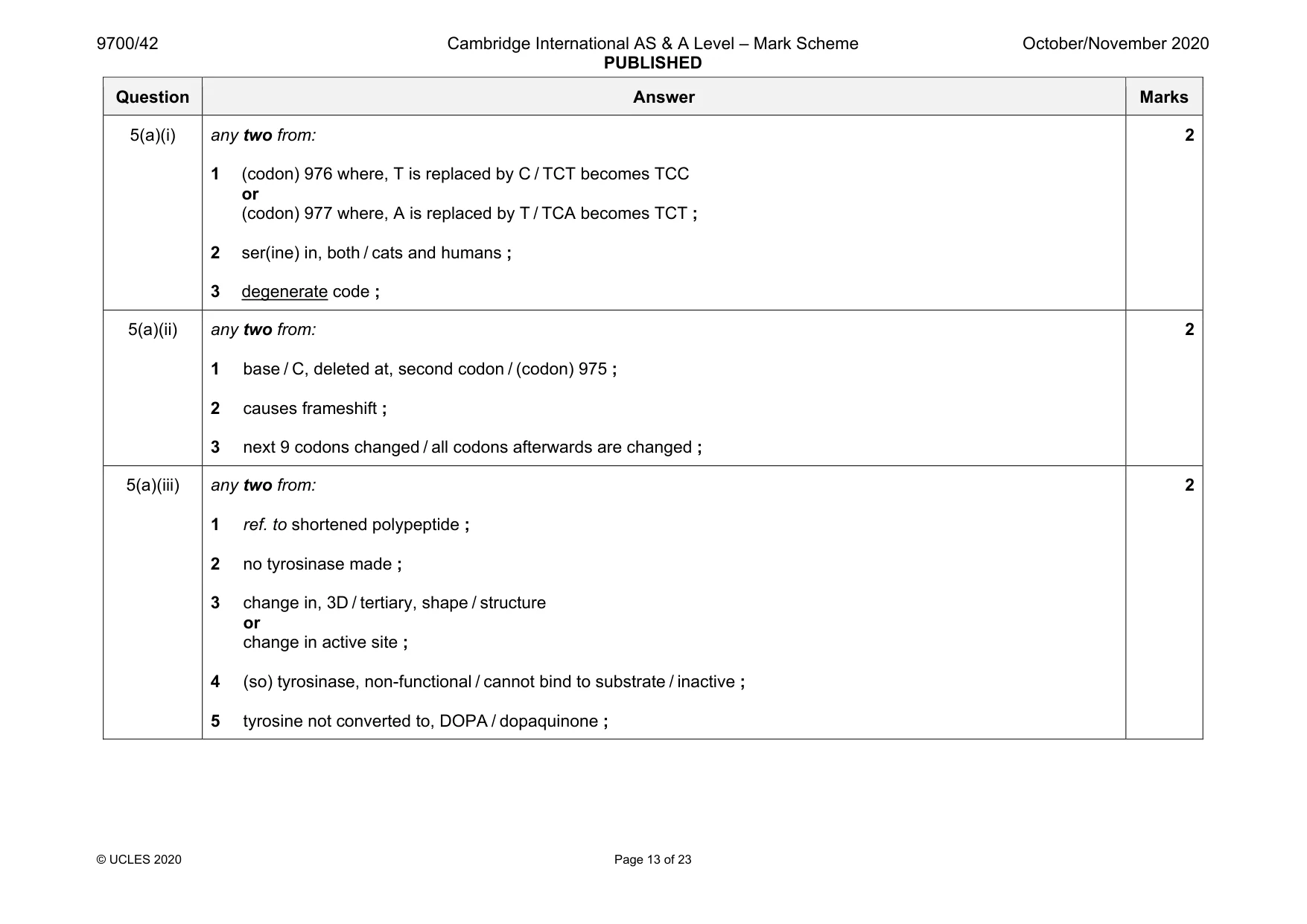
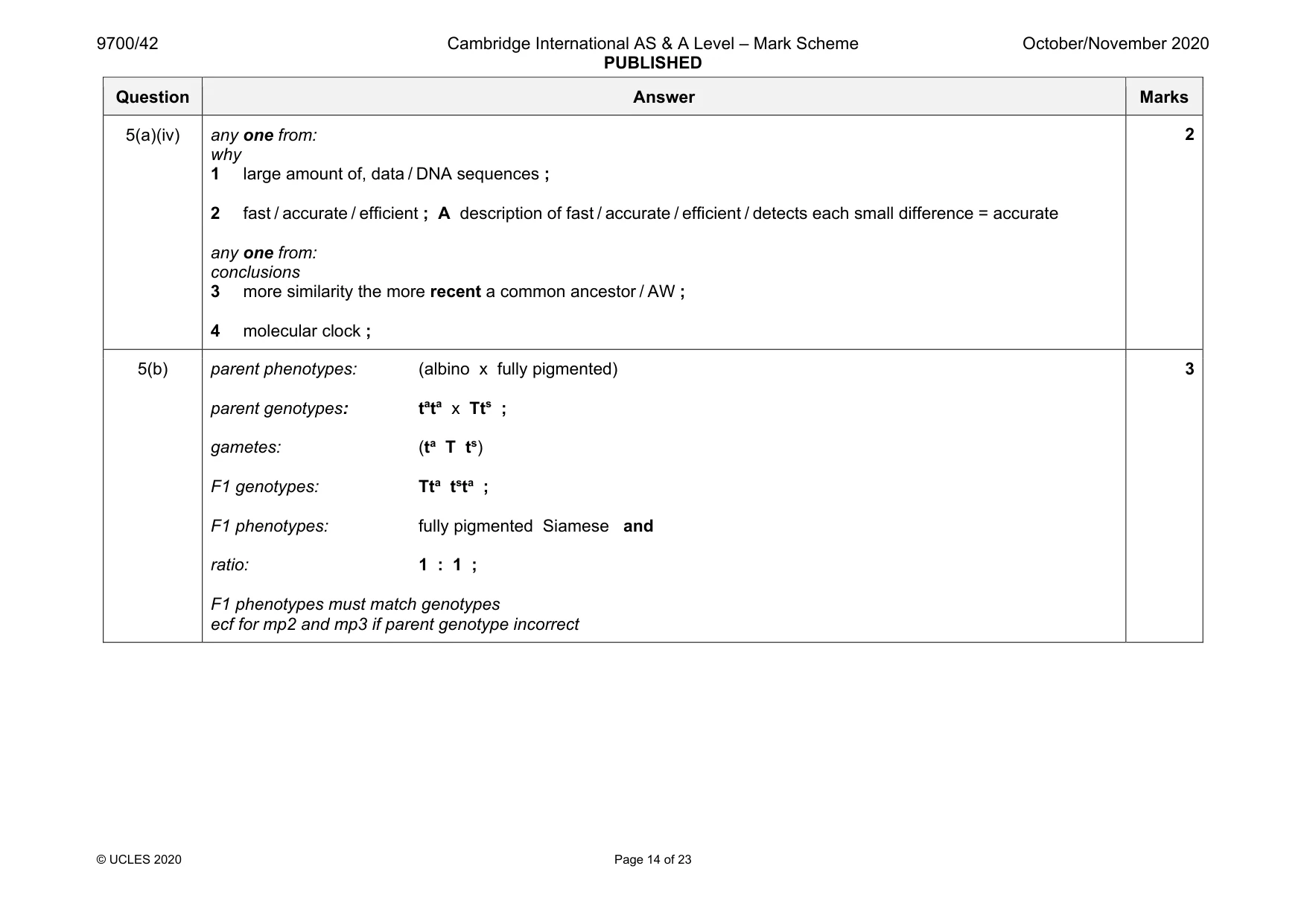
Mark scheme: 5(a)(i) any two from: 1 (codon) 976 where, T is replaced by C / TCT becomes TCC or (codon) 977 where, A is replaced by T / TCA becomes TCT ; 2 ser(ine) in, both / cats and humans ; 3 degenerate code ; 2 5(a)(ii) any two from: 1 base / C, deleted at, second codon / (codon) 975 ; 2 causes frameshift ; 3 next 9 codons changed / all codons afterwards are changed ; 2 5(a)(iii) any two from: 1 ref. to shortened polypeptide ; 2 no tyrosinase made ; 3 change in, 3D / tertiary, shape / structure or change in active site ; 4 (so) tyrosinase, non-functional / cannot bind to substrate / inactive ; 5 tyrosine not converted to, DOPA / dopaquinone ; 2 Question Answer Marks 5(a)(iv) any one from: why 1 large amount of, data / DNA sequences ; 2 fast / accurate / efficient ; A description of fast / accurate / efficient / detects each small difference = accurate any one from: conclusions 3 more similarity the more recent a common ancestor / AW ; 4 molecular clock ; 2 5(b) parent phenotypes: (albino x fully pigmented) parent genotypes: tata x Tts ; gametes: (ta T ts) F1 genotypes: Tta tsta ; F1 phenotypes: fully pigmented Siamese and ratio: 1 : 1 ; F1 phenotypes must match genotypes ecf for mp2 and mp3 if parent genotype incorrect 3
More questions on Structure of nucleic acids and replication of DNA
Q6 · A person who has a wound to their skin may experience pain
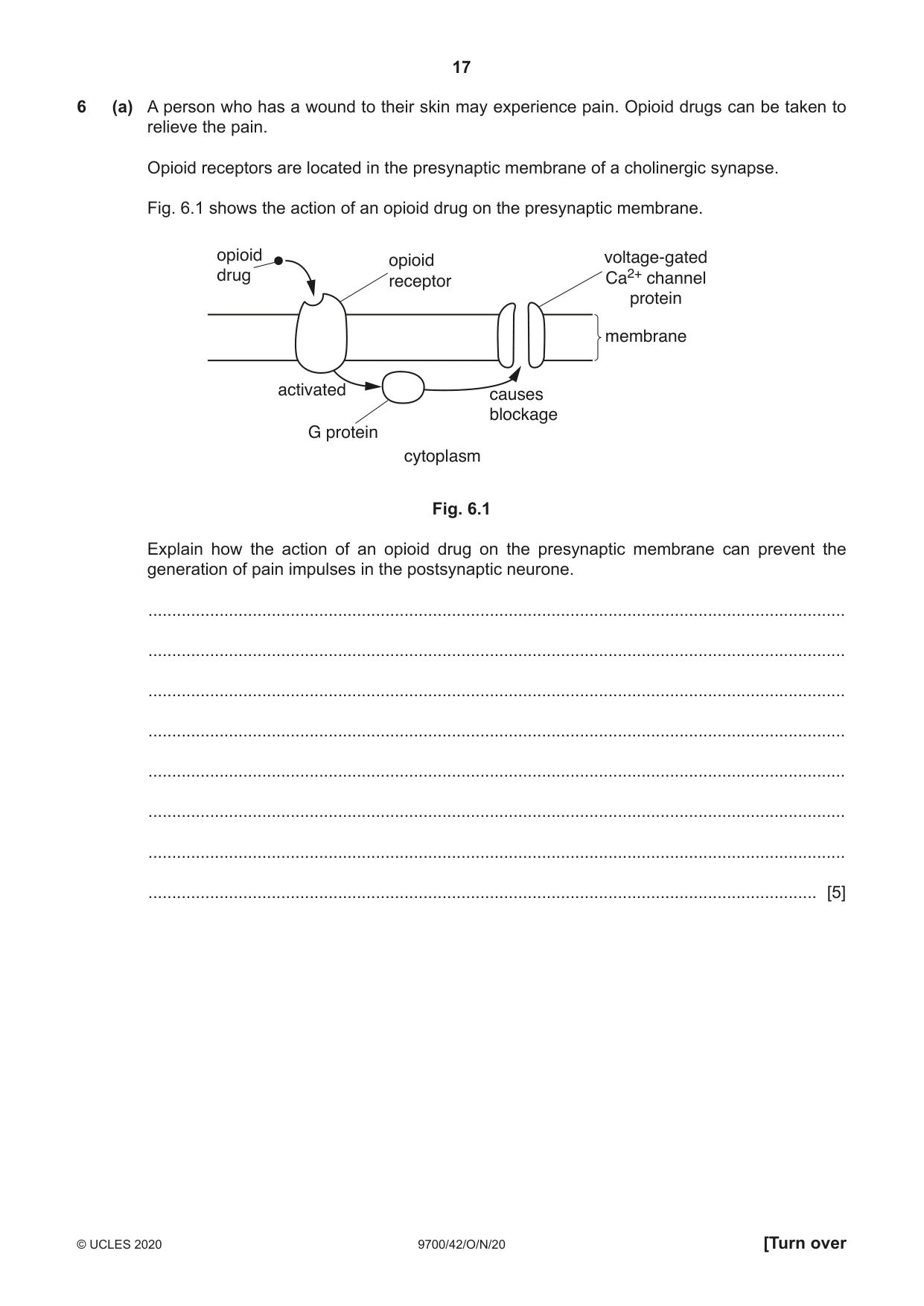
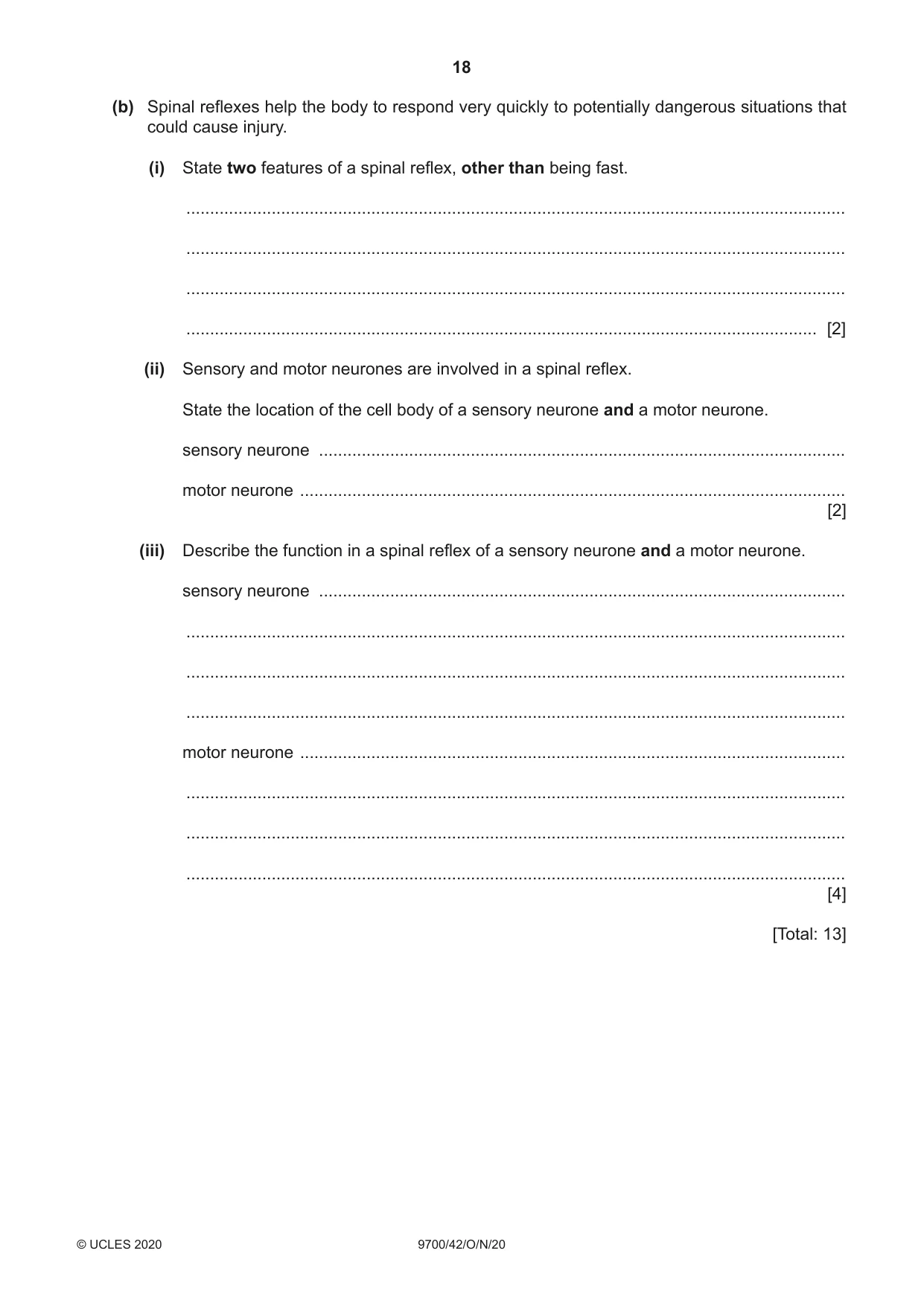
6 (a) A person who has a wound to their skin may experience pain. Opioid drugs can be taken to relieve the pain. Opioid receptors are located in the presynaptic membrane of a cholinergic synapse. Fig. 6.1 shows the action of an opioid drug on the presynaptic membrane. opioid opioid voltage-gated drug receptor Ca2+ channel protein membrane activated causes blockage G protein cytoplasm Fig. 6.1 Explain how the action of an opioid drug on the presynaptic membrane can prevent the generation of pain impulses in the postsynaptic neurone. ................................................................................................................................................... ................................................................................................................................................... ................................................................................................................................................... ................................................................................................................................................... ................................................................................................................................................... ................................................................................................................................................... ................................................................................................................................................... ............................................................................................................................................. [5] (b) Spinal reflexes help the body to respond very quickly to potentially dangerous situations that could cause injury. (i) State two features of a spinal reflex, other than being fast. ........................................................................................................................................... ........................................................................................................................................... ........................................................................................................................................... ..................................................................................................................................... [2] (ii) Sensory and motor neurones are involved in a spinal reflex. State the location of the cell body of a sensory neurone and a motor neurone. sensory neurone ............................................................................................................... motor neurone ................................................................................................................... [2] (iii) Describe the function in a spinal reflex of a sensory neurone and a motor neurone. sensory neurone ............................................................................................................... ........................................................................................................................................... ........................................................................................................................................... ........................................................................................................................................... motor neurone ................................................................................................................... ........................................................................................................................................... ........................................................................................................................................... ........................................................................................................................................... [4] [Total: 13]
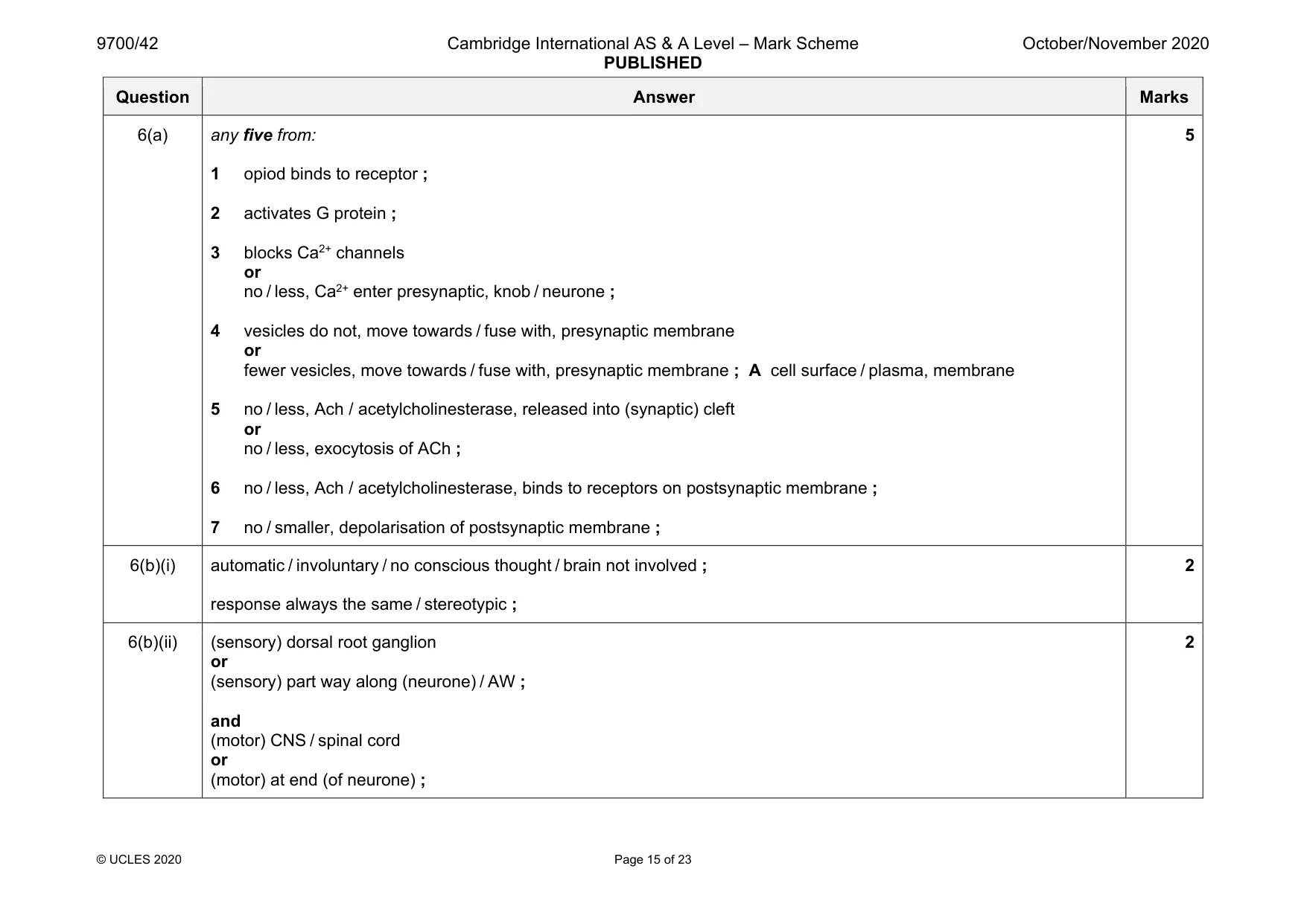
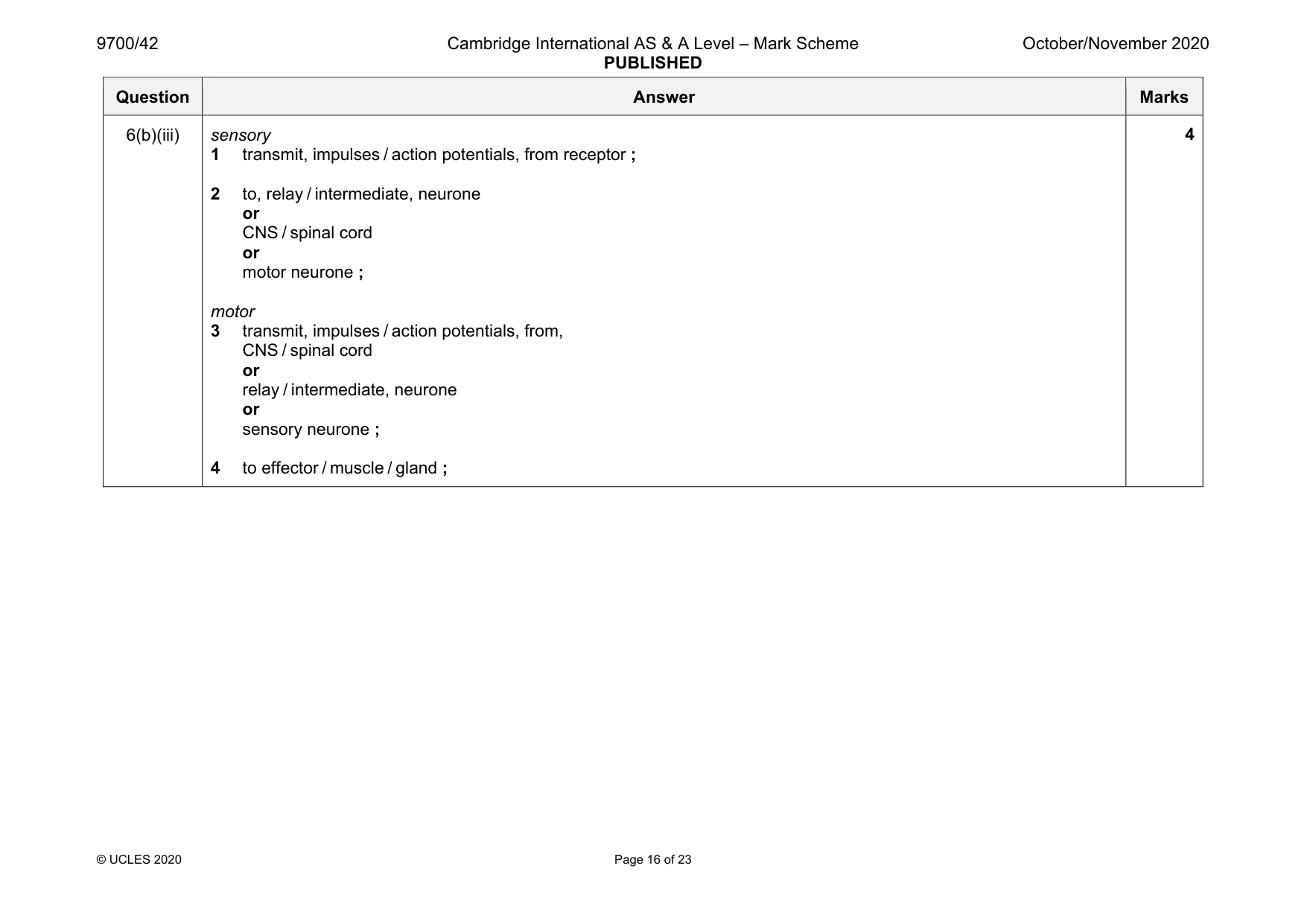
Mark scheme: 6(a) any five from: 1 opiod binds to receptor ; 2 activates G protein ; 3 blocks Ca2+ channels or no / less, Ca2+ enter presynaptic, knob / neurone ; 4 vesicles do not, move towards / fuse with, presynaptic membrane or fewer vesicles, move towards / fuse with, presynaptic membrane ; A cell surface / plasma, membrane 5 no / less, Ach / acetylcholinesterase, released into (synaptic) cleft or no / less, exocytosis of ACh ; 6 no / less, Ach / acetylcholinesterase, binds to receptors on postsynaptic membrane ; 7 no / smaller, depolarisation of postsynaptic membrane ; 5 6(b)(i) automatic / involuntary / no conscious thought / brain not involved ; response always the same / stereotypic ; 2 6(b)(ii) (sensory) dorsal root ganglion or (sensory) part way along (neurone) / AW ; and (motor) CNS / spinal cord or (motor) at end (of neurone) ; 2 Question Answer Marks 6(b)(iii) sensory 1 transmit, impulses / action potentials, from receptor ; 2 to, relay / intermediate, neurone or CNS / spinal cord or motor neurone ; motor 3 transmit, impulses / action potentials, from, CNS / spinal cord or relay / intermediate, neurone or sensory neurone ; 4 to effector / muscle / gland ; 4
Q7 · Insulin is transported around the body in the blood
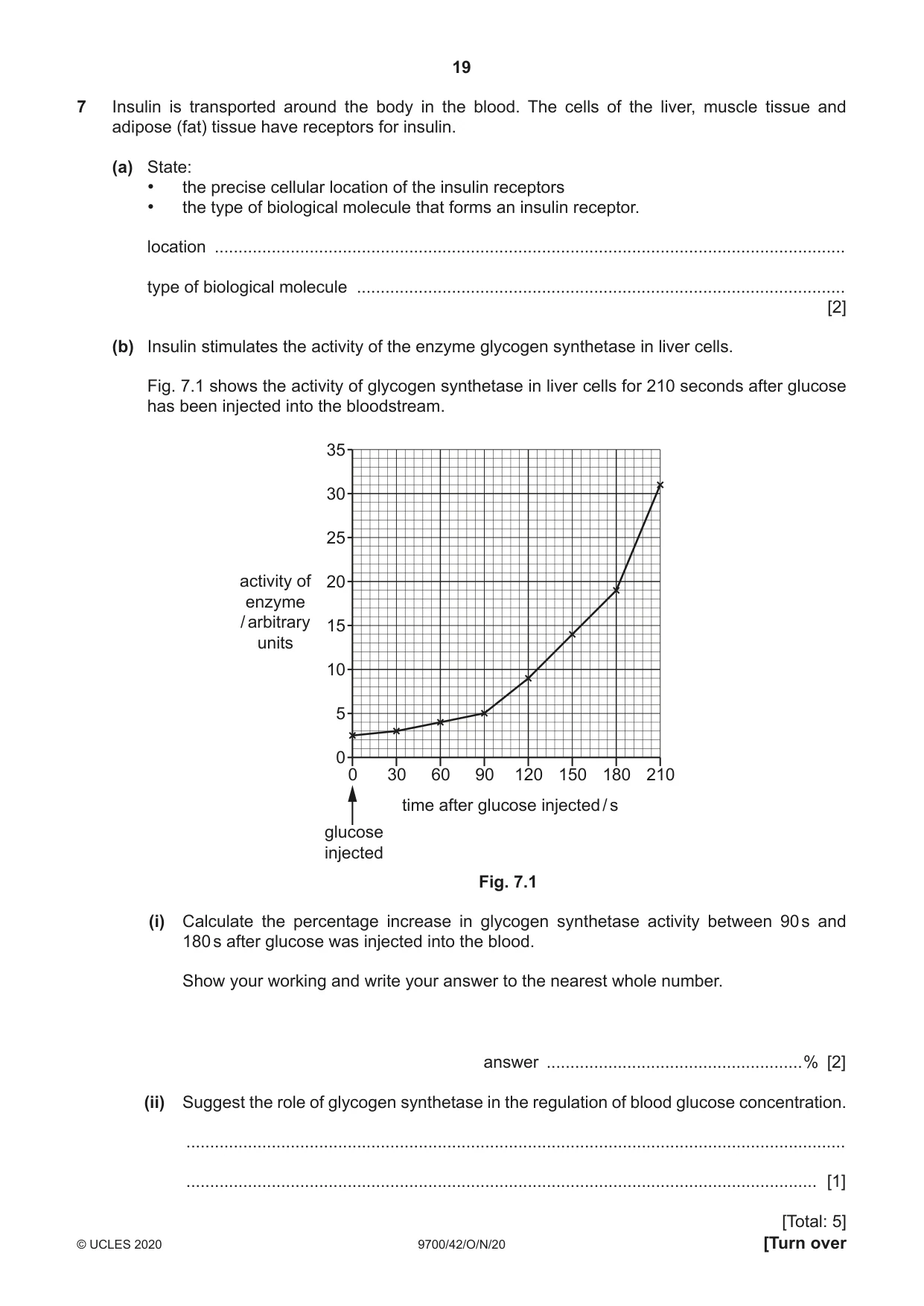
7 Insulin is transported around the body in the blood. The cells of the liver, muscle tissue and adipose (fat) tissue have receptors for insulin. (a) State: • the precise cellular location of the insulin receptors • the type of biological molecule that forms an insulin receptor. location ..................................................................................................................................... type of biological molecule ....................................................................................................... [2] (b) Insulin stimulates the activity of the enzyme glycogen synthetase in liver cells. Fig. 7.1 shows the activity of glycogen synthetase in liver cells for 210 seconds after glucose has been injected into the bloodstream. 35 30 25 activity of 20 enzyme / arbitrary 15 units 10 5 0 0 30 60 90 120 150 180 210 time after glucose injected / s glucose injected Fig. 7.1 (i) Calculate the percentage increase in glycogen synthetase activity between 90 s and 180 s after glucose was injected into the blood. Show your working and write your answer to the nearest whole number. answer ......................................................% [2] (ii) Suggest the role of glycogen synthetase in the regulation of blood glucose concentration. ........................................................................................................................................... ..................................................................................................................................... [1] [Total: 5]
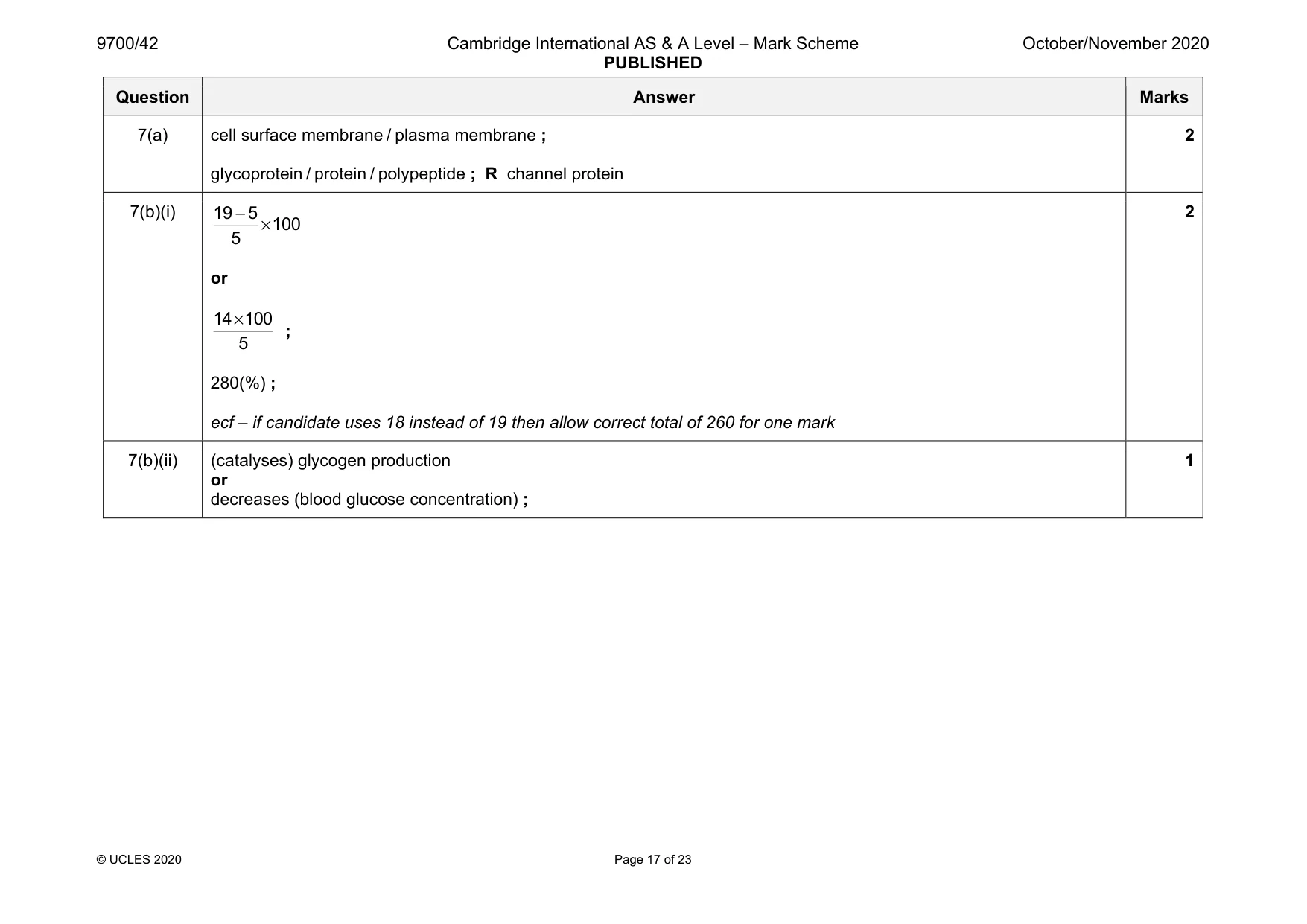
Mark scheme: 7(a) cell surface membrane / plasma membrane ; glycoprotein / protein / polypeptide ; R channel protein 2 7(b)(i) 19 5 100 5 − × or 14 100 5 × ; 280(%) ; ecf – if candidate uses 18 instead of 19 then allow correct total of 260 for one mark 2 7(b)(ii) (catalyses) glycogen production or decreases (blood glucose concentration) ; 1
Q8 · Describe a method that could be used to estimate the population size of a mobile animal…
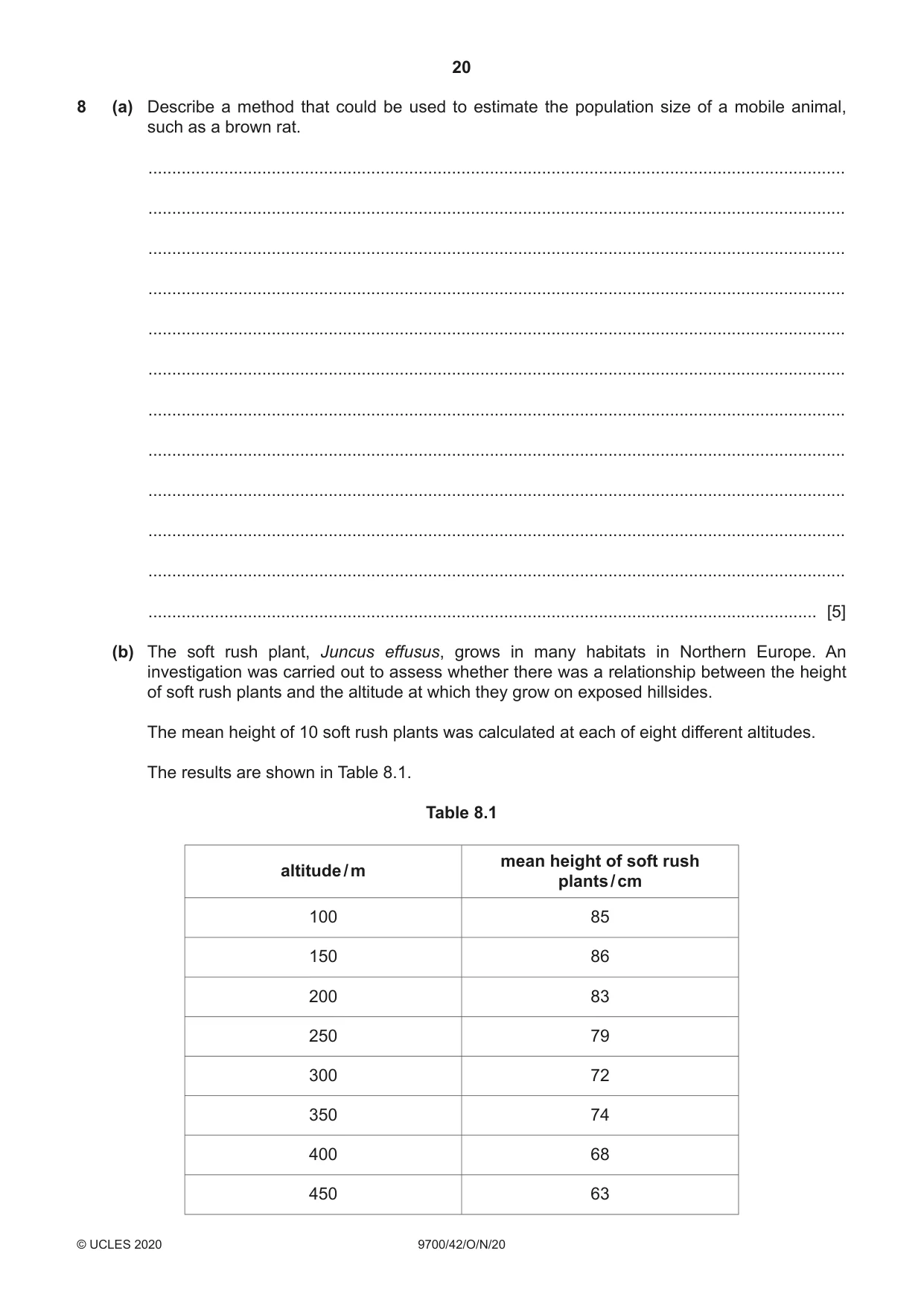
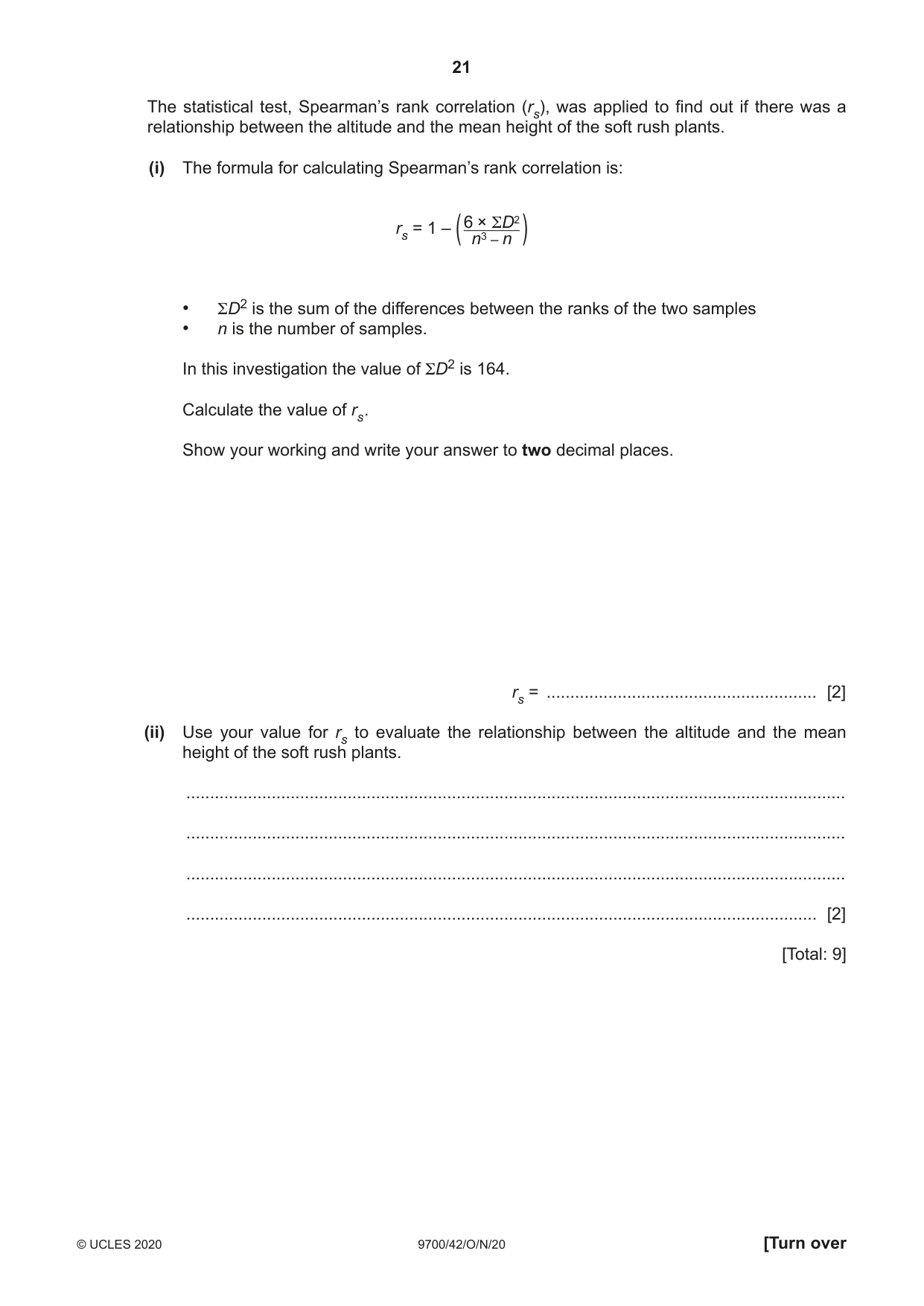
8 (a) Describe a method that could be used to estimate the population size of a mobile animal, such as a brown rat. ................................................................................................................................................... ................................................................................................................................................... ................................................................................................................................................... ................................................................................................................................................... ................................................................................................................................................... ................................................................................................................................................... ................................................................................................................................................... ................................................................................................................................................... ................................................................................................................................................... ................................................................................................................................................... ................................................................................................................................................... ............................................................................................................................................. [5] (b) The soft rush plant, Juncus effusus, grows in many habitats in Northern Europe. An investigation was carried out to assess whether there was a relationship between the height of soft rush plants and the altitude at which they grow on exposed hillsides. The mean height of 10 soft rush plants was calculated at each of eight different altitudes. The results are shown in Table 8.1. Table 8.1 mean height of soft rush altitude / m plants / cm 100 85 150 86 200 83 250 79 300 72 350 74 400 68 450 63 The statistical test, Spearman’s rank correlation (rs), was applied to find out if there was a relationship between the altitude and the mean height of the soft rush plants. (i) The formula for calculating Spearman’s rank correlation is: × ΣD2 rs = 1 – (6n3 – n ) • ΣD2 is the sum of the differences between the ranks of the two samples • n is the number of samples. In this investigation the value of ΣD2 is 164. Calculate the value of rs. Show your working and write your answer to two decimal places. rs = ......................................................... [2] (ii) Use your value for rs to evaluate the relationship between the altitude and the mean height of the soft rush plants. ........................................................................................................................................... ........................................................................................................................................... ........................................................................................................................................... ..................................................................................................................................... [2] [Total: 9]
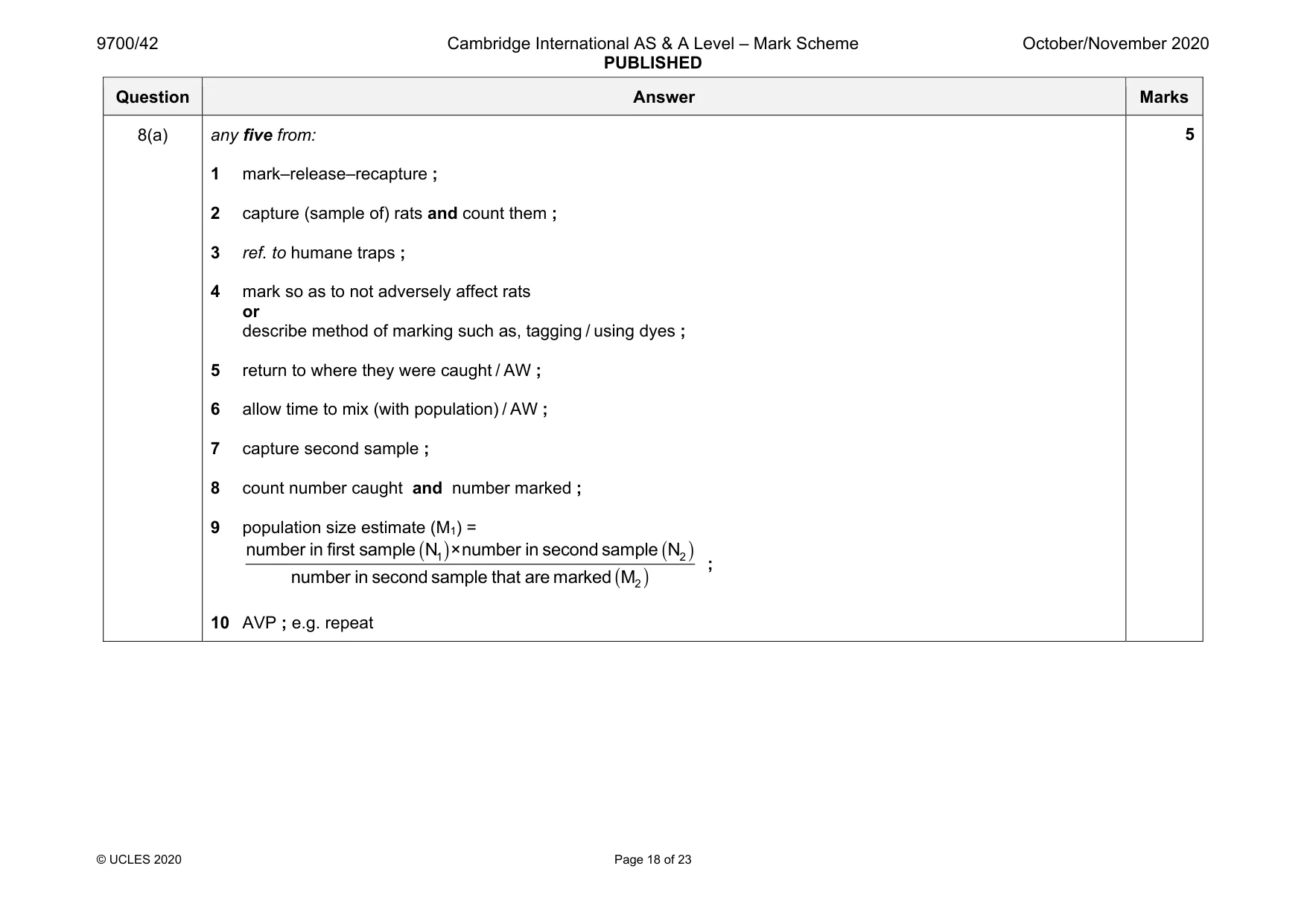
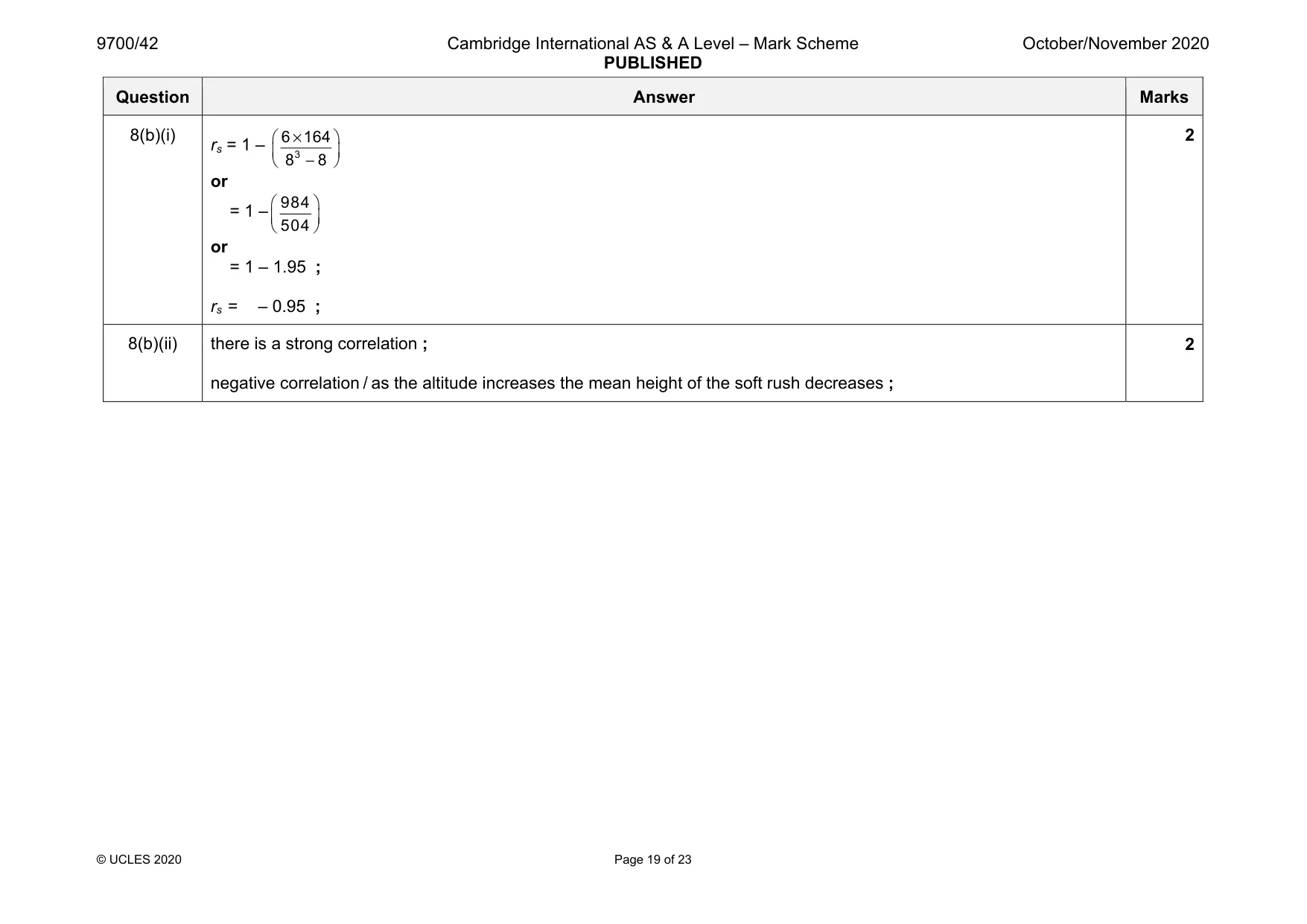
Mark scheme: 8(a) any five from: 1 mark–release–recapture ; 2 capture (sample of) rats and count them ; 3 ref. to humane traps ; 4 mark so as to not adversely affect rats or describe method of marking such as, tagging / using dyes ; 5 return to where they were caught / AW ; 6 allow time to mix (with population) / AW ; 7 capture second sample ; 8 count number caught and number marked ; 9 population size estimate (M1) = ( ) ( ) ( ) 1 2 2 number in first sample N ×number in second sample N number in second sample that are marked M ; 10 AVP ; e.g. repeat Question Answer Marks 8(b)(i) rs = 1 – 3 6 164 8 8 × − or = 1 – 984 504 or = 1 – 1.95 ; rs = – 0.95 ; 2 8(b)(ii) there is a strong correlation ; negative correlation / as the altitude increases the mean height of the soft rush decreases ; 2
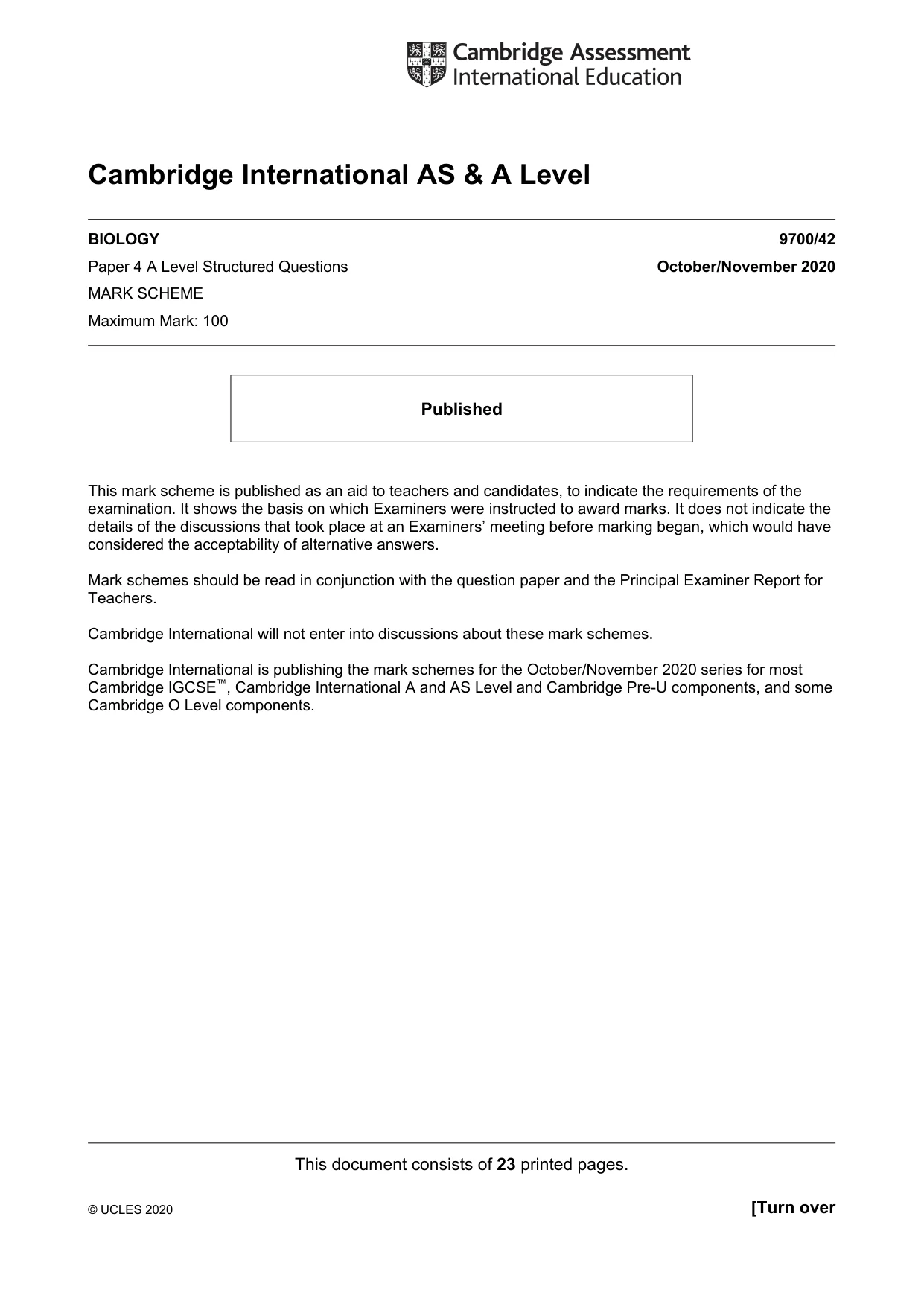
Q9 · Using named examples, describe the differences between structural and regulatory genes…
9 (a) Using named examples, describe the differences between structural and regulatory genes and the differences between repressible and inducible enzymes. [9] (b) Explain the function of transcription factors in gene expression in eukaryotes. [6] [Total: 15]
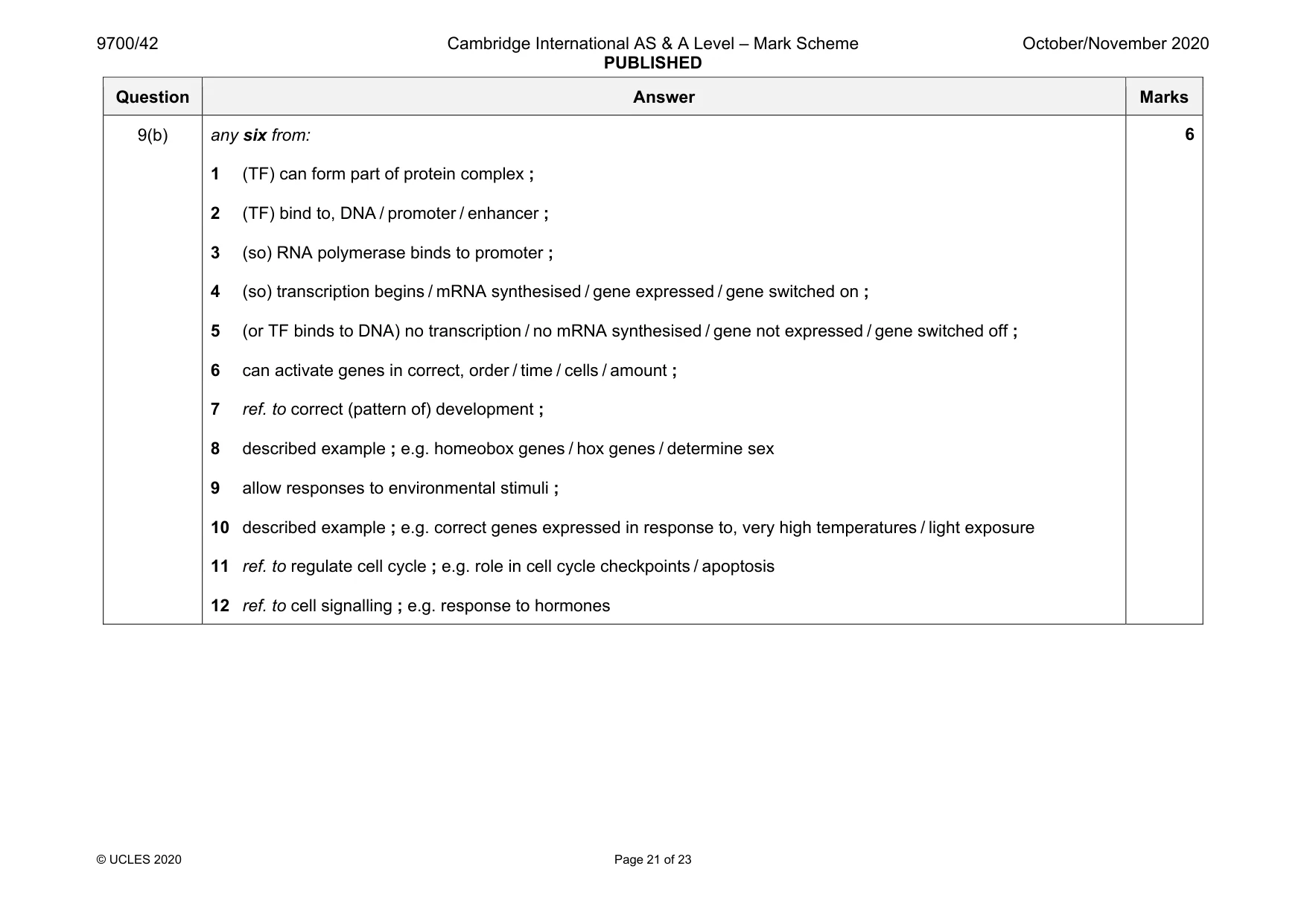
Mark scheme: 9(a) any nine from: structural genes 1 code for, non-regulatory / structural, proteins / polypeptides ; 2 named example of structural gene ; e.g. lac Z / lac Y / lac A 3 (proteins associated with) rRNA / tRNA ; 4 (proteins such as) enzyme / named (structural) protein ; regulatory genes 5 code for, regulatory / non-structural, proteins / polypeptides ; 6 named example ; e.g. gene coding for repressor protein / lac I / PIF / correct ref. DELLA protein / gene for transcription factors 7 detail ; e.g. switches genes on or off / ref. gene expression / ref. transcription ; repressible enzymes 8 (generally) produced continuously ; 9 synthesis can be prevented by binding of repressor protein to, specific site / promoter / operator ; 10 named example ; e.g. enzyme involved in tryptophan synthesis inducible enzymes 11 synthesis only occurs when, substrate / inducer, is present ; 12 idea that transcription of the gene only occurs when, substrate / inducer, binds to, transcription factor / repressor protein; 13 named example ; e.g. β galactosidase / lactose permease / transacetylase Question Answer Marks 9(b) any six from: 1 (TF) can form part of protein complex ; 2 (TF) bind to, DNA / promoter / enhancer ; 3 (so) RNA polymerase binds to promoter ; 4 (so) transcription begins / mRNA synthesised / gene expressed / gene switched on ; 5 (or TF binds to DNA) no transcription / no mRNA synthesised / gene not expressed / gene switched off ; 6 can activate genes in correct, order / time / cells / amount ; 7 ref. to correct (pattern of) development ; 8 described example ; e.g. homeobox genes / hox genes / determine sex 9 allow responses to environmental stimuli ; 10 described example ; e.g. correct genes expressed in response to, very high temperatures / light exposure 11 ref. to regulate cell cycle ; e.g. role in cell cycle checkpoints / apoptosis 12 ref. to cell signalling ; e.g. response to hormones 6
Q10 · Describe how a molecule of glucose is converted to pyruvate and then to acetyl CoA
10 (a) Describe how a molecule of glucose is converted to pyruvate and then to acetyl CoA. [9] (b) Explain how ATP is formed during oxidative phosphorylation. [6] [Total: 15] .................................................................................................................................................................. .................................................................................................................................................................. .................................................................................................................................................................. .................................................................................................................................................................. .................................................................................................................................................................. .................................................................................................................................................................. .................................................................................................................................................................. .................................................................................................................................................................. .................................................................................................................................................................. .................................................................................................................................................................. .................................................................................................................................................................. .................................................................................................................................................................. .................................................................................................................................................................. .................................................................................................................................................................. .................................................................................................................................................................. .................................................................................................................................................................. .................................................................................................................................................................. .................................................................................................................................................................. .................................................................................................................................................................. .................................................................................................................................................................. .................................................................................................................................................................. .................................................................................................................................................................. .................................................................................................................................................................. .................................................................................................................................................................. .................................................................................................................................................................. .................................................................................................................................................................. .................................................................................................................................................................. .................................................................................................................................................................. .................................................................................................................................................................. .................................................................................................................................................................. .................................................................................................................................................................. .................................................................................................................................................................. .................................................................................................................................................................. .................................................................................................................................................................. .................................................................................................................................................................. .................................................................................................................................................................. .................................................................................................................................................................. .................................................................................................................................................................. .................................................................................................................................................................. .................................................................................................................................................................. .................................................................................................................................................................. .................................................................................................................................................................. .................................................................................................................................................................. .................................................................................................................................................................. .................................................................................................................................................................. .................................................................................................................................................................. .................................................................................................................................................................. .................................................................................................................................................................. .................................................................................................................................................................. .................................................................................................................................................................. .................................................................................................................................................................. .................................................................................................................................................................. .................................................................................................................................................................. .................................................................................................................................................................. .................................................................................................................................................................. .................................................................................................................................................................. .................................................................................................................................................................. .................................................................................................................................................................. .................................................................................................................................................................. .................................................................................................................................................................. .................................................................................................................................................................. .................................................................................................................................................................. .................................................................................................................................................................. .................................................................................................................................................................. .................................................................................................................................................................. .................................................................................................................................................................. .................................................................................................................................................................. .................................................................................................................................................................. .................................................................................................................................................................. ..................................................................................................................................................................
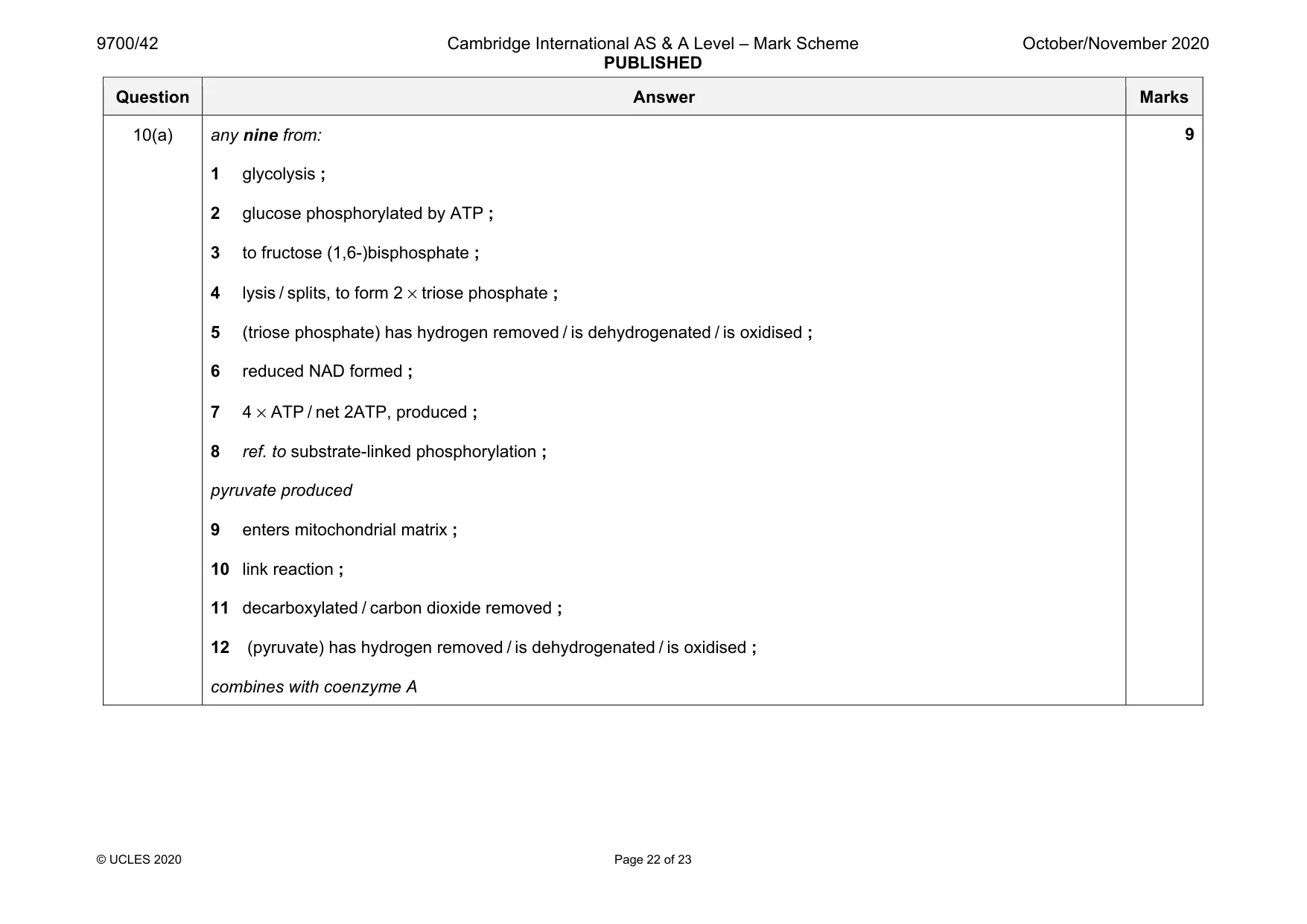
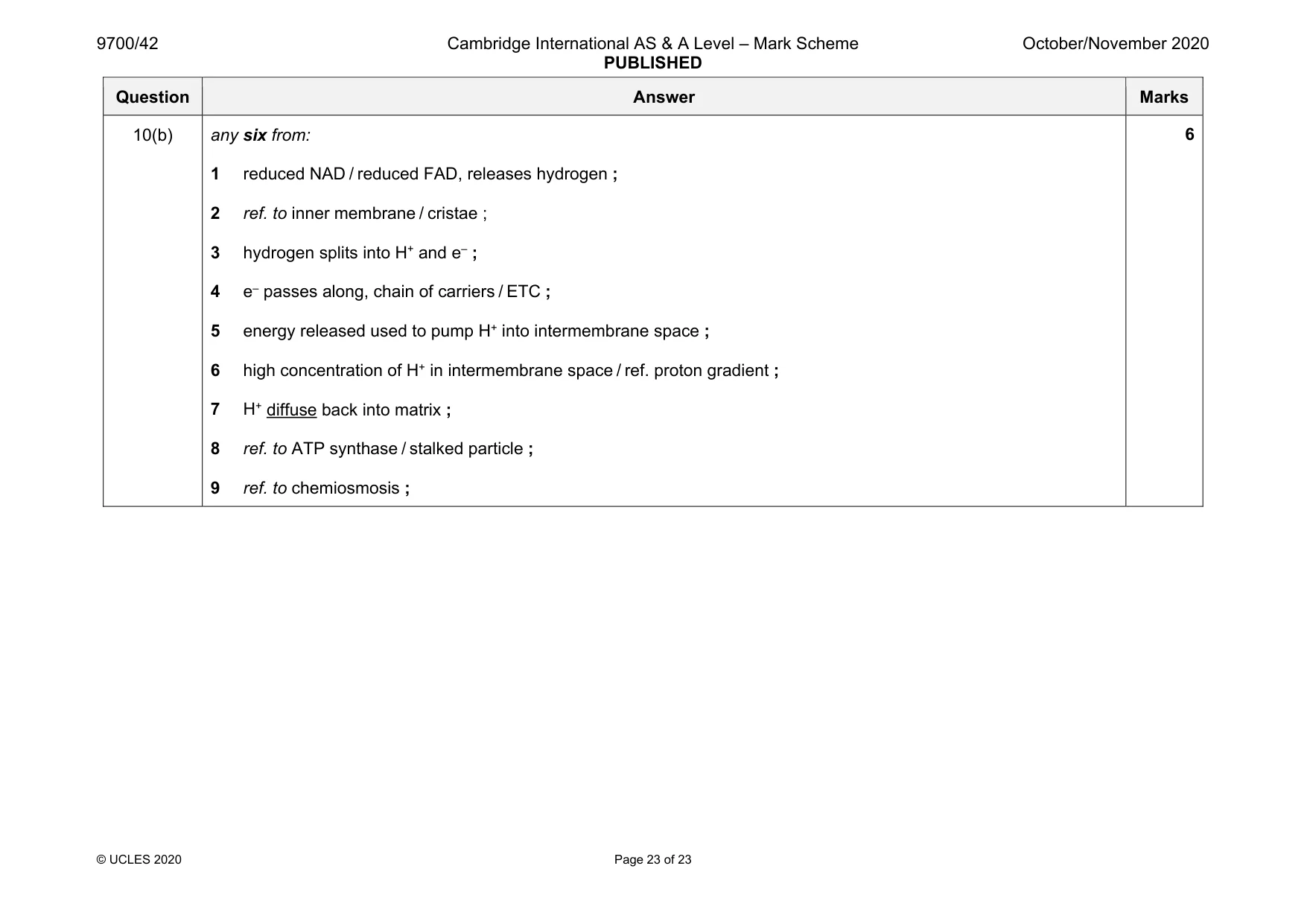
Mark scheme: 10(a) any nine from: 1 glycolysis ; 2 glucose phosphorylated by ATP ; 3 to fructose (1,6-)bisphosphate ; 4 lysis / splits, to form 2 × triose phosphate ; 5 (triose phosphate) has hydrogen removed / is dehydrogenated / is oxidised ; 6 reduced NAD formed ; 7 4 × ATP / net 2ATP, produced ; 8 ref. to substrate-linked phosphorylation ; pyruvate produced 9 enters mitochondrial matrix ; 10 link reaction ; 11 decarboxylated / carbon dioxide removed ; 12 (pyruvate) has hydrogen removed / is dehydrogenated / is oxidised ; combines with coenzyme A Question Answer Marks 10(b) any six from: 1 reduced NAD / reduced FAD, releases hydrogen ; 2 ref. to inner membrane / cristae ; 3 hydrogen splits into H+ and e– ; 4 e– passes along, chain of carriers / ETC ; 5 energy released used to pump H+ into intermembrane space ; 6 high concentration of H+ in intermembrane space / ref. proton gradient ; 7 H+ diffuse back into matrix ; 8 ref. to ATP synthase / stalked particle ; 9 ref. to chemiosmosis ; 6
What was in this paper
The subtopics covered by these 10 questions, and how many questions each got. Open one in a new tab to see every Cambridge question on it.
What you needed in this session
Cambridge’s own grade thresholds for 2020 Oct/Nov, Paper 4 · Variant 2. A higher threshold means an easier paper — the bar moves with how the cohort did.