Cambridge A Level Biology 9700 — 2020 Oct/Nov Paper 4 · Variant 1
9700/41/O/N/20 · 10 questions · 100 marks · ≈113 min
The question paper and its mark scheme, free to read here and free to download. This is Cambridge’s own paper, exactly as it was sat.
Question paper28 pages






Mark scheme16 pages
Answers below. Sit the paper first if you are practising.
Questions as text
Q1 · A transverse section through a leaf from the maize plant, Zea mays
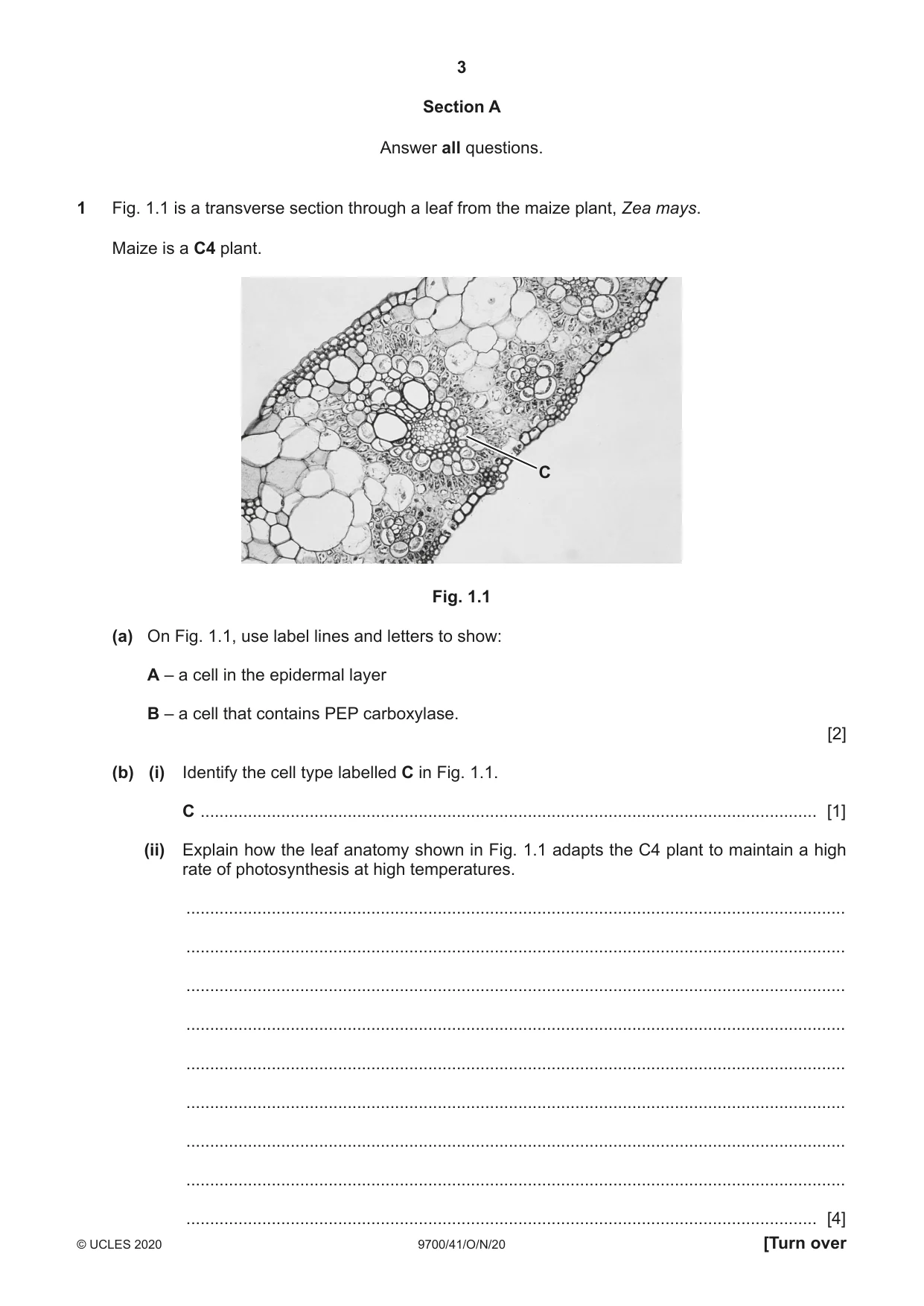
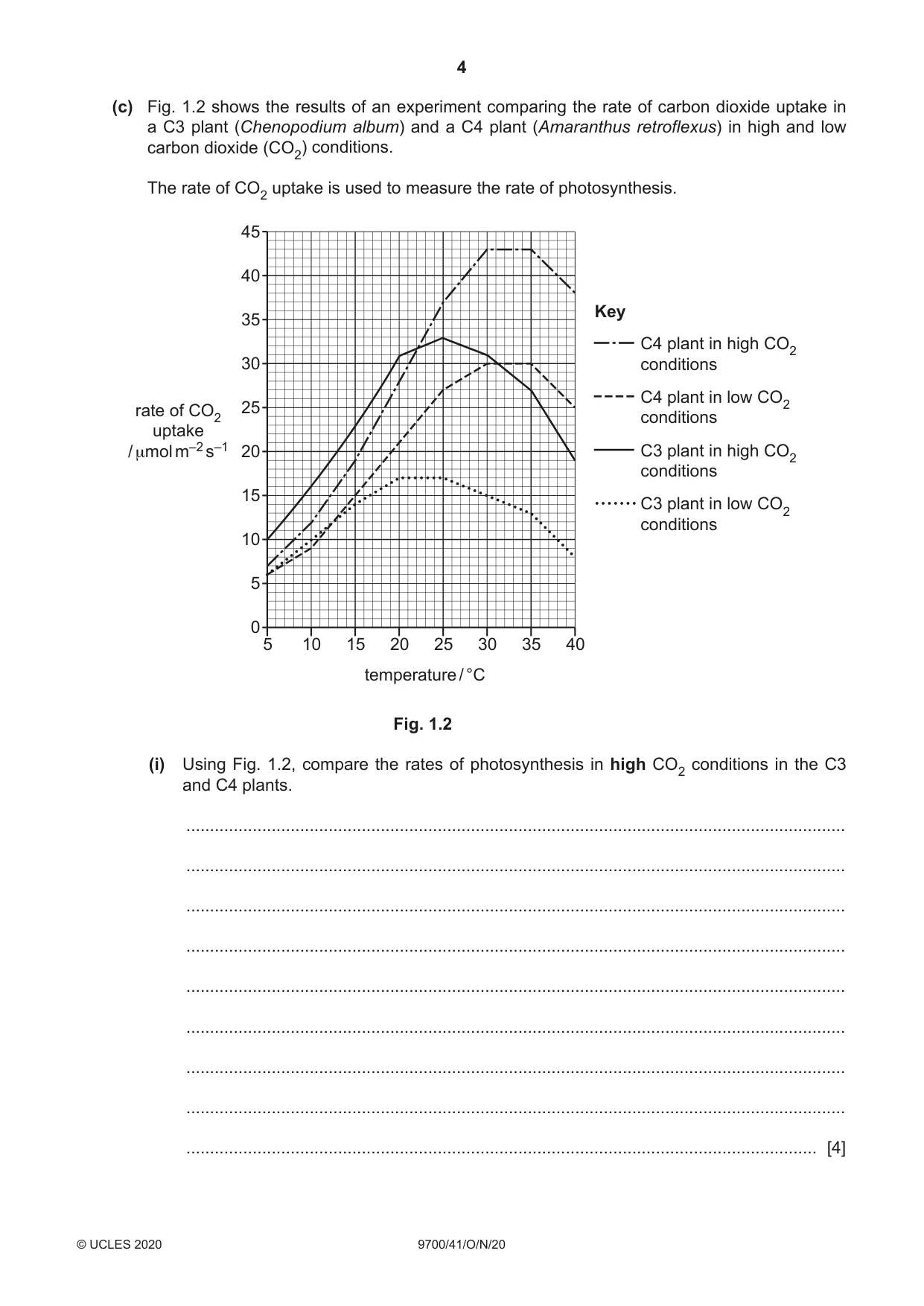
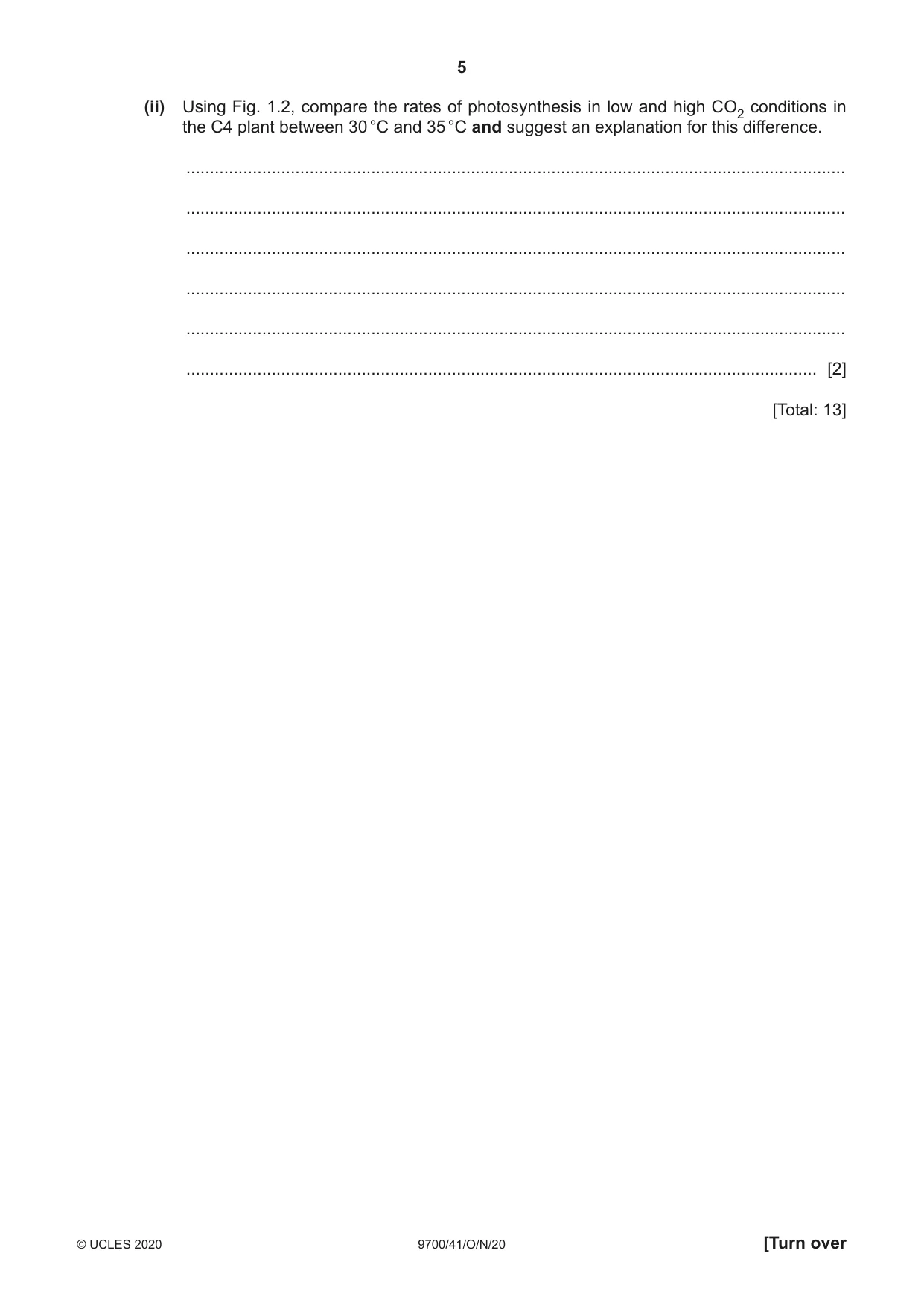
1 Fig. 1.1 is a transverse section through a leaf from the maize plant, Zea mays. Maize is a C4 plant. C Fig. 1.1 (a) On Fig. 1.1, use label lines and letters to show: A – a cell in the epidermal layer B – a cell that contains PEP carboxylase. [2] (b) (i) Identify the cell type labelled C in Fig. 1.1. C .................................................................................................................................. [1] (ii) Explain how the leaf anatomy shown in Fig. 1.1 adapts the C4 plant to maintain a high rate of photosynthesis at high temperatures. ........................................................................................................................................... ........................................................................................................................................... ........................................................................................................................................... ........................................................................................................................................... ........................................................................................................................................... ........................................................................................................................................... ........................................................................................................................................... ........................................................................................................................................... ..................................................................................................................................... [4] (c) Fig. 1.2 shows the results of an experiment comparing the rate of carbon dioxide uptake in a C3 plant (Chenopodium album) and a C4 plant (Amaranthus retroflexus) in high and low carbon dioxide (CO2) conditions. The rate of CO2 uptake is used to measure the rate of photosynthesis. 45 40 Key 35 C4 plant in high CO2 30 conditions C4 plant in low CO2 rate of CO2 25 conditions uptake / μmol m–2 s–1 20 C3 plant in high CO2 conditions 15 C3 plant in low CO2 conditions 10 5 0 5 10 15 20 25 30 35 40 temperature / °C Fig. 1.2 (i) Using Fig. 1.2, compare the rates of photosynthesis in high CO2 conditions in the C3 and C4 plants. ........................................................................................................................................... ........................................................................................................................................... ........................................................................................................................................... ........................................................................................................................................... ........................................................................................................................................... ........................................................................................................................................... ........................................................................................................................................... ........................................................................................................................................... ..................................................................................................................................... [4] (ii) Using Fig. 1.2, compare the rates of photosynthesis in low and high CO2 conditions in the C4 plant between 30 °C and 35 °C and suggest an explanation for this difference. ........................................................................................................................................... ........................................................................................................................................... ........................................................................................................................................... ........................................................................................................................................... ........................................................................................................................................... ..................................................................................................................................... [2] [Total: 13]
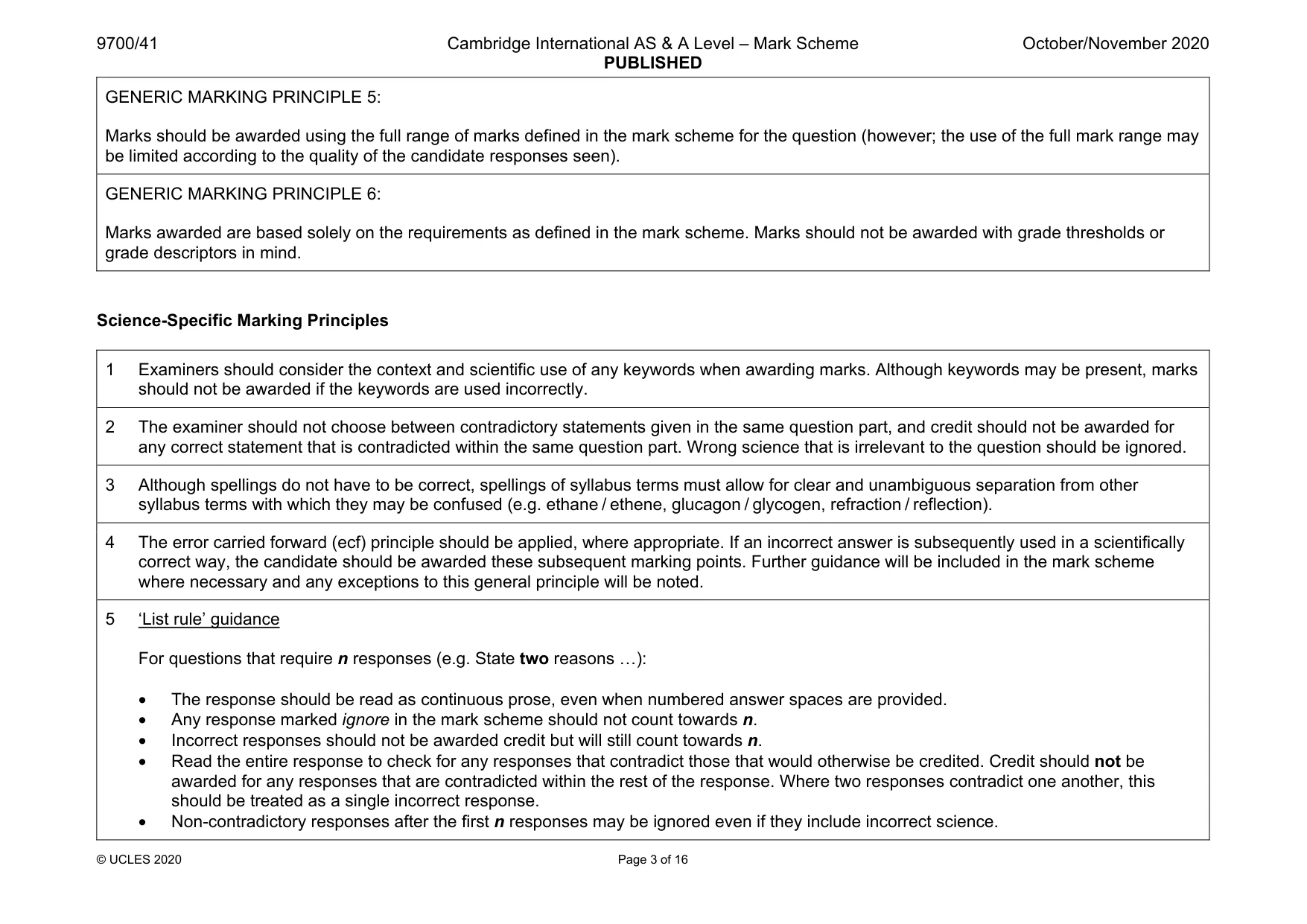
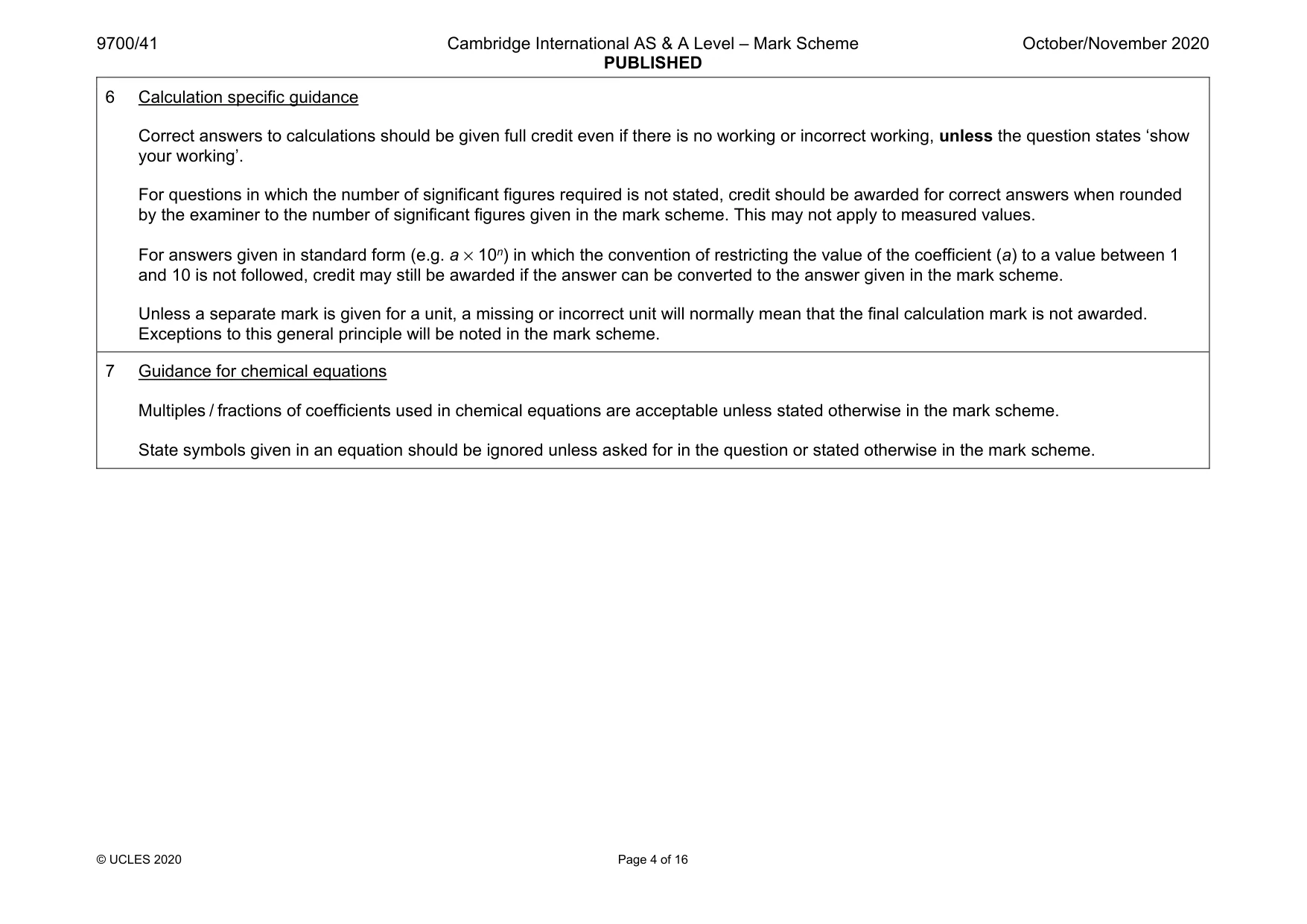
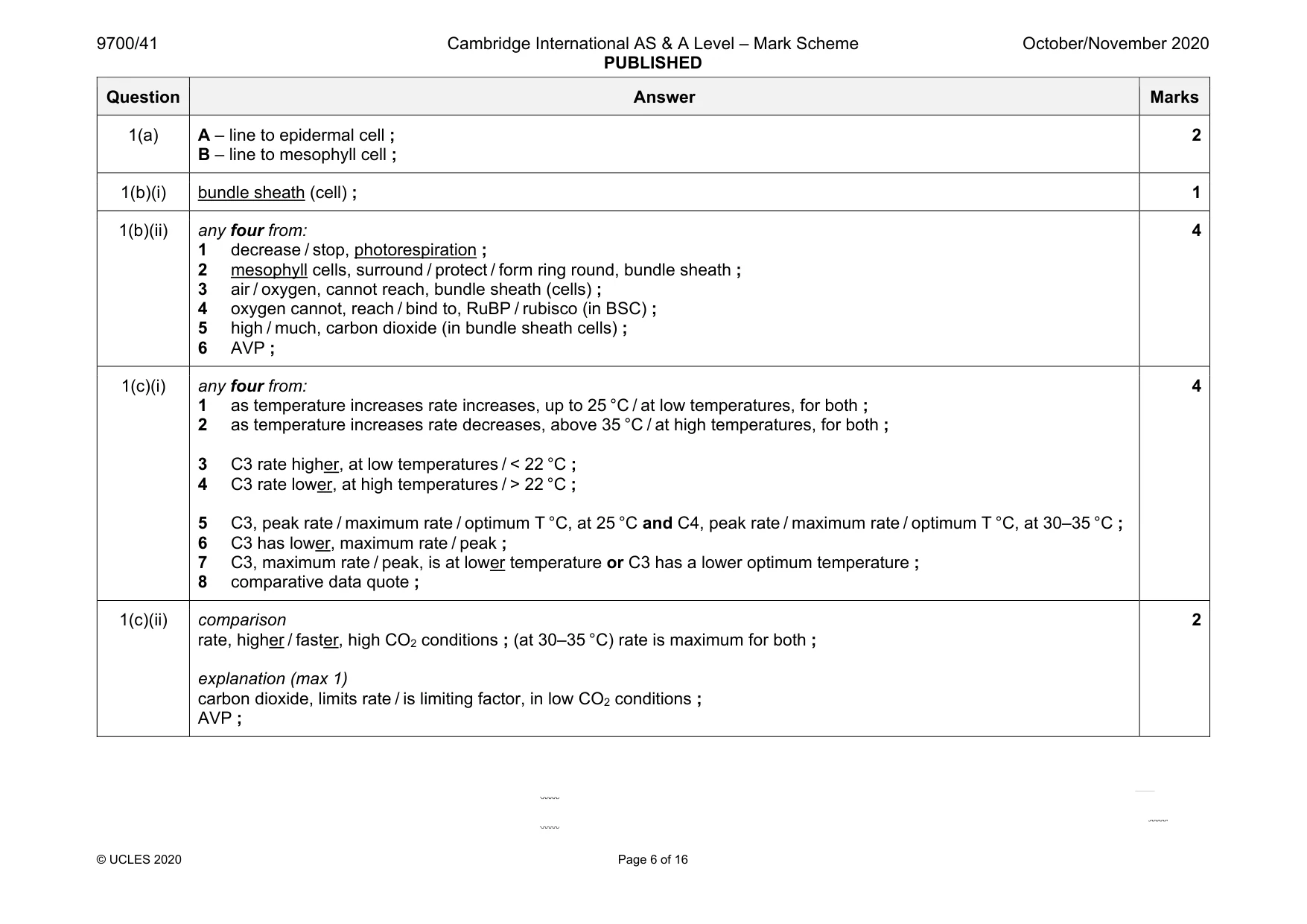
Mark scheme: 1(a) A – line to epidermal cell ; B – line to mesophyll cell ; 2 1(b)(i) bundle sheath (cell) ; 1 1(b)(ii) any four from: 1 decrease / stop, photorespiration ; 2 mesophyll cells, surround / protect / form ring round, bundle sheath ; 3 air / oxygen, cannot reach, bundle sheath (cells) ; 4 oxygen cannot, reach / bind to, RuBP / rubisco (in BSC) ; 5 high / much, carbon dioxide (in bundle sheath cells) ; 6 AVP ; 4 1(c)(i) any four from: 1 as temperature increases rate increases, up to 25 °C / at low temperatures, for both ; 2 as temperature increases rate decreases, above 35 °C / at high temperatures, for both ; 3 C3 rate higher, at low temperatures / < 22 °C ; 4 C3 rate lower, at high temperatures / > 22 °C ; 5 C3, peak rate / maximum rate / optimum T °C, at 25 °C and C4, peak rate / maximum rate / optimum T °C, at 30–35 °C ; 6 C3 has lower, maximum rate / peak ; 7 C3, maximum rate / peak, is at lower temperature or C3 has a lower optimum temperature ; 8 comparative data quote ; 4 1(c)(ii) comparison rate, higher / faster, high CO2 conditions ; (at 30–35 °C) rate is maximum for both ; explanation (max 1) carbon dioxide, limits rate / is limiting factor, in low CO2 conditions ; AVP ; 2
More questions on Photosynthesis as an energy transfer process
Q2 · Domestic goats are small, herbivorous animals that provide milk for human use
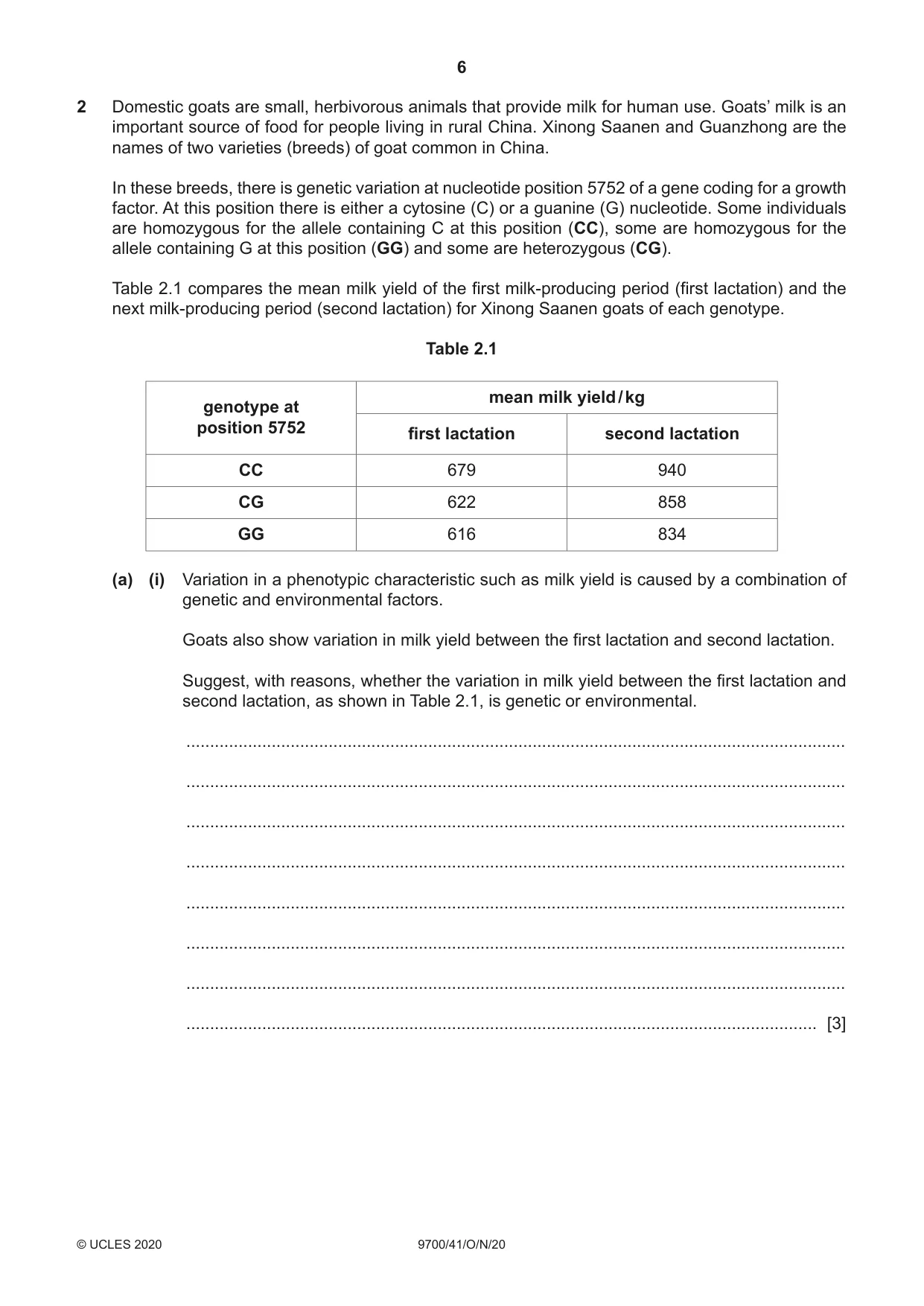
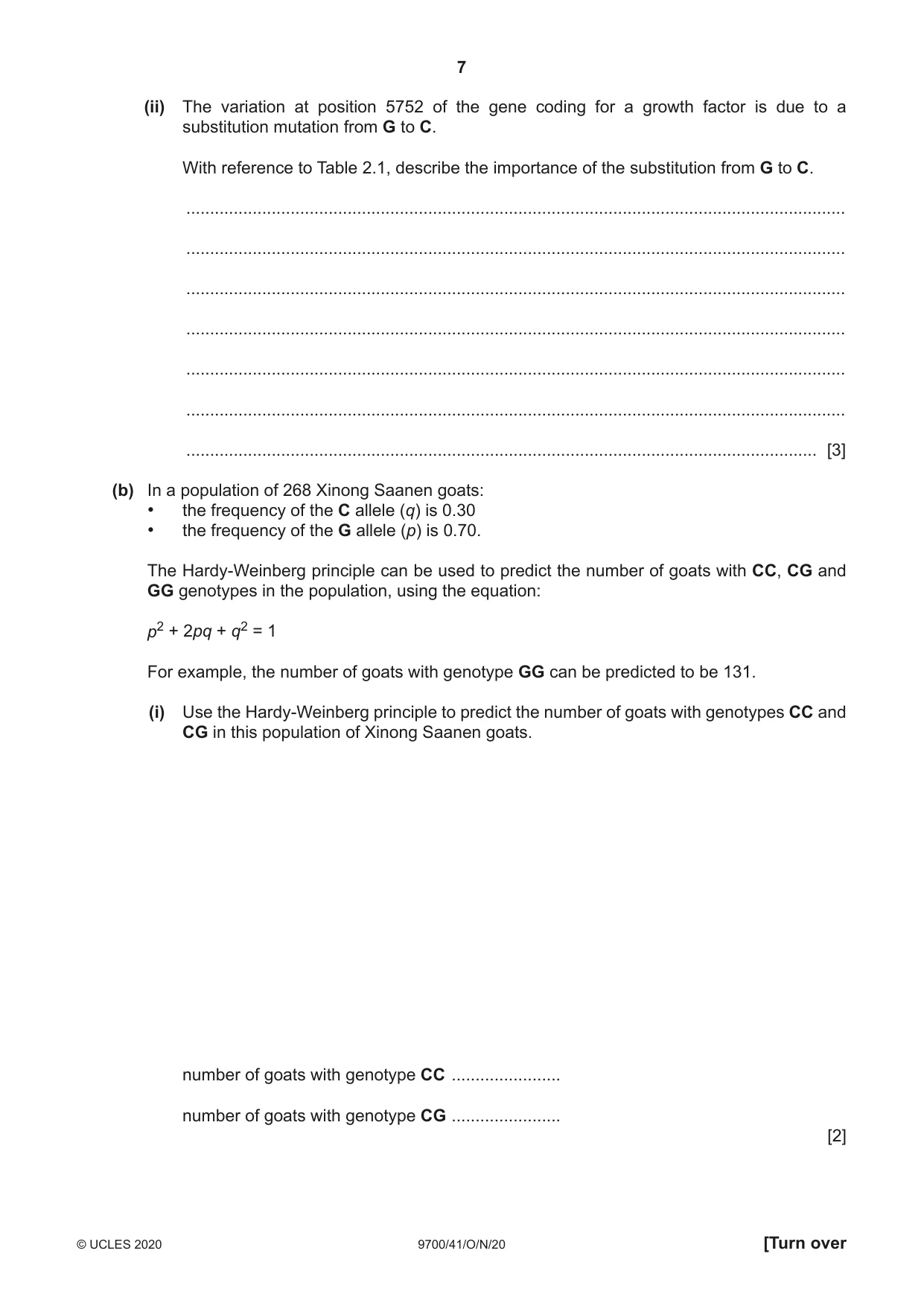
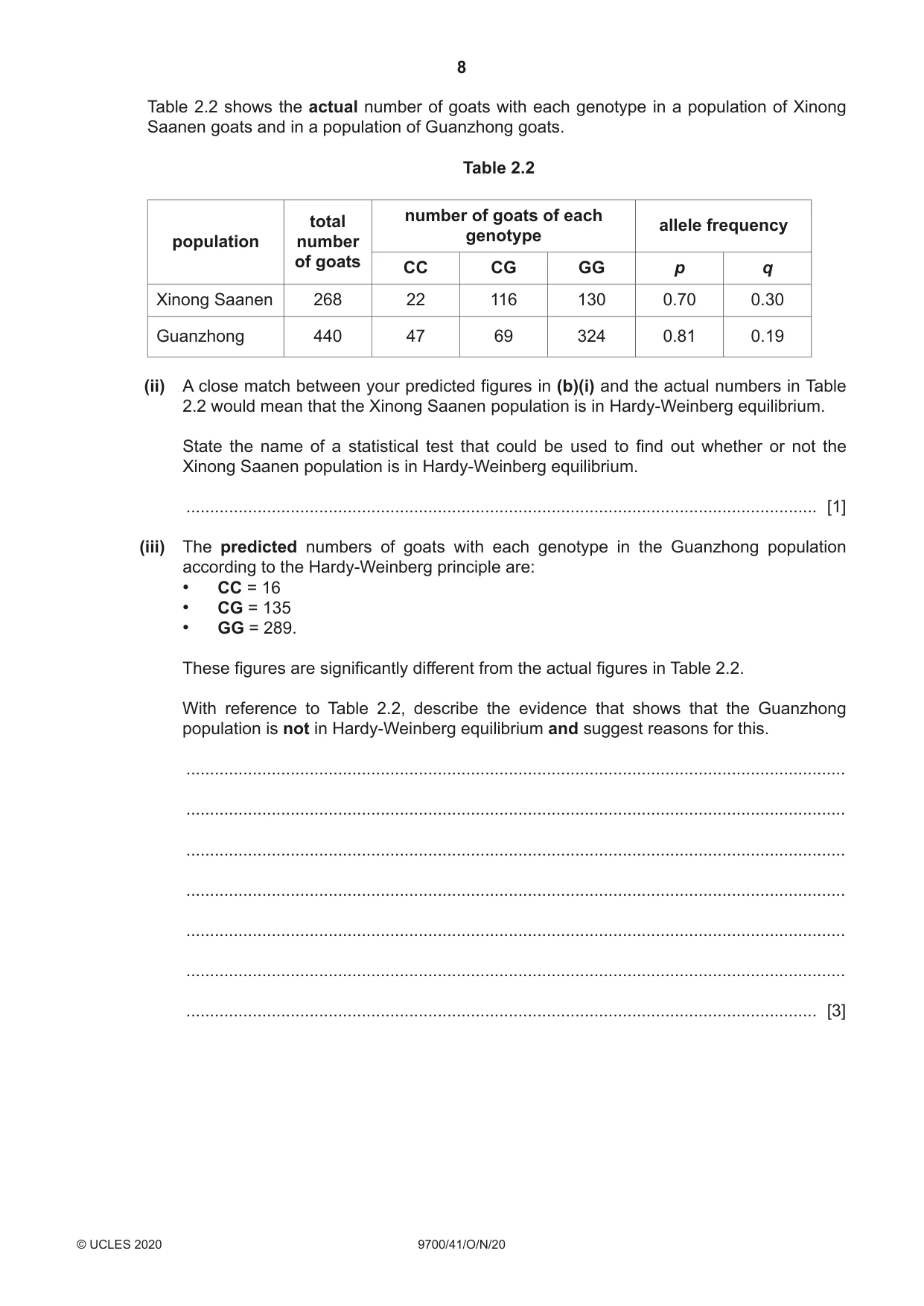
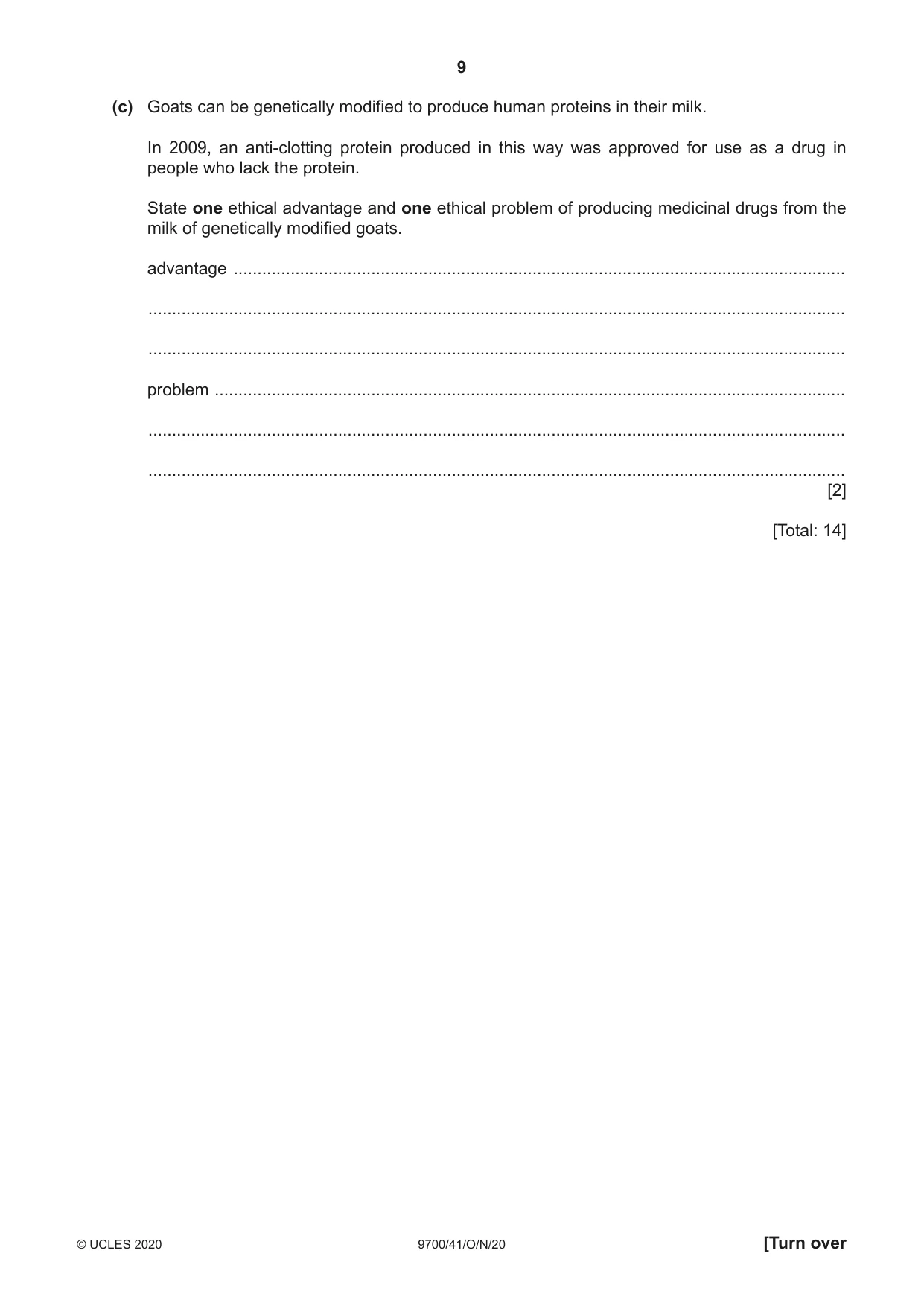
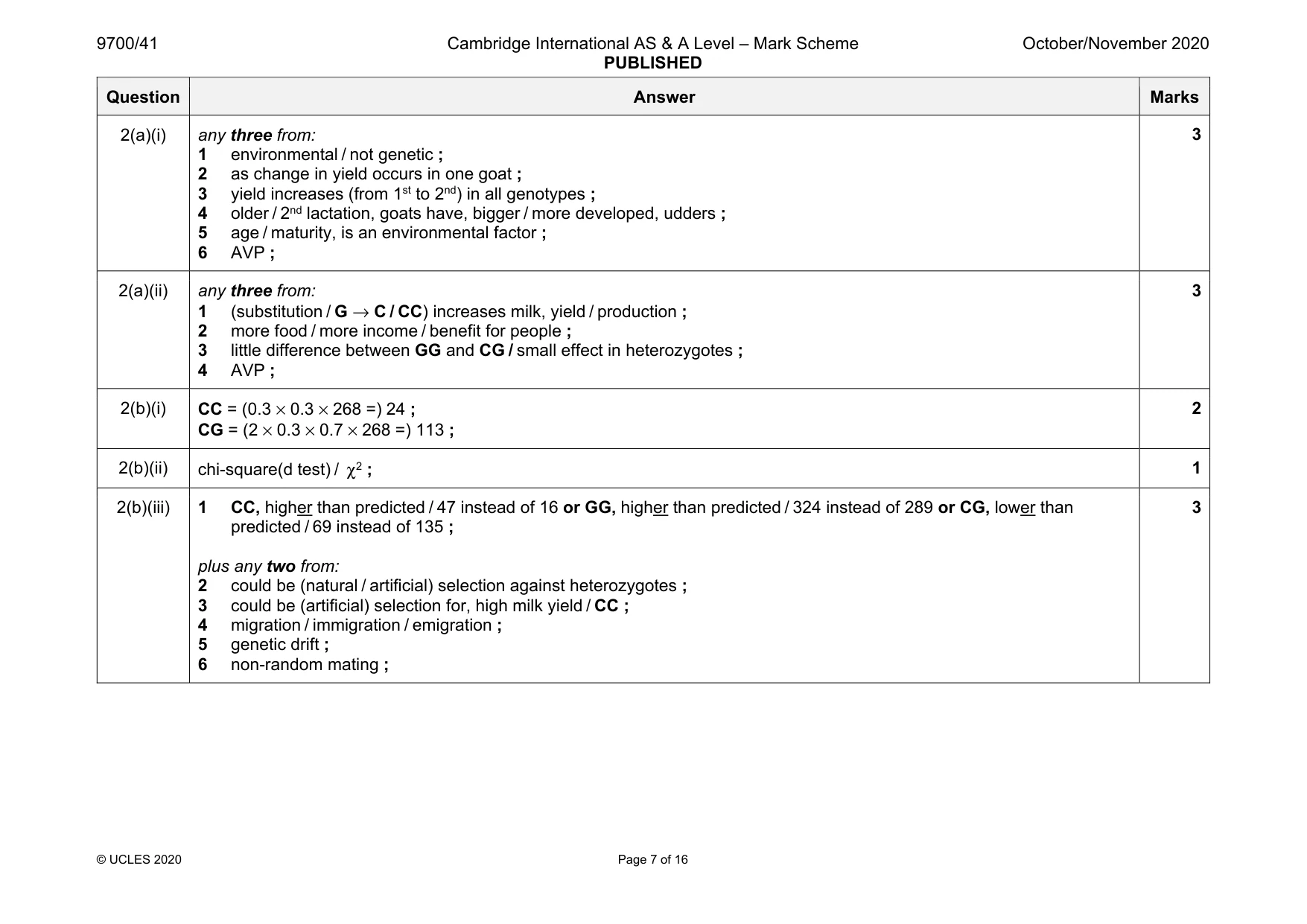
2 Domestic goats are small, herbivorous animals that provide milk for human use. Goats’ milk is an important source of food for people living in rural China. Xinong Saanen and Guanzhong are the names of two varieties (breeds) of goat common in China. In these breeds, there is genetic variation at nucleotide position 5752 of a gene coding for a growth factor. At this position there is either a cytosine (C) or a guanine (G) nucleotide. Some individuals are homozygous for the allele containing C at this position (CC), some are homozygous for the allele containing G at this position (GG) and some are heterozygous (CG). Table 2.1 compares the mean milk yield of the first milk-producing period (first lactation) and the next milk-producing period (second lactation) for Xinong Saanen goats of each genotype. Table 2.1 mean milk yield / kg genotype at position 5752 first lactation second lactation CC 679 940 CG 622 858 GG 616 834 (a) (i) Variation in a phenotypic characteristic such as milk yield is caused by a combination of genetic and environmental factors. Goats also show variation in milk yield between the first lactation and second lactation. Suggest, with reasons, whether the variation in milk yield between the first lactation and second lactation, as shown in Table 2.1, is genetic or environmental. ........................................................................................................................................... ........................................................................................................................................... ........................................................................................................................................... ........................................................................................................................................... ........................................................................................................................................... ........................................................................................................................................... ........................................................................................................................................... ..................................................................................................................................... [3] (ii) The variation at position 5752 of the gene coding for a growth factor is due to a substitution mutation from G to C. With reference to Table 2.1, describe the importance of the substitution from G to C. ........................................................................................................................................... ........................................................................................................................................... ........................................................................................................................................... ........................................................................................................................................... ........................................................................................................................................... ........................................................................................................................................... ..................................................................................................................................... [3] (b) In a population of 268 Xinong Saanen goats: • the frequency of the C allele (q) is 0.30 • the frequency of the G allele (p) is 0.70. The Hardy-Weinberg principle can be used to predict the number of goats with CC, CG and GG genotypes in the population, using the equation: p2 + 2pq + q2 = 1 For example, the number of goats with genotype GG can be predicted to be 131. (i) Use the Hardy-Weinberg principle to predict the number of goats with genotypes CC and CG in this population of Xinong Saanen goats. number of goats with genotype CC ....................... number of goats with genotype CG ....................... [2] Table 2.2 shows the actual number of goats with each genotype in a population of Xinong Saanen goats and in a population of Guanzhong goats. Table 2.2 number of goats of each total allele frequency genotype population number of goats CC CG GG p q Xinong Saanen 268 22 116 130 0.70 0.30 Guanzhong 440 47 69 324 0.81 0.19 (ii) A close match between your predicted figures in (b)(i) and the actual numbers in Table 2.2 would mean that the Xinong Saanen population is in Hardy-Weinberg equilibrium. State the name of a statistical test that could be used to find out whether or not the Xinong Saanen population is in Hardy-Weinberg equilibrium. ..................................................................................................................................... [1] (iii) The predicted numbers of goats with each genotype in the Guanzhong population according to the Hardy-Weinberg principle are: • CC = 16 • CG = 135 • GG = 289. These figures are significantly different from the actual figures in Table 2.2. With reference to Table 2.2, describe the evidence that shows that the Guanzhong population is not in Hardy-Weinberg equilibrium and suggest reasons for this. ........................................................................................................................................... ........................................................................................................................................... ........................................................................................................................................... ........................................................................................................................................... ........................................................................................................................................... ........................................................................................................................................... ..................................................................................................................................... [3] (c) Goats can be genetically modified to produce human proteins in their milk. In 2009, an anti-clotting protein produced in this way was approved for use as a drug in people who lack the protein. State one ethical advantage and one ethical problem of producing medicinal drugs from the milk of genetically modified goats. advantage ................................................................................................................................. ................................................................................................................................................... ................................................................................................................................................... problem ..................................................................................................................................... ................................................................................................................................................... ................................................................................................................................................... [2] [Total: 14]
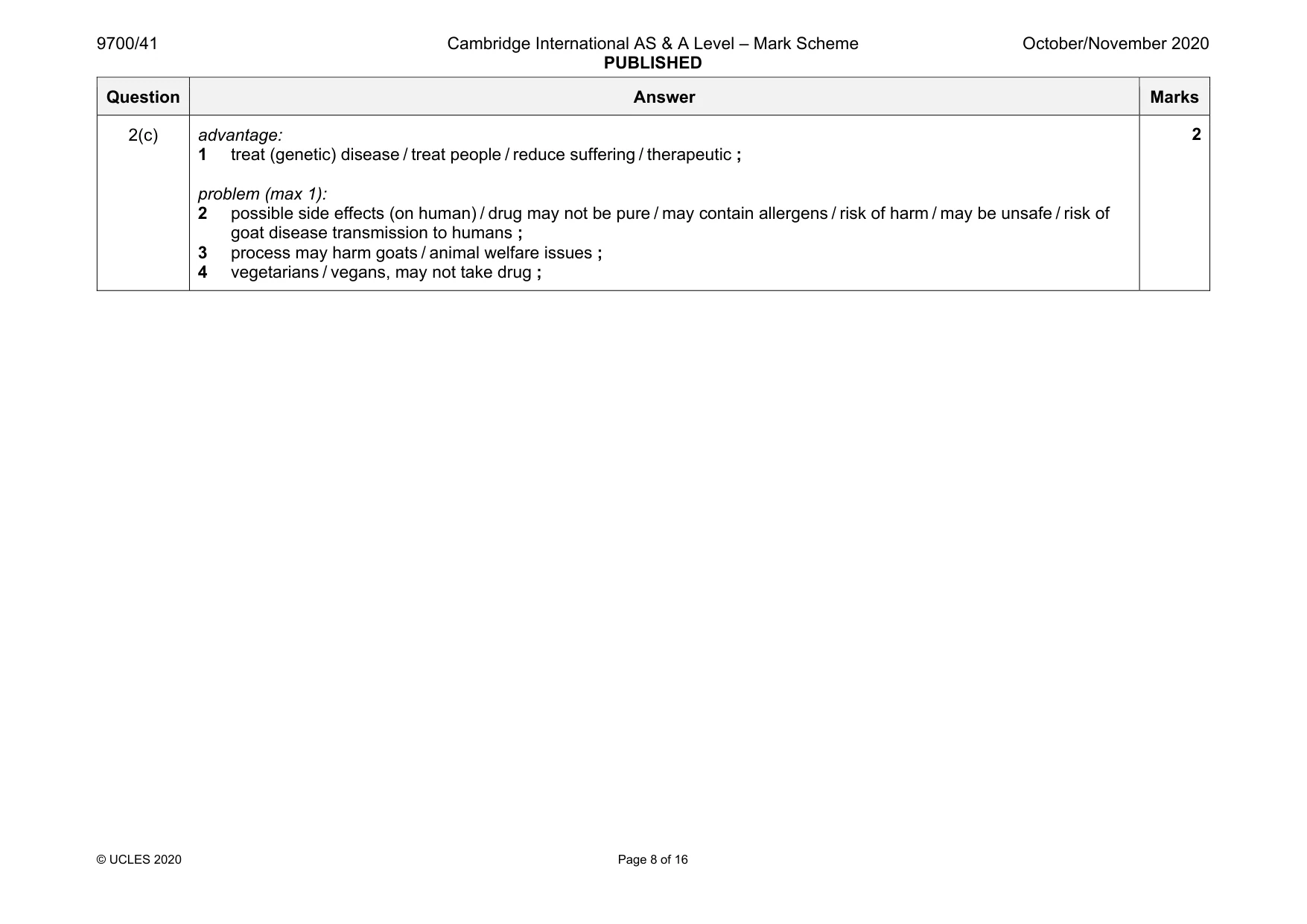
Mark scheme: 2(a)(i) any three from: 1 environmental / not genetic ; 2 as change in yield occurs in one goat ; 3 yield increases (from 1st to 2nd) in all genotypes ; 4 older / 2nd lactation, goats have, bigger / more developed, udders ; 5 age / maturity, is an environmental factor ; 6 AVP ; 2(a)(ii) any three from: 1 (substitution / G → C / CC) increases milk, yield / production ; 2 more food / more income / benefit for people ; 3 little difference between GG and CG / small effect in heterozygotes ; 4 AVP ; 3 2(b)(i) CC = (0.3 × 0.3 × 268 =) 24 ; CG = (2 × 0.3 × 0.7 × 268 =) 113 ; 2 2(b)(ii) chi-square(d test) / χ2 ; 1 2(b)(iii) 1 CC, higher than predicted / 47 instead of 16 or GG, higher than predicted / 324 instead of 289 or CG, lower than predicted / 69 instead of 135 ; plus any two from: 2 could be (natural / artificial) selection against heterozygotes ; 3 could be (artificial) selection for, high milk yield / CC ; 4 migration / immigration / emigration ; 5 genetic drift ; 6 non-random mating ; 3 Question Answer Marks 2(c) advantage: 1 treat (genetic) disease / treat people / reduce suffering / therapeutic ; problem (max 1): 2 possible side effects (on human) / drug may not be pure / may contain allergens / risk of harm / may be unsafe / risk of goat disease transmission to humans ; 3 process may harm goats / animal welfare issues ; 4 vegetarians / vegans, may not take drug ; 2
Q3 · DNA barcoding is used in species identification
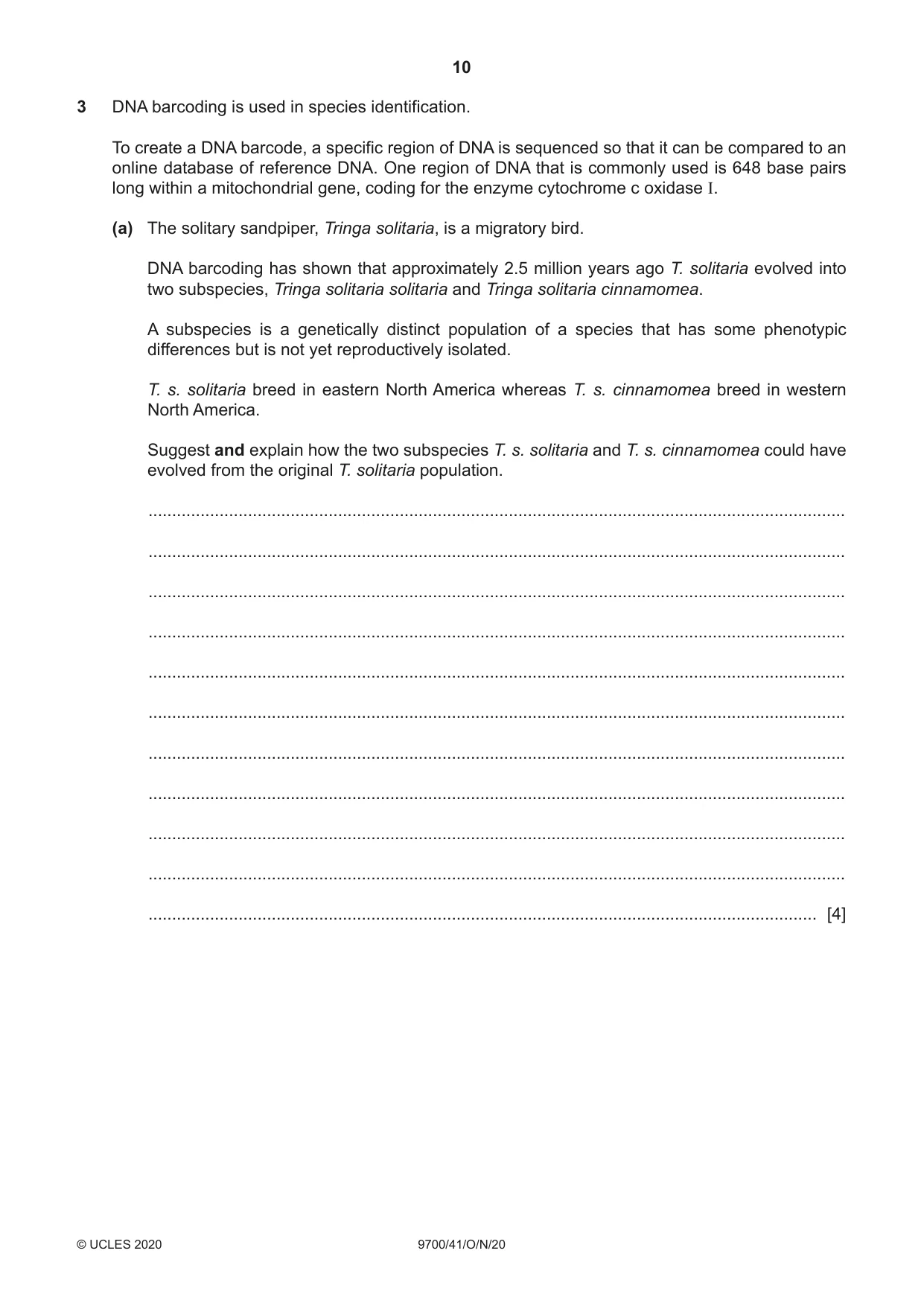
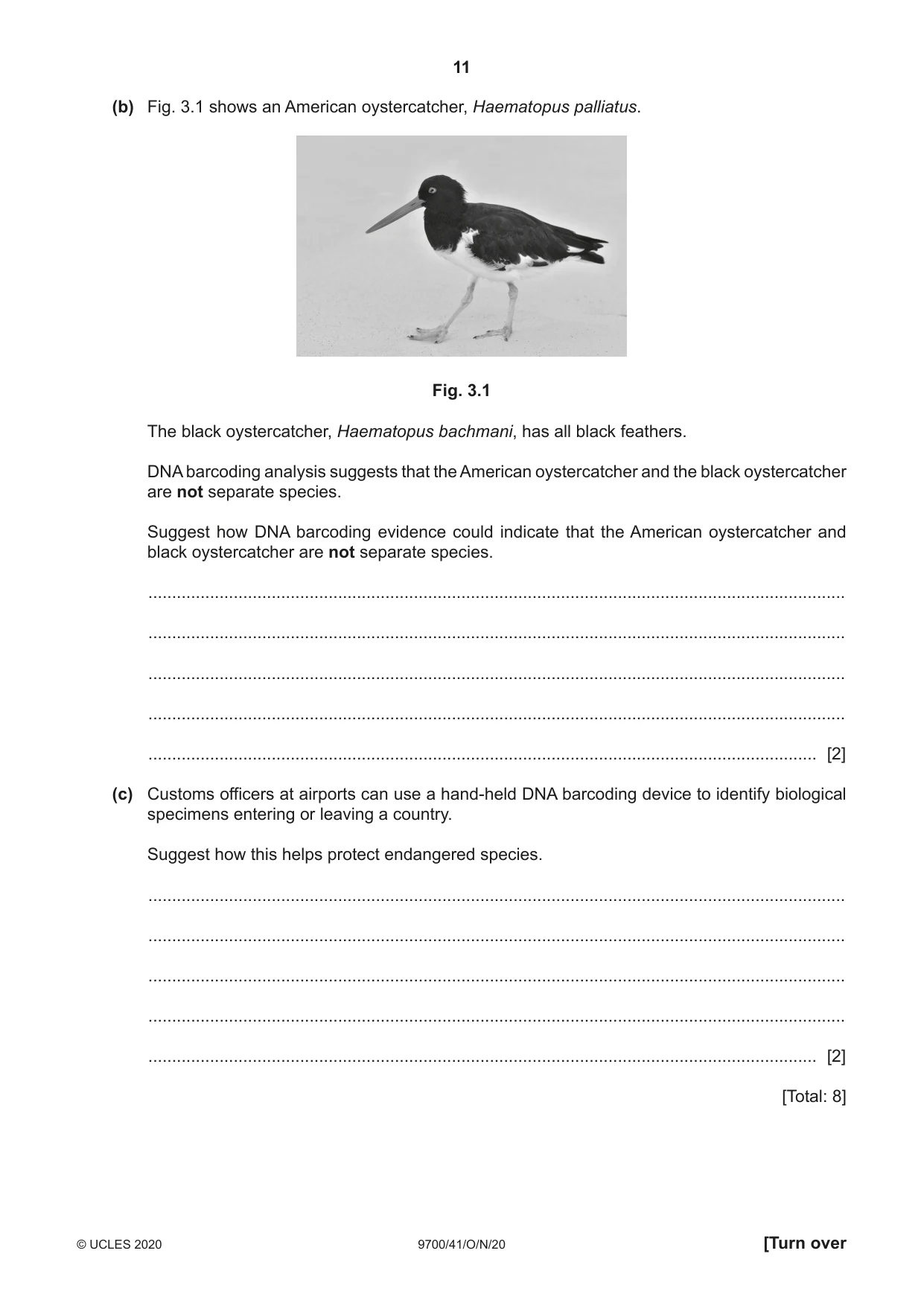
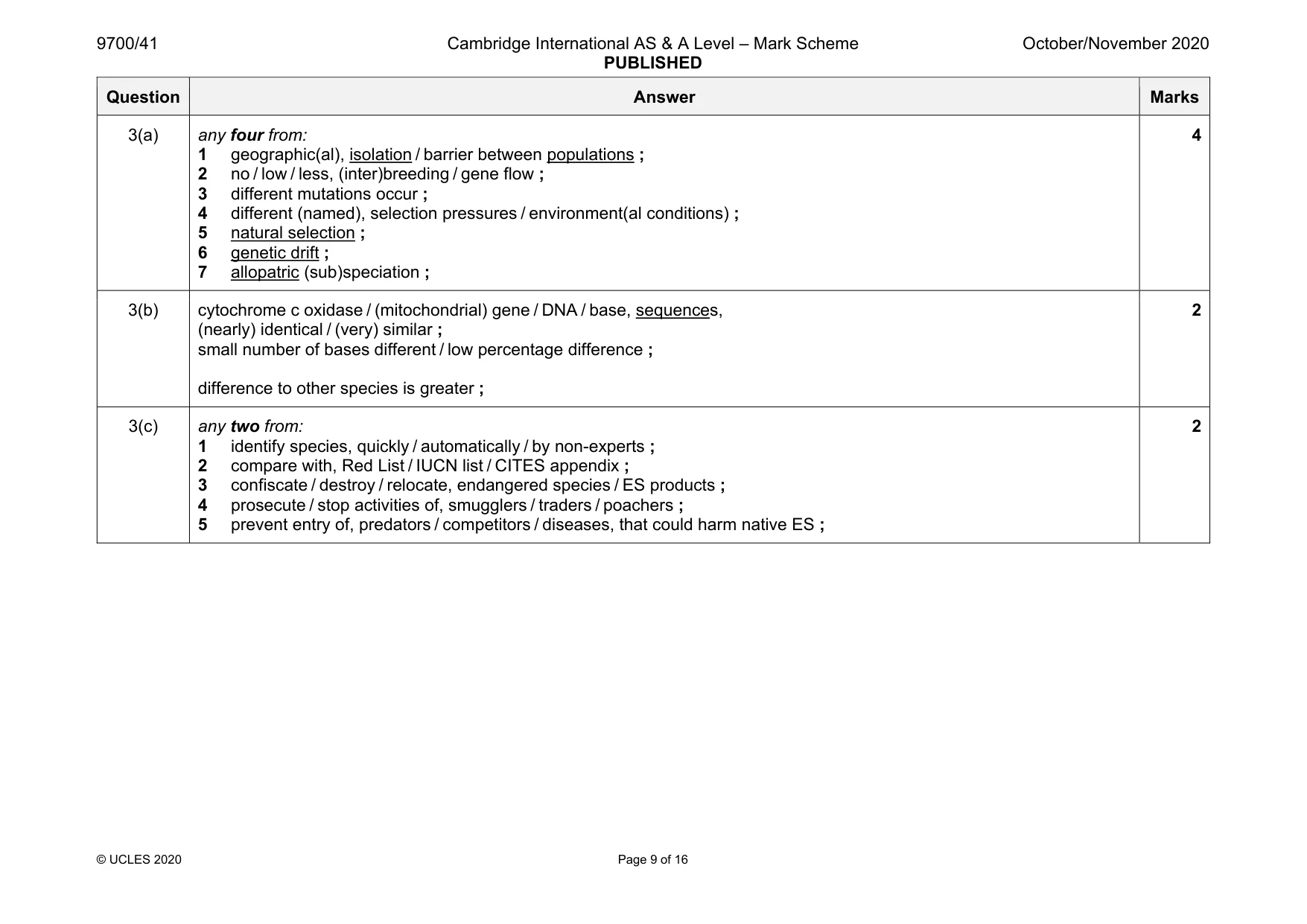
3 DNA barcoding is used in species identification. To create a DNA barcode, a specific region of DNA is sequenced so that it can be compared to an online database of reference DNA. One region of DNA that is commonly used is 648 base pairs long within a mitochondrial gene, coding for the enzyme cytochrome c oxidase I. (a) The solitary sandpiper, Tringa solitaria, is a migratory bird. DNA barcoding has shown that approximately 2.5 million years ago T. solitaria evolved into two subspecies, Tringa solitaria solitaria and Tringa solitaria cinnamomea. A subspecies is a genetically distinct population of a species that has some phenotypic differences but is not yet reproductively isolated. T. s. solitaria breed in eastern North America whereas T. s. cinnamomea breed in western North America. Suggest and explain how the two subspecies T. s. solitaria and T. s. cinnamomea could have evolved from the original T. solitaria population. ................................................................................................................................................... ................................................................................................................................................... ................................................................................................................................................... ................................................................................................................................................... ................................................................................................................................................... ................................................................................................................................................... ................................................................................................................................................... ................................................................................................................................................... ................................................................................................................................................... ................................................................................................................................................... ............................................................................................................................................. [4] (b) Fig. 3.1 shows an American oystercatcher, Haematopus palliatus. Fig. 3.1 The black oystercatcher, Haematopus bachmani, has all black feathers. DNA barcoding analysis suggests that the American oystercatcher and the black oystercatcher are not separate species. Suggest how DNA barcoding evidence could indicate that the American oystercatcher and black oystercatcher are not separate species. ................................................................................................................................................... ................................................................................................................................................... ................................................................................................................................................... ................................................................................................................................................... ............................................................................................................................................. [2] (c) Customs officers at airports can use a hand-held DNA barcoding device to identify biological specimens entering or leaving a country. Suggest how this helps protect endangered species. ................................................................................................................................................... ................................................................................................................................................... ................................................................................................................................................... ................................................................................................................................................... ............................................................................................................................................. [2] [Total: 8]
Mark scheme: 3(a) any four from: 1 geographic(al), isolation / barrier between populations ; 2 no / low / less, (inter)breeding / gene flow ; 3 different mutations occur ; 4 different (named), selection pressures / environment(al conditions) ; 5 natural selection ; 6 genetic drift ; 7 allopatric (sub)speciation ; 4 3(b) cytochrome c oxidase / (mitochondrial) gene / DNA / base, sequences, (nearly) identical / (very) similar ; small number of bases different / low percentage difference ; difference to other species is greater ; 2 3(c) any two from: 1 identify species, quickly / automatically / by non-experts ; 2 compare with, Red List / IUCN list / CITES appendix ; 3 confiscate / destroy / relocate, endangered species / ES products ; 4 prosecute / stop activities of, smugglers / traders / poachers ; 5 prevent entry of, predators / competitors / diseases, that could harm native ES ; 2
Q4 · There are a number of mutations affecting the production of fetal haemoglobin, HbF, and…
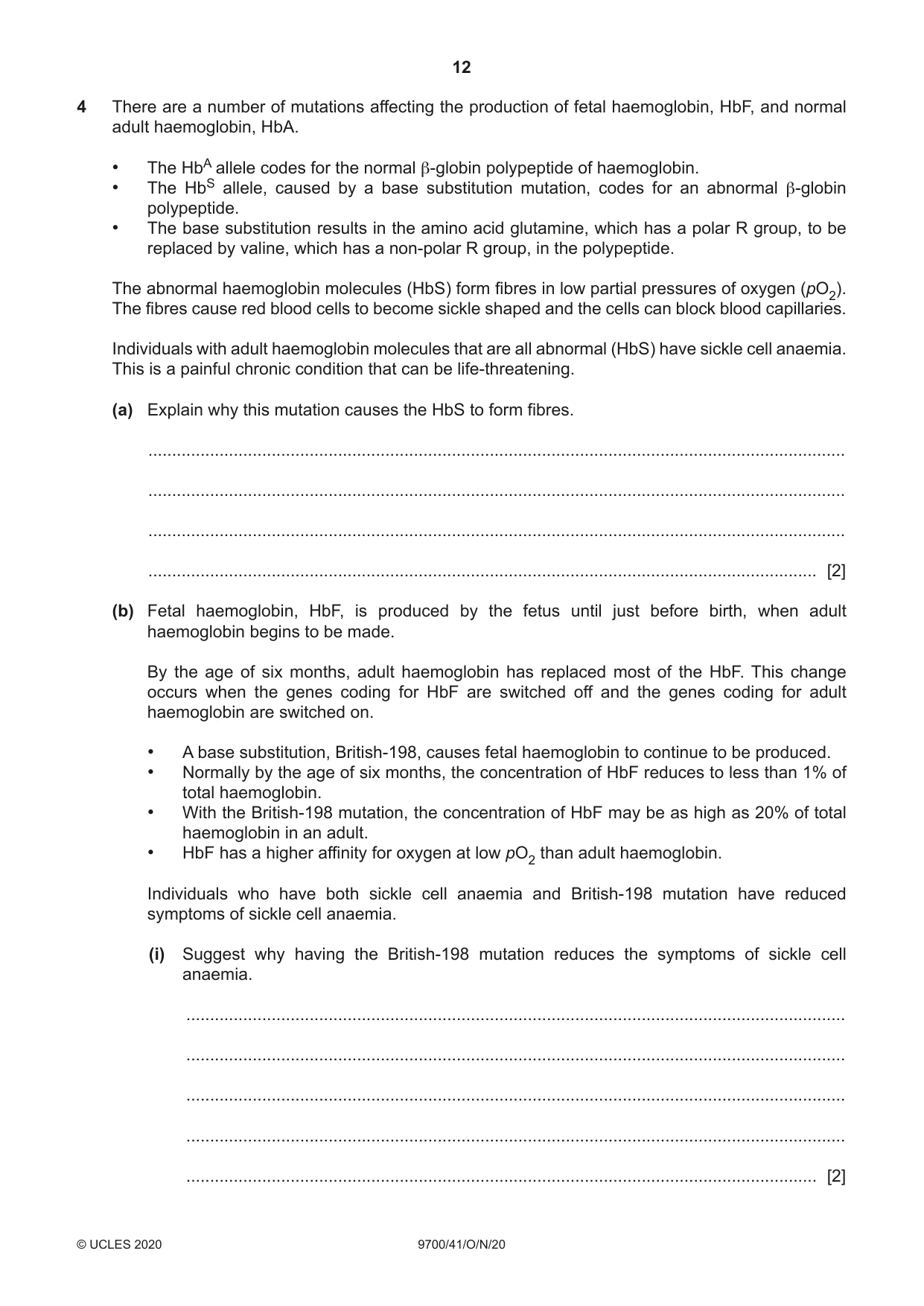
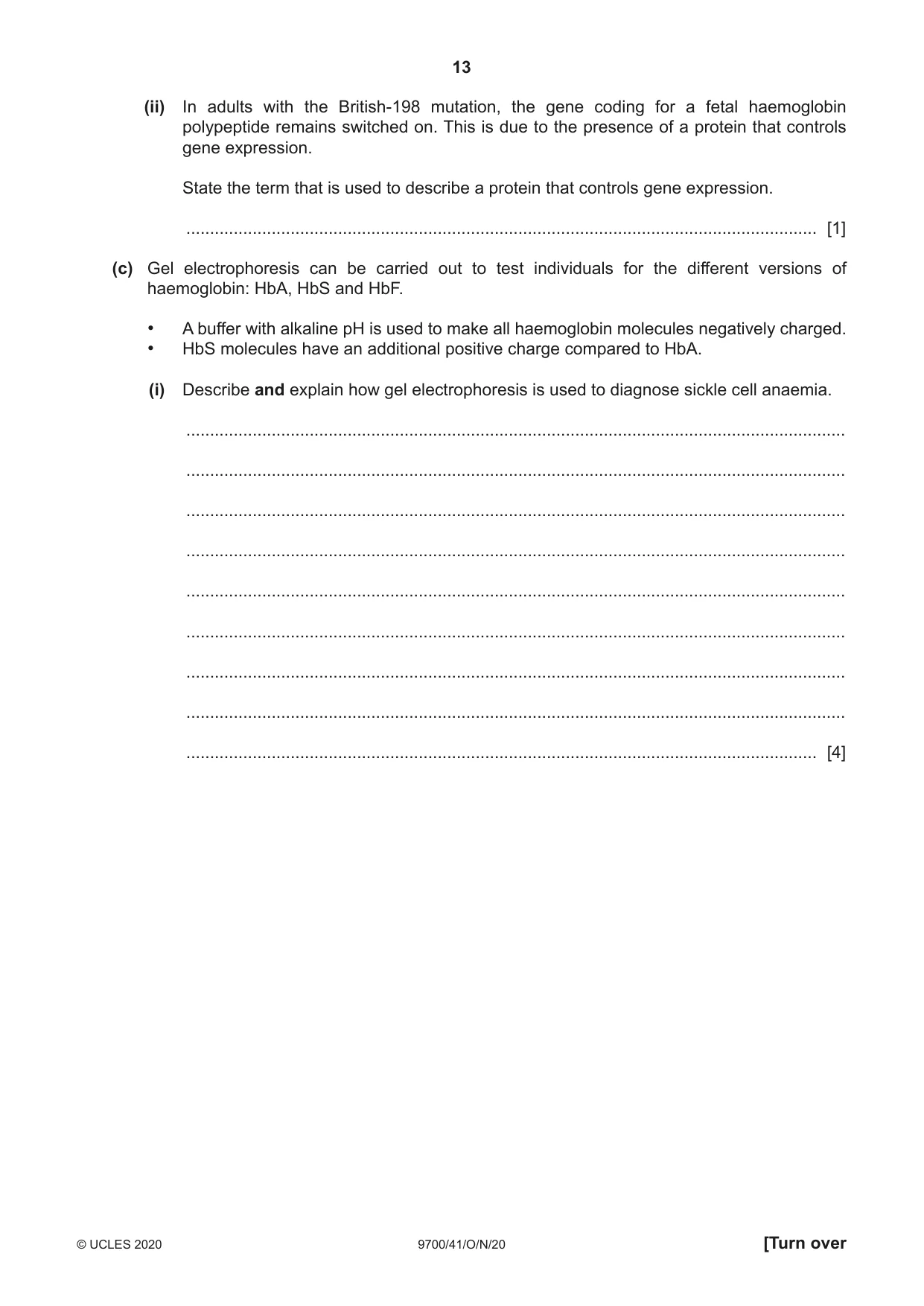
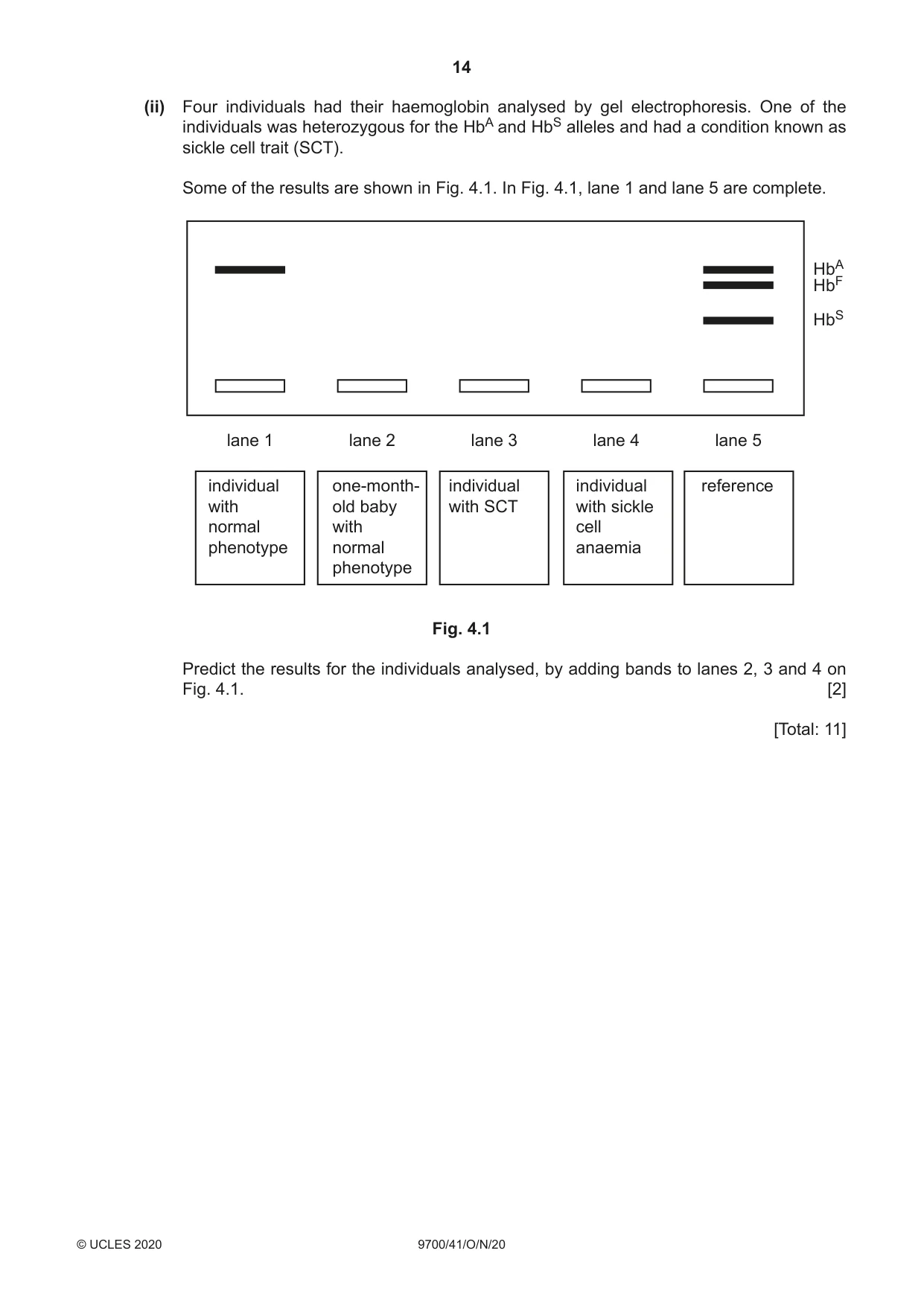
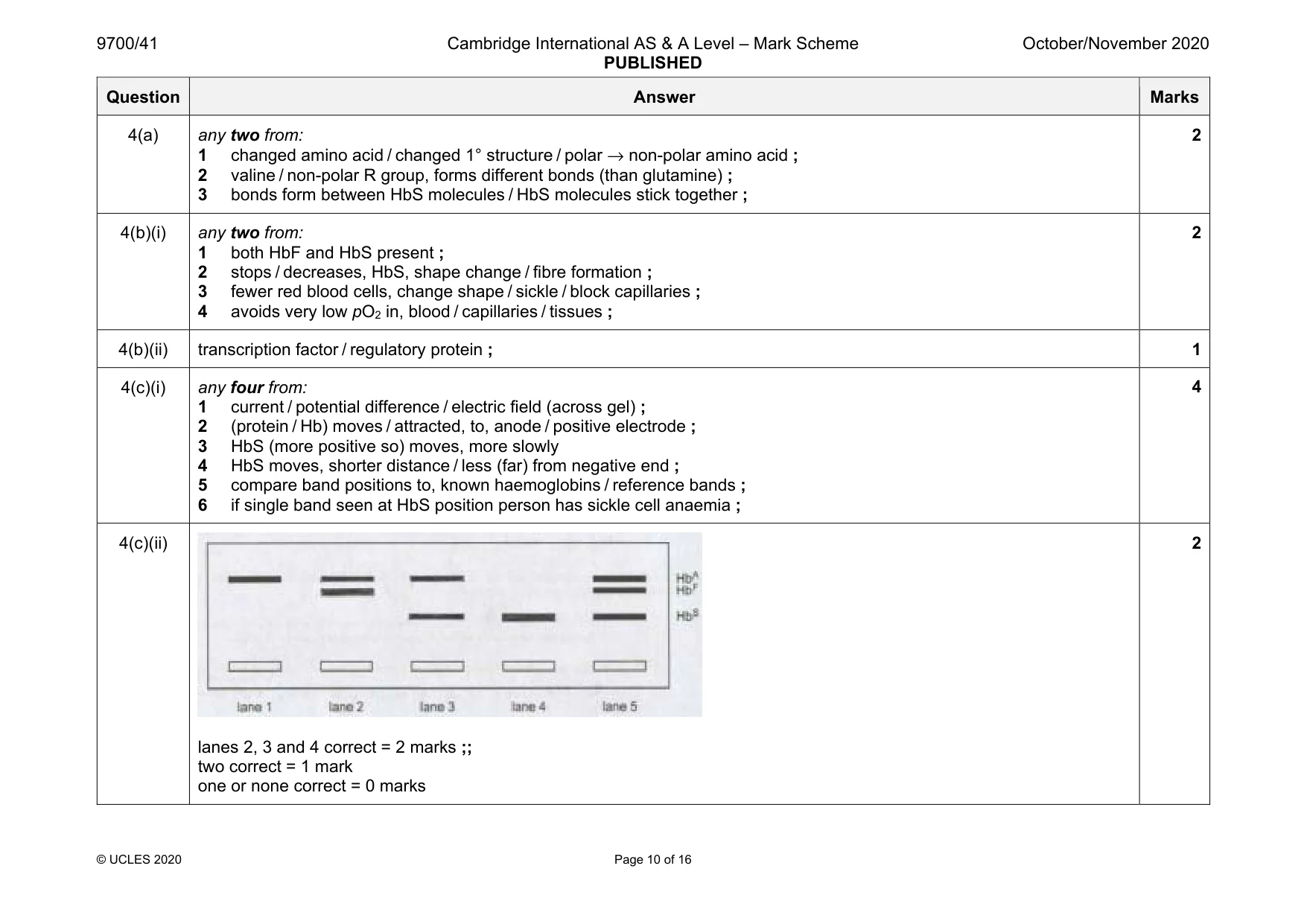
4 There are a number of mutations affecting the production of fetal haemoglobin, HbF, and normal adult haemoglobin, HbA. • The HbA allele codes for the normal β-globin polypeptide of haemoglobin. • The HbS allele, caused by a base substitution mutation, codes for an abnormal β-globin polypeptide. • The base substitution results in the amino acid glutamine, which has a polar R group, to be replaced by valine, which has a non-polar R group, in the polypeptide. The abnormal haemoglobin molecules (HbS) form fibres in low partial pressures of oxygen (pO2). The fibres cause red blood cells to become sickle shaped and the cells can block blood capillaries. Individuals with adult haemoglobin molecules that are all abnormal (HbS) have sickle cell anaemia. This is a painful chronic condition that can be life-threatening. (a) Explain why this mutation causes the HbS to form fibres. ................................................................................................................................................... ................................................................................................................................................... ................................................................................................................................................... ............................................................................................................................................. [2] (b) Fetal haemoglobin, HbF, is produced by the fetus until just before birth, when adult haemoglobin begins to be made. By the age of six months, adult haemoglobin has replaced most of the HbF. This change occurs when the genes coding for HbF are switched off and the genes coding for adult haemoglobin are switched on. • A base substitution, British-198, causes fetal haemoglobin to continue to be produced. • Normally by the age of six months, the concentration of HbF reduces to less than 1% of total haemoglobin. • With the British-198 mutation, the concentration of HbF may be as high as 20% of total haemoglobin in an adult. • HbF has a higher affinity for oxygen at low pO2 than adult haemoglobin. Individuals who have both sickle cell anaemia and British-198 mutation have reduced symptoms of sickle cell anaemia. (i) Suggest why having the British-198 mutation reduces the symptoms of sickle cell anaemia. ........................................................................................................................................... ........................................................................................................................................... ........................................................................................................................................... ........................................................................................................................................... ..................................................................................................................................... [2] (ii) In adults with the British-198 mutation, the gene coding for a fetal haemoglobin polypeptide remains switched on. This is due to the presence of a protein that controls gene expression. State the term that is used to describe a protein that controls gene expression. ..................................................................................................................................... [1] (c) Gel electrophoresis can be carried out to test individuals for the different versions of haemoglobin: HbA, HbS and HbF. • A buffer with alkaline pH is used to make all haemoglobin molecules negatively charged. • HbS molecules have an additional positive charge compared to HbA. (i) Describe and explain how gel electrophoresis is used to diagnose sickle cell anaemia. ........................................................................................................................................... ........................................................................................................................................... ........................................................................................................................................... ........................................................................................................................................... ........................................................................................................................................... ........................................................................................................................................... ........................................................................................................................................... ........................................................................................................................................... ..................................................................................................................................... [4] (ii) Four individuals had their haemoglobin analysed by gel electrophoresis. One of the individuals was heterozygous for the HbA and HbS alleles and had a condition known as sickle cell trait (SCT). Some of the results are shown in Fig. 4.1. In Fig. 4.1, lane 1 and lane 5 are complete. HbA HbF HbS lane 1 lane 2 lane 3 lane 4 lane 5 individual one-month- individual individual reference with old baby with SCT with sickle normal with cell phenotype normal anaemia phenotype Fig. 4.1 Predict the results for the individuals analysed, by adding bands to lanes 2, 3 and 4 on Fig. 4.1. [2] [Total: 11]
Mark scheme: 4(a) any two from: 1 changed amino acid / changed 1° structure / polar → non-polar amino acid ; 2 valine / non-polar R group, forms different bonds (than glutamine) ; 3 bonds form between HbS molecules / HbS molecules stick together ; 2 4(b)(i) any two from: 1 both HbF and HbS present ; 2 stops / decreases, HbS, shape change / fibre formation ; 3 fewer red blood cells, change shape / sickle / block capillaries ; 4 avoids very low pO2 in, blood / capillaries / tissues ; 2 4(b)(ii) transcription factor / regulatory protein ; 1 4(c)(i) any four from: 1 current / potential difference / electric field (across gel) ; 2 (protein / Hb) moves / attracted, to, anode / positive electrode ; 3 HbS (more positive so) moves, more slowly 4 HbS moves, shorter distance / less (far) from negative end ; 5 compare band positions to, known haemoglobins / reference bands ; 6 if single band seen at HbS position person has sickle cell anaemia ; 4 4(c)(ii) lanes 2, 3 and 4 correct = 2 marks ;; two correct = 1 mark one or none correct = 0 marks 2
Q5 · A cat displaying the recessive phenotype for two unlinked genes
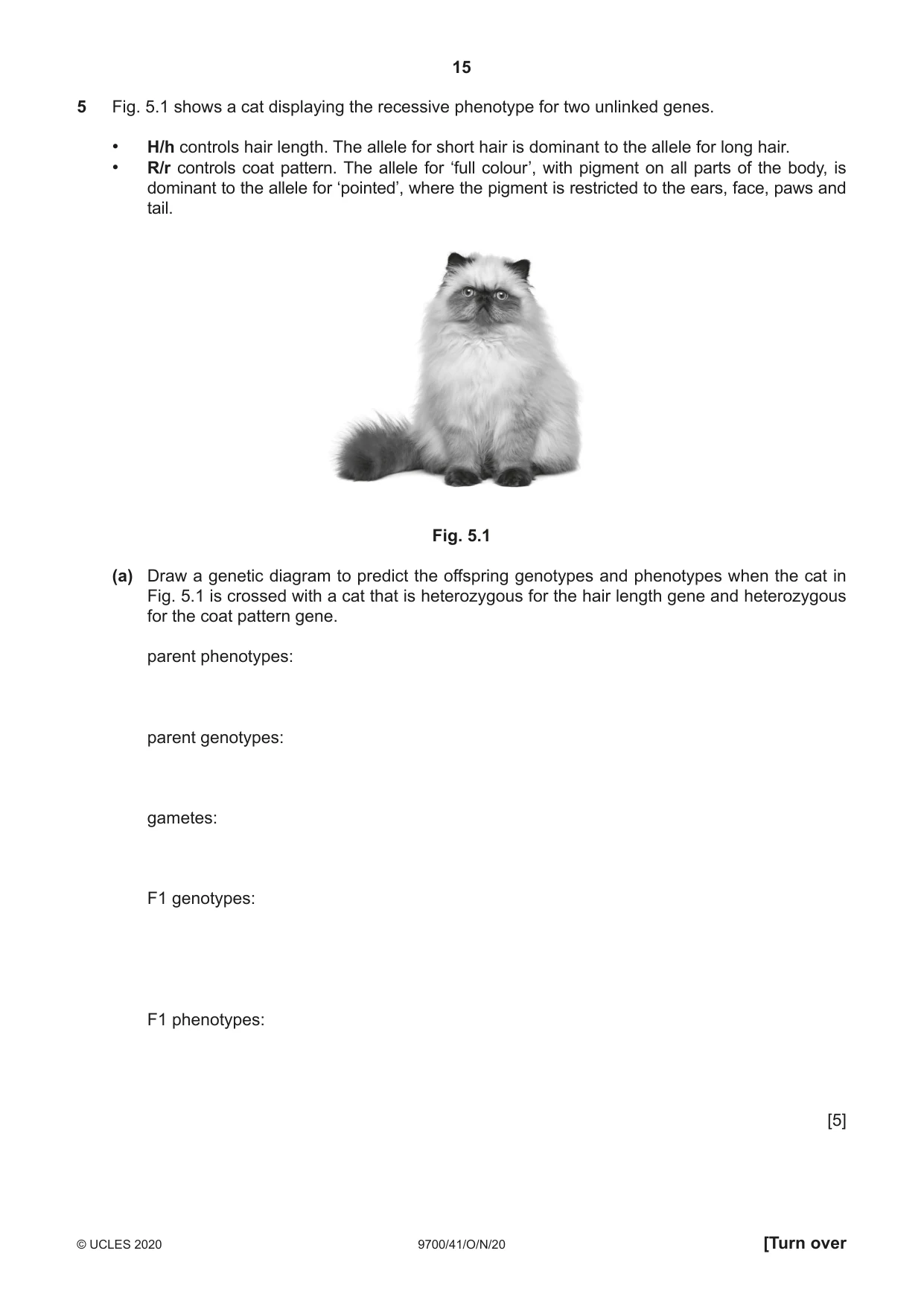
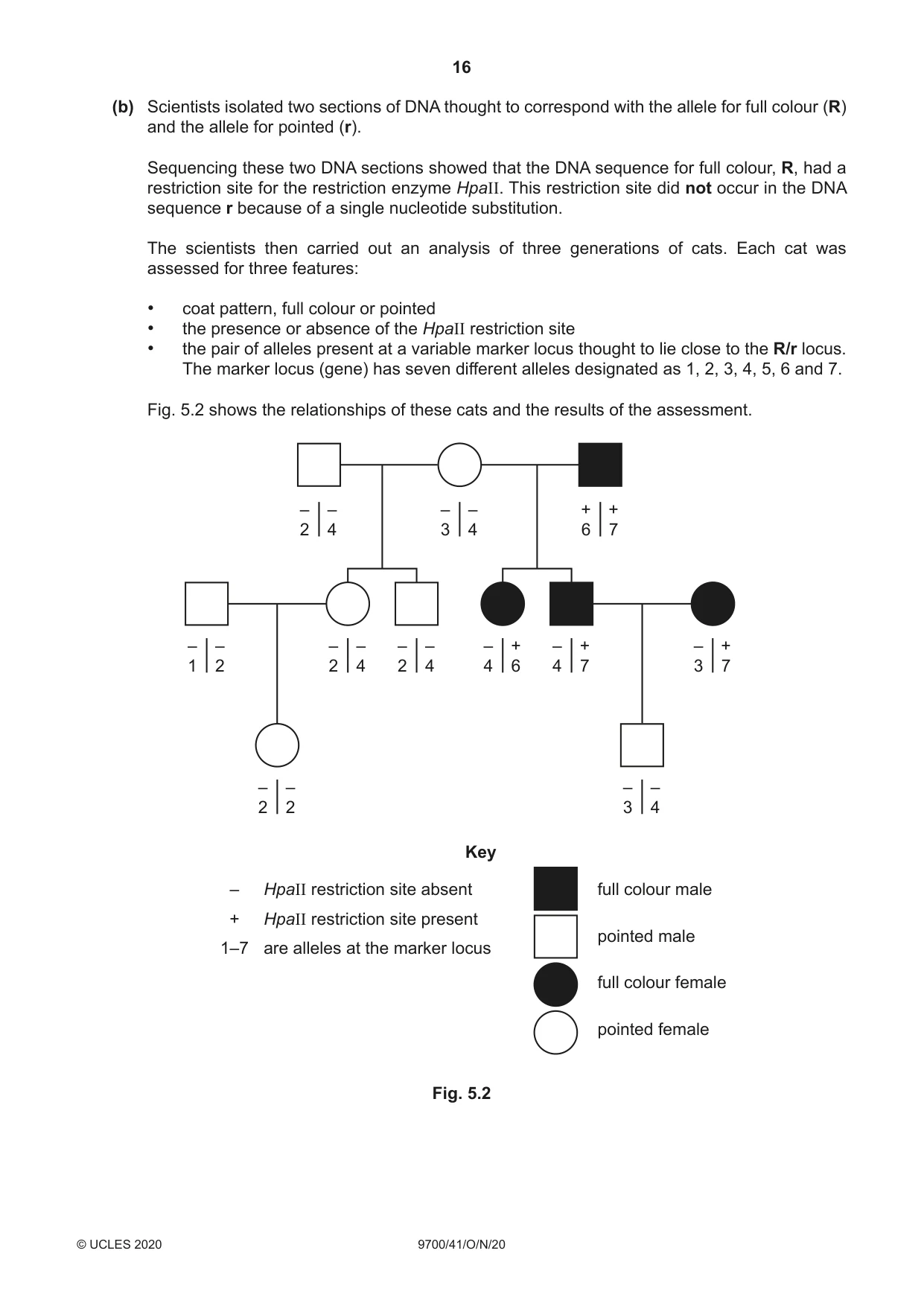
5 Fig. 5.1 shows a cat displaying the recessive phenotype for two unlinked genes. • H/h controls hair length. The allele for short hair is dominant to the allele for long hair. • R/r controls coat pattern. The allele for ‘full colour’, with pigment on all parts of the body, is dominant to the allele for ‘pointed’, where the pigment is restricted to the ears, face, paws and tail. Fig. 5.1 (a) Draw a genetic diagram to predict the offspring genotypes and phenotypes when the cat in Fig. 5.1 is crossed with a cat that is heterozygous for the hair length gene and heterozygous for the coat pattern gene. parent phenotypes: parent genotypes: gametes: F1 genotypes: F1 phenotypes: [5] (b) Scientists isolated two sections of DNA thought to correspond with the allele for full colour (R) and the allele for pointed (r). Sequencing these two DNA sections showed that the DNA sequence for full colour, R, had a restriction site for the restriction enzyme HpaII. This restriction site did not occur in the DNA sequence r because of a single nucleotide substitution. The scientists then carried out an analysis of three generations of cats. Each cat was assessed for three features: • coat pattern, full colour or pointed • the presence or absence of the HpaII restriction site • the pair of alleles present at a variable marker locus thought to lie close to the R/r locus. The marker locus (gene) has seven different alleles designated as 1, 2, 3, 4, 5, 6 and 7. Fig. 5.2 shows the relationships of these cats and the results of the assessment. – – – – + + 2 4 3 4 6 7 – – – – – – – + – + – + 1 2 2 4 2 4 4 6 4 7 3 7 – – – – 2 2 3 4 Key – HpaII restriction site absent full colour male + HpaII restriction site present pointed male 1–7 are alleles at the marker locus full colour female pointed female Fig. 5.2 Identify evidence from Fig. 5.2 to support these statements: (i) the pointed phenotype is due to a recessive allele ........................................................................................................................................... ........................................................................................................................................... ..................................................................................................................................... [1] (ii) the R/r gene is located on an autosome ........................................................................................................................................... ........................................................................................................................................... ........................................................................................................................................... ........................................................................................................................................... ..................................................................................................................................... [2] (iii) the marker locus and R/r are closely linked. ........................................................................................................................................... ........................................................................................................................................... ........................................................................................................................................... ........................................................................................................................................... ..................................................................................................................................... [2] [Total: 10]
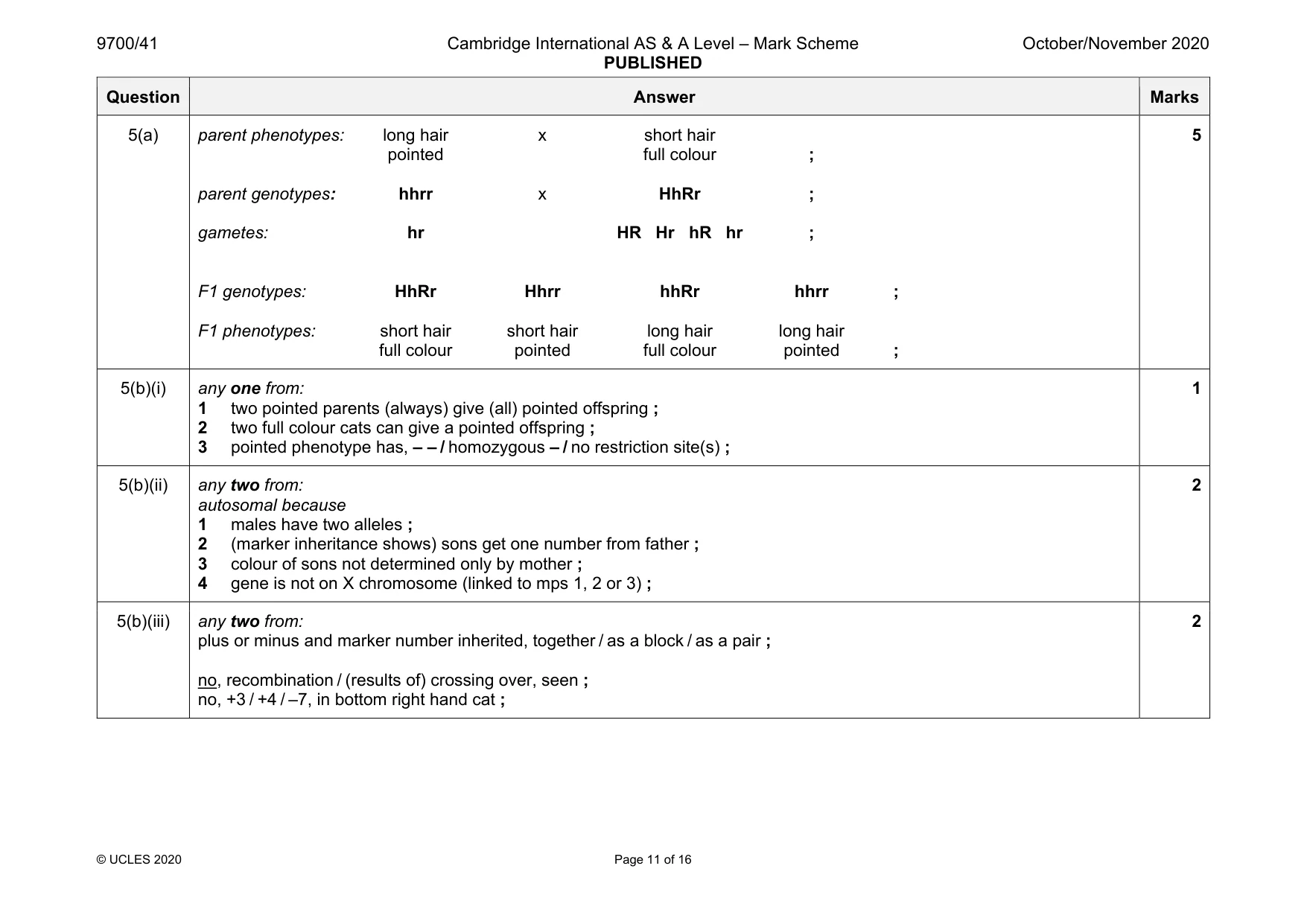
Mark scheme: 5(a) parent phenotypes: long hair x short hair pointed full colour ; parent genotypes: hhrr x HhRr ; gametes: hr HR Hr hR hr ; F1 genotypes: HhRr Hhrr hhRr hhrr ; F1 phenotypes: short hair short hair long hair long hair full colour pointed full colour pointed ; 5 5(b)(i) any one from: 1 two pointed parents (always) give (all) pointed offspring ; 2 two full colour cats can give a pointed offspring ; 3 pointed phenotype has, – – / homozygous – / no restriction site(s) ; 1 5(b)(ii) any two from: autosomal because 1 males have two alleles ; 2 (marker inheritance shows) sons get one number from father ; 3 colour of sons not determined only by mother ; 4 gene is not on X chromosome (linked to mps 1, 2 or 3) ; 2 5(b)(iii) any two from: plus or minus and marker number inherited, together / as a block / as a pair ; no, recombination / (results of) crossing over, seen ; no, +3 / +4 / –7, in bottom right hand cat ; 2
More questions on Passage of information from parents to offspring
Q6 · Identify the precise location in a cholinergic synapse that is described in each of the…
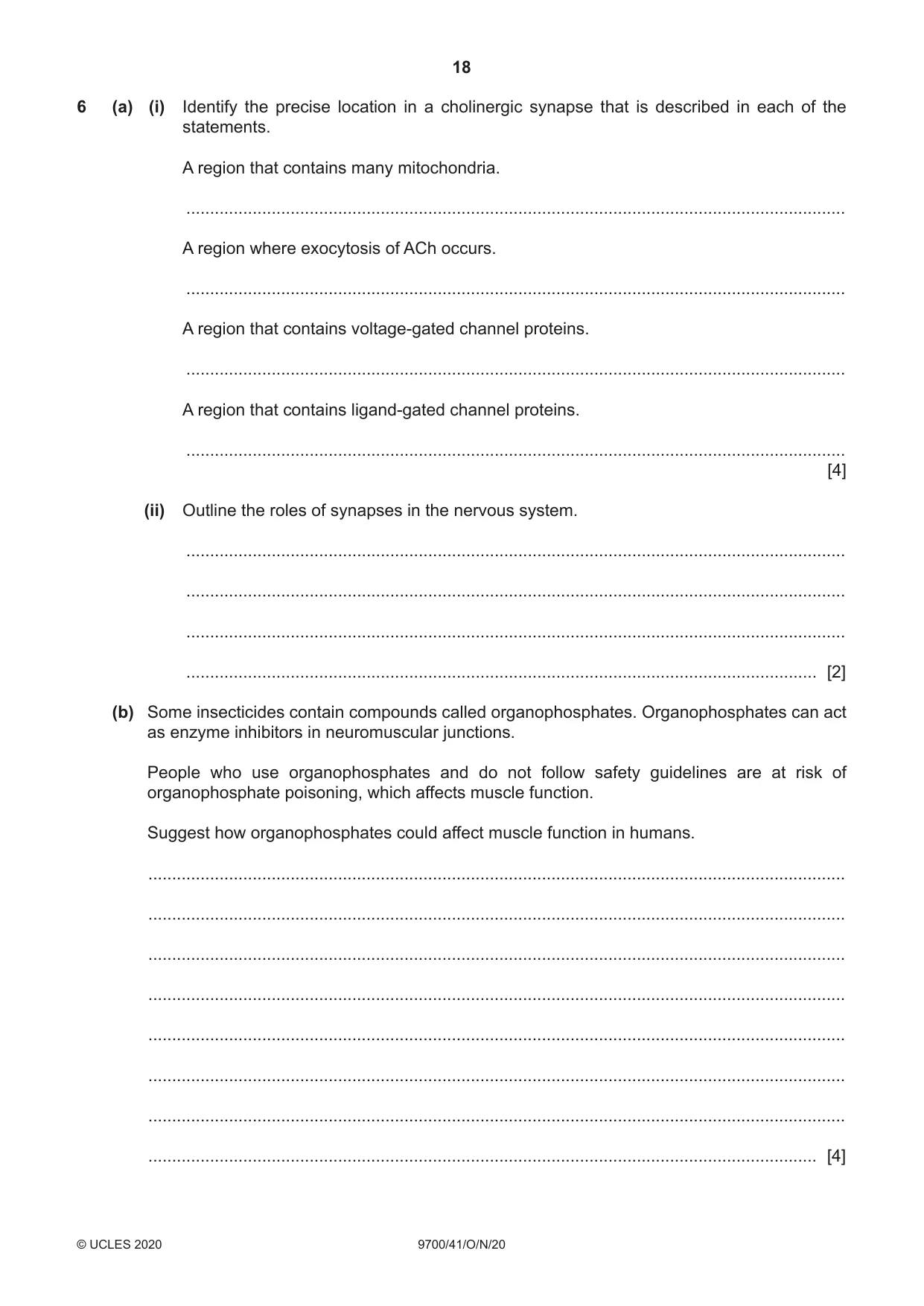
6 (a) (i) Identify the precise location in a cholinergic synapse that is described in each of the statements. A region that contains many mitochondria. ........................................................................................................................................... A region where exocytosis of ACh occurs. ........................................................................................................................................... A region that contains voltage-gated channel proteins. ........................................................................................................................................... A region that contains ligand-gated channel proteins. ........................................................................................................................................... [4] (ii) Outline the roles of synapses in the nervous system. ........................................................................................................................................... ........................................................................................................................................... ........................................................................................................................................... ..................................................................................................................................... [2] (b) Some insecticides contain compounds called organophosphates. Organophosphates can act as enzyme inhibitors in neuromuscular junctions. People who use organophosphates and do not follow safety guidelines are at risk of organophosphate poisoning, which affects muscle function. Suggest how organophosphates could affect muscle function in humans. ................................................................................................................................................... ................................................................................................................................................... ................................................................................................................................................... ................................................................................................................................................... ................................................................................................................................................... ................................................................................................................................................... ................................................................................................................................................... ............................................................................................................................................. [4] (c) Outline the role of the sarcoplasmic reticulum in the contraction of striated muscle. ................................................................................................................................................... ................................................................................................................................................... ................................................................................................................................................... ................................................................................................................................................... ............................................................................................................................................. [2] [Total: 12]
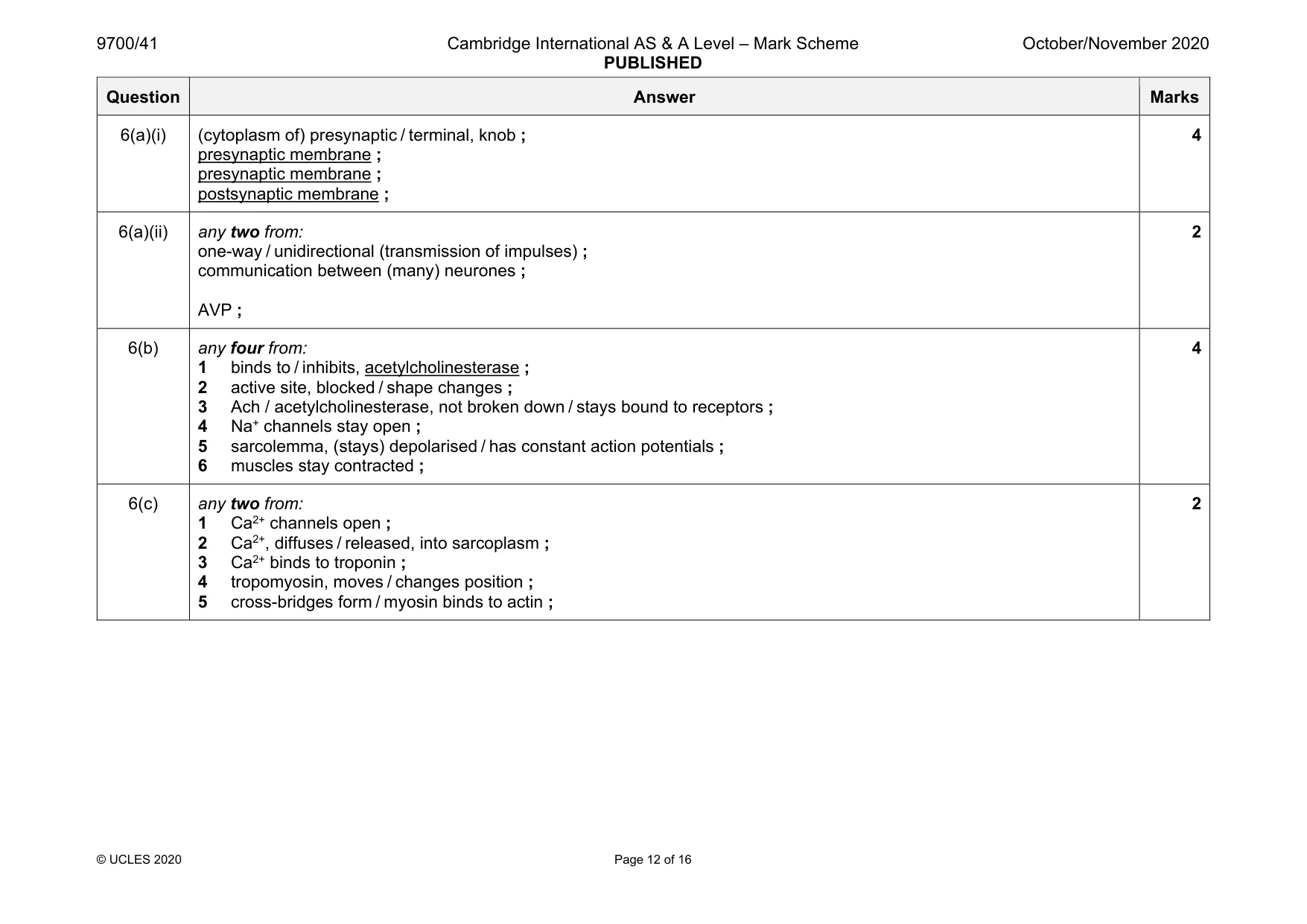
Mark scheme: 6(a)(i) (cytoplasm of) presynaptic / terminal, knob ; presynaptic membrane ; presynaptic membrane ; postsynaptic membrane ; 4 6(a)(ii) any two from: one-way / unidirectional (transmission of impulses) ; communication between (many) neurones ; AVP ; 2 6(b) any four from: 1 binds to / inhibits, acetylcholinesterase ; 2 active site, blocked / shape changes ; 3 Ach / acetylcholinesterase, not broken down / stays bound to receptors ; 4 Na+ channels stay open ; 5 sarcolemma, (stays) depolarised / has constant action potentials ; 6 muscles stay contracted ; 4 6(c) any two from: 1 Ca2+ channels open ; 2 Ca2+, diffuses / released, into sarcoplasm ; 3 Ca2+ binds to troponin ; 4 tropomyosin, moves / changes position ; 5 cross-bridges form / myosin binds to actin ; 2
Q7 · Structures and compounds involved in respiration in anaerobic conditions include: A…
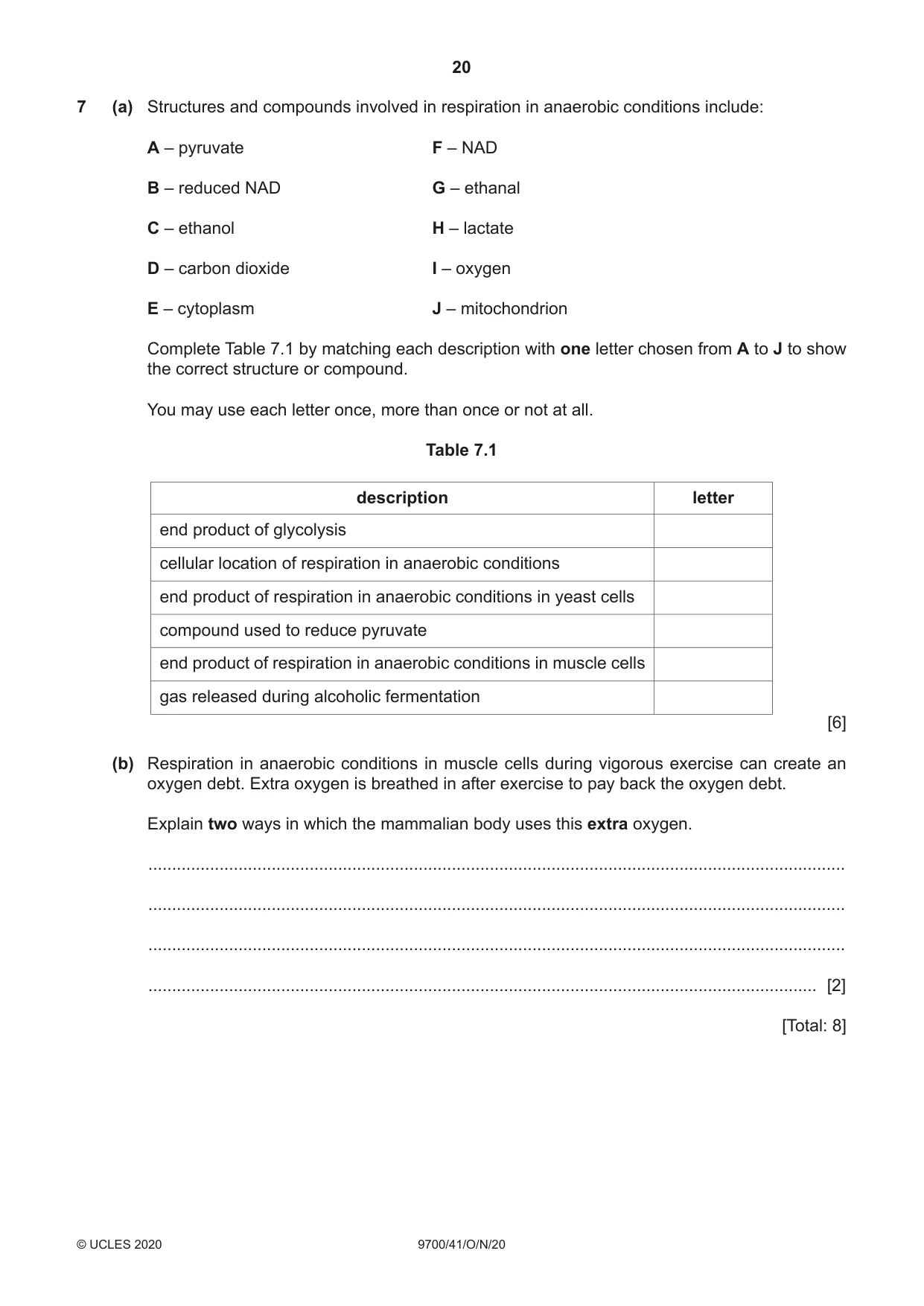
7 (a) Structures and compounds involved in respiration in anaerobic conditions include: A – pyruvate F – NAD B – reduced NAD G – ethanal C – ethanol H – lactate D – carbon dioxide I – oxygen E – cytoplasm J – mitochondrion Complete Table 7.1 by matching each description with one letter chosen from A to J to show the correct structure or compound. You may use each letter once, more than once or not at all. Table 7.1 description letter end product of glycolysis cellular location of respiration in anaerobic conditions end product of respiration in anaerobic conditions in yeast cells compound used to reduce pyruvate end product of respiration in anaerobic conditions in muscle cells gas released during alcoholic fermentation [6] (b) Respiration in anaerobic conditions in muscle cells during vigorous exercise can create an oxygen debt. Extra oxygen is breathed in after exercise to pay back the oxygen debt. Explain two ways in which the mammalian body uses this extra oxygen. ................................................................................................................................................... ................................................................................................................................................... ................................................................................................................................................... ............................................................................................................................................. [2] [Total: 8]
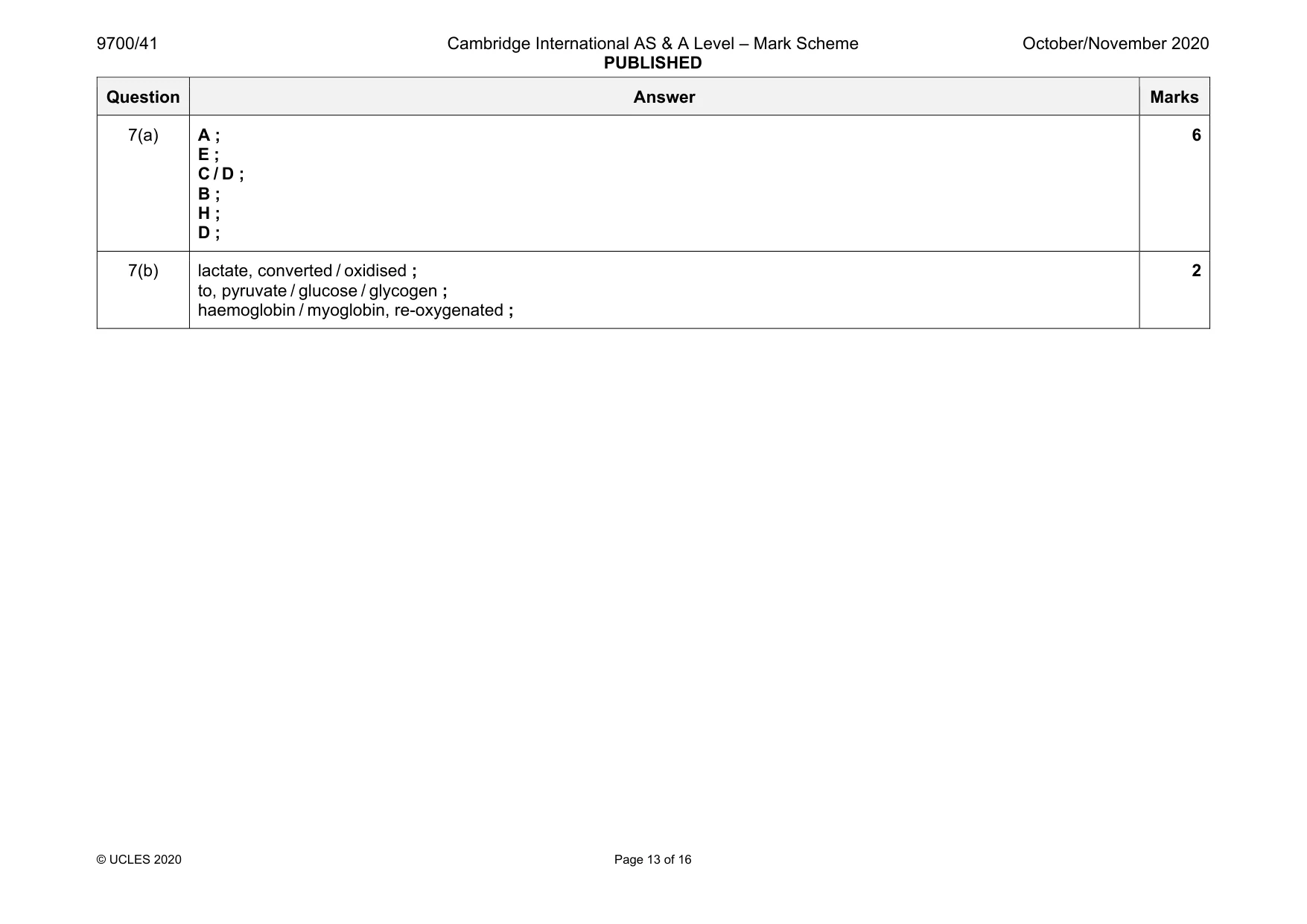
Mark scheme: 7(a) A ; E ; C / D ; B ; H ; D ; 6 7(b) lactate, converted / oxidised ; to, pyruvate / glucose / glycogen ; haemoglobin / myoglobin, re-oxygenated ; 2
Q8 · Palm oil is a vegetable oil that is used very widely in food products
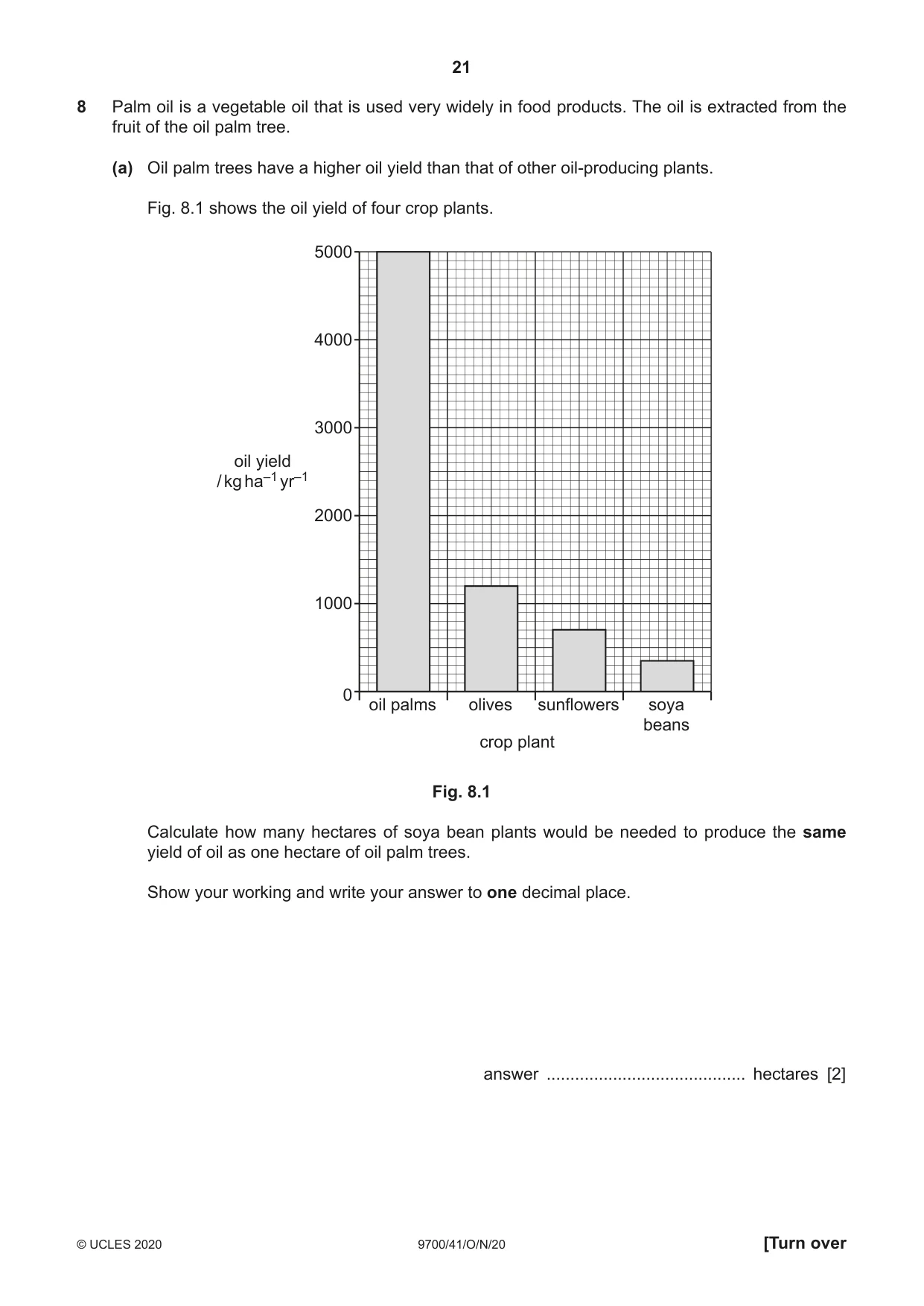
8 Palm oil is a vegetable oil that is used very widely in food products. The oil is extracted from the fruit of the oil palm tree. (a) Oil palm trees have a higher oil yield than that of other oil-producing plants. Fig. 8.1 shows the oil yield of four crop plants. 5000 4000 3000 oil yield / kg ha–1 yr–1 2000 1000 0 oil palms olives sunflowers soya beans crop plant Fig. 8.1 Calculate how many hectares of soya bean plants would be needed to produce the same yield of oil as one hectare of oil palm trees. Show your working and write your answer to one decimal place. answer .......................................... hectares [2] (b) Oil palm plantations in Malaysia and Indonesia have been created by cutting down rainforests. This reduces biodiversity. Outline reasons why it is important to maintain biodiversity. ................................................................................................................................................... ................................................................................................................................................... ................................................................................................................................................... ................................................................................................................................................... ................................................................................................................................................... ................................................................................................................................................... ................................................................................................................................................... ................................................................................................................................................... ................................................................................................................................................... ................................................................................................................................................... ............................................................................................................................................. [5] (c) Palm oil companies are now being asked to produce palm oil in a sustainable way. This means that no more deforestation should take place. Suggest ways in which individual consumers can encourage manufacturers to use palm oil from sustainable sources. ................................................................................................................................................... ................................................................................................................................................... ................................................................................................................................................... ................................................................................................................................................... ................................................................................................................................................... ............................................................................................................................................. [2] [Total: 9]
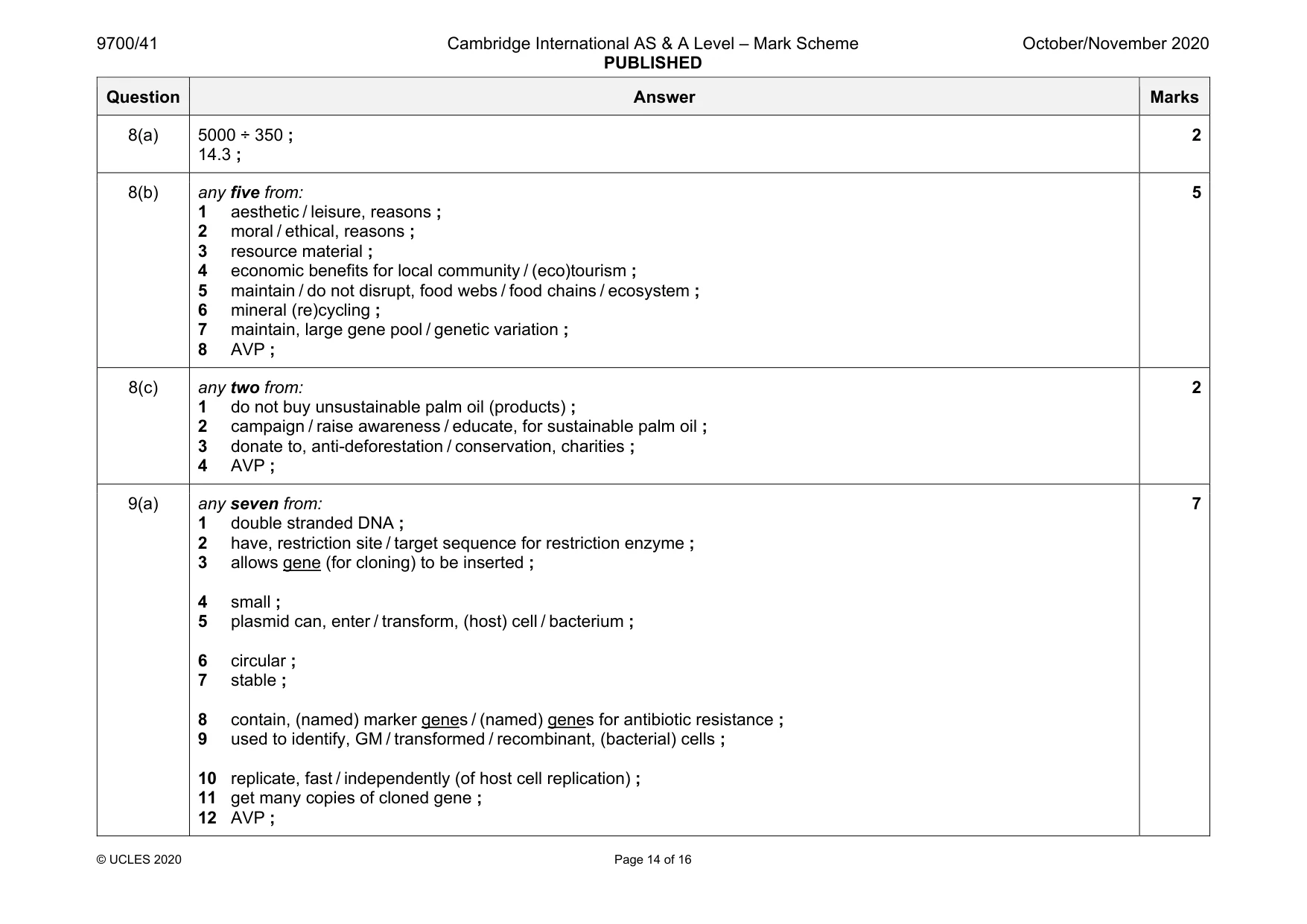
Mark scheme: 8(a) 5000 ÷ 350 ; 14.3 ; 2 8(b) any five from: 1 aesthetic / leisure, reasons ; 2 moral / ethical, reasons ; 3 resource material ; 4 economic benefits for local community / (eco)tourism ; 5 maintain / do not disrupt, food webs / food chains / ecosystem ; 6 mineral (re)cycling ; 7 maintain, large gene pool / genetic variation ; 8 AVP ; 5 8(c) any two from: 1 do not buy unsustainable palm oil (products) ; 2 campaign / raise awareness / educate, for sustainable palm oil ; 3 donate to, anti-deforestation / conservation, charities ; 4 AVP ; 2 7
Q9 · Describe and explain the properties of plasmids that allow them to be used in gene cloning
9 (a) Describe and explain the properties of plasmids that allow them to be used in gene cloning. [7] (b) Explain the roles of restriction endonucleases, ligases and reverse transcriptase in genetic engineering. [8] [Total: 15]
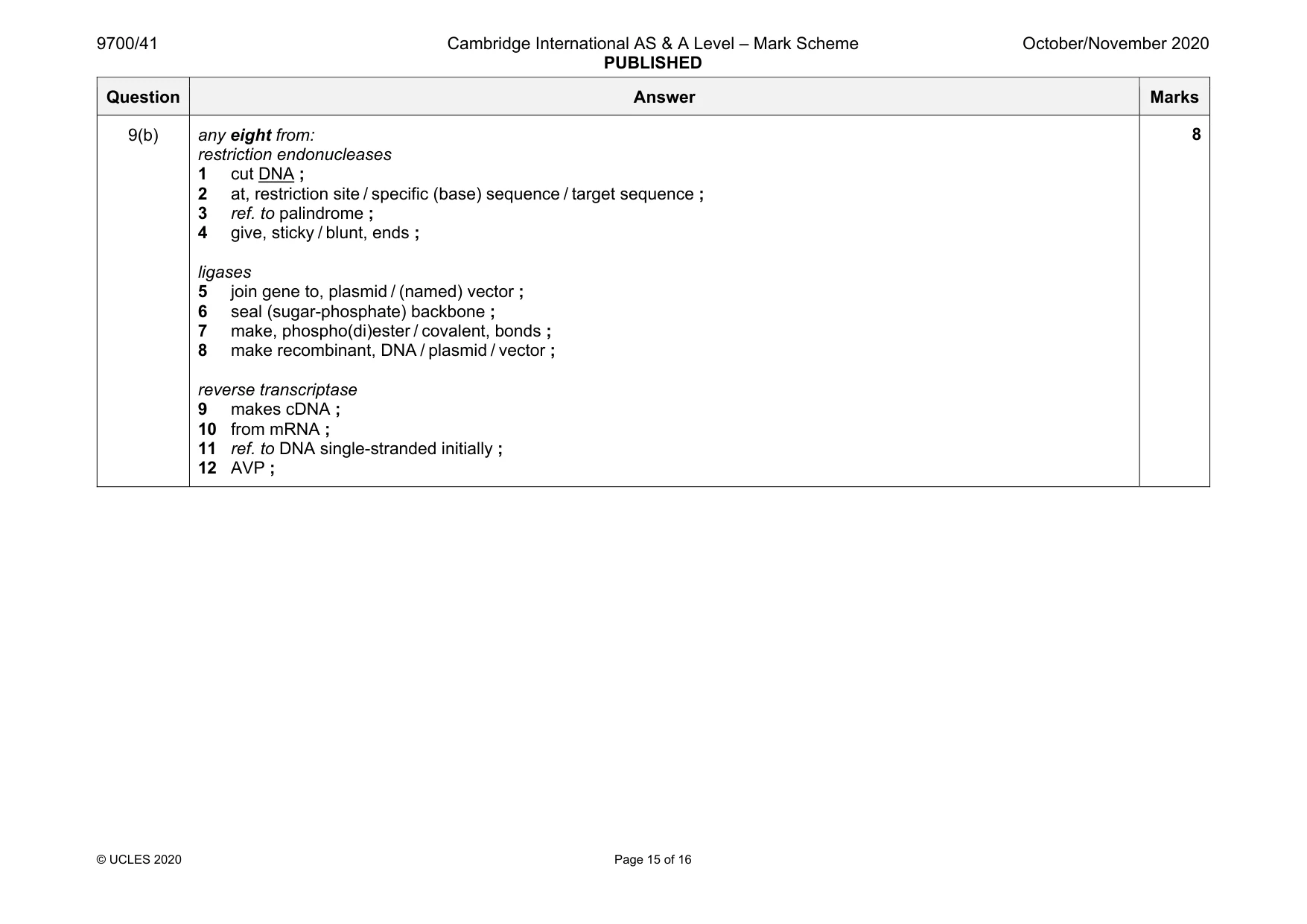
Mark scheme: 9(a) any seven from: 1 double stranded DNA ; 2 have, restriction site / target sequence for restriction enzyme ; 3 allows gene (for cloning) to be inserted ; 4 small ; 5 plasmid can, enter / transform, (host) cell / bacterium ; 6 circular ; 7 stable ; 8 contain, (named) marker genes / (named) genes for antibiotic resistance ; 9 used to identify, GM / transformed / recombinant, (bacterial) cells ; 10 replicate, fast / independently (of host cell replication) ; 11 get many copies of cloned gene ; 12 AVP ; Question Answer Marks 9(b) any eight from: restriction endonucleases 1 cut DNA ; 2 at, restriction site / specific (base) sequence / target sequence ; 3 ref. to palindrome ; 4 give, sticky / blunt, ends ; ligases 5 join gene to, plasmid / (named) vector ; 6 seal (sugar-phosphate) backbone ; 7 make, phospho(di)ester / covalent, bonds ; 8 make recombinant, DNA / plasmid / vector ; reverse transcriptase 9 makes cDNA ; 10 from mRNA ; 11 ref. to DNA single-stranded initially ; 12 AVP ; 8
Q10 · Describe how adrenaline can stimulate liver cells to convert glycogen to glucose
10 (a) Describe how adrenaline can stimulate liver cells to convert glycogen to glucose. [7] (b) Describe the role of abscisic acid (ABA) in the closure of stomata during times of drought. [8] [Total: 15] .................................................................................................................................................................. .................................................................................................................................................................. .................................................................................................................................................................. .................................................................................................................................................................. .................................................................................................................................................................. .................................................................................................................................................................. .................................................................................................................................................................. .................................................................................................................................................................. .................................................................................................................................................................. .................................................................................................................................................................. .................................................................................................................................................................. .................................................................................................................................................................. .................................................................................................................................................................. .................................................................................................................................................................. .................................................................................................................................................................. .................................................................................................................................................................. .................................................................................................................................................................. .................................................................................................................................................................. .................................................................................................................................................................. .................................................................................................................................................................. .................................................................................................................................................................. .................................................................................................................................................................. .................................................................................................................................................................. .................................................................................................................................................................. .................................................................................................................................................................. .................................................................................................................................................................. .................................................................................................................................................................. .................................................................................................................................................................. .................................................................................................................................................................. .................................................................................................................................................................. .................................................................................................................................................................. .................................................................................................................................................................. .................................................................................................................................................................. .................................................................................................................................................................. .................................................................................................................................................................. .................................................................................................................................................................. .................................................................................................................................................................. .................................................................................................................................................................. .................................................................................................................................................................. .................................................................................................................................................................. .................................................................................................................................................................. .................................................................................................................................................................. .................................................................................................................................................................. .................................................................................................................................................................. .................................................................................................................................................................. .................................................................................................................................................................. .................................................................................................................................................................. .................................................................................................................................................................. .................................................................................................................................................................. .................................................................................................................................................................. .................................................................................................................................................................. .................................................................................................................................................................. .................................................................................................................................................................. .................................................................................................................................................................. .................................................................................................................................................................. .................................................................................................................................................................. .................................................................................................................................................................. .................................................................................................................................................................. .................................................................................................................................................................. .................................................................................................................................................................. .................................................................................................................................................................. .................................................................................................................................................................. .................................................................................................................................................................. .................................................................................................................................................................. .................................................................................................................................................................. .................................................................................................................................................................. .................................................................................................................................................................. .................................................................................................................................................................. .................................................................................................................................................................. .................................................................................................................................................................. .................................................................................................................................................................. .................................................................................................................................................................. ..................................................................................................................................................................
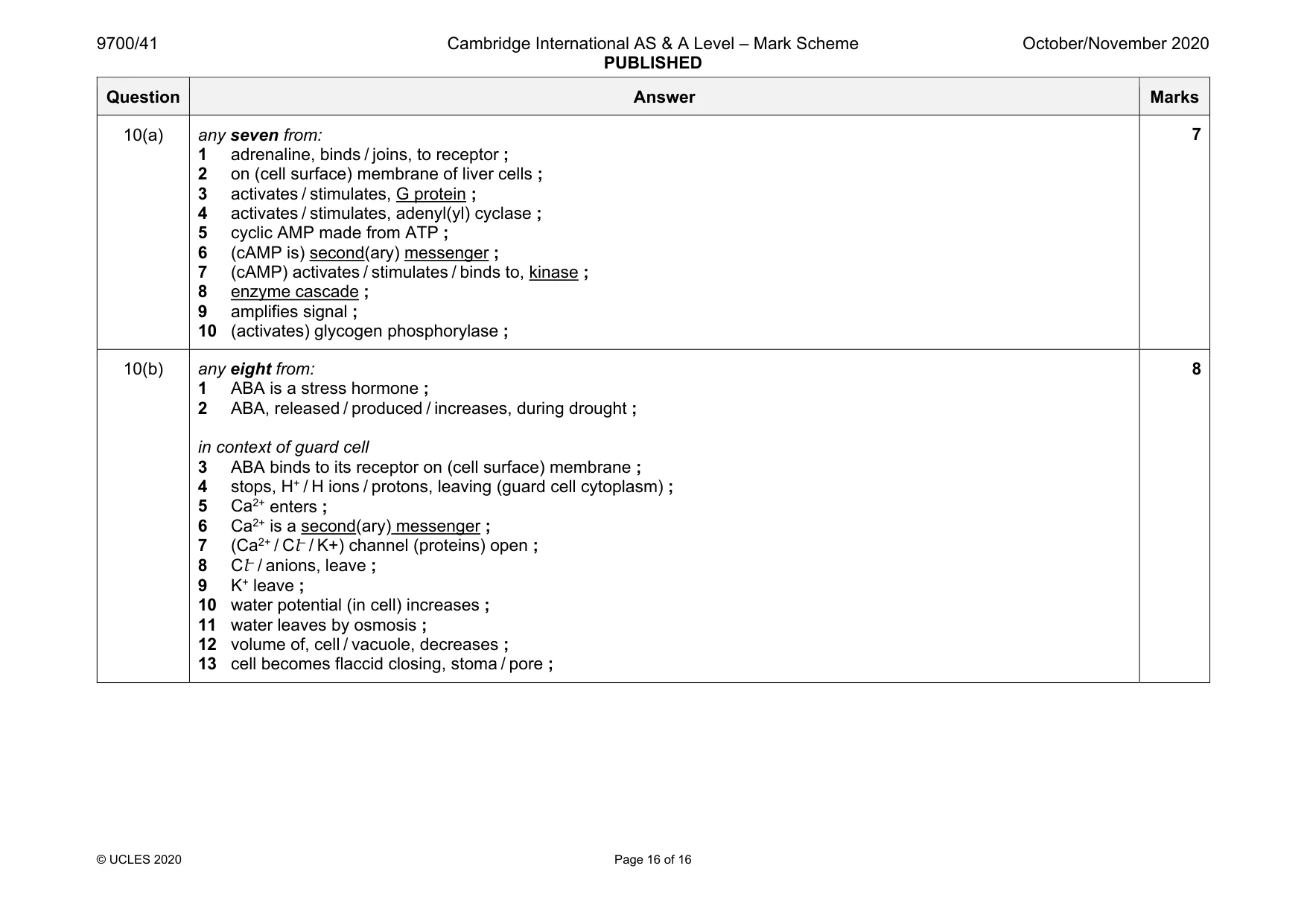
Mark scheme: 10(a) any seven from: 1 adrenaline, binds / joins, to receptor ; 2 on (cell surface) membrane of liver cells ; 3 activates / stimulates, G protein ; 4 activates / stimulates, adenyl(yl) cyclase ; 5 cyclic AMP made from ATP ; 6 (cAMP is) second(ary) messenger ; 7 (cAMP) activates / stimulates / binds to, kinase ; 8 enzyme cascade ; 9 amplifies signal ; 10 (activates) glycogen phosphorylase ; 10(b) any eight from: 1 ABA is a stress hormone ; 2 ABA, released / produced / increases, during drought ; in context of guard cell 3 ABA binds to its receptor on (cell surface) membrane ; 4 stops, H+ / H ions / protons, leaving (guard cell cytoplasm) ; 5 Ca2+ enters ; 6 Ca2+ is a second(ary) messenger ; 7 (Ca2+ / Cl– / K+) channel (proteins) open ; 8 Cl– / anions, leave ; 9 K+ leave ; 10 water potential (in cell) increases ; 11 water leaves by osmosis ; 12 volume of, cell / vacuole, decreases ; 13 cell becomes flaccid closing, stoma / pore ; 8
What was in this paper
The subtopics covered by these 10 questions, and how many questions each got. Open one in a new tab to see every Cambridge question on it.
What you needed in this session
Cambridge’s own grade thresholds for 2020 Oct/Nov, Paper 4 · Variant 1. A higher threshold means an easier paper — the bar moves with how the cohort did.