Cambridge A Level Biology 9700 — 2020 May/June Paper 5 · Variant 2
9700/52/M/J/20
The question paper and its mark scheme, free to read here and free to download. This is Cambridge’s own paper, exactly as it was sat.
Question paper12 pages


Mark scheme9 pages
Answers below. Sit the paper first if you are practising.
Paper as text
Question paper, page 1
Cambridge International AS & A Level DC (JC/JG) 185288/3 © UCLES 2020 [Turn over This document has 12 pages. Blank pages are indicated. * 6 7 4 5 9 3 3 8 5 3 * BIOLOGY 9700/52 Paper 5 Planning, Analysis and Evaluation May/June 2020 1 hour 15 minutes You must answer on the question paper. No additional materials are needed. INSTRUCTIONS ● Answer all questions. ● Use a black or dark blue pen. You may use an HB pencil for any diagrams or graphs. ● Write your name, centre number and candidate number in the boxes at the top of the page. ● Write your answer to each question in the space provided. ● Do not use an erasable pen or correction fluid. ● Do not write on any bar codes. ● You may use a calculator. ● You should show all your working and use appropriate units. INFORMATION ● The total mark for this paper is 30. ● The number of marks for each question or part question is shown in brackets [ ].
Question paper, page 2
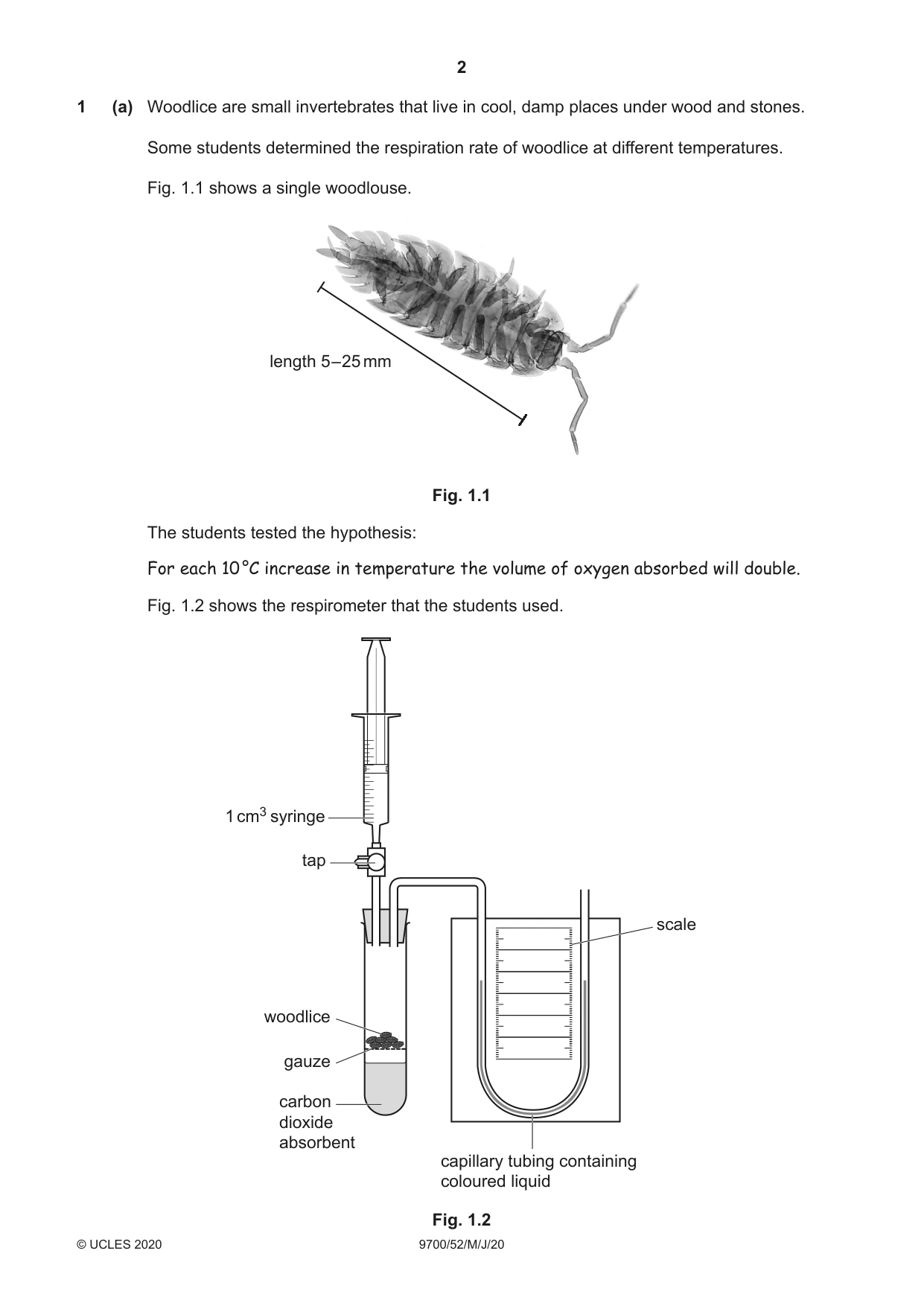
2 9700/52/M/J/20 © UCLES 2020 1 (a) Woodlice are small invertebrates that live in cool, damp places under wood and stones. Some students determined the respiration rate of woodlice at different temperatures. Fig. 1.1 shows a single woodlouse. length 5–25 mm Fig. 1.1 The students tested the hypothesis: For each 10 °C increase in temperature the volume of oxygen absorbed will double. Fig. 1.2 shows the respirometer that the students used. carbon dioxide absorbent capillary tubing containing coloured liquid scale gauze woodlice tap 1 cm3 syringe Fig. 1.2
Question paper, page 3
3 9700/52/M/J/20 © UCLES 2020 [Turn over (i) State the independent variable and the dependent variable in this investigation. independent variable … … dependent variable … … [2] (ii) The students decided to measure oxygen uptake for 5 minutes using a range of temperatures from 5 °C to 35 °C. Suggest why the students chose this range of temperatures and suggest a suitable interval that the students should use. … … … … … [2] (iii) State a suitable control for this investigation. … … [1] (iv) State why the carbon dioxide absorbent solution was placed in the tube. … … … [1] (v) Suggest one variable in this investigation that cannot be standardised. … … [1]
Question paper, page 4
4 9700/52/M/J/20 © UCLES 2020 (b) (i) Describe a method by which the students could set up the respirometer and use it to test their hypothesis: For each 10 °C increase in temperature the volume of oxygen absorbed will double. Your method should be set out in a logical order and be detailed enough to let another person follow it. … … … … … … … … … … … … … … … … … … … … … … … [7]
Question paper, page 5
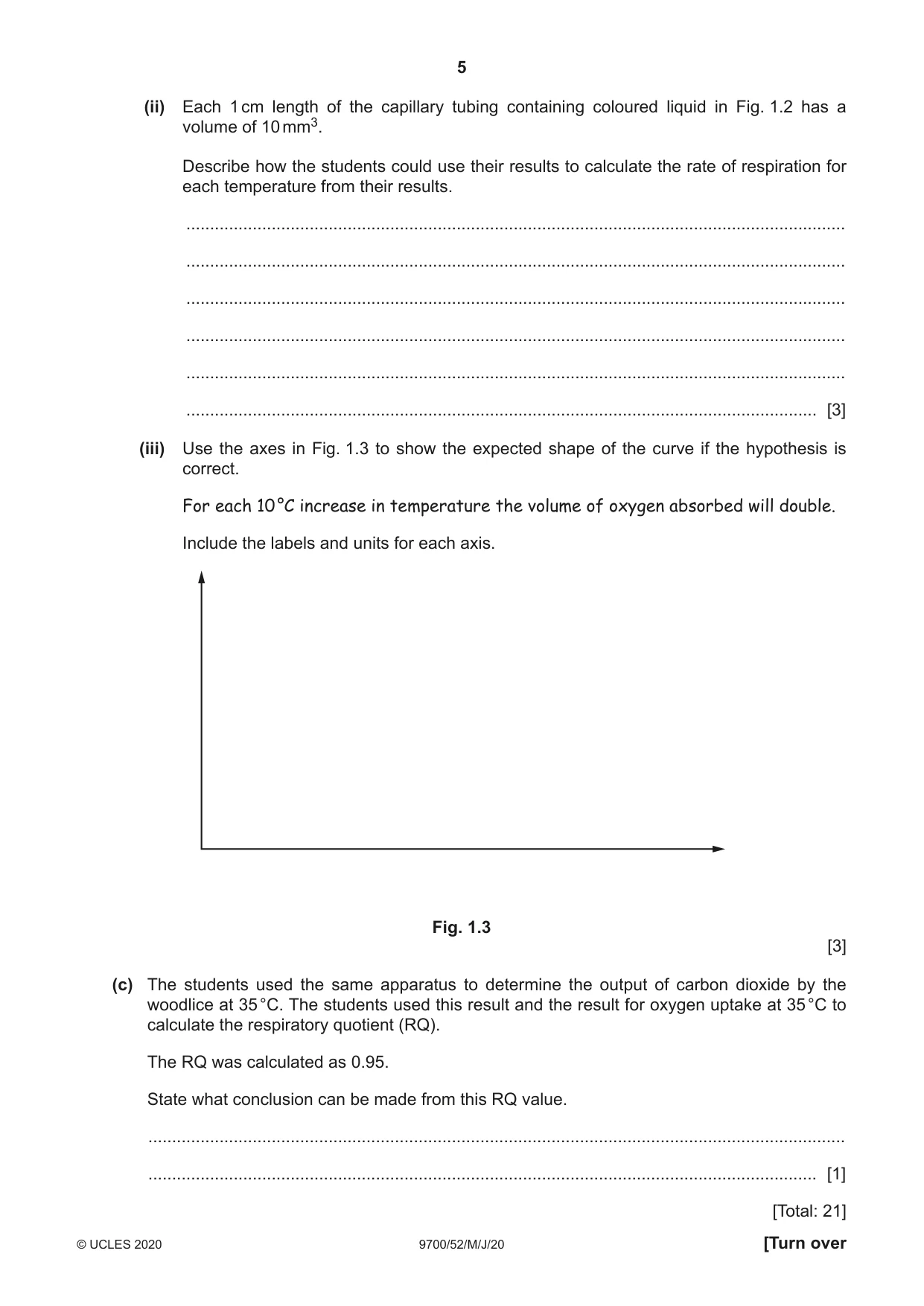
5 9700/52/M/J/20 © UCLES 2020 [Turn over (ii) Each 1 cm length of the capillary tubing containing coloured liquid in Fig. 1.2 has a volume of 10 mm3. Describe how the students could use their results to calculate the rate of respiration for each temperature from their results. … … … … … … [3] (iii) Use the axes in Fig. 1.3 to show the expected shape of the curve if the hypothesis is correct. For each 10 °C increase in temperature the volume of oxygen absorbed will double. Include the labels and units for each axis. Fig. 1.3 [3] (c) The students used the same apparatus to determine the output of carbon dioxide by the woodlice at 35 °C. The students used this result and the result for oxygen uptake at 35 °C to calculate the respiratory quotient (RQ). The RQ was calculated as 0.95. State what conclusion can be made from this RQ value. … … [1] [Total: 21]
Question paper, page 6
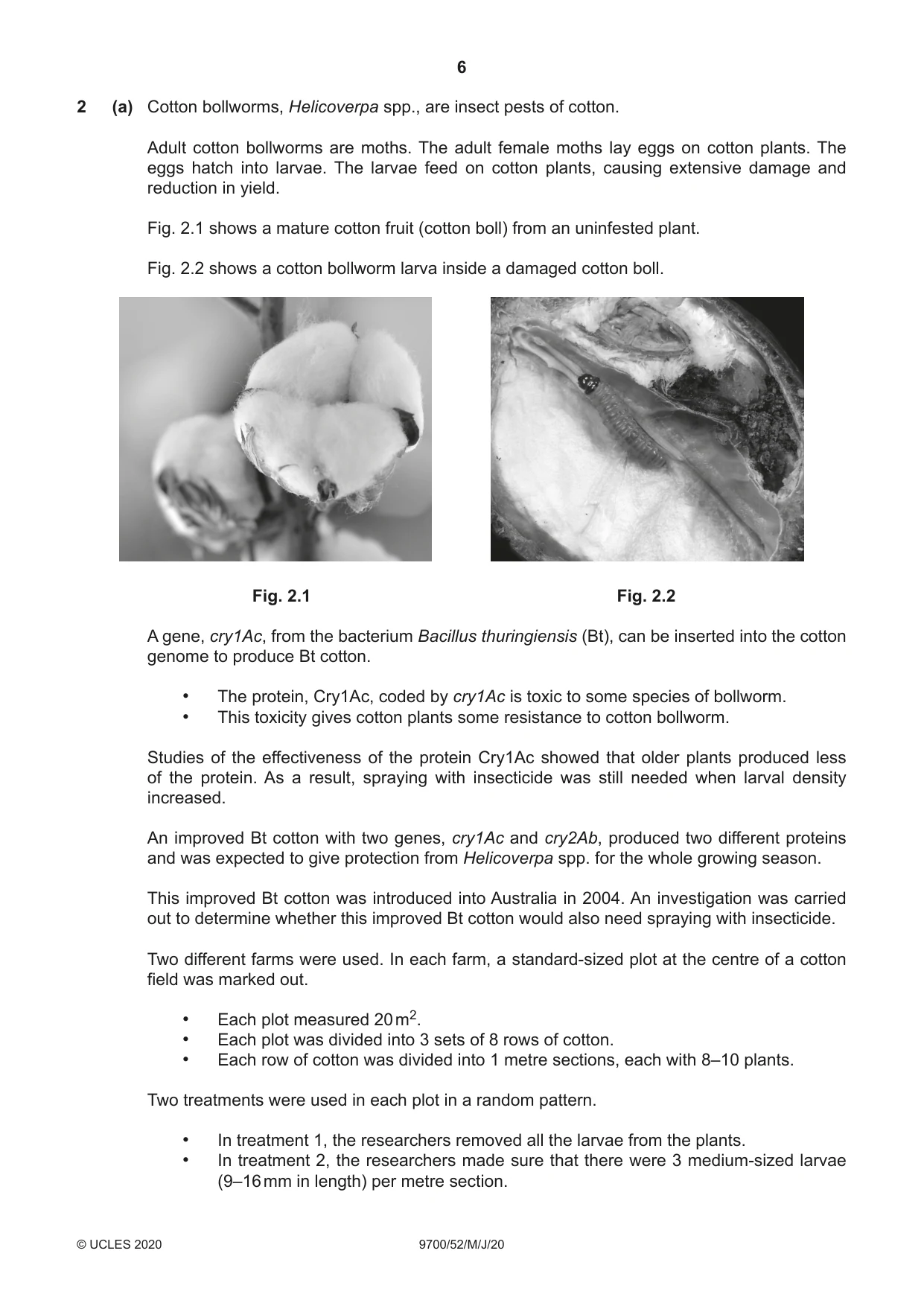
6 9700/52/M/J/20 © UCLES 2020 2 (a) Cotton bollworms, Helicoverpa spp., are insect pests of cotton. Adult cotton bollworms are moths. The adult female moths lay eggs on cotton plants. The eggs hatch into larvae. The larvae feed on cotton plants, causing extensive damage and reduction in yield. Fig. 2.1 shows a mature cotton fruit (cotton boll) from an uninfested plant. Fig. 2.2 shows a cotton bollworm larva inside a damaged cotton boll. Fig. 2.1 Fig. 2.2 A gene, cry1Ac, from the bacterium Bacillus thuringiensis (Bt), can be inserted into the cotton genome to produce Bt cotton. • The protein, Cry1Ac, coded by cry1Ac is toxic to some species of bollworm. • This toxicity gives cotton plants some resistance to cotton bollworm. Studies of the effectiveness of the protein Cry1Ac showed that older plants produced less of the protein. As a result, spraying with insecticide was still needed when larval density increased. An improved Bt cotton with two genes, cry1Ac and cry2Ab, produced two different proteins and was expected to give protection from Helicoverpa spp. for the whole growing season. This improved Bt cotton was introduced into Australia in 2004. An investigation was carried out to determine whether this improved Bt cotton would also need spraying with insecticide. Two different farms were used. In each farm, a standard-sized plot at the centre of a cotton field was marked out. • Each plot measured 20 m2. • Each plot was divided into 3 sets of 8 rows of cotton. • Each row of cotton was divided into 1 metre sections, each with 8–10 plants. Two treatments were used in each plot in a random pattern. • In treatment 1, the researchers removed all the larvae from the plants. • In treatment 2, the researchers made sure that there were 3 medium-sized larvae (9–16 mm in length) per metre section.
Question paper, page 7
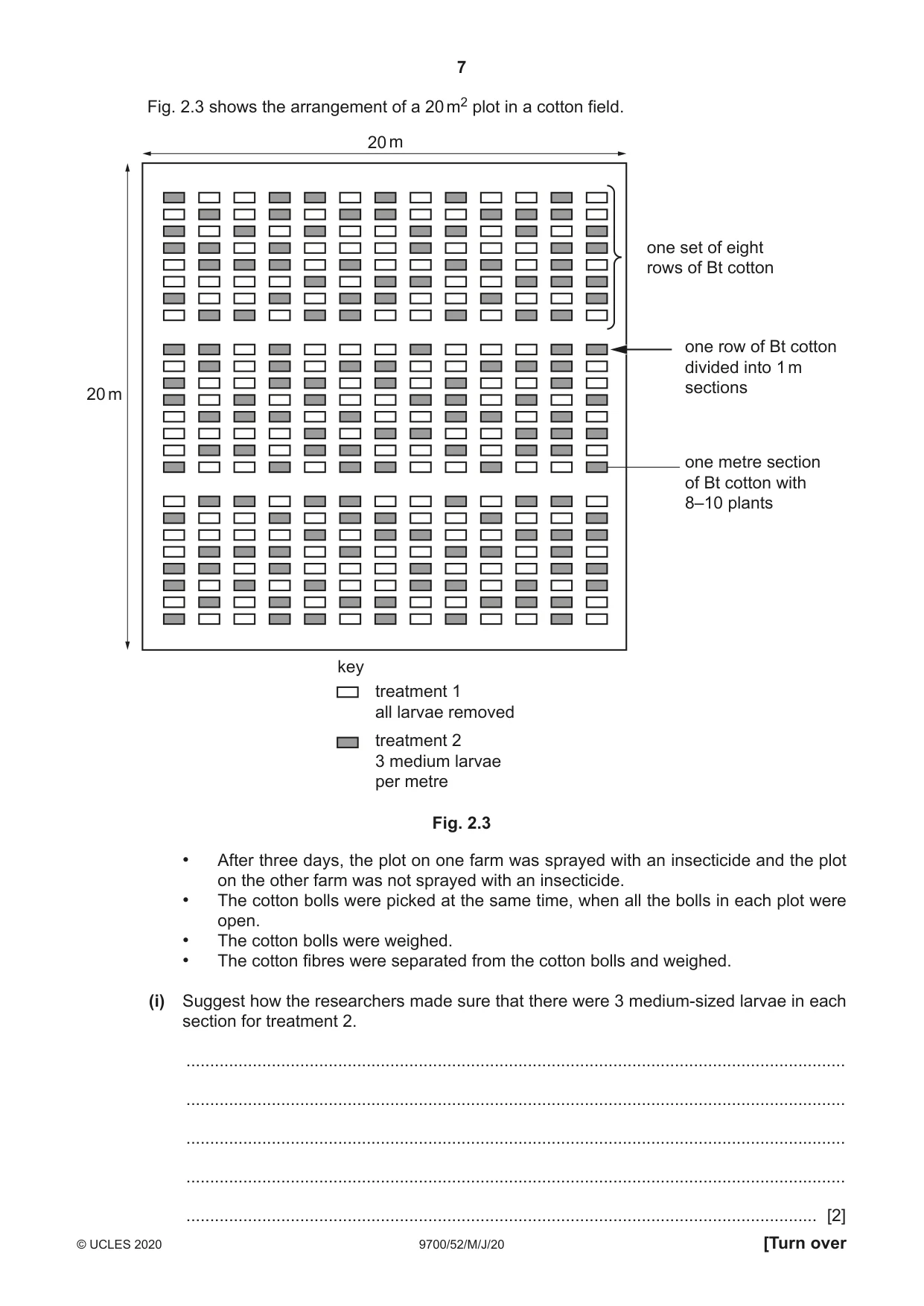
7 9700/52/M/J/20 © UCLES 2020 [Turn over Fig. 2.3 shows the arrangement of a 20 m2 plot in a cotton field. 20 m 20 m one set of eight rows of Bt cotton one row of Bt cotton divided into 1 m sections one metre section of Bt cotton with 8–10 plants key treatment 1 all larvae removed treatment 2 3 medium larvae per metre Fig. 2.3 • After three days, the plot on one farm was sprayed with an insecticide and the plot on the other farm was not sprayed with an insecticide. • The cotton bolls were picked at the same time, when all the bolls in each plot were open. • The cotton bolls were weighed. • The cotton fibres were separated from the cotton bolls and weighed. (i) Suggest how the researchers made sure that there were 3 medium-sized larvae in each section for treatment 2. … … … … … [2]
Question paper, page 8
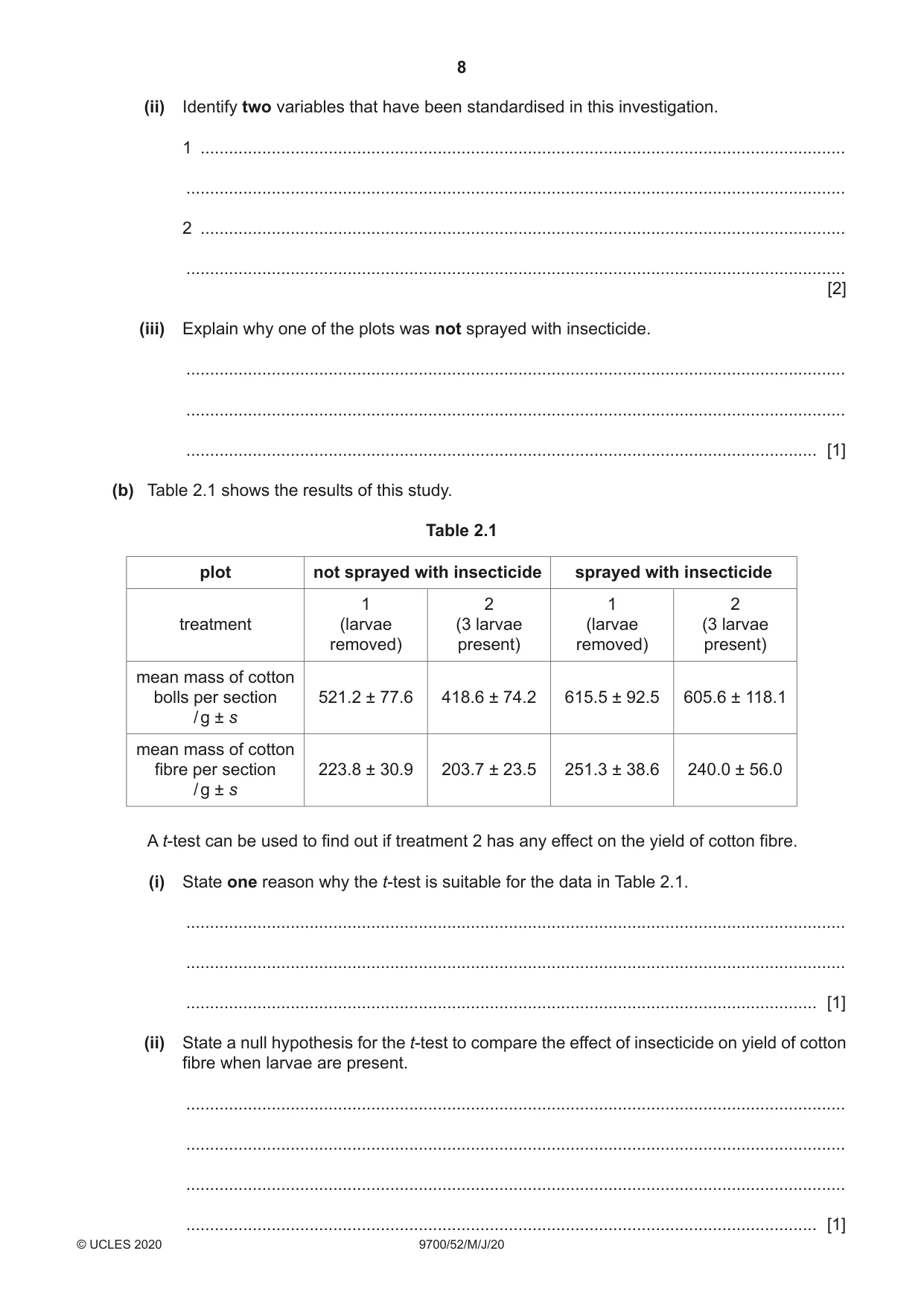
8 9700/52/M/J/20 © UCLES 2020 (ii) Identify two variables that have been standardised in this investigation. 1 … … 2 … … [2] (iii) Explain why one of the plots was not sprayed with insecticide. … … … [1] (b) Table 2.1 shows the results of this study. Table 2.1 plot not sprayed with insecticide sprayed with insecticide treatment 1 (larvae removed) 2 (3 larvae present) 1 (larvae removed) 2 (3 larvae present) mean mass of cotton bolls per section / g ± s 521.2 ± 77.6 418.6 ± 74.2 615.5 ± 92.5 605.6 ± 118.1 mean mass of cotton fibre per section / g ± s 223.8 ± 30.9 203.7 ± 23.5 251.3 ± 38.6 240.0 ± 56.0 A t-test can be used to find out if treatment 2 has any effect on the yield of cotton fibre. (i) State one reason why the t-test is suitable for the data in Table 2.1. … … … [1] (ii) State a null hypothesis for the t-test to compare the effect of insecticide on yield of cotton fibre when larvae are present. … … … … [1]
Question paper, page 9
9 9700/52/M/J/20 © UCLES 2020 (c) The researchers were trying to find out if farmers growing improved Bt cotton will benefit from spraying the improved Bt cotton with insecticide to control cotton bollworm infestations. Comment on whether the results in Table 2.1 show that improved Bt cotton should be sprayed with insecticide. … … … … … … … [2] [Total: 9]
Question paper, page 10
10 9700/52/M/J/20 © UCLES 2020 BLANK PAGE
Question paper, page 11
11 9700/52/M/J/20 © UCLES 2020 BLANK PAGE
Question paper, page 12
12 9700/52/M/J/20 © UCLES 2020 Permission to reproduce items where third-party owned material protected by copyright is included has been sought and cleared where possible. Every reasonable effort has been made by the publisher (UCLES) to trace copyright holders, but if any items requiring clearance have unwittingly been included, the publisher will be pleased to make amends at the earliest possible opportunity. To avoid the issue of disclosure of answer-related information to candidates, all copyright acknowledgements are reproduced online in the Cambridge Assessment International Education Copyright Acknowledgements Booklet. This is produced for each series of examinations and is freely available to download at www.cambridgeinternational.org after the live examination series. Cambridge Assessment International Education is part of the Cambridge Assessment Group. Cambridge Assessment is the brand name of the University of Cambridge Local Examinations Syndicate (UCLES), which itself is a department of the University of Cambridge. BLANK PAGE
Mark scheme, page 1
This document consists of 9 printed pages. © UCLES 2020 [Turn over Cambridge International AS & A Level BIOLOGY 9700/52 Paper 5 Planning, Analysis and Evaluation May/June 2020 MARK SCHEME Maximum Mark: 30 Published Students did not sit exam papers in the June 2020 series due to the Covid-19 global pandemic. This mark scheme is published to support teachers and students and should be read together with the question paper. It shows the requirements of the exam. The answer column of the mark scheme shows the proposed basis on which Examiners would award marks for this exam. Where appropriate, this column also provides the most likely acceptable alternative responses expected from students. Examiners usually review the mark scheme after they have seen student responses and update the mark scheme if appropriate. In the June series, Examiners were unable to consider the acceptability of alternative responses, as there were no student responses to consider. Mark schemes should usually be read together with the Principal Examiner Report for Teachers. However, because students did not sit exam papers, there is no Principal Examiner Report for Teachers for the June 2020 series. Cambridge International will not enter into discussions about these mark schemes. Cambridge International is publishing the mark schemes for the June 2020 series for most Cambridge IGCSE™ and Cambridge International A & AS Level components, and some Cambridge O Level components.
Mark scheme, page 2
9700/52 Cambridge International AS & A Level – Mark Scheme PUBLISHED May/June 2020 © UCLES 2020 Page 2 of 9 Generic Marking Principles These general marking principles must be applied by all examiners when marking candidate answers. They should be applied alongside the specific content of the mark scheme or generic level descriptors for a question. Each question paper and mark scheme will also comply with these marking principles. GENERIC MARKING PRINCIPLE 1: Marks must be awarded in line with: • the specific content of the mark scheme or the generic level descriptors for the question • the specific skills defined in the mark scheme or in the generic level descriptors for the question • the standard of response required by a candidate as exemplified by the standardisation scripts. GENERIC MARKING PRINCIPLE 2: Marks awarded are always whole marks (not half marks, or other fractions). GENERIC MARKING PRINCIPLE 3: Marks must be awarded positively: • marks are awarded for correct/valid answers, as defined in the mark scheme. However, credit is given for valid answers which go beyond the scope of the syllabus and mark scheme, referring to your Team Leader as appropriate • marks are awarded when candidates clearly demonstrate what they know and can do • marks are not deducted for errors • marks are not deducted for omissions • answers should only be judged on the quality of spelling, punctuation and grammar when these features are specifically assessed by the question as indicated by the mark scheme. The meaning, however, should be unambiguous. GENERIC MARKING PRINCIPLE 4: Rules must be applied consistently e.g. in situations where candidates have not followed instructions or in the application of generic level descriptors.
Mark scheme, page 3
9700/52 Cambridge International AS & A Level – Mark Scheme PUBLISHED May/June 2020 © UCLES 2020 Page 3 of 9 GENERIC MARKING PRINCIPLE 5: Marks should be awarded using the full range of marks defined in the mark scheme for the question (however; the use of the full mark range may be limited according to the quality of the candidate responses seen). GENERIC MARKING PRINCIPLE 6: Marks awarded are based solely on the requirements as defined in the mark scheme. Marks should not be awarded with grade thresholds or grade descriptors in mind.
Mark scheme, page 4
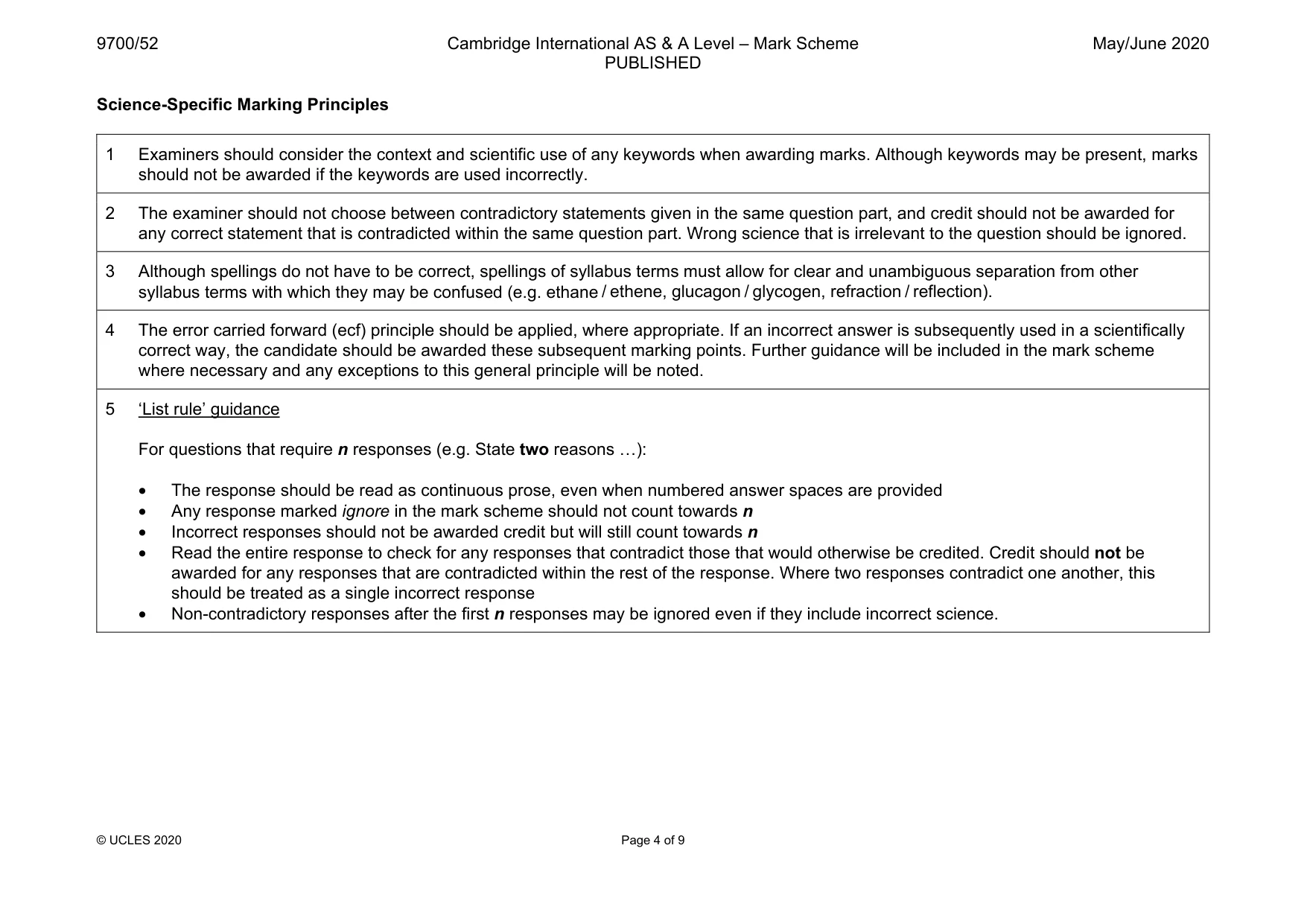
9700/52 Cambridge International AS & A Level – Mark Scheme PUBLISHED May/June 2020 © UCLES 2020 Page 4 of 9 Science-Specific Marking Principles 1 Examiners should consider the context and scientific use of any keywords when awarding marks. Although keywords may be present, marks should not be awarded if the keywords are used incorrectly. 2 The examiner should not choose between contradictory statements given in the same question part, and credit should not be awarded for any correct statement that is contradicted within the same question part. Wrong science that is irrelevant to the question should be ignored. 3 Although spellings do not have to be correct, spellings of syllabus terms must allow for clear and unambiguous separation from other syllabus terms with which they may be confused (e.g. ethane / ethene, glucagon / glycogen, refraction / reflection). 4 The error carried forward (ecf) principle should be applied, where appropriate. If an incorrect answer is subsequently used in a scientifically correct way, the candidate should be awarded these subsequent marking points. Further guidance will be included in the mark scheme where necessary and any exceptions to this general principle will be noted. 5 ‘List rule’ guidance For questions that require n responses (e.g. State two reasons …): • The response should be read as continuous prose, even when numbered answer spaces are provided • Any response marked ignore in the mark scheme should not count towards n • Incorrect responses should not be awarded credit but will still count towards n • Read the entire response to check for any responses that contradict those that would otherwise be credited. Credit should not be awarded for any responses that are contradicted within the rest of the response. Where two responses contradict one another, this should be treated as a single incorrect response • Non-contradictory responses after the first n responses may be ignored even if they include incorrect science.
Mark scheme, page 5
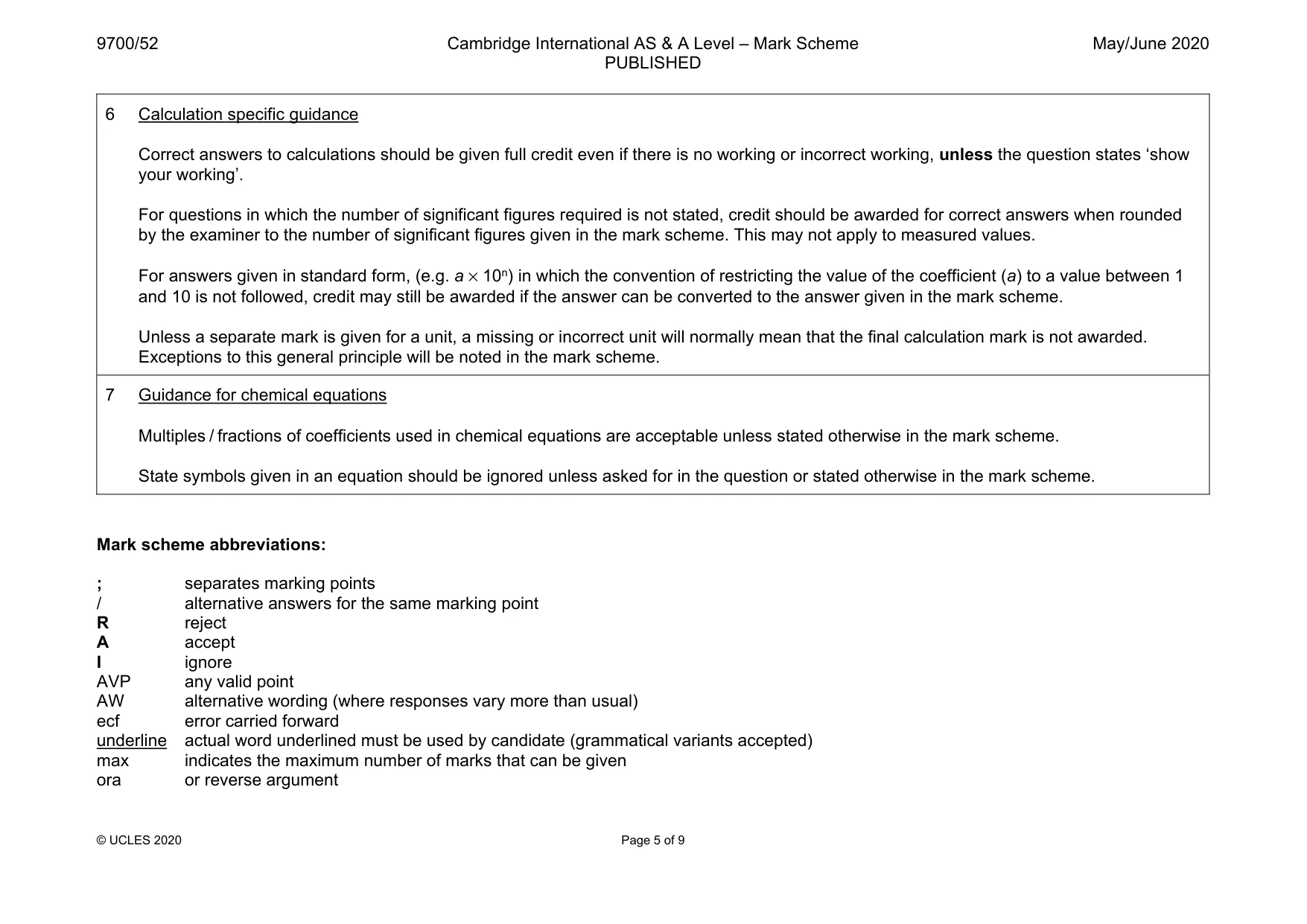
9700/52 Cambridge International AS & A Level – Mark Scheme PUBLISHED May/June 2020 © UCLES 2020 Page 5 of 9 6 Calculation specific guidance Correct answers to calculations should be given full credit even if there is no working or incorrect working, unless the question states ‘show your working’. For questions in which the number of significant figures required is not stated, credit should be awarded for correct answers when rounded by the examiner to the number of significant figures given in the mark scheme. This may not apply to measured values. For answers given in standard form, (e.g. a × 10n) in which the convention of restricting the value of the coefficient (a) to a value between 1 and 10 is not followed, credit may still be awarded if the answer can be converted to the answer given in the mark scheme. Unless a separate mark is given for a unit, a missing or incorrect unit will normally mean that the final calculation mark is not awarded. Exceptions to this general principle will be noted in the mark scheme. 7 Guidance for chemical equations Multiples / fractions of coefficients used in chemical equations are acceptable unless stated otherwise in the mark scheme. State symbols given in an equation should be ignored unless asked for in the question or stated otherwise in the mark scheme. Mark scheme abbreviations: ; separates marking points / alternative answers for the same marking point R reject A accept I ignore AVP any valid point AW alternative wording (where responses vary more than usual) ecf error carried forward underline actual word underlined must be used by candidate (grammatical variants accepted) max indicates the maximum number of marks that can be given ora or reverse argument
Mark scheme, page 6
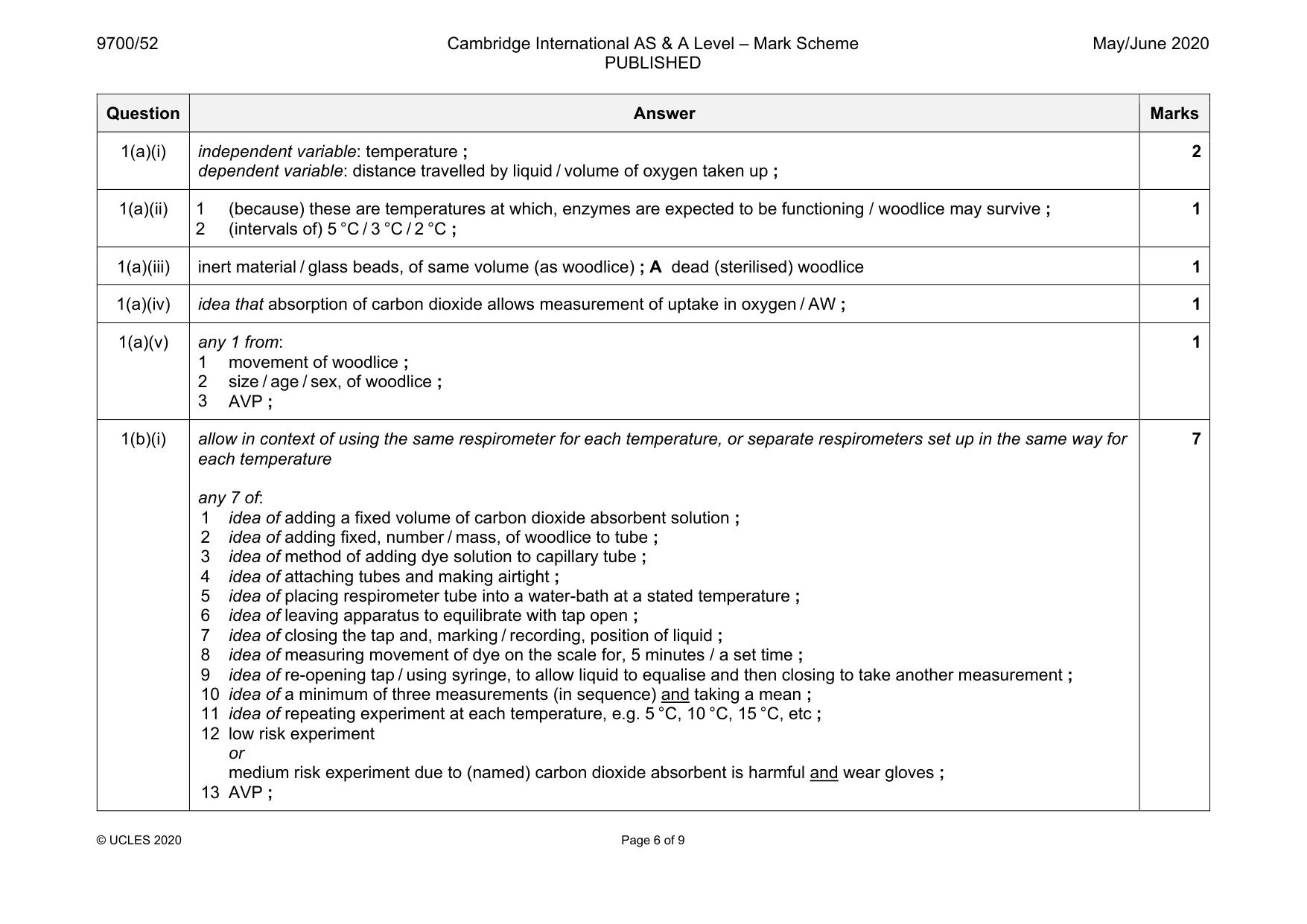
9700/52 Cambridge International AS & A Level – Mark Scheme PUBLISHED May/June 2020 © UCLES 2020 Page 6 of 9 Question Answer Marks 1(a)(i) independent variable: temperature ; dependent variable: distance travelled by liquid / volume of oxygen taken up ; 2 1(a)(ii) 1 (because) these are temperatures at which, enzymes are expected to be functioning / woodlice may survive ; 2 (intervals of) 5 °C / 3 °C / 2 °C ; 1 1(a)(iii) inert material / glass beads, of same volume (as woodlice) ; A dead (sterilised) woodlice 1 1(a)(iv) idea that absorption of carbon dioxide allows measurement of uptake in oxygen / AW ; 1 1(a)(v) any 1 from: 1 movement of woodlice ; 2 size / age / sex, of woodlice ; 3 AVP ; 1 1(b)(i) allow in context of using the same respirometer for each temperature, or separate respirometers set up in the same way for each temperature any 7 of: 1 idea of adding a fixed volume of carbon dioxide absorbent solution ; 2 idea of adding fixed, number / mass, of woodlice to tube ; 3 idea of method of adding dye solution to capillary tube ; 4 idea of attaching tubes and making airtight ; 5 idea of placing respirometer tube into a water-bath at a stated temperature ; 6 idea of leaving apparatus to equilibrate with tap open ; 7 idea of closing the tap and, marking / recording, position of liquid ; 8 idea of measuring movement of dye on the scale for, 5 minutes / a set time ; 9 idea of re-opening tap / using syringe, to allow liquid to equalise and then closing to take another measurement ; 10 idea of a minimum of three measurements (in sequence) and taking a mean ; 11 idea of repeating experiment at each temperature, e.g. 5 °C, 10 °C, 15 °C, etc ; 12 low risk experiment or medium risk experiment due to (named) carbon dioxide absorbent is harmful and wear gloves ; 13 AVP ; 7
Mark scheme, page 7
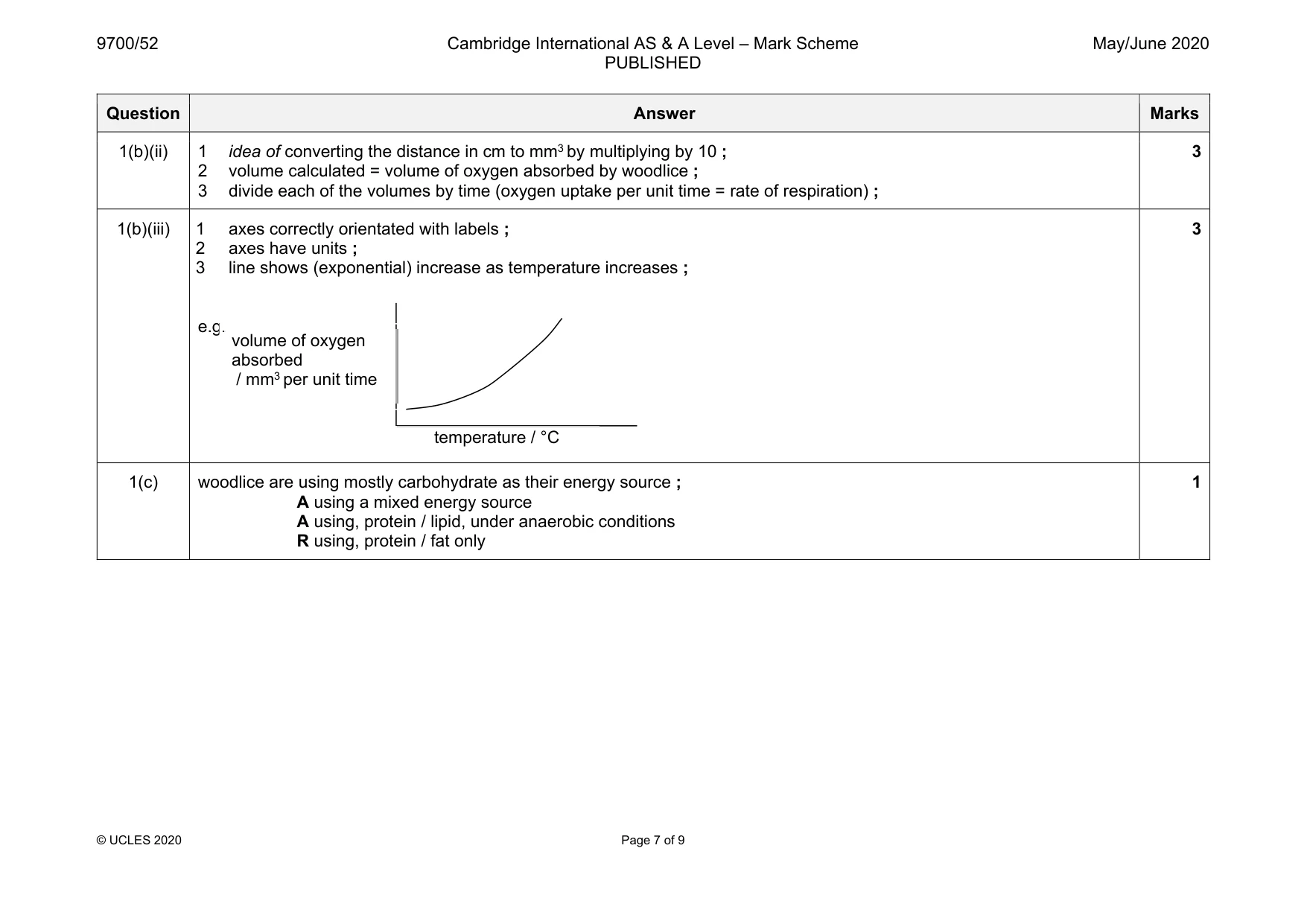
9700/52 Cambridge International AS & A Level – Mark Scheme PUBLISHED May/June 2020 © UCLES 2020 Page 7 of 9 Question Answer Marks 1(b)(ii) 1 idea of converting the distance in cm to mm3 by multiplying by 10 ; 2 volume calculated = volume of oxygen absorbed by woodlice ; 3 divide each of the volumes by time (oxygen uptake per unit time = rate of respiration) ; 3 1(b)(iii) 1 axes correctly orientated with labels ; 2 axes have units ; 3 line shows (exponential) increase as temperature increases ; e.g. 3 1(c) woodlice are using mostly carbohydrate as their energy source ; A using a mixed energy source A using, protein / lipid, under anaerobic conditions R using, protein / fat only 1 volume of oxygen absorbed / mm3 per unit time temperature / °C
Mark scheme, page 8
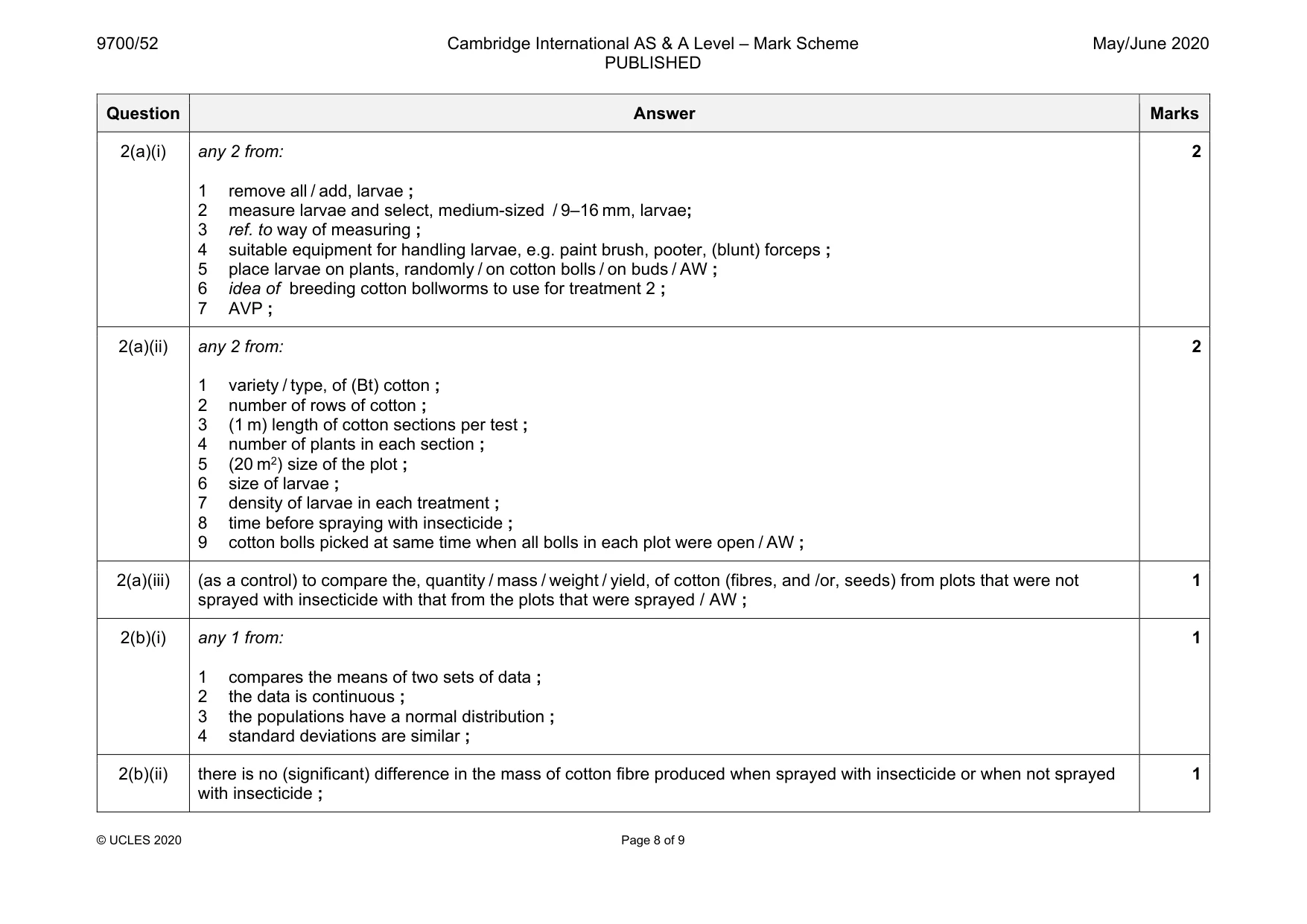
9700/52 Cambridge International AS & A Level – Mark Scheme PUBLISHED May/June 2020 © UCLES 2020 Page 8 of 9 Question Answer Marks 2(a)(i) any 2 from: 1 remove all / add, larvae ; 2 measure larvae and select, medium-sized / 9–16 mm, larvae; 3 ref. to way of measuring ; 4 suitable equipment for handling larvae, e.g. paint brush, pooter, (blunt) forceps ; 5 place larvae on plants, randomly / on cotton bolls / on buds / AW ; 6 idea of breeding cotton bollworms to use for treatment 2 ; 7 AVP ; 2 2(a)(ii) any 2 from: 1 variety / type, of (Bt) cotton ; 2 number of rows of cotton ; 3 (1 m) length of cotton sections per test ; 4 number of plants in each section ; 5 (20 m2) size of the plot ; 6 size of larvae ; 7 density of larvae in each treatment ; 8 time before spraying with insecticide ; 9 cotton bolls picked at same time when all bolls in each plot were open / AW ; 2 2(a)(iii) (as a control) to compare the, quantity / mass / weight / yield, of cotton (fibres, and /or, seeds) from plots that were not sprayed with insecticide with that from the plots that were sprayed / AW ; 1 2(b)(i) any 1 from: 1 compares the means of two sets of data ; 2 the data is continuous ; 3 the populations have a normal distribution ; 4 standard deviations are similar ; 1 2(b)(ii) there is no (significant) difference in the mass of cotton fibre produced when sprayed with insecticide or when not sprayed with insecticide ; 1
Mark scheme, page 9
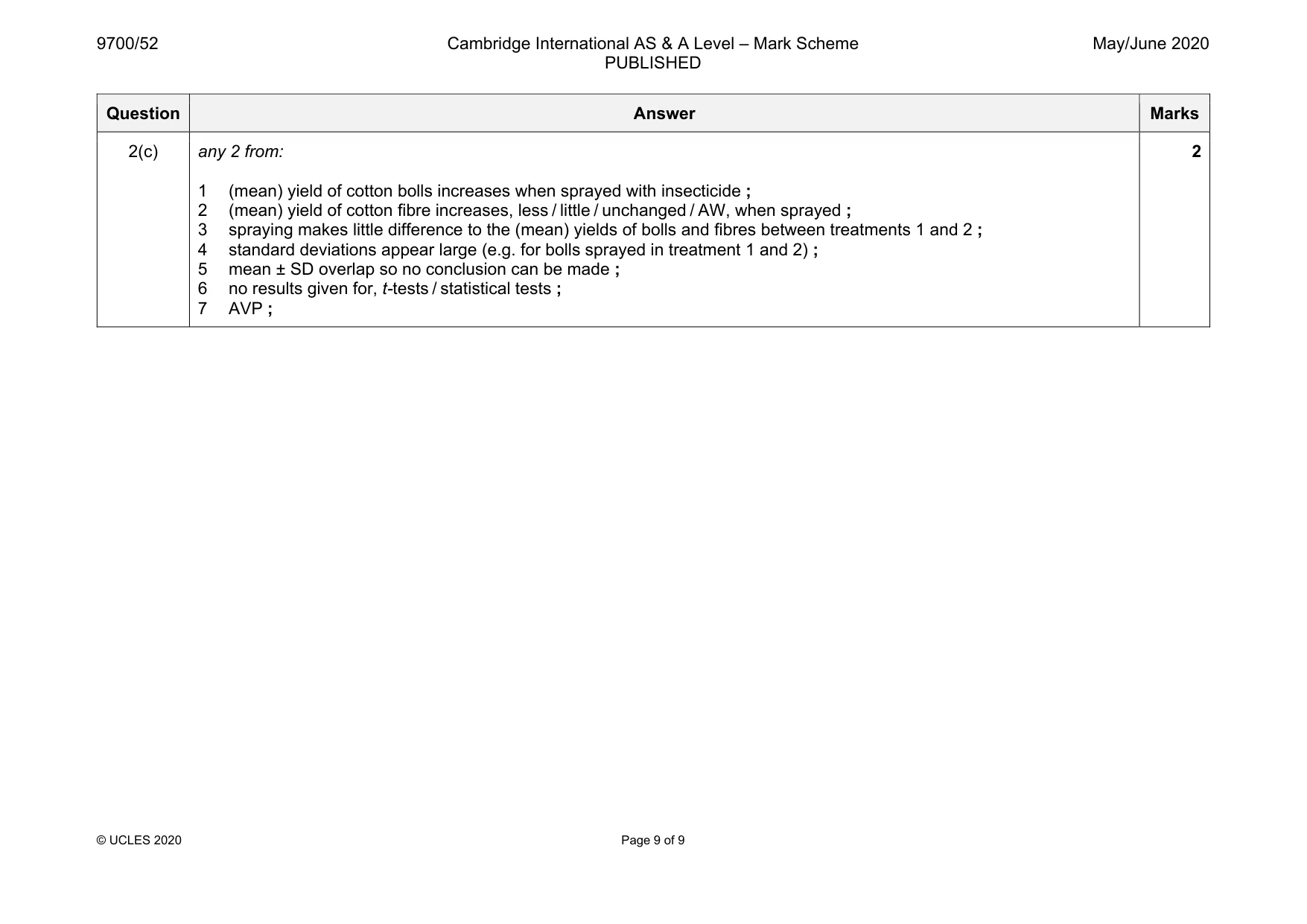
9700/52 Cambridge International AS & A Level – Mark Scheme PUBLISHED May/June 2020 © UCLES 2020 Page 9 of 9 Question Answer Marks 2(c) any 2 from: 1 (mean) yield of cotton bolls increases when sprayed with insecticide ; 2 (mean) yield of cotton fibre increases, less / little / unchanged / AW, when sprayed ; 3 spraying makes little difference to the (mean) yields of bolls and fibres between treatments 1 and 2 ; 4 standard deviations appear large (e.g. for bolls sprayed in treatment 1 and 2) ; 5 mean ± SD overlap so no conclusion can be made ; 6 no results given for, t-tests / statistical tests ; 7 AVP ; 2