Cambridge A Level Biology 9700 — 2020 May/June Paper 5 · Variant 3
9700/53/M/J/20 · 2 questions · 22 marks · ≈25 min
The question paper and its mark scheme, free to read here and free to download. This is Cambridge’s own paper, exactly as it was sat.
Question paper12 pages
Mark scheme8 pages
Answers below. Sit the paper first if you are practising.
Questions as text
Q1 · Some students decided to find the respiratory quotient (RQ) of germinating pea seeds
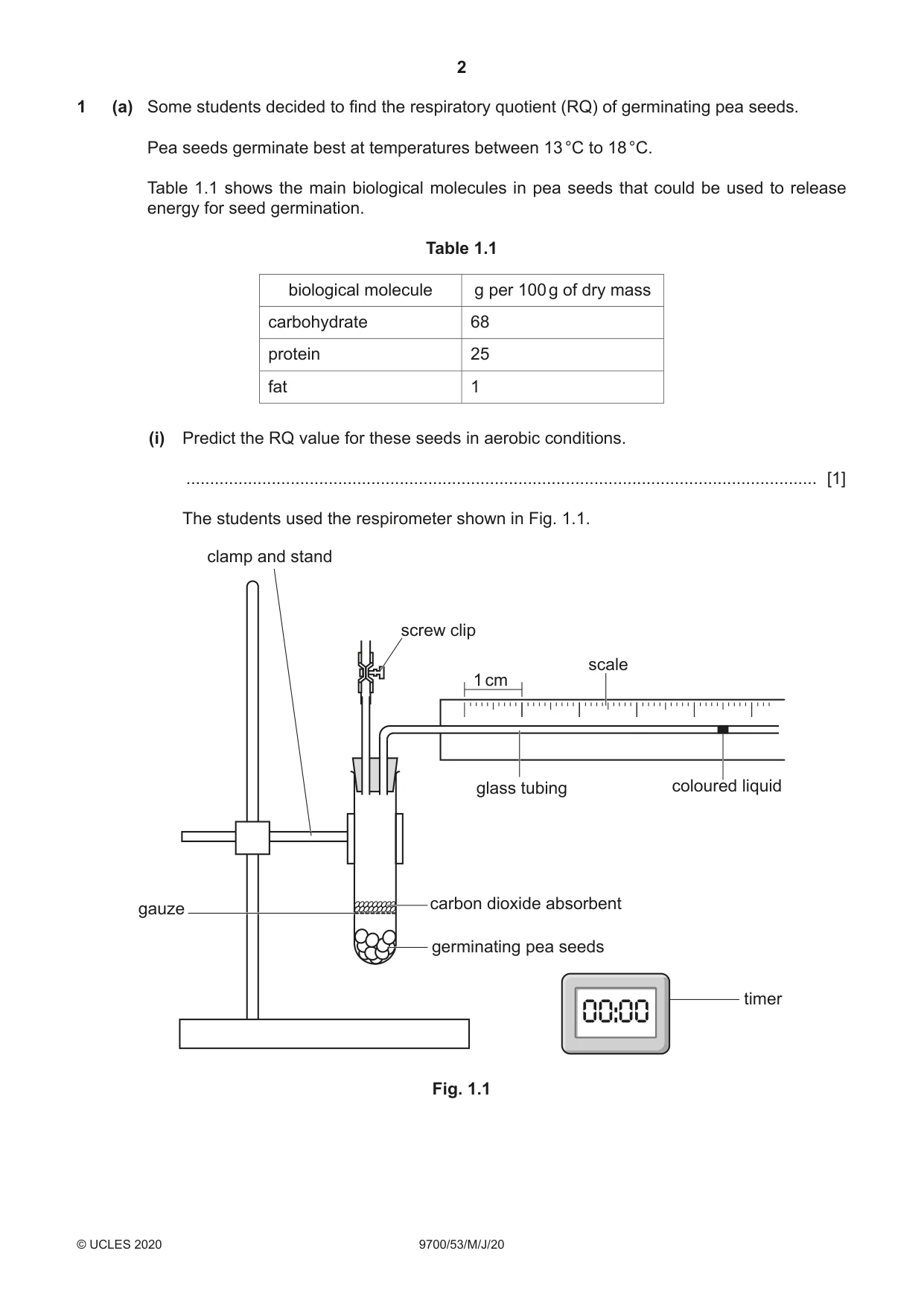
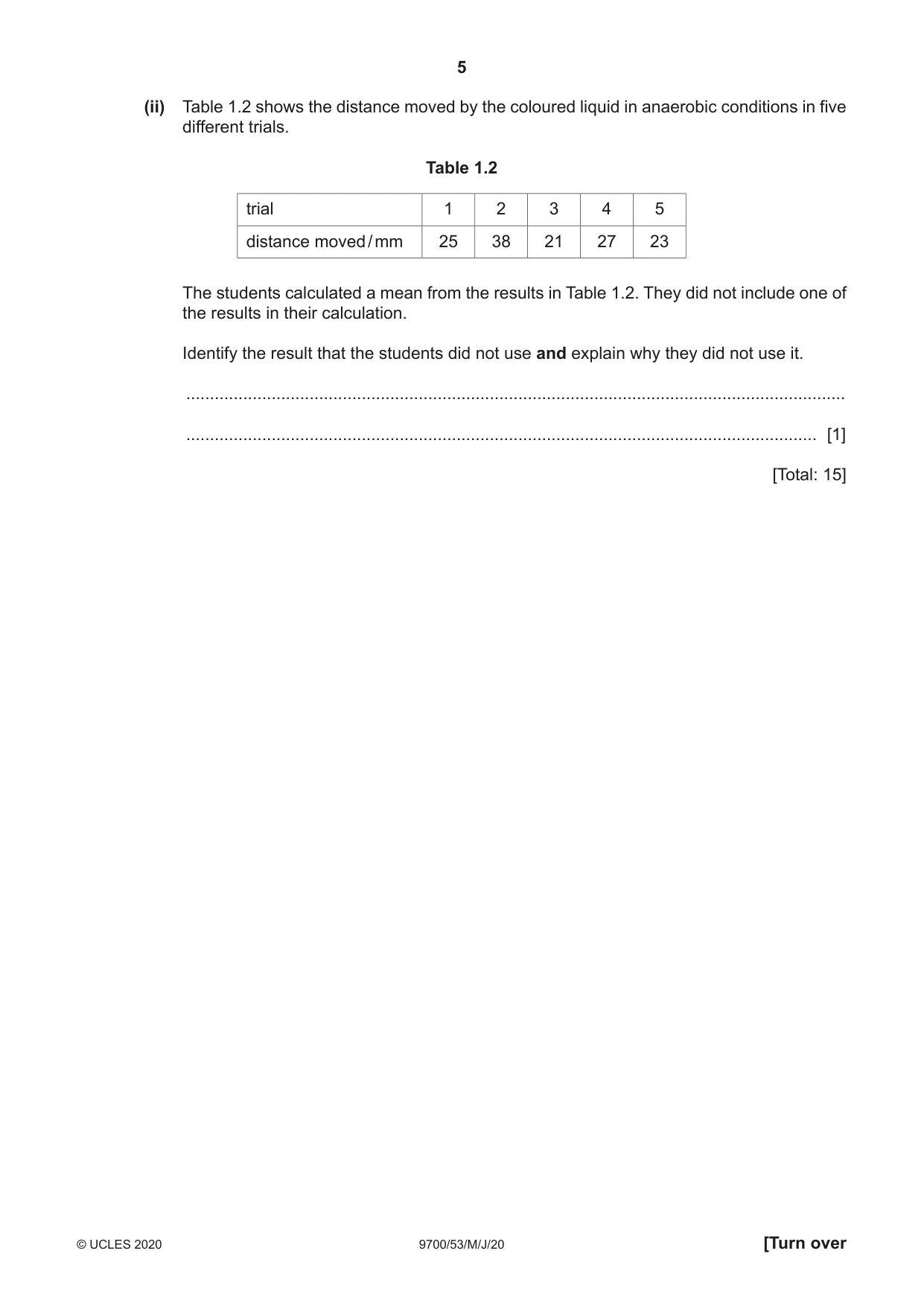
1 (a) Some students decided to find the respiratory quotient (RQ) of germinating pea seeds. Pea seeds germinate best at temperatures between 13 °C to 18 °C. Table 1.1 shows the main biological molecules in pea seeds that could be used to release energy for seed germination. Table 1.1 biological molecule g per 100 g of dry mass carbohydrate 68 protein 25 fat 1 (i) Predict the RQ value for these seeds in aerobic conditions. ..................................................................................................................................... [1] The students used the respirometer shown in Fig. 1.1. clamp and stand screw clip scale 1 cm glass tubing coloured liquid carbon dioxide absorbent gauze germinating pea seeds timer Fig. 1.1 (ii) Describe how the students could set up the respirometer and use it to make the measurements needed to calculate the RQ of germinating pea seeds. Your method should be set out in a logical order and be detailed enough to let another person follow it. ........................................................................................................................................... ........................................................................................................................................... ........................................................................................................................................... ........................................................................................................................................... ........................................................................................................................................... ........................................................................................................................................... ........................................................................................................................................... ........................................................................................................................................... ........................................................................................................................................... ........................................................................................................................................... ........................................................................................................................................... ........................................................................................................................................... ........................................................................................................................................... ........................................................................................................................................... ........................................................................................................................................... ........................................................................................................................................... ........................................................................................................................................... ........................................................................................................................................... ........................................................................................................................................... ........................................................................................................................................... ........................................................................................................................................... ........................................................................................................................................... ..................................................................................................................................... [7] (b) Describe how the students should process their results to find the volumes of gases needed to calculate the RQ of germinating pea seeds. ................................................................................................................................................... ................................................................................................................................................... ................................................................................................................................................... ................................................................................................................................................... ................................................................................................................................................... ................................................................................................................................................... ................................................................................................................................................... ............................................................................................................................................. [3] (c) (i) The students predicted that peas could also respire in anaerobic conditions, producing alcohol and carbon dioxide. Outline how the students could use the respirometer in Fig. 1.1 in anaerobic conditions to find out if their prediction was correct. ........................................................................................................................................... ........................................................................................................................................... ........................................................................................................................................... ........................................................................................................................................... ........................................................................................................................................... ........................................................................................................................................... ........................................................................................................................................... ..................................................................................................................................... [3] (ii) Table 1.2 shows the distance moved by the coloured liquid in anaerobic conditions in five different trials. Table 1.2 trial 1 2 3 4 5 distance moved / mm 25 38 21 27 23 The students calculated a mean from the results in Table 1.2. They did not include one of the results in their calculation. Identify the result that the students did not use and explain why they did not use it. ........................................................................................................................................... ..................................................................................................................................... [1] [Total: 15]
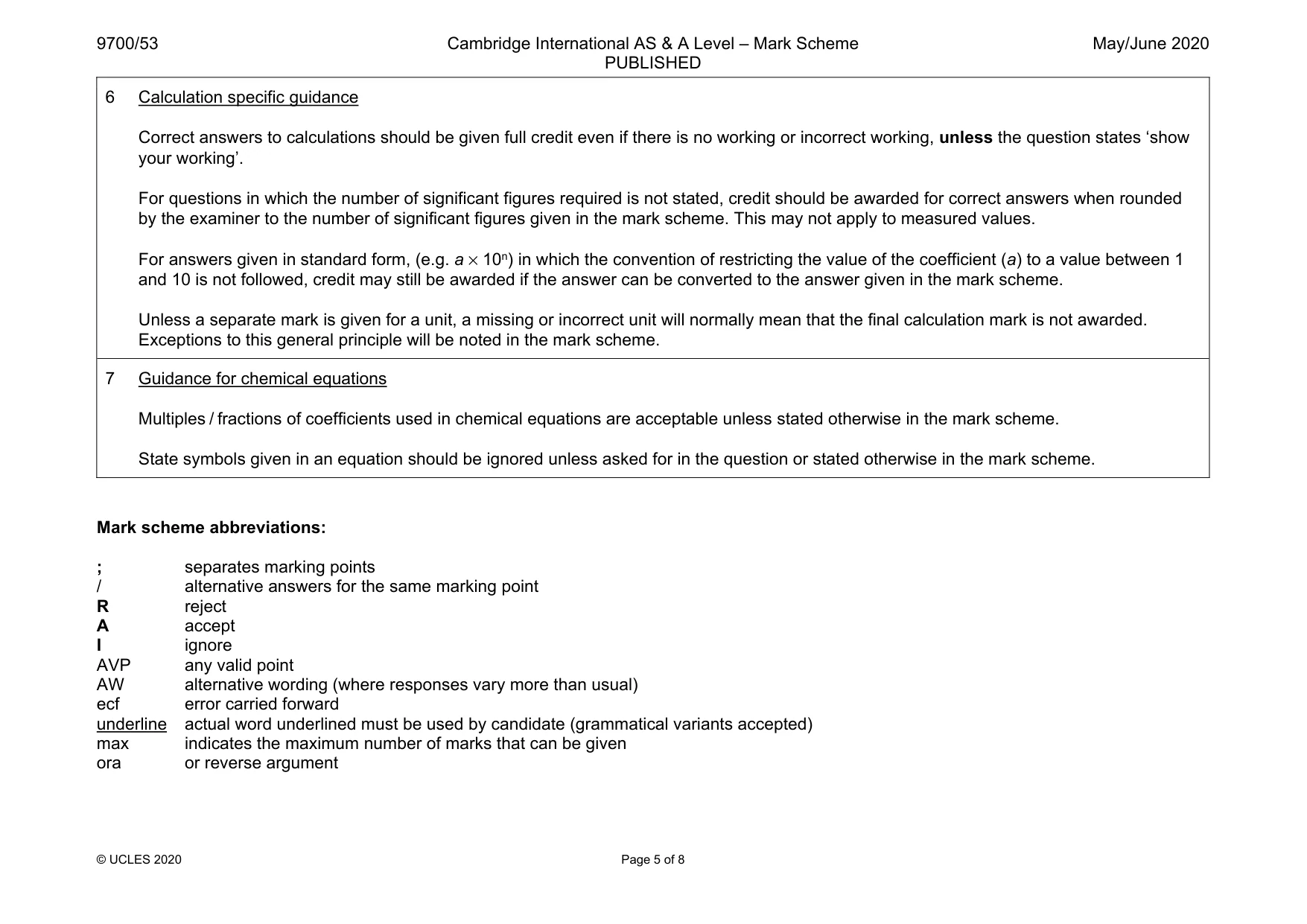
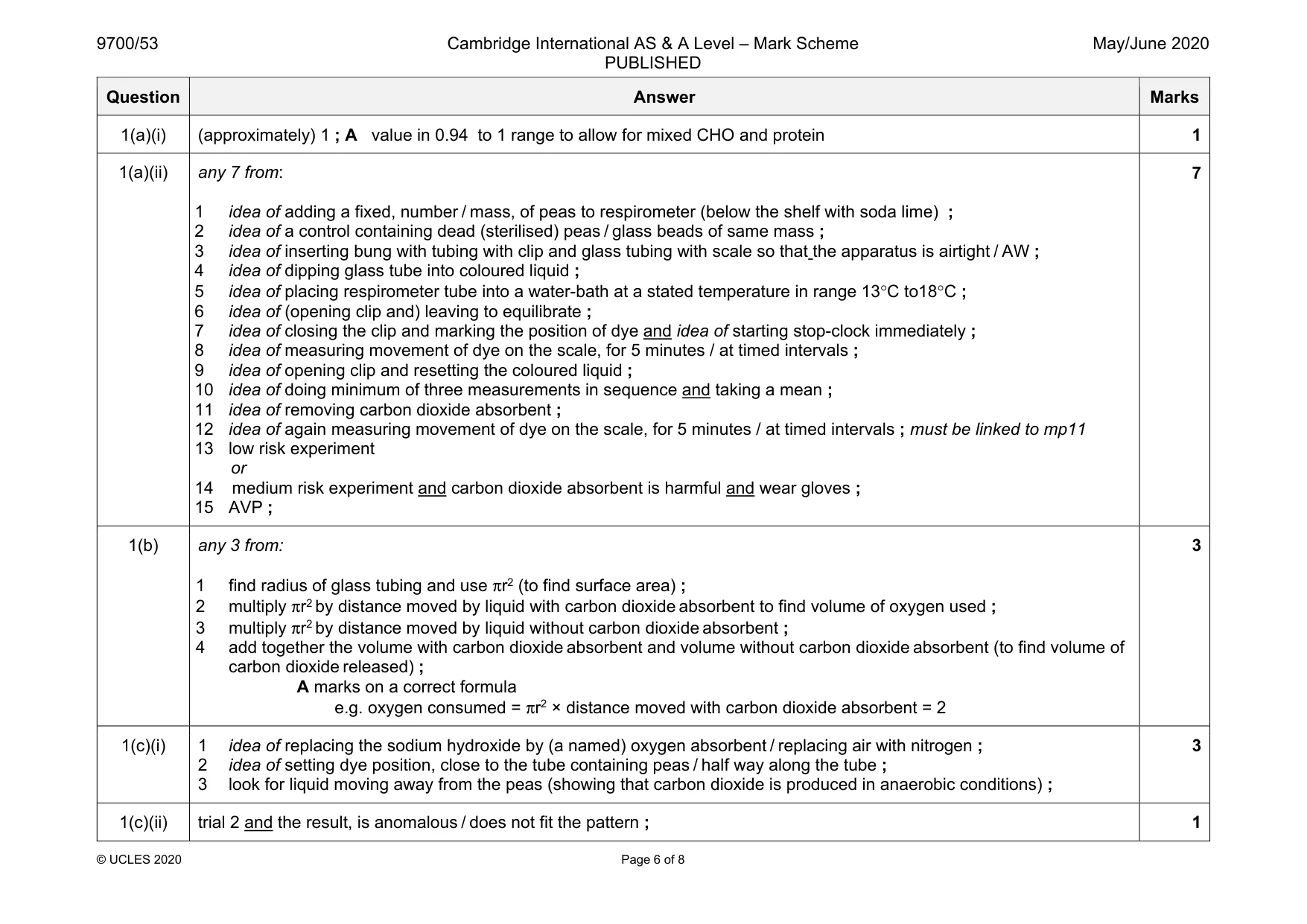
Mark scheme: 1(a)(i) (approximately) 1 ; A value in 0.94 to 1 range to allow for mixed CHO and protein 1 1(a)(ii) any 7 from: 1 idea of adding a fixed, number / mass, of peas to respirometer (below the shelf with soda lime) ; 2 idea of a control containing dead (sterilised) peas / glass beads of same mass ; 3 idea of inserting bung with tubing with clip and glass tubing with scale so that the apparatus is airtight / AW ; 4 idea of dipping glass tube into coloured liquid ; 5 idea of placing respirometer tube into a water-bath at a stated temperature in range 13°C to18°C ; 6 idea of (opening clip and) leaving to equilibrate ; 7 idea of closing the clip and marking the position of dye and idea of starting stop-clock immediately ; 8 idea of measuring movement of dye on the scale, for 5 minutes / at timed intervals ; 9 idea of opening clip and resetting the coloured liquid ; 10 idea of doing minimum of three measurements in sequence and taking a mean ; 11 idea of removing carbon dioxide absorbent ; 12 idea of again measuring movement of dye on the scale, for 5 minutes / at timed intervals ; must be linked to mp11 13 low risk experiment or 14 medium risk experiment and carbon dioxide absorbent is harmful and wear gloves ; 15 AVP ; 7 1(b) any 3 from: 1 find radius of glass tubing and use πr2 (to find surface area) ; 2 multiply πr2 by distance moved by liquid with carbon dioxide absorbent to find volume of oxygen used ; 3 multiply πr2 by distance moved by liquid without carbon dioxide absorbent ; 4 add together the volume with carbon dioxide absorbent and volume without carbon dioxide absorbent (to find volume of carbon dioxide released) ; A marks on a correct formula e.g. oxygen consumed = πr2 × distance moved with carbon dioxide absorbent = 2 3 1(c)(i) 1 idea of replacing the sodium hydroxide by (a named) oxygen absorbent / replacing air with nitrogen ; 2 idea of setting dye position, close to the tube containing peas / half way along the tube ; 3 look for liquid moving away from the peas (showing that carbon dioxide is produced in anaerobic conditions) ; 3 1(c)(ii) trial 2 and the result, is anomalous / does not fit the pattern ; 1
Q2 · The cotton bollworms, Helicoverpa armigera (old world bollworm) and Pectinophora…
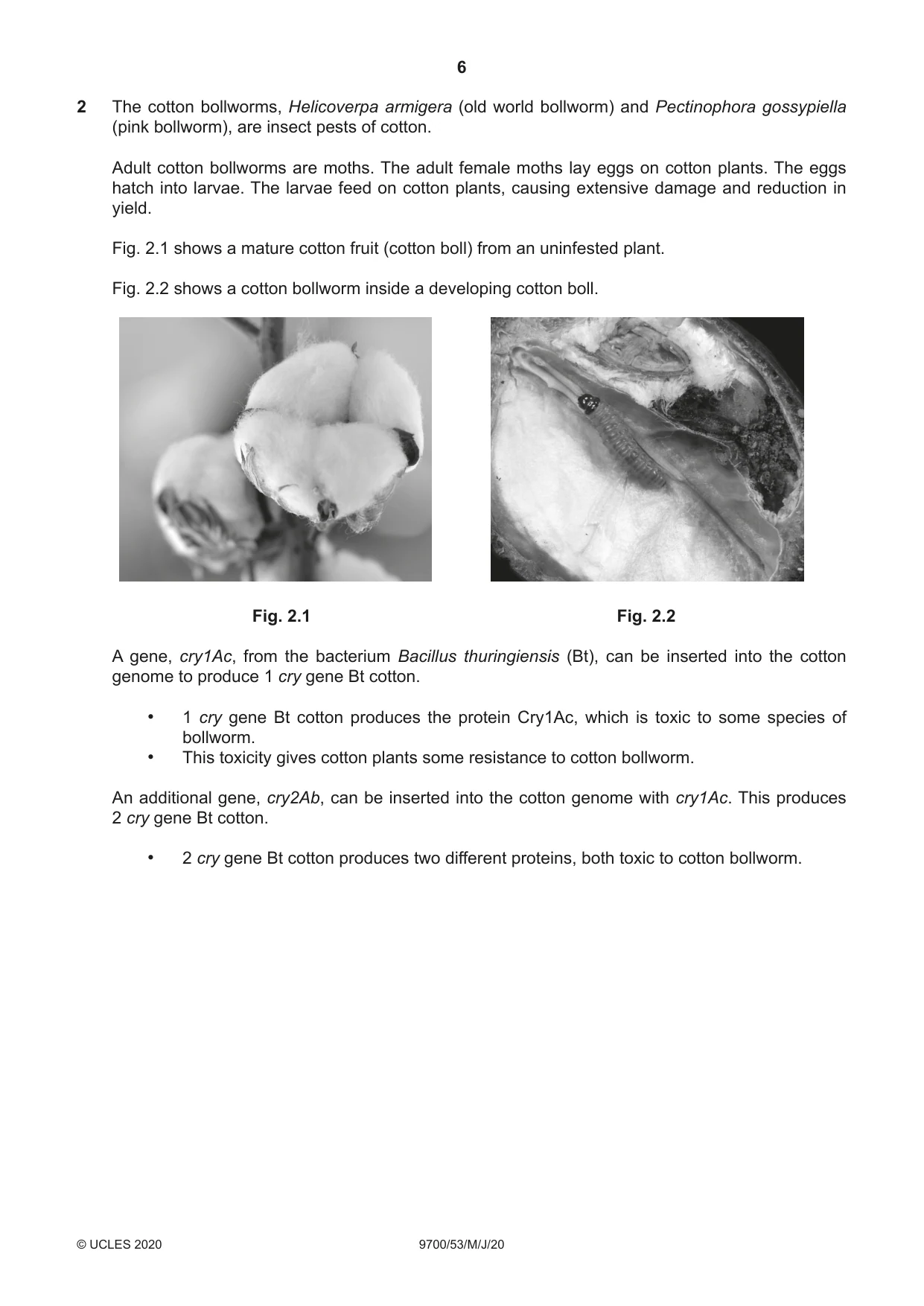
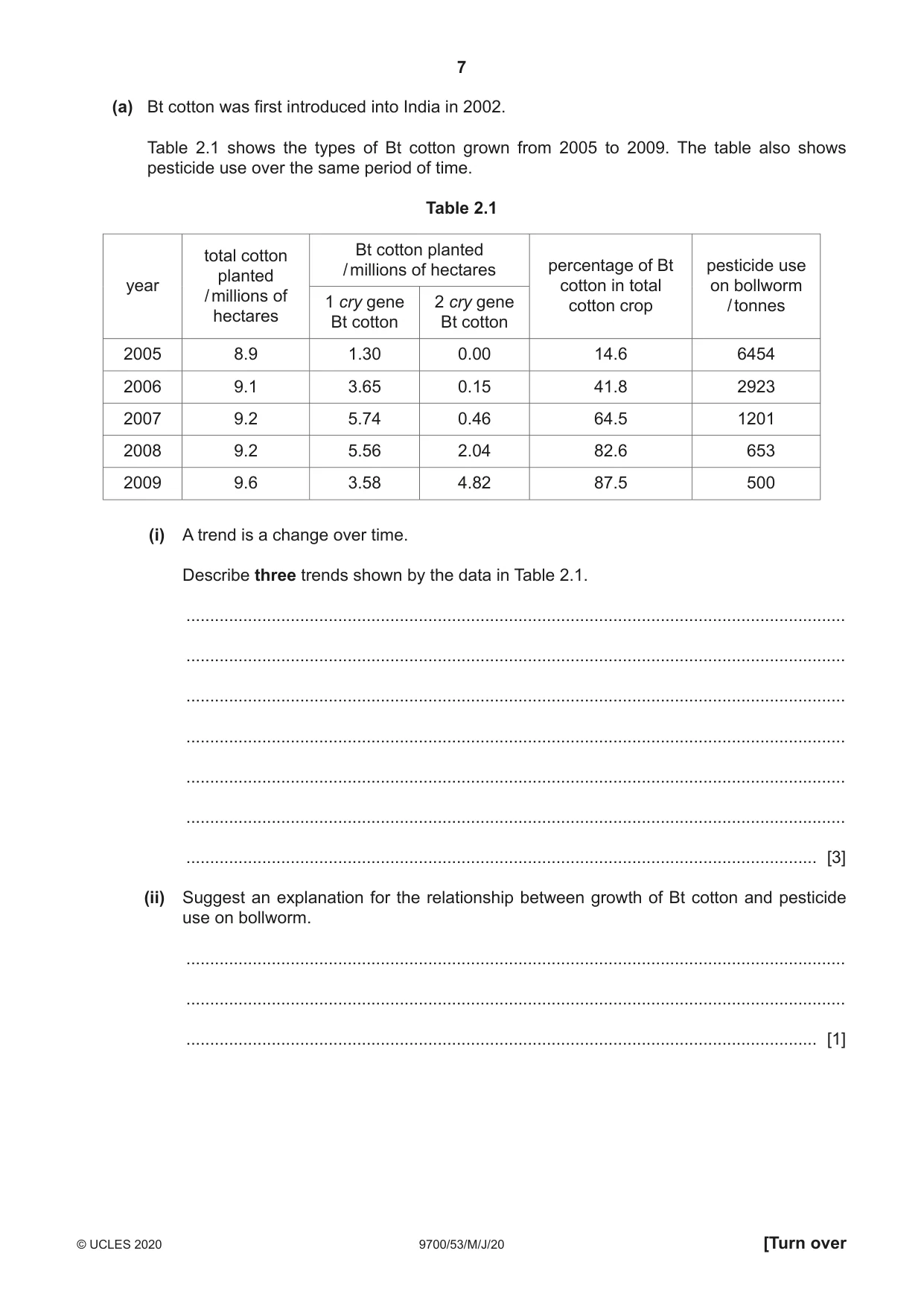
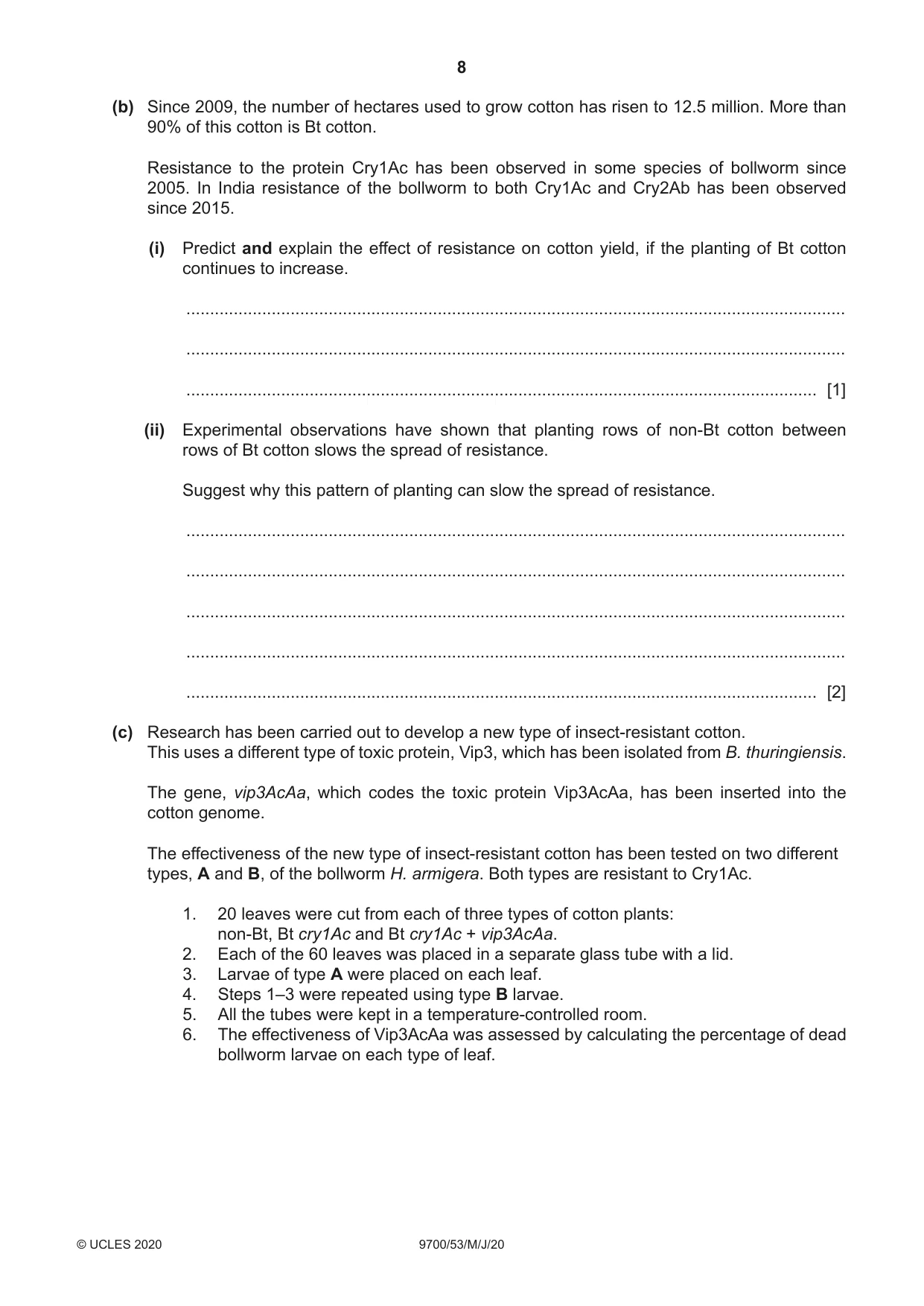
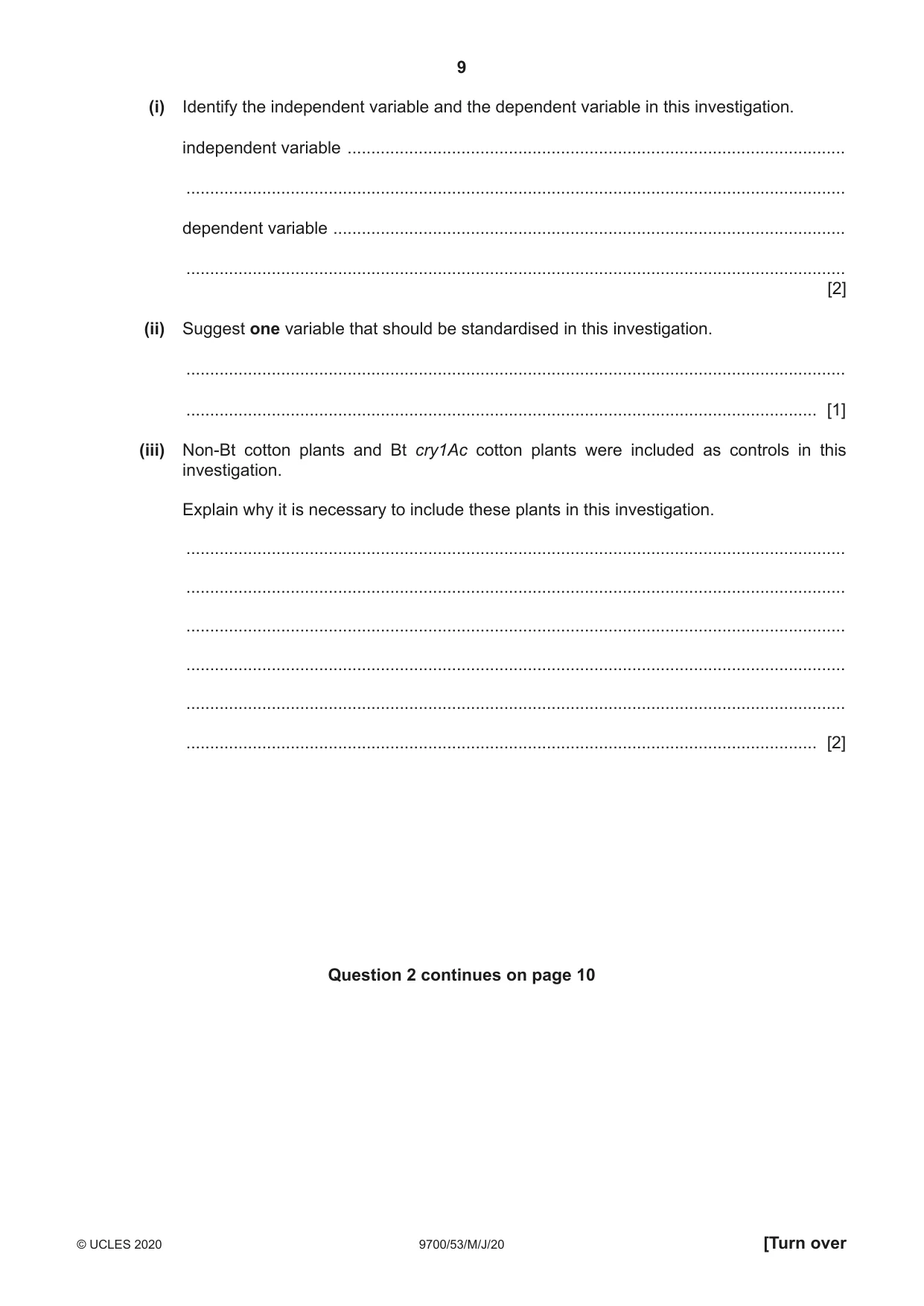
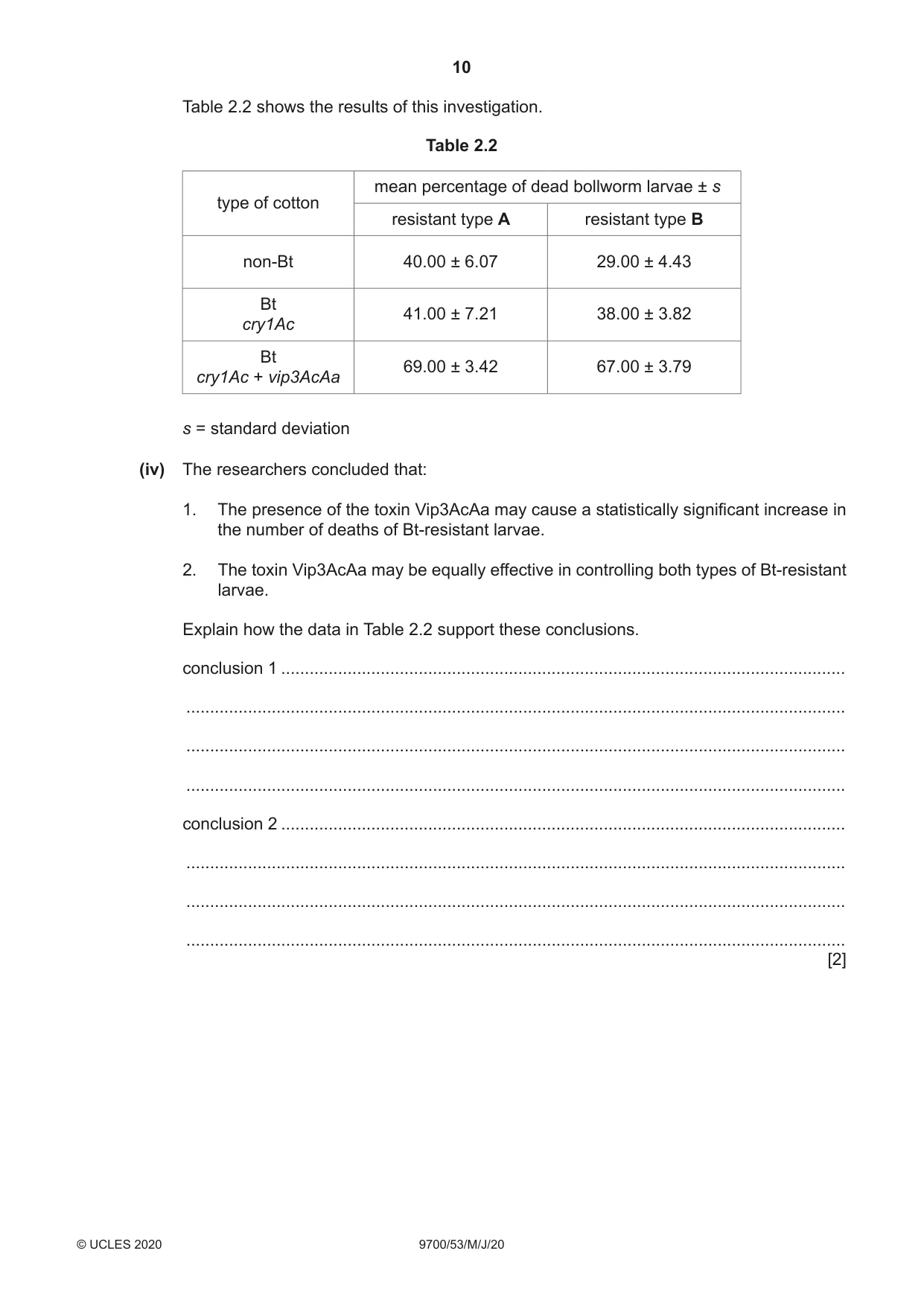
2 The cotton bollworms, Helicoverpa armigera (old world bollworm) and Pectinophora gossypiella (pink bollworm), are insect pests of cotton. Adult cotton bollworms are moths. The adult female moths lay eggs on cotton plants. The eggs hatch into larvae. The larvae feed on cotton plants, causing extensive damage and reduction in yield. Fig. 2.1 shows a mature cotton fruit (cotton boll) from an uninfested plant. Fig. 2.2 shows a cotton bollworm inside a developing cotton boll. Fig. 2.1 Fig. 2.2 A gene, cry1Ac, from the bacterium Bacillus thuringiensis (Bt), can be inserted into the cotton genome to produce 1 cry gene Bt cotton. • 1 cry gene Bt cotton produces the protein Cry1Ac, which is toxic to some species of bollworm. • This toxicity gives cotton plants some resistance to cotton bollworm. An additional gene, cry2Ab, can be inserted into the cotton genome with cry1Ac. This produces 2 cry gene Bt cotton. • 2 cry gene Bt cotton produces two different proteins, both toxic to cotton bollworm. (a) Bt cotton was first introduced into India in 2002. Table 2.1 shows the types of Bt cotton grown from 2005 to 2009. The table also shows pesticide use over the same period of time. Table 2.1 Bt cotton planted total cotton / millions of hectares percentage of Bt pesticide use planted year cotton in total on bollworm / millions of 1 cry gene 2 cry gene cotton crop / tonnes hectares Bt cotton Bt cotton 2005 8.9 1.30 0.00 14.6 6454 2006 9.1 3.65 0.15 41.8 2923 2007 9.2 5.74 0.46 64.5 1201 2008 9.2 5.56 2.04 82.6 653 2009 9.6 3.58 4.82 87.5 500 (i) A trend is a change over time. Describe three trends shown by the data in Table 2.1. ........................................................................................................................................... ........................................................................................................................................... ........................................................................................................................................... ........................................................................................................................................... ........................................................................................................................................... ........................................................................................................................................... ..................................................................................................................................... [3] (ii) Suggest an explanation for the relationship between growth of Bt cotton and pesticide use on bollworm. ........................................................................................................................................... ........................................................................................................................................... ..................................................................................................................................... [1] (b) Since 2009, the number of hectares used to grow cotton has risen to 12.5 million. More than 90% of this cotton is Bt cotton. Resistance to the protein Cry1Ac has been observed in some species of bollworm since 2005. In India resistance of the bollworm to both Cry1Ac and Cry2Ab has been observed since 2015. (i) Predict and explain the effect of resistance on cotton yield, if the planting of Bt cotton continues to increase. ........................................................................................................................................... ........................................................................................................................................... ..................................................................................................................................... [1] (ii) Experimental observations have shown that planting rows of non-Bt cotton between rows of Bt cotton slows the spread of resistance. Suggest why this pattern of planting can slow the spread of resistance. ........................................................................................................................................... ........................................................................................................................................... ........................................................................................................................................... ........................................................................................................................................... ..................................................................................................................................... [2] (c) Research has been carried out to develop a new type of insect-resistant cotton. This uses a different type of toxic protein, Vip3, which has been isolated from B. thuringiensis. The gene, vip3AcAa, which codes the toxic protein Vip3AcAa, has been inserted into the cotton genome. The effectiveness of the new type of insect-resistant cotton has been tested on two different types, A and B, of the bollworm H. armigera. Both types are resistant to Cry1Ac. 1. 20 leaves were cut from each of three types of cotton plants: non-Bt, Bt cry1Ac and Bt cry1Ac + vip3AcAa. 2. Each of the 60 leaves was placed in a separate glass tube with a lid. 3. Larvae of type A were placed on each leaf. 4. Steps 1–3 were repeated using type B larvae. 5. All the tubes were kept in a temperature-controlled room. 6. The effectiveness of Vip3AcAa was assessed by calculating the percentage of dead bollworm larvae on each type of leaf.
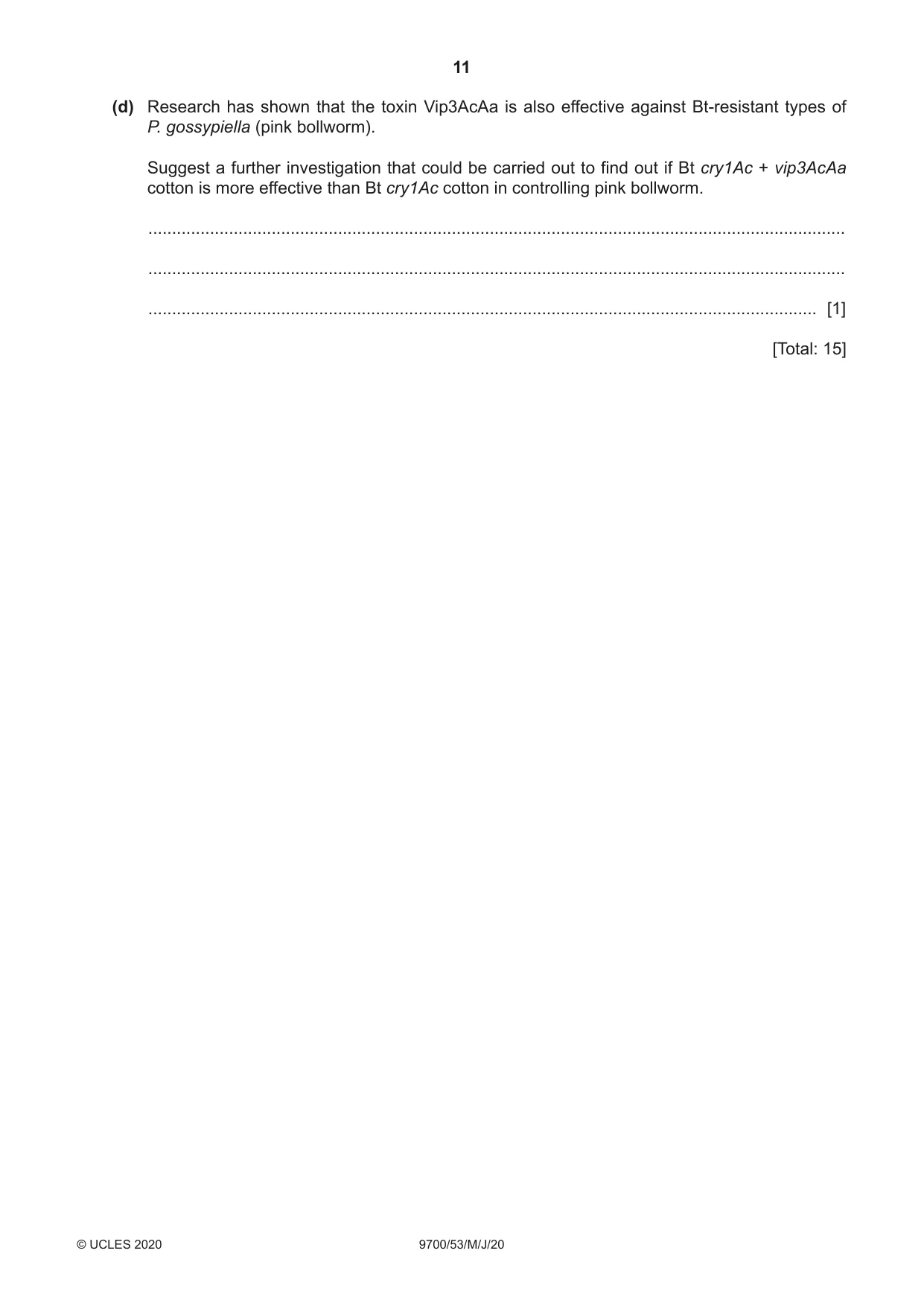
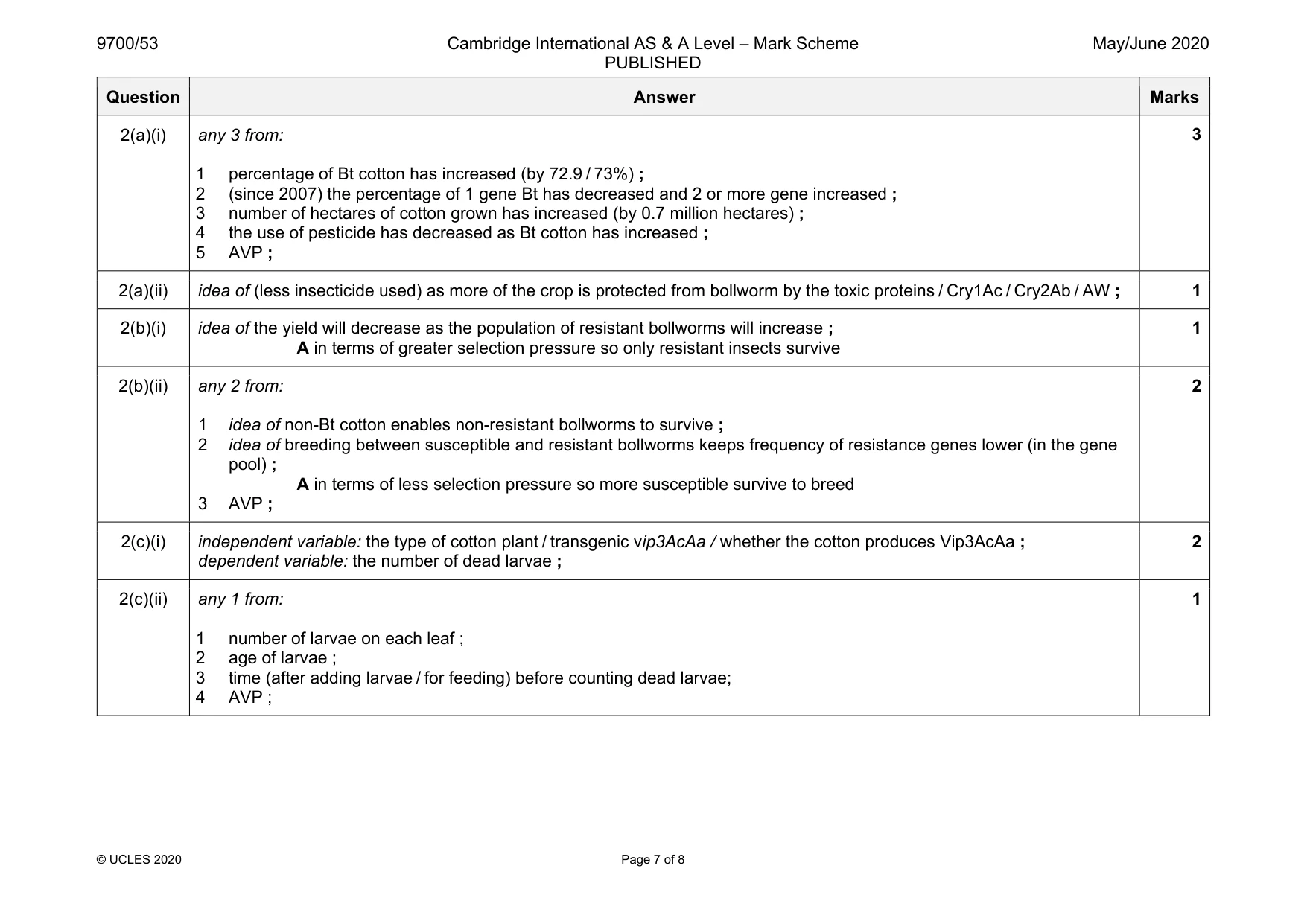
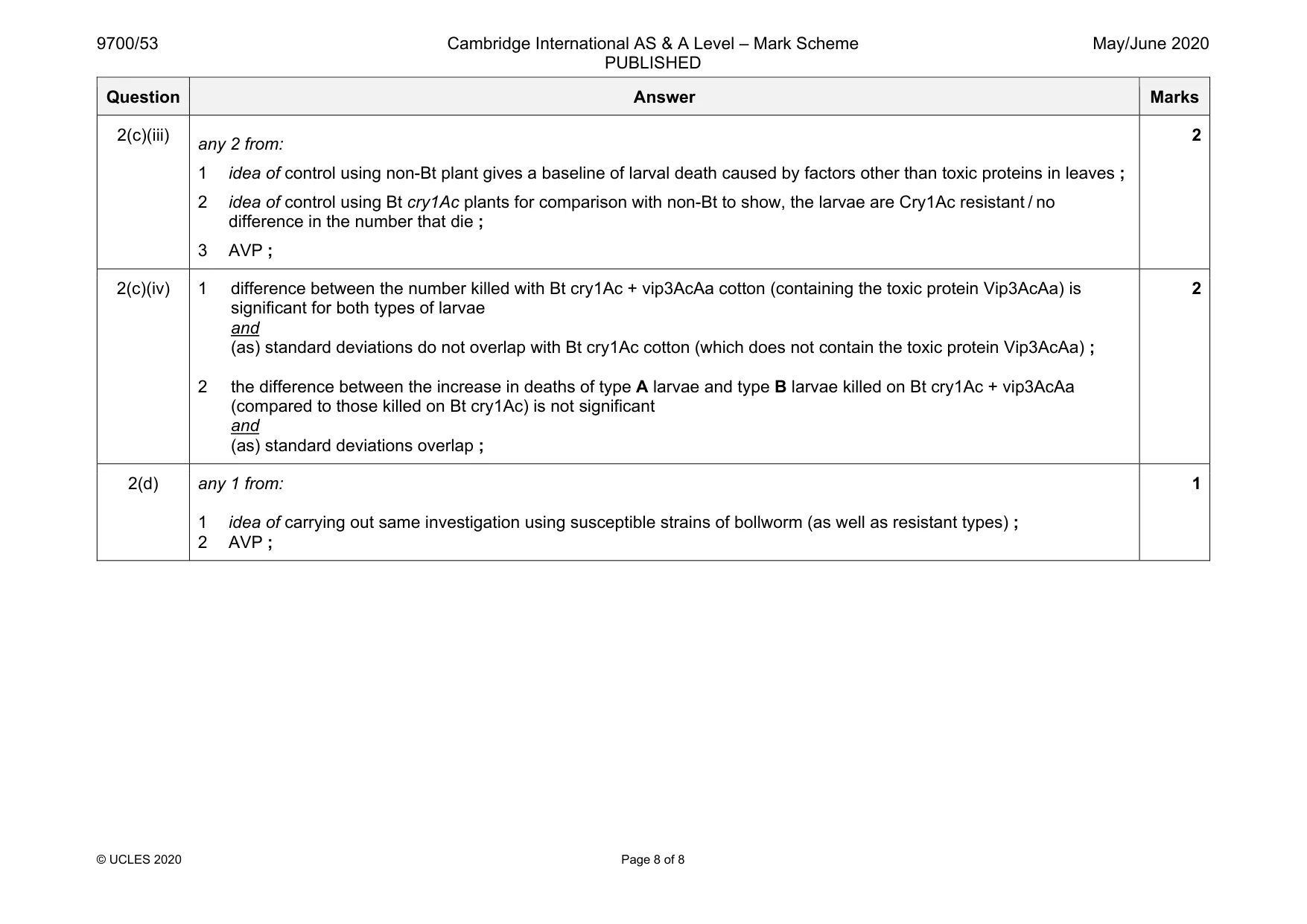
Mark scheme: 2(a)(i) any 3 from: 1 percentage of Bt cotton has increased (by 72.9 / 73%) ; 2 (since 2007) the percentage of 1 gene Bt has decreased and 2 or more gene increased ; 3 number of hectares of cotton grown has increased (by 0.7 million hectares) ; 4 the use of pesticide has decreased as Bt cotton has increased ; 5 AVP ; 2(a)(ii) idea of (less insecticide used) as more of the crop is protected from bollworm by the toxic proteins / Cry1Ac / Cry2Ab / AW ; 1 2(b)(i) idea of the yield will decrease as the population of resistant bollworms will increase ; A in terms of greater selection pressure so only resistant insects survive 1 2(b)(ii) any 2 from: 1 idea of non-Bt cotton enables non-resistant bollworms to survive ; 2 idea of breeding between susceptible and resistant bollworms keeps frequency of resistance genes lower (in the gene pool) ; A in terms of less selection pressure so more susceptible survive to breed 3 AVP ; 2 2(c)(i) independent variable: the type of cotton plant / transgenic vip3AcAa / whether the cotton produces Vip3AcAa ; dependent variable: the number of dead larvae ; 2 2(c)(ii) any 1 from: 1 number of larvae on each leaf ; 2 age of larvae ; 3 time (after adding larvae / for feeding) before counting dead larvae; 4 AVP ; 1 Question Answer Marks 2(c)(iii) any 2 from: 1 idea of control using non-Bt plant gives a baseline of larval death caused by factors other than toxic proteins in leaves ; 2 idea of control using Bt cry1Ac plants for comparison with non-Bt to show, the larvae are Cry1Ac resistant / no difference in the number that die ; 3 AVP ; 2 2(c)(iv) 1 difference between the number killed with Bt cry1Ac + vip3AcAa cotton (containing the toxic protein Vip3AcAa) is significant for both types of larvae and (as) standard deviations do not overlap with Bt cry1Ac cotton (which does not contain the toxic protein Vip3AcAa) ; 2 the difference between the increase in deaths of type A larvae and type B larvae killed on Bt cry1Ac + vip3AcAa (compared to those killed on Bt cry1Ac) is not significant and (as) standard deviations overlap ; 2 2(d) any 1 from: 1 idea of carrying out same investigation using susceptible strains of bollworm (as well as resistant types) ; 2 AVP ; 1
More questions on Genetically modified organisms in agriculture
What was in this paper
The subtopics covered by these 2 questions, and how many questions each got. Open one in a new tab to see every Cambridge question on it.