Cambridge A Level Biology 9700 — 2024 Feb/March Paper 5 · Variant 2
9700/52/F/M/24 · 2 questions · 30 marks · ≈34 min
The question paper and its mark scheme, free to read here and free to download. This is Cambridge’s own paper, exactly as it was sat.
Question paper16 pages
Mark scheme9 pages
Answers below. Sit the paper first if you are practising.
Questions as text
Q1 · Onions are vegetables that are harvested from the plant Allium cepa
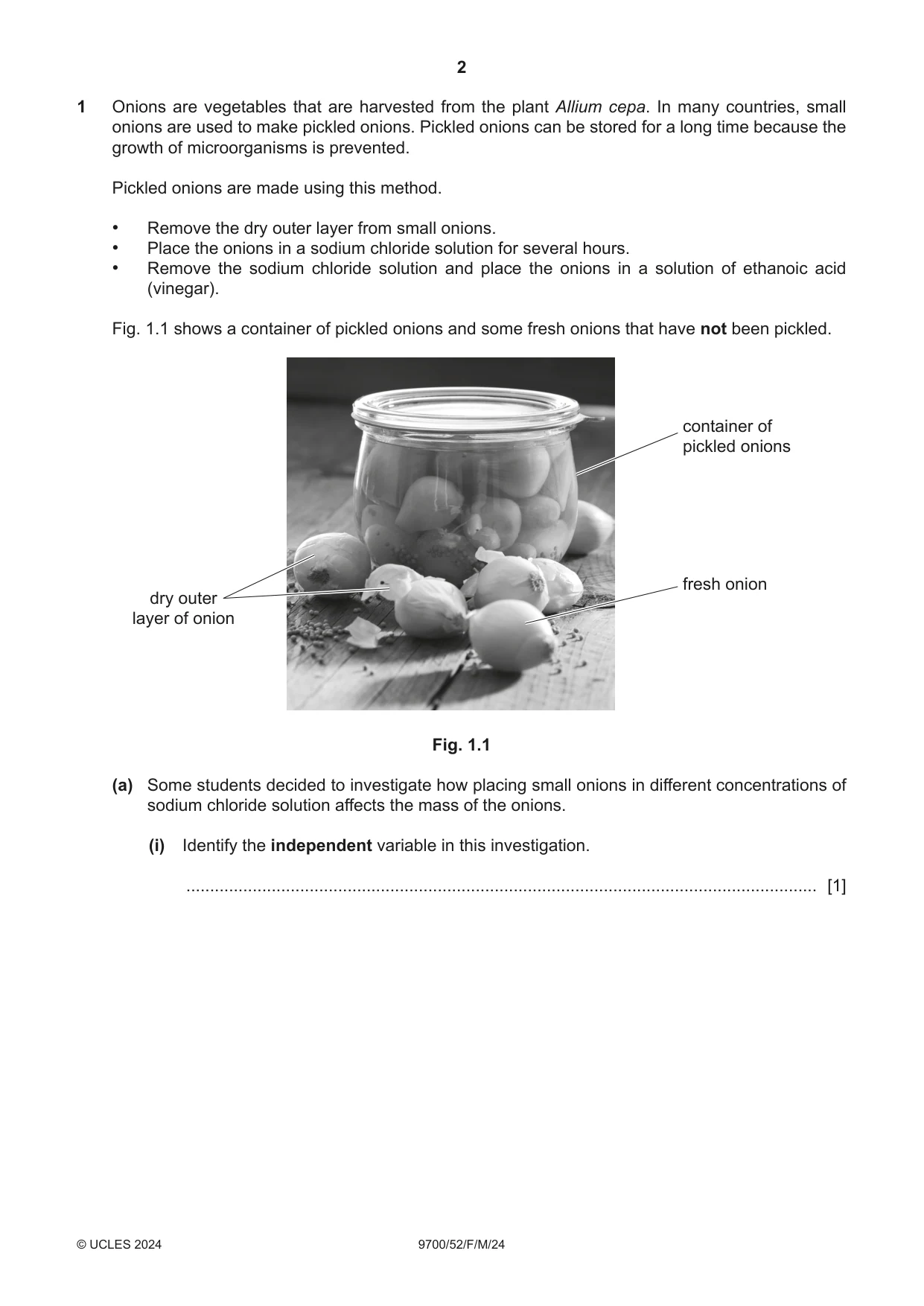
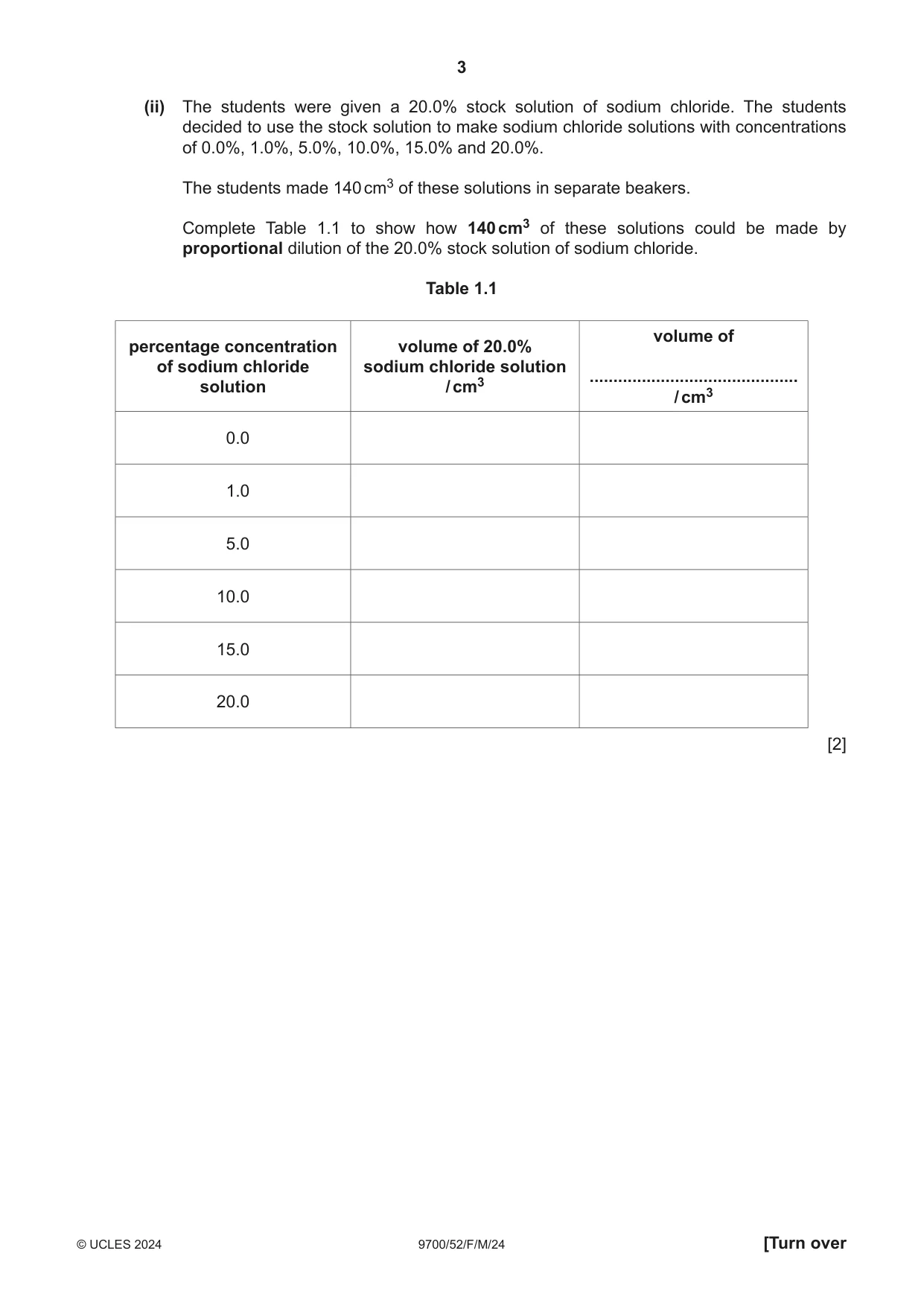
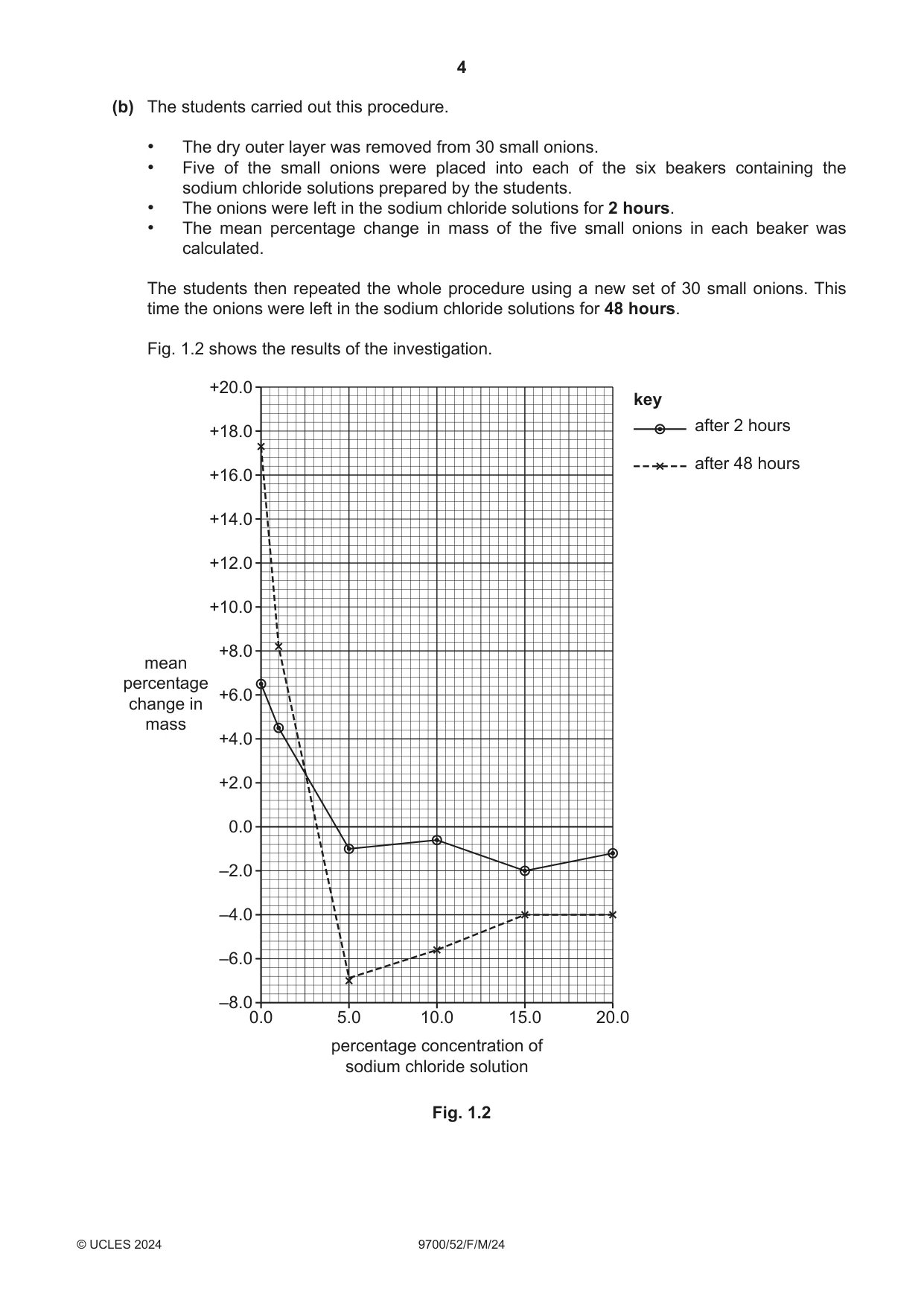
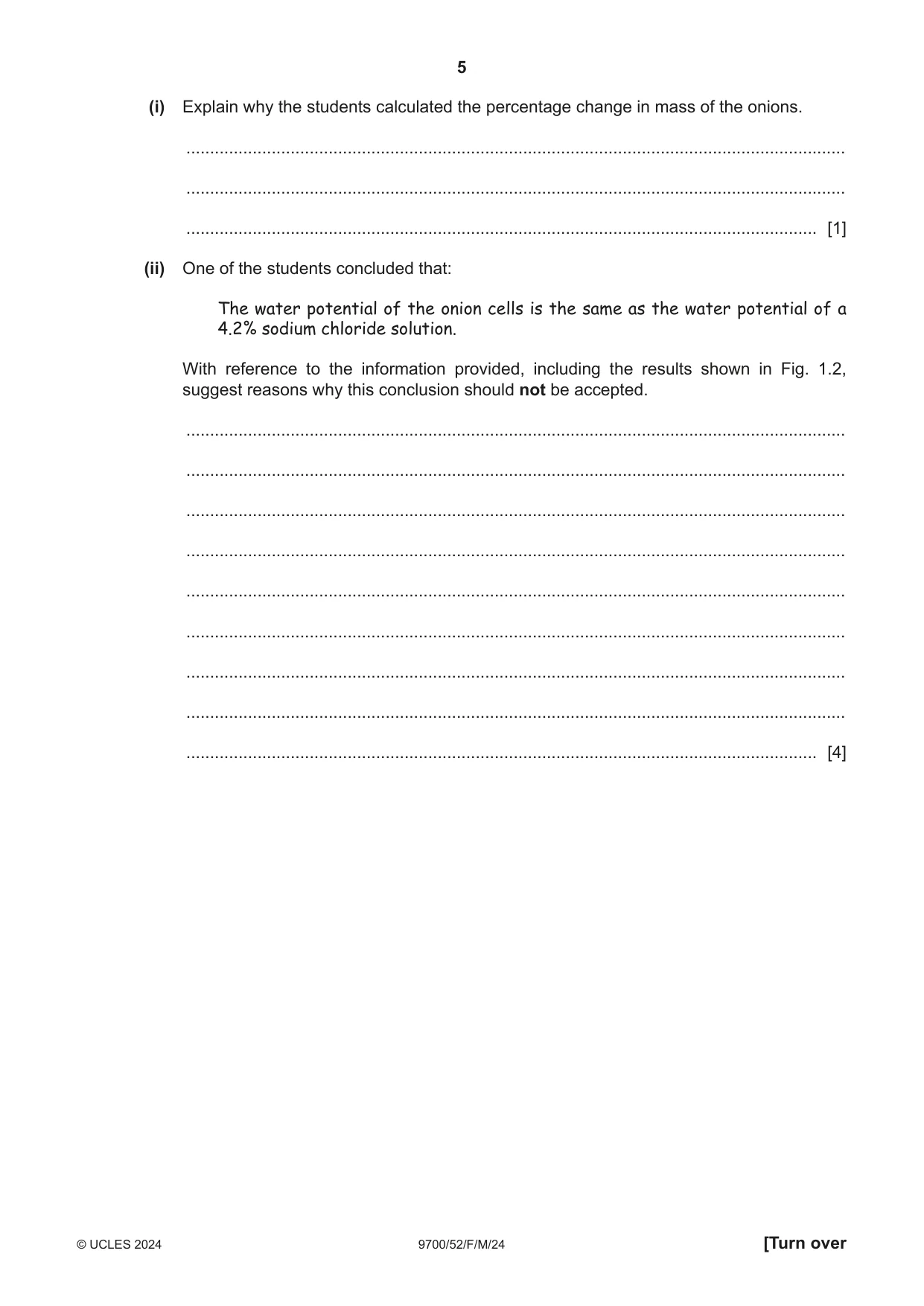
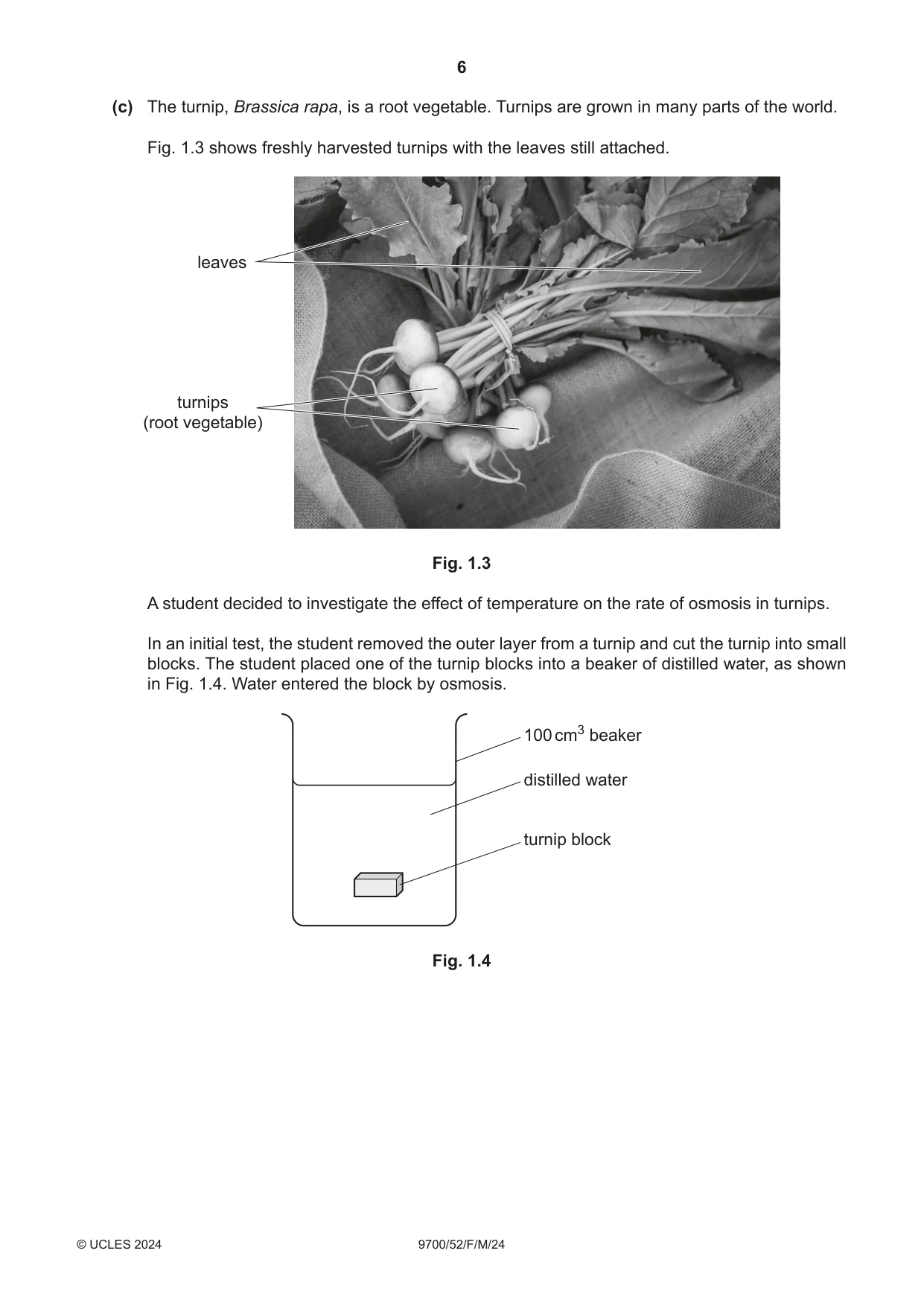
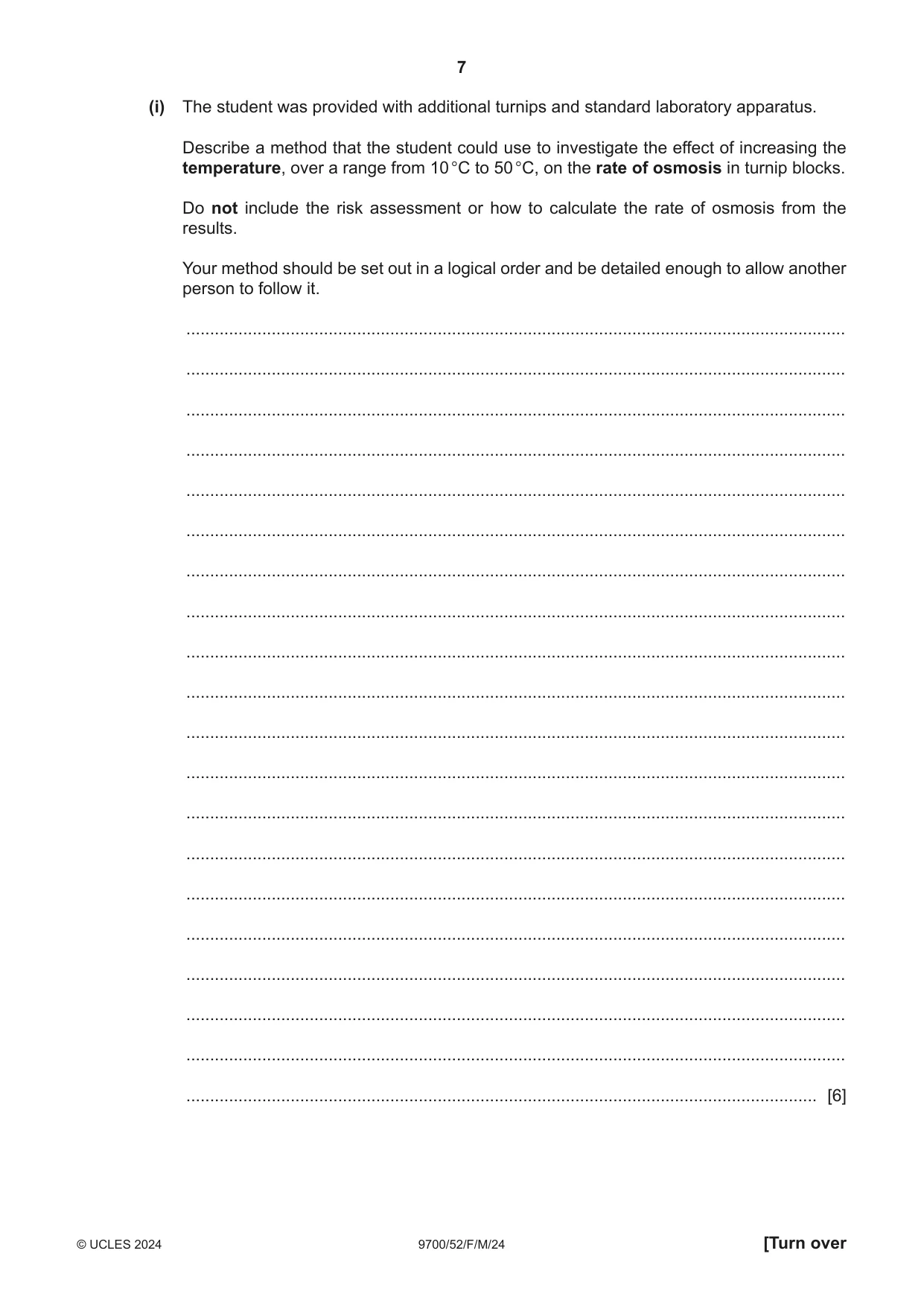
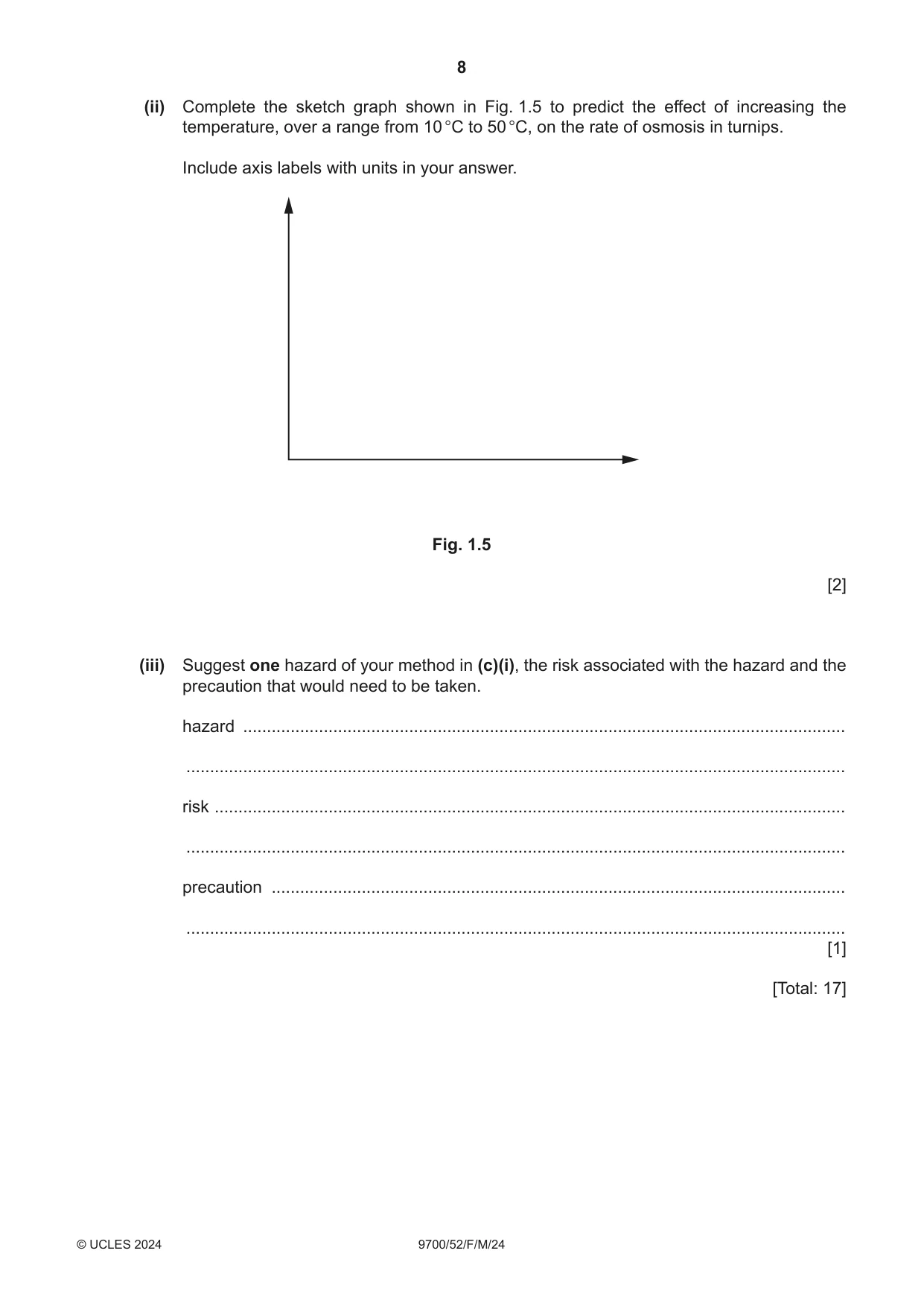
1 Onions are vegetables that are harvested from the plant Allium cepa. In many countries, small onions are used to make pickled onions. Pickled onions can be stored for a long time because the growth of microorganisms is prevented. Pickled onions are made using this method. • Remove the dry outer layer from small onions. • Place the onions in a sodium chloride solution for several hours. • Remove the sodium chloride solution and place the onions in a solution of ethanoic acid (vinegar). Fig. 1.1 shows a container of pickled onions and some fresh onions that have not been pickled. container of pickled onions fresh onion dry outer layer of onion Fig. 1.1 (a) Some students decided to investigate how placing small onions in different concentrations of sodium chloride solution affects the mass of the onions. (i) Identify the independent variable in this investigation. ..................................................................................................................................... [1] (ii) The students were given a 20.0% stock solution of sodium chloride. The students decided to use the stock solution to make sodium chloride solutions with concentrations of 0.0%, 1.0%, 5.0%, 10.0%, 15.0% and 20.0%. The students made 140 cm3 of these solutions in separate beakers. Complete Table 1.1 to show how 140 cm3 of these solutions could be made by proportional dilution of the 20.0% stock solution of sodium chloride. Table 1.1 volume ofpercentage concentration volume of 20.0% of sodium chloride sodium chloride solution ............................................ solution / cm3 / cm3 0.0 1.0 5.0 10.0 15.0 20.0 [2] (b) The students carried out this procedure. • The dry outer layer was removed from 30 small onions. • Five of the small onions were placed into each of the six beakers containing the sodium chloride solutions prepared by the students. • The onions were left in the sodium chloride solutions for 2 hours. • The mean percentage change in mass of the five small onions in each beaker was calculated. The students then repeated the whole procedure using a new set of 30 small onions. This time the onions were left in the sodium chloride solutions for 48 hours. Fig. 1.2 shows the results of the investigation. +20.0 key after 2 hours +18.0 after 48 hours +16.0 +14.0 +12.0 +10.0 +8.0 mean percentage +6.0 change in mass +4.0 +2.0 0.0 –2.0 –4.0 –6.0 –8.0 0.0 5.0 10.0 15.0 20.0 percentage concentration of sodium chloride solution Fig. 1.2 (i) Explain why the students calculated the percentage change in mass of the onions. ........................................................................................................................................... ........................................................................................................................................... ..................................................................................................................................... [1] (ii) One of the students concluded that: The water potential of the onion cells is the same as the water potential of a 4.2% sodium chloride solution. With reference to the information provided, including the results shown in Fig. 1.2, suggest reasons why this conclusion should not be accepted. ........................................................................................................................................... ........................................................................................................................................... ........................................................................................................................................... ........................................................................................................................................... ........................................................................................................................................... ........................................................................................................................................... ........................................................................................................................................... ........................................................................................................................................... ..................................................................................................................................... [4] (c) The turnip, Brassica rapa, is a root vegetable. Turnips are grown in many parts of the world. Fig. 1.3 shows freshly harvested turnips with the leaves still attached. leaves turnips (root vegetable) Fig. 1.3 A student decided to investigate the effect of temperature on the rate of osmosis in turnips. In an initial test, the student removed the outer layer from a turnip and cut the turnip into small blocks. The student placed one of the turnip blocks into a beaker of distilled water, as shown in Fig. 1.4. Water entered the block by osmosis. 100 cm3 beaker distilled water turnip block Fig. 1.4 (i) The student was provided with additional turnips and standard laboratory apparatus. Describe a method that the student could use to investigate the effect of increasing the temperature, over a range from 10 °C to 50 °C, on the rate of osmosis in turnip blocks. Do not include the risk assessment or how to calculate the rate of osmosis from the results. Your method should be set out in a logical order and be detailed enough to allow another person to follow it. ........................................................................................................................................... ........................................................................................................................................... ........................................................................................................................................... ........................................................................................................................................... ........................................................................................................................................... ........................................................................................................................................... ........................................................................................................................................... ........................................................................................................................................... ........................................................................................................................................... ........................................................................................................................................... ........................................................................................................................................... ........................................................................................................................................... ........................................................................................................................................... ........................................................................................................................................... ........................................................................................................................................... ........................................................................................................................................... ........................................................................................................................................... ........................................................................................................................................... ........................................................................................................................................... ..................................................................................................................................... [6] (ii) Complete the sketch graph shown in Fig. 1.5 to predict the effect of increasing the temperature, over a range from 10 °C to 50 °C, on the rate of osmosis in turnips. Include axis labels with units in your answer. Fig. 1.5 [2] (iii) Suggest one hazard of your method in (c)(i), the risk associated with the hazard and the precaution that would need to be taken. hazard ............................................................................................................................... ........................................................................................................................................... risk ..................................................................................................................................... ........................................................................................................................................... precaution ......................................................................................................................... ........................................................................................................................................... [1] [Total: 17]
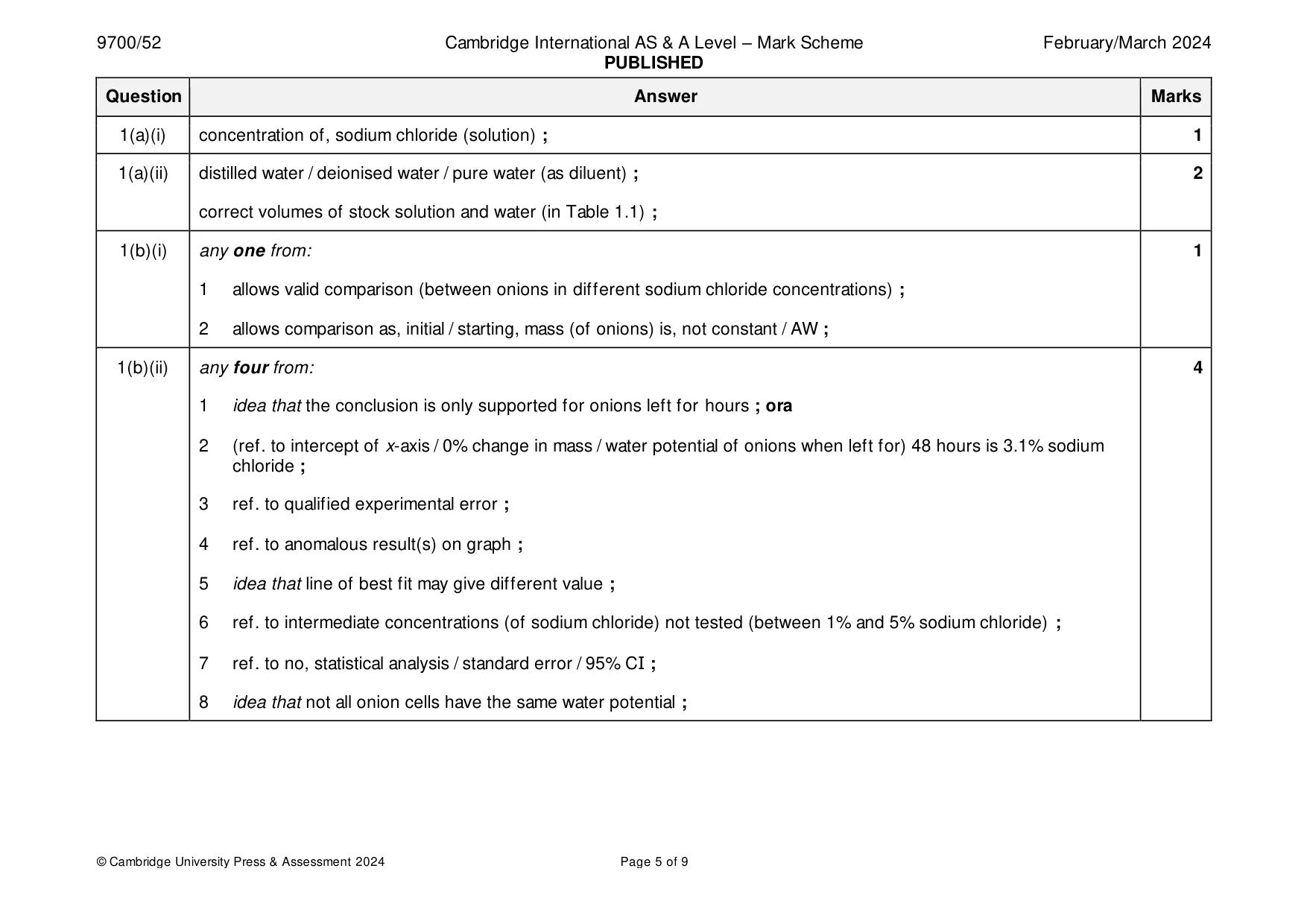
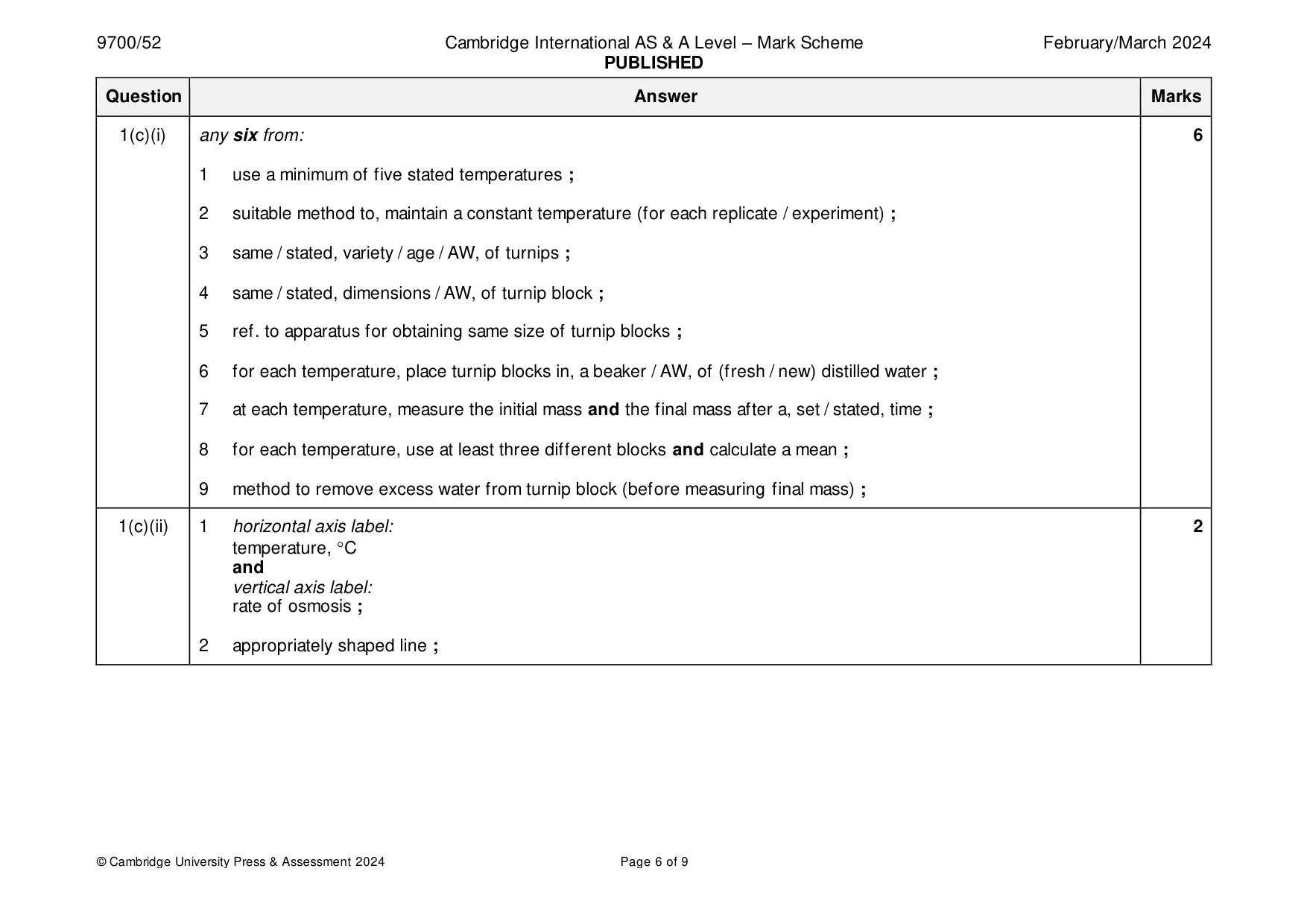
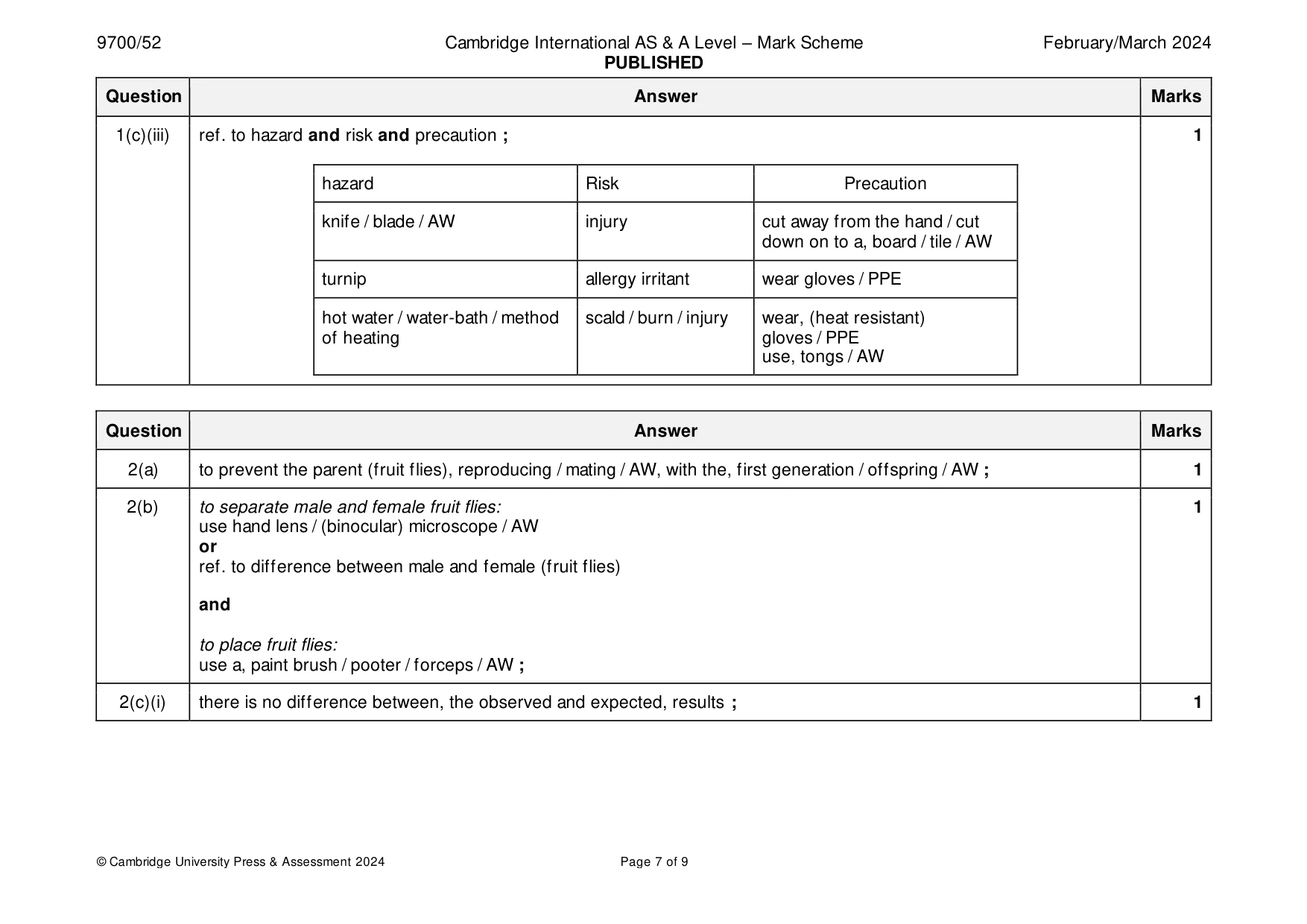
Mark scheme: Question Answer Marks 1(a)(i) concentration of, sodium chloride (solution) ; 1 1(a)(ii) distilled water / deionised water / pure water (as diluent) ; 2 correct volumes of stock solution and water (in Table 1.1) ; 1(b)(i) any one from: 1 1 allows valid comparison (between onions in different sodium chloride concentrations) ; 2 allows comparison as, initial / starting, mass (of onions) is, not constant / AW ; 1(b)(ii) any four from: 4 1 idea that the conclusion is only supported for onions left for hours ; ora 2 (ref. to intercept of x-axis / 0% change in mass / water potential of onions when left for) 48 hours is 3.1% sodium chloride ; 3 ref. to qualified experimental error ; 4 ref. to anomalous result(s) on graph ; 5 idea that line of best fit may give different value ; 6 ref. to intermediate concentrations (of sodium chloride) not tested (between 1% and 5% sodium chloride) ; 7 ref. to no, statistical analysis / standard error / 95% CI ; 8 idea that not all onion cells have the same water potential ; 1(c)(i) any six from: 6 1 use a minimum of five stated temperatures ; 2 suitable method to, maintain a constant temperature (for each replicate / experiment) ; 3 same / stated, variety / age / AW, of turnips ; 4 same / stated, dimensions / AW, of turnip block ; 5 ref. to apparatus for obtaining same size of turnip blocks ; 6 for each temperature, place turnip blocks in, a beaker / AW, of (fresh / new) distilled water ; 7 at each temperature, measure the initial mass and the final mass after a, set / stated, time ; 8 for each temperature, use at least three different blocks and calculate a mean ; 9 method to remove excess water from turnip block (before measuring final mass) ; 1(c)(ii) 1 horizontal axis label: 2 temperature, C and vertical axis label: rate of osmosis ; 2 appropriately shaped line ; 1(c)(iii) ref. to hazard and risk and precaution ; 1 hazard Risk Precaution knife / blade / AW injury cut away from the hand / cut down on to a, board / tile / AW turnip allergy irritant wear gloves / PPE hot water / water-bath / method scald / burn / injury wear, (heat resistant) of heating gloves / PPE use, tongs / AW
Q2 · Drosophila melanogaster is a small fruit fly that is often used in research on genetics
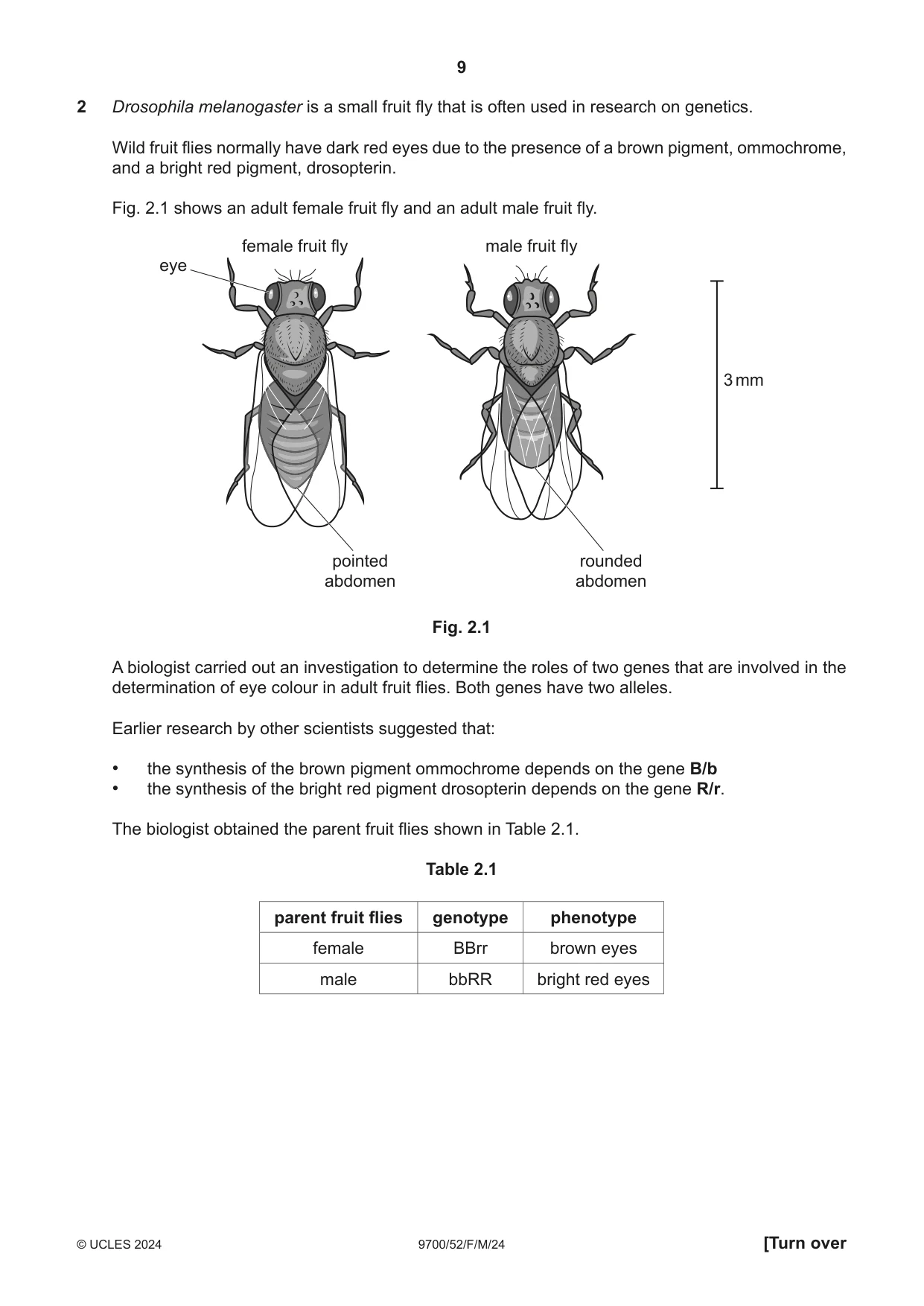
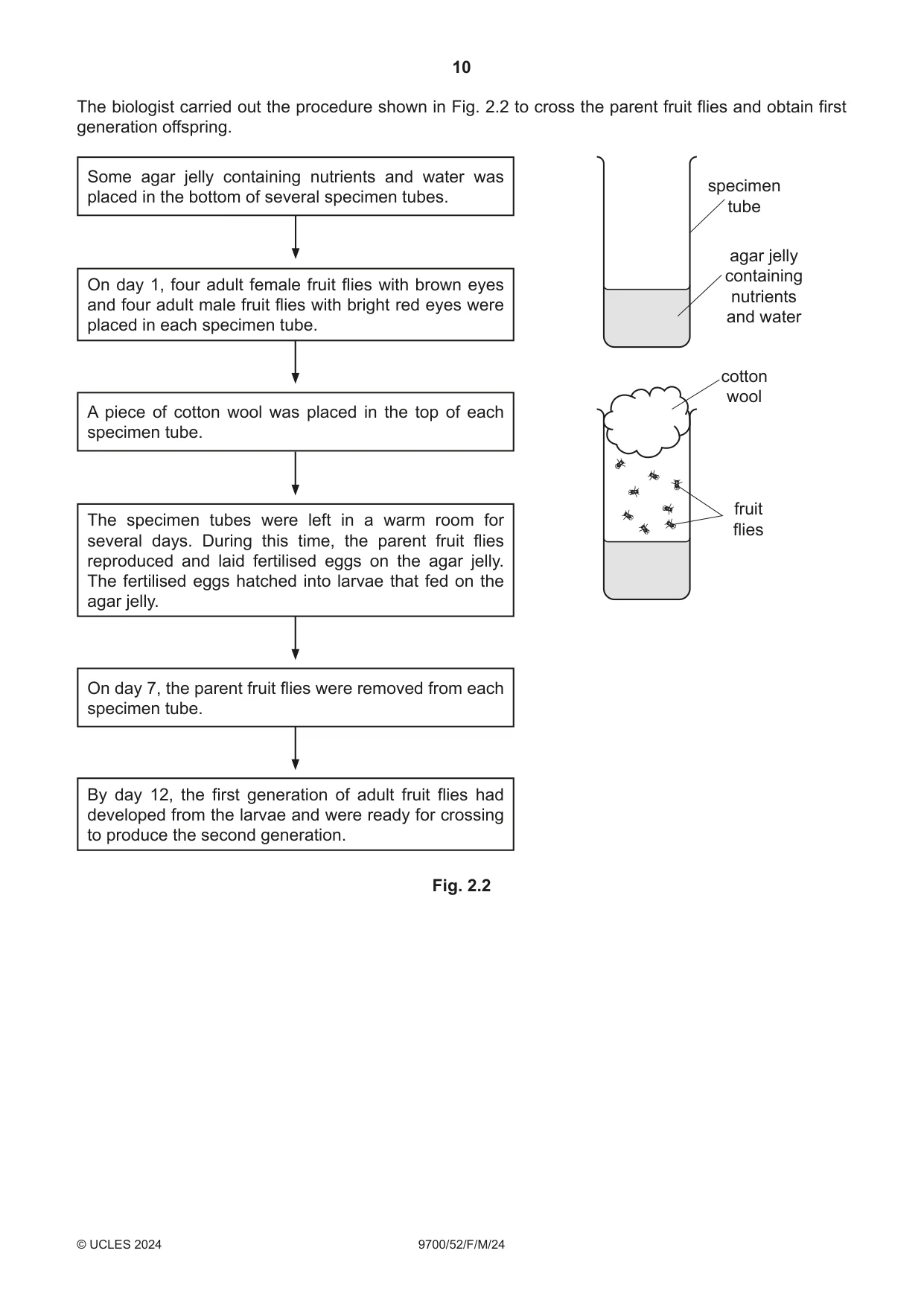
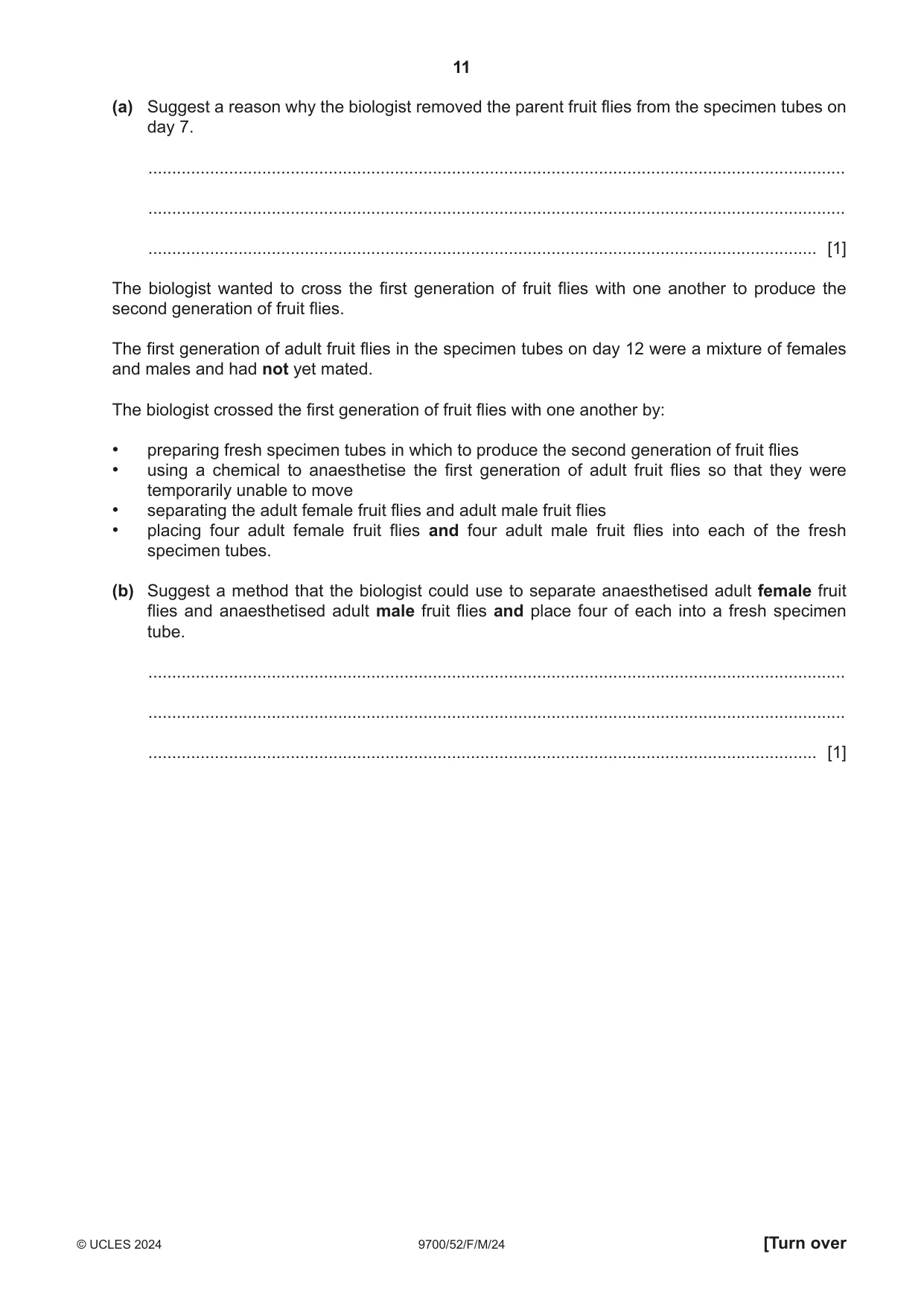
2 Drosophila melanogaster is a small fruit fly that is often used in research on genetics. Wild fruit flies normally have dark red eyes due to the presence of a brown pigment, ommochrome, and a bright red pigment, drosopterin. Fig. 2.1 shows an adult female fruit fly and an adult male fruit fly. female fruit fly male fruit fly eye 3mm pointed rounded abdomen abdomen Fig. 2.1 A biologist carried out an investigation to determine the roles of two genes that are involved in the determination of eye colour in adult fruit flies. Both genes have two alleles. Earlier research by other scientists suggested that: • the synthesis of the brown pigment ommochrome depends on the gene B/b • the synthesis of the bright red pigment drosopterin depends on the gene R/r. The biologist obtained the parent fruit flies shown in Table 2.1. Table 2.1 parent fruit flies genotype phenotype female BBrr brown eyes male bbRR bright red eyes The biologist carried out the procedure shown in Fig. 2.2 to cross the parent fruit flies and obtain first generation offspring. Some agar jelly containing nutrients and water was specimen placed in the bottom of several specimen tubes. tube agar jelly containing On day 1, four adult female fruit flies with brown eyes nutrients and four adult male fruit flies with bright red eyes were and water placed in each specimen tube. cotton wool A piece of cotton wool was placed in the top of each specimen tube. fruit The specimen tubes were left in a warm room for flies several days. During this time, the parent fruit flies reproduced and laid fertilised eggs on the agar jelly. The fertilised eggs hatched into larvae that fed on the agar jelly. On day 7, the parent fruit flies were removed from each specimen tube. By day 12, the first generation of adult fruit flies had developed from the larvae and were ready for crossing to produce the second generation. Fig. 2.2 (a) Suggest a reason why the biologist removed the parent fruit flies from the specimen tubes on day 7. ................................................................................................................................................... ................................................................................................................................................... ............................................................................................................................................. [1] The biologist wanted to cross the first generation of fruit flies with one another to produce the second generation of fruit flies. The first generation of adult fruit flies in the specimen tubes on day 12 were a mixture of females and males and had not yet mated. The biologist crossed the first generation of fruit flies with one another by: • preparing fresh specimen tubes in which to produce the second generation of fruit flies • using a chemical to anaesthetise the first generation of adult fruit flies so that they were temporarily unable to move • separating the adult female fruit flies and adult male fruit flies • placing four adult female fruit flies and four adult male fruit flies into each of the fresh specimen tubes. (b) Suggest a method that the biologist could use to separate anaesthetised adult female fruit flies and anaesthetised adult male fruit flies and place four of each into a fresh specimen tube. ................................................................................................................................................... ................................................................................................................................................... ............................................................................................................................................. [1]
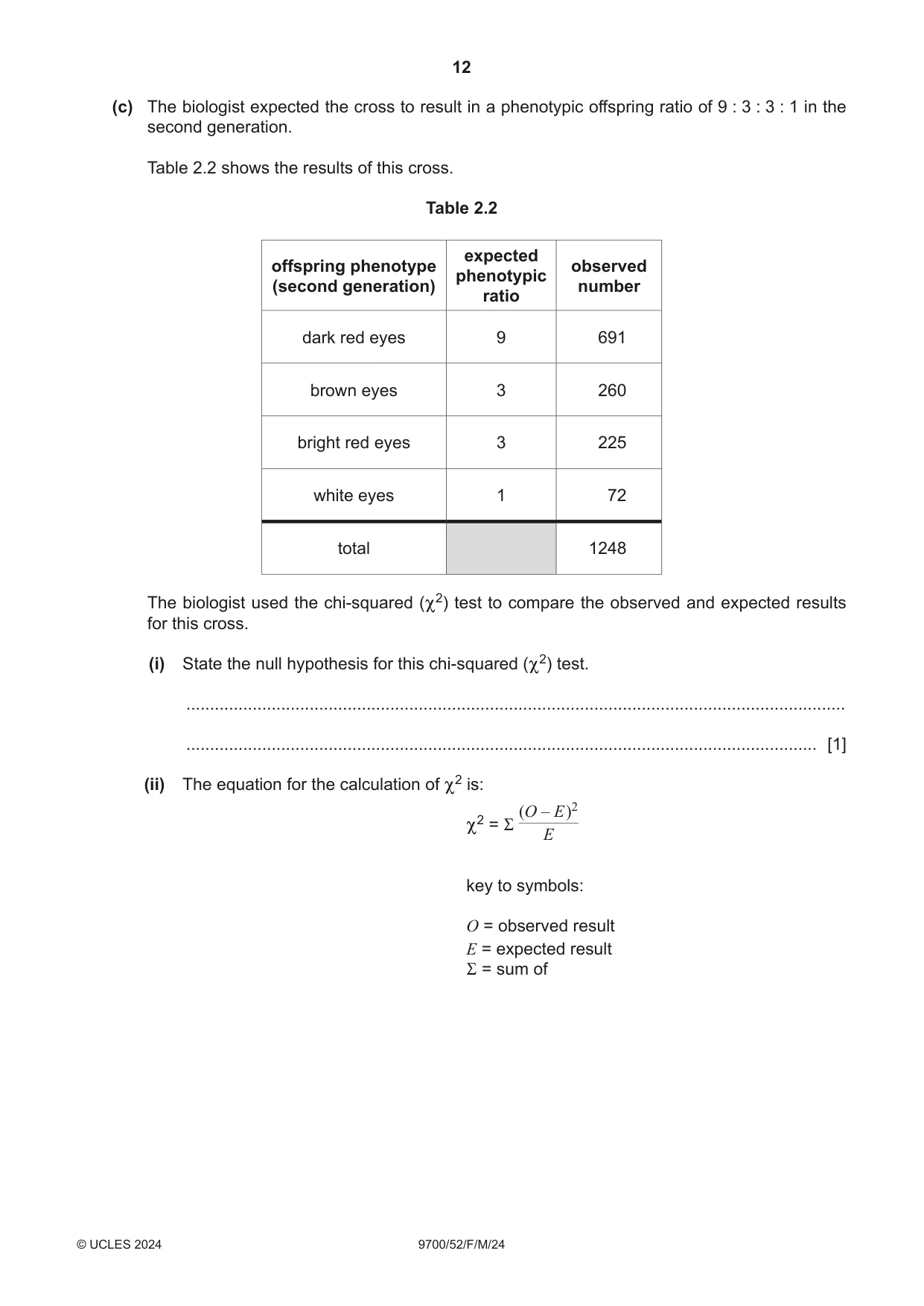
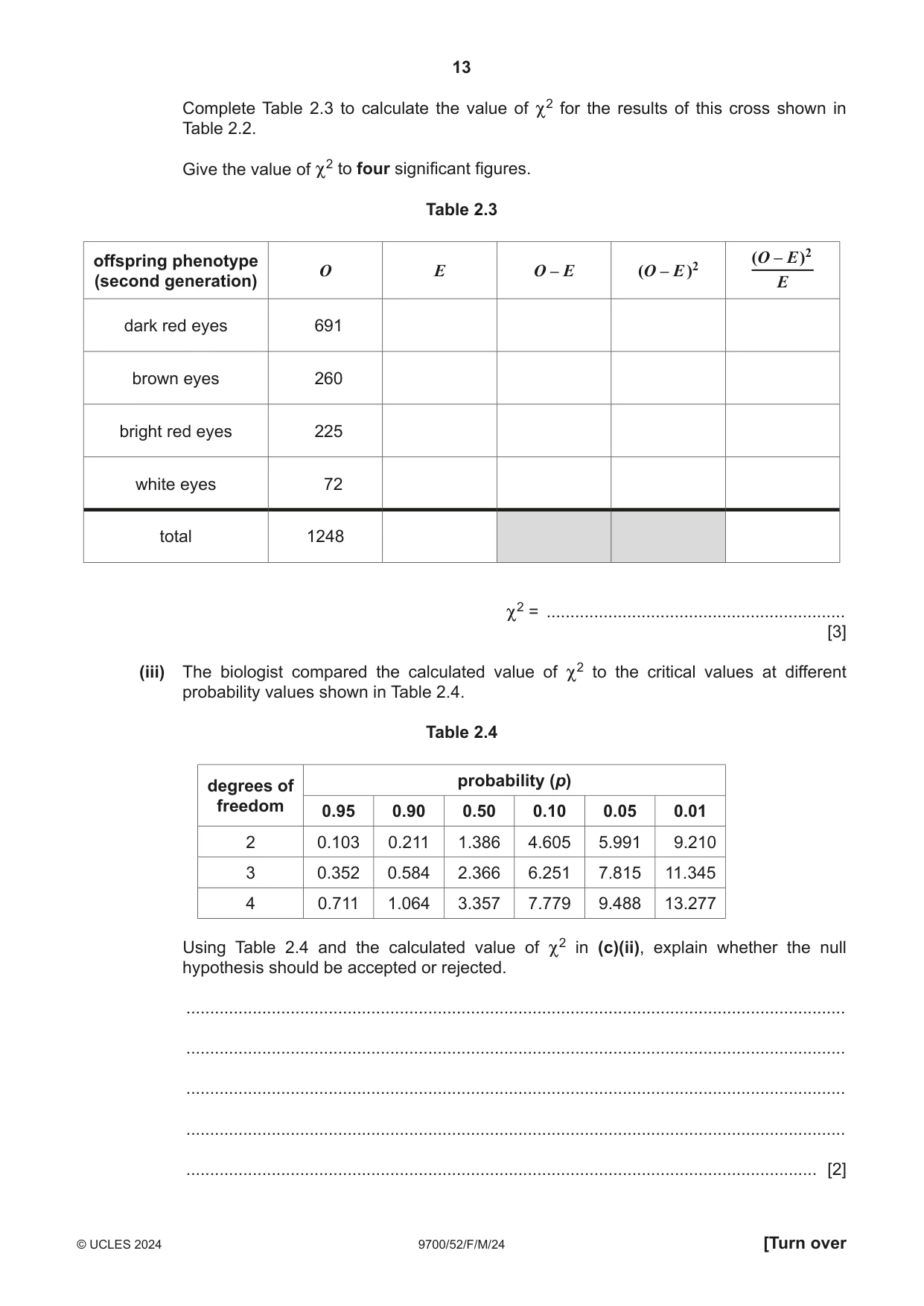
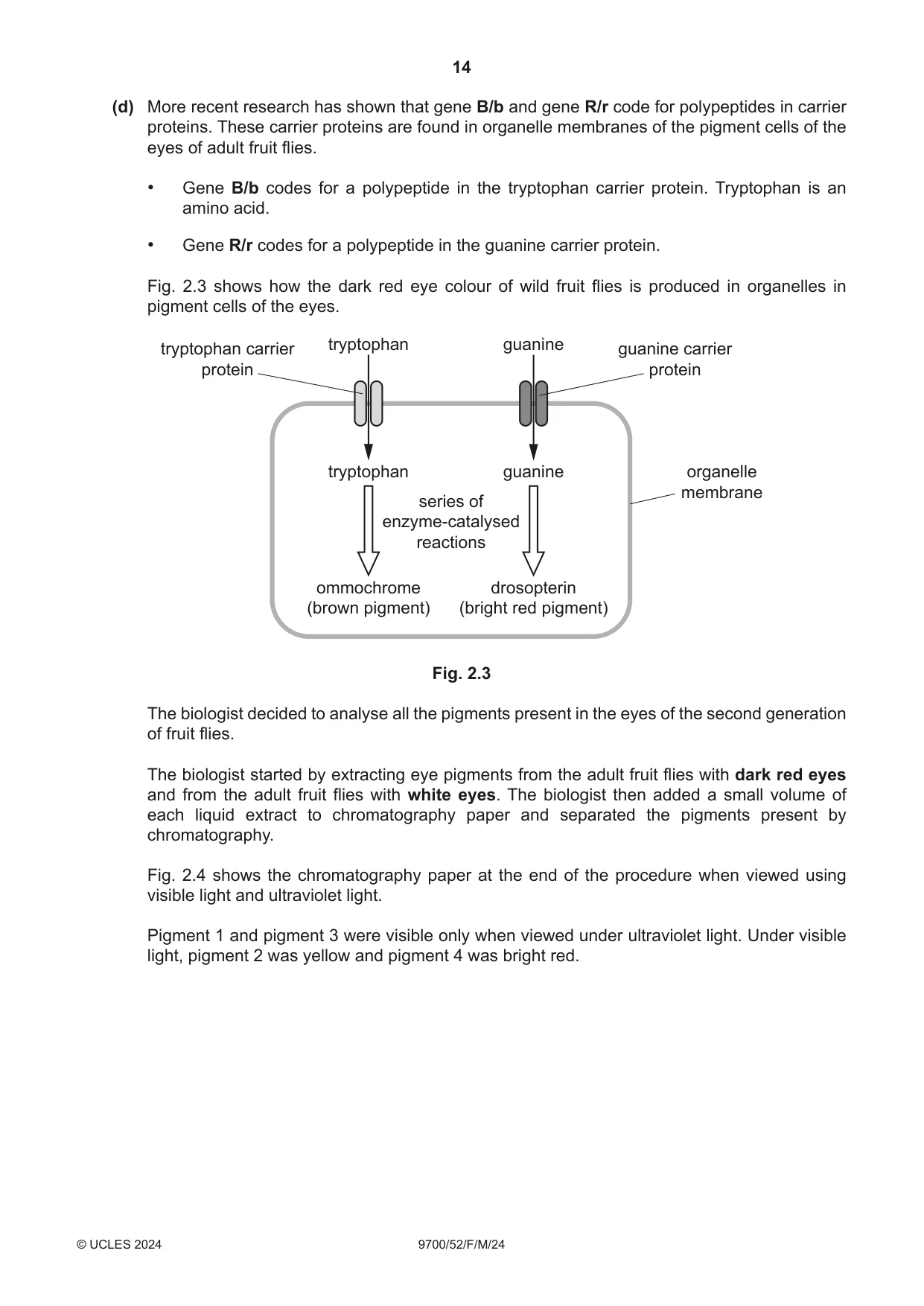
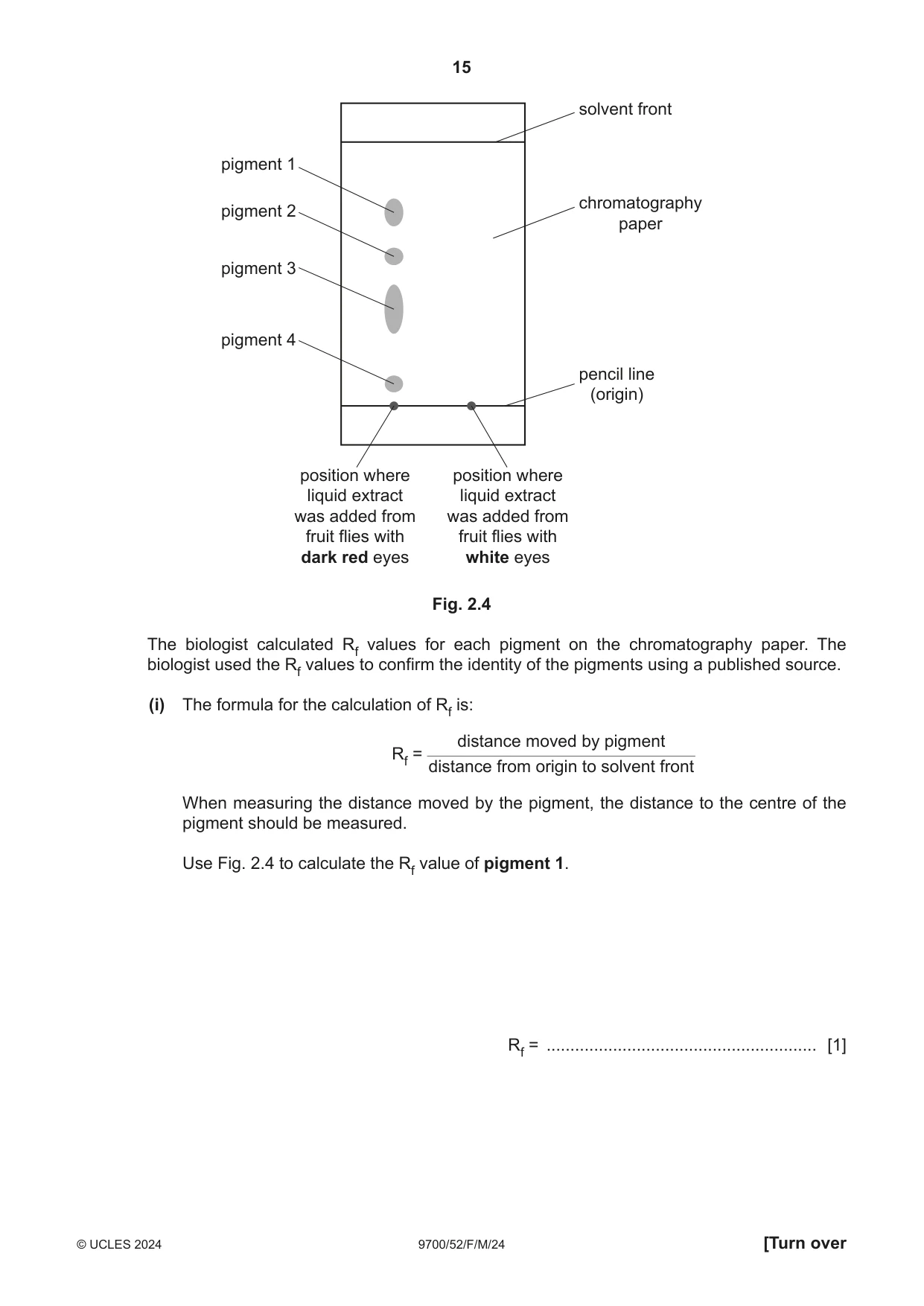
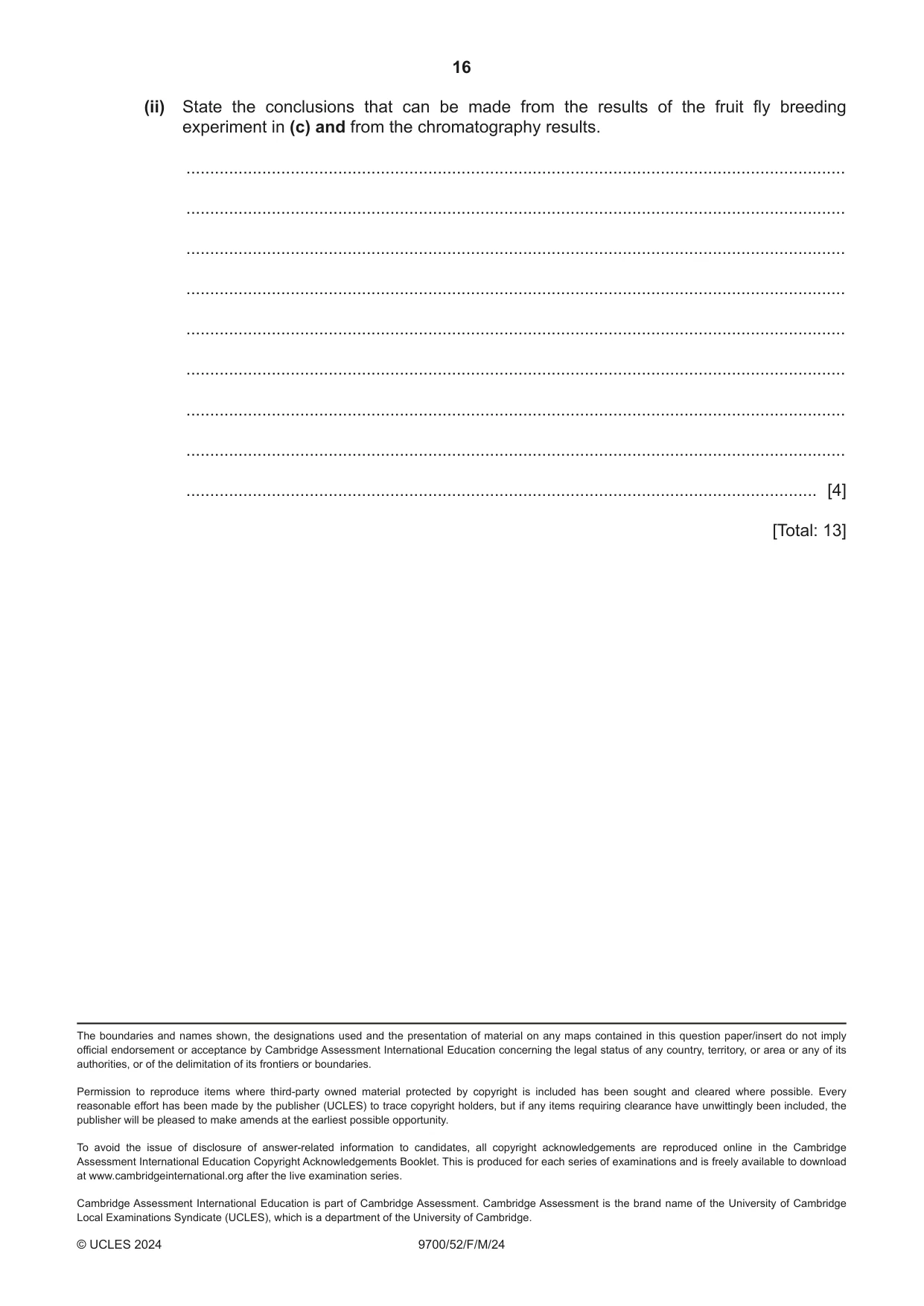
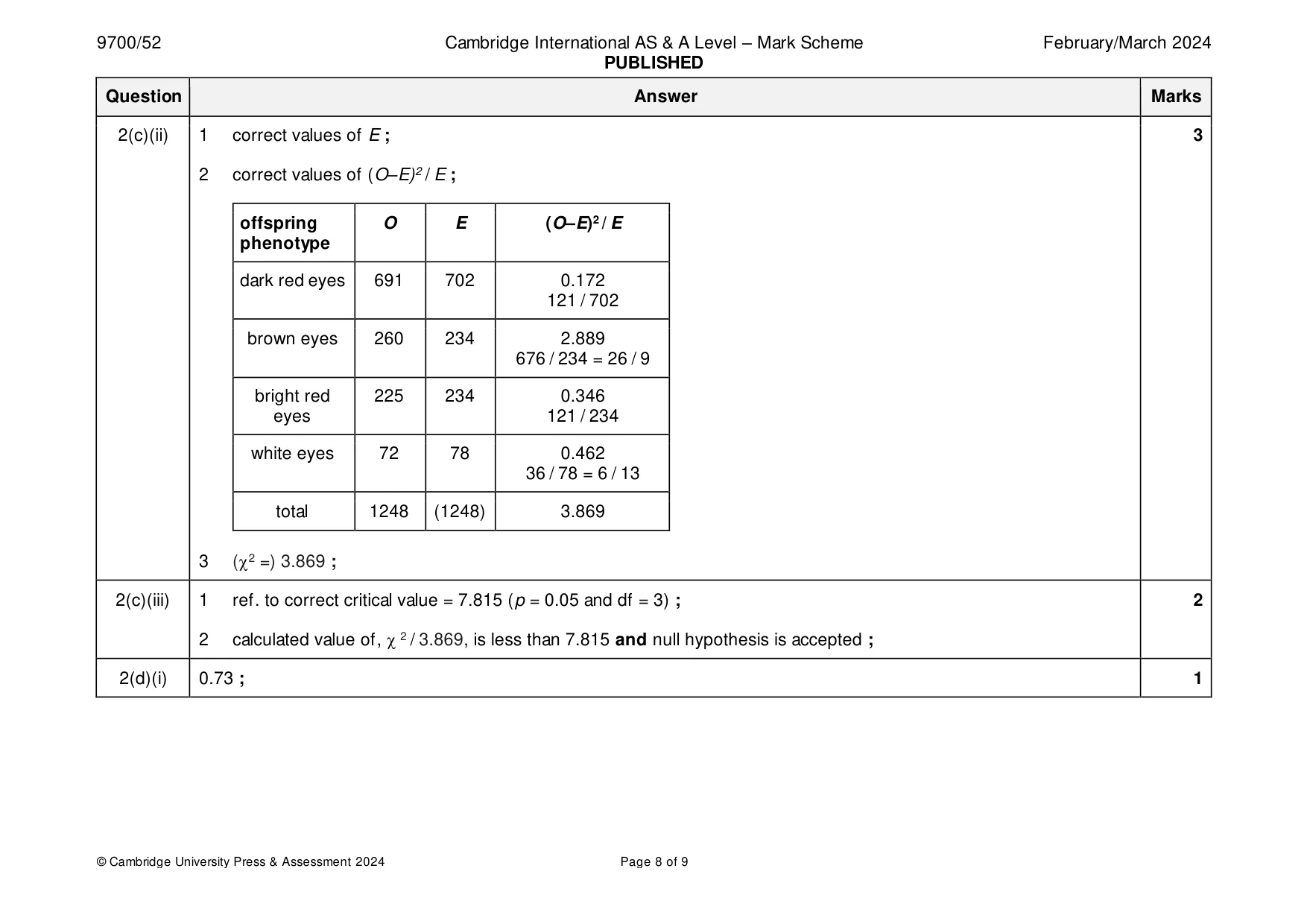
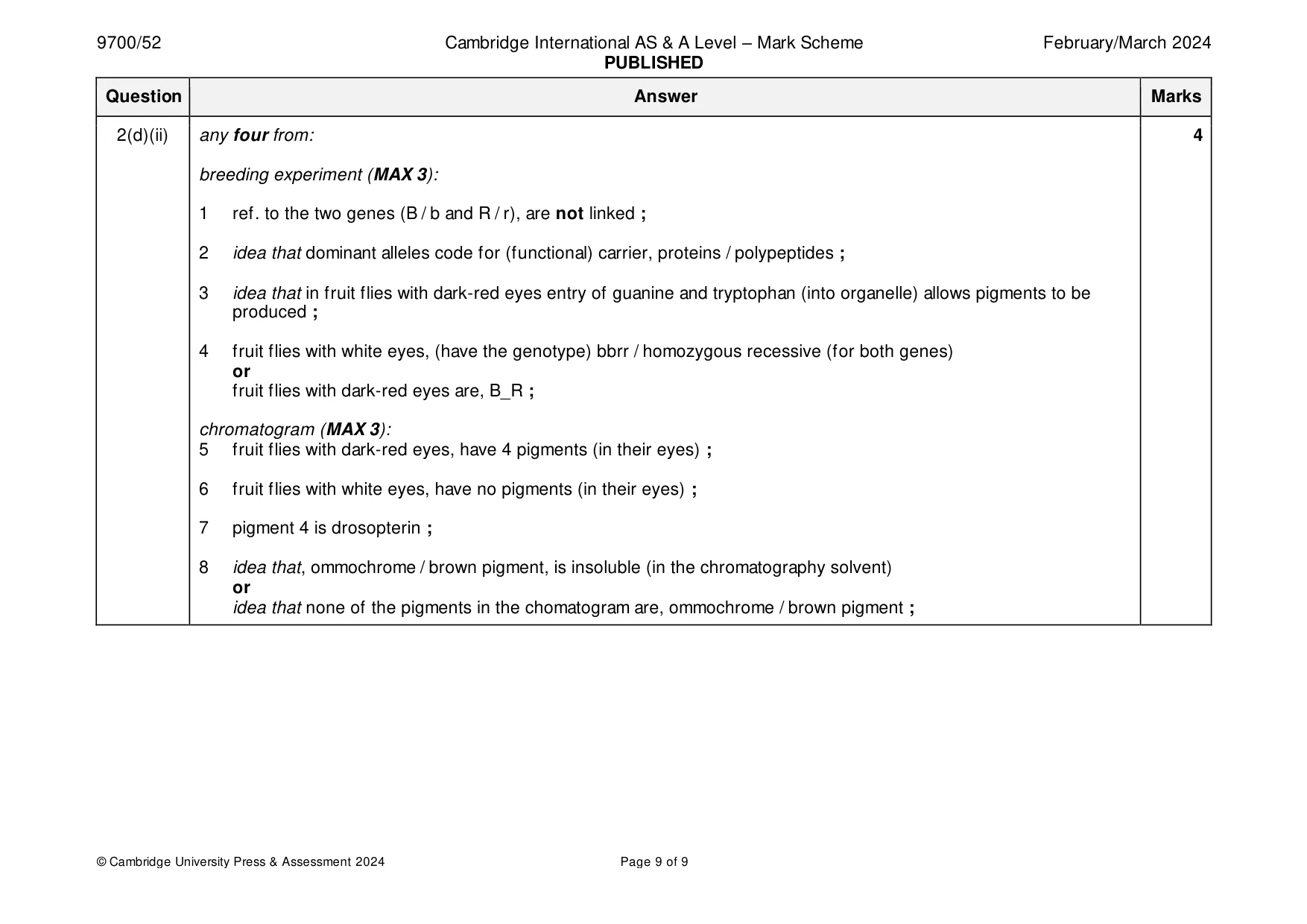
Mark scheme: 2(a) to prevent the parent (fruit flies), reproducing / mating / AW, with the, first generation / offspring / AW ; 1 2(b) to separate male and female fruit flies: 1 use hand lens / (binocular) microscope / AW or ref. to difference between male and female (fruit flies) and to place fruit flies: use a, paint brush / pooter / forceps / AW ; 2(c)(i) there is no difference between, the observed and expected, results ; 1 2(c)(ii) 1 correct values of E ; 3 2 correct values of (O–E)2 / E ; offspring O E (O–E)2 / E phenotype dark red eyes 691 702 0.172 121 / 702 brown eyes 260 234 2.889 676 / 234 = 26 / 9 bright red 225 234 0.346 eyes 121 / 234 white eyes 72 78 0.462 36 / 78 = 6 / 13 total 1248 (1248) 3.869 3 (2 =) 3.869 ; 2(c)(iii) 1 ref. to correct critical value = 7.815 (p = 0.05 and df = 3) ; 2 2 calculated value of, 2 / 3.869, is less than 7.815 and null hypothesis is accepted ; 2(d)(i) 0.73 ; 1 2(d)(ii) any four from: 4 breeding experiment (MAX 3): 1 ref. to the two genes (B / b and R / r), are not linked ; 2 idea that dominant alleles code for (functional) carrier, proteins / polypeptides ; 3 idea that in fruit flies with dark-red eyes entry of guanine and tryptophan (into organelle) allows pigments to be produced ; 4 fruit flies with white eyes, (have the genotype) bbrr / homozygous recessive (for both genes) or fruit flies with dark-red eyes are, B_R ; chromatogram (MAX 3): 5 fruit flies with dark-red eyes, have 4 pigments (in their eyes) ; 6 fruit flies with white eyes, have no pigments (in their eyes) ; 7 pigment 4 is drosopterin ; 8 idea that, ommochrome / brown pigment, is insoluble (in the chromatography solvent) or idea that none of the pigments in the chomatogram are, ommochrome / brown pigment ;
More questions on Passage of information from parents to offspring
What was in this paper
The subtopics covered by these 2 questions, and how many questions each got. Open one in a new tab to see every Cambridge question on it.
What you needed in this session
Cambridge’s own grade thresholds for 2024 Feb/March, Paper 5 · Variant 2. A higher threshold means an easier paper — the bar moves with how the cohort did.