Cambridge A Level Biology 9700 — 2020 May/June Paper 4 · Variant 2
9700/42/M/J/20 · 10 questions · 115 marks · ≈129 min
The question paper and its mark scheme, free to read here and free to download. This is Cambridge’s own paper, exactly as it was sat.
Question paper24 pages





Mark scheme20 pages
Answers below. Sit the paper first if you are practising.
Questions as text
Q1 · The enzyme alanine transaminase (ALT) is found in the liver
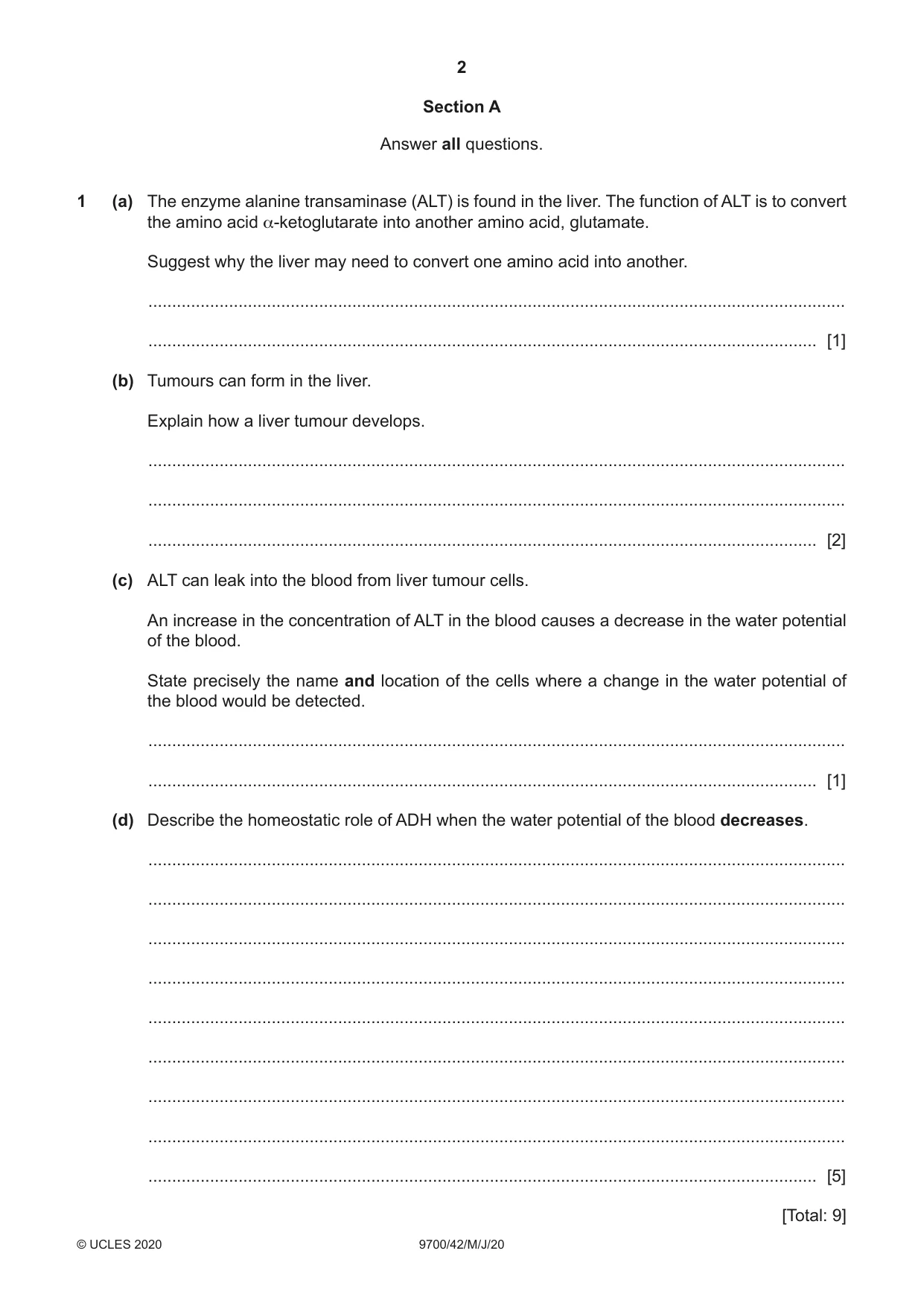
1 (a) The enzyme alanine transaminase (ALT) is found in the liver. The function of ALT is to convert the amino acid α-ketoglutarate into another amino acid, glutamate. Suggest why the liver may need to convert one amino acid into another. ................................................................................................................................................... ............................................................................................................................................. [1] (b) Tumours can form in the liver. Explain how a liver tumour develops. ................................................................................................................................................... ................................................................................................................................................... ............................................................................................................................................. [2] (c) ALT can leak into the blood from liver tumour cells. An increase in the concentration of ALT in the blood causes a decrease in the water potential of the blood. State precisely the name and location of the cells where a change in the water potential of the blood would be detected. ................................................................................................................................................... ............................................................................................................................................. [1] (d) Describe the homeostatic role of ADH when the water potential of the blood decreases. ................................................................................................................................................... ................................................................................................................................................... ................................................................................................................................................... ................................................................................................................................................... ................................................................................................................................................... ................................................................................................................................................... ................................................................................................................................................... ................................................................................................................................................... ............................................................................................................................................. [5] [Total: 9]
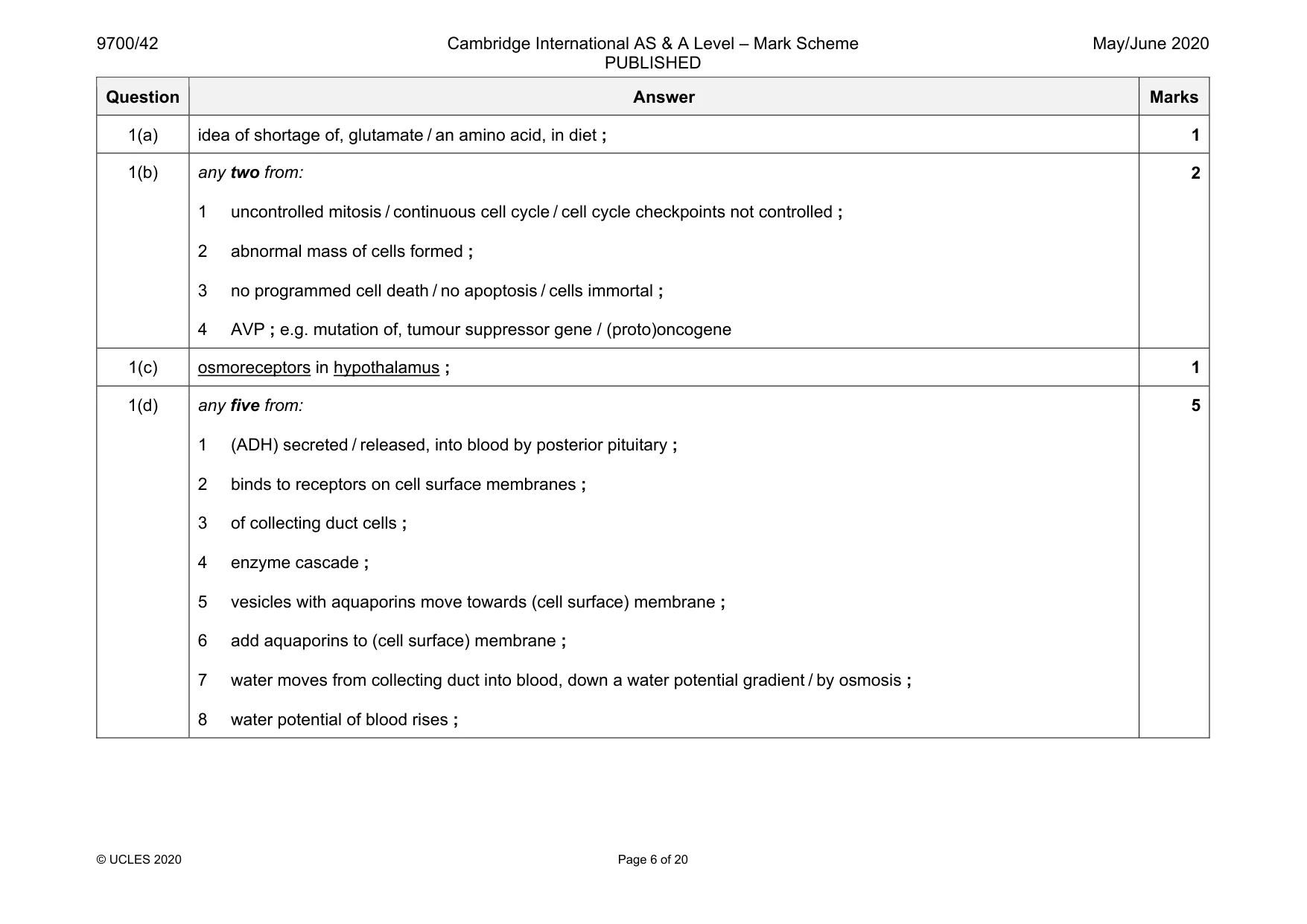
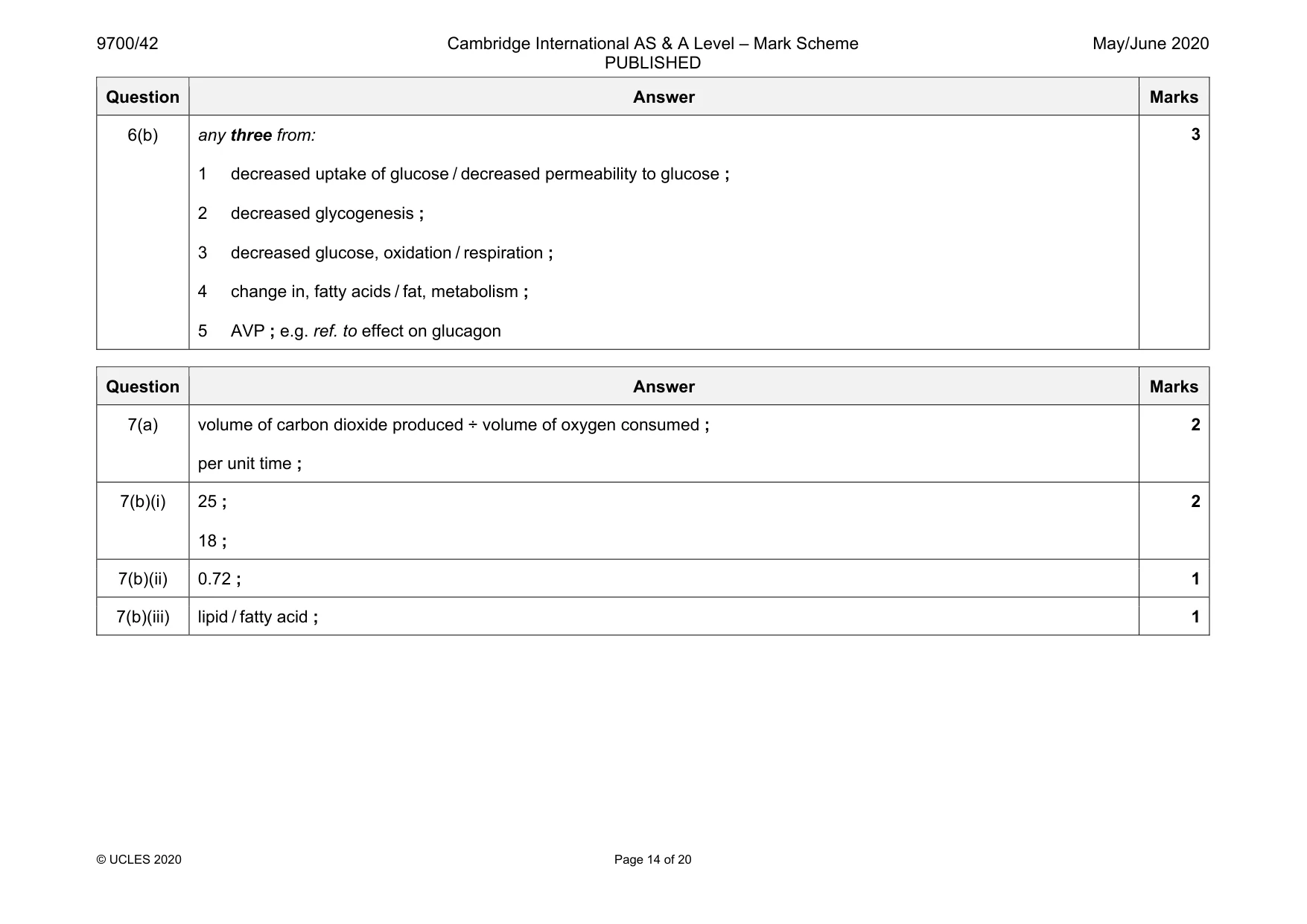
Mark scheme: 1(a) idea of shortage of, glutamate / an amino acid, in diet ; 1 1(b) any two from: 1 uncontrolled mitosis / continuous cell cycle / cell cycle checkpoints not controlled ; 2 abnormal mass of cells formed ; 3 no programmed cell death / no apoptosis / cells immortal ; 4 AVP ; e.g. mutation of, tumour suppressor gene / (proto)oncogene 2 1(c) osmoreceptors in hypothalamus ; 1 1(d) any five from: 1 (ADH) secreted / released, into blood by posterior pituitary ; 2 binds to receptors on cell surface membranes ; 3 of collecting duct cells ; 4 enzyme cascade ; 5 vesicles with aquaporins move towards (cell surface) membrane ; 6 add aquaporins to (cell surface) membrane ; 7 water moves from collecting duct into blood, down a water potential gradient / by osmosis ; 8 water potential of blood rises ; 5
Q2 · The summer squash plant, Cucurbita pepo, produces edible fruits that vary in shape
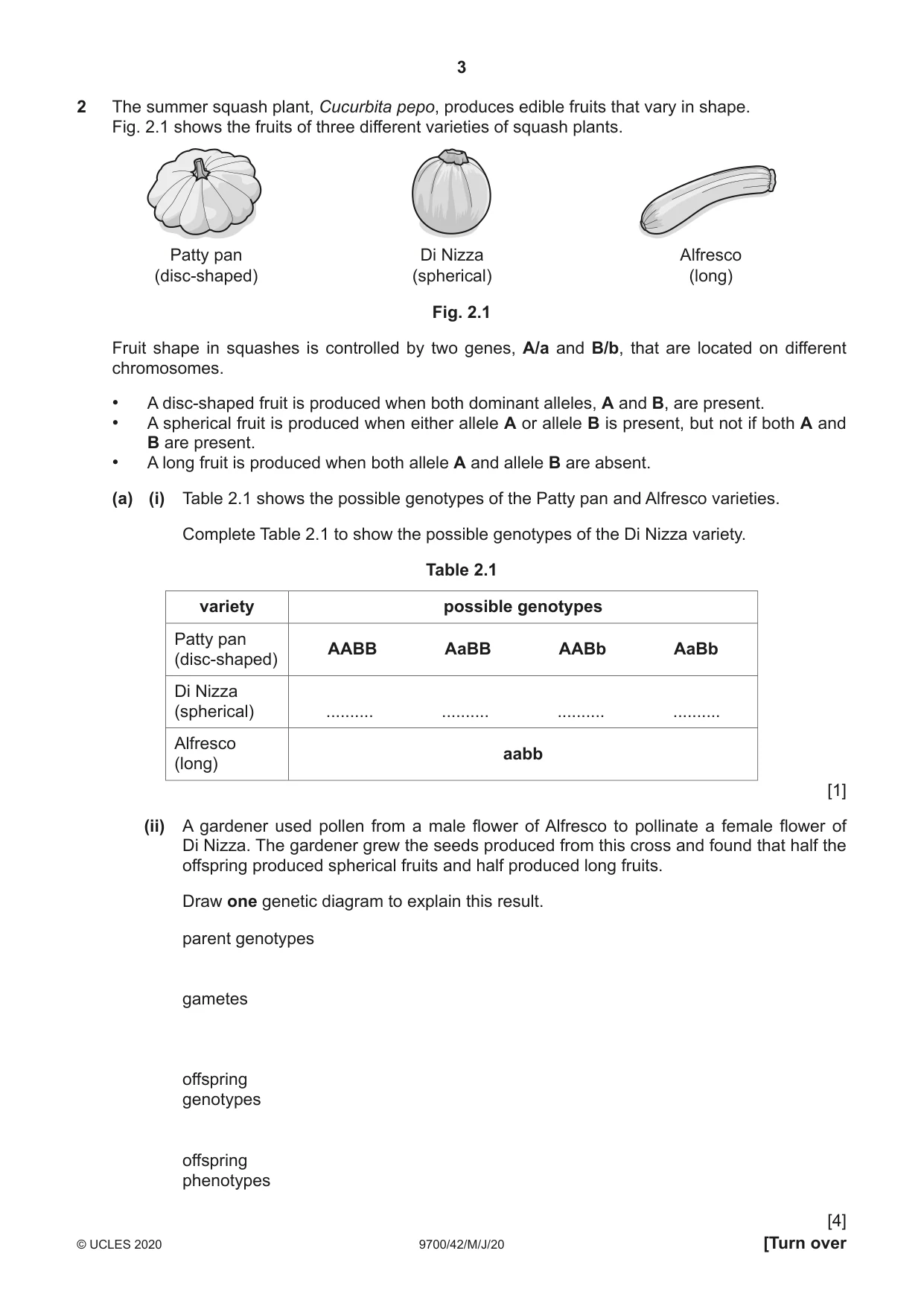
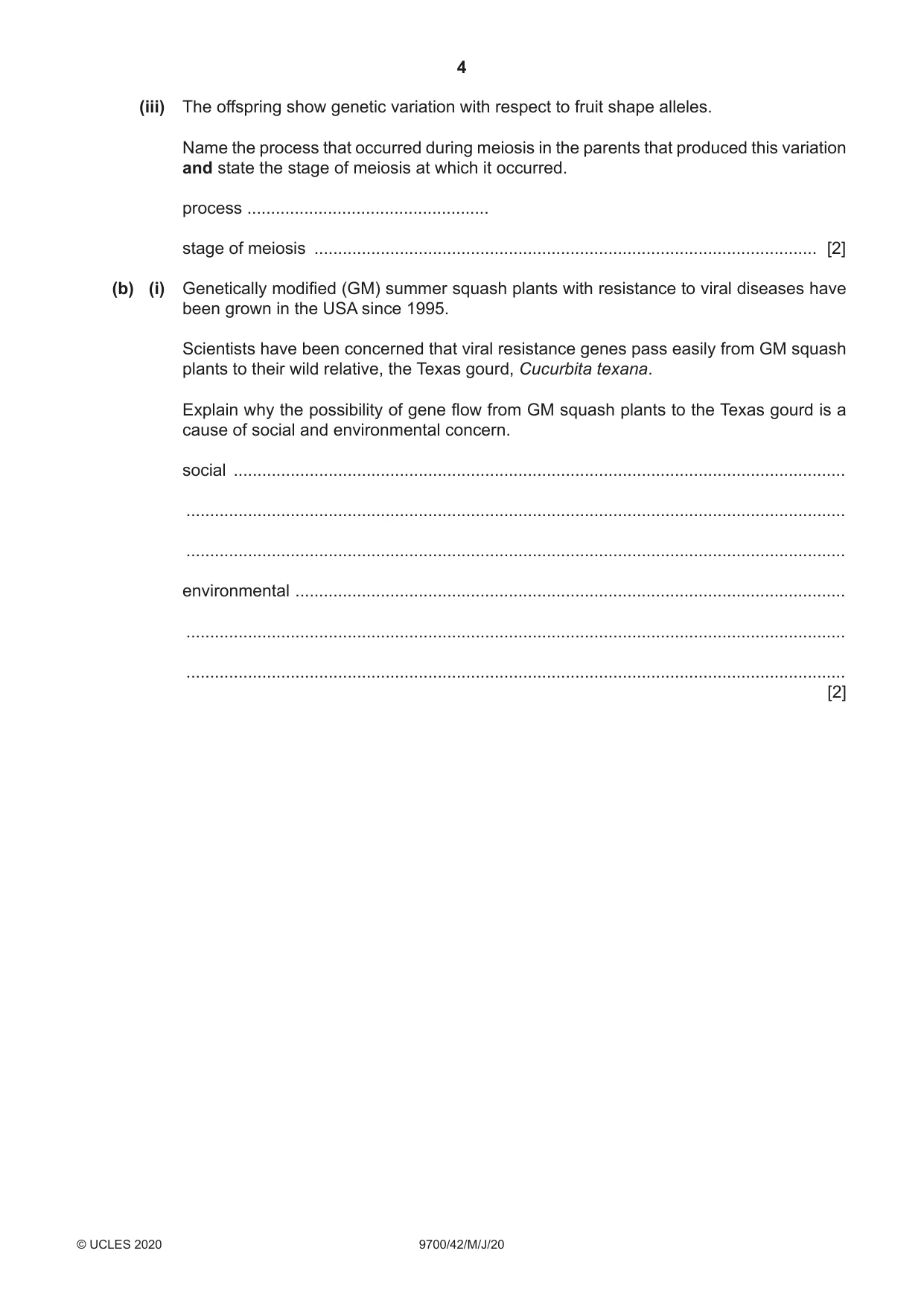
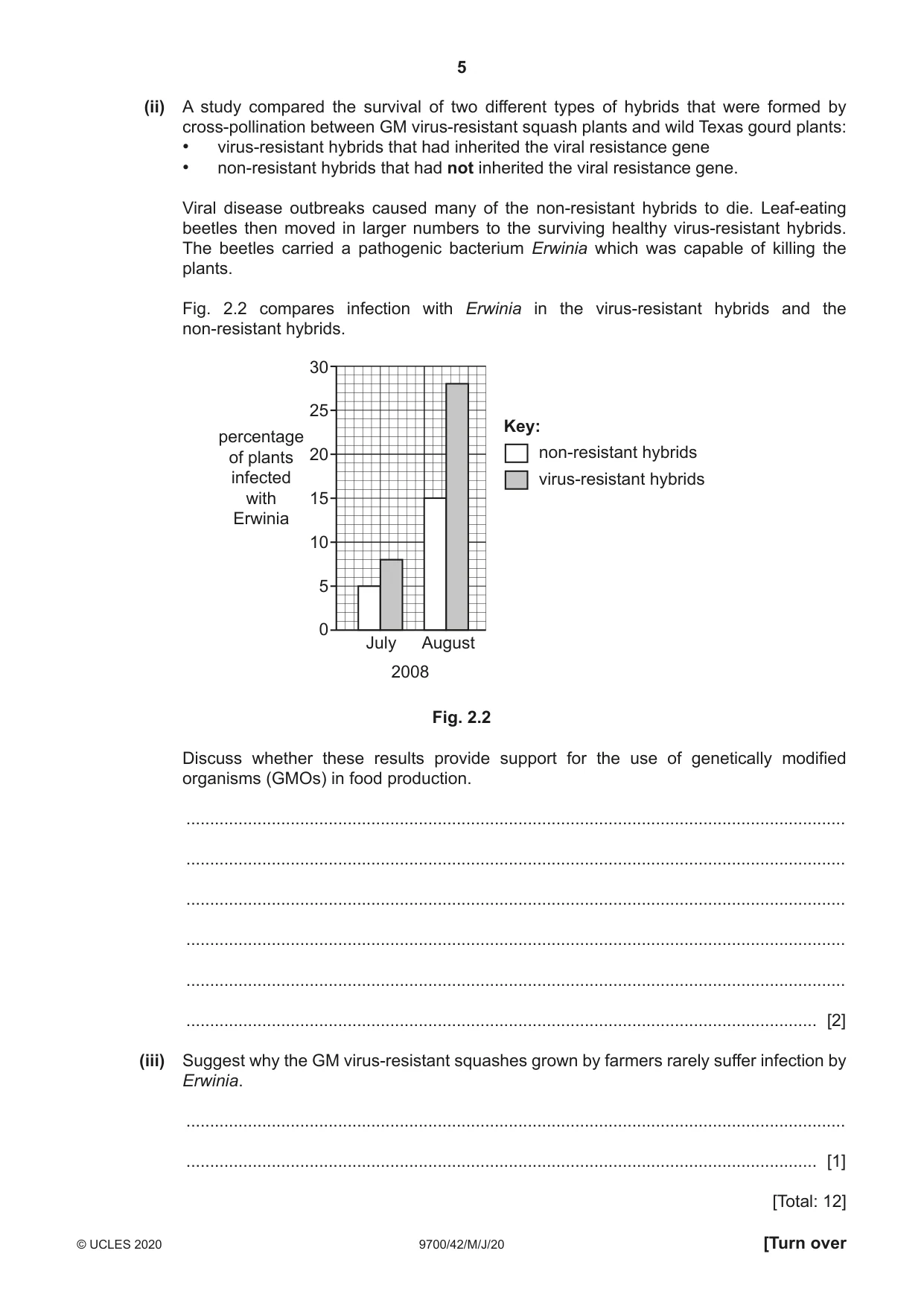
2 The summer squash plant, Cucurbita pepo, produces edible fruits that vary in shape. Fig. 2.1 shows the fruits of three different varieties of squash plants. Patty pan Di Nizza Alfresco (disc-shaped) (spherical) (long) Fig. 2.1 Fruit shape in squashes is controlled by two genes, A/a and B/b, that are located on different chromosomes. • A disc-shaped fruit is produced when both dominant alleles, A and B, are present. • A spherical fruit is produced when either allele A or allele B is present, but not if both A and B are present. • A long fruit is produced when both allele A and allele B are absent. (a) (i) Table 2.1 shows the possible genotypes of the Patty pan and Alfresco varieties. Complete Table 2.1 to show the possible genotypes of the Di Nizza variety. Table 2.1 variety possible genotypes Patty pan AABB AaBB AABb AaBb (disc-shaped) Di Nizza (spherical) .......... .......... .......... .......... Alfresco aabb (long) [1] (ii) A gardener used pollen from a male flower of Alfresco to pollinate a female flower of Di Nizza. The gardener grew the seeds produced from this cross and found that half the offspring produced spherical fruits and half produced long fruits. Draw one genetic diagram to explain this result. parent genotypes gametes offspring genotypes offspring phenotypes [4] (iii) The offspring show genetic variation with respect to fruit shape alleles. Name the process that occurred during meiosis in the parents that produced this variation and state the stage of meiosis at which it occurred. process ................................................... stage of meiosis .......................................................................................................... [2] (b) (i) Genetically modified (GM) summer squash plants with resistance to viral diseases have been grown in the USA since 1995. Scientists have been concerned that viral resistance genes pass easily from GM squash plants to their wild relative, the Texas gourd, Cucurbita texana. Explain why the possibility of gene flow from GM squash plants to the Texas gourd is a cause of social and environmental concern. social ................................................................................................................................. ........................................................................................................................................... ........................................................................................................................................... environmental .................................................................................................................... ........................................................................................................................................... ........................................................................................................................................... [2] (ii) A study compared the survival of two different types of hybrids that were formed by cross-pollination between GM virus-resistant squash plants and wild Texas gourd plants: • virus-resistant hybrids that had inherited the viral resistance gene • non-resistant hybrids that had not inherited the viral resistance gene. Viral disease outbreaks caused many of the non-resistant hybrids to die. Leaf-eating beetles then moved in larger numbers to the surviving healthy virus-resistant hybrids. The beetles carried a pathogenic bacterium Erwinia which was capable of killing the plants. Fig. 2.2 compares infection with Erwinia in the virus-resistant hybrids and the non-resistant hybrids. 30 25 Key: percentage of plants 20 non-resistant hybrids infected virus-resistant hybrids with 15 Erwinia 10 5 0 July August 2008 Fig. 2.2 Discuss whether these results provide support for the use of genetically modified organisms (GMOs) in food production. ........................................................................................................................................... ........................................................................................................................................... ........................................................................................................................................... ........................................................................................................................................... ........................................................................................................................................... ..................................................................................................................................... [2] (iii) Suggest why the GM virus-resistant squashes grown by farmers rarely suffer infection by Erwinia. ........................................................................................................................................... ..................................................................................................................................... [1] [Total: 12]
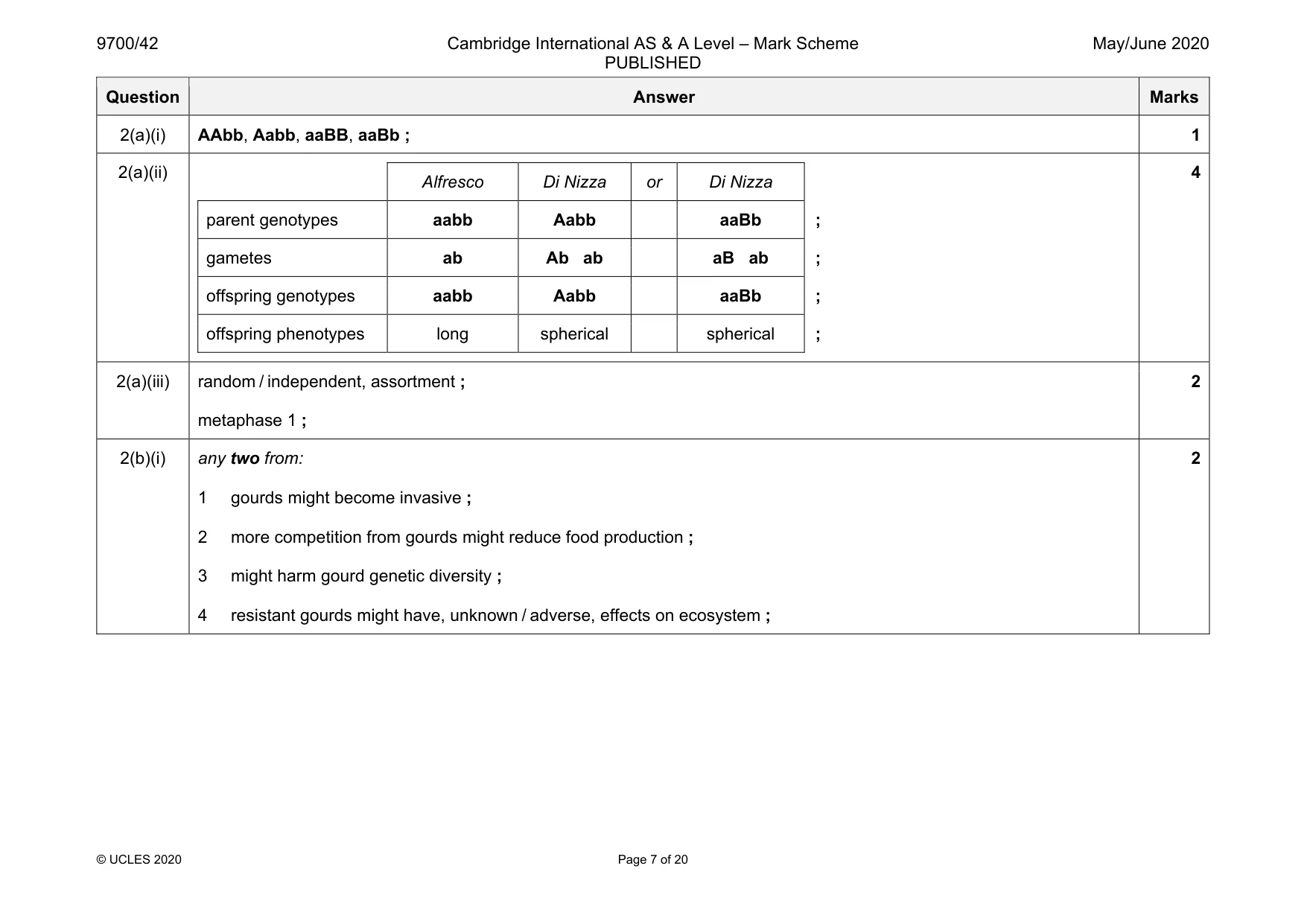
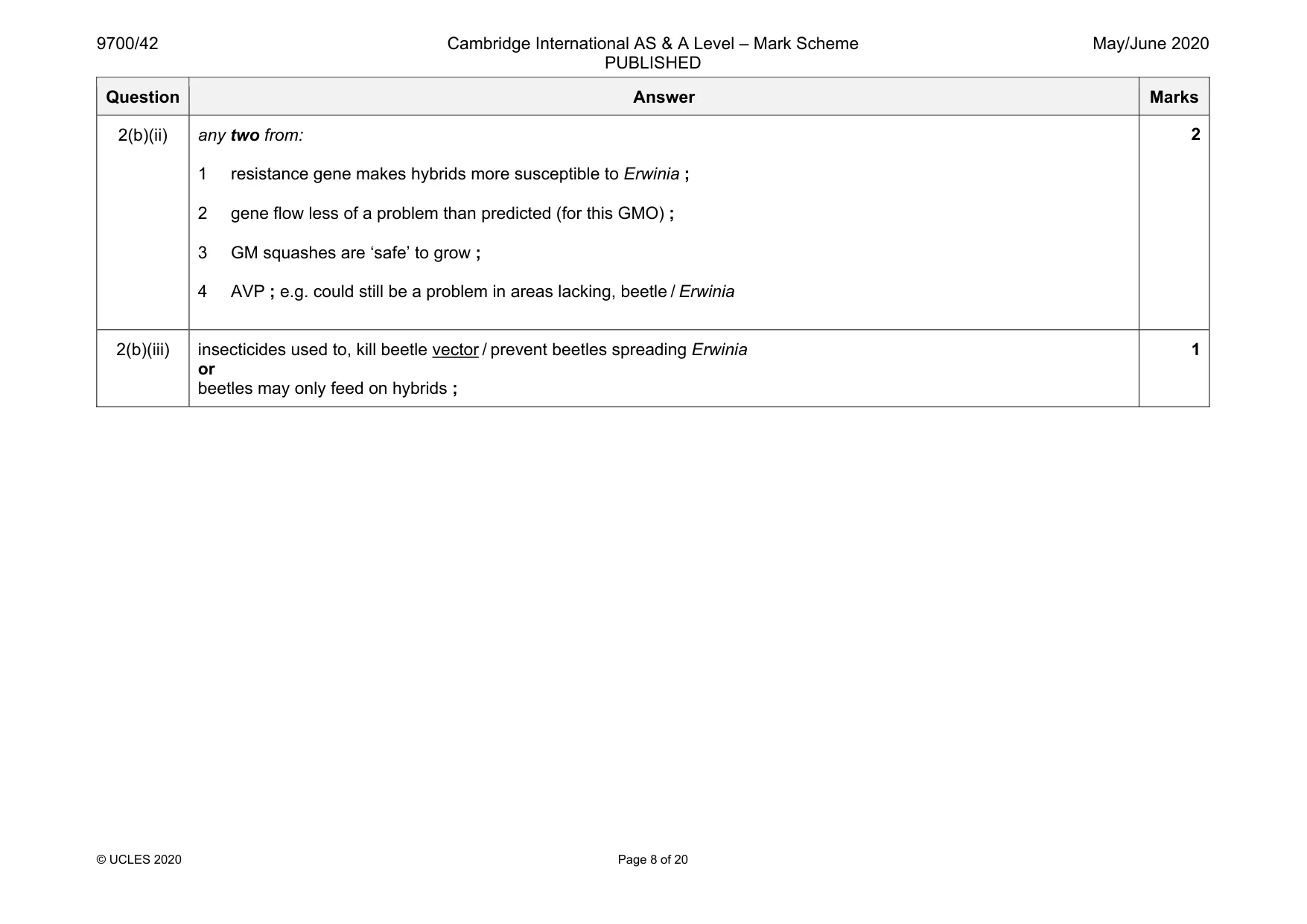
Mark scheme: 2(a)(i) AAbb, Aabb, aaBB, aaBb ; 1 2(a)(ii) Alfresco Di Nizza or Di Nizza parent genotypes aabb Aabb aaBb ; gametes ab Ab ab aB ab ; offspring genotypes aabb Aabb aaBb ; offspring phenotypes long spherical spherical ; 4 2(a)(iii) random / independent, assortment ; metaphase 1 ; 2 2(b)(i) any two from: 1 gourds might become invasive ; 2 more competition from gourds might reduce food production ; 3 might harm gourd genetic diversity ; 4 resistant gourds might have, unknown / adverse, effects on ecosystem ; 2 Question Answer Marks 2(b)(ii) any two from: 1 resistance gene makes hybrids more susceptible to Erwinia ; 2 gene flow less of a problem than predicted (for this GMO) ; 3 GM squashes are ‘safe’ to grow ; 4 AVP ; e.g. could still be a problem in areas lacking, beetle / Erwinia 2 2(b)(iii) insecticides used to, kill beetle vector / prevent beetles spreading Erwinia or beetles may only feed on hybrids ; 1
More questions on Passage of information from parents to offspring
Q3 · A subspecies is a genetically distinct population within a species that has some…
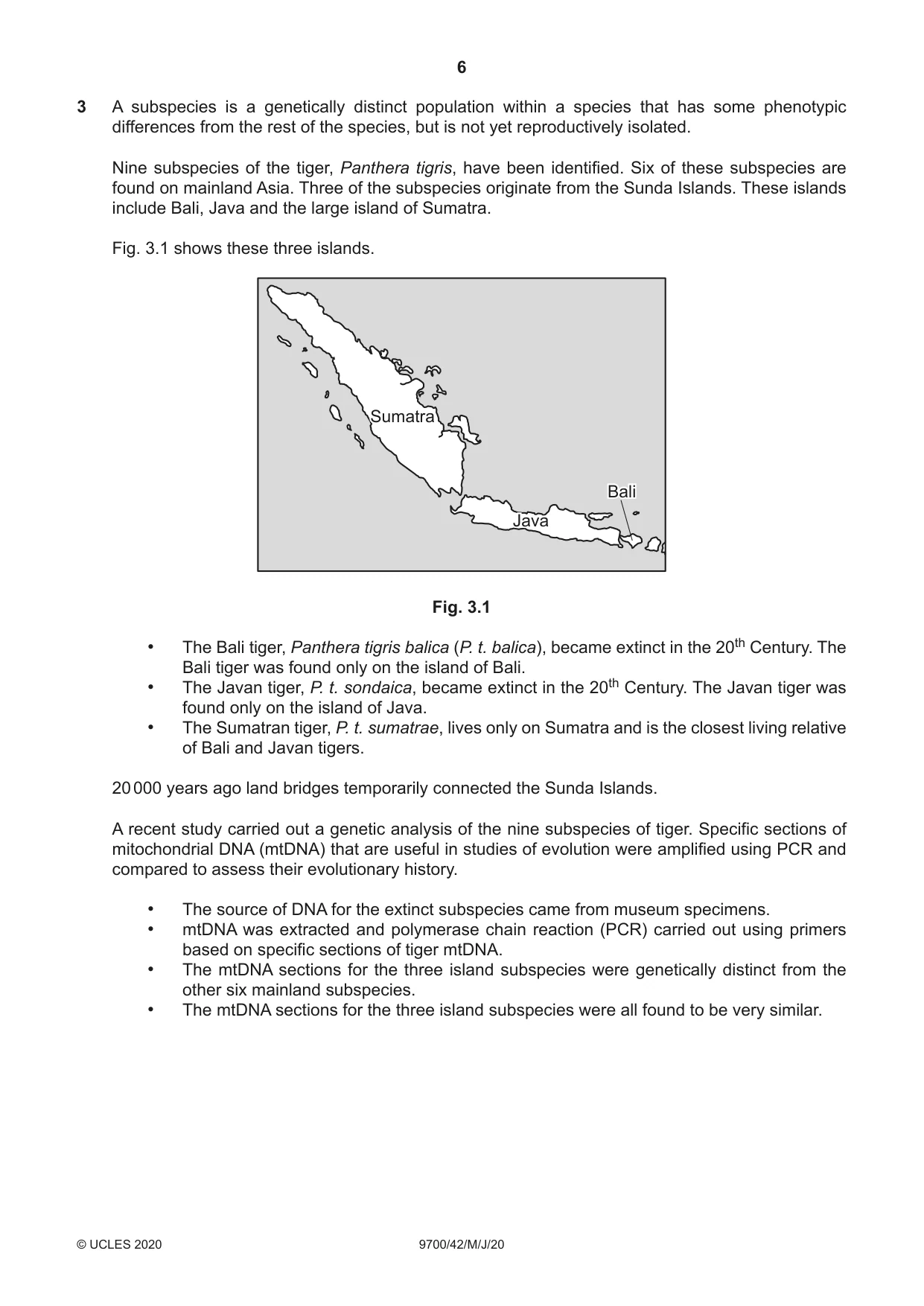
3 A subspecies is a genetically distinct population within a species that has some phenotypic differences from the rest of the species, but is not yet reproductively isolated. Nine subspecies of the tiger, Panthera tigris, have been identified. Six of these subspecies are found on mainland Asia. Three of the subspecies originate from the Sunda Islands. These islands include Bali, Java and the large island of Sumatra. Fig. 3.1 shows these three islands. SumatraSumatra BaliBali JavaJava Fig. 3.1 • The Bali tiger, Panthera tigris balica (P. t. balica), became extinct in the 20th Century. The Bali tiger was found only on the island of Bali. • The Javan tiger, P. t. sondaica, became extinct in the 20th Century. The Javan tiger was found only on the island of Java. • The Sumatran tiger, P. t. sumatrae, lives only on Sumatra and is the closest living relative of Bali and Javan tigers. 20 000 years ago land bridges temporarily connected the Sunda Islands. A recent study carried out a genetic analysis of the nine subspecies of tiger. Specific sections of mitochondrial DNA (mtDNA) that are useful in studies of evolution were amplified using PCR and compared to assess their evolutionary history. • The source of DNA for the extinct subspecies came from museum specimens. • mtDNA was extracted and polymerase chain reaction (PCR) carried out using primers based on specific sections of tiger mtDNA. • The mtDNA sections for the three island subspecies were genetically distinct from the other six mainland subspecies. • The mtDNA sections for the three island subspecies were all found to be very similar. (a) Suggest and explain how the three subspecies of tiger on the Sunda Islands formed. ................................................................................................................................................... ................................................................................................................................................... ................................................................................................................................................... ................................................................................................................................................... ................................................................................................................................................... ................................................................................................................................................... ................................................................................................................................................... ................................................................................................................................................... ................................................................................................................................................... ............................................................................................................................................. [4] (b) Explain why specific primers were used for the tiger mtDNA sections. ................................................................................................................................................... ................................................................................................................................................... ................................................................................................................................................... ............................................................................................................................................. [2] (c) Describe and explain one characteristic of mtDNA that makes it more useful than using nuclear DNA to provide evidence of evolution. ................................................................................................................................................... ................................................................................................................................................... ................................................................................................................................................... ................................................................................................................................................... ............................................................................................................................................. [2] (d) Suggest two reasons why P. t. balica and P. t. sondaica became extinct. ................................................................................................................................................... ................................................................................................................................................... ................................................................................................................................................... ................................................................................................................................................... ............................................................................................................................................. [2] (e) Suggest why P. t. sumatrae is still considered to be a member of the species Panthera tigris. ................................................................................................................................................... ................................................................................................................................................... ................................................................................................................................................... ................................................................................................................................................... ............................................................................................................................................. [2] [Total: 12]
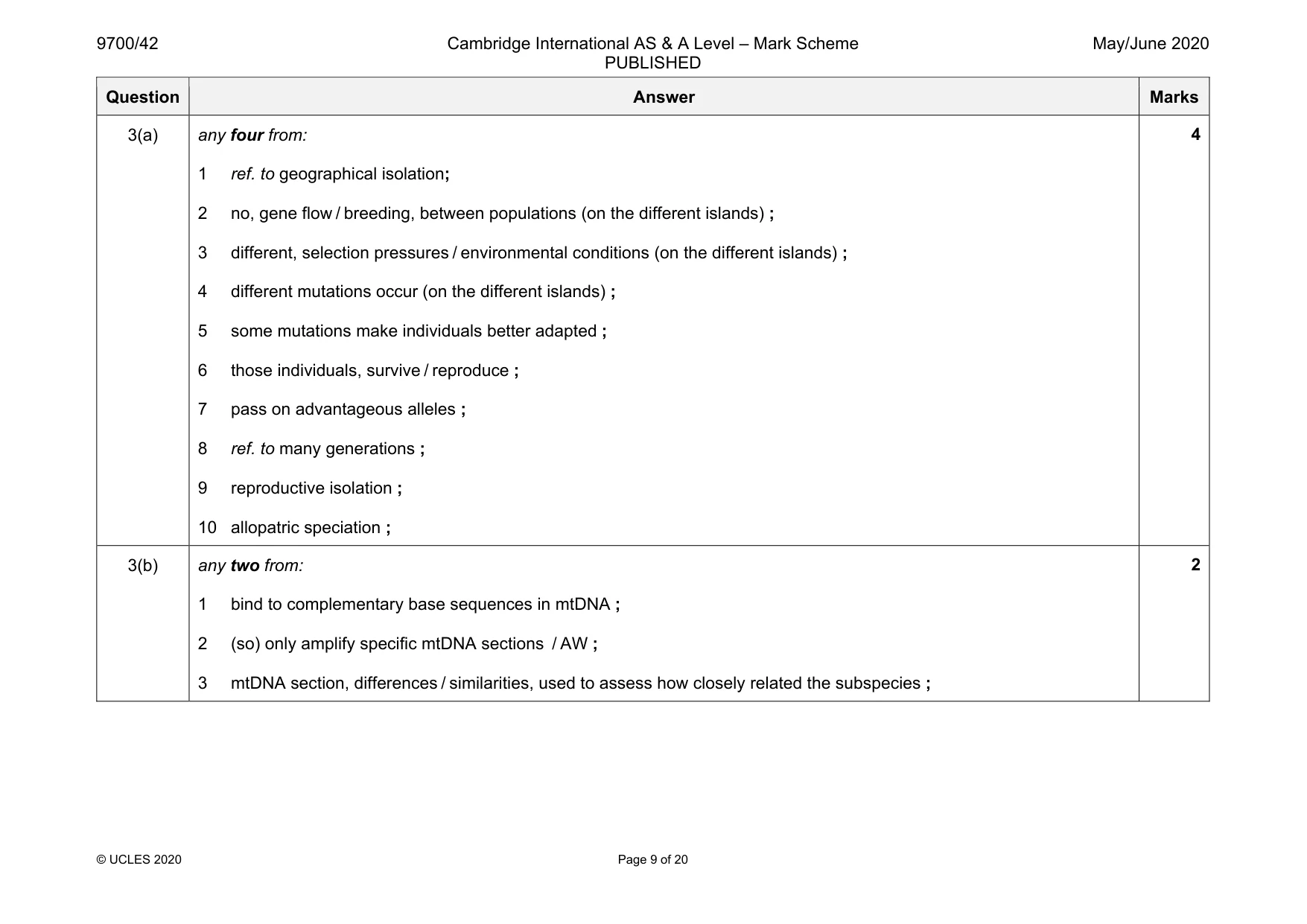
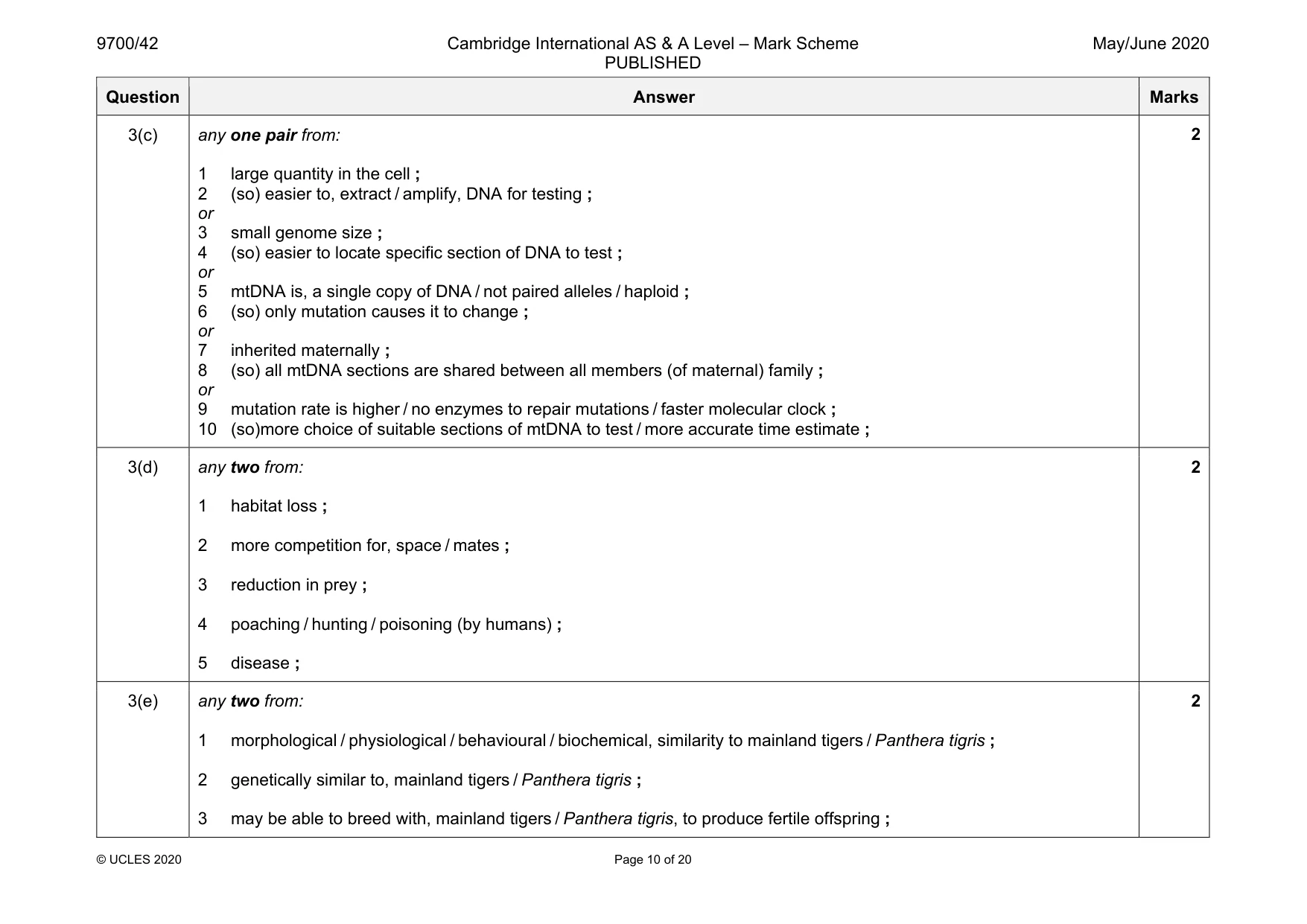
Mark scheme: 3(a) any four from: 1 ref. to geographical isolation; 2 no, gene flow / breeding, between populations (on the different islands) ; 3 different, selection pressures / environmental conditions (on the different islands) ; 4 different mutations occur (on the different islands) ; 5 some mutations make individuals better adapted ; 6 those individuals, survive / reproduce ; 7 pass on advantageous alleles ; 8 ref. to many generations ; 9 reproductive isolation ; 10 allopatric speciation ; 3(b) any two from: 1 bind to complementary base sequences in mtDNA ; 2 (so) only amplify specific mtDNA sections / AW ; 3 mtDNA section, differences / similarities, used to assess how closely related the subspecies ; 2 Question Answer Marks 3(c) any one pair from: 1 large quantity in the cell ; 2 (so) easier to, extract / amplify, DNA for testing ; or 3 small genome size ; 4 (so) easier to locate specific section of DNA to test ; or 5 mtDNA is, a single copy of DNA / not paired alleles / haploid ; 6 (so) only mutation causes it to change ; or 7 inherited maternally ; 8 (so) all mtDNA sections are shared between all members (of maternal) family ; or 9 mutation rate is higher / no enzymes to repair mutations / faster molecular clock ; 10 (so)more choice of suitable sections of mtDNA to test / more accurate time estimate ; 2 3(d) any two from: 1 habitat loss ; 2 more competition for, space / mates ; 3 reduction in prey ; 4 poaching / hunting / poisoning (by humans) ; 5 disease ; 2 3(e) any two from: 1 morphological / physiological / behavioural / biochemical, similarity to mainland tigers / Panthera tigris ; 2 genetically similar to, mainland tigers / Panthera tigris ; 3 may be able to breed with, mainland tigers / Panthera tigris, to produce fertile offspring ; 2
Q4 · Gene therapy can be used to treat some genetic disorders
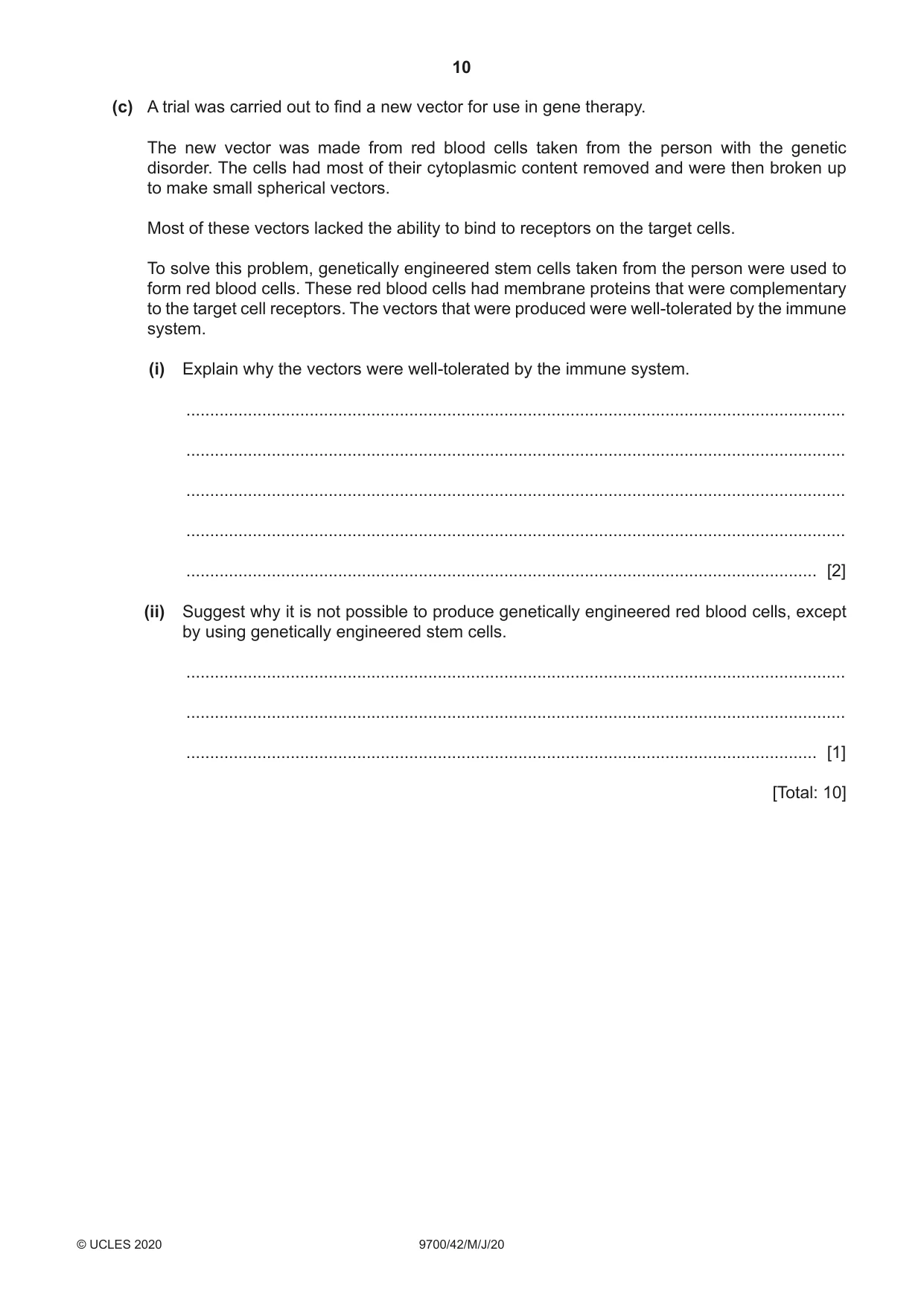
4 Gene therapy can be used to treat some genetic disorders. An appropriate vector is chosen to carry the normal allele into the target cell. Three types of vectors commonly chosen are naked DNA, viruses and liposomes. (a) A trial of gene therapy to treat cystic fibrosis used a viral vector. The viral vector caused a primary immune response with the production of memory cells. Explain why the production of memory cells prevents the gene therapy from working in long-term chronic conditions such as cystic fibrosis. ................................................................................................................................................... ................................................................................................................................................... ................................................................................................................................................... ................................................................................................................................................... ................................................................................................................................................... ................................................................................................................................................... ............................................................................................................................................. [3] (b) With reference to the three types of vectors that are commonly used, discuss the challenges in choosing appropriate vectors for use in gene therapy. Do not include problems associated with an immune response in your answer. ................................................................................................................................................... ................................................................................................................................................... ................................................................................................................................................... ................................................................................................................................................... ................................................................................................................................................... ................................................................................................................................................... ................................................................................................................................................... ............................................................................................................................................. [4] (c) A trial was carried out to find a new vector for use in gene therapy. The new vector was made from red blood cells taken from the person with the genetic disorder. The cells had most of their cytoplasmic content removed and were then broken up to make small spherical vectors. Most of these vectors lacked the ability to bind to receptors on the target cells. To solve this problem, genetically engineered stem cells taken from the person were used to form red blood cells. These red blood cells had membrane proteins that were complementary to the target cell receptors. The vectors that were produced were well-tolerated by the immune system. (i) Explain why the vectors were well-tolerated by the immune system. ........................................................................................................................................... ........................................................................................................................................... ........................................................................................................................................... ........................................................................................................................................... ..................................................................................................................................... [2] (ii) Suggest why it is not possible to produce genetically engineered red blood cells, except by using genetically engineered stem cells. ........................................................................................................................................... ........................................................................................................................................... ..................................................................................................................................... [1] [Total: 10]
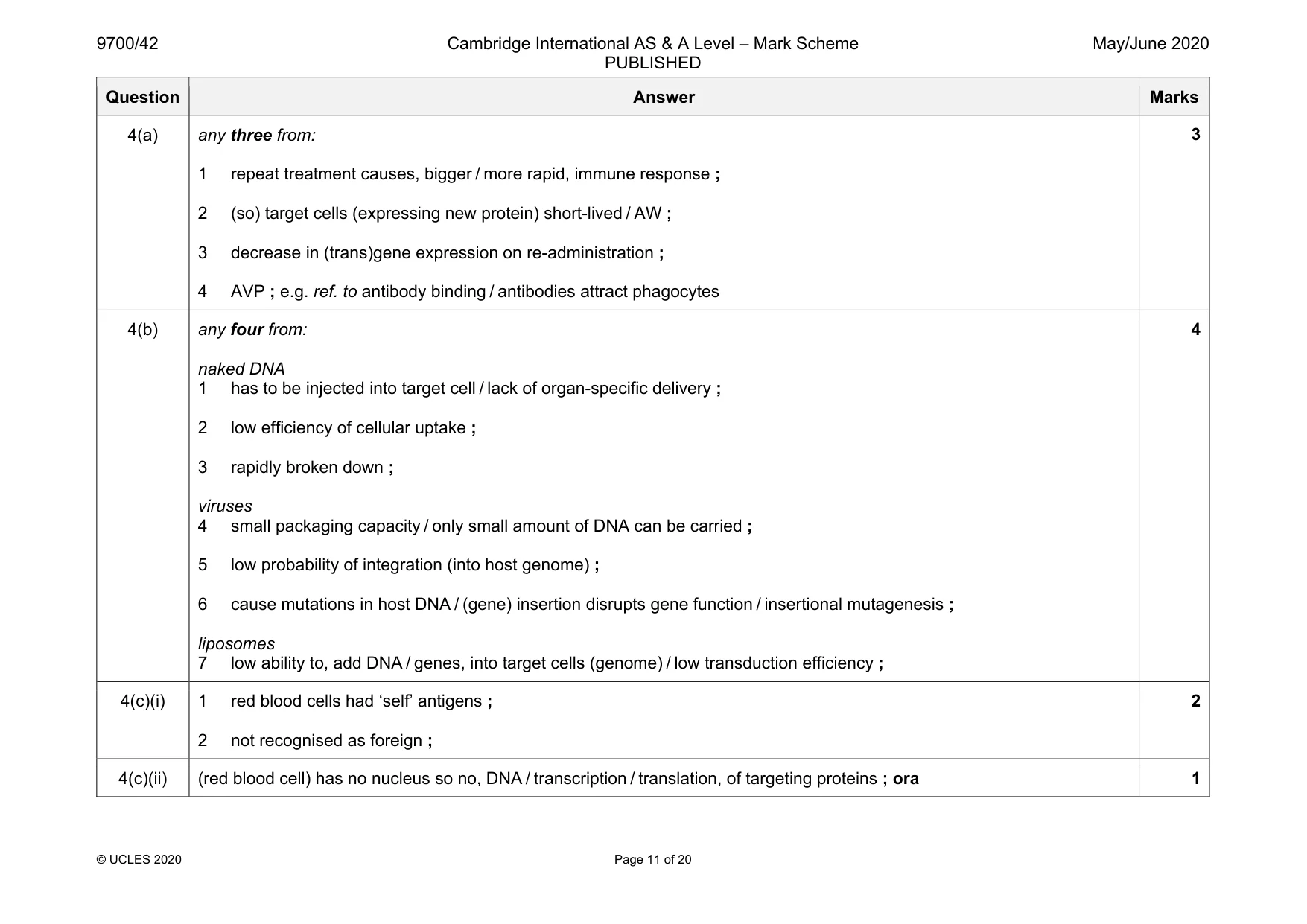
Mark scheme: 4(a) any three from: 1 repeat treatment causes, bigger / more rapid, immune response ; 2 (so) target cells (expressing new protein) short-lived / AW ; 3 decrease in (trans)gene expression on re-administration ; 4 AVP ; e.g. ref. to antibody binding / antibodies attract phagocytes 4(b) any four from: naked DNA 1 has to be injected into target cell / lack of organ-specific delivery ; 2 low efficiency of cellular uptake ; 3 rapidly broken down ; viruses 4 small packaging capacity / only small amount of DNA can be carried ; 5 low probability of integration (into host genome) ; 6 cause mutations in host DNA / (gene) insertion disrupts gene function / insertional mutagenesis ; liposomes 7 low ability to, add DNA / genes, into target cells (genome) / low transduction efficiency ; 4 4(c)(i) 1 red blood cells had ‘self’ antigens ; 2 not recognised as foreign ; 2 4(c)(ii) (red blood cell) has no nucleus so no, DNA / transcription / translation, of targeting proteins ; ora 1
Q5 · Yeast cells respond to changes in glucose concentration in their environment by using…
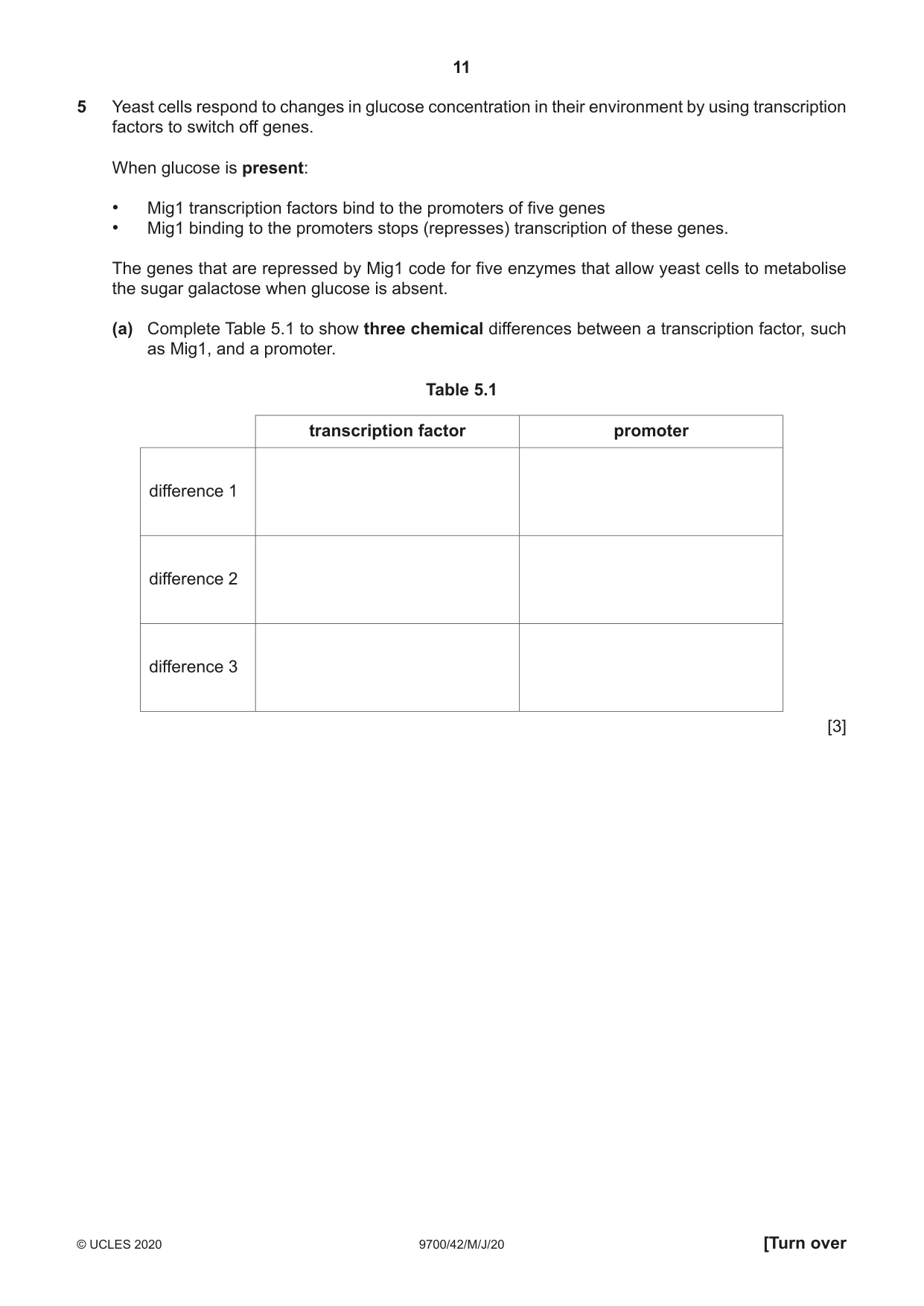
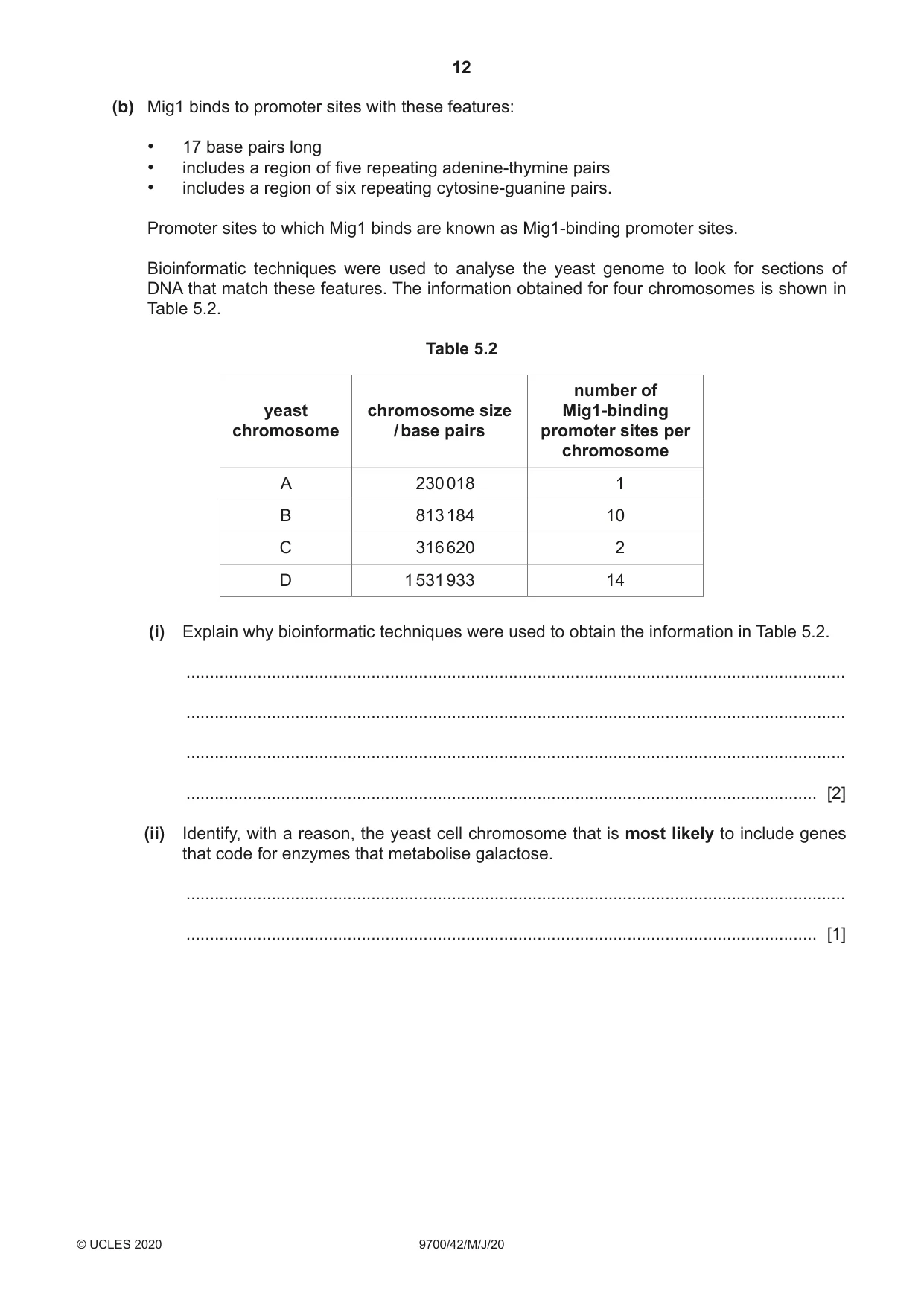
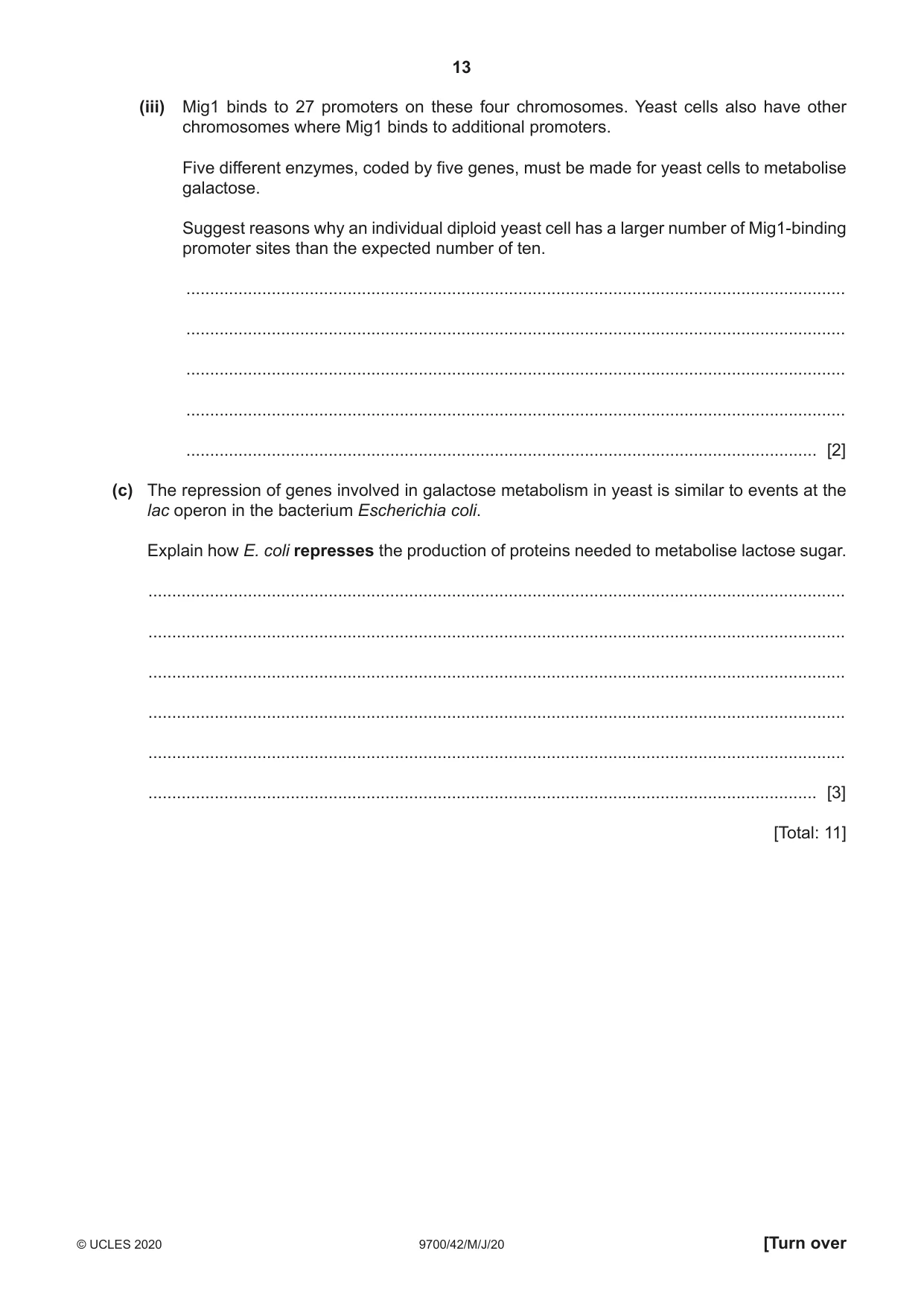
5 Yeast cells respond to changes in glucose concentration in their environment by using transcription factors to switch off genes. When glucose is present: • Mig1 transcription factors bind to the promoters of five genes • Mig1 binding to the promoters stops (represses) transcription of these genes. The genes that are repressed by Mig1 code for five enzymes that allow yeast cells to metabolise the sugar galactose when glucose is absent. (a) Complete Table 5.1 to show three chemical differences between a transcription factor, such as Mig1, and a promoter. Table 5.1 transcription factor promoter difference 1 difference 2 difference 3 [3] (b) Mig1 binds to promoter sites with these features: • 17 base pairs long • includes a region of five repeating adenine-thymine pairs • includes a region of six repeating cytosine-guanine pairs. Promoter sites to which Mig1 binds are known as Mig1-binding promoter sites. Bioinformatic techniques were used to analyse the yeast genome to look for sections of DNA that match these features. The information obtained for four chromosomes is shown in Table 5.2. Table 5.2 number of yeast chromosome size Mig1-binding chromosome / base pairs promoter sites per chromosome A 230 018 1 B 813 184 10 C 316 620 2 D 1 531 933 14 (i) Explain why bioinformatic techniques were used to obtain the information in Table 5.2. ........................................................................................................................................... ........................................................................................................................................... ........................................................................................................................................... ..................................................................................................................................... [2] (ii) Identify, with a reason, the yeast cell chromosome that is most likely to include genes that code for enzymes that metabolise galactose. ........................................................................................................................................... ..................................................................................................................................... [1] (iii) Mig1 binds to 27 promoters on these four chromosomes. Yeast cells also have other chromosomes where Mig1 binds to additional promoters. Five different enzymes, coded by five genes, must be made for yeast cells to metabolise galactose. Suggest reasons why an individual diploid yeast cell has a larger number of Mig1-binding promoter sites than the expected number of ten. ........................................................................................................................................... ........................................................................................................................................... ........................................................................................................................................... ........................................................................................................................................... ..................................................................................................................................... [2] (c) The repression of genes involved in galactose metabolism in yeast is similar to events at the lac operon in the bacterium Escherichia coli. Explain how E. coli represses the production of proteins needed to metabolise lactose sugar. ................................................................................................................................................... ................................................................................................................................................... ................................................................................................................................................... ................................................................................................................................................... ................................................................................................................................................... ............................................................................................................................................. [3] [Total: 11]
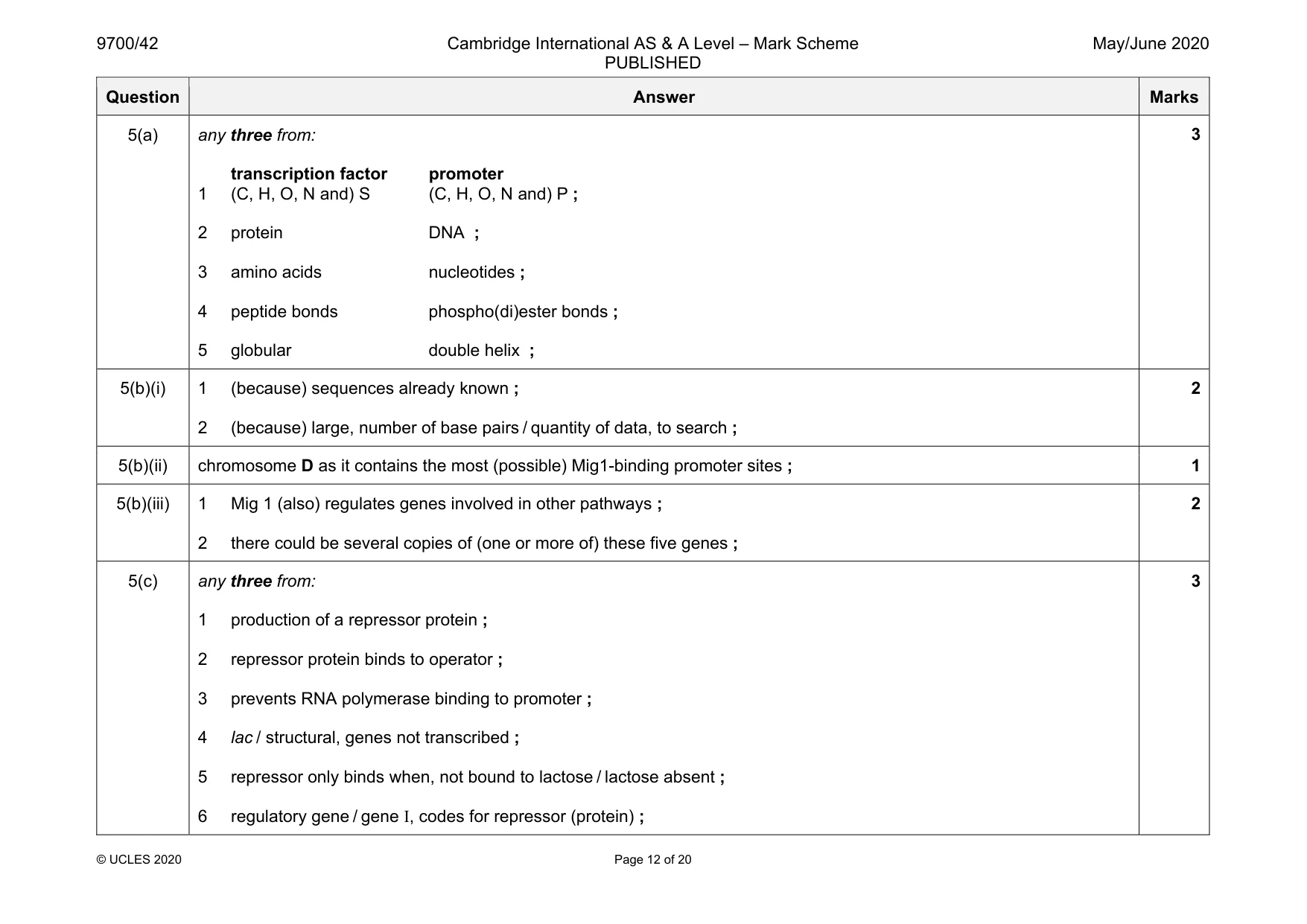
Mark scheme: 5(a) any three from: transcription factor promoter 1 (C, H, O, N and) S (C, H, O, N and) P ; 2 protein DNA ; 3 amino acids nucleotides ; 4 peptide bonds phospho(di)ester bonds ; 5 globular double helix ; 5(b)(i) 1 (because) sequences already known ; 2 (because) large, number of base pairs / quantity of data, to search ; 2 5(b)(ii) chromosome D as it contains the most (possible) Mig1-binding promoter sites ; 1 5(b)(iii) 1 Mig 1 (also) regulates genes involved in other pathways ; 2 there could be several copies of (one or more of) these five genes ; 2 5(c) any three from: 1 production of a repressor protein ; 2 repressor protein binds to operator ; 3 prevents RNA polymerase binding to promoter ; 4 lac / structural, genes not transcribed ; 5 repressor only binds when, not bound to lactose / lactose absent ; 6 regulatory gene / gene I, codes for repressor (protein) ; 3
Q6 · Thyrotoxic myopathy (TM) is a neuromuscular disorder caused by overproduction of the…
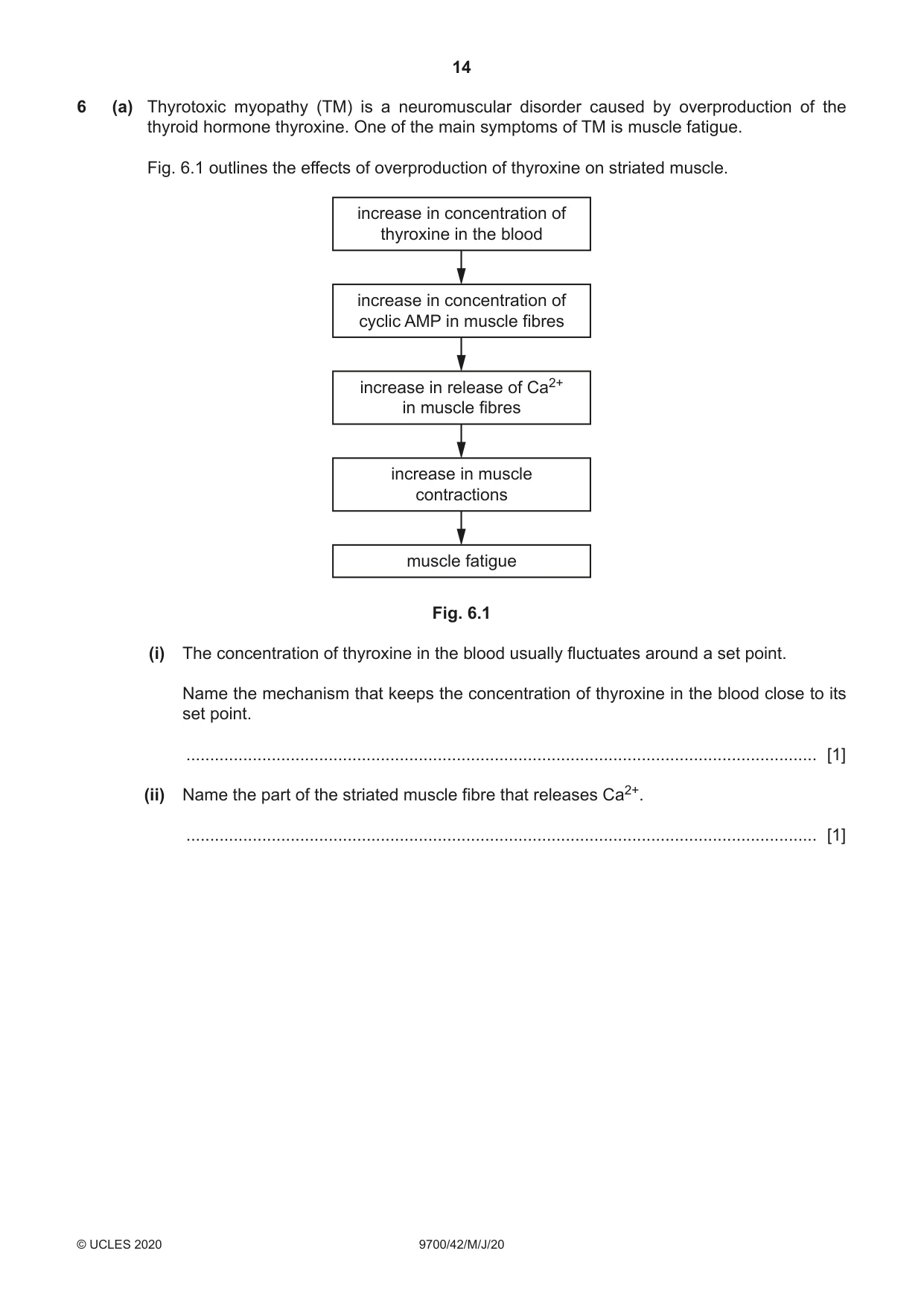
6 (a) Thyrotoxic myopathy (TM) is a neuromuscular disorder caused by overproduction of the thyroid hormone thyroxine. One of the main symptoms of TM is muscle fatigue. Fig. 6.1 outlines the effects of overproduction of thyroxine on striated muscle. increase in concentration of thyroxine in the blood increase in concentration of cyclic AMP in muscle fibres increase in release of Ca2+ in muscle fibres increase in muscle contractions muscle fatigue Fig. 6.1 (i) The concentration of thyroxine in the blood usually fluctuates around a set point. Name the mechanism that keeps the concentration of thyroxine in the blood close to its set point. ..................................................................................................................................... [1] (ii) Name the part of the striated muscle fibre that releases Ca2+. ..................................................................................................................................... [1] (iii) Describe the role of Ca2+, troponin and tropomyosin in the contraction of striated muscle. ........................................................................................................................................... ........................................................................................................................................... ........................................................................................................................................... ........................................................................................................................................... ........................................................................................................................................... ........................................................................................................................................... ........................................................................................................................................... ........................................................................................................................................... ..................................................................................................................................... [4] (iv) Cyclic AMP (cAMP) is also involved in the response of liver cells to glucagon. Describe the role of cAMP in the response of liver cells to glucagon. ........................................................................................................................................... ........................................................................................................................................... ........................................................................................................................................... ..................................................................................................................................... [2] (b) An increase in the concentration of thyroxine in the blood can lead to a condition called insulin resistance (IR). IR decreases the sensitivity to insulin of target cells, such as muscle and liver cells. Suggest how decreased sensitivity to insulin affects target cells. ................................................................................................................................................... ................................................................................................................................................... ................................................................................................................................................... ................................................................................................................................................... ................................................................................................................................................... ............................................................................................................................................. [3] [Total: 11]
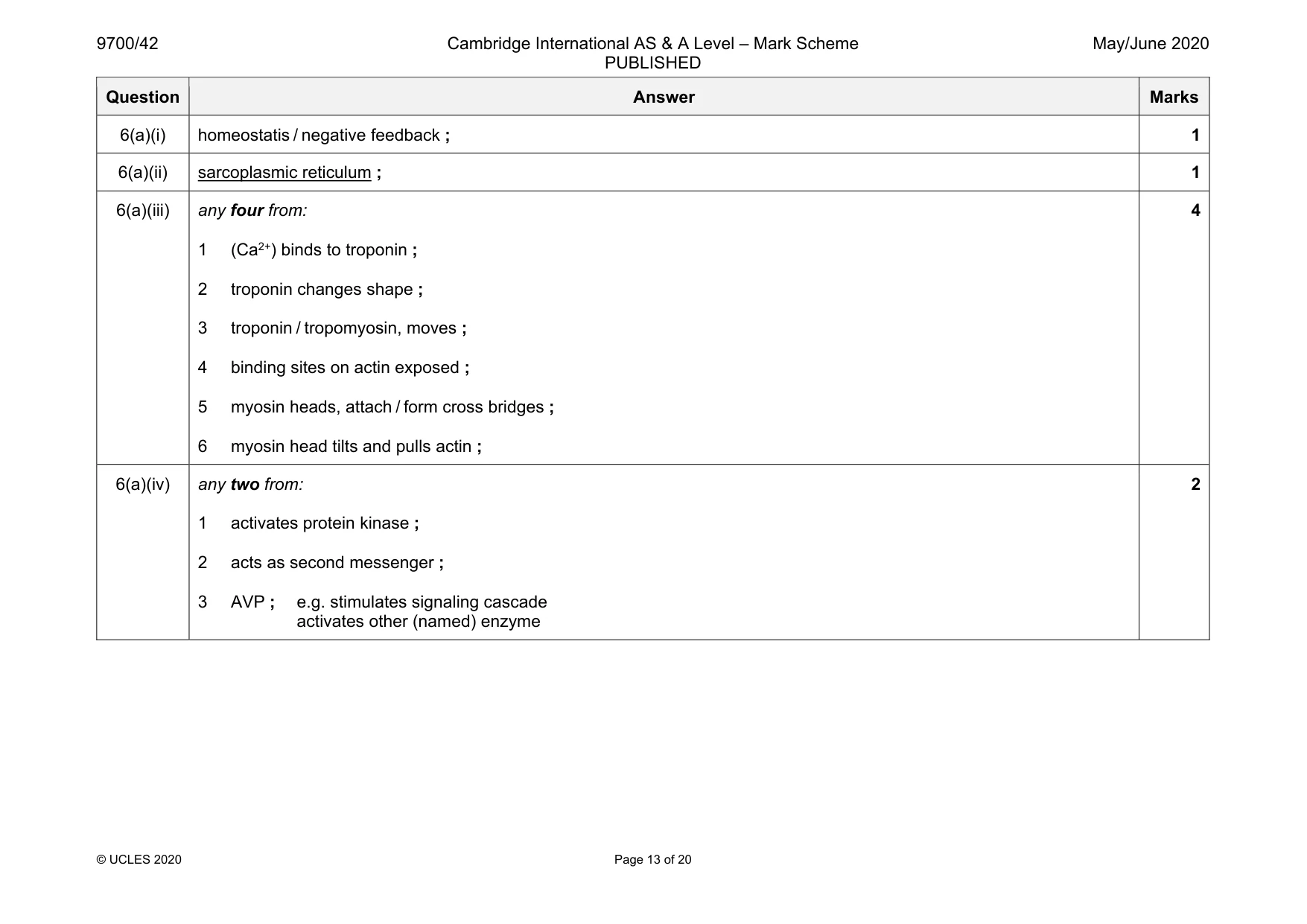
Mark scheme: 6(a)(i) homeostatis / negative feedback ; 1 6(a)(ii) sarcoplasmic reticulum ; 1 6(a)(iii) any four from: 1 (Ca2+) binds to troponin ; 2 troponin changes shape ; 3 troponin / tropomyosin, moves ; 4 binding sites on actin exposed ; 5 myosin heads, attach / form cross bridges ; 6 myosin head tilts and pulls actin ; 4 6(a)(iv) any two from: 1 activates protein kinase ; 2 acts as second messenger ; 3 AVP ; e.g. stimulates signaling cascade activates other (named) enzyme 2 Question Answer Marks 6(b) any three from: 1 decreased uptake of glucose / decreased permeability to glucose ; 2 decreased glycogenesis ; 3 decreased glucose, oxidation / respiration ; 4 change in, fatty acids / fat, metabolism ; 5 AVP ; e.g. ref. to effect on glucagon 3
Q7 · Define the term respiratory quotient (RQ)
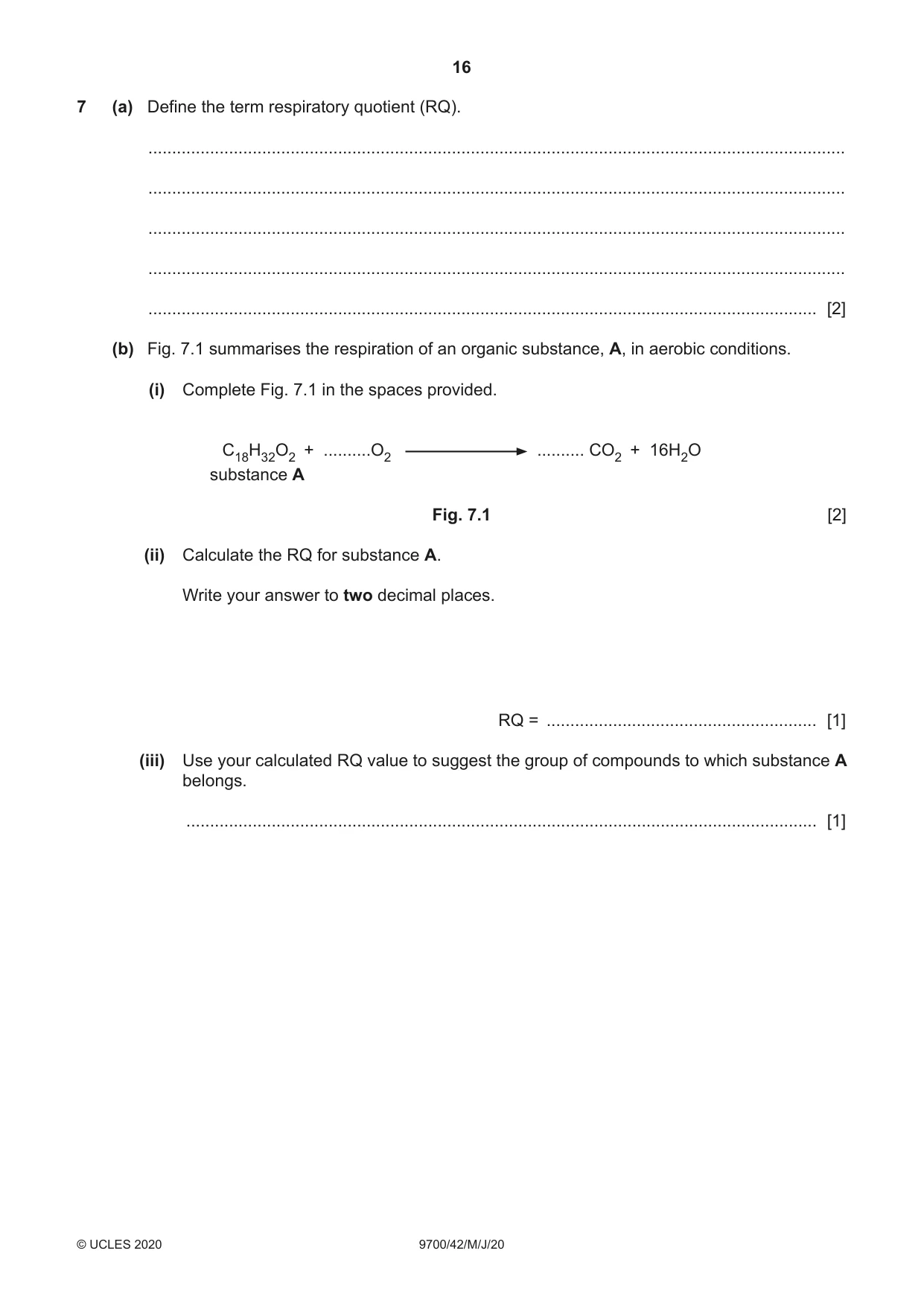
7 (a) Define the term respiratory quotient (RQ). ................................................................................................................................................... ................................................................................................................................................... ................................................................................................................................................... ................................................................................................................................................... ............................................................................................................................................. [2] (b) Fig. 7.1 summarises the respiration of an organic substance, A, in aerobic conditions. (i) Complete Fig. 7.1 in the spaces provided. C18H32O2 + ..........O2 .......... CO2 + 16H2O substance A Fig. 7.1 [2] (ii) Calculate the RQ for substance A. Write your answer to two decimal places. RQ = ......................................................... [1] (iii) Use your calculated RQ value to suggest the group of compounds to which substance A belongs. ..................................................................................................................................... [1] (c) Dinitrophenol (DNP) is a compound used in the production of a number of products, including chemical dyes, insecticides and wood preservers. People who work in factories with DNP are at risk of exposure if they do not follow health and safety guidelines. DNP is a molecule that can transport protons across the inner mitochondrial membrane, allowing protons to leak out of the intermembrane space. (i) Suggest and explain the effects of DNP on aerobic respiration in human cells. ........................................................................................................................................... ........................................................................................................................................... ........................................................................................................................................... ........................................................................................................................................... ........................................................................................................................................... ........................................................................................................................................... ........................................................................................................................................... ..................................................................................................................................... [4] (ii) Suggest two symptoms that may be experienced by people after exposure to DNP for several months. ........................................................................................................................................... ........................................................................................................................................... ........................................................................................................................................... ........................................................................................................................................... ..................................................................................................................................... [2] [Total: 12]
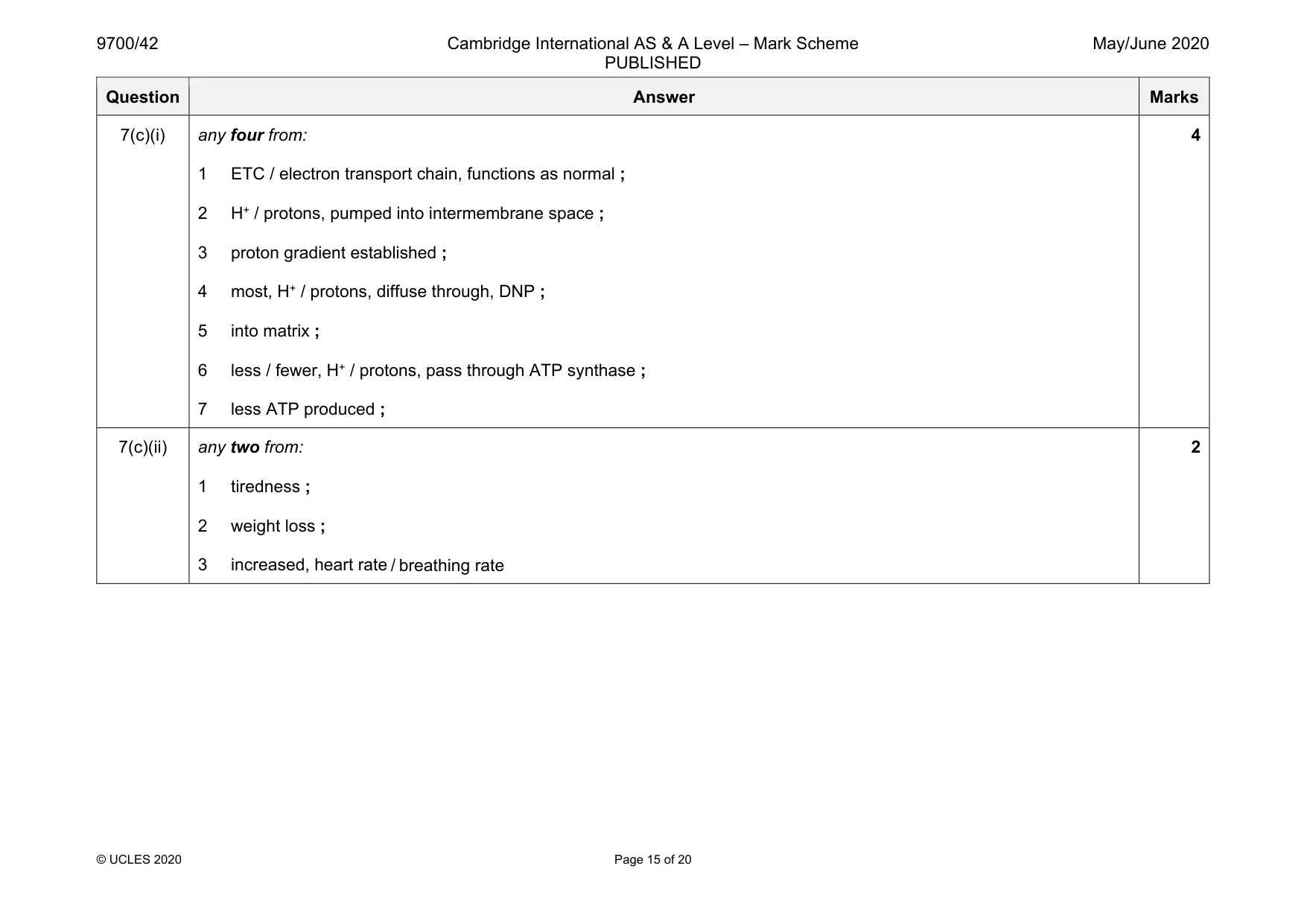
Mark scheme: 7(a) volume of carbon dioxide produced ÷ volume of oxygen consumed ; per unit time ; 2 7(b)(i) 25 ; 18 ; 2 7(b)(ii) 0.72 ; 1 7(b)(iii) lipid / fatty acid ; 1 Question Answer Marks 7(c)(i) any four from: 1 ETC / electron transport chain, functions as normal ; 2 H+ / protons, pumped into intermembrane space ; 3 proton gradient established ; 4 most, H+ / protons, diffuse through, DNP ; 5 into matrix ; 6 less / fewer, H+ / protons, pass through ATP synthase ; 7 less ATP produced ; 4 7(c)(ii) any two from: 1 tiredness ; 2 weight loss ; 3 increased, heart rate / breathing rate 2
Q8 · Most organisms are classified according to a taxonomic hierarchy
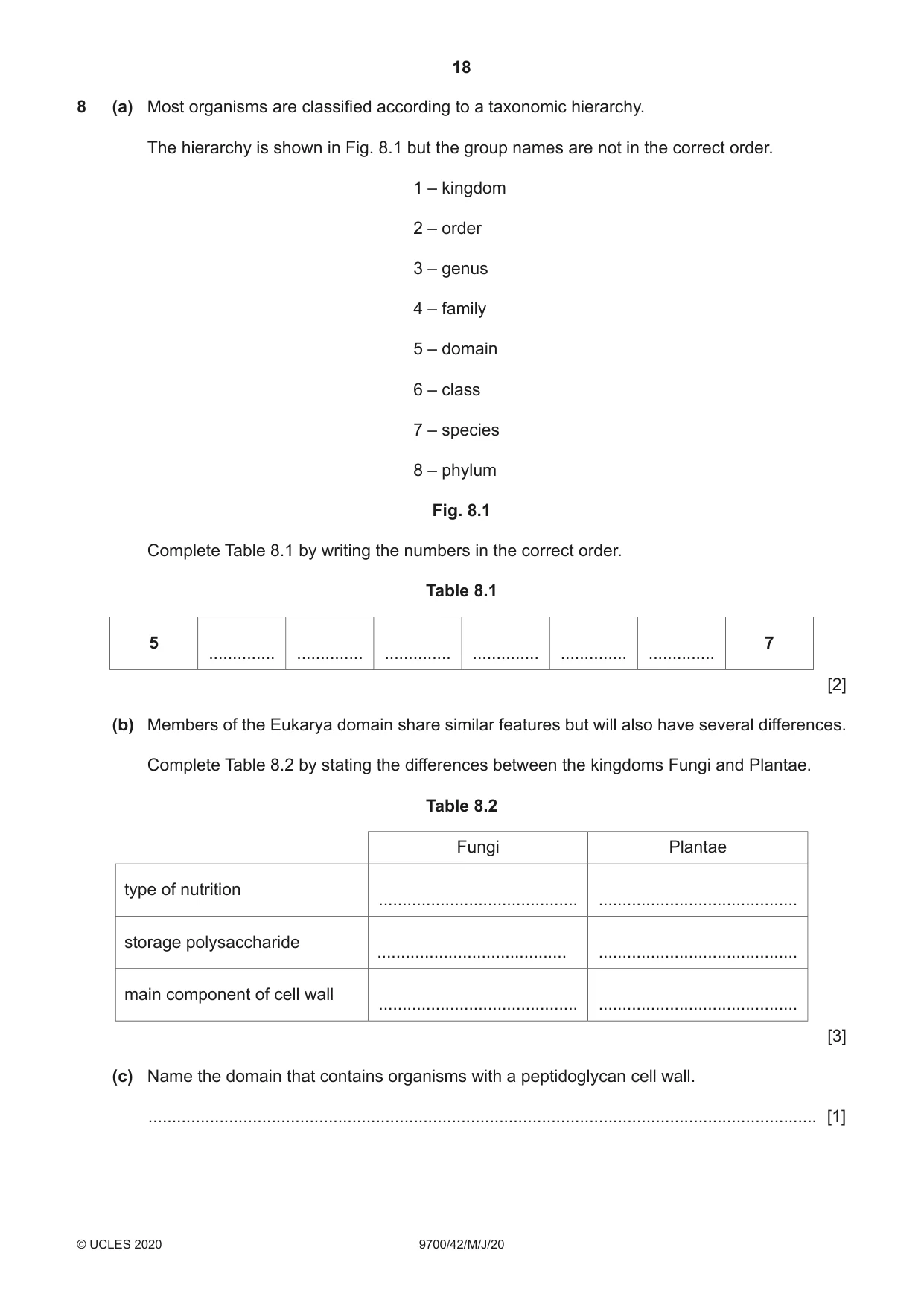
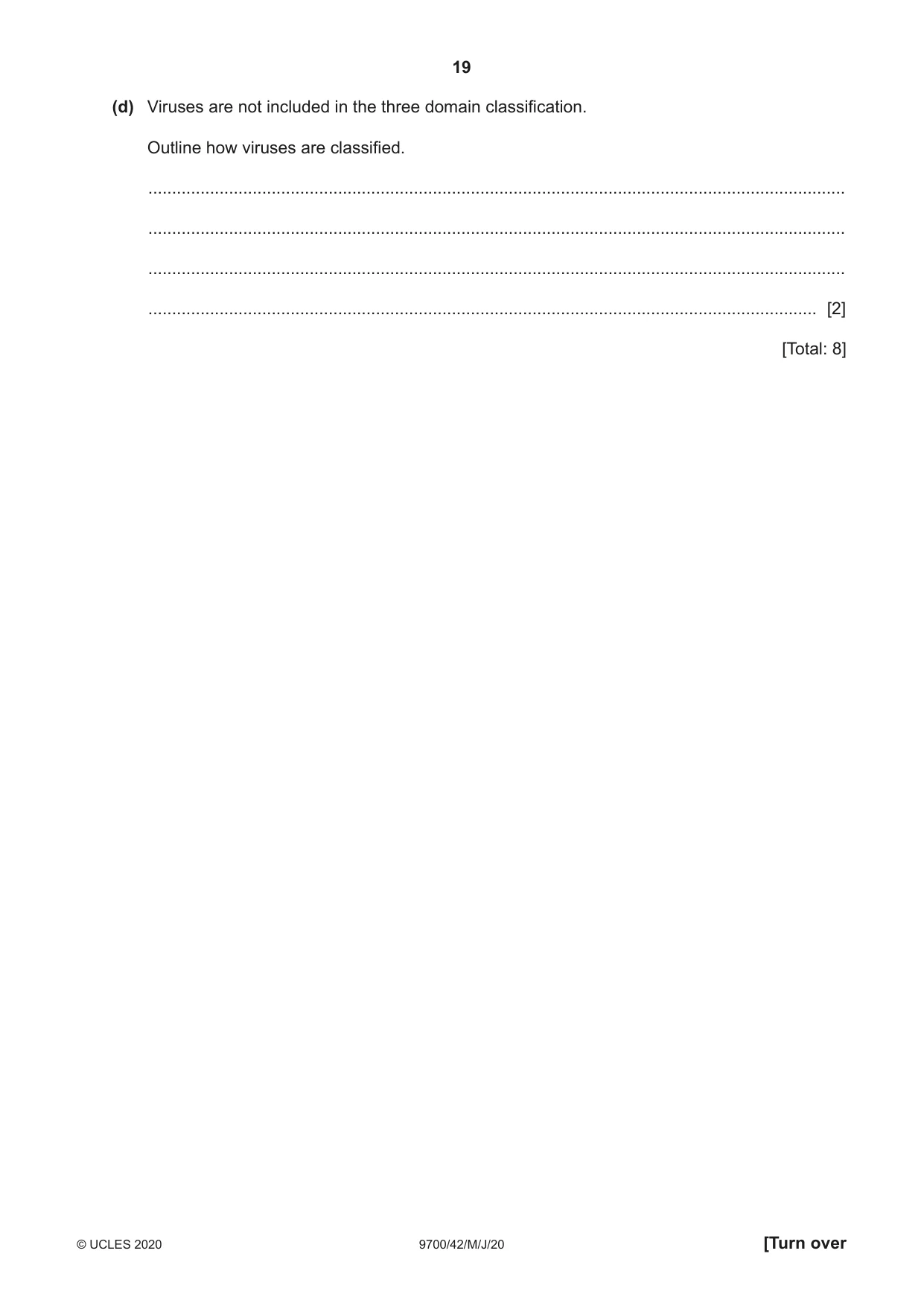
8 (a) Most organisms are classified according to a taxonomic hierarchy. The hierarchy is shown in Fig. 8.1 but the group names are not in the correct order. 1 – kingdom 2 – order 3 – genus 4 – family 5 – domain 6 – class 7 – species 8 – phylum Fig. 8.1 Complete Table 8.1 by writing the numbers in the correct order. Table 8.1 5 7 .............. .............. .............. .............. .............. .............. [2] (b) Members of the Eukarya domain share similar features but will also have several differences. Complete Table 8.2 by stating the differences between the kingdoms Fungi and Plantae. Table 8.2 Fungi Plantae type of nutrition .......................................... .......................................... storage polysaccharide ........................................ .......................................... main component of cell wall .......................................... .......................................... [3] (c) Name the domain that contains organisms with a peptidoglycan cell wall. ............................................................................................................................................. [1] (d) Viruses are not included in the three domain classification. Outline how viruses are classified. ................................................................................................................................................... ................................................................................................................................................... ................................................................................................................................................... ............................................................................................................................................. [2] [Total: 8]
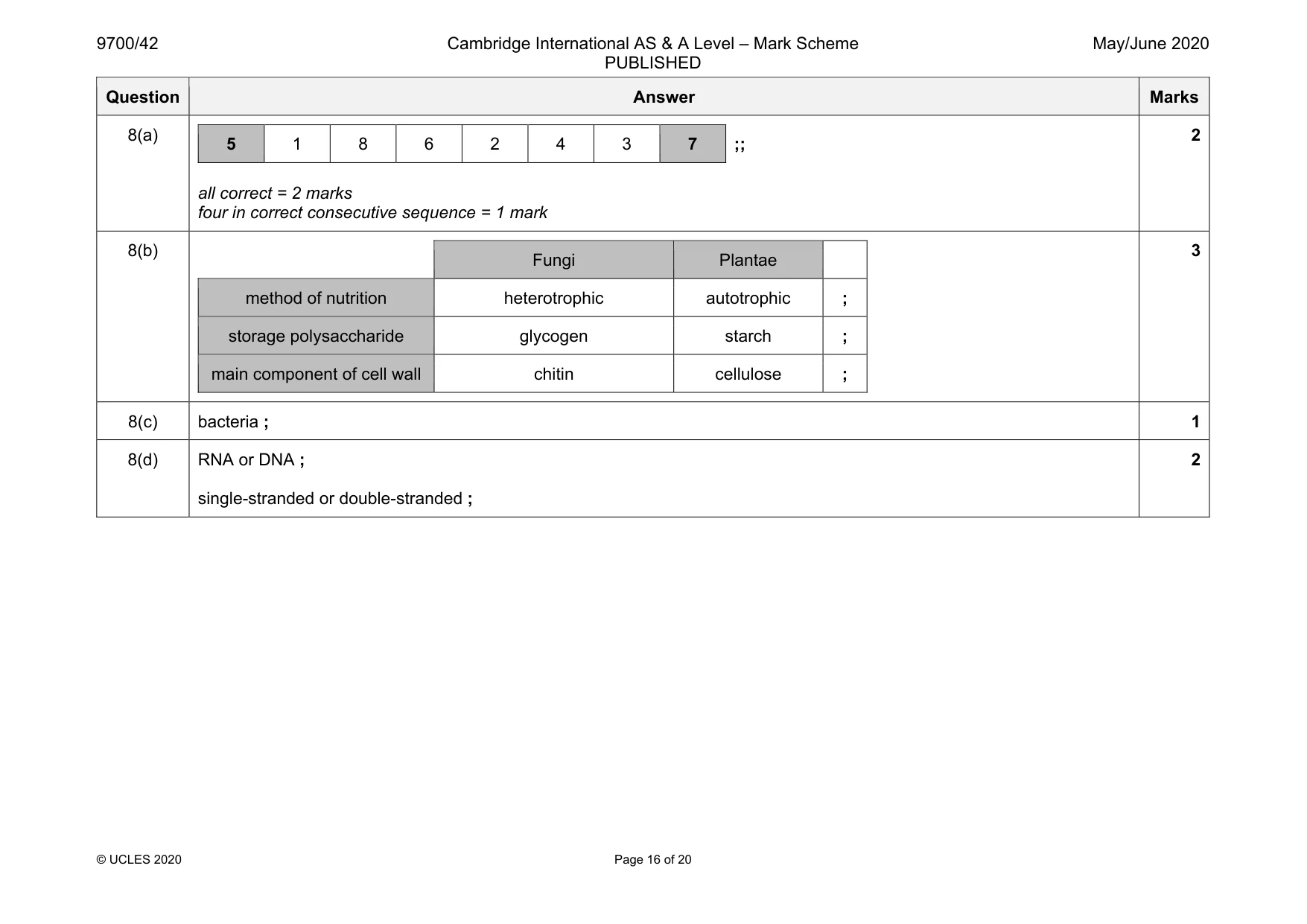
Mark scheme: 8(a) 5 1 8 6 2 4 3 7 ;; all correct = 2 marks four in correct consecutive sequence = 1 mark 2 8(b) Fungi Plantae method of nutrition heterotrophic autotrophic ; storage polysaccharide glycogen starch ; main component of cell wall chitin cellulose ; 3 8(c) bacteria ; 1 8(d) RNA or DNA ; single-stranded or double-stranded ; 2
Q9 · Describe how gel electrophoresis is used to distinguish between two alleles of a gene
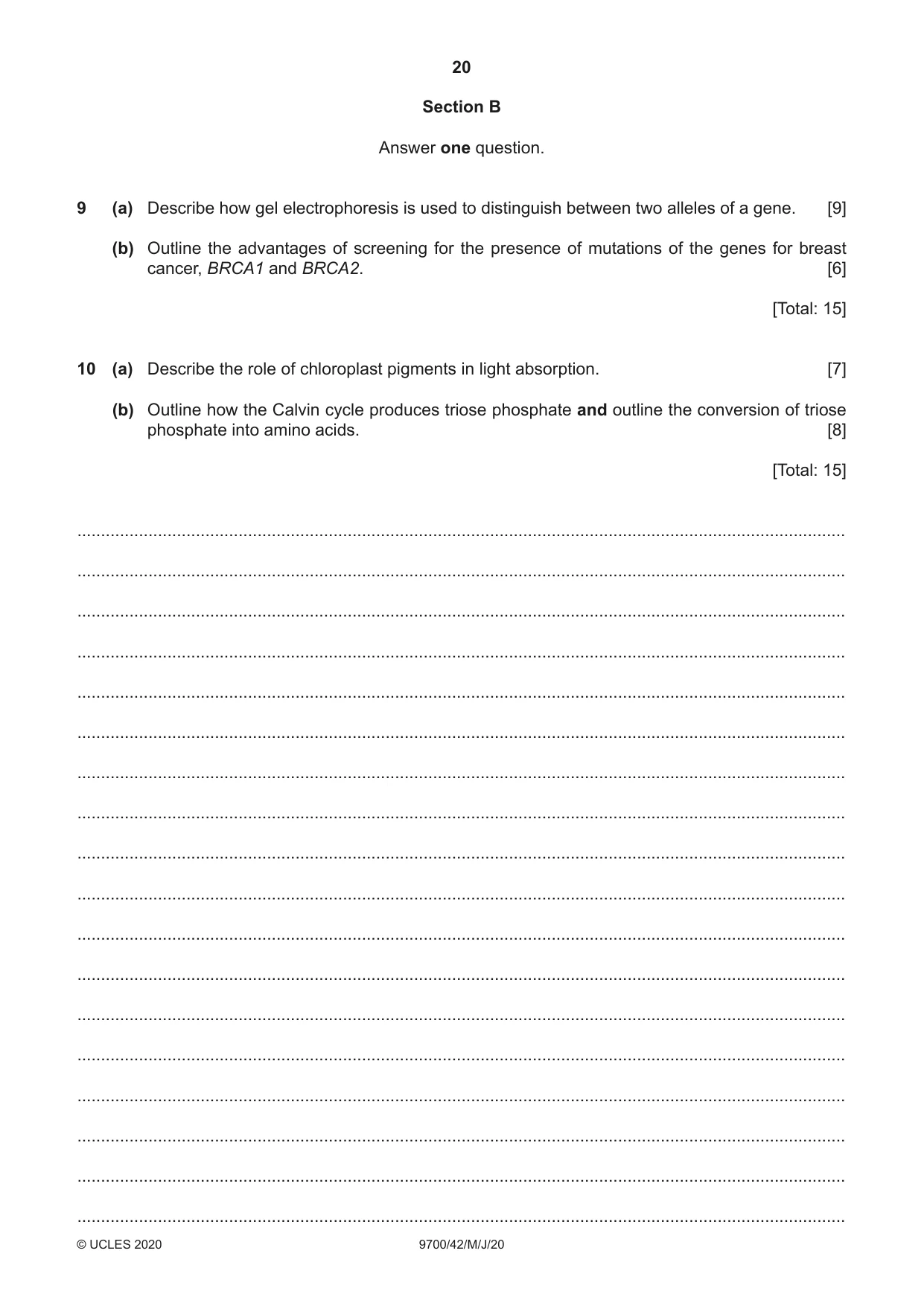
9 (a) Describe how gel electrophoresis is used to distinguish between two alleles of a gene. [9] (b) Outline the advantages of screening for the presence of mutations of the genes for breast cancer, BRCA1 and BRCA2. [6] [Total: 15]
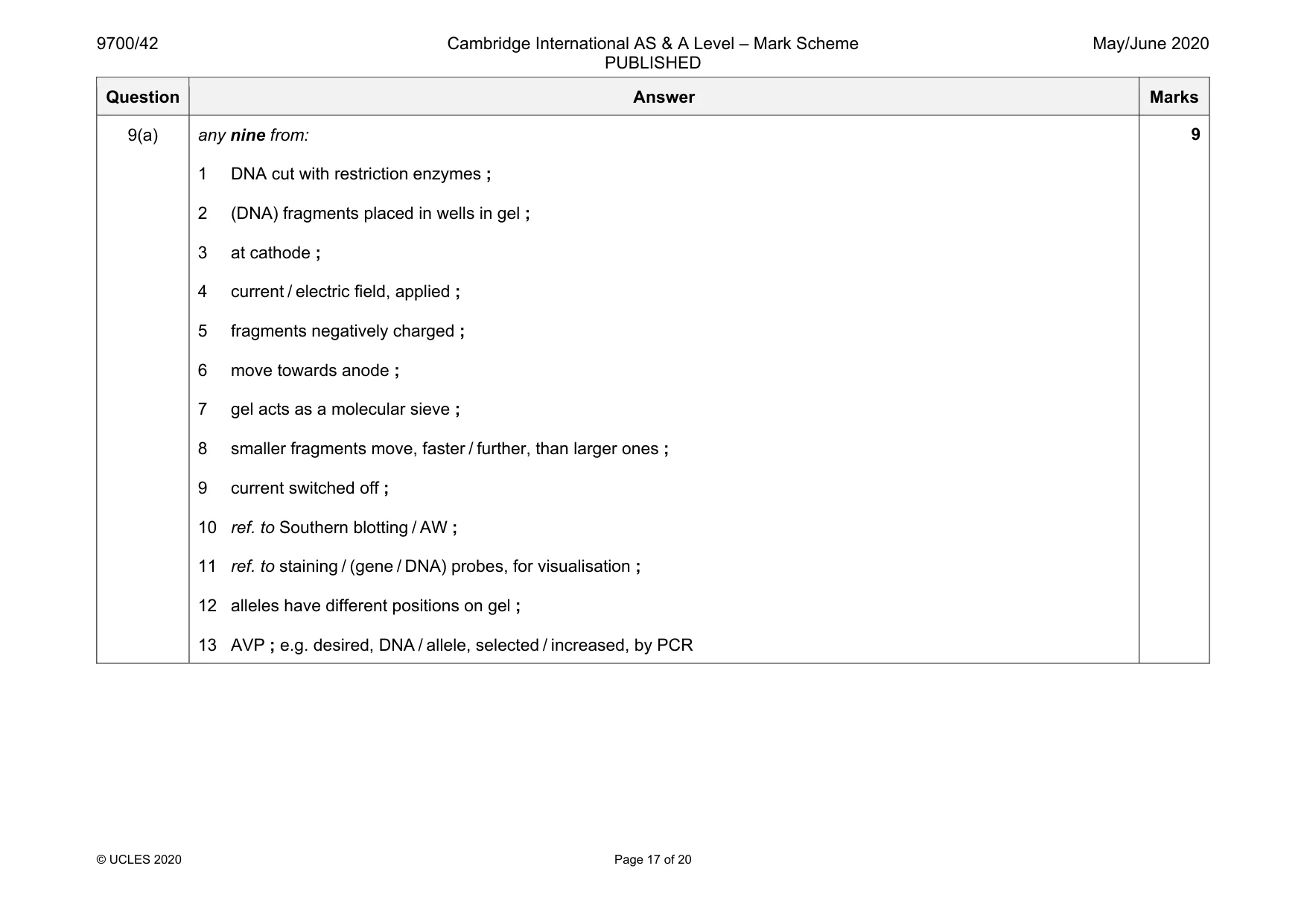
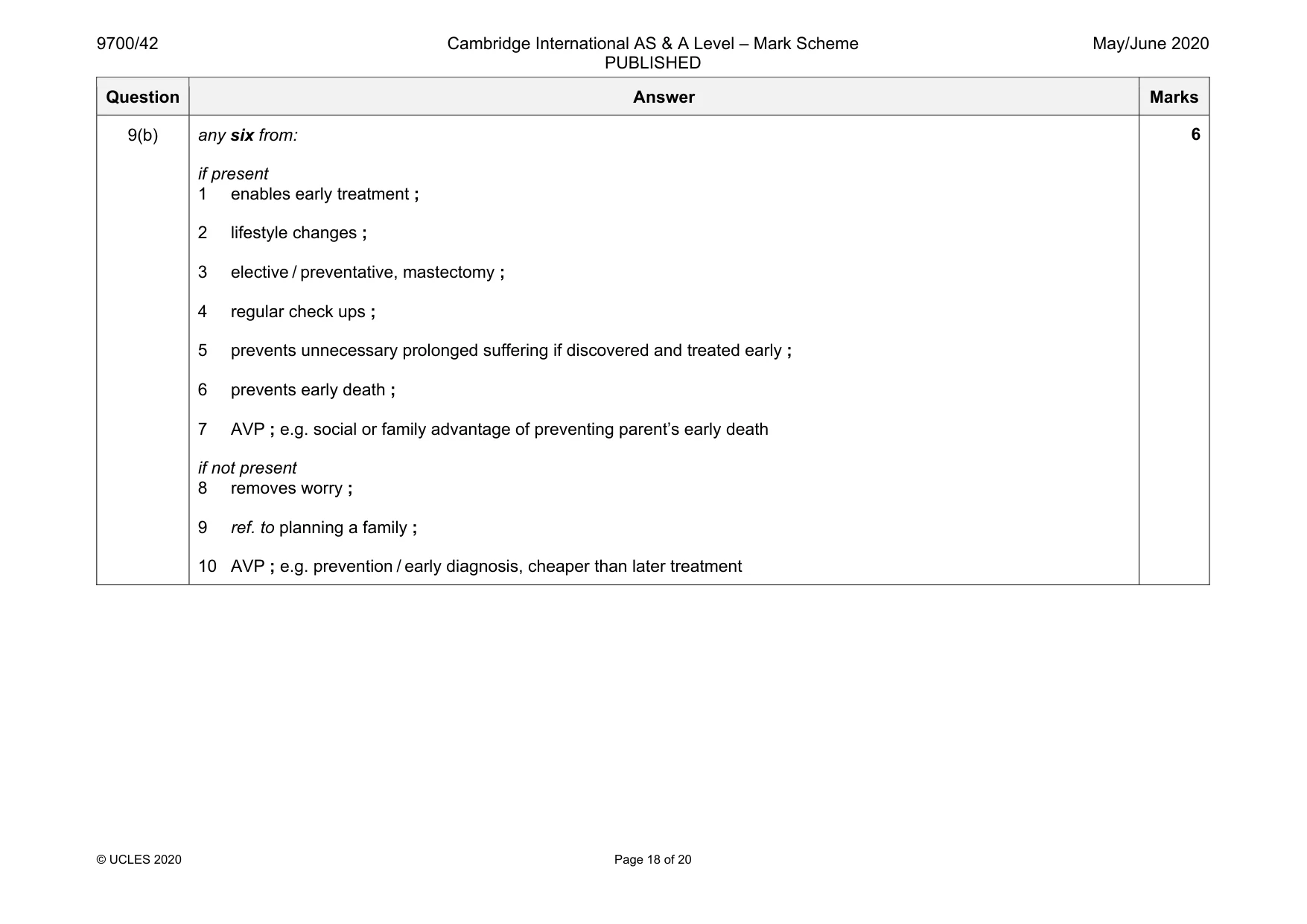
Mark scheme: 9(a) any nine from: 1 DNA cut with restriction enzymes ; 2 (DNA) fragments placed in wells in gel ; 3 at cathode ; 4 current / electric field, applied ; 5 fragments negatively charged ; 6 move towards anode ; 7 gel acts as a molecular sieve ; 8 smaller fragments move, faster / further, than larger ones ; 9 current switched off ; 10 ref. to Southern blotting / AW ; 11 ref. to staining / (gene / DNA) probes, for visualisation ; 12 alleles have different positions on gel ; 13 AVP ; e.g. desired, DNA / allele, selected / increased, by PCR Question Answer Marks 9(b) any six from: if present 1 enables early treatment ; 2 lifestyle changes ; 3 elective / preventative, mastectomy ; 4 regular check ups ; 5 prevents unnecessary prolonged suffering if discovered and treated early ; 6 prevents early death ; 7 AVP ; e.g. social or family advantage of preventing parent’s early death if not present 8 removes worry ; 9 ref. to planning a family ; 10 AVP ; e.g. prevention / early diagnosis, cheaper than later treatment 6
Q10 · Describe the role of chloroplast pigments in light absorption
10 (a) Describe the role of chloroplast pigments in light absorption. [7] (b) Outline how the Calvin cycle produces triose phosphate and outline the conversion of triose phosphate into amino acids. [8] [Total: 15] .................................................................................................................................................................. .................................................................................................................................................................. .................................................................................................................................................................. .................................................................................................................................................................. .................................................................................................................................................................. .................................................................................................................................................................. .................................................................................................................................................................. .................................................................................................................................................................. .................................................................................................................................................................. .................................................................................................................................................................. .................................................................................................................................................................. .................................................................................................................................................................. .................................................................................................................................................................. .................................................................................................................................................................. .................................................................................................................................................................. .................................................................................................................................................................. .................................................................................................................................................................. .................................................................................................................................................................. .................................................................................................................................................................. .................................................................................................................................................................. .................................................................................................................................................................. .................................................................................................................................................................. .................................................................................................................................................................. .................................................................................................................................................................. .................................................................................................................................................................. .................................................................................................................................................................. .................................................................................................................................................................. .................................................................................................................................................................. .................................................................................................................................................................. .................................................................................................................................................................. .................................................................................................................................................................. .................................................................................................................................................................. .................................................................................................................................................................. .................................................................................................................................................................. .................................................................................................................................................................. .................................................................................................................................................................. .................................................................................................................................................................. .................................................................................................................................................................. .................................................................................................................................................................. .................................................................................................................................................................. .................................................................................................................................................................. .................................................................................................................................................................. .................................................................................................................................................................. .................................................................................................................................................................. .................................................................................................................................................................. .................................................................................................................................................................. .................................................................................................................................................................. .................................................................................................................................................................. .................................................................................................................................................................. .................................................................................................................................................................. .................................................................................................................................................................. .................................................................................................................................................................. .................................................................................................................................................................. .................................................................................................................................................................. .................................................................................................................................................................. .................................................................................................................................................................. .................................................................................................................................................................. .................................................................................................................................................................. .................................................................................................................................................................. .................................................................................................................................................................. .................................................................................................................................................................. .................................................................................................................................................................. .................................................................................................................................................................. .................................................................................................................................................................. .................................................................................................................................................................. .................................................................................................................................................................. .................................................................................................................................................................. .................................................................................................................................................................. .................................................................................................................................................................. .................................................................................................................................................................. .................................................................................................................................................................. .................................................................................................................................................................. ..................................................................................................................................................................
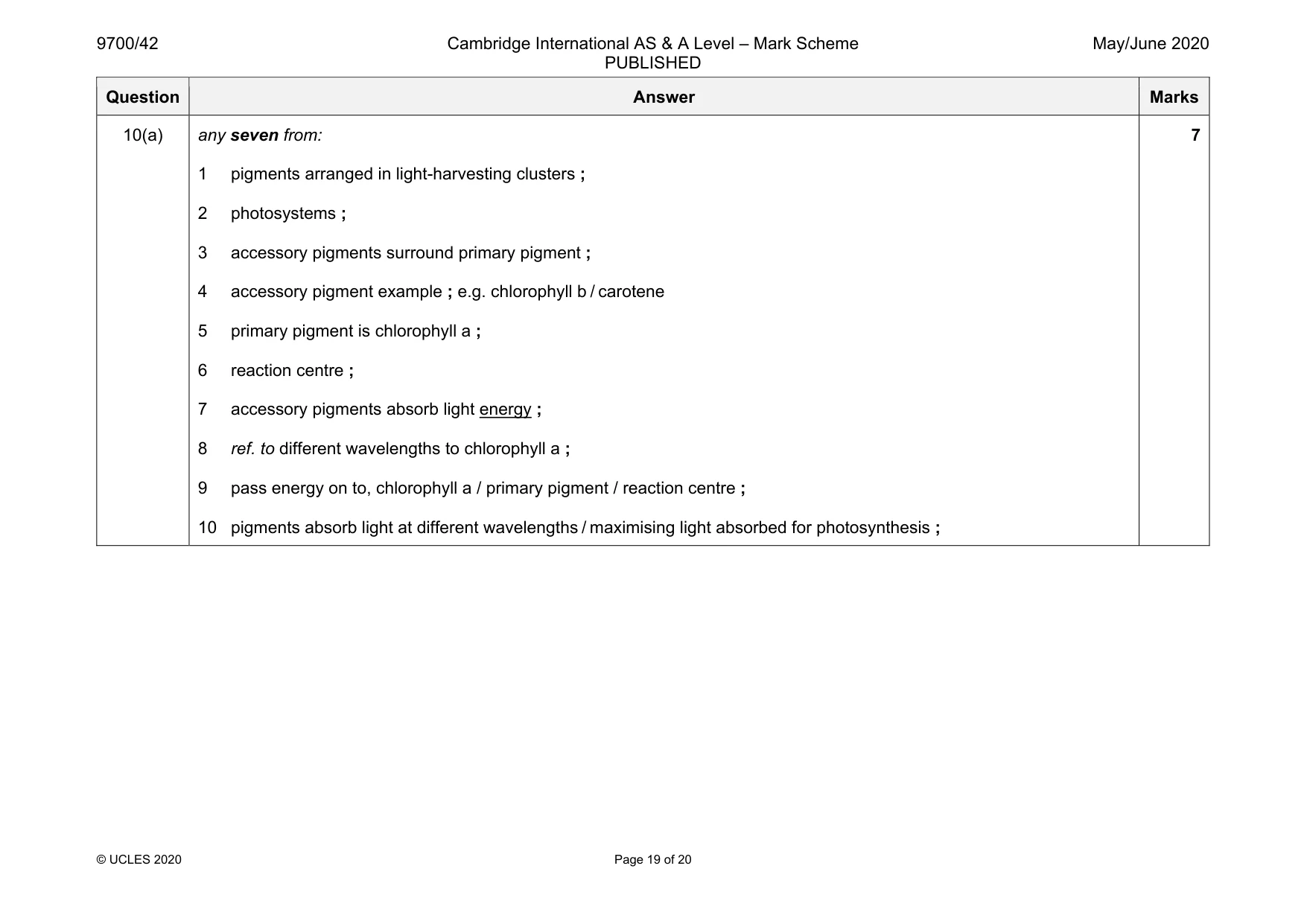
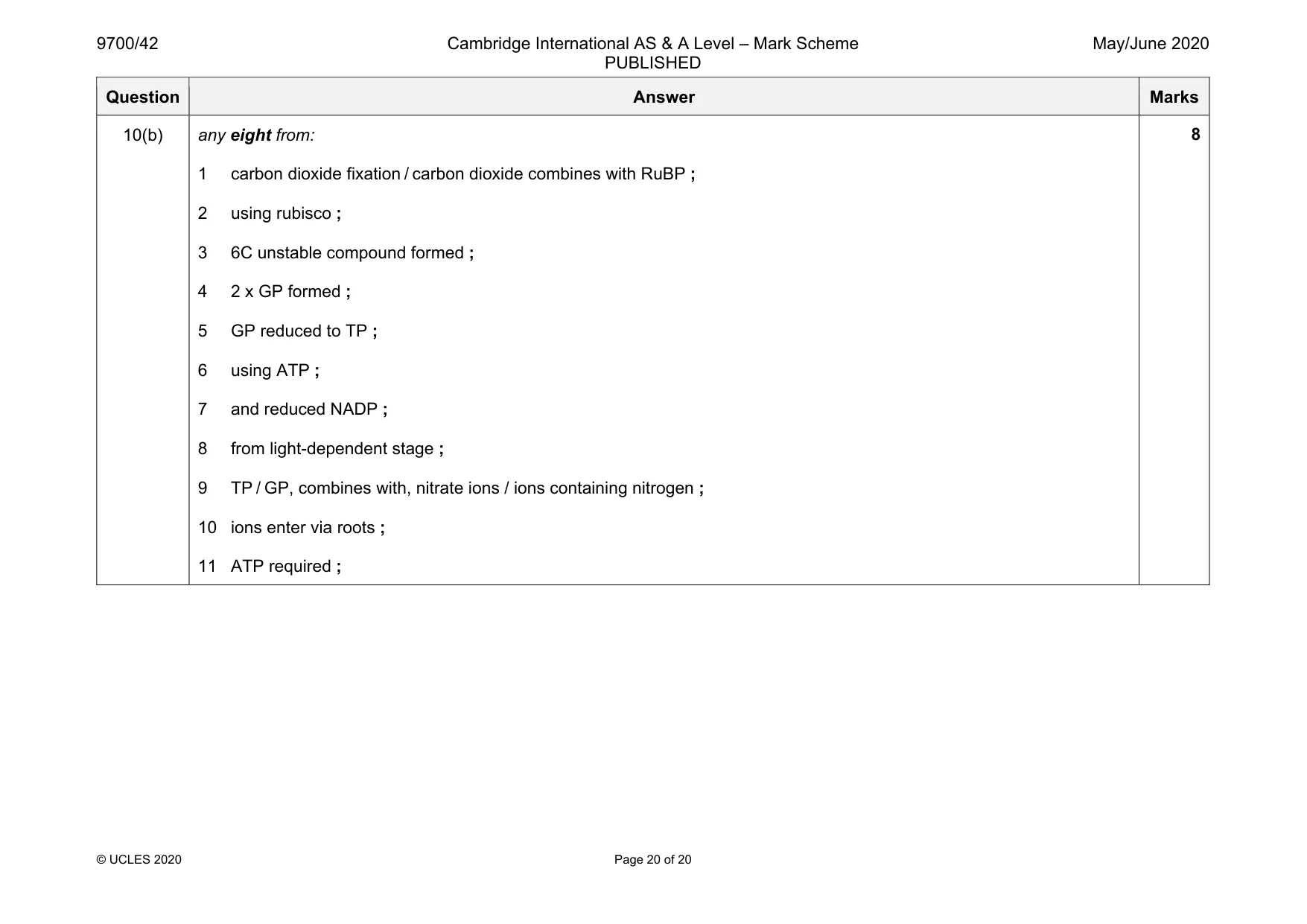
Mark scheme: 10(a) any seven from: 1 pigments arranged in light-harvesting clusters ; 2 photosystems ; 3 accessory pigments surround primary pigment ; 4 accessory pigment example ; e.g. chlorophyll b / carotene 5 primary pigment is chlorophyll a ; 6 reaction centre ; 7 accessory pigments absorb light energy ; 8 ref. to different wavelengths to chlorophyll a ; 9 pass energy on to, chlorophyll a / primary pigment / reaction centre ; 10 pigments absorb light at different wavelengths / maximising light absorbed for photosynthesis ; 7 Question Answer Marks 10(b) any eight from: 1 carbon dioxide fixation / carbon dioxide combines with RuBP ; 2 using rubisco ; 3 6C unstable compound formed ; 4 2 x GP formed ; 5 GP reduced to TP ; 6 using ATP ; 7 and reduced NADP ; 8 from light-dependent stage ; 9 TP / GP, combines with, nitrate ions / ions containing nitrogen ; 10 ions enter via roots ; 11 ATP required ; 8
More questions on Photosynthesis as an energy transfer process
What was in this paper
The subtopics covered by these 10 questions, and how many questions each got. Open one in a new tab to see every Cambridge question on it.