Cambridge A Level Biology 9700 — 2020 May/June Paper 4 · Variant 3
9700/43/M/J/20 · 10 questions · 115 marks · ≈129 min
The question paper and its mark scheme, free to read here and free to download. This is Cambridge’s own paper, exactly as it was sat.
Question paper24 pages
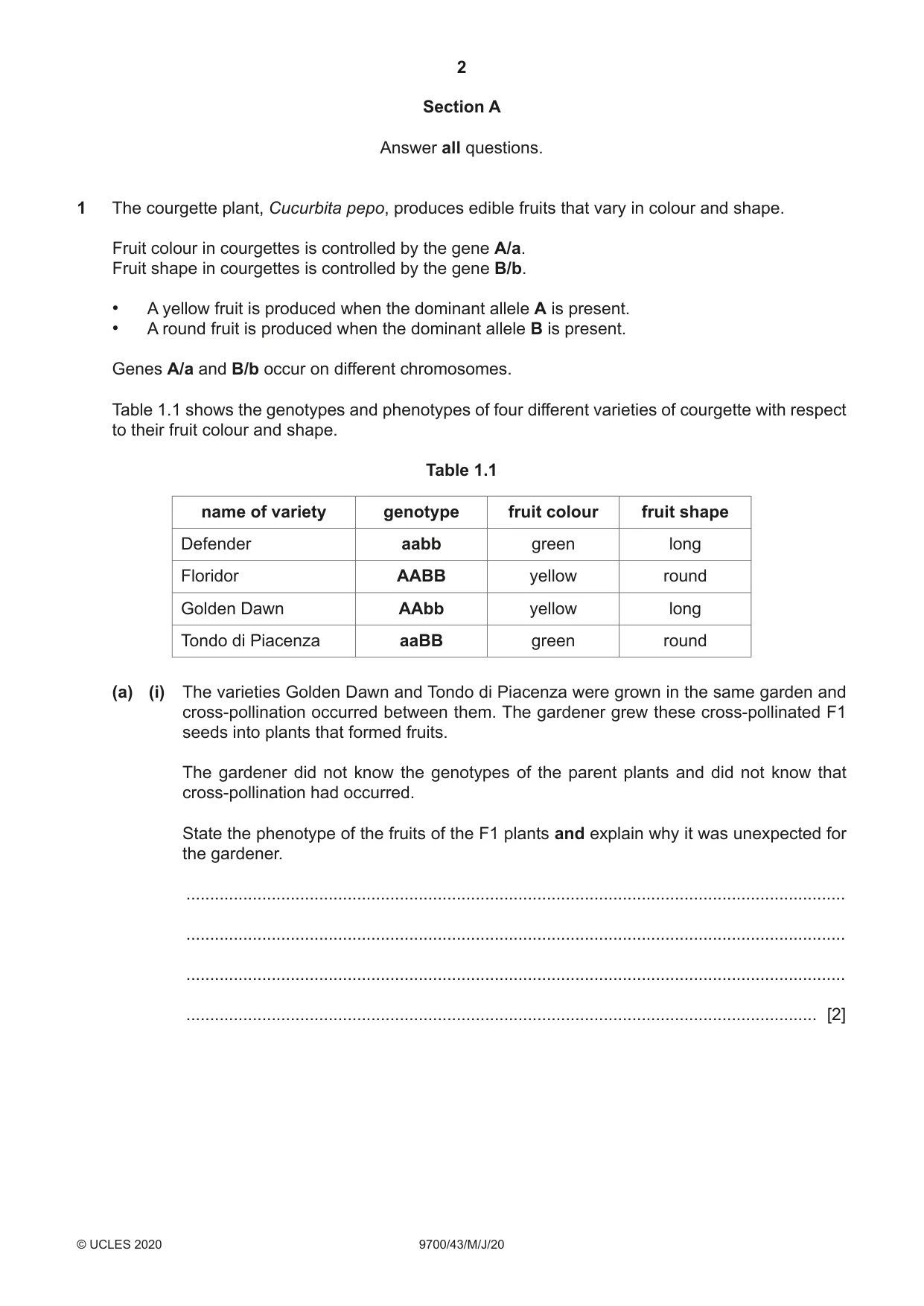
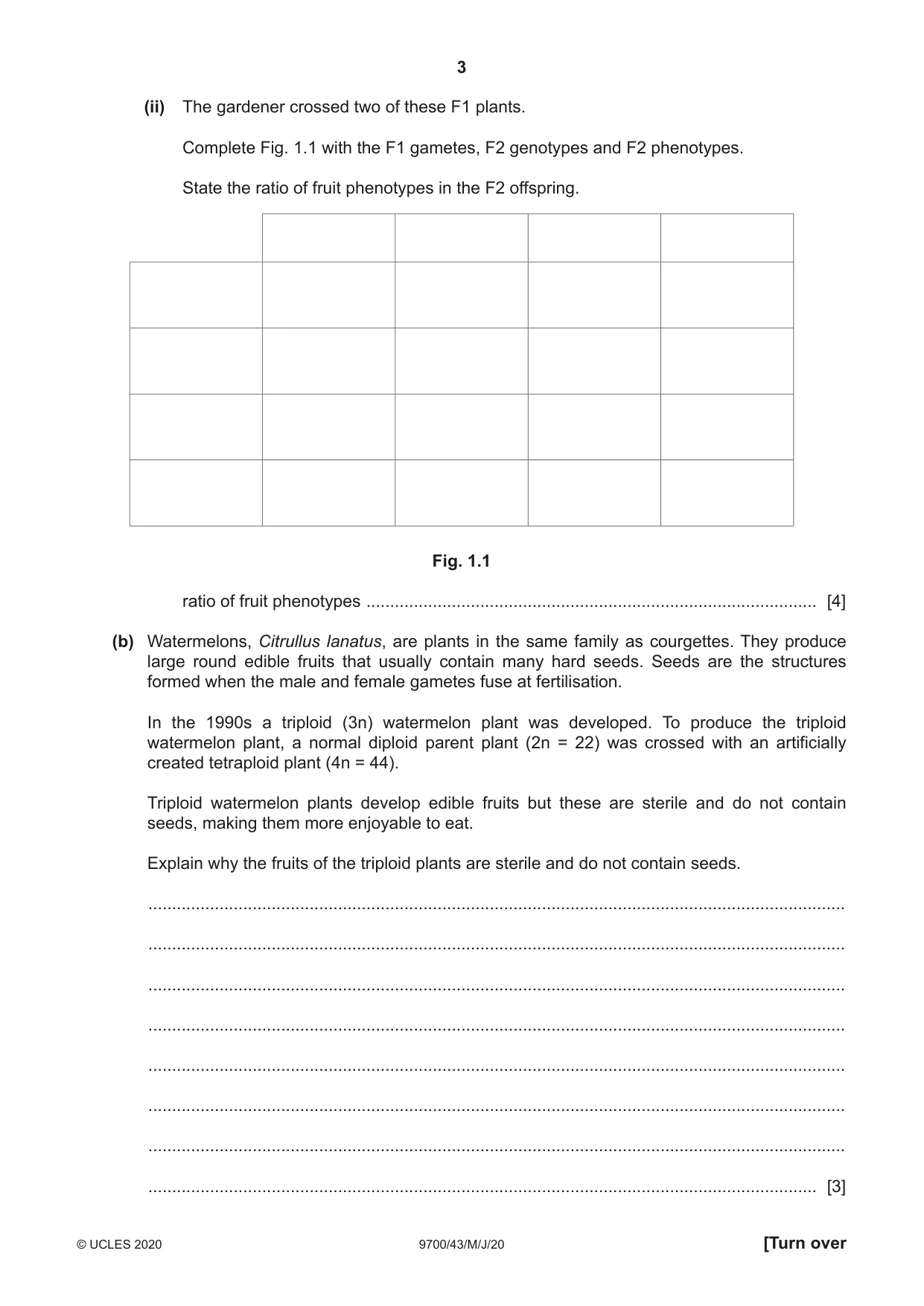
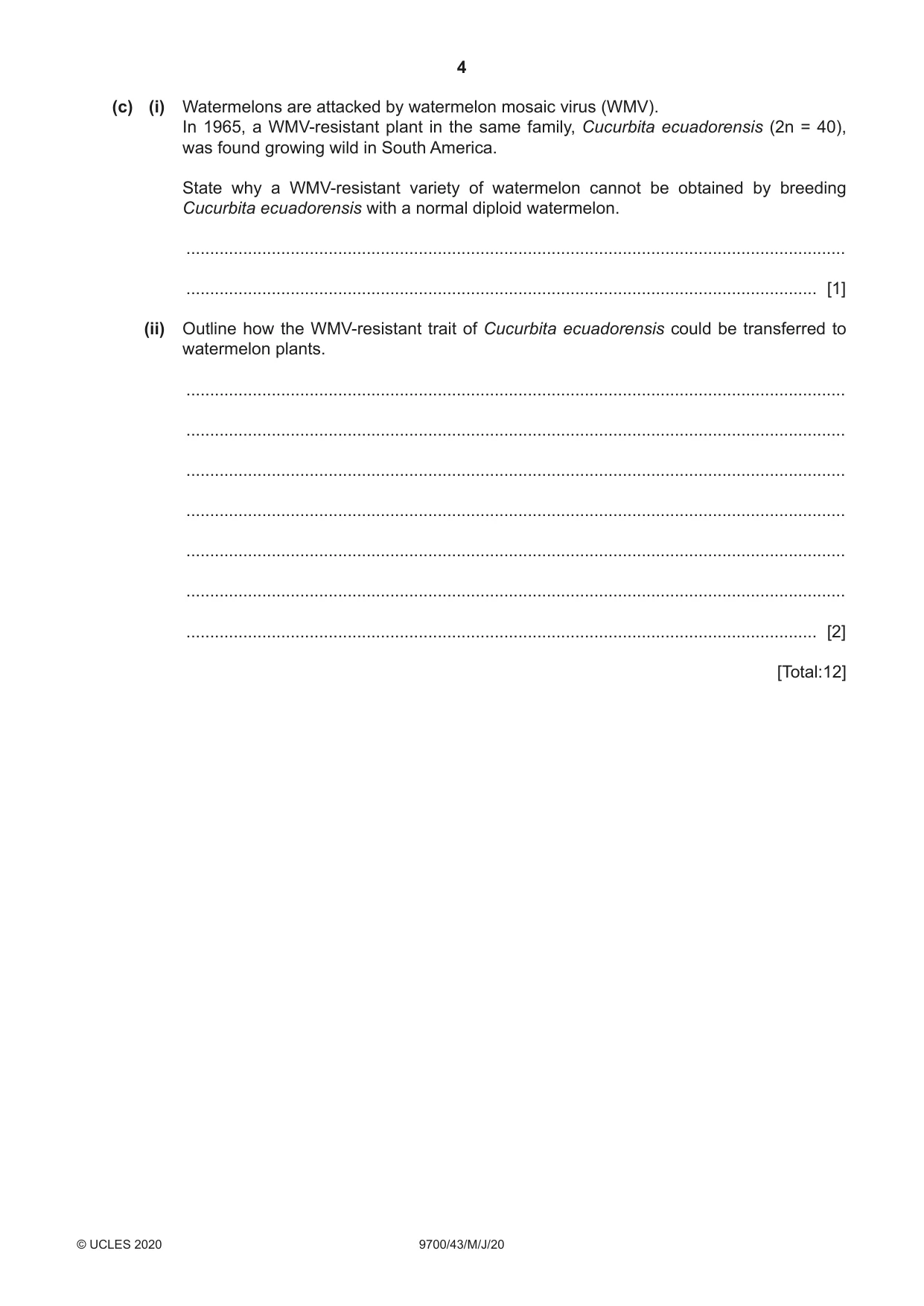
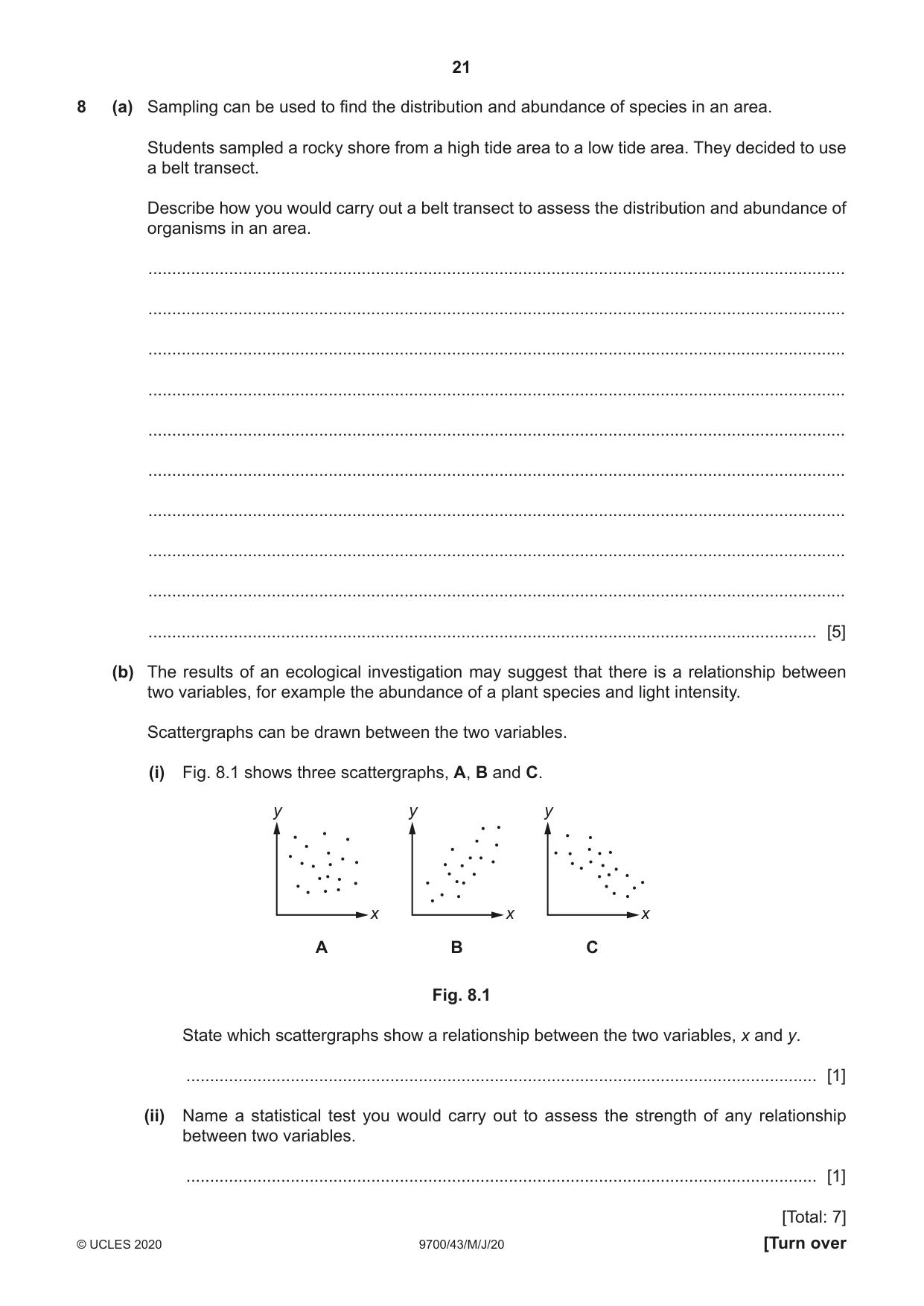
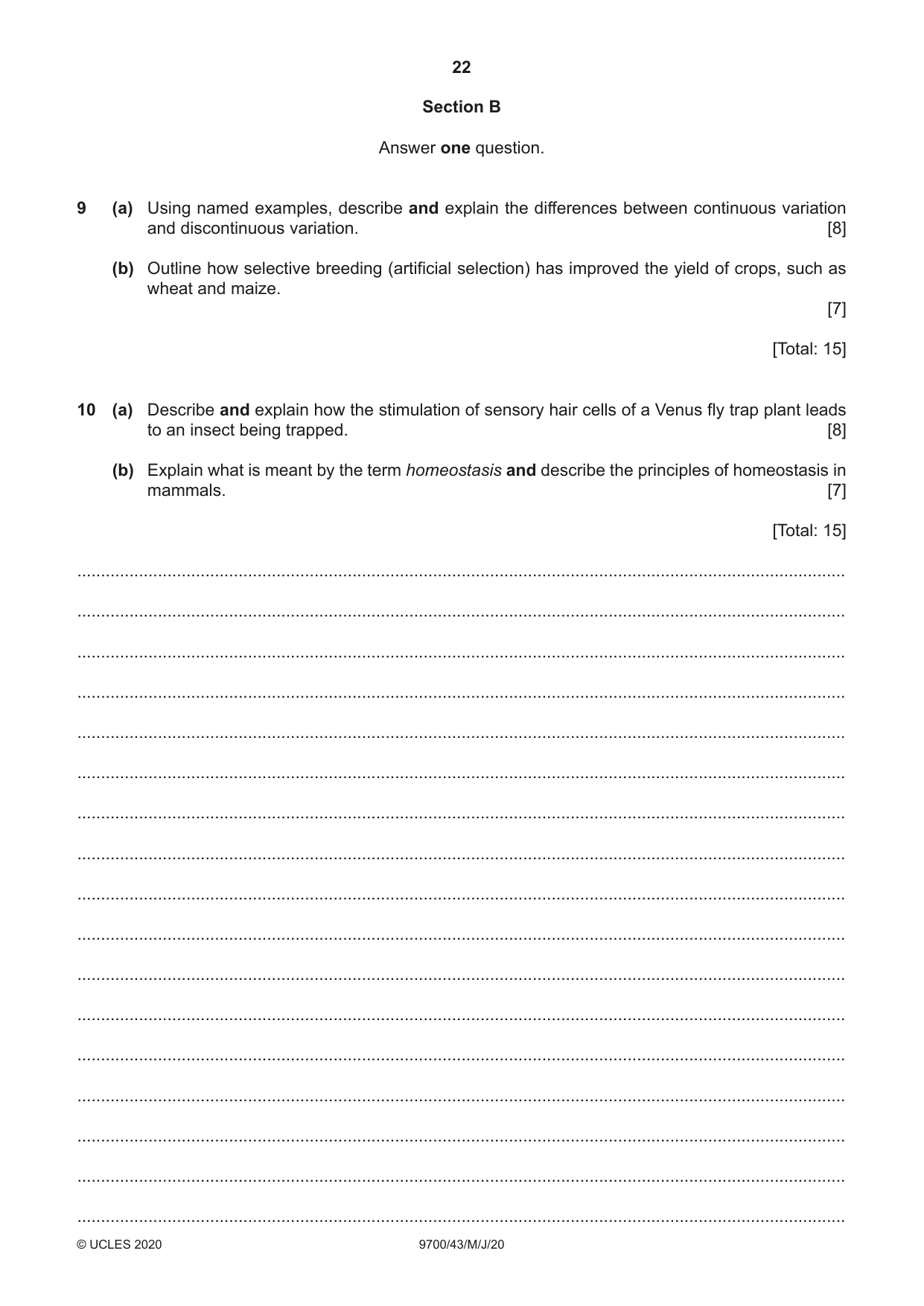


Mark scheme20 pages
Answers below. Sit the paper first if you are practising.
Questions as text
Q1 · The courgette plant, Cucurbita pepo, produces edible fruits that vary in colour and shape
1 The courgette plant, Cucurbita pepo, produces edible fruits that vary in colour and shape. Fruit colour in courgettes is controlled by the gene A/a. Fruit shape in courgettes is controlled by the gene B/b. • A yellow fruit is produced when the dominant allele A is present. • A round fruit is produced when the dominant allele B is present. Genes A/a and B/b occur on different chromosomes. Table 1.1 shows the genotypes and phenotypes of four different varieties of courgette with respect to their fruit colour and shape. Table 1.1 name of variety genotype fruit colour fruit shape Defender aabb green long Floridor AABB yellow round Golden Dawn AAbb yellow long Tondo di Piacenza aaBB green round (a) (i) The varieties Golden Dawn and Tondo di Piacenza were grown in the same garden and cross-pollination occurred between them. The gardener grew these cross-pollinated F1 seeds into plants that formed fruits. The gardener did not know the genotypes of the parent plants and did not know that cross-pollination had occurred. State the phenotype of the fruits of the F1 plants and explain why it was unexpected for the gardener. ........................................................................................................................................... ........................................................................................................................................... ........................................................................................................................................... ..................................................................................................................................... [2] (ii) The gardener crossed two of these F1 plants. Complete Fig. 1.1 with the F1 gametes, F2 genotypes and F2 phenotypes. State the ratio of fruit phenotypes in the F2 offspring. Fig. 1.1 ratio of fruit phenotypes ............................................................................................... [4] (b) Watermelons, Citrullus lanatus, are plants in the same family as courgettes. They produce large round edible fruits that usually contain many hard seeds. Seeds are the structures formed when the male and female gametes fuse at fertilisation. In the 1990s a triploid (3n) watermelon plant was developed. To produce the triploid watermelon plant, a normal diploid parent plant (2n = 22) was crossed with an artificially created tetraploid plant (4n = 44). Triploid watermelon plants develop edible fruits but these are sterile and do not contain seeds, making them more enjoyable to eat. Explain why the fruits of the triploid plants are sterile and do not contain seeds. ................................................................................................................................................... ................................................................................................................................................... ................................................................................................................................................... ................................................................................................................................................... ................................................................................................................................................... ................................................................................................................................................... ................................................................................................................................................... ............................................................................................................................................. [3] (c) (i) Watermelons are attacked by watermelon mosaic virus (WMV). In 1965, a WMV-resistant plant in the same family, Cucurbita ecuadorensis (2n = 40), was found growing wild in South America. State why a WMV-resistant variety of watermelon cannot be obtained by breeding Cucurbita ecuadorensis with a normal diploid watermelon. ........................................................................................................................................... ..................................................................................................................................... [1] (ii) Outline how the WMV-resistant trait of Cucurbita ecuadorensis could be transferred to watermelon plants. ........................................................................................................................................... ........................................................................................................................................... ........................................................................................................................................... ........................................................................................................................................... ........................................................................................................................................... ........................................................................................................................................... ..................................................................................................................................... [2] [Total:12]
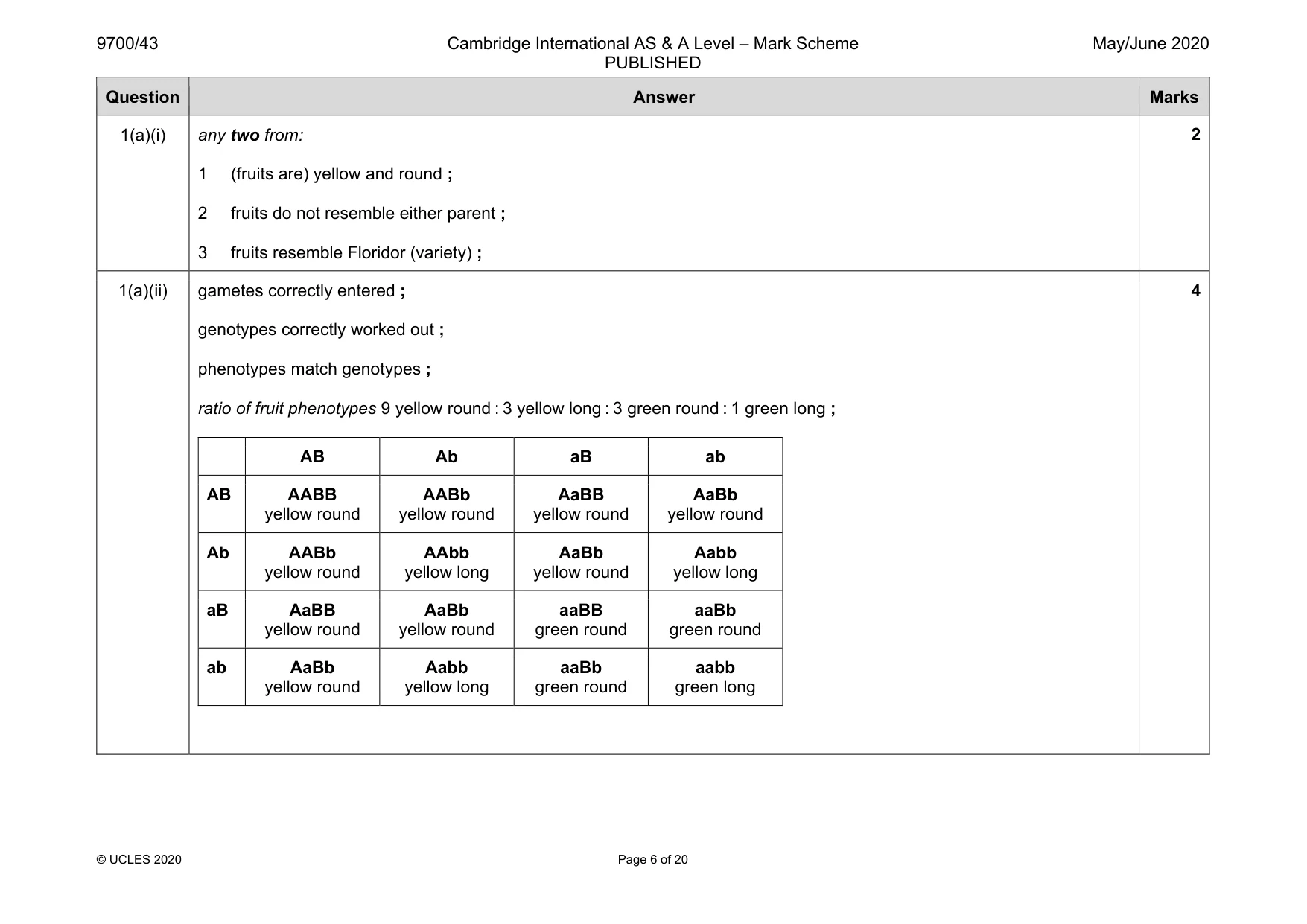
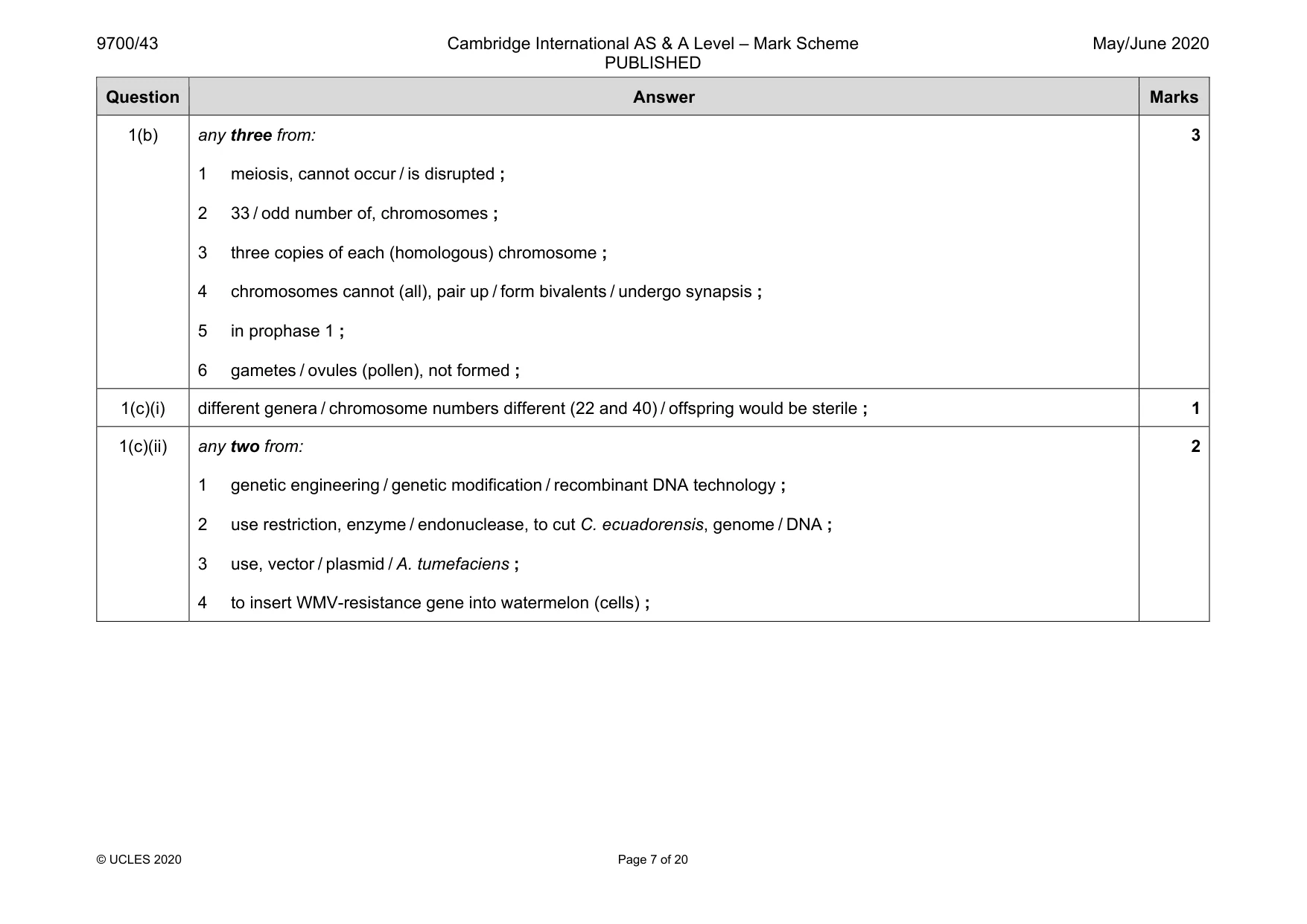
Mark scheme: 1(a)(i) any two from: 1 (fruits are) yellow and round ; 2 fruits do not resemble either parent ; 3 fruits resemble Floridor (variety) ; 1(a)(ii) gametes correctly entered ; genotypes correctly worked out ; phenotypes match genotypes ; ratio of fruit phenotypes 9 yellow round : 3 yellow long : 3 green round : 1 green long ; AB Ab aB ab AB AABB yellow round AABb yellow round AaBB yellow round AaBb yellow round Ab AABb yellow round AAbb yellow long AaBb yellow round Aabb yellow long aB AaBB yellow round AaBb yellow round aaBB green round aaBb green round ab AaBb yellow round Aabb yellow long aaBb green round aabb green long 4 Question Answer Marks 1(b) any three from: 1 meiosis, cannot occur / is disrupted ; 2 33 / odd number of, chromosomes ; 3 three copies of each (homologous) chromosome ; 4 chromosomes cannot (all), pair up / form bivalents / undergo synapsis ; 5 in prophase 1 ; 6 gametes / ovules (pollen), not formed ; 3 1(c)(i) different genera / chromosome numbers different (22 and 40) / offspring would be sterile ; 1 1(c)(ii) any two from: 1 genetic engineering / genetic modification / recombinant DNA technology ; 2 use restriction, enzyme / endonuclease, to cut C. ecuadorensis, genome / DNA ; 3 use, vector / plasmid / A. tumefaciens ; 4 to insert WMV-resistance gene into watermelon (cells) ; 2
More questions on Passage of information from parents to offspring
Q2 · Diabetes insipidus (DI) is a condition in humans that causes a person to have an…
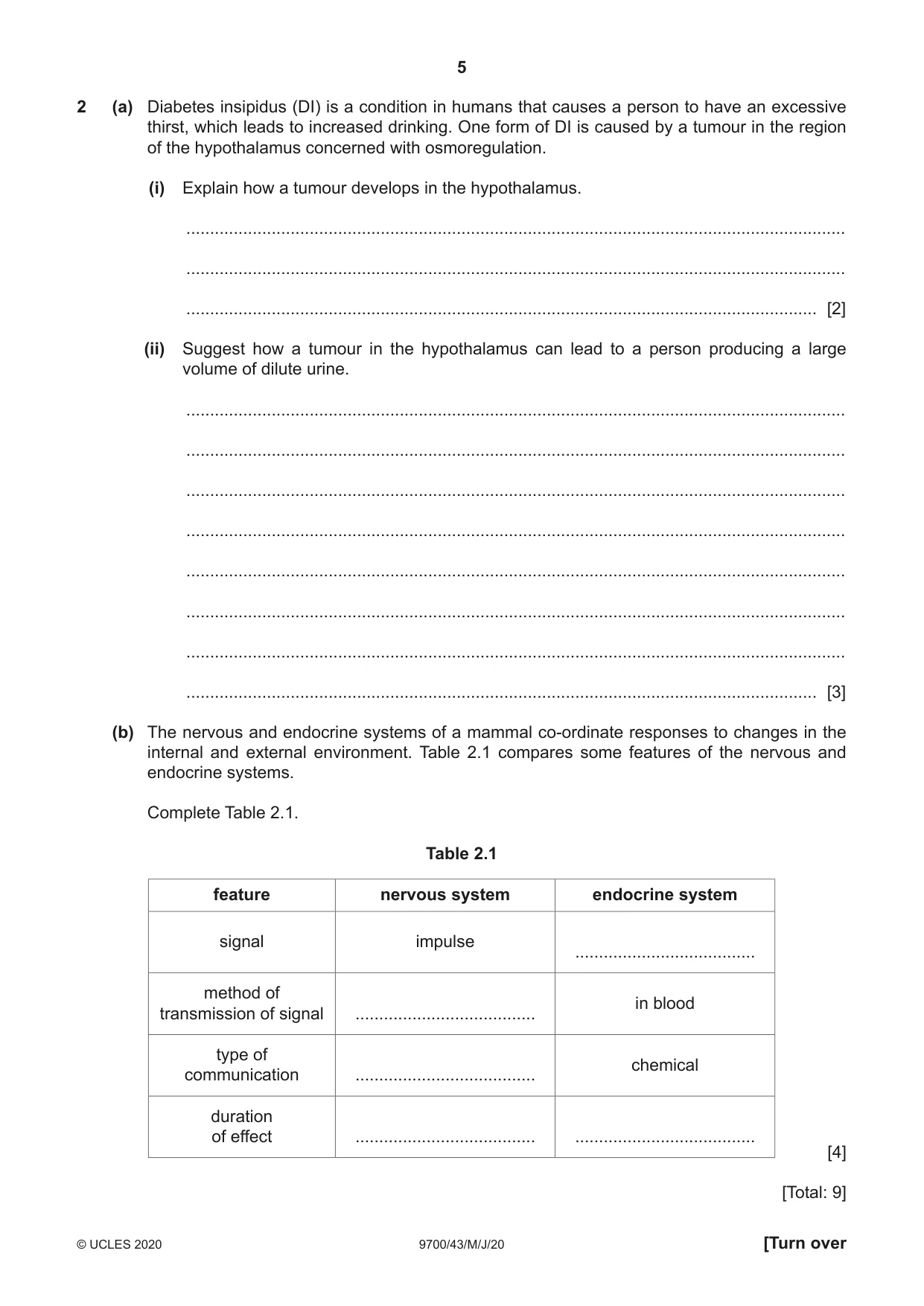
2 (a) Diabetes insipidus (DI) is a condition in humans that causes a person to have an excessive thirst, which leads to increased drinking. One form of DI is caused by a tumour in the region of the hypothalamus concerned with osmoregulation. (i) Explain how a tumour develops in the hypothalamus. ........................................................................................................................................... ........................................................................................................................................... ..................................................................................................................................... [2] (ii) Suggest how a tumour in the hypothalamus can lead to a person producing a large volume of dilute urine. ........................................................................................................................................... ........................................................................................................................................... ........................................................................................................................................... ........................................................................................................................................... ........................................................................................................................................... ........................................................................................................................................... ........................................................................................................................................... ..................................................................................................................................... [3] (b) The nervous and endocrine systems of a mammal co-ordinate responses to changes in the internal and external environment. Table 2.1 compares some features of the nervous and endocrine systems. Complete Table 2.1. Table 2.1 feature nervous system endocrine system signal impulse ...................................... method of in blood transmission of signal ...................................... type of chemical communication ...................................... duration of effect ...................................... ...................................... [4] [Total: 9]
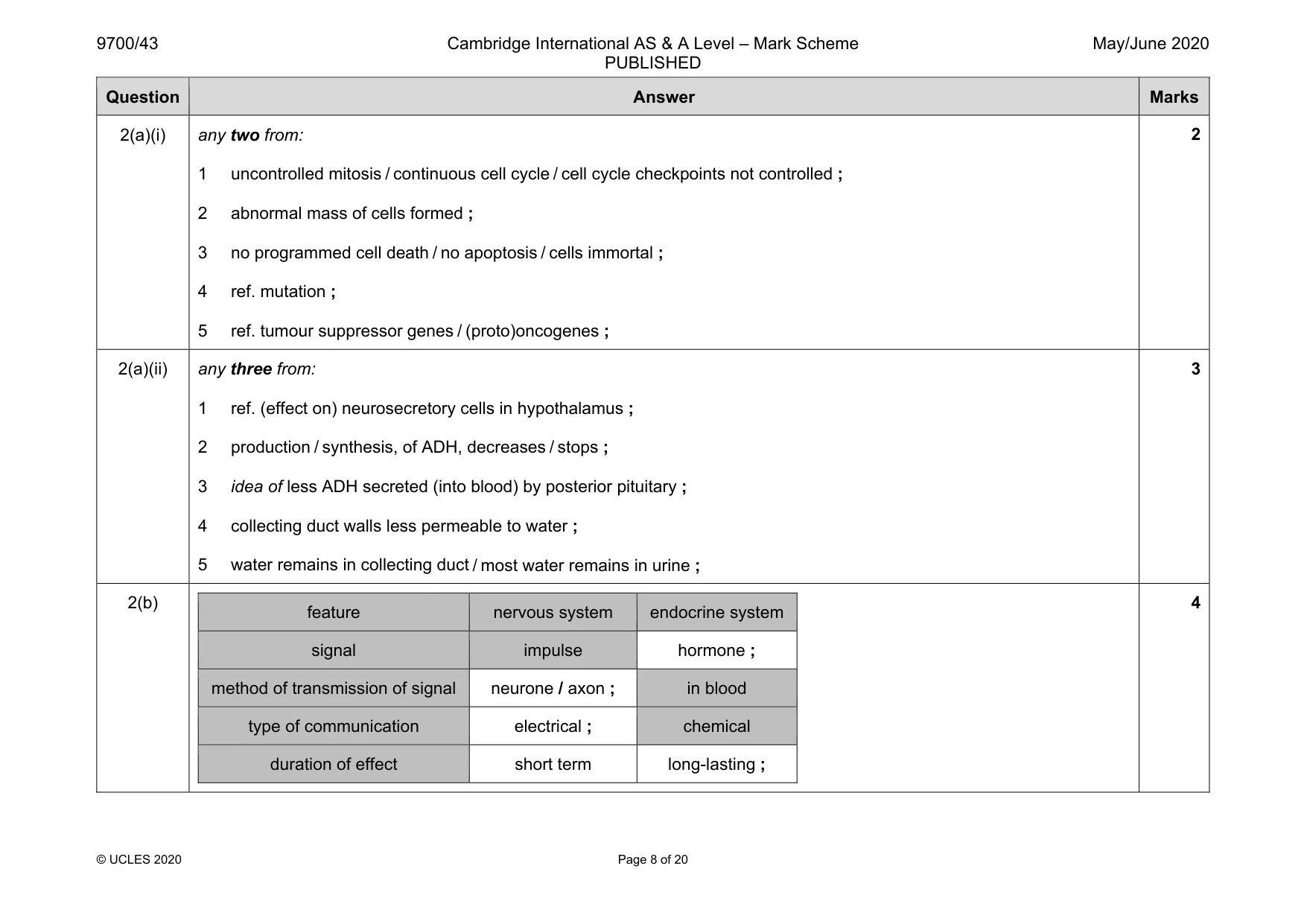
Mark scheme: 2(a)(i) any two from: 1 uncontrolled mitosis / continuous cell cycle / cell cycle checkpoints not controlled ; 2 abnormal mass of cells formed ; 3 no programmed cell death / no apoptosis / cells immortal ; 4 ref. mutation ; 5 ref. tumour suppressor genes / (proto)oncogenes ; 2(a)(ii) any three from: 1 ref. (effect on) neurosecretory cells in hypothalamus ; 2 production / synthesis, of ADH, decreases / stops ; 3 idea of less ADH secreted (into blood) by posterior pituitary ; 4 collecting duct walls less permeable to water ; 5 water remains in collecting duct / most water remains in urine ; 3 2(b) feature nervous system endocrine system signal impulse hormone ; method of transmission of signal neurone / axon ; in blood type of communication electrical ; chemical duration of effect short term long-lasting ; 4
More questions on Replication and division of nuclei and cells
Q3 · The collared flycatcher, Ficedula albicollis, and the pied flycatcher, F
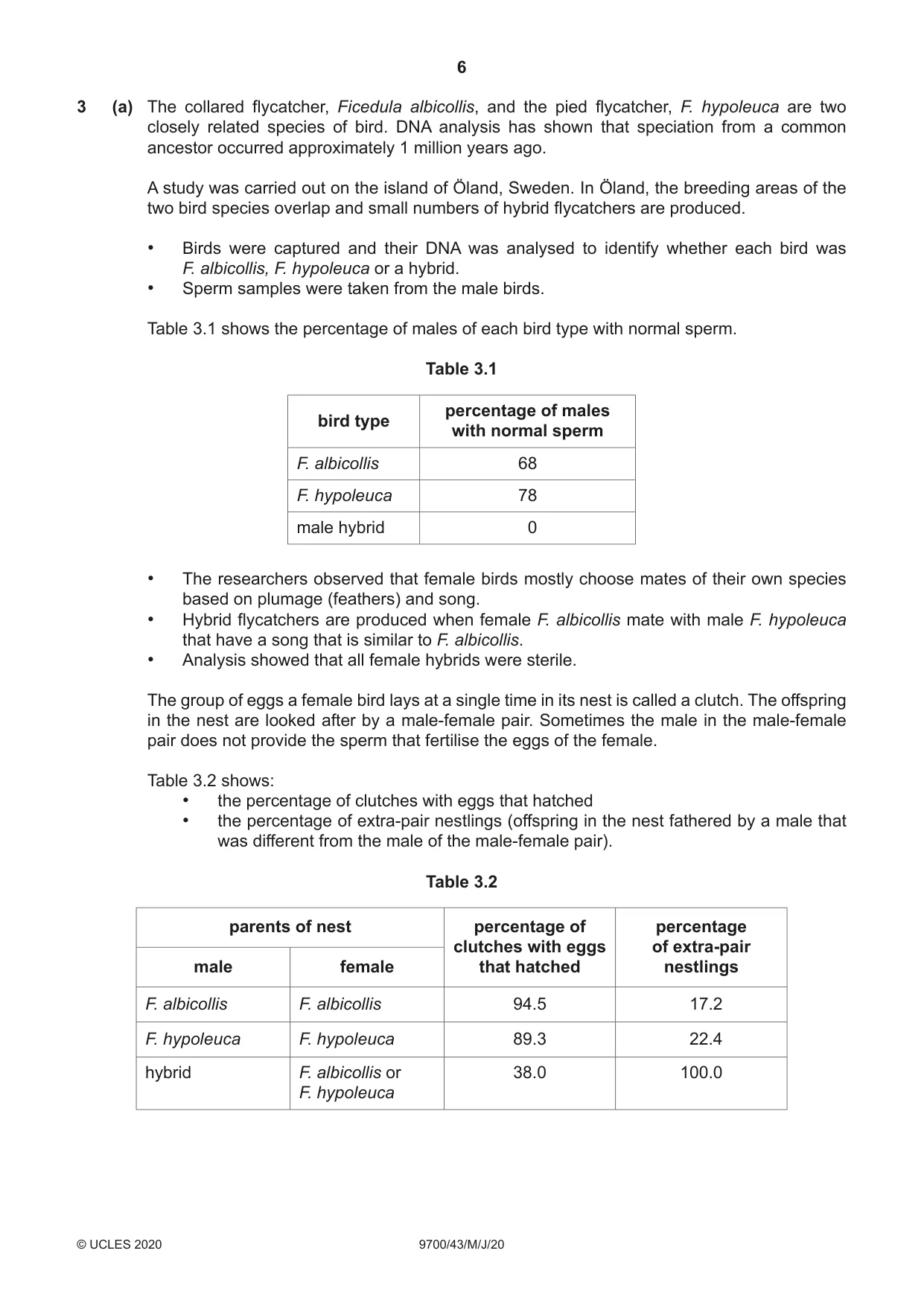
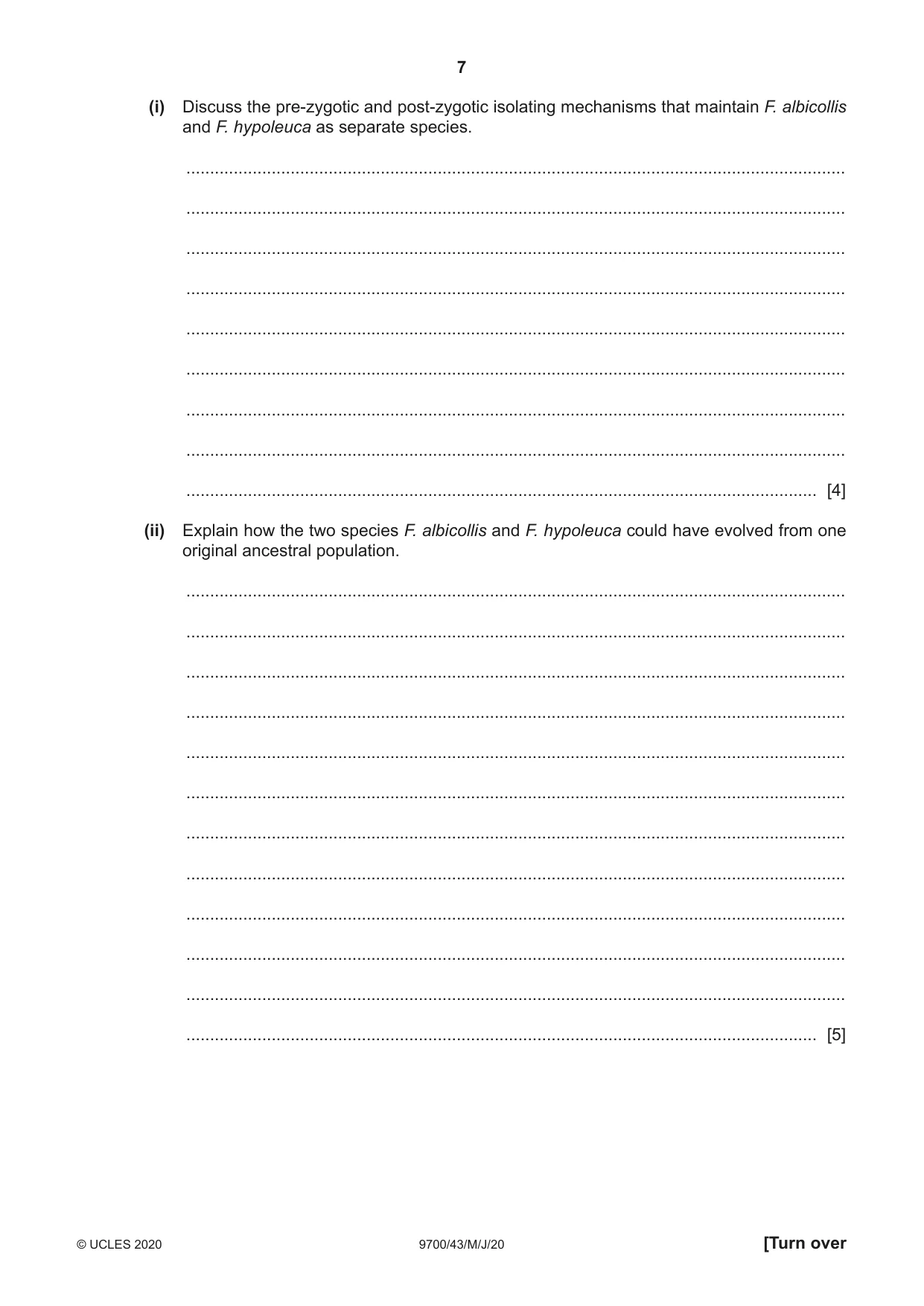
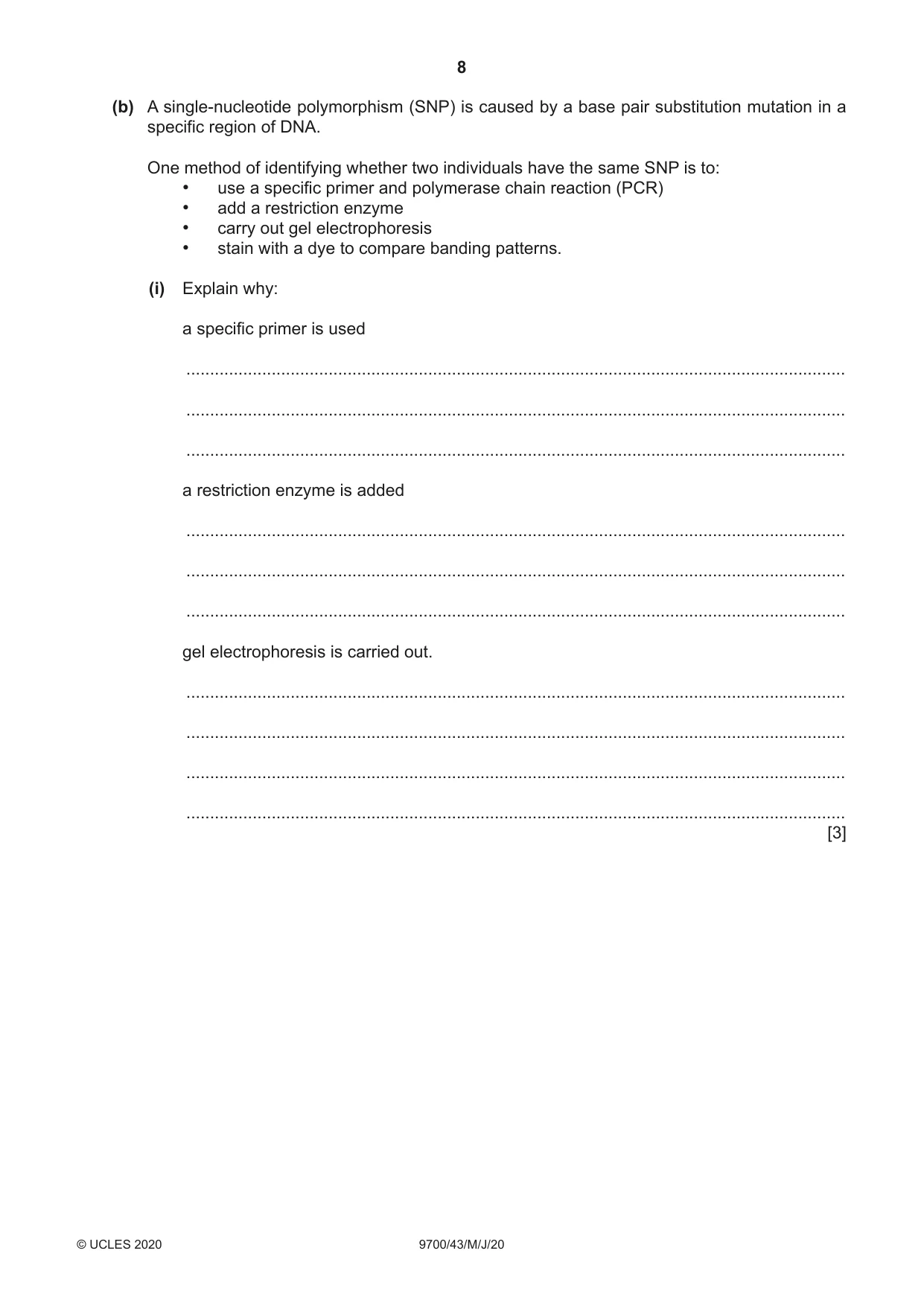
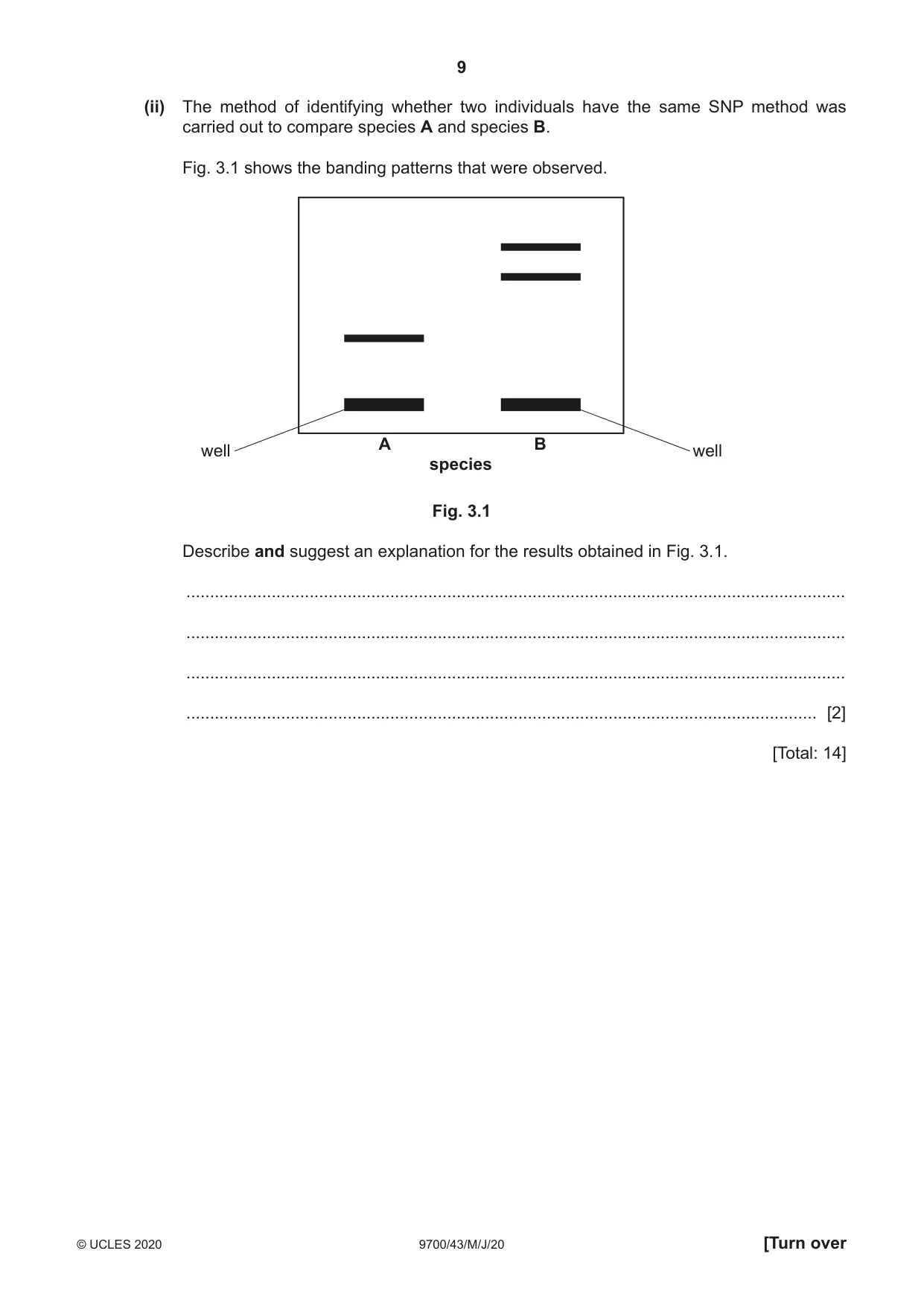
3 (a) The collared flycatcher, Ficedula albicollis, and the pied flycatcher, F. hypoleuca are two closely related species of bird. DNA analysis has shown that speciation from a common ancestor occurred approximately 1 million years ago. A study was carried out on the island of Öland, Sweden. In Öland, the breeding areas of the two bird species overlap and small numbers of hybrid flycatchers are produced. • Birds were captured and their DNA was analysed to identify whether each bird was F. albicollis, F. hypoleuca or a hybrid. • Sperm samples were taken from the male birds. Table 3.1 shows the percentage of males of each bird type with normal sperm. Table 3.1 percentage of males bird type with normal sperm F. albicollis 68 F. hypoleuca 78 male hybrid 0 • The researchers observed that female birds mostly choose mates of their own species based on plumage (feathers) and song. • Hybrid flycatchers are produced when female F. albicollis mate with male F. hypoleuca that have a song that is similar to F. albicollis. • Analysis showed that all female hybrids were sterile. The group of eggs a female bird lays at a single time in its nest is called a clutch. The offspring in the nest are looked after by a male-female pair. Sometimes the male in the male-female pair does not provide the sperm that fertilise the eggs of the female. Table 3.2 shows: • the percentage of clutches with eggs that hatched • the percentage of extra-pair nestlings (offspring in the nest fathered by a male that was different from the male of the male-female pair). Table 3.2 parents of nest percentage of percentage clutches with eggs of extra-pair male female that hatched nestlings F. albicollis F. albicollis 94.5 17.2 F. hypoleuca F. hypoleuca 89.3 22.4 hybrid F. albicollis or 38.0 100.0 F. hypoleuca (i) Discuss the pre-zygotic and post-zygotic isolating mechanisms that maintain F. albicollis and F. hypoleuca as separate species. ........................................................................................................................................... ........................................................................................................................................... ........................................................................................................................................... ........................................................................................................................................... ........................................................................................................................................... ........................................................................................................................................... ........................................................................................................................................... ........................................................................................................................................... ..................................................................................................................................... [4] (ii) Explain how the two species F. albicollis and F. hypoleuca could have evolved from one original ancestral population. ........................................................................................................................................... ........................................................................................................................................... ........................................................................................................................................... ........................................................................................................................................... ........................................................................................................................................... ........................................................................................................................................... ........................................................................................................................................... ........................................................................................................................................... ........................................................................................................................................... ........................................................................................................................................... ........................................................................................................................................... ..................................................................................................................................... [5] (b) A single-nucleotide polymorphism (SNP) is caused by a base pair substitution mutation in a specific region of DNA. One method of identifying whether two individuals have the same SNP is to: • use a specific primer and polymerase chain reaction (PCR) • add a restriction enzyme • carry out gel electrophoresis • stain with a dye to compare banding patterns. (i) Explain why: a specific primer is used ........................................................................................................................................... ........................................................................................................................................... ........................................................................................................................................... a restriction enzyme is added ........................................................................................................................................... ........................................................................................................................................... ........................................................................................................................................... gel electrophoresis is carried out. ........................................................................................................................................... ........................................................................................................................................... ........................................................................................................................................... ........................................................................................................................................... [3] (ii) The method of identifying whether two individuals have the same SNP method was carried out to compare species A and species B. Fig. 3.1 shows the banding patterns that were observed. A B well well species Fig. 3.1 Describe and suggest an explanation for the results obtained in Fig. 3.1. ........................................................................................................................................... ........................................................................................................................................... ........................................................................................................................................... ..................................................................................................................................... [2] [Total: 14]
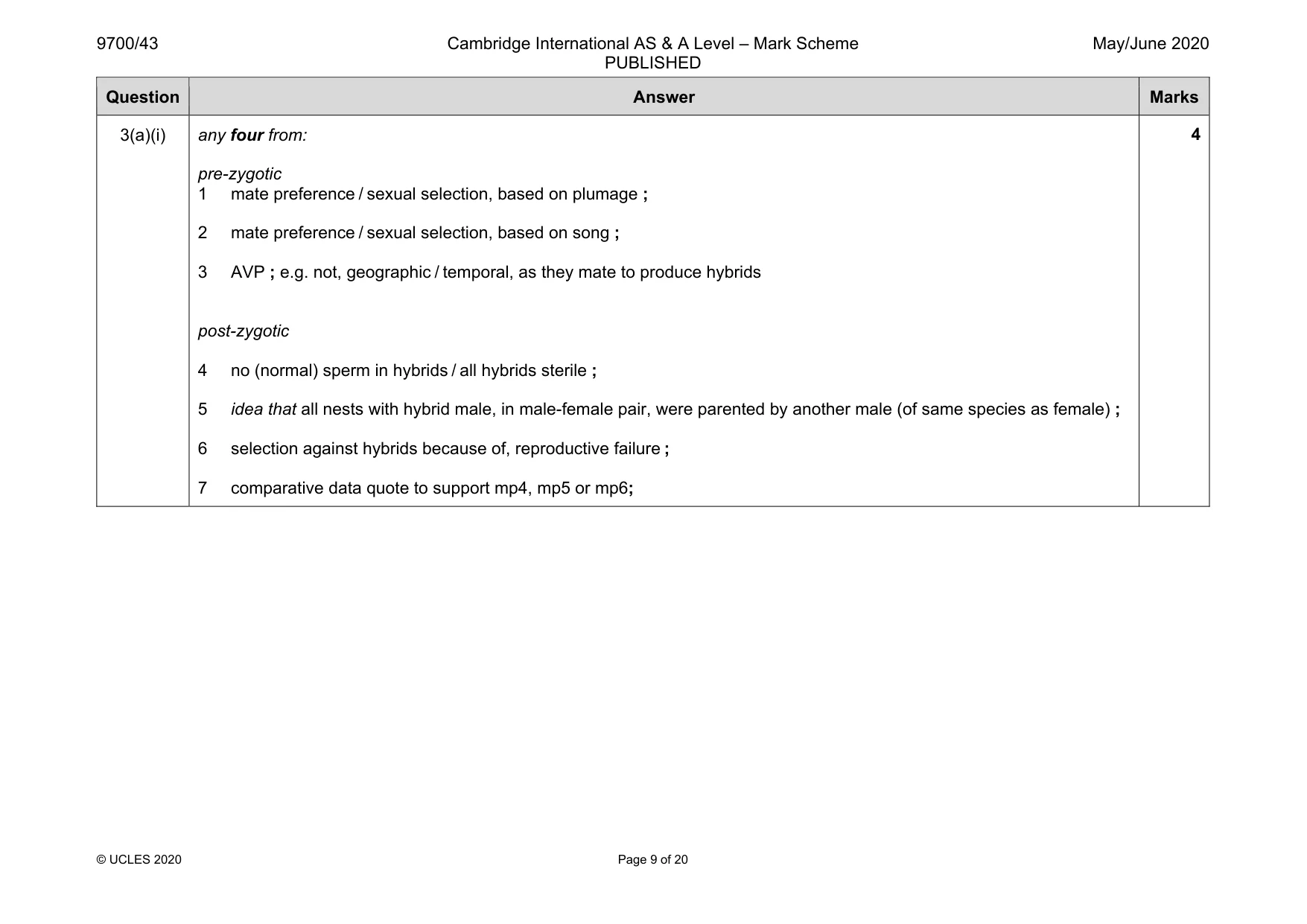
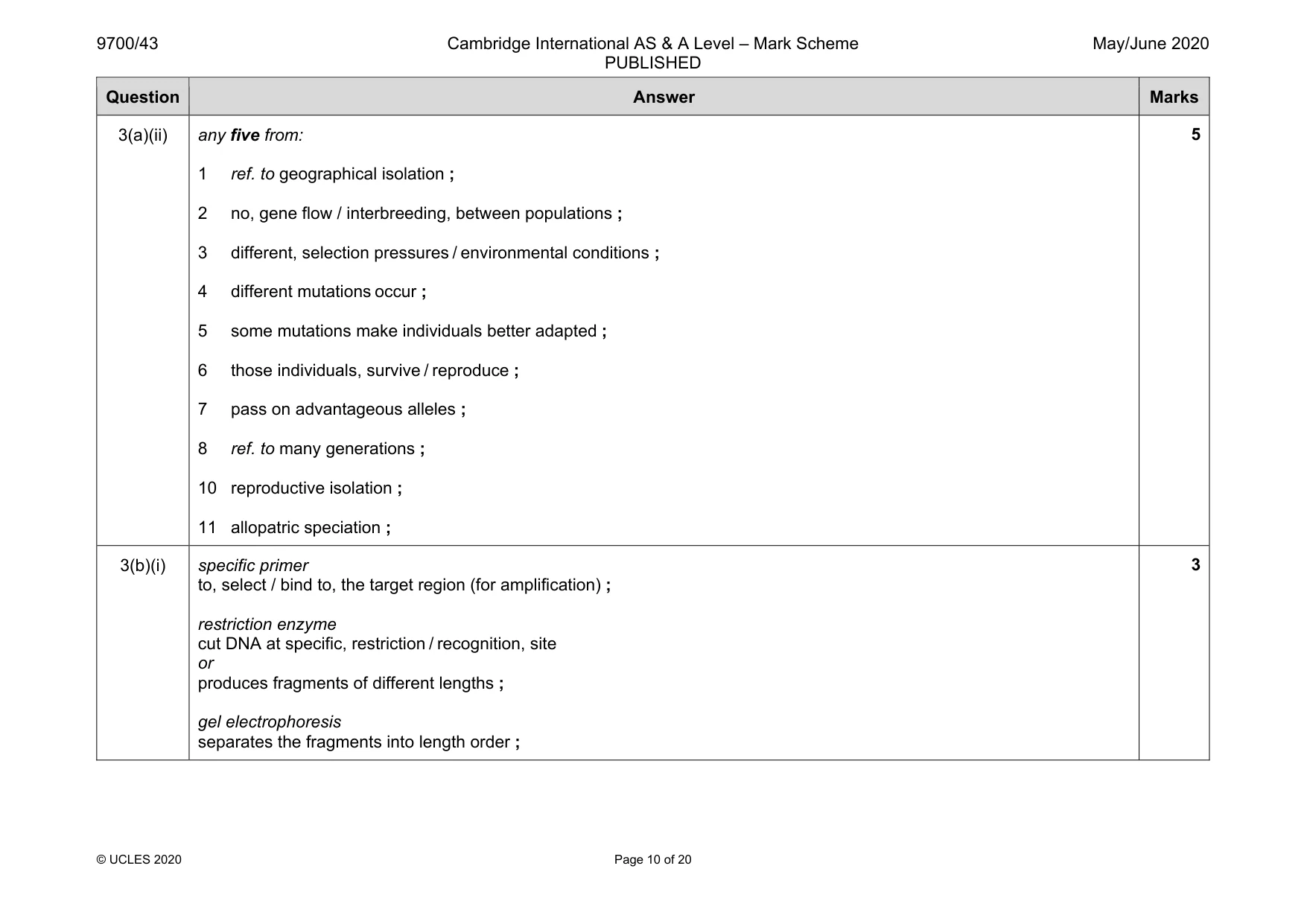
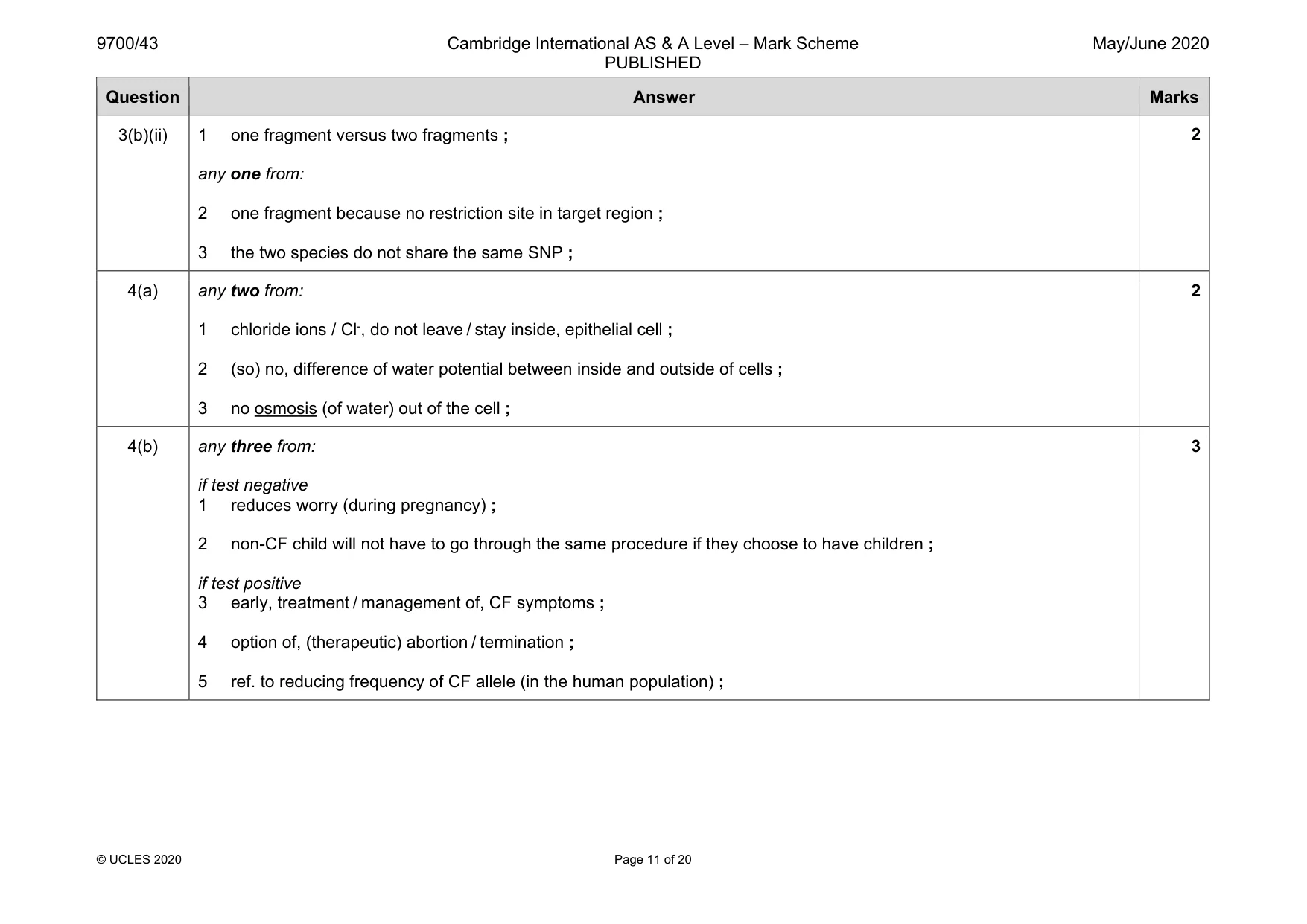
Mark scheme: 3(a)(i) any four from: pre-zygotic 1 mate preference / sexual selection, based on plumage ; 2 mate preference / sexual selection, based on song ; 3 AVP ; e.g. not, geographic / temporal, as they mate to produce hybrids post-zygotic 4 no (normal) sperm in hybrids / all hybrids sterile ; 5 idea that all nests with hybrid male, in male-female pair, were parented by another male (of same species as female) ; 6 selection against hybrids because of, reproductive failure ; 7 comparative data quote to support mp4, mp5 or mp6; Question Answer Marks 3(a)(ii) any five from: 1 ref. to geographical isolation ; 2 no, gene flow / interbreeding, between populations ; 3 different, selection pressures / environmental conditions ; 4 different mutations occur ; 5 some mutations make individuals better adapted ; 6 those individuals, survive / reproduce ; 7 pass on advantageous alleles ; 8 ref. to many generations ; 10 reproductive isolation ; 11 allopatric speciation ; 5 3(b)(i) specific primer to, select / bind to, the target region (for amplification) ; restriction enzyme cut DNA at specific, restriction / recognition, site or produces fragments of different lengths ; gel electrophoresis separates the fragments into length order ; 3 Question Answer Marks 3(b)(ii) 1 one fragment versus two fragments ; any one from: 2 one fragment because no restriction site in target region ; 3 the two species do not share the same SNP ; 2
Q4 · Lung epithelial cells have a thin layer of watery mucus on their surface
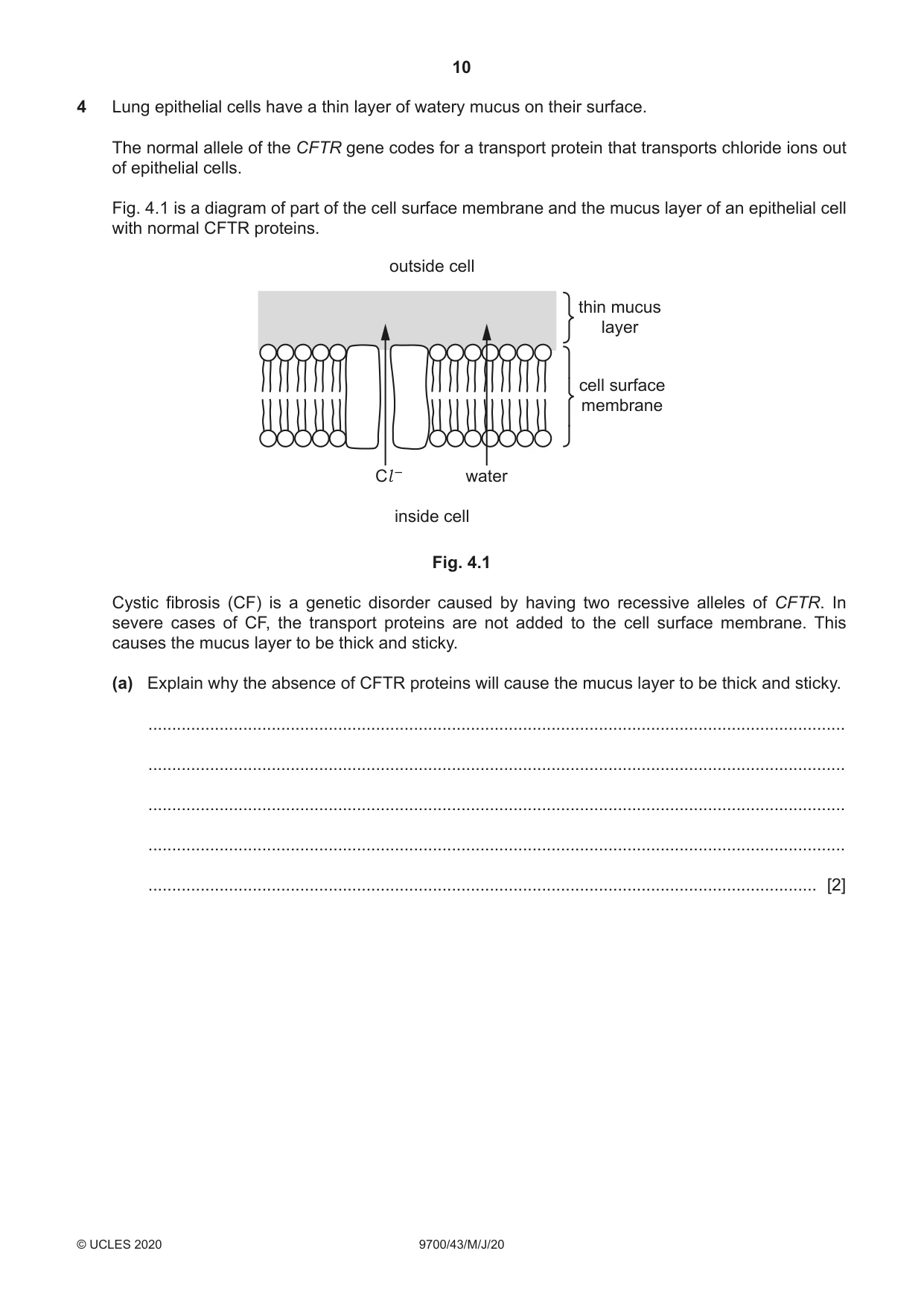
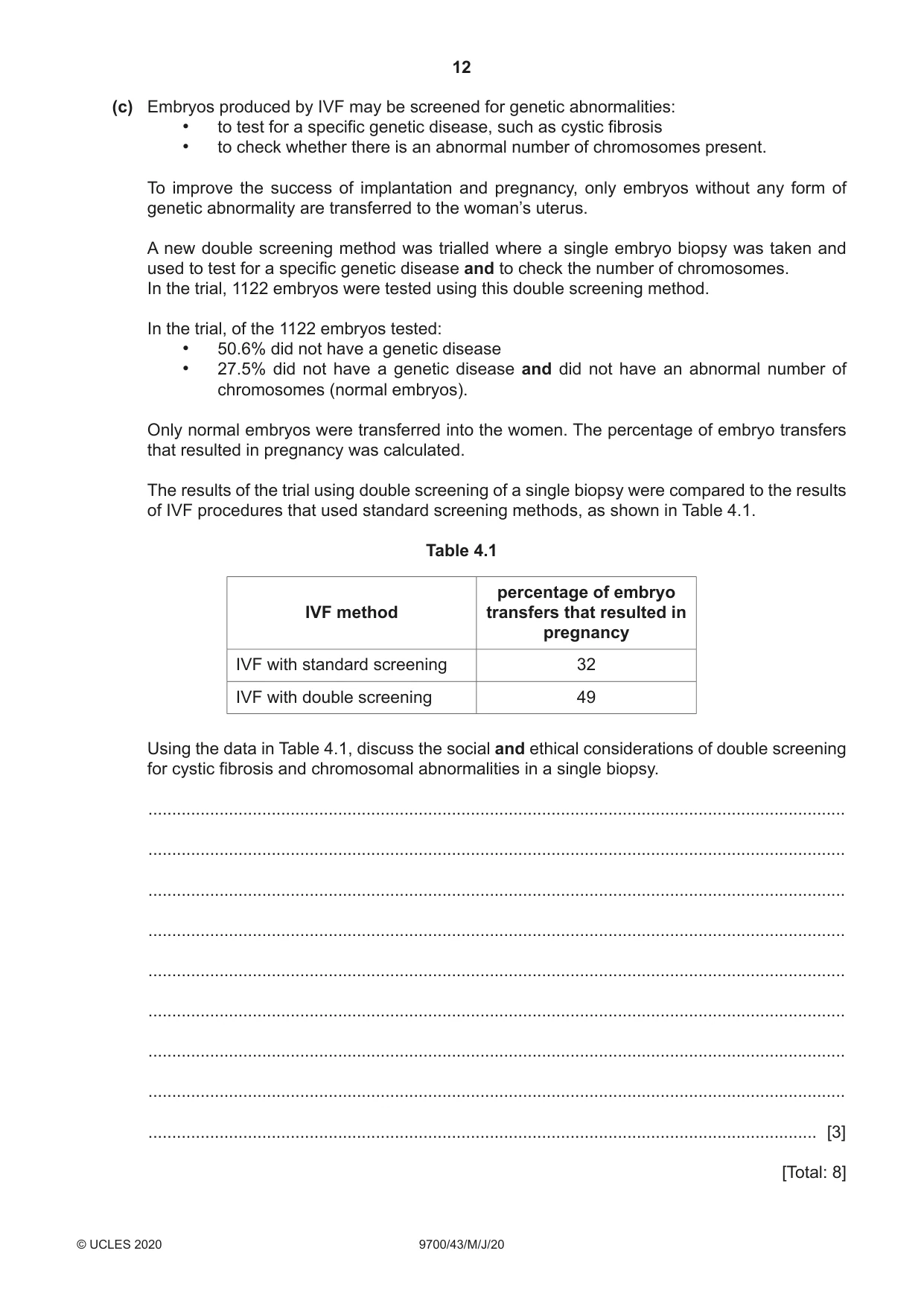
4 Lung epithelial cells have a thin layer of watery mucus on their surface. The normal allele of the CFTR gene codes for a transport protein that transports chloride ions out of epithelial cells. Fig. 4.1 is a diagram of part of the cell surface membrane and the mucus layer of an epithelial cell with normal CFTR proteins. outside cell thin mucus layer cell surface membrane Cl – water inside cell Fig. 4.1 Cystic fibrosis (CF) is a genetic disorder caused by having two recessive alleles of CFTR. In severe cases of CF, the transport proteins are not added to the cell surface membrane. This causes the mucus layer to be thick and sticky. (a) Explain why the absence of CFTR proteins will cause the mucus layer to be thick and sticky. ................................................................................................................................................... ................................................................................................................................................... ................................................................................................................................................... ................................................................................................................................................... ............................................................................................................................................. [2] (b) The probability of a baby having CF when both parents are heterozygous carriers for CF is 25%. It is possible to carry out prenatal screening to check for CF by using one of these tests: • amniocentesis, using cells from the amniotic fluid • chorionic villus sampling, using cells from the placenta. Both tests slightly increase the probability of the pregnancy failing (miscarriage). Outline the advantages of carrying out prenatal screening for CF. ................................................................................................................................................... ................................................................................................................................................... ................................................................................................................................................... ................................................................................................................................................... ................................................................................................................................................... ................................................................................................................................................... ............................................................................................................................................. [3] (c) Embryos produced by IVF may be screened for genetic abnormalities: • to test for a specific genetic disease, such as cystic fibrosis • to check whether there is an abnormal number of chromosomes present. To improve the success of implantation and pregnancy, only embryos without any form of genetic abnormality are transferred to the woman’s uterus. A new double screening method was trialled where a single embryo biopsy was taken and used to test for a specific genetic disease and to check the number of chromosomes. In the trial, 1122 embryos were tested using this double screening method. In the trial, of the 1122 embryos tested: • 50.6% did not have a genetic disease • 27.5% did not have a genetic disease and did not have an abnormal number of chromosomes (normal embryos). Only normal embryos were transferred into the women. The percentage of embryo transfers that resulted in pregnancy was calculated. The results of the trial using double screening of a single biopsy were compared to the results of IVF procedures that used standard screening methods, as shown in Table 4.1. Table 4.1 percentage of embryo IVF method transfers that resulted in pregnancy IVF with standard screening 32 IVF with double screening 49 Using the data in Table 4.1, discuss the social and ethical considerations of double screening for cystic fibrosis and chromosomal abnormalities in a single biopsy. ................................................................................................................................................... ................................................................................................................................................... ................................................................................................................................................... ................................................................................................................................................... ................................................................................................................................................... ................................................................................................................................................... ................................................................................................................................................... ................................................................................................................................................... ............................................................................................................................................. [3] [Total: 8]
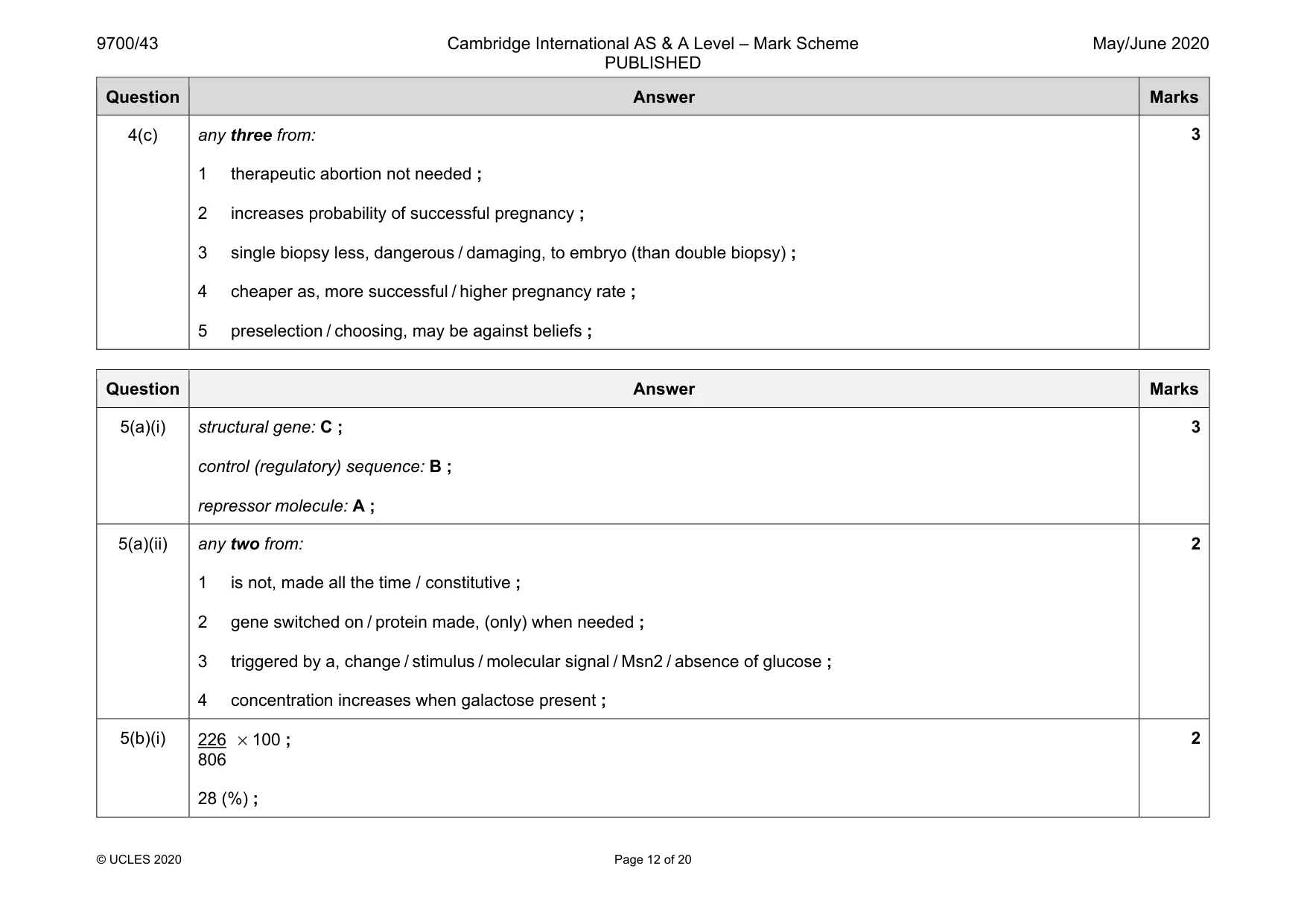
Mark scheme: 4(a) any two from: 1 chloride ions / Cl-, do not leave / stay inside, epithelial cell ; 2 (so) no, difference of water potential between inside and outside of cells ; 3 no osmosis (of water) out of the cell ; 2 4(b) any three from: if test negative 1 reduces worry (during pregnancy) ; 2 non-CF child will not have to go through the same procedure if they choose to have children ; if test positive 3 early, treatment / management of, CF symptoms ; 4 option of, (therapeutic) abortion / termination ; 5 ref. to reducing frequency of CF allele (in the human population) ; 3 Question Answer Marks 4(c) any three from: 1 therapeutic abortion not needed ; 2 increases probability of successful pregnancy ; 3 single biopsy less, dangerous / damaging, to embryo (than double biopsy) ; 4 cheaper as, more successful / higher pregnancy rate ; 5 preselection / choosing, may be against beliefs ; 3
Q5 · Yeast cells are unicellular eukaryotes that respond to the presence and absence of…
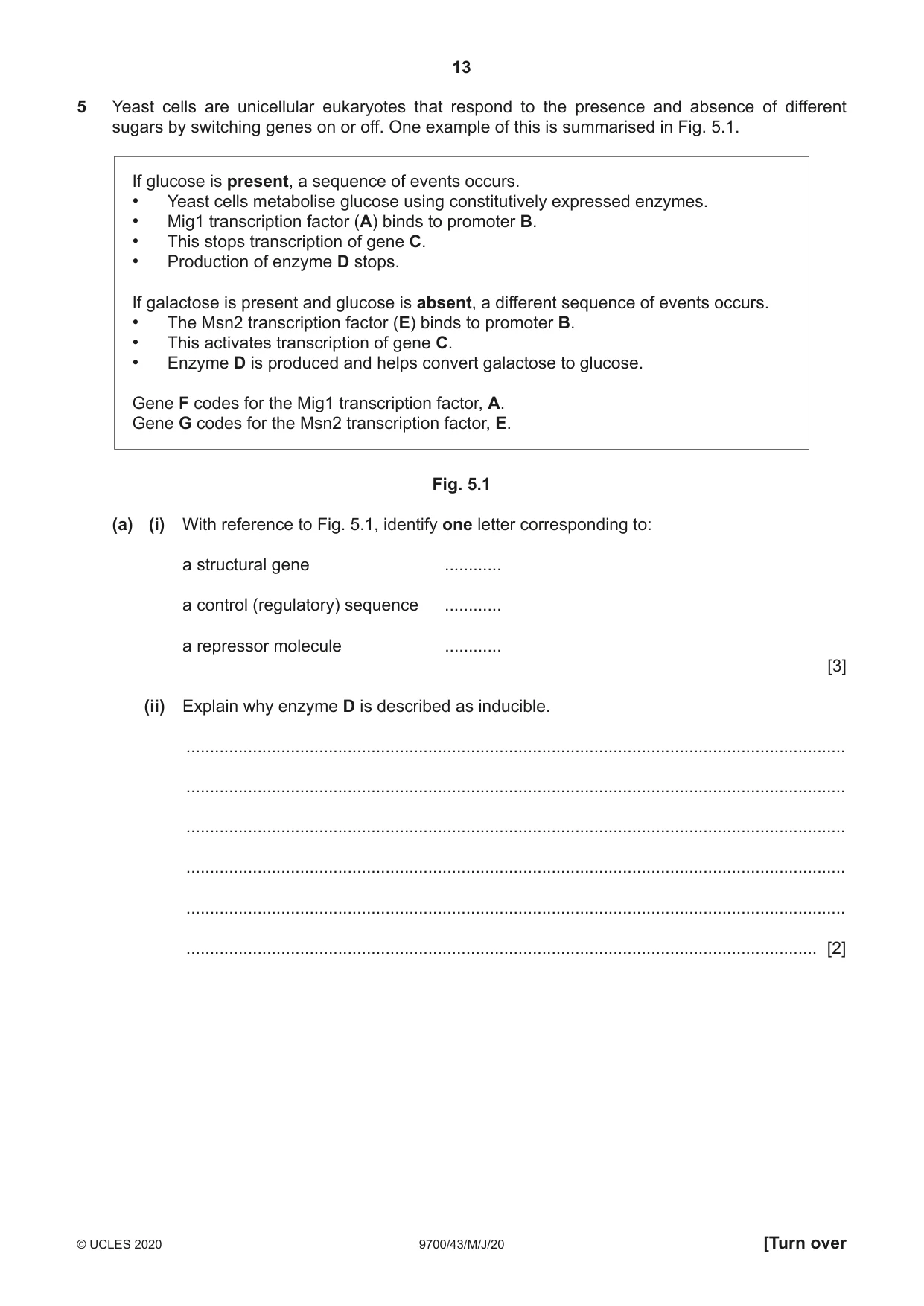
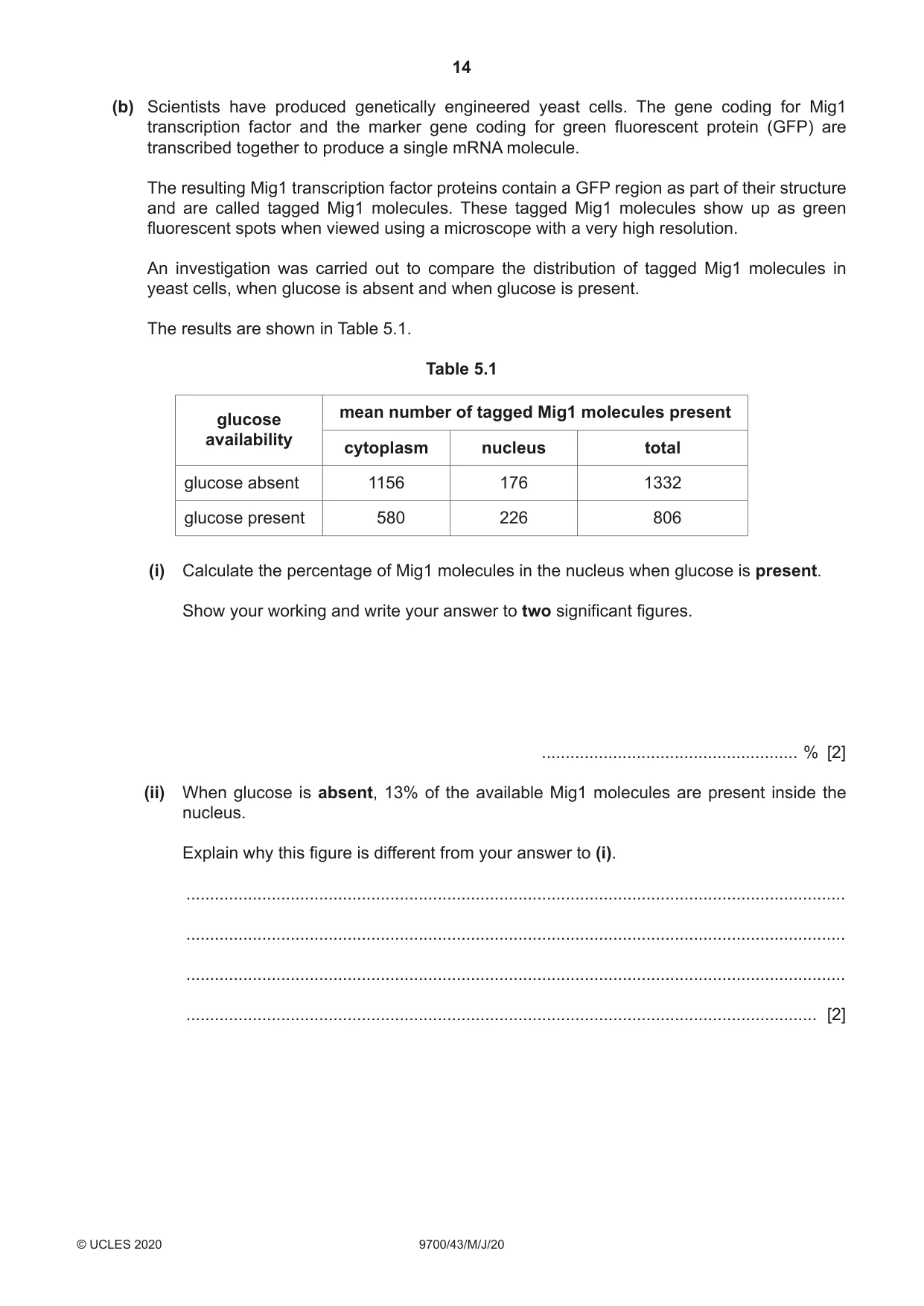
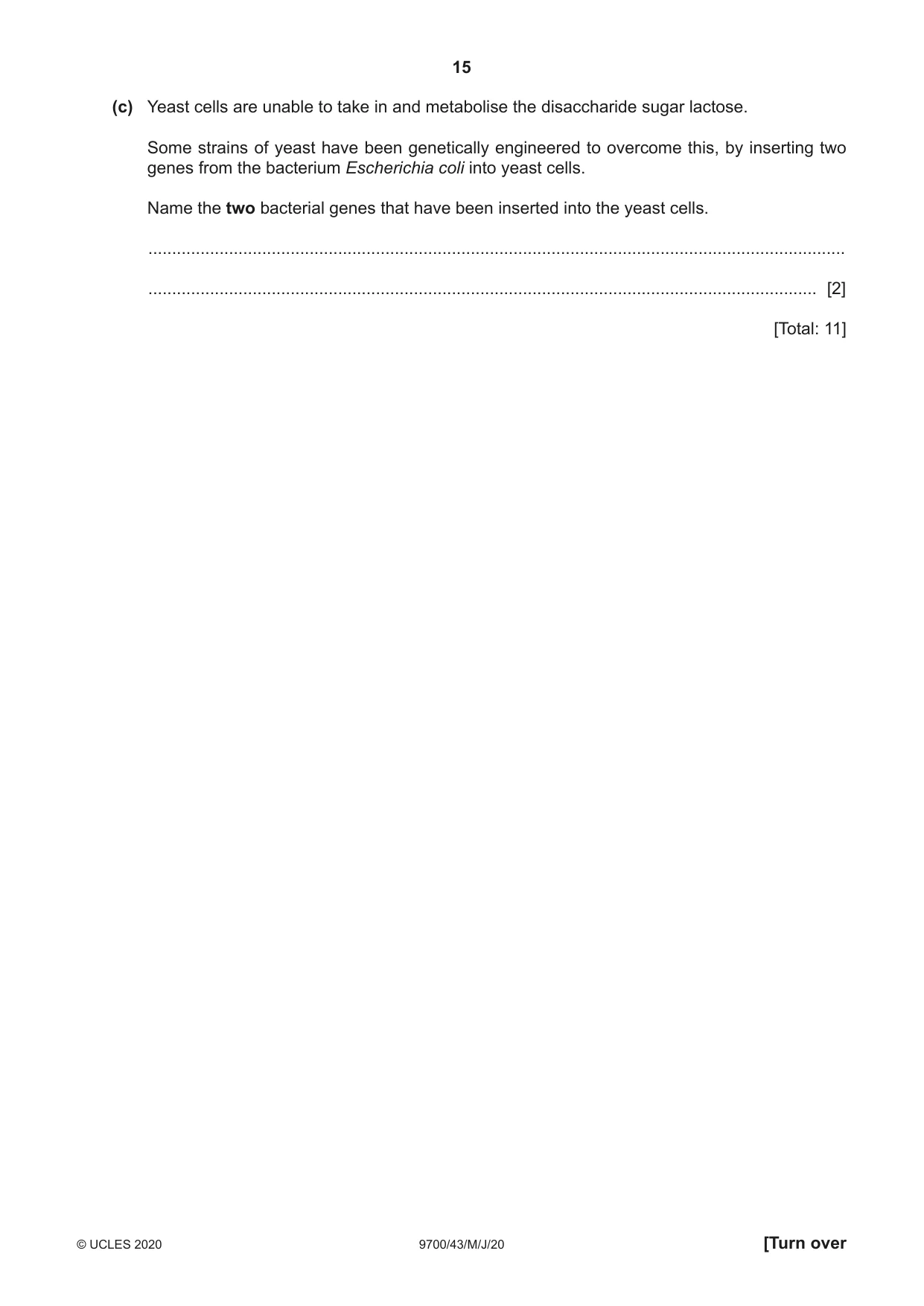
5 Yeast cells are unicellular eukaryotes that respond to the presence and absence of different sugars by switching genes on or off. One example of this is summarised in Fig. 5.1. If glucose is present, a sequence of events occurs. • Yeast cells metabolise glucose using constitutively expressed enzymes. • Mig1 transcription factor (A) binds to promoter B. • This stops transcription of gene C. • Production of enzyme D stops. If galactose is present and glucose is absent, a different sequence of events occurs. • The Msn2 transcription factor (E) binds to promoter B. • This activates transcription of gene C. • Enzyme D is produced and helps convert galactose to glucose. Gene F codes for the Mig1 transcription factor, A. Gene G codes for the Msn2 transcription factor, E. Fig. 5.1 (a) (i) With reference to Fig. 5.1, identify one letter corresponding to: a structural gene ............ a control (regulatory) sequence ............ a repressor molecule ............ [3] (ii) Explain why enzyme D is described as inducible. ........................................................................................................................................... ........................................................................................................................................... ........................................................................................................................................... ........................................................................................................................................... ........................................................................................................................................... ..................................................................................................................................... [2] (b) Scientists have produced genetically engineered yeast cells. The gene coding for Mig1 transcription factor and the marker gene coding for green fluorescent protein (GFP) are transcribed together to produce a single mRNA molecule. The resulting Mig1 transcription factor proteins contain a GFP region as part of their structure and are called tagged Mig1 molecules. These tagged Mig1 molecules show up as green fluorescent spots when viewed using a microscope with a very high resolution. An investigation was carried out to compare the distribution of tagged Mig1 molecules in yeast cells, when glucose is absent and when glucose is present. The results are shown in Table 5.1. Table 5.1 mean number of tagged Mig1 molecules present glucose availability cytoplasm nucleus total glucose absent 1156 176 1332 glucose present 580 226 806 (i) Calculate the percentage of Mig1 molecules in the nucleus when glucose is present. Show your working and write your answer to two significant figures. ...................................................... % [2] (ii) When glucose is absent, 13% of the available Mig1 molecules are present inside the nucleus. Explain why this figure is different from your answer to (i). ........................................................................................................................................... ........................................................................................................................................... ........................................................................................................................................... ..................................................................................................................................... [2] (c) Yeast cells are unable to take in and metabolise the disaccharide sugar lactose. Some strains of yeast have been genetically engineered to overcome this, by inserting two genes from the bacterium Escherichia coli into yeast cells. Name the two bacterial genes that have been inserted into the yeast cells. ................................................................................................................................................... ............................................................................................................................................. [2] [Total: 11]
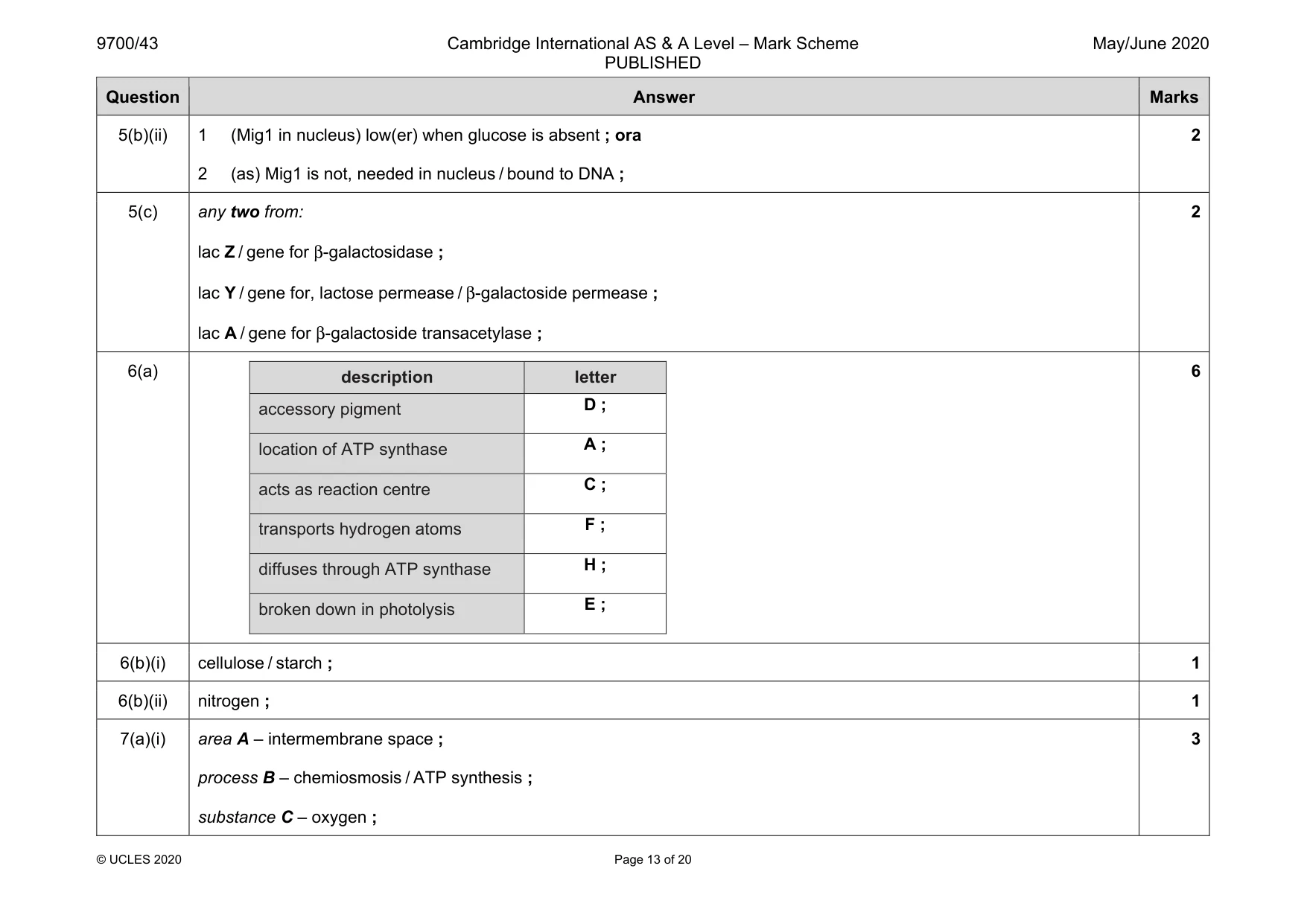
Mark scheme: 5(a)(i) structural gene: C ; control (regulatory) sequence: B ; repressor molecule: A ; 5(a)(ii) any two from: 1 is not, made all the time / constitutive ; 2 gene switched on / protein made, (only) when needed ; 3 triggered by a, change / stimulus / molecular signal / Msn2 / absence of glucose ; 4 concentration increases when galactose present ; 2 5(b)(i) 226 × 100 ; 806 28 (%) ; 2 Question Answer Marks 5(b)(ii) 1 (Mig1 in nucleus) low(er) when glucose is absent ; ora 2 (as) Mig1 is not, needed in nucleus / bound to DNA ; 2 5(c) any two from: lac Z / gene for β-galactosidase ; lac Y / gene for, lactose permease / β-galactoside permease ; lac A / gene for β-galactoside transacetylase ; 2
Q6 · Structures and compounds involved in the light dependent stage of photosynthesis are…
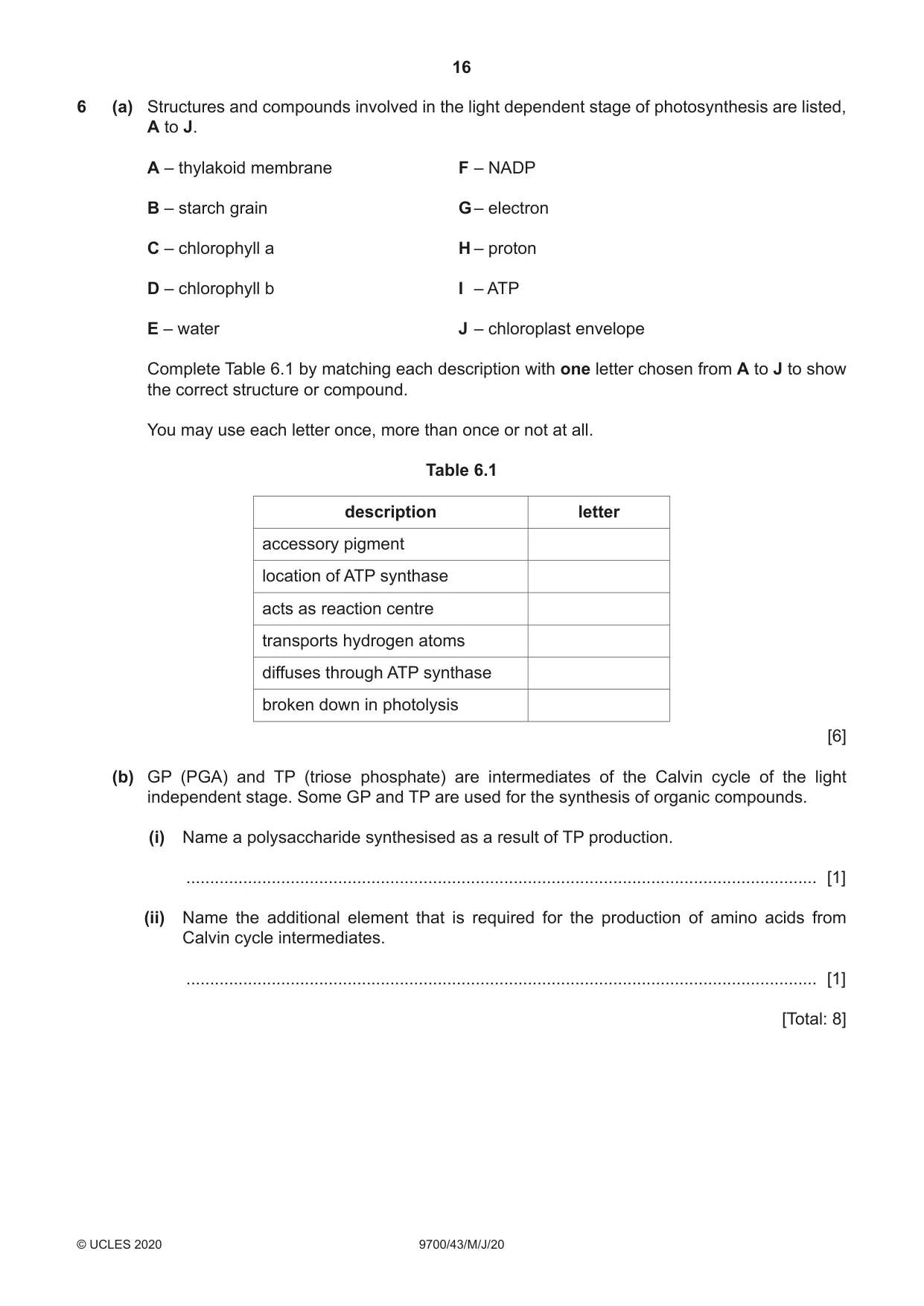
6 (a) Structures and compounds involved in the light dependent stage of photosynthesis are listed, A to J. A – thylakoid membrane F – NADP B – starch grain G – electron C – chlorophyll a H – proton D – chlorophyll b I – ATP E – water J – chloroplast envelope Complete Table 6.1 by matching each description with one letter chosen from A to J to show the correct structure or compound. You may use each letter once, more than once or not at all. Table 6.1 description letter accessory pigment location of ATP synthase acts as reaction centre transports hydrogen atoms diffuses through ATP synthase broken down in photolysis [6] (b) GP (PGA) and TP (triose phosphate) are intermediates of the Calvin cycle of the light independent stage. Some GP and TP are used for the synthesis of organic compounds. (i) Name a polysaccharide synthesised as a result of TP production. ..................................................................................................................................... [1] (ii) Name the additional element that is required for the production of amino acids from Calvin cycle intermediates. ..................................................................................................................................... [1] [Total: 8]
Mark scheme: 6(a) description letter accessory pigment D ; location of ATP synthase A ; acts as reaction centre C ; transports hydrogen atoms F ; diffuses through ATP synthase H ; broken down in photolysis E ; 6 6(b)(i) cellulose / starch ; 1 6(b)(ii) nitrogen ; 1
More questions on Photosynthesis as an energy transfer process
Q7 · Part of the process of respiration in a mitochondrion
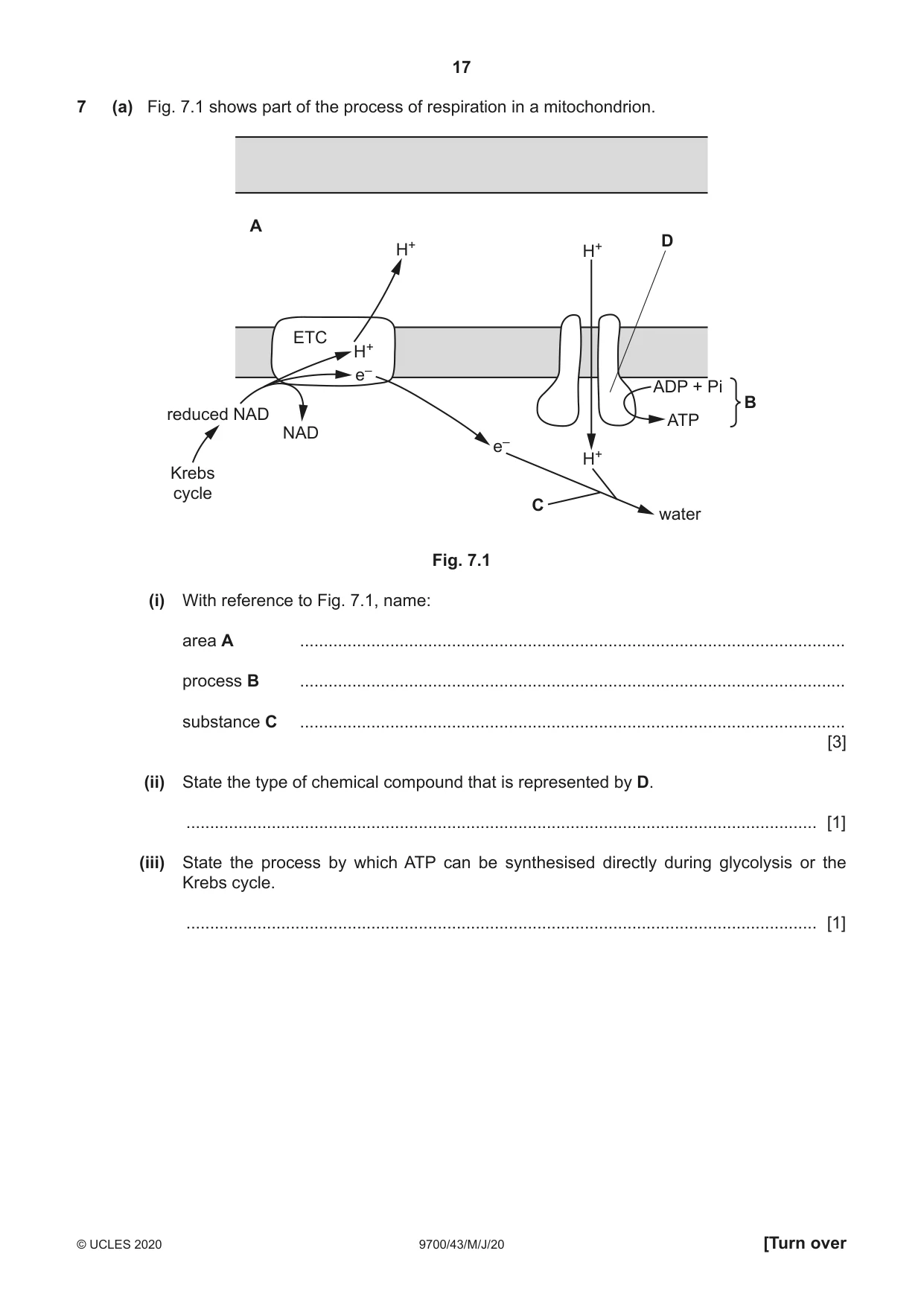
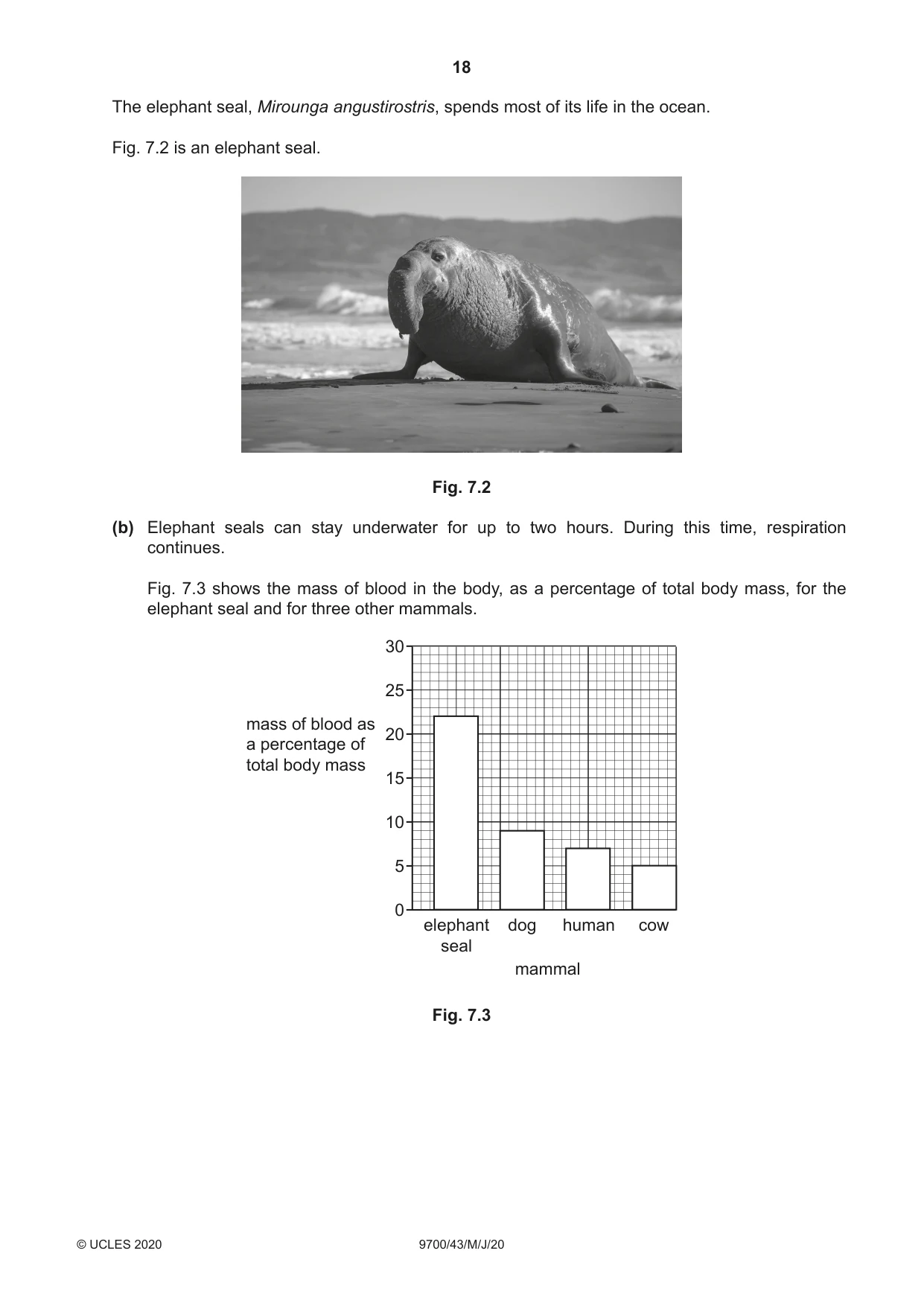
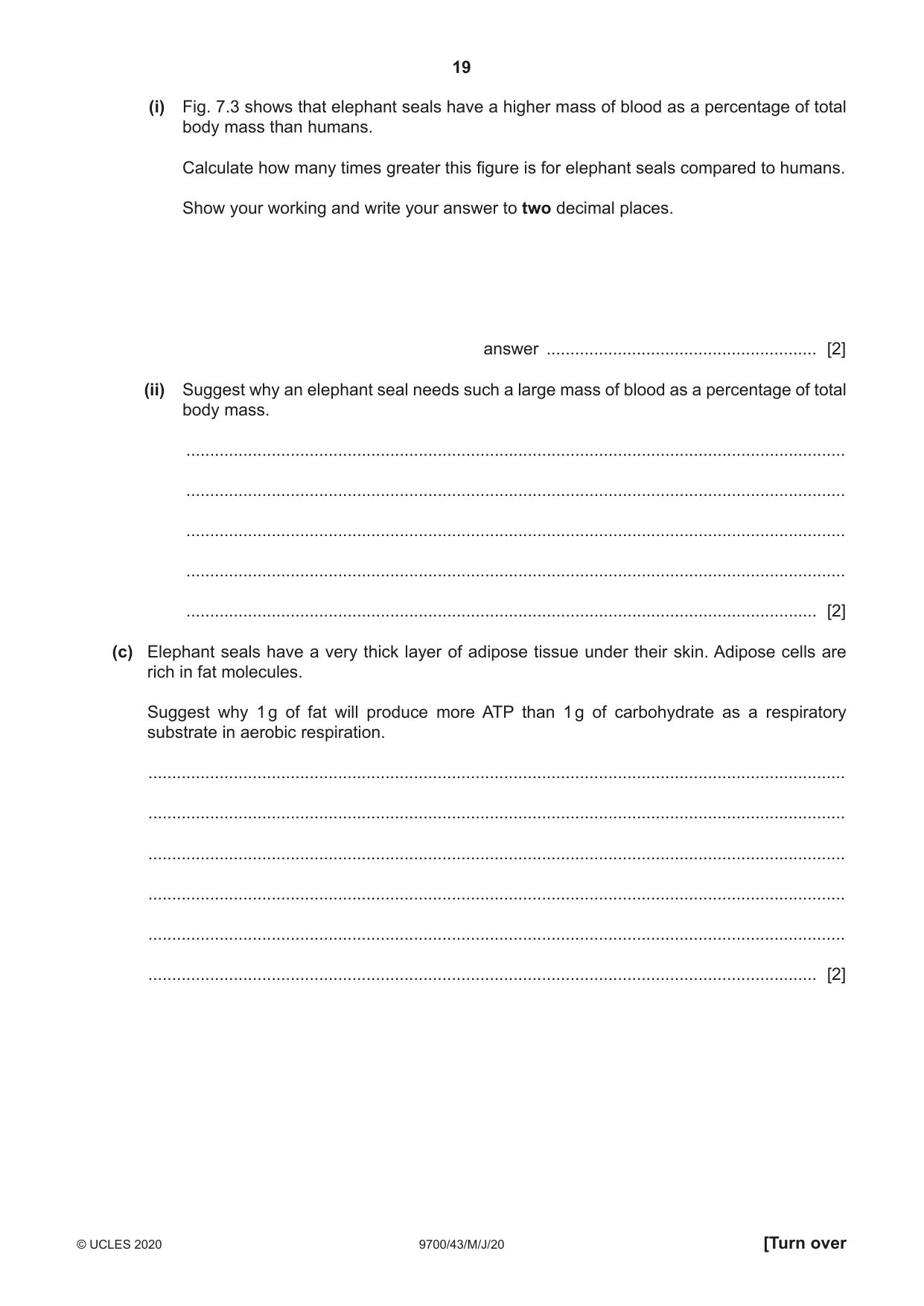
7 (a) Fig. 7.1 shows part of the process of respiration in a mitochondrion. A D H+ H+ ETC H+ e– ADP + Pi B reduced NAD ATP NAD e– H+ Krebs cycle C water Fig. 7.1 (i) With reference to Fig. 7.1, name: area A ................................................................................................................... process B ................................................................................................................... substance C ................................................................................................................... [3] (ii) State the type of chemical compound that is represented by D. ..................................................................................................................................... [1] (iii) State the process by which ATP can be synthesised directly during glycolysis or the Krebs cycle. ..................................................................................................................................... [1] The elephant seal, Mirounga angustirostris, spends most of its life in the ocean. Fig. 7.2 is an elephant seal. Fig. 7.2 (b) Elephant seals can stay underwater for up to two hours. During this time, respiration continues. Fig. 7.3 shows the mass of blood in the body, as a percentage of total body mass, for the elephant seal and for three other mammals. 30 25 mass of blood as 20 a percentage of total body mass 15 10 5 0 elephant dog human cow seal mammal Fig. 7.3 (i) Fig. 7.3 shows that elephant seals have a higher mass of blood as a percentage of total body mass than humans. Calculate how many times greater this figure is for elephant seals compared to humans. Show your working and write your answer to two decimal places. answer ......................................................... [2] (ii) Suggest why an elephant seal needs such a large mass of blood as a percentage of total body mass. ........................................................................................................................................... ........................................................................................................................................... ........................................................................................................................................... ........................................................................................................................................... ..................................................................................................................................... [2] (c) Elephant seals have a very thick layer of adipose tissue under their skin. Adipose cells are rich in fat molecules. Suggest why 1 g of fat will produce more ATP than 1 g of carbohydrate as a respiratory substrate in aerobic respiration. ................................................................................................................................................... ................................................................................................................................................... ................................................................................................................................................... ................................................................................................................................................... ................................................................................................................................................... ............................................................................................................................................. [2] (d) (i) Adipose tissue plays an important role in thermoregulation in elephant seals. State the role of adipose tissue in thermoregulation. ..................................................................................................................................... [1] (ii) The hypothalamus in the brain is the control centre for thermoregulation. Outline how a change in temperature of the external environment results in an impulse arriving at the hypothalamus. ........................................................................................................................................... ........................................................................................................................................... ........................................................................................................................................... ..................................................................................................................................... [2] (iii) When the blood temperature of a mammal decreases, one response is that its body secretes more adrenaline. Suggest how an increase in adrenaline results in an increase in blood temperature. ........................................................................................................................................... ........................................................................................................................................... ........................................................................................................................................... ..................................................................................................................................... [2] [Total: 16]
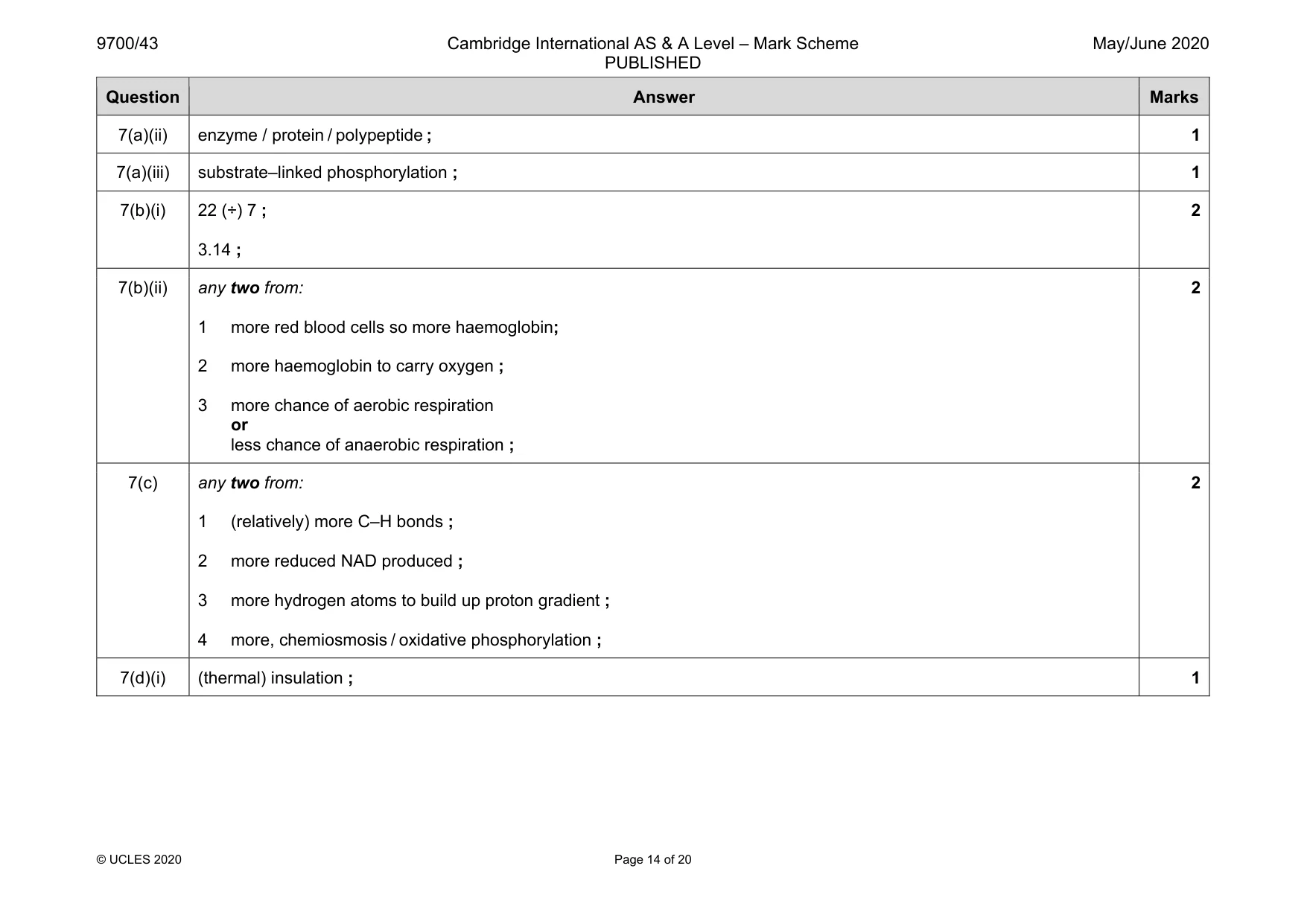
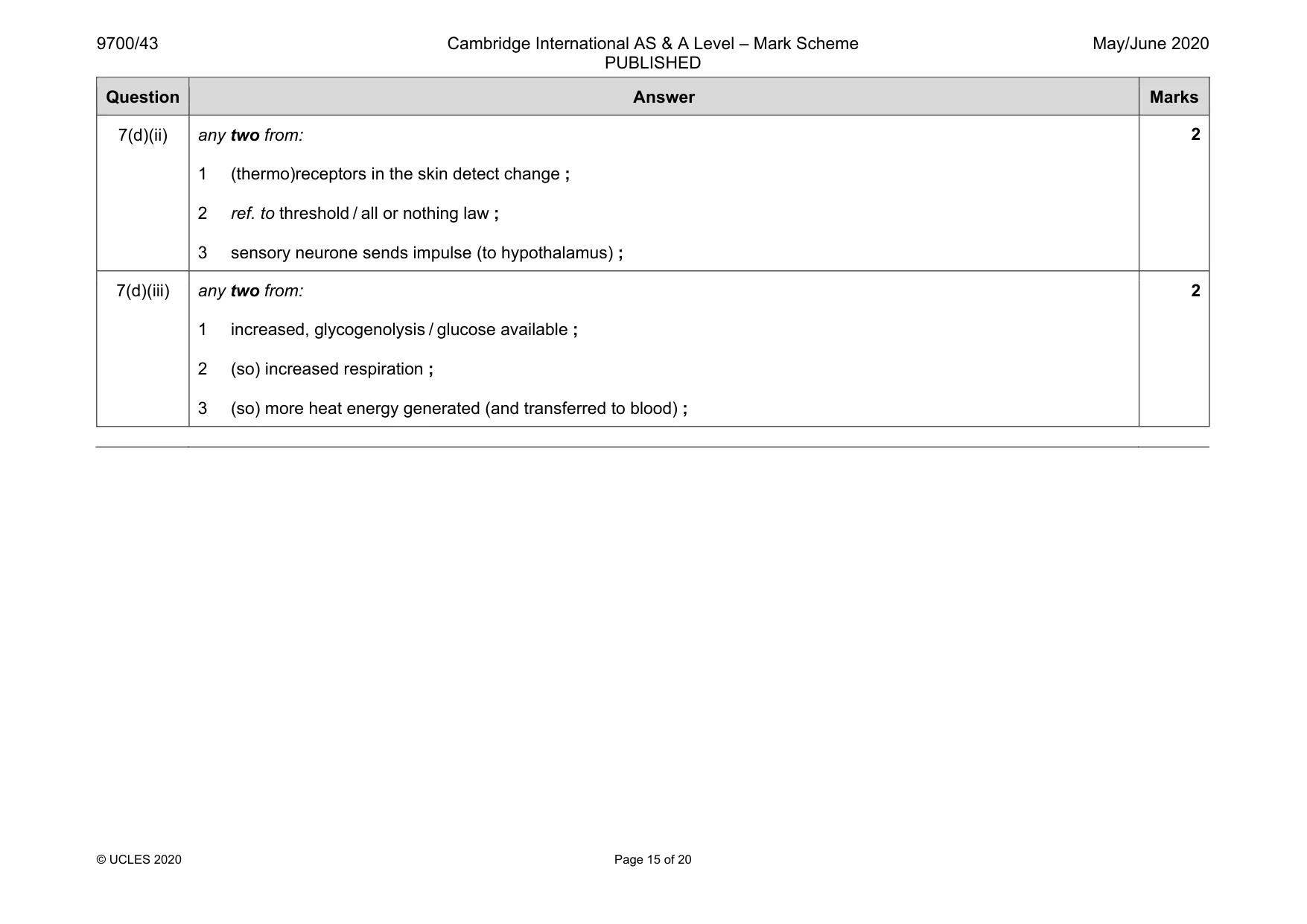
Mark scheme: 7(a)(i) area A – intermembrane space ; process B – chemiosmosis / ATP synthesis ; substance C – oxygen ; 3 Question Answer Marks 7(a)(ii) enzyme / protein / polypeptide ; 1 7(a)(iii) substrate–linked phosphorylation ; 1 7(b)(i) 22 (÷) 7 ; 3.14 ; 2 7(b)(ii) any two from: 1 more red blood cells so more haemoglobin; 2 more haemoglobin to carry oxygen ; 3 more chance of aerobic respiration or less chance of anaerobic respiration ; 2 7(c) any two from: 1 (relatively) more C–H bonds ; 2 more reduced NAD produced ; 3 more hydrogen atoms to build up proton gradient ; 4 more, chemiosmosis / oxidative phosphorylation ; 2 7(d)(i) (thermal) insulation ; 1 Question Answer Marks 7(d)(ii) any two from: 1 (thermo)receptors in the skin detect change ; 2 ref. to threshold / all or nothing law ; 3 sensory neurone sends impulse (to hypothalamus) ; 2 7(d)(iii) any two from: 1 increased, glycogenolysis / glucose available ; 2 (so) increased respiration ; 3 (so) more heat energy generated (and transferred to blood) ; 2
Q8 · Sampling can be used to find the distribution and abundance of species in an area
8 (a) Sampling can be used to find the distribution and abundance of species in an area. Students sampled a rocky shore from a high tide area to a low tide area. They decided to use a belt transect. Describe how you would carry out a belt transect to assess the distribution and abundance of organisms in an area. ................................................................................................................................................... ................................................................................................................................................... ................................................................................................................................................... ................................................................................................................................................... ................................................................................................................................................... ................................................................................................................................................... ................................................................................................................................................... ................................................................................................................................................... ................................................................................................................................................... ............................................................................................................................................. [5] (b) The results of an ecological investigation may suggest that there is a relationship between two variables, for example the abundance of a plant species and light intensity. Scattergraphs can be drawn between the two variables. (i) Fig. 8.1 shows three scattergraphs, A, B and C. y y y x x x A B C Fig. 8.1 State which scattergraphs show a relationship between the two variables, x and y. ..................................................................................................................................... [1] (ii) Name a statistical test you would carry out to assess the strength of any relationship between two variables. ..................................................................................................................................... [1] [Total: 7]
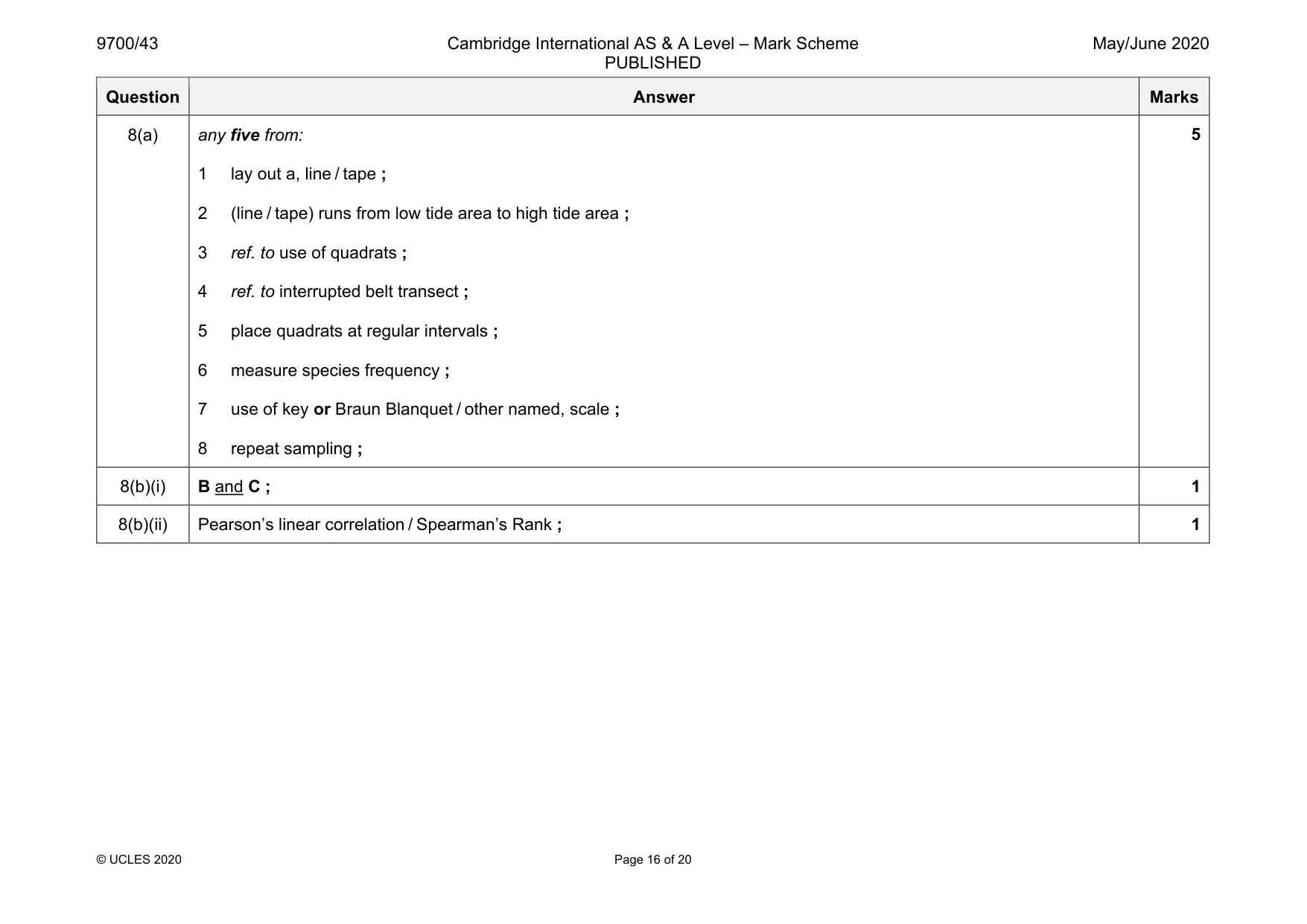
Mark scheme: 8(a) any five from: 1 lay out a, line / tape ; 2 (line / tape) runs from low tide area to high tide area ; 3 ref. to use of quadrats ; 4 ref. to interrupted belt transect ; 5 place quadrats at regular intervals ; 6 measure species frequency ; 7 use of key or Braun Blanquet / other named, scale ; 8 repeat sampling ; 8(b)(i) B and C ; 1 8(b)(ii) Pearson’s linear correlation / Spearman’s Rank ; 1
Q9 · Using named examples, describe and explain the differences between continuous variation…
9 (a) Using named examples, describe and explain the differences between continuous variation and discontinuous variation. [8] (b) Outline how selective breeding (artificial selection) has improved the yield of crops, such as wheat and maize. [7] [Total: 15]
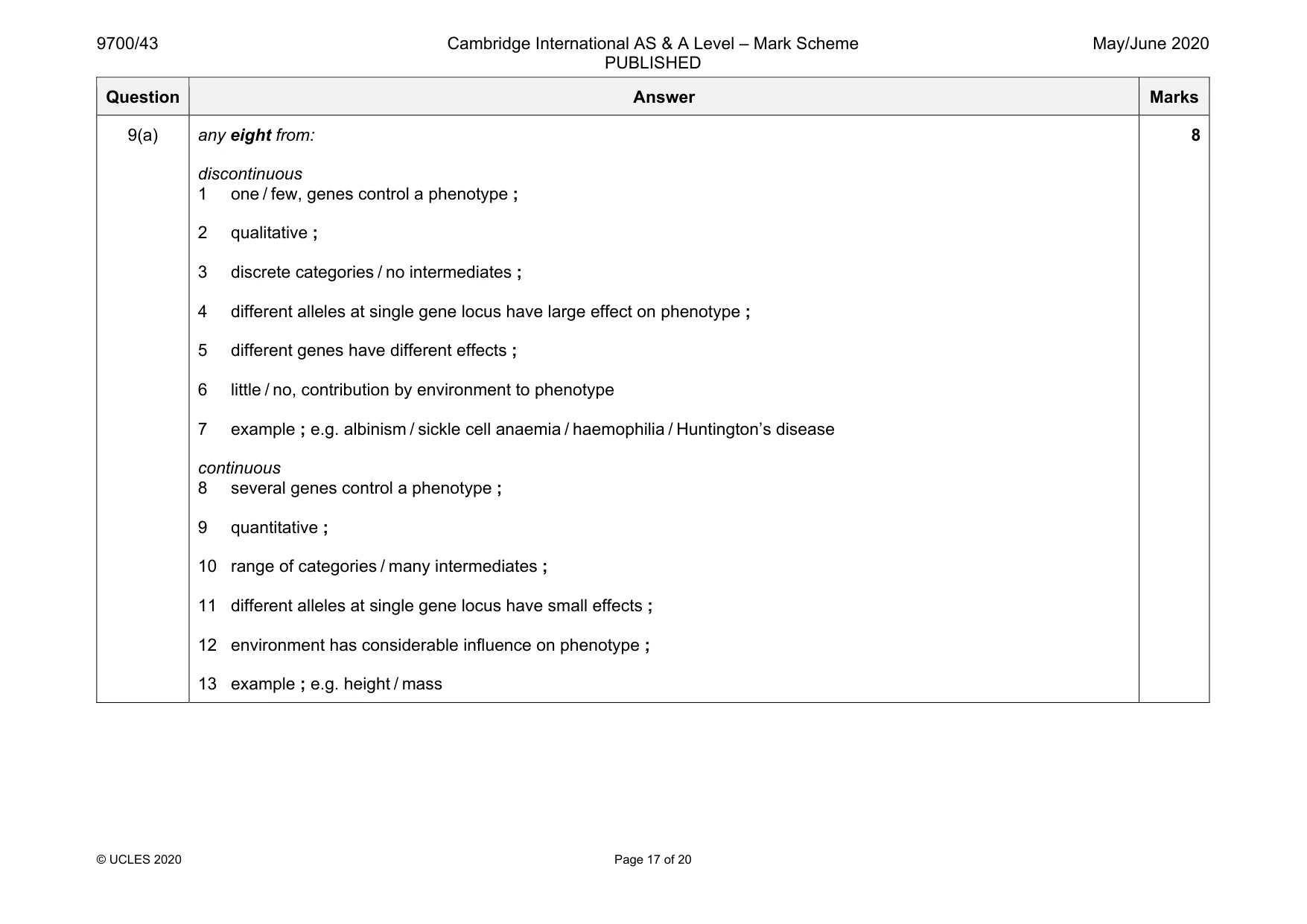
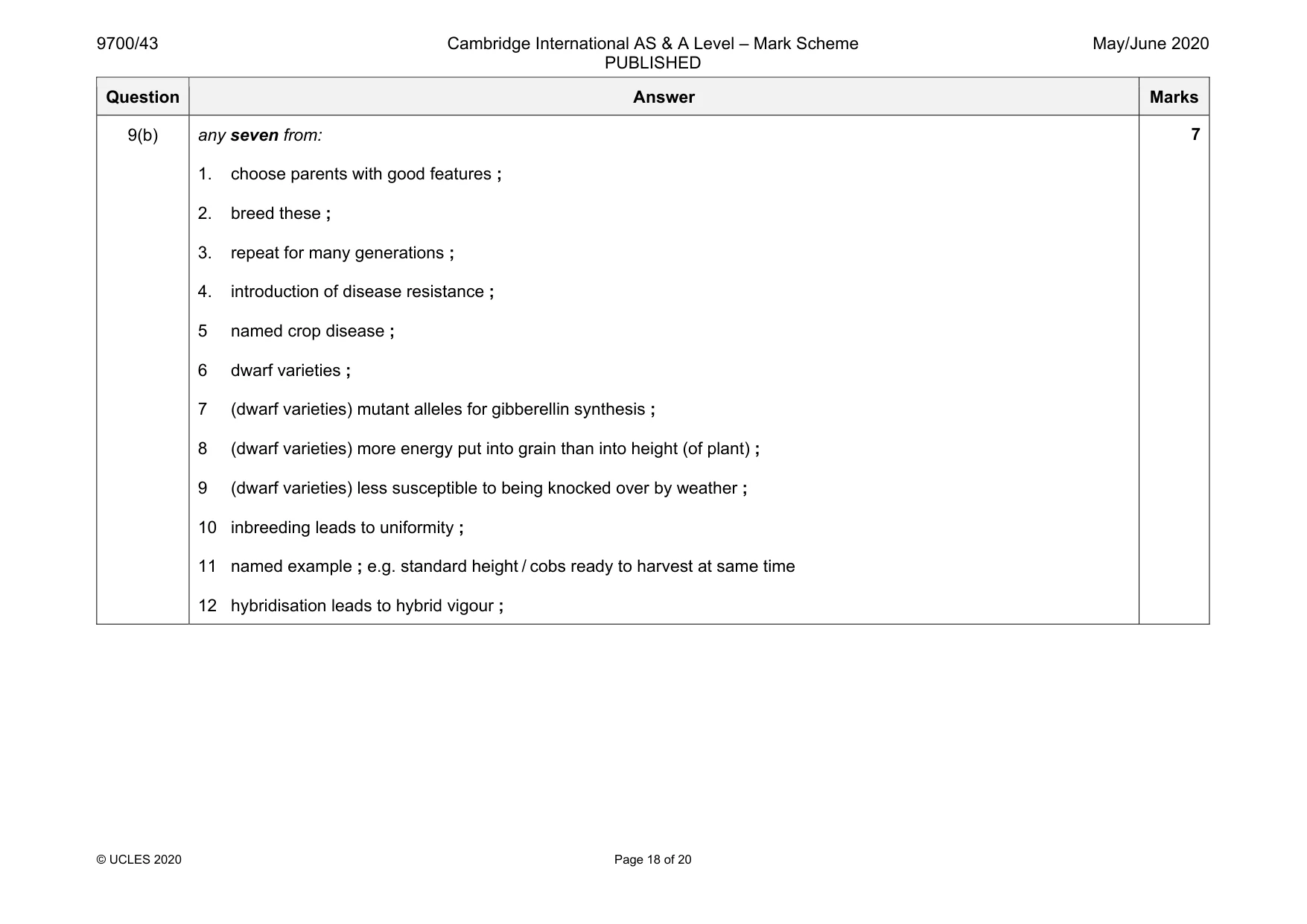
Mark scheme: 9(a) any eight from: discontinuous 1 one / few, genes control a phenotype ; 2 qualitative ; 3 discrete categories / no intermediates ; 4 different alleles at single gene locus have large effect on phenotype ; 5 different genes have different effects ; 6 little / no, contribution by environment to phenotype 7 example ; e.g. albinism / sickle cell anaemia / haemophilia / Huntington’s disease continuous 8 several genes control a phenotype ; 9 quantitative ; 10 range of categories / many intermediates ; 11 different alleles at single gene locus have small effects ; 12 environment has considerable influence on phenotype ; 13 example ; e.g. height / mass 8 Question Answer Marks 9(b) any seven from: 1. choose parents with good features ; 2. breed these ; 3. repeat for many generations ; 4. introduction of disease resistance ; 5 named crop disease ; 6 dwarf varieties ; 7 (dwarf varieties) mutant alleles for gibberellin synthesis ; 8 (dwarf varieties) more energy put into grain than into height (of plant) ; 9 (dwarf varieties) less susceptible to being knocked over by weather ; 10 inbreeding leads to uniformity ; 11 named example ; e.g. standard height / cobs ready to harvest at same time 12 hybridisation leads to hybrid vigour ; 7
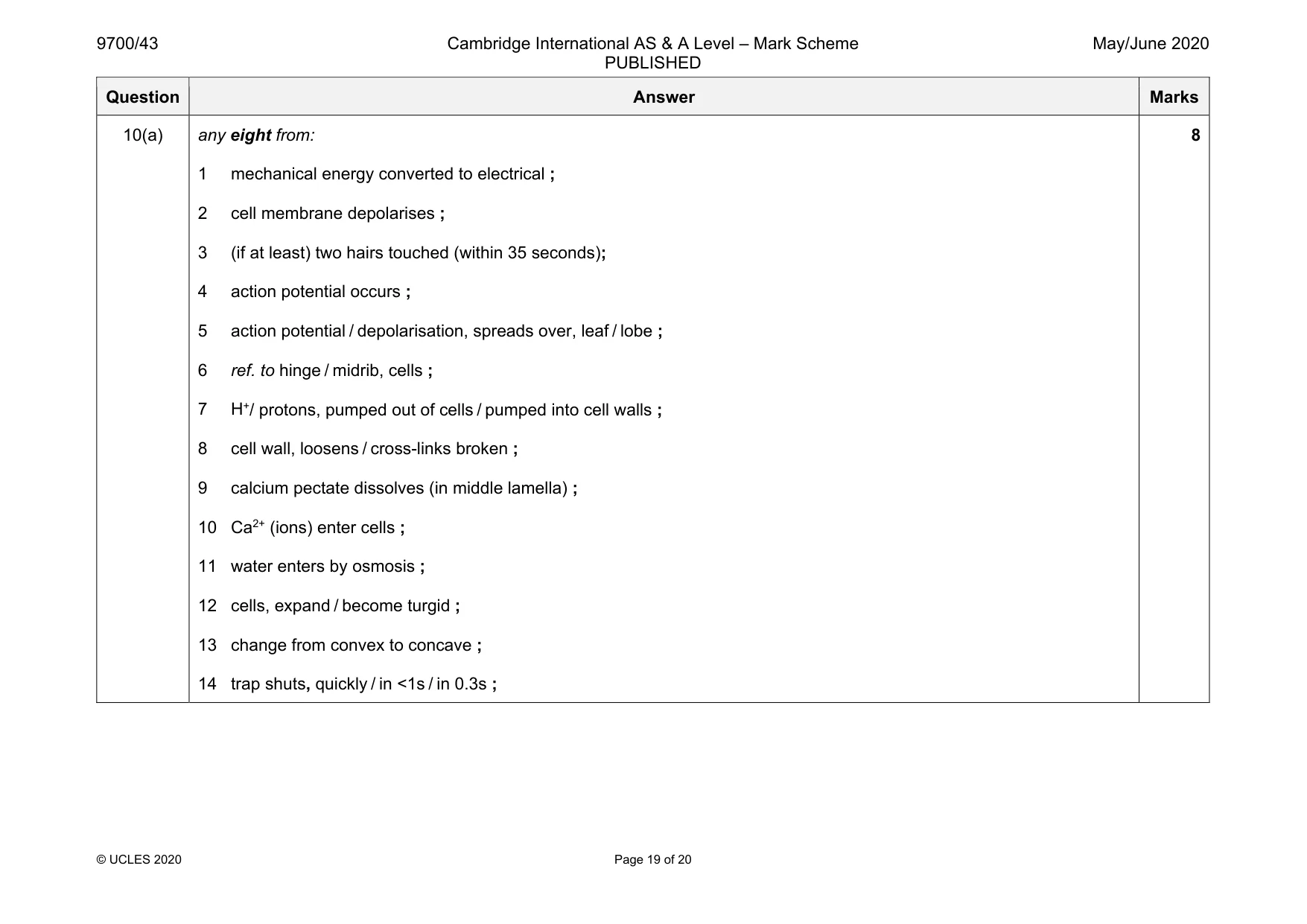
Q10 · Describe and explain how the stimulation of sensory hair cells of a Venus fly trap plant…
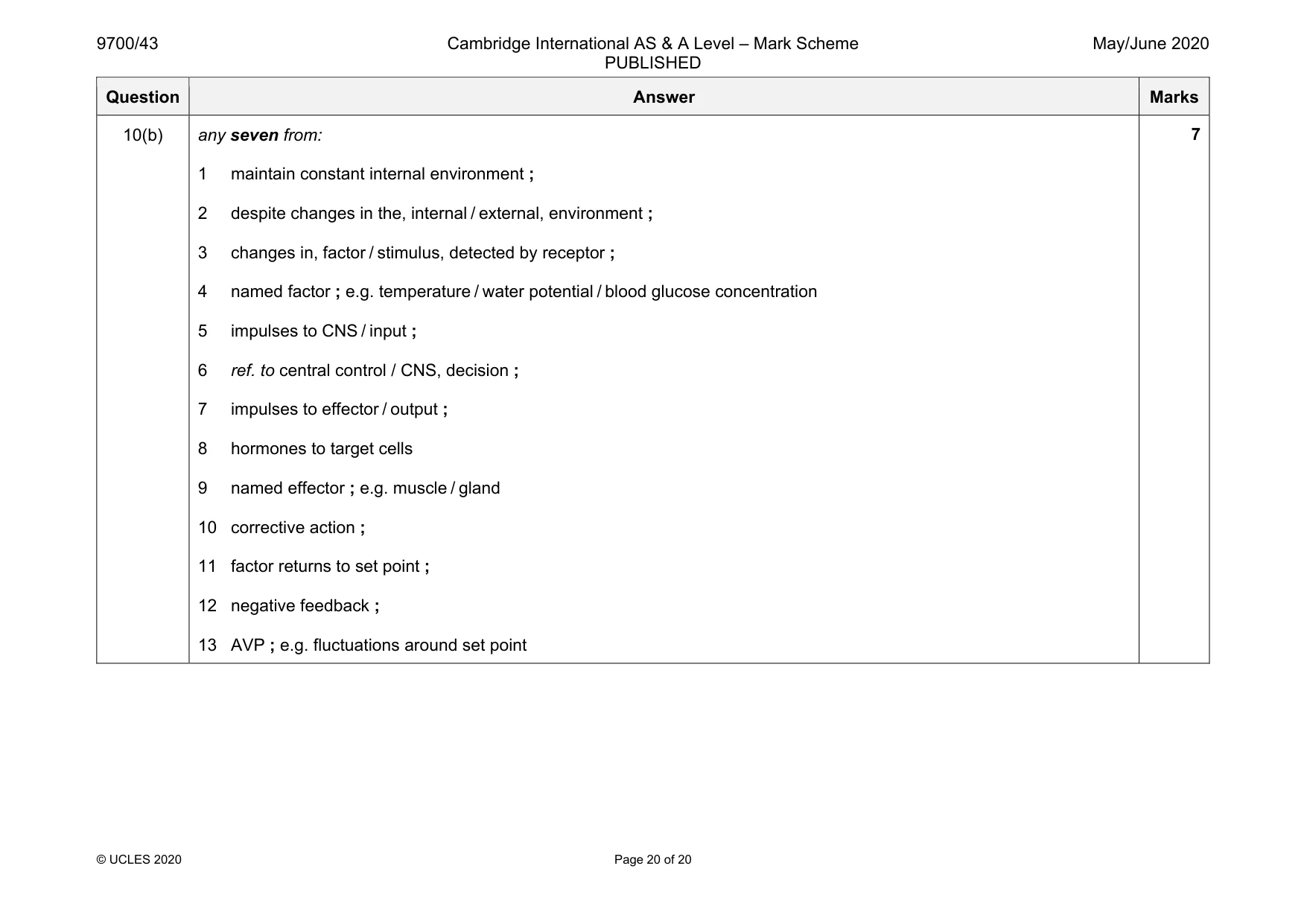
10 (a) Describe and explain how the stimulation of sensory hair cells of a Venus fly trap plant leads to an insect being trapped. [8] (b) Explain what is meant by the term homeostasis and describe the principles of homeostasis in mammals. [7] [Total: 15] .................................................................................................................................................................. .................................................................................................................................................................. .................................................................................................................................................................. .................................................................................................................................................................. .................................................................................................................................................................. .................................................................................................................................................................. .................................................................................................................................................................. .................................................................................................................................................................. .................................................................................................................................................................. .................................................................................................................................................................. .................................................................................................................................................................. .................................................................................................................................................................. .................................................................................................................................................................. .................................................................................................................................................................. .................................................................................................................................................................. .................................................................................................................................................................. .................................................................................................................................................................. .................................................................................................................................................................. .................................................................................................................................................................. .................................................................................................................................................................. .................................................................................................................................................................. .................................................................................................................................................................. .................................................................................................................................................................. .................................................................................................................................................................. .................................................................................................................................................................. .................................................................................................................................................................. .................................................................................................................................................................. .................................................................................................................................................................. .................................................................................................................................................................. .................................................................................................................................................................. .................................................................................................................................................................. .................................................................................................................................................................. .................................................................................................................................................................. .................................................................................................................................................................. .................................................................................................................................................................. .................................................................................................................................................................. .................................................................................................................................................................. .................................................................................................................................................................. .................................................................................................................................................................. .................................................................................................................................................................. .................................................................................................................................................................. .................................................................................................................................................................. .................................................................................................................................................................. .................................................................................................................................................................. .................................................................................................................................................................. .................................................................................................................................................................. .................................................................................................................................................................. .................................................................................................................................................................. .................................................................................................................................................................. .................................................................................................................................................................. .................................................................................................................................................................. .................................................................................................................................................................. .................................................................................................................................................................. .................................................................................................................................................................. .................................................................................................................................................................. .................................................................................................................................................................. .................................................................................................................................................................. .................................................................................................................................................................. .................................................................................................................................................................. .................................................................................................................................................................. .................................................................................................................................................................. .................................................................................................................................................................. .................................................................................................................................................................. .................................................................................................................................................................. .................................................................................................................................................................. .................................................................................................................................................................. .................................................................................................................................................................. .................................................................................................................................................................. ..................................................................................................................................................................
Mark scheme: 10(a) any eight from: 1 mechanical energy converted to electrical ; 2 cell membrane depolarises ; 3 (if at least) two hairs touched (within 35 seconds); 4 action potential occurs ; 5 action potential / depolarisation, spreads over, leaf / lobe ; 6 ref. to hinge / midrib, cells ; 7 H+/ protons, pumped out of cells / pumped into cell walls ; 8 cell wall, loosens / cross-links broken ; 9 calcium pectate dissolves (in middle lamella) ; 10 Ca2+ (ions) enter cells ; 11 water enters by osmosis ; 12 cells, expand / become turgid ; 13 change from convex to concave ; 14 trap shuts, quickly / in <1s / in 0.3s ; 8 Question Answer Marks 10(b) any seven from: 1 maintain constant internal environment ; 2 despite changes in the, internal / external, environment ; 3 changes in, factor / stimulus, detected by receptor ; 4 named factor ; e.g. temperature / water potential / blood glucose concentration 5 impulses to CNS / input ; 6 ref. to central control / CNS, decision ; 7 impulses to effector / output ; 8 hormones to target cells 9 named effector ; e.g. muscle / gland 10 corrective action ; 11 factor returns to set point ; 12 negative feedback ; 13 AVP ; e.g. fluctuations around set point 7
What was in this paper
The subtopics covered by these 10 questions, and how many questions each got. Open one in a new tab to see every Cambridge question on it.