Cambridge A Level Biology 9700 — 2019 Oct/Nov Paper 4 · Variant 1
9700/41/O/N/19 · 10 questions · 100 marks · ≈113 min
The question paper and its mark scheme, free to read here and free to download. This is Cambridge’s own paper, exactly as it was sat.
Question paper28 pages

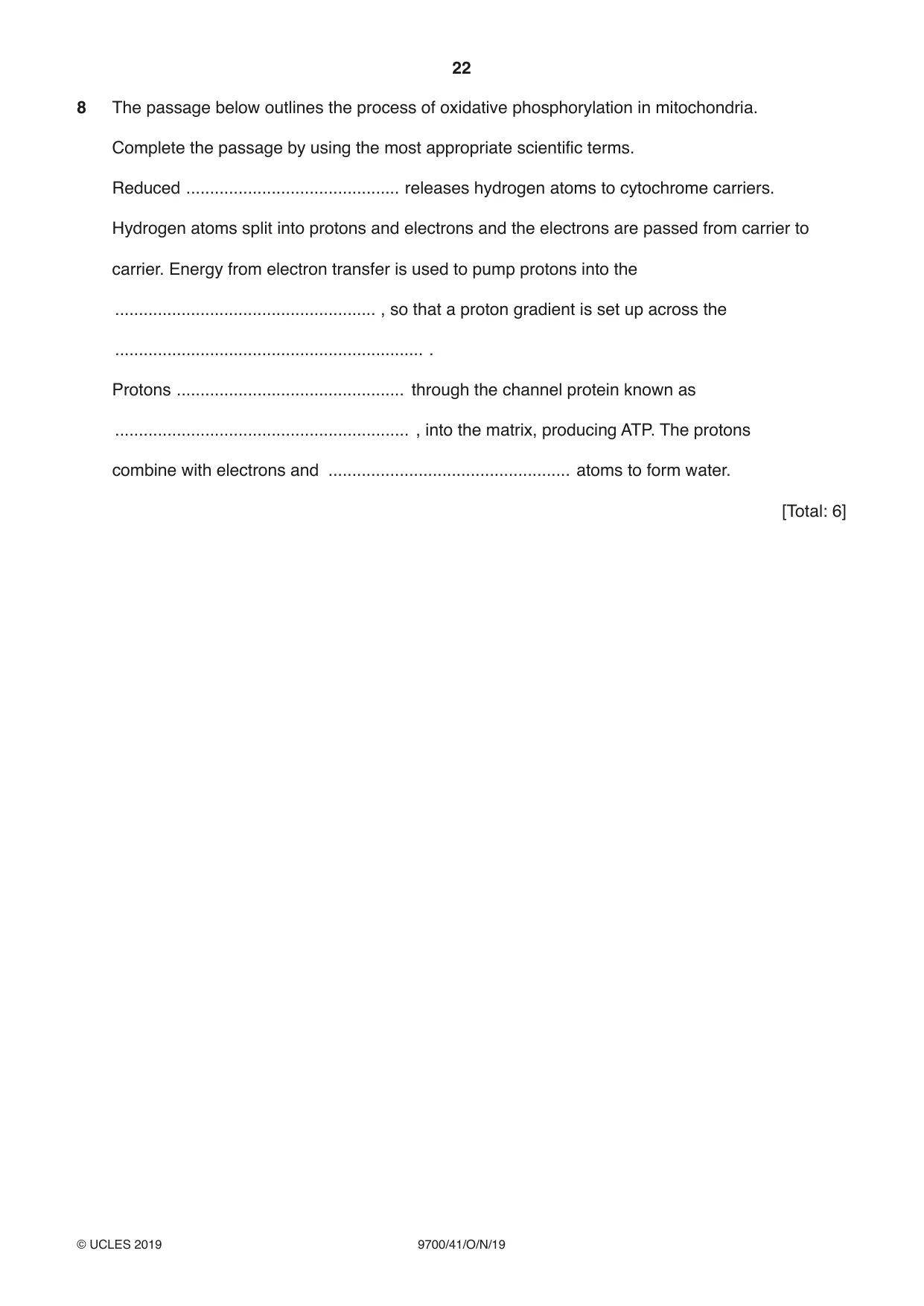
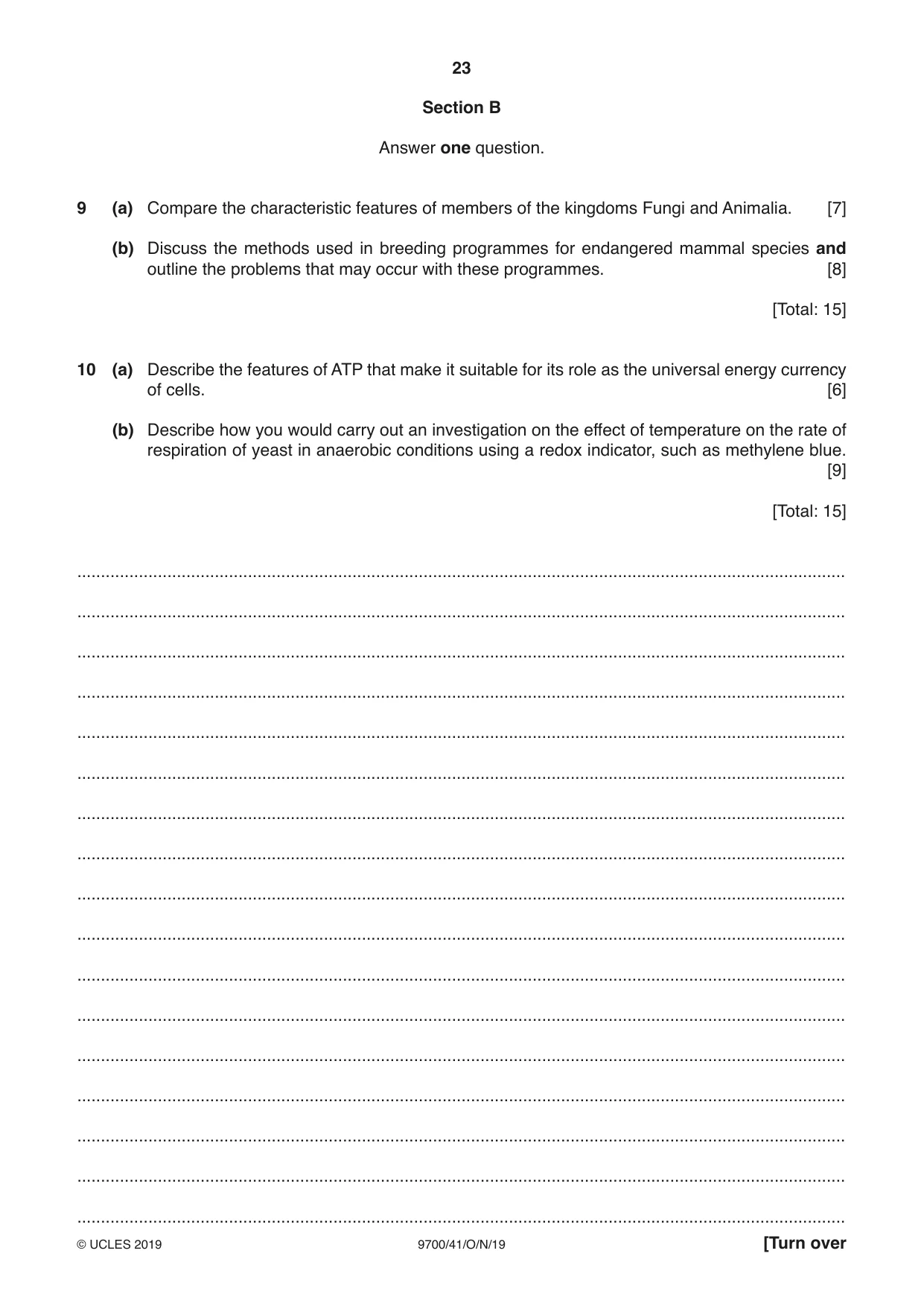





Mark scheme22 pages
Answers below. Sit the paper first if you are practising.
Questions as text
Q1 · ADH is a hormone that is released into the blood of a mammal when changes occur in the…
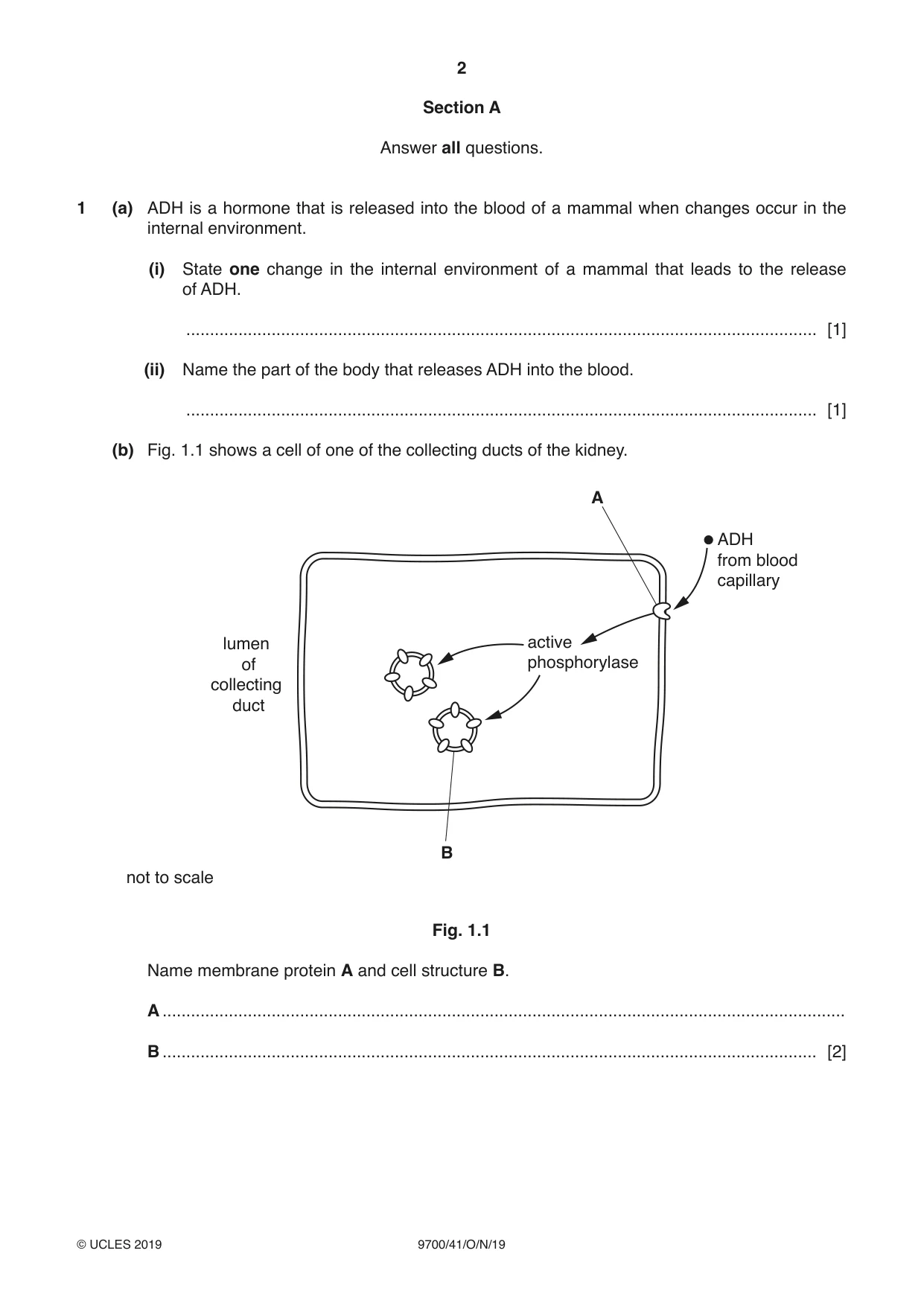
1 (a) ADH is a hormone that is released into the blood of a mammal when changes occur in the internal environment. (i) State one change in the internal environment of a mammal that leads to the release of ADH. ..................................................................................................................................... [1] (ii) Name the part of the body that releases ADH into the blood. ..................................................................................................................................... [1] (b) Fig. 1.1 shows a cell of one of the collecting ducts of the kidney. A ADH from blood capillary lumen active of phosphorylase collecting duct B not to scale Fig. 1.1 Name membrane protein A and cell structure B. A ................................................................................................................................................ B .......................................................................................................................................... [2] (c) The phosphorylase enzyme stimulates structure B. Describe the response of structure B to this stimulation and describe the consequences of this response. ................................................................................................................................................... ................................................................................................................................................... ................................................................................................................................................... ................................................................................................................................................... ................................................................................................................................................... ................................................................................................................................................... ................................................................................................................................................... ................................................................................................................................................... ................................................................................................................................................... ................................................................................................................................................... ................................................................................................................................................... ............................................................................................................................................. [4] [Total: 8]
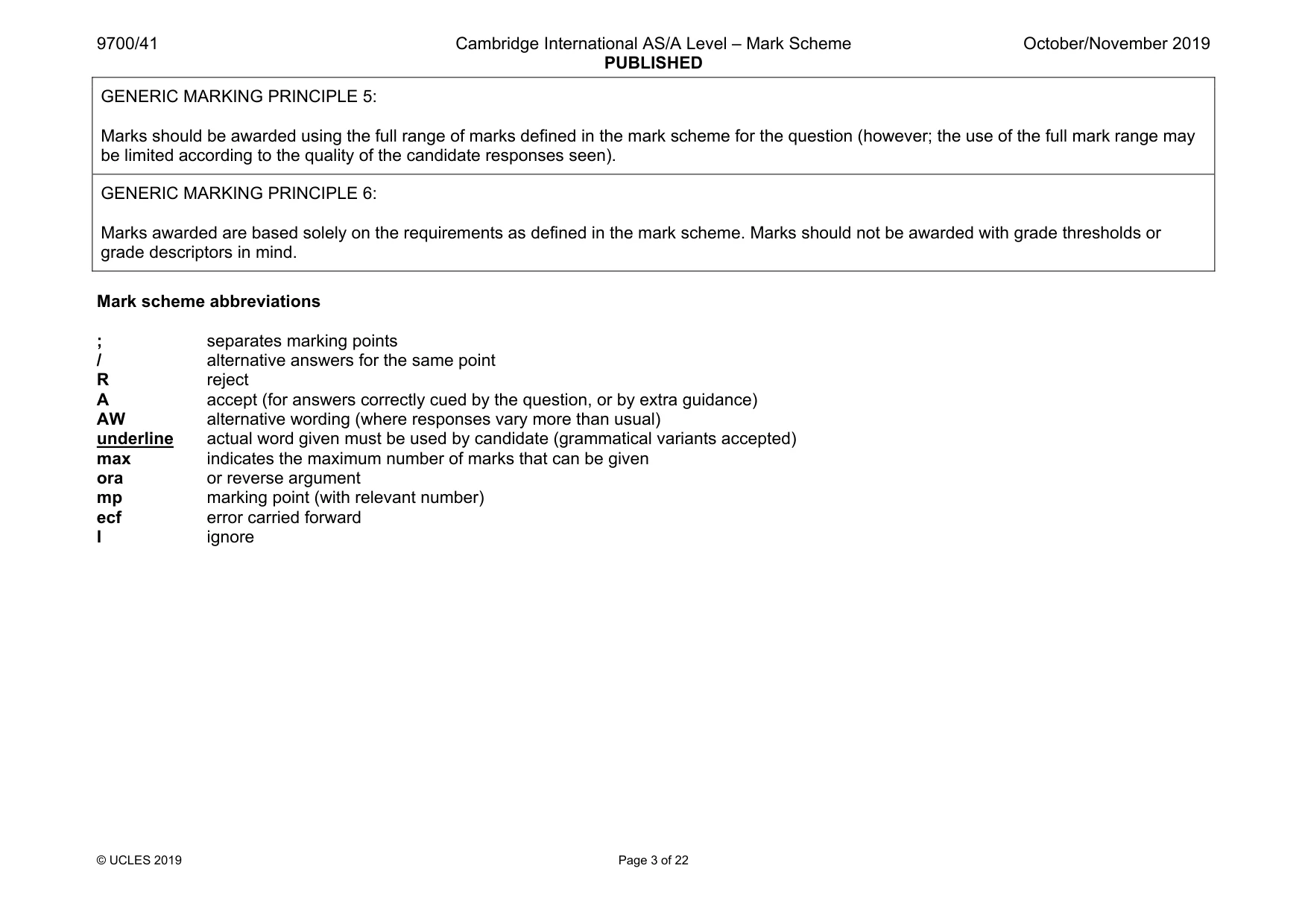
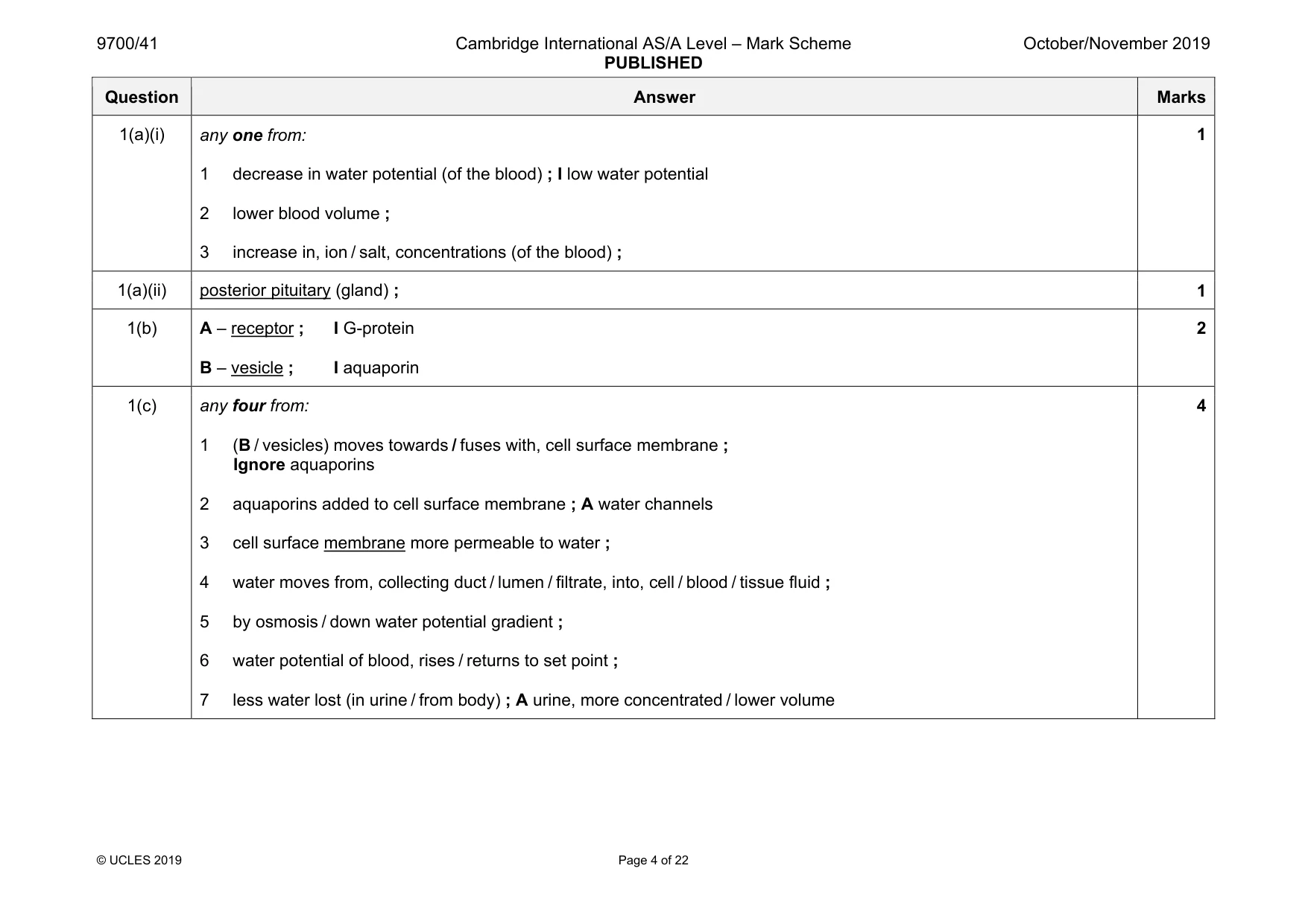
Mark scheme: 1(a)(i) any one from: 1 decrease in water potential (of the blood) ; I low water potential 2 lower blood volume ; 3 increase in, ion / salt, concentrations (of the blood) ; 1 1(a)(ii) posterior pituitary (gland) ; 1 1(b) A – receptor ; I G-protein B – vesicle ; I aquaporin 2 1(c) any four from: 1 (B / vesicles) moves towards / fuses with, cell surface membrane ; Ignore aquaporins 2 aquaporins added to cell surface membrane ; A water channels 3 cell surface membrane more permeable to water ; 4 water moves from, collecting duct / lumen / filtrate, into, cell / blood / tissue fluid ; 5 by osmosis / down water potential gradient ; 6 water potential of blood, rises / returns to set point ; 7 less water lost (in urine / from body) ; A urine, more concentrated / lower volume 4
Q2 · The stickleback fish, Gasterosteus aculeatus, has two distinct forms, the saltwater form…
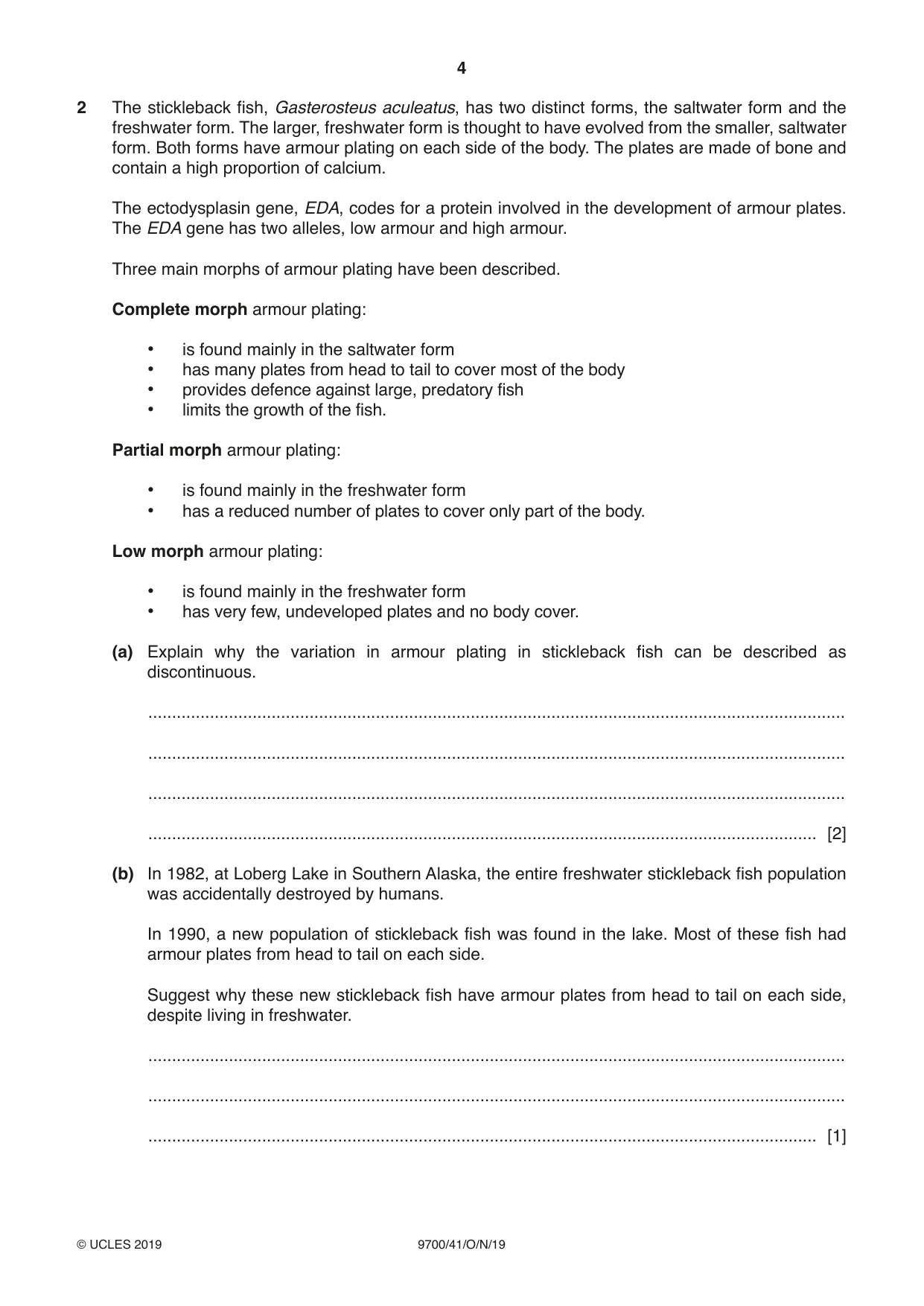
2 The stickleback fish, Gasterosteus aculeatus, has two distinct forms, the saltwater form and the freshwater form. The larger, freshwater form is thought to have evolved from the smaller, saltwater form. Both forms have armour plating on each side of the body. The plates are made of bone and contain a high proportion of calcium. The ectodysplasin gene, EDA, codes for a protein involved in the development of armour plates. The EDA gene has two alleles, low armour and high armour. Three main morphs of armour plating have been described. Complete morph armour plating: • is found mainly in the saltwater form • has many plates from head to tail to cover most of the body • provides defence against large, predatory fish • limits the growth of the fish. Partial morph armour plating: • is found mainly in the freshwater form • has a reduced number of plates to cover only part of the body. Low morph armour plating: • is found mainly in the freshwater form • has very few, undeveloped plates and no body cover. (a) Explain why the variation in armour plating in stickleback fish can be described as discontinuous. ................................................................................................................................................... ................................................................................................................................................... ................................................................................................................................................... ............................................................................................................................................. [2] (b) In 1982, at Loberg Lake in Southern Alaska, the entire freshwater stickleback fish population was accidentally destroyed by humans. In 1990, a new population of stickleback fish was found in the lake. Most of these fish had armour plates from head to tail on each side. Suggest why these new stickleback fish have armour plates from head to tail on each side, despite living in freshwater. ................................................................................................................................................... ................................................................................................................................................... ............................................................................................................................................. [1] (c) From 1990, annual sampling took place in the lake. Each year showed a reduction in the number of individuals with complete morph armour plating (from head to tail on each side). This change took place in a relatively short period of time. • In 1990, 96% of the stickleback fish population had complete morph armour plating. • In 1993, 39% of the stickleback fish population had complete morph armour plating. Explain how natural selection has occurred in this new stickleback fish population. ................................................................................................................................................... ................................................................................................................................................... ................................................................................................................................................... ................................................................................................................................................... ................................................................................................................................................... ................................................................................................................................................... ................................................................................................................................................... ................................................................................................................................................... ................................................................................................................................................... ................................................................................................................................................... ............................................................................................................................................. [5] [Total: 8]
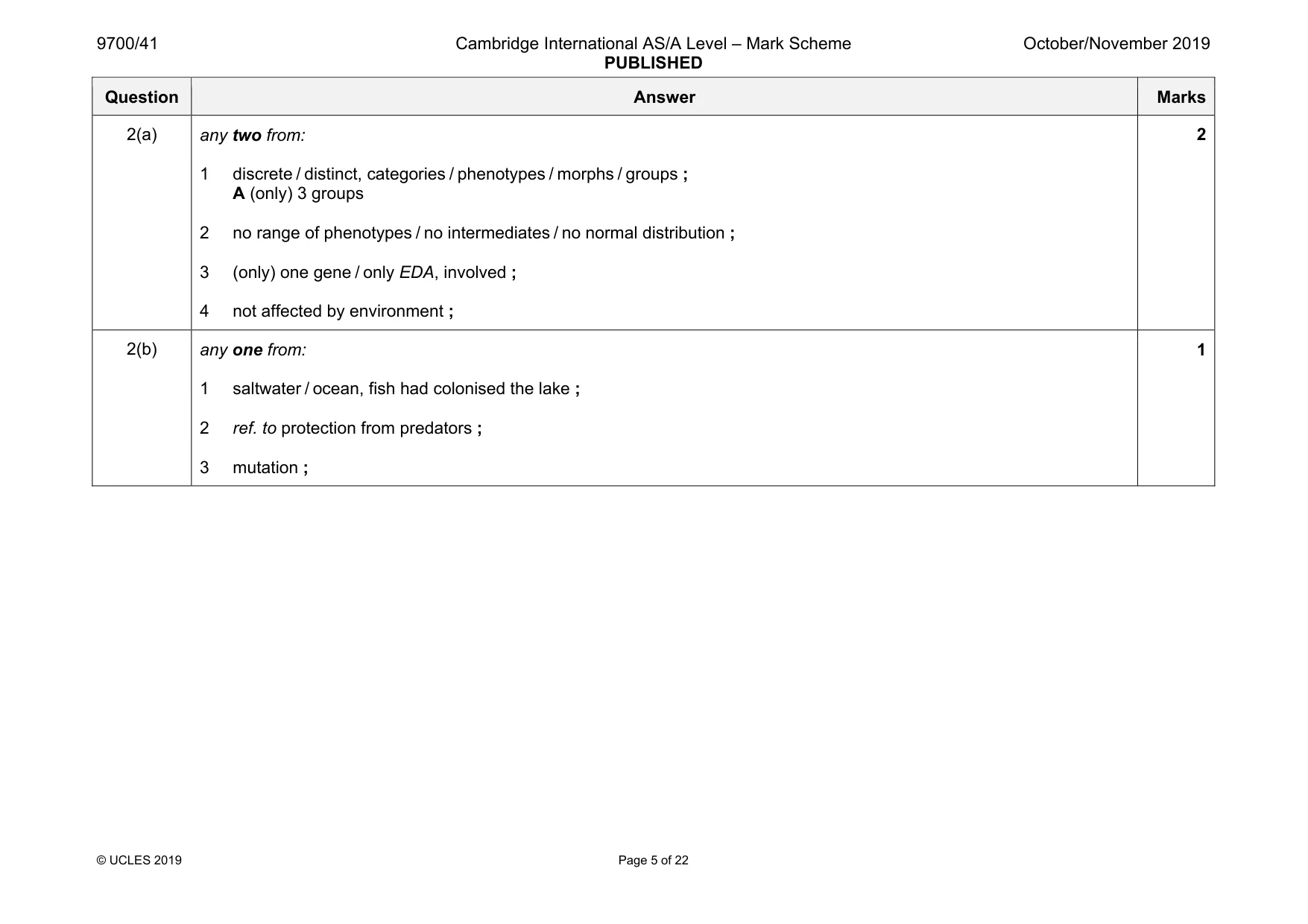
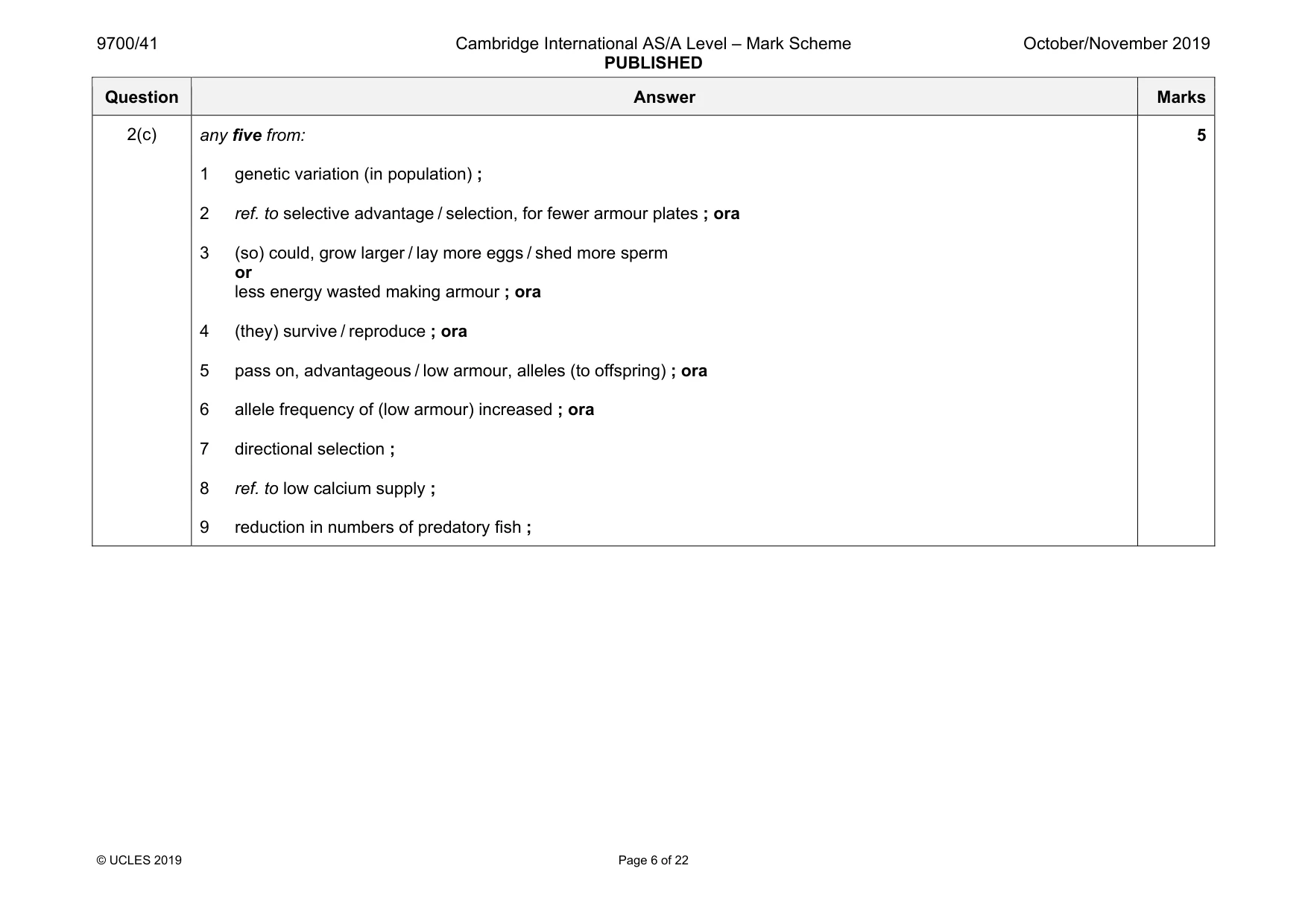
Mark scheme: 2(a) any two from: 1 discrete / distinct, categories / phenotypes / morphs / groups ; A (only) 3 groups 2 no range of phenotypes / no intermediates / no normal distribution ; 3 (only) one gene / only EDA, involved ; 4 not affected by environment ; 2 2(b) any one from: 1 saltwater / ocean, fish had colonised the lake ; 2 ref. to protection from predators ; 3 mutation ; 1 Question Answer Marks 2(c) any five from: 1 genetic variation (in population) ; 2 ref. to selective advantage / selection, for fewer armour plates ; ora 3 (so) could, grow larger / lay more eggs / shed more sperm or less energy wasted making armour ; ora 4 (they) survive / reproduce ; ora 5 pass on, advantageous / low armour, alleles (to offspring) ; ora 6 allele frequency of (low armour) increased ; ora 7 directional selection ; 8 ref. to low calcium supply ; 9 reduction in numbers of predatory fish ; 5
Q3 · Therapeutic proteins are used to treat disease
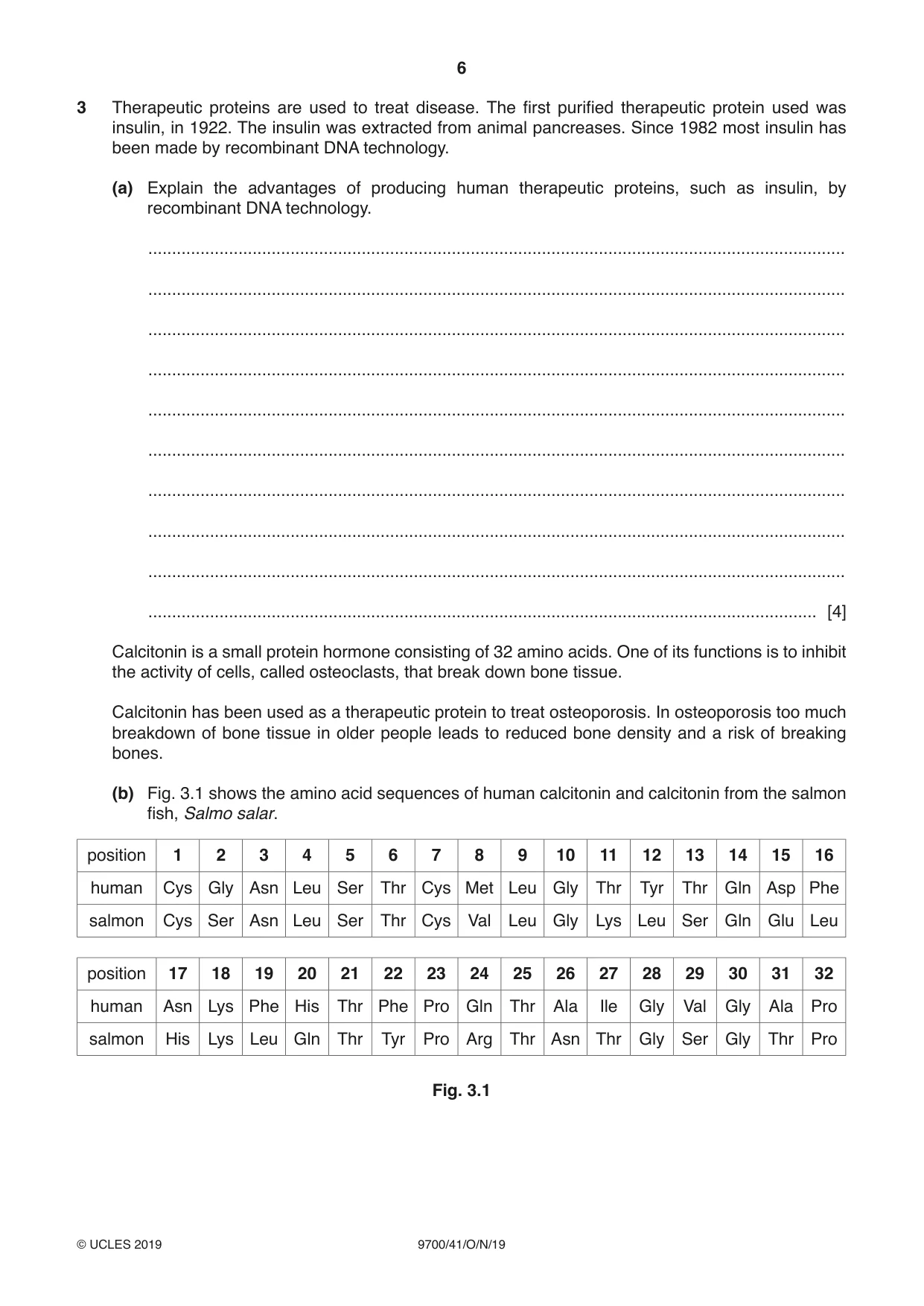
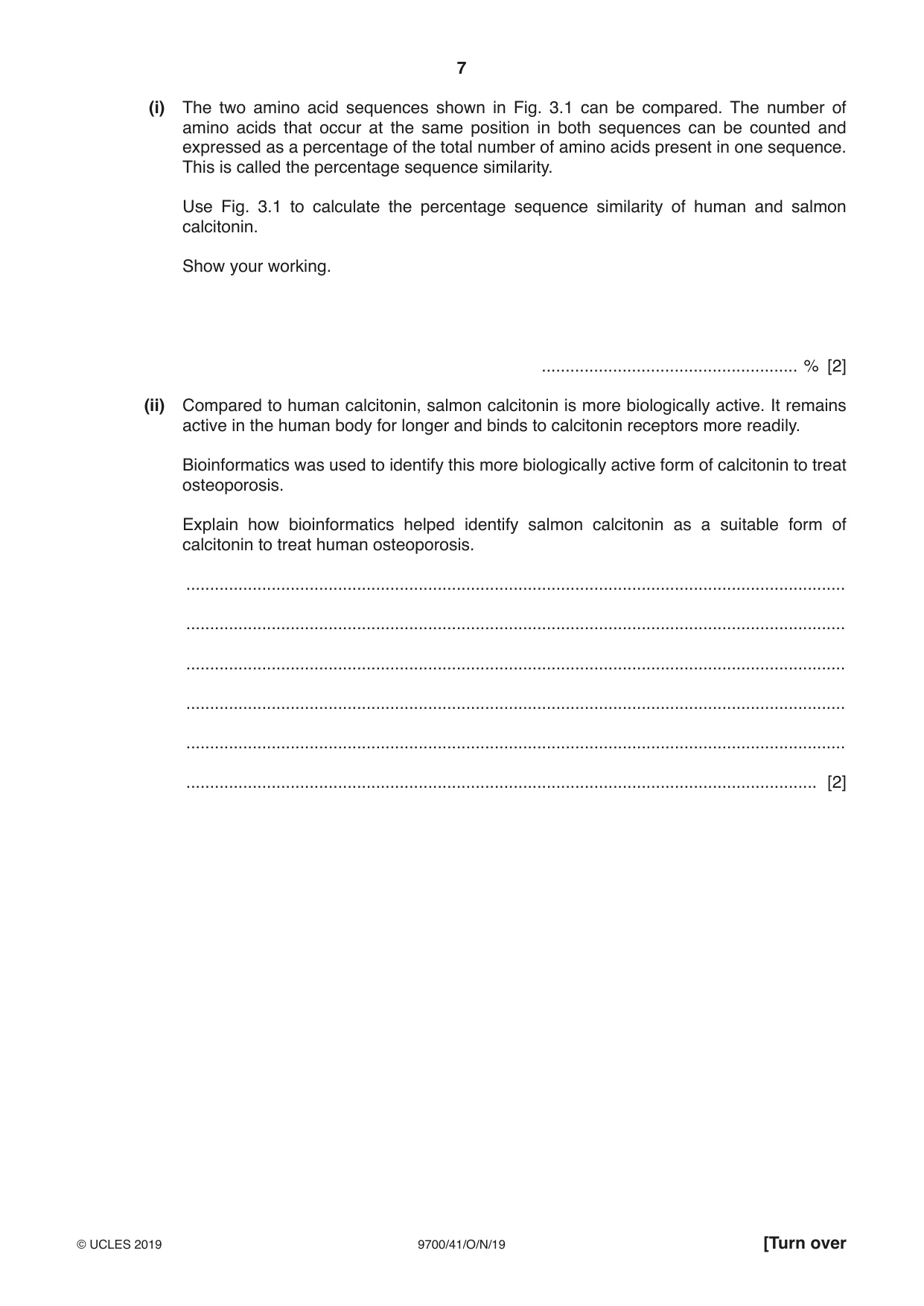
3 Therapeutic proteins are used to treat disease. The first purified therapeutic protein used was insulin, in 1922. The insulin was extracted from animal pancreases. Since 1982 most insulin has been made by recombinant DNA technology. (a) Explain the advantages of producing human therapeutic proteins, such as insulin, by recombinant DNA technology. ................................................................................................................................................... ................................................................................................................................................... ................................................................................................................................................... ................................................................................................................................................... ................................................................................................................................................... ................................................................................................................................................... ................................................................................................................................................... ................................................................................................................................................... ................................................................................................................................................... ............................................................................................................................................. [4] Calcitonin is a small protein hormone consisting of 32 amino acids. One of its functions is to inhibit the activity of cells, called osteoclasts, that break down bone tissue. Calcitonin has been used as a therapeutic protein to treat osteoporosis. In osteoporosis too much breakdown of bone tissue in older people leads to reduced bone density and a risk of breaking bones. (b) Fig. 3.1 shows the amino acid sequences of human calcitonin and calcitonin from the salmon fish, Salmo salar. position 1 2 3 4 5 6 7 8 9 10 11 12 13 14 15 16 human Cys Gly Asn Leu Ser Thr Cys Met Leu Gly Thr Tyr Thr Gln Asp Phe salmon Cys Ser Asn Leu Ser Thr Cys Val Leu Gly Lys Leu Ser Gln Glu Leu position 17 18 19 20 21 22 23 24 25 26 27 28 29 30 31 32 human Asn Lys Phe His Thr Phe Pro Gln Thr Ala Ile Gly Val Gly Ala Pro salmon His Lys Leu Gln Thr Tyr Pro Arg Thr Asn Thr Gly Ser Gly Thr Pro Fig. 3.1 (i) The two amino acid sequences shown in Fig. 3.1 can be compared. The number of amino acids that occur at the same position in both sequences can be counted and expressed as a percentage of the total number of amino acids present in one sequence. This is called the percentage sequence similarity. Use Fig. 3.1 to calculate the percentage sequence similarity of human and salmon calcitonin. Show your working. ...................................................... % [2] (ii) Compared to human calcitonin, salmon calcitonin is more biologically active. It remains active in the human body for longer and binds to calcitonin receptors more readily. Bioinformatics was used to identify this more biologically active form of calcitonin to treat osteoporosis. Explain how bioinformatics helped identify salmon calcitonin as a suitable form of calcitonin to treat human osteoporosis. ........................................................................................................................................... ........................................................................................................................................... ........................................................................................................................................... ........................................................................................................................................... ........................................................................................................................................... ..................................................................................................................................... [2] (c) Salmon calcitonin to treat osteoporosis is made by genetically engineered Escherichia coli bacteria. To produce these bacteria, a plasmid was cut and joined to the new gene to form a recombinant plasmid. The recombinant plasmid was then introduced into the bacterial cells. (i) Name an enzyme that can: • cut plasmid DNA ........................................................................................................................................... • join the salmon calcitonin gene with plasmid DNA. ..................................................................................................................................... [2] (ii) Identify and explain two properties of plasmids that allow them to be used as vectors in gene cloning. 1 ......................................................................................................................................... ........................................................................................................................................... ........................................................................................................................................... ........................................................................................................................................... 2 ......................................................................................................................................... ........................................................................................................................................... ........................................................................................................................................... ..................................................................................................................................... [2] (d) The gene coding for salmon calcitonin is introduced into bacteria in a specially designed plasmid called an expression vector. An expression vector must contain a prokaryotic promoter, such as the lac promoter. Explain why differences in the control of gene expression in prokaryotes and eukaryotes mean that expression vector plasmids must contain a prokaryotic promoter. ................................................................................................................................................... ................................................................................................................................................... ................................................................................................................................................... ................................................................................................................................................... ................................................................................................................................................... ................................................................................................................................................... ............................................................................................................................................. [2] [Total: 14]
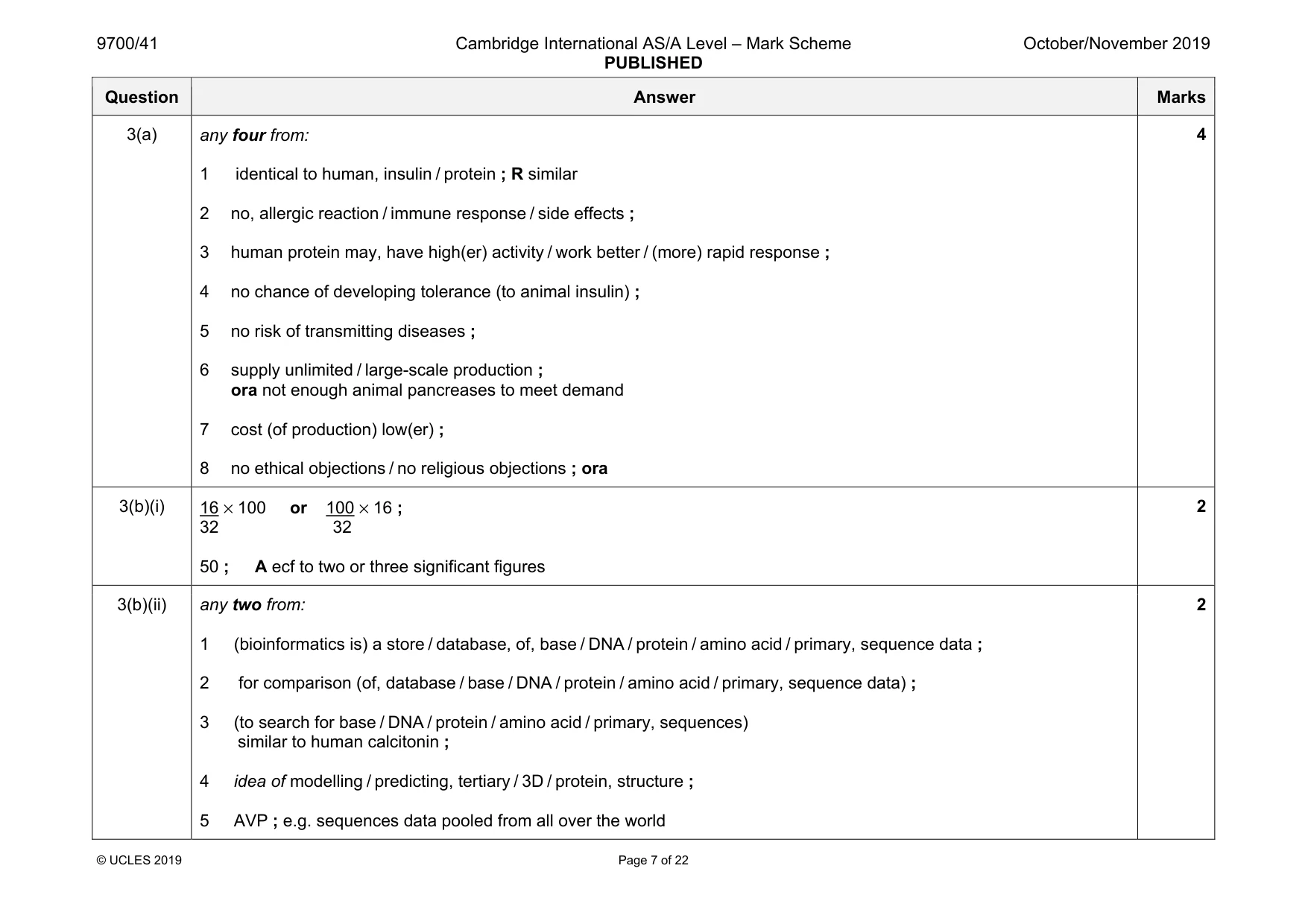
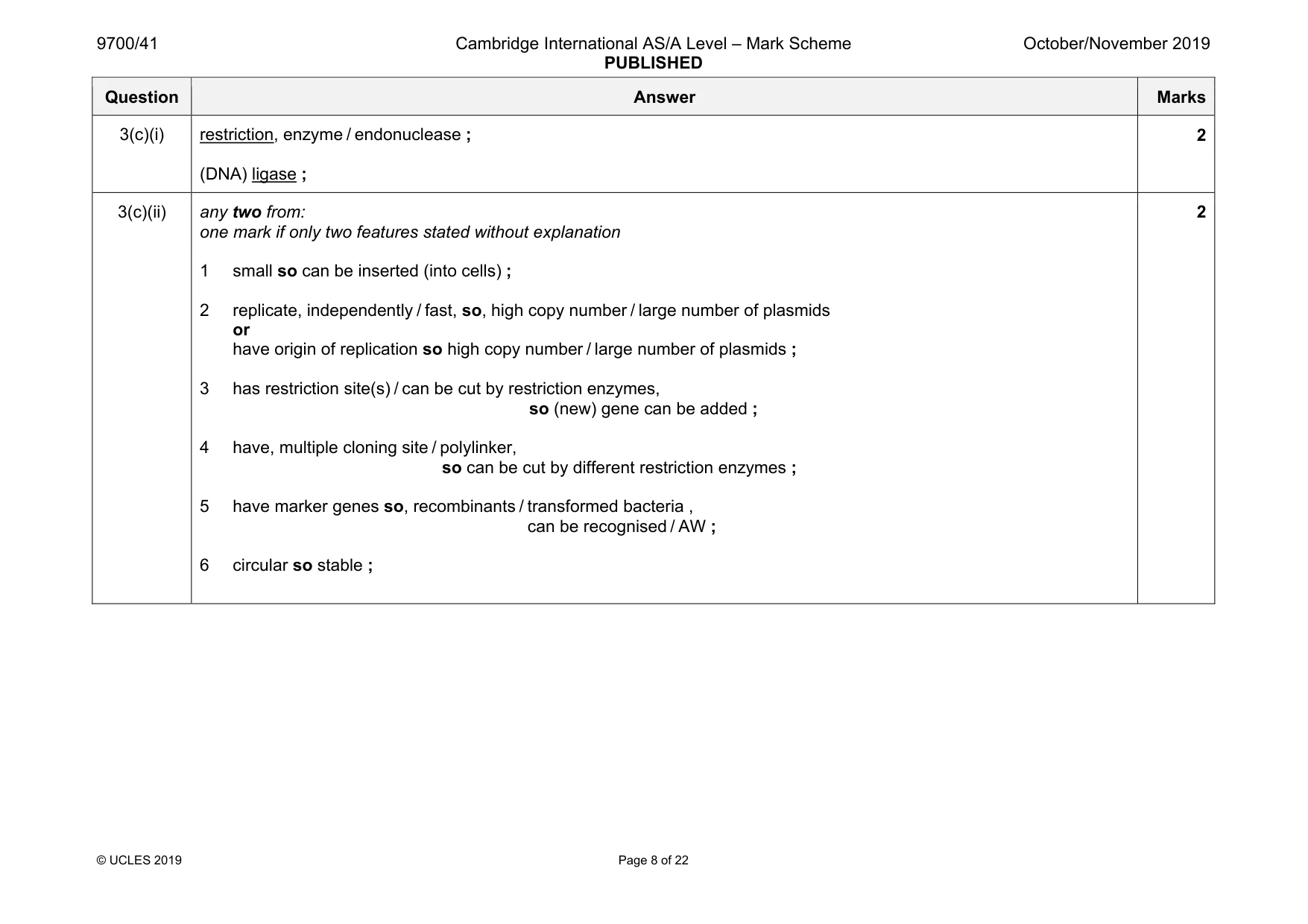
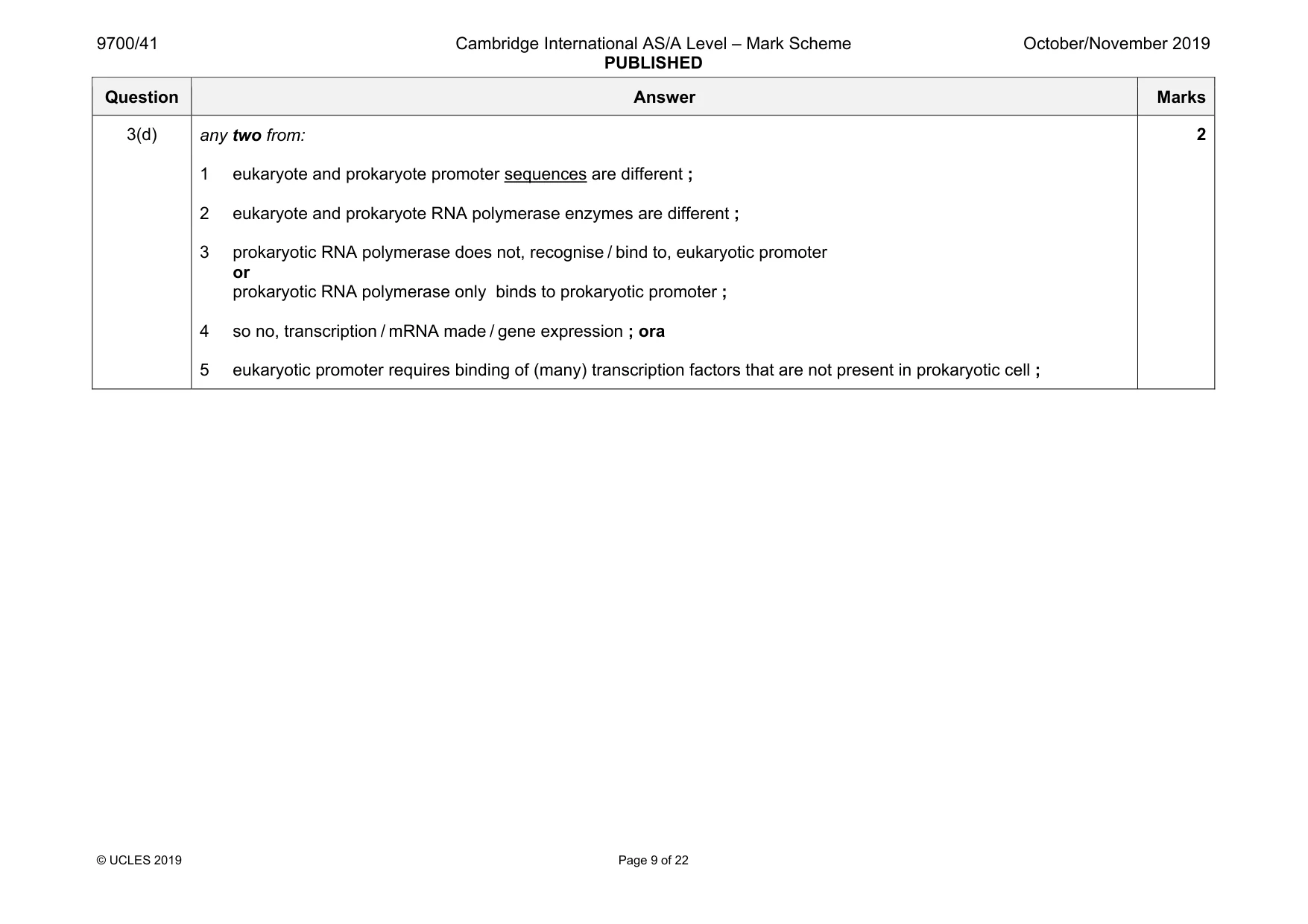
Mark scheme: 3(a) any four from: 1 identical to human, insulin / protein ; R similar 2 no, allergic reaction / immune response / side effects ; 3 human protein may, have high(er) activity / work better / (more) rapid response ; 4 no chance of developing tolerance (to animal insulin) ; 5 no risk of transmitting diseases ; 6 supply unlimited / large-scale production ; ora not enough animal pancreases to meet demand 7 cost (of production) low(er) ; 8 no ethical objections / no religious objections ; ora 4 3(b)(i) 16 × 100 or 100 × 16 ; 32 32 50 ; A ecf to two or three significant figures 2 3(b)(ii) any two from: 1 (bioinformatics is) a store / database, of, base / DNA / protein / amino acid / primary, sequence data ; 2 for comparison (of, database / base / DNA / protein / amino acid / primary, sequence data) ; 3 (to search for base / DNA / protein / amino acid / primary, sequences) similar to human calcitonin ; 4 idea of modelling / predicting, tertiary / 3D / protein, structure ; 5 AVP ; e.g. sequences data pooled from all over the world 2 Question Answer Marks 3(c)(i) restriction, enzyme / endonuclease ; (DNA) ligase ; 2 3(c)(ii) any two from: one mark if only two features stated without explanation 1 small so can be inserted (into cells) ; 2 replicate, independently / fast, so, high copy number / large number of plasmids or have origin of replication so high copy number / large number of plasmids ; 3 has restriction site(s) / can be cut by restriction enzymes, so (new) gene can be added ; 4 have, multiple cloning site / polylinker, so can be cut by different restriction enzymes ; 5 have marker genes so, recombinants / transformed bacteria , can be recognised / AW ; 6 circular so stable ; 2 Question Answer Marks 3(d) any two from: 1 eukaryote and prokaryote promoter sequences are different ; 2 eukaryote and prokaryote RNA polymerase enzymes are different ; 3 prokaryotic RNA polymerase does not, recognise / bind to, eukaryotic promoter or prokaryotic RNA polymerase only binds to prokaryotic promoter ; 4 so no, transcription / mRNA made / gene expression ; ora 5 eukaryotic promoter requires binding of (many) transcription factors that are not present in prokaryotic cell ; 2
Q4 · Meiosis has an important role in sexual reproduction
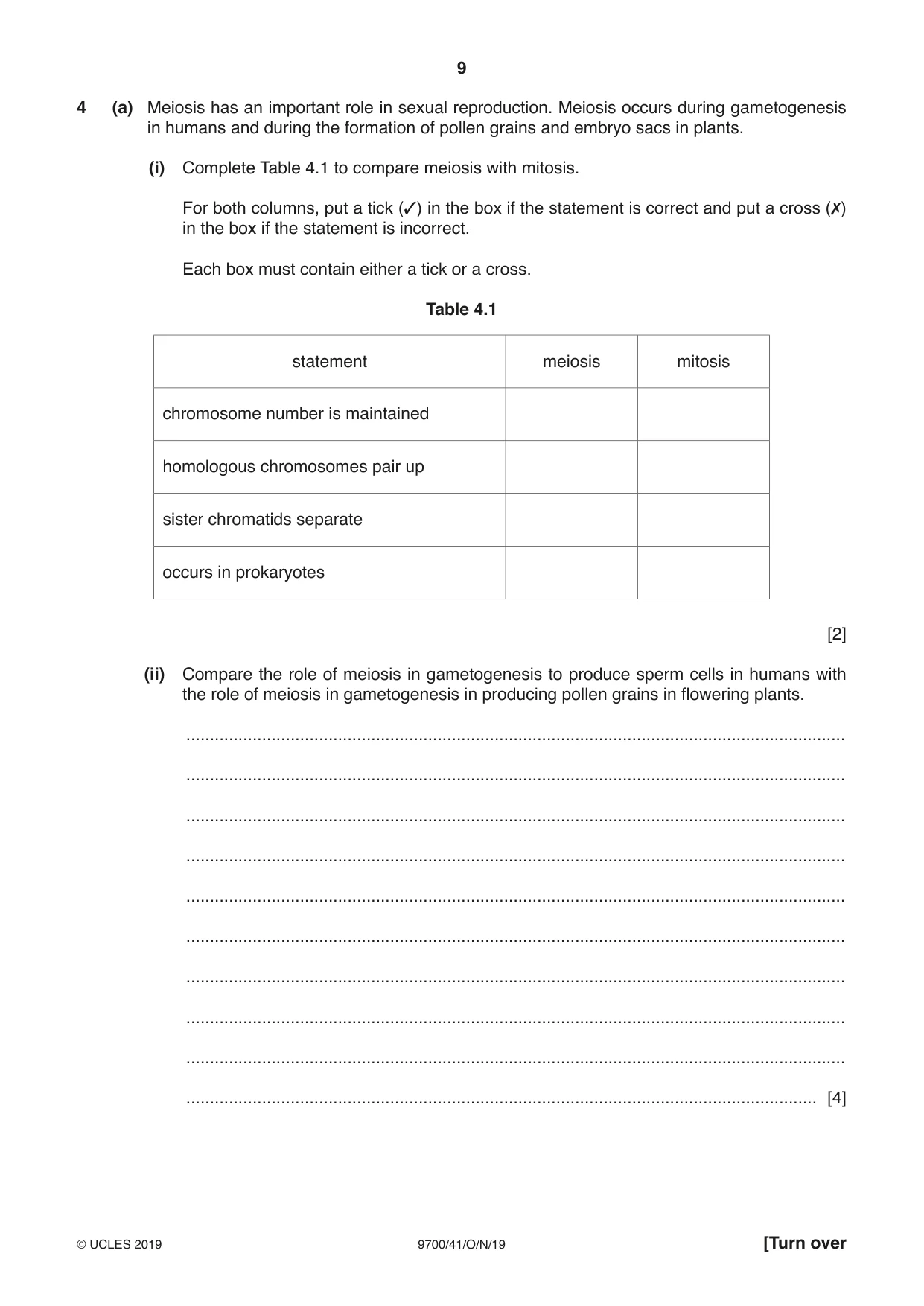
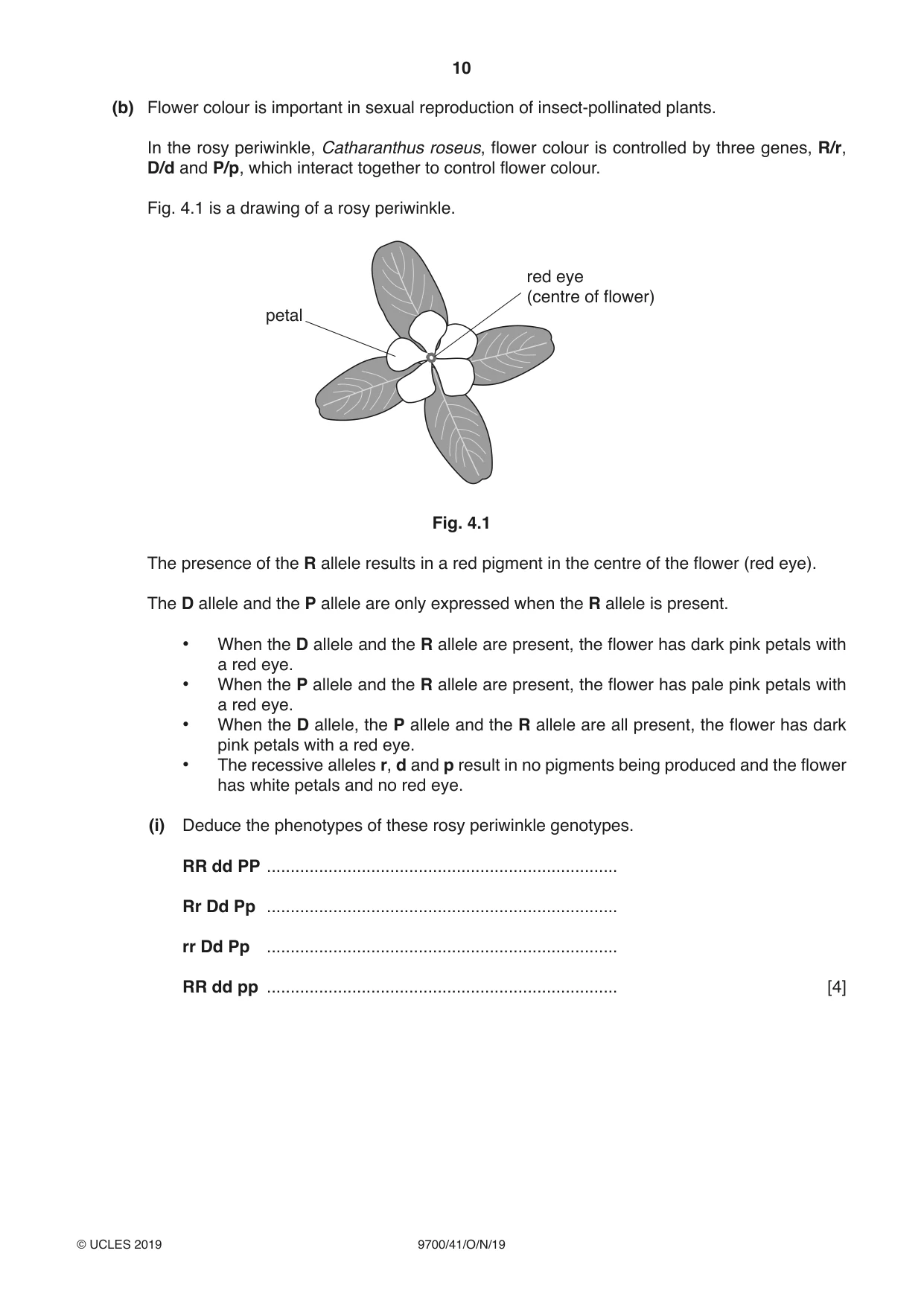
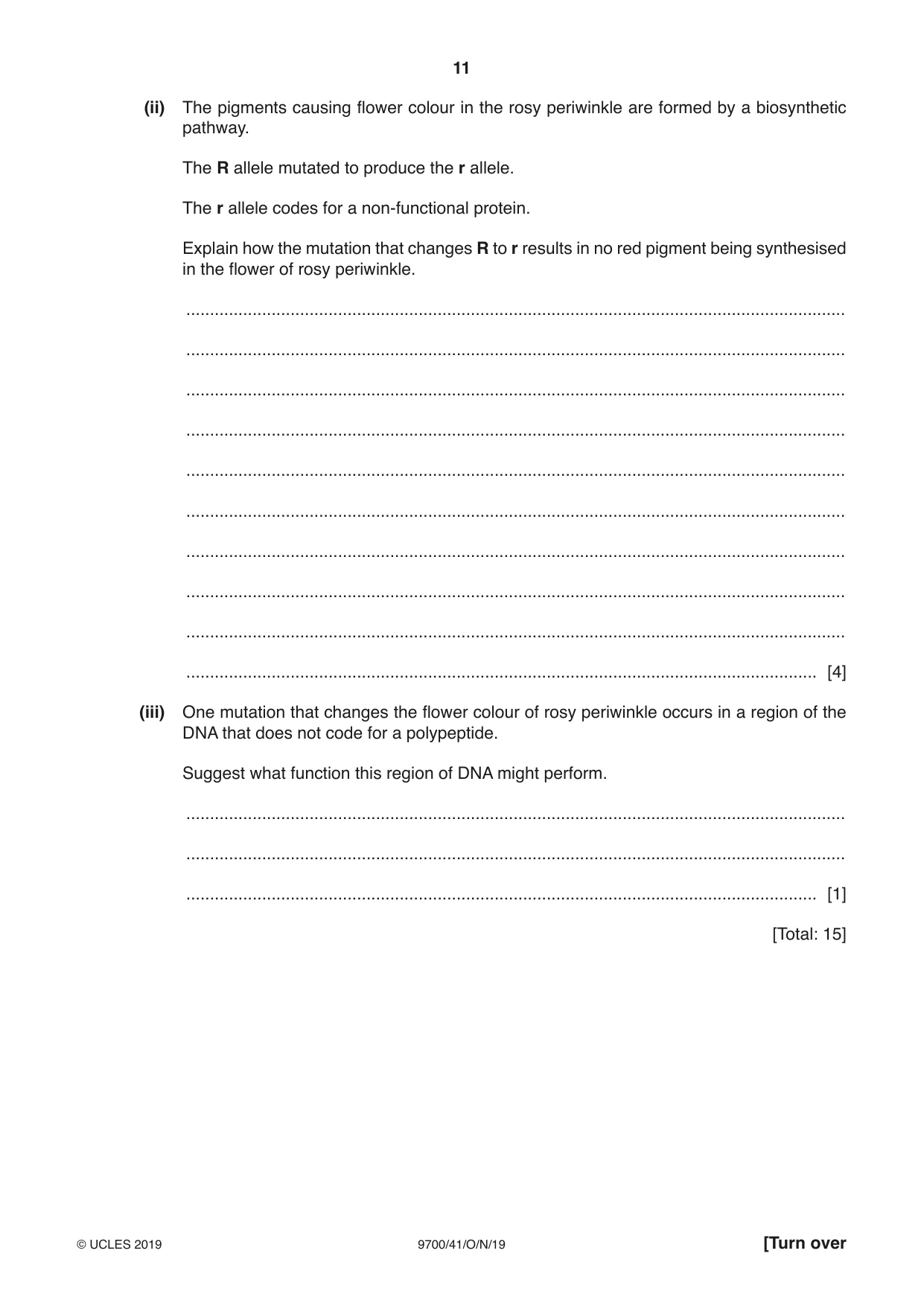
4 (a) Meiosis has an important role in sexual reproduction. Meiosis occurs during gametogenesis in humans and during the formation of pollen grains and embryo sacs in plants. (i) Complete Table 4.1 to compare meiosis with mitosis. For both columns, put a tick (✓) in the box if the statement is correct and put a cross (✗) in the box if the statement is incorrect. Each box must contain either a tick or a cross. Table 4.1 statement meiosis mitosis chromosome number is maintained homologous chromosomes pair up sister chromatids separate occurs in prokaryotes [2] (ii) Compare the role of meiosis in gametogenesis to produce sperm cells in humans with the role of meiosis in gametogenesis in producing pollen grains in flowering plants. ........................................................................................................................................... ........................................................................................................................................... ........................................................................................................................................... ........................................................................................................................................... ........................................................................................................................................... ........................................................................................................................................... ........................................................................................................................................... ........................................................................................................................................... ........................................................................................................................................... ..................................................................................................................................... [4] (b) Flower colour is important in sexual reproduction of insect-pollinated plants. In the rosy periwinkle, Catharanthus roseus, flower colour is controlled by three genes, R/r, D/d and P/p, which interact together to control flower colour. Fig. 4.1 is a drawing of a rosy periwinkle. red eye (centre of flower) petal Fig. 4.1 The presence of the R allele results in a red pigment in the centre of the flower (red eye). The D allele and the P allele are only expressed when the R allele is present. • When the D allele and the R allele are present, the flower has dark pink petals with a red eye. • When the P allele and the R allele are present, the flower has pale pink petals with a red eye. • When the D allele, the P allele and the R allele are all present, the flower has dark pink petals with a red eye. • The recessive alleles r, d and p result in no pigments being produced and the flower has white petals and no red eye. (i) Deduce the phenotypes of these rosy periwinkle genotypes. RR dd PP .......................................................................... Rr Dd Pp .......................................................................... rr Dd Pp .......................................................................... RR dd pp .......................................................................... [4] (ii) The pigments causing flower colour in the rosy periwinkle are formed by a biosynthetic pathway. The R allele mutated to produce the r allele. The r allele codes for a non-functional protein. Explain how the mutation that changes R to r results in no red pigment being synthesised in the flower of rosy periwinkle. ........................................................................................................................................... ........................................................................................................................................... ........................................................................................................................................... ........................................................................................................................................... ........................................................................................................................................... ........................................................................................................................................... ........................................................................................................................................... ........................................................................................................................................... ........................................................................................................................................... ..................................................................................................................................... [4] (iii) One mutation that changes the flower colour of rosy periwinkle occurs in a region of the DNA that does not code for a polypeptide. Suggest what function this region of DNA might perform. ........................................................................................................................................... ........................................................................................................................................... ..................................................................................................................................... [1] [Total: 15]
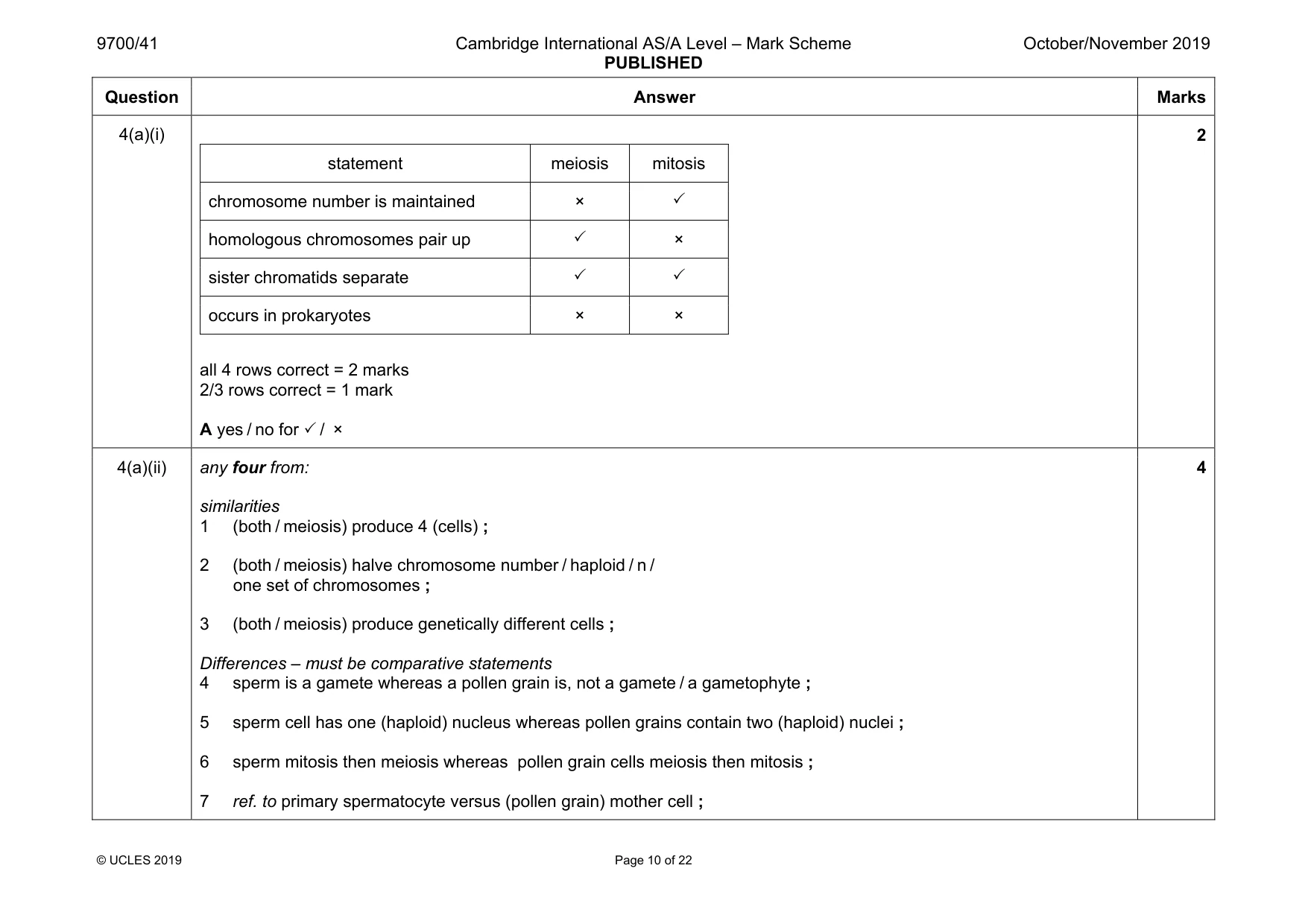
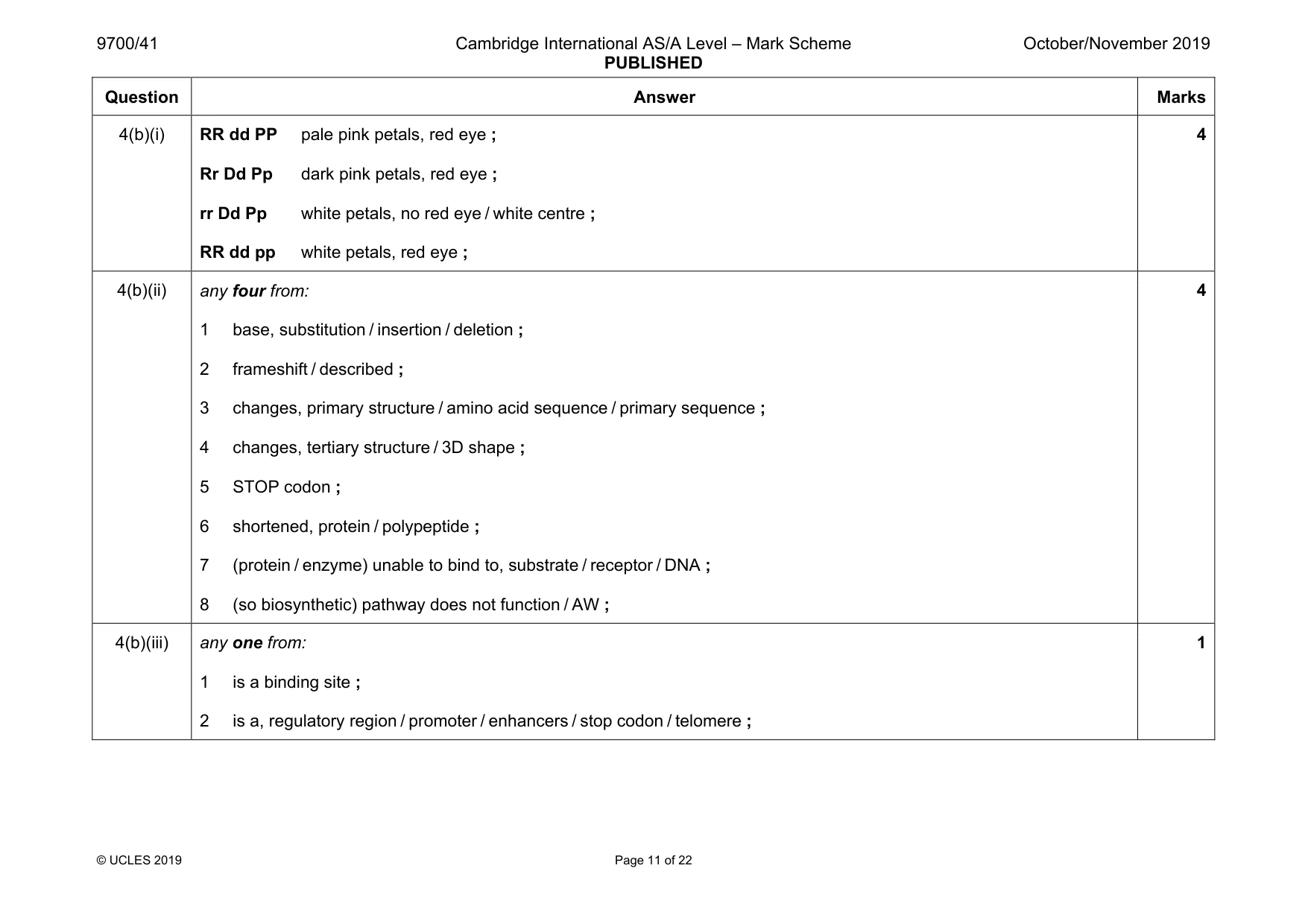
Mark scheme: 4(a)(i) all 4 rows correct = 2 marks 2/3 rows correct = 1 mark A yes / no for 3 / × statement meiosis mitosis chromosome number is maintained × 3 homologous chromosomes pair up 3 × sister chromatids separate 3 3 occurs in prokaryotes × × 2 4(a)(ii) any four from: similarities 1 (both / meiosis) produce 4 (cells) ; 2 (both / meiosis) halve chromosome number / haploid / n / one set of chromosomes ; 3 (both / meiosis) produce genetically different cells ; Differences – must be comparative statements 4 sperm is a gamete whereas a pollen grain is, not a gamete / a gametophyte ; 5 sperm cell has one (haploid) nucleus whereas pollen grains contain two (haploid) nuclei ; 6 sperm mitosis then meiosis whereas pollen grain cells meiosis then mitosis ; 7 ref. to primary spermatocyte versus (pollen grain) mother cell ; 4 Question Answer Marks 4(b)(i) RR dd PP pale pink petals, red eye ; Rr Dd Pp dark pink petals, red eye ; rr Dd Pp white petals, no red eye / white centre ; RR dd pp white petals, red eye ; 4 4(b)(ii) any four from: 1 base, substitution / insertion / deletion ; 2 frameshift / described ; 3 changes, primary structure / amino acid sequence / primary sequence ; 4 changes, tertiary structure / 3D shape ; 5 STOP codon ; 6 shortened, protein / polypeptide ; 7 (protein / enzyme) unable to bind to, substrate / receptor / DNA ; 8 (so biosynthetic) pathway does not function / AW ; 4 4(b)(iii) any one from: 1 is a binding site ; 2 is a, regulatory region / promoter / enhancers / stop codon / telomere ; 1
Q5 · The seaweed Laminaria hyperborea
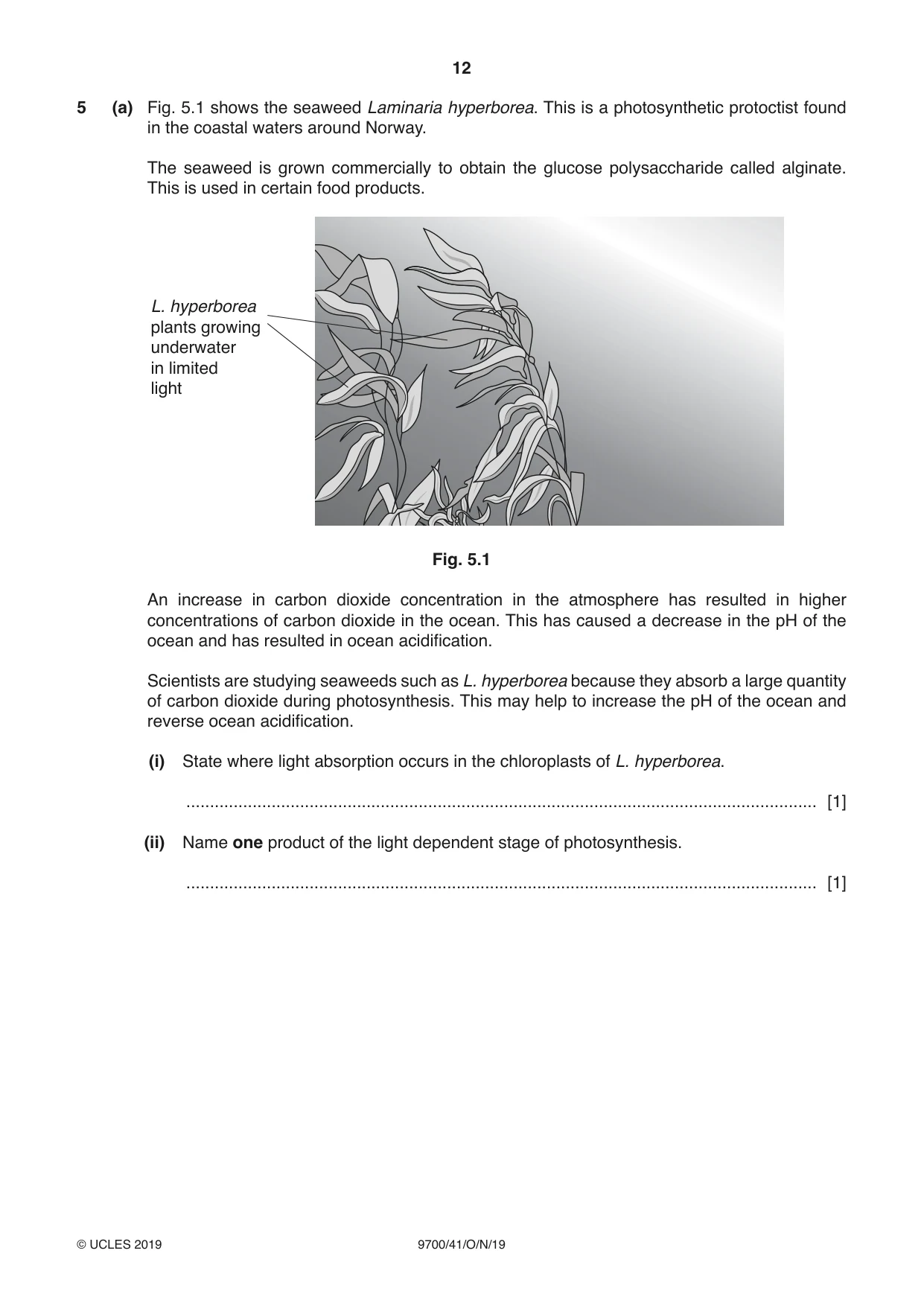
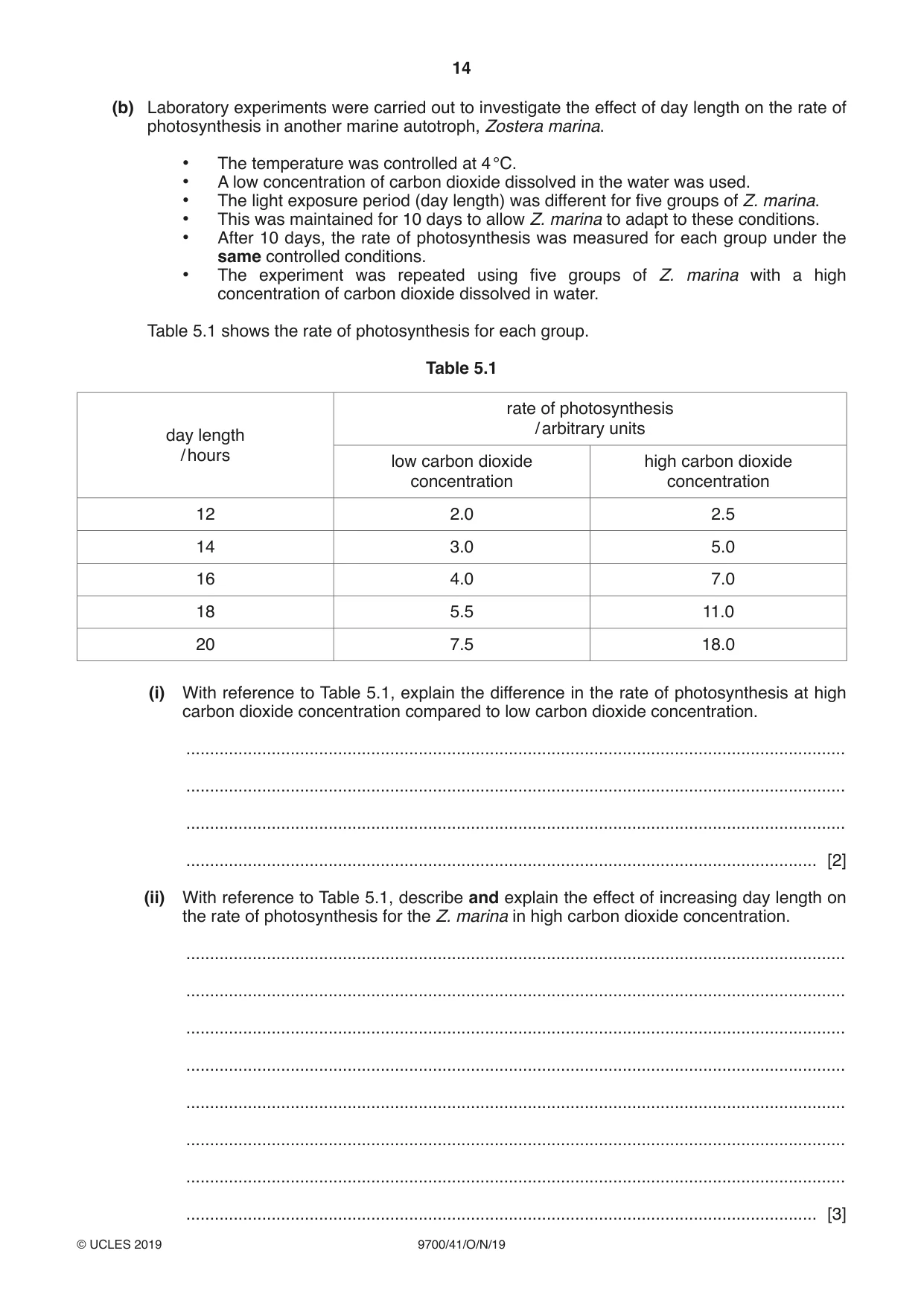
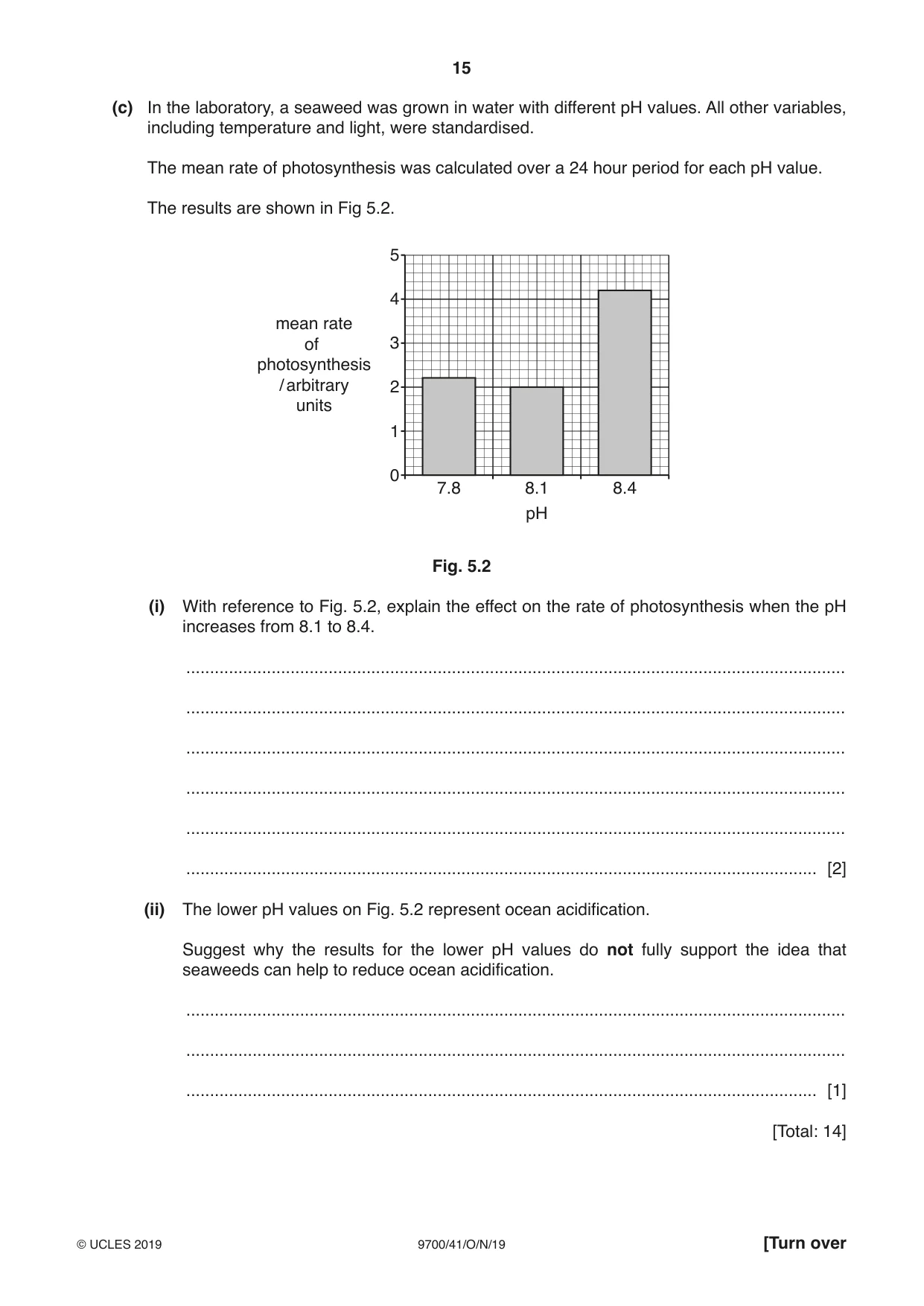
5 (a) Fig. 5.1 shows the seaweed Laminaria hyperborea. This is a photosynthetic protoctist found in the coastal waters around Norway. The seaweed is grown commercially to obtain the glucose polysaccharide called alginate. This is used in certain food products. L. hyperborea plants growing underwater in limited light Fig. 5.1 An increase in carbon dioxide concentration in the atmosphere has resulted in higher concentrations of carbon dioxide in the ocean. This has caused a decrease in the pH of the ocean and has resulted in ocean acidification. Scientists are studying seaweeds such as L. hyperborea because they absorb a large quantity of carbon dioxide during photosynthesis. This may help to increase the pH of the ocean and reverse ocean acidification. (i) State where light absorption occurs in the chloroplasts of L. hyperborea. ..................................................................................................................................... [1] (ii) Name one product of the light dependent stage of photosynthesis. ..................................................................................................................................... [1] (iii) Outline the reactions occurring in the stroma that lead to the production of a polysaccharide, such as alginate. The first sentence has been completed for you. Carbon dioxide binds to RuBP. ........................................................................................................................................... ........................................................................................................................................... ........................................................................................................................................... ........................................................................................................................................... ........................................................................................................................................... ........................................................................................................................................... ........................................................................................................................................... ........................................................................................................................................... ........................................................................................................................................... ..................................................................................................................................... [4] (b) Laboratory experiments were carried out to investigate the effect of day length on the rate of photosynthesis in another marine autotroph, Zostera marina. • The temperature was controlled at 4 °C. • A low concentration of carbon dioxide dissolved in the water was used. • The light exposure period (day length) was different for five groups of Z. marina. • This was maintained for 10 days to allow Z. marina to adapt to these conditions. • After 10 days, the rate of photosynthesis was measured for each group under the same controlled conditions. • The experiment was repeated using five groups of Z. marina with a high concentration of carbon dioxide dissolved in water. Table 5.1 shows the rate of photosynthesis for each group. Table 5.1 rate of photosynthesis / arbitrary units day length / hours low carbon dioxide high carbon dioxide concentration concentration 12 2.0 2.5 14 3.0 5.0 16 4.0 7.0 18 5.5 11.0 20 7.5 18.0 (i) With reference to Table 5.1, explain the difference in the rate of photosynthesis at high carbon dioxide concentration compared to low carbon dioxide concentration. ........................................................................................................................................... ........................................................................................................................................... ........................................................................................................................................... ..................................................................................................................................... [2] (ii) With reference to Table 5.1, describe and explain the effect of increasing day length on the rate of photosynthesis for the Z. marina in high carbon dioxide concentration. ........................................................................................................................................... ........................................................................................................................................... ........................................................................................................................................... ........................................................................................................................................... ........................................................................................................................................... ........................................................................................................................................... ........................................................................................................................................... ..................................................................................................................................... [3] (c) In the laboratory, a seaweed was grown in water with different pH values. All other variables, including temperature and light, were standardised. The mean rate of photosynthesis was calculated over a 24 hour period for each pH value. The results are shown in Fig 5.2. 5 4 mean rate of 3 photosynthesis / arbitrary 2 units 1 0 7.8 8.1 8.4 pH Fig. 5.2 (i) With reference to Fig. 5.2, explain the effect on the rate of photosynthesis when the pH increases from 8.1 to 8.4. ........................................................................................................................................... ........................................................................................................................................... ........................................................................................................................................... ........................................................................................................................................... ........................................................................................................................................... ..................................................................................................................................... [2] (ii) The lower pH values on Fig. 5.2 represent ocean acidification. Suggest why the results for the lower pH values do not fully support the idea that seaweeds can help to reduce ocean acidification. ........................................................................................................................................... ........................................................................................................................................... ..................................................................................................................................... [1] [Total: 14]
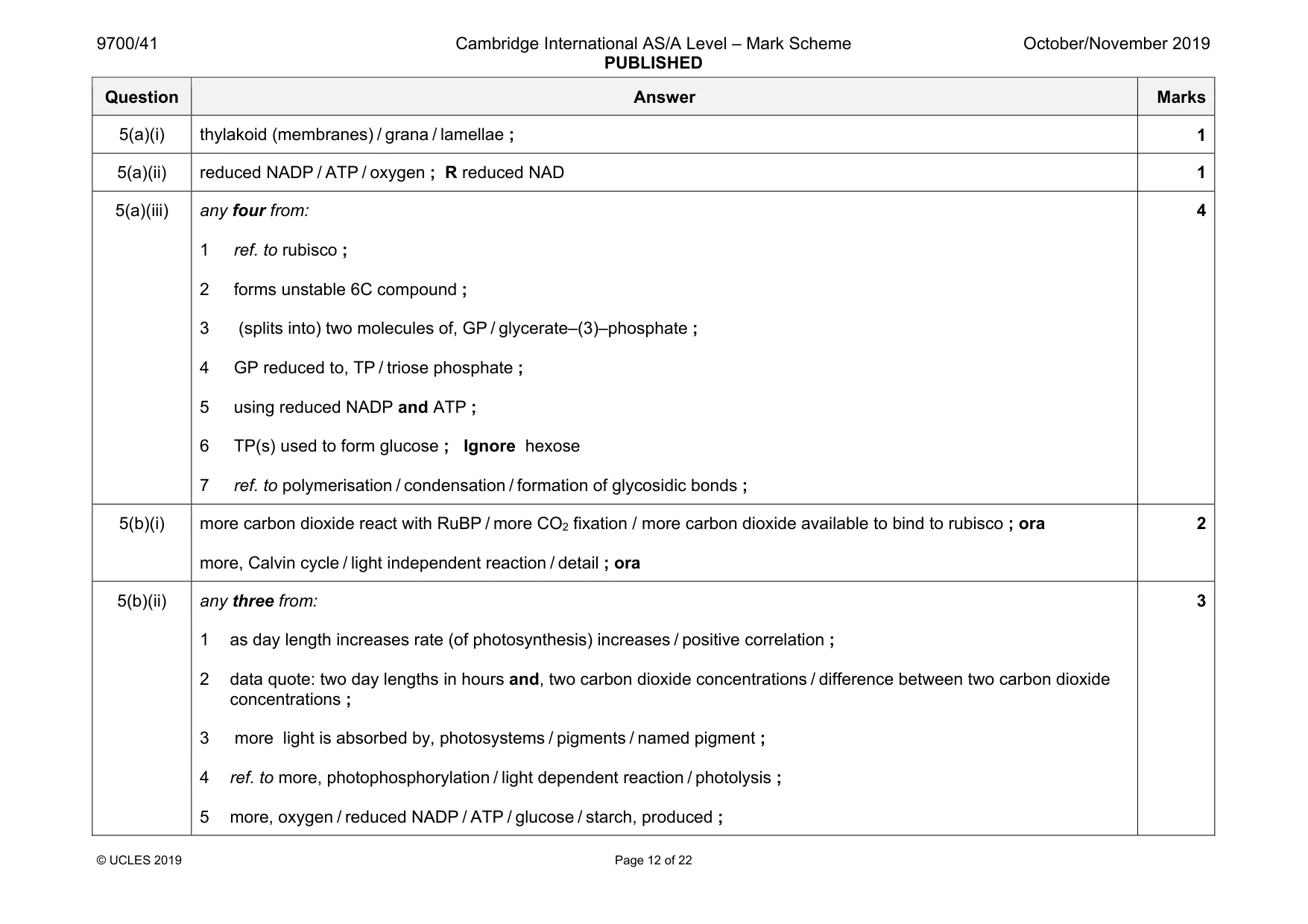
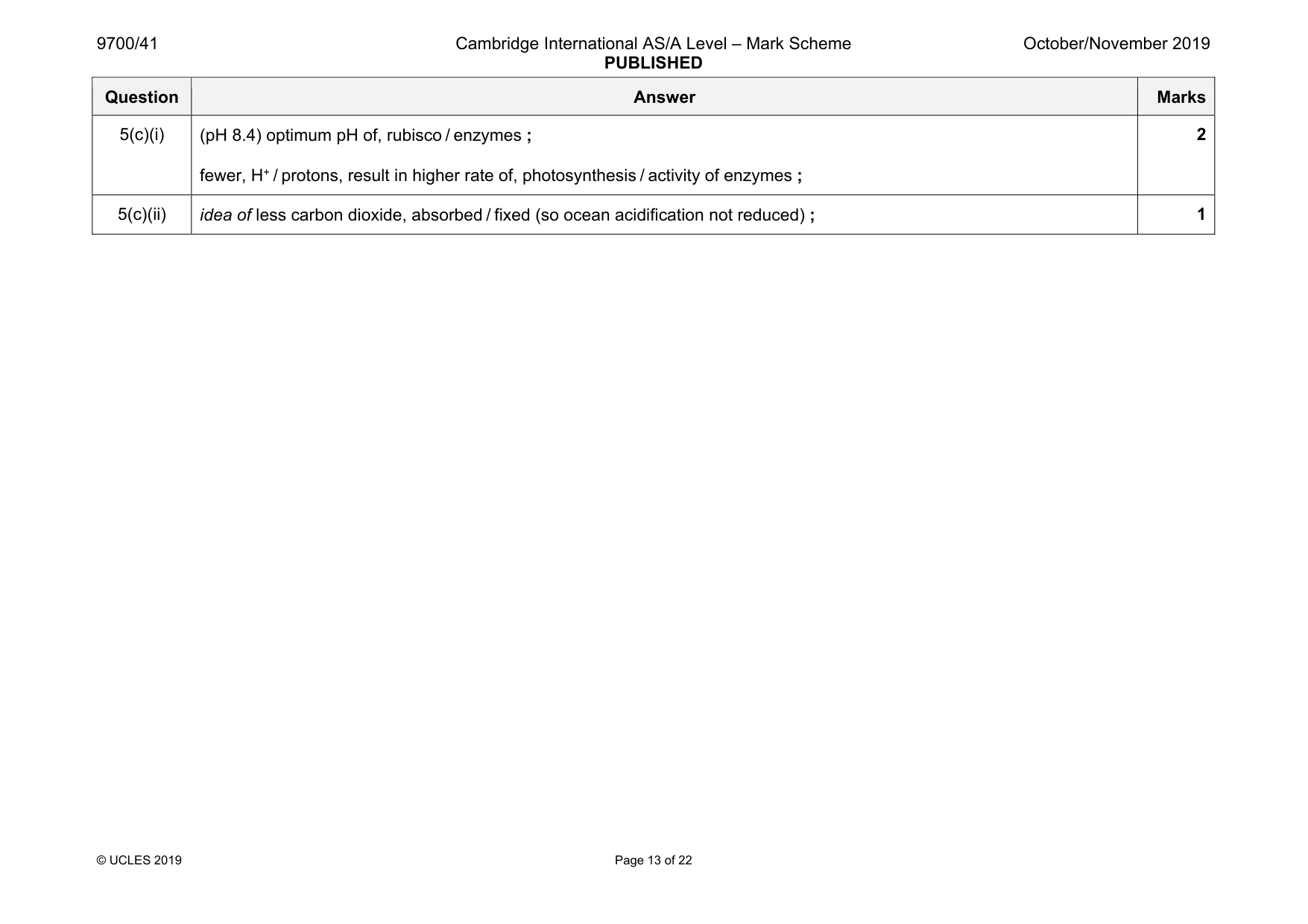
Mark scheme: 5(a)(i) thylakoid (membranes) / grana / lamellae ; 1 5(a)(ii) reduced NADP / ATP / oxygen ; R reduced NAD 1 5(a)(iii) any four from: 1 ref. to rubisco ; 2 forms unstable 6C compound ; 3 (splits into) two molecules of, GP / glycerate–(3)–phosphate ; 4 GP reduced to, TP / triose phosphate ; 5 using reduced NADP and ATP ; 6 TP(s) used to form glucose ; Ignore hexose 7 ref. to polymerisation / condensation / formation of glycosidic bonds ; 4 5(b)(i) more carbon dioxide react with RuBP / more CO2 fixation / more carbon dioxide available to bind to rubisco ; ora more, Calvin cycle / light independent reaction / detail ; ora 2 5(b)(ii) any three from: 1 as day length increases rate (of photosynthesis) increases / positive correlation ; 2 data quote: two day lengths in hours and, two carbon dioxide concentrations / difference between two carbon dioxide concentrations ; 3 more light is absorbed by, photosystems / pigments / named pigment ; 4 ref. to more, photophosphorylation / light dependent reaction / photolysis ; 5 more, oxygen / reduced NADP / ATP / glucose / starch, produced ; 3 Question Answer Marks 5(c)(i) (pH 8.4) optimum pH of, rubisco / enzymes ; fewer, H+ / protons, result in higher rate of, photosynthesis / activity of enzymes ; 2 5(c)(ii) idea of less carbon dioxide, absorbed / fixed (so ocean acidification not reduced) ; 1
Q6 · The genus Heliconius contains more than 40 species of brightly patterned butterflies
6 The genus Heliconius contains more than 40 species of brightly patterned butterflies. Researchers have investigated in the laboratory how one species, Heliconius heurippa, could have developed as a separate species. The phenotype of H. heurippa is intermediate between that of two other species, H. cydno and H. melpomene. Laboratory breeding experiments showed that: • matings between H. cydno and H. melpomene (parent species) produce fertile hybrid offspring • controlled matings of the hybrids produces individuals identical in appearance to H. heurippa within three generations • hybrid butterflies prefer to mate with each other, rather than with individuals of either of the parent species. The researchers concluded that the H. heurippa species could contain DNA from the two parent species as a result of hybridisation. (a) (i) Suggest, with reasons, one prediction that can be made about the chromosome numbers of H. cydno and H. melpomene. ........................................................................................................................................... ........................................................................................................................................... ........................................................................................................................................... ........................................................................................................................................... ..................................................................................................................................... [2] (ii) The researchers thought that, because the hybrid butterflies preferred to mate with each other, this could make speciation more likely to occur. Give reasons why the researchers thought that this made speciation more likely. ........................................................................................................................................... ........................................................................................................................................... ........................................................................................................................................... ........................................................................................................................................... ........................................................................................................................................... ........................................................................................................................................... .......................................................................................................................................... ........................................................................................................................................... ........................................................................................................................................... ..................................................................................................................................... [4] (b) Heliconius butterflies taste unpleasant to predators such as birds. The bright colours on the wings of the butterflies act as warnings so that birds avoid eating them. Individual birds have to learn which patterns to avoid. If one Heliconius species is abundant, or if it has a pattern shared with another similar species, predators learn to avoid this pattern faster. Therefore this pattern provides a selective advantage. In the wild, Heliconius hybrids occur in small numbers and have patterns that do not resemble the established warning pattern of either parent species. These hybrids have a selective disadvantage. This is an example of a post-zygotic isolating mechanism. Explain how selection against hybrids can act as a post-zygotic isolating mechanism. ................................................................................................................................................... ................................................................................................................................................... ................................................................................................................................................... ................................................................................................................................................... ................................................................................................................................................... ............................................................................................................................................. [2] [Total: 8]
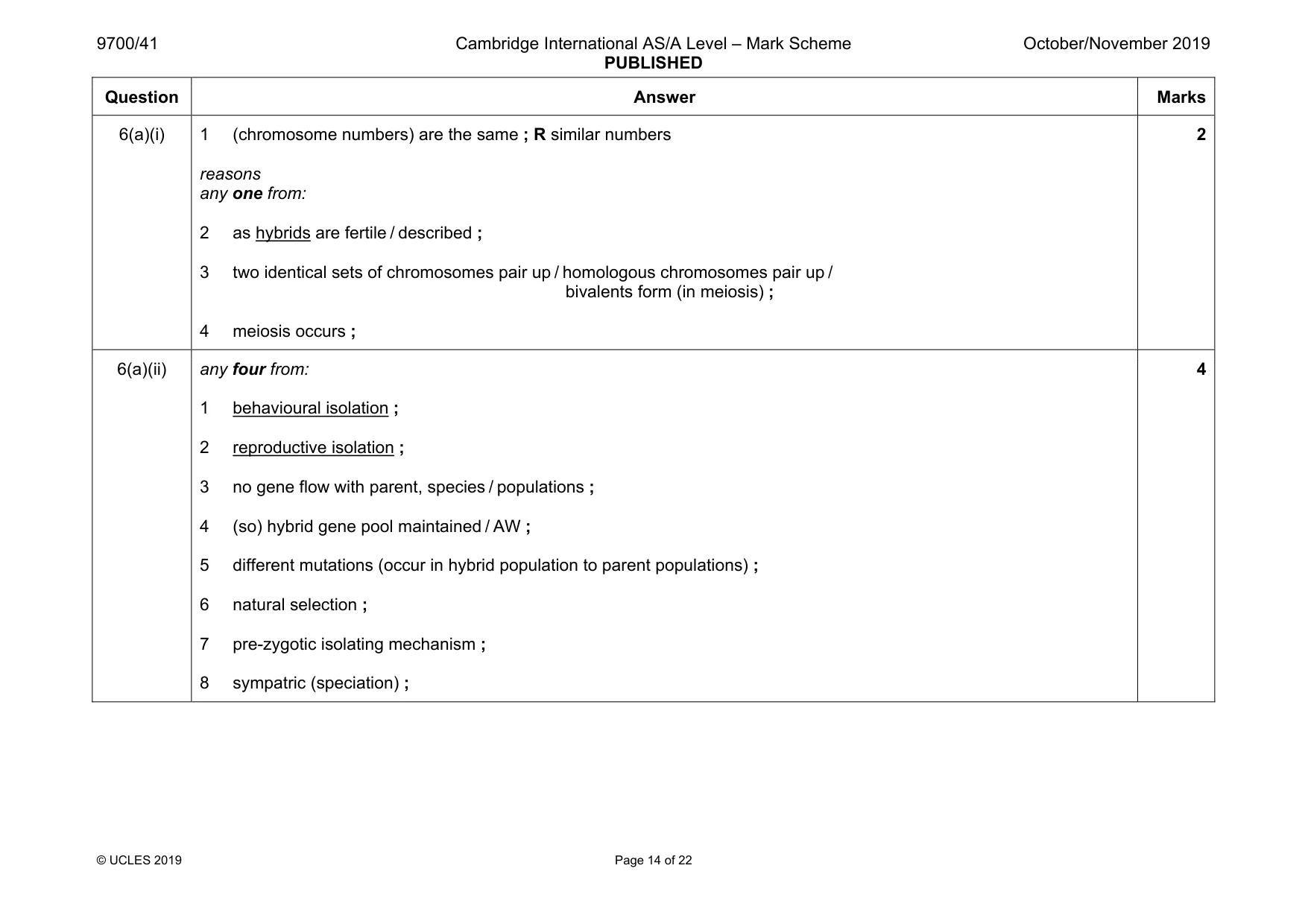
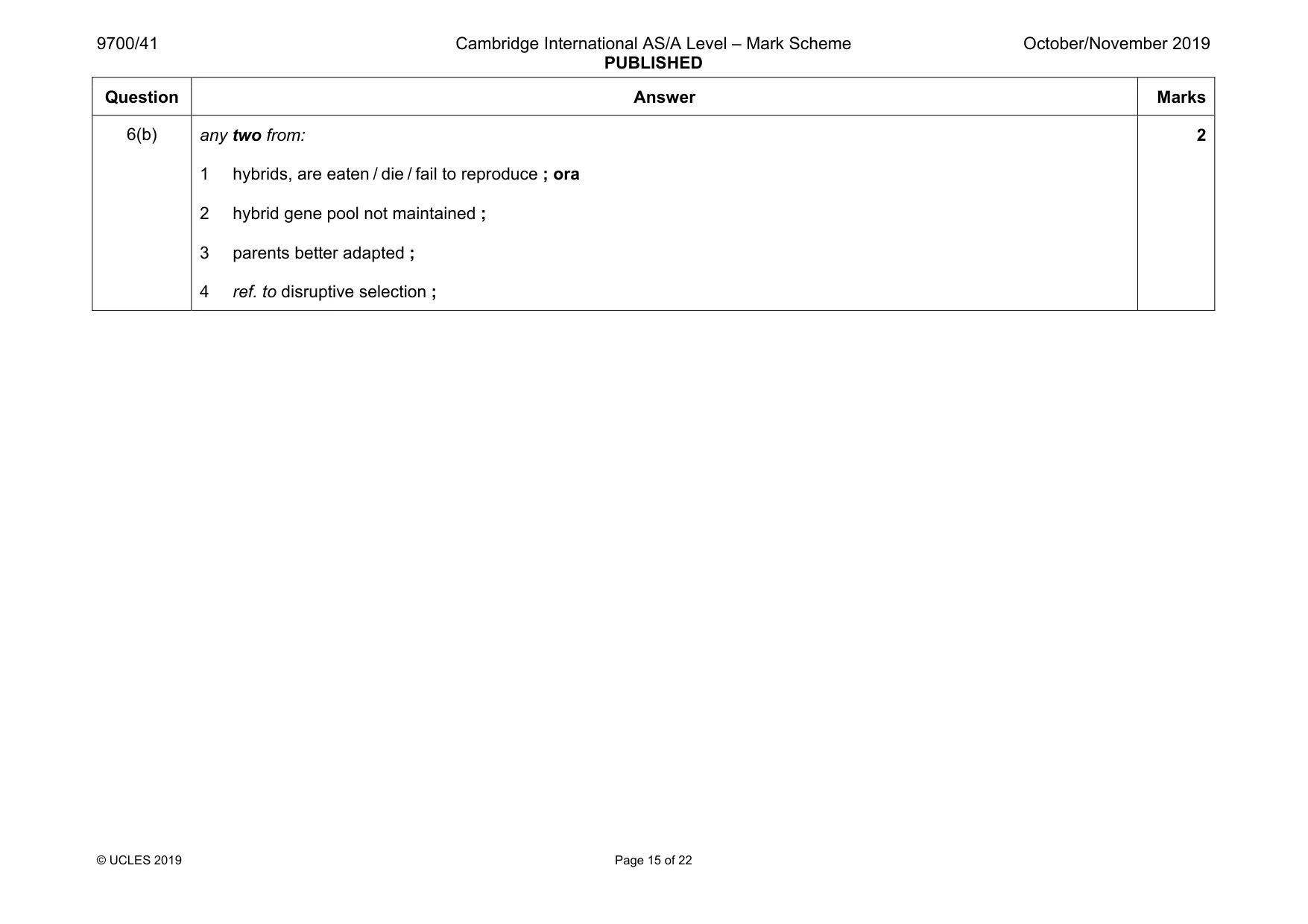
Mark scheme: 6(a)(i) 1 (chromosome numbers) are the same ; R similar numbers reasons any one from: 2 as hybrids are fertile / described ; 3 two identical sets of chromosomes pair up / homologous chromosomes pair up / bivalents form (in meiosis) ; 4 meiosis occurs ; 2 6(a)(ii) any four from: 1 behavioural isolation ; 2 reproductive isolation ; 3 no gene flow with parent, species / populations ; 4 (so) hybrid gene pool maintained / AW ; 5 different mutations (occur in hybrid population to parent populations) ; 6 natural selection ; 7 pre-zygotic isolating mechanism ; 8 sympatric (speciation) ; 4 Question Answer Marks 6(b) any two from: 1 hybrids, are eaten / die / fail to reproduce ; ora 2 hybrid gene pool not maintained ; 3 parents better adapted ; 4 ref. to disruptive selection ; 2
Q7 · The Venus fly trap, Dionaea muscipula, is a carnivorous plant, native to wetlands of the…
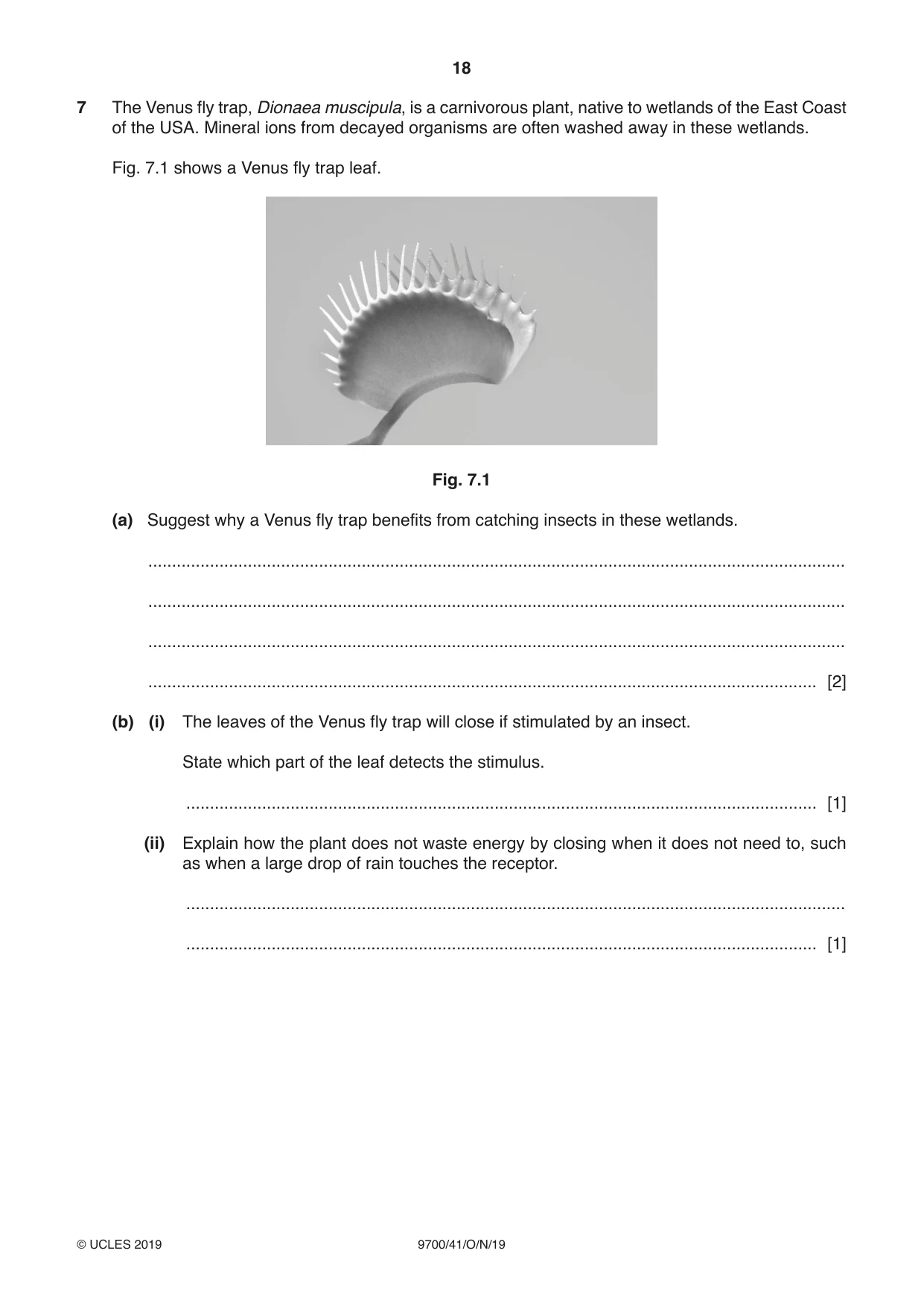
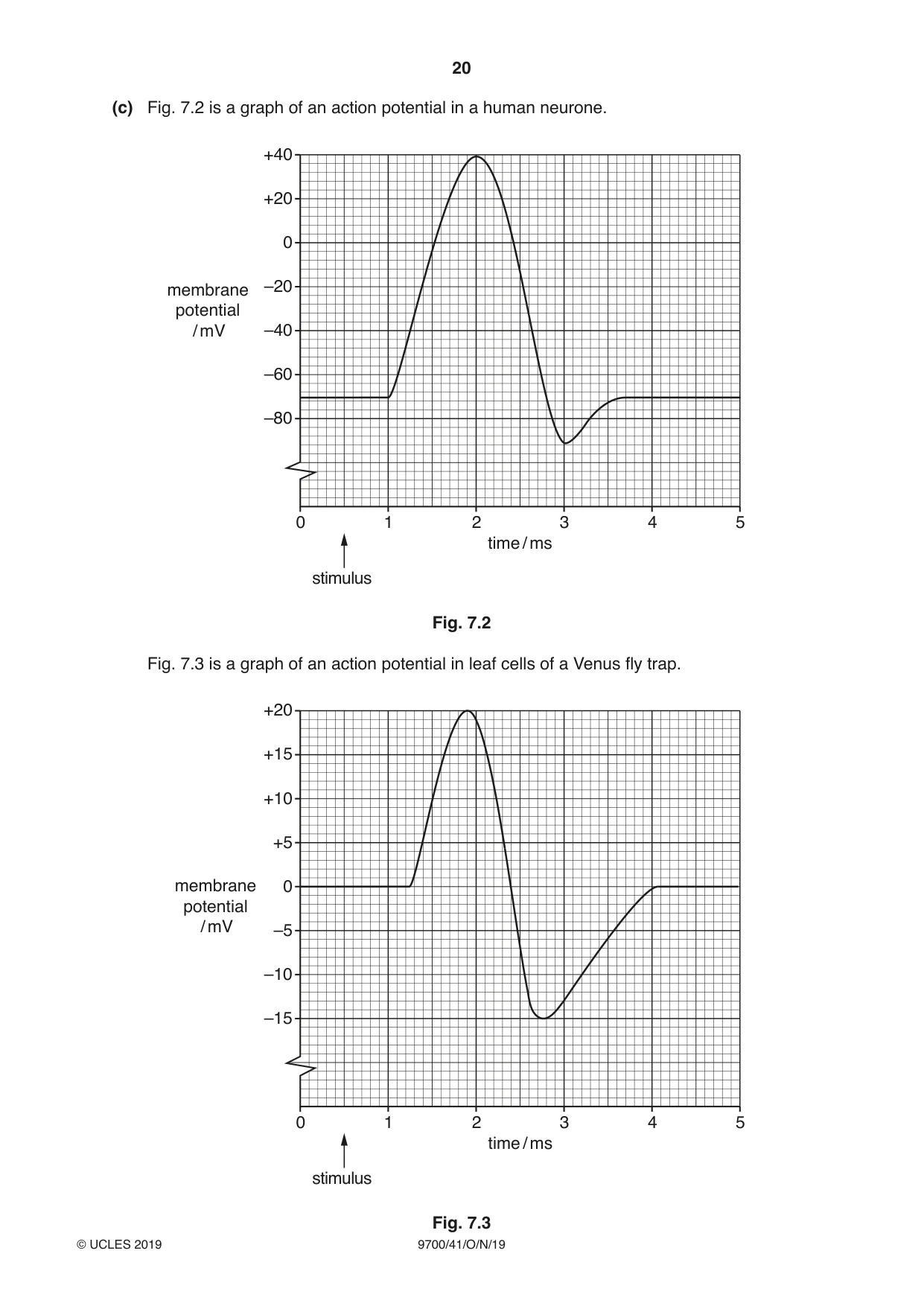
7 The Venus fly trap, Dionaea muscipula, is a carnivorous plant, native to wetlands of the East Coast of the USA. Mineral ions from decayed organisms are often washed away in these wetlands. Fig. 7.1 shows a Venus fly trap leaf. Fig. 7.1 (a) Suggest why a Venus fly trap benefits from catching insects in these wetlands. ................................................................................................................................................... ................................................................................................................................................... ................................................................................................................................................... ............................................................................................................................................. [2] (b) (i) The leaves of the Venus fly trap will close if stimulated by an insect. State which part of the leaf detects the stimulus. ..................................................................................................................................... [1] (ii) Explain how the plant does not waste energy by closing when it does not need to, such as when a large drop of rain touches the receptor. ........................................................................................................................................... ..................................................................................................................................... [1] Question 7 continues on page 20. (c) Fig. 7.2 is a graph of an action potential in a human neurone. +40 +20 0 membrane –20 potential / mV –40 –60 –80 0 1 2 3 4 5 time / ms stimulus Fig. 7.2 Fig. 7.3 is a graph of an action potential in leaf cells of a Venus fly trap. +20 +15 +10 +5 membrane 0 potential / mV –5 –10 –15 0 1 2 3 4 5 time / ms stimulus Fig. 7.3 With reference to Fig. 7.2 and Fig. 7.3, describe how the action potential of the Venus fly trap differs from that of a human. ................................................................................................................................................... ................................................................................................................................................... ................................................................................................................................................... ................................................................................................................................................... ................................................................................................................................................... ................................................................................................................................................... ............................................................................................................................................. [3] (d) Describe how the production of action potentials in the leaf cells of the Venus fly trap can result in the leaves closing and trapping an insect. ................................................................................................................................................... ................................................................................................................................................... ................................................................................................................................................... ................................................................................................................................................... ................................................................................................................................................... ................................................................................................................................................... ................................................................................................................................................... ................................................................................................................................................... ................................................................................................................................................... ................................................................................................................................................... ............................................................................................................................................. [5] [Total: 12]
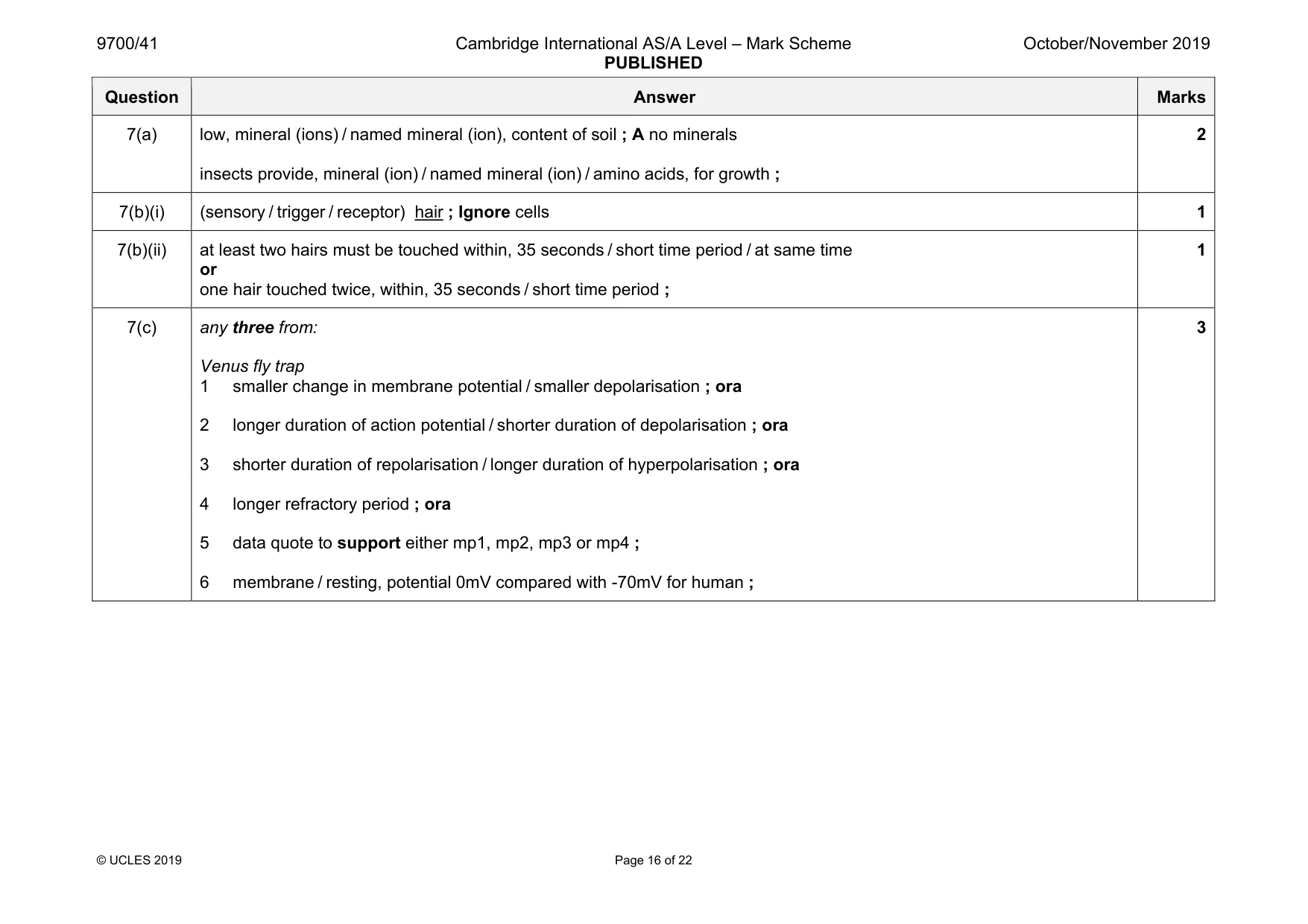
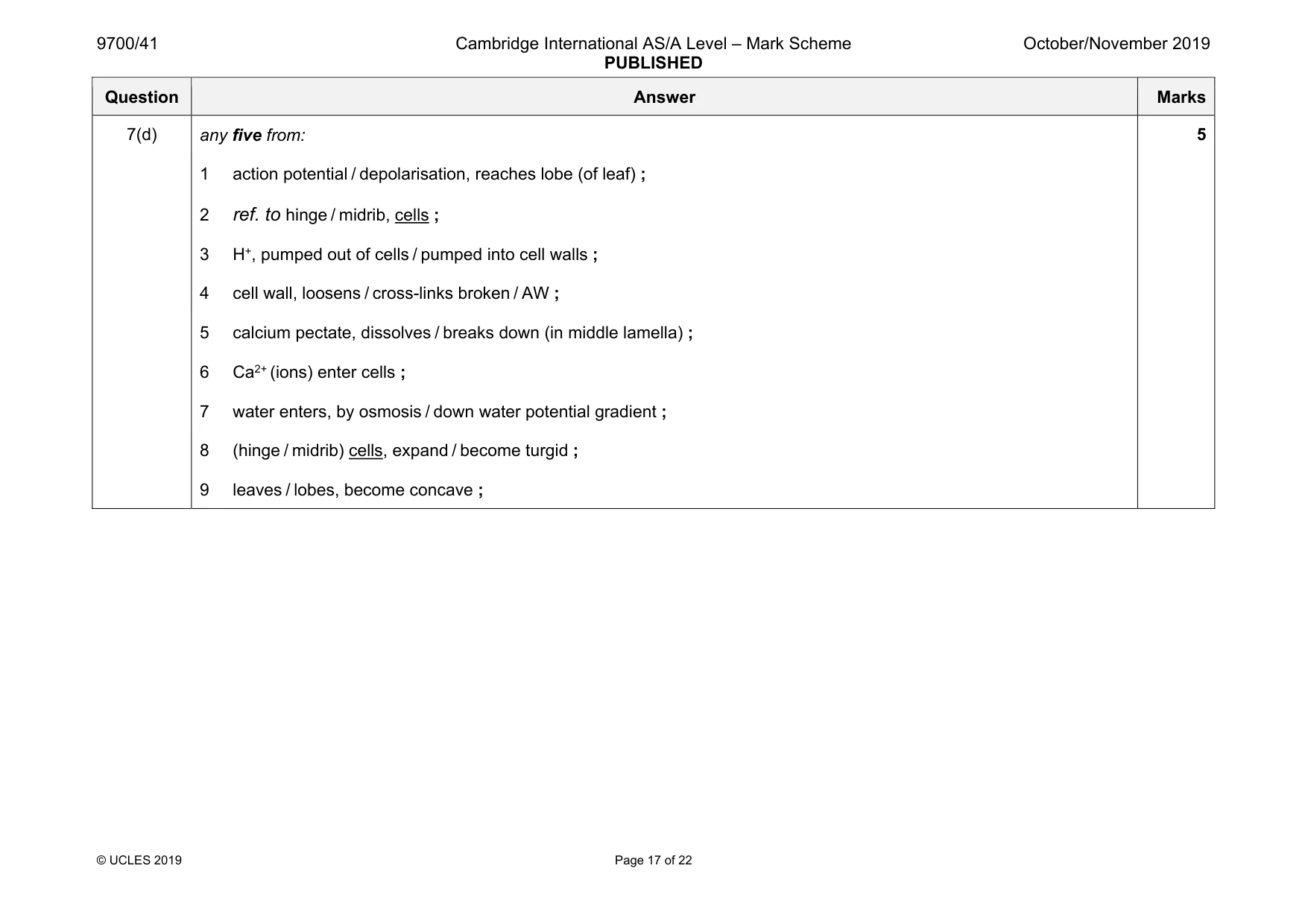
Mark scheme: 7(a) low, mineral (ions) / named mineral (ion), content of soil ; A no minerals insects provide, mineral (ion) / named mineral (ion) / amino acids, for growth ; 2 7(b)(i) (sensory / trigger / receptor) hair ; Ignore cells 1 7(b)(ii) at least two hairs must be touched within, 35 seconds / short time period / at same time or one hair touched twice, within, 35 seconds / short time period ; 1 7(c) any three from: Venus fly trap 1 smaller change in membrane potential / smaller depolarisation ; ora 2 longer duration of action potential / shorter duration of depolarisation ; ora 3 shorter duration of repolarisation / longer duration of hyperpolarisation ; ora 4 longer refractory period ; ora 5 data quote to support either mp1, mp2, mp3 or mp4 ; 6 membrane / resting, potential 0mV compared with -70mV for human ; 3 Question Answer Marks 7(d) any five from: 1 action potential / depolarisation, reaches lobe (of leaf) ; 2 ref. to hinge / midrib, cells ; 3 H+, pumped out of cells / pumped into cell walls ; 4 cell wall, loosens / cross-links broken / AW ; 5 calcium pectate, dissolves / breaks down (in middle lamella) ; 6 Ca2+ (ions) enter cells ; 7 water enters, by osmosis / down water potential gradient ; 8 (hinge / midrib) cells, expand / become turgid ; 9 leaves / lobes, become concave ; 5
Q8 · The passage below outlines the process of oxidative phosphorylation in mitochondria
8 The passage below outlines the process of oxidative phosphorylation in mitochondria. Complete the passage by using the most appropriate scientific terms. Reduced ............................................. releases hydrogen atoms to cytochrome carriers. Hydrogen atoms split into protons and electrons and the electrons are passed from carrier to carrier. Energy from electron transfer is used to pump protons into the ....................................................... , so that a proton gradient is set up across the ................................................................. . Protons ................................................ through the channel protein known as .............................................................. , into the matrix, producing ATP. The protons combine with electrons and ................................................... atoms to form water. [Total: 6]
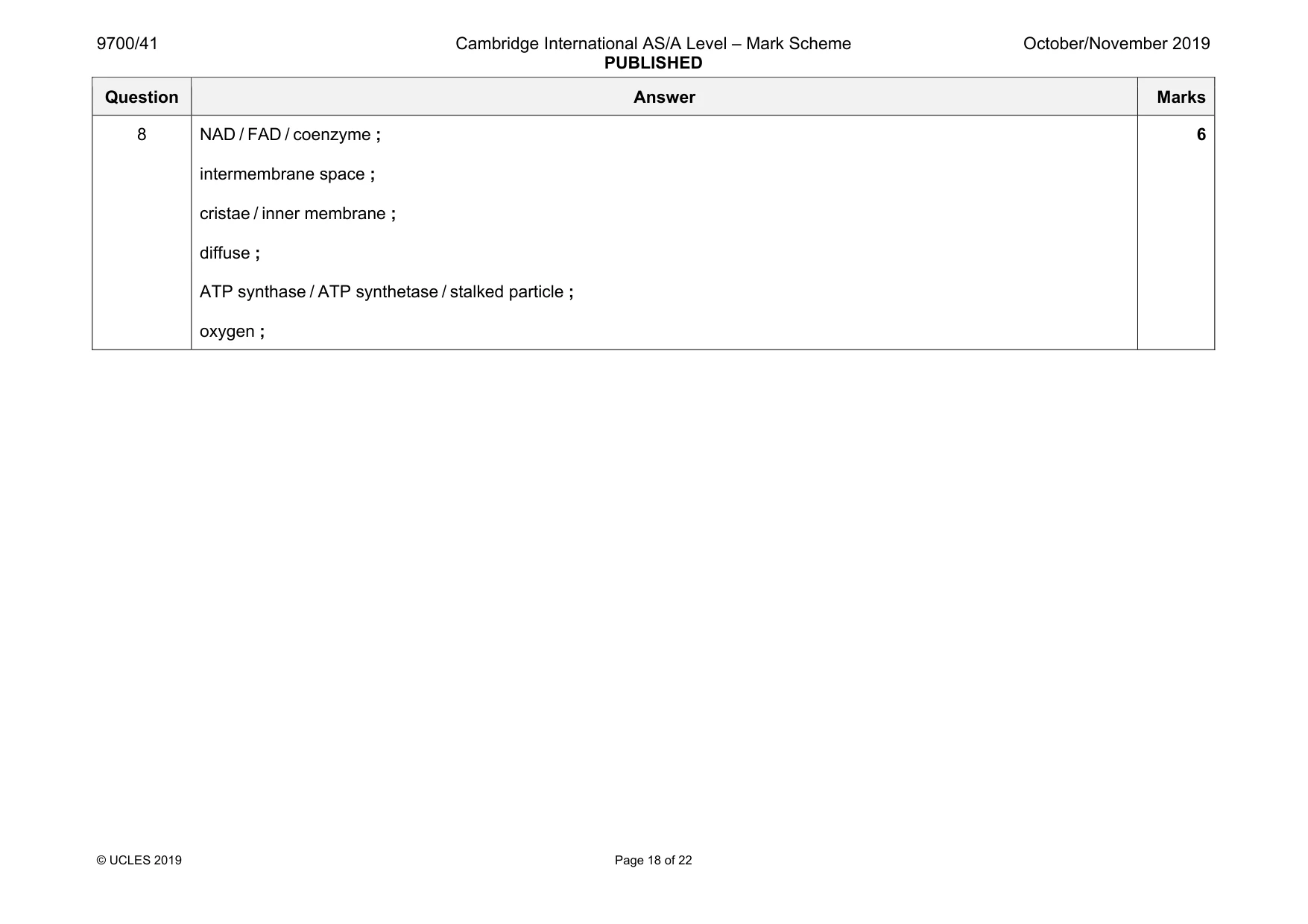
Mark scheme: 8 NAD / FAD / coenzyme ; intermembrane space ; cristae / inner membrane ; diffuse ; ATP synthase / ATP synthetase / stalked particle ; oxygen ; 6
Q9 · Compare the characteristic features of members of the kingdoms Fungi and Animalia
9 (a) Compare the characteristic features of members of the kingdoms Fungi and Animalia. [7] (b) Discuss the methods used in breeding programmes for endangered mammal species and outline the problems that may occur with these programmes. [8] [Total: 15]
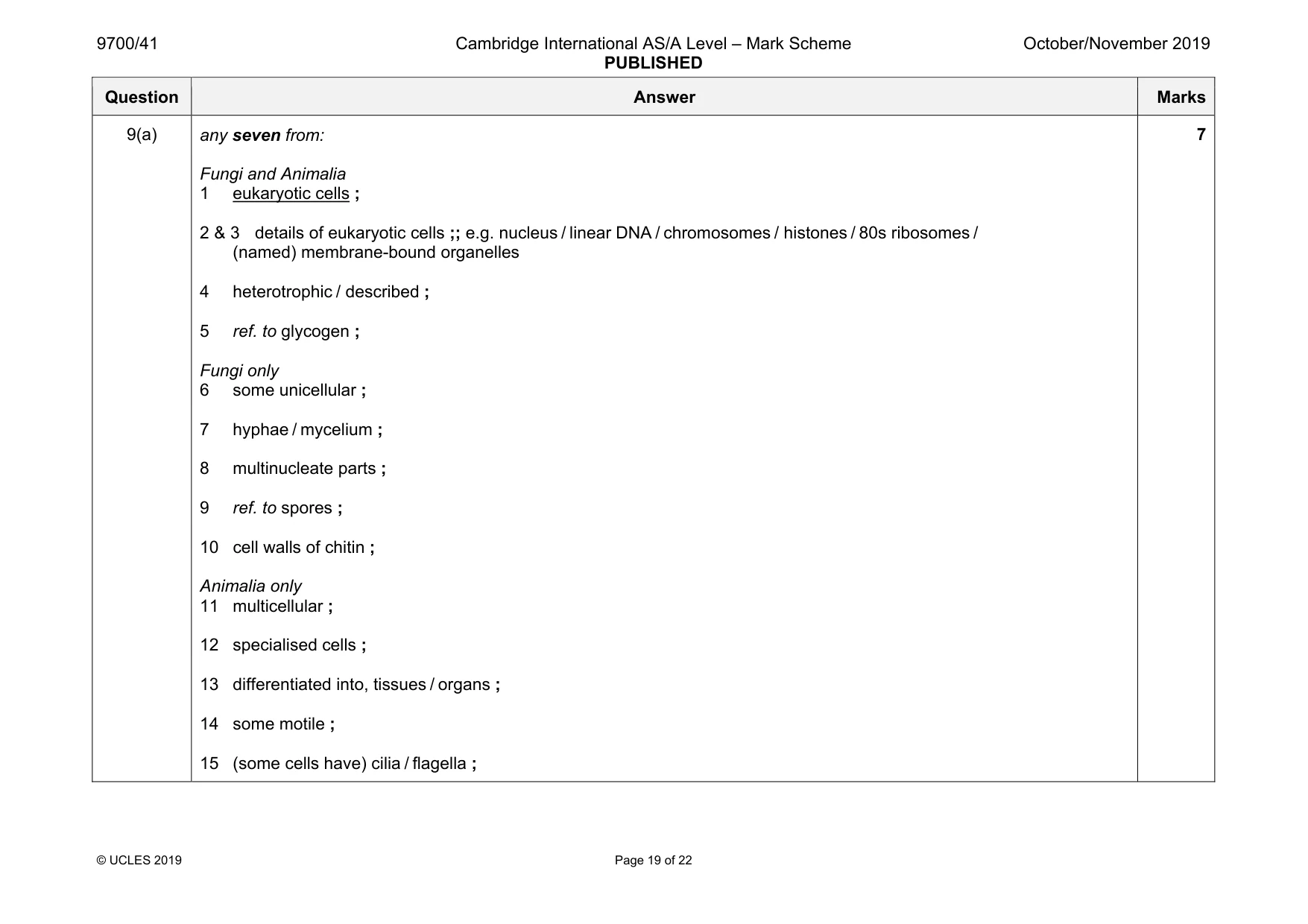
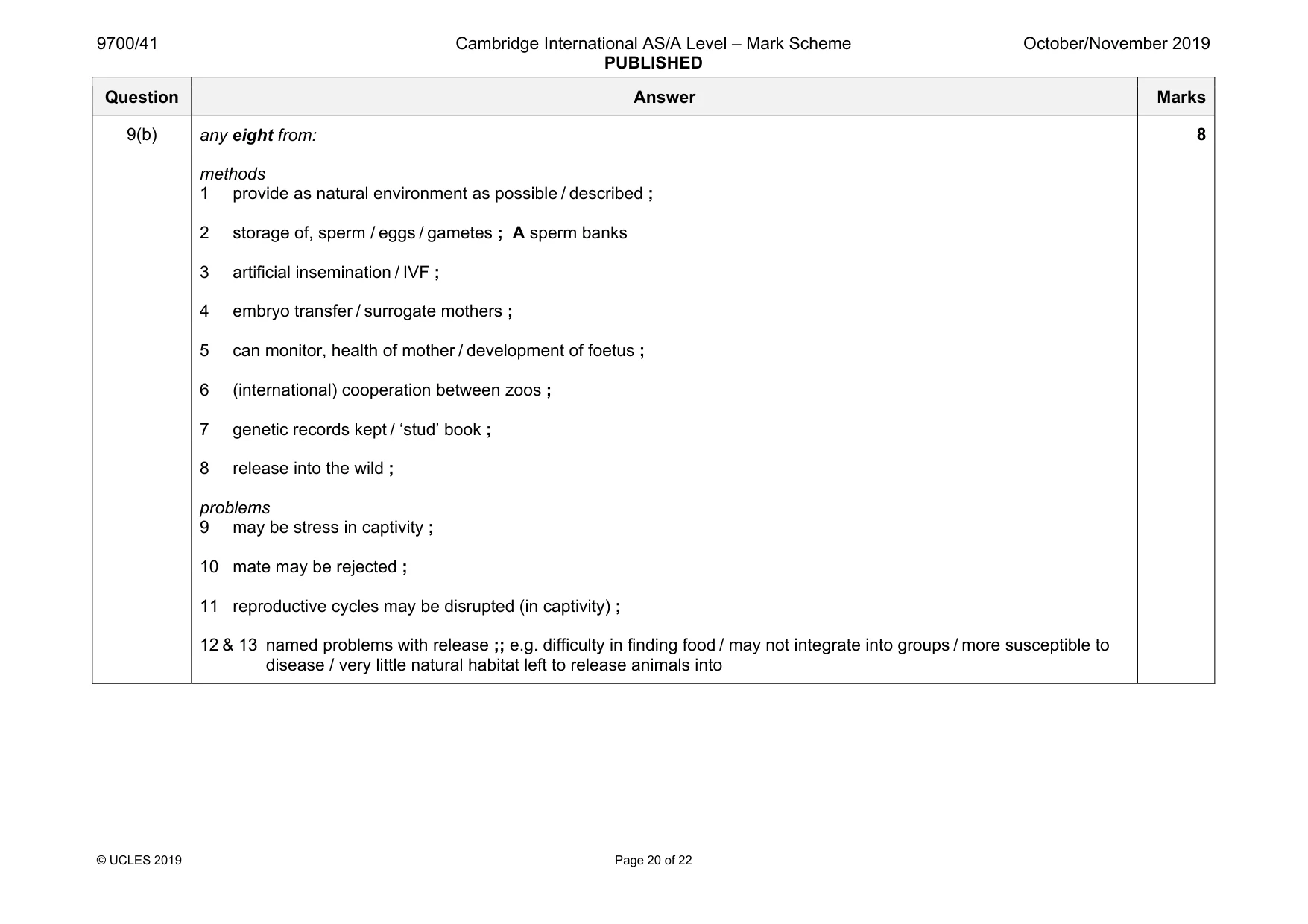
Mark scheme: 9(a) any seven from: Fungi and Animalia 1 eukaryotic cells ; 2 & 3 details of eukaryotic cells ;; e.g. nucleus / linear DNA / chromosomes / histones / 80s ribosomes / (named) membrane-bound organelles 4 heterotrophic / described ; 5 ref. to glycogen ; Fungi only 6 some unicellular ; 7 hyphae / mycelium ; 8 multinucleate parts ; 9 ref. to spores ; 10 cell walls of chitin ; Animalia only 11 multicellular ; 12 specialised cells ; 13 differentiated into, tissues / organs ; 14 some motile ; 15 (some cells have) cilia / flagella ; 7 Question Answer Marks 9(b) any eight from: methods 1 provide as natural environment as possible / described ; 2 storage of, sperm / eggs / gametes ; A sperm banks 3 artificial insemination / IVF ; 4 embryo transfer / surrogate mothers ; 5 can monitor, health of mother / development of foetus ; 6 (international) cooperation between zoos ; 7 genetic records kept / ‘stud’ book ; 8 release into the wild ; problems 9 may be stress in captivity ; 10 mate may be rejected ; 11 reproductive cycles may be disrupted (in captivity) ; 12 & 13 named problems with release ;; e.g. difficulty in finding food / may not integrate into groups / more susceptible to disease / very little natural habitat left to release animals into 8
Q10 · Describe the features of ATP that make it suitable for its role as the universal energy…
10 (a) Describe the features of ATP that make it suitable for its role as the universal energy currency of cells. [6] (b) Describe how you would carry out an investigation on the effect of temperature on the rate of respiration of yeast in anaerobic conditions using a redox indicator, such as methylene blue. [9] [Total: 15] .................................................................................................................................................................. .................................................................................................................................................................. .................................................................................................................................................................. .................................................................................................................................................................. .................................................................................................................................................................. .................................................................................................................................................................. .................................................................................................................................................................. .................................................................................................................................................................. .................................................................................................................................................................. .................................................................................................................................................................. .................................................................................................................................................................. .................................................................................................................................................................. .................................................................................................................................................................. .................................................................................................................................................................. .................................................................................................................................................................. .................................................................................................................................................................. .................................................................................................................................................................. .................................................................................................................................................................. .................................................................................................................................................................. .................................................................................................................................................................. .................................................................................................................................................................. .................................................................................................................................................................. .................................................................................................................................................................. .................................................................................................................................................................. .................................................................................................................................................................. .................................................................................................................................................................. .................................................................................................................................................................. .................................................................................................................................................................. .................................................................................................................................................................. .................................................................................................................................................................. .................................................................................................................................................................. .................................................................................................................................................................. .................................................................................................................................................................. .................................................................................................................................................................. .................................................................................................................................................................. .................................................................................................................................................................. .................................................................................................................................................................. .................................................................................................................................................................. .................................................................................................................................................................. .................................................................................................................................................................. .................................................................................................................................................................. .................................................................................................................................................................. .................................................................................................................................................................. .................................................................................................................................................................. .................................................................................................................................................................. .................................................................................................................................................................. .................................................................................................................................................................. .................................................................................................................................................................. .................................................................................................................................................................. .................................................................................................................................................................. .................................................................................................................................................................. .................................................................................................................................................................. .................................................................................................................................................................. .................................................................................................................................................................. .................................................................................................................................................................. .................................................................................................................................................................. .................................................................................................................................................................. .................................................................................................................................................................. .................................................................................................................................................................. .................................................................................................................................................................. .................................................................................................................................................................. .................................................................................................................................................................. .................................................................................................................................................................. .................................................................................................................................................................. .................................................................................................................................................................. .................................................................................................................................................................. .................................................................................................................................................................. .................................................................................................................................................................. .................................................................................................................................................................. .................................................................................................................................................................. .................................................................................................................................................................. ..................................................................................................................................................................
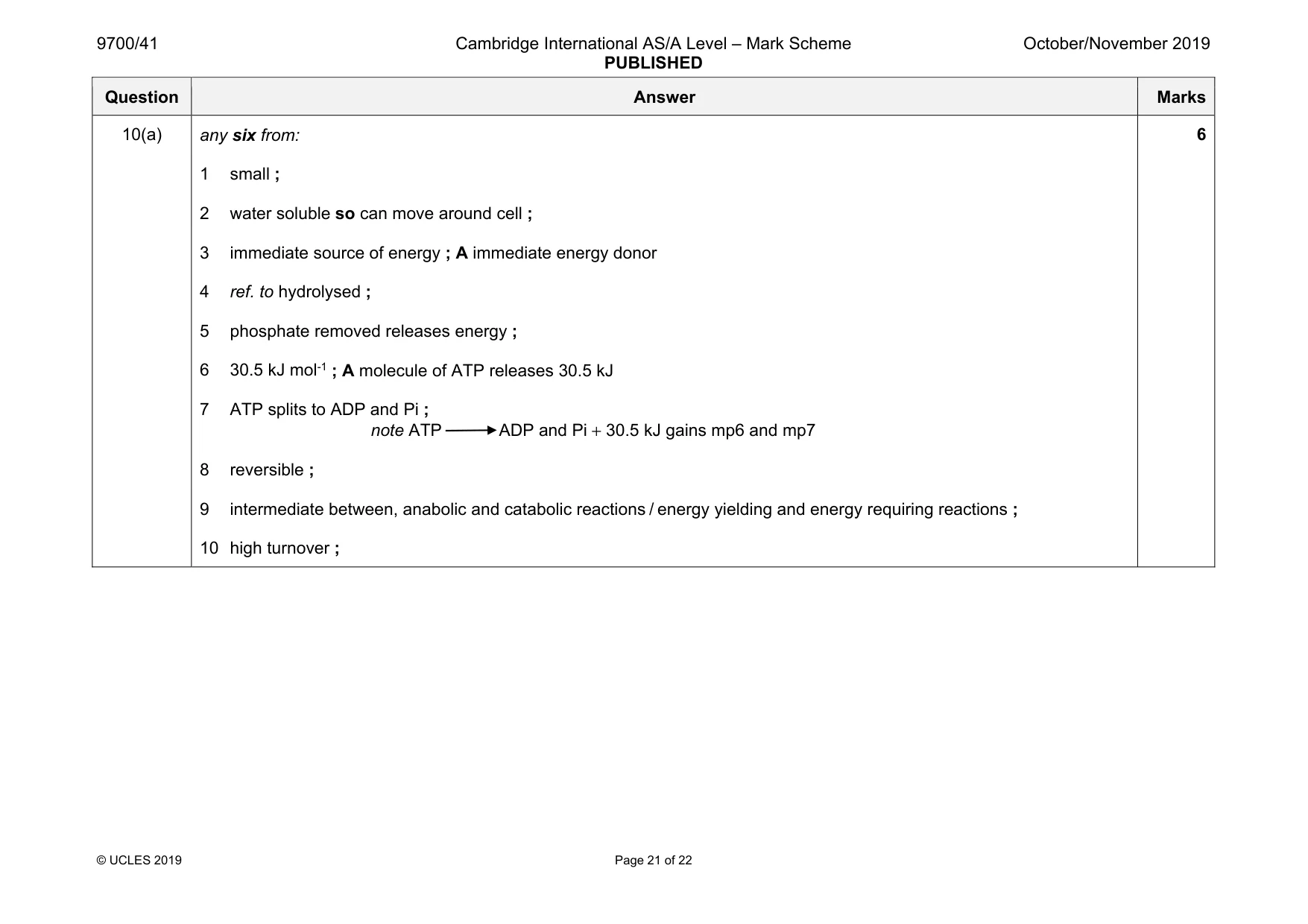
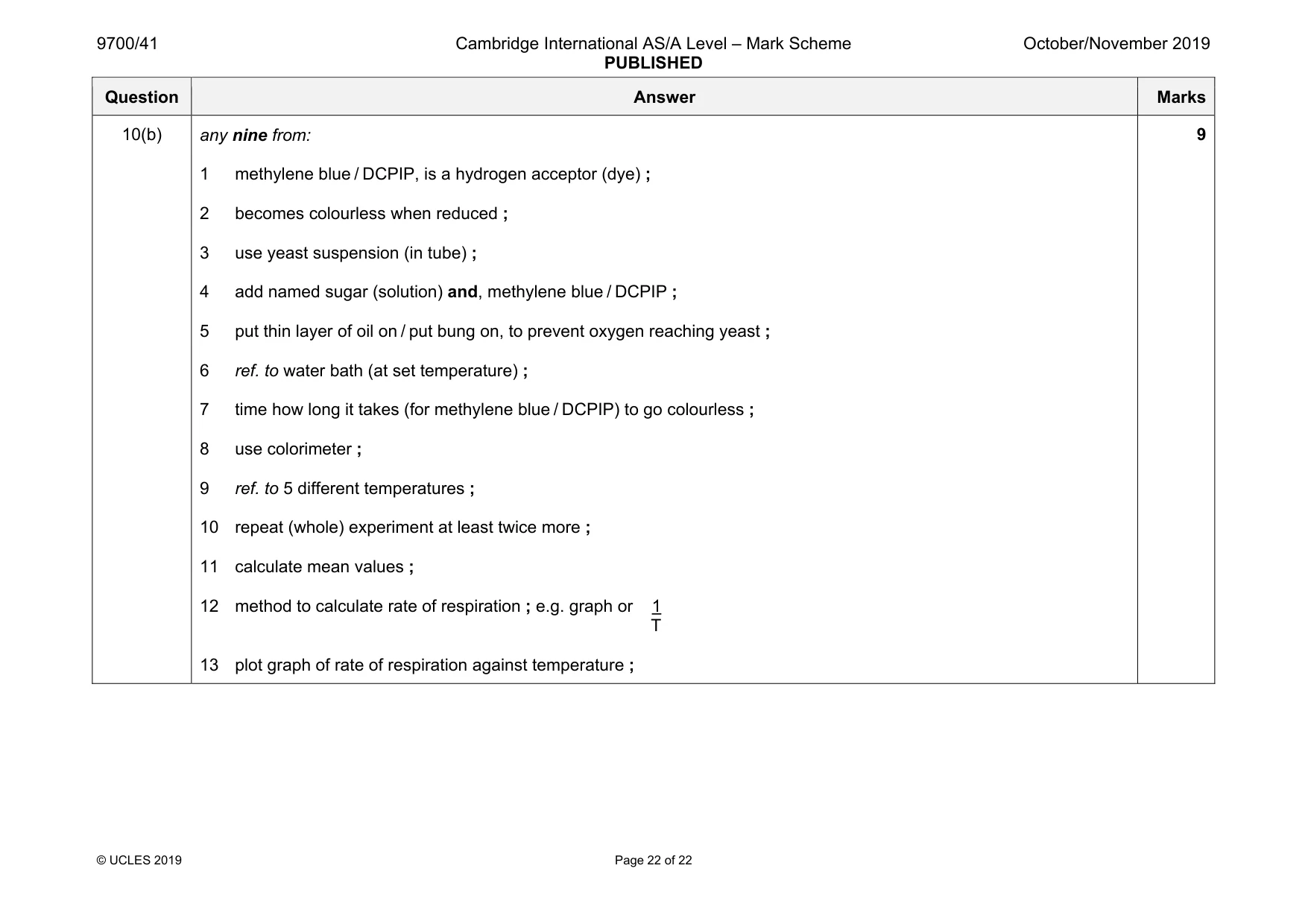
Mark scheme: 10(a) any six from: 1 small ; 2 water soluble so can move around cell ; 3 immediate source of energy ; A immediate energy donor 4 ref. to hydrolysed ; 5 phosphate removed releases energy ; 6 30.5 kJ mol-1 ; A molecule of ATP releases 30.5 kJ 7 ATP splits to ADP and Pi ; note ATP ADP and Pi + 30.5 kJ gains mp6 and mp7 8 reversible ; 9 intermediate between, anabolic and catabolic reactions / energy yielding and energy requiring reactions ; 10 high turnover ; 6 Question Answer Marks 10(b) any nine from: 1 methylene blue / DCPIP, is a hydrogen acceptor (dye) ; 2 becomes colourless when reduced ; 3 use yeast suspension (in tube) ; 4 add named sugar (solution) and, methylene blue / DCPIP ; 5 put thin layer of oil on / put bung on, to prevent oxygen reaching yeast ; 6 ref. to water bath (at set temperature) ; 7 time how long it takes (for methylene blue / DCPIP) to go colourless ; 8 use colorimeter ; 9 ref. to 5 different temperatures ; 10 repeat (whole) experiment at least twice more ; 11 calculate mean values ; 12 method to calculate rate of respiration ; e.g. graph or 1 T 13 plot graph of rate of respiration against temperature ; 9
What was in this paper
The subtopics covered by these 10 questions, and how many questions each got. Open one in a new tab to see every Cambridge question on it.
What you needed in this session
Cambridge’s own grade thresholds for 2019 Oct/Nov, Paper 4 · Variant 1. A higher threshold means an easier paper — the bar moves with how the cohort did.