Cambridge A Level Biology 9700 — 2019 Oct/Nov Paper 4 · Variant 3
9700/43/O/N/19 · 10 questions · 100 marks · ≈113 min
The question paper and its mark scheme, free to read here and free to download. This is Cambridge’s own paper, exactly as it was sat.
Question paper24 pages



Mark scheme14 pages
Answers below. Sit the paper first if you are practising.
Questions as text
Q1 · Part of a guard cell
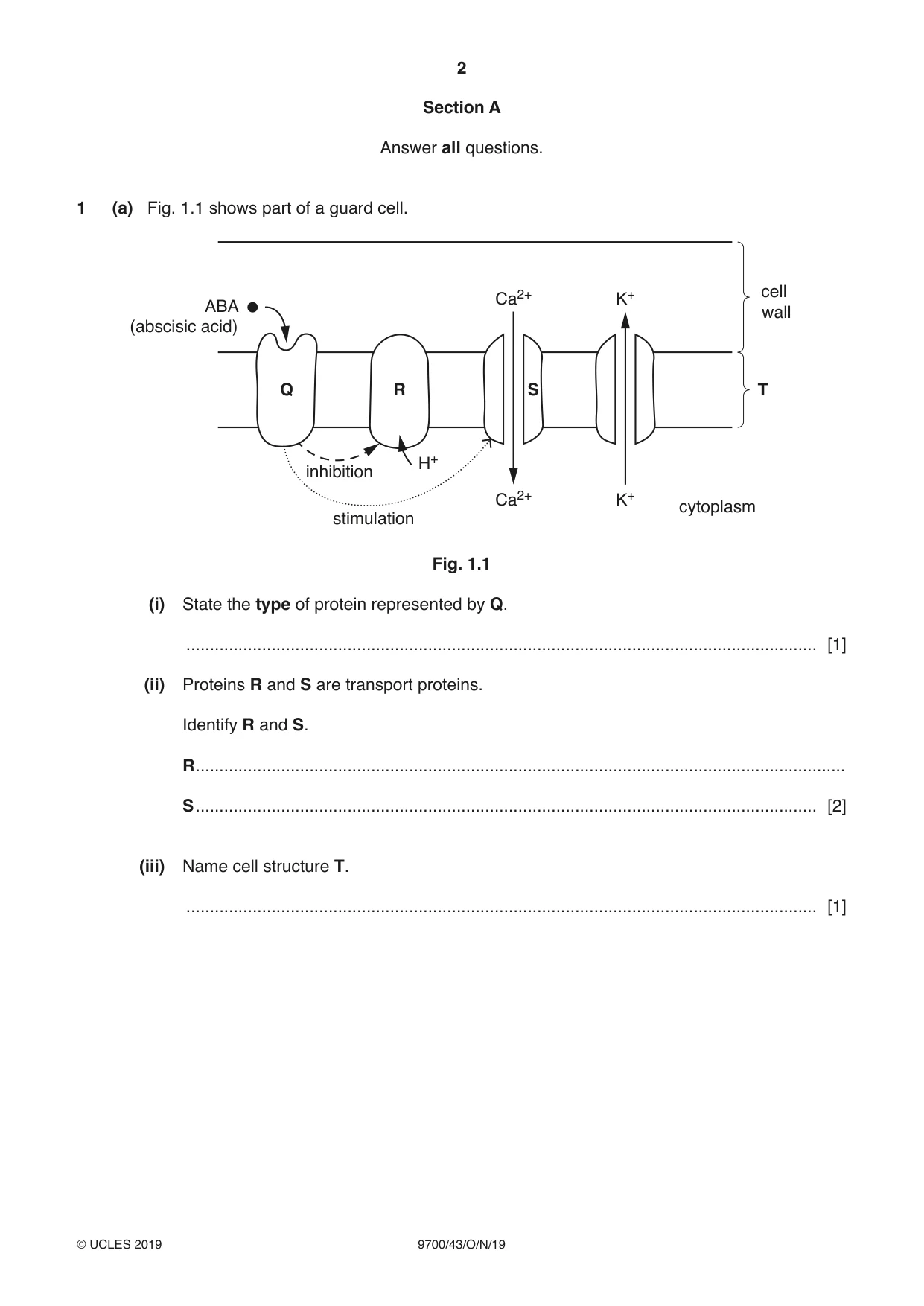
1 (a) Fig. 1.1 shows part of a guard cell. cell Ca2+ K+ ABA wall (abscisic acid) Q R S T H+ inhibition Ca2+ K+ cytoplasm stimulation Fig. 1.1 (i) State the type of protein represented by Q. ..................................................................................................................................... [1] (ii) Proteins R and S are transport proteins. Identify R and S. R ......................................................................................................................................... S ................................................................................................................................... [2] (iii) Name cell structure T. ..................................................................................................................................... [1] (b) With reference to Fig. 1.1, outline the events that occur in a guard cell during times of water stress. ................................................................................................................................................... ................................................................................................................................................... ................................................................................................................................................... ................................................................................................................................................... ................................................................................................................................................... ................................................................................................................................................... ................................................................................................................................................... ................................................................................................................................................... ................................................................................................................................................... ............................................................................................................................................. [5] [Total: 9]
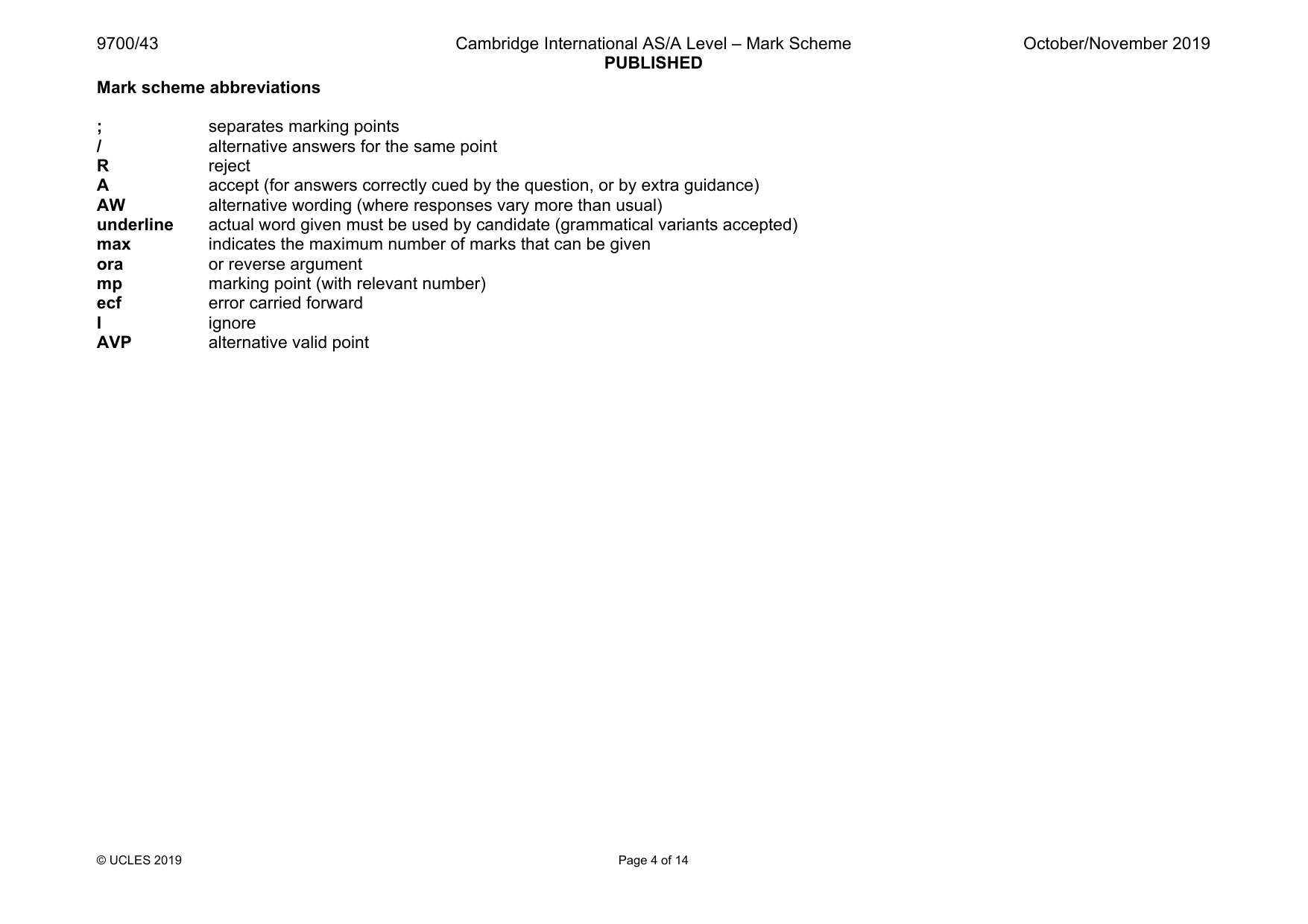
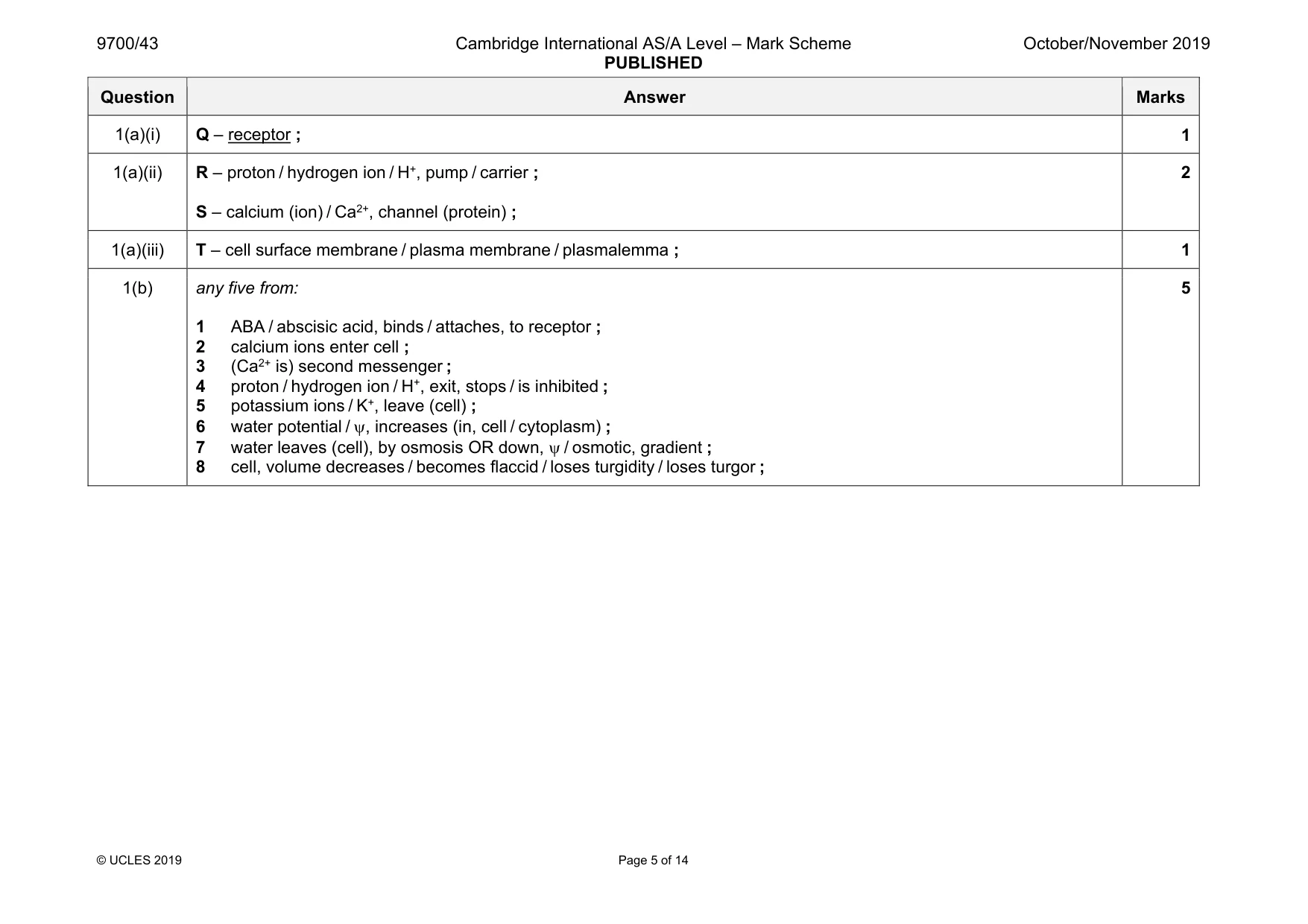
Mark scheme: 1(a)(i) Q – receptor ; 1 1(a)(ii) R – proton / hydrogen ion / H+, pump / carrier ; S – calcium (ion) / Ca2+, channel (protein) ; 2 1(a)(iii) T – cell surface membrane / plasma membrane / plasmalemma ; 1 1(b) any five from: 1 ABA / abscisic acid, binds / attaches, to receptor ; 2 calcium ions enter cell ; 3 (Ca2+ is) second messenger ; 4 proton / hydrogen ion / H+, exit, stops / is inhibited ; 5 potassium ions / K+, leave (cell) ; 6 water potential / ψ, increases (in, cell / cytoplasm) ; 7 water leaves (cell), by osmosis OR down, ψ / osmotic, gradient ; 8 cell, volume decreases / becomes flaccid / loses turgidity / loses turgor ; 5
Q2 · The house mouse, Mus musculus, has a diploid number of 40 chromosomes
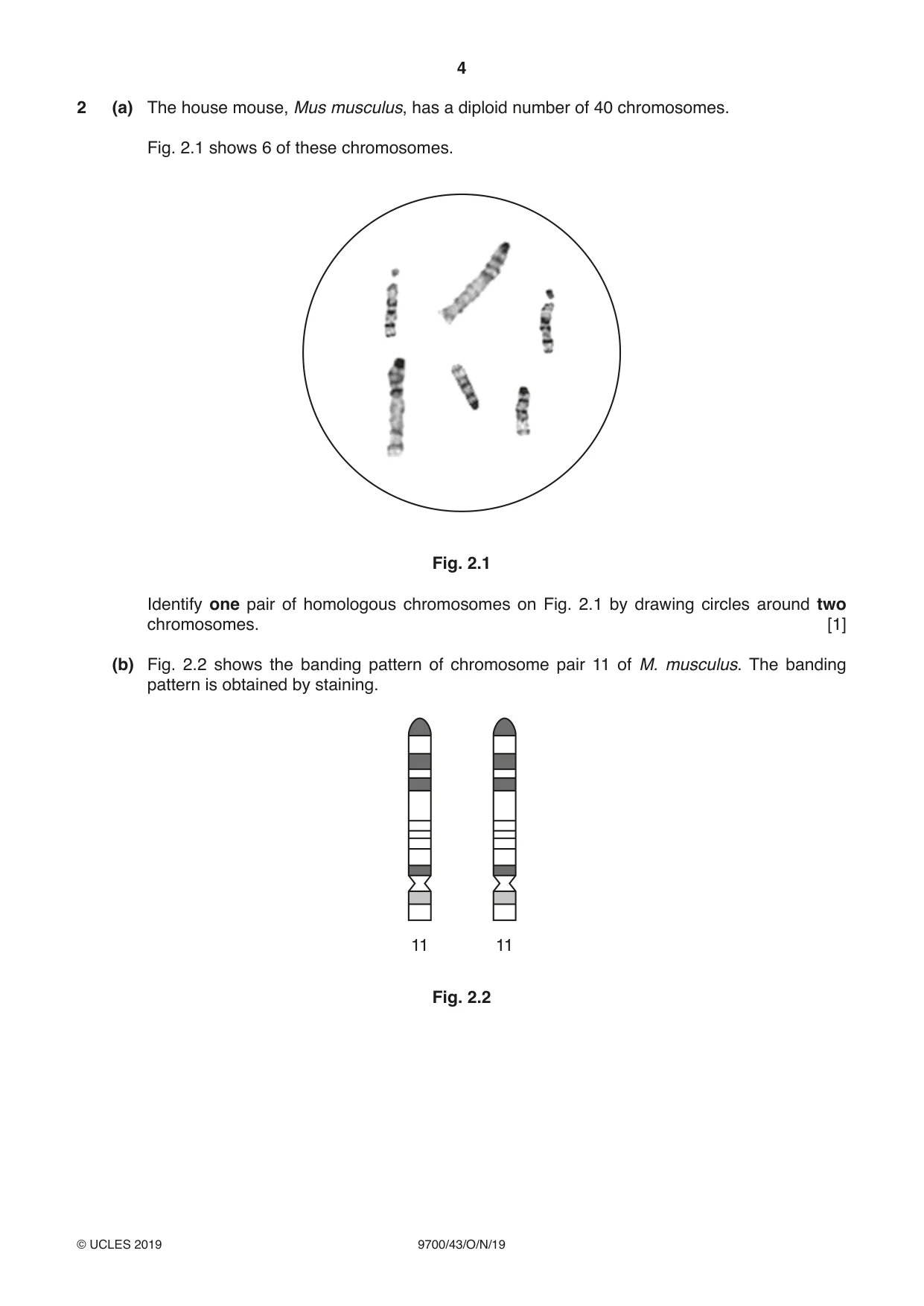
2 (a) The house mouse, Mus musculus, has a diploid number of 40 chromosomes. Fig. 2.1 shows 6 of these chromosomes. Fig. 2.1 Identify one pair of homologous chromosomes on Fig. 2.1 by drawing circles around two chromosomes. [1] (b) Fig. 2.2 shows the banding pattern of chromosome pair 11 of M. musculus. The banding pattern is obtained by staining. 11 11 Fig. 2.2 (i) Explain why chromosomes, such as those in Fig. 2.2, are described as a homologous pair. ........................................................................................................................................... ........................................................................................................................................... ........................................................................................................................................... ........................................................................................................................................... ........................................................................................................................................... ..................................................................................................................................... [3] (ii) State the number of chromosomes that are present in M. musculus spermatozoa. ..................................................................................................................................... [1] (c) M. musculus produces gametes by meiosis. These gametes are genetically different. There is random fusion of gametes at fertilisation. (i) Explain why meiosis is important in the life cycle of M. musculus, apart from producing genetically different gametes. ........................................................................................................................................... ........................................................................................................................................... ........................................................................................................................................... ..................................................................................................................................... [2] (ii) Explain how the random fusion of gametes leads to the expression of rare, recessive alleles. ........................................................................................................................................... ........................................................................................................................................... ........................................................................................................................................... ........................................................................................................................................... ..................................................................................................................................... [2] (d) A mutation causing coats of mice to be woolly in appearance is in a gene located on chromosome 11. The mutation causes a very shortened polypeptide product. Mice with the woolly coat phenotype have longer fur than mice with normal coats. (i) Explain how a base substitution mutation can lead to a very shortened polypeptide product. ........................................................................................................................................... ........................................................................................................................................... ........................................................................................................................................... ........................................................................................................................................... ........................................................................................................................................... ..................................................................................................................................... [2] (ii) The inheritance of the woolly coat characteristic was investigated. Draw a genetic diagram to show a cross between two heterozygous parents with normal coats. Use the symbols A and a for the alleles. parental genotypes gametes offspring genotypes offspring phenotypes [3] [Total: 14]
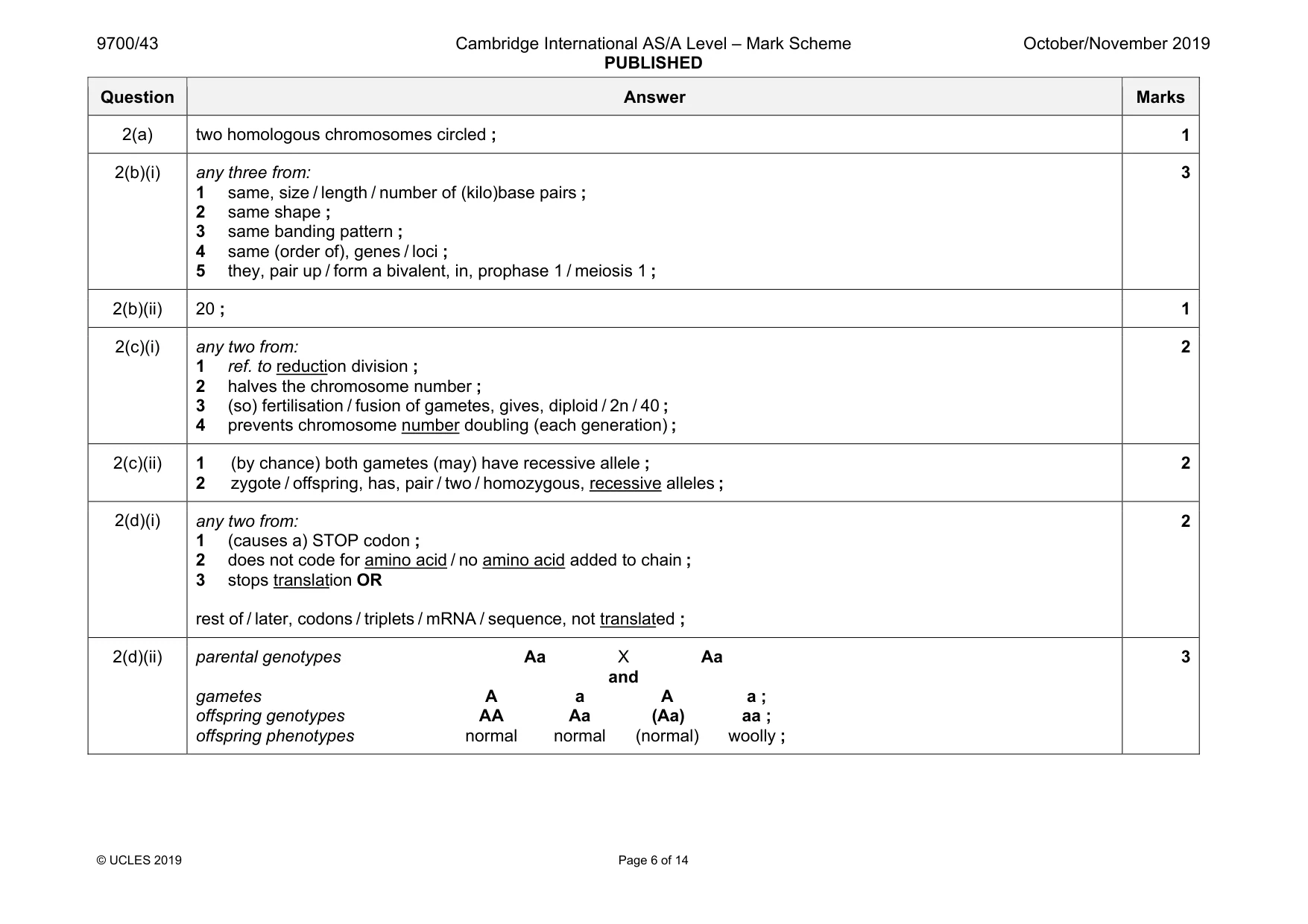
Mark scheme: 2(a) two homologous chromosomes circled ; 1 2(b)(i) any three from: 1 same, size / length / number of (kilo)base pairs ; 2 same shape ; 3 same banding pattern ; 4 same (order of), genes / loci ; 5 they, pair up / form a bivalent, in, prophase 1 / meiosis 1 ; 3 2(b)(ii) 20 ; 1 2(c)(i) any two from: 1 ref. to reduction division ; 2 halves the chromosome number ; 3 (so) fertilisation / fusion of gametes, gives, diploid / 2n / 40 ; 4 prevents chromosome number doubling (each generation) ; 2 2(c)(ii) 1 (by chance) both gametes (may) have recessive allele ; 2 zygote / offspring, has, pair / two / homozygous, recessive alleles ; 2 2(d)(i) any two from: 1 (causes a) STOP codon ; 2 does not code for amino acid / no amino acid added to chain ; 3 stops translation OR rest of / later, codons / triplets / mRNA / sequence, not translated ; 2 2(d)(ii) parental genotypes Aa X Aa and gametes A a A a ; offspring genotypes AA Aa (Aa) aa ; offspring phenotypes normal normal (normal) woolly ; 3
Q3 · Therapeutic proteins are used to treat disease
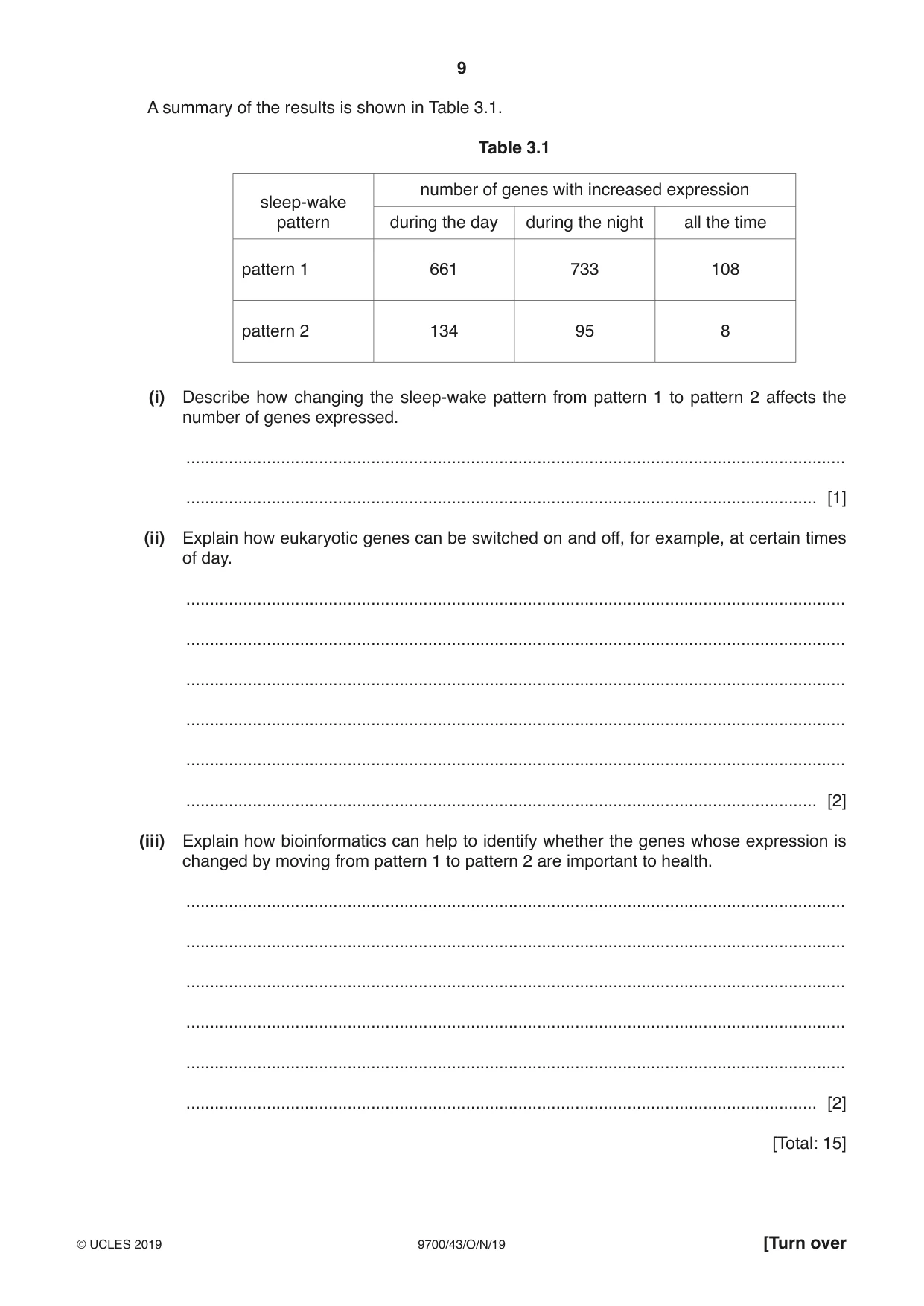
3 Therapeutic proteins are used to treat disease. One example of a therapeutic protein is human growth hormone (hGH). hGH has important roles in growth during childhood and in regulation of metabolism in adulthood. Children described as hGH-deficient do not produce enough hGH and grow more slowly than other children. People who were hGH-deficient when they were children have a mean adult height that is 32 cm shorter than the population mean. Daily injections of hGH are a treatment for hGH-deficient children that can increase growth rate, resulting in an increased adult height. (a) The growth rate of three children was measured. • The growth rate of the hGH-deficient child who did not receive daily hGH injections was 2.5 cm year–1. • The growth rate of the hGH-deficient child who received daily hGH injections was 10.0 cm year–1 in the first year after starting treatment. • The growth rate of the child who is not hGH-deficient was 5.0 cm year–1. Calculate the percentage increase in growth rate of the hGH-deficient child treated with hGH injections compared to the child who is not hGH-deficient. Show your working. ...................................................... % [2] When this form of treatment started in 1958, hGH could only be obtained from the pituitary glands of people who had died. In 1981, a plasmid containing hGH cDNA was constructed and inserted into Escherichia coli bacteria. This allowed recombinant hGH protein to be produced by the bacteria. (b) Name the type of enzyme that: • cuts plasmid DNA ........................................................................................................................................... • makes cDNA from hGH mRNA. ..................................................................................................................................... [2] (c) Identify and explain two properties of plasmids that allow them to be used as vectors of hGH cDNA into cells of Escherichia coli. 1 ................................................................................................................................................. ................................................................................................................................................... ................................................................................................................................................... 2 ................................................................................................................................................. ................................................................................................................................................... ............................................................................................................................................. [2] (d) In 1985, several cases of a rare brain disease were discovered in people who had been treated many years previously with hGH obtained from pituitary glands. It was decided, from 1985 onwards, that only recombinant hGH should be used to treat patients. Explain the advantages of producing human therapeutic proteins, such as hGH, by recombinant DNA technology. ................................................................................................................................................... ................................................................................................................................................... ................................................................................................................................................... ................................................................................................................................................... ................................................................................................................................................... ................................................................................................................................................... ................................................................................................................................................... ................................................................................................................................................... ............................................................................................................................................. [4] (e) hGH is one of many proteins in the body whose secretion or production is controlled by a person’s sleep-wake pattern. The sleep-wake pattern describes when, during a 24 hour day, a person is asleep and when they are awake. For example: • pattern 1 – asleep during the night and awake during the day (normal) • pattern 2 – asleep during the day and awake during the night. Researchers used microarray analysis to identify which genes have their expression changed by a person’s sleep-wake pattern. They collected mRNA from: • a group of people with sleep-wake pattern 1 • the same group of people whose sleep-wake pattern was changed to pattern 2. A summary of the results is shown in Table 3.1. Table 3.1 number of genes with increased expression sleep-wake pattern during the day during the night all the time pattern 1 661 733 108 pattern 2 134 95 8 (i) Describe how changing the sleep-wake pattern from pattern 1 to pattern 2 affects the number of genes expressed. ........................................................................................................................................... ..................................................................................................................................... [1] (ii) Explain how eukaryotic genes can be switched on and off, for example, at certain times of day. ........................................................................................................................................... ........................................................................................................................................... ........................................................................................................................................... ........................................................................................................................................... ........................................................................................................................................... ..................................................................................................................................... [2] (iii) Explain how bioinformatics can help to identify whether the genes whose expression is changed by moving from pattern 1 to pattern 2 are important to health. ........................................................................................................................................... ........................................................................................................................................... ........................................................................................................................................... ........................................................................................................................................... ........................................................................................................................................... ..................................................................................................................................... [2] [Total: 15]
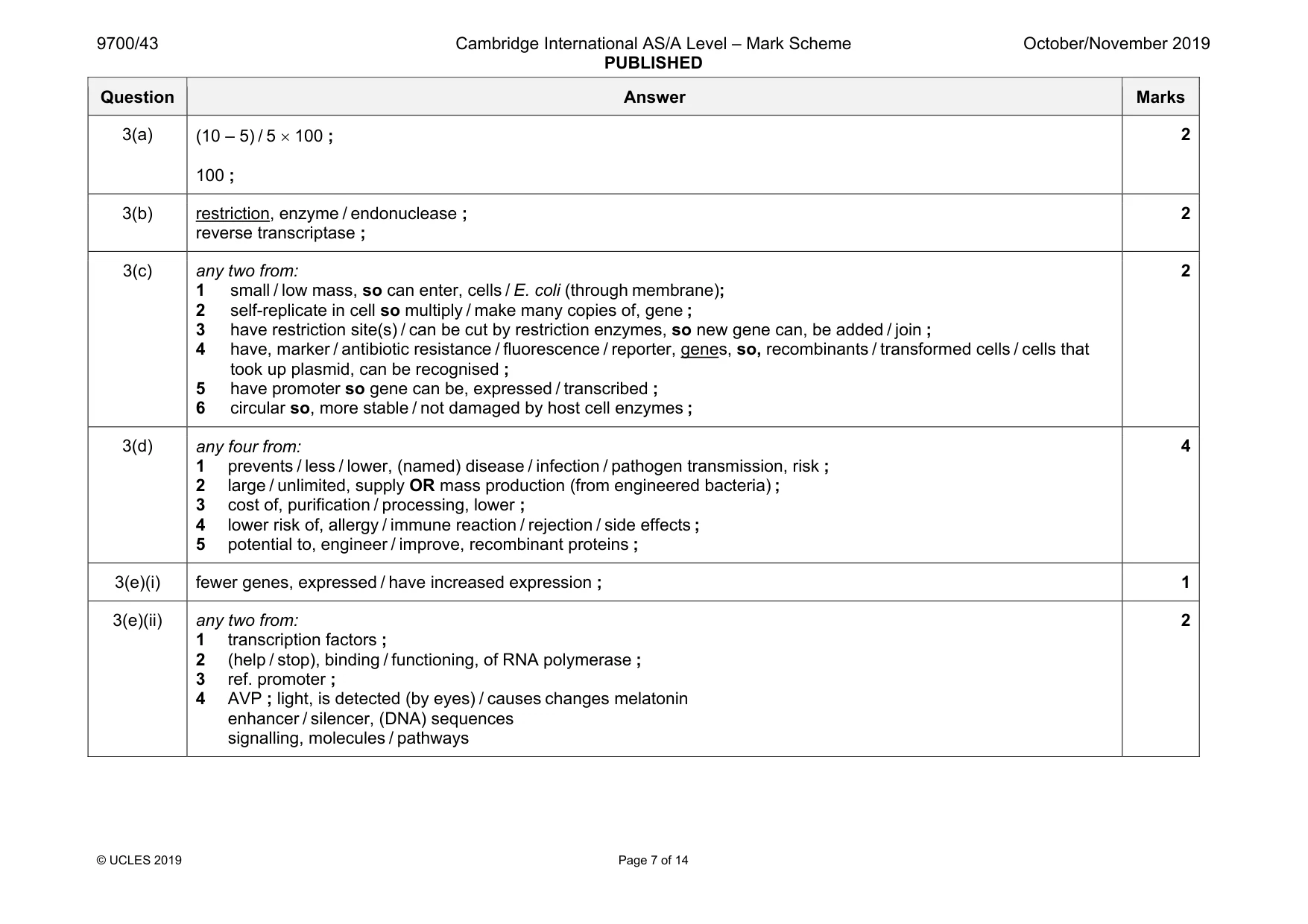
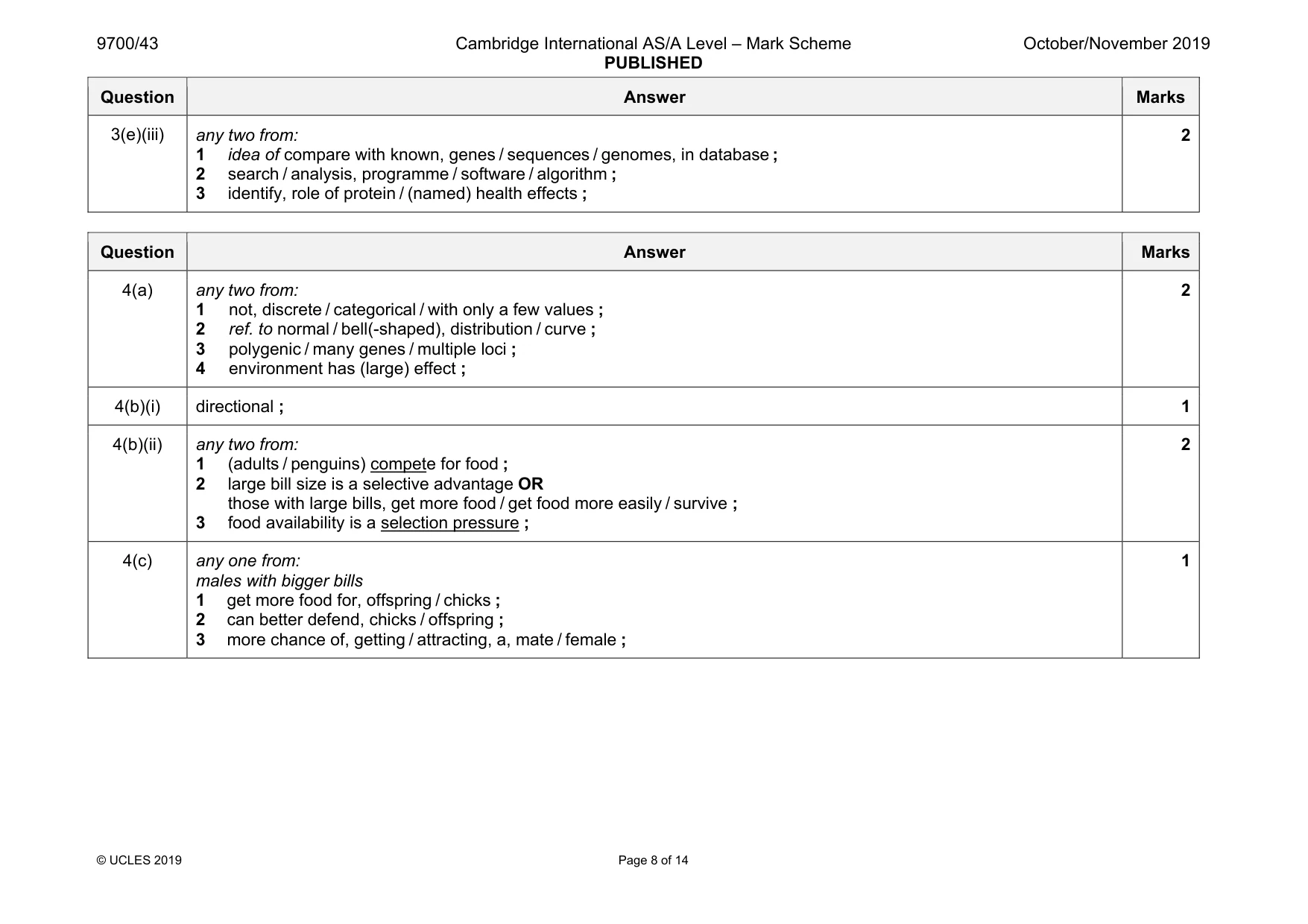
Mark scheme: 3(a) 100 ; 2 3(b) restriction, enzyme / endonuclease ; reverse transcriptase ; 2 3(c) any two from: 1 small / low mass, so can enter, cells / E. coli (through membrane); 2 self-replicate in cell so multiply / make many copies of, gene ; 3 have restriction site(s) / can be cut by restriction enzymes, so new gene can, be added / join ; 4 have, marker / antibiotic resistance / fluorescence / reporter, genes, so, recombinants / transformed cells / cells that took up plasmid, can be recognised ; 5 have promoter so gene can be, expressed / transcribed ; 6 circular so, more stable / not damaged by host cell enzymes ; 2 3(d) any four from: 1 prevents / less / lower, (named) disease / infection / pathogen transmission, risk ; 2 large / unlimited, supply OR mass production (from engineered bacteria) ; 3 cost of, purification / processing, lower ; 4 lower risk of, allergy / immune reaction / rejection / side effects ; 5 potential to, engineer / improve, recombinant proteins ; 4 3(e)(i) fewer genes, expressed / have increased expression ; 1 3(e)(ii) any two from: 1 transcription factors ; 2 (help / stop), binding / functioning, of RNA polymerase ; 3 ref. promoter ; 4 AVP ; light, is detected (by eyes) / causes changes melatonin enhancer / silencer, (DNA) sequences signalling, molecules / pathways 2 Question Answer Marks 3(e)(iii) any two from: 1 idea of compare with known, genes / sequences / genomes, in database ; 2 search / analysis, programme / software / algorithm ; 3 identify, role of protein / (named) health effects ; 2
Q4 · A 28-year study of Magellanic penguins, Spheniscus magellanicus, found in Argentina…
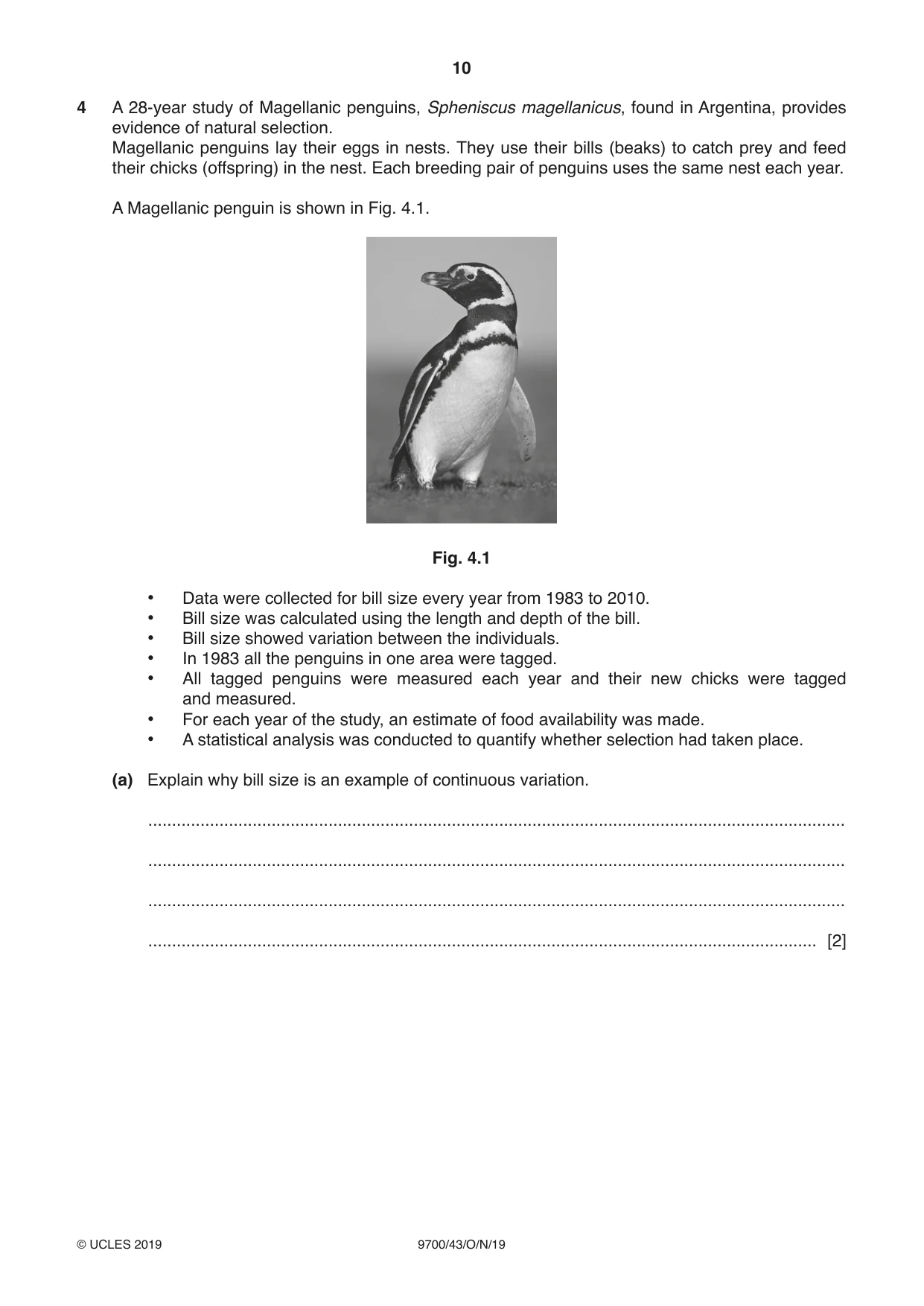
4 A 28-year study of Magellanic penguins, Spheniscus magellanicus, found in Argentina, provides evidence of natural selection. Magellanic penguins lay their eggs in nests. They use their bills (beaks) to catch prey and feed their chicks (offspring) in the nest. Each breeding pair of penguins uses the same nest each year. A Magellanic penguin is shown in Fig. 4.1. Fig. 4.1 • Data were collected for bill size every year from 1983 to 2010. • Bill size was calculated using the length and depth of the bill. • Bill size showed variation between the individuals. • In 1983 all the penguins in one area were tagged. • All tagged penguins were measured each year and their new chicks were tagged and measured. • For each year of the study, an estimate of food availability was made. • A statistical analysis was conducted to quantify whether selection had taken place. (a) Explain why bill size is an example of continuous variation. ................................................................................................................................................... ................................................................................................................................................... ................................................................................................................................................... ............................................................................................................................................. [2] (b) Statistical analysis of the data showed that selection was not significant in most years of the study. However, a significant increase in bill size occurred in four years of the study. (i) Name the type of selection that occurred in these four years. ..................................................................................................................................... [1] (ii) In these same four years, food availability was low. Explain how the data for bill size and food availability supports the idea of the ‘struggle for existence’ seen in natural selection. ........................................................................................................................................... ........................................................................................................................................... ........................................................................................................................................... ........................................................................................................................................... ........................................................................................................................................... ..................................................................................................................................... [2] (c) Further investigation showed that, in some years, larger bill sizes of adult males correlated with higher reproductive success. Reproductive success was measured by the number of chicks that survived per adult each year. Suggest why larger bill size of adult males correlated with higher reproductive success. ................................................................................................................................................... ................................................................................................................................................... ................................................................................................................................................... ............................................................................................................................................. [1] [Total: 6]
Mark scheme: 4(a) any two from: 1 not, discrete / categorical / with only a few values ; 2 ref. to normal / bell(-shaped), distribution / curve ; 3 polygenic / many genes / multiple loci ; 4 environment has (large) effect ; 2 4(b)(i) directional ; 1 4(b)(ii) any two from: 1 (adults / penguins) compete for food ; 2 large bill size is a selective advantage OR those with large bills, get more food / get food more easily / survive ; 3 food availability is a selection pressure ; 2 4(c) any one from: males with bigger bills 1 get more food for, offspring / chicks ; 2 can better defend, chicks / offspring ; 3 more chance of, getting / attracting, a, mate / female ; 1
Q5 · Mimulus is a plant genus containing a diverse range of species that have colourful…
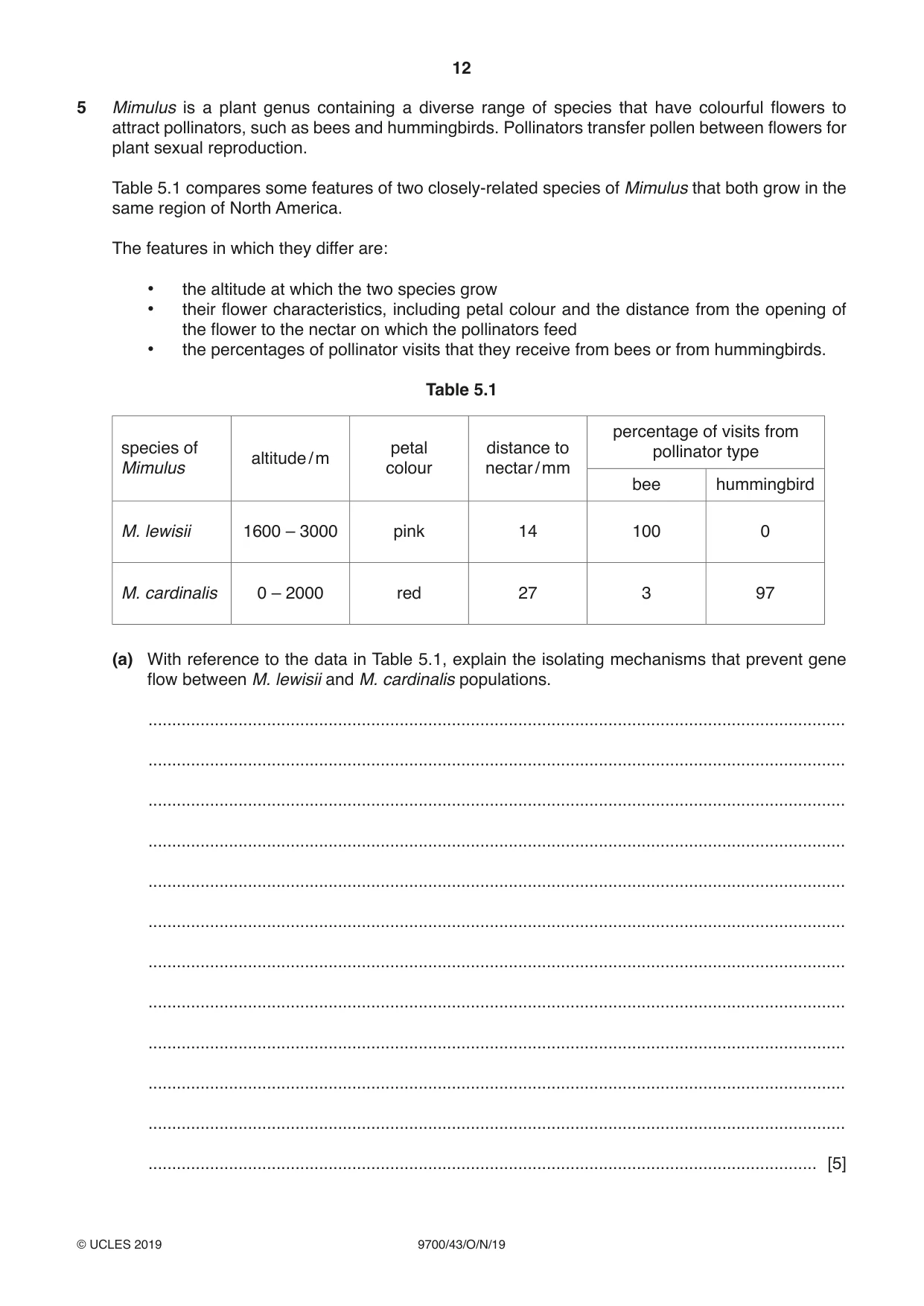
5 Mimulus is a plant genus containing a diverse range of species that have colourful flowers to attract pollinators, such as bees and hummingbirds. Pollinators transfer pollen between flowers for plant sexual reproduction. Table 5.1 compares some features of two closely-related species of Mimulus that both grow in the same region of North America. The features in which they differ are: • the altitude at which the two species grow • their flower characteristics, including petal colour and the distance from the opening of the flower to the nectar on which the pollinators feed • the percentages of pollinator visits that they receive from bees or from hummingbirds. Table 5.1 percentage of visits from species of petal distance to pollinator type altitude / m Mimulus colour nectar / mm bee hummingbird M. lewisii 1600 – 3000 pink 14 100 0 M. cardinalis 0 – 2000 red 27 3 97 (a) With reference to the data in Table 5.1, explain the isolating mechanisms that prevent gene flow between M. lewisii and M. cardinalis populations. ................................................................................................................................................... ................................................................................................................................................... ................................................................................................................................................... ................................................................................................................................................... ................................................................................................................................................... ................................................................................................................................................... ................................................................................................................................................... ................................................................................................................................................... ................................................................................................................................................... ................................................................................................................................................... ................................................................................................................................................... ............................................................................................................................................. [5] (b) Breeding experiments in the laboratory show that M. lewisii and M. cardinalis can breed together and produce offspring. The F1 hybrid offspring are fertile. (i) Suggest, with reasons, what prediction can be made about the chromosome numbers of M. lewisii and M. cardinalis. ........................................................................................................................................... ........................................................................................................................................... ........................................................................................................................................... ........................................................................................................................................... ........................................................................................................................................... ..................................................................................................................................... [2] (ii) The F1 hybrids produce 50% fewer seeds than either of the two parent species. Explain how the reduced production of seeds by the inter-species (F1) hybrids can act as a post-zygotic isolating mechanism. ........................................................................................................................................... ........................................................................................................................................... ........................................................................................................................................... ........................................................................................................................................... ........................................................................................................................................... ..................................................................................................................................... [2] [Total: 9]
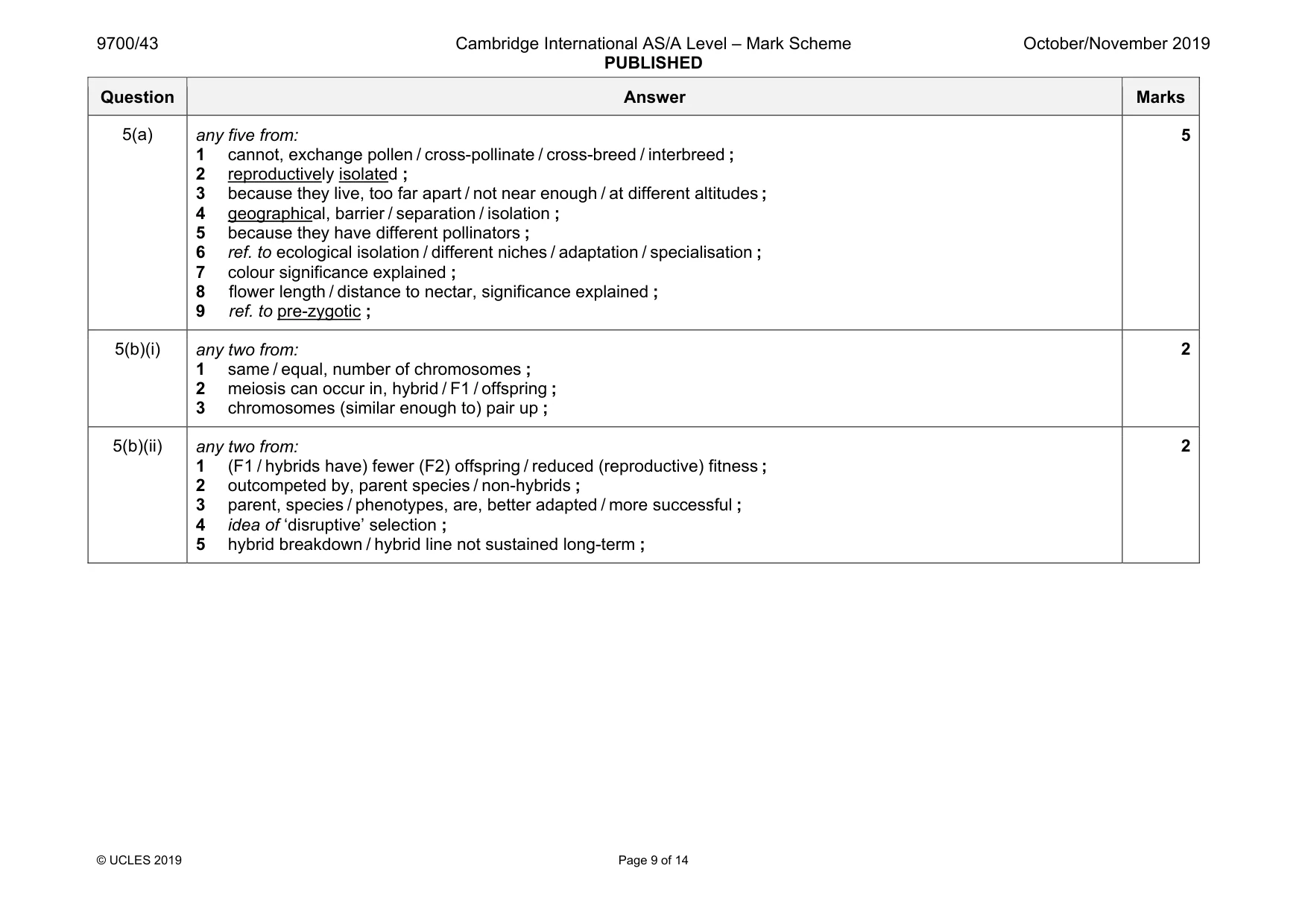
Mark scheme: 5(a) any five from: 1 cannot, exchange pollen / cross-pollinate / cross-breed / interbreed ; 2 reproductively isolated ; 3 because they live, too far apart / not near enough / at different altitudes ; 4 geographical, barrier / separation / isolation ; 5 because they have different pollinators ; 6 ref. to ecological isolation / different niches / adaptation / specialisation ; 7 colour significance explained ; 8 flower length / distance to nectar, significance explained ; 9 ref. to pre-zygotic ; 5 5(b)(i) any two from: 1 same / equal, number of chromosomes ; 2 meiosis can occur in, hybrid / F1 / offspring ; 3 chromosomes (similar enough to) pair up ; 2 5(b)(ii) any two from: 1 (F1 / hybrids have) fewer (F2) offspring / reduced (reproductive) fitness ; 2 outcompeted by, parent species / non-hybrids ; 3 parent, species / phenotypes, are, better adapted / more successful ; 4 idea of ‘disruptive’ selection ; 5 hybrid breakdown / hybrid line not sustained long-term ; 2
Q6 · Mining may result in the release of heavy metal ions, causing pollution of lakes and…
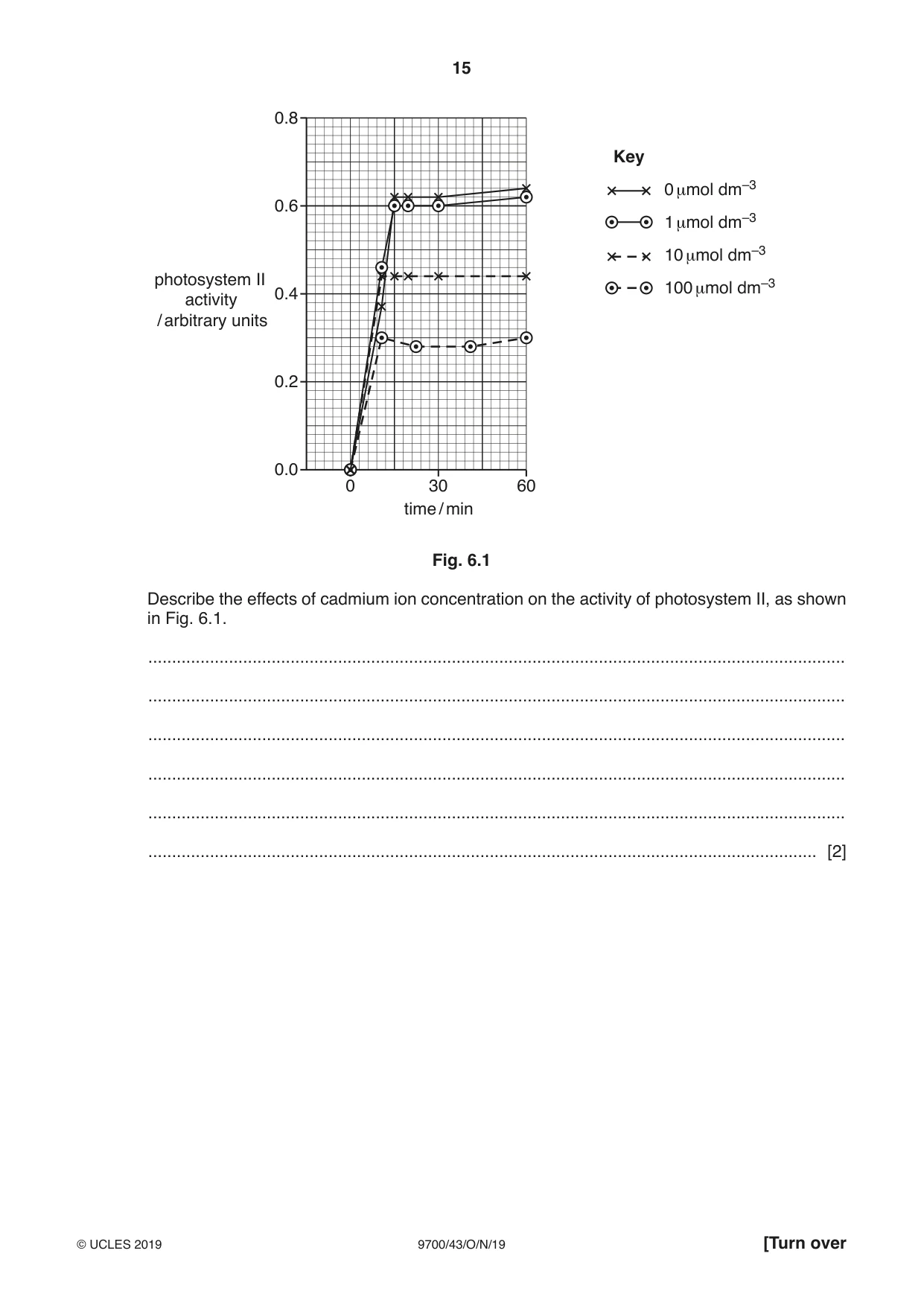
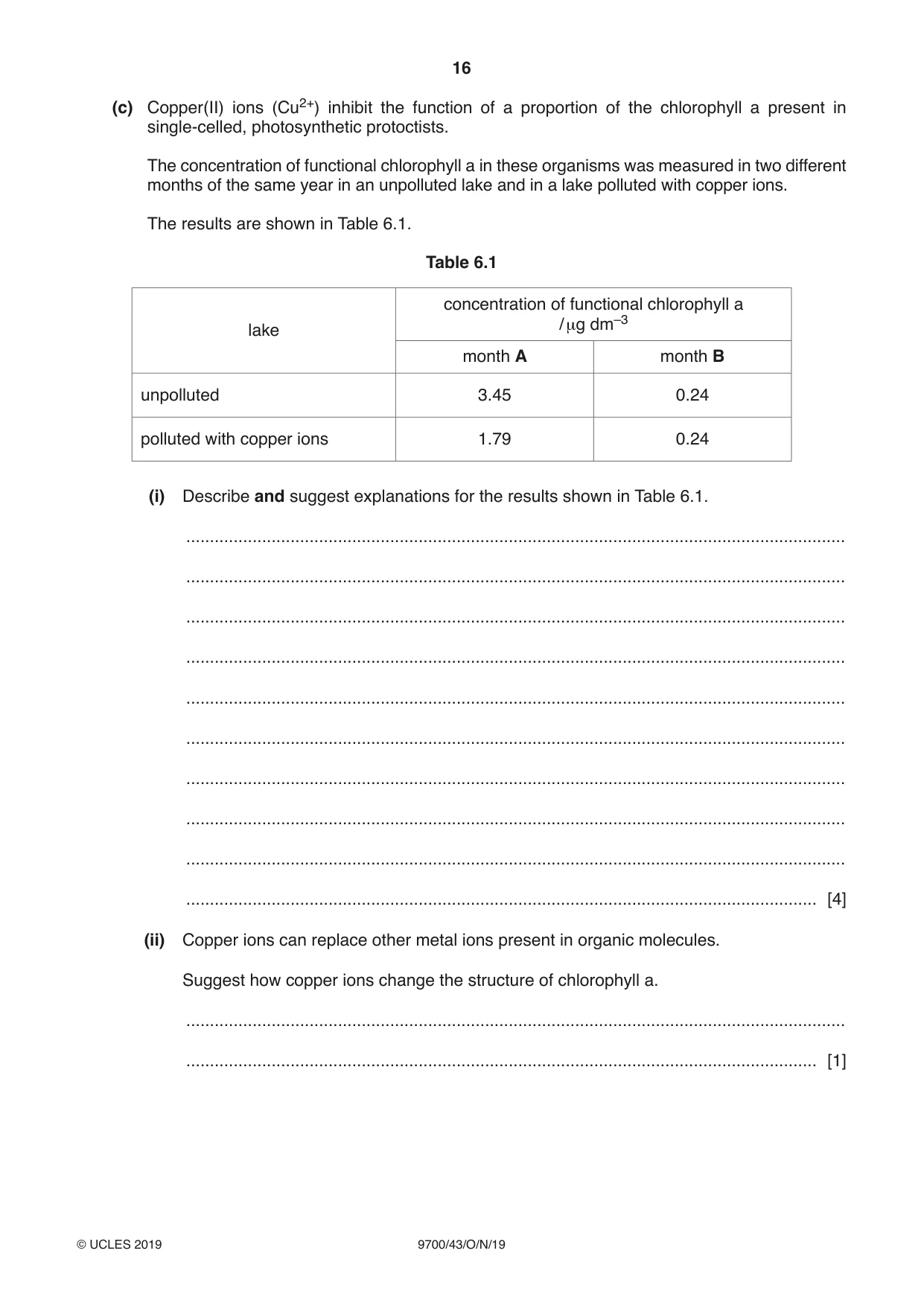
6 Mining may result in the release of heavy metal ions, causing pollution of lakes and rivers. High concentrations of these heavy metal ions, such as cadmium (Cd2+) and copper (Cu2+), decrease the rate of photosynthesis in plants. (a) Cadmium ions disrupt the function of photosystem II in chloroplasts. (i) Name the part of the chloroplast where photosystem II is located. ..................................................................................................................................... [1] (ii) Describe the role of photosystem II in the absorption of light. ........................................................................................................................................... ........................................................................................................................................... ........................................................................................................................................... ........................................................................................................................................... ........................................................................................................................................... ..................................................................................................................................... [3] (b) An investigation was carried out into the effect of cadmium ion concentration on the aquatic, single-celled, photosynthetic protoctist, Chlamydomonas reinhardtii. The activity of photosystem II was measured at different concentrations of cadmium ions. • Four different concentrations of cadmium ions were used, 0, 1, 10 and 100 µmol dm–3. • C. reinhardtii was allowed to acclimatise in the dark before the experiment started. • At time 0 min the light was switched on and the cadmium ions were added. • At each concentration, the activity of photosystem II was measured over a period of 60 minutes. • Each experiment was carried out under the same controlled conditions. The results are shown in Fig. 6.1. 0.8 Key 0 μmol dm–3 0.6 1 μmol dm–3 10 μmol dm–3 photosystem II 100 μmol dm–3 0.4 activity / arbitrary units 0.2 0.0 0 30 60 time / min Fig. 6.1 Describe the effects of cadmium ion concentration on the activity of photosystem II, as shown in Fig. 6.1. ................................................................................................................................................... ................................................................................................................................................... ................................................................................................................................................... ................................................................................................................................................... ................................................................................................................................................... ............................................................................................................................................. [2] (c) Copper(II) ions (Cu2+) inhibit the function of a proportion of the chlorophyll a present in single-celled, photosynthetic protoctists. The concentration of functional chlorophyll a in these organisms was measured in two different months of the same year in an unpolluted lake and in a lake polluted with copper ions. The results are shown in Table 6.1. Table 6.1 concentration of functional chlorophyll a / µg dm–3 lake month A month B unpolluted 3.45 0.24 polluted with copper ions 1.79 0.24 (i) Describe and suggest explanations for the results shown in Table 6.1. ........................................................................................................................................... ........................................................................................................................................... ........................................................................................................................................... ........................................................................................................................................... ........................................................................................................................................... ........................................................................................................................................... ........................................................................................................................................... ........................................................................................................................................... ........................................................................................................................................... ..................................................................................................................................... [4] (ii) Copper ions can replace other metal ions present in organic molecules. Suggest how copper ions change the structure of chlorophyll a. ........................................................................................................................................... ..................................................................................................................................... [1] (d) Chromatography is a method that can be used to separate and identify different photosynthetic pigments in a chloroplast extract. Describe how chromatography is used to identify chlorophyll a in an extract from chloroplasts. ................................................................................................................................................... ................................................................................................................................................... ................................................................................................................................................... ................................................................................................................................................... ................................................................................................................................................... ................................................................................................................................................... ................................................................................................................................................... ................................................................................................................................................... ................................................................................................................................................... ............................................................................................................................................. [4] [Total: 15]
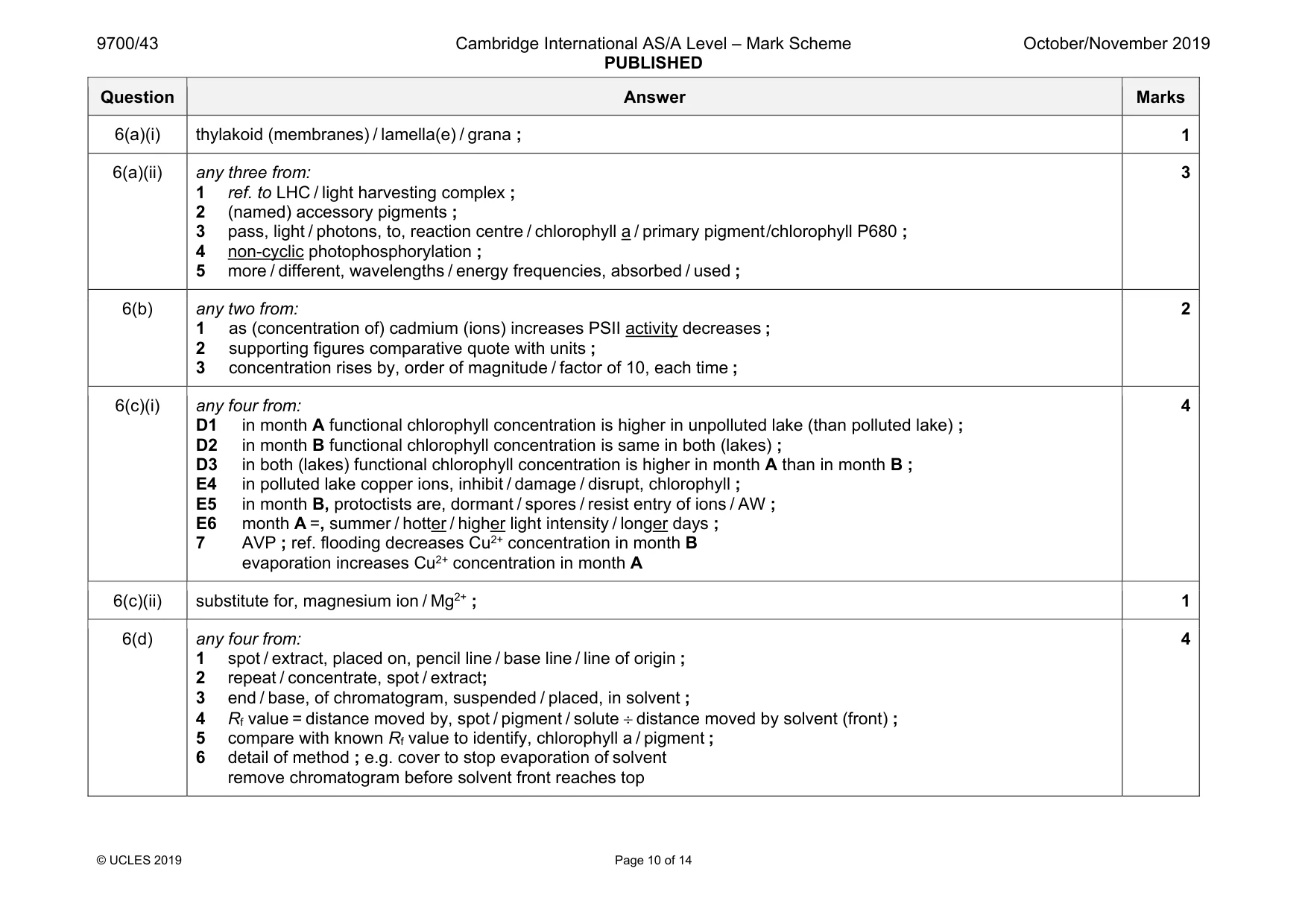
Mark scheme: 6(a)(i) thylakoid (membranes) / lamella(e) / grana ; 1 6(a)(ii) any three from: 1 ref. to LHC / light harvesting complex ; 2 (named) accessory pigments ; 3 pass, light / photons, to, reaction centre / chlorophyll a / primary pigment / chlorophyll P680 ; 4 non-cyclic photophosphorylation ; 5 more / different, wavelengths / energy frequencies, absorbed / used ; 3 6(b) any two from: 1 as (concentration of) cadmium (ions) increases PSII activity decreases ; 2 supporting figures comparative quote with units ; 3 concentration rises by, order of magnitude / factor of 10, each time ; 2 6(c)(i) any four from: D1 in month A functional chlorophyll concentration is higher in unpolluted lake (than polluted lake) ; D2 in month B functional chlorophyll concentration is same in both (lakes) ; D3 in both (lakes) functional chlorophyll concentration is higher in month A than in month B ; E4 in polluted lake copper ions, inhibit / damage / disrupt, chlorophyll ; E5 in month B, protoctists are, dormant / spores / resist entry of ions / AW ; E6 month A =, summer / hotter / higher light intensity / longer days ; 7 AVP ; ref. flooding decreases Cu2+ concentration in month B evaporation increases Cu2+ concentration in month A 4 6(c)(ii) substitute for, magnesium ion / Mg2+ ; 1 6(d) any four from: 1 spot / extract, placed on, pencil line / base line / line of origin ; 2 repeat / concentrate, spot / extract; 3 end / base, of chromatogram, suspended / placed, in solvent ; 4 Rf value = distance moved by, spot / pigment / solute ÷ distance moved by solvent (front) ; 5 compare with known Rf value to identify, chlorophyll a / pigment ; 6 detail of method ; e.g. cover to stop evaporation of solvent remove chromatogram before solvent front reaches top 4
More questions on Photosynthesis as an energy transfer process
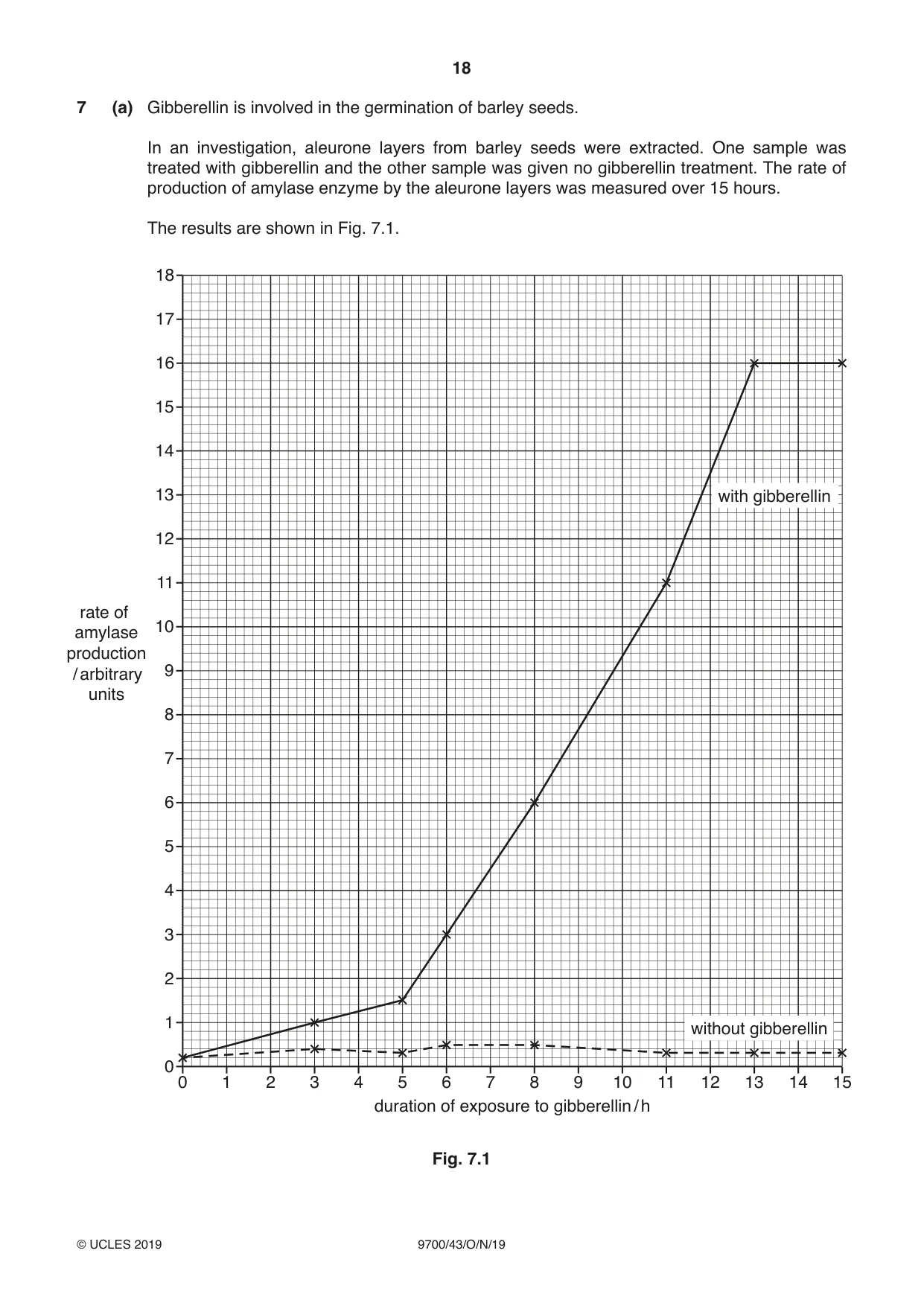
Q7 · Describe the results shown in Fig
Describe the results shown in Fig. 7.1. ................................................................................................................................................... ................................................................................................................................................... ................................................................................................................................................... ................................................................................................................................................... ................................................................................................................................................... ................................................................................................................................................... ............................................................................................................................................. [3] (b) Explain why the aleurone layers of barley seeds need to produce amylase during germination. ................................................................................................................................................... ................................................................................................................................................... ................................................................................................................................................... ................................................................................................................................................... ................................................................................................................................................... ............................................................................................................................................. [3] (c) The height of some plants is partly controlled by their genes. Height in pea plants is affected by a gene with two alleles. The dominant allele results in the production of active gibberellin, which stimulates stem elongation. (i) State the symbol that represents the dominant allele. ..................................................................................................................................... [1] (ii) Explain how this dominant allele results in the production of active gibberellin. ........................................................................................................................................... ........................................................................................................................................... ........................................................................................................................................... ........................................................................................................................................... ..................................................................................................................................... [2] (iii) Active gibberellin stimulates stem elongation by causing the breakdown of DELLA protein repressors so that growth genes can be expressed. Suggest the effects of the expression of these growth genes. ........................................................................................................................................... ........................................................................................................................................... ........................................................................................................................................... ........................................................................................................................................... ..................................................................................................................................... [2] [Total: 11]
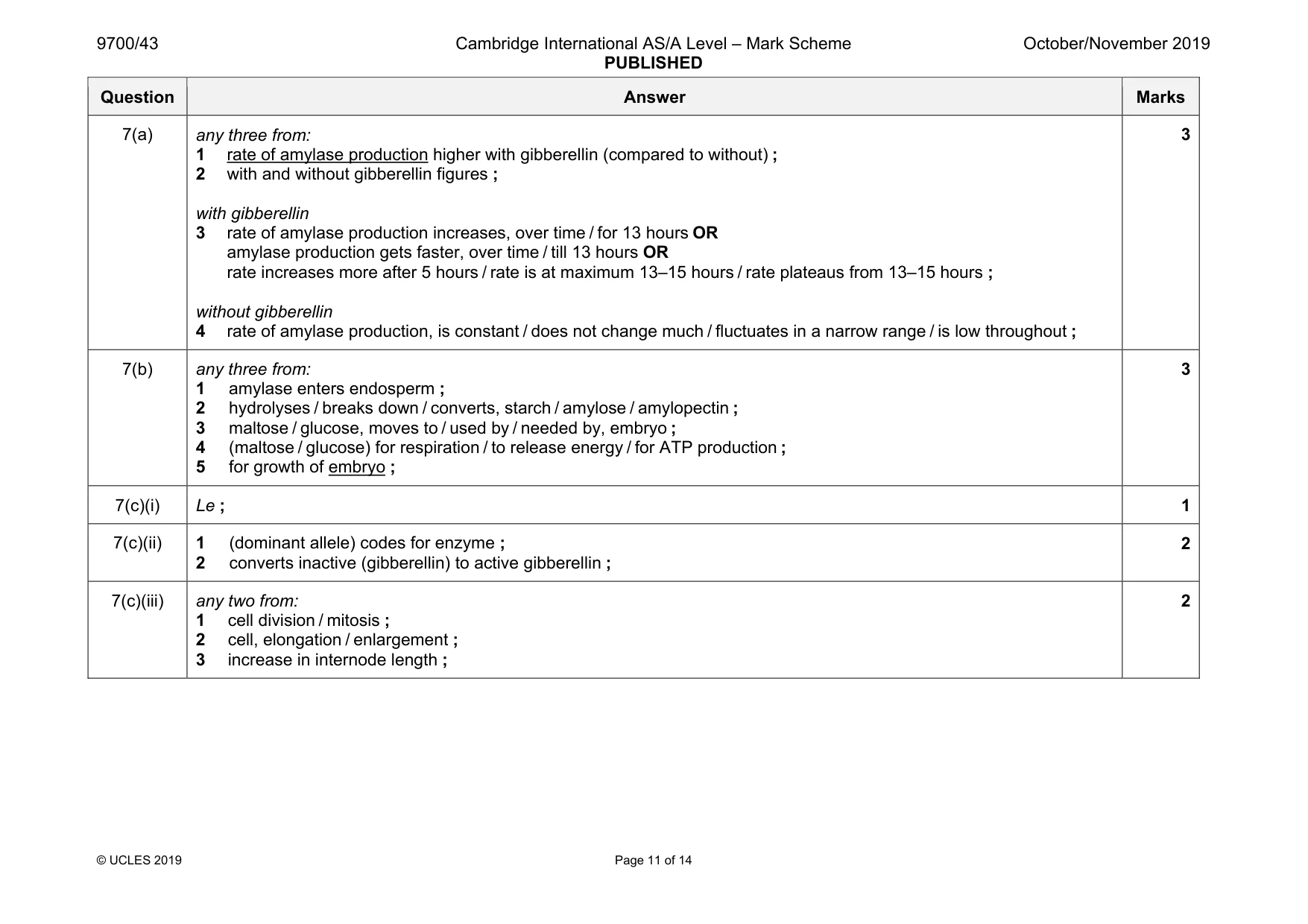
Mark scheme: 7(a) any three from: 1 rate of amylase production higher with gibberellin (compared to without) ; 2 with and without gibberellin figures ; with gibberellin 3 rate of amylase production increases, over time / for 13 hours OR amylase production gets faster, over time / till 13 hours OR rate increases more after 5 hours / rate is at maximum 13–15 hours / rate plateaus from 13–15 hours ; without gibberellin 4 rate of amylase production, is constant / does not change much / fluctuates in a narrow range / is low throughout ; 3 7(b) any three from: 1 amylase enters endosperm ; 2 hydrolyses / breaks down / converts, starch / amylose / amylopectin ; 3 maltose / glucose, moves to / used by / needed by, embryo ; 4 (maltose / glucose) for respiration / to release energy / for ATP production ; 5 for growth of embryo ; 3 7(c)(i) Le ; 1 7(c)(ii) 1 (dominant allele) codes for enzyme ; 2 converts inactive (gibberellin) to active gibberellin ; 2 7(c)(iii) any two from: 1 cell division / mitosis ; 2 cell, elongation / enlargement ; 3 increase in internode length ; 2
Q8 · The passage below outlines the structure of the mitochondrion
8 The passage below outlines the structure of the mitochondrion. Complete the passage by using the most appropriate scientific term(s). The mitochondrion is found in eukaryotic cells. It is bound by a double membrane. The outer membrane is permeable to pyruvate, which is the main product of ...................................... . The inner membrane is folded to form ..................................... , which increase the surface area of the membrane. Embedded in the inner membrane are the carrier proteins of the electron transport chain and the protein complex responsible for ATP production, known as .......................................... . Electron flow leads to the build-up of a large concentration of .................................. in the intermembrane space due to the activity of the electron transport chain. The ........................................ of the mitochondrion, which contains enzymes, is the site of the link reaction and the ......................................... . [6]
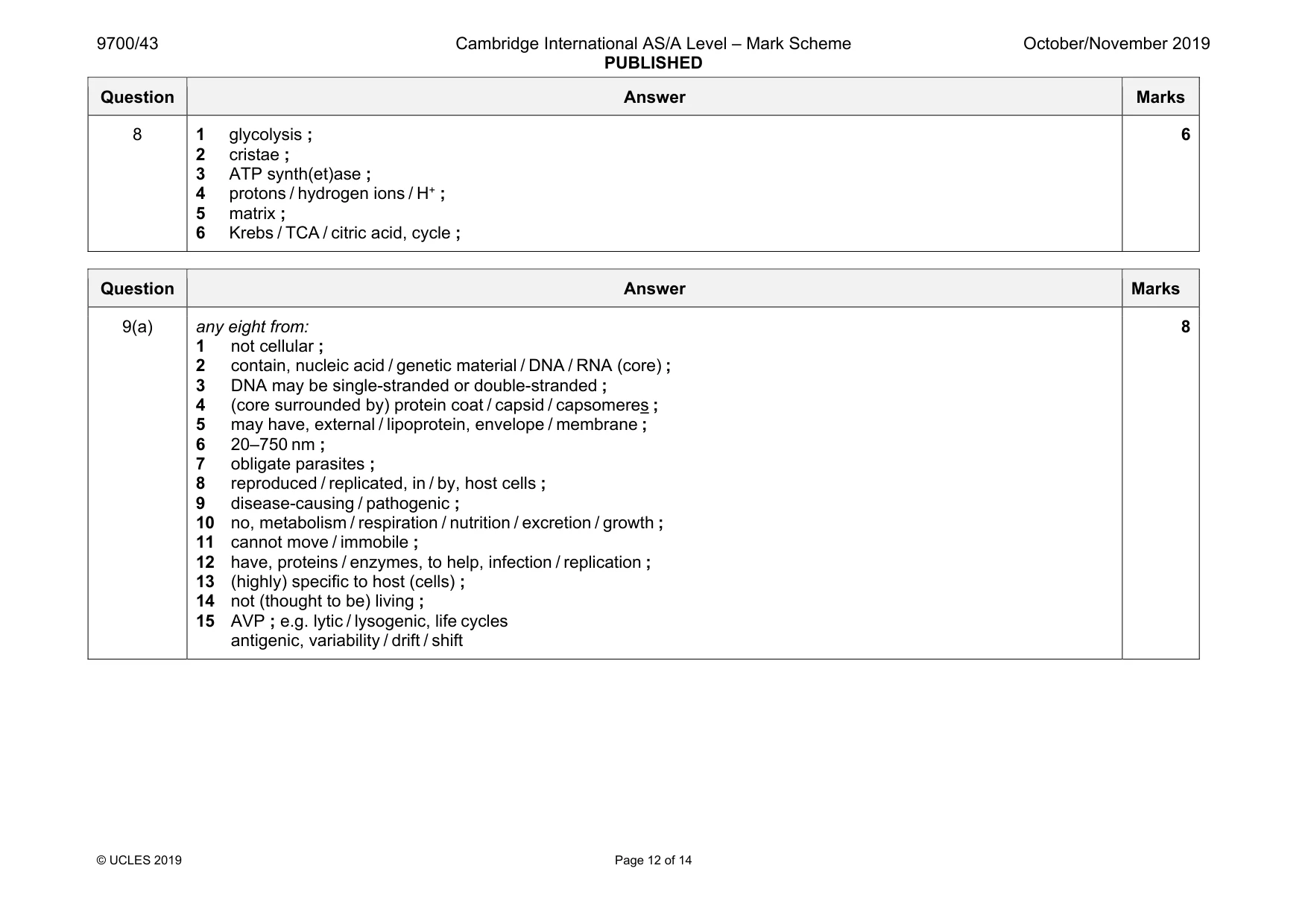
Mark scheme: 8 1 glycolysis ; 2 cristae ; 3 ATP synth(et)ase ; 4 protons / hydrogen ions / H+ ; 5 matrix ; 6 Krebs / TCA / citric acid, cycle ; 6
Q9 · Viruses are not included in the three domain classification system as they have different…
9 (a) Viruses are not included in the three domain classification system as they have different features from most organisms. Describe the features of viruses. [8] (b) Non-governmental organisations play a role in global conservation. Discuss how two global non-governmental organisations contribute to conservation. [7] [Total: 15]
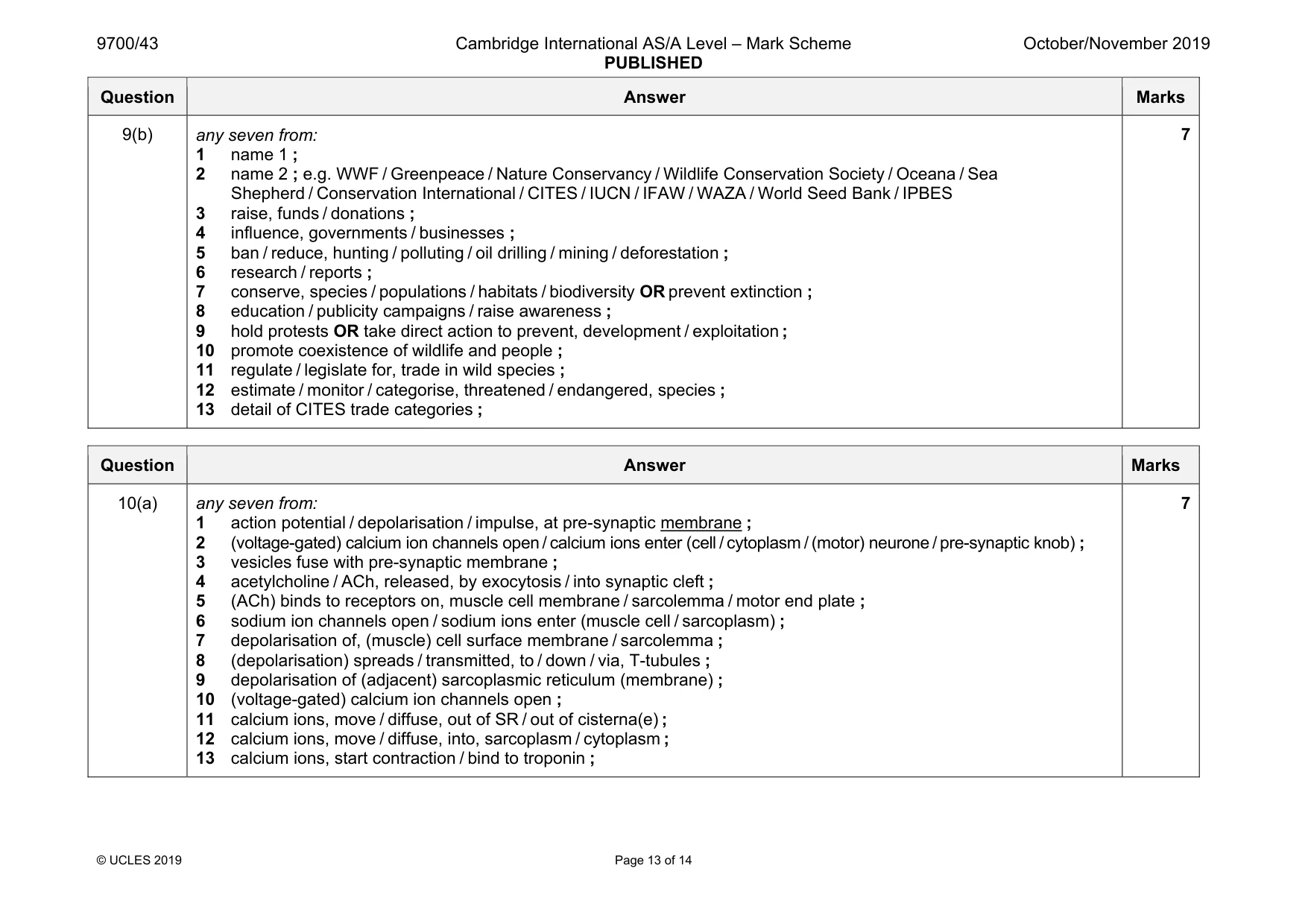
Mark scheme: 9(a) any eight from: 1 not cellular ; 2 contain, nucleic acid / genetic material / DNA / RNA (core) ; 3 DNA may be single-stranded or double-stranded ; 4 (core surrounded by) protein coat / capsid / capsomeres ; 5 may have, external / lipoprotein, envelope / membrane ; 6 20–750 nm ; 7 obligate parasites ; 8 reproduced / replicated, in / by, host cells ; 9 disease-causing / pathogenic ; 10 no, metabolism / respiration / nutrition / excretion / growth ; 11 cannot move / immobile ; 12 have, proteins / enzymes, to help, infection / replication ; 13 (highly) specific to host (cells) ; 14 not (thought to be) living ; 15 AVP ; e.g. lytic / lysogenic, life cycles antigenic, variability / drift / shift 8 Question Answer Marks 9(b) any seven from: 1 name 1 ; 2 name 2 ; e.g. WWF / Greenpeace / Nature Conservancy / Wildlife Conservation Society / Oceana / Sea Shepherd / Conservation International / CITES / IUCN / IFAW / WAZA / World Seed Bank / IPBES 3 raise, funds / donations ; 4 influence, governments / businesses ; 5 ban / reduce, hunting / polluting / oil drilling / mining / deforestation ; 6 research / reports ; 7 conserve, species / populations / habitats / biodiversity OR prevent extinction ; 8 education / publicity campaigns / raise awareness ; 9 hold protests OR take direct action to prevent, development / exploitation ; 10 promote coexistence of wildlife and people ; 11 regulate / legislate for, trade in wild species ; 12 estimate / monitor / categorise, threatened / endangered, species ; 13 detail of CITES trade categories ; 7
Q10 · Describe the roles of the neuromuscular junction, transverse system tubules (T-tubules)…
10 (a) Describe the roles of the neuromuscular junction, transverse system tubules (T-tubules) and the sarcoplasmic reticulum in stimulating contraction in striated muscle. [7] (b) Outline the effects of mutant alleles on the phenotype in Huntington’s disease. [8] [Total: 15] .................................................................................................................................................................. .................................................................................................................................................................. .................................................................................................................................................................. .................................................................................................................................................................. .................................................................................................................................................................. .................................................................................................................................................................. .................................................................................................................................................................. .................................................................................................................................................................. .................................................................................................................................................................. .................................................................................................................................................................. .................................................................................................................................................................. .................................................................................................................................................................. .................................................................................................................................................................. .................................................................................................................................................................. .................................................................................................................................................................. .................................................................................................................................................................. .................................................................................................................................................................. .................................................................................................................................................................. .................................................................................................................................................................. .................................................................................................................................................................. .................................................................................................................................................................. .................................................................................................................................................................. .................................................................................................................................................................. .................................................................................................................................................................. .................................................................................................................................................................. .................................................................................................................................................................. .................................................................................................................................................................. .................................................................................................................................................................. .................................................................................................................................................................. .................................................................................................................................................................. .................................................................................................................................................................. .................................................................................................................................................................. .................................................................................................................................................................. .................................................................................................................................................................. .................................................................................................................................................................. .................................................................................................................................................................. .................................................................................................................................................................. .................................................................................................................................................................. .................................................................................................................................................................. .................................................................................................................................................................. .................................................................................................................................................................. .................................................................................................................................................................. .................................................................................................................................................................. .................................................................................................................................................................. .................................................................................................................................................................. .................................................................................................................................................................. .................................................................................................................................................................. .................................................................................................................................................................. .................................................................................................................................................................. .................................................................................................................................................................. .................................................................................................................................................................. .................................................................................................................................................................. .................................................................................................................................................................. .................................................................................................................................................................. .................................................................................................................................................................. .................................................................................................................................................................. .................................................................................................................................................................. .................................................................................................................................................................. .................................................................................................................................................................. .................................................................................................................................................................. .................................................................................................................................................................. .................................................................................................................................................................. .................................................................................................................................................................. .................................................................................................................................................................. .................................................................................................................................................................. .................................................................................................................................................................. .................................................................................................................................................................. .................................................................................................................................................................. .................................................................................................................................................................. .................................................................................................................................................................. ..................................................................................................................................................................
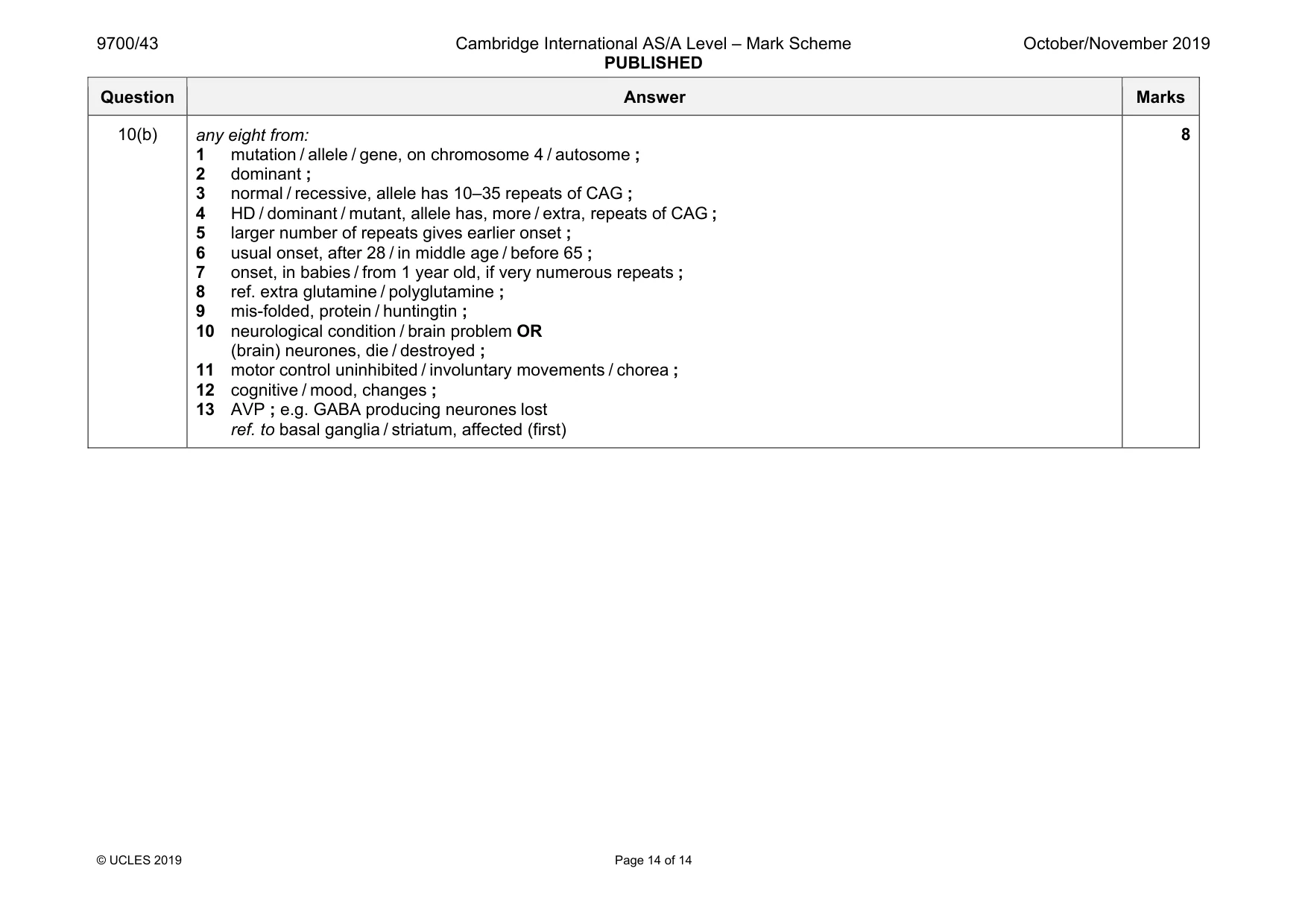
Mark scheme: 10(a) any seven from: 1 action potential / depolarisation / impulse, at pre-synaptic membrane ; 2 (voltage-gated) calcium ion channels open / calcium ions enter (cell / cytoplasm / (motor) neurone / pre-synaptic knob) ; 3 vesicles fuse with pre-synaptic membrane ; 4 acetylcholine / ACh, released, by exocytosis / into synaptic cleft ; 5 (ACh) binds to receptors on, muscle cell membrane / sarcolemma / motor end plate ; 6 sodium ion channels open / sodium ions enter (muscle cell / sarcoplasm) ; 7 depolarisation of, (muscle) cell surface membrane / sarcolemma ; 8 (depolarisation) spreads / transmitted, to / down / via, T-tubules ; 9 depolarisation of (adjacent) sarcoplasmic reticulum (membrane) ; 10 (voltage-gated) calcium ion channels open ; 11 calcium ions, move / diffuse, out of SR / out of cisterna(e) ; 12 calcium ions, move / diffuse, into, sarcoplasm / cytoplasm ; 13 calcium ions, start contraction / bind to troponin ; 7 Question Answer Marks 10(b) any eight from: 1 mutation / allele / gene, on chromosome 4 / autosome ; 2 dominant ; 3 normal / recessive, allele has 10–35 repeats of CAG ; 4 HD / dominant / mutant, allele has, more / extra, repeats of CAG ; 5 larger number of repeats gives earlier onset ; 6 usual onset, after 28 / in middle age / before 65 ; 7 onset, in babies / from 1 year old, if very numerous repeats ; 8 ref. extra glutamine / polyglutamine ; 9 mis-folded, protein / huntingtin ; 10 neurological condition / brain problem OR (brain) neurones, die / destroyed ; 11 motor control uninhibited / involuntary movements / chorea ; 12 cognitive / mood, changes ; 13 AVP ; e.g. GABA producing neurones lost ref. to basal ganglia / striatum, affected (first) 8
What was in this paper
The subtopics covered by these 10 questions, and how many questions each got. Open one in a new tab to see every Cambridge question on it.
What you needed in this session
Cambridge’s own grade thresholds for 2019 Oct/Nov, Paper 4 · Variant 3. A higher threshold means an easier paper — the bar moves with how the cohort did.