Cambridge A Level Biology 9700 — 2018 Oct/Nov Paper 2 · Variant 1
9700/21/O/N/18 · 6 questions · 60 marks · ≈68 min
The question paper and its mark scheme, free to read here and free to download. This is Cambridge’s own paper, exactly as it was sat.
Question paper16 pages
Mark scheme13 pages
Answers below. Sit the paper first if you are practising.
Questions as text
Q1 · The human gas exchange system
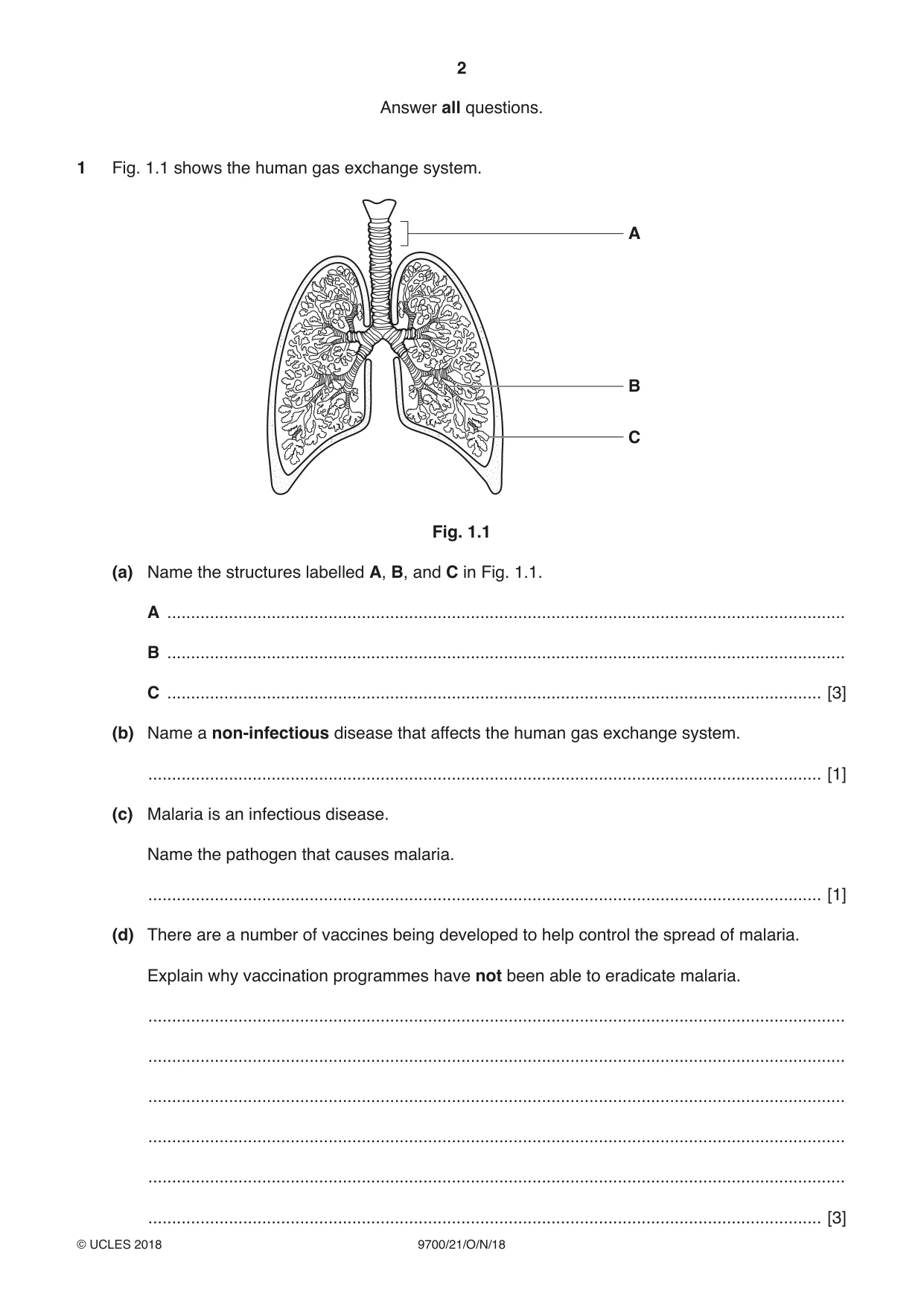
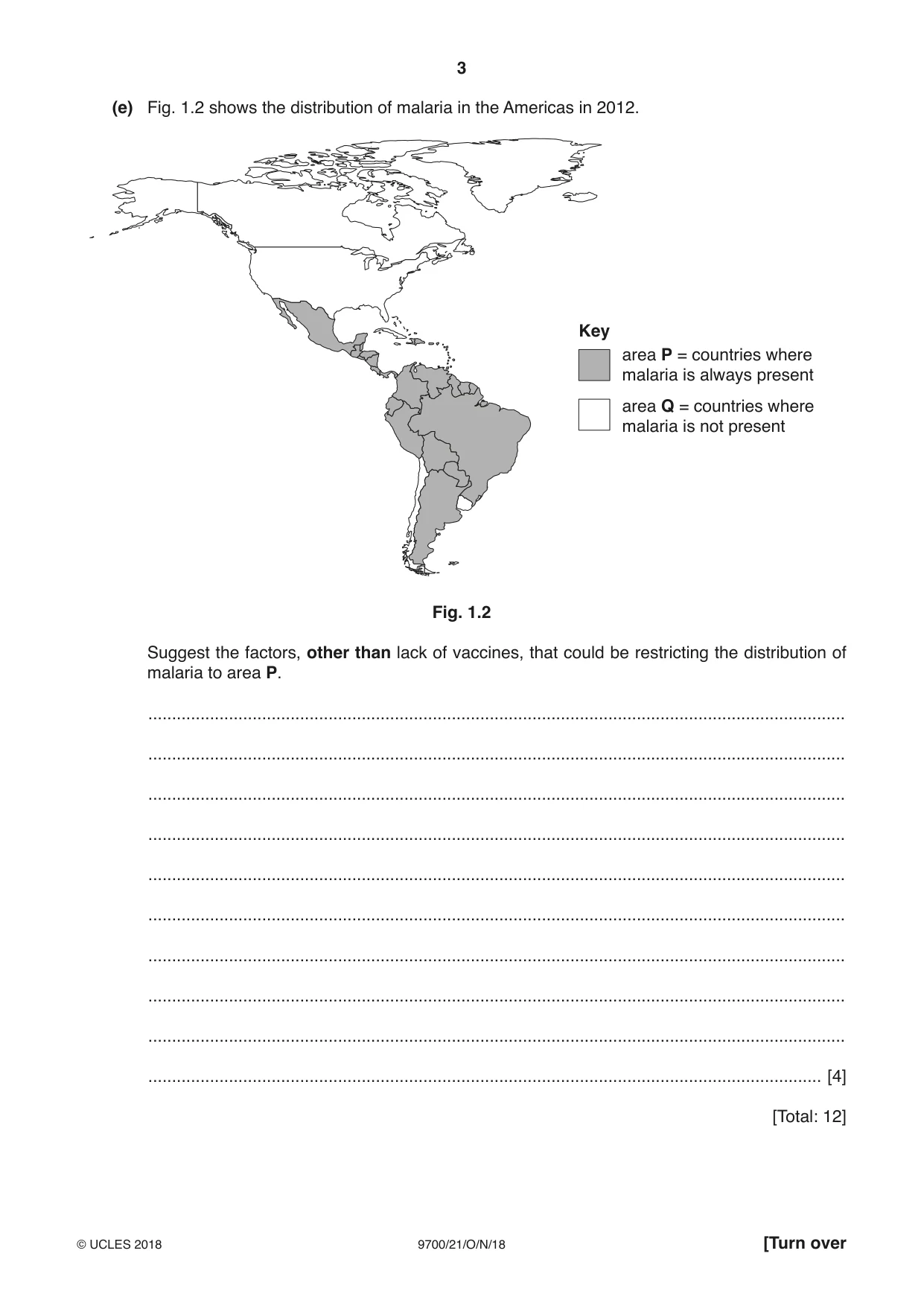
1 Fig. 1.1 shows the human gas exchange system. A B C Fig. 1.1 (a) Name the structures labelled A, B, and C in Fig. 1.1. A ............................................................................................................................................... B ............................................................................................................................................... C .......................................................................................................................................... [3] (b) Name a non-infectious disease that affects the human gas exchange system. .............................................................................................................................................. [1] (c) Malaria is an infectious disease. Name the pathogen that causes malaria. .............................................................................................................................................. [1] (d) There are a number of vaccines being developed to help control the spread of malaria. Explain why vaccination programmes have not been able to eradicate malaria. ................................................................................................................................................... ................................................................................................................................................... ................................................................................................................................................... ................................................................................................................................................... ................................................................................................................................................... .............................................................................................................................................. [3] (e) Fig. 1.2 shows the distribution of malaria in the Americas in 2012. Key area P = countries where malaria is always present area Q = countries where malaria is not present Fig. 1.2 Suggest the factors, other than lack of vaccines, that could be restricting the distribution of malaria to area P. ................................................................................................................................................... ................................................................................................................................................... ................................................................................................................................................... ................................................................................................................................................... ................................................................................................................................................... ................................................................................................................................................... ................................................................................................................................................... ................................................................................................................................................... ................................................................................................................................................... .............................................................................................................................................. [4] [Total: 12]
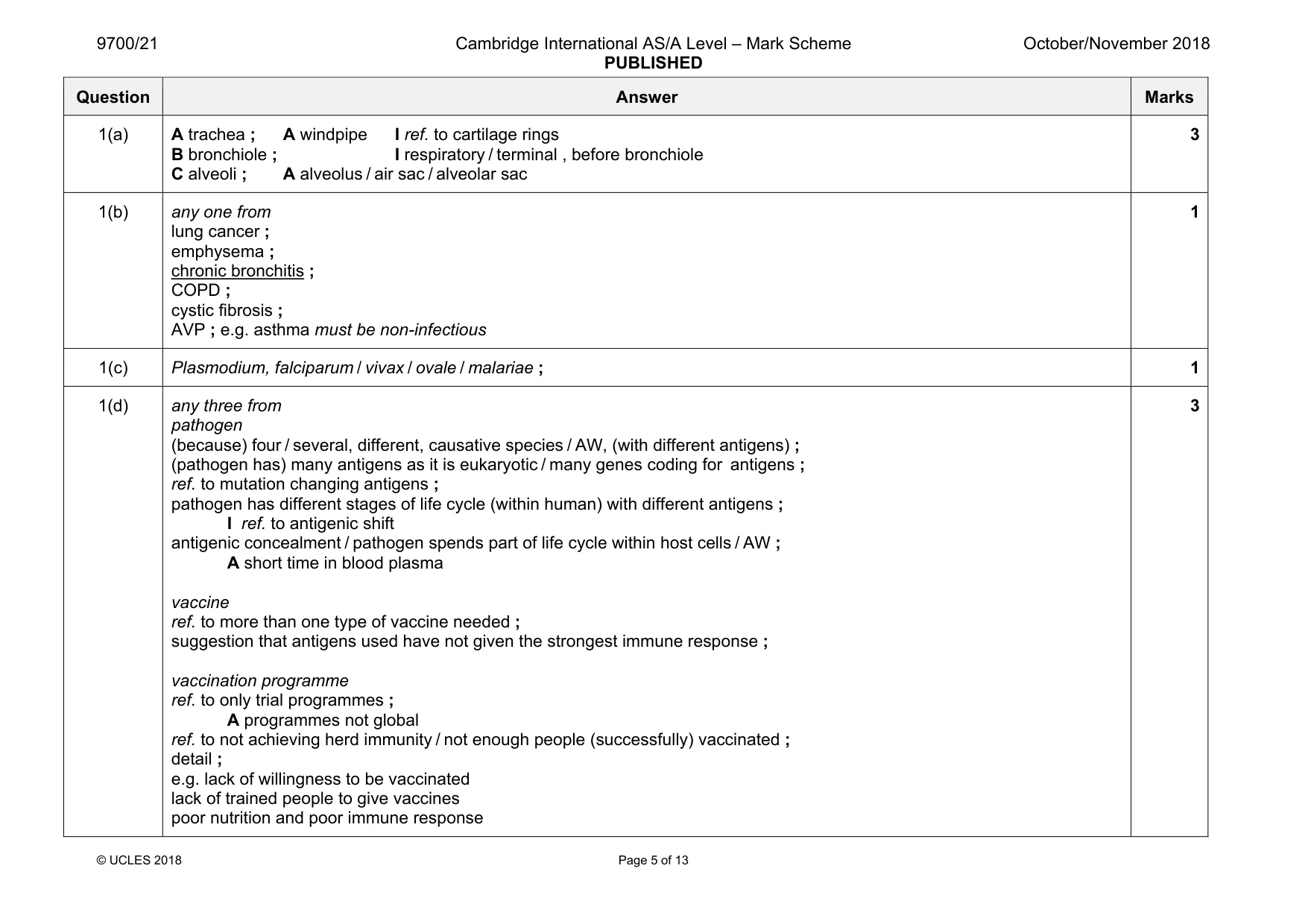
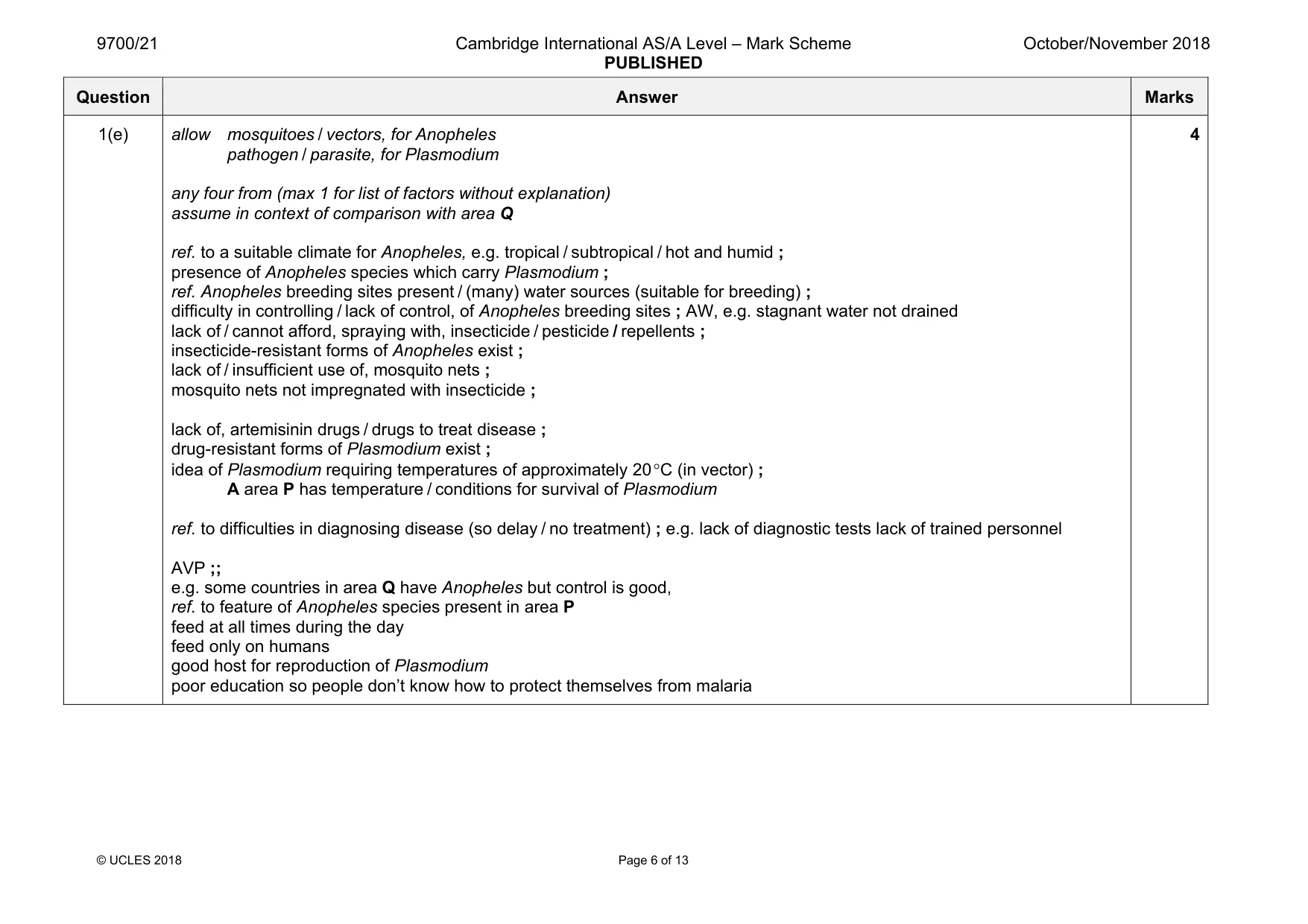
Mark scheme: 1(a) A trachea ; A windpipe I ref. to cartilage rings B bronchiole ; I respiratory / terminal , before bronchiole C alveoli ; A alveolus / air sac / alveolar sac 3 1(b) any one from lung cancer ; emphysema ; chronic bronchitis ; COPD ; cystic fibrosis ; AVP ; e.g. asthma must be non-infectious 1 1(c) Plasmodium, falciparum / vivax / ovale / malariae ; 1 1(d) any three from pathogen (because) four / several, different, causative species / AW, (with different antigens) ; (pathogen has) many antigens as it is eukaryotic / many genes coding for antigens ; ref. to mutation changing antigens ; pathogen has different stages of life cycle (within human) with different antigens ; I ref. to antigenic shift antigenic concealment / pathogen spends part of life cycle within host cells / AW ; A short time in blood plasma vaccine ref. to more than one type of vaccine needed ; suggestion that antigens used have not given the strongest immune response ; vaccination programme ref. to only trial programmes ; A programmes not global ref. to not achieving herd immunity / not enough people (successfully) vaccinated ; detail ; e.g. lack of willingness to be vaccinated lack of trained people to give vaccines poor nutrition and poor immune response 3 Question Answer Marks 1(e) allow mosquitoes / vectors, for Anopheles pathogen / parasite, for Plasmodium any four from (max 1 for list of factors without explanation) assume in context of comparison with area Q ref. to a suitable climate for Anopheles, e.g. tropical / subtropical / hot and humid ; presence of Anopheles species which carry Plasmodium ; ref. Anopheles breeding sites present / (many) water sources (suitable for breeding) ; difficulty in controlling / lack of control, of Anopheles breeding sites ; AW, e.g. stagnant water not drained lack of / cannot afford, spraying with, insecticide / pesticide / repellents ; insecticide-resistant forms of Anopheles exist ; lack of / insufficient use of, mosquito nets ; mosquito nets not impregnated with insecticide ; lack of, artemisinin drugs / drugs to treat disease ; drug-resistant forms of Plasmodium exist ; idea of Plasmodium requiring temperatures of approximately 20 °C (in vector) ; A area P has temperature / conditions for survival of Plasmodium ref. to difficulties in diagnosing disease (so delay / no treatment) ; e.g. lack of diagnostic tests lack of trained personnel AVP ;; e.g. some countries in area Q have Anopheles but control is good, ref. to feature of Anopheles species present in area P feed at all times during the day feed only on humans good host for reproduction of Plasmodium poor education so people don’t know how to protect themselves from malaria 4
Q2 · The disaccharide lactose, which is found in milk
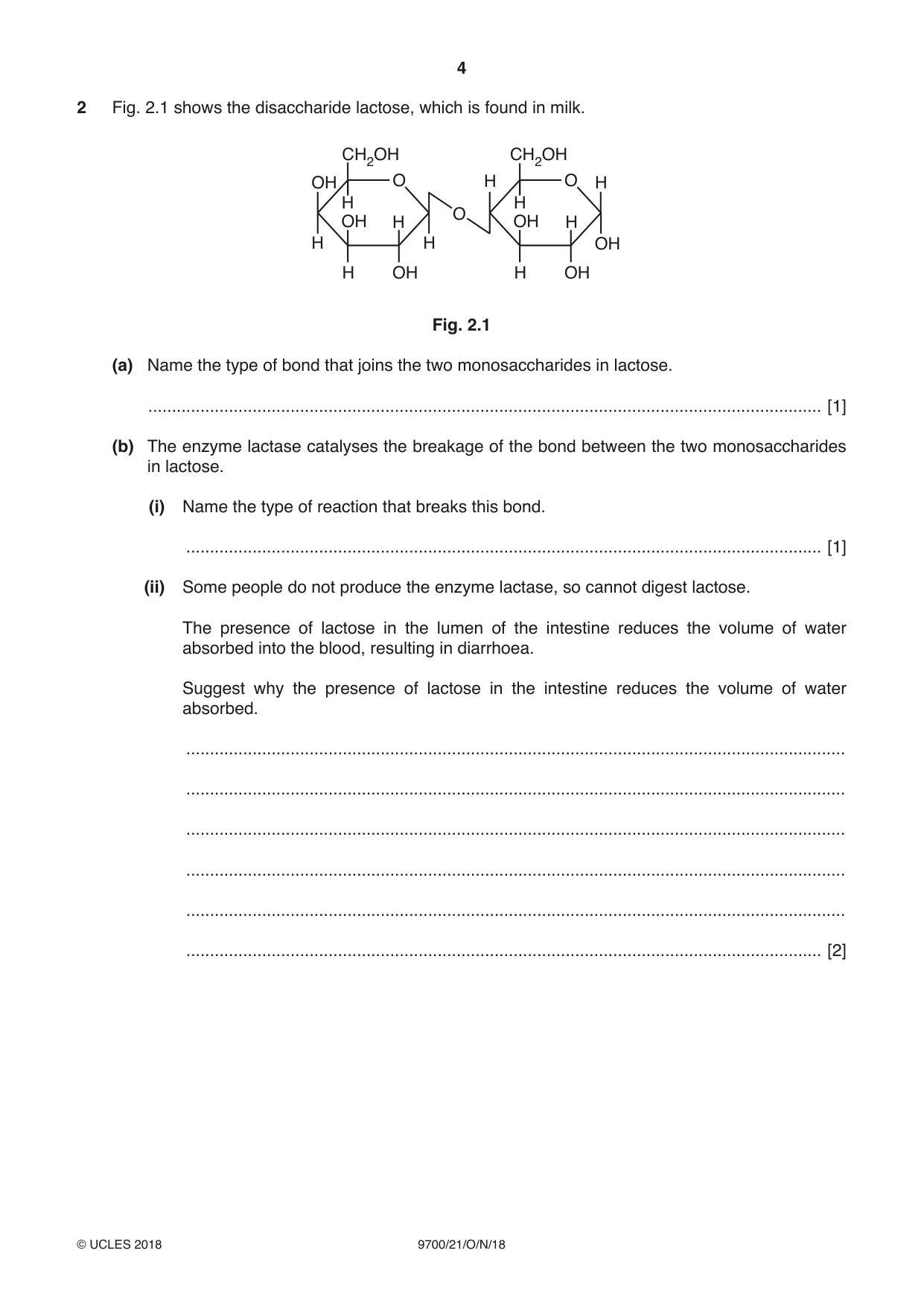
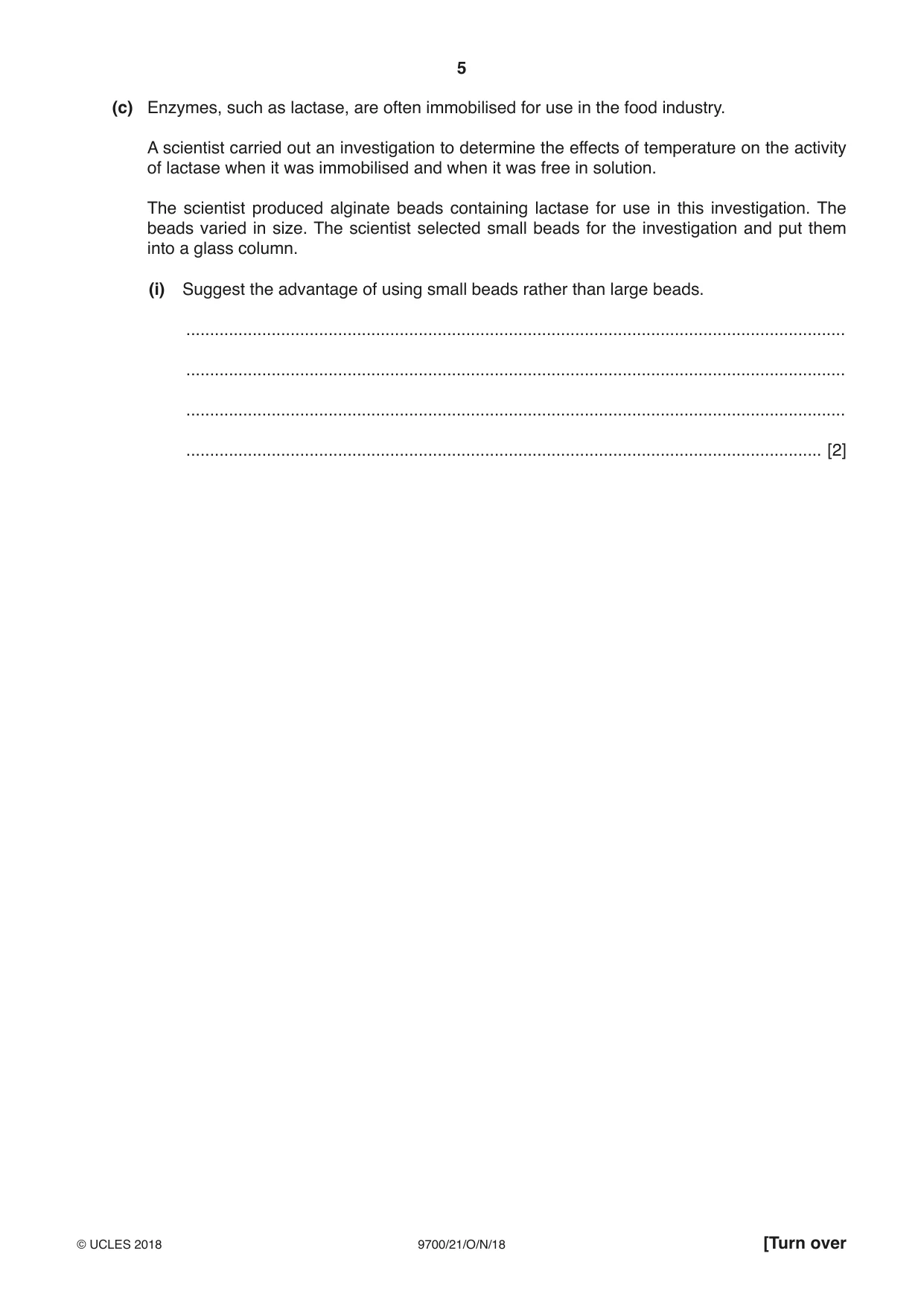
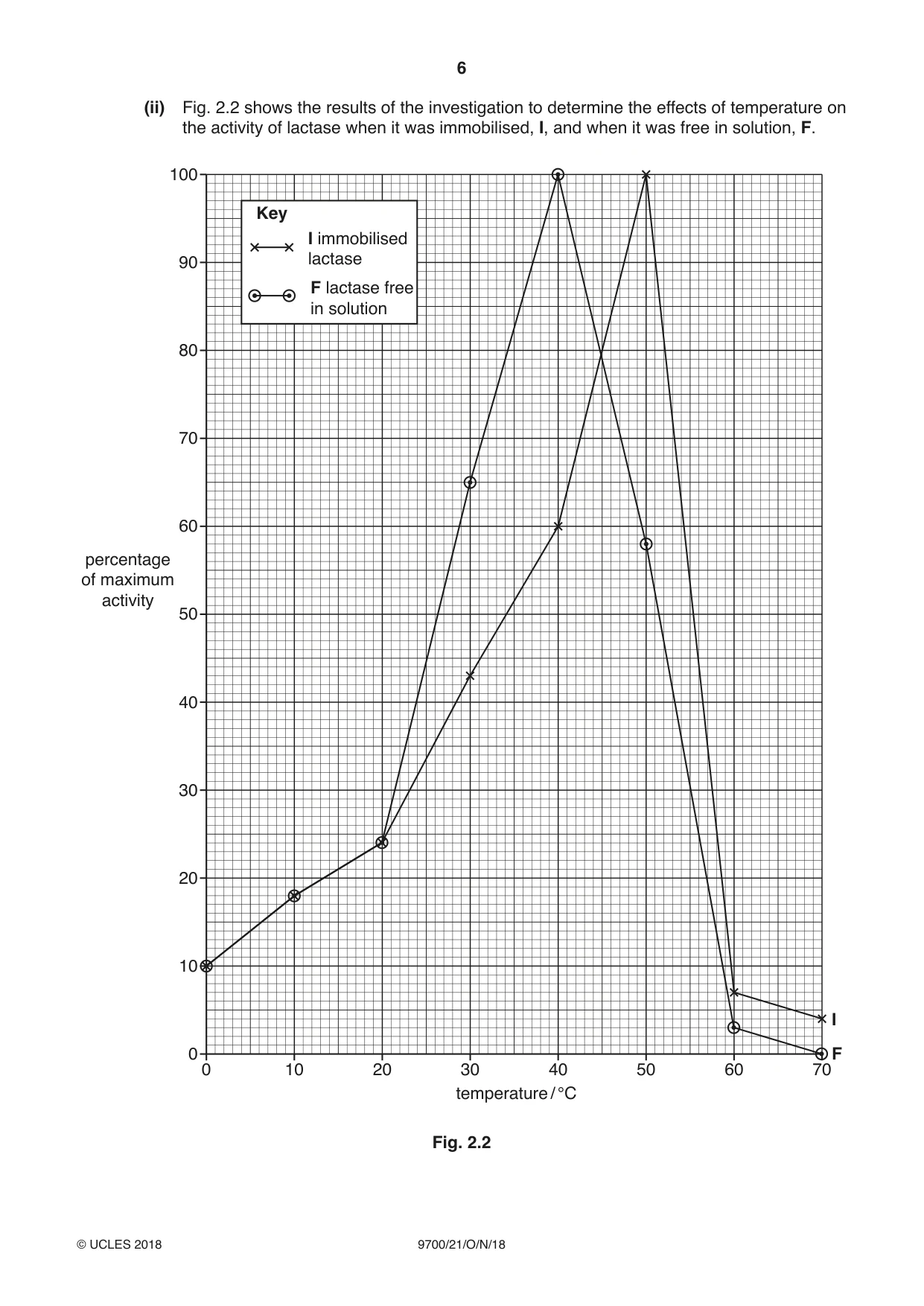
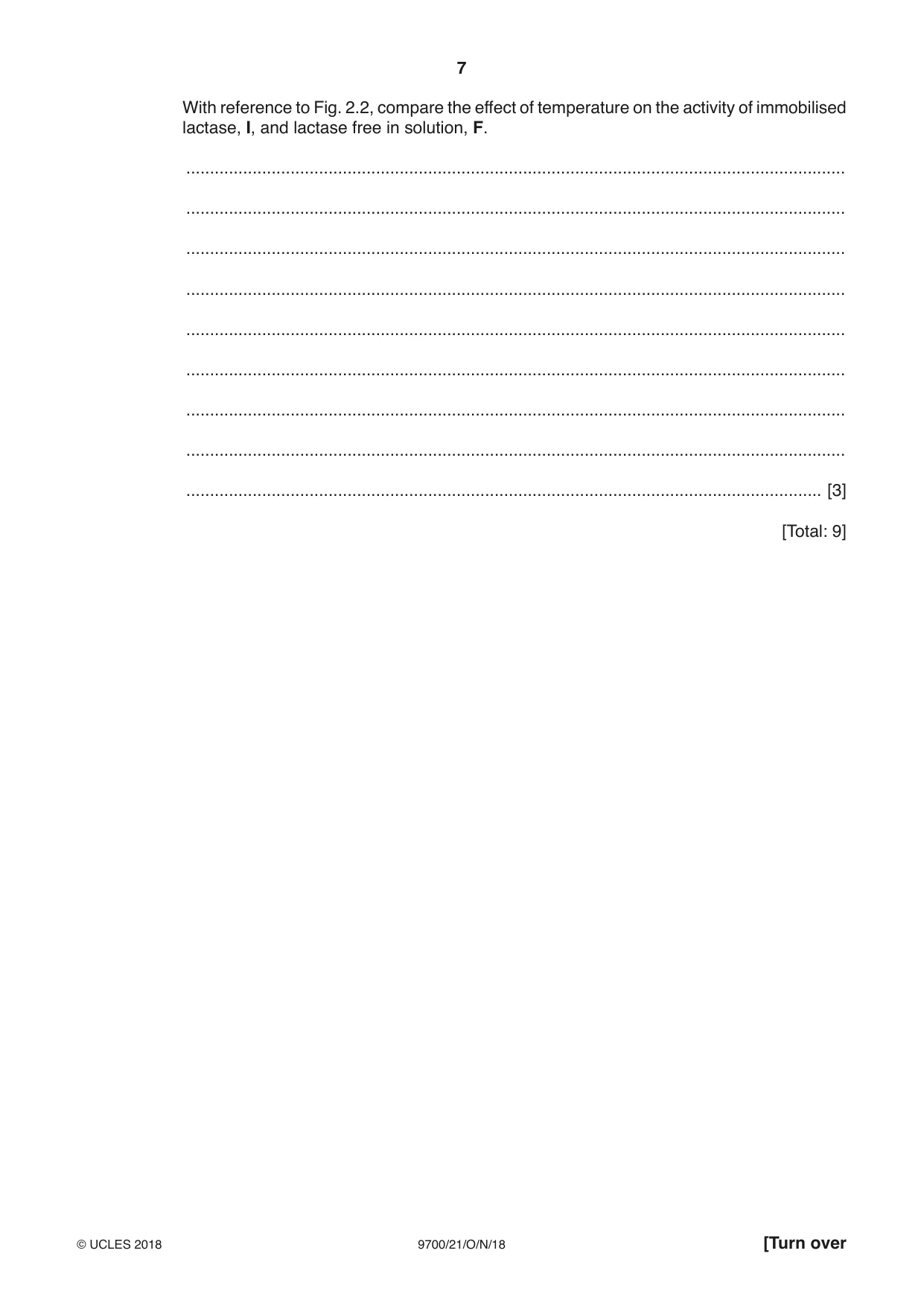
2 Fig. 2.1 shows the disaccharide lactose, which is found in milk. CH2OH CH2OH OH O H O H H H O OH H OH H H H OH H OH H OH Fig. 2.1 (a) Name the type of bond that joins the two monosaccharides in lactose. .............................................................................................................................................. [1] (b) The enzyme lactase catalyses the breakage of the bond between the two monosaccharides in lactose. (i) Name the type of reaction that breaks this bond. ...................................................................................................................................... [1] (ii) Some people do not produce the enzyme lactase, so cannot digest lactose. The presence of lactose in the lumen of the intestine reduces the volume of water absorbed into the blood, resulting in diarrhoea. Suggest why the presence of lactose in the intestine reduces the volume of water absorbed. ........................................................................................................................................... ........................................................................................................................................... ........................................................................................................................................... ........................................................................................................................................... ........................................................................................................................................... ...................................................................................................................................... [2] (c) Enzymes, such as lactase, are often immobilised for use in the food industry. A scientist carried out an investigation to determine the effects of temperature on the activity of lactase when it was immobilised and when it was free in solution. The scientist produced alginate beads containing lactase for use in this investigation. The beads varied in size. The scientist selected small beads for the investigation and put them into a glass column. (i) Suggest the advantage of using small beads rather than large beads. ........................................................................................................................................... ........................................................................................................................................... ........................................................................................................................................... ...................................................................................................................................... [2] With reference to Fig. 2.2, compare the effect of temperature on the activity of immobilised lactase, I, and lactase free in solution, F. ........................................................................................................................................... ........................................................................................................................................... ........................................................................................................................................... ........................................................................................................................................... ........................................................................................................................................... ........................................................................................................................................... ........................................................................................................................................... ........................................................................................................................................... ...................................................................................................................................... [3] [Total: 9]
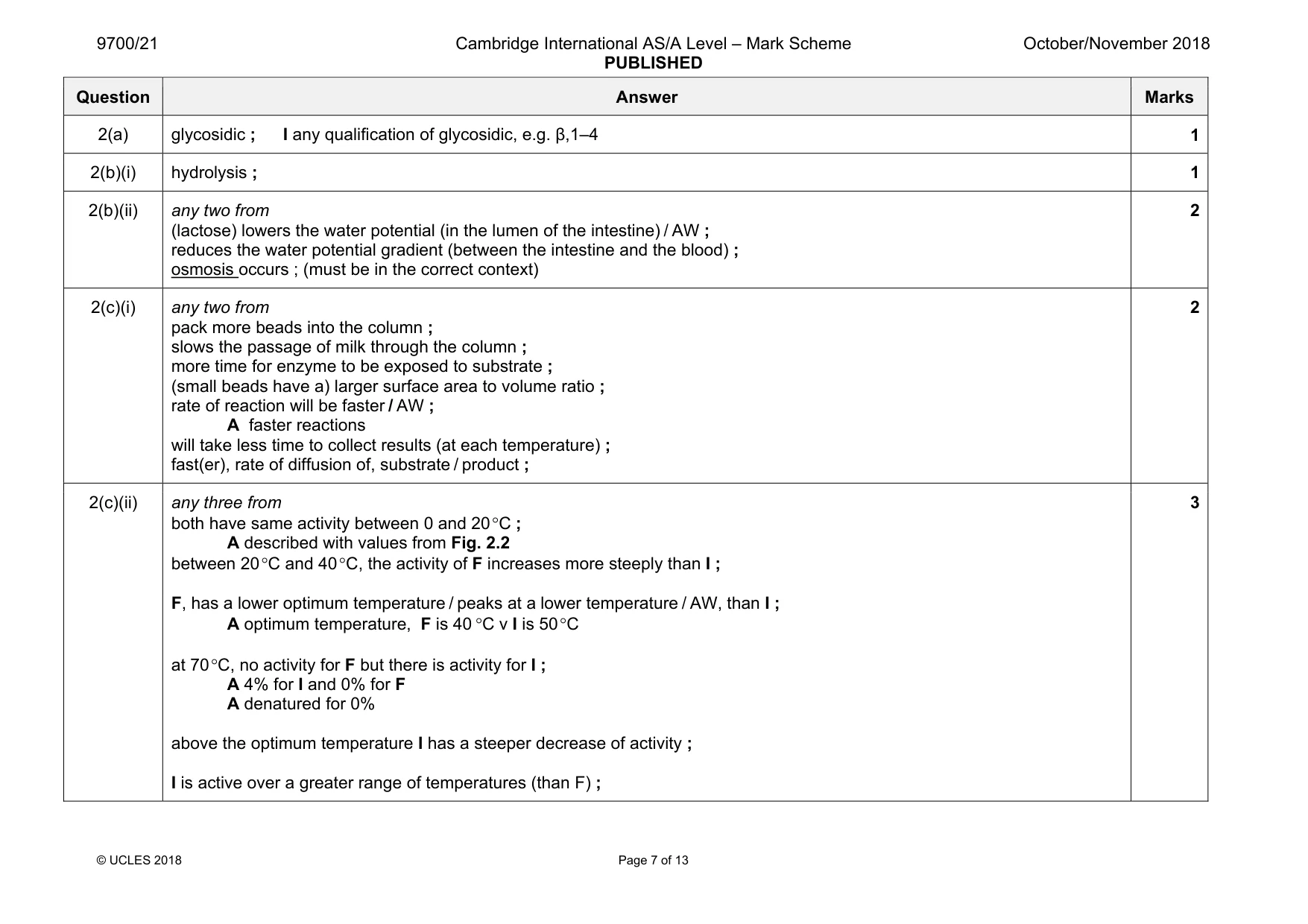
Mark scheme: 2(a) glycosidic ; I any qualification of glycosidic, e.g. β,1–4 1 2(b)(i) hydrolysis ; 1 2(b)(ii) any two from (lactose) lowers the water potential (in the lumen of the intestine) / AW ; reduces the water potential gradient (between the intestine and the blood) ; osmosis occurs ; (must be in the correct context) 2 2(c)(i) any two from pack more beads into the column ; slows the passage of milk through the column ; more time for enzyme to be exposed to substrate ; (small beads have a) larger surface area to volume ratio ; rate of reaction will be faster / AW ; A faster reactions will take less time to collect results (at each temperature) ; fast(er), rate of diffusion of, substrate / product ; 2 2(c)(ii) any three from both have same activity between 0 and 20 °C ; A described with values from Fig. 2.2 between 20 °C and 40 °C, the activity of F increases more steeply than I ; F, has a lower optimum temperature / peaks at a lower temperature / AW, than I ; A optimum temperature, F is 40 °C v I is 50 °C at 70 °C, no activity for F but there is activity for I ; A 4% for I and 0% for F A denatured for 0% above the optimum temperature I has a steeper decrease of activity ; I is active over a greater range of temperatures (than F) ; 3
Q3 · A transmission electron micrograph showing two adjacent cells in a leaf
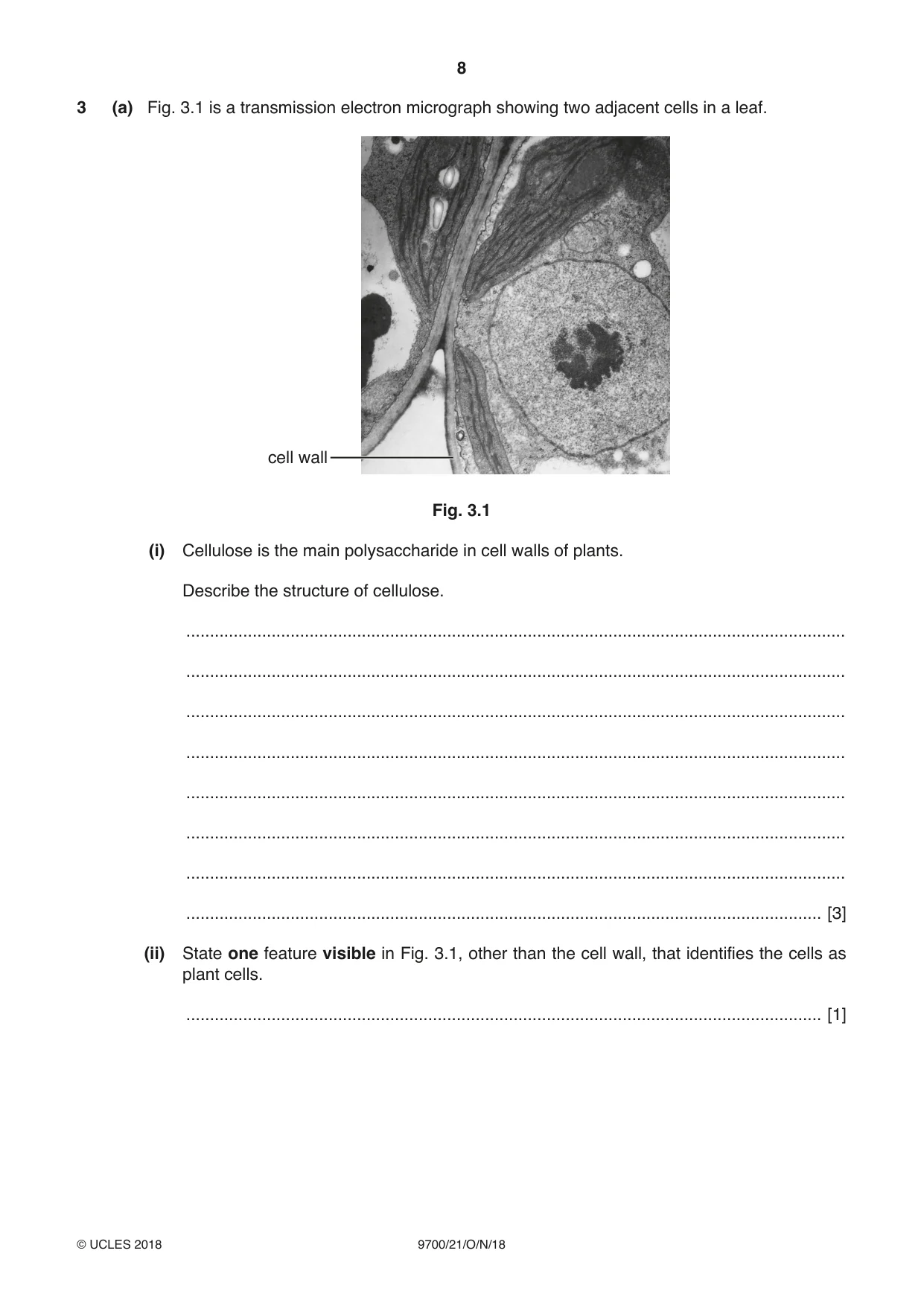
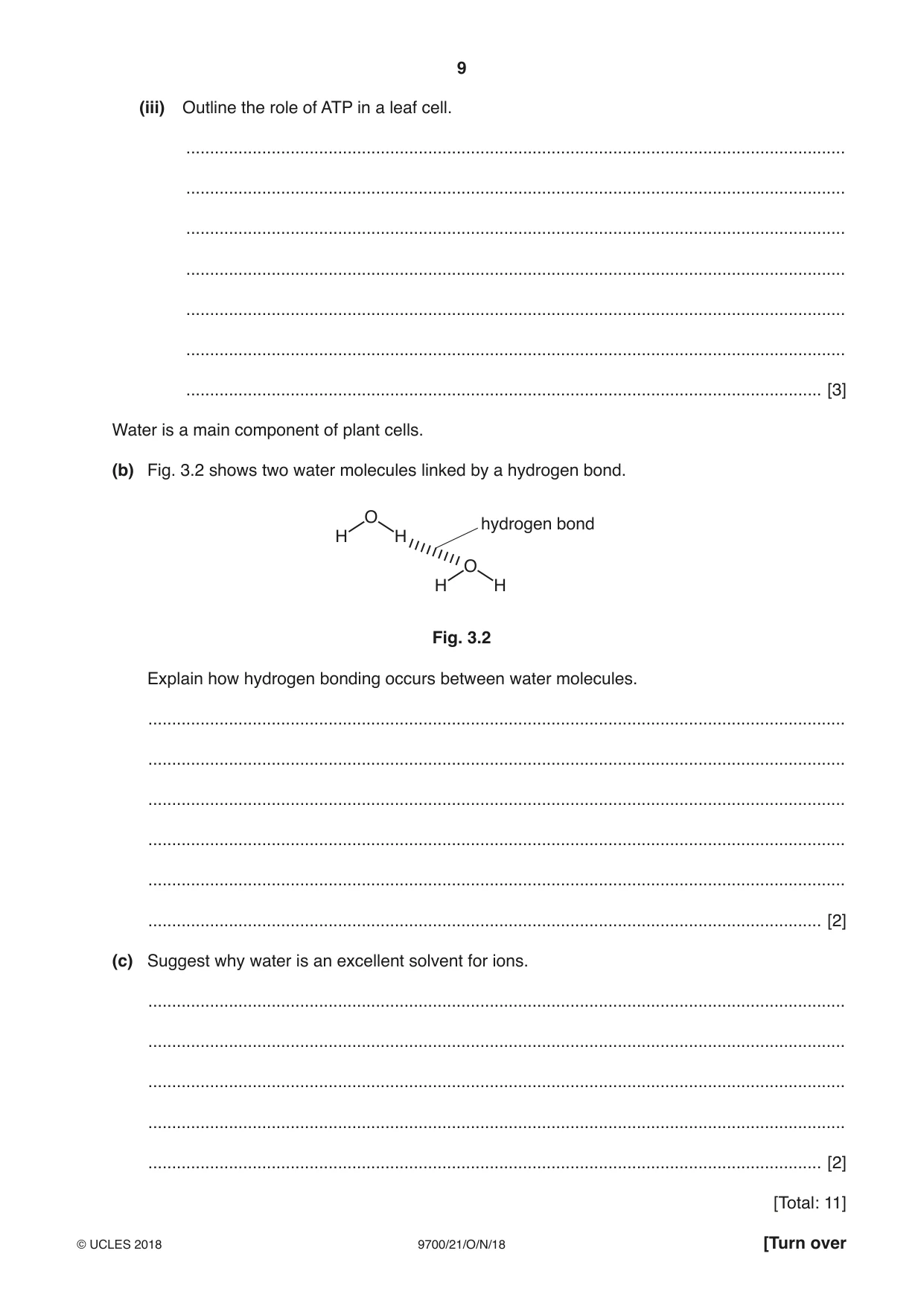
3 (a) Fig. 3.1 is a transmission electron micrograph showing two adjacent cells in a leaf. cell wall Fig. 3.1 (i) Cellulose is the main polysaccharide in cell walls of plants. Describe the structure of cellulose. ........................................................................................................................................... ........................................................................................................................................... ........................................................................................................................................... ........................................................................................................................................... ........................................................................................................................................... ........................................................................................................................................... ........................................................................................................................................... ...................................................................................................................................... [3] (ii) State one feature visible in Fig. 3.1, other than the cell wall, that identifies the cells as plant cells. ...................................................................................................................................... [1] (iii) Outline the role of ATP in a leaf cell. ........................................................................................................................................... ........................................................................................................................................... ........................................................................................................................................... ........................................................................................................................................... ........................................................................................................................................... ........................................................................................................................................... ...................................................................................................................................... [3] Water is a main component of plant cells. (b) Fig. 3.2 shows two water molecules linked by a hydrogen bond. O hydrogen bond H H O H H Fig. 3.2 Explain how hydrogen bonding occurs between water molecules. ................................................................................................................................................... ................................................................................................................................................... ................................................................................................................................................... ................................................................................................................................................... ................................................................................................................................................... .............................................................................................................................................. [2] (c) Suggest why water is an excellent solvent for ions. ................................................................................................................................................... ................................................................................................................................................... ................................................................................................................................................... ................................................................................................................................................... .............................................................................................................................................. [2] [Total: 11]
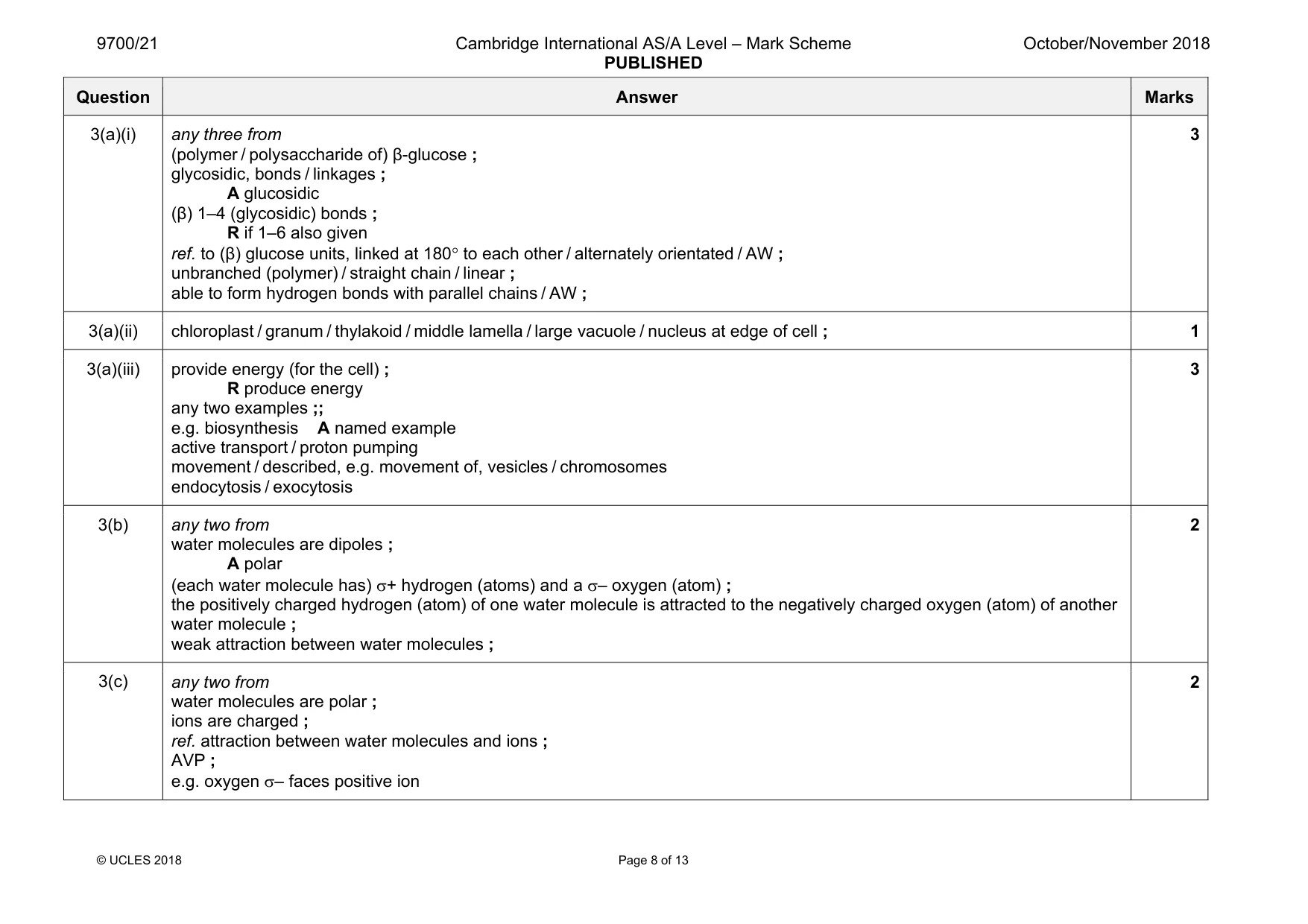
Mark scheme: 3(a)(i) any three from (polymer / polysaccharide of) β-glucose ; glycosidic, bonds / linkages ; A glucosidic (β) 1–4 (glycosidic) bonds ; R if 1–6 also given ref. to (β) glucose units, linked at 180° to each other / alternately orientated / AW ; unbranched (polymer) / straight chain / linear ; able to form hydrogen bonds with parallel chains / AW ; 3 3(a)(ii) chloroplast / granum / thylakoid / middle lamella / large vacuole / nucleus at edge of cell ; 1 3(a)(iii) provide energy (for the cell) ; R produce energy any two examples ;; e.g. biosynthesis A named example active transport / proton pumping movement / described, e.g. movement of, vesicles / chromosomes endocytosis / exocytosis 3 3(b) any two from water molecules are dipoles ; A polar (each water molecule has) σ+ hydrogen (atoms) and a σ– oxygen (atom) ; the positively charged hydrogen (atom) of one water molecule is attracted to the negatively charged oxygen (atom) of another water molecule ; weak attraction between water molecules ; 2 3(c) any two from water molecules are polar ; ions are charged ; ref. attraction between water molecules and ions ; AVP ; e.g. oxygen σ– faces positive ion 2
Q4 · A photomicrograph of a cross-section of a tubular structure in the kidney made from…
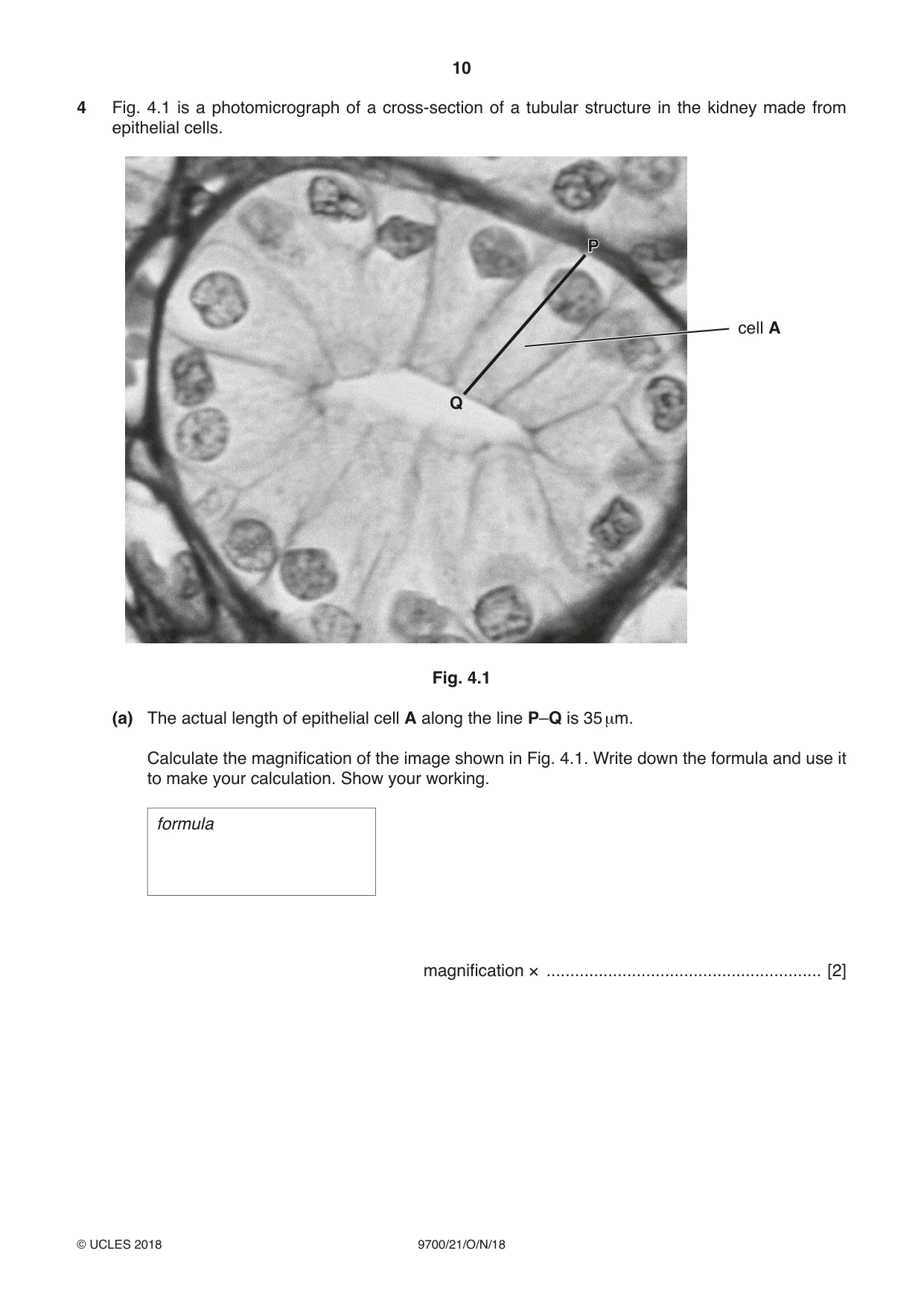
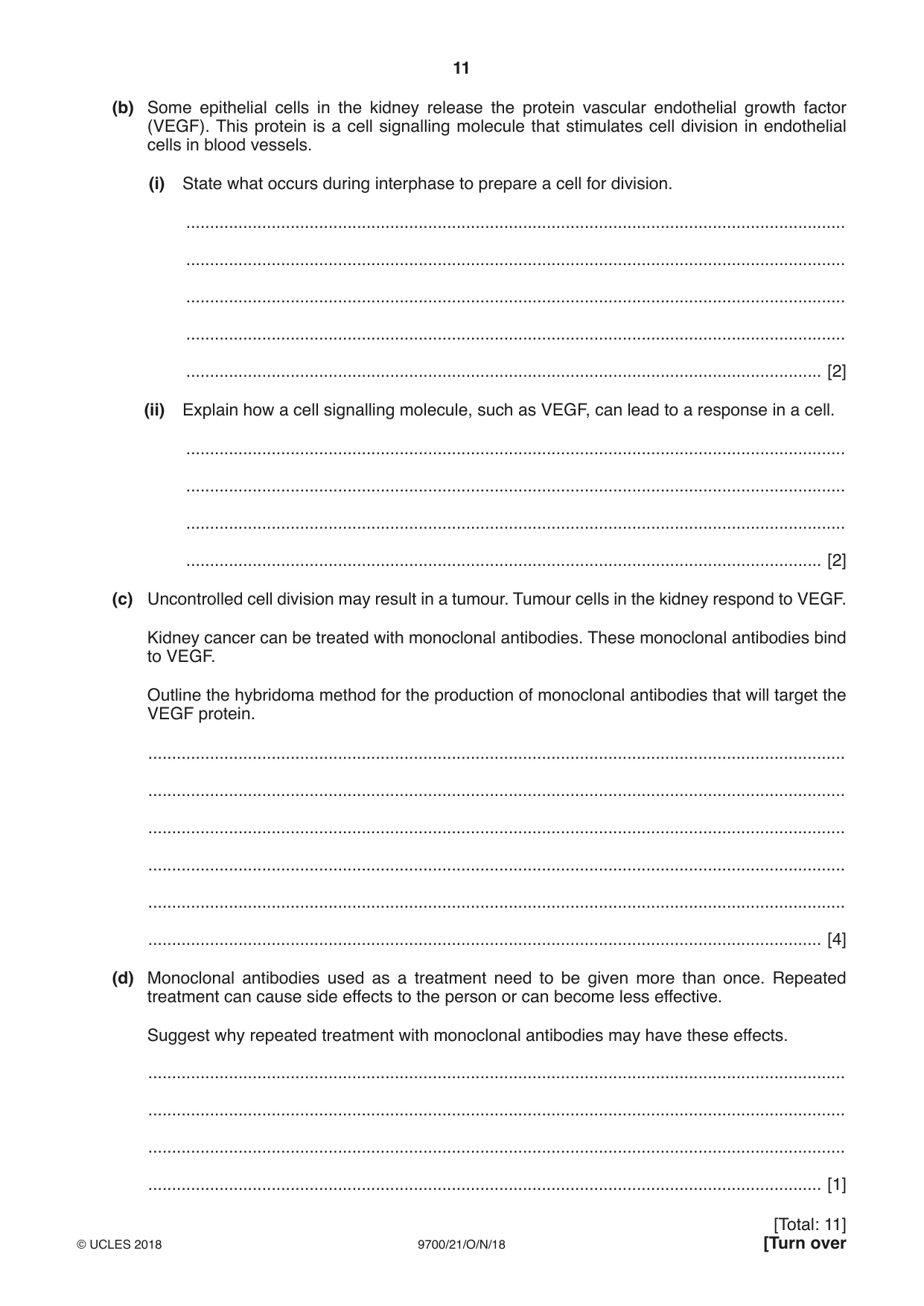
4 Fig. 4.1 is a photomicrograph of a cross-section of a tubular structure in the kidney made from epithelial cells. P cell A Q Fig. 4.1 (a) The actual length of epithelial cell A along the line P–Q is 35 µm. Calculate the magnification of the image shown in Fig. 4.1. Write down the formula and use it to make your calculation. Show your working. formula magnification × .......................................................... [2] (b) Some epithelial cells in the kidney release the protein vascular endothelial growth factor (VEGF). This protein is a cell signalling molecule that stimulates cell division in endothelial cells in blood vessels. (i) State what occurs during interphase to prepare a cell for division. ........................................................................................................................................... ........................................................................................................................................... ........................................................................................................................................... ........................................................................................................................................... ...................................................................................................................................... [2] (ii) Explain how a cell signalling molecule, such as VEGF, can lead to a response in a cell. ........................................................................................................................................... ........................................................................................................................................... ........................................................................................................................................... ...................................................................................................................................... [2] (c) Uncontrolled cell division may result in a tumour. Tumour cells in the kidney respond to VEGF. Kidney cancer can be treated with monoclonal antibodies. These monoclonal antibodies bind to VEGF. Outline the hybridoma method for the production of monoclonal antibodies that will target the VEGF protein. ................................................................................................................................................... ................................................................................................................................................... ................................................................................................................................................... ................................................................................................................................................... ................................................................................................................................................... .............................................................................................................................................. [4] (d) Monoclonal antibodies used as a treatment need to be given more than once. Repeated treatment can cause side effects to the person or can become less effective. Suggest why repeated treatment with monoclonal antibodies may have these effects. ................................................................................................................................................... ................................................................................................................................................... ................................................................................................................................................... .............................................................................................................................................. [1]
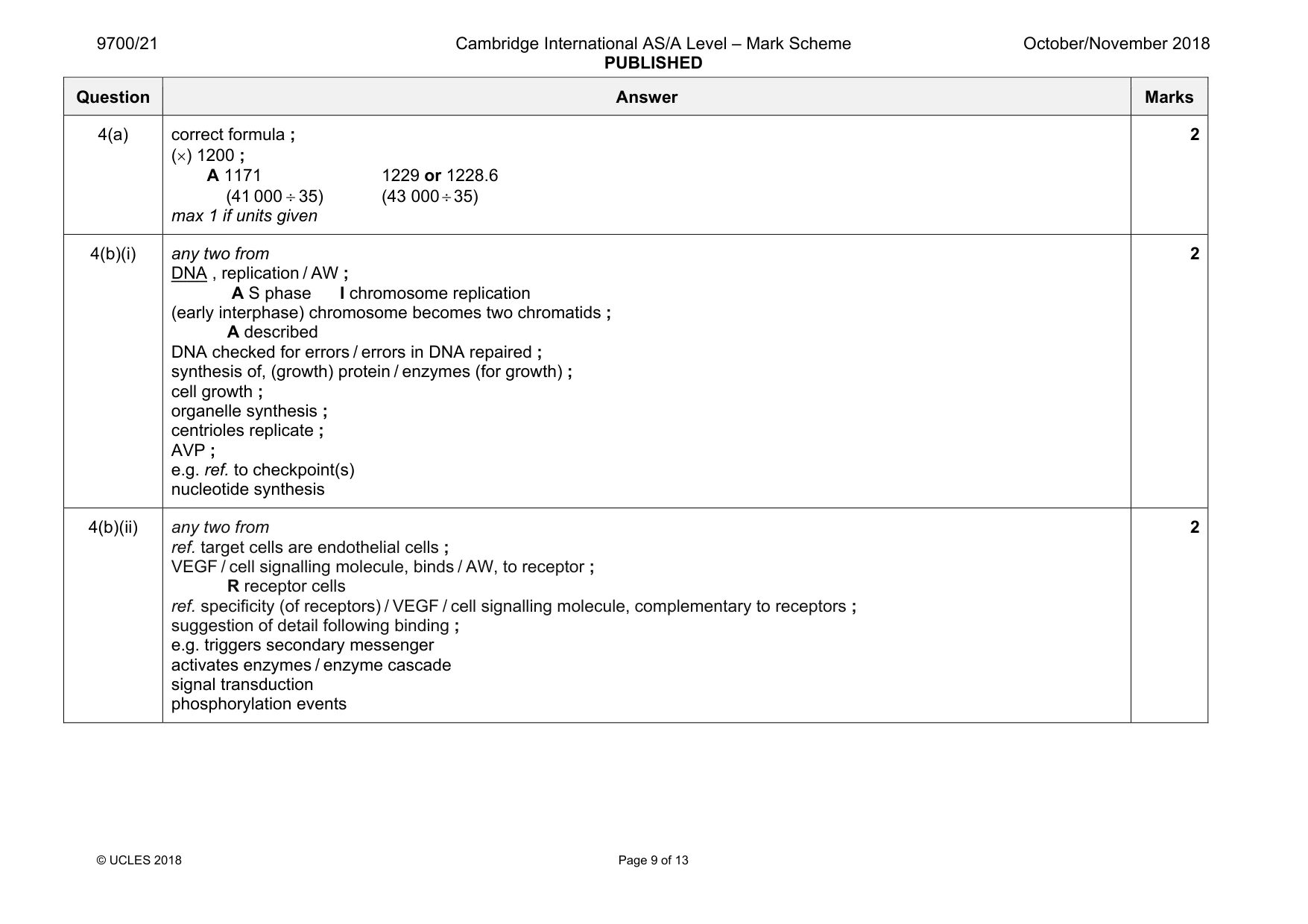
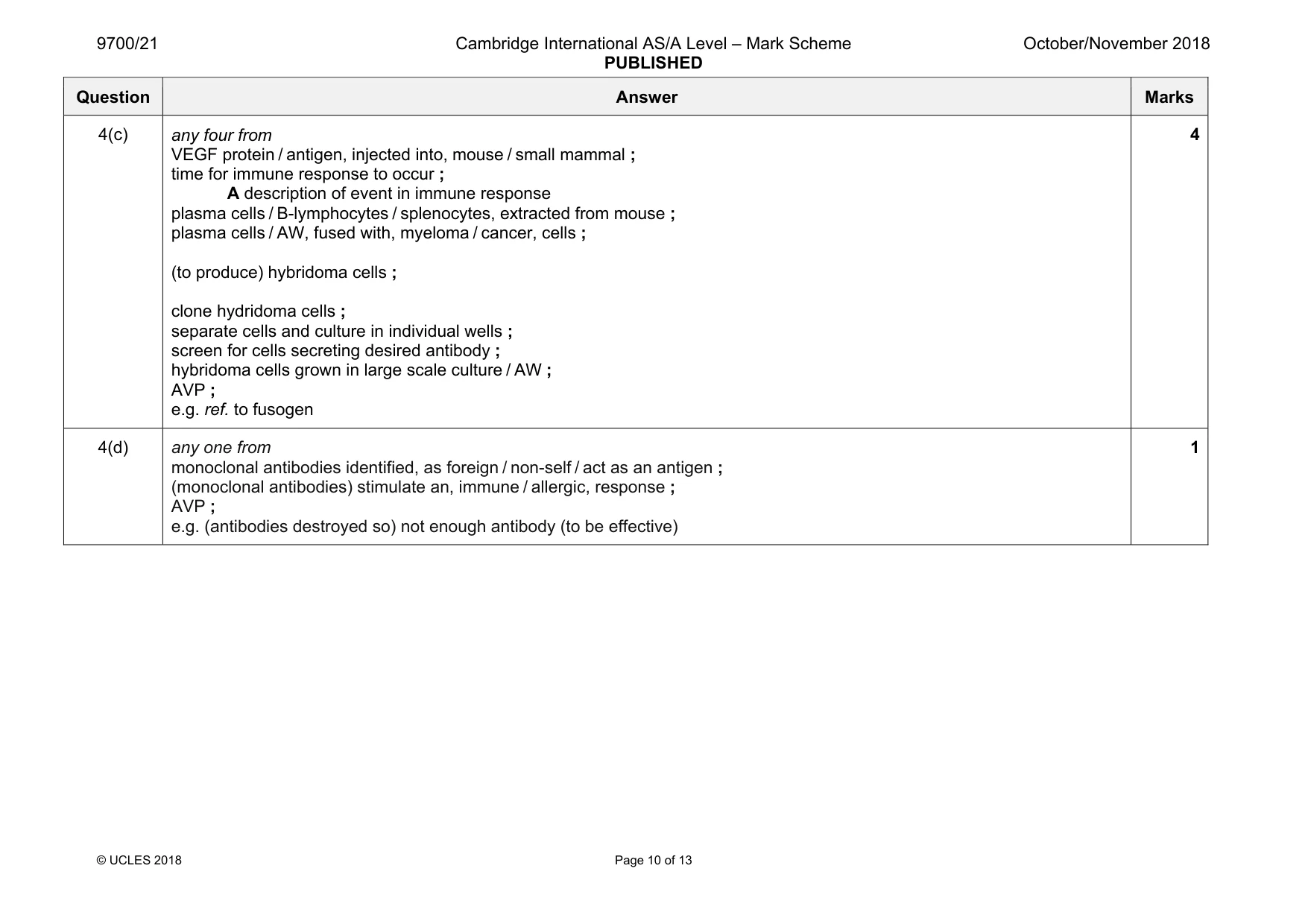
Mark scheme: 4(a) correct formula ; (×) 1200 ; A 1171 1229 or 1228.6 (41 000 ÷ 35) (43 000 ÷ 35) max 1 if units given 2 4(b)(i) any two from DNA , replication / AW ; A S phase I chromosome replication (early interphase) chromosome becomes two chromatids ; A described DNA checked for errors / errors in DNA repaired ; synthesis of, (growth) protein / enzymes (for growth) ; cell growth ; organelle synthesis ; centrioles replicate ; AVP ; e.g. ref. to checkpoint(s) nucleotide synthesis 2 4(b)(ii) any two from ref. target cells are endothelial cells ; VEGF / cell signalling molecule, binds / AW, to receptor ; R receptor cells ref. specificity (of receptors) / VEGF / cell signalling molecule, complementary to receptors ; suggestion of detail following binding ; e.g. triggers secondary messenger activates enzymes / enzyme cascade signal transduction phosphorylation events 2 Question Answer Marks 4(c) any four from VEGF protein / antigen, injected into, mouse / small mammal ; time for immune response to occur ; A description of event in immune response plasma cells / B-lymphocytes / splenocytes, extracted from mouse ; plasma cells / AW, fused with, myeloma / cancer, cells ; (to produce) hybridoma cells ; clone hydridoma cells ; separate cells and culture in individual wells ; screen for cells secreting desired antibody ; hybridoma cells grown in large scale culture / AW ; AVP ; e.g. ref. to fusogen 4 4(d) any one from monoclonal antibodies identified, as foreign / non-self / act as an antigen ; (monoclonal antibodies) stimulate an, immune / allergic, response ; AVP ; e.g. (antibodies destroyed so) not enough antibody (to be effective) 1
More questions on Replication and division of nuclei and cells
Q5 · The structure of a prokaryotic cell
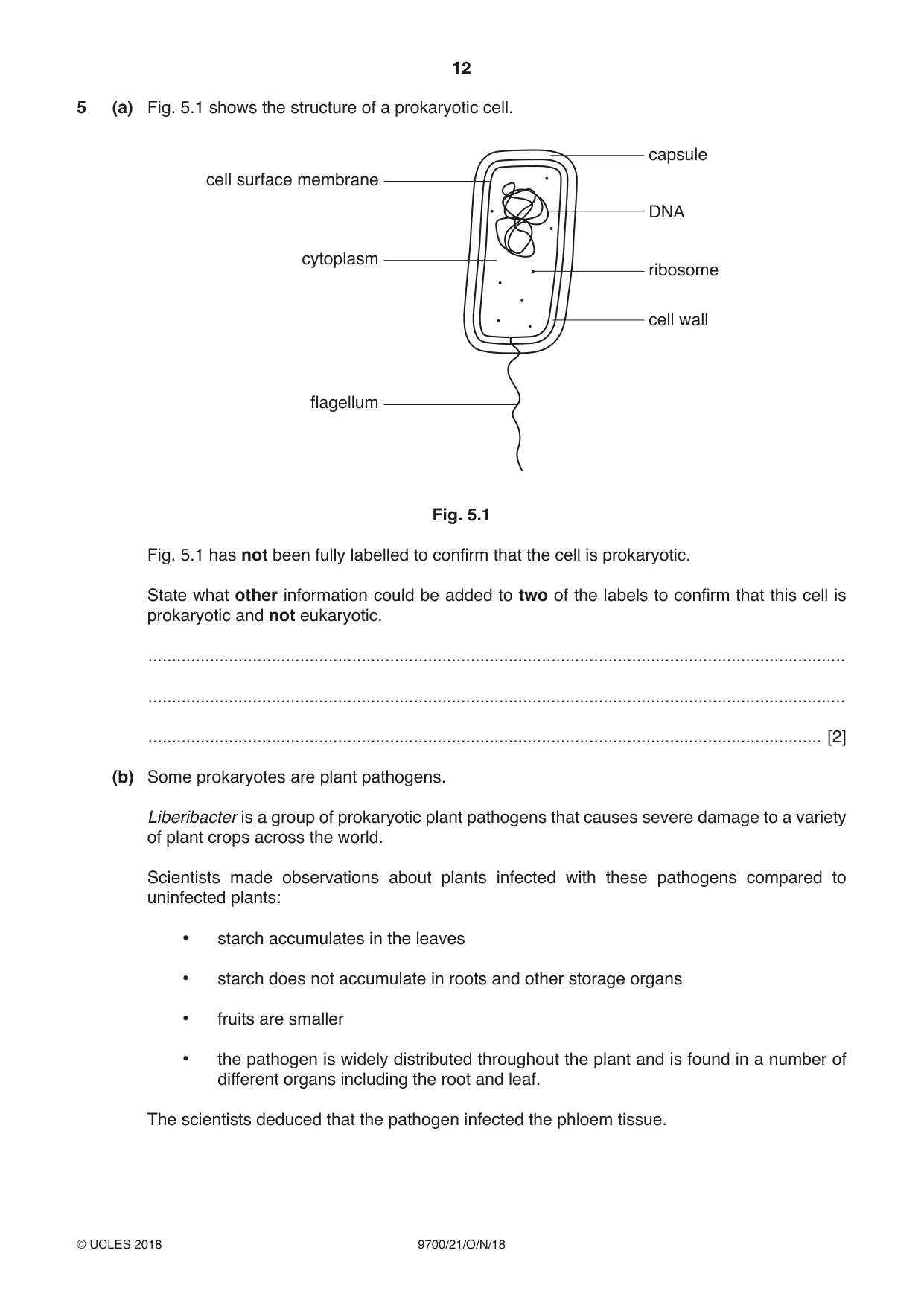
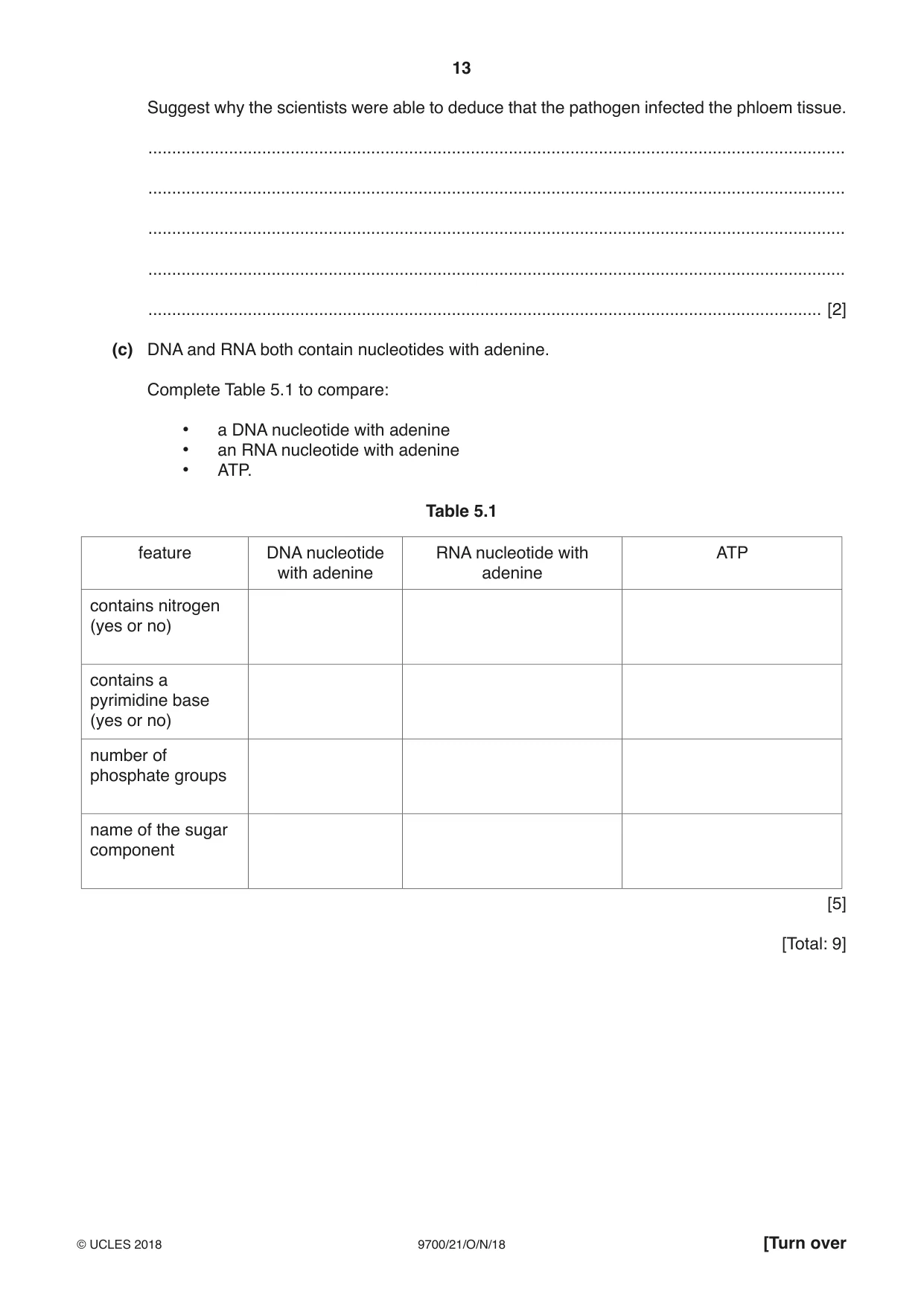
5 (a) Fig. 5.1 shows the structure of a prokaryotic cell. capsule cell surface membrane DNA cytoplasm ribosome cell wall flagellum Fig. 5.1 Fig. 5.1 has not been fully labelled to confirm that the cell is prokaryotic. State what other information could be added to two of the labels to confirm that this cell is prokaryotic and not eukaryotic. ................................................................................................................................................... ................................................................................................................................................... .............................................................................................................................................. [2] (b) Some prokaryotes are plant pathogens. Liberibacter is a group of prokaryotic plant pathogens that causes severe damage to a variety of plant crops across the world. Scientists made observations about plants infected with these pathogens compared to uninfected plants: • starch accumulates in the leaves • starch does not accumulate in roots and other storage organs • fruits are smaller • the pathogen is widely distributed throughout the plant and is found in a number of different organs including the root and leaf. The scientists deduced that the pathogen infected the phloem tissue. Suggest why the scientists were able to deduce that the pathogen infected the phloem tissue. ................................................................................................................................................... ................................................................................................................................................... ................................................................................................................................................... ................................................................................................................................................... .............................................................................................................................................. [2] (c) DNA and RNA both contain nucleotides with adenine. Complete Table 5.1 to compare: • a DNA nucleotide with adenine • an RNA nucleotide with adenine • ATP. Table 5.1 feature DNA nucleotide RNA nucleotide with ATP with adenine adenine contains nitrogen (yes or no) contains a pyrimidine base (yes or no) number of phosphate groups name of the sugar component [5] [Total: 9]
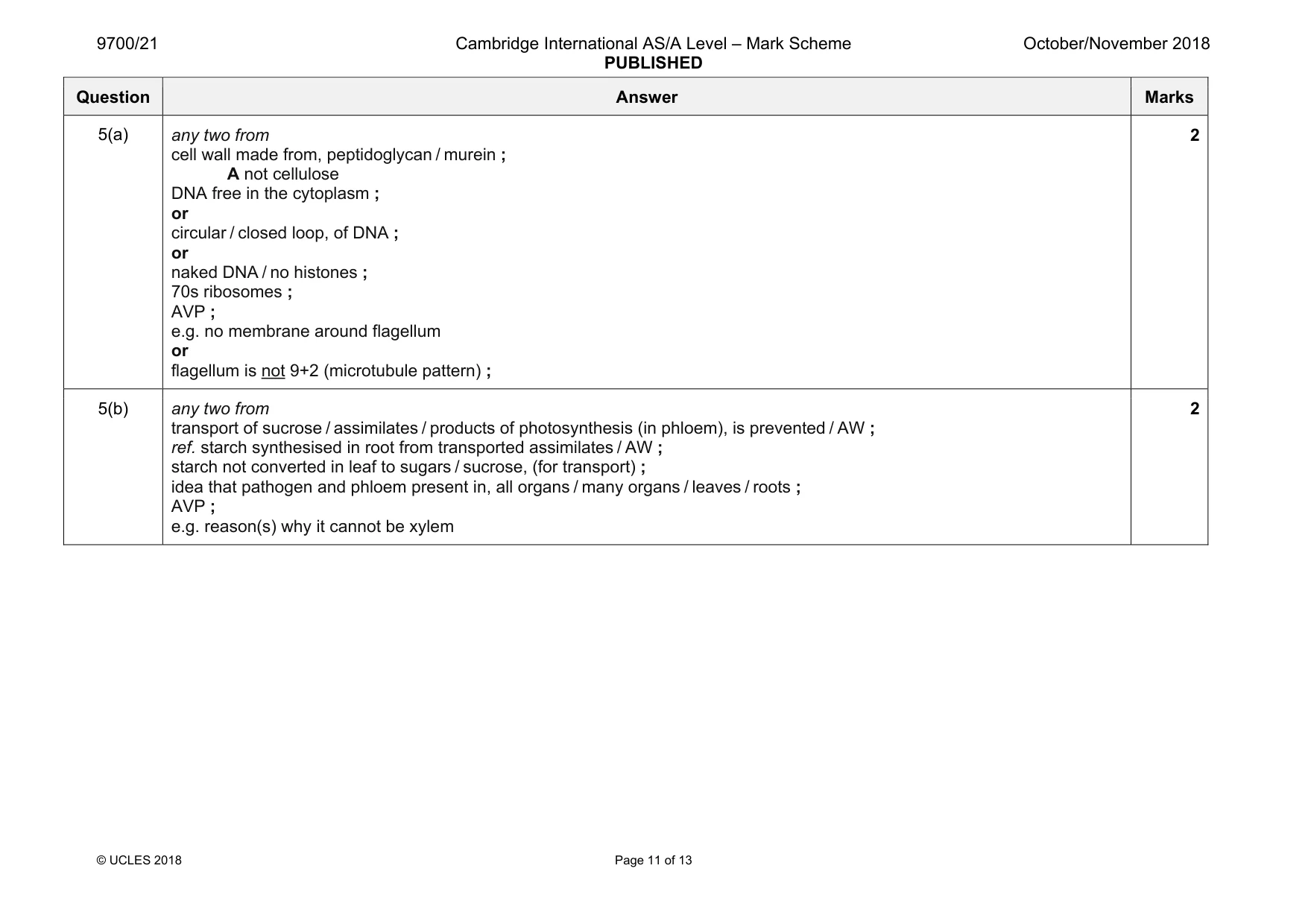
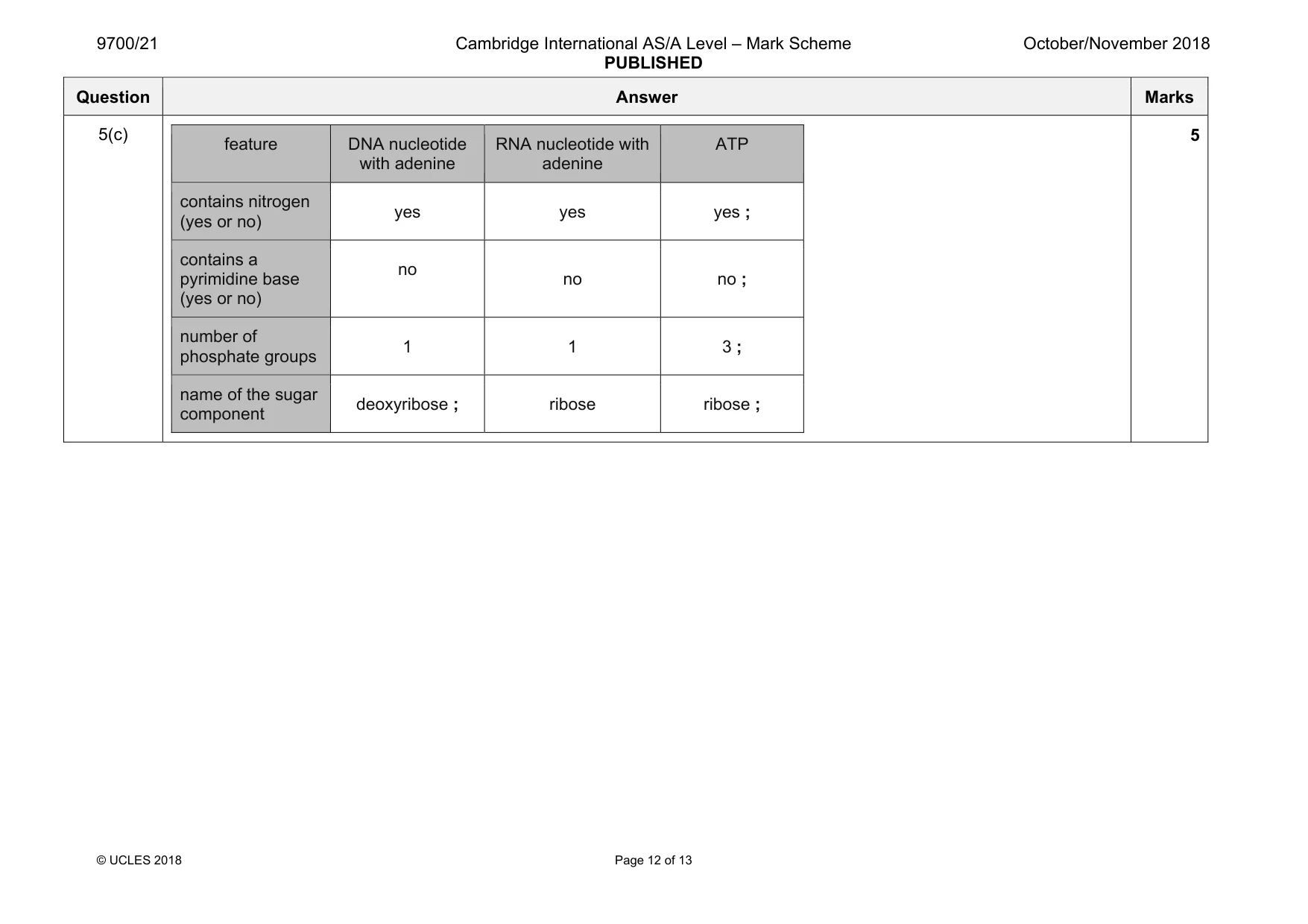
Mark scheme: 5(a) any two from cell wall made from, peptidoglycan / murein ; A not cellulose DNA free in the cytoplasm ; or circular / closed loop, of DNA ; or naked DNA / no histones ; 70s ribosomes ; AVP ; e.g. no membrane around flagellum or flagellum is not 9+2 (microtubule pattern) ; 2 5(b) any two from transport of sucrose / assimilates / products of photosynthesis (in phloem), is prevented / AW ; ref. starch synthesised in root from transported assimilates / AW ; starch not converted in leaf to sugars / sucrose, (for transport) ; idea that pathogen and phloem present in, all organs / many organs / leaves / roots ; AVP ; e.g. reason(s) why it cannot be xylem 2 Question Answer Marks 5(c) feature DNA nucleotide with adenine RNA nucleotide with adenine ATP contains nitrogen (yes or no) yes yes yes ; contains a pyrimidine base (yes or no) no no no ; number of phosphate groups 1 1 3 ; name of the sugar component deoxyribose ; ribose ribose ; 5
More questions on Structure of nucleic acids and replication of DNA
Q6 · Haemoglobin is a globular protein which is able to transport oxygen and is soluble in…
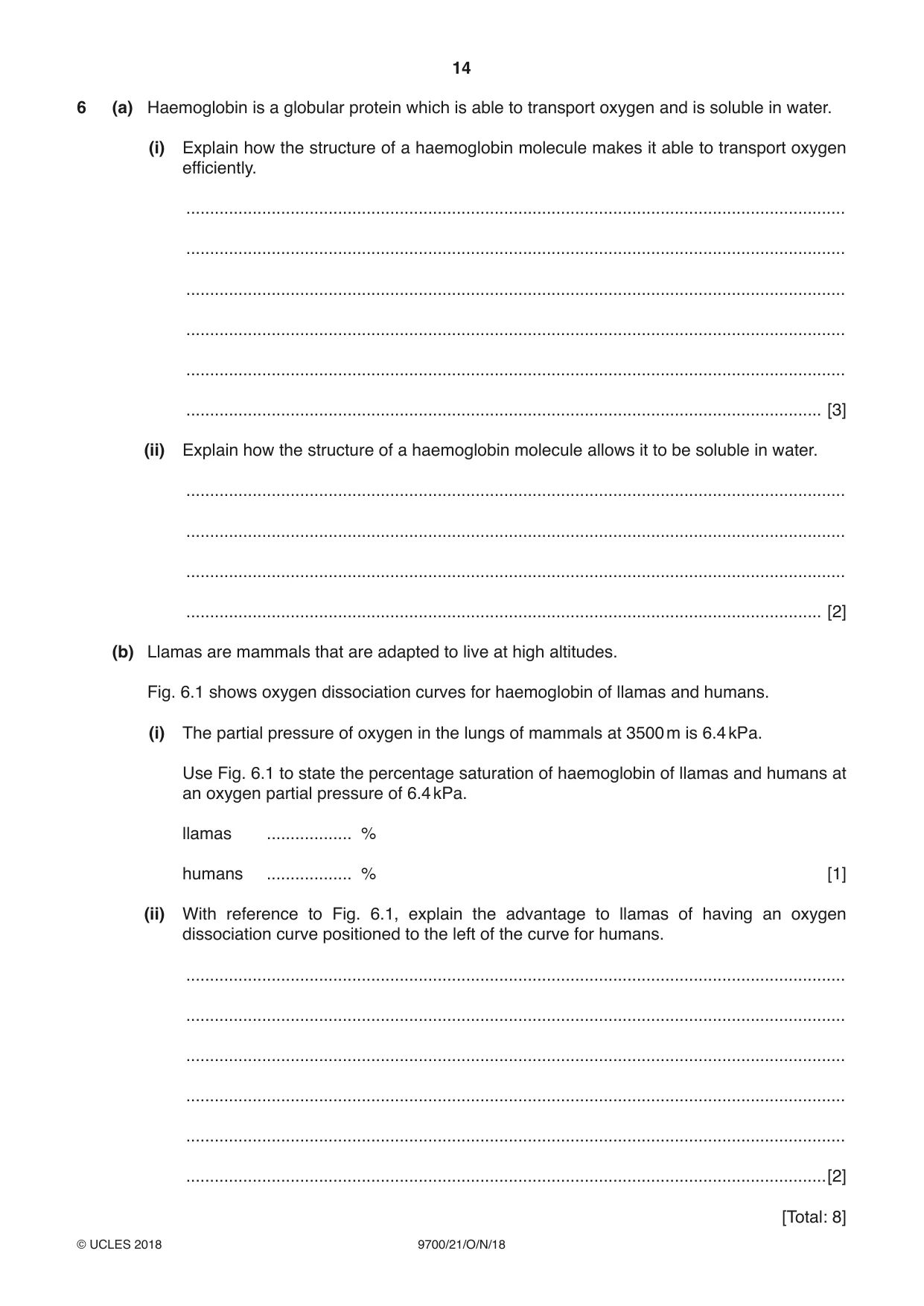
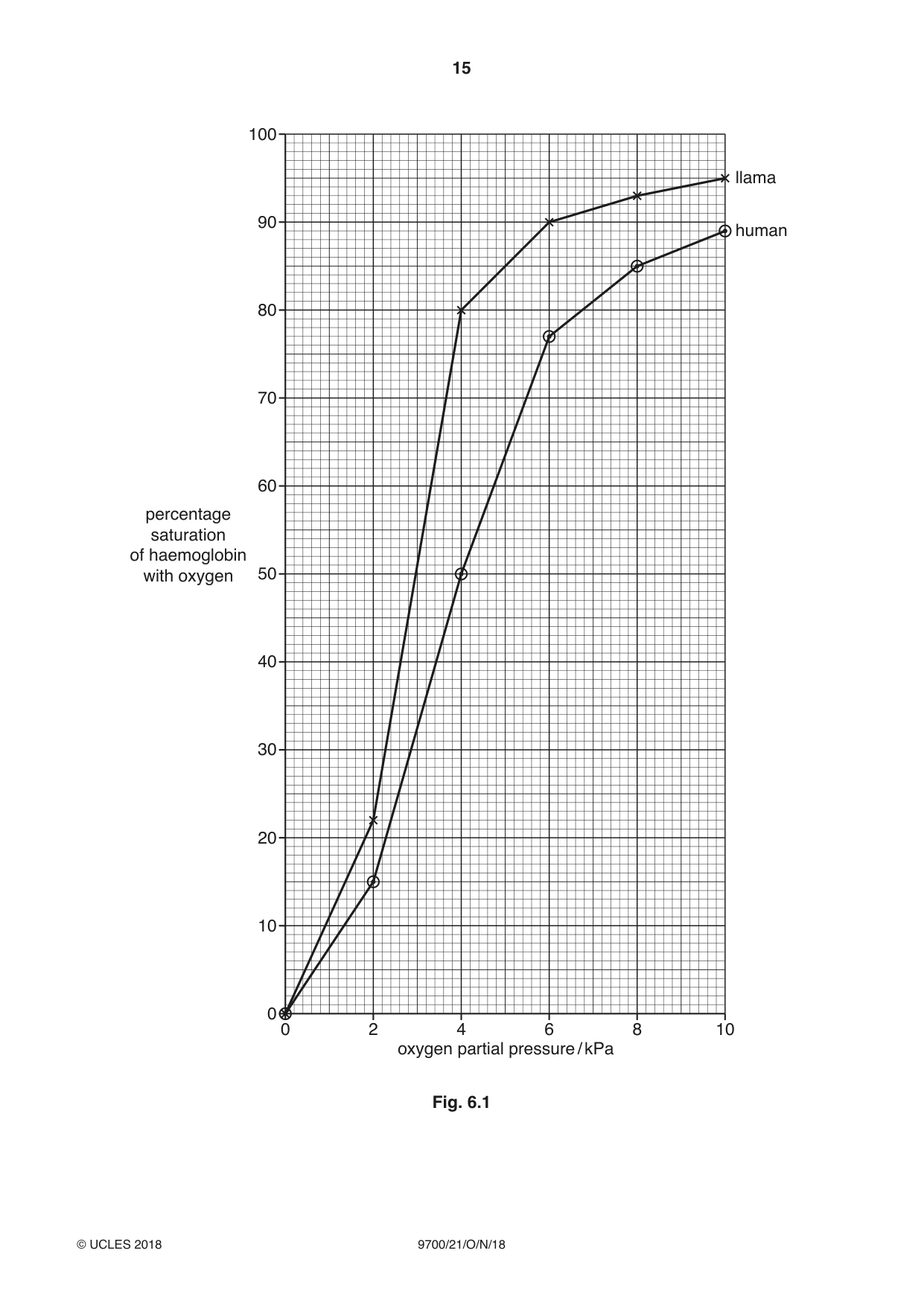
6 (a) Haemoglobin is a globular protein which is able to transport oxygen and is soluble in water. (i) Explain how the structure of a haemoglobin molecule makes it able to transport oxygen efficiently. ........................................................................................................................................... ........................................................................................................................................... ........................................................................................................................................... ........................................................................................................................................... ........................................................................................................................................... ...................................................................................................................................... [3] (ii) Explain how the structure of a haemoglobin molecule allows it to be soluble in water. ........................................................................................................................................... ........................................................................................................................................... ........................................................................................................................................... ...................................................................................................................................... [2] (b) Llamas are mammals that are adapted to live at high altitudes. Fig. 6.1 shows oxygen dissociation curves for haemoglobin of llamas and humans. (i) The partial pressure of oxygen in the lungs of mammals at 3500 m is 6.4 kPa. Use Fig. 6.1 to state the percentage saturation of haemoglobin of llamas and humans at an oxygen partial pressure of 6.4 kPa. llamas .................. % humans .................. % [1] (ii) With reference to Fig. 6.1, explain the advantage to llamas of having an oxygen dissociation curve positioned to the left of the curve for humans. ........................................................................................................................................... ........................................................................................................................................... ........................................................................................................................................... ........................................................................................................................................... ........................................................................................................................................... .......................................................................................................................................[2] [Total: 8]
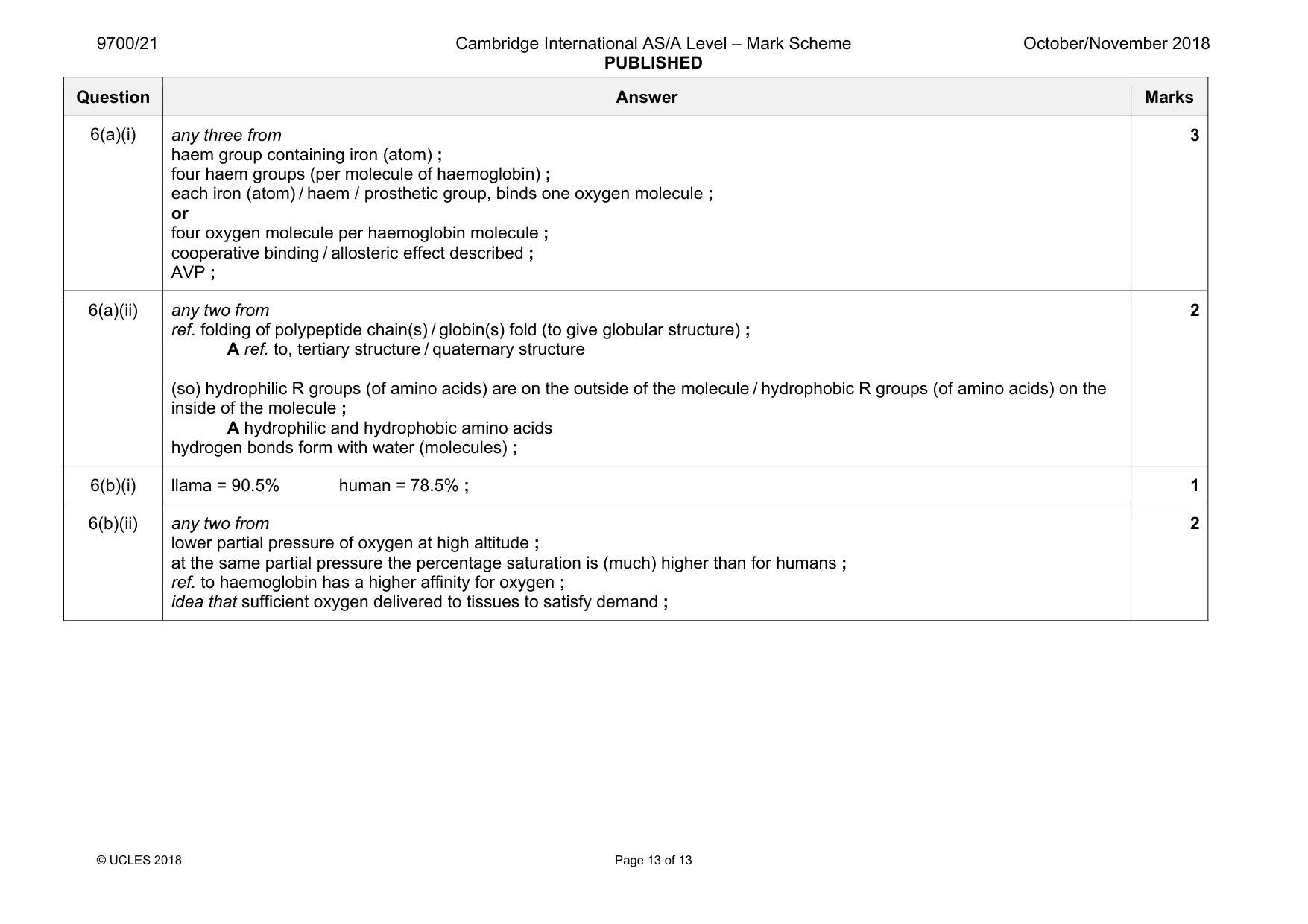
Mark scheme: 6(a)(i) any three from haem group containing iron (atom) ; four haem groups (per molecule of haemoglobin) ; each iron (atom) / haem / prosthetic group, binds one oxygen molecule ; or four oxygen molecule per haemoglobin molecule ; cooperative binding / allosteric effect described ; AVP ; 3 6(a)(ii) any two from ref. folding of polypeptide chain(s) / globin(s) fold (to give globular structure) ; A ref. to, tertiary structure / quaternary structure (so) hydrophilic R groups (of amino acids) are on the outside of the molecule / hydrophobic R groups (of amino acids) on the inside of the molecule ; A hydrophilic and hydrophobic amino acids hydrogen bonds form with water (molecules) ; 2 6(b)(i) llama = 90.5% human = 78.5% ; 1 6(b)(ii) any two from lower partial pressure of oxygen at high altitude ; at the same partial pressure the percentage saturation is (much) higher than for humans ; ref. to haemoglobin has a higher affinity for oxygen ; idea that sufficient oxygen delivered to tissues to satisfy demand ; 2
What was in this paper
The subtopics covered by these 6 questions, and how many questions each got. Open one in a new tab to see every Cambridge question on it.
What you needed in this session
Cambridge’s own grade thresholds for 2018 Oct/Nov, Paper 2 · Variant 1. A higher threshold means an easier paper — the bar moves with how the cohort did.