Cambridge A Level Biology 9700 — 2018 May/June Paper 4 · Variant 1
9700/41/M/J/18 · 10 questions · 100 marks · ≈113 min
The question paper and its mark scheme, free to read here and free to download. This is Cambridge’s own paper, exactly as it was sat.
Question paper24 pages




Mark scheme17 pages
Answers below. Sit the paper first if you are practising.
Questions as text
Q1 · The Sumatran orangutan, Pongo abelii, is found only on the island of Sumatra, Indonesia
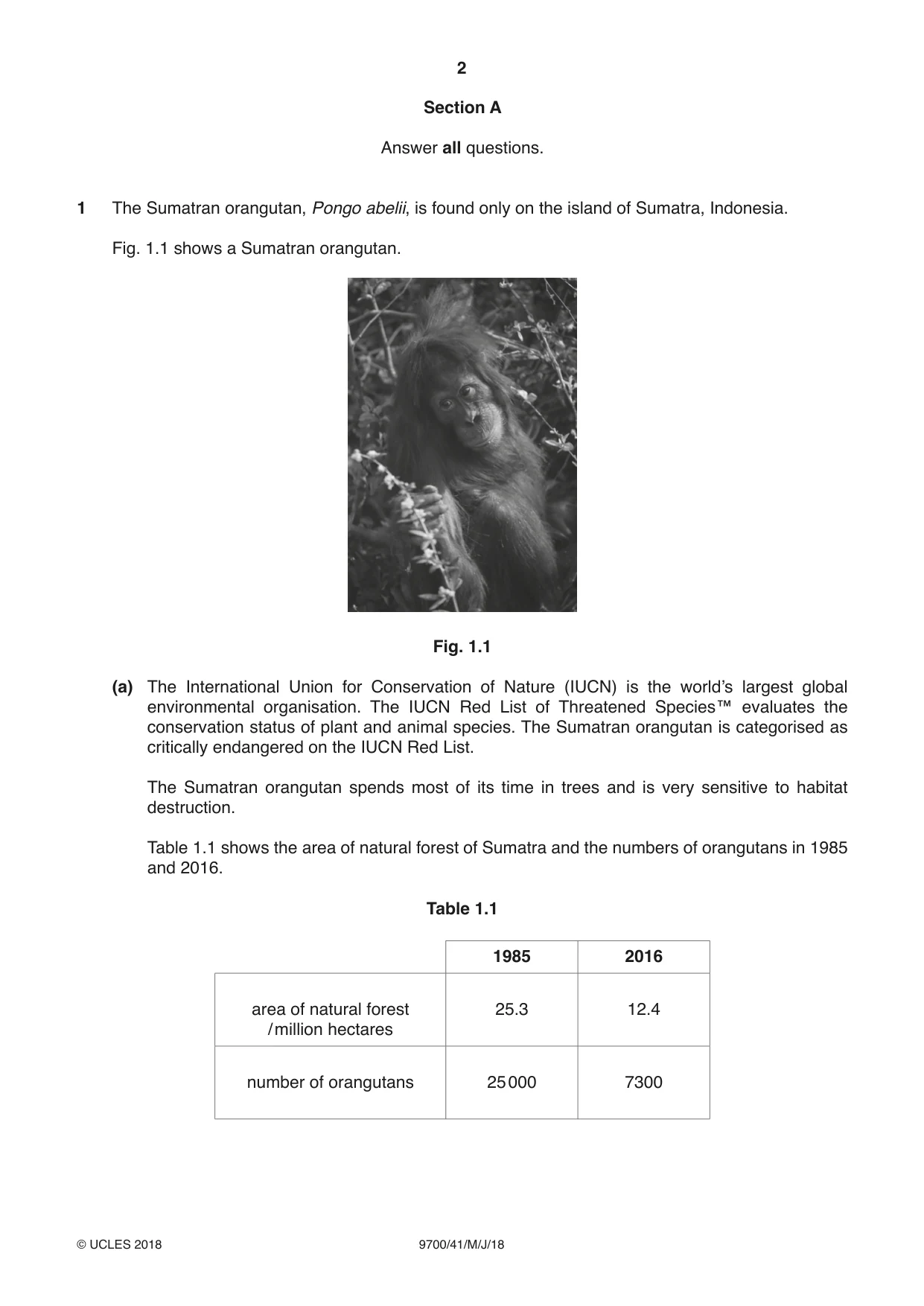
1 The Sumatran orangutan, Pongo abelii, is found only on the island of Sumatra, Indonesia. Fig. 1.1 shows a Sumatran orangutan. Fig. 1.1 (a) The International Union for Conservation of Nature (IUCN) is the world’s largest global environmental organisation. The IUCN Red List of Threatened Species™ evaluates the conservation status of plant and animal species. The Sumatran orangutan is categorised as critically endangered on the IUCN Red List. The Sumatran orangutan spends most of its time in trees and is very sensitive to habitat destruction. Table 1.1 shows the area of natural forest of Sumatra and the numbers of orangutans in 1985 and 2016. Table 1.1 1985 2016 area of natural forest 25.3 12.4 / million hectares number of orangutans 25 000 7300 (i) With reference to Table 1.1, state the relationship between area of natural forest and number of orangutans. ........................................................................................................................................... .......................................................................................................................................[1] (ii) Calculate the mean annual decrease in orangutan numbers between 1985 and 2016. Show your working. Give your answer to the nearest whole number. mean annual decrease = ...........................................................[2] (iii) Use your answer from (a)(ii) to estimate the number of years after 2016 that it will take for the Sumatran orangutan to become extinct in the wild, if conservation work is unsuccessful. ................................................. years [1] (b) Suggest two reasons for the decrease in numbers of Sumatran orangutans, other than habitat loss. ................................................................................................................................................... ................................................................................................................................................... ................................................................................................................................................... ................................................................................................................................................... ...............................................................................................................................................[2] (c) Outline the role zoos can take in the protection of the Sumatran orangutan. ................................................................................................................................................... ................................................................................................................................................... ................................................................................................................................................... ................................................................................................................................................... ................................................................................................................................................... ................................................................................................................................................... ...............................................................................................................................................[3]
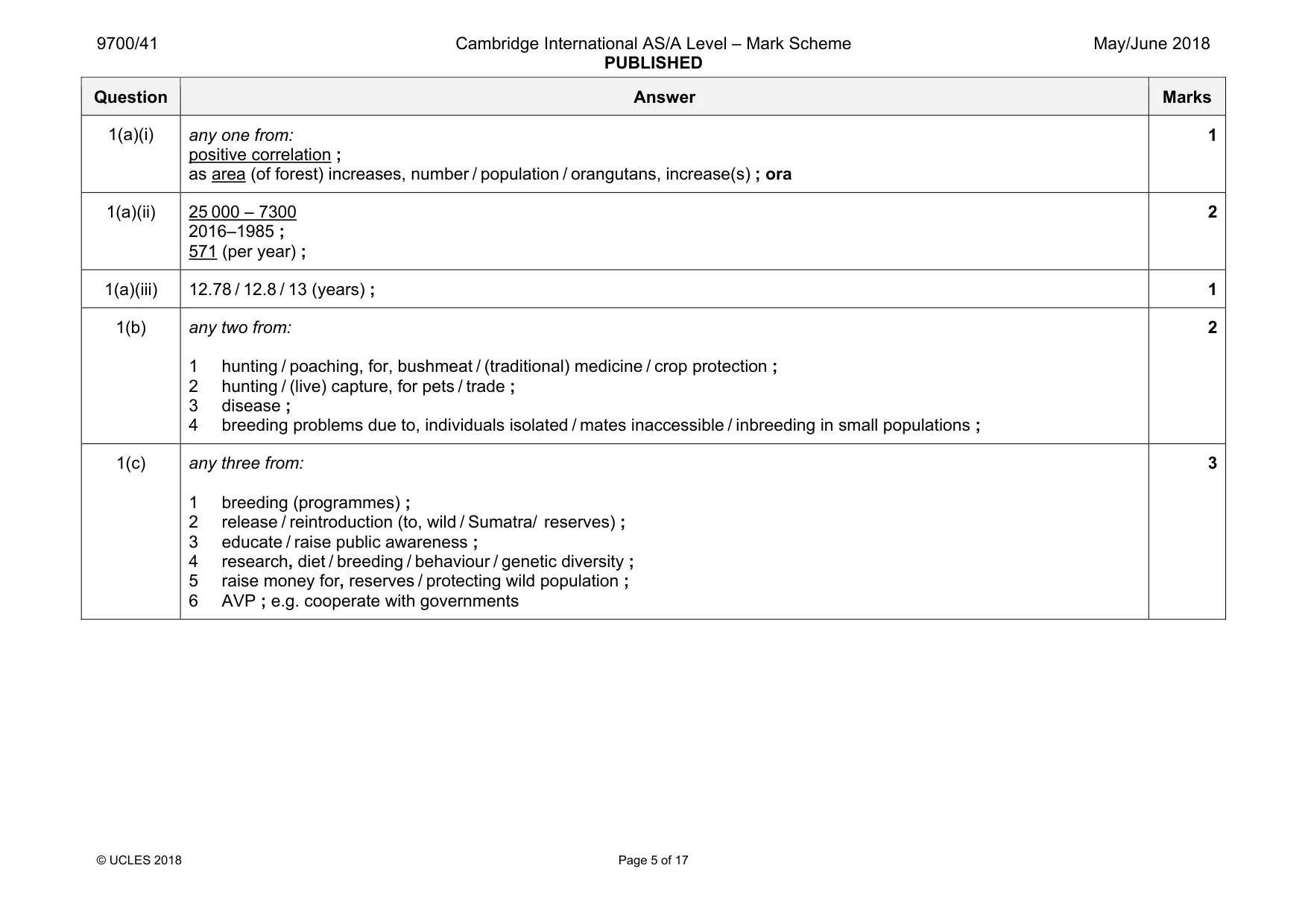
Mark scheme: 1(a)(i) any one from: positive correlation ; as area (of forest) increases, number / population / orangutans, increase(s) ; ora 1 1(a)(ii) 25 000 – 7300 2016–1985 ; 571 (per year) ; 2 1(a)(iii) 12.78 / 12.8 / 13 (years) ; 1 1(b) any two from: 1 hunting / poaching, for, bushmeat / (traditional) medicine / crop protection ; 2 hunting / (live) capture, for pets / trade ; 3 disease ; 4 breeding problems due to, individuals isolated / mates inaccessible / inbreeding in small populations ; 2 1(c) any three from: 1 breeding (programmes) ; 2 release / reintroduction (to, wild / Sumatra/ reserves) ; 3 educate / raise public awareness ; 4 research, diet / breeding / behaviour / genetic diversity ; 5 raise money for, reserves / protecting wild population ; 6 AVP ; e.g. cooperate with governments 3
Q2 · Scientists have found very little evolutionary change in populations of two Australian…
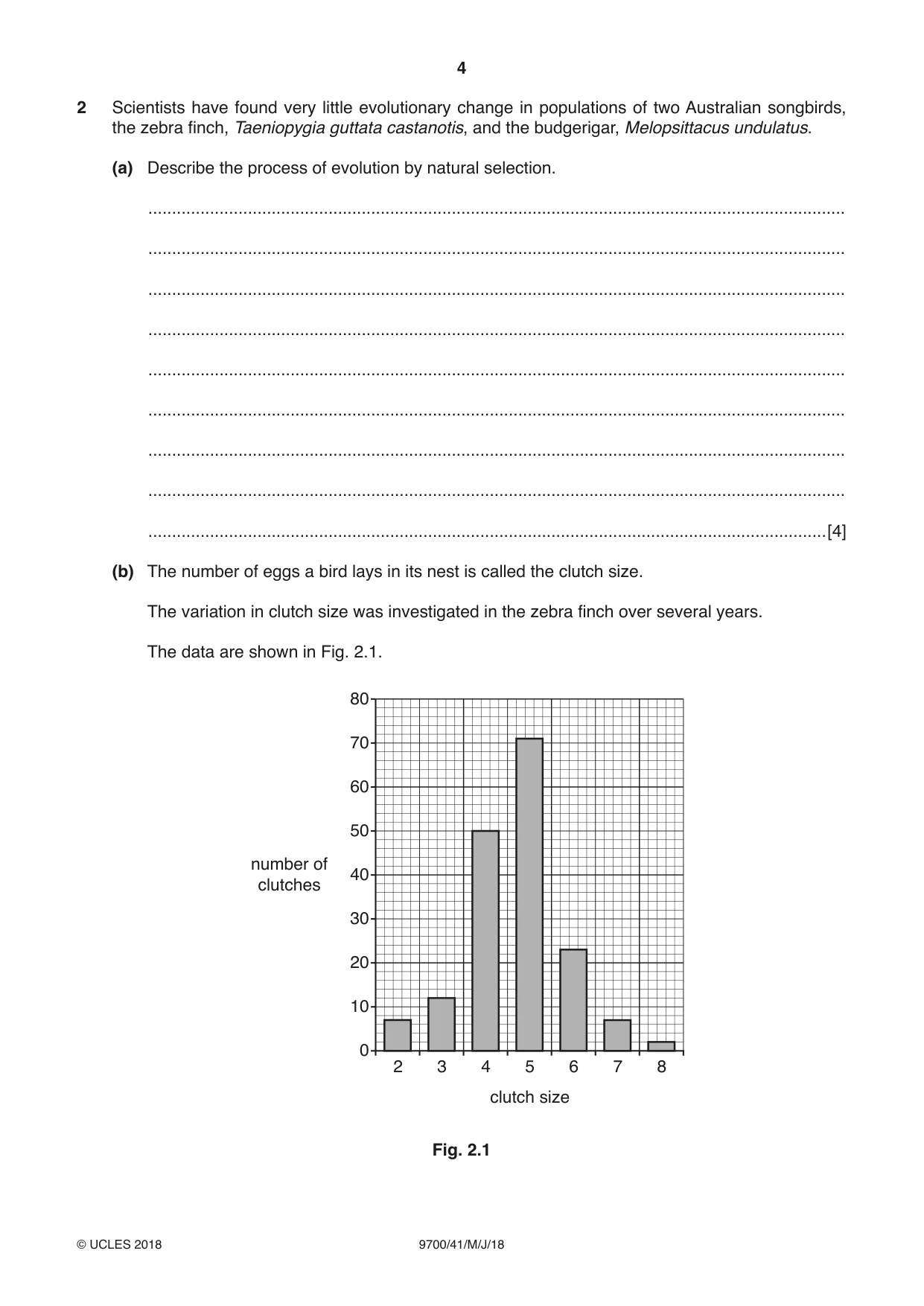
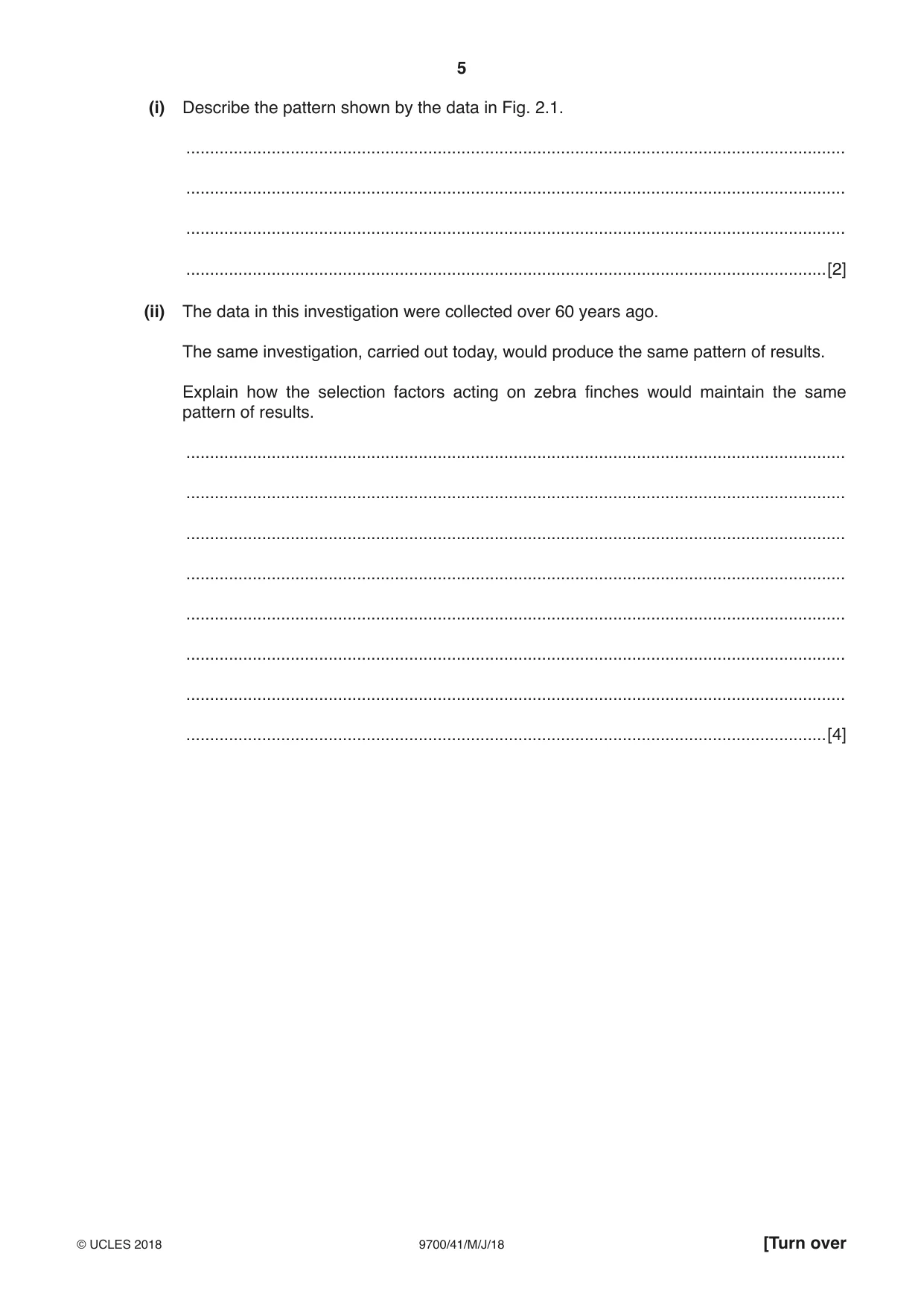
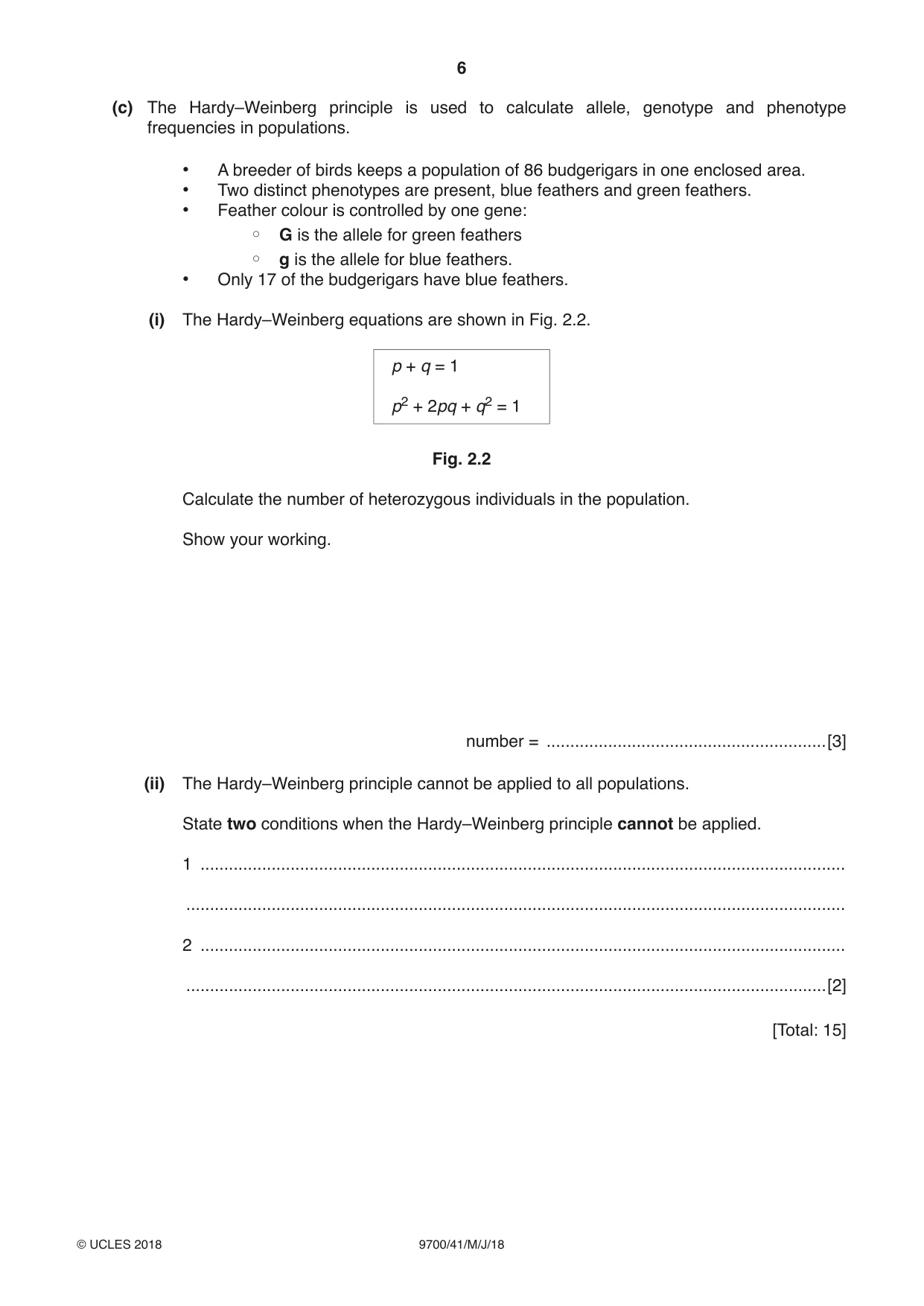
2 Scientists have found very little evolutionary change in populations of two Australian songbirds, the zebra finch, Taeniopygia guttata castanotis, and the budgerigar, Melopsittacus undulatus. (a) Describe the process of evolution by natural selection. ................................................................................................................................................... ................................................................................................................................................... ................................................................................................................................................... ................................................................................................................................................... ................................................................................................................................................... ................................................................................................................................................... ................................................................................................................................................... ................................................................................................................................................... ...............................................................................................................................................[4] (b) The number of eggs a bird lays in its nest is called the clutch size. The variation in clutch size was investigated in the zebra finch over several years. The data are shown in Fig. 2.1. 80 70 60 50 number of 40 clutches 30 20 10 0 2 3 4 5 6 7 8 clutch size Fig. 2.1 (i) Describe the pattern shown by the data in Fig. 2.1. ........................................................................................................................................... ........................................................................................................................................... ........................................................................................................................................... .......................................................................................................................................[2] (ii) The data in this investigation were collected over 60 years ago. The same investigation, carried out today, would produce the same pattern of results. Explain how the selection factors acting on zebra finches would maintain the same pattern of results. ........................................................................................................................................... ........................................................................................................................................... ........................................................................................................................................... ........................................................................................................................................... ........................................................................................................................................... ........................................................................................................................................... ........................................................................................................................................... .......................................................................................................................................[4] (c) The Hardy–Weinberg principle is used to calculate allele, genotype and phenotype frequencies in populations. • A breeder of birds keeps a population of 86 budgerigars in one enclosed area. • Two distinct phenotypes are present, blue feathers and green feathers. • Feather colour is controlled by one gene: G is the allele for green feathers g is the allele for blue feathers. • Only 17 of the budgerigars have blue feathers. (i) The Hardy–Weinberg equations are shown in Fig. 2.2. p + q = 1 p2 + 2pq + q2 = 1 Fig. 2.2 Calculate the number of heterozygous individuals in the population. Show your working. number = ...........................................................[3] (ii) The Hardy–Weinberg principle cannot be applied to all populations. State two conditions when the Hardy–Weinberg principle cannot be applied. 1 ........................................................................................................................................ ........................................................................................................................................... 2 ........................................................................................................................................ .......................................................................................................................................[2] [Total: 15]
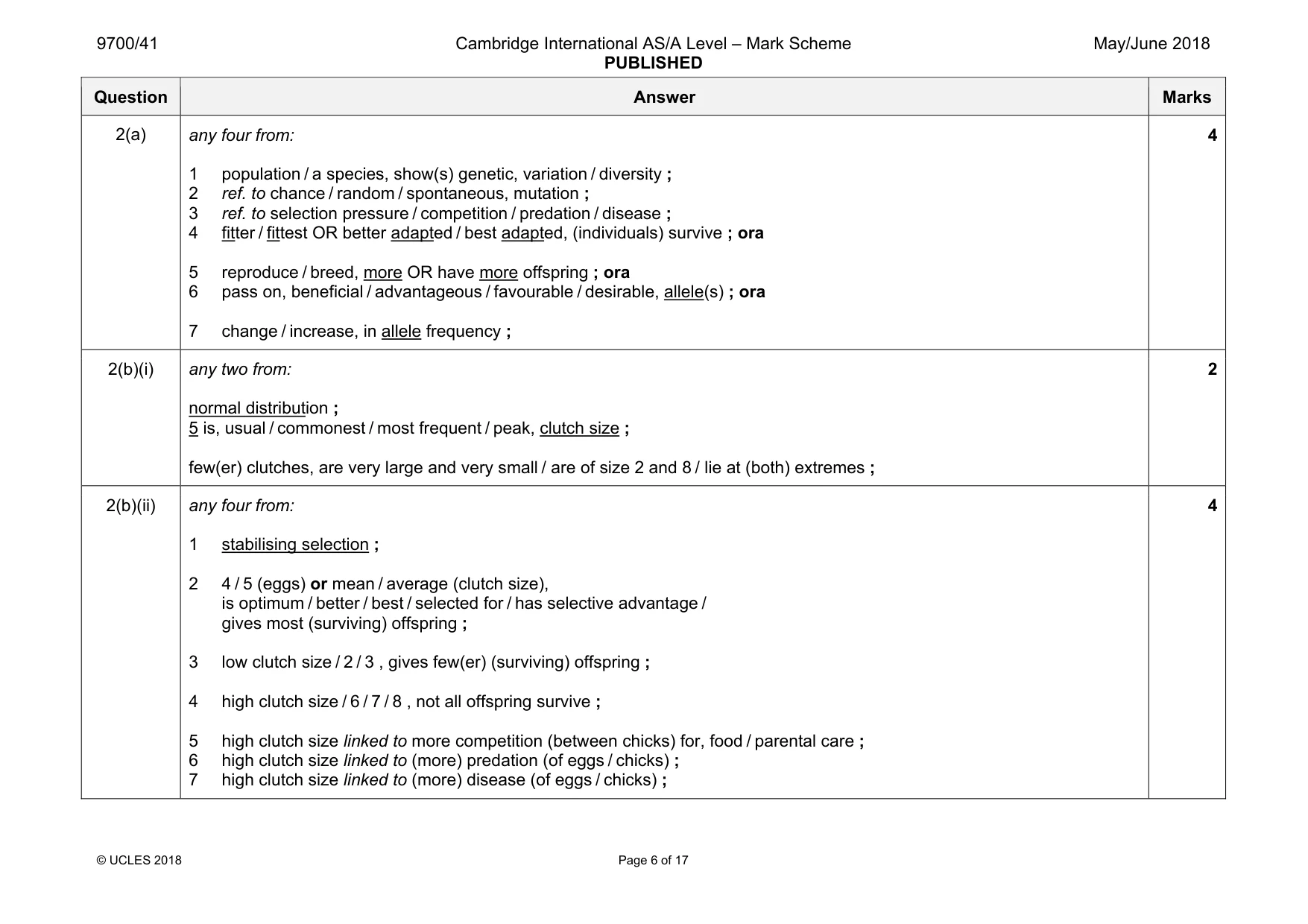
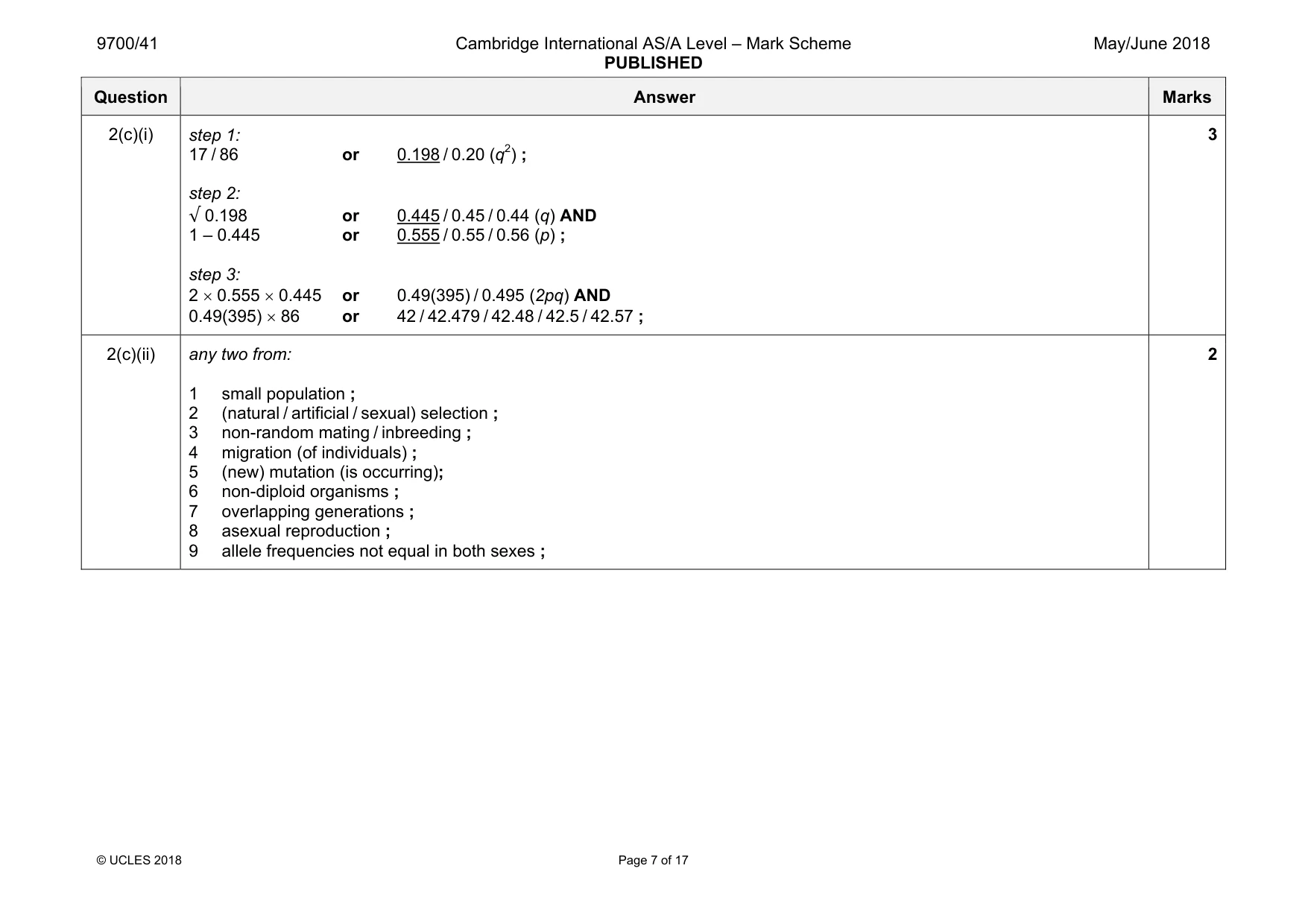
Mark scheme: 2(a) any four from: 1 population / a species, show(s) genetic, variation / diversity ; 2 ref. to chance / random / spontaneous, mutation ; 3 ref. to selection pressure / competition / predation / disease ; 4 fitter / fittest OR better adapted / best adapted, (individuals) survive ; ora 5 reproduce / breed, more OR have more offspring ; ora 6 pass on, beneficial / advantageous / favourable / desirable, allele(s) ; ora 7 change / increase, in allele frequency ; 4 2(b)(i) any two from: normal distribution ; 5 is, usual / commonest / most frequent / peak, clutch size ; few(er) clutches, are very large and very small / are of size 2 and 8 / lie at (both) extremes ; 2 2(b)(ii) any four from: 1 stabilising selection ; 2 4 / 5 (eggs) or mean / average (clutch size), is optimum / better / best / selected for / has selective advantage / gives most (surviving) offspring ; 3 low clutch size / 2 / 3 , gives few(er) (surviving) offspring ; 4 high clutch size / 6 / 7 / 8 , not all offspring survive ; 5 high clutch size linked to more competition (between chicks) for, food / parental care ; 6 high clutch size linked to (more) predation (of eggs / chicks) ; 7 high clutch size linked to (more) disease (of eggs / chicks) ; 4 Question Answer Marks 2(c)(i) step 1: 17 / 86 or 0.198 / 0.20 (q2) ; step 2: √ 0.198 or 0.445 / 0.45 / 0.44 (q) AND 1 – 0.445 or 0.555 / 0.55 / 0.56 (p) ; step 3: 2 × 0.555 × 0.445 or 0.49(395) / 0.495 (2pq) AND 0.49(395) × 86 or 42 / 42.479 / 42.48 / 42.5 / 42.57 ; 3 2(c)(ii) any two from: 1 small population ; 2 (natural / artificial / sexual) selection ; 3 non-random mating / inbreeding ; 4 migration (of individuals) ; 5 (new) mutation (is occurring); 6 non-diploid organisms ; 7 overlapping generations ; 8 asexual reproduction ; 9 allele frequencies not equal in both sexes ; 2
Q3 · The lac operon is a section of DNA present in the genome of the bacterium Escherichia coli
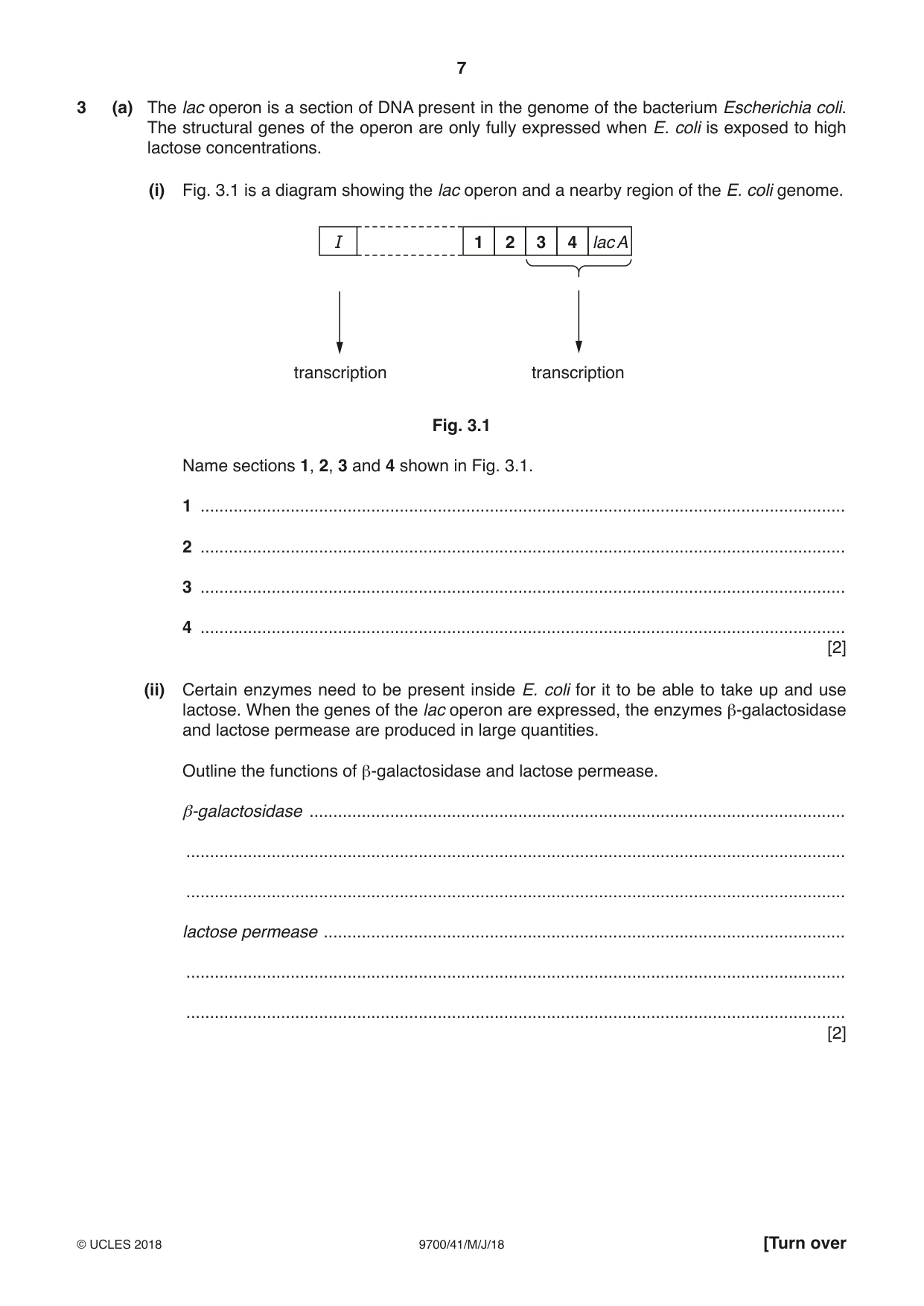
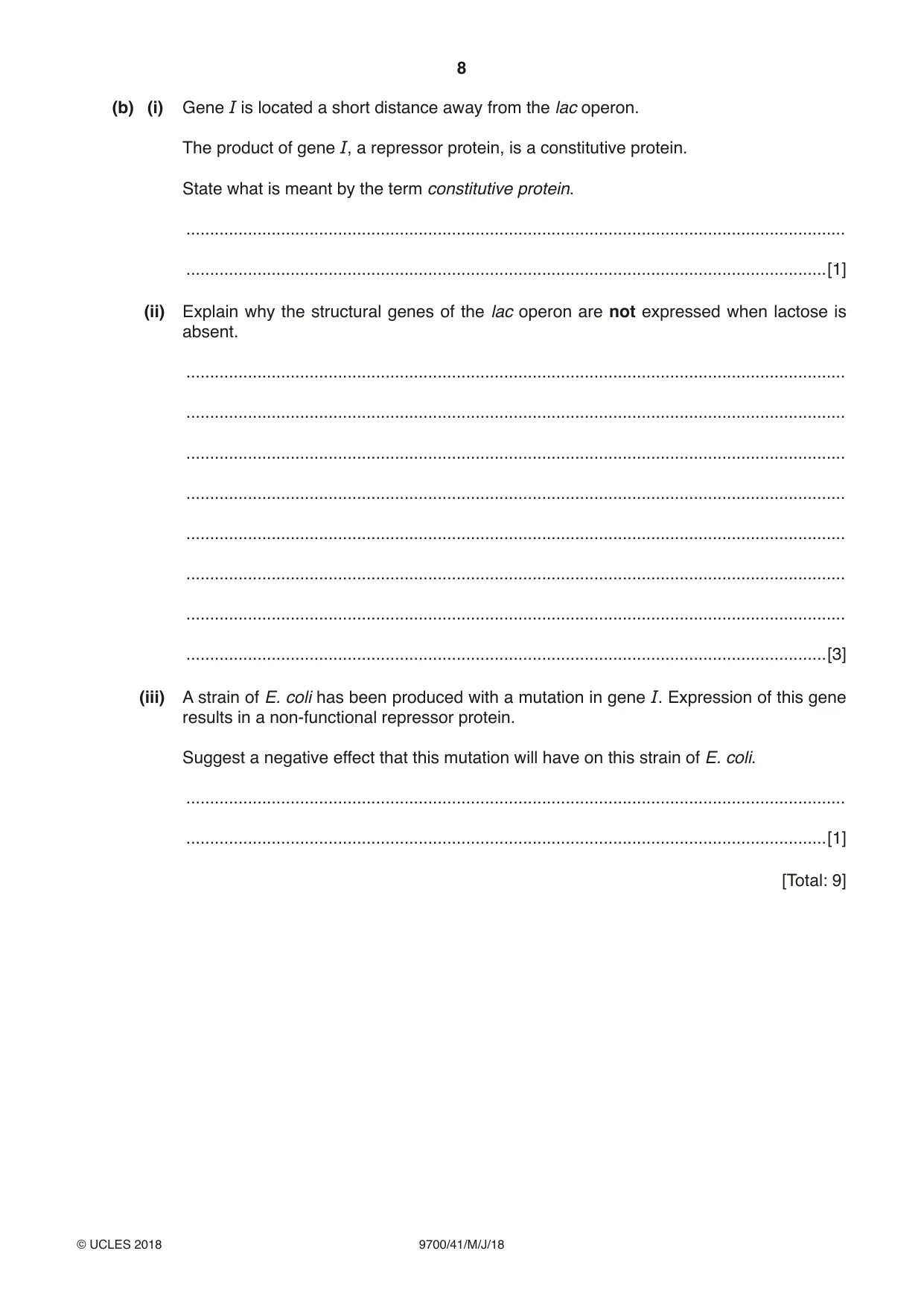
3 (a) The lac operon is a section of DNA present in the genome of the bacterium Escherichia coli. The structural genes of the operon are only fully expressed when E. coli is exposed to high lactose concentrations. (i) Fig. 3.1 is a diagram showing the lac operon and a nearby region of the E. coli genome. I 1 2 3 4 lacA transcription transcription Fig. 3.1 Name sections 1, 2, 3 and 4 shown in Fig. 3.1. 1 ........................................................................................................................................ 2 ........................................................................................................................................ 3 ........................................................................................................................................ 4 ........................................................................................................................................ [2] (ii) Certain enzymes need to be present inside E. coli for it to be able to take up and use lactose. When the genes of the lac operon are expressed, the enzymes β-galactosidase and lactose permease are produced in large quantities. Outline the functions of β-galactosidase and lactose permease. β-galactosidase ................................................................................................................. ........................................................................................................................................... ........................................................................................................................................... lactose permease .............................................................................................................. ........................................................................................................................................... ........................................................................................................................................... [2] (b) (i) Gene I is located a short distance away from the lac operon. The product of gene I, a repressor protein, is a constitutive protein. State what is meant by the term constitutive protein. ........................................................................................................................................... .......................................................................................................................................[1] (ii) Explain why the structural genes of the lac operon are not expressed when lactose is absent. ........................................................................................................................................... ........................................................................................................................................... ........................................................................................................................................... ........................................................................................................................................... ........................................................................................................................................... ........................................................................................................................................... ........................................................................................................................................... .......................................................................................................................................[3] (iii) A strain of E. coli has been produced with a mutation in gene I. Expression of this gene results in a non-functional repressor protein. Suggest a negative effect that this mutation will have on this strain of E. coli. ........................................................................................................................................... .......................................................................................................................................[1] [Total: 9]
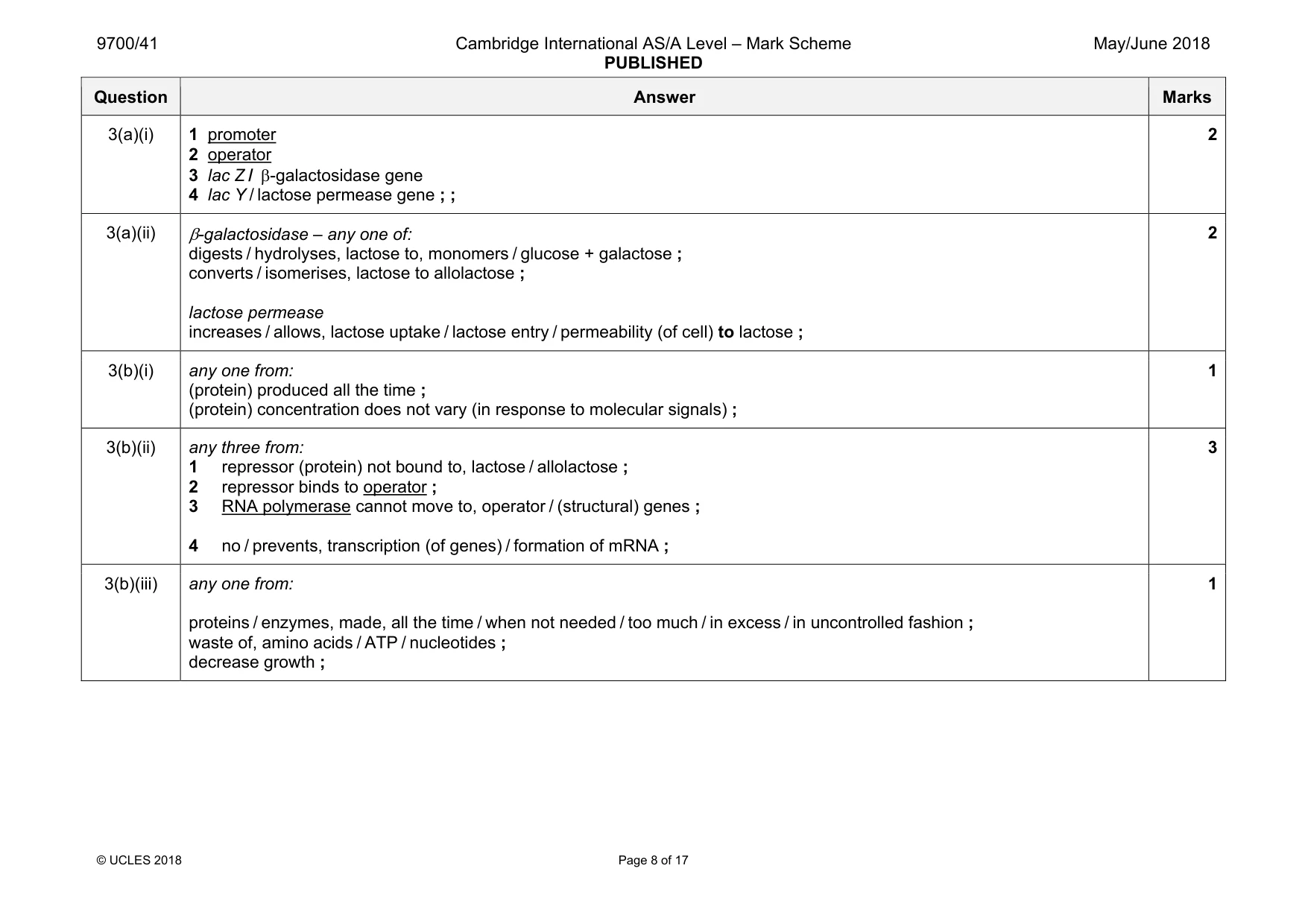
Mark scheme: 3(a)(i) 1 promoter 2 operator 3 lac Z / β-galactosidase gene 4 lac Y / lactose permease gene ; ; 2 3(a)(ii) β-galactosidase – any one of: digests / hydrolyses, lactose to, monomers / glucose + galactose ; converts / isomerises, lactose to allolactose ; lactose permease increases / allows, lactose uptake / lactose entry / permeability (of cell) to lactose ; 2 3(b)(i) any one from: (protein) produced all the time ; (protein) concentration does not vary (in response to molecular signals) ; 1 3(b)(ii) any three from: 1 repressor (protein) not bound to, lactose / allolactose ; 2 repressor binds to operator ; 3 RNA polymerase cannot move to, operator / (structural) genes ; 4 no / prevents, transcription (of genes) / formation of mRNA ; 3 3(b)(iii) any one from: proteins / enzymes, made, all the time / when not needed / too much / in excess / in uncontrolled fashion ; waste of, amino acids / ATP / nucleotides ; decrease growth ; 1
Q4 · Domestic goats, Capra hircus, show a wide range of coat patterns and colours
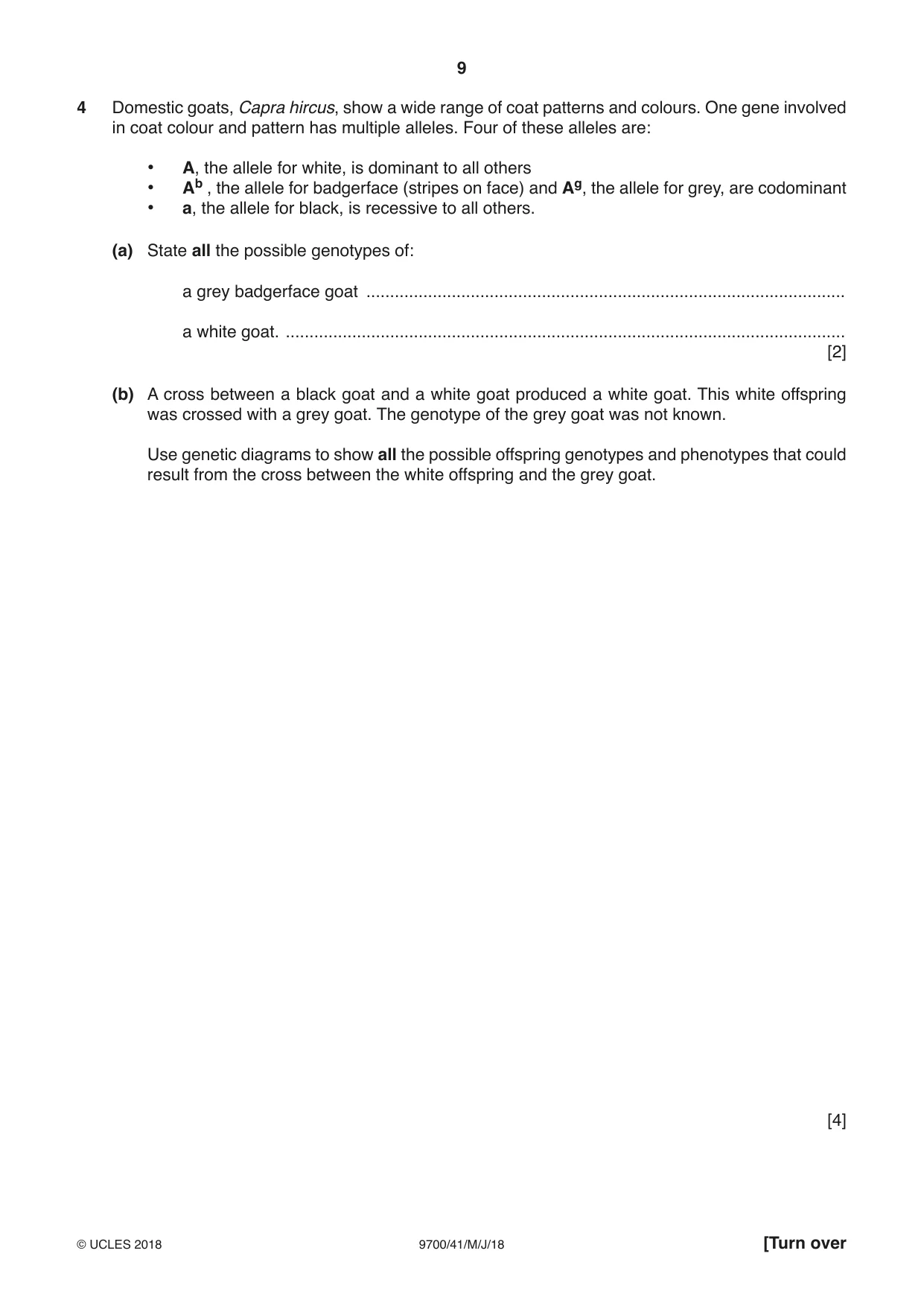
4 Domestic goats, Capra hircus, show a wide range of coat patterns and colours. One gene involved in coat colour and pattern has multiple alleles. Four of these alleles are: • A, the allele for white, is dominant to all others • Ab , the allele for badgerface (stripes on face) and Ag, the allele for grey, are codominant • a, the allele for black, is recessive to all others. (a) State all the possible genotypes of: a grey badgerface goat ..................................................................................................... a white goat. ...................................................................................................................... [2] (b) A cross between a black goat and a white goat produced a white goat. This white offspring was crossed with a grey goat. The genotype of the grey goat was not known. Use genetic diagrams to show all the possible offspring genotypes and phenotypes that could result from the cross between the white offspring and the grey goat. [4] (c) When goat skin cells produce black melanin pigment these events occur: • Melanocyte stimulating hormone (MSH) is secreted into the bloodstream. • MSH binds to the melanocortin 1 receptor on the cell surface membranes of skin cells. • This causes a rise in cyclic AMP within the cell. • The enzyme tyrosinase is activated and begins melanin production. The white allele A codes for a protein that binds irreversibly to the melanocortin 1 receptor. No rise in cyclic AMP occurs, even when MSH is present in the blood. Explain the appearance of goats with genotype aa. ................................................................................................................................................... ................................................................................................................................................... ................................................................................................................................................... ................................................................................................................................................... ................................................................................................................................................... ...............................................................................................................................................[2] [Total: 8]
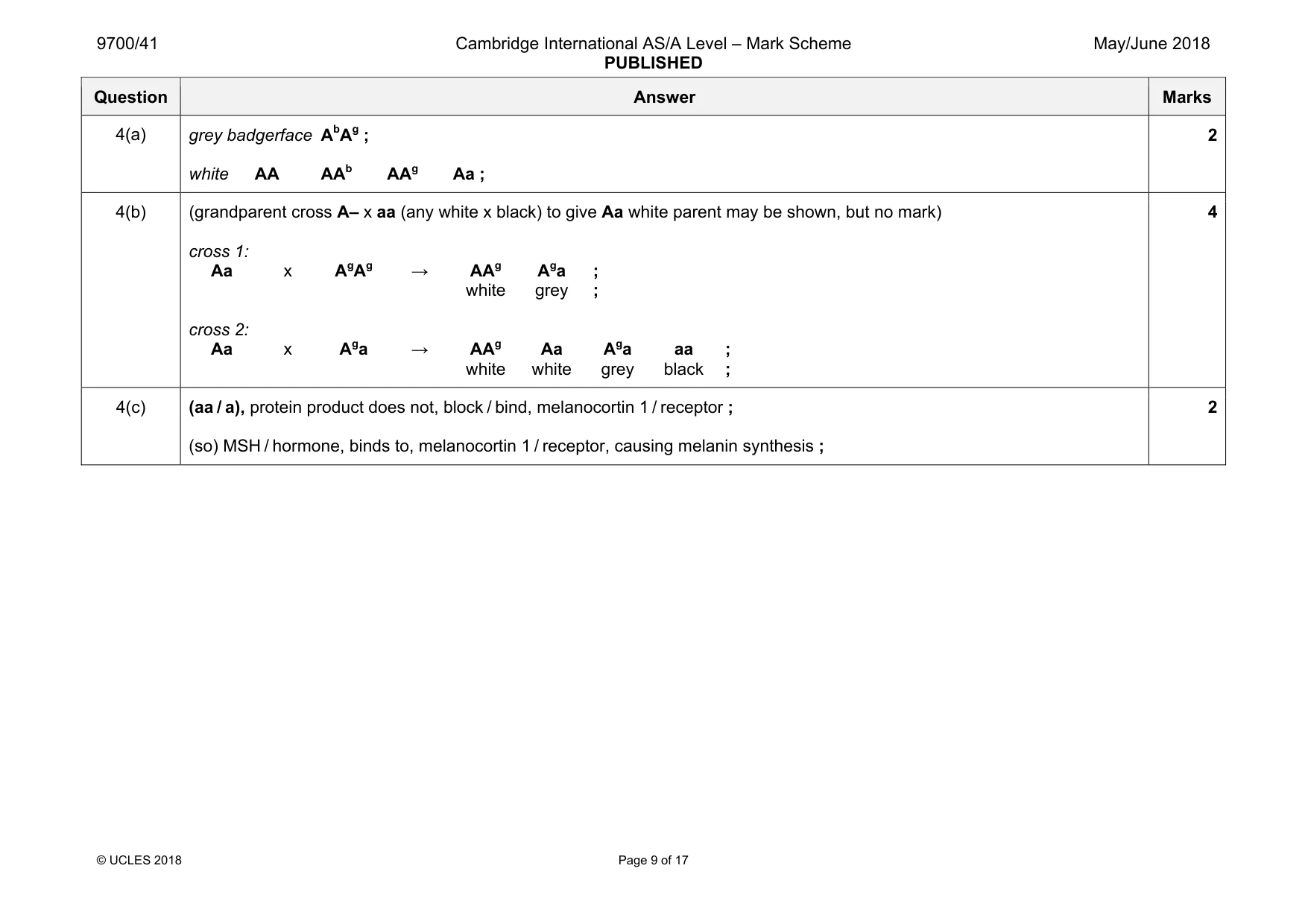
Mark scheme: 4(a) white AA AAb AAg Aa ; 2 4(b) (grandparent cross A– x aa (any white x black) to give Aa white parent may be shown, but no mark) cross 1: Aa x AgAg → AAg Aga ; white grey ; cross 2: Aa x Aga → AAg Aa Aga aa ; white white grey black ; 4 4(c) (aa / a), protein product does not, block / bind, melanocortin 1 / receptor ; (so) MSH / hormone, binds to, melanocortin 1 / receptor, causing melanin synthesis ; 2
More questions on Passage of information from parents to offspring
Q5 · Pigs are farm animals used for livestock in some parts of the world
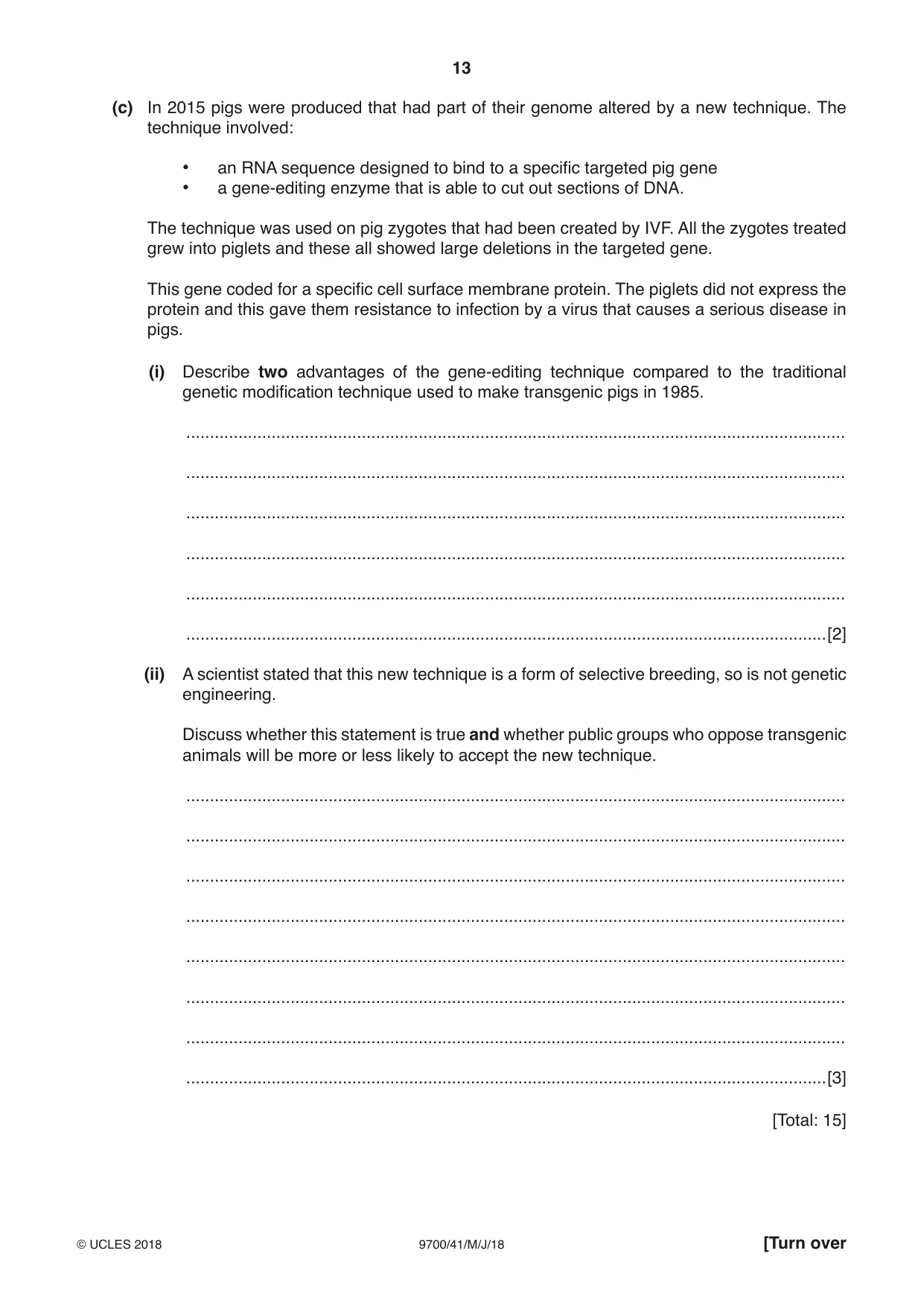
5 (a) Pigs are farm animals used for livestock in some parts of the world. The first genetically modified (transgenic) pigs were produced in 1985. Foreign DNA was injected directly into the nuclei of zygotes. The foreign DNA was made up of two components: • the gene coding for human growth hormone • a section of mouse DNA that, in the presence of metal ions, allows transcription to begin. (i) The human growth hormone synthesised by the transgenic pigs had the effect of making the pigs grow faster, larger and heavier than non-genetically modified pigs. Suggest reasons for this difference. ........................................................................................................................................... ........................................................................................................................................... ........................................................................................................................................... ........................................................................................................................................... .......................................................................................................................................[2] (ii) Suggest and explain why the mouse DNA was included in the foreign DNA. ........................................................................................................................................... ........................................................................................................................................... ........................................................................................................................................... ........................................................................................................................................... ........................................................................................................................................... .......................................................................................................................................[3] Only 1% of the attempts successfully produced transgenic pigs. These pigs showed higher body mass and a greater muscle to fat ratio than normal pigs. Monitoring of the pigs’ behaviour revealed that they rested more than normal pigs, suffered from stomach ulcers and were unwilling to mate. (b) (i) Discuss whether these transgenic pigs have long term economic value. ........................................................................................................................................... ........................................................................................................................................... ........................................................................................................................................... ........................................................................................................................................... ........................................................................................................................................... .......................................................................................................................................[3] (ii) Comment on the ethics of producing transgenic pigs showing the features described. ........................................................................................................................................... ........................................................................................................................................... ........................................................................................................................................... ........................................................................................................................................... ........................................................................................................................................... .......................................................................................................................................[2] (c) In 2015 pigs were produced that had part of their genome altered by a new technique. The technique involved: • an RNA sequence designed to bind to a specific targeted pig gene • a gene-editing enzyme that is able to cut out sections of DNA. The technique was used on pig zygotes that had been created by IVF. All the zygotes treated grew into piglets and these all showed large deletions in the targeted gene. This gene coded for a specific cell surface membrane protein. The piglets did not express the protein and this gave them resistance to infection by a virus that causes a serious disease in pigs. (i) Describe two advantages of the gene-editing technique compared to the traditional genetic modification technique used to make transgenic pigs in 1985. ........................................................................................................................................... ........................................................................................................................................... ........................................................................................................................................... ........................................................................................................................................... ........................................................................................................................................... .......................................................................................................................................[2] (ii) A scientist stated that this new technique is a form of selective breeding, so is not genetic engineering. Discuss whether this statement is true and whether public groups who oppose transgenic animals will be more or less likely to accept the new technique. ........................................................................................................................................... ........................................................................................................................................... ........................................................................................................................................... ........................................................................................................................................... ........................................................................................................................................... ........................................................................................................................................... ........................................................................................................................................... .......................................................................................................................................[3] [Total: 15]
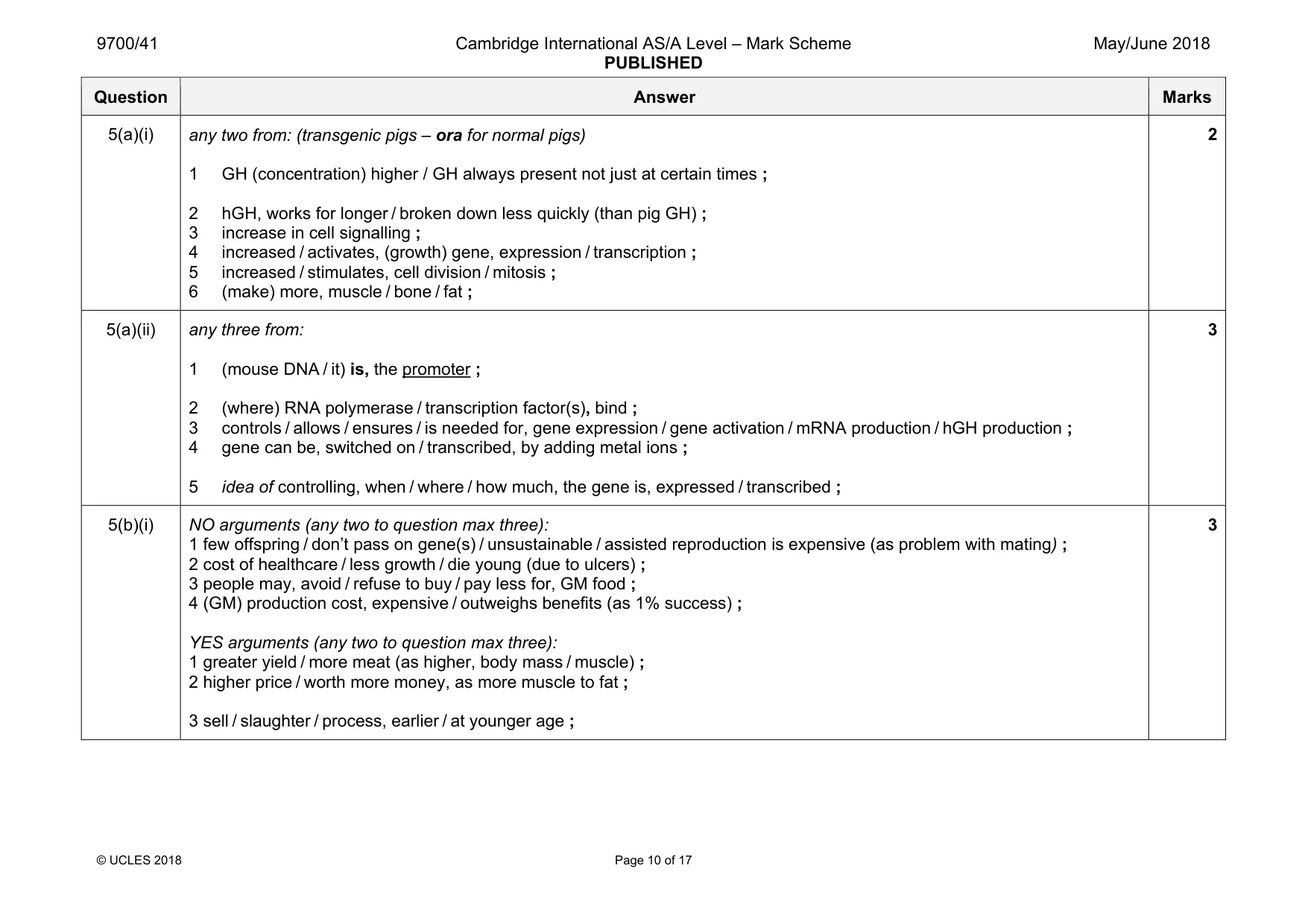
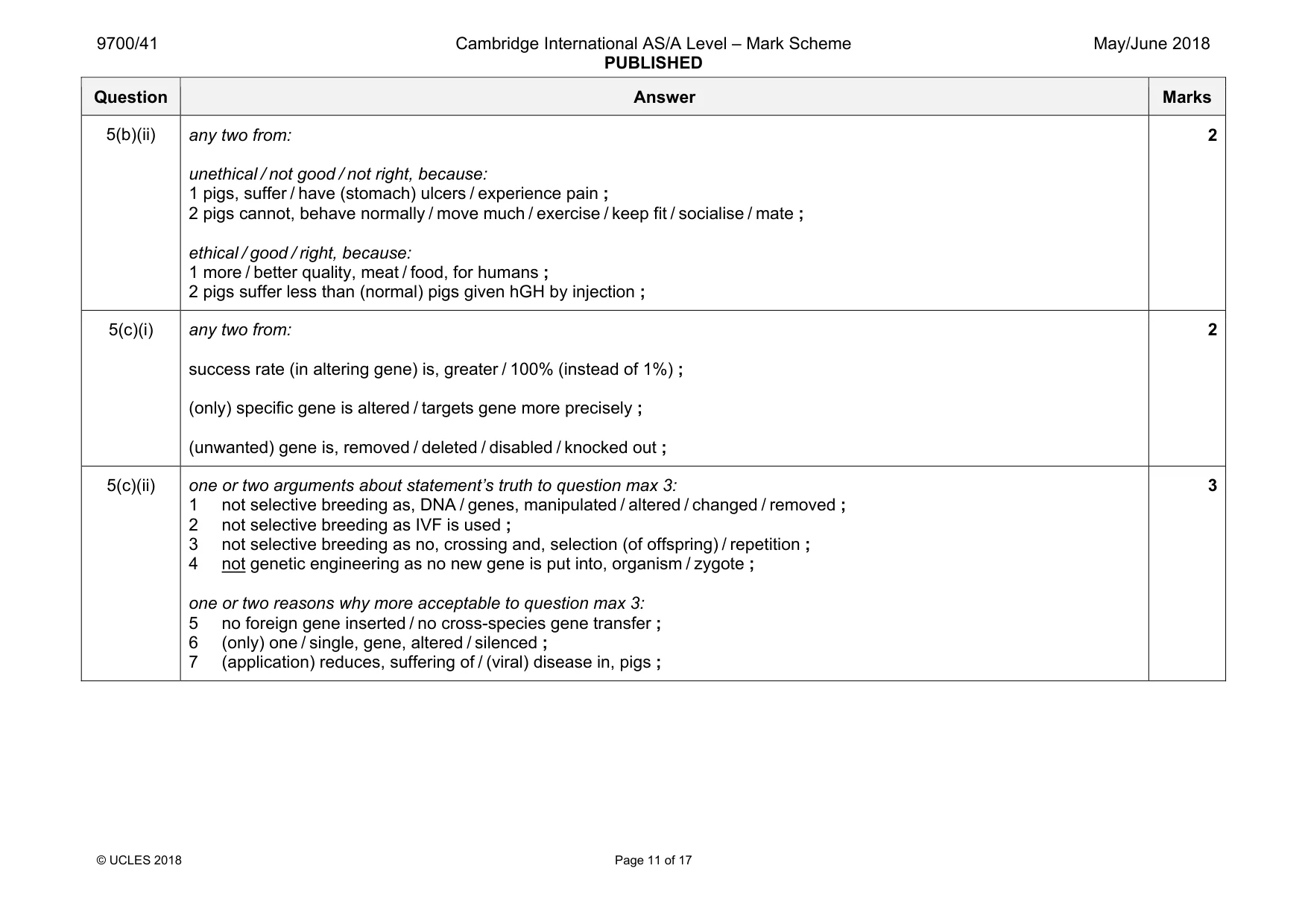
Mark scheme: 5(a)(i) any two from: (transgenic pigs – ora for normal pigs) 1 GH (concentration) higher / GH always present not just at certain times ; 2 hGH, works for longer / broken down less quickly (than pig GH) ; 3 increase in cell signalling ; 4 increased / activates, (growth) gene, expression / transcription ; 5 increased / stimulates, cell division / mitosis ; 6 (make) more, muscle / bone / fat ; 2 5(a)(ii) any three from: 1 (mouse DNA / it) is, the promoter ; 2 (where) RNA polymerase / transcription factor(s), bind ; 3 controls / allows / ensures / is needed for, gene expression / gene activation / mRNA production / hGH production ; 4 gene can be, switched on / transcribed, by adding metal ions ; 5 idea of controlling, when / where / how much, the gene is, expressed / transcribed ; 3 5(b)(i) NO arguments (any two to question max three): 1 few offspring / don’t pass on gene(s) / unsustainable / assisted reproduction is expensive (as problem with mating) ; 2 cost of healthcare / less growth / die young (due to ulcers) ; 3 people may, avoid / refuse to buy / pay less for, GM food ; 4 (GM) production cost, expensive / outweighs benefits (as 1% success) ; YES arguments (any two to question max three): 1 greater yield / more meat (as higher, body mass / muscle) ; 2 higher price / worth more money, as more muscle to fat ; 3 sell / slaughter / process, earlier / at younger age ; 3 Question Answer Marks 5(b)(ii) any two from: unethical / not good / not right, because: 1 pigs, suffer / have (stomach) ulcers / experience pain ; 2 pigs cannot, behave normally / move much / exercise / keep fit / socialise / mate ; ethical / good / right, because: 1 more / better quality, meat / food, for humans ; 2 pigs suffer less than (normal) pigs given hGH by injection ; 2 5(c)(i) any two from: success rate (in altering gene) is, greater / 100% (instead of 1%) ; (only) specific gene is altered / targets gene more precisely ; (unwanted) gene is, removed / deleted / disabled / knocked out ; 2 5(c)(ii) one or two arguments about statement’s truth to question max 3: 1 not selective breeding as, DNA / genes, manipulated / altered / changed / removed ; 2 not selective breeding as IVF is used ; 3 not selective breeding as no, crossing and, selection (of offspring) / repetition ; 4 not genetic engineering as no new gene is put into, organism / zygote ; one or two reasons why more acceptable to question max 3: 5 no foreign gene inserted / no cross-species gene transfer ; 6 (only) one / single, gene, altered / silenced ; 7 (application) reduces, suffering of / (viral) disease in, pigs ; 3
Q6 · A transmission electron micrograph of a section through a mitochondrion
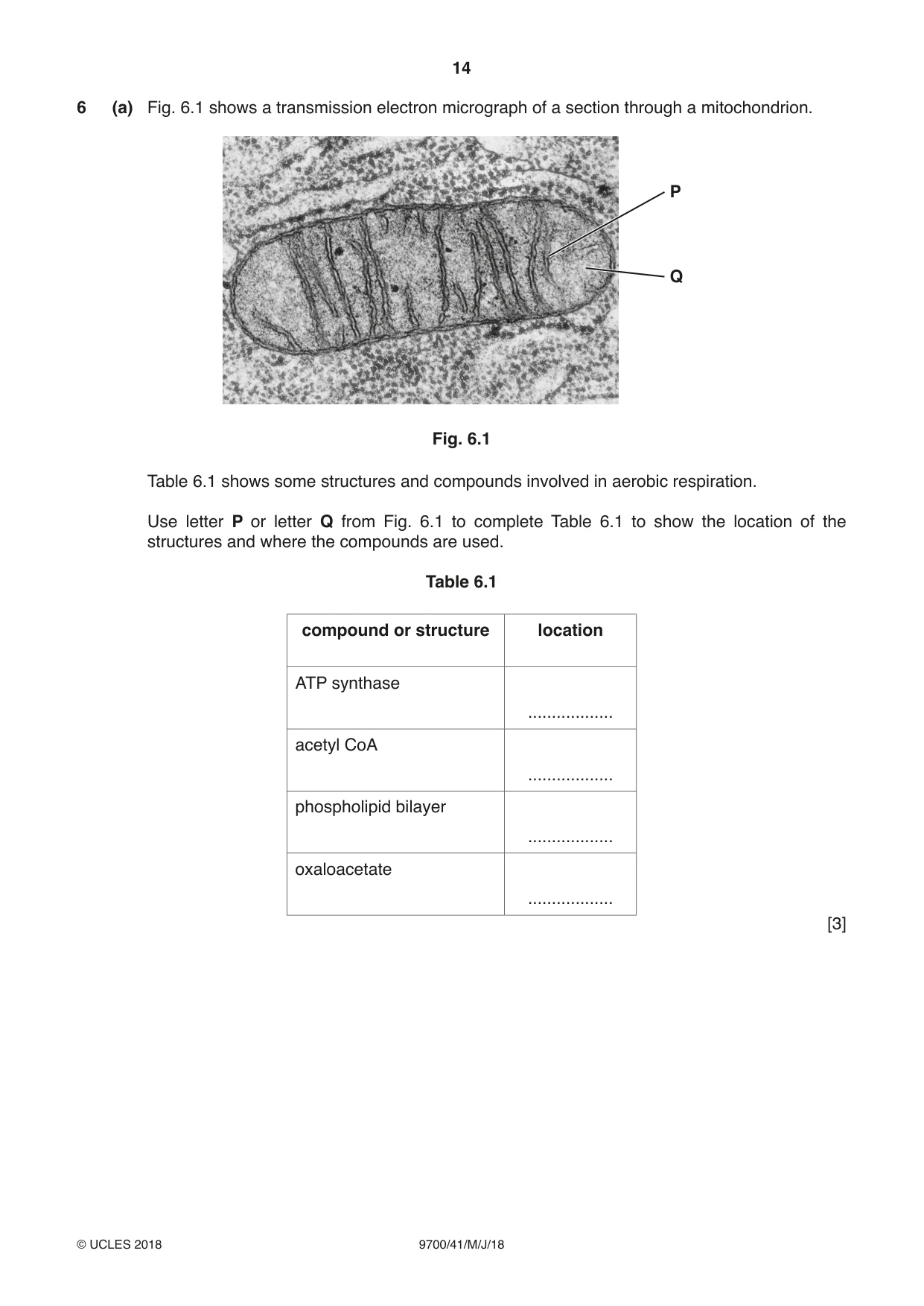
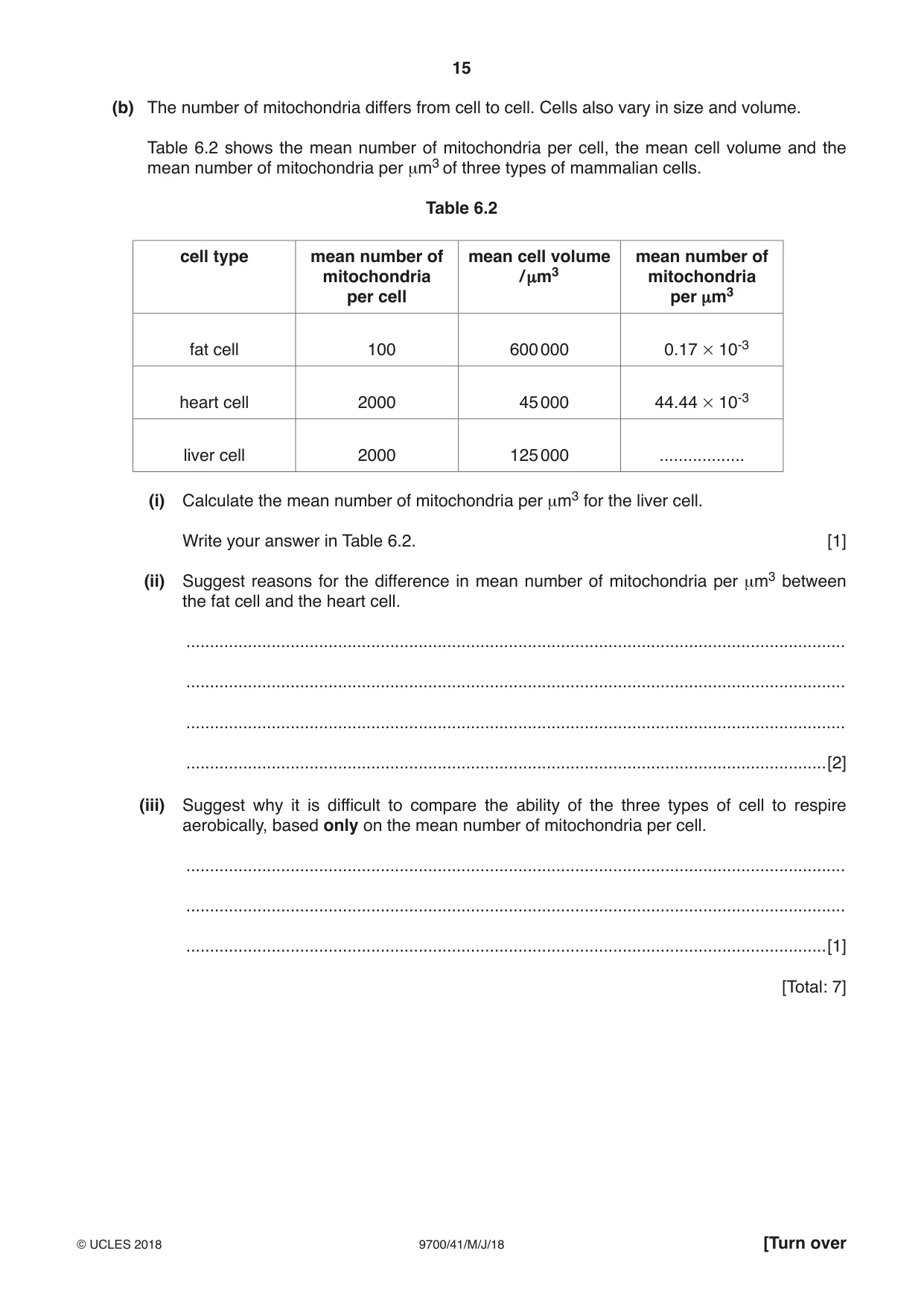
6 (a) Fig. 6.1 shows a transmission electron micrograph of a section through a mitochondrion. P Q Fig. 6.1 Table 6.1 shows some structures and compounds involved in aerobic respiration. Use letter P or letter Q from Fig. 6.1 to complete Table 6.1 to show the location of the structures and where the compounds are used. Table 6.1 compound or structure location ATP synthase .................. acetyl CoA .................. phospholipid bilayer .................. oxaloacetate .................. [3] (b) The number of mitochondria differs from cell to cell. Cells also vary in size and volume. Table 6.2 shows the mean number of mitochondria per cell, the mean cell volume and the mean number of mitochondria per µm3 of three types of mammalian cells. Table 6.2 cell type mean number of mean cell volume mean number of mitochondria / µm3 mitochondria per cell per µm3 # fat cell 100 600 000 0.17 10-3 # heart cell 2000 45 000 44.44 10-3 liver cell 2000 125 000 .................. (i) Calculate the mean number of mitochondria per µm3 for the liver cell. Write your answer in Table 6.2. [1] (ii) Suggest reasons for the difference in mean number of mitochondria per µm3 between the fat cell and the heart cell. ........................................................................................................................................... ........................................................................................................................................... ........................................................................................................................................... .......................................................................................................................................[2] (iii) Suggest why it is difficult to compare the ability of the three types of cell to respire aerobically, based only on the mean number of mitochondria per cell. ........................................................................................................................................... ........................................................................................................................................... .......................................................................................................................................[1] [Total: 7]
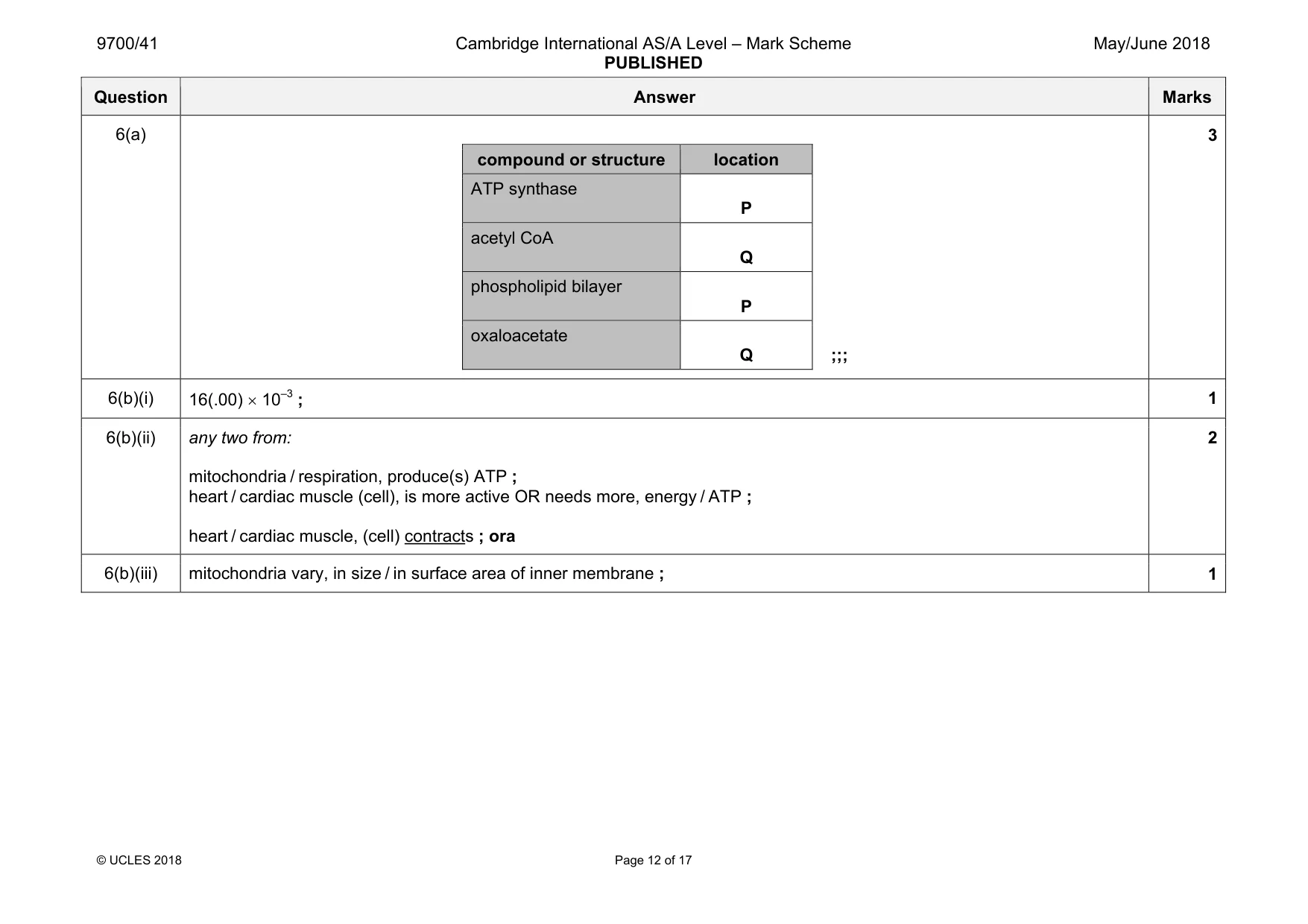
Mark scheme: 6(a) compound or structure location ATP synthase P acetyl CoA Q phospholipid bilayer P oxaloacetate Q ;;; 3 6(b)(i) 16(.00) × 10–3 ; 1 6(b)(ii) any two from: mitochondria / respiration, produce(s) ATP ; heart / cardiac muscle (cell), is more active OR needs more, energy / ATP ; heart / cardiac muscle, (cell) contracts ; ora 2 6(b)(iii) mitochondria vary, in size / in surface area of inner membrane ; 1
Question 7
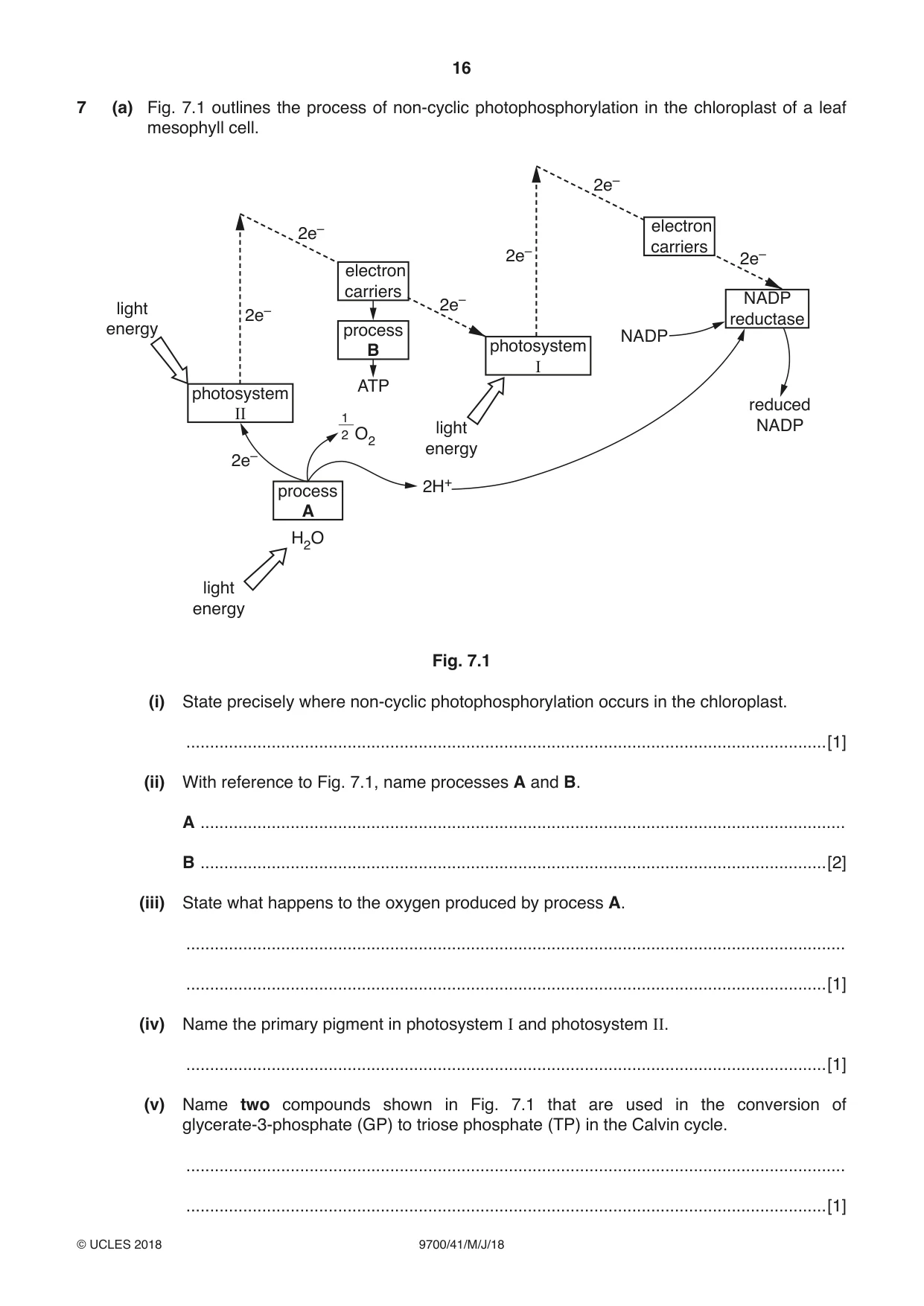
7 (a) Fig. 7.1 outlines the process of non-cyclic photophosphorylation in the chloroplast of a leaf mesophyll cell. 2e– electron 2e– carriers 2e– 2e– electron carriers NADP light 2e– 2e– reductase energy process NADP B photosystem I ATP photosystem reduced II 1 2 light NADP O2 energy 2e– process 2H+ A H2O light energy Fig. 7.1 (i) State precisely where non-cyclic photophosphorylation occurs in the chloroplast. .......................................................................................................................................[1] (ii) With reference to Fig. 7.1, name processes A and B. A ........................................................................................................................................ B ....................................................................................................................................[2] (iii) State what happens to the oxygen produced by process A. ........................................................................................................................................... .......................................................................................................................................[1] (iv) Name the primary pigment in photosystem I and photosystem II. .......................................................................................................................................[1] (v) Name two compounds shown in Fig. 7.1 that are used in the conversion of glycerate-3-phosphate (GP) to triose phosphate (TP) in the Calvin cycle. ........................................................................................................................................... .......................................................................................................................................[1] (b) Outline the uses of triose phosphate in the mesophyll cells of the leaf. ................................................................................................................................................... ................................................................................................................................................... ................................................................................................................................................... ................................................................................................................................................... ................................................................................................................................................... ...............................................................................................................................................[3] [Total: 9]
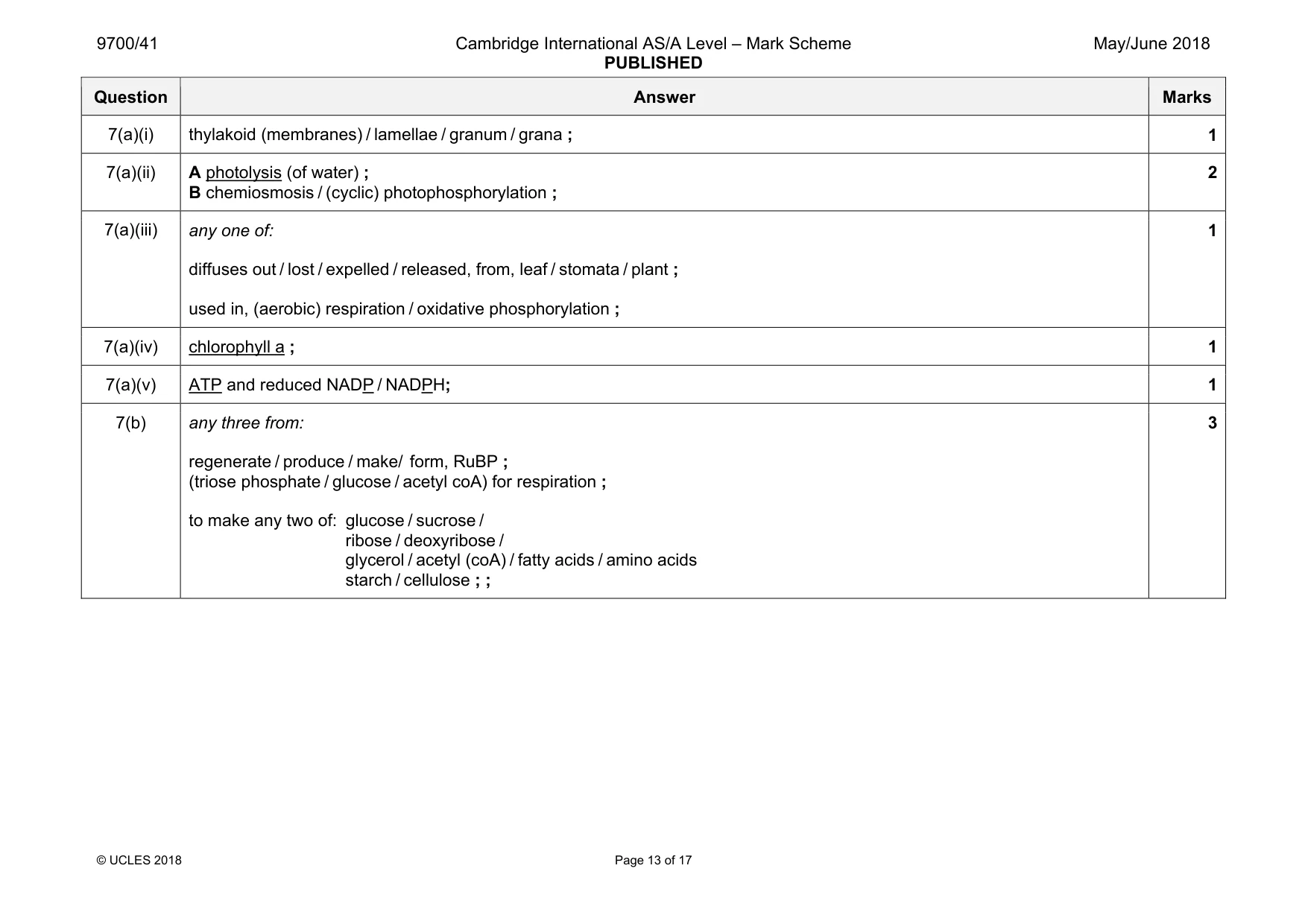
Mark scheme: 7(a)(i) thylakoid (membranes) / lamellae / granum / grana ; 1 7(a)(ii) A photolysis (of water) ; B chemiosmosis / (cyclic) photophosphorylation ; 2 7(a)(iii) any one of: diffuses out / lost / expelled / released, from, leaf / stomata / plant ; used in, (aerobic) respiration / oxidative phosphorylation ; 1 7(a)(iv) chlorophyll a ; 1 7(a)(v) ATP and reduced NADP / NADPH; 1 7(b) any three from: regenerate / produce / make/ form, RuBP ; (triose phosphate / glucose / acetyl coA) for respiration ; to make any two of: glucose / sucrose / ribose / deoxyribose / glycerol / acetyl (coA) / fatty acids / amino acids starch / cellulose ; ; 3
More questions on Photosynthesis as an energy transfer process
Q8 · In mammals, the nervous system and the endocrine system coordinate responses to the…
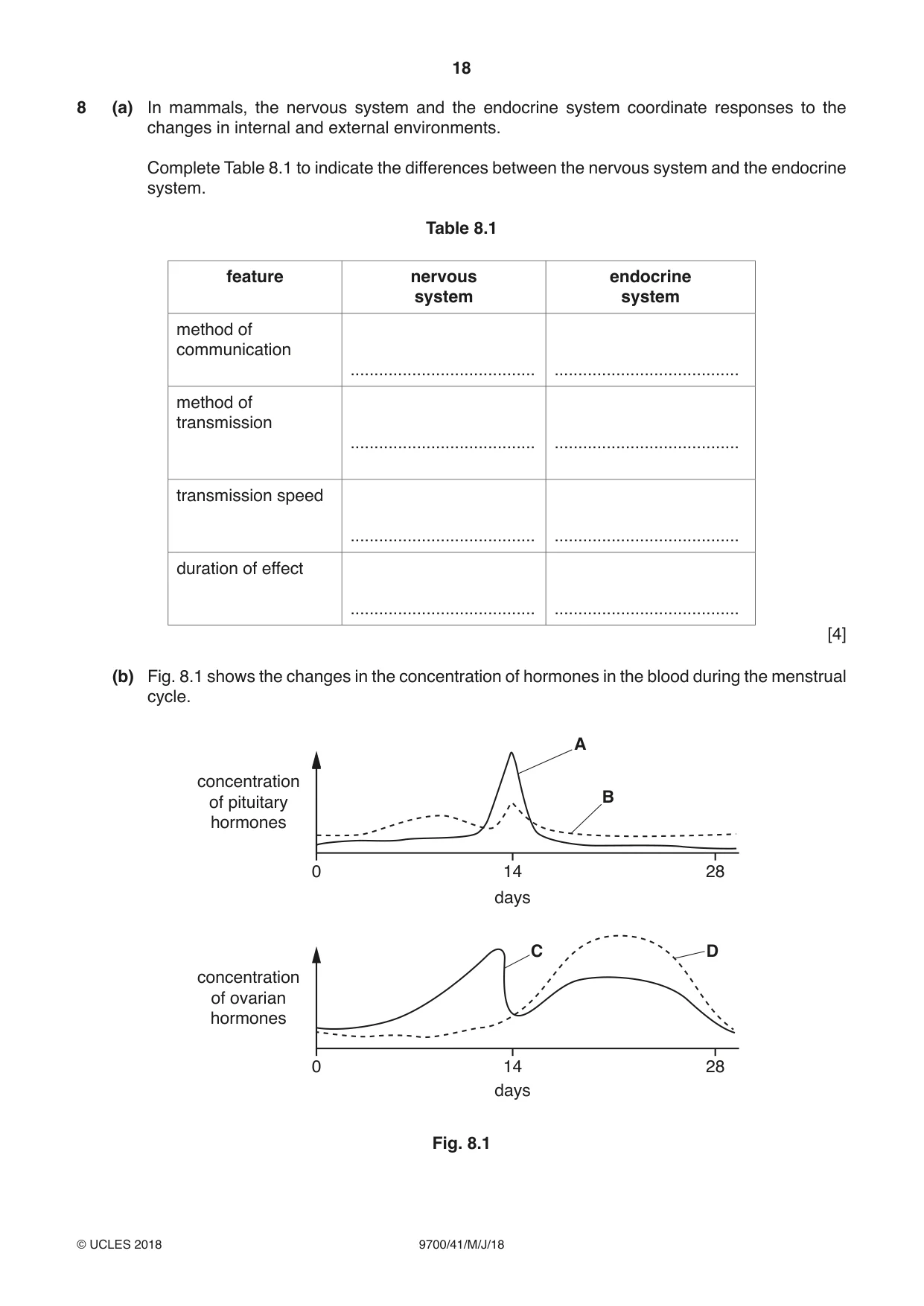
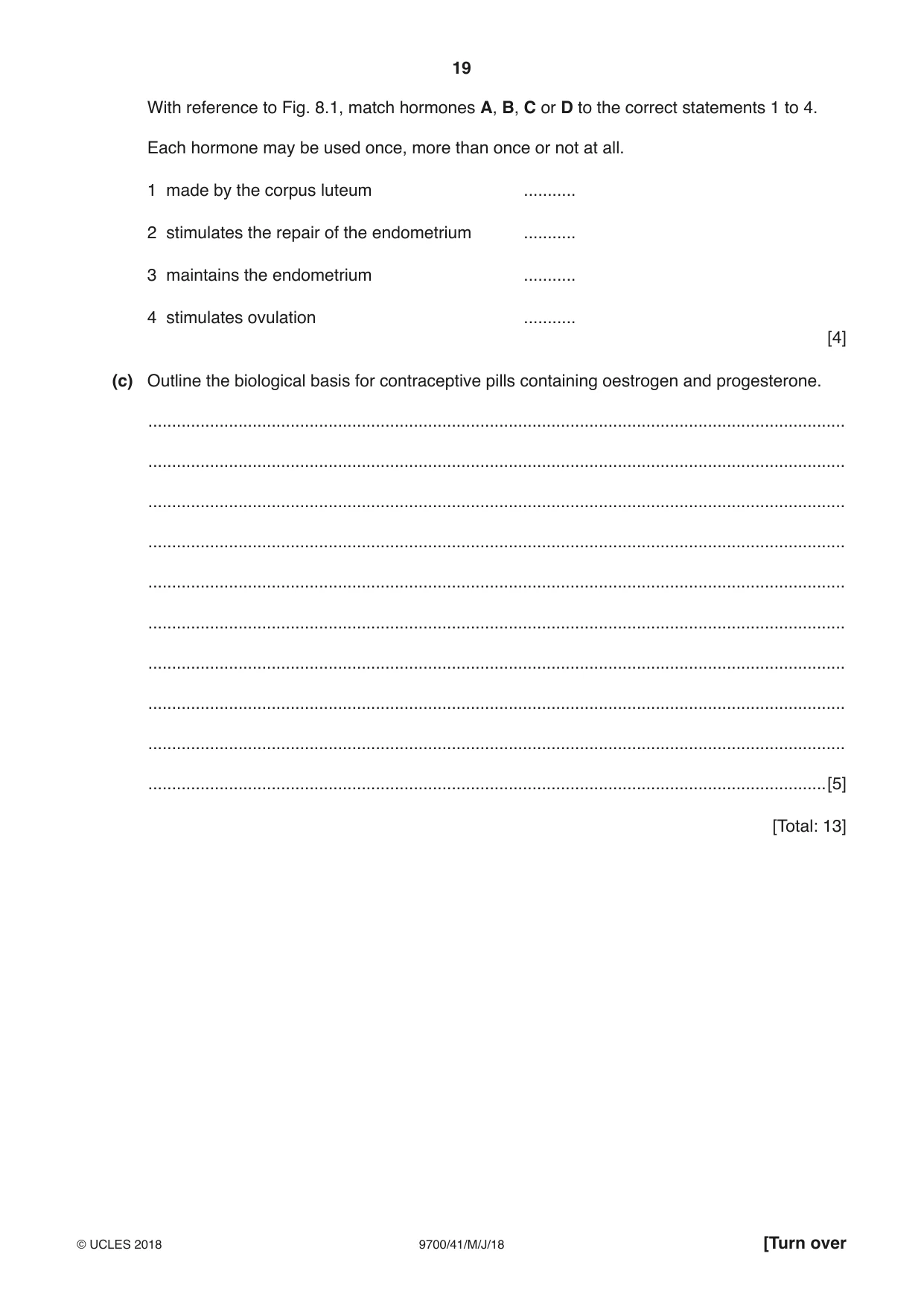
8 (a) In mammals, the nervous system and the endocrine system coordinate responses to the changes in internal and external environments. Complete Table 8.1 to indicate the differences between the nervous system and the endocrine system. Table 8.1 feature nervous endocrine system system method of communication ....................................... ....................................... method of transmission ....................................... ....................................... transmission speed ....................................... ....................................... duration of effect ....................................... ....................................... [4] (b) Fig. 8.1 shows the changes in the concentration of hormones in the blood during the menstrual cycle. A concentration B of pituitary hormones 0 14 28 days C D concentration of ovarian hormones 0 14 28 days Fig. 8.1 With reference to Fig. 8.1, match hormones A, B, C or D to the correct statements 1 to 4. Each hormone may be used once, more than once or not at all. 1 made by the corpus luteum ........... 2 stimulates the repair of the endometrium ........... 3 maintains the endometrium ........... 4 stimulates ovulation ........... [4] (c) Outline the biological basis for contraceptive pills containing oestrogen and progesterone. ................................................................................................................................................... ................................................................................................................................................... ................................................................................................................................................... ................................................................................................................................................... ................................................................................................................................................... ................................................................................................................................................... ................................................................................................................................................... ................................................................................................................................................... ................................................................................................................................................... ...............................................................................................................................................[5] [Total: 13]
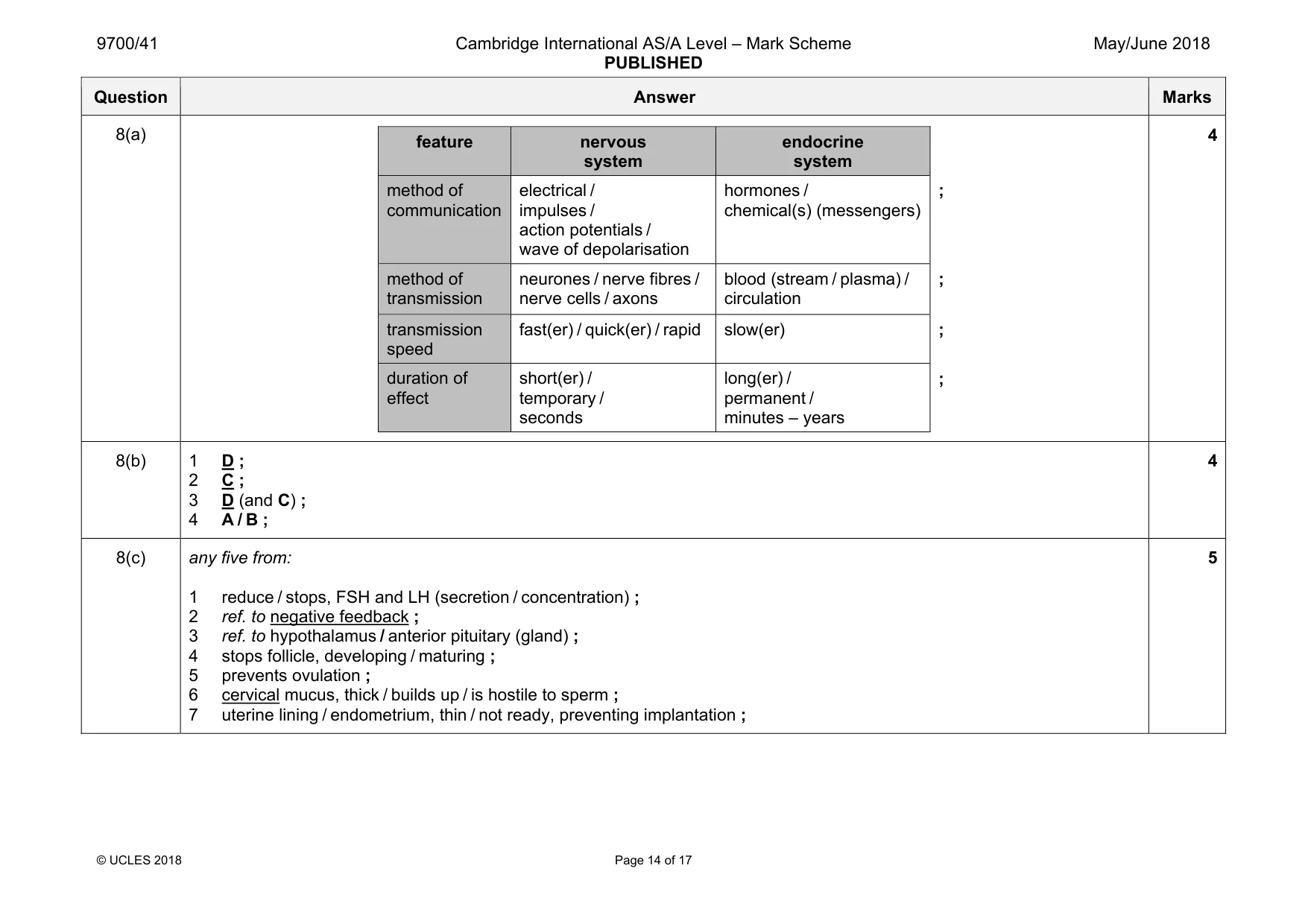
Mark scheme: 8(a) feature nervous system endocrine system method of communication electrical / impulses / action potentials / wave of depolarisation hormones / chemical(s) (messengers) ; method of transmission neurones / nerve fibres / nerve cells / axons blood (stream / plasma) / circulation ; transmission speed fast(er) / quick(er) / rapid slow(er) ; duration of effect short(er) / temporary / seconds long(er) / permanent / minutes – years ; 4 8(b) 1 D ; 2 C ; 3 D (and C) ; 4 A / B ; 4 8(c) any five from: 1 reduce / stops, FSH and LH (secretion / concentration) ; 2 ref. to negative feedback ; 3 ref. to hypothalamus / anterior pituitary (gland) ; 4 stops follicle, developing / maturing ; 5 prevents ovulation ; 6 cervical mucus, thick / builds up / is hostile to sperm ; 7 uterine lining / endometrium, thin / not ready, preventing implantation ; 5
Q9 · Describe the features of ATP that make it suitable as the universal energy currency
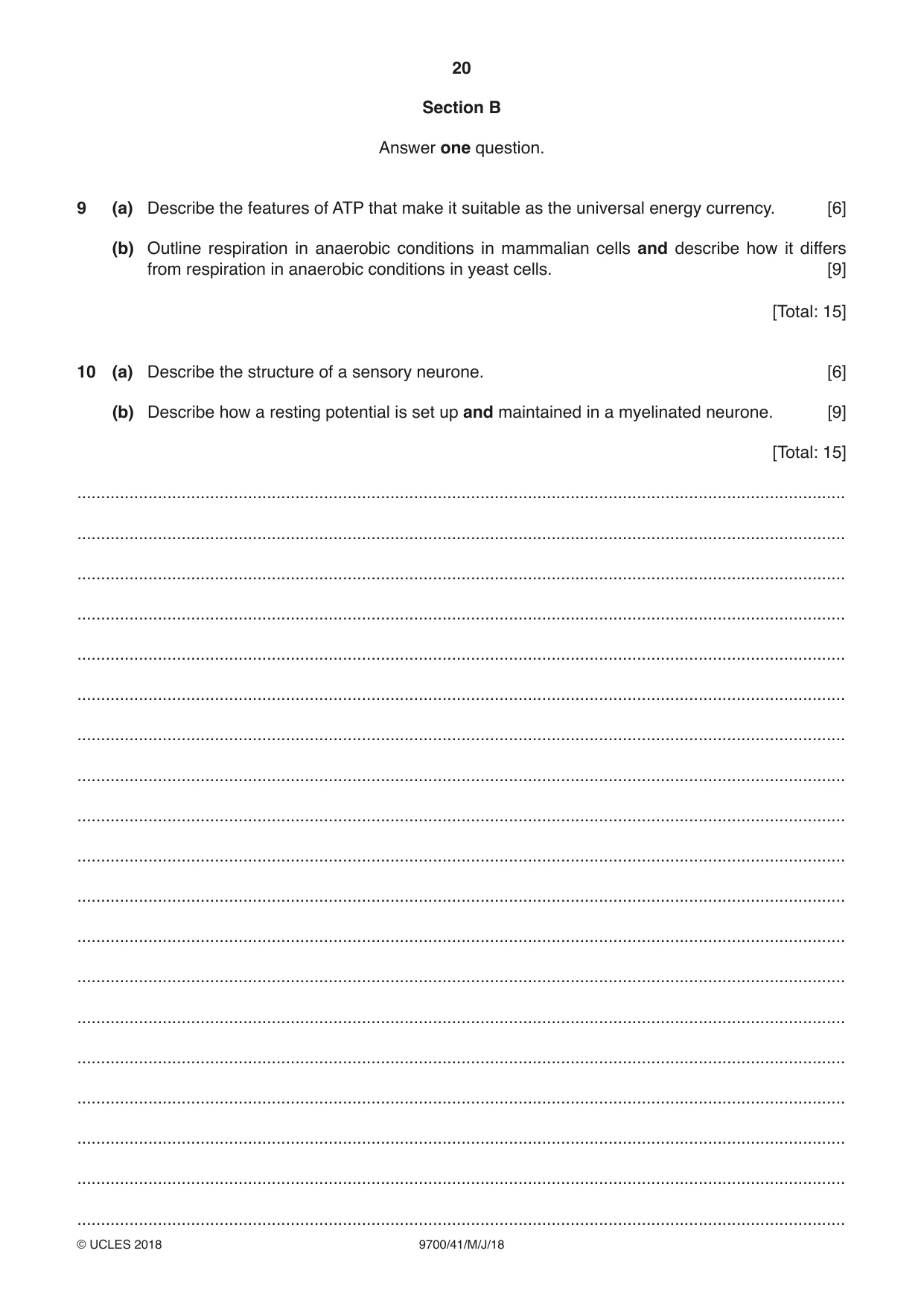
9 (a) Describe the features of ATP that make it suitable as the universal energy currency. [6] (b) Outline respiration in anaerobic conditions in mammalian cells and describe how it differs from respiration in anaerobic conditions in yeast cells. [9] [Total: 15]
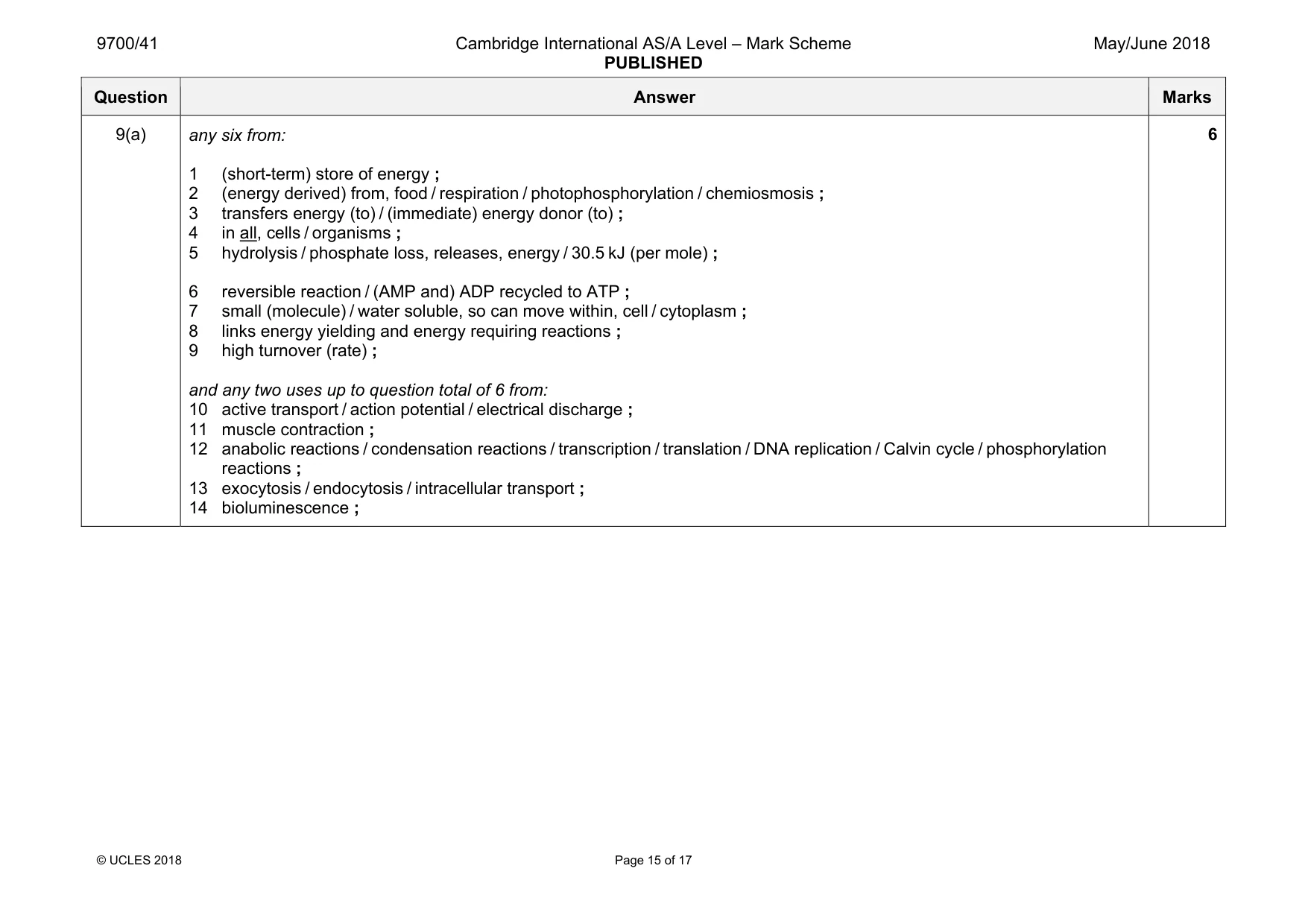
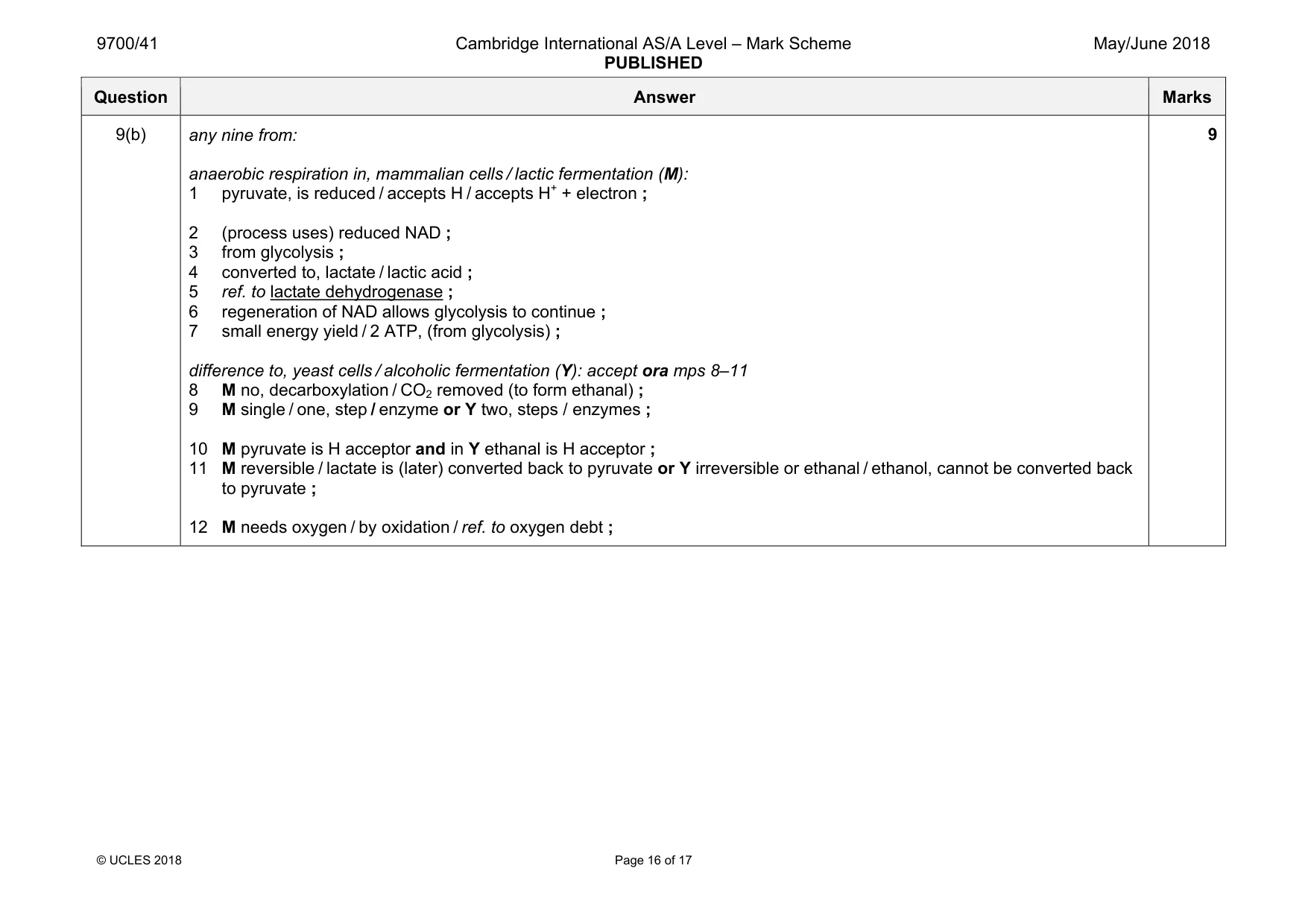
Mark scheme: 9(a) any six from: 1 (short-term) store of energy ; 2 (energy derived) from, food / respiration / photophosphorylation / chemiosmosis ; 3 transfers energy (to) / (immediate) energy donor (to) ; 4 in all, cells / organisms ; 5 hydrolysis / phosphate loss, releases, energy / 30.5 kJ (per mole) ; 6 reversible reaction / (AMP and) ADP recycled to ATP ; 7 small (molecule) / water soluble, so can move within, cell / cytoplasm ; 8 links energy yielding and energy requiring reactions ; 9 high turnover (rate) ; and any two uses up to question total of 6 from: 10 active transport / action potential / electrical discharge ; 11 muscle contraction ; 12 anabolic reactions / condensation reactions / transcription / translation / DNA replication / Calvin cycle / phosphorylation reactions ; 13 exocytosis / endocytosis / intracellular transport ; 14 bioluminescence ; 6 Question Answer Marks 9(b) any nine from: anaerobic respiration in, mammalian cells / lactic fermentation (M): 1 pyruvate, is reduced / accepts H / accepts H+ + electron ; 2 (process uses) reduced NAD ; 3 from glycolysis ; 4 converted to, lactate / lactic acid ; 5 ref. to lactate dehydrogenase ; 6 regeneration of NAD allows glycolysis to continue ; 7 small energy yield / 2 ATP, (from glycolysis) ; difference to, yeast cells / alcoholic fermentation (Y): accept ora mps 8–11 8 M no, decarboxylation / CO2 removed (to form ethanal) ; 9 M single / one, step / enzyme or Y two, steps / enzymes ; 10 M pyruvate is H acceptor and in Y ethanal is H acceptor ; 11 M reversible / lactate is (later) converted back to pyruvate or Y irreversible or ethanal / ethanol, cannot be converted back to pyruvate ; 12 M needs oxygen / by oxidation / ref. to oxygen debt ; 9
Q10 · Describe the structure of a sensory neurone
10 (a) Describe the structure of a sensory neurone. [6] (b) Describe how a resting potential is set up and maintained in a myelinated neurone. [9] [Total: 15] .................................................................................................................................................................. .................................................................................................................................................................. .................................................................................................................................................................. .................................................................................................................................................................. .................................................................................................................................................................. .................................................................................................................................................................. .................................................................................................................................................................. .................................................................................................................................................................. .................................................................................................................................................................. .................................................................................................................................................................. .................................................................................................................................................................. .................................................................................................................................................................. .................................................................................................................................................................. .................................................................................................................................................................. .................................................................................................................................................................. .................................................................................................................................................................. .................................................................................................................................................................. .................................................................................................................................................................. .................................................................................................................................................................. .................................................................................................................................................................. .................................................................................................................................................................. .................................................................................................................................................................. .................................................................................................................................................................. .................................................................................................................................................................. .................................................................................................................................................................. .................................................................................................................................................................. .................................................................................................................................................................. .................................................................................................................................................................. .................................................................................................................................................................. .................................................................................................................................................................. .................................................................................................................................................................. .................................................................................................................................................................. .................................................................................................................................................................. .................................................................................................................................................................. .................................................................................................................................................................. .................................................................................................................................................................. .................................................................................................................................................................. .................................................................................................................................................................. .................................................................................................................................................................. .................................................................................................................................................................. .................................................................................................................................................................. .................................................................................................................................................................. .................................................................................................................................................................. .................................................................................................................................................................. .................................................................................................................................................................. .................................................................................................................................................................. .................................................................................................................................................................. .................................................................................................................................................................. .................................................................................................................................................................. .................................................................................................................................................................. .................................................................................................................................................................. .................................................................................................................................................................. .................................................................................................................................................................. .................................................................................................................................................................. .................................................................................................................................................................. .................................................................................................................................................................. .................................................................................................................................................................. .................................................................................................................................................................. .................................................................................................................................................................. .................................................................................................................................................................. .................................................................................................................................................................. .................................................................................................................................................................. .................................................................................................................................................................. .................................................................................................................................................................. .................................................................................................................................................................. .................................................................................................................................................................. .................................................................................................................................................................. .................................................................................................................................................................. .................................................................................................................................................................. .................................................................................................................................................................. .................................................................................................................................................................. .................................................................................................................................................................. .................................................................................................................................................................. ..................................................................................................................................................................
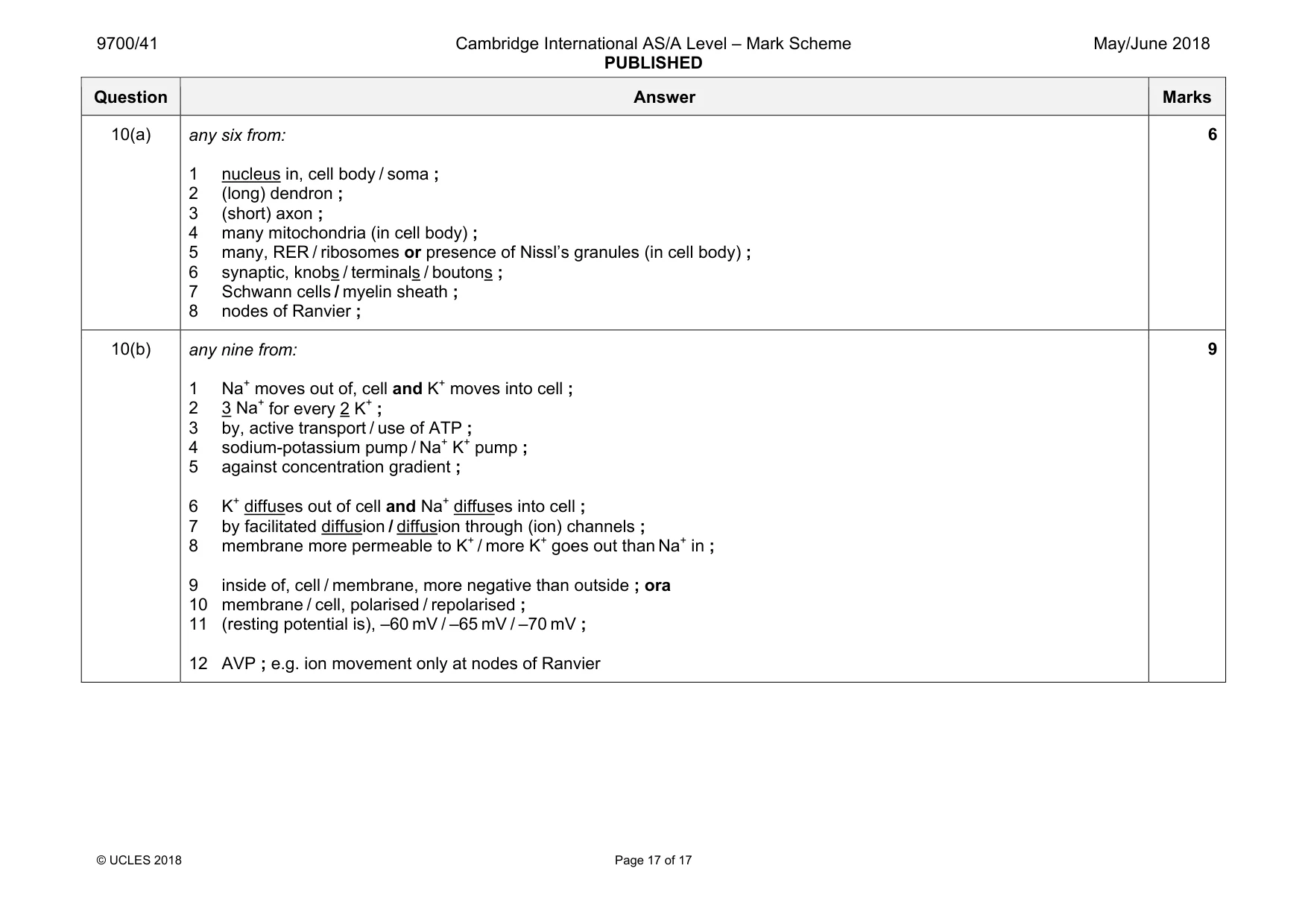
Mark scheme: 10(a) any six from: 1 nucleus in, cell body / soma ; 2 (long) dendron ; 3 (short) axon ; 4 many mitochondria (in cell body) ; 5 many, RER / ribosomes or presence of Nissl’s granules (in cell body) ; 6 synaptic, knobs / terminals / boutons ; 7 Schwann cells / myelin sheath ; 8 nodes of Ranvier ; 6 10(b) any nine from: 1 Na+ moves out of, cell and K+ moves into cell ; 2 3 Na+ for every 2 K+ ; 3 by, active transport / use of ATP ; 4 sodium-potassium pump / Na+ K+ pump ; 5 against concentration gradient ; 6 K+ diffuses out of cell and Na+ diffuses into cell ; 7 by facilitated diffusion / diffusion through (ion) channels ; 8 membrane more permeable to K+ / more K+ goes out than Na+ in ; 9 inside of, cell / membrane, more negative than outside ; ora 10 membrane / cell, polarised / repolarised ; 11 (resting potential is), –60 mV / –65 mV / –70 mV ; 12 AVP ; e.g. ion movement only at nodes of Ranvier 9
What was in this paper
The subtopics covered by these 10 questions, and how many questions each got. Open one in a new tab to see every Cambridge question on it.
What you needed in this session
Cambridge’s own grade thresholds for 2018 May/June, Paper 4 · Variant 1. A higher threshold means an easier paper — the bar moves with how the cohort did.