Cambridge A Level Biology 9700 — 2015 Oct/Nov Paper 2 · Variant 2
9700/22/O/N/15 · 60 marks · ≈68 min
The question paper and its mark scheme, free to read here and free to download. This is Cambridge’s own paper, exactly as it was sat.
Question paper16 pages
Mark scheme11 pages
Answers below. Sit the paper first if you are practising.
Paper as text
Question paper, page 1
This document consists of 16 printed pages. DC (NF/JG) 99039/3 © UCLES 2015 [Turn over Cambridge International Examinations Cambridge International Advanced Subsidiary and Advanced Level * 5 8 0 1 3 8 6 9 1 9 * BIOLOGY 9700/22 Paper 2 Structured Questions AS October/November 2015 1 hour 15 minutes Candidates answer on the Question Paper. No Additional Materials are required. READ THESE INSTRUCTIONS FIRST Write your Centre number, candidate number and name in the spaces provided at the top of this page. Write in dark blue or black pen. You may use an HB pencil for any diagrams or graphs. Do not use staples, paper clips, glue or correction fluid. DO NOT WRITE IN ANY BARCODES. Answer all questions. Electronic calculators may be used. You may lose marks if you do not show your working or if you do not use appropriate units. At the end of the examination, fasten all your work securely together. The number of marks is given in brackets [ ] at the end of each question or part question.
Question paper, page 2
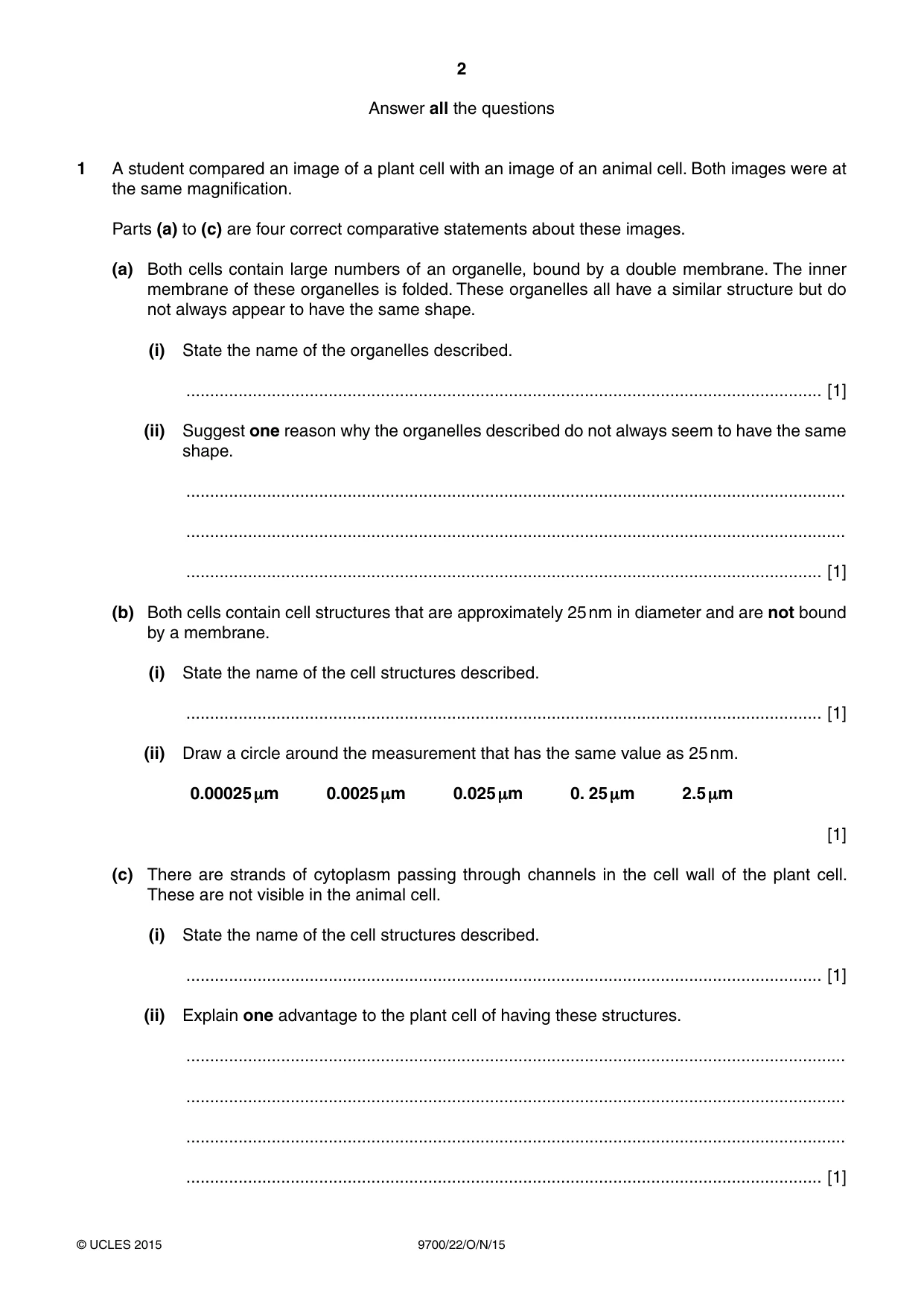
2 9700/22/O/N/15 © UCLES 2015 Answer all the questions 1 A student compared an image of a plant cell with an image of an animal cell. Both images were at the same magnification. Parts (a) to (c) are four correct comparative statements about these images. (a) Both cells contain large numbers of an organelle, bound by a double membrane. The inner membrane of these organelles is folded. These organelles all have a similar structure but do not always appear to have the same shape. (i) State the name of the organelles described. … [1] (ii) Suggest one reason why the organelles described do not always seem to have the same shape. … … … [1] (b) Both cells contain cell structures that are approximately 25 nm in diameter and are not bound by a membrane. (i) State the name of the cell structures described. … [1] (ii) Draw a circle around the measurement that has the same value as 25 nm. 0.00025 μm 0.0025 μm 0.025 μm 0. 25 μm 2.5 μm [1] (c) There are strands of cytoplasm passing through channels in the cell wall of the plant cell. These are not visible in the animal cell. (i) State the name of the cell structures described. … [1] (ii) Explain one advantage to the plant cell of having these structures. … … … … [1]
Question paper, page 3
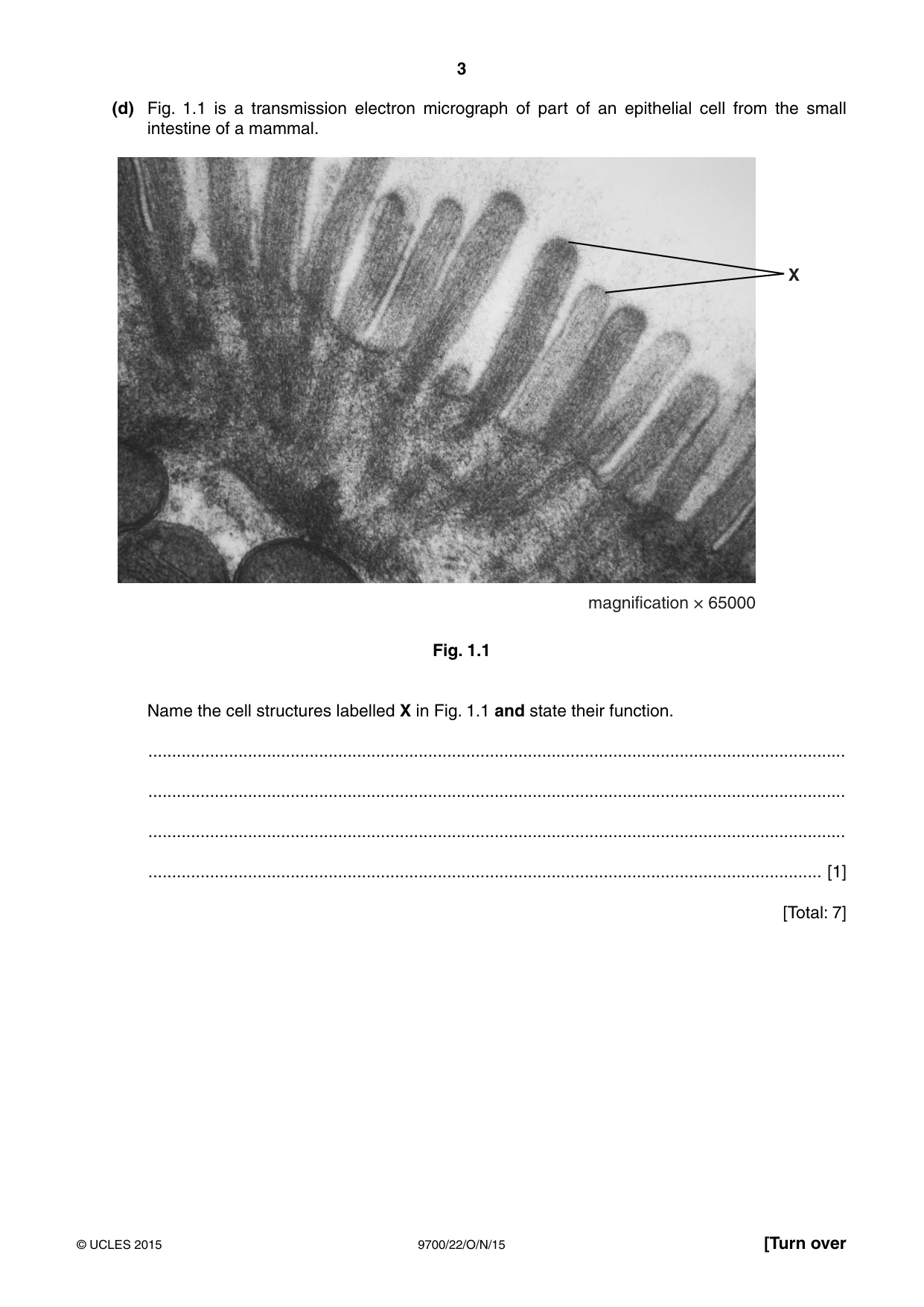
3 9700/22/O/N/15 © UCLES 2015 [Turn over (d) Fig. 1.1 is a transmission electron micrograph of part of an epithelial cell from the small intestine of a mammal. X magnification × 65000 Fig. 1.1 Name the cell structures labelled X in Fig. 1.1 and state their function. … … … … [1] [Total: 7]
Question paper, page 4
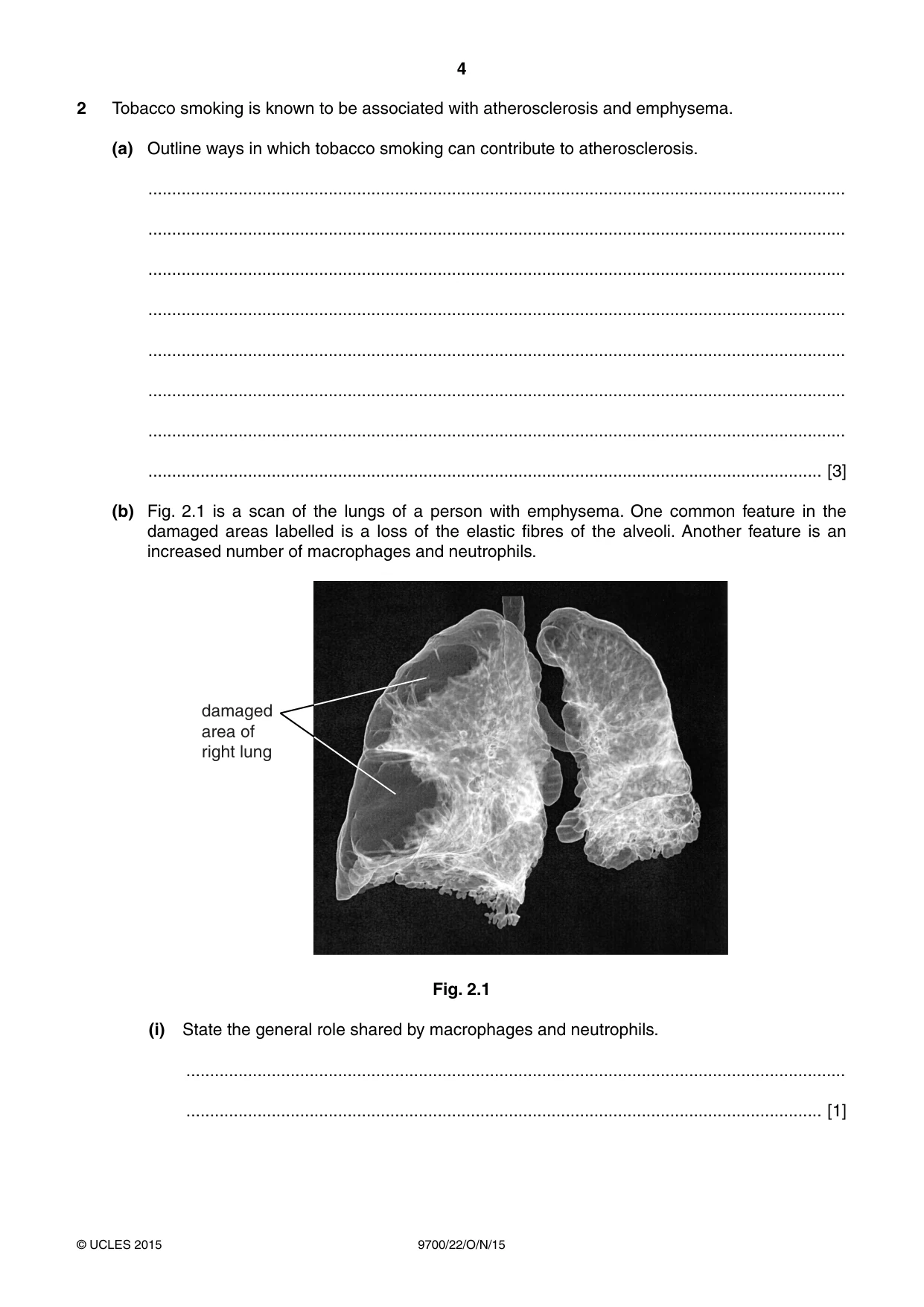
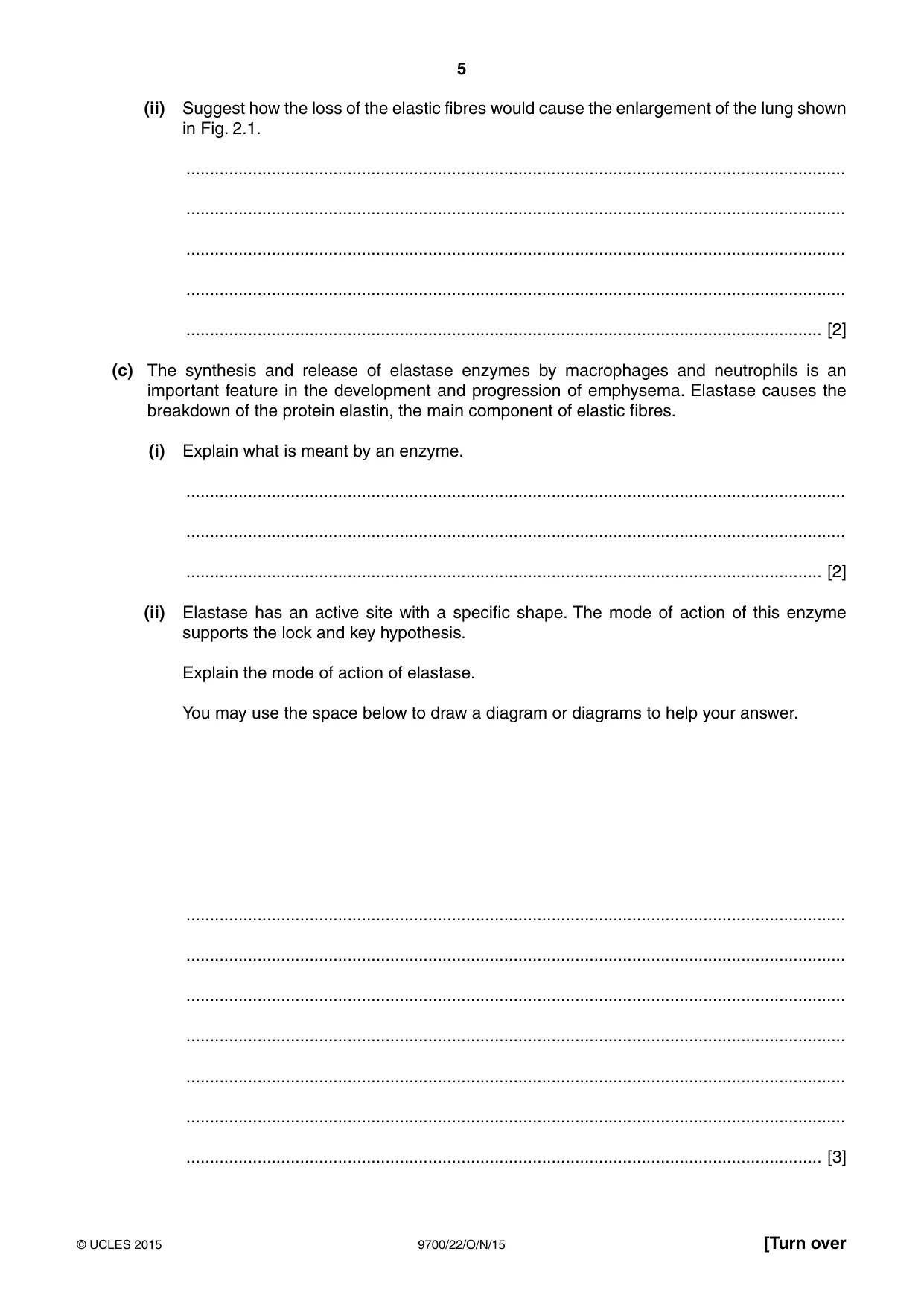
4 9700/22/O/N/15 © UCLES 2015 2 Tobacco smoking is known to be associated with atherosclerosis and emphysema. (a) Outline ways in which tobacco smoking can contribute to atherosclerosis. … … … … … … … … [3] (b) Fig. 2.1 is a scan of the lungs of a person with emphysema. One common feature in the damaged areas labelled is a loss of the elastic fibres of the alveoli. Another feature is an increased number of macrophages and neutrophils. damaged area of right lung Fig. 2.1 (i) State the general role shared by macrophages and neutrophils. … … [1]
Question paper, page 5
5 9700/22/O/N/15 © UCLES 2015 [Turn over (ii) Suggest how the loss of the elastic fibres would cause the enlargement of the lung shown in Fig. 2.1. … … … … … [2] (c) The synthesis and release of elastase enzymes by macrophages and neutrophils is an important feature in the development and progression of emphysema. Elastase causes the breakdown of the protein elastin, the main component of elastic fibres. (i) Explain what is meant by an enzyme. … … … [2] (ii) Elastase has an active site with a specific shape. The mode of action of this enzyme supports the lock and key hypothesis. Explain the mode of action of elastase. You may use the space below to draw a diagram or diagrams to help your answer. … … … … … … … [3]
Question paper, page 6
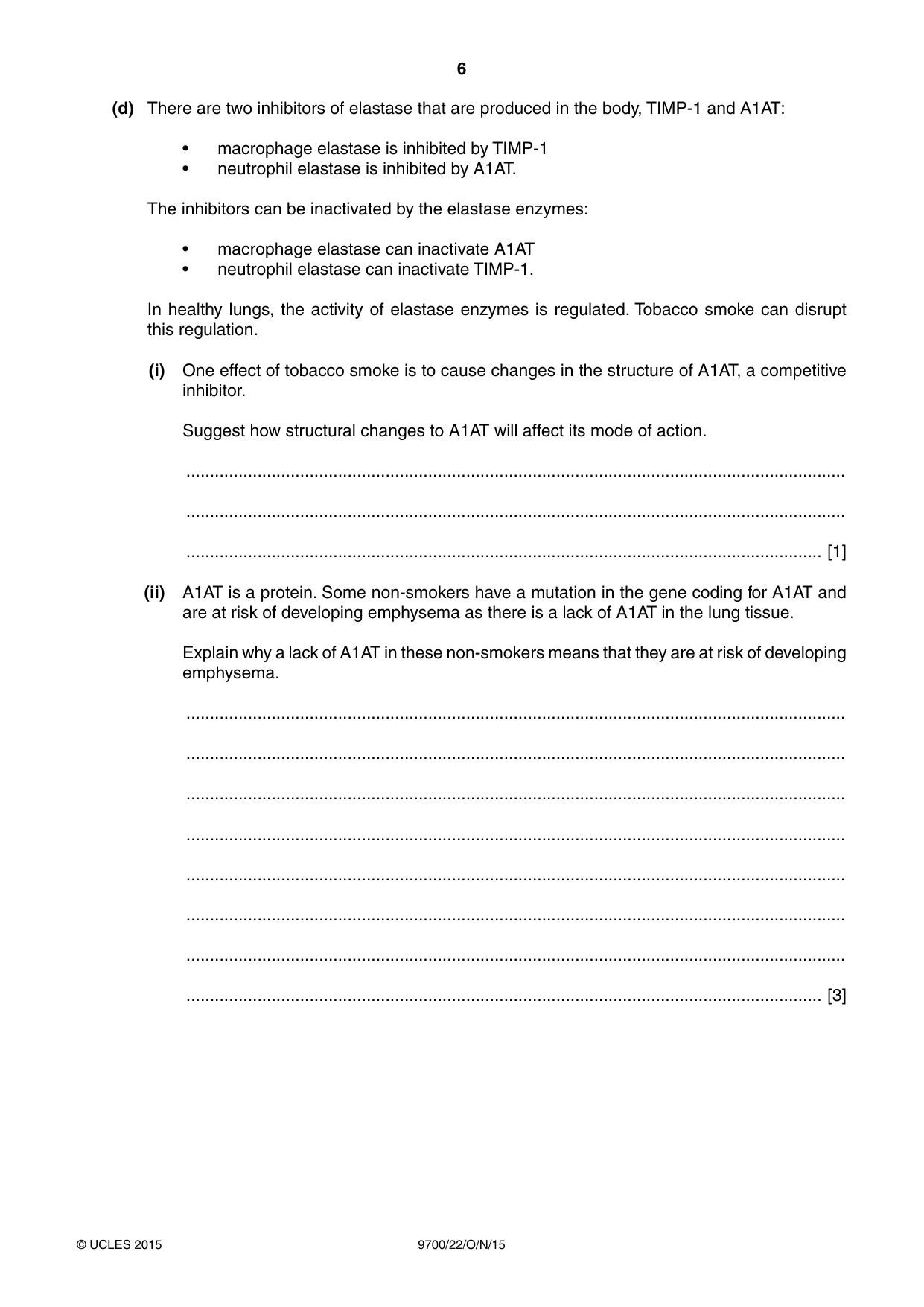
6 9700/22/O/N/15 © UCLES 2015 (d) There are two inhibitors of elastase that are produced in the body, TIMP-1 and A1AT: • macrophage elastase is inhibited by TIMP-1 • neutrophil elastase is inhibited by A1AT. The inhibitors can be inactivated by the elastase enzymes: • macrophage elastase can inactivate A1AT • neutrophil elastase can inactivate TIMP-1. In healthy lungs, the activity of elastase enzymes is regulated. Tobacco smoke can disrupt this regulation. (i) One effect of tobacco smoke is to cause changes in the structure of A1AT, a competitive inhibitor. Suggest how structural changes to A1AT will affect its mode of action. … … … [1] (ii) A1AT is a protein. Some non-smokers have a mutation in the gene coding for A1AT and are at risk of developing emphysema as there is a lack of A1AT in the lung tissue. Explain why a lack of A1AT in these non-smokers means that they are at risk of developing emphysema. … … … … … … … … [3]
Question paper, page 7
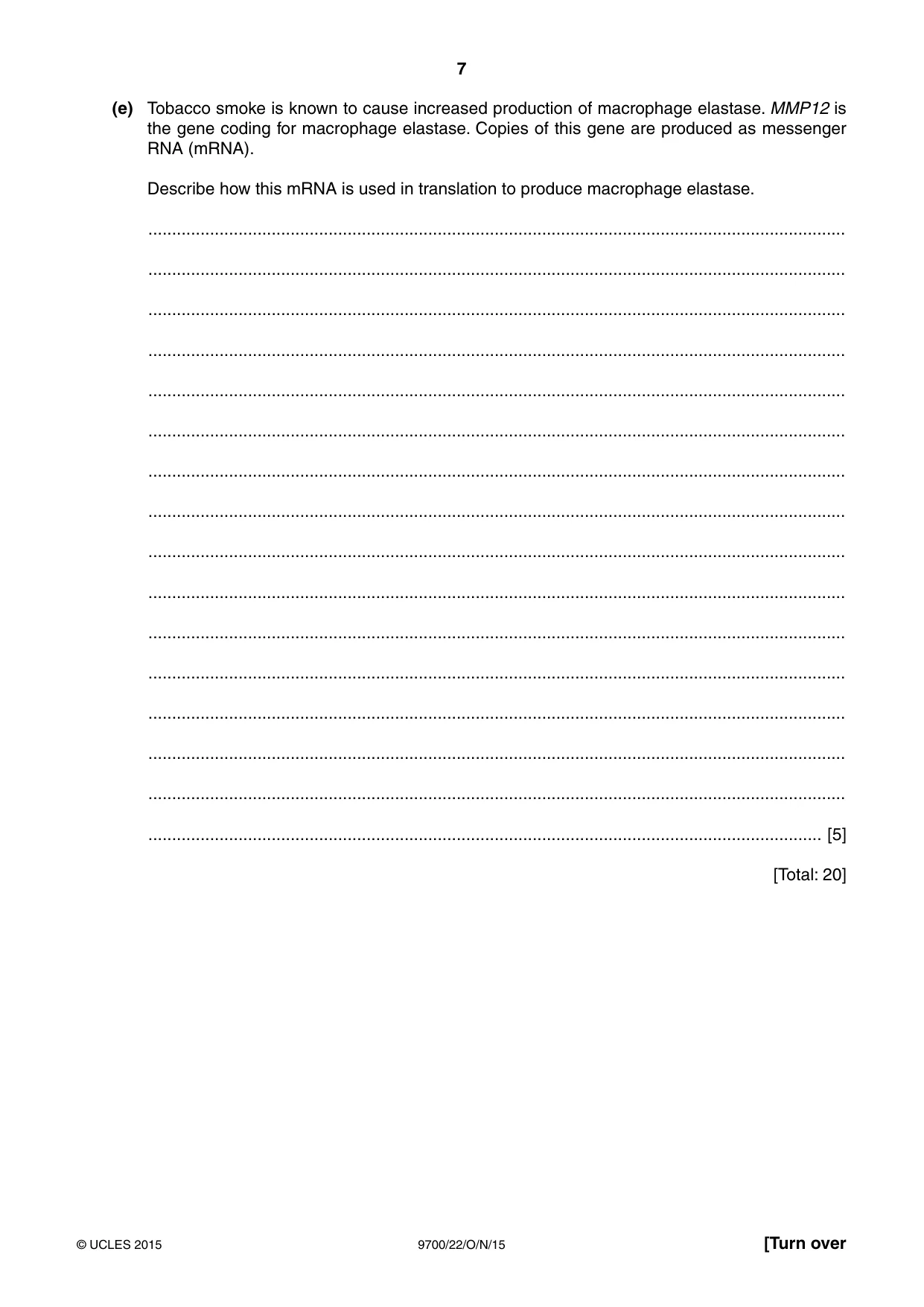
7 9700/22/O/N/15 © UCLES 2015 [Turn over (e) Tobacco smoke is known to cause increased production of macrophage elastase. MMP12 is the gene coding for macrophage elastase. Copies of this gene are produced as messenger RNA (mRNA). Describe how this mRNA is used in translation to produce macrophage elastase. … … … … … … … … … … … … … … … … [5] [Total: 20]
Question paper, page 8
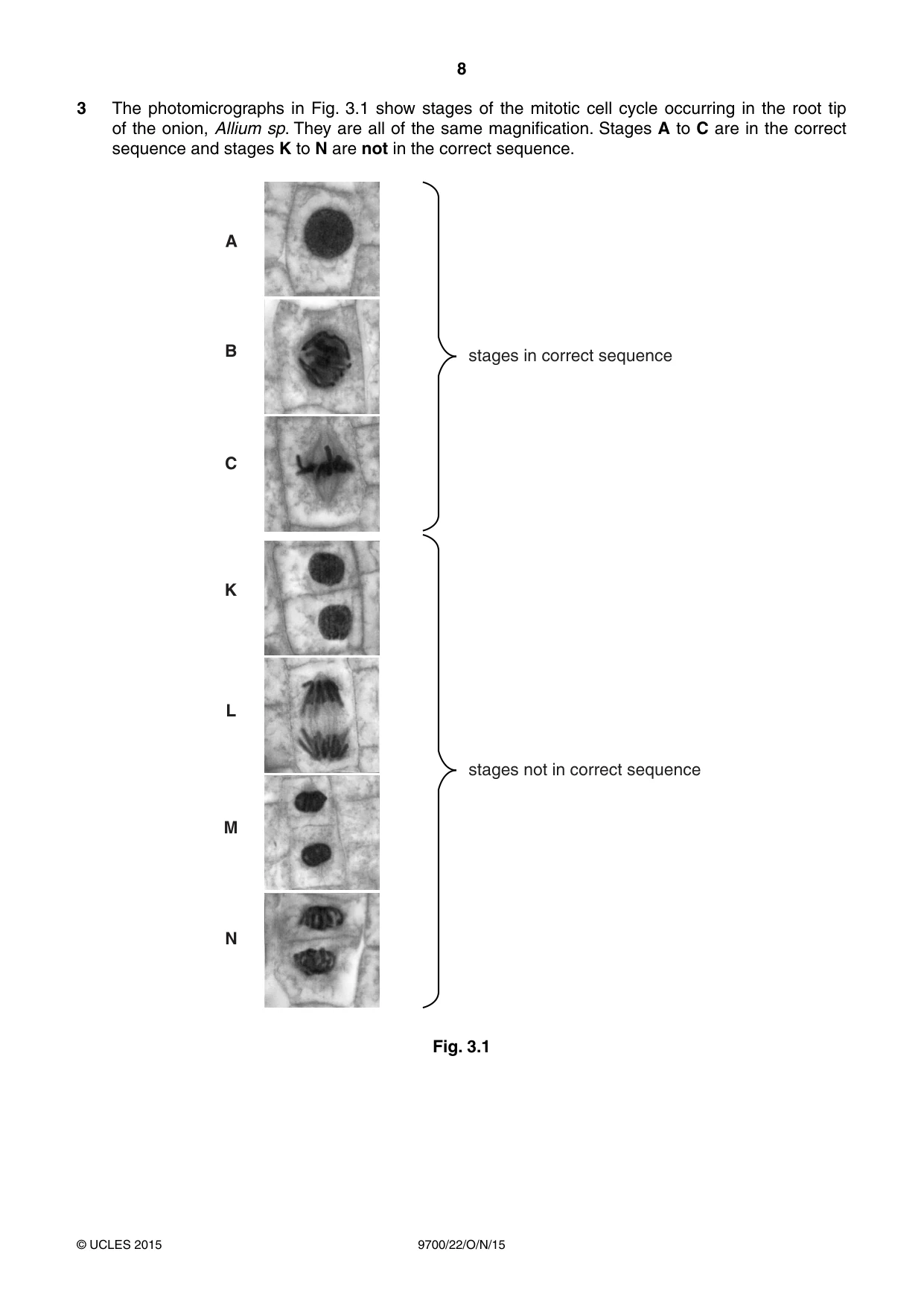
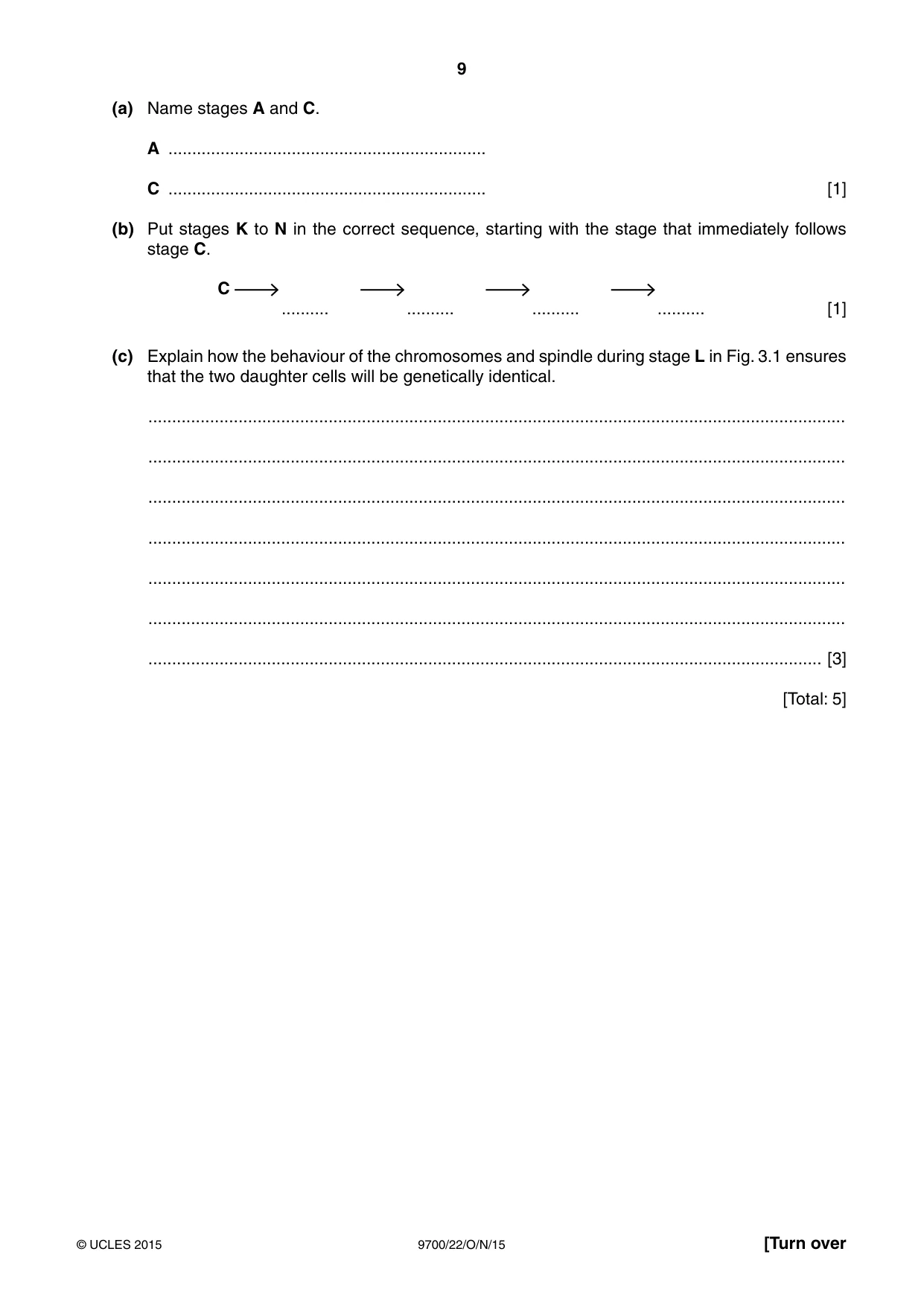
8 9700/22/O/N/15 © UCLES 2015 3 The photomicrographs in Fig. 3.1 show stages of the mitotic cell cycle occurring in the root tip of the onion, Allium sp. They are all of the same magnification. Stages A to C are in the correct sequence and stages K to N are not in the correct sequence. stages in correct sequence stages not in correct sequence A B C K L N M Fig. 3.1
Question paper, page 9
9 9700/22/O/N/15 © UCLES 2015 [Turn over (a) Name stages A and C. A … C … [1] (b) Put stages K to N in the correct sequence, starting with the stage that immediately follows stage C. C … … … … [1] (c) Explain how the behaviour of the chromosomes and spindle during stage L in Fig. 3.1 ensures that the two daughter cells will be genetically identical. … … … … … … … [3] [Total: 5]
Question paper, page 10
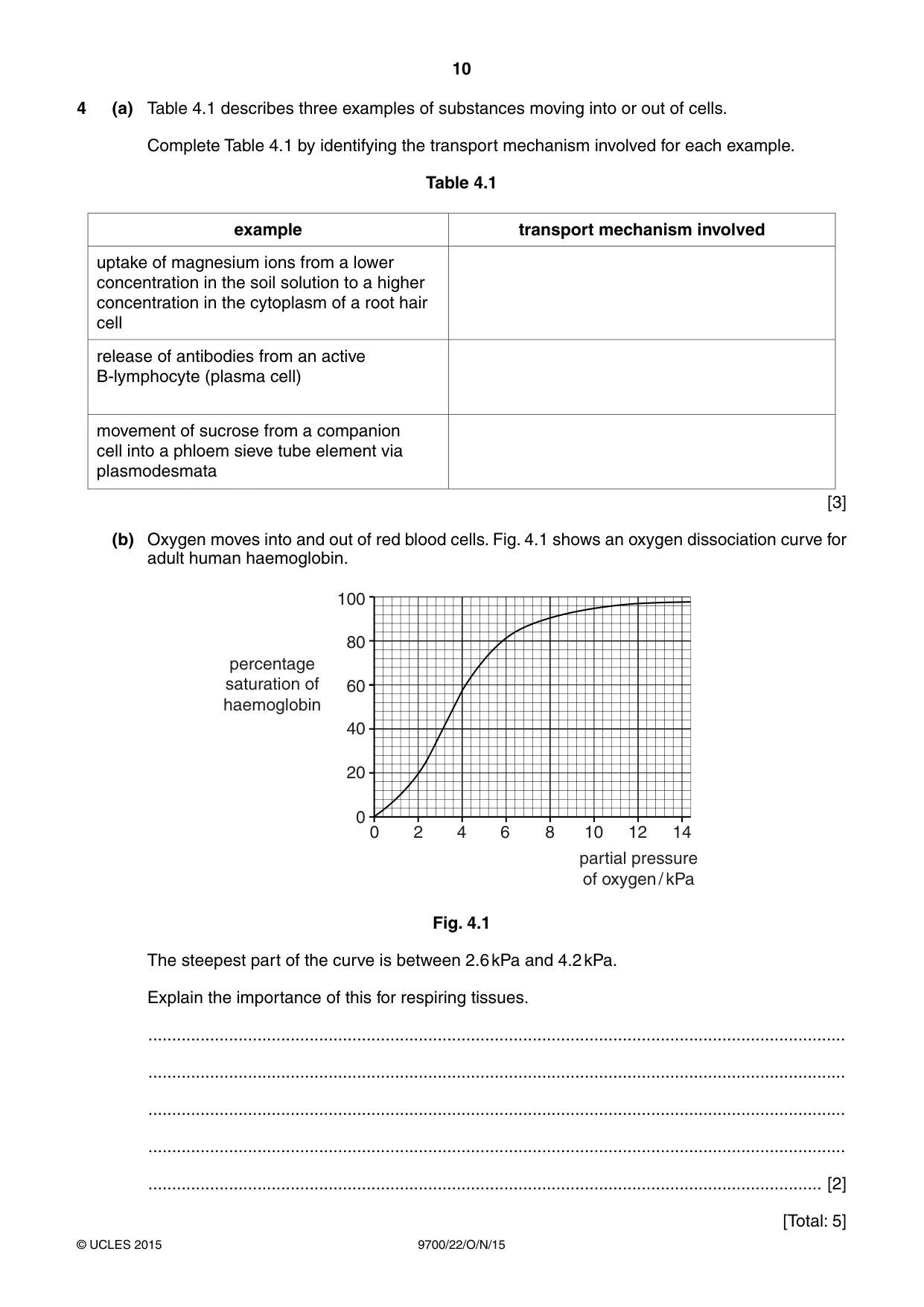
10 9700/22/O/N/15 © UCLES 2015 4 (a) Table 4.1 describes three examples of substances moving into or out of cells. Complete Table 4.1 by identifying the transport mechanism involved for each example. Table 4.1 example transport mechanism involved uptake of magnesium ions from a lower concentration in the soil solution to a higher concentration in the cytoplasm of a root hair cell release of antibodies from an active B-lymphocyte (plasma cell) movement of sucrose from a companion cell into a phloem sieve tube element via plasmodesmata [3] (b) Oxygen moves into and out of red blood cells. Fig. 4.1 shows an oxygen dissociation curve for adult human haemoglobin. partial pressure of oxygen / kPa percentage saturation of haemoglobin 0 20 40 60 80 100 0 2 4 6 8 10 12 14 Fig. 4.1 The steepest part of the curve is between 2.6 kPa and 4.2 kPa. Explain the importance of this for respiring tissues. … … … … … [2] [Total: 5]
Question paper, page 11
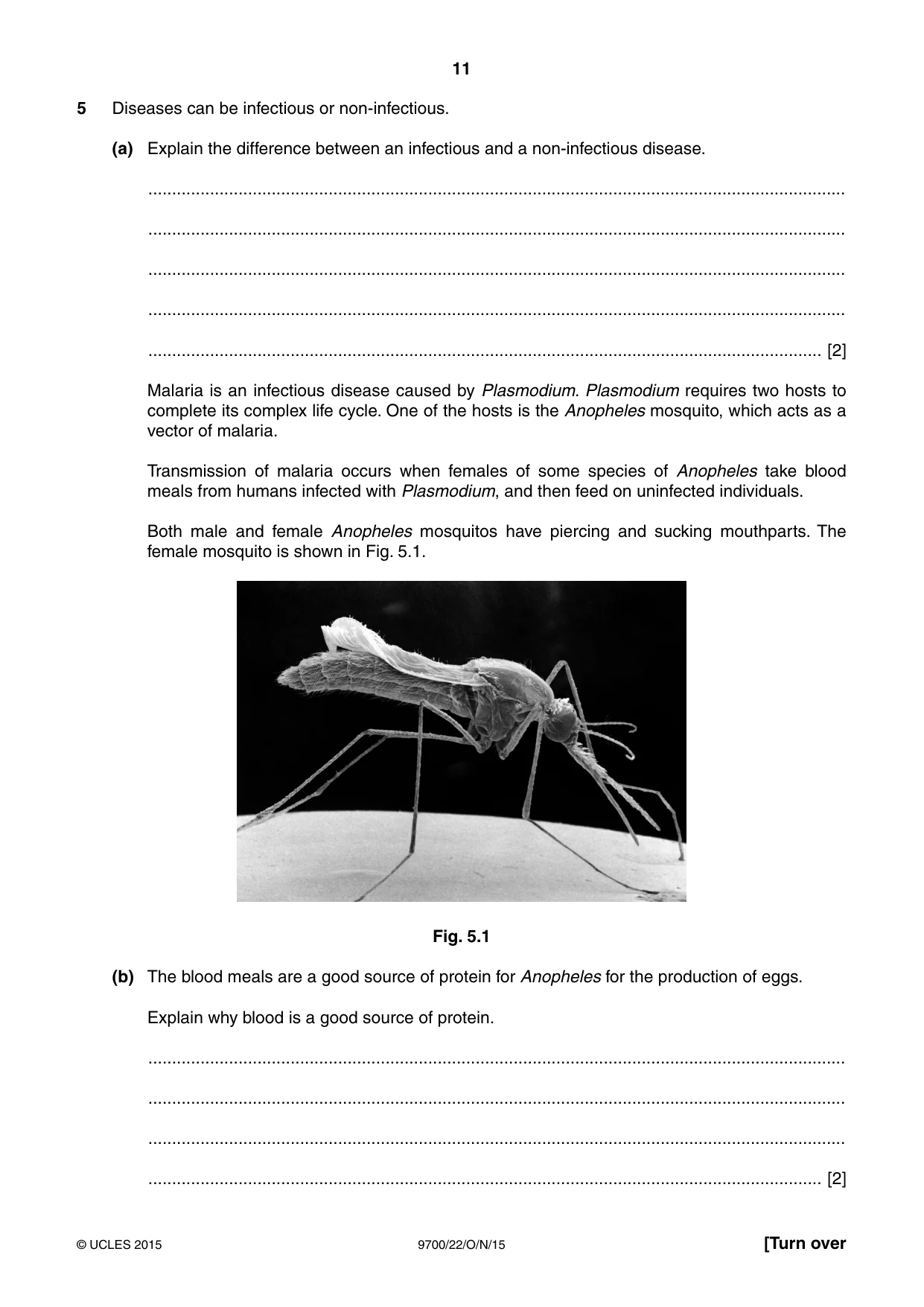
11 9700/22/O/N/15 © UCLES 2015 [Turn over 5 Diseases can be infectious or non-infectious. (a) Explain the difference between an infectious and a non-infectious disease. … … … … … [2] Malaria is an infectious disease caused by Plasmodium. Plasmodium requires two hosts to complete its complex life cycle. One of the hosts is the Anopheles mosquito, which acts as a vector of malaria. Transmission of malaria occurs when females of some species of Anopheles take blood meals from humans infected with Plasmodium, and then feed on uninfected individuals. Both male and female Anopheles mosquitos have piercing and sucking mouthparts. The female mosquito is shown in Fig. 5.1. Fig. 5.1 (b) The blood meals are a good source of protein for Anopheles for the production of eggs. Explain why blood is a good source of protein. … … … … [2]
Question paper, page 12
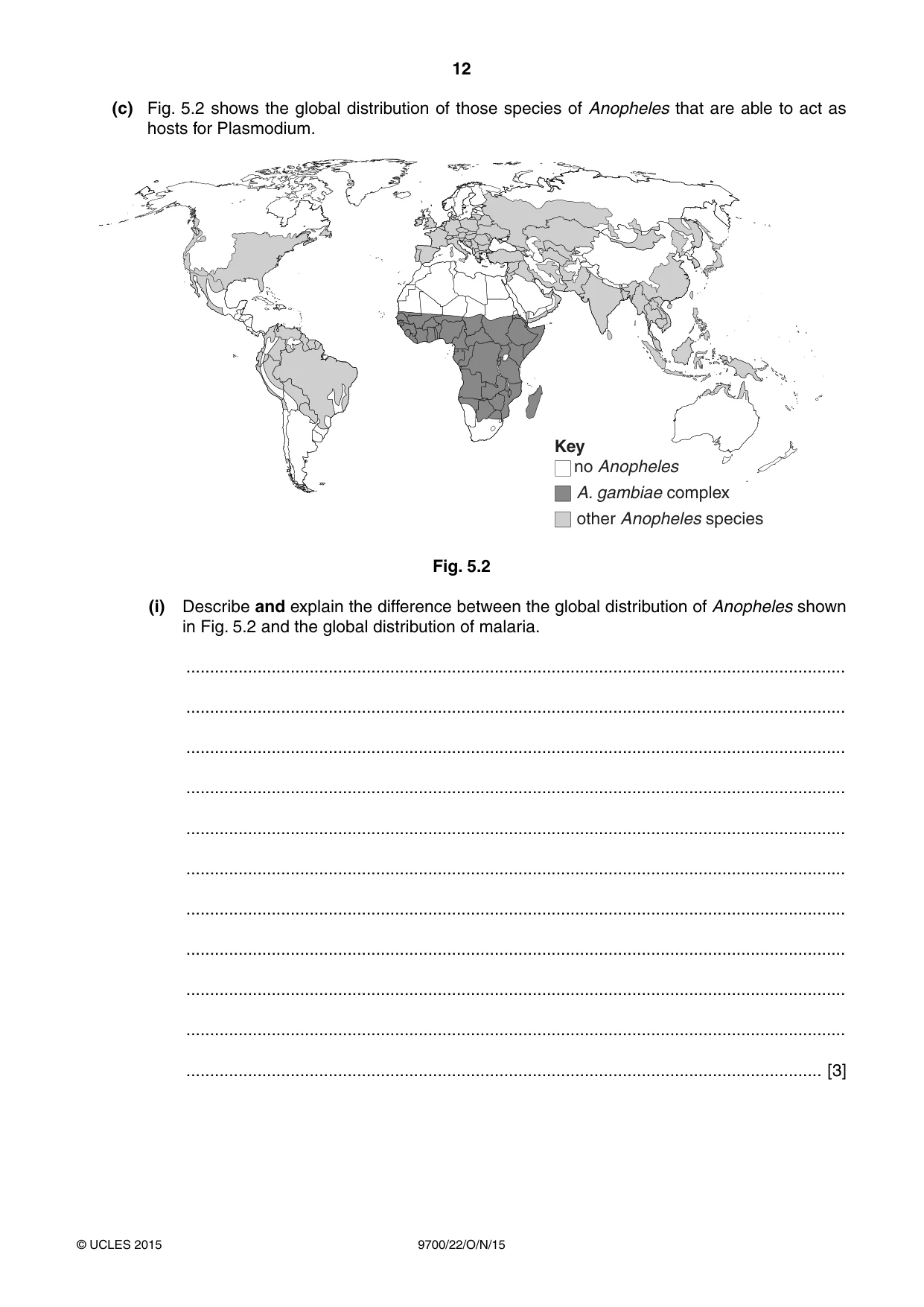
12 9700/22/O/N/15 © UCLES 2015 (c) Fig. 5.2 shows the global distribution of those species of Anopheles that are able to act as hosts for Plasmodium. Key no Anopheles A. gambiae complex other Anopheles species Fig. 5.2 (i) Describe and explain the difference between the global distribution of Anopheles shown in Fig. 5.2 and the global distribution of malaria. … … … … … … … … … … … [3]
Question paper, page 13
13 9700/22/O/N/15 © UCLES 2015 [Turn over (ii) The distribution of Anopheles shown in Fig. 5.2 includes over forty different species that are vectors of malaria. The areas with the highest number of cases of malaria are also the areas where Anopheles gambiae occurs. A. gambiae is responsible for most of the transmission of the disease in these areas. Suggest why A. gambiae is responsible for most of the transmission of Plasmodium. … … … … … … … … … … [3]
Question paper, page 14
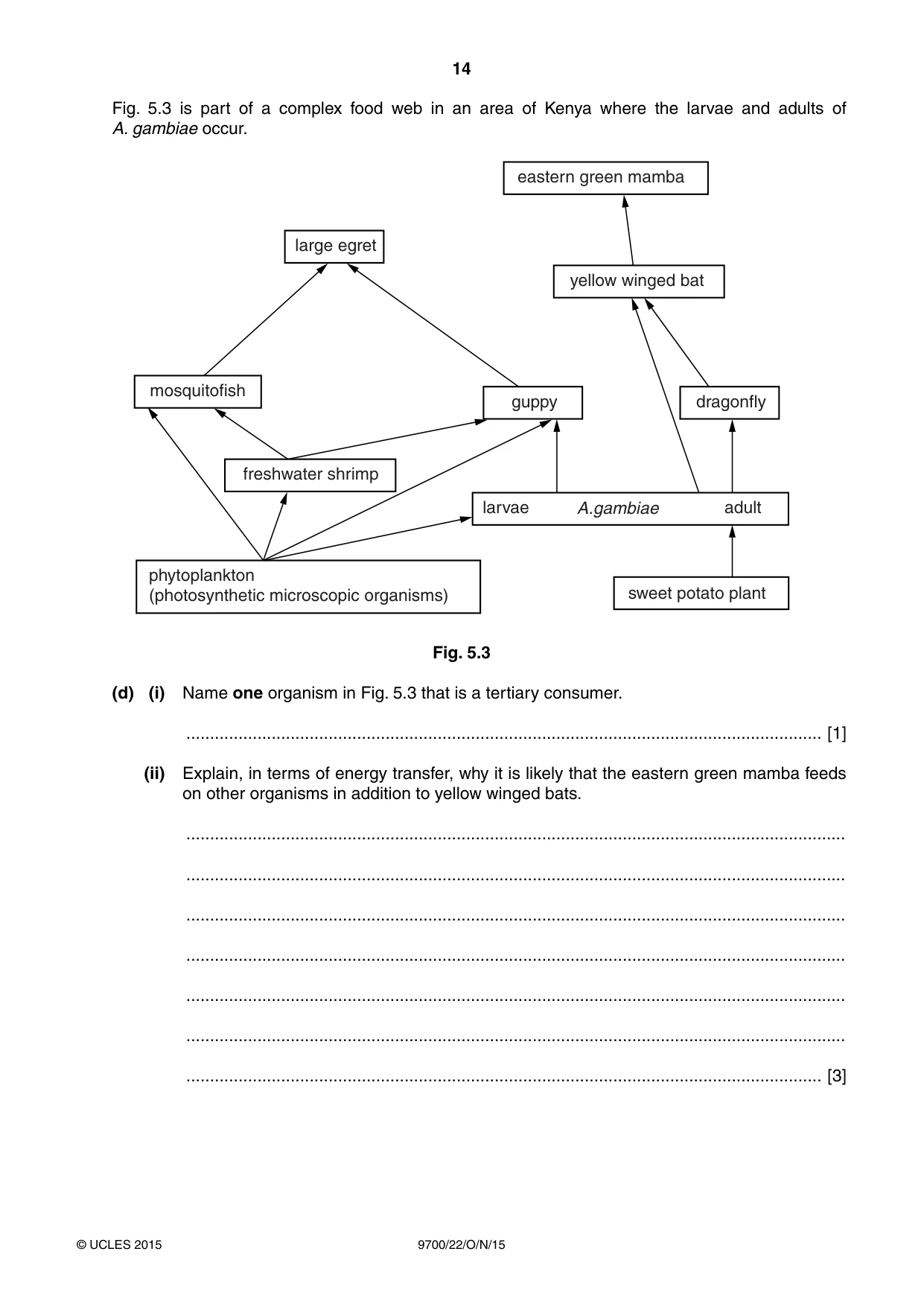
14 9700/22/O/N/15 © UCLES 2015 Fig. 5.3 is part of a complex food web in an area of Kenya where the larvae and adults of A. gambiae occur. eastern green mamba yellow winged bat dragonfly guppy large egret mosquitofish freshwater shrimp larvae adult sweet potato plant A.gambiae phytoplankton (photosynthetic microscopic organisms) Fig. 5.3 (d) (i) Name one organism in Fig. 5.3 that is a tertiary consumer. … [1] (ii) Explain, in terms of energy transfer, why it is likely that the eastern green mamba feeds on other organisms in addition to yellow winged bats. … … … … … … … [3]
Question paper, page 15
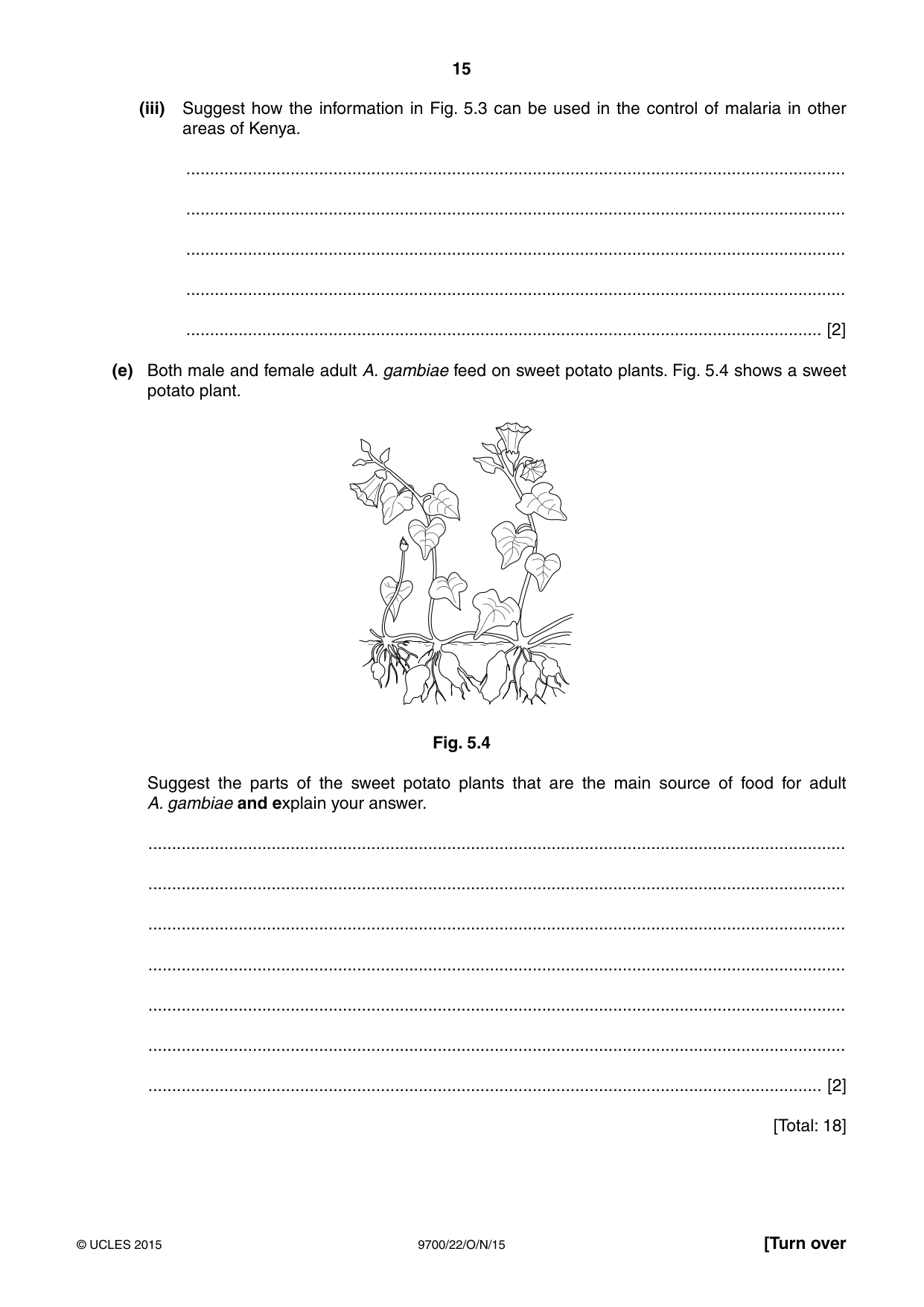
15 9700/22/O/N/15 © UCLES 2015 [Turn over (iii) Suggest how the information in Fig. 5.3 can be used in the control of malaria in other areas of Kenya. … … … … … [2] (e) Both male and female adult A. gambiae feed on sweet potato plants. Fig. 5.4 shows a sweet potato plant. Fig. 5.4 Suggest the parts of the sweet potato plants that are the main source of food for adult A. gambiae and explain your answer. … … … … … … … [2] [Total: 18]
Question paper, page 16
16 9700/22/O/N/15 © UCLES 2015 Permission to reproduce items where third-party owned material protected by copyright is included has been sought and cleared where possible. Every reasonable effort has been made by the publisher (UCLES) to trace copyright holders, but if any items requiring clearance have unwittingly been included, the publisher will be pleased to make amends at the earliest possible opportunity. To avoid the issue of disclosure of answer-related information to candidates, all copyright acknowledgements are reproduced online in the Cambridge International Examinations Copyright Acknowledgements Booklet. This is produced for each series of examinations and is freely available to download at www.cie.org.uk after the live examination series. Cambridge International Examinations is part of the Cambridge Assessment Group. Cambridge Assessment is the brand name of University of Cambridge Local Examinations Syndicate (UCLES), which is itself a department of the University of Cambridge. 6 (a) The thickness of the different chambers of the mammalian heart is due to the amount of cardiac muscle present. The atria have less cardiac muscle than the ventricles, and hence thinner walls. In terms of their functions, explain why the atria have thinner walls than the ventricles. … … … … … [2] (b) Name the dividing wall separating the right and left sides of the mammalian heart. … [1] (c) Transpiration and translocation are both processes occurring in plants. (i) State one way in which transpiration differs from translocation. … … … [1] (ii) State one way in which transpiration and translocation are similar. … … … [1] [Total: 5]
Mark scheme, page 1
® IGCSE is the registered trademark of Cambridge International Examinations. CAMBRIDGE INTERNATIONAL EXAMINATIONS Cambridge International Advanced Subsidiary and Advanced Level MARK SCHEME for the October/November 2015 series 9700 BIOLOGY 9700/22 Paper 2 (AS Structured Questions), maximum raw mark 60 This mark scheme is published as an aid to teachers and candidates, to indicate the requirements of the examination. It shows the basis on which Examiners were instructed to award marks. It does not indicate the details of the discussions that took place at an Examiners’ meeting before marking began, which would have considered the acceptability of alternative answers. Mark schemes should be read in conjunction with the question paper and the Principal Examiner Report for Teachers. Cambridge will not enter into discussions about these mark schemes. Cambridge is publishing the mark schemes for the October/November 2015 series for most Cambridge IGCSE®, Cambridge International A and AS Level components and some Cambridge O Level components.
Mark scheme, page 2
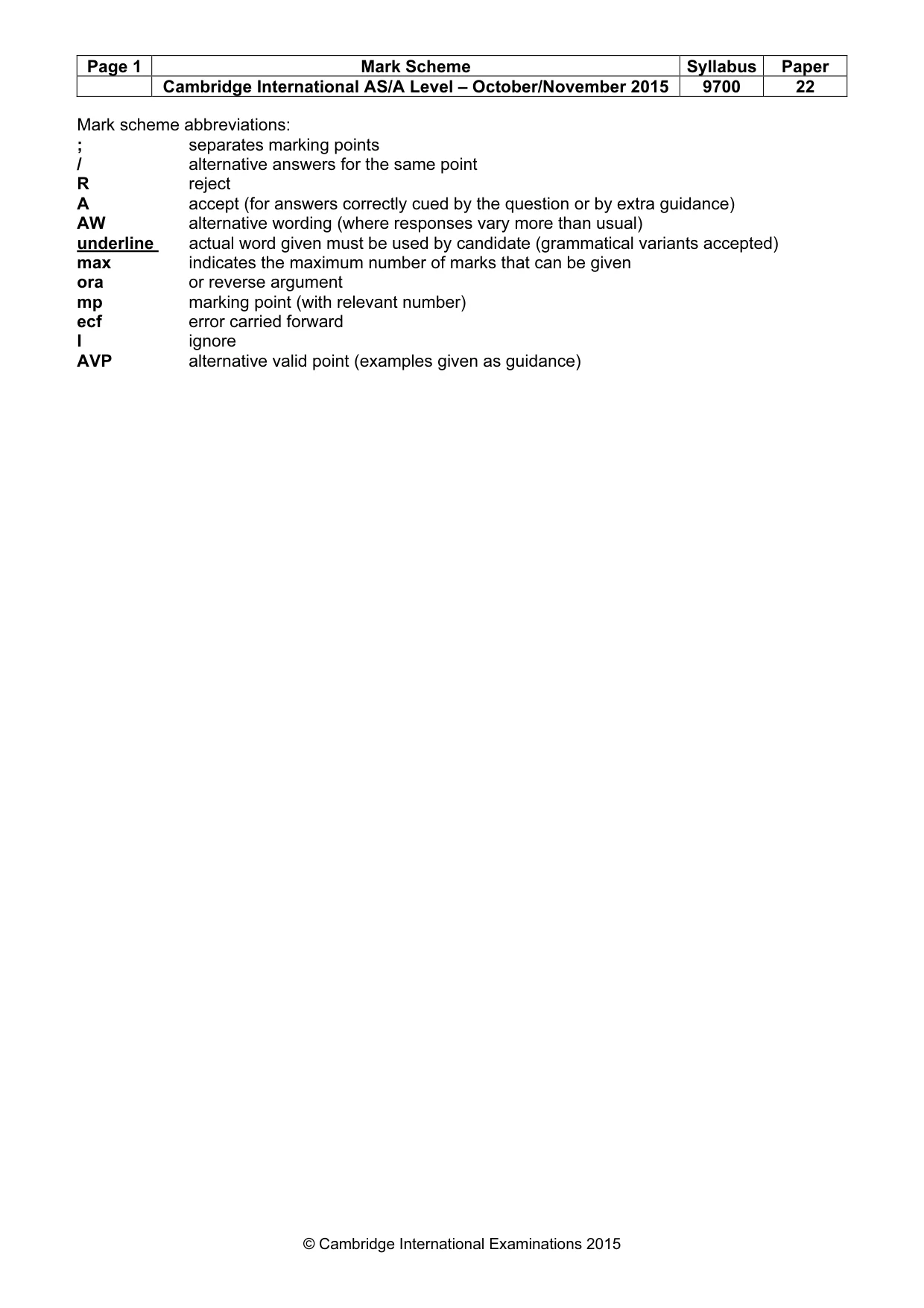
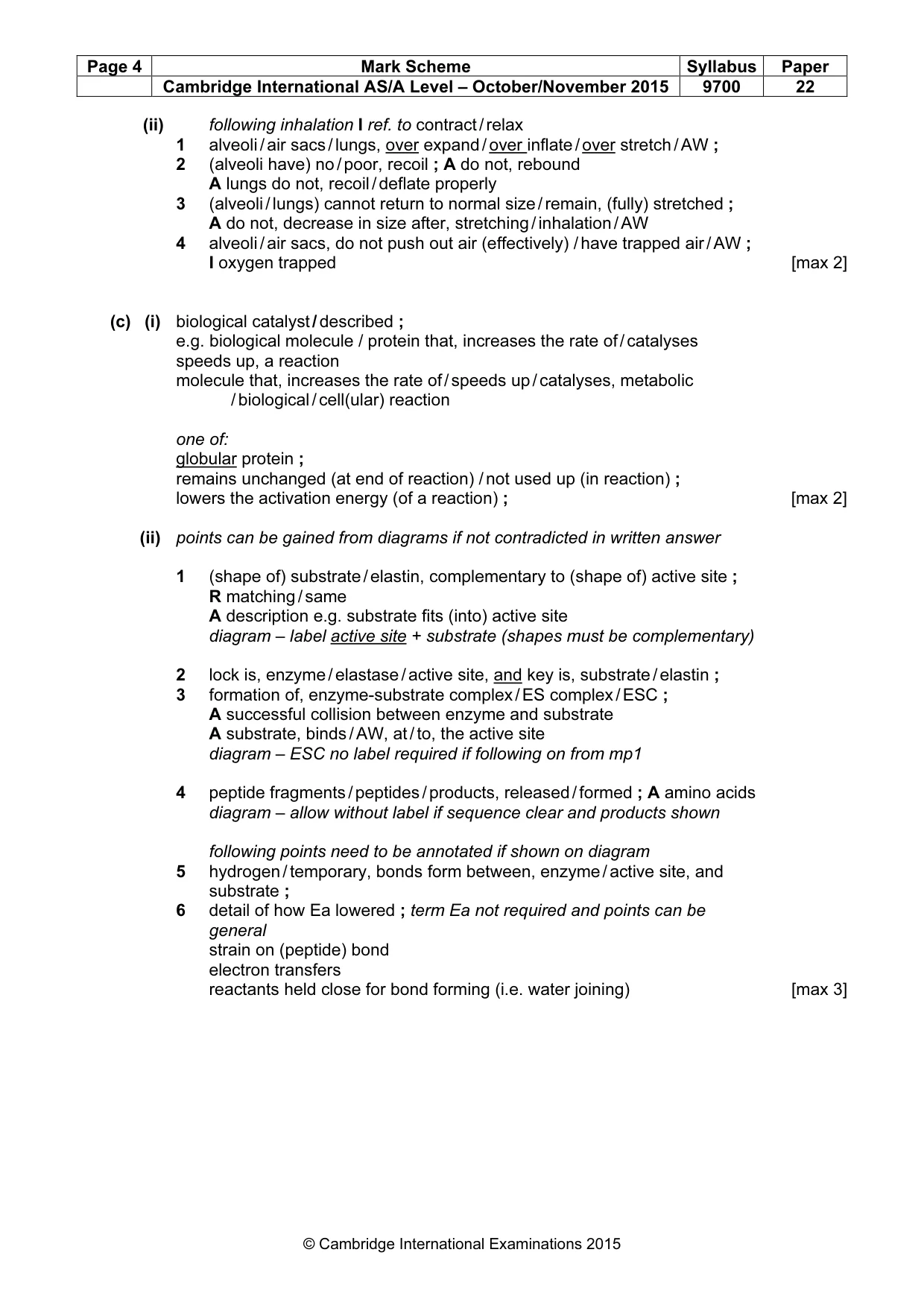
Page 1 Mark Scheme Syllabus Paper Cambridge International AS/A Level – October/November 2015 9700 22 © Cambridge International Examinations 2015 Mark scheme abbreviations: ; separates marking points / alternative answers for the same point R reject A accept (for answers correctly cued by the question or by extra guidance) AW alternative wording (where responses vary more than usual) underline actual word given must be used by candidate (grammatical variants accepted) max indicates the maximum number of marks that can be given ora or reverse argument mp marking point (with relevant number) ecf error carried forward I ignore AVP alternative valid point (examples given as guidance)
Mark scheme, page 3
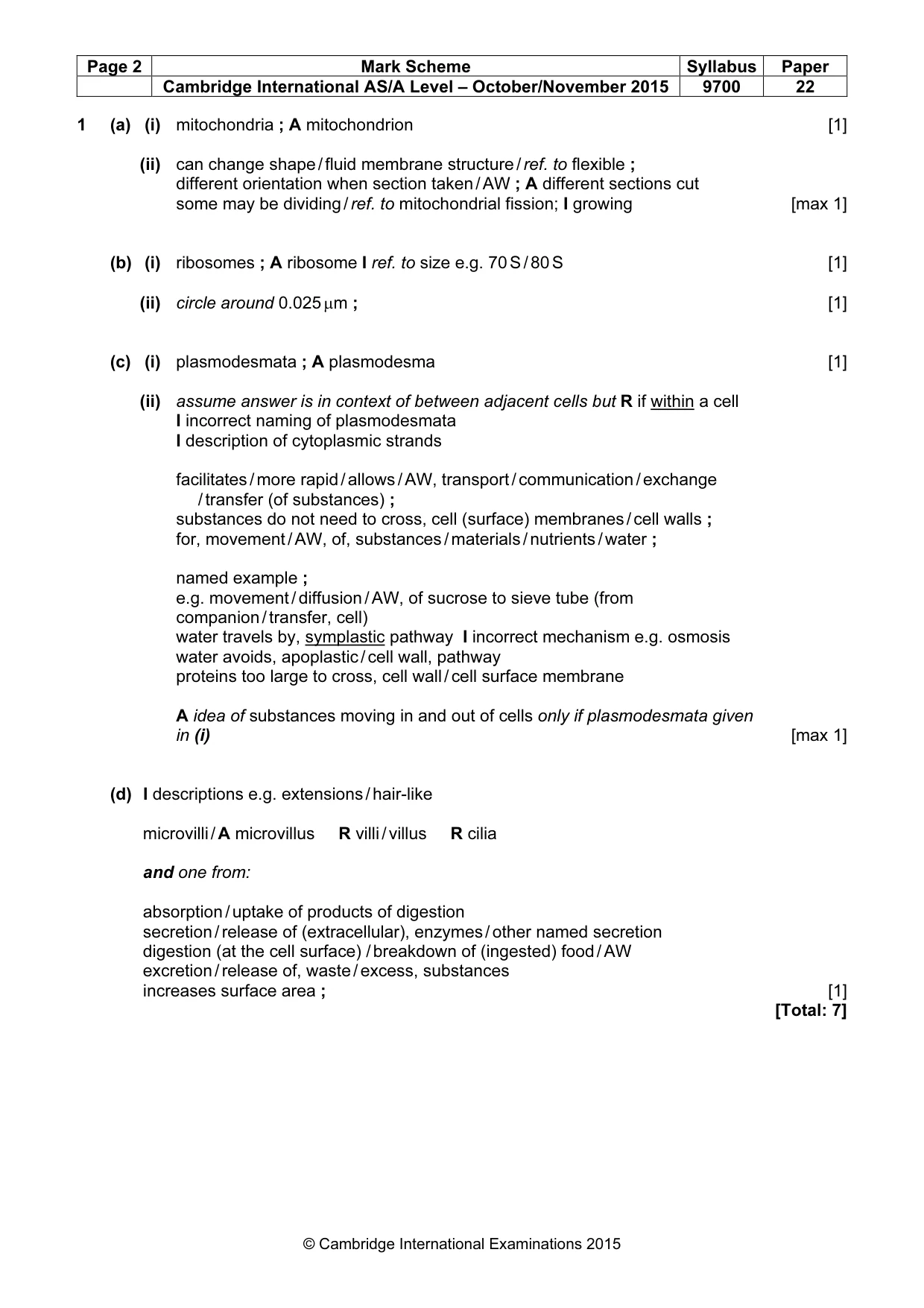
Page 2 Mark Scheme Syllabus Paper Cambridge International AS/A Level – October/November 2015 9700 22 © Cambridge International Examinations 2015 1 (a) (i) mitochondria ; A mitochondrion [1] (ii) can change shape / fluid membrane structure / ref. to flexible ; different orientation when section taken / AW ; A different sections cut some may be dividing / ref. to mitochondrial fission; I growing [max 1] (b) (i) ribosomes ; A ribosome I ref. to size e.g. 70 S / 80 S [1] (ii) circle around 0.025 µm ; [1] (c) (i) plasmodesmata ; A plasmodesma [1] (ii) assume answer is in context of between adjacent cells but R if within a cell I incorrect naming of plasmodesmata I description of cytoplasmic strands facilitates / more rapid / allows / AW, transport / communication / exchange / transfer (of substances) ; substances do not need to cross, cell (surface) membranes / cell walls ; for, movement / AW, of, substances / materials / nutrients / water ; named example ; e.g. movement / diffusion / AW, of sucrose to sieve tube (from companion / transfer, cell) water travels by, symplastic pathway I incorrect mechanism e.g. osmosis water avoids, apoplastic / cell wall, pathway proteins too large to cross, cell wall / cell surface membrane A idea of substances moving in and out of cells only if plasmodesmata given in (i) [max 1] (d) I descriptions e.g. extensions / hair-like microvilli / A microvillus R villi / villus R cilia and one from: absorption / uptake of products of digestion secretion / release of (extracellular), enzymes / other named secretion digestion (at the cell surface) / breakdown of (ingested) food / AW excretion / release of, waste / excess, substances increases surface area ; [1] [Total: 7]
Mark scheme, page 4
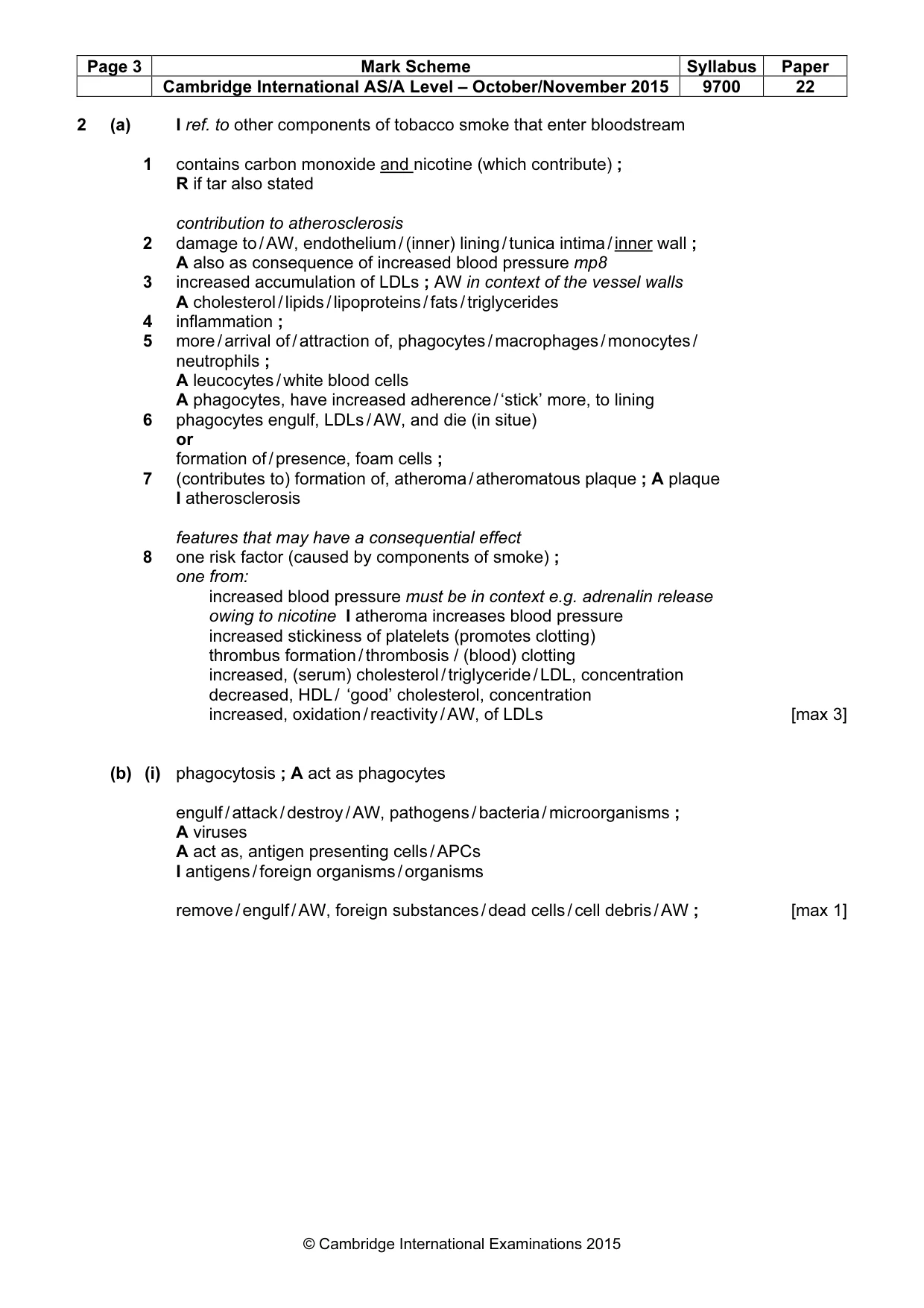
Page 3 Mark Scheme Syllabus Paper Cambridge International AS/A Level – October/November 2015 9700 22 © Cambridge International Examinations 2015 2 (a) I ref. to other components of tobacco smoke that enter bloodstream 1 contains carbon monoxide and nicotine (which contribute) ; R if tar also stated contribution to atherosclerosis 2 damage to / AW, endothelium / (inner) lining / tunica intima / inner wall ; A also as consequence of increased blood pressure mp8 3 increased accumulation of LDLs ; AW in context of the vessel walls A cholesterol / lipids / lipoproteins / fats / triglycerides 4 inflammation ; 5 more / arrival of / attraction of, phagocytes / macrophages / monocytes / neutrophils ; A leucocytes / white blood cells A phagocytes, have increased adherence / ‘stick’ more, to lining 6 phagocytes engulf, LDLs / AW, and die (in situe) or formation of / presence, foam cells ; 7 (contributes to) formation of, atheroma / atheromatous plaque ; A plaque I atherosclerosis features that may have a consequential effect 8 one risk factor (caused by components of smoke) ; one from: increased blood pressure must be in context e.g. adrenalin release owing to nicotine I atheroma increases blood pressure increased stickiness of platelets (promotes clotting) thrombus formation / thrombosis / (blood) clotting increased, (serum) cholesterol / triglyceride / LDL, concentration decreased, HDL / ‘good’ cholesterol, concentration increased, oxidation / reactivity / AW, of LDLs [max 3] (b) (i) phagocytosis ; A act as phagocytes engulf / attack / destroy / AW, pathogens / bacteria / microorganisms ; A viruses A act as, antigen presenting cells / APCs I antigens / foreign organisms / organisms remove / engulf / AW, foreign substances / dead cells / cell debris / AW ; [max 1]
Mark scheme, page 5
Page 4 Mark Scheme Syllabus Paper Cambridge International AS/A Level – October/November 2015 9700 22 © Cambridge International Examinations 2015 (ii) following inhalation I ref. to contract / relax 1 alveoli / air sacs / lungs, over expand / over inflate / over stretch / AW ; 2 (alveoli have) no / poor, recoil ; A do not, rebound A lungs do not, recoil / deflate properly 3 (alveoli / lungs) cannot return to normal size / remain, (fully) stretched ; A do not, decrease in size after, stretching / inhalation / AW 4 alveoli / air sacs, do not push out air (effectively) / have trapped air / AW ; I oxygen trapped [max 2] (c) (i) biological catalyst / described ; e.g. biological molecule / protein that, increases the rate of / catalyses speeds up, a reaction molecule that, increases the rate of / speeds up / catalyses, metabolic / biological / cell(ular) reaction one of: globular protein ; remains unchanged (at end of reaction) / not used up (in reaction) ; lowers the activation energy (of a reaction) ; [max 2] (ii) points can be gained from diagrams if not contradicted in written answer 1 (shape of) substrate / elastin, complementary to (shape of) active site ; R matching / same A description e.g. substrate fits (into) active site diagram – label active site + substrate (shapes must be complementary) 2 lock is, enzyme / elastase / active site, and key is, substrate / elastin ; 3 formation of, enzyme-substrate complex / ES complex / ESC ; A successful collision between enzyme and substrate A substrate, binds / AW, at / to, the active site diagram – ESC no label required if following on from mp1 4 peptide fragments / peptides / products, released / formed ; A amino acids diagram – allow without label if sequence clear and products shown following points need to be annotated if shown on diagram 5 hydrogen / temporary, bonds form between, enzyme / active site, and substrate ; 6 detail of how Ea lowered ; term Ea not required and points can be general strain on (peptide) bond electron transfers reactants held close for bond forming (i.e. water joining) [max 3]
Mark scheme, page 6
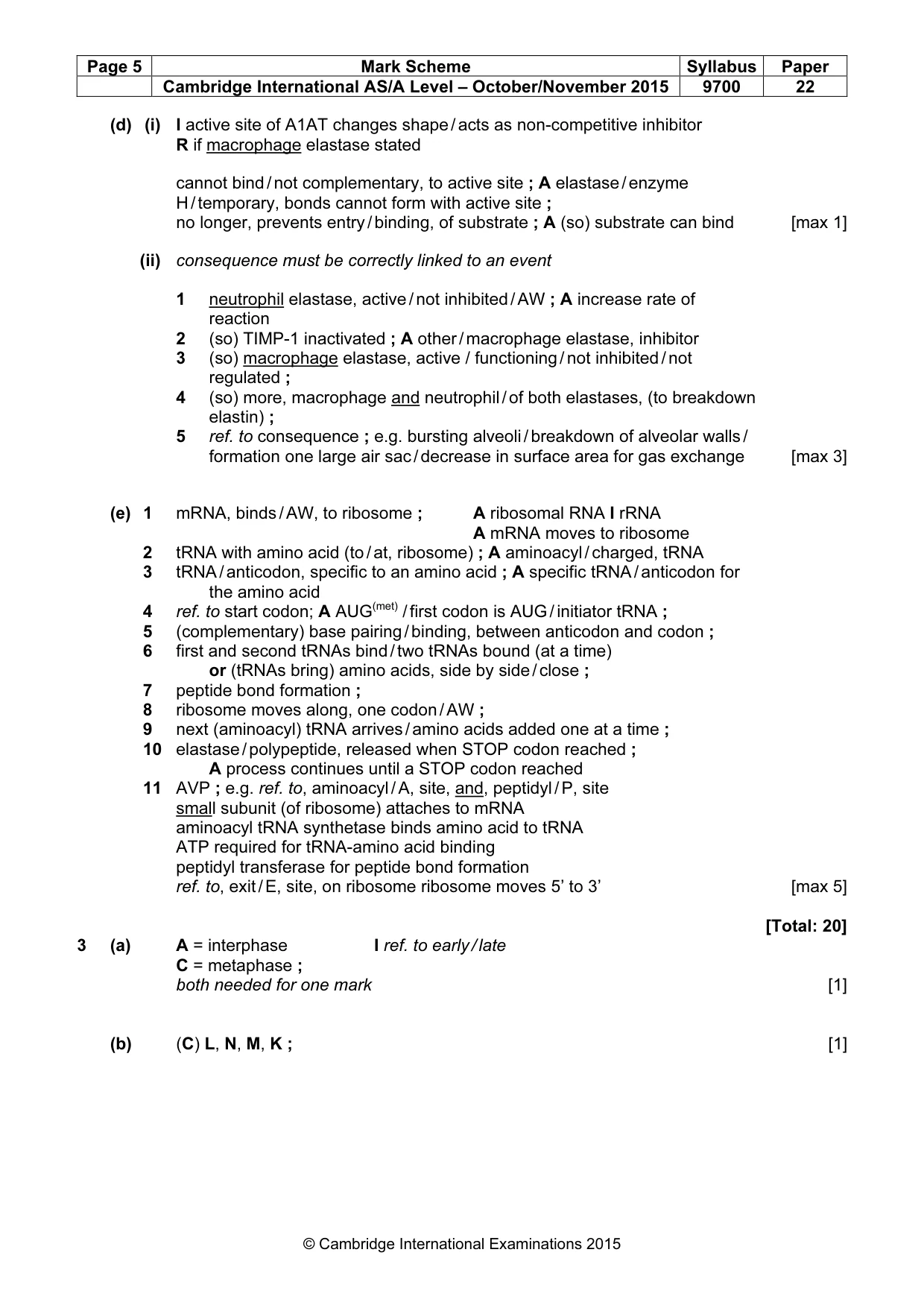
Page 5 Mark Scheme Syllabus Paper Cambridge International AS/A Level – October/November 2015 9700 22 © Cambridge International Examinations 2015 (d) (i) I active site of A1AT changes shape / acts as non-competitive inhibitor R if macrophage elastase stated cannot bind / not complementary, to active site ; A elastase / enzyme H / temporary, bonds cannot form with active site ; no longer, prevents entry / binding, of substrate ; A (so) substrate can bind [max 1] (ii) consequence must be correctly linked to an event 1 neutrophil elastase, active / not inhibited / AW ; A increase rate of reaction 2 (so) TIMP-1 inactivated ; A other / macrophage elastase, inhibitor 3 (so) macrophage elastase, active / functioning / not inhibited / not regulated ; 4 (so) more, macrophage and neutrophil / of both elastases, (to breakdown elastin) ; 5 ref. to consequence ; e.g. bursting alveoli / breakdown of alveolar walls / formation one large air sac / decrease in surface area for gas exchange [max 3] (e) 1 mRNA, binds / AW, to ribosome ; A ribosomal RNA I rRNA A mRNA moves to ribosome 2 tRNA with amino acid (to / at, ribosome) ; A aminoacyl / charged, tRNA 3 tRNA / anticodon, specific to an amino acid ; A specific tRNA / anticodon for the amino acid 4 ref. to start codon; A AUG(met) / first codon is AUG / initiator tRNA ; 5 (complementary) base pairing / binding, between anticodon and codon ; 6 first and second tRNAs bind / two tRNAs bound (at a time) or (tRNAs bring) amino acids, side by side / close ; 7 peptide bond formation ; 8 ribosome moves along, one codon / AW ; 9 next (aminoacyl) tRNA arrives / amino acids added one at a time ; 10 elastase / polypeptide, released when STOP codon reached ; A process continues until a STOP codon reached 11 AVP ; e.g. ref. to, aminoacyl / A, site, and, peptidyl / P, site small subunit (of ribosome) attaches to mRNA aminoacyl tRNA synthetase binds amino acid to tRNA ATP required for tRNA-amino acid binding peptidyl transferase for peptide bond formation ref. to, exit / E, site, on ribosome ribosome moves 5’ to 3’ [max 5] [Total: 20] 3 (a) A = interphase I ref. to early / late C = metaphase ; both needed for one mark [1] (b) (C) L, N, M, K ; [1]
Mark scheme, page 7
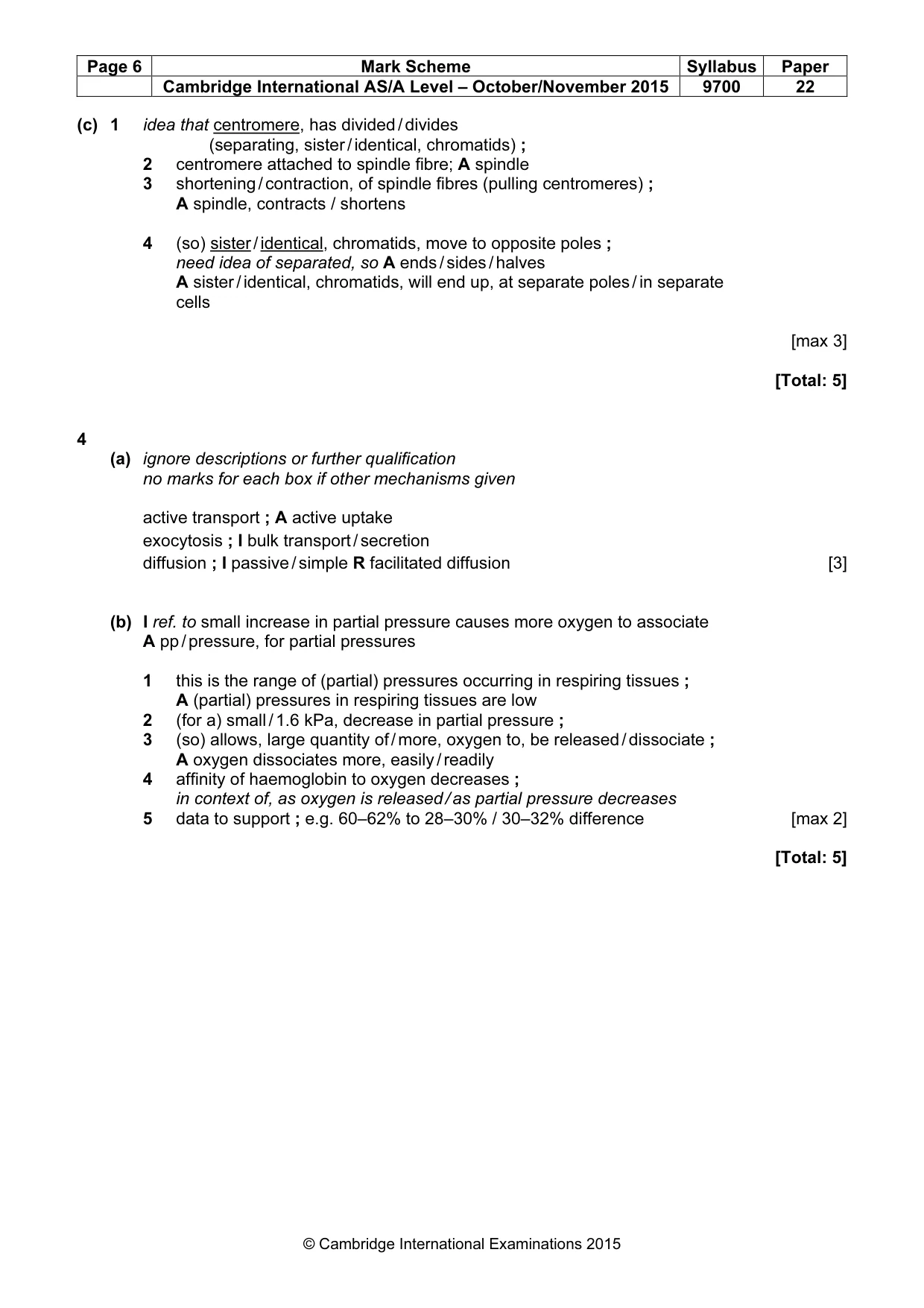
Page 6 Mark Scheme Syllabus Paper Cambridge International AS/A Level – October/November 2015 9700 22 © Cambridge International Examinations 2015 (c) 1 idea that centromere, has divided / divides (separating, sister / identical, chromatids) ; 2 centromere attached to spindle fibre; A spindle 3 shortening / contraction, of spindle fibres (pulling centromeres) ; A spindle, contracts / shortens 4 (so) sister / identical, chromatids, move to opposite poles ; need idea of separated, so A ends / sides / halves A sister / identical, chromatids, will end up, at separate poles / in separate cells [max 3] [Total: 5] 4 (a) ignore descriptions or further qualification no marks for each box if other mechanisms given active transport ; A active uptake exocytosis ; I bulk transport / secretion diffusion ; I passive / simple R facilitated diffusion [3] (b) I ref. to small increase in partial pressure causes more oxygen to associate A pp / pressure, for partial pressures 1 this is the range of (partial) pressures occurring in respiring tissues ; A (partial) pressures in respiring tissues are low 2 (for a) small / 1.6 kPa, decrease in partial pressure ; 3 (so) allows, large quantity of / more, oxygen to, be released / dissociate ; A oxygen dissociates more, easily / readily 4 affinity of haemoglobin to oxygen decreases ; in context of, as oxygen is released / as partial pressure decreases 5 data to support ; e.g. 60–62% to 28–30% / 30–32% difference [max 2] [Total: 5]
Mark scheme, page 8
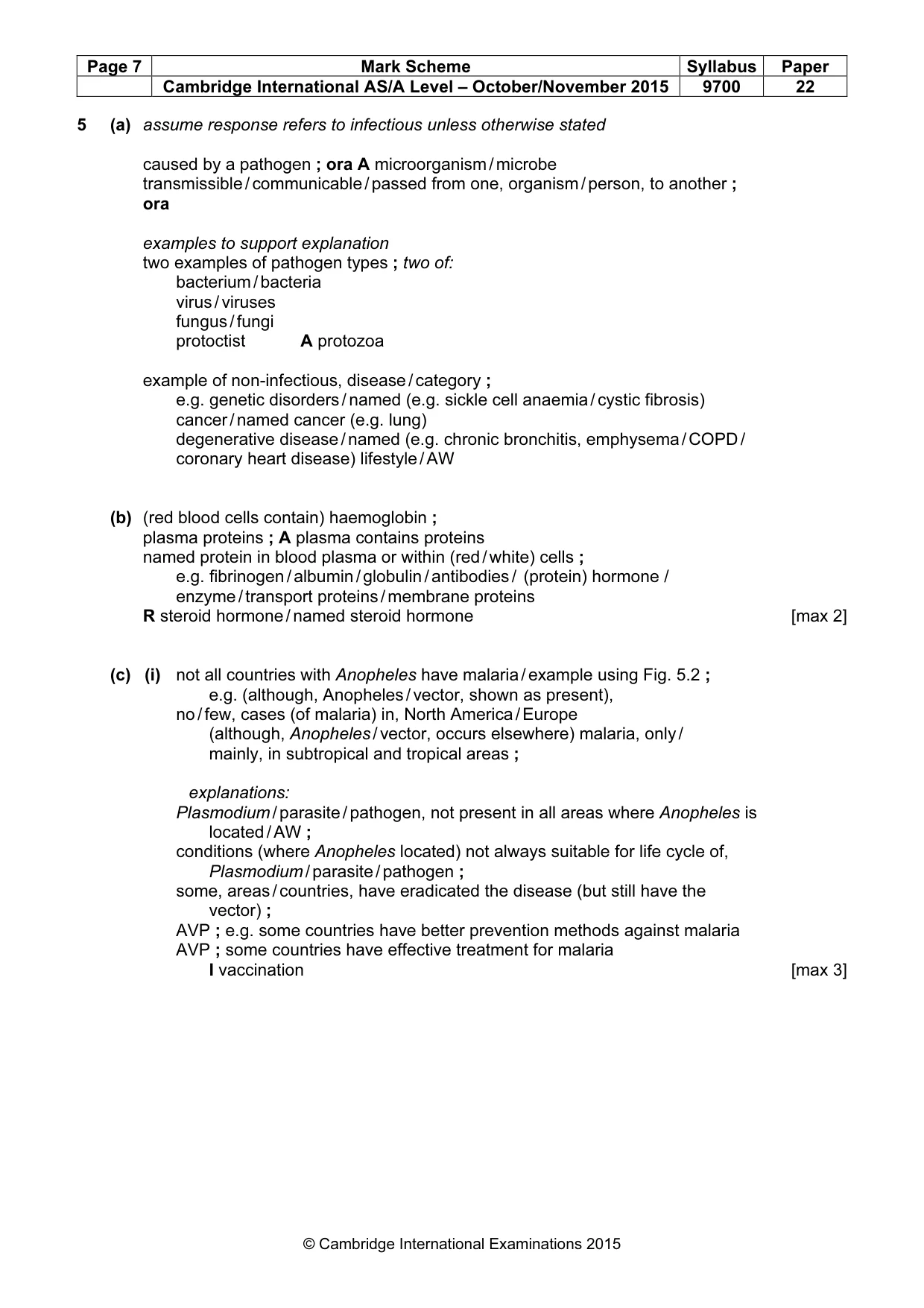
Page 7 Mark Scheme Syllabus Paper Cambridge International AS/A Level – October/November 2015 9700 22 © Cambridge International Examinations 2015 5 (a) assume response refers to infectious unless otherwise stated caused by a pathogen ; ora A microorganism / microbe transmissible / communicable / passed from one, organism / person, to another ; ora examples to support explanation two examples of pathogen types ; two of: bacterium / bacteria virus / viruses fungus / fungi protoctist A protozoa example of non-infectious, disease / category ; e.g. genetic disorders / named (e.g. sickle cell anaemia / cystic fibrosis) cancer / named cancer (e.g. lung) degenerative disease / named (e.g. chronic bronchitis, emphysema / COPD / coronary heart disease) lifestyle / AW (b) (red blood cells contain) haemoglobin ; plasma proteins ; A plasma contains proteins named protein in blood plasma or within (red / white) cells ; e.g. fibrinogen / albumin / globulin / antibodies / (protein) hormone / enzyme / transport proteins / membrane proteins R steroid hormone / named steroid hormone [max 2] (c) (i) not all countries with Anopheles have malaria / example using Fig. 5.2 ; e.g. (although, Anopheles / vector, shown as present), no / few, cases (of malaria) in, North America / Europe (although, Anopheles / vector, occurs elsewhere) malaria, only / mainly, in subtropical and tropical areas ; explanations: Plasmodium / parasite / pathogen, not present in all areas where Anopheles is located / AW ; conditions (where Anopheles located) not always suitable for life cycle of, Plasmodium / parasite / pathogen ; some, areas / countries, have eradicated the disease (but still have the vector) ; AVP ; e.g. some countries have better prevention methods against malaria AVP ; some countries have effective treatment for malaria I vaccination [max 3]
Mark scheme, page 9
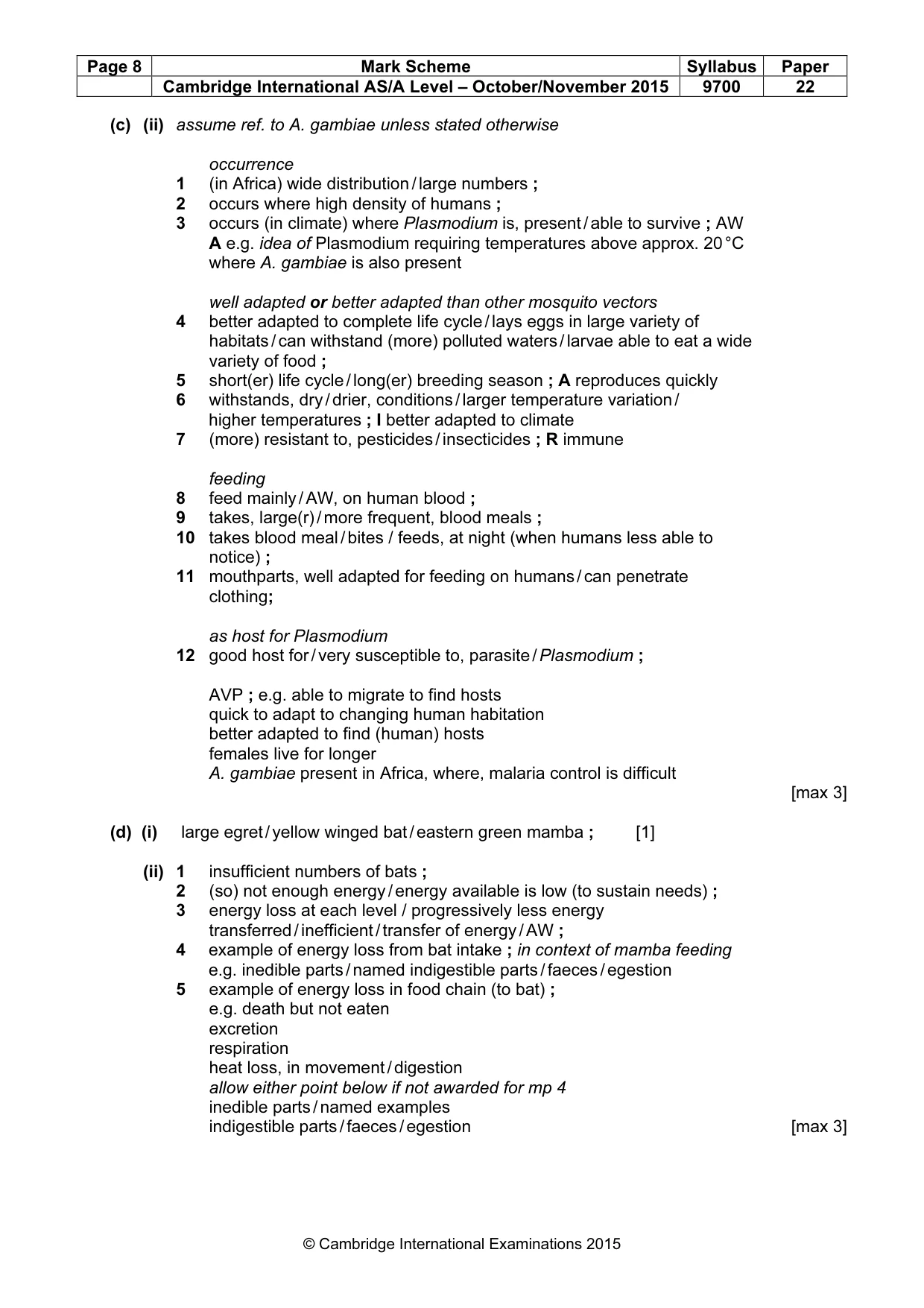
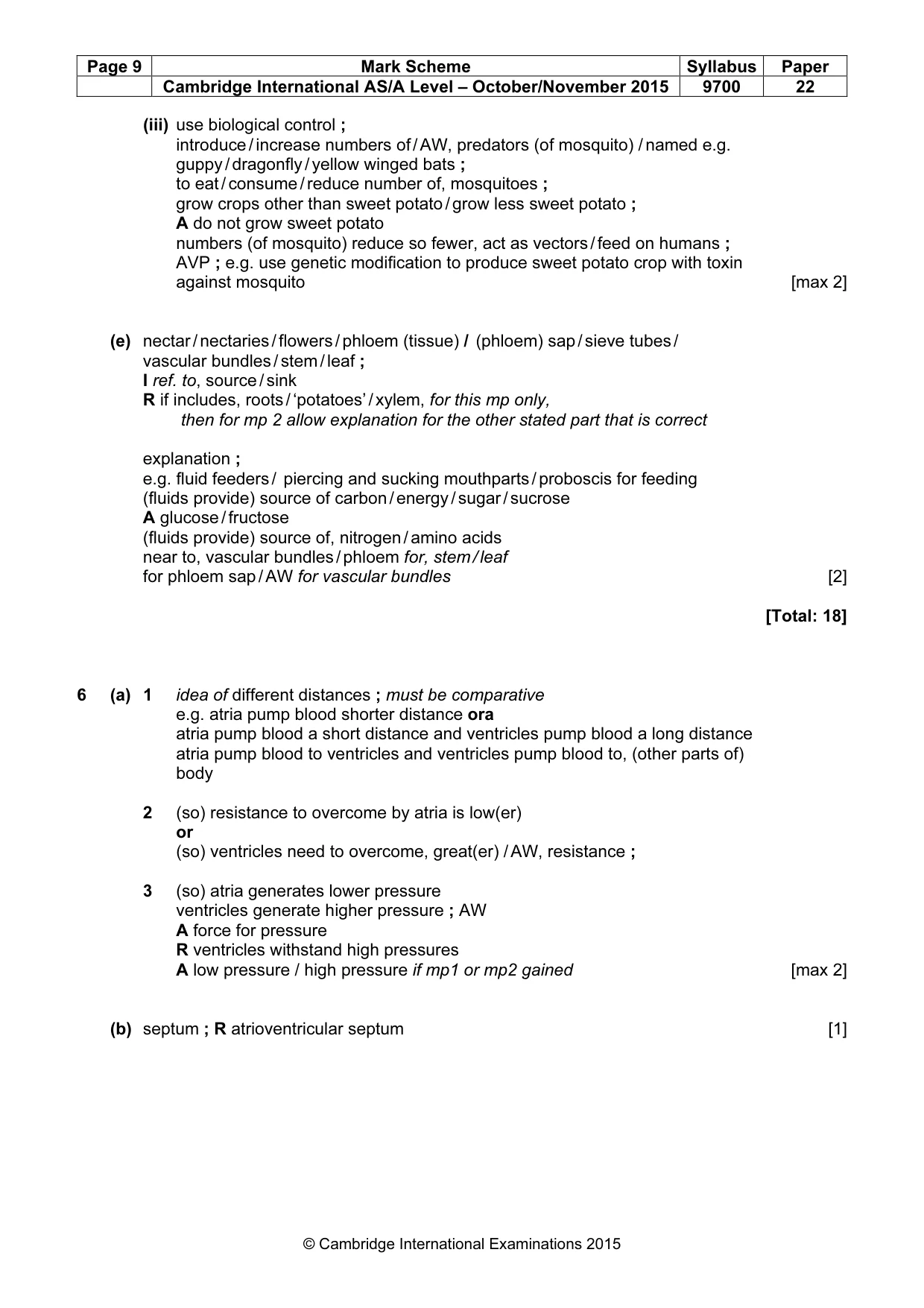
Page 8 Mark Scheme Syllabus Paper Cambridge International AS/A Level – October/November 2015 9700 22 © Cambridge International Examinations 2015 (c) (ii) assume ref. to A. gambiae unless stated otherwise occurrence 1 (in Africa) wide distribution / large numbers ; 2 occurs where high density of humans ; 3 occurs (in climate) where Plasmodium is, present / able to survive ; AW A e.g. idea of Plasmodium requiring temperatures above approx. 20 °C where A. gambiae is also present well adapted or better adapted than other mosquito vectors 4 better adapted to complete life cycle / lays eggs in large variety of habitats / can withstand (more) polluted waters / larvae able to eat a wide variety of food ; 5 short(er) life cycle / long(er) breeding season ; A reproduces quickly 6 withstands, dry / drier, conditions / larger temperature variation / higher temperatures ; I better adapted to climate 7 (more) resistant to, pesticides / insecticides ; R immune feeding 8 feed mainly / AW, on human blood ; 9 takes, large(r) / more frequent, blood meals ; 10 takes blood meal / bites / feeds, at night (when humans less able to notice) ; 11 mouthparts, well adapted for feeding on humans / can penetrate clothing; as host for Plasmodium 12 good host for / very susceptible to, parasite / Plasmodium ; AVP ; e.g. able to migrate to find hosts quick to adapt to changing human habitation better adapted to find (human) hosts females live for longer A. gambiae present in Africa, where, malaria control is difficult [max 3] (d) (i) large egret / yellow winged bat / eastern green mamba ; [1] (ii) 1 insufficient numbers of bats ; 2 (so) not enough energy / energy available is low (to sustain needs) ; 3 energy loss at each level / progressively less energy transferred / inefficient / transfer of energy / AW ; 4 example of energy loss from bat intake ; in context of mamba feeding e.g. inedible parts / named indigestible parts / faeces / egestion 5 example of energy loss in food chain (to bat) ; e.g. death but not eaten excretion respiration heat loss, in movement / digestion allow either point below if not awarded for mp 4 inedible parts / named examples indigestible parts / faeces / egestion [max 3]
Mark scheme, page 10
Page 9 Mark Scheme Syllabus Paper Cambridge International AS/A Level – October/November 2015 9700 22 © Cambridge International Examinations 2015 (iii) use biological control ; introduce / increase numbers of / AW, predators (of mosquito) / named e.g. guppy / dragonfly / yellow winged bats ; to eat / consume / reduce number of, mosquitoes ; grow crops other than sweet potato / grow less sweet potato ; A do not grow sweet potato numbers (of mosquito) reduce so fewer, act as vectors / feed on humans ; AVP ; e.g. use genetic modification to produce sweet potato crop with toxin against mosquito [max 2] (e) nectar / nectaries / flowers / phloem (tissue) / (phloem) sap / sieve tubes / vascular bundles / stem / leaf ; I ref. to, source / sink R if includes, roots / ‘potatoes’ / xylem, for this mp only, then for mp 2 allow explanation for the other stated part that is correct explanation ; e.g. fluid feeders / piercing and sucking mouthparts / proboscis for feeding (fluids provide) source of carbon / energy / sugar / sucrose A glucose / fructose (fluids provide) source of, nitrogen / amino acids near to, vascular bundles / phloem for, stem / leaf for phloem sap / AW for vascular bundles [2] [Total: 18] 6 (a) 1 idea of different distances ; must be comparative e.g. atria pump blood shorter distance ora atria pump blood a short distance and ventricles pump blood a long distance atria pump blood to ventricles and ventricles pump blood to, (other parts of) body 2 (so) resistance to overcome by atria is low(er) or (so) ventricles need to overcome, great(er) / AW, resistance ; 3 (so) atria generates lower pressure ventricles generate higher pressure ; AW A force for pressure R ventricles withstand high pressures A low pressure / high pressure if mp1 or mp2 gained [max 2] (b) septum ; R atrioventricular septum [1]
Mark scheme, page 11
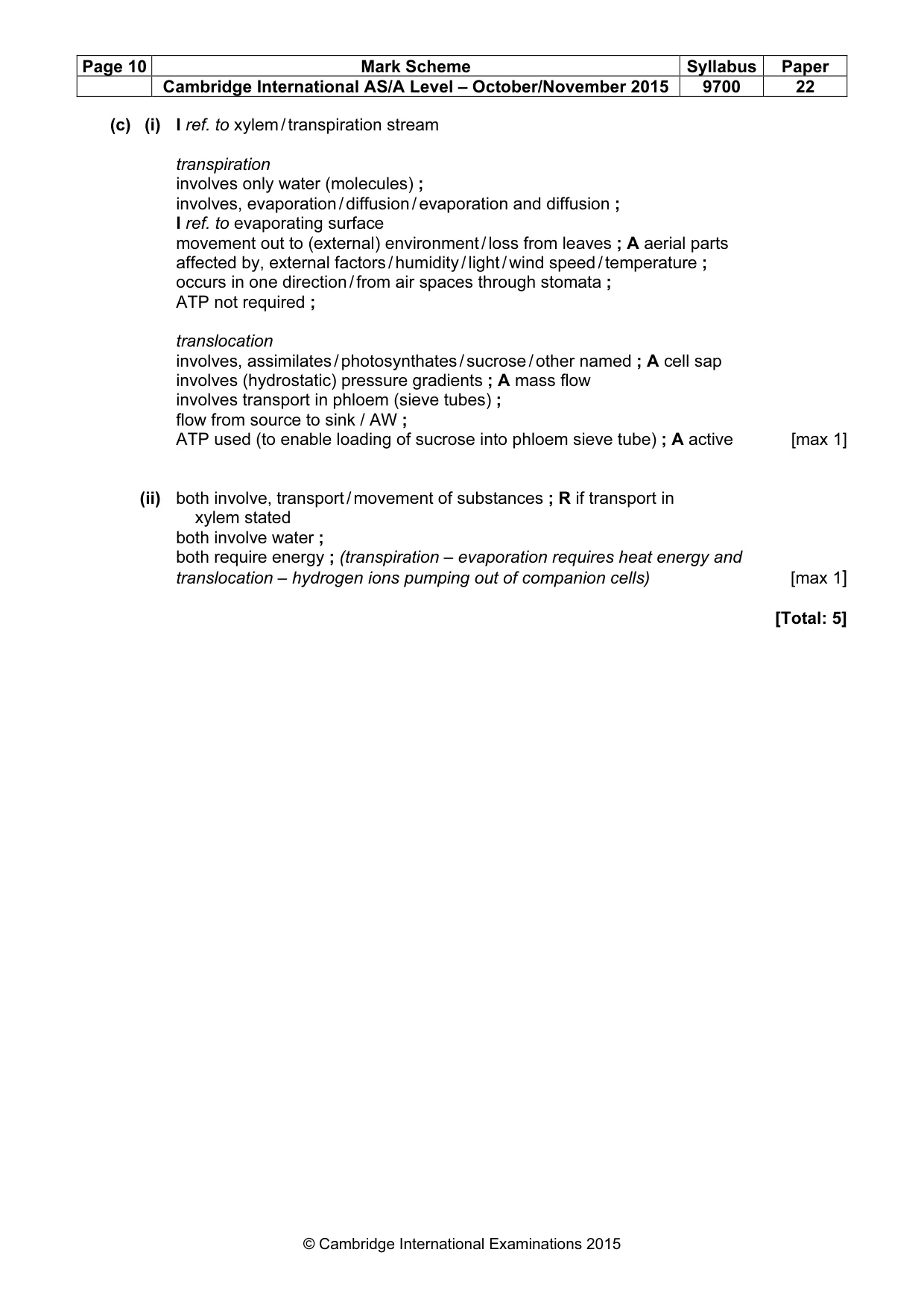
Page 10 Mark Scheme Syllabus Paper Cambridge International AS/A Level – October/November 2015 9700 22 © Cambridge International Examinations 2015 (c) (i) I ref. to xylem / transpiration stream transpiration involves only water (molecules) ; involves, evaporation / diffusion / evaporation and diffusion ; I ref. to evaporating surface movement out to (external) environment / loss from leaves ; A aerial parts affected by, external factors / humidity / light / wind speed / temperature ; occurs in one direction / from air spaces through stomata ; ATP not required ; translocation involves, assimilates / photosynthates / sucrose / other named ; A cell sap involves (hydrostatic) pressure gradients ; A mass flow involves transport in phloem (sieve tubes) ; flow from source to sink / AW ; ATP used (to enable loading of sucrose into phloem sieve tube) ; A active [max 1] (ii) both involve, transport / movement of substances ; R if transport in xylem stated both involve water ; both require energy ; (transpiration – evaporation requires heat energy and translocation – hydrogen ions pumping out of companion cells) [max 1] [Total: 5]
What you needed in this session
Cambridge’s own grade thresholds for 2015 Oct/Nov, Paper 2 · Variant 2. A higher threshold means an easier paper — the bar moves with how the cohort did.