Cambridge A Level Biology 9700 — 2015 Oct/Nov Paper 2 · Variant 1
9700/21/O/N/15 · 60 marks · ≈68 min
The question paper and its mark scheme, free to read here and free to download. This is Cambridge’s own paper, exactly as it was sat.
Question paper16 pages


Mark scheme8 pages
Answers below. Sit the paper first if you are practising.
Paper as text
Question paper, page 1
This document consists of 14 printed pages and 2 blank pages. DC (NF/JG) 99040/3 © UCLES 2015 [Turn over Cambridge International Examinations Cambridge International Advanced Subsidiary and Advanced Level * 2 8 7 0 9 1 9 5 5 6 * BIOLOGY 9700/21 Paper 2 Structured Questions AS October/November 2015 1 hour 15 minutes Candidates answer on the Question Paper. No Additional Materials are required. READ THESE INSTRUCTIONS FIRST Write your Centre number, candidate number and name in the spaces provided at the top of this page. Write in dark blue or black pen. You may use an HB pencil for any diagrams or graphs. Do not use staples, paper clips, glue or correction fluid. DO NOT WRITE IN ANY BARCODES. Answer all questions. Electronic calculators may be used. You may lose marks if you do not show your working or if you do not use appropriate units. At the end of the examination, fasten all your work securely together. The number of marks is given in brackets [ ] at the end of each question or part question.
Question paper, page 2
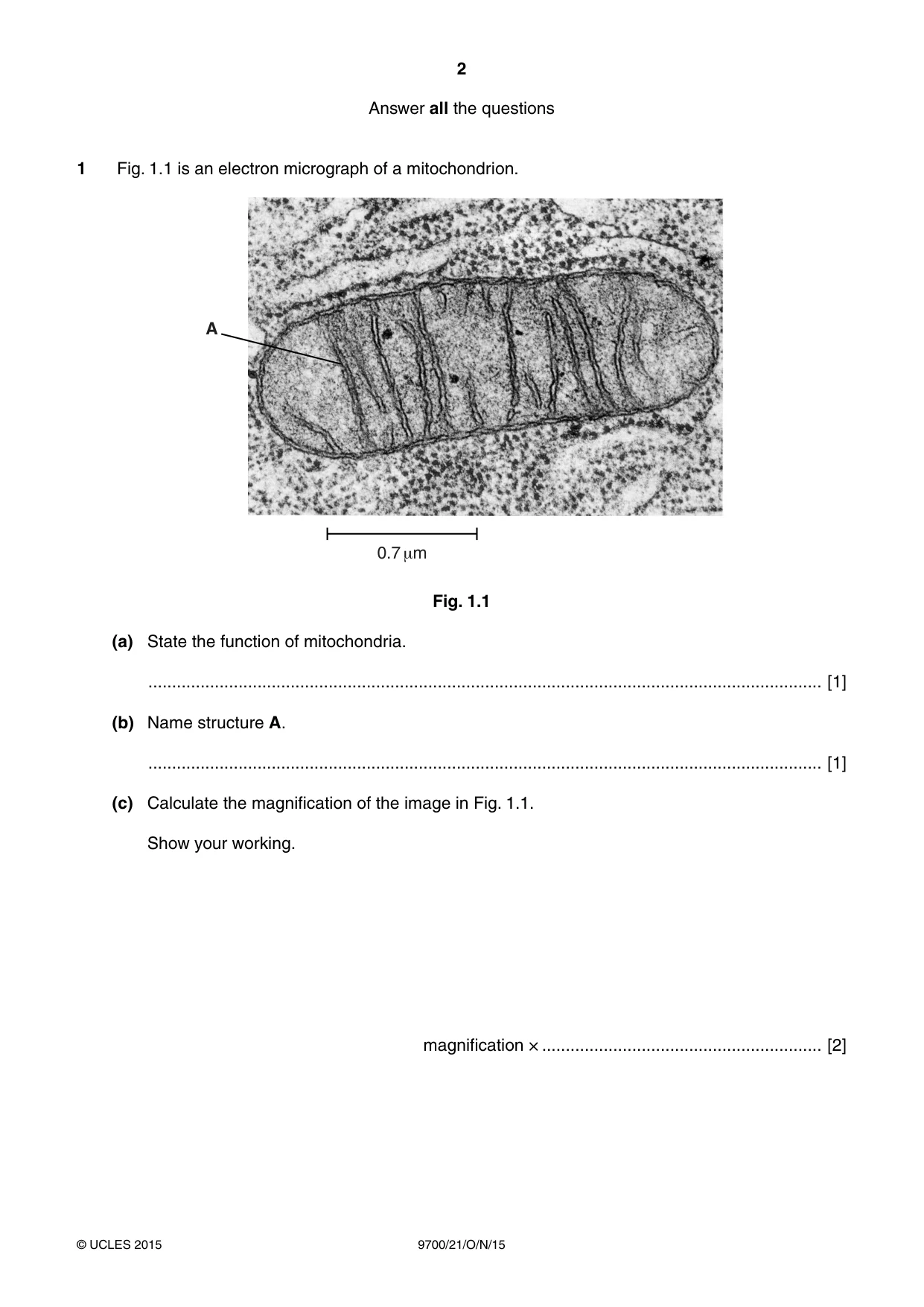
2 9700/21/O/N/15 © UCLES 2015 Answer all the questions 1 Fig. 1.1 is an electron micrograph of a mitochondrion. 0.7 +m A Fig. 1.1 (a) State the function of mitochondria. … [1] (b) Name structure A. … [1] (c) Calculate the magnification of the image in Fig. 1.1. Show your working. magnification × … [2]
Question paper, page 3
3 9700/21/O/N/15 © UCLES 2015 [Turn over (d) Explain why the light microscope could not be used to produce the image in Fig. 1.1. … … … … … [2] (e) Scientists think that mitochondria were once prokaryotes. The evidence for this is that mitochondria have features in common with prokaryotes. State two features that mitochondria have in common with prokaryotes. 1. … 2. … [2] [Total: 8]
Question paper, page 4
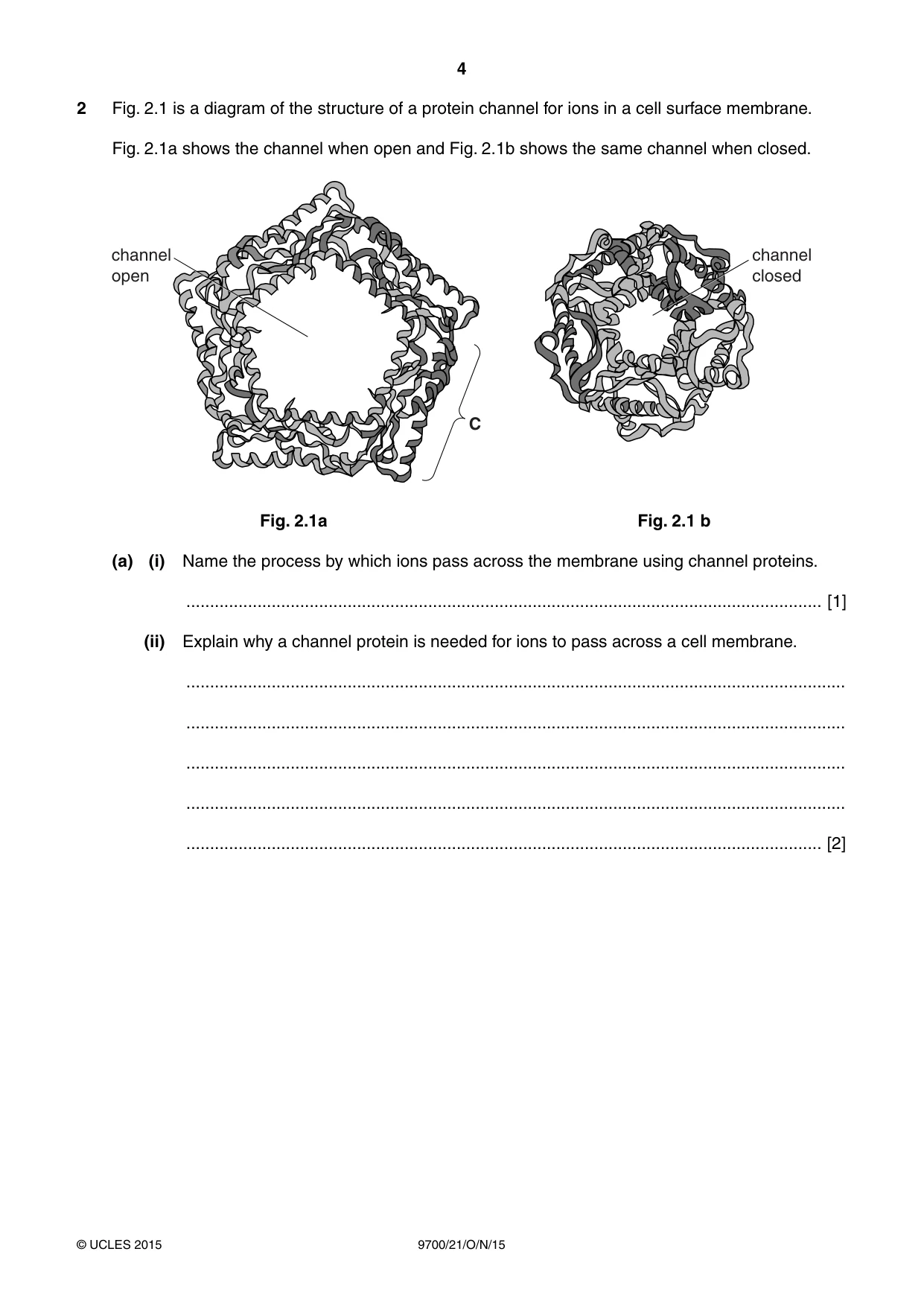
4 9700/21/O/N/15 © UCLES 2015 2 Fig. 2.1 is a diagram of the structure of a protein channel for ions in a cell surface membrane. Fig. 2.1a shows the channel when open and Fig. 2.1b shows the same channel when closed. channel closed channel open C Fig. 2.1a Fig. 2.1 b (a) (i) Name the process by which ions pass across the membrane using channel proteins. … [1] (ii) Explain why a channel protein is needed for ions to pass across a cell membrane. … … … … … [2]
Question paper, page 5
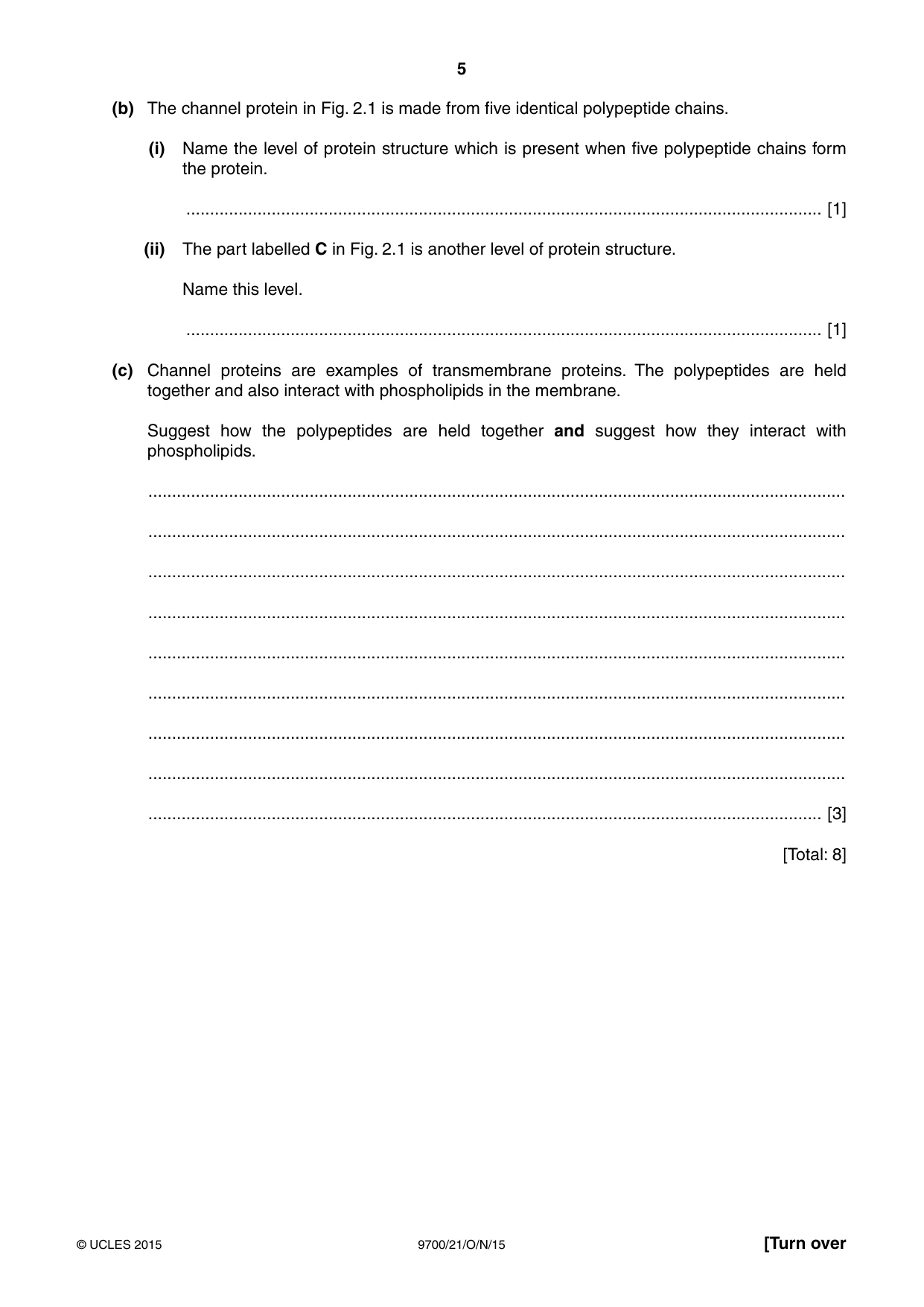
5 9700/21/O/N/15 © UCLES 2015 [Turn over (b) The channel protein in Fig. 2.1 is made from five identical polypeptide chains. (i) Name the level of protein structure which is present when five polypeptide chains form the protein. … [1] (ii) The part labelled C in Fig. 2.1 is another level of protein structure. Name this level. … [1] (c) Channel proteins are examples of transmembrane proteins. The polypeptides are held together and also interact with phospholipids in the membrane. Suggest how the polypeptides are held together and suggest how they interact with phospholipids. … … … … … … … … … [3] [Total: 8]
Question paper, page 6
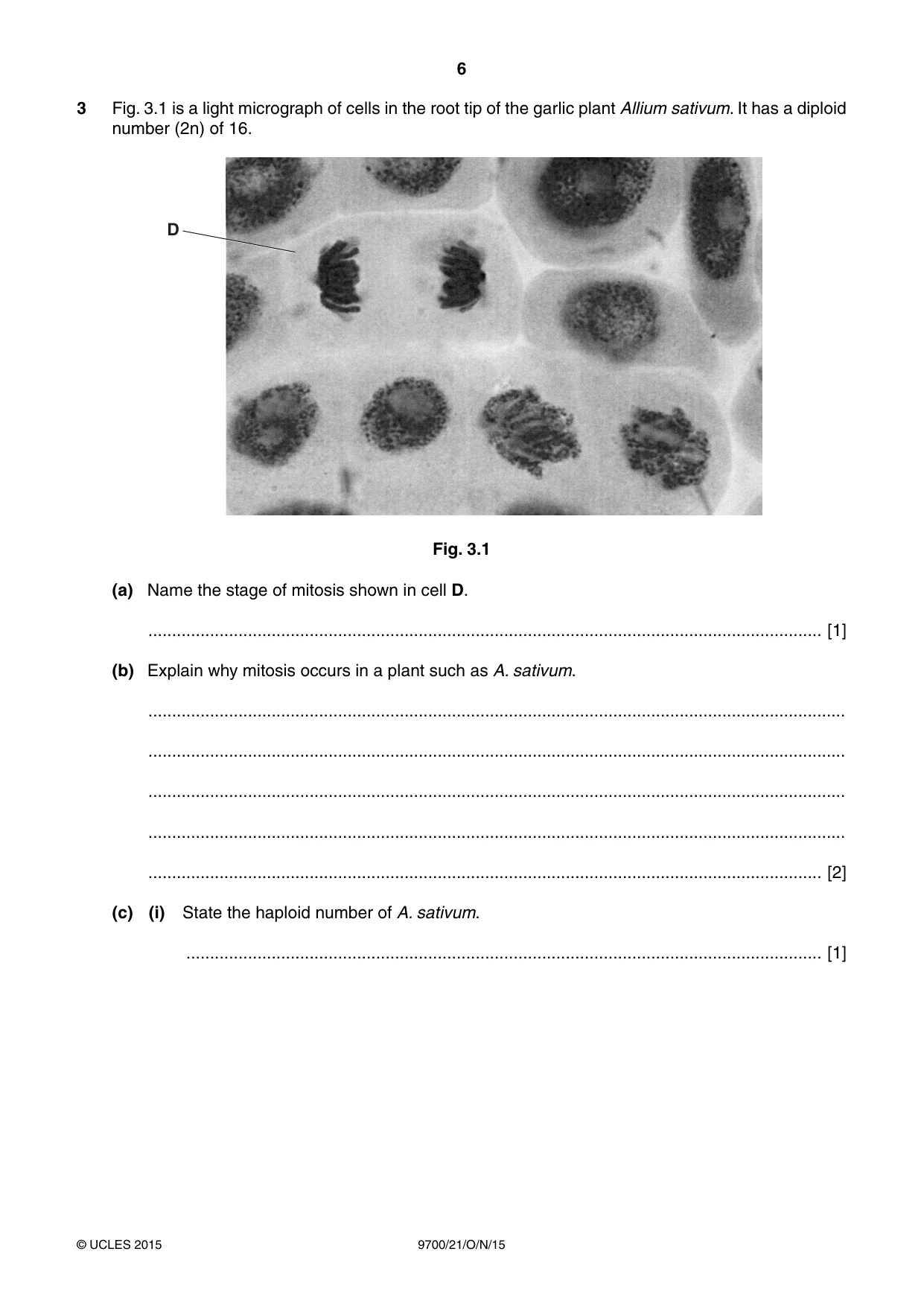
6 9700/21/O/N/15 © UCLES 2015 3 Fig. 3.1 is a light micrograph of cells in the root tip of the garlic plant Allium sativum. It has a diploid number (2n) of 16. D Fig. 3.1 (a) Name the stage of mitosis shown in cell D. … [1] (b) Explain why mitosis occurs in a plant such as A. sativum. … … … … … [2] (c) (i) State the haploid number of A. sativum. … [1]
Question paper, page 7
7 9700/21/O/N/15 © UCLES 2015 [Turn over (ii) Explain why a plant such as A. sativum produces haploid cells. … … … … … … … [3] (d) DNA replication must occur before cell division. Describe the process of DNA replication. … … … … … … … … … … … … [5] [Total: 12]
Question paper, page 8
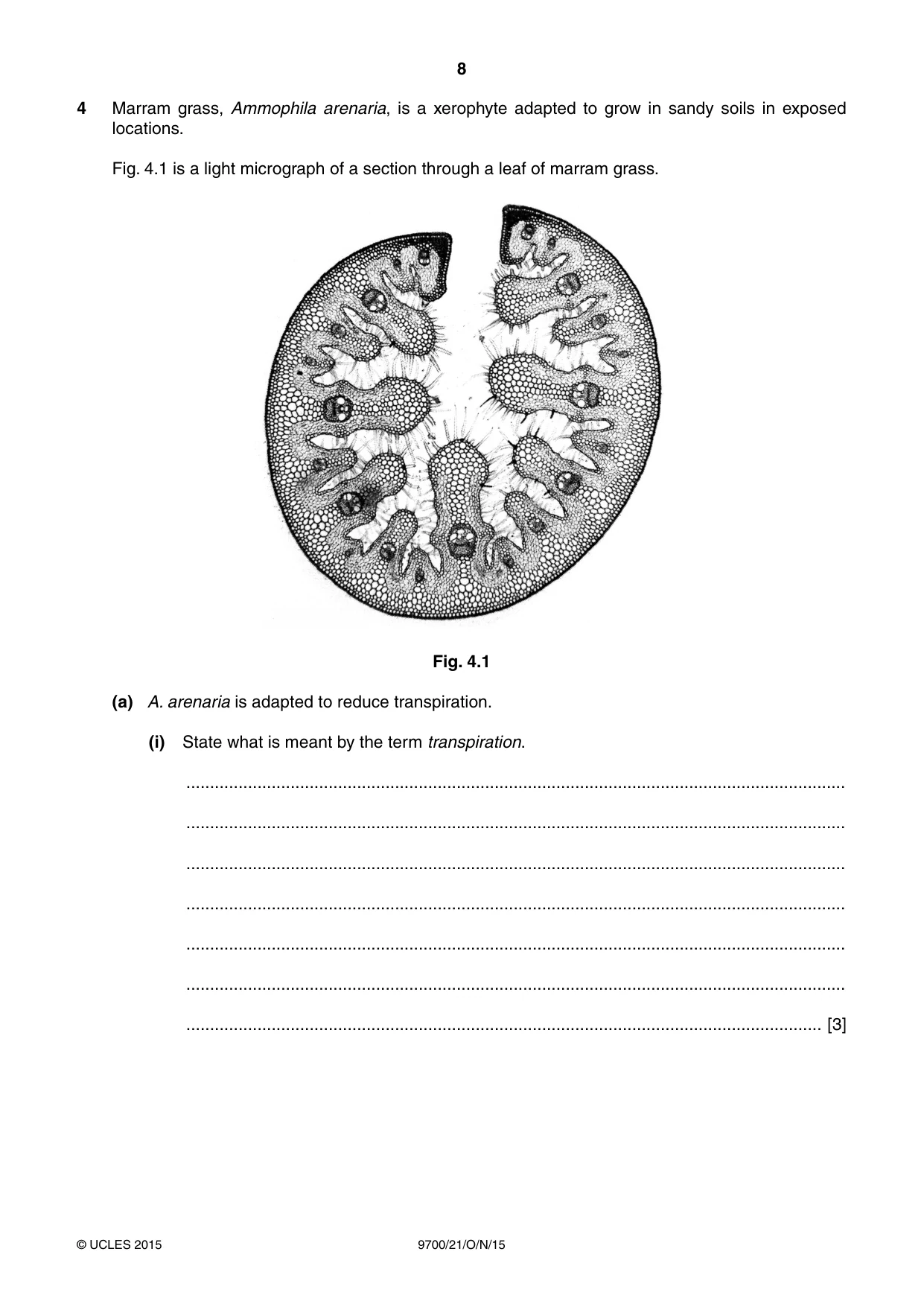
8 9700/21/O/N/15 © UCLES 2015 4 Marram grass, Ammophila arenaria, is a xerophyte adapted to grow in sandy soils in exposed locations. Fig. 4.1 is a light micrograph of a section through a leaf of marram grass. Fig. 4.1 (a) A. arenaria is adapted to reduce transpiration. (i) State what is meant by the term transpiration. … … … … … … … [3]
Question paper, page 9
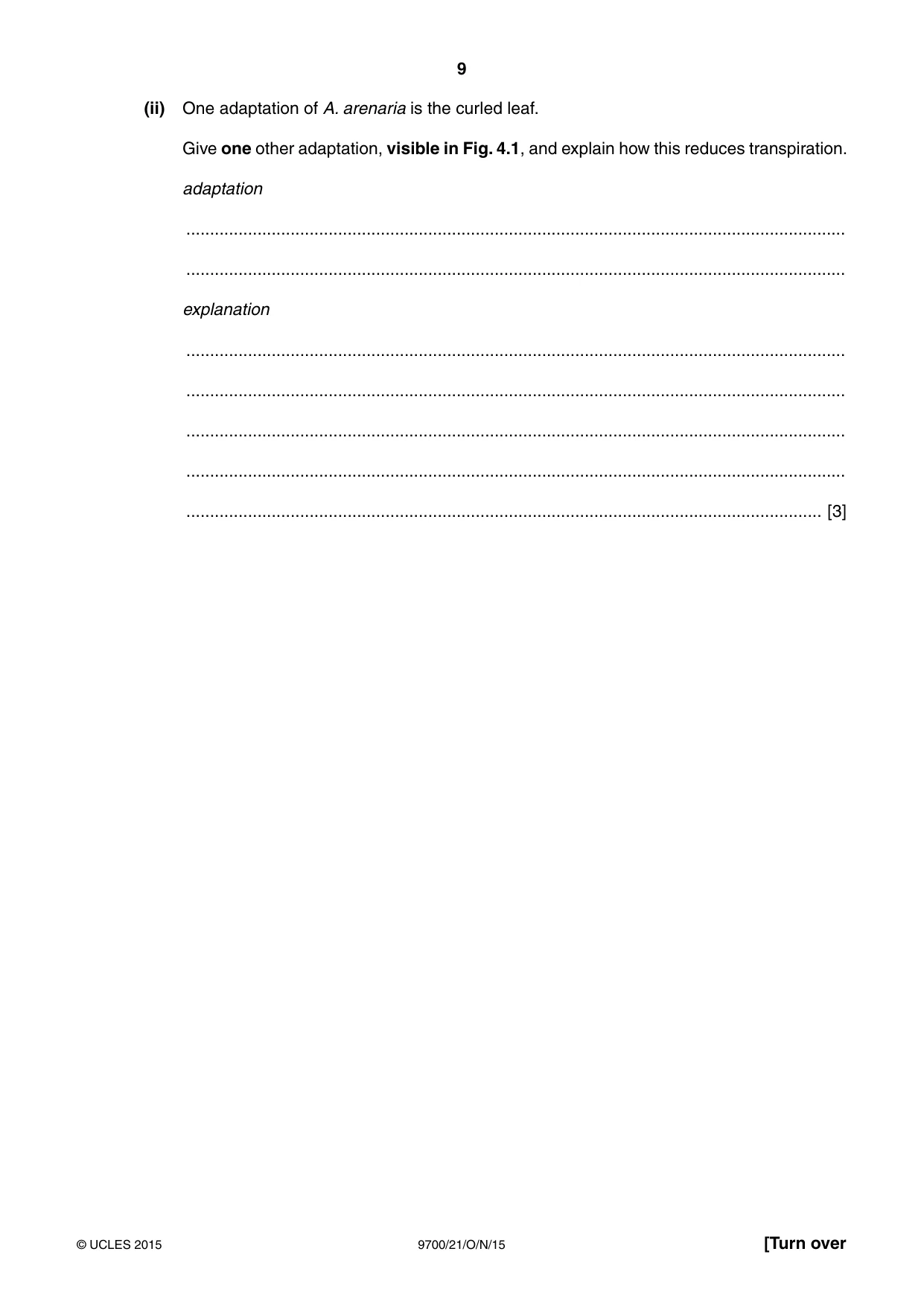
9 9700/21/O/N/15 © UCLES 2015 [Turn over (ii) One adaptation of A. arenaria is the curled leaf. Give one other adaptation, visible in Fig. 4.1, and explain how this reduces transpiration. adaptation … … explanation … … … … … [3]
Question paper, page 10
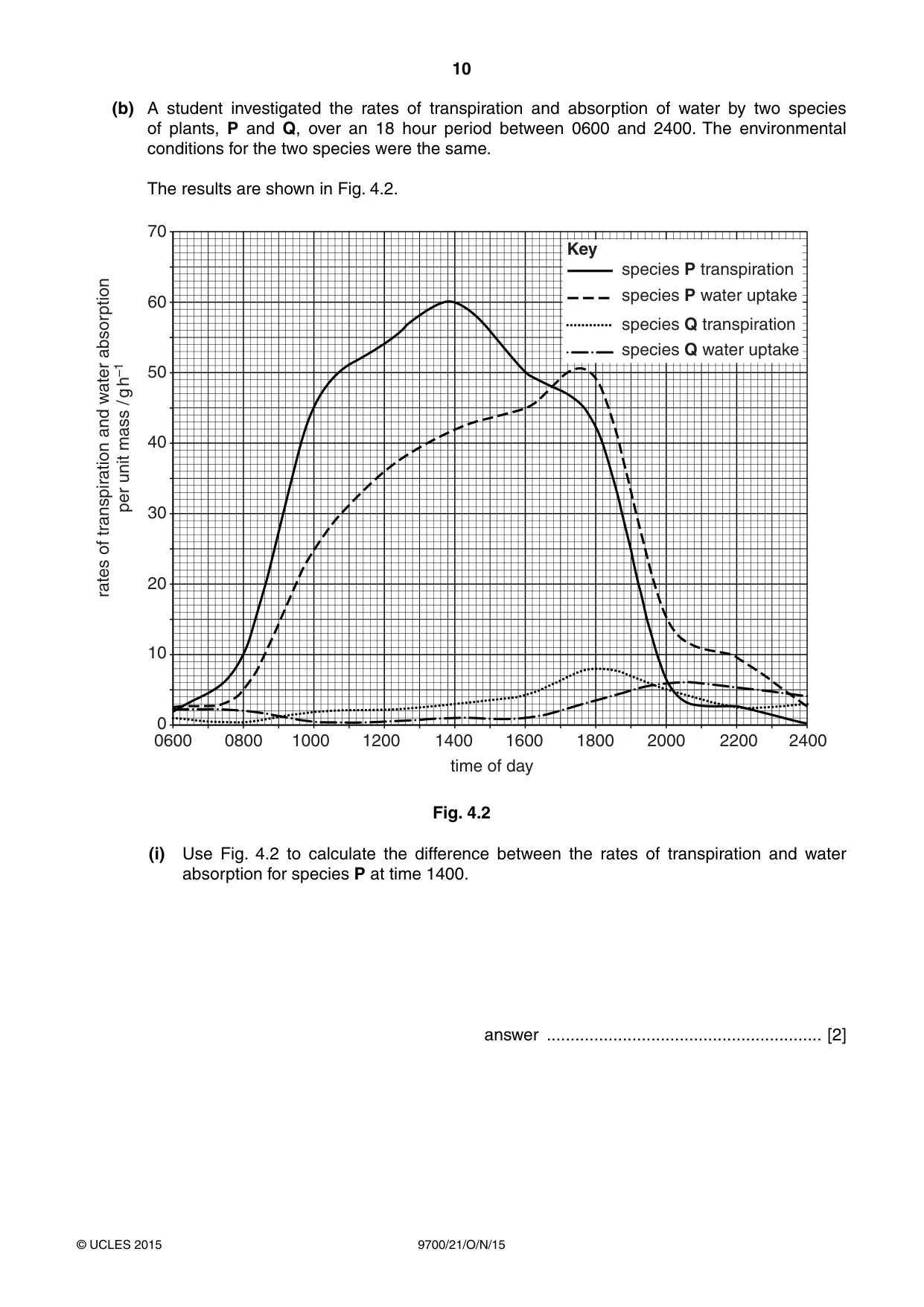
10 9700/21/O/N/15 © UCLES 2015 (b) A student investigated the rates of transpiration and absorption of water by two species of plants, P and Q, over an 18 hour period between 0600 and 2400. The environmental conditions for the two species were the same. The results are shown in Fig. 4.2. 0600 0800 1000 1200 1400 1600 1800 2000 2200 2400 10 0 20 30 40 50 60 70 time of day rates of transpiration and water absorption per unit mass / g h–1 species P transpiration species P water uptake species Q transpiration species Q water uptake Key Fig. 4.2 (i) Use Fig. 4.2 to calculate the difference between the rates of transpiration and water absorption for species P at time 1400. answer … [2]
Question paper, page 11
11 9700/21/O/N/15 © UCLES 2015 [Turn over (ii) Describe and explain the patterns of transpiration and water absorption for species P. … … … … … … … … … [4] (iii) Suggest why the pattern of transpiration for species Q is not the same as for species P. … … … … … … … [2] [Total: 14]
Question paper, page 12
12 9700/21/O/N/15 © UCLES 2015 5 (a) State the name of the causative organism (pathogen) of measles. … [1] (b) Describe how the measles pathogen is transmitted. … … … … … [2] (c) The measles pathogen contains a single stranded RNA molecule and no DNA. The cells that the measles pathogen infects contain double stranded DNA molecules. State two other ways in which the RNA in the measles pathogen differs from the DNA in the infected cells. 1. … … 2. … … [2] (d) The measles pathogen must carry out RNA replication to make new RNA molecules for the new pathogens. This happens inside the infected cell. The pathogen carries its own enzyme for RNA replication, but no other enzymes. Explain why the measles pathogen cannot use an enzyme from the cell to carry out RNA replication. … … … … … [2]
Question paper, page 13
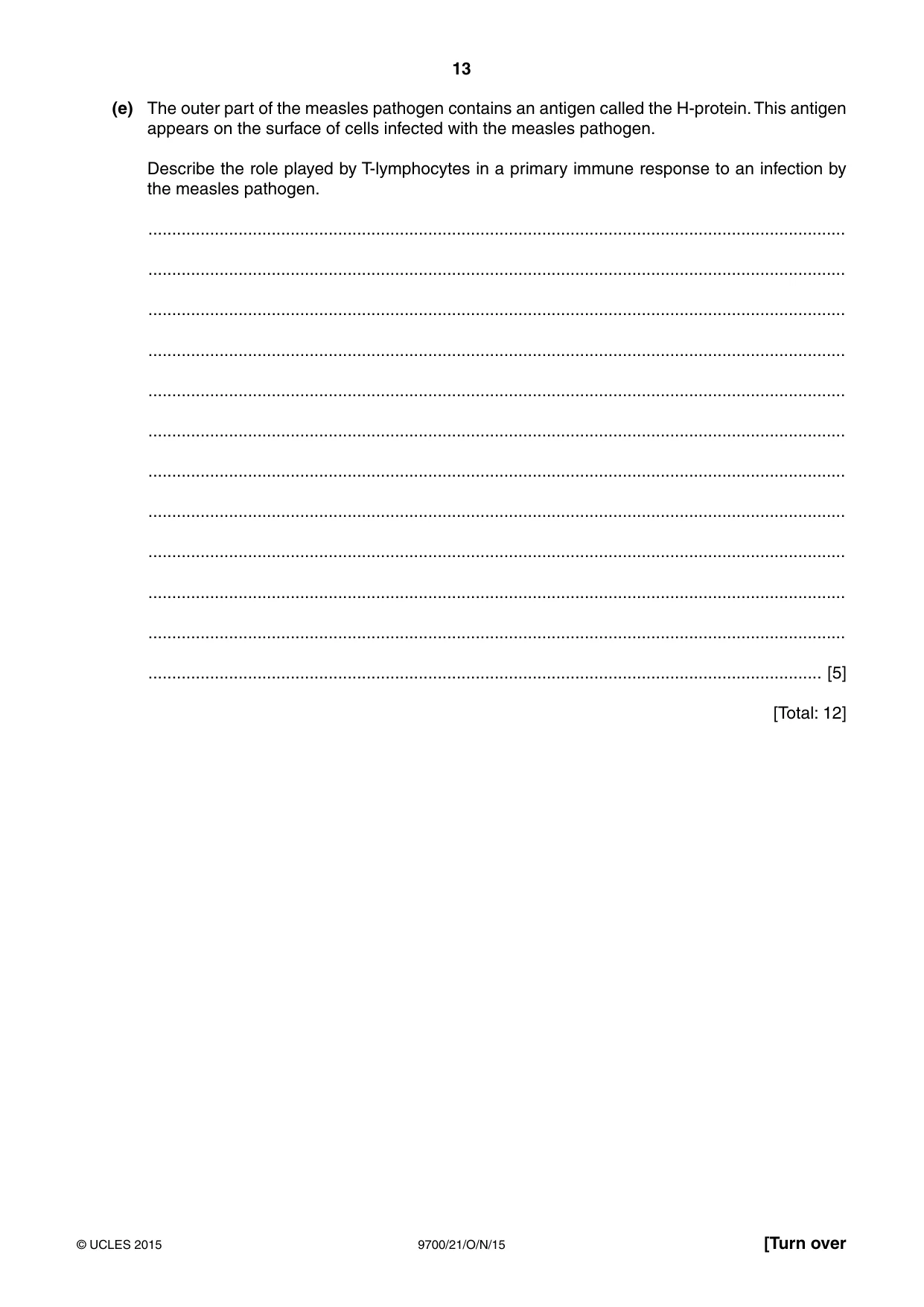
13 9700/21/O/N/15 © UCLES 2015 [Turn over (e) The outer part of the measles pathogen contains an antigen called the H-protein. This antigen appears on the surface of cells infected with the measles pathogen. Describe the role played by T-lymphocytes in a primary immune response to an infection by the measles pathogen. … … … … … … … … … … … … [5] [Total: 12]
Question paper, page 14
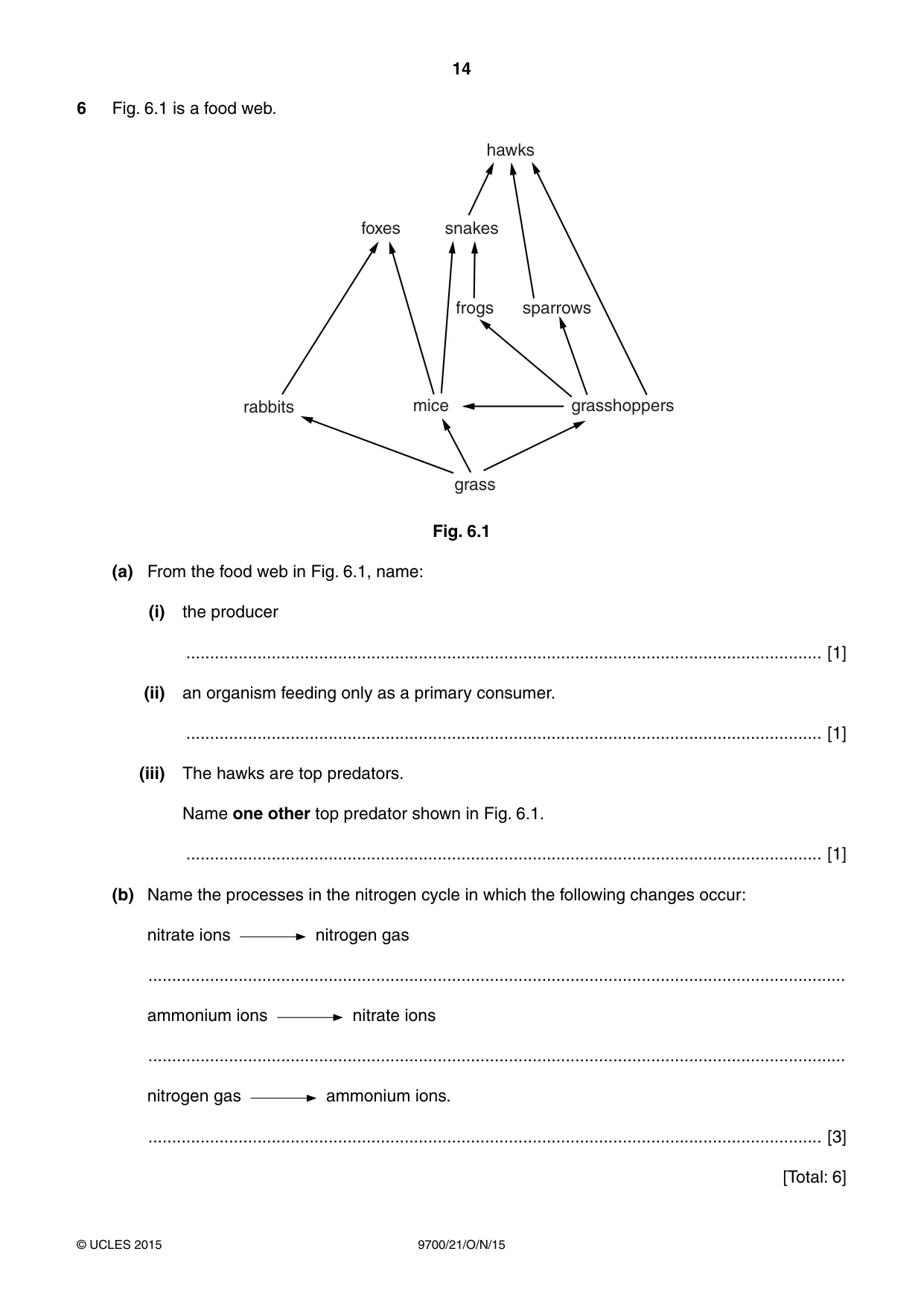
14 9700/21/O/N/15 © UCLES 2015 6 Fig. 6.1 is a food web. foxes rabbits mice grass frogs sparrows grasshoppers snakes hawks Fig. 6.1 (a) From the food web in Fig. 6.1, name: (i) the producer … [1] (ii) an organism feeding only as a primary consumer. … [1] (iii) The hawks are top predators. Name one other top predator shown in Fig. 6.1. … [1] (b) Name the processes in the nitrogen cycle in which the following changes occur: nitrate ions nitrogen gas … ammonium ions nitrate ions … nitrogen gas ammonium ions. … [3] [Total: 6]
Question paper, page 15
15 9700/21/O/N/15 © UCLES 2015 BLANK PAGE
Question paper, page 16
16 9700/21/O/N/15 © UCLES 2015 Permission to reproduce items where third-party owned material protected by copyright is included has been sought and cleared where possible. Every reasonable effort has been made by the publisher (UCLES) to trace copyright holders, but if any items requiring clearance have unwittingly been included, the publisher will be pleased to make amends at the earliest possible opportunity. To avoid the issue of disclosure of answer-related information to candidates, all copyright acknowledgements are reproduced online in the Cambridge International Examinations Copyright Acknowledgements Booklet. This is produced for each series of examinations and is freely available to download at www.cie.org.uk after the live examination series. Cambridge International Examinations is part of the Cambridge Assessment Group. Cambridge Assessment is the brand name of University of Cambridge Local Examinations Syndicate (UCLES), which is itself a department of the University of Cambridge. BLANK PAGE
Mark scheme, page 1
® IGCSE is the registered trademark of Cambridge International Examinations. CAMBRIDGE INTERNATIONAL EXAMINATIONS Cambridge International Advanced Subsidiary and Advanced Level MARK SCHEME for the October/November 2015 series 9700 BIOLOGY 9700/21 Paper 2 (AS Structured Questions), maximum raw mark 60 This mark scheme is published as an aid to teachers and candidates, to indicate the requirements of the examination. It shows the basis on which Examiners were instructed to award marks. It does not indicate the details of the discussions that took place at an Examiners’ meeting before marking began, which would have considered the acceptability of alternative answers. Mark schemes should be read in conjunction with the question paper and the Principal Examiner Report for Teachers. Cambridge will not enter into discussions about these mark schemes. Cambridge is publishing the mark schemes for the October/November 2015 series for most Cambridge IGCSE®, Cambridge International A and AS Level components and some Cambridge O Level components.
Mark scheme, page 2
Page 2 Mark Scheme Syllabus Paper Cambridge International AS/A Level – October/November 2015 9700 21 © Cambridge International Examinations 2015 Mark scheme abbreviations: ; separates marking points / alternative answers for the same point R reject A accept (for answers correctly cued by the question, or by extra guidance) AW alternative wording (where responses vary more than usual) underline actual word given must be used by candidate (grammatical variants accepted) max indicates the maximum number of marks that can be given ora or reverse argument mp marking point (with relevant number) ecf error carried forward I ignore AVP alternative valid point (examples given)
Mark scheme, page 3
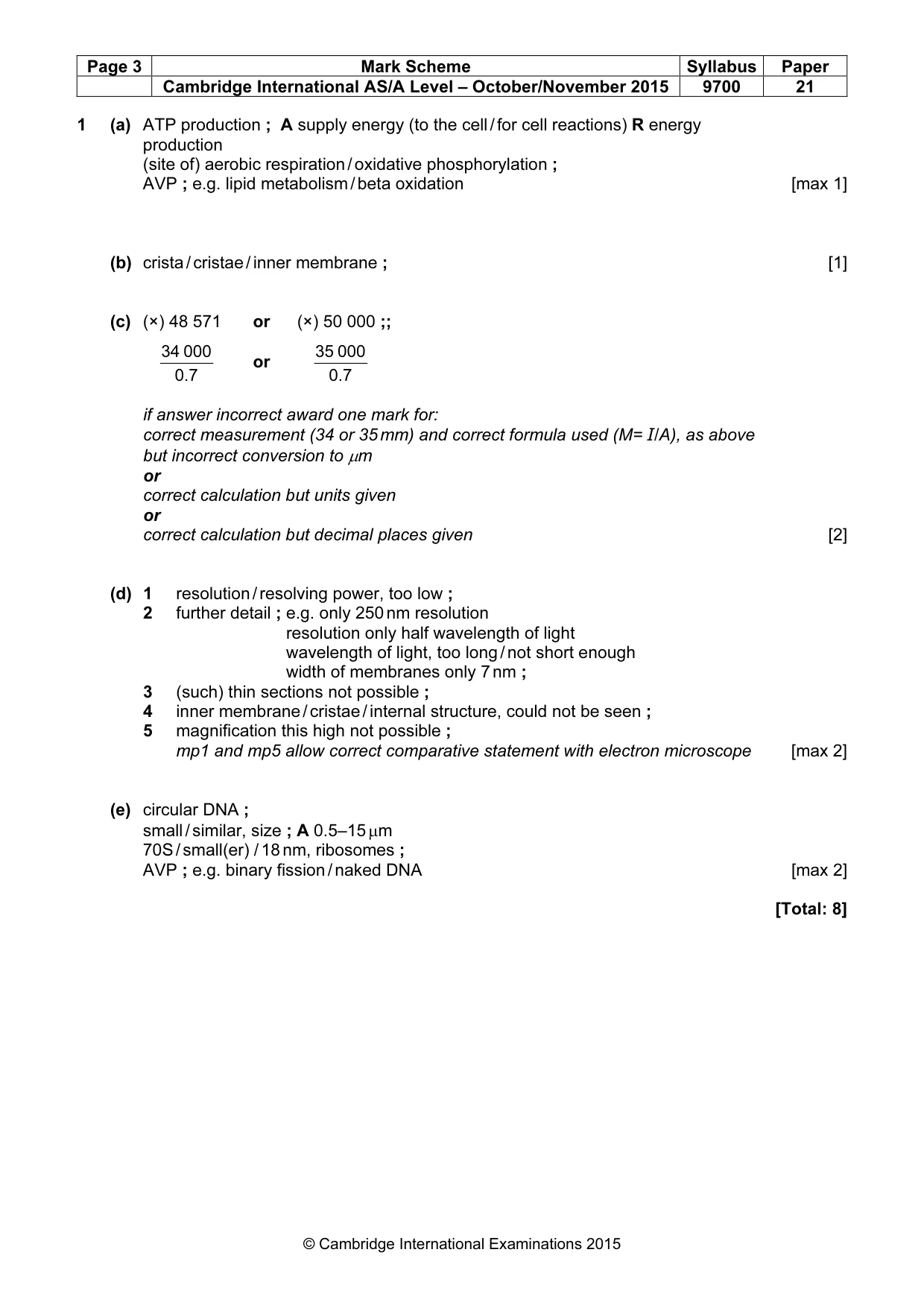
Page 3 Mark Scheme Syllabus Paper Cambridge International AS/A Level – October/November 2015 9700 21 © Cambridge International Examinations 2015 1 (a) ATP production ; A supply energy (to the cell / for cell reactions) R energy production (site of) aerobic respiration / oxidative phosphorylation ; AVP ; e.g. lipid metabolism / beta oxidation [max 1] (b) crista / cristae / inner membrane ; [1] (c) (×) 48 571 or (×) 50 000 ;; 0.7 000 34 or 0.7 000 35 if answer incorrect award one mark for: correct measurement (34 or 35 mm) and correct formula used (M= I/A), as above but incorrect conversion to µm or correct calculation but units given or correct calculation but decimal places given [2] (d) 1 resolution / resolving power, too low ; 2 further detail ; e.g. only 250 nm resolution resolution only half wavelength of light wavelength of light, too long / not short enough width of membranes only 7 nm ; 3 (such) thin sections not possible ; 4 inner membrane / cristae / internal structure, could not be seen ; 5 magnification this high not possible ; mp1 and mp5 allow correct comparative statement with electron microscope [max 2] (e) circular DNA ; small / similar, size ; A 0.5–15 µm 70S / small(er) / 18 nm, ribosomes ; AVP ; e.g. binary fission / naked DNA [max 2] [Total: 8]
Mark scheme, page 4
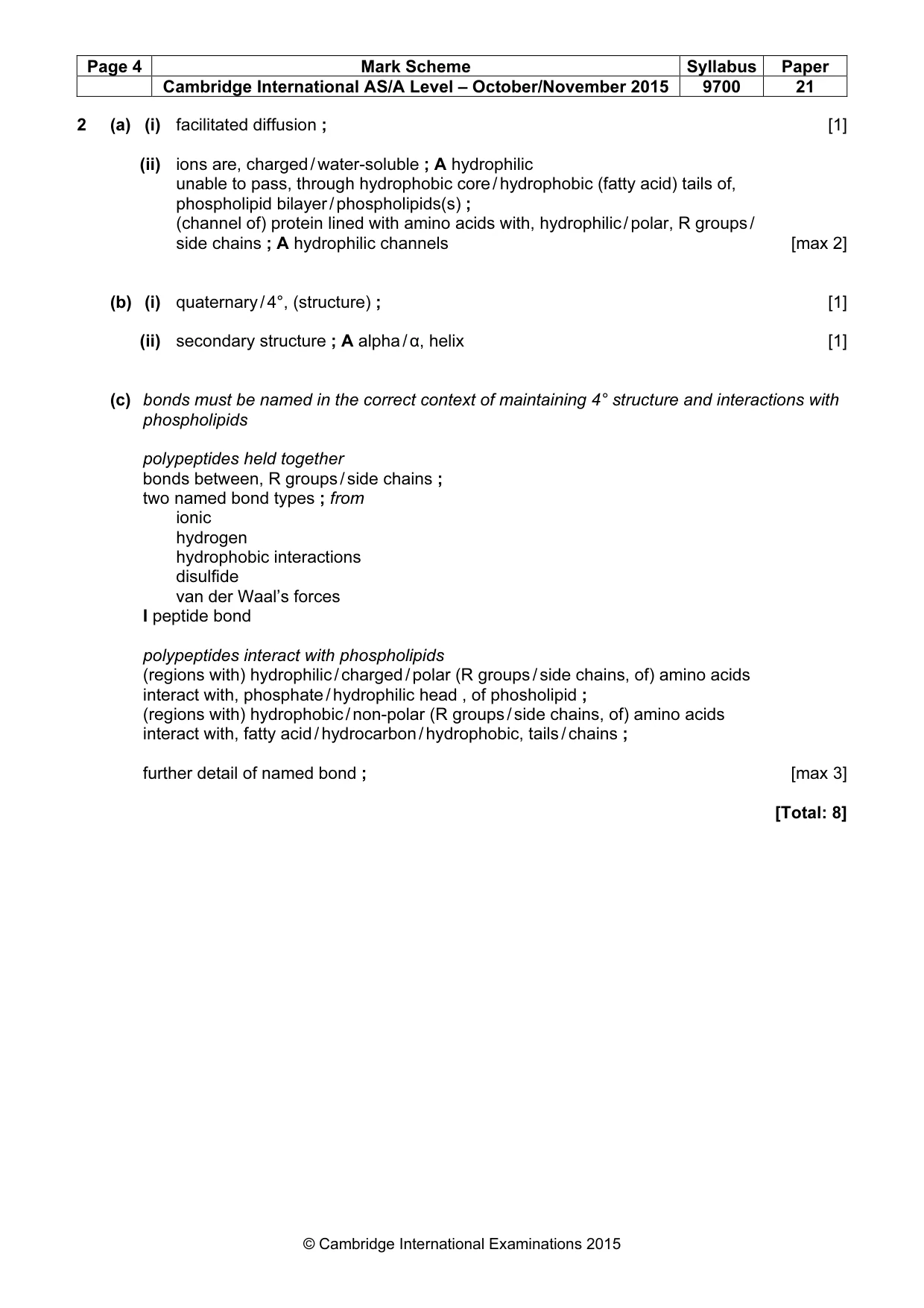
Page 4 Mark Scheme Syllabus Paper Cambridge International AS/A Level – October/November 2015 9700 21 © Cambridge International Examinations 2015 2 (a) (i) facilitated diffusion ; [1] (ii) ions are, charged / water-soluble ; A hydrophilic unable to pass, through hydrophobic core / hydrophobic (fatty acid) tails of, phospholipid bilayer / phospholipids(s) ; (channel of) protein lined with amino acids with, hydrophilic / polar, R groups / side chains ; A hydrophilic channels [max 2] (b) (i) quaternary / 4°, (structure) ; [1] (ii) secondary structure ; A alpha / α, helix [1] (c) bonds must be named in the correct context of maintaining 4° structure and interactions with phospholipids polypeptides held together bonds between, R groups / side chains ; two named bond types ; from ionic hydrogen hydrophobic interactions disulfide van der Waal’s forces I peptide bond polypeptides interact with phospholipids (regions with) hydrophilic / charged / polar (R groups / side chains, of) amino acids interact with, phosphate / hydrophilic head , of phosholipid ; (regions with) hydrophobic / non-polar (R groups / side chains, of) amino acids interact with, fatty acid / hydrocarbon / hydrophobic, tails / chains ; further detail of named bond ; [max 3] [Total: 8]
Mark scheme, page 5
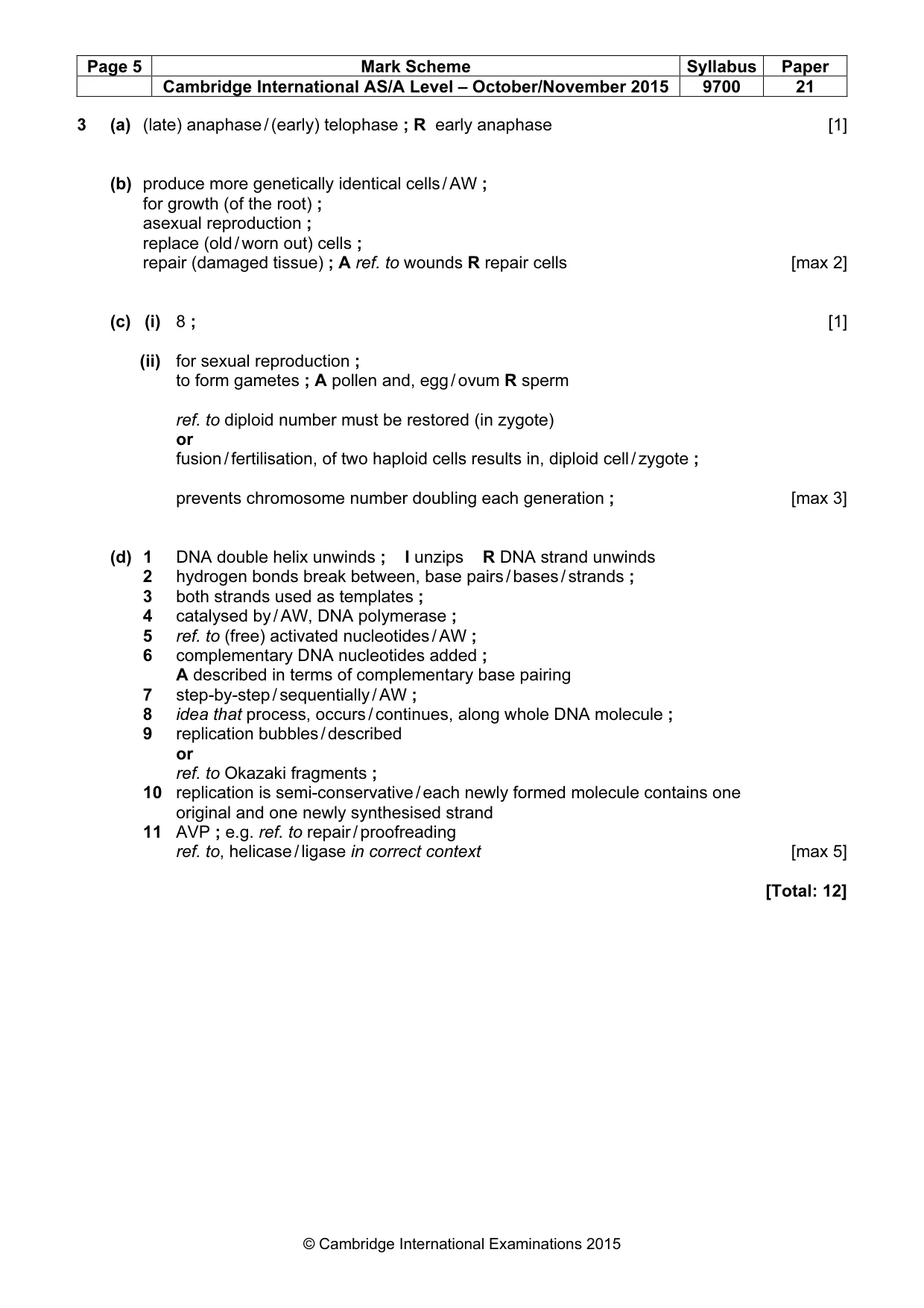
Page 5 Mark Scheme Syllabus Paper Cambridge International AS/A Level – October/November 2015 9700 21 © Cambridge International Examinations 2015 3 (a) (late) anaphase / (early) telophase ; R early anaphase [1] (b) produce more genetically identical cells / AW ; for growth (of the root) ; asexual reproduction ; replace (old / worn out) cells ; repair (damaged tissue) ; A ref. to wounds R repair cells [max 2] (c) (i) 8 ; [1] (ii) for sexual reproduction ; to form gametes ; A pollen and, egg / ovum R sperm ref. to diploid number must be restored (in zygote) or fusion / fertilisation, of two haploid cells results in, diploid cell / zygote ; prevents chromosome number doubling each generation ; [max 3] (d) 1 DNA double helix unwinds ; I unzips R DNA strand unwinds 2 hydrogen bonds break between, base pairs / bases / strands ; 3 both strands used as templates ; 4 catalysed by / AW, DNA polymerase ; 5 ref. to (free) activated nucleotides / AW ; 6 complementary DNA nucleotides added ; A described in terms of complementary base pairing 7 step-by-step / sequentially / AW ; 8 idea that process, occurs / continues, along whole DNA molecule ; 9 replication bubbles / described or ref. to Okazaki fragments ; 10 replication is semi-conservative / each newly formed molecule contains one original and one newly synthesised strand 11 AVP ; e.g. ref. to repair / proofreading ref. to, helicase / ligase in correct context [max 5] [Total: 12]
Mark scheme, page 6
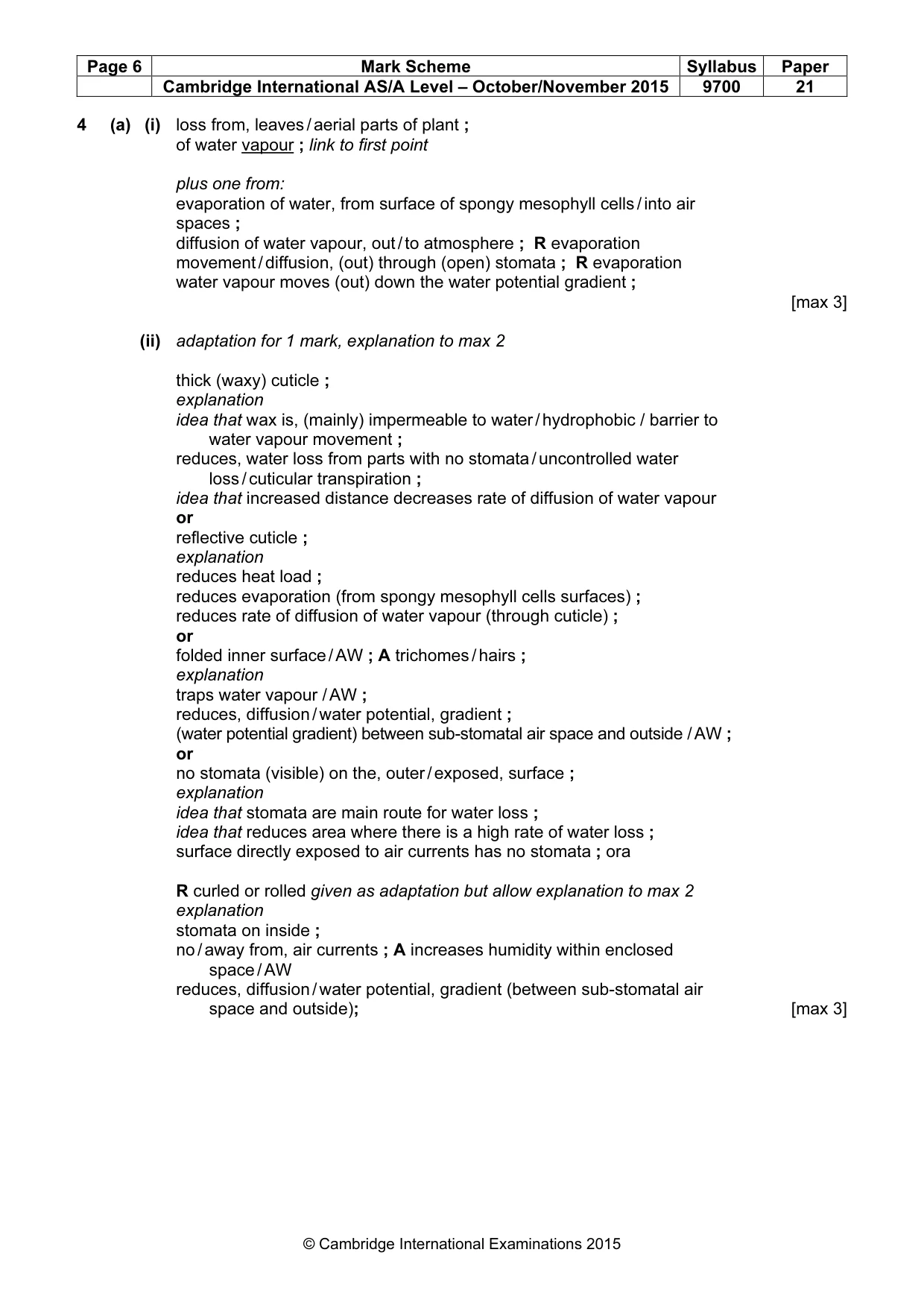
Page 6 Mark Scheme Syllabus Paper Cambridge International AS/A Level – October/November 2015 9700 21 © Cambridge International Examinations 2015 4 (a) (i) loss from, leaves / aerial parts of plant ; of water vapour ; link to first point plus one from: evaporation of water, from surface of spongy mesophyll cells / into air spaces ; diffusion of water vapour, out / to atmosphere ; R evaporation movement / diffusion, (out) through (open) stomata ; R evaporation water vapour moves (out) down the water potential gradient ; [max 3] (ii) adaptation for 1 mark, explanation to max 2 thick (waxy) cuticle ; explanation idea that wax is, (mainly) impermeable to water / hydrophobic / barrier to water vapour movement ; reduces, water loss from parts with no stomata / uncontrolled water loss / cuticular transpiration ; idea that increased distance decreases rate of diffusion of water vapour or reflective cuticle ; explanation reduces heat load ; reduces evaporation (from spongy mesophyll cells surfaces) ; reduces rate of diffusion of water vapour (through cuticle) ; or folded inner surface / AW ; A trichomes / hairs ; explanation traps water vapour / AW ; reduces, diffusion / water potential, gradient ; (water potential gradient) between sub-stomatal air space and outside / AW ; or no stomata (visible) on the, outer / exposed, surface ; explanation idea that stomata are main route for water loss ; idea that reduces area where there is a high rate of water loss ; surface directly exposed to air currents has no stomata ; ora R curled or rolled given as adaptation but allow explanation to max 2 explanation stomata on inside ; no / away from, air currents ; A increases humidity within enclosed space / AW reduces, diffusion / water potential, gradient (between sub-stomatal air space and outside); [max 3]
Mark scheme, page 7
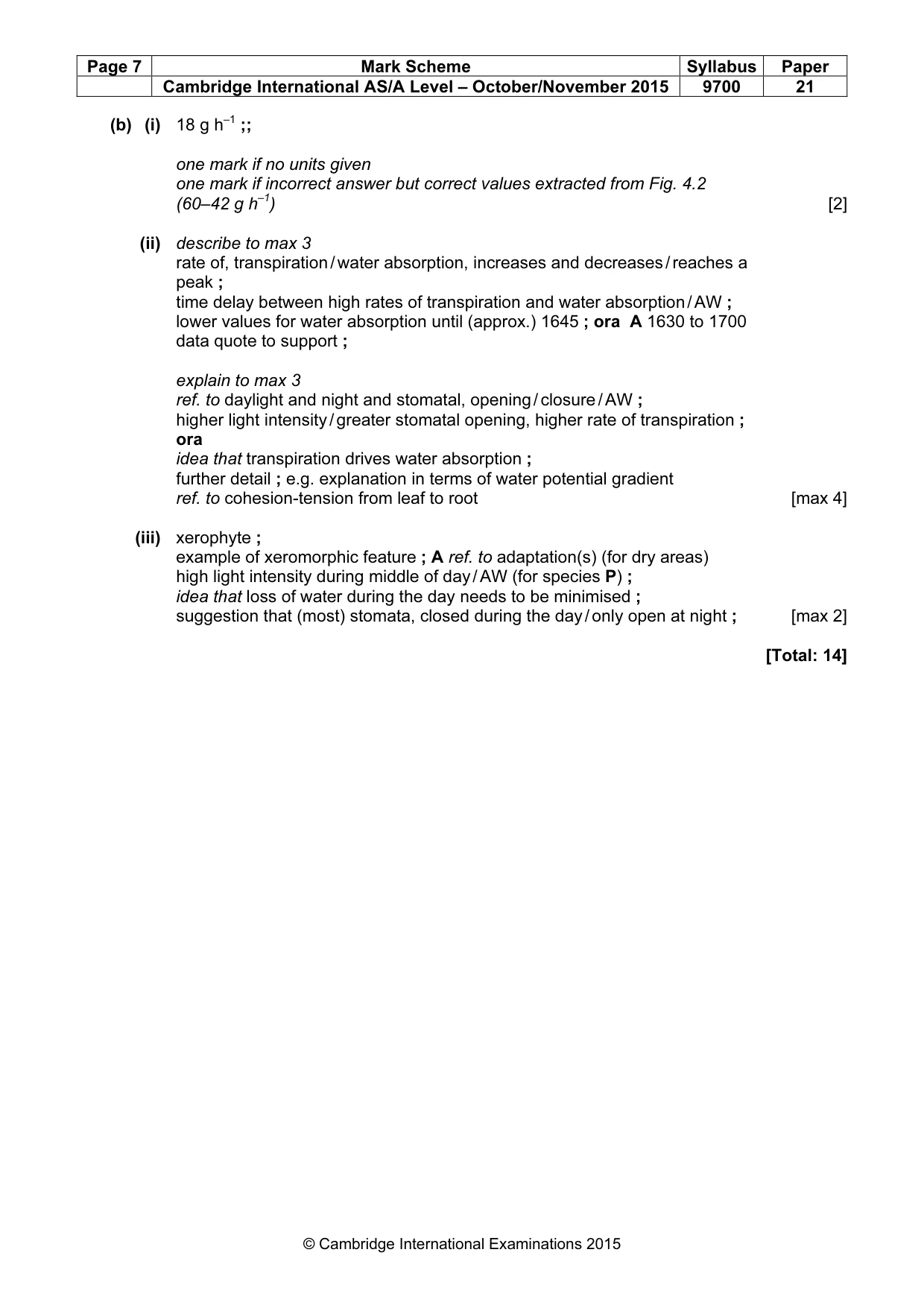
Page 7 Mark Scheme Syllabus Paper Cambridge International AS/A Level – October/November 2015 9700 21 © Cambridge International Examinations 2015 (b) (i) 18 g h–1 ;; one mark if no units given one mark if incorrect answer but correct values extracted from Fig. 4.2 (60–42 g h–1) [2] (ii) describe to max 3 rate of, transpiration / water absorption, increases and decreases / reaches a peak ; time delay between high rates of transpiration and water absorption / AW ; lower values for water absorption until (approx.) 1645 ; ora A 1630 to 1700 data quote to support ; explain to max 3 ref. to daylight and night and stomatal, opening / closure / AW ; higher light intensity / greater stomatal opening, higher rate of transpiration ; ora idea that transpiration drives water absorption ; further detail ; e.g. explanation in terms of water potential gradient ref. to cohesion-tension from leaf to root [max 4] (iii) xerophyte ; example of xeromorphic feature ; A ref. to adaptation(s) (for dry areas) high light intensity during middle of day / AW (for species P) ; idea that loss of water during the day needs to be minimised ; suggestion that (most) stomata, closed during the day / only open at night ; [max 2] [Total: 14]
Mark scheme, page 8
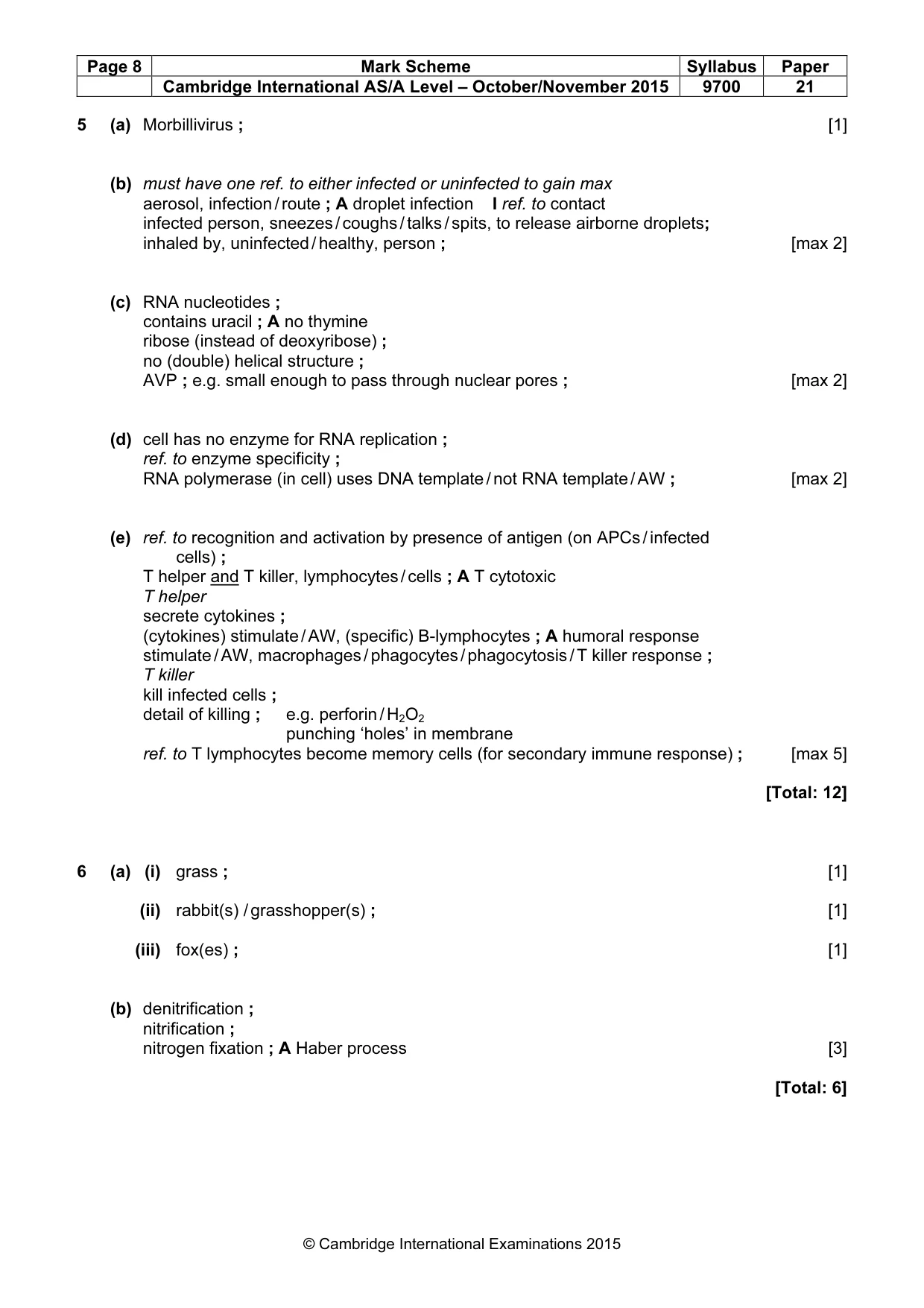
Page 8 Mark Scheme Syllabus Paper Cambridge International AS/A Level – October/November 2015 9700 21 © Cambridge International Examinations 2015 5 (a) Morbillivirus ; [1] (b) must have one ref. to either infected or uninfected to gain max aerosol, infection / route ; A droplet infection I ref. to contact infected person, sneezes / coughs / talks / spits, to release airborne droplets; inhaled by, uninfected / healthy, person ; [max 2] (c) RNA nucleotides ; contains uracil ; A no thymine ribose (instead of deoxyribose) ; no (double) helical structure ; AVP ; e.g. small enough to pass through nuclear pores ; [max 2] (d) cell has no enzyme for RNA replication ; ref. to enzyme specificity ; RNA polymerase (in cell) uses DNA template / not RNA template / AW ; [max 2] (e) ref. to recognition and activation by presence of antigen (on APCs / infected cells) ; T helper and T killer, lymphocytes / cells ; A T cytotoxic T helper secrete cytokines ; (cytokines) stimulate / AW, (specific) B-lymphocytes ; A humoral response stimulate / AW, macrophages / phagocytes / phagocytosis / T killer response ; T killer kill infected cells ; detail of killing ; e.g. perforin / H2O2 punching ‘holes’ in membrane ref. to T lymphocytes become memory cells (for secondary immune response) ; [max 5] [Total: 12] 6 (a) (i) grass ; [1] (ii) rabbit(s) / grasshopper(s) ; [1] (iii) fox(es) ; [1] (b) denitrification ; nitrification ; nitrogen fixation ; A Haber process [3] [Total: 6]
What you needed in this session
Cambridge’s own grade thresholds for 2015 Oct/Nov, Paper 2 · Variant 1. A higher threshold means an easier paper — the bar moves with how the cohort did.