Cambridge A Level Biology 9700 — 2015 May/June Paper 2 · Variant 3
9700/23/M/J/15 · 60 marks · ≈68 min
The question paper and its mark scheme, free to read here and free to download. This is Cambridge’s own paper, exactly as it was sat.
Question paper16 pages



Mark scheme7 pages
Answers below. Sit the paper first if you are practising.
Paper as text
Question paper, page 1
This document consists of 13 printed pages and 3 blank pages. DC (ST/JG) 95555/3 © UCLES 2015 [Turn over Cambridge International Examinations Cambridge International Advanced Subsidiary and Advanced Level * 1 0 3 5 5 4 5 1 0 2 * BIOLOGY 9700/23 Paper 2 Structured Questions AS May/June 2015 1 hour 15 minutes Candidates answer on the Question Paper. No Additional Materials are required. READ THESE INSTRUCTIONS FIRST Write your Centre number, candidate number and name in the spaces at the top of the page. Write in dark blue or black pen. You may use an HB pencil for any diagrams or graphs. Do not use staples, paper clips, glue or correction fluid. DO NOT WRITE IN ANY BARCODES. Answer all questions. Electronic calculators may be used. You may lose marks if you do not show your working or if you do not use appropriate units. At the end of the examination, fasten all your work securely together. The number of marks is given in brackets [ ] at the end of each question or part question.
Question paper, page 2
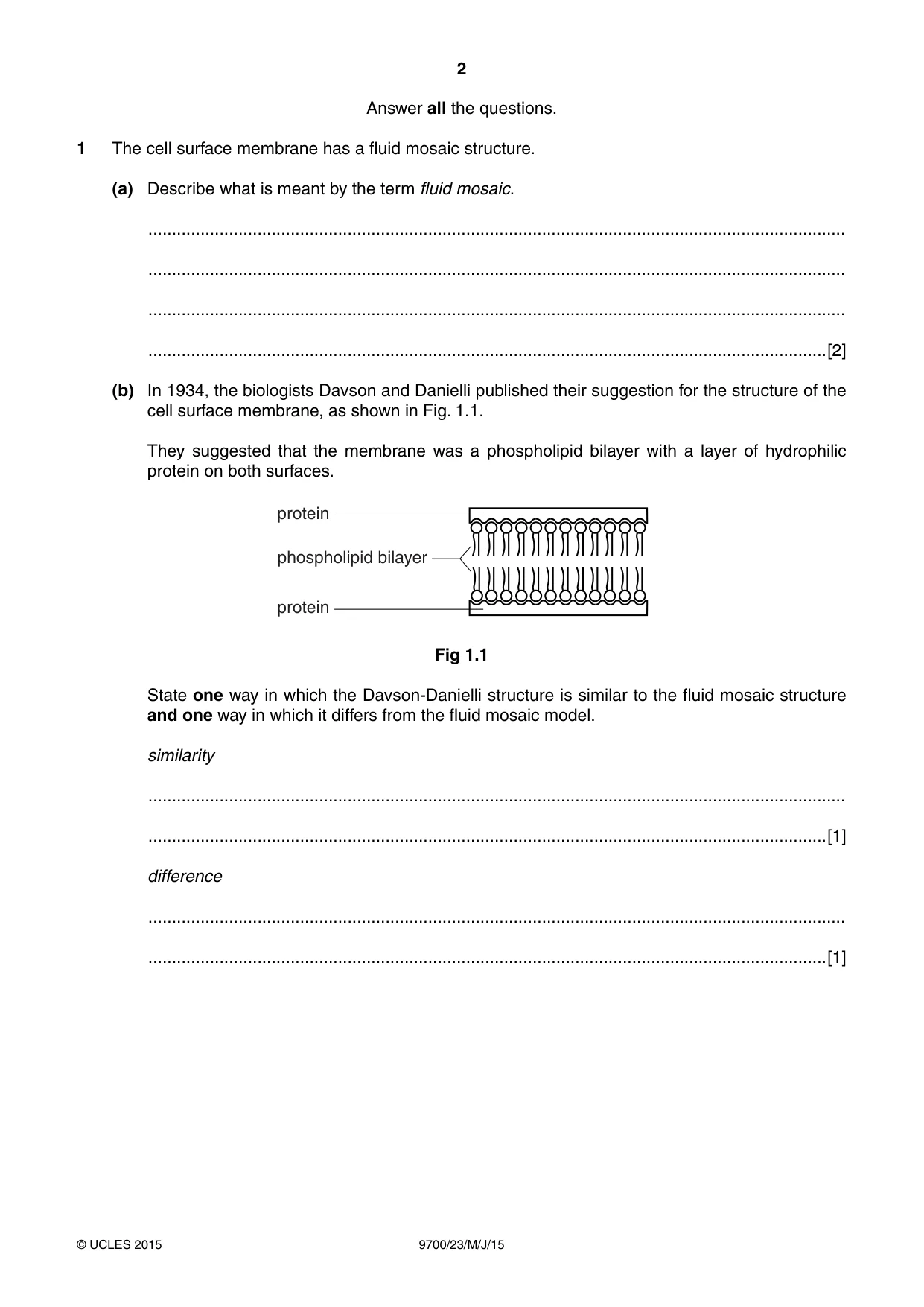
2 9700/23/M/J/15 © UCLES 2015 Answer all the questions. 1 The cell surface membrane has a fluid mosaic structure. (a) Describe what is meant by the term fluid mosaic. … … … …[2] (b) In 1934, the biologists Davson and Danielli published their suggestion for the structure of the cell surface membrane, as shown in Fig. 1.1. They suggested that the membrane was a phospholipid bilayer with a layer of hydrophilic protein on both surfaces. protein protein phospholipid bilayer Fig 1.1 State one way in which the Davson-Danielli structure is similar to the fluid mosaic structure and one way in which it differs from the fluid mosaic model. similarity … …[1] difference … …[1]
Question paper, page 3
3 9700/23/M/J/15 © UCLES 2015 [Turn over (c) One way in which substances can cross cell membranes is by active transport. Describe the mechanism of active transport. … … … … … … …[3] (d) High temperature can damage cell membranes. One factor contributing to this damage is the denaturation of membrane proteins. Describe how proteins become denatured at high temperature and explain how this could lead to damaging cell membranes. … … … … … … …[3] [Total: 10]
Question paper, page 4
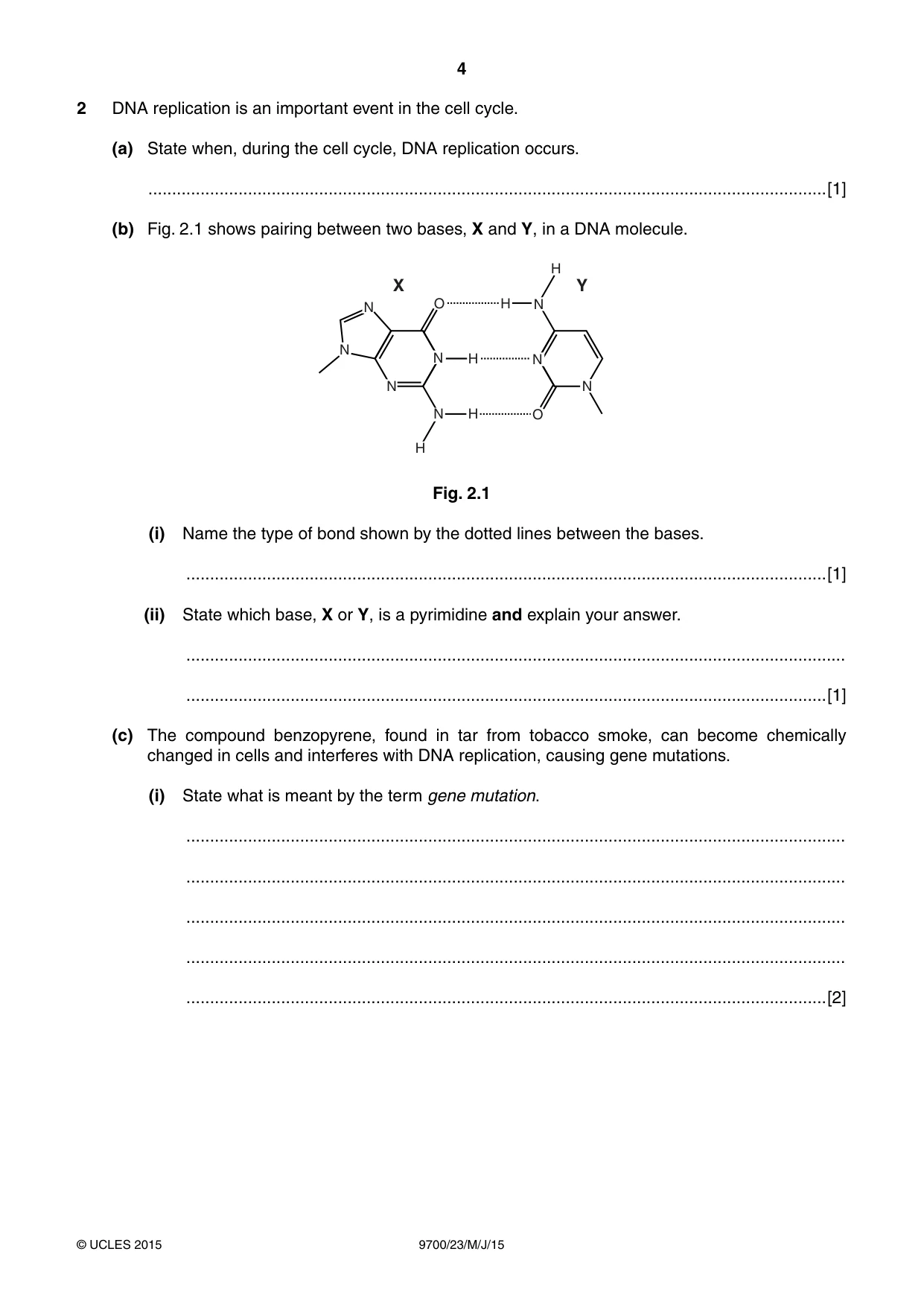
4 9700/23/M/J/15 © UCLES 2015 2 DNA replication is an important event in the cell cycle. (a) State when, during the cell cycle, DNA replication occurs. …[1] (b) Fig. 2.1 shows pairing between two bases, X and Y, in a DNA molecule. O H H Y X N N O N N N N N H N H H Fig. 2.1 (i) Name the type of bond shown by the dotted lines between the bases. …[1] (ii) State which base, X or Y, is a pyrimidine and explain your answer. … …[1] (c) The compound benzopyrene, found in tar from tobacco smoke, can become chemically changed in cells and interferes with DNA replication, causing gene mutations. (i) State what is meant by the term gene mutation. … … … … …[2]
Question paper, page 5
5 9700/23/M/J/15 © UCLES 2015 [Turn over (ii) Mutations that occur in dividing cells of the gas exchange system may result in lung cancer. Suggest the differences in the cell cycle of a cancer cell compared with that of a normal cell of the same type. … … … … …[2] [Total: 7]
Question paper, page 6
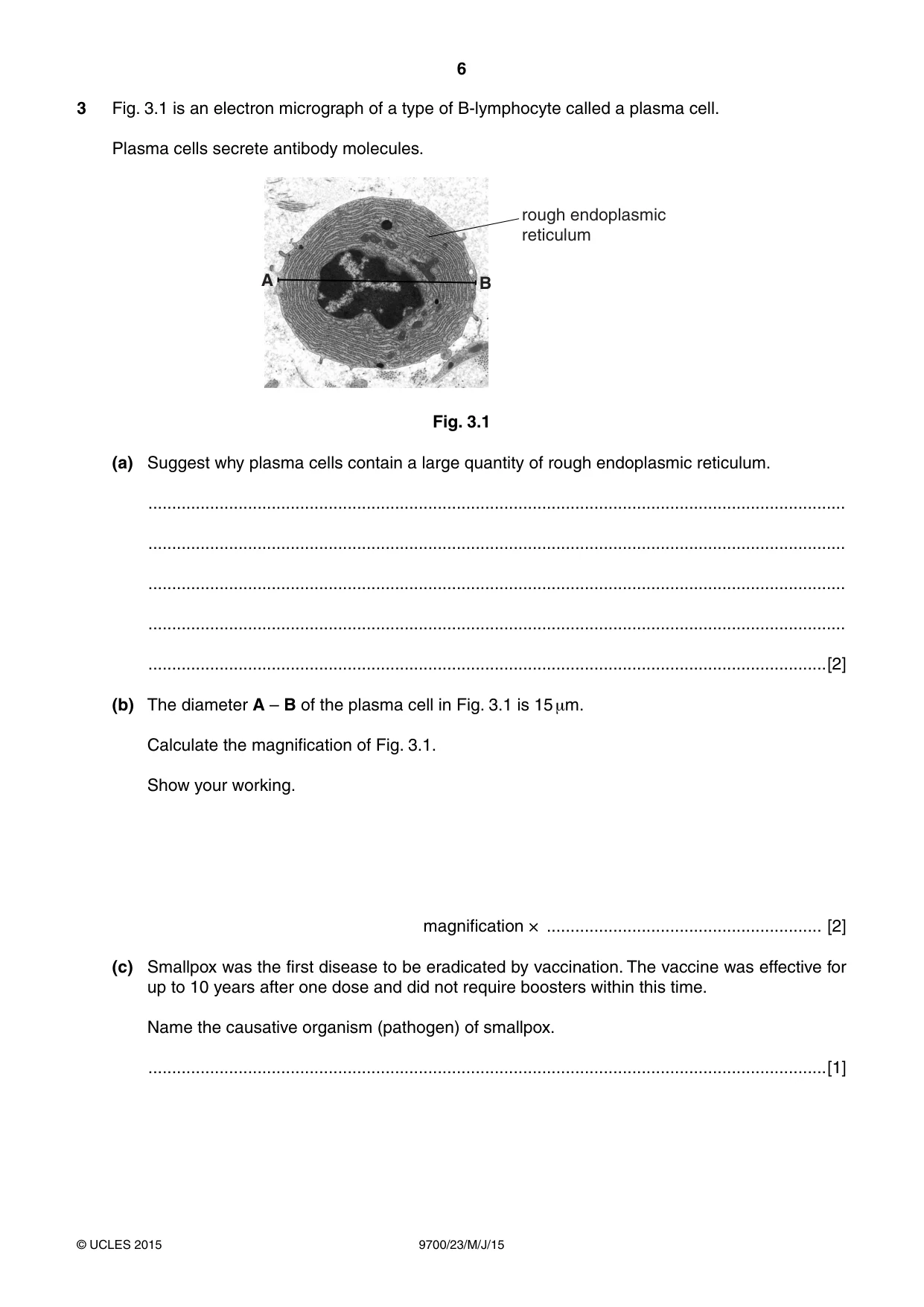
6 9700/23/M/J/15 © UCLES 2015 3 Fig. 3.1 is an electron micrograph of a type of B-lymphocyte called a plasma cell. Plasma cells secrete antibody molecules. A B rough endoplasmic reticulum Fig. 3.1 (a) Suggest why plasma cells contain a large quantity of rough endoplasmic reticulum. … … … … …[2] (b) The diameter A – B of the plasma cell in Fig. 3.1 is 15 μm. Calculate the magnification of Fig. 3.1. Show your working. magnification × … [2] (c) Smallpox was the first disease to be eradicated by vaccination. The vaccine was effective for up to 10 years after one dose and did not require boosters within this time. Name the causative organism (pathogen) of smallpox. …[1]
Question paper, page 7
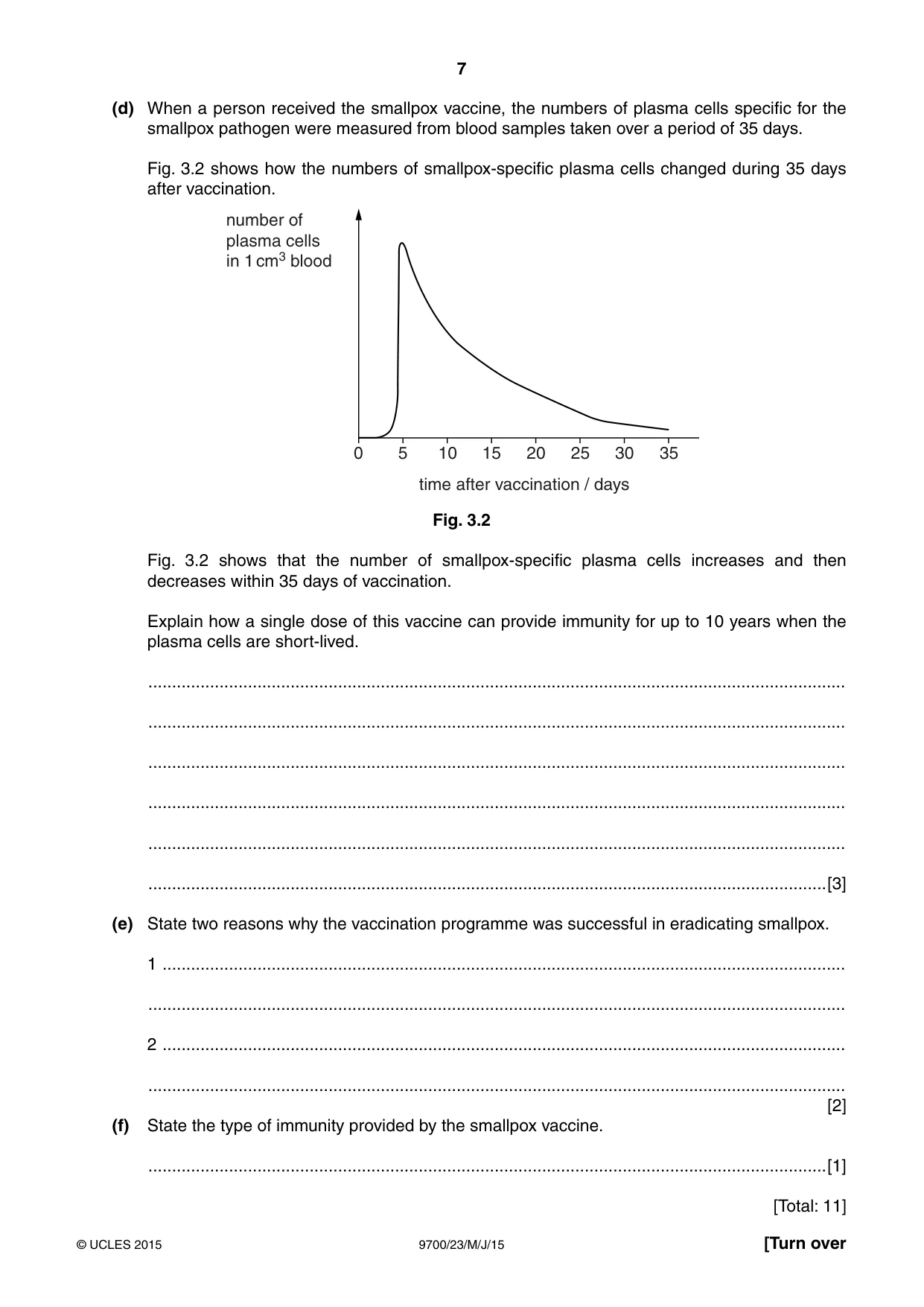
7 9700/23/M/J/15 © UCLES 2015 [Turn over (d) When a person received the smallpox vaccine, the numbers of plasma cells specific for the smallpox pathogen were measured from blood samples taken over a period of 35 days. Fig. 3.2 shows how the numbers of smallpox-specific plasma cells changed during 35 days after vaccination. 0 5 10 15 20 25 30 35 time after vaccination / days number of plasma cells in 1 cm3 blood Fig. 3.2 Fig. 3.2 shows that the number of smallpox-specific plasma cells increases and then decreases within 35 days of vaccination. Explain how a single dose of this vaccine can provide immunity for up to 10 years when the plasma cells are short-lived. … … … … … …[3] (e) State two reasons why the vaccination programme was successful in eradicating smallpox. 1 … … 2 … … [2] (f) State the type of immunity provided by the smallpox vaccine. …[1] [Total: 11]
Question paper, page 8
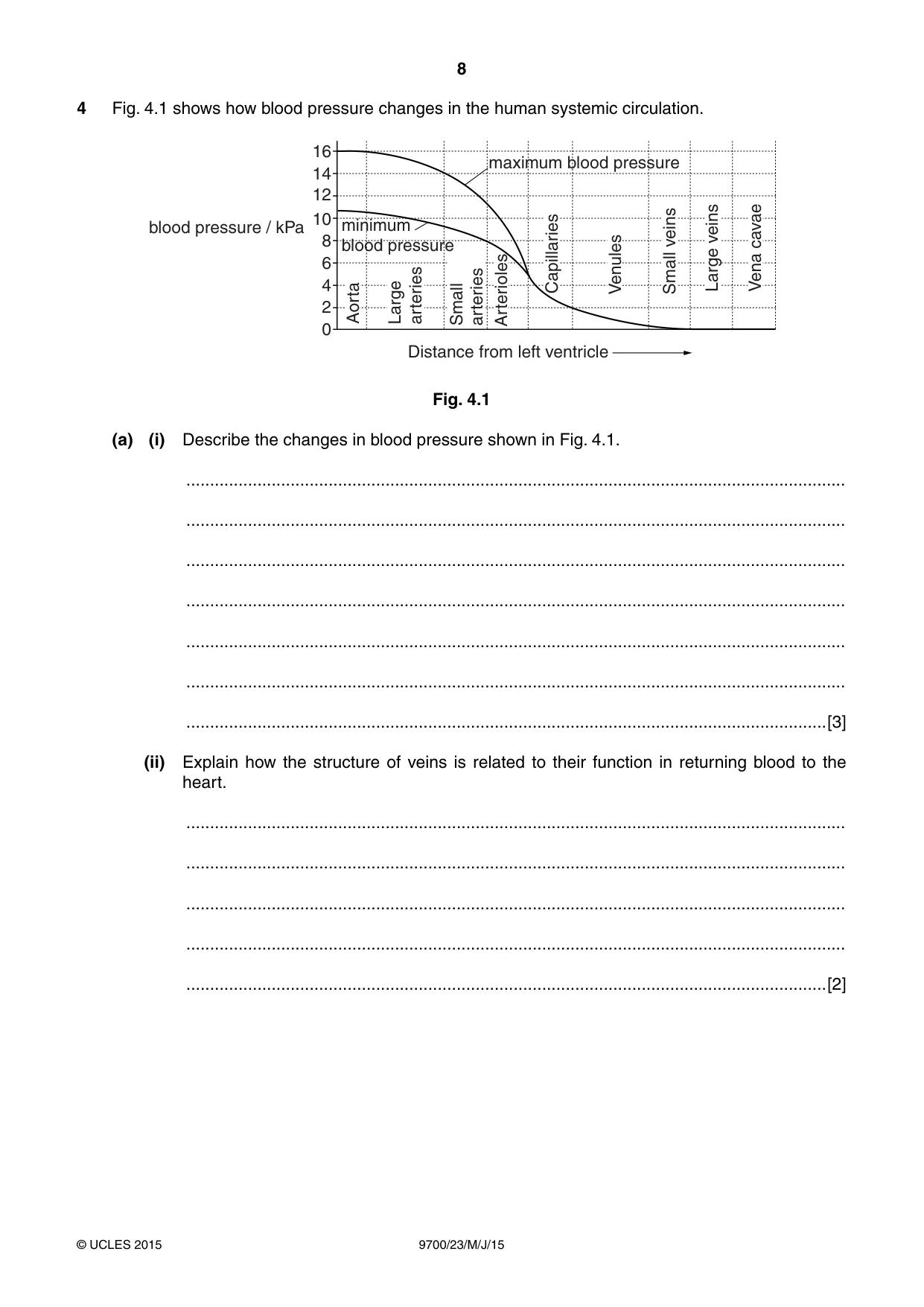
8 9700/23/M/J/15 © UCLES 2015 4 Fig. 4.1 shows how blood pressure changes in the human systemic circulation. 0 2 4 6 8 10 12 14 16 blood pressure / kPa maximum blood pressure minimum blood pressure Distance from left ventricle Aorta Large arteries Small arteries Arterioles Venules Capillaries Small veins Large veins Vena cavae Fig. 4.1 (a) (i) Describe the changes in blood pressure shown in Fig. 4.1. … … … … … … …[3] (ii) Explain how the structure of veins is related to their function in returning blood to the heart. … … … … …[2]
Question paper, page 9
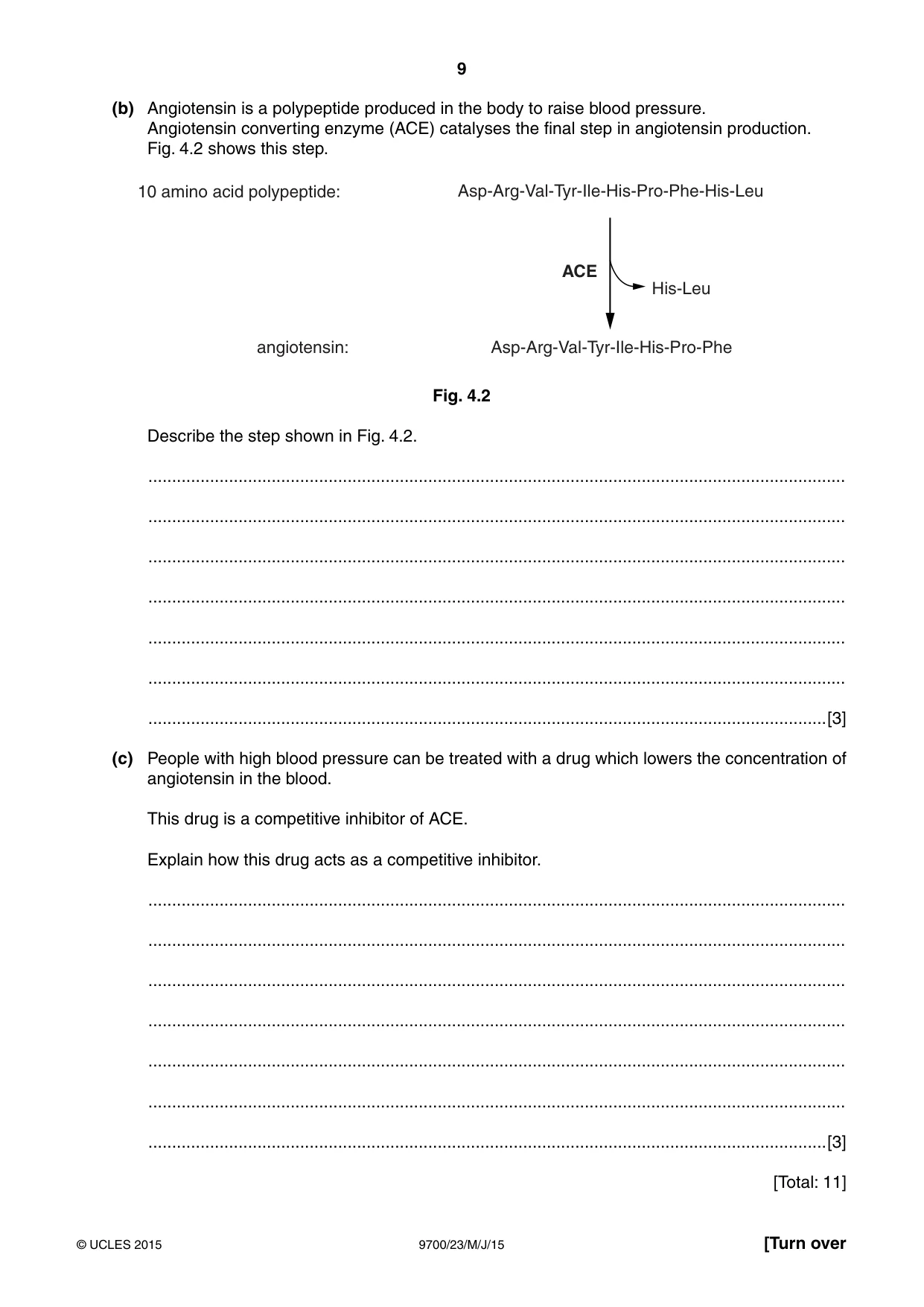
9 9700/23/M/J/15 © UCLES 2015 [Turn over (b) Angiotensin is a polypeptide produced in the body to raise blood pressure. Angiotensin converting enzyme (ACE) catalyses the final step in angiotensin production. Fig. 4.2 shows this step. 10 amino acid polypeptide: Asp-Arg-Val-Tyr-Ile-His-Pro-Phe-His-Leu Asp-Arg-Val-Tyr-Ile-His-Pro-Phe ACE His-Leu angiotensin: Fig. 4.2 Describe the step shown in Fig. 4.2. … … … … … … …[3] (c) People with high blood pressure can be treated with a drug which lowers the concentration of angiotensin in the blood. This drug is a competitive inhibitor of ACE. Explain how this drug acts as a competitive inhibitor. … … … … … … …[3] [Total: 11]
Question paper, page 10
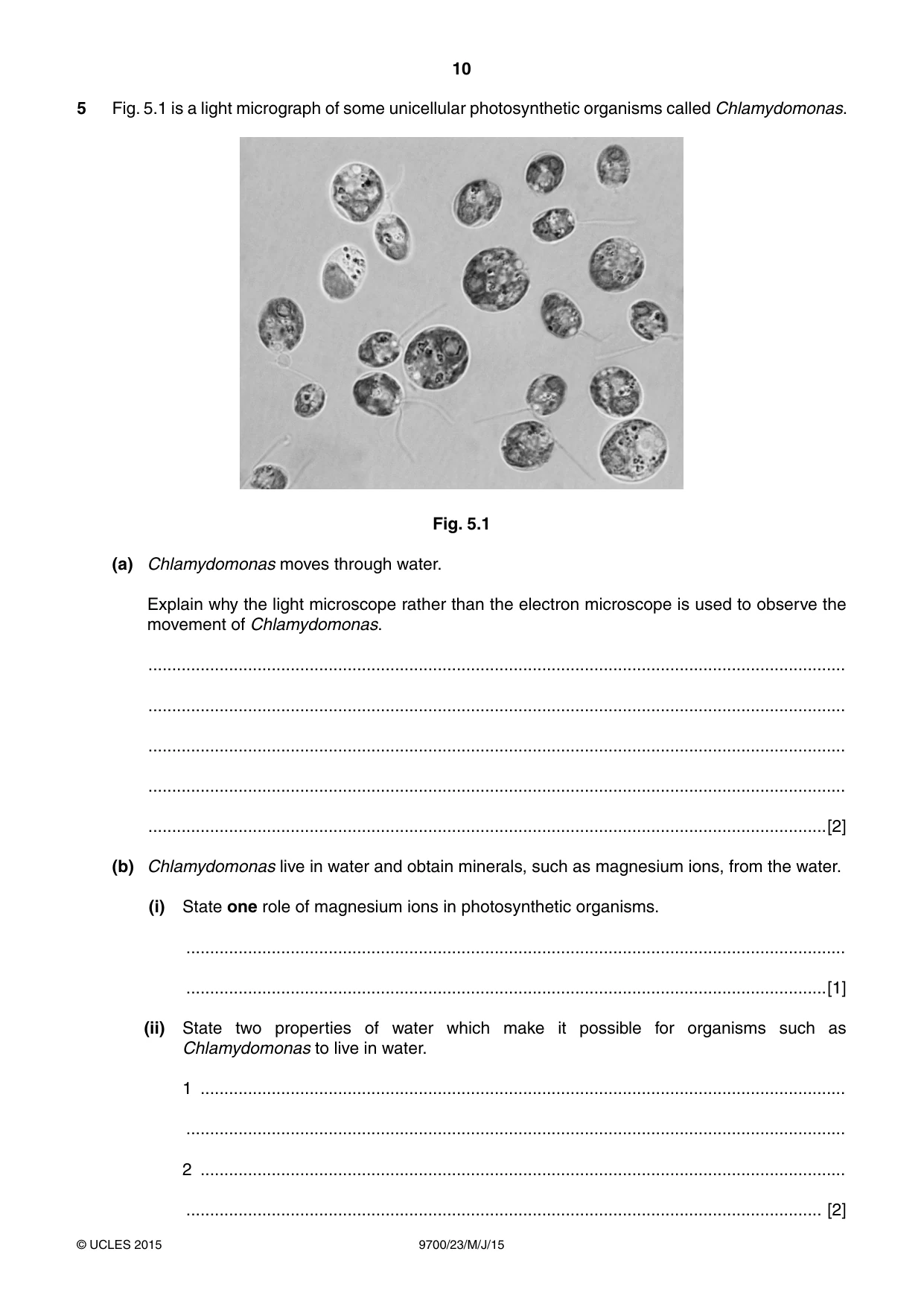
10 9700/23/M/J/15 © UCLES 2015 5 Fig. 5.1 is a light micrograph of some unicellular photosynthetic organisms called Chlamydomonas. Fig. 5.1 (a) Chlamydomonas moves through water. Explain why the light microscope rather than the electron microscope is used to observe the movement of Chlamydomonas. … … … … …[2] (b) Chlamydomonas live in water and obtain minerals, such as magnesium ions, from the water. (i) State one role of magnesium ions in photosynthetic organisms. … …[1] (ii) State two properties of water which make it possible for organisms such as Chlamydomonas to live in water. 1 … … 2 … … [2]
Question paper, page 11
11 9700/23/M/J/15 © UCLES 2015 [Turn over (c) Explain why multicellular organisms require transport systems while unicellular organisms, such as Chlamydomonas, do not. … … … … … … … … …[4] (d) Some plants, such as the banana plant, Musa acuminata, produce fruit. The banana fruit has a high content of carbohydrate. Describe how sugars are transported in phloem sieve tubes from source to sink in plants such as M. acuminata. … … … … … … … … … … …[5] [Total: 14]
Question paper, page 12
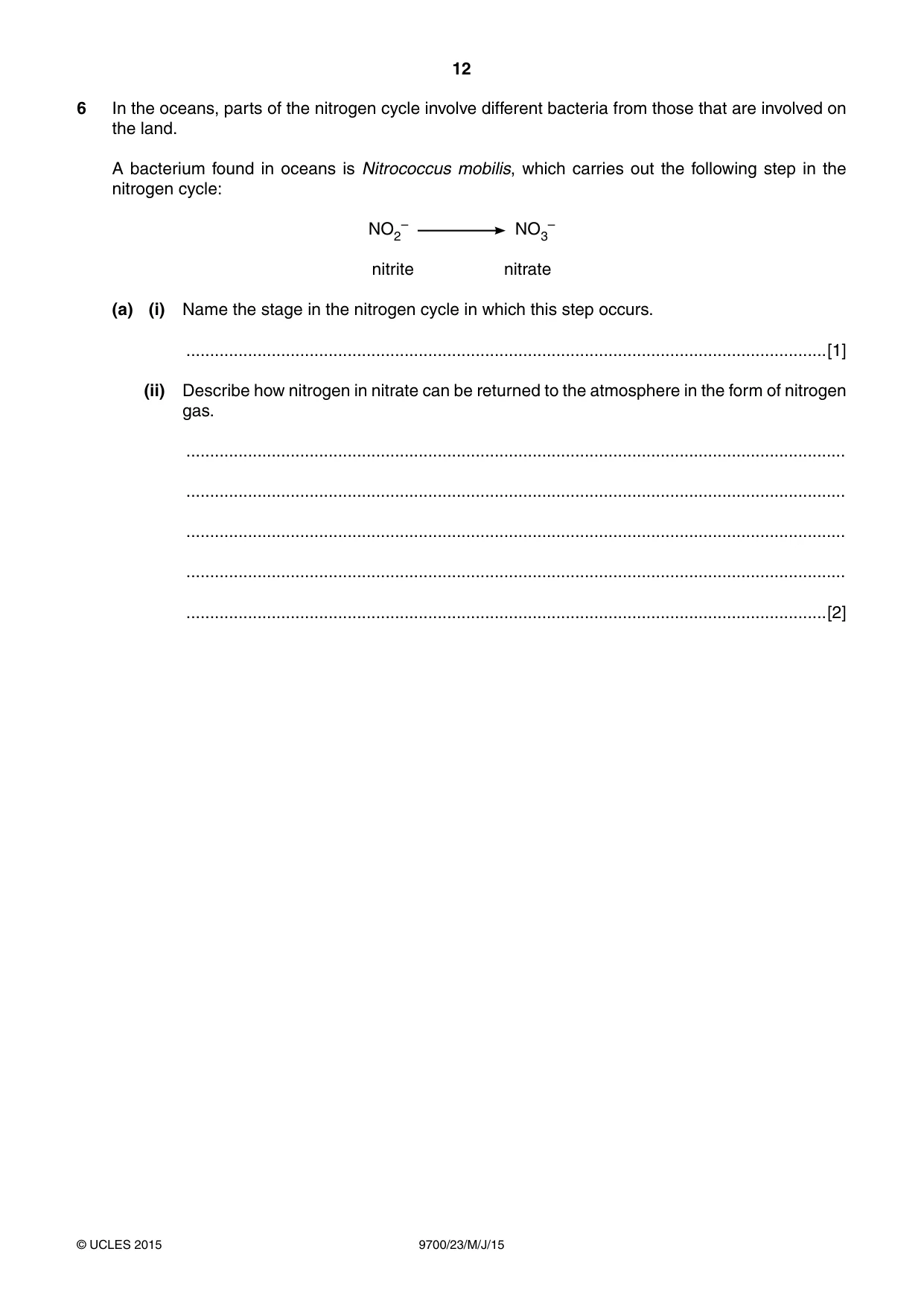
12 9700/23/M/J/15 © UCLES 2015 6 In the oceans, parts of the nitrogen cycle involve different bacteria from those that are involved on the land. A bacterium found in oceans is Nitrococcus mobilis, which carries out the following step in the nitrogen cycle: NO2 – NO3 – nitrite nitrate (a) (i) Name the stage in the nitrogen cycle in which this step occurs. …[1] (ii) Describe how nitrogen in nitrate can be returned to the atmosphere in the form of nitrogen gas. … … … … …[2]
Question paper, page 13
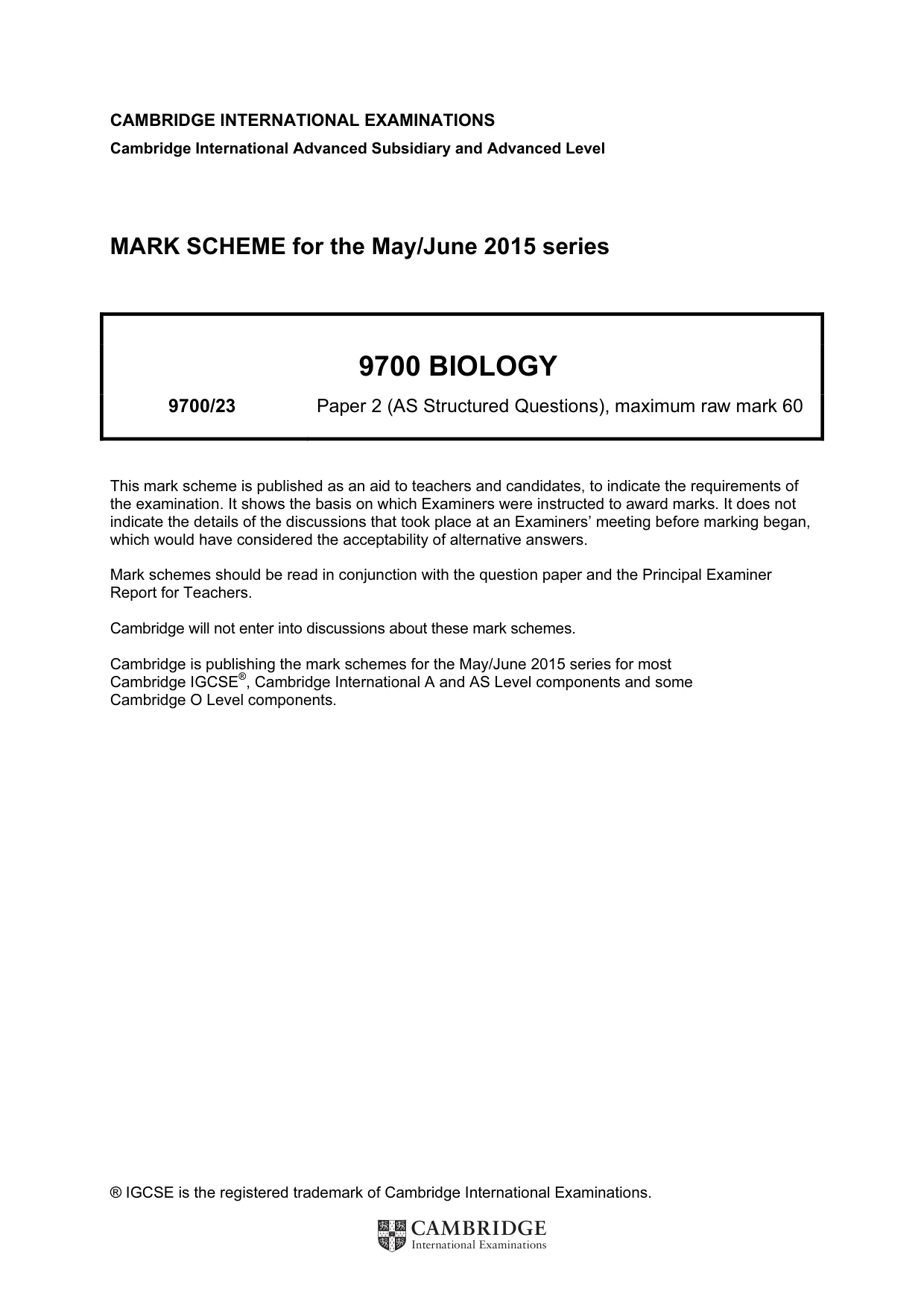
13 9700/23/M/J/15 © UCLES 2015 (b) Phytoplankton are microscopic photosynthetic organisms that are the main producers in ocean ecosystems. Their habitat is the upper layers of the oceans where sunlight can penetrate through the water. Define the terms: (i) ecosystem … … …[2] (ii) producer … … …[1] (iii) habitat. … … …[1] [Total: 7]
Question paper, page 14
14 9700/23/M/J/15 © UCLES 2015 BLANK PAGE
Question paper, page 15
15 9700/23/M/J/15 © UCLES 2015 BLANK PAGE
Question paper, page 16
16 9700/23/M/J/15 © UCLES 2015 Permission to reproduce items where third-party owned material protected by copyright is included has been sought and cleared where possible. Every reasonable effort has been made by the publisher (UCLES) to trace copyright holders, but if any items requiring clearance have unwittingly been included, the publisher will be pleased to make amends at the earliest possible opportunity. To avoid the issue of disclosure of answer-related information to candidates, all copyright acknowledgements are reproduced online in the Cambridge International Examinations Copyright Acknowledgements Booklet. This is produced for each series of examinations and is freely available to download at www.cie.org.uk after the live examination series. Cambridge International Examinations is part of the Cambridge Assessment Group. Cambridge Assessment is the brand name of University of Cambridge Local Examinations Syndicate (UCLES), which is itself a department of the University of Cambridge. BLANK PAGE
Mark scheme, page 1
® IGCSE is the registered trademark of Cambridge International Examinations. CAMBRIDGE INTERNATIONAL EXAMINATIONS Cambridge International Advanced Subsidiary and Advanced Level MARK SCHEME for the May/June 2015 series 9700 BIOLOGY 9700/23 Paper 2 (AS Structured Questions), maximum raw mark 60 This mark scheme is published as an aid to teachers and candidates, to indicate the requirements of the examination. It shows the basis on which Examiners were instructed to award marks. It does not indicate the details of the discussions that took place at an Examiners’ meeting before marking began, which would have considered the acceptability of alternative answers. Mark schemes should be read in conjunction with the question paper and the Principal Examiner Report for Teachers. Cambridge will not enter into discussions about these mark schemes. Cambridge is publishing the mark schemes for the May/June 2015 series for most Cambridge IGCSE®, Cambridge International A and AS Level components and some Cambridge O Level components.
Mark scheme, page 2
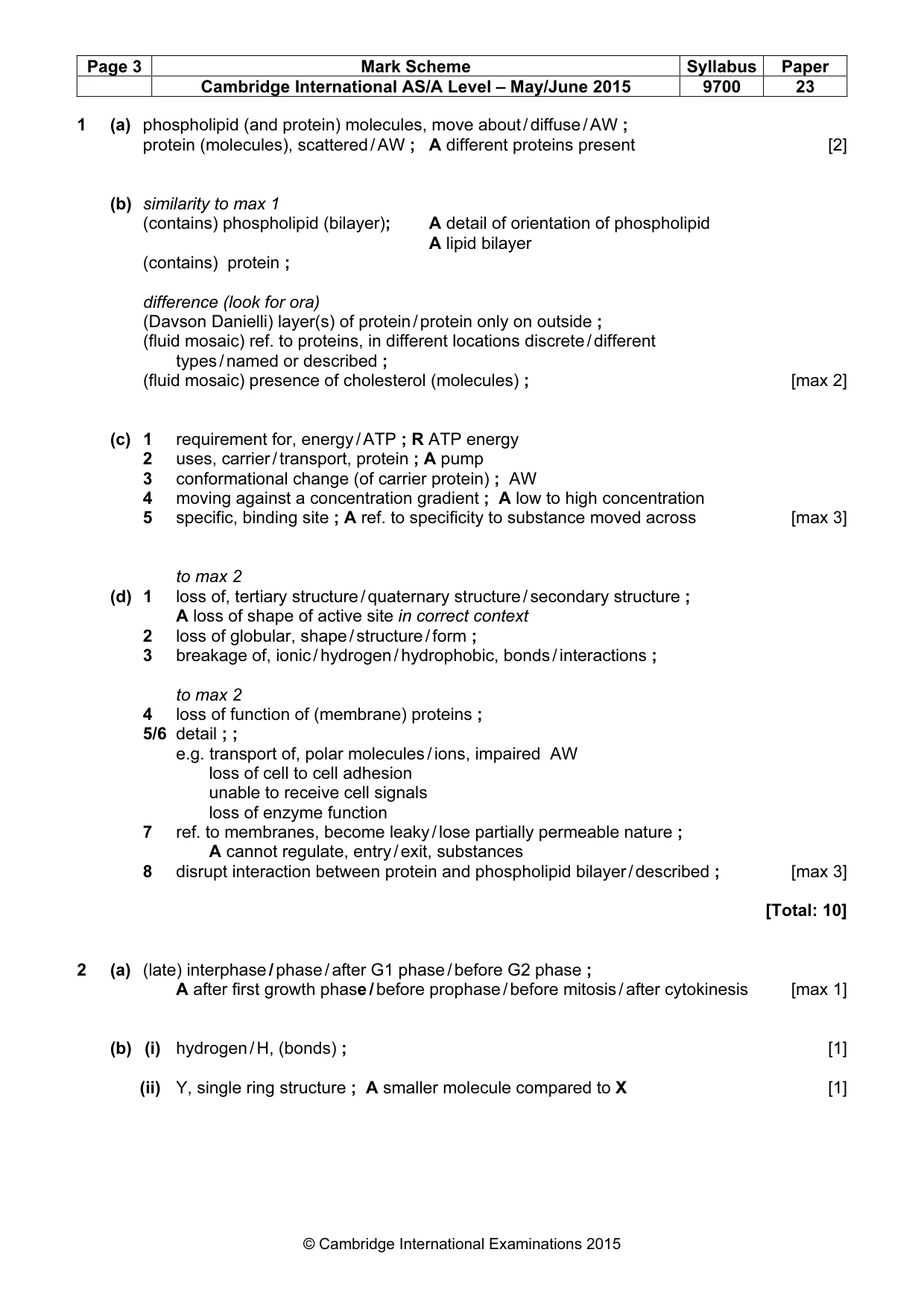
Page 2 Mark Scheme Syllabus Paper Cambridge International AS/A Level – May/June 2015 9700 23 © Cambridge International Examinations 2015 Mark scheme abbreviations: ; separates marking points / alternative answers for the same point R reject A accept (for answers correctly cued by the question, or by extra guidance) AW alternative wording (where responses vary more than usual) underline actual word given must be used by candidate (grammatical variants accepted) max indicates the maximum number of marks that can be given ora or reverse argument mp marking point (with relevant number) ecf error carried forward I ignore
Mark scheme, page 3
Page 3 Mark Scheme Syllabus Paper Cambridge International AS/A Level – May/June 2015 9700 23 © Cambridge International Examinations 2015 1 (a) phospholipid (and protein) molecules, move about / diffuse / AW ; protein (molecules), scattered / AW ; A different proteins present [2] (b) similarity to max 1 (contains) phospholipid (bilayer); A detail of orientation of phospholipid A lipid bilayer (contains) protein ; difference (look for ora) (Davson Danielli) layer(s) of protein / protein only on outside ; (fluid mosaic) ref. to proteins, in different locations discrete / different types / named or described ; (fluid mosaic) presence of cholesterol (molecules) ; [max 2] (c) 1 requirement for, energy / ATP ; R ATP energy 2 uses, carrier / transport, protein ; A pump 3 conformational change (of carrier protein) ; AW 4 moving against a concentration gradient ; A low to high concentration 5 specific, binding site ; A ref. to specificity to substance moved across [max 3] to max 2 (d) 1 loss of, tertiary structure / quaternary structure / secondary structure ; A loss of shape of active site in correct context 2 loss of globular, shape / structure / form ; 3 breakage of, ionic / hydrogen / hydrophobic, bonds / interactions ; to max 2 4 loss of function of (membrane) proteins ; 5/6 detail ; ; e.g. transport of, polar molecules / ions, impaired AW loss of cell to cell adhesion unable to receive cell signals loss of enzyme function 7 ref. to membranes, become leaky / lose partially permeable nature ; A cannot regulate, entry / exit, substances 8 disrupt interaction between protein and phospholipid bilayer / described ; [max 3] [Total: 10] 2 (a) (late) interphase / phase / after G1 phase / before G2 phase ; A after first growth phase / before prophase / before mitosis / after cytokinesis [max 1] (b) (i) hydrogen / H, (bonds) ; [1] (ii) Y, single ring structure ; A smaller molecule compared to X [1]
Mark scheme, page 4
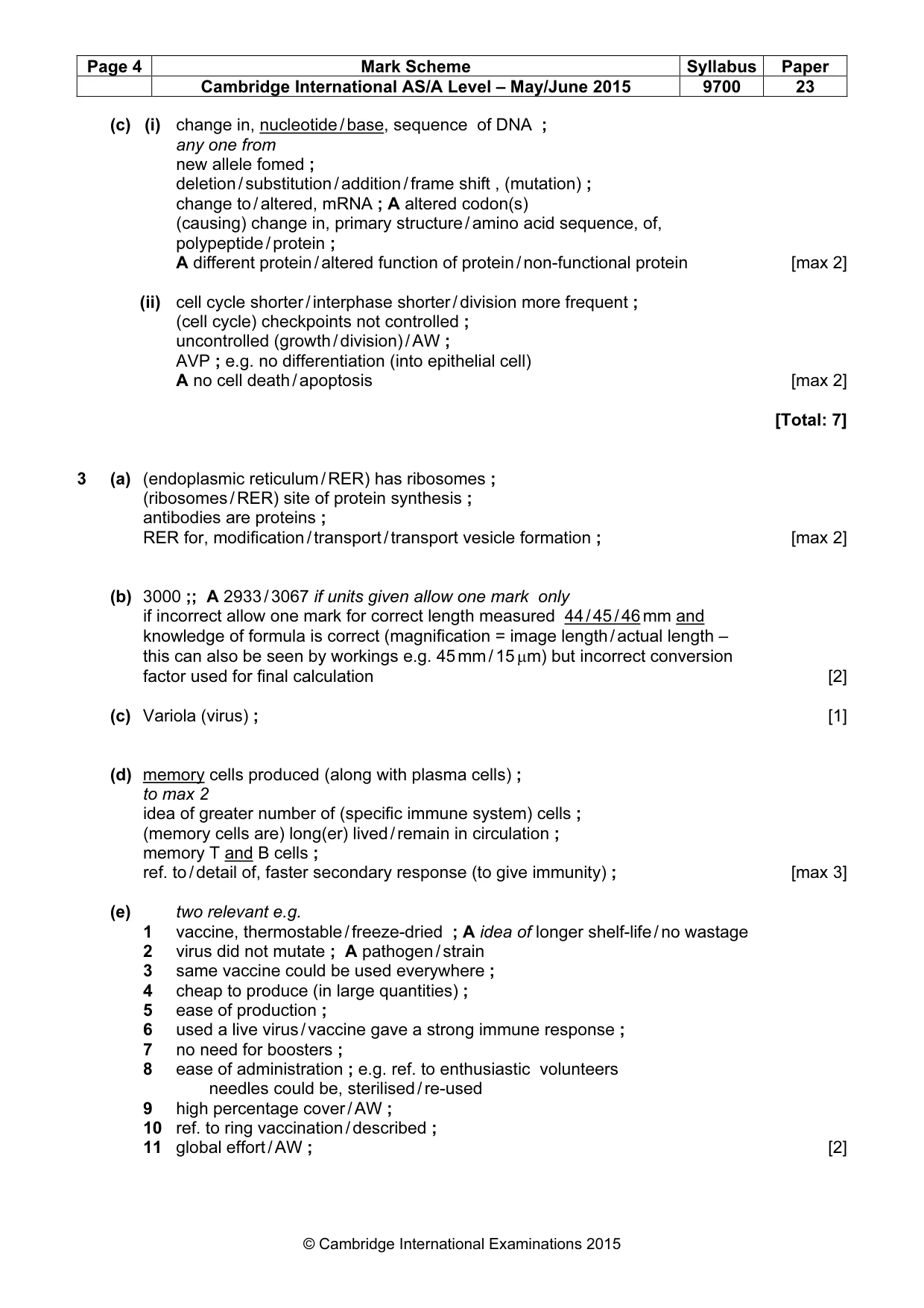
Page 4 Mark Scheme Syllabus Paper Cambridge International AS/A Level – May/June 2015 9700 23 © Cambridge International Examinations 2015 (c) (i) change in, nucleotide / base, sequence of DNA ; any one from new allele fomed ; deletion / substitution / addition / frame shift , (mutation) ; change to / altered, mRNA ; A altered codon(s) (causing) change in, primary structure / amino acid sequence, of, polypeptide / protein ; A different protein / altered function of protein / non-functional protein [max 2] (ii) cell cycle shorter / interphase shorter / division more frequent ; (cell cycle) checkpoints not controlled ; uncontrolled (growth / division) / AW ; AVP ; e.g. no differentiation (into epithelial cell) A no cell death / apoptosis [max 2] [Total: 7] 3 (a) (endoplasmic reticulum / RER) has ribosomes ; (ribosomes / RER) site of protein synthesis ; antibodies are proteins ; RER for, modification / transport / transport vesicle formation ; [max 2] (b) 3000 ;; A 2933 / 3067 if units given allow one mark only if incorrect allow one mark for correct length measured 44 / 45 / 46 mm and knowledge of formula is correct (magnification = image length / actual length – this can also be seen by workings e.g. 45 mm / 15 µm) but incorrect conversion factor used for final calculation [2] (c) Variola (virus) ; [1] (d) memory cells produced (along with plasma cells) ; to max 2 idea of greater number of (specific immune system) cells ; (memory cells are) long(er) lived / remain in circulation ; memory T and B cells ; ref. to / detail of, faster secondary response (to give immunity) ; [max 3] (e) two relevant e.g. 1 vaccine, thermostable / freeze-dried ; A idea of longer shelf-life / no wastage 2 virus did not mutate ; A pathogen / strain 3 same vaccine could be used everywhere ; 4 cheap to produce (in large quantities) ; 5 ease of production ; 6 used a live virus / vaccine gave a strong immune response ; 7 no need for boosters ; 8 ease of administration ; e.g. ref. to enthusiastic volunteers needles could be, sterilised / re-used 9 high percentage cover / AW ; 10 ref. to ring vaccination / described ; 11 global effort / AW ; [2]
Mark scheme, page 5
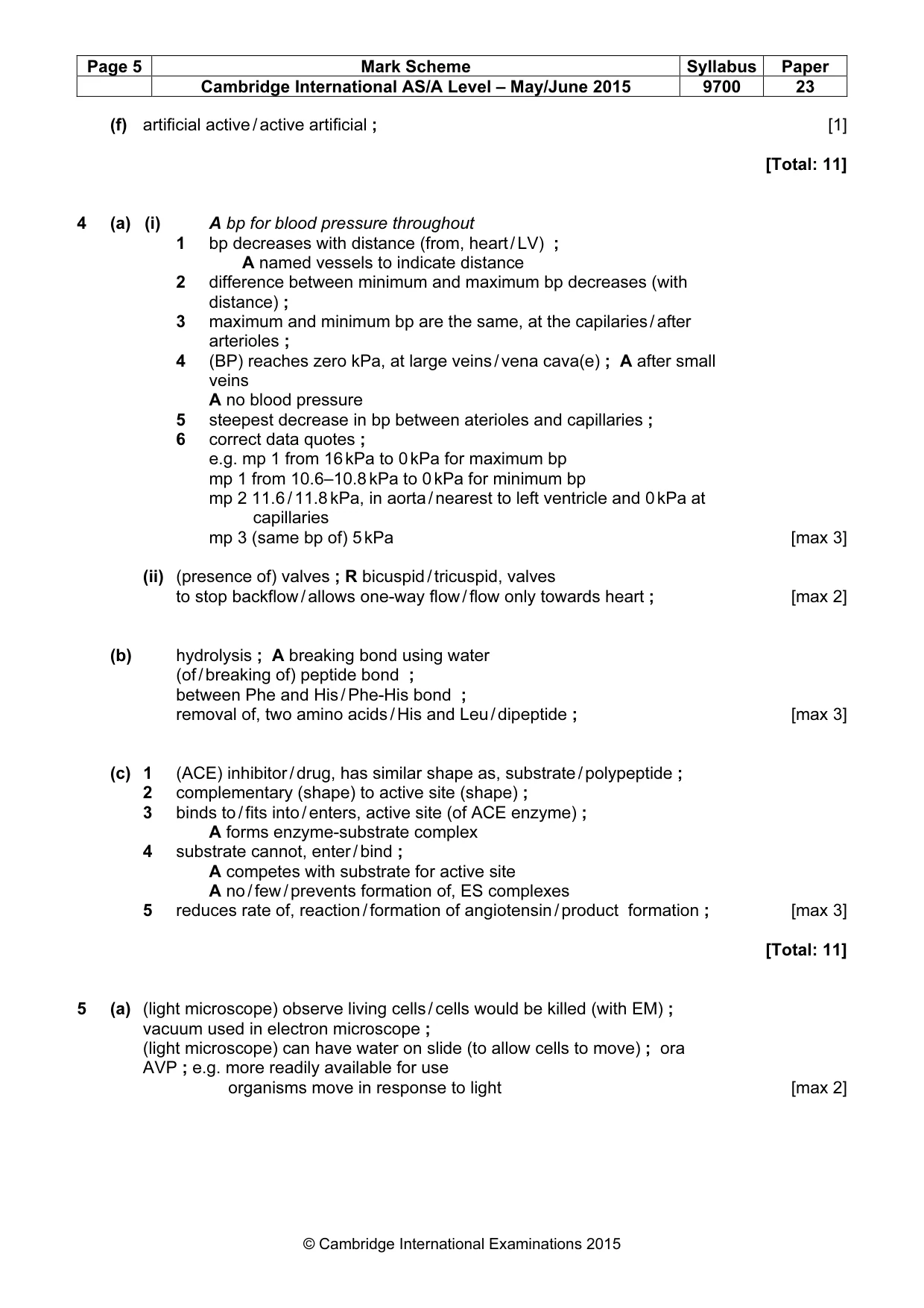
Page 5 Mark Scheme Syllabus Paper Cambridge International AS/A Level – May/June 2015 9700 23 © Cambridge International Examinations 2015 (f) artificial active / active artificial ; [1] [Total: 11] 4 (a) (i) A bp for blood pressure throughout 1 bp decreases with distance (from, heart / LV) ; A named vessels to indicate distance 2 difference between minimum and maximum bp decreases (with distance) ; 3 maximum and minimum bp are the same, at the capilaries / after arterioles ; 4 (BP) reaches zero kPa, at large veins / vena cava(e) ; A after small veins A no blood pressure 5 steepest decrease in bp between aterioles and capillaries ; 6 correct data quotes ; e.g. mp 1 from 16 kPa to 0 kPa for maximum bp mp 1 from 10.6–10.8 kPa to 0 kPa for minimum bp mp 2 11.6 / 11.8 kPa, in aorta / nearest to left ventricle and 0 kPa at capillaries mp 3 (same bp of) 5 kPa [max 3] (ii) (presence of) valves ; R bicuspid / tricuspid, valves to stop backflow / allows one-way flow / flow only towards heart ; [max 2] (b) hydrolysis ; A breaking bond using water (of / breaking of) peptide bond ; between Phe and His / Phe-His bond ; removal of, two amino acids / His and Leu / dipeptide ; [max 3] (c) 1 (ACE) inhibitor / drug, has similar shape as, substrate / polypeptide ; 2 complementary (shape) to active site (shape) ; 3 binds to / fits into / enters, active site (of ACE enzyme) ; A forms enzyme-substrate complex 4 substrate cannot, enter / bind ; A competes with substrate for active site A no / few / prevents formation of, ES complexes 5 reduces rate of, reaction / formation of angiotensin / product formation ; [max 3] [Total: 11] 5 (a) (light microscope) observe living cells / cells would be killed (with EM) ; vacuum used in electron microscope ; (light microscope) can have water on slide (to allow cells to move) ; ora AVP ; e.g. more readily available for use organisms move in response to light [max 2]
Mark scheme, page 6
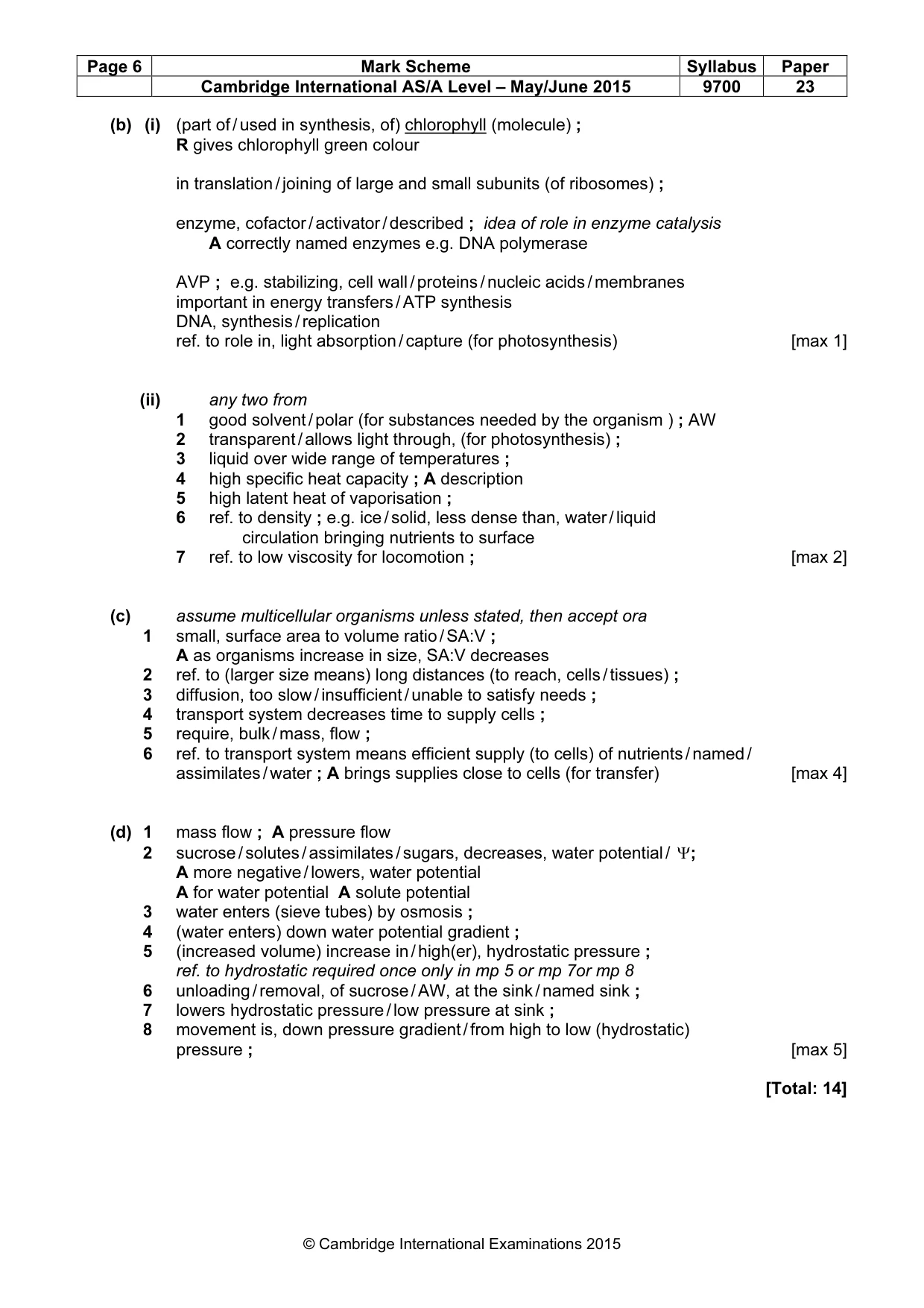
Page 6 Mark Scheme Syllabus Paper Cambridge International AS/A Level – May/June 2015 9700 23 © Cambridge International Examinations 2015 (b) (i) (part of / used in synthesis, of) chlorophyll (molecule) ; R gives chlorophyll green colour in translation / joining of large and small subunits (of ribosomes) ; enzyme, cofactor / activator / described ; idea of role in enzyme catalysis A correctly named enzymes e.g. DNA polymerase AVP ; e.g. stabilizing, cell wall / proteins / nucleic acids / membranes important in energy transfers / ATP synthesis DNA, synthesis / replication ref. to role in, light absorption / capture (for photosynthesis) [max 1] (ii) any two from 1 good solvent / polar (for substances needed by the organism ) ; AW 2 transparent / allows light through, (for photosynthesis) ; 3 liquid over wide range of temperatures ; 4 high specific heat capacity ; A description 5 high latent heat of vaporisation ; 6 ref. to density ; e.g. ice / solid, less dense than, water / liquid circulation bringing nutrients to surface 7 ref. to low viscosity for locomotion ; [max 2] (c) assume multicellular organisms unless stated, then accept ora 1 small, surface area to volume ratio / SA:V ; A as organisms increase in size, SA:V decreases 2 ref. to (larger size means) long distances (to reach, cells / tissues) ; 3 diffusion, too slow / insufficient / unable to satisfy needs ; 4 transport system decreases time to supply cells ; 5 require, bulk / mass, flow ; 6 ref. to transport system means efficient supply (to cells) of nutrients / named / assimilates / water ; A brings supplies close to cells (for transfer) [max 4] (d) 1 mass flow ; A pressure flow 2 sucrose / solutes / assimilates / sugars, decreases, water potential / Ψ; A more negative / lowers, water potential A for water potential A solute potential 3 water enters (sieve tubes) by osmosis ; 4 (water enters) down water potential gradient ; 5 (increased volume) increase in / high(er), hydrostatic pressure ; ref. to hydrostatic required once only in mp 5 or mp 7or mp 8 6 unloading / removal, of sucrose / AW, at the sink / named sink ; 7 lowers hydrostatic pressure / low pressure at sink ; 8 movement is, down pressure gradient / from high to low (hydrostatic) pressure ; [max 5] [Total: 14]
Mark scheme, page 7
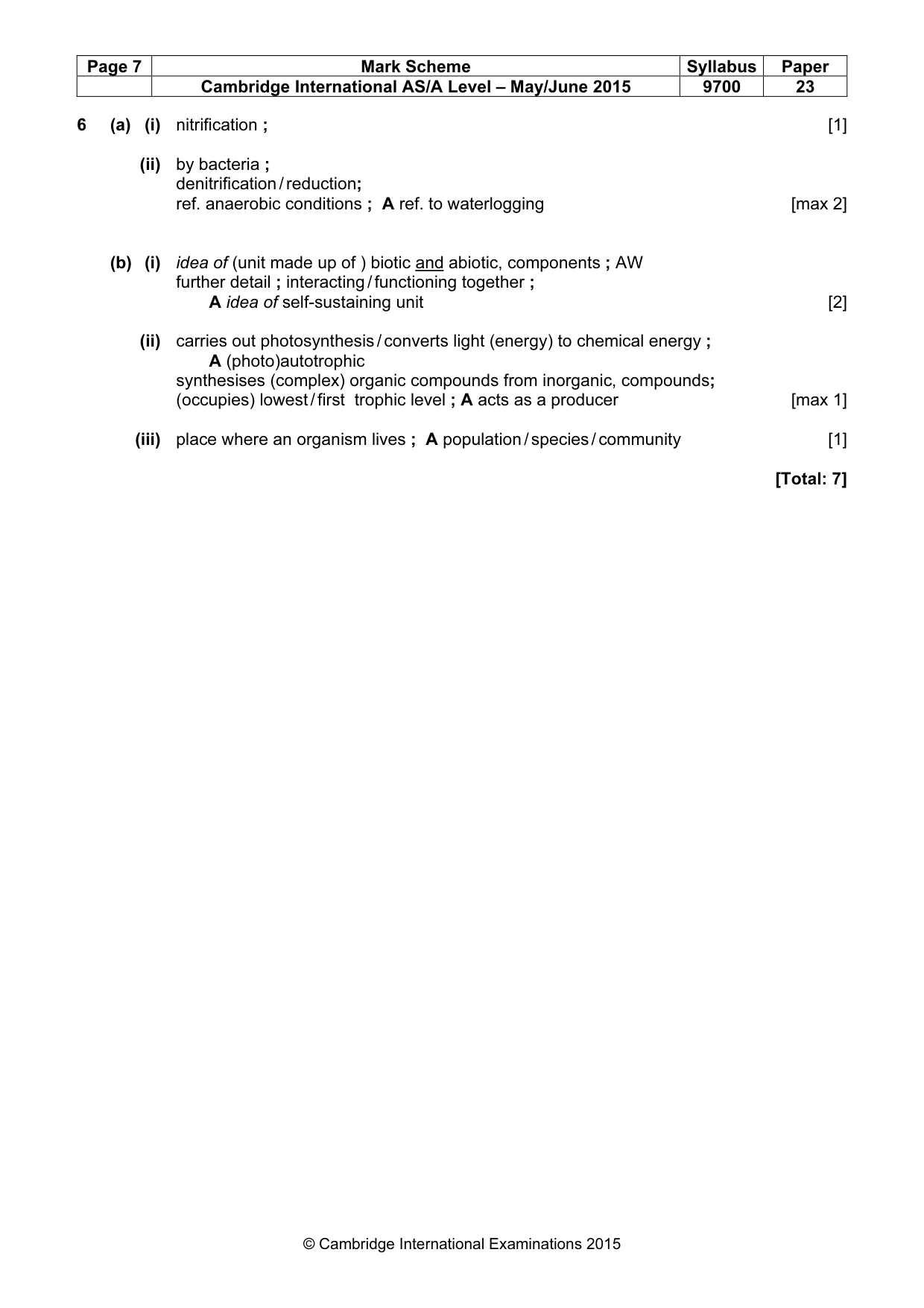
Page 7 Mark Scheme Syllabus Paper Cambridge International AS/A Level – May/June 2015 9700 23 © Cambridge International Examinations 2015 6 (a) (i) nitrification ; [1] (ii) by bacteria ; denitrification / reduction; ref. anaerobic conditions ; A ref. to waterlogging [max 2] (b) (i) idea of (unit made up of ) biotic and abiotic, components ; AW further detail ; interacting / functioning together ; A idea of self-sustaining unit [2] (ii) carries out photosynthesis / converts light (energy) to chemical energy ; A (photo)autotrophic synthesises (complex) organic compounds from inorganic, compounds; (occupies) lowest / first trophic level ; A acts as a producer [max 1] (iii) place where an organism lives ; A population / species / community [1] [Total: 7]
What you needed in this session
Cambridge’s own grade thresholds for 2015 May/June, Paper 2 · Variant 3. A higher threshold means an easier paper — the bar moves with how the cohort did.