Cambridge A Level Biology 9700 — 2015 May/June Paper 2 · Variant 2
9700/22/M/J/15 · 60 marks · ≈68 min
The question paper and its mark scheme, free to read here and free to download. This is Cambridge’s own paper, exactly as it was sat.
Question paper16 pages
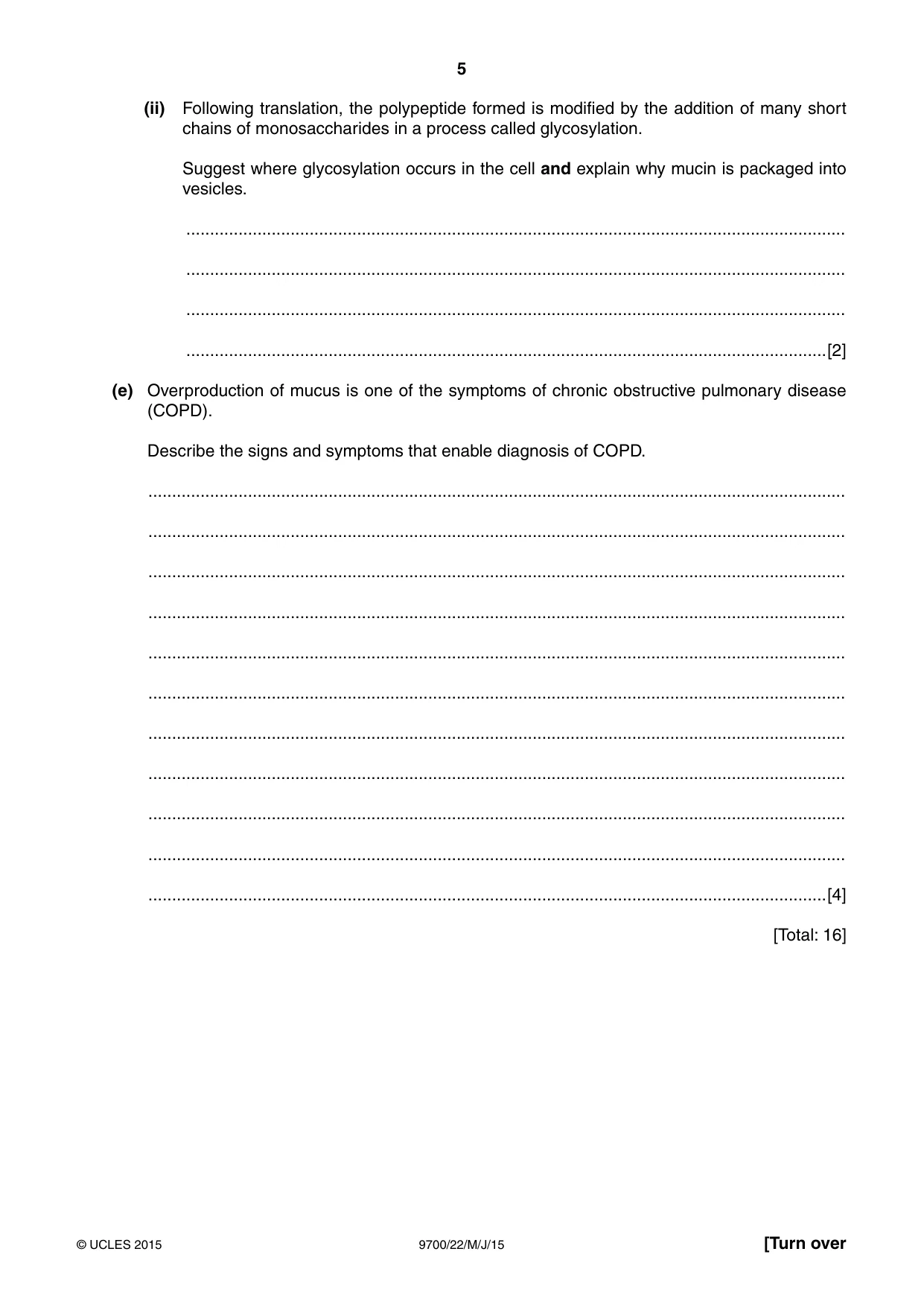
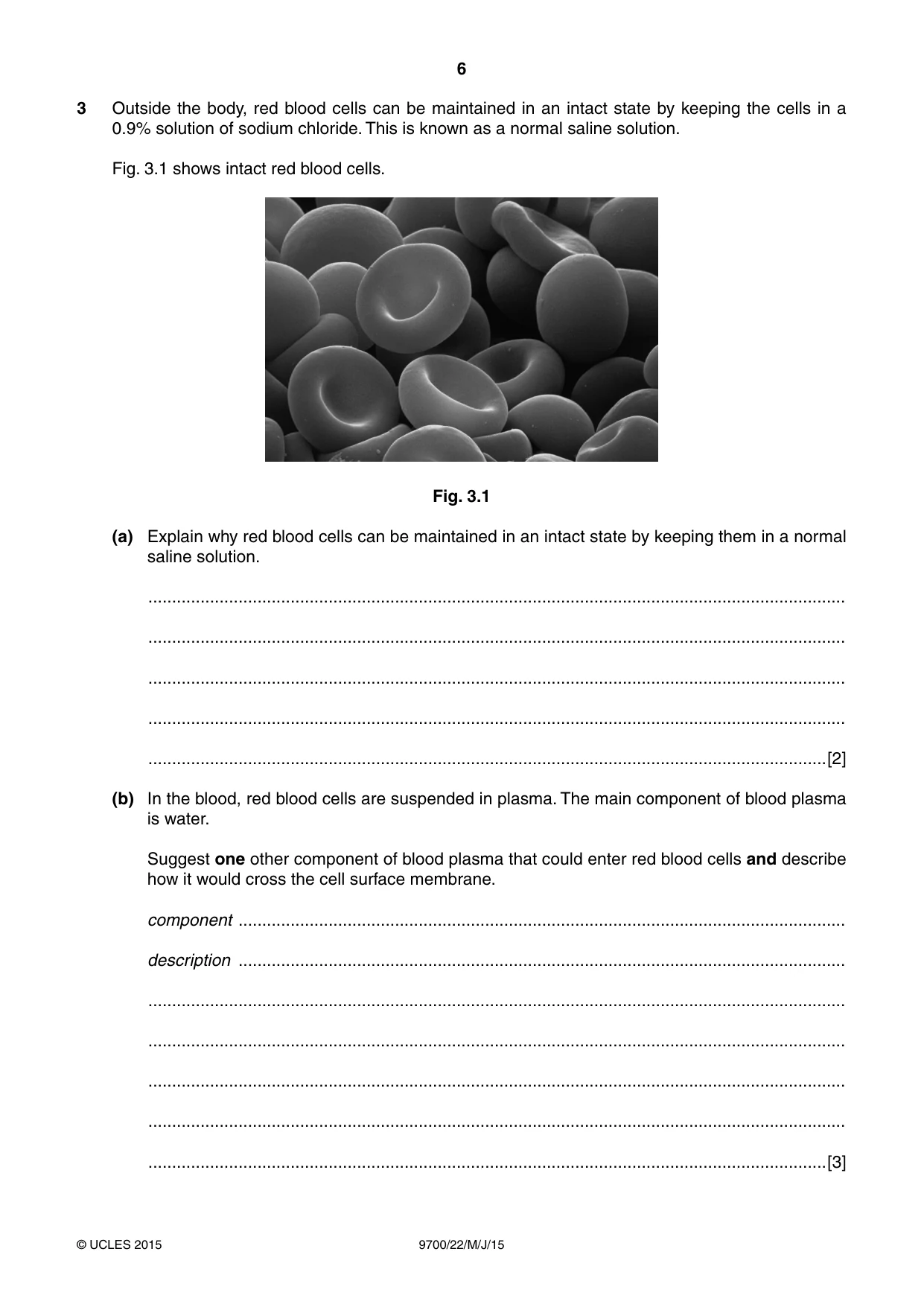
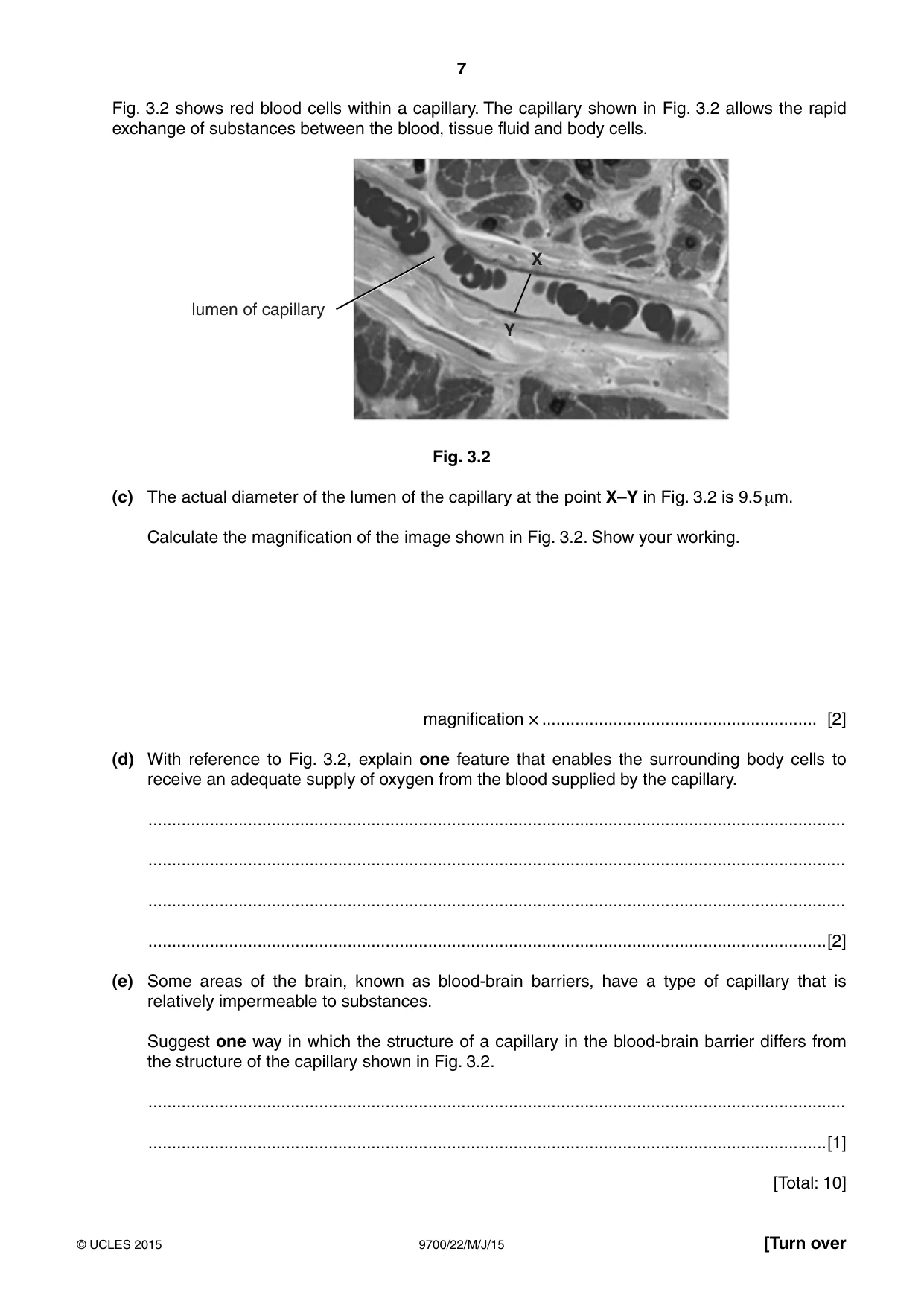
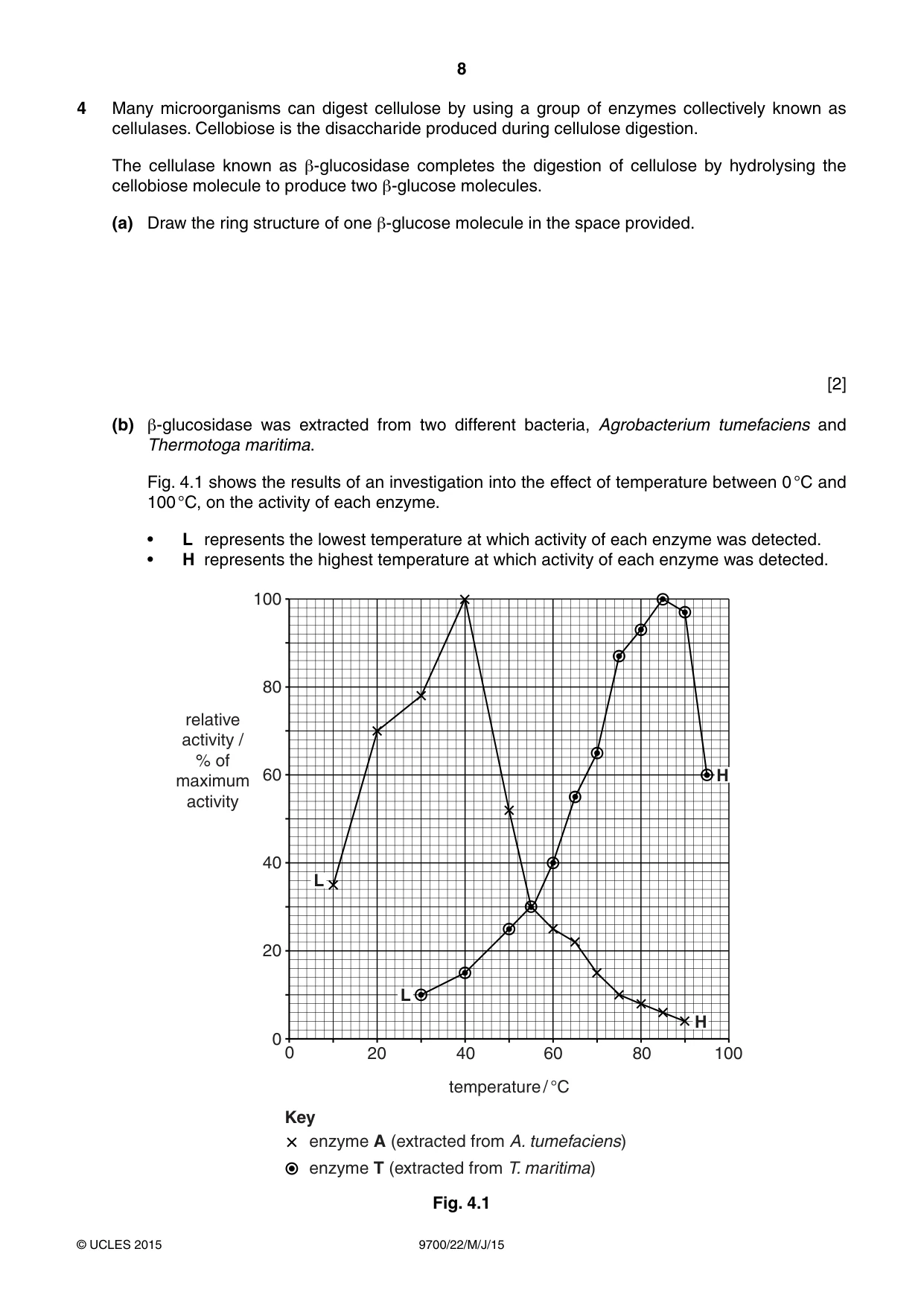



Mark scheme10 pages
Answers below. Sit the paper first if you are practising.
Paper as text
Question paper, page 1
This document consists of 13 printed pages and 3 blank pages. DC (ST/JG) 95554/3 © UCLES 2015 [Turn over Cambridge International Examinations Cambridge International Advanced Subsidiary and Advanced Level * 7 8 3 3 0 3 8 7 1 9 * BIOLOGY 9700/22 Paper 2 Structured Questions AS May/June 2015 1 hour 15 minutes Candidates answer on the Question Paper. No Additional Materials are required. READ THESE INSTRUCTIONS FIRST Write your Centre number, candidate number and name in the spaces at the top of the page. Write in dark blue or black pen. You may use an HB pencil for any diagrams or graphs. Do not use staples, paper clips, glue or correction fluid. DO NOT WRITE IN ANY BARCODES. Answer all questions. Electronic calculators may be used. You may lose marks if you do not show your working or if you do not use appropriate units. At the end of the examination, fasten all your work securely together. The number of marks is given in brackets [ ] at the end of each question or part question.
Question paper, page 2
2 9700/22/M/J/15 © UCLES 2015 Answer all the questions. 1 Each of statements A to E describe a structure associated with the mammalian heart. For each statement, identify the structure that is being described. A The chamber that pumps blood into the pulmonary artery. … B A blood vessel that transports deoxygenated blood into the right atrium. … C The specialised tissue responsible for delaying the conduction of impulses from the atria to the ventricles. … D The blood vessels that supply cardiac muscle with oxygenated blood. … E The valve that prevents the backflow of blood from the ventricle that contains oxygenated blood. … [5] [Total: 5]
Question paper, page 3
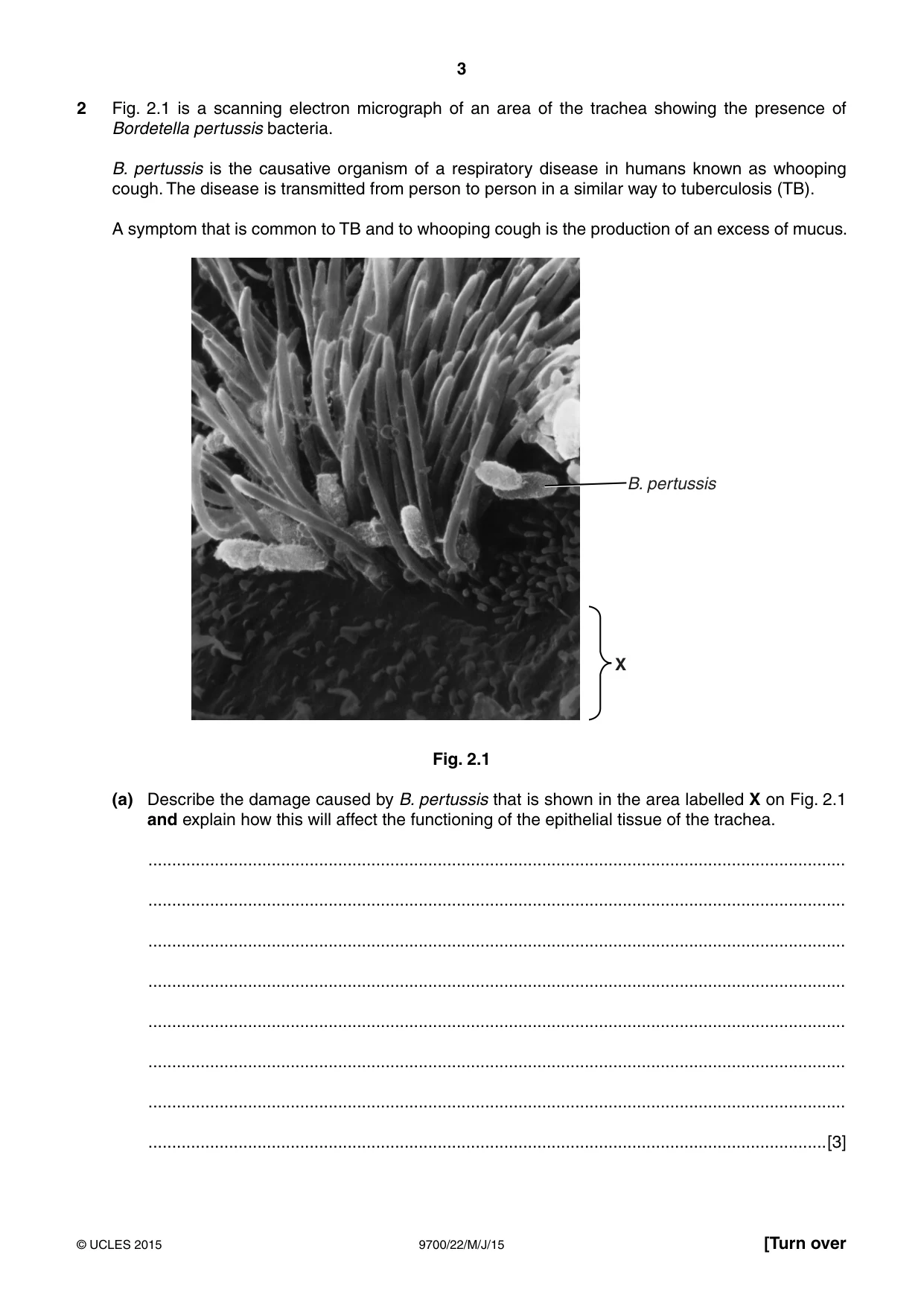
3 9700/22/M/J/15 © UCLES 2015 [Turn over 2 Fig. 2.1 is a scanning electron micrograph of an area of the trachea showing the presence of Bordetella pertussis bacteria. B. pertussis is the causative organism of a respiratory disease in humans known as whooping cough. The disease is transmitted from person to person in a similar way to tuberculosis (TB). A symptom that is common to TB and to whooping cough is the production of an excess of mucus. B. pertussis X Fig. 2.1 (a) Describe the damage caused by B. pertussis that is shown in the area labelled X on Fig. 2.1 and explain how this will affect the functioning of the epithelial tissue of the trachea. … … … … … … … …[3]
Question paper, page 4
4 9700/22/M/J/15 © UCLES 2015 (b) Goblet cells produce mucus. Name one other structure in the gas exchange system that also produces mucus. …[1] (c) Suggest how whooping cough is transmitted. … … … …[2] (d) The presence of B. pertussis stimulates the production of mucin, a gel-like glycoprotein that is the main component of mucus. The mucin produced by the cell is packaged into vesicles ready for exocytosis. (i) The first stage in the production of mucin involves transcription of the gene MUC5AC. Outline the stages occurring in transcription. … … … … … … … … … … … …[4]
Question paper, page 5
5 9700/22/M/J/15 © UCLES 2015 [Turn over (ii) Following translation, the polypeptide formed is modified by the addition of many short chains of monosaccharides in a process called glycosylation. Suggest where glycosylation occurs in the cell and explain why mucin is packaged into vesicles. … … … …[2] (e) Overproduction of mucus is one of the symptoms of chronic obstructive pulmonary disease (COPD). Describe the signs and symptoms that enable diagnosis of COPD. … … … … … … … … … … …[4] [Total: 16]
Question paper, page 6
6 9700/22/M/J/15 © UCLES 2015 3 Outside the body, red blood cells can be maintained in an intact state by keeping the cells in a 0.9% solution of sodium chloride. This is known as a normal saline solution. Fig. 3.1 shows intact red blood cells. Fig. 3.1 (a) Explain why red blood cells can be maintained in an intact state by keeping them in a normal saline solution. … … … … …[2] (b) In the blood, red blood cells are suspended in plasma. The main component of blood plasma is water. Suggest one other component of blood plasma that could enter red blood cells and describe how it would cross the cell surface membrane. component … description … … … … … …[3]
Question paper, page 7
7 9700/22/M/J/15 © UCLES 2015 [Turn over Fig. 3.2 shows red blood cells within a capillary. The capillary shown in Fig. 3.2 allows the rapid exchange of substances between the blood, tissue fluid and body cells. X Y lumen of capillary Fig. 3.2 (c) The actual diameter of the lumen of the capillary at the point X–Y in Fig. 3.2 is 9.5 μm. Calculate the magnification of the image shown in Fig. 3.2. Show your working. magnification × … [2] (d) With reference to Fig. 3.2, explain one feature that enables the surrounding body cells to receive an adequate supply of oxygen from the blood supplied by the capillary. … … … …[2] (e) Some areas of the brain, known as blood-brain barriers, have a type of capillary that is relatively impermeable to substances. Suggest one way in which the structure of a capillary in the blood-brain barrier differs from the structure of the capillary shown in Fig. 3.2. … …[1] [Total: 10]
Question paper, page 8
8 9700/22/M/J/15 © UCLES 2015 4 Many microorganisms can digest cellulose by using a group of enzymes collectively known as cellulases. Cellobiose is the disaccharide produced during cellulose digestion. The cellulase known as β-glucosidase completes the digestion of cellulose by hydrolysing the cellobiose molecule to produce two β-glucose molecules. (a) Draw the ring structure of one β-glucose molecule in the space provided. [2] (b) β-glucosidase was extracted from two different bacteria, Agrobacterium tumefaciens and Thermotoga maritima. Fig. 4.1 shows the results of an investigation into the effect of temperature between 0 °C and 100 °C, on the activity of each enzyme. • L represents the lowest temperature at which activity of each enzyme was detected. • H represents the highest temperature at which activity of each enzyme was detected. 0 0 20 40 60 80 100 20 40 60 80 100 temperature / °C enzyme A (extracted from A. tumefaciens) enzyme T (extracted from T. maritima) Key relative activity / % of maximum activity L L H H Fig. 4.1
Question paper, page 9
9 9700/22/M/J/15 © UCLES 2015 [Turn over (i) With reference to Fig. 4.1, describe the differences in the results for the two enzymes, A and T. … … … … … … … … …[4] (ii) Both enzyme A and enzyme T act on cellobiose. They have a similar, but not identical, primary structure. Suggest how similarities and differences in the primary structure of the two enzymes could help to explain the results obtained in the investigation. … … … … … … … … … … …[4] [Total: 10]
Question paper, page 10
10 9700/22/M/J/15 © UCLES 2015 5 (a) Natural immunity and artificial immunity can both be acquired in a passive or in an active manner. Table 5.1 shows information about immunity acquired by two individuals, P and Q. Complete Table 5.1. Table 5.1 description of event outcome for the individual production of memory cells / yes or no type of immunity acquired by individual individual P is injected with a live, weakened disease- causing organism individual P does not become ill from the disease and has long-lasting protection from the disease … … … individual Q is injected with antibody against a specific disease- causing organism individual Q does not become ill from the disease but is ill with the disease a year later … … … [2] Fig. 5.1 is a light micrograph of a sample of blood. Cell X is a phagocyte. X Fig. 5.1 (b) State the origin of the blood cell labelled X. …[1]
Question paper, page 11
11 9700/22/M/J/15 © UCLES 2015 [Turn over (c) Phagocytes play an important role when an immune response is initiated against cancerous tumour cells. (i) Suggest how phagocytes can recognise the difference between healthy body cells and cancerous tumour cells. … … … … …[2] (ii) Outline briefly how a tumour forms. … … … … …[2] [Total: 7]
Question paper, page 12
12 9700/22/M/J/15 © UCLES 2015 6 (a) Sentences (i) and (ii) are extracted from longer definitions of ecological terms. Each has one or more missing words. Complete (i) and (ii) using the correct terms chosen from the list below. a population a community an ecosystem a niche a habitat trophic level producers organisms consumers (i) ………………………………………………… is the particular location and type of local environment occupied by ………………………………………………… or organism, characterised by its physical features or by its dominant ………………………………………………… . [3] (ii) ………………………………………………… is the functional role or place of a species of organism within ………………………………………………… . [2] (b) Only a small proportion of the light energy striking the leaves of producers becomes converted to chemical energy. The proportion that is converted is known as the photosynthetic efficiency (PE). (i) Outline the possible reasons why a large proportion of light energy striking the leaves of plants is not converted into chemical energy. … … … … … … … … …[3]
Question paper, page 13
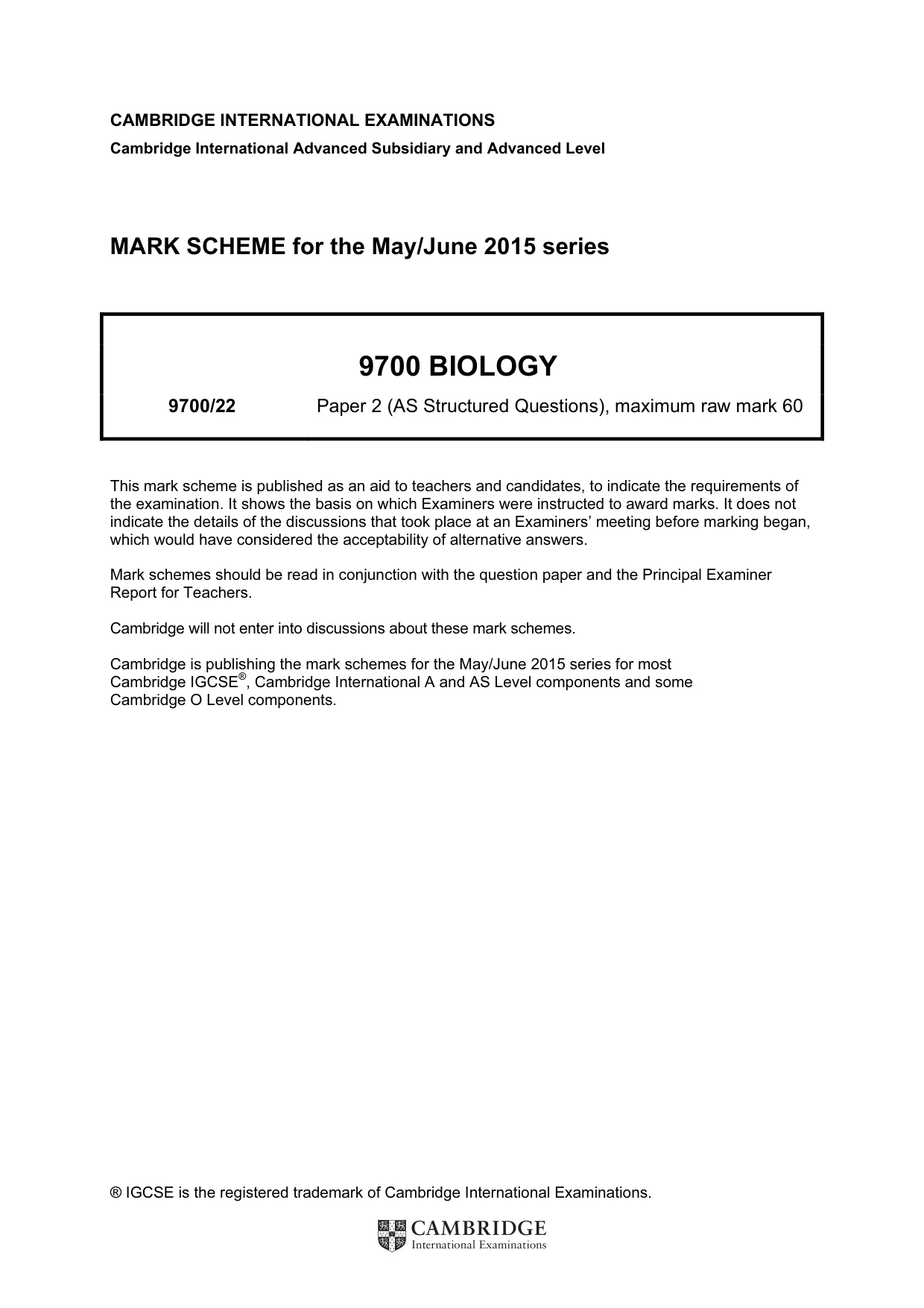
13 9700/22/M/J/15 © UCLES 2015 (ii) Most crops have a PE of 1% to 4%. Sugar cane, an important crop plant for food production and for the production of biofuel, has a PE of 7% to 8%. Suggest the advantages of growing crops with high PE for food production or for biofuel. … … …[2] (iii) Fertilisers containing nitrate are added to improve or maintain yield of crops such as sugar cane. Name two organic compounds containing nitrogen that are made by plants and state one function of each in plant growth. organic compound 1 … function … … organic compound 2 … function … … …[2] [Total: 12]
Question paper, page 14
14 9700/22/M/J/15 © UCLES 2015 BLANK PAGE
Question paper, page 15
15 9700/22/M/J/15 © UCLES 2015 BLANK PAGE
Question paper, page 16
16 9700/22/M/J/15 © UCLES 2015 Permission to reproduce items where third-party owned material protected by copyright is included has been sought and cleared where possible. Every reasonable effort has been made by the publisher (UCLES) to trace copyright holders, but if any items requiring clearance have unwittingly been included, the publisher will be pleased to make amends at the earliest possible opportunity. To avoid the issue of disclosure of answer-related information to candidates, all copyright acknowledgements are reproduced online in the Cambridge International Examinations Copyright Acknowledgements Booklet. This is produced for each series of examinations and is freely available to download at www.cie.org.uk after the live examination series. Cambridge International Examinations is part of the Cambridge Assessment Group. Cambridge Assessment is the brand name of University of Cambridge Local Examinations Syndicate (UCLES), which is itself a department of the University of Cambridge. BLANK PAGE
Mark scheme, page 1
® IGCSE is the registered trademark of Cambridge International Examinations. CAMBRIDGE INTERNATIONAL EXAMINATIONS Cambridge International Advanced Subsidiary and Advanced Level MARK SCHEME for the May/June 2015 series 9700 BIOLOGY 9700/22 Paper 2 (AS Structured Questions), maximum raw mark 60 This mark scheme is published as an aid to teachers and candidates, to indicate the requirements of the examination. It shows the basis on which Examiners were instructed to award marks. It does not indicate the details of the discussions that took place at an Examiners’ meeting before marking began, which would have considered the acceptability of alternative answers. Mark schemes should be read in conjunction with the question paper and the Principal Examiner Report for Teachers. Cambridge will not enter into discussions about these mark schemes. Cambridge is publishing the mark schemes for the May/June 2015 series for most Cambridge IGCSE®, Cambridge International A and AS Level components and some Cambridge O Level components.
Mark scheme, page 2
Page 2 Mark Scheme Syllabus Paper Cambridge International AS/A Level – May/June 2015 9700 22 © Cambridge International Examinations 2015 Mark scheme abbreviations ; separates marking points / alternative answers for the same point R reject A accept (for answers correctly cued by the equation, or by extra guidance) R reject A accept (for answers correctly cued by the question, or by extra guidance AW alternative wording (where responses vary more than usual) underline actual word given must be used by candidate (grammatical variants accepted) max indicates the maximum number of marks that can be given ora or reverse argument mp marking point (with relevant number) ecf error carried forward I ignore AVP alternative valid point
Mark scheme, page 3
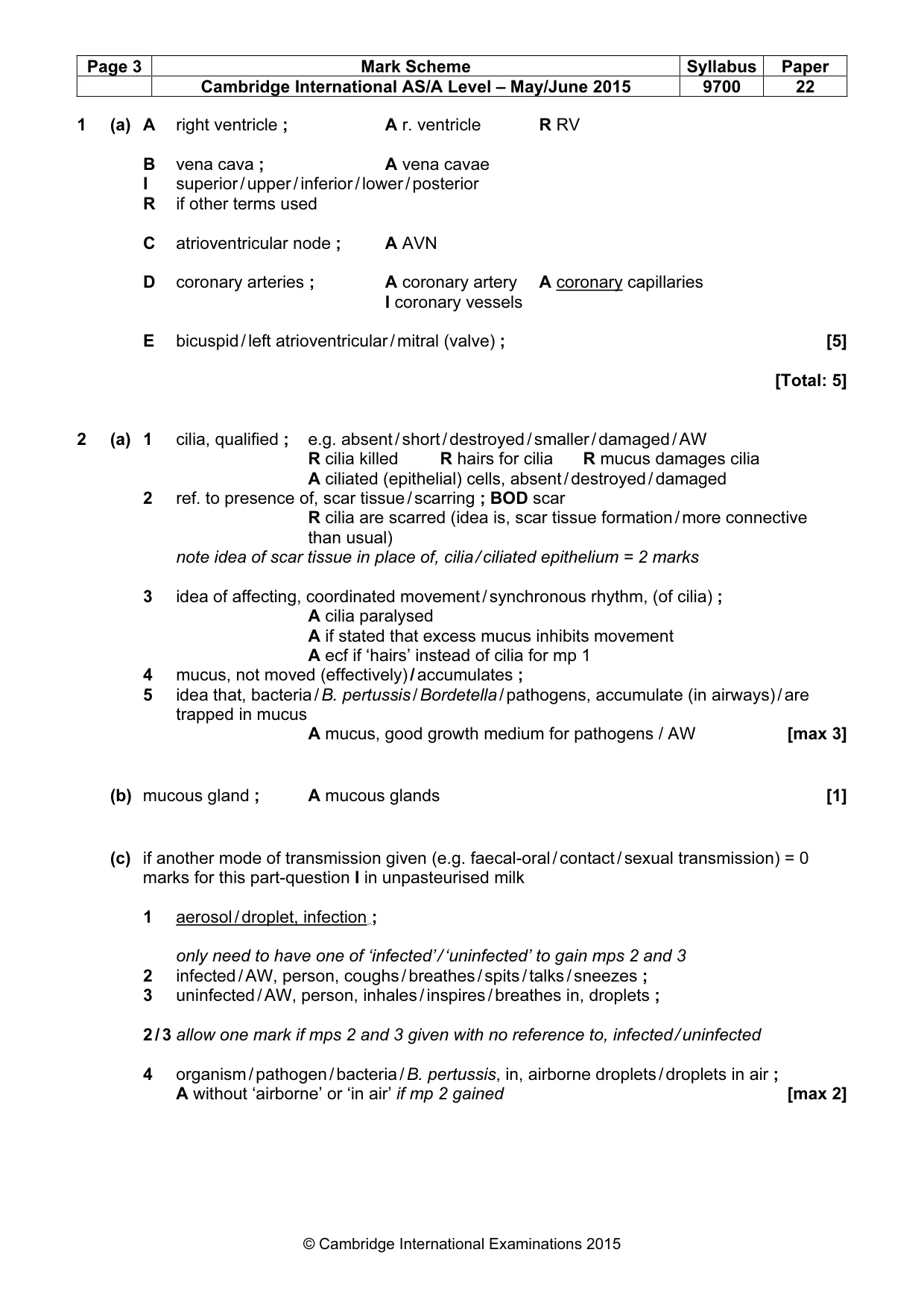
Page 3 Mark Scheme Syllabus Paper Cambridge International AS/A Level – May/June 2015 9700 22 © Cambridge International Examinations 2015 1 (a) A right ventricle ; A r. ventricle R RV B vena cava ; A vena cavae I superior / upper / inferior / lower / posterior R if other terms used C atrioventricular node ; A AVN D coronary arteries ; A coronary artery A coronary capillaries I coronary vessels E bicuspid / left atrioventricular / mitral (valve) ; [5] [Total: 5] 2 (a) 1 cilia, qualified ; e.g. absent / short / destroyed / smaller / damaged / AW R cilia killed R hairs for cilia R mucus damages cilia A ciliated (epithelial) cells, absent / destroyed / damaged 2 ref. to presence of, scar tissue / scarring ; BOD scar R cilia are scarred (idea is, scar tissue formation / more connective than usual) note idea of scar tissue in place of, cilia / ciliated epithelium = 2 marks 3 idea of affecting, coordinated movement / synchronous rhythm, (of cilia) ; A cilia paralysed A if stated that excess mucus inhibits movement A ecf if ‘hairs’ instead of cilia for mp 1 4 mucus, not moved (effectively) / accumulates ; 5 idea that, bacteria / B. pertussis / Bordetella / pathogens, accumulate (in airways) / are trapped in mucus A mucus, good growth medium for pathogens / AW [max 3] (b) mucous gland ; A mucous glands [1] (c) if another mode of transmission given (e.g. faecal-oral / contact / sexual transmission) = 0 marks for this part-question I in unpasteurised milk 1 aerosol / droplet, infection ; only need to have one of ‘infected’ / ‘uninfected’ to gain mps 2 and 3 2 infected / AW, person, coughs / breathes / spits / talks / sneezes ; 3 uninfected / AW, person, inhales / inspires / breathes in, droplets ; 2 / 3 allow one mark if mps 2 and 3 given with no reference to, infected / uninfected 4 organism / pathogen / bacteria / B. pertussis, in, airborne droplets / droplets in air ; A without ‘airborne’ or ‘in air’ if mp 2 gained [max 2]
Mark scheme, page 4
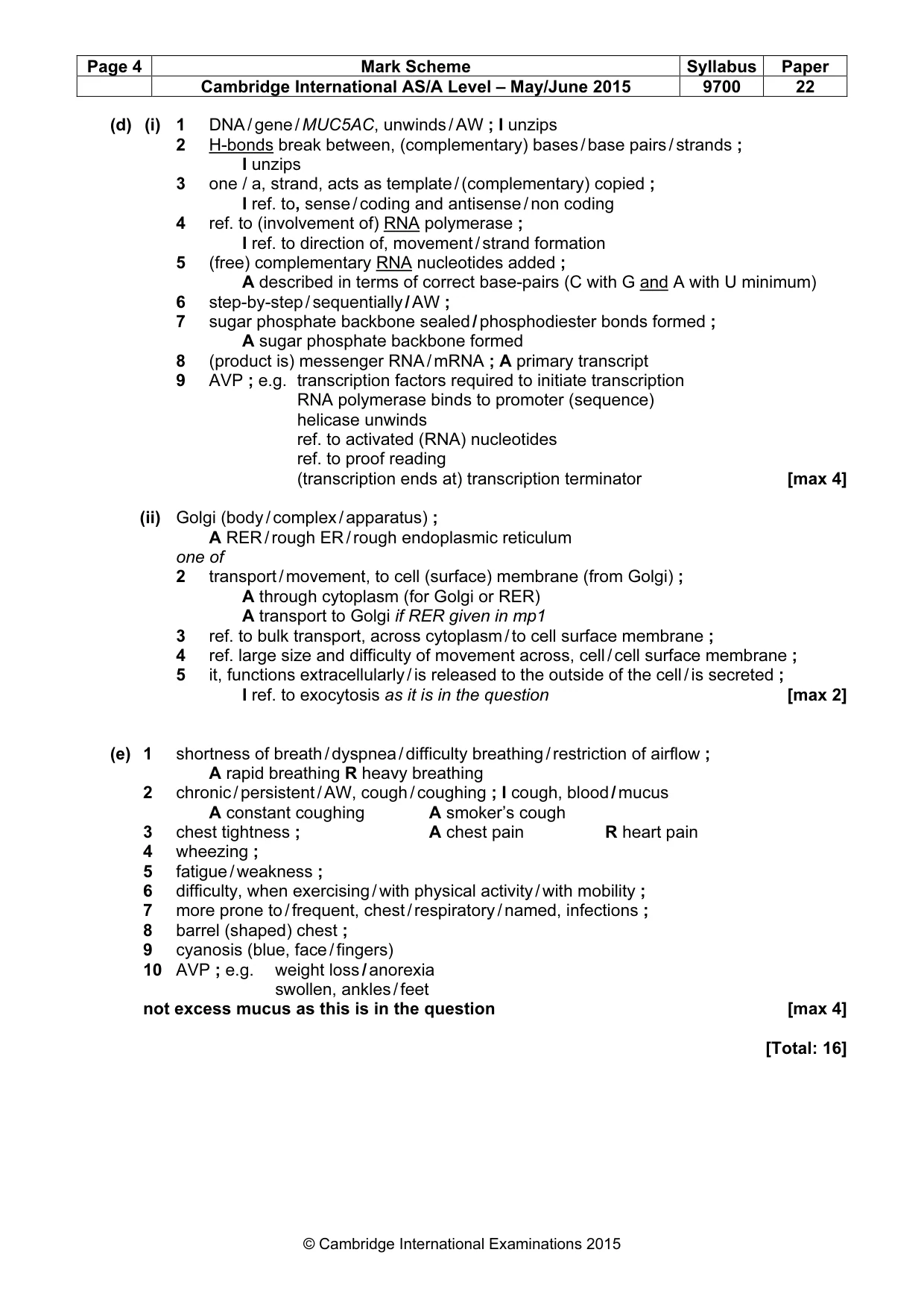
Page 4 Mark Scheme Syllabus Paper Cambridge International AS/A Level – May/June 2015 9700 22 © Cambridge International Examinations 2015 (d) (i) 1 DNA / gene / MUC5AC, unwinds / AW ; I unzips 2 H-bonds break between, (complementary) bases / base pairs / strands ; I unzips 3 one / a, strand, acts as template / (complementary) copied ; I ref. to, sense / coding and antisense / non coding 4 ref. to (involvement of) RNA polymerase ; I ref. to direction of, movement / strand formation 5 (free) complementary RNA nucleotides added ; A described in terms of correct base-pairs (C with G and A with U minimum) 6 step-by-step / sequentially / AW ; 7 sugar phosphate backbone sealed / phosphodiester bonds formed ; A sugar phosphate backbone formed 8 (product is) messenger RNA / mRNA ; A primary transcript 9 AVP ; e.g. transcription factors required to initiate transcription RNA polymerase binds to promoter (sequence) helicase unwinds ref. to activated (RNA) nucleotides ref. to proof reading (transcription ends at) transcription terminator [max 4] (ii) Golgi (body / complex / apparatus) ; A RER / rough ER / rough endoplasmic reticulum one of 2 transport / movement, to cell (surface) membrane (from Golgi) ; A through cytoplasm (for Golgi or RER) A transport to Golgi if RER given in mp1 3 ref. to bulk transport, across cytoplasm / to cell surface membrane ; 4 ref. large size and difficulty of movement across, cell / cell surface membrane ; 5 it, functions extracellularly / is released to the outside of the cell / is secreted ; I ref. to exocytosis as it is in the question [max 2] (e) 1 shortness of breath / dyspnea / difficulty breathing / restriction of airflow ; A rapid breathing R heavy breathing 2 chronic / persistent / AW, cough / coughing ; I cough, blood / mucus A constant coughing A smoker’s cough 3 chest tightness ; A chest pain R heart pain 4 wheezing ; 5 fatigue / weakness ; 6 difficulty, when exercising / with physical activity / with mobility ; 7 more prone to / frequent, chest / respiratory / named, infections ; 8 barrel (shaped) chest ; 9 cyanosis (blue, face / fingers) 10 AVP ; e.g. weight loss / anorexia swollen, ankles / feet not excess mucus as this is in the question [max 4] [Total: 16]
Mark scheme, page 5
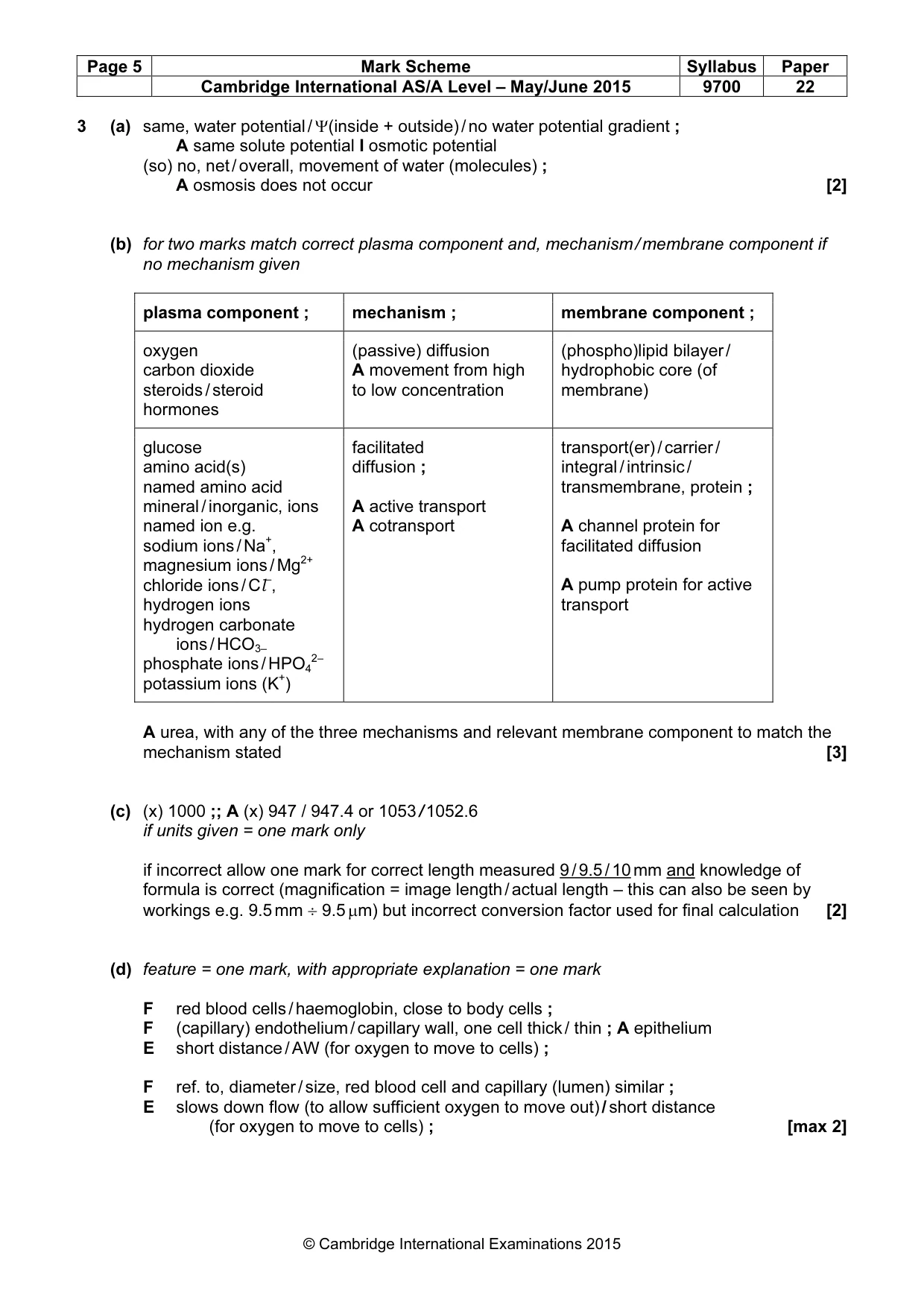
Page 5 Mark Scheme Syllabus Paper Cambridge International AS/A Level – May/June 2015 9700 22 © Cambridge International Examinations 2015 3 (a) same, water potential / Ψ(inside + outside) / no water potential gradient ; A same solute potential I osmotic potential (so) no, net / overall, movement of water (molecules) ; A osmosis does not occur [2] (b) for two marks match correct plasma component and, mechanism / membrane component if no mechanism given plasma component ; mechanism ; membrane component ; oxygen carbon dioxide steroids / steroid hormones (passive) diffusion A movement from high to low concentration (phospho)lipid bilayer / hydrophobic core (of membrane) glucose amino acid(s) named amino acid mineral / inorganic, ions named ion e.g. sodium ions / Na+, magnesium ions / Mg2+ chloride ions / Cl–, hydrogen ions hydrogen carbonate ions / HCO3– phosphate ions / HPO4 2– potassium ions (K+) facilitated diffusion ; A active transport A cotransport transport(er) / carrier / integral / intrinsic / transmembrane, protein ; A channel protein for facilitated diffusion A pump protein for active transport A urea, with any of the three mechanisms and relevant membrane component to match the mechanism stated [3] (c) (x) 1000 ;; A (x) 947 / 947.4 or 1053 / 1052.6 if units given = one mark only if incorrect allow one mark for correct length measured 9 / 9.5 / 10 mm and knowledge of formula is correct (magnification = image length / actual length – this can also be seen by workings e.g. 9.5 mm ÷ 9.5 µm) but incorrect conversion factor used for final calculation [2] (d) feature = one mark, with appropriate explanation = one mark F red blood cells / haemoglobin, close to body cells ; F (capillary) endothelium / capillary wall, one cell thick / thin ; A epithelium E short distance / AW (for oxygen to move to cells) ; F ref. to, diameter / size, red blood cell and capillary (lumen) similar ; E slows down flow (to allow sufficient oxygen to move out) / short distance (for oxygen to move to cells) ; [max 2]
Mark scheme, page 6
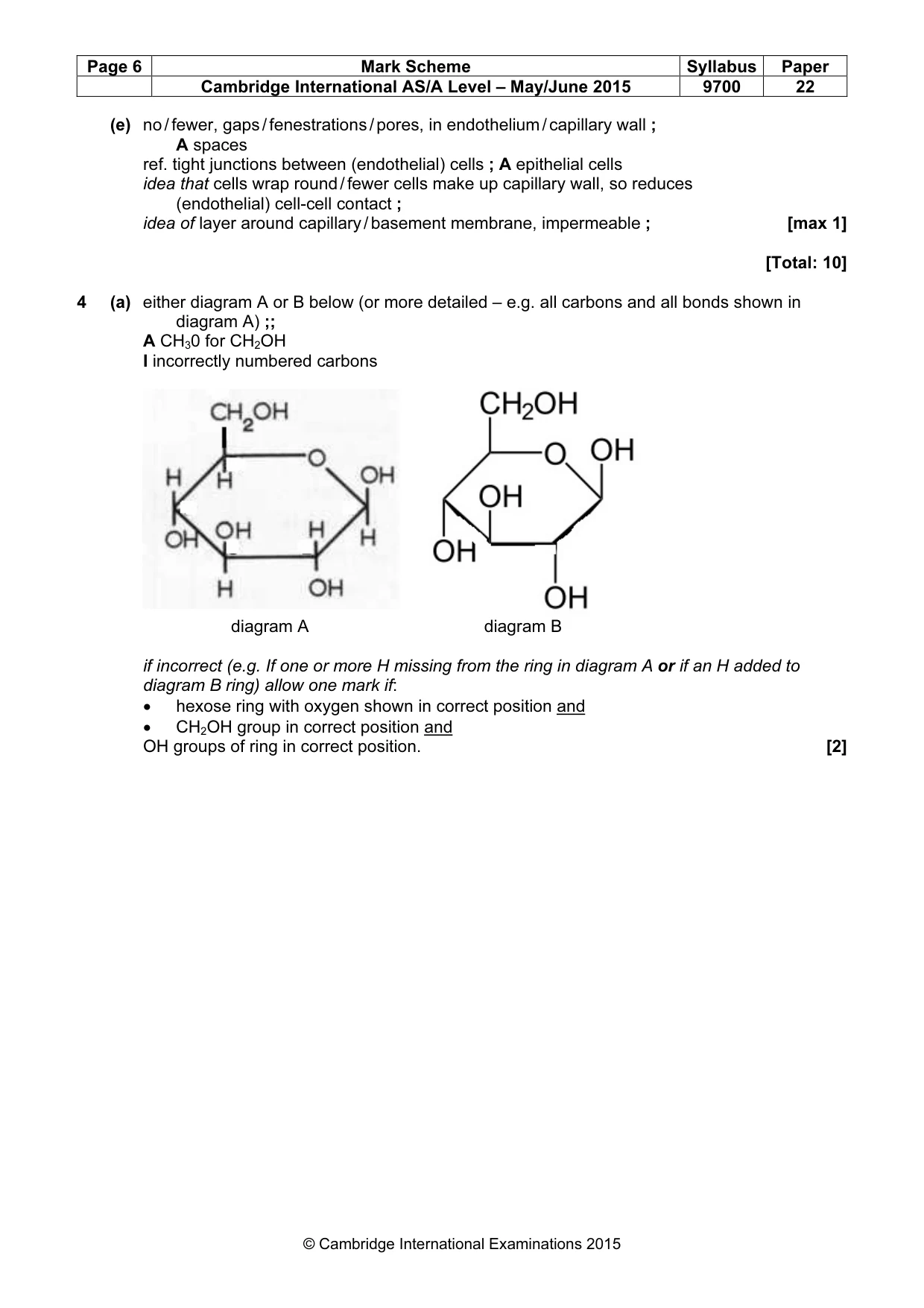
Page 6 Mark Scheme Syllabus Paper Cambridge International AS/A Level – May/June 2015 9700 22 © Cambridge International Examinations 2015 (e) no / fewer, gaps / fenestrations / pores, in endothelium / capillary wall ; A spaces ref. tight junctions between (endothelial) cells ; A epithelial cells idea that cells wrap round / fewer cells make up capillary wall, so reduces (endothelial) cell-cell contact ; idea of layer around capillary / basement membrane, impermeable ; [max 1] [Total: 10] 4 (a) either diagram A or B below (or more detailed – e.g. all carbons and all bonds shown in diagram A) ;; A CH30 for CH2OH I incorrectly numbered carbons diagram A diagram B if incorrect (e.g. If one or more H missing from the ring in diagram A or if an H added to diagram B ring) allow one mark if: • hexose ring with oxygen shown in correct position and • CH2OH group in correct position and OH groups of ring in correct position. [2]
Mark scheme, page 7
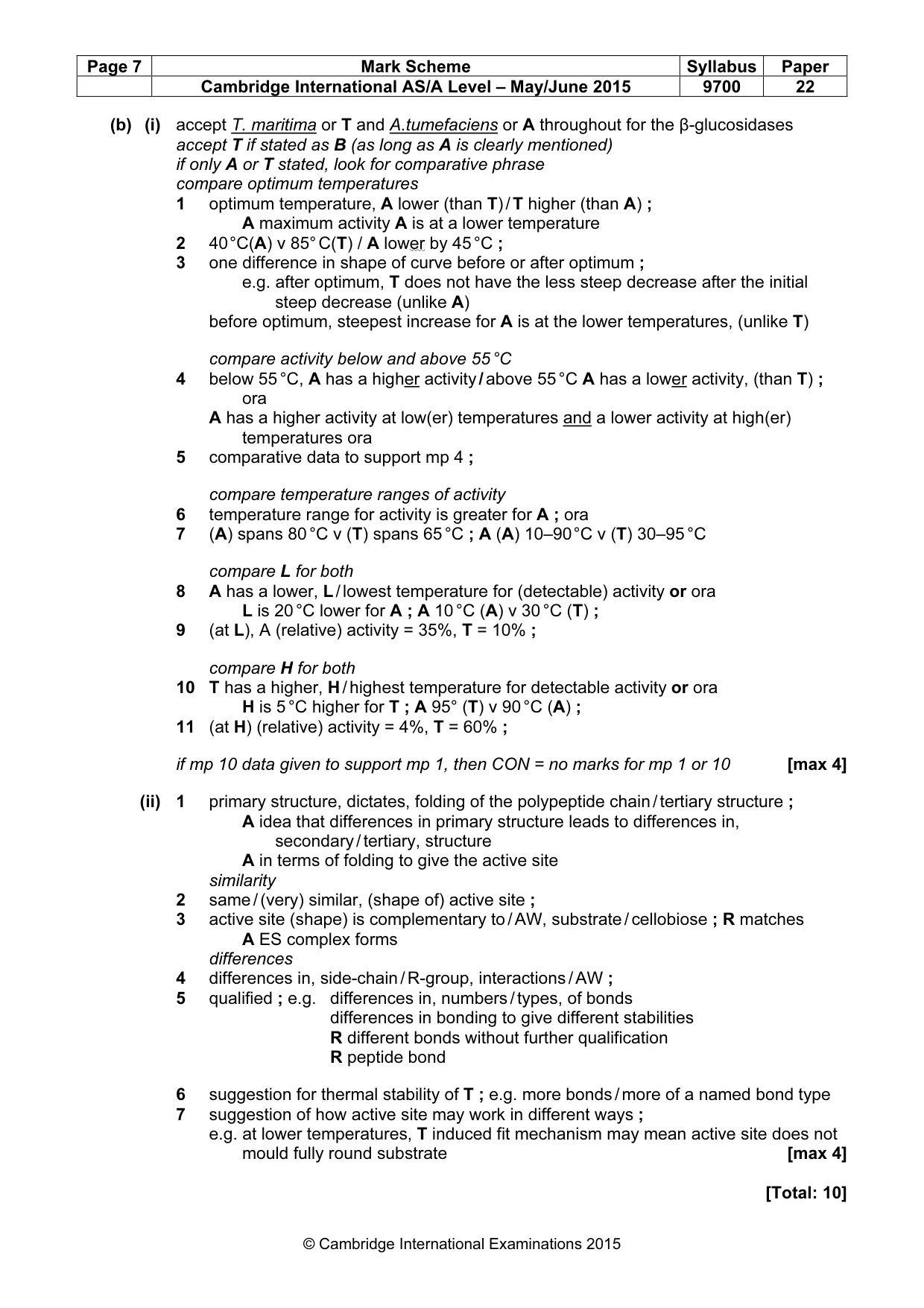
Page 7 Mark Scheme Syllabus Paper Cambridge International AS/A Level – May/June 2015 9700 22 © Cambridge International Examinations 2015 (b) (i) accept T. maritima or T and A.tumefaciens or A throughout for the β-glucosidases accept T if stated as B (as long as A is clearly mentioned) if only A or T stated, look for comparative phrase compare optimum temperatures 1 optimum temperature, A lower (than T) / T higher (than A) ; A maximum activity A is at a lower temperature 2 40 °C(A) v 85° C(T) / A lower by 45 °C ; 3 one difference in shape of curve before or after optimum ; e.g. after optimum, T does not have the less steep decrease after the initial steep decrease (unlike A) before optimum, steepest increase for A is at the lower temperatures, (unlike T) compare activity below and above 55 °C 4 below 55 °C, A has a higher activity / above 55 °C A has a lower activity, (than T) ; ora A has a higher activity at low(er) temperatures and a lower activity at high(er) temperatures ora 5 comparative data to support mp 4 ; compare temperature ranges of activity 6 temperature range for activity is greater for A ; ora 7 (A) spans 80 °C v (T) spans 65 °C ; A (A) 10–90 °C v (T) 30–95 °C compare L for both 8 A has a lower, L / lowest temperature for (detectable) activity or ora L is 20 °C lower for A ; A 10 °C (A) v 30 °C (T) ; 9 (at L), A (relative) activity = 35%, T = 10% ; compare H for both 10 T has a higher, H / highest temperature for detectable activity or ora H is 5 °C higher for T ; A 95° (T) v 90 °C (A) ; 11 (at H) (relative) activity = 4%, T = 60% ; if mp 10 data given to support mp 1, then CON = no marks for mp 1 or 10 [max 4] (ii) 1 primary structure, dictates, folding of the polypeptide chain / tertiary structure ; A idea that differences in primary structure leads to differences in, secondary / tertiary, structure A in terms of folding to give the active site similarity 2 same / (very) similar, (shape of) active site ; 3 active site (shape) is complementary to / AW, substrate / cellobiose ; R matches A ES complex forms differences 4 differences in, side-chain / R-group, interactions / AW ; 5 qualified ; e.g. differences in, numbers / types, of bonds differences in bonding to give different stabilities R different bonds without further qualification R peptide bond 6 suggestion for thermal stability of T ; e.g. more bonds / more of a named bond type 7 suggestion of how active site may work in different ways ; e.g. at lower temperatures, T induced fit mechanism may mean active site does not mould fully round substrate [max 4] [Total: 10]
Mark scheme, page 8
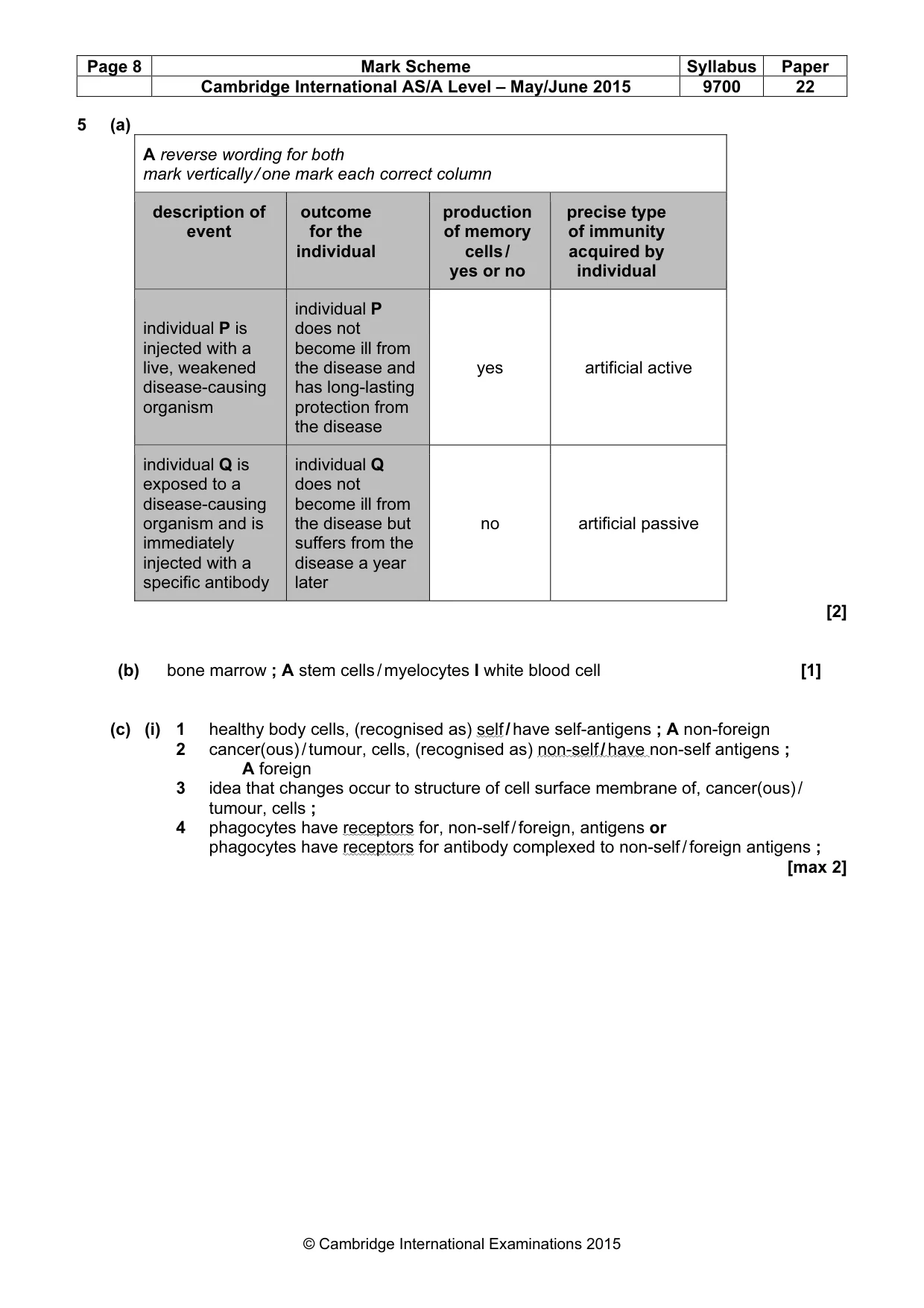
Page 8 Mark Scheme Syllabus Paper Cambridge International AS/A Level – May/June 2015 9700 22 © Cambridge International Examinations 2015 5 (a) A reverse wording for both mark vertically / one mark each correct column description of event outcome for the individual production of memory cells / yes or no precise type of immunity acquired by individual individual P is injected with a live, weakened disease-causing organism individual P does not become ill from the disease and has long-lasting protection from the disease yes artificial active individual Q is exposed to a disease-causing organism and is immediately injected with a specific antibody individual Q does not become ill from the disease but suffers from the disease a year later no artificial passive [2] (b) bone marrow ; A stem cells / myelocytes I white blood cell [1] (c) (i) 1 healthy body cells, (recognised as) self / have self-antigens ; A non-foreign 2 cancer(ous) / tumour, cells, (recognised as) non-self / have non-self antigens ; A foreign 3 idea that changes occur to structure of cell surface membrane of, cancer(ous) / tumour, cells ; 4 phagocytes have receptors for, non-self / foreign, antigens or phagocytes have receptors for antibody complexed to non-self / foreign antigens ; [max 2]
Mark scheme, page 9
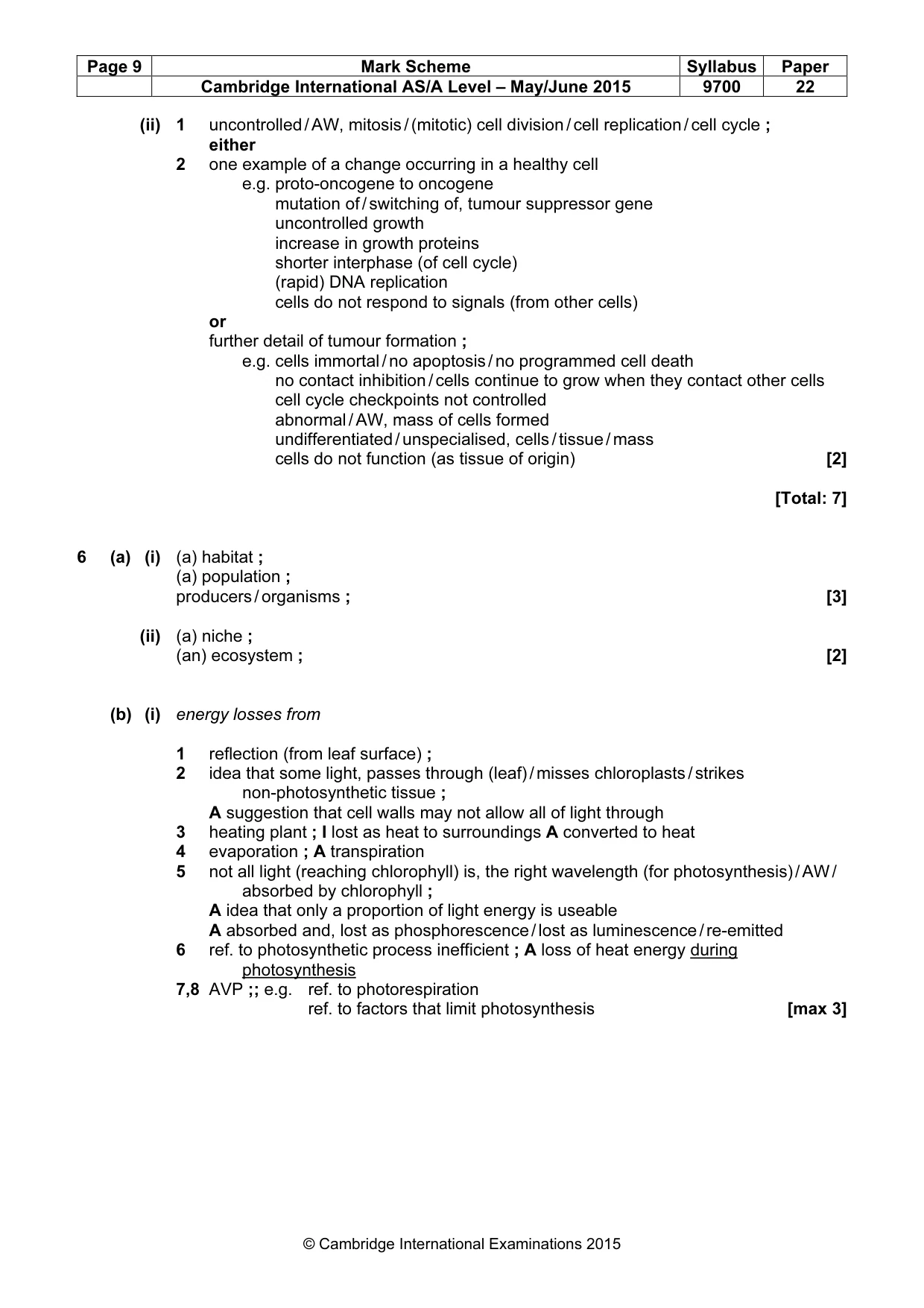
Page 9 Mark Scheme Syllabus Paper Cambridge International AS/A Level – May/June 2015 9700 22 © Cambridge International Examinations 2015 (ii) 1 uncontrolled / AW, mitosis / (mitotic) cell division / cell replication / cell cycle ; either 2 one example of a change occurring in a healthy cell e.g. proto-oncogene to oncogene mutation of / switching of, tumour suppressor gene uncontrolled growth increase in growth proteins shorter interphase (of cell cycle) (rapid) DNA replication cells do not respond to signals (from other cells) or further detail of tumour formation ; e.g. cells immortal / no apoptosis / no programmed cell death no contact inhibition / cells continue to grow when they contact other cells cell cycle checkpoints not controlled abnormal / AW, mass of cells formed undifferentiated / unspecialised, cells / tissue / mass cells do not function (as tissue of origin) [2] [Total: 7] 6 (a) (i) (a) habitat ; (a) population ; producers / organisms ; [3] (ii) (a) niche ; (an) ecosystem ; [2] (b) (i) energy losses from 1 reflection (from leaf surface) ; 2 idea that some light, passes through (leaf) / misses chloroplasts / strikes non-photosynthetic tissue ; A suggestion that cell walls may not allow all of light through 3 heating plant ; I lost as heat to surroundings A converted to heat 4 evaporation ; A transpiration 5 not all light (reaching chlorophyll) is, the right wavelength (for photosynthesis) / AW / absorbed by chlorophyll ; A idea that only a proportion of light energy is useable A absorbed and, lost as phosphorescence / lost as luminescence / re-emitted 6 ref. to photosynthetic process inefficient ; A loss of heat energy during photosynthesis 7,8 AVP ;; e.g. ref. to photorespiration ref. to factors that limit photosynthesis [max 3]
Mark scheme, page 10
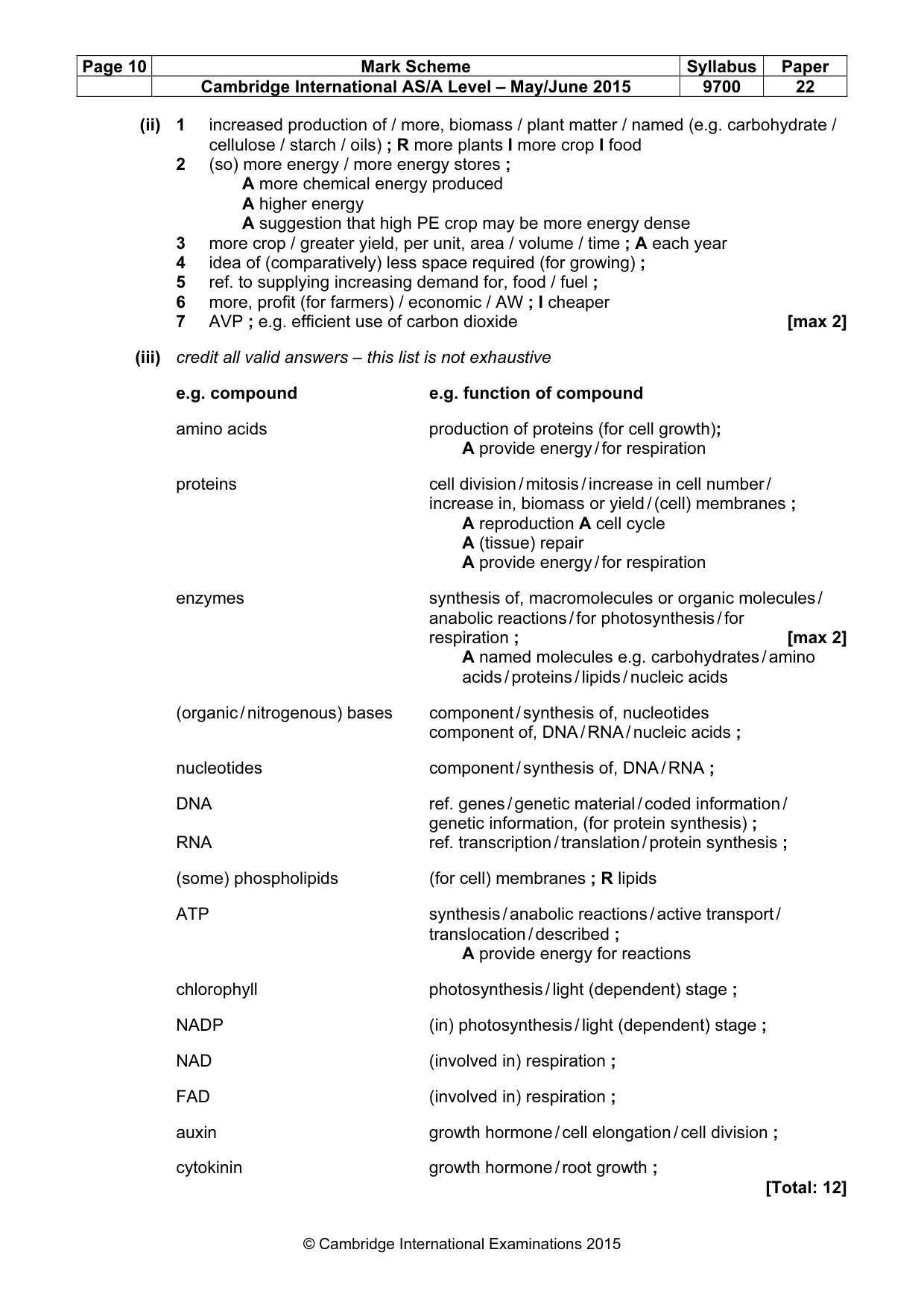
Page 10 Mark Scheme Syllabus Paper Cambridge International AS/A Level – May/June 2015 9700 22 © Cambridge International Examinations 2015 (ii) 1 increased production of / more, biomass / plant matter / named (e.g. carbohydrate / cellulose / starch / oils) ; R more plants I more crop I food 2 (so) more energy / more energy stores ; A more chemical energy produced A higher energy A suggestion that high PE crop may be more energy dense 3 more crop / greater yield, per unit, area / volume / time ; A each year 4 idea of (comparatively) less space required (for growing) ; 5 ref. to supplying increasing demand for, food / fuel ; 6 more, profit (for farmers) / economic / AW ; I cheaper 7 AVP ; e.g. efficient use of carbon dioxide [max 2] (iii) credit all valid answers – this list is not exhaustive e.g. compound e.g. function of compound amino acids production of proteins (for cell growth); A provide energy / for respiration proteins cell division / mitosis / increase in cell number / increase in, biomass or yield / (cell) membranes ; A reproduction A cell cycle A (tissue) repair A provide energy / for respiration enzymes synthesis of, macromolecules or organic molecules / anabolic reactions / for photosynthesis / for respiration ; [max 2] A named molecules e.g. carbohydrates / amino acids / proteins / lipids / nucleic acids (organic / nitrogenous) bases component / synthesis of, nucleotides component of, DNA / RNA / nucleic acids ; nucleotides component / synthesis of, DNA / RNA ; DNA ref. genes / genetic material / coded information / genetic information, (for protein synthesis) ; RNA ref. transcription / translation / protein synthesis ; (some) phospholipids (for cell) membranes ; R lipids ATP synthesis / anabolic reactions / active transport / translocation / described ; A provide energy for reactions chlorophyll photosynthesis / light (dependent) stage ; NADP (in) photosynthesis / light (dependent) stage ; NAD (involved in) respiration ; FAD (involved in) respiration ; auxin growth hormone / cell elongation / cell division ; cytokinin growth hormone / root growth ; [Total: 12]
What you needed in this session
Cambridge’s own grade thresholds for 2015 May/June, Paper 2 · Variant 2. A higher threshold means an easier paper — the bar moves with how the cohort did.