Cambridge A Level Biology 9700 — 2014 May/June Paper 2 · Variant 2
9700/22/M/J/14 · 60 marks · ≈68 min
The question paper and its mark scheme, free to read here and free to download. This is Cambridge’s own paper, exactly as it was sat.
Question paper16 pages


Mark scheme13 pages
Answers below. Sit the paper first if you are practising.
Paper as text
Question paper, page 1
This document consists of 15 printed pages and 1 blank page. DC (LK/CGW) 79171/4 © UCLES 2014 [Turn over * 2 4 9 3 3 3 9 2 1 7 * BIOLOGY 9700/22 Paper 2 Structured Questions AS May/June 2014 1 hour 15 minutes Candidates answer on the Question Paper. No Additional Materials are required. READ THESE INSTRUCTIONS FIRST Write your Centre number, candidate number and name in the spaces provided at the top of this page. Write in dark blue or black pen. You may use a soft pencil for any diagrams, graphs, or rough working. Do not use red ink, staples, paper clips, glue or correction fluid. DO NOT WRITE IN ANY BARCODES. Answer all questions. Electronic calculators may be used. At the end of the examination, fasten all your work securely together. The number of marks is given in brackets [ ] at the end of each question or part question. Cambridge International Examinations Cambridge International Advanced Subsidiary and Advanced Level
Question paper, page 2
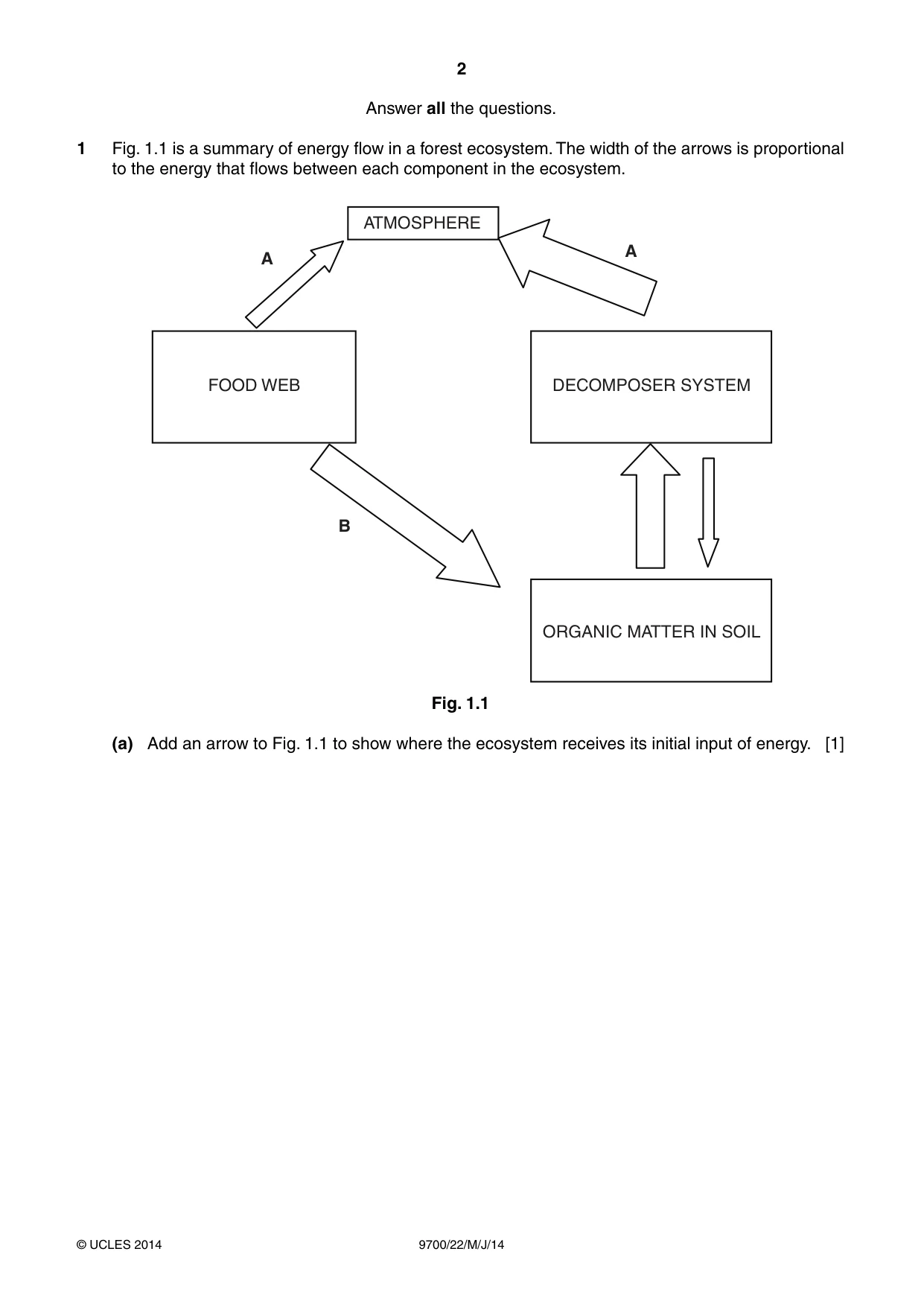
2 9700/22/M/J/14 © UCLES 2014 Answer all the questions. 1 Fig. 1.1 is a summary of energy flow in a forest ecosystem. The width of the arrows is proportional to the energy that flows between each component in the ecosystem. FOOD WEB ATMOSPHERE A A B DECOMPOSER SYSTEM ORGANIC MATTER IN SOIL Fig. 1.1 (a) Add an arrow to Fig. 1.1 to show where the ecosystem receives its initial input of energy. [1]
Question paper, page 3
3 9700/22/M/J/14 © UCLES 2014 [Turn over (b) State the process represented by A. …[1] (c) State one type of organism that is a member of the decomposer system. …[1] (d) Name two processes represented by arrow B. 1. … 2. … [2] [Total: 5]
Question paper, page 4
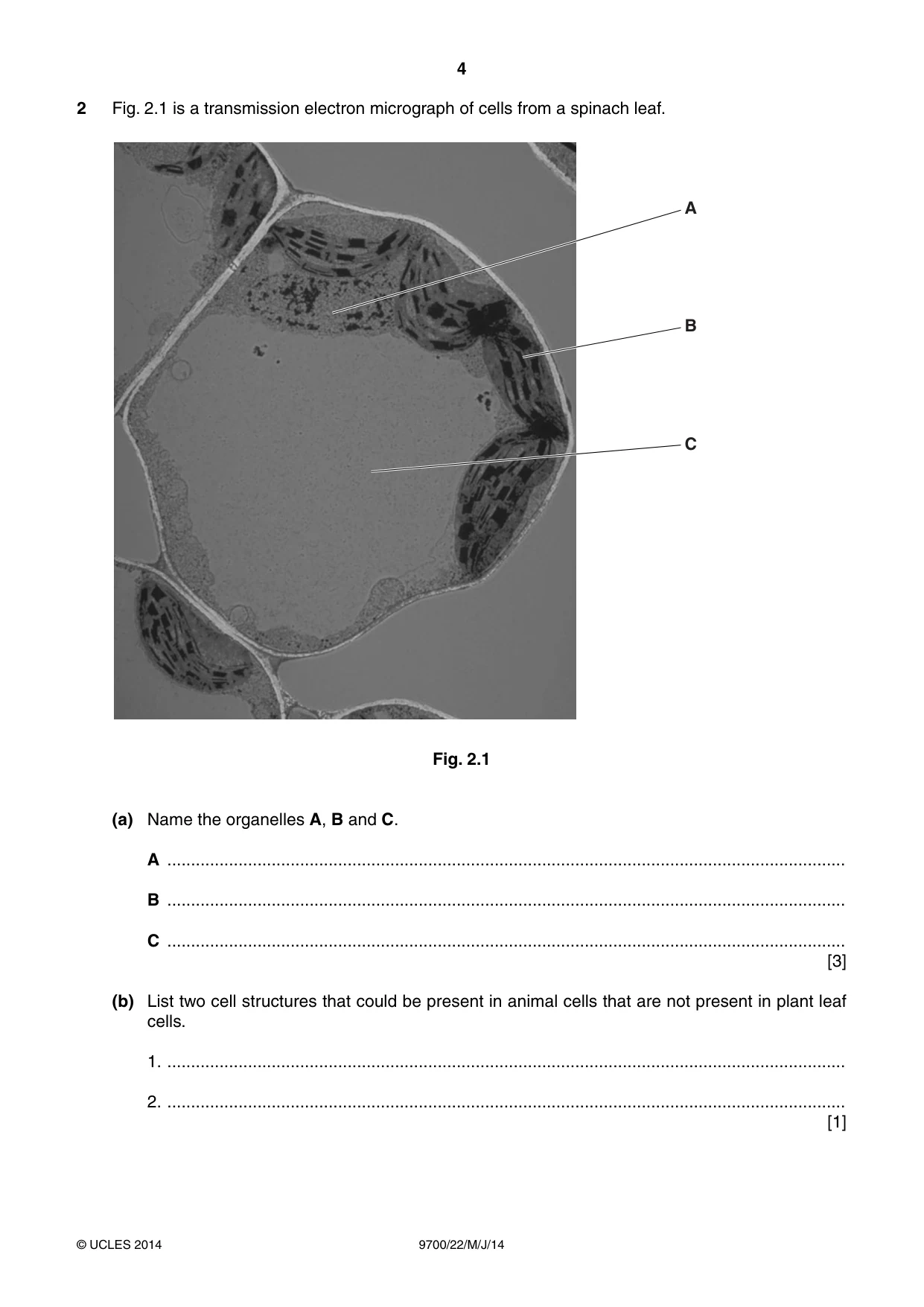
4 9700/22/M/J/14 © UCLES 2014 2 Fig. 2.1 is a transmission electron micrograph of cells from a spinach leaf. B A C Fig. 2.1 (a) Name the organelles A, B and C. A … B … C … [3] (b) List two cell structures that could be present in animal cells that are not present in plant leaf cells. 1. … 2. … [1]
Question paper, page 5
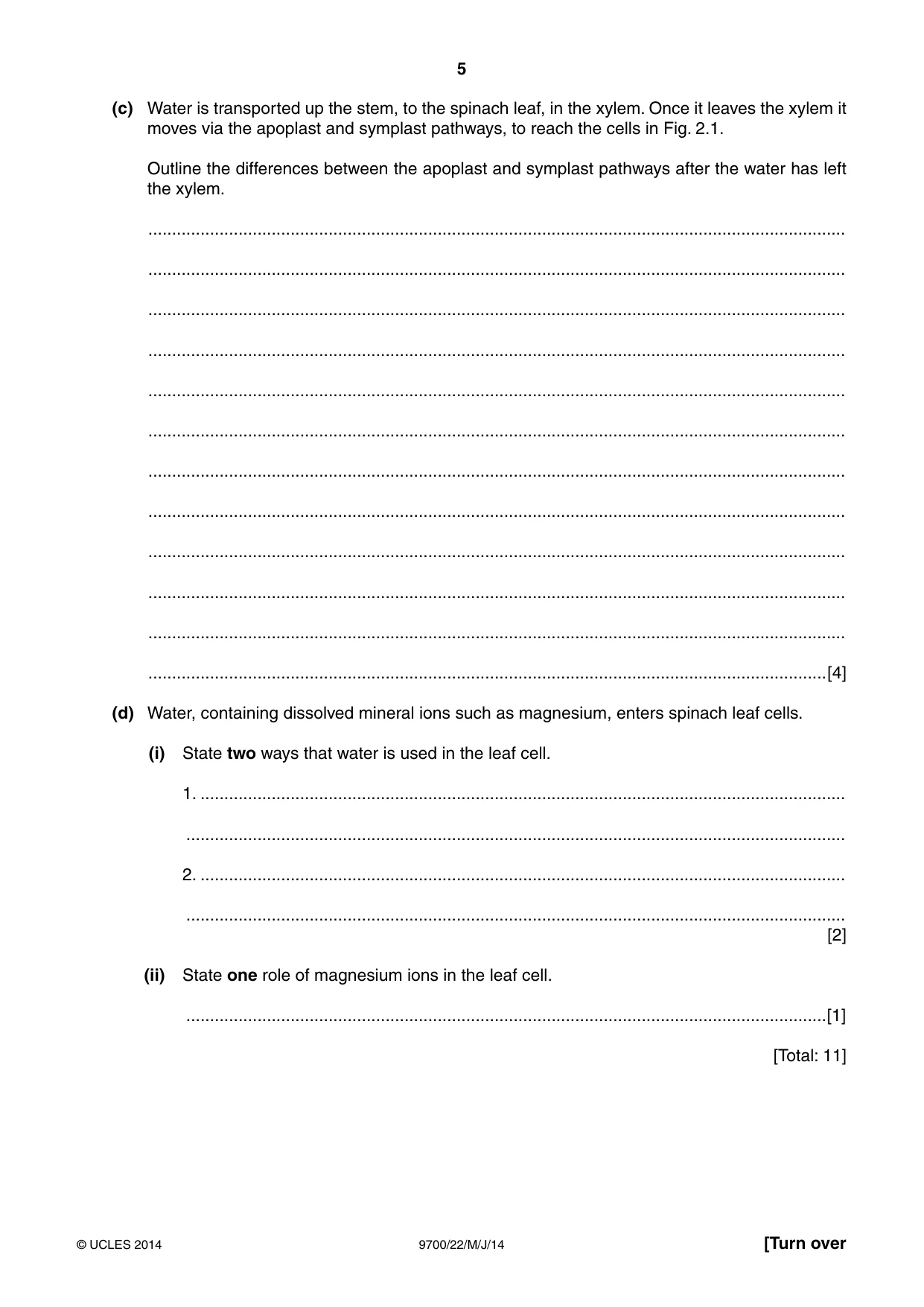
5 9700/22/M/J/14 © UCLES 2014 [Turn over (c) Water is transported up the stem, to the spinach leaf, in the xylem. Once it leaves the xylem it moves via the apoplast and symplast pathways, to reach the cells in Fig. 2.1. Outline the differences between the apoplast and symplast pathways after the water has left the xylem. … … … … … … … … … … … …[4] (d) Water, containing dissolved mineral ions such as magnesium, enters spinach leaf cells. (i) State two ways that water is used in the leaf cell. 1. … … 2. … … [2] (ii) State one role of magnesium ions in the leaf cell. …[1] [Total: 11]
Question paper, page 6
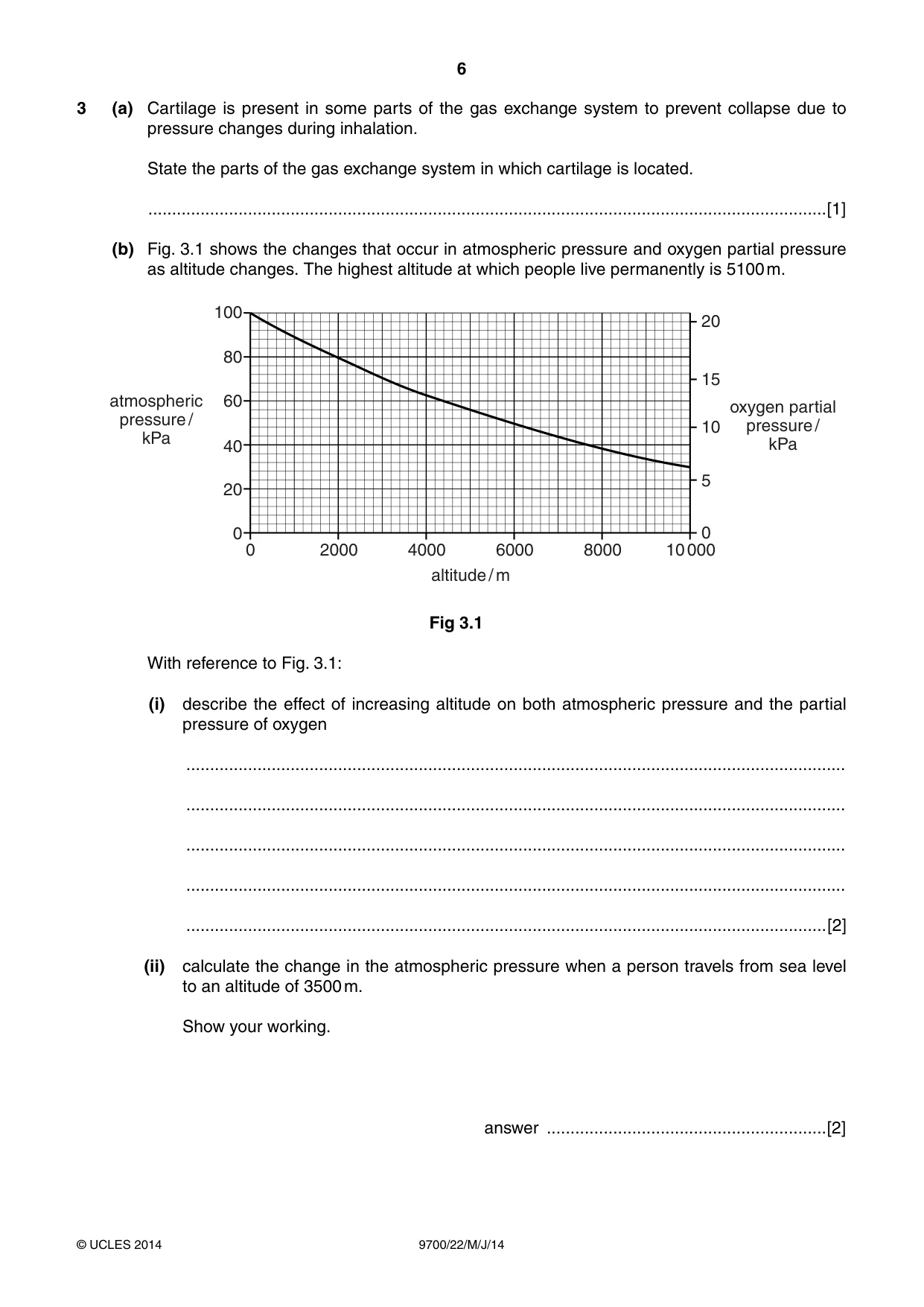
6 9700/22/M/J/14 © UCLES 2014 3 (a) Cartilage is present in some parts of the gas exchange system to prevent collapse due to pressure changes during inhalation. State the parts of the gas exchange system in which cartilage is located. …[1] (b) Fig. 3.1 shows the changes that occur in atmospheric pressure and oxygen partial pressure as altitude changes. The highest altitude at which people live permanently is 5100 m. 2000 0 20 40 60 80 100 0 5 20 15 10 0 4000 6000 altitude / m atmospheric pressure / kPa oxygen partial pressure / kPa 8000 10 000 Fig 3.1 With reference to Fig. 3.1: (i) describe the effect of increasing altitude on both atmospheric pressure and the partial pressure of oxygen … … … … …[2] (ii) calculate the change in the atmospheric pressure when a person travels from sea level to an altitude of 3500 m. Show your working. answer …[2]
Question paper, page 7
7 9700/22/M/J/14 © UCLES 2014 [Turn over (c) When a person travels from 0 m (sea level) to a high altitude, gas exchange in the lungs is affected. A condition known as hypoxia results, where the body tissues do not receive an adequate oxygen supply. Explain how hypoxia occurs when a person ascends from sea level to a high altitude. … … … … … … … … … …[4] (d) At high altitudes, short-term responses by the body to hypoxia include: • a decrease in the volume of plasma in the blood • a decrease in the volume of blood pumped out of the heart per heart beat • an increase in the heart rate • an increase in the breathing rate. (i) Suggest why a decrease in the volume of plasma in the blood may reduce the effects of hypoxia. … … …[1] (ii) Explain why an increase in the heart rate occurs in response to hypoxia. … … … … … …[2]
Question paper, page 8
8 9700/22/M/J/14 © UCLES 2014 (e) People with sickle cell anaemia have a form of haemoglobin that is unable to bind to oxygen efficiently. The cause of the condition is a mutation in the gene coding for the β-globin polypeptide of haemoglobin. Outline how this mutation can lead to an altered amino acid sequence of the β-globin polypeptide. … … … … … … …[3] [Total: 15]
Question paper, page 9
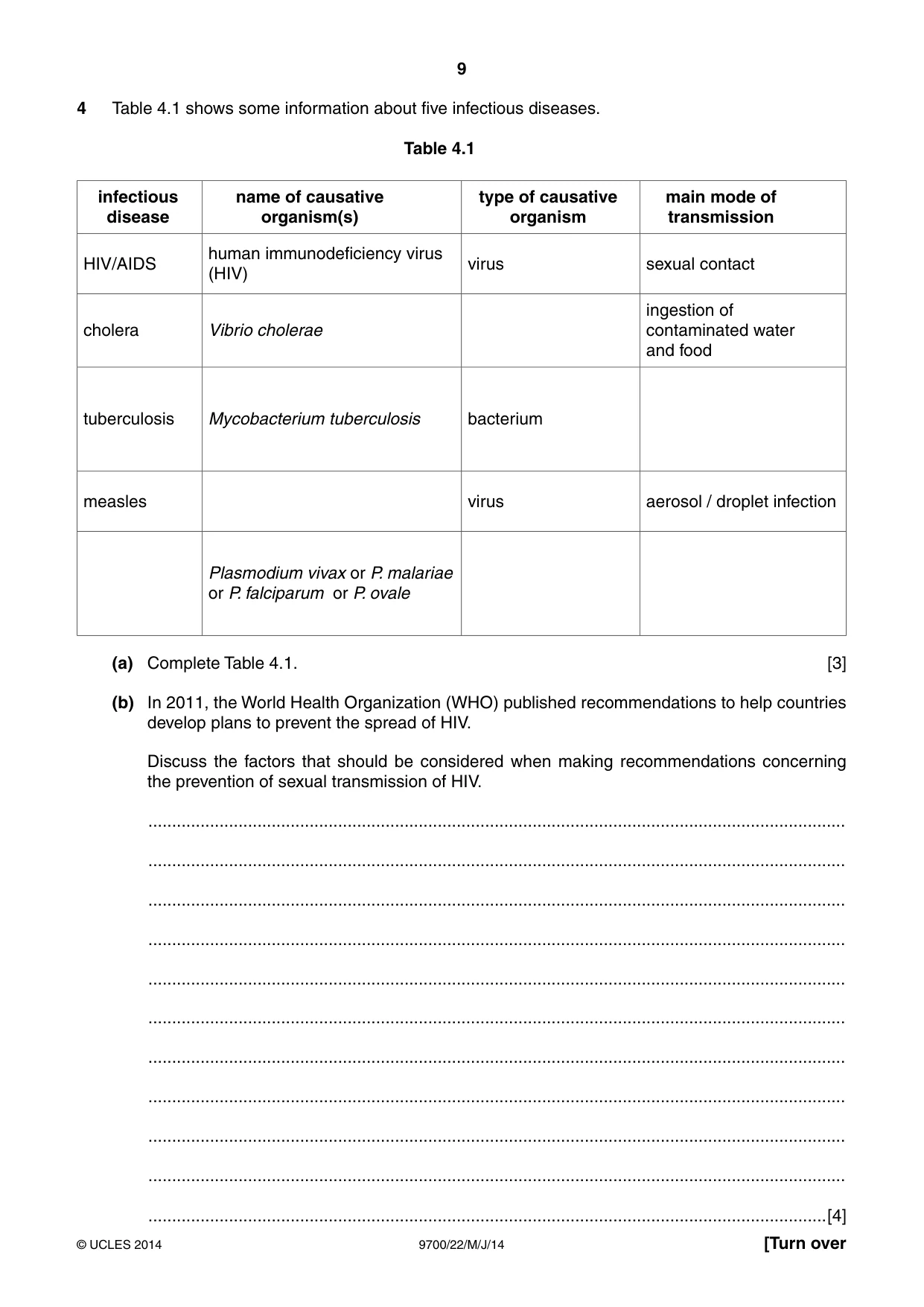
9 9700/22/M/J/14 © UCLES 2014 [Turn over 4 Table 4.1 shows some information about five infectious diseases. Table 4.1 infectious disease name of causative organism(s) type of causative organism main mode of transmission HIV/AIDS human immunodeficiency virus (HIV) virus sexual contact cholera Vibrio cholerae ingestion of contaminated water and food tuberculosis Mycobacterium tuberculosis bacterium measles virus aerosol / droplet infection Plasmodium vivax or P. malariae or P. falciparum or P. ovale (a) Complete Table 4.1. [3] (b) In 2011, the World Health Organization (WHO) published recommendations to help countries develop plans to prevent the spread of HIV. Discuss the factors that should be considered when making recommendations concerning the prevention of sexual transmission of HIV. … … … … … … … … … … …[4]
Question paper, page 10
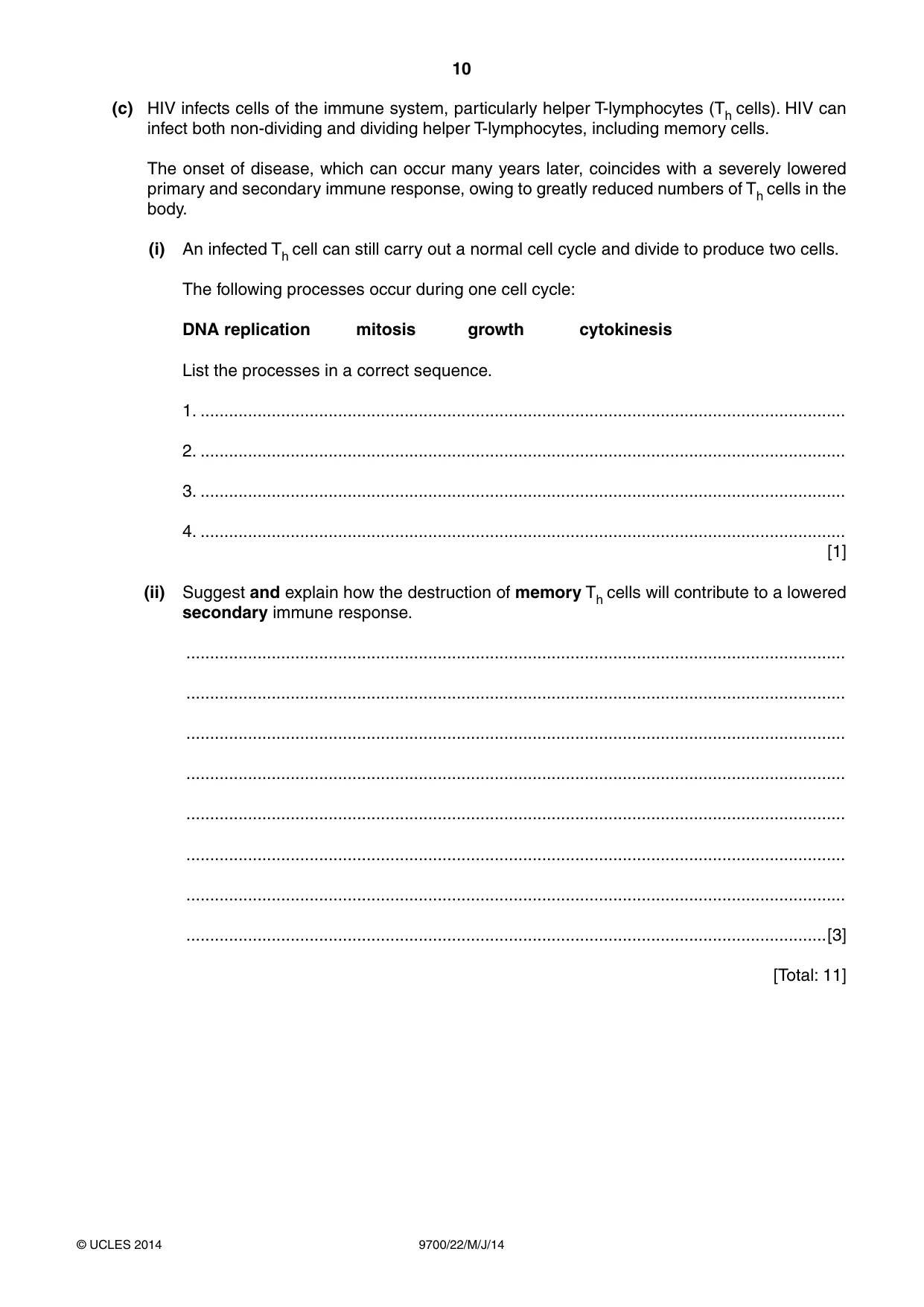
10 9700/22/M/J/14 © UCLES 2014 (c) HIV infects cells of the immune system, particularly helper T-lymphocytes (Th cells). HIV can infect both non-dividing and dividing helper T-lymphocytes, including memory cells. The onset of disease, which can occur many years later, coincides with a severely lowered primary and secondary immune response, owing to greatly reduced numbers of Th cells in the body. (i) An infected Th cell can still carry out a normal cell cycle and divide to produce two cells. The following processes occur during one cell cycle: DNA replication mitosis growth cytokinesis List the processes in a correct sequence. 1. … 2. … 3. … 4. … [1] (ii) Suggest and explain how the destruction of memory Th cells will contribute to a lowered secondary immune response. … … … … … … … …[3] [Total: 11]
Question paper, page 11
11 9700/22/M/J/14 © UCLES 2014 [Turn over Question 5 starts on page 12
Question paper, page 12
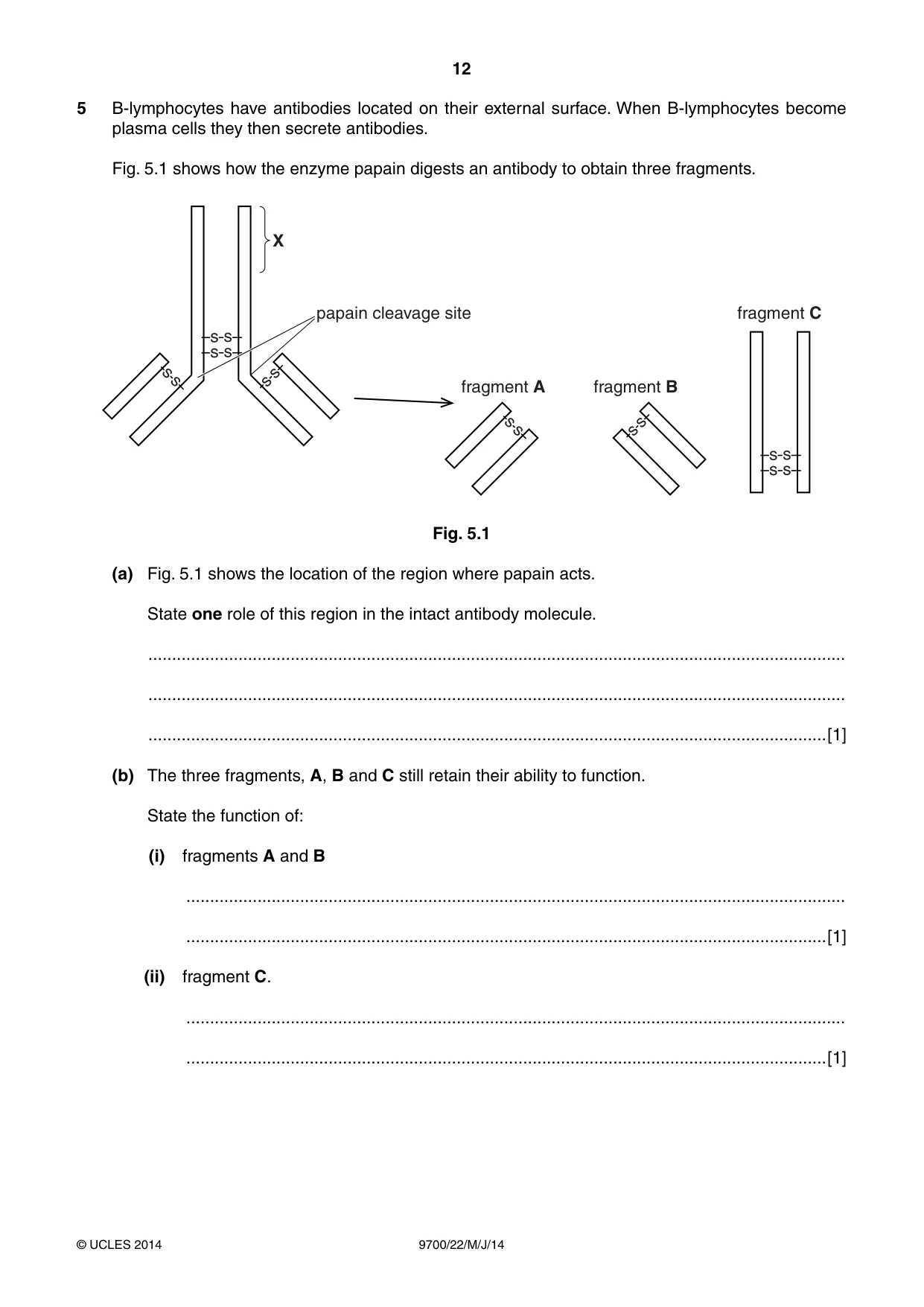
12 9700/22/M/J/14 © UCLES 2014 5 B-lymphocytes have antibodies located on their external surface. When B-lymphocytes become plasma cells they then secrete antibodies. Fig. 5.1 shows how the enzyme papain digests an antibody to obtain three fragments. s s s s papain cleavage site fragment A fragment B fragment C X s s s s s s s s s s s s Fig. 5.1 (a) Fig. 5.1 shows the location of the region where papain acts. State one role of this region in the intact antibody molecule. … … …[1] (b) The three fragments, A, B and C still retain their ability to function. State the function of: (i) fragments A and B … …[1] (ii) fragment C. … …[1]
Question paper, page 13
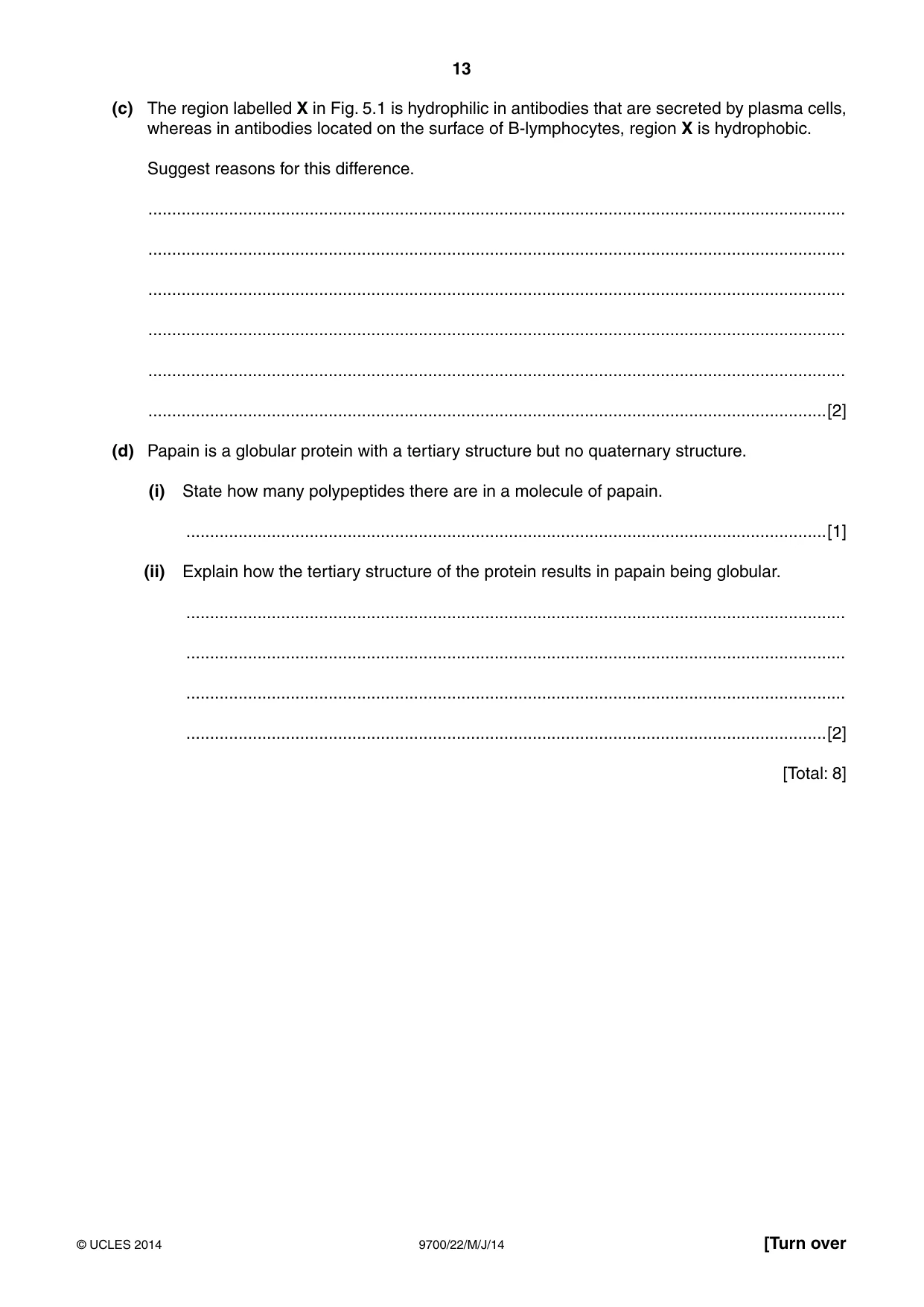
13 9700/22/M/J/14 © UCLES 2014 [Turn over (c) The region labelled X in Fig. 5.1 is hydrophilic in antibodies that are secreted by plasma cells, whereas in antibodies located on the surface of B-lymphocytes, region X is hydrophobic. Suggest reasons for this difference. … … … … … …[2] (d) Papain is a globular protein with a tertiary structure but no quaternary structure. (i) State how many polypeptides there are in a molecule of papain. …[1] (ii) Explain how the tertiary structure of the protein results in papain being globular. … … … …[2] [Total: 8]
Question paper, page 14
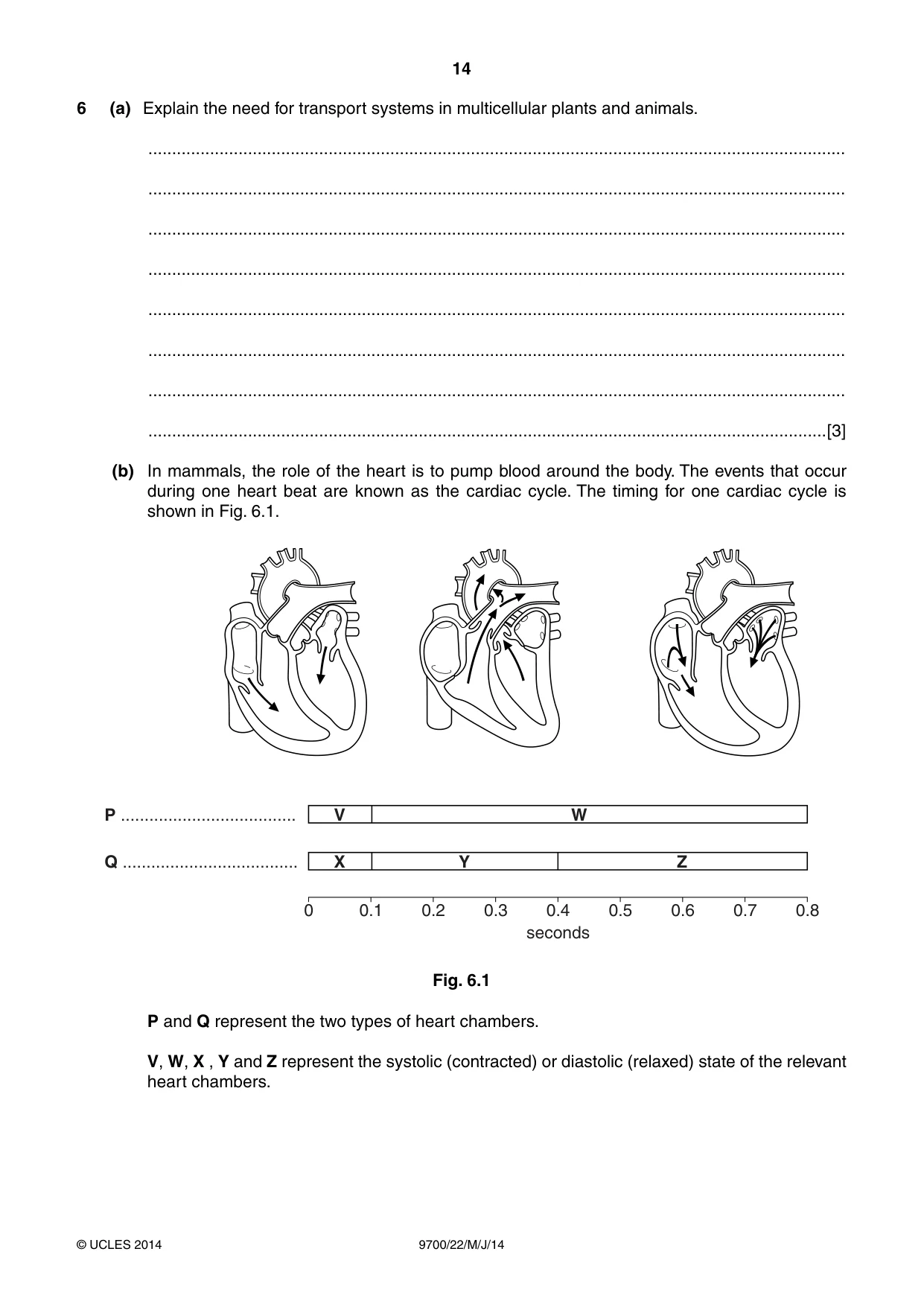
14 9700/22/M/J/14 © UCLES 2014 6 (a) Explain the need for transport systems in multicellular plants and animals. … … … … … … … …[3] (b) In mammals, the role of the heart is to pump blood around the body. The events that occur during one heart beat are known as the cardiac cycle. The timing for one cardiac cycle is shown in Fig. 6.1. V X P … Q … W Y Z 0.8 0.7 0.6 0.5 0.4 seconds 0.3 0.2 0.1 0 Fig. 6.1 P and Q represent the two types of heart chambers. V, W, X , Y and Z represent the systolic (contracted) or diastolic (relaxed) state of the relevant heart chambers.
Question paper, page 15
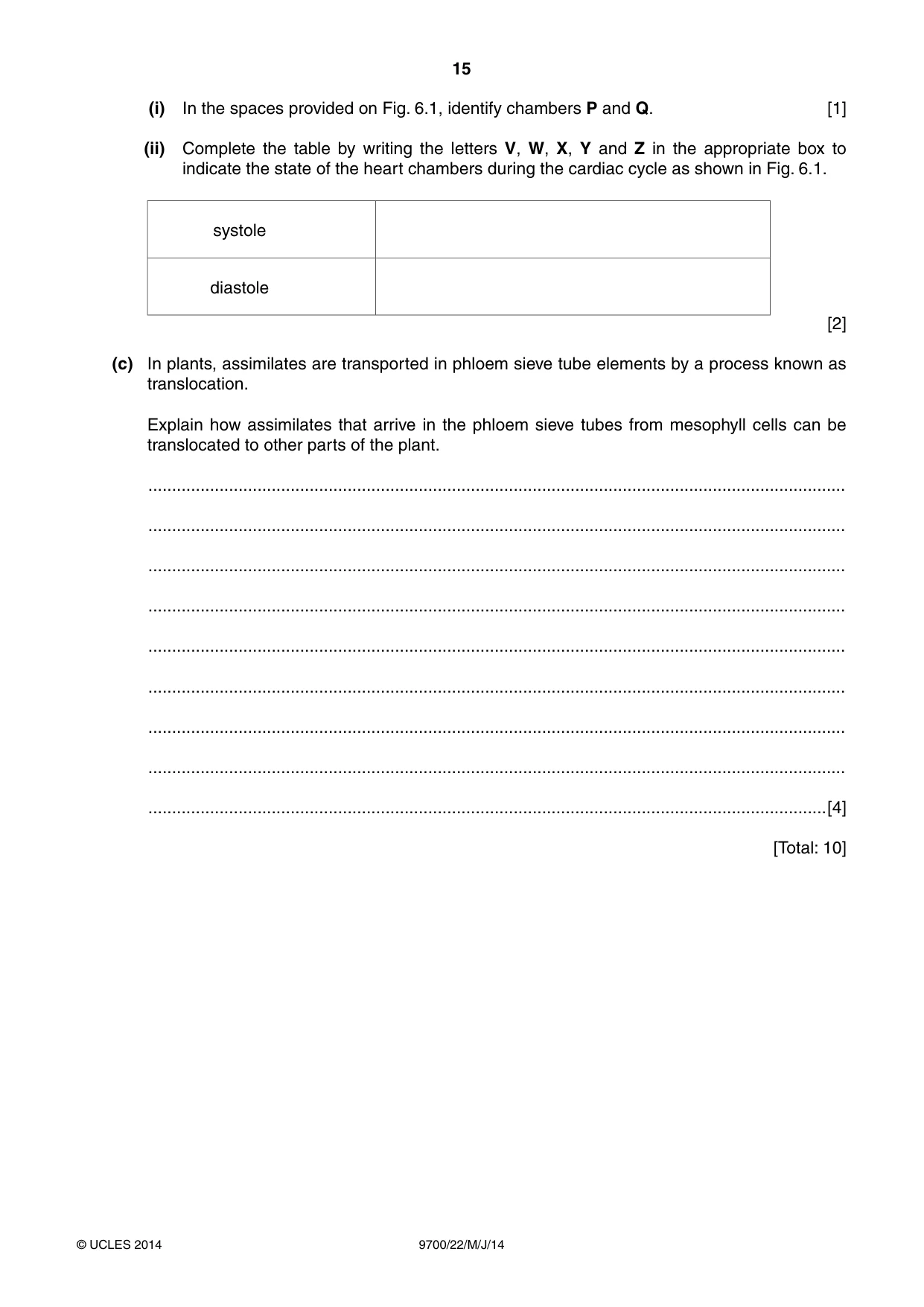
15 9700/22/M/J/14 © UCLES 2014 (i) In the spaces provided on Fig. 6.1, identify chambers P and Q. [1] (ii) Complete the table by writing the letters V, W, X, Y and Z in the appropriate box to indicate the state of the heart chambers during the cardiac cycle as shown in Fig. 6.1. systole diastole [2] (c) In plants, assimilates are transported in phloem sieve tube elements by a process known as translocation. Explain how assimilates that arrive in the phloem sieve tubes from mesophyll cells can be translocated to other parts of the plant. … … … … … … … … …[4] [Total: 10]
Question paper, page 16
16 9700/22/M/J/14 © UCLES 2014 Copyright Acknowledgements: Fig. 2.1 © PHOTOTAKE Inc./Alamy Permission to reproduce items where third-party owned material protected by copyright is included has been sought and cleared where possible. Every reasonable effort has been made by the publisher (UCLES) to trace copyright holders, but if any items requiring clearance have unwittingly been included, the publisher will be pleased to make amends at the earliest possible opportunity. Cambridge International Examinations is part of the Cambridge Assessment Group. Cambridge Assessment is the brand name of University of Cambridge Local Examinations Syndicate (UCLES), which is itself a department of the University of Cambridge. BLANK PAGE
Mark scheme, page 1
© Cambridge International Examinations 2014 CAMBRIDGE INTERNATIONAL EXAMINATIONS GCE Advanced Subsidiary Level and GCE Advanced Level MARK SCHEME for the May/June 2014 series 9700 BIOLOGY 9700/22 Paper 2 (AS Structured Questions), maximum raw mark 60 This mark scheme is published as an aid to teachers and candidates, to indicate the requirements of the examination. It shows the basis on which Examiners were instructed to award marks. It does not indicate the details of the discussions that took place at an Examiners’ meeting before marking began, which would have considered the acceptability of alternative answers. Mark schemes should be read in conjunction with the question paper and the Principal Examiner Report for Teachers. Cambridge will not enter into discussions about these mark schemes. Cambridge is publishing the mark schemes for the May/June 2014 series for most IGCSE, GCE Advanced Level and Advanced Subsidiary Level components and some Ordinary Level components.
Mark scheme, page 2
Page 1 Mark Scheme Syllabus Paper GCE AS/A LEVEL – May/June 2014 9700 22 © Cambridge International Examinations 2014 Mark scheme abbreviations ; separates marking points / alternative answers for the same point R reject A accept (for answers correctly cued by the equation, or by extra guidance) R reject A accept (for answers correctly cued by the question, or by extra guidance AW alternative wording (where responses vary more than usual) underline actual word given must be used by candidate (grammatical variants accepted) max indicates the maximum number of marks that can be given ora or reverse argument mp marking point (with relevant number) ecf error carried forward I ignore AVP alternative valid point
Mark scheme, page 3
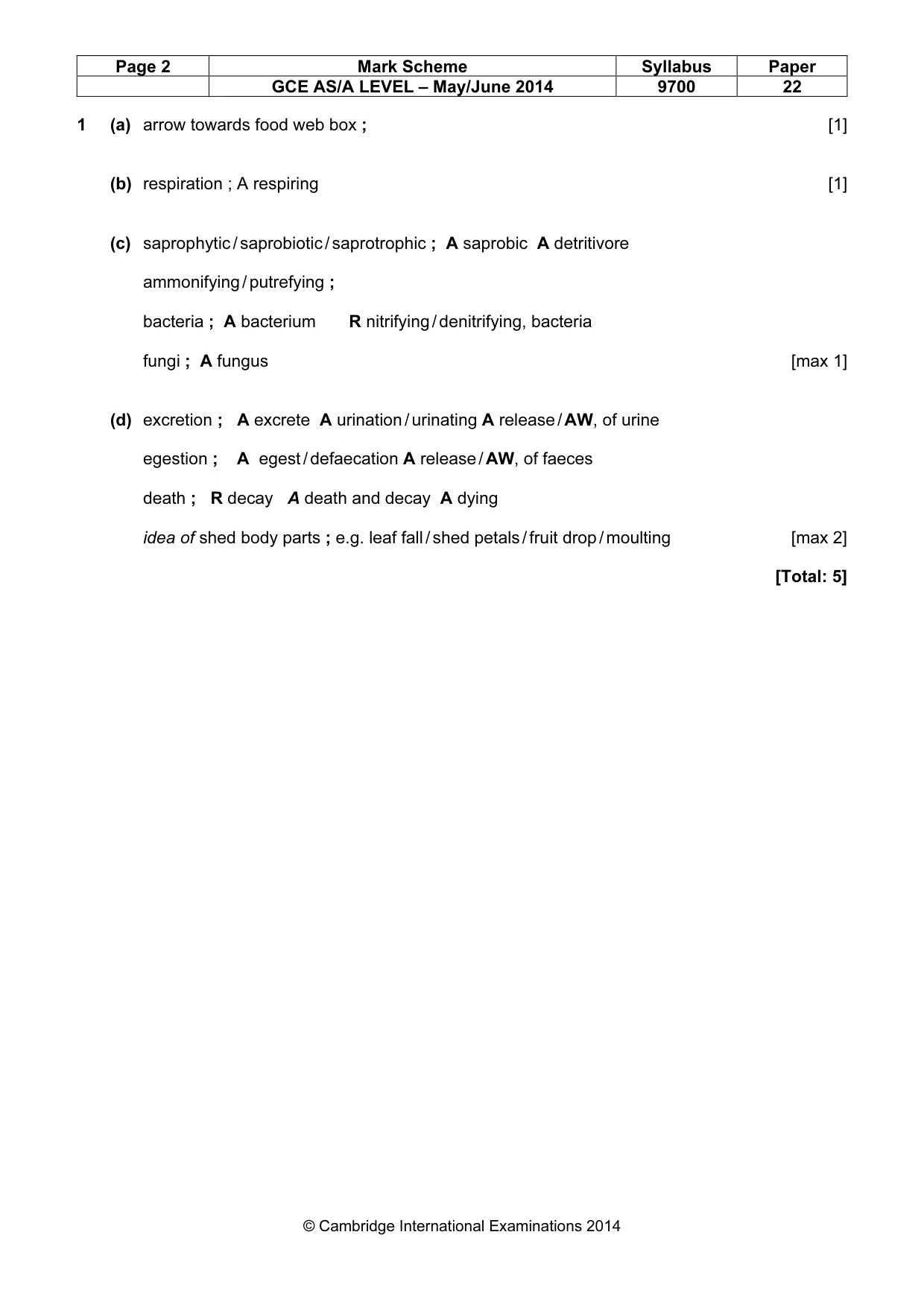
Page 2 Mark Scheme Syllabus Paper GCE AS/A LEVEL – May/June 2014 9700 22 © Cambridge International Examinations 2014 1 (a) arrow towards food web box ; [1] (b) respiration ; A respiring [1] (c) saprophytic / saprobiotic / saprotrophic ; A saprobic A detritivore ammonifying / putrefying ; bacteria ; A bacterium R nitrifying / denitrifying, bacteria fungi ; A fungus [max 1] (d) excretion ; A excrete A urination / urinating A release / AW, of urine egestion ; A egest / defaecation A release / AW, of faeces death ; R decay A death and decay A dying idea of shed body parts ; e.g. leaf fall / shed petals / fruit drop / moulting [max 2] [Total: 5]
Mark scheme, page 4
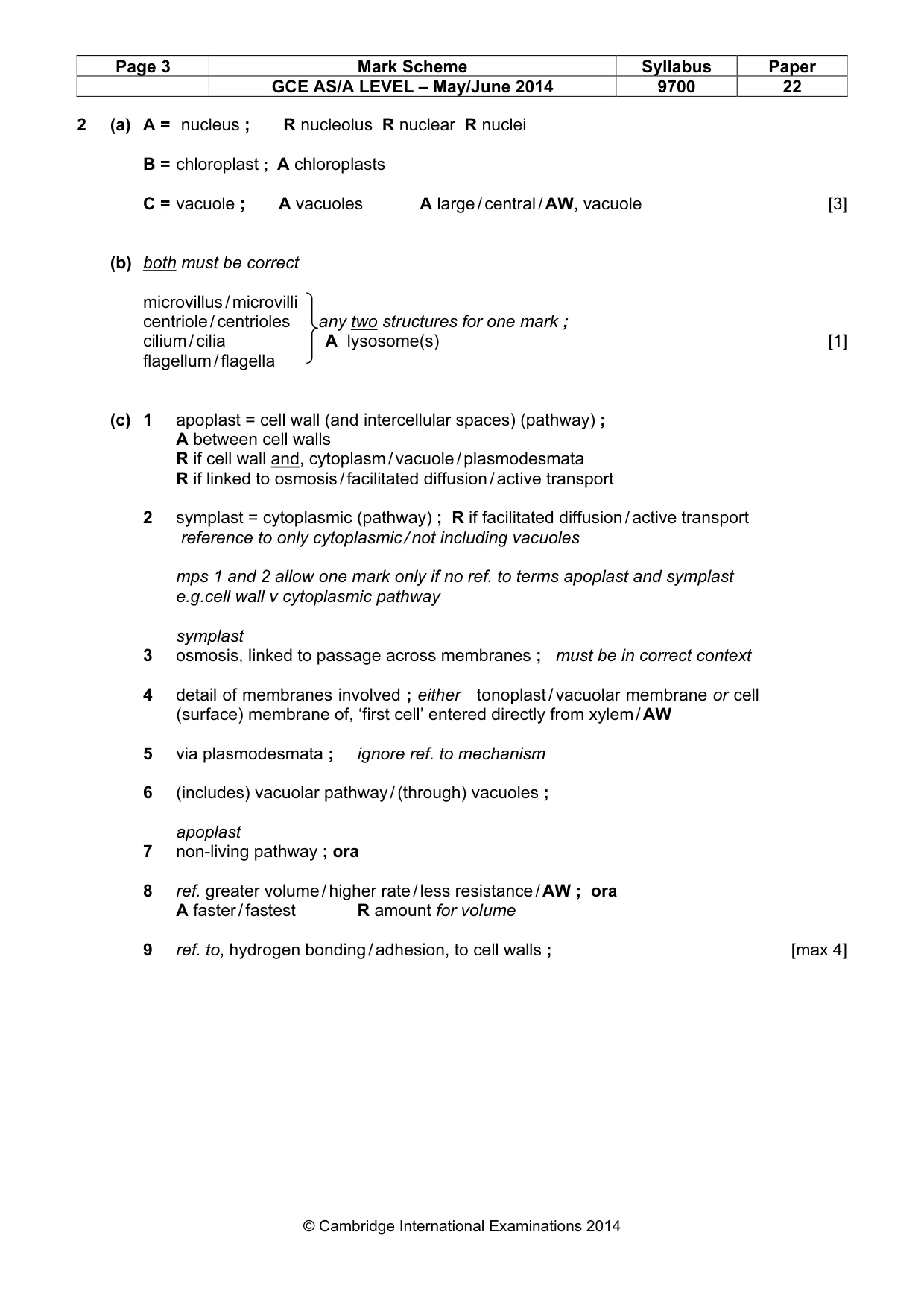
Page 3 Mark Scheme Syllabus Paper GCE AS/A LEVEL – May/June 2014 9700 22 © Cambridge International Examinations 2014 2 (a) A = nucleus ; R nucleolus R nuclear R nuclei B = chloroplast ; A chloroplasts C = vacuole ; A vacuoles A large / central / AW, vacuole [3] (b) both must be correct microvillus / microvilli centriole / centrioles any two structures for one mark ; cilium / cilia A lysosome(s) [1] flagellum / flagella (c) 1 apoplast = cell wall (and intercellular spaces) (pathway) ; A between cell walls R if cell wall and, cytoplasm / vacuole / plasmodesmata R if linked to osmosis / facilitated diffusion / active transport 2 symplast = cytoplasmic (pathway) ; R if facilitated diffusion / active transport reference to only cytoplasmic / not including vacuoles mps 1 and 2 allow one mark only if no ref. to terms apoplast and symplast e.g.cell wall v cytoplasmic pathway symplast 3 osmosis, linked to passage across membranes ; must be in correct context 4 detail of membranes involved ; either tonoplast / vacuolar membrane or cell (surface) membrane of, ‘first cell’ entered directly from xylem / AW 5 via plasmodesmata ; ignore ref. to mechanism 6 (includes) vacuolar pathway / (through) vacuoles ; apoplast 7 non-living pathway ; ora 8 ref. greater volume / higher rate / less resistance / AW ; ora A faster / fastest R amount for volume 9 ref. to, hydrogen bonding / adhesion, to cell walls ; [max 4]
Mark scheme, page 5
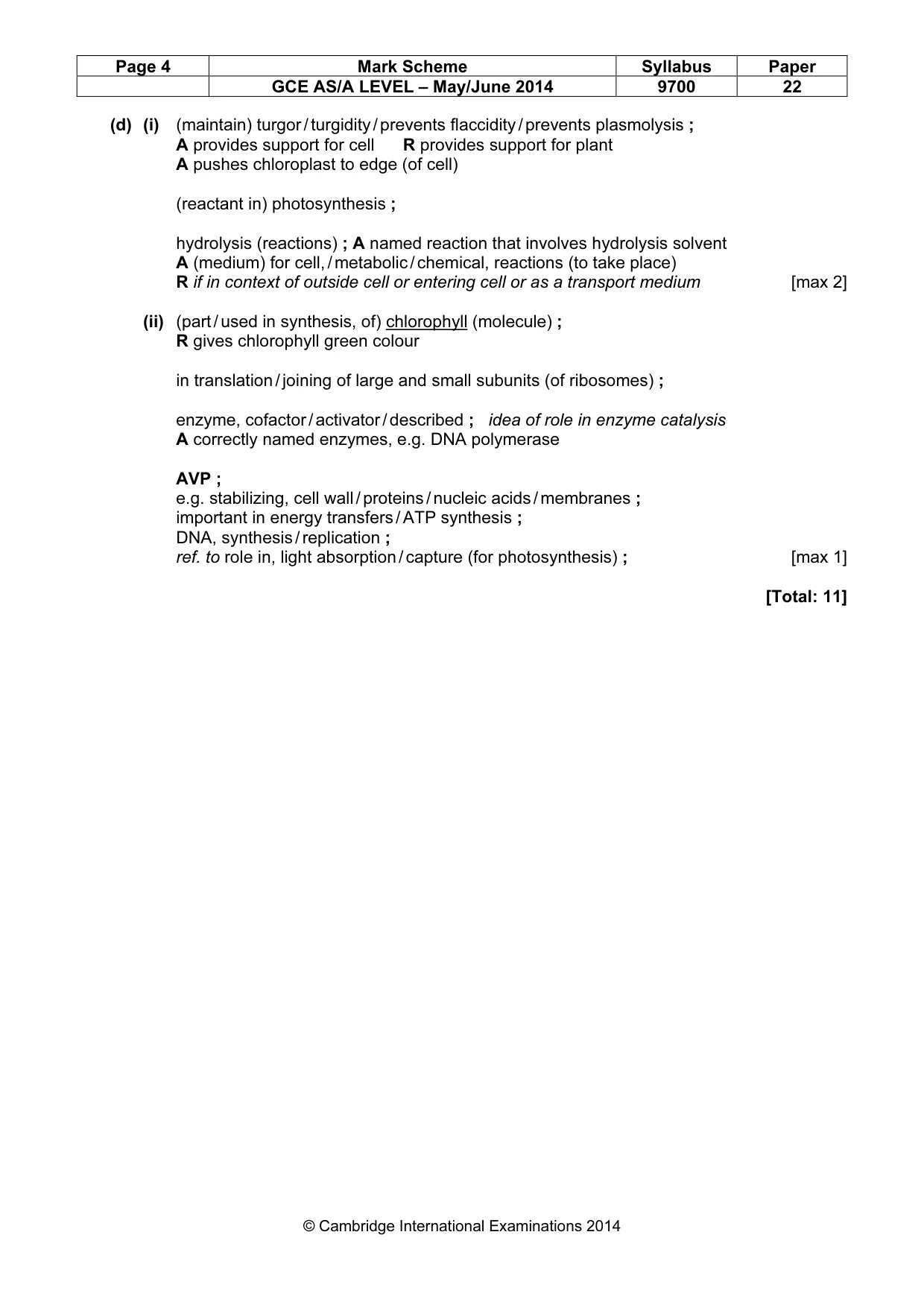
Page 4 Mark Scheme Syllabus Paper GCE AS/A LEVEL – May/June 2014 9700 22 © Cambridge International Examinations 2014 (d) (i) (maintain) turgor / turgidity / prevents flaccidity / prevents plasmolysis ; A provides support for cell R provides support for plant A pushes chloroplast to edge (of cell) (reactant in) photosynthesis ; hydrolysis (reactions) ; A named reaction that involves hydrolysis solvent A (medium) for cell, / metabolic / chemical, reactions (to take place) R if in context of outside cell or entering cell or as a transport medium [max 2] (ii) (part / used in synthesis, of) chlorophyll (molecule) ; R gives chlorophyll green colour in translation / joining of large and small subunits (of ribosomes) ; enzyme, cofactor / activator / described ; idea of role in enzyme catalysis A correctly named enzymes, e.g. DNA polymerase AVP ; e.g. stabilizing, cell wall / proteins / nucleic acids / membranes ; important in energy transfers / ATP synthesis ; DNA, synthesis / replication ; ref. to role in, light absorption / capture (for photosynthesis) ; [max 1] [Total: 11]
Mark scheme, page 6
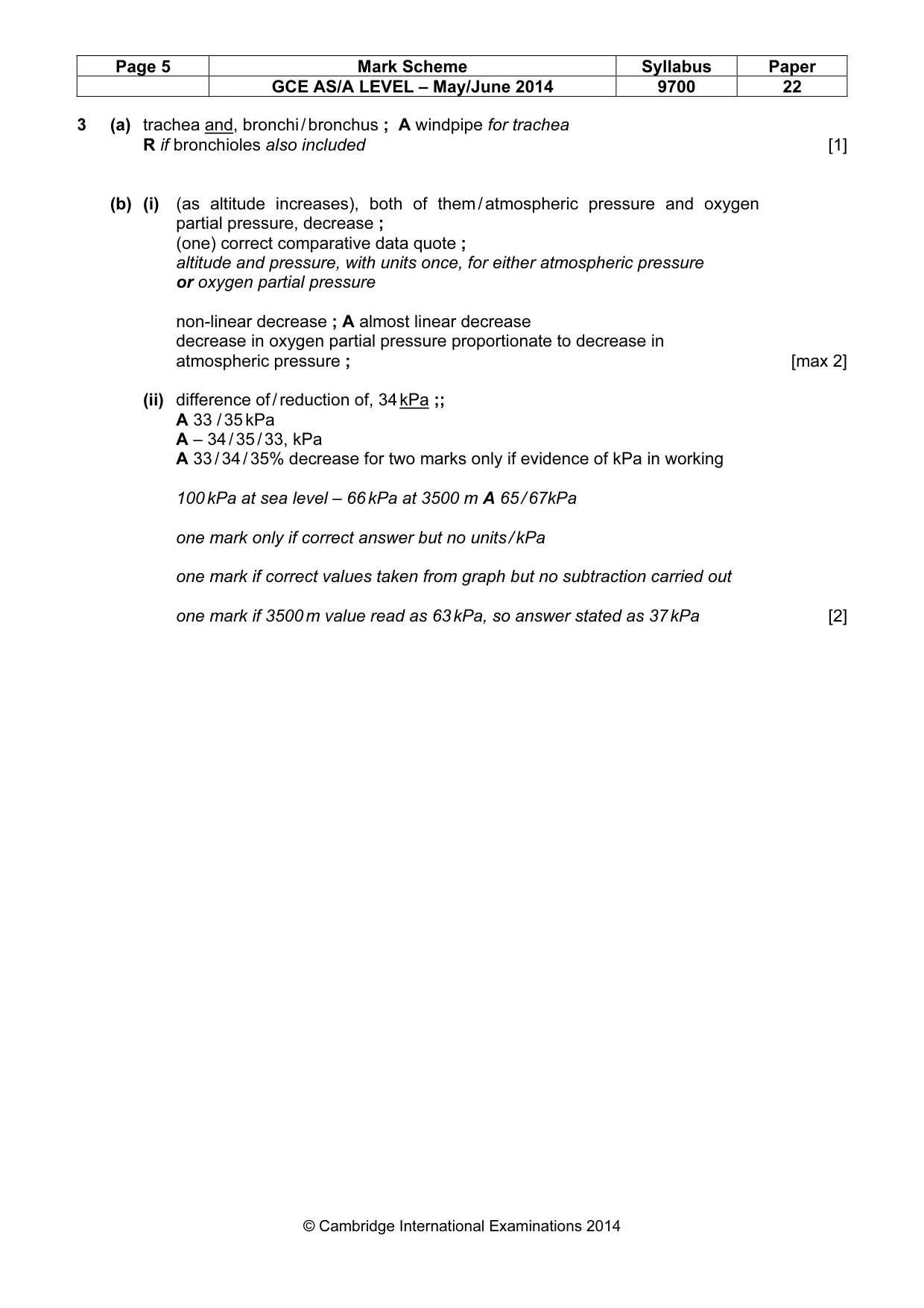
Page 5 Mark Scheme Syllabus Paper GCE AS/A LEVEL – May/June 2014 9700 22 © Cambridge International Examinations 2014 3 (a) trachea and, bronchi / bronchus ; A windpipe for trachea R if bronchioles also included [1] (b) (i) (as altitude increases), both of them / atmospheric pressure and oxygen partial pressure, decrease ; (one) correct comparative data quote ; altitude and pressure, with units once, for either atmospheric pressure or oxygen partial pressure non-linear decrease ; A almost linear decrease decrease in oxygen partial pressure proportionate to decrease in atmospheric pressure ; [max 2] (ii) difference of / reduction of, 34 kPa ;; A 33 / 35 kPa A – 34 / 35 / 33, kPa A 33 / 34 / 35% decrease for two marks only if evidence of kPa in working 100 kPa at sea level – 66 kPa at 3500 m A 65 / 67kPa one mark only if correct answer but no units / kPa one mark if correct values taken from graph but no subtraction carried out one mark if 3500 m value read as 63 kPa, so answer stated as 37 kPa [2]
Mark scheme, page 7
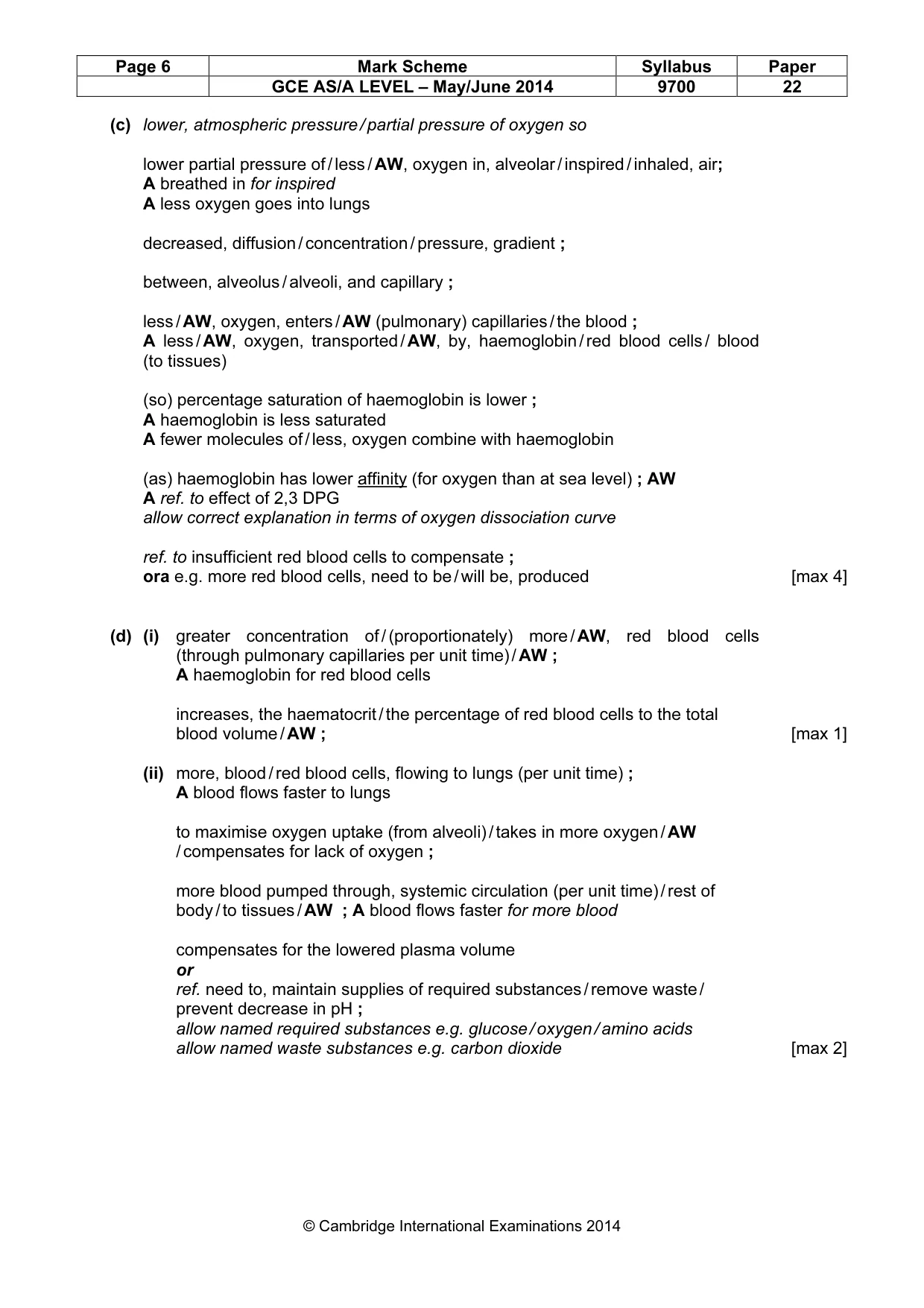
Page 6 Mark Scheme Syllabus Paper GCE AS/A LEVEL – May/June 2014 9700 22 © Cambridge International Examinations 2014 (c) lower, atmospheric pressure / partial pressure of oxygen so lower partial pressure of / less / AW, oxygen in, alveolar / inspired / inhaled, air; A breathed in for inspired A less oxygen goes into lungs decreased, diffusion / concentration / pressure, gradient ; between, alveolus / alveoli, and capillary ; less / AW, oxygen, enters / AW (pulmonary) capillaries / the blood ; A less / AW, oxygen, transported / AW, by, haemoglobin / red blood cells / blood (to tissues) (so) percentage saturation of haemoglobin is lower ; A haemoglobin is less saturated A fewer molecules of / less, oxygen combine with haemoglobin (as) haemoglobin has lower affinity (for oxygen than at sea level) ; AW A ref. to effect of 2,3 DPG allow correct explanation in terms of oxygen dissociation curve ref. to insufficient red blood cells to compensate ; ora e.g. more red blood cells, need to be / will be, produced [max 4] (d) (i) greater concentration of / (proportionately) more / AW, red blood cells (through pulmonary capillaries per unit time) / AW ; A haemoglobin for red blood cells increases, the haematocrit / the percentage of red blood cells to the total blood volume / AW ; [max 1] (ii) more, blood / red blood cells, flowing to lungs (per unit time) ; A blood flows faster to lungs to maximise oxygen uptake (from alveoli) / takes in more oxygen / AW / compensates for lack of oxygen ; more blood pumped through, systemic circulation (per unit time) / rest of body / to tissues / AW ; A blood flows faster for more blood compensates for the lowered plasma volume or ref. need to, maintain supplies of required substances / remove waste / prevent decrease in pH ; allow named required substances e.g. glucose / oxygen / amino acids allow named waste substances e.g. carbon dioxide [max 2]
Mark scheme, page 8
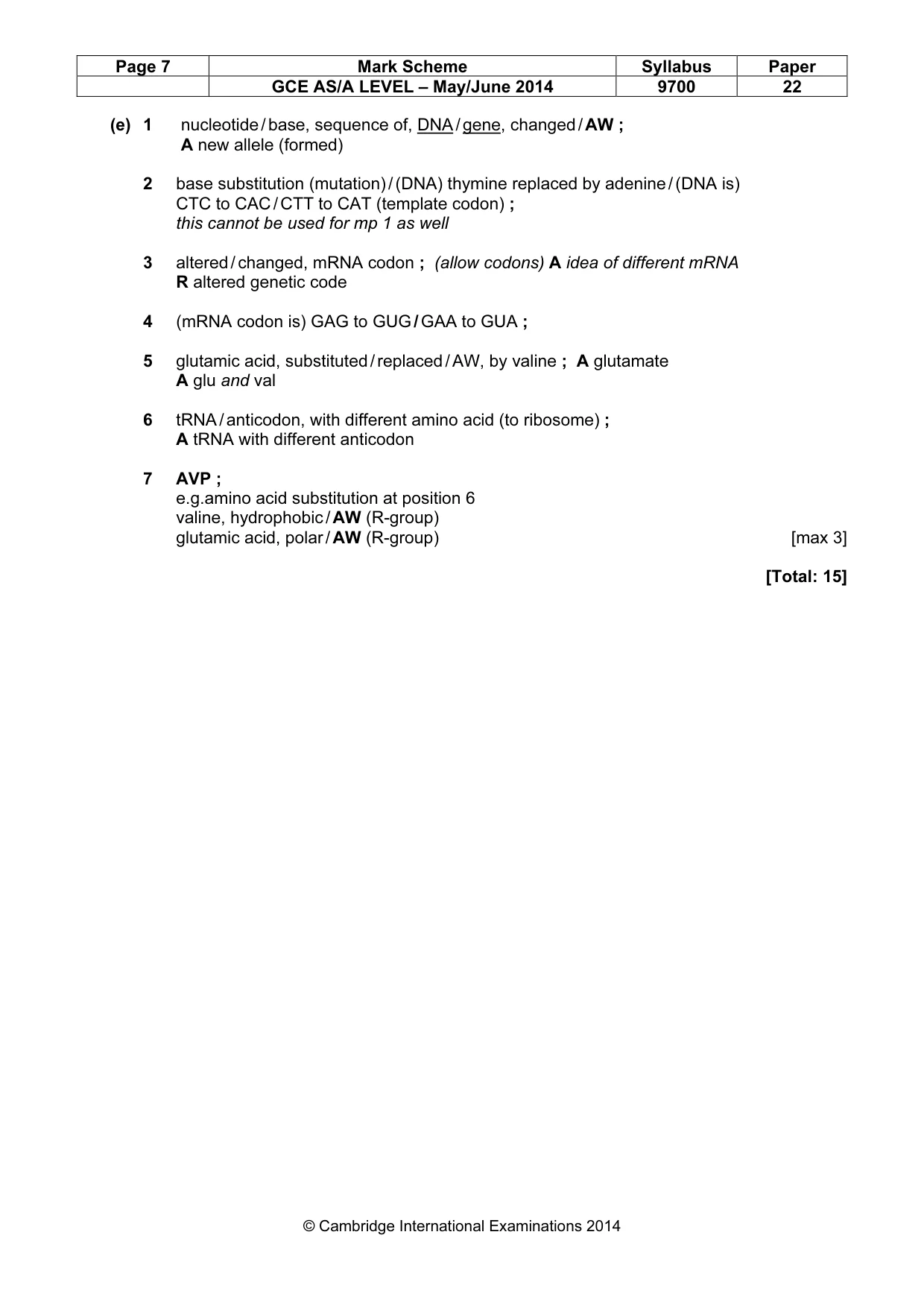
Page 7 Mark Scheme Syllabus Paper GCE AS/A LEVEL – May/June 2014 9700 22 © Cambridge International Examinations 2014 (e) 1 nucleotide / base, sequence of, DNA / gene, changed / AW ; A new allele (formed) 2 base substitution (mutation) / (DNA) thymine replaced by adenine / (DNA is) CTC to CAC / CTT to CAT (template codon) ; this cannot be used for mp 1 as well 3 altered / changed, mRNA codon ; (allow codons) A idea of different mRNA R altered genetic code 4 (mRNA codon is) GAG to GUG / GAA to GUA ; 5 glutamic acid, substituted / replaced / AW, by valine ; A glutamate A glu and val 6 tRNA / anticodon, with different amino acid (to ribosome) ; A tRNA with different anticodon 7 AVP ; e.g.amino acid substitution at position 6 valine, hydrophobic / AW (R-group) glutamic acid, polar / AW (R-group) [max 3] [Total: 15]
Mark scheme, page 9
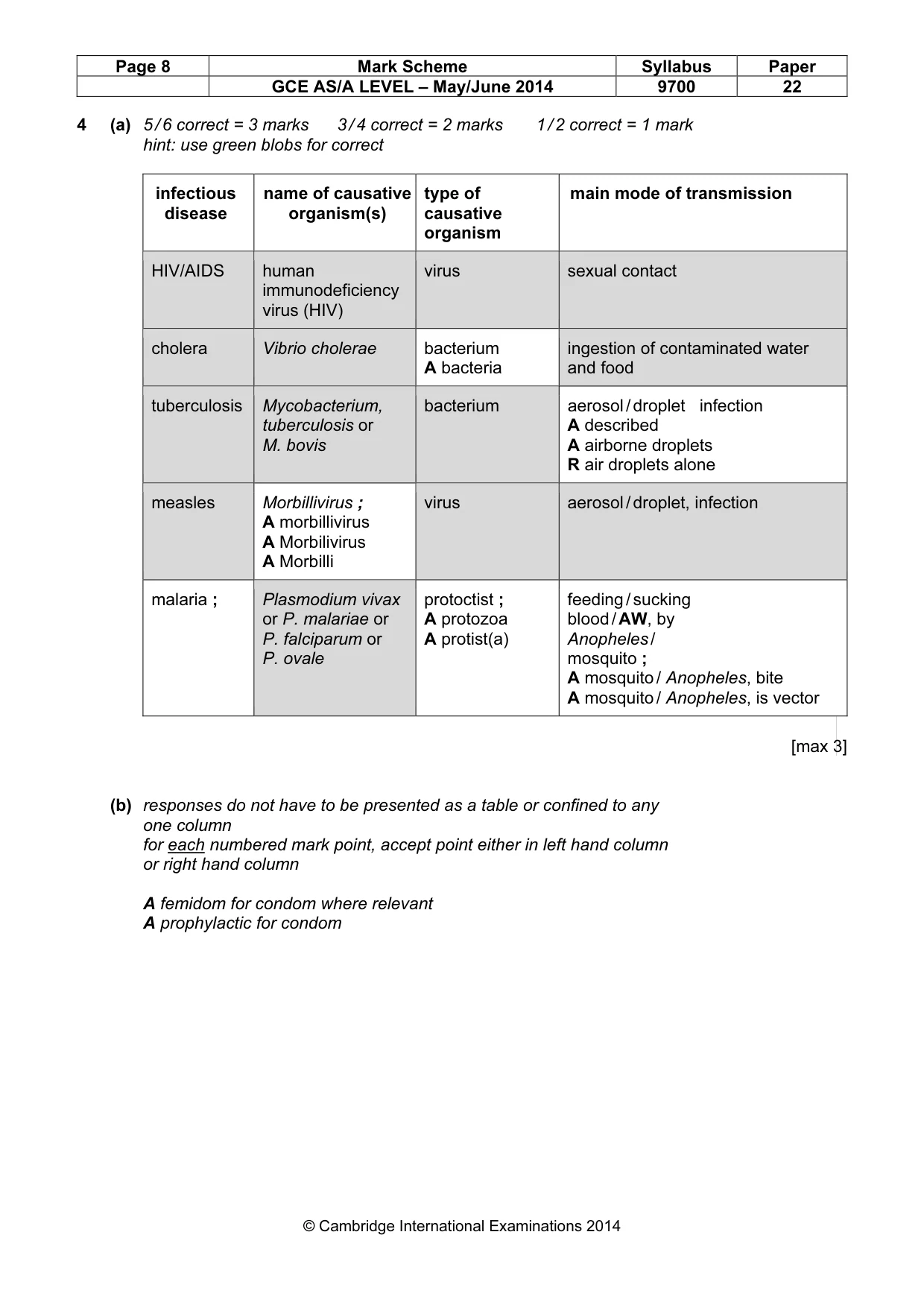
Page 8 Mark Scheme Syllabus Paper GCE AS/A LEVEL – May/June 2014 9700 22 © Cambridge International Examinations 2014 4 (a) 5 / 6 correct = 3 marks 3 / 4 correct = 2 marks 1 / 2 correct = 1 mark hint: use green blobs for correct infectious disease name of causative organism(s) type of causative organism main mode of transmission HIV/AIDS human immunodeficiency virus (HIV) virus sexual contact cholera Vibrio cholerae bacterium A bacteria ingestion of contaminated water and food tuberculosis Mycobacterium, tuberculosis or M. bovis bacterium aerosol / droplet infection A described A airborne droplets R air droplets alone measles Morbillivirus ; A morbillivirus A Morbilivirus A Morbilli virus aerosol / droplet, infection malaria ; Plasmodium vivax or P. malariae or P. falciparum or P. ovale protoctist ; A protozoa A protist(a) feeding / sucking blood / AW, by Anopheles / mosquito ; A mosquito / Anopheles, bite A mosquito / Anopheles, is vector [max 3] (b) responses do not have to be presented as a table or confined to any one column for each numbered mark point, accept point either in left hand column or right hand column A femidom for condom where relevant A prophylactic for condom
Mark scheme, page 10
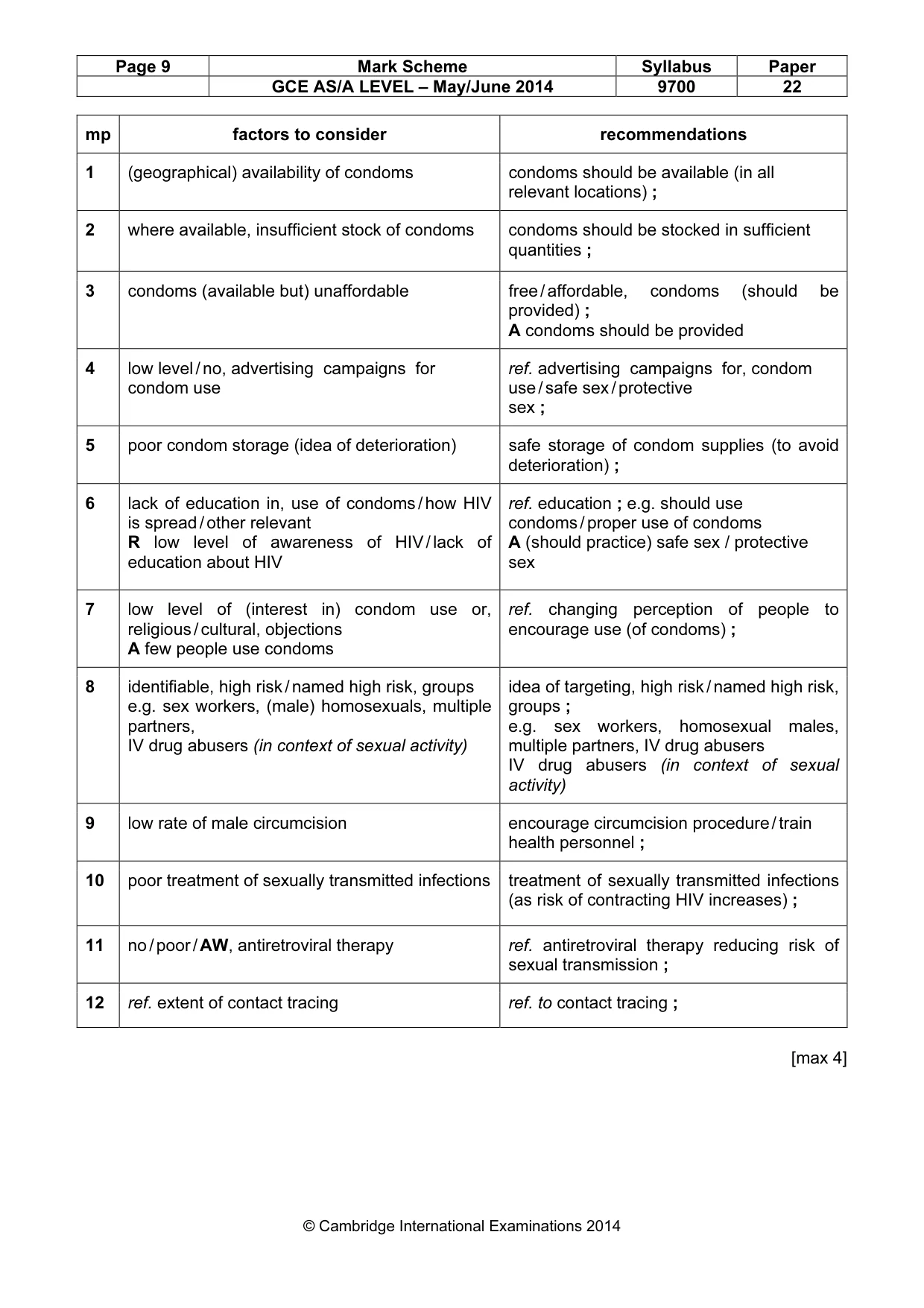
Page 9 Mark Scheme Syllabus Paper GCE AS/A LEVEL – May/June 2014 9700 22 © Cambridge International Examinations 2014 mp factors to consider recommendations 1 (geographical) availability of condoms condoms should be available (in all relevant locations) ; 2 where available, insufficient stock of condoms condoms should be stocked in sufficient quantities ; 3 condoms (available but) unaffordable free / affordable, condoms (should be provided) ; A condoms should be provided 4 low level / no, advertising campaigns for condom use ref. advertising campaigns for, condom use / safe sex / protective sex ; 5 poor condom storage (idea of deterioration) safe storage of condom supplies (to avoid deterioration) ; 6 lack of education in, use of condoms / how HIV is spread / other relevant R low level of awareness of HIV / lack of education about HIV ref. education ; e.g. should use condoms / proper use of condoms A (should practice) safe sex / protective sex 7 low level of (interest in) condom use or, religious / cultural, objections A few people use condoms ref. changing perception of people to encourage use (of condoms) ; 8 identifiable, high risk / named high risk, groups e.g. sex workers, (male) homosexuals, multiple partners, IV drug abusers (in context of sexual activity) idea of targeting, high risk / named high risk, groups ; e.g. sex workers, homosexual males, multiple partners, IV drug abusers IV drug abusers (in context of sexual activity) 9 low rate of male circumcision encourage circumcision procedure / train health personnel ; 10 poor treatment of sexually transmitted infections treatment of sexually transmitted infections (as risk of contracting HIV increases) ; 11 no / poor / AW, antiretroviral therapy ref. antiretroviral therapy reducing risk of sexual transmission ; 12 ref. extent of contact tracing ref. to contact tracing ; [max 4]
Mark scheme, page 11
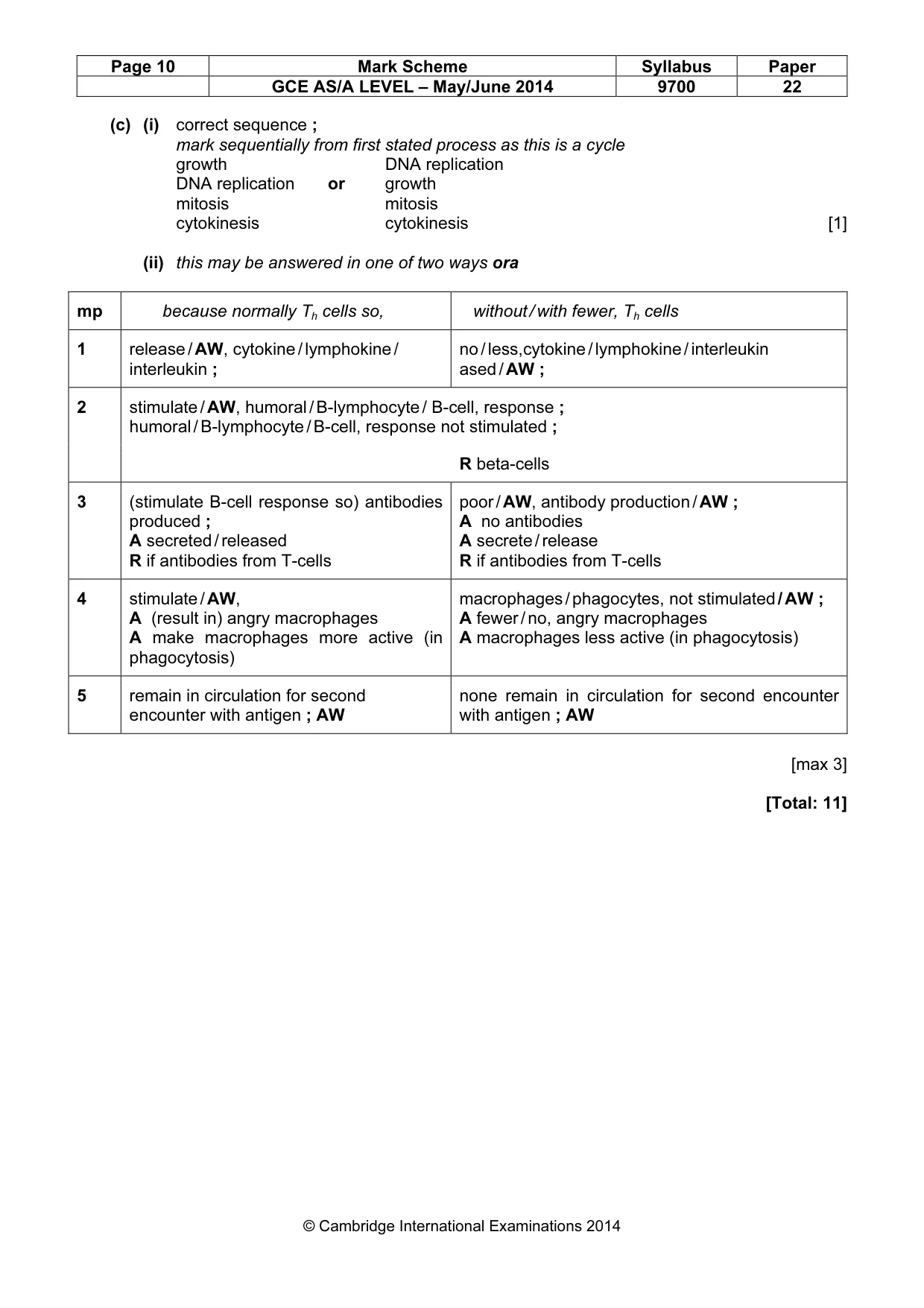
Page 10 Mark Scheme Syllabus Paper GCE AS/A LEVEL – May/June 2014 9700 22 © Cambridge International Examinations 2014 (c) (i) correct sequence ; mark sequentially from first stated process as this is a cycle growth DNA replication DNA replication or growth mitosis mitosis cytokinesis cytokinesis [1] (ii) this may be answered in one of two ways ora mp because normally Th cells so, without / with fewer, Th cells 1 release / AW, cytokine / lymphokine / interleukin ; no / less,cytokine / lymphokine / interleukin ased / AW ; 2 stimulate / AW, humoral / B-lymphocyte / B-cell, response ; humoral / B-lymphocyte / B-cell, response not stimulated ; R beta-cells 3 (stimulate B-cell response so) antibodies produced ; A secreted / released R if antibodies from T-cells poor / AW, antibody production / AW ; A no antibodies A secrete / release R if antibodies from T-cells 4 stimulate / AW, A (result in) angry macrophages A make macrophages more active (in phagocytosis) macrophages / phagocytes, not stimulated / AW ; A fewer / no, angry macrophages A macrophages less active (in phagocytosis) 5 remain in circulation for second encounter with antigen ; AW none remain in circulation for second encounter with antigen ; AW [max 3] [Total: 11]
Mark scheme, page 12
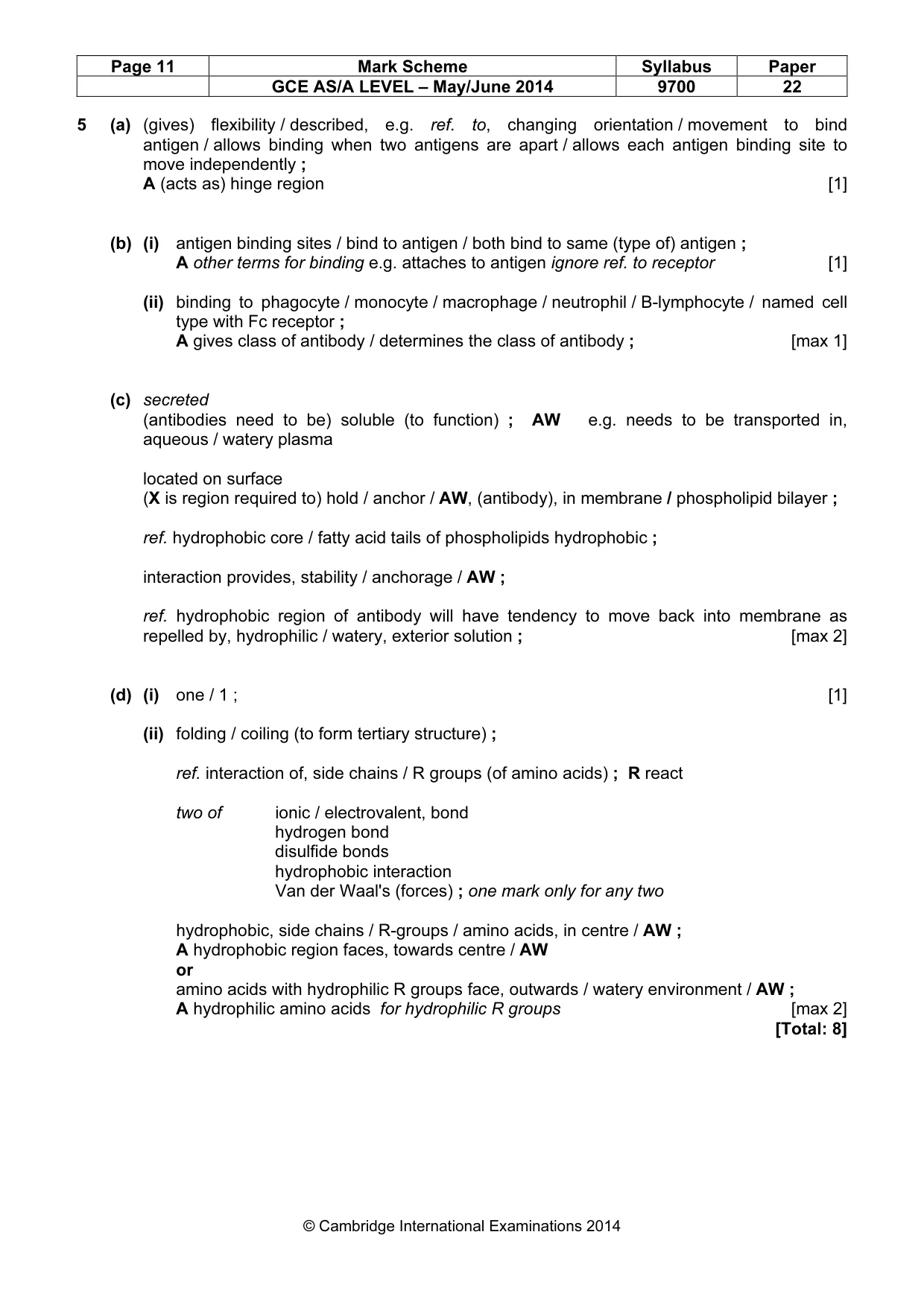
Page 11 Mark Scheme Syllabus Paper GCE AS/A LEVEL – May/June 2014 9700 22 © Cambridge International Examinations 2014 5 (a) (gives) flexibility / described, e.g. ref. to, changing orientation / movement to bind antigen / allows binding when two antigens are apart / allows each antigen binding site to move independently ; A (acts as) hinge region [1] (b) (i) antigen binding sites / bind to antigen / both bind to same (type of) antigen ; A other terms for binding e.g. attaches to antigen ignore ref. to receptor [1] (ii) binding to phagocyte / monocyte / macrophage / neutrophil / B-lymphocyte / named cell type with Fc receptor ; A gives class of antibody / determines the class of antibody ; [max 1] (c) secreted (antibodies need to be) soluble (to function) ; AW e.g. needs to be transported in, aqueous / watery plasma located on surface (X is region required to) hold / anchor / AW, (antibody), in membrane / phospholipid bilayer ; ref. hydrophobic core / fatty acid tails of phospholipids hydrophobic ; interaction provides, stability / anchorage / AW ; ref. hydrophobic region of antibody will have tendency to move back into membrane as repelled by, hydrophilic / watery, exterior solution ; [max 2] (d) (i) one / 1 ; [1] (ii) folding / coiling (to form tertiary structure) ; ref. interaction of, side chains / R groups (of amino acids) ; R react two of ionic / electrovalent, bond hydrogen bond disulfide bonds hydrophobic interaction Van der Waal's (forces) ; one mark only for any two hydrophobic, side chains / R-groups / amino acids, in centre / AW ; A hydrophobic region faces, towards centre / AW or amino acids with hydrophilic R groups face, outwards / watery environment / AW ; A hydrophilic amino acids for hydrophilic R groups [max 2] [Total: 8]
Mark scheme, page 13
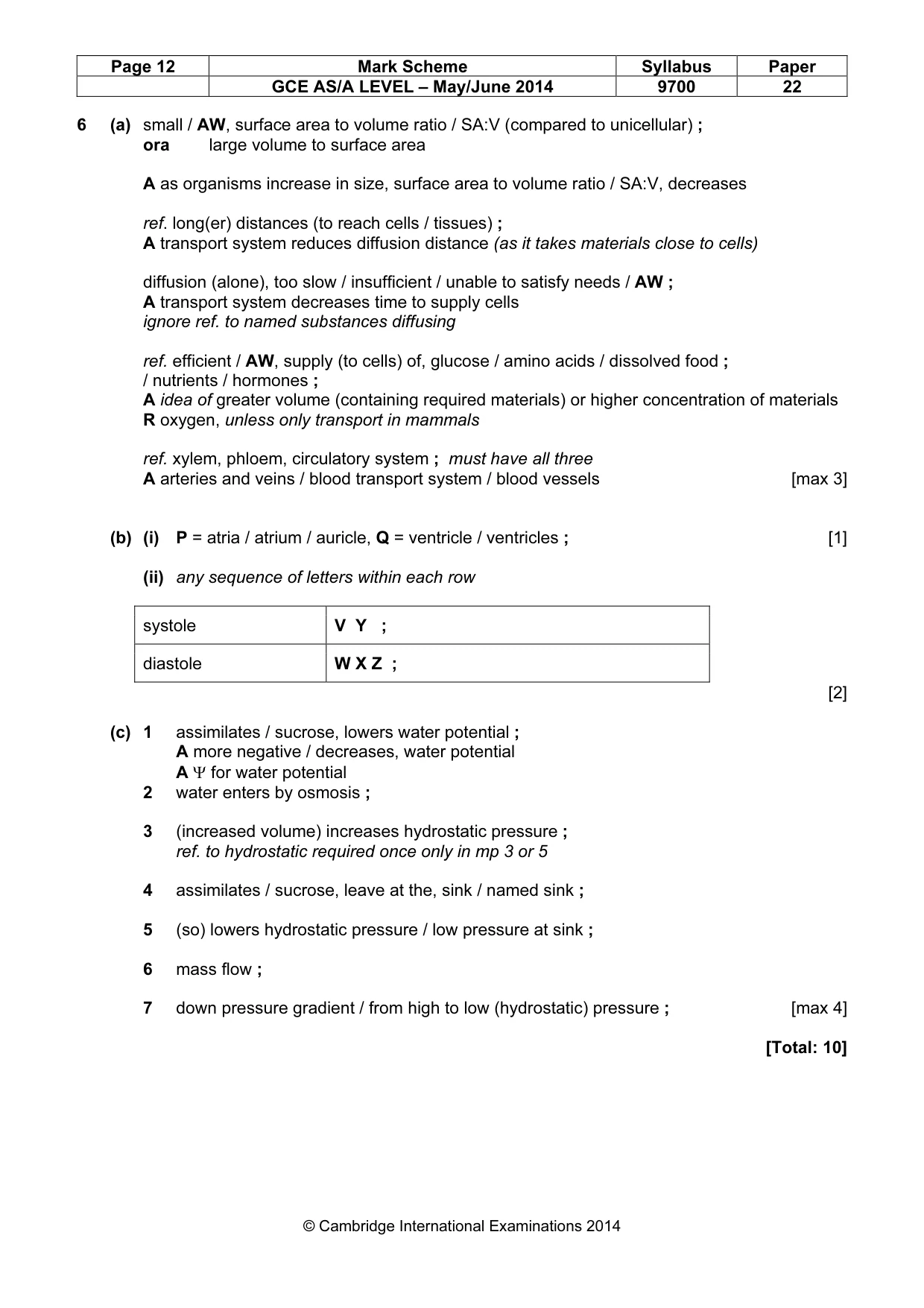
Page 12 Mark Scheme Syllabus Paper GCE AS/A LEVEL – May/June 2014 9700 22 © Cambridge International Examinations 2014 6 (a) small / AW, surface area to volume ratio / SA:V (compared to unicellular) ; ora large volume to surface area A as organisms increase in size, surface area to volume ratio / SA:V, decreases ref. long(er) distances (to reach cells / tissues) ; A transport system reduces diffusion distance (as it takes materials close to cells) diffusion (alone), too slow / insufficient / unable to satisfy needs / AW ; A transport system decreases time to supply cells ignore ref. to named substances diffusing ref. efficient / AW, supply (to cells) of, glucose / amino acids / dissolved food ; / nutrients / hormones ; A idea of greater volume (containing required materials) or higher concentration of materials R oxygen, unless only transport in mammals ref. xylem, phloem, circulatory system ; must have all three A arteries and veins / blood transport system / blood vessels [max 3] (b) (i) P = atria / atrium / auricle, Q = ventricle / ventricles ; [1] (ii) any sequence of letters within each row systole V Y ; diastole W X Z ; [2] (c) 1 assimilates / sucrose, lowers water potential ; A more negative / decreases, water potential A Ψ for water potential 2 water enters by osmosis ; 3 (increased volume) increases hydrostatic pressure ; ref. to hydrostatic required once only in mp 3 or 5 4 assimilates / sucrose, leave at the, sink / named sink ; 5 (so) lowers hydrostatic pressure / low pressure at sink ; 6 mass flow ; 7 down pressure gradient / from high to low (hydrostatic) pressure ; [max 4] [Total: 10]
What you needed in this session
Cambridge’s own grade thresholds for 2014 May/June, Paper 2 · Variant 2. A higher threshold means an easier paper — the bar moves with how the cohort did.