Cambridge A Level Biology 9700 — 2012 May/June Paper 2 · Variant 2
9700/22/M/J/12 · 60 marks · ≈68 min
The question paper and its mark scheme, free to read here and free to download. This is Cambridge’s own paper, exactly as it was sat.
Question paper16 pages

Mark scheme10 pages
Answers below. Sit the paper first if you are practising.
Paper as text
Question paper, page 1
This document consists of 14 printed pages and 2 blank pages. DC (NF/JG) 47764/2 © UCLES 2012 [Turn over UNIVERSITY OF CAMBRIDGE INTERNATIONAL EXAMINATIONS General Certificate of Education Advanced Subsidiary Level and Advanced Level * 0 3 0 3 8 6 2 5 4 5 * BIOLOGY 9700/22 Paper 2 Structured Questions AS May/June 2012 1 hour 15 minutes Candidates answer on the Question Paper. No Additional Materials are required. READ THESE INSTRUCTIONS FIRST Write your Centre number, candidate number and name in the spaces provided at the top of this page. Write in dark blue or black ink. You may use a soft pencil for any diagrams, graphs, or rough working. Do not use red ink, staples, paper clips, highlighters, glue or correction fluid. DO NOT WRITE IN ANY BARCODES. Answer all questions. At the end of the examination, fasten all your work securely together. The number of marks is given in brackets [ ] at the end of each question or part question. For Examiner’s Use 1 2 3 4 5 6 Total
Question paper, page 2
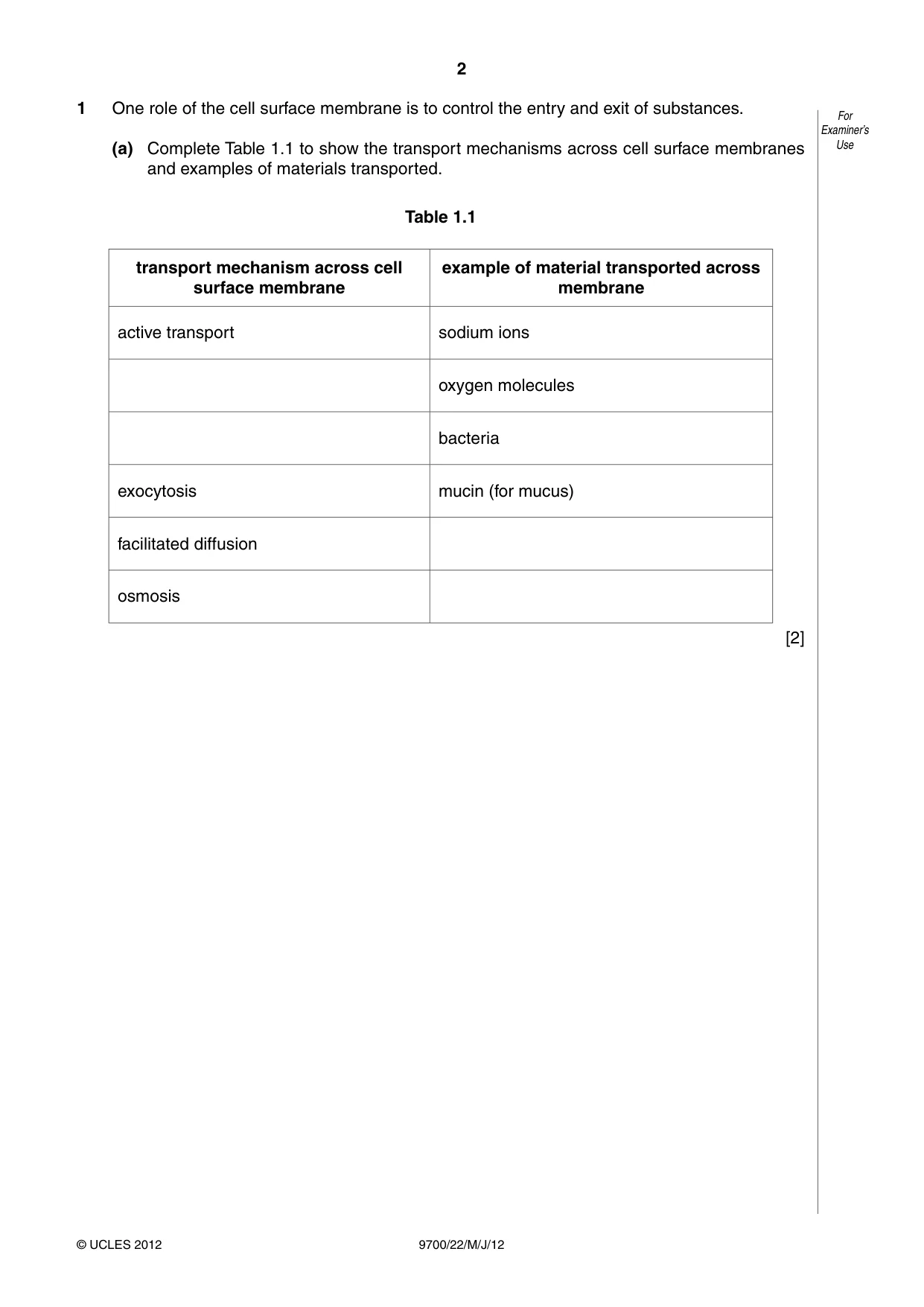
2 9700/22/M/J/12 © UCLES 2012 For Examiner’s Use 1 One role of the cell surface membrane is to control the entry and exit of substances. (a) Complete Table 1.1 to show the transport mechanisms across cell surface membranes and examples of materials transported. Table 1.1 transport mechanism across cell surface membrane example of material transported across membrane active transport sodium ions oxygen molecules bacteria exocytosis mucin (for mucus) facilitated diffusion osmosis [2]
Question paper, page 3
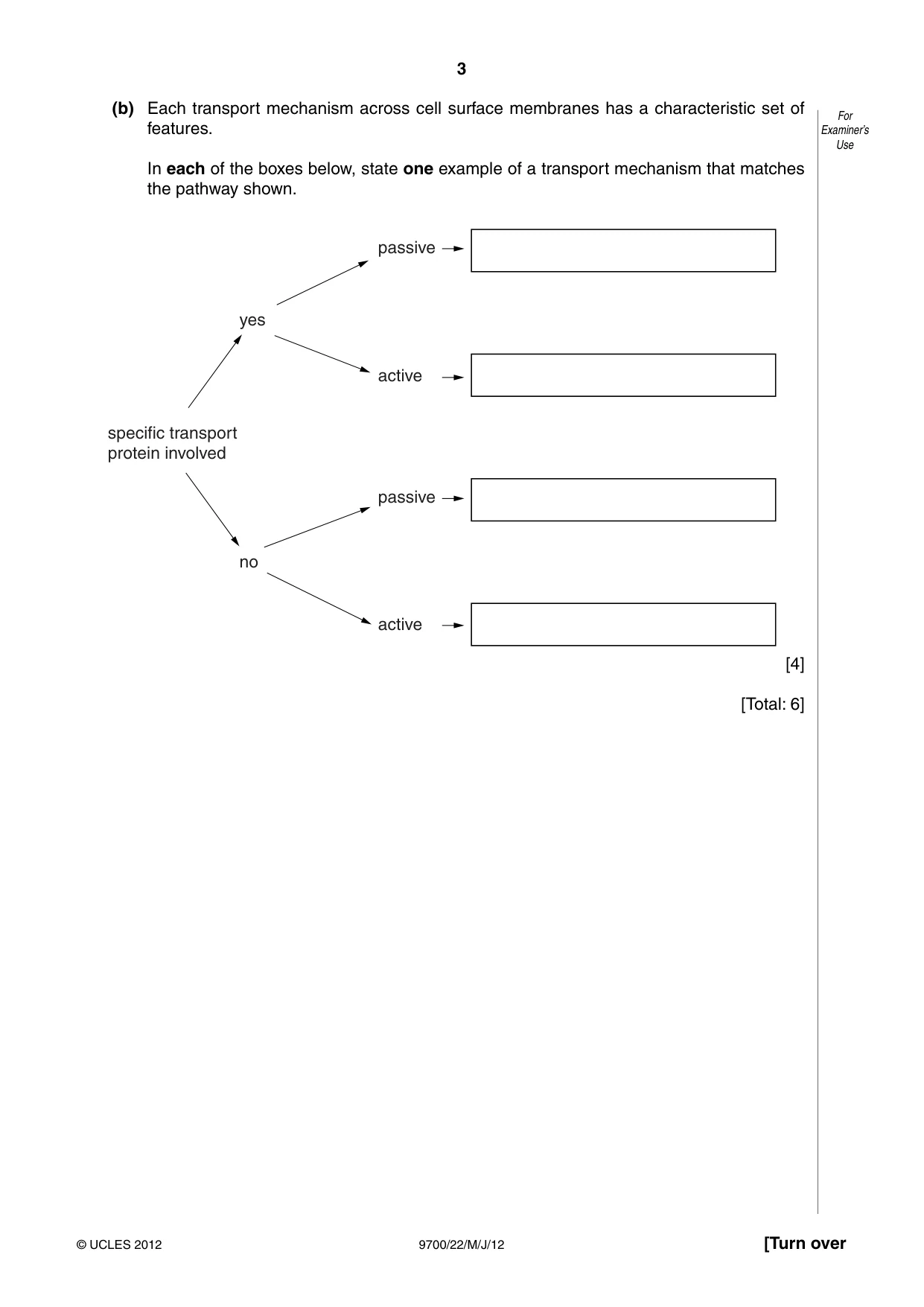
3 9700/22/M/J/12 © UCLES 2012 [Turn over For Examiner’s Use (b) Each transport mechanism across cell surface membranes has a characteristic set of features. In each of the boxes below, state one example of a transport mechanism that matches the pathway shown. passive active passive active no yes specific transport protein involved [4] [Total: 6]
Question paper, page 4
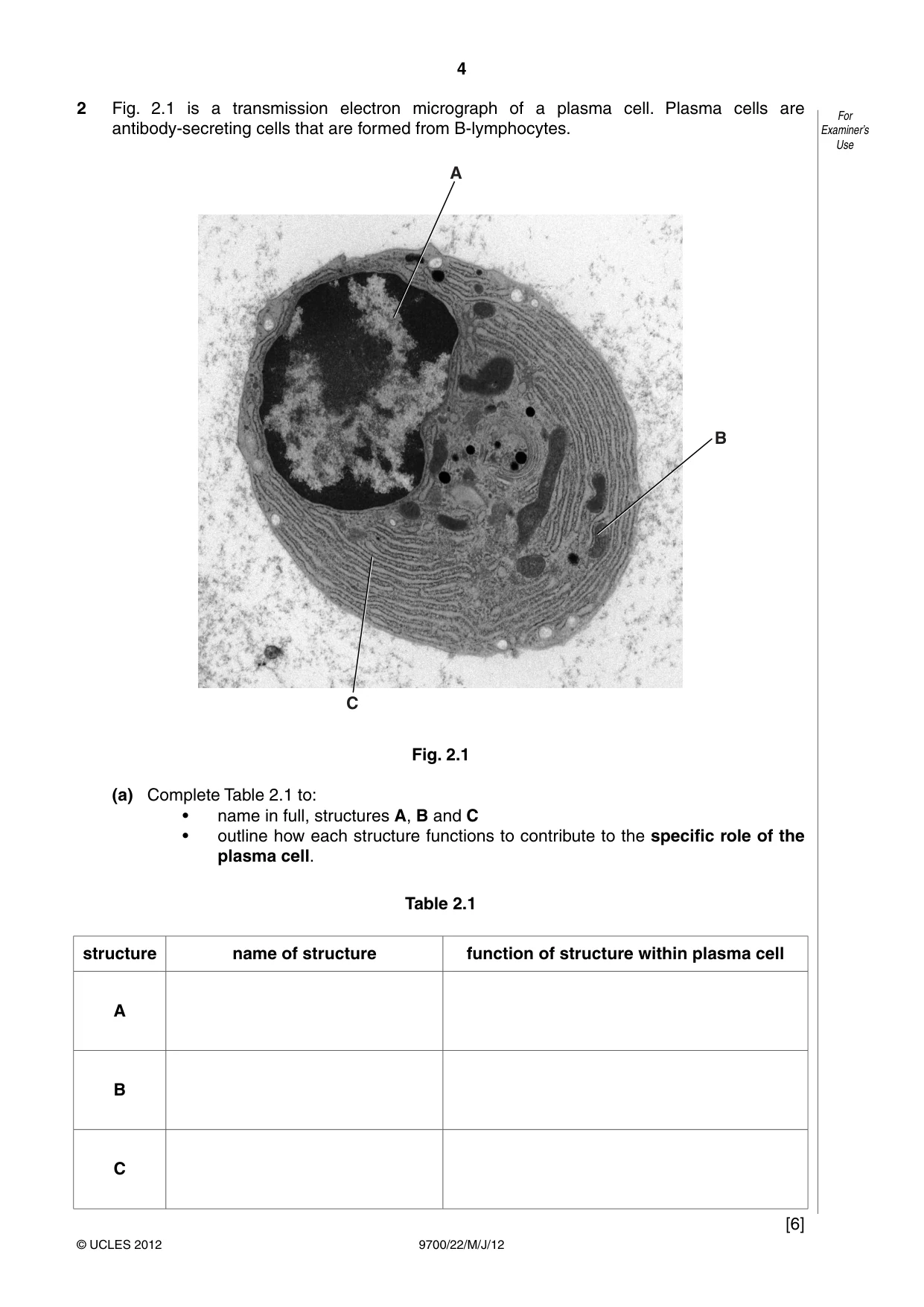
4 9700/22/M/J/12 © UCLES 2012 For Examiner’s Use 2 Fig. 2.1 is a transmission electron micrograph of a plasma cell. Plasma cells are antibody-secreting cells that are formed from B-lymphocytes. A B C Fig. 2.1 (a) Complete Table 2.1 to: • name in full, structures A, B and C • outline how each structure functions to contribute to the specific role of the plasma cell. Table 2.1 structure name of structure function of structure within plasma cell A B C [6]
Question paper, page 5
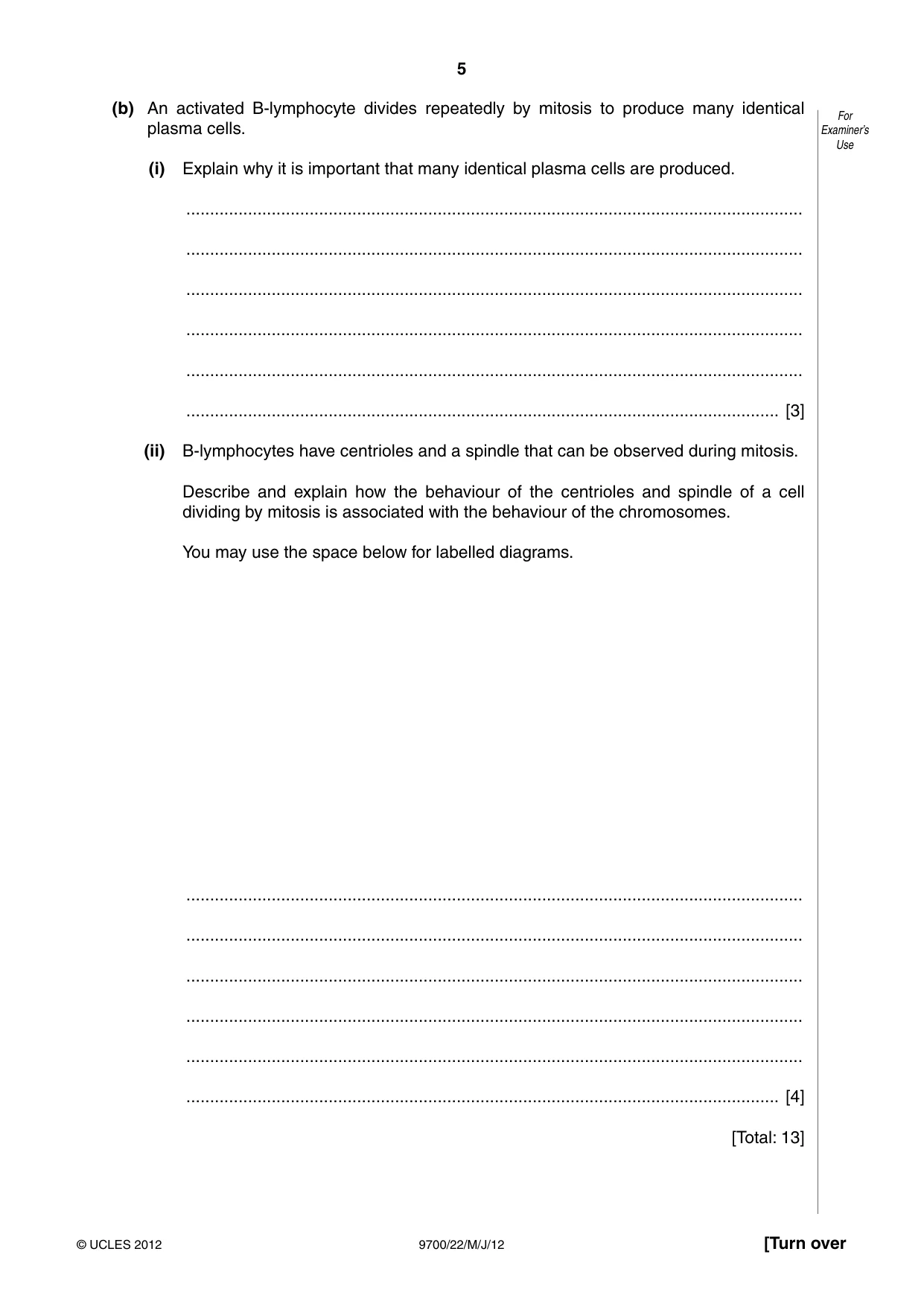
5 9700/22/M/J/12 © UCLES 2012 [Turn over For Examiner’s Use (b) An activated B-lymphocyte divides repeatedly by mitosis to produce many identical plasma cells. (i) Explain why it is important that many identical plasma cells are produced. … … … … … … [3] (ii) B-lymphocytes have centrioles and a spindle that can be observed during mitosis. Describe and explain how the behaviour of the centrioles and spindle of a cell dividing by mitosis is associated with the behaviour of the chromosomes. You may use the space below for labelled diagrams. … … … … … … [4] [Total: 13]
Question paper, page 6
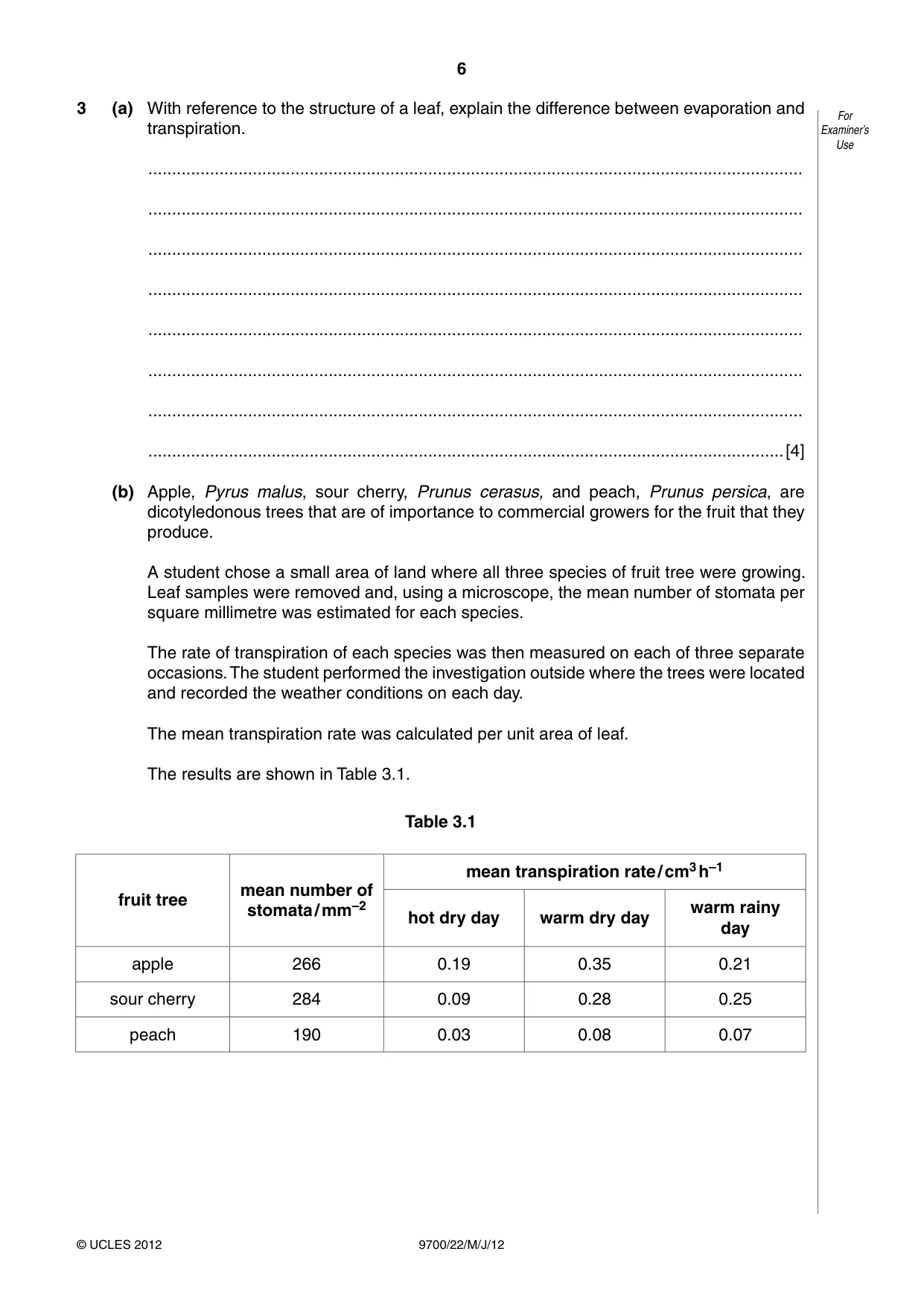
6 9700/22/M/J/12 © UCLES 2012 For Examiner’s Use 3 (a) With reference to the structure of a leaf, explain the difference between evaporation and transpiration. … … … … … … … …[4] (b) Apple, Pyrus malus, sour cherry, Prunus cerasus, and peach, Prunus persica, are dicotyledonous trees that are of importance to commercial growers for the fruit that they produce. A student chose a small area of land where all three species of fruit tree were growing. Leaf samples were removed and, using a microscope, the mean number of stomata per square millimetre was estimated for each species. The rate of transpiration of each species was then measured on each of three separate occasions. The student performed the investigation outside where the trees were located and recorded the weather conditions on each day. The mean transpiration rate was calculated per unit area of leaf. The results are shown in Table 3.1. Table 3.1 fruit tree mean number of stomata / mm–2 mean transpiration rate / cm3 h–1 hot dry day warm dry day warm rainy day apple 266 0.19 0.35 0.21 sour cherry 284 0.09 0.28 0.25 peach 190 0.03 0.08 0.07
Question paper, page 7
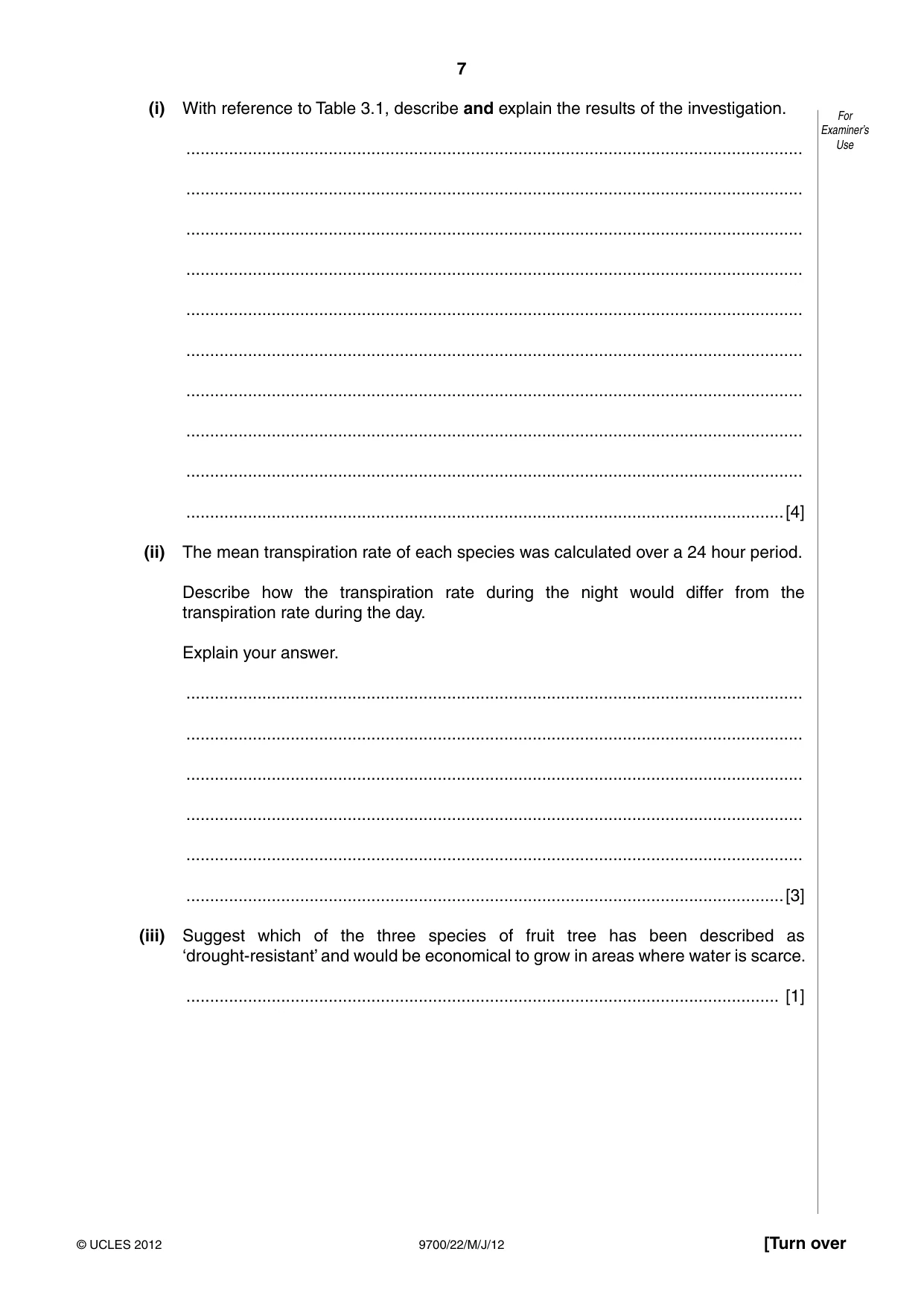
7 9700/22/M/J/12 © UCLES 2012 [Turn over For Examiner’s Use (i) With reference to Table 3.1, describe and explain the results of the investigation. … … … … … … … … … …[4] (ii) The mean transpiration rate of each species was calculated over a 24 hour period. Describe how the transpiration rate during the night would differ from the transpiration rate during the day. Explain your answer. … … … … … …[3] (iii) Suggest which of the three species of fruit tree has been described as ‘drought-resistant’ and would be economical to grow in areas where water is scarce. … [1]
Question paper, page 8
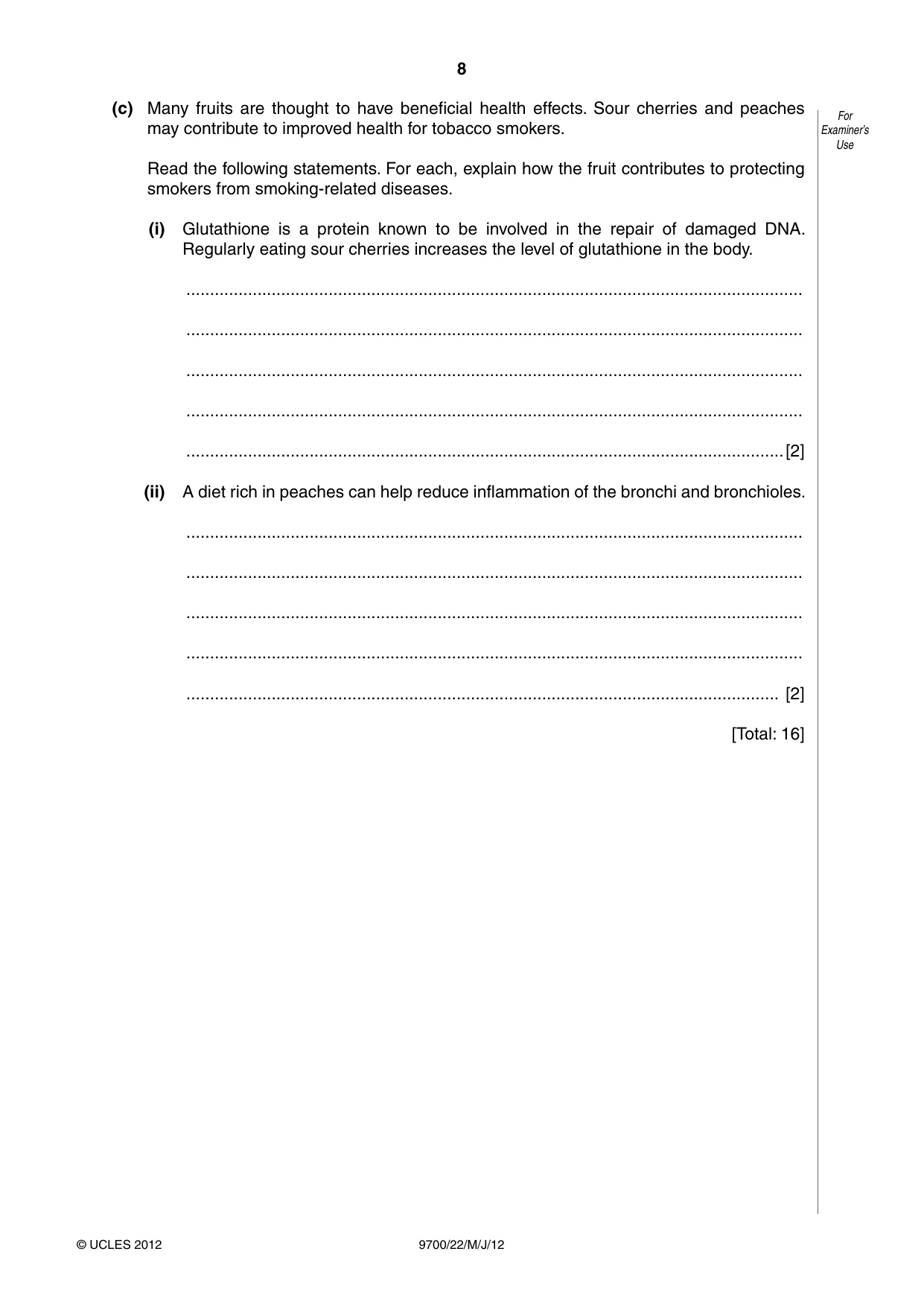
8 9700/22/M/J/12 © UCLES 2012 For Examiner’s Use (c) Many fruits are thought to have beneficial health effects. Sour cherries and peaches may contribute to improved health for tobacco smokers. Read the following statements. For each, explain how the fruit contributes to protecting smokers from smoking-related diseases. (i) Glutathione is a protein known to be involved in the repair of damaged DNA. Regularly eating sour cherries increases the level of glutathione in the body. … … … … …[2] (ii) A diet rich in peaches can help reduce inflammation of the bronchi and bronchioles. … … … … … [2] [Total: 16]
Question paper, page 9
9 9700/22/M/J/12 © UCLES 2012 [Turn over BLANK PAGE
Question paper, page 10
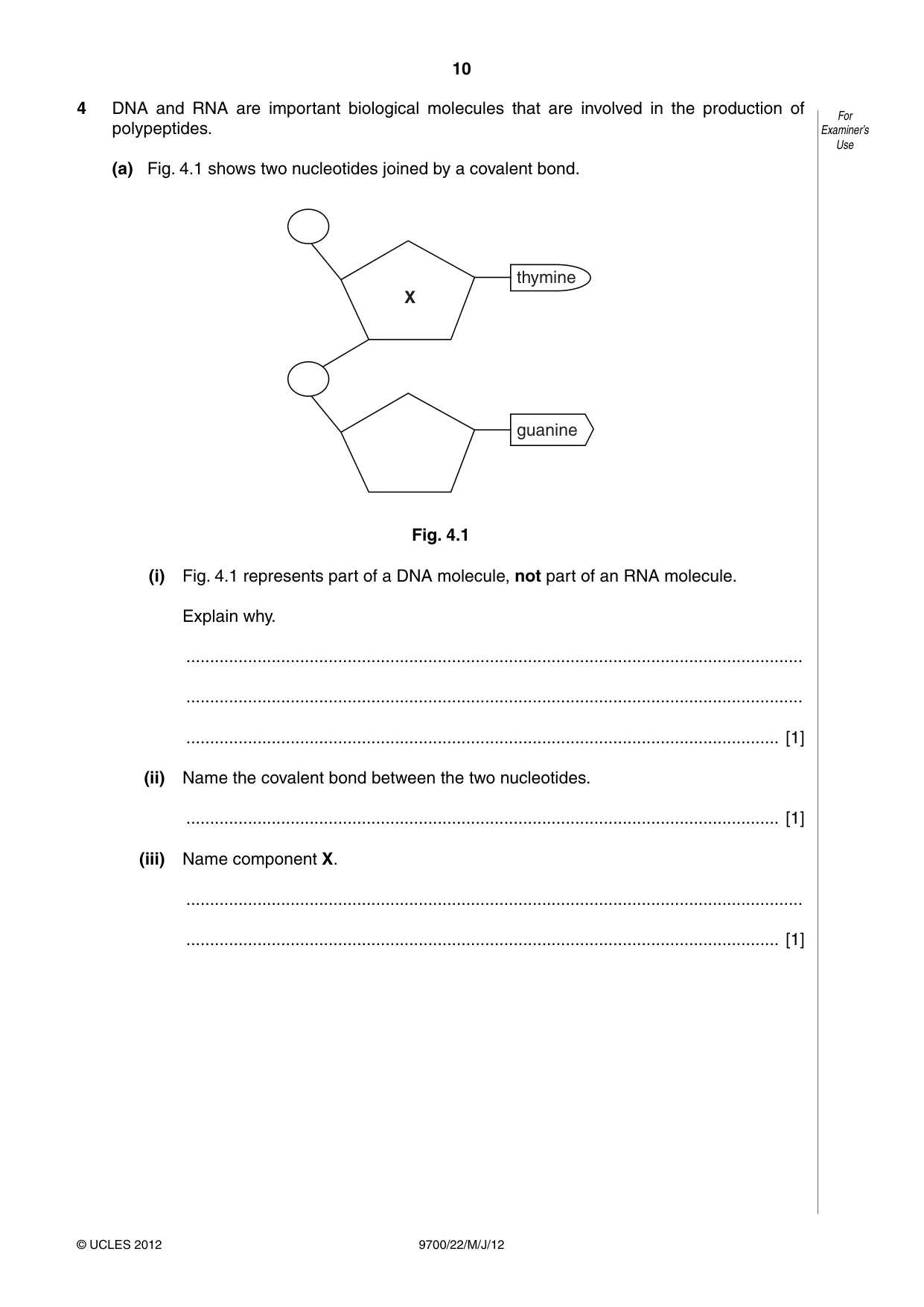
10 9700/22/M/J/12 © UCLES 2012 For Examiner’s Use 4 DNA and RNA are important biological molecules that are involved in the production of polypeptides. (a) Fig. 4.1 shows two nucleotides joined by a covalent bond. thymine guanine X Fig. 4.1 (i) Fig. 4.1 represents part of a DNA molecule, not part of an RNA molecule. Explain why. … … … [1] (ii) Name the covalent bond between the two nucleotides. … [1] (iii) Name component X. … … [1]
Question paper, page 11
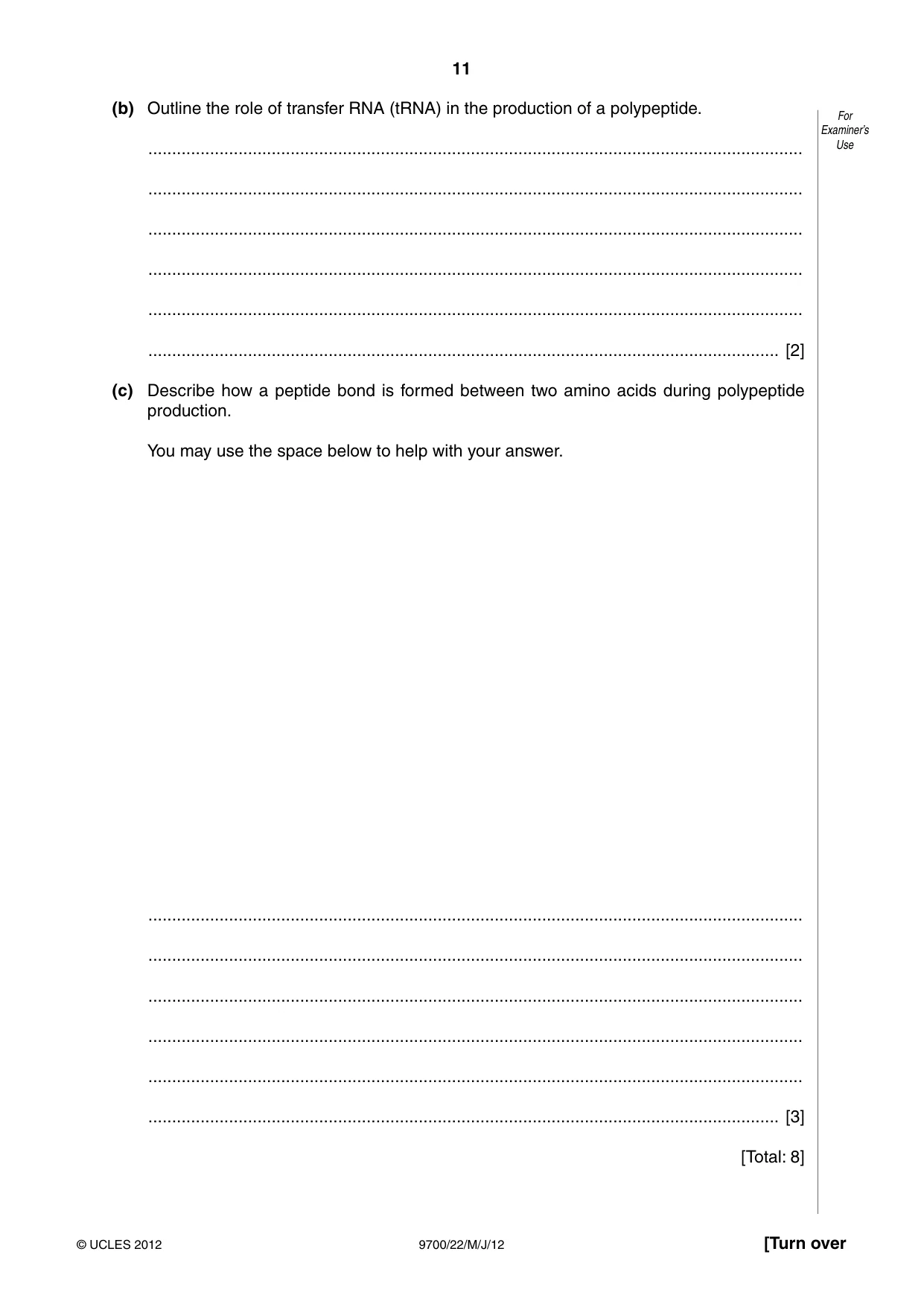
11 9700/22/M/J/12 © UCLES 2012 [Turn over For Examiner’s Use (b) Outline the role of transfer RNA (tRNA) in the production of a polypeptide. … … … … … … [2] (c) Describe how a peptide bond is formed between two amino acids during polypeptide production. You may use the space below to help with your answer. … … … … … … [3] [Total: 8]
Question paper, page 12
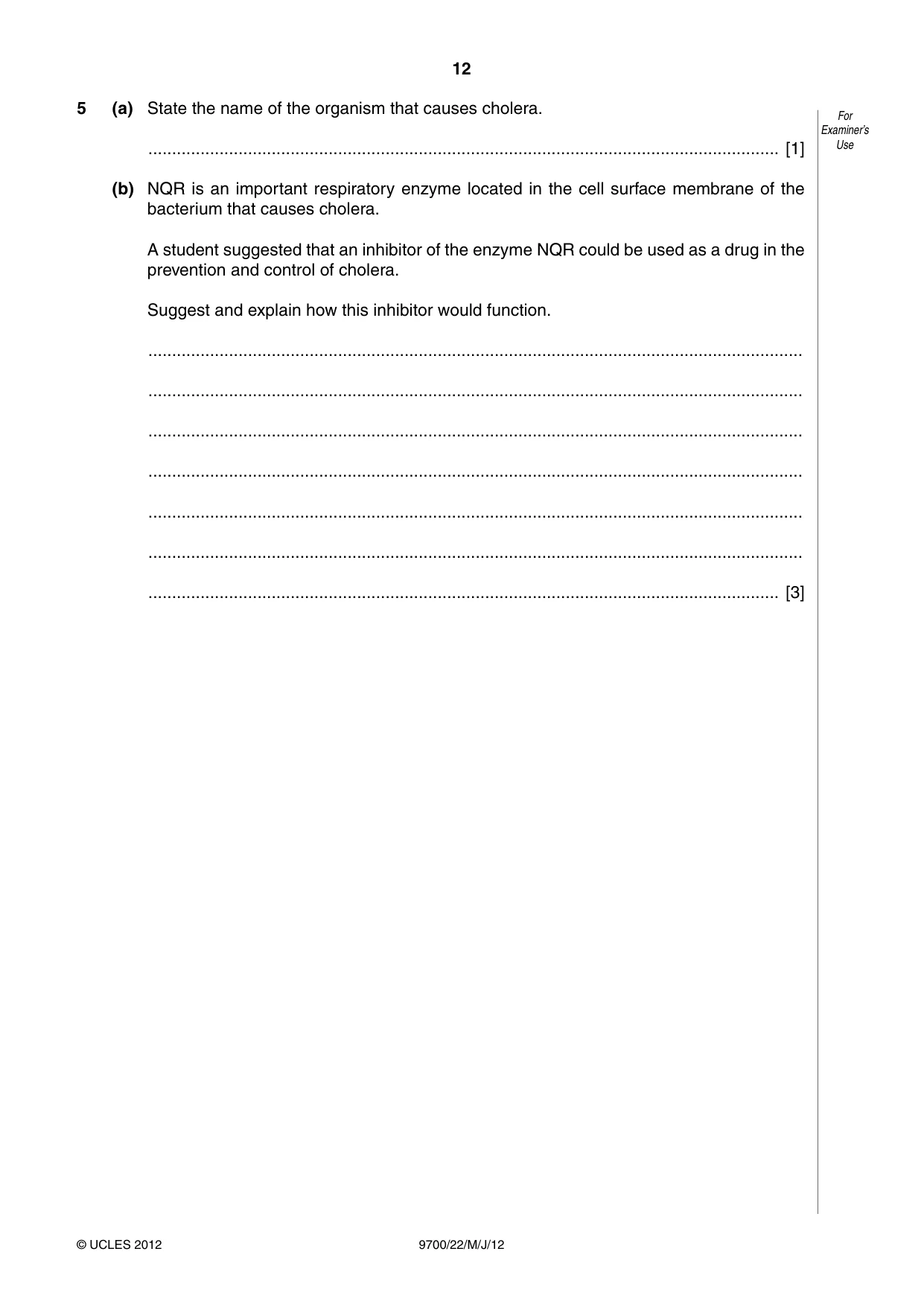
12 9700/22/M/J/12 © UCLES 2012 For Examiner’s Use 5 (a) State the name of the organism that causes cholera. … [1] (b) NQR is an important respiratory enzyme located in the cell surface membrane of the bacterium that causes cholera. A student suggested that an inhibitor of the enzyme NQR could be used as a drug in the prevention and control of cholera. Suggest and explain how this inhibitor would function. … … … … … … … [3]
Question paper, page 13
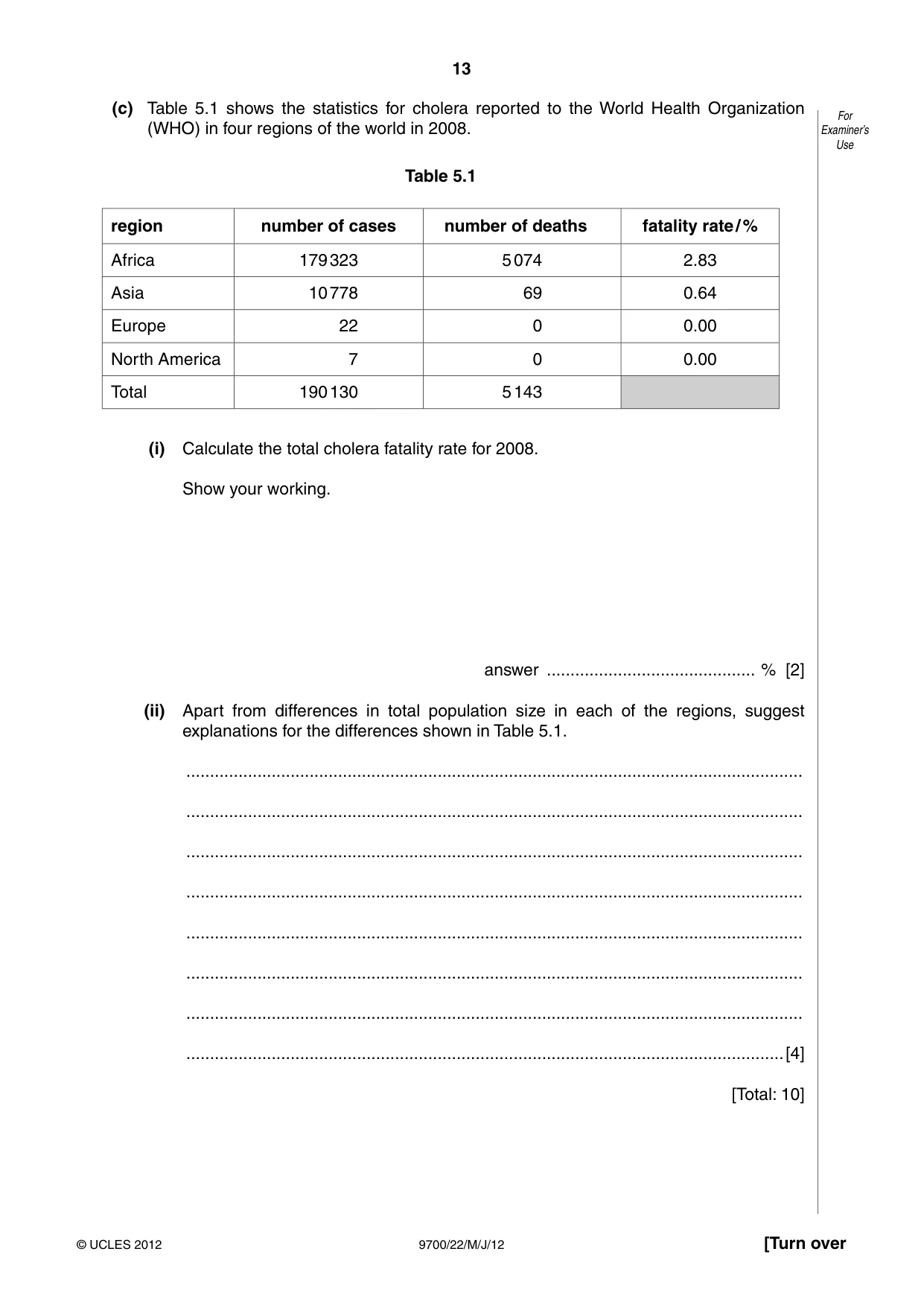
13 9700/22/M/J/12 © UCLES 2012 [Turn over For Examiner’s Use (c) Table 5.1 shows the statistics for cholera reported to the World Health Organization (WHO) in four regions of the world in 2008. Table 5.1 region number of cases number of deaths fatality rate / % Africa 179 323 5 074 2.83 Asia 10 778 69 0.64 Europe 22 0 0.00 North America 7 0 0.00 Total 190 130 5 143 (i) Calculate the total cholera fatality rate for 2008. Show your working. answer … % [2] (ii) Apart from differences in total population size in each of the regions, suggest explanations for the differences shown in Table 5.1. … … … … … … … …[4] [Total: 10]
Question paper, page 14
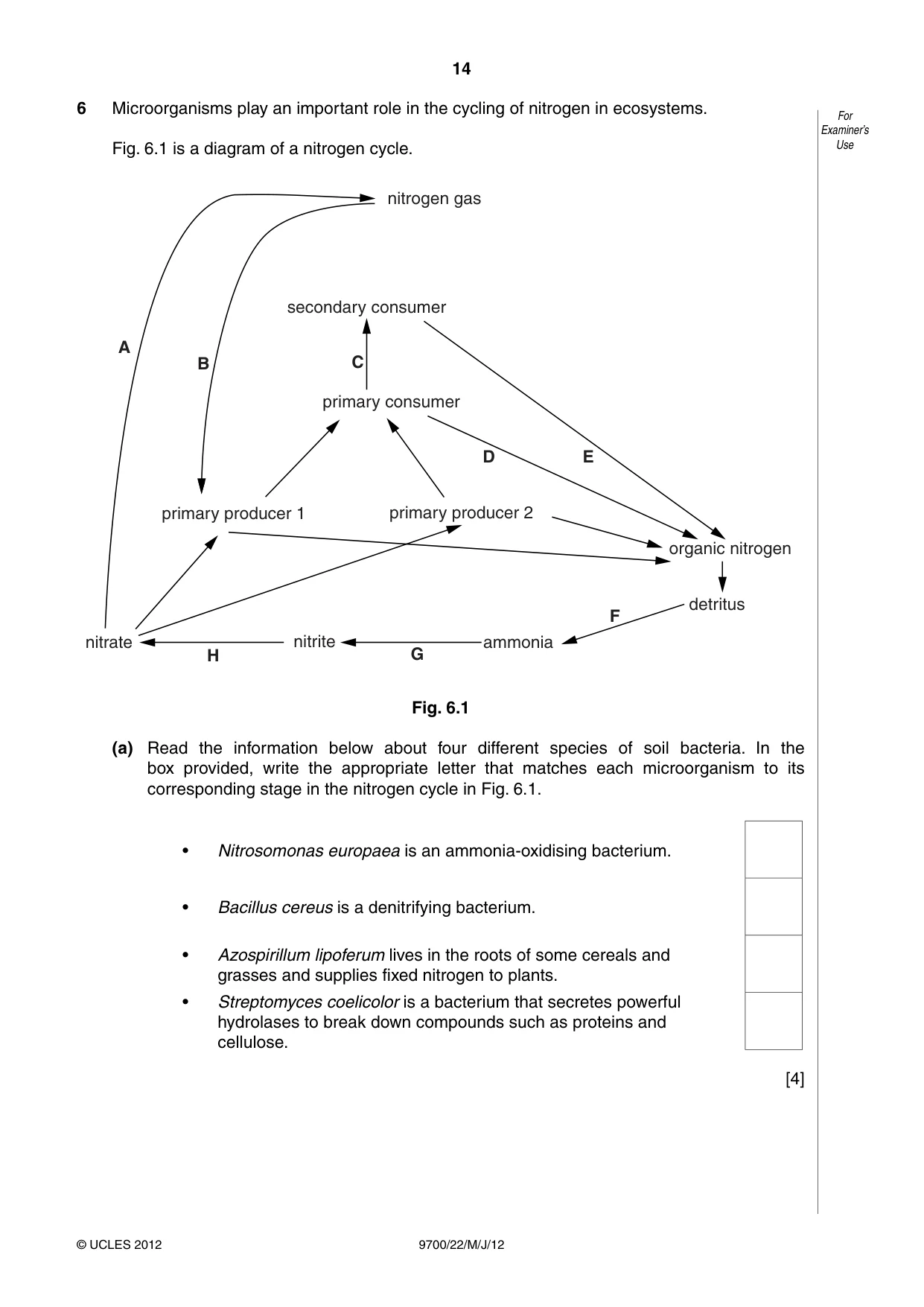
14 9700/22/M/J/12 © UCLES 2012 For Examiner’s Use 6 Microorganisms play an important role in the cycling of nitrogen in ecosystems. Fig. 6.1 is a diagram of a nitrogen cycle. A B C D E F G H nitrate nitrite ammonia primary consumer secondary consumer primary producer 1 primary producer 2 organic nitrogen detritus nitrogen gas Fig. 6.1 (a) Read the information below about four different species of soil bacteria. In the box provided, write the appropriate letter that matches each microorganism to its corresponding stage in the nitrogen cycle in Fig. 6.1. • Nitrosomonas europaea is an ammonia-oxidising bacterium. • Bacillus cereus is a denitrifying bacterium. • Azospirillum lipoferum lives in the roots of some cereals and grasses and supplies fixed nitrogen to plants. • Streptomyces coelicolor is a bacterium that secretes powerful hydrolases to break down compounds such as proteins and cellulose. [4]
Question paper, page 15
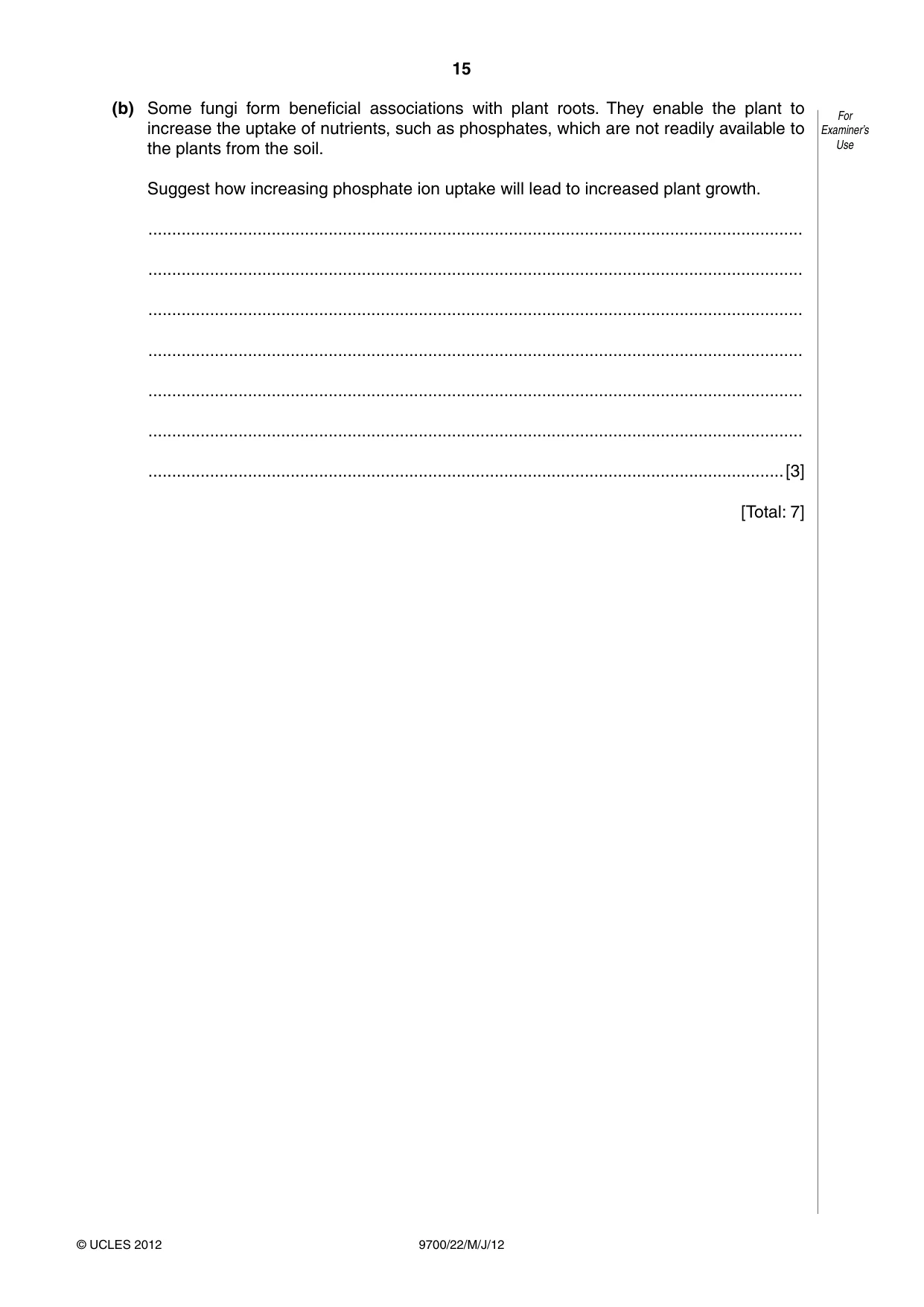
15 9700/22/M/J/12 © UCLES 2012 For Examiner’s Use (b) Some fungi form beneficial associations with plant roots. They enable the plant to increase the uptake of nutrients, such as phosphates, which are not readily available to the plants from the soil. Suggest how increasing phosphate ion uptake will lead to increased plant growth. … … … … … … …[3] [Total: 7]
Question paper, page 16
16 9700/22/M/J/12 © UCLES 2012 BLANK PAGE Copyright Acknowledgements: Question 2 Fig. 2.1 © STEVE GSCHMEISSNER / SCIENCE PHOTO LIBRARY Question 5 Table 5.1 © Cholera; Weekly Epidemiological Record; WHO Geneva; www.who.int/wer; 2009. Permission to reproduce items where third-party owned material protected by copyright is included has been sought and cleared where possible. Every reasonable effort has been made by the publisher (UCLES) to trace copyright holders, but if any items requiring clearance have unwittingly been included, the publisher will be pleased to make amends at the earliest possible opportunity. University of Cambridge International Examinations is part of the Cambridge Assessment Group. Cambridge Assessment is the brand name of University of Cambridge Local Examinations Syndicate (UCLES), which is itself a department of the University of Cambridge.
Mark scheme, page 1
UNIVERSITY OF CAMBRIDGE INTERNATIONAL EXAMINATIONS GCE Advanced Subsidiary Level and GCE Advanced Level MARK SCHEME for the May/June 2012 question paper for the guidance of teachers 9700 BIOLOGY 9700/22 Paper 2 (AS Structured Questions), maximum raw mark 60 This mark scheme is published as an aid to teachers and candidates, to indicate the requirements of the examination. It shows the basis on which Examiners were instructed to award marks. It does not indicate the details of the discussions that took place at an Examiners’ meeting before marking began, which would have considered the acceptability of alternative answers. Mark schemes must be read in conjunction with the question papers and the report on the examination. • Cambridge will not enter into discussions or correspondence in connection with these mark schemes. Cambridge is publishing the mark schemes for the May/June 2012 question papers for most IGCSE, GCE Advanced Level and Advanced Subsidiary Level syllabuses and some Ordinary Level syllabuses.
Mark scheme, page 2
Page 2 Mark Scheme: Teachers’ version Syllabus Paper GCE AS/A LEVEL – May/June 2012 9700 22 © University of Cambridge International Examinations 2012 Mark scheme abbreviations: ; separates marking points / alternative answers for the same point R reject A accept (for answers correctly cued by the question, or by extra guidance) AW alternative wording (where responses vary more than usual) underline actual word given must be used by candidate (grammatical variants excepted) max indicates the maximum number of marks that can be given ora or reverse argument mp marking point (with relevant number) ecf error carried forward I ignore
Mark scheme, page 3
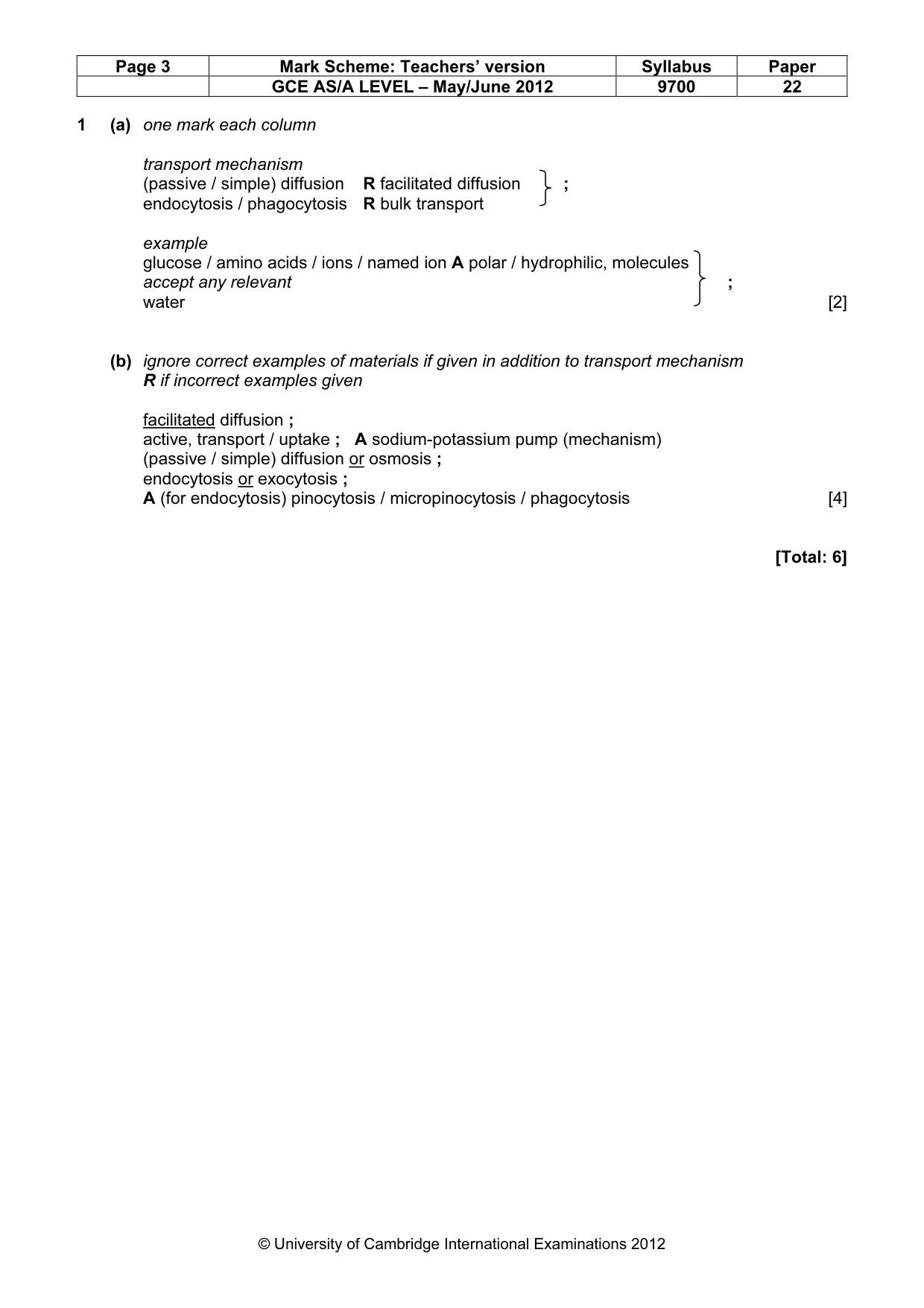
Page 3 Mark Scheme: Teachers’ version Syllabus Paper GCE AS/A LEVEL – May/June 2012 9700 22 © University of Cambridge International Examinations 2012 1 (a) one mark each column transport mechanism (passive / simple) diffusion R facilitated diffusion ; endocytosis / phagocytosis R bulk transport example glucose / amino acids / ions / named ion A polar / hydrophilic, molecules accept any relevant ; water [2] (b) ignore correct examples of materials if given in addition to transport mechanism R if incorrect examples given facilitated diffusion ; active, transport / uptake ; A sodium-potassium pump (mechanism) (passive / simple) diffusion or osmosis ; endocytosis or exocytosis ; A (for endocytosis) pinocytosis / micropinocytosis / phagocytosis [4] [Total: 6]
Mark scheme, page 4
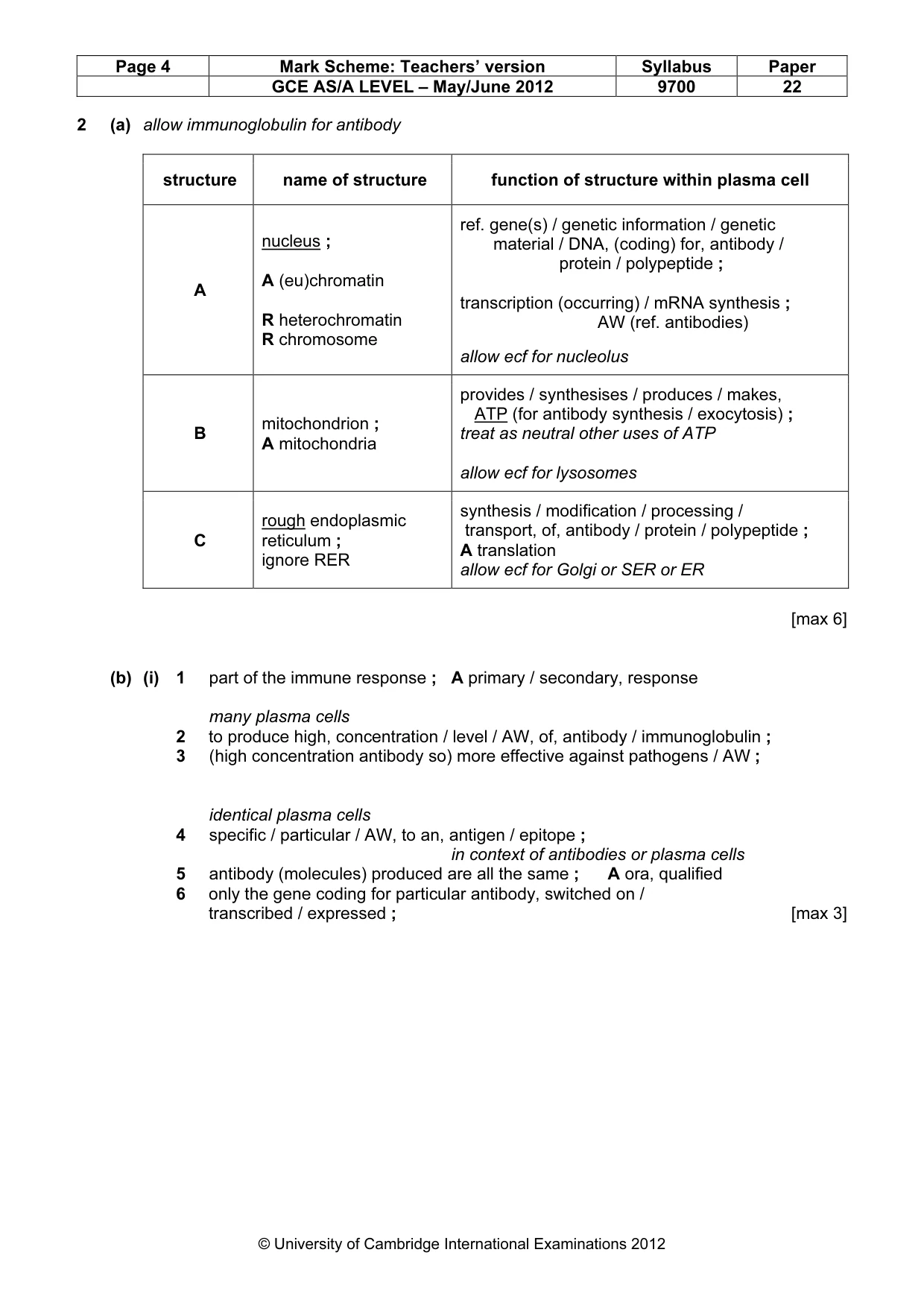
Page 4 Mark Scheme: Teachers’ version Syllabus Paper GCE AS/A LEVEL – May/June 2012 9700 22 © University of Cambridge International Examinations 2012 2 (a) allow immunoglobulin for antibody structure name of structure function of structure within plasma cell A nucleus ; A (eu)chromatin R heterochromatin R chromosome ref. gene(s) / genetic information / genetic material / DNA, (coding) for, antibody / protein / polypeptide ; transcription (occurring) / mRNA synthesis ; AW (ref. antibodies) allow ecf for nucleolus B mitochondrion ; A mitochondria provides / synthesises / produces / makes, ATP (for antibody synthesis / exocytosis) ; treat as neutral other uses of ATP allow ecf for lysosomes C rough endoplasmic reticulum ; ignore RER synthesis / modification / processing / transport, of, antibody / protein / polypeptide ; A translation allow ecf for Golgi or SER or ER [max 6] (b) (i) 1 part of the immune response ; A primary / secondary, response many plasma cells 2 to produce high, concentration / level / AW, of, antibody / immunoglobulin ; 3 (high concentration antibody so) more effective against pathogens / AW ; identical plasma cells 4 specific / particular / AW, to an, antigen / epitope ; in context of antibodies or plasma cells 5 antibody (molecules) produced are all the same ; A ora, qualified 6 only the gene coding for particular antibody, switched on / transcribed / expressed ; [max 3]
Mark scheme, page 5
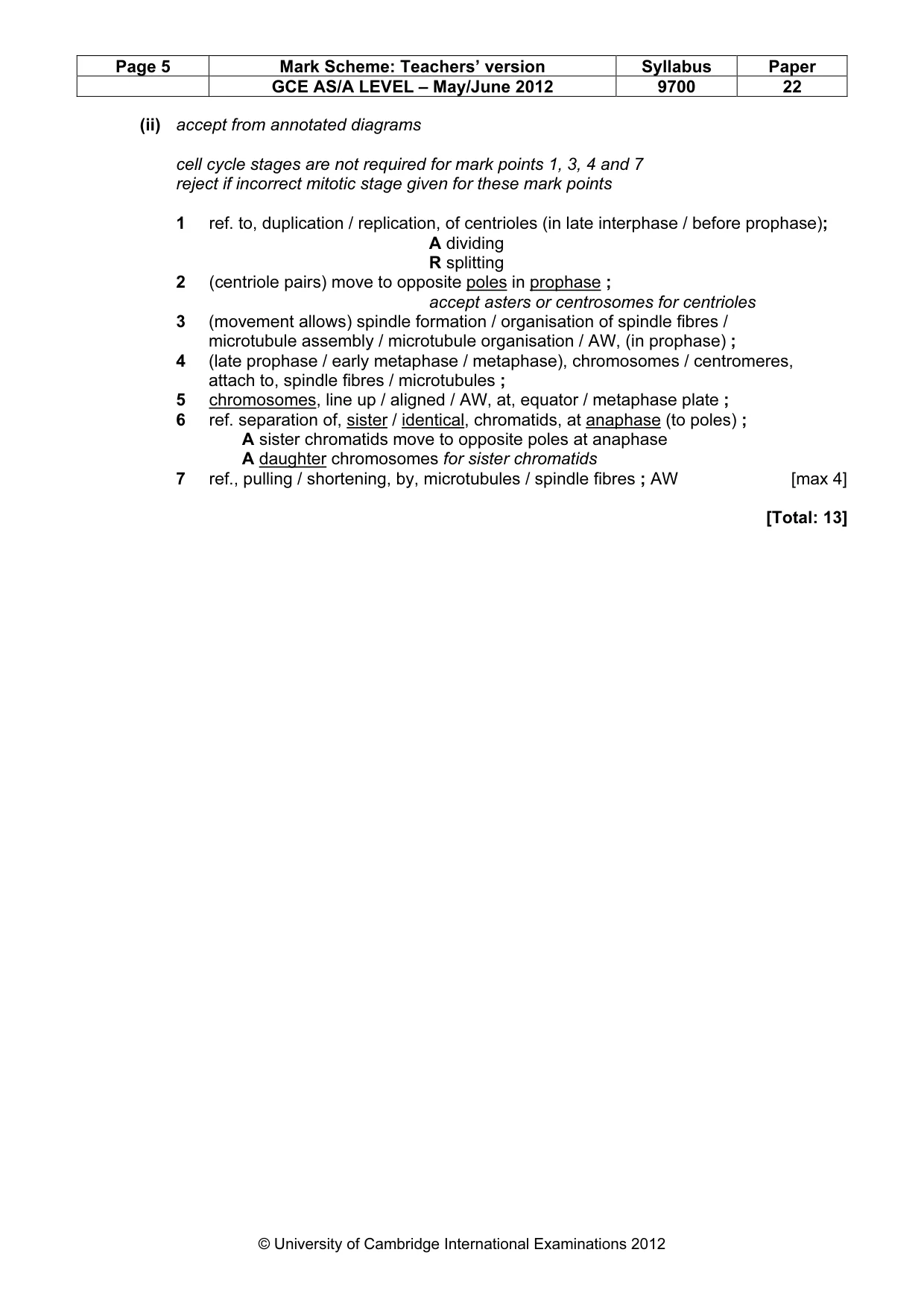
Page 5 Mark Scheme: Teachers’ version Syllabus Paper GCE AS/A LEVEL – May/June 2012 9700 22 © University of Cambridge International Examinations 2012 (ii) accept from annotated diagrams cell cycle stages are not required for mark points 1, 3, 4 and 7 reject if incorrect mitotic stage given for these mark points 1 ref. to, duplication / replication, of centrioles (in late interphase / before prophase); A dividing R splitting 2 (centriole pairs) move to opposite poles in prophase ; accept asters or centrosomes for centrioles 3 (movement allows) spindle formation / organisation of spindle fibres / microtubule assembly / microtubule organisation / AW, (in prophase) ; 4 (late prophase / early metaphase / metaphase), chromosomes / centromeres, attach to, spindle fibres / microtubules ; 5 chromosomes, line up / aligned / AW, at, equator / metaphase plate ; 6 ref. separation of, sister / identical, chromatids, at anaphase (to poles) ; A sister chromatids move to opposite poles at anaphase A daughter chromosomes for sister chromatids 7 ref., pulling / shortening, by, microtubules / spindle fibres ; AW [max 4] [Total: 13]
Mark scheme, page 6
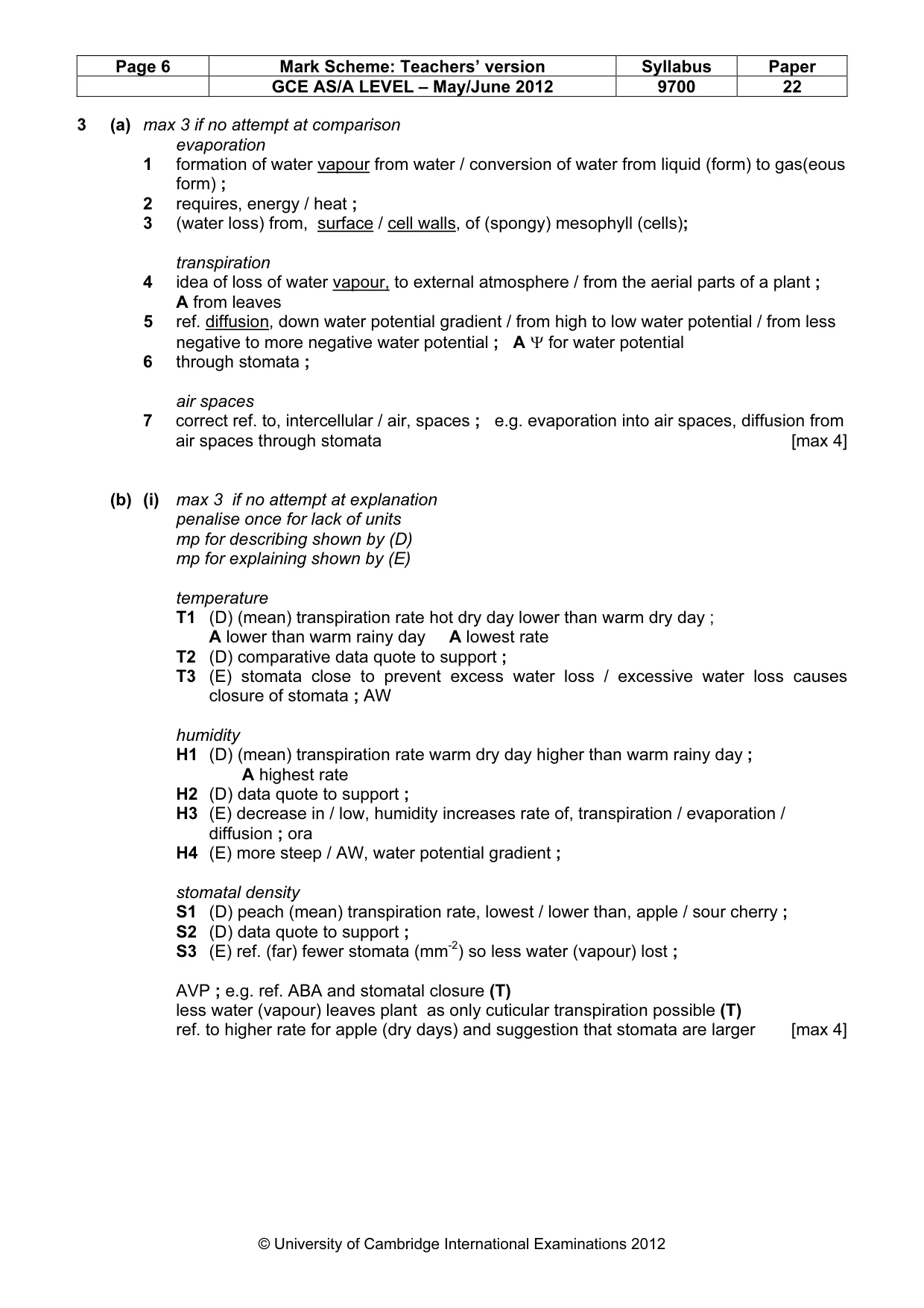
Page 6 Mark Scheme: Teachers’ version Syllabus Paper GCE AS/A LEVEL – May/June 2012 9700 22 © University of Cambridge International Examinations 2012 3 (a) max 3 if no attempt at comparison evaporation 1 formation of water vapour from water / conversion of water from liquid (form) to gas(eous form) ; 2 requires, energy / heat ; 3 (water loss) from, surface / cell walls, of (spongy) mesophyll (cells); transpiration 4 idea of loss of water vapour, to external atmosphere / from the aerial parts of a plant ; A from leaves 5 ref. diffusion, down water potential gradient / from high to low water potential / from less negative to more negative water potential ; A Ψ for water potential 6 through stomata ; air spaces 7 correct ref. to, intercellular / air, spaces ; e.g. evaporation into air spaces, diffusion from air spaces through stomata [max 4] (b) (i) max 3 if no attempt at explanation penalise once for lack of units mp for describing shown by (D) mp for explaining shown by (E) temperature T1 (D) (mean) transpiration rate hot dry day lower than warm dry day ; A lower than warm rainy day A lowest rate T2 (D) comparative data quote to support ; T3 (E) stomata close to prevent excess water loss / excessive water loss causes closure of stomata ; AW humidity H1 (D) (mean) transpiration rate warm dry day higher than warm rainy day ; A highest rate H2 (D) data quote to support ; H3 (E) decrease in / low, humidity increases rate of, transpiration / evaporation / diffusion ; ora H4 (E) more steep / AW, water potential gradient ; stomatal density S1 (D) peach (mean) transpiration rate, lowest / lower than, apple / sour cherry ; S2 (D) data quote to support ; S3 (E) ref. (far) fewer stomata (mm-2) so less water (vapour) lost ; AVP ; e.g. ref. ABA and stomatal closure (T) less water (vapour) leaves plant as only cuticular transpiration possible (T) ref. to higher rate for apple (dry days) and suggestion that stomata are larger [max 4]
Mark scheme, page 7
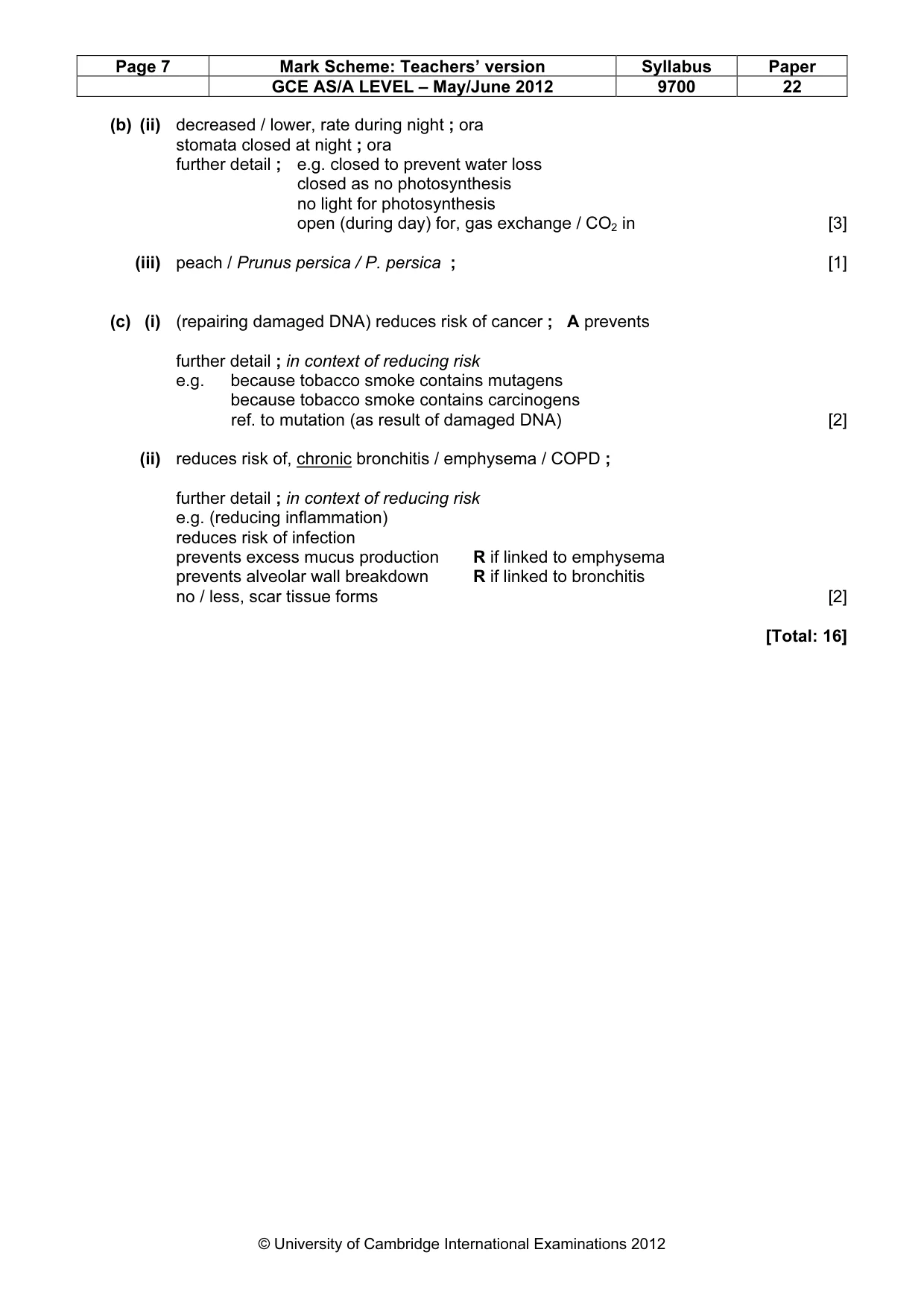
Page 7 Mark Scheme: Teachers’ version Syllabus Paper GCE AS/A LEVEL – May/June 2012 9700 22 © University of Cambridge International Examinations 2012 (b) (ii) decreased / lower, rate during night ; ora stomata closed at night ; ora further detail ; e.g. closed to prevent water loss closed as no photosynthesis no light for photosynthesis open (during day) for, gas exchange / CO2 in [3] (iii) peach / Prunus persica / P. persica ; [1] (c) (i) (repairing damaged DNA) reduces risk of cancer ; A prevents further detail ; in context of reducing risk e.g. because tobacco smoke contains mutagens because tobacco smoke contains carcinogens ref. to mutation (as result of damaged DNA) [2] (ii) reduces risk of, chronic bronchitis / emphysema / COPD ; further detail ; in context of reducing risk e.g. (reducing inflammation) reduces risk of infection prevents excess mucus production R if linked to emphysema prevents alveolar wall breakdown R if linked to bronchitis no / less, scar tissue forms [2] [Total: 16]
Mark scheme, page 8
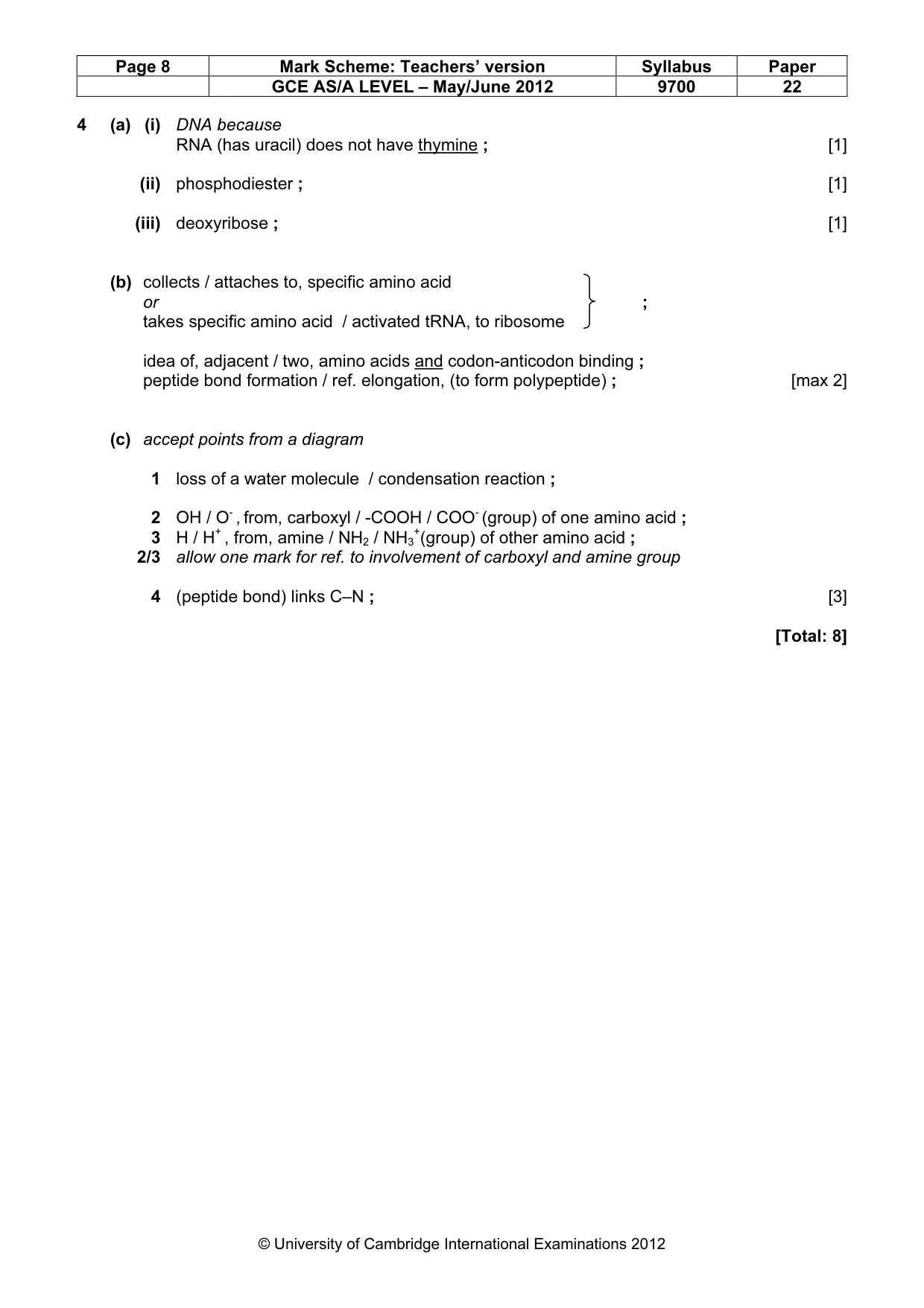
Page 8 Mark Scheme: Teachers’ version Syllabus Paper GCE AS/A LEVEL – May/June 2012 9700 22 © University of Cambridge International Examinations 2012 4 (a) (i) DNA because RNA (has uracil) does not have thymine ; [1] (ii) phosphodiester ; [1] (iii) deoxyribose ; [1] (b) collects / attaches to, specific amino acid or ; takes specific amino acid / activated tRNA, to ribosome idea of, adjacent / two, amino acids and codon-anticodon binding ; peptide bond formation / ref. elongation, (to form polypeptide) ; [max 2] (c) accept points from a diagram 1 loss of a water molecule / condensation reaction ; 2 OH / O- , from, carboxyl / -COOH / COO- (group) of one amino acid ; 3 H / H+ , from, amine / NH2 / NH3 +(group) of other amino acid ; 2/3 allow one mark for ref. to involvement of carboxyl and amine group 4 (peptide bond) links C–N ; [3] [Total: 8]
Mark scheme, page 9
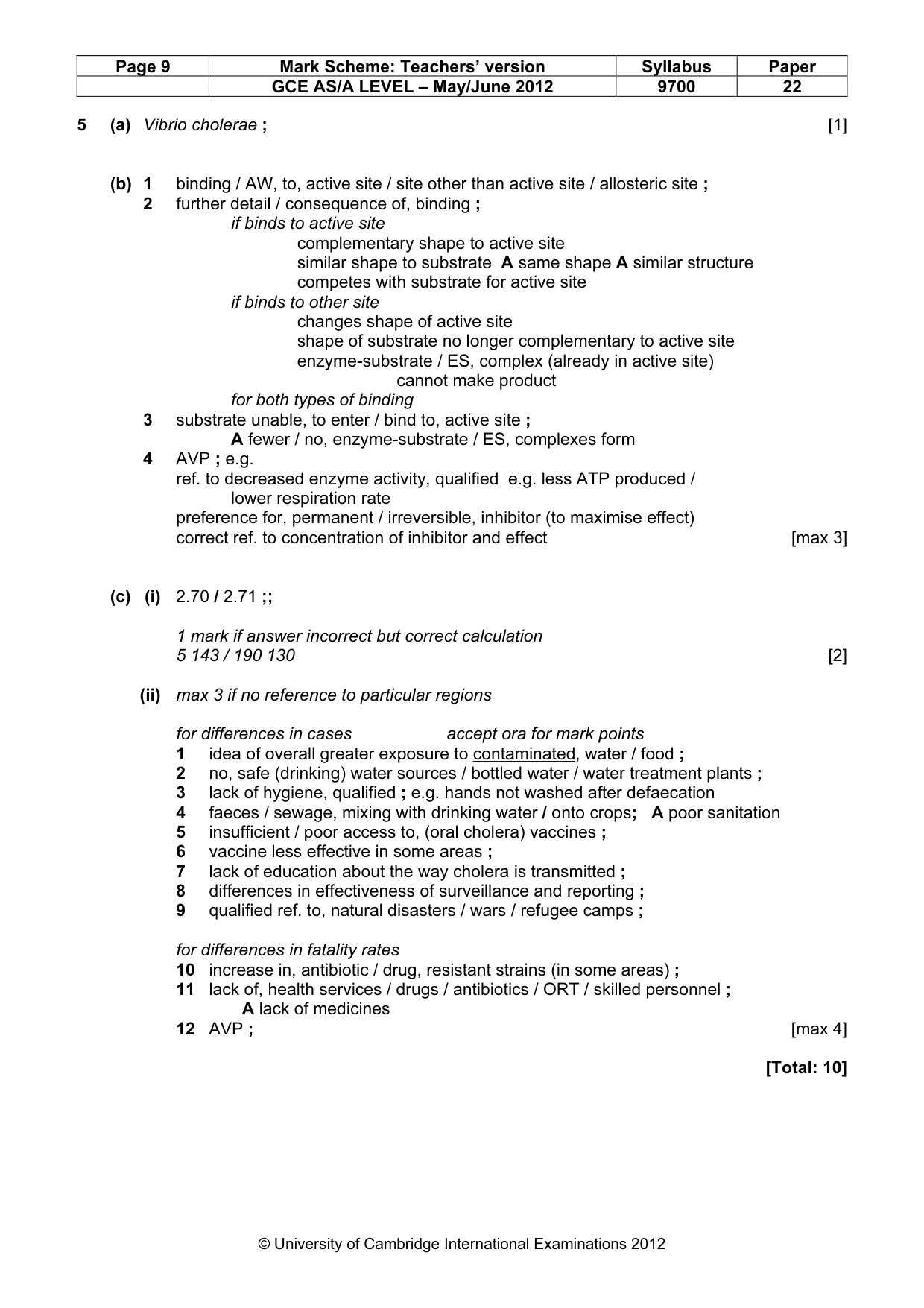
Page 9 Mark Scheme: Teachers’ version Syllabus Paper GCE AS/A LEVEL – May/June 2012 9700 22 © University of Cambridge International Examinations 2012 5 (a) Vibrio cholerae ; [1] (b) 1 binding / AW, to, active site / site other than active site / allosteric site ; 2 further detail / consequence of, binding ; if binds to active site complementary shape to active site similar shape to substrate A same shape A similar structure competes with substrate for active site if binds to other site changes shape of active site shape of substrate no longer complementary to active site enzyme-substrate / ES, complex (already in active site) cannot make product for both types of binding 3 substrate unable, to enter / bind to, active site ; A fewer / no, enzyme-substrate / ES, complexes form 4 AVP ; e.g. ref. to decreased enzyme activity, qualified e.g. less ATP produced / lower respiration rate preference for, permanent / irreversible, inhibitor (to maximise effect) correct ref. to concentration of inhibitor and effect [max 3] (c) (i) 2.70 / 2.71 ;; 1 mark if answer incorrect but correct calculation 5 143 / 190 130 [2] (ii) max 3 if no reference to particular regions for differences in cases accept ora for mark points 1 idea of overall greater exposure to contaminated, water / food ; 2 no, safe (drinking) water sources / bottled water / water treatment plants ; 3 lack of hygiene, qualified ; e.g. hands not washed after defaecation 4 faeces / sewage, mixing with drinking water / onto crops; A poor sanitation 5 insufficient / poor access to, (oral cholera) vaccines ; 6 vaccine less effective in some areas ; 7 lack of education about the way cholera is transmitted ; 8 differences in effectiveness of surveillance and reporting ; 9 qualified ref. to, natural disasters / wars / refugee camps ; for differences in fatality rates 10 increase in, antibiotic / drug, resistant strains (in some areas) ; 11 lack of, health services / drugs / antibiotics / ORT / skilled personnel ; A lack of medicines 12 AVP ; [max 4] [Total: 10]
Mark scheme, page 10
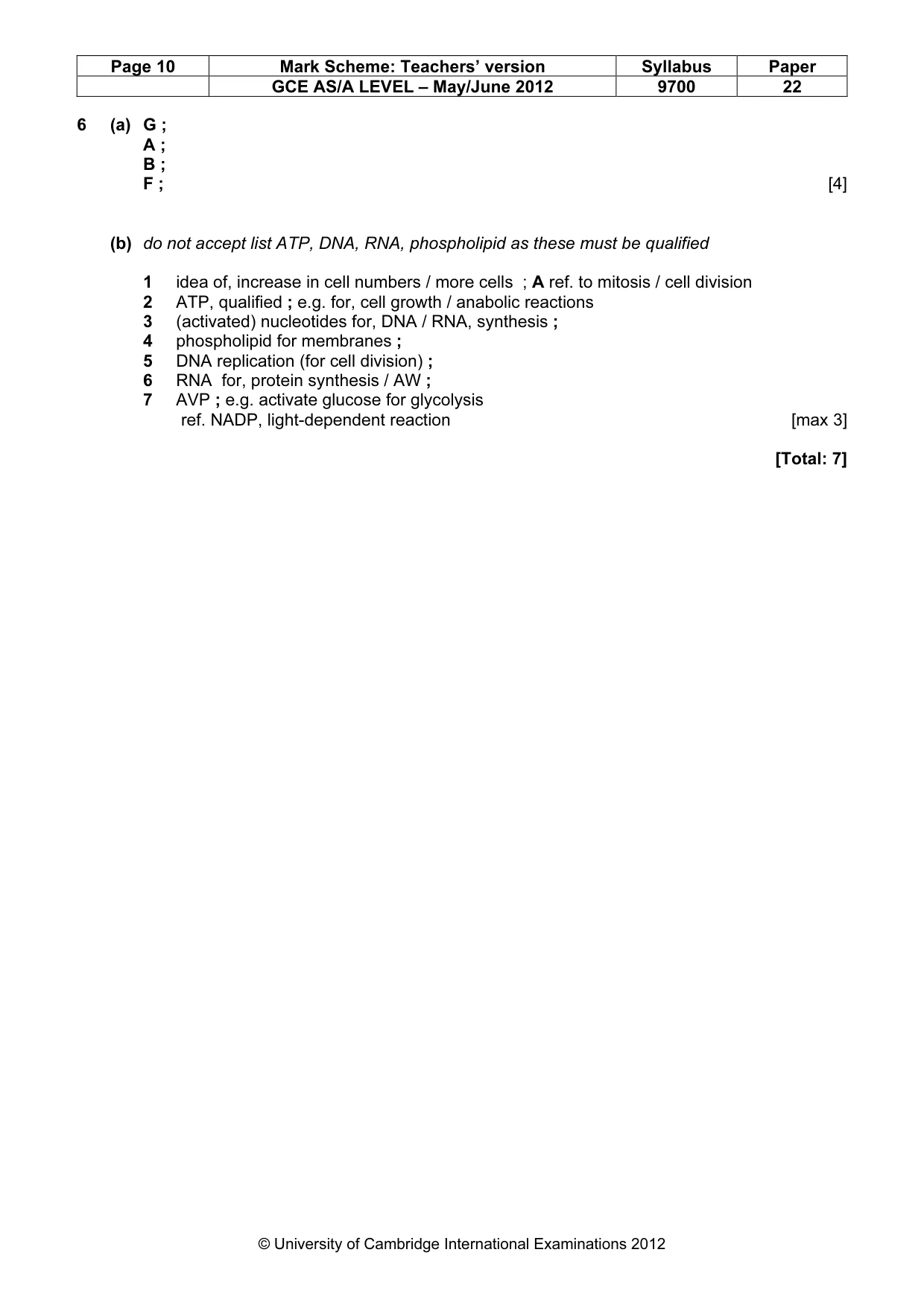
Page 10 Mark Scheme: Teachers’ version Syllabus Paper GCE AS/A LEVEL – May/June 2012 9700 22 © University of Cambridge International Examinations 2012 6 (a) G ; A ; B ; F ; [4] (b) do not accept list ATP, DNA, RNA, phospholipid as these must be qualified 1 idea of, increase in cell numbers / more cells ; A ref. to mitosis / cell division 2 ATP, qualified ; e.g. for, cell growth / anabolic reactions 3 (activated) nucleotides for, DNA / RNA, synthesis ; 4 phospholipid for membranes ; 5 DNA replication (for cell division) ; 6 RNA for, protein synthesis / AW ; 7 AVP ; e.g. activate glucose for glycolysis ref. NADP, light-dependent reaction [max 3] [Total: 7]
What you needed in this session
Cambridge’s own grade thresholds for 2012 May/June, Paper 2 · Variant 2. A higher threshold means an easier paper — the bar moves with how the cohort did.