Cambridge A Level Biology 9700 — 2009 Oct/Nov Paper 2 · Variant 1
9700/21/O/N/09
The question paper and its mark scheme, free to read here and free to download. This is Cambridge’s own paper, exactly as it was sat.
Question paper16 pages


Mark scheme7 pages
Answers below. Sit the paper first if you are practising.
Paper as text
Question paper, page 1
This document consists of 13 printed pages and 3 blank pages. DC (CW/CGW) 13011/4 © UCLES 2009 [Turn over UNIVERSITY OF CAMBRIDGE INTERNATIONAL EXAMINATIONS General Certificate of Education Advanced Subsidiary Level and Advanced Level READ THESE INSTRUCTIONS FIRST Write your Centre number, candidate number and name in the spaces provided at the top of this page. Write in dark blue or black pen. You may use a soft pencil for any diagrams, graphs or rough working. Do not use staples, paper clips, highlighters, glue or correction fluid. DO NOT WRITE IN ANY BARCODES. Answer all questions. At the end of the examination, fasten all your work securely together. The number of marks is given in brackets [ ] at the end of each question or part question. * 0 4 8 5 7 3 8 2 0 0 * BIOLOGY 9700/21 Paper 2 Structured Questions AS October/November 2009 1 hour 15 minutes Candidates answer on the Question Paper. Additional Materials: Electronic calculator Ruler (cm/mm) For Examiner’s Use 1 2 3 4 5 6 Total
Question paper, page 2
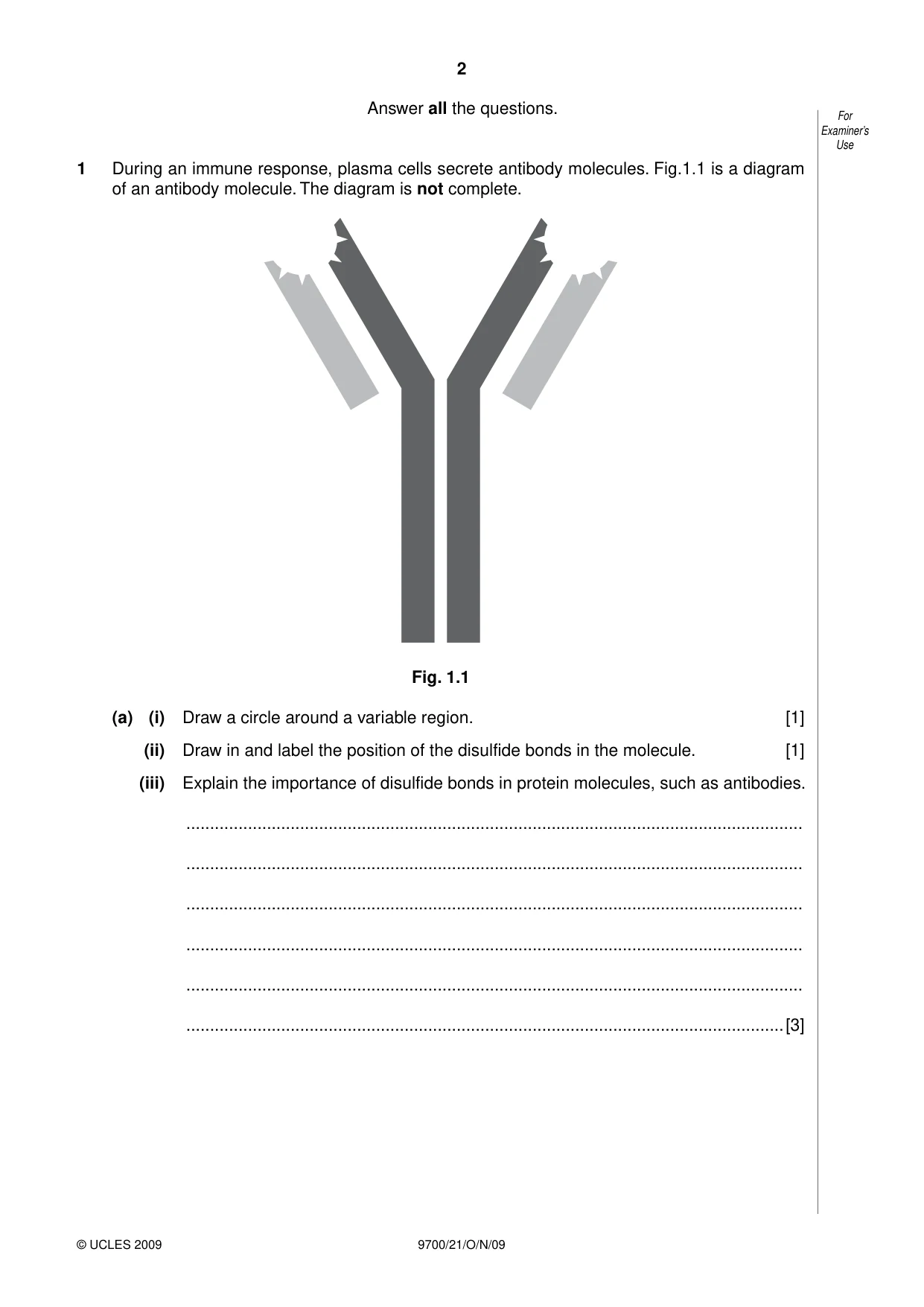
2 9700/21/O/N/09 © UCLES 2009 For Examiner’s Use Answer all the questions. 1 During an immune response, plasma cells secrete antibody molecules. Fig.1.1 is a diagram of an antibody molecule. The diagram is not complete. Fig. 1.1 (a) (i) Draw a circle around a variable region. [1] (ii) Draw in and label the position of the disulfide bonds in the molecule. [1] (iii) Explain the importance of disulfide bonds in protein molecules, such as antibodies. … … … … … …[3]
Question paper, page 3
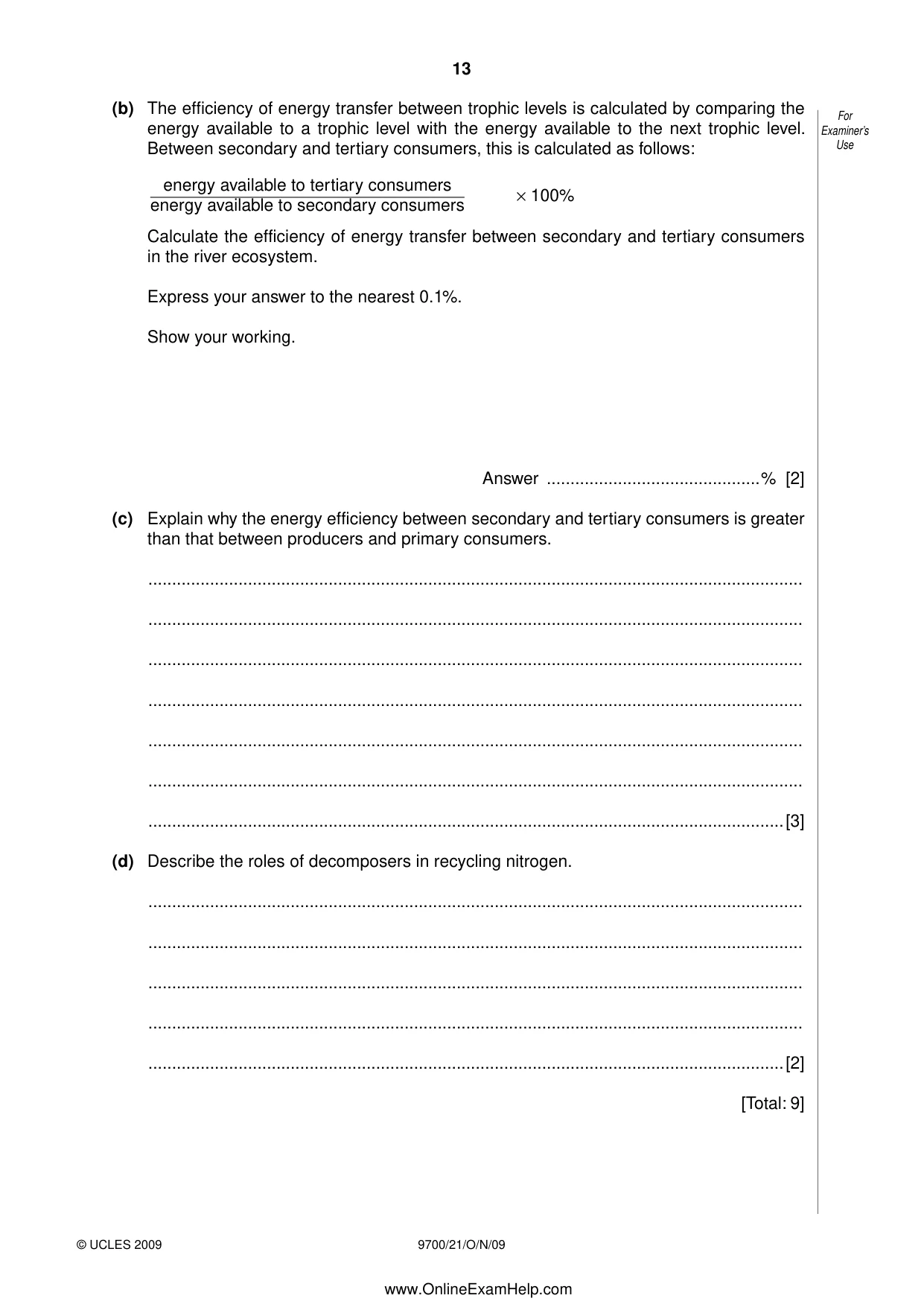
3 9700/21/O/N/09 © UCLES 2009 [Turn over For Examiner’s Use (b) Describe how antibodies provide protection against pathogens. … … … … … … … …[4] (c) Other proteins are found in cell surface membranes. Describe three roles of the proteins in cell surface membranes. 1 … … 2 … … 3 … …[3] [Total: 12]
Question paper, page 4
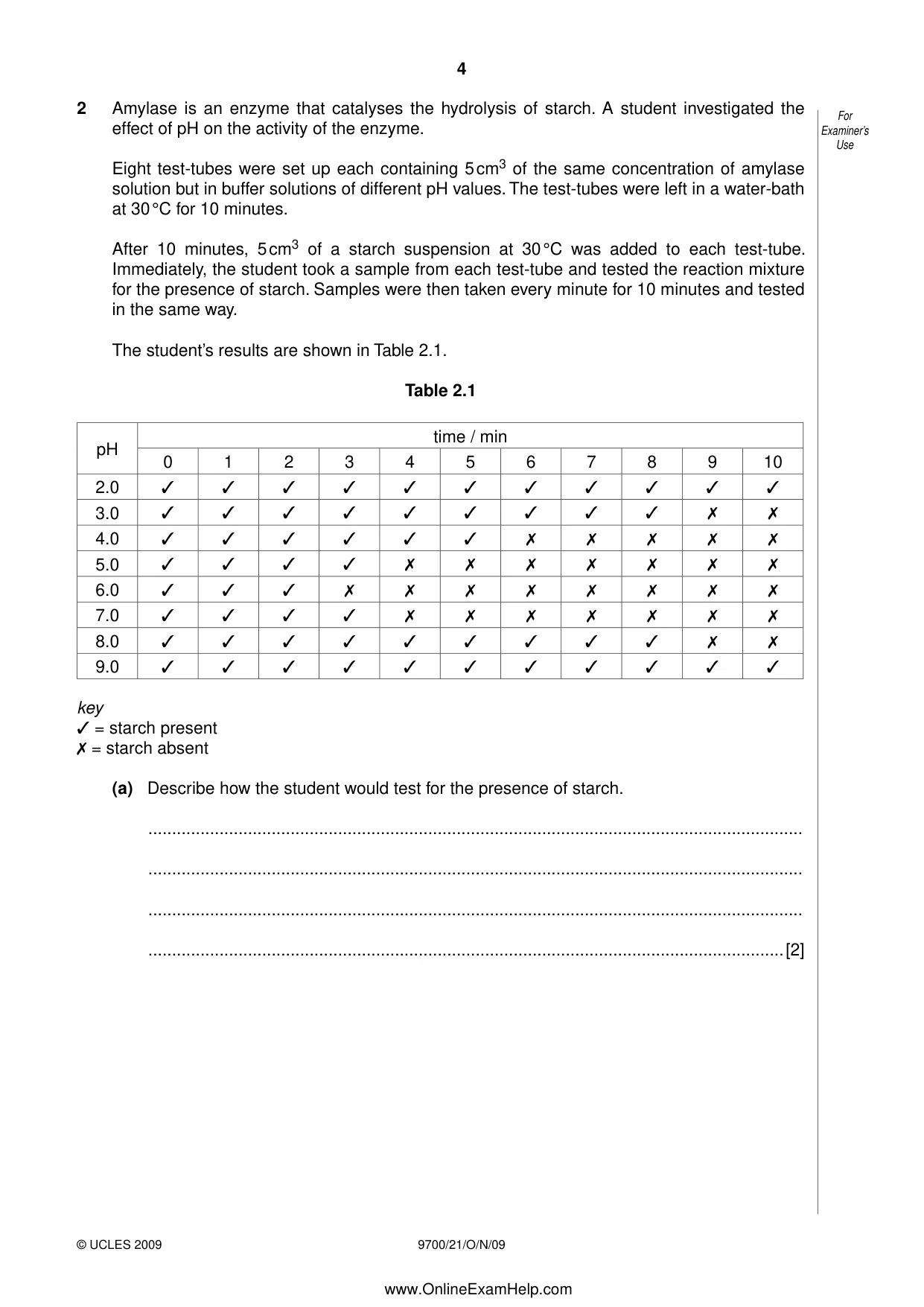
4 9700/21/O/N/09 © UCLES 2009 For Examiner’s Use 2 Amylase is an enzyme that catalyses the hydrolysis of starch. A student investigated the effect of pH on the activity of the enzyme. Eight test-tubes were set up each containing 5 cm3 of the same concentration of amylase solution but in buffer solutions of different pH values. The test-tubes were left in a water-bath at 30 °C for 10 minutes. After 10 minutes, 5 cm3 of a starch suspension at 30 °C was added to each test-tube. Immediately, the student took a sample from each test-tube and tested the reaction mixture for the presence of starch. Samples were then taken every minute for 10 minutes and tested in the same way. The student’s results are shown in Table 2.1. Table 2.1 pH time / min 0 1 2 3 4 5 6 7 8 9 10 2.0 ✓ ✓ ✓ ✓ ✓ ✓ ✓ ✓ ✓ ✓ ✓ 3.0 ✓ ✓ ✓ ✓ ✓ ✓ ✓ ✓ ✓ ✗ ✗ 4.0 ✓ ✓ ✓ ✓ ✓ ✓ ✗ ✗ ✗ ✗ ✗ 5.0 ✓ ✓ ✓ ✓ ✗ ✗ ✗ ✗ ✗ ✗ ✗ 6.0 ✓ ✓ ✓ ✗ ✗ ✗ ✗ ✗ ✗ ✗ ✗ 7.0 ✓ ✓ ✓ ✓ ✗ ✗ ✗ ✗ ✗ ✗ ✗ 8.0 ✓ ✓ ✓ ✓ ✓ ✓ ✓ ✓ ✓ ✗ ✗ 9.0 ✓ ✓ ✓ ✓ ✓ ✓ ✓ ✓ ✓ ✓ ✓ key ✓ = starch present ✗ = starch absent (a) Describe how the student would test for the presence of starch. … … … …[2] www.OnlineExamHelp.com
Question paper, page 5
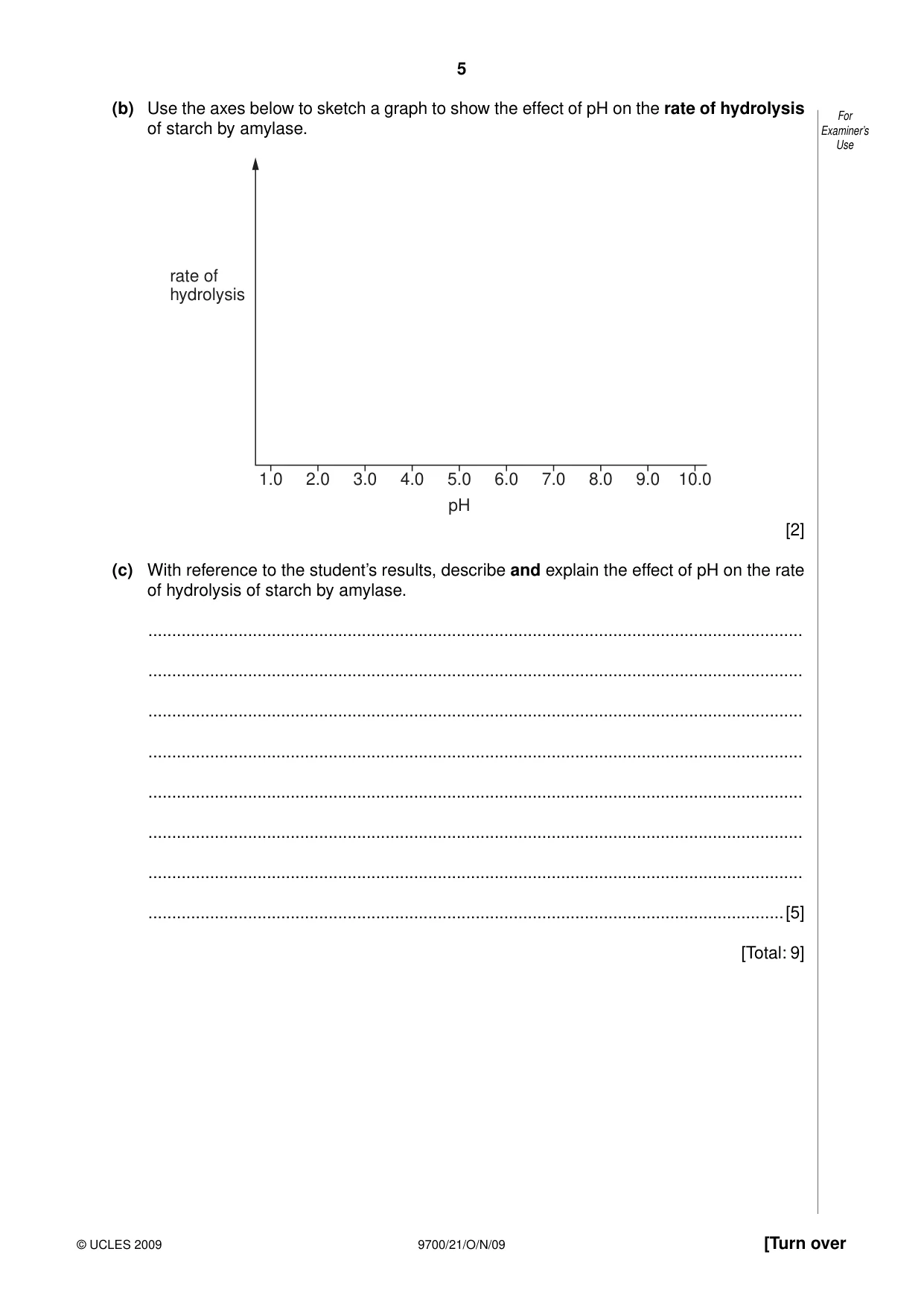
5 9700/21/O/N/09 © UCLES 2009 [Turn over For Examiner’s Use (b) Use the axes below to sketch a graph to show the effect of pH on the rate of hydrolysis of starch by amylase. 1.0 2.0 3.0 4.0 rate of hydrolysis 5.0 pH 6.0 7.0 8.0 9.0 10.0 [2] (c) With reference to the student’s results, describe and explain the effect of pH on the rate of hydrolysis of starch by amylase. … … … … … … … …[5] [Total: 9]
Question paper, page 6
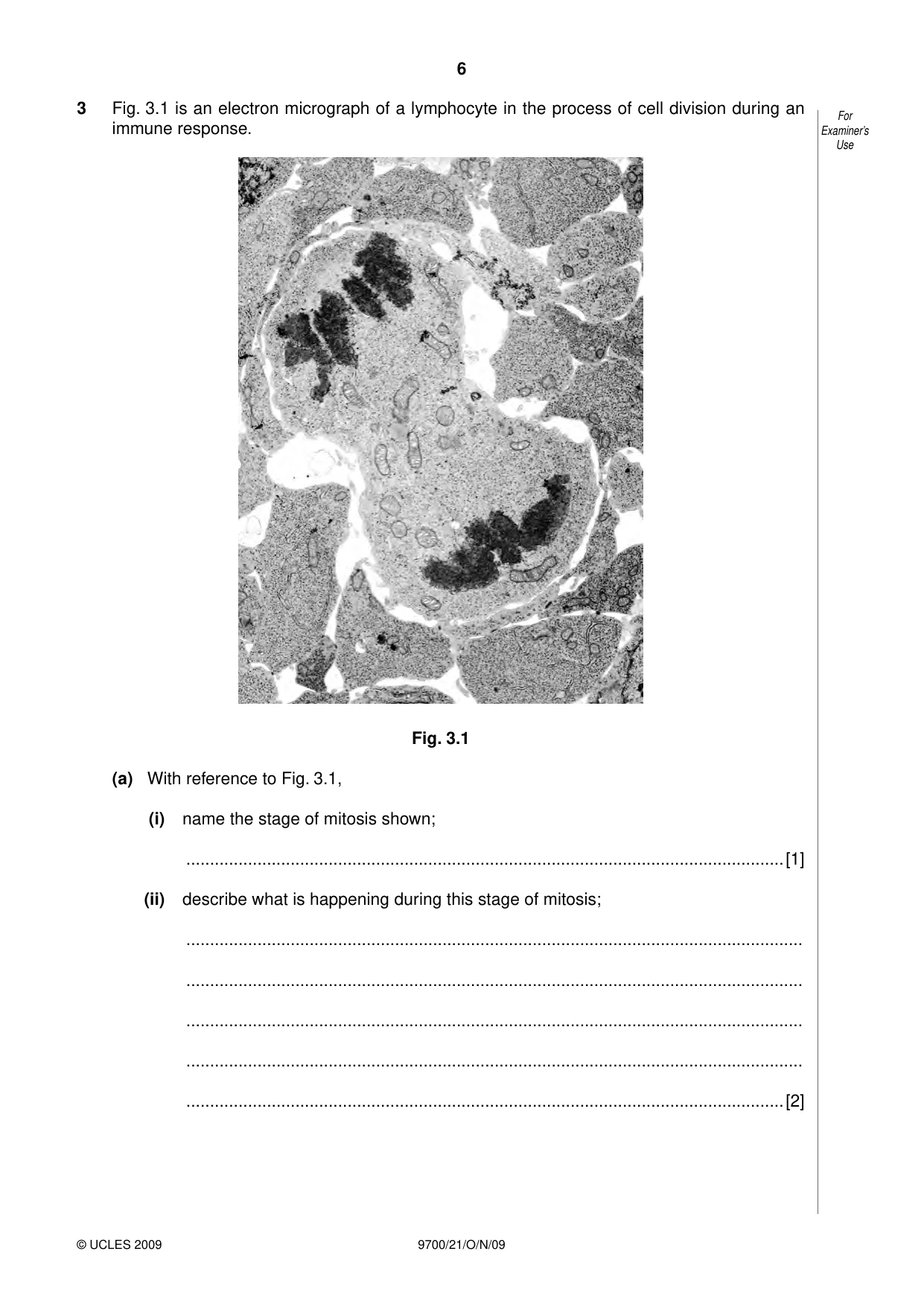
6 9700/21/O/N/09 © UCLES 2009 For Examiner’s Use 3 Fig. 3.1 is an electron micrograph of a lymphocyte in the process of cell division during an immune response. Fig. 3.1 (a) With reference to Fig. 3.1, (i) name the stage of mitosis shown; …[1] (ii) describe what is happening during this stage of mitosis; … … … … …[2]
Question paper, page 7
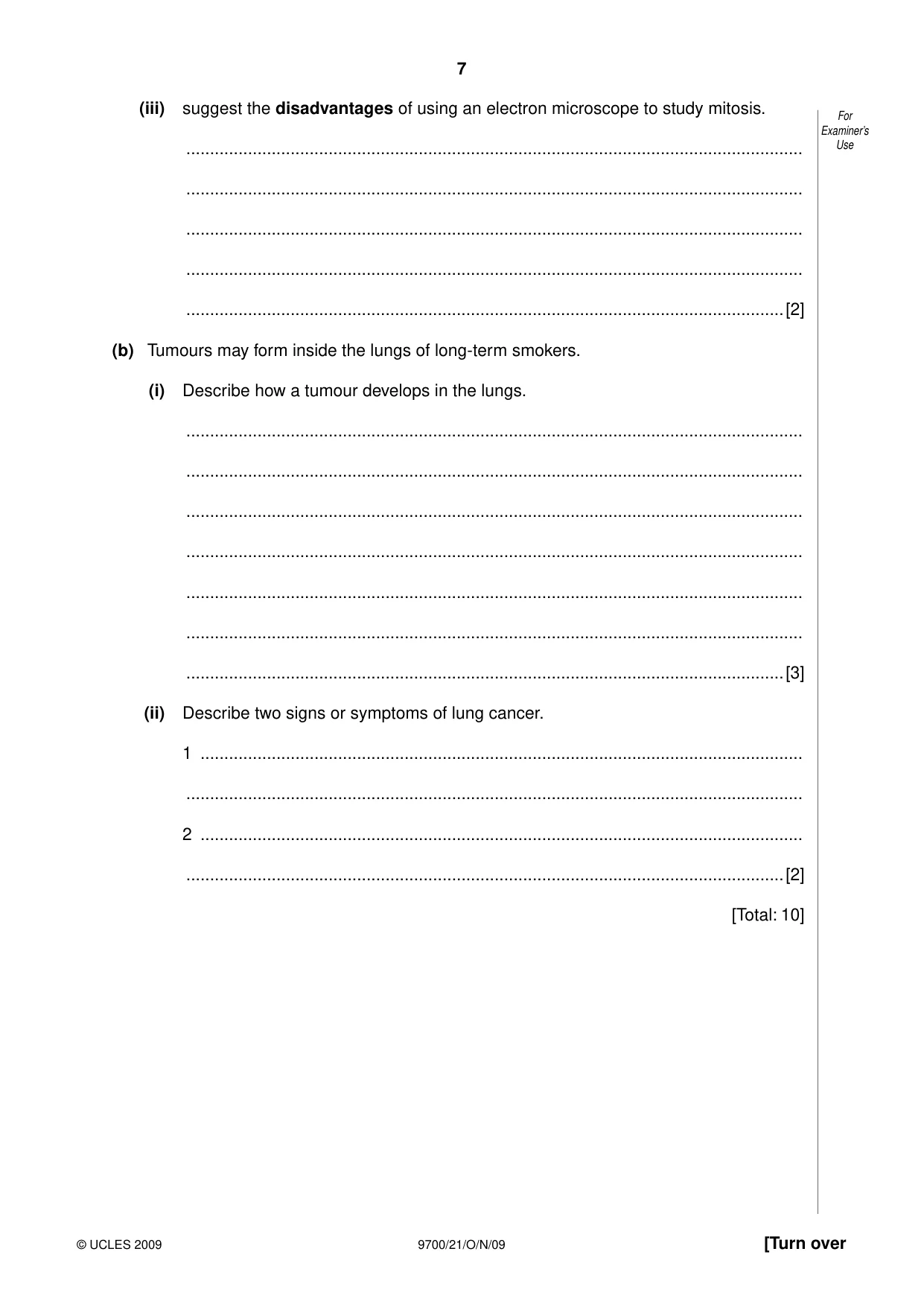
7 9700/21/O/N/09 © UCLES 2009 [Turn over For Examiner’s Use (iii) suggest the disadvantages of using an electron microscope to study mitosis. … … … … …[2] (b) Tumours may form inside the lungs of long-term smokers. (i) Describe how a tumour develops in the lungs. … … … … … … …[3] (ii) Describe two signs or symptoms of lung cancer. 1 … … 2 … …[2] [Total: 10]
Question paper, page 8
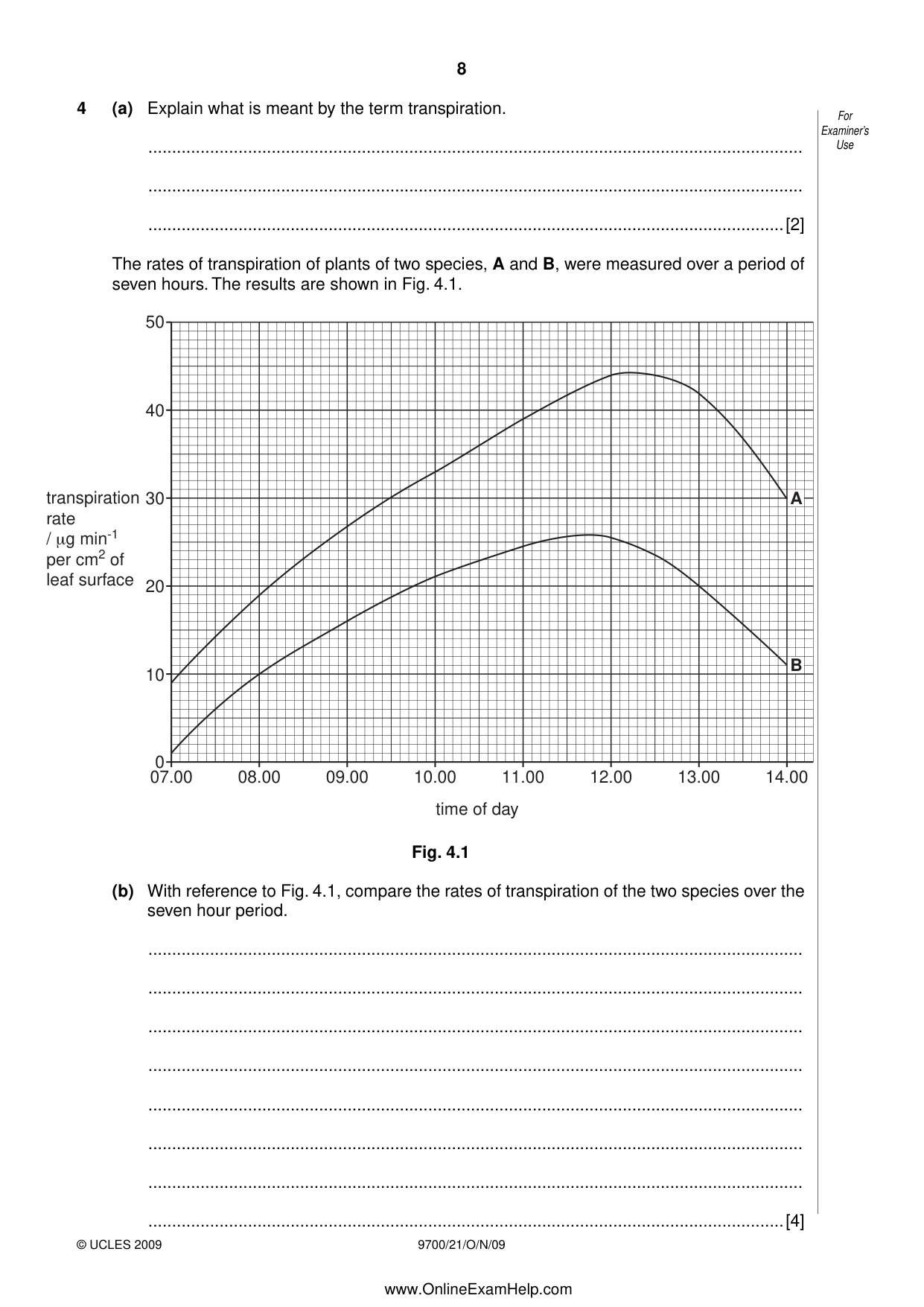
8 9700/21/O/N/09 © UCLES 2009 For Examiner’s Use 4 (a) Explain what is meant by the term transpiration. … … …[2] The rates of transpiration of plants of two species, A and B, were measured over a period of seven hours. The results are shown in Fig. 4.1. 07.00 0 10 20 30 40 50 08.00 09.00 10.00 11.00 time of day transpiration rate / μg min-1 per cm2 of leaf surface 12.00 13.00 14.00 A B Fig. 4.1 (b) With reference to Fig. 4.1, compare the rates of transpiration of the two species over the seven hour period. … … … … … … … …[4] www.OnlineExamHelp.com
Question paper, page 9
9 9700/21/O/N/09 © UCLES 2009 [Turn over For Examiner’s Use (c) State two possible features of the leaves of species B that could explain the different rates of transpiration in comparison with species A. Explain how each feature acts to reduce transpiration. feature … explanation … … … feature … explanation … … …[4] [Total: 10]
Question paper, page 10
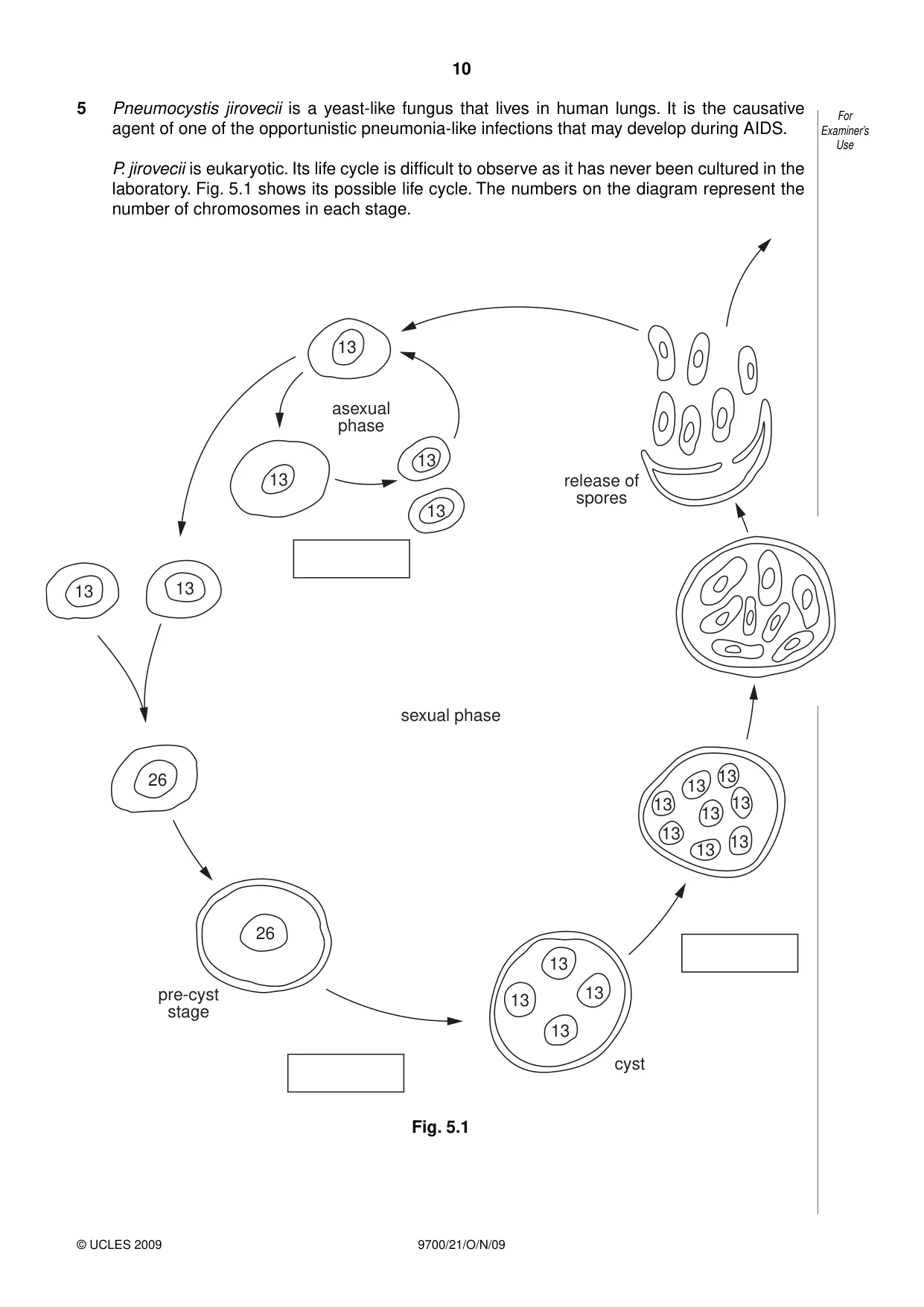
10 9700/21/O/N/09 © UCLES 2009 For Examiner’s Use 5 Pneumocystis jirovecii is a yeast-like fungus that lives in human lungs. It is the causative agent of one of the opportunistic pneumonia-like infections that may develop during AIDS. P. jirovecii is eukaryotic. Its life cycle is difficult to observe as it has never been cultured in the laboratory. Fig. 5.1 shows its possible life cycle. The numbers on the diagram represent the number of chromosomes in each stage. 13 13 13 13 13 13 13 13 13 13 26 26 13 13 13 13 pre-cyst stage cyst 13 13 13 13 asexual phase release of spores sexual phase Fig. 5.1
Question paper, page 11
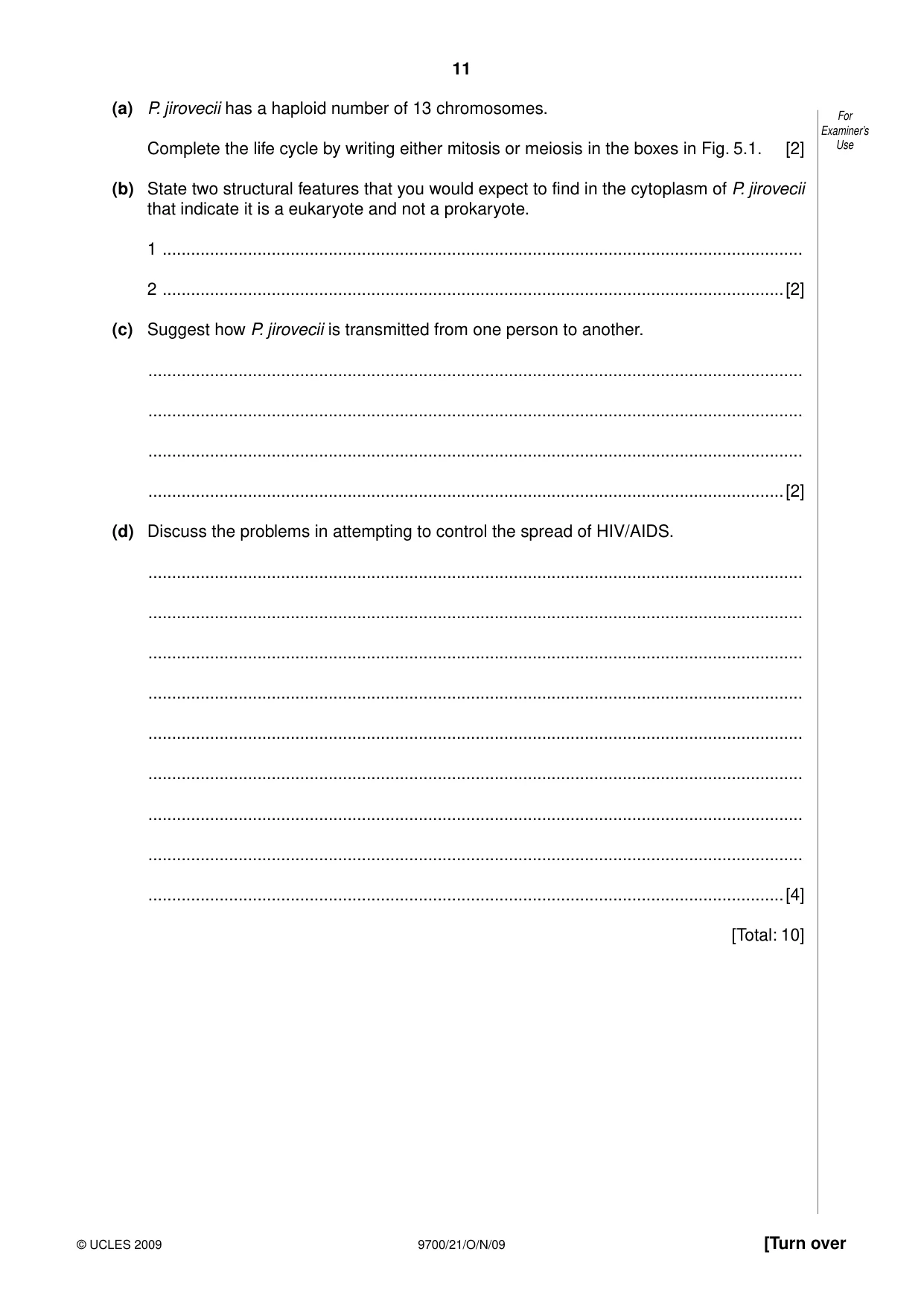
11 9700/21/O/N/09 © UCLES 2009 [Turn over For Examiner’s Use (a) P. jirovecii has a haploid number of 13 chromosomes. Complete the life cycle by writing either mitosis or meiosis in the boxes in Fig. 5.1. [2] (b) State two structural features that you would expect to find in the cytoplasm of P. jirovecii that indicate it is a eukaryote and not a prokaryote. 1 … 2 …[2] (c) Suggest how P. jirovecii is transmitted from one person to another. … … … …[2] (d) Discuss the problems in attempting to control the spread of HIV/AIDS. … … … … … … … … …[4] [Total: 10]
Question paper, page 12
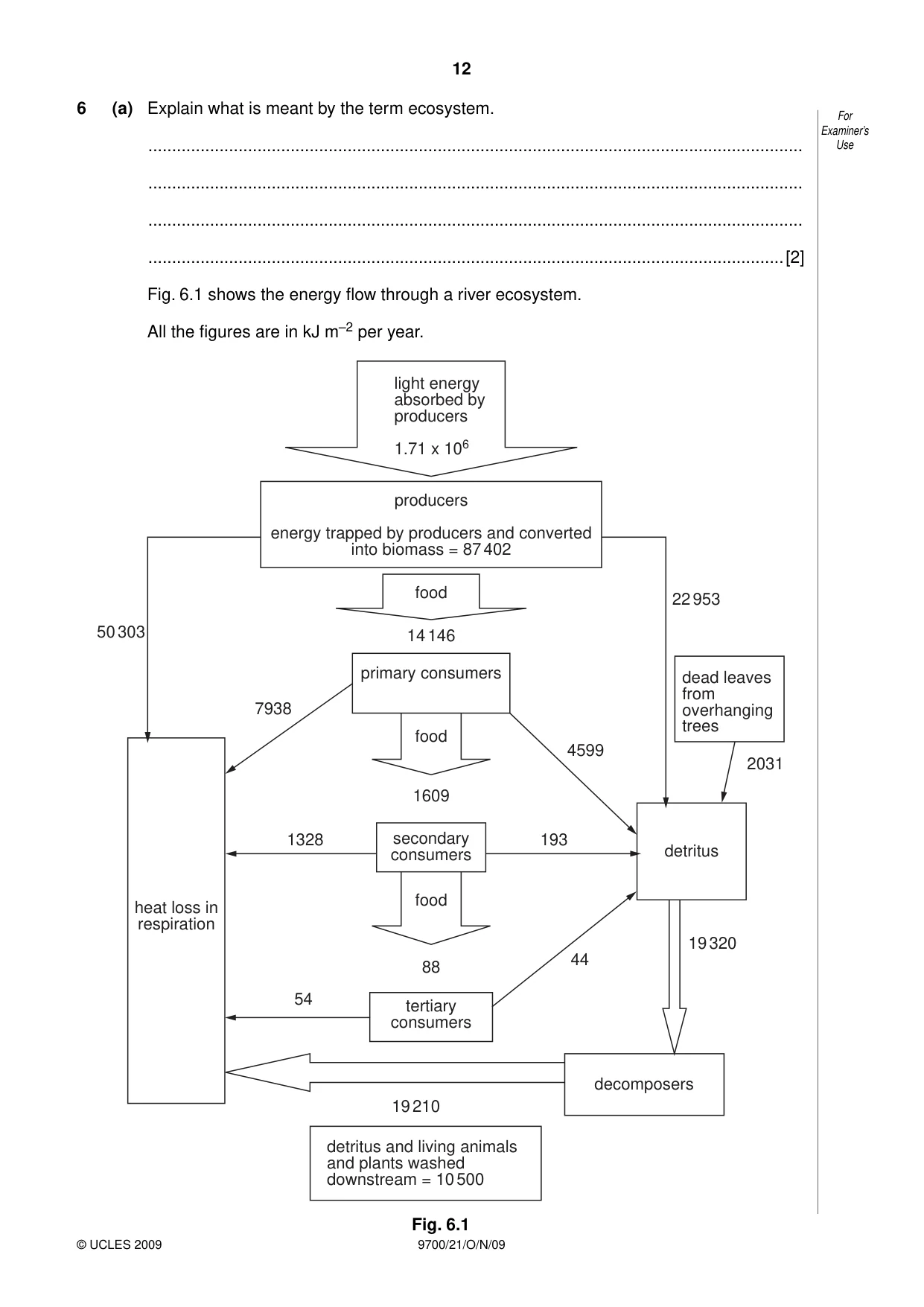
12 9700/21/O/N/09 © UCLES 2009 For Examiner’s Use 6 (a) Explain what is meant by the term ecosystem. … … … …[2] Fig. 6.1 shows the energy flow through a river ecosystem. All the figures are in kJ m–2 per year. light energy absorbed by producers 1.71 x 10⁶ producers energy trapped by producers and converted into biomass = 87 402 food food food 88 1609 54 19 210 decomposers detritus and living animals and plants washed downstream = 10 500 44 19 320 22 953 2031 193 detritus dead leaves from overhanging trees 1328 7938 4599 50 303 heat loss in respiration secondary consumers tertiary consumers 14 146 primary consumers Fig. 6.1
Question paper, page 13
13 9700/21/O/N/09 © UCLES 2009 For Examiner’s Use (b) The efficiency of energy transfer between trophic levels is calculated by comparing the energy available to a trophic level with the energy available to the next trophic level. Between secondary and tertiary consumers, this is calculated as follows: energy available to tertiary consumers energy available to secondary consumers × 100% Calculate the efficiency of energy transfer between secondary and tertiary consumers in the river ecosystem. Express your answer to the nearest 0.1%. Show your working. Answer …% [2] (c) Explain why the energy efficiency between secondary and tertiary consumers is greater than that between producers and primary consumers. … … … … … … …[3] (d) Describe the roles of decomposers in recycling nitrogen. … … … … …[2] [Total: 9] www.OnlineExamHelp.com
Question paper, page 16
16 9700/21/O/N/09 BLANK PAGE Copyright Acknowledgements: Question 3 Fig. 3.1 © P673/063; Cell division, TEM; Science Photo Library. Permission to reproduce items where third-party owned material protected by copyright is included has been sought and cleared where possible. Every reasonable effort has been made by the publisher (UCLES) to trace copyright holders, but if any items requiring clearance have unwittingly been included, the publisher will be pleased to make amends at the earliest possible opportunity. University of Cambridge International Examinations is part of the Cambridge Assessment Group. Cambridge Assessment is the brand name of University of Cambridge Local Examinations Syndicate (UCLES), which is itself a department of the University of Cambridge. www.OnlineExamHelp.com
Mark scheme, page 1
UNIVERSITY OF CAMBRIDGE INTERNATIONAL EXAMINATIONS GCE Advanced Subsidiary Level and GCE Advanced Level MARK SCHEME for the October/November 2009 question paper for the guidance of teachers 9700 BIOLOGY 9700/21 Paper 2 (Structured Questions AS), maximum raw mark 60 This mark scheme is published as an aid to teachers and candidates, to indicate the requirements of the examination. It shows the basis on which Examiners were instructed to award marks. It does not indicate the details of the discussions that took place at an Examiners’ meeting before marking began, which would have considered the acceptability of alternative answers. Mark schemes must be read in conjunction with the question papers and the report on the examination. • CIE will not enter into discussions or correspondence in connection with these mark schemes. CIE is publishing the mark schemes for the October/November 2009 question papers for most IGCSE, GCE Advanced Level and Advanced Subsidiary Level syllabuses and some Ordinary Level syllabuses.
Mark scheme, page 2
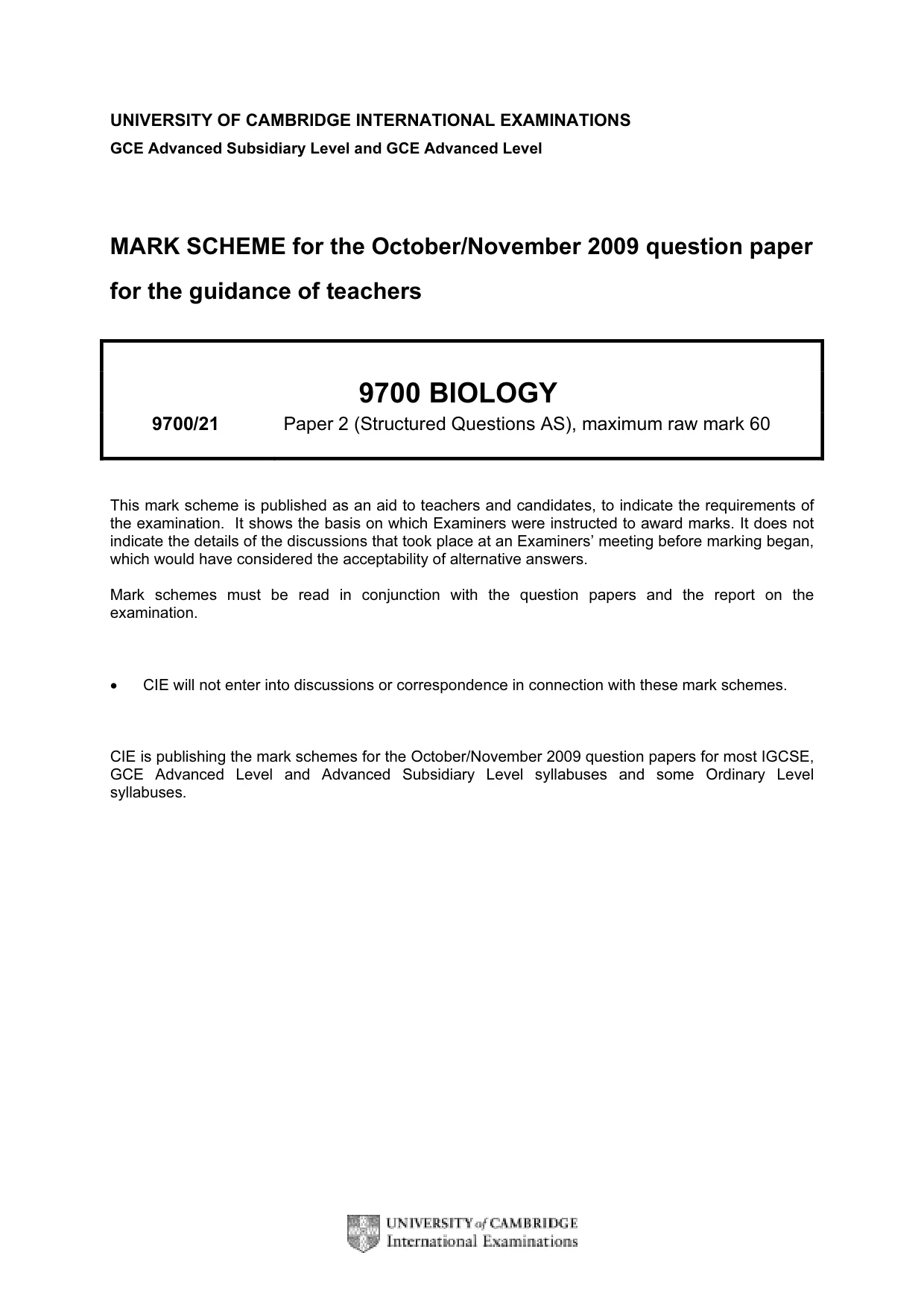
Page 2 Mark Scheme: Teachers’ version Syllabus Paper GCE A/AS LEVEL – October/November 2009 9700 21 © UCLES 2009 1 (a) (i) circle around one or two variable regions ; [1] (ii) line(s) between one light polypeptide and one heavy polypeptide, line(s) between the two heavy polypeptides ; maximum of six lines in each site [1] (iii) 1 (disulfide) bonds are between, cysteine(s) / cysteine residues ; A between R groups S-H S-H 2 covalent bond ; 3 strong bond / not easily broken ; 4 hold, polypeptides / chains / protein , together ; R proteins / strands 5 (in protein with) tertiary / quaternary (structure) ; 6 maintain shape / stop loss of shape / prevent deforming ; A 3D structure R structure unqualified [3 max] (b) 1 secreted / synthesised / produced / released, by, plasma cells / B lymphocytes / B cells ; 2 combines / AW, with, antigens / pathogens / toxins / viruses / bacteria / microbes ; A ‘bonds with’ / ‘sticks to’ / ‘attaches to’ R ‘disease’ 3 ref to, specificity / described ; in context of antibody / B cells / antigen 4 variable region is antigen binding region ; R ‘receptors on antibodies’ 5 neutralises toxins / antitoxin(s) ; 6 lysis of pathogens / described / lysin(s) ; R breaks down 7 prevents viruses entering cells ; 8 clumps / agglutinates / aggregates / AW, bacteria ; R ‘coagulation’ 9 opsonisation / opsonins ; A enable recognition 10 coats / AW, bacteria to facilitate phagocytosis ; only in context 8 or 9 11 receptors on phagocytes for constant regions (of antibodies) ; [4 max] (c) 1 (carrier / channel protein for) facilitated diffusion / described ; A action of (co-) transport protein described 2 (carrier protein for) active transport / described ; 3 cell recognition / distinguishing self from non-self / act as antigens / AW ; 4 receptor ; A binding site qualified in terms of, hormones / neurotransmitters / cytokines / cell signalling molecules ; 5 T-cell receptor / described ; 6 cell (to cell) adhesion / described ; 7 enzyme ; 8 form (hydrogen) bonds with, water / fluid surroundings, to stabilise membrane ; [3] [Total: 12]
Mark scheme, page 3
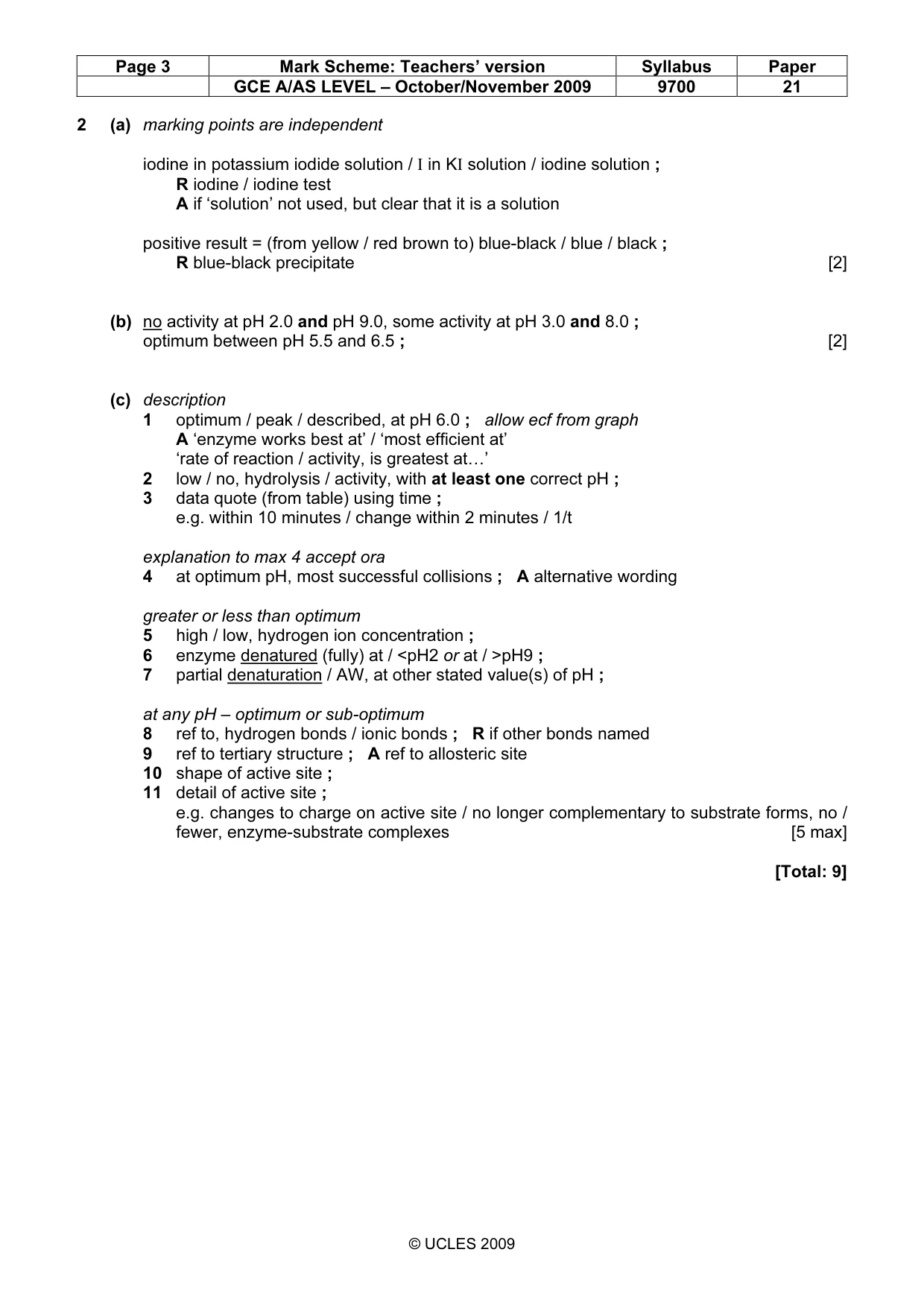
Page 3 Mark Scheme: Teachers’ version Syllabus Paper GCE A/AS LEVEL – October/November 2009 9700 21 © UCLES 2009 2 (a) marking points are independent iodine in potassium iodide solution / I in KI solution / iodine solution ; R iodine / iodine test A if ‘solution’ not used, but clear that it is a solution positive result = (from yellow / red brown to) blue-black / blue / black ; R blue-black precipitate [2] (b) no activity at pH 2.0 and pH 9.0, some activity at pH 3.0 and 8.0 ; optimum between pH 5.5 and 6.5 ; [2] (c) description 1 optimum / peak / described, at pH 6.0 ; allow ecf from graph A ‘enzyme works best at’ / ‘most efficient at’ ‘rate of reaction / activity, is greatest at…’ 2 low / no, hydrolysis / activity, with at least one correct pH ; 3 data quote (from table) using time ; e.g. within 10 minutes / change within 2 minutes / 1/t explanation to max 4 accept ora 4 at optimum pH, most successful collisions ; A alternative wording greater or less than optimum 5 high / low, hydrogen ion concentration ; 6 enzyme denatured (fully) at / <pH2 or at / >pH9 ; 7 partial denaturation / AW, at other stated value(s) of pH ; at any pH – optimum or sub-optimum 8 ref to, hydrogen bonds / ionic bonds ; R if other bonds named 9 ref to tertiary structure ; A ref to allosteric site 10 shape of active site ; 11 detail of active site ; e.g. changes to charge on active site / no longer complementary to substrate forms, no / fewer, enzyme-substrate complexes [5 max] [Total: 9]
Mark scheme, page 4
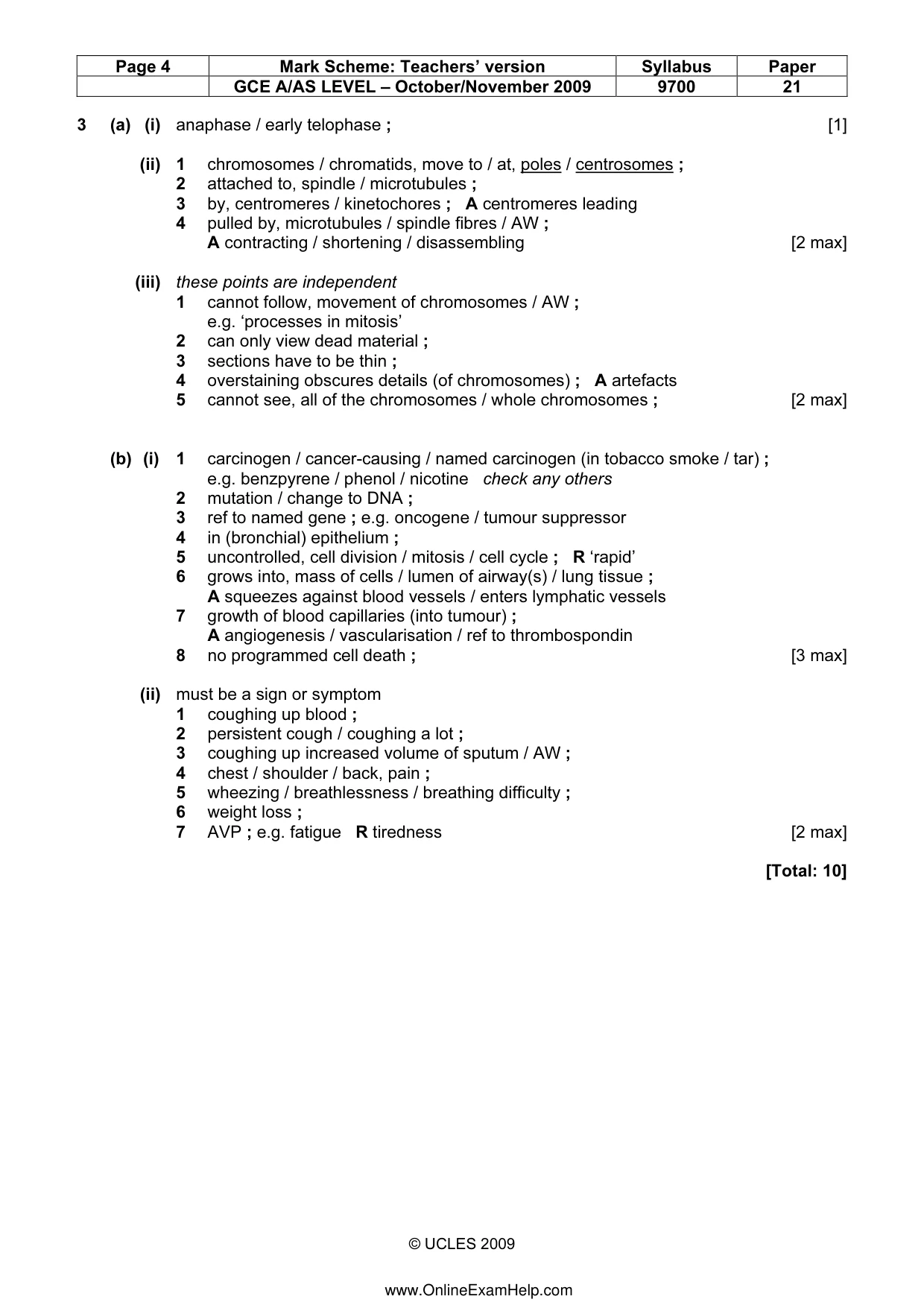
Page 4 Mark Scheme: Teachers’ version Syllabus Paper GCE A/AS LEVEL – October/November 2009 9700 21 © UCLES 2009 3 (a) (i) anaphase / early telophase ; [1] (ii) 1 chromosomes / chromatids, move to / at, poles / centrosomes ; 2 attached to, spindle / microtubules ; 3 by, centromeres / kinetochores ; A centromeres leading 4 pulled by, microtubules / spindle fibres / AW ; A contracting / shortening / disassembling [2 max] (iii) these points are independent 1 cannot follow, movement of chromosomes / AW ; e.g. ‘processes in mitosis’ 2 can only view dead material ; 3 sections have to be thin ; 4 overstaining obscures details (of chromosomes) ; A artefacts 5 cannot see, all of the chromosomes / whole chromosomes ; [2 max] (b) (i) 1 carcinogen / cancer-causing / named carcinogen (in tobacco smoke / tar) ; e.g. benzpyrene / phenol / nicotine check any others 2 mutation / change to DNA ; 3 ref to named gene ; e.g. oncogene / tumour suppressor 4 in (bronchial) epithelium ; 5 uncontrolled, cell division / mitosis / cell cycle ; R ‘rapid’ 6 grows into, mass of cells / lumen of airway(s) / lung tissue ; A squeezes against blood vessels / enters lymphatic vessels 7 growth of blood capillaries (into tumour) ; A angiogenesis / vascularisation / ref to thrombospondin 8 no programmed cell death ; [3 max] (ii) must be a sign or symptom 1 coughing up blood ; 2 persistent cough / coughing a lot ; 3 coughing up increased volume of sputum / AW ; 4 chest / shoulder / back, pain ; 5 wheezing / breathlessness / breathing difficulty ; 6 weight loss ; 7 AVP ; e.g. fatigue R tiredness [2 max] [Total: 10] www.OnlineExamHelp.com
Mark scheme, page 5
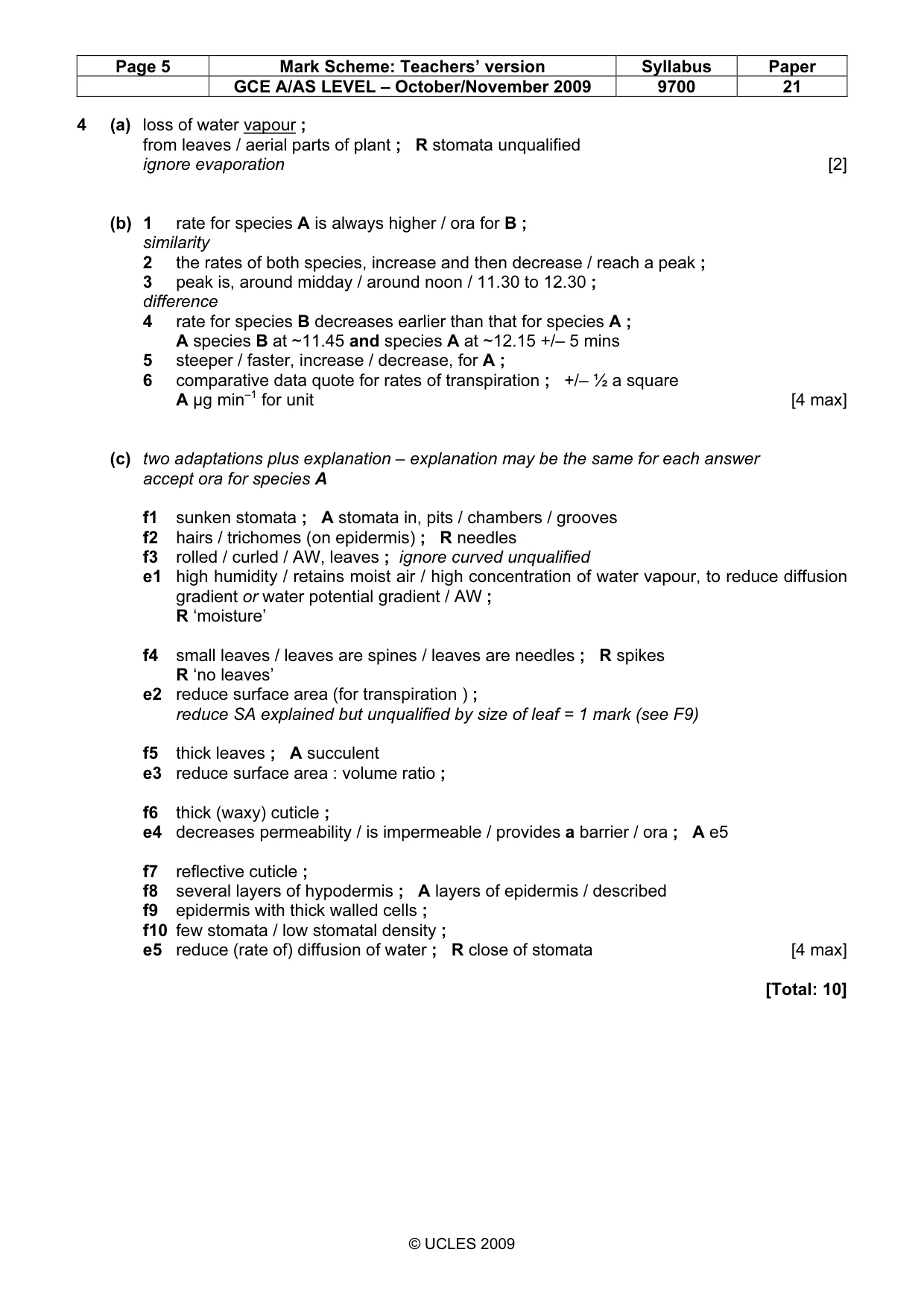
Page 5 Mark Scheme: Teachers’ version Syllabus Paper GCE A/AS LEVEL – October/November 2009 9700 21 © UCLES 2009 4 (a) loss of water vapour ; from leaves / aerial parts of plant ; R stomata unqualified ignore evaporation [2] (b) 1 rate for species A is always higher / ora for B ; similarity 2 the rates of both species, increase and then decrease / reach a peak ; 3 peak is, around midday / around noon / 11.30 to 12.30 ; difference 4 rate for species B decreases earlier than that for species A ; A species B at ~11.45 and species A at ~12.15 +/– 5 mins 5 steeper / faster, increase / decrease, for A ; 6 comparative data quote for rates of transpiration ; +/– ½ a square A µg min–1 for unit [4 max] (c) two adaptations plus explanation – explanation may be the same for each answer accept ora for species A f1 sunken stomata ; A stomata in, pits / chambers / grooves f2 hairs / trichomes (on epidermis) ; R needles f3 rolled / curled / AW, leaves ; ignore curved unqualified e1 high humidity / retains moist air / high concentration of water vapour, to reduce diffusion gradient or water potential gradient / AW ; R ‘moisture’ f4 small leaves / leaves are spines / leaves are needles ; R spikes R ‘no leaves’ e2 reduce surface area (for transpiration ) ; reduce SA explained but unqualified by size of leaf = 1 mark (see F9) f5 thick leaves ; A succulent e3 reduce surface area : volume ratio ; f6 thick (waxy) cuticle ; e4 decreases permeability / is impermeable / provides a barrier / ora ; A e5 f7 reflective cuticle ; f8 several layers of hypodermis ; A layers of epidermis / described f9 epidermis with thick walled cells ; f10 few stomata / low stomatal density ; e5 reduce (rate of) diffusion of water ; R close of stomata [4 max] [Total: 10]
Mark scheme, page 6
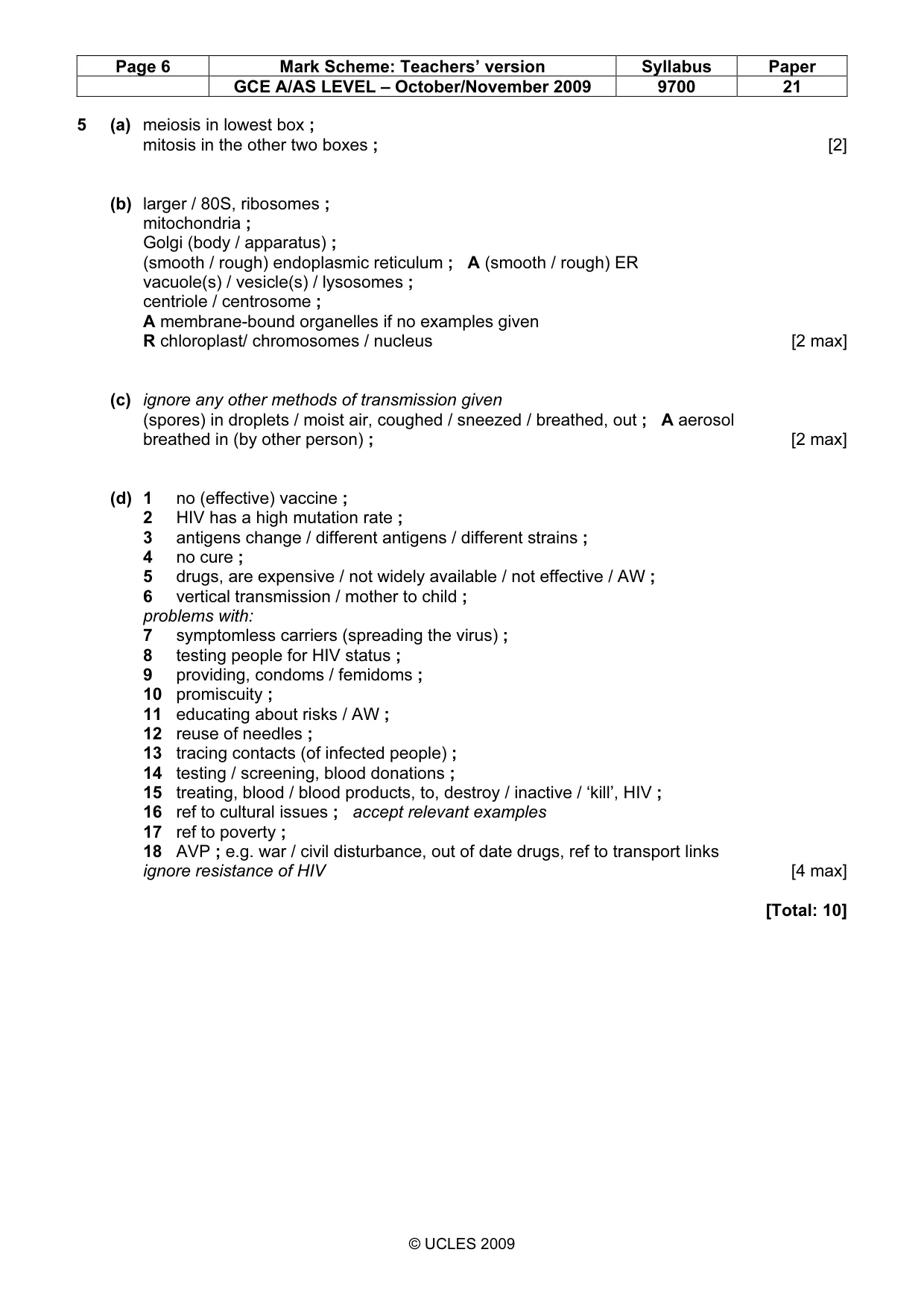
Page 6 Mark Scheme: Teachers’ version Syllabus Paper GCE A/AS LEVEL – October/November 2009 9700 21 © UCLES 2009 5 (a) meiosis in lowest box ; mitosis in the other two boxes ; [2] (b) larger / 80S, ribosomes ; mitochondria ; Golgi (body / apparatus) ; (smooth / rough) endoplasmic reticulum ; A (smooth / rough) ER vacuole(s) / vesicle(s) / lysosomes ; centriole / centrosome ; A membrane-bound organelles if no examples given R chloroplast/ chromosomes / nucleus [2 max] (c) ignore any other methods of transmission given (spores) in droplets / moist air, coughed / sneezed / breathed, out ; A aerosol breathed in (by other person) ; [2 max] (d) 1 no (effective) vaccine ; 2 HIV has a high mutation rate ; 3 antigens change / different antigens / different strains ; 4 no cure ; 5 drugs, are expensive / not widely available / not effective / AW ; 6 vertical transmission / mother to child ; problems with: 7 symptomless carriers (spreading the virus) ; 8 testing people for HIV status ; 9 providing, condoms / femidoms ; 10 promiscuity ; 11 educating about risks / AW ; 12 reuse of needles ; 13 tracing contacts (of infected people) ; 14 testing / screening, blood donations ; 15 treating, blood / blood products, to, destroy / inactive / ‘kill’, HIV ; 16 ref to cultural issues ; accept relevant examples 17 ref to poverty ; 18 AVP ; e.g. war / civil disturbance, out of date drugs, ref to transport links ignore resistance of HIV [4 max] [Total: 10]
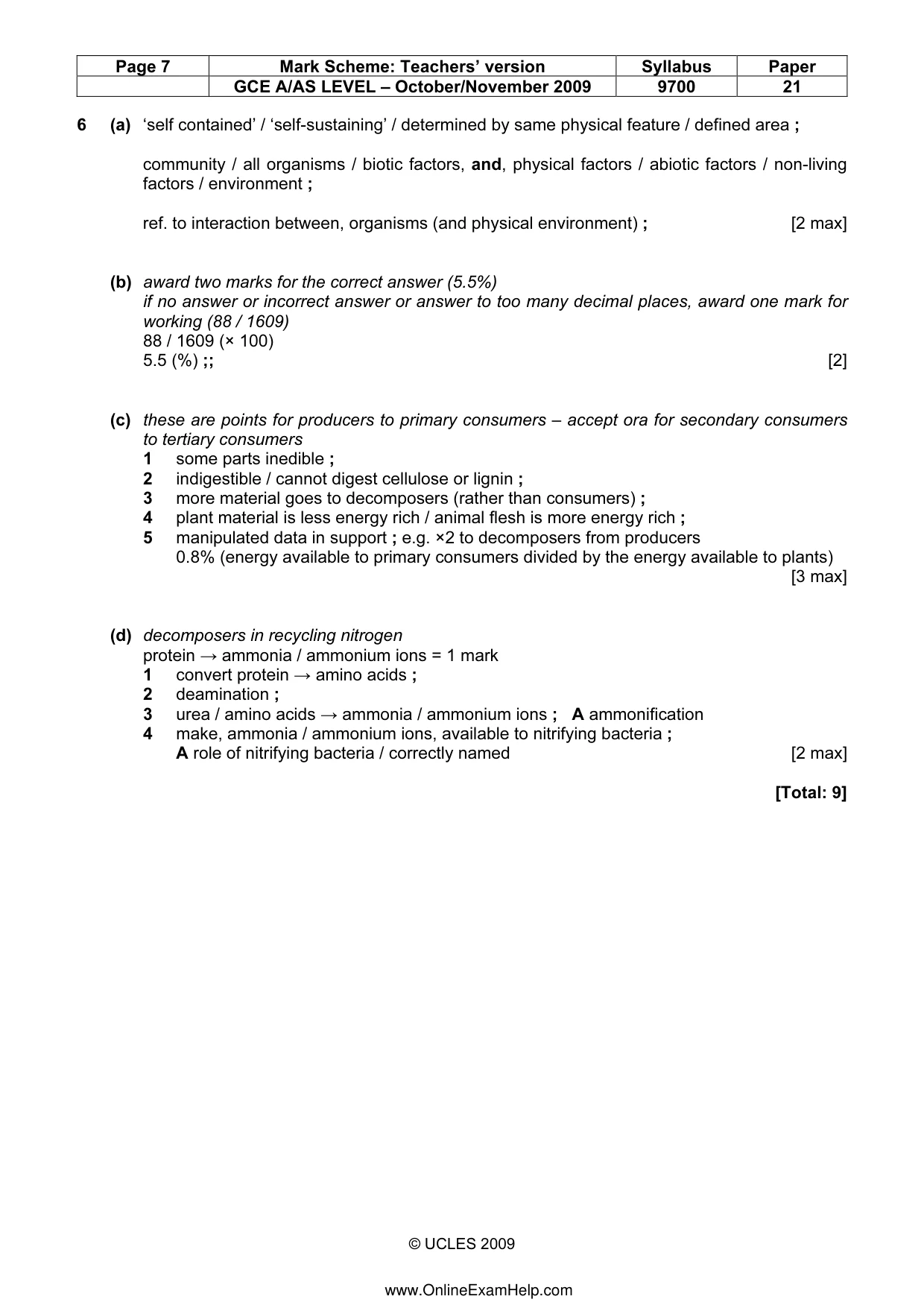
Mark scheme, page 7
Page 7 Mark Scheme: Teachers’ version Syllabus Paper GCE A/AS LEVEL – October/November 2009 9700 21 © UCLES 2009 6 (a) ‘self contained’ / ‘self-sustaining’ / determined by same physical feature / defined area ; community / all organisms / biotic factors, and, physical factors / abiotic factors / non-living factors / environment ; ref. to interaction between, organisms (and physical environment) ; [2 max] (b) award two marks for the correct answer (5.5%) if no answer or incorrect answer or answer to too many decimal places, award one mark for working (88 / 1609) 88 / 1609 (× 100) 5.5 (%) ;; [2] (c) these are points for producers to primary consumers – accept ora for secondary consumers to tertiary consumers 1 some parts inedible ; 2 indigestible / cannot digest cellulose or lignin ; 3 more material goes to decomposers (rather than consumers) ; 4 plant material is less energy rich / animal flesh is more energy rich ; 5 manipulated data in support ; e.g. ×2 to decomposers from producers 0.8% (energy available to primary consumers divided by the energy available to plants) [3 max] (d) decomposers in recycling nitrogen protein → ammonia / ammonium ions = 1 mark 1 convert protein → amino acids ; 2 deamination ; 3 urea / amino acids → ammonia / ammonium ions ; A ammonification 4 make, ammonia / ammonium ions, available to nitrifying bacteria ; A role of nitrifying bacteria / correctly named [2 max] [Total: 9] www.OnlineExamHelp.com