Cambridge A Level Accounting 9706 — 2025 May/June Paper 2 · Variant 3
9706/23/M/J/25 · 4 questions · 90 marks · ≈101 min
The question paper and its mark scheme, free to read here and free to download. This is Cambridge’s own paper, exactly as it was sat.
Question paper20 pages

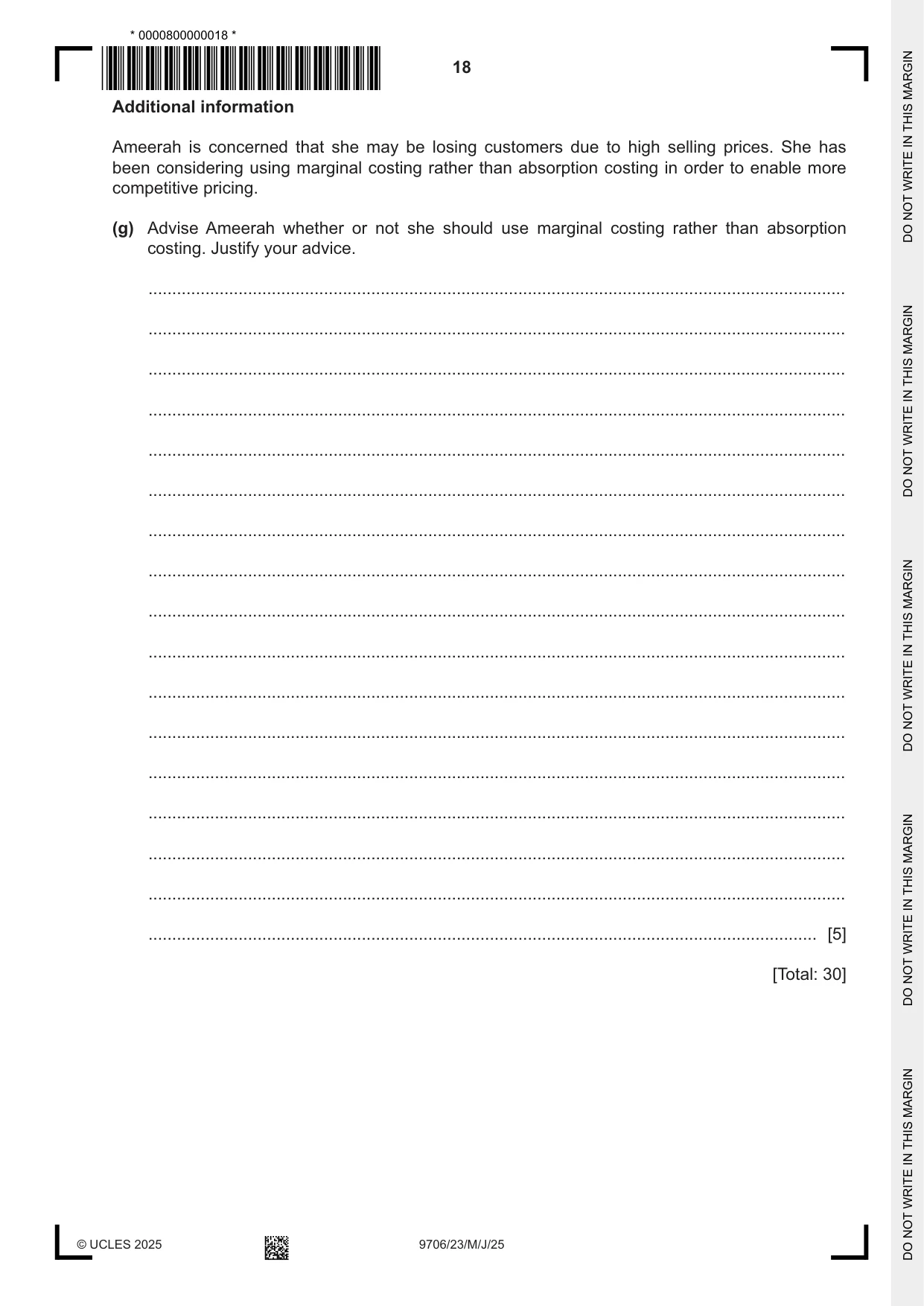

Mark scheme16 pages
Answers below. Sit the paper first if you are practising.
Questions as text
Q1 · Bilal provided the following information for his service business for the year ended 31…
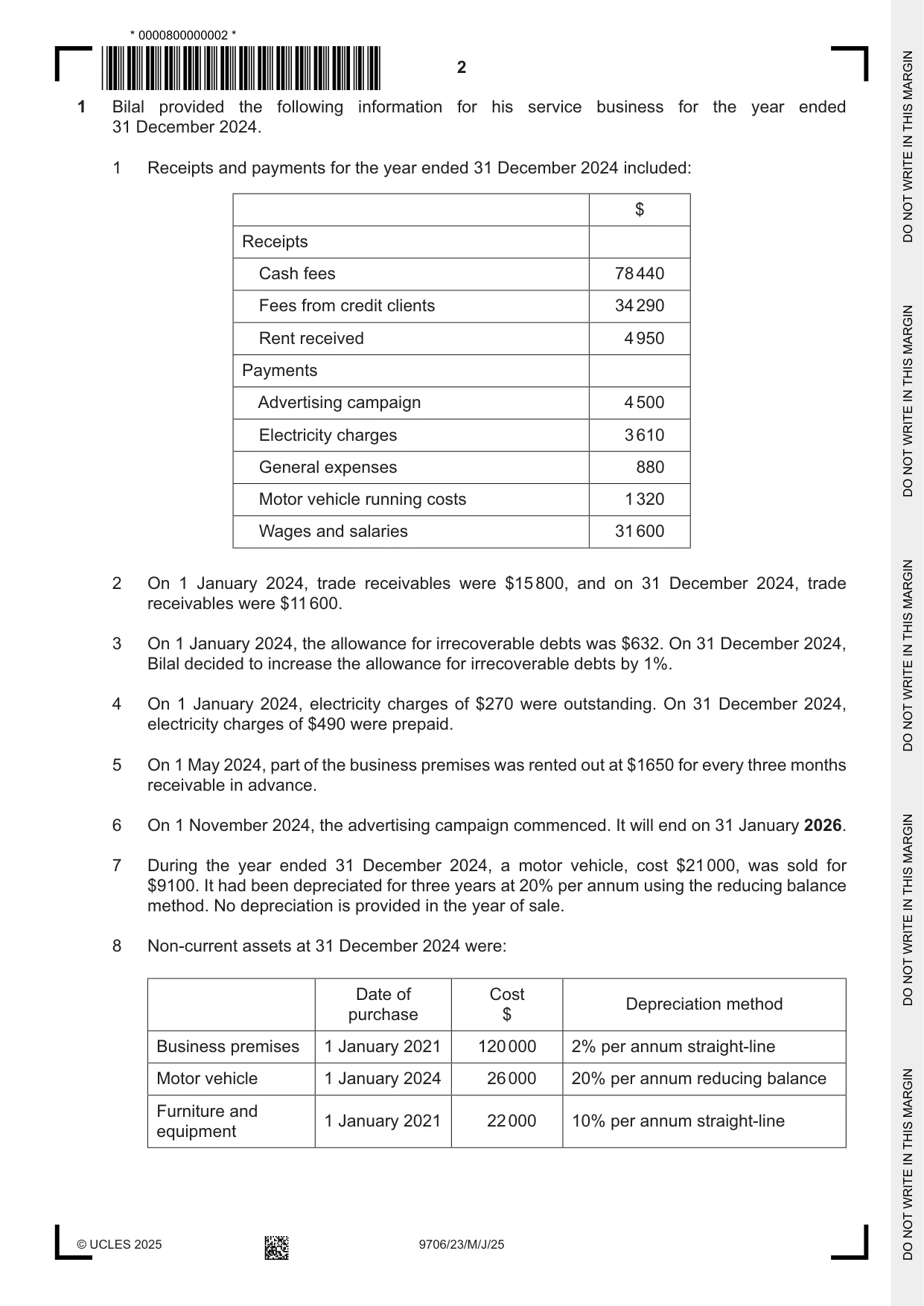
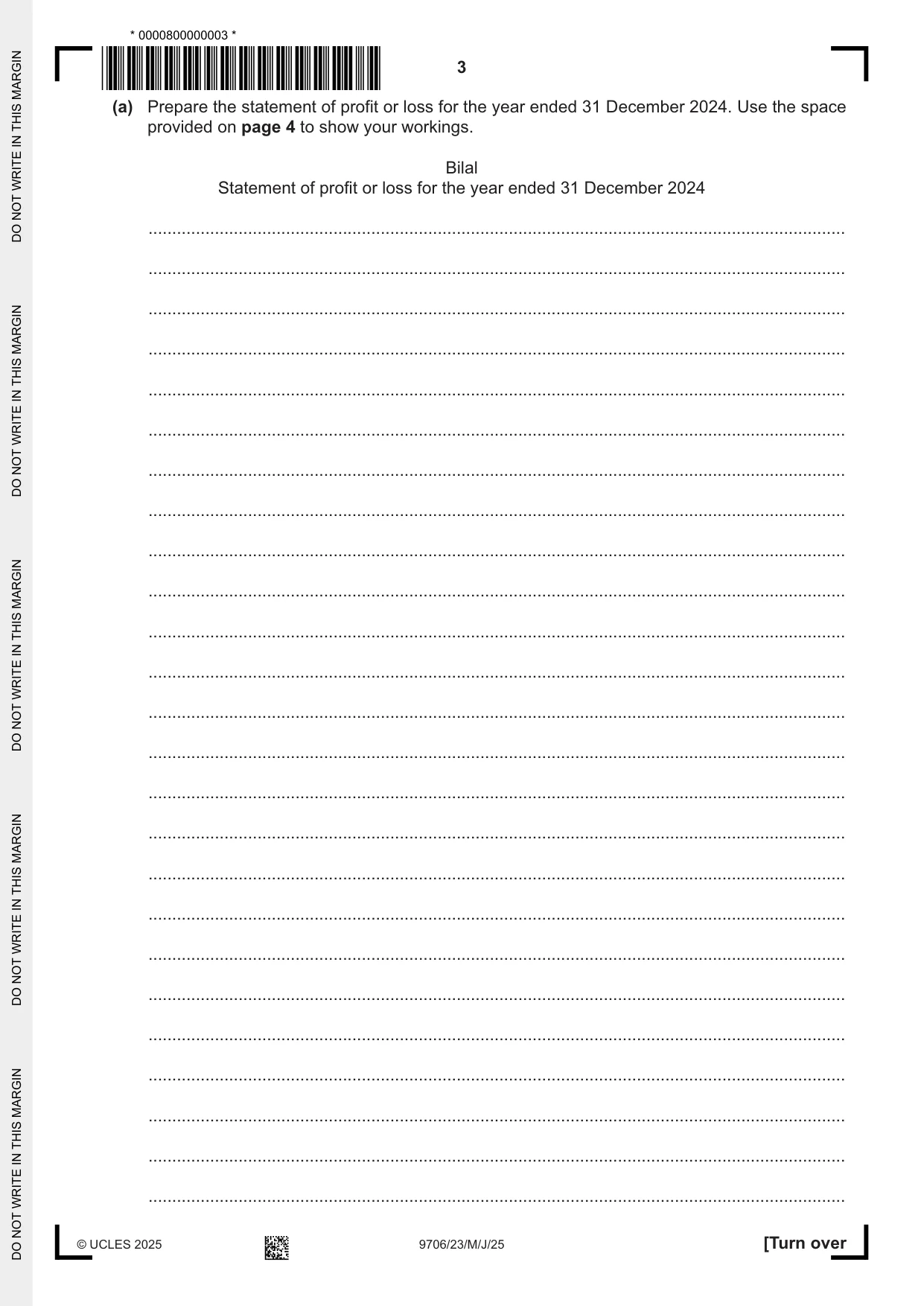
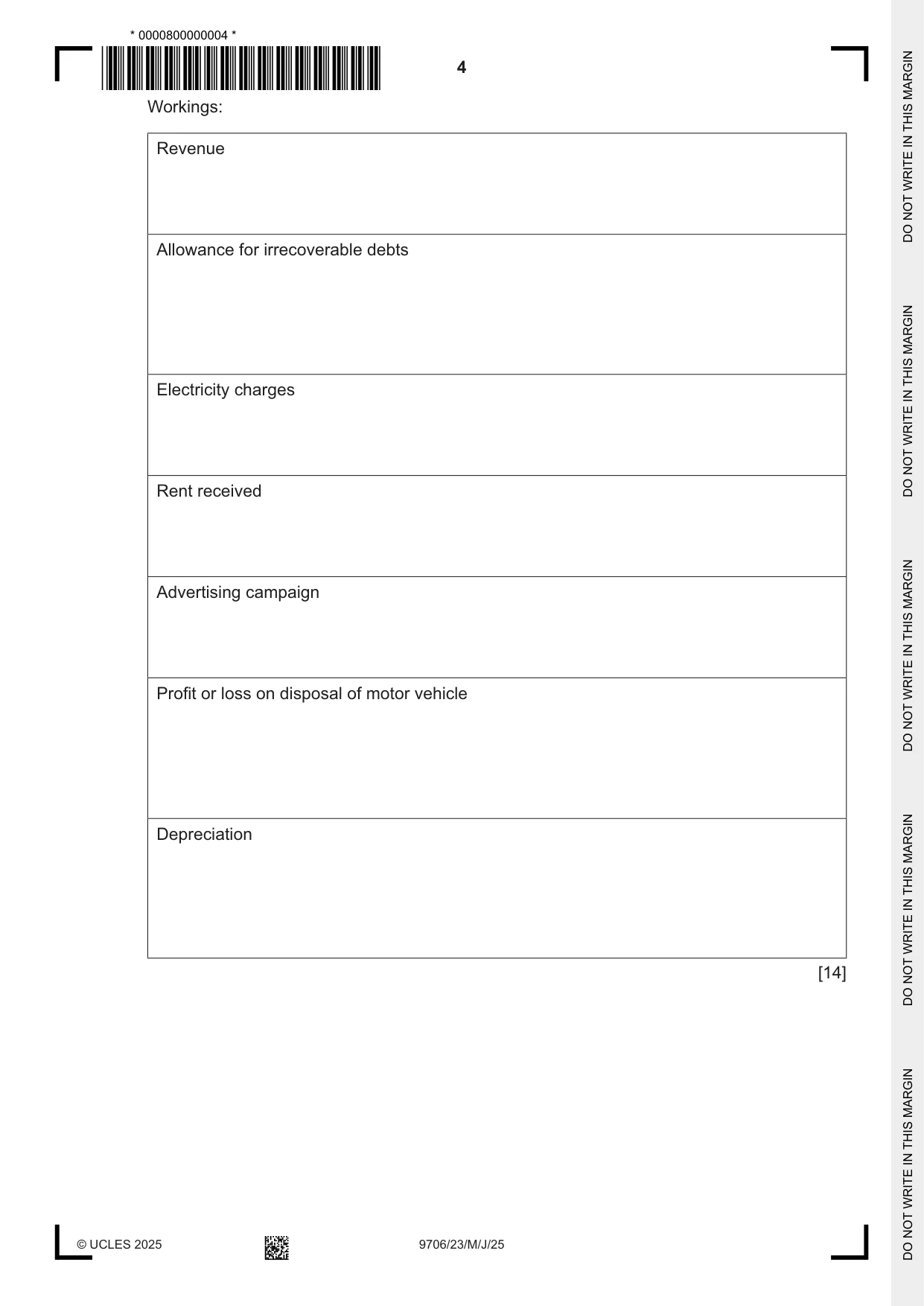
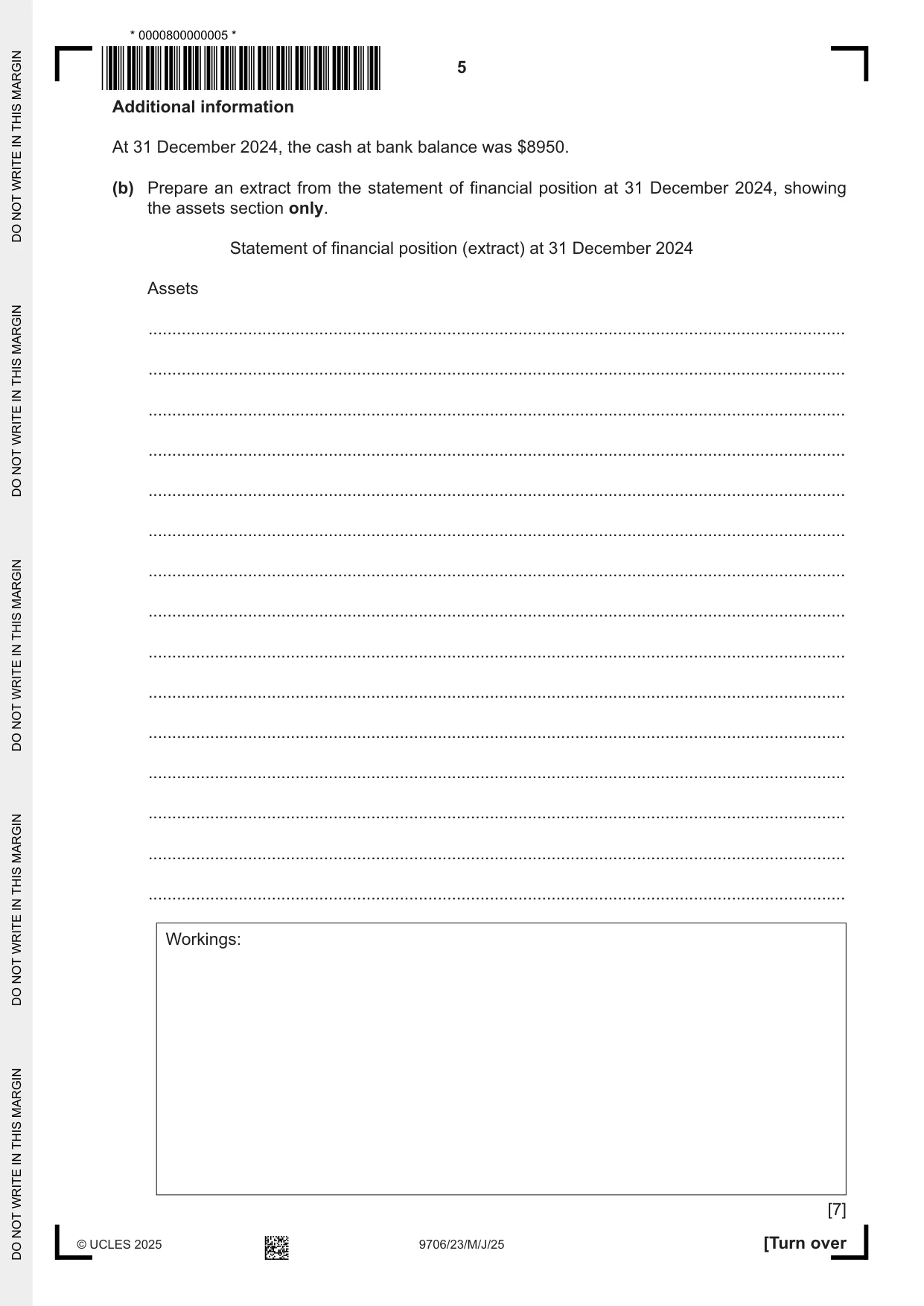
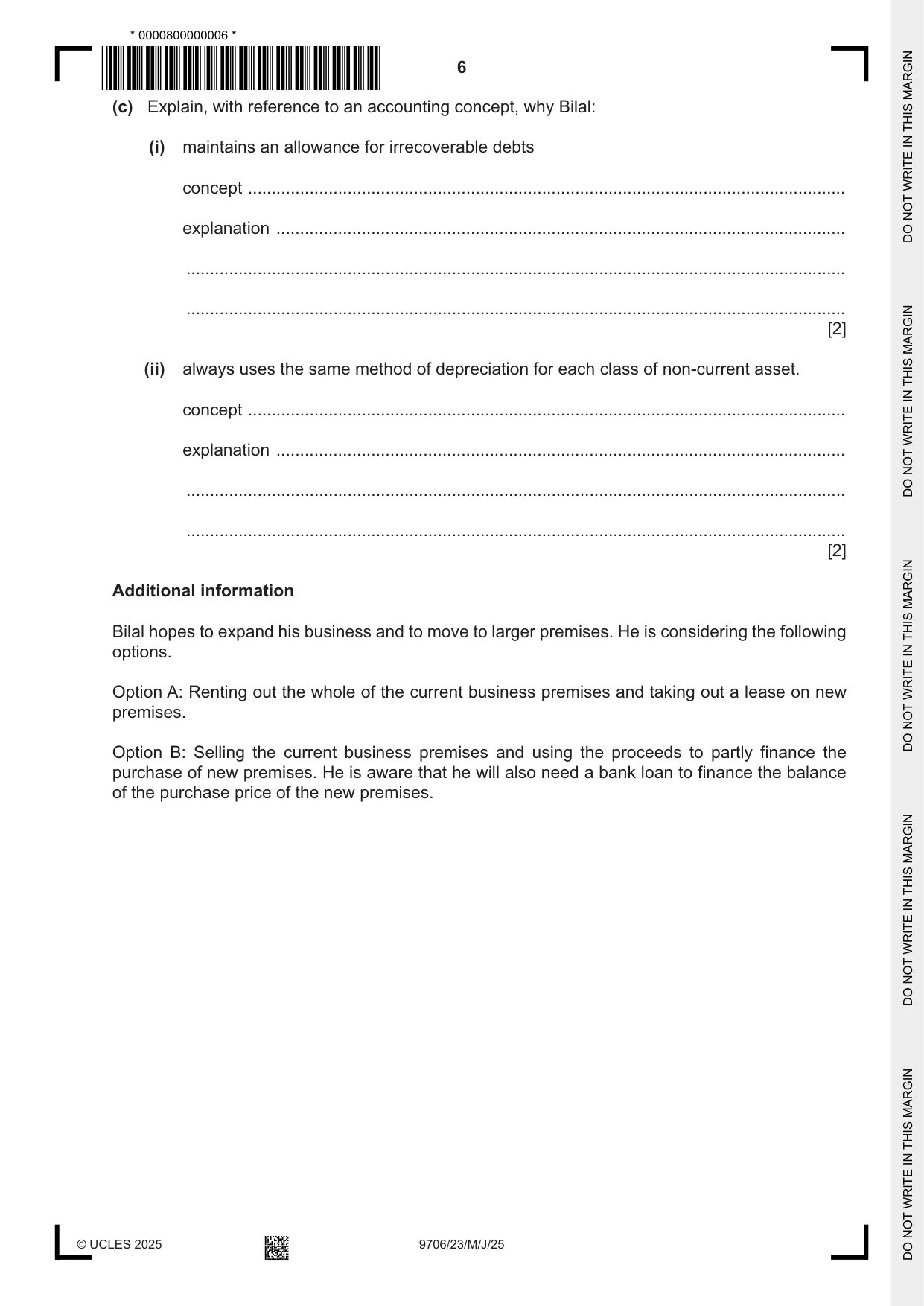
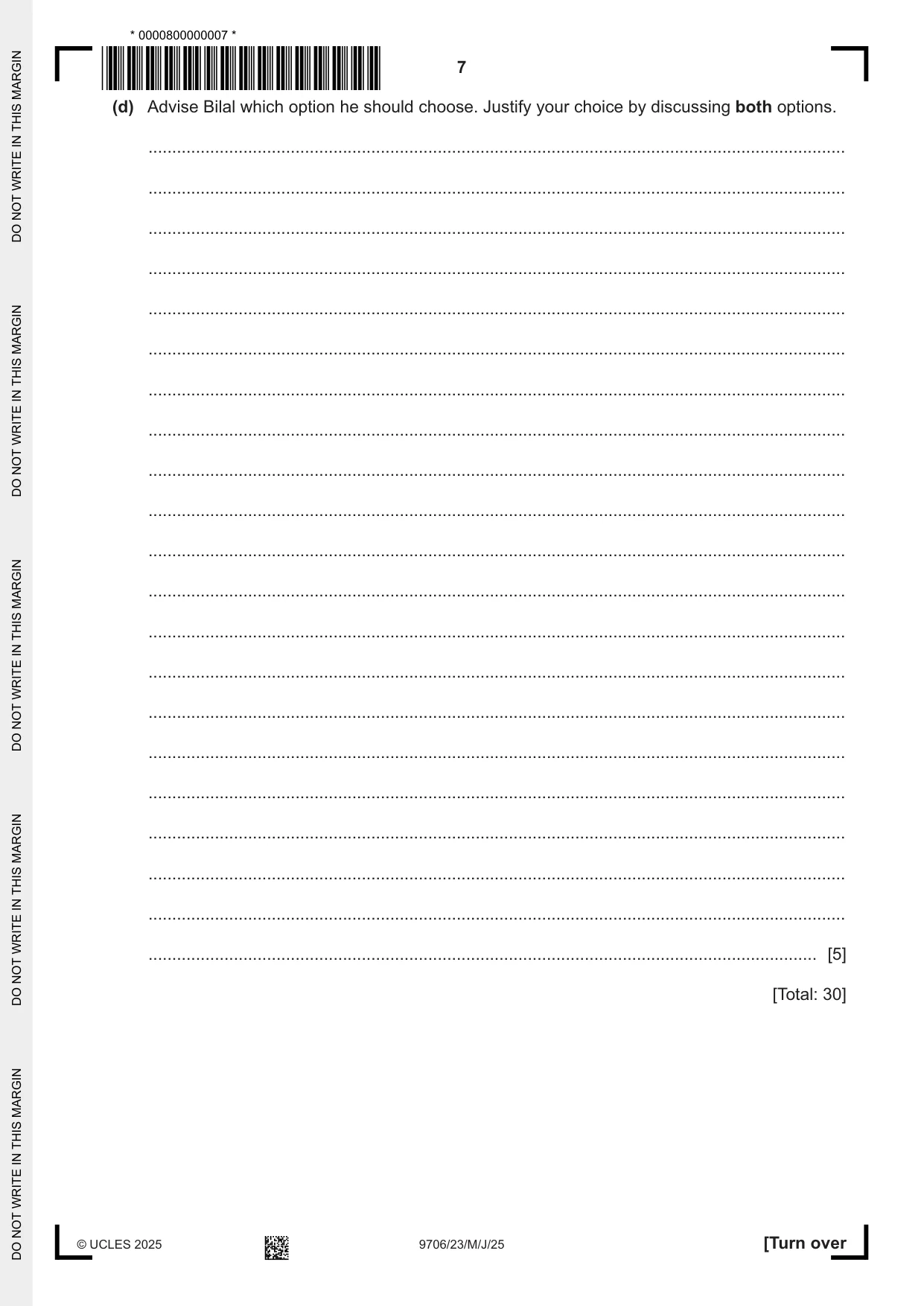
1 Bilal provided the following information for his service business for the year ended 31 December 2024. 1 Receipts and payments for the year ended 31 December 2024 included: $ Receipts Cash fees 78 440 Fees from credit clients 34 290 Rent received 4 950 Payments Advertising campaign 4 500 Electricity charges 3 610 General expenses 880 Motor vehicle running costs 1 320 Wages and salaries 31 600 2 On 1 January 2024, trade receivables were $15 800, and on 31 December 2024, trade receivables were $11 600. 3 On 1 January 2024, the allowance for irrecoverable debts was $632. On 31 December 2024, Bilal decided to increase the allowance for irrecoverable debts by 1%. 4 On 1 January 2024, electricity charges of $270 were outstanding. On 31 December 2024, electricity charges of $490 were prepaid. 5 On 1 May 2024, part of the business premises was rented out at $1650 for every three months receivable in advance. 6 On 1 November 2024, the advertising campaign commenced. It will end on 31 January 2026. 7 During the year ended 31 December 2024, a motor vehicle, cost $21 000, was sold for $9100. It had been depreciated for three years at 20% per annum using the reducing balance method. No depreciation is provided in the year of sale. 8 Non-current assets at 31 December 2024 were: Date of Cost Depreciation method purchase $ Business premises 1 January 2021 120 000 2% per annum straight-line Motor vehicle 1 January 2024 26 000 20% per annum reducing balance Furniture and 1 January 2021 22 000 10% per annum straight-line equipment (a) Prepare the statement of profit or loss for the year ended 31 December 2024. Use the space provided on page 4 to show your workings. Bilal Statement of profit or loss for the year ended 31 December 2024 ................................................................................................................................................... ................................................................................................................................................... ................................................................................................................................................... ................................................................................................................................................... ................................................................................................................................................... ................................................................................................................................................... ................................................................................................................................................... ................................................................................................................................................... ................................................................................................................................................... ................................................................................................................................................... ................................................................................................................................................... ................................................................................................................................................... ................................................................................................................................................... ................................................................................................................................................... ................................................................................................................................................... ................................................................................................................................................... ................................................................................................................................................... ................................................................................................................................................... ................................................................................................................................................... ................................................................................................................................................... ................................................................................................................................................... ................................................................................................................................................... ................................................................................................................................................... ................................................................................................................................................... ................................................................................................................................................... Workings: Revenue Allowance for irrecoverable debts Electricity charges Rent received Advertising campaign Profit or loss on disposal of motor vehicle Depreciation [14] Additional information At 31 December 2024, the cash at bank balance was $8950. (b) Prepare an extract from the statement of financial position at 31 December 2024, showing the assets section only. Statement of financial position (extract) at 31 December 2024 Assets ................................................................................................................................................... ................................................................................................................................................... ................................................................................................................................................... ................................................................................................................................................... ................................................................................................................................................... ................................................................................................................................................... ................................................................................................................................................... ................................................................................................................................................... ................................................................................................................................................... ................................................................................................................................................... ................................................................................................................................................... ................................................................................................................................................... ................................................................................................................................................... ................................................................................................................................................... ................................................................................................................................................... Workings: [7] (c) Explain, with reference to an accounting concept, why Bilal: (i) maintains an allowance for irrecoverable debts concept .............................................................................................................................. explanation ........................................................................................................................ ........................................................................................................................................... ........................................................................................................................................... [2] (ii) always uses the same method of depreciation for each class of non-current asset. concept .............................................................................................................................. explanation ........................................................................................................................ ........................................................................................................................................... ........................................................................................................................................... [2] Additional information Bilal hopes to expand his business and to move to larger premises. He is considering the following options. Option A: Renting out the whole of the current business premises and taking out a lease on new premises. Option B: Selling the current business premises and using the proceeds to partly finance the purchase of new premises. He is aware that he will also need a bank loan to finance the balance of the purchase price of the new premises. (d) Advise Bilal which option he should choose. Justify your choice by discussing both options. ................................................................................................................................................... ................................................................................................................................................... ................................................................................................................................................... ................................................................................................................................................... ................................................................................................................................................... ................................................................................................................................................... ................................................................................................................................................... ................................................................................................................................................... ................................................................................................................................................... ................................................................................................................................................... ................................................................................................................................................... ................................................................................................................................................... ................................................................................................................................................... ................................................................................................................................................... ................................................................................................................................................... ................................................................................................................................................... ................................................................................................................................................... ................................................................................................................................................... ................................................................................................................................................... ................................................................................................................................................... ............................................................................................................................................. [5] [Total: 30]
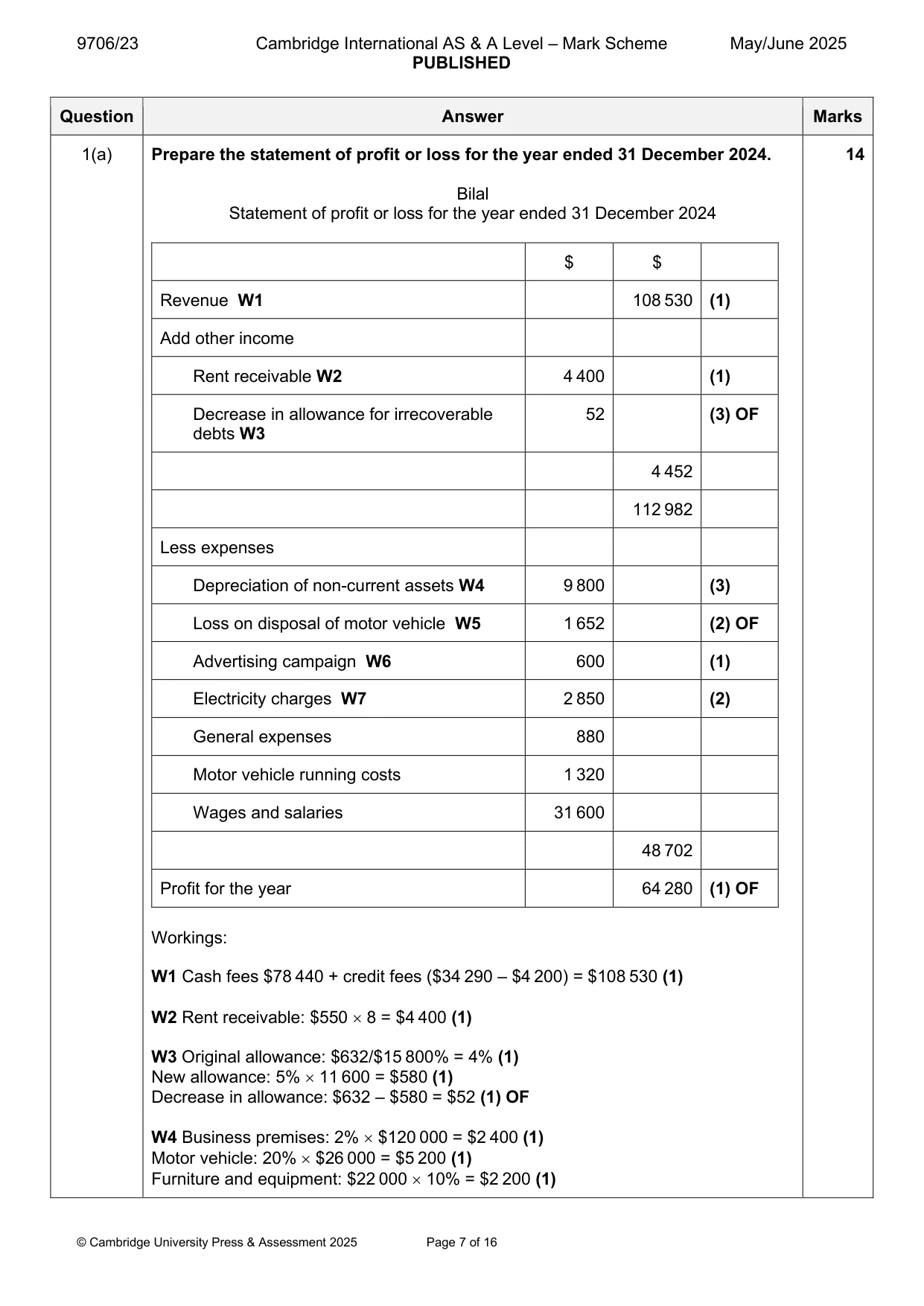
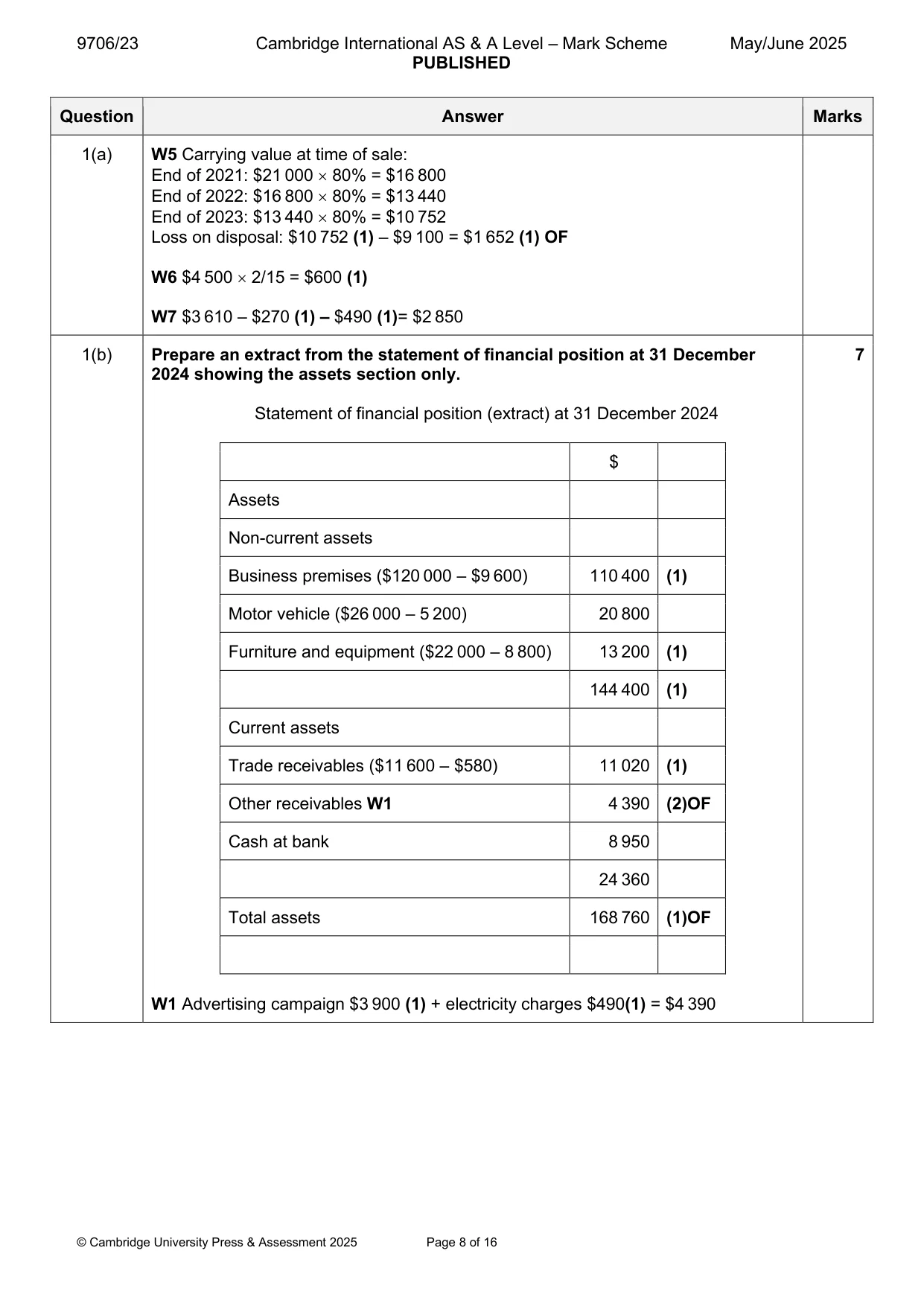
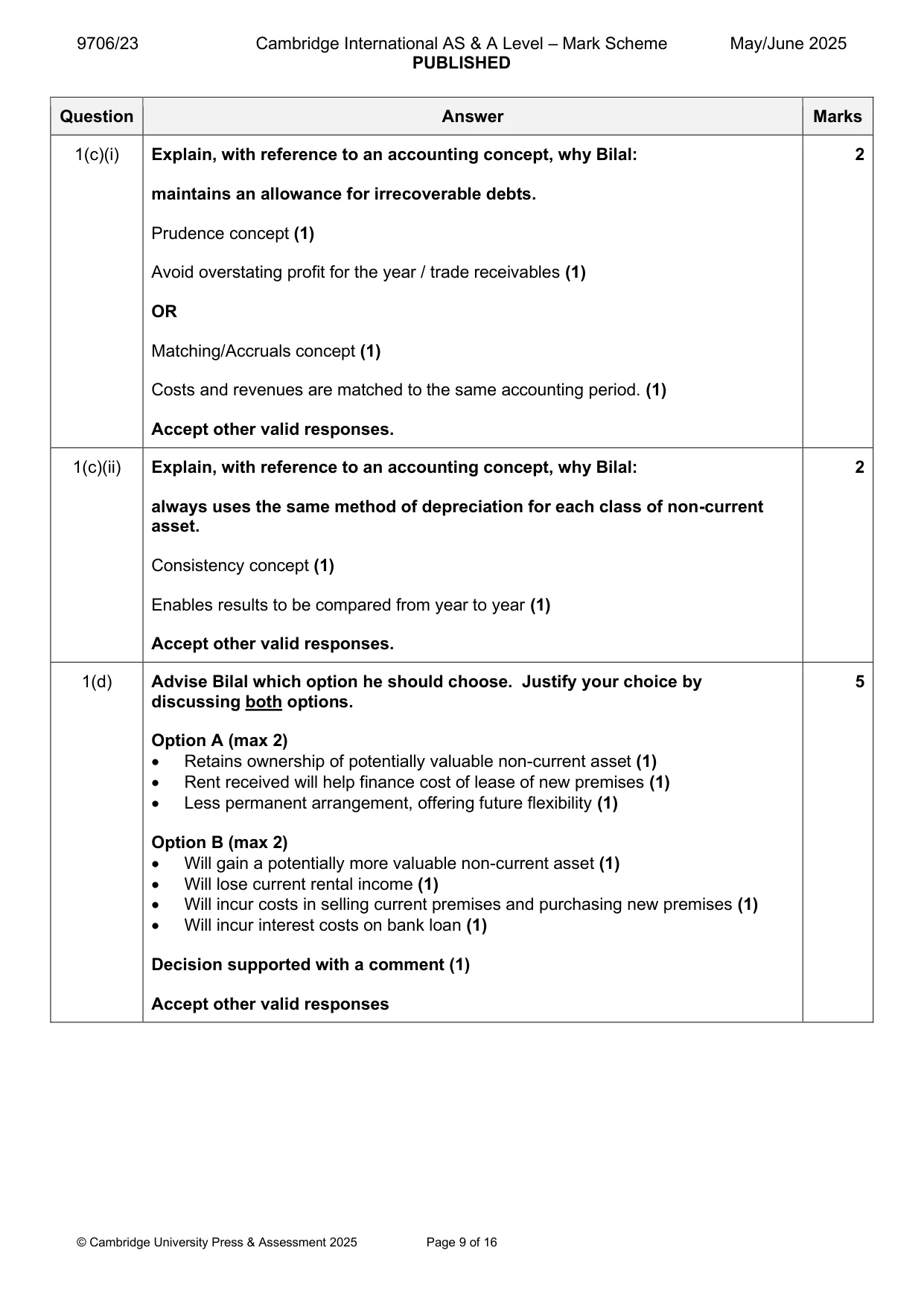
Mark scheme: Question Answer Marks 1(a) Prepare the statement of profit or loss for the year ended 31 December 2024. 14 Bilal Statement of profit or loss for the year ended 31 December 2024 $ $ Revenue W1 108 530 (1) Add other income Rent receivable W2 4 400 (1) Decrease in allowance for irrecoverable 52 (3) OF debts W3 4 452 112 982 Less expenses Depreciation of non-current assets W4 9 800 (3) Loss on disposal of motor vehicle W5 1 652 (2) OF Advertising campaign W6 600 (1) Electricity charges W7 2 850 (2) General expenses 880 Motor vehicle running costs 1 320 Wages and salaries 31 600 48 702 Profit for the year 64 280 (1) OF Workings: W1 Cash fees $78 440 + credit fees ($34 290 – $4 200) = $108 530 (1) W2 Rent receivable: $550 8 = $4 400 (1) W3 Original allowance: $632/$15 800% = 4% (1) New allowance: 5% 11 600 = $580 (1) Decrease in allowance: $632 – $580 = $52 (1) OF W4 Business premises: 2% $120 000 = $2 400 (1) Motor vehicle: 20% $26 000 = $5 200 (1) Furniture and equipment: $22 000 10% = $2 200 (1) 1(a) W5 Carrying value at time of sale: End of 2021: $21 000 80% = $16 800 End of 2022: $16 800 80% = $13 440 End of 2023: $13 440 80% = $10 752 Loss on disposal: $10 752 (1) – $9 100 = $1 652 (1) OF W6 $4 500 2/15 = $600 (1) W7 $3 610 – $270 (1) – $490 (1)= $2 850 1(b) Prepare an extract from the statement of financial position at 31 December 7 2024 showing the assets section only. Statement of financial position (extract) at 31 December 2024 $ Assets Non-current assets Business premises ($120 000 – $9 600) 110 400 (1) Motor vehicle ($26 000 – 5 200) 20 800 Furniture and equipment ($22 000 – 8 800) 13 200 (1) 144 400 (1) Current assets Trade receivables ($11 600 – $580) 11 020 (1) Other receivables W1 4 390 (2)OF Cash at bank 8 950 24 360 Total assets 168 760 (1)OF W1 Advertising campaign $3 900 (1) + electricity charges $490(1) = $4 390 1(c)(i) Explain, with reference to an accounting concept, why Bilal: 2 maintains an allowance for irrecoverable debts. Prudence concept (1) Avoid overstating profit for the year / trade receivables (1) OR Matching/Accruals concept (1) Costs and revenues are matched to the same accounting period. (1) Accept other valid responses. 1(c)(ii) Explain, with reference to an accounting concept, why Bilal: 2 always uses the same method of depreciation for each class of non-current asset. Consistency concept (1) Enables results to be compared from year to year (1) Accept other valid responses. 1(d) Advise Bilal which option he should choose. Justify your choice by 5 discussing both options. Option A (max 2) • Retains ownership of potentially valuable non-current asset (1) • Rent received will help finance cost of lease of new premises (1) • Less permanent arrangement, offering future flexibility (1) Option B (max 2) • Will gain a potentially more valuable non-current asset (1) • Will lose current rental income (1) • Will incur costs in selling current premises and purchasing new premises (1) • Will incur interest costs on bank loan (1) Decision supported with a comment (1) Accept other valid responses
Q2 · Ben and George converted their partnership into a limited company, M Limited
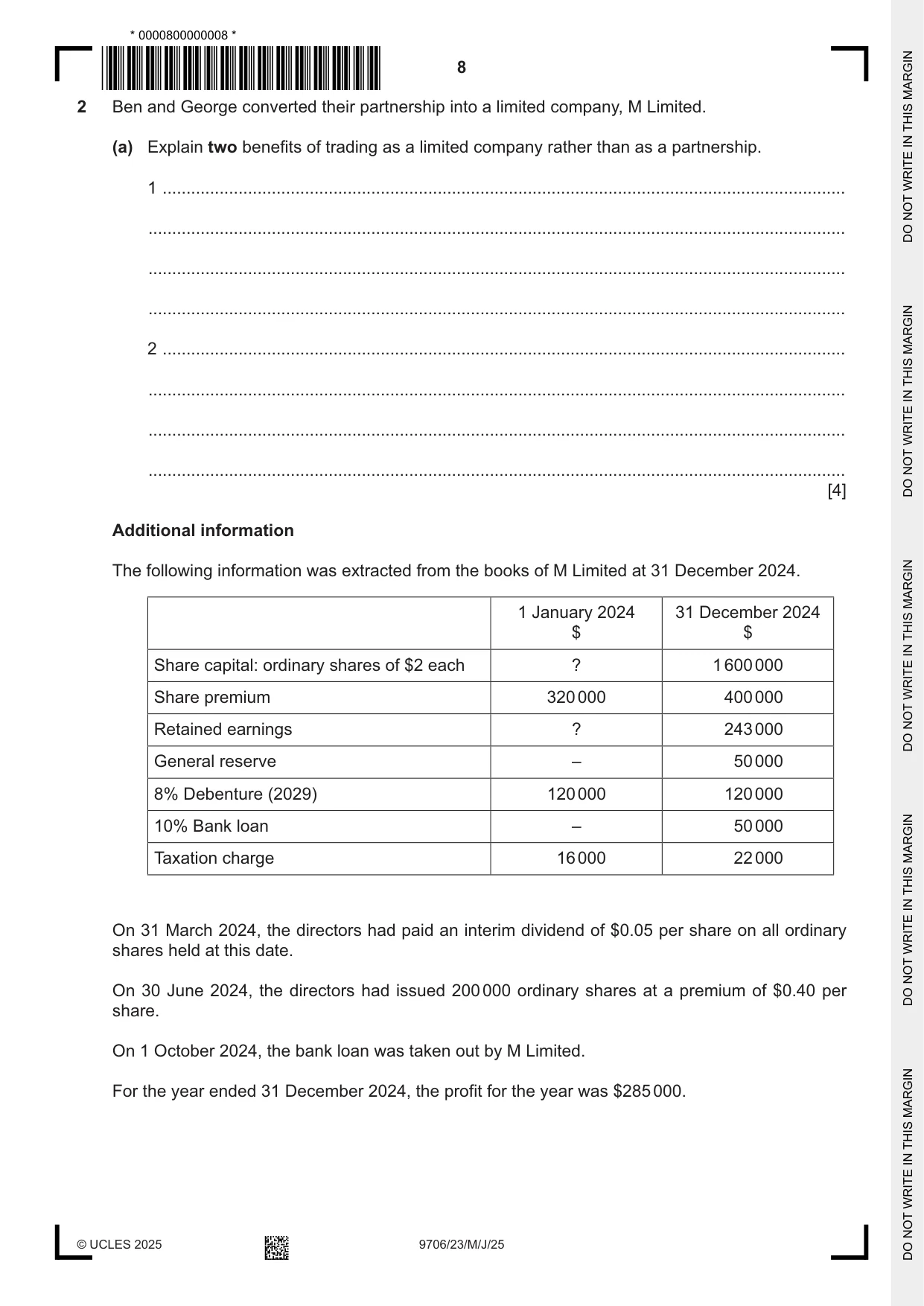
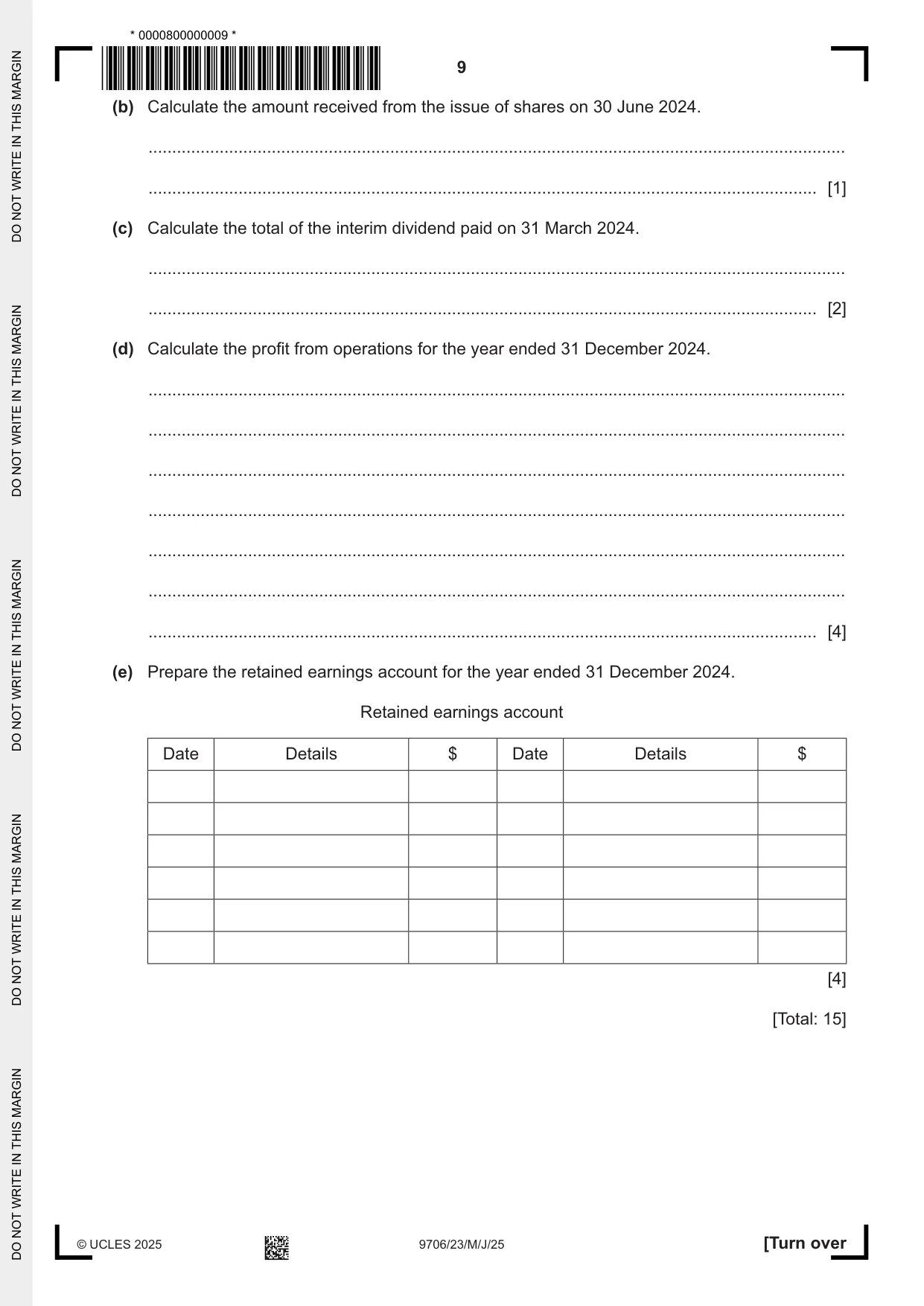
2 Ben and George converted their partnership into a limited company, M Limited. (a) Explain two benefits of trading as a limited company rather than as a partnership. 1 ................................................................................................................................................ ................................................................................................................................................... ................................................................................................................................................... ................................................................................................................................................... 2 ................................................................................................................................................ ................................................................................................................................................... ................................................................................................................................................... ................................................................................................................................................... [4] Additional information The following information was extracted from the books of M Limited at 31 December 2024. 1 January 2024 31 December 2024 $ $ Share capital: ordinary shares of $2 each ? 1 600 000 Share premium 320 000 400 000 Retained earnings ? 243 000 General reserve – 50 000 8% Debenture (2029) 120 000 120 000 10% Bank loan – 50 000 Taxation charge 16 000 22 000 On 31 March 2024, the directors had paid an interim dividend of $0.05 per share on all ordinary shares held at this date. On 30 June 2024, the directors had issued 200 000 ordinary shares at a premium of $0.40 per share. On 1 October 2024, the bank loan was taken out by M Limited. For the year ended 31 December 2024, the profit for the year was $285 000. (b) Calculate the amount received from the issue of shares on 30 June 2024. ................................................................................................................................................... ............................................................................................................................................. [1] (c) Calculate the total of the interim dividend paid on 31 March 2024. ................................................................................................................................................... ............................................................................................................................................. [2] (d) Calculate the profit from operations for the year ended 31 December 2024. ................................................................................................................................................... ................................................................................................................................................... ................................................................................................................................................... ................................................................................................................................................... ................................................................................................................................................... ................................................................................................................................................... ............................................................................................................................................. [4] (e) Prepare the retained earnings account for the year ended 31 December 2024. Retained earnings account Date Details $ Date Details $ [4] [Total: 15]
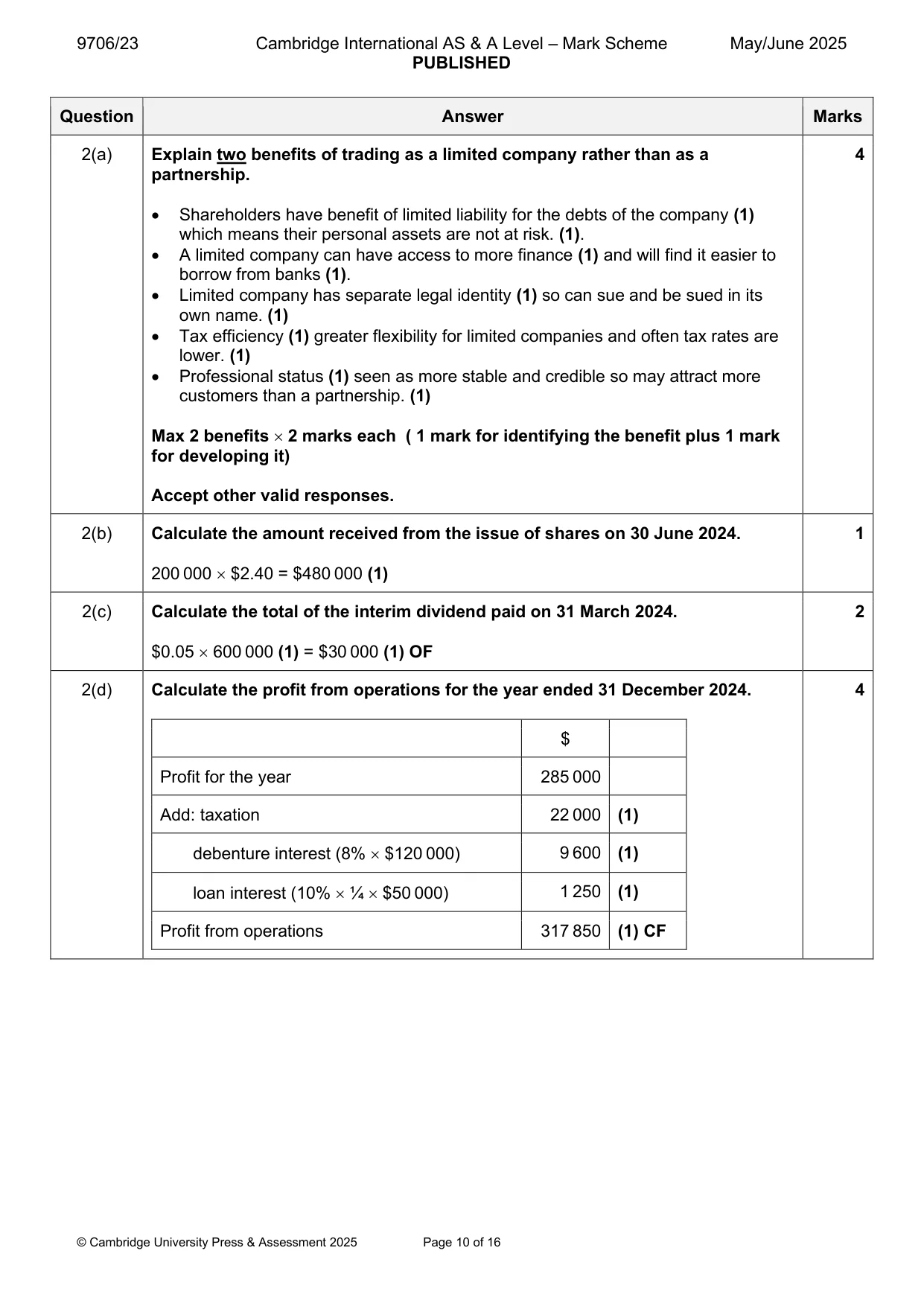
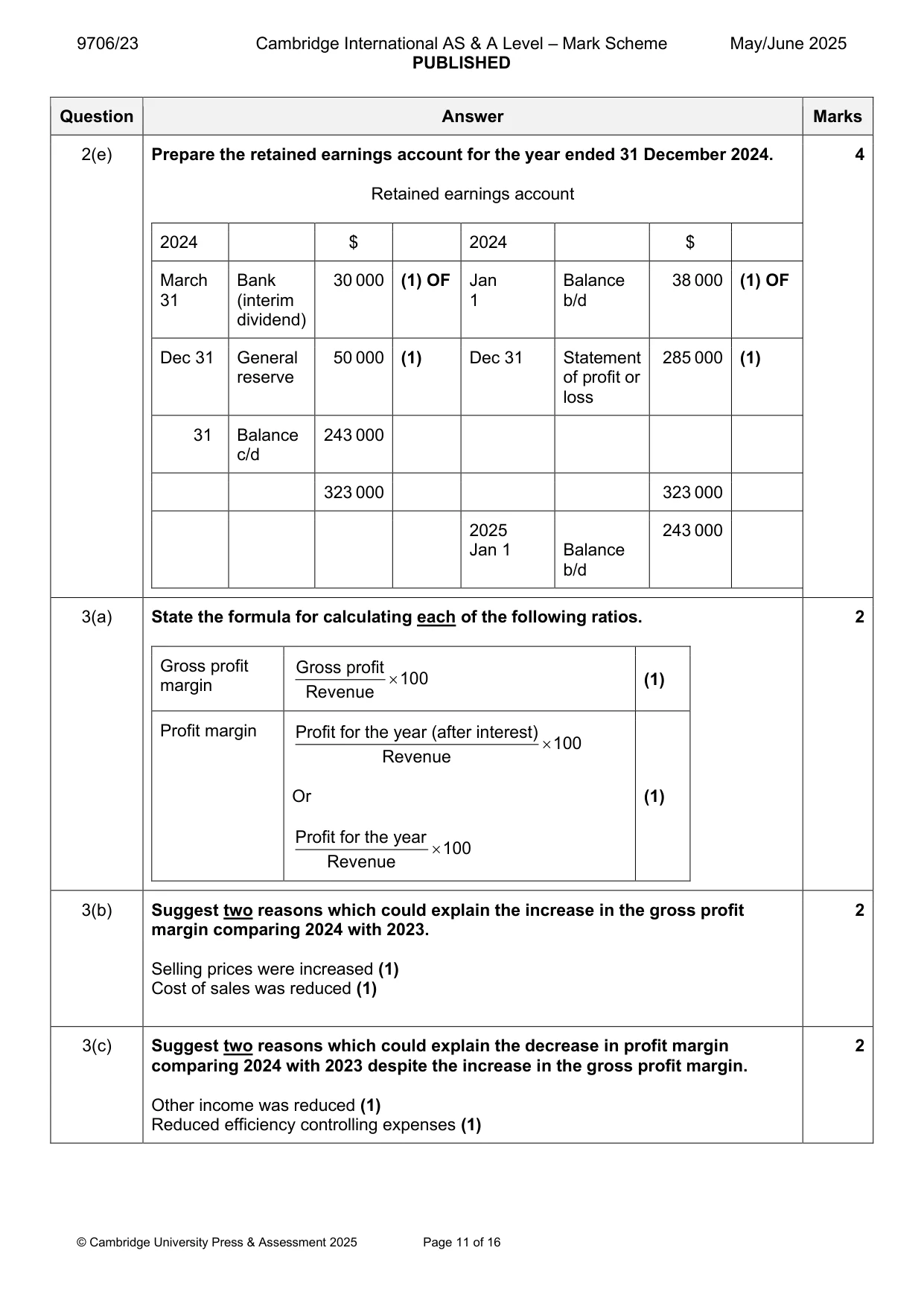
Mark scheme: 2(a) Explain two benefits of trading as a limited company rather than as a 4 partnership. • Shareholders have benefit of limited liability for the debts of the company (1) which means their personal assets are not at risk. (1). • A limited company can have access to more finance (1) and will find it easier to borrow from banks (1). • Limited company has separate legal identity (1) so can sue and be sued in its own name. (1) • Tax efficiency (1) greater flexibility for limited companies and often tax rates are lower. (1) • Professional status (1) seen as more stable and credible so may attract more customers than a partnership. (1) Max 2 benefits 2 marks each ( 1 mark for identifying the benefit plus 1 mark for developing it) Accept other valid responses. 2(b) Calculate the amount received from the issue of shares on 30 June 2024. 1 200 000 $2.40 = $480 000 (1) 2(c) Calculate the total of the interim dividend paid on 31 March 2024. 2 $0.05 600 000 (1) = $30 000 (1) OF 2(d) Calculate the profit from operations for the year ended 31 December 2024. 4 $ Profit for the year 285 000 Add: taxation 22 000 (1) debenture interest (8% $120 000) 9 600 (1) loan interest (10% ¼ $50 000) 1 250 (1) Profit from operations 317 850 (1) CF 2(e) Prepare the retained earnings account for the year ended 31 December 2024. 4 Retained earnings account 2024 $ 2024 $ March Bank 30 000 (1) OF Jan Balance 38 000 (1) OF 31 (interim 1 b/d dividend) Dec 31 General 50 000 (1) Dec 31 Statement 285 000 (1) reserve of profit or loss 31 Balance 243 000 c/d 323 000 323 000 2025 243 000 Jan 1 Balance b/d
Q3 · Khaled, the owner of a retail business, provided the following information
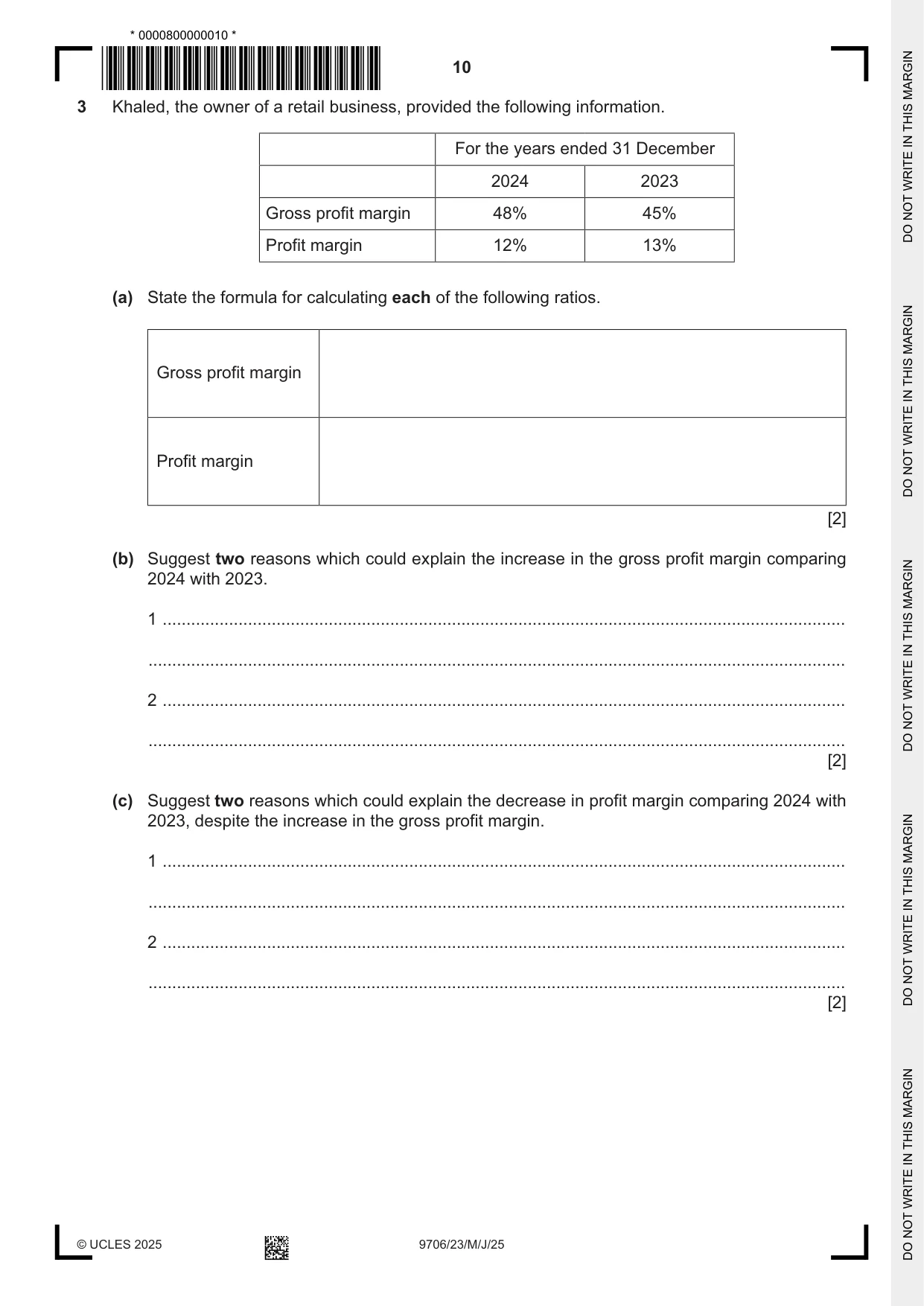
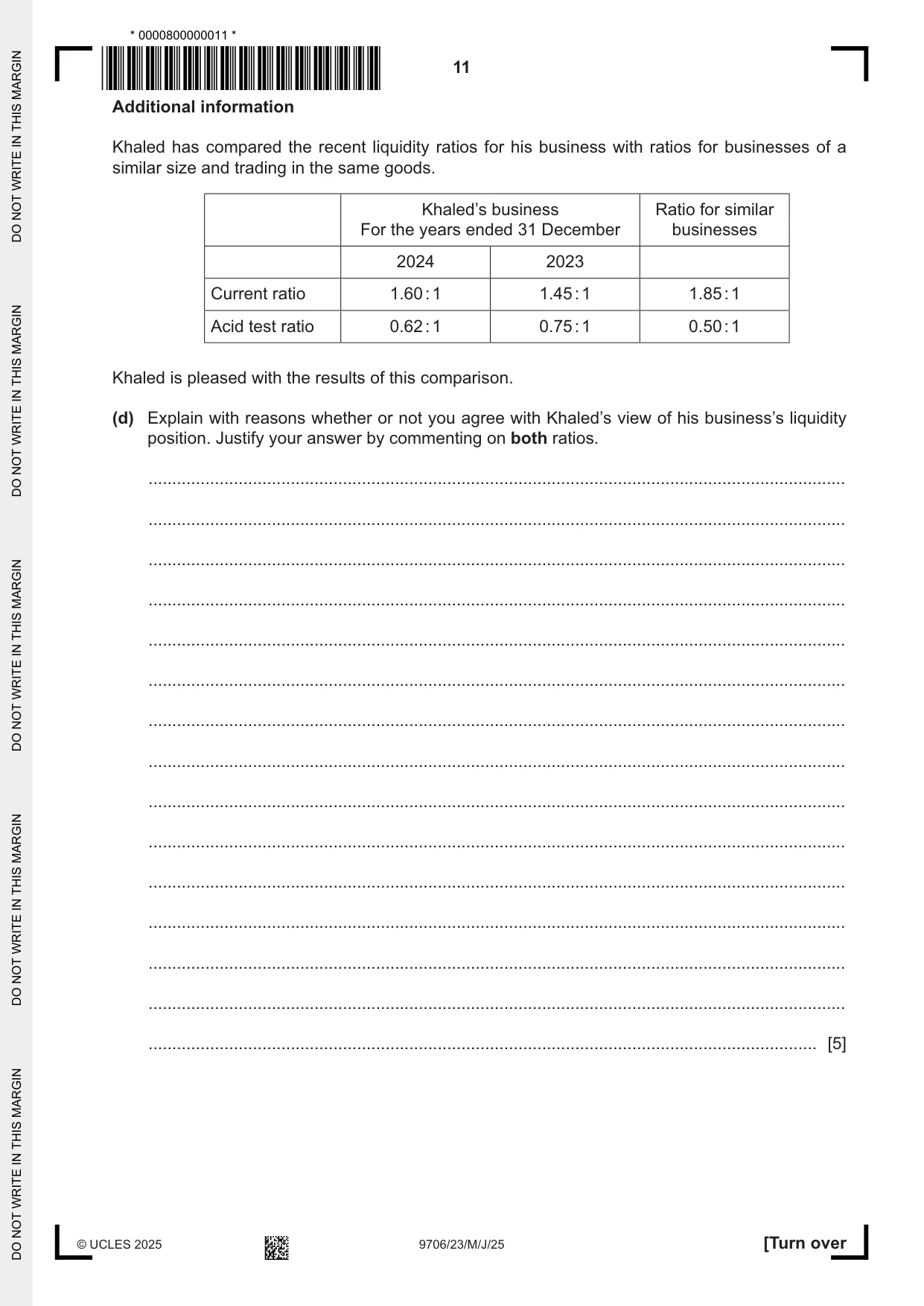
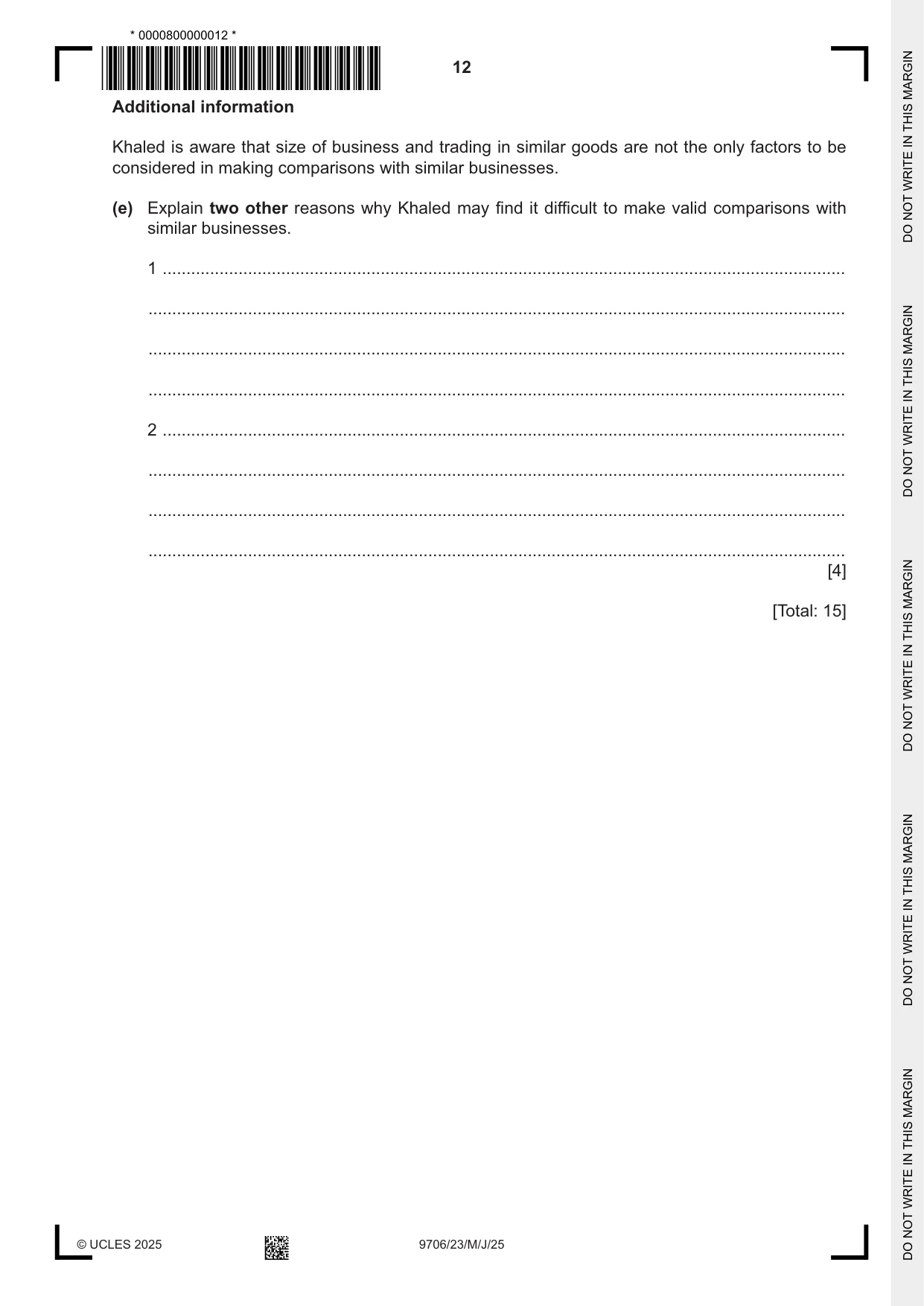
3 Khaled, the owner of a retail business, provided the following information. For the years ended 31 December 2024 2023 Gross profit margin 48% 45% Profit margin 12% 13% (a) State the formula for calculating each of the following ratios. Gross profit margin Profit margin [2] (b) Suggest two reasons which could explain the increase in the gross profit margin comparing 2024 with 2023. 1 ................................................................................................................................................ ................................................................................................................................................... 2 ................................................................................................................................................ ................................................................................................................................................... [2] (c) Suggest two reasons which could explain the decrease in profit margin comparing 2024 with 2023, despite the increase in the gross profit margin. 1 ................................................................................................................................................ ................................................................................................................................................... 2 ................................................................................................................................................ ................................................................................................................................................... [2] Additional information Khaled has compared the recent liquidity ratios for his business with ratios for businesses of a similar size and trading in the same goods. Khaled’s business Ratio for similar For the years ended 31 December businesses 2024 2023 Current ratio 1.60 : 1 1.45 : 1 1.85 : 1 Acid test ratio 0.62 : 1 0.75 : 1 0.50 : 1 Khaled is pleased with the results of this comparison. (d) Explain with reasons whether or not you agree with Khaled’s view of his business’s liquidity position. Justify your answer by commenting on both ratios. ................................................................................................................................................... ................................................................................................................................................... ................................................................................................................................................... ................................................................................................................................................... ................................................................................................................................................... ................................................................................................................................................... ................................................................................................................................................... ................................................................................................................................................... ................................................................................................................................................... ................................................................................................................................................... ................................................................................................................................................... ................................................................................................................................................... ................................................................................................................................................... ................................................................................................................................................... ............................................................................................................................................. [5] Additional information Khaled is aware that size of business and trading in similar goods are not the only factors to be considered in making comparisons with similar businesses. (e) Explain two other reasons why Khaled may find it difficult to make valid comparisons with similar businesses. 1 ................................................................................................................................................ ................................................................................................................................................... ................................................................................................................................................... ................................................................................................................................................... 2 ................................................................................................................................................ ................................................................................................................................................... ................................................................................................................................................... ................................................................................................................................................... [4] [Total: 15]
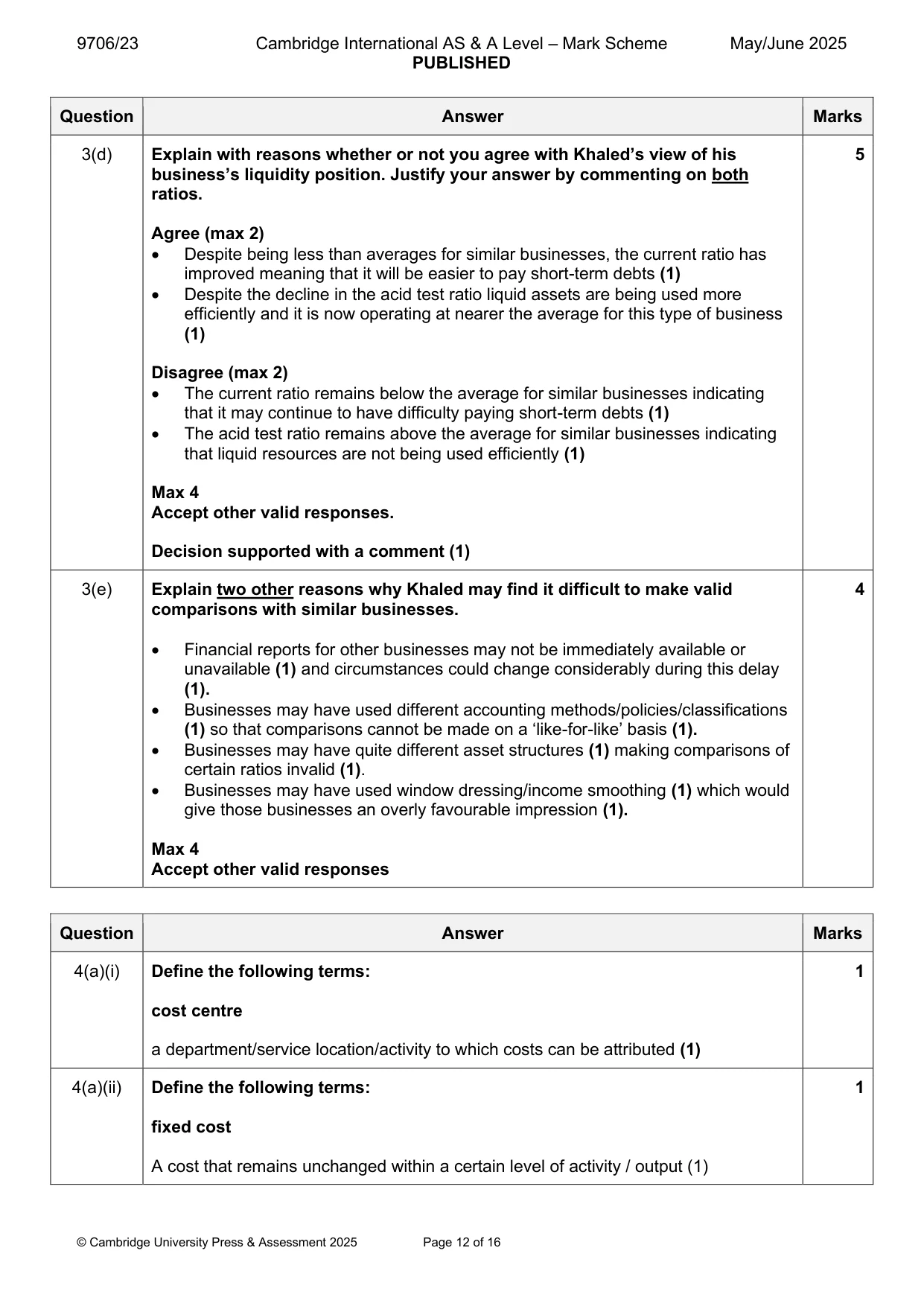
Mark scheme: 3(a) State the formula for calculating each of the following ratios. 2 Gross profit Gross profit 100 (1) margin Revenue Profit margin Profit for the year (after interest) 100 Revenue Or (1) Profit for the year 100 Revenue 3(b) Suggest two reasons which could explain the increase in the gross profit 2 margin comparing 2024 with 2023. Selling prices were increased (1) Cost of sales was reduced (1) 3(c) Suggest two reasons which could explain the decrease in profit margin 2 comparing 2024 with 2023 despite the increase in the gross profit margin. Other income was reduced (1) Reduced efficiency controlling expenses (1) 3(d) Explain with reasons whether or not you agree with Khaled’s view of his 5 business’s liquidity position. Justify your answer by commenting on both ratios. Agree (max 2) • Despite being less than averages for similar businesses, the current ratio has improved meaning that it will be easier to pay short-term debts (1) • Despite the decline in the acid test ratio liquid assets are being used more efficiently and it is now operating at nearer the average for this type of business (1) Disagree (max 2) • The current ratio remains below the average for similar businesses indicating that it may continue to have difficulty paying short-term debts (1) • The acid test ratio remains above the average for similar businesses indicating that liquid resources are not being used efficiently (1) Max 4 Accept other valid responses. Decision supported with a comment (1) 3(e) Explain two other reasons why Khaled may find it difficult to make valid 4 comparisons with similar businesses. • Financial reports for other businesses may not be immediately available or unavailable (1) and circumstances could change considerably during this delay (1). • Businesses may have used different accounting methods/policies/classifications (1) so that comparisons cannot be made on a ‘like-for-like’ basis (1). • Businesses may have quite different asset structures (1) making comparisons of certain ratios invalid (1). • Businesses may have used window dressing/income smoothing (1) which would give those businesses an overly favourable impression (1). Max 4 Accept other valid responses
More questions on Analysis and communication of accounting information
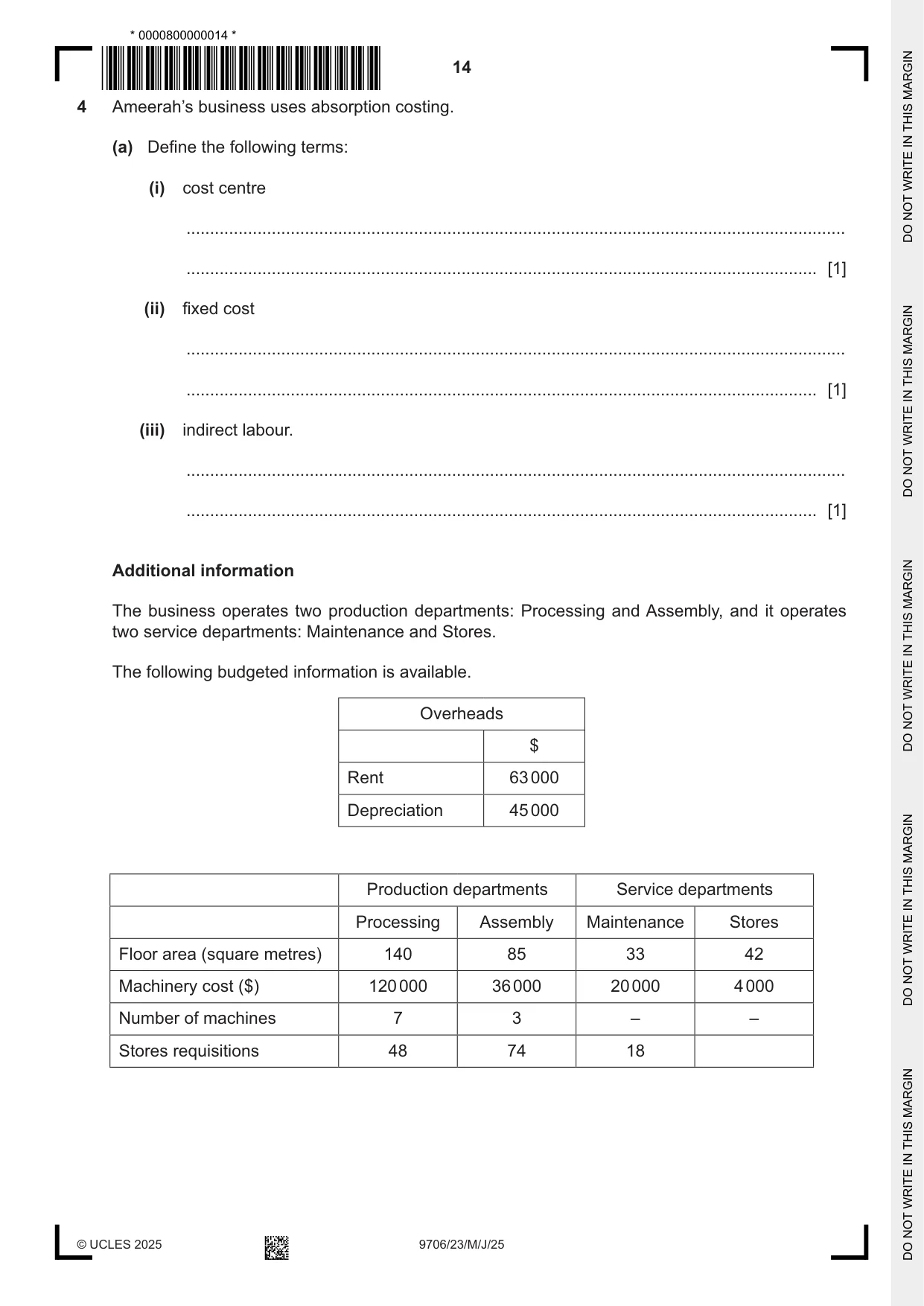
Q4 · Ameerah’s business uses absorption costing
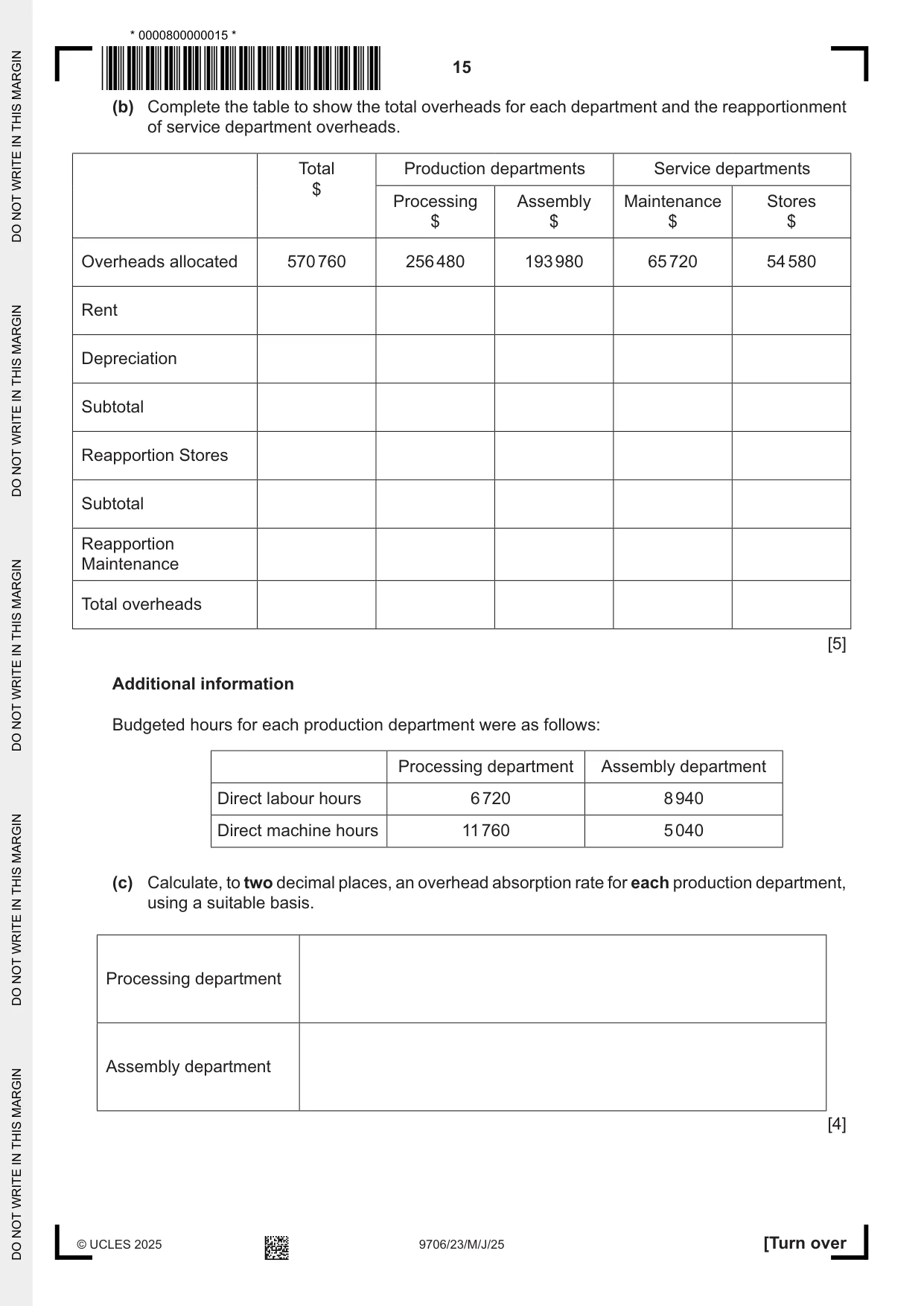
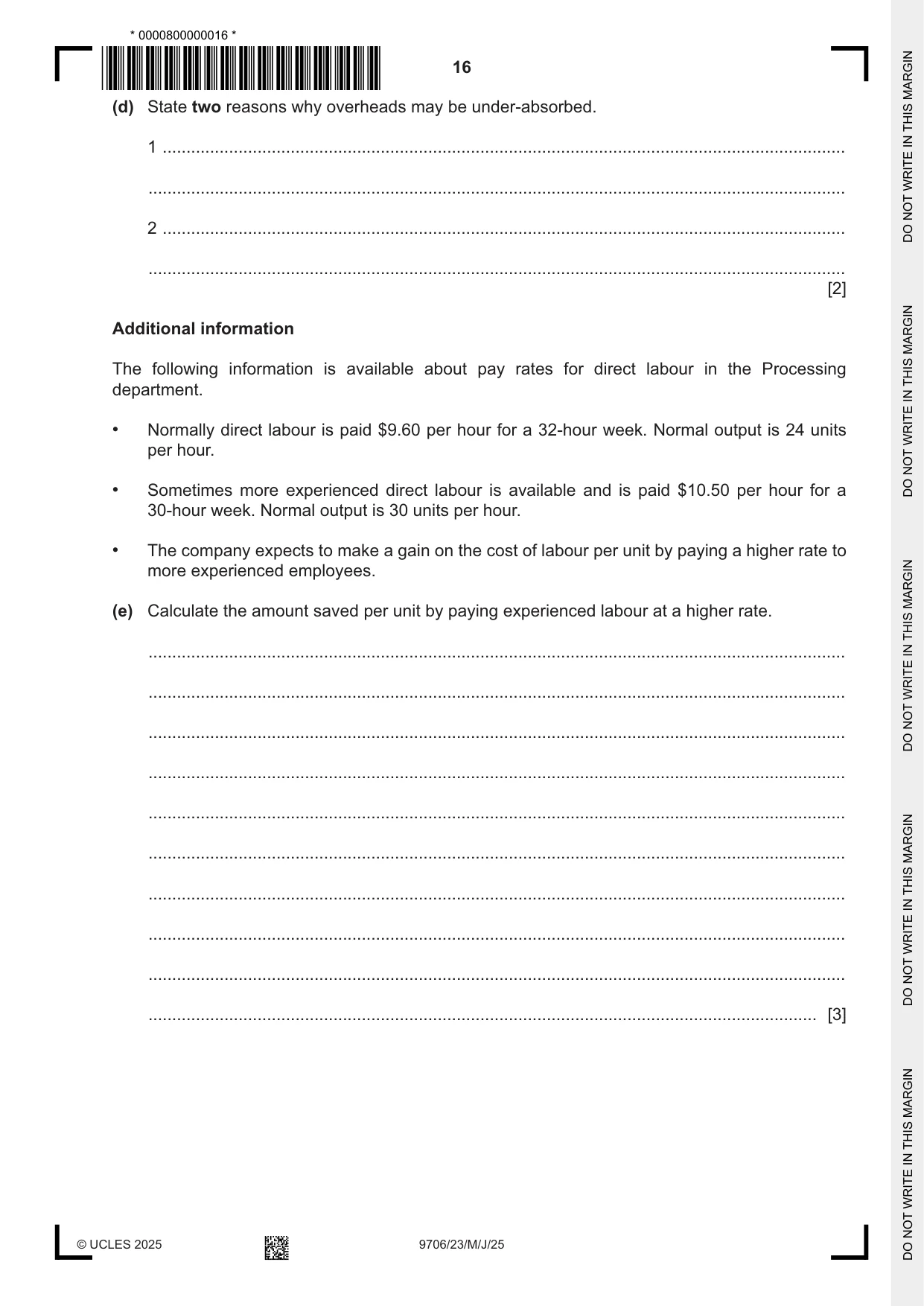
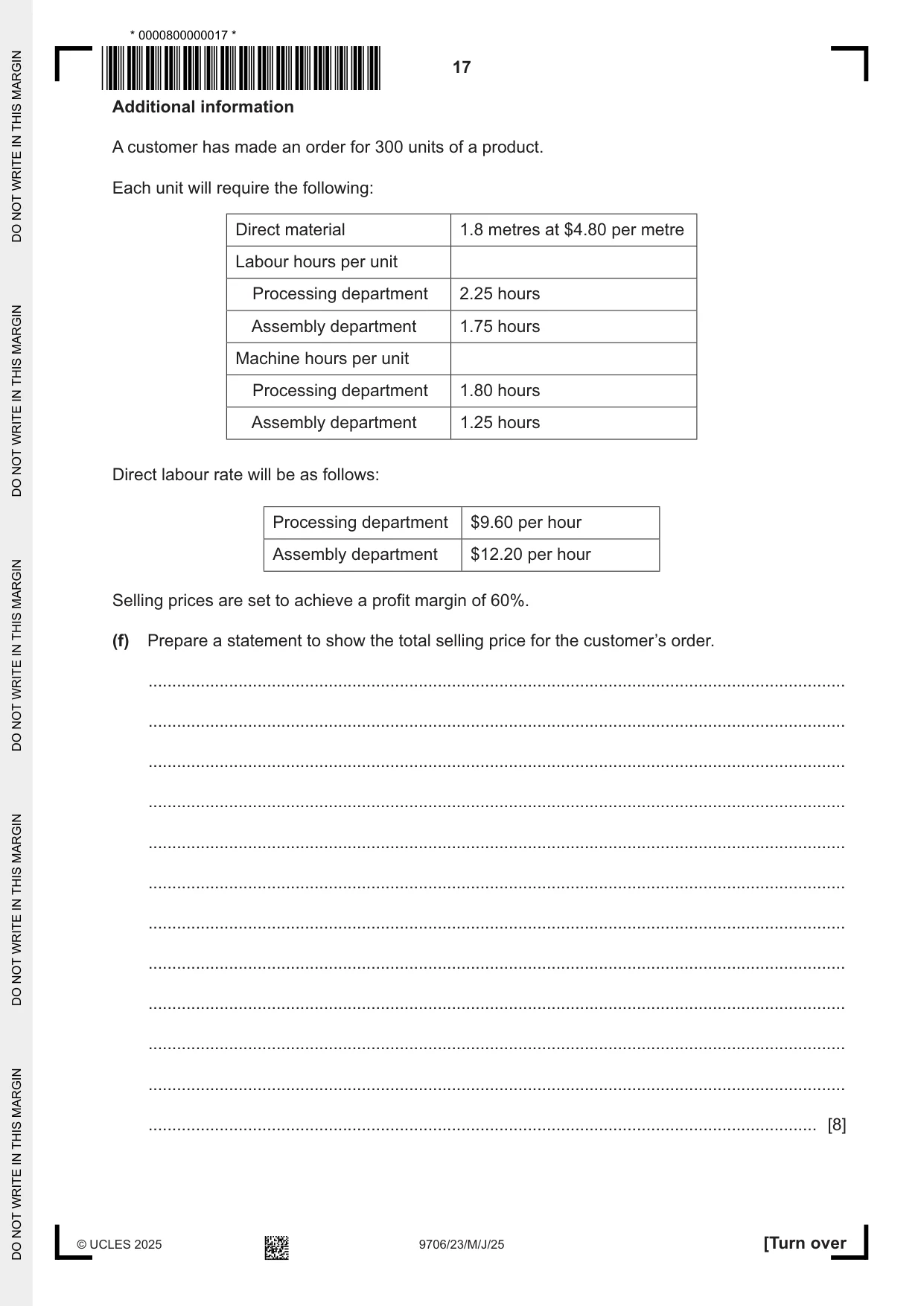
4 Ameerah’s business uses absorption costing. (a) Define the following terms: (i) cost centre ........................................................................................................................................... ..................................................................................................................................... [1] (ii) fixed cost ........................................................................................................................................... ..................................................................................................................................... [1] (iii) indirect labour. ........................................................................................................................................... ..................................................................................................................................... [1] Additional information The business operates two production departments: Processing and Assembly, and it operates two service departments: Maintenance and Stores. The following budgeted information is available. Overheads $ Rent 63 000 Depreciation 45 000 Production departments Service departments Processing Assembly Maintenance Stores Floor area (square metres) 140 85 33 42 Machinery cost ($) 120 000 36 000 20 000 4 000 Number of machines 7 3 – – Stores requisitions 48 74 18 (b) Complete the table to show the total overheads for each department and the reapportionment of service department overheads. Total Production departments Service departments $ Processing Assembly Maintenance Stores $ $ $ $ Overheads allocated 570 760 256 480 193 980 65 720 54 580 Rent Depreciation Subtotal Reapportion Stores Subtotal Reapportion Maintenance Total overheads [5] Additional information Budgeted hours for each production department were as follows: Processing department Assembly department Direct labour hours 6 720 8 940 Direct machine hours 11 760 5 040 (c) Calculate, to two decimal places, an overhead absorption rate for each production department, using a suitable basis. Processing department Assembly department [4] (d) State two reasons why overheads may be under-absorbed. 1 ................................................................................................................................................ ................................................................................................................................................... 2 ................................................................................................................................................ ................................................................................................................................................... [2] Additional information The following information is available about pay rates for direct labour in the Processing department. • Normally direct labour is paid $9.60 per hour for a 32-hour week. Normal output is 24 units per hour. • Sometimes more experienced direct labour is available and is paid $10.50 per hour for a 30-hour week. Normal output is 30 units per hour. • The company expects to make a gain on the cost of labour per unit by paying a higher rate to more experienced employees. (e) Calculate the amount saved per unit by paying experienced labour at a higher rate. ................................................................................................................................................... ................................................................................................................................................... ................................................................................................................................................... ................................................................................................................................................... ................................................................................................................................................... ................................................................................................................................................... ................................................................................................................................................... ................................................................................................................................................... ................................................................................................................................................... ............................................................................................................................................. [3]
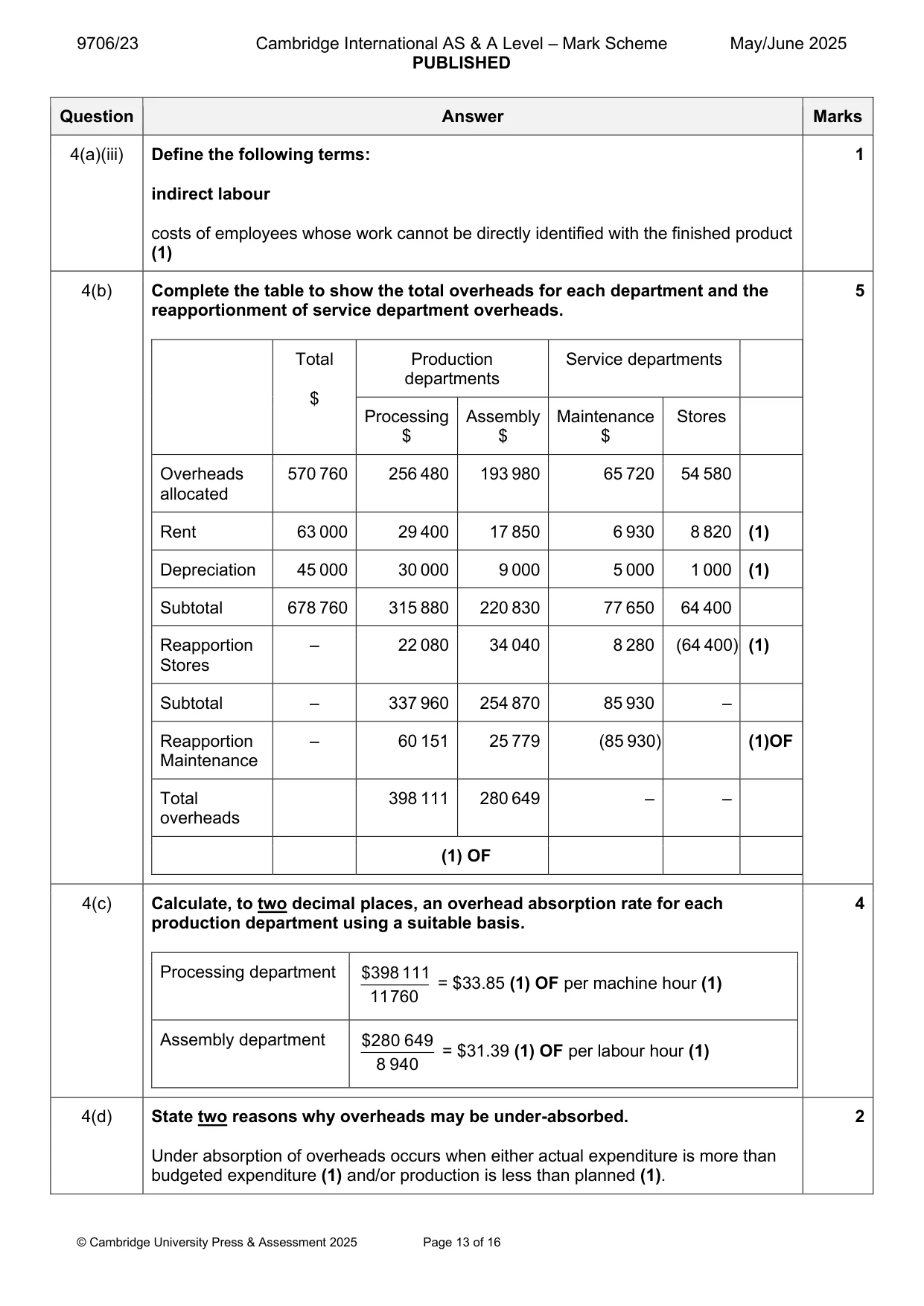
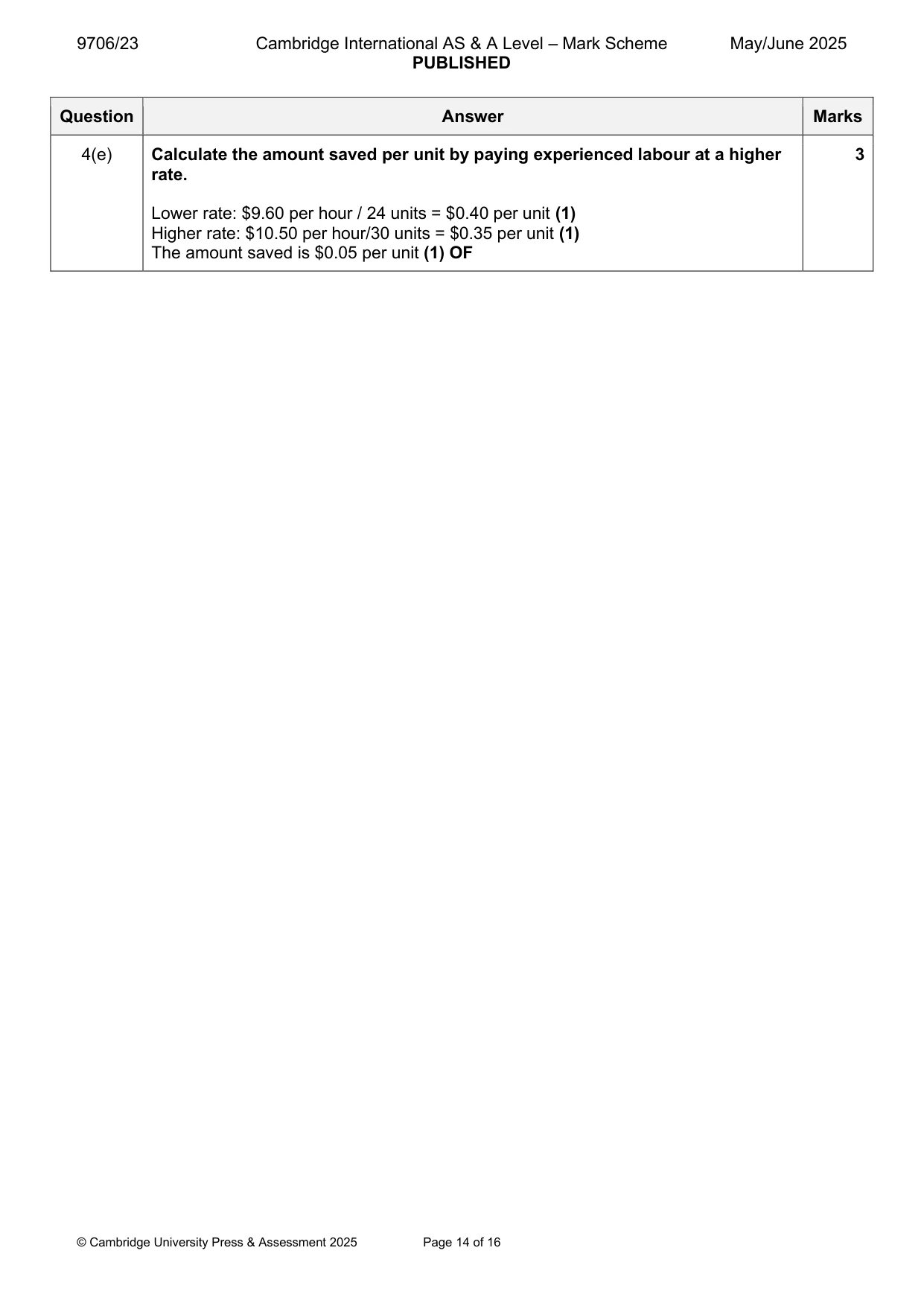
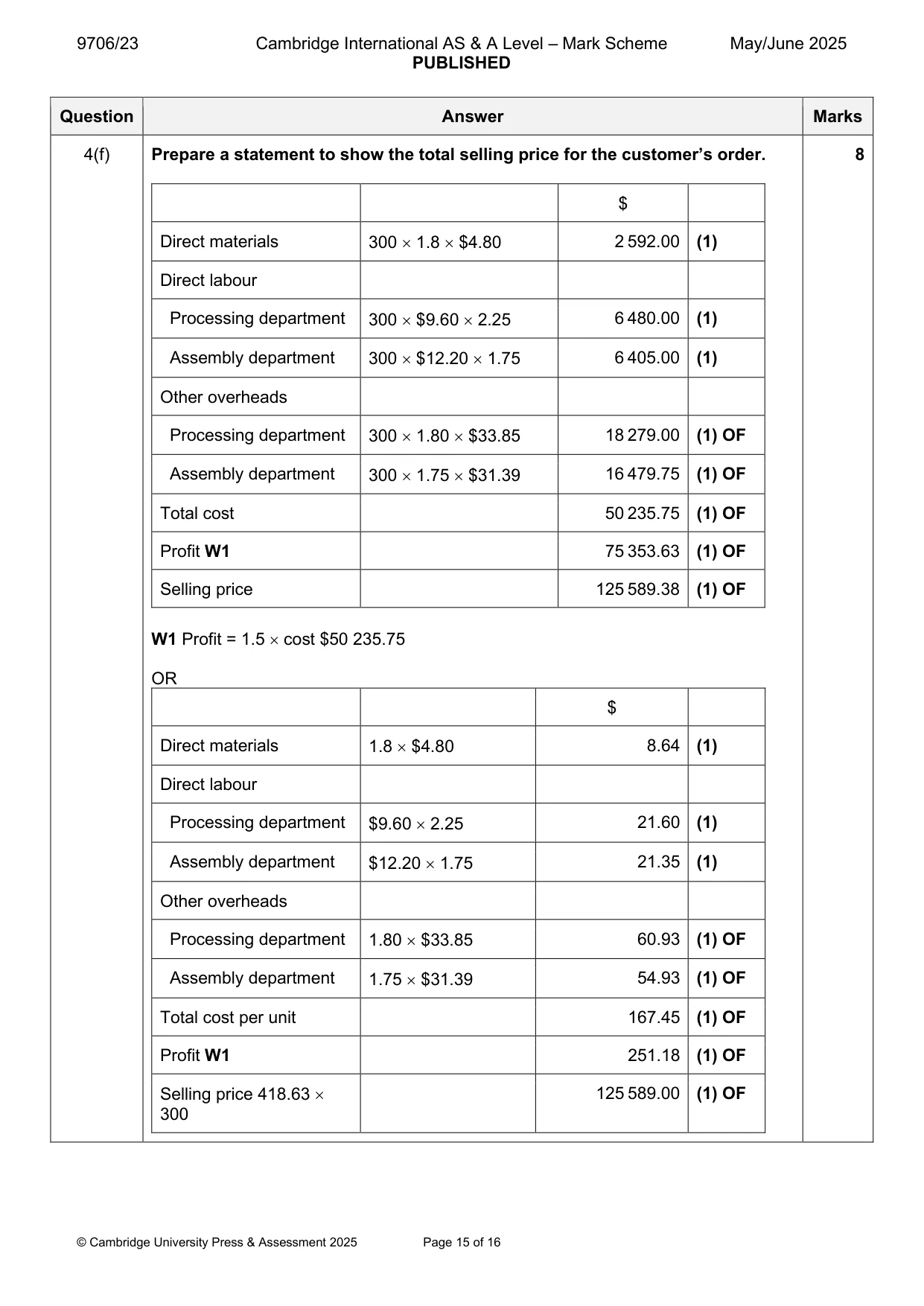
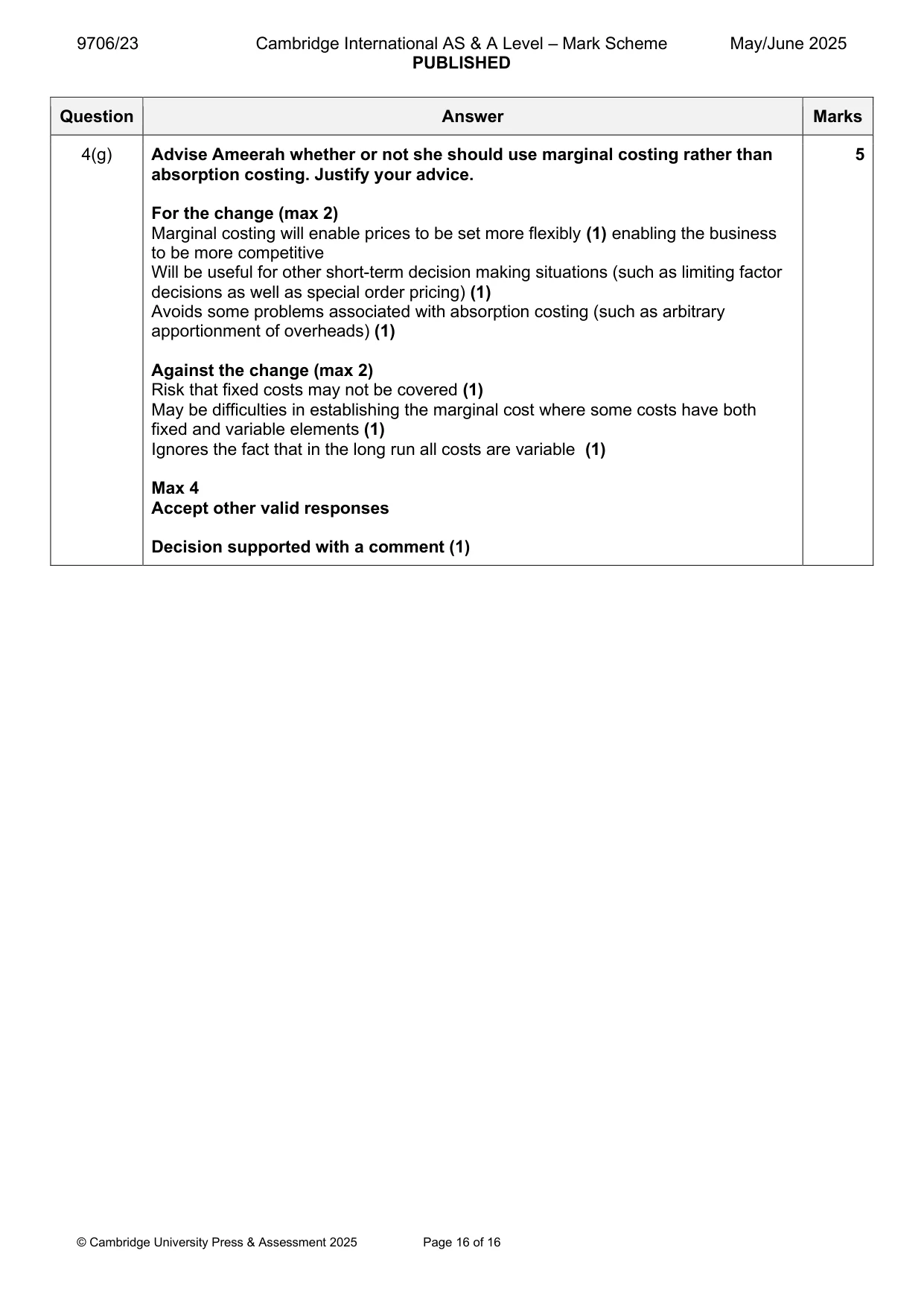
Mark scheme: 4(a)(i) Define the following terms: 1 cost centre a department/service location/activity to which costs can be attributed (1) 4(a)(ii) Define the following terms: 1 fixed cost A cost that remains unchanged within a certain level of activity / output (1) 4(a)(iii) Define the following terms: 1 indirect labour costs of employees whose work cannot be directly identified with the finished product (1) 4(b) Complete the table to show the total overheads for each department and the 5 reapportionment of service department overheads. Total Production Service departments departments $ Processing Assembly Maintenance Stores $ $ $ Overheads 570 760 256 480 193 980 65 720 54 580 allocated Rent 63 000 29 400 17 850 6 930 8 820 (1) Depreciation 45 000 30 000 9 000 5 000 1 000 (1) Subtotal 678 760 315 880 220 830 77 650 64 400 Reapportion – 22 080 34 040 8 280 (64 400) (1) Stores Subtotal – 337 960 254 870 85 930 – Reapportion – 60 151 25 779 (85 930) (1)OF Maintenance Total 398 111 280 649 – – overheads (1) OF 4(c) Calculate, to two decimal places, an overhead absorption rate for each 4 production department using a suitable basis. Processing department $398 111 = $33.85 (1) OF per machine hour (1) 11760 Assembly department $280 649 = $31.39 (1) OF per labour hour (1) 8 940 4(d) State two reasons why overheads may be under-absorbed. 2 Under absorption of overheads occurs when either actual expenditure is more than budgeted expenditure (1) and/or production is less than planned (1). 4(e) Calculate the amount saved per unit by paying experienced labour at a higher 3 rate. Lower rate: $9.60 per hour / 24 units = $0.40 per unit (1) Higher rate: $10.50 per hour/30 units = $0.35 per unit (1) The amount saved is $0.05 per unit (1) OF 4(f) Prepare a statement to show the total selling price for the customer’s order. 8 $ Direct materials 300 1.8 $4.80 2 592.00 (1) Direct labour Processing department 300 $9.60 2.25 6 480.00 (1) Assembly department 300 $12.20 1.75 6 405.00 (1) Other overheads Processing department 300 1.80 $33.85 18 279.00 (1) OF Assembly department 300 1.75 $31.39 16 479.75 (1) OF Total cost 50 235.75 (1) OF Profit W1 75 353.63 (1) OF Selling price 125 589.38 (1) OF W1 Profit = 1.5 cost $50 235.75 OR $ Direct materials 1.8 $4.80 8.64 (1) Direct labour Processing department $9.60 2.25 21.60 (1) Assembly department $12.20 1.75 21.35 (1) Other overheads Processing department 1.80 $33.85 60.93 (1) OF Assembly department 1.75 $31.39 54.93 (1) OF Total cost per unit 167.45 (1) OF Profit W1 251.18 (1) OF Selling price 418.63 125 589.00 (1) OF 300 4(g) Advise Ameerah whether or not she should use marginal costing rather than 5 absorption costing. Justify your advice. For the change (max 2) Marginal costing will enable prices to be set more flexibly (1) enabling the business to be more competitive Will be useful for other short-term decision making situations (such as limiting factor decisions as well as special order pricing) (1) Avoids some problems associated with absorption costing (such as arbitrary apportionment of overheads) (1) Against the change (max 2) Risk that fixed costs may not be covered (1) May be difficulties in establishing the marginal cost where some costs have both fixed and variable elements (1) Ignores the fact that in the long run all costs are variable (1) Max 4 Accept other valid responses Decision supported with a comment (1)
What was in this paper
The subtopics covered by these 4 questions, and how many questions each got. Open one in a new tab to see every Cambridge question on it.
What you needed in this session
Cambridge’s own grade thresholds for 2025 May/June, Paper 2 · Variant 3. A higher threshold means an easier paper — the bar moves with how the cohort did.