Cambridge A Level Accounting 9706 — 2024 Oct/Nov Paper 4 · Variant 3
9706/43/O/N/24 · 2 questions · 50 marks · ≈56 min
The question paper and its mark scheme, free to read here and free to download. This is Cambridge’s own paper, exactly as it was sat.
Question paper8 pages
Mark scheme13 pages
Answers below. Sit the paper first if you are practising.
Questions as text
Q1 · Read Source A in the insert
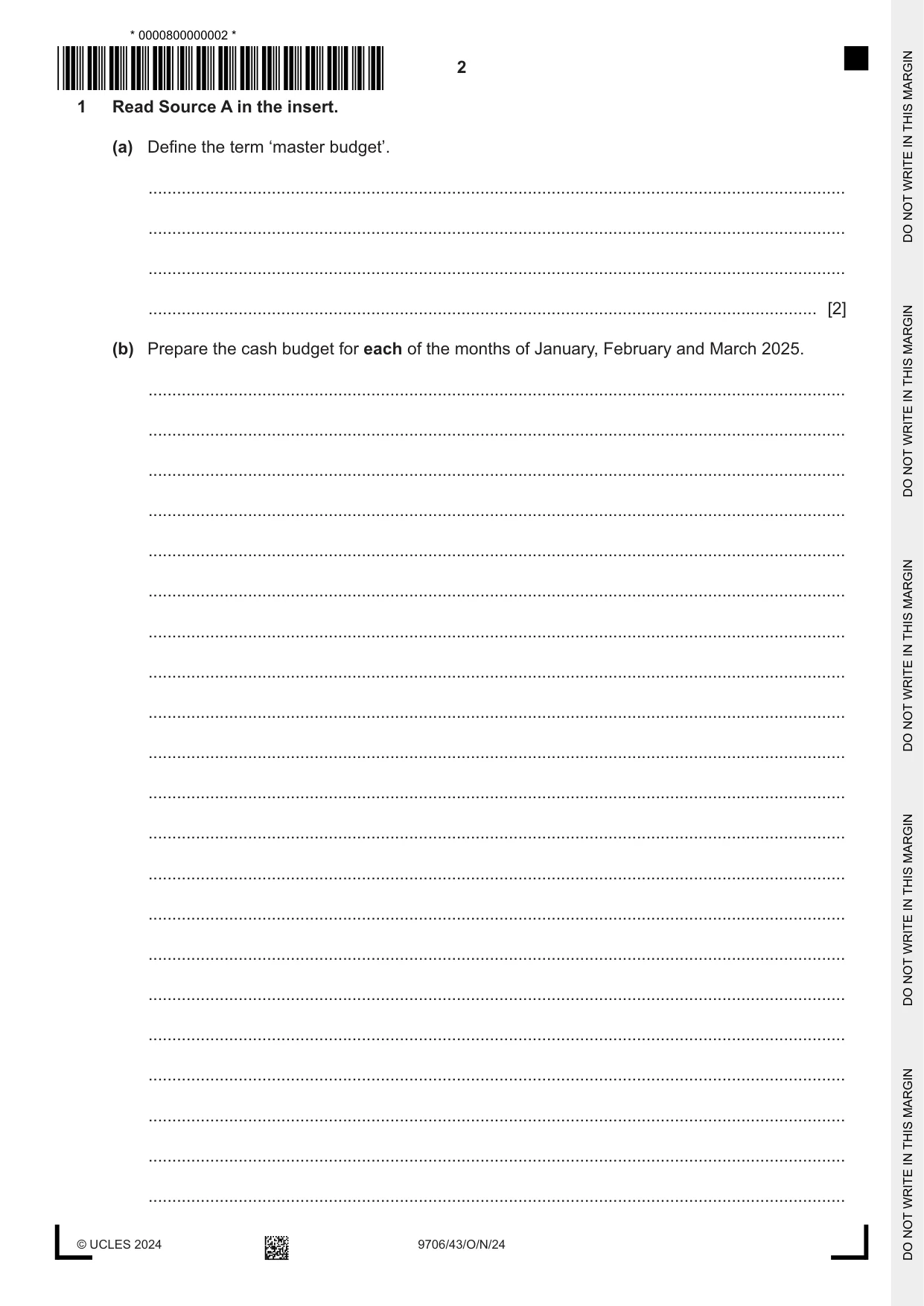
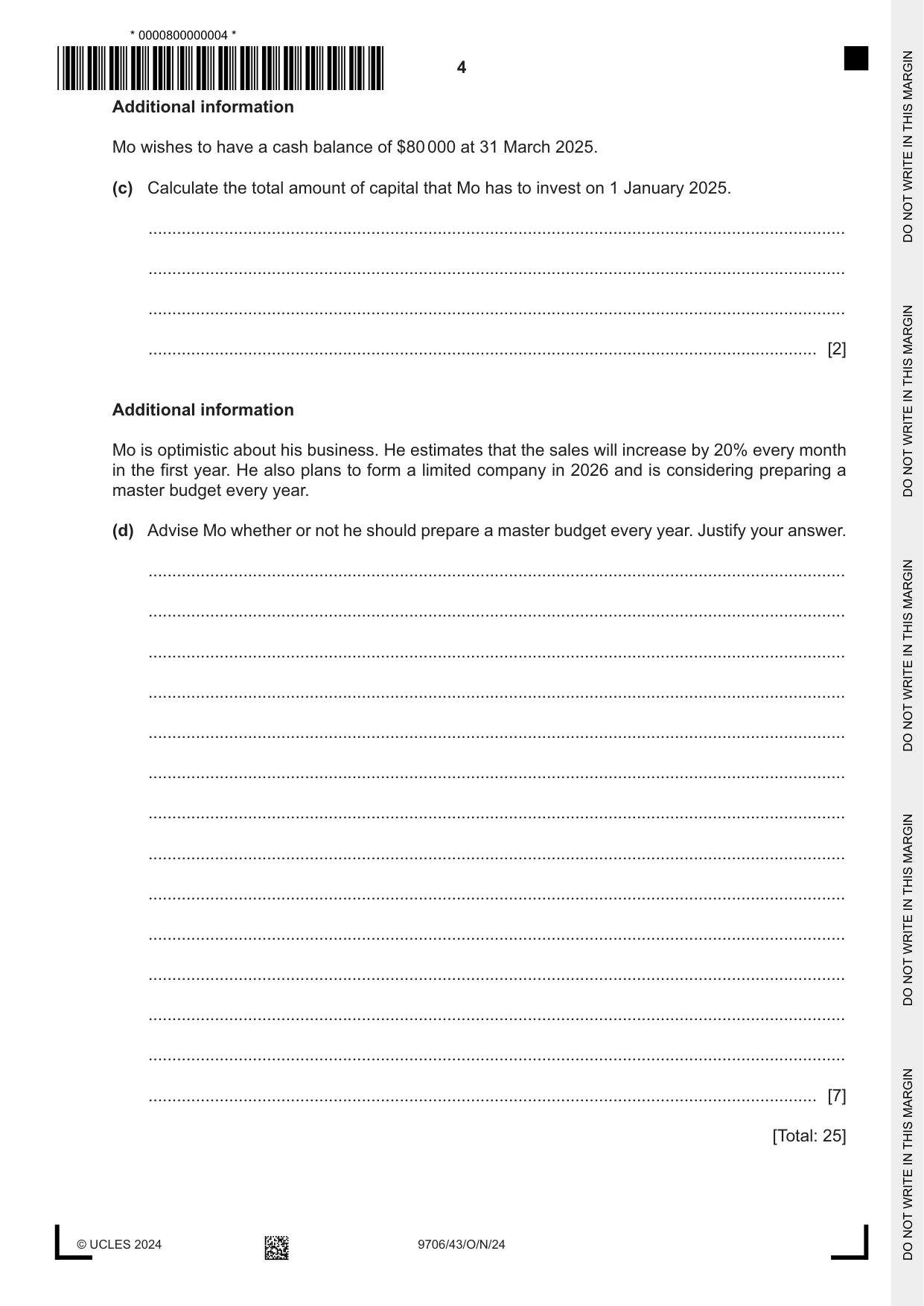
1 Read Source A in the insert. (a) Define the term ‘master budget’. ................................................................................................................................................... ................................................................................................................................................... ................................................................................................................................................... ............................................................................................................................................. [2] (b) Prepare the cash budget for each of the months of January, February and March 2025. ................................................................................................................................................... ................................................................................................................................................... ................................................................................................................................................... ................................................................................................................................................... ................................................................................................................................................... ................................................................................................................................................... ................................................................................................................................................... ................................................................................................................................................... ................................................................................................................................................... ................................................................................................................................................... ................................................................................................................................................... ................................................................................................................................................... ................................................................................................................................................... ................................................................................................................................................... ................................................................................................................................................... ................................................................................................................................................... ................................................................................................................................................... ................................................................................................................................................... ................................................................................................................................................... ................................................................................................................................................... ................................................................................................................................................... Workings: [14] Additional information Mo wishes to have a cash balance of $80 000 at 31 March 2025. (c) Calculate the total amount of capital that Mo has to invest on 1 January 2025. ................................................................................................................................................... ................................................................................................................................................... ................................................................................................................................................... ............................................................................................................................................. [2] Additional information Mo is optimistic about his business. He estimates that the sales will increase by 20% every month in the first year. He also plans to form a limited company in 2026 and is considering preparing a master budget every year. (d) Advise Mo whether or not he should prepare a master budget every year. Justify your answer. ................................................................................................................................................... ................................................................................................................................................... ................................................................................................................................................... ................................................................................................................................................... ................................................................................................................................................... ................................................................................................................................................... ................................................................................................................................................... ................................................................................................................................................... ................................................................................................................................................... ................................................................................................................................................... ................................................................................................................................................... ................................................................................................................................................... ................................................................................................................................................... ............................................................................................................................................. [7] [Total: 25]
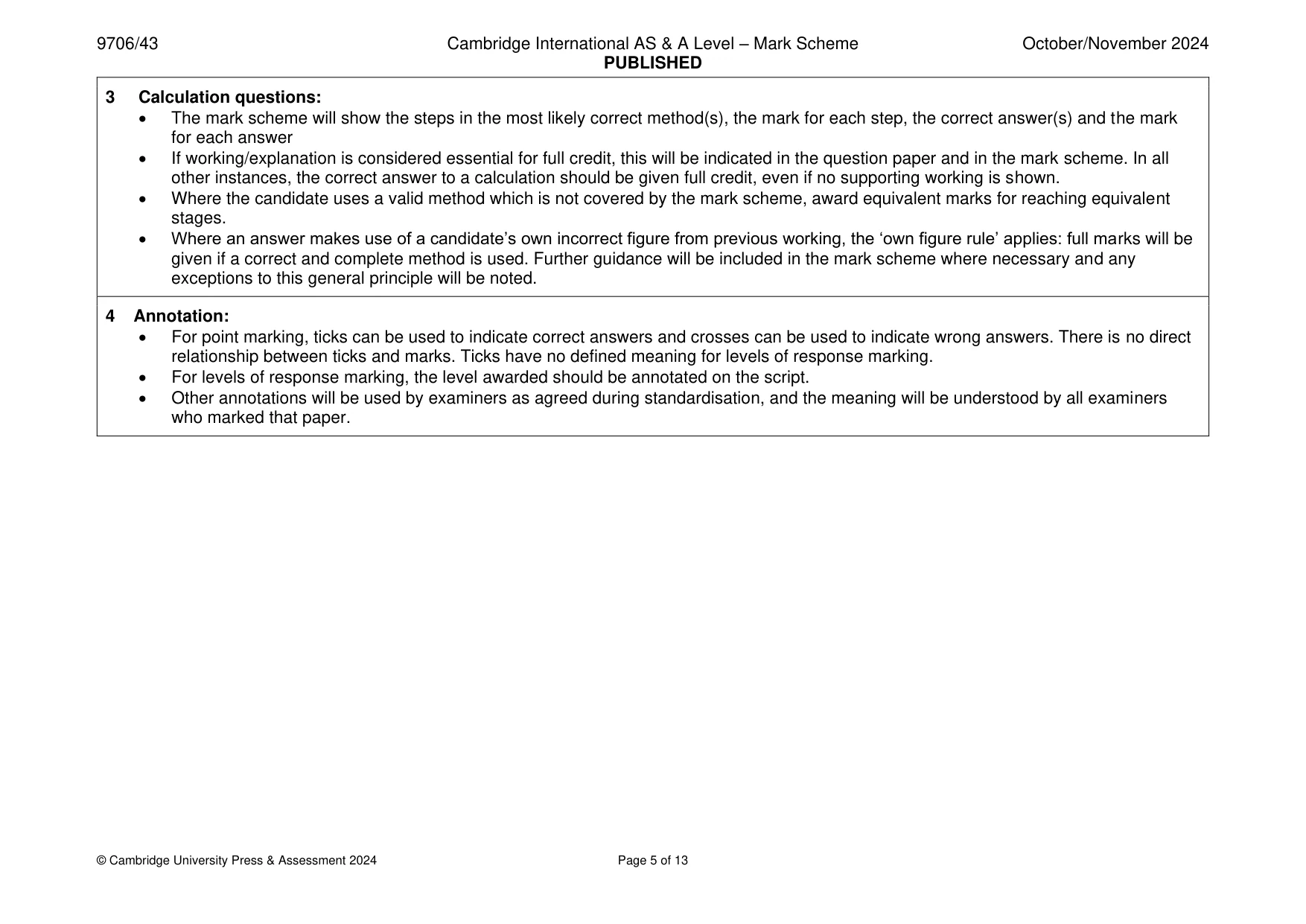
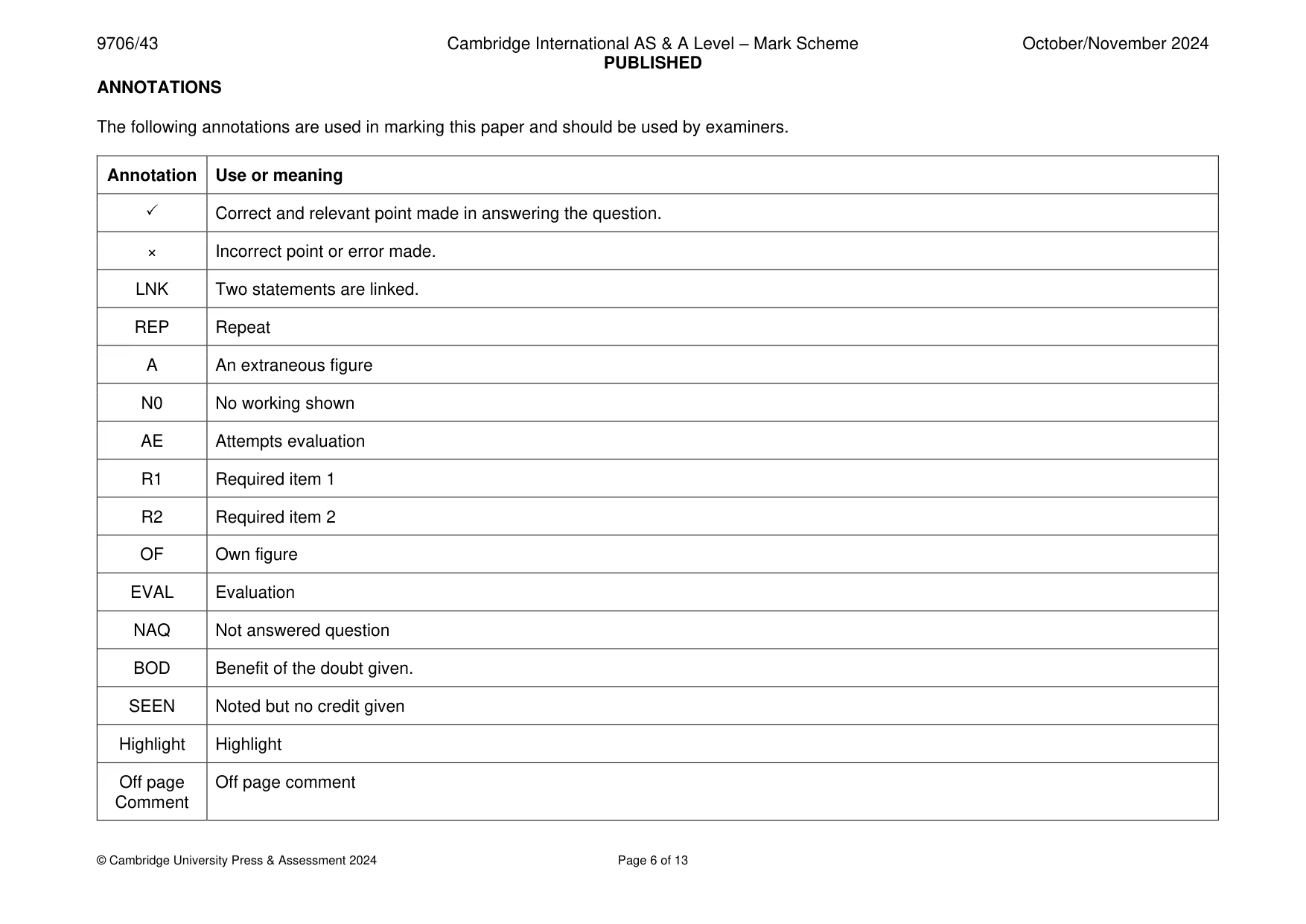
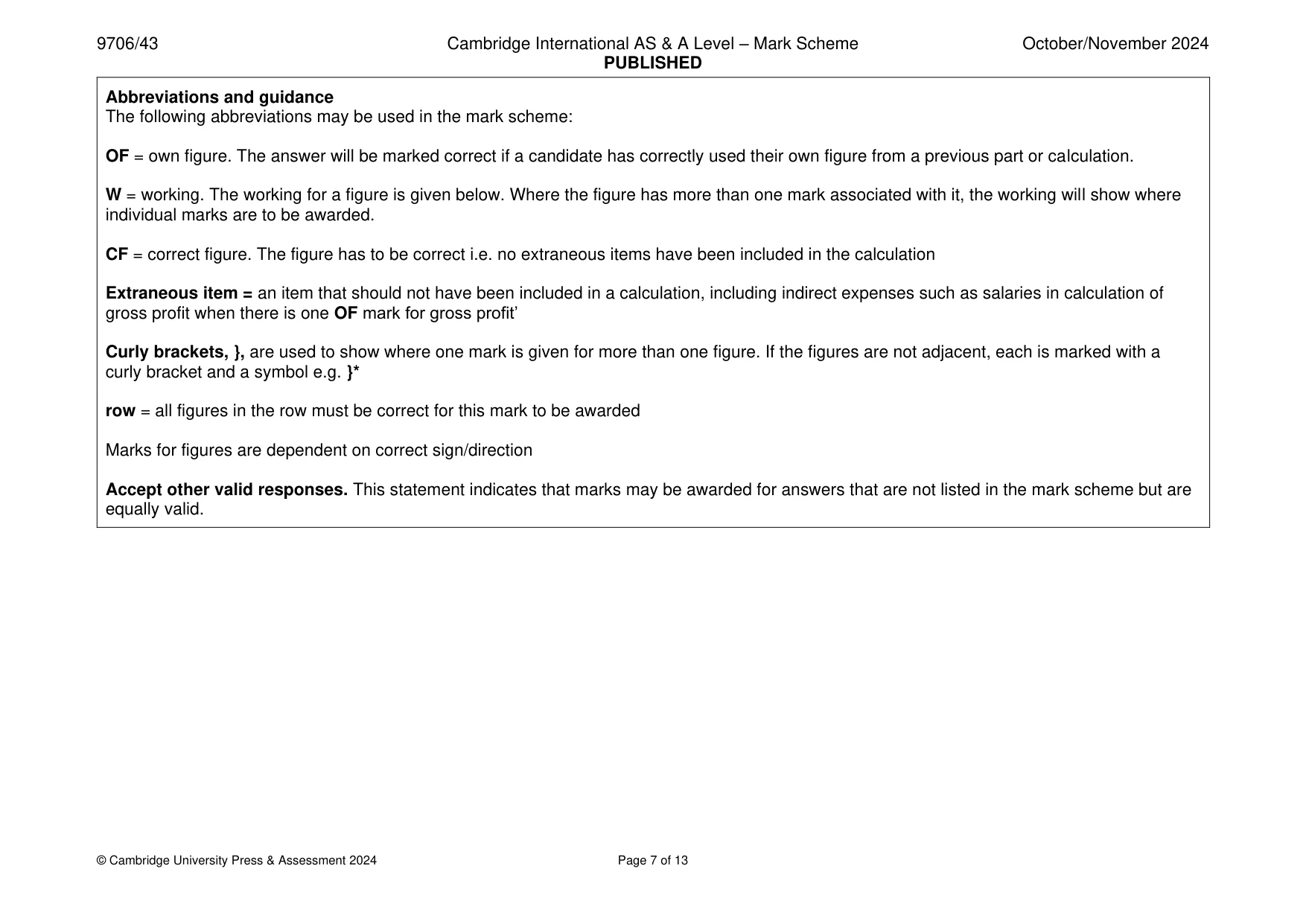
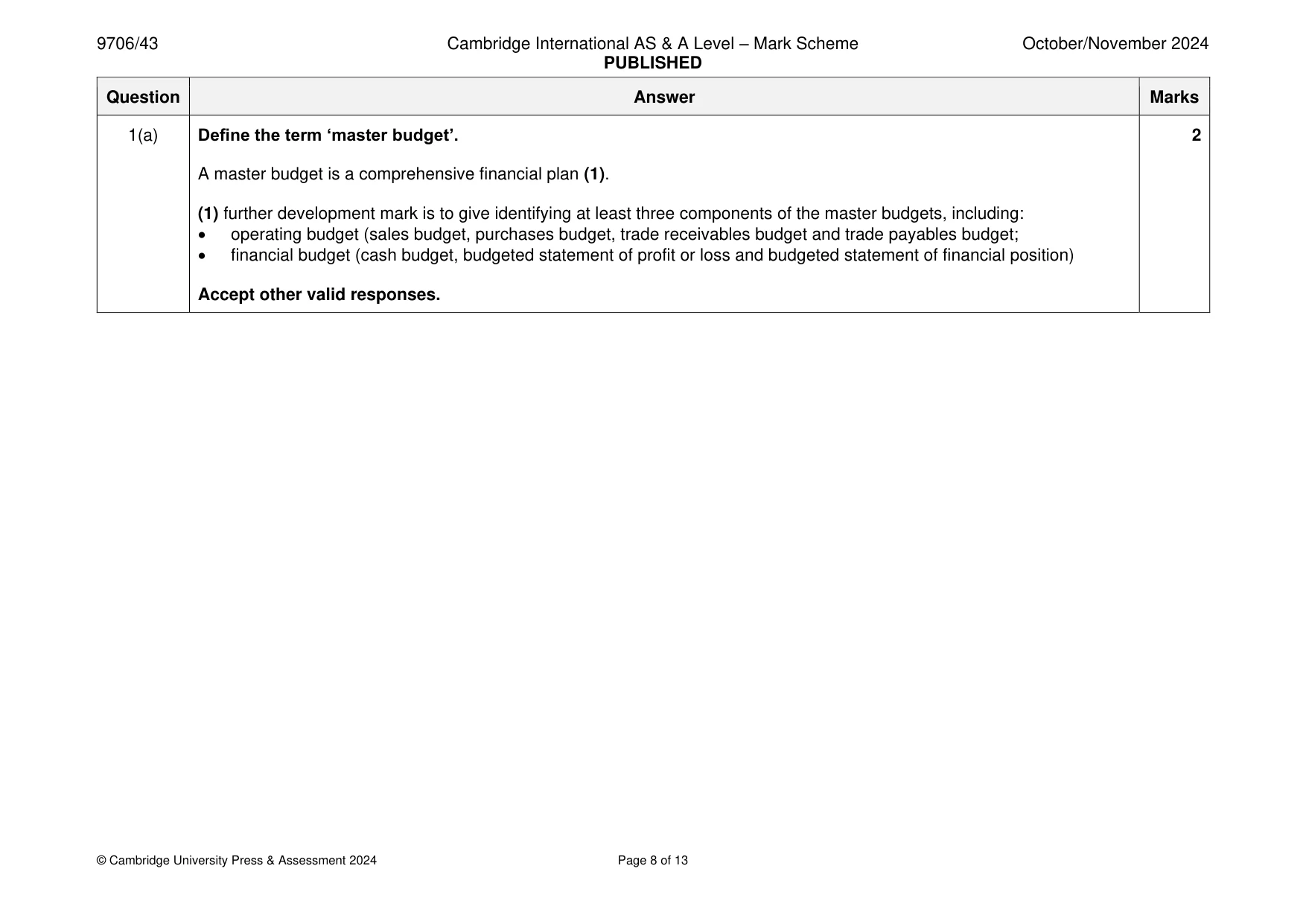
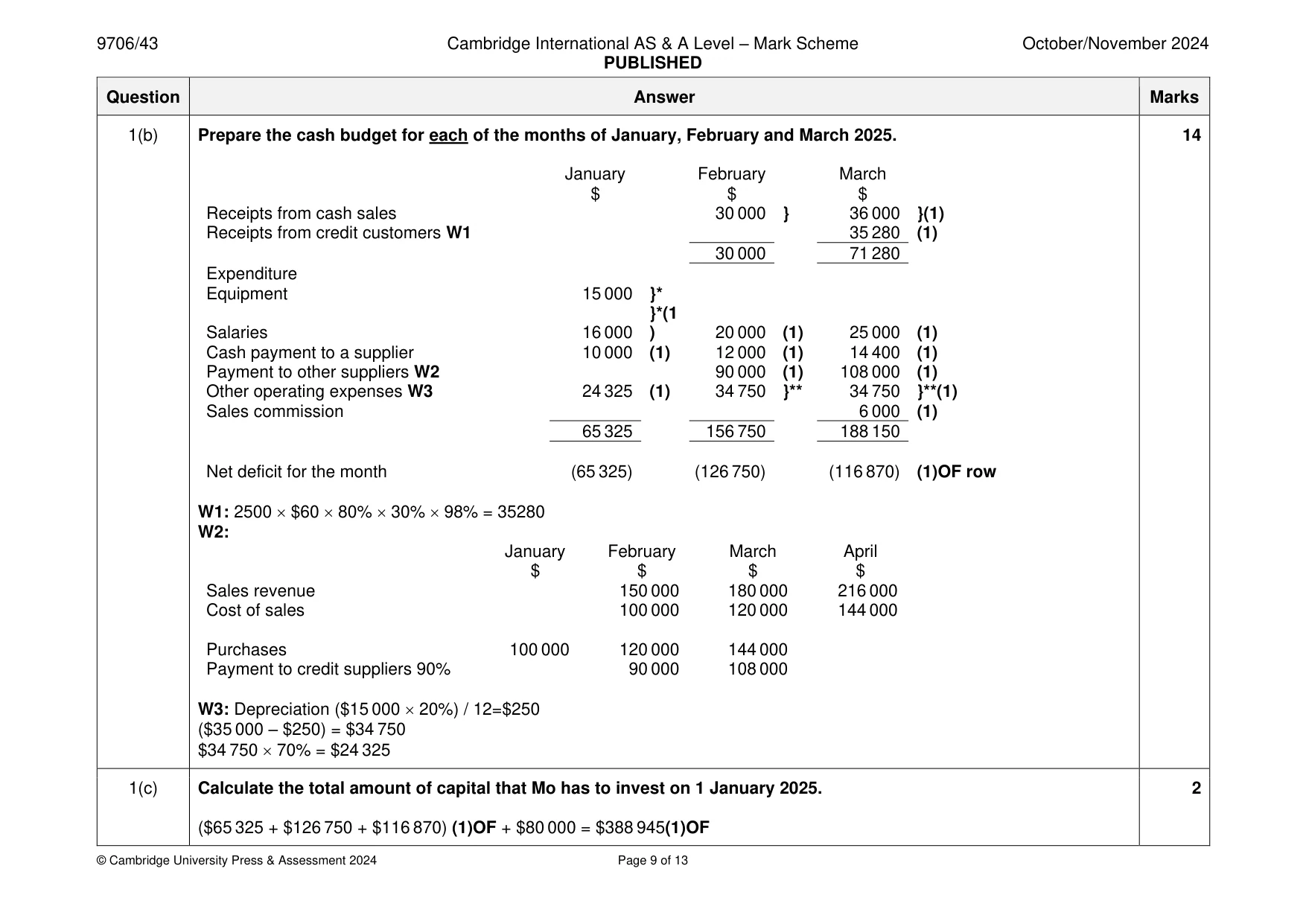
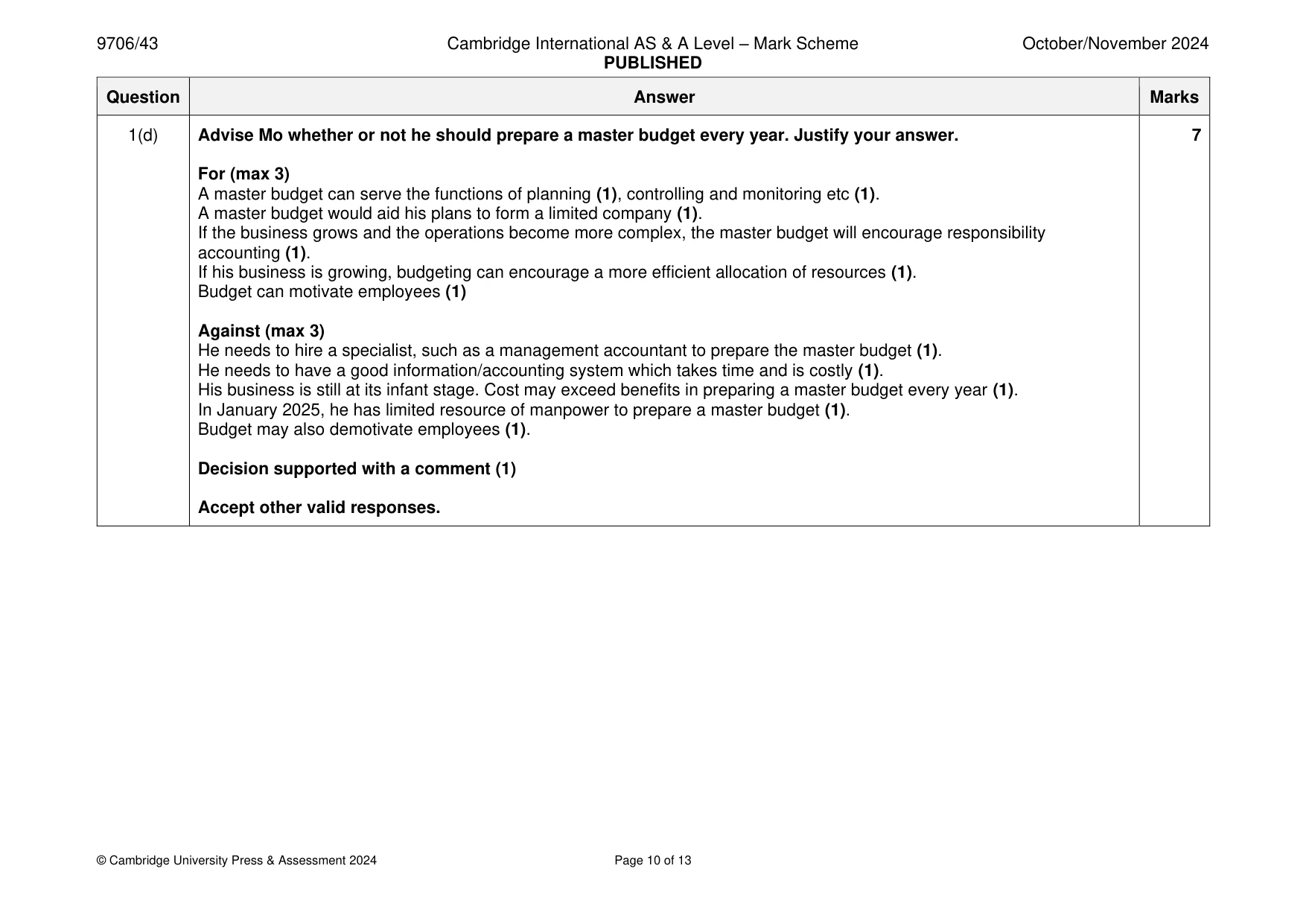
Mark scheme: Question Answer Marks 1(a) Define the term ‘master budget’. 2 A master budget is a comprehensive financial plan (1). (1) further development mark is to give identifying at least three components of the master budgets, including: • operating budget (sales budget, purchases budget, trade receivables budget and trade payables budget; • financial budget (cash budget, budgeted statement of profit or loss and budgeted statement of financial position) Accept other valid responses. 1(b) Prepare the cash budget for each of the months of January, February and March 2025. 14 January February March $ $ $ Receipts from cash sales 30 000 } 36 000 }(1) Receipts from credit customers W1 35 280 (1) 30 000 71 280 Expenditure Equipment 15 000 }* }*(1 Salaries 16 000 ) 20 000 (1) 25 000 (1) Cash payment to a supplier 10 000 (1) 12 000 (1) 14 400 (1) Payment to other suppliers W2 90 000 (1) 108 000 (1) Other operating expenses W3 24 325 (1) 34 750 }** 34 750 }**(1) Sales commission 6 000 (1) 65 325 156 750 188 150 Net deficit for the month (65 325) (126 750) (116 870) (1)OF row W1: 2500 $60 80% 30% 98% = 35280 W2: January February March April $ $ $ $ Sales revenue 150 000 180 000 216 000 Cost of sales 100 000 120 000 144 000 Purchases 100 000 120 000 144 000 Payment to credit suppliers 90% 90 000 108 000 W3: Depreciation ($15 000 20%) / 12=$250 ($35 000 – $250) = $34 750 $34 750 70% = $24 325 1(c) Calculate the total amount of capital that Mo has to invest on 1 January 2025. 2 ($65 325 + $126 750 + $116 870) (1)OF + $80 000 = $388 945(1)OF 1(d) Advise Mo whether or not he should prepare a master budget every year. Justify your answer. 7 For (max 3) A master budget can serve the functions of planning (1), controlling and monitoring etc (1). A master budget would aid his plans to form a limited company (1). If the business grows and the operations become more complex, the master budget will encourage responsibility accounting (1). If his business is growing, budgeting can encourage a more efficient allocation of resources (1). Budget can motivate employees (1) Against (max 3) He needs to hire a specialist, such as a management accountant to prepare the master budget (1). He needs to have a good information/accounting system which takes time and is costly (1). His business is still at its infant stage. Cost may exceed benefits in preparing a master budget every year (1). In January 2025, he has limited resource of manpower to prepare a master budget (1). Budget may also demotivate employees (1). Decision supported with a comment (1) Accept other valid responses.
Q2 · Read Source B in the insert
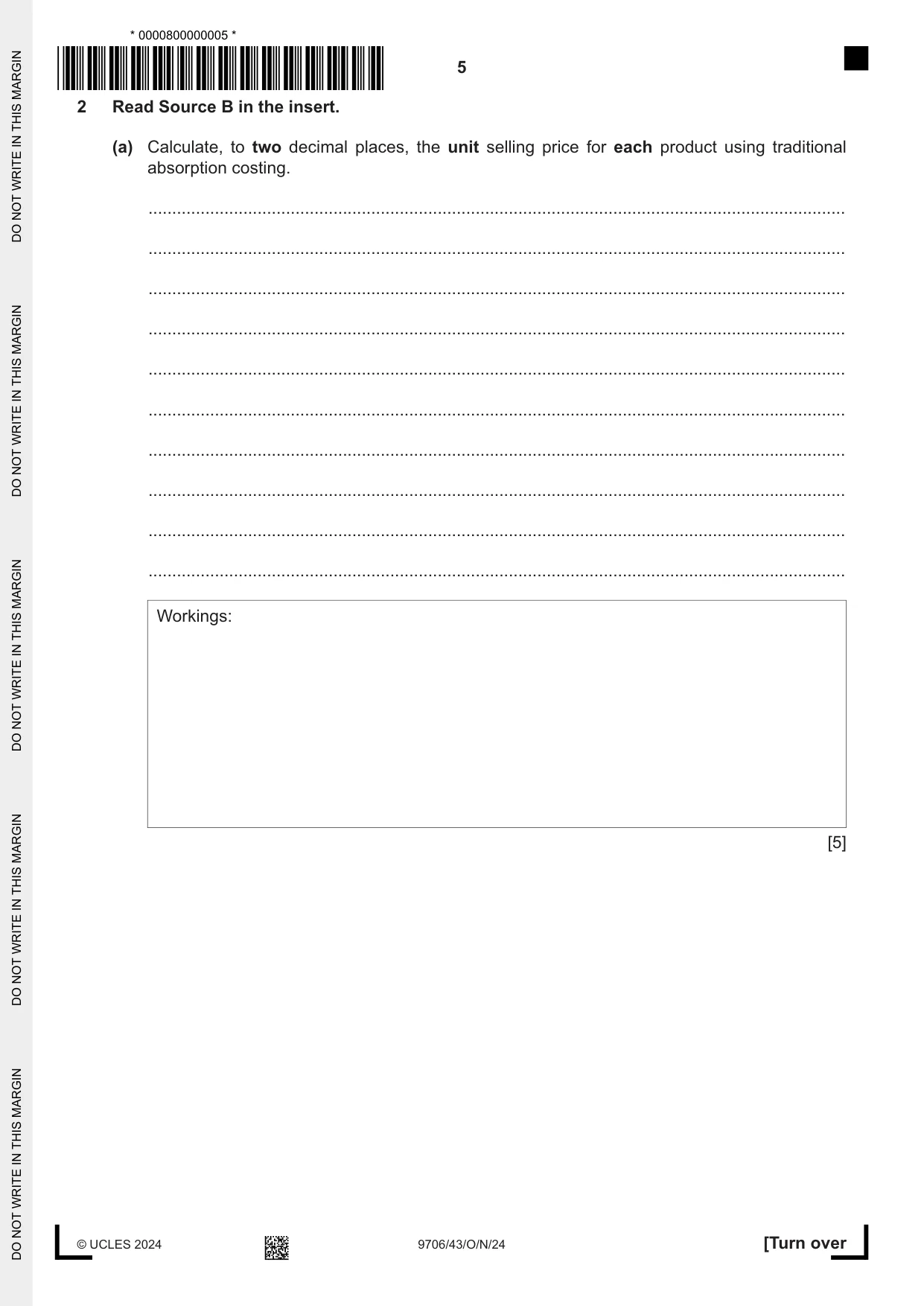
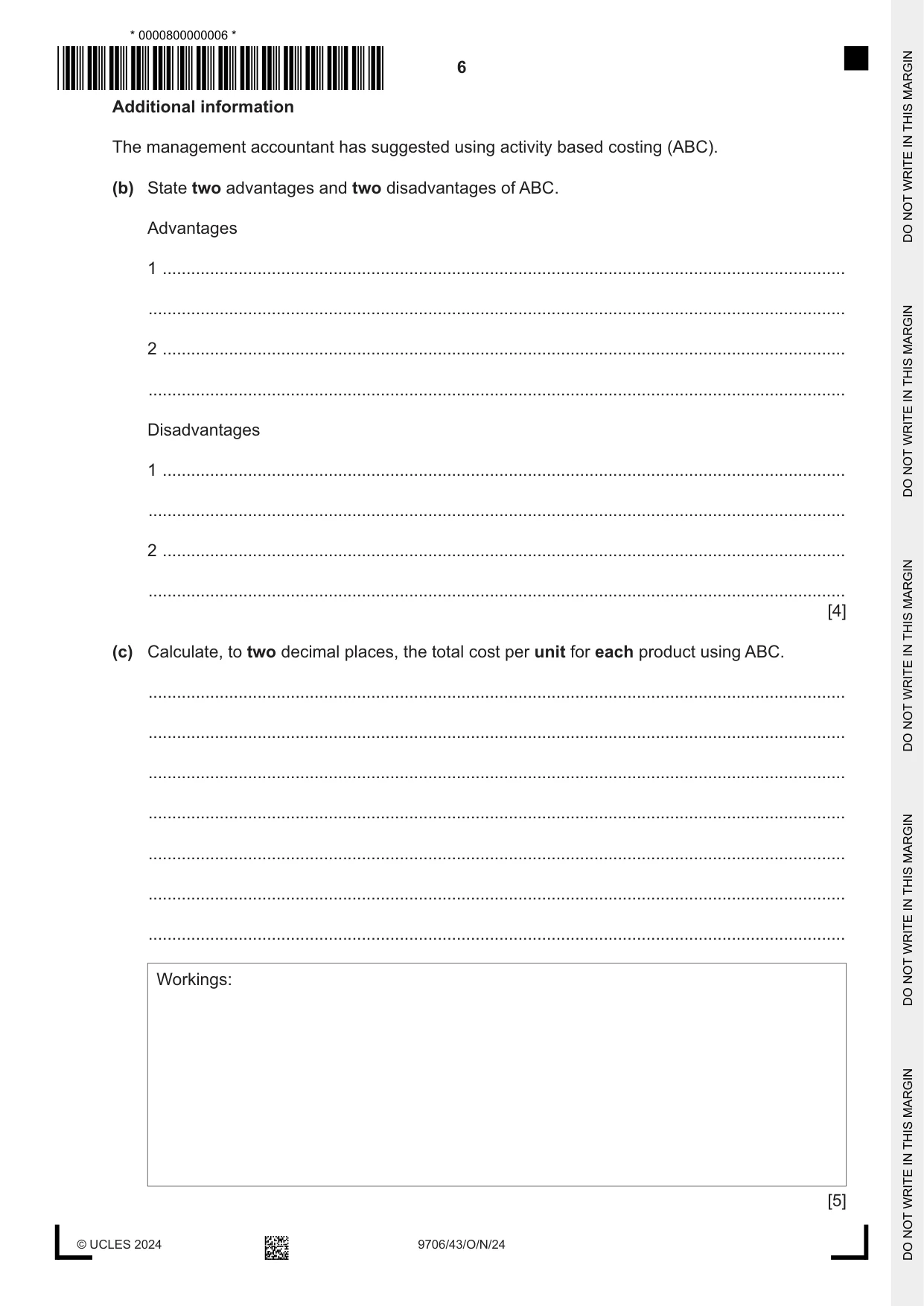
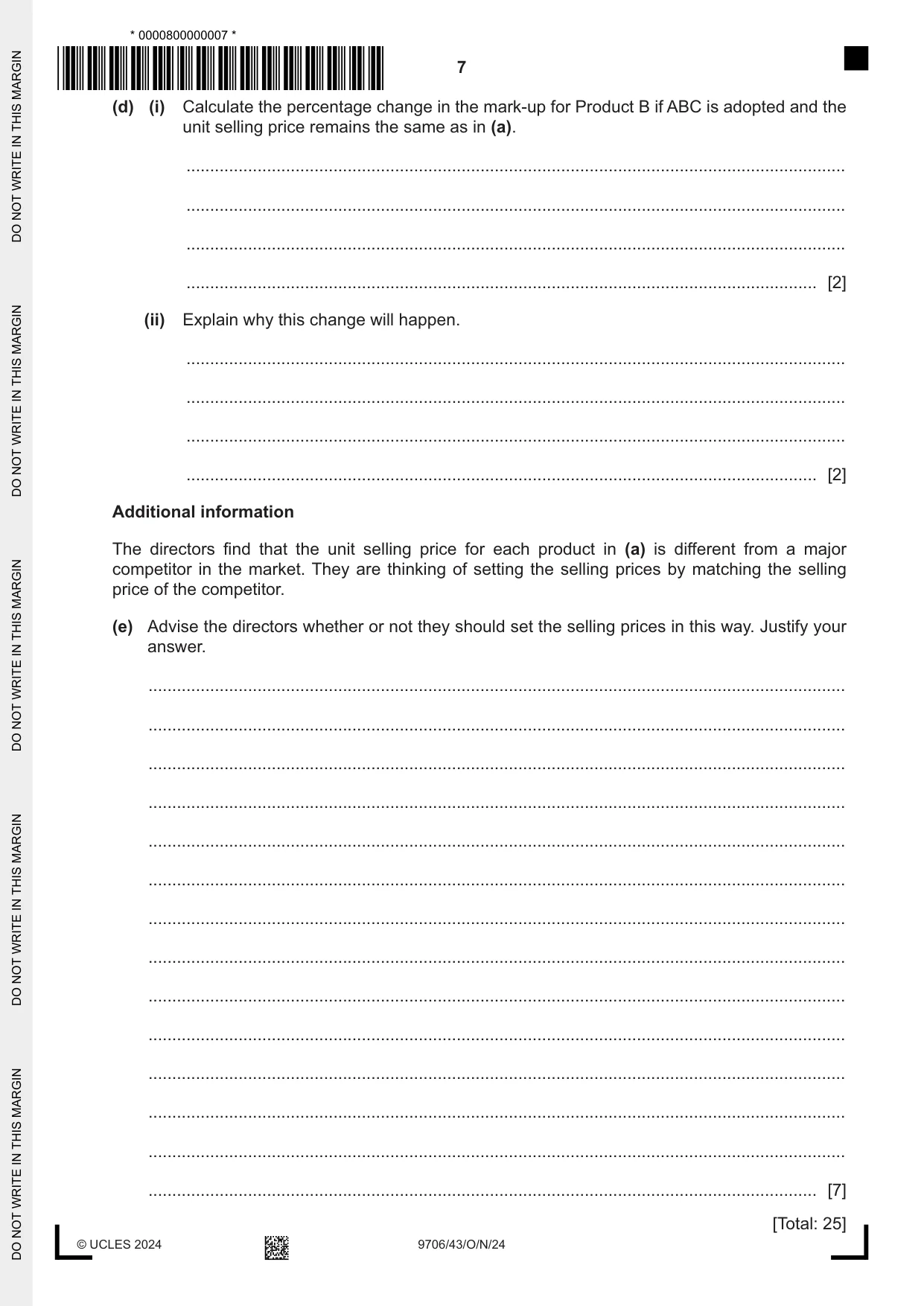
2 Read Source B in the insert. (a) Calculate, to two decimal places, the unit selling price for each product using traditional absorption costing. ................................................................................................................................................... ................................................................................................................................................... ................................................................................................................................................... ................................................................................................................................................... ................................................................................................................................................... ................................................................................................................................................... ................................................................................................................................................... ................................................................................................................................................... ................................................................................................................................................... ................................................................................................................................................... Workings: [5] Additional information The management accountant has suggested using activity based costing (ABC). (b) State two advantages and two disadvantages of ABC. Advantages 1 ................................................................................................................................................ ................................................................................................................................................... 2 ................................................................................................................................................ ................................................................................................................................................... Disadvantages 1 ................................................................................................................................................ ................................................................................................................................................... 2 ................................................................................................................................................ ................................................................................................................................................... [4] (c) Calculate, to two decimal places, the total cost per unit for each product using ABC. ................................................................................................................................................... ................................................................................................................................................... ................................................................................................................................................... ................................................................................................................................................... ................................................................................................................................................... ................................................................................................................................................... ................................................................................................................................................... Workings: [5] (d) (i) Calculate the percentage change in the mark-up for Product B if ABC is adopted and the unit selling price remains the same as in (a). ........................................................................................................................................... ........................................................................................................................................... ........................................................................................................................................... ..................................................................................................................................... [2] (ii) Explain why this change will happen. ........................................................................................................................................... ........................................................................................................................................... ........................................................................................................................................... ..................................................................................................................................... [2] Additional information The directors find that the unit selling price for each product in (a) is different from a major competitor in the market. They are thinking of setting the selling prices by matching the selling price of the competitor. (e) Advise the directors whether or not they should set the selling prices in this way. Justify your answer. ................................................................................................................................................... ................................................................................................................................................... ................................................................................................................................................... ................................................................................................................................................... ................................................................................................................................................... ................................................................................................................................................... ................................................................................................................................................... ................................................................................................................................................... ................................................................................................................................................... ................................................................................................................................................... ................................................................................................................................................... ................................................................................................................................................... ................................................................................................................................................... ............................................................................................................................................. [7]
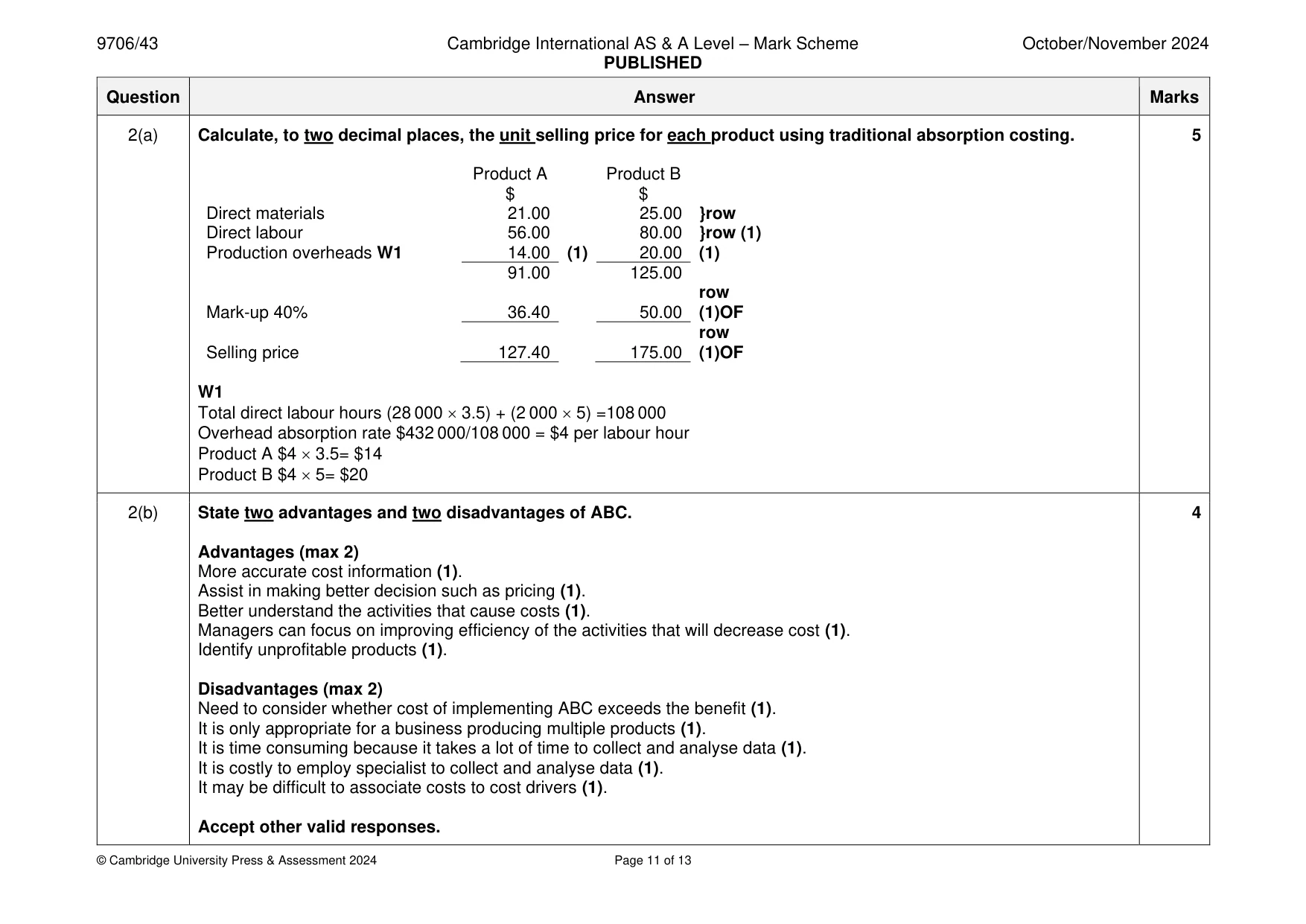
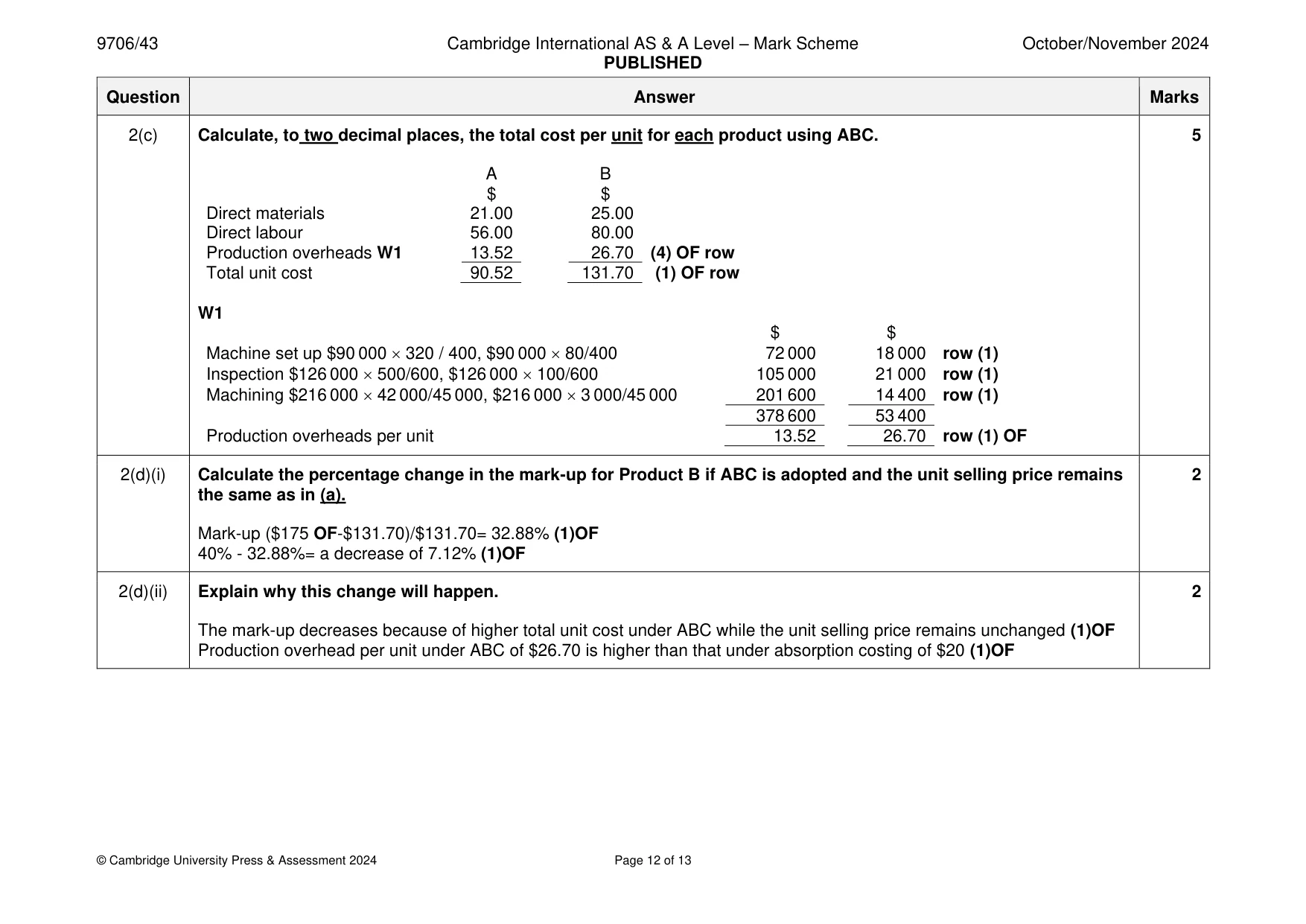
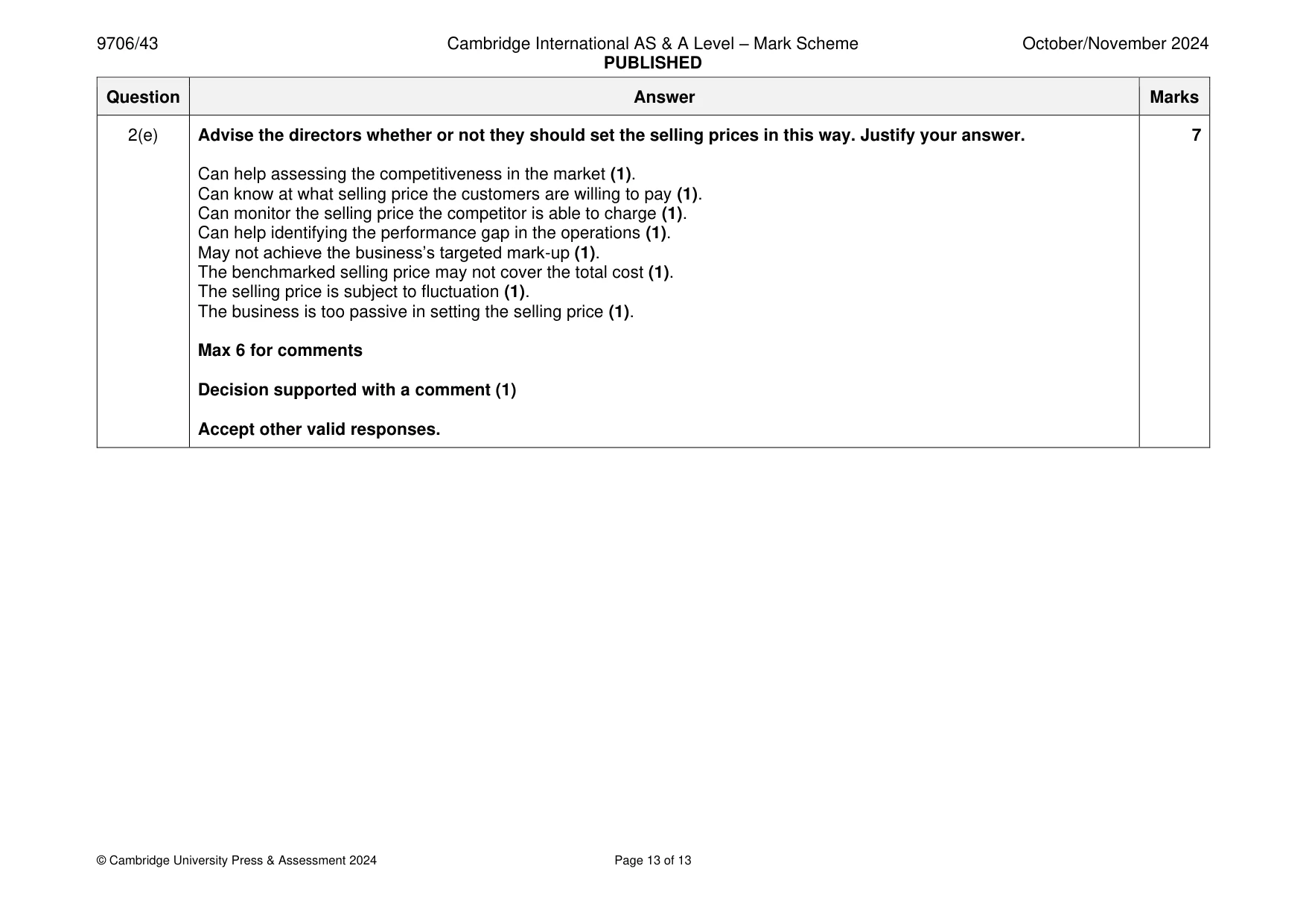
Mark scheme: 2(a) Calculate, to two decimal places, the unit selling price for each product using traditional absorption costing. 5 Product A Product B $ $ Direct materials 21.00 25.00 }row Direct labour 56.00 80.00 }row (1) Production overheads W1 14.00 (1) 20.00 (1) 91.00 125.00 row Mark-up 40% 36.40 50.00 (1)OF row Selling price 127.40 175.00 (1)OF W1 Total direct labour hours (28 000 3.5) + (2 000 5) =108 000 Overhead absorption rate $432 000/108 000 = $4 per labour hour Product A $4 3.5= $14 Product B $4 5= $20 2(b) State two advantages and two disadvantages of ABC. 4 Advantages (max 2) More accurate cost information (1). Assist in making better decision such as pricing (1). Better understand the activities that cause costs (1). Managers can focus on improving efficiency of the activities that will decrease cost (1). Identify unprofitable products (1). Disadvantages (max 2) Need to consider whether cost of implementing ABC exceeds the benefit (1). It is only appropriate for a business producing multiple products (1). It is time consuming because it takes a lot of time to collect and analyse data (1). It is costly to employ specialist to collect and analyse data (1). It may be difficult to associate costs to cost drivers (1). Accept other valid responses. 2(c) Calculate, to two decimal places, the total cost per unit for each product using ABC. 5 A B $ $ Direct materials 21.00 25.00 Direct labour 56.00 80.00 Production overheads W1 13.52 26.70 (4) OF row Total unit cost 90.52 131.70 (1) OF row W1 $ $ Machine set up $90 000 320 / 400, $90 000 80/400 72 000 18 000 row (1) Inspection $126 000 500/600, $126 000 100/600 105 000 21 000 row (1) Machining $216 000 42 000/45 000, $216 000 3 000/45 000 201 600 14 400 row (1) 378 600 53 400 Production overheads per unit 13.52 26.70 row (1) OF 2(d)(i) Calculate the percentage change in the mark-up for Product B if ABC is adopted and the unit selling price remains 2 the same as in (a). Mark-up ($175 OF-$131.70)/$131.70= 32.88% (1)OF 40% - 32.88%= a decrease of 7.12% (1)OF 2(d)(ii) Explain why this change will happen. 2 The mark-up decreases because of higher total unit cost under ABC while the unit selling price remains unchanged (1)OF Production overhead per unit under ABC of $26.70 is higher than that under absorption costing of $20 (1)OF 2(e) Advise the directors whether or not they should set the selling prices in this way. Justify your answer. 7 Can help assessing the competitiveness in the market (1). Can know at what selling price the customers are willing to pay (1). Can monitor the selling price the competitor is able to charge (1). Can help identifying the performance gap in the operations (1). May not achieve the business’s targeted mark-up (1). The benchmarked selling price may not cover the total cost (1). The selling price is subject to fluctuation (1). The business is too passive in setting the selling price (1). Max 6 for comments Decision supported with a comment (1) Accept other valid responses.
What was in this paper
The subtopics covered by these 2 questions, and how many questions each got. Open one in a new tab to see every Cambridge question on it.
What you needed in this session
Cambridge’s own grade thresholds for 2024 Oct/Nov, Paper 4 · Variant 3. A higher threshold means an easier paper — the bar moves with how the cohort did.